Test Driven Development
 and Related Techniques
 For Non-Developers ;-)
        IBM 2012

     Peter Kofler, ‘Code Cop’
         @codecopkofler
       www.code-cop.org
    Copyright Peter Kofler, licensed under CC-BY.
Peter Kofler

•   Ph.D. (Appl. Math.)
•   (Java) Software Developer
•   with IBM since 1 year
•   SDM Costing, IGA, GBS
The opinions expressed here are my
own and do not necessarily represent
 those of current or past employers.
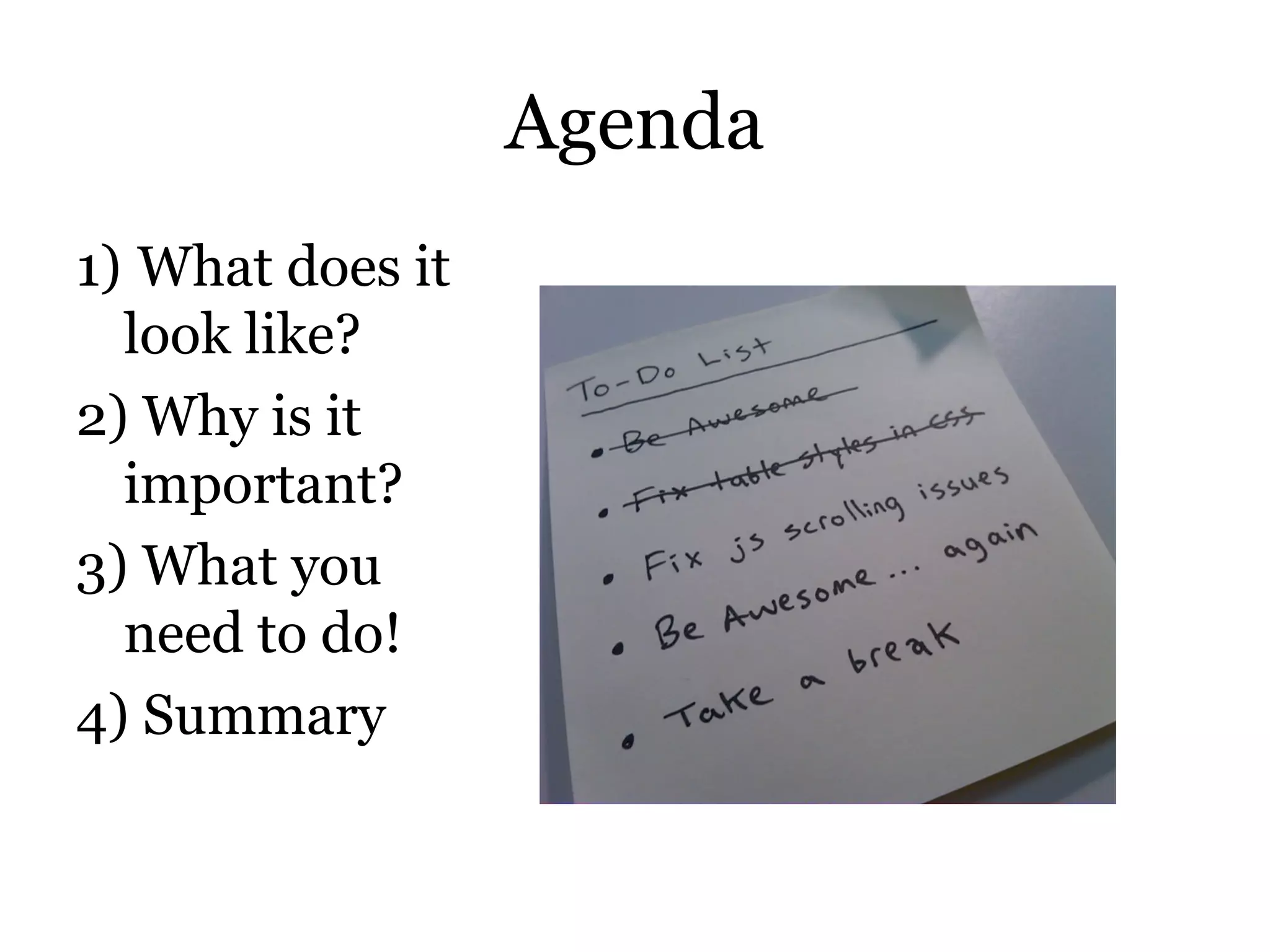
Agenda
1) What does it
  look like?
2) Why is it
  important?
3) What you
  need to do!
4) Summary
1) So what is it all about?


The Prime Factors
  Kata (Demo)
What Exactly Will We Do Now?
●
    write code together
●
    using TDD
●
    see techniques
      and patterns
●
    discuss while
     doing
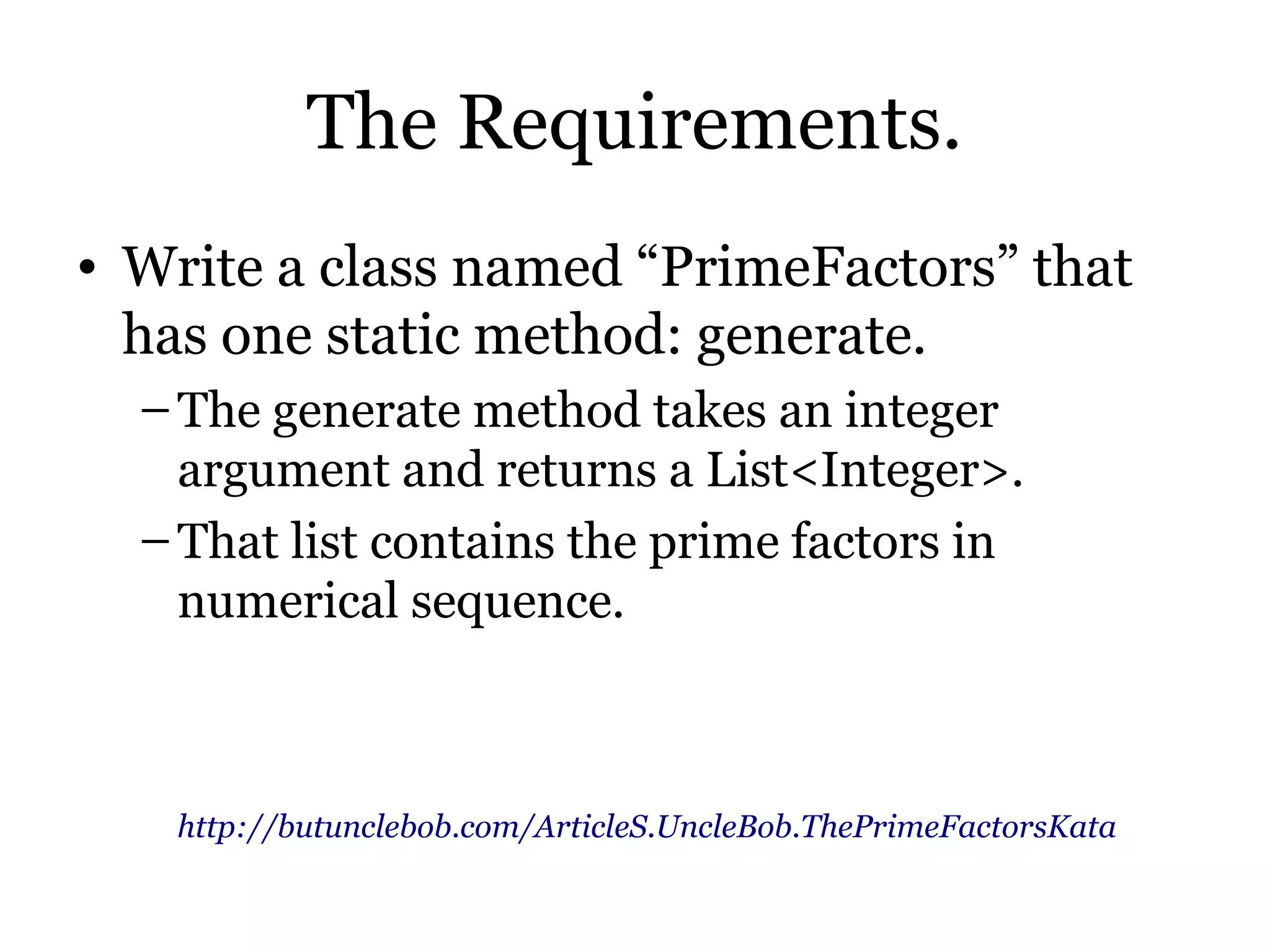
The Requirements.
• Write a class named “PrimeFactors” that
  has one static method: generate.
  – The generate method takes an integer
    argument and returns a List<Integer>.
  – That list contains the prime factors in
    numerical sequence.


   http://butunclebob.com/ArticleS.UncleBob.ThePrimeFactorsKata
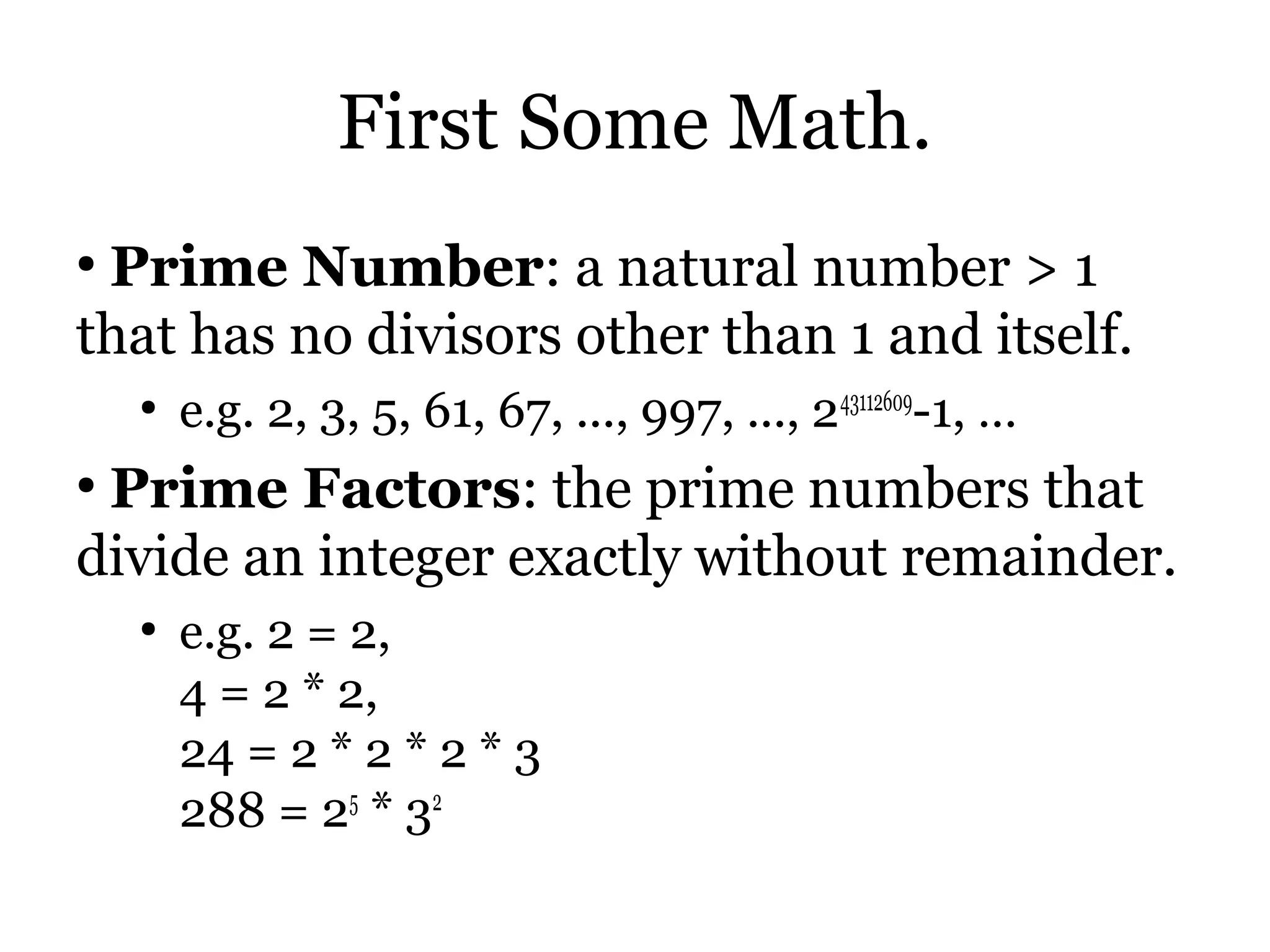
First Some Math.
●
 Prime Number: a natural number > 1
that has no divisors other than 1 and itself.
    ●
        e.g. 2, 3, 5, 61, 67, ..., 997, ..., 243112609-1, …
●
 Prime Factors: the prime numbers that
divide an integer exactly without remainder.
    ●
        e.g. 2 = 2,
        4 = 2 * 2,
        24 = 2 * 2 * 2 * 3
        288 = 25 * 32
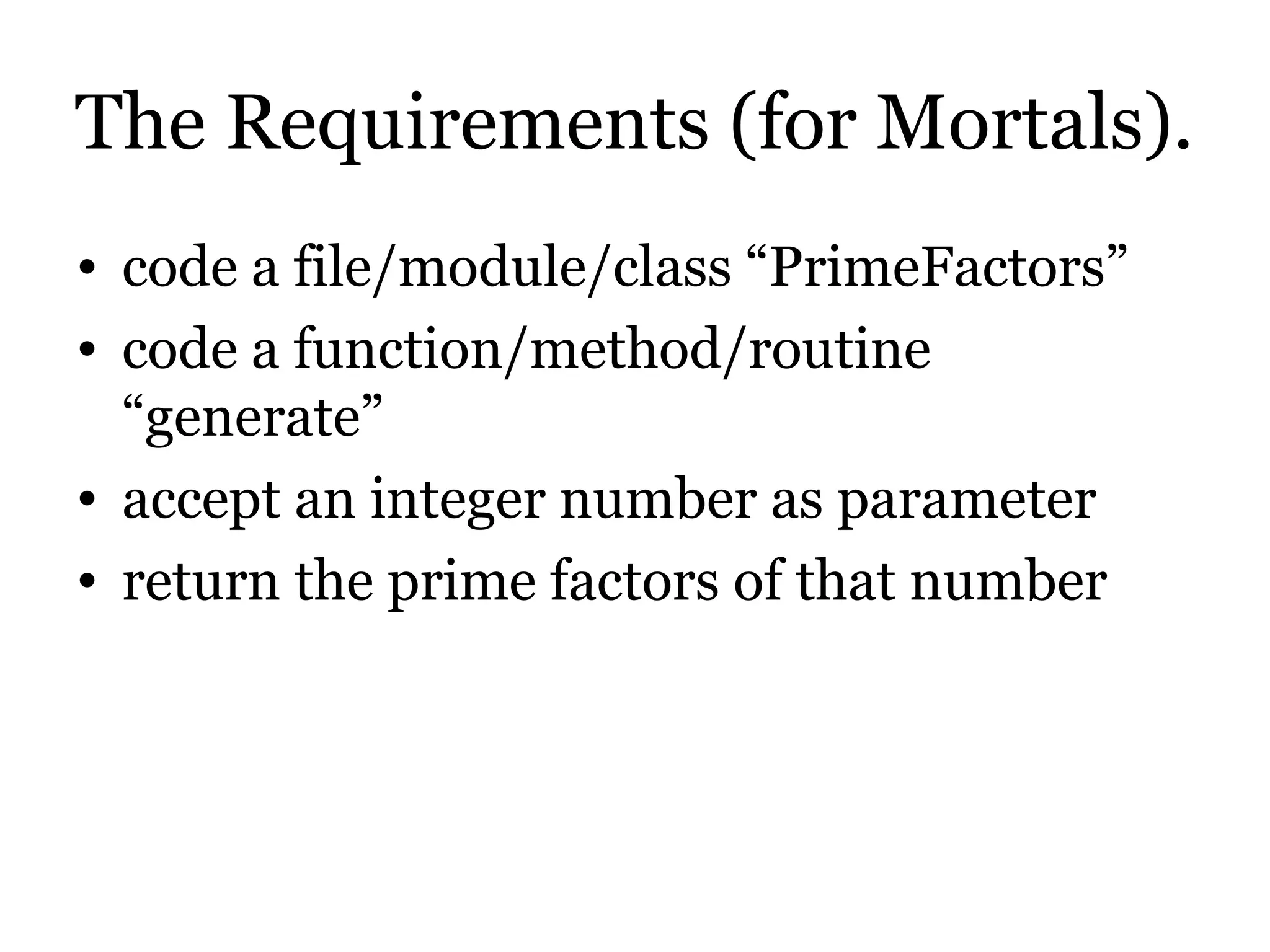
The Requirements (for Mortals).
• code a file/module/class “PrimeFactors”
• code a function/method/routine
  “generate”
• accept an integer number as parameter
• return the prime factors of that number
Demo
(Code Kata)
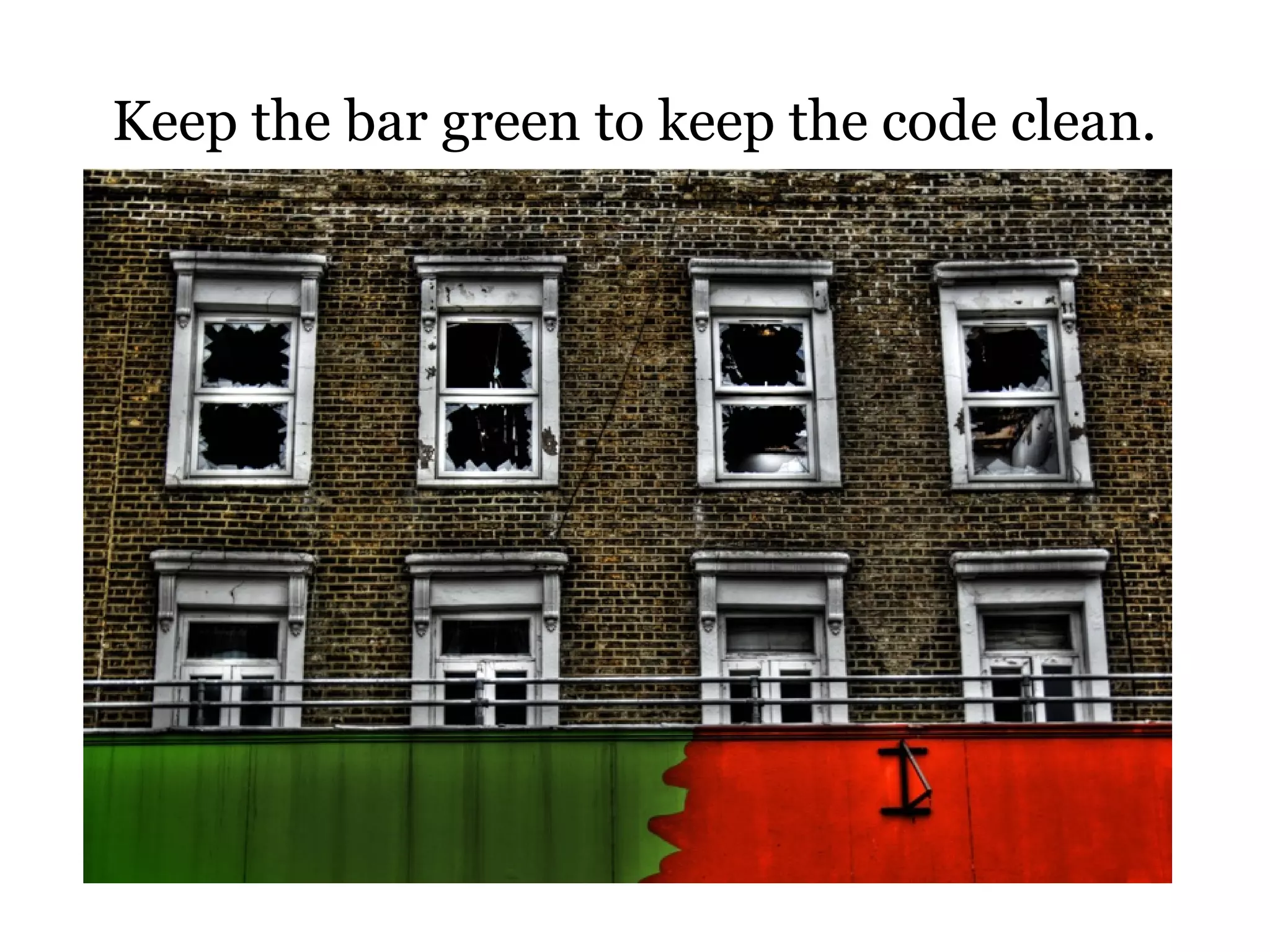
Keep the bar green to keep the code clean.
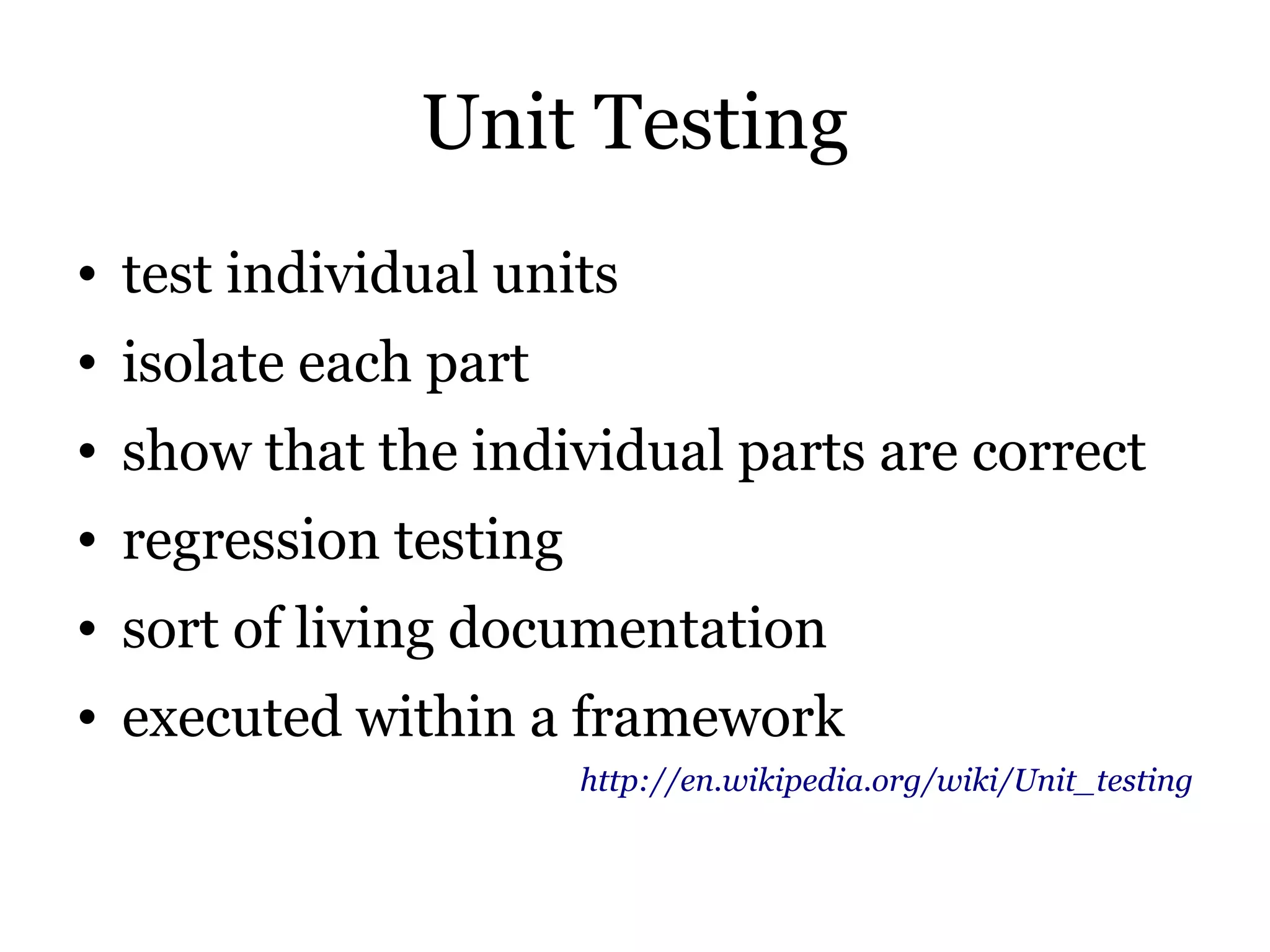
Unit Testing
• test individual units
• isolate each part
• show that the individual parts are correct
• regression testing
• sort of living documentation
• executed within a framework
                       http://en.wikipedia.org/wiki/Unit_testing
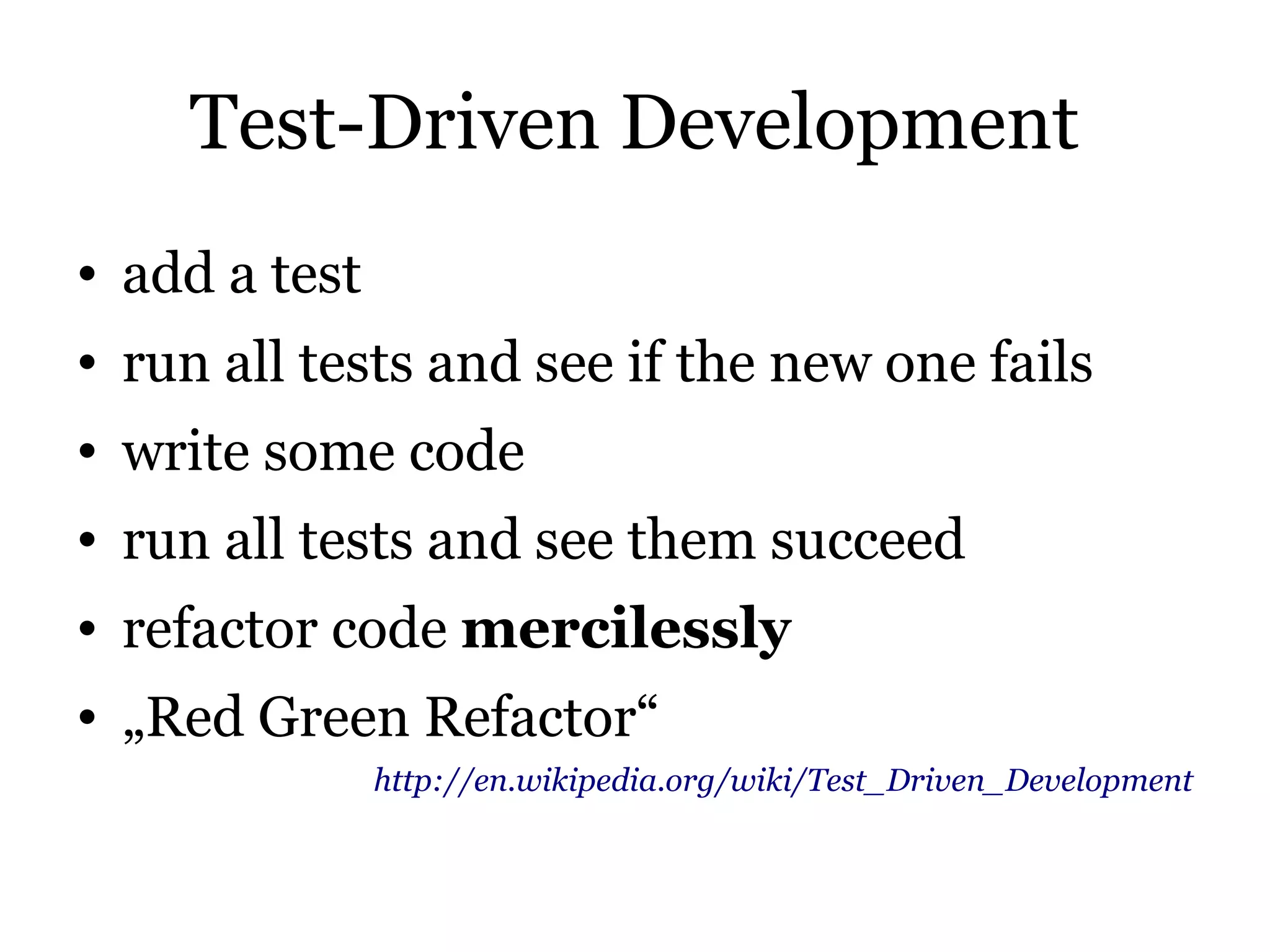
Test-Driven Development
• add a test
• run all tests and see if the new one fails
• write some code
• run all tests and see them succeed
• refactor code mercilessly
• „Red Green Refactor“
               http://en.wikipedia.org/wiki/Test_Driven_Development
A minute ago all
their code worked
Refactoring

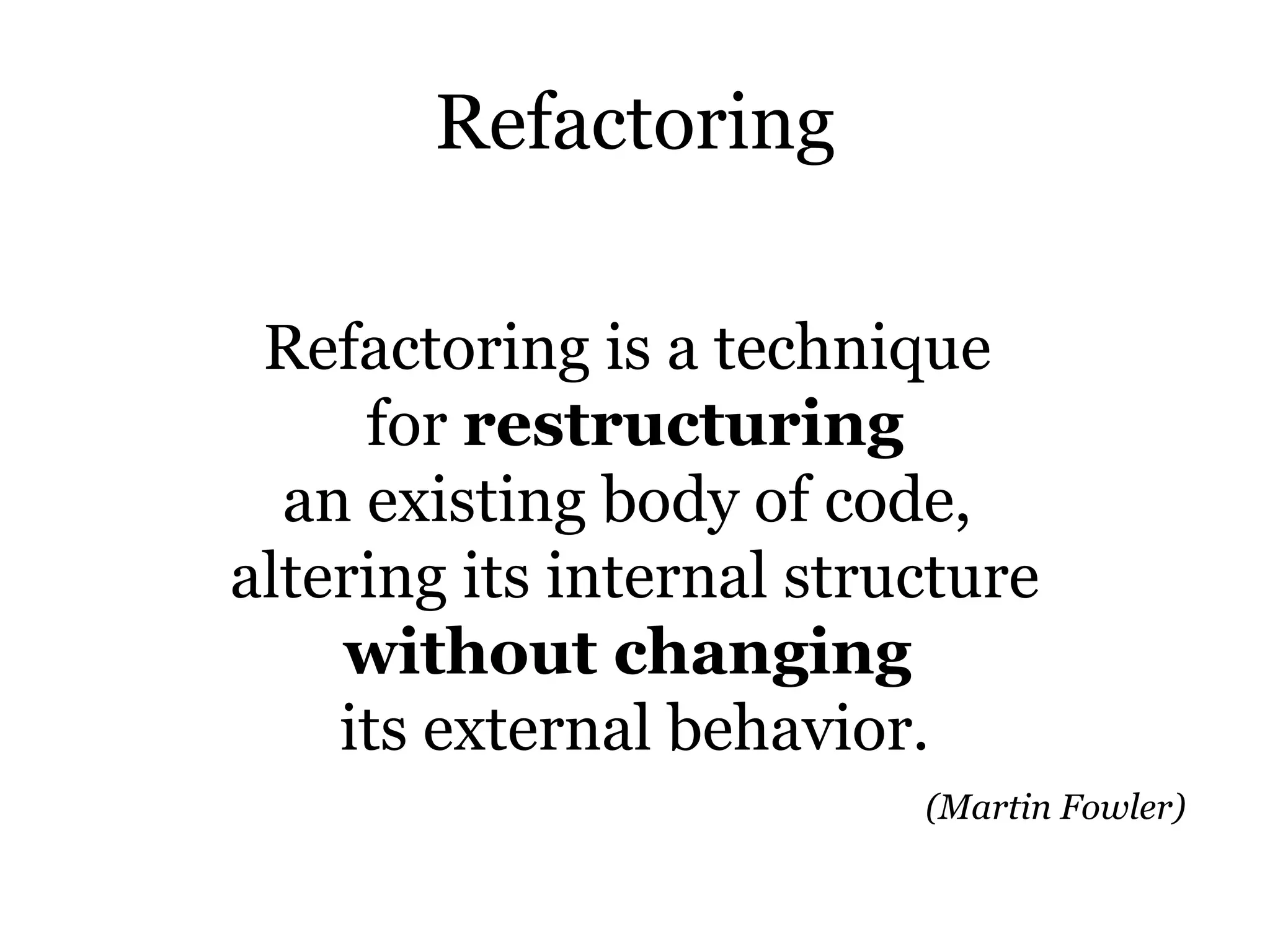
 Refactoring is a technique
     for restructuring
  an existing body of code,
altering its internal structure
    without changing
    its external behavior.
                          (Martin Fowler)
Refactoring
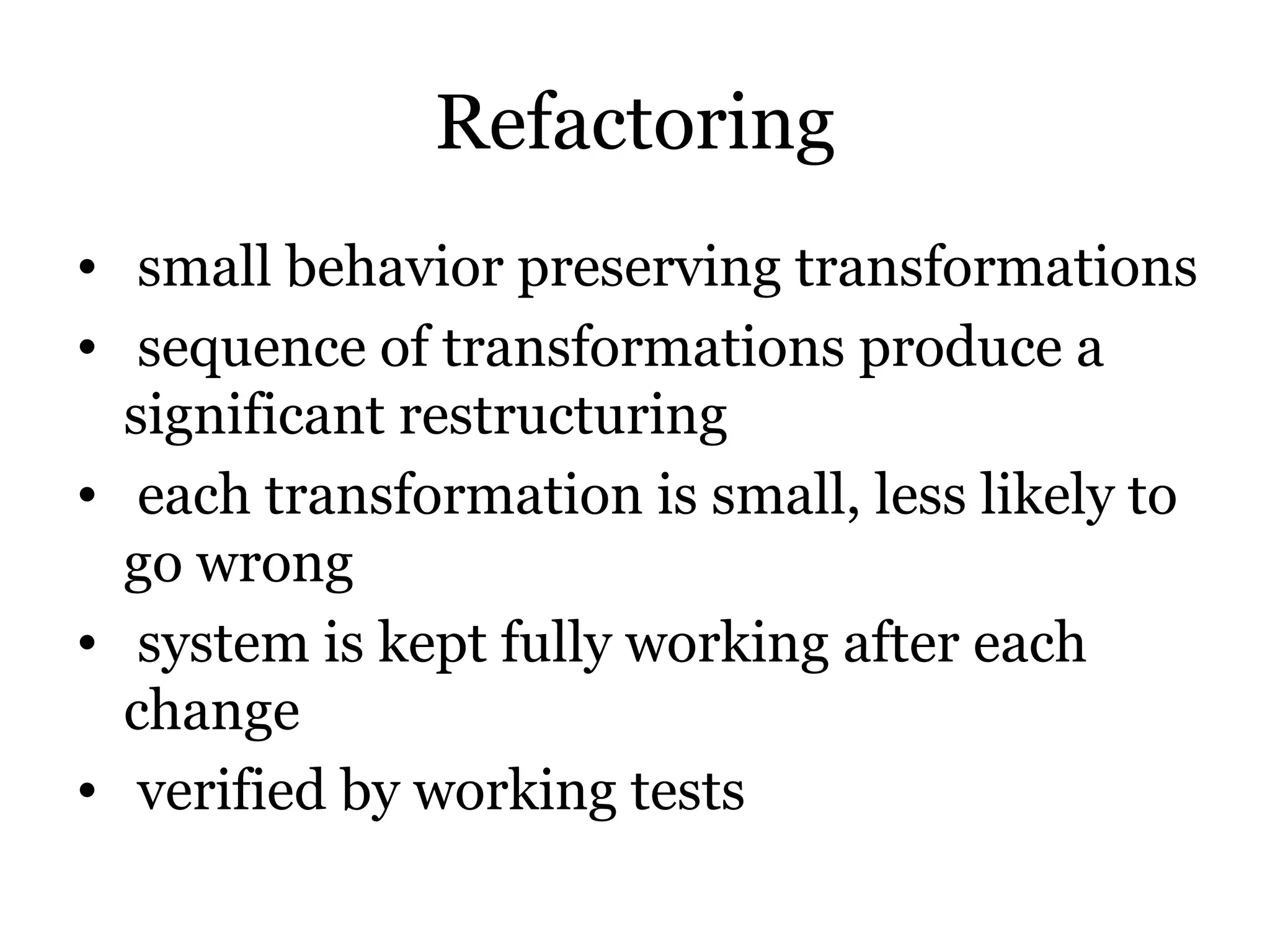
• small behavior preserving transformations
• sequence of transformations produce a
  significant restructuring
• each transformation is small, less likely to
  go wrong
• system is kept fully working after each
  change
• verified by working tests
Code Coverage

comprehensiveness of tests
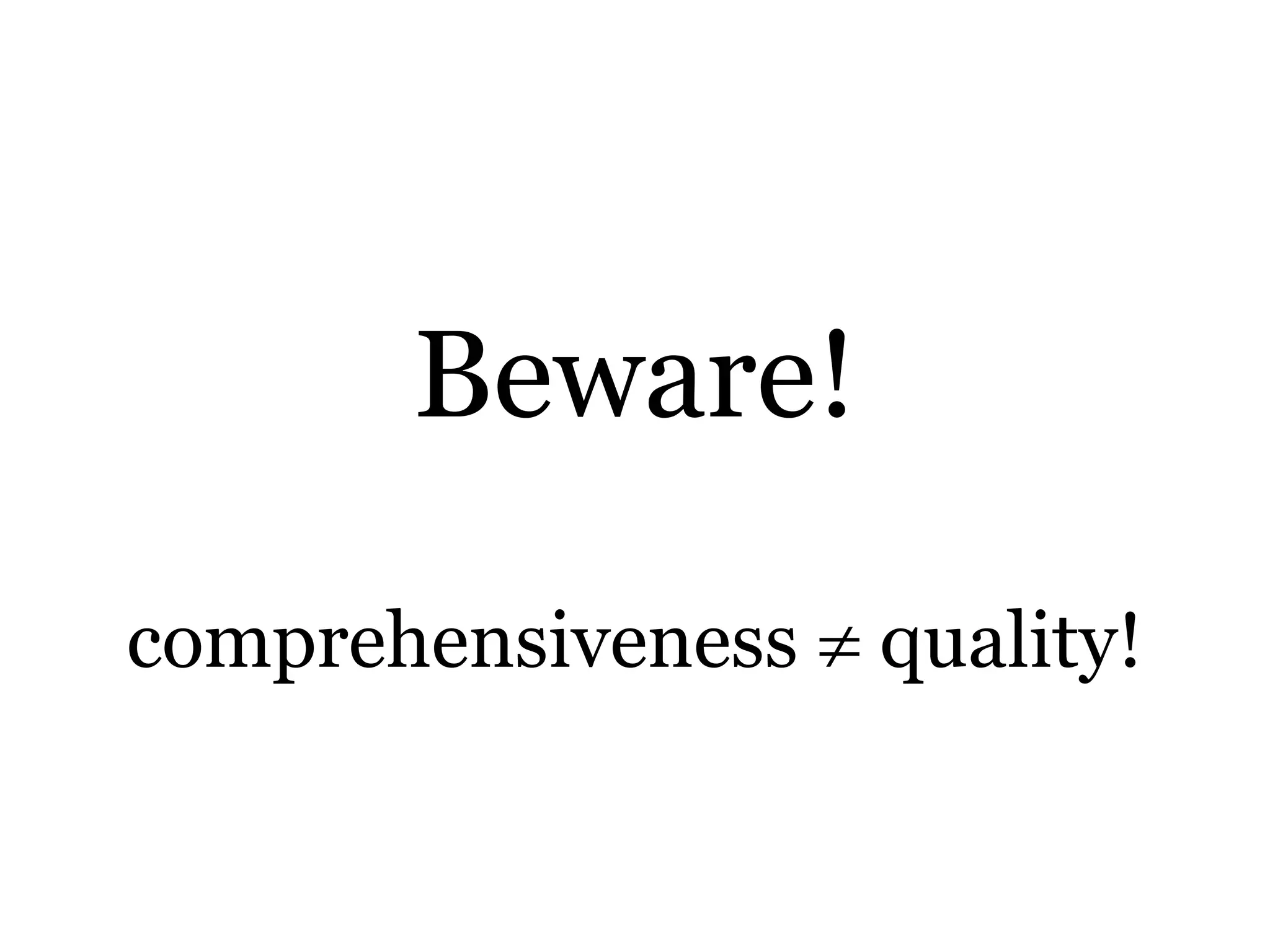
Beware!

comprehensiveness  quality!
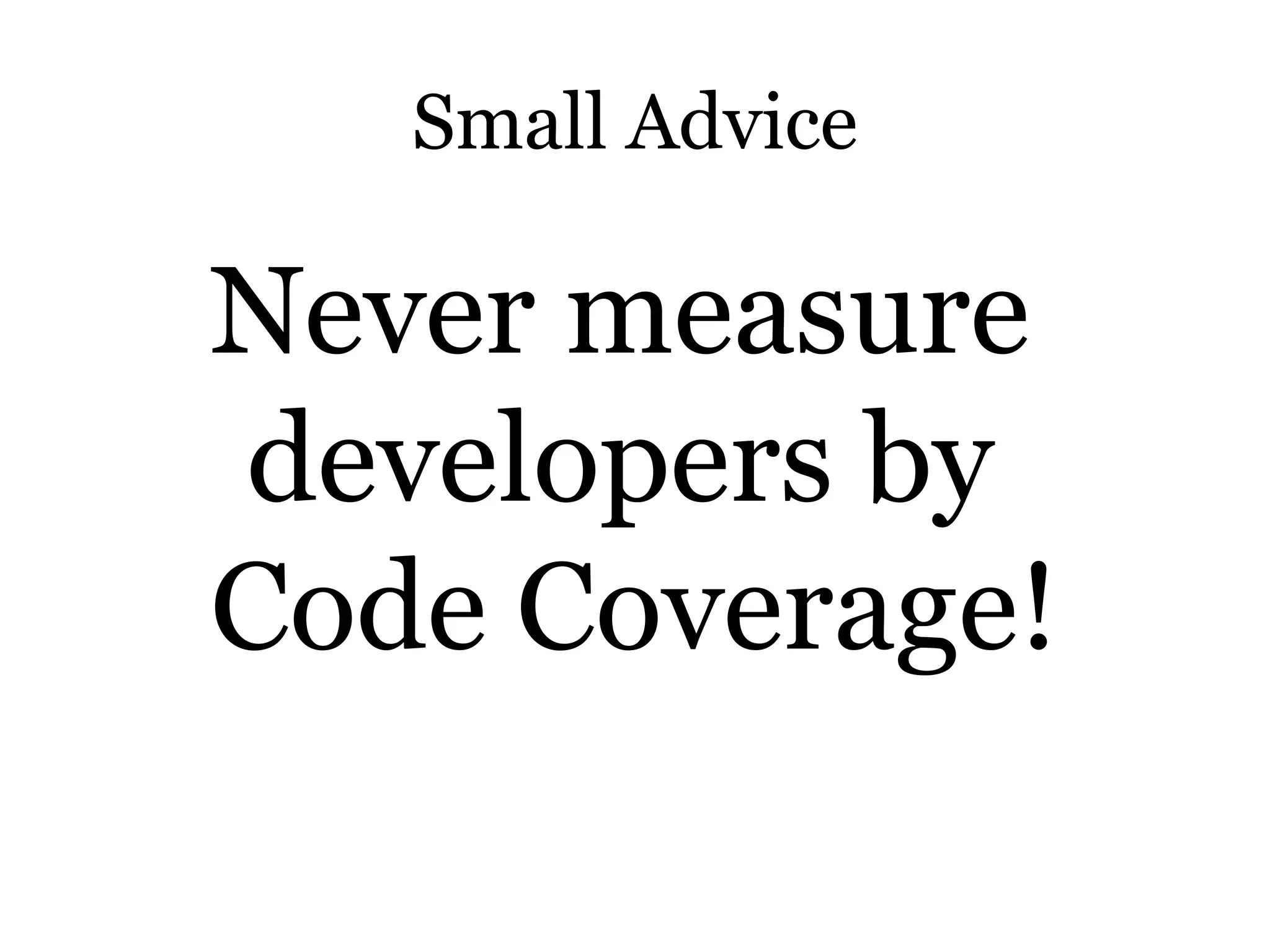
Small Advice

Never measure
developers by
Code Coverage!
Demo
(Coverage in Eclipse)
Demo
 (Jenkins)
Continuous
Integration
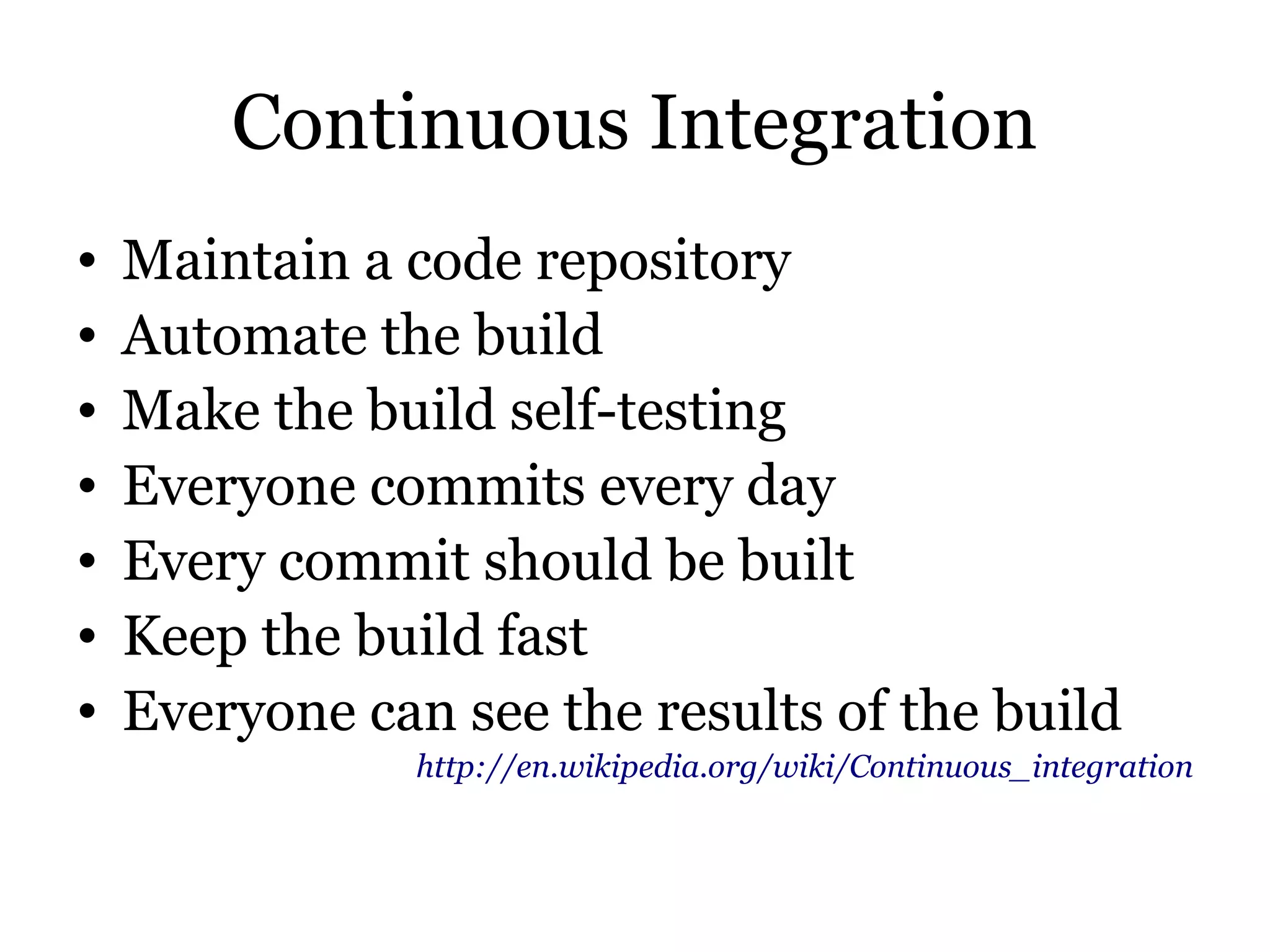
Continuous Integration
•   Maintain a code repository
•   Automate the build
•   Make the build self-testing
•   Everyone commits every day
•   Every commit should be built
•   Keep the build fast
•   Everyone can see the results of the build
                http://en.wikipedia.org/wiki/Continuous_integration
Immediate Feedback
       and
  Early Warning
Demo
 (Jenkins)
2) Why should we use TDD?
• Writing tests takes time
• and we need to    deliver client
 value.
              I don't have time.
              I don't have time.
              I don't have time.
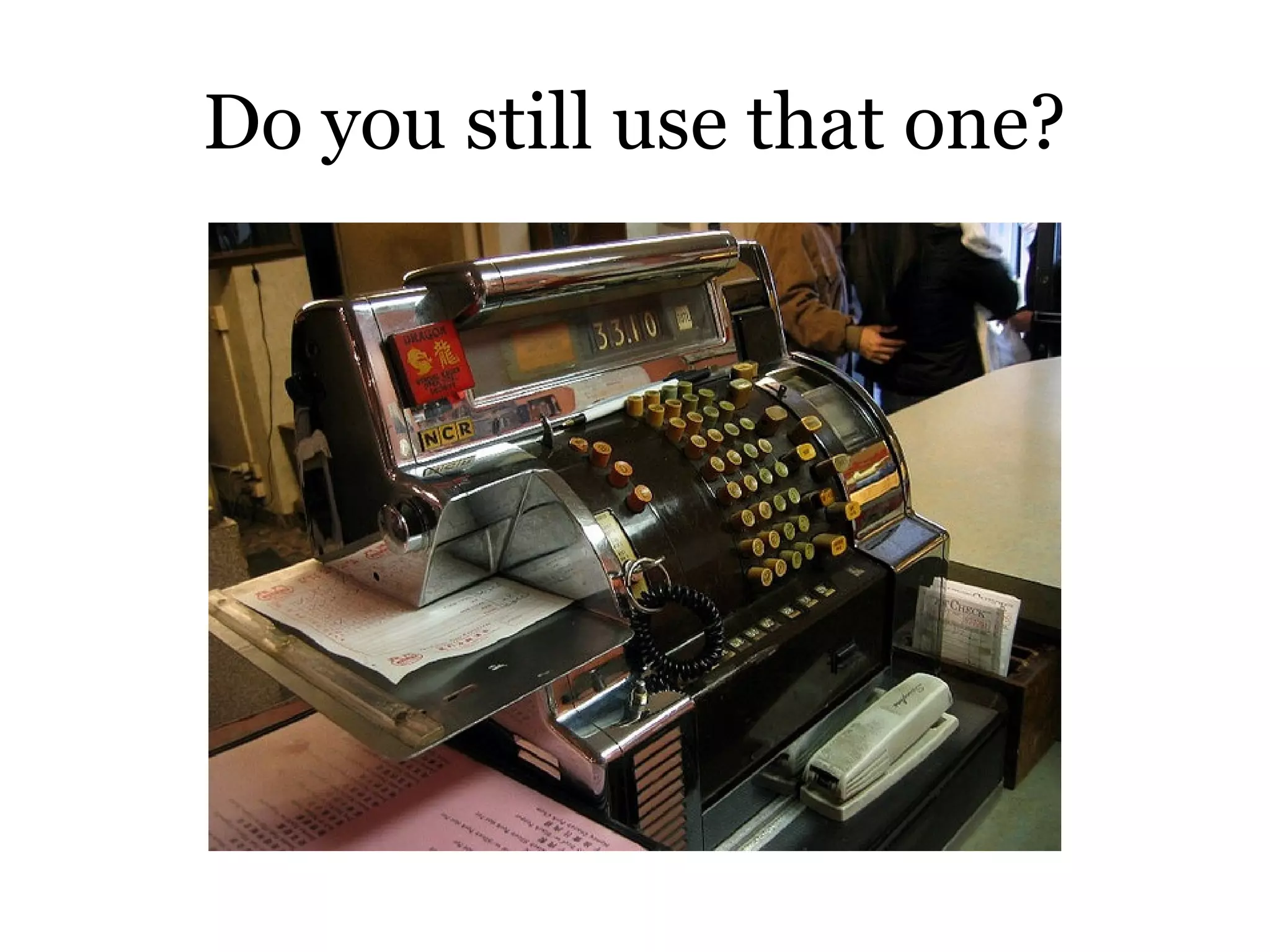
Do you still use that one?
Discussion
• What do you think are the benefits of
  TDD?
  – rapid feedback
  –…
  – ...
Benefits
• speed up
• coverage
  – measurable validation of correctness
• quality
  – proven to save maintenance costs
• creates a detailed specification
Benefits
• improve design
  – drive the design of a program
  – think in exposed API
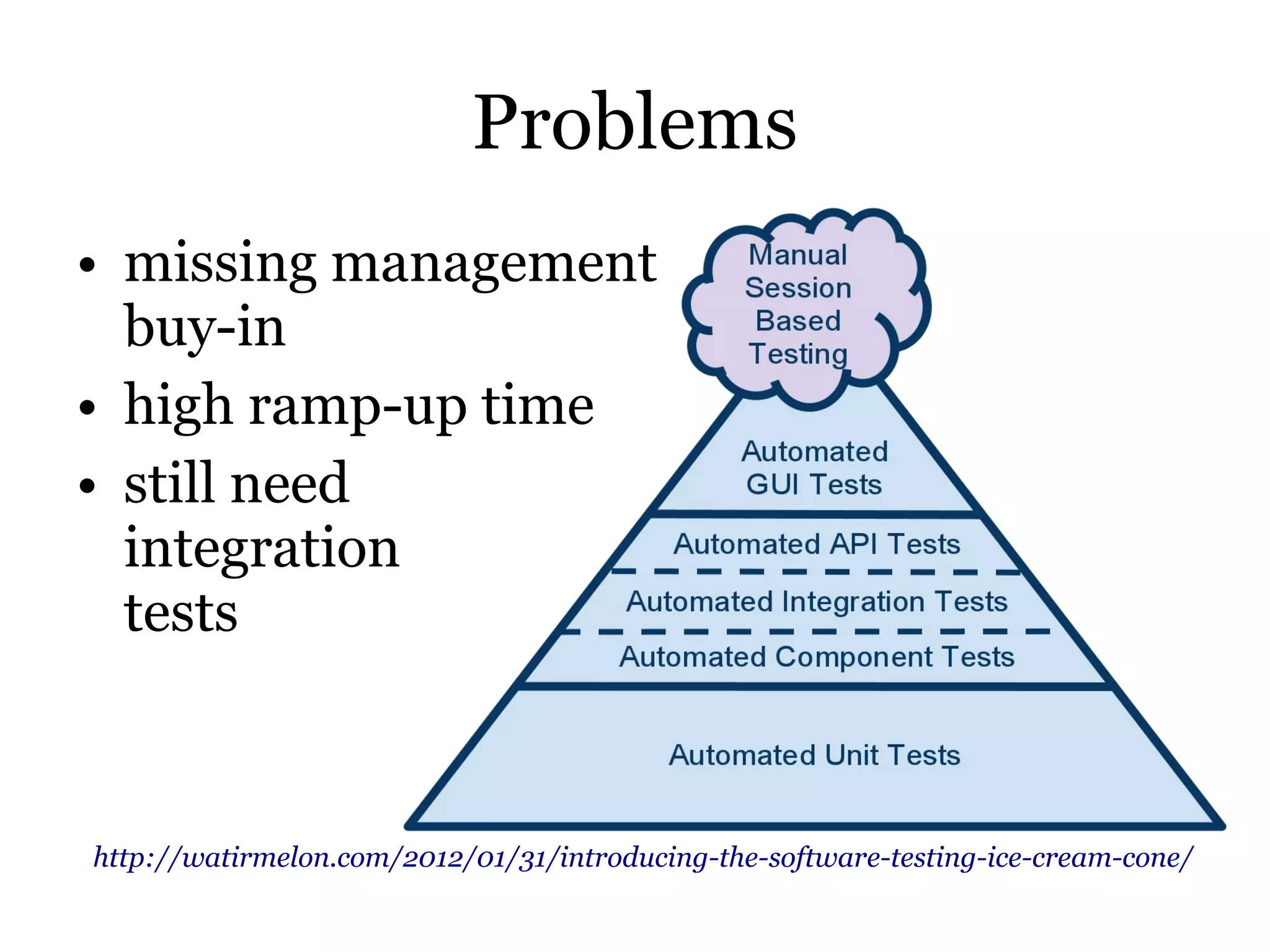
Problems
• missing management
  buy-in
• high ramp-up time
• still need
  integration
  tests


http://watirmelon.com/2012/01/31/introducing-the-software-testing-ice-cream-cone/
TDD will not fix missing skills!
• badly written tests
  –   brittle
  –   blinking
  –   slow
  –   duplicate code
  –   maintenance burden
  –   wrong abstractions
  –   not really unit tests
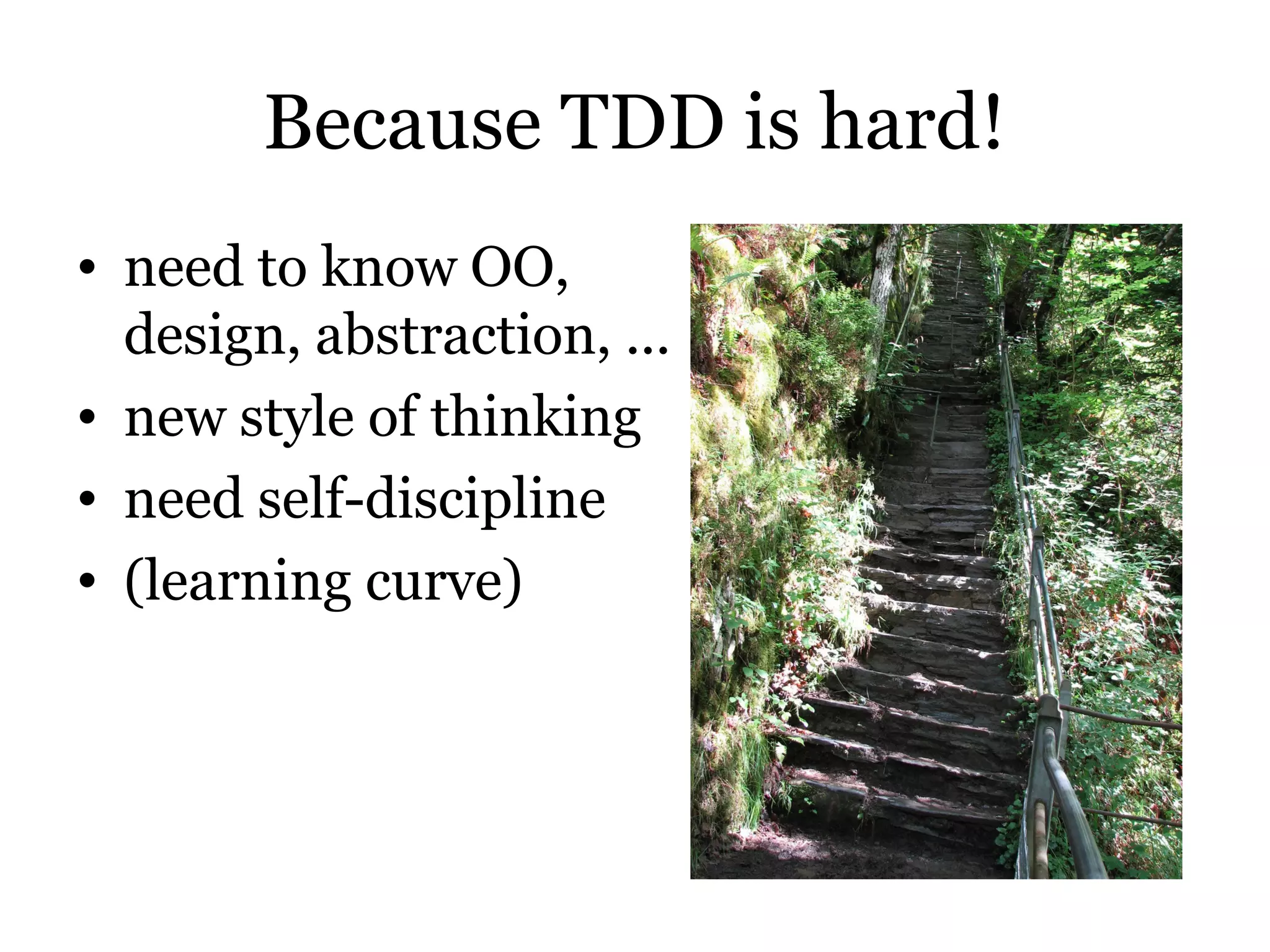
Because TDD is hard!
• need to know OO,
  design, abstraction, ...
• new style of thinking
• need self-discipline
• (learning curve)
3) What you need to do
Problem Indicators: CI
• blinking builds
• builds broken for long time
• increasing build
  execution time
• decreasing code
  coverage
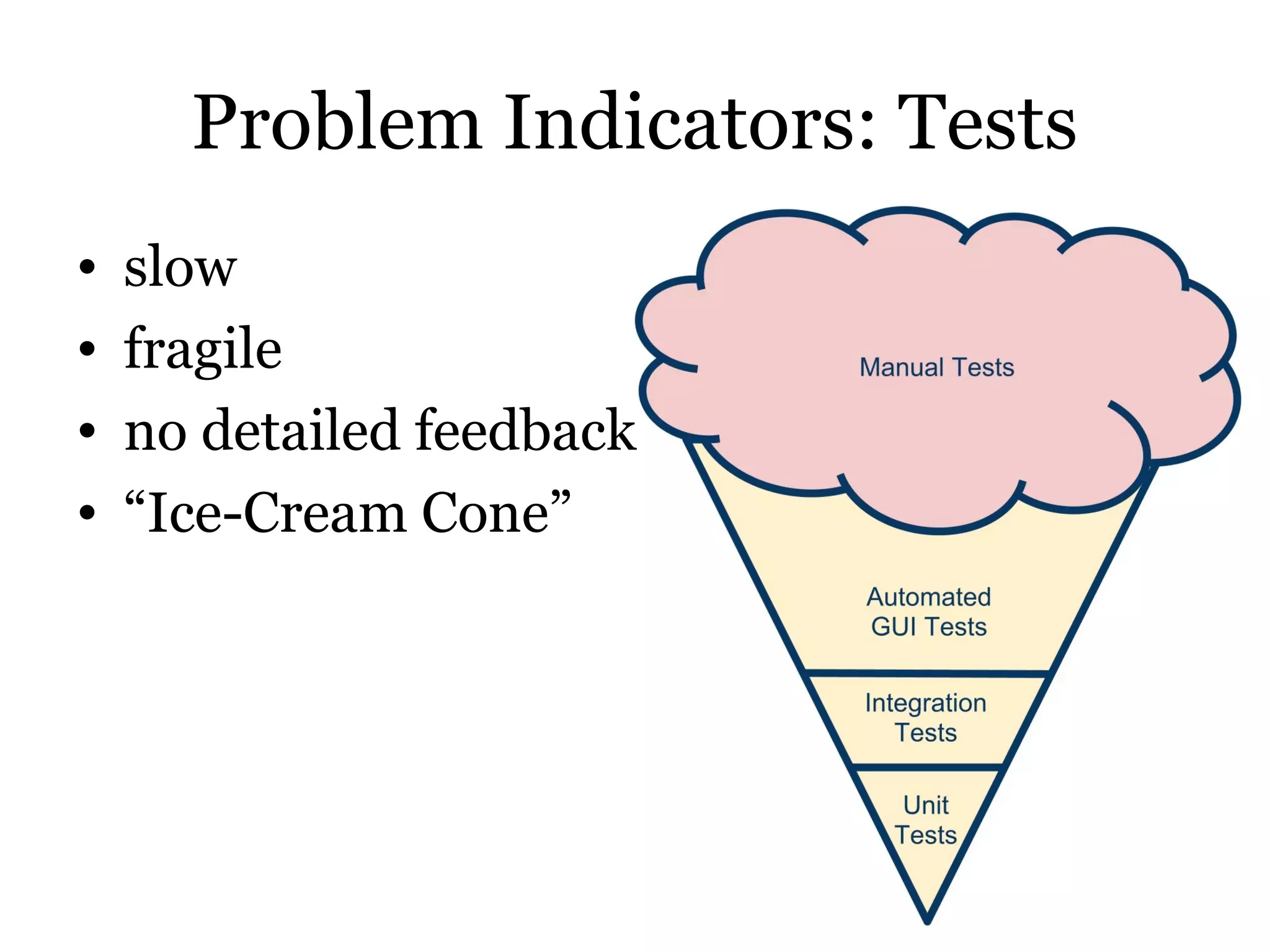
Problem Indicators: Tests
•   slow
•   fragile
•   no detailed feedback
•   “Ice-Cream Cone”
Problem Indicators: Developers
• claiming that they can't write tests
• claiming that they can't fix tests
• wanting to delete tests
“Buzzwords” Summary
• Techniques
  –   Unit Testing
  –   Test Driven Development
  –   Refactoring
  –   Code Coverage
  –   Continuous Integration
• Management Buy-In
• Keep an eye on the CI server
Support TDD


Do not compromise
  on techniques!
Thank
 You
Peter Kofler

  @codecopkofler

www.code-cop.org
CC Images
•   Drive: http://www.flickr.com/photos/hjem/367306587/
•   Judge: http://www.flickr.com/photos/eldave/6169431454/
•   List: http://www.flickr.com/photos/kylesteeddesign/3724074594/
•   Question mark: http://www.flickr.com/photos/oberazzi/318947873/
•   Fence: http://www.flickr.com/photos/30830597@N08/3630649274/
•   Coverage: http://www.flickr.com/photos/paulk/3166328163/
•   Works: http://www.codinghorror.com/blog/archives/000818.html
•   Cash: http://www.flickr.com/photos/mindfire/315274981/
•   Steep: http://www.flickr.com/photos/worldofoddy/229501642/
•   Want You: http://www.flickr.com/photos/shutter/105497713/
•   Warn: http://www.flickr.com/photos/hugosimmelink/2252095723/
•   Questions: http://www.flickr.com/photos/seandreilinger/2326448445/

TDD and Related Techniques for Non Developers (2012)

  • 1.
    Test Driven Development and Related Techniques For Non-Developers ;-) IBM 2012 Peter Kofler, ‘Code Cop’ @codecopkofler www.code-cop.org Copyright Peter Kofler, licensed under CC-BY.
  • 2.
    Peter Kofler • Ph.D. (Appl. Math.) • (Java) Software Developer • with IBM since 1 year • SDM Costing, IGA, GBS
  • 3.
    The opinions expressedhere are my own and do not necessarily represent those of current or past employers.
  • 4.
    Agenda 1) What doesit look like? 2) Why is it important? 3) What you need to do! 4) Summary
  • 5.
    1) So whatis it all about? The Prime Factors Kata (Demo)
  • 6.
    What Exactly WillWe Do Now? ● write code together ● using TDD ● see techniques and patterns ● discuss while doing
  • 7.
    The Requirements. • Writea class named “PrimeFactors” that has one static method: generate. – The generate method takes an integer argument and returns a List<Integer>. – That list contains the prime factors in numerical sequence. http://butunclebob.com/ArticleS.UncleBob.ThePrimeFactorsKata
  • 8.
    First Some Math. ● Prime Number: a natural number > 1 that has no divisors other than 1 and itself. ● e.g. 2, 3, 5, 61, 67, ..., 997, ..., 243112609-1, … ● Prime Factors: the prime numbers that divide an integer exactly without remainder. ● e.g. 2 = 2, 4 = 2 * 2, 24 = 2 * 2 * 2 * 3 288 = 25 * 32
  • 9.
    The Requirements (forMortals). • code a file/module/class “PrimeFactors” • code a function/method/routine “generate” • accept an integer number as parameter • return the prime factors of that number
  • 10.
  • 11.
    Keep the bargreen to keep the code clean.
  • 12.
    Unit Testing • testindividual units • isolate each part • show that the individual parts are correct • regression testing • sort of living documentation • executed within a framework http://en.wikipedia.org/wiki/Unit_testing
  • 13.
    Test-Driven Development • adda test • run all tests and see if the new one fails • write some code • run all tests and see them succeed • refactor code mercilessly • „Red Green Refactor“ http://en.wikipedia.org/wiki/Test_Driven_Development
  • 14.
    A minute agoall their code worked
  • 15.
    Refactoring Refactoring isa technique for restructuring an existing body of code, altering its internal structure without changing its external behavior. (Martin Fowler)
  • 16.
    Refactoring • small behaviorpreserving transformations • sequence of transformations produce a significant restructuring • each transformation is small, less likely to go wrong • system is kept fully working after each change • verified by working tests
  • 18.
  • 19.
  • 20.
  • 21.
  • 22.
  • 24.
  • 25.
    Continuous Integration • Maintain a code repository • Automate the build • Make the build self-testing • Everyone commits every day • Every commit should be built • Keep the build fast • Everyone can see the results of the build http://en.wikipedia.org/wiki/Continuous_integration
  • 26.
    Immediate Feedback and Early Warning
  • 27.
  • 28.
    2) Why shouldwe use TDD? • Writing tests takes time • and we need to deliver client value. I don't have time. I don't have time. I don't have time.
  • 29.
    Do you stilluse that one?
  • 30.
    Discussion • What doyou think are the benefits of TDD? – rapid feedback –… – ...
  • 31.
    Benefits • speed up •coverage – measurable validation of correctness • quality – proven to save maintenance costs • creates a detailed specification
  • 32.
    Benefits • improve design – drive the design of a program – think in exposed API
  • 33.
    Problems • missing management buy-in • high ramp-up time • still need integration tests http://watirmelon.com/2012/01/31/introducing-the-software-testing-ice-cream-cone/
  • 34.
    TDD will notfix missing skills! • badly written tests – brittle – blinking – slow – duplicate code – maintenance burden – wrong abstractions – not really unit tests
  • 35.
    Because TDD ishard! • need to know OO, design, abstraction, ... • new style of thinking • need self-discipline • (learning curve)
  • 36.
    3) What youneed to do
  • 37.
    Problem Indicators: CI •blinking builds • builds broken for long time • increasing build execution time • decreasing code coverage
  • 38.
    Problem Indicators: Tests • slow • fragile • no detailed feedback • “Ice-Cream Cone”
  • 39.
    Problem Indicators: Developers •claiming that they can't write tests • claiming that they can't fix tests • wanting to delete tests
  • 40.
    “Buzzwords” Summary • Techniques – Unit Testing – Test Driven Development – Refactoring – Code Coverage – Continuous Integration • Management Buy-In • Keep an eye on the CI server
  • 41.
    Support TDD Do notcompromise on techniques!
  • 42.
  • 43.
    Peter Kofler @codecopkofler www.code-cop.org
  • 44.
    CC Images • Drive: http://www.flickr.com/photos/hjem/367306587/ • Judge: http://www.flickr.com/photos/eldave/6169431454/ • List: http://www.flickr.com/photos/kylesteeddesign/3724074594/ • Question mark: http://www.flickr.com/photos/oberazzi/318947873/ • Fence: http://www.flickr.com/photos/30830597@N08/3630649274/ • Coverage: http://www.flickr.com/photos/paulk/3166328163/ • Works: http://www.codinghorror.com/blog/archives/000818.html • Cash: http://www.flickr.com/photos/mindfire/315274981/ • Steep: http://www.flickr.com/photos/worldofoddy/229501642/ • Want You: http://www.flickr.com/photos/shutter/105497713/ • Warn: http://www.flickr.com/photos/hugosimmelink/2252095723/ • Questions: http://www.flickr.com/photos/seandreilinger/2326448445/