Test Automation Design Patterns: A
Comprehensive Guide
In software testing, web and mobile automation testing has become indispensable. Over the
past decade, organizations across industries have increasingly relied on test automation to
efficiently handle the diverse array of devices, platforms, browsers, and screen resolutions
encountered in their testing endeavors.
While individual automation testers may have their approach to scripting automation tasks,
collaboration within a team or organization necessitates adopting a structured automation
framework incorporating a design pattern. Such frameworks offer numerous benefits, including
enhanced code quality, maintainability, reusability, scalability, extensibility, and readability.
Selecting the appropriate design pattern is a critical decision influenced by factors such as the
application's complexity, the expertise of automation team members, and project timelines. A
poorly designed framework can lead to unreliable test results, code redundancy, and
maintenance challenges, ultimately undermining the effectiveness of the automation effort.
To mitigate these risks, it is imperative to proactively identify issues within the automation
framework and determine the most suitable design pattern for implementation.
Understanding Software Design Patterns
Software design patterns serve as invaluable tools in software development, offering
established approaches and best practices for crafting robust applications and systems. They
function like navigational aids, guiding developers from common pitfalls associated with specific
scenarios.
These patterns are typically articulated through concise definitions accompanied by Unified
Modeling Language (UML) diagrams, which visually represent their structure and functionality.
Two primary sources inform the creation of design patterns:
● Insights gleaned from the experiences of seasoned software developers who have
encountered similar challenges.
● Fundamental software design principles that underpin effective solution strategies.
Design patterns solve recurring software design dilemmas by encapsulating design wisdom and
insights. Developers and testers alike can leverage these patterns within their codebase to
address prominent issues and enhance the robustness of their solutions.
Exploring Software Design Pattern Categories
Software design patterns encompass three distinct categories, each serving a specific purpose:
1. Creational Design Patterns: These patterns revolve around the mechanisms of object
creation. They offer standardized solutions to common challenges encountered during
object instantiation. By streamlining the process of creating and modifying objects,
creational design patterns facilitate agility in software development.
2. Structural Design Patterns: Structural patterns focus on the composition and
arrangement of classes and objects within a system. They enable developers to
establish flexible and efficient relationships between objects, thereby facilitating the
construction of complex systems. These patterns also aid in organizing code that
enhances comprehensibility and maintainability.
3. Behavioral Design Patterns: Behavioral patterns govern the communication and
allocation of responsibilities among objects. They dictate how objects interact and
manage tasks or actions within the system. Often employed to enhance object
communication and streamline codebase complexity, behavioral patterns mitigate the
reliance on complex coded logic, leading to more adaptable and maintainable software
solutions.
Test Automation Framework Design
Test automation framework design is the blueprint for a test automation framework, outlining its
elements. It's a crucial phase requiring a thorough analysis of project requirements. Once
designed, creating the framework is quick and cost-effective. This test automation design
patterns act as a standard reference, detailing strategies and protocols for implementation,
aligning team members, and optimizing resources.
The Importance of Test Automation Design Patterns
● Enhanced Code Readability:
○ Promotes a structured and standardized approach to test automation.
○ Facilitates collaboration among testers and developers.
○ Reduces errors and simplifies troubleshooting.
● Facilitates Code Reusability:
○ Enables sharing and application of test cases across various scenarios.
○ Eliminates redundant coding efforts.
○ Enhances maintainability and scalability.
● Ensures Long-term Efficiency:
○ Provides a structured foundation for managing changes in the test suite.
○ Allows modifications with minimal disruption.
○ Maintains robustness and reliability of tests as applications evolve.
○ Promotes stability, flexibility, and adaptability in addressing dynamic testing
needs.
Essential Pre-requisites for Test Automation Framework
Design
Before embarking on the design of a test automation framework, several crucial characteristics
must be considered to ensure a high-quality end product:
● Maintainability: The framework should be highly maintainable to minimize the time
testers spend on maintenance tasks.
● Technology Compatibility: It should align with the technologies used, facilitating their
methods rather than merely supporting them.
● Adherence to Design Patterns: The chosen design model and pattern should guide
testers throughout testing, establishing protocols to ensure efficiency.
● Reliability: Designers must prioritize reliability in every aspect of the framework's
design.
● Reusability: The design should promote reusability within the framework, saving time
and costs as the application scales.
● Test Data Support: Test automation frameworks should support data-driven testing by
enabling data attachment in various formats, ensuring comprehensive testing coverage.
● Integration Capabilities: Knowledge of and readiness for integrating with various
systems is essential, as integration has become a standard feature of modern
frameworks.
Addressing these pre-requisites before commencing the design process lays the foundation for
constructing a robust, high-quality automation framework that meets future demands.
Utilizing Software Design Patterns in Test Automation
Design patterns significantly enhance the effectiveness of software test automation projects.
Several design patterns tailored to meet the specific requirements of test automation have
emerged. Among these, the Page Object Model is the most widely utilized. Other patterns like
the Bot Pattern and Page Factory Pattern also find applications in test automation projects.
Commonly employed design patterns in test automation include:
● Page Object Model
● Singleton Pattern
● Factory Pattern
● Facade Pattern
While all these patterns are valuable, the Page Object Model, Singleton Pattern, and Factory
Pattern are particularly prominent. Below, we delve into detailed descriptions of these three key
patterns.
Page Object Model
The Page Object Model (POM) is a prevalent design pattern primarily used for end-to-end
testing of websites, often serving as the foundation for custom test automation frameworks. This
model employs encapsulation to separate test code from the code required to execute various
actions on the system under test.
In the Page Object Model:
● Sections of the website under test are segmented into distinct page classes.
● Each page class encompasses locators essential for accessing UI elements on the
page, along with methods for executing actions.
● Tests can instantiate multiple page objects to execute test scenarios, maintaining the
arrange, act, and assert steps.
● This model fosters code reusability, allowing tests unaffected by slight UI changes.
Instead, modifications are made to the page objects.
Utilizing the Selenium Support classes package, the PageFactory class aids in constructing
page object models for Selenium end-to-end testing. Testers can streamline the creation and
maintenance of page objects by deriving page classes from the Selenium PageFactory class
and leveraging annotations like @FindBy, @FindAll, and @FindBys.
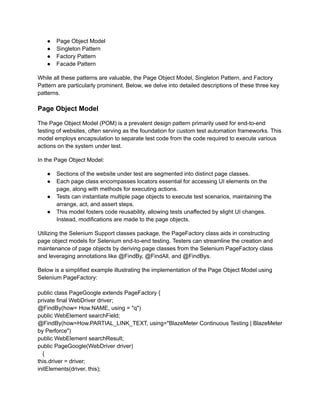
Below is a simplified example illustrating the implementation of the Page Object Model using
Selenium PageFactory:
public class PageGoogle extends PageFactory {
private final WebDriver driver;
@FindBy(how= How.NAME, using = "q")
public WebElement searchField;
@FindBy(how=How.PARTIAL_LINK_TEXT, using="BlazeMeter Continuous Testing | BlazeMeter
by Perforce")
public WebElement searchResult;
public PageGoogle(WebDriver driver)
{
this.driver = driver;
initElements(driver, this);
}
public void searchGoogle(String searchTerm)
{
searchField.sendKeys(searchTerm);
searchField.submit();
}
public boolean isSearchResultFound()
{
return new WebDriverWait(driver, Duration.ofSeconds(5)).
until(ExpectedConditions.visibilityOf(searchResult)) != null;
}
}
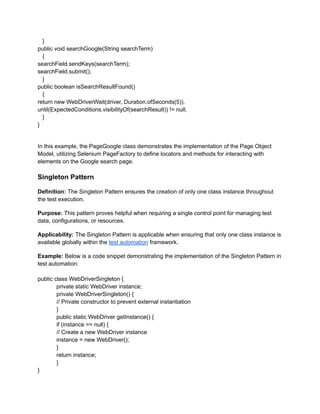
In this example, the PageGoogle class demonstrates the implementation of the Page Object
Model, utilizing Selenium PageFactory to define locators and methods for interacting with
elements on the Google search page.
Singleton Pattern
Definition: The Singleton Pattern ensures the creation of only one class instance throughout
the test execution.
Purpose: This pattern proves helpful when requiring a single control point for managing test
data, configurations, or resources.
Applicability: The Singleton Pattern is applicable when ensuring that only one class instance is
available globally within the test automation framework.
Example: Below is a code snippet demonstrating the implementation of the Singleton Pattern in
test automation:
public class WebDriverSingleton {
private static WebDriver instance;
private WebDriverSingleton() {
// Private constructor to prevent external instantiation
}
public static WebDriver getInstance() {
if (instance == null) {
// Create a new WebDriver instance
instance = new WebDriver();
}
return instance;
}
}
In this example, the WebDriverSingleton class ensures that only one instance of the WebDriver
is created and shared across the test automation framework.
Factory Design Pattern
Overview: In the factory design pattern, a superclass contains multiple subclasses, and based
on specific input, a particular subclass is returned. This pattern is utilized when a class cannot
predict the types of objects it needs to create in advance. The instantiation of a class is handled
within the factory class, making it ideal for scenarios where objects need to be created based on
dynamic input.
Relevance to Test Automation Design: This design pattern is particularly relevant in test
automation, especially when working with platforms like Android and iOS, where objects share
standard identifiers. For instance, both platforms may use accessibility IDs in iOS and content
descriptions in Android. By implementing the Factory Pattern, the appropriate driver object
(either Android or iOS) can be created based on the platform, eliminating the need for repetitive
platform checks.
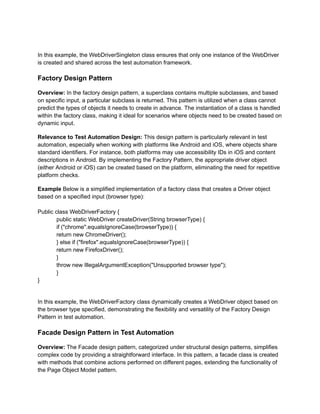
Example Below is a simplified implementation of a factory class that creates a Driver object
based on a specified input (browser type):
Public class WebDriverFactory {
public static WebDriver createDriver(String browserType) {
if ("chrome".equalsIgnoreCase(browserType)) {
return new ChromeDriver();
} else if ("firefox".equalsIgnoreCase(browserType)) {
return new FirefoxDriver();
}
throw new IllegalArgumentException("Unsupported browser type");
}
}
In this example, the WebDriverFactory class dynamically creates a WebDriver object based on
the browser type specified, demonstrating the flexibility and versatility of the Factory Design
Pattern in test automation.
Facade Design Pattern in Test Automation
Overview: The Facade design pattern, categorized under structural design patterns, simplifies
complex code by providing a straightforward interface. In this pattern, a facade class is created
with methods that combine actions performed on different pages, extending the functionality of
the Page Object Model pattern.
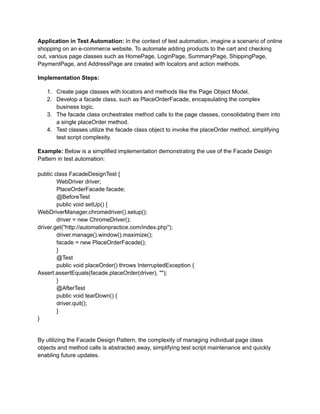
Application in Test Automation: In the context of test automation, imagine a scenario of online
shopping on an e-commerce website. To automate adding products to the cart and checking
out, various page classes such as HomePage, LoginPage, SummaryPage, ShippingPage,
PaymentPage, and AddressPage are created with locators and action methods.
Implementation Steps:
1. Create page classes with locators and methods like the Page Object Model.
2. Develop a facade class, such as PlaceOrderFacade, encapsulating the complex
business logic.
3. The facade class orchestrates method calls to the page classes, consolidating them into
a single placeOrder method.
4. Test classes utilize the facade class object to invoke the placeOrder method, simplifying
test script complexity.
Example: Below is a simplified implementation demonstrating the use of the Facade Design
Pattern in test automation:
public class FacadeDesignTest {
WebDriver driver;
PlaceOrderFacade facade;
@BeforeTest
public void setUp() {
WebDriverManager.chromedriver().setup();
driver = new ChromeDriver();
driver.get("http://automationpractice.com/index.php");
driver.manage().window().maximize();
facade = new PlaceOrderFacade();
}
@Test
public void placeOrder() throws InterruptedException {
Assert.assertEquals(facade.placeOrder(driver), "");
}
@AfterTest
public void tearDown() {
driver.quit();
}
}
By utilizing the Facade Design Pattern, the complexity of managing individual page class
objects and method calls is abstracted away, simplifying test script maintenance and quickly
enabling future updates.
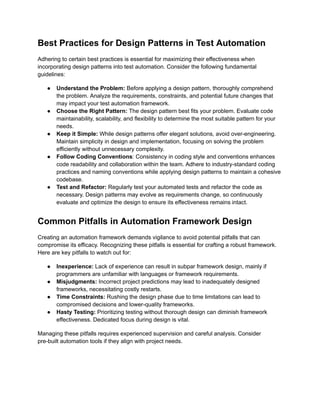
Best Practices for Design Patterns in Test Automation
Adhering to certain best practices is essential for maximizing their effectiveness when
incorporating design patterns into test automation. Consider the following fundamental
guidelines:
● Understand the Problem: Before applying a design pattern, thoroughly comprehend
the problem. Analyze the requirements, constraints, and potential future changes that
may impact your test automation framework.
● Choose the Right Pattern: The design pattern best fits your problem. Evaluate code
maintainability, scalability, and flexibility to determine the most suitable pattern for your
needs.
● Keep it Simple: While design patterns offer elegant solutions, avoid over-engineering.
Maintain simplicity in design and implementation, focusing on solving the problem
efficiently without unnecessary complexity.
● Follow Coding Conventions: Consistency in coding style and conventions enhances
code readability and collaboration within the team. Adhere to industry-standard coding
practices and naming conventions while applying design patterns to maintain a cohesive
codebase.
● Test and Refactor: Regularly test your automated tests and refactor the code as
necessary. Design patterns may evolve as requirements change, so continuously
evaluate and optimize the design to ensure its effectiveness remains intact.
Common Pitfalls in Automation Framework Design
Creating an automation framework demands vigilance to avoid potential pitfalls that can
compromise its efficacy. Recognizing these pitfalls is essential for crafting a robust framework.
Here are key pitfalls to watch out for:
● Inexperience: Lack of experience can result in subpar framework design, mainly if
programmers are unfamiliar with languages or framework requirements.
● Misjudgments: Incorrect project predictions may lead to inadequately designed
frameworks, necessitating costly restarts.
● Time Constraints: Rushing the design phase due to time limitations can lead to
compromised decisions and lower-quality frameworks.
● Hasty Testing: Prioritizing testing without thorough design can diminish framework
effectiveness. Dedicated focus during design is vital.
Managing these pitfalls requires experienced supervision and careful analysis. Consider
pre-built automation tools if they align with project needs.
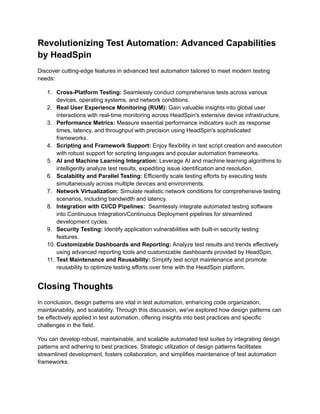
Revolutionizing Test Automation: Advanced Capabilities
by HeadSpin
Discover cutting-edge features in advanced test automation tailored to meet modern testing
needs:
1. Cross-Platform Testing: Seamlessly conduct comprehensive tests across various
devices, operating systems, and network conditions.
2. Real User Experience Monitoring (RUM): Gain valuable insights into global user
interactions with real-time monitoring across HeadSpin's extensive device infrastructure.
3. Performance Metrics: Measure essential performance indicators such as response
times, latency, and throughput with precision using HeadSpin's sophisticated
frameworks.
4. Scripting and Framework Support: Enjoy flexibility in test script creation and execution
with robust support for scripting languages and popular automation frameworks.
5. AI and Machine Learning Integration: Leverage AI and machine learning algorithms to
intelligently analyze test results, expediting issue identification and resolution.
6. Scalability and Parallel Testing: Efficiently scale testing efforts by executing tests
simultaneously across multiple devices and environments.
7. Network Virtualization: Simulate realistic network conditions for comprehensive testing
scenarios, including bandwidth and latency.
8. Integration with CI/CD Pipelines: Seamlessly integrate automated testing software
into Continuous Integration/Continuous Deployment pipelines for streamlined
development cycles.
9. Security Testing: Identify application vulnerabilities with built-in security testing
features.
10. Customizable Dashboards and Reporting: Analyze test results and trends effectively
using advanced reporting tools and customizable dashboards provided by HeadSpin.
11. Test Maintenance and Reusability: Simplify test script maintenance and promote
reusability to optimize testing efforts over time with the HeadSpin platform.
Closing Thoughts
In conclusion, design patterns are vital in test automation, enhancing code organization,
maintainability, and scalability. Through this discussion, we've explored how design patterns can
be effectively applied in test automation, offering insights into best practices and specific
challenges in the field.
You can develop robust, maintainable, and scalable automated test suites by integrating design
patterns and adhering to best practices. Strategic utilization of design patterns facilitates
streamlined development, fosters collaboration, and simplifies maintenance of test automation
frameworks.
HeadSpin's AI-driven Platform stands out by seamlessly integrating skilled QA engineers and
strategically leveraging metrics to ensure the timely delivery of superior software. Its capabilities
empower organizations to tackle testing challenges and achieve excellence in software
development.
Leverage the power of HeadSpin's advanced capabilities and elevate your test automation
endeavors.
Article Source:
This article was originally published on:
https://www.headspin.io/blog/test-automation-design-patterns-boost-your-testing-skills

Test Automation Design Patterns_ A Comprehensive Guide.pdf

  • 1.
    Test Automation DesignPatterns: A Comprehensive Guide In software testing, web and mobile automation testing has become indispensable. Over the past decade, organizations across industries have increasingly relied on test automation to efficiently handle the diverse array of devices, platforms, browsers, and screen resolutions encountered in their testing endeavors. While individual automation testers may have their approach to scripting automation tasks, collaboration within a team or organization necessitates adopting a structured automation framework incorporating a design pattern. Such frameworks offer numerous benefits, including enhanced code quality, maintainability, reusability, scalability, extensibility, and readability. Selecting the appropriate design pattern is a critical decision influenced by factors such as the application's complexity, the expertise of automation team members, and project timelines. A poorly designed framework can lead to unreliable test results, code redundancy, and maintenance challenges, ultimately undermining the effectiveness of the automation effort. To mitigate these risks, it is imperative to proactively identify issues within the automation framework and determine the most suitable design pattern for implementation. Understanding Software Design Patterns Software design patterns serve as invaluable tools in software development, offering established approaches and best practices for crafting robust applications and systems. They function like navigational aids, guiding developers from common pitfalls associated with specific scenarios. These patterns are typically articulated through concise definitions accompanied by Unified Modeling Language (UML) diagrams, which visually represent their structure and functionality.
  • 2.
    Two primary sourcesinform the creation of design patterns: ● Insights gleaned from the experiences of seasoned software developers who have encountered similar challenges. ● Fundamental software design principles that underpin effective solution strategies. Design patterns solve recurring software design dilemmas by encapsulating design wisdom and insights. Developers and testers alike can leverage these patterns within their codebase to address prominent issues and enhance the robustness of their solutions. Exploring Software Design Pattern Categories Software design patterns encompass three distinct categories, each serving a specific purpose: 1. Creational Design Patterns: These patterns revolve around the mechanisms of object creation. They offer standardized solutions to common challenges encountered during object instantiation. By streamlining the process of creating and modifying objects, creational design patterns facilitate agility in software development. 2. Structural Design Patterns: Structural patterns focus on the composition and arrangement of classes and objects within a system. They enable developers to establish flexible and efficient relationships between objects, thereby facilitating the construction of complex systems. These patterns also aid in organizing code that enhances comprehensibility and maintainability. 3. Behavioral Design Patterns: Behavioral patterns govern the communication and allocation of responsibilities among objects. They dictate how objects interact and manage tasks or actions within the system. Often employed to enhance object communication and streamline codebase complexity, behavioral patterns mitigate the reliance on complex coded logic, leading to more adaptable and maintainable software solutions. Test Automation Framework Design Test automation framework design is the blueprint for a test automation framework, outlining its elements. It's a crucial phase requiring a thorough analysis of project requirements. Once designed, creating the framework is quick and cost-effective. This test automation design patterns act as a standard reference, detailing strategies and protocols for implementation, aligning team members, and optimizing resources. The Importance of Test Automation Design Patterns ● Enhanced Code Readability: ○ Promotes a structured and standardized approach to test automation. ○ Facilitates collaboration among testers and developers. ○ Reduces errors and simplifies troubleshooting.
  • 3.
    ● Facilitates CodeReusability: ○ Enables sharing and application of test cases across various scenarios. ○ Eliminates redundant coding efforts. ○ Enhances maintainability and scalability. ● Ensures Long-term Efficiency: ○ Provides a structured foundation for managing changes in the test suite. ○ Allows modifications with minimal disruption. ○ Maintains robustness and reliability of tests as applications evolve. ○ Promotes stability, flexibility, and adaptability in addressing dynamic testing needs. Essential Pre-requisites for Test Automation Framework Design Before embarking on the design of a test automation framework, several crucial characteristics must be considered to ensure a high-quality end product: ● Maintainability: The framework should be highly maintainable to minimize the time testers spend on maintenance tasks. ● Technology Compatibility: It should align with the technologies used, facilitating their methods rather than merely supporting them. ● Adherence to Design Patterns: The chosen design model and pattern should guide testers throughout testing, establishing protocols to ensure efficiency. ● Reliability: Designers must prioritize reliability in every aspect of the framework's design. ● Reusability: The design should promote reusability within the framework, saving time and costs as the application scales. ● Test Data Support: Test automation frameworks should support data-driven testing by enabling data attachment in various formats, ensuring comprehensive testing coverage. ● Integration Capabilities: Knowledge of and readiness for integrating with various systems is essential, as integration has become a standard feature of modern frameworks. Addressing these pre-requisites before commencing the design process lays the foundation for constructing a robust, high-quality automation framework that meets future demands. Utilizing Software Design Patterns in Test Automation Design patterns significantly enhance the effectiveness of software test automation projects. Several design patterns tailored to meet the specific requirements of test automation have emerged. Among these, the Page Object Model is the most widely utilized. Other patterns like the Bot Pattern and Page Factory Pattern also find applications in test automation projects. Commonly employed design patterns in test automation include:
  • 4.
    ● Page ObjectModel ● Singleton Pattern ● Factory Pattern ● Facade Pattern While all these patterns are valuable, the Page Object Model, Singleton Pattern, and Factory Pattern are particularly prominent. Below, we delve into detailed descriptions of these three key patterns. Page Object Model The Page Object Model (POM) is a prevalent design pattern primarily used for end-to-end testing of websites, often serving as the foundation for custom test automation frameworks. This model employs encapsulation to separate test code from the code required to execute various actions on the system under test. In the Page Object Model: ● Sections of the website under test are segmented into distinct page classes. ● Each page class encompasses locators essential for accessing UI elements on the page, along with methods for executing actions. ● Tests can instantiate multiple page objects to execute test scenarios, maintaining the arrange, act, and assert steps. ● This model fosters code reusability, allowing tests unaffected by slight UI changes. Instead, modifications are made to the page objects. Utilizing the Selenium Support classes package, the PageFactory class aids in constructing page object models for Selenium end-to-end testing. Testers can streamline the creation and maintenance of page objects by deriving page classes from the Selenium PageFactory class and leveraging annotations like @FindBy, @FindAll, and @FindBys. Below is a simplified example illustrating the implementation of the Page Object Model using Selenium PageFactory: public class PageGoogle extends PageFactory { private final WebDriver driver; @FindBy(how= How.NAME, using = "q") public WebElement searchField; @FindBy(how=How.PARTIAL_LINK_TEXT, using="BlazeMeter Continuous Testing | BlazeMeter by Perforce") public WebElement searchResult; public PageGoogle(WebDriver driver) { this.driver = driver; initElements(driver, this);
  • 5.
    } public void searchGoogle(StringsearchTerm) { searchField.sendKeys(searchTerm); searchField.submit(); } public boolean isSearchResultFound() { return new WebDriverWait(driver, Duration.ofSeconds(5)). until(ExpectedConditions.visibilityOf(searchResult)) != null; } } In this example, the PageGoogle class demonstrates the implementation of the Page Object Model, utilizing Selenium PageFactory to define locators and methods for interacting with elements on the Google search page. Singleton Pattern Definition: The Singleton Pattern ensures the creation of only one class instance throughout the test execution. Purpose: This pattern proves helpful when requiring a single control point for managing test data, configurations, or resources. Applicability: The Singleton Pattern is applicable when ensuring that only one class instance is available globally within the test automation framework. Example: Below is a code snippet demonstrating the implementation of the Singleton Pattern in test automation: public class WebDriverSingleton { private static WebDriver instance; private WebDriverSingleton() { // Private constructor to prevent external instantiation } public static WebDriver getInstance() { if (instance == null) { // Create a new WebDriver instance instance = new WebDriver(); } return instance; } }
  • 6.
    In this example,the WebDriverSingleton class ensures that only one instance of the WebDriver is created and shared across the test automation framework. Factory Design Pattern Overview: In the factory design pattern, a superclass contains multiple subclasses, and based on specific input, a particular subclass is returned. This pattern is utilized when a class cannot predict the types of objects it needs to create in advance. The instantiation of a class is handled within the factory class, making it ideal for scenarios where objects need to be created based on dynamic input. Relevance to Test Automation Design: This design pattern is particularly relevant in test automation, especially when working with platforms like Android and iOS, where objects share standard identifiers. For instance, both platforms may use accessibility IDs in iOS and content descriptions in Android. By implementing the Factory Pattern, the appropriate driver object (either Android or iOS) can be created based on the platform, eliminating the need for repetitive platform checks. Example Below is a simplified implementation of a factory class that creates a Driver object based on a specified input (browser type): Public class WebDriverFactory { public static WebDriver createDriver(String browserType) { if ("chrome".equalsIgnoreCase(browserType)) { return new ChromeDriver(); } else if ("firefox".equalsIgnoreCase(browserType)) { return new FirefoxDriver(); } throw new IllegalArgumentException("Unsupported browser type"); } } In this example, the WebDriverFactory class dynamically creates a WebDriver object based on the browser type specified, demonstrating the flexibility and versatility of the Factory Design Pattern in test automation. Facade Design Pattern in Test Automation Overview: The Facade design pattern, categorized under structural design patterns, simplifies complex code by providing a straightforward interface. In this pattern, a facade class is created with methods that combine actions performed on different pages, extending the functionality of the Page Object Model pattern.
  • 7.
    Application in TestAutomation: In the context of test automation, imagine a scenario of online shopping on an e-commerce website. To automate adding products to the cart and checking out, various page classes such as HomePage, LoginPage, SummaryPage, ShippingPage, PaymentPage, and AddressPage are created with locators and action methods. Implementation Steps: 1. Create page classes with locators and methods like the Page Object Model. 2. Develop a facade class, such as PlaceOrderFacade, encapsulating the complex business logic. 3. The facade class orchestrates method calls to the page classes, consolidating them into a single placeOrder method. 4. Test classes utilize the facade class object to invoke the placeOrder method, simplifying test script complexity. Example: Below is a simplified implementation demonstrating the use of the Facade Design Pattern in test automation: public class FacadeDesignTest { WebDriver driver; PlaceOrderFacade facade; @BeforeTest public void setUp() { WebDriverManager.chromedriver().setup(); driver = new ChromeDriver(); driver.get("http://automationpractice.com/index.php"); driver.manage().window().maximize(); facade = new PlaceOrderFacade(); } @Test public void placeOrder() throws InterruptedException { Assert.assertEquals(facade.placeOrder(driver), ""); } @AfterTest public void tearDown() { driver.quit(); } } By utilizing the Facade Design Pattern, the complexity of managing individual page class objects and method calls is abstracted away, simplifying test script maintenance and quickly enabling future updates.
  • 8.
    Best Practices forDesign Patterns in Test Automation Adhering to certain best practices is essential for maximizing their effectiveness when incorporating design patterns into test automation. Consider the following fundamental guidelines: ● Understand the Problem: Before applying a design pattern, thoroughly comprehend the problem. Analyze the requirements, constraints, and potential future changes that may impact your test automation framework. ● Choose the Right Pattern: The design pattern best fits your problem. Evaluate code maintainability, scalability, and flexibility to determine the most suitable pattern for your needs. ● Keep it Simple: While design patterns offer elegant solutions, avoid over-engineering. Maintain simplicity in design and implementation, focusing on solving the problem efficiently without unnecessary complexity. ● Follow Coding Conventions: Consistency in coding style and conventions enhances code readability and collaboration within the team. Adhere to industry-standard coding practices and naming conventions while applying design patterns to maintain a cohesive codebase. ● Test and Refactor: Regularly test your automated tests and refactor the code as necessary. Design patterns may evolve as requirements change, so continuously evaluate and optimize the design to ensure its effectiveness remains intact. Common Pitfalls in Automation Framework Design Creating an automation framework demands vigilance to avoid potential pitfalls that can compromise its efficacy. Recognizing these pitfalls is essential for crafting a robust framework. Here are key pitfalls to watch out for: ● Inexperience: Lack of experience can result in subpar framework design, mainly if programmers are unfamiliar with languages or framework requirements. ● Misjudgments: Incorrect project predictions may lead to inadequately designed frameworks, necessitating costly restarts. ● Time Constraints: Rushing the design phase due to time limitations can lead to compromised decisions and lower-quality frameworks. ● Hasty Testing: Prioritizing testing without thorough design can diminish framework effectiveness. Dedicated focus during design is vital. Managing these pitfalls requires experienced supervision and careful analysis. Consider pre-built automation tools if they align with project needs.
  • 9.
    Revolutionizing Test Automation:Advanced Capabilities by HeadSpin Discover cutting-edge features in advanced test automation tailored to meet modern testing needs: 1. Cross-Platform Testing: Seamlessly conduct comprehensive tests across various devices, operating systems, and network conditions. 2. Real User Experience Monitoring (RUM): Gain valuable insights into global user interactions with real-time monitoring across HeadSpin's extensive device infrastructure. 3. Performance Metrics: Measure essential performance indicators such as response times, latency, and throughput with precision using HeadSpin's sophisticated frameworks. 4. Scripting and Framework Support: Enjoy flexibility in test script creation and execution with robust support for scripting languages and popular automation frameworks. 5. AI and Machine Learning Integration: Leverage AI and machine learning algorithms to intelligently analyze test results, expediting issue identification and resolution. 6. Scalability and Parallel Testing: Efficiently scale testing efforts by executing tests simultaneously across multiple devices and environments. 7. Network Virtualization: Simulate realistic network conditions for comprehensive testing scenarios, including bandwidth and latency. 8. Integration with CI/CD Pipelines: Seamlessly integrate automated testing software into Continuous Integration/Continuous Deployment pipelines for streamlined development cycles. 9. Security Testing: Identify application vulnerabilities with built-in security testing features. 10. Customizable Dashboards and Reporting: Analyze test results and trends effectively using advanced reporting tools and customizable dashboards provided by HeadSpin. 11. Test Maintenance and Reusability: Simplify test script maintenance and promote reusability to optimize testing efforts over time with the HeadSpin platform. Closing Thoughts In conclusion, design patterns are vital in test automation, enhancing code organization, maintainability, and scalability. Through this discussion, we've explored how design patterns can be effectively applied in test automation, offering insights into best practices and specific challenges in the field. You can develop robust, maintainable, and scalable automated test suites by integrating design patterns and adhering to best practices. Strategic utilization of design patterns facilitates streamlined development, fosters collaboration, and simplifies maintenance of test automation frameworks.
  • 10.
    HeadSpin's AI-driven Platformstands out by seamlessly integrating skilled QA engineers and strategically leveraging metrics to ensure the timely delivery of superior software. Its capabilities empower organizations to tackle testing challenges and achieve excellence in software development. Leverage the power of HeadSpin's advanced capabilities and elevate your test automation endeavors. Article Source: This article was originally published on: https://www.headspin.io/blog/test-automation-design-patterns-boost-your-testing-skills