Are the world income and living
standards converging or
diverging?
John Phelan, Nagib Ahmad Nuri,
Ligita Visockyte
19th November 2012
What does the theory tell us?
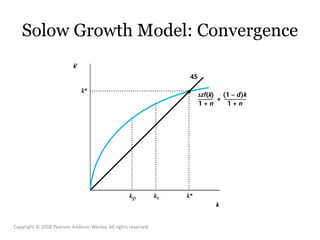
Solow Growth Model: Convergence
Copyright © 2008 Pearson Addison-Wesley. All rights reserved.
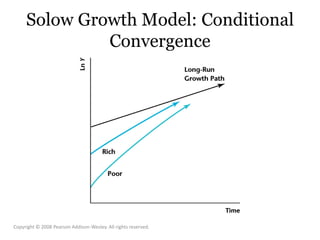
Solow Growth Model: Conditional
Convergence
Copyright © 2008 Pearson Addison-Wesley. All rights reserved.
Conditional Convergence
Countries will converge IF…
• Labour force growth rates
• Savings rates
• Total Factor Productivity
…are all the same
As opposed to Absolute Convergence where
countries converge come what may
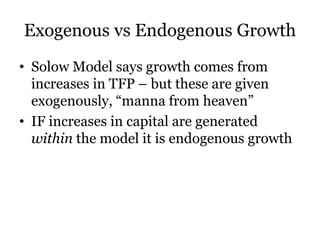
Exogenous vs Endogenous Growth
• Solow Model says growth comes from
increases in TFP – but these are given
exogenously, “manna from heaven”
• IF increases in capital are generated
within the model it is endogenous growth
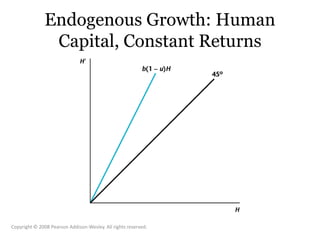
Endogenous Growth: Human
Capital, Constant Returns
Copyright © 2008 Pearson Addison-Wesley. All rights reserved.
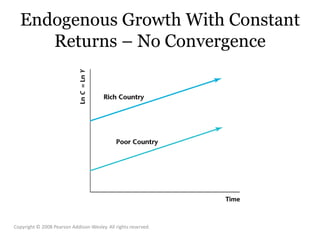
Endogenous Growth With Constant
Returns – No Convergence
Copyright © 2008 Pearson Addison-Wesley. All rights reserved.
What do we see in reality?
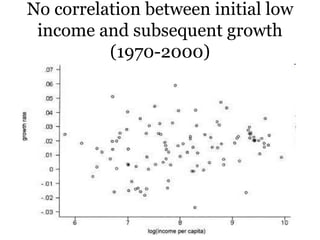
No correlation between initial low
income and subsequent growth
(1970-2000)
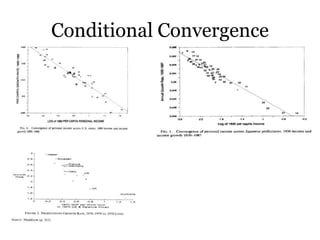
Conditional Convergence
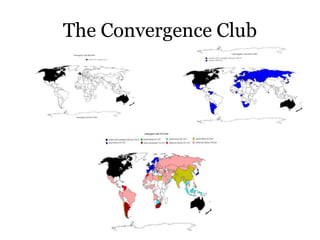
The Convergence Club
Why doesn’t the theory match
reality?
Disequalizing forces (1820 to 1992)
• Consistently better performance of European
countries and their offshoots;
• Relatively poor growth performance of China
and India until late 20th century;
• Divergence between Anglo-Saxon and the other
European countries in the beginning of the 19th
century;
• Slow growth of Africa in the second part of the
20th century. (Bourguignon, Morrison)
Endogenous growth model
• Spillover models (P. Romer; Barro and Sala I Martin; G.
Mankiw, D. Romer, D. Weil): the level of technology determined
locally by knowledge spillovers
• Neo-Schumpeterian model (Arrow): emphasize the
private sector activities that contribute to technological advance
• Linear models: capture the fact that technological
change comes from investments that people make, but do so
at the cost of abandoning the fact that technology or
knowledge is a nonrival good
Critique of Solow model
• R. Hall and C. Jones: Social Infrastructure;
• Rostow: government and institutions;
• Abramovitz: technological congruence and
social capability;
• North: property rights;
• Barro, and Sala-i-Martin: microeconomic
foundations of investment.
Why Globalization does not
equate Convergence
• Bad economic policies;
• Unfavorable circumstances and institutions;
• Lack of formal education (R. Easterlin);
• Relative inefficiency of labor (G. Clark);
• Human capital complementarity (Lucas);
• Lack of social capability (Abramovitz);
• Stock of human capital (Benhabib and Spiegel );
• Closed economies (Sachs and Warner ).
Can’t tell…
Issues that bear on all the studies:
• National accounts vs household surveys
• Exchange rate (market exchange methods or PPP exchange
rates)
• Definition of global distribution
• Estimation errors

Term 1 presentation added

  • 1.
    Are the worldincome and living standards converging or diverging? John Phelan, Nagib Ahmad Nuri, Ligita Visockyte 19th November 2012
  • 2.
    What does thetheory tell us?
  • 3.
    Solow Growth Model:Convergence Copyright © 2008 Pearson Addison-Wesley. All rights reserved.
  • 4.
    Solow Growth Model:Conditional Convergence Copyright © 2008 Pearson Addison-Wesley. All rights reserved.
  • 5.
    Conditional Convergence Countries willconverge IF… • Labour force growth rates • Savings rates • Total Factor Productivity …are all the same As opposed to Absolute Convergence where countries converge come what may
  • 6.
    Exogenous vs EndogenousGrowth • Solow Model says growth comes from increases in TFP – but these are given exogenously, “manna from heaven” • IF increases in capital are generated within the model it is endogenous growth
  • 7.
    Endogenous Growth: Human Capital,Constant Returns Copyright © 2008 Pearson Addison-Wesley. All rights reserved.
  • 8.
    Endogenous Growth WithConstant Returns – No Convergence Copyright © 2008 Pearson Addison-Wesley. All rights reserved.
  • 9.
    What do wesee in reality?
  • 10.
    No correlation betweeninitial low income and subsequent growth (1970-2000)
  • 11.
  • 12.
  • 13.
    Why doesn’t thetheory match reality?
  • 14.
    Disequalizing forces (1820to 1992) • Consistently better performance of European countries and their offshoots; • Relatively poor growth performance of China and India until late 20th century; • Divergence between Anglo-Saxon and the other European countries in the beginning of the 19th century; • Slow growth of Africa in the second part of the 20th century. (Bourguignon, Morrison)
  • 15.
    Endogenous growth model •Spillover models (P. Romer; Barro and Sala I Martin; G. Mankiw, D. Romer, D. Weil): the level of technology determined locally by knowledge spillovers • Neo-Schumpeterian model (Arrow): emphasize the private sector activities that contribute to technological advance • Linear models: capture the fact that technological change comes from investments that people make, but do so at the cost of abandoning the fact that technology or knowledge is a nonrival good
  • 16.
    Critique of Solowmodel • R. Hall and C. Jones: Social Infrastructure; • Rostow: government and institutions; • Abramovitz: technological congruence and social capability; • North: property rights; • Barro, and Sala-i-Martin: microeconomic foundations of investment.
  • 17.
    Why Globalization doesnot equate Convergence • Bad economic policies; • Unfavorable circumstances and institutions; • Lack of formal education (R. Easterlin); • Relative inefficiency of labor (G. Clark); • Human capital complementarity (Lucas); • Lack of social capability (Abramovitz); • Stock of human capital (Benhabib and Spiegel ); • Closed economies (Sachs and Warner ).
  • 18.
    Can’t tell… Issues thatbear on all the studies: • National accounts vs household surveys • Exchange rate (market exchange methods or PPP exchange rates) • Definition of global distribution • Estimation errors