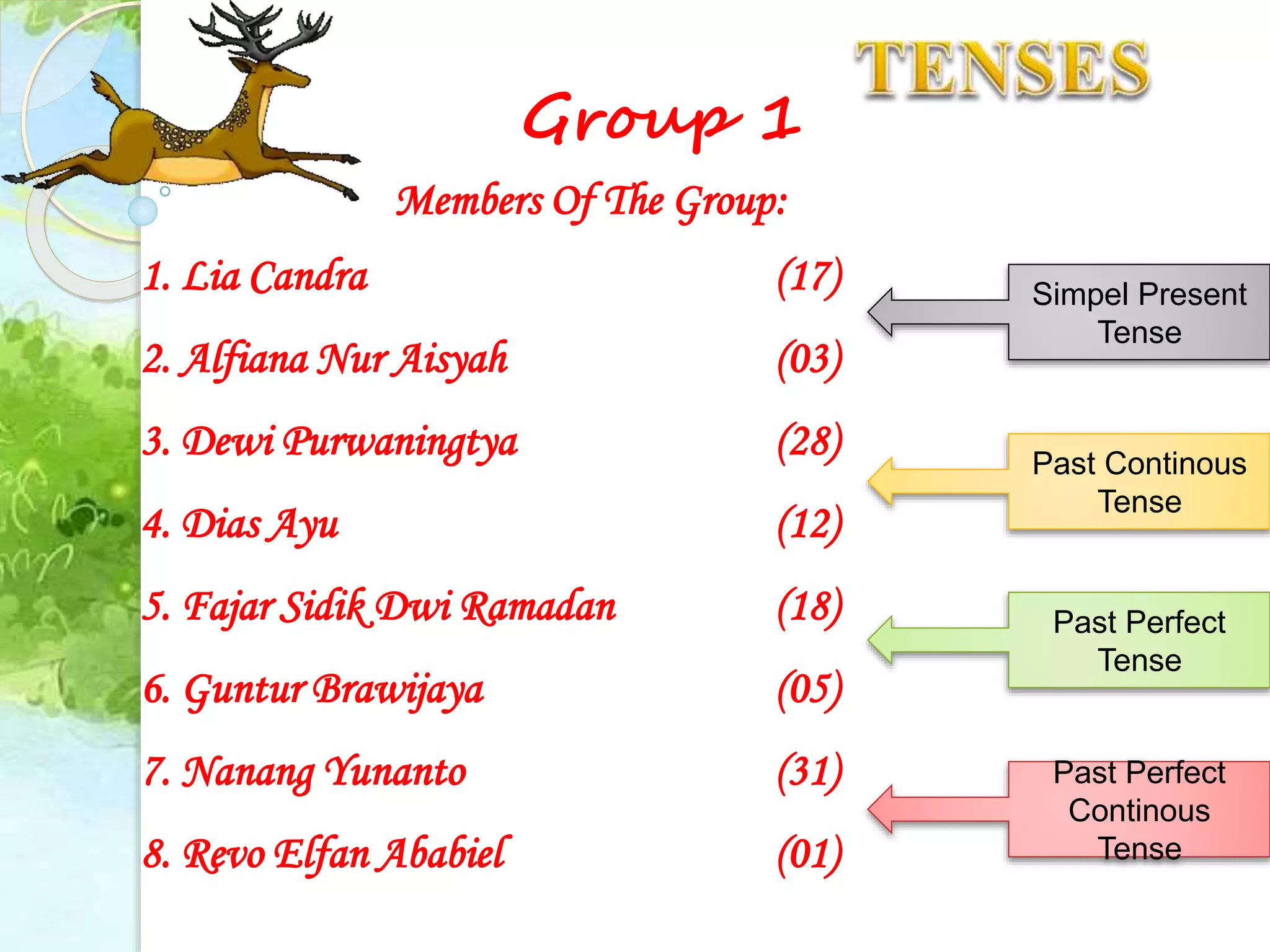
Group 1
Members Of The Group:
1. Lia Candra (17)
2. Alfiana Nur Aisyah (03)
3. Dewi Purwaningtya (28)
4. Dias Ayu (12)
5. Fajar Sidik Dwi Ramadan (18)
6. Guntur Brawijaya (05)
7. Nanang Yunanto (31)
8. Revo Elfan Ababiel (01)
Simpel Present
Tense
Past Perfect
Continous
Tense
Past Perfect
Tense
Past Continous
Tense
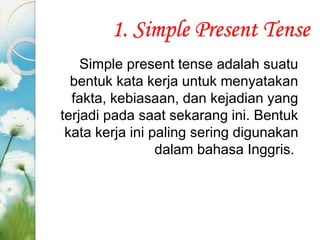
1. Simple Present Tense
Simple present tense adalah suatu
bentuk kata kerja untuk menyatakan
fakta, kebiasaan, dan kejadian yang
terjadi pada saat sekarang ini. Bentuk
kata kerja ini paling sering digunakan
dalam bahasa Inggris.
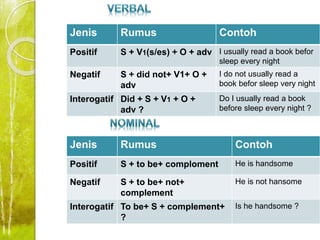
Jenis Rumus Contoh
Positif S + V1(s/es) + O + adv I usually read a book befor
sleep every night
Negatif S + did not+ V1+ O +
adv
I do not usually read a
book befor sleep very night
Interogatif Did + S + V1 + O +
adv ?
Do I usually read a book
before sleep every night ?
Jenis Rumus Contoh
Positif S + to be+ comploment He is handsome
Negatif S + to be+ not+
complement
He is not hansome
Interogatif To be+ S + complement+
?
Is he handsome ?
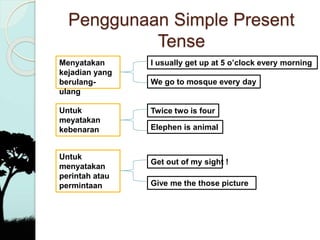
Penggunaan Simple Present
Tense
Menyatakan
kejadian yang
berulang-
ulang
I usually get up at 5 o’clock every morning
We go to mosque every day
Untuk
meyatakan
kebenaran
Twice two is four
Elephen is animal
Untuk
menyatakan
perintah atau
permintaan
Get out of my sight !
Give me the those picture
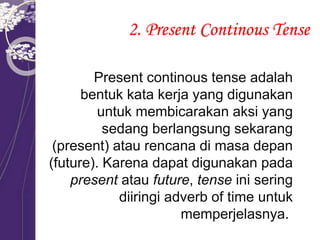
2. Present Continous Tense
Present continous tense adalah
bentuk kata kerja yang digunakan
untuk membicarakan aksi yang
sedang berlangsung sekarang
(present) atau rencana di masa depan
(future). Karena dapat digunakan pada
present atau future, tense ini sering
diiringi adverb of time untuk
memperjelasnya.
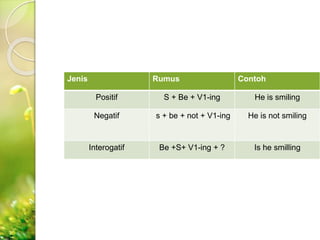
Jenis Rumus Contoh
Positif S + Be + V1-ing He is smiling
Negatif s + be + not + V1-ing He is not smiling
Interogatif Be +S+ V1-ing + ? Is he smilling
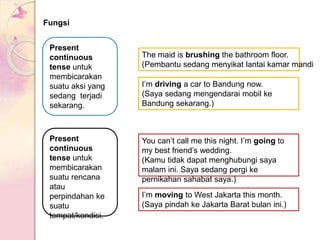
Fungsi
Present
continuous
tense untuk
membicarakan
suatu aksi yang
sedang terjadi
sekarang.
The maid is brushing the bathroom floor.
(Pembantu sedang menyikat lantai kamar mandi
I’m driving a car to Bandung now.
(Saya sedang mengendarai mobil ke
Bandung sekarang.)
Present
continuous
tense untuk
membicarakan
suatu rencana
atau
perpindahan ke
suatu
tempat/kondisi.
You can’t call me this night. I’m going to
my best friend’s wedding.
(Kamu tidak dapat menghubungi saya
malam ini. Saya sedang pergi ke
pernikahan sahabat saya.)
I’m moving to West Jakarta this month.
(Saya pindah ke Jakarta Barat bulan ini.)
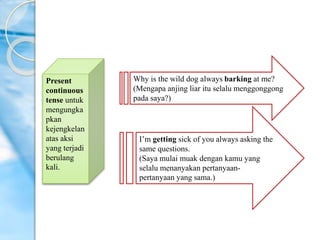
Present
continuous
tense untuk
mengungka
pkan
kejengkelan
atas aksi
yang terjadi
berulang
kali.
Why is the wild dog always barking at me?
(Mengapa anjing liar itu selalu menggonggong
pada saya?)
I’m getting sick of you always asking the
same questions.
(Saya mulai muak dengan kamu yang
selalu menanyakan pertanyaan-
pertanyaan yang sama.)
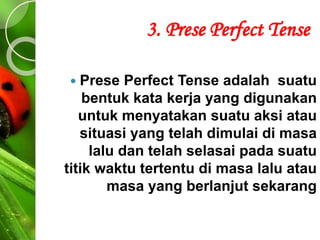
3. Prese Perfect Tense
 Prese Perfect Tense adalah suatu
bentuk kata kerja yang digunakan
untuk menyatakan suatu aksi atau
situasi yang telah dimulai di masa
lalu dan telah selasai pada suatu
titik waktu tertentu di masa lalu atau
masa yang berlanjut sekarang
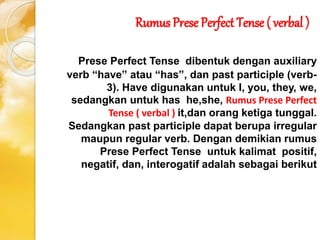
Rumus Prese Perfect Tense ( verbal )
Prese Perfect Tense dibentuk dengan auxiliary
verb “have” atau “has”, dan past participle (verb-
3). Have digunakan untuk I, you, they, we,
sedangkan untuk has he,she, Rumus Prese Perfect
Tense ( verbal ) it,dan orang ketiga tunggal.
Sedangkan past participle dapat berupa irregular
maupun regular verb. Dengan demikian rumus
Prese Perfect Tense untuk kalimat positif,
negatif, dan, interogatif adalah sebagai berikut
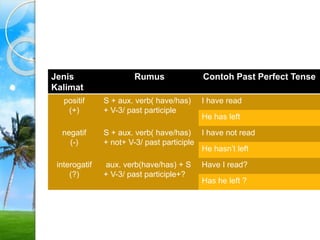
Jenis
Kalimat
Rumus Contoh Past Perfect Tense
positif
(+)
S + aux. verb( have/has)
+ V-3/ past participle
I have read
He has left
negatif
(-)
S + aux. verb( have/has)
+ not+ V-3/ past participle
I have not read
He hasn’t left
interogatif
(?)
aux. verb(have/has) + S
+ V-3/ past participle+?
Have I read?
Has he left ?
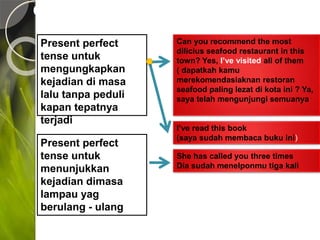
CONTOH PRESENT PERFECT TENSE
Present perfect
tense untuk
mengungkapkan
kejadian di masa
lalu tanpa peduli
kapan tepatnya
terjadi
Can you recommend the most
dilicius seafood restaurant in this
town? Yes, I’ve visited all of them
( dapatkah kamu
merekomendasiaknan restoran
seafood paling lezat di kota ini ? Ya,
saya telah mengunjungi semuanya
I’ve read this book
(saya sudah membaca buku ini)
Present perfect
tense untuk
menunjukkan
kejadian dimasa
lampau yag
berulang - ulang
She has called you three times
Dia sudah menelponmu tiga kali
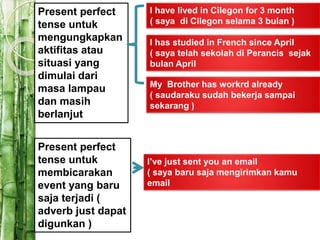
Present perfect
tense untuk
mengungkapkan
aktifitas atau
situasi yang
dimulai dari
masa lampau
dan masih
berlanjut
I have lived in Cilegon for 3 month
( saya di Cilegon selama 3 bulan )
I has studied in French since April
( saya telah sekolah di Perancis sejak
bulan April
My Brother has workrd already
( saudaraku sudah bekerja sampai
sekarang )
Present perfect
tense untuk
membicarakan
event yang baru
saja terjadi (
adverb just dapat
digunkan )
I’ve just sent you an email
( saya baru saja mengirimkan kamu
email
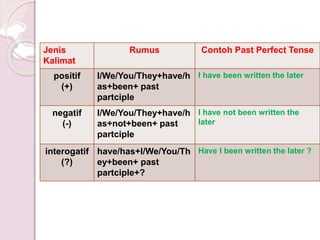
Jenis
Kalimat
Rumus Contoh Past Perfect Tense
positif
(+)
I/We/You/They+have/h
as+been+ past
partciple
I have been written the later
negatif
(-)
I/We/You/They+have/h
as+not+been+ past
partciple
I have not been written the
later
interogatif
(?)
have/has+I/We/You/Th
ey+been+ past
partciple+?
Have I been written the later ?
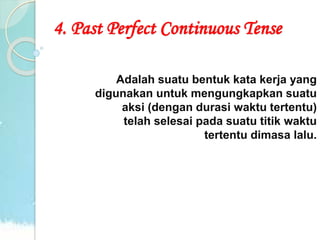
4. Past Perfect Continuous Tense
Adalah suatu bentuk kata kerja yang
digunakan untuk mengungkapkan suatu
aksi (dengan durasi waktu tertentu)
telah selesai pada suatu titik waktu
tertentu dimasa lalu.
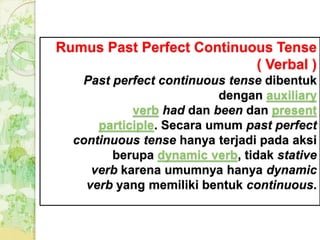
Rumus Past Perfect Continuous Tense
( Verbal )
Past perfect continuous tense dibentuk
dengan auxiliary
verb had dan been dan present
participle. Secara umum past perfect
continuous tense hanya terjadi pada aksi
berupa dynamic verb, tidak stative
verb karena umumnya hanya dynamic
verb yang memiliki bentuk continuous.
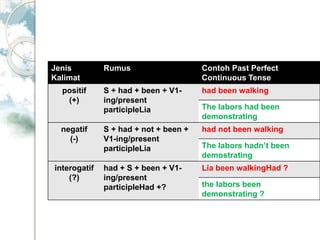
Jenis
Kalimat
Rumus Contoh Past Perfect
Continuous Tense
positif
(+)
S + had + been + V1-
ing/present
participleLia
had been walking
The labors had been
demonstrating
negatif
(-)
S + had + not + been +
V1-ing/present
participleLia
had not been walking
The labors hadn’t been
demostrating
interogatif
(?)
had + S + been + V1-
ing/present
participleHad +?
Lia been walkingHad ?
the labors been
demonstrating ?
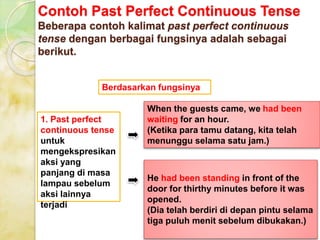
Contoh Past Perfect Continuous Tense
Beberapa contoh kalimat past perfect continuous
tense dengan berbagai fungsinya adalah sebagai
berikut.
Berdasarkan fungsinya
1. Past perfect
continuous tense
untuk
mengekspresikan
aksi yang
panjang di masa
lampau sebelum
aksi lainnya
terjadi
When the guests came, we had been
waiting for an hour.
(Ketika para tamu datang, kita telah
menunggu selama satu jam.)
He had been standing in front of the
door for thirthy minutes before it was
opened.
(Dia telah berdiri di depan pintu selama
tiga puluh menit sebelum dibukakan.)
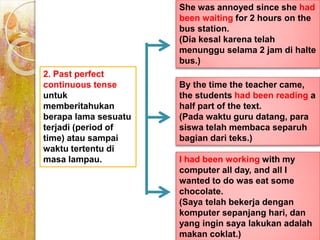
2. Past perfect
continuous tense
untuk
memberitahukan
berapa lama sesuatu
terjadi (period of
time) atau sampai
waktu tertentu di
masa lampau.
She was annoyed since she had
been waiting for 2 hours on the
bus station.
(Dia kesal karena telah
menunggu selama 2 jam di halte
bus.)
By the time the teacher came,
the students had been reading a
half part of the text.
(Pada waktu guru datang, para
siswa telah membaca separuh
bagian dari teks.)
I had been working with my
computer all day, and all I
wanted to do was eat some
chocolate.
(Saya telah bekerja dengan
komputer sepanjang hari, dan
yang ingin saya lakukan adalah
makan coklat.)
Tensis

Tensis

  • 1.
    Group 1 Members OfThe Group: 1. Lia Candra (17) 2. Alfiana Nur Aisyah (03) 3. Dewi Purwaningtya (28) 4. Dias Ayu (12) 5. Fajar Sidik Dwi Ramadan (18) 6. Guntur Brawijaya (05) 7. Nanang Yunanto (31) 8. Revo Elfan Ababiel (01) Simpel Present Tense Past Perfect Continous Tense Past Perfect Tense Past Continous Tense
  • 2.
    1. Simple PresentTense Simple present tense adalah suatu bentuk kata kerja untuk menyatakan fakta, kebiasaan, dan kejadian yang terjadi pada saat sekarang ini. Bentuk kata kerja ini paling sering digunakan dalam bahasa Inggris.
  • 3.
    Jenis Rumus Contoh PositifS + V1(s/es) + O + adv I usually read a book befor sleep every night Negatif S + did not+ V1+ O + adv I do not usually read a book befor sleep very night Interogatif Did + S + V1 + O + adv ? Do I usually read a book before sleep every night ? Jenis Rumus Contoh Positif S + to be+ comploment He is handsome Negatif S + to be+ not+ complement He is not hansome Interogatif To be+ S + complement+ ? Is he handsome ?
  • 4.
    Penggunaan Simple Present Tense Menyatakan kejadianyang berulang- ulang I usually get up at 5 o’clock every morning We go to mosque every day Untuk meyatakan kebenaran Twice two is four Elephen is animal Untuk menyatakan perintah atau permintaan Get out of my sight ! Give me the those picture
  • 5.
    2. Present ContinousTense Present continous tense adalah bentuk kata kerja yang digunakan untuk membicarakan aksi yang sedang berlangsung sekarang (present) atau rencana di masa depan (future). Karena dapat digunakan pada present atau future, tense ini sering diiringi adverb of time untuk memperjelasnya.
  • 6.
    Jenis Rumus Contoh PositifS + Be + V1-ing He is smiling Negatif s + be + not + V1-ing He is not smiling Interogatif Be +S+ V1-ing + ? Is he smilling
  • 7.
    Fungsi Present continuous tense untuk membicarakan suatu aksiyang sedang terjadi sekarang. The maid is brushing the bathroom floor. (Pembantu sedang menyikat lantai kamar mandi I’m driving a car to Bandung now. (Saya sedang mengendarai mobil ke Bandung sekarang.) Present continuous tense untuk membicarakan suatu rencana atau perpindahan ke suatu tempat/kondisi. You can’t call me this night. I’m going to my best friend’s wedding. (Kamu tidak dapat menghubungi saya malam ini. Saya sedang pergi ke pernikahan sahabat saya.) I’m moving to West Jakarta this month. (Saya pindah ke Jakarta Barat bulan ini.)
  • 8.
    Present continuous tense untuk mengungka pkan kejengkelan atas aksi yangterjadi berulang kali. Why is the wild dog always barking at me? (Mengapa anjing liar itu selalu menggonggong pada saya?) I’m getting sick of you always asking the same questions. (Saya mulai muak dengan kamu yang selalu menanyakan pertanyaan- pertanyaan yang sama.)
  • 9.
    3. Prese PerfectTense  Prese Perfect Tense adalah suatu bentuk kata kerja yang digunakan untuk menyatakan suatu aksi atau situasi yang telah dimulai di masa lalu dan telah selasai pada suatu titik waktu tertentu di masa lalu atau masa yang berlanjut sekarang
  • 10.
    Rumus Prese PerfectTense ( verbal ) Prese Perfect Tense dibentuk dengan auxiliary verb “have” atau “has”, dan past participle (verb- 3). Have digunakan untuk I, you, they, we, sedangkan untuk has he,she, Rumus Prese Perfect Tense ( verbal ) it,dan orang ketiga tunggal. Sedangkan past participle dapat berupa irregular maupun regular verb. Dengan demikian rumus Prese Perfect Tense untuk kalimat positif, negatif, dan, interogatif adalah sebagai berikut
  • 11.
    Jenis Kalimat Rumus Contoh PastPerfect Tense positif (+) S + aux. verb( have/has) + V-3/ past participle I have read He has left negatif (-) S + aux. verb( have/has) + not+ V-3/ past participle I have not read He hasn’t left interogatif (?) aux. verb(have/has) + S + V-3/ past participle+? Have I read? Has he left ?
  • 12.
    CONTOH PRESENT PERFECTTENSE Present perfect tense untuk mengungkapkan kejadian di masa lalu tanpa peduli kapan tepatnya terjadi Can you recommend the most dilicius seafood restaurant in this town? Yes, I’ve visited all of them ( dapatkah kamu merekomendasiaknan restoran seafood paling lezat di kota ini ? Ya, saya telah mengunjungi semuanya I’ve read this book (saya sudah membaca buku ini) Present perfect tense untuk menunjukkan kejadian dimasa lampau yag berulang - ulang She has called you three times Dia sudah menelponmu tiga kali
  • 13.
    Present perfect tense untuk mengungkapkan aktifitasatau situasi yang dimulai dari masa lampau dan masih berlanjut I have lived in Cilegon for 3 month ( saya di Cilegon selama 3 bulan ) I has studied in French since April ( saya telah sekolah di Perancis sejak bulan April My Brother has workrd already ( saudaraku sudah bekerja sampai sekarang ) Present perfect tense untuk membicarakan event yang baru saja terjadi ( adverb just dapat digunkan ) I’ve just sent you an email ( saya baru saja mengirimkan kamu email
  • 14.
    Jenis Kalimat Rumus Contoh PastPerfect Tense positif (+) I/We/You/They+have/h as+been+ past partciple I have been written the later negatif (-) I/We/You/They+have/h as+not+been+ past partciple I have not been written the later interogatif (?) have/has+I/We/You/Th ey+been+ past partciple+? Have I been written the later ?
  • 15.
    4. Past PerfectContinuous Tense Adalah suatu bentuk kata kerja yang digunakan untuk mengungkapkan suatu aksi (dengan durasi waktu tertentu) telah selesai pada suatu titik waktu tertentu dimasa lalu.
  • 16.
    Rumus Past PerfectContinuous Tense ( Verbal ) Past perfect continuous tense dibentuk dengan auxiliary verb had dan been dan present participle. Secara umum past perfect continuous tense hanya terjadi pada aksi berupa dynamic verb, tidak stative verb karena umumnya hanya dynamic verb yang memiliki bentuk continuous.
  • 17.
    Jenis Kalimat Rumus Contoh PastPerfect Continuous Tense positif (+) S + had + been + V1- ing/present participleLia had been walking The labors had been demonstrating negatif (-) S + had + not + been + V1-ing/present participleLia had not been walking The labors hadn’t been demostrating interogatif (?) had + S + been + V1- ing/present participleHad +? Lia been walkingHad ? the labors been demonstrating ?
  • 18.
    Contoh Past PerfectContinuous Tense Beberapa contoh kalimat past perfect continuous tense dengan berbagai fungsinya adalah sebagai berikut. Berdasarkan fungsinya 1. Past perfect continuous tense untuk mengekspresikan aksi yang panjang di masa lampau sebelum aksi lainnya terjadi When the guests came, we had been waiting for an hour. (Ketika para tamu datang, kita telah menunggu selama satu jam.) He had been standing in front of the door for thirthy minutes before it was opened. (Dia telah berdiri di depan pintu selama tiga puluh menit sebelum dibukakan.)
  • 19.
    2. Past perfect continuoustense untuk memberitahukan berapa lama sesuatu terjadi (period of time) atau sampai waktu tertentu di masa lampau. She was annoyed since she had been waiting for 2 hours on the bus station. (Dia kesal karena telah menunggu selama 2 jam di halte bus.) By the time the teacher came, the students had been reading a half part of the text. (Pada waktu guru datang, para siswa telah membaca separuh bagian dari teks.) I had been working with my computer all day, and all I wanted to do was eat some chocolate. (Saya telah bekerja dengan komputer sepanjang hari, dan yang ingin saya lakukan adalah makan coklat.)