TENNICOIT
By Sangeeta Patwa
Jnv UJJAIN
INTRODUCTION
Tennikoit is an outdoor game which
was started in the early 1960s. It was
played by high school girls in the USA
since the 1930s. Four decades since
its inception, the game has risen from
district levels to international levels
with nearly 20 countries all over the
world competing for the crown.
HISTORY
Tennikoit is one of the obscure sports
which almost faced extinction.
However the sport received timely
attention and it survived and
flourished. Even though exact records
are not available to document the
place and date of birth of Tennikoit, its
largely believed that South India is its
birthplace.
THE PLAY
The game can be played with a
minimum of two people (singles)
up to a maximum of four people
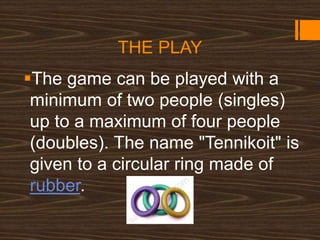
(doubles). The name "Tennikoit" is
given to a circular ring made of
rubber.
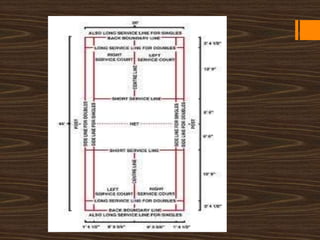
COURT
A game of Tennikoit essentially
involves the exchange of the
tennikoit across the courts. The
net between the two courts acts
as a barrier. A typical Tennikoit
court essentially looks like a
Badminton court
RULE
. Each individual tries to score 21
points in order to be declared a
winner. However, in order to be
declared a winner, one has to
maintain a minimum of two points
lead over the opponent. If each of the
players score 21 points, then the
winner is decided by tie-break. The
match is a set of 3 games
Court and Equipment
Tennikoit can be played indoors or
outside. This variation of ring
tennis can be played on any
surface which includes red sand,
clay, and cement. The dimensions
of the courts are the same for both
Singles and Doubles.
MEASURNMENT
Their measure is 12.2 m by 5.5 m. A
centre line divides the Tennikoit court
into two equal courts. The players
are not allowed to play in the other
side of the court during service. Each
playing zone is 5.2 x 2.75 m. The
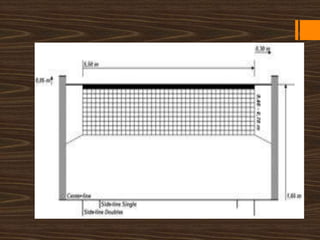
height of the net that divides the
court another direction is 1.8 m.
ANTENNAS
There are strict rules about the
material to be used, the height
of the pole, and the "antennas"
are used to mark the limits of
the sides of the net. The net
height for the Sub-Junior
division is 1.67 m.
Participants and Their Duties
A timeout is allowed for 30
seconds per set for each
team. A yellow card system is
in place for any violation of
this rule.
Rules of Tennikoit
In Tennikoit, you play 3 sets of 21 points.
The winner of 2 sets wins the match.
However, a time limit of 30 seconds is in
place per set. This means the server
should win a point within nine rallies.
Failing to do so will then result in a point
for your opponent.
Playing Actions and Faults
The game is started with a
service, and you must serve
the ball diagonally to the other
player. The first return can be
anywhere.
Each player takes 5 services
in a row, regardless if that
person has won the point or
not. Like tennis, the service
changes half courts every time
. All services should have
an upward tendency. No
one is allowed in the
dead court.
A koit hitting the antenna or sailing
away should be called out, even if it
did fall in the court. A koit is prohibited
to enter the other side through the net.
Both wobbling and shaking are
considered faults
Current Positioning
Tennikoit was initially a popular
game amongst girls. However,
when the sport was taken to a
professional level, fierce
competition often attracted large
crowds. Today, the game conducts
events for men, women and mixed
doubles sections]
TENNIKOIT FEDERATION OF INDIA
. As per the Tennikoit Federation of
India, there are 5,000 registered
Tennikoit players and they have had
29 annual championships to date.
Six countries will take part in the first
World Tennikoit Championships at
Velammal International School,
Panchetti, Chennai[2
References
^
http://tacosite.com/includes/Tennikoit.pdf
^ Source:Tennikoit Federation of India
External links
http://www.indiantennikoit.com
Retrieved from
"http://en.wikipedia.org/w/index.php?title=T
ennikoit&oldid=451442203
Tennikoit

Tennikoit

  • 1.
  • 2.
    INTRODUCTION Tennikoit is anoutdoor game which was started in the early 1960s. It was played by high school girls in the USA since the 1930s. Four decades since its inception, the game has risen from district levels to international levels with nearly 20 countries all over the world competing for the crown.
  • 3.
    HISTORY Tennikoit is oneof the obscure sports which almost faced extinction. However the sport received timely attention and it survived and flourished. Even though exact records are not available to document the place and date of birth of Tennikoit, its largely believed that South India is its birthplace.
  • 4.
    THE PLAY The gamecan be played with a minimum of two people (singles) up to a maximum of four people (doubles). The name "Tennikoit" is given to a circular ring made of rubber.
  • 5.
    COURT A game ofTennikoit essentially involves the exchange of the tennikoit across the courts. The net between the two courts acts as a barrier. A typical Tennikoit court essentially looks like a Badminton court
  • 6.
    RULE . Each individualtries to score 21 points in order to be declared a winner. However, in order to be declared a winner, one has to maintain a minimum of two points lead over the opponent. If each of the players score 21 points, then the winner is decided by tie-break. The match is a set of 3 games
  • 8.
    Court and Equipment Tennikoitcan be played indoors or outside. This variation of ring tennis can be played on any surface which includes red sand, clay, and cement. The dimensions of the courts are the same for both Singles and Doubles.
  • 9.
    MEASURNMENT Their measure is12.2 m by 5.5 m. A centre line divides the Tennikoit court into two equal courts. The players are not allowed to play in the other side of the court during service. Each playing zone is 5.2 x 2.75 m. The height of the net that divides the court another direction is 1.8 m.
  • 12.
    ANTENNAS There are strictrules about the material to be used, the height of the pole, and the "antennas" are used to mark the limits of the sides of the net. The net height for the Sub-Junior division is 1.67 m.
  • 13.
    Participants and TheirDuties A timeout is allowed for 30 seconds per set for each team. A yellow card system is in place for any violation of this rule.
  • 14.
    Rules of Tennikoit InTennikoit, you play 3 sets of 21 points. The winner of 2 sets wins the match. However, a time limit of 30 seconds is in place per set. This means the server should win a point within nine rallies. Failing to do so will then result in a point for your opponent.
  • 15.
    Playing Actions andFaults The game is started with a service, and you must serve the ball diagonally to the other player. The first return can be anywhere.
  • 16.
    Each player takes5 services in a row, regardless if that person has won the point or not. Like tennis, the service changes half courts every time
  • 17.
    . All servicesshould have an upward tendency. No one is allowed in the dead court.
  • 18.
    A koit hittingthe antenna or sailing away should be called out, even if it did fall in the court. A koit is prohibited to enter the other side through the net. Both wobbling and shaking are considered faults
  • 19.
    Current Positioning Tennikoit wasinitially a popular game amongst girls. However, when the sport was taken to a professional level, fierce competition often attracted large crowds. Today, the game conducts events for men, women and mixed doubles sections]
  • 20.
    TENNIKOIT FEDERATION OFINDIA . As per the Tennikoit Federation of India, there are 5,000 registered Tennikoit players and they have had 29 annual championships to date. Six countries will take part in the first World Tennikoit Championships at Velammal International School, Panchetti, Chennai[2
  • 21.
    References ^ http://tacosite.com/includes/Tennikoit.pdf ^ Source:Tennikoit Federationof India External links http://www.indiantennikoit.com Retrieved from "http://en.wikipedia.org/w/index.php?title=T ennikoit&oldid=451442203