Surprised at this findings

    This therapy came from USA
     Based on Quadrant Theorem
25years old in Japan and 65 years in US
Results from Animal Experiments
1. Rats      Dr. Tatsuya Ueda Dr. Kiyoshi Maehara
2. Guinea Pigs Dr. Yukio Azuma, Dr. Hitoshi Taga,
Dr. Masaharu Hashimoto Dr. Kiyoshi Maehara
3. Beagle Dogs Dr. Masaharu Hashimoto, Dr. Kiyoshi
Maehara, Dr. Teruaki Sumioka
4. Rhesus Monkeys Dr. David Burns, Dr. Masaharu
Hashimoto, Dr. Keiichi Tamaki, Dr. Kiyoshi Maehara
1-2 Asahi University School of Dentistry Department of Pharmacology
3-4 Fujisawa Pharmaceutical Company Limited
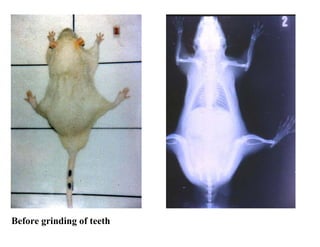
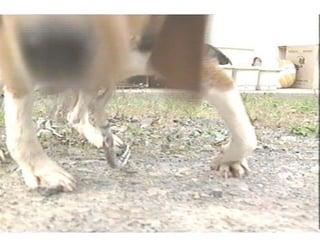
Before grinding of teeth
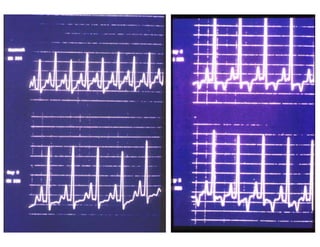
2 months after grinding of teeth-- 30 mg/kg Droperidol ip.
Normal posture before grinding


4 days after
bilateral grinding
of teeth
2 months later after grinding the teeth
Muscle tension has changed with no fractures
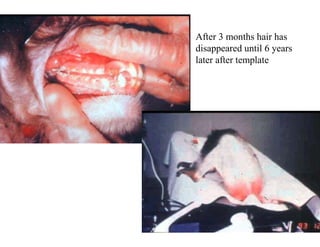
After 3 months hair has
disappeared until 6 years
later after template
1 year later the tongue torqued to one side
Slight anesthesia Ketamine used to observe monkeys
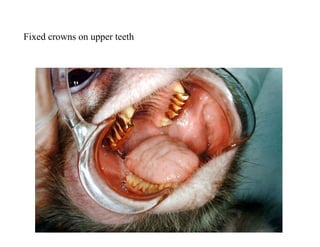
After 6 years high crowns placed as Template
Fixed crowns on upper teeth
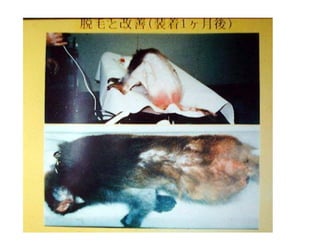
After 1 month of crowns placed improvement of hair loss
2 months later more hair improvement
Why the reasons appear the these clinical
findings?
similar to the acupuncture
What happen in the mouth when bite something?
Reasons for the Effectiveness of
         Template Therapy
1. From the viewpoint of the physics of
Guzay’s Quadrant Theorem
2. From the viewpoint of the physiology
    Masticatory muscles are controlled by
trigeminal nervous system(Controlled by
brain Stem)
Component of Physiology
                 Masticatory muscles
1. Same as skeletal muscle
2. 600 spindles in jaw closing muscles and only 50 spindles in
antagonistic or jaw opening muscles
3. Length of muscle is decided by colossal position
4. However the grinding of teeth or shortening of muscle
requires the motor response of both alpha and gamma
5. This motor access to spinal cord so alpha and gamma level
goes up
This difficult motion is supported by
constriction order from motor nerves which
 come from spinal cord and supported by
                stretch reflex

 Stretching or elongating order of all muscles is
 nothing only constriction
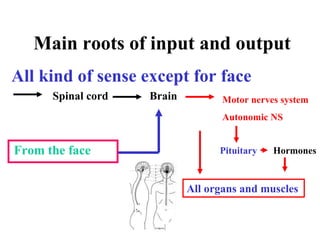
Main roots of input and output
All kind of sense except for face
      Spinal cord   Brain          Motor nerves system
                                   Autonomic NS


From the face                     Pituitary   Hormones


                            All organs and muscles
Dental Occlusion
Upper(head) and lower(mandibule)
teeth touch each other
Still now is it Good or Bad ?::
We have no idea how to measure it
Bite position is always related to the
head position (Support the head)
The bite made by teeth at once and
masticator contracted by motor N.
which direct from brain stem(Trig.N.)
Viewpoint form Physic: Relation between
             upper and lower jaw


Japanese famous cartoon :Just the same as Dentistry
Only move the lower jaw when eating and speaking
Look at the jaw movement
American cartoon ; Always moving upper and lower jaw
Ga Ha Ha


The hippopotamus moves the upper jaw when opening
the mouth; As same People when laughing
The head supported by 2 occipital condyle and right
          and left occlusion of the teeth
Masticatory M. and Posture
         Viewpoint from Physics
    Bite position is crossly related to
    one’s head position & posture
       Viewpoint from Physiology
    Posture is controlled by
    eyesight,hearing,equilibrium and
    muscles sense(Masticatory M.)
Pyramidal and Extrapyramidal Motor System


                        Caudate N.
                          Cerebellum
       Putamen
                          Thalamus
  Pale globe             Hypo.Thalamus
   αMotor fiber to       S.nigra
   muscles fibre         S.Colliculus
        Acceleration     γMotor fiber
        Inhibition       to M.Spindle
         Ventral horn
In case of mal occlusion


                        When over closure is
                        happened, motor N. act more
                        than normal occlusion
Cortex and basal ganglia over work during eating &
swallowing (Excite the motor and autonomic N.)
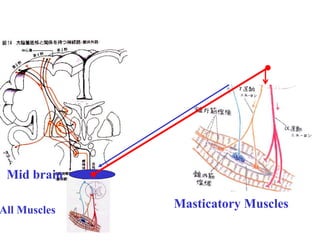
Mid brain

All Muscles
              Masticatory Muscles
Cortex and           Neuromotor system
           basal ganglia.
                              the ventral cells are influenced by
                              cortex and basal ganglia

Ia sense
            γ
 M. Fiber
                     αmotor


      M.Spindle
Until perfect bite, Neuromotor system sent the
information to the Masticatory M.(α・γ motor
                                  (
activated)
                          Difficult factors to Bite
                          1.Do not use a denture during
                            sleeping.
                          2.Deep bite
                          3.Missing teeth and no care


The results are disorder of the out put such as motor
system (mal posture) and autonomic system .
テンプレートの
      テンプレートの装着


咀嚼筋は ばされ脳から咀嚼筋への収縮命令は
咀嚼筋は伸ばされ脳から咀嚼筋への収縮命令は停
           咀嚼筋への収縮命令
    活動は休止)
止(脳の活動は休止)
咀嚼筋の伸張反射のため猛烈な違和感の
咀嚼筋の伸張反射のため猛烈な違和感の発生
        のため猛烈
How to use the stick in medical
                  care?
                Template or stick is not drug
 This works stabilization of the brain due to the cutting off
           the out put signals for the masticators.
1.During the hospitalization patients should bite stick
2.The denture never take out during the sleeping
3.Ease to pain control when bite the Stick or TP.
4.During the under anesthesia bite Brock is necessary in
order to the stabilization of blood pressure
5.In case of incurable diseases, stick or Tp help for patients
Conclusion
1.Mechanism of action is stabilization of the brain
  No more exciting for bite. Only irritate the
  trigeminal mesencephalon and gray matter of the
  mid aqueduct where is a pain reduce action
2.歯のかみ合わせを計測できないが低い歯のかみ合
   のかみ合わせを計測できないが低
            計測できないが    のかみ合
わせは脳 疲労させる
         させる:  清潔に   大切にする
わせは脳を疲労させる:口を清潔に・歯を大切にする
  普段からそしゃく
     からそしゃく筋  ばす訓練
                訓練を
  普段からそしゃく筋を延ばす訓練を行う
  きく口   けて歌
(大きく口を開けて歌う)
  スティックを んだままで毎日20分程度階段
               毎日20分程度階段の
3.スティックを噛んだままで毎日20分程度階段の登り
 りや歩行
    歩行に めましょう。
降りや歩行に努めましょう。

Template Therapy 2

  • 5.
    Surprised at thisfindings This therapy came from USA Based on Quadrant Theorem 25years old in Japan and 65 years in US
  • 6.
    Results from AnimalExperiments 1. Rats Dr. Tatsuya Ueda Dr. Kiyoshi Maehara 2. Guinea Pigs Dr. Yukio Azuma, Dr. Hitoshi Taga, Dr. Masaharu Hashimoto Dr. Kiyoshi Maehara 3. Beagle Dogs Dr. Masaharu Hashimoto, Dr. Kiyoshi Maehara, Dr. Teruaki Sumioka 4. Rhesus Monkeys Dr. David Burns, Dr. Masaharu Hashimoto, Dr. Keiichi Tamaki, Dr. Kiyoshi Maehara 1-2 Asahi University School of Dentistry Department of Pharmacology 3-4 Fujisawa Pharmaceutical Company Limited
  • 7.
  • 8.
    2 months aftergrinding of teeth-- 30 mg/kg Droperidol ip.
  • 9.
    Normal posture beforegrinding 4 days after bilateral grinding of teeth
  • 14.
    2 months laterafter grinding the teeth Muscle tension has changed with no fractures
  • 17.
    After 3 monthshair has disappeared until 6 years later after template
  • 18.
    1 year laterthe tongue torqued to one side Slight anesthesia Ketamine used to observe monkeys
  • 19.
    After 6 yearshigh crowns placed as Template
  • 20.
    Fixed crowns onupper teeth
  • 21.
    After 1 monthof crowns placed improvement of hair loss
  • 22.
    2 months latermore hair improvement
  • 35.
    Why the reasonsappear the these clinical findings? similar to the acupuncture What happen in the mouth when bite something?
  • 36.
    Reasons for theEffectiveness of Template Therapy 1. From the viewpoint of the physics of Guzay’s Quadrant Theorem 2. From the viewpoint of the physiology Masticatory muscles are controlled by trigeminal nervous system(Controlled by brain Stem)
  • 37.
    Component of Physiology Masticatory muscles 1. Same as skeletal muscle 2. 600 spindles in jaw closing muscles and only 50 spindles in antagonistic or jaw opening muscles 3. Length of muscle is decided by colossal position 4. However the grinding of teeth or shortening of muscle requires the motor response of both alpha and gamma 5. This motor access to spinal cord so alpha and gamma level goes up
  • 38.
    This difficult motionis supported by constriction order from motor nerves which come from spinal cord and supported by stretch reflex Stretching or elongating order of all muscles is nothing only constriction
  • 39.
    Main roots ofinput and output All kind of sense except for face Spinal cord Brain Motor nerves system Autonomic NS From the face Pituitary Hormones All organs and muscles
  • 41.
    Dental Occlusion Upper(head) andlower(mandibule) teeth touch each other Still now is it Good or Bad ?:: We have no idea how to measure it Bite position is always related to the head position (Support the head) The bite made by teeth at once and masticator contracted by motor N. which direct from brain stem(Trig.N.)
  • 42.
    Viewpoint form Physic:Relation between upper and lower jaw Japanese famous cartoon :Just the same as Dentistry Only move the lower jaw when eating and speaking
  • 43.
    Look at thejaw movement
  • 44.
    American cartoon ;Always moving upper and lower jaw
  • 45.
    Ga Ha Ha Thehippopotamus moves the upper jaw when opening the mouth; As same People when laughing
  • 46.
    The head supportedby 2 occipital condyle and right and left occlusion of the teeth
  • 47.
    Masticatory M. andPosture Viewpoint from Physics Bite position is crossly related to one’s head position & posture Viewpoint from Physiology Posture is controlled by eyesight,hearing,equilibrium and muscles sense(Masticatory M.)
  • 48.
    Pyramidal and ExtrapyramidalMotor System Caudate N. Cerebellum Putamen Thalamus Pale globe Hypo.Thalamus αMotor fiber to S.nigra muscles fibre S.Colliculus Acceleration γMotor fiber Inhibition to M.Spindle Ventral horn
  • 49.
    In case ofmal occlusion When over closure is happened, motor N. act more than normal occlusion Cortex and basal ganglia over work during eating & swallowing (Excite the motor and autonomic N.)
  • 50.
    Mid brain All Muscles Masticatory Muscles
  • 51.
    Cortex and Neuromotor system basal ganglia. the ventral cells are influenced by cortex and basal ganglia Ia sense γ M. Fiber αmotor M.Spindle
  • 52.
    Until perfect bite,Neuromotor system sent the information to the Masticatory M.(α・γ motor ( activated) Difficult factors to Bite 1.Do not use a denture during sleeping. 2.Deep bite 3.Missing teeth and no care The results are disorder of the out put such as motor system (mal posture) and autonomic system .
  • 53.
    テンプレートの テンプレートの装着 咀嚼筋は ばされ脳から咀嚼筋への収縮命令は 咀嚼筋は伸ばされ脳から咀嚼筋への収縮命令は停 咀嚼筋への収縮命令 活動は休止) 止(脳の活動は休止) 咀嚼筋の伸張反射のため猛烈な違和感の 咀嚼筋の伸張反射のため猛烈な違和感の発生 のため猛烈
  • 55.
    How to usethe stick in medical care? Template or stick is not drug This works stabilization of the brain due to the cutting off the out put signals for the masticators. 1.During the hospitalization patients should bite stick 2.The denture never take out during the sleeping 3.Ease to pain control when bite the Stick or TP. 4.During the under anesthesia bite Brock is necessary in order to the stabilization of blood pressure 5.In case of incurable diseases, stick or Tp help for patients
  • 56.
    Conclusion 1.Mechanism of actionis stabilization of the brain No more exciting for bite. Only irritate the trigeminal mesencephalon and gray matter of the mid aqueduct where is a pain reduce action 2.歯のかみ合わせを計測できないが低い歯のかみ合 のかみ合わせを計測できないが低 計測できないが のかみ合 わせは脳 疲労させる させる: 清潔に 大切にする わせは脳を疲労させる:口を清潔に・歯を大切にする 普段からそしゃく からそしゃく筋 ばす訓練 訓練を 普段からそしゃく筋を延ばす訓練を行う きく口 けて歌 (大きく口を開けて歌う) スティックを んだままで毎日20分程度階段 毎日20分程度階段の 3.スティックを噛んだままで毎日20分程度階段の登り りや歩行 歩行に めましょう。 降りや歩行に努めましょう。