Title of the thesis
(usually within 17 words)
Student Name
Reg ID 203757
Supervisor Name
XXXXXXXXXX
Committee Members
1 - XXXXXXXXX
2 - XXXXXXXXXX
Degree Program
Year
Department/School
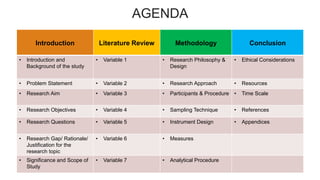
AGENDA
Introduction Literature Review Methodology Conclusion
• Introduction and
Background of the study
• Variable 1 • Research Philosophy &
Design
• Ethical Considerations
• Problem Statement • Variable 2 • Research Approach • Resources
• Research Aim • Variable 3 • Participants & Procedure • Time Scale
• Research Objectives • Variable 4 • Sampling Technique • References
• Research Questions • Variable 5 • Instrument Design • Appendices
• Research Gap/ Rationale/
Justification for the
research topic
• Variable 6 • Measures
• Significance and Scope of
Study
• Variable 7 • Analytical Procedure
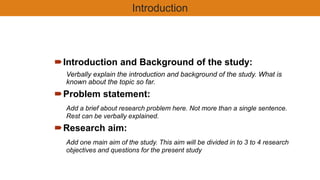
Introduction and Background of the study:
Verbally explain the introduction and background of the study. What is
known about the topic so far.
Problem statement:
Add a brief about research problem here. Not more than a single sentence.
Rest can be verbally explained.
Research aim:
Add one main aim of the study. This aim will be divided in to 3 to 4 research
objectives and questions for the present study
Introduction
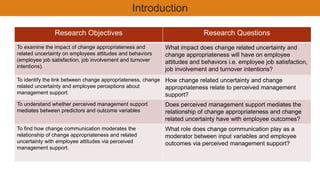
Research Objectives Research Questions
To examine the impact of change appropriateness and
related uncertainty on employees attitudes and behaviors
(employee job satisfaction, job involvement and turnover
intentions).
What impact does change related uncertainty and
change appropriateness will have on employee
attitudes and behaviors i.e. employee job satisfaction,
job involvement and turnover intentions?
To identify the link between change appropriateness, change
related uncertainty and employee perceptions about
management support.
How change related uncertainty and change
appropriateness relate to perceived management
support?
To understand whether perceived management support
mediates between predictors and outcome variables
Does perceived management support mediates the
relationship of change appropriateness and change
related uncertainty have with employee outcomes?
To find how change communication moderates the
relationship of change appropriateness and related
uncertainty with employee attitudes via perceived
management support.
What role does change communication play as a
moderator between input variables and employee
outcomes via perceived management support?
Introduction
Research Gap
Understand the link of perceived management support with employee attitudes and behaviors (Al-Hussami et
al. 2017; Cullen, 2014)
Study organizational change with mediating and moderating variables (Kirrane et al. 2017)
Research indicates to study how workplace change leads to employee stress (Lee et al. 2017)
To examine that how individuals develop sense of changes and understand attitudes of employees in
the context of change (Akhtar et al. 2016).
Important to highlight the factors that lead to job satisfaction during change (Adigwe, 2015)
Important to study employee perspective and understand why they react in a certain way (Al-Ali et al.
2017)
Introduction
Variables Literature
• Variable 1 “An individual’s perceived inability to predict something accurately” (Milliken, 1987)
• Variable 2 Whether change effort appropriate to embrace the vision (Pare et al. 2011).
• Variable 3 “Pleasurable emotional state resulting from the appraisal of one's job as achieving or
facilitating the achievement of one's job values” (Locke,1969)
• Variable 4 “An individual’s desire or willingness to leave an organization” (Hom et al. 1992)
• Variable 5 Degree to which one show emotional or mental identification with his job (Li &
Long,1999).
Literature Review
Relationship
between variables
Literature
Change related
uncertainty & employee
outcomes
Change uncertainty negatively effects xxxxxxxxx (Marmenout, 2010; Podsakoff et
al. 2007; Cullen et al. 2014; Uygur & Kilic, 2009) H1-H3
Change appropriateness
& employee outcomes
When change is perceived to be correct then it positively affects xxxxxxxxxxx (Cole
et al. 2006; Holt et al. 2007; Rusly et al. 2012; Gold et al.2001) H4-H6
Literature Review
Relationship between
variables
Literature
Mediation Beliefs concerning the extent to which the organization values their contributions
and cares about their wellbeing. It Fulfils their socio-emotional needs and
impacts attitudes positively (Kirrane et al. 2017; Cullen et al. 2014) H7-H9
Moderation Quality and adequate information help employees to overcome uncertainties and
understand change appropriateness that encourages employees to show more
openness towards change (Allen et al. 2007; Rehman, 2011) H10a, H10b
Literature Review
Research Framework
Figure 01: Research Model
Source: https://doi.org/10.3390/su11113159
Methodology
Quantitate
research strategy
Objectivist
positivist
Cross sectional
Unit of analysis
will be individuals
Banking and
information
technology
Survey technique Sample size 384
Purposive sampling
technique
5 point likert-scale will be used where 1=Strongly Disagree and 5= Strongly Agree
 Variable 1: Rafferty and Griffin’s (2006) 4 items survey is selected to gather responses
 Variable 2 This variable will be measured by using a 10 items survey developed by (Holt, 2007).
 Variable 3 : Items of this variable are developed by Kanungo’s (1982) that includes 10 items
 Variable 4 : It will be measured through 6 items survey developed by Agho, Price and Mueller (1992).
 Variable 5 : This variable will be measured with 3 items adopted from Vigoda (2000).
 Variable 6 : The items of this variable are adopted from Bouckenooghe et al. (2009) that includes 7
items.
 Variable 7 : It will be measured with 4 items adopted from Wanberg and Banas (2000).
 Control variables: Age, Gender and qualification will be used as control variables
Methodology
Measures
Analytical procedure
 Normality of the data
 Outliers, Missing values, unengaged responses
 Linearity, homoscedasticity, multicollinearity, frequencies, skewness,
kurtosis and standard deviation, Pearson’s correlation analysis,
Cronbach’s Alpha reliability
 Confirmatory factor analyses
 Analysis of moderated mediation
Methodology
Research Ethics
Permission will be requested
Confidentiality and anonymity
Voluntary participation
Resources
Research Ethics Committee Approval/IRB
Conclusion
Thesis Time Line/ Gantt Chart
Activities Start Date End Date
Identifying research gap and topic development 10th July, 2018 28th August, 2018
Proposal draft 1st September, 2018 28th September, 2018
Proposal defense October 2nd Week
Introduction, literature review & methodology write up 17th October, 2018 27th November, 2018
Data collection 1st December, 2018 30th January, 2019
Results and discussion write up 1st February, 2019 10th March, 2019
Completion of final draft 13th March, 2019 30th March, 2019
Submission to supervisor 1st April, 2019
Submission to GEC members 2nd April, 2019
Pre/Final thesis defense May/June, 2019
Conclusion
References
 Cole, M. S., Harris, S. G., & Bernerth, J. B. (2006). Exploring the implications of vision, appropriateness, and execution of organizational
change. Leadership & Organization Development Journal, 27(5), 352-367.
 Cullen, K. L., Edwards, B. D., Casper, W. C., & Gue, K. R. (2014). Employees’ adaptability and perceptions of change-related uncertainty:
Implications for perceived organizational support, job satisfaction, and performance. Journal of Business and Psychology, 29(2), 269-280.
 Agho, A. O., Price, J. L., & Mueller, C. W. (1992). Discriminant validity of measures of job satisfaction, positive affectivity and negative
affectivity. Journal of Occupational and Organizational Psychology, 65(3), 185-195.
 Bouckenooghe, D., Devos, G., & Van den Broeck, H. (2009). Organizational change questionnaire–climate of change, processes, and
readiness: Development of a new instrument. The Journal of psychology, 143(6), 559-599.
 Gold, A. H., Malhotra, A., & Segars, A. H. (2001). Knowledge management: An organizational capabilities perspective. Journal of
management information systems, 18(1), 185-214.
 Hom, P. W., Caranikas-Walker, F., Prussia, G. E., & Griffeth, R. W. (1992). A meta-analytical structural equations analysis of a model of
employee turnover. Journal of Applied Psychology, 77(6), 890.
 Kirrane, M., Lennon, M., O’Connor, C., & Fu, N. (2017). Linking perceived management support with employees’ readiness for change:
the mediating role of psychological capital. Journal of Change Management, 17(1), 47-66.
 Lee, K., Sharif, M., Scandura, T., & Kim, J. (2017). Procedural justice as a moderator of the relationship between organizational change
intensity and commitment to organizational change. Journal of Organizational Change Management, 30(4), 501-524.
 Locke, E. A. (1969). What is job satisfaction?. Organizational behavior and human performance, 4(4), 309-336.
 Marmenout, K. (2010). Employee sensemaking in mergers: How deal characteristics shape employee attitudes. The Journal of Applied
Behavioral Science, 46(3), 329-359.
 Milliken, F. J. (1987). Three types of perceived uncertainty about the environment: State, effect, and response uncertainty. Academy of
Management review, 12(1), 133-143.
Conclusion
Template Research Proposal Presentation-1.pptx

Template Research Proposal Presentation-1.pptx

  • 1.
    Title of thethesis (usually within 17 words) Student Name Reg ID 203757 Supervisor Name XXXXXXXXXX Committee Members 1 - XXXXXXXXX 2 - XXXXXXXXXX Degree Program Year Department/School
  • 2.
    AGENDA Introduction Literature ReviewMethodology Conclusion • Introduction and Background of the study • Variable 1 • Research Philosophy & Design • Ethical Considerations • Problem Statement • Variable 2 • Research Approach • Resources • Research Aim • Variable 3 • Participants & Procedure • Time Scale • Research Objectives • Variable 4 • Sampling Technique • References • Research Questions • Variable 5 • Instrument Design • Appendices • Research Gap/ Rationale/ Justification for the research topic • Variable 6 • Measures • Significance and Scope of Study • Variable 7 • Analytical Procedure
  • 3.
    Introduction and Backgroundof the study: Verbally explain the introduction and background of the study. What is known about the topic so far. Problem statement: Add a brief about research problem here. Not more than a single sentence. Rest can be verbally explained. Research aim: Add one main aim of the study. This aim will be divided in to 3 to 4 research objectives and questions for the present study Introduction
  • 4.
    Research Objectives ResearchQuestions To examine the impact of change appropriateness and related uncertainty on employees attitudes and behaviors (employee job satisfaction, job involvement and turnover intentions). What impact does change related uncertainty and change appropriateness will have on employee attitudes and behaviors i.e. employee job satisfaction, job involvement and turnover intentions? To identify the link between change appropriateness, change related uncertainty and employee perceptions about management support. How change related uncertainty and change appropriateness relate to perceived management support? To understand whether perceived management support mediates between predictors and outcome variables Does perceived management support mediates the relationship of change appropriateness and change related uncertainty have with employee outcomes? To find how change communication moderates the relationship of change appropriateness and related uncertainty with employee attitudes via perceived management support. What role does change communication play as a moderator between input variables and employee outcomes via perceived management support? Introduction
  • 5.
    Research Gap Understand thelink of perceived management support with employee attitudes and behaviors (Al-Hussami et al. 2017; Cullen, 2014) Study organizational change with mediating and moderating variables (Kirrane et al. 2017) Research indicates to study how workplace change leads to employee stress (Lee et al. 2017) To examine that how individuals develop sense of changes and understand attitudes of employees in the context of change (Akhtar et al. 2016). Important to highlight the factors that lead to job satisfaction during change (Adigwe, 2015) Important to study employee perspective and understand why they react in a certain way (Al-Ali et al. 2017) Introduction
  • 6.
    Variables Literature • Variable1 “An individual’s perceived inability to predict something accurately” (Milliken, 1987) • Variable 2 Whether change effort appropriate to embrace the vision (Pare et al. 2011). • Variable 3 “Pleasurable emotional state resulting from the appraisal of one's job as achieving or facilitating the achievement of one's job values” (Locke,1969) • Variable 4 “An individual’s desire or willingness to leave an organization” (Hom et al. 1992) • Variable 5 Degree to which one show emotional or mental identification with his job (Li & Long,1999). Literature Review
  • 7.
    Relationship between variables Literature Change related uncertainty& employee outcomes Change uncertainty negatively effects xxxxxxxxx (Marmenout, 2010; Podsakoff et al. 2007; Cullen et al. 2014; Uygur & Kilic, 2009) H1-H3 Change appropriateness & employee outcomes When change is perceived to be correct then it positively affects xxxxxxxxxxx (Cole et al. 2006; Holt et al. 2007; Rusly et al. 2012; Gold et al.2001) H4-H6 Literature Review
  • 8.
    Relationship between variables Literature Mediation Beliefsconcerning the extent to which the organization values their contributions and cares about their wellbeing. It Fulfils their socio-emotional needs and impacts attitudes positively (Kirrane et al. 2017; Cullen et al. 2014) H7-H9 Moderation Quality and adequate information help employees to overcome uncertainties and understand change appropriateness that encourages employees to show more openness towards change (Allen et al. 2007; Rehman, 2011) H10a, H10b Literature Review
  • 9.
    Research Framework Figure 01:Research Model Source: https://doi.org/10.3390/su11113159
  • 10.
    Methodology Quantitate research strategy Objectivist positivist Cross sectional Unitof analysis will be individuals Banking and information technology Survey technique Sample size 384 Purposive sampling technique
  • 11.
    5 point likert-scalewill be used where 1=Strongly Disagree and 5= Strongly Agree  Variable 1: Rafferty and Griffin’s (2006) 4 items survey is selected to gather responses  Variable 2 This variable will be measured by using a 10 items survey developed by (Holt, 2007).  Variable 3 : Items of this variable are developed by Kanungo’s (1982) that includes 10 items  Variable 4 : It will be measured through 6 items survey developed by Agho, Price and Mueller (1992).  Variable 5 : This variable will be measured with 3 items adopted from Vigoda (2000).  Variable 6 : The items of this variable are adopted from Bouckenooghe et al. (2009) that includes 7 items.  Variable 7 : It will be measured with 4 items adopted from Wanberg and Banas (2000).  Control variables: Age, Gender and qualification will be used as control variables Methodology Measures
  • 12.
    Analytical procedure  Normalityof the data  Outliers, Missing values, unengaged responses  Linearity, homoscedasticity, multicollinearity, frequencies, skewness, kurtosis and standard deviation, Pearson’s correlation analysis, Cronbach’s Alpha reliability  Confirmatory factor analyses  Analysis of moderated mediation Methodology
  • 13.
    Research Ethics Permission willbe requested Confidentiality and anonymity Voluntary participation Resources Research Ethics Committee Approval/IRB Conclusion
  • 14.
    Thesis Time Line/Gantt Chart Activities Start Date End Date Identifying research gap and topic development 10th July, 2018 28th August, 2018 Proposal draft 1st September, 2018 28th September, 2018 Proposal defense October 2nd Week Introduction, literature review & methodology write up 17th October, 2018 27th November, 2018 Data collection 1st December, 2018 30th January, 2019 Results and discussion write up 1st February, 2019 10th March, 2019 Completion of final draft 13th March, 2019 30th March, 2019 Submission to supervisor 1st April, 2019 Submission to GEC members 2nd April, 2019 Pre/Final thesis defense May/June, 2019 Conclusion
  • 15.
    References  Cole, M.S., Harris, S. G., & Bernerth, J. B. (2006). Exploring the implications of vision, appropriateness, and execution of organizational change. Leadership & Organization Development Journal, 27(5), 352-367.  Cullen, K. L., Edwards, B. D., Casper, W. C., & Gue, K. R. (2014). Employees’ adaptability and perceptions of change-related uncertainty: Implications for perceived organizational support, job satisfaction, and performance. Journal of Business and Psychology, 29(2), 269-280.  Agho, A. O., Price, J. L., & Mueller, C. W. (1992). Discriminant validity of measures of job satisfaction, positive affectivity and negative affectivity. Journal of Occupational and Organizational Psychology, 65(3), 185-195.  Bouckenooghe, D., Devos, G., & Van den Broeck, H. (2009). Organizational change questionnaire–climate of change, processes, and readiness: Development of a new instrument. The Journal of psychology, 143(6), 559-599.  Gold, A. H., Malhotra, A., & Segars, A. H. (2001). Knowledge management: An organizational capabilities perspective. Journal of management information systems, 18(1), 185-214.  Hom, P. W., Caranikas-Walker, F., Prussia, G. E., & Griffeth, R. W. (1992). A meta-analytical structural equations analysis of a model of employee turnover. Journal of Applied Psychology, 77(6), 890.  Kirrane, M., Lennon, M., O’Connor, C., & Fu, N. (2017). Linking perceived management support with employees’ readiness for change: the mediating role of psychological capital. Journal of Change Management, 17(1), 47-66.  Lee, K., Sharif, M., Scandura, T., & Kim, J. (2017). Procedural justice as a moderator of the relationship between organizational change intensity and commitment to organizational change. Journal of Organizational Change Management, 30(4), 501-524.  Locke, E. A. (1969). What is job satisfaction?. Organizational behavior and human performance, 4(4), 309-336.  Marmenout, K. (2010). Employee sensemaking in mergers: How deal characteristics shape employee attitudes. The Journal of Applied Behavioral Science, 46(3), 329-359.  Milliken, F. J. (1987). Three types of perceived uncertainty about the environment: State, effect, and response uncertainty. Academy of Management review, 12(1), 133-143. Conclusion