Selling to the C-Level
Executive
LaserFast Telesales Presentation
The aim of the presentation
Explains:
• Who the C-Level Executives (CLEs) are
• What they are concerned about
• Why they need to be targeted
• When they should be targeted
• How to target CLEs
• Agenda for talking with a CLE
C-Level Executives
• Exist in large & multinational companies
• Have very high up positions
• Can influence decisions
Examples Include:
• CEO, CFO, COO, CIO, President
C-Level Executives
In Australia
• Medium Company Executives also act
like CLEs
Examples Include
• Owner, Director, Finance Manager,
Marketing Manager, Operations Manager
What’s Important to a CLE?
They are hyper-focused on:
• Improving their results
• Employing strategies to grow revenue
• Increasing market share
• Decreasing costs
• Improving workforce productivity
• Managing risk
Why are CLEs Important?
They:
• Drive business change
• Are aware of present/future needs
• Sign off on any paperwork
• Have the final say
This is why they need to be targeted
When to Target CLEs?
CLEs rarely get up in the morning thinking
about interacting with salesmen
• Timing is everything
• You need to be in the right place at the
right time
• You need to understand their
organisations equipment buying cycle
Insertion points for a CLE
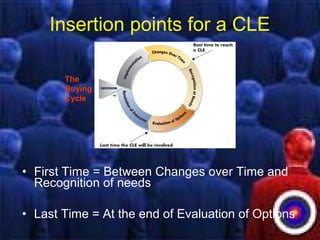
• First Time = Between Changes over Time and
Recognition of needs
• Last Time = At the end of Evaluation of Options
The
Buying
Cycle
Best Time to Reach a CLE
According to Huthwaite the CLE will have most
involvement during the cusp between Changes
Over Time and Recognition of Needs
Here
• The status quo is starting to unravel
• New problems are beginning to emerge
• Eventually they will progress to irritation
Last Time to Reach a CLE
According to Huthwaite, the last time to
reach a CLE is at the end of the
Evaluation of Options
Here
• The CLE checks the right decision has been
made
• Makes Recommendations to change or
influence the decision
Last Time to Reach a CLE
With Medium sized companies buying
smaller amounts of equipment there is
another insertion point:
• Anytime up to the point of signoff
• During the 10 day cooling off period
• Before the Solutions have been delivered
How to Target a CLE
Timing is everything
• Get lucky through cold calling or marketing
• Build a relationship with the CLE
• Find out when their buying cycle is likely to start
• Use trigger events to establish ‘changes over
time’
• Use Value to show needs/issues
Build a relationship with the CLE
• Cold Call the CEO
• Send e-mails, marketing letters
• Follow up with warm calls
• Gather information / Build a profile
• Find a referral
• Be respectful of their time
• Ask for a best or realistic time to try again
Use Buying Cycles
To use buying Cycles you need to:
• Gather Information and build a profile
• Set an opportunity date
• Build a relationship
• Persist to get hold of the CLE when the
opportunity springs into life
What are Trigger Events?
Create Pain – Force Change – Create Needs
Needs are Solved with Products and Services
Trigger events fall into 2 categories
Those that can be seen:
only within an organisation
or
outside an organisation
Triggers Seen Only Inside Orgs
Examples:
• A New Marketing Campaign
• Relocation of Offices
• Cost Cutting/Fast Growth
Ask probing questions
Keep companies with trigger events on the radar
Triggers Seen Outside Orgs
Examples:
• Mergers/Acquisitions/Takeovers
• Downsizing/Organisational Changes
• Rapid Growth/Recruitment Drives
• Shareholder Dissatisfaction
• Major Share Price Movements
Be persistent. Don’t give up
Keep trying to get through to the CLEs
Creating a Value Proposition
Often a sale can be made when you create
a need for a service or product
• Identify a weakness a product can solve
• Find a better solution to what they have
• Find something they don’t have
• Bundle a package together if in the market
• Identify an opportunity for the company
An alternative way to get to the
CLEs
• Work with someone in the organisation
who has the trust of the CLE. i.e.
Executive Assistants. Ask for an audience
later!
• If you know any CLEs or have sold
successfully to any ask them for a referral
Agenda to talk to CLEs
When a CLE is in the recognition of needs
phase of the buying cycle:
• Find out what changes are facing the company
• Discuss how LaserFast can help
• Talk about our capabilities to drive improvement
• Give examples of satisfied customers
• Get a date and time to discuss
• Talk about the next steps
Showing Proof to CLEs
CLEs want to see you:
• Have done your homework
• Know the type of problems or opportunity
facing them
• Have the capabilities to help the CLE
• Have had experience doing this before
CLEs Are Not An Easy Sale!
They do however:
• Buy frequently
• Bring forth great rewards!
Go Get them!

Telesales Training CLEs

  • 1.
    Selling to theC-Level Executive LaserFast Telesales Presentation
  • 2.
    The aim ofthe presentation Explains: • Who the C-Level Executives (CLEs) are • What they are concerned about • Why they need to be targeted • When they should be targeted • How to target CLEs • Agenda for talking with a CLE
  • 3.
    C-Level Executives • Existin large & multinational companies • Have very high up positions • Can influence decisions Examples Include: • CEO, CFO, COO, CIO, President
  • 4.
    C-Level Executives In Australia •Medium Company Executives also act like CLEs Examples Include • Owner, Director, Finance Manager, Marketing Manager, Operations Manager
  • 5.
    What’s Important toa CLE? They are hyper-focused on: • Improving their results • Employing strategies to grow revenue • Increasing market share • Decreasing costs • Improving workforce productivity • Managing risk
  • 6.
    Why are CLEsImportant? They: • Drive business change • Are aware of present/future needs • Sign off on any paperwork • Have the final say This is why they need to be targeted
  • 7.
    When to TargetCLEs? CLEs rarely get up in the morning thinking about interacting with salesmen • Timing is everything • You need to be in the right place at the right time • You need to understand their organisations equipment buying cycle
  • 8.
    Insertion points fora CLE • First Time = Between Changes over Time and Recognition of needs • Last Time = At the end of Evaluation of Options The Buying Cycle
  • 9.
    Best Time toReach a CLE According to Huthwaite the CLE will have most involvement during the cusp between Changes Over Time and Recognition of Needs Here • The status quo is starting to unravel • New problems are beginning to emerge • Eventually they will progress to irritation
  • 10.
    Last Time toReach a CLE According to Huthwaite, the last time to reach a CLE is at the end of the Evaluation of Options Here • The CLE checks the right decision has been made • Makes Recommendations to change or influence the decision
  • 11.
    Last Time toReach a CLE With Medium sized companies buying smaller amounts of equipment there is another insertion point: • Anytime up to the point of signoff • During the 10 day cooling off period • Before the Solutions have been delivered
  • 12.
    How to Targeta CLE Timing is everything • Get lucky through cold calling or marketing • Build a relationship with the CLE • Find out when their buying cycle is likely to start • Use trigger events to establish ‘changes over time’ • Use Value to show needs/issues
  • 13.
    Build a relationshipwith the CLE • Cold Call the CEO • Send e-mails, marketing letters • Follow up with warm calls • Gather information / Build a profile • Find a referral • Be respectful of their time • Ask for a best or realistic time to try again
  • 14.
    Use Buying Cycles Touse buying Cycles you need to: • Gather Information and build a profile • Set an opportunity date • Build a relationship • Persist to get hold of the CLE when the opportunity springs into life
  • 15.
    What are TriggerEvents? Create Pain – Force Change – Create Needs Needs are Solved with Products and Services Trigger events fall into 2 categories Those that can be seen: only within an organisation or outside an organisation
  • 16.
    Triggers Seen OnlyInside Orgs Examples: • A New Marketing Campaign • Relocation of Offices • Cost Cutting/Fast Growth Ask probing questions Keep companies with trigger events on the radar
  • 17.
    Triggers Seen OutsideOrgs Examples: • Mergers/Acquisitions/Takeovers • Downsizing/Organisational Changes • Rapid Growth/Recruitment Drives • Shareholder Dissatisfaction • Major Share Price Movements Be persistent. Don’t give up Keep trying to get through to the CLEs
  • 18.
    Creating a ValueProposition Often a sale can be made when you create a need for a service or product • Identify a weakness a product can solve • Find a better solution to what they have • Find something they don’t have • Bundle a package together if in the market • Identify an opportunity for the company
  • 19.
    An alternative wayto get to the CLEs • Work with someone in the organisation who has the trust of the CLE. i.e. Executive Assistants. Ask for an audience later! • If you know any CLEs or have sold successfully to any ask them for a referral
  • 20.
    Agenda to talkto CLEs When a CLE is in the recognition of needs phase of the buying cycle: • Find out what changes are facing the company • Discuss how LaserFast can help • Talk about our capabilities to drive improvement • Give examples of satisfied customers • Get a date and time to discuss • Talk about the next steps
  • 21.
    Showing Proof toCLEs CLEs want to see you: • Have done your homework • Know the type of problems or opportunity facing them • Have the capabilities to help the CLE • Have had experience doing this before
  • 22.
    CLEs Are NotAn Easy Sale! They do however: • Buy frequently • Bring forth great rewards! Go Get them!

Editor's Notes

  • #13 Build a relationship, being tenacious, sending e-mails, letters, marketing, calling to check on the status quo can help Buying Cycle – profiling the organisation, gathering info on their equipment, contract start date and length of contract, finding out when they usually change and if the eq is having issues.
  • #19 Examples – Equitrac/MPS , Consolidate Printers to an MFD , a Label Printer, Offer a MFD and a Label Printer, i.e. printing on their invoices with dataworks this may lead to a sale of software and an MFD.