Real World Problems,
Real World Load Testing
Jim Holmes
Evangelist, Test Studio
@aJimHolmes
http://bit.ly/JimAtTestStudio
Jim.Holmes@Telerik.com
Recent News…
What the CEO/customer wants:
“Can our site survive as we grow?”
“Will our users be happy when the system’s
being used?”
The cost of degraded performance
“According to a 2008 Aberdeen Group study, a 1-second delay
in page load time equals 11 percent fewer page views, a 16
percent decrease in customer satisfaction, and a 7 percent
loss in conversions. In dollar terms, this means that if a site
typically earns $100,000 a day, this year you could lose $2.5
million in sales for every second slower your site is compared
to last year (or, for that matter, compared to your
competitor’s website).” -- Web Load Testing for Dummies
What’s on the menu
• Types of Load Testing
• Setting Expectations
• What
• Where
• How
• Demo!
Types of Load Testing
Soak Testing
Failover / Tip Testing
Load Testing
Set Expectations Early
• What are our realistic goals?
• “Do we really need to support China when we will
only serve our neighborhood?” -- @BenCarey
• Need People, Hardware, TIME
• What’s on the table for fixing?
WHERE do we test?
• Internal
• Lets us focus on system behavior
• Hardware, cache, app itself
• External
• Focus is on overall system, usability
WHAT do we test?
• Existing site? Learn the traffic patterns.
• How do users use your site?
• Got history? Hit your web server logs, eg
• Build your scenarios to mimic
• Think times
• Ramp up
HOW do we test?
• Control the environment
• Change ONE THING at a time
• Automate setup & config
• Baseline data
• System config
• Flush caches, app pools, etc
• Warmup scripts
A Sample Load Test
An online shopping cart application is required to support 10,000 concurrent users
broken out into following activities:
• 7500 Virtual Users (VU’s) log in, browse through items and then log off.
• 1250 VU’s log in, add items to their shopping cart, check out and then log off.
• 750 VU’s log in, request RMA and then log off.
• 500 VU’s just log in without any subsequent activity.
*Each of the below is classified as a ‘User Profile’ or ‘Scenario’.
-Wikipedia
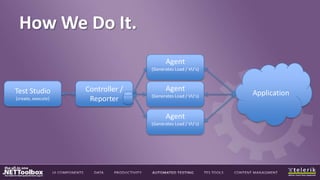
How We Do It.
Test Studio
(create, execute)
Controller /
Reporter
Agent
(Generates Load / VU’s)
Agent
(Generates Load / VU’s)
Agent
(Generates Load / VU’s)
Application
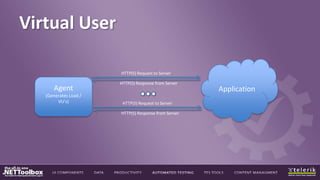
Virtual User
Agent
(Generates Load /
VU’s)
Application
HTTP(S) Request to Server
HTTP(S) Response from Server
HTTP(S) Request to Server
HTTP(S) Response from Server
Jim Holmes
Jim.Holmes@telerik.com
@aJimHolmes
@telerik | facebook.com/telerik

Load testing with Telerik Test Studio

  • 1.
    Real World Problems, RealWorld Load Testing Jim Holmes Evangelist, Test Studio @aJimHolmes http://bit.ly/JimAtTestStudio Jim.Holmes@Telerik.com
  • 2.
  • 3.
    What the CEO/customerwants: “Can our site survive as we grow?” “Will our users be happy when the system’s being used?”
  • 4.
    The cost ofdegraded performance “According to a 2008 Aberdeen Group study, a 1-second delay in page load time equals 11 percent fewer page views, a 16 percent decrease in customer satisfaction, and a 7 percent loss in conversions. In dollar terms, this means that if a site typically earns $100,000 a day, this year you could lose $2.5 million in sales for every second slower your site is compared to last year (or, for that matter, compared to your competitor’s website).” -- Web Load Testing for Dummies
  • 5.
    What’s on themenu • Types of Load Testing • Setting Expectations • What • Where • How • Demo!
  • 6.
  • 7.
  • 8.
  • 9.
  • 10.
    Set Expectations Early •What are our realistic goals? • “Do we really need to support China when we will only serve our neighborhood?” -- @BenCarey • Need People, Hardware, TIME • What’s on the table for fixing?
  • 11.
    WHERE do wetest? • Internal • Lets us focus on system behavior • Hardware, cache, app itself • External • Focus is on overall system, usability
  • 12.
    WHAT do wetest? • Existing site? Learn the traffic patterns. • How do users use your site? • Got history? Hit your web server logs, eg • Build your scenarios to mimic • Think times • Ramp up
  • 13.
    HOW do wetest? • Control the environment • Change ONE THING at a time • Automate setup & config • Baseline data • System config • Flush caches, app pools, etc • Warmup scripts
  • 14.
    A Sample LoadTest An online shopping cart application is required to support 10,000 concurrent users broken out into following activities: • 7500 Virtual Users (VU’s) log in, browse through items and then log off. • 1250 VU’s log in, add items to their shopping cart, check out and then log off. • 750 VU’s log in, request RMA and then log off. • 500 VU’s just log in without any subsequent activity. *Each of the below is classified as a ‘User Profile’ or ‘Scenario’. -Wikipedia
  • 15.
    How We DoIt. Test Studio (create, execute) Controller / Reporter Agent (Generates Load / VU’s) Agent (Generates Load / VU’s) Agent (Generates Load / VU’s) Application
  • 16.
    Virtual User Agent (Generates Load/ VU’s) Application HTTP(S) Request to Server HTTP(S) Response from Server HTTP(S) Request to Server HTTP(S) Response from Server
  • 18.