Teeth abnormalities on genetic
background
By
Romissaa Aly
Assistant lecturer of Oral Medicine,
Periodontology, Diagnosis and Dental
Radiology (Al-Azhar Univerisity)
Development of the Primary Dentition
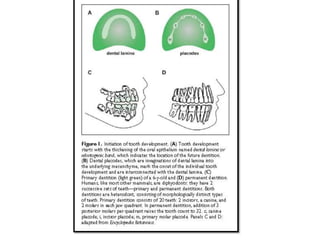
Tooth development initiates around the sixth week of
gestation as morphologically distinct thickening of the oral
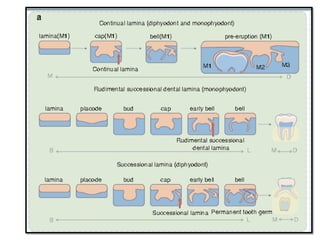
ectoderm called dental lamina (Fig. 1; Ooe 1981). This
uniform strip of ectodermal cells indicates the location of
the future dentition.
Studies on animal models, mainly mice, have shown that
it is characterized by the expression of several markers,
including Pitx2, the transcription factor most specific for
the dental epithelium, as well as Foxi3, Shh, Dlx2, Lef1,
and p63
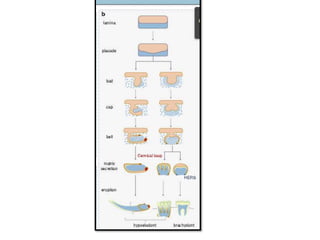
Epithelial cells within the placode progressively
proliferate and form the bud-shaped structure
surrounded by the condensed neural crest–derived
dental mesenchyme.
In the ensuing steps, the epithelium folds into a cap-like
structure, which further extends apically to form a bell-like
structure that resembles the shape of the future tooth
crown.
Epithelial morphogenesis of primary teeth is
regulated by signaling centers: clusters of
nonproliferative cells characterized by the localized
expression of several genes, including p21, Edar, Dkk4,
and Fgf20, within the tooth epithelium
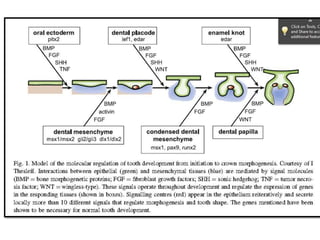
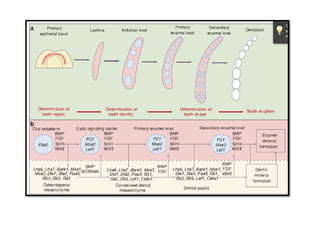
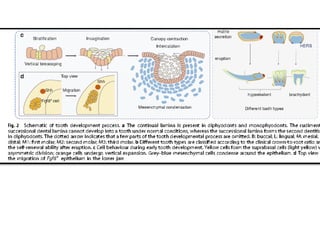
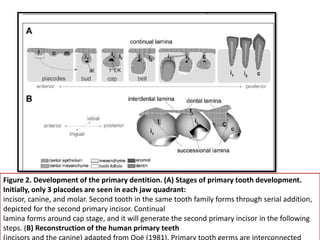
Three signaling centers form during tooth development (Fig.
2). The first is the initiation knot, which forms in the placodes
and governs the budding of the dental epithelium and the
condensation of the adjacent neural crest– derived
mesenchyme (Ahtiainen et al. 2016).
The second is the primary enamel knot, which appears at
the tip of the newly formed bud and governs tooth crown
development and formation of secondary enamel knots, a
third generation of signaling centers that fine-tune crown
morphogenesis by determining the sites of cusps.
Figure 2. Development of the primary dentition. (A) Stages of primary tooth development.
Initially, only 3 placodes are seen in each jaw quadrant:
incisor, canine, and molar. Second tooth in the same tooth family forms through serial addition,
depicted for the second primary incisor. Continual
lamina forms around cap stage, and it will generate the second primary incisor in the following
steps. (B) Reconstruction of the human primary teeth
Development of the Permanent Dentition
In both cases, the successional tooth is formed from the
extension of dental lamina of the predecessor tooth, when th
preceding tooth is in the early cap stage (Juuri et al. 2013).
These 2 processes are believed to be similar, particularly
considering that in both cases the successional tooth forms
from Sox2+ cells (Juuri et al. 2013).
Interestingly, gene expression analyses
on diphyodont ferret and minipig have demonstrated that
the interdental and successional laminae share similar
molecular characteristics, including diffused expression of
Foxi3 and Pitx2; asymmetric distribution of Sox2 and Bmp4,
located at the lingual side, and FZD6, a WNT pathway
receptor, expressed in the buccal/labial side
Molecular and Cellular Mechanisms
Regulating Successional Tooth Formation
Successional tooth formation requires stem cells to
generate new tissues.
 Tooth epithelial stem cells were first identified in the
continuously growing mouse incisors as label-retaining
cells.
Later studies have shown that they also express many
stem cell markers, including Sox2, and that they generate all
epithelial lineages in teeth
Published data on the molecular regulation of
successional tooth formation in reptiles and selected
mammals have provided evidence that tooth
morphogenesis and tooth replacement/
addition are regulated by the same signaling pathways.
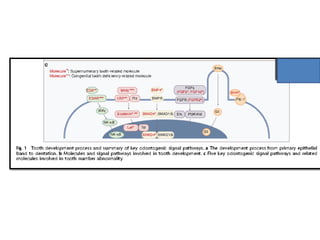
These include the WNT/β-catenin, BMP, Shh, EDA,
and FGF signaling pathways expressed in the intricate
temporal and spatial patterns, which define the timing
of individual tooth formation, size, shape, and position
of all teeth
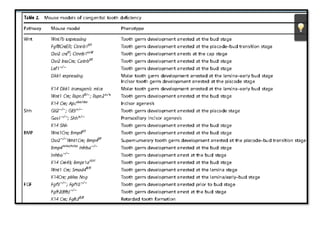
Wnt/β-catenin signaling regulates tooth development
at multiple stages and has been suggested as the key
regulator of successional tooth formation. Inhibition of
Wnt/β-catenin signaling in the early epithelium leads to
arrested tooth development at the lamina stage (Liu et
al. 2008).
Wnt activation throughout the ectoderm initiates
multiple tooth buds and results in supernumerary
teeth (Jarvinen et al. 2006; Wang
et al. 2009).
In particular, BMP2 and BMP4 are expressed in the
odontogenic condensed mesenchyme surrounding the
tip of the successional lamina and were implied as
positive modulators of Wnt signaling (Handrigan
and Richman 2010;
Runx2 is another transcription factor expressed in the
mesenchyme surrounding the tip of the successional
lamina, and its heterozygotic loss of function leads to
supernumerary tooth formation in humans (see later) and
in budding of the dental lamina in mice
Osr2 is expressed in the mesenchyme surrounding the tip of
the successional lamina, as well as in interdental lamina
(Jussila et al. 2014).
Mice lacking Osr2 develop supernumerary teeth located on
the lingual side, which is associated with the expansion of
the BMP4+ odontogenic mesenchyme and resembles
successional tooth formation (Zhang et al. 2009)
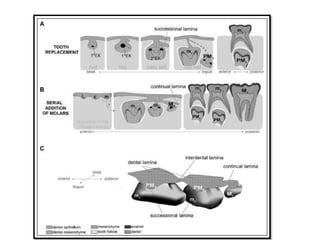
Figure 3. Development of the permanent dentition. (A) Permanent teeth, which
replace the primary dentition, develop from successional lamina,
which extends lingually from the dental lamina around the cap stage. (B) Permanent
molars erupt posterior to primary dentition and are the only teeth
in the permanent dentition that do not replace any primary teeth. It is not known
whether these teeth develop from an independent placode within
the primary dental lamina or are serially added from the continual lamina of the
second primary molar. Therefore, it is still a matter of debate whether
the permanent molars are part of the primary dentition or not. (C) Reconstruction of
the human primary dentition adapted from Ooë (1981) depicting
primary molars and generation of the first permanent molar, all interconnected by
interdental lamina. Initiation of permanent teeth from successional
lamina is depicted. 2o EK, secondary enamel knot; m1, first primary molar; m2, second
primary molar; M1, first permanent molar; PM1, first premolar;
PM2, second premolar
Tooth Agenesis
Tooth agenesis is one of the most common developmental
anomalies in humans (Yin and Bian 2015).
It is classified per the number of missing teeth to
hypodontia, oligodontia, and anodontia.
Hypodontia, an absence of 1 to 5 teeth (excluding third
molars), is the most common.
It occurs in primary dentition, with a prevalence between
0.1% and 1.5% and with no sex difference.
In the permanent dentition, the prevalence of hypodontia is
3.5% to 7%, and females are affected 1.5 times more than male
(Brook et al. 2014).
Oligodontia, an absence of ≥6 teeth (excluding third
molars), is relatively rare, with a prevalence of 0.3% (Bural et al
2012).
Anodontia, an absence of all teeth in one or both dentitions,
occurs very rarely and only in some forms of ectodermal
dysplasia
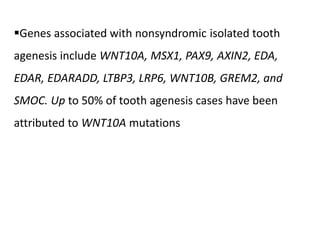
Genes associated with nonsyndromic isolated tooth
agenesis include WNT10A, MSX1, PAX9, AXIN2, EDA,
EDAR, EDARADD, LTBP3, LRP6, WNT10B, GREM2, and
SMOC. Up to 50% of tooth agenesis cases have been
attributed to WNT10A mutations
The most common syndromes with tooth agenesis
are ectodermal dysplasias affecting ectodermal organs,
including teeth.
The most common form is hypohidrotic ectodermal
dysplasia caused by mutations in genes of the EDA
pathway, including EDA, EDAR, EDARADD, and NEMO (
Other notable syndromic conditions often associated with
tooth agenesis are Rieger syndrome and cleft syndromes.
Rieger syndrome is caused by mutations in PITX2 resulting
in abnormalities in the eye, umbilical anomalies, and dental
abnormalities, including enamel hypoplasia and hypodontia
affecting the incisor region
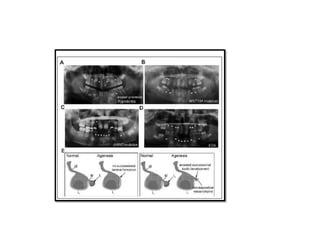
Figure 4. Panoramic radiographs from patients showing variable degrees of tooth agenesis.
(A) Eight-year-old male with incisor-premolar hypodontia showing agenesis of maxillary lateral
incisors, second maxillary premolars, and left mandibular second premolar. (B) Agenesis of
maxillary right premolars and second left premolar and mandibular premolars in a 10-y-old
male with homozygous WNT10A mutation. (C) Agenesis of right second permanent molars and
left second or first permanent molars; mandibular incisors, canines, and second premolars; and
maxillary lateral incisors in 8-y-old female with AXIN2 mutation. (D) A 7-y-old male with X-linked
EDA showing agenesis of maxillary premolars, canines, and lateral incisors as well as permanent
incisors, canines, and second premolars in mandible. (E) Schematics of possible mechanisms
leading
to tooth agenesis. (left) Successional lamina is not developing from the predecessor tooth due
to depletion of the odontogenic potential in the dental lamina. (right) Successional lamina buds
from the predecessor tooth but weakened or absent mesenchymal signals do not support further
development of the successional tooth. Missing teeth marked by asterisks. Panels B and D courtes
of Elisa Ronkainenand; panel C courtesy of Laura Lammi. dl, dental lamina; i1, first primary incisor;
I1, first permanent incisor; sl, successional lamina.
Maxillary central incisors as well as primary teeth,
which are rarely affected by tooth agenesis, might be
missing.
Van der Woude syndrome is caused by mutations in the
interferon regulatory factor 6 (IRF6). It is characterized by
the presence of lower lip pits, clefts in the lip and/or palate,
and association with hypodontia
Supernumerary Tooth Formation
Supernumerary tooth formation, or hyperdontia, is not as
common
as hypodontia: the prevalence in the primary dentition is
0.2% to 0.8% and in the permanent dentition, 0.5% to 5.3%,
with geographic variations (Wang and Fan 2011).
Similar to hypodontia, supernumerary teeth occur either as
an isolated developmental anomaly or are related to
syndromes with a genetic background
Interestingly, mutations in SOX2 were associated with
supernumerary teeth, suggesting that Sox2 may have an
inhibitory role in successional tooth formation (Numakura
et al. 2010).
Mutations of only few genes have been identified as a
cause of supernumerary tooth formation. Mutations in
RUNX2, a transcription factor essential for skeletal
morphogenesis, cause cleidocranial dysplasia
This is an autosomal dominant syndrome that
affects bone development and leads to short
stature, hypoplastic clavicles, open fontanelles,
and supernumerary teeth
Figure 5. Panoramic radiographs showing isolated and syndromic supernumerary tooth
formation. (A) Panoramic radiograph showing mesiodens (arrow) located between the
maxillary
central incisors in a 10-y-old female. (B) Nine-year-old male with cleidocranial dysplasia
showing
multiple supernumerary teeth. (C) Two supernumerary teeth (arrows), mesiodentes,
between
the maxillary central incisors in an X-ray and after extraction. (D) Schematics of the continued
successional tooth formation. (above) Third generation of teeth starts to develop when
second
successional lamina is formed from the developing permanent tooth. (middle)
Supernumerary
permanent molars form by continued serial addition. The continual lamina forms in the distal
end
of the third molar and leads to the formation of fourth molar. (below) Supernumerary teeth
may
also arise in between the normal primary and permanent tooth. Panel A: courtesy of Johanna
Kotilainen; panel B: courtesy of Tarja Siltanen; panel C: courtesy of Young Tse Kuah. dl, dental
lamina; i1, first primary incisor; I1, first permanent incisor; M1, M2, M3, M4, first through
fourth
permanent molars; sl, successional lamina.
A similar dental phenotype is observed in Kreiborg-
Pakistani syndrome, which is manifested by
craniosynostosis, delayed tooth eruption, and
supernumerary teeth and is caused by mutations in
interleukin receptor IL11RA
Mutations in the APC gene (adenomatous
polyposis coli) activate the Wnt pathway and cause
human hereditary disorders called familial
adenomatous polyposis or its variant Gardner
syndrome
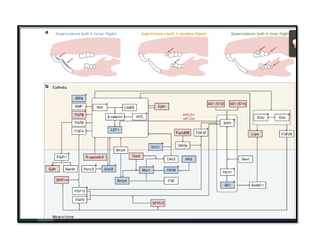
Fig. 3 Schematic of location and
genes regarding tooth number
abnormality. a Schematic of
supernumerary teeth located in
different
regions. b Summary of genes
related to tooth number
abnormality. Red represents genes
associated with extra teeth; blue
represents genes
associated with inhibition of tooth
development; Red * represents
genes reported in humans
Tooth Size and Shape
Variation
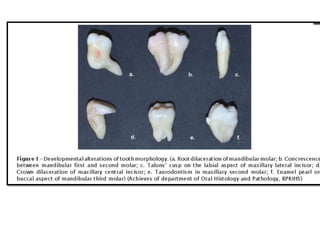
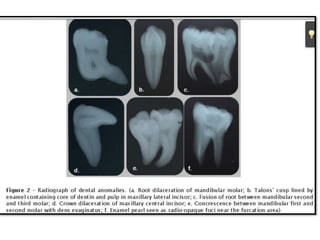
The anomalies of tooth size and form has been listed
under section WHO-ICD -10 (K00.2), which includes
concrescence, fusion, gemination, dens evaginatus, dens
in dente, dens invaginatus, enamel pearls, macrodontia,
microdontia, peg-shaped teeth, taurodontism and
tuberculum paramolare
Aberrations in tooth number, size, and shape are often linked
Hypodontia is frequently associated with smaller teeth
when compared with that of the general population, often
peg-shaped incisors and molars with fewer cusps.
In contrast, dentitions with extra teeth are often
associated with larger teeth and may show crown shape
variations with additional cusps and grooves (Brook et al.
2014).
Double teeth may originate by fusion of 2 tooth germs or
by gemination when 2 teeth develop from 1 tooth bud (Fig.
6).
The differentiation between fused and geminated double
teeth is often difficult: if formed by fusion, the number of
teeth is reduced, whereas if formed by gemination, the
number of teeth present remain unchanged
. Double teeth are more frequently detected in primary
dentition (ranging from 0.5% to 4.5%) than in permanent
dentition (ranging from 0.1% to 0.3%; Brook et al. 2014)
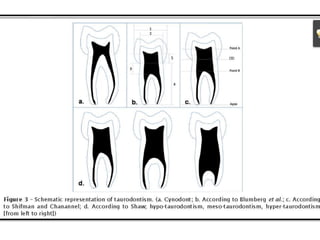
Taurodontism is a condition marked by enlarged pulp
cavity and subsequent reduction of the root length.
 It is often associated with hypodontia, and it occurs in
syndromes, especially those having an ectodermal
defect (Puttalingaiah et al. 2014;
Yang et al. 2015
In molars, taurodontism is seen as a vertically
enlarged pulp cavity, with the floor of the pulp cavity
moving toward the root apex resulting in shortened root
proportion.
The epithelial structure, known as Hertwig’s epithelial
root sheath (HERS), guides the root development. The apical
shift of the root furcation in taurodontic teeth is due to the late
timing or failure of HERS invagination
Geminated teeth arise from an attempt at
division of a single tooth germ by invagination,
resulting in a single tooth with two completely
separated crowns; or a large, incompletely separated
crown having single root and root canal
Fusion can be complete (total/true fusion) or
incomplete (partial/late fusion), depending on stage
of development.
 If fusion begins before calcification stage, the teeth unite
completely and the crown incorporates enamel, dentin,
cementum and pulp of both the teeth. Incomplete fusion
occurs at a later stage and resultant tooth may exhibit
separate crowns and limited to root alone with
fused or separate pulp canals.
Concrescence is defined as the cemental union of two
adjacent teeth without confluence of the underlying dentin
showing independent pulpchambers and root canals [14, 18].
It may occur during or after the completion of root
formation.
If the condition occurs during development, it is called
true/developmental concrescence and acquired/post
inflammatory concrescence if after root formation
Dilacerations usually occur in the apical third of
the root when the anterior teeth are involved, middle
third when first molars are involved and coronal
third when third molars are involved [39].
Root dilacerations are common than crown
dilacerations and occur usually in the posterior
region of permanent dentition [
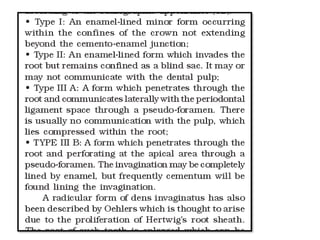
Dens invaginatus (DI) also known as the pregnant
woman anomaly, extensive compound odontoma,
and dens in dente, occurs as a consequence of an
invagination on the external surface of the tooth
crown before calcification
Dens evaginatus (DE) is a developmental aberration of a
tooth resulting in formation of an accessory cusp whose
morphology has been described as abnormal tubercle,
elevation, protuberance, excrescence, extrusion, or a bulge
[36].
It is also referred to as tuberculated cusp, accessory
tubercle, occlusal tuberculated premolar, Leong’s
premolar, evaginatus odontoma, and occlusal pearl
Witkop defined taurodontism as teeth with large pulp
chambers in which the bifurcation or trifurcation are
displaced apically, so that the chamber has greater apical-
occlusal height than in normal teeth and lacks the
constriction at the level of cemento-enamel junction (CEJ).
The distance from the trifurcation or bifurcation of the
root to the CEJ is greater than the occlusal-cervical
distance
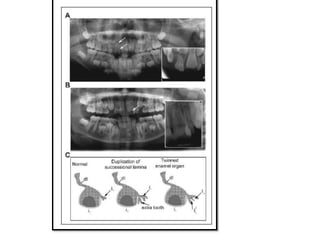
Figure 6. Panoramic radiographs showing duplicated primary and
permanent maxillary central incisors. (A) An 8-y-old male with
duplication of primary maxillary right central incisor (arrow), most
likely formed by gemination of the primary incisor and a supernumerary
tooth. In addition to the primary doubled incisor, a small supernumerary
tooth is visible in the apical region of the primary tooth (arrow).
(B) A 11-y-old male with a permanent maxillary left central incisor
formed by gemination of the permanent incisor and a supernumerary
tooth (arrow). Tooth number remained unchanged. (C) Schematics of
possible mechanisms of double-tooth formation. (middle) Duplication of
successional lamina leads to formation of 2 joined teeth. (right) Splitting
of the developing tooth bud leads to the formation of geminated tooth.
dl, dental lamina; i1, first primary incisor; I1, first permanent incisor; I2
1,
supernumerary permanent incisor.
•The Eda signal pathway has a specific role in the
regulation of tooth signaling centers, since the Eda receptor
Edar is specifically expressed in the initiation knots in tooth
placodes as well as in the enamel knots (Mikkola and
Thesleff 2003; Ahtiainen et al. 2016).
Inhibition of the Eda pathway in mutant mouse models
decreases the size of placodes and signaling
centers, resulting in smaller tooth buds (Pispa et al. 1999;
Ahtiainen et al. 2016) and the lack of the third molars or
incisors, while the remaining teeth are usually smaller
and have altered-shape crowns that are fused and lacking
cusps (Pispa et al. 1999).
CONNECTION BETWEEN TOOTH NUMBER
ABNORMALITIES
AND OTHER HUMAN DISEASES
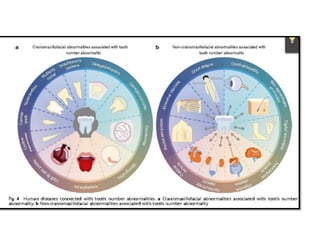
Numerous cases support a potential connection between
tooth number abnormalities and other human diseases. In
addition to common Craniomaxillofacial abnormalities,
many systemic diseases such as skeletal system diseases,
eye diseases, and nervous system diseases can also co-
occur with tooth number abnormalities in patients with
some syndromes
The potential relationship between tooth agenesis and
tumours is noteworthy.
 Because of the intersection of tumorigenesis- and
odontogenesis-associated signalling pathways, tooth
agenesis may provide some information regarding cancer
susceptibility.
Wnt signalling-related genes, such as Wnt10A, Wnt10B,
AXIN2, MESD, LRP6 and Dkk1, are pathogenic genes related
to tooth agenesis
Additionally, patients with hepatocellular carcinoma, prostate
cancer, ovarian cancer and lung cancer may have AXIN2 mutatio
 In addition to Wnt signalling, the FGF signalling pathway (FGF
FGF10 and FGFR2) is associated with cancer susceptibility.
Moreover, Pax9 is not only a pathogenic gene related to tooth
agenesis175 but also a transcription factor that can affect
malignant transformation by maintaining the differentiation of
squamous cells.
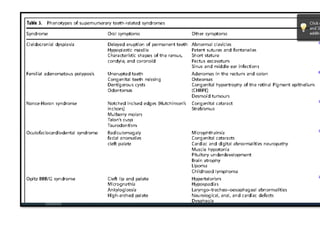
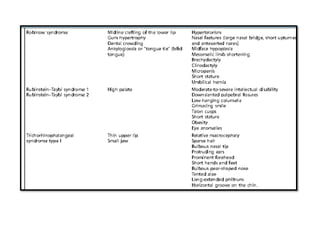
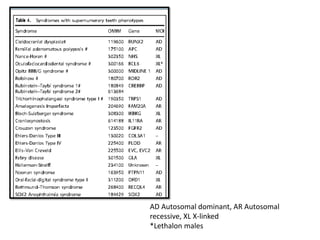
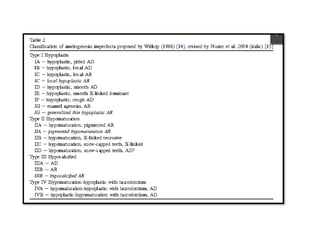
AD Autosomal dominant, AR Autosomal
recessive, XL X-linked
*Lethalon males
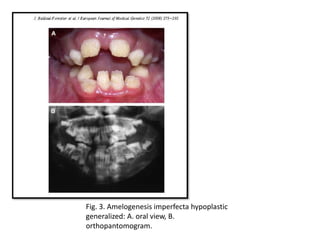
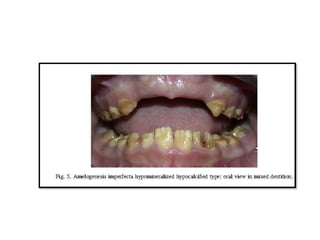
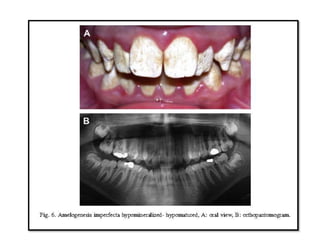
Fig. 3. Amelogenesis imperfecta hypoplastic
generalized: A. oral view, B.
orthopantomogram.
dental abnormalities on genetic background (new vision).pptx

dental abnormalities on genetic background (new vision).pptx

  • 1.
    Teeth abnormalities ongenetic background By Romissaa Aly Assistant lecturer of Oral Medicine, Periodontology, Diagnosis and Dental Radiology (Al-Azhar Univerisity)
  • 3.
    Development of thePrimary Dentition
  • 4.
    Tooth development initiatesaround the sixth week of gestation as morphologically distinct thickening of the oral ectoderm called dental lamina (Fig. 1; Ooe 1981). This uniform strip of ectodermal cells indicates the location of the future dentition.
  • 12.
    Studies on animalmodels, mainly mice, have shown that it is characterized by the expression of several markers, including Pitx2, the transcription factor most specific for the dental epithelium, as well as Foxi3, Shh, Dlx2, Lef1, and p63
  • 13.
    Epithelial cells withinthe placode progressively proliferate and form the bud-shaped structure surrounded by the condensed neural crest–derived dental mesenchyme.
  • 14.
    In the ensuingsteps, the epithelium folds into a cap-like structure, which further extends apically to form a bell-like structure that resembles the shape of the future tooth crown.
  • 15.
    Epithelial morphogenesis ofprimary teeth is regulated by signaling centers: clusters of nonproliferative cells characterized by the localized expression of several genes, including p21, Edar, Dkk4, and Fgf20, within the tooth epithelium
  • 16.
    Three signaling centersform during tooth development (Fig. 2). The first is the initiation knot, which forms in the placodes and governs the budding of the dental epithelium and the condensation of the adjacent neural crest– derived mesenchyme (Ahtiainen et al. 2016).
  • 17.
    The second isthe primary enamel knot, which appears at the tip of the newly formed bud and governs tooth crown development and formation of secondary enamel knots, a third generation of signaling centers that fine-tune crown morphogenesis by determining the sites of cusps.
  • 18.
    Figure 2. Developmentof the primary dentition. (A) Stages of primary tooth development. Initially, only 3 placodes are seen in each jaw quadrant: incisor, canine, and molar. Second tooth in the same tooth family forms through serial addition, depicted for the second primary incisor. Continual lamina forms around cap stage, and it will generate the second primary incisor in the following steps. (B) Reconstruction of the human primary teeth
  • 19.
    Development of thePermanent Dentition
  • 20.
    In both cases,the successional tooth is formed from the extension of dental lamina of the predecessor tooth, when th preceding tooth is in the early cap stage (Juuri et al. 2013). These 2 processes are believed to be similar, particularly considering that in both cases the successional tooth forms from Sox2+ cells (Juuri et al. 2013).
  • 21.
    Interestingly, gene expressionanalyses on diphyodont ferret and minipig have demonstrated that the interdental and successional laminae share similar molecular characteristics, including diffused expression of Foxi3 and Pitx2; asymmetric distribution of Sox2 and Bmp4, located at the lingual side, and FZD6, a WNT pathway receptor, expressed in the buccal/labial side
  • 22.
    Molecular and CellularMechanisms Regulating Successional Tooth Formation
  • 23.
    Successional tooth formationrequires stem cells to generate new tissues.  Tooth epithelial stem cells were first identified in the continuously growing mouse incisors as label-retaining cells. Later studies have shown that they also express many stem cell markers, including Sox2, and that they generate all epithelial lineages in teeth
  • 24.
    Published data onthe molecular regulation of successional tooth formation in reptiles and selected mammals have provided evidence that tooth morphogenesis and tooth replacement/ addition are regulated by the same signaling pathways.
  • 25.
    These include theWNT/β-catenin, BMP, Shh, EDA, and FGF signaling pathways expressed in the intricate temporal and spatial patterns, which define the timing of individual tooth formation, size, shape, and position of all teeth
  • 26.
    Wnt/β-catenin signaling regulatestooth development at multiple stages and has been suggested as the key regulator of successional tooth formation. Inhibition of Wnt/β-catenin signaling in the early epithelium leads to arrested tooth development at the lamina stage (Liu et al. 2008).
  • 27.
    Wnt activation throughoutthe ectoderm initiates multiple tooth buds and results in supernumerary teeth (Jarvinen et al. 2006; Wang et al. 2009).
  • 28.
    In particular, BMP2and BMP4 are expressed in the odontogenic condensed mesenchyme surrounding the tip of the successional lamina and were implied as positive modulators of Wnt signaling (Handrigan and Richman 2010;
  • 29.
    Runx2 is anothertranscription factor expressed in the mesenchyme surrounding the tip of the successional lamina, and its heterozygotic loss of function leads to supernumerary tooth formation in humans (see later) and in budding of the dental lamina in mice
  • 30.
    Osr2 is expressedin the mesenchyme surrounding the tip of the successional lamina, as well as in interdental lamina (Jussila et al. 2014). Mice lacking Osr2 develop supernumerary teeth located on the lingual side, which is associated with the expansion of the BMP4+ odontogenic mesenchyme and resembles successional tooth formation (Zhang et al. 2009)
  • 32.
    Figure 3. Developmentof the permanent dentition. (A) Permanent teeth, which replace the primary dentition, develop from successional lamina, which extends lingually from the dental lamina around the cap stage. (B) Permanent molars erupt posterior to primary dentition and are the only teeth in the permanent dentition that do not replace any primary teeth. It is not known whether these teeth develop from an independent placode within the primary dental lamina or are serially added from the continual lamina of the second primary molar. Therefore, it is still a matter of debate whether the permanent molars are part of the primary dentition or not. (C) Reconstruction of the human primary dentition adapted from Ooë (1981) depicting primary molars and generation of the first permanent molar, all interconnected by interdental lamina. Initiation of permanent teeth from successional lamina is depicted. 2o EK, secondary enamel knot; m1, first primary molar; m2, second primary molar; M1, first permanent molar; PM1, first premolar; PM2, second premolar
  • 33.
  • 34.
    Tooth agenesis isone of the most common developmental anomalies in humans (Yin and Bian 2015). It is classified per the number of missing teeth to hypodontia, oligodontia, and anodontia. Hypodontia, an absence of 1 to 5 teeth (excluding third molars), is the most common. It occurs in primary dentition, with a prevalence between 0.1% and 1.5% and with no sex difference.
  • 35.
    In the permanentdentition, the prevalence of hypodontia is 3.5% to 7%, and females are affected 1.5 times more than male (Brook et al. 2014). Oligodontia, an absence of ≥6 teeth (excluding third molars), is relatively rare, with a prevalence of 0.3% (Bural et al 2012). Anodontia, an absence of all teeth in one or both dentitions, occurs very rarely and only in some forms of ectodermal dysplasia
  • 36.
    Genes associated withnonsyndromic isolated tooth agenesis include WNT10A, MSX1, PAX9, AXIN2, EDA, EDAR, EDARADD, LTBP3, LRP6, WNT10B, GREM2, and SMOC. Up to 50% of tooth agenesis cases have been attributed to WNT10A mutations
  • 37.
    The most commonsyndromes with tooth agenesis are ectodermal dysplasias affecting ectodermal organs, including teeth. The most common form is hypohidrotic ectodermal dysplasia caused by mutations in genes of the EDA pathway, including EDA, EDAR, EDARADD, and NEMO (
  • 38.
    Other notable syndromicconditions often associated with tooth agenesis are Rieger syndrome and cleft syndromes. Rieger syndrome is caused by mutations in PITX2 resulting in abnormalities in the eye, umbilical anomalies, and dental abnormalities, including enamel hypoplasia and hypodontia affecting the incisor region
  • 40.
    Figure 4. Panoramicradiographs from patients showing variable degrees of tooth agenesis. (A) Eight-year-old male with incisor-premolar hypodontia showing agenesis of maxillary lateral incisors, second maxillary premolars, and left mandibular second premolar. (B) Agenesis of maxillary right premolars and second left premolar and mandibular premolars in a 10-y-old male with homozygous WNT10A mutation. (C) Agenesis of right second permanent molars and left second or first permanent molars; mandibular incisors, canines, and second premolars; and maxillary lateral incisors in 8-y-old female with AXIN2 mutation. (D) A 7-y-old male with X-linked EDA showing agenesis of maxillary premolars, canines, and lateral incisors as well as permanent incisors, canines, and second premolars in mandible. (E) Schematics of possible mechanisms leading to tooth agenesis. (left) Successional lamina is not developing from the predecessor tooth due to depletion of the odontogenic potential in the dental lamina. (right) Successional lamina buds from the predecessor tooth but weakened or absent mesenchymal signals do not support further development of the successional tooth. Missing teeth marked by asterisks. Panels B and D courtes of Elisa Ronkainenand; panel C courtesy of Laura Lammi. dl, dental lamina; i1, first primary incisor; I1, first permanent incisor; sl, successional lamina.
  • 41.
    Maxillary central incisorsas well as primary teeth, which are rarely affected by tooth agenesis, might be missing. Van der Woude syndrome is caused by mutations in the interferon regulatory factor 6 (IRF6). It is characterized by the presence of lower lip pits, clefts in the lip and/or palate, and association with hypodontia
  • 43.
  • 44.
    Supernumerary tooth formation,or hyperdontia, is not as common as hypodontia: the prevalence in the primary dentition is 0.2% to 0.8% and in the permanent dentition, 0.5% to 5.3%, with geographic variations (Wang and Fan 2011). Similar to hypodontia, supernumerary teeth occur either as an isolated developmental anomaly or are related to syndromes with a genetic background
  • 45.
    Interestingly, mutations inSOX2 were associated with supernumerary teeth, suggesting that Sox2 may have an inhibitory role in successional tooth formation (Numakura et al. 2010).
  • 46.
    Mutations of onlyfew genes have been identified as a cause of supernumerary tooth formation. Mutations in RUNX2, a transcription factor essential for skeletal morphogenesis, cause cleidocranial dysplasia
  • 47.
    This is anautosomal dominant syndrome that affects bone development and leads to short stature, hypoplastic clavicles, open fontanelles, and supernumerary teeth
  • 49.
    Figure 5. Panoramicradiographs showing isolated and syndromic supernumerary tooth formation. (A) Panoramic radiograph showing mesiodens (arrow) located between the maxillary central incisors in a 10-y-old female. (B) Nine-year-old male with cleidocranial dysplasia showing multiple supernumerary teeth. (C) Two supernumerary teeth (arrows), mesiodentes, between the maxillary central incisors in an X-ray and after extraction. (D) Schematics of the continued successional tooth formation. (above) Third generation of teeth starts to develop when second successional lamina is formed from the developing permanent tooth. (middle) Supernumerary permanent molars form by continued serial addition. The continual lamina forms in the distal end of the third molar and leads to the formation of fourth molar. (below) Supernumerary teeth may also arise in between the normal primary and permanent tooth. Panel A: courtesy of Johanna Kotilainen; panel B: courtesy of Tarja Siltanen; panel C: courtesy of Young Tse Kuah. dl, dental lamina; i1, first primary incisor; I1, first permanent incisor; M1, M2, M3, M4, first through fourth permanent molars; sl, successional lamina.
  • 50.
    A similar dentalphenotype is observed in Kreiborg- Pakistani syndrome, which is manifested by craniosynostosis, delayed tooth eruption, and supernumerary teeth and is caused by mutations in interleukin receptor IL11RA
  • 51.
    Mutations in theAPC gene (adenomatous polyposis coli) activate the Wnt pathway and cause human hereditary disorders called familial adenomatous polyposis or its variant Gardner syndrome
  • 54.
    Fig. 3 Schematicof location and genes regarding tooth number abnormality. a Schematic of supernumerary teeth located in different regions. b Summary of genes related to tooth number abnormality. Red represents genes associated with extra teeth; blue represents genes associated with inhibition of tooth development; Red * represents genes reported in humans
  • 55.
    Tooth Size andShape Variation
  • 56.
    The anomalies oftooth size and form has been listed under section WHO-ICD -10 (K00.2), which includes concrescence, fusion, gemination, dens evaginatus, dens in dente, dens invaginatus, enamel pearls, macrodontia, microdontia, peg-shaped teeth, taurodontism and tuberculum paramolare
  • 59.
    Aberrations in toothnumber, size, and shape are often linked Hypodontia is frequently associated with smaller teeth when compared with that of the general population, often peg-shaped incisors and molars with fewer cusps. In contrast, dentitions with extra teeth are often associated with larger teeth and may show crown shape variations with additional cusps and grooves (Brook et al. 2014).
  • 60.
    Double teeth mayoriginate by fusion of 2 tooth germs or by gemination when 2 teeth develop from 1 tooth bud (Fig. 6). The differentiation between fused and geminated double teeth is often difficult: if formed by fusion, the number of teeth is reduced, whereas if formed by gemination, the number of teeth present remain unchanged
  • 61.
    . Double teethare more frequently detected in primary dentition (ranging from 0.5% to 4.5%) than in permanent dentition (ranging from 0.1% to 0.3%; Brook et al. 2014)
  • 62.
    Taurodontism is acondition marked by enlarged pulp cavity and subsequent reduction of the root length.  It is often associated with hypodontia, and it occurs in syndromes, especially those having an ectodermal defect (Puttalingaiah et al. 2014; Yang et al. 2015
  • 63.
    In molars, taurodontismis seen as a vertically enlarged pulp cavity, with the floor of the pulp cavity moving toward the root apex resulting in shortened root proportion. The epithelial structure, known as Hertwig’s epithelial root sheath (HERS), guides the root development. The apical shift of the root furcation in taurodontic teeth is due to the late timing or failure of HERS invagination
  • 64.
    Geminated teeth arisefrom an attempt at division of a single tooth germ by invagination, resulting in a single tooth with two completely separated crowns; or a large, incompletely separated crown having single root and root canal
  • 65.
    Fusion can becomplete (total/true fusion) or incomplete (partial/late fusion), depending on stage of development.  If fusion begins before calcification stage, the teeth unite completely and the crown incorporates enamel, dentin, cementum and pulp of both the teeth. Incomplete fusion occurs at a later stage and resultant tooth may exhibit separate crowns and limited to root alone with fused or separate pulp canals.
  • 66.
    Concrescence is definedas the cemental union of two adjacent teeth without confluence of the underlying dentin showing independent pulpchambers and root canals [14, 18]. It may occur during or after the completion of root formation. If the condition occurs during development, it is called true/developmental concrescence and acquired/post inflammatory concrescence if after root formation
  • 67.
    Dilacerations usually occurin the apical third of the root when the anterior teeth are involved, middle third when first molars are involved and coronal third when third molars are involved [39]. Root dilacerations are common than crown dilacerations and occur usually in the posterior region of permanent dentition [
  • 68.
    Dens invaginatus (DI)also known as the pregnant woman anomaly, extensive compound odontoma, and dens in dente, occurs as a consequence of an invagination on the external surface of the tooth crown before calcification
  • 70.
    Dens evaginatus (DE)is a developmental aberration of a tooth resulting in formation of an accessory cusp whose morphology has been described as abnormal tubercle, elevation, protuberance, excrescence, extrusion, or a bulge [36]. It is also referred to as tuberculated cusp, accessory tubercle, occlusal tuberculated premolar, Leong’s premolar, evaginatus odontoma, and occlusal pearl
  • 72.
    Witkop defined taurodontismas teeth with large pulp chambers in which the bifurcation or trifurcation are displaced apically, so that the chamber has greater apical- occlusal height than in normal teeth and lacks the constriction at the level of cemento-enamel junction (CEJ). The distance from the trifurcation or bifurcation of the root to the CEJ is greater than the occlusal-cervical distance
  • 75.
    Figure 6. Panoramicradiographs showing duplicated primary and permanent maxillary central incisors. (A) An 8-y-old male with duplication of primary maxillary right central incisor (arrow), most likely formed by gemination of the primary incisor and a supernumerary tooth. In addition to the primary doubled incisor, a small supernumerary tooth is visible in the apical region of the primary tooth (arrow). (B) A 11-y-old male with a permanent maxillary left central incisor formed by gemination of the permanent incisor and a supernumerary tooth (arrow). Tooth number remained unchanged. (C) Schematics of possible mechanisms of double-tooth formation. (middle) Duplication of successional lamina leads to formation of 2 joined teeth. (right) Splitting of the developing tooth bud leads to the formation of geminated tooth. dl, dental lamina; i1, first primary incisor; I1, first permanent incisor; I2 1, supernumerary permanent incisor.
  • 76.
    •The Eda signalpathway has a specific role in the regulation of tooth signaling centers, since the Eda receptor Edar is specifically expressed in the initiation knots in tooth placodes as well as in the enamel knots (Mikkola and Thesleff 2003; Ahtiainen et al. 2016).
  • 77.
    Inhibition of theEda pathway in mutant mouse models decreases the size of placodes and signaling centers, resulting in smaller tooth buds (Pispa et al. 1999; Ahtiainen et al. 2016) and the lack of the third molars or incisors, while the remaining teeth are usually smaller and have altered-shape crowns that are fused and lacking cusps (Pispa et al. 1999).
  • 78.
    CONNECTION BETWEEN TOOTHNUMBER ABNORMALITIES AND OTHER HUMAN DISEASES
  • 79.
    Numerous cases supporta potential connection between tooth number abnormalities and other human diseases. In addition to common Craniomaxillofacial abnormalities, many systemic diseases such as skeletal system diseases, eye diseases, and nervous system diseases can also co- occur with tooth number abnormalities in patients with some syndromes
  • 81.
    The potential relationshipbetween tooth agenesis and tumours is noteworthy.  Because of the intersection of tumorigenesis- and odontogenesis-associated signalling pathways, tooth agenesis may provide some information regarding cancer susceptibility. Wnt signalling-related genes, such as Wnt10A, Wnt10B, AXIN2, MESD, LRP6 and Dkk1, are pathogenic genes related to tooth agenesis
  • 82.
    Additionally, patients withhepatocellular carcinoma, prostate cancer, ovarian cancer and lung cancer may have AXIN2 mutatio  In addition to Wnt signalling, the FGF signalling pathway (FGF FGF10 and FGFR2) is associated with cancer susceptibility. Moreover, Pax9 is not only a pathogenic gene related to tooth agenesis175 but also a transcription factor that can affect malignant transformation by maintaining the differentiation of squamous cells.
  • 85.
    AD Autosomal dominant,AR Autosomal recessive, XL X-linked *Lethalon males
  • 86.
    Fig. 3. Amelogenesisimperfecta hypoplastic generalized: A. oral view, B. orthopantomogram.