Copyright © Pamela Fraser & TeeJay Publishers August 2013 Value for Money Level 2
Produced for TeeJay Publishers by Pamela Fraser
TeeJay PublishersTeeJay Publishers
Financial Maths - Life SkillsFinancial Maths - Life Skills
Value for Money
UNIT
Value for Money
UNIT
Level 2 - Lesson Plan
Copyright © Pamela Fraser & TeeJay Publishers August 2013 Value for Money Level 2
Guidance Notes for Teachers
Value for Money Lesson
Lesson Objective: By the end of the lesson, pupils will have an awareness of loyalty card
vouchers and other promotional discounts. Pupils will also learn the positive and negative impacts
that such promotional material can have on a family's budget.
Outcomes: I can manage money, compare costs from different retailers, and determine what
I can afford to buy.
Lesson Introduction
Everyone likes spending money on something that they really want, especially if you have been
saving that money up in your piggy bank for some time. But how much better does it feel when
you get the item you are buying for a bargain - for less money than you were expecting to have
to pay for it ?
People get bargains because shops will give discounts off the real price of an item. They
sometimes do this to get rid of items that are difficult to sell; they might do it to encourage
people to buy more when they visit the shop or they may do it to reward a customer who is loyal
and shops in that store regularly. In the last case, customers who shop regularly in a particular
shop may have something called a loyalty card.
A loyalty card is a plastic card which shows that you are a member of a loyalty programme. By
being a member you will receive special discounts and offers as well as receive points for every
$ that you spend in the store. These points will add up and are usually sent to the cardholder as
gift vouchers once or twice a year, to be spent in the store or group of stores.
Bargains can be very tempting offers as you are getting something for less money than it would
normally cost, but they are not always value for money, and therefore do not always save us
money. Before buying the item you will have to decide whether it is something that you need -
something that you will use or will you just be wasting your money in buying it ?
Discussion
Once the introduction has been completed with the class, the attached discussion notes sheet will
assist you with increasing the pupils’ understanding of loyalty cards, special offers and getting
Value for Money.
Worksheet - Pupil Activity
During discussion, it should be ascertained that the pupils understand the concept of value for
money and “getting a bargain” and the factors which determine true value for money offers.
Pupils should then progress to a worked example. The questions are set around a scenario using
real life monetary amounts.
Plenary
This sheet summarises the learning and highlights the key points of the Value for Money lesson.
Pamela Fraser
Copyright © Pamela Fraser & TeeJay Publishers August 2013 Value for Money Level 2
Discussion Notes
Value for Money
Q1: What is a loyalty card ?
A: A loyalty card is a plastic card which you receive
when you join a loyalty programme with a particular
store or group of stores. You are rewarded in points
or special offers for using that store regularly.
Q2: Can you give 2 examples
of real life loyalty cards ?
A: Answers will vary. Possible examples may include :-
Coles VelocityFlybuys, Myer, One
Qantas FlyerFrequent
or RewardsEverydayWoolworths .
Q3: Supermarkets often
advertise bargains for shoppers.
Can you provide 3 examples of
the different types of bargains
available ?
A: Again answers will vary, but correct answers should
represent a variety of special offers such as buy
one get one free, half price, 10% discount, bundles
(buy game console and get a game & headphones free).
A: Answers are individual but should be
based on perishable goods or items that
you are unlikely to use more than one
of at any given time.
Q5: At the local supermarket they
have “Buy one Get one free” on all
items. Give an example of one item
where this offer might not be value
for money and explain your reason.
Q4: What does “value
for money” mean ?
A: Value for money means get the most for your money.
Getting the most for your money might be getting the
biggest quantity of something or the best quality of
something for the least amount of money.
Supplementary Questions
Q6: What factors do you need to think about before you buy an item with 50% off the original price ?
• Can you afford to buy it ? • Do you need it ?
• Will you use it ? • Is it the brand you use ?
• Do you already have something similar ? • Are you only buying because it is cheap ?
• Should you use the money for something more important (at the time) ?
Q7: When do you think bargains or special deals are the most useful to people ?
Answers will vary. Suggested answers may be :- when people are short of money and need to
budget, when they have to buy a lot of items at one time e.g. special occasions, when they
really need the item on special offer.
Copyright © Pamela Fraser & TeeJay Publishers August 2013 Value for Money Level 2
Value for Money Worksheet
Eve is a single mother with two sons Alfie & Finn. She is always
looking for ways to save money and loves a bargain when out
shopping. Eve has 2 loyalty cards; the loyalty cards allow her to
collect points when she spends money in the shops and to benefit
from special offers that can save her money when she is shopping.
It is important that Eve only spends money on the offers that will
save her money. Can you help her to do this ?
1. Eve has checked her Barrows Supermarket loyalty
card statement online and discovers she has
3450 points. If 1 point equals c1 how much money
will she receive in vouchers ?
2. The vouchers arrive a week later. As well as the money
vouchers there are some special offers. Which of the
vouchers do you think Eve will be able to use when she goes shopping ?
3. While shopping, Eve buys 2 cans of tomato soup, 2 cans of mushroom soup, 2 cans of
chicken soup and 2 cans of vegetable broth costing $1·05 each.
How much money does she save by using her voucher ?
4. The supermarket has a number of deals on in the store, but they are not all good
value for money.
Which of the following deals would be value for money?
a One jar of coffee for $3·25 or buy 2 jars for $5·49.
b Buy one get one free on frozen pizzas.
c 4 pack of baked beans special price $3·20 or 1 tin of baked beans for 7 c4 .
d Yogurt pack was $1·85 now at the special price of $1·90.
e Buy one get 2 free on packets of salad vegetables.
Free “Bethany”
fashion doll if you
spend $25 or more.
40 extra points when
you buy BUBBLES
washing up liquid.
c50 off Ba wsrro
Supermarket
tea-bags.
Buy one - get one
free on all Barrows
canned soups
Copyright © Pamela Fraser & TeeJay Publishers August 2013 Value for Money Level 2
5. When she uses her supermarket loyalty card, Eve receives 1 point for every
$1 she spends.
a If she spends $84·50 doing her weekly supermarket shop how many points
will she earn, including the voucher for her washing up liquid ?
b If she receives 1p for every point how much money has she earned towards
her next vouchers ?
6. How much money will Eve pay for her final bill if she uses the vouchers she has ?
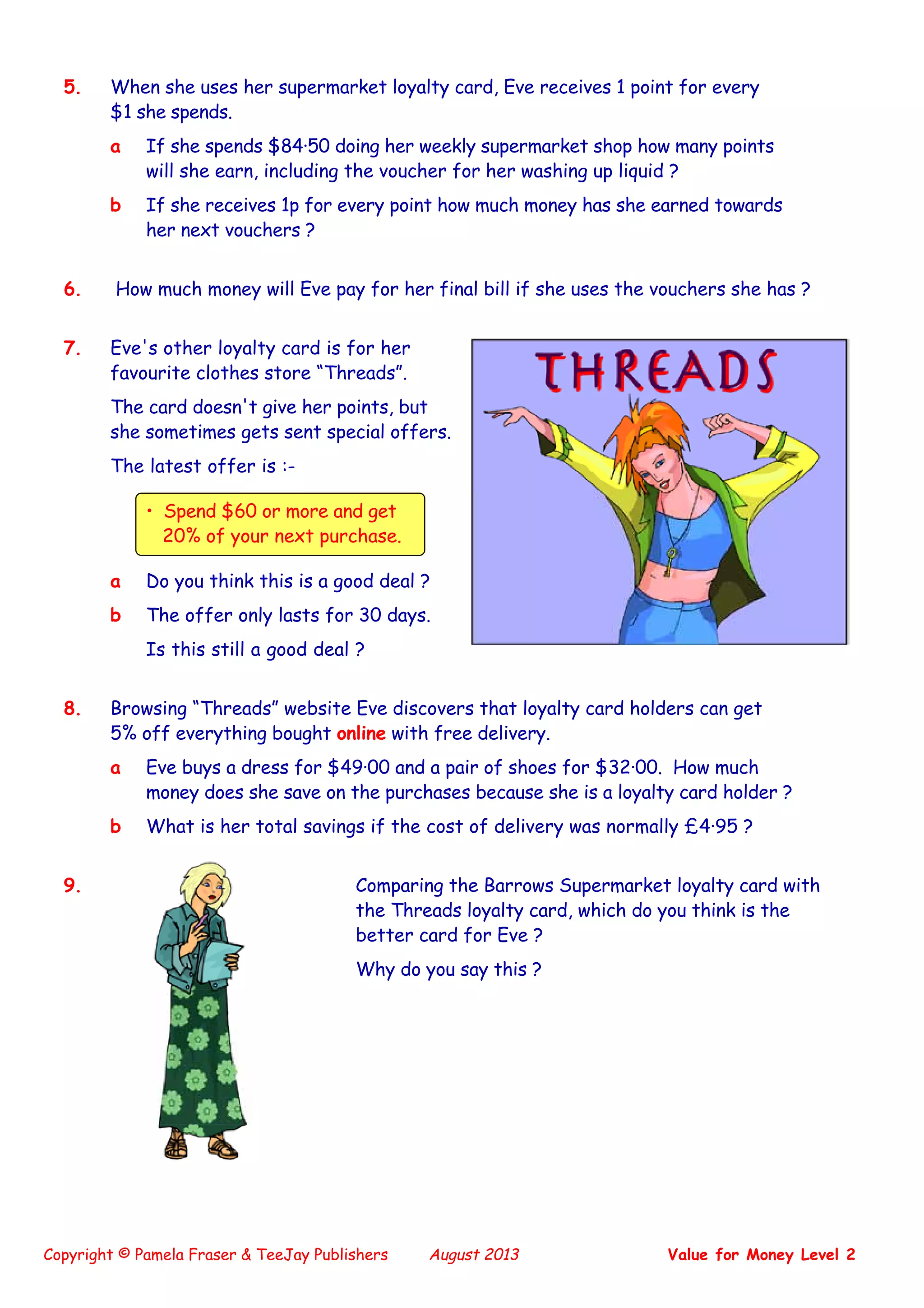
7. Eve's other loyalty card is for her
favourite clothes store “Threads”.
The card doesn't give her points, but
she sometimes gets sent special offers.
The latest offer is :-
• Spend $60 or more and get
20% of your next purchase.
a Do you think this is a good deal ?
b The offer only lasts for 30 days.
Is this still a good deal ?
8. Browsing “Threads” website Eve discovers that loyalty card holders can get
5% off everything bought online with free delivery.
a Eve buys a dress for $49·00 and a pair of shoes for $32·00. How much
money does she save on the purchases because she is a loyalty card holder ?
b What is her total savings if the cost of delivery was normally £4·95 ?
9. Comparing the Barrows Supermarket loyalty card with
the Threads loyalty card, which do you think is the
better card for Eve ?
Why do you say this ?
Copyright © Pamela Fraser & TeeJay Publishers August 2013 Value for Money Level 2
Value for Money Worksheet - Answers
1. Eve would get $34·50 in vouchers.
2. The washing up liquid voucher, tea bag voucher, and the soup voucher would all be of
interest to Eve and her family.
3. The voucher was for buy one get one free so Eve only pays for 4 of the tins saving
her $4·20.
4. The offers for the coffee and the pizzas are good deals. The salad vegetables may
go off before the family has a chance to use them, (but they are free !).
5. a Eve will earn 124 points. 84 points from her shopping bill and an additional 40
from using the washing up liquid voucher.
b She has earned $1·24 towards the next vouchers.
6. Eve has to pay $50 cash towards her bill with the balance of $34·50 paid in vouchers.
7. a It's not a good deal as it is encouraging Eve to spend more money before she saves
any money. She might end up spending money on something that she doesn't need
just to get the deal.
b The short timescale of the special offer makes it even less attractive.
8. a Eve saves $4·05 by buying the items online.
b Her total saving is $9·00.
9. The Barrows Supermarket loyalty card is the best card for Eve. She probably shops
at the supermarket every week and gets a reward for doing so. Once the points add
up she can save money by using the vouchers to pay her shopping bill. The Threads
card only saves her money on her next purchase after she has bought something.
Copyright © Pamela Fraser & TeeJay Publishers August 2013 Value for Money Level 2
Questions to assess student understanding
Eve did not use the first offer that she received from Threads.
Why do you think she didn't use it ?
She did not think it was Value for Money. She had to spend money on something that she did
not need to take advantage of their offer. She did not feel it was a reward for her loyalty.
Why do you think shops and stores put on special offers ?
• To get people to shop in their shop rather than the competition.
• To promote a new product.
• To encourage people to buy products that might not be selling so well.
• To encourage people to spend more money.
If you owned a shop, what type of special offers would you use to give people Value for Money ?
This answer will depend on the pupil's own opinion but it should display that they have thought about
what the customer wants and will find attractive. Also it should confirm that they are putting the
customer first (customer satisfaction is very important).
Summary/Plenary SheetSummary/Plenary Sheet
The exercise you have just completed teaches us about Value for
Money. We have learned about loyalty cards and how they work
and we have also learned how to identify whether a special
deal/offer is actually value for money or not. Saving money
wherever we can is important as it helps us to manage our money
better.
Recap on Key Learning Points
• Value for Money should mean that you have got high quality products or services for the money you have
paid for them.
• A loyalty card is a plastic card which shows that you are a member of a shop or group of stores'
loyalty programme.
• Using a loyalty card when you are in that shop will mean that you will earn points which will eventually
be exchanged into money vouchers.
• You may also be offered special deals as a loyalty cardholder.
Extended Learning
For teachers wishing to further the lesson by issuing homework or extended learning opportunities to pupils
the following are suggested activities :-
• Review newspapers or magazines for special offers and make a Value for Money collage.
• Working in groups, get pupils to research different loyalty cards online and carry out an investigation
to discover which card gives the most benefits to the cardholder.

Australian Lifeskills - Value for Money Level 2

  • 1.
    Copyright © PamelaFraser & TeeJay Publishers August 2013 Value for Money Level 2 Produced for TeeJay Publishers by Pamela Fraser TeeJay PublishersTeeJay Publishers Financial Maths - Life SkillsFinancial Maths - Life Skills Value for Money UNIT Value for Money UNIT Level 2 - Lesson Plan
  • 2.
    Copyright © PamelaFraser & TeeJay Publishers August 2013 Value for Money Level 2 Guidance Notes for Teachers Value for Money Lesson Lesson Objective: By the end of the lesson, pupils will have an awareness of loyalty card vouchers and other promotional discounts. Pupils will also learn the positive and negative impacts that such promotional material can have on a family's budget. Outcomes: I can manage money, compare costs from different retailers, and determine what I can afford to buy. Lesson Introduction Everyone likes spending money on something that they really want, especially if you have been saving that money up in your piggy bank for some time. But how much better does it feel when you get the item you are buying for a bargain - for less money than you were expecting to have to pay for it ? People get bargains because shops will give discounts off the real price of an item. They sometimes do this to get rid of items that are difficult to sell; they might do it to encourage people to buy more when they visit the shop or they may do it to reward a customer who is loyal and shops in that store regularly. In the last case, customers who shop regularly in a particular shop may have something called a loyalty card. A loyalty card is a plastic card which shows that you are a member of a loyalty programme. By being a member you will receive special discounts and offers as well as receive points for every $ that you spend in the store. These points will add up and are usually sent to the cardholder as gift vouchers once or twice a year, to be spent in the store or group of stores. Bargains can be very tempting offers as you are getting something for less money than it would normally cost, but they are not always value for money, and therefore do not always save us money. Before buying the item you will have to decide whether it is something that you need - something that you will use or will you just be wasting your money in buying it ? Discussion Once the introduction has been completed with the class, the attached discussion notes sheet will assist you with increasing the pupils’ understanding of loyalty cards, special offers and getting Value for Money. Worksheet - Pupil Activity During discussion, it should be ascertained that the pupils understand the concept of value for money and “getting a bargain” and the factors which determine true value for money offers. Pupils should then progress to a worked example. The questions are set around a scenario using real life monetary amounts. Plenary This sheet summarises the learning and highlights the key points of the Value for Money lesson. Pamela Fraser
  • 3.
    Copyright © PamelaFraser & TeeJay Publishers August 2013 Value for Money Level 2 Discussion Notes Value for Money Q1: What is a loyalty card ? A: A loyalty card is a plastic card which you receive when you join a loyalty programme with a particular store or group of stores. You are rewarded in points or special offers for using that store regularly. Q2: Can you give 2 examples of real life loyalty cards ? A: Answers will vary. Possible examples may include :- Coles VelocityFlybuys, Myer, One Qantas FlyerFrequent or RewardsEverydayWoolworths . Q3: Supermarkets often advertise bargains for shoppers. Can you provide 3 examples of the different types of bargains available ? A: Again answers will vary, but correct answers should represent a variety of special offers such as buy one get one free, half price, 10% discount, bundles (buy game console and get a game & headphones free). A: Answers are individual but should be based on perishable goods or items that you are unlikely to use more than one of at any given time. Q5: At the local supermarket they have “Buy one Get one free” on all items. Give an example of one item where this offer might not be value for money and explain your reason. Q4: What does “value for money” mean ? A: Value for money means get the most for your money. Getting the most for your money might be getting the biggest quantity of something or the best quality of something for the least amount of money. Supplementary Questions Q6: What factors do you need to think about before you buy an item with 50% off the original price ? • Can you afford to buy it ? • Do you need it ? • Will you use it ? • Is it the brand you use ? • Do you already have something similar ? • Are you only buying because it is cheap ? • Should you use the money for something more important (at the time) ? Q7: When do you think bargains or special deals are the most useful to people ? Answers will vary. Suggested answers may be :- when people are short of money and need to budget, when they have to buy a lot of items at one time e.g. special occasions, when they really need the item on special offer.
  • 4.
    Copyright © PamelaFraser & TeeJay Publishers August 2013 Value for Money Level 2 Value for Money Worksheet Eve is a single mother with two sons Alfie & Finn. She is always looking for ways to save money and loves a bargain when out shopping. Eve has 2 loyalty cards; the loyalty cards allow her to collect points when she spends money in the shops and to benefit from special offers that can save her money when she is shopping. It is important that Eve only spends money on the offers that will save her money. Can you help her to do this ? 1. Eve has checked her Barrows Supermarket loyalty card statement online and discovers she has 3450 points. If 1 point equals c1 how much money will she receive in vouchers ? 2. The vouchers arrive a week later. As well as the money vouchers there are some special offers. Which of the vouchers do you think Eve will be able to use when she goes shopping ? 3. While shopping, Eve buys 2 cans of tomato soup, 2 cans of mushroom soup, 2 cans of chicken soup and 2 cans of vegetable broth costing $1·05 each. How much money does she save by using her voucher ? 4. The supermarket has a number of deals on in the store, but they are not all good value for money. Which of the following deals would be value for money? a One jar of coffee for $3·25 or buy 2 jars for $5·49. b Buy one get one free on frozen pizzas. c 4 pack of baked beans special price $3·20 or 1 tin of baked beans for 7 c4 . d Yogurt pack was $1·85 now at the special price of $1·90. e Buy one get 2 free on packets of salad vegetables. Free “Bethany” fashion doll if you spend $25 or more. 40 extra points when you buy BUBBLES washing up liquid. c50 off Ba wsrro Supermarket tea-bags. Buy one - get one free on all Barrows canned soups
  • 5.
    Copyright © PamelaFraser & TeeJay Publishers August 2013 Value for Money Level 2 5. When she uses her supermarket loyalty card, Eve receives 1 point for every $1 she spends. a If she spends $84·50 doing her weekly supermarket shop how many points will she earn, including the voucher for her washing up liquid ? b If she receives 1p for every point how much money has she earned towards her next vouchers ? 6. How much money will Eve pay for her final bill if she uses the vouchers she has ? 7. Eve's other loyalty card is for her favourite clothes store “Threads”. The card doesn't give her points, but she sometimes gets sent special offers. The latest offer is :- • Spend $60 or more and get 20% of your next purchase. a Do you think this is a good deal ? b The offer only lasts for 30 days. Is this still a good deal ? 8. Browsing “Threads” website Eve discovers that loyalty card holders can get 5% off everything bought online with free delivery. a Eve buys a dress for $49·00 and a pair of shoes for $32·00. How much money does she save on the purchases because she is a loyalty card holder ? b What is her total savings if the cost of delivery was normally £4·95 ? 9. Comparing the Barrows Supermarket loyalty card with the Threads loyalty card, which do you think is the better card for Eve ? Why do you say this ?
  • 6.
    Copyright © PamelaFraser & TeeJay Publishers August 2013 Value for Money Level 2 Value for Money Worksheet - Answers 1. Eve would get $34·50 in vouchers. 2. The washing up liquid voucher, tea bag voucher, and the soup voucher would all be of interest to Eve and her family. 3. The voucher was for buy one get one free so Eve only pays for 4 of the tins saving her $4·20. 4. The offers for the coffee and the pizzas are good deals. The salad vegetables may go off before the family has a chance to use them, (but they are free !). 5. a Eve will earn 124 points. 84 points from her shopping bill and an additional 40 from using the washing up liquid voucher. b She has earned $1·24 towards the next vouchers. 6. Eve has to pay $50 cash towards her bill with the balance of $34·50 paid in vouchers. 7. a It's not a good deal as it is encouraging Eve to spend more money before she saves any money. She might end up spending money on something that she doesn't need just to get the deal. b The short timescale of the special offer makes it even less attractive. 8. a Eve saves $4·05 by buying the items online. b Her total saving is $9·00. 9. The Barrows Supermarket loyalty card is the best card for Eve. She probably shops at the supermarket every week and gets a reward for doing so. Once the points add up she can save money by using the vouchers to pay her shopping bill. The Threads card only saves her money on her next purchase after she has bought something.
  • 7.
    Copyright © PamelaFraser & TeeJay Publishers August 2013 Value for Money Level 2 Questions to assess student understanding Eve did not use the first offer that she received from Threads. Why do you think she didn't use it ? She did not think it was Value for Money. She had to spend money on something that she did not need to take advantage of their offer. She did not feel it was a reward for her loyalty. Why do you think shops and stores put on special offers ? • To get people to shop in their shop rather than the competition. • To promote a new product. • To encourage people to buy products that might not be selling so well. • To encourage people to spend more money. If you owned a shop, what type of special offers would you use to give people Value for Money ? This answer will depend on the pupil's own opinion but it should display that they have thought about what the customer wants and will find attractive. Also it should confirm that they are putting the customer first (customer satisfaction is very important). Summary/Plenary SheetSummary/Plenary Sheet The exercise you have just completed teaches us about Value for Money. We have learned about loyalty cards and how they work and we have also learned how to identify whether a special deal/offer is actually value for money or not. Saving money wherever we can is important as it helps us to manage our money better. Recap on Key Learning Points • Value for Money should mean that you have got high quality products or services for the money you have paid for them. • A loyalty card is a plastic card which shows that you are a member of a shop or group of stores' loyalty programme. • Using a loyalty card when you are in that shop will mean that you will earn points which will eventually be exchanged into money vouchers. • You may also be offered special deals as a loyalty cardholder. Extended Learning For teachers wishing to further the lesson by issuing homework or extended learning opportunities to pupils the following are suggested activities :- • Review newspapers or magazines for special offers and make a Value for Money collage. • Working in groups, get pupils to research different loyalty cards online and carry out an investigation to discover which card gives the most benefits to the cardholder.