Tourism & Technology An Introduction by Tony Jolley
Aim To consider  together  the past, present and future relationship between Tourism and Technology
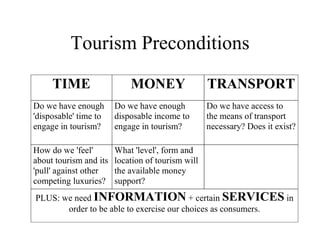
Tourism Preconditions
Technology and its Influence Anything  that affects availability and choice of how much time and money we have directly and indirectly affects tourism. Anything that affects transport systems directly and indirectly affects tourism.  New means of transport. pricing … eg  air transport   public / private provision etc.…eg  rail  de-privatisation
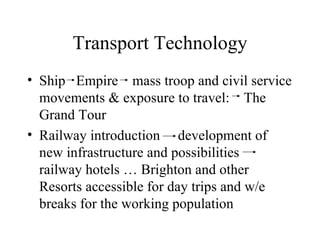
Transport Technology Ship  Empire  mass troop and civil service movements & exposure to travel:  The Grand Tour Railway introduction  development of new infrastructure and possibilities  railway hotels … Brighton and other Resorts accessible for day trips and w/e breaks for the working population
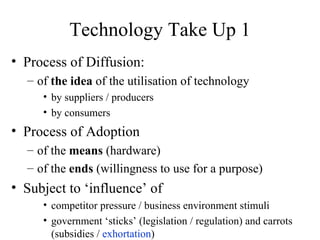
Technology Take Up 1 Process of Diffusion: of  the idea  of the utilisation of technology by suppliers / producers by consumers Process of Adoption of the  means  (hardware) of the  ends  (willingness to use for a purpose) Subject to ‘influence’ of competitor pressure / business environment stimuli government ‘sticks’ (legislation / regulation) and carrots (subsidies /  exhortation )
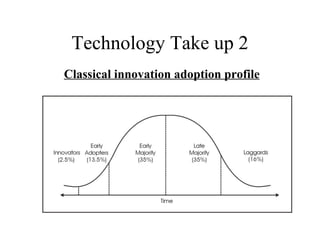
Technology Take up 2 Classical innovation adoption profile
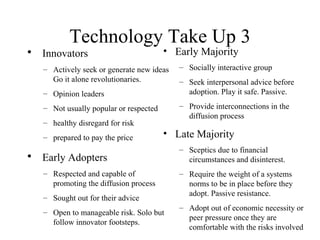
Technology Take Up 3 Innovators Actively seek or generate new ideas Go it alone revolutionaries. Opinion leaders Not usually popular or respected healthy disregard for risk  prepared to pay the price Early Adopters Respected and capable of promoting the diffusion process Sought out for their advice Open to manageable risk. Solo but follow innovator footsteps.  Early Majority Socially interactive group Seek interpersonal advice before adoption. Play it safe. Passive. Provide interconnections in the diffusion process Late Majority Sceptics due to financial circumstances and disinterest. Require the weight of a systems norms to be in place before they adopt. Passive resistance. Adopt out of economic necessity or peer pressure once they are comfortable with the risks involved
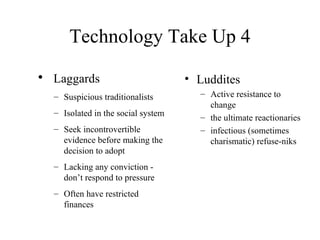
Technology Take Up 4 Laggards Suspicious traditionalists Isolated in the social system Seek incontrovertible evidence before making the decision to adopt Lacking any conviction - don’t respond to pressure Often have restricted finances Luddites Active resistance to change the ultimate reactionaries infectious (sometimes charismatic) refuse-niks
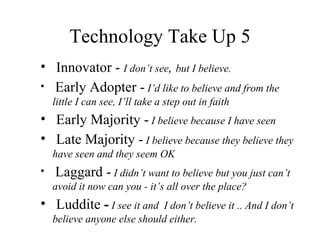
Technology Take Up 5 Innovator -  I don’t see ,  but I believe. Early Adopter -   I’d like to believe and from the little I can see, I’ll take a step out in faith Early Majority -   I believe because I have seen Late Majority -   I believe because they believe they have seen and they seem OK Laggard -   I didn’t want to believe but you just can’t avoid it now can you - it’s all over the place? Luddite  -   I see it and  I don’t believe it .. And I don’t believe anyone else should either.
Technology Take Up 5 So which are you? Innovator Early Adopter Early Majority Late Majority Laggard Luddite
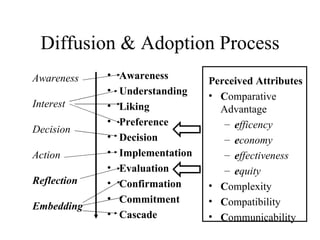
Diffusion & Adoption Process Awareness  Understanding Liking Preference Decision Implementation Evaluation Confirmation Commitment Cascade Perceived Attributes C omparative Advantage e fficency e conomy e ffectiveness e quity C omplexity C ompatibility C ommunicability Awareness Interest Decision Action Reflection Embedding
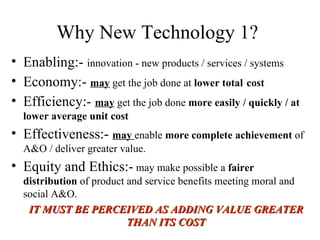
Why New Technology 1? Enabling:-  innovation - new products / services / systems Economy:-  may  get the job done at  lower total   cost   Efficiency:-  may  get the job done  more easily / quickly / at lower average unit cost Effectiveness:-  may  enable  more complete achievement  of A&O / deliver greater value. Equity and Ethics:-  may make possible a  fairer distribution  of product and service benefits meeting moral and social A&O. IT MUST BE PERCEIVED AS ADDING VALUE GREATER THAN ITS COST
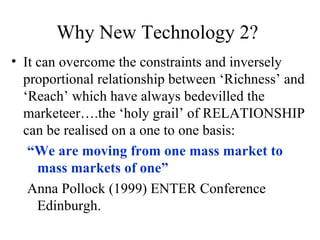
Why New Technology 2? It can overcome the constraints and inversely proportional relationship between ‘Richness’ and ‘Reach’ which have always bedevilled the marketeer….the ‘holy grail’ of RELATIONSHIP can be realised on a one to one basis: “ We are moving from one mass market to mass markets of one” Anna Pollock (1999) ENTER Conference Edinburgh.
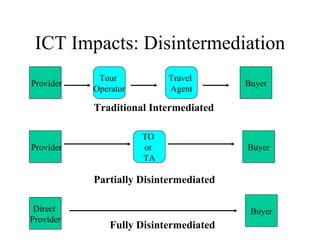
ICT Impacts: Disintermediation Provider Buyer Tour  Operator Travel  Agent TO  or  TA Provider Direct  Provider Buyer Buyer Fully Disintermediated Partially Disintermediated Traditional Intermediated
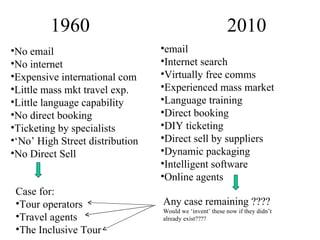
1960  2010 No email No internet Expensive international com Little mass mkt travel exp. Little language capability No direct booking Ticketing by specialists ‘ No’ High Street distribution No Direct Sell email Internet search Virtually free comms Experienced mass market Language training Direct booking DIY ticketing Direct sell by suppliers Dynamic packaging Intelligent software Online agents Case for: Tour operators Travel agents The Inclusive Tour Any case remaining ???? Would we ‘invent’ these now if they didn’t already exist????
ICT & Tourism 2 Think about these Qs for a minute or two & discuss with your friends adjacent... Q1. What can a traditional travel agent or tour operator do presently that ICT can’t - and how crucial are such things to buyers? Q2. In the next 5-10 years as software and internet based applications become even more intelligent and customisable to individual needs and wants - will there still be things that  only  a traditional agent/operator can do, or that he/she can still do  much better  (economically, effectively, efficiently…) than the technological alternative? Q3. What sorts of agents and operators are most at risk? Q4. What survival strategies might you advocate to those at risk?
ICT & Tourism Disintermediation.  (goodbye Mr T/A or Mr T/O?) Tour Operator  cost saving (commission), direct relationship acquisition (via screen) Customer loses intermediary benefits not provided by ICT loses (in one sense) choice of booking options possible savings (if passed on by Tour Op / direct provider)  Travel Agent add value to customer and tour operator =/> commission large ops --> multi-channel.  Small --> niche.  Medium???
ICT Successes - Why? Ryanair Expedia Lastminute.com Amazon Why do some operators find ICT ‘easy’ to adopt and others not? Is there anything about Tourism that makes it difficult to apply ICT successfully?

Tech N Tourism 1960 2010

  • 1.
    Tourism & TechnologyAn Introduction by Tony Jolley
  • 2.
    Aim To consider together the past, present and future relationship between Tourism and Technology
  • 3.
  • 4.
    Technology and itsInfluence Anything that affects availability and choice of how much time and money we have directly and indirectly affects tourism. Anything that affects transport systems directly and indirectly affects tourism. New means of transport. pricing … eg air transport public / private provision etc.…eg rail de-privatisation
  • 5.
    Transport Technology Ship Empire mass troop and civil service movements & exposure to travel: The Grand Tour Railway introduction development of new infrastructure and possibilities railway hotels … Brighton and other Resorts accessible for day trips and w/e breaks for the working population
  • 6.
    Technology Take Up1 Process of Diffusion: of the idea of the utilisation of technology by suppliers / producers by consumers Process of Adoption of the means (hardware) of the ends (willingness to use for a purpose) Subject to ‘influence’ of competitor pressure / business environment stimuli government ‘sticks’ (legislation / regulation) and carrots (subsidies / exhortation )
  • 7.
    Technology Take up2 Classical innovation adoption profile
  • 8.
    Technology Take Up3 Innovators Actively seek or generate new ideas Go it alone revolutionaries. Opinion leaders Not usually popular or respected healthy disregard for risk prepared to pay the price Early Adopters Respected and capable of promoting the diffusion process Sought out for their advice Open to manageable risk. Solo but follow innovator footsteps. Early Majority Socially interactive group Seek interpersonal advice before adoption. Play it safe. Passive. Provide interconnections in the diffusion process Late Majority Sceptics due to financial circumstances and disinterest. Require the weight of a systems norms to be in place before they adopt. Passive resistance. Adopt out of economic necessity or peer pressure once they are comfortable with the risks involved
  • 9.
    Technology Take Up4 Laggards Suspicious traditionalists Isolated in the social system Seek incontrovertible evidence before making the decision to adopt Lacking any conviction - don’t respond to pressure Often have restricted finances Luddites Active resistance to change the ultimate reactionaries infectious (sometimes charismatic) refuse-niks
  • 10.
    Technology Take Up5 Innovator - I don’t see , but I believe. Early Adopter - I’d like to believe and from the little I can see, I’ll take a step out in faith Early Majority - I believe because I have seen Late Majority - I believe because they believe they have seen and they seem OK Laggard - I didn’t want to believe but you just can’t avoid it now can you - it’s all over the place? Luddite - I see it and I don’t believe it .. And I don’t believe anyone else should either.
  • 11.
    Technology Take Up5 So which are you? Innovator Early Adopter Early Majority Late Majority Laggard Luddite
  • 12.
    Diffusion & AdoptionProcess Awareness Understanding Liking Preference Decision Implementation Evaluation Confirmation Commitment Cascade Perceived Attributes C omparative Advantage e fficency e conomy e ffectiveness e quity C omplexity C ompatibility C ommunicability Awareness Interest Decision Action Reflection Embedding
  • 13.
    Why New Technology1? Enabling:- innovation - new products / services / systems Economy:- may get the job done at lower total cost Efficiency:- may get the job done more easily / quickly / at lower average unit cost Effectiveness:- may enable more complete achievement of A&O / deliver greater value. Equity and Ethics:- may make possible a fairer distribution of product and service benefits meeting moral and social A&O. IT MUST BE PERCEIVED AS ADDING VALUE GREATER THAN ITS COST
  • 14.
    Why New Technology2? It can overcome the constraints and inversely proportional relationship between ‘Richness’ and ‘Reach’ which have always bedevilled the marketeer….the ‘holy grail’ of RELATIONSHIP can be realised on a one to one basis: “ We are moving from one mass market to mass markets of one” Anna Pollock (1999) ENTER Conference Edinburgh.
  • 15.
    ICT Impacts: DisintermediationProvider Buyer Tour Operator Travel Agent TO or TA Provider Direct Provider Buyer Buyer Fully Disintermediated Partially Disintermediated Traditional Intermediated
  • 16.
    1960 2010No email No internet Expensive international com Little mass mkt travel exp. Little language capability No direct booking Ticketing by specialists ‘ No’ High Street distribution No Direct Sell email Internet search Virtually free comms Experienced mass market Language training Direct booking DIY ticketing Direct sell by suppliers Dynamic packaging Intelligent software Online agents Case for: Tour operators Travel agents The Inclusive Tour Any case remaining ???? Would we ‘invent’ these now if they didn’t already exist????
  • 17.
    ICT & Tourism2 Think about these Qs for a minute or two & discuss with your friends adjacent... Q1. What can a traditional travel agent or tour operator do presently that ICT can’t - and how crucial are such things to buyers? Q2. In the next 5-10 years as software and internet based applications become even more intelligent and customisable to individual needs and wants - will there still be things that only a traditional agent/operator can do, or that he/she can still do much better (economically, effectively, efficiently…) than the technological alternative? Q3. What sorts of agents and operators are most at risk? Q4. What survival strategies might you advocate to those at risk?
  • 18.
    ICT & TourismDisintermediation. (goodbye Mr T/A or Mr T/O?) Tour Operator cost saving (commission), direct relationship acquisition (via screen) Customer loses intermediary benefits not provided by ICT loses (in one sense) choice of booking options possible savings (if passed on by Tour Op / direct provider) Travel Agent add value to customer and tour operator =/> commission large ops --> multi-channel. Small --> niche. Medium???
  • 19.
    ICT Successes -Why? Ryanair Expedia Lastminute.com Amazon Why do some operators find ICT ‘easy’ to adopt and others not? Is there anything about Tourism that makes it difficult to apply ICT successfully?