Biyyoolessaii Ija
                                                                     Mukaa
                                                        “Fruit of the Land”
                                                                   Team 2
                                                   Devin Broadwater, Karen Hamby, Naomi Chen,
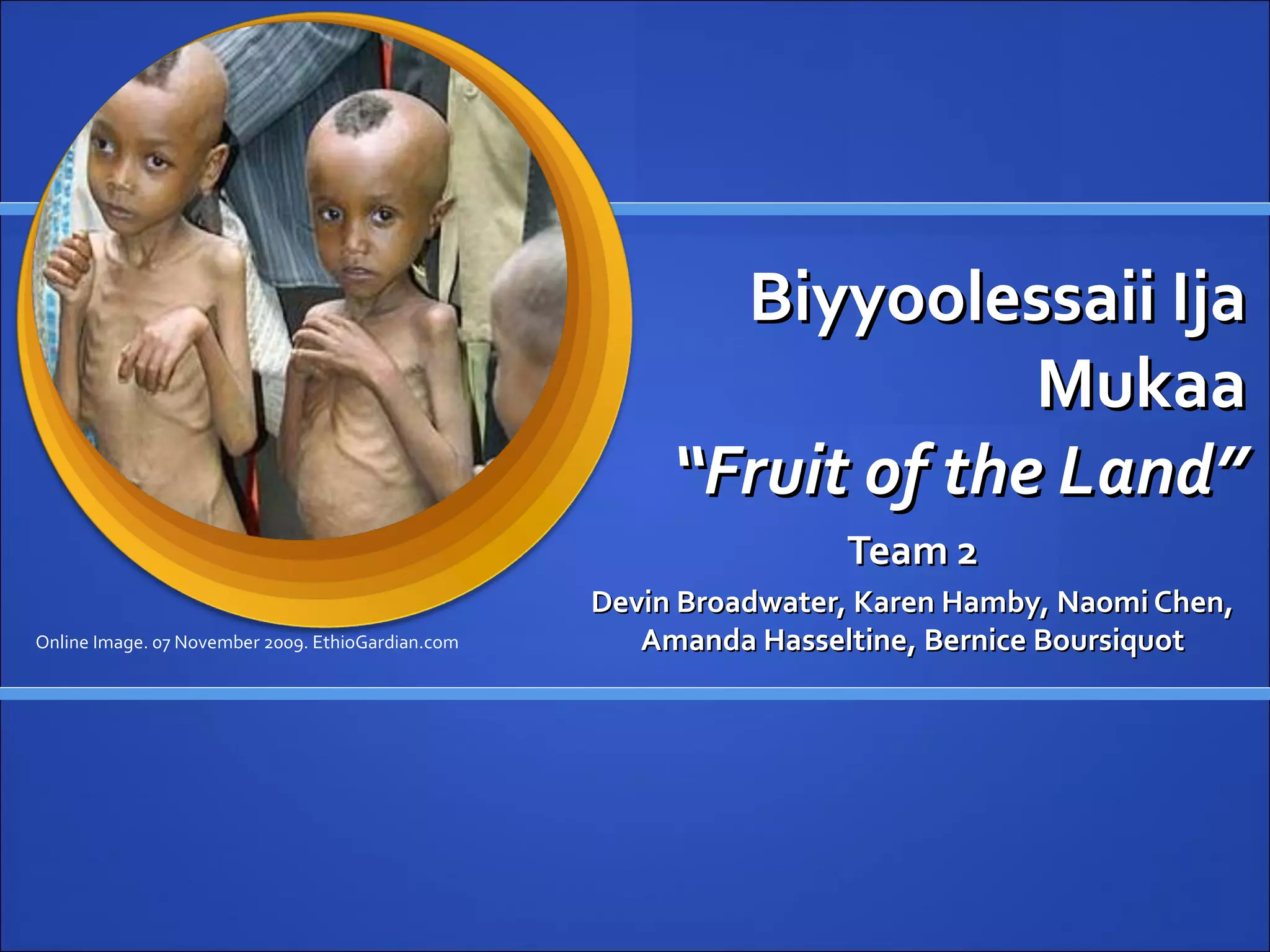
Online Image. 07 November 2009. EthioGardian.com      Amanda Hasseltine, Bernice Boursiquot
Presentation Outline

 Demographics on Oromiya

 Meet the Adabbos, an Average Oromo family

 Child Malnutrition and Its Factors

 Strategy to Combat Child Malnutrition
   Emergency Food Aid
   Comprehensive Approach
   Allocation of Funds

 Summary
Oromiya Region Background
      Demographics                                             Current Health Crisis
 27 Million People                                        34.4% of Children under the
 4.8 People Per Household                                  age of five are underweight
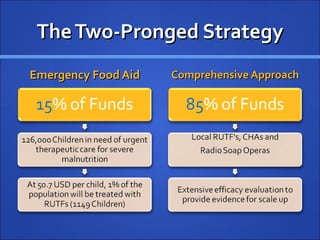
                                                           Estimated 126,000 children are
 Ethnic Groups
                                                            in need of urgent therapeutic
   87.8% Oromo                                             care for severe malnutrition in
   7.22% Amhara                                            Ethiopia
 Religion                                                       This number is expected to
                                                                     climb
    48.2% Christian
                                                           Ethiopia is rated the sixth
      Orthodox and Protestant
                                                                worst country in terms of
    47.5% Muslim                                               nutritional outcomes
 88.7% Rural Inhabitants                                       worldwide.

                Central Statistical Agency (CSA) of Ethiopia, 2007
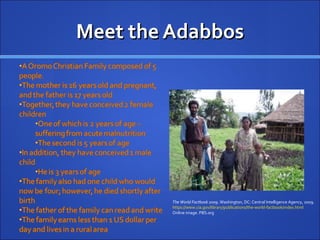
Meet the Adabbos


         The World Factbook 2009. Washington, DC: Central Intelligence Agency, 2009.
         https://www.cia.gov/library/publications/the-world-factbook/index.html
         Online image. PBS.org
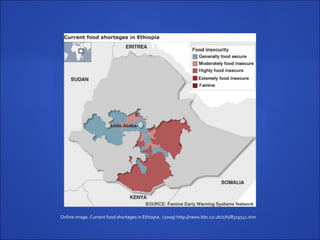
Online image. Current food shortages in Ethiopia. (2009) http://news.bbc.co.uk/2/hi/8319741.stm
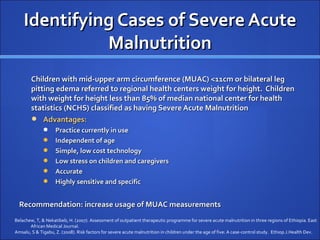
Identifying Cases of Severe Acute
              Malnutrition
        Children with mid-upper arm circumference (MUAC) <11cm or bilateral leg
        pitting edema referred to regional health centers weight for height. Children
        with weight for height less than 85% of median national center for health
        statistics (NCHS) classified as having Severe Acute Malnutrition
         Advantages:
                   Practice currently in use
                   Independent of age
                   Simple, low cost technology
                   Low stress on children and caregivers
                   Accurate
                   Highly sensitive and specific


  Recommendation: increase usage of MUAC measurements
Belachew, T, & Nekatibeb, H. (2007). Assessment of outpatient therapeutic programme for severe acute malnutrition in three regions of Ethiopia. East
       African Medical Journal.
Amsalu, S & Tigabu, Z. (2008). Risk factors for severe acute malnutrition in children under the age of five: A case-control study. Ethiop.J.Health Dev.
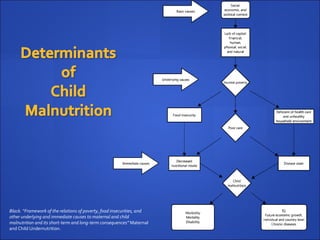
Black. “Framework of the relations of poverty, food insecurities, and
other underlying and immediate causes to maternal and child
malnutrition and its short-term and long-term consequences” Maternal
and Child Undernutrition.
Cholera
Outbreak
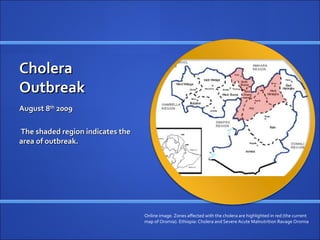
August 8th 2009

The shaded region indicates the
area of outbreak.


                                  Online image. Zones affected with the cholera are highlighted in red (the current
                                  map of Oromia). Ethiopia: Cholera and Severe Acute Malnutrition Ravage Oromia
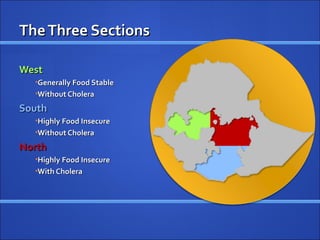
The Three Sections

West
  •Generally Food Stable
  •Without Cholera

South
  •Highly Food Insecure
  •Without Cholera

North
  •Highly Food Insecure
  •With Cholera
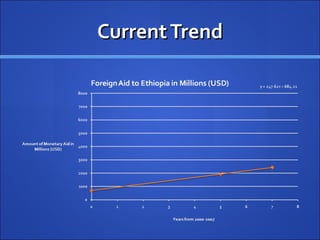
Current Trend
The 1 million dollar question (USD)?
How can severe acute malnutrition be sustainably reduced in
   the Oromiya region of Ethiopia with 1 USD million?
The Two-Pronged Strategy
Emergency Food Aid   Comprehensive Approach
Emergency Food Aid

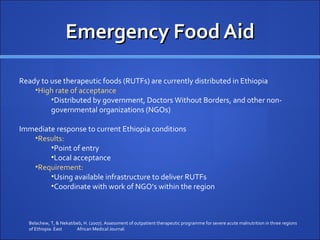
Ready to use therapeutic foods (RUTFs) are currently distributed in Ethiopia
    •High rate of acceptance
         •Distributed by government, Doctors Without Borders, and other non-
         governmental organizations (NGOs)

Immediate response to current Ethiopia conditions
   •Results:
        •Point of entry
        •Local acceptance
   •Requirement:
        •Using available infrastructure to deliver RUTFs
        •Coordinate with work of NGO’s within the region


  Belachew, T, & Nekatibeb, H. (2007). Assessment of outpatient therapeutic programme for severe acute malnutrition in three regions
  of Ethiopia. East     African Medical Journal.
Comprehensive Targeted Approach

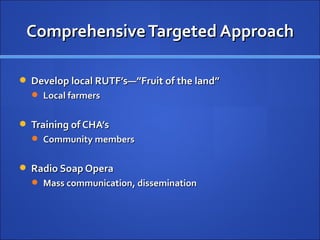
 Develop local RUTF’s—”Fruit of the land”
   Local farmers


 Training of CHA’s
   Community members


 Radio Soap Opera
   Mass communication, dissemination
Assessment
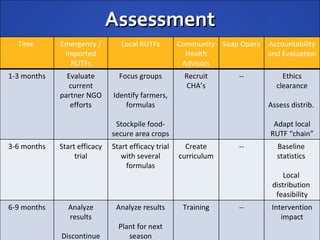
  Time       Emergency /         Local RUTFs         Community Soap Opera Accountability
              Imported                                 Health             and Evaluation
               RUTFs                                  Advisors
1-3 months     Evaluate         Focus groups          Recruit       --         Ethics
                current                               CHA’s                  clearance
             partner NGO      Identify farmers,
                efforts           formulas                                 Assess distrib.

                               Stockpile food-                               Adapt local
                              secure area crops                             RUTF “chain”
3-6 months   Start efficacy   Start efficacy trial     Create       --        Baseline
                  trial          with several        curriculum               statistics
                                  formulas
                                                                                Local
                                                                            distribution
                                                                             feasibility
6-9 months     Analyze         Analyze results        Training      --      Intervention
               results                                                         impact
                                Plant for next
             Discontinue           season
Implementation
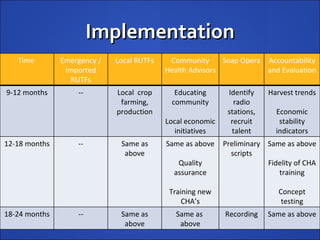
   Time        Emergency /   Local RUTFs    Community      Soap Opera Accountability
                Imported                   Health Advisors            and Evaluation
                 RUTFs
9-12 months        --        Local crop      Educating       Identify    Harvest trends
                              farming,      community          radio
                             production                      stations,     Economic
                                           Local economic     recruit       stability
                                              initiatives     talent       indicators
12-18 months       --         Same as      Same as above    Preliminary Same as above
                               above                          scripts
                                              Quality                   Fidelity of CHA
                                             assurance                     training

                                            Training new                    Concept
                                                CHA’s                        testing
18-24 months       --         Same as         Same as       Recording    Same as above
                               above           above
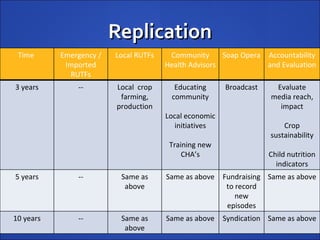
Replication
 Time      Emergency /   Local RUTFs    Community      Soap Opera Accountability
            Imported                   Health Advisors            and Evaluation
             RUTFs
3 years        --        Local crop      Educating      Broadcast    Evaluate
                          farming,      community                   media reach,
                         production                                   impact
                                       Local economic
                                          initiatives                   Crop
                                                                    sustainability
                                        Training new
                                            CHA’s                   Child nutrition
                                                                      indicators
5 years        --         Same as      Same as above    Fundraising Same as above
                           above                         to record
                                                            new
                                                         episodes
10 years       --         Same as      Same as above    Syndication Same as above
                           above
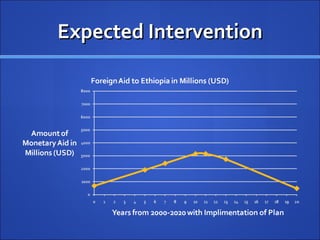
Expected Intervention
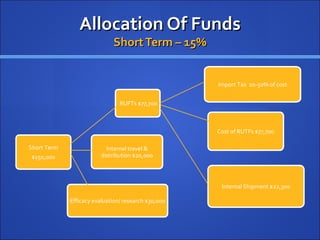
Allocation Of Funds
                             Short Term – 15%


                                                     Import Tax 20-50% of cost


                                RUFTs $77,700


                                                     Cost of RUTFs $77,700

Short Term                 Internal travel &
 $150,000                distribution $20,000


                                                      Internal Shipment $22,300

             Efficacy evaluation/ research $30,000
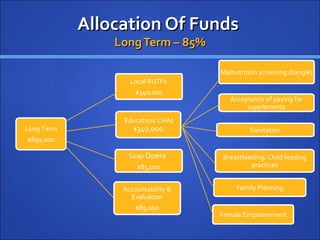
Allocation Of Funds
                Long Term – 85%

                                    Malnutrition screening (bangle)
                   Local RUTFs
                     $340,000
                                       Acceptance of paying for
                                            supplements
                 Education/ CHAs
Long Term          $340,000                  Sanitation
$850,000

                  Soap Opera        Breastfeeding/ Child feeding
                     $85,000                 practices


                 Accountability &        Family Planning
                   Evaluation
                     $85,000
                                    Female Empowerment
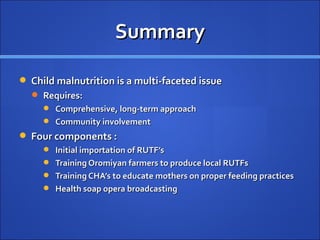
Summary

 Child malnutrition is a multi-faceted issue
   Requires:
      Comprehensive, long-term approach
      Community involvement
 Four components :
      Initial importation of RUTF’s
      Training Oromiyan farmers to produce local RUTFs
      Training CHA’s to educate mothers on proper feeding practices
      Health soap opera broadcasting

Team 2 case study

  • 1.
    Biyyoolessaii Ija Mukaa “Fruit of the Land” Team 2 Devin Broadwater, Karen Hamby, Naomi Chen, Online Image. 07 November 2009. EthioGardian.com Amanda Hasseltine, Bernice Boursiquot
  • 2.
    Presentation Outline  Demographicson Oromiya  Meet the Adabbos, an Average Oromo family  Child Malnutrition and Its Factors  Strategy to Combat Child Malnutrition  Emergency Food Aid  Comprehensive Approach  Allocation of Funds  Summary
  • 3.
    Oromiya Region Background Demographics Current Health Crisis  27 Million People  34.4% of Children under the  4.8 People Per Household age of five are underweight  Estimated 126,000 children are  Ethnic Groups in need of urgent therapeutic  87.8% Oromo care for severe malnutrition in  7.22% Amhara Ethiopia  Religion  This number is expected to climb  48.2% Christian  Ethiopia is rated the sixth  Orthodox and Protestant worst country in terms of  47.5% Muslim nutritional outcomes  88.7% Rural Inhabitants worldwide. Central Statistical Agency (CSA) of Ethiopia, 2007
  • 4.
    Meet the Adabbos The World Factbook 2009. Washington, DC: Central Intelligence Agency, 2009. https://www.cia.gov/library/publications/the-world-factbook/index.html Online image. PBS.org
  • 5.
    Online image. Currentfood shortages in Ethiopia. (2009) http://news.bbc.co.uk/2/hi/8319741.stm
  • 6.
    Identifying Cases ofSevere Acute Malnutrition Children with mid-upper arm circumference (MUAC) <11cm or bilateral leg pitting edema referred to regional health centers weight for height. Children with weight for height less than 85% of median national center for health statistics (NCHS) classified as having Severe Acute Malnutrition  Advantages:  Practice currently in use  Independent of age  Simple, low cost technology  Low stress on children and caregivers  Accurate  Highly sensitive and specific Recommendation: increase usage of MUAC measurements Belachew, T, & Nekatibeb, H. (2007). Assessment of outpatient therapeutic programme for severe acute malnutrition in three regions of Ethiopia. East African Medical Journal. Amsalu, S & Tigabu, Z. (2008). Risk factors for severe acute malnutrition in children under the age of five: A case-control study. Ethiop.J.Health Dev.
  • 7.
    Black. “Framework ofthe relations of poverty, food insecurities, and other underlying and immediate causes to maternal and child malnutrition and its short-term and long-term consequences” Maternal and Child Undernutrition.
  • 8.
    Cholera Outbreak August 8th 2009 Theshaded region indicates the area of outbreak. Online image. Zones affected with the cholera are highlighted in red (the current map of Oromia). Ethiopia: Cholera and Severe Acute Malnutrition Ravage Oromia
  • 9.
    The Three Sections West •Generally Food Stable •Without Cholera South •Highly Food Insecure •Without Cholera North •Highly Food Insecure •With Cholera
  • 10.
  • 11.
    The 1 milliondollar question (USD)? How can severe acute malnutrition be sustainably reduced in the Oromiya region of Ethiopia with 1 USD million?
  • 12.
    The Two-Pronged Strategy EmergencyFood Aid Comprehensive Approach
  • 13.
    Emergency Food Aid Readyto use therapeutic foods (RUTFs) are currently distributed in Ethiopia •High rate of acceptance •Distributed by government, Doctors Without Borders, and other non- governmental organizations (NGOs) Immediate response to current Ethiopia conditions •Results: •Point of entry •Local acceptance •Requirement: •Using available infrastructure to deliver RUTFs •Coordinate with work of NGO’s within the region Belachew, T, & Nekatibeb, H. (2007). Assessment of outpatient therapeutic programme for severe acute malnutrition in three regions of Ethiopia. East African Medical Journal.
  • 14.
    Comprehensive Targeted Approach Develop local RUTF’s—”Fruit of the land”  Local farmers  Training of CHA’s  Community members  Radio Soap Opera  Mass communication, dissemination
  • 15.
    Assessment Time Emergency / Local RUTFs Community Soap Opera Accountability Imported Health and Evaluation RUTFs Advisors 1-3 months Evaluate Focus groups Recruit -- Ethics current CHA’s clearance partner NGO Identify farmers, efforts formulas Assess distrib. Stockpile food- Adapt local secure area crops RUTF “chain” 3-6 months Start efficacy Start efficacy trial Create -- Baseline trial with several curriculum statistics formulas Local distribution feasibility 6-9 months Analyze Analyze results Training -- Intervention results impact Plant for next Discontinue season
  • 16.
    Implementation Time Emergency / Local RUTFs Community Soap Opera Accountability Imported Health Advisors and Evaluation RUTFs 9-12 months -- Local crop Educating Identify Harvest trends farming, community radio production stations, Economic Local economic recruit stability initiatives talent indicators 12-18 months -- Same as Same as above Preliminary Same as above above scripts Quality Fidelity of CHA assurance training Training new Concept CHA’s testing 18-24 months -- Same as Same as Recording Same as above above above
  • 17.
    Replication Time Emergency / Local RUTFs Community Soap Opera Accountability Imported Health Advisors and Evaluation RUTFs 3 years -- Local crop Educating Broadcast Evaluate farming, community media reach, production impact Local economic initiatives Crop sustainability Training new CHA’s Child nutrition indicators 5 years -- Same as Same as above Fundraising Same as above above to record new episodes 10 years -- Same as Same as above Syndication Same as above above
  • 18.
  • 19.
    Allocation Of Funds Short Term – 15% Import Tax 20-50% of cost RUFTs $77,700 Cost of RUTFs $77,700 Short Term Internal travel & $150,000 distribution $20,000 Internal Shipment $22,300 Efficacy evaluation/ research $30,000
  • 20.
    Allocation Of Funds Long Term – 85% Malnutrition screening (bangle) Local RUTFs $340,000 Acceptance of paying for supplements Education/ CHAs Long Term $340,000 Sanitation $850,000 Soap Opera Breastfeeding/ Child feeding $85,000 practices Accountability & Family Planning Evaluation $85,000 Female Empowerment
  • 21.
    Summary  Child malnutritionis a multi-faceted issue  Requires:  Comprehensive, long-term approach  Community involvement  Four components :  Initial importation of RUTF’s  Training Oromiyan farmers to produce local RUTFs  Training CHA’s to educate mothers on proper feeding practices  Health soap opera broadcasting

Editor's Notes

  • #16 Harvest in May, October 4 months between each (May-June, Oct-Dec)