M3 Distribution
Representative: Jennifer Echols
• Product: Electronic components/Assembly/ Fabrication.
• Target: Oil Gas/ Medical/ HVAC
• Team 01TTH10:00 – Joaquin Dela Cruz, Carlos Hernandez, Luis
Villalpanda, HugoVillegas
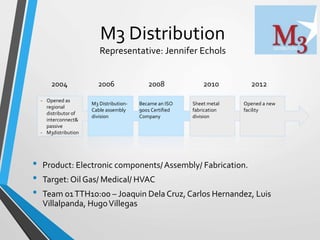
2004 2006 2008 2010 2012
- Opened as
regional
distributor of
interconnect&
passive
- M3distribution
M3 Distribution-
Cable assembly
division
Sheet metal
fabrication
division
Opened a new
facility
Became an ISO
9001 Certified
Company
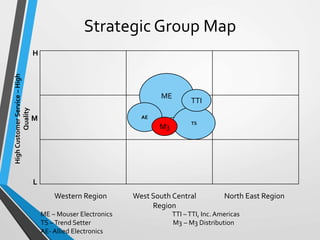
HighCustomerService–High
Quality
Western Region
ME
AE
TS
TTI
Strategic Group Map
ME – Mouser Electronics TTI –TTI, Inc. Americas
TS –Trend Setter M3 – M3 Distribution
AE- Allied Electronics
West South Central
Region
North East Region
M3
H
L
M
Industry Dominant Economic
Characteristics
• High # rivals
• High entry barriers
• Low growth rate(-)
• Technological change (+)
• Geographical concentration density(+)
Driving Forces of Change
• (+) ISO9001 requirements-steady rate
I: Risk/Lose Suppliers
R: Proactive – Keep certification updated
• (+) uncertainty (Suppliers)- steady rate
I: Retaining Contract
R: Acquisitions of new suppliers
• (+) technological change-steady rate
I: Update /improve
R: Bulk purchasing
I = Impact R = Recommendations
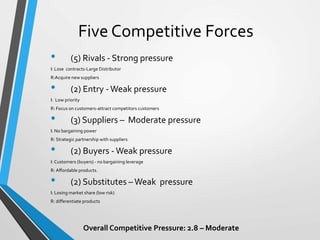
Five Competitive Forces
• (5) Rivals - Strong pressure
I: Lose contracts-Large Distributor
R:Acquire new suppliers
• (2) Entry - Weak pressure
I: Low priority
R: Focus on customers-attract competitors customers
• (3) Suppliers – Moderate pressure
I: No bargaining power
R: Strategic partnership with suppliers
• (2) Buyers - Weak pressure
I: Customers (buyers) - no bargaining leverage
R: Affordable products.
• (2) Substitutes – Weak pressure
I: Losing market share (low risk)
R: differentiate products
Overall Competitive Pressure: 2.8 – Moderate
Key Success Factors
• Accessibility
• Customer service(*)
• Quality products
• Goodwill
• Open communication (*)
• Connection to employers(*)
• Technology requirements
* Currently integrated into company strategy
Industry AttractivenessAnalysis
Criterion W R WR D
Customer
Service
.35 7 2.45 1.053
Expertise
requirements
.25 5 1.25 1.252
Technology
Requirements
.20 1 .20 1.81
Seasonality
issues
.05 8 .40 .10
Competitive
Forces
.05 3 .15 .35
Growth .05 2 .10 .40
Profitability .05 2 .10 .40
1.0 4.65 5.35
Customer Service
I: Customer retention (+)
R: Proactive feedback
Seasonality Issues
I: steady customer flow
R: incentives to attract customers
Expertise:
I: ISO9001 requirement (+ training cost)
R: Leverage certifications in contracts
Technology requirements:
I: Machinery/software update (high cost)
R: bulk-discounted items
Competitive Forces
I: Encourages innovation
R: Add more suppliers
Growth:
I: less resources on rivals
R: Focus on expanding suppliers
Profitability
I: Restricts entry
R: Focus on MIS for budgeting
W = weight R = Rating WR = weighted rating D = delta
1, 2, 3 Reflects MIS Resource Allocation Priority
Company Strategy Analysis
Low Cost Leadership Strategy
• Obtainable price
• Goodwill recognition
• Attracts diverse customers
• Manage costs effectively
SWOT Analysis
Strengths
• Connection to employers(*)
• Customer support(*)
• Open communication (*)
• Goodwill
Weaknesses
• Identity(-)
• Limited Brand
• Staff support
• Mobility & Location
• Accessibility
Opportunities
• Location – Regional expansion
• Regional economy
• Regional population
Threats
• Financial funds
• Competitor expansion
• Supplier contracts
+ integrated into current strategy
CSAM Analysis
M3 Distribution Mouser Electronics Trend Setter Allied Electronics TTI, Inc.Americas
Criterion WT
Ratin
g
WTD
Rating
Delta Rating
WTD
Rating
Delta Rating
WTD
Rating
Delta Rating
WTD
Rating
Delta Rating
WTD
Rating
Delta
Accessibility .15 4 .6 .9 6 .9 .6 2 .3 1.2 5 .75 .75 1 .15 1.35
Customer
Service
.15 7 1.05 .45 4 .6 .9 5 .75 .75 6 .9 .6 3 .45 1.05
Quality
Products
.15 5 .75 .75 7 1.05 .45 6 .9 .6 8 1.2 .3 6 .9 .6
Goodwill .10 8 .8 .2 3 .3 .7 5 .5 .5 4 .4 .6 6 .6 .4
Open
Communication
.15 6 .9 .6 4 .6 .9 1 .15 1.35 3 .45 1.05 5 .75 .75
Connection to
Employees
.2 6 1.2 .8 3 .6 1.4 4 .8 1.2 4 .8 1.2 5 1 1
Technology
requirements
.1 4 .4 .6 8 .8 .2 5 .5 .5 5 .5 .5 4 .4 .6
1.0 5.7 4.3 4.85 5.15 3.9 6.1 5 5 4.25 5.75
Offensive Strategy
Mouser Electronics– 3.5:1
Head-on Assault– Promote company
values towards public
Defensive Strategy
Mouser Electronics– 1:1.5
Blocking Strategy – Availability promise
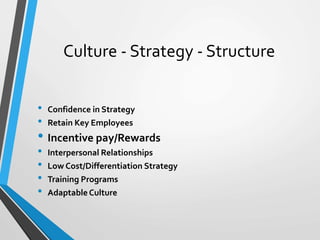
Culture - Strategy - Structure
• Confidence in Strategy
• Retain Key Employees
• Incentive pay/Rewards
• Interpersonal Relationships
• Low Cost/Differentiation Strategy
• Training Programs
• Adaptable Culture
Corporate Strategy
• Related Diversification Strategy
• Maximizing strategic fit – use all capital & available
resources
• Create synergy – High Goodwill
Combined Matrix Analysis
Relative Market Share
High Low
IndustryGrowthRate
Low
High
LowHigh Medium
High
Low
IndustryAttractiveness
~~
CSAM & CPAM
SP
P S
M3 Plus DistributionM3 Distribution
Strategic Issues
• ShortTerm
1. How do we gain more customers?
2. How do we keep supplier contracts?
3. How do we raise capital?
• LongTerm
1. How do we improve customer satisfaction?
2. How do we gain more market share?
3. How do we increase our competitive advantage?
Action Steps
• ShortTerm
1. Implement a better marketing strategy
2. Meet supplier sales quota
3. Short term investments
• LongTerm
1. Rewards program
2. Acquire other entities
3. Specialization

TEAM 01 - 1000 - SPRING 2016 - PRESENTATION (5)

  • 1.
    M3 Distribution Representative: JenniferEchols • Product: Electronic components/Assembly/ Fabrication. • Target: Oil Gas/ Medical/ HVAC • Team 01TTH10:00 – Joaquin Dela Cruz, Carlos Hernandez, Luis Villalpanda, HugoVillegas 2004 2006 2008 2010 2012 - Opened as regional distributor of interconnect& passive - M3distribution M3 Distribution- Cable assembly division Sheet metal fabrication division Opened a new facility Became an ISO 9001 Certified Company
  • 2.
    HighCustomerService–High Quality Western Region ME AE TS TTI Strategic GroupMap ME – Mouser Electronics TTI –TTI, Inc. Americas TS –Trend Setter M3 – M3 Distribution AE- Allied Electronics West South Central Region North East Region M3 H L M
  • 3.
    Industry Dominant Economic Characteristics •High # rivals • High entry barriers • Low growth rate(-) • Technological change (+) • Geographical concentration density(+)
  • 4.
    Driving Forces ofChange • (+) ISO9001 requirements-steady rate I: Risk/Lose Suppliers R: Proactive – Keep certification updated • (+) uncertainty (Suppliers)- steady rate I: Retaining Contract R: Acquisitions of new suppliers • (+) technological change-steady rate I: Update /improve R: Bulk purchasing I = Impact R = Recommendations
  • 5.
    Five Competitive Forces •(5) Rivals - Strong pressure I: Lose contracts-Large Distributor R:Acquire new suppliers • (2) Entry - Weak pressure I: Low priority R: Focus on customers-attract competitors customers • (3) Suppliers – Moderate pressure I: No bargaining power R: Strategic partnership with suppliers • (2) Buyers - Weak pressure I: Customers (buyers) - no bargaining leverage R: Affordable products. • (2) Substitutes – Weak pressure I: Losing market share (low risk) R: differentiate products Overall Competitive Pressure: 2.8 – Moderate
  • 6.
    Key Success Factors •Accessibility • Customer service(*) • Quality products • Goodwill • Open communication (*) • Connection to employers(*) • Technology requirements * Currently integrated into company strategy
  • 7.
    Industry AttractivenessAnalysis Criterion WR WR D Customer Service .35 7 2.45 1.053 Expertise requirements .25 5 1.25 1.252 Technology Requirements .20 1 .20 1.81 Seasonality issues .05 8 .40 .10 Competitive Forces .05 3 .15 .35 Growth .05 2 .10 .40 Profitability .05 2 .10 .40 1.0 4.65 5.35 Customer Service I: Customer retention (+) R: Proactive feedback Seasonality Issues I: steady customer flow R: incentives to attract customers Expertise: I: ISO9001 requirement (+ training cost) R: Leverage certifications in contracts Technology requirements: I: Machinery/software update (high cost) R: bulk-discounted items Competitive Forces I: Encourages innovation R: Add more suppliers Growth: I: less resources on rivals R: Focus on expanding suppliers Profitability I: Restricts entry R: Focus on MIS for budgeting W = weight R = Rating WR = weighted rating D = delta 1, 2, 3 Reflects MIS Resource Allocation Priority
  • 8.
    Company Strategy Analysis LowCost Leadership Strategy • Obtainable price • Goodwill recognition • Attracts diverse customers • Manage costs effectively
  • 9.
    SWOT Analysis Strengths • Connectionto employers(*) • Customer support(*) • Open communication (*) • Goodwill Weaknesses • Identity(-) • Limited Brand • Staff support • Mobility & Location • Accessibility Opportunities • Location – Regional expansion • Regional economy • Regional population Threats • Financial funds • Competitor expansion • Supplier contracts + integrated into current strategy
  • 10.
    CSAM Analysis M3 DistributionMouser Electronics Trend Setter Allied Electronics TTI, Inc.Americas Criterion WT Ratin g WTD Rating Delta Rating WTD Rating Delta Rating WTD Rating Delta Rating WTD Rating Delta Rating WTD Rating Delta Accessibility .15 4 .6 .9 6 .9 .6 2 .3 1.2 5 .75 .75 1 .15 1.35 Customer Service .15 7 1.05 .45 4 .6 .9 5 .75 .75 6 .9 .6 3 .45 1.05 Quality Products .15 5 .75 .75 7 1.05 .45 6 .9 .6 8 1.2 .3 6 .9 .6 Goodwill .10 8 .8 .2 3 .3 .7 5 .5 .5 4 .4 .6 6 .6 .4 Open Communication .15 6 .9 .6 4 .6 .9 1 .15 1.35 3 .45 1.05 5 .75 .75 Connection to Employees .2 6 1.2 .8 3 .6 1.4 4 .8 1.2 4 .8 1.2 5 1 1 Technology requirements .1 4 .4 .6 8 .8 .2 5 .5 .5 5 .5 .5 4 .4 .6 1.0 5.7 4.3 4.85 5.15 3.9 6.1 5 5 4.25 5.75 Offensive Strategy Mouser Electronics– 3.5:1 Head-on Assault– Promote company values towards public Defensive Strategy Mouser Electronics– 1:1.5 Blocking Strategy – Availability promise
  • 11.
    Culture - Strategy- Structure • Confidence in Strategy • Retain Key Employees • Incentive pay/Rewards • Interpersonal Relationships • Low Cost/Differentiation Strategy • Training Programs • Adaptable Culture
  • 12.
    Corporate Strategy • RelatedDiversification Strategy • Maximizing strategic fit – use all capital & available resources • Create synergy – High Goodwill
  • 13.
    Combined Matrix Analysis RelativeMarket Share High Low IndustryGrowthRate Low High LowHigh Medium High Low IndustryAttractiveness ~~ CSAM & CPAM SP P S M3 Plus DistributionM3 Distribution
  • 14.
    Strategic Issues • ShortTerm 1.How do we gain more customers? 2. How do we keep supplier contracts? 3. How do we raise capital? • LongTerm 1. How do we improve customer satisfaction? 2. How do we gain more market share? 3. How do we increase our competitive advantage?
  • 15.
    Action Steps • ShortTerm 1.Implement a better marketing strategy 2. Meet supplier sales quota 3. Short term investments • LongTerm 1. Rewards program 2. Acquire other entities 3. Specialization