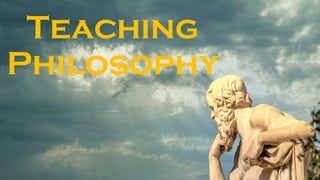
Teaching
Philosophy
WHAT WOULD YOU HONESTLY
DO?
Scenario #1
You’re in a general meeting of 50 people and
one of your bosses criticizes you in front of
other co-workers for a project you spent 2
days and 2 sleepless nights putting together.
WHAT WOULD YOU HONESTLY
DO?
Scenario #2
Your special someone tells you that it hurts
their feelings when you forget to do whatever
plans or deeds which you both agreed to.
WHAT WOULD YOU HONESTLY
DO?
Scenario #3
You have worked for the company for 6 years
and a colleague for 4. You and that same
colleague were up for the same promotion,
but he got it instead of you.
WHAT WOULD YOU HONESTLY
DO?
Scenario #4
You passed a challenging exam and posted
about it on social media but didn’t get any
“likes”.
WHAT WOULD YOU HONESTLY
DO?
Scenario #5
You’re on a date with the guy/girl you really
liked but it doesn’t seem to be going very well
(frequent awkward silence).
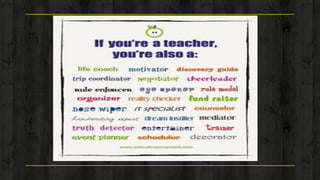
What is a TEACHER?
helps their students to be passionate
act as role models, mentors, caregivers and advisers.
presence in a student’s life can boost their morale and guide them to be
more valuable in life.
imparts knowledge, good values, tradition, modern-day challenges and
ways to resolve them within students.
The Changing Role of a Teacher
8
What is the role of a TEACHER?
to inspire, motivate, encourage and educate learners.
to “shape the life chances of young people by imparting knowledge –
bringing the curriculum to life.
to safeguard children’s welfare, inspiring critical thought and moral
values.
to bring out the best in students and inspire them to strive for greatness.
The Changing Role of a Teacher
9
The Changing Role of a Teacher
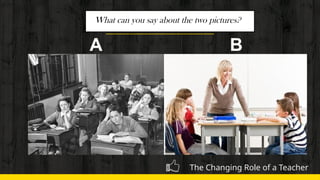
What can you say about the two pictures?
A B
10
Let’s go back to History:
The Changing Role of a Teacher
11
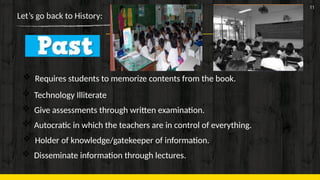
Let’s go back to History:
 Requires students to memorize contents from the book.
 Technology Illiterate
 Give assessments through written examination.
 Autocratic in which the teachers are in control of everything.
 Holder of knowledge/gatekeeper of information.
 Disseminate information through lectures.
12
The Changing Role of a Teacher
13
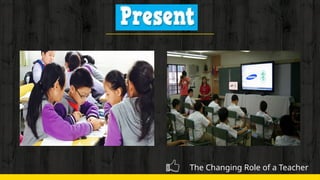
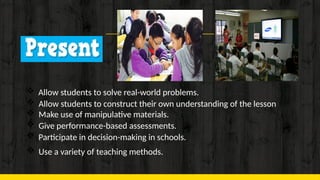
 Allow students to solve real-world problems.
 Allow students to construct their own understanding of the lesson
 Make use of manipulative materials.
 Give performance-based assessments.
 Participate in decision-making in schools.
 Use a variety of teaching methods.
14
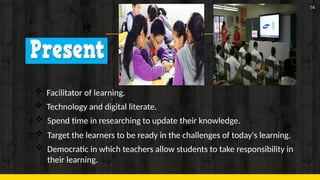
 Facilitator of learning.
 Technology and digital literate.
 Spend time in researching to update their knowledge.
 Target the learners to be ready in the challenges of today's learning.
 Democratic in which teachers allow students to take responsibility in
their learning.
15
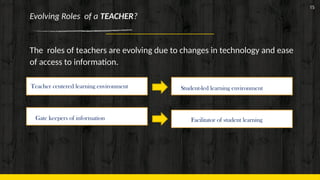
Evolving Roles of a TEACHER?
The roles of teachers are evolving due to changes in technology and ease
of access to information.
Teacher centered learning environment Student-led learning environment
Gate keepers of information Facilitator of student learning
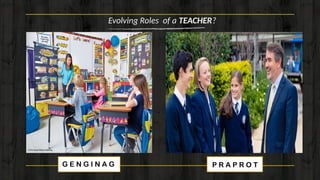
Evolving Roles of a TEACHER?
G E N G I N A G P R A P R O T
17
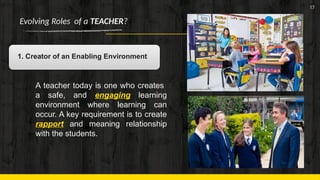
Evolving Roles of a TEACHER?
1. Creator of an Enabling Environment
A teacher today is one who creates
a safe, and engaging learning
environment where learning can
occur. A key requirement is to create
rapport and meaning relationship
with the students.
18
Evolving Roles of a TEACHER?
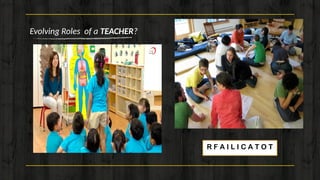
R F A I L I C A T O T
19
Evolving Roles of a TEACHER?
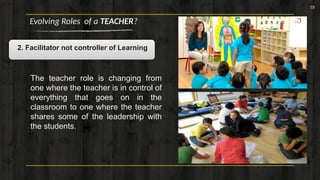
2. Facilitator not controller of Learning
The teacher role is changing from
one where the teacher is in control of
everything that goes on in the
classroom to one where the teacher
shares some of the leadership with
the students.
20
Evolving Roles of a TEACHER?
O M O I T I A V T N
Y U C I O S R T I
Evolving Roles of a TEACHER?
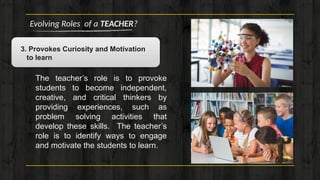
3. Provokes Curiosity and Motivation
to learn
The teacher’s role is to provoke
students to become independent,
creative, and critical thinkers by
providing experiences, such as
problem solving activities that
develop these skills. The teacher’s
role is to identify ways to engage
and motivate the students to learn.
22
Evolving Roles of a TEACHER?
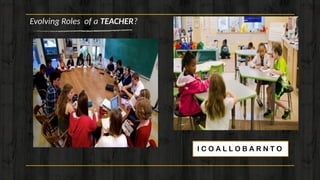
I C O A L L O B A R N T O
23
Evolving Roles of a TEACHER?
4. Promotes Collaboration
Learning through collaboration is
said to be one of the most effective
forms of learning. Learning in groups
enhances learning and critical
thinking skills. The teacher is to
provide collaborative activities such
as debates, group projects, joint
problem solving opportunities, etc
“Philo”
“Sophia
”
love wisdom
Philosophy – love of
I value critical
thinking I believe in active
learning
strong
fundamentals…
…global
citizens
…student-
Philosophy
an activity people undertake when
they seek to understand fundamental
truths about themselves, the world in
which they live, and their
relationships to the world and to each
other (Florida State University)
Philosophy
a way of thinking about certain
subjects such as ethics, thought,
existence, time, meaning and value.
That 'way of thinking' involves 4 Rs:
responsiveness, reflection, reason
and re-evaluation.
Philosophy
The aim is to deepen understanding.
The hope is that by doing philosophy
we learn to think better, to act more
wisely, and thereby help to improve
the quality of all our lives.
(The Philosophy Foundation)
Philosophy
the study of the basic ideas about
knowledge, right and wrong, reasoning,
and the value of things
a specific set of ideas of a person or a group
a set of ideas about how to do something
or how to live
life
“Live and let live.”
“You only live once.”
“Amare et Service.”
Teaching Philosophy
• A statement of principles
• Examples of how you put those
principles into practice
• Indication of how you assess student
learning
• Evidence of your effectiveness (if
List several teaching
practices you regularly
engage in. (How do
you deliver
information? How do
you grade? How do
you interact with
students?)
Describe the teaching
practices of a favorite
teacher. (How did they
deliver information?
How did they grade?
How did they interact
with students?)
Brainstorm metaphors
for teaching. (Teaching
is like… coaching?
Swimming? Dancing?)
Describe what a
successful student in
your course is like.
(What have they
learned? What have
they done? How did
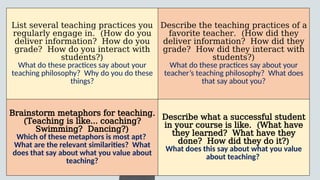
List several teaching practices you
regularly engage in. (How do you
deliver information? How do you
grade? How do you interact with
students?)
What do these practices say about your
teaching philosophy? Why do you do these
things?
Describe the teaching practices of a
favorite teacher. (How did they
deliver information? How did they
grade? How did they interact with
students?)
What do these practices say about your
teacher’s teaching philosophy? What does
that say about you?
Brainstorm metaphors for teaching.
(Teaching is like… coaching?
Swimming? Dancing?)
Which of these metaphors is most apt?
What are the relevant similarities? What
does that say about what you value about
teaching?
Describe what a successful student
in your course is like. (What have
they learned? What have they
done? How did they do it?)
What does this say about what you value
about teaching?
Teaching Philosophy
Your teaching
philosophy statement
should indicate what
drives you to teach the
Teaching Philosophy
Your teaching
philosophy statement
should include specific,
concrete examples of
Teaching Philosophy
Your teaching
philosophy statement
should, space
permitting, indicate
Teaching Philosophy
Your teaching
philosophy statement
should, if possible,
demonstrate evidence
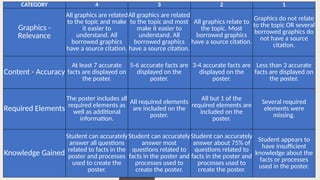
CATEGORY 4 3 2 1
Graphics -
Relevance
All graphics are related
to the topic and make
it easier to
understand. All
borrowed graphics
have a source citation.
All graphics are related
to the topic and most
make it easier to
understand. All
borrowed graphics
have a source citation.
All graphics relate to
the topic. Most
borrowed graphics
have a source citation.
Graphics do not relate
to the topic OR several
borrowed graphics do
not have a source
citation.
Content - Accuracy
At least 7 accurate
facts are displayed on
the poster.
5-6 accurate facts are
displayed on the
poster.
3-4 accurate facts are
displayed on the
poster.
Less than 3 accurate
facts are displayed on
the poster.
Required Elements
The poster includes all
required elements as
well as additional
information.
All required elements
are included on the
poster.
All but 1 of the
required elements are
included on the
poster.
Several required
elements were
missing.
Knowledge Gained
Student can accurately
answer all questions
related to facts in the
poster and processes
used to create the
poster.
Student can accurately
answer most
questions related to
facts in the poster and
processes used to
create the poster.
Student can accurately
answer about 75% of
questions related to
facts in the poster and
processes used to
create the poster.
Student appears to
have insufficient
knowledge about the
facts or processes
used in the poster.

Teaching Philosophy for Teachers Orientation

  • 1.
  • 2.
    WHAT WOULD YOUHONESTLY DO? Scenario #1 You’re in a general meeting of 50 people and one of your bosses criticizes you in front of other co-workers for a project you spent 2 days and 2 sleepless nights putting together.
  • 3.
    WHAT WOULD YOUHONESTLY DO? Scenario #2 Your special someone tells you that it hurts their feelings when you forget to do whatever plans or deeds which you both agreed to.
  • 4.
    WHAT WOULD YOUHONESTLY DO? Scenario #3 You have worked for the company for 6 years and a colleague for 4. You and that same colleague were up for the same promotion, but he got it instead of you.
  • 5.
    WHAT WOULD YOUHONESTLY DO? Scenario #4 You passed a challenging exam and posted about it on social media but didn’t get any “likes”.
  • 6.
    WHAT WOULD YOUHONESTLY DO? Scenario #5 You’re on a date with the guy/girl you really liked but it doesn’t seem to be going very well (frequent awkward silence).
  • 7.
    What is aTEACHER? helps their students to be passionate act as role models, mentors, caregivers and advisers. presence in a student’s life can boost their morale and guide them to be more valuable in life. imparts knowledge, good values, tradition, modern-day challenges and ways to resolve them within students. The Changing Role of a Teacher
  • 8.
    8 What is therole of a TEACHER? to inspire, motivate, encourage and educate learners. to “shape the life chances of young people by imparting knowledge – bringing the curriculum to life. to safeguard children’s welfare, inspiring critical thought and moral values. to bring out the best in students and inspire them to strive for greatness. The Changing Role of a Teacher
  • 9.
    9 The Changing Roleof a Teacher What can you say about the two pictures? A B
  • 10.
    10 Let’s go backto History: The Changing Role of a Teacher
  • 11.
    11 Let’s go backto History:  Requires students to memorize contents from the book.  Technology Illiterate  Give assessments through written examination.  Autocratic in which the teachers are in control of everything.  Holder of knowledge/gatekeeper of information.  Disseminate information through lectures.
  • 12.
  • 13.
    13  Allow studentsto solve real-world problems.  Allow students to construct their own understanding of the lesson  Make use of manipulative materials.  Give performance-based assessments.  Participate in decision-making in schools.  Use a variety of teaching methods.
  • 14.
    14  Facilitator oflearning.  Technology and digital literate.  Spend time in researching to update their knowledge.  Target the learners to be ready in the challenges of today's learning.  Democratic in which teachers allow students to take responsibility in their learning.
  • 15.
    15 Evolving Roles ofa TEACHER? The roles of teachers are evolving due to changes in technology and ease of access to information. Teacher centered learning environment Student-led learning environment Gate keepers of information Facilitator of student learning
  • 16.
    Evolving Roles ofa TEACHER? G E N G I N A G P R A P R O T
  • 17.
    17 Evolving Roles ofa TEACHER? 1. Creator of an Enabling Environment A teacher today is one who creates a safe, and engaging learning environment where learning can occur. A key requirement is to create rapport and meaning relationship with the students.
  • 18.
    18 Evolving Roles ofa TEACHER? R F A I L I C A T O T
  • 19.
    19 Evolving Roles ofa TEACHER? 2. Facilitator not controller of Learning The teacher role is changing from one where the teacher is in control of everything that goes on in the classroom to one where the teacher shares some of the leadership with the students.
  • 20.
    20 Evolving Roles ofa TEACHER? O M O I T I A V T N Y U C I O S R T I
  • 21.
    Evolving Roles ofa TEACHER? 3. Provokes Curiosity and Motivation to learn The teacher’s role is to provoke students to become independent, creative, and critical thinkers by providing experiences, such as problem solving activities that develop these skills. The teacher’s role is to identify ways to engage and motivate the students to learn.
  • 22.
    22 Evolving Roles ofa TEACHER? I C O A L L O B A R N T O
  • 23.
    23 Evolving Roles ofa TEACHER? 4. Promotes Collaboration Learning through collaboration is said to be one of the most effective forms of learning. Learning in groups enhances learning and critical thinking skills. The teacher is to provide collaborative activities such as debates, group projects, joint problem solving opportunities, etc
  • 25.
  • 26.
    I value critical thinkingI believe in active learning strong fundamentals… …global citizens …student-
  • 27.
    Philosophy an activity peopleundertake when they seek to understand fundamental truths about themselves, the world in which they live, and their relationships to the world and to each other (Florida State University)
  • 28.
    Philosophy a way ofthinking about certain subjects such as ethics, thought, existence, time, meaning and value. That 'way of thinking' involves 4 Rs: responsiveness, reflection, reason and re-evaluation.
  • 29.
    Philosophy The aim isto deepen understanding. The hope is that by doing philosophy we learn to think better, to act more wisely, and thereby help to improve the quality of all our lives. (The Philosophy Foundation)
  • 30.
    Philosophy the study ofthe basic ideas about knowledge, right and wrong, reasoning, and the value of things a specific set of ideas of a person or a group a set of ideas about how to do something or how to live
  • 31.
    life “Live and letlive.” “You only live once.” “Amare et Service.”
  • 32.
    Teaching Philosophy • Astatement of principles • Examples of how you put those principles into practice • Indication of how you assess student learning • Evidence of your effectiveness (if
  • 33.
    List several teaching practicesyou regularly engage in. (How do you deliver information? How do you grade? How do you interact with students?) Describe the teaching practices of a favorite teacher. (How did they deliver information? How did they grade? How did they interact with students?) Brainstorm metaphors for teaching. (Teaching is like… coaching? Swimming? Dancing?) Describe what a successful student in your course is like. (What have they learned? What have they done? How did
  • 34.
    List several teachingpractices you regularly engage in. (How do you deliver information? How do you grade? How do you interact with students?) What do these practices say about your teaching philosophy? Why do you do these things? Describe the teaching practices of a favorite teacher. (How did they deliver information? How did they grade? How did they interact with students?) What do these practices say about your teacher’s teaching philosophy? What does that say about you? Brainstorm metaphors for teaching. (Teaching is like… coaching? Swimming? Dancing?) Which of these metaphors is most apt? What are the relevant similarities? What does that say about what you value about teaching? Describe what a successful student in your course is like. (What have they learned? What have they done? How did they do it?) What does this say about what you value about teaching?
  • 35.
    Teaching Philosophy Your teaching philosophystatement should indicate what drives you to teach the
  • 36.
    Teaching Philosophy Your teaching philosophystatement should include specific, concrete examples of
  • 37.
    Teaching Philosophy Your teaching philosophystatement should, space permitting, indicate
  • 38.
    Teaching Philosophy Your teaching philosophystatement should, if possible, demonstrate evidence
  • 67.
    CATEGORY 4 32 1 Graphics - Relevance All graphics are related to the topic and make it easier to understand. All borrowed graphics have a source citation. All graphics are related to the topic and most make it easier to understand. All borrowed graphics have a source citation. All graphics relate to the topic. Most borrowed graphics have a source citation. Graphics do not relate to the topic OR several borrowed graphics do not have a source citation. Content - Accuracy At least 7 accurate facts are displayed on the poster. 5-6 accurate facts are displayed on the poster. 3-4 accurate facts are displayed on the poster. Less than 3 accurate facts are displayed on the poster. Required Elements The poster includes all required elements as well as additional information. All required elements are included on the poster. All but 1 of the required elements are included on the poster. Several required elements were missing. Knowledge Gained Student can accurately answer all questions related to facts in the poster and processes used to create the poster. Student can accurately answer most questions related to facts in the poster and processes used to create the poster. Student can accurately answer about 75% of questions related to facts in the poster and processes used to create the poster. Student appears to have insufficient knowledge about the facts or processes used in the poster.