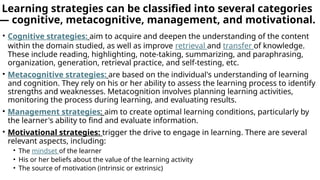
Learning strategies canbe classified into several categories
— cognitive, metacognitive, management, and motivational.
• Cognitive strategies: aim to acquire and deepen the understanding of the content
within the domain studied, as well as improve retrieval and transfer of knowledge.
These include reading, highlighting, note-taking, summarizing, and paraphrasing,
organization, generation, retrieval practice, and self-testing, etc.
• Metacognitive strategies: are based on the individual's understanding of learning
and cognition. They rely on his or her ability to assess the learning process to identify
strengths and weaknesses. Metacognition involves planning learning activities,
monitoring the process during learning, and evaluating results.
• Management strategies: aim to create optimal learning conditions, particularly by
the learner's ability to find and evaluate information.
• Motivational strategies: trigger the drive to engage in learning. There are several
relevant aspects, including:
• The mindset of the learner
• His or her beliefs about the value of the learning activity
• The source of motivation (intrinsic or extrinsic)
3.
Teaching Strategies inNurse Educati
on
•Strategy 1: Lecture
•
Lecturing has proven to be one of the most effectiv
e ways
to present information to large groups of students
when you need to cover a lot of material quickly.
With technology, lectures don’t have to be boring.
Incorporating polling technology, videos, and
interactive software applications, can make the
lecture fun and combat the passive student role.
4.
Teaching Strategies inNurse Educati
on
• Strategy 2: High-Fidelity Simulation
• Simulation allows students to recreate a clinical scenario in an
artificial setting. These scenarios often mimic the patient care
environment and allow for direct application of theoretical
knowledge. Simulations often provide innovative educational
experiences that help nurses assess and develop clinical
competency. Plus, it improves the nursing student’s satisfaction
and self-confidence. Incorporating debriefing sessions after
each simulation as well will improve critical thinking and clinical
reasoning. It’s important to discuss the scenario, what went
right, what went wrong, why that is the case, and to evaluate
your nursing student’s reactions to the simulation.
5.
Teaching Strategies inNurse Educati
on
•Strategy 3: Concept Mapping
• This strategy motivates students to represent
ideas visually, which causes them to analyze,
evaluate, and think critically. Concept mapping
helps complete missing knowledge and clarify
existing knowledge by allowing students to see
interrelationships in clinical data and grasp a
patient’s total clinical picture. These concept
mapping applications are even available on mobile
devices.
6.
Teaching Strategies inNurse Educati
on
•Strategy 4: Online Course
• Online courses for nurses can control their
own study time and work it around their
schedule. By using online courses, the
instructor can prepare diverse learning
materials, such as literature, videos, websites
and discussion forums, and administer an
online test to evaluate comprehension.
7.
Teaching Strategies inNurse Educati
on
•Strategy 5: Role Playing
In role playing, students represent and
experience characters known in everyday life,
and helps students learn how to
communicate and deal with conflict. To utilize
this strategy, establish the goal of the role-
playing activity, and debrief after the activity
is complete to provide feedback to students.
8.
Teaching Strategies inNurse Educati
on
•Strategy 6: Case Study
Case studies are realistic and complex
stories that help bridge the gap between
theory and practice, and between the
classroom and the workplace. The use of
Case studies in nurse education is suitable
for teaching about clinical diseases, culture
competence, communication skills, and other
topics.
9.
Teaching Strategies inNurse Educati
on
•Strategy 7: Debating
Debating should be used when teaching a
controversial issue or discussing a trend in nursing
education. It helps students to become actively involved
in learning the course content and promotes critical
thinking skills and enhances verbal communication skills.
It may help to create an anonymous environment to
discuss more sensitive issues. This is not necessarily a
learning method to “out” someone for their beliefs, but to
demonstrate the vast differences in every social situation
and how it impacts individual communication styles.
10.
Teaching Strategies inNurse Educati
on
•Strategy 8: Problem-Based Learning
Lecturing has proven to be one of the most effectiv
e ways
to present information to large groups of students
when you need to cover a lot of material quickly.
With technology, lectures don’t have to be boring.
Incorporating polling technology, videos, and
interactive software applications, can make the
lecture fun and combat the passive student role.
11.
Classroom teaching strategiesand
techniques
1-Classroom management strategies
•Teachers overwhelmingly reported a lack of
professional development support when it came
to improving their own classroom management
strategies. This can lead to confusion for
students and frustration for teachers. When
students clearly understand what’s expected of
them, they’re more likely to be focused and
engaged with their lessons.
12.
Classroom teaching strategiesand
techniques
•1-Classroom management strategies
• Some tips for building a positive environment include:
• Model ideal behavior: Clearly explain proper behavior and
then follow it yourself.
• Encourage initiative: Allow students to actively participate in
the learning process with class discussions and exercises that
support the initiative.
• Avoid collective punishment: While it can be difficult, make
a point of calling out disruptive behaviors on an individual,
not collective, basis.
13.
Classroom teaching strategiesand
techniques
2. Summative assessment
•Summative assessments are end-of-unit tests, final
projects or standardized tests used to assess student
understanding on a broad and absolute level. But there
are important benefits to using summative assessments
as a teaching strategy: they motivate students to pay
attention and challenge them to apply their learning.
They’re also a valuable source of insight for teachers,
especially for those with larger classes allowing them to
easily identify and correct any wide gaps in
understanding across the classroom.
14.
Classroom teaching strategiesand
techniques
2. Summative assessment
• Occurs at end of chapter or unit
• Evaluates what students learn
• Covers complete content areas
• Assigns a grade to students’ understanding
• Emphasizes the product of student learning
15.
Classroom teaching strategiesand
techniques
3. Formative assessment
Formative assessments are the opposite of
summative assessments because they take place
during the teaching process. Formative
assessments can reduce student stress around
testing. They give you the chance to correct
course mid-unit if there are serious
comprehension issues and to see which students
might need a bit more one-on-one time.
16.
Classroom teaching strategiesand
techniques
3. Formative assessment
• Occurs through chapter or unit
• Improves how students learn
• Covers small content areas
• Monitors on how students are learning
• Focuses on process of student learning.
17.
Classroom teaching strategiesand
techniques
4. Active learning
•Put students at the center of the classroom with active
learning strategies — a teaching technique that increases
student engagement in daily lessons. The technique can
also help teachers as much as it helps students: With the
goal of teaching mindful learners who actively pursue
knowledge, teachers become more actively engaged in
how they teach the curriculum and how they develop
each student’s learning potential. They mix and match a
variety of tactics to ensure that students not only learn
more, better, and faster -- they also learn smarter.”
19.
Classroom teaching strategiesand
techniques
Some active learning strategies include:
•Reciprocal questioning: Have students come up
with questions for the class on a recent lesson or
concept.
•The pause procedure: Take a break every 10 to 15
minutes so that students have time to discuss, ask
questions or solve problems.
•Muddiest point: Ask students to write down which
point in the lesson is the least clear to them.
20.
Classroom teaching strategiesand
techniques
5. Differentiated instruction
Differentiated instruction is a popular and effective
teaching strategy that involves reacting to the diverse
learning styles in every classroom with adjusted content
and processes. Frequently reflect on the match between
your classroom and the philosophy of teaching and
learning you want to practice. Look for matches,
mismatches and use both to guide you.” Strategies like
learning stations and the think-pair-share method are
small ways that you can bring unique learning
experiences to your students.
21.
Classroom teaching strategiesand
techniques
6. Personalized learning
Personalized learning builds a learning experience
that addresses the unique abilities of each student.
“Students attending classroom using personalized
learning made gains in math and reading over the
last two years that are significantly greater than a
virtual control group made up of similar students
selected from comparable schools. Personalized
learning allows students to learn without stigma and
gets students involved in what they’re learning.
22.
Classroom teaching strategiesand
techniques
7. Universal design for learning
Universal design for learning (UDL) is an educational
framework that ensures all students have equal
access to education. Use it in your classroom to give
unique students flexible ways to learn and become
more goal oriented. Universal design for learning
gives all students an impactful learning experience
and helps teachers focus their efforts on students
who need it most. For more information on how to
make sure all your students succeed.
23.
Classroom teaching strategiesand
techniques
8. Response to intervention
Response to intervention (RTI) focuses on early and
continuous identification, assessment and assistance
for students who have learning, or behavior needs.
It’s best used as part of a more general classroom
management plan and involves small-group or
individual intervention that quickly addresses
trouble spots. The most effective RTI strategies are
proactive. Start with everyday teaching and move to
targeted intervention as soon as you spot a problem.
24.
Classroom teaching strategiesand
techniques
9. Classroom technology
Technology is a great way to improve student
engagement and get students excited for class,
but it can be difficult to incorporate seamlessly
into the classroom. There are an endless number
of ways to make use of technology to enhance
lessons, including:
25.
Classroom teaching strategiesand
techniques
9. Classroom technology
• A virtual field trip: Use virtual reality apps to explore famous
landmarks and natural phenomena. Take a trip to the Great
Barrier Reef to study ecosystems or tour Barcelona as part of a
Spanish class.
• Video mini-lessons: Teacher Tube offers an education-only
version of YouTube, with videos on several core subjects. This
makes the learning process more engaging, especially for visual
learners.
• Podcasts: Give students relevant podcasts and engage
auditory learners, or have older students create their own. They’ll
develop research and technology skills at the same time.
26.
Classroom teaching strategiesand
techniques
10. Project-based learning
• Students must take an active role in their own learning
but are often disengaged from the learning process. Project-
based learning allows students to be fully immersed in an
authentic and nuanced problem that has real-life implications.
Project-based learning is open-ended and allows students
engaged in group work to find their own way to the solution.
It doesn’t look the same in every classroom - class size,
student ability and learning styles play a large role in shaping
the process.older students create their own. They’ll develop
research and technology skills at the same time.
27.
Classroom teaching strategiesand
techniques
11. Experiential learning
Every classroom has a wide range of levels and
learning styles, which can be difficult for any
teacher to effectively address. Use experiential
learning activities to counter student
disengagement and get them involved in the
learning process.
28.
Classroom teaching strategiesand
techniques
11. Experiential learning
Experiential learning activities
• Student-centered/focused
• Flexible and open learning outcomes
• Develop knowledge and skills through
experience
• Flexible structure, minimum facilitation
29.
Classroom teaching strategiesand
techniques
11. Experiential learning
Experiential learning activities
• Provide students with new ways of learning to
help them stay focused, learn dynamically and learn
faster. Engage students in the process of inquiry and
reflection! Ask them to create three to five questions
(with answers) on a recent lesson. In pairs, students
quiz their partners on the questions they wrote and
watch to see which concepts students consider to be
the most important from their lesson.
30.
Classroom teaching strategiesand
techniques
12. Peer teaching
It's one of many teaching strategies that help
develop reasoning and critical thinking skills, and
it improves self-esteem and interpersonal skills. It
can be difficult, however, to bring it to the
classroom. Students might have different
proficiency levels or be hesitant about teaching
their peers, and it can lead to confidentiality
issues about which students are struggling.
31.
Classroom teaching strategiesand
techniques
12. Peer teaching
Some best practices for teaching include:
• Explaining to students how to give feedback
• Providing written prompts to guide discussion
• Running class wide peer editing sessions
32.
Classroom teaching strategiesand
techniques
13. Inquiry-based learning
• In the inquiry-based learning classroom,
teachers are responsible for guiding students
through their questions — past curiosity and into
critical thinking and understanding.
33.
Classroom teaching strategiesand
techniques
13. Inquiry-based learning
• There are 4 main types of inquiry-based learning:
• Confirmation inquiry: Students are given a question along with
a way to answer it
• Structured inquiry: Students are given an open question and
investigation method
• Guided inquiry: Students work from open question to design
investigation methods
• Open inquiry: Students develop original questions that they
answer through their own methods
Students who use inquiry-based learning are more likely to retain
information from the activity and curriculum content in general.
34.
Classroom teaching strategiesand
techniques
14. Problem-based learning
Problem-based learning
• is a student-centered pedagogy that puts students in groups
to solve open-ended problems together. This teaching strategy
has its advantages and disadvantages:
• Advantages
• Develop long-term knowledge retention
• Use diverse instruction types
• Students are continuously engaged
• Develop transferable skills
• Improve teamwork skills
35.
Classroom teaching strategiesand
techniques
14. Problem-based learning
Problem-based learning
• Disadvantages
• Potentially poor test results
• Student unpreparedness
• Teacher unpreparedness
• Assessment is time-consuming
• Might not be relevant/applicable
36.
Classroom teaching strategiesand
techniques
15. Blended learning
• Blended learning combines online learning with traditional
classroom instruction. It’s a valuable tool to use in
differentiation teaching strategies and can help students learn
tailored content at their own pace. There are several different
ways to bring blended learning to your classroom, but some
common methods include implementing learning stations and
putting certain lessons online in part or entirely. With many
classrooms supporting hybrid learning environments in the
last two years, blended learning has become a more common
teaching strategy across classrooms.
37.
Classroom teaching strategiesand
techniques
16. Interdisciplinary teaching
Use interdisciplinary teaching strategies to
encourage students to develop creative and critical
thinking skills — and draw information from several
different academic disciplines — as they solve real-
world problems. In your classroom, interdisciplinary
teaching could involve collaboration with other
teachers or asking your students to make
connections between different subjects. Try these
activities to get your class started:
38.
Classroom teaching strategiesand
techniques
16. Interdisciplinary teaching
• News analysis: Play a news clip or hand out an article that
discusses a local, national or international topic. Ask students to
solve a related question using skills they’ve learned in other classes.
• All about Weather: Look at the impact of weather and climate
on the labor, agriculture and customs of other societies. This gives
students a chance to learn about different cultures from a scientific
and social standpoint.
• Historical Pen Pals: Combine creative writing and history by
having students take on the role of a historical figure and write to
classmates about challenges she faced. Give students a variety of
sources to improve their research skills at the same time.