A perspective on
Text and Data Mining
and Open Science
Caroline Colin, European Commission, DG CONNECT
Jean-François Dechamp, European Commission, DG RTD
OpenMinTeD workshop, Brussels, 24 May 2018
Directive on copyright in the Digital
Single Market
Main objectives:
• Modernising EU rules on key exceptions and limitations
in the areas of research, education, and preservation of
cultural heritage
• Facilitating licences in order to ensure wider access to
content (out-of-commerce works, negotiation
mechanism/VoD platforms)
• Introducing fairer rules of the game for a better
functioning copyright marketplace (press publisher's
rights, value gap, remuneration of authors and
performers).
Directive on copyright in the Digital
Single Market
State of play of the negotiations in the Council
• 20 meetings of the Intellectual Property Council Working
Party chaired by the Slovak, Maltese, Estonian and
Bulgarian Presidencies.
• Latest compromise text prepared by the Bulgarian
Presidency for the Coreper meeting of 27 April (first
Coreper: 31 January)
Directive on copyright in the Digital
Single Market
State of play of the negotiations in the Council
- Focus on TDM
• Commission proposal: a mandatory exception allowing
research organisations to carry out TDM on content they
have lawful access to for scientific research purposes
(commercial and non-commercial)
• Presidency text (no official Council position on TDM):
• extends beneficiaries to cover also cultural heritage institutions
• new para.: keeping the copies for the duration of the research
project
Directive on copyright in the Digital
Single Market
State of play of the negotiations in the Council
- Focus on TDM
• Presidency text: additional optional exception (Art. 3 a)
allowing MS to provide for an exception for TDM beyond
research to allow any lawful user to perform TDM
provided this has not been expressly reserved by right
holders
• Next step: Coreper, 25 May (on the whole package)
Directive on copyright in the Digital
Single Market
State of play of the negotiations in the
European Parliament
• Opinions already adopted by CULT , ITRE, IMCO and
LIBE
• Vote in JURI scheduled for 20-21 June (Rapporteur: Axel
Voss, EPP/DE)
Why do we care for TDM?
1. "It's different for science"
• Authors in most cases not remunerated, give away their ©...
• Licence-based solutions for scientific papers do not seem to work, are
massively rejected by academics...
2. Digital data
• Increasing amounts of content (data, papers...) require massive analysis
with TDM (technical/legal hurdles)
• Almost all scientific journals are already available online and research
libraries' collections in the EU are mostly composed of digital content
3. Open Science
• Multi-disciplinarity/sources, public/private partners, 'Big Data'...
• Open access includes the concept of TDM (for re-use purposes)
• Public funding
Member States say to themselves
Council Conclusions The transition towards an Open
Science system (27 May 2016)
• "WELCOMES the Commission Communication of 9 December 2015 on
"Towards a modern, more European copyright framework" and LOOKS
FORWARD to the legislative proposals from the Commission
announced therein; STRESSES the importance to enhance the EU’s
competitiveness, and technological and scientific leadership, which
could include allowing public interest research organisations to carry
out text and data mining of content, to which they already have
lawful access, for scientific research purposes; STRESSES the need to
continue the support by the Commission and Member States to allow
all bodies and organisations, including citizens, scientists and
businesses and SMEs, to mine results of publicly funded research
they already have legal access to."
EC says to Member States (1/2)
Communication on Digital Education Action
Plan (17.01.2018)
• "Citizen-centred research and innovation focused
on solving societal challenges should make more use of
open data and collaborative digital technology tools and
methods."
Proposed recast of the PSI Directive
(25.04.2018)
• Increase the availability of data by bringing new types
of public and publicly funded data into the scope
of the Directive, such as research data resulting from
public funding
EC says to Member States (2/2)
Revised Recommendation on scientific
information (25.04.2018)
• Member States should ensure that licensing terms
used on the market do not unduly restrict TDM of
publications & research data resulting from
publicly funded research
• Researchers, when entering into contractual agreements
with scientific publishers, should retain the necessary
intellectual property rights to comply with the
open access policy requirements – this concerns in
particular self-archiving and re-use notably through
TDM
EC says to itself
Horizon 2020
• "In all cases, the Commission encourages authors to
retain their copyright and grant adequate licences to
publishers. Creative Commons offers useful licensing
solutions. This type of licence is a good legal tool for
providing open access in its broadest sense"
(Guidelines)
Horizon Europe (2021-2027)
• It is already clear that beneficiaries must ensure that
they or the authors retain sufficient intellectual property
rights to comply with their open access requirements
(Legal requirement to be decided)
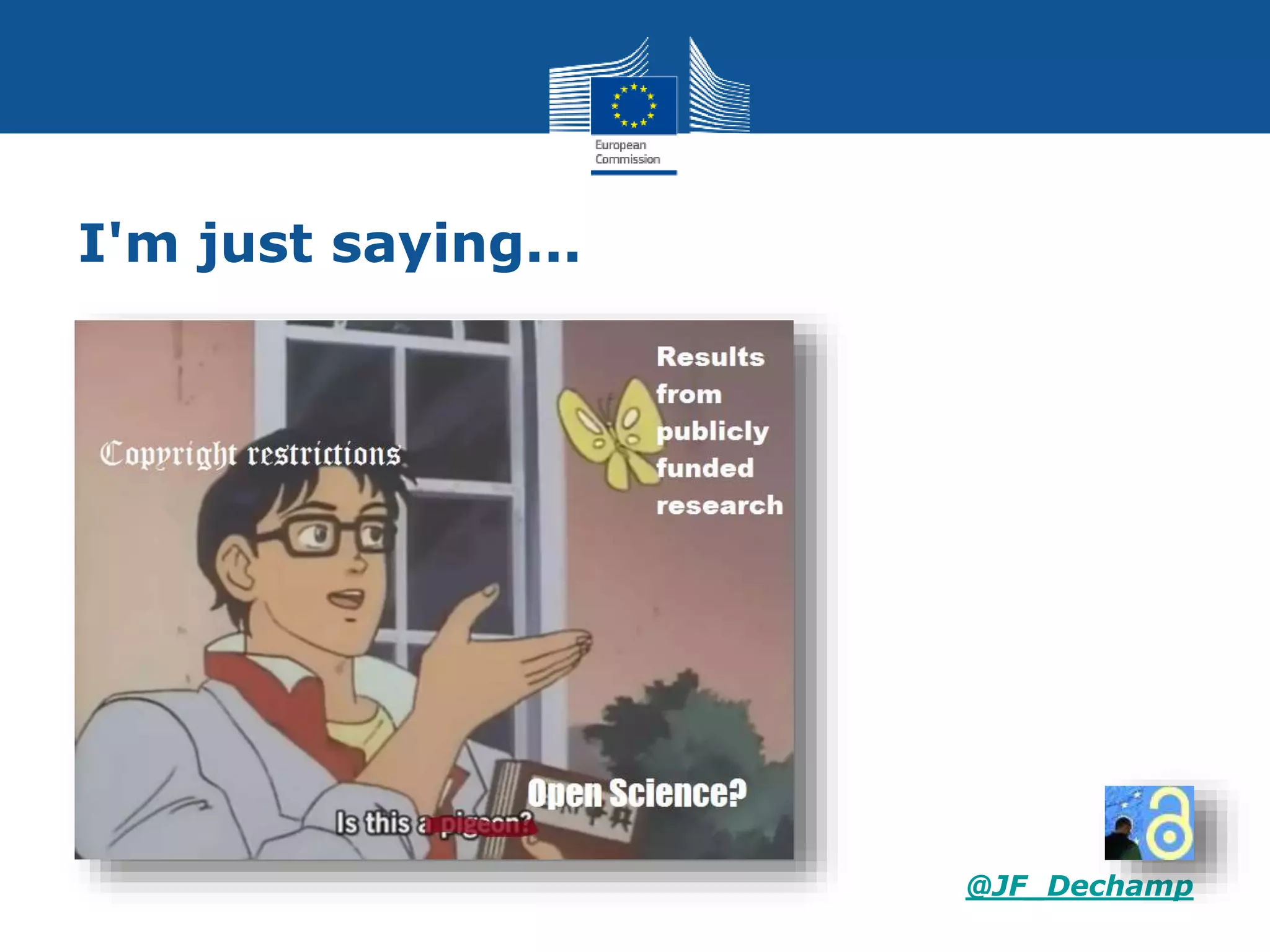
I'm just saying...
@JF_Dechamp

Tdm dechamp colin_open_minted

  • 1.
    A perspective on Textand Data Mining and Open Science Caroline Colin, European Commission, DG CONNECT Jean-François Dechamp, European Commission, DG RTD OpenMinTeD workshop, Brussels, 24 May 2018
  • 2.
    Directive on copyrightin the Digital Single Market Main objectives: • Modernising EU rules on key exceptions and limitations in the areas of research, education, and preservation of cultural heritage • Facilitating licences in order to ensure wider access to content (out-of-commerce works, negotiation mechanism/VoD platforms) • Introducing fairer rules of the game for a better functioning copyright marketplace (press publisher's rights, value gap, remuneration of authors and performers).
  • 3.
    Directive on copyrightin the Digital Single Market State of play of the negotiations in the Council • 20 meetings of the Intellectual Property Council Working Party chaired by the Slovak, Maltese, Estonian and Bulgarian Presidencies. • Latest compromise text prepared by the Bulgarian Presidency for the Coreper meeting of 27 April (first Coreper: 31 January)
  • 4.
    Directive on copyrightin the Digital Single Market State of play of the negotiations in the Council - Focus on TDM • Commission proposal: a mandatory exception allowing research organisations to carry out TDM on content they have lawful access to for scientific research purposes (commercial and non-commercial) • Presidency text (no official Council position on TDM): • extends beneficiaries to cover also cultural heritage institutions • new para.: keeping the copies for the duration of the research project
  • 5.
    Directive on copyrightin the Digital Single Market State of play of the negotiations in the Council - Focus on TDM • Presidency text: additional optional exception (Art. 3 a) allowing MS to provide for an exception for TDM beyond research to allow any lawful user to perform TDM provided this has not been expressly reserved by right holders • Next step: Coreper, 25 May (on the whole package)
  • 6.
    Directive on copyrightin the Digital Single Market State of play of the negotiations in the European Parliament • Opinions already adopted by CULT , ITRE, IMCO and LIBE • Vote in JURI scheduled for 20-21 June (Rapporteur: Axel Voss, EPP/DE)
  • 7.
    Why do wecare for TDM? 1. "It's different for science" • Authors in most cases not remunerated, give away their ©... • Licence-based solutions for scientific papers do not seem to work, are massively rejected by academics... 2. Digital data • Increasing amounts of content (data, papers...) require massive analysis with TDM (technical/legal hurdles) • Almost all scientific journals are already available online and research libraries' collections in the EU are mostly composed of digital content 3. Open Science • Multi-disciplinarity/sources, public/private partners, 'Big Data'... • Open access includes the concept of TDM (for re-use purposes) • Public funding
  • 8.
    Member States sayto themselves Council Conclusions The transition towards an Open Science system (27 May 2016) • "WELCOMES the Commission Communication of 9 December 2015 on "Towards a modern, more European copyright framework" and LOOKS FORWARD to the legislative proposals from the Commission announced therein; STRESSES the importance to enhance the EU’s competitiveness, and technological and scientific leadership, which could include allowing public interest research organisations to carry out text and data mining of content, to which they already have lawful access, for scientific research purposes; STRESSES the need to continue the support by the Commission and Member States to allow all bodies and organisations, including citizens, scientists and businesses and SMEs, to mine results of publicly funded research they already have legal access to."
  • 9.
    EC says toMember States (1/2) Communication on Digital Education Action Plan (17.01.2018) • "Citizen-centred research and innovation focused on solving societal challenges should make more use of open data and collaborative digital technology tools and methods." Proposed recast of the PSI Directive (25.04.2018) • Increase the availability of data by bringing new types of public and publicly funded data into the scope of the Directive, such as research data resulting from public funding
  • 10.
    EC says toMember States (2/2) Revised Recommendation on scientific information (25.04.2018) • Member States should ensure that licensing terms used on the market do not unduly restrict TDM of publications & research data resulting from publicly funded research • Researchers, when entering into contractual agreements with scientific publishers, should retain the necessary intellectual property rights to comply with the open access policy requirements – this concerns in particular self-archiving and re-use notably through TDM
  • 11.
    EC says toitself Horizon 2020 • "In all cases, the Commission encourages authors to retain their copyright and grant adequate licences to publishers. Creative Commons offers useful licensing solutions. This type of licence is a good legal tool for providing open access in its broadest sense" (Guidelines) Horizon Europe (2021-2027) • It is already clear that beneficiaries must ensure that they or the authors retain sufficient intellectual property rights to comply with their open access requirements (Legal requirement to be decided)
  • 12.