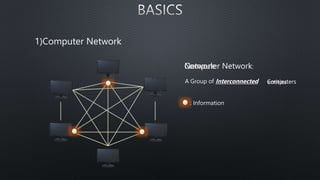
1)Computer Network
Network:
A Group of Interconnected
Computer Network:
entities
Computers
: Information
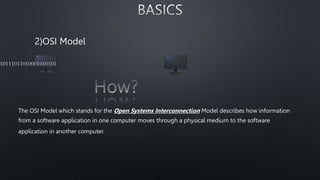
2)OSI Model
The OSI Model which stands for the Open Systems Interconnection Model describes how information
from a software application in one computer moves through a physical medium to the software
application in another computer.
10111011010001010101
2)OSI Model
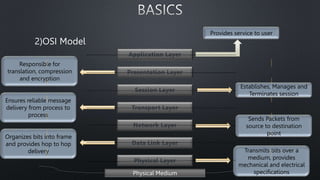
Application Layer
Presentation Layer
Session Layer
Transport Layer
Network Layer
Data Link Layer
Physical Layer
Application Layer
Presentation Layer
Session Layer
Transport Layer
Network Layer
Data Link Layer
Physical Layer
Provides service to user
Responsible for
translation, compression
and encryption
Establishes, Manages and
Terminates session
Ensures reliable message
delivery from process to
process
Sends Packets from
source to destination
point
Organizes bits into frame
and provides hop to hop
delivery Transmits bits over a
medium, provides
mechanical and electrical
specifications
Physical Medium
Physical Medium
Physical Medium
3)Protocol
?
A
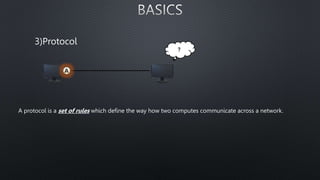
A protocol is a set of rules which define the way how two computes communicate across a network.
Name CPU Memory Disk
>Music Player 0.5% 37.2 MB 0.1 Mbps
>Mail 1.1% 59.6 MB 1.1 Mbps
>System 10% 10 MB 0.1 Mbps
>Edge 9.7% 300 MB 2.1 Mbps
>Windows 2.3% 30 MB 0 Mbps
Explorer
>Task 2.5% 26 MB 0 Mbps
Manager
Task Manager
Name CPU Memory Disk
>Task 2.6% 25.4 MB 0.1 Mbps
Manager
>Music Player 0.3% 35.69 MB 0.1 Mbps
>Windows 2.9% 45 MB 4 Mbps
Explorer
>Edge 8.4% 290 MB 3.7 Mbps
>Mail 1.2% 55.34 MB 0.6 Mbps
>System 4% 10.1 MB 0 Mbps
Task Manager
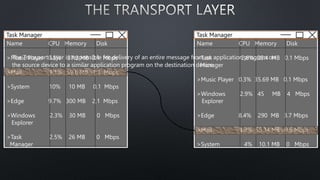
The Transport Layer is responsible for delivery of an entire message from an application program on
the source device to a similar application program on the destination device.
010 101110 110100 010101 010100 110110
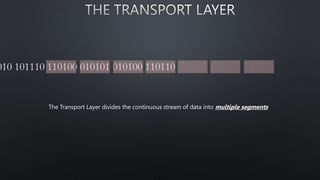
The Transport Layer divides the continuous stream of data into multiple segments
Header Data
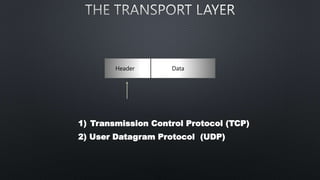
1) Transmission Control Protocol (TCP)
2) User Datagram Protocol (UDP)
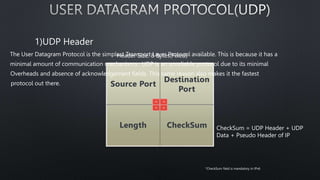
Source Port
Length
Destination
Port
CheckSum
1)UDP Header
16 16
16
16
Header Size: 8 Bytes(Fixed)
The User Datagram Protocol is the simplest Transport Layer Protocol available. This is because it has a
minimal amount of communication mechanisms . UDP is an unreliable protocol due to its minimal
Overheads and absence of acknowledgement fields. This same reason also makes it the fastest
protocol out there.
CheckSum = UDP Header + UDP
Data + Pseudo Header of IP
*CheckSum field is mandatory in IPv6
2) UDP Features vs TCP Features
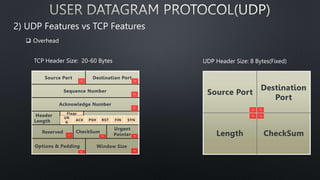
 Overhead
Source Port
Length
Destination
Port
CheckSum
16 16
16
16
Source Port Destination Port
Sequence Number
Acknowledge Number
Flags
Header
Length
Reserved
UR
G
ACK PSH RST FIN SYN
Urgent
Pointer
CheckSum
Window Size
Options & Padding
16
32
32
40
16
3 16
16
16
TCP Header Size: 20-60 Bytes UDP Header Size: 8 Bytes(Fixed)
2) UDP Features vs TCP Features
 Overhead
 Connection Less vs Connection Oriented
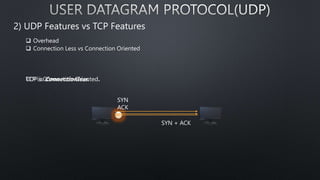
UDP is Connectionless.
TCP is Connection Oriented.
SYN
SYN + ACK
ACK
2) UDP Features vs TCP Features
 Overhead
 Connection Less vs Connection Oriented
 Less Reliability vs More Reliability
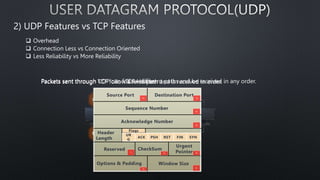
Packets sent through UDP can follow different paths and be received in any order.
3
2
1
1
2
3
Packets sent through TCP follow a fixed path and is received in order.
Source Port Destination Port
Sequence Number
Acknowledge Number
Flags
Header
Length
Reserved
UR
G
ACK PSH RST FIN SYN
Urgent
Pointer
CheckSum
Window Size
Options & Padding
16
32
32
40
16
3 16
16
16
TCP Header.
2) UDP Features vs TCP Features
 Overhead
 Connection Less vs Connection Oriented
 Less Reliability vs More Reliability
 Error Control
 Transmission Speed
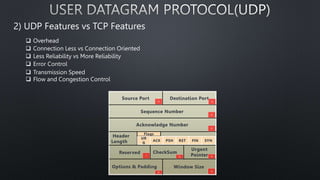
 Flow and Congestion Control
Source Port Destination Port
Sequence Number
Acknowledge Number
Flags
Header
Length
Reserved
UR
G
ACK PSH RST FIN SYN
Urgent
Pointer
CheckSum
Window Size
Options & Padding
16
32
32
40
16
3 16
16
16
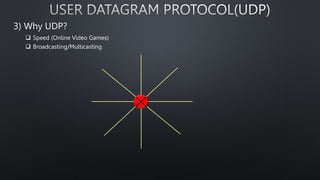
3) Why UDP?
 Speed (Online Video Games)
 Broadcasting/Multicasting
3) Why UDP?
 Speed (Online Video Games)
 Broadcasting/Multicasting
 Continuous Video Streaming
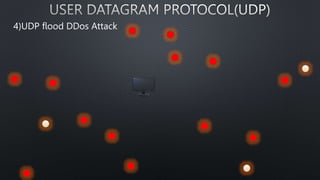
4)UDP flood DDos Attack
TCP vs UDP in OSI model  Computer Network

TCP vs UDP in OSI model Computer Network

  • 2.
    1)Computer Network Network: A Groupof Interconnected Computer Network: entities Computers : Information
  • 3.
    2)OSI Model The OSIModel which stands for the Open Systems Interconnection Model describes how information from a software application in one computer moves through a physical medium to the software application in another computer. 10111011010001010101
  • 4.
    2)OSI Model Application Layer PresentationLayer Session Layer Transport Layer Network Layer Data Link Layer Physical Layer Application Layer Presentation Layer Session Layer Transport Layer Network Layer Data Link Layer Physical Layer Provides service to user Responsible for translation, compression and encryption Establishes, Manages and Terminates session Ensures reliable message delivery from process to process Sends Packets from source to destination point Organizes bits into frame and provides hop to hop delivery Transmits bits over a medium, provides mechanical and electrical specifications Physical Medium Physical Medium Physical Medium
  • 5.
    3)Protocol ? A A protocol isa set of rules which define the way how two computes communicate across a network.
  • 6.
    Name CPU MemoryDisk >Music Player 0.5% 37.2 MB 0.1 Mbps >Mail 1.1% 59.6 MB 1.1 Mbps >System 10% 10 MB 0.1 Mbps >Edge 9.7% 300 MB 2.1 Mbps >Windows 2.3% 30 MB 0 Mbps Explorer >Task 2.5% 26 MB 0 Mbps Manager Task Manager Name CPU Memory Disk >Task 2.6% 25.4 MB 0.1 Mbps Manager >Music Player 0.3% 35.69 MB 0.1 Mbps >Windows 2.9% 45 MB 4 Mbps Explorer >Edge 8.4% 290 MB 3.7 Mbps >Mail 1.2% 55.34 MB 0.6 Mbps >System 4% 10.1 MB 0 Mbps Task Manager The Transport Layer is responsible for delivery of an entire message from an application program on the source device to a similar application program on the destination device.
  • 7.
    010 101110 110100010101 010100 110110 The Transport Layer divides the continuous stream of data into multiple segments
  • 8.
    Header Data 1) TransmissionControl Protocol (TCP) 2) User Datagram Protocol (UDP)
  • 9.
    Source Port Length Destination Port CheckSum 1)UDP Header 1616 16 16 Header Size: 8 Bytes(Fixed) The User Datagram Protocol is the simplest Transport Layer Protocol available. This is because it has a minimal amount of communication mechanisms . UDP is an unreliable protocol due to its minimal Overheads and absence of acknowledgement fields. This same reason also makes it the fastest protocol out there. CheckSum = UDP Header + UDP Data + Pseudo Header of IP *CheckSum field is mandatory in IPv6
  • 10.
    2) UDP Featuresvs TCP Features  Overhead Source Port Length Destination Port CheckSum 16 16 16 16 Source Port Destination Port Sequence Number Acknowledge Number Flags Header Length Reserved UR G ACK PSH RST FIN SYN Urgent Pointer CheckSum Window Size Options & Padding 16 32 32 40 16 3 16 16 16 TCP Header Size: 20-60 Bytes UDP Header Size: 8 Bytes(Fixed)
  • 11.
    2) UDP Featuresvs TCP Features  Overhead  Connection Less vs Connection Oriented UDP is Connectionless. TCP is Connection Oriented. SYN SYN + ACK ACK
  • 12.
    2) UDP Featuresvs TCP Features  Overhead  Connection Less vs Connection Oriented  Less Reliability vs More Reliability Packets sent through UDP can follow different paths and be received in any order. 3 2 1 1 2 3 Packets sent through TCP follow a fixed path and is received in order. Source Port Destination Port Sequence Number Acknowledge Number Flags Header Length Reserved UR G ACK PSH RST FIN SYN Urgent Pointer CheckSum Window Size Options & Padding 16 32 32 40 16 3 16 16 16 TCP Header.
  • 13.
    2) UDP Featuresvs TCP Features  Overhead  Connection Less vs Connection Oriented  Less Reliability vs More Reliability  Error Control  Transmission Speed  Flow and Congestion Control Source Port Destination Port Sequence Number Acknowledge Number Flags Header Length Reserved UR G ACK PSH RST FIN SYN Urgent Pointer CheckSum Window Size Options & Padding 16 32 32 40 16 3 16 16 16
  • 14.
    3) Why UDP? Speed (Online Video Games)  Broadcasting/Multicasting
  • 15.
    3) Why UDP? Speed (Online Video Games)  Broadcasting/Multicasting  Continuous Video Streaming
  • 16.