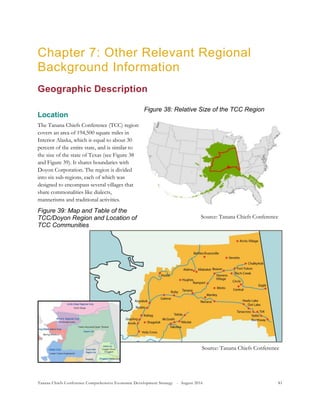
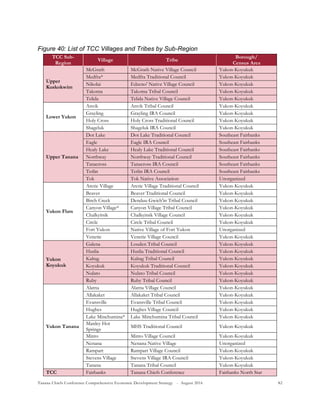
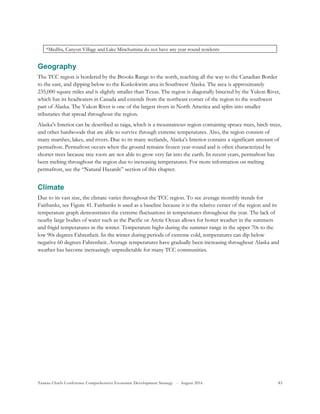
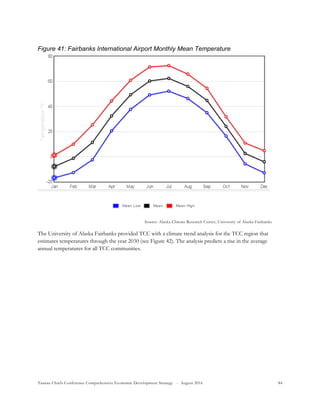
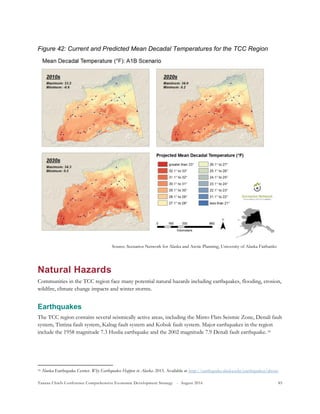
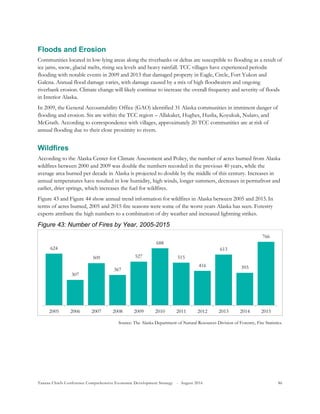
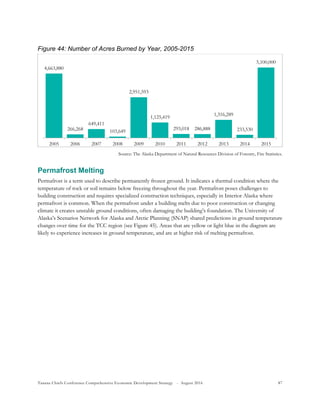
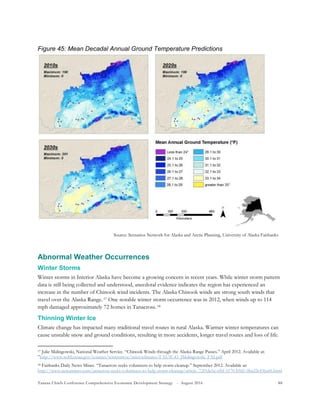
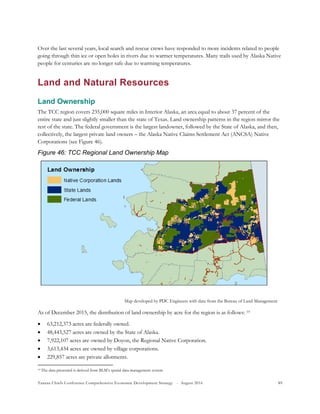
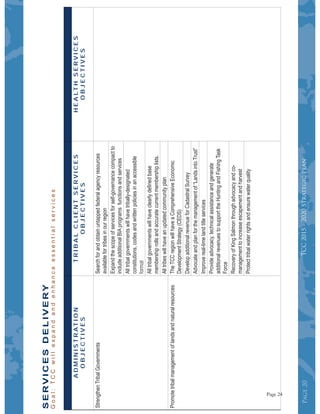
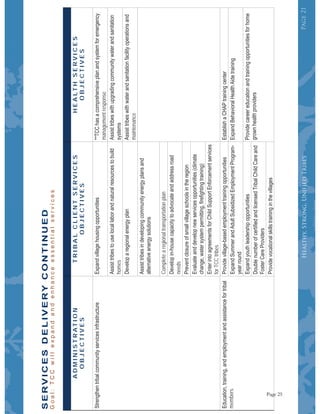
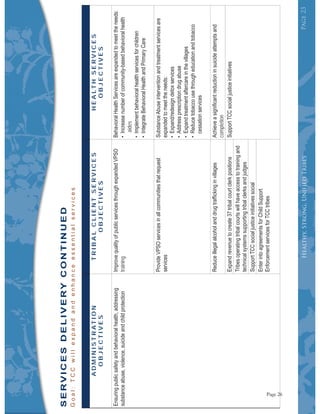
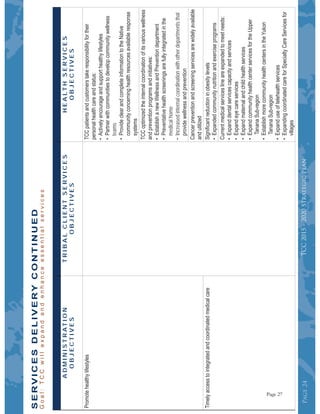
Tanana Chiefs Conference Comprehensive Economic Development Strategy – FINAL, August 2016 1
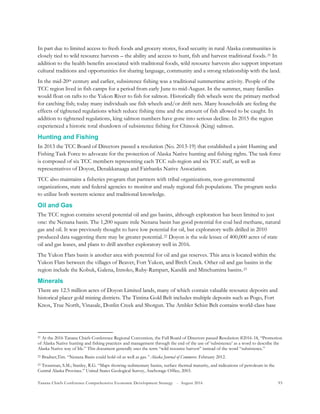
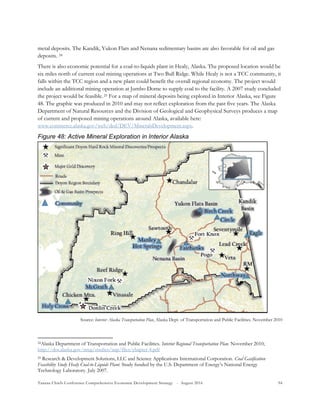
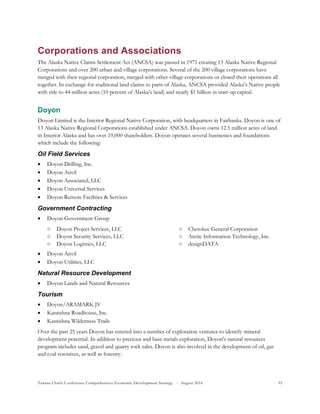
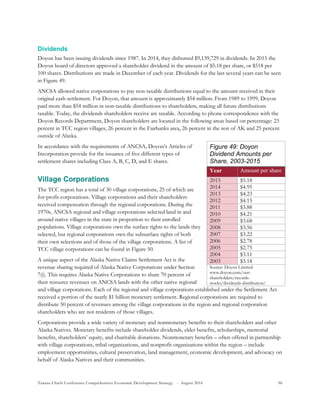
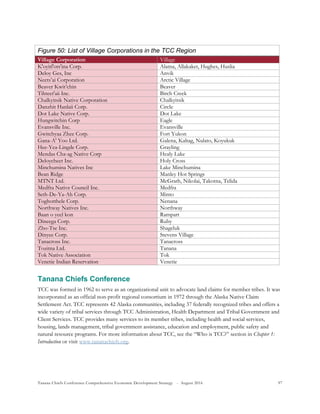
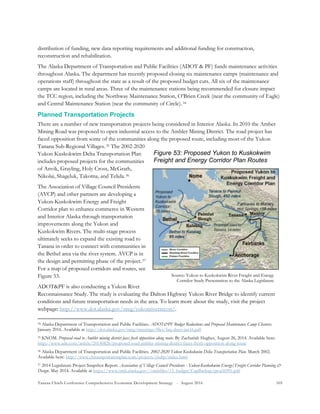
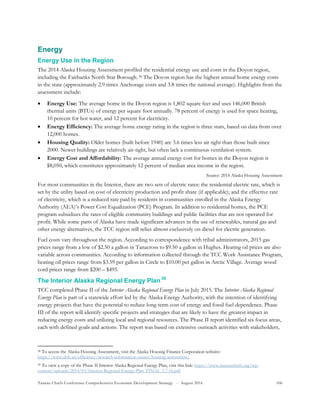
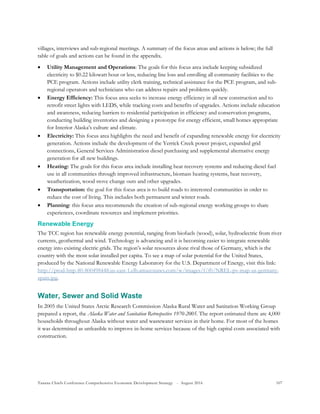
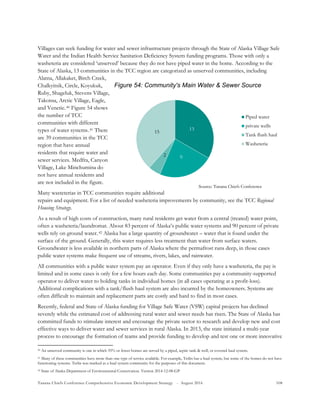
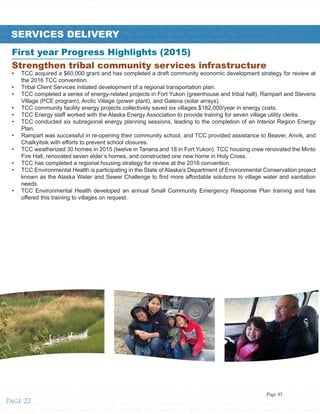
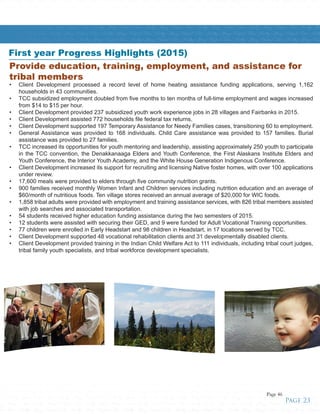
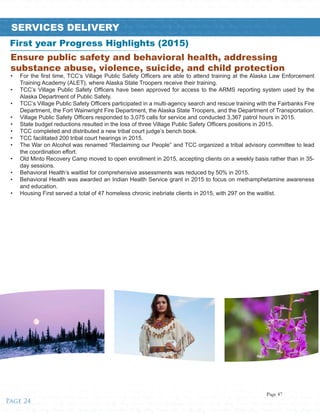
Comprehensive Economic Development Strategy
(CEDS), 2016-2021
August 2016
Tanana Chiefs Conference Comprehensive Economic Development Strategy – FINAL, August 2016 2
Acknowledgements
Many community leaders, Tanana Chiefs Conference (TCC) staff, regional partners, business owners and
tribal members came together to help develop this plan. A special thanks goes to:
 All Tanana Chief Conference Region Tribal and Community Leaders
 Tanana Chiefs Conference Executive Staff
 Tanana Chiefs Conference Executive Board Members
 Shirley Kelly, Economic Development Administration
 Tanana Chiefs Conference Annual Convention Attendees
 Regional Survey Respondents
 CEDS Committee Members
○ Alice Dale, First Chief, McGrath*
○ Ben Stevens, Hunting and Fishing Task Force Director
○ Brianna Gray, TCC Economic Development Specialist*
○ Bryan Uher, Administration Manager, Interior Alaska Campus*
○ Charlisa Attla, TCC Self-Governance Coordinator*
○ Emma Hildebrand, Northway Natives, Inc. Board Member, Northway*
○ Jana George, CEO, Interior Regional Housing Authority*
○ Janet Bifelt, Tribal Administrator, Hughes*
○ Jason Custer, Business Development Director, Alaska Power & Telephone
○ Jeffrey Weltzin, TCC Contract Support
○ Julie Roberts-Hyslop, TCC Vice President
○ Kathryn Folger, Tribal Administrator, Koyukuk*
○ Kelly Workman, Tribal Administrator, Shageluk*
○ March Runner, Former Tribal Administrator, Louden
○ Melanie Herbert, TCC Transportation Manager*
○ Nancy James, First Chief, Fort Yukon
○ Nichol Rallo, Tribal Administrator, Northway*
○ Rhonda Pitka, First Chief, Beaver
○ Shannon Erhart, Executive Director, Tanana Tribal Council
○ Stephanie Ashcraft, TCC Planning and Development Manager*
○ Teisha Simmons, TCC Health and Wellness Director
○ Tiffany Simmons, TCC Tribal Development Director
 Stakeholder Interviewees (* symbol above = CEDS Committee Members that were also interviewed)
○ Chris Simon, TCC Deputy Health Director
○ Christine Rifredi, City Clerk, Fort Yukon
○ Don Shircel, TCC Client Services Director
○ Jamie Marunde, Board Chair, Northway Natives
○ Nick Alexia Sr., First Chief, Nikolai
○ Tessiana Paul, Tribal Administrator, Holy Cross
○ Will Mayo, Director of TCC Tribal Government and Client Services
Tanana Chiefs Conference Comprehensive Economic Development Strategy – FINAL, August 2016 3
Table of Contents
Executive Summary...................................................................................................................5
TCC Economic Vision.................................................................................................................................. 5
TCC Mission................................................................................................................................................... 5
Key Outcomes of the CEDS........................................................................................................................ 5
Chapter 1: Introduction..............................................................................................................8
What is a CEDS?............................................................................................................................................ 8
Who is TCC?................................................................................................................................................... 8
Project Area Overview.................................................................................................................................. 9
Development of the CEDS.......................................................................................................................... 9
Structure and How to Use the Document............................................................................................... 12
Chapter 2: Regional Socioeconomic Data............................................................................... 13
Culture and History...................................................................................................................................... 13
Demographics............................................................................................................................................... 13
Regional Economy....................................................................................................................................... 20
Education ...................................................................................................................................................... 33
Individual, Community and Regional Wellness....................................................................................... 36
Chapter 3: Regional Survey Results.........................................................................................39
Who responded to the survey?................................................................................................................... 39
Survey Feedback........................................................................................................................................... 41
Chapter 4: Regional SWOT Analysis.......................................................................................50
Strengths........................................................................................................................................................ 50
Weaknesses.................................................................................................................................................... 53
Opportunities................................................................................................................................................ 55
Threats ........................................................................................................................................................... 58
Chapter 5: Regional Future Direction .....................................................................................60
Tanana Chiefs Conference Regional Vision Statement ......................................................................... 60
Goals, Objectives and Strategies................................................................................................................ 60
Chapter 6: Action Plan and Performance Measures................................................................65
Chapter 7: Other Relevant Regional Background Information............................................... 81
Geographic Description.............................................................................................................................. 81
Natural Hazards............................................................................................................................................ 85
Tanana Chiefs Conference Comprehensive Economic Development Strategy – FINAL, August 2016 4
Land and Natural Resources ...................................................................................................................... 89
Corporations and Associations.................................................................................................................. 95
Cultural Programs and Events ................................................................................................................... 99
Physical Infrastructure...............................................................................................................................101
Tanana Chiefs Conference Comprehensive Economic Development Strategy – FINAL, August 2016 5
Executive Summary
Tanana Chiefs Conference (TCC) developed this 2016-2020 Comprehensive Economic Development
Strategy (CEDS) to identify ways to strengthen the regional economy. TCC communities have faced many
challenges in recent years, including impacts caused by natural disasters. Many residents and communities deal
with high unemployment and poverty rates, limited and/or unsatisfactory housing conditions, extremely high
energy and food costs, and schools on the verge of shutting down due to low enrollment numbers. The
region also has limited technological and communications infrastructure, which further hinders access to
education, workforce development and business expansion efforts.
The Economic Development Administration (EDA) cannot provide grant assistance without a current and
active CEDS. TCC saw the need for assistance as communities and residents struggled to meet their daily
needs and pushed forward toward development of this 2016-2020 CEDS.
TCC tribes have taken many steps toward building stronger and more economically resilient communities.
With this CEDS, TCC community and tribal leaders will have background information, guidance, direction
and support that will assist them with allocating funding and prioritizing their economic development efforts,
including who and how they engage with local, regional, state and federal partners over the next five years.
This planning effort was initiated by Tanana Chiefs Conference with extensive input from member tribes as
well as many partner organizations, businesses and residents. For a list of key participants and organizations,
please see the Acknowledgements page.
The primary goals of the TCC CEDS are to expand employment opportunities for residents in rural Interior
Alaska and to improve the quality of life in Interior Alaska villages. This document provides a comprehensive
overview of the region, along with an economic picture and development strategies for the future.
TCC Economic Vision
Healthy, Strong, Unified Tribes.
TCC Mission
Tanana Chiefs Conference provides a unified voice in advancing sovereign tribal governments through the
promotion of physical and mental wellness, education, socioeconomic development, and culture of the
Interior Alaska Native people.
Key Outcomes of the CEDS
Strengths, Weaknesses, Opportunities and Threats (SWOT) Analysis
Chapter Four of this document includes an analysis of Strengths (S), Weaknesses (W), Opportunities (O) and
Threats (T), or “SWOT Analysis,” to create a picture of where the economy of the TCC region is today. The
SWOT analysis helps TCC communities and the region understand and leverage existing strengths and
Tanana Chiefs Conference Comprehensive Economic Development Strategy – FINAL, August 2016 6
Why do you live here? What makes
your community special? 
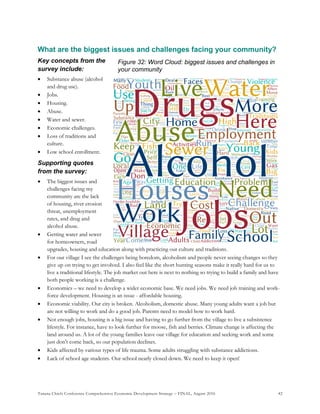
What are the biggest issues and
challenges facing your community?

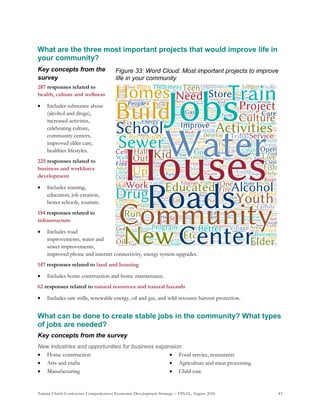
What are the three most important
projects that would improve life in
your community? 
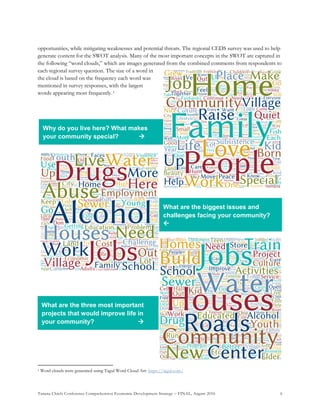
opportunities, while mitigating weaknesses and potential threats. The regional CEDS survey was used to help
generate content for the SWOT analysis. Many of the most important concepts in the SWOT are captured in
the following “word clouds,” which are images generated from the combined comments from respondents to
each regional survey question. The size of a word in
the cloud is based on the frequency each word was
mentioned in survey responses, with the largest
words appearing most frequently.0F
1
1 Word clouds were generated using Tagul Word Cloud Art: https://tagul.com/
Tanana Chiefs Conference Comprehensive Economic Development Strategy – FINAL, August 2016 7
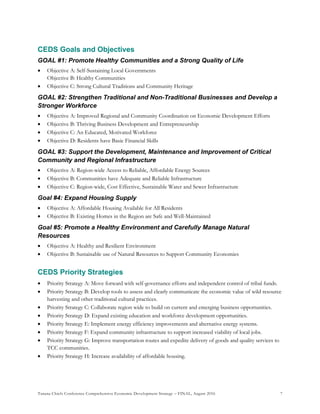
CEDS Goals and Objectives
GOAL #1: Promote Healthy Communities and a Strong Quality of Life
 Objective A: Self-Sustaining Local Governments
Objective B: Healthy Communities
 Objective C: Strong Cultural Traditions and Community Heritage
GOAL #2: Strengthen Traditional and Non-Traditional Businesses and Develop a
Stronger Workforce
 Objective A: Improved Regional and Community Coordination on Economic Development Efforts
 Objective B: Thriving Business Development and Entrepreneurship
 Objective C: An Educated, Motivated Workforce
 Objective D: Residents have Basic Financial Skills
GOAL #3: Support the Development, Maintenance and Improvement of Critical
Community and Regional Infrastructure
 Objective A: Region-wide Access to Reliable, Affordable Energy Sources
 Objective B: Communities have Adequate and Reliable Infrastructure
 Objective C: Region-wide, Cost Effective, Sustainable Water and Sewer Infrastructure
Goal #4: Expand Housing Supply
 Objective A: Affordable Housing Available for All Residents
 Objective B: Existing Homes in the Region are Safe and Well-Maintained
Goal #5: Promote a Healthy Environment and Carefully Manage Natural
Resources
 Objective A: Healthy and Resilient Environment
 Objective B: Sustainable use of Natural Resources to Support Community Economies
CEDS Priority Strategies
 Priority Strategy A: Move forward with self-governance efforts and independent control of tribal funds.
 Priority Strategy B: Develop tools to assess and clearly communicate the economic value of wild resource
harvesting and other traditional cultural practices.
 Priority Strategy C: Collaborate region wide to build on current and emerging business opportunities.
 Priority Strategy D: Expand existing education and workforce development opportunities.
 Priority Strategy E: Implement energy efficiency improvements and alternative energy systems.
 Priority Strategy F: Expand community infrastructure to support increased viability of local jobs.
 Priority Strategy G: Improve transportation routes and expedite delivery of goods and quality services to
TCC communities.
 Priority Strategy H: Increase availability of affordable housing.
Tanana Chiefs Conference Comprehensive Economic Development Strategy – FINAL, August 2016 8
Chapter 1: Introduction
What is a CEDS?
A Comprehensive Economic Development Strategy (CEDS) is a tool for community based and regionally
driven economic planning, with strategies and an implementation plan for creating stronger and more resilient
communities and economies. CEDS are an important part of the U.S. Department of Commerce Economic
Development Administration (EDA) programs, and are often required in order to be eligible for federal and
grant funding.
A CEDS provides an overview of economic indicators and identifies projects and actions that will support
economic development and increase regional wealth in a particular region. The CEDS aims to highlight the
region’s economic development strengths, challenges and opportunities and proposes strategies and actions
that enhance the economic development potential of the region. As state and federal funds in Alaska continue
to decline, it is increasingly important that the public, private and non-profit sectors in the region work
together in order to grow the region’s economy. Tanana Chiefs Conference (TCC) and its member
communities will use the CEDS to help these partners collaborate and work strategically in order to leverage
the resources and strengths of the region.
Who is TCC?
Tanana Chiefs Conference (TCC) is organized as Dena’ Nena’ Henash or “Our Land Speaks”; an Alaska
Native non-profit corporation, charged with advancing tribal self-determination and enhancing regional
Native unity. TCC provides services while balancing traditional Athabascan and Alaska Native values with
modern demands. The organization works toward meeting the health and social service needs of tribal
members and beneficiaries throughout the TCC region.
TCC was formed in 1962 to serve as an organizational unit to advocate land claims for member tribes. It was
incorporated as an official non-profit regional consortium in 1972 through the Alaska Native Claim
Settlement Act (ANCSA). TCC represents 42 Alaska communities, including 37 federally recognized tribes
and offers a wide variety of tribal services through the TCC Administration, Health Services, and Tribal
Government and Client Services.
TCC has compacting authority with the Bureau of Indian Affairs (BIA) and Indian Health Service (IHS) for
management and delivery of health and social services to over 10,000 Alaska Natives in the region. Programs
and services include health care, housing, lands management, tribal government assistance, education and
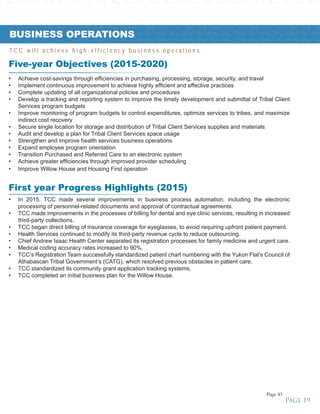
employment, and natural resource programs. TCC also provides for public safety through Alaska’s Village
Public Safety Officer (VPSO) program.
TCC manages the Chief Andrew Isaac Health Center, the major Alaska Native health care facility for the
region, which is located next to the Fairbanks Memorial Hospital. It also provides mental health, dental and
optometry services at clinics in Fairbanks, and operates several remote alcohol recovery camps. TCC
administers the Community Health Aide Program (CHAP) in the Interior, which places health aides at village
clinics across the region, and offers roaming services where hospital staff travel to the villages throughout the
year to provide exams.
Tanana Chiefs Conference Comprehensive Economic Development Strategy – FINAL, August 2016 9
Project Area Overview
The Tanana Chiefs Conference 2016-2020 Comprehensive Economic Development Strategy (CEDS) covers
the Interior Alaska region, with the exception of the Fairbanks North Star Borough (FNSB). The FNSB
creates their own CEDS; the most recent version was completed in January 2016.1F
2 The Tanana Chiefs
Conference outlining borders were set by the Alaska Native Claims Settlement Act (ANCSA) and are shared
with Doyon, Limited. This plan is intended to benefit all residents, communities, and Athabascan tribes
within the region as they make progress towards their rural community economic development goals.
Development of the CEDS
Many people contributed to this plan. Outlined below are the main steps in the TCC CEDS planning process.
The CEDS was developed with assistance from Agnew::Beck Consulting, PDC Engineers and Northern
Economics. Working in partnership with TCC villages, business leaders, stakeholder and TCC staff, the
project team conducted the following activities to collect information and develop the content for this CEDS:
 The TCC Tribal Development Director sent a letter to TCC tribes in January 2015 introducing the CEDS
and requesting participation.
 The TCC Economic Development Specialist held four teleconference meetings with CEDS committee
members in 2015 and 2016.
 The TCC Economic Development Specialist held conversations with sub-regional representatives at the
July 2015 Planning Summit.
 The project team compiled background data on communities and the region from various local, state and
federal data sources, TCC departments, and from relevant community and regional planning documents.
 A regional survey was designed and distributed to TCC members. Residents were able to respond either
online or via hard copy. In order to ensure elders had the opportunity to participate in the planning
process, TCC staff visited the homes of elders during routine village visits to deliver hard copy versions
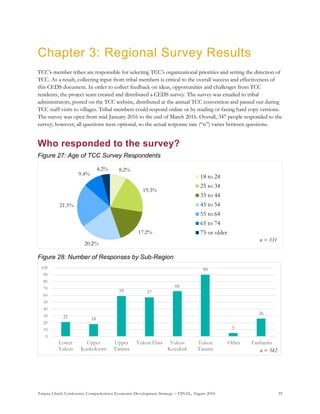
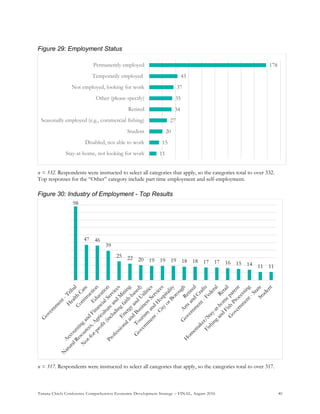
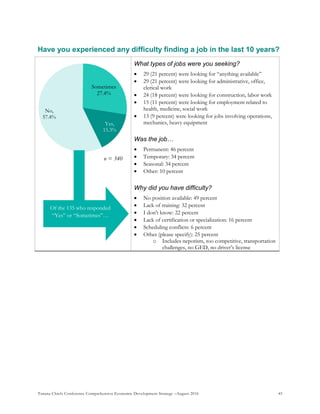
of the survey. The survey was open through the end of March 2016. In total, 347 residents responded to
the survey.
 The project team conducted interviews with tribal administrators, stakeholders and community leaders.
Overall, 19 interviews were completed during the planning process.
 The project team shared project information, collected survey responses and discussed the project and
potential contents with attendees and the Annual TCC Convention, held in Fairbanks in March 2016.
The CEDS will be reevaluated and undergo a complete update every five years as communities work toward
and meet their current goals. Communities will need to identify and develop revised objectives as times
change. Along with the completed CEDS, there will be annually updated appendices to report on changes in
the region and to make revisions as communities make progress on the goals and strategies outlined in the
CEDS.
2 The 2016 Fairbanks North Star Borough Comprehensive Economic Development Strategy is available here:
http://www.co.fairbanks.ak.us/mayor/Documents/FNSB%20CEDS%202016-Final.pdf
Tanana Chiefs Conference Comprehensive Economic Development Strategy – FINAL, August 2016 10
Previous Planning Processes
The first formal Overall Economic Development Plan (OEDP) for the TCC region was completed in 1985
by the TCC Office of Planning and Information Program. The OEDP identified a variety of economic
development projects including the establishment of a fur industry, timber industry, fishery processing,
biotical production, tourism development, agriculture development, arts and crafts, energy development,
mineral development, industrial development, infrastructure development and federal land management
contracting. The OEDP was updated on an annual basis until its expiration in 1990. In 1991, a new OEDP
was created for the TCC region through assistance from the TCC Planning and Development department.
The 1991-1996 plan was the first time information was collected as a result of pulling together the TCC
Executive Board and village-representatives from each community in the region. The 1991-1996 plan
expanded on many of the same priorities developed in the 1985-1990 OEDP.
In 2002, through grant funding received by the Economic Development Administration, TCC began working
on a CEDS for the region. The primary goal of the 2002-2006 CEDS plan was to look at expanding
employment opportunities for TCC residents while taking into account the decline of statewide resources.
However, the tribes ultimately felt the draft document did not accurately depicted the region’s needs and
priorities, and the 2006 TCC CEDS was not passed through resolution. This was a reminder that TCC tribes
have a strong voice in their future and emphasizes the need to engage member communities early and
throughout the creation of regional plans.
Other Community and Regional Planning Efforts
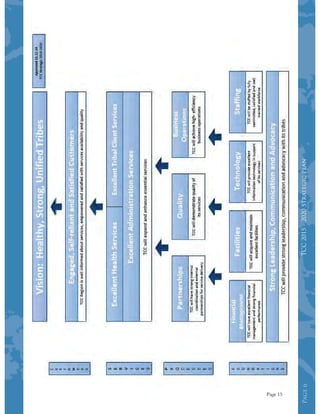
Tanana Chiefs Conference Strategic Plan
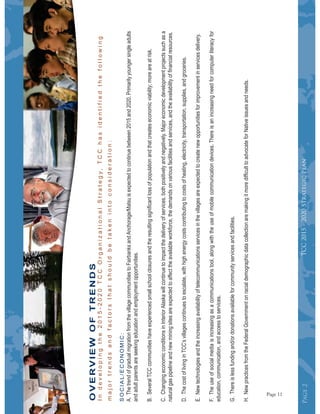
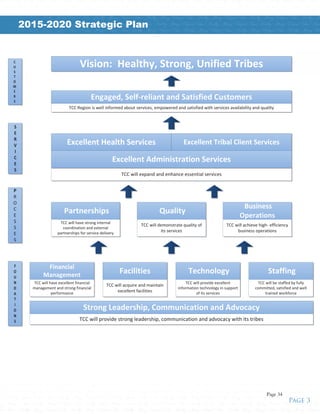
In November 2014 the Tanana Chiefs Conference Board of Directors held a special meeting to adopt a new
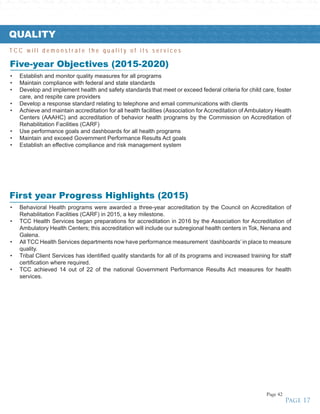
Strategic Plan for 2015 to 2020. The Strategic Plan provides a roadmap for improving the organization and
the services TCC provides to the 42 tribal governments and over 16,000 tribal members who own the
organization. The Strategic Plan was created based on member tribe priorities described in Board of Directors
resolutions, individual community plans and tribal resolutions, recommendations from TCC advisory councils
and recommendations of tribal members who participated in the planning process. The Strategic Plan is
organized around ten goals, with a corresponding list of five-year objectives. Each year the Executive Board
meets with senior executives and managers to identify specific initiatives to achieve during the year. The
Strategic Plan and First Year Progress Highlights from the plan can be found in the appendices.
TCC Planning and Development Program
During the January 2012 executive planning session, the TCC Executive Board (E-Board) identified the need
for greater assistance and support in community planning, project planning and grant writing in member
communities. Several models were initially considered, and ultimately the TCC Planning and Development
Program was created. The mission of the Village Planning and Development (VP&D) Program is to provide
technical assistance to tribal councils to support sustainable community development for the Interior Alaska
Native people. The VP&D Program was developed with several goals in mind:
 Provide a greater level of technical assistance to TCC member villages in the area of planning and grant
writing.
 Support village-based employment opportunities.
 Support capacity building in planning and grant writing to TCC member villages.
Tanana Chiefs Conference Comprehensive Economic Development Strategy – FINAL, August 2016 11
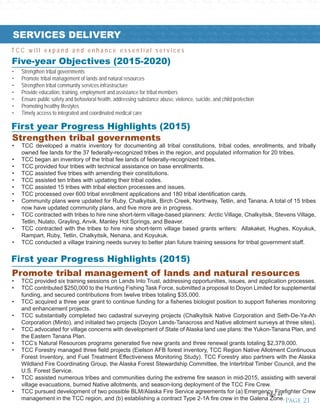
The VP&D program works with tribal councils to temporarily hire and train village-based grant writers and
planners to complete either a grant application or a community plan on behalf of their tribe. Since its launch
in 2012, TCC has invested approximately $500,000 towards the training and employment of village
employees. Twenty village-based Community Planning Specialist and 29 village-based Grant Development
Specialist positions have been created since the initiation of this program. The investment has resulted in over
$870,000 in grant funding and the completion of 21 community plans.
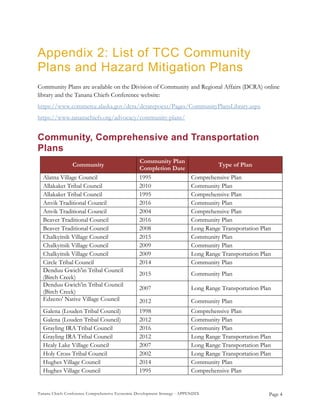
Community Plans
Community plans are available on the Alaska Division of Community and Regional Affairs online library and
the Tanana Chiefs Conference websites:
https://www.commerce.alaska.gov/dcra/dcrarepoext/Pages/CommunityPlansLibrary.aspx and
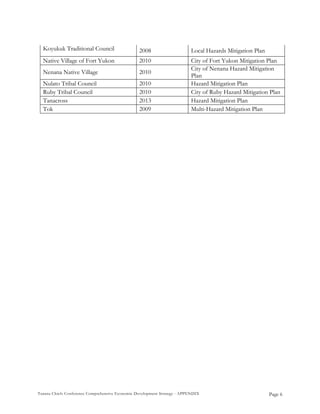
https://www.tananachiefs.org/advocacy/community-plans/. See the appendix for a list of community plans
for TCC communities.
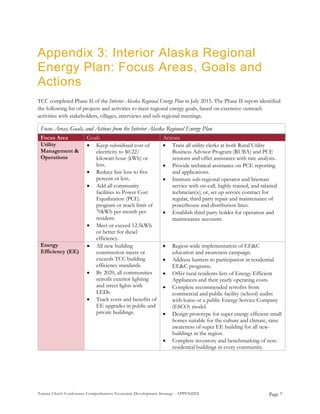
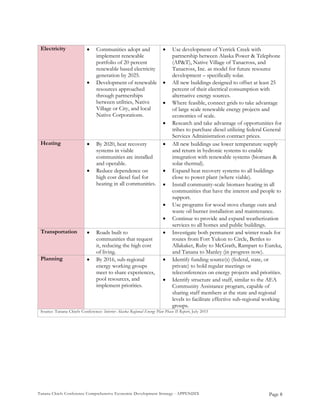
Regional Energy Plan
The Interior Regional Energy Plan is part of a statewide effort led by the Alaska Energy Authority to identify
energy projects and priorities that will reduce the long-term cost of energy and dependence on fossil fuels in
Interior Alaska. The planning process examined the total mix of energy needs in the region, including
electricity, heating and transportation. The plan presents background information and recommendations on
local and regional energy resources as well as energy efficiency and conservation. The plan is available here:
https://www.tananachiefs.org/wp-content/uploads/2014/03/Interior-Regional-Energy-
Plan_FINAL_1.7.16.pdf
Transportation Planning
TCC’s transportation manager works with several communities in achieving their transportation goals by
providing technical support and assisting with the development of transportation plans. TCC is currently in
the process of developing a regional transportation plan.
Regional Housing Strategy
The Regional Housing Strategy was developed through a partnership between various organizations that provide
housing services to Interior Alaska Native people. The lead organizations included the Tanana Chiefs
Conference (TCC), Interior Regional Housing Authority (IRHA), Nulato Tribal Council, Chalkyitsik Village
Council, Rampart Village Council, Fort Yukon Tribal Council, Louden Tribal Council and the Tanana Tribal
Council. The United States Department of Agriculture (USDA) and Cold Climate Housing Research Center
(CCHRC) assisted with data collection for the Regional Housing Strategy.
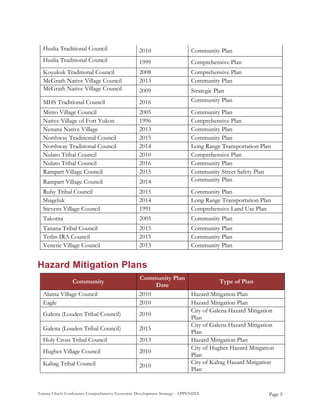
Tribal Mitigation Planning
The TCC Office of Environmental Health (OEH) assists TCC villages with emergency response planning,
water and sewer system project planning, preventative maintenance plans and other relevant topics as
requested. OEH has hosted several planning workshops for tribal leaders that provided training and time to
develop a Small Community Emergency Response Plan (SCERP) in conjunction with the State of Alaska. A
strong initial response to a local emergency typically leads to better long term recovery. An effective
emergency response plan helps prepare a community to respond to both large scale natural disasters and
smaller scale disasters such as a plane crash or structure fire. For a list of hazard mitigation plans in the
region, see the appendix.
Tanana Chiefs Conference Comprehensive Economic Development Strategy – FINAL, August 2016 12
Structure and How to Use the Document
This document is organized to first provide the reader with an overview of CEDS planning, the project area
and the process used to develop this CEDS. Chapter Two includes an overview of the people, regional
wealth, demographics and economic trends of Interior Alaska. Chapter Three includes highlights and quotes
from the TCC CEDS Regional Survey. Chapter Four offers a Strengths, Weaknesses, Opportunities and
Threats (SWOT) analysis of the region. The focus of the SWOT is on making connections between key data
points (graphically and through narrative) that best tell the story of the TCC economy, including those factors
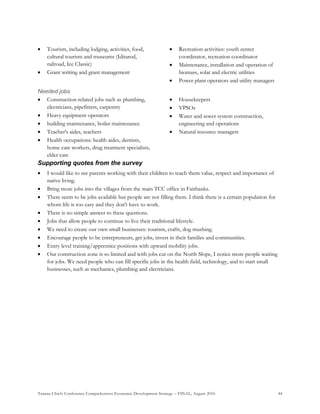
that are a challenge and/or support regional economic development efforts. The SWOT leads directly into
Chapter Five, “Regional Future Direction.” In this chapter, we reintroduce TCC’s vision and mission
statements, and define regional goals and objectives as well as priority programs, projects and activities.
Chapter Six includes an action table, which defines a plan of action and is followed by an evaluation
framework with performance measures to evaluate progress of the action items. Chapter Seven has additional
background information to support the priority goals, objective sand strategies, including information on
land, natural hazards and infrastructure. As outlined in the Table of Contents, the appendices include
additional data and expanded background information on important topics.
Tanana Chiefs Conference Comprehensive Economic Development Strategy – FINAL, August 2016 13
“I love living in rural
Alaska because of
the peace and quiet,
and my daughter gets
to learn our traditional
way of life.”
-TCC survey respondent
from Beaver
Chapter 2: Regional Socioeconomic
Data
Culture and History
Since the time of contact with Western society, Alaska Native people have
experienced an unprecedented rate of change. The gradual settlement of
Alaska has introduced a range of external influences including new
populations, laws, policies, diseases, institutions, values, economies and
languages.
Athabascan people have a long history in Interior Alaska with a traditional
lifestyle based on seasonal wild resource harvest activities. The
communities that identify as Athabascan are very diverse, with each region
possessing its own distinct language or dialect, world view and cultural
values.
The traditional hunting and fishing practices of Alaska Native people,
including the harvesting and sharing of fish, game, and other resources and the ceremonies which accompany
these practices provide for the social, cultural, and spiritual, and economic wellbeing and survival of TCC
people and communities. Today, these traditional practices are in continued jeopardy, with residents
disenfranchised in a highly complex regulatory and management regime dominated by federal and state
governments.
Demographics
This section identifies compelling data, trends and indicators that help define the economy of TCC
communities and the region. When possible, we have shared data at the community and sub-regional level. In
other cases, we have used census areas to identify general socioeconomic trends in the region. The 42
member tribes of TCC fall largely into to two U.S. Census areas: the Yukon-Koyukuk (YK) Census Area with
34 TCC communities, and the Southeast Fairbanks Census Area with seven TCC communities (see the
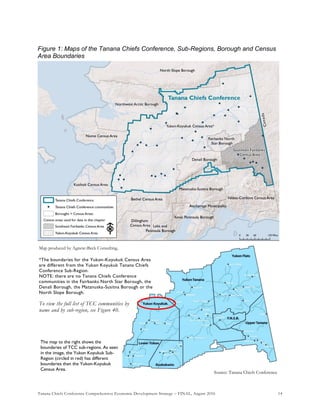
communities listed by census area in Figure 2). Figure 1 includes an outline of the TCC region, with the
Yukon-Koyukuk Census Area and Southeast Fairbanks Census Area highlighted. As seen in the map, the
TCC region also overlaps with parts of the Fairbanks North Star Borough, Denali Borough, Matanuska
Susitna Borough and the North Slope Borough. However, no TCC communities are located in the
boundaries of these boroughs so those areas are not included in this CEDS analysis. Although the two
combined census areas do not align exactly with the TCC region boundaries, they provide a relatively accurate
picture of the economy and demographic trends in the region when community-specific information is not
available. When community-specific data is available, as provided by the Alaska Department of Labor and
Workforce Development via a special data extract and/or via primary data collected by TCC, the information
is summarized as “TCC region” data in this chapter.
Tanana Chiefs Conference Comprehensive Economic Development Strategy – FINAL, August 2016 14
Figure 1: Maps of the Tanana Chiefs Conference, Sub-Regions, Borough and Census
Area Boundaries
Source: Tanana Chiefs Conference
Map produced by Agnew::Beck Consulting.
*The boundaries for the Yukon-Koyukuk Census Area
are different from the Yukon Koyukuk Tanana Chiefs
Conference Sub-Region.
NOTE: there are no Tanana Chiefs Conference
communities in the Fairbanks North Star Borough, the
Denali Borough, the Matanuska-Susitna Borough or the
North Slope Borough.
To view the full list of TCC communities by
name and by sub-region, see Figure 40.
The map to the right shows the
boundaries of TCC sub-regions. As seen
in the image, the Yukon Koyukuk Sub-
Region (circled in red) has different
boundaries than the Yukon-Koyukuk
Census Area.
Tanana Chiefs Conference Comprehensive Economic Development Strategy – FINAL, August 2016 15
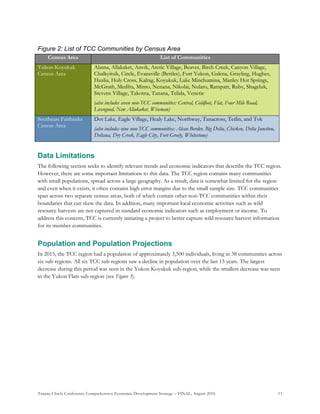
Figure 2: List of TCC Communities by Census Area
Census Area List of Communities
Yukon-Koyukuk
Census Area
Alatna, Allakaket, Anvik, Arctic Village, Beaver, Birch Creek, Canyon Village,
Chalkyitsik, Circle, Evansville (Bettles), Fort Yukon, Galena, Grayling, Hughes,
Huslia, Holy Cross, Kaltag, Koyukuk, Lake Minchumina, Manley Hot Springs,
McGrath, Medfra, Minto, Nenana, Nikolai, Nulato, Rampart, Ruby, Shageluk,
Stevens Village, Takotna, Tanana, Telida, Venetie
(also includes seven non-TCC communities: Central, Coldfoot, Flat, Four Mile Road,
Livengood, New Allakaket, Wiseman)
Southeast Fairbanks
Census Area
Dot Lake, Eagle Village, Healy Lake, Northway, Tanacross, Tetlin, and Tok
(also includes nine non-TCC communities: Alcan Border, Big Delta, Chicken, Delta Junction,
Deltana, Dry Creek, Eagle City, Fort Greely, Whitestone)
Data Limitations
The following section seeks to identify relevant trends and economic indicators that describe the TCC region.
However, there are some important limitations to this data. The TCC region contains many communities
with small populations, spread across a large geography. As a result, data is somewhat limited for the region
and even when it exists, it often contains high error margins due to the small sample size. TCC communities
span across two separate census areas, both of which contain other non-TCC communities within their
boundaries that can skew the data. In addition, many important local economic activities such as wild
resource harvests are not captured in standard economic indicators such as employment or income. To
address this concern, TCC is currently initiating a project to better capture wild resource harvest information
for its member communities.
Population and Population Projections
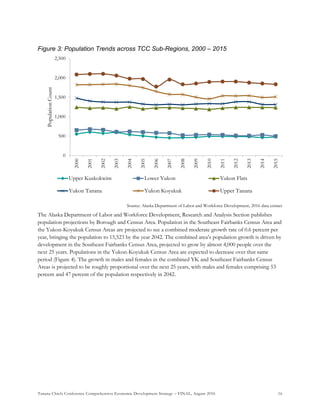
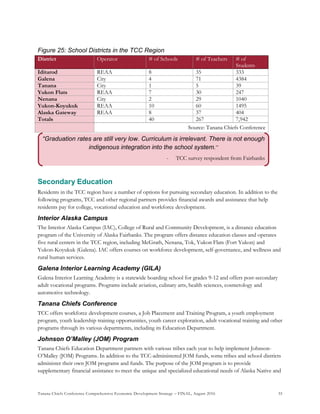
In 2015, the TCC region had a population of approximately 3,500 individuals, living in 38 communities across
six sub-regions. All six TCC sub-regions saw a decline in population over the last 15 years. The largest
decrease during this period was seen in the Yukon Koyukuk sub-region, while the smallest decrease was seen
in the Yukon Flats sub-region (see Figure 3).
Tanana Chiefs Conference Comprehensive Economic Development Strategy – FINAL, August 2016 16
Figure 3: Population Trends across TCC Sub-Regions, 2000 – 2015
Source: Alaska Department of Labor and Workforce Development, 2016 data extract
The Alaska Department of Labor and Workforce Development, Research and Analysis Section publishes
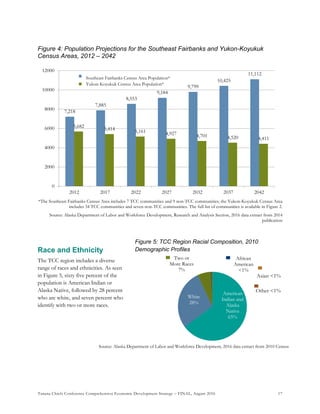
population projections by Borough and Census Area. Population in the Southeast Fairbanks Census Area and
the Yukon-Koyukuk Census Areas are projected to see a combined moderate growth rate of 0.6 percent per
year, bringing the population to 15,523 by the year 2042. The combined area’s population growth is driven by
development in the Southeast Fairbanks Census Area, projected to grow by almost 4,000 people over the
next 25 years. Populations in the Yukon-Koyukuk Census Area are expected to decrease over that same
period (Figure 4). The growth in males and females in the combined YK and Southeast Fairbanks Census
Areas is projected to be roughly proportional over the next 25 years, with males and females comprising 53
percent and 47 percent of the population respectively in 2042.
0
500
1,000
1,500
2,000
2,500
2000
2001
2002
2003
2004
2005
2006
2007
2008
2009
2010
2011
2012
2013
2014
2015
PopulationCount
Upper Kuskokwim Lower Yukon Yukon Flats
Yukon Tanana Yukon Koyukuk Upper Tanana
Tanana Chiefs Conference Comprehensive Economic Development Strategy – FINAL, August 2016 17
7,218
7,885
8,553
9,184
9,799
10,425
11,112
5,682 5,414 5,161 4,927 4,701 4,520 4,411
0
2000
4000
6000
8000
10000
12000
2012 2017 2022 2027 2032 2037 2042
Southeast Fairbanks Borough Population
Yukon Koyukuk Borough Population
Southeast Fairbanks Census Area Population*
Yukon-Koyukuk Census Area Population*
Figure 5: TCC Region Racial Composition, 2010
Demographic Profiles
American
Indian and
Alaska
Native
65%
White
28%
Two or
More Races
7%
African
American
<1%
Asian <1%
Other <1%
Source: Alaska Department of Labor and Workforce Development, 2016 data extract from 2010 Census
Figure 4: Population Projections for the Southeast Fairbanks and Yukon-Koyukuk
Census Areas, 2012 – 2042
*The Southeast Fairbanks Census Area includes 7 TCC communities and 9 non-TCC communities; the Yukon-Koyukuk Census Area
includes 34 TCC communities and seven non-TCC communities. The full list of communities is available in Figure 2.
Source: Alaska Department of Labor and Workforce Development, Research and Analysis Section, 2016 data extract from 2014
publication
Race and Ethnicity
The TCC region includes a diverse
range of races and ethnicities. As seen
in Figure 5, sixty five percent of the
population is American Indian or
Alaska Native, followed by 28 percent
who are white, and seven percent who
identify with two or more races.
Tanana Chiefs Conference Comprehensive Economic Development Strategy – FINAL, August 2016 18
“[The biggest
challenge today is] not
losing what our elders
taught us younger
generations, not letting
our traditional values
be lost or forgotten.”
-TCC survey respondent
from Fort Yukon
Age and Gender Distribution
According to 2010 Census data, fifty-four percent of the population in
the TCC region is male, which is higher than the statewide average of 52
percent (Figure 6). The gender composition of communities in the TCC
region varies, with males generally composing between 50 to 75 percent
of the population. In terms of age, there is a larger proportion of
residents in the zero to 19 and the 45 to 59 age categories, with a notable
drop in residents ages 20 to 49. The 20 to 49 age group makes up an
important component of the workforce in most communities, and a
reduction in that age group in the region could indicate that working-age
residents are leaving for job opportunities outside the region.
Figure 6: TCC Regional Population by Age and Gender, 2010
Demographic Profiles
Source: Alaska Department of Labor and Workforce Development, 2016 data extract from 2010 Census
According to the state’s population projections, the population of residents over the age of 70 in the
combined Yukon Koyukuk and Southeast Fairbanks Census Areas is expected to double over the next 20
0 100 200 300 400 500 600 700
0 - 4
5 - 9
10 - 14
15 - 19
20 - 24
25 - 29
30 - 34
35 - 39
40 - 44
45 - 49
50 - 54
55 - 59
60 - 64
65 - 69
70 - 74
75 - 79
80 - 84
85 +
Population Count
Age
Male
Female
Tanana Chiefs Conference Comprehensive Economic Development Strategy – FINAL, August 2016 19
“This is my hometown, where I was
born, and I love living in a village
more than city life. I lived and
worked in several cities, but my
heart was always in the villages.”
-TCC survey respondent from Nulato
years, from an estimated 904 in 2015 to 1,814 in 2035. As the senior population grows, it is important that
communities plan for potential increases in the demand for senior services and housing.
Migration
Estimates from the Alaska Department of Labor and
Workforce Development indicate that there is a net
migration out of the region. Between 2014 and 2015, 126
individuals migrated into the region, while 180 migrated
out of the region. Migration patterns vary between the
TCC sub-regions (see Figure 7). The Yukon Flats sub-
region saw a net increase, while the other five sub-regions each saw a net decrease. The Lower Yukon and
Yukon Tanana sub-regions saw the largest out-migration of individuals.
Figure 7: Migration Patterns for TCC Sub-Regions, 2014-2015
Source: Alaska Department of Labor and Workforce Development, Permanent Fund Dividend (PFD) Migration between 2014-2015
by Place Estimates, 2016 data extract
The migration information comes from Permanent Fund Dividend (PFD) data, which allows the state to
track residency changes at a community, regional and statewide level. The following is a list of noteworthy
trends and changes from the migration data. The numbers summarized below refer to net migration changes;
for example, if 10 people moved to a community and 15 people moved away, there would be a net migration
loss of five people for that community. These numbers are separate from natural population fluctuations
0 10 20 30 40 50 60
Upper Tanana
Yukon Tanana
Lower Yukon
Yukon Koyukuk
Upper Kuskokwim
Yukon Flats
Migrating Individuals
TCCSub-Region
Sum of Out-Migration
Sum of In-Migration
Tanana Chiefs Conference Comprehensive Economic Development Strategy – FINAL, August 2016 20
related to birth and death rates. For the breakdown of the components of migration change for each
community, see the appendices.
According to PFD data:
 Some communities experience large fluctuations in migration from year to year, both positive and
negative. For example, Ruby had a net migration loss of 24 people between 2002 and 2003 but the very
next year saw an increase of 23 due to migration. Other communities with high migration fluctuations
include Circle, Fort Yukon, Nenana, Tanacross, Tanana and Venetie.
 Migration data indicates that some communities experience high out-migration where people are moving
to other parts of Alaska outside of the Interior region. These communities include Anvik, Grayling, Holy
Cross, McGrath and Shageluk.
 Some communities experience net outmigration to areas outside their census area but still within Interior
Alaska. These residents may be moving to hub communities such as Fairbanks. These communities
include Fort Yukon, Galena, Minto, Nulato and Stevens Village.
Regional Economy
Employment Trends
Employment in the TCC region has been slowly decreasing over the past 15 years, with a high of close to
4,000 jobs in 2001, and a low of fewer than 3,600 jobs in 2014. The lowest points for employment were seen
in 2008 and 2014. Employment trends in the region largely mirrored population trends, with overall
employment decreasing over the last 15 years, and employment numbers trending higher in the more
populated sub-regions (see Figure 8).
Figure 8: Total Employment by TCC Sub-Region, 2001-2014
Source: Alaska Department of Labor and Workforce Development, 2016 data extract for years 2001-2014
0
200
400
600
800
1000
1200
2001 2002 2003 2004 2005 2006 2007 2008 2009 2010 2011 2012 2013 2014
NumberEmployed
Upper
Kuskokwim
Lower
Yukon
Yukon Flats
Yukon
Tanana
Yukon
Koyukuk
Upper
Tanana
Tanana Chiefs Conference Comprehensive Economic Development Strategy – FINAL, August 2016 21
“Attempting to create jobs and
economies within a small
community is a huge endeavor to
undertake…local businesses don't
have much of a customer base to
rely on to generate enough income
to be in business.”
-TCC survey respondent from Northway
Top Employers by Sector and Industry Clusters
Local government is the largest employment sector in the TCC region, providing 13 percent of total
employment (Figure 9). Educational and Health Services is the next largest sector, with 12 percent of total
employment, followed by Trade, Transportation and Utilities and Leisure and Hospitality, both with 11
percent. These numbers do not include self-employment or wild resource harvests. TCC is currently
developing a data process to help capture wild resource harvests in the region.
Figure 9: TCC Regional Employment by Sector, 2014
Source: Alaska Department of Labor and Workforce Development, 2016 data extract with 2014 numbers
Stats America produces a variety of economic
development tools to support economic analysis as a part
of its Innovation Data series, including cluster
information for different regions. While the site does not
include community-level data, there is 2012 data available
for the combined Yukon-Koyukuk Census Area and
Southeast Fairbanks Census Area. Figure 10 shows
industry clusters in the region. Since the information
includes non-TCC communities, it does not perfectly
capture the economic picture of the TCC region;
however, the data does give helpful insights into the key
industry drivers in the region. This data is also limited
because some information is not disclosed due to confidentiality concerns, which is the case when there are a
Local
Government
13%
Educational and
Health Services
12%
Trade,
Transportation and
Utilities
11%
Leisure and
Hospitality
11%Construction
9%Professional and
Business Services
9%
Natural Resources
and Mining
8%
Other
7%
State Government
7%
Information
6%
Manufacturing
4%
Financial
Activities
2%
Unknown
1%
Tanana Chiefs Conference Comprehensive Economic Development Strategy – FINAL, August 2016 22
small number of business establishments in a given industry within the region. Industries that may be under-
represented in the table include agriculture, forestry, fishing and hunting; educational services; mining;
manufacturing; health care; real estate; arts, entertainment and recreation, and accommodation and food
services. Wild resource harvests are also not reflected in the table.
In terms of the number of establishments, Energy is the top industry for the two census areas with 53
establishments followed by Defense and Security (48 establishments) and Business & Financial Services (33
establishments). In terms of the number of people employed, Defense and Security is first with 515 people
employed, followed by Energy (431 people) and Mining (240 people).
The tool also summarizes total wages for each industry; again, Defense and Security is first with $38.5 million
in combined wages, followed by Energy ($31.4 million) and Mining ($21.2 million). Stats America also uses a
“Location Quotient” (LQ) to compare the relative density of certain industries compared with other parts of
the country in order to identify key industry clusters that are focused in the area. In the combined Yukon-
Koyukuk and Southeast Fairbanks Census Areas, Mining is given a very high LQ score, indicating the region
is comparatively more developed in the mining industry than other parts of the country. Energy, Defense and
Security, Transportation Equipment Manufacture and Forest and Wood Products all received above-average
location quotient scores as well.
Figure 10: Industry Clusters and Location Quotients, Yukon-Koyukuk and Southeast
Fairbanks Census Areas 2012
Description
# of
Establishments
# of People
Employed
Total Wages
Cluster
Establishment
LQ
Cluster
Employment
LQ
Mining 16 240 $21,210,274 21.13 31.94
Energy (Fossil &
Renewable) 53 431 $31,393,536 2.14 1.97
Defense & Security 48 515 $38,555,864 2.23 1.93
Transportation Equipment
Manufacturing 1 31 $1,631,878 2.88 1.35
Forest & Wood Products 6 49 $1,561,748 1.57 1.09
Arts, Entertainment,
Recreation & Visitor
Industries 30 196 $6,548,151 1.84 1.02
Transportation &
Logistics 20 108 $6,035,122 1.48 0.73
Chemicals & Chemical
Based Products 1 19 $1,073,406 0.54 0.54
Apparel & Textiles 2 6 $83,457 1.1 0.5
Agribusiness, Food
Processing & Technology 7 50 $1,903,204 0.83 0.45
Biomedical/Biotechnical
(Life Sciences) 6 236 $9,947,583 0.29 0.44
Business & Financial
Services 33 161 $13,488,052 0.37 0.38
Tanana Chiefs Conference Comprehensive Economic Development Strategy – FINAL, August 2016 23
Education & Knowledge
Creation 11 37 $2,124,660 1.37 0.2
Printing & Publishing 6 15 $368,989 0.51 0.2
Fabricated Metal Product
Manufacturing 1 2 $100,885 0.64 0.09
Information Technology
& Telecommunications 5 10 $700,557 0.23 0.05
Total All Industries 560 4,845 $249,727,509 1 1
Source: U.S. Bureau of Labor Statistics, Quarterly Census of Employment & Wages (QCEW) and Purdue Center for Regional
Development, as reported by Stats America. Available here: http://statsamerica.org/innovation/anydata/custom.asp
While construction employment numbers are currently low, interviews with tribal administrators indicate
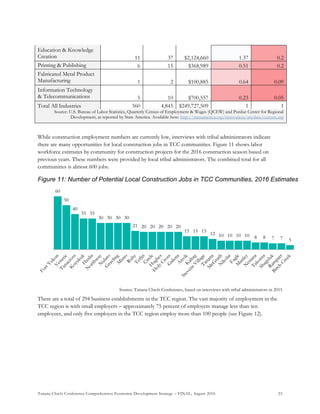
there are many opportunities for local construction jobs in TCC communities. Figure 11 shows labor
workforce estimates by community for construction projects for the 2016 construction season based on
previous years. These numbers were provided by local tribal administrators. The combined total for all
communities is almost 600 jobs.
Source: Tanana Chiefs Conference, based on interviews with tribal administrators in 2015
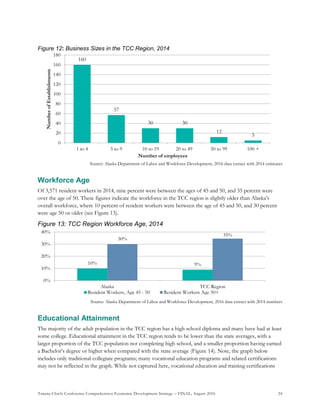
There are a total of 294 business establishments in the TCC region. The vast majority of employment in the
TCC region is with small employers – approximately 75 percent of employers manage less than ten
employees, and only five employers in the TCC region employ more than 100 people (see Figure 12).
60
50
40
35 35
30 30 30 30
21 20 20 20 20 20
15 15 15
12 10 10 10 10 8 8 7 7 5
Figure 11: Number of Potential Local Construction Jobs in TCC Communities, 2016 Estimates
Tanana Chiefs Conference Comprehensive Economic Development Strategy – FINAL, August 2016 24
Figure 12: Business Sizes in the TCC Region, 2014
Source: Alaska Department of Labor and Workforce Development, 2016 data extract with 2014 estimates
Workforce Age
Of 3,571 resident workers in 2014, nine percent were between the ages of 45 and 50, and 35 percent were
over the age of 50. These figures indicate the workforce in the TCC region is slightly older than Alaska’s
overall workforce, where 10 percent of resident workers were between the age of 45 and 50, and 30 percent
were age 50 or older (see Figure 13).
Figure 13: TCC Region Workforce Age, 2014
Source: Alaska Department of Labor and Workforce Development, 2016 data extract with 2014 numbers
Educational Attainment
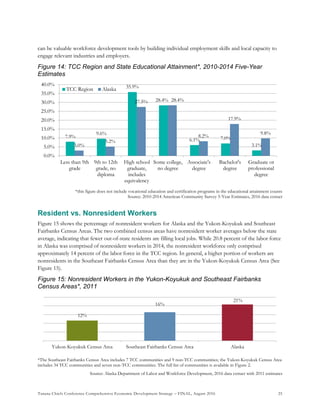
The majority of the adult population in the TCC region has a high school diploma and many have had at least
some college. Educational attainment in the TCC region tends to be lower than the state averages, with a
larger proportion of the TCC population not completing high school, and a smaller proportion having earned
a Bachelor’s degree or higher when compared with the state average (Figure 14). Note, the graph below
includes only traditional collegiate programs; many vocational education programs and related certifications
may not be reflected in the graph. While not captured here, vocational education and training certifications
160
57
30 30
12
5
0
20
40
60
80
100
120
140
160
180
1 to 4 5 to 9 10 to 19 20 to 49 50 to 99 100 +
NumberofEstablishments
Number of employees
10% 9%
30%
35%
0%
10%
20%
30%
40%
Alaska TCC Region
Resident Workers, Age 45 - 50 Resident Workers Age 50+
Tanana Chiefs Conference Comprehensive Economic Development Strategy – FINAL, August 2016 25
can be valuable workforce development tools by building individual employment skills and local capacity to
engage relevant industries and employers.
Figure 14: TCC Region and State Educational Attainment*, 2010-2014 Five-Year
Estimates
*this figure does not include vocational education and certification programs in the educational attainment counts
Source: 2010-2014 American Community Survey 5-Year Estimates, 2016 data extract
Resident vs. Nonresident Workers
Figure 15 shows the percentage of nonresident workers for Alaska and the Yukon-Koyukuk and Southeast
Fairbanks Census Areas. The two combined census areas have nonresident worker averages below the state
average, indicating that fewer out-of-state residents are filling local jobs. While 20.8 percent of the labor force
in Alaska was comprised of nonresident workers in 2014, the nonresident workforce only comprised
approximately 14 percent of the labor force in the TCC region. In general, a higher portion of workers are
nonresidents in the Southeast Fairbanks Census Area than they are in the Yukon-Koyukuk Census Area (See
Figure 15).
Figure 15: Nonresident Workers in the Yukon-Koyukuk and Southeast Fairbanks
Census Areas*, 2011
*The Southeast Fairbanks Census Area includes 7 TCC communities and 9 non-TCC communities; the Yukon-Koyukuk Census Area
includes 34 TCC communities and seven non-TCC communities. The full list of communities is available in Figure 2.
Source: Alaska Department of Labor and Workforce Development, 2016 data extract with 2011 estimates
7.9%
9.6%
35.9%
28.4%
6.1% 7.0%
3.1%3.0%
5.2%
27.5% 28.4%
8.2%
17.9%
9.8%
0.0%
5.0%
10.0%
15.0%
20.0%
25.0%
30.0%
35.0%
40.0%
Less than 9th
grade
9th to 12th
grade, no
diploma
High school
graduate,
includes
equivalency
Some college,
no degree
Associate's
degree
Bachelor's
degree
Graduate or
professional
degree
TCC Region Alaska
12%
16%
21%
Yukon-Koyukuk Census Area Southeast Fairbanks Census Area Alaska
Tanana Chiefs Conference Comprehensive Economic Development Strategy – FINAL, August 2016 26
Self-Employment
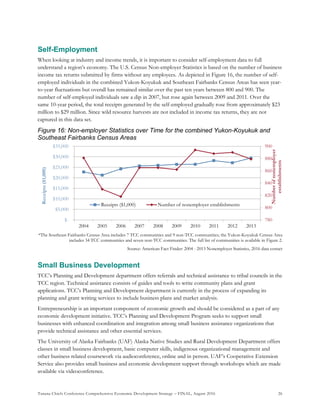
When looking at industry and income trends, it is important to consider self-employment data to full
understand a region’s economy. The U.S. Census Non-employer Statistics is based on the number of business
income tax returns submitted by firms without any employees. As depicted in Figure 16, the number of self-
employed individuals in the combined Yukon-Koyukuk and Southeast Fairbanks Census Areas has seen year-
to-year fluctuations but overall has remained similar over the past ten years between 800 and 900. The
number of self-employed individuals saw a dip in 2007, but rose again between 2009 and 2011. Over the
same 10-year period, the total receipts generated by the self-employed gradually rose from approximately $23
million to $29 million. Since wild resource harvests are not included in income tax returns, they are not
captured in this data set.
Figure 16: Non-employer Statistics over Time for the combined Yukon-Koyukuk and
Southeast Fairbanks Census Areas
*The Southeast Fairbanks Census Area includes 7 TCC communities and 9 non-TCC communities; the Yukon-Koyukuk Census Area
includes 34 TCC communities and seven non-TCC communities. The full list of communities is available in Figure 2.
Source: American Fact Finder: 2004 - 2013 Nonemployer Statistics, 2016 data extract
Small Business Development
TCC’s Planning and Development department offers referrals and technical assistance to tribal councils in the
TCC region. Technical assistance consists of guides and tools to write community plans and grant
applications. TCC’s Planning and Development department is currently in the process of expanding its
planning and grant writing services to include business plans and market analysis.
Entrepreneurship is an important component of economic growth and should be considered as a part of any
economic development initiative. TCC’s Planning and Development Program seeks to support small
businesses with enhanced coordination and integration among small business assistance organizations that
provide technical assistance and other essential services.
The University of Alaska Fairbanks (UAF) Alaska Native Studies and Rural Development Department offers
classes in small business development, basic computer skills, indigenous organizational management and
other business related coursework via audioconference, online and in person. UAF’s Cooperative Extension
Service also provides small business and economic development support through workshops which are made
available via videoconference.
780
800
820
840
860
880
900
$-
$5,000
$10,000
$15,000
$20,000
$25,000
$30,000
$35,000
2004 2005 2006 2007 2008 2009 2010 2011 2012 2013
Numberofnonemployer
establishments
Receipts($1,000)
Receipts ($1,000) Number of nonemployer establishments
Tanana Chiefs Conference Comprehensive Economic Development Strategy – FINAL, August 2016 27
There are also statewide and national organizations that have resources available for small businesses and
entrepreneurs. The U.S Small Business Administration provides a variety of services including how to start a
business, how to write a business plan and assistance exploring funding options. The Alaska Department of
Commerce, Community and Economic Development has a Small Business Assistance Center online that
provides direction for entrepreneurs, start-ups and existing businesses in Alaska. Alaska’s Division of
Corporations, Businesses, and Professional Licensing provides the necessary forms online to get an Alaska
Business license.2F
3
State and Local Taxes
The State of Alaska does not have a statewide property or sales tax. However, the state is facing declining
revenues as a result of decreased oil production and low worldwide oil prices, and is considering new ways to
collect revenue. Current options being considered include a sales tax, income tax and/or restructuring of the
Permanent Fund Dividend (PFD). Given the high costs of living and lower incomes in the TCC region, there
are concerns that any new taxation would disproportionally affect people in rural communities.
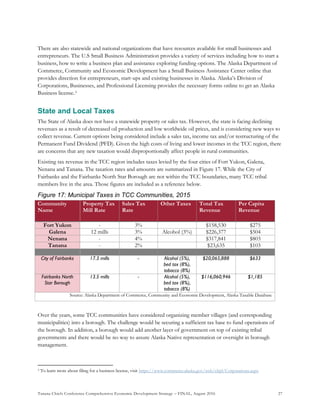
Existing tax revenue in the TCC region includes taxes levied by the four cities of Fort Yukon, Galena,
Nenana and Tanana. The taxation rates and amounts are summarized in Figure 17. While the City of
Fairbanks and the Fairbanks North Star Borough are not within the TCC boundaries, many TCC tribal
members live in the area. Those figures are included as a reference below.
Figure 17: Municipal Taxes in TCC Communities, 2015
Community
Name
Property Tax
Mill Rate
Sales Tax
Rate
Other Taxes Total Tax
Revenue
Per Capita
Revenue
Fort Yukon - 3% $158,530 $275
Galena 12 mills 3% Alcohol (3%) $226,377 $504
Nenana - 4% $317,841 $803
Tanana - 2% $23,635 $103
City of Fairbanks 17.3 mills - Alcohol (5%),
bed tax (8%),
tobacco (8%)
$20,065,888 $633
Fairbanks North
Star Borough
13.5 mills - Alcohol (5%),
bed tax (8%),
tobacco (8%)
$116,060,946 $1,185
Source: Alaska Department of Commerce, Community and Economic Development, Alaska Taxable Database
Over the years, some TCC communities have considered organizing member villages (and corresponding
municipalities) into a borough. The challenge would be securing a sufficient tax base to fund operations of
the borough. In addition, a borough would add another layer of government on top of existing tribal
governments and there would be no way to assure Alaska Native representation or oversight in borough
management.
3 To learn more about filing for a business license, visit https://www.commerce.alaska.gov/web/cbpl/Corporations.aspx
Tanana Chiefs Conference Comprehensive Economic Development Strategy – FINAL, August 2016 28
“I would offer that the CEDS would be most effective by helping remote, rural
communities to maintain the dominant, preferred economic activity while
strengthening the supplemental nature of the local cash economy, doing nothing
to harm or endanger the former. When properly considered and weighed, our
communities are practicing economic development in a very real sense and
experience a certain level of security as participants in the wild resource
economy. They are self-employed providers of their families, elders, infirm and
needy. It represents their traditional form of “social security” and it has existed for
thousands of years. It’s time we clearly articulated and quantified this.
Participation in the cash economy is also necessary and important but must exist
in harmony and compatibility with the mainstay wild resource economy.”
- Will Mayo, July 2016
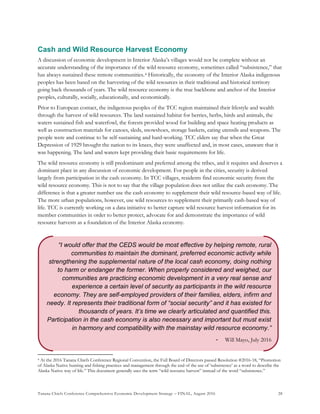
Cash and Wild Resource Harvest Economy
A discussion of economic development in Interior Alaska’s villages would not be complete without an
accurate understanding of the importance of the wild resource economy, sometimes called “subsistence,” that
has always sustained these remote communities.3F
4 Historically, the economy of the Interior Alaska indigenous
peoples has been based on the harvesting of the wild resources in their traditional and historical territory
going back thousands of years. The wild resource economy is the true backbone and anchor of the Interior
peoples, culturally, socially, educationally, and economically.
Prior to European contact, the indigenous peoples of the TCC region maintained their lifestyle and wealth
through the harvest of wild resources. The land sustained habitat for berries, herbs, birds and animals, the
waters sustained fish and waterfowl, the forests provided wood for building and space heating products as
well as construction materials for canoes, sleds, snowshoes, storage baskets, eating utensils and weapons. The
people were and continue to be self-sustaining and hard-working. TCC elders say that when the Great
Depression of 1929 brought the nation to its knees, they were unaffected and, in most cases, unaware that it
was happening. The land and waters kept providing their basic requirements for life.
The wild resource economy is still predominant and preferred among the tribes, and it requires and deserves a
dominant place in any discussion of economic development. For people in the cities, security is derived
largely from participation in the cash economy. In TCC villages, residents find economic security from the
wild resource economy. This is not to say that the village population does not utilize the cash economy. The
difference is that a greater number use the cash economy to supplement their wild resource-based way of life.
The more urban populations, however, use wild resources to supplement their primarily cash-based way of
life. TCC is currently working on a data initiative to better capture wild resource harvest information for its
member communities in order to better protect, advocate for and demonstrate the importance of wild
resource harvests as a foundation of the Interior Alaska economy.
4 At the 2016 Tanana Chiefs Conference Regional Convention, the Full Board of Directors passed Resolution #2016-18, “Promotion
of Alaska Native hunting and fishing practices and management through the end of the use of ‘subsistence’ as a word to describe the
Alaska Native way of life.” This document generally uses the term “wild resource harvest” instead of the word “subsistence.”
Tanana Chiefs Conference Comprehensive Economic Development Strategy – FINAL, August 2016 29
Income
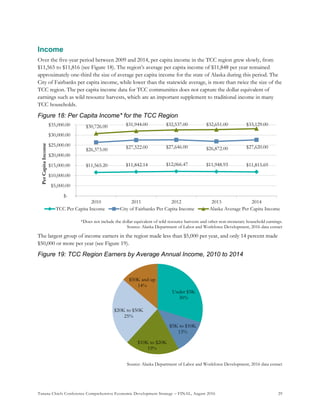
Over the five-year period between 2009 and 2014, per capita income in the TCC region grew slowly, from
$11,565 to $11,816 (see Figure 18). The region’s average per capita income of $11,848 per year remained
approximately one-third the size of average per capita income for the state of Alaska during this period. The
City of Fairbanks per capita income, while lower than the statewide average, is more than twice the size of the
TCC region. The per capita income data for TCC communities does not capture the dollar equivalent of
earnings such as wild resource harvests, which are an important supplement to traditional income in many
TCC households.
Figure 18: Per Capita Income* for the TCC Region
*Does not include the dollar equivalent of wild resource harvests and other non-monetary household earnings.
Source: Alaska Department of Labor and Workforce Development, 2016 data extract
The largest group of income earners in the region made less than $5,000 per year, and only 14 percent made
$50,000 or more per year (see Figure 19).
Figure 19: TCC Region Earners by Average Annual Income, 2010 to 2014
Source: Alaska Department of Labor and Workforce Development, 2016 data extract
$11,565.20 $11,842.14 $12,066.47 $11,948.93 $11,815.69
$26,373.00 $27,522.00 $27,646.00 $26,872.00 $27,620.00
$30,726.00 $31,944.00 $32,537.00 $32,651.00 $33,129.00
$-
$5,000.00
$10,000.00
$15,000.00
$20,000.00
$25,000.00
$30,000.00
$35,000.00
2010 2011 2012 2013 2014
PerCapitaIncome
TCC Per Capita Income City of Fairbanks Per Capita Income Alaska Average Per Capita Income
Under $5K
30%
$5K to $10K
13%
$10K to $20K
19%
$20K to $50K
25%
$50K and up
14%
Tanana Chiefs Conference Comprehensive Economic Development Strategy – FINAL, August 2016 30
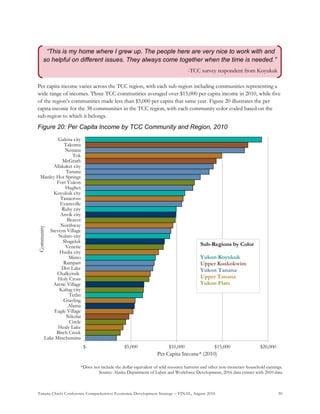
Per capita income varies across the TCC region, with each sub-region including communities representing a
wide range of incomes. Three TCC communities averaged over $15,000 per capita income in 2010, while five
of the region’s communities made less than $5,000 per capita that same year. Figure 20 illustrates the per
capita income for the 38 communities in the TCC region, with each community color coded based on the
sub-region to which it belongs.
Figure 20: Per Capita Income by TCC Community and Region, 2010
*Does not include the dollar equivalent of wild resource harvests and other non-monetary household earnings.
Source: Alaska Department of Labor and Workforce Development, 2016 data extract with 2010 data
$- $5,000 $10,000 $15,000 $20,000
Lake Minchumina
Birch Creek
Healy Lake
Circle
Nikolai
Eagle Village
Alatna
Grayling
Tetlin
Kaltag city
Arctic Village
Holy Cross
Chalkyitsik
Dot Lake
Rampart
Minto
Huslia city
Venetie
Shageluk
Nulato city
Stevens Village
Northway
Beaver
Anvik city
Ruby city
Evansville
Tanacross
Koyukuk city
Hughes
Fort Yukon
Manley Hot Springs
Tanana
Allakaket city
McGrath
Tok
Nenana
Takotna
Galena city
Per Capita Income* (2010)
Community
Sub-Regions by Color
Yukon Koyukuk
Upper Kuskokwim
Yukon Tanana
Upper Tanana
Yukon Flats
“This is my home where I grew up. The people here are very nice to work with and
so helpful on different issues. They always come together when the time is needed.”
-TCC survey respondent from Koyukuk
Tanana Chiefs Conference Comprehensive Economic Development Strategy – FINAL, August 2016 31
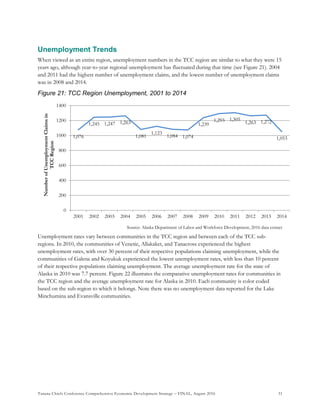
Unemployment Trends
When viewed as an entire region, unemployment numbers in the TCC region are similar to what they were 15
years ago, although year-to-year regional unemployment has fluctuated during that time (see Figure 21). 2004
and 2011 had the highest number of unemployment claims, and the lowest number of unemployment claims
was in 2008 and 2014.
Figure 21: TCC Region Unemployment, 2001 to 2014
Source: Alaska Department of Labor and Workforce Development, 2016 data extract
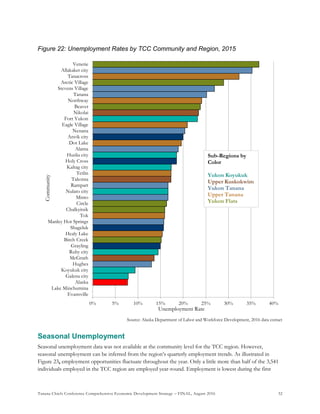
Unemployment rates vary between communities in the TCC region and between each of the TCC sub-
regions. In 2010, the communities of Venetie, Allakaket, and Tanacross experienced the highest
unemployment rates, with over 30 percent of their respective populations claiming unemployment, while the
communities of Galena and Koyukuk experienced the lowest unemployment rates, with less than 10 percent
of their respective populations claiming unemployment. The average unemployment rate for the state of
Alaska in 2010 was 7.7 percent. Figure 22 illustrates the comparative unemployment rates for communities in
the TCC region and the average unemployment rate for Alaska in 2010. Each community is color coded
based on the sub-region to which it belongs. Note there was no unemployment data reported for the Lake
Minchumina and Evansville communities.
1,076
1,245 1,247 1,263
1,081
1,123
1,084 1,074
1,239
1,293 1,305
1,263 1,272
1,053
0
200
400
600
800
1000
1200
1400
2001 2002 2003 2004 2005 2006 2007 2008 2009 2010 2011 2012 2013 2014
NumberofUnemploymentClaimsin
TCCRegion
Tanana Chiefs Conference Comprehensive Economic Development Strategy – FINAL, August 2016 32
Figure 22: Unemployment Rates by TCC Community and Region, 2015
Source: Alaska Department of Labor and Workforce Development, 2016 data extract
Seasonal Unemployment
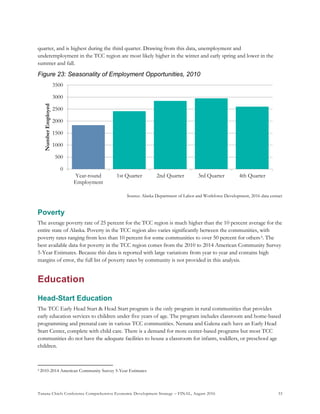
Seasonal unemployment data was not available at the community level for the TCC region. However,
seasonal unemployment can be inferred from the region’s quarterly employment trends. As illustrated in
Figure 23, employment opportunities fluctuate throughout the year. Only a little more than half of the 3,541
individuals employed in the TCC region are employed year-round. Employment is lowest during the first
0% 5% 10% 15% 20% 25% 30% 35% 40%
Evansville
Lake Minchumina
Alaska
Galena city
Koyukuk city
Hughes
McGrath
Ruby city
Grayling
Birch Creek
Healy Lake
Shageluk
Manley Hot Springs
Tok
Chalkyitsik
Circle
Minto
Nulato city
Rampart
Takotna
Tetlin
Kaltag city
Holy Cross
Huslia city
Alatna
Dot Lake
Anvik city
Nenana
Eagle Village
Fort Yukon
Nikolai
Beaver
Northway
Tanana
Stevens Village
Arctic Village
Tanacross
Allakaket city
Venetie
Unemployment Rate
Community
Sub-Regions by
Color
Yukon Koyukuk
Upper Kuskokwim
Yukon Tanana
Upper Tanana
Yukon Flats
Tanana Chiefs Conference Comprehensive Economic Development Strategy – FINAL, August 2016 33
quarter, and is highest during the third quarter. Drawing from this data, unemployment and
underemployment in the TCC region are most likely higher in the winter and early spring and lower in the
summer and fall.
Figure 23: Seasonality of Employment Opportunities, 2010
Source: Alaska Department of Labor and Workforce Development, 2016 data extract
Poverty
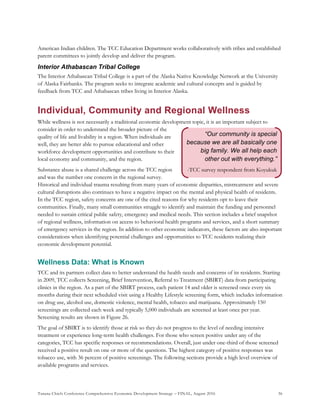
The average poverty rate of 25 percent for the TCC region is much higher than the 10 percent average for the
entire state of Alaska. Poverty in the TCC region also varies significantly between the communities, with
poverty rates ranging from less than 10 percent for some communities to over 50 percent for others4F
5. The
best available data for poverty in the TCC region comes from the 2010 to 2014 American Community Survey
5-Year Estimates. Because this data is reported with large variations from year to year and contains high
margins of error, the full list of poverty rates by community is not provided in this analysis.
Education
Head-Start Education
The TCC Early Head Start & Head Start program is the only program in rural communities that provides
early education services to children under five years of age. The program includes classroom and home-based
programming and prenatal care in various TCC communities. Nenana and Galena each have an Early Head
Start Center, complete with child care. There is a demand for more center-based programs but most TCC
communities do not have the adequate facilities to house a classroom for infants, toddlers, or preschool age
children.
5 2010-2014 American Community Survey 5-Year Estimates
0
500
1000
1500
2000
2500
3000
3500
Year-round
Employment
1st Quarter 2nd Quarter 3rd Quarter 4th Quarter
NumberEmployed
Tanana Chiefs Conference Comprehensive Economic Development Strategy – FINAL, August 2016 34
Primary Education
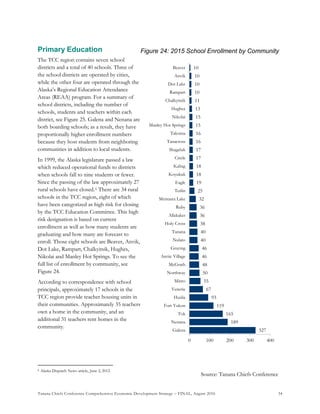
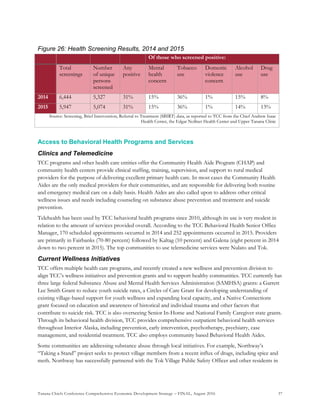
The TCC region contains seven school
districts and a total of 40 schools. Three of
the school districts are operated by cities,
while the other four are operated through the
Alaska’s Regional Education Attendance
Areas (REAA) program. For a summary of
school districts, including the number of
schools, students and teachers within each
district, see Figure 25. Galena and Nenana are
both boarding schools; as a result, they have
proportionally higher enrollment numbers
because they host students from neighboring
communities in addition to local students.
In 1999, the Alaska legislature passed a law
which reduced operational funds to districts
when schools fall to nine students or fewer.
Since the passing of the law approximately 27
rural schools have closed.5F
6 There are 34 rural
schools in the TCC region, eight of which
have been categorized as high risk for closing
by the TCC Education Committee. This high
risk designation is based on current
enrollment as well as how many students are
graduating and how many are forecast to
enroll. Those eight schools are Beaver, Anvik,
Dot Lake, Rampart, Chalkyitsik, Hughes,
Nikolai and Manley Hot Springs. To see the
full list of enrollment by community, see
Figure 24.
According to correspondence with school
principals, approximately 17 schools in the
TCC region provide teacher housing units in
their communities. Approximately 35 teachers
own a home in the community, and an
additional 31 teachers rent homes in the
community.
6 Alaska Dispatch News article, June 2, 2012.
Figure 24: 2015 School Enrollment by Community
327
189
165
119
93
67
55
50
48
46
46
40
40
38
36
36
32
25
19
18
18
17
17
16
16
15
15
13
11
10
10
10
10
Galena
Nenana
Tok
Fort Yukon
Huslia
Venetie
Minto
Northway
McGrath
Arctic Village
Graying
Nulato
Tanana
Holy Cross
Allakaket
Ruby
Mentasta Lake
Tetlin
Eagle
Koyukuk
Kaltag
Circle
Shageluk
Tanacross
Takotna
Manley Hot Springs
Nikolai
Hughes
Chalkyitsik
Rampart
Dot Lake
Anvik
Beaver
0 100 200 300 400
Source: Tanana Chiefs Conference
Tanana Chiefs Conference Comprehensive Economic Development Strategy – FINAL, August 2016 35
Figure 25: School Districts in the TCC Region
District Operator # of Schools # of Teachers # of
Students
Iditarod REAA 8 35 333
Galena City 4 71 4384
Tanana City 1 5 39
Yukon Flats REAA 7 30 247
Nenana City 2 29 1040
Yukon-Koyukuk REAA 10 60 1495
Alaska Gateway REAA 8 37 404
Totals 40 267 7,942
Source: Tanana Chiefs Conference
Secondary Education
Residents in the TCC region have a number of options for pursuing secondary education. In addition to the
following programs, TCC and other regional partners provides financial awards and assistance that help
residents pay for college, vocational education and workforce development.
Interior Alaska Campus
The Interior Alaska Campus (IAC), College of Rural and Community Development, is a distance education
program of the University of Alaska Fairbanks. The program offers distance education classes and operates
five rural centers in the TCC region, including McGrath, Nenana, Tok, Yukon Flats (Fort Yukon) and
Yukon-Koyukuk (Galena). IAC offers courses on workforce development, self-governance, and wellness and
rural human services.
Galena Interior Learning Academy (GILA)
Galena Interior Learning Academy is a statewide boarding school for grades 9-12 and offers post-secondary
adult vocational programs. Programs include aviation, culinary arts, health sciences, cosmetology and
automotive technology.
Tanana Chiefs Conference
TCC offers workforce development courses, a Job Placement and Training Program, a youth employment
program, youth leadership training opportunities, youth career exploration, adult vocational training and other
programs through its various departments, including its Education Department.
Johnson O’Malley (JOM) Program
Tanana Chiefs Education Department partners with various tribes each year to help implement Johnson-
O’Malley (JOM) Programs. In addition to the TCC-administered JOM funds, some tribes and school districts
administer their own JOM programs and funds. The purpose of the JOM program is to provide
supplementary financial assistance to meet the unique and specialized educational needs of Alaska Native and
“Graduation rates are still very low. Curriculum is irrelevant. There is not enough
indigenous integration into the school system.”
- TCC survey respondent from Fairbanks
Tanana Chiefs Conference Comprehensive Economic Development Strategy – FINAL, August 2016 36
“Our community is special
because we are all basically one
big family. We all help each
other out with everything.”
-TCC survey respondent from Koyukuk
American Indian children. The TCC Education Department works collaboratively with tribes and established
parent committees to jointly develop and deliver the program.
Interior Athabascan Tribal College
The Interior Athabascan Tribal College is a part of the Alaska Native Knowledge Network at the University
of Alaska Fairbanks. The program seeks to integrate academic and cultural concepts and is guided by
feedback from TCC and Athabascan tribes living in Interior Alaska.
Individual, Community and Regional Wellness
While wellness is not necessarily a traditional economic development topic, it is an important subject to
consider in order to understand the broader picture of the
quality of life and livability in a region. When individuals are
well, they are better able to pursue educational and other
workforce development opportunities and contribute to their
local economy and community, and the region.
Substance abuse is a shared challenge across the TCC region
and was the number one concern in the regional survey.
Historical and individual trauma resulting from many years of economic disparities, mistreatment and severe
cultural disruptions also continues to have a negative impact on the mental and physical health of residents.
In the TCC region, safety concerns are one of the cited reasons for why residents opt to leave their
communities. Finally, many small communities struggle to identify and maintain the funding and personnel
needed to sustain critical public safety, emergency and medical needs. This section includes a brief snapshot
of regional wellness, information on access to behavioral health programs and services, and a short summary
of emergency services in the region. In addition to other economic indicators, these factors are also important
considerations when identifying potential challenges and opportunities to TCC residents realizing their
economic development potential.
Wellness Data: What is Known
TCC and its partners collect data to better understand the health needs and concerns of its residents. Starting
in 2009, TCC collects Screening, Brief Intervention, Referral to Treatment (SBIRT) data from participating
clinics in the region. As a part of the SBIRT process, each patient 14 and older is screened once every six
months during their next scheduled visit using a Healthy Lifestyle screening form, which includes information
on drug use, alcohol use, domestic violence, mental health, tobacco and marijuana. Approximately 150
screenings are collected each week and typically 5,000 individuals are screened at least once per year.
Screening results are shown in Figure 26.
The goal of SBIRT is to identify those at risk so they do not progress to the level of needing intensive
treatment or experience long-term health challenges. For those who screen positive under any of the
categories, TCC has specific responses or recommendations. Overall, just under one-third of those screened
received a positive result on one or more of the questions. The highest category of positive responses was
tobacco use, with 36 percent of positive screenings. The following sections provide a high level overview of
available programs and services.
Tanana Chiefs Conference Comprehensive Economic Development Strategy – FINAL, August 2016 37
Figure 26: Health Screening Results, 2014 and 2015
Of those who screened positive:
Total
screenings
Number
of unique
persons
screened
Any
positive
Mental
health
concern
Tobacco
use
Domestic
violence
concern
Alcohol
use
Drug
use
2014 6,444 5,327 31% 15% 36% 1% 15% 8%
2015 5,947 5,074 31% 15% 36% 1% 14% 13%
Source: Screening, Brief Intervention, Referral to Treatment (SBIRT) data, as reported to TCC from the Chief Andrew Isaac
Health Center, the Edgar Nollner Health Center and Upper Tanana Clinic
Access to Behavioral Health Programs and Services
Clinics and Telemedicine
TCC programs and other health care entities offer the Community Health Aide Program (CHAP) and
community health centers provide clinical staffing, training, supervision, and support to rural medical
providers for the purpose of delivering excellent primary health care. In most cases the Community Health
Aides are the only medical providers for their communities, and are responsible for delivering both routine
and emergency medical care on a daily basis. Health Aides are also called upon to address other critical
wellness issues and needs including counseling on substance abuse prevention and treatment and suicide
prevention.
Telehealth has been used by TCC behavioral health programs since 2010, although its use is very modest in
relation to the amount of services provided overall. According to the TCC Behavioral Health Senior Office
Manager, 170 scheduled appointments occurred in 2014 and 252 appointments occurred in 2015. Providers
are primarily in Fairbanks (70-80 percent) followed by Kaltag (10 percent) and Galena (eight percent in 2014
down to two percent in 2015). The top communities to use telemedicine services were Nulato and Tok.
Current Wellness Initiatives
TCC offers multiple health care programs, and recently created a new wellness and prevention division to
align TCC’s wellness initiatives and prevention grants and to support healthy communities. TCC currently has
three large federal Substance Abuse and Mental Health Services Administration (SAMHSA) grants: a Garrett
Lee Smith Grant to reduce youth suicide rates, a Circles of Care Grant for developing understanding of
existing village-based support for youth wellness and expanding local capacity, and a Native Connections
grant focused on education and awareness of historical and individual trauma and other factors that
contribute to suicide risk. TCC is also overseeing Senior In-Home and National Family Caregiver state grants.
Through its behavioral health division, TCC provides comprehensive outpatient behavioral health services
throughout Interior Alaska, including prevention, early intervention, psychotherapy, psychiatry, case
management, and residential treatment. TCC also employs community based Behavioral Health Aides.
Some communities are addressing substance abuse through local initiatives. For example, Northway’s
“Taking a Stand” project seeks to protect village members from a recent influx of drugs, including spice and
meth. Northway has successfully partnered with the Tok Village Public Safety Officer and other residents in
Tanana Chiefs Conference Comprehensive Economic Development Strategy – FINAL, August 2016 38
“My community is an amazing
place because it has thousands
of years of our Alaska Native
history. There is a deep sense of
community and a commitment to
our culture.”
-TCC survey respondent from Northway
Tok and Tanacross and more than 70 people are involved in the project. Inspired in part by Northway, other
TCC communities in the region are considering similar initiatives.6F
7
In the TCC region, Housing First is a 47-unit supportive housing program for the chronic inebriate homeless.
All 47 units are occupied at TCC’s Housing First facility.
Residents receive access to medical services and have the
option of accessing alcohol treatment. Three tenants are
employed full-time and nine tenants have steady day labor
jobs. Six tenants have been sober for over a year and a half.
Emergency Services
Creating a safe community environment not only protects
citizens, it also helps promote economic growth. Residents
and businesses alike prefer living and operating in safe communities; crime, emergencies, and unpredictable
natural disasters such as fires and flooding can be a drain on financial resources and human capital. Local
emergency services in rural Alaska communities typically fall into two categories: public safety provided
through the Village Public Safety Officer (VPSO) Program and local/regional firefighting crews.
Public Safety
The Village Public Safety Officer (VPSO) Program is a statewide program through the State of Alaska
Department of Public Safety. The VPSO program works in conjunction with the Alaska State Troopers to
meet the public safety needs in rural communities. VPSOs are known as “The First Responders in the Last
Frontier,” as they respond to emergency calls related to law enforcement, fire, emergency medical services,
and search and rescue. Having the presence of a VPSO discourages crime and provides emergency response
services to villages. In 2015, TCC VPSOs responded to 3,075 calls for service, 288 of which were criminal
offenses and 190 of which were substance abuse related.7F
8
Finding adequate housing for VPSOs is a challenge for many TCC villages. To learn more about the VPSO
housing situation in the TCC region, see the TCC Regional Housing Strategy.
Fire Response
Most rural Alaska communities are remote and many have no road access, thereby making it a challenge to
adequately respond to a fire. Most villages do not have a fire hall and if they do the crew is completely
volunteer-based. In addition, many communities lack water trucks and other critical firefighting equipment.
Three TCC communities have formal fire departments, 25 have volunteer departments and 13 communities
do not have a formalized fire response program. Local VPSOs are trained as rural firefighters and can provide
additional fire suppression support and fire prevention, education and training.
7 For more information about these efforts, see the 2014 TCC Annual Report, available here: https://www.tananachiefs.org/wp-
content/uploads/2015/02/TCC-Annual-Report-2014.pdf
8 Source: Tanana Chiefs Conference 2015 Annual Report, available here: https://www.tananachiefs.org/wp-
content/uploads/2014/04/TCC-2015-Annual-Report.pdf
Tanana Chiefs Conference Comprehensive Economic Development Strategy – FINAL, August 2016 39
Chapter 3: Regional Survey Results
TCC’s member tribes are responsible for selecting TCC’s organizational priorities and setting the direction of
TCC. As a result, collecting input from tribal members is critical to the overall success and effectiveness of
this CEDS document. In order to collect feedback on ideas, opportunities and challenges from TCC
residents, the project team created and distributed a CEDS survey. The survey was emailed to tribal
administrators, posted on the TCC website, distributed at the annual TCC convention and passed out during
TCC staff visits to villages. Tribal members could respond online or by mailing or faxing hard copy versions.
The survey was open from mid-January 2016 to the end of March 2016. Overall, 347 people responded to the
survey; however, all questions were optional, so the actual response rate (“n”) varies between questions.
Who responded to the survey?
Figure 27: Age of TCC Survey Respondents
Figure 28: Number of Responses by Sub-Region
8.2%
19.3%
17.2%
20.2%
21.5%
9.4%
4.2%
18 to 24
25 to 34
35 to 44
45 to 54
55 to 64
65 to 74
75 or older
21 18
59 57
66
90
5
26
0
10
20
30
40
50
60
70
80
90
100
Lower
Yukon
Upper
Kuskokwim
Upper
Tanana
Yukon Flats Yukon
Koyukuk
Yukon
Tanana
Other Fairbanks
n = 342
n = 331
Tanana Chiefs Conference Comprehensive Economic Development Strategy – FINAL, August 2016 40
Figure 29: Employment Status
n = 332. Respondents were instructed to select all categories that apply, so the categories total to over 332.
Top responses for the “Other” category include part time employment and self-employment.
Figure 30: Industry of Employment - Top Results
n = 317. Respondents were instructed to select all categories that apply, so the categories total to over 317.
178
43
37
35
34
27
20
15
11
Permanently employed
Temporarily employed
Not employed, looking for work
Other (please specify)
Retired
Seasonally employed (e.g., commercial fishing)
Student
Disabled, not able to work
Stay-at-home, not looking for work
98
47 46
39
25 22 20 19 19 19 18 18 17 17 16 15 14 11 11
Tanana Chiefs Conference Comprehensive Economic Development Strategy – FINAL, August 2016 41
Figure 31: Word Cloud: what makes TCC communities special
Survey Feedback8F
9
Why do you
continue to live
here? What makes
your community
special?
Key concepts from the
survey include:
 I was born and raised here.
 My job is here.
 My family is here.
 My friends are here.
 Culture and subsistence/
wild resource harvests.
 Beautiful and quiet.
 Friendly people.
Supporting quotes from
the survey:
 My family lives here and I
have a job at the school.
The people make it special.
 I like the small and close
knit community. Koyukuk is a strong Koyukon Athabascan village and everyone still practices our
traditional ways
 The peace and quiet. We are a close knit community and work together.
 I continue to live here because I enjoy my land, hunting, fishing, camping and quietness.
 The basketball team. The location is amazing. The people.
 Peaceful and quiet. Love the village life. Beautiful community and everyone gets along and works
together.
 I recently moved back here after 20 something years. Eagle is so beautiful it just takes your breath away
and the people here are unique. Good hearted people that never try to gain anything from someone else.
 I love my community! I would never want to live elsewhere. I'm so proud to be from Huslia and am
happy to be raising my family here.
 I was raised here, going to fish camp every summer, I want the same for my children.
9 NOTE: the word clouds throughout this section are based on the combined comments from respondents to each question. The size
of a word is based on the frequency each word is mentioned in survey responses, with the largest words appearing most frequently.
Word clouds were generated using Tagul Word Cloud Art: https://tagul.com/
Tanana Chiefs Conference Comprehensive Economic Development Strategy – FINAL, August 2016 42
What are the biggest issues and challenges facing your community?
Key concepts from the
survey include:
 Substance abuse (alcohol
and drug use).
 Jobs.
 Housing.
 Abuse.
 Water and sewer.
 Economic challenges.
 Loss of traditions and
culture.
 Low school enrollment.
Supporting quotes
from the survey:
 The biggest issues and
challenges facing my
community are the lack
of housing, river erosion
threat, unemployment
rates, and drug and
alcohol abuse.
 Getting water and sewer
for homeowners, road
upgrades, housing and education along with practicing our culture and traditions.
 For our village I see the challenges being boredom, alcoholism and people never seeing changes so they
give up on trying to get involved. I also feel like the short hunting seasons make it really hard for us to
live a traditional lifestyle. The job market out here is next to nothing so trying to build a family and have
both people working is a challenge.
 Economics – we need to develop a wider economic base. We need jobs. We need job training and work-
force development. Housing is an issue - affordable housing.
 Economic viability. Our city is broken. Alcoholism, domestic abuse. Many young adults want a job but
are not willing to work and do a good job. Parents need to model how to work hard.
 Not enough jobs, housing is a big issue and having to go further from the village to live a subsistence
lifestyle. For instance, have to look further for moose, fish and berries. Climate change is affecting the
land around us. A lot of the young families leave our village for education and seeking work and some
just don't come back, so our population declines.
 Kids affected by various types of life trauma. Some adults struggling with substance addictions.
 Lack of school age students. Our school nearly closed down. We need to keep it open!
Figure 32: Word Cloud: biggest issues and challenges in
your community
Tanana Chiefs Conference Comprehensive Economic Development Strategy – FINAL, August 2016 43
What are the three most important projects that would improve life in
your community?
Key concepts from the
survey
287 responses related to
health, culture and wellness
 Includes substance abuse
(alcohol and drugs),
increased activities,
celebrating culture,
community centers,
improved elder care,
healthier lifestyles.
225 responses related to
business and workforce
development
 Includes training,
education, job creation,
better schools, tourism.
154 responses related to
infrastructure
 Includes road
improvements, water and
sewer improvements,
improved phone and internet connectivity, energy system upgrades.
147 responses related to land and housing
 Includes home construction and home maintenance.
62 responses related to natural resources and natural hazards
 Includes saw mills, renewable energy, oil and gas, and wild resource harvest protection.
What can be done to create stable jobs in the community? What types
of jobs are needed?
Key concepts from the survey
New industries and opportunities for business expansion
 Home construction
 Arts and crafts
 Manufacturing
 Food service, restaurants
 Agriculture and meat processing
 Child care
Figure 33: Word Cloud: Most important projects to improve
life in your community
Tanana Chiefs Conference Comprehensive Economic Development Strategy – FINAL, August 2016 44
 Tourism, including lodging, activities, food,
cultural tourism and museums (Iditarod,
railroad, Ice Classic)
 Grant writing and grant management
 Recreation activities: youth center
coordinator, recreation coordinator
 Maintenance, installation and operation of
biomass, solar and electric utilities
 Power plant operators and utility managers
Needed jobs
 Construction-related jobs such as plumbing,
electricians, pipefitters, carpentry
 Heavy equipment operators
 building maintenance, boiler maintenance
 Teacher's aides, teachers
 Health occupations: health aides, dentists,
home care workers, drug treatment specialists,
elder care
 Housekeepers
 VPSOs
 Water and sewer system construction,
engineering and operations
 Natural resource managers
Supporting quotes from the survey
 I would like to see parents working with their children to teach them value, respect and importance of
native living.
 Bring more jobs into the villages from the main TCC office in Fairbanks.
 There seem to be jobs available but people are not filling them. I think there is a certain population for
whom life is too easy and they don't have to work.
 There is no simple answer to these questions.
 Jobs that allow people to continue to live their traditional lifestyle.
 We need to create our own small businesses: tourism, crafts, dog mushing.
 Encourage people to be entrepreneurs, get jobs, invest in their families and communities.
 Entry level training/apprentice positions with upward mobility jobs.
 Our construction zone is so limited and with jobs cut on the North Slope, I notice more people waiting
for jobs. We need people who can fill specific jobs in the health field, technology, and to start small
businesses, such as mechanics, plumbing and electricians.
Tanana Chiefs Conference Comprehensive Economic Development Strategy –August 2016 45
Yes,
15.3%
No,
57.4%
n = 340
Sometimes
27.4%
Have you experienced any difficulty finding a job in the last 10 years?
What types of jobs were you seeking?
 29 (21 percent) were looking for “anything available”
 29 (21 percent) were looking for administrative, office,
clerical work
 24 (18 percent) were looking for construction, labor work
 15 (11 percent) were looking for employment related to
health, medicine, social work
 13 (9 percent) were looking for jobs involving operations,
mechanics, heavy equipment
Was the job…
 Permanent: 46 percent
 Temporary: 34 percent
 Seasonal: 34 percent
 Other: 10 percent
Why did you have difficulty?
 No position available: 49 percent
 Lack of training: 32 percent
 I don't know: 22 percent
 Lack of certification or specialization: 16 percent
 Scheduling conflicts: 6 percent
 Other (please specify): 25 percent
o Includes nepotism, too competitive, transportation
challenges, no GED, no driver’s license
Of the 135 who responded
“Yes” or “Sometimes”…
Tanana Chiefs Conference Comprehensive Economic Development Strategy –August 2016 46
What education and training would prepare you for the workforce?
Key concepts from the
survey
Improved access to
training
 Help with child care,
housing and
transportation for out-of-
community training.
 Help offsetting the costs
of training and school.
 Improved advertisement
and outreach of available
training programs.
 Offer more degrees and
classes online.
 Offer more courses
within villages.
 Increase on-the-job
training throughout the
region.
Needed types of training
by occupation
 Construction, trade skills
and labor.
○ Construction and construction management.
○ Carpentry, electrical, plumbing, pipe fitting, welding.
○ Heavy equipment operators, water, sewer and power plant operators.
○ Saw mill training.
○ Commercial driver’s license.
○ Road construction.
○ Engineers.
○ Hazardous Materials training and Hazard and Operability (HAZOP) training.
○ Mechanics, equipment operations and maintenance.
○ Firefighting.
 Health, Wellness and Safety.
○ Health aides.
○ Indian Child Welfare Act (ICWA) training, including more about court processes and documents.
○ Trauma-based education and support.
○ Substance abuse treatment and recovery.
Figure 34: Word Cloud: Education and training needed to
prepare for the workforce
Tanana Chiefs Conference Comprehensive Economic Development Strategy –August 2016 47
○ Alternative and traditional medicine, including yoga, herbal medicine and acupuncture.
○ Behavioral health, mental health, suicide prevention.
 Administrative, Computer and Business Skills.
○ Computer skills, including Microsoft Word and Microsoft Excel.
○ Accounting.
○ Grant writing and grant management.
○ Tribal management training.
○ Bookkeeping and filing.
○ Project management.
 Other
○ Teach financial skills such as banking, taxes and loans.
○ Encourage young people to consider careers as local teachers.
○ Tourism and hospitality training.
○ Business planning and training for new exports such as hide tanning, marijuana cultivation and local
resource manufacturing.
○ Renewable energy research and development.
○ Culinary arts training.
Improve job and college preparation
 Offer more vocational courses and trade skills in high school.
 Increase the number of residents with a high school diploma or GED.
 Offer youth mentorships and apprenticeships for young people interested in different careers.
 Offer classes on resume development, job searching and interview skills.
 Emphasize the need for work ethics such as reliability, customer service, cleanliness.
 Expand cultural education and native language programs in schools.
Willingness to Leave for Education, Training and Employment
Figure 35: Would you be willing to leave your community part time for education and/or
training?
n= 314
Yes, 64.6%
No, 14.0%
Maybe, 21.3%
Tanana Chiefs Conference Comprehensive Economic Development Strategy –August 2016 48
Figure 36: Would you consider a job that required you to travel outside the community,
such as...
n = 313
What factors affect your decision to leave for work or training?
Key concepts from the survey
Positive Factors and Benefits Negative Factors and Barriers
 Opportunity to travel and see new
places.
 Build job experience.
 Higher pay and benefits.
 Increased availability of jobs outside.
 Convenient location.
 Desirable/interesting jobs.
 Miss the community, don’t want to be away from
home.
 Concerns about being away from family.
 Child care availability and affordability.
 Proximity to quality education for family.
 Housing costs.
 Transportation costs.
 Want to contribute to the community and/or feel
needed in the community.
 Disruption of wild resource harvests and traditional
activities.
878789
53
6159
166
127
134
A two week on, two week off job?A part-time seasonal job?A full-time seasonal job?
No
Maybe
Yes
Tanana Chiefs Conference Comprehensive Economic Development Strategy –August 2016 49
Figure 37: Word Cloud: Factors affecting decision to
leave for training or job
Supporting quotes from the survey
 The chance to travel to
other communities,
meet new people and
learn new skills.
 We like living here –
moving to get a job is
not something we
would want to have to
do...unfortunately
many have had to
make that difficult
choice.
 Jobs that bring us back
to the community with
the ability to
contribute, such as
hazmat training
 My children, I want to
raise them in Nulato
and make more
positive changes
within my community.
 I don't want to leave
my son at home while
I travel for work for
long periods of time.
 My kids love it here. They wouldn't want to move. If the position benefited our community as a whole I
would be willing to apply for jobs outside the community.
 I live in Huslia. My husband works here full-time, and my two boys are here in our home. I did traveling
jobs up north when I was single and young, but that part of my life is done with now. I would like to stay
here in the village where my family and people are.
 If I could earn a livable wage and return home, if I could have a reasonable housing where I could work.
 Applying for jobs outside the community is an opportunity that has been there for 40 years. Although it
is a wealth creating opportunity - creating jobs in-community should be the focus and goal. If you have to
leave your community for any and all work, then you don't have a sustainable community.
 There are jobs in our village. We need alcohol and drug free workers!
Tanana Chiefs Conference Comprehensive Economic Development Strategy –August 2016 50
“I was raised here and
go to fish camp every
summer. I want the
same for my children.”
-TCC survey respondent
from Beaver
Chapter 4: Regional SWOT Analysis
To increase quality of life and support economic development, it is important to have a clear understanding
of a region’s current situation. In this document, an analysis of Strengths (S), Weaknesses (W), Opportunities
(O) and Threats (T), or “SWOT Analysis,” is used to create a picture of where the economy of the TCC
region is today. By understanding the key concepts in the SWOT, TCC villages can move strategically toward
economic resiliency, which is “the region’s ability to avoid, withstand and recover from economic shifts,
natural disasters and impacts of climate change.”9F
10 The TCC region can accomplish this by leveraging the
region’s existing strengths and opportunities and mitigating weaknesses and potential threats. The content in
this SWOT is used to identify and implement the goals, objectives and strategies in Chapter 4.
Strengths
Health, Culture and Wellness - Strengths
 The region has adaptive, resilient people with a rich cultural heritage who have maintained important ties
to language, wild resource harvests and cultural traditions.
 Many communities offer culture camps, health weeks and winter and spring carnivals.
 Recent improvements have been made to medical care access in
communities, including clinic improvements, increased provider
visits and increased use of telemedicine.
 Self-determination: tribes and tribal governments have the ability to
govern themselves and control the future of their communities.
 Tribal governments are recognized as sovereign entities by the U.S.,
and the federal government has trust responsibilities toward tribes,
which brings a significant amount of set aside funding.
 Many regional partners support health and wellness, including TCC,
the Fairbanks Native Association (FNA), the Chief Andrew Isaac Health Center and Denakkanaaga Inc.
 Many residents participate in regional and statewide events such as TCC’s Annual Convention, the Elders
and Youth Conference and the Alaska Federation of Natives Convention.
 The region has many strong leaders and advocates.
 The statewide Village Public Safety Officer (VPSO) program helps rural communities meet their public
safety and emergency response needs. According to the 2015 Annual TCC report, in VPSOs responded
to 3,075 calls for service in 2015.
 TCC tribes have increased self-governance efforts over the past ten years.
 The Morris Thompson Cultural and Visitor Center showcases Alaska Native culture in Interior Alaska
and promotes tourism.
10 As defined by the U.S. Economic Development Administration in the Comprehensive Economic Development Strategy (CEDS) Content
Guidelines. Updated March 2016. Available here: https://www.eda.gov/ceds/files/ceds-content-guidelines-full.pdf
Tanana Chiefs Conference Comprehensive Economic Development Strategy –August 2016 51
“The subsistence
here is a big
strength. You can
go right out your
back door and go
fishing or get a
caribou.”
-TCC interviewee from
Northway
“Each community has leaders that shine. They are able to step forward and make a huge
difference, just as one person. It’s really empowering and inspiring.
-TCC interviewee from Koyukuk
 Over the past five years, TCC has taken a multi-funding approach to financing capital projects for
Interior villages where small Legislative Capital Improvement Project (CIP) grants are being used to
leverage federal and foundation funds. State CIPs totaling $4,210,000 have or are leveraging $19,092,000
of non-state funds. Seven communities have recently completed new clinics and another three
communities are actively securing funding for new clinics.
 Community churches host events and are an important cultural resource. There are a total of 17 churches
in TCC villages.
 Most TCC villages have a current community plan.
 TCC has a Diabetes Program which provides quality, holistic, permission-based diabetes education and
prevention to beneficiaries across the TCC region including care coordination and ongoing support as
needed in a culturally-appropriate, community-driven manner. The Diabetes Program oversees a fitness
center in Fairbanks, free for tribal members and TCC staff.
 TCC’s sub-regional structure offers opportunities for communities to work together and address shared
concerns.
Natural Resources and Natural Hazards - Strengths
 Wild resource harvests provide healthy, affordable foods for many residents and are an important cultural
tradition in many households.
 Some communities are taking advantage of small export markets for birch products, arts and crafts, furs
and timber.
 National parks, wildlife refuges and state parks attract visitation, provide
employment, protect wild resource harvests and offer recreation
opportunities.
 The region has extensive mineral deposits. Based on U.S. Bureau of Labor
Statistics data, the region has a well-developed mining industry cluster,
meaning the region has a higher concentration of mining-related
establishments, employment and wages than other parts of the country. In
2012, the mining industry employed 240 people and paid over $21 million
in total wages in the Yukon-Koyukuk and Southeast Fairbanks Census
Areas.10F
11
 The region has better solar potential than Germany, which has more solar
installed per capita than any other country on the planet. The region also has large untapped biomass
potential.
11 U.S. Bureau of Labor Statistics, 2012 Quarterly Census on Employment and Wages
Tanana Chiefs Conference Comprehensive Economic Development Strategy –August 2016 52
Business and Workforce Development - Strengths
 The region’s Alaska Native Corporation, Doyon, is the largest private landowner in Alaska with 12.5
million acres of land and over 19,000 shareholders. Doyon invests in the region, funds education
programs and distributes annual dividends to shareholders. In 2014, Doyon disbursed over $9 million in
dividends.
 There are 30 village corporations in the TCC region. Village corporations support their communities in
many ways, including though dividends, scholarships, land management and employment opportunities.
 TCC offers education, workforce development and financial literacy programs and has financial
assistance for secondary education.
 The University of Alaska Fairbanks’ Interior Alaska Campus provides courses aimed at meeting the needs
of rural communities, including self-governance, construction and community health aide training.
 The Iditarod Sled Dog race brings visitation, tourism and publicity to TCC communities along the
Iditarod route.
 Self-employment numbers in the region remained steady between 2001 and 2011 at between 800-900
non-employer establishments, with an increase in self-employment receipts from approximately $23
million in 2001 to $29 million in 2011.
Infrastructure - Strengths
 There are three radio stations in the region; signals are rebroadcast to other communities.
 The Power-Cost Equalization (PCE) program helps reduce the cost of electricity in rural communities for
residential homes and eligible community buildings. According to the Interior Regional Energy Plan, all
TCC communities are eligible for the PCE program except for Nenana, who is connected to the Railbelt
electrical grid.
 State and federal government projects employ regional residents directly and bring in additional funds
through grants, infrastructure funding, statewide programs and more.
 Many communities in the region have tribal halls, which house tribal offices and often serve as
community gathering spaces.
 Many residents have access to local health care via community clinics.
Land and Housing - Strengths
 The region’s Alaska Native Corporation, Doyon, is the largest private landowner in Alaska with 12.5
million acres of land and over 19,000 shareholders.
 Village corporations own a combined 3.6 million acres in TCC communities.
 The TCC Cadastral Survey Program provides professional land surveying services.
 The Interior Regional Housing Authority (IRHA) and the TCC Housing Department offer services and
support to tribal councils to help with funding, grants and other housing related projects.
Tanana Chiefs Conference Comprehensive Economic Development Strategy –August 2016 53
“We have a big
problem with drugs
and alcohol coming
into our community.
That is our biggest
problem right now.”
-TCC survey respondent
from Huslia
Weaknesses
Health, Culture and Wellness - Weaknesses
 Many communities face high rates of depression, substance abuse, domestic violence and diabetes.
Substance abuse was the number one concern identified in the regional
survey.
 TCC schools are struggling with low graduation rates and declining
enrollment. Compared with the rest of Alaska, five-year estimates from
2010 to 2014 indicate that the TCC region has a larger proportion of the
population without a high school degree (17.5 percent compared with 8.2
percent statewide) and a smaller proportion of people with a Bachelor’s
degree or higher (10.1 percent compared with 27.7 percent statewide).
 Many TCC communities and residents struggle with ongoing negative
impacts to physical health, mental health and motivation due to historical
and individual trauma and disenfranchisement.
 At times, competition for funding and lack of collaboration between
community entities (tribes, village corporations and cities) in some villages.
 Limited early education programs and shortage of child care.
 Very few communities have available elder housing.
 High turnover of community health aides, largely attributed to the stress of the position.
 Limited access to fresh and healthy foods and an abundance of processed foods in village stores.
Natural Resources and Natural Hazards - Weaknesses
 Very cold winter temperatures and increasingly unpredictable weather throughout the year. In the winter
during periods of extreme cold, temperatures can dip below negative 60 degrees Fahrenheit.
 High competition for wild resources between commercial, sport, non-tribal and traditional hunters and
fishermen.
 Heavy reliance on wild resource populations such as animals, fish, plants and trees for timber, which are
subject to natural fluctuations and vulnerable to other external changes.
 In a recent report from the Alaska Energy Authority, the rural interior is the only region in Alaska that is
100 percent dependent on diesel for its electric production. As a result, the cost of diesel dictates the cost
of transportation, the cost of electricity, the cost of heating fuel and the costs of goods in interior villages.
Business and Workforce Development - Weaknesses
 Employment in the region has been slowly decreasing over the past 15 years, from 4,000 people
employed in 2000 to 3,600 in 2014.
 Per capita income has experienced slow growth over the past five years but remains low at an average of
$11,848. This is approximately one- third of the statewide per capita income and half of the per capita
income for the City of Fairbanks. Only 14 percent of residents made $50,000 or more per year.
Tanana Chiefs Conference Comprehensive Economic Development Strategy –August 2016 54
 An average of 25 percent of households experience poverty in the TCC region, compared with 10
percent for the state of Alaska. This number varies greatly between communities, ranging from under 10
percent to over 50 percent.
 Many jobs are seasonal in nature, and unemployment rises in the winter months. A little more than half
of the 3,541 people employed in the region are employed year-round. Overall unemployment rates have
stayed relatively constant since 2001, with wide variations in unemployment across TCC villages.
 Organizations and agencies in the region struggle to accurately capture traditional entrepreneurship and
wild resource harvest lifestyles or non-cash activities that contribute to individual, community and culture
vitality.
 Most residents lack access to start-up capital for small businesses, and many do not have adequate credit
to be eligible for a loan.
 Of existing job opportunities, many are minimum wage. Employers experience challenges attracting and
retaining qualified employees but do not have the resources for higher wages.
 Residents in some communities are concerned about nepotism and the lack of transparency in hiring
decisions made by local entities.
 Educational attainment in the TCC region is lower than the state averages, with a larger proportion of the
TCC population not completing high school, and a smaller proportion having earned a Bachelor’s degree
or higher when compared with the state average.11F
12
Infrastructure - Weaknesses
 The region experiences very high energy and fuel prices. According to the Alaska Housing Finance
Corporation 2014 Alaska Housing Assessment, the average energy cost for a home in the region is $8,046 –
the highest of any Alaska Native Claims Settlement Act (ANCSA) region in Alaska. The interior has 13
standalone electric utilities where the average costs per kilowatt hour are 56 percent higher than in
villages that are members of electric cooperatives.
 Villages that were electrified in the 1960s through the 1980s are now struggling to maintain electrical
infrastructure at the end of its design life. Many rural utilities have not kept repair and reserve accounts to
keep up with deferred maintenance, so electrical costs will need to go up to keep small electric utilities
operating.
 There are 13 communities in the TCC region with homes that do not have access to piped water.
Funding for Alaska Department of Environmental Conservation Village Safe Water capital projects has
declined severely while the estimated cost of addressing rural water and sewer needs has risen sharply.
 Construction costs are expensive due to high shipping and transportation costs and short building
seasons. During the construction season, there is often a shortage of workers.
 The construction and maintenance equipment in many TCC villages is old and in need of repair. When
equipment fails, delivering replacements and/or repairing existing equipment can be expensive,
logistically difficult and can cause delays during the short construction season.
 Internet connectivity is limited, slow and expensive.
 There is poor cell phone coverage throughout the region.
12 2010-2014 American Community Survey 5-Year Estimates, 2016 data extract
Tanana Chiefs Conference Comprehensive Economic Development Strategy –August 2016 55
“We need more
housing but are
running out of land.”
-TCC interviewee from
Holy Cross
 Many tribal office buildings and community halls were built in the 1970s and 1980s and are now in poor
condition, with expensive repairs needed and high energy costs.
 Postal mail service is often slow and unreliable.
 There are only 10 communities in the TCC region that are road accessible, and of those, several are only
accessible in the summer months. Air and barge transportation are both expensive, increasing the cost of
travel, goods and materials.
 The region has a small number of airline operators serving its communities. Flights are becoming
increasingly expensive and service is often unreliable.
 Tourism is limited by high transportation costs and limited accommodation options.
Land and Housing - Weaknesses
 Land and survey boundaries are unclear, unknown and undefined in many communities.
 In many villages, the ANCSA prescribed land transfer/conveyance process has not been completed, or
there are many absentee land lot owners holding title to valuable residential land lots.
 Twenty-three percent of households in the region are overcrowded and
30 TCC villages are experiencing a housing shortage.
 Many houses are in need of improvements and maintenance. Priority
concerns include indoor air quality, insulation, window, roofing, electrical
upgrades and mold. In some homes, residents pay as much or more for
their heating bills as they do for their mortgage.
 Communities have a limited availability of land, especially for residential
housing. In many communities the only available land is owned by the corporation or city.
 Many communities face a lack of housing for VPSOs, teachers and community health aides.
Opportunities
Health, Culture and Wellness - Opportunities
 A new TCC community health aide training center is being planned, which will provide increased training
capacity and an accelerated program.
 TCC has a Wellness Strategies for Health grant through the Alaska Native Tribal Health Consortium
(ANTHC) and the Center for Disease Control (CDC) to develop a program focused on addressing risk
factors associated with chronic diseases such as heart disease and diabetes.
 TCC has multiple suicide prevention initiatives underway, funded in part through three new grants.
 TCC has created an inter-departmental effort titled Reclaiming Our People. This effort focuses on reducing
the number and impact of social issues faced by people in the region, such as suicide, substance abuse
and crime while also focusing on promoting health and wellness. The Reclaiming Our People effort crosses
all TCC divisions and includes work done by Wellness and Prevention, Behavioral Health, the VPSO
Program, Tribal Courts, Family Services and Education.
Tanana Chiefs Conference Comprehensive Economic Development Strategy –August 2016 56
Natural Resources and Natural Hazards - Opportunities
 The National Flood Insurance Program (NFIP) provides flood insurance to communities that adopt and
enforce a floodplain management ordinance that meets program standards.
 Over the past five years there has been an increase in the availability of resources for documenting,
understanding and mitigating climate change impacts in Alaska through the Denali Commission,
ANTHC’s Local Environmental Observer (LEO) network and many other private, state and federally
managed efforts.
 The region is home to multiple potential new mining and resource projects, such as the proposed Donlin
Gold mine and a coal-to-liquids coal plant in Healy, Alaska. The Nenana Basin is also thought to include
coal bed methane, natural gas and oil.
 The Tanana Chiefs Conference Full Board of Directors passed Resolution No. 2013-19 to establish a
joint Hunting and Fishing Task Force. The founding resolution called for the Task Force to be a joint
effort, unifying the Interior Alaska Native voice. Subsequently, Doyon, Limited, Denakkanaaga, and
Fairbanks Native Association all passed partner resolutions supporting the joint Task Force.12F
13
 The traditional hunting and fishing practices of tribal members, including the harvesting and sharing of
fish, game, and other resources and the ceremonies which accompany these practices provide for the
social, cultural, spiritual, and economic wellbeing and survival of people and communities.
Business and Workforce Development - Opportunities
 There are many existing secondary education opportunities through TCC, the Galena Interior Learning
Academy, Johnson O’Malley and the University of Alaska Fairbanks and its related programs, including
the Interior Alaska Campus and the Interior Athabascan Tribal College.
 There is high regional demand for heavy equipment operators, mechanics, plumbers, commercial drivers
and small engine repair technicians, accountants, social service providers, carpenters, nurses, bookkeepers
and people with business training or experience.
 Locally sourced timber could be better utilized through the creation of sawmills, which would employ
residents and provide lower cost building materials.
 Consolidating small village utilities into larger consortia could reduce costs, increase efficiencies and
create more reliable management structures.
Infrastructure - Opportunities
 The State of Alaska Water Sewer Challenge is funding teams to develop and test innovative and cost
effective systems to provide water and sewer services to homes in rural Alaska.
 State, federal and regional partners are considering new road connections in the region, including the
Ambler Mining Road, the road to Tanana and connections in the Yukon-Kuskokwim Delta area.
 There have been many successful recent efforts to secure funding and construct community multi-
purpose centers in TCC communities.
13 To learn more about the task force, including task force members and strategies, visit
https://www.tananachiefs.org/advocacy/sustainability-policy-issues/hunting-and-fishing-task-force/
Tanana Chiefs Conference Comprehensive Economic Development Strategy –August 2016 57
 The Interior Energy Project, an effort to bring natural gas to Interior Alaska communities, may result in
lower residential and business energy costs.
 Many communities in the region have renewable energy potential, ranging from biofuels (wood),
hydroelectric from river currents, geothermal and wind. Technology is advancing and it is becoming
easier to integrate renewable energy into existing electric grids.
 There has been a recent increase in staffing and outreach for rural Alaska energy projects through the
Office of Indian Energy and USDA Rural Development programs.
 TCC has secured seats on the Native Nations Tribal Broadband Task Force and on the FirstNet Tribal
Working Group under the Federal Commerce Department to advocate for advancements in information
technology in tribal communities.
 Efforts to increase village broadband connectivity to the clinics are underway, which should eventually
lead the way for expansion to residential customers.
 Multiple statewide energy efficiency programs are available to support home energy efficiency upgrades
and weatherization.
 Annual Indian Community Development Block Grants are available for tribes to apply for. Between
2005 and 2015, communities in the TCC region have been successful in securing $12,774,840.00 in
ICDBG funding for residential and public infrastructure projects.
 According to a survey of tribal administrators, the region has high summer construction workforce
employment needs, with almost 600 potential jobs for the upcoming 2016 construction season.
Land and Housing - Opportunities
 There are continuing advancements in construction and building techniques for affordable, energy-
efficient and culturally appropriate house and building models for rural Alaska.
 The Fairbanks-based Cold Climate Housing Research Center (CCHRC) studies building models and
techniques to build more efficient, resilient homes in cold climates. CCHRC is working on projects with
the Yukon Flats School District, Galena and Venetie. In addition, their research has the potential to
benefit all TCC communities.
 Depending on the outcome of a district court case, the Bureau of Indian Affairs (BIA) may be able to
take land into trust for Alaska tribes, per the Indian Reorganization Act (IRA) of 1934. There are many
implications if tribes are able to place their tribal fee lands into trust including potential increases in
financial protections, greater local jurisdiction, increased grant eligibility and other benefits.
Tanana Chiefs Conference Comprehensive Economic Development Strategy –August 2016 58
“The issues associated
with negative self-
perception are often
the most powerful
obstacles and the
hardest to overcome
and are passed from
generation to
generation.”
-TCC survey respondent
from Tanana
Threats
Health, Culture and Wellness - Threats
 The TCC region saw a nine percent decline in population over the last
15 years, from 3900 people to 3540 people. Between 2014 and 2015,
all but one sub-region (Yukon Flats) had a net outward migration of
people. Decreasing population contributes to a number of issues,
including concerns about school closure for schools with enrollment
below the state-mandated minimum of ten students. Currently there
are eight schools in the region that have been categorized as high risk
for closing.
 The introduction of modern technology and the internet has eroded
knowledge of culture and tradition in some rural communities.
 Based on estimates provided by the Alaska Department of Labor and
Workforce Development, the population of residents over the age of
70 in the combined Yukon Koyukuk and Southeast Fairbanks Census
Areas is expected to double over the next 20 years. This increase in the senior population will likely result
in an increased demand for senior services and housing, which many communities already struggle to
provide.
 Over the years, the State of Alaska has consistently not recognized tribal governments as partners, nor is
there an acknowledgement and respect for tribal lands, tribal sovereignty, subsistence access and other
tribal priorities.
Natural Resources and Natural Hazards - Threats
 Climate change has already warmed Alaska by an average of three degrees Fahrenheit over the past six
decades, with estimates that interior Alaska will warm an additional six to eight degrees by the end of the
century.13F
14 Climate change brings many additional impacts to the region, including melting permafrost,
negative changes on wild harvest resources, erosion for communities along waterways, increase soot and
air quality impacts, increased wildfire risk and changing weather conditions, and effects on winter travel
routes. According to the Alaska Center for Climate Assessment and Policy, the average wildfire area
burned per decade in Alaska is projected to double by the middle of this century.
 Yukon and Kuskokwim River salmon populations have been declining drastically since 1998, resulting in
declines in allowable subsistence and commercial catch. In 2015, the region experienced a dramatic total
shutdown of subsistence fishing for Chinook (King) salmon.
 The TCC region has several fault systems with the potential for major earthquakes; for example, in 2002
a magnitude 7.9 earthquake occurred along the Denali Fault.14F
15
14 Climate Change Impacts in the United States: The Third National Climate Change Assessment. 2014. Published by the National
Climate Assessment and Development Advisory Committee. Available here: http://www.globalchange.gov/node/2939
15 15 Alaska Earthquake Center. Why Earthquakes Happen in Alaska. 2015. Available at
http://earthquake.alaska.edu/earthquakes/about.
Tanana Chiefs Conference Comprehensive Economic Development Strategy –August 2016 59
“With only 300 or so residents in my community, local businesses don't have much of a
customer base to rely on to generate enough income to be in business.”
-TCC survey respondent from Northway
 Many TCC communities are located alongside riverbanks or deltas and are susceptible to flooding as a
result of ice jams, snow, glacial melts, rising sea levels and heavy rainfall. According to correspondence
with villages, approximately 20 TCC communities are at risk of annual flooding.
 Road projects open up outside hunting and fishing access to traditional wild resource harvesting areas
and could impact species that are important for wild harvests.
 Continued high worldwide oil prices and long-term declines in statewide oil exploration and production
will likely result in a decrease in the availability of oil industry jobs for Alaska residents.
 Mining and resource extraction efforts in the region are a potential source of income but also bring a
variety of environmental risks and can undermine traditional ways of life.
Business and Workforce Development - Threats
 Given the State’s budget deficit, there will likely be some combination of an income tax, a sales tax,
reduced Permanent Fund dividends or other changes that will impact household income for all Alaska
residents. Other State policy changes may impact the ability to recruit, retain and expand businesses in
the interior.
Infrastructure - Threats
 Communities in the region heavily rely on federal funding, including resources for tribal operations,
transportation projects and maintenance and capital project funds.
 The Alaska Department of Transportation and Public Facilities has proposed closing six maintenance
camps throughout the state, including three that would impact the TCC region.
 Potential cuts to the Alaska Bypass mail program could impact rural air carriers, rural residents and
stores, reducing the affordability of air travel and air cargo deliveries.
 Some rural electric utilities in TCC communities are on the verge of bankruptcy and struggle to maintain
local utility infrastructure. Stand-alone utilities also lack oversight by any regional electric utility.
Land and Housing - Threats
 High cost of living makes it harder for residents to remain in the region and threatens quality of life.
According to the Partnership for Sustainable Communities’ Location Affordability Index, both the
Yukon-Koyukuk Census Area and the Southeast Fairbanks Census Area have a higher affordability index
than both the City of Fairbanks and the statewide average, meaning residents in those areas spend a
higher proportion of income on housing and transportation.
 Heavy reliance on federal funding for tribal programs, including housing programs that have
independently been unsuccessful at addressing housing needs in the region.
Tanana Chiefs Conference Comprehensive Economic Development Strategy –August 2016 60
“We need community
organizations and tribes
that run effectively,
efficiently and
sustainably.”
-TCC interviewee from
Koyukuk
Chapter 5: Regional Future Direction
Tanana Chiefs Conference Regional Vision
Statement
Healthy, Strong, Unified Tribes.
Goals, Objectives and Strategies
The following goals, objectives and strategies come from interviews, survey results and a review of relevant
regional planning documents. Priority strategies are marked with a (*).
Some strategies received a large amount of support in interviews and the
regional survey, but were not selected as priority CEDS priorities
because they are not specifically related to economic development, job
creation and regional wealth. These strategies are marked with a (▲).
In addition to these region-wide priorities, there is a full list of economic
development priorities for each community in the appendix. This list
was developed with help from tribal administrators and other
community leaders.
GOAL #1: Promote Healthy Communities and a Strong Quality of Life
Objective A: Self-Sustaining Local Governments
1. Move forward with self-governance efforts and independent control of tribal funds. (Priority Strategy A*)
2. Conduct asset-building motivational workshops in TCC communities to identify what skills and
resources exist and encourage team-building across community entities.
3. Encourage school districts to incorporate tribal government programming into the curriculum, including
information about ANCSA and how tribal governance works.
Objective B: Healthy Communities
1. Increase the availability of alcohol treatment services in the region and improve outpatient support for
those returning to villages after treatment. (▲)
2. Investigate options to develop additional long-term care facilities for elders in underserved sub-regions.
3. Expand fire response programs and facilities in TCC communities.
4. Continue to improve access to telemedicine in rural clinics.
5. Improve support for community health aides, including encouraging tribal councils to have listening
sessions with health aides to understand their concerns and identify ways to better support them.
6. Continue to support the construction of community centers for villages without a central gathering space.
7. Support local agriculture, including the construction of greenhouses and community gardens.
8. Expand policing and VPSO programs to increase rural law enforcement in Interior Alaska.
Tanana Chiefs Conference Comprehensive Economic Development Strategy –August 2016 61
“We need to re-link kids and
young adults with their identity
and culture. We need to provide
culturally relevant and drug free
activities to help them get on
track, boost self-esteem and
develop coping skills.”
-TCC interviewee in Fairbanks
(from the Upper Tanana subregion)
Objective C: Strong Cultural Traditions and Community Heritage
1. Develop tools to assess and clearly communicate the
economic value of wild resource harvesting and other
traditional cultural practices. (Priority Strategy B*)
2. Expand the number of wellness weeks, culture camps and
other community building activities throughout the region.
(▲)
3. Conduct culture, wild resource harvest and language
programs, including activities that strengthen youth and
elder communications and mentoring.
GOAL #2: Strengthen Traditional and Non-Traditional Businesses and
Develop a Stronger Workforce
Objective A: Improved Regional and Community Coordination on Economic
Development Efforts
1. Collaborate region wide to build on current and emerging business opportunities. (Priority Strategy C*)
2. Improve communications and increase coordination between local community entities (tribes, village
corporations and municipalities). (▲)
3. Identify TCC jobs that can be done remotely from villages instead of in Fairbanks.
4. Expand strategic partnerships by participating in regional, statewide and federal conversations to advance
tribal and rural priorities.
Objective B: Thriving Business Development and Entrepreneurship
1. Create a sustainable model to increase tribal capacity for management and construction of capital
improvement projects.
2. Develop and grow cultural and ecotourism.
3. Identify potential industries to base in communities.
4. Encourage residents to pursue traditional self-employment and self-sufficiency activities through the
harvest of wild resources.
5. Continue to pass on the knowledge of wild resource harvesting as a form of traditional self-employment
and self-sufficiency.
6. Strive to reduce the costs of heating and electricity to reduce the high burden of energy costs on local
businesses (see also Goal 3 Objective A).
7. Develop culturally-appropriate resource development opportunities.
Objective C: An Educated, Motivated Workforce
1. Expand existing education and workforce development opportunities. (Priority Strategy D*)
Tanana Chiefs Conference Comprehensive Economic Development Strategy –August 2016 62
“We need to re-instate
vocational training into our
schools. For some reason it
has been taken out. We need
to start training the youth at a
younger age, encourage them
to become employed and be
an effective community
member.”
-TCC interviewee from Fort Yukon
2. Encourage residents to consider secondary education
and/or training for jobs with high regional demand,
including construction-related occupations (heavy
equipment operators, carpenters, plumbers, electricians, pipe
fitters, commercial drivers, welders, hazardous materials
training), equipment and building operations and
maintenance, power plant operators and utility managers,
teachers, VPSOs, natural resource managers, accountants,
water/sewer operators, foresters, health occupations (health
aides, dentists, drug treatment specialists, nurses, elder care),
bookkeepers, people with business experience and training
related to food service, tourism, grant writing, bookkeeping,
child care, computer skills and renewable energy. (▲)
3. Continue to offer and expand the TCC welfare/job trade program, where program participants are given
training and then have five months paid time toward a job in the community as an alternative to receiving
welfare payments.
4. Work with tribal councils to establish policies that discourage nepotism and ensure governance is
transparent and has systems in place to fairly resolve conflicts.
5. Reduce barriers to training participation, such as offering guidance and support for child care, housing
and transportation costs to out-of-community trainings.
6. Advocate for increased Johnson O’Malley funding and encourage more TCC tribes to apply for and
utilize the program.
Objective D: Residents have Basic Financial Skills
1. Increase financial literacy in the region through youth-oriented classes in schools and adult-focused
programs. (▲)
2. Continue to expand the free tax service prep services provided by the Alaska Business Development
Center to ensure residents get proper tax returns.
GOAL #3: Support the Development, Maintenance and Improvement
of Critical Community and Regional Infrastructure
Objective A: Region-wide Access to Reliable, Affordable Energy Sources
1. Implement energy efficiency improvements and alternative energy systems. (Priority Strategy E*)
2. Form regional purchasing groups to conduct bulk fuel purchases to increase purchasing power and help
lower fuel prices.
3. Working with Alaska Energy Authority and other community partners, facilitate ongoing conversations
around energy opportunities, challenges and potential projects with leaders, communities and energy
providers in the region. Consider the creation of sub-regional energy working groups.
4. Support efforts to replace old generators and to upgrade power systems.
5. Support exploratory efforts in the Nenana Basin, and participate in conversations regarding resource
development projects that are located in the TCC region.
6. Support the Interior Energy project and efforts to bring natural gas to the area.
Tanana Chiefs Conference Comprehensive Economic Development Strategy –August 2016 63
Objective B: Communities have Adequate and Reliable Infrastructure
1. Expand community infrastructure to support increased viability of local jobs. (Priority Strategy F*)
2. Improve transportation routes and expedite delivery of goods and quality services to TCC communities.
(Priority Strategy G*)
3. Encourage better coordination between community entities to reduce transportation and shipping costs,
such as by sharing air cargo charters and sharing heavy equipment and materials for projects. (▲)
4. Increase safety along snowmachine trails by increasing signage along key routes.
5. Investigate the feasibility of TCC barge service or of creating sub-regional barge businesses to lower
costs.
6. Identify cost-effective ways to improve village roads, including through equipment-sharing and road
maintenance training.
Objective C: Region-wide, Cost Effective, Sustainable Water and Sewer
Infrastructure
1. Track the outcomes of the Alaska Water Sewer Challenge and support installation of the final technology,
once developed. (▲)
2. Advocate for continued funding of the Village Safe Water program and offer technical assistance to
communities seeking program funding. (▲)
Goal #4: Expand Housing Supply
Objective A: Affordable Housing Available for All Residents
1. Increase availability of affordable housing. (Priority Strategy H*)
2. Support efforts to identify housing options for VPSOs, community health aides and teachers where
necessary. (▲)
3. Establish shared community wood lots for residents to collect firewood and timber to reduce home
heating costs and construction material for infrastructure and construction projects.
4. Encourage residents who have the financial resources for constructing their own houses to collaborate
with one another on small-scale housing projects.
5. Work with partners such as the Cold Climate Housing Research Center to design housing prototypes for
super energy efficient small homes suitable for the culture and climate.
Objective B: Existing Homes in the Region are Safe and Well-Maintained
1. Offer education and technical assistance related to energy efficiency and weatherization, including
information on the availability of programs and funding, the potential cost savings and where to find
funding.
2. Invite representatives from education and research institutions to give community wide presentations on
basic home maintenance and repair, weatherization, stove repair, fire safety, emergency preparedness and
other related topics.
3. For an extensive list of housing resources and needs, see the TCC Regional Housing Strategy.
Tanana Chiefs Conference Comprehensive Economic Development Strategy –August 2016 64
“We need education on how
natural resources can be
developed without losing the
lifestyle and the traditions that
communities value. Even
subsistence hunting and
fishing requires money for gas
and equipment, so you need
some sort of economy.”
-TCC interviewee from Galena
Goal #5: Promote a Healthy Environment and Carefully Manage
Natural Resources
Objective A: Healthy and Resilient Environment
1. Support emergency preparedness in TCC communities through hazard mitigation planning, emergency
response planning, and other resilience-building efforts.
2. Support efforts to research and strengthen salmon stocks on the Yukon and Kuskokwim Rivers, and
advocate for increased tribal participation in management decisions.
3. Encourage tribal members and community environmental coordinators to participate in ANTHC’s Local
Environmental Observer (LEO) network.
4. Collect data on climate change impacts to wild resource harvests within the region.
Objective B: Sustainable use of Natural Resources to Support Community
Economies
1. Protect tribal land ownership.
2. Encourage efforts to take over management of local resources
by village entities from federal and state agencies. (▲)
3. Build local capacity in natural resource management, especially
with local village corporations.
4. Manage local forests to maximize productivity of local biomass
for heating and saw timbers and to reduce threats from
wildfires.
5. Encourage local agriculture efforts by providing additional
training and resources to interested communities, and explore
the feasibility of small scale meat production.
6. Advocate for increased tribal involvement in conversations around potential mining and resource
extraction projects.
Tanana Chiefs Conference Comprehensive Economic Development Strategy –August 2016 65
Chapter 6: Action Plan and Performance
Measures
The process for implementing this CEDS includes developing an action plan of “priority actions” that
support priority strategies identified in the CEDS. This action plan takes into account existing and anticipated
resources and will provide direction to TCC leadership, staff and member tribes. The action plan also
identifies performance measures so tribal members, TCC staff, businesses and partners have a detailed picture
of what the region hopes to accomplish and to better track progress being made on the CEDS. Annual
updates will include a summary of actions taken and progress made toward CEDS-identified goals and
objectives.
Below is the list of priority strategies. These strategies were repeated multiple times during the planning
process. In addition, the priority strategies were selected because they are quantifiable and have the potential
to create jobs and grow regional wealth. TCC staff helped select the final priorities using the following
criteria:
 Will the strategy create new jobs and/or grow
regional wealth?
 Does the strategy align with our economic
vision?
 Are there any likely partners, including
nontraditional and private sector partners?
 Is there high regional demand/need/support
for the strategy?
 Does the strategy take advantage of existing
strengths/opportunities?
 Will the strategy have a broad impact?
 Does the strategy address a time sensitive
need?
 Do we have the available resources to
accomplish the strategy: funding availability,
staff capacity?
For each strategy, there is an associated list of potential partners and performance measures. Potential
partners include organizations, agencies, businesses and communities who may be able to provide resources,
expertise and support to help TCC with implementation for each priority strategy. Performance measures
include a mix of short, medium and long-term measures. Current trend information related to each strategy is
available in the background section of this document. As additional research and feasibility assessments are
completed, TCC will define anticipated outcomes, job creation estimates and anticipated costs for each
strategy.
Goal #1 Promote Healthy Communities and a Strong Quality of Life
Priority Strategy A: Move forward with self-governance efforts and independent control
of tribal funds.
Actions and Implementation Timeline
Year One:
 Develop an equipment inventory for each community.
Tanana Chiefs Conference Comprehensive Economic Development Strategy - August 2016 66
Year Two:
 Advocate reducing the sale of native allotments to individuals who are not tribal members and/or Alaska
Native.
 Initiate strategic plan development with three tribal councils.
 Develop an equipment needs assessment for each community.
Year Three:
 Complete three strategic plans.
 Research funding opportunities for the purchase of equipment.
 Prepare proposals for funding opportunities for the purchase of tribally-owned construction and
maintenance equipment.
Year Four:
 Initiate implementation of strategic plans.
Year Five:
 Initiate strategic plan development with three different tribal councils.
Ongoing
 Engage with potential partners to build relationships to encourage self-governance and independent
control of tribal funds.
 Advocate for an increase in Bureau of Indian Affairs (BIA) Tribal Priority Allocation (TPA) baseline
funding and housing-related funds available to tribal housing authorities.
 Support tribes with self-assessment and moving forward with self-governance goals through strategic
planning, including: development of strategic plans and identifying priorities, succession/transition
planning, annual operation budgets and identifying ways to fill open tribal administrator positions.
 Encourage training opportunities for tribal administrators and administrative assistants.
 Encourage tribes and sub-regions to advocate for funding at the regional, statewide and the national level.
 Promote community/tribal ownership of construction and maintenance equipment.
 Implement land buy-back resolution that reduces the sale of native allotments to individuals who are not
tribal members and/or Alaska Native. As part of existing policy, implement first right of refusal.
Lead: TCC Tribal Development Division.
Potential Partners
Tribes, Bureau of Indian Affairs (BIA), Department of Housing and Urban Development (HUD), Tribal
Transportation Program (TTP), Alaska Native Tribal Health Consortium (ANTHC), Rasmuson Foundation,
Economic Development Administration (EDA), Interior Alaska Campus (IAC), Doyon Limited,
Environmental Protection Agency (EPA), unions, village and regional corporations, city governments, State
of Alaska.
Various departments at TCC currently partner with these potential partners in training, conferences, projects
and funding opportunities. TCC will continue to develop these relationships in implementing the self-
governance strategy.
Tanana Chiefs Conference Comprehensive Economic Development Strategy - August 2016 67
Performance Measures
 Net increase in self-governance funds and/or percentage of tribes who are receiving self-governance
funds.
 Increased number of tribal jobs in TCC communities.
 Completion of three Tribal Council Strategic Plans and initiation of three other plans.
Estimated Costs
 Approximately $160,000 for short-term filling of tribal administrator positions.
 Approximately $15,000 per village-based planning position for 400 contract hours to develop a strategic
plan.
 Other costs will be defined during CEDS implementation through feasibility assessments, program
design and additional research.
Estimated Jobs
Tanana Chiefs Conference estimates approximately 30 new jobs will be created as a result of this strategy.
Priority Strategy B: Develop tools to assess and clearly communicate the economic
value of wild resource harvesting and other traditional cultural practices.
Actions and Implementation Timeline
Year One:
 Secure funding for programming and management of collected data.
 Identify and hire a program manager.
 Develop a wild resources calculator and TCC wild resource harvest data initiative to formally quantify,
define and thus manage the traditional wild resource (subsistence) economy and effectively define the
relationship between the wild resource economy and cash economy for families and their rural
communities.
 Employ four facilitators (rural staff) that would work in the villages introducing the program and helping
people learn how to use it and assisting those with no access to online technology.
 Identify travel costs for facilitators to each community.
 Develop support infrastructure, including access to the internet (to include cell phone data access) so
people can create their account (as easy as creating a Yahoo or Gmail account) and answer resource
harvest questions. For those that do not have access to the internet, they could use public facilities,
including school and library internet. Consider dedicating satellite internet systems to this initiative for
persons/communities with no access to the internet.
 Introduce and beta test the process with selected communities. Review user feedback and make software
adjustments/enhancements as needed.
 Identify personnel training needs and a data management strategy.
 Develop an incentive program for community participation to encourage people to record data.
Tanana Chiefs Conference Comprehensive Economic Development Strategy - August 2016 68
Year Two:
 Secure funding for the development of major software platforms for mobile devices to enhance user
friendliness. The initial program will use a web browser format users can access via personal devices such
as a tablet, laptop or cell phone.
 Introduce and launch the data collection process to all TCC communities. If TCC wide launch already
accomplished and software is ready, launch statewide (once mobile device apps are tested and ready).
 Secure funding for administration and facilitators of further expansion (use) in communities.
 Enhance incentive programs for encouraging community participation.
Year Three:
 Incorporate the new program/tool into tribal management. Educate staff on how to use the data in their
duties and in dialogue with other agencies.
 Expand partnerships with research and educational programs, including universities.
Year Four:
 Actively promote wild resource management policy to state and federal management partners.
 Explore the possibility of exporting wild resource harvest data collection and management to other
regions outside Alaska.
Year Five:
 Launch (export) of comprehensive wild resource management to other governments outside of Alaska.
 Continued enhancement of wild resource management in all regions of the state of Alaska with
engagement of agencies in how they assess and evaluate poverty and employment in rural Alaska.
Ongoing
 Collaborate with agencies to better assess and evaluate poverty and employment levels within the dual
wild foods/cash economies in rural Alaska in order to better account for families/communities with
heavy reliance on wild resource harvests and provide agencies with accurate documentation for
recognizing the significance/needs of wild resources in the dual rural Alaska economies.
 Develop a comprehensive description of the wild resource economy that can inform economic policy.
Lead: TCC Tribal Client Services Department.
Potential Partners
TCC Wild Resource Management Program, tribes, elders, Morris Thompson Cultural Center, University of
Alaska Fairbanks, Doyon, Limited, Denakkanagaa, Alaska Department of Fish and Game, Department of the
Interior.
Performance Measures
 Improved wild resource harvest data and management tools.
 Number of TCC communities that collect wild resource harvest data.
 Tribal, state and federal partners use wild resource harvest data to inform management and policy.
Tanana Chiefs Conference Comprehensive Economic Development Strategy - August 2016 69
Estimated Costs
 Initial programing/database management costs (browser based): $125,000
 Rural facilitators costs for up to four facilitators (one year): $160,000
 Program facilitator (part time first year): $40,000
 Rural and program facilitator’s travel costs: $110,000
 Additional costs will be defined further during CEDS implementation through feasibility assessments,
program design and additional research.
Estimated Jobs
TCC estimates approximately 10 new jobs for this strategy.
 First year – Programmers (2), Program Manager (1), Facilitators (4)
 Second year – Nutritionist (2), Statistician (1)
Goal #2 Strengthen Traditional and Non-Traditional Businesses and
Develop a Stronger Workforce
Priority Strategy C: Collaborate region wide to build on current and emerging
business opportunities.
Action and Implementation Timeline
Year One:
 Meet with sub-regional advisory groups to review the full TCC CEDS and develop specific, project-
focused economic development plans by sub-region that align with the unique assets and opportunities
within each region. Collaborate with sub-regional groups to develop action plans to accomplish priority
projects.
 Build relationships with local organizations that develop and review business plans.
 Engage with local organizations to help support agriculture in TCC region.
 Engage village corporations in potential business development.
 Leverage cultural knowledge for economic benefit by encouraging communities to pursue cultural
tourism events, activities and workshops.
Year Two:
 Research successful timber and gravel industries within and in other regions, how they relate to Alaska,
and the impact of a fully developed timber and gravel extraction industry in Alaska.
 Develop small business development training curriculum specific to TCC communities.
 Begin planning process of TCC/Doyon Marketplace Regional Challenge. The preliminary concept: a
multi-phase competition where entrepreneurs can submit business ideas, develop an initial business plan
with help from the TCC Economic Development Specialist, and submit a detailed business plan in a
competition. The “best business plan”, or grand prize winner would be eligible for up to $20,000 in seed
money to start a business.
 Research and apply for agriculture funding.
Tanana Chiefs Conference Comprehensive Economic Development Strategy - August 2016 70
Year Three:
 Research and apply for funding opportunities to support TCC/Doyon Marketplace Regional Challenge.
 Hire a regional timber and gravel extraction coordinator.
 Develop a gravel extraction strategy, including which communities have gravel extraction needs, locations
of viable gravel sites and potential business partnerships.
 Initiate biannually small business development trainings.
Year Four:
 Implement the TCC/Doyon Marketplace Regional Challenge.
 Develop and distribute small business newsletter for the TCC region.
Year Five:
 Increase the number and production capacity of small-scale timber mills.
○ Establish a timber industry group.
○ Educate local businesses and contractors on how to build and operate a successful timber mill,
including case studies and lessons learned from other communities in the region.
○ Involve village corporations in natural resource management and harvest plans.
Ongoing:
 Implement action plans developed by sub-regional advisory groups.
 Implement TCC/Doyon Marketplace Regional Challenge.
 Inform and provide communities with small business planning, construction and other trainings.
 Market small business development training opportunities to communities in the TCC region.
 Assist tribes with business climate strategies and local economic development plans.
Lead: TCC Planning and Development Program.
Potential Partners
Tribes, village corporations, Interior Alaska Campus, Interior Regional Housing Authority, Bureau of Indian
Affairs, Doyon Limited, city governments, contractors.
Performance Measures
 Increase the number of timber mills in TCC communities.
 Increase the number of people employed in the timber industry.
 Reduce the cost of timber for construction projects.
 Increase the employment rate among workforce-age residents.
Estimated Costs
 Initial startup costs for TCC/Doyon Marketplace Regional Challenge: $100,000
 Travel Costs for TCC/Doyon Marketplace Regional Challenge participants: $30,000
 Travel Costs for sub-regional advisory group: $60,000
 Regional Timber and Gravel Extraction Coordinator: $56,000
Tanana Chiefs Conference Comprehensive Economic Development Strategy - August 2016 71
 Additional costs will be defined further during CEDS implementation through feasibility assessments,
program design and additional research.
Estimated Jobs
TCC estimates approximately 2 new jobs for this strategy.
 Regional Timber/Gravel Coordinator (1).
 Marketplace Challenge winner (1).
 In addition, timber and mining jobs will likely be created as a result of this strategy. Specific estimates will
be available as feasibility studies and training programs are developed.
Priority Strategy D: Expand existing education and workforce development
opportunities.
Actions and Implementation Timeline
Year One:
 Develop and conduct ongoing cross cultural sensitivity training.
Year Two:
 Increase training and skill development opportunities for TCC staff in Fairbanks and in TCC villages.
 Expand and develop internship and mentoring programs in the TCC region.
 Expand career progression systems.
 Implement a comprehensive staff training plan.
 Develop and maintain an online descriptive matrix by village of trainings available.
 Develop a youth outreach program.
Years Three through Five
 Implement youth ran outreach program to encourage youth employment and involvement for leadership
development, specialized training and career exploration.
Ongoing
 Provide vocational skills training in the villages.
 Expand youth leadership opportunities.
 Increase the availability of internship, training and workforce preparation and mentorship opportunities
(e.g., summer youth employment program).
 Increase awareness of and enrollment in existing education programs.
 Ensure new projects in the region have requirements for on-the-job-training and local hire.
 Support region wide adoption/adaptation of successful local labor agreements (e.g., cooperative
agreements, Tribal Employment Rights Ordinances [TERO], etc.) to improve access to training and
increase employment opportunities.
 Increase union and member accountability.
 Provide advanced grant writing training opportunities to reoccurring Village Planning and Development
participants.
Tanana Chiefs Conference Comprehensive Economic Development Strategy - August 2016 72
 Provide Village Planning and Development participants with grant writing and community planning
training through Interior Alaska Campus allowing for college credits.
 Provide increased financial management training and support to Tribal Councils and Tribal
Administrators.
 Expand Behavioral Health Aide training.
 Provide career education and training opportunities for home grown health providers.
 Improve quality of public services through expanded VPSO training
 Identify and recruit for more village based staff to fill vacant positions.
Lead: TCC Tribal Client Services Division
Potential Partners
Tribes, village corporations, University of Alaska (including the Interior Alaska Campus, the Cooperative
Extension and the Small Business Development Center), the U.S. Small Business Administration, Fairbanks
Native Association (FNA), Doyon, Limited, school districts, Fairbanks Memorial Hospital, State of Alaska’s
Department of Labor and Workforce Development, tribes that currently have union contracts (including the
Yukon-Koyukuk Cooperative Labor Agreement members) and tribes interested in developing a cooperative
agreement or a Tribal Employment Rights Ordinance (TERO), unions, private contractors, Interior Regional
Housing Authority (IRHA), Arctic Village and Venetie Community-Based Development Organization
(CBDO), Alaska Department of Commerce, Community and Economic Development Rural Utilities
Business Advisor (RUBA) program, Rasmuson Foundation, Northern Alaska Tour Company, Warbelow’s
Air Service, Ravn Alaska, Wright’s Air Service, Fish and Wildlife Service, Explore Fairbanks, cities.
Performance Measures
 Increased community member wages.
 Increased enrollment in secondary education and workforce development training programs.
 Increased course offerings for occupations currently in high demand in the region, including heavy
equipment operators, mechanics and small engine repair.
 Increased availability of and participation in mentoring, job shadowing and internship programs in the
region.
 Increased number of TCC young adults entering and staying in jobs with opportunity for growth and
career advancement.
 Increased per capita income.
 Increased high school graduation rates for all communities.
 Reduced out-migration across all sub-regions.
 Increased employment rate among workforce-age residents.
 Increased number of trainings for union members.
 Reduction in the poverty rate.
Estimated Costs
 Training for grant writers-$1,500 per participant including travel costs.
 Training for community planners-$1,500 per participant including travel costs.
Tanana Chiefs Conference Comprehensive Economic Development Strategy - August 2016 73
 Additional costs will be defined further during CEDS implementation through feasibility assessments,
program design and additional research.
Estimated Jobs
TCC estimates approximately 12 new jobs for this strategy:
 Interns (four per year)
 Grant Writers (five per year)
 Community Planners (three per year)
 In addition, TCC T estimates approximately 50 percent of currently-vacant positions in TCC
communities will be filled as a result of this strategy. Other job estimates will be refined as TCC moves
forward with implementation and program design.
Goal #3 Support the Development, Maintenance and Improvement of
Critical Community and Regional Infrastructure
Priority Strategy E: Implement energy efficiency improvements and alternative energy
systems.
Actions and Implementation Timeline
Year One:
 Sign a Memorandum of Understanding between TCC, Alaska Power and Telephone and Northway to
begin to work together on funding for design and permitting of interties.
 Investigate feasibility of expanding interties between communities to create a more robust grid that will
increase feasibility of larger renewable projects. Possible interties include Tok to Golden Valley Electric
Association, Northway to Tok and Bettles to Allakaket.
 Encourage communities to instate new building construction energy codes so that all new housing
constructed in the region meet or exceed specified performance metrics such as an Energy Use Index
(EUI).
Year Two:
 Seek financing from USDA Rural Development for loan/grant combinations to finance interties.
 Leverage existing funding for 7-Mile Ridge wind farm project to secure full project amount.
 Encourage and educate to small village utilities to consider consolidating into larger entities to create
efficiencies, reduce costs and build stronger management capacity.
Years Three through Five:
 Work with small stand-alone utilities to develop an electric utility cooperative that can effectively
streamline operational costs, improve service and reduce emergencies and electrical outages. The
establishment of a small, progressive utility cooperative in the interior of Alaska will allow small villages
to join together and achieve reduced rates through increased economies of scale in operations and
management. The cooperative will eventually fund itself through the more efficient use of electric rates
and increased collections.
Tanana Chiefs Conference Comprehensive Economic Development Strategy - August 2016 74
 Development of successfully funded intertie projects. Facilitate cost sharing between tribal transportation
programs and intertie construction.
Ongoing
 Work with communities to install biomass district heating systems to offset diesel.
 Provide technical assistance to help communities with Power Cost Equalization (PCE) Program
applications and reporting.
 Increase utilization of existing energy efficiency programs.
 Support installation of solar panel infrastructure for utility grids in all TCC sub-regions.
 Support the Yerrick Creek Hydropower project.
Lead: TCC Energy Department
Potential Partners
Tribes, village corporations, Cold Climate Housing Research Center, Interior Regional Housing Authority,
Alaska Housing Finance Corporation, U.S. Department of Energy, U.S. Department of Housing and Urban
Development, USDA Rural Development, Alaska Village Electric Cooperative (AVEC), Alaska Power and
Telephone, Alaska Energy Authority and the Alaska Industrial Development and Export Authority.
Performance Measures
 Increased percentage of community electricity generated by renewable energy sources.
 Decreased percentage of household income spent on energy.
 Decreased community electricity and utility costs.
 Reduced frequency of community power outages.
 Reduction in diesel use.
 Percentage of new homes that use less than 150 gallons of fuel per year of firewood equivalent.
 The development of rural electric consortia to streamline business operations, increase maintenance
oversight and increase utility spending on infrastructure development.
Estimated Costs
 Northway to Tok intertie: construction cost estimated at $150k per mile x 50 miles = $7.5 million;
estimated payback: 20 years, estimated timeline 1-5 years.
 Bettles to Allakaket intertie: construction cost estimated at $250k per mile x 50 miles = $15 million;
estimated payback: 45 years, estimated timeline 10-20 years.
 General Valley Electric Association to Alaska Power + Telephone grid: construction cost estimated at
$150k per mile x 30 miles = $4.5 million; estimated payback less than 10 years; estimated timeline 1-5
years.
 7-Mile Ridge wind farm: $10 million; some funding already secured, including $3 million from a High
Energy Cost Grant.
 Additional costs will be defined further during CEDS implementation through feasibility assessments,
program design and additional research.
Estimated Jobs
TCC estimates approximately 50-100 new jobs for this strategy:
Tanana Chiefs Conference Comprehensive Economic Development Strategy - August 2016 75
 Northway to Tok intertie: estimated 25-50 jobs created during construction.
 General Valley Electric Association to Alaska Power + Telephone grid: estimated 25-50 jobs created
during construction.
 7-Mile Ridge wind farm: estimated eight jobs created during construction.
 In addition to creating seasonal construction jobs, these energy projects will result in longer-term
economic growth. Reduced energy costs will lower operational costs for current and potential businesses,
thereby encouraging new business growth and new hires over the long term.
Priority Strategy F: Expand communications infrastructure to support increased
viability of local jobs.
Actions and Implementation Timeline
Year One:
 Conduct comprehensive information technology assessment of the TCC region to determine:
○ Which communities have/do not have broadband, Internet access and connectivity and why?
○ Which communities desire those services?
○ What types of communications services would meet the needs of TCC communities?
 Engage with local internet service providers to advocate for improved internet access and availability in
communities without access.
 Provide internet leverage training for communities with internet access (what you can do with the
internet).
 Continue partnering with DRS Technologies to complete Phase 3 of the construction of terrestrial
broadband microwave towers in the TCC region, which includes connecting the communities of Huslia
and Hughes.
 Continue working with the Native Nations Broadband Task Force and the Federal Communications
Commission (FCC) to obtain more subsidies for health care connectivity and for internet access through
the LifeLine Program.
Year Two:
 Based on Year One assessment, develop a communications master plan for the TCC region that includes:
○ Alternatives for communities without internet access and cost of those alternatives.
○ Funding opportunities to help support internet service and equipment costs such as the USDA
Community Connect Grant funding.
 Apply for funding to help support internet services and equipment costs.
 Develop job descriptions for information technology (IT) project manager and sub-regional technicians
to oversee implementation of the communication master plan strategies.
 Continue partnering with DRS Technologies to complete Phase 4 of the construction of terrestrial
broadband microwave towers in the TCC region, which tentatively includes connecting the communities
of Alatna, Allakaket, Birch Creek, Beaver and Stevens Village.
 Apply for funding for project manager and sub-regional technician positions.
 Advertise for project manager position.
Tanana Chiefs Conference Comprehensive Economic Development Strategy - August 2016 76
 Hire project manager.
Year Three:
 Advertise for sub-regional technician positions.
 Hire sub-regional technician.
 Continue partnering with DRS Technologies to complete Phase 4 of the construction of terrestrial
broadband microwave towers in the TCC region, which tentatively includes connecting the communities
of Venetie, Fort Yukon, Circle and Chalkytsik.
Year Four/Five
 Research the feasibility of developing a traveling Information Technology (IT) training program.
 Research the feasibility of developing a rural networking group/club.
 Continue partnering with DRS Technologies to complete installation of all 28 terrestrial broadband
microwave towers in the TCC region, which in the final phase (Phase 6) tentatively includes connecting
the community of Evansville and looping the network together between Allakaket and Steven’s Village.
Ongoing:
 Encourage online learning to build capacity for telecommunication/remote employment.
 Provide local IT training to encourage sustainability.
 Help communities with setting up, maintaining and servicing IT infrastructure.
 Encourage tribes to set up organizational IT networks.
 Encourage tribes to align technology acquisition and structure with IT industry best practices.
Lead: TCC IT Department
Potential Partners
Tribes, Native Nations Broadband Task Force, Federal Communications Commission (FCC), Alaska Power
and Telephone, Quantillion, TelAlaska, Hughes Net, Small Business Development Administration, DRS
Technologies, University of Alaska, Doyon Foundation, Excede, Verizon and other terrestrial and satellite
internet service providers.
Performance Measures
 Develop a data baseline including which communities have internet, which communities have set ups,
what improvements have been made and how internet performance has changed.
 Successful adoption, set-up and completion of IT infrastructure.
 Apply for two grant opportunities.
 Two Council offices will have increased internet speed/internet access.
 Increase the ability to complete online degree programs in rural communities.
 One community will have an internet cafe.
 Increase in the number of communities with terrestrial broadband microwave towers.
 Increase in the number of phone and internet providers servicing communities in the TCC region.
Tanana Chiefs Conference Comprehensive Economic Development Strategy - August 2016 77
Estimated Costs
 IT Project Manager: $100,000
 Sub-regional IT Technicians: $80,000/job (six positions)
 $1 million per terrestrial broadband microwave tower.
 Additional costs will be defined further during CEDS implementation through feasibility assessments,
program design and additional research.
Estimated Jobs
TCC estimates approximately seven new jobs for this strategy.
 Project Manager (1)
 Sub-regional Technician (6)
 In addition to the jobs mentioned above, better access to affordable, reliable internet will improve the
ease of doing business in the region. This strategy opens up opportunities for residents to generate new
businesses online and apply for telecommuting jobs, thereby increasing access to employment
opportunities and resulting in indirect job creation.
Priority Strategy G: Improve transportation routes and expedite delivery of goods and
quality services to TCC communities.
Actions and Implementation Timeline
Year One:
 Expand the TCC Transportation Program to assist TCC tribes with planning, maintaining and
constructing transportation infrastructure that supports economic development and improves quality of
life for TCC communities. To that end, work with contractor to:
○ Educate tribal entities about different federal transportation programs and funding eligibility.
○ Identify tribes that are not spending down their allotted BIA and related transportation funds.
Year Two through Five:
 Assist interested tribes with developing resolutions, memorandums of understanding (MOAs) and related
documentation, including Long Range Transportation Plans (and related roads and trails inventories) that
position them to receive both BIA Tribal Transportation Program (established) and Federal Highway
Administration Tribal Program (still in negotiation and rule-making stage) funds.
 Secure service contract or compact relationships with tribes toward reaching their transportation goals.
 Support barge service at end of road to Tanana.
 Support DOT&PF efforts to conduct a regional airport study in the Tok/Tanacross area and to
construct a regional airport in Fort Yukon.
Ongoing
 Advocate for tribal involvement in the awarding of Bypass Mail contracts.
 Advocate for reliable, frequent air service to TCC communities.
 Work with bulk fuel delivery providers to identify long-term, reliable delivery plans, and/or encourage
new fuel delivery service providers.
Tanana Chiefs Conference Comprehensive Economic Development Strategy - August 2016 78
 Increase the use of backhauls to reduce shipping costs by utilizing discounted space on otherwise empty
return flights to hub communities.
 Support the Yukon River Reconnaissance Study, including efforts to assess current Yukon River Bridge
conditions, current and future traffic demands, safety needs and alternate crossing locations.
Lead: TCC Tribal Transportation Program
Potential Partners
Tribes, Bureau of Indian Affairs Transportation Program Staff, Federal Highways Administration, Alaska
Department of Transportation and Public Facilities, City of Tanana.
Performance Measures
 Increased funding to tribes for roads and trails projects.
 Reduced average freight costs.
Estimated Costs
 Yukon River Bridge construction and associated road work: $150-$200 million.
 Regional Airport costs: $35 million for Tok/Tanacross and $16 million for Fort Yukon.
 Annual cost of contractor to increase transportation program outreach to TCC tribes: $7,330 per tribe for
up to six tribes and $6,000 for each additional tribe, not including travel costs.
 Average cost of administering a community’s transportation program through TCC: $32,000 per tribe
(actual amount per tribe decreases as additional tribes join the compact due to reduced overhead costs).
 Additional costs will be defined further during CEDS implementation through feasibility assessments,
program design and additional research.
Estimated Jobs
TCC estimates approximately two new jobs for this strategy:
 Expanding the TCC Transportation Program will result in the creation of one new position, plus a
contract support position.
 In addition, improved transportation in the region is a catalyst for additional economic growth. With
transportation improvements, markets becomes more accessible and it becomes more affordable to move
goods, supplies and people, thereby reducing barriers to development and trade.
Goal #4 Expand Housing Supply
Priority Strategy H: Increase availability of affordable housing.
Actions and Implementation Timeline
Year One:
 Research and apply for funding to expand the TCC Planning Department’s planning efforts to include
land use planning.
 Strategically plan and engage with local organizations to help decrease the costs for shipping and handling
of housing construction materials.
 Engage with local organizations to plan a housing fair.
Tanana Chiefs Conference Comprehensive Economic Development Strategy - August 2016 79
 Produce a final draft of the TCC Regional Housing Strategy.
 Engage with local educational organizations to expand rural workforce construction training.
 Construct one new home using BIA funds.
 Weatherize homes through Alaska Housing Finance Corporation (AHFC) weatherization funds.
 Employ a housing intern.
Year Two:
 Hold first housing fair with partnering agencies and lending institutions.
 Work with local educational organizations to provide local rural construction training before construction
of homes.
 Construct one new home using BIA funds.
 Research feasibility in expanding TCC housing department services.
 Conduct housing survey for one TCC sub region.
Year Three through Five
 Construct one new home using BIA funds (Have five new homes built by Year 5 using BIA funds).
 Update housing strategy.
 Conduct housing survey for one TCC sub region each year.
Ongoing:
 Increase capacity for tribes to manage all components of their own housing projects.
 Address land ownership barriers and site control challenges and issues, including chain of title (survey
history) to new housing construction and ownership.
 Identify land survey funding for housing and other community projects.
 Conduct housing fairs with partner agencies and lending institutions to provide education for interested
and potential home buyers.
 Explore different ways to offset costs for new home construction, including incorporating sweat equity
contributions from interested homeowners.
 Encourage community land use planning in conjunction with housing, infrastructure, economic
development and other planning.
 Advocate increasing BIA Housing Improvement Program (HIP) funding allocation.
 Manage annual BIA HIP funds.
 Employ housing interns to help support TCC housing department.
 Conduct regular updates to the Interior Alaska Housing Strategy.
Lead: TCC Housing Department
Potential Partners
Tribes, village corporations, Interior Regional Housing Authority, Alaska Housing Finance Corporation
(AHFC), Interior Alaska Campus, Cold Climate Housing Research Center (CCHRC), Bureau of Indian
Affairs (BIA), U.S. Department of Housing and Urban Development (HUD), U.S Department of Agriculture
(USDA), lending institutions.
Tanana Chiefs Conference Comprehensive Economic Development Strategy - August 2016 80
Performance Measures
 Increased number of affordable housing units.
 Increased land availability for construction of new homes.
 Increased number of homeowners.
 Increased number of locally trained individuals in construction.
Estimated Costs
 Land Use Planner- ($56,000)
 Construction trade position- ($100,000)
 Carpenter-($26/hr)
 Laborer-($18/hr)
 Additional costs will be defined further during CEDS implementation through feasibility assessments,
program design and additional research.
Estimated Jobs
TCC estimates approximately six new jobs for this strategy.
 Land Use Planner (1)
 Construction trade position (1)
 Carpenters (2 for each housing construction)
 Laborers (2 for each housing construction)
Tanana Chiefs Conference Comprehensive Economic Development Strategy - August 2016 81
Figure 38: Relative Size of the TCC Region
Source: Tanana Chiefs Conference
Chapter 7: Other Relevant Regional
Background Information
Geographic Description
Location
The Tanana Chiefs Conference (TCC) region
covers an area of 194,500 square miles in
Interior Alaska, which is equal to about 30
percent of the entire state, and is similar to
the size of the state of Texas (see Figure 38
and Figure 39). It shares boundaries with
Doyon Corporation. The region is divided
into six sub-regions, each of which was
designed to encompass several villages that
share commonalities like dialects,
mannerisms and traditional activities.
Figure 39: Map and Table of the
TCC/Doyon Region and Location of
TCC Communities
Source: Tanana Chiefs Conference
Tanana Chiefs Conference Comprehensive Economic Development Strategy - August 2016 82
Figure 40: List of TCC Villages and Tribes by Sub-Region
TCC Sub-
Region
Village Tribe
Borough/
Census Area
Upper
Kuskokwim
McGrath McGrath Native Village Council Yukon-Koyukuk
Medfra* Medfra Traditional Council Yukon-Koyukuk
Nikolai Edzeno' Native Village Council Yukon-Koyukuk
Takotna Takotna Tribal Council Yukon-Koyukuk
Telida Telida Native Village Council Yukon-Koyukuk
Lower Yukon
Anvik Anvik Tribal Council Yukon-Koyukuk
Grayling Grayling IRA Council Yukon-Koyukuk
Holy Cross Holy Cross Traditional Council Yukon-Koyukuk
Shageluk Shageluk IRA Council Yukon-Koyukuk
Upper Tanana
Dot Lake Dot Lake Traditional Council Southeast Fairbanks
Eagle Eagle IRA Council Southeast Fairbanks
Healy Lake Healy Lake Traditional Council Southeast Fairbanks
Northway Northway Traditional Council Southeast Fairbanks
Tanacross Tanacross IRA Council Southeast Fairbanks
Tetlin Tetlin IRA Council Southeast Fairbanks
Tok Tok Native Association Unorganized
Yukon Flats
Arctic Village Arctic Village Traditional Council Yukon-Koyukuk
Beaver Beaver Traditional Council Yukon-Koyukuk
Birch Creek Denduu Gwich'in Tribal Council Yukon-Koyukuk
Canyon Village* Canyon Village Tribal Council Yukon-Koyukuk
Chalkyitsik Chalkyitsik Village Council Yukon-Koyukuk
Circle Circle Tribal Council Yukon-Koyukuk
Fort Yukon Native Village of Fort Yukon Unorganized
Venetie Venetie Village Council Yukon-Koyukuk
Yukon
Koyukuk
Galena Louden Tribal Council Yukon-Koyukuk
Huslia Huslia Traditional Council Yukon-Koyukuk
Kaltag Kaltag Tribal Council Yukon-Koyukuk
Koyukuk Koyukuk Traditional Council Yukon-Koyukuk
Nulato Nulato Tribal Council Yukon-Koyukuk
Ruby Ruby Tribal Council Yukon-Koyukuk
Yukon Tanana
Alatna Alatna Village Council Yukon-Koyukuk
Allakaket Allakaket Tribal Council Yukon-Koyukuk
Evansville Evansville Tribal Council Yukon-Koyukuk
Hughes Hughes Village Council Yukon-Koyukuk
Lake Minchumina* Lake Minchumina Tribal Council Yukon-Koyukuk
Manley Hot
Springs
MHS Traditional Council Yukon-Koyukuk
Minto Minto Village Council Yukon-Koyukuk
Nenana Nenana Native Village Unorganized
Rampart Rampart Village Council Yukon-Koyukuk
Stevens Village Stevens Village IRA Council Yukon-Koyukuk
Tanana Tanana Tribal Council Yukon-Koyukuk
TCC Fairbanks Tanana Chiefs Conference Fairbanks North Star
Tanana Chiefs Conference Comprehensive Economic Development Strategy - August 2016 83
*Medfra, Canyon Village and Lake Minchumina do not have any year-round residents
Geography
The TCC region is bordered by the Brooks Range to the north, reaching all the way to the Canadian Border
to the east, and dipping below to the Kuskokwim area in Southwest Alaska. The area is approximately
235,000 square miles and is slightly smaller than Texas. The region is diagonally bisected by the Yukon River,
which has its headwaters in Canada and extends from the northeast corner of the region to the southwest
part of Alaska. The Yukon River is one of the largest rivers in North America and splits into smaller
tributaries that spread throughout the region.
Alaska’s Interior can be described as taiga, which is a mountainous region containing spruce trees, birch trees,
and other hardwoods that are able to survive through extreme temperatures. Also, the region consists of
many marshes, lakes, and rivers. Due to its many wetlands, Alaska’s Interior contains a significant amount of
permafrost. Permafrost occurs when the ground remains frozen year-round and is often characterized by
shorter trees because tree roots are not able to grow very far into the earth. In recent years, permafrost has
been melting throughout the region due to increasing temperatures. For more information on melting
permafrost, see the “Natural Hazards” section of this chapter.
Climate
Due to its vast size, the climate varies throughout the TCC region. To see average monthly trends for
Fairbanks, see Figure 41. Fairbanks is used as a baseline because it is the relative center of the region and its
temperature graph demonstrates the extreme fluctuations in temperatures throughout the year. The lack of
nearby large bodies of water such as the Pacific or Arctic Ocean allows for hotter weather in the summers
and frigid temperatures in the winter. Temperature highs during the summer range in the upper 70s to the
low 90s degrees Fahrenheit. In the winter during periods of extreme cold, temperatures can dip below
negative 60 degrees Fahrenheit. Average temperatures have gradually been increasing throughout Alaska and
weather has become increasingly unpredictable for many TCC communities.
Tanana Chiefs Conference Comprehensive Economic Development Strategy - August 2016 84
Figure 41: Fairbanks International Airport Monthly Mean Temperature
The University of Alaska Fairbanks provided TCC with a climate trend analysis for the TCC region that
estimates temperatures through the year 2030 (see Figure 42). The analysis predicts a rise in the average
annual temperatures for all TCC communities.
Source: Alaska Climate Research Center, University of Alaska Fairbanks
Tanana Chiefs Conference Comprehensive Economic Development Strategy - August 2016 85
Figure 42: Current and Predicted Mean Decadal Temperatures for the TCC Region
Natural Hazards
Communities in the TCC region face many potential natural hazards including earthquakes, flooding, erosion,
wildfire, climate change impacts and winter storms.
Earthquakes
The TCC region contains several seismically active areas, including the Minto Flats Seismic Zone, Denali fault
system, Tintina fault system, Kaltag fault system and Kobuk fault system. Major earthquakes in the region
include the 1958 magnitude 7.3 Huslia earthquake and the 2002 magnitude 7.9 Denali fault earthquake.15F
16
16 Alaska Earthquake Center. Why Earthquakes Happen in Alaska. 2015. Available at http://earthquake.alaska.edu/earthquakes/about.
Source: Scenarios Network for Alaska and Arctic Planning, University of Alaska Fairbanks
Tanana Chiefs Conference Comprehensive Economic Development Strategy - August 2016 86
Floods and Erosion
Communities located in low-lying areas along the riverbanks or deltas are susceptible to flooding as a result of
ice jams, snow, glacial melts, rising sea levels and heavy rainfall. TCC villages have experienced periodic
flooding with notable events in 2009 and 2013 that damaged property in Eagle, Circle, Fort Yukon and
Galena. Annual flood damage varies, with damage caused by a mix of high floodwaters and ongoing
riverbank erosion. Climate change will likely continue to increase the overall frequency and severity of floods
in Interior Alaska.
In 2009, the General Accountability Office (GAO) identified 31 Alaska communities in imminent danger of
flooding and erosion. Six are within the TCC region – Allakaket, Hughes, Huslia, Koyukuk, Nulato, and
McGrath. According to correspondence with villages, approximately 20 TCC communities are at risk of
annual flooding due to their close proximity to rivers.
Wildfires
According to the Alaska Center for Climate Assessment and Policy, the number of acres burned from Alaska
wildfires between 2000 and 2009 was double the numbers recorded in the previous 40 years, while the
average area burned per decade in Alaska is projected to double by the middle of this century. Increases in
annual temperatures have resulted in low humidity, high winds, longer summers, decreases in permafrost and
earlier, drier springs, which increases the fuel for wildfires.
Figure 43 and Figure 44 show annual trend information for wildfires in Alaska between 2005 and 2015. In
terms of acres burned, 2005 and 2015 fire seasons were some of the worst years Alaska has seen. Forestry
experts attribute the high numbers to a combination of dry weather and increased lightning strikes.
Figure 43: Number of Fires by Year, 2005-2015
Source: The Alaska Department of Natural Resources Division of Forestry, Fire Statistics.
624
307
509
367
527
688
515
416
613
393
766
2005 2006 2007 2008 2009 2010 2011 2012 2013 2014 2015
Tanana Chiefs Conference Comprehensive Economic Development Strategy - August 2016 87
Figure 44: Number of Acres Burned by Year, 2005-2015
Source: The Alaska Department of Natural Resources Division of Forestry, Fire Statistics.
Permafrost Melting
Permafrost is a term used to describe permanently frozen ground. It indicates a thermal condition where the
temperature of rock or soil remains below freezing throughout the year. Permafrost poses challenges to
building construction and requires specialized construction techniques, especially in Interior Alaska where
permafrost is common. When the permafrost under a building melts due to poor construction or changing
climate it creates unstable ground conditions, often damaging the building’s foundation. The University of
Alaska’s Scenarios Network for Alaska and Arctic Planning (SNAP) shared predictions in ground temperature
changes over time for the TCC region (see Figure 45). Areas that are yellow or light blue in the diagram are
likely to experience increases in ground temperature, and are at higher risk of melting permafrost.
4,663,880
266,268
649,411
103,649
2,951,593
1,125,419
293,018 286,888
1,316,289
233,530
5,100,000
2005 2006 2007 2008 2009 2010 2011 2012 2013 2014 2015
Tanana Chiefs Conference Comprehensive Economic Development Strategy - August 2016 88
Figure 45: Mean Decadal Annual Ground Temperature Predictions
Abnormal Weather Occurrences
Winter Storms
Winter storms in Interior Alaska have become a growing concern in recent years. While winter storm pattern
data is still being collected and understood, anecdotal evidence indicates the region has experienced an
increase in the number of Chinook wind incidents. The Alaska Chinook winds are strong south winds that
travel over the Alaska Range.16F
17 One notable winter storm occurrence was in 2012, when winds up to 114
mph damaged approximately 72 homes in Tanacross.17F
18
Thinning Winter Ice
Climate change has impacted many traditional travel routes in rural Alaska. Warmer winter temperatures can
cause unstable snow and ground conditions, resulting in more accidents, longer travel routes and loss of life.
17 Julie Malingowski, National Weather Service. “Chinook Winds through the Alaska Range Passes.” April 2012. Available at:
”http://www.wdtb.noaa.gov/courses/winterawoc/microclimates/FAI/IC43_JMalingowski_FAI.pdf
18 Fairbanks Daily News Miner. “Tanacross seeks volunteers to help storm cleanup.” September 2012. Available at:
http://www.newsminer.com/tanacross-seeks-volunteers-to-help-storm-cleanup/article_72f1de5a-ef6f-5170-b9d1-0ba22e436a66.html
Source: Scenarios Network for Alaska and Arctic Planning, University of Alaska Fairbanks
Tanana Chiefs Conference Comprehensive Economic Development Strategy - August 2016 89
Over the last several years, local search and rescue crews have responded to more incidents related to people
going through thin ice or open holes in rivers due to warmer temperatures. Many trails used by Alaska Native
people for centuries are no longer safe due to warming temperatures.
Land and Natural Resources
Land Ownership
The TCC region covers 235,000 square miles in Interior Alaska, an area equal to about 37 percent of the
entire state and just slightly smaller than the state of Texas. Land ownership patterns in the region mirror the
rest of the state. The federal government is the largest landowner, followed by the State of Alaska, and then,
collectively, the largest private land owners – the Alaska Native Claims Settlement Act (ANCSA) Native
Corporations (see Figure 46).
Figure 46: TCC Regional Land Ownership Map
As of December 2015, the distribution of land ownership by acre for the region is as follows: 18F
19
 63,212,373 acres are federally owned.
 48,443,527 acres are owned by the State of Alaska.
 7,922,107 acres are owned by Doyon, the Regional Native Corporation.
 3,613,434 acres are owned by village corporations.
 229,857 acres are private allotments.
19 The data presented is derived from BLM’s spatial data management system.
Map developed by PDC Engineers with data from the Bureau of Land Management
Tanana Chiefs Conference Comprehensive Economic Development Strategy - August 2016 90
 All subsurface areas below Doyon and village corporation land are owned by Doyon.19F
20
Federal Lands
The majority of federally owned lands in Interior Alaska have been set aside for public use. The National
Park Service and U.S. Fish and Wildlife Service manage over 40 million acres (approximately 33 percent of
the total land area) for resource protection, fish and wildlife conservation and recreation. The Bureau of Land
Management manages roughly 18 million acres (approximately 15 percent of the total land area) for multiple
use purposes including timber production, fish and wildlife, recreation, water and mining. Roughly two
million acres (one percent of the land area) is military owned.
Federally controlled lands include the Arctic National Wildlife Refuge, Kanuti National Wildlife Refuge and
the Gates of the Arctic National Park and Preserve.
State Lands
The State of Alaska owns significant land holdings throughout the region. Some state parks and recreational
areas exist in the Interior but most of Alaska’s state-owned recreation areas are located along the road system.
State park lands include the Steese National Conservation Area, the Yukon-Charley Rivers National Preserve
and the Chena River State Recreation Area.
Municipal Lands
Eighteen TCC communities have city governments in addition to local tribal government. The city
governments typically own land in the community. The State of Alaska oversees the Municipal Land Trust
Program, which holds land in trust for unorganized communities in the event they later elect to form a
municipality.
Native Corporation Lands
Doyon Limited is the Regional Native Corporation for Interior Alaska. Doyon is one of 13 Alaska Native
Regional Corporations established under ANCSA. Under the provisions of ANCSA, Doyon is entitled to
receive approximately 12.5 million acres across Interior Alaska, making Doyon the largest private landowner
in Alaska. To date, Doyon has received title to nearly 10 million acres, primarily around the 34 villages within
the TCC region. For more information on Doyon, please see the “Corporations and Associations” section in
this chapter.
The villages of Venetie, Arctic Village and Tetlin historically had reservation status but the status dissolved
with the passage of ANCSA. Unlike other villages, which are part of a larger regional corporation, the for-
profit villages of Venetie, Arctic Village, and Tetlin received fee simple title to their lands, giving them both
surface and subsurface rights. Venetie and Arctic Village have since transferred all of their corporation lands
to the Native Village of Venetie. The other villages in the Interior, recognized in ANCSA, have village for-
profit corporations but are different from the above three villages in that they own only a portion of the
entire land allocated to them. Of the remaining sections of land, the villages share ownership of various
surface and some subsurface rights with Doyon.
Figure 47 shows the total acreage for each village corporation in the TCC region. Most villages received
between 69,000 and 115,000 acres of land.
20 The villages of Venetie, Arctic Village, and Tetlin are an exception to this rule. For more information, see the “Native Corporation
Lands” section that follows.
Tanana Chiefs Conference Comprehensive Economic Development Strategy - August 2016 91
Figure 47: Total Acreage by TCC Village Corporation
Village Corporation Name Village Entitlement
Alatna K'OYITL'OTS'INA Limited 69,120 acres
Allakaket K'OYITL'OTS'INA Limited 92,160 acres
Anvik DELOY GES, Inc. 92,160 acres
Beaver BEAVER KWIT'CHIN Corporation 92,160 acres
Birch Creek TIHTEET'AII, Incorporated 92,160 acres
Chalkyitsik CHALKYITSIK Native Corporation 69,120 acres
Circle DANZHIT HANLAII Corporation 92,160 acres
Dot Lake DOT LAKE Native Corporation 69,120 acres
Eagle HUNGWITCHIN Corporation 92,160 acres
Evansville EVANSVILLE, Inc. 69,120 acres
Fort Yukon GWITCHYAA ZHEE Corporation 161,280 acres
Galena GANA-A'YOO, Limited 115,200 acres
Grayling HEE-YEA LINDGE Corporation 92,160 acres
Healy Lake Mendas Chaag Native Corporation 69,120 acres
Holy Cross DELOYCHEET, Inc. 138,240 acres
Hughes K'OYITL'OTS'INA Limited 69,120 acres
Huslia K'OYITL'OTS'INA Limited 115,200 acres
Kaltag
Koyukuk GANA-A'YOO, Limited 92,160 acres
Manley Hot Springs BEAN RIDGE Corporation 69,120 acres
McGrath MTNT, Limited 92,160 acres
Minto SETH-DE-YA-AH Corporation 115,200 acres
Nenana TOGHOTTHELE Corporation 138,240 acres
Nikolai MTNT, Limited 69,120 acres
Northway NORTHWAY NATIVES 115,200 acres
Nulato GANA-A'YOO, Limited 115,200 acres
Rampart BAAN-O-YEEL KON Corporation 92,160 acres
Ruby DINEEGA Corporation 115,200 acres
Shageluk ZHO-TSE, Incorporated 92,160 acres
Stevens Village DINYEE Corporation 92,160 acres
Takotna MTNT, Limited 69,120 acres
Tanacross TANACROSS, Inc. 92,160 acres
Tanana TOZITNA, Limited 138,240 acres
Telida MTNT, Limited 69,120 acres
Tanana Chiefs Conference Comprehensive Economic Development Strategy - August 2016 92
Native Allotments
There is a great deal of existing restricted Native Allotments within the TCC region, which represents one
class of individually owned lands. Such lands are overseen by the Bureau of Indian Affairs (BIA) as part of
the agency’s trust functions.
Tribal Trust Lands and Tribal Fee Lands
When tribal land is placed into trust, the federal government holds legal title to the land for the benefit, use
and occupancy of a federally recognized tribe. The U.S. government’s name is on the deed as property owner.
Tribal fee land, which is land owned in fee simple by a tribe or an eligible Indian(s), is a type of land that can
be taken into trust. The exact acreage of tribal fee lands for the TCC region is currently unknown. However,
based on current estimates, the region has between 2.5 and 3 million acres of land owned in fee by the tribes.
The TCC Tribal Government Services program is currently conducting an inventory of tribal fee land in the
region. Alaska tribes acquired land in fee status in a variety of ways including transfers from village
corporations or cities to tribes, in lieu of 14(c) transfers, Alaska Native Town Site lands where cities did not
form, transfers from churches, purchases and gifts.
The Indian Reorganization Act (IRA) of 1934 allows the Secretary of Interior to take land into trust for
Indian tribes. However, a problem arose for Alaska tribes because in 1980, the BIA created an Alaska
exemption in their regulations for taking land into trust in Alaska. In March 2013, the U.S. District Court of
Columbia determined ANCSA does not prohibit the Secretary from taking land into trust and the ‘Alaska
exception’ diminished the privileges and immunities available to federally recognized tribes. The State of
Alaska appealed this decision in September 2015. Currently the BIA is taking land in trust applications but
will not approve any of them until this court case is resolved.
There are many implications if a tribe were interested in placing their tribal fee lands into trust including:
 Land held in trust has greater protection from loss to creditors, taxation, etc.
 Tribes potentially have more authority/jurisdiction over lands held in trust.
 Trust lands are eligible for federal grant programs that are not available to non-trust lands.
 Trust lands have more federal oversight and are subject to federal rules.
 Some economic development has more federal oversight.
 Tribes with trust lands can adopt tribal codes under the HEARTH Act of 2012, which reduces federal
oversight.
Natural Resources
Wild Resource Harvests
Many villages have limited or no access to grocery stores. When stores exist, fresh healthy foods are often not
available and when available, they can be unaffordable for households to purchase. In part, this is due to
delays and related challenges with the Bypass Mail system, which sometimes results in fresh produce being
spoiled and thrown out for safety concerns before it can be sold. Rural stores must absorb these losses, either
by avoiding fresh produce orders or raising prices.
Tanana Chiefs Conference Comprehensive Economic Development Strategy - August 2016 93
In part due to limited access to fresh foods and grocery stores, food security in rural Alaska communities is
closely tied to wild resource harvests – the ability and access to hunt, fish and harvest traditional foods.20F
21 In
addition to the health benefits associated with traditional foods, wild resource harvests also support important
cultural traditions and opportunities for sharing language, community and a strong relationship with the land.
In the mid-20th century and earlier, subsistence fishing was a traditional summertime activity. People of the
TCC region lived in fish camps for a period from early June to mid-August. In the summer, many families
would float on rafts to the Yukon River to fish for salmon. Historically fish wheels were the primary method
for catching fish; today many individuals use fish wheels and/or drift nets. Many households are feeling the
effects of tightened regulations which reduce fishing time and the amount of fish allowed to be caught. In
addition to tightened regulations, king salmon numbers have gone into serious decline. In 2015 the region
experienced a historic total shutdown of subsistence fishing for Chinook (King) salmon.
Hunting and Fishing
In 2013 the TCC Board of Directors passed a resolution (No. 2013-19) that established a joint Hunting and
Fishing Task Force to advocate for the protection of Alaska Native hunting and fishing rights. The task force
is composed of six TCC members representing each TCC sub-region and six TCC staff, as well as
representatives of Doyon, Denakkanaaga and Fairbanks Native Association.
TCC also maintains a fisheries program that partners with tribal organizations, non-governmental
organizations, state and federal agencies to monitor and study regional fish populations. The program seeks
to utilize both western science and traditional knowledge.
Oil and Gas
The TCC region contains several potential oil and gas basins, although exploration has been limited to just
one: the Nenana basin. The 1,200 square mile Nenana basin has good potential for coal bed methane, natural
gas and oil. It was previously thought to have low potential for oil, but exploratory wells drilled in 2010
produced data suggesting there may be greater potential.21F
22 Doyon is the sole lessee of 400,000 acres of state
oil and gas leases, and plans to drill another exploratory well in 2016.
The Yukon Flats basin is another area with potential for oil and gas reserves. This area is located within the
Yukon Flats between the villages of Beaver, Fort Yukon, and Birch Creek. Other oil and gas basins in the
region include the Kobuk, Galena, Innoko, Ruby-Rampart, Kandik and Minchumina basins.22F
23
Minerals
There are 12.5 million acres of Doyon Limited lands, many of which contain valuable resource deposits and
historical placer gold mining districts. The Tintina Gold Belt includes multiple deposits such as Pogo, Fort
Knox, True North, Vinasale, Donlin Creek and Shotgun. The Ambler Schist Belt contains world-class base
21 At the 2016 Tanana Chiefs Conference Regional Convention, the Full Board of Directors passed Resolution #2016-18, “Promotion
of Alaska Native hunting and fishing practices and management through the end of the use of ‘subsistence’ as a word to describe the
Alaska Native way of life.” This document generally uses the term “wild resource harvest” instead of the word “subsistence.”
22 Bradner,Tim. “Nenana Basin could hold oil as well as gas.” Alaska Journal of Commerce. February 2012.
23 Troutman, S.M.; Stanley, R.G. “Maps showing sedimentary basins, surface thermal maturity, and indications of petroleum in the
Central Alaska Province.” United States Geological Survey, Anchorage Office, 2003.
Tanana Chiefs Conference Comprehensive Economic Development Strategy - August 2016 94
metal deposits. The Kandik, Yukon Flats and Nenana sedimentary basins are also favorable for oil and gas
deposits. 23F
24
There is also economic potential for a coal-to-liquids plant in Healy, Alaska. The proposed location would be
six miles north of current coal mining operations at Two Bull Ridge. While Healy is not a TCC community, it
falls within the TCC region and a new plant could benefit the overall regional economy. The project would
include an additional mining operation at Jumbo Dome to supply coal to the facility. A 2007 study concluded
the project would be feasible.24F
25 For a map of mineral deposits being explored in Interior Alaska, see Figure
48. The graphic was produced in 2010 and may not reflect exploration from the past five years. The Alaska
Department of Natural Resources and the Division of Geological and Geophysical Surveys produces a map
of current and proposed mining operations around Alaska, available here:
www.commerce.alaska.gov/web/ded/DEV/MineralsDevelopment.aspx.
Figure 48: Active Mineral Exploration in Interior Alaska
Source: Interior Alaska Transportation Plan, Alaska Dept. of Transportation and Public Facilities. November 2010
24Alaska Department of Transportation and Public Facilities. Interior Regional Transportation Plan. November 2010;
http://dot.alaska.gov/nreg/studies/iatp/files/chapter-4.pdf
25 Research & Development Solutions, LLC and Science Applications International Corporation. Coal Gasification
Feasibility Study Healy Coal-to-Liquids Plant. Study funded by the U.S. Department of Energy’s National Energy
Technology Laboratory. July 2007.
Community
Tanana Chiefs Conference Comprehensive Economic Development Strategy - August 2016 95
Corporations and Associations
The Alaska Native Claims Settlement Act (ANCSA) was passed in 1971 creating 13 Alaska Native Regional
Corporations and over 200 urban and village corporations. Several of the 200 village corporations have
merged with their regional corporation, merged with other village corporations or closed their operations all
together. In exchange for traditional land claims to parts of Alaska, ANCSA provided Alaska’s Native people
with title to 44 million acres (10 percent of Alaska’s land) and nearly $1 billion in start-up capital.
Doyon
Doyon Limited is the Interior Regional Native Corporation, with headquarters in Fairbanks. Doyon is one of
13 Alaska Native Regional Corporations established under ANCSA. Doyon owns 12.5 million acres of land
in Interior Alaska and has over 19,000 shareholders. Doyon operates several businesses and foundations
which include the following:
Oil Field Services
 Doyon Drilling, Inc.
 Doyon Anvil
 Doyon Associated, LLC
 Doyon Universal Services
 Doyon Remote Facilities & Services
Government Contracting
 Doyon Government Group
○ Doyon Project Services, LLC
○ Doyon Security Services, LLC
○ Doyon Logistics, LLC
○ Cherokee General Corporation
○ Arctic Information Technology, Inc.
○ designDATA
 Doyon Anvil
 Doyon Utilities, LLC
Natural Resource Development
 Doyon Lands and Natural Resources
Tourism
 Doyon/ARAMARK JV
 Kantishna Roadhouse, Inc.
 Kantishna Wilderness Trails
Over the past 25 years Doyon has entered into a number of exploration ventures to identify mineral
development potential. In addition to precious and base metals exploration, Doyon's natural resources
program includes sand, gravel and quarry rock sales. Doyon is also involved in the development of oil, gas
and coal resources, as well as forestry.
Tanana Chiefs Conference Comprehensive Economic Development Strategy - August 2016 96
Dividends
Doyon has been issuing dividends since 1987. In 2014, they disbursed $9,139,729 in dividends. In 2015 the
Doyon board of directors approved a shareholder dividend in the amount of $5.18 per share, or $518 per
100 shares. Distributions are made in December of each year. Dividends for the last several years can be seen
in Figure 49.
ANCSA allowed native corporations to pay non-taxable distributions equal to the amount received in their
original cash settlement. For Doyon, that amount is approximately $54 million. From 1989 to 1999, Doyon
paid more than $54 million in non-taxable distributions to shareholders, making all future distributions
taxable. Today, the dividends shareholders receive are taxable. According to phone correspondence with the
Doyon Records Department, Doyon shareholders are located in the following areas based on percentage: 23
percent in TCC region villages, 26 percent in the Fairbanks area, 26 percent in the rest of AK and 25 percent
outside of Alaska.
In accordance with the requirements of ANCSA, Doyon’s Articles of
Incorporation provide for the issuance of five different types of
settlement shares including Class A, B, C, D, and E shares.
Village Corporations
The TCC region has a total of 30 village corporations, 25 of which are
for-profit corporations. Village corporations and their shareholders
received compensation through the regional corporations. During the
1970s, ANCSA regional and village corporations selected land in and
around native villages in the state in proportion to their enrolled
populations. Village corporations own the surface rights to the lands they
selected, but regional corporations own the subsurface rights of both
their own selections and of those of the village corporations. A list of
TCC village corporations can be found in Figure 50.
A unique aspect of the Alaska Native Claims Settlement Act is the
revenue sharing required of Alaska Native Corporations under Section
7(i). This requires Alaska Native Corporations to share 70 percent of
their resource revenues on ANCSA lands with the other native regional
and village corporations. Each of the regional and village corporations established under the Settlement Act
received a portion of the nearly $1 billion monetary settlement. Regional corporations are required to
distribute 50 percent of revenues among the village corporations in the region and regional corporation
shareholders who are not residents of those villages.
Corporations provide a wide variety of monetary and nonmonetary benefits to their shareholders and other
Alaska Natives. Monetary benefits include shareholder dividends, elder benefits, scholarships, memorial
benefits, shareholders’ equity, and charitable donations. Nonmonetary benefits – often offered in partnership
with village corporations, tribal organizations, and nonprofit organizations within the region – include
employment opportunities, cultural preservation, land management, economic development, and advocacy on
behalf of Alaska Natives and their communities.
Figure 49: Doyon
Dividend Amounts per
Share, 2003-2015
Year Amount per share
2015 $5.18
2014 $4.95
2013 $4.23
2012 $4.15
2011 $3.88
2010 $4.21
2009 $3.68
2008 $3.56
2007 $3.22
2006 $2.78
2005 $2.75
2004 $3.11
2003 $3.18
Source: Doyon Limited:
www.doyon.com/our-
shareholders/records-
stocks/dividends-distribution/
Tanana Chiefs Conference Comprehensive Economic Development Strategy - August 2016 97
Figure 50: List of Village Corporations in the TCC Region
Village Corporation Village
K'oyitl'ots'ina Corp. Alatna, Allakaket, Hughes, Huslia
Deloy Ges, Inc Anvik
Neets’ai Corporation Arctic Village
Beaver Kwit’chin Beaver
Tihteet'aii Inc. Birch Creek
Chalkyitsik Native Corporation Chalkyitsik
Danzhit Hanlaii Corp. Circle
Dot Lake Native Corp. Dot Lake
Hungwitchin Corp Eagle
Evansville Inc. Evansville
Gwitchyaa Zhee Corp. Fort Yukon
Gana-A' Yoo Ltd. Galena, Kaltag, Nulato, Koyukuk
Hee-Yea-Lingde Corp. Grayling
Mendas Cha-ag Native Corp Healy Lake
Deloycheet Inc. Holy Cross
Minchumina Natives Inc Lake Minchumina
Bean Ridge Manley Hot Springs
MTNT Ltd. McGrath, Nikolai, Takotna, Telida
Medfra Native Council Inc. Medfra
Seth-De-Ya-Ah Corp. Minto
Toghotthele Corp. Nenana
Northway Natives Inc. Northway
Baan o yeel kon Rampart
Dineega Corp. Ruby
Zho-Tse Inc. Shageluk
Dinyee Corp. Stevens Village
Tanacross Inc. Tanacross
Tozitna Ltd. Tanana
Tok Native Association Tok
Venetie Indian Reservation Venetie
Tanana Chiefs Conference
TCC was formed in 1962 to serve as an organizational unit to advocate land claims for member tribes. It was
incorporated as an official non-profit regional consortium in 1972 through the Alaska Native Claim
Settlement Act. TCC represents 42 Alaska communities, including 37 federally recognized tribes and offers a
wide variety of tribal services through TCC Administration, Health Department and Tribal Government and
Client Services. TCC provides many services to its member tribes, including health and social services,
housing, lands management, tribal government assistance, education and employment, public safety and
natural resource programs. For more information about TCC, see the “Who is TCC?” section in Chapter 1:
Introduction or visit www.tananachiefs.org.
Tanana Chiefs Conference Comprehensive Economic Development Strategy - August 2016 98
Interior Regional Housing Authority (IRHA)
IRHA works closely with the Department of Housing and Urban Development (HUD) and local village tribal
councils on many types of projects throughout Alaska’s Interior. IRHA receives Indian Housing Block Grant
Funds (IHBG) also known as the Native American Housing and Self Determination Act (NAHASDA)
funding on behalf of the need in the communities that have designated IRHA as their Tribally Designated
Housing Entity (TDHE).25F
26
In addition to the TCC communities that participate in IRHA, six communities
operate their own housing departments: Chalkyitsik, Nulato, Rampart, Fort Yukon, Galena and Tanana.
IRHA offers many services as the TDHE to tribal councils, such as, applying for funding, grants, or Title VI
loans, site control, home management, environmental reviews, insurance, project management, housing
design, prevailing wage determinations, and other required reporting that comes with this heavily regulated
program.
Denakkanaaga Inc26F
27
Denakkanaaga, or “Our People Speak” in Koyukon Athabascan, is a 501 (c) 3 non-profit organization which
serves as the voice for Native elders in the Doyon and Tanana Chiefs Conference region of Interior Alaska.
Denakkanaaga acts on the elders’ behalf, working to ensure their concerns are addressed regarding topics
such as Native cultures, traditions, languages, subsistence and social issues. As the population over 65 grows
within Interior Alaska, Denakkanaaga works with other organizations to maximize efforts to advocate for
native elders. The core programs of Denakkanaaga include elder to elder peer support, supporting and
mentoring the next generation, cultural programs and providing a regional voice on key issues and concerns.
Fairbanks Native Association27F
28
In 1967 Fairbanks Native Association (FNA) was incorporated as a nonprofit under the laws of the State of
Alaska. Membership is open to Alaska Natives and American Indians of one-quarter blood or greater who
once a year elect a nine-person board of directors. Today FNA is a powerful and influential Native American
voice in Alaska. Over the years the organization has changed public policies that were discriminatory to
Alaska Native people and FNA programs have helped countless people find new jobs, maintain sobriety,
celebrate their culture and receive an education. FNA currently provides a range of behavioral health services,
Head Start programming, community services, tribal home visiting and Johnson O’Malley programming.
26 Tanana Chiefs Conference. Regional Housing Strategy. February 2016.
27 This information comes from the Denakkanaaga website: http://www.denakkanaaga.org/about.php
28 This information comes from the Fairbanks Native Association Website: www.fairbanksnative.org/about-fna/
Tanana Chiefs Conference Comprehensive Economic Development Strategy - August 2016 99
Cultural Programs and Events
Culture Camps
Throughout the TCC region, Native communities and
organizations operate large and small camping programs
to provide spiritual and cultural guidance to their people.
Some concentrate on children’s programs in the summer
months, while others serve adult groups at different
times of the year. All programs seek to share and develop
traditional Native knowledge as a beacon of common
sense in a world of conflicting values. Alaska Native
Culture camps stress community responsibility, not
individual rights. They teach traditional values such as
sharing and hard work, respect for nature and for all
people, celebration of language and heritage, the virtues
of humility and cooperation, love of children and
reverence for elders – in short, “family values.”
Annual Community Events
Spring and Winter Carnivals
Many communities celebrate the lengthening of daylight
hours across the Interior by hosting spring carnivals.
During the first week of April TCC communities such as Venetie and Fort Yukon welcome friends and
relatives from neighboring communities to their annual spring event. The week is filled with a variety of
events including potlaches, fiddle dance, and games and contests.28F
29
Baseball and Basketball
Baseball and basketball are popular sports within the TCC region. Team sports provide opportunities to stay
healthy and develop important teamwork skills, while also providing an incentive for young people to stay in
school. Several sports camps are held in the region. For example, in 2015 a basketball camp was held in
Tanana sponsored by former NBA Celtics player Damen Bell Holter. In addition to basketball skills, the
camp handed out pledge cards that asked participants to honor and protect themselves and others to stand
together to stop suicide. Many TCC communities have baseball fields and hold tournaments throughout the
year, usually hosted by the city, corporation and/or village councils. Local teams from neighboring
communities take turns hosting games throughout the summer months.
29 Fairbanks Daily News-Miner. “Venetie celebrates annual Spring Carnival.” April 19, 2013. Available here:
http://www.newsminer.com/features/our_town/stories_of_our_town/venetie-celebrates-annual-spring-carnival/article_58953f56-
a98a-11e2-b6b0-0019bb30f31a.html
Culture Camp Example: Holy Cross
In Holy Cross, education and tradition are
one in the same. Thirty-seven students
from the Holy Cross school get the unique
experience of learning traditional
subsistence hunting, fishing and trapping
along with their regular school work.
Holy Cross Principal Jeff Bader
understands the value of subsistence living.
Instead of going out to buy these things
from a store, you can catch it; and even
make something and sell it yourself.
Since 2001 Bader has been taking youth on
different Culture Camp outings to teach
them how to keep their traditional lifestyle
thriving. Bader spends many of his days
with the kids outdoors teaching them to
trap, fish, tan hides and even hunt moose.
Source: extract from the TCC 2015 Annual Report
Tanana Chiefs Conference Comprehensive Economic Development Strategy - August 2016 100
Alaska Federation of Natives (AFN) Annual Convention
Each year Alaska Natives from all over the state convene to discuss policies, network with one another,
advocate for key issues and participate in cultural activities. AFN draws between 4,000-5,000 attendees each
year and is the largest annual gathering in the United States of its kind. The location of the annual Convention
alternates between Anchorage and Fairbanks.
Tanana Chiefs Conference Annual Convention
The Tanana Chiefs Conference meets each year in the spring, with speakers, trainings and a Board of
Directors meeting. Typically, the TCC sub-regions conduct one of their two annual meetings in conjunction
with the convention.
Elders and Youth Conference
Each year Denakkanaaga Inc., an Alaska Native elders organization, hosts an annual Elders & Youth
Conference which bring together elders and youth from throughout the region. The meaningful discussions
created as a part of this conference surround cultural awareness and empowerment of Alaska Natives. The
conference is hosted by a different Interior community every year as determined by the Denakkanaaga Board
of Directors.
Tribal Courts29F
30
There are 37 federally recognized tribes in the Tanana Chiefs Conference region. Each of the tribes have
exercised their judicial authority in handling tribal court cases since the 1980s. At this time, all but a few of
the TCC tribes have active tribal court cases. The main types of cases handled through the tribal courts
involve child protection, guardianship, adoption and domestic violence. Less common cases involve civil
infractions which are designed to protect the health, safety and welfare of tribal members.
A more recent development is the practice of restorative community sentencing circles in the region in
collaboration with state criminal cases. Additionally, the State of Alaska Division of Juvenile Justice offers a
diversion program to tribes that wish to handle juvenile delinquency cases. The Alaska Attorney General is
working on a negotiated agreement to similarly divert misdemeanors to TCC’s tribal courts.
The tribal courts in the TCC region continue to be instrumental in the growth, wellness and safety of
communities in the region. TCC provides on-going technical assistance and training for all TCC tribal courts.
Churches
Churches have played a prominent role in the shaping of community cultures throughout the region.
Missionary activity in Alaska began during the late 1800s- early 1900s and was a major force for cultural
change. There has been much debate about the role of missionaries and their long-term effects on Alaska, but
in any case, churches continue to play a pivotal role in various community events and traditional gatherings.
Several TCC villages, through the community planning process, have identified the need to rebuild local
churches.
While there are many religions practicing throughout the TCC region that do so without a formal church
facility, the main denomination for existing church facilities is Episcopalian, with 17 church buildings in the
TCC region. Additional denominations with church facilities include Catholic (11 churches), Non-
30 This information was provided by Lisa Jaeger, TCC Tribal Government Specialist
Tanana Chiefs Conference Comprehensive Economic Development Strategy - August 2016 101
Denominational (11 churches), Assembly of God (six churches), Baptist (six churches), Russian Orthodox
(two churches) and Moravian (one church).
Physical Infrastructure
Residential Housing
In early 2016, a partnership of organizations including the Tanana Chiefs Conference and the Interior
Regional Housing Authority prepared a Regional Housing Strategy for Rural Villages located in Alaska’s Interior.
Based on a survey of 1,785 tribal residents conducted for the Regional Housing Strategy, the two main types of
homes in rural communities are log cabins (approximately 852 homes) and frame homes (approximately 825
homes). The same survey found approximately 23 percent of households in the TCC region are overcrowded.
The Regional Housing Strategy reports that according to conversations with tribal administrators, 30 TCC
villages have a housing shortage, with a total of 227 tribal families, 204 tribal members and 21 tribal veterans
seeking housing. Surveying efforts of TCC communities identified the most pressing residential housing
concerns and topics for existing housing stock include indoor air quality, insulation, window, roofing,
electrical and mold. For more detail on each of these topics, including potential solutions and strategies for
addressing concerns, see the TCC Regional Housing Strategy.
The survey found 56 percent of households use wood stoves as a primary heating source, following by oil
furnaces and monitors. Seventy-two percent of households have a secondary heating system. See Figure 51
for the full heating system results from the survey. According to the Alaska Housing Finance Corporation’s
2014 Alaska Housing Assessment, the Doyon region has an average home energy cost of $8,046. This is the
highest energy cost of any ANCSA region in Alaska.
Source: Tanana Chiefs Conference household survey
933
471
309
39
00
222
315
6
468
0
100
200
300
400
500
600
700
800
900
1000
Wood Stove Oil Furnace Monitor Boiler Do not have
Numberofsurveyrespondents
Primary Heating System Secondary Heating System
Figure 51: Heating System by Source
Tanana Chiefs Conference Comprehensive Economic Development Strategy - August 2016 102
Public Infrastructure
Tribal Offices
Approximately 27 TCC tribes own their tribal offices. Ten tribes are currently renting office space, and three
are in the process of building or renovating their offices (Koyukuk Tribal Council, Louden Tribe in Galena
and Ruby Traditional Council).
Most TCC tribes built their tribal offices and halls in the 1970s and 1980s. These tribal offices and halls are
nearing their end of usefulness and are expensive to heat. Also, many TCC tribes now operate a wide variety
of social services and other programs which require modern facility space. As a result, many TCC tribes are
building or planning to build multi-purpose community service centers to replace their aging tribal offices.
Will Mayo, former TCC President, provided the historical background of how TCC developed its unique
relationship of supporting the development of TCC tribal offices. Having first started out with the Tanana
Tribal Council he recalls:
It was 1982 and Tanana was in tough times. In a short period we were losing over 40 jobs with
the hospital soon to close, the FAA moving out, and the state department of transportation was
going to close their maintenance shop, as well as the de-mobing of the White Alice site. On top
of that, commercial fishing was winding down to nothing and fur prices were tanking under
international pressure from animal rights activists.
We convened a meeting of the tribal council which I presided over as the chief. With a quorum
present we discussed our deteriorating economic situation in the village (I was also the chief
executive of our village corporation). We had few options for rebuilding our future but we
decided that we would pass a resolution rescinding our BIA authorization from the Tanana
Chiefs Conference so we could develop our own PL 638 contract, thus bringing the services
home to run ourselves. It was a bit scary but these were desperate times and we had to take
action. The plan helped to stabilize our local economy and attracted other funding sources and
a contract with IHS for our village clinic.
Nine years later, as the newly elected president of Tanana Chiefs Conference, in fulfillment of
my campaign promises, I initiated a new plan to start up fully equipped offices in every village.
At that time, only three villages had a tribal office space and the plan was to get the resources
so we could open tribal offices in every village. Over the next two years, we had offices open
with office furniture, phones, fax machines, computers and two staff people each. Shortly
thereafter, we negotiated a Self-governance compact with the BIA and the IHS that enabled us
to enter agreements with each tribe to take on more functions and programs at the village level.
With new offices, equipment and staff, tribes began to bring new programs home and build their
employee base. Eventually, some tribes started to negotiate their own PL 638 contracts. Tribal
self-determination was well on the road to full realization and the future looked more promising.
–Will Mayo, Former TCC President, as shared in 2015
Tanana Chiefs Conference Comprehensive Economic Development Strategy - August 2016 103
Community Halls and Multi-Purpose Centers
Community halls are the central gathering location in many TCC communities. They are places where the
community comes together for cultural and traditional events such as celebration potlatches, during the loss
of a community member, and as a gathering and planning area for emergency situations. Halls have
traditionally been a standalone building. Most of the community halls in the TCC region are energy inefficient
and in dilapidated condition. Community halls that were built before 2005 usually have no running water or
bathrooms and are heated with a wood stove.
Due to lack of funding, tribal councils are looking to build multipurpose buildings, which contain office space
for tribal offices and offices for other program services such as the elder cook program. The Foraker Group
completed an assessment to identify the factors to assess community readiness and feasibility of establishing
and maintaining a community center. Please see the appendix for a copy of the checklist.
The tribes at Northway, Beaver, Ruby, Tanacross, McGrath, Holy Cross, Shageluk and Grayling have built or
are in the process of building energy efficient multi-purpose community services centers. In addition, tribes at
Huslia, Nulato, Nikolai, Tanana, and Arctic Village are planning for future multi-purpose projects. The
ultimate outcome of these projects will result in increased social and cultural services provision with reduced
building operations and maintenance costs. In order to pay for the facilities, communities often leverage
Alaska Legislative Capital Improvement Program (CIP) funding to secure additional federal and private
funding. As the State faces significant fiscal challenges, the availability of any State funds for capital and/or
other program or project needs is uncertain.
Community Fire Halls
There are nine operational fire halls in the TCC region and four inoperable fire stations. For information
regarding fire halls, see “Community Fire Response” under the Social Wellbeing category of this chapter.
Transportation
History
The discovery of gold and subsequent gold rush in the late 1800s and early 1900s introduced a United States
military presence into Interior Alaska, including new transportation routes. By 1901, a military road was
available between Valdez and Eagle, and construction of the Alaska Railroad route between Fairbanks,
Nenana and Seward began in 1915 and was completed in 1923. During the 1920s, airfield construction
became popular throughout Alaska. World War II brought additional transportation upgrades, including the
1,522 mile Alaska Highway from Dawson Creek, British Columbia to Fairbanks.30F
31
Overview of Existing Transportation Infrastructure
Including the City of Fairbanks, the TCC region contains approximately 2,500 miles of roads. About 750 of
these miles are in the Fairbanks North Star Borough. According to the TCC Transportation department,
there are 1603 miles in the TCC region included in the Indian Reservation Roads program.
The 42 communities in the TCC region are served by 37 runways. Runways in the region are usually surfaced
with packed dirt or gravel. Over the years, many remote villages have come to depend more upon outside
31 Summarized from the Alaska Department of Transportation and Public Facilities’ Interior Alaska Transportation Plan. November
2010. Available here: http://dot.alaska.gov/nreg/studies/iatp/files/chapter-2.pdf
Tanana Chiefs Conference Comprehensive Economic Development Strategy - August 2016 104
resources to supplement their subsistence lifestyle. The length of runways is the main factor that determines
the size of aircraft that can land or take off on these runways. The appendix provides the runway length for
runways serving communities across the region.
Figure 52 shows the list of TCC communities and the primary mode(s) of transit used to access each
community. Ten communities are accessible by road; in general, these communities have the lowest
transportation costs when compared with communities. Seventeen communities are accessed by air; these
communities struggle with increasing air travel costs and limited air carrier service options. Nineteen TCC
communities are serviced by barge; in these communities, barge service can be limited by ice in the winter.
Figure 52: Accessibility and Modes and Access for TCC Communities
Transportation Financing
Alaska relies heavily on federal funds to pay for capital transportation projects. State funding is used primarily
for maintenance and as required match funds. The Federal Highway Administration (FHWA) also provides
funding for tribal transportation programs. Tribes can either receive their transportation funding directly
through FHWA or can contract with the Bureau of Indian Affairs to help manage the tribal FHWA funds.31F
32
In December 2015, President Obama passed the Fixing America’s Surface Transportation (FAST) Act.32F
33 This
federal law made several changes to the existing tribal transportation program, including changes to the
32 Summarized from the Alaska Department of Transportation and Public Facilities’ Interior Alaska Transportation Plan. November
2010. Available here: http://dot.alaska.gov/nreg/studies/iatp/files/chapter-2.pdf
33 Federal Highway Administration. Fixing America’s Surface Transportation Act or “FAST Act.” Information here:
https://www.fhwa.dot.gov/fastact/
10 Road Communities
•Nenana
•Minto
•Healy Lake (accessible by
road in winter and road/boat
in summer)
•Dot Lake
•Rampart (road close to the
community and then boat
service is available)
•Tanacross
•Tok
•Tetlin
•Northway
•Eagle (road closed in winter)
•Circle (road closed in winter)
17 Air Service
Communities
•Shageluk
•Nikolai
•Telida
•Takotna
•Huslia
•Hughes
•Alatna (via Allakaket)
•Allakaket
•Evansville (at times ice road
access via haul road)
•Venetie
•Arctic Village
•Canyon Village (via Ft.
Yukon)
•Chalkyitsik
•Birch Creek
•Beaver
•McGrath
•Rampart
19 Barge Communities
•Holy Cross
•Anvik
•Grayling
•Beaver (varies)
•Hughes (varies)
•Huslia (varies)
•Ruby
•Koyukuk
•McGrath
•Kaltag
•Nenana (hub for cargo)
•Nulato
•Koyukuk
•Galena
•Manley
•Tanana
•Rampart
•Stevens Village
•Fort Yukon
Tanana Chiefs Conference Comprehensive Economic Development Strategy - August 2016 105
Figure 53: Proposed Yukon to Kuskokwim
Freight and Energy Corridor Plan Routes
Source: Yukon to Kuskokwim River Freight and Energy
Corridor Study Presentation to the Alaska Legislature
distribution of funding, new data reporting requirements and additional funding for construction,
reconstruction and rehabilitation.
The Alaska Department of Transportation and Public Facilities (ADOT & PF) funds maintenance activities
throughout Alaska. The department has recently proposed closing six maintenance camps (maintenance and
operations staff) throughout the state as a result of the proposed budget cuts. All six of the maintenance
camps are located in rural areas. Three of the maintenance stations being recommended for closure impact
the TCC region, including the Northway Maintenance Station, O’Brien Creek (near the community of Eagle)
and Central Maintenance Station (near the community of Circle).33F
34
Planned Transportation Projects
There are a number of new transportation projects being considered in Interior Alaska. In 2010 the Amber
Mining Road was proposed to open industrial access to the Ambler Mining District. The road project has
faced opposition from some of the communities along the proposed route, including most of the Yukon
Tanana Sub-Regional Villages.34F
35 The 2002-2020
Yukon Kuskokwim Delta Transportation Plan
includes proposed projects for the communities
of Anvik, Grayling, Holy Cross, McGrath,
Nikolai, Shageluk, Takotna, and Telida.35F
36
The Association of Village Council Presidents
(AVCP) and other partners are developing a
Yukon-Kuskokwim Energy and Freight
Corridor plan to enhance commerce in Western
and Interior Alaska through transportation
improvements along the Yukon and
Kuskokwim Rivers. The multi-stage process
ultimately seeks to expand the existing road to
Tanana in order to connect with communities in
the Bethel area via the river system. AVCP is in
the design and permitting phase of the project.36F
37
For a map of proposed corridors and routes, see
Figure 53.
ADOT&PF is also conducting a Yukon River
Reconnaissance Study. The study is evaluating the Dalton Highway Yukon River Bridge to identify current
conditions and future transportation needs in the area. To learn more about the study, visit the project
webpage: http://www.dot.alaska.gov/nreg/yukonriverrecon/.
34 Alaska Department of Transportation and Public Facilities. ADOT&PF Budget Reductions and Proposed Maintenance Camp Closures.
January 2016. Available at http://dot.alaska.gov/nreg/meetings/files/faq-sheet-jan16.pdf
35 KNOM. Proposed road to Ambler mining district faces fresh opposition along route. By Zachariah Hughes, August 26, 2014. Available here:
http://www.adn.com/article/20140826/proposed-road-ambler-mining-district-faces-fresh-opposition-along-route
36 Alaska Department of Transportation and Public Facilities. 2002-2020 Yukon Kuskokwim Delta Transportation Plan. March 2002.
Available here: http://www.yktransportationplan.com/projects/ykdtp/index.html
37 2014 Legislature Project Snapshot Report. Association of Village Council Presidents - Yukon-Kuskokwim Energy/Freight Corridor Planning &
Design. May 2014. Available at https://www.omb.alaska.gov//ombfiles/15_budget/CapBackup/proj56991.pdf
Tanana Chiefs Conference Comprehensive Economic Development Strategy - August 2016 106
Energy
Energy Use in the Region
The 2014 Alaska Housing Assessment profiled the residential energy use and costs in the Doyon region,
including the Fairbanks North Star Borough.37F
38 The Doyon region has the highest annual home energy costs
in the state (approximately 2.9 times Anchorage costs and 3.8 times the national average). Highlights from the
assessment include:
 Energy Use: The average home in the Doyon region is 1,802 square feet and uses 146,000 British
thermal units (BTUs) of energy per square foot annually. 78 percent of energy is used for space heating,
10 percent for hot water, and 12 percent for electricity.
 Energy Efficiency: The average home energy rating in the region is three stars, based on data from over
12,000 homes.
 Housing Quality: Older homes (built before 1940) are 3.6 times less air tight than those built since
2000. Newer buildings are relatively air-tight, but often lack a continuous ventilation system.
 Energy Cost and Affordability: The average annual energy cost for homes in the Doyon region is
$8,050, which constitutes approximately 12 percent of median area income in the region.
Source: 2014 Alaska Housing Assessment
For most communities in the Interior, there are two sets of electric rates: the residential electric rate, which is
set by the utility based on cost of electricity production and profit share (if applicable); and the effective rate
of electricity, which is a reduced rate paid by residents in communities enrolled in the Alaska Energy
Authority (AEA)’s Power Cost Equalization (PCE) Program. In addition to residential homes, the PCE
program subsidizes the rates of eligible community buildings and public facilities that are not operated for
profit. While some parts of Alaska have made significant advances in the use of renewables, natural gas and
other energy alternatives, the TCC region still relies almost exclusively on diesel for electric generation.
Fuel costs vary throughout the region. According to correspondence with tribal administrators, 2015 gas
prices range from a low of $2.50 a gallon in Tanacross to $9.50 a gallon in Hughes. Heating oil prices are also
variable across communities. According to information collected through the TCC Work Assistance Program,
heating oil prices range from $3.59 per gallon in Circle to $10.00 per gallon in Arctic Village. Average wood
cord prices range from $200 – $495.
The Interior Alaska Regional Energy Plan38F
39
TCC completed Phase II of the Interior Alaska Regional Energy Plan in July 2015. The Interior Alaska Regional
Energy Plan is part of a statewide effort led by the Alaska Energy Authority, with the intention of identifying
energy projects that have the potential to reduce long-term cost of energy and fossil fuel dependence. Phase
III of the report will identify specific projects and strategies that are likely to have the greatest impact in
reducing energy costs and utilizing local and regional resources. The Phase II report identified six focus areas,
each with defined goals and actions. The report was based on extensive outreach activities with stakeholders,
38 To access the Alaska Housing Assessment, visit the Alaska Housing Finance Corporation website:
https://www.ahfc.us/efficiency/research-information-center/housing-assessment/
39 To view a copy of the Phase II Interior Alaska Regional Energy Plan, visit this link: https://www.tananachiefs.org/wp-
content/uploads/2014/03/Interior-Regional-Energy-Plan_FINAL_1.7.16.pdf
Tanana Chiefs Conference Comprehensive Economic Development Strategy - August 2016 107
villages, interviews and sub-regional meetings. A summary of the focus areas and actions is below; the full
table of goals and actions can be found in the appendix.
 Utility Management and Operations: The goals for this focus area include keeping subsidized
electricity to $0.22 kilowatt hour or less, reducing line loss and enrolling all community facilities to the
PCE program. Actions include utility clerk training, technical assistance for the PCE program, and sub-
regional operators and technicians who can address repairs and problems quickly.
 Energy Efficiency: This focus area seeks to increase energy efficiency in all new construction and to
retrofit street lights with LEDS, while tracking costs and benefits of upgrades. Actions include education
and awareness, reducing barriers to residential participation in efficiency and conservation programs,
conducting building inventories and designing a prototype for energy efficient, small homes appropriate
for Interior Alaska’s culture and climate.
 Electricity: This focus area highlights the need and benefit of expanding renewable energy for electricity
generation. Actions include the development of the Yerrick Creek power project, expanded grid
connections, General Services Administration diesel purchasing and supplemental alternative energy
generation for all new buildings.
 Heating: The goals for this focus area include installing heat recovery systems and reducing diesel fuel
use in all communities through improved infrastructure, biomass heating systems, heat recovery,
weatherization, wood stove change outs and other upgrades.
 Transportation: the goal for this focus area is to build roads to interested communities in order to
reduce the cost of living. This includes both permanent and winter roads.
 Planning: this focus area recommends the creation of sub-regional energy working groups to share
experiences, coordinate resources and implement priorities.
Renewable Energy
The TCC region has renewable energy potential, ranging from biofuels (wood), solar, hydroelectric from river
currents, geothermal and wind. Technology is advancing and it is becoming easier to integrate renewable
energy into existing electric grids. The region’s solar resources alone rival those of Germany, which is the
country with the most solar installed per capita. To see a map of solar potential for the United States,
produced by the National Renewable Energy Laboratory for the U.S. Department of Energy, visit this link:
http://prod-http-80-800498448.us-east-1.elb.amazonaws.com/w/images/f/f0/NREL-pv-map-us-germany-
spain.jpg.
Water, Sewer and Solid Waste
In 2005 the United States Arctic Research Commission Alaska Rural Water and Sanitation Working Group
prepared a report, the Alaska Water and Sanitation Retrospective 1970-2005. The report estimated there are 4,000
households throughout Alaska without water and wastewater services in their home. For most of the homes
it was determined as unfeasible to improve in-home services because of the high capital costs associated with
construction.
Tanana Chiefs Conference Comprehensive Economic Development Strategy - August 2016 108
13
92
15
Piped water
private wells
Tank flush haul
Washeteria
Figure 54: Community's Main Water & Sewer Source
Source: Tanana Chiefs Conference
Villages can seek funding for water and sewer infrastructure projects through the State of Alaska Village Safe
Water and the Indian Health Service Sanitation Deficiency System funding programs. Those with only a
washeteria are considered ‘unserved’ because they do not have piped water in the home. According to the
State of Alaska, 13 communities in the TCC region are categorized as unserved communities, including
Alatna, Allakaket, Birch Creek,
Chalkyitsik, Circle, Koyukuk,
Ruby, Shageluk, Stevens Village,
Takotna, Arctic Village, Eagle,
and Venetie.39F
40 Figure 54 shows
the number of TCC
communities with different
types of water systems.40F
41 There
are 39 communities in the TCC
region that have annual
residents that require water and
sewer services. Medfra, Canyon
Village, Lake Minchumina do
not have annual residents and
are not included in the figure.
Many wasteterias in TCC communities require additional
repairs and equipment. For a list of needed washeteria improvements by community, see the TCC Regional
Housing Strategy.
As a result of high costs of construction, many rural residents get water from a central (treated) water point,
often a washeteria/laundromat. About 83 percent of Alaska’s public water systems and 90 percent of private
wells rely on ground water.41F
42 Alaska has a large quantity of groundwater – water that is found under the
surface of the ground. Generally, this water requires less treatment than water from surface waters.
Groundwater is less available in northern parts of Alaska where the permafrost runs deep, in those cases
public water systems make frequent use of streams, rivers, lakes, and rainwater.
All communities with a public water system pay an operator. Even if they only have a washeteria, the pay is
limited and in some cases is only for a few hours each day. Some communities pay a community-supported
operator to deliver water to holding tanks in individual homes (in all cases operating at a profit-loss).
Additional complications with a tank/flush haul system are also incurred by the homeowners. Systems are
often difficult to maintain and replacement parts are costly and hard to find in most cases.
Recently, federal and State of Alaska funding for Village Safe Water (VSW) capital projects has declined
severely while the estimated cost of addressing rural water and sewer needs has risen. The State of Alaska has
committed funds to stimulate interest and encourage the private sector to research and develop new and cost
effective ways to deliver water and sewer services in rural Alaska. In 2013, the state initiated a multi-year
process to encourage the formation of teams and provide funding to develop and test one or more innovative
40 An unserved community is one in which 55% or fewer homes are served by a piped, septic tank & well, or covered haul system.
41 Many of these communities have more than one type of service available. For example, Tetlin has a haul system, but some of the homes do not have
functioning systems. Tetlin was marked as a haul system community for the purposes of this document.
42 State of Alaska Department of Environmental Conservation. Version 2014-12-08-GP
Tanana Chiefs Conference Comprehensive Economic Development Strategy - August 2016 109
and cost effective technologies to provide basic water and sewer services to homes in rural Alaska. To see an
outline of the process, called the Water Sewer Challenge, see the appendix.
The funding process for water and sewer projects is complex. The TCC Office of Environmental Health
(OEH) assists villages and works with the Alaska Native Tribal Health Consortium (ANTHC) and VSW to
secure projects that meet the community needs and have potential to be competitive for funding. Once a
project is funded OEH will conduct plan reviews at various stages of development.
OEH staff work with local water operators to develop preventative maintenance plans for the village water
treatment plants. Not only does this extend the life of the treatment facility and reduce operations costs,
having a plan also increase’s a community’s score when competing for water and sewer project funding.
Communications
The primary modes of communicating with TCC residents are through satellite communications and the U.S.
Postal Service. Postal mail often takes as much as two weeks to reach its endpoint due to the costs and
complications of rural transportation. Some smaller communities do not have a post office and must wait for
their mail to be routed through larger neighboring communities.
Satellite communications include phone, internet and public broadcasting services. Often the only location in
a TCC village with internet capabilities is the local government facilities and schools. However, some tribal
offices still lack adequate internet access and rely mostly on the fax machine and the telephone. In addition,
telephone services are not very reliable and some villages lose service for days because of satellite deficiencies.
Another important part of the rural communications system is the Alaska Rural Communications’ Service:
Department of Administration on Public Broadcasting which airs public television to all the rural villages in
the Interior and throughout Alaska. This basic system allows for communication when needed and is enough
for residents to correspond with each other in a timely manner; however, compared to more urban areas,
communications in the Interior remains in the infancy stage. Alaska Public Broadcasting also provides radio
station services to three communities in the TCC region. Many surrounding villages receive the signals from
the three stations:
 McGrath: KSKO-Kuskokwim Public Broadcasting
 Galena: KIYU- Big River Public Broadcasting
 Fort Yukon: KZPA- Gwandak Public Broadcasting
Internet connectivity has become increasingly important for economic development in rural communities,
and provides opportunities for business transactions, the exchange of information and access to increased
training and educational opportunities. According to Connect Alaska, as of November 2014 only 42 percent
of households in the Yukon-Koyukuk Census Area had access to broadband and 59 percent of households in
the Southeast Fairbanks Census Area had access to broadband, compared with over 99 percent for both
Anchorage and Fairbanks.42F
43 Even when broadband is available, rural parts of Alaska also experience slower
speeds and less reliable connectivity than more urban parts of the state.43F
44
43 Note: The Yukon-Koyukuk and Southeast Fairbanks Census Areas include a combined total of 16 non-TCC communities in their
boundaries.
44 Connect Alaska. “Estimated Availability of Broadband Service by Borough, Census Area and Municipality – Terrestrial Broadband
(excluding mobile). November 2014. Accessed from http://www.connectak.org/planning
Tanana Chiefs Conference Comprehensive Economic Development Strategy - APPENDIX
List of Appendices
Appendix 1: Acronyms ...............................................................................................................2
Appendix 2: List of TCC Community Plans and Hazard Mitigation Plans..............................4
Appendix 3: Interior Alaska Regional Energy Plan: Focus Areas, Goals and Actions..............7
Appendix 4: TCC Strategic Plan, 2015-2020...............................................................................9
Appendix 5: First Year Progress Highlights from the TCC Strategic Plan............................. 31
Appendix 6: Priority Project List by Community .................................................................... 51
Appendix 7: Migration Information ........................................................................................ 54
Appendix 8: TCC Videos .......................................................................................................... 55
Page 1
Tanana Chiefs Conference Comprehensive Economic Development Strategy - APPENDIX
Appendix 1: Acronyms
ADHSEM Alaska Division of Homeland Security and Emergency Management
ADOT+PF Alaska Department of Transportation and Public Facilities
AEA Alaska Energy Authority
AFN Alaska Federation of Natives
AHFC Alaska Housing Finance Corporation
ANC Alaska Native Corporation
ANCSA Alaska Native Claims Settlement Act
ANTHC Alaska Native Tribal Health Consortium
AP&T Alaska Power and Telephone Company
AVCP Association of Village Council Presidents
AVEC Alaska Village Electric Cooperative
BIA Bureau of Indian Affairs
BLM Bureau of Land Management
BTU British Thermal Units
CBDO Community-Based Development Organization
CCHRC Cold Climate Housing Research Center
CDC Centers for Disease Control and Prevention
CEDS Comprehensive Economic Development Strategy
CHAP Community Health Aide Program
CIP Capital Improvement Project
EDA U.S. Economic Development Administration
EPA U.S. Environmental Protection Agency
ESCO Energy Service Company
FAST Fixing America’s Surface Transportation Act
FCC Federal Communications Commission
FHWA Federal Highway Administration
FNSB Fairbanks North Star Borough
GAO General Accountability Office
GILA Galena Interior Learning Academy
HAZOP Hazard and Operability
HIP Housing Improvement Program
HUD U.S. Department of Housing and Urban Development
IAC Interior Alaska Campus
ICDBG Indian Community Development Block Grant
ICWA Indian Child Welfare Act
IHBG Indian Housing Block Grant
IHS Indian Health Service
IRA Indian Reorganization Act
IRHA Interior Regional Housing Authority
IT Information Technology
JOM Johnson O’Malley Program
kWh kilowatt hour (unit of energy)
LAI Location Affordability Index
Page 2
Tanana Chiefs Conference Comprehensive Economic Development Strategy - APPENDIX
MOA Memorandum of Understanding
NAHASDA Native American Housing and Self Determination Act
OEDP Overall Economic Development Plan
OEH TCC Office of Environmental Health
PCE Power Cost Equalization Program
PFD Permanent Fund Dividend
PSC Partnership for Sustainable Communities
REAA Regional Education Attendance Areas
RUBA Rural Utility Business Advisor Program
SAMHSA Substance Abuse and Mental Health Services Administration
SBIRT Screening, Brief Intervention, Referral to Treatment
SCERPSmall Community Emergency Response Plan
SNAP Scenarios Network for Alaska and Arctic Planning (University of Alaska)
SWOT Strengths, Weaknesses, Opportunities and Threats
TCC Tanana Chiefs Conference
TDHE Tribally Designated Housing Entity
TERO Tribal Employment Rights Ordinance
TPA Tribal Priority Allocation
TTP Tribal Transportation Program
UAF University of Alaska Fairbanks
USDA United States Department of Agriculture
VP&D TCC Village Planning and Development
VPSO Village Public Safety Officer
VSW Village Safe Water
Page 3
Tanana Chiefs Conference Comprehensive Economic Development Strategy - APPENDIX
Appendix 2: List of TCC Community
Plans and Hazard Mitigation Plans
Community Plans are available on the Division of Community and Regional Affairs (DCRA) online
library and the Tanana Chiefs Conference website:
https://www.commerce.alaska.gov/dcra/dcrarepoext/Pages/CommunityPlansLibrary.aspx
https://www.tananachiefs.org/advocacy/community-plans/
Community, Comprehensive and Transportation
Plans
Community
Community Plan
Completion Date
Type of Plan
Alatna Village Council 1995 Comprehensive Plan
Allakaket Tribal Council 2010 Community Plan
Allakaket Tribal Council 1995 Comprehensive Plan
Anvik Traditional Council 2016 Community Plan
Anvik Traditional Council 2004 Comprehensive Plan
Beaver Traditional Council 2016 Community Plan
Beaver Traditional Council 2008 Long Range Transportation Plan
Chalkyitsik Village Council 2015 Community Plan
Chalkyitsik Village Council 2009 Community Plan
Chalkyitsik Village Council 2009 Long Range Transportation Plan
Circle Tribal Council 2014 Community Plan
Denduu Gwich'in Tribal Council
(Birch Creek)
2015 Community Plan
Denduu Gwich'in Tribal Council
(Birch Creek)
2007 Long Range Transportation Plan
Edzeno' Native Village Council 2012 Community Plan
Galena (Louden Tribal Council) 1998 Comprehensive Plan
Galena (Louden Tribal Council) 2012 Community Plan
Grayling IRA Tribal Council 2016 Community Plan
Grayling IRA Tribal Council 2012 Long Range Transportation Plan
Healy Lake Village Council 2007 Long Range Transportation Plan
Holy Cross Tribal Council 2002 Long Range Transportation Plan
Hughes Village Council 2014 Community Plan
Hughes Village Council 1995 Comprehensive Plan
Page 4
Tanana Chiefs Conference Comprehensive Economic Development Strategy - APPENDIX
Huslia Traditional Council 2010 Community Plan
Huslia Traditional Council 1999 Comprehensive Plan
Koyukuk Traditional Council 2008 Comprehensive Plan
McGrath Native Village Council 2013 Community Plan
McGrath Native Village Council 2009 Strategic Plan
MHS Traditional Council 2016 Community Plan
Minto Village Council 2005 Community Plan
Native Village of Fort Yukon 1996 Comprehensive Plan
Nenana Native Village 2013 Community Plan
Northway Traditional Council 2015 Community Plan
Northway Traditional Council 2014 Long Range Transportation Plan
Nulato Tribal Council 2010 Comprehensive Plan
Nulato Tribal Council 2016 Community Plan
Rampart Village Council 2015 Community Street Safety Plan
Rampart Village Council 2014 Community Plan
Ruby Tribal Council 2015 Community Plan
Shageluk 2014 Long Range Transportation Plan
Stevens Village Council 1991 Comprehensive Land Use Plan
Takotna 2005 Community Plan
Tanana Tribal Council 2015 Community Plan
Tetlin IRA Council 2015 Community Plan
Venetie Village Council 2013 Community Plan
Hazard Mitigation Plans
Community
Community Plan
Date
Type of Plan
Alatna Village Council 2010 Hazard Mitigation Plan
Eagle 2010 Hazard Mitigation Plan
Galena (Louden Tribal Council) 2010
City of Galena Hazard Mitigation
Plan
Galena (Louden Tribal Council) 2015
City of Galena Hazard Mitigation
Plan
Holy Cross Tribal Council 2013 Hazard Mitigation Plan
Hughes Village Council 2010
City of Hughes Hazard Mitigation
Plan
Kaltag Tribal Council 2010
City of Kaltag Hazard Mitigation
Plan
Page 5
Tanana Chiefs Conference Comprehensive Economic Development Strategy - APPENDIX
Koyukuk Traditional Council 2008 Local Hazards Mitigation Plan
Native Village of Fort Yukon 2010 City of Fort Yukon Mitigation Plan
Nenana Native Village 2010
City of Nenana Hazard Mitigation
Plan
Nulato Tribal Council 2010 Hazard Mitigation Plan
Ruby Tribal Council 2010 City of Ruby Hazard Mitigation Plan
Tanacross 2013 Hazard Mitigation Plan
Tok 2009 Multi-Hazard Mitigation Plan
Page 6
Tanana Chiefs Conference Comprehensive Economic Development Strategy - APPENDIX
Appendix 3: Interior Alaska Regional
Energy Plan: Focus Areas, Goals and
Actions
TCC completed Phase II of the Interior Alaska Regional Energy Plan in July 2015. The Phase II report identified
the following list of projects and activities to meet regional energy goals, based on extensive outreach
activities with stakeholders, villages, interviews and sub-regional meetings.
Focus Areas, Goals, and Actions from the Interior Alaska Regional Energy Plan
Focus Area Goals Actions
Utility
Management &
Operations
• Keep subsidized cost of
electricity to $0.22/
kilowatt hour (kWh) or
less.
• Reduce line loss to five
percent or less.
• Add all community
facilities to Power Cost
Equalization (PCE)
program or reach limit of
70kWh per month per
resident.
• Meet or exceed 12.5kWh
or better for diesel
efficiency.
• Train all utility clerks at both Rural Utility
Business Advisor Program (RUBA) and PCE
sessions and offer assistance with rate analysis.
• Provide technical assistance on PCE reporting
and applications.
• Institute sub-regional operator and lineman
service with on-call, highly trained, and salaried
technician(s); or, set up service contract for
regular, third party repair and maintenance of
powerhouse and distribution lines.
• Establish third party holder for operation and
maintenance accounts.
Energy
Efficiency (EE)
• All new building
construction meets or
exceeds TCC building
efficiency standards.
• By 2020, all communities
retrofit exterior lighting
and street lights with
LEDs.
• Track costs and benefits of
EE upgrades in public and
private buildings.
• Region-wide implementation of EE&C
education and awareness campaign.
• Address barriers to participation in residential
EE&C programs.
• Offer rural residents lists of Energy Efficient
Appliances and their yearly operating costs.
• Complete recommended retrofits from
commercial and public facility (school) audits
with loans or a public Energy Service Company
(ESCO) model.
• Design prototype for super energy efficient small
homes suitable for the culture and climate, raise
awareness of super EE building for all new-
buildings in the region.
• Complete inventory and benchmarking of non-
residential buildings in every community.
Page 7
Tanana Chiefs Conference Comprehensive Economic Development Strategy - APPENDIX
Electricity • Communities adopt and
implement renewable
portfolio of 20 percent
renewable based electricity
generation by 2025.
• Development of renewable
resources approached
through partnerships
between utilities, Native
Village or City, and local
Native Corporations.
• Use development of Yerrick Creek with
partnership between Alaska Power & Telephone
(AP&T), Native Village of Tanacross, and
Tanacross, Inc. as model for future resource
development – specifically solar.
• All new buildings designed to offset at least 25
percent of their electrical consumption with
alternative energy sources.
• Where feasible, connect grids to take advantage
of large scale renewable energy projects and
economies of scale.
• Research and take advantage of opportunities for
tribes to purchase diesel utilizing federal General
Services Administration contract prices.
Heating • By 2020, heat recovery
systems in viable
communities are installed
and operable.
• Reduce dependence on
high cost diesel fuel for
heating in all communities.
• All new buildings use lower temperature supply
and return in hydronic systems to enable
integration with renewable systems (biomass &
solar thermal).
• Expand heat recovery systems to all buildings
close to power plant (where viable).
• Install community-scale biomass heating in all
communities that have the interest and people to
support.
• Use programs for wood stove change outs and
waste oil burner installation and maintenance.
• Continue to provide and expand weatherization
services to all homes and public buildings.
Transportation • Roads built to
communities that request
it, reducing the high cost
of living.
• Investigate both permanent and winter roads for
routes from Fort Yukon to Circle, Bettles to
Allakaket, Ruby to McGrath, Rampart to Eureka,
and Tanana to Manley (in progress now).
Planning • By 2016, sub-regional
energy working groups
meet to share experiences,
pool resources, and
implement priorities.
• Identify funding source(s) (federal, state, or
private) to hold regular meetings or
teleconferences on energy projects and priorities.
• Identify structure and staff, similar to the AEA
Community Assistance program, capable of
sharing staff members at the state and regional
levels to facilitate effective sub-regional working
groups.
Source: Tanana Chiefs Conference: Interior Alaska Regional Energy Plan Phase II Report, July 2015
Page 8
Tanana Chiefs Conference Comprehensive Economic Development Strategy - APPENDIX
Appendix 4: TCC Strategic Plan, 2015-
2020
Page 9
Page1
StrategicPlan
2015-2020
Dena’Nena’Henash(OurLandSpeaks)
Page 10
Page2Page2Page2TCC2015-2020StrategicPlan
OVERVIEWOFTRENDS
Page 11
Page3Page3PaPaPaPaPageeeee333333PaPaPaPaPageeeee333333TCC2015-2020StrategicPlan
healthconditions.
thesehealthchallenges.
TRENDSCONTINUED
Page 12
Page4Page4Page4TCC2015-2020StrategicPlan
TRENDSCONTINUED
Page 13
Page5Page5PaPaPaPaPageeeee555555PaPaPaPaPageeeee555555TCC2015-2020StrategicPlan
TRENDSCONTINUED
Page 14
Page6Page6Page6TCC2015-2020StrategicPlan
Page 15
Page7Page7PaPaPaPaPageeeee777777PaPaPaPaPageeeee77
ADMINISTRATION
OBJECTIVES
TRIBALCLIENTSERVICES
OBJECTIVES
HEALTHSERVICES
OBJECTIVES
acrossTCCanditsmembertribes
principles
nationaltribalassociationsrelatedtoTCSprogramsand
STRONGLEADERSHIP,COMMUNICATIONANDADVOCACY
TCC2015-2020StrategicPlan
Page 16
Page9Page9Page9Page9
ADMINISTRATION
OBJECTIVES
TRIBALCLIENTSERVICES
OBJECTIVES
HEALTHSERVICES
OBJECTIVES
capitalcapabilities
forprogrammanagers
FINANCIALMANAGEMENT
Healthy,Strong,UnifiedTribes
Page 17
Page10Page10Page10
ADMINISTRATION
OBJECTIVES
TRIBALCLIENTSERVICES
OBJECTIVES
HEALTHSERVICES
OBJECTIVES
capitalreplacementplanforTCCfacilitiesownedhealthfacilities
capitalreplacementofTCCownedhealthfacilities
Completeandimplementaplanformaintenanceof
FACILITIES
TCC2015-2020StrategicPlan
Page 18
Page12Page12Page12TCC2015-2020StrategicPlan
ADMINISTRATION
OBJECTIVES
TRIBALCLIENTSERVICES
OBJECTIVES
HEALTHSERVICES
OBJECTIVES
CreateonlineapplicationsforallTCSprograms
INFORMATIONTECHNOLOGY
Page 19
Page13Page13Page13Page13Healthy,Strong,UnifiedTribes
ADMINISTRATION
OBJECTIVES
TRIBALCLIENTSERVICES
OBJECTIVES
HEALTHSERVICES
OBJECTIVES
trainingplan
TCC
STAFFING
Page 20
Page14Page14Page14
ADMINISTRATION
OBJECTIVES
TRIBALCLIENTSERVICES
OBJECTIVES
HEALTHSERVICES
OBJECTIVES
•Tribes
PARTNERSHIPS
TCC2015-2020StrategicPlan
Page 21
Page17Page17Page17Page17Healthy,Strong,UnifiedTribes
ADMINISTRATION
OBJECTIVES
TRIBALCLIENTSERVICES
OBJECTIVES
HEALTHSERVICES
OBJECTIVES
•childcare
•fostercare
withclientshealthprograms
TCSprogramsMaintaincompliancewithfederalandstatestandards
QUALITY
Page 22
Page18Page18Page18
ADMINISTRATION
OBJECTIVES
TRIBALCLIENTSERVICES
OBJECTIVES
HEALTHSERVICES
OBJECTIVES
•Processing
•Storage
BUSINESSOPERATIONS
TCC2015-2020StrategicPlan
Page 23
Page20Page20Page20
ADMINISTRATION
OBJECTIVES
TRIBALCLIENTSERVICES
OBJECTIVES
HEALTHSERVICES
OBJECTIVES
format
SERVICESDELIVERY
TCC2015-2020StrategicPlan
Page 24
Page21Page21Page21Page21
ADMINISTRATION
OBJECTIVES
TRIBALCLIENTSERVICES
OBJECTIVES
HEALTHSERVICES
OBJECTIVES
managementresponse
homes
maintenance
Completearegionaltransportationplan
needs
forTCCtribes
members
SERVICESDELIVERYCONTINUED
Healthy,Strong,UnifiedTribes
Page 25
Page23Page23Page23Page23
ADMINISTRATION
OBJECTIVES
TRIBALCLIENTSERVICES
OBJECTIVES
HEALTHSERVICES
OBJECTIVES
training
aides
completion
SERVICESDELIVERYCONTINUED
Healthy,Strong,UnifiedTribes
Page 26
Page24Page24Page24TCC2015-2020StrategicPlan
SERVICESDELIVERYCONTINUED
ADMINISTRATION
OBJECTIVES
TRIBALCLIENTSERVICES
OBJECTIVES
HEALTHSERVICES
OBJECTIVES
teams
medicalhome
•Increasedinternalcoordinationwithotherdepartmentsthat
Page 27
Page25Page25Page25Page25Healthy,Strong,UnifiedTribes
ADMINISTRATION
OBJECTIVES
TRIBALCLIENTSERVICES
OBJECTIVES
HEALTHSERVICES
OBJECTIVES
SERVICESDELIVERYCONTINUED
Page 28
Page26Page26Page26
ADMINISTRATION
OBJECTIVES
TRIBALCLIENTSERVICES
OBJECTIVES
HEALTHSERVICES
OBJECTIVES
TCC2015-2020StrategicPlan
ENGAGED,SELF-RELIANTANDSATISFIEDCUSTOMERS
Page 29
Page29Page29Page29Healthy,Strong,UnifiedTribes
“VITALFEW”PRIORITIESFOR2015
A.Acceleratingthe‘WaronAlcohol’JacolineBergstrom/MarilynAndon
B.ImplementHunting&FishingTaskForceinitiativesNatashaSingh/BenStevens
C.CompleteapplicationsforChildSupportEnforcementservicesDonShircel
D.PreventclosureofsmallvillageschoolsintheregionDonShircel/AvaVent
E.CompletearegionaleconomicdevelopmentstrategyWillMayo
F.CompletearegionaltransportationplanTiffanySimmons/MelanieHerbert
G.CompletearegionalenergyplanPaulMayo/DavePelunis-Messier
H.Advocateforvillagetelecommunications/broadbandservicesJoshuaPeter/ScottStewart
I.AddressvillagehousingandequipmentneedsTiffanySimmons/AlfredFelix
J.PromotionofculturalandtraditionalvaluesDoreenDeaton
K.Effectivehigh-levelcommunicationandrelationshipswithDOIandVictorJoseph/NatashaSingh
DHHSonlegislationandfunding
L.Effectivehigh-levelcommunicationandrelationshipswithBIAWillMayo
N.CompleteTCCRuralJobsCreationinitiativesHeatherRogers
O.CompleteupdatingofallTCCpoliciesNatashaSingh
P.AchieveCARFaccreditationforBehavioralHealthJacolineBergstrom/MarilynAndon
Q.Implement3newelectronicdocumentprocessingimprovementsBrianRidley
R.MeetICD-10medicalcodingrequirementsJacolineBergstrom
T.Completefacilitiesplan/decision23rdpropertyBrianRidley
V.Completeabudgeting/contractsupportcostplanBenShilling
Page 30
Tanana Chiefs Conference Comprehensive Economic Development Strategy - APPENDIX
Appendix 5: First Year Progress
Highlights from the TCC Strategic Plan
Page 31
hy • Strong • Unified • Tribes • Healthy • Strong • Unified • Tribes • Healthy • Strong • Unified • Tribes • Healthy • Strong • Unified • Tribes • Healthy • Strong • Unified • Tribes • Healthy • Strong • Unified • Tribes • Healthy • Strong • Unified • Tribes • Hea
ng • Unified • Tribes • Healthy • Strong • Unified • Tribes • Healthy • Strong • Unified • Tribes • Healthy • Strong • Unified • Tribes • Healthy • Strong • Unified • Tribes • Healthy • Strong • Unified • Tribes • Healthy • Strong • Unified • Tribes • Hea
ng • Unified • Tribes • Healthy • Strong • Unified • Tribes • Healthy • Strong • Unified • Tribes • Healthy • Strong • Unified • Tribes • Healthy • Strong • Unified • Tribes • Healthy • Strong • Unified • Tribes • Healthy • Strong • Unified • Tribes • Healt
• Unified • Tribes • Healthy • Strong • Unified • Tribes • Healthy • Strong • Unified • Tribes • Healthy • Strong • Unified • Tribes • Healthy • Strong • Unified • Tribes • Healthy • Strong • Unified • Tribes • Healthy • Strong • Unified • Tribes • Healthy • Str
ied • Tribes • Healthy • Strong • Unified • Tribes • Healthy • Strong • Unified • Tribes • Healthy • Strong • Unified • Tribes • Healthy • Strong • Unified • Tribes • Healthy • Strong • Unified • Tribes • Healthy • Strong • Unified • Tribes • Healthy • Stro
d • Tribes • Healthy • Strong • Unified • Tribes • Healthy • Strong • Unified • Tribes • Healthy • Strong • Unified • Tribes • Healthy • Strong • Unified • Tribes • Healthy • Strong • Unified • Tribes • Healthy • Strong • Unified • Tribes • Healthy • Strong • Uni
• Healthy • Strong • Unified • Tribes • Healthy • Strong • Unified • Tribes • Healthy • Strong • Unified • Tribes • Healthy • Strong • Unified • Tribes • Healthy • Strong • Unified • Tribes • Healthy • Strong • Unified • Tribes • Healthy • Strong • Unifi
Healthy • Strong • Unified • Tribes • Healthy • Strong • Unified • Tribes • Healthy • Strong • Unified • Tribes • Healthy • Strong • Unified • Tribes • Healthy • Strong • Unified • Tribes • Healthy • Strong • Unified • Tribes • Healthy • Strong • Unifi
Healthy • Strong • Unified • Tribes • Healthy • Strong • Unified • Tribes • Healthy • Strong • Unified • Tribes • Healthy • Strong • Unified • Tribes • Healthy • Strong • Unified • Tribes • Healthy • Strong • Unified • Tribes • Healthy • Strong • Unified • Tr
thy • Strong • Unified • Tribes • Healthy • Strong • Unified • Tribes • Healthy • Strong • Unified • Tribes • Healthy • Strong • Unified • Tribes • Healthy • Strong • Unified • Tribes • Healthy • Strong • Unified • Tribes • Healthy • Strong • Unified • Trib
hy • Strong • Unified • Tribes • Healthy • Strong • Unified • Tribes • Healthy • Strong • Unified • Tribes • Healthy • Strong • Unified • Tribes • Healthy • Strong • Unified • Tribes • Healthy • Strong • Unified • Tribes • Healthy • Strong • Unified • Tribes • Hea
ng • Unified • Tribes • Healthy • Strong • Unified • Tribes • Healthy • Strong • Unified • Tribes • Healthy • Strong • Unified • Tribes • Healthy • Strong • Unified • Tribes • Healthy • Strong • Unified • Tribes • Healthy • Strong • Unified • Tribes • Healt
• Unified • Tribes • Healthy • Strong • Unified • Tribes • Healthy • Strong • Unified • Tribes • Healthy • Strong • Unified • Tribes • Healthy • Strong • Unified • Tribes • Healthy • Strong • Unified • Tribes • Healthy • Strong • Unified • Tribes • Healthy • Str
ied • Tribes • Healthy • Strong • Unified • Tribes • Healthy • Strong • Unified • Tribes • Healthy • Strong • Unified • Tribes •
Strong • Unified • Tribes • Healthy • Strong • Unified • Tribes • Healthy • Strong • Unified • Tribes • Healthy • Strong • Unified • Tribes • Healthy • Strong • Unified • Tribes • Healthy • Strong • Unified • Tribes • Healthy • Strong • Unified • Tribes • Hea
• Tribes • Healthy • Strong • Unified • Tribes • Healthy • Strong • Unified • Tribes • Healthy • Strong • Unified • Tribes • Healthy • Strong • Unified • Tribes • Healthy • Strong • Unified • Tribes • Healthy • Strong • Unified • Tribes • Healthy • Strong • U
• Healthy • Strong • Unified • Tribes • Healthy • Strong • Unified • Tribes • Healthy • Strong • Unified
Healthy • Strong • Unified • Tribes • Healthy • Strong • Unified • Tribes • Healthy • Strong • Unified • Tribes • Healthy • Strong • Unified • Tribes • Healthy • Strong • Unified • Tribes • Healthy • Strong • Unified • Tribes • Healthy • Strong • Unified • Tr
thy • Strong • Unified • Tribes • Healthy • Strong • Unified • Tribes • Healthy • Strong • Unified • Tribes • Healthy • Strong • Unified • Tribes • Healthy • Strong • Unified • Tribes • Healthy • Strong • Unified • Tribes • Healthy • Strong • Unified • Trib
hy • Strong • Unified • Tribes • Healthy • Strong • Unified • Tribes • Healthy • Strong • Unified • Tribes • Healthy • Strong • Unified • Tribes • Healthy • Strong • Unified • Tribes • Healthy • Strong • Unified • Tribes • Healthy • Strong • Unified • Tribes • Hea
ng • Unified • Tribes • Healthy • Strong • Unified • Tribes • Healthy • Strong • Unified • Tribes • Healthy • Strong • Unified • Tribes • Healthy • Strong • Unified • Tribes • Healthy • Strong • Unified • Tribes • Healthy • Strong • Unified • Tribes • Health
g • Unified • Tribes • Healthy • Strong • Unified • Tribes • Healthy • Strong • Unified • Tribes • Healthy • Strong • Unified • Tribes • Healthy • Strong • Unified • Tribes • Healthy • Strong • Unified • Tribes • Healthy • Strong • Unified • Tribes • Healthy • Str
ied • Tribes • Healthy • Strong • Unified • Tribes • Healthy • Strong • Unified • Tribes • Healthy • Strong • Unified • Tribes • Healthy • Strong • Unified • Tribes • Healthy • Strong • Unified • Tribes • Healthy • Strong • Unified • Tribes • Healthy • Stron
d • Tribes • Healthy • Strong • Unified • Tribes • Healthy • Strong • Unified • Tribes • Healthy • Strong • Unified • Tribes • Healthy • Strong • Unified • Tribes • Healthy • Strong • Unified • Tribes • Healthy • Strong • Unified • Tribes • Healthy • Strong • Unif
• Healthy • Strong • Unified • Tribes • Healthy • Strong • Unified • Tribes • Healthy • Strong • Unified • Tribes • Healthy • Strong • Unified • Tribes • Healthy • Strong • Unified • Tribes • Healthy • Strong • Unified • Tribes • Healthy • Strong • Unifie
Healthy • Strong • Unified • Tribes • Healthy • Strong • Unified • Tribes • Healthy • Strong • Unified • Tribes • Healthy • Strong • Unified • Tribes • Healthy • Strong • Unified • Tribes • Healthy • Strong • Unified • Tribes • Healthy • Strong • Unified • Tri
thy • Strong • Unified • Tribes • Healthy • Strong • Unified • Tribes • Healthy • Strong • Unified • Tribes • Healthy • Strong • Unified • Tribes • Healthy • Strong • Unified • Tribes • Healthy • Strong • Unified • Tribes • Healthy • Strong • Unified • Trib
hy • Strong • Unified • Tribes • Healthy • Strong • Unified • Tribes • Healthy • Strong • Unified • Tribes • Healthy • Strong • Unified • Tribes • Healthy • Strong • Unified • Tribes • Healthy • Strong • Unified • Tribes • Healthy • Strong • Unified • Trib
STRATEGIC PLAN2015 PROGRESS HIGHLIGHTS
OurCommunities OurFuture
2015-2020
Page 32
Dear Tribal Members,
In November 2014, Tanana Chiefs Conference Board of Directors held a special
meeting to adopt at new Strategic Plan for the period of 2015-2020.
The Strategic Plan provides a roadmap for improving the organization and the
services it provides to the 42 tribal governments and over 16,000 tribal members
who own the organization.
The Strategic Plan was created based on member tribe priorities described in Board of
Directorsresolutions,individualcommunityplansandtribalresolutions,therecommendations
of our advisory councils, and the recommendations of tribal members who participated in the planning process.
The Strategic Plan is organized around ten goals. For each goal, five-year objectives were identified for the
organization. Each year the Executive Board meets with senior executives and managers to identify specific
initiatives to achieve during the year.
This report presents a summary of progress toward achieving these objectives during calendar year 2015.
More detailed information about each of these activities is provided in the TCC annual program report, which
is provided to convention delegates and is available on our website.
As I travelled throughout the region in 2015 with members of our Executive Board and senior executives
for meetings with individual tribal councils, I shared the progress being made and listened closely to your
concerns and recommendations.
Tanana Chiefs Conference will continue to shape and modify our initiatives to reflect the changing conditions
and challenges we face as a region, and to ensure success of the organization and our member tribes as we
move forward.
					
Ana Basee,
Victor Joseph
TCC President
althy • Strong • Unified • Tribes • Healthy • Strong • Unified • Tribes • Healthy • Strong • Unified • Tribes • Healthy • Strong • Unified • Tribes • Healthy • Strong • Unified • Tribes • Healthy • Strong • Unified • Tribes • Healthy •
ong • Unified • Tribes • Healthy • Strong • Unified • Tribes • Healthy • Strong • Unified • Tribes • Healthy • Strong • Unified • Tribes • Healthy • Strong • Unified • Tribes • Healthy • Strong • Unified • Tribes • Healthy • Strong •
fied • Tribes • Healthy • Strong • Unified • Tribes • Healthy • Strong • Unified • Tribes • Healthy • Strong • Unified • Tribes • Healthy • Strong • Unified • Tribes • Healthy • Strong • Unified • Tribes • Healthy • Strong • Unified •
bes • Healthy • Strong • Unified • Tribes • Healthy • Strong • Unified • Tribes • Healthy • Strong • Unified • Tribes • Healthy • Strong • Unified • Tribes • Healthy • Strong • Unified • Tribes • Healthy • Strong • Unified • Tribes •
althy • Strong • Unified • Tribes • Healthy • Strong • Unified • Tribes • Healthy • Strong • Unified • Tribes • Healthy • Strong • Unified • Tribes • Healthy • Strong • Unified • Tribes • Healthy • Strong • Unified • Tribes • Healthy •
ong • Unified • Tribes • Healthy • Strong • Unified • Tribes • Healthy • Strong • Unified • Tribes • Healthy • Strong • Unified • Tribes • Healthy • Strong • Unified • Tribes • Healthy • Strong • Unified • Tribes • Healthy • Strong •
fied • Tribes • Healthy • Strong • Unified • Tribes • Healthy • Strong • Unified • Tribes • Healthy • Strong • Unified • Tribes • Healthy • Strong • Unified • Tribes • Healthy • Strong • Unified • Tribes • Healthy • Strong • Unified •
bes • Healthy • Strong • Unified • Tribes • Healthy • Strong • Unified • Tribes • Healthy • Strong • Unified • Tribes • Healthy • Strong • Unified • Tribes • Healthy • Strong • Unified • Tribes • Healthy • Strong • Unified • Tribes •
ong • Unified • Tribes • Healthy • Strong • Unified • Tribes • Healthy • Strong • Unified • Tribes • Healthy • Strong • Unified • Tribes • Healthy • Strong • Unified • Tribes • Healthy • Strong • Unified • Tribes • Healthy • Strong •
fied • Tribes • Healthy • Strong • Unified • Tribes • Healthy • Strong • Unified • Tribes • Healthy • Strong • Unified • Tribes • Healthy • Strong • Unified • Tribes • Healthy • Strong • Unified • Tribes • Healthy • Strong • Unified •
Tribes • Healthy • Strong • Unified • Tribes • Healthy • Strong • Unified • Tribes • Healthy • Strong • Unified • Tribes • Healthy • Strong • Unified • Tribes • Healthy • Strong • Unified • Tribes • Healthy • Strong • Unified • Tribes • H
g • Unified • Tribes • Healthy • Strong • Unified • Tribes • Healthy • Strong • Unified • Tribes • Healthy • Strong • Unified • Tribes • Healthy • Strong • Unified • Tribes • Healthy • Strong • Unified • Tribes • Healthy • Strong • U
ealthy • Strong • Unified • Tribes • Healthy • Strong • Unified • Tribes • Healthy • Strong • Unified • Tribes • Healthy • Strong • Unified • Tribes • Healthy • Strong • Unified • Tribes • Healthy • Strong • Unified • Tribes • Healthy •
ed • Tribes • Healthy • Strong • Unified • Tribes • Healthy • Strong • Unified • Tribes • Healthy • Strong • Unified • Tribes • Healthy • Strong • Unified • Tribes • Healthy • Strong • Unified • Tribes • Healthy • Strong • Unified • T
y • Strong • Unified • Tribes • Healthy • Strong • Unified • Tribes • Healthy • Strong • Unified • Tribes • Healthy • Strong • Unified • Tribes • Healthy • Strong • Unified • Tribes • Healthy • Strong • Unified • Tribes • Healthy • St
Healthy • Strong • Unified • Tribes • Healthy • Strong • Unified • Tribes • Healthy • Strong • Unified • Tribes • Healthy • Strong • Unified • Tribes • Healthy • Strong • Unified • Tribes • Healthy • Strong • Unified • Tribes • Heal
• Unified • Tribes • Healthy • Strong • Unified • Tribes • Healthy • Strong • Unified • Tribes • Healthy • Strong • Unified • Tribes • Healthy • Strong • Unified • Tribes • Healthy • Strong • Unified • Tribes • Healthy • Strong • UnLetter from the President
Page 1
Page 33
Vision: Healthy, Strong, Unified Tribes
Engaged, Self-reliant and Satisfied Customers
Excellent Health Services
Strong Leadership, Communication and Advocacy
Partnerships Quality
Business
Operations
Financial
Management
TechnologyFacilities Staffing
F
O
U
N
D
A
T
I
O
N
S
P
R
O
C
E
S
S
E
S
S
E
R
V
I
C
E
S
C
U
S
T
O
M
E
R
S
Approv
TCC Strate
TCC Region is well informed about services, empowered and satisfied with services availability and quality
Excellent Tribal Client Services
TCC will expand and enhance essential services
TCC will have strong internal
coordination and external
partnerships for service delivery
TCC will demonstrate quality of
its services
TCC will achieve high- efficiency
business operations
TCC will have excellent financial
management and strong financial
performance
TCC will acquire and maintain
excellent facilities
TCC will provide excellent
information technology in support
of its services
TCC will be staffed by fully
committed, satisfied and well
trained workforce
TCC will provide strong leadership, communication and advocacy with its tribes
Excellent Administration Services
Vision: Healthy, Strong, Unified Tribes
Engaged, Self-reliant and Satisfied Customers
Excellent Health Services
Strong Leadership, Communication and Advocacy
Partnerships Quality
Business
Operations
Financial
Management
TechnologyFacilities Staffi
F
O
U
N
D
A
T
I
O
N
S
P
R
O
C
E
S
S
E
S
S
E
R
V
I
C
E
S
C
U
S
T
O
M
E
R
S
TCC Region is well informed about services, empowered and satisfied with services availability and quality
Excellent Tribal Client Services
TCC will expand and enhance essential services
TCC will have strong internal
coordination and external
partnerships for service delivery
TCC will demonstrate quality of
its services
TCC will achieve high- efficiency
business operations
TCC will have excellent financial
management and strong financial
performance
TCC will acquire and maintain
excellent facilities
TCC will provide excellent
information technology in support
of its services
TCC will be staffe
committed, satisfi
trained work
TCC will provide strong leadership, communication and advocacy with its tribes
Excellent Administration Services
Tribes • Healthy • Strong • Unified • Tribes • Healthy • Strong • Unified • Tribes • Healthy • Strong • Unified • Tribes • Healthy • Strong • Unified • Tribes • Healthy • Strong • Unified • Tribes • Healthy • Strong • Unified • Tribes • H
g • Unified • Tribes • Healthy • Strong • Unified • Tribes • Healthy • Strong • Unified • Tribes • Healthy • Strong • Unified • Tribes • Healthy • Strong • Unified • Tribes • Healthy • Strong • Unified • Tribes • Healthy • Strong • U
ealthy • Strong • Unified • Tribes • Healthy • Strong • Unified • Tribes • Healthy • Strong • Unified • Tribes • Healthy • Strong • Unified • Tribes • Healthy • Strong • Unified • Tribes • Healthy • Strong • Unified • Tribes • Healthy •
ed • Tribes • Healthy • Strong • Unified • Tribes • Healthy • Strong • Unified • Tribes • Healthy • Strong • Unified • Tribes • Healthy • Strong • Unified • Tribes • Healthy • Strong • Unified • Tribes • Healthy • Strong • Unified • T
y • Strong • Unified • Tribes • Healthy • Strong • Unified • Tribes • Healthy • Strong • Unified • Tribes • Healthy • Strong • Unified • Tribes • Healthy • Strong • Unified • Tribes • Healthy • Strong • Unified • Tribes • Healthy • St
Healthy • Strong • Unified • Tribes • Healthy • Strong • Unified • Tribes • Healthy • Strong • Unified • Tribes • Healthy • Strong • Unified • Tribes • Healthy • Strong • Unified • Tribes • Healthy • Strong • Unified • Tribes • Heal
• Unified • Tribes • Healthy • Strong • Unified • Tribes • Healthy • Strong • Unified • Tribes • Healthy • Strong • Unified • Tribes • Healthy • Strong • Unified • Tribes • Healthy • Strong • Unified • Tribes • Healthy • Strong • Un
althy • Strong • Unified • Tribes • Healthy • Strong • Unified • Tribes • Healthy • Strong • Unified • Tribes • Healthy • Strong • Unified • Tribes • Healthy • Strong • Unified • Tribes • Healthy • Strong • Unified • Tribes • Healthy •
ong • Unified • Tribes • Healthy • Strong • Unified • Tribes • Healthy • Strong • Unified • Tribes • Healthy • Strong • Unified • Tribes • Healthy • Strong • Unified • Tribes • Healthy • Strong • Unified • Tribes • Healthy • Strong •
fied • Tribes • Healthy • Strong • Unified • Tribes • Healthy • Strong • Unified • Tribes • Healthy • Strong • Unified • Tribes • Healthy • Strong • Unified • Tribes • Healthy • Strong • Unified • Tribes • Healthy • Strong • Unified •
bes • Healthy • Strong • Unified • Tribes • Healthy • Strong • Unified • Tribes • Healthy • Strong • Unified • Tribes • Healthy • Strong • Unified • Tribes • Healthy • Strong • Unified • Tribes • Healthy • Strong • Unified • Tribes •
althy • Strong • Unified • Tribes • Healthy • Strong • Unified • Tribes • Healthy • Strong • Unified • Tribes • Healthy • Strong • Unified • Tribes • Healthy • Strong • Unified • Tribes • Healthy • Strong • Unified • Tribes • Healthy •
ong • Unified • Tribes • Healthy • Strong • Unified • Tribes • Healthy • Strong • Unified • Tribes • Healthy • Strong • Unified • Tribes • Healthy • Strong • Unified • Tribes • Healthy • Strong • Unified • Tribes • Healthy • Strong •
fied • Tribes • Healthy • Strong • Unified • Tribes • Healthy • Strong • Unified • Tribes • Healthy • Strong • Unified • Tribes • Healthy • Strong • Unified • Tribes • Healthy • Strong • Unified • Tribes • Healthy • Strong • Unified •
bes • Healthy • Strong • Unified • Tribes • Healthy • Strong • Unified • Tribes • Healthy • Strong • Unified • Tribes • Healthy • Strong • Unified • Tribes • Healthy • Strong • Unified • Tribes • Healthy • Strong • Unified • Tribes •
ong • Unified • Tribes • Healthy • Strong • Unified • Tribes • Healthy • Strong • Unified • Tribes • Healthy • Strong • Unified • Tribes • Healthy • Strong • Unified • Tribes • Healthy • Strong • Unified • Tribes • Healthy • Strong •
fied • Tribes • Healthy • Strong • Unified • Tribes • Healthy • Strong • Unified • Tribes • Healthy • Strong • Unified • Tribes • Healthy • Strong • Unified • Tribes • Healthy • Strong • Unified • Tribes • Healthy • Strong • Unified •
2015-2020 Strategic Plan
Page 3
Page 34
ified • Tribes • Healthy • Strong • Unified • Tribes • Healthy • Strong • Unified • Tribes • Healthy • Strong • Unified • Tribes • Healthy • Strong • Unified • Tribes • Healthy • Strong • Unified • Tribes • Healthy • Strong • Unified • T
trong • Unified • Tribes • Healthy • Strong • Unified • Tribes • Healthy • Strong • Unified • Tribes • Healthy • Strong • Unified • Tribes • Healthy • Strong • Unified • Tribes • Healthy • Strong • Unified • Tribes • Healthy • Strong
es • Healthy • Strong • Unified • Tribes • Healthy • Strong • Unified • Tribes • Healthy • Strong • Unified • Tribes • Healthy • Strong • Unified • Tribes • Healthy • Strong • Unified • Tribes • Healthy • Strong • Unified • Tribes • He
Unified • Tribes • Healthy • Strong • Unified • Tribes • Healthy • Strong • Unified • Tribes • Healthy • Strong • Unified • Tribes • Healthy • Strong • Unified • Tribes • Healthy • Strong • Unified • Tribes • Healthy • Strong • Unifie
Healthy • Strong • Unified • Tribes • Healthy • Strong • Unified • Tribes • Healthy • Strong • Unified • Tribes • Healthy • Strong • Unified • Tribes • Healthy • Strong • Unified • Tribes • Healthy • Strong • Unified • Tribes • Healthy
Unified • Tribes • Healthy • Strong • Unified • Tribes • Healthy • Strong • Unifiealthy • Strong • Unified • Tribes • Healthy • Strong • Unified • Tribes • Healthy • Strong • Unified • Tribes • Healthy • Strong • Unified • Tribes • H
Strong • Unified • Tribes • Healthy • Strong • Unified • Tribes • Healthy • Strong • Unified • Tribes • Healthy • Strong • Unified • Tribes • Healthy • Strong • Unified • Tribes • Healthy • Strong • Unified • Tribes • Healthy • Strong
Healthy • Strong • Unified • Tribes • Healthy • Strong • Unified • Tribes • Healthy • Strong • Unified • Tribes • Healthy • Strong • Unified • Tribes • Healthy • Strong • Unified • Tribes • Healthy • Strong • Unified • Tribes • Hea
Strong • Unified • Tribes • Healthy • Strong • Unified • Tribes • Healthy • Strong • Unified • Tribes • Healthy • Strong • Unified • Tribes • Healthy • Strong • Unified • Tribes • Healthy • Strong • Unified • Tribes • Healthy • Stro
Unified • Tribes • Healthy • Strong • Unified • Tribes • Healthy • Strong • Unified • Tribes • Healthy • Strong • Unified • Tribes • Healthy • Strong • Unified • Tribes • Healthy • Strong • Unified • Tribes • Healthy • Strong • Unif
Tribes • Healthy • Strong • Unified • Tribes • Healthy • Strong • Unified • Tribes • Healthy • Strong • Unified • Tribes • Healthy • Strong • Unified • Tribes • Healthy • Strong • Unified • Tribes • Healthy • Strong • Unified • Trib
Healthy • Strong • Unified • Tribes • Healthy • Strong • Unified • Tribes • Healthy • Strong • Unified • Tribes • Healthy • Strong • Unified • Tribes • Healthy • Strong • Unified • Tribes • Healthy • Strong • Unified • Tribes • Hea
Strong • Unified • Tribes • Healthy • Strong • Unified • Tribes • Healthy • Strong • Unified • Tribes • Healthy • Strong • Unified • Tribes • Healthy • Strong • Unified • Tribes • Healthy • Strong • Unified • Tribes • Healthy • Stro
Unified • Tribes • Healthy • Strong • Unified • Tribes • Healthy • Strong • Unified • Tribes • Healthy • Strong • Unified • Tribes • Healthy • Strong • Unified • Tribes • Healthy • Strong • Unified • Tribes • Healthy • Strong • Unif
Tribes • Healthy • Strong • Unified • Tribes • Healthy • Strong • Unified • Tribes • Healthy • Strong • Unified • Tribes • Healthy • Strong • Unified • Tribes • Healthy • Strong • Unified • Tribes • Healthy • Strong • Unified • Trib
Healthy • Strong • Unified • Tribes • Healthy • Strong • Unified • Tribes • Healthy • Strong • Unified • Tribes • Healthy • Strong • Unified • Tribes • Healthy • Strong • Unified • Tribes • Healthy • Strong • Unified • Tribes • Stro
Unified • Tribes • Healthy • Strong • Unified • Tribes • Healthy • Strong • Unified • Tribes • Healthy • Strong • Unified • Tribes • Healthy • Strong • Unified • Tribes • Healthy • Strong • Unified • Tribes • Healthy • Strong • Unif
STRONG LEADERSHIP, COMMUNICATION & ADVOCACY
Five-year Objectives (2015-2020)
•	 A coordinated effort with the Alaska Innocence Project and grassroots advocacy resulted in the release of the
Fairbanks Four in December 2015.
•	 TCC hired a full-time governmental relations coordinator to provide increased coordination for legislative issues. TCC
formed a coalition with Tlingit Haida Central Council, Kawerak, Bristol Bay Native Association to improve rural issue
advocacy in the Alaska State Legislature.
•	 TCC’s General Counsel served as the lead negotiator for the Alaska Tribal Health Compact in 2015 negotiations.
•	 TCC formed strategic relationships with tribal partners to advocate for MSA, ISDEA, 477, and tribal court issues.
•	 TCC ensured Alaska tribes had an oral comment session for the Bureau of Indian Affairs regarding draft Indian Child
Welfare Act regulation in April 2015 and assisted tribes and non-profits in submitting written comments.
•	 July 2015, TCC hosted a Regional Planning Summit with member tribes to provide guidance in the areas of housing,
economic development, energy, and planning.
•	 TCC Tribal Client Services developed high-level communication and relationships with the BIA, including the Assistant
Secretary of Indian Affairs, the local agency director, and the regional director. Some successes include opening a
Fairbanks self-determination specialist position, and receiving additional funds for the housing, realty and tribal courts
programs.
•	 TCC President, Victor Joseph met with U.S. Interior Secretary Sally Jewell and President Barack Obama during
visits to Alaska in the fall of 2015. TCC leadership participated in the GLACIER conference in Anchorage addressing
climate change in the Arctic.
•	 Comprehensive well-supported advocacy effort across TCC and with member tribes
•	 Improved system for coordinating and prioritizing requests for legal assistance
•	 Provide leadership in statewide and national tribal advocacy organizations
•	 Promote Alaska Native culture and traditional values
•	 Demonstrate leadership by following cultural and traditional codes of respectful interaction
•	 Support tribes by advocating for and participating in state and federal tribal consultations
•	 Support tribal priorities by identifying and working with key national tribal associations
•	 Fully inform tribal leaders about Tribal Client Services programs and services
•	 Ensure effective advocacy with the U.S. Department of Health and Human Services
•	 Ensure effective advocacy on health issues with the State of Alaska
•	 Provide leadership in the Alaska Tribal Health System
First year Progress Highlights (2015)
T C C w i l l p r o v i d e s t r o n g l e a d e r s h i p , c o m m u n i c a t i o n a n d a d v o c a c y w i t h i t s t r i b e s
Page 4
Page 35
Tribes • Healthy • Strong • Unified • Tribes • Healthy • Strong • Unified • Tribes • Healthy • Strong • Unified • Tribes • Healthy • Strong • Unified • Tribes • Healthy • Strong • Unified • Tribes • Healthy • Strong • Unified • Tribes • H
g • Unified • Tribes • Healthy • Strong • Unified • Tribes • Healthy • Strong • Unified • Tribes • Healthy • Strong • Unified • Tribes • Healthy • Strong • Unified • Tribes • Healthy • Strong • Unified • Tribes • Healthy • Strong • U
ealthy • Strong • Unified • Tribes • Healthy • Strong • Unified • Tribes • Healthy • Strong • Unified • Tribes • Healthy • Strong • Unified • Tribes • Healthy • Strong • Unified • Tribes • Healthy • Strong • Unified • Tribes • Healthy •
ed • Tribes • Healthy • Strong • Unified • Tribes • Healthy • Strong • Unified • Tribes • Healthy • Strong • Unified • Tribes • Healthy • Strong • Unified • Tribes • Healthy • Strong • Unified • Tribes • Healthy • Strong • Unified • T
y • Strong • Unified • Tribes • Healthy • Strong • Unified • Tribes • Healthy • Strong • Unified • Tribes • Healthy • Strong • Unified • Tribes • Healthy • Strong • Unified • Tribes • Healthy • Strong • Unified • Tribes • Healthy • St
Healthy • Strong • Unified • Tribes • Healthy • Strong • Unified • Tribes • Healthy • Strong • Unified • Tribes • Healthy • Strong • Unified • Tribes • Healthy • Strong • Unified • Tribes • Healthy • Strong • Unified • Tribes • Heal
• Unified • Tribes • Healthy • Strong • Unified • Tribes • Healthy • Strong • Unified • Tribes • Healthy • Strong • Unified • Tribes • Healthy • Strong • Unified • Tribes • Healthy • Strong • Unified • Tribes • Healthy • Strong • Un
althy • Strong • Unified • Tribes • Healthy • Strong • Unified • Tribes • Healthy • Strong • Unified • Tribes • Healthy • Strong • Unified • Tribes • Healthy • Strong • Unified • Tribes • Healthy • Strong • Unified • Tribes • Healthy •
ong • Unified • Tribes • Healthy • Strong • Unified • Tribes • Healthy • Strong • Unified • Tribes • Healthy • Strong • Unified • Tribes • Healthy • Strong • Unified • Tribes • Healthy • Strong • Unified • Tribes • Healthy • Strong •
fied • Tribes • Healthy • Strong • Unified • Tribes • Healthy • Strong • Unified • Tribes • Healthy • Strong • Unified • Tribes • Healthy • Strong • Unified • Tribes • Healthy • Strong • Unified • Tribes • Healthy • Strong • Unified •
bes • Healthy • Strong • Unified • Tribes • Healthy • Strong • Unified • Tribes • Healthy • Strong • Unified • Tribes • Healthy • Strong • Unified • Tribes • Healthy • Strong • Unified • Tribes • Healthy • Strong • Unified • Tribes •
althy • Strong • Unified • Tribes • Healthy • Strong • Unified • Tribes • Healthy • Strong • Unified • Tribes • Healthy • Strong • Unified • Tribes • Healthy • Strong • Unified • Tribes • Healthy • Strong • Unified • Tribes • Healthy •
ong • Unified • Tribes • Healthy • Strong • Unified • Tribes • Healthy • Strong • Unified • Tribes • Healthy • Strong • Unified • Tribes • Healthy • Strong • Unified • Tribes • Healthy • Strong • Unified • Tribes • Healthy • Strong •
fied • Tribes • Healthy • Strong • Unified • Tribes • Healthy • Strong • Unified • Tribes • Healthy • Strong • Unified • Tribes • Healthy • Strong • Unified • Tribes • Healthy • Strong • Unified • Tribes • Healthy • Strong • Unified •
bes • Healthy • Strong • Unified • Tribes • Healthy • Strong • Unified • Tribes • Healthy • Strong • Unified • Tribes • Healthy • Strong • Unified • Tribes • Healthy • Strong • Unified • Tribes • Healthy • Strong • Unified • Tribes •
ong • Unified • Tribes • Healthy • Strong • Unified • Tribes • Healthy • Strong • Unified • Tribes • Healthy • Strong • Unified • Tribes • Healthy • Strong • Unified • Tribes • Healthy • Strong • Unified • Tribes • Healthy • Strong •
fied • Tribes • Healthy • Strong • Unified • Tribes • Healthy • Strong • Unified • Tribes • Healthy • Strong • Unified • Tribes • Healthy • Strong • Unified • Tribes • Healthy • Strong • Unified • Tribes • Healthy • Strong • Unified •
•	 Rampart Village worked tirelessly in efforts to reopen its school and TCC had the privilege of providing assistance.
•	 TCC’s Hunting Fishing Task Force increased advocacy on several fronts to protect subsistence fishing including
multiple courses on wildlife management and advocacy, continued organization of the Fish Commissions, and
securing a seat on the Advisory Council to the North Pacific Fisheries Management Council.
•	 In July 2015, TCC organized and hosted a formal celebration of the 100-year anniversary of the historic meeting
between the Tanana River chiefs and federal judge James Wickersham.
•	 TCC Communications department added video production capability and expanded the use of social media in
2015.
•	 TCC Communications, Information Technology and the Legal Department worked to develop and implement
an advocacy page on the TCC website to communicate TCC’s federal and state legislative priorities with tribal
members.
•	 TCC Communications secured a grant to provide funding to interview elders from each of the six subregions to
document language, culture, and history.
•	 The TCC Executive Board has been advocating nationally for reauthorization of NAHASDA funding.
•	 TCC, along with the Alaska Native Health Board and other regional health organizations, successfully advocated
for the State of Alaska’s implementation of Medicaid expansion.
•	 Years of grassroots advocacy and assistance from TCC resulted in the federal government’s recognition of the
Athabascan name “Denali” for America’s highest mountain.
•	 TCC advocated for state and federal recognition of “Indigenous People’s Day.”
•	 All past and current community health aides and community health practitioners were honored at the March
2015 TCC convention.
Page 5
Page 36
Five-year Objectives (2015-2020)
•	 TCC Finance initiated a plan for refinancing the bonds for construction of the Chief Andrew Isaac Health
Center, which will save the organization millions in future costs.
•	 TCC Finance deployed a new “Grants Manager Report” to provide more accurate information to supervisors
on fund expenditures.
•	 TCC Health Services exceeded its 2015 target for collection of third-party revenues (Medicaid, Medicare,
private insurance). The 2015 target was $23.5 million and the total achieved was $26.2 million.
•	 Behavioral Health services collected $2.7 million in third-party revenues in 2015.
•	 TCC successfully transitioned its operating systems to meet the requirements of ICD-10, a new international
medical coding system.
•	 Administration reviewed the process and software to improve management of its expenses and obligations
for Purchased and Referred Care (formerly Contract Health Services).
•	 Tribal Client Services secured $2.1 million in new grants in 2015.
•	 TCC Self-Governance provided expanded training in financial management to representatives of 15 villages
in May 2015.
•	 TCC Self-Governance, in partnership with the Accounting Department and tribes, streamlined the process
of providing financial information to tribes.
•	 TCC and many of our member tribes received notification that a settlement with the Bureau of Indian Affairs
with respect to our past-due contract support costs was achieved. The total amount recovered for the region
is expected to be approximately $15.6 million, and is expected to be received in late 2016.
•	 Develop strategy for retiring/financing bond debt for Chief Andrew Isaac Health Center
•	 Achieve investment grade bond rating to enhance future capital capabilities
•	 Provide timely financial data and enhanced budget reporting for program managers
•	 Grow total revenue to $200 million by 2020
•	 Establish a capital replacement plan
•	 Complete a budget/contract support cost plan
•	 Increase Tribal Client Services funding through additional program and self-generated revenue
•	 Provide increased financial management training and support for tribal councils
•	 Successful transition to new federal medical cost-coding requirements (ICD-10)
•	 More effectively manage contract health services (Purchased and Referred Care) expenditures
•	 TCC budget management systems will meet management requirements
•	 Third party health revenues will increase from $17M to $34M by 2020
First year Progress Highlights (2015)
Tribes • Healthy • Strong • Unified • Tribes • Healthy • Strong • Unified • Tribes • Healthy • Strong • Unified • Tribes • Healthy • Strong • Unified • Tribes • Healthy • Strong • Unified • Tribes • Healthy • Strong • Unified • Tribes • H
g • Unified • Tribes • Healthy • Strong • Unified • Tribes • Healthy • Strong • Unified • Tribes • Healthy • Strong • Unified • Tribes • Healthy • Strong • Unified • Tribes • Healthy • Strong • Unified • Tribes • Healthy • Strong • U
ealthy • Strong • Unified • Tribes • Healthy • Strong • Unified • Tribes • Healthy • Strong • Unified • Tribes • Healthy • Strong • Unified • Tribes • Healthy • Strong • Unified • Tribes • Healthy • Strong • Unified • Tribes • Healthy •
ied • Tribes • Healthy • Strong • Unified • Tribes • Healthy • Strong • Unified • Tribes • Healthy • Strong • Unified • Tribes • Healthy • Strong • Unified • Tribes • Healthy • Strong • Unified • Tribes • Healthy • Strong • Unified
y • Strong • Unified • Tribes • Healthy • Strong • Unified • Tribes • Healthy • Strong • Unified • Tribes • Healthy • Strong • Unified • Tribes • Healthy • Strong • Unified • Tribes • Healthy • Strong • Unified • Tribes • Healthy • St
Healthy • Strong • Unified • Tribes • Healthy • Strong • Unified • Tribes • Healthy • Strong • Unified • Tribes • Healthy • Strong • Unified • Tribes • Healthy • Strong • Unified • Tribes • Healthy • Strong • Unified • Tribes • Heal
• Unified • Tribes • Healthy • Strong • Unified • Tribes • Healthy • Strong • Unified • Tribes • Healthy • Strong • Unified • Tribes • Healthy • Strong • Unified • Tribes • Healthy • Strong • Unified • Tribes • Healthy • Strong • Un
FINANCIAL MANAGEMENT
T C C w i l l h a v e e x c e l l e n t f i n a n c i a l m a n a g e m e n t a n d s t r o n g f i n a n c i a l p e r f o r m a n c e
Page 7
Page 37
Five-year Objectives (2015-2020)
•	 The finance division completed a new arrangement to integrate and better organize maintenance of TCC
facilities in Fairbanks and hired a new facilities manager.
•	 The new Community Health Aide/Practitioner Training Center was established in the Al Ketzler Senior
Building.
•	 The TCC Patient Hostel in Fairbanks was fully remodeled, both inside and outside.
•	 TCC’s 23rd Avenue six-plex building was refurbished for future use.
•	 TCC initiated an assessment of improvements needed in tribal offices and village-owned buildings where
TCC employees provide services. Nine assessments were completed.
•	 The new clinic in Allakaket is under construction. A new clinic was completed in Nikolai; grant writing
assistance for the project was provided by TCC.
•	 TCC assisted Circle and Evansville to generate funding for community clinic replacement.
•	 TCC acquired the Upper Tanana Health Center South facility in Tok and made renovations required for
improved operations.
•	 Ensure a safe and secure environment to protect staff, customers, and property in all TCC service locations
•	 Complete and implement a comprehensive master development plan for TCC facilities, including the Chief
Andrew Isaac Health Center
•	 Complete and implement a comprehensive maintenance and capital replacement plan for TCC facilities
•	 Plan for Tribal Client Services facility/space requirements in TCC owned building and community-owned
facilities
•	 Identify funding and partner with tribes to plan for community facilities construction and maintenance
•	 Support new, replacement, and renovation projects for TCC owned health facilities
•	 Support new, replacement, and renovation projects for community-owned health facilities
First year Progress Highlights (2015)
y • Strong • Unified • Tribes • Healthy • Strong • Unified • Tribes • Healthy • Strong • Unified • Tribes • Healthy • Strong • Unified • Tribes • Healthy • Strong • Unified • Tribes • Healthy • Strong • Unified • Tribes • Healthy • St
Healthy • Strong • Unified • Tribes • Healthy • Strong • Unified • Tribes • Healthy • Strong • Unified • Tribes • Healthy • Strong • Unified • Tribes • Healthy • Strong • Unified • Tribes • Healthy • Strong • Unified • Tribes • HealFACILITIES
Tribes • Healthy • Strong • Unified • Tribes • Healthy • Strong • Unified • Tribes • Healthy • Strong • Unified • Tribes • Healthy • Strong • Unified • Tribes • Healthy • Strong • Unified • Tribes • Healthy • Strong • Unified • Tribes • H
g • Unified • Tribes • Healthy • Strong • Unified • Tribes • Healthy • Strong • Unified • Tribes • Healthy • Strong • Unified • Tribes • Healthy • Strong • Unified • Tribes • Healthy • Strong • Unified • Tribes • Healthy • Strong • U
ealthy • Strong • Unified • Tribes • Healthy • Strong • Unified • Tribes • Healthy • Strong • Unified • Tribes • Healthy • Strong • Unified • Tribes • Healthy • Strong • Unified • Tribes • Healthy • Strong • Unified • Tribes • Healthy •
ied • Tribes • Healthy • Strong • Unified • Tribes • Healthy • Strong • Unified • Tribes • Healthy • Strong • Unified • Tribes • Healthy • Strong • Unified • Tribes • Healthy • Strong • Unified • Tribes • Healthy • Strong • Unified
T C C w i l l a c q u i r e a n d m a i n t a i n e x c e l l e n t f a c i l i t i e s
Page 9
Page 38
y • Strong • Unified • Tribes • Healthy • Strong • Unified • Tribes • Healthy • Strong • Unified • Tribes • Healthy • Strong • Unified • Tribes • Healthy • Strong • Unified • Tribes • Healthy • Strong • Unified • Tribes • Healthy • St
Healthy • Strong • Unified • Tribes • Healthy • Strong • Unified • Tribes • Healthy • Strong • Unified • Tribes • Healthy • Strong • Unified • Tribes • Healthy • Strong • Unified • Tribes • Healthy • Strong • Unified • Tribes • Heal
• Unified • Tribes • Healthy • Strong • Unified • Tribes • Healthy • Strong • Unified • Tribes • Healthy • Strong • Unified • Tribes • Healthy • Strong • Unified • Tribes • Healthy • Strong • Unified • Tribes • Healthy • Strong • Un
Tribes • Healthy • Strong • Unified • Tribes • Healthy • Strong • Unified • Tribes • Healthy • Strong • Unified • Tribes • Healthy • Strong • Unified • Tribes • Healthy • Strong • Unified • Tribes • Healthy • Strong • Unified • Tribes • H
g • Unified • Tribes • Healthy • Strong • Unified • Tribes • Healthy • Strong • Unified • Tribes • Healthy • Strong • Unified • Tribes • Healthy • Strong • Unified • Tribes • Healthy • Strong • Unified • Tribes • Healthy • Strong • U
ealthy • Strong • Unified • Tribes • Healthy • Strong • Unified • Tribes • Healthy • Strong • Unified • Tribes • Healthy • Strong • Unified • Tribes • Healthy • Strong • Unified • Tribes • Healthy • Strong • Unified • Tribes • Healthy •
ied • Tribes • Healthy • Strong • Unified • Tribes • Healthy • Strong • Unified • Tribes • Healthy • Strong • Unified • Tribes • Healthy • Strong • Unified • Tribes • Healthy • Strong • Unified • Tribes • Healthy • Strong • Unified
Five-year Objectives (2015-2020)
•	 Information Technology worked with DRS to complete lease agreements to connect Huslia and Hughes, and
is preparing lease agreements for Allakaket and Alatna and the Yukon Flats subregion.
•	 Information Technology conducted a network and service infrastructure assessment for the Chief Andrew
Isaac Health Center and is initiating improvements recommended.
•	 200 computers at the Chief Andrew Isaac Health Center were upgraded to meet the requirements of the new
ICD-10 coding system.
•	 Final stages were completed for testing the information sharing capabilities of TCC’s electronic medical
record through the Alaska eHealth Network.
•	 Information Technology improved the internal Oracle Learning Management System to better support on-line
training for staff in Fairbanks and the villages.
•	 The new Tok clinic facility was connected to the TCC network.
•	 The Chief Peter John Tribal Building core network hardware was upgraded to increase bandwidth and
resilience to network outages.
•	 TCC has reorganized the structure of its Information Technology Governance Group to better prioritize and
plan for improvement of Information Technology services.
•	 Information Technology has begun developing a USDA Community Connect grant application for deployment
of broadband internet in communities with DRS terrestrial towers.
•	 Information Technology has been working with the Native Nations Broadband Task Force and the Federal
Communications Commission to obtain more subsidies for health care connectivity and for internet access
through the LifeLine Program.
•	 All Tribal Client Services (Realty, Client Development, and Tribal Development) applications are available
on-line.
•	 Complete a comprehensive Information Technology assessment and follow-up for improving operations
•	 Meet the organizations and tribes information technology needs (health information technology, community
services tracking tool, integrated client data system, expanded data storage, and Information Technology
infrastructure at TCC and tribal offices)
•	 Advocate for village tele-communications/broadband expansion
•	 Complete transition to electronic document processing
•	 Create on-line applications for all Tribal Client Services programs
•	 Develop an integrated client database for Tribal Client Services programs
•	 Complete an electronic filing system for Tribal Client Services
•	 Ensure that health information technology systems meet requirements
•	 Fully participate in the Alaska Health Information Exchange
•	 Telehealth services will expand to provide increased access to medical and behavioral health services
•	 TCC health staff will be fully trained to utilize current health information technologies
First year Progress Highlights (2015)
INFORMATION TECHNOLOGY
T C C w i l l p r o v i d e e x c e l l e n t i n f o r m a t i o n t e c h n o l o g y i n s u p p o r t o f i t s s e r v i c e s
Page 11
Page 39
hy • Strong • Unified • Tribes • Healthy • Strong • Unified • Tribes • Healthy • Strong • Unified • Tribes • Healthy • Strong • Unified • Tribes • Healthy • Strong • Unified • Tribes • Healthy • Strong • Unified • Tribes • Healthy • St
Healthy • Strong • Unified • Tribes • Healthy • Strong • Unified • Tribes • Healthy • Strong • Unified • Tribes • Healthy • Strong • Unified • Tribes • Healthy • Strong • Unified • Tribes • Healthy • Strong • Unified • Tribes • Heal
• Unified • Tribes • Healthy • Strong • Unified • Tribes • Healthy • Strong • Unified • Tribes • Healthy • Strong • Unified • Tribes • Healthy • Strong • Unified • Tribes • Healthy • Strong • Unified • Tribes • Healthy • Strong • Uni
y • Strong • Unified • Tribes • Healthy • Strong • Unified • Tribes • Healthy • Strong • Unified • Tribes • Healthy • Strong • Unified • Tribes • Healthy • Strong • Unified • Tribes • Healthy • Strong • Unified • Tribes • Healthy • S
Tribes • Healthy • Strong • Unified • Tribes • Healthy • Strong • Unified • Tribes • Healthy • Strong • Unified • Tribes • Healthy • Strong • Unified • Tribes • Healthy • Strong • Unified • Tribes • Healthy • Strong • Unified • Tribes • H
g • Unified • Tribes • Healthy • Strong • Unified • Tribes • Healthy • Strong • Unified • Tribes • Healthy • Strong • Unified • Tribes • Healthy • Strong • Unified • Tribes • Healthy • Strong • Unified • Tribes • Healthy • Strong • U
ealthy • Strong • Unified • Tribes • Healthy • Strong • Unified • Tribes • Healthy • Strong • Unified • Tribes • Healthy • Strong • Unified • Tribes • Healthy • Strong • Unified • Tribes • Healthy • Strong • Unified • Tribes • Healthy •
Five-year Objectives (2015-2020)
•	 TCC’s overall employee count at the end of 2015 is 850, with 250 employees located in the villages. TCC’s
overall Native hire rate is 62%.
•	 TCC’s staff turnover rate for 2015 was 15.33%, considered a normal turnover rate for a non-profit organization.
•	 The professional recruiter position was filled, resulting in dramatic improvements in selection of quality health
care providers, including several tribal members.
•	 TCC implemented an employee wellness plan to include new health promotion events and incentives.
•	 HR selected a new employee retirement vendor, Transamerica, to improve employee retirement account
management.
•	 HR upgraded its new employee orientation in 2015; all new employees are receiving a more comprehensive
orientation to the organization.
•	 TCC Communications and Human Resources developed an informational video on cross-cultural communications,
which will be used in new employee orientation.
•	 TCC overhauled its Oracle Learning Management System to make it more user friendly and functional for
employees taking on-line training.
•	 TCC has been advocating for elimination of the Cadillac Tax provision of the Affordable Care Act, which will
significantly impact our ability to provide a comprehensive benefits package for employees.
•	 TCC provided a new $1,500/full time and $500/half-time rural hardship compensation payment to village-based
employees in 2015.
•	 HR has been clarifying procedures for employees with dual supervision from the tribal council and TCC.
•	 An updated pay range chart for TCC was approved and implemented for the first time since 2007.
•	 The TCC patient advocate provided over 25 training sessions for staff on communications skills and cross-
cultural sensitivity.
•	 Tribal employees were surveyed for trainings important to their professional development. The results will be
used to incorporate material they want into future trainings. 
•	 Maximize Native hire within TCC
•	 Identify and recruit for more village based staff
•	 Develop and conduct ongoing cross cultural sensitivity training
•	 Ensure staff compensation is competitive with market
•	 Enhance recruiting support and efficiency for program staffing
•	 Implement a comprehensive staff training plan
•	 Expand employee recognition activities
•	 Expand career progression systems within TCC
•	 Expand and develop internship and mentoring programs at TCC
•	 Ensure that all staff receive timely performance appraisals
•	 Improve employee satisfaction by obtaining adequate staffing to avoid burnout
•	 Increase training and skill development opportunities for both Fairbanks and village based staff
•	 Enhance employee satisfaction and retention through engagement, valuing feedback, and recognition
•	 Maintain current village based health positions and expand as opportunities allow
•	 Strengthen employee personal communications skills and cross cultural sensitivity
•	 Reduce staff turnover and increase staff retention
•	 Ensure that all staff meet required competencies through development of a training plan
First year Progress Highlights (2015)
STAFFING
T C C w i l l p r o v i d e e x c e l l e n t i n f o r m a t i o n t e c h n o l o g y i n s u p p o r t o f i t s s e r v i c e s
Page 13
Page 40
y • Strong • Unified • Tribes • Healthy • Strong • Unified • Tribes • Healthy • Strong • Unified • Tribes • Healthy • Strong • Unified • Tribes • Healthy • Strong • Unified • Tribes • Healthy • Strong • Unified • Tribes • Healthy • Stro
Healthy • Strong • Unified • Tribes • Healthy • Strong • Unified • Tribes • Healthy • Strong • Unified • Tribes • Healthy • Strong • Unified • Tribes • Healthy • Strong • Unified • Tribes • Healthy • Strong • Unified • Tribes • Health
• Unified • Tribes • Healthy • Strong • Unified • Tribes • Healthy • Strong • Unified • Tribes • Healthy • Strong • Unified • Tribes • Healthy • Strong • Unified • Tribes • Healthy • Strong • Unified • Tribes • Healthy • Strong • Unif
hy • Strong • Unified • Tribes • Healthy • Strong • Unified • Tribes • Healthy • Strong • Unified • Tribes • Healthy • Strong • Unified • Tribes • Healthy • Strong • Unified • Tribes • Healthy • Strong • Unified • Tribes • Healthy •
Tribes • Healthy • Strong • Unified • Tribes • Healthy • Strong • Unified • Tribes • Healthy • Strong • Unified • Tribes • Healthy • Strong • Unified • Tribes • Healthy • Strong • Unified • Tribes • Healthy • Strong • Unified • Tribes •
ng • Unified • Tribes • Healthy • Strong • Unified • Tribes • Healthy • Strong • Unified • Tribes • Healthy • Strong • Unified • Tribes • Healthy • Strong • Unified • Tribes • Healthy • Strong • Unified • Tribes • Healthy • Strong • U
Healthy • Strong • Unified • Tribes • Healthy • Strong • Unified • Tribes • Healthy • Strong • Unified • Tribes • Healthy • Strong • Unified • Tribes • Healthy • Strong • Unified • Tribes • Healthy • Strong • Unified • Tribes • Healthy
Five-year Objectives (2015-2020)
•	 TCC Health Services updated its memorandum of agreement with the Council of Athabascan Tribal
Governments in 2015 to improve coordination of health services in the Yukon Flats subregion.
•	 Health Services formed new partnerships in the Tok area to assume responsibility for 24/7 health services
formerly provided by the Tok Community Clinic.
•	 TCC strengthened its partnership with the Fairbanks Native Association, Doyon, and Denakkanaaga to
address shared Native priorities and issues facing the Interior Alaska Native community.
•	 TCC Tribal Client Services formed a stronger partnership with the Alaska Fire Service, the Department of
Homeland Security, and the Federal Emergency Management Agency, with respect to response to the high
level of forest fire activity in the TCC region in 2015.
•	 TCC’s partnership with the University of Alaska was recognized at the July 6, 2015 anniversary of the
founding of the University of Alaska and the dedication of Troth Yedda. A TCC partnership with the University
of Alaska funded by the National Science Foundation is supporting assessment of climate change impacts
on interior Alaska tribes.
•	 The Hunting Fishing Task Force is facilitating stronger partnerships between TCC tribes and agencies such
as the Migratory Bird Co-Management Council, the Yukon River Intertribal Fish Commission, the North Pacific
Fisheries Management Council, regional advisory councils, the Alaska Department of Fish and Game, the
U.S. Fish and Wildlife Service, the University of Alaska Tribal Management Program, and the national wildlife
refuges in the TCC region.
•	 Facilitate key interdepartmental partnerships and coordination
•	 Facilitate key external partnerships (Interior Native organizations, Alaska Federation of Natives, tribal
governments, Department of Interior, Department of Health and Human Services
•	 Increase internal and external partnerships to leverage resources and services to address tribal priorities
•	 Develop closer coordination and planning between Tribal Client Services and Health Services
•	 Optimize the internal coordination of the various wellness and prevention activities
•	 Improve coordination and partnerships for services for elders
•	 Update a comprehensive health needs assessment for each TCC community
First year Progress Highlights (2015)
PARTNERSHIPS
T C C w i l l h a v e s t r o n g i n t e r n a l c o o r d i n a t i o n a n d e x t e r n a l p a r t n e r s h i p s f o r s e r v i c e
Page 15
Page 41
y • Strong • Unified • Tribes • Healthy • Strong • Unified • Tribes • Healthy • Strong • Unified • Tribes • Healthy • Strong • Unified • Tribes • Healthy • Strong • Unified • Tribes • Healthy • Strong • Unified • Tribes • Healthy • Stro
Healthy • Strong • Unified • Tribes • Healthy • Strong • Unified • Tribes • Healthy • Strong • Unified • Tribes • Healthy • Strong • Unified • Tribes • Healthy • Strong • Unified • Tribes • Healthy • Strong • Unified • Tribes • Health
• Unified • Tribes • Healthy • Strong • Unified • Tribes • Healthy • Strong • Unified • Tribes • Healthy • Strong • Unified • Tribes • Healthy • Strong • Unified • Tribes • Healthy • Strong • Unified • Tribes • Healthy • Strong • Unif
hy • Strong • Unified • Tribes • Healthy • Strong • Unified • Tribes • Healthy • Strong • Unified • Tribes • Healthy • Strong • Unified • Tribes • Healthy • Strong • Unified • Tribes • Healthy • Strong • Unified • Tribes • Healthy •
Tribes • Healthy • Strong • Unified • Tribes • Healthy • Strong • Unified • Tribes • Healthy • Strong • Unified • Tribes • Healthy • Strong • Unified • Tribes • Healthy • Strong • Unified • Tribes • Healthy • Strong • Unified • Tribes •
ng • Unified • Tribes • Healthy • Strong • Unified • Tribes • Healthy • Strong • Unified • Tribes • Healthy • Strong • Unified • Tribes • Healthy • Strong • Unified • Tribes • Healthy • Strong • Unified • Tribes • Healthy • Strong • U
Healthy • Strong • Unified • Tribes • Healthy • Strong • Unified • Tribes • Healthy • Strong • Unified • Tribes • Healthy • Strong • Unified • Tribes • Healthy • Strong • Unified • Tribes • Healthy • Strong • Unified • Tribes • Healthy
Five-year Objectives (2015-2020)
•	 Behavioral Health programs were awarded a three-year accreditation by the Council on Accreditation of
Rehabilitation Facilities (CARF) in 2015, a key milestone.
•	 TCC Health Services began preparations for accreditation in 2016 by the Association for Accreditation of
Ambulatory Health Centers; this accreditation will include our subregional health centers in Tok, Nenana and
Galena.
•	 All TCC Health Services departments now have performance measurement ‘dashboards’ in place to measure
quality.
•	 Tribal Client Services has identified quality standards for all of its programs and increased training for staff
certification where required.
•	 TCC achieved 14 out of 22 of the national Government Performance Results Act measures for health
services.
•	 Establish and monitor quality measures for all programs
•	 Maintain compliance with federal and state standards
•	 Develop and implement health and safety standards that meet or exceed federal criteria for child care, foster
care, and respite care providers
•	 Develop a response standard relating to telephone and email communications with clients
•	 Achieve and maintain accreditation for all health facilities (Association for Accreditation of Ambulatory Health
Centers (AAAHC) and accreditation of behavior health programs by the Commission on Accreditation of
Rehabilitation Facilities (CARF)
•	 Use performance goals and dashboards for all health programs
•	 Maintain and exceed Government Performance Results Act goals
•	 Establish an effective compliance and risk management system
First year Progress Highlights (2015)
QUALITY
T C C w i l l d e m o n s t r a t e t h e q u a l i t y o f i t s s e r v i c e s
Page 17
Page 42
y • Strong • Unified • Tribes • Healthy • Strong • Unified • Tribes • Healthy • Strong • Unified • Tribes • Healthy • Strong • Unified • Tribes • Healthy • Strong • Unified • Tribes • Healthy • Strong • Unified • Tribes • Healthy • Stro
Healthy • Strong • Unified • Tribes • Healthy • Strong • Unified • Tribes • Healthy • Strong • Unified • Tribes • Healthy • Strong • Unified • Tribes • Healthy • Strong • Unified • Tribes • Healthy • Strong • Unified • Tribes • Health
• Unified • Tribes • Healthy • Strong • Unified • Tribes • Healthy • Strong • Unified • Tribes • Healthy • Strong • Unified • Tribes • Healthy • Strong • Unified • Tribes • Healthy • Strong • Unified • Tribes • Healthy • Strong • Unif
hy • Strong • Unified • Tribes • Healthy • Strong • Unified • Tribes • Healthy • Strong • Unified • Tribes • Healthy • Strong • Unified • Tribes • Healthy • Strong • Unified • Tribes • Healthy • Strong • Unified • Tribes • Healthy •
Tribes • Healthy • Strong • Unified • Tribes • Healthy • Strong • Unified • Tribes • Healthy • Strong • Unified • Tribes • Healthy • Strong • Unified • Tribes • Healthy • Strong • Unified • Tribes • Healthy • Strong • Unified • Tribes •
ng • Unified • Tribes • Healthy • Strong • Unified • Tribes • Healthy • Strong • Unified • Tribes • Healthy • Strong • Unified • Tribes • Healthy • Strong • Unified • Tribes • Healthy • Strong • Unified • Tribes • Healthy • Strong • U
Healthy • Strong • Unified • Tribes • Healthy • Strong • Unified • Tribes • Healthy • Strong • Unified • Tribes • Healthy • Strong • Unified • Tribes • Healthy • Strong • Unified • Tribes • Healthy • Strong • Unified • Tribes • Healthy
Five-year Objectives (2015-2020)
•	 In 2015, TCC made several improvements in business process automation, including the electronic
processing of personnel-related documents and approval of contractual agreements.
•	 TCC made improvements in the processes of billing for dental and eye clinic services, resulting in increased
third-party collections.
•	 TCC began direct billing of insurance coverage for eyeglasses, to avoid requiring upfront patient payment.
•	 Health Services continued to modify its third-party revenue cycle to reduce outsourcing.
•	 Chief Andrew Isaac Health Center separated its registration processes for family medicine and urgent care.
•	 Medical coding accuracy rates increased to 90%.
•	 TCC’s Registration Team successfully standardized patient chart numbering with the Yukon Flat’s Council of
Athabascan Tribal Government’s (CATG), which resolved previous obstacles in patient care.
•	 TCC standardized its community grant application tracking systems.
•	 TCC completed an initial business plan for the Willow House.
•	 Achieve cost-savings through efficiencies in purchasing, processing, storage, security, and travel
•	 Implement continuous improvement to achieve highly efficient and effective practices
•	 Complete updating of all organizational policies and procedures
•	 Develop a tracking and reporting system to improve the timely development and submittal of Tribal Client
Services program budgets
•	 Improve monitoring of program budgets to control expenditures, optimize services to tribes, and maximize
indirect cost recovery
•	 Secure single location for storage and distribution of Tribal Client Services supplies and materials
•	 Audit and develop a plan for Tribal Client Services space usage
•	 Strengthen and improve health services business operations
•	 Expand employee program orientation
•	 Transition Purchased and Referred Care to an electronic system
•	 Achieve greater efficiencies through improved provider scheduling
•	 Improve Willow House and Housing First operation
First year Progress Highlights (2015)
BUSINESS OPERATIONS
T C C w i l l a c h i e v e h i g h - e f f i c i e n c y b u s i n e s s o p e r a t i o n s
Page 19
Page 43
y • Strong • Unified • Tribes • Healthy • Strong • Unified • Tribes • Healthy • Strong • Unified • Tribes • Healthy • Strong • Unified • Tribes • Healthy • Strong • Unified • Tribes • Healthy • Strong • Unified • Tribes • Healthy • Stro
Healthy • Strong • Unified • Tribes • Healthy • Strong • Unified • Tribes • Healthy • Strong • Unified • Tribes • Healthy • Strong • Unified • Tribes • Healthy • Strong • Unified • Tribes • Healthy • Strong • Unified • Tribes • Health
• Unified • Tribes • Healthy • Strong • Unified • Tribes • Healthy • Strong • Unified • Tribes • Healthy • Strong • Unified • Tribes • Healthy • Strong • Unified • Tribes • Healthy • Strong • Unified • Tribes • Healthy • Strong • Unif
hy • Strong • Unified • Tribes • Healthy • Strong • Unified • Tribes • Healthy • Strong • Unified • Tribes • Healthy • Strong • Unified • Tribes • Healthy • Strong • Unified • Tribes • Healthy • Strong • Unified • Tribes • Healthy •
Tribes • Healthy • Strong • Unified • Tribes • Healthy • Strong • Unified • Tribes • Healthy • Strong • Unified • Tribes • Healthy • Strong • Unified • Tribes • Healthy • Strong • Unified • Tribes • Healthy • Strong • Unified • Tribes •
ng • Unified • Tribes • Healthy • Strong • Unified • Tribes • Healthy • Strong • Unified • Tribes • Healthy • Strong • Unified • Tribes • Healthy • Strong • Unified • Tribes • Healthy • Strong • Unified • Tribes • Healthy • Strong • U
Healthy • Strong • Unified • Tribes • Healthy • Strong • Unified • Tribes • Healthy • Strong • Unified • Tribes • Healthy • Strong • Unified • Tribes • Healthy • Strong • Unified • Tribes • Healthy • Strong • Unified • Tribes • Healthy
SERVICES DELIVERY
Five-year Objectives (2015-2020)
Strengthen tribal governments
•	 TCC developed a matrix inventory for documenting all tribal constitutions, tribal codes, enrollments, and tribally
owned fee lands for the 37 federally-recognized tribes in the region, and populated information for 20 tribes.
•	 TCC began an inventory of the tribal fee lands of federally-recognized tribes.
•	 TCC provided four tribes with technical assistance on base enrollments.
•	 TCC assisted five tribes with amending their constitutions.
•	 TCC assisted ten tribes with updating their tribal codes.
•	 TCC assisted 15 tribes with tribal election processes and issues.
•	 TCC processed over 600 tribal enrollment applications and 180 tribal identification cards.
•	 Community plans were updated for Ruby, Chalkyitsik, Birch Creek, Northway, Tetlin, and Tanana. A total of 15 tribes
now have updated community plans, and five more are in progress.
•	 TCC contracted with tribes to hire nine short-term village-based planners: Arctic Village, Chalkyitsik, Stevens Village,
Tetlin, Nulato, Grayling, Anvik, Manley Hot Springs, and Beaver.
•	 TCC contracted with the tribes to hire nine short-term village based grants writers: Allakaket, Hughes, Koyukuk,
Rampart, Ruby, Tetlin, Chalkyitsik, Nenana, and Koyukuk.
•	 TCC conducted a village training needs survey to better plan future training sessions for tribal government staff.
•	 Strengthen tribal governments
•	 Promote tribal management of lands and natural resources
•	 Strengthen tribal community services infrastructure
•	 Provide education, training, employment and assistance for tribal members
•	 Ensure public safety and behavioral health, addressing substance abuse, violence, suicide, and child protection
•	 Promoting healthy lifestyles
•	 Timely access to integrated and coordinated medical care
First year Progress Highlights (2015)
T C C w i l l e x p a n d a n d e n h a n c e e s s e n t i a l s e r v i c e s
Promote tribal management of lands and natural resources
•	 TCC provided six training sessions on Lands Into Trust, addressing opportunities, issues, and application processes.
•	 TCC contributed $250,000 to the Hunting Fishing Task Force, submitted a proposal to Doyon Limited for supplemental
funding, and secured contributions from twelve tribes totaling $35,000.
•	 TCC acquired a three year grant to continue funding for a fisheries biologist position to support fisheries monitoring
and enhancement projects.
•	 TCC substantially completed two cadastral surveying projects (Chalkyitsik Native Corporation and Seth-De-Ya-Ah
Corporation (Minto), and initiated two projects (Doyon Lands-Tanacross and Native allotment surveys at three sites).
•	 TCC advocated for village concerns with development of State of Alaska land use plans: the Yukon-Tanana Plan, and
the Eastern Tanana Plan.
•	 TCC’s Natural Resources programs generated five new grants and three renewal grants totaling $2,379,000.
•	 TCC Forestry managed three field projects (Eielson AFB forest inventory, TCC Region Native Allotment Continuous
Forest Inventory, and Fuel Treatment Effectiveness Monitoring Study). TCC Forestry also partners with the Alaska
Wildland Fire Coordinating Group, the Alaska Forest Stewardship Committee, the Intertribal Timber Council, and the
U.S. Forest Service.
•	 TCC assisted numerous tribes and communities during the extreme fire season in mid-2015, assisting with several
village evacuations, burned Native allotments, and season-long deployment of the TCC Fire Crew.
•	 TCC pursued development of two possible BLM/Alaska Fire Service agreements for (a) Emergency Firefighter Crew
management in the TCC region, and (b) establishing a contract Type 2-1A fire crew in the Galena Zone.
First year Progress Highlights (2015)
Page 21
Page 44
ified • Tribes • Healthy • Strong • Unified • Tribes • Healthy • Strong • Unified • Tribes • Healthy • Strong • Unified • Tribes • Healthy • Strong • Unified • Tribes • Healthy • Strong • Unified • Tribes • Healthy • Strong • Unified • T
trong • Unified • Tribes • Healthy • Strong • Unified • Tribes • Healthy • Strong • Unified • Tribes • Healthy • Strong • Unified • Tribes • Healthy • Strong • Unified • Tribes • Healthy • Strong • Unified • Tribes • Healthy • Strong
es • Healthy • Strong • Unified • Tribes • Healthy • Strong • Unified • Tribes • Healthy • Strong • Unified • Tribes • Healthy • Strong • Unified • Tribes • Healthy • Strong • Unified • Tribes • Healthy • Strong • Unified • Tribes • He
nified • Tribes • Healthy • Strong • Unified • Tribes • Healthy • Strong • Unified • Tribes • Healthy • Strong • Unified • Tribes • Healthy • Strong • Unified • Tribes • Healthy • Strong • Unified • Tribes • Healthy • Strong • Unifi
Healthy • Strong • Unified • Tribes • Healthy • Strong • Unified • Tribes • Healthy • Strong • Unified • Tribes • Healthy • Strong • Unified • Tribes • Healthy • Strong • Unified • Tribes • Healthy • Strong • Unified • Tribes • Healthy
Unified • Tribes • Healthy • Strong • Unified • Tribes • Healthy • Strong • Unifiealthy • Strong • Unified • Tribes • Healthy • Strong • Unified • Tribes • Healthy • Strong • Unified • Tribes • Healthy • Strong • Unified • Tribes • H
Strong • Unified • Tribes • Healthy • Strong • Unified • Tribes • Healthy • Strong • Unified • Tribes • Healthy • Strong • Unified • Tribes • Healthy • Strong • Unified • Tribes • Healthy • Strong • Unified • Tribes • Healthy • Strong •
Healthy • Strong • Unified • Tribes • Healthy • Strong • Unified • Tribes • Healthy • Strong • Unified • Tribes • Healthy • Strong • Unified • Tribes • Healthy • Strong • Unified • Tribes • Healthy • Strong • Unified • Tribes • Hea
Strong • Unified • Tribes • Healthy • Strong • Unified • Tribes • Healthy • Strong • Unified • Tribes • Healthy • Strong • Unified • Tribes • Healthy • Strong • Unified • Tribes • Healthy • Strong • Unified • Tribes • Healthy • Stro
Unified • Tribes • Healthy • Strong • Unified • Tribes • Healthy • Strong • Unified • Tribes • Healthy • Strong • Unified • Tribes • Healthy • Strong • Unified • Tribes • Healthy • Strong • Unified • Tribes • Healthy • Strong • Unif
Tribes • Healthy • Strong • Unified • Tribes • Healthy • Strong • Unified • Tribes • Healthy • Strong • Unified • Tribes • Healthy • Strong • Unified • Tribes • Healthy • Strong • Unified • Tribes • Healthy • Strong • Unified • Trib
Healthy • Strong • Unified • Tribes • Healthy • Strong • Unified • Tribes • Healthy • Strong • Unified • Tribes • Healthy • Strong • Unified • Tribes • Healthy • Strong • Unified • Tribes • Healthy • Strong • Unified • Tribes • Hea
Strong • Unified • Tribes • Healthy • Strong • Unified • Tribes • Healthy • Strong • Unified • Tribes • Healthy • Strong • Unified • Tribes • Healthy • Strong • Unified • Tribes • Healthy • Strong • Unified • Tribes • Healthy • Stro
Unified • Tribes • Healthy • Strong • Unified • Tribes • Healthy • Strong • Unified • Tribes • Healthy • Strong • Unified • Tribes • Healthy • Strong • Unified • Tribes • Healthy • Strong • Unified • Tribes • Healthy • Strong • Unif
Tribes • Healthy • Strong • Unified • Tribes • Healthy • Strong • Unified • Tribes • Healthy • Strong • Unified • Tribes • Healthy • Strong • Unified • Tribes • Healthy • Strong • Unified • Tribes • Healthy • Strong • Unified • Trib
Healthy • Strong • Unified • Tribes • Healthy • Strong • Unified • Tribes • Healthy • Strong • Unified • Tribes • Healthy • Strong • Unified • Tribes • Healthy • Strong • Unified • Tribes • Healthy • Strong • Unified • Tribes • Stro
Unified • Tribes • Healthy • Strong • Unified • Tribes • Healthy • Strong • Unified • Tribes • Healthy • Strong • Unified • Tribes • Healthy • Strong • Unified • Tribes • Healthy • Strong • Unified • Tribes • Healthy • Strong • Unif
SERVICES DELIVERY
Strengthen tribal community services infrastructure
•	 TCC acquired a $60,000 grant and has completed a draft community economic development strategy for review at
the 2016 TCC convention.
•	 Tribal Client Services initiated development of a regional transportation plan.
•	 TCC completed a series of energy-related projects in Fort Yukon (greenhouse and tribal hall), Rampart and Stevens
Village (PCE program), Arctic Village (power plant), and Galena (solar arrays).
•	 TCC community facility energy projects collectively saved six villages $182,000/year in energy costs.
•	 TCC Energy staff worked with the Alaska Energy Association to provide training for seven village utility clerks.
•	 TCC conducted six subregional energy planning sessions, leading to the completion of an Interior Region Energy
Plan.
•	 Rampart was successful in re-opening their community school, and TCC provided assistance to Beaver, Anvik, and
Chalkyitsik with efforts to prevent school closures.
•	 TCC weatherized 30 homes in 2015 (twelve in Tanana and 18 in Fort Yukon). TCC housing crew renovated the Minto
Fire Hall, renovated seven elder’s homes, and constructed one new home in Holy Cross.
•	 TCC has completed a regional housing strategy for review at the 2016 convention.
•	 TCC Environmental Health is participating in the State of Alaska’s Department of Environmental Conservation project
known as the Alaska Water and Sewer Challenge to find more affordable solutions to village water and sanitation
needs.
•	 TCC Environmental Health developed an annual Small Community Emergency Response Plan training and has
offered this training to villages on request.
First year Progress Highlights (2015)
Page 22
Page 45
Tribes • Healthy • Strong • Unified • Tribes • Healthy • Strong • Unified • Tribes • Healthy • Strong • Unified • Tribes • Healthy • Strong • Unified • Tribes • Healthy • Strong • Unified • Tribes • Healthy • Strong • Unified • Tribes • H
g • Unified • Tribes • Healthy • Strong • Unified • Tribes • Healthy • Strong • Unified • Tribes • Healthy • Strong • Unified • Tribes • Healthy • Strong • Unified • Tribes • Healthy • Strong • Unified • Tribes • Healthy • Strong • U
ealthy • Strong • Unified • Tribes • Healthy • Strong • Unified • Tribes • Healthy • Strong • Unified • Tribes • Healthy • Strong • Unified • Tribes • Healthy • Strong • Unified • Tribes • Healthy • Strong • Unified • Tribes • Healthy •
ied • Tribes • Healthy • Strong • Unified • Tribes • Healthy • Strong • Unified • Tribes • Healthy • Strong • Unified • Tribes • Healthy • Strong • Unified • Tribes • Healthy • Strong • Unified • Tribes • Healthy • Strong • Unified
y • Strong • Unified • Tribes • Healthy • Strong • Unified • Tribes • Healthy • Strong • Unified • Tribes • Healthy • Strong • Unified • Tribes • Healthy • Strong • Unified • Tribes • Healthy • Strong • Unified • Tribes • Healthy • Stro
Healthy • Strong • Unified • Tribes • Healthy • Strong • Unified • Tribes • Healthy • Strong • Unified • Tribes • Healthy • Strong • Unified • Tribes • Healthy • Strong • Unified • Tribes • Healthy • Strong • Unified • Tribes • Health
• Unified • Tribes • Healthy • Strong • Unified • Tribes • Healthy • Strong • Unified • Tribes • Healthy • Strong • Unified • Tribes • Healthy • Strong • Unified • Tribes • Healthy • Strong • Unified • Tribes • Healthy • Strong • Unif
althy • Strong • Unified • Tribes • Healthy • Strong • Unified • Tribes • Healthy • Strong • Unified • Tribes • Healthy • Strong • Unified • Tribes • Healthy • Strong • Unified • Tribes • Healthy • Strong • Unified • Tribes • Healthy •
ong • Unified • Tribes • Healthy • Strong • Unified • Tribes • Healthy • Strong • Unified • Tribes • Healthy • Strong • Unified • Tribes • Healthy • Strong • Unified • Tribes • Healthy • Strong • Unified • Tribes • Healthy • Strong •
fied • Tribes • Healthy • Strong • Unified • Tribes • Healthy • Strong • Unified • Tribes • Healthy • Strong • Unified • Tribes • Healthy • Strong • Unified • Tribes • Healthy • Strong • Unified • Tribes • Healthy • Strong • Unified •
bes • Healthy • Strong • Unified • Tribes • Healthy • Strong • Unified • Tribes • Healthy • Strong • Unified • Tribes • Healthy • Strong • Unified • Tribes • Healthy • Strong • Unified • Tribes • Healthy • Strong • Unified • Tribes •
althy • Strong • Unified • Tribes • Healthy • Strong • Unified • Tribes • Healthy • Strong • Unified • Tribes • Healthy • Strong • Unified • Tribes • Healthy • Strong • Unified • Tribes • Healthy • Strong • Unified • Tribes • Healthy •
ong • Unified • Tribes • Healthy • Strong • Unified • Tribes • Healthy • Strong • Unified • Tribes • Healthy • Strong • Unified • Tribes • Healthy • Strong • Unified • Tribes • Healthy • Strong • Unified • Tribes • Healthy • Strong •
fied • Tribes • Healthy • Strong • Unified • Tribes • Healthy • Strong • Unified • Tribes • Healthy • Strong • Unified • Tribes • Healthy • Strong • Unified • Tribes • Healthy • Strong • Unified • Tribes • Healthy • Strong • Unified •
bes • Healthy • Strong • Unified • Tribes • Healthy • Strong • Unified • Tribes • Healthy • Strong • Unified • Tribes • Healthy • Strong • Unified • Tribes • Healthy • Strong • Unified • Tribes • Healthy • Strong • Unified • Tribes •
ong • Unified • Tribes • Healthy • Strong • Unified • Tribes • Healthy • Strong • Unified • Tribes • Healthy • Strong • Unified • Tribes • Healthy • Strong • Unified • Tribes • Healthy • Strong • Unified • Tribes • Healthy • Strong •
fied • Tribes • Healthy • Strong • Unified • Tribes • Healthy • Strong • Unified • Tribes • Healthy • Strong • Unified • Tribes • Healthy • Strong • Unified • Tribes • Healthy • Strong • Unified • Tribes • Healthy • Strong • Unified •
Provide education, training, employment, and assistance for
tribal members
•	 Client Development processed a record level of home heating assistance funding applications, serving 1,162
households in 43 communities.
•	 TCC subsidized employment doubled from five months to ten months of full-time employment and wages increased
from $14 to $15 per hour.
•	 Client Development provided 237 subsidized youth work experience jobs in 28 villages and Fairbanks in 2015.
•	 Client Development assisted 772 households file federal tax returns.
•	 Client Development supported 197 Temporary Assistance for Needy Families cases, transitioning 60 to employment.
•	 General Assistance was provided to 168 individuals. Child Care assistance was provided to 157 families. Burial
assistance was provided to 27 families.
•	 TCC increased its opportunities for youth mentoring and leadership, assisting approximately 250 youth to participate
in the TCC convention, the Denakkanaaga Elders and Youth Conference, the First Alaskans Institute Elders and
Youth Conference, the Interior Youth Academy, and the White House Generation Indigenous Conference.
•	 Client Development increased its support for recruiting and licensing Native foster homes, with over 100 applications
under review.
•	 17,600 meals were provided to elders through five community nutrition grants.
•	 900 families received monthly Women Infant and Children services including nutrition education and an average of
$60/month of nutritious foods. Ten village stores received an annual average of $20,000 for WIC foods.
•	 1,858 tribal adults were provided with employment and training assistance services, with 826 tribal members assisted
with job searches and associated transportation.
•	 54 students received higher education funding assistance during the two semesters of 2015.
•	 12 students were assisted with securing their GED, and 9 were funded for Adult Vocational Training opportunities.
•	 77 children were enrolled in Early Headstart and 98 children in Headstart, in 17 locations served by TCC.
•	 Client Development supported 48 vocational rehabilitation clients and 31 developmentally disabled clients.
•	 Client Development provided training in the Indian Child Welfare Act to 111 individuals, including tribal court judges,
tribal family youth specialists, and tribal workforce development specialists.
First year Progress Highlights (2015)
Page 23
Page 46
ified • Tribes • Healthy • Strong • Unified • Tribes • Healthy • Strong • Unified • Tribes • Healthy • Strong • Unified • Tribes • Healthy • Strong • Unified • Tribes • Healthy • Strong • Unified • Tribes • Healthy • Strong • Unified • T
trong • Unified • Tribes • Healthy • Strong • Unified • Tribes • Healthy • Strong • Unified • Tribes • Healthy • Strong • Unified • Tribes • Healthy • Strong • Unified • Tribes • Healthy • Strong • Unified • Tribes • Healthy • Strong
es • Healthy • Strong • Unified • Tribes • Healthy • Strong • Unified • Tribes • Healthy • Strong • Unified • Tribes • Healthy • Strong • Unified • Tribes • Healthy • Strong • Unified • Tribes • Healthy • Strong • Unified • Tribes • He
Unified • Tribes • Healthy • Strong • Unified • Tribes • Healthy • Strong • Unified • Tribes • Healthy • Strong • Unified • Tribes • Healthy • Strong • Unified • Tribes • Healthy • Strong • Unified • Tribes • Healthy • Strong • Unifie
Healthy • Strong • Unified • Tribes • Healthy • Strong • Unified • Tribes • Healthy • Strong • Unified • Tribes • Healthy • Strong • Unified • Tribes • Healthy • Strong • Unified • Tribes • Healthy • Strong • Unified • Tribes • Healthy
Unified • Tribes • Healthy • Strong • Unified • Tribes • Healthy • Strong • Unifiealthy • Strong • Unified • Tribes • Healthy • Strong • Unified • Tribes • Healthy • Strong • Unified • Tribes • Healthy • Strong • Unified • Tribes • H
Strong • Unified • Tribes • Healthy • Strong • Unified • Tribes • Healthy • Strong • Unified • Tribes • Healthy • Strong • Unified • Tribes • Healthy • Strong • Unified • Tribes • Healthy • Strong • Unified • Tribes • Healthy • Strong
Healthy • Strong • Unified • Tribes • Healthy • Strong • Unified • Tribes • Healthy • Strong • Unified • Tribes • Healthy • Strong • Unified • Tribes • Healthy • Strong • Unified • Tribes • Healthy • Strong • Unified • Tribes • Hea
Strong • Unified • Tribes • Healthy • Strong • Unified • Tribes • Healthy • Strong • Unified • Tribes • Healthy • Strong • Unified • Tribes • Healthy • Strong • Unified • Tribes • Healthy • Strong • Unified • Tribes • Healthy • Stro
Unified • Tribes • Healthy • Strong • Unified • Tribes • Healthy • Strong • Unified • Tribes • Healthy • Strong • Unified • Tribes • Healthy • Strong • Unified • Tribes • Healthy • Strong • Unified • Tribes • Healthy • Strong • Unif
Tribes • Healthy • Strong • Unified • Tribes • Healthy • Strong • Unified • Tribes • Healthy • Strong • Unified • Tribes • Healthy • Strong • Unified • Tribes • Healthy • Strong • Unified • Tribes • Healthy • Strong • Unified • Trib
Healthy • Strong • Unified • Tribes • Healthy • Strong • Unified • Tribes • Healthy • Strong • Unified • Tribes • Healthy • Strong • Unified • Tribes • Healthy • Strong • Unified • Tribes • Healthy • Strong • Unified • Tribes • Hea
Strong • Unified • Tribes • Healthy • Strong • Unified • Tribes • Healthy • Strong • Unified • Tribes • Healthy • Strong • Unified • Tribes • Healthy • Strong • Unified • Tribes • Healthy • Strong • Unified • Tribes • Healthy • Stro
Unified • Tribes • Healthy • Strong • Unified • Tribes • Healthy • Strong • Unified • Tribes • Healthy • Strong • Unified • Tribes • Healthy • Strong • Unified • Tribes • Healthy • Strong • Unified • Tribes • Healthy • Strong • Unif
Tribes • Healthy • Strong • Unified • Tribes • Healthy • Strong • Unified • Tribes • Healthy • Strong • Unified • Tribes • Healthy • Strong • Unified • Tribes • Healthy • Strong • Unified • Tribes • Healthy • Strong • Unified • Trib
Healthy • Strong • Unified • Tribes • Healthy • Strong • Unified • Tribes • Healthy • Strong • Unified • Tribes • Healthy • Strong • Unified • Tribes • Healthy • Strong • Unified • Tribes • Healthy • Strong • Unified • Tribes • Stro
Unified • Tribes • Healthy • Strong • Unified • Tribes • Healthy • Strong • Unified • Tribes • Healthy • Strong • Unified • Tribes • Healthy • Strong • Unified • Tribes • Healthy • Strong • Unified • Tribes • Healthy • Strong • Unif
SERVICES DELIVERY
Ensure public safety and behavioral health, addressing
substance abuse, violence, suicide, and child protection
•	 For the first time, TCC’s Village Public Safety Officers are able to attend training at the Alaska Law Enforcement
Training Academy (ALET), where Alaska State Troopers receive their training.
•	 TCC’s Village Public Safety Officers have been approved for access to the ARMS reporting system used by the
Alaska Department of Public Safety.
•	 TCC’s Village Public Safety Officers participated in a multi-agency search and rescue training with the Fairbanks Fire
Department, the Fort Wainwright Fire Department, the Alaska State Troopers, and the Department of Transportation.
•	 Village Public Safety Officers responded to 3,075 calls for service and conducted 3,367 patrol hours in 2015.
•	 State budget reductions resulted in the loss of three Village Public Safety Officers positions in 2015.
•	 TCC completed and distributed a new tribal court judge’s bench book.
•	 TCC facilitated 200 tribal court hearings in 2015.
•	 The War on Alcohol was renamed “Reclaiming our People” and TCC organized a tribal advisory committee to lead
the coordination effort.
•	 Old Minto Recovery Camp moved to open enrollment in 2015, accepting clients on a weekly basis rather than in 35-
day sessions.
•	 Behavioral Health’s waitlist for comprehensive assessments was reduced by 50% in 2015.
•	 Behavioral Health was awarded an Indian Health Service grant in 2015 to focus on methamphetamine awareness
and education.
•	 Housing First served a total of 47 homeless chronic inebriate clients in 2015, with 297 on the waitlist.
First year Progress Highlights (2015)
Page 24
Page 47
Tribes • Healthy • Strong • Unified • Tribes • Healthy • Strong • Unified • Tribes • Healthy • Strong • Unified • Tribes • Healthy • Strong • Unified • Tribes • Healthy • Strong • Unified • Tribes • Healthy • Strong • Unified • Tribes • H
g • Unified • Tribes • Healthy • Strong • Unified • Tribes • Healthy • Strong • Unified • Tribes • Healthy • Strong • Unified • Tribes • Healthy • Strong • Unified • Tribes • Healthy • Strong • Unified • Tribes • Healthy • Strong • U
ealthy • Strong • Unified • Tribes • Healthy • Strong • Unified • Tribes • Healthy • Strong • Unified • Tribes • Healthy • Strong • Unified • Tribes • Healthy • Strong • Unified • Tribes • Healthy • Strong • Unified • Tribes • Healthy •
ed • Tribes • Healthy • Strong • Unified • Tribes • Healthy • Strong • Unified • Tribes • Healthy • Strong • Unified • Tribes • Healthy • Strong • Unified • Tribes • Healthy • Strong • Unified • Tribes • Healthy • Strong • Unified • T
y • Strong • Unified • Tribes • Healthy • Strong • Unified • Tribes • Healthy • Strong • Unified • Tribes • Healthy • Strong • Unified • Tribes • Healthy • Strong • Unified • Tribes • Healthy • Strong • Unified • Tribes • Healthy • St
Healthy • Strong • Unified • Tribes • Healthy • Strong • Unified • Tribes • Healthy • Strong • Unified • Tribes • Healthy • Strong • Unified • Tribes • Healthy • Strong • Unified • Tribes • Healthy • Strong • Unified • Tribes • Heal
• Unified • Tribes • Healthy • Strong • Unified • Tribes • Healthy • Strong • Unified • Tribes • Healthy • Strong • Unified • Tribes • Healthy • Strong • Unified • Tribes • Healthy • Strong • Unified • Tribes • Healthy • Strong • Un
althy • Strong • Unified • Tribes • Healthy • Strong • Unified • Tribes • Healthy • Strong • Unified • Tribes • Healthy • Strong • Unified • Tribes • Healthy • Strong • Unified • Tribes • Healthy • Strong • Unified • Tribes • Healthy •
ong • Unified • Tribes • Healthy • Strong • Unified • Tribes • Healthy • Strong • Unified • Tribes • Healthy • Strong • Unified • Tribes • Healthy • Strong • Unified • Tribes • Healthy • Strong • Unified • Tribes • Healthy • Strong •
fied • Tribes • Healthy • Strong • Unified • Tribes • Healthy • Strong • Unified • Tribes • Healthy • Strong • Unified • Tribes • Healthy • Strong • Unified • Tribes • Healthy • Strong • Unified • Tribes • Healthy • Strong • Unified •
bes • Healthy • Strong • Unified • Tribes • Healthy • Strong • Unified • Tribes • Healthy • Strong • Unified • Tribes • Healthy • Strong • Unified • Tribes • Healthy • Strong • Unified • Tribes • Healthy • Strong • Unified • Tribes •
althy • Strong • Unified • Tribes • Healthy • Strong • Unified • Tribes • Healthy • Strong • Unified • Tribes • Healthy • Strong • Unified • Tribes • Healthy • Strong • Unified • Tribes • Healthy • Strong • Unified • Tribes • Healthy •
ong • Unified • Tribes • Healthy • Strong • Unified • Tribes • Healthy • Strong • Unified • Tribes • Healthy • Strong • Unified • Tribes • Healthy • Strong • Unified • Tribes • Healthy • Strong • Unified • Tribes • Healthy • Strong •
fied • Tribes • Healthy • Strong • Unified • Tribes • Healthy • Strong • Unified • Tribes • Healthy • Strong • Unified • Tribes • Healthy • Strong • Unified • Tribes • Healthy • Strong • Unified • Tribes • Healthy • Strong • Unified •
bes • Healthy • Strong • Unified • Tribes • Healthy • Strong • Unified • Tribes • Healthy • Strong • Unified • Tribes • Healthy • Strong • Unified • Tribes • Healthy • Strong • Unified • Tribes • Healthy • Strong • Unified • Tribes •
ong • Unified • Tribes • Healthy • Strong • Unified • Tribes • Healthy • Strong • Unified • Tribes • Healthy • Strong • Unified • Tribes • Healthy • Strong • Unified • Tribes • Healthy • Strong • Unified • Tribes • Healthy • Strong •
fied • Tribes • Healthy • Strong • Unified • Tribes • Healthy • Strong • Unified • Tribes • Healthy • Strong • Unified • Tribes • Healthy • Strong • Unified • Tribes • Healthy • Strong • Unified • Tribes • Healthy • Strong • Unified •
Promoting healthy lifestyles
•	 TCC created a new Division of Wellness and Prevention, consolidating programs previously housed in Behavioral
Health and Community Health Outreach to improve coordination of village-based services.
•	 In 2015, TCC initiated a Garrett Lee Smith Wellness project and a Native Connections grant, focused on reducing the
youth suicide rate and addressing historical trauma, and a Circles of Care grant to assist 21 communities with youth
wellness initiatives.
•	 In 2015, TCC provided twenty village workshop trainings related to suicide prevention, involving 248 participants.
•	 The Hozelleeh Denh Fitness Center provides a place to exercise for TCC beneficiaries and staff in Fairbanks.
•	 TCC Diabetes program is currently supporting 560 active diabetes patients, 950 pre-diabetes patients, and 110
gestational diabetes patients.
•	 TCC now enforces a ‘tobacco-free’ policy on all of its properties.
•	 TCC Communications Department published a series of educational articles concerning the risks and consequences
of tobacco, meth, heroin, spice, prescription drugs, soda and energy drinks which were published in The Council
Newsletter.
•	 TCC Communications developed and scripted public service announcements for radio and television regarding winter
travel safety.
First year Progress Highlights (2015)
Page 25
Page 48
Tribes • Healthy • Strong • Unified • Tribes • Healthy • Strong • Unified • Tribes • Healthy • Strong • Unified • Tribes • Healthy • Strong • Unified • Tribes • Healthy • Strong • Unified • Tribes • Healthy • Strong • Unified • Tribes • H
g • Unified • Tribes • Healthy • Strong • Unified • Tribes • Healthy • Strong • Unified • Tribes • Healthy • Strong • Unified • Tribes • Healthy • Strong • Unified • Tribes • Healthy • Strong • Unified • Tribes • Healthy • Strong • U
ealthy • Strong • Unified • Tribes • Healthy • Strong • Unified • Tribes • Healthy • Strong • Unified • Tribes • Healthy • Strong • Unified • Tribes • Healthy • Strong • Unified • Tribes • Healthy • Strong • Unified • Tribes • Healthy •
ied • Tribes • Healthy • Strong • Unified • Tribes • Healthy • Strong • Unified • Tribes • Healthy • Strong • Unified • Tribes • Healthy • Strong • Unified • Tribes • Healthy • Strong • Unified • Tribes • Healthy • Strong • Unified
y • Strong • Unified • Tribes • Healthy • Strong • Unified • Tribes • Healthy • Strong • Unified • Tribes • Healthy • Strong • Unified • Tribes • Healthy • Strong • Unified • Tribes • Healthy • Strong • Unified • Tribes • Healthy • Stro
Healthy • Strong • Unified • Tribes • Healthy • Strong • Unified • Tribes • Healthy • Strong • Unified • Tribes • Healthy • Strong • Unified • Tribes • Healthy • Strong • Unified • Tribes • Healthy • Strong • Unified • Tribes • Health
• Unified • Tribes • Healthy • Strong • Unified • Tribes • Healthy • Strong • Unified • Tribes • Healthy • Strong • Unified • Tribes • Healthy • Strong • Unified • Tribes • Healthy • Strong • Unified • Tribes • Healthy • Strong • Unif
SERVICES DELIVERY
Timely access to integrated and coordinated medical care
•	 Health Services assumed responsibility for providing 24/7 medical care services in Tok following the closure of the
Tok Community Clinic. TCC now operates two medical facilities in Tok.
•	 Chief Andrew Isaac Health Center is preparing to provide more comprehensive care services to high-risk elders.
•	 TCC and the Alaska Native Medical Center signed a memorandum of agreement for chemotherapy services and
TCC is identifying patients suitable for receiving chemotherapy at Chief Andrew Isaac Health Center.
•	 Purchased and Referred Care is now paying for village patient travel for baseline mammograms and colonoscopies.
Purchased and Referred Care has added a third patient travel position.
•	 1,519 new patients registered at Chief Andrew Isaac Health Center in 2015, including 248 newborns and 228 non-
Native veterans.
•	 Chief Andrew Isaac Health Center is focusing on the integration of services to expand the patient centered medical
home model.
•	 Chief Andrew Isaac Health Center medical providers were in village clinics for 367 days in 2015, and saw 1,979
patients.
•	 Chief Andrew Isaac Health Center is expanding complementary medicine services, including integrative medicine,
osteopathic manipulation therapy, and acupuncture. Preparations are underway to add massage therapy and
chiropractic services.
•	 TCC dentists provided 105 weeks of dental services in 25 villages in 2015.
•	 Three dental health aide therapist students were selected and began their three year training in July 2015. In the
future, TCC expects to locate them in subregional health centers.
•	 The Eye Clinic added a third optometrist in 2015, and provided services to 5,600 patients in 2015, including 579
patients seen on field visits in 17 villages.
•	 Chief Andrew Isaac Health Center is supporting six centering pregnancy groups with 48 patients participating.
•	 Chief Andrew Isaac Health Center Pharmacy provided 173,580 prescriptions in 2015, for an average of 700
prescriptions each day. Pharmacy hours were extended and the pharmacy is no longer closed during the lunch
hour.
•	 Chief Andrew Isaac Health Center Radiology and Imaging Services are gradually expanding, and were extended
to the Upper Tanana Health Center in 2015. Radiology provided 3,900 plain radiology studies, 938 mammograms,
1,687 ultrasounds, and 84 Dexascans.
•	 All TCC medical x-ray imaging equipment is now standardized in the villages and technologist oversight is available
for enhancing image quality in the village clinics.
•	 The Chief Andrew Isaac Health Center Laboratory received another 2-year accreditation in June 2015. Laboratory
services were provided for 2,415 village patients in 2015.
•	 Chief Andrew Isaac Health Center Biomedical added at third equipment technician in 2015 to ensure travel to all
villages to maintain medical equipment.
•	 Health Services constructed a new training center for community health aides/practitioners in Fairbanks, hired six
staff, and prepared for a February 2016 opening. This training center will substantially reduce the time needed for
TCC Community Health Aides to complete all training sessions.
•	 Community Health Aides and Community Health Practitioners provided over 5,400 patient care visits in 20
communities. Clinical providers at TCC’s community health centers provided 4,000 patient care visits in 2015.
First year Progress Highlights (2015)
Page 27
Page 49
Tribes • Healthy • Strong • Unified • Tribes • Healthy • Strong • Unified • Tribes • Healthy • Strong • Unified • Tribes • Healthy • Strong • Unified • Tribes • Healthy • Strong • Unified • Tribes • Healthy • Strong • Unified • Tribes • H
g • Unified • Tribes • Healthy • Strong • Unified • Tribes • Healthy • Strong • Unified • Tribes • Healthy • Strong • Unified • Tribes • Healthy • Strong • Unified • Tribes • Healthy • Strong • Unified • Tribes • Healthy • Strong • U
ealthy • Strong • Unified • Tribes • Healthy • Strong • Unified • Tribes • Healthy • Strong • Unified • Tribes • Healthy • Strong • Unified • Tribes • Healthy • Strong • Unified • Tribes • Healthy • Strong • Unified • Tribes • Healthy •
ied • Tribes • Healthy • Strong • Unified • Tribes • Healthy • Strong • Unified • Tribes • Healthy • Strong • Unified • Tribes • Healthy • Strong • Unified • Tribes • Healthy • Strong • Unified • Tribes • Healthy • Strong • Unified
y • Strong • Unified • Tribes • Healthy • Strong • Unified • Tribes • Healthy • Strong • Unified • Tribes • Healthy • Strong • Unified • Tribes • Healthy • Strong • Unified • Tribes • Healthy • Strong • Unified • Tribes • Healthy • Stro
Healthy • Strong • Unified • Tribes • Healthy • Strong • Unified • Tribes • Healthy • Strong • Unified • Tribes • Healthy • Strong • Unified • Tribes • Healthy • Strong • Unified • Tribes • Healthy • Strong • Unified • Tribes • Health
• Unified • Tribes • Healthy • Strong • Unified • Tribes • Healthy • Strong • Unified • Tribes • Healthy • Strong • Unified • Tribes • Healthy • Strong • Unified • Tribes • Healthy • Strong • Unified • Tribes • Healthy • Strong • Unif
ENGAGED, SELF-RELIANT AND SATISFIED CUSTOMERS
Five-year Objectives (2015-2020)
•	 TCC revised its process for responding to patient complaints more quickly and effectively.
•	 TCC added a second patient navigator position at the Chief Andrew Isaac Health Center.
•	 Chief Andrew Isaac Health Center patient satisfaction surveys were redesigned to be more informative and
a higher rate of return was achieved.
•	 Chief Andrew Isaac Health Center patient satisfaction ratings were reported in the TCC Council newsletter.
•	 For the first time, TCC is conducting patient satisfaction surveys at its rural clinics and reporting the results
to providers and the TCC Regional Health Board.
•	 TCC Health Services is expanding its distribution of information about the Purchased and Referred Care
services at all clinic sites, on-line, and in TCC publications.
•	 Tribal governments, tribal members, TCC employees and partner organizations are informed in a consistent
and timely manger about TCC services, policies, and priorities
•	 TCC leadership will constantly review customer feedback for all services provided
•	 Develop and maintain an on-line descriptive matrix by village of TCC services, contacts for each Tribal Client
Services program
•	 Develop, deploy and monitor online customer satisfaction survey for all programs and service units
•	 Update the Tribal Client Service website
•	 Provide excellent patient navigation and advocacy
•	 Provide a high level of customer service to patients
•	 Engage patients and customers in ownership of the health system
•	 Ensure effective customer surveying and feedback
First year Progress Highlights (2015)
T h e T C C R e g i o n i s w e l l i n f o r m e d a b o u t s e r v i c e s , e m p o w e r e d a n d s a t i s f i e d w i t h
s e r v i c e s
Page 29
Page 50
Tanana Chiefs Conference Comprehensive Economic Development Strategy - APPENDIX
Appendix 6: Priority Project List by
Community
Community #1 Priority Project #2 Priority Project #3 Priority Project
Alatna
Build new businesses,
including a new store. Alatna
relies on Allakaket for the only
store, which is about eight
miles round trip, in which we
have to cross a river; Allakaket
is unavailable to us during
freeze up and break up. Alatna
is in need of a local store in
order to save gas, stop
dangerous river crossings, and
to create jobs for residents.
Elder nutrition/garage
building. This building could
host an elder's nutrition
program to build strength and
to promote gatherings and
build love and communication
in our community.
A garage building would help
our youth to learn to maintain
vehicles in order for them to
run properly, a great asset to
have while there are teachers
available.
Open a community school.
Currently students must travel
8.5 miles round trip to the
school in Allakaket. Students
miss school during the
months of break up and freeze
up of the river. If we were
able to get funding for a safe
route to school, this could
help with getting our kids to
and from Allakaket.
Allakaket
Planning the construction of a
new subdivision, located
outside the flood plain.
Expand Tribal Transportation
Plan Blazer Loop subdivision.
Local multipurpose building
with library and computer lab
to help support student
education, museum of
community.
Emergency response for
safety of community,
including search and rescue
supplies for emergency
situations and an emergency
community response center
that is different from medical
response.
Anvik
Job creation-try to manage
what project may be coming
and promoting local hire for
new projects, such as the
biomass project, clearing the
fire break, home rehabilitation,
rebuilding the public safety
building and other seasonal
work.
Identify remaining funding
needed for biomass project.
Fire crew.
Arctic
Village
[no response] [no response] [no response]
Page 51
Tanana Chiefs Conference Comprehensive Economic Development Strategy - APPENDIX
Community #1 Priority Project #2 Priority Project #3 Priority Project
Beaver
Community housing and
locate land to build future
housing. There are very few
lots to build on, land needs to
be located to build future
housing to help retain
community members.
Purchasing equipment such as
a loader, compactor, and rock
crusher will benefit this need.
Energy, including energy
efficiency; biomass, LED
street lights for entire
community, developing a staff
position to work on energy
efforts within the community,
and training tribal government
employees on the operations
and maintenance of solar
system in Beaver.
Upgrade the road condition of
the Barge Access Road. The
Barge Access Road is the main
access provider to the Yukon
River Barge landing located
2.9 miles downstream from
the community. The current
poor condition of the Barge
Access Road is an impediment
to village development and
access to the barge landing.
Birch Creek
Multipurpose building with
running water.
Develop an environmental
tech coordinator to help
maintain the landfill.
Encourage local businesses
such as a bed and breakfast or
local store.
Canyon
Village
[no response] [no response] [no response]
Chalkyitsik
Job creation: Identify local
Artisans. Support Chalkyitsik
residents in acquiring training
and identifying job
opportunities.
New generator.
Re-wiring of residential homes
electricity and purchase new
heavy equipment
Circle [no response] [no response] [no response]
Dot Lake [no response] [no response] [no response]
Eagle Washateria and well
Well for water delivery in
village
Roof for VPSO building
Fort Yukon
Youth Center. This will create
jobs and will add infrastructure
for the youth and elders to
gather.
Tourism. Open and expand
the tourism industry in the
community of Fort Yukon.
New business ventures, such
as an auto shop tribal bingo.
Galena
New tribal office/ cultural
center
Housing Water/sewer
Grayling Job creation
Developing critical
infrastructure
Building new business
Healy Lake
More housing for people to
move back home.
Fix up school so that we can
re-open it.
Build a small store.
Holy Cross [no response] [no response] [no response]
Hughes Job creation Building a new business
developing infrastructure
critical to the activities above
Huslia [no response] [no response] [no response]
Kaltag
Build a new community hall/
multi-purpose building.
Increase housing to support
community growth.
Provide safe, good education
and a healthy place for our
children.
Page 52
Tanana Chiefs Conference Comprehensive Economic Development Strategy - APPENDIX
Community #1 Priority Project #2 Priority Project #3 Priority Project
Koyukuk Water & sewer Multi-purpose building
New roads project and tribal
member housing.
Lake
Minchumina
[no response] [no response] [no response]
Manley Hot
Springs
[no response] [no response] [no response]
McGrath [no response] [no response] [no response]
Medfra [no response] [no response] [no response]
Minto [no response] [no response] [no response]
Nenana Housing Employment Education
Nikolai [no response] [no response] [no response]
Northway Housing for families
Solar for three of community
buildings
Landfill expansion
Nulato [no response] [no response] [no response]
Rampart
Housing construction to
accommodate our growing
community.
Energy: improve our power
utility to operate more
efficiently and look into
renewable energy facilities.
Rampart Historical Road
Improvement Project:
Building new businesses and
job creation. This would
allow a new store to operate
efficiently at a fraction of the
cost.
Ruby [no response] [no response] [no response]
Shageluk [no response] [no response] [no response]
Stevens
Village
Getting school opened before
5 year closure takes effect.
Saw mill for homes to be built.
IRR Trails to hot springs,
banister road (for jobs in
community)
Takotna [no response] [no response] [no response]
Tanacross [no response] [no response] [no response]
Tanana Housing Job creation
Developing critical
infrastructure
Telida [no response] [no response] [no response]
Tetlin Developing infrastructure Job creation Building new businesses
Tok [no response] [no response] [no response]
Venetie [no response] [no response] [no response]
Page 53
Tanana Chiefs Conference Comprehensive Economic Development Strategy - APPENDIX
Appendix 7: Migration Information
[available as a separate Excel file]
Page 54
Tanana Chiefs Conference Comprehensive Economic Development Strategy - APPENDIX
Appendix 8:TCC Videos
Tanana Chiefs Conference Tribal Courts
Past Presidents of the Tanana Chiefs Conference
Page 55

TCC_Comprehensive_Economic_Development_Strategy_9-30-16_FINAL_w_appendices

  • 1.
    Tanana Chiefs ConferenceComprehensive Economic Development Strategy – FINAL, August 2016 1 Comprehensive Economic Development Strategy (CEDS), 2016-2021 August 2016
  • 2.
    Tanana Chiefs ConferenceComprehensive Economic Development Strategy – FINAL, August 2016 2 Acknowledgements Many community leaders, Tanana Chiefs Conference (TCC) staff, regional partners, business owners and tribal members came together to help develop this plan. A special thanks goes to:  All Tanana Chief Conference Region Tribal and Community Leaders  Tanana Chiefs Conference Executive Staff  Tanana Chiefs Conference Executive Board Members  Shirley Kelly, Economic Development Administration  Tanana Chiefs Conference Annual Convention Attendees  Regional Survey Respondents  CEDS Committee Members ○ Alice Dale, First Chief, McGrath* ○ Ben Stevens, Hunting and Fishing Task Force Director ○ Brianna Gray, TCC Economic Development Specialist* ○ Bryan Uher, Administration Manager, Interior Alaska Campus* ○ Charlisa Attla, TCC Self-Governance Coordinator* ○ Emma Hildebrand, Northway Natives, Inc. Board Member, Northway* ○ Jana George, CEO, Interior Regional Housing Authority* ○ Janet Bifelt, Tribal Administrator, Hughes* ○ Jason Custer, Business Development Director, Alaska Power & Telephone ○ Jeffrey Weltzin, TCC Contract Support ○ Julie Roberts-Hyslop, TCC Vice President ○ Kathryn Folger, Tribal Administrator, Koyukuk* ○ Kelly Workman, Tribal Administrator, Shageluk* ○ March Runner, Former Tribal Administrator, Louden ○ Melanie Herbert, TCC Transportation Manager* ○ Nancy James, First Chief, Fort Yukon ○ Nichol Rallo, Tribal Administrator, Northway* ○ Rhonda Pitka, First Chief, Beaver ○ Shannon Erhart, Executive Director, Tanana Tribal Council ○ Stephanie Ashcraft, TCC Planning and Development Manager* ○ Teisha Simmons, TCC Health and Wellness Director ○ Tiffany Simmons, TCC Tribal Development Director  Stakeholder Interviewees (* symbol above = CEDS Committee Members that were also interviewed) ○ Chris Simon, TCC Deputy Health Director ○ Christine Rifredi, City Clerk, Fort Yukon ○ Don Shircel, TCC Client Services Director ○ Jamie Marunde, Board Chair, Northway Natives ○ Nick Alexia Sr., First Chief, Nikolai ○ Tessiana Paul, Tribal Administrator, Holy Cross ○ Will Mayo, Director of TCC Tribal Government and Client Services
  • 3.
    Tanana Chiefs ConferenceComprehensive Economic Development Strategy – FINAL, August 2016 3 Table of Contents Executive Summary...................................................................................................................5 TCC Economic Vision.................................................................................................................................. 5 TCC Mission................................................................................................................................................... 5 Key Outcomes of the CEDS........................................................................................................................ 5 Chapter 1: Introduction..............................................................................................................8 What is a CEDS?............................................................................................................................................ 8 Who is TCC?................................................................................................................................................... 8 Project Area Overview.................................................................................................................................. 9 Development of the CEDS.......................................................................................................................... 9 Structure and How to Use the Document............................................................................................... 12 Chapter 2: Regional Socioeconomic Data............................................................................... 13 Culture and History...................................................................................................................................... 13 Demographics............................................................................................................................................... 13 Regional Economy....................................................................................................................................... 20 Education ...................................................................................................................................................... 33 Individual, Community and Regional Wellness....................................................................................... 36 Chapter 3: Regional Survey Results.........................................................................................39 Who responded to the survey?................................................................................................................... 39 Survey Feedback........................................................................................................................................... 41 Chapter 4: Regional SWOT Analysis.......................................................................................50 Strengths........................................................................................................................................................ 50 Weaknesses.................................................................................................................................................... 53 Opportunities................................................................................................................................................ 55 Threats ........................................................................................................................................................... 58 Chapter 5: Regional Future Direction .....................................................................................60 Tanana Chiefs Conference Regional Vision Statement ......................................................................... 60 Goals, Objectives and Strategies................................................................................................................ 60 Chapter 6: Action Plan and Performance Measures................................................................65 Chapter 7: Other Relevant Regional Background Information............................................... 81 Geographic Description.............................................................................................................................. 81 Natural Hazards............................................................................................................................................ 85
  • 4.
    Tanana Chiefs ConferenceComprehensive Economic Development Strategy – FINAL, August 2016 4 Land and Natural Resources ...................................................................................................................... 89 Corporations and Associations.................................................................................................................. 95 Cultural Programs and Events ................................................................................................................... 99 Physical Infrastructure...............................................................................................................................101
  • 5.
    Tanana Chiefs ConferenceComprehensive Economic Development Strategy – FINAL, August 2016 5 Executive Summary Tanana Chiefs Conference (TCC) developed this 2016-2020 Comprehensive Economic Development Strategy (CEDS) to identify ways to strengthen the regional economy. TCC communities have faced many challenges in recent years, including impacts caused by natural disasters. Many residents and communities deal with high unemployment and poverty rates, limited and/or unsatisfactory housing conditions, extremely high energy and food costs, and schools on the verge of shutting down due to low enrollment numbers. The region also has limited technological and communications infrastructure, which further hinders access to education, workforce development and business expansion efforts. The Economic Development Administration (EDA) cannot provide grant assistance without a current and active CEDS. TCC saw the need for assistance as communities and residents struggled to meet their daily needs and pushed forward toward development of this 2016-2020 CEDS. TCC tribes have taken many steps toward building stronger and more economically resilient communities. With this CEDS, TCC community and tribal leaders will have background information, guidance, direction and support that will assist them with allocating funding and prioritizing their economic development efforts, including who and how they engage with local, regional, state and federal partners over the next five years. This planning effort was initiated by Tanana Chiefs Conference with extensive input from member tribes as well as many partner organizations, businesses and residents. For a list of key participants and organizations, please see the Acknowledgements page. The primary goals of the TCC CEDS are to expand employment opportunities for residents in rural Interior Alaska and to improve the quality of life in Interior Alaska villages. This document provides a comprehensive overview of the region, along with an economic picture and development strategies for the future. TCC Economic Vision Healthy, Strong, Unified Tribes. TCC Mission Tanana Chiefs Conference provides a unified voice in advancing sovereign tribal governments through the promotion of physical and mental wellness, education, socioeconomic development, and culture of the Interior Alaska Native people. Key Outcomes of the CEDS Strengths, Weaknesses, Opportunities and Threats (SWOT) Analysis Chapter Four of this document includes an analysis of Strengths (S), Weaknesses (W), Opportunities (O) and Threats (T), or “SWOT Analysis,” to create a picture of where the economy of the TCC region is today. The SWOT analysis helps TCC communities and the region understand and leverage existing strengths and
  • 6.
    Tanana Chiefs ConferenceComprehensive Economic Development Strategy – FINAL, August 2016 6 Why do you live here? What makes your community special?  What are the biggest issues and challenges facing your community?  What are the three most important projects that would improve life in your community?  opportunities, while mitigating weaknesses and potential threats. The regional CEDS survey was used to help generate content for the SWOT analysis. Many of the most important concepts in the SWOT are captured in the following “word clouds,” which are images generated from the combined comments from respondents to each regional survey question. The size of a word in the cloud is based on the frequency each word was mentioned in survey responses, with the largest words appearing most frequently.0F 1 1 Word clouds were generated using Tagul Word Cloud Art: https://tagul.com/
  • 7.
    Tanana Chiefs ConferenceComprehensive Economic Development Strategy – FINAL, August 2016 7 CEDS Goals and Objectives GOAL #1: Promote Healthy Communities and a Strong Quality of Life  Objective A: Self-Sustaining Local Governments Objective B: Healthy Communities  Objective C: Strong Cultural Traditions and Community Heritage GOAL #2: Strengthen Traditional and Non-Traditional Businesses and Develop a Stronger Workforce  Objective A: Improved Regional and Community Coordination on Economic Development Efforts  Objective B: Thriving Business Development and Entrepreneurship  Objective C: An Educated, Motivated Workforce  Objective D: Residents have Basic Financial Skills GOAL #3: Support the Development, Maintenance and Improvement of Critical Community and Regional Infrastructure  Objective A: Region-wide Access to Reliable, Affordable Energy Sources  Objective B: Communities have Adequate and Reliable Infrastructure  Objective C: Region-wide, Cost Effective, Sustainable Water and Sewer Infrastructure Goal #4: Expand Housing Supply  Objective A: Affordable Housing Available for All Residents  Objective B: Existing Homes in the Region are Safe and Well-Maintained Goal #5: Promote a Healthy Environment and Carefully Manage Natural Resources  Objective A: Healthy and Resilient Environment  Objective B: Sustainable use of Natural Resources to Support Community Economies CEDS Priority Strategies  Priority Strategy A: Move forward with self-governance efforts and independent control of tribal funds.  Priority Strategy B: Develop tools to assess and clearly communicate the economic value of wild resource harvesting and other traditional cultural practices.  Priority Strategy C: Collaborate region wide to build on current and emerging business opportunities.  Priority Strategy D: Expand existing education and workforce development opportunities.  Priority Strategy E: Implement energy efficiency improvements and alternative energy systems.  Priority Strategy F: Expand community infrastructure to support increased viability of local jobs.  Priority Strategy G: Improve transportation routes and expedite delivery of goods and quality services to TCC communities.  Priority Strategy H: Increase availability of affordable housing.
  • 8.
    Tanana Chiefs ConferenceComprehensive Economic Development Strategy – FINAL, August 2016 8 Chapter 1: Introduction What is a CEDS? A Comprehensive Economic Development Strategy (CEDS) is a tool for community based and regionally driven economic planning, with strategies and an implementation plan for creating stronger and more resilient communities and economies. CEDS are an important part of the U.S. Department of Commerce Economic Development Administration (EDA) programs, and are often required in order to be eligible for federal and grant funding. A CEDS provides an overview of economic indicators and identifies projects and actions that will support economic development and increase regional wealth in a particular region. The CEDS aims to highlight the region’s economic development strengths, challenges and opportunities and proposes strategies and actions that enhance the economic development potential of the region. As state and federal funds in Alaska continue to decline, it is increasingly important that the public, private and non-profit sectors in the region work together in order to grow the region’s economy. Tanana Chiefs Conference (TCC) and its member communities will use the CEDS to help these partners collaborate and work strategically in order to leverage the resources and strengths of the region. Who is TCC? Tanana Chiefs Conference (TCC) is organized as Dena’ Nena’ Henash or “Our Land Speaks”; an Alaska Native non-profit corporation, charged with advancing tribal self-determination and enhancing regional Native unity. TCC provides services while balancing traditional Athabascan and Alaska Native values with modern demands. The organization works toward meeting the health and social service needs of tribal members and beneficiaries throughout the TCC region. TCC was formed in 1962 to serve as an organizational unit to advocate land claims for member tribes. It was incorporated as an official non-profit regional consortium in 1972 through the Alaska Native Claim Settlement Act (ANCSA). TCC represents 42 Alaska communities, including 37 federally recognized tribes and offers a wide variety of tribal services through the TCC Administration, Health Services, and Tribal Government and Client Services. TCC has compacting authority with the Bureau of Indian Affairs (BIA) and Indian Health Service (IHS) for management and delivery of health and social services to over 10,000 Alaska Natives in the region. Programs and services include health care, housing, lands management, tribal government assistance, education and employment, and natural resource programs. TCC also provides for public safety through Alaska’s Village Public Safety Officer (VPSO) program. TCC manages the Chief Andrew Isaac Health Center, the major Alaska Native health care facility for the region, which is located next to the Fairbanks Memorial Hospital. It also provides mental health, dental and optometry services at clinics in Fairbanks, and operates several remote alcohol recovery camps. TCC administers the Community Health Aide Program (CHAP) in the Interior, which places health aides at village clinics across the region, and offers roaming services where hospital staff travel to the villages throughout the year to provide exams.
  • 9.
    Tanana Chiefs ConferenceComprehensive Economic Development Strategy – FINAL, August 2016 9 Project Area Overview The Tanana Chiefs Conference 2016-2020 Comprehensive Economic Development Strategy (CEDS) covers the Interior Alaska region, with the exception of the Fairbanks North Star Borough (FNSB). The FNSB creates their own CEDS; the most recent version was completed in January 2016.1F 2 The Tanana Chiefs Conference outlining borders were set by the Alaska Native Claims Settlement Act (ANCSA) and are shared with Doyon, Limited. This plan is intended to benefit all residents, communities, and Athabascan tribes within the region as they make progress towards their rural community economic development goals. Development of the CEDS Many people contributed to this plan. Outlined below are the main steps in the TCC CEDS planning process. The CEDS was developed with assistance from Agnew::Beck Consulting, PDC Engineers and Northern Economics. Working in partnership with TCC villages, business leaders, stakeholder and TCC staff, the project team conducted the following activities to collect information and develop the content for this CEDS:  The TCC Tribal Development Director sent a letter to TCC tribes in January 2015 introducing the CEDS and requesting participation.  The TCC Economic Development Specialist held four teleconference meetings with CEDS committee members in 2015 and 2016.  The TCC Economic Development Specialist held conversations with sub-regional representatives at the July 2015 Planning Summit.  The project team compiled background data on communities and the region from various local, state and federal data sources, TCC departments, and from relevant community and regional planning documents.  A regional survey was designed and distributed to TCC members. Residents were able to respond either online or via hard copy. In order to ensure elders had the opportunity to participate in the planning process, TCC staff visited the homes of elders during routine village visits to deliver hard copy versions of the survey. The survey was open through the end of March 2016. In total, 347 residents responded to the survey.  The project team conducted interviews with tribal administrators, stakeholders and community leaders. Overall, 19 interviews were completed during the planning process.  The project team shared project information, collected survey responses and discussed the project and potential contents with attendees and the Annual TCC Convention, held in Fairbanks in March 2016. The CEDS will be reevaluated and undergo a complete update every five years as communities work toward and meet their current goals. Communities will need to identify and develop revised objectives as times change. Along with the completed CEDS, there will be annually updated appendices to report on changes in the region and to make revisions as communities make progress on the goals and strategies outlined in the CEDS. 2 The 2016 Fairbanks North Star Borough Comprehensive Economic Development Strategy is available here: http://www.co.fairbanks.ak.us/mayor/Documents/FNSB%20CEDS%202016-Final.pdf
  • 10.
    Tanana Chiefs ConferenceComprehensive Economic Development Strategy – FINAL, August 2016 10 Previous Planning Processes The first formal Overall Economic Development Plan (OEDP) for the TCC region was completed in 1985 by the TCC Office of Planning and Information Program. The OEDP identified a variety of economic development projects including the establishment of a fur industry, timber industry, fishery processing, biotical production, tourism development, agriculture development, arts and crafts, energy development, mineral development, industrial development, infrastructure development and federal land management contracting. The OEDP was updated on an annual basis until its expiration in 1990. In 1991, a new OEDP was created for the TCC region through assistance from the TCC Planning and Development department. The 1991-1996 plan was the first time information was collected as a result of pulling together the TCC Executive Board and village-representatives from each community in the region. The 1991-1996 plan expanded on many of the same priorities developed in the 1985-1990 OEDP. In 2002, through grant funding received by the Economic Development Administration, TCC began working on a CEDS for the region. The primary goal of the 2002-2006 CEDS plan was to look at expanding employment opportunities for TCC residents while taking into account the decline of statewide resources. However, the tribes ultimately felt the draft document did not accurately depicted the region’s needs and priorities, and the 2006 TCC CEDS was not passed through resolution. This was a reminder that TCC tribes have a strong voice in their future and emphasizes the need to engage member communities early and throughout the creation of regional plans. Other Community and Regional Planning Efforts Tanana Chiefs Conference Strategic Plan In November 2014 the Tanana Chiefs Conference Board of Directors held a special meeting to adopt a new Strategic Plan for 2015 to 2020. The Strategic Plan provides a roadmap for improving the organization and the services TCC provides to the 42 tribal governments and over 16,000 tribal members who own the organization. The Strategic Plan was created based on member tribe priorities described in Board of Directors resolutions, individual community plans and tribal resolutions, recommendations from TCC advisory councils and recommendations of tribal members who participated in the planning process. The Strategic Plan is organized around ten goals, with a corresponding list of five-year objectives. Each year the Executive Board meets with senior executives and managers to identify specific initiatives to achieve during the year. The Strategic Plan and First Year Progress Highlights from the plan can be found in the appendices. TCC Planning and Development Program During the January 2012 executive planning session, the TCC Executive Board (E-Board) identified the need for greater assistance and support in community planning, project planning and grant writing in member communities. Several models were initially considered, and ultimately the TCC Planning and Development Program was created. The mission of the Village Planning and Development (VP&D) Program is to provide technical assistance to tribal councils to support sustainable community development for the Interior Alaska Native people. The VP&D Program was developed with several goals in mind:  Provide a greater level of technical assistance to TCC member villages in the area of planning and grant writing.  Support village-based employment opportunities.  Support capacity building in planning and grant writing to TCC member villages.
  • 11.
    Tanana Chiefs ConferenceComprehensive Economic Development Strategy – FINAL, August 2016 11 The VP&D program works with tribal councils to temporarily hire and train village-based grant writers and planners to complete either a grant application or a community plan on behalf of their tribe. Since its launch in 2012, TCC has invested approximately $500,000 towards the training and employment of village employees. Twenty village-based Community Planning Specialist and 29 village-based Grant Development Specialist positions have been created since the initiation of this program. The investment has resulted in over $870,000 in grant funding and the completion of 21 community plans. Community Plans Community plans are available on the Alaska Division of Community and Regional Affairs online library and the Tanana Chiefs Conference websites: https://www.commerce.alaska.gov/dcra/dcrarepoext/Pages/CommunityPlansLibrary.aspx and https://www.tananachiefs.org/advocacy/community-plans/. See the appendix for a list of community plans for TCC communities. Regional Energy Plan The Interior Regional Energy Plan is part of a statewide effort led by the Alaska Energy Authority to identify energy projects and priorities that will reduce the long-term cost of energy and dependence on fossil fuels in Interior Alaska. The planning process examined the total mix of energy needs in the region, including electricity, heating and transportation. The plan presents background information and recommendations on local and regional energy resources as well as energy efficiency and conservation. The plan is available here: https://www.tananachiefs.org/wp-content/uploads/2014/03/Interior-Regional-Energy- Plan_FINAL_1.7.16.pdf Transportation Planning TCC’s transportation manager works with several communities in achieving their transportation goals by providing technical support and assisting with the development of transportation plans. TCC is currently in the process of developing a regional transportation plan. Regional Housing Strategy The Regional Housing Strategy was developed through a partnership between various organizations that provide housing services to Interior Alaska Native people. The lead organizations included the Tanana Chiefs Conference (TCC), Interior Regional Housing Authority (IRHA), Nulato Tribal Council, Chalkyitsik Village Council, Rampart Village Council, Fort Yukon Tribal Council, Louden Tribal Council and the Tanana Tribal Council. The United States Department of Agriculture (USDA) and Cold Climate Housing Research Center (CCHRC) assisted with data collection for the Regional Housing Strategy. Tribal Mitigation Planning The TCC Office of Environmental Health (OEH) assists TCC villages with emergency response planning, water and sewer system project planning, preventative maintenance plans and other relevant topics as requested. OEH has hosted several planning workshops for tribal leaders that provided training and time to develop a Small Community Emergency Response Plan (SCERP) in conjunction with the State of Alaska. A strong initial response to a local emergency typically leads to better long term recovery. An effective emergency response plan helps prepare a community to respond to both large scale natural disasters and smaller scale disasters such as a plane crash or structure fire. For a list of hazard mitigation plans in the region, see the appendix.
  • 12.
    Tanana Chiefs ConferenceComprehensive Economic Development Strategy – FINAL, August 2016 12 Structure and How to Use the Document This document is organized to first provide the reader with an overview of CEDS planning, the project area and the process used to develop this CEDS. Chapter Two includes an overview of the people, regional wealth, demographics and economic trends of Interior Alaska. Chapter Three includes highlights and quotes from the TCC CEDS Regional Survey. Chapter Four offers a Strengths, Weaknesses, Opportunities and Threats (SWOT) analysis of the region. The focus of the SWOT is on making connections between key data points (graphically and through narrative) that best tell the story of the TCC economy, including those factors that are a challenge and/or support regional economic development efforts. The SWOT leads directly into Chapter Five, “Regional Future Direction.” In this chapter, we reintroduce TCC’s vision and mission statements, and define regional goals and objectives as well as priority programs, projects and activities. Chapter Six includes an action table, which defines a plan of action and is followed by an evaluation framework with performance measures to evaluate progress of the action items. Chapter Seven has additional background information to support the priority goals, objective sand strategies, including information on land, natural hazards and infrastructure. As outlined in the Table of Contents, the appendices include additional data and expanded background information on important topics.
  • 13.
    Tanana Chiefs ConferenceComprehensive Economic Development Strategy – FINAL, August 2016 13 “I love living in rural Alaska because of the peace and quiet, and my daughter gets to learn our traditional way of life.” -TCC survey respondent from Beaver Chapter 2: Regional Socioeconomic Data Culture and History Since the time of contact with Western society, Alaska Native people have experienced an unprecedented rate of change. The gradual settlement of Alaska has introduced a range of external influences including new populations, laws, policies, diseases, institutions, values, economies and languages. Athabascan people have a long history in Interior Alaska with a traditional lifestyle based on seasonal wild resource harvest activities. The communities that identify as Athabascan are very diverse, with each region possessing its own distinct language or dialect, world view and cultural values. The traditional hunting and fishing practices of Alaska Native people, including the harvesting and sharing of fish, game, and other resources and the ceremonies which accompany these practices provide for the social, cultural, and spiritual, and economic wellbeing and survival of TCC people and communities. Today, these traditional practices are in continued jeopardy, with residents disenfranchised in a highly complex regulatory and management regime dominated by federal and state governments. Demographics This section identifies compelling data, trends and indicators that help define the economy of TCC communities and the region. When possible, we have shared data at the community and sub-regional level. In other cases, we have used census areas to identify general socioeconomic trends in the region. The 42 member tribes of TCC fall largely into to two U.S. Census areas: the Yukon-Koyukuk (YK) Census Area with 34 TCC communities, and the Southeast Fairbanks Census Area with seven TCC communities (see the communities listed by census area in Figure 2). Figure 1 includes an outline of the TCC region, with the Yukon-Koyukuk Census Area and Southeast Fairbanks Census Area highlighted. As seen in the map, the TCC region also overlaps with parts of the Fairbanks North Star Borough, Denali Borough, Matanuska Susitna Borough and the North Slope Borough. However, no TCC communities are located in the boundaries of these boroughs so those areas are not included in this CEDS analysis. Although the two combined census areas do not align exactly with the TCC region boundaries, they provide a relatively accurate picture of the economy and demographic trends in the region when community-specific information is not available. When community-specific data is available, as provided by the Alaska Department of Labor and Workforce Development via a special data extract and/or via primary data collected by TCC, the information is summarized as “TCC region” data in this chapter.
  • 14.
    Tanana Chiefs ConferenceComprehensive Economic Development Strategy – FINAL, August 2016 14 Figure 1: Maps of the Tanana Chiefs Conference, Sub-Regions, Borough and Census Area Boundaries Source: Tanana Chiefs Conference Map produced by Agnew::Beck Consulting. *The boundaries for the Yukon-Koyukuk Census Area are different from the Yukon Koyukuk Tanana Chiefs Conference Sub-Region. NOTE: there are no Tanana Chiefs Conference communities in the Fairbanks North Star Borough, the Denali Borough, the Matanuska-Susitna Borough or the North Slope Borough. To view the full list of TCC communities by name and by sub-region, see Figure 40. The map to the right shows the boundaries of TCC sub-regions. As seen in the image, the Yukon Koyukuk Sub- Region (circled in red) has different boundaries than the Yukon-Koyukuk Census Area.
  • 15.
    Tanana Chiefs ConferenceComprehensive Economic Development Strategy – FINAL, August 2016 15 Figure 2: List of TCC Communities by Census Area Census Area List of Communities Yukon-Koyukuk Census Area Alatna, Allakaket, Anvik, Arctic Village, Beaver, Birch Creek, Canyon Village, Chalkyitsik, Circle, Evansville (Bettles), Fort Yukon, Galena, Grayling, Hughes, Huslia, Holy Cross, Kaltag, Koyukuk, Lake Minchumina, Manley Hot Springs, McGrath, Medfra, Minto, Nenana, Nikolai, Nulato, Rampart, Ruby, Shageluk, Stevens Village, Takotna, Tanana, Telida, Venetie (also includes seven non-TCC communities: Central, Coldfoot, Flat, Four Mile Road, Livengood, New Allakaket, Wiseman) Southeast Fairbanks Census Area Dot Lake, Eagle Village, Healy Lake, Northway, Tanacross, Tetlin, and Tok (also includes nine non-TCC communities: Alcan Border, Big Delta, Chicken, Delta Junction, Deltana, Dry Creek, Eagle City, Fort Greely, Whitestone) Data Limitations The following section seeks to identify relevant trends and economic indicators that describe the TCC region. However, there are some important limitations to this data. The TCC region contains many communities with small populations, spread across a large geography. As a result, data is somewhat limited for the region and even when it exists, it often contains high error margins due to the small sample size. TCC communities span across two separate census areas, both of which contain other non-TCC communities within their boundaries that can skew the data. In addition, many important local economic activities such as wild resource harvests are not captured in standard economic indicators such as employment or income. To address this concern, TCC is currently initiating a project to better capture wild resource harvest information for its member communities. Population and Population Projections In 2015, the TCC region had a population of approximately 3,500 individuals, living in 38 communities across six sub-regions. All six TCC sub-regions saw a decline in population over the last 15 years. The largest decrease during this period was seen in the Yukon Koyukuk sub-region, while the smallest decrease was seen in the Yukon Flats sub-region (see Figure 3).
  • 16.
    Tanana Chiefs ConferenceComprehensive Economic Development Strategy – FINAL, August 2016 16 Figure 3: Population Trends across TCC Sub-Regions, 2000 – 2015 Source: Alaska Department of Labor and Workforce Development, 2016 data extract The Alaska Department of Labor and Workforce Development, Research and Analysis Section publishes population projections by Borough and Census Area. Population in the Southeast Fairbanks Census Area and the Yukon-Koyukuk Census Areas are projected to see a combined moderate growth rate of 0.6 percent per year, bringing the population to 15,523 by the year 2042. The combined area’s population growth is driven by development in the Southeast Fairbanks Census Area, projected to grow by almost 4,000 people over the next 25 years. Populations in the Yukon-Koyukuk Census Area are expected to decrease over that same period (Figure 4). The growth in males and females in the combined YK and Southeast Fairbanks Census Areas is projected to be roughly proportional over the next 25 years, with males and females comprising 53 percent and 47 percent of the population respectively in 2042. 0 500 1,000 1,500 2,000 2,500 2000 2001 2002 2003 2004 2005 2006 2007 2008 2009 2010 2011 2012 2013 2014 2015 PopulationCount Upper Kuskokwim Lower Yukon Yukon Flats Yukon Tanana Yukon Koyukuk Upper Tanana
  • 17.
    Tanana Chiefs ConferenceComprehensive Economic Development Strategy – FINAL, August 2016 17 7,218 7,885 8,553 9,184 9,799 10,425 11,112 5,682 5,414 5,161 4,927 4,701 4,520 4,411 0 2000 4000 6000 8000 10000 12000 2012 2017 2022 2027 2032 2037 2042 Southeast Fairbanks Borough Population Yukon Koyukuk Borough Population Southeast Fairbanks Census Area Population* Yukon-Koyukuk Census Area Population* Figure 5: TCC Region Racial Composition, 2010 Demographic Profiles American Indian and Alaska Native 65% White 28% Two or More Races 7% African American <1% Asian <1% Other <1% Source: Alaska Department of Labor and Workforce Development, 2016 data extract from 2010 Census Figure 4: Population Projections for the Southeast Fairbanks and Yukon-Koyukuk Census Areas, 2012 – 2042 *The Southeast Fairbanks Census Area includes 7 TCC communities and 9 non-TCC communities; the Yukon-Koyukuk Census Area includes 34 TCC communities and seven non-TCC communities. The full list of communities is available in Figure 2. Source: Alaska Department of Labor and Workforce Development, Research and Analysis Section, 2016 data extract from 2014 publication Race and Ethnicity The TCC region includes a diverse range of races and ethnicities. As seen in Figure 5, sixty five percent of the population is American Indian or Alaska Native, followed by 28 percent who are white, and seven percent who identify with two or more races.
  • 18.
    Tanana Chiefs ConferenceComprehensive Economic Development Strategy – FINAL, August 2016 18 “[The biggest challenge today is] not losing what our elders taught us younger generations, not letting our traditional values be lost or forgotten.” -TCC survey respondent from Fort Yukon Age and Gender Distribution According to 2010 Census data, fifty-four percent of the population in the TCC region is male, which is higher than the statewide average of 52 percent (Figure 6). The gender composition of communities in the TCC region varies, with males generally composing between 50 to 75 percent of the population. In terms of age, there is a larger proportion of residents in the zero to 19 and the 45 to 59 age categories, with a notable drop in residents ages 20 to 49. The 20 to 49 age group makes up an important component of the workforce in most communities, and a reduction in that age group in the region could indicate that working-age residents are leaving for job opportunities outside the region. Figure 6: TCC Regional Population by Age and Gender, 2010 Demographic Profiles Source: Alaska Department of Labor and Workforce Development, 2016 data extract from 2010 Census According to the state’s population projections, the population of residents over the age of 70 in the combined Yukon Koyukuk and Southeast Fairbanks Census Areas is expected to double over the next 20 0 100 200 300 400 500 600 700 0 - 4 5 - 9 10 - 14 15 - 19 20 - 24 25 - 29 30 - 34 35 - 39 40 - 44 45 - 49 50 - 54 55 - 59 60 - 64 65 - 69 70 - 74 75 - 79 80 - 84 85 + Population Count Age Male Female
  • 19.
    Tanana Chiefs ConferenceComprehensive Economic Development Strategy – FINAL, August 2016 19 “This is my hometown, where I was born, and I love living in a village more than city life. I lived and worked in several cities, but my heart was always in the villages.” -TCC survey respondent from Nulato years, from an estimated 904 in 2015 to 1,814 in 2035. As the senior population grows, it is important that communities plan for potential increases in the demand for senior services and housing. Migration Estimates from the Alaska Department of Labor and Workforce Development indicate that there is a net migration out of the region. Between 2014 and 2015, 126 individuals migrated into the region, while 180 migrated out of the region. Migration patterns vary between the TCC sub-regions (see Figure 7). The Yukon Flats sub- region saw a net increase, while the other five sub-regions each saw a net decrease. The Lower Yukon and Yukon Tanana sub-regions saw the largest out-migration of individuals. Figure 7: Migration Patterns for TCC Sub-Regions, 2014-2015 Source: Alaska Department of Labor and Workforce Development, Permanent Fund Dividend (PFD) Migration between 2014-2015 by Place Estimates, 2016 data extract The migration information comes from Permanent Fund Dividend (PFD) data, which allows the state to track residency changes at a community, regional and statewide level. The following is a list of noteworthy trends and changes from the migration data. The numbers summarized below refer to net migration changes; for example, if 10 people moved to a community and 15 people moved away, there would be a net migration loss of five people for that community. These numbers are separate from natural population fluctuations 0 10 20 30 40 50 60 Upper Tanana Yukon Tanana Lower Yukon Yukon Koyukuk Upper Kuskokwim Yukon Flats Migrating Individuals TCCSub-Region Sum of Out-Migration Sum of In-Migration
  • 20.
    Tanana Chiefs ConferenceComprehensive Economic Development Strategy – FINAL, August 2016 20 related to birth and death rates. For the breakdown of the components of migration change for each community, see the appendices. According to PFD data:  Some communities experience large fluctuations in migration from year to year, both positive and negative. For example, Ruby had a net migration loss of 24 people between 2002 and 2003 but the very next year saw an increase of 23 due to migration. Other communities with high migration fluctuations include Circle, Fort Yukon, Nenana, Tanacross, Tanana and Venetie.  Migration data indicates that some communities experience high out-migration where people are moving to other parts of Alaska outside of the Interior region. These communities include Anvik, Grayling, Holy Cross, McGrath and Shageluk.  Some communities experience net outmigration to areas outside their census area but still within Interior Alaska. These residents may be moving to hub communities such as Fairbanks. These communities include Fort Yukon, Galena, Minto, Nulato and Stevens Village. Regional Economy Employment Trends Employment in the TCC region has been slowly decreasing over the past 15 years, with a high of close to 4,000 jobs in 2001, and a low of fewer than 3,600 jobs in 2014. The lowest points for employment were seen in 2008 and 2014. Employment trends in the region largely mirrored population trends, with overall employment decreasing over the last 15 years, and employment numbers trending higher in the more populated sub-regions (see Figure 8). Figure 8: Total Employment by TCC Sub-Region, 2001-2014 Source: Alaska Department of Labor and Workforce Development, 2016 data extract for years 2001-2014 0 200 400 600 800 1000 1200 2001 2002 2003 2004 2005 2006 2007 2008 2009 2010 2011 2012 2013 2014 NumberEmployed Upper Kuskokwim Lower Yukon Yukon Flats Yukon Tanana Yukon Koyukuk Upper Tanana
  • 21.
    Tanana Chiefs ConferenceComprehensive Economic Development Strategy – FINAL, August 2016 21 “Attempting to create jobs and economies within a small community is a huge endeavor to undertake…local businesses don't have much of a customer base to rely on to generate enough income to be in business.” -TCC survey respondent from Northway Top Employers by Sector and Industry Clusters Local government is the largest employment sector in the TCC region, providing 13 percent of total employment (Figure 9). Educational and Health Services is the next largest sector, with 12 percent of total employment, followed by Trade, Transportation and Utilities and Leisure and Hospitality, both with 11 percent. These numbers do not include self-employment or wild resource harvests. TCC is currently developing a data process to help capture wild resource harvests in the region. Figure 9: TCC Regional Employment by Sector, 2014 Source: Alaska Department of Labor and Workforce Development, 2016 data extract with 2014 numbers Stats America produces a variety of economic development tools to support economic analysis as a part of its Innovation Data series, including cluster information for different regions. While the site does not include community-level data, there is 2012 data available for the combined Yukon-Koyukuk Census Area and Southeast Fairbanks Census Area. Figure 10 shows industry clusters in the region. Since the information includes non-TCC communities, it does not perfectly capture the economic picture of the TCC region; however, the data does give helpful insights into the key industry drivers in the region. This data is also limited because some information is not disclosed due to confidentiality concerns, which is the case when there are a Local Government 13% Educational and Health Services 12% Trade, Transportation and Utilities 11% Leisure and Hospitality 11%Construction 9%Professional and Business Services 9% Natural Resources and Mining 8% Other 7% State Government 7% Information 6% Manufacturing 4% Financial Activities 2% Unknown 1%
  • 22.
    Tanana Chiefs ConferenceComprehensive Economic Development Strategy – FINAL, August 2016 22 small number of business establishments in a given industry within the region. Industries that may be under- represented in the table include agriculture, forestry, fishing and hunting; educational services; mining; manufacturing; health care; real estate; arts, entertainment and recreation, and accommodation and food services. Wild resource harvests are also not reflected in the table. In terms of the number of establishments, Energy is the top industry for the two census areas with 53 establishments followed by Defense and Security (48 establishments) and Business & Financial Services (33 establishments). In terms of the number of people employed, Defense and Security is first with 515 people employed, followed by Energy (431 people) and Mining (240 people). The tool also summarizes total wages for each industry; again, Defense and Security is first with $38.5 million in combined wages, followed by Energy ($31.4 million) and Mining ($21.2 million). Stats America also uses a “Location Quotient” (LQ) to compare the relative density of certain industries compared with other parts of the country in order to identify key industry clusters that are focused in the area. In the combined Yukon- Koyukuk and Southeast Fairbanks Census Areas, Mining is given a very high LQ score, indicating the region is comparatively more developed in the mining industry than other parts of the country. Energy, Defense and Security, Transportation Equipment Manufacture and Forest and Wood Products all received above-average location quotient scores as well. Figure 10: Industry Clusters and Location Quotients, Yukon-Koyukuk and Southeast Fairbanks Census Areas 2012 Description # of Establishments # of People Employed Total Wages Cluster Establishment LQ Cluster Employment LQ Mining 16 240 $21,210,274 21.13 31.94 Energy (Fossil & Renewable) 53 431 $31,393,536 2.14 1.97 Defense & Security 48 515 $38,555,864 2.23 1.93 Transportation Equipment Manufacturing 1 31 $1,631,878 2.88 1.35 Forest & Wood Products 6 49 $1,561,748 1.57 1.09 Arts, Entertainment, Recreation & Visitor Industries 30 196 $6,548,151 1.84 1.02 Transportation & Logistics 20 108 $6,035,122 1.48 0.73 Chemicals & Chemical Based Products 1 19 $1,073,406 0.54 0.54 Apparel & Textiles 2 6 $83,457 1.1 0.5 Agribusiness, Food Processing & Technology 7 50 $1,903,204 0.83 0.45 Biomedical/Biotechnical (Life Sciences) 6 236 $9,947,583 0.29 0.44 Business & Financial Services 33 161 $13,488,052 0.37 0.38
  • 23.
    Tanana Chiefs ConferenceComprehensive Economic Development Strategy – FINAL, August 2016 23 Education & Knowledge Creation 11 37 $2,124,660 1.37 0.2 Printing & Publishing 6 15 $368,989 0.51 0.2 Fabricated Metal Product Manufacturing 1 2 $100,885 0.64 0.09 Information Technology & Telecommunications 5 10 $700,557 0.23 0.05 Total All Industries 560 4,845 $249,727,509 1 1 Source: U.S. Bureau of Labor Statistics, Quarterly Census of Employment & Wages (QCEW) and Purdue Center for Regional Development, as reported by Stats America. Available here: http://statsamerica.org/innovation/anydata/custom.asp While construction employment numbers are currently low, interviews with tribal administrators indicate there are many opportunities for local construction jobs in TCC communities. Figure 11 shows labor workforce estimates by community for construction projects for the 2016 construction season based on previous years. These numbers were provided by local tribal administrators. The combined total for all communities is almost 600 jobs. Source: Tanana Chiefs Conference, based on interviews with tribal administrators in 2015 There are a total of 294 business establishments in the TCC region. The vast majority of employment in the TCC region is with small employers – approximately 75 percent of employers manage less than ten employees, and only five employers in the TCC region employ more than 100 people (see Figure 12). 60 50 40 35 35 30 30 30 30 21 20 20 20 20 20 15 15 15 12 10 10 10 10 8 8 7 7 5 Figure 11: Number of Potential Local Construction Jobs in TCC Communities, 2016 Estimates
  • 24.
    Tanana Chiefs ConferenceComprehensive Economic Development Strategy – FINAL, August 2016 24 Figure 12: Business Sizes in the TCC Region, 2014 Source: Alaska Department of Labor and Workforce Development, 2016 data extract with 2014 estimates Workforce Age Of 3,571 resident workers in 2014, nine percent were between the ages of 45 and 50, and 35 percent were over the age of 50. These figures indicate the workforce in the TCC region is slightly older than Alaska’s overall workforce, where 10 percent of resident workers were between the age of 45 and 50, and 30 percent were age 50 or older (see Figure 13). Figure 13: TCC Region Workforce Age, 2014 Source: Alaska Department of Labor and Workforce Development, 2016 data extract with 2014 numbers Educational Attainment The majority of the adult population in the TCC region has a high school diploma and many have had at least some college. Educational attainment in the TCC region tends to be lower than the state averages, with a larger proportion of the TCC population not completing high school, and a smaller proportion having earned a Bachelor’s degree or higher when compared with the state average (Figure 14). Note, the graph below includes only traditional collegiate programs; many vocational education programs and related certifications may not be reflected in the graph. While not captured here, vocational education and training certifications 160 57 30 30 12 5 0 20 40 60 80 100 120 140 160 180 1 to 4 5 to 9 10 to 19 20 to 49 50 to 99 100 + NumberofEstablishments Number of employees 10% 9% 30% 35% 0% 10% 20% 30% 40% Alaska TCC Region Resident Workers, Age 45 - 50 Resident Workers Age 50+
  • 25.
    Tanana Chiefs ConferenceComprehensive Economic Development Strategy – FINAL, August 2016 25 can be valuable workforce development tools by building individual employment skills and local capacity to engage relevant industries and employers. Figure 14: TCC Region and State Educational Attainment*, 2010-2014 Five-Year Estimates *this figure does not include vocational education and certification programs in the educational attainment counts Source: 2010-2014 American Community Survey 5-Year Estimates, 2016 data extract Resident vs. Nonresident Workers Figure 15 shows the percentage of nonresident workers for Alaska and the Yukon-Koyukuk and Southeast Fairbanks Census Areas. The two combined census areas have nonresident worker averages below the state average, indicating that fewer out-of-state residents are filling local jobs. While 20.8 percent of the labor force in Alaska was comprised of nonresident workers in 2014, the nonresident workforce only comprised approximately 14 percent of the labor force in the TCC region. In general, a higher portion of workers are nonresidents in the Southeast Fairbanks Census Area than they are in the Yukon-Koyukuk Census Area (See Figure 15). Figure 15: Nonresident Workers in the Yukon-Koyukuk and Southeast Fairbanks Census Areas*, 2011 *The Southeast Fairbanks Census Area includes 7 TCC communities and 9 non-TCC communities; the Yukon-Koyukuk Census Area includes 34 TCC communities and seven non-TCC communities. The full list of communities is available in Figure 2. Source: Alaska Department of Labor and Workforce Development, 2016 data extract with 2011 estimates 7.9% 9.6% 35.9% 28.4% 6.1% 7.0% 3.1%3.0% 5.2% 27.5% 28.4% 8.2% 17.9% 9.8% 0.0% 5.0% 10.0% 15.0% 20.0% 25.0% 30.0% 35.0% 40.0% Less than 9th grade 9th to 12th grade, no diploma High school graduate, includes equivalency Some college, no degree Associate's degree Bachelor's degree Graduate or professional degree TCC Region Alaska 12% 16% 21% Yukon-Koyukuk Census Area Southeast Fairbanks Census Area Alaska
  • 26.
    Tanana Chiefs ConferenceComprehensive Economic Development Strategy – FINAL, August 2016 26 Self-Employment When looking at industry and income trends, it is important to consider self-employment data to full understand a region’s economy. The U.S. Census Non-employer Statistics is based on the number of business income tax returns submitted by firms without any employees. As depicted in Figure 16, the number of self- employed individuals in the combined Yukon-Koyukuk and Southeast Fairbanks Census Areas has seen year- to-year fluctuations but overall has remained similar over the past ten years between 800 and 900. The number of self-employed individuals saw a dip in 2007, but rose again between 2009 and 2011. Over the same 10-year period, the total receipts generated by the self-employed gradually rose from approximately $23 million to $29 million. Since wild resource harvests are not included in income tax returns, they are not captured in this data set. Figure 16: Non-employer Statistics over Time for the combined Yukon-Koyukuk and Southeast Fairbanks Census Areas *The Southeast Fairbanks Census Area includes 7 TCC communities and 9 non-TCC communities; the Yukon-Koyukuk Census Area includes 34 TCC communities and seven non-TCC communities. The full list of communities is available in Figure 2. Source: American Fact Finder: 2004 - 2013 Nonemployer Statistics, 2016 data extract Small Business Development TCC’s Planning and Development department offers referrals and technical assistance to tribal councils in the TCC region. Technical assistance consists of guides and tools to write community plans and grant applications. TCC’s Planning and Development department is currently in the process of expanding its planning and grant writing services to include business plans and market analysis. Entrepreneurship is an important component of economic growth and should be considered as a part of any economic development initiative. TCC’s Planning and Development Program seeks to support small businesses with enhanced coordination and integration among small business assistance organizations that provide technical assistance and other essential services. The University of Alaska Fairbanks (UAF) Alaska Native Studies and Rural Development Department offers classes in small business development, basic computer skills, indigenous organizational management and other business related coursework via audioconference, online and in person. UAF’s Cooperative Extension Service also provides small business and economic development support through workshops which are made available via videoconference. 780 800 820 840 860 880 900 $- $5,000 $10,000 $15,000 $20,000 $25,000 $30,000 $35,000 2004 2005 2006 2007 2008 2009 2010 2011 2012 2013 Numberofnonemployer establishments Receipts($1,000) Receipts ($1,000) Number of nonemployer establishments
  • 27.
    Tanana Chiefs ConferenceComprehensive Economic Development Strategy – FINAL, August 2016 27 There are also statewide and national organizations that have resources available for small businesses and entrepreneurs. The U.S Small Business Administration provides a variety of services including how to start a business, how to write a business plan and assistance exploring funding options. The Alaska Department of Commerce, Community and Economic Development has a Small Business Assistance Center online that provides direction for entrepreneurs, start-ups and existing businesses in Alaska. Alaska’s Division of Corporations, Businesses, and Professional Licensing provides the necessary forms online to get an Alaska Business license.2F 3 State and Local Taxes The State of Alaska does not have a statewide property or sales tax. However, the state is facing declining revenues as a result of decreased oil production and low worldwide oil prices, and is considering new ways to collect revenue. Current options being considered include a sales tax, income tax and/or restructuring of the Permanent Fund Dividend (PFD). Given the high costs of living and lower incomes in the TCC region, there are concerns that any new taxation would disproportionally affect people in rural communities. Existing tax revenue in the TCC region includes taxes levied by the four cities of Fort Yukon, Galena, Nenana and Tanana. The taxation rates and amounts are summarized in Figure 17. While the City of Fairbanks and the Fairbanks North Star Borough are not within the TCC boundaries, many TCC tribal members live in the area. Those figures are included as a reference below. Figure 17: Municipal Taxes in TCC Communities, 2015 Community Name Property Tax Mill Rate Sales Tax Rate Other Taxes Total Tax Revenue Per Capita Revenue Fort Yukon - 3% $158,530 $275 Galena 12 mills 3% Alcohol (3%) $226,377 $504 Nenana - 4% $317,841 $803 Tanana - 2% $23,635 $103 City of Fairbanks 17.3 mills - Alcohol (5%), bed tax (8%), tobacco (8%) $20,065,888 $633 Fairbanks North Star Borough 13.5 mills - Alcohol (5%), bed tax (8%), tobacco (8%) $116,060,946 $1,185 Source: Alaska Department of Commerce, Community and Economic Development, Alaska Taxable Database Over the years, some TCC communities have considered organizing member villages (and corresponding municipalities) into a borough. The challenge would be securing a sufficient tax base to fund operations of the borough. In addition, a borough would add another layer of government on top of existing tribal governments and there would be no way to assure Alaska Native representation or oversight in borough management. 3 To learn more about filing for a business license, visit https://www.commerce.alaska.gov/web/cbpl/Corporations.aspx
  • 28.
    Tanana Chiefs ConferenceComprehensive Economic Development Strategy – FINAL, August 2016 28 “I would offer that the CEDS would be most effective by helping remote, rural communities to maintain the dominant, preferred economic activity while strengthening the supplemental nature of the local cash economy, doing nothing to harm or endanger the former. When properly considered and weighed, our communities are practicing economic development in a very real sense and experience a certain level of security as participants in the wild resource economy. They are self-employed providers of their families, elders, infirm and needy. It represents their traditional form of “social security” and it has existed for thousands of years. It’s time we clearly articulated and quantified this. Participation in the cash economy is also necessary and important but must exist in harmony and compatibility with the mainstay wild resource economy.” - Will Mayo, July 2016 Cash and Wild Resource Harvest Economy A discussion of economic development in Interior Alaska’s villages would not be complete without an accurate understanding of the importance of the wild resource economy, sometimes called “subsistence,” that has always sustained these remote communities.3F 4 Historically, the economy of the Interior Alaska indigenous peoples has been based on the harvesting of the wild resources in their traditional and historical territory going back thousands of years. The wild resource economy is the true backbone and anchor of the Interior peoples, culturally, socially, educationally, and economically. Prior to European contact, the indigenous peoples of the TCC region maintained their lifestyle and wealth through the harvest of wild resources. The land sustained habitat for berries, herbs, birds and animals, the waters sustained fish and waterfowl, the forests provided wood for building and space heating products as well as construction materials for canoes, sleds, snowshoes, storage baskets, eating utensils and weapons. The people were and continue to be self-sustaining and hard-working. TCC elders say that when the Great Depression of 1929 brought the nation to its knees, they were unaffected and, in most cases, unaware that it was happening. The land and waters kept providing their basic requirements for life. The wild resource economy is still predominant and preferred among the tribes, and it requires and deserves a dominant place in any discussion of economic development. For people in the cities, security is derived largely from participation in the cash economy. In TCC villages, residents find economic security from the wild resource economy. This is not to say that the village population does not utilize the cash economy. The difference is that a greater number use the cash economy to supplement their wild resource-based way of life. The more urban populations, however, use wild resources to supplement their primarily cash-based way of life. TCC is currently working on a data initiative to better capture wild resource harvest information for its member communities in order to better protect, advocate for and demonstrate the importance of wild resource harvests as a foundation of the Interior Alaska economy. 4 At the 2016 Tanana Chiefs Conference Regional Convention, the Full Board of Directors passed Resolution #2016-18, “Promotion of Alaska Native hunting and fishing practices and management through the end of the use of ‘subsistence’ as a word to describe the Alaska Native way of life.” This document generally uses the term “wild resource harvest” instead of the word “subsistence.”
  • 29.
    Tanana Chiefs ConferenceComprehensive Economic Development Strategy – FINAL, August 2016 29 Income Over the five-year period between 2009 and 2014, per capita income in the TCC region grew slowly, from $11,565 to $11,816 (see Figure 18). The region’s average per capita income of $11,848 per year remained approximately one-third the size of average per capita income for the state of Alaska during this period. The City of Fairbanks per capita income, while lower than the statewide average, is more than twice the size of the TCC region. The per capita income data for TCC communities does not capture the dollar equivalent of earnings such as wild resource harvests, which are an important supplement to traditional income in many TCC households. Figure 18: Per Capita Income* for the TCC Region *Does not include the dollar equivalent of wild resource harvests and other non-monetary household earnings. Source: Alaska Department of Labor and Workforce Development, 2016 data extract The largest group of income earners in the region made less than $5,000 per year, and only 14 percent made $50,000 or more per year (see Figure 19). Figure 19: TCC Region Earners by Average Annual Income, 2010 to 2014 Source: Alaska Department of Labor and Workforce Development, 2016 data extract $11,565.20 $11,842.14 $12,066.47 $11,948.93 $11,815.69 $26,373.00 $27,522.00 $27,646.00 $26,872.00 $27,620.00 $30,726.00 $31,944.00 $32,537.00 $32,651.00 $33,129.00 $- $5,000.00 $10,000.00 $15,000.00 $20,000.00 $25,000.00 $30,000.00 $35,000.00 2010 2011 2012 2013 2014 PerCapitaIncome TCC Per Capita Income City of Fairbanks Per Capita Income Alaska Average Per Capita Income Under $5K 30% $5K to $10K 13% $10K to $20K 19% $20K to $50K 25% $50K and up 14%
  • 30.
    Tanana Chiefs ConferenceComprehensive Economic Development Strategy – FINAL, August 2016 30 Per capita income varies across the TCC region, with each sub-region including communities representing a wide range of incomes. Three TCC communities averaged over $15,000 per capita income in 2010, while five of the region’s communities made less than $5,000 per capita that same year. Figure 20 illustrates the per capita income for the 38 communities in the TCC region, with each community color coded based on the sub-region to which it belongs. Figure 20: Per Capita Income by TCC Community and Region, 2010 *Does not include the dollar equivalent of wild resource harvests and other non-monetary household earnings. Source: Alaska Department of Labor and Workforce Development, 2016 data extract with 2010 data $- $5,000 $10,000 $15,000 $20,000 Lake Minchumina Birch Creek Healy Lake Circle Nikolai Eagle Village Alatna Grayling Tetlin Kaltag city Arctic Village Holy Cross Chalkyitsik Dot Lake Rampart Minto Huslia city Venetie Shageluk Nulato city Stevens Village Northway Beaver Anvik city Ruby city Evansville Tanacross Koyukuk city Hughes Fort Yukon Manley Hot Springs Tanana Allakaket city McGrath Tok Nenana Takotna Galena city Per Capita Income* (2010) Community Sub-Regions by Color Yukon Koyukuk Upper Kuskokwim Yukon Tanana Upper Tanana Yukon Flats “This is my home where I grew up. The people here are very nice to work with and so helpful on different issues. They always come together when the time is needed.” -TCC survey respondent from Koyukuk
  • 31.
    Tanana Chiefs ConferenceComprehensive Economic Development Strategy – FINAL, August 2016 31 Unemployment Trends When viewed as an entire region, unemployment numbers in the TCC region are similar to what they were 15 years ago, although year-to-year regional unemployment has fluctuated during that time (see Figure 21). 2004 and 2011 had the highest number of unemployment claims, and the lowest number of unemployment claims was in 2008 and 2014. Figure 21: TCC Region Unemployment, 2001 to 2014 Source: Alaska Department of Labor and Workforce Development, 2016 data extract Unemployment rates vary between communities in the TCC region and between each of the TCC sub- regions. In 2010, the communities of Venetie, Allakaket, and Tanacross experienced the highest unemployment rates, with over 30 percent of their respective populations claiming unemployment, while the communities of Galena and Koyukuk experienced the lowest unemployment rates, with less than 10 percent of their respective populations claiming unemployment. The average unemployment rate for the state of Alaska in 2010 was 7.7 percent. Figure 22 illustrates the comparative unemployment rates for communities in the TCC region and the average unemployment rate for Alaska in 2010. Each community is color coded based on the sub-region to which it belongs. Note there was no unemployment data reported for the Lake Minchumina and Evansville communities. 1,076 1,245 1,247 1,263 1,081 1,123 1,084 1,074 1,239 1,293 1,305 1,263 1,272 1,053 0 200 400 600 800 1000 1200 1400 2001 2002 2003 2004 2005 2006 2007 2008 2009 2010 2011 2012 2013 2014 NumberofUnemploymentClaimsin TCCRegion
  • 32.
    Tanana Chiefs ConferenceComprehensive Economic Development Strategy – FINAL, August 2016 32 Figure 22: Unemployment Rates by TCC Community and Region, 2015 Source: Alaska Department of Labor and Workforce Development, 2016 data extract Seasonal Unemployment Seasonal unemployment data was not available at the community level for the TCC region. However, seasonal unemployment can be inferred from the region’s quarterly employment trends. As illustrated in Figure 23, employment opportunities fluctuate throughout the year. Only a little more than half of the 3,541 individuals employed in the TCC region are employed year-round. Employment is lowest during the first 0% 5% 10% 15% 20% 25% 30% 35% 40% Evansville Lake Minchumina Alaska Galena city Koyukuk city Hughes McGrath Ruby city Grayling Birch Creek Healy Lake Shageluk Manley Hot Springs Tok Chalkyitsik Circle Minto Nulato city Rampart Takotna Tetlin Kaltag city Holy Cross Huslia city Alatna Dot Lake Anvik city Nenana Eagle Village Fort Yukon Nikolai Beaver Northway Tanana Stevens Village Arctic Village Tanacross Allakaket city Venetie Unemployment Rate Community Sub-Regions by Color Yukon Koyukuk Upper Kuskokwim Yukon Tanana Upper Tanana Yukon Flats
  • 33.
    Tanana Chiefs ConferenceComprehensive Economic Development Strategy – FINAL, August 2016 33 quarter, and is highest during the third quarter. Drawing from this data, unemployment and underemployment in the TCC region are most likely higher in the winter and early spring and lower in the summer and fall. Figure 23: Seasonality of Employment Opportunities, 2010 Source: Alaska Department of Labor and Workforce Development, 2016 data extract Poverty The average poverty rate of 25 percent for the TCC region is much higher than the 10 percent average for the entire state of Alaska. Poverty in the TCC region also varies significantly between the communities, with poverty rates ranging from less than 10 percent for some communities to over 50 percent for others4F 5. The best available data for poverty in the TCC region comes from the 2010 to 2014 American Community Survey 5-Year Estimates. Because this data is reported with large variations from year to year and contains high margins of error, the full list of poverty rates by community is not provided in this analysis. Education Head-Start Education The TCC Early Head Start & Head Start program is the only program in rural communities that provides early education services to children under five years of age. The program includes classroom and home-based programming and prenatal care in various TCC communities. Nenana and Galena each have an Early Head Start Center, complete with child care. There is a demand for more center-based programs but most TCC communities do not have the adequate facilities to house a classroom for infants, toddlers, or preschool age children. 5 2010-2014 American Community Survey 5-Year Estimates 0 500 1000 1500 2000 2500 3000 3500 Year-round Employment 1st Quarter 2nd Quarter 3rd Quarter 4th Quarter NumberEmployed
  • 34.
    Tanana Chiefs ConferenceComprehensive Economic Development Strategy – FINAL, August 2016 34 Primary Education The TCC region contains seven school districts and a total of 40 schools. Three of the school districts are operated by cities, while the other four are operated through the Alaska’s Regional Education Attendance Areas (REAA) program. For a summary of school districts, including the number of schools, students and teachers within each district, see Figure 25. Galena and Nenana are both boarding schools; as a result, they have proportionally higher enrollment numbers because they host students from neighboring communities in addition to local students. In 1999, the Alaska legislature passed a law which reduced operational funds to districts when schools fall to nine students or fewer. Since the passing of the law approximately 27 rural schools have closed.5F 6 There are 34 rural schools in the TCC region, eight of which have been categorized as high risk for closing by the TCC Education Committee. This high risk designation is based on current enrollment as well as how many students are graduating and how many are forecast to enroll. Those eight schools are Beaver, Anvik, Dot Lake, Rampart, Chalkyitsik, Hughes, Nikolai and Manley Hot Springs. To see the full list of enrollment by community, see Figure 24. According to correspondence with school principals, approximately 17 schools in the TCC region provide teacher housing units in their communities. Approximately 35 teachers own a home in the community, and an additional 31 teachers rent homes in the community. 6 Alaska Dispatch News article, June 2, 2012. Figure 24: 2015 School Enrollment by Community 327 189 165 119 93 67 55 50 48 46 46 40 40 38 36 36 32 25 19 18 18 17 17 16 16 15 15 13 11 10 10 10 10 Galena Nenana Tok Fort Yukon Huslia Venetie Minto Northway McGrath Arctic Village Graying Nulato Tanana Holy Cross Allakaket Ruby Mentasta Lake Tetlin Eagle Koyukuk Kaltag Circle Shageluk Tanacross Takotna Manley Hot Springs Nikolai Hughes Chalkyitsik Rampart Dot Lake Anvik Beaver 0 100 200 300 400 Source: Tanana Chiefs Conference
  • 35.
    Tanana Chiefs ConferenceComprehensive Economic Development Strategy – FINAL, August 2016 35 Figure 25: School Districts in the TCC Region District Operator # of Schools # of Teachers # of Students Iditarod REAA 8 35 333 Galena City 4 71 4384 Tanana City 1 5 39 Yukon Flats REAA 7 30 247 Nenana City 2 29 1040 Yukon-Koyukuk REAA 10 60 1495 Alaska Gateway REAA 8 37 404 Totals 40 267 7,942 Source: Tanana Chiefs Conference Secondary Education Residents in the TCC region have a number of options for pursuing secondary education. In addition to the following programs, TCC and other regional partners provides financial awards and assistance that help residents pay for college, vocational education and workforce development. Interior Alaska Campus The Interior Alaska Campus (IAC), College of Rural and Community Development, is a distance education program of the University of Alaska Fairbanks. The program offers distance education classes and operates five rural centers in the TCC region, including McGrath, Nenana, Tok, Yukon Flats (Fort Yukon) and Yukon-Koyukuk (Galena). IAC offers courses on workforce development, self-governance, and wellness and rural human services. Galena Interior Learning Academy (GILA) Galena Interior Learning Academy is a statewide boarding school for grades 9-12 and offers post-secondary adult vocational programs. Programs include aviation, culinary arts, health sciences, cosmetology and automotive technology. Tanana Chiefs Conference TCC offers workforce development courses, a Job Placement and Training Program, a youth employment program, youth leadership training opportunities, youth career exploration, adult vocational training and other programs through its various departments, including its Education Department. Johnson O’Malley (JOM) Program Tanana Chiefs Education Department partners with various tribes each year to help implement Johnson- O’Malley (JOM) Programs. In addition to the TCC-administered JOM funds, some tribes and school districts administer their own JOM programs and funds. The purpose of the JOM program is to provide supplementary financial assistance to meet the unique and specialized educational needs of Alaska Native and “Graduation rates are still very low. Curriculum is irrelevant. There is not enough indigenous integration into the school system.” - TCC survey respondent from Fairbanks
  • 36.
    Tanana Chiefs ConferenceComprehensive Economic Development Strategy – FINAL, August 2016 36 “Our community is special because we are all basically one big family. We all help each other out with everything.” -TCC survey respondent from Koyukuk American Indian children. The TCC Education Department works collaboratively with tribes and established parent committees to jointly develop and deliver the program. Interior Athabascan Tribal College The Interior Athabascan Tribal College is a part of the Alaska Native Knowledge Network at the University of Alaska Fairbanks. The program seeks to integrate academic and cultural concepts and is guided by feedback from TCC and Athabascan tribes living in Interior Alaska. Individual, Community and Regional Wellness While wellness is not necessarily a traditional economic development topic, it is an important subject to consider in order to understand the broader picture of the quality of life and livability in a region. When individuals are well, they are better able to pursue educational and other workforce development opportunities and contribute to their local economy and community, and the region. Substance abuse is a shared challenge across the TCC region and was the number one concern in the regional survey. Historical and individual trauma resulting from many years of economic disparities, mistreatment and severe cultural disruptions also continues to have a negative impact on the mental and physical health of residents. In the TCC region, safety concerns are one of the cited reasons for why residents opt to leave their communities. Finally, many small communities struggle to identify and maintain the funding and personnel needed to sustain critical public safety, emergency and medical needs. This section includes a brief snapshot of regional wellness, information on access to behavioral health programs and services, and a short summary of emergency services in the region. In addition to other economic indicators, these factors are also important considerations when identifying potential challenges and opportunities to TCC residents realizing their economic development potential. Wellness Data: What is Known TCC and its partners collect data to better understand the health needs and concerns of its residents. Starting in 2009, TCC collects Screening, Brief Intervention, Referral to Treatment (SBIRT) data from participating clinics in the region. As a part of the SBIRT process, each patient 14 and older is screened once every six months during their next scheduled visit using a Healthy Lifestyle screening form, which includes information on drug use, alcohol use, domestic violence, mental health, tobacco and marijuana. Approximately 150 screenings are collected each week and typically 5,000 individuals are screened at least once per year. Screening results are shown in Figure 26. The goal of SBIRT is to identify those at risk so they do not progress to the level of needing intensive treatment or experience long-term health challenges. For those who screen positive under any of the categories, TCC has specific responses or recommendations. Overall, just under one-third of those screened received a positive result on one or more of the questions. The highest category of positive responses was tobacco use, with 36 percent of positive screenings. The following sections provide a high level overview of available programs and services.
  • 37.
    Tanana Chiefs ConferenceComprehensive Economic Development Strategy – FINAL, August 2016 37 Figure 26: Health Screening Results, 2014 and 2015 Of those who screened positive: Total screenings Number of unique persons screened Any positive Mental health concern Tobacco use Domestic violence concern Alcohol use Drug use 2014 6,444 5,327 31% 15% 36% 1% 15% 8% 2015 5,947 5,074 31% 15% 36% 1% 14% 13% Source: Screening, Brief Intervention, Referral to Treatment (SBIRT) data, as reported to TCC from the Chief Andrew Isaac Health Center, the Edgar Nollner Health Center and Upper Tanana Clinic Access to Behavioral Health Programs and Services Clinics and Telemedicine TCC programs and other health care entities offer the Community Health Aide Program (CHAP) and community health centers provide clinical staffing, training, supervision, and support to rural medical providers for the purpose of delivering excellent primary health care. In most cases the Community Health Aides are the only medical providers for their communities, and are responsible for delivering both routine and emergency medical care on a daily basis. Health Aides are also called upon to address other critical wellness issues and needs including counseling on substance abuse prevention and treatment and suicide prevention. Telehealth has been used by TCC behavioral health programs since 2010, although its use is very modest in relation to the amount of services provided overall. According to the TCC Behavioral Health Senior Office Manager, 170 scheduled appointments occurred in 2014 and 252 appointments occurred in 2015. Providers are primarily in Fairbanks (70-80 percent) followed by Kaltag (10 percent) and Galena (eight percent in 2014 down to two percent in 2015). The top communities to use telemedicine services were Nulato and Tok. Current Wellness Initiatives TCC offers multiple health care programs, and recently created a new wellness and prevention division to align TCC’s wellness initiatives and prevention grants and to support healthy communities. TCC currently has three large federal Substance Abuse and Mental Health Services Administration (SAMHSA) grants: a Garrett Lee Smith Grant to reduce youth suicide rates, a Circles of Care Grant for developing understanding of existing village-based support for youth wellness and expanding local capacity, and a Native Connections grant focused on education and awareness of historical and individual trauma and other factors that contribute to suicide risk. TCC is also overseeing Senior In-Home and National Family Caregiver state grants. Through its behavioral health division, TCC provides comprehensive outpatient behavioral health services throughout Interior Alaska, including prevention, early intervention, psychotherapy, psychiatry, case management, and residential treatment. TCC also employs community based Behavioral Health Aides. Some communities are addressing substance abuse through local initiatives. For example, Northway’s “Taking a Stand” project seeks to protect village members from a recent influx of drugs, including spice and meth. Northway has successfully partnered with the Tok Village Public Safety Officer and other residents in
  • 38.
    Tanana Chiefs ConferenceComprehensive Economic Development Strategy – FINAL, August 2016 38 “My community is an amazing place because it has thousands of years of our Alaska Native history. There is a deep sense of community and a commitment to our culture.” -TCC survey respondent from Northway Tok and Tanacross and more than 70 people are involved in the project. Inspired in part by Northway, other TCC communities in the region are considering similar initiatives.6F 7 In the TCC region, Housing First is a 47-unit supportive housing program for the chronic inebriate homeless. All 47 units are occupied at TCC’s Housing First facility. Residents receive access to medical services and have the option of accessing alcohol treatment. Three tenants are employed full-time and nine tenants have steady day labor jobs. Six tenants have been sober for over a year and a half. Emergency Services Creating a safe community environment not only protects citizens, it also helps promote economic growth. Residents and businesses alike prefer living and operating in safe communities; crime, emergencies, and unpredictable natural disasters such as fires and flooding can be a drain on financial resources and human capital. Local emergency services in rural Alaska communities typically fall into two categories: public safety provided through the Village Public Safety Officer (VPSO) Program and local/regional firefighting crews. Public Safety The Village Public Safety Officer (VPSO) Program is a statewide program through the State of Alaska Department of Public Safety. The VPSO program works in conjunction with the Alaska State Troopers to meet the public safety needs in rural communities. VPSOs are known as “The First Responders in the Last Frontier,” as they respond to emergency calls related to law enforcement, fire, emergency medical services, and search and rescue. Having the presence of a VPSO discourages crime and provides emergency response services to villages. In 2015, TCC VPSOs responded to 3,075 calls for service, 288 of which were criminal offenses and 190 of which were substance abuse related.7F 8 Finding adequate housing for VPSOs is a challenge for many TCC villages. To learn more about the VPSO housing situation in the TCC region, see the TCC Regional Housing Strategy. Fire Response Most rural Alaska communities are remote and many have no road access, thereby making it a challenge to adequately respond to a fire. Most villages do not have a fire hall and if they do the crew is completely volunteer-based. In addition, many communities lack water trucks and other critical firefighting equipment. Three TCC communities have formal fire departments, 25 have volunteer departments and 13 communities do not have a formalized fire response program. Local VPSOs are trained as rural firefighters and can provide additional fire suppression support and fire prevention, education and training. 7 For more information about these efforts, see the 2014 TCC Annual Report, available here: https://www.tananachiefs.org/wp- content/uploads/2015/02/TCC-Annual-Report-2014.pdf 8 Source: Tanana Chiefs Conference 2015 Annual Report, available here: https://www.tananachiefs.org/wp- content/uploads/2014/04/TCC-2015-Annual-Report.pdf
  • 39.
    Tanana Chiefs ConferenceComprehensive Economic Development Strategy – FINAL, August 2016 39 Chapter 3: Regional Survey Results TCC’s member tribes are responsible for selecting TCC’s organizational priorities and setting the direction of TCC. As a result, collecting input from tribal members is critical to the overall success and effectiveness of this CEDS document. In order to collect feedback on ideas, opportunities and challenges from TCC residents, the project team created and distributed a CEDS survey. The survey was emailed to tribal administrators, posted on the TCC website, distributed at the annual TCC convention and passed out during TCC staff visits to villages. Tribal members could respond online or by mailing or faxing hard copy versions. The survey was open from mid-January 2016 to the end of March 2016. Overall, 347 people responded to the survey; however, all questions were optional, so the actual response rate (“n”) varies between questions. Who responded to the survey? Figure 27: Age of TCC Survey Respondents Figure 28: Number of Responses by Sub-Region 8.2% 19.3% 17.2% 20.2% 21.5% 9.4% 4.2% 18 to 24 25 to 34 35 to 44 45 to 54 55 to 64 65 to 74 75 or older 21 18 59 57 66 90 5 26 0 10 20 30 40 50 60 70 80 90 100 Lower Yukon Upper Kuskokwim Upper Tanana Yukon Flats Yukon Koyukuk Yukon Tanana Other Fairbanks n = 342 n = 331
  • 40.
    Tanana Chiefs ConferenceComprehensive Economic Development Strategy – FINAL, August 2016 40 Figure 29: Employment Status n = 332. Respondents were instructed to select all categories that apply, so the categories total to over 332. Top responses for the “Other” category include part time employment and self-employment. Figure 30: Industry of Employment - Top Results n = 317. Respondents were instructed to select all categories that apply, so the categories total to over 317. 178 43 37 35 34 27 20 15 11 Permanently employed Temporarily employed Not employed, looking for work Other (please specify) Retired Seasonally employed (e.g., commercial fishing) Student Disabled, not able to work Stay-at-home, not looking for work 98 47 46 39 25 22 20 19 19 19 18 18 17 17 16 15 14 11 11
  • 41.
    Tanana Chiefs ConferenceComprehensive Economic Development Strategy – FINAL, August 2016 41 Figure 31: Word Cloud: what makes TCC communities special Survey Feedback8F 9 Why do you continue to live here? What makes your community special? Key concepts from the survey include:  I was born and raised here.  My job is here.  My family is here.  My friends are here.  Culture and subsistence/ wild resource harvests.  Beautiful and quiet.  Friendly people. Supporting quotes from the survey:  My family lives here and I have a job at the school. The people make it special.  I like the small and close knit community. Koyukuk is a strong Koyukon Athabascan village and everyone still practices our traditional ways  The peace and quiet. We are a close knit community and work together.  I continue to live here because I enjoy my land, hunting, fishing, camping and quietness.  The basketball team. The location is amazing. The people.  Peaceful and quiet. Love the village life. Beautiful community and everyone gets along and works together.  I recently moved back here after 20 something years. Eagle is so beautiful it just takes your breath away and the people here are unique. Good hearted people that never try to gain anything from someone else.  I love my community! I would never want to live elsewhere. I'm so proud to be from Huslia and am happy to be raising my family here.  I was raised here, going to fish camp every summer, I want the same for my children. 9 NOTE: the word clouds throughout this section are based on the combined comments from respondents to each question. The size of a word is based on the frequency each word is mentioned in survey responses, with the largest words appearing most frequently. Word clouds were generated using Tagul Word Cloud Art: https://tagul.com/
  • 42.
    Tanana Chiefs ConferenceComprehensive Economic Development Strategy – FINAL, August 2016 42 What are the biggest issues and challenges facing your community? Key concepts from the survey include:  Substance abuse (alcohol and drug use).  Jobs.  Housing.  Abuse.  Water and sewer.  Economic challenges.  Loss of traditions and culture.  Low school enrollment. Supporting quotes from the survey:  The biggest issues and challenges facing my community are the lack of housing, river erosion threat, unemployment rates, and drug and alcohol abuse.  Getting water and sewer for homeowners, road upgrades, housing and education along with practicing our culture and traditions.  For our village I see the challenges being boredom, alcoholism and people never seeing changes so they give up on trying to get involved. I also feel like the short hunting seasons make it really hard for us to live a traditional lifestyle. The job market out here is next to nothing so trying to build a family and have both people working is a challenge.  Economics – we need to develop a wider economic base. We need jobs. We need job training and work- force development. Housing is an issue - affordable housing.  Economic viability. Our city is broken. Alcoholism, domestic abuse. Many young adults want a job but are not willing to work and do a good job. Parents need to model how to work hard.  Not enough jobs, housing is a big issue and having to go further from the village to live a subsistence lifestyle. For instance, have to look further for moose, fish and berries. Climate change is affecting the land around us. A lot of the young families leave our village for education and seeking work and some just don't come back, so our population declines.  Kids affected by various types of life trauma. Some adults struggling with substance addictions.  Lack of school age students. Our school nearly closed down. We need to keep it open! Figure 32: Word Cloud: biggest issues and challenges in your community
  • 43.
    Tanana Chiefs ConferenceComprehensive Economic Development Strategy – FINAL, August 2016 43 What are the three most important projects that would improve life in your community? Key concepts from the survey 287 responses related to health, culture and wellness  Includes substance abuse (alcohol and drugs), increased activities, celebrating culture, community centers, improved elder care, healthier lifestyles. 225 responses related to business and workforce development  Includes training, education, job creation, better schools, tourism. 154 responses related to infrastructure  Includes road improvements, water and sewer improvements, improved phone and internet connectivity, energy system upgrades. 147 responses related to land and housing  Includes home construction and home maintenance. 62 responses related to natural resources and natural hazards  Includes saw mills, renewable energy, oil and gas, and wild resource harvest protection. What can be done to create stable jobs in the community? What types of jobs are needed? Key concepts from the survey New industries and opportunities for business expansion  Home construction  Arts and crafts  Manufacturing  Food service, restaurants  Agriculture and meat processing  Child care Figure 33: Word Cloud: Most important projects to improve life in your community
  • 44.
    Tanana Chiefs ConferenceComprehensive Economic Development Strategy – FINAL, August 2016 44  Tourism, including lodging, activities, food, cultural tourism and museums (Iditarod, railroad, Ice Classic)  Grant writing and grant management  Recreation activities: youth center coordinator, recreation coordinator  Maintenance, installation and operation of biomass, solar and electric utilities  Power plant operators and utility managers Needed jobs  Construction-related jobs such as plumbing, electricians, pipefitters, carpentry  Heavy equipment operators  building maintenance, boiler maintenance  Teacher's aides, teachers  Health occupations: health aides, dentists, home care workers, drug treatment specialists, elder care  Housekeepers  VPSOs  Water and sewer system construction, engineering and operations  Natural resource managers Supporting quotes from the survey  I would like to see parents working with their children to teach them value, respect and importance of native living.  Bring more jobs into the villages from the main TCC office in Fairbanks.  There seem to be jobs available but people are not filling them. I think there is a certain population for whom life is too easy and they don't have to work.  There is no simple answer to these questions.  Jobs that allow people to continue to live their traditional lifestyle.  We need to create our own small businesses: tourism, crafts, dog mushing.  Encourage people to be entrepreneurs, get jobs, invest in their families and communities.  Entry level training/apprentice positions with upward mobility jobs.  Our construction zone is so limited and with jobs cut on the North Slope, I notice more people waiting for jobs. We need people who can fill specific jobs in the health field, technology, and to start small businesses, such as mechanics, plumbing and electricians.
  • 45.
    Tanana Chiefs ConferenceComprehensive Economic Development Strategy –August 2016 45 Yes, 15.3% No, 57.4% n = 340 Sometimes 27.4% Have you experienced any difficulty finding a job in the last 10 years? What types of jobs were you seeking?  29 (21 percent) were looking for “anything available”  29 (21 percent) were looking for administrative, office, clerical work  24 (18 percent) were looking for construction, labor work  15 (11 percent) were looking for employment related to health, medicine, social work  13 (9 percent) were looking for jobs involving operations, mechanics, heavy equipment Was the job…  Permanent: 46 percent  Temporary: 34 percent  Seasonal: 34 percent  Other: 10 percent Why did you have difficulty?  No position available: 49 percent  Lack of training: 32 percent  I don't know: 22 percent  Lack of certification or specialization: 16 percent  Scheduling conflicts: 6 percent  Other (please specify): 25 percent o Includes nepotism, too competitive, transportation challenges, no GED, no driver’s license Of the 135 who responded “Yes” or “Sometimes”…
  • 46.
    Tanana Chiefs ConferenceComprehensive Economic Development Strategy –August 2016 46 What education and training would prepare you for the workforce? Key concepts from the survey Improved access to training  Help with child care, housing and transportation for out-of- community training.  Help offsetting the costs of training and school.  Improved advertisement and outreach of available training programs.  Offer more degrees and classes online.  Offer more courses within villages.  Increase on-the-job training throughout the region. Needed types of training by occupation  Construction, trade skills and labor. ○ Construction and construction management. ○ Carpentry, electrical, plumbing, pipe fitting, welding. ○ Heavy equipment operators, water, sewer and power plant operators. ○ Saw mill training. ○ Commercial driver’s license. ○ Road construction. ○ Engineers. ○ Hazardous Materials training and Hazard and Operability (HAZOP) training. ○ Mechanics, equipment operations and maintenance. ○ Firefighting.  Health, Wellness and Safety. ○ Health aides. ○ Indian Child Welfare Act (ICWA) training, including more about court processes and documents. ○ Trauma-based education and support. ○ Substance abuse treatment and recovery. Figure 34: Word Cloud: Education and training needed to prepare for the workforce
  • 47.
    Tanana Chiefs ConferenceComprehensive Economic Development Strategy –August 2016 47 ○ Alternative and traditional medicine, including yoga, herbal medicine and acupuncture. ○ Behavioral health, mental health, suicide prevention.  Administrative, Computer and Business Skills. ○ Computer skills, including Microsoft Word and Microsoft Excel. ○ Accounting. ○ Grant writing and grant management. ○ Tribal management training. ○ Bookkeeping and filing. ○ Project management.  Other ○ Teach financial skills such as banking, taxes and loans. ○ Encourage young people to consider careers as local teachers. ○ Tourism and hospitality training. ○ Business planning and training for new exports such as hide tanning, marijuana cultivation and local resource manufacturing. ○ Renewable energy research and development. ○ Culinary arts training. Improve job and college preparation  Offer more vocational courses and trade skills in high school.  Increase the number of residents with a high school diploma or GED.  Offer youth mentorships and apprenticeships for young people interested in different careers.  Offer classes on resume development, job searching and interview skills.  Emphasize the need for work ethics such as reliability, customer service, cleanliness.  Expand cultural education and native language programs in schools. Willingness to Leave for Education, Training and Employment Figure 35: Would you be willing to leave your community part time for education and/or training? n= 314 Yes, 64.6% No, 14.0% Maybe, 21.3%
  • 48.
    Tanana Chiefs ConferenceComprehensive Economic Development Strategy –August 2016 48 Figure 36: Would you consider a job that required you to travel outside the community, such as... n = 313 What factors affect your decision to leave for work or training? Key concepts from the survey Positive Factors and Benefits Negative Factors and Barriers  Opportunity to travel and see new places.  Build job experience.  Higher pay and benefits.  Increased availability of jobs outside.  Convenient location.  Desirable/interesting jobs.  Miss the community, don’t want to be away from home.  Concerns about being away from family.  Child care availability and affordability.  Proximity to quality education for family.  Housing costs.  Transportation costs.  Want to contribute to the community and/or feel needed in the community.  Disruption of wild resource harvests and traditional activities. 878789 53 6159 166 127 134 A two week on, two week off job?A part-time seasonal job?A full-time seasonal job? No Maybe Yes
  • 49.
    Tanana Chiefs ConferenceComprehensive Economic Development Strategy –August 2016 49 Figure 37: Word Cloud: Factors affecting decision to leave for training or job Supporting quotes from the survey  The chance to travel to other communities, meet new people and learn new skills.  We like living here – moving to get a job is not something we would want to have to do...unfortunately many have had to make that difficult choice.  Jobs that bring us back to the community with the ability to contribute, such as hazmat training  My children, I want to raise them in Nulato and make more positive changes within my community.  I don't want to leave my son at home while I travel for work for long periods of time.  My kids love it here. They wouldn't want to move. If the position benefited our community as a whole I would be willing to apply for jobs outside the community.  I live in Huslia. My husband works here full-time, and my two boys are here in our home. I did traveling jobs up north when I was single and young, but that part of my life is done with now. I would like to stay here in the village where my family and people are.  If I could earn a livable wage and return home, if I could have a reasonable housing where I could work.  Applying for jobs outside the community is an opportunity that has been there for 40 years. Although it is a wealth creating opportunity - creating jobs in-community should be the focus and goal. If you have to leave your community for any and all work, then you don't have a sustainable community.  There are jobs in our village. We need alcohol and drug free workers!
  • 50.
    Tanana Chiefs ConferenceComprehensive Economic Development Strategy –August 2016 50 “I was raised here and go to fish camp every summer. I want the same for my children.” -TCC survey respondent from Beaver Chapter 4: Regional SWOT Analysis To increase quality of life and support economic development, it is important to have a clear understanding of a region’s current situation. In this document, an analysis of Strengths (S), Weaknesses (W), Opportunities (O) and Threats (T), or “SWOT Analysis,” is used to create a picture of where the economy of the TCC region is today. By understanding the key concepts in the SWOT, TCC villages can move strategically toward economic resiliency, which is “the region’s ability to avoid, withstand and recover from economic shifts, natural disasters and impacts of climate change.”9F 10 The TCC region can accomplish this by leveraging the region’s existing strengths and opportunities and mitigating weaknesses and potential threats. The content in this SWOT is used to identify and implement the goals, objectives and strategies in Chapter 4. Strengths Health, Culture and Wellness - Strengths  The region has adaptive, resilient people with a rich cultural heritage who have maintained important ties to language, wild resource harvests and cultural traditions.  Many communities offer culture camps, health weeks and winter and spring carnivals.  Recent improvements have been made to medical care access in communities, including clinic improvements, increased provider visits and increased use of telemedicine.  Self-determination: tribes and tribal governments have the ability to govern themselves and control the future of their communities.  Tribal governments are recognized as sovereign entities by the U.S., and the federal government has trust responsibilities toward tribes, which brings a significant amount of set aside funding.  Many regional partners support health and wellness, including TCC, the Fairbanks Native Association (FNA), the Chief Andrew Isaac Health Center and Denakkanaaga Inc.  Many residents participate in regional and statewide events such as TCC’s Annual Convention, the Elders and Youth Conference and the Alaska Federation of Natives Convention.  The region has many strong leaders and advocates.  The statewide Village Public Safety Officer (VPSO) program helps rural communities meet their public safety and emergency response needs. According to the 2015 Annual TCC report, in VPSOs responded to 3,075 calls for service in 2015.  TCC tribes have increased self-governance efforts over the past ten years.  The Morris Thompson Cultural and Visitor Center showcases Alaska Native culture in Interior Alaska and promotes tourism. 10 As defined by the U.S. Economic Development Administration in the Comprehensive Economic Development Strategy (CEDS) Content Guidelines. Updated March 2016. Available here: https://www.eda.gov/ceds/files/ceds-content-guidelines-full.pdf
  • 51.
    Tanana Chiefs ConferenceComprehensive Economic Development Strategy –August 2016 51 “The subsistence here is a big strength. You can go right out your back door and go fishing or get a caribou.” -TCC interviewee from Northway “Each community has leaders that shine. They are able to step forward and make a huge difference, just as one person. It’s really empowering and inspiring. -TCC interviewee from Koyukuk  Over the past five years, TCC has taken a multi-funding approach to financing capital projects for Interior villages where small Legislative Capital Improvement Project (CIP) grants are being used to leverage federal and foundation funds. State CIPs totaling $4,210,000 have or are leveraging $19,092,000 of non-state funds. Seven communities have recently completed new clinics and another three communities are actively securing funding for new clinics.  Community churches host events and are an important cultural resource. There are a total of 17 churches in TCC villages.  Most TCC villages have a current community plan.  TCC has a Diabetes Program which provides quality, holistic, permission-based diabetes education and prevention to beneficiaries across the TCC region including care coordination and ongoing support as needed in a culturally-appropriate, community-driven manner. The Diabetes Program oversees a fitness center in Fairbanks, free for tribal members and TCC staff.  TCC’s sub-regional structure offers opportunities for communities to work together and address shared concerns. Natural Resources and Natural Hazards - Strengths  Wild resource harvests provide healthy, affordable foods for many residents and are an important cultural tradition in many households.  Some communities are taking advantage of small export markets for birch products, arts and crafts, furs and timber.  National parks, wildlife refuges and state parks attract visitation, provide employment, protect wild resource harvests and offer recreation opportunities.  The region has extensive mineral deposits. Based on U.S. Bureau of Labor Statistics data, the region has a well-developed mining industry cluster, meaning the region has a higher concentration of mining-related establishments, employment and wages than other parts of the country. In 2012, the mining industry employed 240 people and paid over $21 million in total wages in the Yukon-Koyukuk and Southeast Fairbanks Census Areas.10F 11  The region has better solar potential than Germany, which has more solar installed per capita than any other country on the planet. The region also has large untapped biomass potential. 11 U.S. Bureau of Labor Statistics, 2012 Quarterly Census on Employment and Wages
  • 52.
    Tanana Chiefs ConferenceComprehensive Economic Development Strategy –August 2016 52 Business and Workforce Development - Strengths  The region’s Alaska Native Corporation, Doyon, is the largest private landowner in Alaska with 12.5 million acres of land and over 19,000 shareholders. Doyon invests in the region, funds education programs and distributes annual dividends to shareholders. In 2014, Doyon disbursed over $9 million in dividends.  There are 30 village corporations in the TCC region. Village corporations support their communities in many ways, including though dividends, scholarships, land management and employment opportunities.  TCC offers education, workforce development and financial literacy programs and has financial assistance for secondary education.  The University of Alaska Fairbanks’ Interior Alaska Campus provides courses aimed at meeting the needs of rural communities, including self-governance, construction and community health aide training.  The Iditarod Sled Dog race brings visitation, tourism and publicity to TCC communities along the Iditarod route.  Self-employment numbers in the region remained steady between 2001 and 2011 at between 800-900 non-employer establishments, with an increase in self-employment receipts from approximately $23 million in 2001 to $29 million in 2011. Infrastructure - Strengths  There are three radio stations in the region; signals are rebroadcast to other communities.  The Power-Cost Equalization (PCE) program helps reduce the cost of electricity in rural communities for residential homes and eligible community buildings. According to the Interior Regional Energy Plan, all TCC communities are eligible for the PCE program except for Nenana, who is connected to the Railbelt electrical grid.  State and federal government projects employ regional residents directly and bring in additional funds through grants, infrastructure funding, statewide programs and more.  Many communities in the region have tribal halls, which house tribal offices and often serve as community gathering spaces.  Many residents have access to local health care via community clinics. Land and Housing - Strengths  The region’s Alaska Native Corporation, Doyon, is the largest private landowner in Alaska with 12.5 million acres of land and over 19,000 shareholders.  Village corporations own a combined 3.6 million acres in TCC communities.  The TCC Cadastral Survey Program provides professional land surveying services.  The Interior Regional Housing Authority (IRHA) and the TCC Housing Department offer services and support to tribal councils to help with funding, grants and other housing related projects.
  • 53.
    Tanana Chiefs ConferenceComprehensive Economic Development Strategy –August 2016 53 “We have a big problem with drugs and alcohol coming into our community. That is our biggest problem right now.” -TCC survey respondent from Huslia Weaknesses Health, Culture and Wellness - Weaknesses  Many communities face high rates of depression, substance abuse, domestic violence and diabetes. Substance abuse was the number one concern identified in the regional survey.  TCC schools are struggling with low graduation rates and declining enrollment. Compared with the rest of Alaska, five-year estimates from 2010 to 2014 indicate that the TCC region has a larger proportion of the population without a high school degree (17.5 percent compared with 8.2 percent statewide) and a smaller proportion of people with a Bachelor’s degree or higher (10.1 percent compared with 27.7 percent statewide).  Many TCC communities and residents struggle with ongoing negative impacts to physical health, mental health and motivation due to historical and individual trauma and disenfranchisement.  At times, competition for funding and lack of collaboration between community entities (tribes, village corporations and cities) in some villages.  Limited early education programs and shortage of child care.  Very few communities have available elder housing.  High turnover of community health aides, largely attributed to the stress of the position.  Limited access to fresh and healthy foods and an abundance of processed foods in village stores. Natural Resources and Natural Hazards - Weaknesses  Very cold winter temperatures and increasingly unpredictable weather throughout the year. In the winter during periods of extreme cold, temperatures can dip below negative 60 degrees Fahrenheit.  High competition for wild resources between commercial, sport, non-tribal and traditional hunters and fishermen.  Heavy reliance on wild resource populations such as animals, fish, plants and trees for timber, which are subject to natural fluctuations and vulnerable to other external changes.  In a recent report from the Alaska Energy Authority, the rural interior is the only region in Alaska that is 100 percent dependent on diesel for its electric production. As a result, the cost of diesel dictates the cost of transportation, the cost of electricity, the cost of heating fuel and the costs of goods in interior villages. Business and Workforce Development - Weaknesses  Employment in the region has been slowly decreasing over the past 15 years, from 4,000 people employed in 2000 to 3,600 in 2014.  Per capita income has experienced slow growth over the past five years but remains low at an average of $11,848. This is approximately one- third of the statewide per capita income and half of the per capita income for the City of Fairbanks. Only 14 percent of residents made $50,000 or more per year.
  • 54.
    Tanana Chiefs ConferenceComprehensive Economic Development Strategy –August 2016 54  An average of 25 percent of households experience poverty in the TCC region, compared with 10 percent for the state of Alaska. This number varies greatly between communities, ranging from under 10 percent to over 50 percent.  Many jobs are seasonal in nature, and unemployment rises in the winter months. A little more than half of the 3,541 people employed in the region are employed year-round. Overall unemployment rates have stayed relatively constant since 2001, with wide variations in unemployment across TCC villages.  Organizations and agencies in the region struggle to accurately capture traditional entrepreneurship and wild resource harvest lifestyles or non-cash activities that contribute to individual, community and culture vitality.  Most residents lack access to start-up capital for small businesses, and many do not have adequate credit to be eligible for a loan.  Of existing job opportunities, many are minimum wage. Employers experience challenges attracting and retaining qualified employees but do not have the resources for higher wages.  Residents in some communities are concerned about nepotism and the lack of transparency in hiring decisions made by local entities.  Educational attainment in the TCC region is lower than the state averages, with a larger proportion of the TCC population not completing high school, and a smaller proportion having earned a Bachelor’s degree or higher when compared with the state average.11F 12 Infrastructure - Weaknesses  The region experiences very high energy and fuel prices. According to the Alaska Housing Finance Corporation 2014 Alaska Housing Assessment, the average energy cost for a home in the region is $8,046 – the highest of any Alaska Native Claims Settlement Act (ANCSA) region in Alaska. The interior has 13 standalone electric utilities where the average costs per kilowatt hour are 56 percent higher than in villages that are members of electric cooperatives.  Villages that were electrified in the 1960s through the 1980s are now struggling to maintain electrical infrastructure at the end of its design life. Many rural utilities have not kept repair and reserve accounts to keep up with deferred maintenance, so electrical costs will need to go up to keep small electric utilities operating.  There are 13 communities in the TCC region with homes that do not have access to piped water. Funding for Alaska Department of Environmental Conservation Village Safe Water capital projects has declined severely while the estimated cost of addressing rural water and sewer needs has risen sharply.  Construction costs are expensive due to high shipping and transportation costs and short building seasons. During the construction season, there is often a shortage of workers.  The construction and maintenance equipment in many TCC villages is old and in need of repair. When equipment fails, delivering replacements and/or repairing existing equipment can be expensive, logistically difficult and can cause delays during the short construction season.  Internet connectivity is limited, slow and expensive.  There is poor cell phone coverage throughout the region. 12 2010-2014 American Community Survey 5-Year Estimates, 2016 data extract
  • 55.
    Tanana Chiefs ConferenceComprehensive Economic Development Strategy –August 2016 55 “We need more housing but are running out of land.” -TCC interviewee from Holy Cross  Many tribal office buildings and community halls were built in the 1970s and 1980s and are now in poor condition, with expensive repairs needed and high energy costs.  Postal mail service is often slow and unreliable.  There are only 10 communities in the TCC region that are road accessible, and of those, several are only accessible in the summer months. Air and barge transportation are both expensive, increasing the cost of travel, goods and materials.  The region has a small number of airline operators serving its communities. Flights are becoming increasingly expensive and service is often unreliable.  Tourism is limited by high transportation costs and limited accommodation options. Land and Housing - Weaknesses  Land and survey boundaries are unclear, unknown and undefined in many communities.  In many villages, the ANCSA prescribed land transfer/conveyance process has not been completed, or there are many absentee land lot owners holding title to valuable residential land lots.  Twenty-three percent of households in the region are overcrowded and 30 TCC villages are experiencing a housing shortage.  Many houses are in need of improvements and maintenance. Priority concerns include indoor air quality, insulation, window, roofing, electrical upgrades and mold. In some homes, residents pay as much or more for their heating bills as they do for their mortgage.  Communities have a limited availability of land, especially for residential housing. In many communities the only available land is owned by the corporation or city.  Many communities face a lack of housing for VPSOs, teachers and community health aides. Opportunities Health, Culture and Wellness - Opportunities  A new TCC community health aide training center is being planned, which will provide increased training capacity and an accelerated program.  TCC has a Wellness Strategies for Health grant through the Alaska Native Tribal Health Consortium (ANTHC) and the Center for Disease Control (CDC) to develop a program focused on addressing risk factors associated with chronic diseases such as heart disease and diabetes.  TCC has multiple suicide prevention initiatives underway, funded in part through three new grants.  TCC has created an inter-departmental effort titled Reclaiming Our People. This effort focuses on reducing the number and impact of social issues faced by people in the region, such as suicide, substance abuse and crime while also focusing on promoting health and wellness. The Reclaiming Our People effort crosses all TCC divisions and includes work done by Wellness and Prevention, Behavioral Health, the VPSO Program, Tribal Courts, Family Services and Education.
  • 56.
    Tanana Chiefs ConferenceComprehensive Economic Development Strategy –August 2016 56 Natural Resources and Natural Hazards - Opportunities  The National Flood Insurance Program (NFIP) provides flood insurance to communities that adopt and enforce a floodplain management ordinance that meets program standards.  Over the past five years there has been an increase in the availability of resources for documenting, understanding and mitigating climate change impacts in Alaska through the Denali Commission, ANTHC’s Local Environmental Observer (LEO) network and many other private, state and federally managed efforts.  The region is home to multiple potential new mining and resource projects, such as the proposed Donlin Gold mine and a coal-to-liquids coal plant in Healy, Alaska. The Nenana Basin is also thought to include coal bed methane, natural gas and oil.  The Tanana Chiefs Conference Full Board of Directors passed Resolution No. 2013-19 to establish a joint Hunting and Fishing Task Force. The founding resolution called for the Task Force to be a joint effort, unifying the Interior Alaska Native voice. Subsequently, Doyon, Limited, Denakkanaaga, and Fairbanks Native Association all passed partner resolutions supporting the joint Task Force.12F 13  The traditional hunting and fishing practices of tribal members, including the harvesting and sharing of fish, game, and other resources and the ceremonies which accompany these practices provide for the social, cultural, spiritual, and economic wellbeing and survival of people and communities. Business and Workforce Development - Opportunities  There are many existing secondary education opportunities through TCC, the Galena Interior Learning Academy, Johnson O’Malley and the University of Alaska Fairbanks and its related programs, including the Interior Alaska Campus and the Interior Athabascan Tribal College.  There is high regional demand for heavy equipment operators, mechanics, plumbers, commercial drivers and small engine repair technicians, accountants, social service providers, carpenters, nurses, bookkeepers and people with business training or experience.  Locally sourced timber could be better utilized through the creation of sawmills, which would employ residents and provide lower cost building materials.  Consolidating small village utilities into larger consortia could reduce costs, increase efficiencies and create more reliable management structures. Infrastructure - Opportunities  The State of Alaska Water Sewer Challenge is funding teams to develop and test innovative and cost effective systems to provide water and sewer services to homes in rural Alaska.  State, federal and regional partners are considering new road connections in the region, including the Ambler Mining Road, the road to Tanana and connections in the Yukon-Kuskokwim Delta area.  There have been many successful recent efforts to secure funding and construct community multi- purpose centers in TCC communities. 13 To learn more about the task force, including task force members and strategies, visit https://www.tananachiefs.org/advocacy/sustainability-policy-issues/hunting-and-fishing-task-force/
  • 57.
    Tanana Chiefs ConferenceComprehensive Economic Development Strategy –August 2016 57  The Interior Energy Project, an effort to bring natural gas to Interior Alaska communities, may result in lower residential and business energy costs.  Many communities in the region have renewable energy potential, ranging from biofuels (wood), hydroelectric from river currents, geothermal and wind. Technology is advancing and it is becoming easier to integrate renewable energy into existing electric grids.  There has been a recent increase in staffing and outreach for rural Alaska energy projects through the Office of Indian Energy and USDA Rural Development programs.  TCC has secured seats on the Native Nations Tribal Broadband Task Force and on the FirstNet Tribal Working Group under the Federal Commerce Department to advocate for advancements in information technology in tribal communities.  Efforts to increase village broadband connectivity to the clinics are underway, which should eventually lead the way for expansion to residential customers.  Multiple statewide energy efficiency programs are available to support home energy efficiency upgrades and weatherization.  Annual Indian Community Development Block Grants are available for tribes to apply for. Between 2005 and 2015, communities in the TCC region have been successful in securing $12,774,840.00 in ICDBG funding for residential and public infrastructure projects.  According to a survey of tribal administrators, the region has high summer construction workforce employment needs, with almost 600 potential jobs for the upcoming 2016 construction season. Land and Housing - Opportunities  There are continuing advancements in construction and building techniques for affordable, energy- efficient and culturally appropriate house and building models for rural Alaska.  The Fairbanks-based Cold Climate Housing Research Center (CCHRC) studies building models and techniques to build more efficient, resilient homes in cold climates. CCHRC is working on projects with the Yukon Flats School District, Galena and Venetie. In addition, their research has the potential to benefit all TCC communities.  Depending on the outcome of a district court case, the Bureau of Indian Affairs (BIA) may be able to take land into trust for Alaska tribes, per the Indian Reorganization Act (IRA) of 1934. There are many implications if tribes are able to place their tribal fee lands into trust including potential increases in financial protections, greater local jurisdiction, increased grant eligibility and other benefits.
  • 58.
    Tanana Chiefs ConferenceComprehensive Economic Development Strategy –August 2016 58 “The issues associated with negative self- perception are often the most powerful obstacles and the hardest to overcome and are passed from generation to generation.” -TCC survey respondent from Tanana Threats Health, Culture and Wellness - Threats  The TCC region saw a nine percent decline in population over the last 15 years, from 3900 people to 3540 people. Between 2014 and 2015, all but one sub-region (Yukon Flats) had a net outward migration of people. Decreasing population contributes to a number of issues, including concerns about school closure for schools with enrollment below the state-mandated minimum of ten students. Currently there are eight schools in the region that have been categorized as high risk for closing.  The introduction of modern technology and the internet has eroded knowledge of culture and tradition in some rural communities.  Based on estimates provided by the Alaska Department of Labor and Workforce Development, the population of residents over the age of 70 in the combined Yukon Koyukuk and Southeast Fairbanks Census Areas is expected to double over the next 20 years. This increase in the senior population will likely result in an increased demand for senior services and housing, which many communities already struggle to provide.  Over the years, the State of Alaska has consistently not recognized tribal governments as partners, nor is there an acknowledgement and respect for tribal lands, tribal sovereignty, subsistence access and other tribal priorities. Natural Resources and Natural Hazards - Threats  Climate change has already warmed Alaska by an average of three degrees Fahrenheit over the past six decades, with estimates that interior Alaska will warm an additional six to eight degrees by the end of the century.13F 14 Climate change brings many additional impacts to the region, including melting permafrost, negative changes on wild harvest resources, erosion for communities along waterways, increase soot and air quality impacts, increased wildfire risk and changing weather conditions, and effects on winter travel routes. According to the Alaska Center for Climate Assessment and Policy, the average wildfire area burned per decade in Alaska is projected to double by the middle of this century.  Yukon and Kuskokwim River salmon populations have been declining drastically since 1998, resulting in declines in allowable subsistence and commercial catch. In 2015, the region experienced a dramatic total shutdown of subsistence fishing for Chinook (King) salmon.  The TCC region has several fault systems with the potential for major earthquakes; for example, in 2002 a magnitude 7.9 earthquake occurred along the Denali Fault.14F 15 14 Climate Change Impacts in the United States: The Third National Climate Change Assessment. 2014. Published by the National Climate Assessment and Development Advisory Committee. Available here: http://www.globalchange.gov/node/2939 15 15 Alaska Earthquake Center. Why Earthquakes Happen in Alaska. 2015. Available at http://earthquake.alaska.edu/earthquakes/about.
  • 59.
    Tanana Chiefs ConferenceComprehensive Economic Development Strategy –August 2016 59 “With only 300 or so residents in my community, local businesses don't have much of a customer base to rely on to generate enough income to be in business.” -TCC survey respondent from Northway  Many TCC communities are located alongside riverbanks or deltas and are susceptible to flooding as a result of ice jams, snow, glacial melts, rising sea levels and heavy rainfall. According to correspondence with villages, approximately 20 TCC communities are at risk of annual flooding.  Road projects open up outside hunting and fishing access to traditional wild resource harvesting areas and could impact species that are important for wild harvests.  Continued high worldwide oil prices and long-term declines in statewide oil exploration and production will likely result in a decrease in the availability of oil industry jobs for Alaska residents.  Mining and resource extraction efforts in the region are a potential source of income but also bring a variety of environmental risks and can undermine traditional ways of life. Business and Workforce Development - Threats  Given the State’s budget deficit, there will likely be some combination of an income tax, a sales tax, reduced Permanent Fund dividends or other changes that will impact household income for all Alaska residents. Other State policy changes may impact the ability to recruit, retain and expand businesses in the interior. Infrastructure - Threats  Communities in the region heavily rely on federal funding, including resources for tribal operations, transportation projects and maintenance and capital project funds.  The Alaska Department of Transportation and Public Facilities has proposed closing six maintenance camps throughout the state, including three that would impact the TCC region.  Potential cuts to the Alaska Bypass mail program could impact rural air carriers, rural residents and stores, reducing the affordability of air travel and air cargo deliveries.  Some rural electric utilities in TCC communities are on the verge of bankruptcy and struggle to maintain local utility infrastructure. Stand-alone utilities also lack oversight by any regional electric utility. Land and Housing - Threats  High cost of living makes it harder for residents to remain in the region and threatens quality of life. According to the Partnership for Sustainable Communities’ Location Affordability Index, both the Yukon-Koyukuk Census Area and the Southeast Fairbanks Census Area have a higher affordability index than both the City of Fairbanks and the statewide average, meaning residents in those areas spend a higher proportion of income on housing and transportation.  Heavy reliance on federal funding for tribal programs, including housing programs that have independently been unsuccessful at addressing housing needs in the region.
  • 60.
    Tanana Chiefs ConferenceComprehensive Economic Development Strategy –August 2016 60 “We need community organizations and tribes that run effectively, efficiently and sustainably.” -TCC interviewee from Koyukuk Chapter 5: Regional Future Direction Tanana Chiefs Conference Regional Vision Statement Healthy, Strong, Unified Tribes. Goals, Objectives and Strategies The following goals, objectives and strategies come from interviews, survey results and a review of relevant regional planning documents. Priority strategies are marked with a (*). Some strategies received a large amount of support in interviews and the regional survey, but were not selected as priority CEDS priorities because they are not specifically related to economic development, job creation and regional wealth. These strategies are marked with a (▲). In addition to these region-wide priorities, there is a full list of economic development priorities for each community in the appendix. This list was developed with help from tribal administrators and other community leaders. GOAL #1: Promote Healthy Communities and a Strong Quality of Life Objective A: Self-Sustaining Local Governments 1. Move forward with self-governance efforts and independent control of tribal funds. (Priority Strategy A*) 2. Conduct asset-building motivational workshops in TCC communities to identify what skills and resources exist and encourage team-building across community entities. 3. Encourage school districts to incorporate tribal government programming into the curriculum, including information about ANCSA and how tribal governance works. Objective B: Healthy Communities 1. Increase the availability of alcohol treatment services in the region and improve outpatient support for those returning to villages after treatment. (▲) 2. Investigate options to develop additional long-term care facilities for elders in underserved sub-regions. 3. Expand fire response programs and facilities in TCC communities. 4. Continue to improve access to telemedicine in rural clinics. 5. Improve support for community health aides, including encouraging tribal councils to have listening sessions with health aides to understand their concerns and identify ways to better support them. 6. Continue to support the construction of community centers for villages without a central gathering space. 7. Support local agriculture, including the construction of greenhouses and community gardens. 8. Expand policing and VPSO programs to increase rural law enforcement in Interior Alaska.
  • 61.
    Tanana Chiefs ConferenceComprehensive Economic Development Strategy –August 2016 61 “We need to re-link kids and young adults with their identity and culture. We need to provide culturally relevant and drug free activities to help them get on track, boost self-esteem and develop coping skills.” -TCC interviewee in Fairbanks (from the Upper Tanana subregion) Objective C: Strong Cultural Traditions and Community Heritage 1. Develop tools to assess and clearly communicate the economic value of wild resource harvesting and other traditional cultural practices. (Priority Strategy B*) 2. Expand the number of wellness weeks, culture camps and other community building activities throughout the region. (▲) 3. Conduct culture, wild resource harvest and language programs, including activities that strengthen youth and elder communications and mentoring. GOAL #2: Strengthen Traditional and Non-Traditional Businesses and Develop a Stronger Workforce Objective A: Improved Regional and Community Coordination on Economic Development Efforts 1. Collaborate region wide to build on current and emerging business opportunities. (Priority Strategy C*) 2. Improve communications and increase coordination between local community entities (tribes, village corporations and municipalities). (▲) 3. Identify TCC jobs that can be done remotely from villages instead of in Fairbanks. 4. Expand strategic partnerships by participating in regional, statewide and federal conversations to advance tribal and rural priorities. Objective B: Thriving Business Development and Entrepreneurship 1. Create a sustainable model to increase tribal capacity for management and construction of capital improvement projects. 2. Develop and grow cultural and ecotourism. 3. Identify potential industries to base in communities. 4. Encourage residents to pursue traditional self-employment and self-sufficiency activities through the harvest of wild resources. 5. Continue to pass on the knowledge of wild resource harvesting as a form of traditional self-employment and self-sufficiency. 6. Strive to reduce the costs of heating and electricity to reduce the high burden of energy costs on local businesses (see also Goal 3 Objective A). 7. Develop culturally-appropriate resource development opportunities. Objective C: An Educated, Motivated Workforce 1. Expand existing education and workforce development opportunities. (Priority Strategy D*)
  • 62.
    Tanana Chiefs ConferenceComprehensive Economic Development Strategy –August 2016 62 “We need to re-instate vocational training into our schools. For some reason it has been taken out. We need to start training the youth at a younger age, encourage them to become employed and be an effective community member.” -TCC interviewee from Fort Yukon 2. Encourage residents to consider secondary education and/or training for jobs with high regional demand, including construction-related occupations (heavy equipment operators, carpenters, plumbers, electricians, pipe fitters, commercial drivers, welders, hazardous materials training), equipment and building operations and maintenance, power plant operators and utility managers, teachers, VPSOs, natural resource managers, accountants, water/sewer operators, foresters, health occupations (health aides, dentists, drug treatment specialists, nurses, elder care), bookkeepers, people with business experience and training related to food service, tourism, grant writing, bookkeeping, child care, computer skills and renewable energy. (▲) 3. Continue to offer and expand the TCC welfare/job trade program, where program participants are given training and then have five months paid time toward a job in the community as an alternative to receiving welfare payments. 4. Work with tribal councils to establish policies that discourage nepotism and ensure governance is transparent and has systems in place to fairly resolve conflicts. 5. Reduce barriers to training participation, such as offering guidance and support for child care, housing and transportation costs to out-of-community trainings. 6. Advocate for increased Johnson O’Malley funding and encourage more TCC tribes to apply for and utilize the program. Objective D: Residents have Basic Financial Skills 1. Increase financial literacy in the region through youth-oriented classes in schools and adult-focused programs. (▲) 2. Continue to expand the free tax service prep services provided by the Alaska Business Development Center to ensure residents get proper tax returns. GOAL #3: Support the Development, Maintenance and Improvement of Critical Community and Regional Infrastructure Objective A: Region-wide Access to Reliable, Affordable Energy Sources 1. Implement energy efficiency improvements and alternative energy systems. (Priority Strategy E*) 2. Form regional purchasing groups to conduct bulk fuel purchases to increase purchasing power and help lower fuel prices. 3. Working with Alaska Energy Authority and other community partners, facilitate ongoing conversations around energy opportunities, challenges and potential projects with leaders, communities and energy providers in the region. Consider the creation of sub-regional energy working groups. 4. Support efforts to replace old generators and to upgrade power systems. 5. Support exploratory efforts in the Nenana Basin, and participate in conversations regarding resource development projects that are located in the TCC region. 6. Support the Interior Energy project and efforts to bring natural gas to the area.
  • 63.
    Tanana Chiefs ConferenceComprehensive Economic Development Strategy –August 2016 63 Objective B: Communities have Adequate and Reliable Infrastructure 1. Expand community infrastructure to support increased viability of local jobs. (Priority Strategy F*) 2. Improve transportation routes and expedite delivery of goods and quality services to TCC communities. (Priority Strategy G*) 3. Encourage better coordination between community entities to reduce transportation and shipping costs, such as by sharing air cargo charters and sharing heavy equipment and materials for projects. (▲) 4. Increase safety along snowmachine trails by increasing signage along key routes. 5. Investigate the feasibility of TCC barge service or of creating sub-regional barge businesses to lower costs. 6. Identify cost-effective ways to improve village roads, including through equipment-sharing and road maintenance training. Objective C: Region-wide, Cost Effective, Sustainable Water and Sewer Infrastructure 1. Track the outcomes of the Alaska Water Sewer Challenge and support installation of the final technology, once developed. (▲) 2. Advocate for continued funding of the Village Safe Water program and offer technical assistance to communities seeking program funding. (▲) Goal #4: Expand Housing Supply Objective A: Affordable Housing Available for All Residents 1. Increase availability of affordable housing. (Priority Strategy H*) 2. Support efforts to identify housing options for VPSOs, community health aides and teachers where necessary. (▲) 3. Establish shared community wood lots for residents to collect firewood and timber to reduce home heating costs and construction material for infrastructure and construction projects. 4. Encourage residents who have the financial resources for constructing their own houses to collaborate with one another on small-scale housing projects. 5. Work with partners such as the Cold Climate Housing Research Center to design housing prototypes for super energy efficient small homes suitable for the culture and climate. Objective B: Existing Homes in the Region are Safe and Well-Maintained 1. Offer education and technical assistance related to energy efficiency and weatherization, including information on the availability of programs and funding, the potential cost savings and where to find funding. 2. Invite representatives from education and research institutions to give community wide presentations on basic home maintenance and repair, weatherization, stove repair, fire safety, emergency preparedness and other related topics. 3. For an extensive list of housing resources and needs, see the TCC Regional Housing Strategy.
  • 64.
    Tanana Chiefs ConferenceComprehensive Economic Development Strategy –August 2016 64 “We need education on how natural resources can be developed without losing the lifestyle and the traditions that communities value. Even subsistence hunting and fishing requires money for gas and equipment, so you need some sort of economy.” -TCC interviewee from Galena Goal #5: Promote a Healthy Environment and Carefully Manage Natural Resources Objective A: Healthy and Resilient Environment 1. Support emergency preparedness in TCC communities through hazard mitigation planning, emergency response planning, and other resilience-building efforts. 2. Support efforts to research and strengthen salmon stocks on the Yukon and Kuskokwim Rivers, and advocate for increased tribal participation in management decisions. 3. Encourage tribal members and community environmental coordinators to participate in ANTHC’s Local Environmental Observer (LEO) network. 4. Collect data on climate change impacts to wild resource harvests within the region. Objective B: Sustainable use of Natural Resources to Support Community Economies 1. Protect tribal land ownership. 2. Encourage efforts to take over management of local resources by village entities from federal and state agencies. (▲) 3. Build local capacity in natural resource management, especially with local village corporations. 4. Manage local forests to maximize productivity of local biomass for heating and saw timbers and to reduce threats from wildfires. 5. Encourage local agriculture efforts by providing additional training and resources to interested communities, and explore the feasibility of small scale meat production. 6. Advocate for increased tribal involvement in conversations around potential mining and resource extraction projects.
  • 65.
    Tanana Chiefs ConferenceComprehensive Economic Development Strategy –August 2016 65 Chapter 6: Action Plan and Performance Measures The process for implementing this CEDS includes developing an action plan of “priority actions” that support priority strategies identified in the CEDS. This action plan takes into account existing and anticipated resources and will provide direction to TCC leadership, staff and member tribes. The action plan also identifies performance measures so tribal members, TCC staff, businesses and partners have a detailed picture of what the region hopes to accomplish and to better track progress being made on the CEDS. Annual updates will include a summary of actions taken and progress made toward CEDS-identified goals and objectives. Below is the list of priority strategies. These strategies were repeated multiple times during the planning process. In addition, the priority strategies were selected because they are quantifiable and have the potential to create jobs and grow regional wealth. TCC staff helped select the final priorities using the following criteria:  Will the strategy create new jobs and/or grow regional wealth?  Does the strategy align with our economic vision?  Are there any likely partners, including nontraditional and private sector partners?  Is there high regional demand/need/support for the strategy?  Does the strategy take advantage of existing strengths/opportunities?  Will the strategy have a broad impact?  Does the strategy address a time sensitive need?  Do we have the available resources to accomplish the strategy: funding availability, staff capacity? For each strategy, there is an associated list of potential partners and performance measures. Potential partners include organizations, agencies, businesses and communities who may be able to provide resources, expertise and support to help TCC with implementation for each priority strategy. Performance measures include a mix of short, medium and long-term measures. Current trend information related to each strategy is available in the background section of this document. As additional research and feasibility assessments are completed, TCC will define anticipated outcomes, job creation estimates and anticipated costs for each strategy. Goal #1 Promote Healthy Communities and a Strong Quality of Life Priority Strategy A: Move forward with self-governance efforts and independent control of tribal funds. Actions and Implementation Timeline Year One:  Develop an equipment inventory for each community.
  • 66.
    Tanana Chiefs ConferenceComprehensive Economic Development Strategy - August 2016 66 Year Two:  Advocate reducing the sale of native allotments to individuals who are not tribal members and/or Alaska Native.  Initiate strategic plan development with three tribal councils.  Develop an equipment needs assessment for each community. Year Three:  Complete three strategic plans.  Research funding opportunities for the purchase of equipment.  Prepare proposals for funding opportunities for the purchase of tribally-owned construction and maintenance equipment. Year Four:  Initiate implementation of strategic plans. Year Five:  Initiate strategic plan development with three different tribal councils. Ongoing  Engage with potential partners to build relationships to encourage self-governance and independent control of tribal funds.  Advocate for an increase in Bureau of Indian Affairs (BIA) Tribal Priority Allocation (TPA) baseline funding and housing-related funds available to tribal housing authorities.  Support tribes with self-assessment and moving forward with self-governance goals through strategic planning, including: development of strategic plans and identifying priorities, succession/transition planning, annual operation budgets and identifying ways to fill open tribal administrator positions.  Encourage training opportunities for tribal administrators and administrative assistants.  Encourage tribes and sub-regions to advocate for funding at the regional, statewide and the national level.  Promote community/tribal ownership of construction and maintenance equipment.  Implement land buy-back resolution that reduces the sale of native allotments to individuals who are not tribal members and/or Alaska Native. As part of existing policy, implement first right of refusal. Lead: TCC Tribal Development Division. Potential Partners Tribes, Bureau of Indian Affairs (BIA), Department of Housing and Urban Development (HUD), Tribal Transportation Program (TTP), Alaska Native Tribal Health Consortium (ANTHC), Rasmuson Foundation, Economic Development Administration (EDA), Interior Alaska Campus (IAC), Doyon Limited, Environmental Protection Agency (EPA), unions, village and regional corporations, city governments, State of Alaska. Various departments at TCC currently partner with these potential partners in training, conferences, projects and funding opportunities. TCC will continue to develop these relationships in implementing the self- governance strategy.
  • 67.
    Tanana Chiefs ConferenceComprehensive Economic Development Strategy - August 2016 67 Performance Measures  Net increase in self-governance funds and/or percentage of tribes who are receiving self-governance funds.  Increased number of tribal jobs in TCC communities.  Completion of three Tribal Council Strategic Plans and initiation of three other plans. Estimated Costs  Approximately $160,000 for short-term filling of tribal administrator positions.  Approximately $15,000 per village-based planning position for 400 contract hours to develop a strategic plan.  Other costs will be defined during CEDS implementation through feasibility assessments, program design and additional research. Estimated Jobs Tanana Chiefs Conference estimates approximately 30 new jobs will be created as a result of this strategy. Priority Strategy B: Develop tools to assess and clearly communicate the economic value of wild resource harvesting and other traditional cultural practices. Actions and Implementation Timeline Year One:  Secure funding for programming and management of collected data.  Identify and hire a program manager.  Develop a wild resources calculator and TCC wild resource harvest data initiative to formally quantify, define and thus manage the traditional wild resource (subsistence) economy and effectively define the relationship between the wild resource economy and cash economy for families and their rural communities.  Employ four facilitators (rural staff) that would work in the villages introducing the program and helping people learn how to use it and assisting those with no access to online technology.  Identify travel costs for facilitators to each community.  Develop support infrastructure, including access to the internet (to include cell phone data access) so people can create their account (as easy as creating a Yahoo or Gmail account) and answer resource harvest questions. For those that do not have access to the internet, they could use public facilities, including school and library internet. Consider dedicating satellite internet systems to this initiative for persons/communities with no access to the internet.  Introduce and beta test the process with selected communities. Review user feedback and make software adjustments/enhancements as needed.  Identify personnel training needs and a data management strategy.  Develop an incentive program for community participation to encourage people to record data.
  • 68.
    Tanana Chiefs ConferenceComprehensive Economic Development Strategy - August 2016 68 Year Two:  Secure funding for the development of major software platforms for mobile devices to enhance user friendliness. The initial program will use a web browser format users can access via personal devices such as a tablet, laptop or cell phone.  Introduce and launch the data collection process to all TCC communities. If TCC wide launch already accomplished and software is ready, launch statewide (once mobile device apps are tested and ready).  Secure funding for administration and facilitators of further expansion (use) in communities.  Enhance incentive programs for encouraging community participation. Year Three:  Incorporate the new program/tool into tribal management. Educate staff on how to use the data in their duties and in dialogue with other agencies.  Expand partnerships with research and educational programs, including universities. Year Four:  Actively promote wild resource management policy to state and federal management partners.  Explore the possibility of exporting wild resource harvest data collection and management to other regions outside Alaska. Year Five:  Launch (export) of comprehensive wild resource management to other governments outside of Alaska.  Continued enhancement of wild resource management in all regions of the state of Alaska with engagement of agencies in how they assess and evaluate poverty and employment in rural Alaska. Ongoing  Collaborate with agencies to better assess and evaluate poverty and employment levels within the dual wild foods/cash economies in rural Alaska in order to better account for families/communities with heavy reliance on wild resource harvests and provide agencies with accurate documentation for recognizing the significance/needs of wild resources in the dual rural Alaska economies.  Develop a comprehensive description of the wild resource economy that can inform economic policy. Lead: TCC Tribal Client Services Department. Potential Partners TCC Wild Resource Management Program, tribes, elders, Morris Thompson Cultural Center, University of Alaska Fairbanks, Doyon, Limited, Denakkanagaa, Alaska Department of Fish and Game, Department of the Interior. Performance Measures  Improved wild resource harvest data and management tools.  Number of TCC communities that collect wild resource harvest data.  Tribal, state and federal partners use wild resource harvest data to inform management and policy.
  • 69.
    Tanana Chiefs ConferenceComprehensive Economic Development Strategy - August 2016 69 Estimated Costs  Initial programing/database management costs (browser based): $125,000  Rural facilitators costs for up to four facilitators (one year): $160,000  Program facilitator (part time first year): $40,000  Rural and program facilitator’s travel costs: $110,000  Additional costs will be defined further during CEDS implementation through feasibility assessments, program design and additional research. Estimated Jobs TCC estimates approximately 10 new jobs for this strategy.  First year – Programmers (2), Program Manager (1), Facilitators (4)  Second year – Nutritionist (2), Statistician (1) Goal #2 Strengthen Traditional and Non-Traditional Businesses and Develop a Stronger Workforce Priority Strategy C: Collaborate region wide to build on current and emerging business opportunities. Action and Implementation Timeline Year One:  Meet with sub-regional advisory groups to review the full TCC CEDS and develop specific, project- focused economic development plans by sub-region that align with the unique assets and opportunities within each region. Collaborate with sub-regional groups to develop action plans to accomplish priority projects.  Build relationships with local organizations that develop and review business plans.  Engage with local organizations to help support agriculture in TCC region.  Engage village corporations in potential business development.  Leverage cultural knowledge for economic benefit by encouraging communities to pursue cultural tourism events, activities and workshops. Year Two:  Research successful timber and gravel industries within and in other regions, how they relate to Alaska, and the impact of a fully developed timber and gravel extraction industry in Alaska.  Develop small business development training curriculum specific to TCC communities.  Begin planning process of TCC/Doyon Marketplace Regional Challenge. The preliminary concept: a multi-phase competition where entrepreneurs can submit business ideas, develop an initial business plan with help from the TCC Economic Development Specialist, and submit a detailed business plan in a competition. The “best business plan”, or grand prize winner would be eligible for up to $20,000 in seed money to start a business.  Research and apply for agriculture funding.
  • 70.
    Tanana Chiefs ConferenceComprehensive Economic Development Strategy - August 2016 70 Year Three:  Research and apply for funding opportunities to support TCC/Doyon Marketplace Regional Challenge.  Hire a regional timber and gravel extraction coordinator.  Develop a gravel extraction strategy, including which communities have gravel extraction needs, locations of viable gravel sites and potential business partnerships.  Initiate biannually small business development trainings. Year Four:  Implement the TCC/Doyon Marketplace Regional Challenge.  Develop and distribute small business newsletter for the TCC region. Year Five:  Increase the number and production capacity of small-scale timber mills. ○ Establish a timber industry group. ○ Educate local businesses and contractors on how to build and operate a successful timber mill, including case studies and lessons learned from other communities in the region. ○ Involve village corporations in natural resource management and harvest plans. Ongoing:  Implement action plans developed by sub-regional advisory groups.  Implement TCC/Doyon Marketplace Regional Challenge.  Inform and provide communities with small business planning, construction and other trainings.  Market small business development training opportunities to communities in the TCC region.  Assist tribes with business climate strategies and local economic development plans. Lead: TCC Planning and Development Program. Potential Partners Tribes, village corporations, Interior Alaska Campus, Interior Regional Housing Authority, Bureau of Indian Affairs, Doyon Limited, city governments, contractors. Performance Measures  Increase the number of timber mills in TCC communities.  Increase the number of people employed in the timber industry.  Reduce the cost of timber for construction projects.  Increase the employment rate among workforce-age residents. Estimated Costs  Initial startup costs for TCC/Doyon Marketplace Regional Challenge: $100,000  Travel Costs for TCC/Doyon Marketplace Regional Challenge participants: $30,000  Travel Costs for sub-regional advisory group: $60,000  Regional Timber and Gravel Extraction Coordinator: $56,000
  • 71.
    Tanana Chiefs ConferenceComprehensive Economic Development Strategy - August 2016 71  Additional costs will be defined further during CEDS implementation through feasibility assessments, program design and additional research. Estimated Jobs TCC estimates approximately 2 new jobs for this strategy.  Regional Timber/Gravel Coordinator (1).  Marketplace Challenge winner (1).  In addition, timber and mining jobs will likely be created as a result of this strategy. Specific estimates will be available as feasibility studies and training programs are developed. Priority Strategy D: Expand existing education and workforce development opportunities. Actions and Implementation Timeline Year One:  Develop and conduct ongoing cross cultural sensitivity training. Year Two:  Increase training and skill development opportunities for TCC staff in Fairbanks and in TCC villages.  Expand and develop internship and mentoring programs in the TCC region.  Expand career progression systems.  Implement a comprehensive staff training plan.  Develop and maintain an online descriptive matrix by village of trainings available.  Develop a youth outreach program. Years Three through Five  Implement youth ran outreach program to encourage youth employment and involvement for leadership development, specialized training and career exploration. Ongoing  Provide vocational skills training in the villages.  Expand youth leadership opportunities.  Increase the availability of internship, training and workforce preparation and mentorship opportunities (e.g., summer youth employment program).  Increase awareness of and enrollment in existing education programs.  Ensure new projects in the region have requirements for on-the-job-training and local hire.  Support region wide adoption/adaptation of successful local labor agreements (e.g., cooperative agreements, Tribal Employment Rights Ordinances [TERO], etc.) to improve access to training and increase employment opportunities.  Increase union and member accountability.  Provide advanced grant writing training opportunities to reoccurring Village Planning and Development participants.
  • 72.
    Tanana Chiefs ConferenceComprehensive Economic Development Strategy - August 2016 72  Provide Village Planning and Development participants with grant writing and community planning training through Interior Alaska Campus allowing for college credits.  Provide increased financial management training and support to Tribal Councils and Tribal Administrators.  Expand Behavioral Health Aide training.  Provide career education and training opportunities for home grown health providers.  Improve quality of public services through expanded VPSO training  Identify and recruit for more village based staff to fill vacant positions. Lead: TCC Tribal Client Services Division Potential Partners Tribes, village corporations, University of Alaska (including the Interior Alaska Campus, the Cooperative Extension and the Small Business Development Center), the U.S. Small Business Administration, Fairbanks Native Association (FNA), Doyon, Limited, school districts, Fairbanks Memorial Hospital, State of Alaska’s Department of Labor and Workforce Development, tribes that currently have union contracts (including the Yukon-Koyukuk Cooperative Labor Agreement members) and tribes interested in developing a cooperative agreement or a Tribal Employment Rights Ordinance (TERO), unions, private contractors, Interior Regional Housing Authority (IRHA), Arctic Village and Venetie Community-Based Development Organization (CBDO), Alaska Department of Commerce, Community and Economic Development Rural Utilities Business Advisor (RUBA) program, Rasmuson Foundation, Northern Alaska Tour Company, Warbelow’s Air Service, Ravn Alaska, Wright’s Air Service, Fish and Wildlife Service, Explore Fairbanks, cities. Performance Measures  Increased community member wages.  Increased enrollment in secondary education and workforce development training programs.  Increased course offerings for occupations currently in high demand in the region, including heavy equipment operators, mechanics and small engine repair.  Increased availability of and participation in mentoring, job shadowing and internship programs in the region.  Increased number of TCC young adults entering and staying in jobs with opportunity for growth and career advancement.  Increased per capita income.  Increased high school graduation rates for all communities.  Reduced out-migration across all sub-regions.  Increased employment rate among workforce-age residents.  Increased number of trainings for union members.  Reduction in the poverty rate. Estimated Costs  Training for grant writers-$1,500 per participant including travel costs.  Training for community planners-$1,500 per participant including travel costs.
  • 73.
    Tanana Chiefs ConferenceComprehensive Economic Development Strategy - August 2016 73  Additional costs will be defined further during CEDS implementation through feasibility assessments, program design and additional research. Estimated Jobs TCC estimates approximately 12 new jobs for this strategy:  Interns (four per year)  Grant Writers (five per year)  Community Planners (three per year)  In addition, TCC T estimates approximately 50 percent of currently-vacant positions in TCC communities will be filled as a result of this strategy. Other job estimates will be refined as TCC moves forward with implementation and program design. Goal #3 Support the Development, Maintenance and Improvement of Critical Community and Regional Infrastructure Priority Strategy E: Implement energy efficiency improvements and alternative energy systems. Actions and Implementation Timeline Year One:  Sign a Memorandum of Understanding between TCC, Alaska Power and Telephone and Northway to begin to work together on funding for design and permitting of interties.  Investigate feasibility of expanding interties between communities to create a more robust grid that will increase feasibility of larger renewable projects. Possible interties include Tok to Golden Valley Electric Association, Northway to Tok and Bettles to Allakaket.  Encourage communities to instate new building construction energy codes so that all new housing constructed in the region meet or exceed specified performance metrics such as an Energy Use Index (EUI). Year Two:  Seek financing from USDA Rural Development for loan/grant combinations to finance interties.  Leverage existing funding for 7-Mile Ridge wind farm project to secure full project amount.  Encourage and educate to small village utilities to consider consolidating into larger entities to create efficiencies, reduce costs and build stronger management capacity. Years Three through Five:  Work with small stand-alone utilities to develop an electric utility cooperative that can effectively streamline operational costs, improve service and reduce emergencies and electrical outages. The establishment of a small, progressive utility cooperative in the interior of Alaska will allow small villages to join together and achieve reduced rates through increased economies of scale in operations and management. The cooperative will eventually fund itself through the more efficient use of electric rates and increased collections.
  • 74.
    Tanana Chiefs ConferenceComprehensive Economic Development Strategy - August 2016 74  Development of successfully funded intertie projects. Facilitate cost sharing between tribal transportation programs and intertie construction. Ongoing  Work with communities to install biomass district heating systems to offset diesel.  Provide technical assistance to help communities with Power Cost Equalization (PCE) Program applications and reporting.  Increase utilization of existing energy efficiency programs.  Support installation of solar panel infrastructure for utility grids in all TCC sub-regions.  Support the Yerrick Creek Hydropower project. Lead: TCC Energy Department Potential Partners Tribes, village corporations, Cold Climate Housing Research Center, Interior Regional Housing Authority, Alaska Housing Finance Corporation, U.S. Department of Energy, U.S. Department of Housing and Urban Development, USDA Rural Development, Alaska Village Electric Cooperative (AVEC), Alaska Power and Telephone, Alaska Energy Authority and the Alaska Industrial Development and Export Authority. Performance Measures  Increased percentage of community electricity generated by renewable energy sources.  Decreased percentage of household income spent on energy.  Decreased community electricity and utility costs.  Reduced frequency of community power outages.  Reduction in diesel use.  Percentage of new homes that use less than 150 gallons of fuel per year of firewood equivalent.  The development of rural electric consortia to streamline business operations, increase maintenance oversight and increase utility spending on infrastructure development. Estimated Costs  Northway to Tok intertie: construction cost estimated at $150k per mile x 50 miles = $7.5 million; estimated payback: 20 years, estimated timeline 1-5 years.  Bettles to Allakaket intertie: construction cost estimated at $250k per mile x 50 miles = $15 million; estimated payback: 45 years, estimated timeline 10-20 years.  General Valley Electric Association to Alaska Power + Telephone grid: construction cost estimated at $150k per mile x 30 miles = $4.5 million; estimated payback less than 10 years; estimated timeline 1-5 years.  7-Mile Ridge wind farm: $10 million; some funding already secured, including $3 million from a High Energy Cost Grant.  Additional costs will be defined further during CEDS implementation through feasibility assessments, program design and additional research. Estimated Jobs TCC estimates approximately 50-100 new jobs for this strategy:
  • 75.
    Tanana Chiefs ConferenceComprehensive Economic Development Strategy - August 2016 75  Northway to Tok intertie: estimated 25-50 jobs created during construction.  General Valley Electric Association to Alaska Power + Telephone grid: estimated 25-50 jobs created during construction.  7-Mile Ridge wind farm: estimated eight jobs created during construction.  In addition to creating seasonal construction jobs, these energy projects will result in longer-term economic growth. Reduced energy costs will lower operational costs for current and potential businesses, thereby encouraging new business growth and new hires over the long term. Priority Strategy F: Expand communications infrastructure to support increased viability of local jobs. Actions and Implementation Timeline Year One:  Conduct comprehensive information technology assessment of the TCC region to determine: ○ Which communities have/do not have broadband, Internet access and connectivity and why? ○ Which communities desire those services? ○ What types of communications services would meet the needs of TCC communities?  Engage with local internet service providers to advocate for improved internet access and availability in communities without access.  Provide internet leverage training for communities with internet access (what you can do with the internet).  Continue partnering with DRS Technologies to complete Phase 3 of the construction of terrestrial broadband microwave towers in the TCC region, which includes connecting the communities of Huslia and Hughes.  Continue working with the Native Nations Broadband Task Force and the Federal Communications Commission (FCC) to obtain more subsidies for health care connectivity and for internet access through the LifeLine Program. Year Two:  Based on Year One assessment, develop a communications master plan for the TCC region that includes: ○ Alternatives for communities without internet access and cost of those alternatives. ○ Funding opportunities to help support internet service and equipment costs such as the USDA Community Connect Grant funding.  Apply for funding to help support internet services and equipment costs.  Develop job descriptions for information technology (IT) project manager and sub-regional technicians to oversee implementation of the communication master plan strategies.  Continue partnering with DRS Technologies to complete Phase 4 of the construction of terrestrial broadband microwave towers in the TCC region, which tentatively includes connecting the communities of Alatna, Allakaket, Birch Creek, Beaver and Stevens Village.  Apply for funding for project manager and sub-regional technician positions.  Advertise for project manager position.
  • 76.
    Tanana Chiefs ConferenceComprehensive Economic Development Strategy - August 2016 76  Hire project manager. Year Three:  Advertise for sub-regional technician positions.  Hire sub-regional technician.  Continue partnering with DRS Technologies to complete Phase 4 of the construction of terrestrial broadband microwave towers in the TCC region, which tentatively includes connecting the communities of Venetie, Fort Yukon, Circle and Chalkytsik. Year Four/Five  Research the feasibility of developing a traveling Information Technology (IT) training program.  Research the feasibility of developing a rural networking group/club.  Continue partnering with DRS Technologies to complete installation of all 28 terrestrial broadband microwave towers in the TCC region, which in the final phase (Phase 6) tentatively includes connecting the community of Evansville and looping the network together between Allakaket and Steven’s Village. Ongoing:  Encourage online learning to build capacity for telecommunication/remote employment.  Provide local IT training to encourage sustainability.  Help communities with setting up, maintaining and servicing IT infrastructure.  Encourage tribes to set up organizational IT networks.  Encourage tribes to align technology acquisition and structure with IT industry best practices. Lead: TCC IT Department Potential Partners Tribes, Native Nations Broadband Task Force, Federal Communications Commission (FCC), Alaska Power and Telephone, Quantillion, TelAlaska, Hughes Net, Small Business Development Administration, DRS Technologies, University of Alaska, Doyon Foundation, Excede, Verizon and other terrestrial and satellite internet service providers. Performance Measures  Develop a data baseline including which communities have internet, which communities have set ups, what improvements have been made and how internet performance has changed.  Successful adoption, set-up and completion of IT infrastructure.  Apply for two grant opportunities.  Two Council offices will have increased internet speed/internet access.  Increase the ability to complete online degree programs in rural communities.  One community will have an internet cafe.  Increase in the number of communities with terrestrial broadband microwave towers.  Increase in the number of phone and internet providers servicing communities in the TCC region.
  • 77.
    Tanana Chiefs ConferenceComprehensive Economic Development Strategy - August 2016 77 Estimated Costs  IT Project Manager: $100,000  Sub-regional IT Technicians: $80,000/job (six positions)  $1 million per terrestrial broadband microwave tower.  Additional costs will be defined further during CEDS implementation through feasibility assessments, program design and additional research. Estimated Jobs TCC estimates approximately seven new jobs for this strategy.  Project Manager (1)  Sub-regional Technician (6)  In addition to the jobs mentioned above, better access to affordable, reliable internet will improve the ease of doing business in the region. This strategy opens up opportunities for residents to generate new businesses online and apply for telecommuting jobs, thereby increasing access to employment opportunities and resulting in indirect job creation. Priority Strategy G: Improve transportation routes and expedite delivery of goods and quality services to TCC communities. Actions and Implementation Timeline Year One:  Expand the TCC Transportation Program to assist TCC tribes with planning, maintaining and constructing transportation infrastructure that supports economic development and improves quality of life for TCC communities. To that end, work with contractor to: ○ Educate tribal entities about different federal transportation programs and funding eligibility. ○ Identify tribes that are not spending down their allotted BIA and related transportation funds. Year Two through Five:  Assist interested tribes with developing resolutions, memorandums of understanding (MOAs) and related documentation, including Long Range Transportation Plans (and related roads and trails inventories) that position them to receive both BIA Tribal Transportation Program (established) and Federal Highway Administration Tribal Program (still in negotiation and rule-making stage) funds.  Secure service contract or compact relationships with tribes toward reaching their transportation goals.  Support barge service at end of road to Tanana.  Support DOT&PF efforts to conduct a regional airport study in the Tok/Tanacross area and to construct a regional airport in Fort Yukon. Ongoing  Advocate for tribal involvement in the awarding of Bypass Mail contracts.  Advocate for reliable, frequent air service to TCC communities.  Work with bulk fuel delivery providers to identify long-term, reliable delivery plans, and/or encourage new fuel delivery service providers.
  • 78.
    Tanana Chiefs ConferenceComprehensive Economic Development Strategy - August 2016 78  Increase the use of backhauls to reduce shipping costs by utilizing discounted space on otherwise empty return flights to hub communities.  Support the Yukon River Reconnaissance Study, including efforts to assess current Yukon River Bridge conditions, current and future traffic demands, safety needs and alternate crossing locations. Lead: TCC Tribal Transportation Program Potential Partners Tribes, Bureau of Indian Affairs Transportation Program Staff, Federal Highways Administration, Alaska Department of Transportation and Public Facilities, City of Tanana. Performance Measures  Increased funding to tribes for roads and trails projects.  Reduced average freight costs. Estimated Costs  Yukon River Bridge construction and associated road work: $150-$200 million.  Regional Airport costs: $35 million for Tok/Tanacross and $16 million for Fort Yukon.  Annual cost of contractor to increase transportation program outreach to TCC tribes: $7,330 per tribe for up to six tribes and $6,000 for each additional tribe, not including travel costs.  Average cost of administering a community’s transportation program through TCC: $32,000 per tribe (actual amount per tribe decreases as additional tribes join the compact due to reduced overhead costs).  Additional costs will be defined further during CEDS implementation through feasibility assessments, program design and additional research. Estimated Jobs TCC estimates approximately two new jobs for this strategy:  Expanding the TCC Transportation Program will result in the creation of one new position, plus a contract support position.  In addition, improved transportation in the region is a catalyst for additional economic growth. With transportation improvements, markets becomes more accessible and it becomes more affordable to move goods, supplies and people, thereby reducing barriers to development and trade. Goal #4 Expand Housing Supply Priority Strategy H: Increase availability of affordable housing. Actions and Implementation Timeline Year One:  Research and apply for funding to expand the TCC Planning Department’s planning efforts to include land use planning.  Strategically plan and engage with local organizations to help decrease the costs for shipping and handling of housing construction materials.  Engage with local organizations to plan a housing fair.
  • 79.
    Tanana Chiefs ConferenceComprehensive Economic Development Strategy - August 2016 79  Produce a final draft of the TCC Regional Housing Strategy.  Engage with local educational organizations to expand rural workforce construction training.  Construct one new home using BIA funds.  Weatherize homes through Alaska Housing Finance Corporation (AHFC) weatherization funds.  Employ a housing intern. Year Two:  Hold first housing fair with partnering agencies and lending institutions.  Work with local educational organizations to provide local rural construction training before construction of homes.  Construct one new home using BIA funds.  Research feasibility in expanding TCC housing department services.  Conduct housing survey for one TCC sub region. Year Three through Five  Construct one new home using BIA funds (Have five new homes built by Year 5 using BIA funds).  Update housing strategy.  Conduct housing survey for one TCC sub region each year. Ongoing:  Increase capacity for tribes to manage all components of their own housing projects.  Address land ownership barriers and site control challenges and issues, including chain of title (survey history) to new housing construction and ownership.  Identify land survey funding for housing and other community projects.  Conduct housing fairs with partner agencies and lending institutions to provide education for interested and potential home buyers.  Explore different ways to offset costs for new home construction, including incorporating sweat equity contributions from interested homeowners.  Encourage community land use planning in conjunction with housing, infrastructure, economic development and other planning.  Advocate increasing BIA Housing Improvement Program (HIP) funding allocation.  Manage annual BIA HIP funds.  Employ housing interns to help support TCC housing department.  Conduct regular updates to the Interior Alaska Housing Strategy. Lead: TCC Housing Department Potential Partners Tribes, village corporations, Interior Regional Housing Authority, Alaska Housing Finance Corporation (AHFC), Interior Alaska Campus, Cold Climate Housing Research Center (CCHRC), Bureau of Indian Affairs (BIA), U.S. Department of Housing and Urban Development (HUD), U.S Department of Agriculture (USDA), lending institutions.
  • 80.
    Tanana Chiefs ConferenceComprehensive Economic Development Strategy - August 2016 80 Performance Measures  Increased number of affordable housing units.  Increased land availability for construction of new homes.  Increased number of homeowners.  Increased number of locally trained individuals in construction. Estimated Costs  Land Use Planner- ($56,000)  Construction trade position- ($100,000)  Carpenter-($26/hr)  Laborer-($18/hr)  Additional costs will be defined further during CEDS implementation through feasibility assessments, program design and additional research. Estimated Jobs TCC estimates approximately six new jobs for this strategy.  Land Use Planner (1)  Construction trade position (1)  Carpenters (2 for each housing construction)  Laborers (2 for each housing construction)
  • 81.
    Tanana Chiefs ConferenceComprehensive Economic Development Strategy - August 2016 81 Figure 38: Relative Size of the TCC Region Source: Tanana Chiefs Conference Chapter 7: Other Relevant Regional Background Information Geographic Description Location The Tanana Chiefs Conference (TCC) region covers an area of 194,500 square miles in Interior Alaska, which is equal to about 30 percent of the entire state, and is similar to the size of the state of Texas (see Figure 38 and Figure 39). It shares boundaries with Doyon Corporation. The region is divided into six sub-regions, each of which was designed to encompass several villages that share commonalities like dialects, mannerisms and traditional activities. Figure 39: Map and Table of the TCC/Doyon Region and Location of TCC Communities Source: Tanana Chiefs Conference
  • 82.
    Tanana Chiefs ConferenceComprehensive Economic Development Strategy - August 2016 82 Figure 40: List of TCC Villages and Tribes by Sub-Region TCC Sub- Region Village Tribe Borough/ Census Area Upper Kuskokwim McGrath McGrath Native Village Council Yukon-Koyukuk Medfra* Medfra Traditional Council Yukon-Koyukuk Nikolai Edzeno' Native Village Council Yukon-Koyukuk Takotna Takotna Tribal Council Yukon-Koyukuk Telida Telida Native Village Council Yukon-Koyukuk Lower Yukon Anvik Anvik Tribal Council Yukon-Koyukuk Grayling Grayling IRA Council Yukon-Koyukuk Holy Cross Holy Cross Traditional Council Yukon-Koyukuk Shageluk Shageluk IRA Council Yukon-Koyukuk Upper Tanana Dot Lake Dot Lake Traditional Council Southeast Fairbanks Eagle Eagle IRA Council Southeast Fairbanks Healy Lake Healy Lake Traditional Council Southeast Fairbanks Northway Northway Traditional Council Southeast Fairbanks Tanacross Tanacross IRA Council Southeast Fairbanks Tetlin Tetlin IRA Council Southeast Fairbanks Tok Tok Native Association Unorganized Yukon Flats Arctic Village Arctic Village Traditional Council Yukon-Koyukuk Beaver Beaver Traditional Council Yukon-Koyukuk Birch Creek Denduu Gwich'in Tribal Council Yukon-Koyukuk Canyon Village* Canyon Village Tribal Council Yukon-Koyukuk Chalkyitsik Chalkyitsik Village Council Yukon-Koyukuk Circle Circle Tribal Council Yukon-Koyukuk Fort Yukon Native Village of Fort Yukon Unorganized Venetie Venetie Village Council Yukon-Koyukuk Yukon Koyukuk Galena Louden Tribal Council Yukon-Koyukuk Huslia Huslia Traditional Council Yukon-Koyukuk Kaltag Kaltag Tribal Council Yukon-Koyukuk Koyukuk Koyukuk Traditional Council Yukon-Koyukuk Nulato Nulato Tribal Council Yukon-Koyukuk Ruby Ruby Tribal Council Yukon-Koyukuk Yukon Tanana Alatna Alatna Village Council Yukon-Koyukuk Allakaket Allakaket Tribal Council Yukon-Koyukuk Evansville Evansville Tribal Council Yukon-Koyukuk Hughes Hughes Village Council Yukon-Koyukuk Lake Minchumina* Lake Minchumina Tribal Council Yukon-Koyukuk Manley Hot Springs MHS Traditional Council Yukon-Koyukuk Minto Minto Village Council Yukon-Koyukuk Nenana Nenana Native Village Unorganized Rampart Rampart Village Council Yukon-Koyukuk Stevens Village Stevens Village IRA Council Yukon-Koyukuk Tanana Tanana Tribal Council Yukon-Koyukuk TCC Fairbanks Tanana Chiefs Conference Fairbanks North Star
  • 83.
    Tanana Chiefs ConferenceComprehensive Economic Development Strategy - August 2016 83 *Medfra, Canyon Village and Lake Minchumina do not have any year-round residents Geography The TCC region is bordered by the Brooks Range to the north, reaching all the way to the Canadian Border to the east, and dipping below to the Kuskokwim area in Southwest Alaska. The area is approximately 235,000 square miles and is slightly smaller than Texas. The region is diagonally bisected by the Yukon River, which has its headwaters in Canada and extends from the northeast corner of the region to the southwest part of Alaska. The Yukon River is one of the largest rivers in North America and splits into smaller tributaries that spread throughout the region. Alaska’s Interior can be described as taiga, which is a mountainous region containing spruce trees, birch trees, and other hardwoods that are able to survive through extreme temperatures. Also, the region consists of many marshes, lakes, and rivers. Due to its many wetlands, Alaska’s Interior contains a significant amount of permafrost. Permafrost occurs when the ground remains frozen year-round and is often characterized by shorter trees because tree roots are not able to grow very far into the earth. In recent years, permafrost has been melting throughout the region due to increasing temperatures. For more information on melting permafrost, see the “Natural Hazards” section of this chapter. Climate Due to its vast size, the climate varies throughout the TCC region. To see average monthly trends for Fairbanks, see Figure 41. Fairbanks is used as a baseline because it is the relative center of the region and its temperature graph demonstrates the extreme fluctuations in temperatures throughout the year. The lack of nearby large bodies of water such as the Pacific or Arctic Ocean allows for hotter weather in the summers and frigid temperatures in the winter. Temperature highs during the summer range in the upper 70s to the low 90s degrees Fahrenheit. In the winter during periods of extreme cold, temperatures can dip below negative 60 degrees Fahrenheit. Average temperatures have gradually been increasing throughout Alaska and weather has become increasingly unpredictable for many TCC communities.
  • 84.
    Tanana Chiefs ConferenceComprehensive Economic Development Strategy - August 2016 84 Figure 41: Fairbanks International Airport Monthly Mean Temperature The University of Alaska Fairbanks provided TCC with a climate trend analysis for the TCC region that estimates temperatures through the year 2030 (see Figure 42). The analysis predicts a rise in the average annual temperatures for all TCC communities. Source: Alaska Climate Research Center, University of Alaska Fairbanks
  • 85.
    Tanana Chiefs ConferenceComprehensive Economic Development Strategy - August 2016 85 Figure 42: Current and Predicted Mean Decadal Temperatures for the TCC Region Natural Hazards Communities in the TCC region face many potential natural hazards including earthquakes, flooding, erosion, wildfire, climate change impacts and winter storms. Earthquakes The TCC region contains several seismically active areas, including the Minto Flats Seismic Zone, Denali fault system, Tintina fault system, Kaltag fault system and Kobuk fault system. Major earthquakes in the region include the 1958 magnitude 7.3 Huslia earthquake and the 2002 magnitude 7.9 Denali fault earthquake.15F 16 16 Alaska Earthquake Center. Why Earthquakes Happen in Alaska. 2015. Available at http://earthquake.alaska.edu/earthquakes/about. Source: Scenarios Network for Alaska and Arctic Planning, University of Alaska Fairbanks
  • 86.
    Tanana Chiefs ConferenceComprehensive Economic Development Strategy - August 2016 86 Floods and Erosion Communities located in low-lying areas along the riverbanks or deltas are susceptible to flooding as a result of ice jams, snow, glacial melts, rising sea levels and heavy rainfall. TCC villages have experienced periodic flooding with notable events in 2009 and 2013 that damaged property in Eagle, Circle, Fort Yukon and Galena. Annual flood damage varies, with damage caused by a mix of high floodwaters and ongoing riverbank erosion. Climate change will likely continue to increase the overall frequency and severity of floods in Interior Alaska. In 2009, the General Accountability Office (GAO) identified 31 Alaska communities in imminent danger of flooding and erosion. Six are within the TCC region – Allakaket, Hughes, Huslia, Koyukuk, Nulato, and McGrath. According to correspondence with villages, approximately 20 TCC communities are at risk of annual flooding due to their close proximity to rivers. Wildfires According to the Alaska Center for Climate Assessment and Policy, the number of acres burned from Alaska wildfires between 2000 and 2009 was double the numbers recorded in the previous 40 years, while the average area burned per decade in Alaska is projected to double by the middle of this century. Increases in annual temperatures have resulted in low humidity, high winds, longer summers, decreases in permafrost and earlier, drier springs, which increases the fuel for wildfires. Figure 43 and Figure 44 show annual trend information for wildfires in Alaska between 2005 and 2015. In terms of acres burned, 2005 and 2015 fire seasons were some of the worst years Alaska has seen. Forestry experts attribute the high numbers to a combination of dry weather and increased lightning strikes. Figure 43: Number of Fires by Year, 2005-2015 Source: The Alaska Department of Natural Resources Division of Forestry, Fire Statistics. 624 307 509 367 527 688 515 416 613 393 766 2005 2006 2007 2008 2009 2010 2011 2012 2013 2014 2015
  • 87.
    Tanana Chiefs ConferenceComprehensive Economic Development Strategy - August 2016 87 Figure 44: Number of Acres Burned by Year, 2005-2015 Source: The Alaska Department of Natural Resources Division of Forestry, Fire Statistics. Permafrost Melting Permafrost is a term used to describe permanently frozen ground. It indicates a thermal condition where the temperature of rock or soil remains below freezing throughout the year. Permafrost poses challenges to building construction and requires specialized construction techniques, especially in Interior Alaska where permafrost is common. When the permafrost under a building melts due to poor construction or changing climate it creates unstable ground conditions, often damaging the building’s foundation. The University of Alaska’s Scenarios Network for Alaska and Arctic Planning (SNAP) shared predictions in ground temperature changes over time for the TCC region (see Figure 45). Areas that are yellow or light blue in the diagram are likely to experience increases in ground temperature, and are at higher risk of melting permafrost. 4,663,880 266,268 649,411 103,649 2,951,593 1,125,419 293,018 286,888 1,316,289 233,530 5,100,000 2005 2006 2007 2008 2009 2010 2011 2012 2013 2014 2015
  • 88.
    Tanana Chiefs ConferenceComprehensive Economic Development Strategy - August 2016 88 Figure 45: Mean Decadal Annual Ground Temperature Predictions Abnormal Weather Occurrences Winter Storms Winter storms in Interior Alaska have become a growing concern in recent years. While winter storm pattern data is still being collected and understood, anecdotal evidence indicates the region has experienced an increase in the number of Chinook wind incidents. The Alaska Chinook winds are strong south winds that travel over the Alaska Range.16F 17 One notable winter storm occurrence was in 2012, when winds up to 114 mph damaged approximately 72 homes in Tanacross.17F 18 Thinning Winter Ice Climate change has impacted many traditional travel routes in rural Alaska. Warmer winter temperatures can cause unstable snow and ground conditions, resulting in more accidents, longer travel routes and loss of life. 17 Julie Malingowski, National Weather Service. “Chinook Winds through the Alaska Range Passes.” April 2012. Available at: ”http://www.wdtb.noaa.gov/courses/winterawoc/microclimates/FAI/IC43_JMalingowski_FAI.pdf 18 Fairbanks Daily News Miner. “Tanacross seeks volunteers to help storm cleanup.” September 2012. Available at: http://www.newsminer.com/tanacross-seeks-volunteers-to-help-storm-cleanup/article_72f1de5a-ef6f-5170-b9d1-0ba22e436a66.html Source: Scenarios Network for Alaska and Arctic Planning, University of Alaska Fairbanks
  • 89.
    Tanana Chiefs ConferenceComprehensive Economic Development Strategy - August 2016 89 Over the last several years, local search and rescue crews have responded to more incidents related to people going through thin ice or open holes in rivers due to warmer temperatures. Many trails used by Alaska Native people for centuries are no longer safe due to warming temperatures. Land and Natural Resources Land Ownership The TCC region covers 235,000 square miles in Interior Alaska, an area equal to about 37 percent of the entire state and just slightly smaller than the state of Texas. Land ownership patterns in the region mirror the rest of the state. The federal government is the largest landowner, followed by the State of Alaska, and then, collectively, the largest private land owners – the Alaska Native Claims Settlement Act (ANCSA) Native Corporations (see Figure 46). Figure 46: TCC Regional Land Ownership Map As of December 2015, the distribution of land ownership by acre for the region is as follows: 18F 19  63,212,373 acres are federally owned.  48,443,527 acres are owned by the State of Alaska.  7,922,107 acres are owned by Doyon, the Regional Native Corporation.  3,613,434 acres are owned by village corporations.  229,857 acres are private allotments. 19 The data presented is derived from BLM’s spatial data management system. Map developed by PDC Engineers with data from the Bureau of Land Management
  • 90.
    Tanana Chiefs ConferenceComprehensive Economic Development Strategy - August 2016 90  All subsurface areas below Doyon and village corporation land are owned by Doyon.19F 20 Federal Lands The majority of federally owned lands in Interior Alaska have been set aside for public use. The National Park Service and U.S. Fish and Wildlife Service manage over 40 million acres (approximately 33 percent of the total land area) for resource protection, fish and wildlife conservation and recreation. The Bureau of Land Management manages roughly 18 million acres (approximately 15 percent of the total land area) for multiple use purposes including timber production, fish and wildlife, recreation, water and mining. Roughly two million acres (one percent of the land area) is military owned. Federally controlled lands include the Arctic National Wildlife Refuge, Kanuti National Wildlife Refuge and the Gates of the Arctic National Park and Preserve. State Lands The State of Alaska owns significant land holdings throughout the region. Some state parks and recreational areas exist in the Interior but most of Alaska’s state-owned recreation areas are located along the road system. State park lands include the Steese National Conservation Area, the Yukon-Charley Rivers National Preserve and the Chena River State Recreation Area. Municipal Lands Eighteen TCC communities have city governments in addition to local tribal government. The city governments typically own land in the community. The State of Alaska oversees the Municipal Land Trust Program, which holds land in trust for unorganized communities in the event they later elect to form a municipality. Native Corporation Lands Doyon Limited is the Regional Native Corporation for Interior Alaska. Doyon is one of 13 Alaska Native Regional Corporations established under ANCSA. Under the provisions of ANCSA, Doyon is entitled to receive approximately 12.5 million acres across Interior Alaska, making Doyon the largest private landowner in Alaska. To date, Doyon has received title to nearly 10 million acres, primarily around the 34 villages within the TCC region. For more information on Doyon, please see the “Corporations and Associations” section in this chapter. The villages of Venetie, Arctic Village and Tetlin historically had reservation status but the status dissolved with the passage of ANCSA. Unlike other villages, which are part of a larger regional corporation, the for- profit villages of Venetie, Arctic Village, and Tetlin received fee simple title to their lands, giving them both surface and subsurface rights. Venetie and Arctic Village have since transferred all of their corporation lands to the Native Village of Venetie. The other villages in the Interior, recognized in ANCSA, have village for- profit corporations but are different from the above three villages in that they own only a portion of the entire land allocated to them. Of the remaining sections of land, the villages share ownership of various surface and some subsurface rights with Doyon. Figure 47 shows the total acreage for each village corporation in the TCC region. Most villages received between 69,000 and 115,000 acres of land. 20 The villages of Venetie, Arctic Village, and Tetlin are an exception to this rule. For more information, see the “Native Corporation Lands” section that follows.
  • 91.
    Tanana Chiefs ConferenceComprehensive Economic Development Strategy - August 2016 91 Figure 47: Total Acreage by TCC Village Corporation Village Corporation Name Village Entitlement Alatna K'OYITL'OTS'INA Limited 69,120 acres Allakaket K'OYITL'OTS'INA Limited 92,160 acres Anvik DELOY GES, Inc. 92,160 acres Beaver BEAVER KWIT'CHIN Corporation 92,160 acres Birch Creek TIHTEET'AII, Incorporated 92,160 acres Chalkyitsik CHALKYITSIK Native Corporation 69,120 acres Circle DANZHIT HANLAII Corporation 92,160 acres Dot Lake DOT LAKE Native Corporation 69,120 acres Eagle HUNGWITCHIN Corporation 92,160 acres Evansville EVANSVILLE, Inc. 69,120 acres Fort Yukon GWITCHYAA ZHEE Corporation 161,280 acres Galena GANA-A'YOO, Limited 115,200 acres Grayling HEE-YEA LINDGE Corporation 92,160 acres Healy Lake Mendas Chaag Native Corporation 69,120 acres Holy Cross DELOYCHEET, Inc. 138,240 acres Hughes K'OYITL'OTS'INA Limited 69,120 acres Huslia K'OYITL'OTS'INA Limited 115,200 acres Kaltag Koyukuk GANA-A'YOO, Limited 92,160 acres Manley Hot Springs BEAN RIDGE Corporation 69,120 acres McGrath MTNT, Limited 92,160 acres Minto SETH-DE-YA-AH Corporation 115,200 acres Nenana TOGHOTTHELE Corporation 138,240 acres Nikolai MTNT, Limited 69,120 acres Northway NORTHWAY NATIVES 115,200 acres Nulato GANA-A'YOO, Limited 115,200 acres Rampart BAAN-O-YEEL KON Corporation 92,160 acres Ruby DINEEGA Corporation 115,200 acres Shageluk ZHO-TSE, Incorporated 92,160 acres Stevens Village DINYEE Corporation 92,160 acres Takotna MTNT, Limited 69,120 acres Tanacross TANACROSS, Inc. 92,160 acres Tanana TOZITNA, Limited 138,240 acres Telida MTNT, Limited 69,120 acres
  • 92.
    Tanana Chiefs ConferenceComprehensive Economic Development Strategy - August 2016 92 Native Allotments There is a great deal of existing restricted Native Allotments within the TCC region, which represents one class of individually owned lands. Such lands are overseen by the Bureau of Indian Affairs (BIA) as part of the agency’s trust functions. Tribal Trust Lands and Tribal Fee Lands When tribal land is placed into trust, the federal government holds legal title to the land for the benefit, use and occupancy of a federally recognized tribe. The U.S. government’s name is on the deed as property owner. Tribal fee land, which is land owned in fee simple by a tribe or an eligible Indian(s), is a type of land that can be taken into trust. The exact acreage of tribal fee lands for the TCC region is currently unknown. However, based on current estimates, the region has between 2.5 and 3 million acres of land owned in fee by the tribes. The TCC Tribal Government Services program is currently conducting an inventory of tribal fee land in the region. Alaska tribes acquired land in fee status in a variety of ways including transfers from village corporations or cities to tribes, in lieu of 14(c) transfers, Alaska Native Town Site lands where cities did not form, transfers from churches, purchases and gifts. The Indian Reorganization Act (IRA) of 1934 allows the Secretary of Interior to take land into trust for Indian tribes. However, a problem arose for Alaska tribes because in 1980, the BIA created an Alaska exemption in their regulations for taking land into trust in Alaska. In March 2013, the U.S. District Court of Columbia determined ANCSA does not prohibit the Secretary from taking land into trust and the ‘Alaska exception’ diminished the privileges and immunities available to federally recognized tribes. The State of Alaska appealed this decision in September 2015. Currently the BIA is taking land in trust applications but will not approve any of them until this court case is resolved. There are many implications if a tribe were interested in placing their tribal fee lands into trust including:  Land held in trust has greater protection from loss to creditors, taxation, etc.  Tribes potentially have more authority/jurisdiction over lands held in trust.  Trust lands are eligible for federal grant programs that are not available to non-trust lands.  Trust lands have more federal oversight and are subject to federal rules.  Some economic development has more federal oversight.  Tribes with trust lands can adopt tribal codes under the HEARTH Act of 2012, which reduces federal oversight. Natural Resources Wild Resource Harvests Many villages have limited or no access to grocery stores. When stores exist, fresh healthy foods are often not available and when available, they can be unaffordable for households to purchase. In part, this is due to delays and related challenges with the Bypass Mail system, which sometimes results in fresh produce being spoiled and thrown out for safety concerns before it can be sold. Rural stores must absorb these losses, either by avoiding fresh produce orders or raising prices.
  • 93.
    Tanana Chiefs ConferenceComprehensive Economic Development Strategy - August 2016 93 In part due to limited access to fresh foods and grocery stores, food security in rural Alaska communities is closely tied to wild resource harvests – the ability and access to hunt, fish and harvest traditional foods.20F 21 In addition to the health benefits associated with traditional foods, wild resource harvests also support important cultural traditions and opportunities for sharing language, community and a strong relationship with the land. In the mid-20th century and earlier, subsistence fishing was a traditional summertime activity. People of the TCC region lived in fish camps for a period from early June to mid-August. In the summer, many families would float on rafts to the Yukon River to fish for salmon. Historically fish wheels were the primary method for catching fish; today many individuals use fish wheels and/or drift nets. Many households are feeling the effects of tightened regulations which reduce fishing time and the amount of fish allowed to be caught. In addition to tightened regulations, king salmon numbers have gone into serious decline. In 2015 the region experienced a historic total shutdown of subsistence fishing for Chinook (King) salmon. Hunting and Fishing In 2013 the TCC Board of Directors passed a resolution (No. 2013-19) that established a joint Hunting and Fishing Task Force to advocate for the protection of Alaska Native hunting and fishing rights. The task force is composed of six TCC members representing each TCC sub-region and six TCC staff, as well as representatives of Doyon, Denakkanaaga and Fairbanks Native Association. TCC also maintains a fisheries program that partners with tribal organizations, non-governmental organizations, state and federal agencies to monitor and study regional fish populations. The program seeks to utilize both western science and traditional knowledge. Oil and Gas The TCC region contains several potential oil and gas basins, although exploration has been limited to just one: the Nenana basin. The 1,200 square mile Nenana basin has good potential for coal bed methane, natural gas and oil. It was previously thought to have low potential for oil, but exploratory wells drilled in 2010 produced data suggesting there may be greater potential.21F 22 Doyon is the sole lessee of 400,000 acres of state oil and gas leases, and plans to drill another exploratory well in 2016. The Yukon Flats basin is another area with potential for oil and gas reserves. This area is located within the Yukon Flats between the villages of Beaver, Fort Yukon, and Birch Creek. Other oil and gas basins in the region include the Kobuk, Galena, Innoko, Ruby-Rampart, Kandik and Minchumina basins.22F 23 Minerals There are 12.5 million acres of Doyon Limited lands, many of which contain valuable resource deposits and historical placer gold mining districts. The Tintina Gold Belt includes multiple deposits such as Pogo, Fort Knox, True North, Vinasale, Donlin Creek and Shotgun. The Ambler Schist Belt contains world-class base 21 At the 2016 Tanana Chiefs Conference Regional Convention, the Full Board of Directors passed Resolution #2016-18, “Promotion of Alaska Native hunting and fishing practices and management through the end of the use of ‘subsistence’ as a word to describe the Alaska Native way of life.” This document generally uses the term “wild resource harvest” instead of the word “subsistence.” 22 Bradner,Tim. “Nenana Basin could hold oil as well as gas.” Alaska Journal of Commerce. February 2012. 23 Troutman, S.M.; Stanley, R.G. “Maps showing sedimentary basins, surface thermal maturity, and indications of petroleum in the Central Alaska Province.” United States Geological Survey, Anchorage Office, 2003.
  • 94.
    Tanana Chiefs ConferenceComprehensive Economic Development Strategy - August 2016 94 metal deposits. The Kandik, Yukon Flats and Nenana sedimentary basins are also favorable for oil and gas deposits. 23F 24 There is also economic potential for a coal-to-liquids plant in Healy, Alaska. The proposed location would be six miles north of current coal mining operations at Two Bull Ridge. While Healy is not a TCC community, it falls within the TCC region and a new plant could benefit the overall regional economy. The project would include an additional mining operation at Jumbo Dome to supply coal to the facility. A 2007 study concluded the project would be feasible.24F 25 For a map of mineral deposits being explored in Interior Alaska, see Figure 48. The graphic was produced in 2010 and may not reflect exploration from the past five years. The Alaska Department of Natural Resources and the Division of Geological and Geophysical Surveys produces a map of current and proposed mining operations around Alaska, available here: www.commerce.alaska.gov/web/ded/DEV/MineralsDevelopment.aspx. Figure 48: Active Mineral Exploration in Interior Alaska Source: Interior Alaska Transportation Plan, Alaska Dept. of Transportation and Public Facilities. November 2010 24Alaska Department of Transportation and Public Facilities. Interior Regional Transportation Plan. November 2010; http://dot.alaska.gov/nreg/studies/iatp/files/chapter-4.pdf 25 Research & Development Solutions, LLC and Science Applications International Corporation. Coal Gasification Feasibility Study Healy Coal-to-Liquids Plant. Study funded by the U.S. Department of Energy’s National Energy Technology Laboratory. July 2007. Community
  • 95.
    Tanana Chiefs ConferenceComprehensive Economic Development Strategy - August 2016 95 Corporations and Associations The Alaska Native Claims Settlement Act (ANCSA) was passed in 1971 creating 13 Alaska Native Regional Corporations and over 200 urban and village corporations. Several of the 200 village corporations have merged with their regional corporation, merged with other village corporations or closed their operations all together. In exchange for traditional land claims to parts of Alaska, ANCSA provided Alaska’s Native people with title to 44 million acres (10 percent of Alaska’s land) and nearly $1 billion in start-up capital. Doyon Doyon Limited is the Interior Regional Native Corporation, with headquarters in Fairbanks. Doyon is one of 13 Alaska Native Regional Corporations established under ANCSA. Doyon owns 12.5 million acres of land in Interior Alaska and has over 19,000 shareholders. Doyon operates several businesses and foundations which include the following: Oil Field Services  Doyon Drilling, Inc.  Doyon Anvil  Doyon Associated, LLC  Doyon Universal Services  Doyon Remote Facilities & Services Government Contracting  Doyon Government Group ○ Doyon Project Services, LLC ○ Doyon Security Services, LLC ○ Doyon Logistics, LLC ○ Cherokee General Corporation ○ Arctic Information Technology, Inc. ○ designDATA  Doyon Anvil  Doyon Utilities, LLC Natural Resource Development  Doyon Lands and Natural Resources Tourism  Doyon/ARAMARK JV  Kantishna Roadhouse, Inc.  Kantishna Wilderness Trails Over the past 25 years Doyon has entered into a number of exploration ventures to identify mineral development potential. In addition to precious and base metals exploration, Doyon's natural resources program includes sand, gravel and quarry rock sales. Doyon is also involved in the development of oil, gas and coal resources, as well as forestry.
  • 96.
    Tanana Chiefs ConferenceComprehensive Economic Development Strategy - August 2016 96 Dividends Doyon has been issuing dividends since 1987. In 2014, they disbursed $9,139,729 in dividends. In 2015 the Doyon board of directors approved a shareholder dividend in the amount of $5.18 per share, or $518 per 100 shares. Distributions are made in December of each year. Dividends for the last several years can be seen in Figure 49. ANCSA allowed native corporations to pay non-taxable distributions equal to the amount received in their original cash settlement. For Doyon, that amount is approximately $54 million. From 1989 to 1999, Doyon paid more than $54 million in non-taxable distributions to shareholders, making all future distributions taxable. Today, the dividends shareholders receive are taxable. According to phone correspondence with the Doyon Records Department, Doyon shareholders are located in the following areas based on percentage: 23 percent in TCC region villages, 26 percent in the Fairbanks area, 26 percent in the rest of AK and 25 percent outside of Alaska. In accordance with the requirements of ANCSA, Doyon’s Articles of Incorporation provide for the issuance of five different types of settlement shares including Class A, B, C, D, and E shares. Village Corporations The TCC region has a total of 30 village corporations, 25 of which are for-profit corporations. Village corporations and their shareholders received compensation through the regional corporations. During the 1970s, ANCSA regional and village corporations selected land in and around native villages in the state in proportion to their enrolled populations. Village corporations own the surface rights to the lands they selected, but regional corporations own the subsurface rights of both their own selections and of those of the village corporations. A list of TCC village corporations can be found in Figure 50. A unique aspect of the Alaska Native Claims Settlement Act is the revenue sharing required of Alaska Native Corporations under Section 7(i). This requires Alaska Native Corporations to share 70 percent of their resource revenues on ANCSA lands with the other native regional and village corporations. Each of the regional and village corporations established under the Settlement Act received a portion of the nearly $1 billion monetary settlement. Regional corporations are required to distribute 50 percent of revenues among the village corporations in the region and regional corporation shareholders who are not residents of those villages. Corporations provide a wide variety of monetary and nonmonetary benefits to their shareholders and other Alaska Natives. Monetary benefits include shareholder dividends, elder benefits, scholarships, memorial benefits, shareholders’ equity, and charitable donations. Nonmonetary benefits – often offered in partnership with village corporations, tribal organizations, and nonprofit organizations within the region – include employment opportunities, cultural preservation, land management, economic development, and advocacy on behalf of Alaska Natives and their communities. Figure 49: Doyon Dividend Amounts per Share, 2003-2015 Year Amount per share 2015 $5.18 2014 $4.95 2013 $4.23 2012 $4.15 2011 $3.88 2010 $4.21 2009 $3.68 2008 $3.56 2007 $3.22 2006 $2.78 2005 $2.75 2004 $3.11 2003 $3.18 Source: Doyon Limited: www.doyon.com/our- shareholders/records- stocks/dividends-distribution/
  • 97.
    Tanana Chiefs ConferenceComprehensive Economic Development Strategy - August 2016 97 Figure 50: List of Village Corporations in the TCC Region Village Corporation Village K'oyitl'ots'ina Corp. Alatna, Allakaket, Hughes, Huslia Deloy Ges, Inc Anvik Neets’ai Corporation Arctic Village Beaver Kwit’chin Beaver Tihteet'aii Inc. Birch Creek Chalkyitsik Native Corporation Chalkyitsik Danzhit Hanlaii Corp. Circle Dot Lake Native Corp. Dot Lake Hungwitchin Corp Eagle Evansville Inc. Evansville Gwitchyaa Zhee Corp. Fort Yukon Gana-A' Yoo Ltd. Galena, Kaltag, Nulato, Koyukuk Hee-Yea-Lingde Corp. Grayling Mendas Cha-ag Native Corp Healy Lake Deloycheet Inc. Holy Cross Minchumina Natives Inc Lake Minchumina Bean Ridge Manley Hot Springs MTNT Ltd. McGrath, Nikolai, Takotna, Telida Medfra Native Council Inc. Medfra Seth-De-Ya-Ah Corp. Minto Toghotthele Corp. Nenana Northway Natives Inc. Northway Baan o yeel kon Rampart Dineega Corp. Ruby Zho-Tse Inc. Shageluk Dinyee Corp. Stevens Village Tanacross Inc. Tanacross Tozitna Ltd. Tanana Tok Native Association Tok Venetie Indian Reservation Venetie Tanana Chiefs Conference TCC was formed in 1962 to serve as an organizational unit to advocate land claims for member tribes. It was incorporated as an official non-profit regional consortium in 1972 through the Alaska Native Claim Settlement Act. TCC represents 42 Alaska communities, including 37 federally recognized tribes and offers a wide variety of tribal services through TCC Administration, Health Department and Tribal Government and Client Services. TCC provides many services to its member tribes, including health and social services, housing, lands management, tribal government assistance, education and employment, public safety and natural resource programs. For more information about TCC, see the “Who is TCC?” section in Chapter 1: Introduction or visit www.tananachiefs.org.
  • 98.
    Tanana Chiefs ConferenceComprehensive Economic Development Strategy - August 2016 98 Interior Regional Housing Authority (IRHA) IRHA works closely with the Department of Housing and Urban Development (HUD) and local village tribal councils on many types of projects throughout Alaska’s Interior. IRHA receives Indian Housing Block Grant Funds (IHBG) also known as the Native American Housing and Self Determination Act (NAHASDA) funding on behalf of the need in the communities that have designated IRHA as their Tribally Designated Housing Entity (TDHE).25F 26 In addition to the TCC communities that participate in IRHA, six communities operate their own housing departments: Chalkyitsik, Nulato, Rampart, Fort Yukon, Galena and Tanana. IRHA offers many services as the TDHE to tribal councils, such as, applying for funding, grants, or Title VI loans, site control, home management, environmental reviews, insurance, project management, housing design, prevailing wage determinations, and other required reporting that comes with this heavily regulated program. Denakkanaaga Inc26F 27 Denakkanaaga, or “Our People Speak” in Koyukon Athabascan, is a 501 (c) 3 non-profit organization which serves as the voice for Native elders in the Doyon and Tanana Chiefs Conference region of Interior Alaska. Denakkanaaga acts on the elders’ behalf, working to ensure their concerns are addressed regarding topics such as Native cultures, traditions, languages, subsistence and social issues. As the population over 65 grows within Interior Alaska, Denakkanaaga works with other organizations to maximize efforts to advocate for native elders. The core programs of Denakkanaaga include elder to elder peer support, supporting and mentoring the next generation, cultural programs and providing a regional voice on key issues and concerns. Fairbanks Native Association27F 28 In 1967 Fairbanks Native Association (FNA) was incorporated as a nonprofit under the laws of the State of Alaska. Membership is open to Alaska Natives and American Indians of one-quarter blood or greater who once a year elect a nine-person board of directors. Today FNA is a powerful and influential Native American voice in Alaska. Over the years the organization has changed public policies that were discriminatory to Alaska Native people and FNA programs have helped countless people find new jobs, maintain sobriety, celebrate their culture and receive an education. FNA currently provides a range of behavioral health services, Head Start programming, community services, tribal home visiting and Johnson O’Malley programming. 26 Tanana Chiefs Conference. Regional Housing Strategy. February 2016. 27 This information comes from the Denakkanaaga website: http://www.denakkanaaga.org/about.php 28 This information comes from the Fairbanks Native Association Website: www.fairbanksnative.org/about-fna/
  • 99.
    Tanana Chiefs ConferenceComprehensive Economic Development Strategy - August 2016 99 Cultural Programs and Events Culture Camps Throughout the TCC region, Native communities and organizations operate large and small camping programs to provide spiritual and cultural guidance to their people. Some concentrate on children’s programs in the summer months, while others serve adult groups at different times of the year. All programs seek to share and develop traditional Native knowledge as a beacon of common sense in a world of conflicting values. Alaska Native Culture camps stress community responsibility, not individual rights. They teach traditional values such as sharing and hard work, respect for nature and for all people, celebration of language and heritage, the virtues of humility and cooperation, love of children and reverence for elders – in short, “family values.” Annual Community Events Spring and Winter Carnivals Many communities celebrate the lengthening of daylight hours across the Interior by hosting spring carnivals. During the first week of April TCC communities such as Venetie and Fort Yukon welcome friends and relatives from neighboring communities to their annual spring event. The week is filled with a variety of events including potlaches, fiddle dance, and games and contests.28F 29 Baseball and Basketball Baseball and basketball are popular sports within the TCC region. Team sports provide opportunities to stay healthy and develop important teamwork skills, while also providing an incentive for young people to stay in school. Several sports camps are held in the region. For example, in 2015 a basketball camp was held in Tanana sponsored by former NBA Celtics player Damen Bell Holter. In addition to basketball skills, the camp handed out pledge cards that asked participants to honor and protect themselves and others to stand together to stop suicide. Many TCC communities have baseball fields and hold tournaments throughout the year, usually hosted by the city, corporation and/or village councils. Local teams from neighboring communities take turns hosting games throughout the summer months. 29 Fairbanks Daily News-Miner. “Venetie celebrates annual Spring Carnival.” April 19, 2013. Available here: http://www.newsminer.com/features/our_town/stories_of_our_town/venetie-celebrates-annual-spring-carnival/article_58953f56- a98a-11e2-b6b0-0019bb30f31a.html Culture Camp Example: Holy Cross In Holy Cross, education and tradition are one in the same. Thirty-seven students from the Holy Cross school get the unique experience of learning traditional subsistence hunting, fishing and trapping along with their regular school work. Holy Cross Principal Jeff Bader understands the value of subsistence living. Instead of going out to buy these things from a store, you can catch it; and even make something and sell it yourself. Since 2001 Bader has been taking youth on different Culture Camp outings to teach them how to keep their traditional lifestyle thriving. Bader spends many of his days with the kids outdoors teaching them to trap, fish, tan hides and even hunt moose. Source: extract from the TCC 2015 Annual Report
  • 100.
    Tanana Chiefs ConferenceComprehensive Economic Development Strategy - August 2016 100 Alaska Federation of Natives (AFN) Annual Convention Each year Alaska Natives from all over the state convene to discuss policies, network with one another, advocate for key issues and participate in cultural activities. AFN draws between 4,000-5,000 attendees each year and is the largest annual gathering in the United States of its kind. The location of the annual Convention alternates between Anchorage and Fairbanks. Tanana Chiefs Conference Annual Convention The Tanana Chiefs Conference meets each year in the spring, with speakers, trainings and a Board of Directors meeting. Typically, the TCC sub-regions conduct one of their two annual meetings in conjunction with the convention. Elders and Youth Conference Each year Denakkanaaga Inc., an Alaska Native elders organization, hosts an annual Elders & Youth Conference which bring together elders and youth from throughout the region. The meaningful discussions created as a part of this conference surround cultural awareness and empowerment of Alaska Natives. The conference is hosted by a different Interior community every year as determined by the Denakkanaaga Board of Directors. Tribal Courts29F 30 There are 37 federally recognized tribes in the Tanana Chiefs Conference region. Each of the tribes have exercised their judicial authority in handling tribal court cases since the 1980s. At this time, all but a few of the TCC tribes have active tribal court cases. The main types of cases handled through the tribal courts involve child protection, guardianship, adoption and domestic violence. Less common cases involve civil infractions which are designed to protect the health, safety and welfare of tribal members. A more recent development is the practice of restorative community sentencing circles in the region in collaboration with state criminal cases. Additionally, the State of Alaska Division of Juvenile Justice offers a diversion program to tribes that wish to handle juvenile delinquency cases. The Alaska Attorney General is working on a negotiated agreement to similarly divert misdemeanors to TCC’s tribal courts. The tribal courts in the TCC region continue to be instrumental in the growth, wellness and safety of communities in the region. TCC provides on-going technical assistance and training for all TCC tribal courts. Churches Churches have played a prominent role in the shaping of community cultures throughout the region. Missionary activity in Alaska began during the late 1800s- early 1900s and was a major force for cultural change. There has been much debate about the role of missionaries and their long-term effects on Alaska, but in any case, churches continue to play a pivotal role in various community events and traditional gatherings. Several TCC villages, through the community planning process, have identified the need to rebuild local churches. While there are many religions practicing throughout the TCC region that do so without a formal church facility, the main denomination for existing church facilities is Episcopalian, with 17 church buildings in the TCC region. Additional denominations with church facilities include Catholic (11 churches), Non- 30 This information was provided by Lisa Jaeger, TCC Tribal Government Specialist
  • 101.
    Tanana Chiefs ConferenceComprehensive Economic Development Strategy - August 2016 101 Denominational (11 churches), Assembly of God (six churches), Baptist (six churches), Russian Orthodox (two churches) and Moravian (one church). Physical Infrastructure Residential Housing In early 2016, a partnership of organizations including the Tanana Chiefs Conference and the Interior Regional Housing Authority prepared a Regional Housing Strategy for Rural Villages located in Alaska’s Interior. Based on a survey of 1,785 tribal residents conducted for the Regional Housing Strategy, the two main types of homes in rural communities are log cabins (approximately 852 homes) and frame homes (approximately 825 homes). The same survey found approximately 23 percent of households in the TCC region are overcrowded. The Regional Housing Strategy reports that according to conversations with tribal administrators, 30 TCC villages have a housing shortage, with a total of 227 tribal families, 204 tribal members and 21 tribal veterans seeking housing. Surveying efforts of TCC communities identified the most pressing residential housing concerns and topics for existing housing stock include indoor air quality, insulation, window, roofing, electrical and mold. For more detail on each of these topics, including potential solutions and strategies for addressing concerns, see the TCC Regional Housing Strategy. The survey found 56 percent of households use wood stoves as a primary heating source, following by oil furnaces and monitors. Seventy-two percent of households have a secondary heating system. See Figure 51 for the full heating system results from the survey. According to the Alaska Housing Finance Corporation’s 2014 Alaska Housing Assessment, the Doyon region has an average home energy cost of $8,046. This is the highest energy cost of any ANCSA region in Alaska. Source: Tanana Chiefs Conference household survey 933 471 309 39 00 222 315 6 468 0 100 200 300 400 500 600 700 800 900 1000 Wood Stove Oil Furnace Monitor Boiler Do not have Numberofsurveyrespondents Primary Heating System Secondary Heating System Figure 51: Heating System by Source
  • 102.
    Tanana Chiefs ConferenceComprehensive Economic Development Strategy - August 2016 102 Public Infrastructure Tribal Offices Approximately 27 TCC tribes own their tribal offices. Ten tribes are currently renting office space, and three are in the process of building or renovating their offices (Koyukuk Tribal Council, Louden Tribe in Galena and Ruby Traditional Council). Most TCC tribes built their tribal offices and halls in the 1970s and 1980s. These tribal offices and halls are nearing their end of usefulness and are expensive to heat. Also, many TCC tribes now operate a wide variety of social services and other programs which require modern facility space. As a result, many TCC tribes are building or planning to build multi-purpose community service centers to replace their aging tribal offices. Will Mayo, former TCC President, provided the historical background of how TCC developed its unique relationship of supporting the development of TCC tribal offices. Having first started out with the Tanana Tribal Council he recalls: It was 1982 and Tanana was in tough times. In a short period we were losing over 40 jobs with the hospital soon to close, the FAA moving out, and the state department of transportation was going to close their maintenance shop, as well as the de-mobing of the White Alice site. On top of that, commercial fishing was winding down to nothing and fur prices were tanking under international pressure from animal rights activists. We convened a meeting of the tribal council which I presided over as the chief. With a quorum present we discussed our deteriorating economic situation in the village (I was also the chief executive of our village corporation). We had few options for rebuilding our future but we decided that we would pass a resolution rescinding our BIA authorization from the Tanana Chiefs Conference so we could develop our own PL 638 contract, thus bringing the services home to run ourselves. It was a bit scary but these were desperate times and we had to take action. The plan helped to stabilize our local economy and attracted other funding sources and a contract with IHS for our village clinic. Nine years later, as the newly elected president of Tanana Chiefs Conference, in fulfillment of my campaign promises, I initiated a new plan to start up fully equipped offices in every village. At that time, only three villages had a tribal office space and the plan was to get the resources so we could open tribal offices in every village. Over the next two years, we had offices open with office furniture, phones, fax machines, computers and two staff people each. Shortly thereafter, we negotiated a Self-governance compact with the BIA and the IHS that enabled us to enter agreements with each tribe to take on more functions and programs at the village level. With new offices, equipment and staff, tribes began to bring new programs home and build their employee base. Eventually, some tribes started to negotiate their own PL 638 contracts. Tribal self-determination was well on the road to full realization and the future looked more promising. –Will Mayo, Former TCC President, as shared in 2015
  • 103.
    Tanana Chiefs ConferenceComprehensive Economic Development Strategy - August 2016 103 Community Halls and Multi-Purpose Centers Community halls are the central gathering location in many TCC communities. They are places where the community comes together for cultural and traditional events such as celebration potlatches, during the loss of a community member, and as a gathering and planning area for emergency situations. Halls have traditionally been a standalone building. Most of the community halls in the TCC region are energy inefficient and in dilapidated condition. Community halls that were built before 2005 usually have no running water or bathrooms and are heated with a wood stove. Due to lack of funding, tribal councils are looking to build multipurpose buildings, which contain office space for tribal offices and offices for other program services such as the elder cook program. The Foraker Group completed an assessment to identify the factors to assess community readiness and feasibility of establishing and maintaining a community center. Please see the appendix for a copy of the checklist. The tribes at Northway, Beaver, Ruby, Tanacross, McGrath, Holy Cross, Shageluk and Grayling have built or are in the process of building energy efficient multi-purpose community services centers. In addition, tribes at Huslia, Nulato, Nikolai, Tanana, and Arctic Village are planning for future multi-purpose projects. The ultimate outcome of these projects will result in increased social and cultural services provision with reduced building operations and maintenance costs. In order to pay for the facilities, communities often leverage Alaska Legislative Capital Improvement Program (CIP) funding to secure additional federal and private funding. As the State faces significant fiscal challenges, the availability of any State funds for capital and/or other program or project needs is uncertain. Community Fire Halls There are nine operational fire halls in the TCC region and four inoperable fire stations. For information regarding fire halls, see “Community Fire Response” under the Social Wellbeing category of this chapter. Transportation History The discovery of gold and subsequent gold rush in the late 1800s and early 1900s introduced a United States military presence into Interior Alaska, including new transportation routes. By 1901, a military road was available between Valdez and Eagle, and construction of the Alaska Railroad route between Fairbanks, Nenana and Seward began in 1915 and was completed in 1923. During the 1920s, airfield construction became popular throughout Alaska. World War II brought additional transportation upgrades, including the 1,522 mile Alaska Highway from Dawson Creek, British Columbia to Fairbanks.30F 31 Overview of Existing Transportation Infrastructure Including the City of Fairbanks, the TCC region contains approximately 2,500 miles of roads. About 750 of these miles are in the Fairbanks North Star Borough. According to the TCC Transportation department, there are 1603 miles in the TCC region included in the Indian Reservation Roads program. The 42 communities in the TCC region are served by 37 runways. Runways in the region are usually surfaced with packed dirt or gravel. Over the years, many remote villages have come to depend more upon outside 31 Summarized from the Alaska Department of Transportation and Public Facilities’ Interior Alaska Transportation Plan. November 2010. Available here: http://dot.alaska.gov/nreg/studies/iatp/files/chapter-2.pdf
  • 104.
    Tanana Chiefs ConferenceComprehensive Economic Development Strategy - August 2016 104 resources to supplement their subsistence lifestyle. The length of runways is the main factor that determines the size of aircraft that can land or take off on these runways. The appendix provides the runway length for runways serving communities across the region. Figure 52 shows the list of TCC communities and the primary mode(s) of transit used to access each community. Ten communities are accessible by road; in general, these communities have the lowest transportation costs when compared with communities. Seventeen communities are accessed by air; these communities struggle with increasing air travel costs and limited air carrier service options. Nineteen TCC communities are serviced by barge; in these communities, barge service can be limited by ice in the winter. Figure 52: Accessibility and Modes and Access for TCC Communities Transportation Financing Alaska relies heavily on federal funds to pay for capital transportation projects. State funding is used primarily for maintenance and as required match funds. The Federal Highway Administration (FHWA) also provides funding for tribal transportation programs. Tribes can either receive their transportation funding directly through FHWA or can contract with the Bureau of Indian Affairs to help manage the tribal FHWA funds.31F 32 In December 2015, President Obama passed the Fixing America’s Surface Transportation (FAST) Act.32F 33 This federal law made several changes to the existing tribal transportation program, including changes to the 32 Summarized from the Alaska Department of Transportation and Public Facilities’ Interior Alaska Transportation Plan. November 2010. Available here: http://dot.alaska.gov/nreg/studies/iatp/files/chapter-2.pdf 33 Federal Highway Administration. Fixing America’s Surface Transportation Act or “FAST Act.” Information here: https://www.fhwa.dot.gov/fastact/ 10 Road Communities •Nenana •Minto •Healy Lake (accessible by road in winter and road/boat in summer) •Dot Lake •Rampart (road close to the community and then boat service is available) •Tanacross •Tok •Tetlin •Northway •Eagle (road closed in winter) •Circle (road closed in winter) 17 Air Service Communities •Shageluk •Nikolai •Telida •Takotna •Huslia •Hughes •Alatna (via Allakaket) •Allakaket •Evansville (at times ice road access via haul road) •Venetie •Arctic Village •Canyon Village (via Ft. Yukon) •Chalkyitsik •Birch Creek •Beaver •McGrath •Rampart 19 Barge Communities •Holy Cross •Anvik •Grayling •Beaver (varies) •Hughes (varies) •Huslia (varies) •Ruby •Koyukuk •McGrath •Kaltag •Nenana (hub for cargo) •Nulato •Koyukuk •Galena •Manley •Tanana •Rampart •Stevens Village •Fort Yukon
  • 105.
    Tanana Chiefs ConferenceComprehensive Economic Development Strategy - August 2016 105 Figure 53: Proposed Yukon to Kuskokwim Freight and Energy Corridor Plan Routes Source: Yukon to Kuskokwim River Freight and Energy Corridor Study Presentation to the Alaska Legislature distribution of funding, new data reporting requirements and additional funding for construction, reconstruction and rehabilitation. The Alaska Department of Transportation and Public Facilities (ADOT & PF) funds maintenance activities throughout Alaska. The department has recently proposed closing six maintenance camps (maintenance and operations staff) throughout the state as a result of the proposed budget cuts. All six of the maintenance camps are located in rural areas. Three of the maintenance stations being recommended for closure impact the TCC region, including the Northway Maintenance Station, O’Brien Creek (near the community of Eagle) and Central Maintenance Station (near the community of Circle).33F 34 Planned Transportation Projects There are a number of new transportation projects being considered in Interior Alaska. In 2010 the Amber Mining Road was proposed to open industrial access to the Ambler Mining District. The road project has faced opposition from some of the communities along the proposed route, including most of the Yukon Tanana Sub-Regional Villages.34F 35 The 2002-2020 Yukon Kuskokwim Delta Transportation Plan includes proposed projects for the communities of Anvik, Grayling, Holy Cross, McGrath, Nikolai, Shageluk, Takotna, and Telida.35F 36 The Association of Village Council Presidents (AVCP) and other partners are developing a Yukon-Kuskokwim Energy and Freight Corridor plan to enhance commerce in Western and Interior Alaska through transportation improvements along the Yukon and Kuskokwim Rivers. The multi-stage process ultimately seeks to expand the existing road to Tanana in order to connect with communities in the Bethel area via the river system. AVCP is in the design and permitting phase of the project.36F 37 For a map of proposed corridors and routes, see Figure 53. ADOT&PF is also conducting a Yukon River Reconnaissance Study. The study is evaluating the Dalton Highway Yukon River Bridge to identify current conditions and future transportation needs in the area. To learn more about the study, visit the project webpage: http://www.dot.alaska.gov/nreg/yukonriverrecon/. 34 Alaska Department of Transportation and Public Facilities. ADOT&PF Budget Reductions and Proposed Maintenance Camp Closures. January 2016. Available at http://dot.alaska.gov/nreg/meetings/files/faq-sheet-jan16.pdf 35 KNOM. Proposed road to Ambler mining district faces fresh opposition along route. By Zachariah Hughes, August 26, 2014. Available here: http://www.adn.com/article/20140826/proposed-road-ambler-mining-district-faces-fresh-opposition-along-route 36 Alaska Department of Transportation and Public Facilities. 2002-2020 Yukon Kuskokwim Delta Transportation Plan. March 2002. Available here: http://www.yktransportationplan.com/projects/ykdtp/index.html 37 2014 Legislature Project Snapshot Report. Association of Village Council Presidents - Yukon-Kuskokwim Energy/Freight Corridor Planning & Design. May 2014. Available at https://www.omb.alaska.gov//ombfiles/15_budget/CapBackup/proj56991.pdf
  • 106.
    Tanana Chiefs ConferenceComprehensive Economic Development Strategy - August 2016 106 Energy Energy Use in the Region The 2014 Alaska Housing Assessment profiled the residential energy use and costs in the Doyon region, including the Fairbanks North Star Borough.37F 38 The Doyon region has the highest annual home energy costs in the state (approximately 2.9 times Anchorage costs and 3.8 times the national average). Highlights from the assessment include:  Energy Use: The average home in the Doyon region is 1,802 square feet and uses 146,000 British thermal units (BTUs) of energy per square foot annually. 78 percent of energy is used for space heating, 10 percent for hot water, and 12 percent for electricity.  Energy Efficiency: The average home energy rating in the region is three stars, based on data from over 12,000 homes.  Housing Quality: Older homes (built before 1940) are 3.6 times less air tight than those built since 2000. Newer buildings are relatively air-tight, but often lack a continuous ventilation system.  Energy Cost and Affordability: The average annual energy cost for homes in the Doyon region is $8,050, which constitutes approximately 12 percent of median area income in the region. Source: 2014 Alaska Housing Assessment For most communities in the Interior, there are two sets of electric rates: the residential electric rate, which is set by the utility based on cost of electricity production and profit share (if applicable); and the effective rate of electricity, which is a reduced rate paid by residents in communities enrolled in the Alaska Energy Authority (AEA)’s Power Cost Equalization (PCE) Program. In addition to residential homes, the PCE program subsidizes the rates of eligible community buildings and public facilities that are not operated for profit. While some parts of Alaska have made significant advances in the use of renewables, natural gas and other energy alternatives, the TCC region still relies almost exclusively on diesel for electric generation. Fuel costs vary throughout the region. According to correspondence with tribal administrators, 2015 gas prices range from a low of $2.50 a gallon in Tanacross to $9.50 a gallon in Hughes. Heating oil prices are also variable across communities. According to information collected through the TCC Work Assistance Program, heating oil prices range from $3.59 per gallon in Circle to $10.00 per gallon in Arctic Village. Average wood cord prices range from $200 – $495. The Interior Alaska Regional Energy Plan38F 39 TCC completed Phase II of the Interior Alaska Regional Energy Plan in July 2015. The Interior Alaska Regional Energy Plan is part of a statewide effort led by the Alaska Energy Authority, with the intention of identifying energy projects that have the potential to reduce long-term cost of energy and fossil fuel dependence. Phase III of the report will identify specific projects and strategies that are likely to have the greatest impact in reducing energy costs and utilizing local and regional resources. The Phase II report identified six focus areas, each with defined goals and actions. The report was based on extensive outreach activities with stakeholders, 38 To access the Alaska Housing Assessment, visit the Alaska Housing Finance Corporation website: https://www.ahfc.us/efficiency/research-information-center/housing-assessment/ 39 To view a copy of the Phase II Interior Alaska Regional Energy Plan, visit this link: https://www.tananachiefs.org/wp- content/uploads/2014/03/Interior-Regional-Energy-Plan_FINAL_1.7.16.pdf
  • 107.
    Tanana Chiefs ConferenceComprehensive Economic Development Strategy - August 2016 107 villages, interviews and sub-regional meetings. A summary of the focus areas and actions is below; the full table of goals and actions can be found in the appendix.  Utility Management and Operations: The goals for this focus area include keeping subsidized electricity to $0.22 kilowatt hour or less, reducing line loss and enrolling all community facilities to the PCE program. Actions include utility clerk training, technical assistance for the PCE program, and sub- regional operators and technicians who can address repairs and problems quickly.  Energy Efficiency: This focus area seeks to increase energy efficiency in all new construction and to retrofit street lights with LEDS, while tracking costs and benefits of upgrades. Actions include education and awareness, reducing barriers to residential participation in efficiency and conservation programs, conducting building inventories and designing a prototype for energy efficient, small homes appropriate for Interior Alaska’s culture and climate.  Electricity: This focus area highlights the need and benefit of expanding renewable energy for electricity generation. Actions include the development of the Yerrick Creek power project, expanded grid connections, General Services Administration diesel purchasing and supplemental alternative energy generation for all new buildings.  Heating: The goals for this focus area include installing heat recovery systems and reducing diesel fuel use in all communities through improved infrastructure, biomass heating systems, heat recovery, weatherization, wood stove change outs and other upgrades.  Transportation: the goal for this focus area is to build roads to interested communities in order to reduce the cost of living. This includes both permanent and winter roads.  Planning: this focus area recommends the creation of sub-regional energy working groups to share experiences, coordinate resources and implement priorities. Renewable Energy The TCC region has renewable energy potential, ranging from biofuels (wood), solar, hydroelectric from river currents, geothermal and wind. Technology is advancing and it is becoming easier to integrate renewable energy into existing electric grids. The region’s solar resources alone rival those of Germany, which is the country with the most solar installed per capita. To see a map of solar potential for the United States, produced by the National Renewable Energy Laboratory for the U.S. Department of Energy, visit this link: http://prod-http-80-800498448.us-east-1.elb.amazonaws.com/w/images/f/f0/NREL-pv-map-us-germany- spain.jpg. Water, Sewer and Solid Waste In 2005 the United States Arctic Research Commission Alaska Rural Water and Sanitation Working Group prepared a report, the Alaska Water and Sanitation Retrospective 1970-2005. The report estimated there are 4,000 households throughout Alaska without water and wastewater services in their home. For most of the homes it was determined as unfeasible to improve in-home services because of the high capital costs associated with construction.
  • 108.
    Tanana Chiefs ConferenceComprehensive Economic Development Strategy - August 2016 108 13 92 15 Piped water private wells Tank flush haul Washeteria Figure 54: Community's Main Water & Sewer Source Source: Tanana Chiefs Conference Villages can seek funding for water and sewer infrastructure projects through the State of Alaska Village Safe Water and the Indian Health Service Sanitation Deficiency System funding programs. Those with only a washeteria are considered ‘unserved’ because they do not have piped water in the home. According to the State of Alaska, 13 communities in the TCC region are categorized as unserved communities, including Alatna, Allakaket, Birch Creek, Chalkyitsik, Circle, Koyukuk, Ruby, Shageluk, Stevens Village, Takotna, Arctic Village, Eagle, and Venetie.39F 40 Figure 54 shows the number of TCC communities with different types of water systems.40F 41 There are 39 communities in the TCC region that have annual residents that require water and sewer services. Medfra, Canyon Village, Lake Minchumina do not have annual residents and are not included in the figure. Many wasteterias in TCC communities require additional repairs and equipment. For a list of needed washeteria improvements by community, see the TCC Regional Housing Strategy. As a result of high costs of construction, many rural residents get water from a central (treated) water point, often a washeteria/laundromat. About 83 percent of Alaska’s public water systems and 90 percent of private wells rely on ground water.41F 42 Alaska has a large quantity of groundwater – water that is found under the surface of the ground. Generally, this water requires less treatment than water from surface waters. Groundwater is less available in northern parts of Alaska where the permafrost runs deep, in those cases public water systems make frequent use of streams, rivers, lakes, and rainwater. All communities with a public water system pay an operator. Even if they only have a washeteria, the pay is limited and in some cases is only for a few hours each day. Some communities pay a community-supported operator to deliver water to holding tanks in individual homes (in all cases operating at a profit-loss). Additional complications with a tank/flush haul system are also incurred by the homeowners. Systems are often difficult to maintain and replacement parts are costly and hard to find in most cases. Recently, federal and State of Alaska funding for Village Safe Water (VSW) capital projects has declined severely while the estimated cost of addressing rural water and sewer needs has risen. The State of Alaska has committed funds to stimulate interest and encourage the private sector to research and develop new and cost effective ways to deliver water and sewer services in rural Alaska. In 2013, the state initiated a multi-year process to encourage the formation of teams and provide funding to develop and test one or more innovative 40 An unserved community is one in which 55% or fewer homes are served by a piped, septic tank & well, or covered haul system. 41 Many of these communities have more than one type of service available. For example, Tetlin has a haul system, but some of the homes do not have functioning systems. Tetlin was marked as a haul system community for the purposes of this document. 42 State of Alaska Department of Environmental Conservation. Version 2014-12-08-GP
  • 109.
    Tanana Chiefs ConferenceComprehensive Economic Development Strategy - August 2016 109 and cost effective technologies to provide basic water and sewer services to homes in rural Alaska. To see an outline of the process, called the Water Sewer Challenge, see the appendix. The funding process for water and sewer projects is complex. The TCC Office of Environmental Health (OEH) assists villages and works with the Alaska Native Tribal Health Consortium (ANTHC) and VSW to secure projects that meet the community needs and have potential to be competitive for funding. Once a project is funded OEH will conduct plan reviews at various stages of development. OEH staff work with local water operators to develop preventative maintenance plans for the village water treatment plants. Not only does this extend the life of the treatment facility and reduce operations costs, having a plan also increase’s a community’s score when competing for water and sewer project funding. Communications The primary modes of communicating with TCC residents are through satellite communications and the U.S. Postal Service. Postal mail often takes as much as two weeks to reach its endpoint due to the costs and complications of rural transportation. Some smaller communities do not have a post office and must wait for their mail to be routed through larger neighboring communities. Satellite communications include phone, internet and public broadcasting services. Often the only location in a TCC village with internet capabilities is the local government facilities and schools. However, some tribal offices still lack adequate internet access and rely mostly on the fax machine and the telephone. In addition, telephone services are not very reliable and some villages lose service for days because of satellite deficiencies. Another important part of the rural communications system is the Alaska Rural Communications’ Service: Department of Administration on Public Broadcasting which airs public television to all the rural villages in the Interior and throughout Alaska. This basic system allows for communication when needed and is enough for residents to correspond with each other in a timely manner; however, compared to more urban areas, communications in the Interior remains in the infancy stage. Alaska Public Broadcasting also provides radio station services to three communities in the TCC region. Many surrounding villages receive the signals from the three stations:  McGrath: KSKO-Kuskokwim Public Broadcasting  Galena: KIYU- Big River Public Broadcasting  Fort Yukon: KZPA- Gwandak Public Broadcasting Internet connectivity has become increasingly important for economic development in rural communities, and provides opportunities for business transactions, the exchange of information and access to increased training and educational opportunities. According to Connect Alaska, as of November 2014 only 42 percent of households in the Yukon-Koyukuk Census Area had access to broadband and 59 percent of households in the Southeast Fairbanks Census Area had access to broadband, compared with over 99 percent for both Anchorage and Fairbanks.42F 43 Even when broadband is available, rural parts of Alaska also experience slower speeds and less reliable connectivity than more urban parts of the state.43F 44 43 Note: The Yukon-Koyukuk and Southeast Fairbanks Census Areas include a combined total of 16 non-TCC communities in their boundaries. 44 Connect Alaska. “Estimated Availability of Broadband Service by Borough, Census Area and Municipality – Terrestrial Broadband (excluding mobile). November 2014. Accessed from http://www.connectak.org/planning
  • 110.
    Tanana Chiefs ConferenceComprehensive Economic Development Strategy - APPENDIX List of Appendices Appendix 1: Acronyms ...............................................................................................................2 Appendix 2: List of TCC Community Plans and Hazard Mitigation Plans..............................4 Appendix 3: Interior Alaska Regional Energy Plan: Focus Areas, Goals and Actions..............7 Appendix 4: TCC Strategic Plan, 2015-2020...............................................................................9 Appendix 5: First Year Progress Highlights from the TCC Strategic Plan............................. 31 Appendix 6: Priority Project List by Community .................................................................... 51 Appendix 7: Migration Information ........................................................................................ 54 Appendix 8: TCC Videos .......................................................................................................... 55 Page 1
  • 111.
    Tanana Chiefs ConferenceComprehensive Economic Development Strategy - APPENDIX Appendix 1: Acronyms ADHSEM Alaska Division of Homeland Security and Emergency Management ADOT+PF Alaska Department of Transportation and Public Facilities AEA Alaska Energy Authority AFN Alaska Federation of Natives AHFC Alaska Housing Finance Corporation ANC Alaska Native Corporation ANCSA Alaska Native Claims Settlement Act ANTHC Alaska Native Tribal Health Consortium AP&T Alaska Power and Telephone Company AVCP Association of Village Council Presidents AVEC Alaska Village Electric Cooperative BIA Bureau of Indian Affairs BLM Bureau of Land Management BTU British Thermal Units CBDO Community-Based Development Organization CCHRC Cold Climate Housing Research Center CDC Centers for Disease Control and Prevention CEDS Comprehensive Economic Development Strategy CHAP Community Health Aide Program CIP Capital Improvement Project EDA U.S. Economic Development Administration EPA U.S. Environmental Protection Agency ESCO Energy Service Company FAST Fixing America’s Surface Transportation Act FCC Federal Communications Commission FHWA Federal Highway Administration FNSB Fairbanks North Star Borough GAO General Accountability Office GILA Galena Interior Learning Academy HAZOP Hazard and Operability HIP Housing Improvement Program HUD U.S. Department of Housing and Urban Development IAC Interior Alaska Campus ICDBG Indian Community Development Block Grant ICWA Indian Child Welfare Act IHBG Indian Housing Block Grant IHS Indian Health Service IRA Indian Reorganization Act IRHA Interior Regional Housing Authority IT Information Technology JOM Johnson O’Malley Program kWh kilowatt hour (unit of energy) LAI Location Affordability Index Page 2
  • 112.
    Tanana Chiefs ConferenceComprehensive Economic Development Strategy - APPENDIX MOA Memorandum of Understanding NAHASDA Native American Housing and Self Determination Act OEDP Overall Economic Development Plan OEH TCC Office of Environmental Health PCE Power Cost Equalization Program PFD Permanent Fund Dividend PSC Partnership for Sustainable Communities REAA Regional Education Attendance Areas RUBA Rural Utility Business Advisor Program SAMHSA Substance Abuse and Mental Health Services Administration SBIRT Screening, Brief Intervention, Referral to Treatment SCERPSmall Community Emergency Response Plan SNAP Scenarios Network for Alaska and Arctic Planning (University of Alaska) SWOT Strengths, Weaknesses, Opportunities and Threats TCC Tanana Chiefs Conference TDHE Tribally Designated Housing Entity TERO Tribal Employment Rights Ordinance TPA Tribal Priority Allocation TTP Tribal Transportation Program UAF University of Alaska Fairbanks USDA United States Department of Agriculture VP&D TCC Village Planning and Development VPSO Village Public Safety Officer VSW Village Safe Water Page 3
  • 113.
    Tanana Chiefs ConferenceComprehensive Economic Development Strategy - APPENDIX Appendix 2: List of TCC Community Plans and Hazard Mitigation Plans Community Plans are available on the Division of Community and Regional Affairs (DCRA) online library and the Tanana Chiefs Conference website: https://www.commerce.alaska.gov/dcra/dcrarepoext/Pages/CommunityPlansLibrary.aspx https://www.tananachiefs.org/advocacy/community-plans/ Community, Comprehensive and Transportation Plans Community Community Plan Completion Date Type of Plan Alatna Village Council 1995 Comprehensive Plan Allakaket Tribal Council 2010 Community Plan Allakaket Tribal Council 1995 Comprehensive Plan Anvik Traditional Council 2016 Community Plan Anvik Traditional Council 2004 Comprehensive Plan Beaver Traditional Council 2016 Community Plan Beaver Traditional Council 2008 Long Range Transportation Plan Chalkyitsik Village Council 2015 Community Plan Chalkyitsik Village Council 2009 Community Plan Chalkyitsik Village Council 2009 Long Range Transportation Plan Circle Tribal Council 2014 Community Plan Denduu Gwich'in Tribal Council (Birch Creek) 2015 Community Plan Denduu Gwich'in Tribal Council (Birch Creek) 2007 Long Range Transportation Plan Edzeno' Native Village Council 2012 Community Plan Galena (Louden Tribal Council) 1998 Comprehensive Plan Galena (Louden Tribal Council) 2012 Community Plan Grayling IRA Tribal Council 2016 Community Plan Grayling IRA Tribal Council 2012 Long Range Transportation Plan Healy Lake Village Council 2007 Long Range Transportation Plan Holy Cross Tribal Council 2002 Long Range Transportation Plan Hughes Village Council 2014 Community Plan Hughes Village Council 1995 Comprehensive Plan Page 4
  • 114.
    Tanana Chiefs ConferenceComprehensive Economic Development Strategy - APPENDIX Huslia Traditional Council 2010 Community Plan Huslia Traditional Council 1999 Comprehensive Plan Koyukuk Traditional Council 2008 Comprehensive Plan McGrath Native Village Council 2013 Community Plan McGrath Native Village Council 2009 Strategic Plan MHS Traditional Council 2016 Community Plan Minto Village Council 2005 Community Plan Native Village of Fort Yukon 1996 Comprehensive Plan Nenana Native Village 2013 Community Plan Northway Traditional Council 2015 Community Plan Northway Traditional Council 2014 Long Range Transportation Plan Nulato Tribal Council 2010 Comprehensive Plan Nulato Tribal Council 2016 Community Plan Rampart Village Council 2015 Community Street Safety Plan Rampart Village Council 2014 Community Plan Ruby Tribal Council 2015 Community Plan Shageluk 2014 Long Range Transportation Plan Stevens Village Council 1991 Comprehensive Land Use Plan Takotna 2005 Community Plan Tanana Tribal Council 2015 Community Plan Tetlin IRA Council 2015 Community Plan Venetie Village Council 2013 Community Plan Hazard Mitigation Plans Community Community Plan Date Type of Plan Alatna Village Council 2010 Hazard Mitigation Plan Eagle 2010 Hazard Mitigation Plan Galena (Louden Tribal Council) 2010 City of Galena Hazard Mitigation Plan Galena (Louden Tribal Council) 2015 City of Galena Hazard Mitigation Plan Holy Cross Tribal Council 2013 Hazard Mitigation Plan Hughes Village Council 2010 City of Hughes Hazard Mitigation Plan Kaltag Tribal Council 2010 City of Kaltag Hazard Mitigation Plan Page 5
  • 115.
    Tanana Chiefs ConferenceComprehensive Economic Development Strategy - APPENDIX Koyukuk Traditional Council 2008 Local Hazards Mitigation Plan Native Village of Fort Yukon 2010 City of Fort Yukon Mitigation Plan Nenana Native Village 2010 City of Nenana Hazard Mitigation Plan Nulato Tribal Council 2010 Hazard Mitigation Plan Ruby Tribal Council 2010 City of Ruby Hazard Mitigation Plan Tanacross 2013 Hazard Mitigation Plan Tok 2009 Multi-Hazard Mitigation Plan Page 6
  • 116.
    Tanana Chiefs ConferenceComprehensive Economic Development Strategy - APPENDIX Appendix 3: Interior Alaska Regional Energy Plan: Focus Areas, Goals and Actions TCC completed Phase II of the Interior Alaska Regional Energy Plan in July 2015. The Phase II report identified the following list of projects and activities to meet regional energy goals, based on extensive outreach activities with stakeholders, villages, interviews and sub-regional meetings. Focus Areas, Goals, and Actions from the Interior Alaska Regional Energy Plan Focus Area Goals Actions Utility Management & Operations • Keep subsidized cost of electricity to $0.22/ kilowatt hour (kWh) or less. • Reduce line loss to five percent or less. • Add all community facilities to Power Cost Equalization (PCE) program or reach limit of 70kWh per month per resident. • Meet or exceed 12.5kWh or better for diesel efficiency. • Train all utility clerks at both Rural Utility Business Advisor Program (RUBA) and PCE sessions and offer assistance with rate analysis. • Provide technical assistance on PCE reporting and applications. • Institute sub-regional operator and lineman service with on-call, highly trained, and salaried technician(s); or, set up service contract for regular, third party repair and maintenance of powerhouse and distribution lines. • Establish third party holder for operation and maintenance accounts. Energy Efficiency (EE) • All new building construction meets or exceeds TCC building efficiency standards. • By 2020, all communities retrofit exterior lighting and street lights with LEDs. • Track costs and benefits of EE upgrades in public and private buildings. • Region-wide implementation of EE&C education and awareness campaign. • Address barriers to participation in residential EE&C programs. • Offer rural residents lists of Energy Efficient Appliances and their yearly operating costs. • Complete recommended retrofits from commercial and public facility (school) audits with loans or a public Energy Service Company (ESCO) model. • Design prototype for super energy efficient small homes suitable for the culture and climate, raise awareness of super EE building for all new- buildings in the region. • Complete inventory and benchmarking of non- residential buildings in every community. Page 7
  • 117.
    Tanana Chiefs ConferenceComprehensive Economic Development Strategy - APPENDIX Electricity • Communities adopt and implement renewable portfolio of 20 percent renewable based electricity generation by 2025. • Development of renewable resources approached through partnerships between utilities, Native Village or City, and local Native Corporations. • Use development of Yerrick Creek with partnership between Alaska Power & Telephone (AP&T), Native Village of Tanacross, and Tanacross, Inc. as model for future resource development – specifically solar. • All new buildings designed to offset at least 25 percent of their electrical consumption with alternative energy sources. • Where feasible, connect grids to take advantage of large scale renewable energy projects and economies of scale. • Research and take advantage of opportunities for tribes to purchase diesel utilizing federal General Services Administration contract prices. Heating • By 2020, heat recovery systems in viable communities are installed and operable. • Reduce dependence on high cost diesel fuel for heating in all communities. • All new buildings use lower temperature supply and return in hydronic systems to enable integration with renewable systems (biomass & solar thermal). • Expand heat recovery systems to all buildings close to power plant (where viable). • Install community-scale biomass heating in all communities that have the interest and people to support. • Use programs for wood stove change outs and waste oil burner installation and maintenance. • Continue to provide and expand weatherization services to all homes and public buildings. Transportation • Roads built to communities that request it, reducing the high cost of living. • Investigate both permanent and winter roads for routes from Fort Yukon to Circle, Bettles to Allakaket, Ruby to McGrath, Rampart to Eureka, and Tanana to Manley (in progress now). Planning • By 2016, sub-regional energy working groups meet to share experiences, pool resources, and implement priorities. • Identify funding source(s) (federal, state, or private) to hold regular meetings or teleconferences on energy projects and priorities. • Identify structure and staff, similar to the AEA Community Assistance program, capable of sharing staff members at the state and regional levels to facilitate effective sub-regional working groups. Source: Tanana Chiefs Conference: Interior Alaska Regional Energy Plan Phase II Report, July 2015 Page 8
  • 118.
    Tanana Chiefs ConferenceComprehensive Economic Development Strategy - APPENDIX Appendix 4: TCC Strategic Plan, 2015- 2020 Page 9
  • 119.
  • 120.
  • 121.
  • 122.
  • 123.
  • 124.
  • 125.
  • 126.
  • 127.
  • 128.
  • 129.
  • 130.
  • 131.
  • 132.
  • 133.
  • 134.
  • 135.
  • 136.
  • 137.
  • 138.
  • 139.
    Page29Page29Page29Healthy,Strong,UnifiedTribes “VITALFEW”PRIORITIESFOR2015 A.Acceleratingthe‘WaronAlcohol’JacolineBergstrom/MarilynAndon B.ImplementHunting&FishingTaskForceinitiativesNatashaSingh/BenStevens C.CompleteapplicationsforChildSupportEnforcementservicesDonShircel D.PreventclosureofsmallvillageschoolsintheregionDonShircel/AvaVent E.CompletearegionaleconomicdevelopmentstrategyWillMayo F.CompletearegionaltransportationplanTiffanySimmons/MelanieHerbert G.CompletearegionalenergyplanPaulMayo/DavePelunis-Messier H.Advocateforvillagetelecommunications/broadbandservicesJoshuaPeter/ScottStewart I.AddressvillagehousingandequipmentneedsTiffanySimmons/AlfredFelix J.PromotionofculturalandtraditionalvaluesDoreenDeaton K.Effectivehigh-levelcommunicationandrelationshipswithDOIandVictorJoseph/NatashaSingh DHHSonlegislationandfunding L.Effectivehigh-levelcommunicationandrelationshipswithBIAWillMayo N.CompleteTCCRuralJobsCreationinitiativesHeatherRogers O.CompleteupdatingofallTCCpoliciesNatashaSingh P.AchieveCARFaccreditationforBehavioralHealthJacolineBergstrom/MarilynAndon Q.Implement3newelectronicdocumentprocessingimprovementsBrianRidley R.MeetICD-10medicalcodingrequirementsJacolineBergstrom T.Completefacilitiesplan/decision23rdpropertyBrianRidley V.Completeabudgeting/contractsupportcostplanBenShilling Page 30
  • 140.
    Tanana Chiefs ConferenceComprehensive Economic Development Strategy - APPENDIX Appendix 5: First Year Progress Highlights from the TCC Strategic Plan Page 31
  • 141.
    hy • Strong• Unified • Tribes • Healthy • Strong • Unified • Tribes • Healthy • Strong • Unified • Tribes • Healthy • Strong • Unified • Tribes • Healthy • Strong • Unified • Tribes • Healthy • Strong • Unified • Tribes • Healthy • Strong • Unified • Tribes • Hea ng • Unified • Tribes • Healthy • Strong • Unified • Tribes • Healthy • Strong • Unified • Tribes • Healthy • Strong • Unified • Tribes • Healthy • Strong • Unified • Tribes • Healthy • Strong • Unified • Tribes • Healthy • Strong • Unified • Tribes • Hea ng • Unified • Tribes • Healthy • Strong • Unified • Tribes • Healthy • Strong • Unified • Tribes • Healthy • Strong • Unified • Tribes • Healthy • Strong • Unified • Tribes • Healthy • Strong • Unified • Tribes • Healthy • Strong • Unified • Tribes • Hea ng • Unified • Tribes • Healthy • Strong • Unified • Tribes • Healthy • Strong • Unified • Tribes • Healthy • Strong • Unified • Tribes • Healthy • Strong • Unified • Tribes • Healthy • Strong • Unified • Tribes • Healthy • Strong • Unified • Tribes • Healt • Unified • Tribes • Healthy • Strong • Unified • Tribes • Healthy • Strong • Unified • Tribes • Healthy • Strong • Unified • Tribes • Healthy • Strong • Unified • Tribes • Healthy • Strong • Unified • Tribes • Healthy • Strong • Unified • Tribes • Healthy • Str ied • Tribes • Healthy • Strong • Unified • Tribes • Healthy • Strong • Unified • Tribes • Healthy • Strong • Unified • Tribes • Healthy • Strong • Unified • Tribes • Healthy • Strong • Unified • Tribes • Healthy • Strong • Unified • Tribes • Healthy • Stro d • Tribes • Healthy • Strong • Unified • Tribes • Healthy • Strong • Unified • Tribes • Healthy • Strong • Unified • Tribes • Healthy • Strong • Unified • Tribes • Healthy • Strong • Unified • Tribes • Healthy • Strong • Unified • Tribes • Healthy • Strong • Uni • Healthy • Strong • Unified • Tribes • Healthy • Strong • Unified • Tribes • Healthy • Strong • Unified • Tribes • Healthy • Strong • Unified • Tribes • Healthy • Strong • Unified • Tribes • Healthy • Strong • Unified • Tribes • Healthy • Strong • Unifi Healthy • Strong • Unified • Tribes • Healthy • Strong • Unified • Tribes • Healthy • Strong • Unified • Tribes • Healthy • Strong • Unified • Tribes • Healthy • Strong • Unified • Tribes • Healthy • Strong • Unified • Tribes • Healthy • Strong • Unifi Healthy • Strong • Unified • Tribes • Healthy • Strong • Unified • Tribes • Healthy • Strong • Unified • Tribes • Healthy • Strong • Unified • Tribes • Healthy • Strong • Unified • Tribes • Healthy • Strong • Unified • Tribes • Healthy • Strong • Unified • Tr thy • Strong • Unified • Tribes • Healthy • Strong • Unified • Tribes • Healthy • Strong • Unified • Tribes • Healthy • Strong • Unified • Tribes • Healthy • Strong • Unified • Tribes • Healthy • Strong • Unified • Tribes • Healthy • Strong • Unified • Trib hy • Strong • Unified • Tribes • Healthy • Strong • Unified • Tribes • Healthy • Strong • Unified • Tribes • Healthy • Strong • Unified • Tribes • Healthy • Strong • Unified • Tribes • Healthy • Strong • Unified • Tribes • Healthy • Strong • Unified • Tribes • Hea ng • Unified • Tribes • Healthy • Strong • Unified • Tribes • Healthy • Strong • Unified • Tribes • Healthy • Strong • Unified • Tribes • Healthy • Strong • Unified • Tribes • Healthy • Strong • Unified • Tribes • Healthy • Strong • Unified • Tribes • Healt • Unified • Tribes • Healthy • Strong • Unified • Tribes • Healthy • Strong • Unified • Tribes • Healthy • Strong • Unified • Tribes • Healthy • Strong • Unified • Tribes • Healthy • Strong • Unified • Tribes • Healthy • Strong • Unified • Tribes • Healthy • Str ied • Tribes • Healthy • Strong • Unified • Tribes • Healthy • Strong • Unified • Tribes • Healthy • Strong • Unified • Tribes • Strong • Unified • Tribes • Healthy • Strong • Unified • Tribes • Healthy • Strong • Unified • Tribes • Healthy • Strong • Unified • Tribes • Healthy • Strong • Unified • Tribes • Healthy • Strong • Unified • Tribes • Healthy • Strong • Unified • Tribes • Hea • Tribes • Healthy • Strong • Unified • Tribes • Healthy • Strong • Unified • Tribes • Healthy • Strong • Unified • Tribes • Healthy • Strong • Unified • Tribes • Healthy • Strong • Unified • Tribes • Healthy • Strong • Unified • Tribes • Healthy • Strong • U • Healthy • Strong • Unified • Tribes • Healthy • Strong • Unified • Tribes • Healthy • Strong • Unified Healthy • Strong • Unified • Tribes • Healthy • Strong • Unified • Tribes • Healthy • Strong • Unified • Tribes • Healthy • Strong • Unified • Tribes • Healthy • Strong • Unified • Tribes • Healthy • Strong • Unified • Tribes • Healthy • Strong • Unified • Tr thy • Strong • Unified • Tribes • Healthy • Strong • Unified • Tribes • Healthy • Strong • Unified • Tribes • Healthy • Strong • Unified • Tribes • Healthy • Strong • Unified • Tribes • Healthy • Strong • Unified • Tribes • Healthy • Strong • Unified • Trib hy • Strong • Unified • Tribes • Healthy • Strong • Unified • Tribes • Healthy • Strong • Unified • Tribes • Healthy • Strong • Unified • Tribes • Healthy • Strong • Unified • Tribes • Healthy • Strong • Unified • Tribes • Healthy • Strong • Unified • Tribes • Hea ng • Unified • Tribes • Healthy • Strong • Unified • Tribes • Healthy • Strong • Unified • Tribes • Healthy • Strong • Unified • Tribes • Healthy • Strong • Unified • Tribes • Healthy • Strong • Unified • Tribes • Healthy • Strong • Unified • Tribes • Health g • Unified • Tribes • Healthy • Strong • Unified • Tribes • Healthy • Strong • Unified • Tribes • Healthy • Strong • Unified • Tribes • Healthy • Strong • Unified • Tribes • Healthy • Strong • Unified • Tribes • Healthy • Strong • Unified • Tribes • Healthy • Str ied • Tribes • Healthy • Strong • Unified • Tribes • Healthy • Strong • Unified • Tribes • Healthy • Strong • Unified • Tribes • Healthy • Strong • Unified • Tribes • Healthy • Strong • Unified • Tribes • Healthy • Strong • Unified • Tribes • Healthy • Stron d • Tribes • Healthy • Strong • Unified • Tribes • Healthy • Strong • Unified • Tribes • Healthy • Strong • Unified • Tribes • Healthy • Strong • Unified • Tribes • Healthy • Strong • Unified • Tribes • Healthy • Strong • Unified • Tribes • Healthy • Strong • Unif • Healthy • Strong • Unified • Tribes • Healthy • Strong • Unified • Tribes • Healthy • Strong • Unified • Tribes • Healthy • Strong • Unified • Tribes • Healthy • Strong • Unified • Tribes • Healthy • Strong • Unified • Tribes • Healthy • Strong • Unifie Healthy • Strong • Unified • Tribes • Healthy • Strong • Unified • Tribes • Healthy • Strong • Unified • Tribes • Healthy • Strong • Unified • Tribes • Healthy • Strong • Unified • Tribes • Healthy • Strong • Unified • Tribes • Healthy • Strong • Unified • Tri thy • Strong • Unified • Tribes • Healthy • Strong • Unified • Tribes • Healthy • Strong • Unified • Tribes • Healthy • Strong • Unified • Tribes • Healthy • Strong • Unified • Tribes • Healthy • Strong • Unified • Tribes • Healthy • Strong • Unified • Trib hy • Strong • Unified • Tribes • Healthy • Strong • Unified • Tribes • Healthy • Strong • Unified • Tribes • Healthy • Strong • Unified • Tribes • Healthy • Strong • Unified • Tribes • Healthy • Strong • Unified • Tribes • Healthy • Strong • Unified • Trib hy • Strong • Unified • Tribes • Healthy • Strong • Unified • Tribes • Healthy • Strong • Unified • Tribes • Healthy • Strong • Unified • Tribes • Healthy • Strong • Unified • Tribes • Healthy • Strong • Unified • Tribes • Healthy • Strong • Unified • Trib STRATEGIC PLAN2015 PROGRESS HIGHLIGHTS OurCommunities OurFuture 2015-2020 Page 32
  • 142.
    Dear Tribal Members, InNovember 2014, Tanana Chiefs Conference Board of Directors held a special meeting to adopt at new Strategic Plan for the period of 2015-2020. The Strategic Plan provides a roadmap for improving the organization and the services it provides to the 42 tribal governments and over 16,000 tribal members who own the organization. The Strategic Plan was created based on member tribe priorities described in Board of Directorsresolutions,individualcommunityplansandtribalresolutions,therecommendations of our advisory councils, and the recommendations of tribal members who participated in the planning process. The Strategic Plan is organized around ten goals. For each goal, five-year objectives were identified for the organization. Each year the Executive Board meets with senior executives and managers to identify specific initiatives to achieve during the year. This report presents a summary of progress toward achieving these objectives during calendar year 2015. More detailed information about each of these activities is provided in the TCC annual program report, which is provided to convention delegates and is available on our website. As I travelled throughout the region in 2015 with members of our Executive Board and senior executives for meetings with individual tribal councils, I shared the progress being made and listened closely to your concerns and recommendations. Tanana Chiefs Conference will continue to shape and modify our initiatives to reflect the changing conditions and challenges we face as a region, and to ensure success of the organization and our member tribes as we move forward. Ana Basee, Victor Joseph TCC President althy • Strong • Unified • Tribes • Healthy • Strong • Unified • Tribes • Healthy • Strong • Unified • Tribes • Healthy • Strong • Unified • Tribes • Healthy • Strong • Unified • Tribes • Healthy • Strong • Unified • Tribes • Healthy • ong • Unified • Tribes • Healthy • Strong • Unified • Tribes • Healthy • Strong • Unified • Tribes • Healthy • Strong • Unified • Tribes • Healthy • Strong • Unified • Tribes • Healthy • Strong • Unified • Tribes • Healthy • Strong • fied • Tribes • Healthy • Strong • Unified • Tribes • Healthy • Strong • Unified • Tribes • Healthy • Strong • Unified • Tribes • Healthy • Strong • Unified • Tribes • Healthy • Strong • Unified • Tribes • Healthy • Strong • Unified • bes • Healthy • Strong • Unified • Tribes • Healthy • Strong • Unified • Tribes • Healthy • Strong • Unified • Tribes • Healthy • Strong • Unified • Tribes • Healthy • Strong • Unified • Tribes • Healthy • Strong • Unified • Tribes • althy • Strong • Unified • Tribes • Healthy • Strong • Unified • Tribes • Healthy • Strong • Unified • Tribes • Healthy • Strong • Unified • Tribes • Healthy • Strong • Unified • Tribes • Healthy • Strong • Unified • Tribes • Healthy • ong • Unified • Tribes • Healthy • Strong • Unified • Tribes • Healthy • Strong • Unified • Tribes • Healthy • Strong • Unified • Tribes • Healthy • Strong • Unified • Tribes • Healthy • Strong • Unified • Tribes • Healthy • Strong • fied • Tribes • Healthy • Strong • Unified • Tribes • Healthy • Strong • Unified • Tribes • Healthy • Strong • Unified • Tribes • Healthy • Strong • Unified • Tribes • Healthy • Strong • Unified • Tribes • Healthy • Strong • Unified • bes • Healthy • Strong • Unified • Tribes • Healthy • Strong • Unified • Tribes • Healthy • Strong • Unified • Tribes • Healthy • Strong • Unified • Tribes • Healthy • Strong • Unified • Tribes • Healthy • Strong • Unified • Tribes • ong • Unified • Tribes • Healthy • Strong • Unified • Tribes • Healthy • Strong • Unified • Tribes • Healthy • Strong • Unified • Tribes • Healthy • Strong • Unified • Tribes • Healthy • Strong • Unified • Tribes • Healthy • Strong • fied • Tribes • Healthy • Strong • Unified • Tribes • Healthy • Strong • Unified • Tribes • Healthy • Strong • Unified • Tribes • Healthy • Strong • Unified • Tribes • Healthy • Strong • Unified • Tribes • Healthy • Strong • Unified • Tribes • Healthy • Strong • Unified • Tribes • Healthy • Strong • Unified • Tribes • Healthy • Strong • Unified • Tribes • Healthy • Strong • Unified • Tribes • Healthy • Strong • Unified • Tribes • Healthy • Strong • Unified • Tribes • H g • Unified • Tribes • Healthy • Strong • Unified • Tribes • Healthy • Strong • Unified • Tribes • Healthy • Strong • Unified • Tribes • Healthy • Strong • Unified • Tribes • Healthy • Strong • Unified • Tribes • Healthy • Strong • U ealthy • Strong • Unified • Tribes • Healthy • Strong • Unified • Tribes • Healthy • Strong • Unified • Tribes • Healthy • Strong • Unified • Tribes • Healthy • Strong • Unified • Tribes • Healthy • Strong • Unified • Tribes • Healthy • ed • Tribes • Healthy • Strong • Unified • Tribes • Healthy • Strong • Unified • Tribes • Healthy • Strong • Unified • Tribes • Healthy • Strong • Unified • Tribes • Healthy • Strong • Unified • Tribes • Healthy • Strong • Unified • T y • Strong • Unified • Tribes • Healthy • Strong • Unified • Tribes • Healthy • Strong • Unified • Tribes • Healthy • Strong • Unified • Tribes • Healthy • Strong • Unified • Tribes • Healthy • Strong • Unified • Tribes • Healthy • St Healthy • Strong • Unified • Tribes • Healthy • Strong • Unified • Tribes • Healthy • Strong • Unified • Tribes • Healthy • Strong • Unified • Tribes • Healthy • Strong • Unified • Tribes • Healthy • Strong • Unified • Tribes • Heal • Unified • Tribes • Healthy • Strong • Unified • Tribes • Healthy • Strong • Unified • Tribes • Healthy • Strong • Unified • Tribes • Healthy • Strong • Unified • Tribes • Healthy • Strong • Unified • Tribes • Healthy • Strong • UnLetter from the President Page 1 Page 33
  • 143.
    Vision: Healthy, Strong,Unified Tribes Engaged, Self-reliant and Satisfied Customers Excellent Health Services Strong Leadership, Communication and Advocacy Partnerships Quality Business Operations Financial Management TechnologyFacilities Staffing F O U N D A T I O N S P R O C E S S E S S E R V I C E S C U S T O M E R S Approv TCC Strate TCC Region is well informed about services, empowered and satisfied with services availability and quality Excellent Tribal Client Services TCC will expand and enhance essential services TCC will have strong internal coordination and external partnerships for service delivery TCC will demonstrate quality of its services TCC will achieve high- efficiency business operations TCC will have excellent financial management and strong financial performance TCC will acquire and maintain excellent facilities TCC will provide excellent information technology in support of its services TCC will be staffed by fully committed, satisfied and well trained workforce TCC will provide strong leadership, communication and advocacy with its tribes Excellent Administration Services Vision: Healthy, Strong, Unified Tribes Engaged, Self-reliant and Satisfied Customers Excellent Health Services Strong Leadership, Communication and Advocacy Partnerships Quality Business Operations Financial Management TechnologyFacilities Staffi F O U N D A T I O N S P R O C E S S E S S E R V I C E S C U S T O M E R S TCC Region is well informed about services, empowered and satisfied with services availability and quality Excellent Tribal Client Services TCC will expand and enhance essential services TCC will have strong internal coordination and external partnerships for service delivery TCC will demonstrate quality of its services TCC will achieve high- efficiency business operations TCC will have excellent financial management and strong financial performance TCC will acquire and maintain excellent facilities TCC will provide excellent information technology in support of its services TCC will be staffe committed, satisfi trained work TCC will provide strong leadership, communication and advocacy with its tribes Excellent Administration Services Tribes • Healthy • Strong • Unified • Tribes • Healthy • Strong • Unified • Tribes • Healthy • Strong • Unified • Tribes • Healthy • Strong • Unified • Tribes • Healthy • Strong • Unified • Tribes • Healthy • Strong • Unified • Tribes • H g • Unified • Tribes • Healthy • Strong • Unified • Tribes • Healthy • Strong • Unified • Tribes • Healthy • Strong • Unified • Tribes • Healthy • Strong • Unified • Tribes • Healthy • Strong • Unified • Tribes • Healthy • Strong • U ealthy • Strong • Unified • Tribes • Healthy • Strong • Unified • Tribes • Healthy • Strong • Unified • Tribes • Healthy • Strong • Unified • Tribes • Healthy • Strong • Unified • Tribes • Healthy • Strong • Unified • Tribes • Healthy • ed • Tribes • Healthy • Strong • Unified • Tribes • Healthy • Strong • Unified • Tribes • Healthy • Strong • Unified • Tribes • Healthy • Strong • Unified • Tribes • Healthy • Strong • Unified • Tribes • Healthy • Strong • Unified • T y • Strong • Unified • Tribes • Healthy • Strong • Unified • Tribes • Healthy • Strong • Unified • Tribes • Healthy • Strong • Unified • Tribes • Healthy • Strong • Unified • Tribes • Healthy • Strong • Unified • Tribes • Healthy • St Healthy • Strong • Unified • Tribes • Healthy • Strong • Unified • Tribes • Healthy • Strong • Unified • Tribes • Healthy • Strong • Unified • Tribes • Healthy • Strong • Unified • Tribes • Healthy • Strong • Unified • Tribes • Heal • Unified • Tribes • Healthy • Strong • Unified • Tribes • Healthy • Strong • Unified • Tribes • Healthy • Strong • Unified • Tribes • Healthy • Strong • Unified • Tribes • Healthy • Strong • Unified • Tribes • Healthy • Strong • Un althy • Strong • Unified • Tribes • Healthy • Strong • Unified • Tribes • Healthy • Strong • Unified • Tribes • Healthy • Strong • Unified • Tribes • Healthy • Strong • Unified • Tribes • Healthy • Strong • Unified • Tribes • Healthy • ong • Unified • Tribes • Healthy • Strong • Unified • Tribes • Healthy • Strong • Unified • Tribes • Healthy • Strong • Unified • Tribes • Healthy • Strong • Unified • Tribes • Healthy • Strong • Unified • Tribes • Healthy • Strong • fied • Tribes • Healthy • Strong • Unified • Tribes • Healthy • Strong • Unified • Tribes • Healthy • Strong • Unified • Tribes • Healthy • Strong • Unified • Tribes • Healthy • Strong • Unified • Tribes • Healthy • Strong • Unified • bes • Healthy • Strong • Unified • Tribes • Healthy • Strong • Unified • Tribes • Healthy • Strong • Unified • Tribes • Healthy • Strong • Unified • Tribes • Healthy • Strong • Unified • Tribes • Healthy • Strong • Unified • Tribes • althy • Strong • Unified • Tribes • Healthy • Strong • Unified • Tribes • Healthy • Strong • Unified • Tribes • Healthy • Strong • Unified • Tribes • Healthy • Strong • Unified • Tribes • Healthy • Strong • Unified • Tribes • Healthy • ong • Unified • Tribes • Healthy • Strong • Unified • Tribes • Healthy • Strong • Unified • Tribes • Healthy • Strong • Unified • Tribes • Healthy • Strong • Unified • Tribes • Healthy • Strong • Unified • Tribes • Healthy • Strong • fied • Tribes • Healthy • Strong • Unified • Tribes • Healthy • Strong • Unified • Tribes • Healthy • Strong • Unified • Tribes • Healthy • Strong • Unified • Tribes • Healthy • Strong • Unified • Tribes • Healthy • Strong • Unified • bes • Healthy • Strong • Unified • Tribes • Healthy • Strong • Unified • Tribes • Healthy • Strong • Unified • Tribes • Healthy • Strong • Unified • Tribes • Healthy • Strong • Unified • Tribes • Healthy • Strong • Unified • Tribes • ong • Unified • Tribes • Healthy • Strong • Unified • Tribes • Healthy • Strong • Unified • Tribes • Healthy • Strong • Unified • Tribes • Healthy • Strong • Unified • Tribes • Healthy • Strong • Unified • Tribes • Healthy • Strong • fied • Tribes • Healthy • Strong • Unified • Tribes • Healthy • Strong • Unified • Tribes • Healthy • Strong • Unified • Tribes • Healthy • Strong • Unified • Tribes • Healthy • Strong • Unified • Tribes • Healthy • Strong • Unified • 2015-2020 Strategic Plan Page 3 Page 34
  • 144.
    ified • Tribes• Healthy • Strong • Unified • Tribes • Healthy • Strong • Unified • Tribes • Healthy • Strong • Unified • Tribes • Healthy • Strong • Unified • Tribes • Healthy • Strong • Unified • Tribes • Healthy • Strong • Unified • T trong • Unified • Tribes • Healthy • Strong • Unified • Tribes • Healthy • Strong • Unified • Tribes • Healthy • Strong • Unified • Tribes • Healthy • Strong • Unified • Tribes • Healthy • Strong • Unified • Tribes • Healthy • Strong es • Healthy • Strong • Unified • Tribes • Healthy • Strong • Unified • Tribes • Healthy • Strong • Unified • Tribes • Healthy • Strong • Unified • Tribes • Healthy • Strong • Unified • Tribes • Healthy • Strong • Unified • Tribes • He Unified • Tribes • Healthy • Strong • Unified • Tribes • Healthy • Strong • Unified • Tribes • Healthy • Strong • Unified • Tribes • Healthy • Strong • Unified • Tribes • Healthy • Strong • Unified • Tribes • Healthy • Strong • Unifie Healthy • Strong • Unified • Tribes • Healthy • Strong • Unified • Tribes • Healthy • Strong • Unified • Tribes • Healthy • Strong • Unified • Tribes • Healthy • Strong • Unified • Tribes • Healthy • Strong • Unified • Tribes • Healthy Unified • Tribes • Healthy • Strong • Unified • Tribes • Healthy • Strong • Unifiealthy • Strong • Unified • Tribes • Healthy • Strong • Unified • Tribes • Healthy • Strong • Unified • Tribes • Healthy • Strong • Unified • Tribes • H Strong • Unified • Tribes • Healthy • Strong • Unified • Tribes • Healthy • Strong • Unified • Tribes • Healthy • Strong • Unified • Tribes • Healthy • Strong • Unified • Tribes • Healthy • Strong • Unified • Tribes • Healthy • Strong Healthy • Strong • Unified • Tribes • Healthy • Strong • Unified • Tribes • Healthy • Strong • Unified • Tribes • Healthy • Strong • Unified • Tribes • Healthy • Strong • Unified • Tribes • Healthy • Strong • Unified • Tribes • Hea Strong • Unified • Tribes • Healthy • Strong • Unified • Tribes • Healthy • Strong • Unified • Tribes • Healthy • Strong • Unified • Tribes • Healthy • Strong • Unified • Tribes • Healthy • Strong • Unified • Tribes • Healthy • Stro Unified • Tribes • Healthy • Strong • Unified • Tribes • Healthy • Strong • Unified • Tribes • Healthy • Strong • Unified • Tribes • Healthy • Strong • Unified • Tribes • Healthy • Strong • Unified • Tribes • Healthy • Strong • Unif Tribes • Healthy • Strong • Unified • Tribes • Healthy • Strong • Unified • Tribes • Healthy • Strong • Unified • Tribes • Healthy • Strong • Unified • Tribes • Healthy • Strong • Unified • Tribes • Healthy • Strong • Unified • Trib Healthy • Strong • Unified • Tribes • Healthy • Strong • Unified • Tribes • Healthy • Strong • Unified • Tribes • Healthy • Strong • Unified • Tribes • Healthy • Strong • Unified • Tribes • Healthy • Strong • Unified • Tribes • Hea Strong • Unified • Tribes • Healthy • Strong • Unified • Tribes • Healthy • Strong • Unified • Tribes • Healthy • Strong • Unified • Tribes • Healthy • Strong • Unified • Tribes • Healthy • Strong • Unified • Tribes • Healthy • Stro Unified • Tribes • Healthy • Strong • Unified • Tribes • Healthy • Strong • Unified • Tribes • Healthy • Strong • Unified • Tribes • Healthy • Strong • Unified • Tribes • Healthy • Strong • Unified • Tribes • Healthy • Strong • Unif Tribes • Healthy • Strong • Unified • Tribes • Healthy • Strong • Unified • Tribes • Healthy • Strong • Unified • Tribes • Healthy • Strong • Unified • Tribes • Healthy • Strong • Unified • Tribes • Healthy • Strong • Unified • Trib Healthy • Strong • Unified • Tribes • Healthy • Strong • Unified • Tribes • Healthy • Strong • Unified • Tribes • Healthy • Strong • Unified • Tribes • Healthy • Strong • Unified • Tribes • Healthy • Strong • Unified • Tribes • Stro Unified • Tribes • Healthy • Strong • Unified • Tribes • Healthy • Strong • Unified • Tribes • Healthy • Strong • Unified • Tribes • Healthy • Strong • Unified • Tribes • Healthy • Strong • Unified • Tribes • Healthy • Strong • Unif STRONG LEADERSHIP, COMMUNICATION & ADVOCACY Five-year Objectives (2015-2020) • A coordinated effort with the Alaska Innocence Project and grassroots advocacy resulted in the release of the Fairbanks Four in December 2015. • TCC hired a full-time governmental relations coordinator to provide increased coordination for legislative issues. TCC formed a coalition with Tlingit Haida Central Council, Kawerak, Bristol Bay Native Association to improve rural issue advocacy in the Alaska State Legislature. • TCC’s General Counsel served as the lead negotiator for the Alaska Tribal Health Compact in 2015 negotiations. • TCC formed strategic relationships with tribal partners to advocate for MSA, ISDEA, 477, and tribal court issues. • TCC ensured Alaska tribes had an oral comment session for the Bureau of Indian Affairs regarding draft Indian Child Welfare Act regulation in April 2015 and assisted tribes and non-profits in submitting written comments. • July 2015, TCC hosted a Regional Planning Summit with member tribes to provide guidance in the areas of housing, economic development, energy, and planning. • TCC Tribal Client Services developed high-level communication and relationships with the BIA, including the Assistant Secretary of Indian Affairs, the local agency director, and the regional director. Some successes include opening a Fairbanks self-determination specialist position, and receiving additional funds for the housing, realty and tribal courts programs. • TCC President, Victor Joseph met with U.S. Interior Secretary Sally Jewell and President Barack Obama during visits to Alaska in the fall of 2015. TCC leadership participated in the GLACIER conference in Anchorage addressing climate change in the Arctic. • Comprehensive well-supported advocacy effort across TCC and with member tribes • Improved system for coordinating and prioritizing requests for legal assistance • Provide leadership in statewide and national tribal advocacy organizations • Promote Alaska Native culture and traditional values • Demonstrate leadership by following cultural and traditional codes of respectful interaction • Support tribes by advocating for and participating in state and federal tribal consultations • Support tribal priorities by identifying and working with key national tribal associations • Fully inform tribal leaders about Tribal Client Services programs and services • Ensure effective advocacy with the U.S. Department of Health and Human Services • Ensure effective advocacy on health issues with the State of Alaska • Provide leadership in the Alaska Tribal Health System First year Progress Highlights (2015) T C C w i l l p r o v i d e s t r o n g l e a d e r s h i p , c o m m u n i c a t i o n a n d a d v o c a c y w i t h i t s t r i b e s Page 4 Page 35
  • 145.
    Tribes • Healthy• Strong • Unified • Tribes • Healthy • Strong • Unified • Tribes • Healthy • Strong • Unified • Tribes • Healthy • Strong • Unified • Tribes • Healthy • Strong • Unified • Tribes • Healthy • Strong • Unified • Tribes • H g • Unified • Tribes • Healthy • Strong • Unified • Tribes • Healthy • Strong • Unified • Tribes • Healthy • Strong • Unified • Tribes • Healthy • Strong • Unified • Tribes • Healthy • Strong • Unified • Tribes • Healthy • Strong • U ealthy • Strong • Unified • Tribes • Healthy • Strong • Unified • Tribes • Healthy • Strong • Unified • Tribes • Healthy • Strong • Unified • Tribes • Healthy • Strong • Unified • Tribes • Healthy • Strong • Unified • Tribes • Healthy • ed • Tribes • Healthy • Strong • Unified • Tribes • Healthy • Strong • Unified • Tribes • Healthy • Strong • Unified • Tribes • Healthy • Strong • Unified • Tribes • Healthy • Strong • Unified • Tribes • Healthy • Strong • Unified • T y • Strong • Unified • Tribes • Healthy • Strong • Unified • Tribes • Healthy • Strong • Unified • Tribes • Healthy • Strong • Unified • Tribes • Healthy • Strong • Unified • Tribes • Healthy • Strong • Unified • Tribes • Healthy • St Healthy • Strong • Unified • Tribes • Healthy • Strong • Unified • Tribes • Healthy • Strong • Unified • Tribes • Healthy • Strong • Unified • Tribes • Healthy • Strong • Unified • Tribes • Healthy • Strong • Unified • Tribes • Heal • Unified • Tribes • Healthy • Strong • Unified • Tribes • Healthy • Strong • Unified • Tribes • Healthy • Strong • Unified • Tribes • Healthy • Strong • Unified • Tribes • Healthy • Strong • Unified • Tribes • Healthy • Strong • Un althy • Strong • Unified • Tribes • Healthy • Strong • Unified • Tribes • Healthy • Strong • Unified • Tribes • Healthy • Strong • Unified • Tribes • Healthy • Strong • Unified • Tribes • Healthy • Strong • Unified • Tribes • Healthy • ong • Unified • Tribes • Healthy • Strong • Unified • Tribes • Healthy • Strong • Unified • Tribes • Healthy • Strong • Unified • Tribes • Healthy • Strong • Unified • Tribes • Healthy • Strong • Unified • Tribes • Healthy • Strong • fied • Tribes • Healthy • Strong • Unified • Tribes • Healthy • Strong • Unified • Tribes • Healthy • Strong • Unified • Tribes • Healthy • Strong • Unified • Tribes • Healthy • Strong • Unified • Tribes • Healthy • Strong • Unified • bes • Healthy • Strong • Unified • Tribes • Healthy • Strong • Unified • Tribes • Healthy • Strong • Unified • Tribes • Healthy • Strong • Unified • Tribes • Healthy • Strong • Unified • Tribes • Healthy • Strong • Unified • Tribes • althy • Strong • Unified • Tribes • Healthy • Strong • Unified • Tribes • Healthy • Strong • Unified • Tribes • Healthy • Strong • Unified • Tribes • Healthy • Strong • Unified • Tribes • Healthy • Strong • Unified • Tribes • Healthy • ong • Unified • Tribes • Healthy • Strong • Unified • Tribes • Healthy • Strong • Unified • Tribes • Healthy • Strong • Unified • Tribes • Healthy • Strong • Unified • Tribes • Healthy • Strong • Unified • Tribes • Healthy • Strong • fied • Tribes • Healthy • Strong • Unified • Tribes • Healthy • Strong • Unified • Tribes • Healthy • Strong • Unified • Tribes • Healthy • Strong • Unified • Tribes • Healthy • Strong • Unified • Tribes • Healthy • Strong • Unified • bes • Healthy • Strong • Unified • Tribes • Healthy • Strong • Unified • Tribes • Healthy • Strong • Unified • Tribes • Healthy • Strong • Unified • Tribes • Healthy • Strong • Unified • Tribes • Healthy • Strong • Unified • Tribes • ong • Unified • Tribes • Healthy • Strong • Unified • Tribes • Healthy • Strong • Unified • Tribes • Healthy • Strong • Unified • Tribes • Healthy • Strong • Unified • Tribes • Healthy • Strong • Unified • Tribes • Healthy • Strong • fied • Tribes • Healthy • Strong • Unified • Tribes • Healthy • Strong • Unified • Tribes • Healthy • Strong • Unified • Tribes • Healthy • Strong • Unified • Tribes • Healthy • Strong • Unified • Tribes • Healthy • Strong • Unified • • Rampart Village worked tirelessly in efforts to reopen its school and TCC had the privilege of providing assistance. • TCC’s Hunting Fishing Task Force increased advocacy on several fronts to protect subsistence fishing including multiple courses on wildlife management and advocacy, continued organization of the Fish Commissions, and securing a seat on the Advisory Council to the North Pacific Fisheries Management Council. • In July 2015, TCC organized and hosted a formal celebration of the 100-year anniversary of the historic meeting between the Tanana River chiefs and federal judge James Wickersham. • TCC Communications department added video production capability and expanded the use of social media in 2015. • TCC Communications, Information Technology and the Legal Department worked to develop and implement an advocacy page on the TCC website to communicate TCC’s federal and state legislative priorities with tribal members. • TCC Communications secured a grant to provide funding to interview elders from each of the six subregions to document language, culture, and history. • The TCC Executive Board has been advocating nationally for reauthorization of NAHASDA funding. • TCC, along with the Alaska Native Health Board and other regional health organizations, successfully advocated for the State of Alaska’s implementation of Medicaid expansion. • Years of grassroots advocacy and assistance from TCC resulted in the federal government’s recognition of the Athabascan name “Denali” for America’s highest mountain. • TCC advocated for state and federal recognition of “Indigenous People’s Day.” • All past and current community health aides and community health practitioners were honored at the March 2015 TCC convention. Page 5 Page 36
  • 146.
    Five-year Objectives (2015-2020) • TCC Finance initiated a plan for refinancing the bonds for construction of the Chief Andrew Isaac Health Center, which will save the organization millions in future costs. • TCC Finance deployed a new “Grants Manager Report” to provide more accurate information to supervisors on fund expenditures. • TCC Health Services exceeded its 2015 target for collection of third-party revenues (Medicaid, Medicare, private insurance). The 2015 target was $23.5 million and the total achieved was $26.2 million. • Behavioral Health services collected $2.7 million in third-party revenues in 2015. • TCC successfully transitioned its operating systems to meet the requirements of ICD-10, a new international medical coding system. • Administration reviewed the process and software to improve management of its expenses and obligations for Purchased and Referred Care (formerly Contract Health Services). • Tribal Client Services secured $2.1 million in new grants in 2015. • TCC Self-Governance provided expanded training in financial management to representatives of 15 villages in May 2015. • TCC Self-Governance, in partnership with the Accounting Department and tribes, streamlined the process of providing financial information to tribes. • TCC and many of our member tribes received notification that a settlement with the Bureau of Indian Affairs with respect to our past-due contract support costs was achieved. The total amount recovered for the region is expected to be approximately $15.6 million, and is expected to be received in late 2016. • Develop strategy for retiring/financing bond debt for Chief Andrew Isaac Health Center • Achieve investment grade bond rating to enhance future capital capabilities • Provide timely financial data and enhanced budget reporting for program managers • Grow total revenue to $200 million by 2020 • Establish a capital replacement plan • Complete a budget/contract support cost plan • Increase Tribal Client Services funding through additional program and self-generated revenue • Provide increased financial management training and support for tribal councils • Successful transition to new federal medical cost-coding requirements (ICD-10) • More effectively manage contract health services (Purchased and Referred Care) expenditures • TCC budget management systems will meet management requirements • Third party health revenues will increase from $17M to $34M by 2020 First year Progress Highlights (2015) Tribes • Healthy • Strong • Unified • Tribes • Healthy • Strong • Unified • Tribes • Healthy • Strong • Unified • Tribes • Healthy • Strong • Unified • Tribes • Healthy • Strong • Unified • Tribes • Healthy • Strong • Unified • Tribes • H g • Unified • Tribes • Healthy • Strong • Unified • Tribes • Healthy • Strong • Unified • Tribes • Healthy • Strong • Unified • Tribes • Healthy • Strong • Unified • Tribes • Healthy • Strong • Unified • Tribes • Healthy • Strong • U ealthy • Strong • Unified • Tribes • Healthy • Strong • Unified • Tribes • Healthy • Strong • Unified • Tribes • Healthy • Strong • Unified • Tribes • Healthy • Strong • Unified • Tribes • Healthy • Strong • Unified • Tribes • Healthy • ied • Tribes • Healthy • Strong • Unified • Tribes • Healthy • Strong • Unified • Tribes • Healthy • Strong • Unified • Tribes • Healthy • Strong • Unified • Tribes • Healthy • Strong • Unified • Tribes • Healthy • Strong • Unified y • Strong • Unified • Tribes • Healthy • Strong • Unified • Tribes • Healthy • Strong • Unified • Tribes • Healthy • Strong • Unified • Tribes • Healthy • Strong • Unified • Tribes • Healthy • Strong • Unified • Tribes • Healthy • St Healthy • Strong • Unified • Tribes • Healthy • Strong • Unified • Tribes • Healthy • Strong • Unified • Tribes • Healthy • Strong • Unified • Tribes • Healthy • Strong • Unified • Tribes • Healthy • Strong • Unified • Tribes • Heal • Unified • Tribes • Healthy • Strong • Unified • Tribes • Healthy • Strong • Unified • Tribes • Healthy • Strong • Unified • Tribes • Healthy • Strong • Unified • Tribes • Healthy • Strong • Unified • Tribes • Healthy • Strong • Un FINANCIAL MANAGEMENT T C C w i l l h a v e e x c e l l e n t f i n a n c i a l m a n a g e m e n t a n d s t r o n g f i n a n c i a l p e r f o r m a n c e Page 7 Page 37
  • 147.
    Five-year Objectives (2015-2020) • The finance division completed a new arrangement to integrate and better organize maintenance of TCC facilities in Fairbanks and hired a new facilities manager. • The new Community Health Aide/Practitioner Training Center was established in the Al Ketzler Senior Building. • The TCC Patient Hostel in Fairbanks was fully remodeled, both inside and outside. • TCC’s 23rd Avenue six-plex building was refurbished for future use. • TCC initiated an assessment of improvements needed in tribal offices and village-owned buildings where TCC employees provide services. Nine assessments were completed. • The new clinic in Allakaket is under construction. A new clinic was completed in Nikolai; grant writing assistance for the project was provided by TCC. • TCC assisted Circle and Evansville to generate funding for community clinic replacement. • TCC acquired the Upper Tanana Health Center South facility in Tok and made renovations required for improved operations. • Ensure a safe and secure environment to protect staff, customers, and property in all TCC service locations • Complete and implement a comprehensive master development plan for TCC facilities, including the Chief Andrew Isaac Health Center • Complete and implement a comprehensive maintenance and capital replacement plan for TCC facilities • Plan for Tribal Client Services facility/space requirements in TCC owned building and community-owned facilities • Identify funding and partner with tribes to plan for community facilities construction and maintenance • Support new, replacement, and renovation projects for TCC owned health facilities • Support new, replacement, and renovation projects for community-owned health facilities First year Progress Highlights (2015) y • Strong • Unified • Tribes • Healthy • Strong • Unified • Tribes • Healthy • Strong • Unified • Tribes • Healthy • Strong • Unified • Tribes • Healthy • Strong • Unified • Tribes • Healthy • Strong • Unified • Tribes • Healthy • St Healthy • Strong • Unified • Tribes • Healthy • Strong • Unified • Tribes • Healthy • Strong • Unified • Tribes • Healthy • Strong • Unified • Tribes • Healthy • Strong • Unified • Tribes • Healthy • Strong • Unified • Tribes • HealFACILITIES Tribes • Healthy • Strong • Unified • Tribes • Healthy • Strong • Unified • Tribes • Healthy • Strong • Unified • Tribes • Healthy • Strong • Unified • Tribes • Healthy • Strong • Unified • Tribes • Healthy • Strong • Unified • Tribes • H g • Unified • Tribes • Healthy • Strong • Unified • Tribes • Healthy • Strong • Unified • Tribes • Healthy • Strong • Unified • Tribes • Healthy • Strong • Unified • Tribes • Healthy • Strong • Unified • Tribes • Healthy • Strong • U ealthy • Strong • Unified • Tribes • Healthy • Strong • Unified • Tribes • Healthy • Strong • Unified • Tribes • Healthy • Strong • Unified • Tribes • Healthy • Strong • Unified • Tribes • Healthy • Strong • Unified • Tribes • Healthy • ied • Tribes • Healthy • Strong • Unified • Tribes • Healthy • Strong • Unified • Tribes • Healthy • Strong • Unified • Tribes • Healthy • Strong • Unified • Tribes • Healthy • Strong • Unified • Tribes • Healthy • Strong • Unified T C C w i l l a c q u i r e a n d m a i n t a i n e x c e l l e n t f a c i l i t i e s Page 9 Page 38
  • 148.
    y • Strong• Unified • Tribes • Healthy • Strong • Unified • Tribes • Healthy • Strong • Unified • Tribes • Healthy • Strong • Unified • Tribes • Healthy • Strong • Unified • Tribes • Healthy • Strong • Unified • Tribes • Healthy • St Healthy • Strong • Unified • Tribes • Healthy • Strong • Unified • Tribes • Healthy • Strong • Unified • Tribes • Healthy • Strong • Unified • Tribes • Healthy • Strong • Unified • Tribes • Healthy • Strong • Unified • Tribes • Heal • Unified • Tribes • Healthy • Strong • Unified • Tribes • Healthy • Strong • Unified • Tribes • Healthy • Strong • Unified • Tribes • Healthy • Strong • Unified • Tribes • Healthy • Strong • Unified • Tribes • Healthy • Strong • Un Tribes • Healthy • Strong • Unified • Tribes • Healthy • Strong • Unified • Tribes • Healthy • Strong • Unified • Tribes • Healthy • Strong • Unified • Tribes • Healthy • Strong • Unified • Tribes • Healthy • Strong • Unified • Tribes • H g • Unified • Tribes • Healthy • Strong • Unified • Tribes • Healthy • Strong • Unified • Tribes • Healthy • Strong • Unified • Tribes • Healthy • Strong • Unified • Tribes • Healthy • Strong • Unified • Tribes • Healthy • Strong • U ealthy • Strong • Unified • Tribes • Healthy • Strong • Unified • Tribes • Healthy • Strong • Unified • Tribes • Healthy • Strong • Unified • Tribes • Healthy • Strong • Unified • Tribes • Healthy • Strong • Unified • Tribes • Healthy • ied • Tribes • Healthy • Strong • Unified • Tribes • Healthy • Strong • Unified • Tribes • Healthy • Strong • Unified • Tribes • Healthy • Strong • Unified • Tribes • Healthy • Strong • Unified • Tribes • Healthy • Strong • Unified Five-year Objectives (2015-2020) • Information Technology worked with DRS to complete lease agreements to connect Huslia and Hughes, and is preparing lease agreements for Allakaket and Alatna and the Yukon Flats subregion. • Information Technology conducted a network and service infrastructure assessment for the Chief Andrew Isaac Health Center and is initiating improvements recommended. • 200 computers at the Chief Andrew Isaac Health Center were upgraded to meet the requirements of the new ICD-10 coding system. • Final stages were completed for testing the information sharing capabilities of TCC’s electronic medical record through the Alaska eHealth Network. • Information Technology improved the internal Oracle Learning Management System to better support on-line training for staff in Fairbanks and the villages. • The new Tok clinic facility was connected to the TCC network. • The Chief Peter John Tribal Building core network hardware was upgraded to increase bandwidth and resilience to network outages. • TCC has reorganized the structure of its Information Technology Governance Group to better prioritize and plan for improvement of Information Technology services. • Information Technology has begun developing a USDA Community Connect grant application for deployment of broadband internet in communities with DRS terrestrial towers. • Information Technology has been working with the Native Nations Broadband Task Force and the Federal Communications Commission to obtain more subsidies for health care connectivity and for internet access through the LifeLine Program. • All Tribal Client Services (Realty, Client Development, and Tribal Development) applications are available on-line. • Complete a comprehensive Information Technology assessment and follow-up for improving operations • Meet the organizations and tribes information technology needs (health information technology, community services tracking tool, integrated client data system, expanded data storage, and Information Technology infrastructure at TCC and tribal offices) • Advocate for village tele-communications/broadband expansion • Complete transition to electronic document processing • Create on-line applications for all Tribal Client Services programs • Develop an integrated client database for Tribal Client Services programs • Complete an electronic filing system for Tribal Client Services • Ensure that health information technology systems meet requirements • Fully participate in the Alaska Health Information Exchange • Telehealth services will expand to provide increased access to medical and behavioral health services • TCC health staff will be fully trained to utilize current health information technologies First year Progress Highlights (2015) INFORMATION TECHNOLOGY T C C w i l l p r o v i d e e x c e l l e n t i n f o r m a t i o n t e c h n o l o g y i n s u p p o r t o f i t s s e r v i c e s Page 11 Page 39
  • 149.
    hy • Strong• Unified • Tribes • Healthy • Strong • Unified • Tribes • Healthy • Strong • Unified • Tribes • Healthy • Strong • Unified • Tribes • Healthy • Strong • Unified • Tribes • Healthy • Strong • Unified • Tribes • Healthy • St Healthy • Strong • Unified • Tribes • Healthy • Strong • Unified • Tribes • Healthy • Strong • Unified • Tribes • Healthy • Strong • Unified • Tribes • Healthy • Strong • Unified • Tribes • Healthy • Strong • Unified • Tribes • Heal • Unified • Tribes • Healthy • Strong • Unified • Tribes • Healthy • Strong • Unified • Tribes • Healthy • Strong • Unified • Tribes • Healthy • Strong • Unified • Tribes • Healthy • Strong • Unified • Tribes • Healthy • Strong • Uni y • Strong • Unified • Tribes • Healthy • Strong • Unified • Tribes • Healthy • Strong • Unified • Tribes • Healthy • Strong • Unified • Tribes • Healthy • Strong • Unified • Tribes • Healthy • Strong • Unified • Tribes • Healthy • S Tribes • Healthy • Strong • Unified • Tribes • Healthy • Strong • Unified • Tribes • Healthy • Strong • Unified • Tribes • Healthy • Strong • Unified • Tribes • Healthy • Strong • Unified • Tribes • Healthy • Strong • Unified • Tribes • H g • Unified • Tribes • Healthy • Strong • Unified • Tribes • Healthy • Strong • Unified • Tribes • Healthy • Strong • Unified • Tribes • Healthy • Strong • Unified • Tribes • Healthy • Strong • Unified • Tribes • Healthy • Strong • U ealthy • Strong • Unified • Tribes • Healthy • Strong • Unified • Tribes • Healthy • Strong • Unified • Tribes • Healthy • Strong • Unified • Tribes • Healthy • Strong • Unified • Tribes • Healthy • Strong • Unified • Tribes • Healthy • Five-year Objectives (2015-2020) • TCC’s overall employee count at the end of 2015 is 850, with 250 employees located in the villages. TCC’s overall Native hire rate is 62%. • TCC’s staff turnover rate for 2015 was 15.33%, considered a normal turnover rate for a non-profit organization. • The professional recruiter position was filled, resulting in dramatic improvements in selection of quality health care providers, including several tribal members. • TCC implemented an employee wellness plan to include new health promotion events and incentives. • HR selected a new employee retirement vendor, Transamerica, to improve employee retirement account management. • HR upgraded its new employee orientation in 2015; all new employees are receiving a more comprehensive orientation to the organization. • TCC Communications and Human Resources developed an informational video on cross-cultural communications, which will be used in new employee orientation. • TCC overhauled its Oracle Learning Management System to make it more user friendly and functional for employees taking on-line training. • TCC has been advocating for elimination of the Cadillac Tax provision of the Affordable Care Act, which will significantly impact our ability to provide a comprehensive benefits package for employees. • TCC provided a new $1,500/full time and $500/half-time rural hardship compensation payment to village-based employees in 2015. • HR has been clarifying procedures for employees with dual supervision from the tribal council and TCC. • An updated pay range chart for TCC was approved and implemented for the first time since 2007. • The TCC patient advocate provided over 25 training sessions for staff on communications skills and cross- cultural sensitivity. • Tribal employees were surveyed for trainings important to their professional development. The results will be used to incorporate material they want into future trainings.  • Maximize Native hire within TCC • Identify and recruit for more village based staff • Develop and conduct ongoing cross cultural sensitivity training • Ensure staff compensation is competitive with market • Enhance recruiting support and efficiency for program staffing • Implement a comprehensive staff training plan • Expand employee recognition activities • Expand career progression systems within TCC • Expand and develop internship and mentoring programs at TCC • Ensure that all staff receive timely performance appraisals • Improve employee satisfaction by obtaining adequate staffing to avoid burnout • Increase training and skill development opportunities for both Fairbanks and village based staff • Enhance employee satisfaction and retention through engagement, valuing feedback, and recognition • Maintain current village based health positions and expand as opportunities allow • Strengthen employee personal communications skills and cross cultural sensitivity • Reduce staff turnover and increase staff retention • Ensure that all staff meet required competencies through development of a training plan First year Progress Highlights (2015) STAFFING T C C w i l l p r o v i d e e x c e l l e n t i n f o r m a t i o n t e c h n o l o g y i n s u p p o r t o f i t s s e r v i c e s Page 13 Page 40
  • 150.
    y • Strong• Unified • Tribes • Healthy • Strong • Unified • Tribes • Healthy • Strong • Unified • Tribes • Healthy • Strong • Unified • Tribes • Healthy • Strong • Unified • Tribes • Healthy • Strong • Unified • Tribes • Healthy • Stro Healthy • Strong • Unified • Tribes • Healthy • Strong • Unified • Tribes • Healthy • Strong • Unified • Tribes • Healthy • Strong • Unified • Tribes • Healthy • Strong • Unified • Tribes • Healthy • Strong • Unified • Tribes • Health • Unified • Tribes • Healthy • Strong • Unified • Tribes • Healthy • Strong • Unified • Tribes • Healthy • Strong • Unified • Tribes • Healthy • Strong • Unified • Tribes • Healthy • Strong • Unified • Tribes • Healthy • Strong • Unif hy • Strong • Unified • Tribes • Healthy • Strong • Unified • Tribes • Healthy • Strong • Unified • Tribes • Healthy • Strong • Unified • Tribes • Healthy • Strong • Unified • Tribes • Healthy • Strong • Unified • Tribes • Healthy • Tribes • Healthy • Strong • Unified • Tribes • Healthy • Strong • Unified • Tribes • Healthy • Strong • Unified • Tribes • Healthy • Strong • Unified • Tribes • Healthy • Strong • Unified • Tribes • Healthy • Strong • Unified • Tribes • ng • Unified • Tribes • Healthy • Strong • Unified • Tribes • Healthy • Strong • Unified • Tribes • Healthy • Strong • Unified • Tribes • Healthy • Strong • Unified • Tribes • Healthy • Strong • Unified • Tribes • Healthy • Strong • U Healthy • Strong • Unified • Tribes • Healthy • Strong • Unified • Tribes • Healthy • Strong • Unified • Tribes • Healthy • Strong • Unified • Tribes • Healthy • Strong • Unified • Tribes • Healthy • Strong • Unified • Tribes • Healthy Five-year Objectives (2015-2020) • TCC Health Services updated its memorandum of agreement with the Council of Athabascan Tribal Governments in 2015 to improve coordination of health services in the Yukon Flats subregion. • Health Services formed new partnerships in the Tok area to assume responsibility for 24/7 health services formerly provided by the Tok Community Clinic. • TCC strengthened its partnership with the Fairbanks Native Association, Doyon, and Denakkanaaga to address shared Native priorities and issues facing the Interior Alaska Native community. • TCC Tribal Client Services formed a stronger partnership with the Alaska Fire Service, the Department of Homeland Security, and the Federal Emergency Management Agency, with respect to response to the high level of forest fire activity in the TCC region in 2015. • TCC’s partnership with the University of Alaska was recognized at the July 6, 2015 anniversary of the founding of the University of Alaska and the dedication of Troth Yedda. A TCC partnership with the University of Alaska funded by the National Science Foundation is supporting assessment of climate change impacts on interior Alaska tribes. • The Hunting Fishing Task Force is facilitating stronger partnerships between TCC tribes and agencies such as the Migratory Bird Co-Management Council, the Yukon River Intertribal Fish Commission, the North Pacific Fisheries Management Council, regional advisory councils, the Alaska Department of Fish and Game, the U.S. Fish and Wildlife Service, the University of Alaska Tribal Management Program, and the national wildlife refuges in the TCC region. • Facilitate key interdepartmental partnerships and coordination • Facilitate key external partnerships (Interior Native organizations, Alaska Federation of Natives, tribal governments, Department of Interior, Department of Health and Human Services • Increase internal and external partnerships to leverage resources and services to address tribal priorities • Develop closer coordination and planning between Tribal Client Services and Health Services • Optimize the internal coordination of the various wellness and prevention activities • Improve coordination and partnerships for services for elders • Update a comprehensive health needs assessment for each TCC community First year Progress Highlights (2015) PARTNERSHIPS T C C w i l l h a v e s t r o n g i n t e r n a l c o o r d i n a t i o n a n d e x t e r n a l p a r t n e r s h i p s f o r s e r v i c e Page 15 Page 41
  • 151.
    y • Strong• Unified • Tribes • Healthy • Strong • Unified • Tribes • Healthy • Strong • Unified • Tribes • Healthy • Strong • Unified • Tribes • Healthy • Strong • Unified • Tribes • Healthy • Strong • Unified • Tribes • Healthy • Stro Healthy • Strong • Unified • Tribes • Healthy • Strong • Unified • Tribes • Healthy • Strong • Unified • Tribes • Healthy • Strong • Unified • Tribes • Healthy • Strong • Unified • Tribes • Healthy • Strong • Unified • Tribes • Health • Unified • Tribes • Healthy • Strong • Unified • Tribes • Healthy • Strong • Unified • Tribes • Healthy • Strong • Unified • Tribes • Healthy • Strong • Unified • Tribes • Healthy • Strong • Unified • Tribes • Healthy • Strong • Unif hy • Strong • Unified • Tribes • Healthy • Strong • Unified • Tribes • Healthy • Strong • Unified • Tribes • Healthy • Strong • Unified • Tribes • Healthy • Strong • Unified • Tribes • Healthy • Strong • Unified • Tribes • Healthy • Tribes • Healthy • Strong • Unified • Tribes • Healthy • Strong • Unified • Tribes • Healthy • Strong • Unified • Tribes • Healthy • Strong • Unified • Tribes • Healthy • Strong • Unified • Tribes • Healthy • Strong • Unified • Tribes • ng • Unified • Tribes • Healthy • Strong • Unified • Tribes • Healthy • Strong • Unified • Tribes • Healthy • Strong • Unified • Tribes • Healthy • Strong • Unified • Tribes • Healthy • Strong • Unified • Tribes • Healthy • Strong • U Healthy • Strong • Unified • Tribes • Healthy • Strong • Unified • Tribes • Healthy • Strong • Unified • Tribes • Healthy • Strong • Unified • Tribes • Healthy • Strong • Unified • Tribes • Healthy • Strong • Unified • Tribes • Healthy Five-year Objectives (2015-2020) • Behavioral Health programs were awarded a three-year accreditation by the Council on Accreditation of Rehabilitation Facilities (CARF) in 2015, a key milestone. • TCC Health Services began preparations for accreditation in 2016 by the Association for Accreditation of Ambulatory Health Centers; this accreditation will include our subregional health centers in Tok, Nenana and Galena. • All TCC Health Services departments now have performance measurement ‘dashboards’ in place to measure quality. • Tribal Client Services has identified quality standards for all of its programs and increased training for staff certification where required. • TCC achieved 14 out of 22 of the national Government Performance Results Act measures for health services. • Establish and monitor quality measures for all programs • Maintain compliance with federal and state standards • Develop and implement health and safety standards that meet or exceed federal criteria for child care, foster care, and respite care providers • Develop a response standard relating to telephone and email communications with clients • Achieve and maintain accreditation for all health facilities (Association for Accreditation of Ambulatory Health Centers (AAAHC) and accreditation of behavior health programs by the Commission on Accreditation of Rehabilitation Facilities (CARF) • Use performance goals and dashboards for all health programs • Maintain and exceed Government Performance Results Act goals • Establish an effective compliance and risk management system First year Progress Highlights (2015) QUALITY T C C w i l l d e m o n s t r a t e t h e q u a l i t y o f i t s s e r v i c e s Page 17 Page 42
  • 152.
    y • Strong• Unified • Tribes • Healthy • Strong • Unified • Tribes • Healthy • Strong • Unified • Tribes • Healthy • Strong • Unified • Tribes • Healthy • Strong • Unified • Tribes • Healthy • Strong • Unified • Tribes • Healthy • Stro Healthy • Strong • Unified • Tribes • Healthy • Strong • Unified • Tribes • Healthy • Strong • Unified • Tribes • Healthy • Strong • Unified • Tribes • Healthy • Strong • Unified • Tribes • Healthy • Strong • Unified • Tribes • Health • Unified • Tribes • Healthy • Strong • Unified • Tribes • Healthy • Strong • Unified • Tribes • Healthy • Strong • Unified • Tribes • Healthy • Strong • Unified • Tribes • Healthy • Strong • Unified • Tribes • Healthy • Strong • Unif hy • Strong • Unified • Tribes • Healthy • Strong • Unified • Tribes • Healthy • Strong • Unified • Tribes • Healthy • Strong • Unified • Tribes • Healthy • Strong • Unified • Tribes • Healthy • Strong • Unified • Tribes • Healthy • Tribes • Healthy • Strong • Unified • Tribes • Healthy • Strong • Unified • Tribes • Healthy • Strong • Unified • Tribes • Healthy • Strong • Unified • Tribes • Healthy • Strong • Unified • Tribes • Healthy • Strong • Unified • Tribes • ng • Unified • Tribes • Healthy • Strong • Unified • Tribes • Healthy • Strong • Unified • Tribes • Healthy • Strong • Unified • Tribes • Healthy • Strong • Unified • Tribes • Healthy • Strong • Unified • Tribes • Healthy • Strong • U Healthy • Strong • Unified • Tribes • Healthy • Strong • Unified • Tribes • Healthy • Strong • Unified • Tribes • Healthy • Strong • Unified • Tribes • Healthy • Strong • Unified • Tribes • Healthy • Strong • Unified • Tribes • Healthy Five-year Objectives (2015-2020) • In 2015, TCC made several improvements in business process automation, including the electronic processing of personnel-related documents and approval of contractual agreements. • TCC made improvements in the processes of billing for dental and eye clinic services, resulting in increased third-party collections. • TCC began direct billing of insurance coverage for eyeglasses, to avoid requiring upfront patient payment. • Health Services continued to modify its third-party revenue cycle to reduce outsourcing. • Chief Andrew Isaac Health Center separated its registration processes for family medicine and urgent care. • Medical coding accuracy rates increased to 90%. • TCC’s Registration Team successfully standardized patient chart numbering with the Yukon Flat’s Council of Athabascan Tribal Government’s (CATG), which resolved previous obstacles in patient care. • TCC standardized its community grant application tracking systems. • TCC completed an initial business plan for the Willow House. • Achieve cost-savings through efficiencies in purchasing, processing, storage, security, and travel • Implement continuous improvement to achieve highly efficient and effective practices • Complete updating of all organizational policies and procedures • Develop a tracking and reporting system to improve the timely development and submittal of Tribal Client Services program budgets • Improve monitoring of program budgets to control expenditures, optimize services to tribes, and maximize indirect cost recovery • Secure single location for storage and distribution of Tribal Client Services supplies and materials • Audit and develop a plan for Tribal Client Services space usage • Strengthen and improve health services business operations • Expand employee program orientation • Transition Purchased and Referred Care to an electronic system • Achieve greater efficiencies through improved provider scheduling • Improve Willow House and Housing First operation First year Progress Highlights (2015) BUSINESS OPERATIONS T C C w i l l a c h i e v e h i g h - e f f i c i e n c y b u s i n e s s o p e r a t i o n s Page 19 Page 43
  • 153.
    y • Strong• Unified • Tribes • Healthy • Strong • Unified • Tribes • Healthy • Strong • Unified • Tribes • Healthy • Strong • Unified • Tribes • Healthy • Strong • Unified • Tribes • Healthy • Strong • Unified • Tribes • Healthy • Stro Healthy • Strong • Unified • Tribes • Healthy • Strong • Unified • Tribes • Healthy • Strong • Unified • Tribes • Healthy • Strong • Unified • Tribes • Healthy • Strong • Unified • Tribes • Healthy • Strong • Unified • Tribes • Health • Unified • Tribes • Healthy • Strong • Unified • Tribes • Healthy • Strong • Unified • Tribes • Healthy • Strong • Unified • Tribes • Healthy • Strong • Unified • Tribes • Healthy • Strong • Unified • Tribes • Healthy • Strong • Unif hy • Strong • Unified • Tribes • Healthy • Strong • Unified • Tribes • Healthy • Strong • Unified • Tribes • Healthy • Strong • Unified • Tribes • Healthy • Strong • Unified • Tribes • Healthy • Strong • Unified • Tribes • Healthy • Tribes • Healthy • Strong • Unified • Tribes • Healthy • Strong • Unified • Tribes • Healthy • Strong • Unified • Tribes • Healthy • Strong • Unified • Tribes • Healthy • Strong • Unified • Tribes • Healthy • Strong • Unified • Tribes • ng • Unified • Tribes • Healthy • Strong • Unified • Tribes • Healthy • Strong • Unified • Tribes • Healthy • Strong • Unified • Tribes • Healthy • Strong • Unified • Tribes • Healthy • Strong • Unified • Tribes • Healthy • Strong • U Healthy • Strong • Unified • Tribes • Healthy • Strong • Unified • Tribes • Healthy • Strong • Unified • Tribes • Healthy • Strong • Unified • Tribes • Healthy • Strong • Unified • Tribes • Healthy • Strong • Unified • Tribes • Healthy SERVICES DELIVERY Five-year Objectives (2015-2020) Strengthen tribal governments • TCC developed a matrix inventory for documenting all tribal constitutions, tribal codes, enrollments, and tribally owned fee lands for the 37 federally-recognized tribes in the region, and populated information for 20 tribes. • TCC began an inventory of the tribal fee lands of federally-recognized tribes. • TCC provided four tribes with technical assistance on base enrollments. • TCC assisted five tribes with amending their constitutions. • TCC assisted ten tribes with updating their tribal codes. • TCC assisted 15 tribes with tribal election processes and issues. • TCC processed over 600 tribal enrollment applications and 180 tribal identification cards. • Community plans were updated for Ruby, Chalkyitsik, Birch Creek, Northway, Tetlin, and Tanana. A total of 15 tribes now have updated community plans, and five more are in progress. • TCC contracted with tribes to hire nine short-term village-based planners: Arctic Village, Chalkyitsik, Stevens Village, Tetlin, Nulato, Grayling, Anvik, Manley Hot Springs, and Beaver. • TCC contracted with the tribes to hire nine short-term village based grants writers: Allakaket, Hughes, Koyukuk, Rampart, Ruby, Tetlin, Chalkyitsik, Nenana, and Koyukuk. • TCC conducted a village training needs survey to better plan future training sessions for tribal government staff. • Strengthen tribal governments • Promote tribal management of lands and natural resources • Strengthen tribal community services infrastructure • Provide education, training, employment and assistance for tribal members • Ensure public safety and behavioral health, addressing substance abuse, violence, suicide, and child protection • Promoting healthy lifestyles • Timely access to integrated and coordinated medical care First year Progress Highlights (2015) T C C w i l l e x p a n d a n d e n h a n c e e s s e n t i a l s e r v i c e s Promote tribal management of lands and natural resources • TCC provided six training sessions on Lands Into Trust, addressing opportunities, issues, and application processes. • TCC contributed $250,000 to the Hunting Fishing Task Force, submitted a proposal to Doyon Limited for supplemental funding, and secured contributions from twelve tribes totaling $35,000. • TCC acquired a three year grant to continue funding for a fisheries biologist position to support fisheries monitoring and enhancement projects. • TCC substantially completed two cadastral surveying projects (Chalkyitsik Native Corporation and Seth-De-Ya-Ah Corporation (Minto), and initiated two projects (Doyon Lands-Tanacross and Native allotment surveys at three sites). • TCC advocated for village concerns with development of State of Alaska land use plans: the Yukon-Tanana Plan, and the Eastern Tanana Plan. • TCC’s Natural Resources programs generated five new grants and three renewal grants totaling $2,379,000. • TCC Forestry managed three field projects (Eielson AFB forest inventory, TCC Region Native Allotment Continuous Forest Inventory, and Fuel Treatment Effectiveness Monitoring Study). TCC Forestry also partners with the Alaska Wildland Fire Coordinating Group, the Alaska Forest Stewardship Committee, the Intertribal Timber Council, and the U.S. Forest Service. • TCC assisted numerous tribes and communities during the extreme fire season in mid-2015, assisting with several village evacuations, burned Native allotments, and season-long deployment of the TCC Fire Crew. • TCC pursued development of two possible BLM/Alaska Fire Service agreements for (a) Emergency Firefighter Crew management in the TCC region, and (b) establishing a contract Type 2-1A fire crew in the Galena Zone. First year Progress Highlights (2015) Page 21 Page 44
  • 154.
    ified • Tribes• Healthy • Strong • Unified • Tribes • Healthy • Strong • Unified • Tribes • Healthy • Strong • Unified • Tribes • Healthy • Strong • Unified • Tribes • Healthy • Strong • Unified • Tribes • Healthy • Strong • Unified • T trong • Unified • Tribes • Healthy • Strong • Unified • Tribes • Healthy • Strong • Unified • Tribes • Healthy • Strong • Unified • Tribes • Healthy • Strong • Unified • Tribes • Healthy • Strong • Unified • Tribes • Healthy • Strong es • Healthy • Strong • Unified • Tribes • Healthy • Strong • Unified • Tribes • Healthy • Strong • Unified • Tribes • Healthy • Strong • Unified • Tribes • Healthy • Strong • Unified • Tribes • Healthy • Strong • Unified • Tribes • He nified • Tribes • Healthy • Strong • Unified • Tribes • Healthy • Strong • Unified • Tribes • Healthy • Strong • Unified • Tribes • Healthy • Strong • Unified • Tribes • Healthy • Strong • Unified • Tribes • Healthy • Strong • Unifi Healthy • Strong • Unified • Tribes • Healthy • Strong • Unified • Tribes • Healthy • Strong • Unified • Tribes • Healthy • Strong • Unified • Tribes • Healthy • Strong • Unified • Tribes • Healthy • Strong • Unified • Tribes • Healthy Unified • Tribes • Healthy • Strong • Unified • Tribes • Healthy • Strong • Unifiealthy • Strong • Unified • Tribes • Healthy • Strong • Unified • Tribes • Healthy • Strong • Unified • Tribes • Healthy • Strong • Unified • Tribes • H Strong • Unified • Tribes • Healthy • Strong • Unified • Tribes • Healthy • Strong • Unified • Tribes • Healthy • Strong • Unified • Tribes • Healthy • Strong • Unified • Tribes • Healthy • Strong • Unified • Tribes • Healthy • Strong • Healthy • Strong • Unified • Tribes • Healthy • Strong • Unified • Tribes • Healthy • Strong • Unified • Tribes • Healthy • Strong • Unified • Tribes • Healthy • Strong • Unified • Tribes • Healthy • Strong • Unified • Tribes • Hea Strong • Unified • Tribes • Healthy • Strong • Unified • Tribes • Healthy • Strong • Unified • Tribes • Healthy • Strong • Unified • Tribes • Healthy • Strong • Unified • Tribes • Healthy • Strong • Unified • Tribes • Healthy • Stro Unified • Tribes • Healthy • Strong • Unified • Tribes • Healthy • Strong • Unified • Tribes • Healthy • Strong • Unified • Tribes • Healthy • Strong • Unified • Tribes • Healthy • Strong • Unified • Tribes • Healthy • Strong • Unif Tribes • Healthy • Strong • Unified • Tribes • Healthy • Strong • Unified • Tribes • Healthy • Strong • Unified • Tribes • Healthy • Strong • Unified • Tribes • Healthy • Strong • Unified • Tribes • Healthy • Strong • Unified • Trib Healthy • Strong • Unified • Tribes • Healthy • Strong • Unified • Tribes • Healthy • Strong • Unified • Tribes • Healthy • Strong • Unified • Tribes • Healthy • Strong • Unified • Tribes • Healthy • Strong • Unified • Tribes • Hea Strong • Unified • Tribes • Healthy • Strong • Unified • Tribes • Healthy • Strong • Unified • Tribes • Healthy • Strong • Unified • Tribes • Healthy • Strong • Unified • Tribes • Healthy • Strong • Unified • Tribes • Healthy • Stro Unified • Tribes • Healthy • Strong • Unified • Tribes • Healthy • Strong • Unified • Tribes • Healthy • Strong • Unified • Tribes • Healthy • Strong • Unified • Tribes • Healthy • Strong • Unified • Tribes • Healthy • Strong • Unif Tribes • Healthy • Strong • Unified • Tribes • Healthy • Strong • Unified • Tribes • Healthy • Strong • Unified • Tribes • Healthy • Strong • Unified • Tribes • Healthy • Strong • Unified • Tribes • Healthy • Strong • Unified • Trib Healthy • Strong • Unified • Tribes • Healthy • Strong • Unified • Tribes • Healthy • Strong • Unified • Tribes • Healthy • Strong • Unified • Tribes • Healthy • Strong • Unified • Tribes • Healthy • Strong • Unified • Tribes • Stro Unified • Tribes • Healthy • Strong • Unified • Tribes • Healthy • Strong • Unified • Tribes • Healthy • Strong • Unified • Tribes • Healthy • Strong • Unified • Tribes • Healthy • Strong • Unified • Tribes • Healthy • Strong • Unif SERVICES DELIVERY Strengthen tribal community services infrastructure • TCC acquired a $60,000 grant and has completed a draft community economic development strategy for review at the 2016 TCC convention. • Tribal Client Services initiated development of a regional transportation plan. • TCC completed a series of energy-related projects in Fort Yukon (greenhouse and tribal hall), Rampart and Stevens Village (PCE program), Arctic Village (power plant), and Galena (solar arrays). • TCC community facility energy projects collectively saved six villages $182,000/year in energy costs. • TCC Energy staff worked with the Alaska Energy Association to provide training for seven village utility clerks. • TCC conducted six subregional energy planning sessions, leading to the completion of an Interior Region Energy Plan. • Rampart was successful in re-opening their community school, and TCC provided assistance to Beaver, Anvik, and Chalkyitsik with efforts to prevent school closures. • TCC weatherized 30 homes in 2015 (twelve in Tanana and 18 in Fort Yukon). TCC housing crew renovated the Minto Fire Hall, renovated seven elder’s homes, and constructed one new home in Holy Cross. • TCC has completed a regional housing strategy for review at the 2016 convention. • TCC Environmental Health is participating in the State of Alaska’s Department of Environmental Conservation project known as the Alaska Water and Sewer Challenge to find more affordable solutions to village water and sanitation needs. • TCC Environmental Health developed an annual Small Community Emergency Response Plan training and has offered this training to villages on request. First year Progress Highlights (2015) Page 22 Page 45
  • 155.
    Tribes • Healthy• Strong • Unified • Tribes • Healthy • Strong • Unified • Tribes • Healthy • Strong • Unified • Tribes • Healthy • Strong • Unified • Tribes • Healthy • Strong • Unified • Tribes • Healthy • Strong • Unified • Tribes • H g • Unified • Tribes • Healthy • Strong • Unified • Tribes • Healthy • Strong • Unified • Tribes • Healthy • Strong • Unified • Tribes • Healthy • Strong • Unified • Tribes • Healthy • Strong • Unified • Tribes • Healthy • Strong • U ealthy • Strong • Unified • Tribes • Healthy • Strong • Unified • Tribes • Healthy • Strong • Unified • Tribes • Healthy • Strong • Unified • Tribes • Healthy • Strong • Unified • Tribes • Healthy • Strong • Unified • Tribes • Healthy • ied • Tribes • Healthy • Strong • Unified • Tribes • Healthy • Strong • Unified • Tribes • Healthy • Strong • Unified • Tribes • Healthy • Strong • Unified • Tribes • Healthy • Strong • Unified • Tribes • Healthy • Strong • Unified y • Strong • Unified • Tribes • Healthy • Strong • Unified • Tribes • Healthy • Strong • Unified • Tribes • Healthy • Strong • Unified • Tribes • Healthy • Strong • Unified • Tribes • Healthy • Strong • Unified • Tribes • Healthy • Stro Healthy • Strong • Unified • Tribes • Healthy • Strong • Unified • Tribes • Healthy • Strong • Unified • Tribes • Healthy • Strong • Unified • Tribes • Healthy • Strong • Unified • Tribes • Healthy • Strong • Unified • Tribes • Health • Unified • Tribes • Healthy • Strong • Unified • Tribes • Healthy • Strong • Unified • Tribes • Healthy • Strong • Unified • Tribes • Healthy • Strong • Unified • Tribes • Healthy • Strong • Unified • Tribes • Healthy • Strong • Unif althy • Strong • Unified • Tribes • Healthy • Strong • Unified • Tribes • Healthy • Strong • Unified • Tribes • Healthy • Strong • Unified • Tribes • Healthy • Strong • Unified • Tribes • Healthy • Strong • Unified • Tribes • Healthy • ong • Unified • Tribes • Healthy • Strong • Unified • Tribes • Healthy • Strong • Unified • Tribes • Healthy • Strong • Unified • Tribes • Healthy • Strong • Unified • Tribes • Healthy • Strong • Unified • Tribes • Healthy • Strong • fied • Tribes • Healthy • Strong • Unified • Tribes • Healthy • Strong • Unified • Tribes • Healthy • Strong • Unified • Tribes • Healthy • Strong • Unified • Tribes • Healthy • Strong • Unified • Tribes • Healthy • Strong • Unified • bes • Healthy • Strong • Unified • Tribes • Healthy • Strong • Unified • Tribes • Healthy • Strong • Unified • Tribes • Healthy • Strong • Unified • Tribes • Healthy • Strong • Unified • Tribes • Healthy • Strong • Unified • Tribes • althy • Strong • Unified • Tribes • Healthy • Strong • Unified • Tribes • Healthy • Strong • Unified • Tribes • Healthy • Strong • Unified • Tribes • Healthy • Strong • Unified • Tribes • Healthy • Strong • Unified • Tribes • Healthy • ong • Unified • Tribes • Healthy • Strong • Unified • Tribes • Healthy • Strong • Unified • Tribes • Healthy • Strong • Unified • Tribes • Healthy • Strong • Unified • Tribes • Healthy • Strong • Unified • Tribes • Healthy • Strong • fied • Tribes • Healthy • Strong • Unified • Tribes • Healthy • Strong • Unified • Tribes • Healthy • Strong • Unified • Tribes • Healthy • Strong • Unified • Tribes • Healthy • Strong • Unified • Tribes • Healthy • Strong • Unified • bes • Healthy • Strong • Unified • Tribes • Healthy • Strong • Unified • Tribes • Healthy • Strong • Unified • Tribes • Healthy • Strong • Unified • Tribes • Healthy • Strong • Unified • Tribes • Healthy • Strong • Unified • Tribes • ong • Unified • Tribes • Healthy • Strong • Unified • Tribes • Healthy • Strong • Unified • Tribes • Healthy • Strong • Unified • Tribes • Healthy • Strong • Unified • Tribes • Healthy • Strong • Unified • Tribes • Healthy • Strong • fied • Tribes • Healthy • Strong • Unified • Tribes • Healthy • Strong • Unified • Tribes • Healthy • Strong • Unified • Tribes • Healthy • Strong • Unified • Tribes • Healthy • Strong • Unified • Tribes • Healthy • Strong • Unified • Provide education, training, employment, and assistance for tribal members • Client Development processed a record level of home heating assistance funding applications, serving 1,162 households in 43 communities. • TCC subsidized employment doubled from five months to ten months of full-time employment and wages increased from $14 to $15 per hour. • Client Development provided 237 subsidized youth work experience jobs in 28 villages and Fairbanks in 2015. • Client Development assisted 772 households file federal tax returns. • Client Development supported 197 Temporary Assistance for Needy Families cases, transitioning 60 to employment. • General Assistance was provided to 168 individuals. Child Care assistance was provided to 157 families. Burial assistance was provided to 27 families. • TCC increased its opportunities for youth mentoring and leadership, assisting approximately 250 youth to participate in the TCC convention, the Denakkanaaga Elders and Youth Conference, the First Alaskans Institute Elders and Youth Conference, the Interior Youth Academy, and the White House Generation Indigenous Conference. • Client Development increased its support for recruiting and licensing Native foster homes, with over 100 applications under review. • 17,600 meals were provided to elders through five community nutrition grants. • 900 families received monthly Women Infant and Children services including nutrition education and an average of $60/month of nutritious foods. Ten village stores received an annual average of $20,000 for WIC foods. • 1,858 tribal adults were provided with employment and training assistance services, with 826 tribal members assisted with job searches and associated transportation. • 54 students received higher education funding assistance during the two semesters of 2015. • 12 students were assisted with securing their GED, and 9 were funded for Adult Vocational Training opportunities. • 77 children were enrolled in Early Headstart and 98 children in Headstart, in 17 locations served by TCC. • Client Development supported 48 vocational rehabilitation clients and 31 developmentally disabled clients. • Client Development provided training in the Indian Child Welfare Act to 111 individuals, including tribal court judges, tribal family youth specialists, and tribal workforce development specialists. First year Progress Highlights (2015) Page 23 Page 46
  • 156.
    ified • Tribes• Healthy • Strong • Unified • Tribes • Healthy • Strong • Unified • Tribes • Healthy • Strong • Unified • Tribes • Healthy • Strong • Unified • Tribes • Healthy • Strong • Unified • Tribes • Healthy • Strong • Unified • T trong • Unified • Tribes • Healthy • Strong • Unified • Tribes • Healthy • Strong • Unified • Tribes • Healthy • Strong • Unified • Tribes • Healthy • Strong • Unified • Tribes • Healthy • Strong • Unified • Tribes • Healthy • Strong es • Healthy • Strong • Unified • Tribes • Healthy • Strong • Unified • Tribes • Healthy • Strong • Unified • Tribes • Healthy • Strong • Unified • Tribes • Healthy • Strong • Unified • Tribes • Healthy • Strong • Unified • Tribes • He Unified • Tribes • Healthy • Strong • Unified • Tribes • Healthy • Strong • Unified • Tribes • Healthy • Strong • Unified • Tribes • Healthy • Strong • Unified • Tribes • Healthy • Strong • Unified • Tribes • Healthy • Strong • Unifie Healthy • Strong • Unified • Tribes • Healthy • Strong • Unified • Tribes • Healthy • Strong • Unified • Tribes • Healthy • Strong • Unified • Tribes • Healthy • Strong • Unified • Tribes • Healthy • Strong • Unified • Tribes • Healthy Unified • Tribes • Healthy • Strong • Unified • Tribes • Healthy • Strong • Unifiealthy • Strong • Unified • Tribes • Healthy • Strong • Unified • Tribes • Healthy • Strong • Unified • Tribes • Healthy • Strong • Unified • Tribes • H Strong • Unified • Tribes • Healthy • Strong • Unified • Tribes • Healthy • Strong • Unified • Tribes • Healthy • Strong • Unified • Tribes • Healthy • Strong • Unified • Tribes • Healthy • Strong • Unified • Tribes • Healthy • Strong Healthy • Strong • Unified • Tribes • Healthy • Strong • Unified • Tribes • Healthy • Strong • Unified • Tribes • Healthy • Strong • Unified • Tribes • Healthy • Strong • Unified • Tribes • Healthy • Strong • Unified • Tribes • Hea Strong • Unified • Tribes • Healthy • Strong • Unified • Tribes • Healthy • Strong • Unified • Tribes • Healthy • Strong • Unified • Tribes • Healthy • Strong • Unified • Tribes • Healthy • Strong • Unified • Tribes • Healthy • Stro Unified • Tribes • Healthy • Strong • Unified • Tribes • Healthy • Strong • Unified • Tribes • Healthy • Strong • Unified • Tribes • Healthy • Strong • Unified • Tribes • Healthy • Strong • Unified • Tribes • Healthy • Strong • Unif Tribes • Healthy • Strong • Unified • Tribes • Healthy • Strong • Unified • Tribes • Healthy • Strong • Unified • Tribes • Healthy • Strong • Unified • Tribes • Healthy • Strong • Unified • Tribes • Healthy • Strong • Unified • Trib Healthy • Strong • Unified • Tribes • Healthy • Strong • Unified • Tribes • Healthy • Strong • Unified • Tribes • Healthy • Strong • Unified • Tribes • Healthy • Strong • Unified • Tribes • Healthy • Strong • Unified • Tribes • Hea Strong • Unified • Tribes • Healthy • Strong • Unified • Tribes • Healthy • Strong • Unified • Tribes • Healthy • Strong • Unified • Tribes • Healthy • Strong • Unified • Tribes • Healthy • Strong • Unified • Tribes • Healthy • Stro Unified • Tribes • Healthy • Strong • Unified • Tribes • Healthy • Strong • Unified • Tribes • Healthy • Strong • Unified • Tribes • Healthy • Strong • Unified • Tribes • Healthy • Strong • Unified • Tribes • Healthy • Strong • Unif Tribes • Healthy • Strong • Unified • Tribes • Healthy • Strong • Unified • Tribes • Healthy • Strong • Unified • Tribes • Healthy • Strong • Unified • Tribes • Healthy • Strong • Unified • Tribes • Healthy • Strong • Unified • Trib Healthy • Strong • Unified • Tribes • Healthy • Strong • Unified • Tribes • Healthy • Strong • Unified • Tribes • Healthy • Strong • Unified • Tribes • Healthy • Strong • Unified • Tribes • Healthy • Strong • Unified • Tribes • Stro Unified • Tribes • Healthy • Strong • Unified • Tribes • Healthy • Strong • Unified • Tribes • Healthy • Strong • Unified • Tribes • Healthy • Strong • Unified • Tribes • Healthy • Strong • Unified • Tribes • Healthy • Strong • Unif SERVICES DELIVERY Ensure public safety and behavioral health, addressing substance abuse, violence, suicide, and child protection • For the first time, TCC’s Village Public Safety Officers are able to attend training at the Alaska Law Enforcement Training Academy (ALET), where Alaska State Troopers receive their training. • TCC’s Village Public Safety Officers have been approved for access to the ARMS reporting system used by the Alaska Department of Public Safety. • TCC’s Village Public Safety Officers participated in a multi-agency search and rescue training with the Fairbanks Fire Department, the Fort Wainwright Fire Department, the Alaska State Troopers, and the Department of Transportation. • Village Public Safety Officers responded to 3,075 calls for service and conducted 3,367 patrol hours in 2015. • State budget reductions resulted in the loss of three Village Public Safety Officers positions in 2015. • TCC completed and distributed a new tribal court judge’s bench book. • TCC facilitated 200 tribal court hearings in 2015. • The War on Alcohol was renamed “Reclaiming our People” and TCC organized a tribal advisory committee to lead the coordination effort. • Old Minto Recovery Camp moved to open enrollment in 2015, accepting clients on a weekly basis rather than in 35- day sessions. • Behavioral Health’s waitlist for comprehensive assessments was reduced by 50% in 2015. • Behavioral Health was awarded an Indian Health Service grant in 2015 to focus on methamphetamine awareness and education. • Housing First served a total of 47 homeless chronic inebriate clients in 2015, with 297 on the waitlist. First year Progress Highlights (2015) Page 24 Page 47
  • 157.
    Tribes • Healthy• Strong • Unified • Tribes • Healthy • Strong • Unified • Tribes • Healthy • Strong • Unified • Tribes • Healthy • Strong • Unified • Tribes • Healthy • Strong • Unified • Tribes • Healthy • Strong • Unified • Tribes • H g • Unified • Tribes • Healthy • Strong • Unified • Tribes • Healthy • Strong • Unified • Tribes • Healthy • Strong • Unified • Tribes • Healthy • Strong • Unified • Tribes • Healthy • Strong • Unified • Tribes • Healthy • Strong • U ealthy • Strong • Unified • Tribes • Healthy • Strong • Unified • Tribes • Healthy • Strong • Unified • Tribes • Healthy • Strong • Unified • Tribes • Healthy • Strong • Unified • Tribes • Healthy • Strong • Unified • Tribes • Healthy • ed • Tribes • Healthy • Strong • Unified • Tribes • Healthy • Strong • Unified • Tribes • Healthy • Strong • Unified • Tribes • Healthy • Strong • Unified • Tribes • Healthy • Strong • Unified • Tribes • Healthy • Strong • Unified • T y • Strong • Unified • Tribes • Healthy • Strong • Unified • Tribes • Healthy • Strong • Unified • Tribes • Healthy • Strong • Unified • Tribes • Healthy • Strong • Unified • Tribes • Healthy • Strong • Unified • Tribes • Healthy • St Healthy • Strong • Unified • Tribes • Healthy • Strong • Unified • Tribes • Healthy • Strong • Unified • Tribes • Healthy • Strong • Unified • Tribes • Healthy • Strong • Unified • Tribes • Healthy • Strong • Unified • Tribes • Heal • Unified • Tribes • Healthy • Strong • Unified • Tribes • Healthy • Strong • Unified • Tribes • Healthy • Strong • Unified • Tribes • Healthy • Strong • Unified • Tribes • Healthy • Strong • Unified • Tribes • Healthy • Strong • Un althy • Strong • Unified • Tribes • Healthy • Strong • Unified • Tribes • Healthy • Strong • Unified • Tribes • Healthy • Strong • Unified • Tribes • Healthy • Strong • Unified • Tribes • Healthy • Strong • Unified • Tribes • Healthy • ong • Unified • Tribes • Healthy • Strong • Unified • Tribes • Healthy • Strong • Unified • Tribes • Healthy • Strong • Unified • Tribes • Healthy • Strong • Unified • Tribes • Healthy • Strong • Unified • Tribes • Healthy • Strong • fied • Tribes • Healthy • Strong • Unified • Tribes • Healthy • Strong • Unified • Tribes • Healthy • Strong • Unified • Tribes • Healthy • Strong • Unified • Tribes • Healthy • Strong • Unified • Tribes • Healthy • Strong • Unified • bes • Healthy • Strong • Unified • Tribes • Healthy • Strong • Unified • Tribes • Healthy • Strong • Unified • Tribes • Healthy • Strong • Unified • Tribes • Healthy • Strong • Unified • Tribes • Healthy • Strong • Unified • Tribes • althy • Strong • Unified • Tribes • Healthy • Strong • Unified • Tribes • Healthy • Strong • Unified • Tribes • Healthy • Strong • Unified • Tribes • Healthy • Strong • Unified • Tribes • Healthy • Strong • Unified • Tribes • Healthy • ong • Unified • Tribes • Healthy • Strong • Unified • Tribes • Healthy • Strong • Unified • Tribes • Healthy • Strong • Unified • Tribes • Healthy • Strong • Unified • Tribes • Healthy • Strong • Unified • Tribes • Healthy • Strong • fied • Tribes • Healthy • Strong • Unified • Tribes • Healthy • Strong • Unified • Tribes • Healthy • Strong • Unified • Tribes • Healthy • Strong • Unified • Tribes • Healthy • Strong • Unified • Tribes • Healthy • Strong • Unified • bes • Healthy • Strong • Unified • Tribes • Healthy • Strong • Unified • Tribes • Healthy • Strong • Unified • Tribes • Healthy • Strong • Unified • Tribes • Healthy • Strong • Unified • Tribes • Healthy • Strong • Unified • Tribes • ong • Unified • Tribes • Healthy • Strong • Unified • Tribes • Healthy • Strong • Unified • Tribes • Healthy • Strong • Unified • Tribes • Healthy • Strong • Unified • Tribes • Healthy • Strong • Unified • Tribes • Healthy • Strong • fied • Tribes • Healthy • Strong • Unified • Tribes • Healthy • Strong • Unified • Tribes • Healthy • Strong • Unified • Tribes • Healthy • Strong • Unified • Tribes • Healthy • Strong • Unified • Tribes • Healthy • Strong • Unified • Promoting healthy lifestyles • TCC created a new Division of Wellness and Prevention, consolidating programs previously housed in Behavioral Health and Community Health Outreach to improve coordination of village-based services. • In 2015, TCC initiated a Garrett Lee Smith Wellness project and a Native Connections grant, focused on reducing the youth suicide rate and addressing historical trauma, and a Circles of Care grant to assist 21 communities with youth wellness initiatives. • In 2015, TCC provided twenty village workshop trainings related to suicide prevention, involving 248 participants. • The Hozelleeh Denh Fitness Center provides a place to exercise for TCC beneficiaries and staff in Fairbanks. • TCC Diabetes program is currently supporting 560 active diabetes patients, 950 pre-diabetes patients, and 110 gestational diabetes patients. • TCC now enforces a ‘tobacco-free’ policy on all of its properties. • TCC Communications Department published a series of educational articles concerning the risks and consequences of tobacco, meth, heroin, spice, prescription drugs, soda and energy drinks which were published in The Council Newsletter. • TCC Communications developed and scripted public service announcements for radio and television regarding winter travel safety. First year Progress Highlights (2015) Page 25 Page 48
  • 158.
    Tribes • Healthy• Strong • Unified • Tribes • Healthy • Strong • Unified • Tribes • Healthy • Strong • Unified • Tribes • Healthy • Strong • Unified • Tribes • Healthy • Strong • Unified • Tribes • Healthy • Strong • Unified • Tribes • H g • Unified • Tribes • Healthy • Strong • Unified • Tribes • Healthy • Strong • Unified • Tribes • Healthy • Strong • Unified • Tribes • Healthy • Strong • Unified • Tribes • Healthy • Strong • Unified • Tribes • Healthy • Strong • U ealthy • Strong • Unified • Tribes • Healthy • Strong • Unified • Tribes • Healthy • Strong • Unified • Tribes • Healthy • Strong • Unified • Tribes • Healthy • Strong • Unified • Tribes • Healthy • Strong • Unified • Tribes • Healthy • ied • Tribes • Healthy • Strong • Unified • Tribes • Healthy • Strong • Unified • Tribes • Healthy • Strong • Unified • Tribes • Healthy • Strong • Unified • Tribes • Healthy • Strong • Unified • Tribes • Healthy • Strong • Unified y • Strong • Unified • Tribes • Healthy • Strong • Unified • Tribes • Healthy • Strong • Unified • Tribes • Healthy • Strong • Unified • Tribes • Healthy • Strong • Unified • Tribes • Healthy • Strong • Unified • Tribes • Healthy • Stro Healthy • Strong • Unified • Tribes • Healthy • Strong • Unified • Tribes • Healthy • Strong • Unified • Tribes • Healthy • Strong • Unified • Tribes • Healthy • Strong • Unified • Tribes • Healthy • Strong • Unified • Tribes • Health • Unified • Tribes • Healthy • Strong • Unified • Tribes • Healthy • Strong • Unified • Tribes • Healthy • Strong • Unified • Tribes • Healthy • Strong • Unified • Tribes • Healthy • Strong • Unified • Tribes • Healthy • Strong • Unif SERVICES DELIVERY Timely access to integrated and coordinated medical care • Health Services assumed responsibility for providing 24/7 medical care services in Tok following the closure of the Tok Community Clinic. TCC now operates two medical facilities in Tok. • Chief Andrew Isaac Health Center is preparing to provide more comprehensive care services to high-risk elders. • TCC and the Alaska Native Medical Center signed a memorandum of agreement for chemotherapy services and TCC is identifying patients suitable for receiving chemotherapy at Chief Andrew Isaac Health Center. • Purchased and Referred Care is now paying for village patient travel for baseline mammograms and colonoscopies. Purchased and Referred Care has added a third patient travel position. • 1,519 new patients registered at Chief Andrew Isaac Health Center in 2015, including 248 newborns and 228 non- Native veterans. • Chief Andrew Isaac Health Center is focusing on the integration of services to expand the patient centered medical home model. • Chief Andrew Isaac Health Center medical providers were in village clinics for 367 days in 2015, and saw 1,979 patients. • Chief Andrew Isaac Health Center is expanding complementary medicine services, including integrative medicine, osteopathic manipulation therapy, and acupuncture. Preparations are underway to add massage therapy and chiropractic services. • TCC dentists provided 105 weeks of dental services in 25 villages in 2015. • Three dental health aide therapist students were selected and began their three year training in July 2015. In the future, TCC expects to locate them in subregional health centers. • The Eye Clinic added a third optometrist in 2015, and provided services to 5,600 patients in 2015, including 579 patients seen on field visits in 17 villages. • Chief Andrew Isaac Health Center is supporting six centering pregnancy groups with 48 patients participating. • Chief Andrew Isaac Health Center Pharmacy provided 173,580 prescriptions in 2015, for an average of 700 prescriptions each day. Pharmacy hours were extended and the pharmacy is no longer closed during the lunch hour. • Chief Andrew Isaac Health Center Radiology and Imaging Services are gradually expanding, and were extended to the Upper Tanana Health Center in 2015. Radiology provided 3,900 plain radiology studies, 938 mammograms, 1,687 ultrasounds, and 84 Dexascans. • All TCC medical x-ray imaging equipment is now standardized in the villages and technologist oversight is available for enhancing image quality in the village clinics. • The Chief Andrew Isaac Health Center Laboratory received another 2-year accreditation in June 2015. Laboratory services were provided for 2,415 village patients in 2015. • Chief Andrew Isaac Health Center Biomedical added at third equipment technician in 2015 to ensure travel to all villages to maintain medical equipment. • Health Services constructed a new training center for community health aides/practitioners in Fairbanks, hired six staff, and prepared for a February 2016 opening. This training center will substantially reduce the time needed for TCC Community Health Aides to complete all training sessions. • Community Health Aides and Community Health Practitioners provided over 5,400 patient care visits in 20 communities. Clinical providers at TCC’s community health centers provided 4,000 patient care visits in 2015. First year Progress Highlights (2015) Page 27 Page 49
  • 159.
    Tribes • Healthy• Strong • Unified • Tribes • Healthy • Strong • Unified • Tribes • Healthy • Strong • Unified • Tribes • Healthy • Strong • Unified • Tribes • Healthy • Strong • Unified • Tribes • Healthy • Strong • Unified • Tribes • H g • Unified • Tribes • Healthy • Strong • Unified • Tribes • Healthy • Strong • Unified • Tribes • Healthy • Strong • Unified • Tribes • Healthy • Strong • Unified • Tribes • Healthy • Strong • Unified • Tribes • Healthy • Strong • U ealthy • Strong • Unified • Tribes • Healthy • Strong • Unified • Tribes • Healthy • Strong • Unified • Tribes • Healthy • Strong • Unified • Tribes • Healthy • Strong • Unified • Tribes • Healthy • Strong • Unified • Tribes • Healthy • ied • Tribes • Healthy • Strong • Unified • Tribes • Healthy • Strong • Unified • Tribes • Healthy • Strong • Unified • Tribes • Healthy • Strong • Unified • Tribes • Healthy • Strong • Unified • Tribes • Healthy • Strong • Unified y • Strong • Unified • Tribes • Healthy • Strong • Unified • Tribes • Healthy • Strong • Unified • Tribes • Healthy • Strong • Unified • Tribes • Healthy • Strong • Unified • Tribes • Healthy • Strong • Unified • Tribes • Healthy • Stro Healthy • Strong • Unified • Tribes • Healthy • Strong • Unified • Tribes • Healthy • Strong • Unified • Tribes • Healthy • Strong • Unified • Tribes • Healthy • Strong • Unified • Tribes • Healthy • Strong • Unified • Tribes • Health • Unified • Tribes • Healthy • Strong • Unified • Tribes • Healthy • Strong • Unified • Tribes • Healthy • Strong • Unified • Tribes • Healthy • Strong • Unified • Tribes • Healthy • Strong • Unified • Tribes • Healthy • Strong • Unif ENGAGED, SELF-RELIANT AND SATISFIED CUSTOMERS Five-year Objectives (2015-2020) • TCC revised its process for responding to patient complaints more quickly and effectively. • TCC added a second patient navigator position at the Chief Andrew Isaac Health Center. • Chief Andrew Isaac Health Center patient satisfaction surveys were redesigned to be more informative and a higher rate of return was achieved. • Chief Andrew Isaac Health Center patient satisfaction ratings were reported in the TCC Council newsletter. • For the first time, TCC is conducting patient satisfaction surveys at its rural clinics and reporting the results to providers and the TCC Regional Health Board. • TCC Health Services is expanding its distribution of information about the Purchased and Referred Care services at all clinic sites, on-line, and in TCC publications. • Tribal governments, tribal members, TCC employees and partner organizations are informed in a consistent and timely manger about TCC services, policies, and priorities • TCC leadership will constantly review customer feedback for all services provided • Develop and maintain an on-line descriptive matrix by village of TCC services, contacts for each Tribal Client Services program • Develop, deploy and monitor online customer satisfaction survey for all programs and service units • Update the Tribal Client Service website • Provide excellent patient navigation and advocacy • Provide a high level of customer service to patients • Engage patients and customers in ownership of the health system • Ensure effective customer surveying and feedback First year Progress Highlights (2015) T h e T C C R e g i o n i s w e l l i n f o r m e d a b o u t s e r v i c e s , e m p o w e r e d a n d s a t i s f i e d w i t h s e r v i c e s Page 29 Page 50
  • 160.
    Tanana Chiefs ConferenceComprehensive Economic Development Strategy - APPENDIX Appendix 6: Priority Project List by Community Community #1 Priority Project #2 Priority Project #3 Priority Project Alatna Build new businesses, including a new store. Alatna relies on Allakaket for the only store, which is about eight miles round trip, in which we have to cross a river; Allakaket is unavailable to us during freeze up and break up. Alatna is in need of a local store in order to save gas, stop dangerous river crossings, and to create jobs for residents. Elder nutrition/garage building. This building could host an elder's nutrition program to build strength and to promote gatherings and build love and communication in our community. A garage building would help our youth to learn to maintain vehicles in order for them to run properly, a great asset to have while there are teachers available. Open a community school. Currently students must travel 8.5 miles round trip to the school in Allakaket. Students miss school during the months of break up and freeze up of the river. If we were able to get funding for a safe route to school, this could help with getting our kids to and from Allakaket. Allakaket Planning the construction of a new subdivision, located outside the flood plain. Expand Tribal Transportation Plan Blazer Loop subdivision. Local multipurpose building with library and computer lab to help support student education, museum of community. Emergency response for safety of community, including search and rescue supplies for emergency situations and an emergency community response center that is different from medical response. Anvik Job creation-try to manage what project may be coming and promoting local hire for new projects, such as the biomass project, clearing the fire break, home rehabilitation, rebuilding the public safety building and other seasonal work. Identify remaining funding needed for biomass project. Fire crew. Arctic Village [no response] [no response] [no response] Page 51
  • 161.
    Tanana Chiefs ConferenceComprehensive Economic Development Strategy - APPENDIX Community #1 Priority Project #2 Priority Project #3 Priority Project Beaver Community housing and locate land to build future housing. There are very few lots to build on, land needs to be located to build future housing to help retain community members. Purchasing equipment such as a loader, compactor, and rock crusher will benefit this need. Energy, including energy efficiency; biomass, LED street lights for entire community, developing a staff position to work on energy efforts within the community, and training tribal government employees on the operations and maintenance of solar system in Beaver. Upgrade the road condition of the Barge Access Road. The Barge Access Road is the main access provider to the Yukon River Barge landing located 2.9 miles downstream from the community. The current poor condition of the Barge Access Road is an impediment to village development and access to the barge landing. Birch Creek Multipurpose building with running water. Develop an environmental tech coordinator to help maintain the landfill. Encourage local businesses such as a bed and breakfast or local store. Canyon Village [no response] [no response] [no response] Chalkyitsik Job creation: Identify local Artisans. Support Chalkyitsik residents in acquiring training and identifying job opportunities. New generator. Re-wiring of residential homes electricity and purchase new heavy equipment Circle [no response] [no response] [no response] Dot Lake [no response] [no response] [no response] Eagle Washateria and well Well for water delivery in village Roof for VPSO building Fort Yukon Youth Center. This will create jobs and will add infrastructure for the youth and elders to gather. Tourism. Open and expand the tourism industry in the community of Fort Yukon. New business ventures, such as an auto shop tribal bingo. Galena New tribal office/ cultural center Housing Water/sewer Grayling Job creation Developing critical infrastructure Building new business Healy Lake More housing for people to move back home. Fix up school so that we can re-open it. Build a small store. Holy Cross [no response] [no response] [no response] Hughes Job creation Building a new business developing infrastructure critical to the activities above Huslia [no response] [no response] [no response] Kaltag Build a new community hall/ multi-purpose building. Increase housing to support community growth. Provide safe, good education and a healthy place for our children. Page 52
  • 162.
    Tanana Chiefs ConferenceComprehensive Economic Development Strategy - APPENDIX Community #1 Priority Project #2 Priority Project #3 Priority Project Koyukuk Water & sewer Multi-purpose building New roads project and tribal member housing. Lake Minchumina [no response] [no response] [no response] Manley Hot Springs [no response] [no response] [no response] McGrath [no response] [no response] [no response] Medfra [no response] [no response] [no response] Minto [no response] [no response] [no response] Nenana Housing Employment Education Nikolai [no response] [no response] [no response] Northway Housing for families Solar for three of community buildings Landfill expansion Nulato [no response] [no response] [no response] Rampart Housing construction to accommodate our growing community. Energy: improve our power utility to operate more efficiently and look into renewable energy facilities. Rampart Historical Road Improvement Project: Building new businesses and job creation. This would allow a new store to operate efficiently at a fraction of the cost. Ruby [no response] [no response] [no response] Shageluk [no response] [no response] [no response] Stevens Village Getting school opened before 5 year closure takes effect. Saw mill for homes to be built. IRR Trails to hot springs, banister road (for jobs in community) Takotna [no response] [no response] [no response] Tanacross [no response] [no response] [no response] Tanana Housing Job creation Developing critical infrastructure Telida [no response] [no response] [no response] Tetlin Developing infrastructure Job creation Building new businesses Tok [no response] [no response] [no response] Venetie [no response] [no response] [no response] Page 53
  • 163.
    Tanana Chiefs ConferenceComprehensive Economic Development Strategy - APPENDIX Appendix 7: Migration Information [available as a separate Excel file] Page 54
  • 164.
    Tanana Chiefs ConferenceComprehensive Economic Development Strategy - APPENDIX Appendix 8:TCC Videos Tanana Chiefs Conference Tribal Courts Past Presidents of the Tanana Chiefs Conference Page 55