1
B P
B L T M
est ractice -
est anguage eaching ethods
BP-BLTM
Task-Based Learning
Source:
Jane Willis, A Framework for Task-Based Learning, Longman ELT
2
B P
B L T M
est ractice -
est anguage eaching ethods
BP-BLTM
Why taskWhy task--based learningbased learning??
What isWhat is aa tasktask??
Six typesSix types ofof taskstasks
TheThe TBLTBL frameworkframework
3
B P
B L T M
est ractice -
est anguage eaching ethods
BP-BLTM
Why Task-Based Learning?
Conditions for Language Learning
desirableessential
Instruction
in language
(i.e. chances to
focus on form
Motivation
to listen and
read the
language and
to speak and
write (i.e. to
process and
use the
exposure)
Use
of the language
to do things
(i.e. exchange
meanings)
Exposure
to a rich but
comprehensible
input of real
spoken and
written
language in use
The TBL framework supports these conditions in
a classroom environment.
4
B P
B L T M
est ractice -
est anguage eaching ethods
BP-BLTM
What is a task?
A task is an activity "where the
target language is used by the
learner for a communicative
purpose (goal) in order to
achieve an outcome."
Jane Willis
5
B P
B L T M
est ractice -
est anguage eaching ethods
BP-BLTM
Types of tasks
1. Listing
brainstorming
fact-finding
Outcome:
Completed list or draft mind map.
6
B P
B L T M
est ractice -
est anguage eaching ethods
BP-BLTM
Types of tasks
2. Ordering and sorting
categorising
classifying
Outcome:
Set of information ordered and sorted
according to specified criteria
sequencing
ranking
7
B P
B L T M
est ractice -
est anguage eaching ethods
BP-BLTM
Types of tasks
3. Comparing
matching
finding similarities
finding differences
Outcome:
Could be items appropriately matched or
assembled, or the identification of similarities
and/or differeneces.
8
B P
B L T M
est ractice -
est anguage eaching ethods
BP-BLTM
Types of tasks
4. Problem solving
reasoning
decision making
Outcome:
Solutions to the problem, which can then
be evaluated.
analysing real situations
analysing hypothetical situations
9
B P
B L T M
est ractice -
est anguage eaching ethods
BP-BLTM
Types of tasks
5. Sharing personal experiences
exploring and explaining
attitudes, opinions, reactions
Outcome:
Largely social.
narrating
describing
10
B P
B L T M
est ractice -
est anguage eaching ethods
BP-BLTM
Types of tasks
6. Creative Tasks
ordering and sorting
comparing
problem solving and many others
Outcome:
End product which can be appreciated by a
wider audience.
brainstorming
fact-finding
11
B P
B L T M
est ractice -
est anguage eaching ethods
BP-BLTM
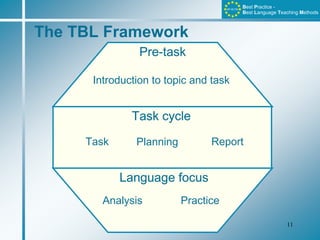
The TBL Framework
Pre-task
Introduction to topic and task
Task cycle
Task Planning Report
Language focus
Analysis Practice
12
B P
B L T M
est ractice -
est anguage eaching ethods
BP-BLTM
Task-Based Learning
Klaus Leonhardt 2003
13
B P
B L T M
est ractice -
est anguage eaching ethods
BP-BLTM
14

Tbl presentation

  • 1.
    1 B P B LT M est ractice - est anguage eaching ethods BP-BLTM Task-Based Learning Source: Jane Willis, A Framework for Task-Based Learning, Longman ELT
  • 2.
    2 B P B LT M est ractice - est anguage eaching ethods BP-BLTM Why taskWhy task--based learningbased learning?? What isWhat is aa tasktask?? Six typesSix types ofof taskstasks TheThe TBLTBL frameworkframework
  • 3.
    3 B P B LT M est ractice - est anguage eaching ethods BP-BLTM Why Task-Based Learning? Conditions for Language Learning desirableessential Instruction in language (i.e. chances to focus on form Motivation to listen and read the language and to speak and write (i.e. to process and use the exposure) Use of the language to do things (i.e. exchange meanings) Exposure to a rich but comprehensible input of real spoken and written language in use The TBL framework supports these conditions in a classroom environment.
  • 4.
    4 B P B LT M est ractice - est anguage eaching ethods BP-BLTM What is a task? A task is an activity "where the target language is used by the learner for a communicative purpose (goal) in order to achieve an outcome." Jane Willis
  • 5.
    5 B P B LT M est ractice - est anguage eaching ethods BP-BLTM Types of tasks 1. Listing brainstorming fact-finding Outcome: Completed list or draft mind map.
  • 6.
    6 B P B LT M est ractice - est anguage eaching ethods BP-BLTM Types of tasks 2. Ordering and sorting categorising classifying Outcome: Set of information ordered and sorted according to specified criteria sequencing ranking
  • 7.
    7 B P B LT M est ractice - est anguage eaching ethods BP-BLTM Types of tasks 3. Comparing matching finding similarities finding differences Outcome: Could be items appropriately matched or assembled, or the identification of similarities and/or differeneces.
  • 8.
    8 B P B LT M est ractice - est anguage eaching ethods BP-BLTM Types of tasks 4. Problem solving reasoning decision making Outcome: Solutions to the problem, which can then be evaluated. analysing real situations analysing hypothetical situations
  • 9.
    9 B P B LT M est ractice - est anguage eaching ethods BP-BLTM Types of tasks 5. Sharing personal experiences exploring and explaining attitudes, opinions, reactions Outcome: Largely social. narrating describing
  • 10.
    10 B P B LT M est ractice - est anguage eaching ethods BP-BLTM Types of tasks 6. Creative Tasks ordering and sorting comparing problem solving and many others Outcome: End product which can be appreciated by a wider audience. brainstorming fact-finding
  • 11.
    11 B P B LT M est ractice - est anguage eaching ethods BP-BLTM The TBL Framework Pre-task Introduction to topic and task Task cycle Task Planning Report Language focus Analysis Practice
  • 12.
    12 B P B LT M est ractice - est anguage eaching ethods BP-BLTM Task-Based Learning Klaus Leonhardt 2003
  • 13.
    13 B P B LT M est ractice - est anguage eaching ethods BP-BLTM
  • 14.