Task 4
Laura Hodgson & Hannah McDonagh
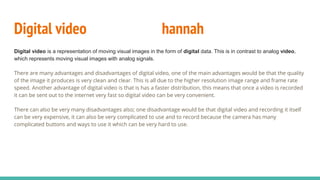
Digital video hannah
Digital video is a representation of moving visual images in the form of digital data. This is in contrast to analog video,
which represents moving visual images with analog signals.
There are many advantages and disadvantages of digital video, one of the main advantages would be that the quality
of the image it produces is very clean and clear. This is all due to the higher resolution image range and frame rate
speed. Another advantage of digital video is that is has a faster distribution, this means that once a video is recorded
it can be sent out to the internet very fast so digital video can be very convenient.
There can also be very many disadvantages also; one disadvantage would be that digital video and recording it itself
can be very expensive, it can also be very complicated to use and to record because the camera has many
complicated buttons and ways to use it which can be very hard to use.
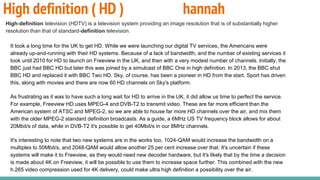
High definition ( HD ) hannah
High-definition television (HDTV) is a television system providing an image resolution that is of substantially higher
resolution than that of standard-definition television.
It took a long time for the UK to get HD. While we were launching our digital TV services, the Americans were
already up-and-running with their HD systems. Because of a lack of bandwidth, and the number of existing services it
took until 2010 for HD to launch on Freeview in the UK, and then with a very modest number of channels. Initially, the
BBC just had BBC HD but later this was joined by a simulcast of BBC One in high definition. In 2013, the BBC shut
BBC HD and replaced it with BBC Two HD. Sky, of course, has been a pioneer in HD from the start. Sport has driven
this, along with movies and there are now 60 HD channels on Sky's platform.
As frustrating as it was to have such a long wait for HD to arrive in the UK, it did allow us time to perfect the service.
For example, Freeview HD uses MPEG-4 and DVB-T2 to transmit video. These are far more efficient than the
American system of ATSC and MPEG-2, so we are able to house far more HD channels over the air, and mix them
with the older MPEG-2 standard definition broadcasts. As a guide, a 6MHz US TV frequency block allows for about
20Mbit/s of data, while in DVB-T2 it's possible to get 40Mbit/s in our 8MHz channels.
It's interesting to note that two new systems are in the works too, 1024-QAM would increase the bandwidth on a
multiplex to 50Mbit/s, and 2048-QAM would allow another 25 per cent increase over that. It's uncertain if these
systems will make it to Freeview, as they would need new decoder hardware, but it's likely that by the time a decision
is made about 4K on Freeview, it will be possible to use them to increase space further. This combined with the new
h.265 video compression used for 4K delivery, could make ultra high definition a possibility over the air.
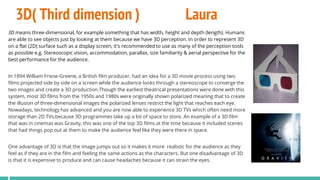
3D( Third dimension ) Laura
3D means three-dimensional, for example something that has width, height and depth (length). Humans
are able to see objects just by looking at them because we have 3D perception. In order to represent 3D
on a flat (2D) surface such as a display screen, it's recommended to use as many of the perception tools
as possible e.g. Stereoscopic vision, accommodation, parallax, size familiarity & aerial perspective for the
best performance for the audience.
In 1894 William Friese-Greene, a British film producer, had an idea for a 3D movie process using two
films projected side by side on a screen while the audience looks through a stereoscope to converge the
two images and create a 3D production.Though the earliest theatrical presentations were done with this
system, most 3D films from the 1950s and 1980s were originally shown polarized meaning that to create
the illusion of three-dimensional images the polarized lenses restrict the light that reaches each eye.
Nowadays, technology has advanced and you are now able to experience 3D TVs which often need more
storage than 2D TVs,because 3D programmes take up a lot of space to store. An example of a 3D film
that was in cinemas was Gravity, this was one of the top 3D films at the time because it included scenes
that had things pop out at them to make the audience feel like they were there in space.
One advantage of 3D is that the image jumps out so it makes it more realistic for the audience as they
feel as if they are in the film and feeling the same actions as the characters. But one disadvantage of 3D
is that it is expensive to produce and can cause headaches because it can strain the eyes.
The internet - Hannah and Laura
The Internet is the global system of interconnected computer networks that use the Internet protocol suite(TCP/IP) to link devices
worldwide. It is a network of networks that consists of private, public, academic, business, and government networks of local to
global scope, linked by a broad array of electronic, wireless, and optical networking technologies.
ARPANET adopted TCP/IP on January 1, 1983, and from there researchers began to assemble the “network of networks” that
became the modern Internet. The online world then took on a more recognizable form in 1990, when computer scientist Tim
Berners-Lee invented the World Wide Web.
There are many advantages and disadvantages of the internet. Some of the advantages are that there are so many things you
can do; you can search almost anything on the internet, anything you want to know or see is pretty much there. You are able to
order things online, you can bank online, you can communicate with people from anywhere in the world and so much more but the
internet also has a very dark side to it including many disadvantages.
The internet can be a very dangerous place. The internet can bring you many things, but the disadvantages of these can actually
be very dangerous. These are a range of things from hackers, stalkers, scammers and much more. For example, you are able to
communicate with almost anybody in the world if you wanted to, but do you really know who is behind the other side of the
computer screen. Another example could be that you are also able to order anything online if you wanted to, but doing this means
that you would have to put your bank details online and yet again not knowing who's on the other end you could potentially be a
victim of fraud
On Demand hannah
Video on demand is an interactive TV technology that allows people to view programmes in real time or download
programmes to view them later on. This service can be delivered over the internet to computers and laptops, most
smartphones and advanced digital media devices e.g. Smart TV’s.
The video on demand concept is not new. The first commercial video on demand service was launched in the early 90’s in
Hong Kong. In the United States, Oceanic Cable of Hawaii was the first to offer it back in 2000. Today video on demand is
offered by many different providers, mostly those who also offer triple play services. Video on demand can and is being
using in educational institutions and other professional environments.
Video on demand has historically suffered from lack of available network bandwidth, resulting in bottlenecks and long
download times. Video on demand can work well over a wide geographic region or on a satellite based network as long as
the demand for programming is modest. However, when large numbers of customers demand multiple programs on a
continuous basis, the total amount of data involved can overwhelm network resources.

Task 4 unit 8

  • 1.
    Task 4 Laura Hodgson& Hannah McDonagh
  • 2.
    Digital video hannah Digitalvideo is a representation of moving visual images in the form of digital data. This is in contrast to analog video, which represents moving visual images with analog signals. There are many advantages and disadvantages of digital video, one of the main advantages would be that the quality of the image it produces is very clean and clear. This is all due to the higher resolution image range and frame rate speed. Another advantage of digital video is that is has a faster distribution, this means that once a video is recorded it can be sent out to the internet very fast so digital video can be very convenient. There can also be very many disadvantages also; one disadvantage would be that digital video and recording it itself can be very expensive, it can also be very complicated to use and to record because the camera has many complicated buttons and ways to use it which can be very hard to use.
  • 3.
    High definition (HD ) hannah High-definition television (HDTV) is a television system providing an image resolution that is of substantially higher resolution than that of standard-definition television. It took a long time for the UK to get HD. While we were launching our digital TV services, the Americans were already up-and-running with their HD systems. Because of a lack of bandwidth, and the number of existing services it took until 2010 for HD to launch on Freeview in the UK, and then with a very modest number of channels. Initially, the BBC just had BBC HD but later this was joined by a simulcast of BBC One in high definition. In 2013, the BBC shut BBC HD and replaced it with BBC Two HD. Sky, of course, has been a pioneer in HD from the start. Sport has driven this, along with movies and there are now 60 HD channels on Sky's platform. As frustrating as it was to have such a long wait for HD to arrive in the UK, it did allow us time to perfect the service. For example, Freeview HD uses MPEG-4 and DVB-T2 to transmit video. These are far more efficient than the American system of ATSC and MPEG-2, so we are able to house far more HD channels over the air, and mix them with the older MPEG-2 standard definition broadcasts. As a guide, a 6MHz US TV frequency block allows for about 20Mbit/s of data, while in DVB-T2 it's possible to get 40Mbit/s in our 8MHz channels. It's interesting to note that two new systems are in the works too, 1024-QAM would increase the bandwidth on a multiplex to 50Mbit/s, and 2048-QAM would allow another 25 per cent increase over that. It's uncertain if these systems will make it to Freeview, as they would need new decoder hardware, but it's likely that by the time a decision is made about 4K on Freeview, it will be possible to use them to increase space further. This combined with the new h.265 video compression used for 4K delivery, could make ultra high definition a possibility over the air.
  • 4.
    3D( Third dimension) Laura 3D means three-dimensional, for example something that has width, height and depth (length). Humans are able to see objects just by looking at them because we have 3D perception. In order to represent 3D on a flat (2D) surface such as a display screen, it's recommended to use as many of the perception tools as possible e.g. Stereoscopic vision, accommodation, parallax, size familiarity & aerial perspective for the best performance for the audience. In 1894 William Friese-Greene, a British film producer, had an idea for a 3D movie process using two films projected side by side on a screen while the audience looks through a stereoscope to converge the two images and create a 3D production.Though the earliest theatrical presentations were done with this system, most 3D films from the 1950s and 1980s were originally shown polarized meaning that to create the illusion of three-dimensional images the polarized lenses restrict the light that reaches each eye. Nowadays, technology has advanced and you are now able to experience 3D TVs which often need more storage than 2D TVs,because 3D programmes take up a lot of space to store. An example of a 3D film that was in cinemas was Gravity, this was one of the top 3D films at the time because it included scenes that had things pop out at them to make the audience feel like they were there in space. One advantage of 3D is that the image jumps out so it makes it more realistic for the audience as they feel as if they are in the film and feeling the same actions as the characters. But one disadvantage of 3D is that it is expensive to produce and can cause headaches because it can strain the eyes.
  • 5.
    The internet -Hannah and Laura The Internet is the global system of interconnected computer networks that use the Internet protocol suite(TCP/IP) to link devices worldwide. It is a network of networks that consists of private, public, academic, business, and government networks of local to global scope, linked by a broad array of electronic, wireless, and optical networking technologies. ARPANET adopted TCP/IP on January 1, 1983, and from there researchers began to assemble the “network of networks” that became the modern Internet. The online world then took on a more recognizable form in 1990, when computer scientist Tim Berners-Lee invented the World Wide Web. There are many advantages and disadvantages of the internet. Some of the advantages are that there are so many things you can do; you can search almost anything on the internet, anything you want to know or see is pretty much there. You are able to order things online, you can bank online, you can communicate with people from anywhere in the world and so much more but the internet also has a very dark side to it including many disadvantages. The internet can be a very dangerous place. The internet can bring you many things, but the disadvantages of these can actually be very dangerous. These are a range of things from hackers, stalkers, scammers and much more. For example, you are able to communicate with almost anybody in the world if you wanted to, but do you really know who is behind the other side of the computer screen. Another example could be that you are also able to order anything online if you wanted to, but doing this means that you would have to put your bank details online and yet again not knowing who's on the other end you could potentially be a victim of fraud
  • 6.
    On Demand hannah Videoon demand is an interactive TV technology that allows people to view programmes in real time or download programmes to view them later on. This service can be delivered over the internet to computers and laptops, most smartphones and advanced digital media devices e.g. Smart TV’s. The video on demand concept is not new. The first commercial video on demand service was launched in the early 90’s in Hong Kong. In the United States, Oceanic Cable of Hawaii was the first to offer it back in 2000. Today video on demand is offered by many different providers, mostly those who also offer triple play services. Video on demand can and is being using in educational institutions and other professional environments. Video on demand has historically suffered from lack of available network bandwidth, resulting in bottlenecks and long download times. Video on demand can work well over a wide geographic region or on a satellite based network as long as the demand for programming is modest. However, when large numbers of customers demand multiple programs on a continuous basis, the total amount of data involved can overwhelm network resources.