United States Tariffs  and Nullification   1828, 1832, 1833, 1842 By: Grant
The Tariff of Abominations 1828 The Tariff of 1828 was proposed by the Jacksonians in order to give President John Quincy Adams a bad political popularity. The tariff proposed extremely high tariff rates on manufactured goods in New England. The Jacksonians did not believe that the tariff would be passed, and it would give Adams a bad name to his tariff-desirous friends in the Northern states. Unexpectedly, the tariff was passed and Jackson inherited the controversial issue when he became president.
Nullification in the South Southern planters first opposed the tariff because it raised prices for the purchase of goods. The major underlying dispute was over the assertion of national rights over state rights. Southerners feared the national government’s movement toward abolitionism. South Carolina was the most outright in their opinion, and John C. Calhoun anonymously authored the South Carolina Exposition and Protest. The Exposition declared that the tariff was unconstitutional and that states should nullify the tariff within their borders. South Carolina was unable to pass the nullification legislature by a two-thirds vote in 1832. “Nullies” and “Unionists” went against each other with a passion in the 1832 election, and the “Nullies” got a two-thirds majority in the state legislature. South Carolina threatened secession if Washington attempted to collect the duties by force.
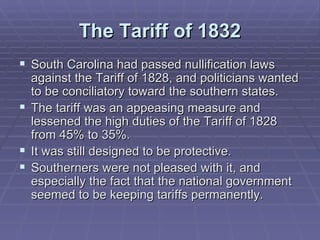
The Tariff of 1832 South Carolina had passed nullification laws against the Tariff of 1828, and politicians wanted to be conciliatory toward the southern states.  The tariff was an appeasing measure and lessened the high duties of the Tariff of 1828 from 45% to 35%. It was still designed to be protective. Southerners were not pleased with it, and especially the fact that the national government seemed to be keeping tariffs permanently.
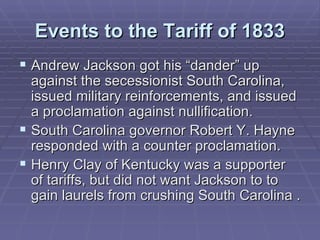
Events to the Tariff of 1833 Andrew Jackson got his “dander” up against the secessionist South Carolina, issued military reinforcements, and issued a proclamation against nullification. South Carolina governor Robert Y. Hayne responded with a counter proclamation. Henry Clay of Kentucky was a supporter of tariffs, but did not want Jackson to to gain laurels from crushing South Carolina .
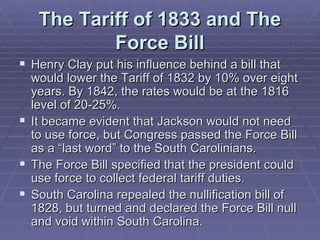
The Tariff of 1833 and The Force Bill Henry Clay put his influence behind a bill that would lower the Tariff of 1832 by 10% over eight years. By 1842, the rates would be at the 1816 level of 20-25%. It became evident that Jackson would not need to use force, but Congress passed the Force Bill as a “last word” to the South Carolinians.  The Force Bill specified that the president could use force to collect federal tariff duties. South Carolina repealed the nullification bill of 1828, but turned and declared the Force Bill null and void within South Carolina.
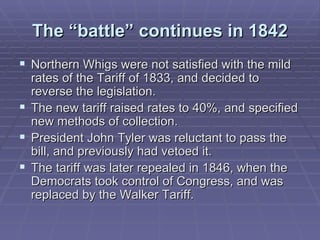
The “battle” continues in 1842 Northern Whigs were not satisfied with the mild rates of the Tariff of 1833, and decided to reverse the legislation. The new tariff raised rates to 40%, and specified new methods of collection. President John Tyler was reluctant to pass the bill, and previously had vetoed it. The tariff was later repealed in 1846, when the Democrats took control of Congress, and was replaced by the Walker Tariff.

Tariff Presentation

  • 1.
    United States Tariffs and Nullification 1828, 1832, 1833, 1842 By: Grant
  • 2.
    The Tariff ofAbominations 1828 The Tariff of 1828 was proposed by the Jacksonians in order to give President John Quincy Adams a bad political popularity. The tariff proposed extremely high tariff rates on manufactured goods in New England. The Jacksonians did not believe that the tariff would be passed, and it would give Adams a bad name to his tariff-desirous friends in the Northern states. Unexpectedly, the tariff was passed and Jackson inherited the controversial issue when he became president.
  • 3.
    Nullification in theSouth Southern planters first opposed the tariff because it raised prices for the purchase of goods. The major underlying dispute was over the assertion of national rights over state rights. Southerners feared the national government’s movement toward abolitionism. South Carolina was the most outright in their opinion, and John C. Calhoun anonymously authored the South Carolina Exposition and Protest. The Exposition declared that the tariff was unconstitutional and that states should nullify the tariff within their borders. South Carolina was unable to pass the nullification legislature by a two-thirds vote in 1832. “Nullies” and “Unionists” went against each other with a passion in the 1832 election, and the “Nullies” got a two-thirds majority in the state legislature. South Carolina threatened secession if Washington attempted to collect the duties by force.
  • 4.
    The Tariff of1832 South Carolina had passed nullification laws against the Tariff of 1828, and politicians wanted to be conciliatory toward the southern states. The tariff was an appeasing measure and lessened the high duties of the Tariff of 1828 from 45% to 35%. It was still designed to be protective. Southerners were not pleased with it, and especially the fact that the national government seemed to be keeping tariffs permanently.
  • 5.
    Events to theTariff of 1833 Andrew Jackson got his “dander” up against the secessionist South Carolina, issued military reinforcements, and issued a proclamation against nullification. South Carolina governor Robert Y. Hayne responded with a counter proclamation. Henry Clay of Kentucky was a supporter of tariffs, but did not want Jackson to to gain laurels from crushing South Carolina .
  • 6.
    The Tariff of1833 and The Force Bill Henry Clay put his influence behind a bill that would lower the Tariff of 1832 by 10% over eight years. By 1842, the rates would be at the 1816 level of 20-25%. It became evident that Jackson would not need to use force, but Congress passed the Force Bill as a “last word” to the South Carolinians. The Force Bill specified that the president could use force to collect federal tariff duties. South Carolina repealed the nullification bill of 1828, but turned and declared the Force Bill null and void within South Carolina.
  • 7.
    The “battle” continuesin 1842 Northern Whigs were not satisfied with the mild rates of the Tariff of 1833, and decided to reverse the legislation. The new tariff raised rates to 40%, and specified new methods of collection. President John Tyler was reluctant to pass the bill, and previously had vetoed it. The tariff was later repealed in 1846, when the Democrats took control of Congress, and was replaced by the Walker Tariff.