Target Strength
reflected wave
incident wave
a
2
i r
I 4 r I
  
r
i
I
TS 10log
I
 
  
 
scattering cross section
 
2
TS 10log 10log
4 r 4
 
   
 
   
 
   
At r = 1 yd.
Factors Determining Target Strength
• the shape of the target
• the size of the target
• the construction of the walls of the target
• the wavelength of the incident sound
• the angle of incidence of the sound
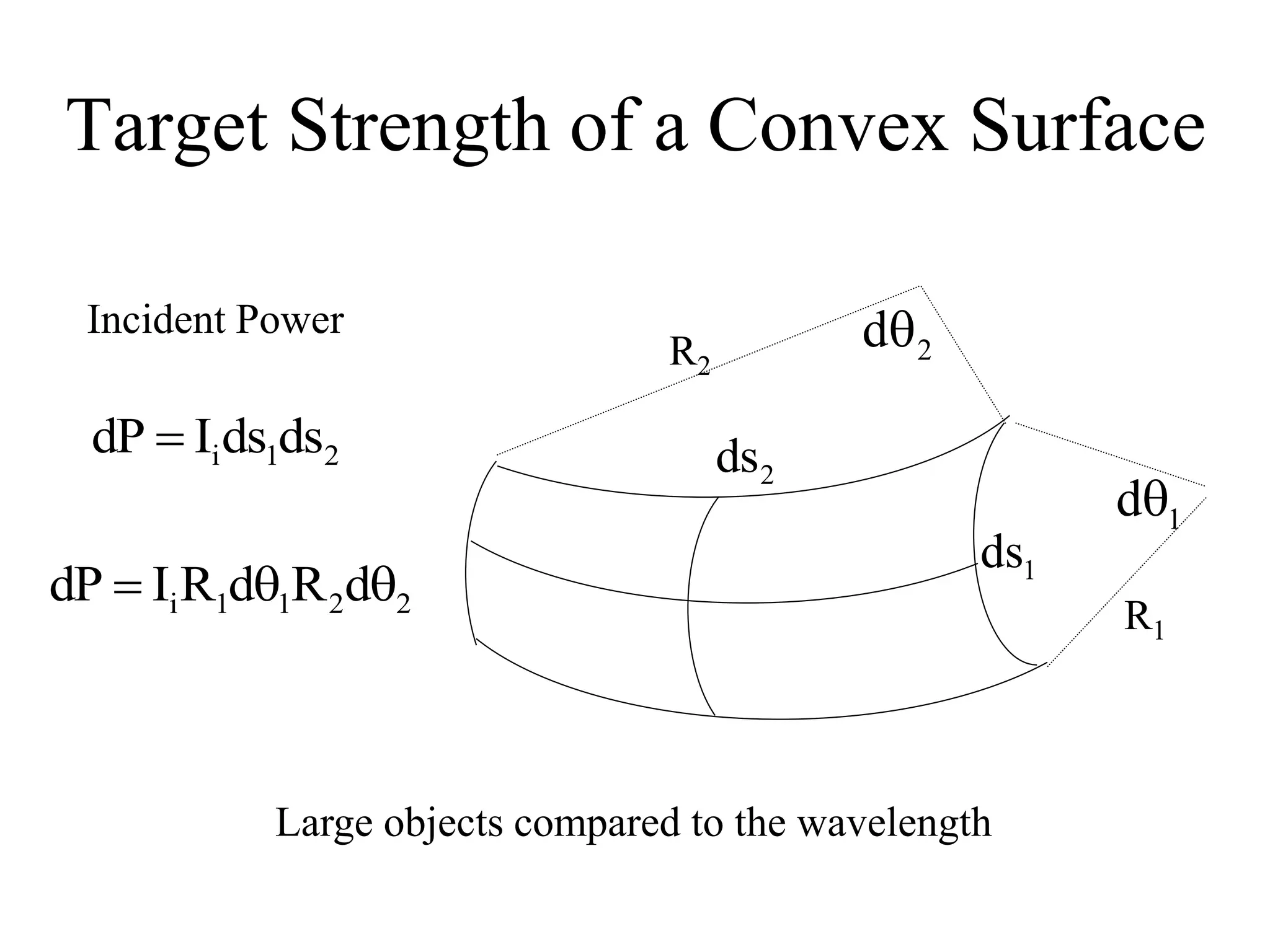
Target Strength of a Convex Surface
i 1 2
dP I ds ds

R1
R2
1
d
1
ds
2
d
2
ds
i 1 1 2 2
dP I R d R d
  
Incident Power
Large objects compared to the wavelength
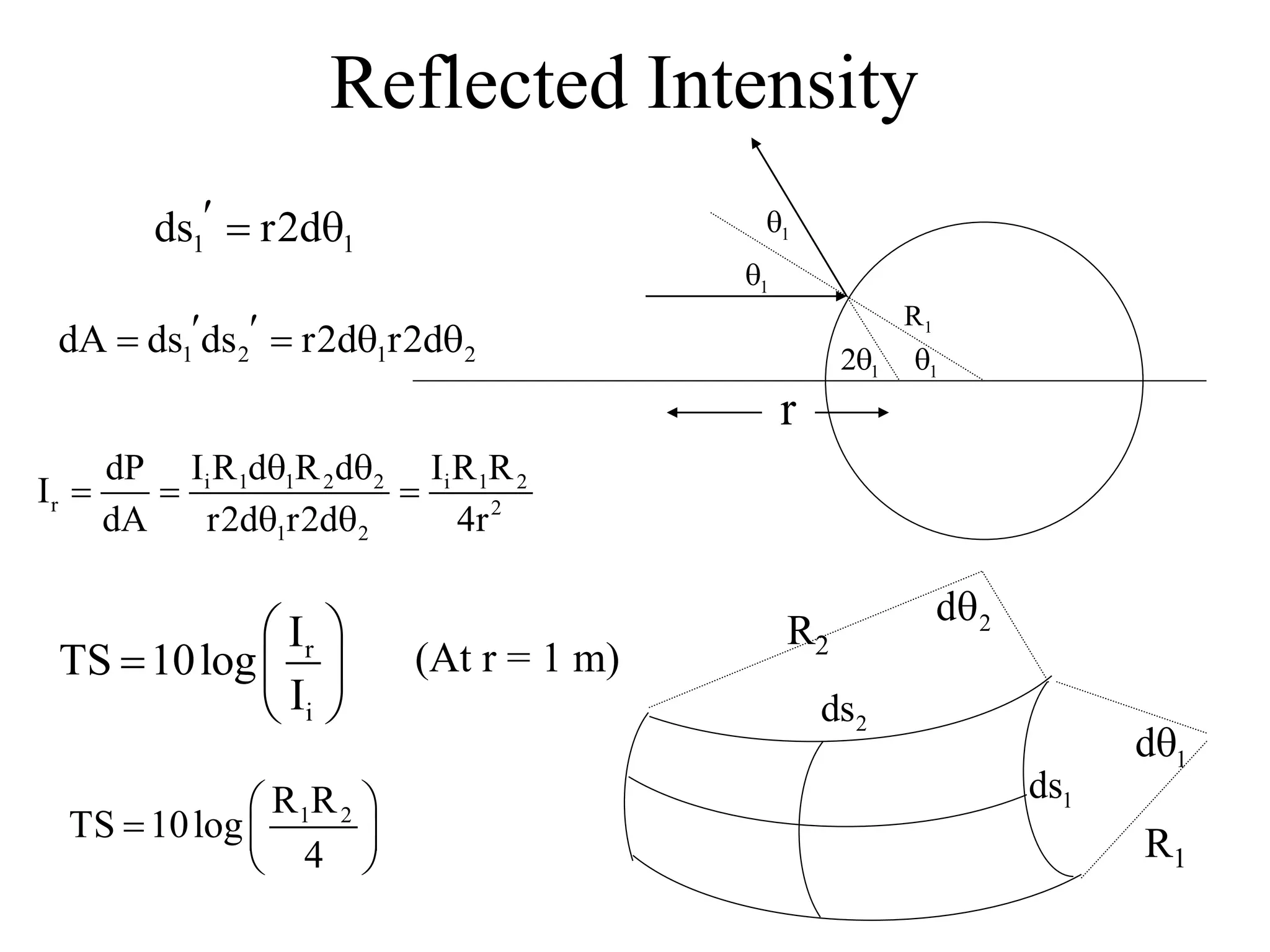
Reflected Intensity
1
2 1

1
R
1

1

r
1 1
ds r2d
  
1 2 1 2
dA ds ds r2d r2d
 
   
i 1 1 2 2 i 1 2
r 2
1 2
dP I R d R d I R R
I
dA r2d r2d 4r
 
  
 
R1
R2
1
d
1
ds
2
d
2
ds
r
i
I
TS 10log
I
 
  
 
1 2
R R
TS 10log
4
 
  
 
(At r = 1 m)
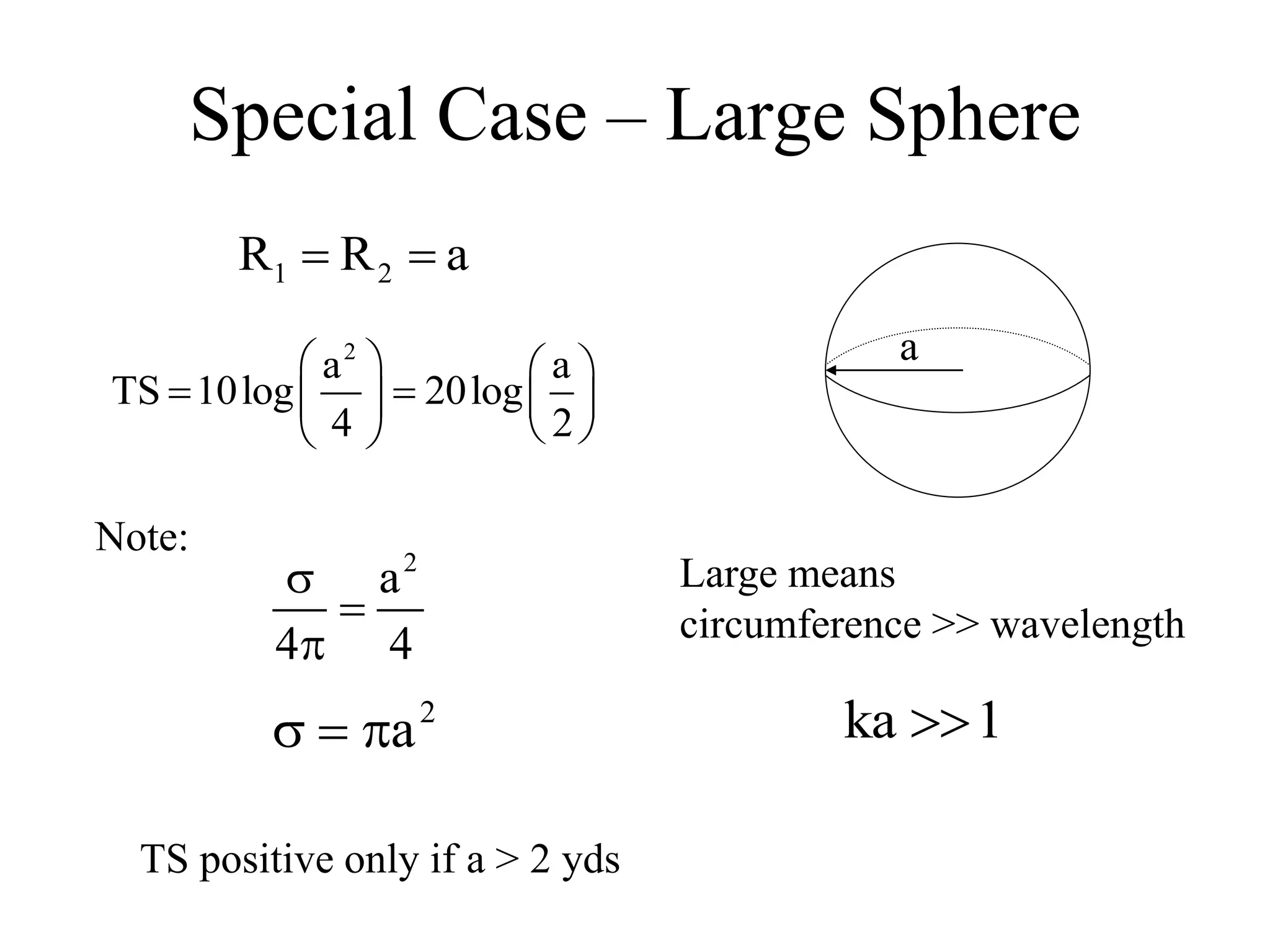
Special Case – Large Sphere
1 2
R R a
 
2
a a
TS 10log 20log
4 2
   
 
   
 
 
a
Note: 2
a
4 4



2
a
  
Large means
circumference >> wavelength
ka 1

TS positive only if a > 2 yds
Large Spheres (continued)
 
2 2 2 2
r
1
2
i
I 1
a a cot J kasin
I 4 r 2
  
 
    
 
 
  
 
a

0o
180o
Example
• An old Iraqi mine with a radius of 1.5 m is
floating partially submerged in the Red Sea. Your
minehunting sonar is a piston array and has a
frequency of 15 kHz and a diameter of 5 m. 20
kW of electrical power are supplied to the
transducer which has an efficiency of 40%. If the
mine is 1000 yds in front of you, what is the signal
level of the echo. Assume spherical spreading.
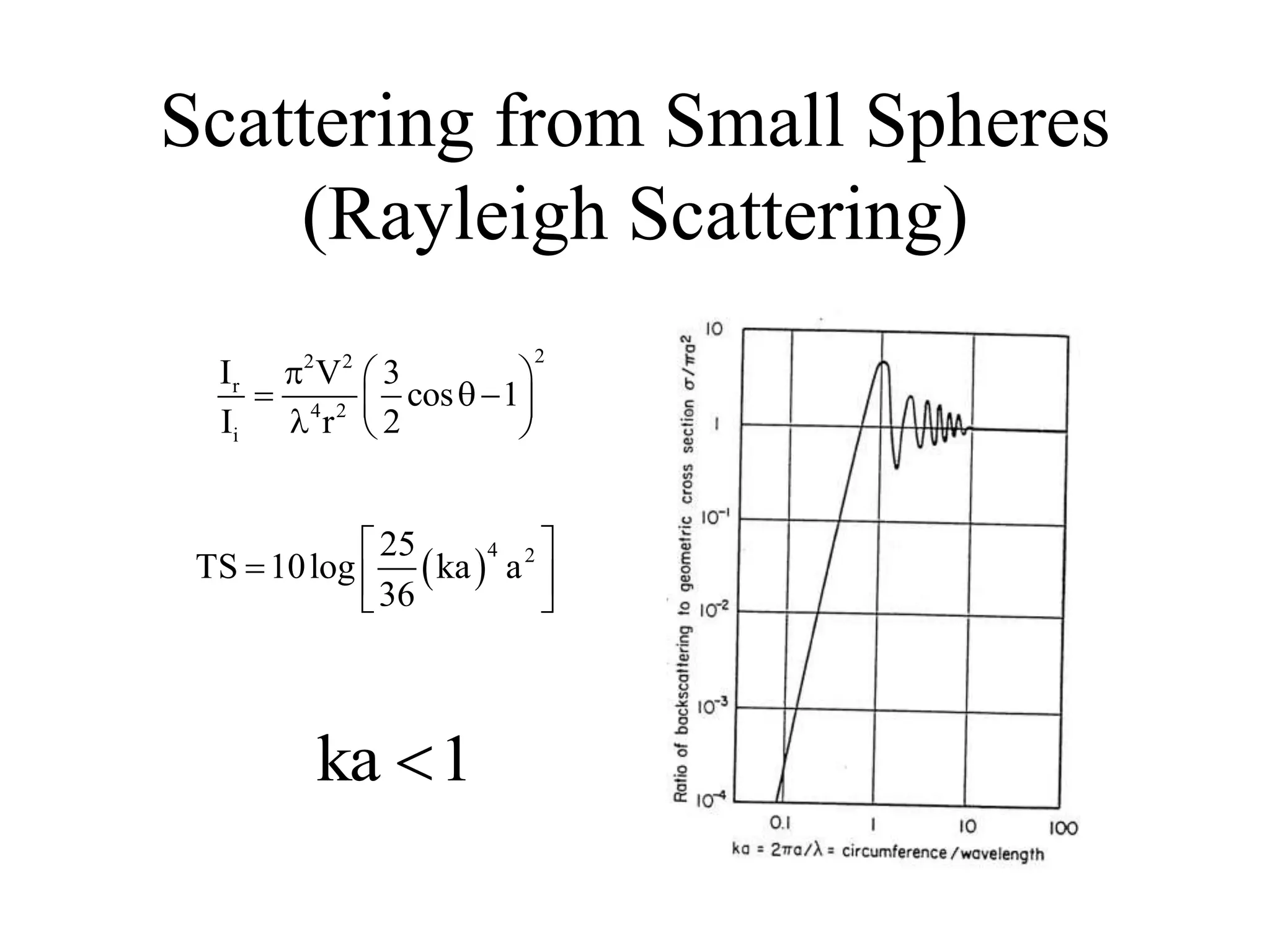
Scattering from Small Spheres
(Rayleigh Scattering)
2
2 2
r
4 2
i
I V 3
cos 1
I r 2
  
 
 
  
 
4 2
25
TS 10log ka a
36
 
  
 
ka 1

Scattering from Cylinders
L
2a

 
2
2 2
2
aL sin cos
TS 10log
2 1yd
 
   
 
  
  
 
 
 
 
 
2 L
sin

  

 
2
2
aL 1
TS 10log
2 1yd
 
 
  
 

 
 
 
o
0
 
Dimensions (L,a) large
compared to wavelength
Gas Bubbles
• Damping effect is due to the
combined effects of radiation,
shear viscosity and thermal
conductivity. A good
approximation is
• where fk is the frequency in kHz.
3
2
2
2
0
0
1
resonant frequency
damping term
bs
a
f
f
f




 
 
 
 
 
 
 
 


 
 
0
3
5
3
1 3.25
1 0.1
2
1000 kg/m
hydrostatic pressure in Pa 10 1 0.1
depth in meters
adiabatic constant for air ( 1.4)
w
w
w
w
P
f z
a a
P z
z

 


  

  

 
0.3
0.03 for 1 kHz< 100 kHz
k k
f f
  
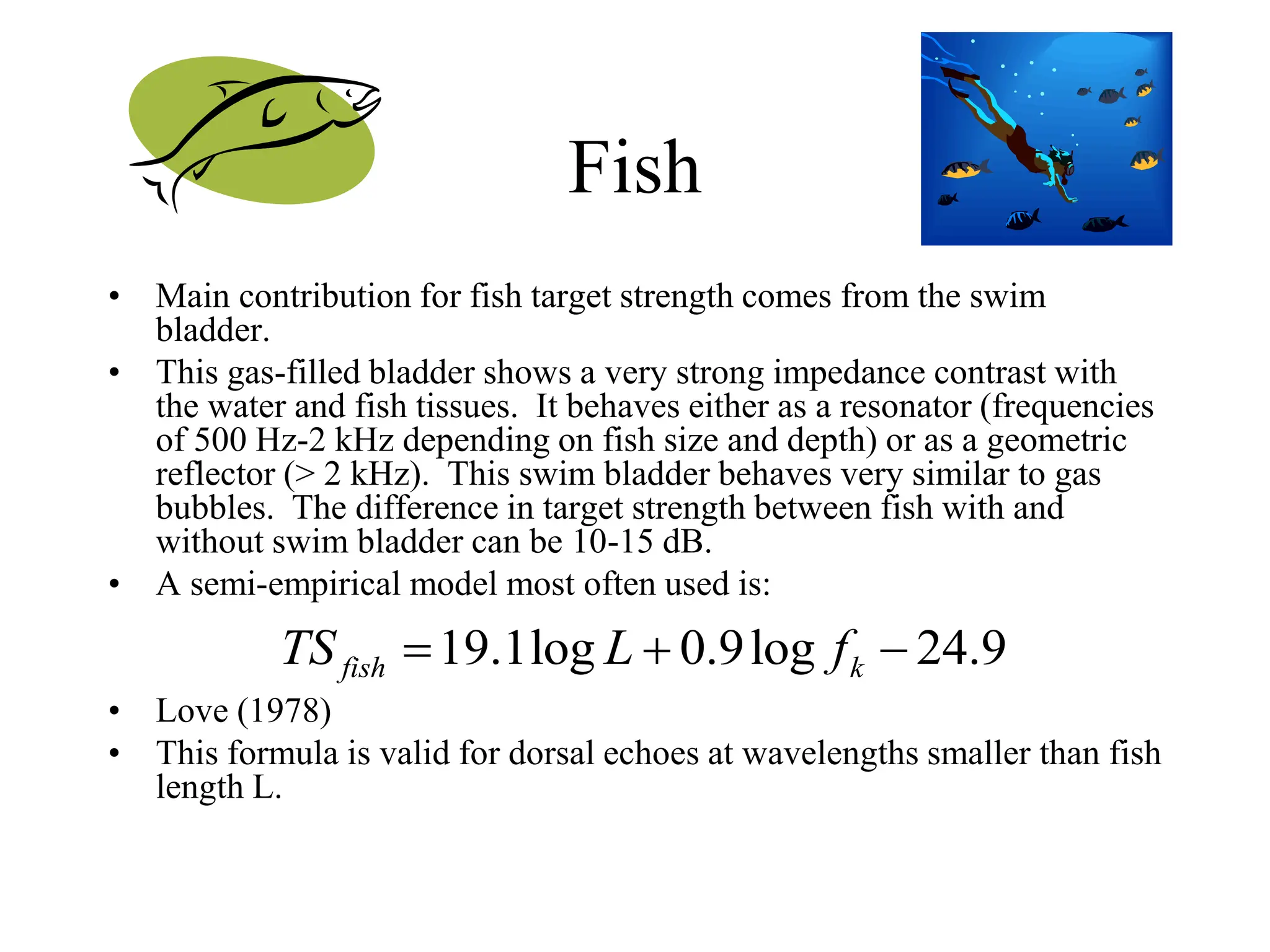
Fish
• Main contribution for fish target strength comes from the swim
bladder.
• This gas-filled bladder shows a very strong impedance contrast with
the water and fish tissues. It behaves either as a resonator (frequencies
of 500 Hz-2 kHz depending on fish size and depth) or as a geometric
reflector (> 2 kHz). This swim bladder behaves very similar to gas
bubbles. The difference in target strength between fish with and
without swim bladder can be 10-15 dB.
• A semi-empirical model most often used is:
• Love (1978)
• This formula is valid for dorsal echoes at wavelengths smaller than fish
length L.
19.1log 0.9log 24.9
fish k
TS L f
  
4
2
1a
a
2
r
4
4
2
7
.
61

V
2
ar
r
a
2
4
4
9



2
2
aL
 
2
2 2
sin
aL cos
2
 


2
a
4




2
2
2
cos
sin













 ab
2
2






a
bc
  



 2
2
1
2
cos
2















 J
a
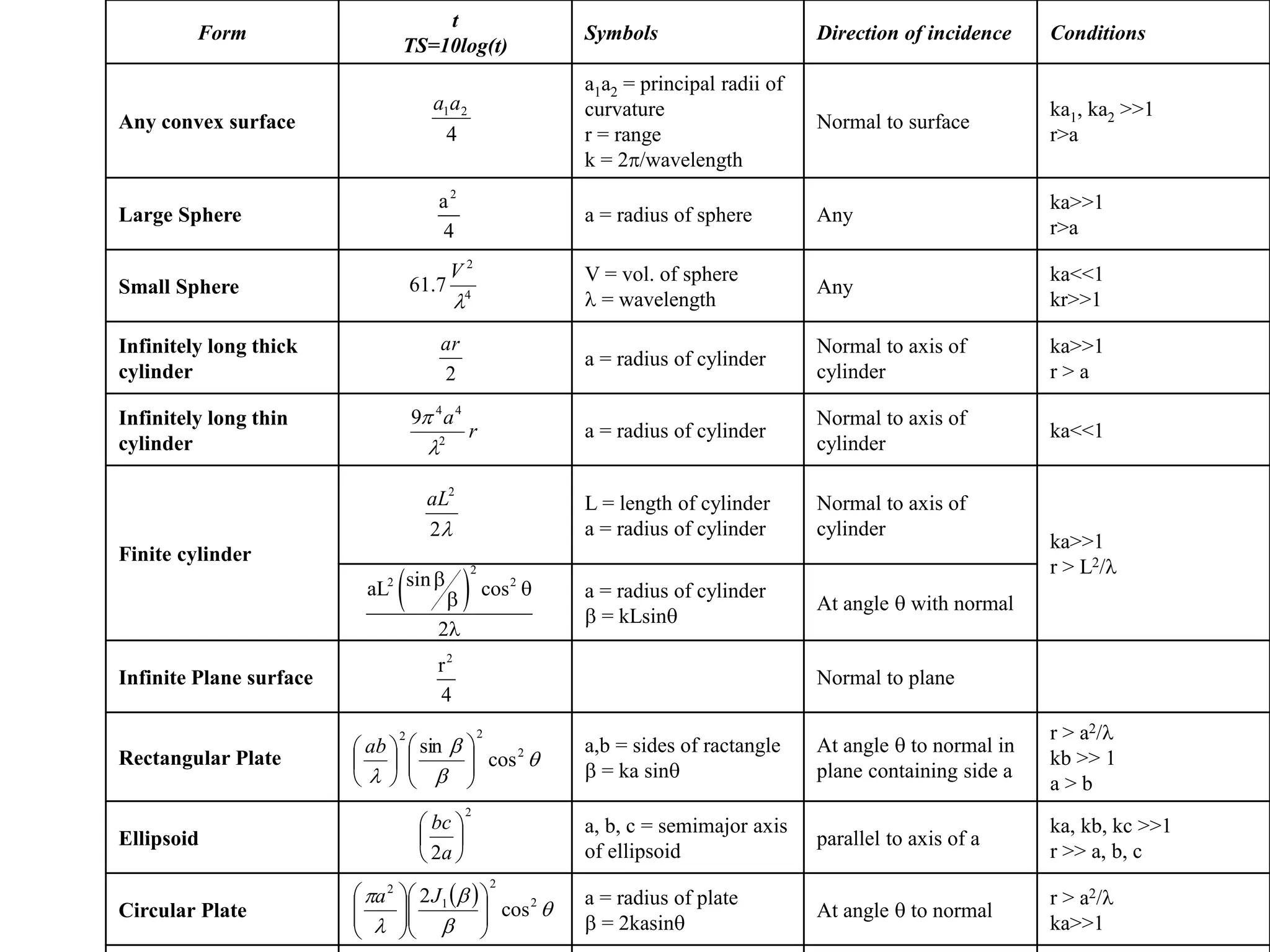
Form
t
TS=10log(t)
Symbols Direction of incidence Conditions
Any convex surface
a1a2 = principal radii of
curvature
r = range
k = 2/wavelength
Normal to surface
ka1, ka2 >>1
r>a
Large Sphere a = radius of sphere Any
ka>>1
r>a
Small Sphere
V = vol. of sphere
 = wavelength
Any
ka<<1
kr>>1
Infinitely long thick
cylinder
a = radius of cylinder
Normal to axis of
cylinder
ka>>1
r > a
Infinitely long thin
cylinder
a = radius of cylinder
Normal to axis of
cylinder
ka<<1
Finite cylinder
L = length of cylinder
a = radius of cylinder
Normal to axis of
cylinder
ka>>1
r > L2/
a = radius of cylinder
 = kLsin
At angle  with normal
Infinite Plane surface Normal to plane
Rectangular Plate
a,b = sides of ractangle
 = ka sin
At angle  to normal in
plane containing side a
r > a2/
kb >> 1
a > b
Ellipsoid
a, b, c = semimajor axis
of ellipsoid
parallel to axis of a
ka, kb, kc >>1
r >> a, b, c
Circular Plate
a = radius of plate
 = 2kasin
At angle  to normal
r > a2/
ka>>1
Example
• What is the target strength of a cylindrical
submarine 10 m in diameter and 100 m in
length when pinged on by a 1500 Hz sonar?
2 4 6 8 10
-40
-20
20
40
TS

10o
5o
Example
• What is the target strength of a single fish
1m in length if the fish finder sonar has a
frequency of 5000 Hz?

Target Strength measurement formulas.pptx

  • 1.
    Target Strength reflected wave incidentwave a 2 i r I 4 r I    r i I TS 10log I        scattering cross section   2 TS 10log 10log 4 r 4                   At r = 1 yd.
  • 2.
    Factors Determining TargetStrength • the shape of the target • the size of the target • the construction of the walls of the target • the wavelength of the incident sound • the angle of incidence of the sound
  • 3.
    Target Strength ofa Convex Surface i 1 2 dP I ds ds  R1 R2 1 d 1 ds 2 d 2 ds i 1 1 2 2 dP I R d R d    Incident Power Large objects compared to the wavelength
  • 4.
    Reflected Intensity 1 2 1  1 R 1  1  r 11 ds r2d    1 2 1 2 dA ds ds r2d r2d       i 1 1 2 2 i 1 2 r 2 1 2 dP I R d R d I R R I dA r2d r2d 4r        R1 R2 1 d 1 ds 2 d 2 ds r i I TS 10log I        1 2 R R TS 10log 4        (At r = 1 m)
  • 5.
    Special Case –Large Sphere 1 2 R R a   2 a a TS 10log 20log 4 2               a Note: 2 a 4 4    2 a    Large means circumference >> wavelength ka 1  TS positive only if a > 2 yds
  • 6.
    Large Spheres (continued)  2 2 2 2 r 1 2 i I 1 a a cot J kasin I 4 r 2                    a  0o 180o
  • 7.
    Example • An oldIraqi mine with a radius of 1.5 m is floating partially submerged in the Red Sea. Your minehunting sonar is a piston array and has a frequency of 15 kHz and a diameter of 5 m. 20 kW of electrical power are supplied to the transducer which has an efficiency of 40%. If the mine is 1000 yds in front of you, what is the signal level of the echo. Assume spherical spreading.
  • 8.
    Scattering from SmallSpheres (Rayleigh Scattering) 2 2 2 r 4 2 i I V 3 cos 1 I r 2             4 2 25 TS 10log ka a 36        ka 1 
  • 9.
    Scattering from Cylinders L 2a   2 2 2 2 aL sin cos TS 10log 2 1yd                         2 L sin        2 2 aL 1 TS 10log 2 1yd                 o 0   Dimensions (L,a) large compared to wavelength
  • 10.
    Gas Bubbles • Dampingeffect is due to the combined effects of radiation, shear viscosity and thermal conductivity. A good approximation is • where fk is the frequency in kHz. 3 2 2 2 0 0 1 resonant frequency damping term bs a f f f                           0 3 5 3 1 3.25 1 0.1 2 1000 kg/m hydrostatic pressure in Pa 10 1 0.1 depth in meters adiabatic constant for air ( 1.4) w w w w P f z a a P z z                0.3 0.03 for 1 kHz< 100 kHz k k f f   
  • 11.
    Fish • Main contributionfor fish target strength comes from the swim bladder. • This gas-filled bladder shows a very strong impedance contrast with the water and fish tissues. It behaves either as a resonator (frequencies of 500 Hz-2 kHz depending on fish size and depth) or as a geometric reflector (> 2 kHz). This swim bladder behaves very similar to gas bubbles. The difference in target strength between fish with and without swim bladder can be 10-15 dB. • A semi-empirical model most often used is: • Love (1978) • This formula is valid for dorsal echoes at wavelengths smaller than fish length L. 19.1log 0.9log 24.9 fish k TS L f   
  • 12.
    4 2 1a a 2 r 4 4 2 7 . 61  V 2 ar r a 2 4 4 9    2 2 aL   2 2 2 sin aLcos 2     2 a 4     2 2 2 cos sin               ab 2 2       a bc        2 2 1 2 cos 2                 J a Form t TS=10log(t) Symbols Direction of incidence Conditions Any convex surface a1a2 = principal radii of curvature r = range k = 2/wavelength Normal to surface ka1, ka2 >>1 r>a Large Sphere a = radius of sphere Any ka>>1 r>a Small Sphere V = vol. of sphere  = wavelength Any ka<<1 kr>>1 Infinitely long thick cylinder a = radius of cylinder Normal to axis of cylinder ka>>1 r > a Infinitely long thin cylinder a = radius of cylinder Normal to axis of cylinder ka<<1 Finite cylinder L = length of cylinder a = radius of cylinder Normal to axis of cylinder ka>>1 r > L2/ a = radius of cylinder  = kLsin At angle  with normal Infinite Plane surface Normal to plane Rectangular Plate a,b = sides of ractangle  = ka sin At angle  to normal in plane containing side a r > a2/ kb >> 1 a > b Ellipsoid a, b, c = semimajor axis of ellipsoid parallel to axis of a ka, kb, kc >>1 r >> a, b, c Circular Plate a = radius of plate  = 2kasin At angle  to normal r > a2/ ka>>1
  • 13.
    Example • What isthe target strength of a cylindrical submarine 10 m in diameter and 100 m in length when pinged on by a 1500 Hz sonar? 2 4 6 8 10 -40 -20 20 40 TS  10o 5o
  • 14.
    Example • What isthe target strength of a single fish 1m in length if the fish finder sonar has a frequency of 5000 Hz?