Target Notes
Target Notes Purpose:  This graphic organizer is designed to help students   expand their thinking while focusing on a main idea, topic, or concept. Description:  The Target Notes strategy asks students to consider what is at the center of the inquiry. What is the student aiming to discover? Designed to scaffold students’ thinking, the  center circle holds the main idea, topic, or concept ;  the first tier calls for identifying characteristics or perspectives;  and  the second tier allows students to further develop their understanding by identifying details, examples, quotations, or further explanations of the first tier.  Because information is organized, writers can easily compose highly organized pieces of writing that incorporate details and examples. This graphic organizer can be used in multiple ways for a number of different purposes.
Procedure : After determining the topic of focus, have students set the purpose by filling in the center circle with the main topic, idea, or concept.  Have students brainstorm or identify (or you can provide these, see sample) categories appropriate for the subject of study based on pre-reading or scanning the text and put these in the categories in the first tier. Students read for information that provides details, examples or further explanation of each category. The details should be recorded in the second tier. Students may divide the second tier into as many sections as deemed appropriate based on the reading selection. The summary box should be used for students to compile the information.
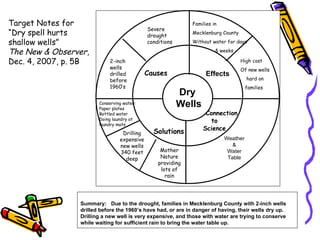
Target Notes for “Dry spell hurts shallow wells” The New & Observer , Dec. 4, 2007, p. 5B Summary:  Due to the drought, families in Mecklenburg County with 2-inch wells drilled before the 1960’s have had, or are in danger of having, their wells dry up.  Drilling a new well is very expensive, and those with water are trying to conserve  while waiting for sufficient rain to bring the water table up. Target Notes for “Dry spell hurts shallow wells” The New & Observer , Dec. 4, 2007, p. 5B Families in  Mecklenburg County Without water for days  & weeks High cost  Of new wells hard on  families Connection to Science Solutions Causes Mother Nature providing lots of rain 2-inch wells drilled before 1960’s Severe drought conditions Conserving water: Paper plates Bottled water Doing laundry at laundry mats Drilling expensive new wells 340 feet deep Dry  Wells Effects Weather & Water Table
Target Notes for “Dry spell hurts shallow wells” The New & Observer , Dec. 4, 2007, p. 5B Summary: Sample Target Notes for “Life in the Ocean” Marine Ecosystem Marine Environments Three Groups of Marine Life Food  Chains and  Food Webs Benthos - Live on or near ocean floor (Includes: crabs, starfish, worms, coral, sponges, clams, seaweed Plankton -  Drift  freely-Food for other organisms- 2 Types: Plantlike ( phytoplankton)  produces oxygen & Animal-like  (zooplankton) Nekton-  Swim actively in sea –Includes: Mammals like dolphins & sea lions & many types of fish Life in the Ocean

Target notes 2_1_11

  • 1.
  • 2.
    Target Notes Purpose: This graphic organizer is designed to help students expand their thinking while focusing on a main idea, topic, or concept. Description: The Target Notes strategy asks students to consider what is at the center of the inquiry. What is the student aiming to discover? Designed to scaffold students’ thinking, the center circle holds the main idea, topic, or concept ; the first tier calls for identifying characteristics or perspectives; and the second tier allows students to further develop their understanding by identifying details, examples, quotations, or further explanations of the first tier. Because information is organized, writers can easily compose highly organized pieces of writing that incorporate details and examples. This graphic organizer can be used in multiple ways for a number of different purposes.
  • 3.
    Procedure : Afterdetermining the topic of focus, have students set the purpose by filling in the center circle with the main topic, idea, or concept. Have students brainstorm or identify (or you can provide these, see sample) categories appropriate for the subject of study based on pre-reading or scanning the text and put these in the categories in the first tier. Students read for information that provides details, examples or further explanation of each category. The details should be recorded in the second tier. Students may divide the second tier into as many sections as deemed appropriate based on the reading selection. The summary box should be used for students to compile the information.
  • 4.
    Target Notes for“Dry spell hurts shallow wells” The New & Observer , Dec. 4, 2007, p. 5B Summary: Due to the drought, families in Mecklenburg County with 2-inch wells drilled before the 1960’s have had, or are in danger of having, their wells dry up. Drilling a new well is very expensive, and those with water are trying to conserve while waiting for sufficient rain to bring the water table up. Target Notes for “Dry spell hurts shallow wells” The New & Observer , Dec. 4, 2007, p. 5B Families in Mecklenburg County Without water for days & weeks High cost Of new wells hard on families Connection to Science Solutions Causes Mother Nature providing lots of rain 2-inch wells drilled before 1960’s Severe drought conditions Conserving water: Paper plates Bottled water Doing laundry at laundry mats Drilling expensive new wells 340 feet deep Dry Wells Effects Weather & Water Table
  • 5.
    Target Notes for“Dry spell hurts shallow wells” The New & Observer , Dec. 4, 2007, p. 5B Summary: Sample Target Notes for “Life in the Ocean” Marine Ecosystem Marine Environments Three Groups of Marine Life Food Chains and Food Webs Benthos - Live on or near ocean floor (Includes: crabs, starfish, worms, coral, sponges, clams, seaweed Plankton - Drift freely-Food for other organisms- 2 Types: Plantlike ( phytoplankton) produces oxygen & Animal-like (zooplankton) Nekton- Swim actively in sea –Includes: Mammals like dolphins & sea lions & many types of fish Life in the Ocean