The Customer Compass: Navigating Target Market,
Requirements, and Size
Welcome to the
Customer Compass
● Understanding your customers is key to
business success.
● We'll explore how to identify your target
market, understand customer
requirements, and estimate market size.
● Think about a product you love. Who do
you think is its target market?
Defining the Target
Market
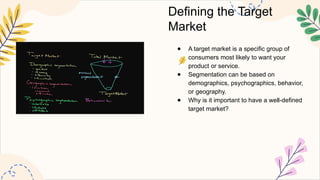
● A target market is a specific group of
consumers most likely to want your
product or service.
● Segmentation can be based on
demographics, psychographics, behavior,
or geography.
● Why is it important to have a well-defined
target market?
Demographic Segmentation
● Demographics include age, gender, income, education, and
family status.
● Products often appeal to customers in certain demographic
brackets.
● How might a product for teenagers differ from one for adults?
Psychographic
Segmentation
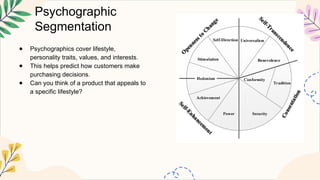
● Psychographics cover lifestyle,
personality traits, values, and interests.
● This helps predict how customers make
purchasing decisions.
● Can you think of a product that appeals to
a specific lifestyle?
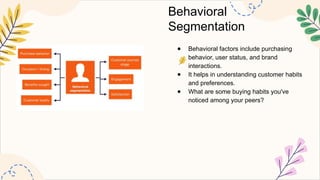
Behavioral
Segmentation
● Behavioral factors include purchasing
behavior, user status, and brand
interactions.
● It helps in understanding customer habits
and preferences.
● What are some buying habits you've
noticed among your peers?
Geographic Segmentation
● Geographic location, climate, and whether an area is urban or
rural can influence consumer needs.
● Products may be tailored to fit these geographic specifics.
● Why would a company market differently in a city versus a rural
area?
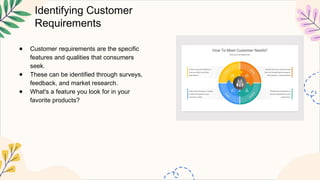
Identifying Customer
Requirements
● Customer requirements are the specific
features and qualities that consumers
seek.
● These can be identified through surveys,
feedback, and market research.
● What's a feature you look for in your
favorite products?
Importance of Meeting
Customer Needs
● Meeting customer needs leads to
satisfaction, loyalty, and repeat business.
● It also helps in differentiating your product
from competitors.
● How does a brand gain your loyalty?
Market Size Estimation
● Market size is the total potential sales for a product or service.
● It's measured by volume (units) or value (revenue).
● Why is it important for a business to estimate its market size?
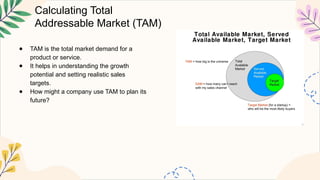
Calculating Total
Addressable Market (TAM)
● TAM is the total market demand for a
product or service.
● It helps in understanding the growth
potential and setting realistic sales
targets.
● How might a company use TAM to plan its
future?
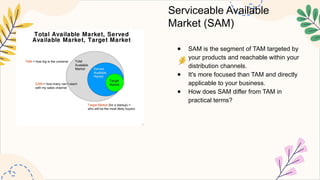
Serviceable Available
Market (SAM)
● SAM is the segment of TAM targeted by
your products and reachable within your
distribution channels.
● It's more focused than TAM and directly
applicable to your business.
● How does SAM differ from TAM in
practical terms?
Serviceable Obtainable Market (SOM)
● SOM is the portion of SAM that you can capture.
● It's influenced by competition, brand strength, and market
penetration strategies.
● What factors might affect a company's ability to increase its
SOM?
Market Research
Techniques
● Techniques include surveys, interviews,
focus groups, and data analysis.
● Research helps in understanding
customer behavior and market trends.
● What's a market research method you've
participated in?
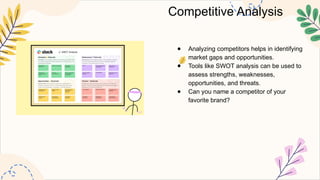
Competitive Analysis
● Analyzing competitors helps in identifying
market gaps and opportunities.
● Tools like SWOT analysis can be used to
assess strengths, weaknesses,
opportunities, and threats.
● Can you name a competitor of your
favorite brand?
Customer Personas
● Personas are fictional characters representing different user
types within a target market.
● They help in visualizing the ideal customer and tailoring
marketing strategies.
● Imagine a persona for a new gaming app. What would they be
like?
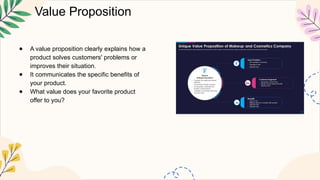
Value Proposition
● A value proposition clearly explains how a
product solves customers' problems or
improves their situation.
● It communicates the specific benefits of
your product.
● What value does your favorite product
offer to you?
Product Positioning
● Positioning is how a product is perceived
in the context of competitive alternatives.
● It involves creating a unique impression in
the customer's mind.
● How is your favorite brand positioned
against its competitors?
Marketing Mix (The 4 Ps)
● The 4 Ps are Product, Price, Place, and Promotion.
● They are used to consider different facets of marketing a product.
● How might the 4 Ps influence your decision to buy something?
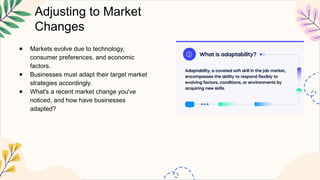
Adjusting to Market
Changes
● Markets evolve due to technology,
consumer preferences, and economic
factors.
● Businesses must adapt their target market
strategies accordingly.
● What's a recent market change you've
noticed, and how have businesses
adapted?
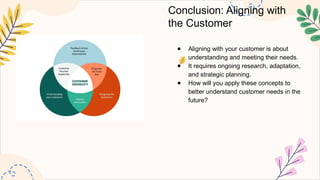
Conclusion: Aligning with
the Customer
● Aligning with your customer is about
understanding and meeting their needs.
● It requires ongoing research, adaptation,
and strategic planning.
● How will you apply these concepts to
better understand customer needs in the
future?

target market Untitled presentation (4).pptx

  • 1.
    The Customer Compass:Navigating Target Market, Requirements, and Size
  • 2.
    Welcome to the CustomerCompass ● Understanding your customers is key to business success. ● We'll explore how to identify your target market, understand customer requirements, and estimate market size. ● Think about a product you love. Who do you think is its target market?
  • 3.
    Defining the Target Market ●A target market is a specific group of consumers most likely to want your product or service. ● Segmentation can be based on demographics, psychographics, behavior, or geography. ● Why is it important to have a well-defined target market?
  • 4.
    Demographic Segmentation ● Demographicsinclude age, gender, income, education, and family status. ● Products often appeal to customers in certain demographic brackets. ● How might a product for teenagers differ from one for adults?
  • 5.
    Psychographic Segmentation ● Psychographics coverlifestyle, personality traits, values, and interests. ● This helps predict how customers make purchasing decisions. ● Can you think of a product that appeals to a specific lifestyle?
  • 6.
    Behavioral Segmentation ● Behavioral factorsinclude purchasing behavior, user status, and brand interactions. ● It helps in understanding customer habits and preferences. ● What are some buying habits you've noticed among your peers?
  • 7.
    Geographic Segmentation ● Geographiclocation, climate, and whether an area is urban or rural can influence consumer needs. ● Products may be tailored to fit these geographic specifics. ● Why would a company market differently in a city versus a rural area?
  • 8.
    Identifying Customer Requirements ● Customerrequirements are the specific features and qualities that consumers seek. ● These can be identified through surveys, feedback, and market research. ● What's a feature you look for in your favorite products?
  • 9.
    Importance of Meeting CustomerNeeds ● Meeting customer needs leads to satisfaction, loyalty, and repeat business. ● It also helps in differentiating your product from competitors. ● How does a brand gain your loyalty?
  • 10.
    Market Size Estimation ●Market size is the total potential sales for a product or service. ● It's measured by volume (units) or value (revenue). ● Why is it important for a business to estimate its market size?
  • 11.
    Calculating Total Addressable Market(TAM) ● TAM is the total market demand for a product or service. ● It helps in understanding the growth potential and setting realistic sales targets. ● How might a company use TAM to plan its future?
  • 12.
    Serviceable Available Market (SAM) ●SAM is the segment of TAM targeted by your products and reachable within your distribution channels. ● It's more focused than TAM and directly applicable to your business. ● How does SAM differ from TAM in practical terms?
  • 13.
    Serviceable Obtainable Market(SOM) ● SOM is the portion of SAM that you can capture. ● It's influenced by competition, brand strength, and market penetration strategies. ● What factors might affect a company's ability to increase its SOM?
  • 14.
    Market Research Techniques ● Techniquesinclude surveys, interviews, focus groups, and data analysis. ● Research helps in understanding customer behavior and market trends. ● What's a market research method you've participated in?
  • 15.
    Competitive Analysis ● Analyzingcompetitors helps in identifying market gaps and opportunities. ● Tools like SWOT analysis can be used to assess strengths, weaknesses, opportunities, and threats. ● Can you name a competitor of your favorite brand?
  • 16.
    Customer Personas ● Personasare fictional characters representing different user types within a target market. ● They help in visualizing the ideal customer and tailoring marketing strategies. ● Imagine a persona for a new gaming app. What would they be like?
  • 17.
    Value Proposition ● Avalue proposition clearly explains how a product solves customers' problems or improves their situation. ● It communicates the specific benefits of your product. ● What value does your favorite product offer to you?
  • 18.
    Product Positioning ● Positioningis how a product is perceived in the context of competitive alternatives. ● It involves creating a unique impression in the customer's mind. ● How is your favorite brand positioned against its competitors?
  • 19.
    Marketing Mix (The4 Ps) ● The 4 Ps are Product, Price, Place, and Promotion. ● They are used to consider different facets of marketing a product. ● How might the 4 Ps influence your decision to buy something?
  • 20.
    Adjusting to Market Changes ●Markets evolve due to technology, consumer preferences, and economic factors. ● Businesses must adapt their target market strategies accordingly. ● What's a recent market change you've noticed, and how have businesses adapted?
  • 21.
    Conclusion: Aligning with theCustomer ● Aligning with your customer is about understanding and meeting their needs. ● It requires ongoing research, adaptation, and strategic planning. ● How will you apply these concepts to better understand customer needs in the future?

Editor's Notes

  • #1 Created from: https://docs.google.com/presentation/d/1Mr9eogPeOFYOs9jeq48SooGfM9_BZWIKABI9aWVm2qI/edit?pli=1#slide=id.p