

A Brief Overview
              of Laws Affecting
                 Employment
                 Background
                Investigations

Mike Coffey, SPHR
President
Imperative Information Group
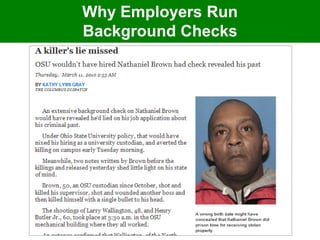
Why Employers Run
Background Checks
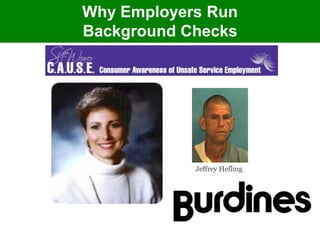
Why Employers Run
Background Checks


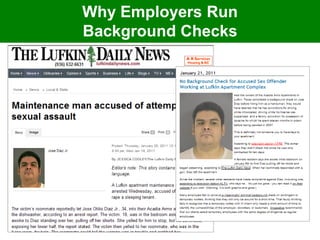
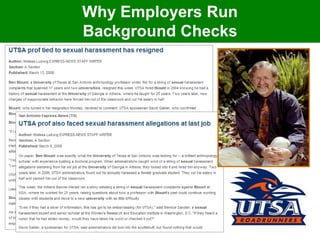
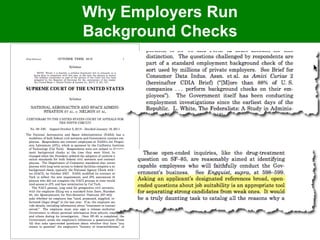
            Jeffrey Hefling
Why Employers Run
Background Checks


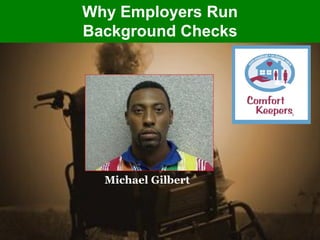
  Michael Gilbert
Why Employers Run
Background Checks
Why Employers Run
Background Checks
Why Employers Run
Background Checks


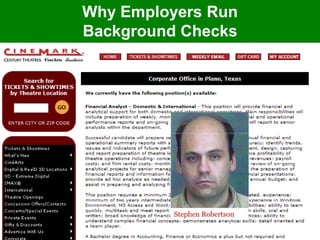
          Stephen Robertson
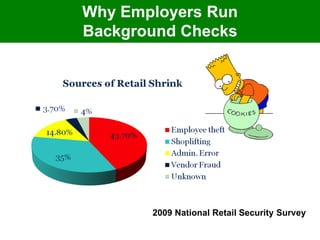
Why Employers Run
Background Checks


       2009 National Retail Security Survey
Why Employers Run
Background Checks
The federal Fair Credit Reporting Act
     governs consumer reports.
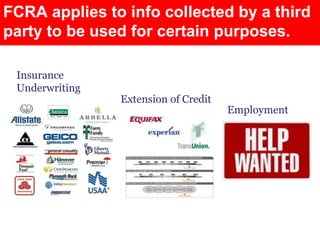
FCRA applies to info collected by a third
party to be used for certain purposes.

 Insurance
 Underwriting
                Extension of Credit
                                      Employment
FCRA applies to reports about
“consumers.”
     Consumer def: “An individual”
Report providers (investigators) are
Consumer Reporting Agencies.

 Consumer Reporting Agency def:

 Anyone who, “for monetary fees, dues, or on a
 cooperative nonprofit basis, regularly engages in
 whole or part in the practice of assembling or
 evaluating… information on consumers to third
 parties, and uses any means or facility of interstate
 commerce for the purpose of preparing or
 furnishing consumer reports.”
Report providers (investigators) are
Consumer Reporting Agencies.

 Consumer Report def:
  “Any written, oral, or other communication…by a
  consumer reporting agency bearing on a consumer’s
  credit worthiness, credit standing, or credit capacity,
  character, general reputation, personal
  characteristics, or mode of living …which is used or
  expected to be used or collected in whole or in part
  for the purpose of serving as a factor in establishing
  the consumer’s eligibility for… employment
  purposes”
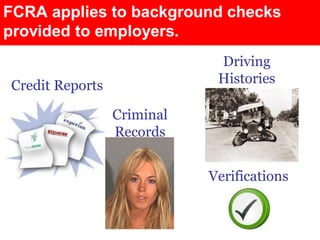
FCRA applies to background checks
provided to employers.
                             Driving
Credit Reports               Histories

                 Criminal
                 Records


                            Verifications
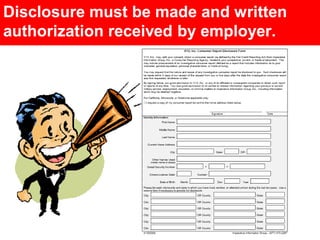
Disclosure must be made and written
authorization received by employer.
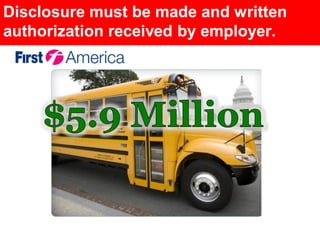
Disclosure must be made and written
authorization received by employer.
The FCRA has two standards for
accuracy of reported information.
        Accuracy of Information (all information)

 “Whenever a consumer reporting
 agency prepares a consumer
 report it shall follow reasonable
 procedures to assure maximum
 possible accuracy of the
 information concerning the
 individual about whom the report
 relates.”
Disclosure must be made and written
authorization received by employer.
        Accuracy of Public Record Information


 The CRA must ensure that the
 information reported “matches the
 status of the item at the time the report
 is requested,” (this is the best practice)
 or
 “notify the consumer that the negative public record
 information is being reported, along with the name and
 address of the employer to whom the report is being
 provided.” (Commonly called “contemporaneous
 notification.”)
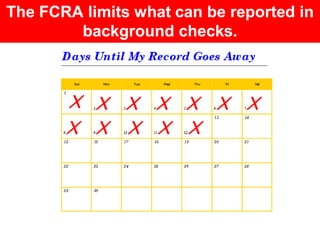
The FCRA limits what can be reported in
        background checks.
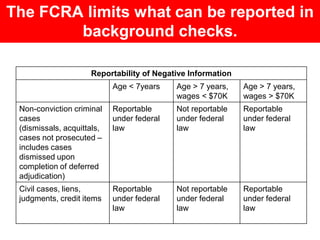
The FCRA limits what can be reported in
        background checks.

                     Reportability of Negative Information
                            Age < 7years    Age > 7 years,   Age > 7 years,
                                            wages < $70K     wages > $70K
 Non-conviction criminal    Reportable      Not reportable   Reportable
 cases                      under federal   under federal    under federal
 (dismissals, acquittals,   law             law              law
 cases not prosecuted –
 includes cases
 dismissed upon
 completion of deferred
 adjudication)
 Civil cases, liens,        Reportable      Not reportable   Reportable
 judgments, credit items    under federal   under federal    under federal
                            law             law              law
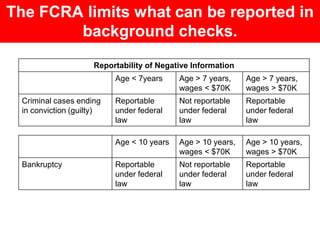
The FCRA limits what can be reported in
        background checks.
                     Reportability of Negative Information
                          Age < 7years     Age > 7 years,    Age > 7 years,
                                           wages < $70K      wages > $70K
 Criminal cases ending    Reportable       Not reportable    Reportable
 in conviction (guilty)   under federal    under federal     under federal
                          law              law               law

                          Age < 10 years   Age > 10 years,   Age > 10 years,
                                           wages < $70K      wages > $70K
 Bankruptcy               Reportable       Not reportable    Reportable
                          under federal    under federal     under federal
                          law              law               law
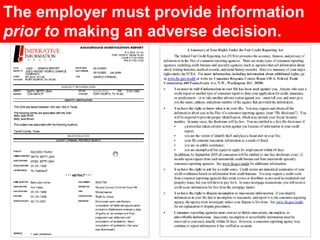
The employer must provide information
prior to making an adverse decision.
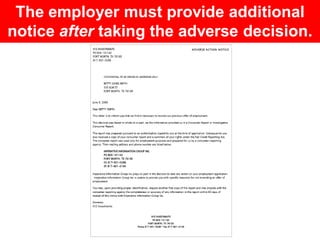
The employer must provide additional
notice after taking the adverse decision.
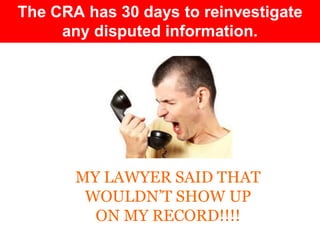
The CRA has 30 days to reinvestigate
     any disputed information.


       MY LAWYER SAID THAT
        WOULDN’T SHOW UP
         ON MY RECORD!!!!
Sample State Consumer Reporting Laws


Texas’ only restriction (limiting all
information to seven years) was
invalidated by the Fair and Accurate
Credit Transactions Act (FACTA),
though it is still widely quoted by
attorneys and screening firms
unfamiliar with the interplay of the
state and federal laws.
Sample State Consumer Reporting Laws


 The authorization and consent must
  contain a “box” for the consumer to
  check to receive a copy of the report.

 Employers may not inquire about
  sealed records and applicants may
  state that they have no conviction
Sample State Consumer Reporting Laws

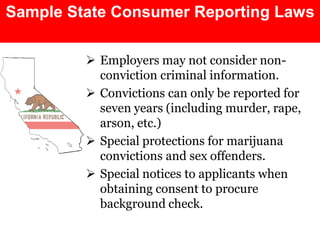
          Employers may not consider non-
           conviction criminal information.
          Convictions can only be reported for
           seven years (including murder, rape,
           arson, etc.)
          Special protections for marijuana
           convictions and sex offenders.
          Special notices to applicants when
           obtaining consent to procure
           background check.
Sample State Consumer Reporting Laws

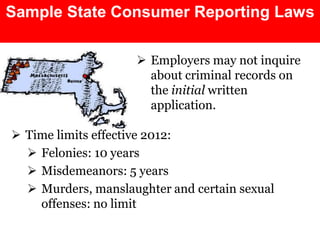
                     Employers may not inquire
                      about criminal records on
                      the initial written
                      application.

 Time limits effective 2012:
   Felonies: 10 years
   Misdemeanors: 5 years
   Murders, manslaughter and certain sexual
    offenses: no limit
Sample State Consumer Reporting Laws


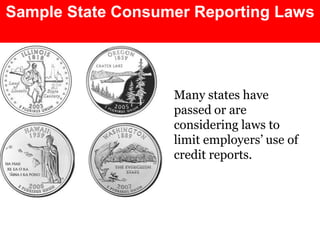
                   Many states have
                   passed or are
                   considering laws to
                   limit employers’ use of
                   credit reports.
Title VII of Title VII of the of 1964
             the Civil Rights Act
    Civil Rights Act of 1964
Title VII of the Civil Rights Act of 1964

    Prohibits both intentional discrimination
     (“disparate treatment”) and seemingly neutral
     policies without business necessity that have
     adverse impacts on protected classes (“disparate
     impact” - see Griggs v. Duke Power)

    Policies must have a manifest relationship to
     employment role with no viable alternatives to
     qualify as a business necessity

    Heavily impacts employment qualifications,
     tests, and background checks
Title VII of the Civil Rights Act of 1964

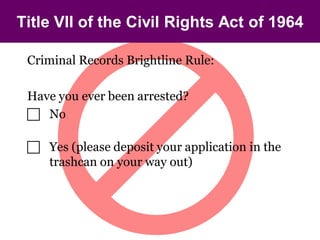
 Criminal Records Brightline Rule:

 Have you ever been arrested?
  No

  Yes (please deposit your application in the
   trashcan on your way out)
Title VII of the Civil Rights Act of 1964
When reviewing criminal records, an employer must consider:

    – The relevance of the offense to the position, including
      severity and time passed since the offense

    – The reasonable likelihood that the person committed the
      offense

Disposition (final judicial outcome) is not the issue!

See EEOC Policy Statement on the Issue of Conviction Records under
Title VII of the Civil Rights Act of 1964 and Policy Guidance on the
Consideration of Arrest Records in Employment Decisions under Title VII of the
Civil Rights Act of 1964
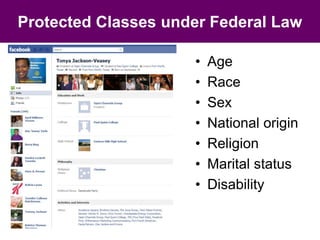
Protected Classes under Federal Law

                     •   Age
                     •   Race
                     •   Sex
                     •   National origin
                     •   Religion
                     •   Marital status
                     •   Disability
EEOC Activity

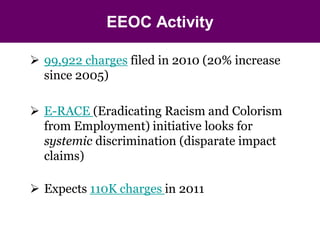
 99,922 charges filed in 2010 (20% increase
  since 2005)

 E-RACE (Eradicating Racism and Colorism
  from Employment) initiative looks for
  systemic discrimination (disparate impact
  claims)

 Expects 110K charges in 2011
EEOC Activity

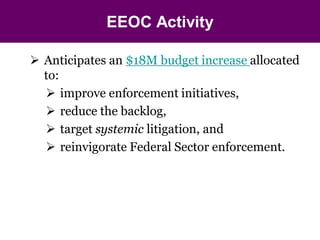
 Anticipates an $18M budget increase allocated
  to:
   improve enforcement initiatives,
   reduce the backlog,
   target systemic litigation, and
   reinvigorate Federal Sector enforcement.
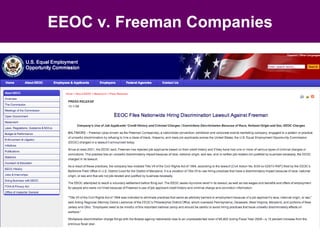
EEOC v. Freeman Companies
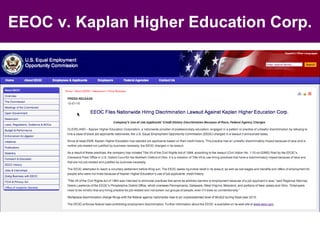
EEOC v. Kaplan Higher Education Corp.
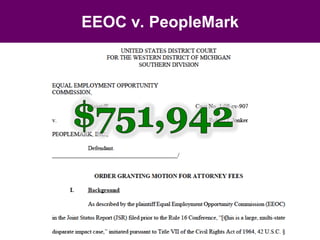
EEOC v. PeopleMark
State EEO Laws

Many states have their own equal employment
opportunity or human rights laws.

   Washington state will not allow employers to
    consider any criminal records older than ten
    years.

   6 states have “job-relatedness” requirements
    for the consideration of criminal records.

   Texas has no such limitations.
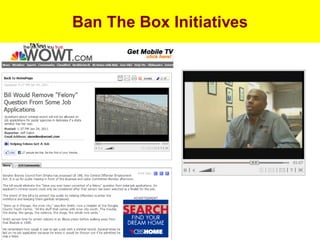
Ban The Box Initiatives

 Massachusetts: Employers may not inquire about criminal
  records on the initial written application.

 Minnesota, Connecticut & New Mexico: Public employers
  may not inquire about criminal records on the initial
  written application.

 Hawaii: Employer may inquire only after an offer of
  employment is made

 More than 2 dozen cities have passed similar ordinances
  including Philadelphia (04/2011), Baltimore, Memphis,
  and San Francisco
Ban The Box Initiatives

 Similar legislation is pending in Nebraska, New Jersey,
  and Rhode Island.

 Minnesota considering extending the ban to private
  employers.

 Nationwide, community groups are pushing for new
  legislation at all levels
Questions?

A Brief Overview of Laws Affecting Background Checks

  • 1.
    A Brief Overview of Laws Affecting Employment Background Investigations Mike Coffey, SPHR President Imperative Information Group
  • 2.
  • 3.
    Why Employers Run BackgroundChecks Jeffrey Hefling
  • 4.
    Why Employers Run BackgroundChecks Michael Gilbert
  • 5.
  • 6.
  • 7.
    Why Employers Run BackgroundChecks Stephen Robertson
  • 8.
    Why Employers Run BackgroundChecks 2009 National Retail Security Survey
  • 9.
  • 10.
    The federal FairCredit Reporting Act governs consumer reports.
  • 11.
    FCRA applies toinfo collected by a third party to be used for certain purposes. Insurance Underwriting Extension of Credit Employment
  • 12.
    FCRA applies toreports about “consumers.” Consumer def: “An individual”
  • 13.
    Report providers (investigators)are Consumer Reporting Agencies. Consumer Reporting Agency def: Anyone who, “for monetary fees, dues, or on a cooperative nonprofit basis, regularly engages in whole or part in the practice of assembling or evaluating… information on consumers to third parties, and uses any means or facility of interstate commerce for the purpose of preparing or furnishing consumer reports.”
  • 14.
    Report providers (investigators)are Consumer Reporting Agencies.  Consumer Report def: “Any written, oral, or other communication…by a consumer reporting agency bearing on a consumer’s credit worthiness, credit standing, or credit capacity, character, general reputation, personal characteristics, or mode of living …which is used or expected to be used or collected in whole or in part for the purpose of serving as a factor in establishing the consumer’s eligibility for… employment purposes”
  • 15.
    FCRA applies tobackground checks provided to employers. Driving Credit Reports Histories Criminal Records Verifications
  • 16.
    Disclosure must bemade and written authorization received by employer.
  • 17.
    Disclosure must bemade and written authorization received by employer.
  • 18.
    The FCRA hastwo standards for accuracy of reported information. Accuracy of Information (all information) “Whenever a consumer reporting agency prepares a consumer report it shall follow reasonable procedures to assure maximum possible accuracy of the information concerning the individual about whom the report relates.”
  • 19.
    Disclosure must bemade and written authorization received by employer. Accuracy of Public Record Information The CRA must ensure that the information reported “matches the status of the item at the time the report is requested,” (this is the best practice) or “notify the consumer that the negative public record information is being reported, along with the name and address of the employer to whom the report is being provided.” (Commonly called “contemporaneous notification.”)
  • 20.
    The FCRA limitswhat can be reported in background checks.
  • 21.
    The FCRA limitswhat can be reported in background checks. Reportability of Negative Information Age < 7years Age > 7 years, Age > 7 years, wages < $70K wages > $70K Non-conviction criminal Reportable Not reportable Reportable cases under federal under federal under federal (dismissals, acquittals, law law law cases not prosecuted – includes cases dismissed upon completion of deferred adjudication) Civil cases, liens, Reportable Not reportable Reportable judgments, credit items under federal under federal under federal law law law
  • 22.
    The FCRA limitswhat can be reported in background checks. Reportability of Negative Information Age < 7years Age > 7 years, Age > 7 years, wages < $70K wages > $70K Criminal cases ending Reportable Not reportable Reportable in conviction (guilty) under federal under federal under federal law law law Age < 10 years Age > 10 years, Age > 10 years, wages < $70K wages > $70K Bankruptcy Reportable Not reportable Reportable under federal under federal under federal law law law
  • 23.
    The employer mustprovide information prior to making an adverse decision.
  • 24.
    The employer mustprovide additional notice after taking the adverse decision.
  • 25.
    The CRA has30 days to reinvestigate any disputed information. MY LAWYER SAID THAT WOULDN’T SHOW UP ON MY RECORD!!!!
  • 26.
    Sample State ConsumerReporting Laws Texas’ only restriction (limiting all information to seven years) was invalidated by the Fair and Accurate Credit Transactions Act (FACTA), though it is still widely quoted by attorneys and screening firms unfamiliar with the interplay of the state and federal laws.
  • 27.
    Sample State ConsumerReporting Laws  The authorization and consent must contain a “box” for the consumer to check to receive a copy of the report.  Employers may not inquire about sealed records and applicants may state that they have no conviction
  • 29.
    Sample State ConsumerReporting Laws  Employers may not consider non- conviction criminal information.  Convictions can only be reported for seven years (including murder, rape, arson, etc.)  Special protections for marijuana convictions and sex offenders.  Special notices to applicants when obtaining consent to procure background check.
  • 30.
    Sample State ConsumerReporting Laws  Employers may not inquire about criminal records on the initial written application.  Time limits effective 2012:  Felonies: 10 years  Misdemeanors: 5 years  Murders, manslaughter and certain sexual offenses: no limit
  • 31.
    Sample State ConsumerReporting Laws Many states have passed or are considering laws to limit employers’ use of credit reports.
  • 32.
    Title VII ofTitle VII of the of 1964 the Civil Rights Act Civil Rights Act of 1964
  • 33.
    Title VII ofthe Civil Rights Act of 1964  Prohibits both intentional discrimination (“disparate treatment”) and seemingly neutral policies without business necessity that have adverse impacts on protected classes (“disparate impact” - see Griggs v. Duke Power)  Policies must have a manifest relationship to employment role with no viable alternatives to qualify as a business necessity  Heavily impacts employment qualifications, tests, and background checks
  • 34.
    Title VII ofthe Civil Rights Act of 1964 Criminal Records Brightline Rule: Have you ever been arrested?  No  Yes (please deposit your application in the trashcan on your way out)
  • 35.
    Title VII ofthe Civil Rights Act of 1964 When reviewing criminal records, an employer must consider: – The relevance of the offense to the position, including severity and time passed since the offense – The reasonable likelihood that the person committed the offense Disposition (final judicial outcome) is not the issue! See EEOC Policy Statement on the Issue of Conviction Records under Title VII of the Civil Rights Act of 1964 and Policy Guidance on the Consideration of Arrest Records in Employment Decisions under Title VII of the Civil Rights Act of 1964
  • 36.
    Protected Classes underFederal Law • Age • Race • Sex • National origin • Religion • Marital status • Disability
  • 37.
    EEOC Activity  99,922charges filed in 2010 (20% increase since 2005)  E-RACE (Eradicating Racism and Colorism from Employment) initiative looks for systemic discrimination (disparate impact claims)  Expects 110K charges in 2011
  • 38.
    EEOC Activity  Anticipatesan $18M budget increase allocated to:  improve enforcement initiatives,  reduce the backlog,  target systemic litigation, and  reinvigorate Federal Sector enforcement.
  • 39.
    EEOC v. FreemanCompanies
  • 40.
    EEOC v. KaplanHigher Education Corp.
  • 41.
  • 42.
    State EEO Laws Manystates have their own equal employment opportunity or human rights laws.  Washington state will not allow employers to consider any criminal records older than ten years.  6 states have “job-relatedness” requirements for the consideration of criminal records.  Texas has no such limitations.
  • 43.
    Ban The BoxInitiatives
  • 44.
    Ban The BoxInitiatives  Massachusetts: Employers may not inquire about criminal records on the initial written application.  Minnesota, Connecticut & New Mexico: Public employers may not inquire about criminal records on the initial written application.  Hawaii: Employer may inquire only after an offer of employment is made  More than 2 dozen cities have passed similar ordinances including Philadelphia (04/2011), Baltimore, Memphis, and San Francisco
  • 45.
    Ban The BoxInitiatives  Similar legislation is pending in Nebraska, New Jersey, and Rhode Island.  Minnesota considering extending the ban to private employers.  Nationwide, community groups are pushing for new legislation at all levels
  • 46.