Greenpeace is a global organisation that
uses non-violent direct action to tackle
the most crucial threats to our planet’s
biodiversity and environment. Greenpeace
is a non-profit organisation, present in 40
countries across Europe, The Americas,
Asia and the Pacific.                             Case studies of decentralised renewable
It speaks for 2.8 million supporters              energy projects in India in 2010
worldwide, and inspires many millions
more to take action every day. To maintain
its independence, Greenpeace does not
accept donations from governments or
corporations but relies on contributions from
individual supporters and foundation grants.

Greenpeace has been campaigning against
environmental degradation since 1971 when
a small boat of volunteers and journalists
sailed into Amchitka, an area north of
Alaska, where the US Government was
conducting underground nuclear tests.This
tradition of ‘bearing witness’ in a non-violent
manner continues today, and ships are an
important part of all its campaign work.


Greenpeace India Society
#60, Wellington Street, Richmond Town,
Bengaluru 560025, India.
T: +91 80 41154861 F: +91 80 41154862
E: supporter.services.in@greenpeace.org
www.greenpeaceindia.org
facebook.com/greenpeaceindia                      www.greenpeaceindia.org
03
                                                                                                                                                                    Micro-hydro power
                                                                                                                                                                    in Kerala


                                                                                                                                01      Introduction


                                                                                                                            CONTENTS
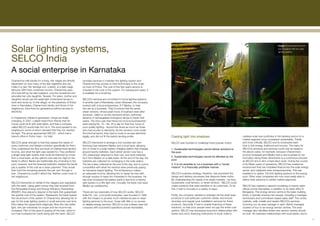
                                                                                                                                                                       Solar lighting for the energy
                                                                                                                                                                              poor by SELCO India      15
Report produced by Greenpeace India Society, October 2011

Author Grace Boyle and Avinash Krishnamurthy

Thanks and acknowledgments
                                                                                                                                         21         Five thousand five
                                                                                                                                                    hundred cattle
                                                                                                                                                                             31
Anil Kumar and Samuel Thomas, Alakode
                                                                                                                                                    dung biogas units in
Harish Hande, Prasanta Biswal, Ashis Sahu, SELCO                                                                                                    Karnataka
Ram Esteves, Mario Esteves and staff of ADATS and the Coolie Sangha, Bagepalli
S. Srinivasan and staff at Barefoot College, Tilonia


                                                                                                                                                    41       Grid-interactive
Teja Ram, Manthan, Kotri
S. Battacharya, West Bengal Renewable Energy Development Agency                                                                                                                         Solar powered
Debabrata Dutta, Secretary of RabiRashmi Residents’ Association                                                                                              solar houses, New          water purification in
Mohammad Hasnain, Pranai Thapa, Rachel Nilza, and Tashi Norbu, Ladakh Ecological Development Group
Sampath Kumar, D R Muralidhar, Prakruti Hydro Labs
                                                                                                                                                             Town Kolkata               Rajasthan
Ravi Gownder, Madhu, Ganesh, Nisarga Environment Technologies
S. Srinivasan, Trans Solar Technologies
Sunny George, Holy Family Hospital, New Delhi                                                                                                                                               A solar power
Vinoth Rangaswamy, www.mettupalayam.in,
Rangaswamy Shanmugam, Odanthurai Panchayat                                                                                                                                                  plant and
Ratnesh Yadav and staff of Husk Power Systems                                                                                                                                               electricity from
                                                                                                                                                                                            micro-hydro in
                                                                                                                            71
Special thanks for editorial consultation: Patrick Inglis and Gail Stevens
                                                                                                                                    Pico-hydro in                                           Ladakh
Contact arpana.udupa@greenpeace.org
                                                                                                                                    the Karnataka
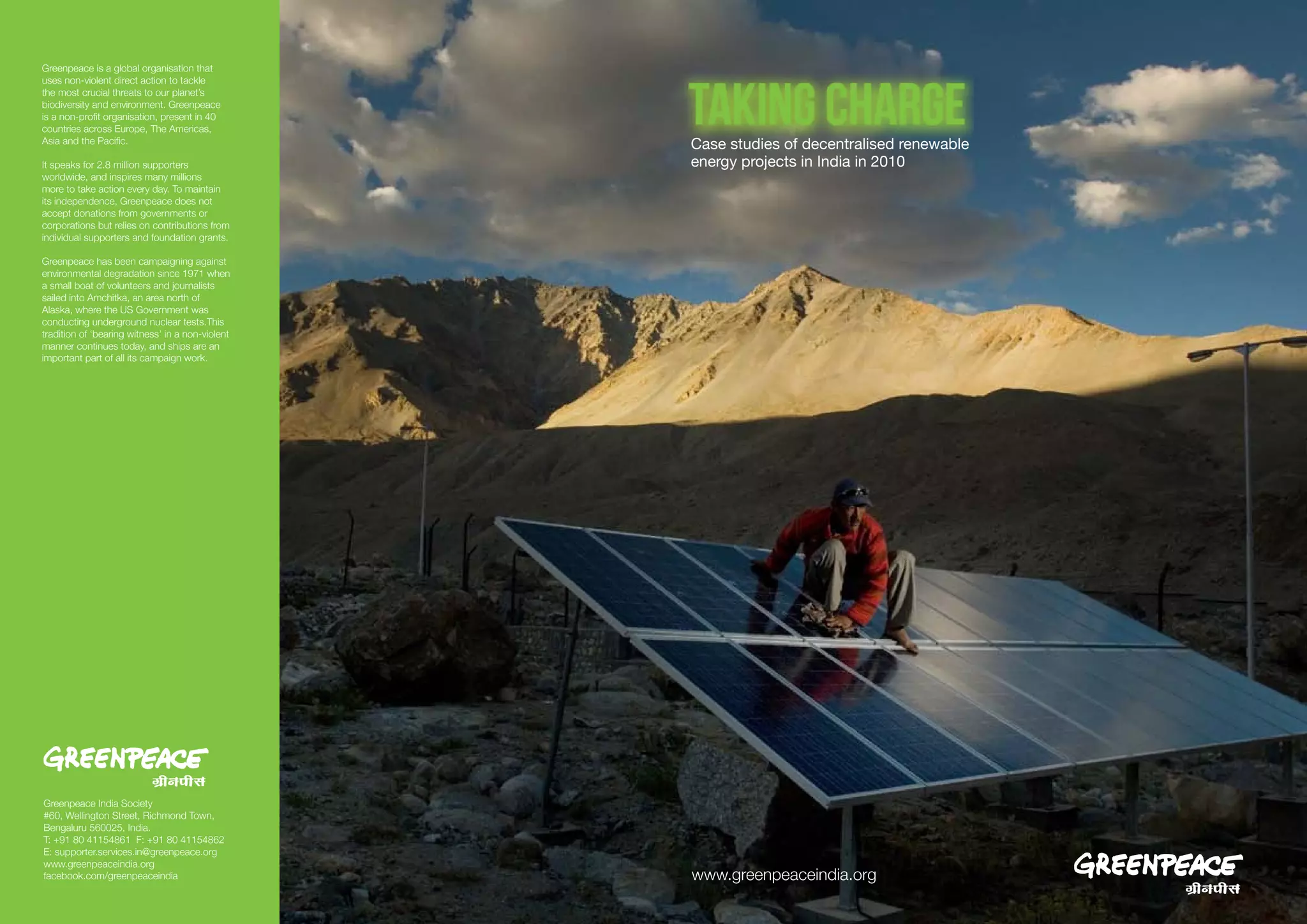
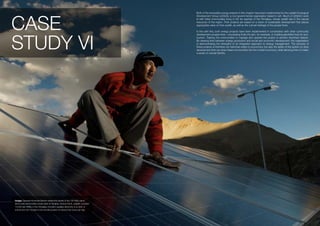
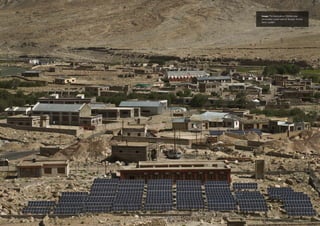
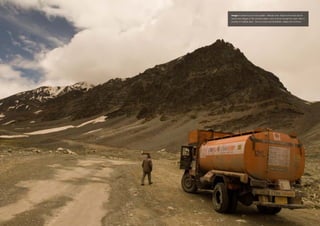
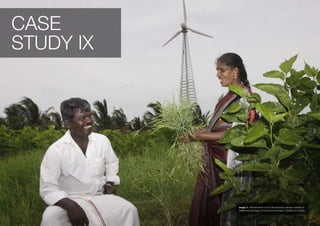
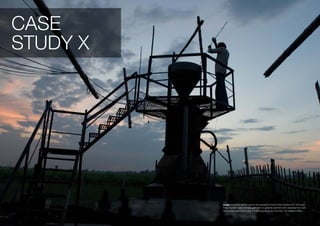
Cover image      Operator Konchok Stanzin cleans the panels of the 100 kWp stand-alone solar photovoltaic power
                 plant at Tangtse, Durbuk block, Ladakh. Located 14,500 feet AMSL in the Himalaya, the plant supplies
                 electricity to a clinic, a school and 347 houses in this remote location, for around five hours per day.
                                                                                                                                    hills
                                                                                                                                                                                            47
                                                                                                                                                     83
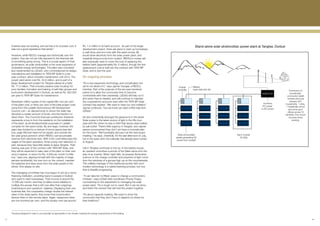
                                                                                                                            Supplying energy

                                                                                                                                                                                             101
Photography
Ladakh (pg 47-70) and Husk Power Systems (pg 101-110): Harikrishna Katragadda                                               services in New Delhi
Panthanpara (pg 03-14) and Odanthurai (pg 91-100): Selvaprakash L
Prakruti Hydro Labs (pg 71-82) and Bagepalli (pg 21-30): Vivek M


                                                                                                                                                    91
SELCO photos reproduced with kind permission of SELCO India Pvt. Ltd.
Kotri (pg 31-40): Prashanth Vishwanathan                                                                                                                                                       Electricity
RabiRashmi Abasan photos reproduced with kind permission of West Bengal Renewable Energy Development Agency.
Holy Family Hospital (pg 83-90): Sudhanshu Malhotra                                                                                                                                            from rice
Design Reema Ganguly & Shagun Mitra
                                                                                                                                                    Wind power                                 husk in Bihar
Printed on 100% recycled paper
                                                                                                                                                    in Tamil Nadu
Introduction
     taking charge
     Taking Charge is a selection of case studies of small-scale, decentralised renewable energy systems in India in 2010. Each
     has two parts: the main story, which captures some of the remarkable human and social elements that have shaped these
     pioneering projects, and a quick-glance section, which provides an easy reference for the more technical aspects.

     The strength of these stories lies in their diversity. One is a   New Town Kolkata, a housing project with grid-interactive
     diversity of the context in which they are based, including       photovoltaic technology has been built, ready for the next
     the geography of the place, and its social fabric. From           wave of urban development. Bankers are travelling to the
     semi-nomadic pastoral tribes in the Himalaya, to caste-           most remote areas of Karnataka to issue loans to farmers
     based politics in the deserts of Rajasthan, to church-lead        to purchase tiny hydro systems for their homes.
     community action in the hills of Kerala, renewable energy
     is seen being applied to the problem of energy access in a        Perhaps most interesting is the diversity of energy
     variety of contexts.                                              governance that these stories demonstrate, and the
                                                                       economic models that they have developed. In Delhi, a
     Another is the diversity of solutions applied. Each of these      hospital is saving up to sixty per cent on its water heating
     renewable energy projects has worked because they are             bills from an enterprising company that has set up shop
     tailored to fit the local needs and conditions. In Bihar, a       on its roof. Across Karnataka, a company is turning profit
     company is providing electricity to over 100,000 people           by providing solar services to people who were previously                                                                                         Image: Women benefit from clean biogas stoves.
     using the only waste product in the villages: rice husk. In       considered unbankable. In Tamil Nadu, a Panchayat is


                                                                                                                                       investing in wind energy to provide better public services      logic is valid and imperative. Yet the people profiled here
                                                                                                                                       for its citizens. And near the Andhra Pradesh border in         only mention environmental concern as a secondary
                                                                                                                                       Karnataka, an NGO, in partnership with a community              incentive for renewable energy, if at all. These decentralised
                                                                                                                                       organisation of 40,000 member families, has built 5,500         projects make sense from a development angle alone. In
                                                                                                                                       biogas units across 339 villages and is monitoring their        India, where an estimated forty per cent of the population
                                                                                                                                       useage daily.                                                   do not have access to reliable energy services, they
                                                                                                                                                                                                       are particularly relevant. Again and again, we see links
                                                                                                                                       Observing the challenges that these people have faced, and      between the energy access that these projects provide, and
                                                                                                                                       how they have chosen to overcome them, is fascinating.          development indicators such as access to basic resources
                                                                                                                                       Yet despite the diversity of these stories, the challenges      and bottom-up economic growth.
                                                                                                                                       faced in setting up decentralised renewable energy projects
                                                                                                                                       seem to fit into three broad categories:                        The title of this book is in part a reference to the generation of
                                                                                                                                                                                                       electricity, though not all the stories in the book are of electricity
                                                                                                                                       1. Social ownership and local governance. Who will own,         and neither are the energy needs of the population confined
                                                                                                                                       run and regulate it?                                            to it. It is primarily a reference to the grit and determination
                                                                                                                                                                                                       of the people who have fought for and developed these
                                                                                                                                       2. Accessing technology, knowledge, services and                projects. Determination that they will no longer wait for the
                                                                                                                                       training. How will they know what to do?                        most basic of energy services to be given to them, or that
                                                                                                                                                                                                       they will no longer draw their energy in a way that is harmful.
                                                                                                                                       3. Accessing finance, and achieving economic stability.         They will take charge, and lead the way to a brighter, more
                                                                                                                                       How will everything be paid for?                                equitable future.

                                                                                                                                       These stories demonstrate a variety of answers, which           In individual learning is collective knowledge, and India can
                                                                                                                                       should be studied.                                              and should learn from projects such as these as it moves
                                                                                                                                                                                                       towards a low-carbon future.
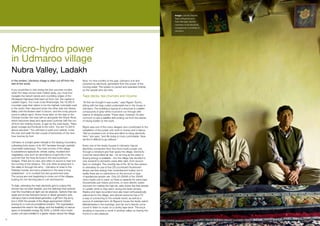
                                                                                               Image: Pico-hydro power in Karnataka.
                                                                                                                                       The call for renewable energy is most often heard as part of
                                                                                                                                       a prescription to mitigate climate change, and certainly this

01                                                                                                                                                                                                                                                                              02
CASE
STUDY I


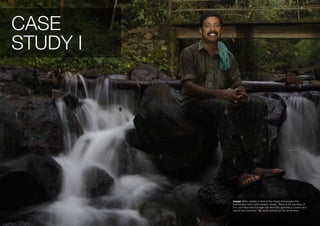
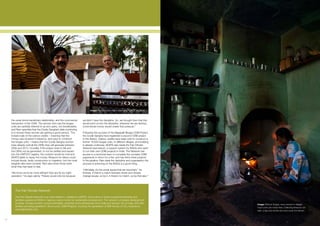
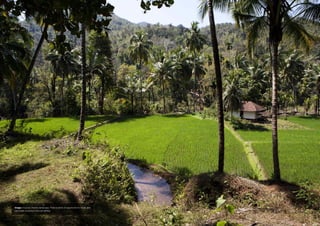
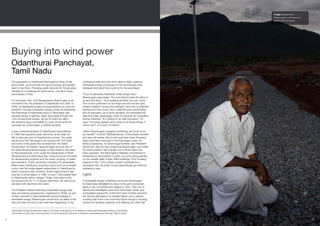
          Image: Shibu Joseph in front of the stream that powers the
          Pathanpara micro hydro system, Kerala. Shibu is the secretary of
          the committee that manages the electricity-generating system, and
          was its first customer. My world opened up, he remembers.
Micro-hydro power in
     Pathanpara village
     Western Ghats, Kerala
     Anil Kumar and Samuel Thomas dreamt of creating power            priest encourages and guides the people.” The level of
     “without doing any big-big thing,” says Anil. “Big nuclear,      initiative meant that Pathanpara was not entirely without
     big dams… all these things that are harmful.” In 1991,           power: individuals had improvised their own tiny electricity
     the government proposed a nuclear power plant in their           systems in their backyards, and the teashops in the village’s
     home district of Kannur, in northern Kerala. The plant was       main street ran black and white televisions off car batteries.
     framed as a solution to the area’s acute power shortage,         “First I had a bullet dynamo, then a jeep engine, set up to
     but the community fought the plans with fervour. As part of      run off the local streams,” Benny remembers. “Simple. I had
     the movement, Anil and Samuel argued that power needs            eight tube lights running at one point.”
     could be met through a combination of better management
     of transmission and distribution - plus a lot of decentralised   In a similar spirit, Anil and Samuel sought to fight the
     renewable energy systems. The two engineers needed a             nuclear power plant by building an environmentally friendly
     project to prove their point, a David to their Goliath. They     power solution that could serve the wider community.
     decided to build one in Pathanpara, a small, unelectrified       They realised the streams could be key to this, and spent
     village close to both their homes.                               months travelling the country to study small and mini hydro
                                                                      projects and talk to people about their experiences. In
     Pathanpara is a hamlet of three hundred and sixty families       1996, Anil even crossed the border to study a micro-hydro
     spread across a small valley of the rolling Western Ghats.       project in Nepal. In 1997, they had the sense to approach
     It comes under the larger Naduvil Panchayat, and is part         Pathanpara’s parish priest, Father Mathew Asaparambil.
     of Kannur district. This is hill country, where farmers grow     They explained to him their idea to create power in the
     areca nut, coconut, rubber and spices on their small             village from one of the perennial streams. If they could
     landholdings and, in the 1990s, lit their evenings with          convince the Father, they would gain the cooperation of
     candles or kerosene lamps. There was no grid electricity,        the community. A proactive visionary, Father Asaparambil
     but plenty of perennial and seasonal streams in this verdant     agreed and began to mobilise the people. “He was a good
     jungle region: a vehement monsoon delivers up to five            organiser,” remarks Benny.
     metres of rainfall annually. There was even a stream in
     Pathanpara’s borders that had the potential to support           The village sets to work
     a micro-hydro system. Socially, the church was, and is,
     pivotal: the west coast is believed to have been a landing       Thirty-six households donated Rs. 6000 each – over
     point for Thomas the Apostle in AD52, and around ninety-         seventy per cent of the average monthly income in
     nine per cent of the population in Pathanpara are practising     Pathanapara – and more donated their labour. Another
     Christians. The cross atop the church is one of the few          50,000 rupees were taken on loan from the Thalaserry
     aerial signs of settlement, poking above the valley’s canopy     Social Service Society, a local organisation. The forest
     of coconut trees.                                                department was persuaded to donate the same amount,
                                                                      giving the project capital of around Rs. 300,000 to set up
     The church could galvanise the community across social           with. Two pieces of land were donated for the project: one
     divisions, and by 1991 had already led Pathanpara in setting     for the reservoir, and one for the powerhouse.
     up its own private bus service. Founded by community
     donations, the bus is still the only service connecting the      Though qualified engineers, neither Anil nor Samuel had
     village to the conveniences of the bigger Alakode, where Anil    built such a system before, and spent many hours figuring
     and Samuel live.                                                 out the best specifications to turn the chosen stream into
                                                                      a reliable power source. Electromechanical equipment was
     “People here are prepared to improve their conditions,” says     ordered from around the country, and the turbine was cast
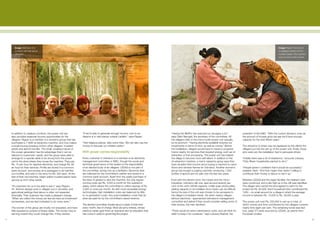
     Benny Matthew, a teacher at Pathanpara’s primary school.         in phosphoric bronze in a mould brought from Nepal. Anil         Image: Monsoon in Pathanpara.
     “Literacy is high, and it gives people ambitions. And the        was better at the technical side of things, while Samuel

05
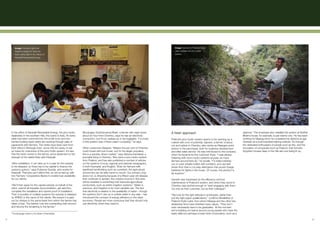
Image: Anil Kumar, right, and                                                                                                                 Image: “It was a very
         a Pathanpara resident in front                                                                                                                exciting time.” Samuel
         of the reservoir pond built by                                                                                                                Thomas, one of the
         the village.                                                                                                                                  engineers of Pathanpara’s
                                                                                                                                                       micro-hydro system.


     excelled at the governance and planning. “It was a very                      1997. The thirty-six households that had contributed             “Schooling has also changed in Pathanpara since the                electricity meters to the five cables that ran out of the
     exciting time,” remembers Samuel, pointing to grainy photos                  financially to the set-up received connections at no extra       television,” he adds. “People’s work was agriculture, and          powerhouse to identify households that consumed above
     of the construction group.                                                   cost, as did the primary school and two church-supported         they studied until tenth standard, maximum. Now their              their ration. They disconnected six users, explaining to them
                                                                                  art clubs. The church was also connected, but insisted that      aspirations have changed, and people take up higher                that the system couldn’t support such appliances. The
     By December 1997, the team had diverted part of the hill                     it would pay. A mini grid extended up to two kilometres from     studies.”                                                          users had to pay five hundred rupees to be reconnected.
     stream into a crude reservoir pond, and installed a six-inch-                the powerhouse to each of the users. Others in the village                                                                          No household in Pathanpara has overburdened the system
     wide pipe to carry the water a vertical height of sixty metres               saw the system working and soon joined, until the total          As part of the committee, Shibu and the other members              since. All regulation is now socially driven, strictly adhering to
     down the hill slope to a powerhouse. By the time the water                   number of households drawing electricity reached seventy-        set the tariffs for the electricity (see fact box, pg 14), based   the code of conduct laid out by the committee.
     hit the turbine, it was travelling at twenty-two litres per                  five. Additional households had to pay a ‘connection fee’ of     on providing different bundles of services rather than a
     second: enough to generate 5kW of power.                                     Rs. 2,000, however.                                              metered system. They decided their income should cover             There have been other examples of good governance. The
                                                                                                                                                   an operator’s salary and maintenance costs, but allow only         committee first used their slowly accumulating funds to pay
     “We didn’t take any payment,” says Samuel. “But [the                         A committee of seven villagers was elected to govern, own        a small emergency fund to accrue beyond that. Customers            off the loan to the Thalaserry Social Service Society. Later, the
     villagers] provided us food.” He pauses. “Food and liquor.”                  and manage Pathanpara’s micro-hydro system on a three            were divided into nine groups, and each committee member           committee secured the land on which the powerhouse stood
     He grins. Through their work, the two engineers developed                    year term. Father Asaparambil was appointed president and        assigned a section to collect fees from every month.               from Shibu’s uncle, who had previously donated it for the
     almost familial ties with the residents of Pathanpara.                       a man named Shibu Joseph as Secretary.                                                                                              project. They also knew it was important to protect the source
     Thirteen years later, the powerhouse is still a place of                                                                                      There were some hiccups, of course                                 of their power for the future, so they partnered with Thalaserry
     frequent revelry. A casual site visit by Anil can quickly turn               Shibu, the system’s first customer, remembers using the                                                                             again to safeguard the stream’s flow. With Rs. 5 million
     noisy, as one man after the other shows up in moustache                      power to watch television for the first time. He was twenty-     With the sudden luxury of electricity, the people of               invested by the civil society, the partners built check dams
     and lungi1, carrying containers of hot food or a bottle of                   seven. “My world opened up,” he says. “My children’s lives       Pathanpara eagerly began to buy electrical appliances and          and gully plugs. They also planted bamboo clusters along the
     home-brewed wine.                                                            are very different as a result of the TV.” Shibu rarely leaves   plug them in to the new sockets that had appeared on their         banks to increase the groundwater percolation, and secure
                                                                                  Pathanpara, and has never been outside of Kannur district.       walls. Unlike a national electricity grid, which is treated as     the base flows into the stream.
     Let there be light                                                           In contrast, many of the younger generation are now working      a limitless battery, the stand-alone micro hydro system had
                                                                                  in the Gulf or Europe: far-flung ambitions that he accredits,    a fixed maximum capacity of 5kW, and therefore couldn’t            These micro measures made some difference, but not
     The lights flickered on in Pathanpara on Christmas Day,                      with an air of approval, to their exposure to television.        support a heavy load of iron boxes. The committee fixed            enough: the macro trends of the hilly regions of Kerala are


     A tube-shaped cloth worn around the waist, particularly in southern India.
     1


07                                                                                                                                                                                                                                                                                         08
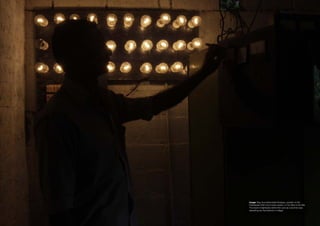
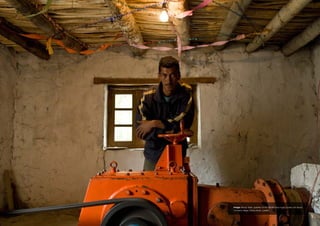
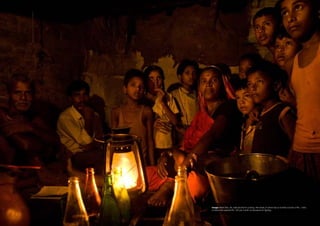
Image: Raju Arumathamattal Devasiya, operator of the
Pathanpara 5kW micro-hydro system, in his office in the hills.
The board of lightbulbs behind him acts as a dummy load,
absorbing any fluctuations in voltage.
Image: A man pours tea in Jojo
                                                                                                                                          Michaels’ shop. Jojo used the
                                                                                                                                                micro-hydro to power an
                                                                                                                                          uninterrupted screening of the
                                                                                                                                                2010 football World Cup
                                                                                                                                             in his tea shop. That meant
                                                                                                                                         good business for me, he says.


     against them. Stream flow is said to be reducing in the           electricity was low voltage and unreliable, as national
     Western Ghats as a result of changing monsoon patterns            shortages led to frequent load shedding in this rural area.
     and mono-cropping. When the system was first installed,
     even the lean summer flow ran at twenty-two litres per            In addition, Pathanpara’s remote geography caused
     second through the turbine. Shortly after the installation,       problems: broken transformers would take two or three
     however, the lean flow ceased completely. The committee           days to be repaired, and falling trees sometimes severed
     had to purchase a diesel generator set in 2004, which they        the connection completely. Slowly, the houses that had
     use to plug the deficit in April and May of each year. Money      disconnected from the micro-hydro began to ask to be
     from work such as this comes from the aforementioned              reconnected, but the window of opportunity had narrowed.
     emergency fund, which hovers around Rs. 60,000. The               The committee refused to reconnect all those who had
     committee’s monthly income is Rs. 1,000 higher than their         so hastily left their system. Operating on a policy of no-
     average outgoings, and they’ve been quite successful in           profit-no-loss, they saw little temptation in the prospect
     accessing other funds to renovate the system when needed          of more fees, and instead preferred to reward their faithful
     (see fact box on pg 14 for details).                              customers with a higher load. Shopkeeper Jojo Michael, 35,
                                                                       was one of around five users who managed to persuade
     In 2002 the committee revamped the holding pool in the            the committee to reconnect him to the micro-hydro system.
     hills above the powerhouse. A small section of the hill
     stream now diverts into a three-metre-deep stone pool,            “I switched from the micro-hydro because it doesn’t work in
     cool and aquamarine blue and dotted with dragonflies. The         the summer, and you can only use lights,” he explains. He
     purpose of the reservoir pool is to create a steady flow of       owns a small goods shop packed with so much stock he
     water through the pipe to the powerhouse. “If you want            can barely stand at the opening, and a teashop across the
     you can swim in it!” says Anil. “Fresh clean water.” Another      street. The teashop has a television, where people come to
     friend from Pathanpara appears from the undergrowth,              watch news and sports. During the 2010 World Cup, Jojo
     waving a container of hot home-cooked food.                       took back his micro-hydro connection so his customers
                                                                       could watch the matches without disruption.

                       Micro, pico or mini?                            “I could be sure it would provide uninterrupted power,” he
                                                                       says. “And that meant good business for me.”

                    Pico-hydro < 5kW capacity
                                                                       What now for this tiny electricity system?
                       Micro-hydro 5-100kW
                    Mini-hydro 100kW to 1MW                            Pathanpara’s micro-hydro customers are loyal: after all,
                        Small hydro 1-10MW                             their electricity rates haven’t changed in thirteen years. The
                       (Large) hydro >10MW                             system served well as a gesture against nuclear power,
                                                                       and withstood a clash with the nationwide electricity grid.
                                                                       Its committee is determined to continue, and to expand.

     The grid enters Pathanpara                                        Anil and Samuel have calculated that the peak flow of
                                                                       the stream can generate 500kW for up to seven months
     Everything changed when the national electricity grid             of the year, and are suggesting that the community
     entered the village in 2002. It was a move voted for by           harness at least some of that to sell to the main grid,
     the community, who also channelled decentralised state            or to power seasonal industry. There are talks with
     funds to pay for a third of the Rs. 450,000 cost. The grid        Thalaserry Social Service Society to further protect
     electrified the nucleus of Pathanpara, though many houses         the stream’s flow. Whatever the next steps, they will
     further out remained unconnected. Excited by the idea of          be the product of the Pathanpara community, as was
     limitless electricity, thirty-five houses in the village centre   the original construction thirteen years ago. “The way
     disconnected from the micro-hydro system and, flourishing         we made it was not the proper technical way to work,”
     electric irons, paid Rs. 7,500 to connect to the main grid.       confides Samuel, grinning at the memory. “But I felt
     Thirty-five others, most of whom were located outside of          that, in four years of studying engineering, we had learnt
     the centre, retained their local connection, and four or five     nothing. In three months, we learnt everything.”
     houses took both the grid, and retained the micro-hydro
     service.

     It wasn’t long before the electricity grid began to disappoint,
     however. Far from being an inexhaustible supply, the state

11
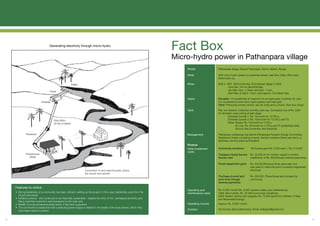
Generating electricity through micro-hydro
                                                                                                                                    Fact Box
                                                                                                                                    Micro-hydro power in Pathanpara village
                                                                                                                                        Where:               Pathanpara village, Naduvil Panchayat, Kannur district, Kerala.

                                                                                                                                        What:                5kW micro-hydro system on perennial stream, lean flow 22lps, 60m head.
                                                                                                                                                             Diesel back up.

                                                             Intake                                                                     When:                Built in 1997. Still functioning. Grid entered village in 2002.
                                                                                                                                                                       June-Dec: 24 hrs electricity/day,
                                                                                                                                                                       Jan-Mar: 5am -7.30am and 5pm -11pm,
                                      Canal
                                                                                                                                                                       April-May: 6.30pm -10pm, plus approx. 3.5l diesel /day.

                                                                                                                                        Users:               Domestic: 75 households at maximum of non-grid years. Currently 35, plus
                              Forebay                                                                                                                        4-5 connected to both micro-hydro system and main grid.
                                                                                                                                                             Other: Previously primary school, two art clubs and a church. Now four shops.

                                                                                                                                        Tariff:              Flat, not metered. Collected monthly, post-use. Connection fee of Rs. 2000
                                                                                                                                                             for domestic users joining at later stage
                                                                                                                                                                       Domestic bundle 1: Rs. 75/month for 10 CFLs,
                                          Drop (60m,                                                                                                                   Domestic bundle 2: Rs. 100/month for 10 CFLs and TV,
                                          22 lps of water)                                                                                                             Other: Shops: Rs. 75/month for 2 CFLs,
                                                                                                                                                                              Art cub: Rs. 20/month for 2 CFLs and TV (subsidised rate),
                                                                                                                                                                              School: free connection and electricity.

               Penstock                                                                                                                 Management:          Pathanpara Janakeeya Urja Samiti (Pathanpara People’s Energy Committee).
                                                                                                                                                             Registered charity consisting of seven elected members (three year term), a
                                                                                                                                                             Secretary and the priest as President.
                                                                                                                                        Finance
                                                                                                                                        Initial investment   Community donations:          36 houses gave Rs. 6,000 each = Rs. 216,000
                                                                                                                                        costs:
              Powerhouse                                                                                                                                     Thalaserry Social Service    Rs. 50,000 at 4% interest, repaid in monthly
                (5kW)                                                                                                                                        Society loan:                instalments of Rs. 650 (through revenue payments)

                                                                                                                                                             Forest department grant:     Rs. 50,000 (Received three years later and
                                                                                                                                                                                          was used to make the pond a properly-engineered
                                                                        Connection to end users (houses, shops,                                                                           structure)
                                                                        the church and school)
                                                                                                                                                             Purchase of pond land        Rs. 200,000. Powerhouse land donated by
                                                                                                                                                             (over time, through          community
                                                                                                                                                             revenue payments):

     Features to notice:
                                                                                                                                        Operating and        Rs. 4,000/ month (Rs. 3,000 operator salary plus maintenance),
     • Strong leadership of a community has been critical in setting up the project. In this case, leadership came from the             maintenance costs:   1998: New turbine, Rs. 20,000 (community donations),
       church and priest.                                                                                                                                    2008: System service and upgrade, Rs. 75,000 (grant from Ministry of New
     • Initiative survived - and continued to be financially sustainable - despite the entry of the centralised electricity grid.                            and Renewable Energy).
       Many potential customers were bypassed by the main grid.
     • Wealth of social entrepreneurship exists, if lead and supported.                                                                 Operating income:    Approx. Rs. 5,000/ month.
     • The community is aware that their continuing power supply is related to the health of the local stream, which they
                                                                                                                                        Contact:             Anil Kumar, Sigma Electronics. Email: anilsigma@gmail.com.
       have taken steps to protect.


13                                                                                                                                                                                                                                            14
CASE
STUDY II


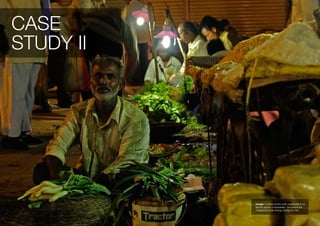
           Image: A street vendor sells vegetables lit by
           electric lamps in Karnataka. The lamps are
           charged by solar energy during the day.
Solar lighting systems,
                                                                                                                                                                                                                                          Image: Chanamma’s income
                                                                                                                                                                                                                                          has increased with her solar
                                                                                                                                                                                                                                          lighting system.


     SELCO India
     A social enterprise in Karnataka
     Chanamma rolls beedis for a living. Her wages are directly         provides services to maintain the lighting system and
     dependent on how many of the leaf cigarettes she can               Chanamma has access to their technicians in the close-
     make in a day. Her teenage son, Lokesh, is a daily wage            by town of Puttur. The cost of the first year’s service is
     labourer. With their combined income, Chanamma pays                included in the cost of the system. For subsequent years, it
     off a loan left by her late husband, runs the household and        is available for a small fee.
     educates her only daughter, Taravati. For years, mother and
     daughter would use the weak light of kerosene lamps to             SELCO’s services are not limited to home lighting systems.
     work and study by. In this village, on the periphery of Puttur     In another part of Karnataka, urban Dharwad, the company
     town in Karnataka, Chanamma’s family, and those of her             worked with a local entrepreneur, S F Madlur, to help
     neighbours, have lived for generations without access to           him set up a business. They’d noticed that the area’s
     electricity.                                                       street vendors, whose peak hours of business were after
                                                                        sundown, relied on smoky kerosene lamps, petromax
     In Chanama’s children’s generation, things are finally             lanterns or rechargeable emergency lamps to hawk their
     changing. In 2007, Lokesh heard from friends that his              wares. The irony was that these low-income businessmen
     house could be lit with solar lights, and that a company           were paying Rs. 15 – Rs. 25 a day for their four hours of
     called SELCO would help him do it. The word spread to his          poor quality lighting - around five times as much as those
     neighbours, some of whom decided that they too wanted              who had access to electricity. As the vendors come under
     the light. The group approached SELCO - which had a                the informal sector, they had no route to access electricity
     branch office in Puttur town - for help.                           legally, and did not fit the bank’s lending profile.              Casting light into shadows                                     catalyse solar loan portfolios in the banking sector for a
                                                                                                                                                                                                         market segment once considered unbankable. Thirdly
     SELCO’s great strength is that they assess the needs of            SELCO intervened to arrange a one hundred per cent                SELCO was founded to challenge three popular myths:            and most critically, SELCO and its employees learn
     every customer, and design a solution specifically for them.       financing loan between Madlur and a local bank, allowing                                                                         how to link energy, livelihood and income. The loans for
     They understood the flow and level of Chanamma’s family’s          him to invest in a solar battery charging station that charges    1. Sustainable technologies cannot deliver solutions to        SELCO’s products and services could only be repaid in
     income, and what the light was needed for. They proffered          around twenty batteries. Each street vendor now has a             the poor.                                                      the above cases, for example, because Chanamma’s
     a single solar light system that could be financed by a loan       CFL-based light attached to their cart, and rents batteries                                                                      income increased and Madlur had a new business to run.
                                                                                                                                          2. Sustainable technologies cannot be afforded by the
     from a local bank, as the upfront cost was too high for the        for it from Madlur on a daily basis. At the end of the day, the                                                                  Innovation along these dimensions is a continuous process
                                                                                                                                          poor.
     family to afford. Banks are traditionally shy of lending to the    batteries are collected for recharging in the solar station.                                                                     at SELCO and is all in a hard day’s work. During the course
     poor, however, and the financial institution insisted the family   The fee is also collected at the end of the day, and is a price   3. It is not possible to run a business with a “social         of its fifteen years of operations, SELCO has created an
     pay a quarter of the cost as a down payment. They would            competitive with what the vendors were previously paying          mission” in a financially profitable manner.                   environment that has mobilised finance into the solar energy
     then fund the remaining seventy-five per cent through a            for kerosene-based lighting. The entrepreneur makes                                                                              sector, and catalysed solar entrepreneurship. This has
     loan. Chanamma couldn’t afford this. Neither could most of         an adequate income, allowing him to repay his loan with           SELCO’s business strategy, therefore, has pioneered the        enabled it to deliver 100,000 lighting systems to the energy
     her neighbours.                                                    enough surplus to keep him interested in the business. He         design and delivery processes that disprove these myths.       poor. Other solar companies are now more easily able to
                                                                        has even increased the battery bank in size from a twenty         By understanding the needs of its target markets – be they     deliver their solutions to similar market segments.
     SELCO intervened on behalf of the villagers and negotiated         light system to a fifty light one. Crucially, the bank now sees   households, rural farmers, or street vendors - SELCO could
     with the bank. Using grant money they had received from            Madlur as creditworthy.                                           create solutions that were sensitive to its customers. To do   SELCO has created a network consisting of twenty-eight
     the Renewable Energy and Energy Efficiency Partnership                                                                               this, it had to innovate in a variety of ways.                 offices across Karnataka, in addition to its head office in
     (REEEP), they placed a deposit in the bank that guaranteed         These are two examples of how SELCO works. SELCO                                                                                 Bangalore. The energy service centre is the basic building
     the quarter cost of the system. Reassured, the bank loaned         India Pvt. Ltd., a for-profit enterprise, was founded in 1995     Firstly, the company needed to redesign off-the-shelf solar    block; it typically employs five people, including a manager,
     the full amount of the system to Chanamma, allowing her to         with the mission to provide much-needed access to clean           products to suit particular customer needs, and ensure         technicians and commission-based sales staff. This centre
     pay for the solar lighting system in small amounts over time.      lighting services to the poor: those with little or no access     doorstep and regular post-installation services for these      markets, sells, installs and repairs SELCO’s services.
     She makes her repayments religiously. Now she has better           to reliable energy services. SELCO is now a fifteen-year-old      products. Secondly, it had to enable financing of these        Zooming out, an area manager in each district manages
     light, she can roll beedis for longer and her income has           company with successful operations across Karnataka.              solutions, so that poor people need not pay the entire cost    clusters of four to six energy service centres. The area
     increased. Part of this goes to paying off the loan, which in                                                                        upfront. SELCO has developed long-term relationships with      manager also identifies where new service centres should
     turn has increased her credit rating with the bank. SELCO                                                                            banks and micro financing institutions of south India to       be built. He maintains relationships with local banks, and is

17                                                                                                                                                                                                                                                                       18
the contact point between head office and the energy
     service centres.
                                                                                International Finance Corporation (IFC), the private lending
                                                                                arm of the World Bank. SELCO India broke even for the first
                                                                                time in 2001 and began to make modest profits.
                                                                                                                                                Fact Box
     In total, the SELCO network employs 180 people, and
     a further eighty business commission agents. SELCO
     considers personality as much as qualifications during
                                                                                Eager for more, SELCO’s investors pressured the company
                                                                                into attempting a quick scale-up in 2004. Rather than
                                                                                                                                                SELCO India
     applicant interviews. Managers assess whether candidates                   owning and operating all their service centres, as they do
     are passionate and motivated to work long-term for an                      today, the company attempted to create a franchise dealer
                                                                                                                                                   Who:                       SELCO Solar Light Private Limited, founded in 1995.
     organisation like SELCO, where processes and protocols                     network. These dealers weren’t loyal to SELCO’s mission
     need constant innovation. “We strive for fifty per cent of our             to serve the poor, however, and they lead the company to
     employees who are passion-based, and fifty per cent who                    start looking at upper- and middle-class markets, which            Where:                     Head office in Bangalore, with operations across Karnataka.
     come in from 9am to 5pm,” says Dr. Harish Hande, founder                   were still immature. By the end of the 2005-2006 fiscal year,
     of SELCO. “Ideally, we don’t want to cross over. If you have               SELCO’s profits had begun to fall.
     more than fifty per cent passionate people, then you have                                                                                     Business mission:          Provision of lighting and other energy solutions to those living in the base
     lots of problems in the organisation, and if you have more                 The company suffered another blow in 2007. Germany                                            of the income pyramid.
     than fifty per cent who are salary-based, you end up with                  introduced large solar subsidies, causing the global
     problems on the mission. So that’s the balance.”                           photovoltaic cell market to shift focus and spiking the
                                                                                                                                                   Track record:              Has delivered 100,000 solar lighting systems.
                                                                                prices of solar panels in India by forty-seven per cent.
     The winding road to success                                                The company was brought to the brink of collapse and
                                                                                its primary mission heavily compromised. With the help
                                                                                                                                                   Clients:                   Households, institutions, schools and businesses.
     The initial idea for the company came from Hande’s PhD,                    of the IFC, which supported their management, SELCO
     which underwent a drastic change following a visit to the                  India underwent a long and arduous journey to restructure
     Dominican Republic. There, he observed solar micro-                        ownership of the company. After a legal process, SELCO
                                                                                eventually managed to attract three new investors whose            Employees:                 180 staff and 80 business commission agents, across 28 branch offices
     enterprises delivering energy services, coupled with micro-                                                                                                              in Karnataka.
     credit to overcome financial barriers. He was convinced that               values were more aligned with their own: E+Co, Good
     this system had the contours of a solution for India, and on               Energies and the Lemelson Foundation. All three are not-
     his return to the USA switched his thesis focus accordingly.               for-profit, committed to SELCO’s mission to provide energy
                                                                                services to the poor, and open to single-digit returns on          Critical Partnerships:     Nationalised and rural regional banks in Karnataka.
     In 1994, in the latter years of his doctorate, he refocused
     his research efforts to investigating how decentralised solar              their investments. Together they now have a ninety-eight-
     electricity could be viable in the Indian subcontinent. It was             per-cent-plus stake in the company: an unusual situation
     during this time that he met Dr. Neville Williams, founder                 of a for-profit company with non-profit investors. SELCO           Ownership:                 98% + stake held by three non-profits: E+Co, The Lemelson Foundation
     of SELF (Solar Electric Light Fund), a US-based non-profit                 now has a total equity base of $2.1 million, with the IFC                                     and The Good Energies Foundation.
     facilitating rural electrification worldwide. In 1995, together            remaining as the leading debtor of $0.8 million. “We’ve
     they founded the Solar Electric Company – or SELCO India.                  learnt from our mistakes,” says Hande. “We now do as
                                                                                much due-diligence on the investors as they would do on            Current Equity Base:       $2.1 million.
     The first few years were a struggle. Williams’ organisation,               the investees.”
     SELF, tried to channel $40,000 into SELCO India, but was
     prevented by restrictions on investments of foreign capital.               An Indian institution                                              Outstanding Debt:          $0.8 million from International Finance Corporation
     Williams founded SELCO USA to own and fund subsidiaries
     in India, Sri Lanka and Vietnam, and in 1996 transferred                   SELCO is now considering how the company should
     the ownership of SELCO India from SELF to this new                         grow. It institutionalised its design process by creating an
                                                                                                                                                   Contact:                   SELCO Solar Light Pvt. Ltd., Bangalore.
     parent company. The same year, they managed to get a                       innovation centre and a SELCO Labs within the company
                                                                                                                                                                              Ph: 91-80-26654 509, 26654 510. Email: selco@selco-india.com.
     conditional loan of $150,000 from Winrock International, a                 in April 2009. They’ve begun to look at energy solutions
     global non-profit organisation.                                            beyond solar. The hope is to develop solutions for more
                                                                                difficult markets – to go “deeper” into the base of the
     Funding started to pick up. SELCO USA managed to raise                     pyramid1, rather than merely “widening” their market base.
     equity investments from European investors, and made                       These critical decisions will affect SELCO’s future – both
     an equity investment of $850,000 in SELCO India. It also                   in terms of its further plans and its continued success as a       Features to notice:
     succeeded in securing a $1 million loan from the                           socially-committed company that turns a profit.                    • It’s possible to build a profitable business providing renewable energy to the poor.
                                                                                                                                                   • The poor are bankable, and willing to pay for reliable energy services.
                                                                                                                                                   • However, they often need help with financing. Bundling bank loans with a product, allowing payments
                                                                                                                                                     to be made in instalments, can unlock this huge market.
                                                                                                                                                   • Providing customers with access to maintenance services after installation is critical.
     1
      The base of the pyramid is a term that describes the largest and poorest socio-economic group.
     Approximately 2.5 billion people fall into this category.

19                                                                                                                                                                                                                                                           20
CASE
STUDY III


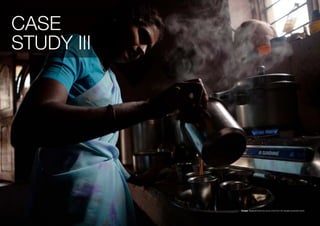
            Image: Nagarathnamma pours chai from her biogas-powered stove.
Five thousand,
     five hundred clean
     cookstoves through biogas
     Chickballapur district, Karnataka
     In 2005, Nagarathnamma’s kitchen looked like her mother’s            “Simply put, your life is easier,” says Ram Esteves. His
     had when she was a child, and her grandmother’s before               non-governmental organisation, ADATS2, orchestrated the
     that. The women cooked on a mud stove in the corner                  construction of Nagarathnamma’s biogas unit as one of
     of the kitchen, pushing sticks into its embers. It was a             forty-two others in Vadigiri village. In total, ADATS set up
     laborious process. “We had to go to the forest, get firewood         5,490 of these units across Chickballapur district between
     and then cook,” Nagarathnamma remembers. “An entire                  2006 and 2008.
     day was wasted. We used to get eye pains, we used to
     cough…” The wall above where her stove used to be is                 Ram points out the implications of having to fetch firewood
     still blackened with soot, deposited by the thick day-to-day         were often offensive, as well as inconvenient. “The women
     smoke that would fill her two-room house. Nagarathnamma              walk ten or fifteen kilometres and there’s a lot of sexual
     lives in Vadigiri, a small village in Chickballapur district, near   exploitation that happens at the hands of the forest guards,”
     the Andhra Pradesh border in Karnataka.                              he says. “Then they come back staggering with a huge
                                                                          headload of fuel. It is horrible. So demeaning. So it’s not
     In 2006, a biogas unit1 was installed on Nagarathnamma’s             just the practical gender aspect, but I would say to do with
     property. It’s a domed chamber buried under her yard, with           self-respect, dignity and all those things. There’s a lot of
     a trapdoor at the top where she loads in the dung from the           symbolism in these biogas stoves for these women.”
     family’s one cow, mixed with water. The dung digests in
     the anaerobic chamber, producing a gas, and a nutrient-              “I can’t go back to the earlier difficulties now,” agrees
     rich slurry. The gas is piped to the kitchen, where it burns         Nagarathnamma. She says the unit has so improved her life
     cleanly on an adapted stove, replacing her need for wood             she’d be willing to take a bank loan to replace it, if a break
     as a fuel. The slurry from the domed digester is pushed out          down forced her to3.
     of its side, and makes a nutrient-rich fertiliser for the family’s
     yearly crop.                                                         Cattle dung biogas is readily acknowledged to be a highly
                                                                          effective renewable energy system for parts of rural India.
     “Not only are those [firewood collecting] days free, but it is       However, the cost of building the unit is still beyond the
     much faster to cook,” Nagarathnamma says, reflecting on              budget of most rural families, especially a family of daily
     the benefits of the biogas unit. “It’s much easier to send the       wage labourers. The unit in Nagarathnamma’s yard cost Rs.
     children to school in the mornings. We run a small shop and          11,000. To construct all 5,490 units, the project spent Rs.
     I spend my time there. I can run it more easily now.” She no         61.5 million. “You can’t touch those kind of numbers with
     longer has to spend hours scrubbing black marks from her             donor funds,” says Ram.
     cooking vessels. Through the biogas unit the cow, already
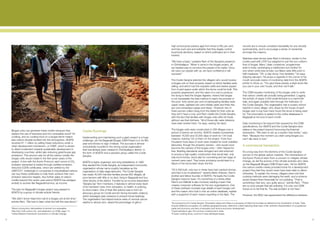
     heavily depended upon in villages for its milk, becomes an           This giant project is known as the Bagepalli Biogas CDM
     even more important source of income. Its dung creates not           Project, after the central town where ADATS is headquartered,
     just a clean, free cooking fuel, but the time in which women         and because it was financed by a commercial transaction
     are free to do other things.                                         through the forward sale of carbon credits.


     1
      See diagram, page 29                                                                                                                 Image: Cow dung digests anaerobically to form a
     2
      Agricultural Development and Training Society, www.adats.com                                                                         clean-burning gas that is considered carbon neutral.
     3
      See ‘uses of capital’ in fact box, page 30

23
high school (post puberty age) from three to fifty per cent,                      records are to ensure complete traceability for any shoddy
                                                                                                                                           and has such size and solidarity that they largely control                        workmanship, and to encourage a sense of ownership
                                                                                                                                           local body elections, based on which politicians act in their                     amongst the masons.
                                                                                                                                           interest.
                                                                                                                                                                                                                             Stainless steel stoves were fitted in kitchens, similar to the
                                                                                                                                           “We have a base,” explains Ram of the Sangha’s presence                           model used with LPG8 but adapted to suit the non-uniform
                                                                                                                                           in Chickballapur. “When it came to the biogas project, all                        flow of biogas. Many ‘clean cookstove’ programmes
                                                                                                                                           we needed was to convince the people of its merits. Once                          exist in India, exchanging a traditional mud chulha9 for
                                                                                                                                           we carry our people with us, we have confidence it will                           one which emits less smoke, but Mario sees little point in
                                                                                                                                           succeed.”                                                                         half-measures. “Oh, a clay stove, how fantastic,” he says,
                                                                                                                                                                                                                             dripping sarcasm. He props a cigarette in the corner of his
                                                                                                                                           The Coolie Sangha selected the villagers who would receive                        mouth and pulls reams of monitoring data from the ADATS
                                                                                                                                           a biogas unit on their property, based on which families were                     printer to show us. “You give these people a steel stove like
                                                                                                                                           willing, and which had the requisite cattle and twelve square                     you use in your own house, and then we’ll talk.”
                                                                                                                                           foot of yard space under which the dome could be built. This
                                                                                                                                           property requirement, and the need of a cow to produce                            The CDM requires monitoring of the biogas units to verify
                                                                                                                                           the dung to feed the biogas digester, means that biogas                           that carbon credits are actually being generated. Logging
                                                                                                                                           is not necessarily the best method to reach the poorest of                        the activity of nearly 5,500 small kitchens is a mammoth
                                                                                                                                           the poor: forty-seven per cent of participating families were                     task, and again possible here through the institution of
                                                                                                                                           upper caste, eighteen per cent middle caste and thirty-five                       the Coolie Sangha. The organisation has a nursery school
                                                                                                                                           per cent scheduled castes and tribes7. However, two or                            teacher in every village, who drops by the house of each
                                                                                                                                           three women collect dung from the street for their units as                       biogas user to log how many hours the stove is being used
                                                                                                                                           they don’t have a cow, and Ram credits the Coolie Sangha                          for. The information is added to the online databases in
                                                                                                                                           with the fact that families with biogas units often let those                     Bagepalli at the end of each month.
                                                                                Image: Construction of a biogas unit in Bagepalli taluk.
                                                                                                                                           without use their kitchens. “All of those silly caste divisions
                                                                                                                                           have been broken here,” he says, waving his hand.                                 Daily monitoring is far beyond that required by the CDM
                                                                                                                                                                                                                             specifications, but ADATS and the Coolie Sangha have
                                                                                                                                           The biogas units were constructed in 339 villages over a                          stakes in the project beyond honouring the financial
     Biogas units can generate these credits because they            Coolie Runnings                                                       period of twenty-six months. ADATS created somewhere                              transaction. “We want to set up a system that works,” says
     replace the use of kerosene and non-renewable wood4 for
     cooking, and so cooking food on a biogas flame means                                                                                  between 16,500 and 22,000 days of work for 134 local                              Ram. “Because the moment you start using biogas you
                                                                     Implementing and maintaining such a giant project is a huge
     less carbon dioxide emitted into the atmosphere. ADATS                                                                                masons, training 123 of them on the project. Forty-four                           can’t slip back to fuel.”
                                                                     challenge, yet the Bagepalli Biogas CDM Project is in its fifth
     received €1.1 million by selling these reductions under a                                                                             thousand more days of work were created for local unskilled
                                                                     year and shows no sign of failure. The success is almost
     clean development mechanism, or CDM5, which is aimed                                                                                  labourers, though the property owners – who would soon                            A commercial transaction
                                                                     undoubtedly founded in the strong social organisation
     to direct investment towards sustainable development in                                                                               become the owners of the biogas units – often helped for
                                                                     that had already been created in Chickballapur district, in
     developing countries, whilst also reducing greenhouse gas                                                                             free. Building standards were stringent and self-enforced                         It’s a long way from the kitchens of the Coolie Sangha
                                                                     the form of ADATS and a people’s group called the Coolie
     emissions. This amount was for all the carbon credits the                                                                             to ensure a high quality construction that would last: only                       women to the global carbon markets. The mechanisms of
                                                                     Sangha.
     biogas units would create in the first seven years of the                                                                             fully-burnt bricks, stone jelly for concreting and ten bags of                    the Kyoto Protocol stem from a concern to mitigate climate
     project. In line with the Kyoto Protocol, each tonne of CO2                                                                           cement were used. They knew scrimping would lead to a                             change, as did the actions of the climate activists who drew
                                                                     ADATS is highly organised, and long established. In 1985
     emission prevented is traded through certified emission                                                                               failure of the dome later down the line.                                          up the Bagepalli Biogas CDM Project plan. Yet for ADATS,
                                                                     they seeded the Coolie Sangha, an independent community
     reduction (CER) certificates, which are verified by the         organisation whose name roughly translates as the                                                                                                       the carbon credits merely provided funds for a development
     UNFCCC6. Individuals or companies in industrialised nations                                                                           “Of 5,490 built, only two or three have had cracked domes,                        project they feel they would never have been able to afford
                                                                     organisation of daily wage labourers. The Coolie Sangha
     can buy these certificates to help them achieve their own                                                                             and had to be re-plastered,” asserts Mario Esteves, Ram’s                         otherwise. To explain the money, villagers were told their
                                                                     has nearly 40,000 member families across 902 villages, all
     emission reduction targets. Any further sales of carbon                                                                               brother and fellow founder of ADATS. He leads the Coolie                          cooking methods were damaging the earth, and a scheme
                                                                     poor farmers with little or no land, living in Bagepalli and four
     credits beyond this seven-year period ADATS has pledged                                                                               Sangha masonry team. It’s something of a family affair:                           would reward them financially for not polluting. “That is
                                                                     other blocks of the district. Funded by an income-dependent
     entirely to women like Nagarathnamma, as income.                                                                                      Ram’s son Mikhail is also involved, leading a team that                           something I feel very, very guilty about,” admits Ram. “There
                                                                     ‘Sangha tax’ from members, it features in almost every facet
                                                                                                                                           creates computer software for the two organisations. One                          are no poor people that are polluting. It is a lie, but CDM
                                                                     of its members’ lives: from education, to health, to policing,
     The plan for Bagepalli’s biogas project was passed to                                                                                 of these software modules logs details of each biogas unit                        forces us to tell that lie. The real problem is not here.”
                                                                     to micro-loans. One of their first actions was to form an
     ADATS by a group of climate activist friends.                                                                                         and the mason who built it onto an online database, replete
                                                                     advocacy group for Coolie women facing domestic violence,
                                                                                                                                           with a snapshot of each mason squinting in the flash. The                         However, the NGO has appreciated the difference between
                                                                     which leveraged peer pressure to prevent future beatings.
     “We didn’t know head from tail of a biogas unit at the time,”   The organisation has helped reduce rates of cervical cancer
     admits Ram. “We had to learn what the hell this was about.”     deaths to almost zero, raised the percentage of girls in              7
                                                                                                                                            As surveyed by the Coolie Sangha. Scheduled castes and tribes is a grouping of tribal communities as defined by the Constitution of India. Traits
                                                                                                                                           include traditional occupation of a definite geographical area, distinctive culture featuring tribal ways of life, primitive characteristics of occupational
     4
      Wood coming from deforestation is termed non-renewable.                                                                              patter and economy, and lack of education and techno-economic development.
     5
      See http://cdm.unfccc.int/, and addendum on CDM, page 111.                                                                           8
                                                                                                                                            Liquid petroleum gas, the common cooking fuel in India.
     6
      United Nations Framework Convention on Climate Change.                                                                               9
                                                                                                                                            A basic cooking stove, common in less developed areas.

25                                                                                                                                                                                                                                                                                                        26
Image: Ram (right) and Mario Esteves of ADATS, Bagepalli.


     the usual donor-beneficiary relationship, and the commercial       we didn’t have the discipline. So, we thought then that this
     transaction of the CDM. The women who use the biogas               would prod us into the discipline, wherever we are lacking.
     units are carefully referred to as end users, not beneficiaries,   Commercial money would create that pressure.”
     and Ram specifies that the Coolie Sangha’s daily monitoring
     is to ensure these women are getting a good service. The           Following the success of the Bagepalli Biogas CDM Project,
     forward sale of the carbon credits – meaning that the              the Coolie Sangha have registered a second CDM project
     money was received in advance, and used to construct               in the district. Carbon credits have been sold to construct a
     the biogas units – means that the Coolie Sangha women              further 18,000 biogas units, in different villages, and building
     have already sold all the CERs they will generate between          is already underway. ADATS also leads the Fair Climate
     2006 and 2013. Crucially, if the project were to fail and          Network (see below), a support system for NGOs who want
     the CERs not be generated, or not be verified and issued           to run their own CDM projects in India. The Network has
     into the UNFCCC registry, the contract would be void and           access to a technical team to complete the complex CDM
     ADATS liable to repay the money. Reasons for failure could         paperwork in return for a fee, and has thirty-three projects
     include floods, faulty construction or migration, but the most     in the pipeline. Ram feels the discipline and organisation the
     tangible risks were societal. Ram also knew those were             process is enforcing on the NGOs is a good thing.
     what they had least to fear.
                                                                        “Ultimately, it’s the social issues that are important,” he
     “We know we’re far more efficient than any fly-by-night            finishes. If there’s a match between these and climate
     operation,” he says calmly. “Failure would only be because         change issues, so be it. It there’s no match, so be that also.”


        The Fair Climate Network
        The Fair Climate Network is an open platform, initiated by ADATS, which aims to share experiential learning and
        facilitate grassroots NGOs in tapping carbon funds for sustainable development. The network comprises development
        workers, climate activists, environmentalists, scientists and professionals from India and abroad. As of today, 500,000            Image: Without biogas, many women in villages
        families are being assisted in 36 pro-poor CDM Projects, involving the generation of 686 tonnes of CO2 reductions.                 must cook over indoor fires. Collecting firewood can
        www.fairclimate.com                                                                                                                take a day, and smoke and soot cover the kitchen.


27
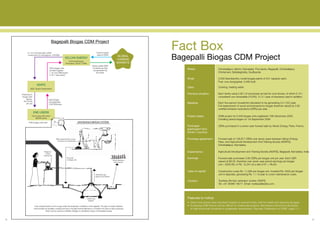
Fact Box
                                           Bagepalli Biogas CDM Project

             1.1m in forward sale, before                                                              Current market


                                                                                                                                              Bagepalli Biogas CDM Project
            construction of units (approx.      8/CER)                                                 value of CERs
                                                                                                                                 GLOBAL
                                                             VELCAN ENERGY
                                                                                                                                 CARBON
                                                                 Commercial buyer.
                                                              Purchases 136,871 CERs                                             MARKETS
                                                                                               Velcan resells CERs
                                         5500 biogas units                                      in batches as they
                                         bundled together                                        are generated by
                                                                                                                                                  Where:                     Chickballapur district, Karnataka. Five taluks: Bagepalli, Chickballapur,
                                         1. as one CDM project                                      end users.                                                               Chintamani, Siddalaghatta, Gudibanda
                                         2. for 7 year period

                                                                                                                                                  What:                      5,500 Deenbandhu model biogas plants of 2m3 capacity each.
                                                                                                                                                                             Fuel: cow dung/gobar. 5,490 built.
                        ADATS
               NGO, Project Implementor
                                                                                                                                                  Uses:                      Cooking, heating water.

     Financing for                                                                                                                                Previous situation:        Each family using 2.85 t of wood/year as fuel for mud stoves, of which 2.15 t
      biogas units                                                                                                                                                           considered non-renewable (75.6%). 31.2 l /year of kerosene used in addition.
          approx.                       Each biogas
        Rs.12,000                       unit generates
          per unit                                                                                                                                Baseline:                  Each five-person household calculated to be generating 3.5 t CO2/year.
                                        3.56 CERs/year
                                                                                                                                                                             Full replacement of wood and kerosene by biogas therefore valued at 3.56
                                                                                                                                                                             certified emission reductions (CERs) per year.
                     END USERS
                 Community with which                                                                                                             Project dates:             CDM project for 5,500 biogas units registered 10th December 2005.
                    ADATS works
                                                                                                                                                                             Crediting period began on 1st September 2006.
             5490 biogas units built                                            HOUSEHOLD BIOGAS SYSTEM
                                                                                                                                                  Purchaser                  CERs purchased in a seven-year forward sale by Velcan Energy, Paris, France.
                                                                                                                                                  (participant from
                                                                                                                                                  Annex I country):

                                                  Milk-supplementary source                                                                       Purchase agreement:        Forward sale of 136,871 CERs over seven years between Velcan Energy,
                                                   of income for households
                                                                                                                                                                             Paris, and Agricultural Development And Training Society (ADATS),
                                                                                                                                                                             Chickballapur, Karnataka.

                                  Biogas as                                                                                                       Implementor:               Agricultural Development and Training Society (ADATS), Bagepalli, Karnataka, India.
                                   a clean
                                 cooking fuel
                                                               Dung fed                                                                           Earnings:                  Forward sale purchases 3.56 CERs per biogas unit per year. Each CER
                                                               to biogas unit                                                Slurry becomes
                                                                                                                              farm manure                                    valued at €8.03, therefore over seven year period earnings per biogas
                                                                                                                                                                             unit = €200.69, or Rs. 12,041 at a rate of €1 = Rs.60.

                                                                                                                                                  Uses of capital:           Construction costs Rs. 11,089 per biogas unit. Invested Rs. 2500 per biogas
                                                                                                      Generated gas                                                          unit in deposits, generating Rs. 1.1 m/year to cover maintenance costs.
                                                                                                      piped to the kitchen

                                                                                                                                                  Contact:                   Towfeeq Ahmed, extension worker, ADATS.
                                                                                                                                                                             Tel: +91 90080 18017. Email: towfeeq@adats.com.


                                                                                        Cattle dung                                               Features to notice:
                                                                                         digestor
                                                                                                                                                  • Clean cook stoves have important impacts on women’s lives, both for health and reducing drudgery.
                      Cow dung ferments to form a gas under the anaerobic conditions of the digester. The gas is mostly methane,                  • Accessing CDM finance can be difficult for small-scale projects. Mechanisms should be developed
                     and provides an excellent cooking fuel due to its high thermal effeciency. A nutrient-rich slurry is also produced,            to help those that contribute to sustainable development. See also ‘Addendum on CDM’, page 111.
                                   which can be used as a fertiliser. Biogas is considered a type of renewable energy.


29                                                                                                                                                                                                                                                                 30
CASE
STUDY IV


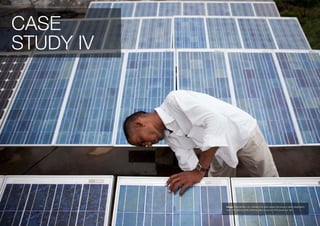
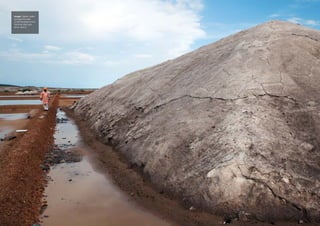
           Image: Parama Ram, 23, maintains the solar panels that power a water desalination
           plant. The plant provides drinking water to around 1000 people per day.
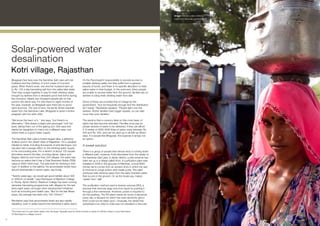
Image: Women collect drinking
                                                                                                                                                   water from the solar-powered plant.


     Solar-powered water
     desalination
     Kotri village, Rajasthan
     Bhagwati Devi lives near the Sambhar Salt Lake with her                     It’s the Panchayat’s2 responsibility to provide access to
     husband and five children, in a hut made of mud and                         potable drinking water, but they suffer from a general
     grass. When there’s work, she and her husband earn up                       paucity of funds, and there is no specific allocation to treat
     to Rs. 150 a day harvesting salt from the saline lake water.                saline water in their budget. In the summers, when people
     Then they scrape together to pay for fresh drinking water,                  are unable to access water from the ground, families rely on
     brought by tankers from a rainwater pond that forms during                  tankers to bring fresh drinking water from afar.
     the monsoon. Nearly two thousand people rely on this
     pond in the same way. It’s only there for eight months of                   Some of these are provided free of charge by the
     the year, however, as Bhagwati says there are no good                       government, “but not frequently enough and the distribution
     rains anymore. The rest of time, the family drinks brackish                 isn’t equal,” Ramkaran explains. “People fight over the
     water from the Sambhar Lake. Bhagwati is seven months                       tankers. Richer families have bigger vessels, so can take
     pregnant with her sixth child.                                              more than poor families.”

     “We know the harm of it, “ she says, “but there’s no                        The result is that a currency label on this most basic of
     alternative.” She draws a bright pink ghoongat1 over her                    rights has fast become standard. Families must pay for
     eyes, taking them out of the glaring sun. She says she                      private tankers of water to be delivered, if they can afford
     wants her daughters to marry into a different area; one                     it. A tanker of 4000-5000 litres of water costs between Rs.
     where there is a good water supply.                                         300 and Rs. 500, and can be used up in as little as fifteen
                                                                                 days. For people like Bhagwati, the expense is simply not
     The Sambhar Salt Lake is India’s largest lake, a glittering                 an option.
     shallow pool in the desert state of Rajasthan. It’s a valuable
     habitat for birds, including thousands of pink flamingos, but               A sweet solution
     has also had a savage effect on the drinking water supply
     in the surrounding area. For a stretch of about 125 square                  There is a group of people here whose story is turning down
     kilometres around the lake, touching Ajmer, Jaipur and                      a different path, however. Forty kilometres from the banks of
     Nagaur districts and more than 200 villages, the water has                  the Sambhar Salt Lake, in Ajmer district, a pilot scheme has
     become so saline that it has a Total Dissolved Solids (TDS)                 been set up in a village called Kotri. A purification plant was
     value of 3000-3500 mg/l. The safe level for drinking is 500                 installed in 2006 in the grounds of Manthan, a local NGO
     mg/l. In addition to the salinity, the groundwater levels have              whose name comes from an ancient story in which the sea
     shrunk dramatically in recent years, say locals.                            is churned to purge poison and create purity. The plant
                                                                                 produces safe drinking water from the salty, brackish water
     “Twenty years ago, we would get good rainfall; about 300                    that occurs in the ground. Or, as the locals say, makes
     or 400mm of rainfall,” says Ramkaran of Barefoot College                    ‘sweet’ from ‘salt’.
     in Tilonia, Ajmer District. Barefoot College has been running
     rainwater harvesting programmes with villagers for the last                 The purification method used is reverse osmosis (RO), a
     thirty-eight years, amongst other development initiatives                   process that removes large ions from liquid by pushing it
     such as schooling and health care. “But for the last fifteen                through a fine membrane. However, power is required to
     years, the average has been only 100-150mm.”                                do this pushing. The RO plant needs six hours of electricity
                                                                                 every day, a demand for which the main electricity grid in
     Ramkaran says that groundwater levels are also rapidly                      Kotri could not be relied upon. Unusually, the diesel that
     depleting, even in areas beyond the Sambhar’s saline reach.                 substitutes it so often in India was not prevalent in this part

     The loose end of a sari when drawn over the head. Typically used by Hindu women in parts of northern India to cover their faces.
     1

     A Panchayat is a village council.
     2


33
Image: Bhagwati Devi with                                                                                                        Image: A water tanker in Kotri
         her five children. Far from                                                                                                      village square. Fetching water
         the RO plant, the family must                                                                                                    is seen as the work of women
         sometimes drink the salty                                                                                                        and girls.
         lake water. Bhagwati is seven
         months pregnant.


     of Rajasthan. However, the State receives one of the            The plant runs daily between 10am and 4pm, producing             work closely together. A case in point, Manthan is lead by                    persuading 100 of the 150 families that now collect the
     highest incidences of sunlight in the country, capable of       500-600 litres of fresh water an hour. This is used for          a former night school teacher called Tejaram, and staffed                     ‘sweet’ water to trust that the system was clean. Like many
     generating 5kW of power per square metre and strong for         cooking and drinking, and the 2000 litres of salt water          largely by men and women who have not received high                           of the villagers, he would often have to drink the saline
     around 314 days annually.                                       produced per day is channelled for use in kitchens,              levels of formal education, or are from socially stigmatised                  ground water before the RO plant was installed.
                                                                     bathrooms and toilets. Salt can also be harvested from this      groups.
     Manthan decided to tap this sunlight to power their sweet       water to create income, but the villagers currently see little                                                                                 “Our knees felt swollen, our teeth were yellow, and we had
     drinking water. They applied for and received full funding      point in a place as imbued with salinity as this.                In line with this, the RO plant in Kotri has been something                   stomach pains,” Parama says of the days in which Kotri’s
     of Rs. 1.5 million from the Ministry of New and Renewable                                                                        of a social experiment. Funding bodies were previously                        residents would drink the brackish water. “Now, since we
     Energy (MNRE), and purchased full RO apparatus from             Kotri’s RO plant has also tested a new type of membrane,         sceptical that this kind of system could be run by a local,                   have the sweet water, these pains have relaxed, so people
     the Central Salt and Marine Chemicals Research Institute        developed by CSMCRI. It’s been functioning successfully          rural community. “People said it was high technology, and                     know its bad to drink the saline water. Also,” he adds,
     (CSMCRI) in Gujarat. To power the plant, they purchased         since the installation of the plant four years ago3, whereas     needed to be run by an engineer from IIT4, or somewhere                       summing up the fundamental difference, “now they have a
     2.5kWp capacity of solar photovoltaic panels and a battery      former membrane designs would need to be replaced                like that,” says Tejaram. The organisation challenged the                     choice.”
     bank. CSMCRI came to install the RO plant, and took only        yearly.                                                          assumption. “We said okay, install it in one place, and see if
     six days.                                                                                                                        the village can look after it or not.” Their challenge bore fruit.            Caste in a different mould
                                                                     Worth its salt
     The plant now provides an average of three litres of drinking                                                                    Parama Ram, 23, has been the operator of the RO system                        The plant has also been used as a tool to challenge
     water per day to around 1000 people in Kotri and the            Above its use as a water purifier, the plant seeks to prove      since its installation. Born in Kotri and educated up to                      discrimination. Caste division is rife in this area, and members
     nearby area.                                                    two things. One is the potential of solar photovoltaic           eighth standard in Barefoot College night schools, his                        of higher castes will often refuse to draw water from the
                                                                     technology to provide solutions beyond electricity,              training to run the RO plant took only six days, during the                   same place as lower castes. This means social standing can
     Reverse osmosis works by separating a volume of water           demonstrating the links between energy access and other          time CSMCRI came to install the equipment. “We took it                        have a direct impact on how much water a family has access
     into two: one without impurities, and the other with a          developmental factors. The second is a social point. Proving     apart, and put it back together again, and took it apart and                  to. While the plant’s limited capacity means only a third of
     concentration of all the impurities present in the original     that traditional academic education is not a prerequisite        put it back together again,” he explains. “It was difficult for               Kotri’s three-thousand-strong population can draw safe
     volume of water. In the monsoon, the ration of sweet:salt       for operating ‘complex’ solar technology is one of the           me at the start, but now I’m fine with it.” He lives above the                drinking water from the solar-powered plant, the majority of
     produced is 60:40, dipping to 50:50 in the dry summers.         cornerstones of both Manthan and Barefoot College, who           system, and is one of its biggest advocates, personally                       them are Dalits5 and landless labourers.

                                                                                                                                      Indian Institute of Technology, a group of higher-education institutes in India oriented to engineering and technology.
                                                                                                                                      4

     Greenpeace visited this project in late 2010
     3
                                                                                                                                      A Dalit is a person of a lower caste.
                                                                                                                                      5


35                                                                                                                                                                                                                                                                                     36
Image: Tejaram walks
amongst the piles
of salt harvested at the
Sambhar Salt Lake,
Ajmer district.
“Higher caste people made it, so we needed convincing
     that it was good for us too, and that it was safe,” says Maya
     Devi, a Dalit and mother of four who draws water from
                                                                        main income of the villagers is salt production, as the rains
                                                                        are too meagre to support much agriculture or livestock.
                                                                        Big dirty piles of salt – mountains, almost – dot the land as
                                                                                                                                          Fact Box
     Manthan. She says the groundwater pipeline they used to
     draw from has been spouting brackish water for the last
     three years, and the children’s teeth would turn yellow and
                                                                        far as the eye can see, and the flat pools of water reflect the
                                                                        scanty white monsoon clouds. It’s very quiet, and very still.
                                                                        Nothing can grow in this water, and salt can’t be harvested
                                                                                                                                          Solar-powered water desalination
     their joints ache from drinking it.                                during the monsoon months either. Tejaram recounts a
                                                                        couple of the many local folk tales explaining how the
                                                                                                                                              Where:                      Village Kotri, Kishengarh Block, Ajmer district, Rajasthan.
     That the water should be available primarily on a pro-poor         Sambhar Lake became salty: in each, the salinity of the lake
     basis was a decision of the community, as was which of the         has been the result of a punishment or a curse, never a
     families should pay for their twice-daily allowance. There is      reward.                                                               Type of technology:         Solar photovoltaic panels power a reverse osmosis (RO) process.
     a nominal monthly charge of ten rupees levied, “to change
     mindsets,” says Tejaram, tapping the side of his head.             We pass empty, half-derelict houses. “See?” Says Tejaram.             Photovoltaic                2.5kWp capacity solar photovoltaic panels, 24 x 2V batteries producing direct
     “People here think that they have a right to get clean water       “People are migrating because the water situation is so               plant details:              current, booster pump and pressure pump. The plant uses a new design of
     for free.” In an area where Manthan says the water table           bad.”                                                                                             membrane by CSMCRI, which has lasted four years as of 2010.
     has sunk from ninety to 250 feet, this is sadly no longer the
     case. Those outside of the RO plant’s service area must still      Meanwhile, as the sun sets on Kotri village, groups of                RO system capacity:         Produces 500-600 litres of desalinated water per hour.
     pay unchecked rates for private tankers, or drink the saline       women and girls appear on the road to Manthan, cutting tall
     water.                                                             columns against the horizon with their water pots balanced
                                                                        on their heads. It’s the duty of the women to collect water           Funding:                    Entirely by grant from the Ministry of New and Renewable Energy (MNRE),
     Tejaram admits freely that the plant in Kotri has been a           in villages, and many of the girls have embroidered their                                         at a cost of Rs. 1.5 million.
     “first-time experiment.” Another solar-powered RO plant is         own rings to pad the bronze- and silver-coloured vessels.
     now being built in Ajmer district, in a village called Sinodia.    Rekha Megwal, 15, gingerly balances one pot on top of the             Input:                      Brackish groundwater. The plant is run for 6 hours per day (10am – 4pm).
     It will have an increased capacity of 5kW, to provide water        other with her fingertips to bring home enough water for
     to a greater proportion of the population than it can in           the six members of her family. It’s about the average size of         Output:                     500-600 litres of drinking water per hour.
     Kotri, and the community will be involved in its installation.     a household in this area. She has no idea how the plant is                                        During the monsoon, for every litre of salted water put in, 0.6-0.7 litres of
     It will also charge a little more, to generate the salary of the   powered, but it hardly matters to her. Now that she doesn’t                                       drinking water are produced, dropping to 0.5 litres during the dry summer months.
     operator. Four similar projects have been approved and are         have to walk so far to bring water, she has more time to
     about to be implemented, funded by the Coca Cola India             study.                                                                                            Fresh water from the RO plant is only for drinking. The brackish water is
                                                                                                                                              Usage:
     Foundation. Having witnessed the initiative, the Panchayat                                                                                                           used for washing and other purposes. It is also possible to harvest salt
     has also agreed to provide access to 120 more RO plants,           “Funders said that this project was too expensive to just                                         from the brackish section of output.
     at its own cost.                                                   give water to 1000 people,” says Tejaram. “But they don’t
                                                                        see families and the change it can make in people’s lives.
                                                                                                                                              End users:                  The plant provides around 3 litres of drinking water per day to around 1000
     On the banks of the Sambhar Lake, workers have piled
                                                                                                                                                                          people, selected by the community to be mostly landless labourers and
     earth in small bundh6s around long, flat rectangles of land        “If we can give just one family sweet drinking water, in my
                                                                                                                                                                          socially stigmatised groups.
     and filled the slabs with salt water to evaporate in the           opinion that project is a success.”
     sunshine, leaving only the mineral deposits. In this area, the
                                                                                                                                              Billing and payment:        Just over half of the 150 families that draw water pay a nominal fee of
                                                                                                                                                                          Rs. 10 per month.

                                                                                                                                              Operation and               Managed by Manthan, a social work centre.
                                                                                                                                              maintenance:                The technician is a local employee, trained in 6 days to operate the plant. Any
                                                                                                                                                                          severe problems are dealt with by a technician from CSMCRI, at cost to MNRE.
                                                                                                                                                                          CSMCRI also visit the plant once every 3-4 months.Battery replacement
                                                                                                                                                                          required every 6-7 years, at a cost of Rs. 240,000.
                                                                                                                                                                          Membrane replacement will cost Rs. 25,000-40,000.


                                                                                                                                              Features to notice:
                                                                                                                                              • Access to energy is critical for social development. It can also reduce the drudgery of women’s lives.
                                                                                                                                              • High level of academic education is not a prerequisite for managing and operating renewable energy
                                                                                                                                                technologies.
     Small raised body of earth, built as a barrier to water.
     6


39                                                                                                                                                                                                                                                            40
CASE
STUDY V


          Image: The RabiRashmi Abasan in New Town Kolkata, West Bengal is
          a purpose-built solar housing complex that feeds into the electricity grid.
Grid interactive
     solar housing complex
     New Town Kolkata, West Bengal
     India is one of the few countries in the world with a                     WBREDA has retained four of the twenty-five bungalows,
     government ministry dedicated solely to renewable energy.                 while the other twenty-one were quickly sold to private
     This central Ministry of New and Renewable Energy                         buyers. Most of the purchasers are families and work in
     (MNRE) has a nodal agency in each state, to promote and                   IT; some have their own businesses. Only a couple work
     deploy these technologies on a more local level. They also                in the renewable energy industry. Debabrata Dutta, a
     administer the roll out of the parent ministry’s schemes.                 RabiRashmi bungalow owner, was motivated both by an
     Electrifying remote areas through renewable energy is                     ideological support of the environmental movement, and by
     common; emphatically promoting the use of renewable                       the opportunity to become involved in something that was
     energy as part of an integrated, urban energy landscape is                ahead of its time. He’s sure that in the future, all housing
     less so. It’s rare that a state nodal agency takes on a real              projects will have to have some kind of power generation
     estate project.                                                           incorporated.

     In New Town Kolkata, the West Bengal Renewable Energy                     “We are the first set of people who have taken this type
     Development Agency1 (WBREDA) has built ‘India’s first                     of housing, so surely there are some risks,” he says
     solar housing complex.’ The RabiRashmi Abasan, whose                      comfortably. He is also the secretary of the RabiRashmi
     name means solar housing complex in Bengali, is a neat                    Residents’ Association, which will soon own all of the
     square of twenty-five houses a few kilometres outside of                  community assets of the compound, including the solar
     the old capital city. The compound also holds a community                 technology. “We thought: this is good work. Let us be part
     centre with a swimming pool, a children’s playground                      of that.”
     and an ornamental water fountain in the garden of each
     house. The project was conceived and financed entirely by                 Renewable energy and real estate
     WBREDA, and construction and engineering outsourced
     to Bengal Development Corporation Ltd. Each house has                     The RabiRashmi Abasan demonstrates two things. Firstly,
     solar photovoltaic panels on its roof, with a total capacity              it is a demonstration of how renewable energy technology
     of 2.1kW, feeding into the state utility’s electricity grid. The          can be integrated into housing. Secondly, it seeks to
     community centre has building-integrated photovoltaics, or                develop a real estate market for this kind of housing, and
     BIPV: window tiles that generate electricity from sunlight.               demonstrate to the real estate sector that this can be done
                                                                               in a commercially viable way.
     Other energy efficiency features include passive solar
     architecture, allowing the houses to remain cool in the                   The families that purchased the RabiRashmi bungalows did
     Kolkata summers without need for air conditioning. Central                so for between Rs. 4.3 million and Rs. 4.5 million, thereby
     open shafts distribute natural light, and allow air to circulate.         just covering WBREDA’s Rs. 4 million construction cost
     Hydropneumatic water pumps save energy by switching on                    for each house. MNRE grants were used to lower costs
     only when there is a dip in water pressure, and by operating              of building solar components, but no subsidies from the
     on varying frequency so only the required amount of energy                Solar Mission2 were utilised as construction was before the
     is used. Each house also has a 100 litre solar water heating              mission was introduced.
     system on the roof, distributing hot water to the kitchen
     sink as well as the bathrooms. Seventeen solar streetlights               Some time after the houses were built, however, WBREDA
     illuminate the picturesque single road.                                   gifted one of the four it had retained to the company that     Image: Housing with integrated energy
                                                                                                                                              generation is seen as a concept for future real
                                                                                                                                              estate. The RabiRashmi Abasan bungalows are
     1
      www.wbreda.org                                                                                                                          already estimated to be worth 2.5x the cost of
     2
      The Central Government scheme will the objective of accelerating and catalysing the solar energy sector in India. The scheme is         construction.
     owned by the MNRE and is part of the National Action Plan on Climate Change.

43
had built the complex, Bengal DCL. They promptly sold it         the Residents’ Association that the nodal agency will be                                        Residential grid-connected solar photovoltaic system
     for Rs. 8 million. Battacharya estimates the value of each       present if any operating or maintenance problems emerge
     bungalow is now Rs. 10 million, and anticipates the value        in the future. In turn, WBREDA will be able to witness the
     will rise further once commercial infrastructure such as         interaction between a residents’ association that produces
     shops and markets arrive. New Town Kolkata is currently an       electricity, and the state utility – a new type of relationship.
     area of development: largely empty, though the skeletons of      They would also be able to understand the capacities and
     future apartment blocks are already standing sentinel on the     needs of an association to maintain and manage solar                                                                               Solar
     horizon. The bungalows of RabiRashmi Abasan are being            assets in the long term.                                                                                                          panels
     decorated as families wait for this development to take
     place. Mr Dutta estimates it will take around one year.          Such technical aspects “will be slightly tough,”
                                                                      admits Dutta. Once energy-generating housing is
     “It is a nice area,” he considers. “A well-planned city. Plus    more commonplace, however, he anticipates that the
     the security and safety of a gated community, and there’s        maintenance may be outsourced to property management
     the swimming pool. I think down the line it’s going to be the    companies. Solar technology would merely become part of
     ideal place to move.”                                            a common maintenance package, along with roads, waste
                                                                      management, and all other utilities of gated communities.
     The energy-generating and energy efficiency measures             “But we don’t know exactly how it will go yet,” he says,
     in the RabiRashmi Abasan will slash electricity costs for        shrugging his shoulders. “I am not worried. Let us see!”                                                         Inverter
     residents. The state allows net metering for residential                                                                                                                                                                 Utility
     consumers of electricity up to one hundred per cent of           WBREDA also plans to use this housing complex to                                                                                                       service
                                                                                                                                                                                                     Meter
     a household’s requirements, meaning that bills will only         compile detailed measurements on the performance of the
     charge for electricity consumption in excess of what the         solar panels, including how much electricity is generated
     solar panels produce. However, WBREDA is currently               through different seasons. This kind of data will be useful            Home power
     dealing with the challenge of net metering the relatively tiny   to extrapolate the impact of integrating solar photovoltaics            appliances
     amounts of current that will be produced by the houses.          into the grid, for when housing with solar technology built in
     Once the appropriate instrumentation is in place, and the        becomes more commonplace.
     residents move in, electricity from the solar panels replace
     some to all of that which is needed from the grid. One           WBREDA envisages a housing sector in which renewable
     consultant with WBREDA anticipates monthly electricity bills     energy is used to holistically solve a variety of potential
     of Rs. 200-300, as opposed to a typical bill of Rs. 1,200.       problems. They’re attempting talks with corporations and
                                                                      municipal authorities, to encourage them to build these            Features to notice:
     The two government bodies that handle electricity                technologies into construction byelaws. Their vision is one
     regulation and distribution are the West Bengal Electricity      in which all niches for renewable energy are integrated            • Strong potential for urban planning and construction bye-laws.
     Regulatory Commission (WBERC) and the West Bengal                into urban planning and development, and peak electricity          • Proactive nodal agencies can demonstrate solutions which may later become mainstream.
     State Electricity Distribution Company Limited (WBSEDCL).        demands are lowered by captive renewable energy
     Potentially, if a household was to produce more electricity      generation.
     than it uses, the solar photovoltaic panels on the roof
     could become a source of income. However, WBREC is               Battacharya talks about hybrid systems in areas with lots
     yet to adopt the feed-in tariff for retail consumers, and the    of wind, in which a rooftop aero generator can back up
     WBSEDCL is yet to institute all the technical, administrative    batteries on cloudy days when the photovoltaic potential
     and institutional changes necessary to treat household           dips. They’re also thinking about biogas digesters3 to
     rooftop solar panels as paid independent power producers.        process kitchen waste, and rainwater harvesting to reduce
                                                                      energy bills for pumping water.
     Laying foundations
                                                                      “You can consider RabiRashmi as a concept,” explains
     The RabiRashmi Abasan is a first step in a vision for the        Battacharya. “It’s under research and development, and
     future of urban development. “It’s an action research            there’s scope for more activities. But if we can establish
     project,” explains Battacharya. WBREDA has retained              here that LT4 net metering is possible then it may be
     ownership of one of the RabiRashmi houses, to reassure           replicated throughout India. No problem.”


     3
         See biogas system diagram on bottom of page 29.
     4
         Low tension, meaning the lower voltage distribution grids.

45                                                                                                                                                                                                                                      46
CASE
                                                                                  Both of the renewable energy projects in this chapter have been implemented by the Ladakh Ecological
                                                                                  Development Group (LEDeG), a non-governmental organisation based in Leh. Much of LEDeG’s work
                                                                                  is with tribal communities living in the far reaches of the Himalaya, whose wealth lies in the natural
                                                                                  resources of the region. Their projects are based on a vision of sustainable development that places
                                                                                  appropriate value on that wealth, as well as the cultural heritage of the people there.

                                                                                  In line with this, both energy projects have been implemented in combination with other community


STUDY VI
                                                                                  development programmes – processing fruits into jam, for example, or building electrified huts for eco-
                                                                                  tourism. Training the communities to manage and operate the project is another important feature.
                                                                                  By drawing links between energy production and social and economic development, the organisation
                                                                                  is demonstrating the strengths of an integrated approach to energy management. The success of
                                                                                  these projects is therefore not restricted solely to economics, but also the ability of the system to drive
                                                                                  development that can draw these communities into the modern economy, while allowing them to retain
                                                                                  a sense of cultural identity.


Image: Operator Konchok Stanzin cleans the panels of the 100 kWp stand-
alone solar photovoltaic power plant at Tangtse, Durbuk block, Ladakh. Located
14,500 feet AMSL in the Himalaya, the plant supplies electricity to a clinic, a
school and 347 houses in this remote location for around five hours per day.
Image: Lobzanj Tsephel,
                                                                                                                                         Tserinj Ringchen) and
                                                                                                                                         Tashi Namgial, elected
                                                                                                                                         members of the electricity
                                                                                                                                         management committee in
                                                                                                                                         Udmaroo.


     Micro-hydro power
     in Udmaroo village
     Nubra Valley, Ladakh
     In the winters, Udmaroo village is often cut off from the          Now, for nine months of the year, Udmaroo is lit and
     rest of the world.                                                 powered by electricity, generated from the power of the
                                                                        moving water. The system is owned and operated entirely
     If you would like to visit during the four summer months,          by the people who live here.
     when the deep snows have melted away, you must first
     navigate the hairpin bends and crumbling edges of the              Tape decks, tea churners and income
     Himalayan highways that lead out from Leh, the capital of
     Ladakh region. You must cross Khardungla, the 18,380-ft            “At first we thought it was a joke,” says Rigzen Tsomo,
     mountain pass that claims to be the highest motorable road         sitting with her legs curled underneath her in her house in
     in the world, then descend down the other side into Nubra          Udmaroo. The building is typical of a structure in Ladakh:
     Valley until the flowers start to bloom, and the rocky ground      compounds of grey-white mud brick run through with
     turns to yellow sand. Some hours later, on the way to the          beams of stripped poplar. These days, however, it’s also
     Chinese border, the road will run alongside the Shyok River,       common to see a satellite dish poking out from the stacks
     which becomes deep and rapid every summer with the run-            of drying fodder on the roofs.
     off from the melting snows. A sign by the road reads, “Here,
     great courage and fortitude is the norm. You are 10,320 ft         Rigzin was one of the many villagers who contributed to the
     above sea level.” You will have to park your vehicle, cross        installation of the power unit, both in money and in labour.
     the river and walk the last couple of kilometres of the nine-      “We’ve invested a lot of time and effort to bring electricity
     hour journey by foot.                                              here,” she says, “and life today is more comfortable. Now
                                                                        we find it difficult to go without.”
     Udmaroo is a bright green triangle in the sloping mountains,
     cultivating forty-seven of its 457 hectares through carefully      Every one of the ninety houses in Udmaroo has an
     channelled waterways. The main income of the village               electricity connection from the micro-hydro power unit,
     is subsistence agriculture: wheat, barley, mustard and             through a miniature grid that spans the village. Electricity
     vegetables, plus such an abundance of apricots in the              could be transmitted all day - for as long as the water is
     summer that the fruits lie loose in the sea buckthorn              flowing energy is available - but the village has decided to
     hedges. There are no cars, and often no sound to hear but          only transmit to domestic users after dark, from around
     the running of the streams. The only other employment in           6pm to midnight. The monthly fee of Rs. 90 for this service
     the valley is through the army - Udmaroo is close to the           is ostensibly for use of five CFLs (compact fluorescent
     Pakistan border, and army presence in the area is long             lamps use less energy than incandescent bulbs), but in
     established - or in coveted but rare government jobs.              reality there are no restrictions on the amount or type
     The young are now beginning to move out of the villages,           of appliances people use. Only 20-25kVA of the 32kVA
     looking for non-farming jobs in Leh and beyond.                    micro-hydro unit is used, so there is capacity for extra load.
                                                                        Households use mixers and irons, or even electric butter
     To date, extending the main electricity grid to a place this       churners for making the high fat, salty butter tea that people
     remote has not been feasible, and the darkness that extends        in Ladakh drink to stay warm during the bitter winters.
     over the mountains at night can be absolute. Options then are      Radios and tape recorders have also been enthusiastically
     weak and smoky kerosene lamps or diesel generator sets.            welcomed to the village, and almost everyone has a TV:
     Udmaroo had a small diesel generator, a gift from the army,        a way of connecting to the outside world, as well as a
     but in 2005 the people of the village approached LEDeG             source of entertainment. At Rigzen’s house the family watch
     looking for a more accomplished solution. The organisation         Mahabharata in the evenings, and her son’s friends come
     assessed the need in the village, and the feasibility of various   round to listen to music on a clunky tape deck. The boy’s
     types of renewable energy. By 2008, a 32kVA micro-hydro            studying to become a monk in another valley, so having him
     power unit was installed in a glacier stream above the village.    home is a rare pleasure.

49
Image: Members of a                                                                                                                                                                                                            Image: Rigzen Tsomo and
        women’s self-help group,                                                                                                                                                                                                       a colleague extract oil from
        Udmaroo.                                                                                                                                                                                                                       mustard seeds. The machine
                                                                                                                                                                                                                                       runs on micro-hydro power.


     In addition to creature comforts, the power unit has           “If we’re able to generate enough income, one of our            “Having the MHPU has reduced our drudgery a lot,”               president of the EMC. “With the current demand, even as
     also provided seasonal income opportunities for the            dreams is to visit places outside Ladakh,” says Rigzen.         says Tashi Namgial, the secretary of the committee. All         the amount of houses grow we see we’ll have enough
     villagers. Rigzen is a member of a women’s group that has                                                                      the villagers refer to the micro-hydro power unit casually,     capacity for the next fifteen years.”
     purchased a 7.5kW oil extraction machine, and now makes        “Visit religious places, take some trips. We can also use the   by its acronym. “Having electricity available reduces our
     a small income pressing oil from other villagers’ mustard      money to educate our children better.”                          investments in terms of time, as well as money.” Before         The reticence to share may be explained by the efforts the
     seeds and apricot kernels. The small, localised nature of                                                                      the installation, villagers would have to travel to powered     villagers put into the set up of the power unit. Firstly, those
     this power generation has the advantage that it can be         With power comes responsibility                                 towns nearby for services that required energy, such as oil     who were pro the installation had to persuade others.
     tailored to customers’ needs, and the group were able to                                                                       extraction or fruit processing. The power unit has helped
     arrange for a special cable to be strung from the power        Every customer in Udmaroo is a member of an electricity         the village to become more self reliant: in addition to the     “Initially there was a lot of resistance,” recounts Lobzanj.
     unit to the shed where they house the machine. They pay        management committee or EMC, though the social and              oil extraction machine, a men’s carpentry group says they       “Only fifteen households wanted to do it.”
     Rs. 15 per hour for daytime electricity, and charge Rs. 80     technical governance of the system is the responsibility        have doubled their income since buying a machine to carve
     an hour for their services. Profits are stored in a common     of an elected body of six villagers. LEDeG is not part of       doors and window frames for Udmaroo. Another women’s            “People weren’t confident that it would be successful,”
     bank account, and excess oil is packaged in old half-litre     the committee, acting only as a facilitator. Electricity fees   group has bought a pulping machine, producing 1,500             explains Tashi. “And that meant they weren’t willing to
     rum bottles, and sold to the army for Rs. 300 each. At the     are collected by the committee’s cashier and stored in a        bottles of apricot jam for sale over the last two years.        contribute their money or labour to set it up.”
     feet of their red machine, bright yellow mustard plants have   common bank account. Apart from the yearly purchase of
     sprung up from stray seeds.                                    five kilos of grease to slick the machine, the only regular     Even with the electric irons, the mixers and the micro-         Between LEDeG and the eager families, the hesitant ones
                                                                    running costs are Rs. 3,000 a month for the operator’s          industries, Udmaroo still only uses around seventy per          were convinced, and a site high up in the cliff was identified.
     “It’s important for us to be able to earn,” says Rigzen,       salary, which allows the committee to collect savings of Rs.    cent of the unit’s 32kVA capacity. Unlike solar photovoltaic,   The villager who owned the land agreed to sell it for the
     44. Women always work in villages, but in domestic and         5,000 or more per month. As with most renewable energy          adding capacity to an installed micro-hydro can be difficult,   project for Rs. 60,000. Each household then contributed Rs.
     agricultural settings their labour is often not rewarded       technologies, high installation costs are balanced by little    hence the size of the unit was chosen to be excessive to        1000 – no small amount for a village in which the average
     financially. Their business has made a pleasant change.        to no generation costs. Any post-installation costs that do     the village’s immediate needs. Yet when nearby villages -       income is between Rs. 10,000 to Rs. 30,000 a year.
     “When we collect the money we feel we have an investment       arise are paid for by the committee’s saved revenue.            without electricity - approached Udmaroo’s management
     somewhere, and we feel motivated to do more work.”                                                                             committee and asked if they would consider selling some of      The power unit cost Rs. 220,000 to set up in total, of
                                                                    The elected committee donate about a week of their time         their excess, the men declined.                                 which money and time contributed by the villagers covered
     The women of the group are mostly not educated, and have       every month, free of charge. Most are army retirees, whose                                                                      nearly forty-eight per cent. The remaining funds (see fact
     little experience outside of Nubra Valley. The money they’re   previous career gave them an exposure and an education that     “There would be extra maintenance costs, and we think it’s      box, page 57) were sourced by LEDeG, as grants from
     earning means they could change this, if they wished.          has come in useful in governing the project.                    safer to keep it for ourselves,” says Lobzanj Tsephel, the      European bodies.

51                                                                                                                                                                                                                                                                    52
Image: Mutup Tashi, operator of the 30kVA micro-hydro power unit above
Udmaroo village, Nubra block, Ladakh.
A distribution grid was made with poles of the willow that       given electricity for free, as the community knows they have
     grows fast in the region, and wires strung by men balancing      little source of income. This village has no crime, and doors
     precariously on beams and ladders. A section of the stream       are never locked.
     also had to be diverted to run through the MHPU, a “really
     tough job,” says one villager. “The pipes were so heavy, and     “I think projects like this help bring a community closer
     we nearly gave up.” All the villagers, both men and women,       together,” says Tseway Motup, Rigzen’s husband. “We’re
     put in about two months of labour to install the system.         happy with the way the operator works, but if there’s a
                                                                      problem that’s beyond him we all go up and help.”
     Figuring out the small print
                                                                      The second factor is that the villagers are well aware how
     More than two years after installation, it’s interesting to      enviable their situation is. The rivers and streams freeze
     hear the finer details of how the community have adapted         in Nubra Valley for up to four months each year, and the
     to governing their own electricity system. Mutup Tashi is        micro-hydo power unit does not create electricity then.
     the operator: he mans the micro-hydro power unit on the          So from December to March, the EMC runs a small diesel
     mountainside above the village, turns its switches and           generator set instead, distributing electricity through the
     cleans silt from its crevices. The committee manages any         same micro-grid. This provides a direct comparison to the
     problems itself, save one, when the previous operator left       alternative energy paradigm for the villagers. The costs for
     the machine running and a part had to be replaced. The           diesel are much higher: in the winter of 2009-2010 each
     equipment had to be ordered from Nepal, and took eight           household has to contribute Rs. 600 for one month of
     months to arrive.                                                electricity, as opposed to the Rs. 90 they pay for the micro-
                                                                      hydro. By using the micro-hydro for nine months of the year,
     Mutup has been trained by Lobzanj and Tashi, and has             the village saves at least Rs. 120,000, compared to what
     a handbook in the local Bodhi language. Someone has              they would spend if using only diesel.
     strung ribbons across the ceiling, but he says it can get a
     little lonely up on the hill on his own. However, Mutup is one   “We do think about pollution, too,” says Lobzanj. “In the
     of the few in the village who considers he is given enough       months we have to use the diesel it creates a lot of smoke.”
     respect for his job. The elected members feel overlooked.        It’s the first mention of pollution in this story of renewable
                                                                      energy: while mitigation of pollution and climate change are
     “People aren’t supportive of what we’re doing!” complains        motives for renewable energy in the wider world, here they
     Tashi. “They don’t realise how much time and effort we           make sense for developmental reasons alone.
     have to put in.” He says family members tease them that it’s
     not a ‘proper job,’ unlike paid employment in the army or        There are government plans afoot to build two 1-2MW
     government.                                                      dams on the Shyok River, ostensibly to bring electricity
                                                                      to clusters of villages similar to Udmaroo. This would
     There’s no question that they may leave their positions,         create no thick smoke, and the villagers would not have to
     though. “We’ve been trained over and over again [by              manage the system themselves. Would Udmaroo want it?
     LEDeG],” he says. “So we feel obliged to take care of            Surprisingly, most people say no.
     the project.” There’s a discernible amount of pride in his
                                                                      “Since we’ve invested so much time and effort, I’d be
     voice as he continues: “We also realise that if other people
                                                                      happy continuing with our own system,” says Rigzen.
     in the village manage it they won’t do it well enough.
     We’ve worked hard to get to this point, and don’t mind           “But if there are problems [with the grid], it’s the
     continuing.”                                                     government’s responsibility,” counters her husband.
     While the EMC may grumble that the villagers do not              “But it’s our own source of power and we have control over
     respect them, they receive no opposition to their work:          it,” points out Rigzen. “Whenever we have an occasion like
     the bill payment rates in Udmaroo are a remarkable one           a marriage or death, we can ask that the electricity comes
     hundred per cent.                                                to power it. With the grid, we have no control.”

     Such honest commitment to the system seems to stem               The members of the EMC – the people who voluntarily give
     from a couple of factors. Firstly, Ladakhi communities are       their time to managing the micro-hydro – agree with Rigzen.
     recognised as close-knit and peaceful. The living conditions     “If the grid comes we’ll still maintain the micro-hydro, as we
     in the Himalayas are known to be some of the harshest on         have control over it,” says Tashi. “Plus we would have to
     earth, and people are used to pulling together to make it        pay more for the grid.
     through the merciless winters. The EMC has no standard
     procedure for complaints, as the community is so close           “Electricity is such an important part of our lives, it’s good to   Image: Women of Udmaroo village, July 2010.
     they are dealt with on a personal basis. Three widows are        be in charge.”

55                                                                                                                                                                                      27
Fact Box
     Micro-hydro power in Udmaroo village
         Technical details    Capacity                     32kVA capacity, presently generating 20-25kVA.                                                                        ii. Men’s group run carpentry enterprise
         of system:                                                                                                                                                              making furniture for local markets – 1.5
                              Head and flow                Net head 54m, design flow 120 litres/second.                                                                          kW capacity, used for 3-4 hours per day
                              Electric component           415V three phase, four wire system with                                                                               when required,
                                                           electronic load governing, live load.
                                                                                                                                                                                 iii. Women’s group run electric flour
                              Total transmission length    3.3km.                                                                                                                milling enterprise – 3.5 kW, used
                                                                                                                                                                                 seasonally for up to two months per year,
         Management:          Every customer of the system is a general member of the Electricity
                              Management Committee (EMC) and in turn elects a six-member body to handle                                                                          iv. Women’s group fruit processing
                              management. All members are voluntary                                                                                                              enterprise - 746W pulping machine,
                                                                                                                                                                                 making 1,000 bottles of jam and 500
                                                                                                                                                                                 bottles of seabuckthorn juice in 2009,
         Costs and funding:   Total cost of micro-hydro system        Rs. 2,218,810                                                                                              and half that in 2010.
                              User cash contribution towards          Approx. Rs. 1,000 per household
                                                                                                                                                                          b) Special occasions such as marriages, funerals
                              capital cost
                                                                                                                                                                          and festivals.
                              User in-kind contribution               Unpaid labour for installation
                                                                                                                Tariffs and pro-poor       Domestic                          Rs. 90/month for five CFLs. However, excess
                              Remaining installation costs covered in grant funds from European Union
                                                                                                                policies:                                                    consumption is not policed due to high power
                              (EU), Bremen Overseas Research and Development Association (BORDA)
                                                                                                                                                                             availability.
                              and Groupe Energies Renouveable, Environment et Solidarites (GERES)
                              under the ‘Rural Electrification Component’ of ‘Improving the living conditions                              Income generating activities      Rs. 15/hour
                              of marginalised people in remote villages of Ladakh region,’ conceived and                                   Special occasions                 Rs. 50/hour
                              implemented by LEDeG. Fruit processing unit funded by Sir Dorabji Tata Trust.
                                                                                                                                           Pro-poor policy                   Three widows in the village receive free electricity
                              Operations and maintenance costs are covered by electricity revenue. EMC
                              income approx. Rs. 8,000/month. Regular outgoings are operator’s salary (Rs.                                 A fine of Rs. 500 for late payment exists, though “this is more like a threat,” says
                              3,000/month) plus small amount of grease for machine.                                                        the EMC president. So far, payment rates are 100%.


                              Domestic                    Lighting, entertainment (tape recorders, TV,          Savings compared           Rs 120,000 savings on diesel fuel to the village as a whole, based on a nine-
         End-uses and
                              (90 houses)                 cable TV), kitchen appliances.                        to diesel use:             month cycle.
         service levels:
                                                          Electricity provided during the evenings for 6
                                                          hours, from 6pm to midnight.                          Contact:                   Mohammad Hasnain, Director, LEDeG.
                                                                                                                                           Tel: +91 1982.253221 email: mail@ledeg.org
                              Non-domestic                Electricity provided on demand, by arrangement
                                                          with the electricity management committee.

                                                          a) Four income-generating enterprises (daytime
                                                          use):
                                                                    i. Women’s self-help group runs oil
                                                                    extraction enterprise, pressing oil from    Features to notice:
                                                                    mustard seeds and apricot kernels.          • Community values having control over their own electricity system. Despite the effort required to manage
                                                                    7.5 kW, charges Rs. 80/- per hour and         it, they can be sure of a reliable service, unlike customers of the centralised electricity grid.
                                                                    is used seasonally for one and a half       • Developing productive end uses for these electricity systems is important.
                                                                    months per year,


57                                                                                                                                                                                                                                  58
Image: The stand-alone 100kWp solar
photovoltaic power plant at Tangtse, Durbuk
block, Ladakh.
Image: Dr. Shamim Ahmed can now store polio
                                                                                                                                             and measles vaccines on site.


     Solar photovoltaic
     power plant in Durbuk
     Changthang, Ladakh
     Durbuk looks like moonscape. It’s a block for the purpose              diesel to Tangtse every year, at a cost of Rs. 1.6 million to
     of administration, but in reality its twenty-four hamlets              the state government, plus Rs. 220,000 in maintenance and
     and 6000 inhabitants are pretty dispersed. Habitation lies             running costs2.
     scattered over the Himalayan rock face, bearing intense
     sunlight in summer and temperatures of under minus forty               Yet the diesel system had problems: breakdowns and
     degrees Celsius in winter. The communities are semi-                   unreliable transport, the latter due to the treacherous
     nomadic pastoral tribes, eking a living by following their             mountain roads where landslides and deep snows are
     livestock to different altitudes with season. It was only a            common. The man who used to operate the diesel set says
     few decades ago that these Ladakhi communities lived in                that the fuel supply would halt for five to ten days in the
     complete isolation, and most life is still lived in tradition. It is   winters when the trucks got held up. The twenty-three-year-
     a quiet, remote, and inhospitable setting.                             old who operates the solar power plant maintains the diesel
                                                                            wouldn’t be available for two to three months of the year.
     Six years ago1, a solar power plant was built in Durbuk. One           It’s an example of the conflicting testimonies and shifting
     thousand three hundred and sixty solar photovoltaic panels,            realities that exist in this small and isolated place, which
     some of the most cutting-edge electricity-generating                   make the community’s experiences with such cutting-edge
     technology the world has, stand in fenced-in rows at                   solar technology all the more fascinating.
     the edge of Tangtse, which is the block’s headquarters.
     The plant is stand-alone, meaning it is not connected to               The greatest asset of the solar power is its reliability. “If
     a centralised electricity grid, and has a peak capacity of             the diesel isn’t there,” points out one contract worker
     100kW. In this arid landscape, 14,500 feet above sea level,            in Tangtse, “the diesel set can’t run. The sun is always
     the community is harvesting energy.                                    there.” The mini grid was upgraded and extended after
                                                                            the photovoltaic plant was installed, and 347 houses now
     The electricity situation in Durbuk has always been fairly             receive uninterrupted electricity from 5.30pm to 10pm every
     unique. Firstly, the place is so remote that extending the             evening in the winters, and from 7pm to 11pm during the
     main grid has never really been an option. In 1993, the                summers. In the winters, when the days are shorter and
     block was gifted a 250kVA diesel generator set by the                  sunlight weaker, sometimes the supply from the solar bank
     Power Development Department of the state government. It               dips to two hours instead of four, but very rarely below that.
     stood in a blackened shed on the outskirts of Tangtse and              The energy captured during the daytime is stored in four
     distributed electricity through a mini grid for three to four          battery banks: two long corridors of black box cells in a
     hours each day, to houses up to nineteen kilometres away.              building next to the plant.
     Houses the grid couldn’t reach were gifted solar home
     lighting systems, or solar lamps from the state government.            The diesel generator set still stands in its shed as a back
     It’s a consideration unusual elsewhere in India, but not here.         up, and people have scratched their names into the soot
                                                                            deposits on the walls. “There’s a lot of smoke,” nods Thinlay
     The gifts are thought to be due to the politically sensitive           Angchok. He works as a linesman for the solar power
     location: Durbuk runs along the Indo-China border, and                 plant now, and operates the diesel set only to manage the
     army presence in the area is long established. There are               extra load during Losar, the Tibetan new year. Durbuk’s
     claims that the army also drew power from the diesel set,              population is almost 100 per cent Buddhist, and celebrates
     but their actions are secretive, and the claims difficult to           in style. They erect a special tent on the Tantgtse valley
     corroborate. Either way, trucks had to bring 48,000 litres of          floor, pouring lights and music into the still mountain air.


     1
         Greenpeace visited Durbuk in 2010
     2
         Figures from LEDeG

61
Image: Thinlay Angchok                                                                                                                 Image: An operator with one
         with the diesel generator set                                                                                                          of the four battery banks.
         that used to power Tangtse.
         He now works as a linesman
         for the solar plant.


     Bigger consequences than just convenience                         winters; and a toothcare section with electric dental chair           Management of a very modern resource                              demand side management scheme without instruction.
                                                                       and drill. The only rules throughout Durbuk are that electric                                                                           Sterilisation is done by steam, powered by electricity from
     The solar power plant has enabled better health care in           heaters are not permitted, and that CFLs be used instead of           Every customer of the solar power plant is a member of the        the solar power plant, “but we do it in a precise manner, like
     Durbuk. Its reliability has allowed Tangtse’s Primary Health      incandescent bulbs. While CFLs are more energy efficient,             Renewable Energy Development Cooperative (REDCo), a               in late evenings when the power consumption is very low,”
     Centre to store polio and measles vaccines on site, as they       they are also more expensive, and Shamim has stuck a                  registered society and non-profit entity. From this pool the      says Shamim. “And we make sure our refrigerators are not
     can keep their refrigerator constantly at the required –20        thundering circular on the clinic notice board:                       society has elected fifteen members to a board of directors,      running at that time.”
     degrees Celsius. This completes the supply ‘cold chain,’ a                                                                              headed by the Councillor. They are charged with ensuring
     restricted temperature range that the vaccines must be kept       ‘It has come to my notice that most of the solar lights or            electricity is delivered as agreed to customers, that customers   Electricity use in Tangtse is not metered. Domestic
     within from synthesis to administration. Outside this, the        its part and CFL bulbs from the hospital has been taken               use only the permitted appliances and that fees are collected     customers pay a flat rate of Rs. 50 per month, decided on
     drugs can become ineffective.                                     away by the employee to their residence, leaving the wards            in the Cooperative’s bank account. Shamim considers them to       as something that everyone could afford. It’s roughly the
                                                                       and corridors in total darkness, giving haunted look to the           be running it “very nicely. They are good people.”                same as they used to pay for the heavily-subsidised diesel.
     “Before the solar power plant, we would bring vaccines            hospital and creating a lot of problems while dealing with                                                                              Ostensibly the fee covers two CFLs per house, “but right
     by road from Leh and vaccinate people on the same day,”           emergencies at night.’                                                The ‘family style’ Shamim refers to means his clinic was          now, we don’t know how much load people are using,”
     says Dr. Shamim Ahmed, the block medical officer. “Now,                                                                                 able to arrange for a special line to bring them electricity      admits a REDCo member. Almost everyone has satellite TV.
     we have vaccination days in Tangtse every month, and our          “The staff come in the middle of the night and take them!”            for three and a half hours in the day, and the same in the
     vans go out to the villages to vaccinate people there. We’re      he exclaims. “But now I’ve marked the bulbs with my                   evening. When the operator is late turning on the electricity,    The flat fee and the excessive capacity of the solar – only
     on the verge of eradicating polio here.”                          signature, so if they are missing I go to their houses and            the doctor simply picks up the phone and calls him. “But          fifty-five per cent of its 100 kWp capacity is currently utilised
                                                                       take it back, I shame him.” He begins to chuckle. “Then               I’m polite,” Shamim specifies. “I have to call almost every       - could easily encourage carelessness in electricity use.
     The clinic uses the electricity from the photovoltaic plant “as   they say ‘don’t put my name on the notice board!’”                    day, but I don’t nag because I can’t have him leave the job.”     But shouldering responsibility for the plant is causing the
     much as we can,” says Shamim, although they also keep a                                                                                                                                                   community to proceed with caution. “REDCo is run by the
     small diesel generator as back up. Their uses include lights;     That rules can be enforced by the simple threat of public reprimand   Prudent use of electricity has begun to sink into the             people themselves,” explains Shamim. “The wise people
     computers; an X-ray machine; an ultrasound machine;               is an indicator of the innocence of the community in Durbuk. As in    community consciousness. It’s not uncommon for one                here know that if something happens, or the inverter gets
     laboratory machines to test liver and kidney functioning; a       Udmaroo2, electricity bill payment rates are one hundred per cent,    person to point out to another that they’re using the wrong       burnt, it’s a problem for them. It’s not like a grid, where the
     heater to warm premature babies or those born in the frigid       and the plant is run “almost like a family,” says Shamim.             type of bulb, and the clinic has implemented its own              government is going to fix it for us. In 2008 one of the


     See micro-hydro power in Udmaroo village, page 49.
     2


63                                                                                                                                                                                                                                                                                 64
Image: A diesel truck on the Ladakh - Manali route. Diesel is the main fuel for
towns and villages in this remotes region, and must be brought by road: often a
journey of multiple days. Due to snows and landslides, delays are common.
Tangste 100 KWp Stand Alone SPV Plant
     inverters was not working, and we had a lot of power cuts. It                Rs. 1.4 million in its bank account. As part of the larger                          Stand-alone solar photovoltaic power plant at Tangtse, Durbuk
     was not a good experience that winter.”                                      development project, there are plans to start up homestays,
                                                                                  a craft shop and eco-huts with this seed money. All
     However, while REDCo manage and technically own the                          would draw electricity from the solar power plant, and
     project, they are not yet fully exposed to the financial risk                hopefully bring income from tourism. REDCo’s money will
     of something going wrong. This is a crucial aspect of their                  also eventually have to cover the cost of replacing the
     governance, as solar photovoltaic is the most expensive of                   battery bank (approximately Rs. 6 million), though the first
     renewable energy technologies. The plant was conceived                       replacement cost is built into the contract with TATA BP
     and implemented by LEDeG, who commissioned its design,                       Solar, and is due this year.
     manufacture and installation to TATA BP Solar in a ten-
     year contract, which includes maintenance until 2014. The                    An ongoing process
     power plant alone cost Rs. 32.8 million, and is part of a
     larger development project for Tangtse valued at a hefty                     “It’s a very expensive technology, and complicated, but
     Rs. 77.3 million. That includes passive solar housing3 for                   we’re not afraid of it,” says Jigmat Yourgial, a REDCo              Charge        Battery
     poor families, formation and training of self-help groups and                member. Part of the purpose of the ten-year handover               controller     bank (480,000 Ah)                                                       Connection to
     ecotourism development in Durbuk, as well as Rs. 300,000                     period is to allow the community time to become                                                                                                            households,
                                                                                                                                                                                                                    INVERTOR
     per year to TATA BP Solar for maintenance.                                   comfortable with their ownership. LEDeG still help out if                                                                                               community health
                                                                                  and when they’re needed, and will continue to maintain                                                                                                  centres and local
     Seventeen million rupees of the capital (fifty-one per cent                  the cooperative’s accounts even after the TATA BP Solar                                                                                                   industry (347
                                                                                                                                                                                                                     Converts           households, 1 clinic,
     of the plant cost, or thirty per cent of the total project cost)             contract has expired. “We want to have our own initiative,”                                                                       DC power             1 residential school
     came from the Ladakh Autonomous Hill Development                             Jigmat continues, “but we know we need a little help from                                                                        to AC power             and some govt.
     Council, Leh – an elected body to whom the state has                         LEDeG.”                                                                                                                                                 offices across 10
     devolved a certain amount of funds, and the freedom to                                                                                                                                                                             hamlets). Four hours
     direct them. The Council’s financial contribution therefore                  He sits contentedly amongst the geraniums in the street.                                                                                                 of power every
     represents a buy-in from the residents on the installation                   Solar power is the latest source of light in the fifty-four-                                                                                                 evening.
     of the plant, as all developmental proposals in Ladakh                       year-old’s life: when he was a child their lamps were fuelled
     compete for the same funds. By and large, however, the                       by yak butter. There’s little urgency in Tangste, and Jigmat
     plant was funded by a mixture of donor grants (see fact                      seems unconcerned they don’t yet have a concrete plan
     box, page 69) that need not be repaid, and include the                       for the future. “We’ll probably discuss it at the next board
     ten-year grace period in which REDCo can accumulate                          meeting,” he says, cheerfully. It’s the last afternoon of July,     Solar photovoltaic                          Each module
                                                                                                                                                    panels generating DC                            25 kWp
     revenue from electricity fees. With it the committee pays the                but in the quiet clinic the calendar has already been turned
                                                                                                                                                     power from sunlight
     wages of the plant operators, three young men selected, in                   to August.
     part, because they have little desire to leave Tangtse. Their
     training was part of the contract with TATA BP Solar, and                    Life in Tangtse continues to tick by. In the battery house,
     they will be expected to take care of the plant on their own                 an operator smoothes a picture of the Dalai Lama onto the
     once it expires. In return for Rs. 4,500 per month (“a little                side of an inverter. When night falls, he presses illuminated
     low,” says one, aligning himself with the majority of wage                   buttons on the charge controller and pinpricks of light come
     earners worldwide), the men turn on the current, maintain                    from the windows of a gompa high up on the mountainside.
     the batteries and wipe snow from the solar panels in the                     The unlikely marriage of this traditional society with such
     winter. One sleeps on site.                                                  modern technology is a careful learning process, but one
                                                                                  that is steadily progressing.
     The managing committee has now begun to act as a micro-
     financing institution, providing loans to people in Durbuk                    “It can take ten to fifteen years to change a community’s
     who want to start businesses. Their income is around Rs.                     mindset,” says LEDeG field coordinator Pranai Thapa,
     17,000 per month, and they’ve taken some initiative to                       commenting on the adjustment to managing the solar
     multiply the excess that is left over after their outgoings                  power plant. “It’s a tough nut to crack. But it can be done,
     (maintenance and operators’ salaries). Displaying their own                  and that’s the cement that will hold the project together.
     business flair, the cooperative charge double the interest
     rates of the state banks: they know their local location                     “It’s about capacity building. We want to show the
     favours them in this remote place. Again, repayment rates                    community that they don’t have to depend on others for
     are one hundred per cent, and the society now has around                     their livelihood.”


     Housing designed to heat or cool naturally as appropriate to the climate, lowering the energy requirements of the building.
     3


67                                                                                                                                                                                                                                                              68
Fact Box
     Solar photovoltaic power plant in Durbuk
         Where:                  Durbuk is one of six administrative blocks in Leh district, Ladakh, Jammu and
                                 Kashmir. It falls in the Changthang region. The block headquarters is Tangtse,        Capital costs and         Capital cost of 100kWp SPV plant: Rs. 32.8 million
                                 120km from Leh and 14500 ft AMSL. The SPV plant is situated in Tangtse, and           financing:                Cost of various end use devices, passive solar architecture, manpower and
                                 covers almost all of Durbuk.                                                                                    implementation: Rs. 44.5 million.
                                                                                                                                                 Land requirement: 67,500 x 75 500 ft, built on community land donated to the
                                                                                                                                                 project.
         Plant details:          4x25kWp stand-alone SPV power plant. 1360 panels. 4x120 battery cells of                                        Total cost of project: Rs. 77,258,600.
                                 1000Ah at C10 total capacity. Transmission began on 26th Feb 2005.                                              Grant sources include:
                                                                                                                                                    India-Canada Environment Facility: Rs. 34,848,100
                                                                                                                                                    Ministry of New and Renewable Energy: Rs. 17,790,000
         Plant Load Factor:      Currently 55%, though 55%-65% is possible.                                                                         Ladakh Autonomous Hill Development Council: Rs. 17,020,500
                                                                                                                                                    Ladakh Ecological Development Group: Rs. 1,900,000
         Management:             Renewable Energy Development Cooperative Limited (REDCo). Registered
                                                                                                                                                 The plant was conceived and implemented by LEDeG.
                                 as a Jammu and Kashmir cooperative society, as per the Indian societies
                                 registration act. Comprises of 15 elected community members serving five-year
                                                                                                                                                 TATA BP Solar India Ltd contract was signed in June 2004. It covers
                                 terms. They are responsible for collecting the tariff, ensuring a regular supply of
                                                                                                                                                 design, manufacture, supply, installation, commissioning and comprehensive
                                 electricity is distributed to customers, checking that customers use only CFL
                                                                                                                                                 maintenance costs of the SPV plant.
                                 bulbs, and overseeing operations and maintenance of the plant.


         Monthly operating       Approx. Rs. 17,000                                                                    Contact:                  Mohammad Hasnain, Director, LEDeG.
         revenue from                                                                                                                            Tel: +91 1982.253221. Email: mail@ledeg.org.
         domestic electricity:

         Monthly operating       Rs. 4,500 monthly for each of three operators.
         and maintenance         A 10 year annual maintenance contract with Tata BP Solar India Ltd. worth Rs.         Features to notice:
         costs:                  300,000 per year. Includes battery replacement.
                                                                                                                       • Local management of technology and resources can take time, but is possible even in the most remote
                                                                                                                         of communities.
         Extent of               347 households, 1 clinic, 1 residential school, some government offices.              • Reliable energy access has important links to health, especially in remote areas.
         electrification:


         Service and tariffs:    Electricity generated almost 12 months of the year.

                                 Domestic: From 5.30pm to 10pm in winter, and from 7pm to 11pm in summer.
                                           Flat tariff of Rs. 50/month, post-paid in cash every six months to a
                                           REDCo collector, for 2 CFLs. Most users also have a television.


         Clinic:                 10.30am-2pm, and 6pm to 9.30pm. Bill based on their average usage. Pays
                                 post-use in a direct payment to REDCo’s bank account.


         School and              Charged at fixed monthly rates.
         government offices:


69                                                                                                                                                                                                                              70
CASE
STUDY VII


Image: Usha Kumari with her mother-in-law Gangamma at
their home in Chembu. The family has installed thirty points
for lighting from their pico-hydro system.
Micro- and pico-hydro
     supply chains
     Western Ghats, Karnataka
     In the shade of the coconut palms, Sridhar Bhatt kneels                     resisted so far,” says his mother, laughing. “He goes to his
     to turn a small valve wheel, fixed to a pipe that leads to a                cousin’s place to watch it whenever he can. He’s more or
     bright blue box. Stream water rushes through the valve and                  less alone here, too, and grabs the chance for company his
     into the box, gurgling. As the turbine inside begins to rotate              own age.”
     with the force of the water, Sridhar watches the needle on
     the pressure gauge rise to ten.                                             Sridhar’s farm is in Chembu, a mostly unelectrified
                                                                                 panchayat in Kodagu district, Karnataka. The panchayat
     “If the reading doesn’t go up to show the pressure                          is home to 5,000 people (around 950 households) but no
     generated by a ten-metre drop in water, I know there’s                      buses yet connect it to the local highway. Forty per cent
     something wrong with the pipes,” explains the farmer,                       of the population are Dalits2 or tribal people, and around
     tapping the dial. The pico-hydro1 system has only been on                   twenty per cent are landless labourers. Those with land
     his farm for a month, but he handles it with confidence.                    are mostly farmers, growing areca, rubber, cocoa, banana,
     It’s powered by a diverted section of a stream, drawn from                  coffee and a little bit of cashew and paddy. An average
     a high point in the hilly land and directed to rejoin it lower              landholding is three to five acres. There are many such
     down, shortly after the water has passed through the                        panchayats in India’s rural interior.
     turbine. The force of this movement generates up to 1kW
     of electricity, which is directed to Sridhar’s house through                “We’ve been applying for electricity for the last twelve
     a single set of wires. It’s summer now, and the water levels                years!” says N. V. Krishnappa, the panchayat president. “We
     lower, so he comes to turn the system on only when he                       even applied under the RGGVY3 four years back and were
     needs it – between five and nine in the morning, and six and                informed it’s been sanctioned for us – but there has been
     nine in the evening. In the monsoon season, he’ll be able to                no progress on the ground. Most villagers use kerosene
     run it constantly.                                                          for lighting needs.” He describes how the panchayat’s
                                                                                 income from taxes is mostly spent on providing water to
     “We’ve installed around thirty points for lighting in the                   households, and the funds from central government are
     house,” says Usha Kumari, Sridhar’s wife. An electric load                  tied to overheads such as roads, housing for the poor, and
     governor is fixed to the outside of the house, ensuring there               schools. “And rainfall’s very high here so we spend a lot
     is no change in voltage when appliances are switched on                     on roads and gutters,” he adds. “We’d potentially like to
     and off inside. “We can use ten lights at a time without a                  install community micro-hydro systems to bring electricity,
     problem,” she continues. “We had a solar system installed                   but financing is a huge challenge.” His colleagues nod their
     earlier, but only for two lights. Now I also have an electric               agreement.
     curd-churner that I use every day, and a mixer that I use for
     grinding coconut and rice flour for idlis and dosas.”                       With the State unable to provide electricity, those residents
                                                                                 of Chembu with land and access to flowing water have
     Sridhar’s frail mother Gangamma shows the giant ancestral                   begun to install their own private pico-hydro systems to
     grinding stone the family had previously. It looks like it                  bring power. Thirty-five 1kW systems have been installed
     could churn all history, should one use it. “I save a lot of                in the panchayat by Nisarga Environment Technologies,
     time now,” says Usha. “It would be thirty to forty minutes of               a company that delivers renewable energy systems and
     grinding on the stone, but now I finish in ten or fifteen.” The             efficient cooking stoves to remote rural areas. This pico-
     couple’s young son is pushing for a television next. “We’ve                 system is Nisarga’s primary revenue driver, specifically

                                                                                                                                                            Image: The water source for Sridhar Bhatt’s pico-hydro
     1
       See page 11 for hydroelectric size classifications.
     2
       A Dalit is a person of a lower caste.                                                                                                                system. It’s estimated there are potentially 2,000 such sites
     3
       The Rajiv Gandhi Grameen Vidyutikaran Yojana, or RGGVY, is the Central Government scheme to provide electricity to all rural households, primarily   in Karnataka.
     by extension of a centralised electricity grid.

73
Image: Homes lit by                                                                                                                 Image: Ganesh and family at
        pico-hydro units in Chembu.                                                                                                         home in Chembu.


     designed for use in the hilly regions and able to operate          The company has engaged with different players – the            How will the poor pay?                                                     sustaining the relationship with the agency was distracting
     in a wide range of field conditions. “It’s a big boon for us       electronics, generator and mechanical engineering                                                                                          their engineers from developing the technical aspects of
     in Chembu,” says President Krishnappa. Three hundred               industries – to develop robust components for their             An ingenious financing model has developed with the                        the product. So they decided to multiply to conquer: it
     have so far been installed across the Western Ghats of             products. “They’re virtually fit-and-forget,” continues         product. Very little of the target market (the rural, and the              was agreed that an employee who had spent time on the
     Karnataka.                                                         Muralidhar. “They can also be adapted to many different         energy poor) can afford micro-hydro systems, which cost                    KREDL relationship, a Ravi S. Gownder, would branch
                                                                        types of head and flow, as getting accurate measurements        around Rs. 100,000 (see fact box on page 81 for cost                       out with his own firm. He founded a dealership firm6 that
     Good, hard fieldwork                                               for sites is often difficult.” The system on Sridhar Bhatt’s    breakdown). Almost the entire cost of the system can                       focused on the delivery of the product, end consumer
                                                                        farm, for example, has two feed pipes as opposed to one,        be covered by a scheme from the Ministry of New and                        financing and post-installation services. Hence a supply
     This tiny, hardy hydro system is the result of an intense two      which compensates for the relatively short ten-metre drop       Renewable Energy4 but the subsidy is released only after                   chain was created that is central to the successful delivery
     years of field-driven research and development. Sampath            of the water.                                                   installation. The prospect of taking a private, commercial                 of the product. Prakruti is now free to innovate with the
     Kumar met engineer D. R. Muralidhar by chance in 2005,                                                                             loan to buy a system, and then having to later negotiate the               product’s development, and is in the process of creating
     when the two were sent to work on the same micro-hydro             Each unit built by Prakruti undergoes rigorous testing at       subsidy paperwork alone, was proving a deterrent to many                   grid-interactive small hydro models of higher capacity (up to
     project, which was being implemented by the civil society          their Bangalore facility before it is sold. Developing such a   potential customers. Prakruti’s breakthrough in late 2008                  half a megawatt).
     organisation Sampath worked for. In 2006 the two men               robust, maintenance-free product has driven up the price        was to offer the finance as a package with the product:
     formed a company called Prakruti Hydro Labs, with the              of Prakruti’s system compared to others on the market, yet      anyone who bought a pico-hydro system would also receive                   Nisarga has developed these initial strategies for financing
     intention of developing small-scale, hydro-based resources.        customers don’t seem to be deterred. The hardier, more          a bank loan and later a subsidy, which the company would                   into robust working relationships with local banks, and there
     Prakruti was different from earlier civil society initiatives in   expensive systems have less need for post-installation          apply for on their behalf. Prakruti’s costs in taking all this             are now two more dealership firms that deliver Prakruti’s
     its conviction that the approach had to be businesslike,           services, which can be prohibitively costly in remote           paperwork would be bundled with the cost of the product.                   pico-hydro product across the Karnataka hills. Delivery
     and generate economic value for all players in the chain of        locations.                                                                                                                                 of the product is tied to both a loan from the local banks,
     engineering, manufacture and delivery of the systems.                                                                              It was a long and arduous process for Prakruti to build a                  and the later release of the subsidy from KREDL. Nisarga
                                                                        “Some of the critical reasons earlier [civil-society-driven]    relationship with KREDL5, the agency administering the                     estimates this has opened up 2,000 potential sites for pico-
     “It is a completely wrong perception that micro-hydro does         micro-hydro projects have failed are the absence of these       relevant subsidy in Karnataka. They soon found the effort of               hydro across Karnataka.
     not require engineering,” says Muralidhar. “We’ve used             services,” says Sampath. It’s an aspect that has caused at
     sound engineering principles, and designed products that           least forty households to discard their earlier systems, and    4
                                                                                                                                         Upgradation/Development of Water Mills Scheme.
     can operate constantly with one hundred per cent load              reinvest in Prakruti’s pico-hydro. Their strongest form of      5
                                                                                                                                         Karnataka Renewable Energy Development Limited, the state nodal agency of the Ministry of New and Renewable Energy, administers the Upgradation/
     factor.”                                                           marketing is word of mouth.                                     Development of Water Mills Scheme in Karnataka.
                                                                                                                                        6
                                                                                                                                         Nisarga Environment Technologies.

75                                                                                                                                                                                                                                                                                          76
Image: A typical Chembu landscape. There is plenty of opportunity for micro- and
pico-hydro systems in this lush setting.
Image: Farmers (right) are                                                                                                            Image: Ganesh of Prakruti Hydro
         helped to apply for loans by                                                                                                          Labs explains his pico-hydro
         bank clerks (left) in the offices of                                                                                                  system.
         Karavalli Renewable Energy.


     In the office of Karavalli Renewable Energy, the pico-hydro       Mundugaru Subhramanya Bhatt, a farmer with eight acres               A fresh approach                                                 diploma.” The employee who installed the system at Sridhar
     dealership in the southern hills, the scene is lively. An extra   about an hour from Chembu, says he has an electricity                                                                                 Bhatt’s house, for example, is just twenty-one. He has been
     table has been crammed into the small room and two                connection, but it’s so useless as to be negligible. “I’d invest     Prakruti’s pico-hydro system seems to be opening up a            working for Nisarga since he completed his diploma at age
     harried-looking bank clerks are working through piles of          in this system even if there wasn’t a subsidy,” he says.             market with a lot of potential. Ganesh, a farmer of areca        nineteen at a local industrial training institute. It’s through
     paperwork with farmers. The clerks have been sent from                                                                                 nut and rubber in Chembu, also works as Nisarga’s point          the dedicated enthusiasm of people such as this, and the
     their office in Shimoga town, some 200 km away, to set            Other customers disagree. “Maybe five per cent of Chembu             person in the panchayat, both for business development           innovation of companies such as Prakruti, that formerly
     up loans for customers of the pico hydro system. It’s rare        could invest with just a loan, but for the larger populace,          and after sales service. He was introduced to the company        forgotten houses deep in the hills are now being lit up.
     that the bank comes to the farmer, and a testament to the         this is a subsidy-driven market,” says Sahana Kantabail, a           when he became its first customer there. “I was always
     strength of the relationship with Karavalli.                      journalist living in Chembu. She owns a pico-hydro system            tinkering with micro-hydro systems anyway, as many
                                                                       from Prakruti, and has also published a number of articles           farmers around here do,” he recalls. “I’d make turbines
     “After installation, it can take up to a year for the subsidy     on the systems in local, regional and national newspapers,           out of cycle wheels bolted with tumblers, and use belt
     to be released, so there has to be capital to finance the         in both Kannada7 and English. “Even for farmers with                 drives from that to run jeep alternators that would charge
     systems upfront,” says Puttanna Gowda, who works for              significant landholding such as ourselves, the agricultural          batteries for lights in the house. Of course, this product is
     Karavalli. “Farmers can’t afford this, so we’ve tied up with      economics can be fairly hand-to-mouth. Our primary crop,             far superior.”
     two Farmers’ Cooperative Banks to enable loan availability        areca nut, is dropping because of a fifteen-year-old disease
     for our clients.                                                  that continues to spread. Any surplus income in this area            Ganesh was impressed by the efficiency and low
                                                                       will be invested in something that improves agricultural             maintenance of Prakruti’s system, and when they came to
     “We’ll then apply for the capital subsidy on behalf of the        productivity, such as better irrigation systems.” Water is           Chembu was excited enough to “start engaging with them
     client, submit all requisite documentation, get sanction,         precious, and irrigation is its most valuable use. The fact          not only as their customer, but as their colleague”.
     complete the installation and submit proof of installation.       that electricity is relative to the availability of water – though
     Then in bundles of multiple systems the subsidy is released       the systems don’t use up or pollute water in any way – has           “We look for the right attitude in employees, rather than
     by KREDL in the name of the clients. We ensure it is paid         introduced the concept of energy efficiency in the dryer             just the right paper qualifications,” confirms Muralidhar of
     out by cheque to the same bank from which the farmer has          summers. People are more conscious that they should only             Prakruti Hydro Labs, from whom Nisarga and the other two
     taken a loan. The banker cuts the outstanding loan amount         use electricity when they need to.                                   dealership firms have inherited many values. “They don’t
     and returns the remaining to the farmer.”                                                                                              even necessarily have to be graduates. At the moment
                                                                                                                                            we’re building our teams around young people who have the
     The language native to the State of Karnataka.
     7
                                                                                                                                            basic skills but perhaps a lower level of education, such as a

79                                                                                                                                                                                                                                                                             80
Fact Box
     Micro- and pico-hydro supply chains
         Who:                Parent company: Prakruti Hydro Labs, Bangalore.                                                               Financing details
                             Founded by Sampath Kumar and D. R. Muralidhar
                             Daughter dealerships:                                                                                      Loan disbursed by        91,817              @16% interest for a period of
                             1. Nisarga Environment Technologies, Shimoga (central hills of Karnataka),                                 banks                                        up to 1 year, no early repayment
                             2. Karavalli Renewable Energy, Belthangady (southern hills of Karnataka),                                                                               fees
                             3. Canara Renewable Energy, Sirsi (northern hills of Karnataka).
                                                                                                                                        Membership share in      525                 Customer pays this at the time of
                                                                                                                                        cooperative bank                             loan process
         What:               A 1kW pico-hydro system, developed by Prakruti Hydro Labs, can operate on
                             10m-60m head and 4-60 l/s flow rate.                                                                       Loan documentation       2,900               Customer pays this at the time of
                                                                                                                                        fee                                          loan process

         Market size:        Prakruti Hydro Labs and its dealerships estimate approx. 2000 sites for the                                Subsidy amount           110,000             Paid by KREDL under the
                             1kW pico-hydro system in Karnataka.                                                                                                                     “Upgradation/Development
                                                                                                                                                                                     of Water Mills” scheme after
                                                                                                                                                                                     completion of installation.
         No. of systems      250 as of Jan 2011
         installed:


         No. of loans        Approx. 220, two thirds of which have been repaid as of Jan 2011
                                                                                                           Turnover of Prakruti        Rs. 3.7 million in 2009,
         disbursed:
                                                                                                           Hydro Labs:                 Rs. 6.8 million in 2010 (close to 100% growth).

         Product costs and   Per household/product:                                                                                    In 2011 PHL plans to become a Private Limited Company, and is seeking equity
         financing:                                                                                                                    from friends and relative networks.

                                       Item                Cost/Rs.               Source of money
                                                                                                           Contact:                    Prakruti Hydro Labs: Tel: 080 26860077. Email: prakrutihydro@gmail.com.
                              Civil works and piping   20,000 – 60,000    Customer
                                                                                                                                       Ravi Gownder, Nisarga Environment Technologies.
                                                                                                                                       Tel: 08182 40174. Email: ravi_snisarga@rediffmail.com.

                              Electromechanical        91,750             Subsidy from KREDL. Bridge
                              equipment (turbine,                         loan from bank until subsidy
                              generator, load                             release
                              controller)                                                                  Features to notice:
                                                                                                           • Bundling finance and financial services for end users (here, a bridge loan and access to subsidy) is
                                                                                                             critical to drive uptake of decentralised renewable energy.
                              Wiring and basic end     15,000             Customer                         • Post-sale maintenance services must be available to sustain decentralised renewable energy.
                              use devices                                                                  • Sustainable supply and delivery chains effectively place RE products where they are needed - and
                                                                                                             creates local employment.


81                                                                                                                                                                                                                       82
CASE
STUDY VIII


Image: Solar thermal water heaters on the roof of Holy Family Hospital,
New Delhi. The technology is owned by an energy services company
which sells hot water to the hospital.
Supplying energy services
     Holy Family Hospital, New Delhi
     When it comes to energy, what does the general public                 previously using piped natural gas to heat water in its
     want? Is it important to them to be able to produce their             boilers, because it was cheaper than using electricity.
     own, and talk of current and voltage? Or do they care only            With room for 300 inpatients, the hospital had a hot water
     for the services – heating, lighting, entertainment - that this       requirement of 20,000 litres per day, and their gas bill was
     energy can provide them with?                                         running at Rs. 60,000-70,000 per month. In the winter
                                                                           months, it went up to Rs. 90,000.
     S. Srinivasan of Trans Solar Technologies, New Delhi, is of
     the opinion that it’s the latter.                                     “I spoke to some five or six companies about solar water
                                                                           heaters, but their main concern was to sell the product,”
     “It’s not within the reach of normal people to understand             says Sunny George, the hospital’s maintenance officer.
     and access the technology to power their own homes,”                  Quoted costs to buy the technologies were Rs. 1.8 - 2.4
     he says. “To know what their power requirements are,                  million, with a warranty of only one year. In other words, too
     what kind of technology they should go for, and so on.                high for the charitable hospital.
     Renewable energy also has high capital costs, so is not
     within the capacity of most.                                          The “partnership” ESCO model that Srinivasan proposed,
                                                                           explains Sunny, would instead save the hospital both the
     “So, instead, my company promotes energy services.”                   cost of the solar water heaters and the responsibility of
                                                                           looking after them. The two men spent seven months
     Trans Solar Technologies (TST) began in 2001, when                    working out the terms of the contract together, before
     Srinivasan returned to India after working for a microturbine         presenting the proposal to the hospital director. The seven-
     technology company in the USA. His business started                   year contract held that TST would provide the hospital with
     simply in sales of renewable energy technologies, such                up to 22,000 litres of water per day, heated to a minimum of
     as wind turbines and solar photovoltaic panels, but later             sixty degrees Celsius, for a cost of Rs. 55,000 per month.
     diversified to become an Energy Services Company, or                  Water was already provided to the hospital free of charge
     ESCO. “It’s the first in India,” he says proudly. The business        by the State. If more hot water was needed, or the day
     model is one Srinivasan had been exposed to in the USA,               was very cloudy, a gas boiler (and the gas line installed
     but lack of capital prevented him from starting his business          previously) could be used to heat the liquid fully. TST would
     as such.                                                              then reimburse the fuel costs to the hospital. In practice,
                                                                           this is rarely needed: on a sunny afternoon in the monsoon
     Under the ESCO model, TST pays the costs of the                       season the water usually reaches at least seventy degrees.
     technology, installs it on the premises of the customer, and
     charges the customer only for the services the technology             The tariff was agreed upon as one mutually beneficial to
     provides: hot water, for example, or electric light. The              both parties. Holy Family Hospital would save between Rs.
     customer benefits as they don’t take the risks of investing in        5,000 and Rs. 35,000 every month on their previous gas bill,
     the technology, yet have an assured service. The company              and TST would make a handsome return on its investment
     benefits by setting a tariff for the service that will ensure it an   (see fact box for details). It was a win-win situation, and the
     acceptable return on its capital investment.                          director accepted. TST partnered with a private funding
                                                                           agency to access the Rs.1.8 million cost of the hospital’s hot
     On the roof of the ward                                               water system, and one hundred flat plate collectors1 were
                                                                           installed on the roof in February 2009. The old gas boiler
     Holy Family Hospital in Okhla Road, New Delhi, is the site of         system was adapted, and hot water distributed to hospital
     Srinivasan’s first venture as an ESCO. The hospital was               departments through the same pipe network.                        Image: An operator employed by Trans Solar
                                                                                                                                             Technologies maintains the equipment on the
                                                                                                                                             hospital roof.
     A common apparatus for heating water using solar thermal energy.
     1


85
“See, as a customer,” explains Srinivasan, “the hospital           hospital’s electricity requirements through an ESCO solar
     wasn’t bothered about the technology. They require around          photovoltaic system. Electricity provision by the central
     20,000 litres of hot water every day, and that’s the end of it.”   grid is good in this part of New Delhi. “One hundred per
                                                                        cent available,” says Sunny, when asked about it. “Though
     Holy Family Hospital had owned some solar water heaters            of course,” he adds, “being a hospital we have to have
     about twenty years before, when Sunny was still in college.        a backup.” The hospital, however, sees the opportunity
     A problem emerged, however, and the water never heated             for something cheaper. As with the hot water system, the
     properly. Unable or unwilling to tackle the maintenance,           contract would be a result of their specific circumstances.
     the hospital scrapped the panels in favour of a gas boiler.
     Sunny looks embarrassed at the hospital’s easy surrender           “See, our load pattern varies,” explains Sunny. “In summer,
     under the previous maintenance officer. Without some               we draw around 1MW, sixty to seventy per cent of which is
     determination, he admits, initial costs and financial risks can    for air conditioning. In winters, the lean period, our load is
     be a barrier for organisations investing in renewable energy.      only around 360kW.” Yet the hospital has a sanctioned load
     Now that their system has been set up, however, he is              of 650kW and must pay for this monthly, though they often
     gleeful about the hospital’s savings.                              use less. When they draw more, they must pay a fine, which
                                                                        means their electricity bill vacillates between Rs. 900,000,
     Once the seven years of the contract have                          and a steep Rs. 2.2 million each month. Now they also
                                                                        want to replace the long lines of fans in the rooms with air
     passed, there are three options:
                                                                        conditioning units, which would increase their load further.
     1. TST sells the technology to the hospital at the token
                                                                        On request, Srinivasan will come up with an ESCO proposal
     price of Rs. 50,000 and walks away. The hospital is left with
                                                                        for a solar photovoltaic system. He’s calculated that there’s
     ownership of the system, and any maintenance costs or
                                                                        still enough space on the roof to host a 1MW plant, which
     financial risk that comes with it. TST will have regained their
                                                                        could run their lighting, fans, and air conditioning and
     costs, and made some profit (see fact box, page 89).
                                                                        biomedical machines “It could reduce our lighting costs by
                                                                        half,” considers Sunny.
     2. Pleased with the service, the hospital chooses to renew
     the contract, but this time purchasing the hot water at a
                                                                        Word about the ease of the ESCO model has spread,
     cheaper price than in their previous contract – Rs. 20,000
                                                                        and Srinivasan is now in the process of installing a 5kW
     per month, for example. TST accepts this, as the system                                                                                                                                                                 Image: Holy Family Hospital saves Rs. 5,000 to
                                                                        solar photovoltaic system in St. Mary’s Convent School in                                                                                            Rs. 35,000 per month by purchasing renewable
     has already been installed and the capital costs returned. If
                                                                        Rohtak, Haryana, about one hundred kilometres from New                                                                                               energy services.
     the hospital’s hot water requirements increase, the system
                                                                        Delhi. Outside the city, the electricity provision from the
     can be expanded and the cost of that factored into the
                                                                        grid is very poor during the day, and the school is currently
     tariff.
                                                                        paying around Rs. 40,000 per month to run off diesel
                                                                        generator sets. Srinivasan is installing the system of 5kW to       business - one hundred per cent,” confirms Srinivasan.            Hospital project. “But they are also too time consuming,”
     3. Technology may have advanced by the time the first
                                                                        provide for their electricity needs (daytime fans and lights), in   The two men often finish each other’s sentences. “It has to       says Srinivasan, describing how it can take between six
     contract elapses. If so, TST removes the existing solar
                                                                        return for a monthly fee of Rs. 30,000.                             make firm financial sense or I see no point in doing it.” TST     months and a year to receive a sanction and start installing.
     thermal system, replaces it with a new, more sophisticated
     technology, and begins a new contract with the hospital.                                                                               will now also replace the hospital’s worn-out boilers under       “Once the ESCO agreement is finalised, the customer feels
                                                                        If there is less sunlight on a given day and the capacity of        the ESCO model, some of which will be operated by gas,            we are wasting our time in subsidies. They want to execute
     A small-scale approach can pay dividends                           the solar PV system dips, the school’s power will be topped         and some by solar, depending on which technology is more          the project at the earliest.” There are still confusions for
                                                                        up by back-up batteries, which charge from the grid during          suited to the type of usage.                                      subsidies relating to an ESCO model. Who should receive
     More benefits have come as a result of the close working           the night when electricity is available, but not being used                                                                           the money? The owner of the technology, or the owner of
     relationship. The operator Srinivasan employs now also             by the school. The system will cost TST Rs. 1.2 million to          The greatest barrier to growth for an ESCO is the high            the land on which the sunlight falls?
     takes care of the gas autoclave boiler, the effluent treatment     install, and very little to maintain. Srinivasan can expect to      capital intensity. To make deal after deal like this, TST would
     plant and the sewage treatment plant on the hospital               get his costs back in just over four years, and will make Rs.       need a huge upfront investment. “Human resources and              As a child, Srinivasan moved all around India with his father,
     premises. The hospital benefits because they pay Srinivasan        400,000 profit by the end of the five-year contract.                knowledge are absolutely no problem,” he says. “Capital           who worked for the country’s leading large-scale power
     a service fee that was less than they had paid the previous                                                                            is the one and only problem I am facing at present. I can         companies of both public and private sectors. Did he ever
     company; Srinivasan benefits because he received the               A commercial business                                               multiply this business exponentially if capital is available.”    think of following in his footsteps? “No,” he says, without a
     contract at no extra labour costs. It’s the kind of tailor-made                                                                        So far, costly capital has been raised per project through        second’s thought. You can see his sharp business mind has
     solution that can often result from small-scale, decentralised     Reduction of carbon emissions is now no longer seen as an           private funding agencies. “Small-time people like us face a       already dismissed the idea. “Coal doesn’t interest me. And
     projects, and Srinivasan obviously enjoys piecing things           act of social responsibility for businesses, but is becoming a      lot of problem with bank funding. Bank finance would be           anyway, it is not the future.
     together in this way. He negotiates the hospital corridors         part of core strategy to reduce environmental costs. Despite        cheaper, but they always demand collateral.”
     confidently, pointing out his company’s touches.                   this, neither Srinivasan nor Sunny have considered their                                                                              “Renewable energy is the future.”
                                                                        shrinking carbon footprint at any stage. “It just happened,”        Renewable energy subsidies could bring down these costs,
     TST and the hospital are now also in talks to meet the             shrugs the maintenance officer. “This is a commercial               though none were used to commission the Holy Family

87                                                                                                                                                                                                                                                                             88
Fact Box                                                                                                                     Features to notice:

     Supplying energy services                                                                                                    • The customer’s focus is often on ‘energy services,’ rather than just energy.
                                                                                                                                  • There is a need for business innovation to absorb technical and financial risk.
                                                                                                                                  • Small-scale systems allow you to know your customer, and tailor solutions to them.

        Details of the energy services contract between Trans Solar Technologies and Holy Family Hospital                                         ESCO: Energy Services Company

          CUSTOMER
          PERSPECTIVE                                                                                                  Basic principles of the relationship between anan EnergyServices Company (ESCO) andand a customer.
                                                                                                                                Basic principles of the relationship between Energy Services Company (ESCO) a customer

          Hospital requirement:    22,000 litres of hot water (minimum of 60 degrees Celsius) per day.

          Earlier solution:        Investment in a gas boiler. Bill for operations Rs. 60,000 to Rs. 90,000 per
                                   month.

          New solution:            Seven-year contract with Trans Solar Technologies to deliver hot water. TST is
                                   acting as an Energy Service Company, or ESCO.                                            Energy Services Company (ESCO)

                                                                                                                                Invests in technology
          Contract details:        Hospital provides TST with water, free of charge (as provided by the State),
                                   Hospital pays TST Rs. 55,000 per month to heat this water, for 7 year period,                Manages, maintains and operates the technology
                                   In return, TST provides hospital with 22,000 litres/day at 60 degrees Celsius or
                                   above,                                                                                       Owns the assets
                                   TST installs its own solar thermal hot water system on 200m2 of hospital roof to
                                   do this,                                                                                     Delivers the energy service/s (eg. 22,000 litres                 An energy service contract
                                   If water is less than 60 degrees Celsuis, TST pays for gas to do the remainder of            of hot water/day)
                                                                                                                                                                                                     Defines the service to be
                                   heating in a gas boiler.
                                                                                                                                                                                                     provided (eg. heating of water)
          ESCO PERSPECTIVE
                                                                                                                                                                                                     Defines a period of contract
          Equipment:               Solar thermal flat plate collectors. Capacity of 22,000 litres /day.
                                                                                                                                                                                                     Defines a tariff for the service
          Investment:              Rs. 1.8 million on solar thermal hot water system.

          Source of investment     Private investors.                                                                                                                                                Defines service levels and actions
          funds:                                                                                                                                                                                 f   for failure
                                                                                                                            Customer to the ESCO
          Operational costs:       Rs. 10,000/month.
                                                                                                                                Has a need for energy service/s (eg. 22,000
          Return to investor:      Rs. 37,000/month for 5 years i.e. payback of Rs. 2.2 million over 5 years.                   litres of hot water/day)

                                                                                                                                Does not understand technology and its operation
                                    One of three options exists:
                                                                                                                                Cannot take risks (eg. technology failing)
          AFTER THE                1. TST exits and assets transferred to hospital at a depreciated value.
          CONTRACT                 2. Contract renewed between the two parties with renegotiated tariffs.                       Pays for the energy service on the basis of a tariff
          EXPIRES                  3. Contract renewed between two parties with renegotiated tariffs and
                                   technology upgrade.


          Contact:                 S. Srinivasan, Trans Solar Technologies. Mobile +91 9810817592. Email:
                                   transsolartechnologies@yahoo.co.in, website www.transsolartechnologies.com.


89                                                                                                                                                                                                                                        90
CASE
STUDY IX


           Image: M. Radharkrishnan and R. Bhuvaneswari, elected members of
           Odanthurai Panchayat, in front of the Panchayat’ s 350kW wind turbine..
Image: Rangaswamy
                                                                                                                                                 Shanmugam, ex-President of
                                                                                                                                                 Odanthurai Panchayat.


     Buying into wind power
     Odanthurai Panchayat,
     Tamil Nadu
     The population in Odanthurai Panchayat is rising. It has                  conference halls he’d tour from table to table, quizzing
     good roads, good schools and good housing, and people                     renewable energy companies on the technologies they
     want to live there. Providing public services for the growing             displayed and what they could do for his panchayat.
     numbers is a challenge for governance, one felt in many
     panchayats in India.                                                      “If you’re genuinely interested, these things exist,”
                                                                               Shanmugam says easily. “You just need to have the drive to
     It is fortunate, then, that Rangaswamy Shanmugam is an                    go and find them.” He is wearing all white, the only colour
     innovative man. As president of Odanthurai from 2001 to                   from a thick gold band on his finger and the red and grey
     2009, he repeatedly sought unusual solutions to common                    smear of tilakam2 across his forehead. He’s from a wealthier
     problems, through renewable energy. Under his leadership,                 background than some, with a relatively good landholding
     the Panchayat in Karamadai block of Tamil Nadu has                        and an education up to tenth standard, but dismisses the
     resolved issues of lighting, water and waste through this                 idea that these advantages might be requisite for renewable
     ‘non-conventional energy,’ as the 55-year-old calls it.                   energy initiatives. “It’s nothing to do with education,” he
     His solutions have culminated in a very unconventional                    says. “It’s purely passion and a drive to do these things. If
     purchase for a Panchayat: a 350kW windmill.                               others can’t, it’s a lack of interest.”

     It was a financial analysis of Odanthurai’s expenditures                  “When Shanmugam suggests something, we know it’s for
     in 1996 that exposed public electricity as the drain for                  our benefit,” nods M. Radharkrishnan, a Panchayat member
     fifty to sixty per cent of Odanthurai’s income. The yearly                and saw mill worker. We’re told more than three thousand
     bill ate all of the Panchayat’s tax revenue (Rs. 675,000),                plans have been executed in the Panchayat under the
     and some of the grant they received from the State                        family’s leadership, for Shanmugam’s father was President
     Government. At present, approximately nine per cent of                    before him, and his wife Lingammal Shanmugam now holds
     the state developmental budget of Tamil Nadu is devolved                  the same position. Not a single one of those plans has
     to Panchayats that come under the Department of Rural                     been opposed. The Panchayat’s hallmark commitment to
     Development and Panchayat Raj. These funds are intended                   transparency has resulted in public accounts being painted
     for development projects such as roads, housing, or water                 on the outside walls of their office buildings. From housing
     and sanitation. Public electricity, including 575 streetlights,           projects to Rs. 178 to obtain a death certificate for a
     fifteen water distribution pumping motors and one borewell                deceased man, all public money expenditures are listed for
     motor, was the single largest expenditure in Odanthurai for               residents to see.
     which no grants were received. Shanmugam knew it was
     only set to climb higher: in 1996, a mere 1,500 people lived              Lights
     in Odanthurai’s eleven villages. Today, more than 8,000
     are packed into its 1,119 square kilometres. All need to be               A renewable energy workshop convinced Shanmugam
     provided with electricity and water.                                      to install solar streetlights in place of the grid-connected
                                                                               lights in two of Odanthurai’s villages in 2001. The cost of
     The President started attending renewable energy trade                    twenty-five streetlights came from Panchayat funds, and
     fairs and training programmes, organised by TEDA1 as part                 immediately shaved Rs. 5,000 from their monthly electricity
     of their mandate to raise awareness and knowledge of                      bill. Shortly afterwards, he installed fifteen more, cleverly
     renewable energy. Shanmugam would look up dates of the                    covering half of the cost of all forty lights through a housing
     fairs and take the bus to see what was happening. In the                  scheme for landless migrants, and drawing the other half


     Tamil Nadu Energy Development Agency, the state nodal agency of the Ministry of New and Renewable Energy in Tamil Nadu.
     1

     Tamil name for the mark commonly worn on the forehead by followers of Hinduism, symbolising the third eye. Tikka in Hindi.
     2


93                                                                                                                                                                            09
Image: A boy drinks                                                                                                                                         Image: Children study under
         water pumped from the                                                                                                                                       a solar streetlight in one of
         public filtration plant. The                                                                                                                                the few remaining areas
         government building behind                                                                                                                                  without domestic electricity in
         him has the Panchayat’s                                                                                                                                     Odanthurai Panchayat.
         accounts painted on it for
         transparency.


     from MNRE3 scheme grants. Eighty per cent of the                               Water                                                                        cent of the costs of the treatment system were sourced            ward councillor of her village, Vino Bhavji Nagar, which
     Panchayat’s inhabitants are landless labourers, many of                                                                                                     from the Rajiv Gandhi Drinking Water Mission, a central           receives both free grid electricity to each of its 135
     whom have migrated to its housing projects. A fifth of the                     In 2003, Odanthurai’s water supply came from river to tank                   government scheme to improve health; the remaining ten            houses, and free clean water from the pump. She’s also a
     population are Irulas, members of a local scheduled tribe4.                    to tap, with no treatment in between. Failing to separate the                per cent came from the public.                                    Panchayat member. “I used to have to go three kilometres
                                                                                    supply used for drinking and non-drinking purposes had                                                                                         for a pot of water,” she continues. “Now, it comes right to
     A process was quickly established: Shanmugam specified                         created vicious cycles of water-borne diseases. There was an                 “We did two surveys of water borne diseases in                    the village. The neat layout of brightly-coloured houses was
     what he wanted to the District Rural Development Agency                        urgent need to address the problem.                                          Odanthurai,” says Shanmugam. “One before the treatment            one of the first housing projects built by the Panchayat, and
     (DRDA), and they would help him negotiate the labyrinths                                                                                                    system was installed, and one after. In the one after, the rate   has had solar streetlights for six years. “We’re able to move
     of grant schemes and complete the paperwork. The solar                         A village water and sanitation committee was formed. Their                   of water-related diseases had dropped to zero.”                   around in the dark without fear of insects. We can tell you
     streetlights still operate today, and their installation has been              solution was to treat the river water for drinking supplies,                                                                                   that snakebites have reduced. Through all these schemes –
     sewn in to all future housing projects in Odanthurai.                          by building a plant to sanitise the amount of potable water                  The system was crucial for the residents, but came with           proper housing, water and lighting – ninety per cent of our
                                                                                    required. This separated the two classes of water in the                     high electrical running costs. However, the Panchayat was         problems are reduced. We’re pretty happy.”
     For Tamilselvi, 35, the streetlights have more than a                          Panchayat. For non-drinking purposes - cleaning and                          becoming adept at leveraging government schemes to
     financial value. She lives in one of the housing areas not yet                 toilets – the villagers could fill their pots from mini water                their advantage. To bring down the cost of pumping and            The biomass gasifier, fed with wood6, covered all the
     reconstructed, in a hut made of dried coconut fronds. The                      cisterns at various public points across Odanthurai, stocked                 distributing 275,000 litres of water per day, the Panchayat       electricity requirements of the water treatment system for
     only electric light here is from the solar streetlights. “We’re                with groundwater pumped from borewells. For drinking                         installed a 15kVA biomass gasifier plant5 next to the river.      five years, and saved the Panchayat sixty-five per cent on
     living in darkness, and it’s difficult for the children to study,”             water, the Panchayat invested Rs. 4.8 million in a 7kW                       The cost was Rs. 310,000, of which Rs. 135,000 came               bills to run the water treatment plant. In 2008, its use was
     she says. She says the family uses kerosene inside the                         pump to bring water from the River Bhavani, after which                      from an MNRE subsidy, and the remainder of funds from             discontinued, as it no longer made financial sense: the cost
     house, and it occurs to us how flammable its construction                      it was passed through sand and ceramic filters. Following                    the Panchayat.                                                    of wood had increased significantly. The biomass gasifier
     material must be. Until they get their new house, her children                 chemical treatment for bacteria, the safe drinking water was                                                                                   also had increasing labour costs, which were expensive for
     study under the solar streetlight outside, which spills its circle             pumped to houses in nine of Odanthurai’s eleven villages                     “The most important part of this is that I get water with zero    the Panchayat as they weren’t supported by government.
     of white light onto the road from 6pm to 6am every night.                      through an existing underground pipe network. Ninety per                     bacteria in it,” says R. Bhuvaneswari, a mother of four. She’s    The electricity from the grid didn’t require local labour. The

     3
      Ministry of New and Renewable Energy                                                                                                                       See diagram, page 109.
                                                                                                                                                                 5

     4
      ‘Scheduled Tribe’ is a grouping of tribal communities as defined by the Constitution of India. Traits include traditional occupation of a definite         See addendum on use of biomass as fuel, page 111.
                                                                                                                                                                 6

     geographical area, distinctive culture featuring tribal ways of life, primitive characteristics of occupational patter and economy, and lack of education
     and techno-economic development.

95                                                                                                                                                                                                                                                                                                  96
Image: Children play in one of the newly constructed housing blocks in Odanthurai
Panchayat, Tamil Nadu. Partly because of its good roads, good schools and good
housing, the population in Odanthurai is rising fast, and the governing body have
turned to renewable energy to lower their public electricity costs.
grid in Tamil Nadu was reliable, unlike that of other states,
     and the daily two-hour powercut announced in advance
     through the newspapers. The biomass gasifier therefore
                                                                              system that would tap solar energy during the day, and
                                                                              wind energy at night, but the government scheme that
                                                                              would have funded ninety per cent of it closed at the last
                                                                                                                                                Fact Box
     stands unused and is now a sunk investment. While the
     Panchayat was proactive in cutting operating costs of the
     water treatment plant, it failed to foresee the increase in
                                                                              moment. Instead, they selected Suzlon, a leading global
                                                                              wind power company, and a 350kW wind turbine.                     Wind power for Odanthurai Panchayat
     biomass costs.                                                           Odanthurai did not install a wind turbine in the Panchayat.
                                                                              Instead, in 2006 they purchased a turbine in a wind farm
     Waste                                                                    called Maivadi, 140km away from their land. This is a rare
                                                                                                                                                    Who:                       Odanthurai Panchayat, Coimbatore District, Tamil Nadu. President from 2001-
                                                                              action from a public body – all the other windmills in Maivadi
     Vino Bhavji Nagar was also the site of a more unusual                                                                                                                     2009: Rangaswamy Shanmugam. Current President Lingammal Shanmugam.
                                                                              are owned by commercial enterprises. The wind farm belts
     experiment in renewable energy in 2002: a community                      of Tamil Nadu spread across this area, and the turbines
     biogas plant based on nightsoil. Nightsoil-based biogas                  stand in giant grids, white blades sweeping through the air.
     works in the same way as any biogas unit7, except that the               Each windmill creates electricity from the power of moving            What:                      Panchayat as independent power producer, through purchase of 350kW wind
     feed material is human waste. A large underground dome                   wind and feeds it into the electricity grid. Whoever owns                                        turbine. Turbine located in Maivadi, a Suzlon wind farm in Tamil Nadu 140km
     was built in the village, fed by pipes from thirty-five toilets.         the turbine owns the electricity, and is paid by the State                                       from Odanthurai. All turbines feed into the electricity grid.
     Tubes at the top of the chamber carried gas to the kitchens              Electricity Board in return for adding to the grid.
     of fifteen houses, where the methane content was burnt
     in a gas stove. Human faeces decomposes in anaerobic                     It cost Rs. 15.5 million to purchase the wind turbine – a
     conditions to have some of the highest methane content                                                                                         When:                      Wind turbine purchased in 2006.
                                                                              major investment for a Panchayat. With Rs. 4 million
     of any common biogas feed – more than cow dung, and                      of saved funds, the committee leveraged a seven-year
     similar to grass – and the system has no smell if managed                commercial loan for the remainder of the money with
     properly. Technically, it’s brilliant: sanitation and pollution-                                                                               Financing:                 Cost of Rs. 15.5 million, Rs. 4 million direct funds from Panchayat savings,
                                                                              the Central Bank of India in Coimbatore, Avarampalyam
     free cooking achieved through one solution. Socially, it’s                                                                                                                remainder through a seven-year commercial loan from Central Bank of India,
                                                                              Branch, at a rate of eight and a half per cent. They decided
     almost impossible, as people don’t like the idea of cooking                                                                                                               Avarampalyam Branch, Coimbatore, at 8.5% interest.
                                                                              that, until the loan was repaid, all money generated by the
     with gas made of excrement. It’s widely acknowledged                     windmill would go to the bank. That was four years ago.
     that this plant in Vino Bhavji Nagar was abandoned after                 For the next three years, Odanthurai’s electricity scenario
     two years, and most of the women in the village claim the                will continue almost as if they didn’t have the windmill, by
     gas isn’t used. One or two attest that it is, but that nobody                                                                                  Electricity generated:     675,000 units/year, sold to grid at Rs. 2.90/unit
                                                                              paying the electricity board Rs. 3 per unit for their 22,000-
     wants to admit it.                                                       unit monthly electricity requirements. In 2013, the sweeping
     Wind                                                                     turbine blades and the land on which the windmill stands
                                                                              will be theirs. Turbine number G827 – the turbine owned by            Panchayat earnings:        2006-2013: All proceeds from sale of units go directly to bank for repayment of
     Shanmugam’s experiments in small decentralised energy                    Odanthurai – produces around 675,000 units of electricity                                        loan.
     projects had given him a good understanding of the                       a year. Shanmugam estimates the Panchayat’s electricity
     possibilities and risks they could bring. Now his sights                 requirements will be 450,000 units by 2013. The windmill                                         2013 onwards: net metering arrangement with Tamil Nadu Electricity Board.
     moved to bigger and less risky solutions.                                will generate 225,000 units in addition to that, which the                                       Panchayat’s electricity consumption anticipated to be 450,000 units/year.
                                                                              board will purchase from the Panchayat at Rs. 2.90 each.                                         Surplus of 225,000 units/year will generate revenue at Rs. 2.90 per unit, a total
     “As the population grew, we realised we needed a lot of                  Odanthurai will then not only have no electricity bills to pay,                                  of Rs. 798,000/year.
     power to cater to everyone,” he says. “Wind would be the                 but also an income close to Rs. 800,000 per year.
     only way to go.” Odanthurai is close to the wind farm belts
     of Tamil Nadu, and general awareness of wind power is                    “[Shanmugam] has a very sharp commercial brain,”
                                                                                                                                                    Contact:                   Odanthurai Panchayat, Karamadai Panchayat Union, Coimbatore. Email
     relatively high in the area.                                             observes Vinoth Rangaswamy, a friend and nearby resident.
                                                                                                                                                                               odenthuraipanchayat@sanchamet.in.
                                                                              “He’s aware that, if a small section of every scheme can be
     Shanmugam formed a committee of Panchayat members                        used for commercial purposes, some money can be made
     and advisors from government development bodies8 to                      which can go towards the next scheme.”
     give advice and technical assessments of companies
     dealing in wind energy. “Sunlight and air are free, so it’s              Shanmugam’s already thinking of the next plan: invest to
     the most intelligent way to produce energy,” he points out.              make the Panchayat’s domestic electricity load independent            Features to notice:
     “Producing electricity from materials that will run out doesn’t          of the electricity board, too. That way the household lighting
     seem very sensible.”                                                     and fans of future immigrant populations could be taken care          • All renewable energy projects in Odanthurai are driven by their financial viability.
                                                                              of. “It’s not good to depend on someone else for electricity,”        • Panchayats can be proactive and play a key role in deployment of renewable energy.
     The Panchayat first thought to commission a hybrid electricity           he considers. “It’s much better that we make our own.”                • Unfortunately, Odanthurai is not the norm. There is a need for knowledge surrounding renewable energy
                                                                                                                                                      and financing schemes to reach out to local governing bodies.
     See diagram, page 29.
     7

     District Rural Development Agency, District Collectorate, Tamil Nadu Energy Development Agency
     8


99                                                                                                                                                                                                                                                                 100
CASE
STUDY X


          Image: A biomass gasifier, owned and operated by Husk Power Systems Pvt. Ltd. Husk
          Power Systems uses biomass gasification to generate electricity from discarded rice husk,
          and provides electricity to over 100,000 people across more than 125 villages in Bihar.
Electricity from rice husk
      Husk Power Systems, Bihar
      “When you travel through Bihar at night,” says Ratnesh                     increase efficiency, the company also insists that customers
      Kumar, co-founder of Husk Power Systems, “every place                      may use only CFL bulbs.
      you see is dark. You don’t see anything.”
                                                                                 HPS focuses its attention primarily on villages that are
      “But if you travel during the day, no matter where you go                  off-grid, but will set up anywhere there is rice husk and a
      you’ll find roads full of people in the remotest of places.                demand for electricity. As of September 20102, they had
      Houses just next to the highway.” His voice is slow and                    thirty-five power plants in operation; four of 52kW and the
      steady, like his manner. “But people won’t light their lanterns            rest 32kW installed capacity. Once the twenty-five plants
      for a moment longer than they need, as they are so poor.”                  currently under installation are complete, HPS will have a
                                                                                 total installed capacity of about 2MW.
      In such lean conditions as in Bihar’s villages, people waste
      very little. When Ratnesh and Gyanesh Pandey, Ratnesh’s                    HPS pays under one rupee per kilogram for rice husk, and
      childhood friend and the other co-founder of Husk Power                    by loading fifty kilograms per hour into one of their 32kW
      Systems, first began to research the living conditions in                  power plants, can produce enough power to sustain a
      these villages, they found that even the garbage gathered                  load of 700 typical rural households at the same time. The
      in the evenings was used in some way. “Villagers live in                   model seems unstoppable: this year, Bihar will produce
      complete harmony with nature,” explains Ratnesh. In these                  1.8 billion kilograms of rice husk. If you extend the model
      stretches of darkened countryside, they found only one                     to all of India, as HPS plan to do, they say it is possible to
      substance that was going to waste: the leftover husk of rice               generate 27GW of power from just the waste rice husk that
      grains. Ratnesh and Gyanesh decided to use this one stray                  is produced in the country3. That’s one sixth of the total
      link to produce what the villagers most needed.                            installed generating capacity of the country.

      Their company, Husk Power Systems, now provides                            Part of the beauty of the model is that it’s built on a resource
      electricity for six to seven hours each evening, to about                  that costs, as Ratnesh describes it, “not that much.” When
      100,000 people across 125 villages1, using only rice husk.                 HPS first began buying rice husk for their pilot plant, local
                                                                                 millers noticed the commodity had become valuable and
      The power plants that have achieved this impressive task                   started hoarding it, driving prices up accordingly. Ratnesh
      are modest in appearance. A typical Husk Power Systems                     and Gyanesh responded by setting up their own rice mill,
      (HPS) compound is only 5000-6000 square foot of rented                     dehusking villagers’ rice for free. All the other rice mills went
      land with a small biomass gasifier on it (see diagram, page                out of business. Ratnesh and Gyanesh signed a contract
      109), one storey tall and slim enough that two men could                   with them, guaranteeing that they could buy rice husk at
      encircle it with their arms. There are large piles of biscuit-             an affordable price for the next six to eight years, and then
      coloured rice husk for feeding the machine, and smaller                    shut down their free mill to direct the business back to the
      piles of black rice husk char, which is the small amount of                other mills. They have a similarly inclusive approach to the
      solid waste the gasification process generates in addition                 diesel merchants, as many of the villages they’ve set up in
      to the gas. Next to the gasifier are four filters for cleaning             have private micro-grids already in place. “First we offer [the
      tar and dust from the gas, and a generator in which the gas                diesel merchants] work at our plant. If they choose not to
      is used to fuel an internal combustion engine and generate                 work with us, there’s enough business that we can both set
      electricity. From the compound run the HPS wires that carry                up there. We don’t want to completely take over somebody
      electricity to houses: a local distribution grid. Grids reach              else’s business.” Ratnesh laughs a little. “We do take some
      a maximum distance of two to three kilometres, because,                    share of their market, though.”
      beyond that, there begins to be a drop in voltage. To further
                                                                                                                                                     Image: Portrait of Ratnesh Kumar, co-founder and COO
                                                                                                                                                     of Husk Power Systems. An 8kVA biomass gasifier plant
      1
        These figures are constantly increasing. See www.huskpowersystems.com for recent figures.                                                    owned and operated by Husk Power Systems is seen in
      2
        See www.huskpowersystems.com for recent statistics.                                                                                          the background.
      3
        See addendum on use of biomass as fuel, page 111.

103
Image: Ratnesh Kumar                                                                                                             Image: Shops in the
         discusses operations                                                                                                             Sariswa village market use
         in front of Husk Power                                                                                                           power generated by the
         Systems plants.                                                                                                                  Husk Power Systems.


      Sariswa: a village lit up                                         village suddenly dropped to zero when the electricity           filament bulbs are HPS’s field method of monitoring              driven the eight hours from Patna to play a game of football
                                                                        came. Quality of life for women improves as they can at        consumption: a customer can have as much electricity as           with the HPS employees of West Champaran District. The
      Sariswa village in West Champaran district is one of the          least see the insects that swarm as they’re cooking, and       they want and would want to pay for, but there has been a         managers play next to the husk-loaders in the pouring
      villages receiving electricity from HPS, via a 32kW biomass       shopkeepers make more money, as they can stay open for         problem with people stealing by using more than agreed.           rain, distinguished only by their shirt or lack of it to demark
      gasifier power plant situated on its outskirts. Sariswa is also   more hours. A 30W connection (two 15W CFLs) costs Rs.          The filament bulbs work as fuses because they burn out            the two teams. HPS insists that all employees refer to
      connected to the state utility’s grid, but it rarely provides     80-100 a month, and most plants operate for six to seven       when too much electricity is drawn.                               each other respectfully, with the ji suffix to every name, but
      electricity to them. In contrast, the HPS plant now provides      hours every evening. “They wouldn’t have got a better                                                                            creating a sense of equality is a slow process.
      electricity to around 230 customers, spread over domestic         deal than this in their whole life,” says Ratnesh. Initially   Delivering energy: the social challenge
      and commercial use, lighting lights and whirring fans.            customers were billed after using the electricity, but there                                                                     “Sir! Sir! Shall I kick the goal now, sir!” shouts one
      Almost everyone with a connection now has a television            were problems when some people refused to pay, so a local      Ratnesh blames the theft on rural Bihar’s “inertia to             employee to his managers, pausing in front of the makeshift
      in their home, and all customers pay their electricity bills in   employee now collects the fees ahead of delivery.              change,” and a sense of entitlement borne of an intractable       goalposts. “Just kick it!” They shout back.
      advance.                                                                                                                         caste system. He tells a story of one village, where an HPS
                                                                        Madi Devi, 50, sits in the marketplace down the street with    electrician fitting a fuse outside an upper-caste man’s house     From darkness to light: a growing business
      For a customer, the HPS electricity is an excellent deal.         a two-year-old child asleep in her lap. The 32kW Sariswa       had a gun held to his head by the furious customer, who
      Anush Kumar, 25, runs a hostel for the village schoolboys         plant is already operating at full capacity, and so Madi has   felt his caste gave him the right to free electricity. When the   The exemplary HPS model has won accolades, both social
      in Sariswa. He previously paid Rs. 1,700 per month to run         not been able to take a connection. She’d like to, and         electrician did not desist, the man “broke his head” with a       and financial. Yet if they hadn’t won their first monetary
      a diesel generator to light the hostel from 6pm to 9pm, but       says she would pay for it. The HPS connection would be         stick. A police complaint went nowhere. “This man would           awards in the US, accessing start-up finance could
      now pays Rs. 1,200 a month to HPS for a power supply              cheaper than the kerosene she buys at the moment, and          spend Rs. 50,000 fighting the case, but he wouldn’t pay           have posed a problem, and banks do not consider such
      from 6pm to 1am from their nearby plant. The students             her household could save Rs. 150 per month. What would         Rs. 80 a month because he had to show his supremacy in            projects in Bihar a worthwhile investment. Yet HPS now
      can study later, and a saving of Rs. 500 can really make a        they spend it on? “Food,” she says simply. The family of       the village,” explains Ratnesh. In the face of such brutality,    has thousands of paying customers in both domestic and
      difference when you have 125 boys to take care of. “I’d be        seven have a monthly income of Rs.1500.                        HPS shut the plant and 500 villagers lost their electricity       commercial sectors across Bihar, and have just built their
      happy to pay for full, twenty-four-hour access,” he says.                                                                        connection. “The whole village suffered, but no one came          first plant in Uttar Pradesh. There are plans to expand to
      “We have a grid connection but it only gives us power for         The dim tarry light from Madi’s kerosene lamp is one of        forward to say anything.” Ratnesh shakes his head.                Tamil Nadu, West Bengal and Assam, as well as across the
      one or two days a month. It’s useless.”                           three grades of light in Sariswa village at nighttime. Those                                                                     border to Nepal. “Anywhere there is rice husk, it can work,”
                                                                        doorways with a connection are pooled in the white light of    The stubborn caste system is something that HPS is                says Ratnesh. They’ve now discovered that silicon can be
      Villagers say that burglaries have reduced because of better      a CFL bulb, and above each connected household hang a          striving to challenge through their power as an employer as       extracted from the rice husk char, and plan to start selling
      lighting at night, and the number of snakebites in each           bunch of low wattage yellow bulbs like balloons. These         well as a supplier. On one of the days we visit, Ratnesh has      this to solar panel manufacturers, creating in-house

105                                                                                                                                                                                                                                                                        106
Image: Madi Devi, 56, sells alcohol for a living. Her family of seven has a monthly income of Rs. 1,500,
of which she spends Rs. 150 per month on kerosene for lighting.
Fact Box
                                                                                                                                                Husk Power Systems
                                                                                                                                                   Type of technology:          Biomass gasification

                                                                                                                                                   Source of energy:            Rice husk. Fifty kg of rice husk an hour can run a 32kW plant. This year, Bihar
                                                                                                                                                                                will produce 1.8 billion kg of rice husk – which could produce about 2.2GW of
                                                                                                                                                                                power. See addendum on use of biomass as fuel (page 111).

                                                                                                                                                   Supply chain:                Husk purchased from local rice mills at less than Re. 1/kg, without seasonal
                                                                                                                                                                                variation. One month’s stock of husk is stockpiled during the monsoon to ensure
                                                                                                                                                                                dry feed is available.

                              A generic model of electricity generation and distribution by biomass gasification                                   Plant details:               Thirty five in operation, and 25 under installation. Most plants are 32kW installed
                                                                                                                                                                                 capacity; four are 52kW. Once all 60 plants are completed, total installed
                                                                                                                                                                                capacity will be about 2MW.
      employment for rural women in Bihar in the process.                    meet, he shares some news. It’s a small piece of news, but            Funding:                     Initial investments were from personal funds. Since, HPS has received funding
      They’re also seriously contemplating registering HPS’s                 it holds a wonderful potential. Five residents from the village                                    from the Shell Foundation, International Finance Corporation and other funding
      power plants under the Clean Development Mechanism                     where the upper caste man beat an electrician, and HPS                                             bodies. The company also receives Rs. 15,000 per kW of the system as capital
      (CDM)4, which would bring them an extra income of around               had to shut their plant, came to see Ratnesh in the morning.                                       subsidy from the MNRE.
      Rs. 100,000 per plant per annum, based on the calculation              They told him they wanted electricity, and were prepared
      that an electricity connection will save a villager from               to put in the work to start up a plant themselves. HPS                Investment:                  Total installation costs are less than Rs. 50/watt, including distribution. Running
      burning ten litres of kerosene per month.                              decided that these five villagers will be their first production                                   costs are Rs. 20-22,000, including salaries, husk cost, maintenance cost.
                                                                             franchisees.
      They have no interest in patenting their model. The secret                                                                                   Return time:                 About 2-3 months to become operationally profitable, and 2-3 years for capital
      lies not in the biomass gasification system, which is “so              When Ratnesh and Gyanesh were children, they used to                                               expenditure to be returned, depending on whether subsidies are received, and
      simple that even a person who cannot read and write can                chant a shloka in the mornings at school. Aum, the children                                        how much they amount to.
      operate it with a little bit of training,” sniffs Ratnesh, but in      said.
      their social blueprint. Most of the managerial staff trained at                                                                              End users:                   Eleven to twelve thousand connections have been taken across over 125
      India’s best business schools, and have left jobs with higher                             Asato ma sad gamaya,                                                            villages, of which 80-90% are domestic users. In all, more than 100,00 people
      salaries both at home and abroad to work long hours in                                  tamaso ma jyotir gamaya,                                                          benefit from HPS electricity.
      villages with no connectivity and no toilets. “But they work                          mrityor ma aamritaam gamaya
      very well,” says Ratnesh, “because they also want to make                                                                                    Billing & payment:           Domestic users pay Rs. 80-100 per month for a 30W connection
      a difference.” Some other employees previously led lives               Line for line, it means                                                                            (two 15W CFLS). Electricity is available for six to seven hours in the evening in
      of drugs or crime, and now work for HPS on the straight                                                                                                                   most plants. Payment is monthly, collected in advance by a local HPS employee.
      and narrow. The unifying factor is “passion,” thinks the co-                        Lead me from ignorance to truth,
      founder. “If you don’t have that, you can’t work with us.”                               from darkness to light,
                                                                                                                                                   Employment created:          Each plant employs around four people
                                                                                             from death to immortality.                                                         Ratnesh Yadav, Co-founder, Husk Power Systems.
                                                                                                                                                   Contact:
      One suspects there must be some negative externalities to                                                                                                                 Mobile: +91 8986181808. Email: yadav@huskpowersystems.com
      the model. Every method of power generation has them.                  Today, tamaso ma jyotir gamaya – ‘from darkness to light’ -
      “To be honest,” Ratnesh says, “of this plant, I haven’t seen           is the motto of Husk Power Systems.
      any. We have analysed noise level pollution, quality of gas,
      the effect the plant is having on the surrounding area…” The           Note: This case study was first printed in ‘Empowering                Features to notice:
      positive effects witnessed in Sariswa are found across the             Bihar,’ released by the Greenpeace India Society in
                                                                                                                                                   • Reliable energy services are linked to local economic development.
      villages in which HPS has set up plants. On the final day we           October 2010
                                                                                                                                                   • The financial viability of the systems stems from their local emphasis.
                                                                                                                                                   • Business plugs into a local supply chain – in this case, rice dehusking – without polluting the local
                                                                                                                                                     environment.
                                                                                                                                                   • Customer segment that is largely perceived to be unwilling or unable to pay for electricity is both willing
                                                                                                                                                     and able, if the service is good.
      For more details on CDM, see http://cdm.unfccc.int, and addendum on page 111.
      4


109                                                                                                                                                                                                                                                                   110
Addendum
      Use of biomass as a fuel
      The case study on page 101 describes a decentralised model of electrification using biomass gasification
      technology, with “agri-waste” as feedstock. Biomass gasification is also mentioned in the case study on page
      91. It should be noted that there are some concerns over the use of biomass as a fuel. These are:

      •   Conversion of food crop into fuel
      •   Conversion of land under food crops to fuel crop cultivation
      •   Conversion of agricultural waste into fuel as opposed to being converted into ecological soil nutrients
      •   The definition of ‘wasteland’ in India, and the danger that it may be used sweepingly and inaccurately to
      b   describe areas with both ecosystem functions and socioeconomic relevance.

      All of these issues are critical considerations for sustainable agriculture and food security. To clarify, there
      must be no sacrifice of food for fuel. Greenpeace does not present the case study of Husk Power Systems
      to particularly advocate the model of biomass gasification, or a blind scaling of this model regardless of which
      resources are available locally: to do so would be to contradict the very essence of the decentralised model.

      There is much valuable information to be gleaned from these case studies, but their most important lesson is
      that decentralised power generation from renewable energy must be highly localised in both its design and
      implementation, with detailed assessment of, and sensitivity to, both local requirements and local resources.
      Policies relating to this type of renewable energy must strive for local and regional understanding of resources,
      considering energy as a route for resource development, rather than a provision that is in conflict with
      resources.


      The Clean Development Mechanism
      The case study on page 21 features the clean development mechanism (CDM) as a source of funds for
      construction of biogas units. While Greenpeace supports this project and the use of biogas as a form of
      renewable energy, it should be noted that Greenpeace does not promote the use of the CDM for financing              Image: A community of Musahars - the poorest of the poor caste in Bihar - who have
      renewable energy. We believe the prevailing CDM regime needs substantial reforms to ensure that the highest         never had an electricity connection. Decentralised renewable energy could provide
      levels of environmental integrity are applied to every CDM project, and that emissions avoided through the          communities such as these with vital, reliable energy services, free of the urban
      mechanism are not double counted. Greenpeace is also of the view that any kind of offset mechanism should           preference of the centralised electricity grid. Sikandarpur Village, Danapur, Bihar.
      not used for no-regret cost mitigation options.

111

Taking charge

  • 1.
    Greenpeace is aglobal organisation that uses non-violent direct action to tackle the most crucial threats to our planet’s biodiversity and environment. Greenpeace is a non-profit organisation, present in 40 countries across Europe, The Americas, Asia and the Pacific. Case studies of decentralised renewable It speaks for 2.8 million supporters energy projects in India in 2010 worldwide, and inspires many millions more to take action every day. To maintain its independence, Greenpeace does not accept donations from governments or corporations but relies on contributions from individual supporters and foundation grants. Greenpeace has been campaigning against environmental degradation since 1971 when a small boat of volunteers and journalists sailed into Amchitka, an area north of Alaska, where the US Government was conducting underground nuclear tests.This tradition of ‘bearing witness’ in a non-violent manner continues today, and ships are an important part of all its campaign work. Greenpeace India Society #60, Wellington Street, Richmond Town, Bengaluru 560025, India. T: +91 80 41154861 F: +91 80 41154862 E: supporter.services.in@greenpeace.org www.greenpeaceindia.org facebook.com/greenpeaceindia www.greenpeaceindia.org
  • 2.
    03 Micro-hydro power in Kerala 01 Introduction CONTENTS Solar lighting for the energy poor by SELCO India 15 Report produced by Greenpeace India Society, October 2011 Author Grace Boyle and Avinash Krishnamurthy Thanks and acknowledgments 21 Five thousand five hundred cattle 31 Anil Kumar and Samuel Thomas, Alakode dung biogas units in Harish Hande, Prasanta Biswal, Ashis Sahu, SELCO Karnataka Ram Esteves, Mario Esteves and staff of ADATS and the Coolie Sangha, Bagepalli S. Srinivasan and staff at Barefoot College, Tilonia 41 Grid-interactive Teja Ram, Manthan, Kotri S. Battacharya, West Bengal Renewable Energy Development Agency Solar powered Debabrata Dutta, Secretary of RabiRashmi Residents’ Association solar houses, New water purification in Mohammad Hasnain, Pranai Thapa, Rachel Nilza, and Tashi Norbu, Ladakh Ecological Development Group Sampath Kumar, D R Muralidhar, Prakruti Hydro Labs Town Kolkata Rajasthan Ravi Gownder, Madhu, Ganesh, Nisarga Environment Technologies S. Srinivasan, Trans Solar Technologies Sunny George, Holy Family Hospital, New Delhi A solar power Vinoth Rangaswamy, www.mettupalayam.in, Rangaswamy Shanmugam, Odanthurai Panchayat plant and Ratnesh Yadav and staff of Husk Power Systems electricity from micro-hydro in 71 Special thanks for editorial consultation: Patrick Inglis and Gail Stevens Pico-hydro in Ladakh Contact arpana.udupa@greenpeace.org the Karnataka Cover image Operator Konchok Stanzin cleans the panels of the 100 kWp stand-alone solar photovoltaic power plant at Tangtse, Durbuk block, Ladakh. Located 14,500 feet AMSL in the Himalaya, the plant supplies electricity to a clinic, a school and 347 houses in this remote location, for around five hours per day. hills 47 83 Supplying energy 101 Photography Ladakh (pg 47-70) and Husk Power Systems (pg 101-110): Harikrishna Katragadda services in New Delhi Panthanpara (pg 03-14) and Odanthurai (pg 91-100): Selvaprakash L Prakruti Hydro Labs (pg 71-82) and Bagepalli (pg 21-30): Vivek M 91 SELCO photos reproduced with kind permission of SELCO India Pvt. Ltd. Kotri (pg 31-40): Prashanth Vishwanathan Electricity RabiRashmi Abasan photos reproduced with kind permission of West Bengal Renewable Energy Development Agency. Holy Family Hospital (pg 83-90): Sudhanshu Malhotra from rice Design Reema Ganguly & Shagun Mitra Wind power husk in Bihar Printed on 100% recycled paper in Tamil Nadu
  • 3.
    Introduction taking charge Taking Charge is a selection of case studies of small-scale, decentralised renewable energy systems in India in 2010. Each has two parts: the main story, which captures some of the remarkable human and social elements that have shaped these pioneering projects, and a quick-glance section, which provides an easy reference for the more technical aspects. The strength of these stories lies in their diversity. One is a New Town Kolkata, a housing project with grid-interactive diversity of the context in which they are based, including photovoltaic technology has been built, ready for the next the geography of the place, and its social fabric. From wave of urban development. Bankers are travelling to the semi-nomadic pastoral tribes in the Himalaya, to caste- most remote areas of Karnataka to issue loans to farmers based politics in the deserts of Rajasthan, to church-lead to purchase tiny hydro systems for their homes. community action in the hills of Kerala, renewable energy is seen being applied to the problem of energy access in a Perhaps most interesting is the diversity of energy variety of contexts. governance that these stories demonstrate, and the economic models that they have developed. In Delhi, a Another is the diversity of solutions applied. Each of these hospital is saving up to sixty per cent on its water heating renewable energy projects has worked because they are bills from an enterprising company that has set up shop tailored to fit the local needs and conditions. In Bihar, a on its roof. Across Karnataka, a company is turning profit company is providing electricity to over 100,000 people by providing solar services to people who were previously Image: Women benefit from clean biogas stoves. using the only waste product in the villages: rice husk. In considered unbankable. In Tamil Nadu, a Panchayat is investing in wind energy to provide better public services logic is valid and imperative. Yet the people profiled here for its citizens. And near the Andhra Pradesh border in only mention environmental concern as a secondary Karnataka, an NGO, in partnership with a community incentive for renewable energy, if at all. These decentralised organisation of 40,000 member families, has built 5,500 projects make sense from a development angle alone. In biogas units across 339 villages and is monitoring their India, where an estimated forty per cent of the population useage daily. do not have access to reliable energy services, they are particularly relevant. Again and again, we see links Observing the challenges that these people have faced, and between the energy access that these projects provide, and how they have chosen to overcome them, is fascinating. development indicators such as access to basic resources Yet despite the diversity of these stories, the challenges and bottom-up economic growth. faced in setting up decentralised renewable energy projects seem to fit into three broad categories: The title of this book is in part a reference to the generation of electricity, though not all the stories in the book are of electricity 1. Social ownership and local governance. Who will own, and neither are the energy needs of the population confined run and regulate it? to it. It is primarily a reference to the grit and determination of the people who have fought for and developed these 2. Accessing technology, knowledge, services and projects. Determination that they will no longer wait for the training. How will they know what to do? most basic of energy services to be given to them, or that they will no longer draw their energy in a way that is harmful. 3. Accessing finance, and achieving economic stability. They will take charge, and lead the way to a brighter, more How will everything be paid for? equitable future. These stories demonstrate a variety of answers, which In individual learning is collective knowledge, and India can should be studied. and should learn from projects such as these as it moves towards a low-carbon future. Image: Pico-hydro power in Karnataka. The call for renewable energy is most often heard as part of a prescription to mitigate climate change, and certainly this 01 02
  • 4.
    CASE STUDY I Image: Shibu Joseph in front of the stream that powers the Pathanpara micro hydro system, Kerala. Shibu is the secretary of the committee that manages the electricity-generating system, and was its first customer. My world opened up, he remembers.
  • 5.
    Micro-hydro power in Pathanpara village Western Ghats, Kerala Anil Kumar and Samuel Thomas dreamt of creating power priest encourages and guides the people.” The level of “without doing any big-big thing,” says Anil. “Big nuclear, initiative meant that Pathanpara was not entirely without big dams… all these things that are harmful.” In 1991, power: individuals had improvised their own tiny electricity the government proposed a nuclear power plant in their systems in their backyards, and the teashops in the village’s home district of Kannur, in northern Kerala. The plant was main street ran black and white televisions off car batteries. framed as a solution to the area’s acute power shortage, “First I had a bullet dynamo, then a jeep engine, set up to but the community fought the plans with fervour. As part of run off the local streams,” Benny remembers. “Simple. I had the movement, Anil and Samuel argued that power needs eight tube lights running at one point.” could be met through a combination of better management of transmission and distribution - plus a lot of decentralised In a similar spirit, Anil and Samuel sought to fight the renewable energy systems. The two engineers needed a nuclear power plant by building an environmentally friendly project to prove their point, a David to their Goliath. They power solution that could serve the wider community. decided to build one in Pathanpara, a small, unelectrified They realised the streams could be key to this, and spent village close to both their homes. months travelling the country to study small and mini hydro projects and talk to people about their experiences. In Pathanpara is a hamlet of three hundred and sixty families 1996, Anil even crossed the border to study a micro-hydro spread across a small valley of the rolling Western Ghats. project in Nepal. In 1997, they had the sense to approach It comes under the larger Naduvil Panchayat, and is part Pathanpara’s parish priest, Father Mathew Asaparambil. of Kannur district. This is hill country, where farmers grow They explained to him their idea to create power in the areca nut, coconut, rubber and spices on their small village from one of the perennial streams. If they could landholdings and, in the 1990s, lit their evenings with convince the Father, they would gain the cooperation of candles or kerosene lamps. There was no grid electricity, the community. A proactive visionary, Father Asaparambil but plenty of perennial and seasonal streams in this verdant agreed and began to mobilise the people. “He was a good jungle region: a vehement monsoon delivers up to five organiser,” remarks Benny. metres of rainfall annually. There was even a stream in Pathanpara’s borders that had the potential to support The village sets to work a micro-hydro system. Socially, the church was, and is, pivotal: the west coast is believed to have been a landing Thirty-six households donated Rs. 6000 each – over point for Thomas the Apostle in AD52, and around ninety- seventy per cent of the average monthly income in nine per cent of the population in Pathanpara are practising Pathanapara – and more donated their labour. Another Christians. The cross atop the church is one of the few 50,000 rupees were taken on loan from the Thalaserry aerial signs of settlement, poking above the valley’s canopy Social Service Society, a local organisation. The forest of coconut trees. department was persuaded to donate the same amount, giving the project capital of around Rs. 300,000 to set up The church could galvanise the community across social with. Two pieces of land were donated for the project: one divisions, and by 1991 had already led Pathanpara in setting for the reservoir, and one for the powerhouse. up its own private bus service. Founded by community donations, the bus is still the only service connecting the Though qualified engineers, neither Anil nor Samuel had village to the conveniences of the bigger Alakode, where Anil built such a system before, and spent many hours figuring and Samuel live. out the best specifications to turn the chosen stream into a reliable power source. Electromechanical equipment was “People here are prepared to improve their conditions,” says ordered from around the country, and the turbine was cast Benny Matthew, a teacher at Pathanpara’s primary school. in phosphoric bronze in a mould brought from Nepal. Anil Image: Monsoon in Pathanpara. “Literacy is high, and it gives people ambitions. And the was better at the technical side of things, while Samuel 05
  • 6.
    Image: Anil Kumar,right, and Image: “It was a very a Pathanpara resident in front exciting time.” Samuel of the reservoir pond built by Thomas, one of the the village. engineers of Pathanpara’s micro-hydro system. excelled at the governance and planning. “It was a very 1997. The thirty-six households that had contributed “Schooling has also changed in Pathanpara since the electricity meters to the five cables that ran out of the exciting time,” remembers Samuel, pointing to grainy photos financially to the set-up received connections at no extra television,” he adds. “People’s work was agriculture, and powerhouse to identify households that consumed above of the construction group. cost, as did the primary school and two church-supported they studied until tenth standard, maximum. Now their their ration. They disconnected six users, explaining to them art clubs. The church was also connected, but insisted that aspirations have changed, and people take up higher that the system couldn’t support such appliances. The By December 1997, the team had diverted part of the hill it would pay. A mini grid extended up to two kilometres from studies.” users had to pay five hundred rupees to be reconnected. stream into a crude reservoir pond, and installed a six-inch- the powerhouse to each of the users. Others in the village No household in Pathanpara has overburdened the system wide pipe to carry the water a vertical height of sixty metres saw the system working and soon joined, until the total As part of the committee, Shibu and the other members since. All regulation is now socially driven, strictly adhering to down the hill slope to a powerhouse. By the time the water number of households drawing electricity reached seventy- set the tariffs for the electricity (see fact box, pg 14), based the code of conduct laid out by the committee. hit the turbine, it was travelling at twenty-two litres per five. Additional households had to pay a ‘connection fee’ of on providing different bundles of services rather than a second: enough to generate 5kW of power. Rs. 2,000, however. metered system. They decided their income should cover There have been other examples of good governance. The an operator’s salary and maintenance costs, but allow only committee first used their slowly accumulating funds to pay “We didn’t take any payment,” says Samuel. “But [the A committee of seven villagers was elected to govern, own a small emergency fund to accrue beyond that. Customers off the loan to the Thalaserry Social Service Society. Later, the villagers] provided us food.” He pauses. “Food and liquor.” and manage Pathanpara’s micro-hydro system on a three were divided into nine groups, and each committee member committee secured the land on which the powerhouse stood He grins. Through their work, the two engineers developed year term. Father Asaparambil was appointed president and assigned a section to collect fees from every month. from Shibu’s uncle, who had previously donated it for the almost familial ties with the residents of Pathanpara. a man named Shibu Joseph as Secretary. project. They also knew it was important to protect the source Thirteen years later, the powerhouse is still a place of There were some hiccups, of course of their power for the future, so they partnered with Thalaserry frequent revelry. A casual site visit by Anil can quickly turn Shibu, the system’s first customer, remembers using the again to safeguard the stream’s flow. With Rs. 5 million noisy, as one man after the other shows up in moustache power to watch television for the first time. He was twenty- With the sudden luxury of electricity, the people of invested by the civil society, the partners built check dams and lungi1, carrying containers of hot food or a bottle of seven. “My world opened up,” he says. “My children’s lives Pathanpara eagerly began to buy electrical appliances and and gully plugs. They also planted bamboo clusters along the home-brewed wine. are very different as a result of the TV.” Shibu rarely leaves plug them in to the new sockets that had appeared on their banks to increase the groundwater percolation, and secure Pathanpara, and has never been outside of Kannur district. walls. Unlike a national electricity grid, which is treated as the base flows into the stream. Let there be light In contrast, many of the younger generation are now working a limitless battery, the stand-alone micro hydro system had in the Gulf or Europe: far-flung ambitions that he accredits, a fixed maximum capacity of 5kW, and therefore couldn’t These micro measures made some difference, but not The lights flickered on in Pathanpara on Christmas Day, with an air of approval, to their exposure to television. support a heavy load of iron boxes. The committee fixed enough: the macro trends of the hilly regions of Kerala are A tube-shaped cloth worn around the waist, particularly in southern India. 1 07 08
  • 7.
    Image: Raju ArumathamattalDevasiya, operator of the Pathanpara 5kW micro-hydro system, in his office in the hills. The board of lightbulbs behind him acts as a dummy load, absorbing any fluctuations in voltage.
  • 8.
    Image: A manpours tea in Jojo Michaels’ shop. Jojo used the micro-hydro to power an uninterrupted screening of the 2010 football World Cup in his tea shop. That meant good business for me, he says. against them. Stream flow is said to be reducing in the electricity was low voltage and unreliable, as national Western Ghats as a result of changing monsoon patterns shortages led to frequent load shedding in this rural area. and mono-cropping. When the system was first installed, even the lean summer flow ran at twenty-two litres per In addition, Pathanpara’s remote geography caused second through the turbine. Shortly after the installation, problems: broken transformers would take two or three however, the lean flow ceased completely. The committee days to be repaired, and falling trees sometimes severed had to purchase a diesel generator set in 2004, which they the connection completely. Slowly, the houses that had use to plug the deficit in April and May of each year. Money disconnected from the micro-hydro began to ask to be from work such as this comes from the aforementioned reconnected, but the window of opportunity had narrowed. emergency fund, which hovers around Rs. 60,000. The The committee refused to reconnect all those who had committee’s monthly income is Rs. 1,000 higher than their so hastily left their system. Operating on a policy of no- average outgoings, and they’ve been quite successful in profit-no-loss, they saw little temptation in the prospect accessing other funds to renovate the system when needed of more fees, and instead preferred to reward their faithful (see fact box on pg 14 for details). customers with a higher load. Shopkeeper Jojo Michael, 35, was one of around five users who managed to persuade In 2002 the committee revamped the holding pool in the the committee to reconnect him to the micro-hydro system. hills above the powerhouse. A small section of the hill stream now diverts into a three-metre-deep stone pool, “I switched from the micro-hydro because it doesn’t work in cool and aquamarine blue and dotted with dragonflies. The the summer, and you can only use lights,” he explains. He purpose of the reservoir pool is to create a steady flow of owns a small goods shop packed with so much stock he water through the pipe to the powerhouse. “If you want can barely stand at the opening, and a teashop across the you can swim in it!” says Anil. “Fresh clean water.” Another street. The teashop has a television, where people come to friend from Pathanpara appears from the undergrowth, watch news and sports. During the 2010 World Cup, Jojo waving a container of hot home-cooked food. took back his micro-hydro connection so his customers could watch the matches without disruption. Micro, pico or mini? “I could be sure it would provide uninterrupted power,” he says. “And that meant good business for me.” Pico-hydro < 5kW capacity What now for this tiny electricity system? Micro-hydro 5-100kW Mini-hydro 100kW to 1MW Pathanpara’s micro-hydro customers are loyal: after all, Small hydro 1-10MW their electricity rates haven’t changed in thirteen years. The (Large) hydro >10MW system served well as a gesture against nuclear power, and withstood a clash with the nationwide electricity grid. Its committee is determined to continue, and to expand. The grid enters Pathanpara Anil and Samuel have calculated that the peak flow of the stream can generate 500kW for up to seven months Everything changed when the national electricity grid of the year, and are suggesting that the community entered the village in 2002. It was a move voted for by harness at least some of that to sell to the main grid, the community, who also channelled decentralised state or to power seasonal industry. There are talks with funds to pay for a third of the Rs. 450,000 cost. The grid Thalaserry Social Service Society to further protect electrified the nucleus of Pathanpara, though many houses the stream’s flow. Whatever the next steps, they will further out remained unconnected. Excited by the idea of be the product of the Pathanpara community, as was limitless electricity, thirty-five houses in the village centre the original construction thirteen years ago. “The way disconnected from the micro-hydro system and, flourishing we made it was not the proper technical way to work,” electric irons, paid Rs. 7,500 to connect to the main grid. confides Samuel, grinning at the memory. “But I felt Thirty-five others, most of whom were located outside of that, in four years of studying engineering, we had learnt the centre, retained their local connection, and four or five nothing. In three months, we learnt everything.” houses took both the grid, and retained the micro-hydro service. It wasn’t long before the electricity grid began to disappoint, however. Far from being an inexhaustible supply, the state 11
  • 9.
    Generating electricity throughmicro-hydro Fact Box Micro-hydro power in Pathanpara village Where: Pathanpara village, Naduvil Panchayat, Kannur district, Kerala. What: 5kW micro-hydro system on perennial stream, lean flow 22lps, 60m head. Diesel back up. Intake When: Built in 1997. Still functioning. Grid entered village in 2002. June-Dec: 24 hrs electricity/day, Jan-Mar: 5am -7.30am and 5pm -11pm, Canal April-May: 6.30pm -10pm, plus approx. 3.5l diesel /day. Users: Domestic: 75 households at maximum of non-grid years. Currently 35, plus Forebay 4-5 connected to both micro-hydro system and main grid. Other: Previously primary school, two art clubs and a church. Now four shops. Tariff: Flat, not metered. Collected monthly, post-use. Connection fee of Rs. 2000 for domestic users joining at later stage Domestic bundle 1: Rs. 75/month for 10 CFLs, Drop (60m, Domestic bundle 2: Rs. 100/month for 10 CFLs and TV, 22 lps of water) Other: Shops: Rs. 75/month for 2 CFLs, Art cub: Rs. 20/month for 2 CFLs and TV (subsidised rate), School: free connection and electricity. Penstock Management: Pathanpara Janakeeya Urja Samiti (Pathanpara People’s Energy Committee). Registered charity consisting of seven elected members (three year term), a Secretary and the priest as President. Finance Initial investment Community donations: 36 houses gave Rs. 6,000 each = Rs. 216,000 costs: Powerhouse Thalaserry Social Service Rs. 50,000 at 4% interest, repaid in monthly (5kW) Society loan: instalments of Rs. 650 (through revenue payments) Forest department grant: Rs. 50,000 (Received three years later and was used to make the pond a properly-engineered Connection to end users (houses, shops, structure) the church and school) Purchase of pond land Rs. 200,000. Powerhouse land donated by (over time, through community revenue payments): Features to notice: Operating and Rs. 4,000/ month (Rs. 3,000 operator salary plus maintenance), • Strong leadership of a community has been critical in setting up the project. In this case, leadership came from the maintenance costs: 1998: New turbine, Rs. 20,000 (community donations), church and priest. 2008: System service and upgrade, Rs. 75,000 (grant from Ministry of New • Initiative survived - and continued to be financially sustainable - despite the entry of the centralised electricity grid. and Renewable Energy). Many potential customers were bypassed by the main grid. • Wealth of social entrepreneurship exists, if lead and supported. Operating income: Approx. Rs. 5,000/ month. • The community is aware that their continuing power supply is related to the health of the local stream, which they Contact: Anil Kumar, Sigma Electronics. Email: anilsigma@gmail.com. have taken steps to protect. 13 14
  • 10.
    CASE STUDY II Image: A street vendor sells vegetables lit by electric lamps in Karnataka. The lamps are charged by solar energy during the day.
  • 11.
    Solar lighting systems, Image: Chanamma’s income has increased with her solar lighting system. SELCO India A social enterprise in Karnataka Chanamma rolls beedis for a living. Her wages are directly provides services to maintain the lighting system and dependent on how many of the leaf cigarettes she can Chanamma has access to their technicians in the close- make in a day. Her teenage son, Lokesh, is a daily wage by town of Puttur. The cost of the first year’s service is labourer. With their combined income, Chanamma pays included in the cost of the system. For subsequent years, it off a loan left by her late husband, runs the household and is available for a small fee. educates her only daughter, Taravati. For years, mother and daughter would use the weak light of kerosene lamps to SELCO’s services are not limited to home lighting systems. work and study by. In this village, on the periphery of Puttur In another part of Karnataka, urban Dharwad, the company town in Karnataka, Chanamma’s family, and those of her worked with a local entrepreneur, S F Madlur, to help neighbours, have lived for generations without access to him set up a business. They’d noticed that the area’s electricity. street vendors, whose peak hours of business were after sundown, relied on smoky kerosene lamps, petromax In Chanama’s children’s generation, things are finally lanterns or rechargeable emergency lamps to hawk their changing. In 2007, Lokesh heard from friends that his wares. The irony was that these low-income businessmen house could be lit with solar lights, and that a company were paying Rs. 15 – Rs. 25 a day for their four hours of called SELCO would help him do it. The word spread to his poor quality lighting - around five times as much as those neighbours, some of whom decided that they too wanted who had access to electricity. As the vendors come under the light. The group approached SELCO - which had a the informal sector, they had no route to access electricity branch office in Puttur town - for help. legally, and did not fit the bank’s lending profile. Casting light into shadows catalyse solar loan portfolios in the banking sector for a market segment once considered unbankable. Thirdly SELCO’s great strength is that they assess the needs of SELCO intervened to arrange a one hundred per cent SELCO was founded to challenge three popular myths: and most critically, SELCO and its employees learn every customer, and design a solution specifically for them. financing loan between Madlur and a local bank, allowing how to link energy, livelihood and income. The loans for They understood the flow and level of Chanamma’s family’s him to invest in a solar battery charging station that charges 1. Sustainable technologies cannot deliver solutions to SELCO’s products and services could only be repaid in income, and what the light was needed for. They proffered around twenty batteries. Each street vendor now has a the poor. the above cases, for example, because Chanamma’s a single solar light system that could be financed by a loan CFL-based light attached to their cart, and rents batteries income increased and Madlur had a new business to run. 2. Sustainable technologies cannot be afforded by the from a local bank, as the upfront cost was too high for the for it from Madlur on a daily basis. At the end of the day, the Innovation along these dimensions is a continuous process poor. family to afford. Banks are traditionally shy of lending to the batteries are collected for recharging in the solar station. at SELCO and is all in a hard day’s work. During the course poor, however, and the financial institution insisted the family The fee is also collected at the end of the day, and is a price 3. It is not possible to run a business with a “social of its fifteen years of operations, SELCO has created an pay a quarter of the cost as a down payment. They would competitive with what the vendors were previously paying mission” in a financially profitable manner. environment that has mobilised finance into the solar energy then fund the remaining seventy-five per cent through a for kerosene-based lighting. The entrepreneur makes sector, and catalysed solar entrepreneurship. This has loan. Chanamma couldn’t afford this. Neither could most of an adequate income, allowing him to repay his loan with SELCO’s business strategy, therefore, has pioneered the enabled it to deliver 100,000 lighting systems to the energy her neighbours. enough surplus to keep him interested in the business. He design and delivery processes that disprove these myths. poor. Other solar companies are now more easily able to has even increased the battery bank in size from a twenty By understanding the needs of its target markets – be they deliver their solutions to similar market segments. SELCO intervened on behalf of the villagers and negotiated light system to a fifty light one. Crucially, the bank now sees households, rural farmers, or street vendors - SELCO could with the bank. Using grant money they had received from Madlur as creditworthy. create solutions that were sensitive to its customers. To do SELCO has created a network consisting of twenty-eight the Renewable Energy and Energy Efficiency Partnership this, it had to innovate in a variety of ways. offices across Karnataka, in addition to its head office in (REEEP), they placed a deposit in the bank that guaranteed These are two examples of how SELCO works. SELCO Bangalore. The energy service centre is the basic building the quarter cost of the system. Reassured, the bank loaned India Pvt. Ltd., a for-profit enterprise, was founded in 1995 Firstly, the company needed to redesign off-the-shelf solar block; it typically employs five people, including a manager, the full amount of the system to Chanamma, allowing her to with the mission to provide much-needed access to clean products to suit particular customer needs, and ensure technicians and commission-based sales staff. This centre pay for the solar lighting system in small amounts over time. lighting services to the poor: those with little or no access doorstep and regular post-installation services for these markets, sells, installs and repairs SELCO’s services. She makes her repayments religiously. Now she has better to reliable energy services. SELCO is now a fifteen-year-old products. Secondly, it had to enable financing of these Zooming out, an area manager in each district manages light, she can roll beedis for longer and her income has company with successful operations across Karnataka. solutions, so that poor people need not pay the entire cost clusters of four to six energy service centres. The area increased. Part of this goes to paying off the loan, which in upfront. SELCO has developed long-term relationships with manager also identifies where new service centres should turn has increased her credit rating with the bank. SELCO banks and micro financing institutions of south India to be built. He maintains relationships with local banks, and is 17 18
  • 12.
    the contact pointbetween head office and the energy service centres. International Finance Corporation (IFC), the private lending arm of the World Bank. SELCO India broke even for the first time in 2001 and began to make modest profits. Fact Box In total, the SELCO network employs 180 people, and a further eighty business commission agents. SELCO considers personality as much as qualifications during Eager for more, SELCO’s investors pressured the company into attempting a quick scale-up in 2004. Rather than SELCO India applicant interviews. Managers assess whether candidates owning and operating all their service centres, as they do are passionate and motivated to work long-term for an today, the company attempted to create a franchise dealer Who: SELCO Solar Light Private Limited, founded in 1995. organisation like SELCO, where processes and protocols network. These dealers weren’t loyal to SELCO’s mission need constant innovation. “We strive for fifty per cent of our to serve the poor, however, and they lead the company to employees who are passion-based, and fifty per cent who start looking at upper- and middle-class markets, which Where: Head office in Bangalore, with operations across Karnataka. come in from 9am to 5pm,” says Dr. Harish Hande, founder were still immature. By the end of the 2005-2006 fiscal year, of SELCO. “Ideally, we don’t want to cross over. If you have SELCO’s profits had begun to fall. more than fifty per cent passionate people, then you have Business mission: Provision of lighting and other energy solutions to those living in the base lots of problems in the organisation, and if you have more The company suffered another blow in 2007. Germany of the income pyramid. than fifty per cent who are salary-based, you end up with introduced large solar subsidies, causing the global problems on the mission. So that’s the balance.” photovoltaic cell market to shift focus and spiking the Track record: Has delivered 100,000 solar lighting systems. prices of solar panels in India by forty-seven per cent. The winding road to success The company was brought to the brink of collapse and its primary mission heavily compromised. With the help Clients: Households, institutions, schools and businesses. The initial idea for the company came from Hande’s PhD, of the IFC, which supported their management, SELCO which underwent a drastic change following a visit to the India underwent a long and arduous journey to restructure Dominican Republic. There, he observed solar micro- ownership of the company. After a legal process, SELCO eventually managed to attract three new investors whose Employees: 180 staff and 80 business commission agents, across 28 branch offices enterprises delivering energy services, coupled with micro- in Karnataka. credit to overcome financial barriers. He was convinced that values were more aligned with their own: E+Co, Good this system had the contours of a solution for India, and on Energies and the Lemelson Foundation. All three are not- his return to the USA switched his thesis focus accordingly. for-profit, committed to SELCO’s mission to provide energy services to the poor, and open to single-digit returns on Critical Partnerships: Nationalised and rural regional banks in Karnataka. In 1994, in the latter years of his doctorate, he refocused his research efforts to investigating how decentralised solar their investments. Together they now have a ninety-eight- electricity could be viable in the Indian subcontinent. It was per-cent-plus stake in the company: an unusual situation during this time that he met Dr. Neville Williams, founder of a for-profit company with non-profit investors. SELCO Ownership: 98% + stake held by three non-profits: E+Co, The Lemelson Foundation of SELF (Solar Electric Light Fund), a US-based non-profit now has a total equity base of $2.1 million, with the IFC and The Good Energies Foundation. facilitating rural electrification worldwide. In 1995, together remaining as the leading debtor of $0.8 million. “We’ve they founded the Solar Electric Company – or SELCO India. learnt from our mistakes,” says Hande. “We now do as much due-diligence on the investors as they would do on Current Equity Base: $2.1 million. The first few years were a struggle. Williams’ organisation, the investees.” SELF, tried to channel $40,000 into SELCO India, but was prevented by restrictions on investments of foreign capital. An Indian institution Outstanding Debt: $0.8 million from International Finance Corporation Williams founded SELCO USA to own and fund subsidiaries in India, Sri Lanka and Vietnam, and in 1996 transferred SELCO is now considering how the company should the ownership of SELCO India from SELF to this new grow. It institutionalised its design process by creating an Contact: SELCO Solar Light Pvt. Ltd., Bangalore. parent company. The same year, they managed to get a innovation centre and a SELCO Labs within the company Ph: 91-80-26654 509, 26654 510. Email: selco@selco-india.com. conditional loan of $150,000 from Winrock International, a in April 2009. They’ve begun to look at energy solutions global non-profit organisation. beyond solar. The hope is to develop solutions for more difficult markets – to go “deeper” into the base of the Funding started to pick up. SELCO USA managed to raise pyramid1, rather than merely “widening” their market base. equity investments from European investors, and made These critical decisions will affect SELCO’s future – both an equity investment of $850,000 in SELCO India. It also in terms of its further plans and its continued success as a Features to notice: succeeded in securing a $1 million loan from the socially-committed company that turns a profit. • It’s possible to build a profitable business providing renewable energy to the poor. • The poor are bankable, and willing to pay for reliable energy services. • However, they often need help with financing. Bundling bank loans with a product, allowing payments to be made in instalments, can unlock this huge market. • Providing customers with access to maintenance services after installation is critical. 1 The base of the pyramid is a term that describes the largest and poorest socio-economic group. Approximately 2.5 billion people fall into this category. 19 20
  • 13.
    CASE STUDY III Image: Nagarathnamma pours chai from her biogas-powered stove.
  • 14.
    Five thousand, five hundred clean cookstoves through biogas Chickballapur district, Karnataka In 2005, Nagarathnamma’s kitchen looked like her mother’s “Simply put, your life is easier,” says Ram Esteves. His had when she was a child, and her grandmother’s before non-governmental organisation, ADATS2, orchestrated the that. The women cooked on a mud stove in the corner construction of Nagarathnamma’s biogas unit as one of of the kitchen, pushing sticks into its embers. It was a forty-two others in Vadigiri village. In total, ADATS set up laborious process. “We had to go to the forest, get firewood 5,490 of these units across Chickballapur district between and then cook,” Nagarathnamma remembers. “An entire 2006 and 2008. day was wasted. We used to get eye pains, we used to cough…” The wall above where her stove used to be is Ram points out the implications of having to fetch firewood still blackened with soot, deposited by the thick day-to-day were often offensive, as well as inconvenient. “The women smoke that would fill her two-room house. Nagarathnamma walk ten or fifteen kilometres and there’s a lot of sexual lives in Vadigiri, a small village in Chickballapur district, near exploitation that happens at the hands of the forest guards,” the Andhra Pradesh border in Karnataka. he says. “Then they come back staggering with a huge headload of fuel. It is horrible. So demeaning. So it’s not In 2006, a biogas unit1 was installed on Nagarathnamma’s just the practical gender aspect, but I would say to do with property. It’s a domed chamber buried under her yard, with self-respect, dignity and all those things. There’s a lot of a trapdoor at the top where she loads in the dung from the symbolism in these biogas stoves for these women.” family’s one cow, mixed with water. The dung digests in the anaerobic chamber, producing a gas, and a nutrient- “I can’t go back to the earlier difficulties now,” agrees rich slurry. The gas is piped to the kitchen, where it burns Nagarathnamma. She says the unit has so improved her life cleanly on an adapted stove, replacing her need for wood she’d be willing to take a bank loan to replace it, if a break as a fuel. The slurry from the domed digester is pushed out down forced her to3. of its side, and makes a nutrient-rich fertiliser for the family’s yearly crop. Cattle dung biogas is readily acknowledged to be a highly effective renewable energy system for parts of rural India. “Not only are those [firewood collecting] days free, but it is However, the cost of building the unit is still beyond the much faster to cook,” Nagarathnamma says, reflecting on budget of most rural families, especially a family of daily the benefits of the biogas unit. “It’s much easier to send the wage labourers. The unit in Nagarathnamma’s yard cost Rs. children to school in the mornings. We run a small shop and 11,000. To construct all 5,490 units, the project spent Rs. I spend my time there. I can run it more easily now.” She no 61.5 million. “You can’t touch those kind of numbers with longer has to spend hours scrubbing black marks from her donor funds,” says Ram. cooking vessels. Through the biogas unit the cow, already heavily depended upon in villages for its milk, becomes an This giant project is known as the Bagepalli Biogas CDM even more important source of income. Its dung creates not Project, after the central town where ADATS is headquartered, just a clean, free cooking fuel, but the time in which women and because it was financed by a commercial transaction are free to do other things. through the forward sale of carbon credits. 1 See diagram, page 29 Image: Cow dung digests anaerobically to form a 2 Agricultural Development and Training Society, www.adats.com clean-burning gas that is considered carbon neutral. 3 See ‘uses of capital’ in fact box, page 30 23
  • 15.
    high school (postpuberty age) from three to fifty per cent, records are to ensure complete traceability for any shoddy and has such size and solidarity that they largely control workmanship, and to encourage a sense of ownership local body elections, based on which politicians act in their amongst the masons. interest. Stainless steel stoves were fitted in kitchens, similar to the “We have a base,” explains Ram of the Sangha’s presence model used with LPG8 but adapted to suit the non-uniform in Chickballapur. “When it came to the biogas project, all flow of biogas. Many ‘clean cookstove’ programmes we needed was to convince the people of its merits. Once exist in India, exchanging a traditional mud chulha9 for we carry our people with us, we have confidence it will one which emits less smoke, but Mario sees little point in succeed.” half-measures. “Oh, a clay stove, how fantastic,” he says, dripping sarcasm. He props a cigarette in the corner of his The Coolie Sangha selected the villagers who would receive mouth and pulls reams of monitoring data from the ADATS a biogas unit on their property, based on which families were printer to show us. “You give these people a steel stove like willing, and which had the requisite cattle and twelve square you use in your own house, and then we’ll talk.” foot of yard space under which the dome could be built. This property requirement, and the need of a cow to produce The CDM requires monitoring of the biogas units to verify the dung to feed the biogas digester, means that biogas that carbon credits are actually being generated. Logging is not necessarily the best method to reach the poorest of the activity of nearly 5,500 small kitchens is a mammoth the poor: forty-seven per cent of participating families were task, and again possible here through the institution of upper caste, eighteen per cent middle caste and thirty-five the Coolie Sangha. The organisation has a nursery school per cent scheduled castes and tribes7. However, two or teacher in every village, who drops by the house of each three women collect dung from the street for their units as biogas user to log how many hours the stove is being used they don’t have a cow, and Ram credits the Coolie Sangha for. The information is added to the online databases in with the fact that families with biogas units often let those Bagepalli at the end of each month. Image: Construction of a biogas unit in Bagepalli taluk. without use their kitchens. “All of those silly caste divisions have been broken here,” he says, waving his hand. Daily monitoring is far beyond that required by the CDM specifications, but ADATS and the Coolie Sangha have The biogas units were constructed in 339 villages over a stakes in the project beyond honouring the financial Biogas units can generate these credits because they Coolie Runnings period of twenty-six months. ADATS created somewhere transaction. “We want to set up a system that works,” says replace the use of kerosene and non-renewable wood4 for cooking, and so cooking food on a biogas flame means between 16,500 and 22,000 days of work for 134 local Ram. “Because the moment you start using biogas you Implementing and maintaining such a giant project is a huge less carbon dioxide emitted into the atmosphere. ADATS masons, training 123 of them on the project. Forty-four can’t slip back to fuel.” challenge, yet the Bagepalli Biogas CDM Project is in its fifth received €1.1 million by selling these reductions under a thousand more days of work were created for local unskilled year and shows no sign of failure. The success is almost clean development mechanism, or CDM5, which is aimed labourers, though the property owners – who would soon A commercial transaction undoubtedly founded in the strong social organisation to direct investment towards sustainable development in become the owners of the biogas units – often helped for that had already been created in Chickballapur district, in developing countries, whilst also reducing greenhouse gas free. Building standards were stringent and self-enforced It’s a long way from the kitchens of the Coolie Sangha the form of ADATS and a people’s group called the Coolie emissions. This amount was for all the carbon credits the to ensure a high quality construction that would last: only women to the global carbon markets. The mechanisms of Sangha. biogas units would create in the first seven years of the fully-burnt bricks, stone jelly for concreting and ten bags of the Kyoto Protocol stem from a concern to mitigate climate project. In line with the Kyoto Protocol, each tonne of CO2 cement were used. They knew scrimping would lead to a change, as did the actions of the climate activists who drew ADATS is highly organised, and long established. In 1985 emission prevented is traded through certified emission failure of the dome later down the line. up the Bagepalli Biogas CDM Project plan. Yet for ADATS, they seeded the Coolie Sangha, an independent community reduction (CER) certificates, which are verified by the organisation whose name roughly translates as the the carbon credits merely provided funds for a development UNFCCC6. Individuals or companies in industrialised nations “Of 5,490 built, only two or three have had cracked domes, project they feel they would never have been able to afford organisation of daily wage labourers. The Coolie Sangha can buy these certificates to help them achieve their own and had to be re-plastered,” asserts Mario Esteves, Ram’s otherwise. To explain the money, villagers were told their has nearly 40,000 member families across 902 villages, all emission reduction targets. Any further sales of carbon brother and fellow founder of ADATS. He leads the Coolie cooking methods were damaging the earth, and a scheme poor farmers with little or no land, living in Bagepalli and four credits beyond this seven-year period ADATS has pledged Sangha masonry team. It’s something of a family affair: would reward them financially for not polluting. “That is other blocks of the district. Funded by an income-dependent entirely to women like Nagarathnamma, as income. Ram’s son Mikhail is also involved, leading a team that something I feel very, very guilty about,” admits Ram. “There ‘Sangha tax’ from members, it features in almost every facet creates computer software for the two organisations. One are no poor people that are polluting. It is a lie, but CDM of its members’ lives: from education, to health, to policing, The plan for Bagepalli’s biogas project was passed to of these software modules logs details of each biogas unit forces us to tell that lie. The real problem is not here.” to micro-loans. One of their first actions was to form an ADATS by a group of climate activist friends. and the mason who built it onto an online database, replete advocacy group for Coolie women facing domestic violence, with a snapshot of each mason squinting in the flash. The However, the NGO has appreciated the difference between which leveraged peer pressure to prevent future beatings. “We didn’t know head from tail of a biogas unit at the time,” The organisation has helped reduce rates of cervical cancer admits Ram. “We had to learn what the hell this was about.” deaths to almost zero, raised the percentage of girls in 7 As surveyed by the Coolie Sangha. Scheduled castes and tribes is a grouping of tribal communities as defined by the Constitution of India. Traits include traditional occupation of a definite geographical area, distinctive culture featuring tribal ways of life, primitive characteristics of occupational 4 Wood coming from deforestation is termed non-renewable. patter and economy, and lack of education and techno-economic development. 5 See http://cdm.unfccc.int/, and addendum on CDM, page 111. 8 Liquid petroleum gas, the common cooking fuel in India. 6 United Nations Framework Convention on Climate Change. 9 A basic cooking stove, common in less developed areas. 25 26
  • 16.
    Image: Ram (right)and Mario Esteves of ADATS, Bagepalli. the usual donor-beneficiary relationship, and the commercial we didn’t have the discipline. So, we thought then that this transaction of the CDM. The women who use the biogas would prod us into the discipline, wherever we are lacking. units are carefully referred to as end users, not beneficiaries, Commercial money would create that pressure.” and Ram specifies that the Coolie Sangha’s daily monitoring is to ensure these women are getting a good service. The Following the success of the Bagepalli Biogas CDM Project, forward sale of the carbon credits – meaning that the the Coolie Sangha have registered a second CDM project money was received in advance, and used to construct in the district. Carbon credits have been sold to construct a the biogas units – means that the Coolie Sangha women further 18,000 biogas units, in different villages, and building have already sold all the CERs they will generate between is already underway. ADATS also leads the Fair Climate 2006 and 2013. Crucially, if the project were to fail and Network (see below), a support system for NGOs who want the CERs not be generated, or not be verified and issued to run their own CDM projects in India. The Network has into the UNFCCC registry, the contract would be void and access to a technical team to complete the complex CDM ADATS liable to repay the money. Reasons for failure could paperwork in return for a fee, and has thirty-three projects include floods, faulty construction or migration, but the most in the pipeline. Ram feels the discipline and organisation the tangible risks were societal. Ram also knew those were process is enforcing on the NGOs is a good thing. what they had least to fear. “Ultimately, it’s the social issues that are important,” he “We know we’re far more efficient than any fly-by-night finishes. If there’s a match between these and climate operation,” he says calmly. “Failure would only be because change issues, so be it. It there’s no match, so be that also.” The Fair Climate Network The Fair Climate Network is an open platform, initiated by ADATS, which aims to share experiential learning and facilitate grassroots NGOs in tapping carbon funds for sustainable development. The network comprises development workers, climate activists, environmentalists, scientists and professionals from India and abroad. As of today, 500,000 Image: Without biogas, many women in villages families are being assisted in 36 pro-poor CDM Projects, involving the generation of 686 tonnes of CO2 reductions. must cook over indoor fires. Collecting firewood can www.fairclimate.com take a day, and smoke and soot cover the kitchen. 27
  • 17.
    Fact Box Bagepalli Biogas CDM Project 1.1m in forward sale, before Current market Bagepalli Biogas CDM Project construction of units (approx. 8/CER) value of CERs GLOBAL VELCAN ENERGY CARBON Commercial buyer. Purchases 136,871 CERs MARKETS Velcan resells CERs 5500 biogas units in batches as they bundled together are generated by Where: Chickballapur district, Karnataka. Five taluks: Bagepalli, Chickballapur, 1. as one CDM project end users. Chintamani, Siddalaghatta, Gudibanda 2. for 7 year period What: 5,500 Deenbandhu model biogas plants of 2m3 capacity each. Fuel: cow dung/gobar. 5,490 built. ADATS NGO, Project Implementor Uses: Cooking, heating water. Financing for Previous situation: Each family using 2.85 t of wood/year as fuel for mud stoves, of which 2.15 t biogas units considered non-renewable (75.6%). 31.2 l /year of kerosene used in addition. approx. Each biogas Rs.12,000 unit generates per unit Baseline: Each five-person household calculated to be generating 3.5 t CO2/year. 3.56 CERs/year Full replacement of wood and kerosene by biogas therefore valued at 3.56 certified emission reductions (CERs) per year. END USERS Community with which Project dates: CDM project for 5,500 biogas units registered 10th December 2005. ADATS works Crediting period began on 1st September 2006. 5490 biogas units built HOUSEHOLD BIOGAS SYSTEM Purchaser CERs purchased in a seven-year forward sale by Velcan Energy, Paris, France. (participant from Annex I country): Milk-supplementary source Purchase agreement: Forward sale of 136,871 CERs over seven years between Velcan Energy, of income for households Paris, and Agricultural Development And Training Society (ADATS), Chickballapur, Karnataka. Biogas as Implementor: Agricultural Development and Training Society (ADATS), Bagepalli, Karnataka, India. a clean cooking fuel Dung fed Earnings: Forward sale purchases 3.56 CERs per biogas unit per year. Each CER to biogas unit Slurry becomes farm manure valued at €8.03, therefore over seven year period earnings per biogas unit = €200.69, or Rs. 12,041 at a rate of €1 = Rs.60. Uses of capital: Construction costs Rs. 11,089 per biogas unit. Invested Rs. 2500 per biogas Generated gas unit in deposits, generating Rs. 1.1 m/year to cover maintenance costs. piped to the kitchen Contact: Towfeeq Ahmed, extension worker, ADATS. Tel: +91 90080 18017. Email: towfeeq@adats.com. Cattle dung Features to notice: digestor • Clean cook stoves have important impacts on women’s lives, both for health and reducing drudgery. Cow dung ferments to form a gas under the anaerobic conditions of the digester. The gas is mostly methane, • Accessing CDM finance can be difficult for small-scale projects. Mechanisms should be developed and provides an excellent cooking fuel due to its high thermal effeciency. A nutrient-rich slurry is also produced, to help those that contribute to sustainable development. See also ‘Addendum on CDM’, page 111. which can be used as a fertiliser. Biogas is considered a type of renewable energy. 29 30
  • 18.
    CASE STUDY IV Image: Parama Ram, 23, maintains the solar panels that power a water desalination plant. The plant provides drinking water to around 1000 people per day.
  • 19.
    Image: Women collectdrinking water from the solar-powered plant. Solar-powered water desalination Kotri village, Rajasthan Bhagwati Devi lives near the Sambhar Salt Lake with her It’s the Panchayat’s2 responsibility to provide access to husband and five children, in a hut made of mud and potable drinking water, but they suffer from a general grass. When there’s work, she and her husband earn up paucity of funds, and there is no specific allocation to treat to Rs. 150 a day harvesting salt from the saline lake water. saline water in their budget. In the summers, when people Then they scrape together to pay for fresh drinking water, are unable to access water from the ground, families rely on brought by tankers from a rainwater pond that forms during tankers to bring fresh drinking water from afar. the monsoon. Nearly two thousand people rely on this pond in the same way. It’s only there for eight months of Some of these are provided free of charge by the the year, however, as Bhagwati says there are no good government, “but not frequently enough and the distribution rains anymore. The rest of time, the family drinks brackish isn’t equal,” Ramkaran explains. “People fight over the water from the Sambhar Lake. Bhagwati is seven months tankers. Richer families have bigger vessels, so can take pregnant with her sixth child. more than poor families.” “We know the harm of it, “ she says, “but there’s no The result is that a currency label on this most basic of alternative.” She draws a bright pink ghoongat1 over her rights has fast become standard. Families must pay for eyes, taking them out of the glaring sun. She says she private tankers of water to be delivered, if they can afford wants her daughters to marry into a different area; one it. A tanker of 4000-5000 litres of water costs between Rs. where there is a good water supply. 300 and Rs. 500, and can be used up in as little as fifteen days. For people like Bhagwati, the expense is simply not The Sambhar Salt Lake is India’s largest lake, a glittering an option. shallow pool in the desert state of Rajasthan. It’s a valuable habitat for birds, including thousands of pink flamingos, but A sweet solution has also had a savage effect on the drinking water supply in the surrounding area. For a stretch of about 125 square There is a group of people here whose story is turning down kilometres around the lake, touching Ajmer, Jaipur and a different path, however. Forty kilometres from the banks of Nagaur districts and more than 200 villages, the water has the Sambhar Salt Lake, in Ajmer district, a pilot scheme has become so saline that it has a Total Dissolved Solids (TDS) been set up in a village called Kotri. A purification plant was value of 3000-3500 mg/l. The safe level for drinking is 500 installed in 2006 in the grounds of Manthan, a local NGO mg/l. In addition to the salinity, the groundwater levels have whose name comes from an ancient story in which the sea shrunk dramatically in recent years, say locals. is churned to purge poison and create purity. The plant produces safe drinking water from the salty, brackish water “Twenty years ago, we would get good rainfall; about 300 that occurs in the ground. Or, as the locals say, makes or 400mm of rainfall,” says Ramkaran of Barefoot College ‘sweet’ from ‘salt’. in Tilonia, Ajmer District. Barefoot College has been running rainwater harvesting programmes with villagers for the last The purification method used is reverse osmosis (RO), a thirty-eight years, amongst other development initiatives process that removes large ions from liquid by pushing it such as schooling and health care. “But for the last fifteen through a fine membrane. However, power is required to years, the average has been only 100-150mm.” do this pushing. The RO plant needs six hours of electricity every day, a demand for which the main electricity grid in Ramkaran says that groundwater levels are also rapidly Kotri could not be relied upon. Unusually, the diesel that depleting, even in areas beyond the Sambhar’s saline reach. substitutes it so often in India was not prevalent in this part The loose end of a sari when drawn over the head. Typically used by Hindu women in parts of northern India to cover their faces. 1 A Panchayat is a village council. 2 33
  • 20.
    Image: Bhagwati Deviwith Image: A water tanker in Kotri her five children. Far from village square. Fetching water the RO plant, the family must is seen as the work of women sometimes drink the salty and girls. lake water. Bhagwati is seven months pregnant. of Rajasthan. However, the State receives one of the The plant runs daily between 10am and 4pm, producing work closely together. A case in point, Manthan is lead by persuading 100 of the 150 families that now collect the highest incidences of sunlight in the country, capable of 500-600 litres of fresh water an hour. This is used for a former night school teacher called Tejaram, and staffed ‘sweet’ water to trust that the system was clean. Like many generating 5kW of power per square metre and strong for cooking and drinking, and the 2000 litres of salt water largely by men and women who have not received high of the villagers, he would often have to drink the saline around 314 days annually. produced per day is channelled for use in kitchens, levels of formal education, or are from socially stigmatised ground water before the RO plant was installed. bathrooms and toilets. Salt can also be harvested from this groups. Manthan decided to tap this sunlight to power their sweet water to create income, but the villagers currently see little “Our knees felt swollen, our teeth were yellow, and we had drinking water. They applied for and received full funding point in a place as imbued with salinity as this. In line with this, the RO plant in Kotri has been something stomach pains,” Parama says of the days in which Kotri’s of Rs. 1.5 million from the Ministry of New and Renewable of a social experiment. Funding bodies were previously residents would drink the brackish water. “Now, since we Energy (MNRE), and purchased full RO apparatus from Kotri’s RO plant has also tested a new type of membrane, sceptical that this kind of system could be run by a local, have the sweet water, these pains have relaxed, so people the Central Salt and Marine Chemicals Research Institute developed by CSMCRI. It’s been functioning successfully rural community. “People said it was high technology, and know its bad to drink the saline water. Also,” he adds, (CSMCRI) in Gujarat. To power the plant, they purchased since the installation of the plant four years ago3, whereas needed to be run by an engineer from IIT4, or somewhere summing up the fundamental difference, “now they have a 2.5kWp capacity of solar photovoltaic panels and a battery former membrane designs would need to be replaced like that,” says Tejaram. The organisation challenged the choice.” bank. CSMCRI came to install the RO plant, and took only yearly. assumption. “We said okay, install it in one place, and see if six days. the village can look after it or not.” Their challenge bore fruit. Caste in a different mould Worth its salt The plant now provides an average of three litres of drinking Parama Ram, 23, has been the operator of the RO system The plant has also been used as a tool to challenge water per day to around 1000 people in Kotri and the Above its use as a water purifier, the plant seeks to prove since its installation. Born in Kotri and educated up to discrimination. Caste division is rife in this area, and members nearby area. two things. One is the potential of solar photovoltaic eighth standard in Barefoot College night schools, his of higher castes will often refuse to draw water from the technology to provide solutions beyond electricity, training to run the RO plant took only six days, during the same place as lower castes. This means social standing can Reverse osmosis works by separating a volume of water demonstrating the links between energy access and other time CSMCRI came to install the equipment. “We took it have a direct impact on how much water a family has access into two: one without impurities, and the other with a developmental factors. The second is a social point. Proving apart, and put it back together again, and took it apart and to. While the plant’s limited capacity means only a third of concentration of all the impurities present in the original that traditional academic education is not a prerequisite put it back together again,” he explains. “It was difficult for Kotri’s three-thousand-strong population can draw safe volume of water. In the monsoon, the ration of sweet:salt for operating ‘complex’ solar technology is one of the me at the start, but now I’m fine with it.” He lives above the drinking water from the solar-powered plant, the majority of produced is 60:40, dipping to 50:50 in the dry summers. cornerstones of both Manthan and Barefoot College, who system, and is one of its biggest advocates, personally them are Dalits5 and landless labourers. Indian Institute of Technology, a group of higher-education institutes in India oriented to engineering and technology. 4 Greenpeace visited this project in late 2010 3 A Dalit is a person of a lower caste. 5 35 36
  • 21.
    Image: Tejaram walks amongstthe piles of salt harvested at the Sambhar Salt Lake, Ajmer district.
  • 22.
    “Higher caste peoplemade it, so we needed convincing that it was good for us too, and that it was safe,” says Maya Devi, a Dalit and mother of four who draws water from main income of the villagers is salt production, as the rains are too meagre to support much agriculture or livestock. Big dirty piles of salt – mountains, almost – dot the land as Fact Box Manthan. She says the groundwater pipeline they used to draw from has been spouting brackish water for the last three years, and the children’s teeth would turn yellow and far as the eye can see, and the flat pools of water reflect the scanty white monsoon clouds. It’s very quiet, and very still. Nothing can grow in this water, and salt can’t be harvested Solar-powered water desalination their joints ache from drinking it. during the monsoon months either. Tejaram recounts a couple of the many local folk tales explaining how the Where: Village Kotri, Kishengarh Block, Ajmer district, Rajasthan. That the water should be available primarily on a pro-poor Sambhar Lake became salty: in each, the salinity of the lake basis was a decision of the community, as was which of the has been the result of a punishment or a curse, never a families should pay for their twice-daily allowance. There is reward. Type of technology: Solar photovoltaic panels power a reverse osmosis (RO) process. a nominal monthly charge of ten rupees levied, “to change mindsets,” says Tejaram, tapping the side of his head. We pass empty, half-derelict houses. “See?” Says Tejaram. Photovoltaic 2.5kWp capacity solar photovoltaic panels, 24 x 2V batteries producing direct “People here think that they have a right to get clean water “People are migrating because the water situation is so plant details: current, booster pump and pressure pump. The plant uses a new design of for free.” In an area where Manthan says the water table bad.” membrane by CSMCRI, which has lasted four years as of 2010. has sunk from ninety to 250 feet, this is sadly no longer the case. Those outside of the RO plant’s service area must still Meanwhile, as the sun sets on Kotri village, groups of RO system capacity: Produces 500-600 litres of desalinated water per hour. pay unchecked rates for private tankers, or drink the saline women and girls appear on the road to Manthan, cutting tall water. columns against the horizon with their water pots balanced on their heads. It’s the duty of the women to collect water Funding: Entirely by grant from the Ministry of New and Renewable Energy (MNRE), Tejaram admits freely that the plant in Kotri has been a in villages, and many of the girls have embroidered their at a cost of Rs. 1.5 million. “first-time experiment.” Another solar-powered RO plant is own rings to pad the bronze- and silver-coloured vessels. now being built in Ajmer district, in a village called Sinodia. Rekha Megwal, 15, gingerly balances one pot on top of the Input: Brackish groundwater. The plant is run for 6 hours per day (10am – 4pm). It will have an increased capacity of 5kW, to provide water other with her fingertips to bring home enough water for to a greater proportion of the population than it can in the six members of her family. It’s about the average size of Output: 500-600 litres of drinking water per hour. Kotri, and the community will be involved in its installation. a household in this area. She has no idea how the plant is During the monsoon, for every litre of salted water put in, 0.6-0.7 litres of It will also charge a little more, to generate the salary of the powered, but it hardly matters to her. Now that she doesn’t drinking water are produced, dropping to 0.5 litres during the dry summer months. operator. Four similar projects have been approved and are have to walk so far to bring water, she has more time to about to be implemented, funded by the Coca Cola India study. Fresh water from the RO plant is only for drinking. The brackish water is Usage: Foundation. Having witnessed the initiative, the Panchayat used for washing and other purposes. It is also possible to harvest salt has also agreed to provide access to 120 more RO plants, “Funders said that this project was too expensive to just from the brackish section of output. at its own cost. give water to 1000 people,” says Tejaram. “But they don’t see families and the change it can make in people’s lives. End users: The plant provides around 3 litres of drinking water per day to around 1000 On the banks of the Sambhar Lake, workers have piled people, selected by the community to be mostly landless labourers and earth in small bundh6s around long, flat rectangles of land “If we can give just one family sweet drinking water, in my socially stigmatised groups. and filled the slabs with salt water to evaporate in the opinion that project is a success.” sunshine, leaving only the mineral deposits. In this area, the Billing and payment: Just over half of the 150 families that draw water pay a nominal fee of Rs. 10 per month. Operation and Managed by Manthan, a social work centre. maintenance: The technician is a local employee, trained in 6 days to operate the plant. Any severe problems are dealt with by a technician from CSMCRI, at cost to MNRE. CSMCRI also visit the plant once every 3-4 months.Battery replacement required every 6-7 years, at a cost of Rs. 240,000. Membrane replacement will cost Rs. 25,000-40,000. Features to notice: • Access to energy is critical for social development. It can also reduce the drudgery of women’s lives. • High level of academic education is not a prerequisite for managing and operating renewable energy technologies. Small raised body of earth, built as a barrier to water. 6 39 40
  • 23.
    CASE STUDY V Image: The RabiRashmi Abasan in New Town Kolkata, West Bengal is a purpose-built solar housing complex that feeds into the electricity grid.
  • 24.
    Grid interactive solar housing complex New Town Kolkata, West Bengal India is one of the few countries in the world with a WBREDA has retained four of the twenty-five bungalows, government ministry dedicated solely to renewable energy. while the other twenty-one were quickly sold to private This central Ministry of New and Renewable Energy buyers. Most of the purchasers are families and work in (MNRE) has a nodal agency in each state, to promote and IT; some have their own businesses. Only a couple work deploy these technologies on a more local level. They also in the renewable energy industry. Debabrata Dutta, a administer the roll out of the parent ministry’s schemes. RabiRashmi bungalow owner, was motivated both by an Electrifying remote areas through renewable energy is ideological support of the environmental movement, and by common; emphatically promoting the use of renewable the opportunity to become involved in something that was energy as part of an integrated, urban energy landscape is ahead of its time. He’s sure that in the future, all housing less so. It’s rare that a state nodal agency takes on a real projects will have to have some kind of power generation estate project. incorporated. In New Town Kolkata, the West Bengal Renewable Energy “We are the first set of people who have taken this type Development Agency1 (WBREDA) has built ‘India’s first of housing, so surely there are some risks,” he says solar housing complex.’ The RabiRashmi Abasan, whose comfortably. He is also the secretary of the RabiRashmi name means solar housing complex in Bengali, is a neat Residents’ Association, which will soon own all of the square of twenty-five houses a few kilometres outside of community assets of the compound, including the solar the old capital city. The compound also holds a community technology. “We thought: this is good work. Let us be part centre with a swimming pool, a children’s playground of that.” and an ornamental water fountain in the garden of each house. The project was conceived and financed entirely by Renewable energy and real estate WBREDA, and construction and engineering outsourced to Bengal Development Corporation Ltd. Each house has The RabiRashmi Abasan demonstrates two things. Firstly, solar photovoltaic panels on its roof, with a total capacity it is a demonstration of how renewable energy technology of 2.1kW, feeding into the state utility’s electricity grid. The can be integrated into housing. Secondly, it seeks to community centre has building-integrated photovoltaics, or develop a real estate market for this kind of housing, and BIPV: window tiles that generate electricity from sunlight. demonstrate to the real estate sector that this can be done in a commercially viable way. Other energy efficiency features include passive solar architecture, allowing the houses to remain cool in the The families that purchased the RabiRashmi bungalows did Kolkata summers without need for air conditioning. Central so for between Rs. 4.3 million and Rs. 4.5 million, thereby open shafts distribute natural light, and allow air to circulate. just covering WBREDA’s Rs. 4 million construction cost Hydropneumatic water pumps save energy by switching on for each house. MNRE grants were used to lower costs only when there is a dip in water pressure, and by operating of building solar components, but no subsidies from the on varying frequency so only the required amount of energy Solar Mission2 were utilised as construction was before the is used. Each house also has a 100 litre solar water heating mission was introduced. system on the roof, distributing hot water to the kitchen sink as well as the bathrooms. Seventeen solar streetlights Some time after the houses were built, however, WBREDA illuminate the picturesque single road. gifted one of the four it had retained to the company that Image: Housing with integrated energy generation is seen as a concept for future real estate. The RabiRashmi Abasan bungalows are 1 www.wbreda.org already estimated to be worth 2.5x the cost of 2 The Central Government scheme will the objective of accelerating and catalysing the solar energy sector in India. The scheme is construction. owned by the MNRE and is part of the National Action Plan on Climate Change. 43
  • 25.
    had built thecomplex, Bengal DCL. They promptly sold it the Residents’ Association that the nodal agency will be Residential grid-connected solar photovoltaic system for Rs. 8 million. Battacharya estimates the value of each present if any operating or maintenance problems emerge bungalow is now Rs. 10 million, and anticipates the value in the future. In turn, WBREDA will be able to witness the will rise further once commercial infrastructure such as interaction between a residents’ association that produces shops and markets arrive. New Town Kolkata is currently an electricity, and the state utility – a new type of relationship. area of development: largely empty, though the skeletons of They would also be able to understand the capacities and future apartment blocks are already standing sentinel on the needs of an association to maintain and manage solar Solar horizon. The bungalows of RabiRashmi Abasan are being assets in the long term. panels decorated as families wait for this development to take place. Mr Dutta estimates it will take around one year. Such technical aspects “will be slightly tough,” admits Dutta. Once energy-generating housing is “It is a nice area,” he considers. “A well-planned city. Plus more commonplace, however, he anticipates that the the security and safety of a gated community, and there’s maintenance may be outsourced to property management the swimming pool. I think down the line it’s going to be the companies. Solar technology would merely become part of ideal place to move.” a common maintenance package, along with roads, waste management, and all other utilities of gated communities. The energy-generating and energy efficiency measures “But we don’t know exactly how it will go yet,” he says, in the RabiRashmi Abasan will slash electricity costs for shrugging his shoulders. “I am not worried. Let us see!” Inverter residents. The state allows net metering for residential Utility consumers of electricity up to one hundred per cent of WBREDA also plans to use this housing complex to service Meter a household’s requirements, meaning that bills will only compile detailed measurements on the performance of the charge for electricity consumption in excess of what the solar panels, including how much electricity is generated solar panels produce. However, WBREDA is currently through different seasons. This kind of data will be useful Home power dealing with the challenge of net metering the relatively tiny to extrapolate the impact of integrating solar photovoltaics appliances amounts of current that will be produced by the houses. into the grid, for when housing with solar technology built in Once the appropriate instrumentation is in place, and the becomes more commonplace. residents move in, electricity from the solar panels replace some to all of that which is needed from the grid. One WBREDA envisages a housing sector in which renewable consultant with WBREDA anticipates monthly electricity bills energy is used to holistically solve a variety of potential of Rs. 200-300, as opposed to a typical bill of Rs. 1,200. problems. They’re attempting talks with corporations and municipal authorities, to encourage them to build these Features to notice: The two government bodies that handle electricity technologies into construction byelaws. Their vision is one regulation and distribution are the West Bengal Electricity in which all niches for renewable energy are integrated • Strong potential for urban planning and construction bye-laws. Regulatory Commission (WBERC) and the West Bengal into urban planning and development, and peak electricity • Proactive nodal agencies can demonstrate solutions which may later become mainstream. State Electricity Distribution Company Limited (WBSEDCL). demands are lowered by captive renewable energy Potentially, if a household was to produce more electricity generation. than it uses, the solar photovoltaic panels on the roof could become a source of income. However, WBREC is Battacharya talks about hybrid systems in areas with lots yet to adopt the feed-in tariff for retail consumers, and the of wind, in which a rooftop aero generator can back up WBSEDCL is yet to institute all the technical, administrative batteries on cloudy days when the photovoltaic potential and institutional changes necessary to treat household dips. They’re also thinking about biogas digesters3 to rooftop solar panels as paid independent power producers. process kitchen waste, and rainwater harvesting to reduce energy bills for pumping water. Laying foundations “You can consider RabiRashmi as a concept,” explains The RabiRashmi Abasan is a first step in a vision for the Battacharya. “It’s under research and development, and future of urban development. “It’s an action research there’s scope for more activities. But if we can establish project,” explains Battacharya. WBREDA has retained here that LT4 net metering is possible then it may be ownership of one of the RabiRashmi houses, to reassure replicated throughout India. No problem.” 3 See biogas system diagram on bottom of page 29. 4 Low tension, meaning the lower voltage distribution grids. 45 46
  • 26.
    CASE Both of the renewable energy projects in this chapter have been implemented by the Ladakh Ecological Development Group (LEDeG), a non-governmental organisation based in Leh. Much of LEDeG’s work is with tribal communities living in the far reaches of the Himalaya, whose wealth lies in the natural resources of the region. Their projects are based on a vision of sustainable development that places appropriate value on that wealth, as well as the cultural heritage of the people there. In line with this, both energy projects have been implemented in combination with other community STUDY VI development programmes – processing fruits into jam, for example, or building electrified huts for eco- tourism. Training the communities to manage and operate the project is another important feature. By drawing links between energy production and social and economic development, the organisation is demonstrating the strengths of an integrated approach to energy management. The success of these projects is therefore not restricted solely to economics, but also the ability of the system to drive development that can draw these communities into the modern economy, while allowing them to retain a sense of cultural identity. Image: Operator Konchok Stanzin cleans the panels of the 100 kWp stand- alone solar photovoltaic power plant at Tangtse, Durbuk block, Ladakh. Located 14,500 feet AMSL in the Himalaya, the plant supplies electricity to a clinic, a school and 347 houses in this remote location for around five hours per day.
  • 27.
    Image: Lobzanj Tsephel, Tserinj Ringchen) and Tashi Namgial, elected members of the electricity management committee in Udmaroo. Micro-hydro power in Udmaroo village Nubra Valley, Ladakh In the winters, Udmaroo village is often cut off from the Now, for nine months of the year, Udmaroo is lit and rest of the world. powered by electricity, generated from the power of the moving water. The system is owned and operated entirely If you would like to visit during the four summer months, by the people who live here. when the deep snows have melted away, you must first navigate the hairpin bends and crumbling edges of the Tape decks, tea churners and income Himalayan highways that lead out from Leh, the capital of Ladakh region. You must cross Khardungla, the 18,380-ft “At first we thought it was a joke,” says Rigzen Tsomo, mountain pass that claims to be the highest motorable road sitting with her legs curled underneath her in her house in in the world, then descend down the other side into Nubra Udmaroo. The building is typical of a structure in Ladakh: Valley until the flowers start to bloom, and the rocky ground compounds of grey-white mud brick run through with turns to yellow sand. Some hours later, on the way to the beams of stripped poplar. These days, however, it’s also Chinese border, the road will run alongside the Shyok River, common to see a satellite dish poking out from the stacks which becomes deep and rapid every summer with the run- of drying fodder on the roofs. off from the melting snows. A sign by the road reads, “Here, great courage and fortitude is the norm. You are 10,320 ft Rigzin was one of the many villagers who contributed to the above sea level.” You will have to park your vehicle, cross installation of the power unit, both in money and in labour. the river and walk the last couple of kilometres of the nine- “We’ve invested a lot of time and effort to bring electricity hour journey by foot. here,” she says, “and life today is more comfortable. Now we find it difficult to go without.” Udmaroo is a bright green triangle in the sloping mountains, cultivating forty-seven of its 457 hectares through carefully Every one of the ninety houses in Udmaroo has an channelled waterways. The main income of the village electricity connection from the micro-hydro power unit, is subsistence agriculture: wheat, barley, mustard and through a miniature grid that spans the village. Electricity vegetables, plus such an abundance of apricots in the could be transmitted all day - for as long as the water is summer that the fruits lie loose in the sea buckthorn flowing energy is available - but the village has decided to hedges. There are no cars, and often no sound to hear but only transmit to domestic users after dark, from around the running of the streams. The only other employment in 6pm to midnight. The monthly fee of Rs. 90 for this service the valley is through the army - Udmaroo is close to the is ostensibly for use of five CFLs (compact fluorescent Pakistan border, and army presence in the area is long lamps use less energy than incandescent bulbs), but in established - or in coveted but rare government jobs. reality there are no restrictions on the amount or type The young are now beginning to move out of the villages, of appliances people use. Only 20-25kVA of the 32kVA looking for non-farming jobs in Leh and beyond. micro-hydro unit is used, so there is capacity for extra load. Households use mixers and irons, or even electric butter To date, extending the main electricity grid to a place this churners for making the high fat, salty butter tea that people remote has not been feasible, and the darkness that extends in Ladakh drink to stay warm during the bitter winters. over the mountains at night can be absolute. Options then are Radios and tape recorders have also been enthusiastically weak and smoky kerosene lamps or diesel generator sets. welcomed to the village, and almost everyone has a TV: Udmaroo had a small diesel generator, a gift from the army, a way of connecting to the outside world, as well as a but in 2005 the people of the village approached LEDeG source of entertainment. At Rigzen’s house the family watch looking for a more accomplished solution. The organisation Mahabharata in the evenings, and her son’s friends come assessed the need in the village, and the feasibility of various round to listen to music on a clunky tape deck. The boy’s types of renewable energy. By 2008, a 32kVA micro-hydro studying to become a monk in another valley, so having him power unit was installed in a glacier stream above the village. home is a rare pleasure. 49
  • 28.
    Image: Members ofa Image: Rigzen Tsomo and women’s self-help group, a colleague extract oil from Udmaroo. mustard seeds. The machine runs on micro-hydro power. In addition to creature comforts, the power unit has “If we’re able to generate enough income, one of our “Having the MHPU has reduced our drudgery a lot,” president of the EMC. “With the current demand, even as also provided seasonal income opportunities for the dreams is to visit places outside Ladakh,” says Rigzen. says Tashi Namgial, the secretary of the committee. All the amount of houses grow we see we’ll have enough villagers. Rigzen is a member of a women’s group that has the villagers refer to the micro-hydro power unit casually, capacity for the next fifteen years.” purchased a 7.5kW oil extraction machine, and now makes “Visit religious places, take some trips. We can also use the by its acronym. “Having electricity available reduces our a small income pressing oil from other villagers’ mustard money to educate our children better.” investments in terms of time, as well as money.” Before The reticence to share may be explained by the efforts the seeds and apricot kernels. The small, localised nature of the installation, villagers would have to travel to powered villagers put into the set up of the power unit. Firstly, those this power generation has the advantage that it can be With power comes responsibility towns nearby for services that required energy, such as oil who were pro the installation had to persuade others. tailored to customers’ needs, and the group were able to extraction or fruit processing. The power unit has helped arrange for a special cable to be strung from the power Every customer in Udmaroo is a member of an electricity the village to become more self reliant: in addition to the “Initially there was a lot of resistance,” recounts Lobzanj. unit to the shed where they house the machine. They pay management committee or EMC, though the social and oil extraction machine, a men’s carpentry group says they “Only fifteen households wanted to do it.” Rs. 15 per hour for daytime electricity, and charge Rs. 80 technical governance of the system is the responsibility have doubled their income since buying a machine to carve an hour for their services. Profits are stored in a common of an elected body of six villagers. LEDeG is not part of doors and window frames for Udmaroo. Another women’s “People weren’t confident that it would be successful,” bank account, and excess oil is packaged in old half-litre the committee, acting only as a facilitator. Electricity fees group has bought a pulping machine, producing 1,500 explains Tashi. “And that meant they weren’t willing to rum bottles, and sold to the army for Rs. 300 each. At the are collected by the committee’s cashier and stored in a bottles of apricot jam for sale over the last two years. contribute their money or labour to set it up.” feet of their red machine, bright yellow mustard plants have common bank account. Apart from the yearly purchase of sprung up from stray seeds. five kilos of grease to slick the machine, the only regular Even with the electric irons, the mixers and the micro- Between LEDeG and the eager families, the hesitant ones running costs are Rs. 3,000 a month for the operator’s industries, Udmaroo still only uses around seventy per were convinced, and a site high up in the cliff was identified. “It’s important for us to be able to earn,” says Rigzen, salary, which allows the committee to collect savings of Rs. cent of the unit’s 32kVA capacity. Unlike solar photovoltaic, The villager who owned the land agreed to sell it for the 44. Women always work in villages, but in domestic and 5,000 or more per month. As with most renewable energy adding capacity to an installed micro-hydro can be difficult, project for Rs. 60,000. Each household then contributed Rs. agricultural settings their labour is often not rewarded technologies, high installation costs are balanced by little hence the size of the unit was chosen to be excessive to 1000 – no small amount for a village in which the average financially. Their business has made a pleasant change. to no generation costs. Any post-installation costs that do the village’s immediate needs. Yet when nearby villages - income is between Rs. 10,000 to Rs. 30,000 a year. “When we collect the money we feel we have an investment arise are paid for by the committee’s saved revenue. without electricity - approached Udmaroo’s management somewhere, and we feel motivated to do more work.” committee and asked if they would consider selling some of The power unit cost Rs. 220,000 to set up in total, of The elected committee donate about a week of their time their excess, the men declined. which money and time contributed by the villagers covered The women of the group are mostly not educated, and have every month, free of charge. Most are army retirees, whose nearly forty-eight per cent. The remaining funds (see fact little experience outside of Nubra Valley. The money they’re previous career gave them an exposure and an education that “There would be extra maintenance costs, and we think it’s box, page 57) were sourced by LEDeG, as grants from earning means they could change this, if they wished. has come in useful in governing the project. safer to keep it for ourselves,” says Lobzanj Tsephel, the European bodies. 51 52
  • 29.
    Image: Mutup Tashi,operator of the 30kVA micro-hydro power unit above Udmaroo village, Nubra block, Ladakh.
  • 30.
    A distribution gridwas made with poles of the willow that given electricity for free, as the community knows they have grows fast in the region, and wires strung by men balancing little source of income. This village has no crime, and doors precariously on beams and ladders. A section of the stream are never locked. also had to be diverted to run through the MHPU, a “really tough job,” says one villager. “The pipes were so heavy, and “I think projects like this help bring a community closer we nearly gave up.” All the villagers, both men and women, together,” says Tseway Motup, Rigzen’s husband. “We’re put in about two months of labour to install the system. happy with the way the operator works, but if there’s a problem that’s beyond him we all go up and help.” Figuring out the small print The second factor is that the villagers are well aware how More than two years after installation, it’s interesting to enviable their situation is. The rivers and streams freeze hear the finer details of how the community have adapted in Nubra Valley for up to four months each year, and the to governing their own electricity system. Mutup Tashi is micro-hydo power unit does not create electricity then. the operator: he mans the micro-hydro power unit on the So from December to March, the EMC runs a small diesel mountainside above the village, turns its switches and generator set instead, distributing electricity through the cleans silt from its crevices. The committee manages any same micro-grid. This provides a direct comparison to the problems itself, save one, when the previous operator left alternative energy paradigm for the villagers. The costs for the machine running and a part had to be replaced. The diesel are much higher: in the winter of 2009-2010 each equipment had to be ordered from Nepal, and took eight household has to contribute Rs. 600 for one month of months to arrive. electricity, as opposed to the Rs. 90 they pay for the micro- hydro. By using the micro-hydro for nine months of the year, Mutup has been trained by Lobzanj and Tashi, and has the village saves at least Rs. 120,000, compared to what a handbook in the local Bodhi language. Someone has they would spend if using only diesel. strung ribbons across the ceiling, but he says it can get a little lonely up on the hill on his own. However, Mutup is one “We do think about pollution, too,” says Lobzanj. “In the of the few in the village who considers he is given enough months we have to use the diesel it creates a lot of smoke.” respect for his job. The elected members feel overlooked. It’s the first mention of pollution in this story of renewable energy: while mitigation of pollution and climate change are “People aren’t supportive of what we’re doing!” complains motives for renewable energy in the wider world, here they Tashi. “They don’t realise how much time and effort we make sense for developmental reasons alone. have to put in.” He says family members tease them that it’s not a ‘proper job,’ unlike paid employment in the army or There are government plans afoot to build two 1-2MW government. dams on the Shyok River, ostensibly to bring electricity to clusters of villages similar to Udmaroo. This would There’s no question that they may leave their positions, create no thick smoke, and the villagers would not have to though. “We’ve been trained over and over again [by manage the system themselves. Would Udmaroo want it? LEDeG],” he says. “So we feel obliged to take care of Surprisingly, most people say no. the project.” There’s a discernible amount of pride in his “Since we’ve invested so much time and effort, I’d be voice as he continues: “We also realise that if other people happy continuing with our own system,” says Rigzen. in the village manage it they won’t do it well enough. We’ve worked hard to get to this point, and don’t mind “But if there are problems [with the grid], it’s the continuing.” government’s responsibility,” counters her husband. While the EMC may grumble that the villagers do not “But it’s our own source of power and we have control over respect them, they receive no opposition to their work: it,” points out Rigzen. “Whenever we have an occasion like the bill payment rates in Udmaroo are a remarkable one a marriage or death, we can ask that the electricity comes hundred per cent. to power it. With the grid, we have no control.” Such honest commitment to the system seems to stem The members of the EMC – the people who voluntarily give from a couple of factors. Firstly, Ladakhi communities are their time to managing the micro-hydro – agree with Rigzen. recognised as close-knit and peaceful. The living conditions “If the grid comes we’ll still maintain the micro-hydro, as we in the Himalayas are known to be some of the harshest on have control over it,” says Tashi. “Plus we would have to earth, and people are used to pulling together to make it pay more for the grid. through the merciless winters. The EMC has no standard procedure for complaints, as the community is so close “Electricity is such an important part of our lives, it’s good to Image: Women of Udmaroo village, July 2010. they are dealt with on a personal basis. Three widows are be in charge.” 55 27
  • 31.
    Fact Box Micro-hydro power in Udmaroo village Technical details Capacity 32kVA capacity, presently generating 20-25kVA. ii. Men’s group run carpentry enterprise of system: making furniture for local markets – 1.5 Head and flow Net head 54m, design flow 120 litres/second. kW capacity, used for 3-4 hours per day Electric component 415V three phase, four wire system with when required, electronic load governing, live load. iii. Women’s group run electric flour Total transmission length 3.3km. milling enterprise – 3.5 kW, used seasonally for up to two months per year, Management: Every customer of the system is a general member of the Electricity Management Committee (EMC) and in turn elects a six-member body to handle iv. Women’s group fruit processing management. All members are voluntary enterprise - 746W pulping machine, making 1,000 bottles of jam and 500 bottles of seabuckthorn juice in 2009, Costs and funding: Total cost of micro-hydro system Rs. 2,218,810 and half that in 2010. User cash contribution towards Approx. Rs. 1,000 per household b) Special occasions such as marriages, funerals capital cost and festivals. User in-kind contribution Unpaid labour for installation Tariffs and pro-poor Domestic Rs. 90/month for five CFLs. However, excess Remaining installation costs covered in grant funds from European Union policies: consumption is not policed due to high power (EU), Bremen Overseas Research and Development Association (BORDA) availability. and Groupe Energies Renouveable, Environment et Solidarites (GERES) under the ‘Rural Electrification Component’ of ‘Improving the living conditions Income generating activities Rs. 15/hour of marginalised people in remote villages of Ladakh region,’ conceived and Special occasions Rs. 50/hour implemented by LEDeG. Fruit processing unit funded by Sir Dorabji Tata Trust. Pro-poor policy Three widows in the village receive free electricity Operations and maintenance costs are covered by electricity revenue. EMC income approx. Rs. 8,000/month. Regular outgoings are operator’s salary (Rs. A fine of Rs. 500 for late payment exists, though “this is more like a threat,” says 3,000/month) plus small amount of grease for machine. the EMC president. So far, payment rates are 100%. Domestic Lighting, entertainment (tape recorders, TV, Savings compared Rs 120,000 savings on diesel fuel to the village as a whole, based on a nine- End-uses and (90 houses) cable TV), kitchen appliances. to diesel use: month cycle. service levels: Electricity provided during the evenings for 6 hours, from 6pm to midnight. Contact: Mohammad Hasnain, Director, LEDeG. Tel: +91 1982.253221 email: mail@ledeg.org Non-domestic Electricity provided on demand, by arrangement with the electricity management committee. a) Four income-generating enterprises (daytime use): i. Women’s self-help group runs oil extraction enterprise, pressing oil from Features to notice: mustard seeds and apricot kernels. • Community values having control over their own electricity system. Despite the effort required to manage 7.5 kW, charges Rs. 80/- per hour and it, they can be sure of a reliable service, unlike customers of the centralised electricity grid. is used seasonally for one and a half • Developing productive end uses for these electricity systems is important. months per year, 57 58
  • 32.
    Image: The stand-alone100kWp solar photovoltaic power plant at Tangtse, Durbuk block, Ladakh.
  • 33.
    Image: Dr. ShamimAhmed can now store polio and measles vaccines on site. Solar photovoltaic power plant in Durbuk Changthang, Ladakh Durbuk looks like moonscape. It’s a block for the purpose diesel to Tangtse every year, at a cost of Rs. 1.6 million to of administration, but in reality its twenty-four hamlets the state government, plus Rs. 220,000 in maintenance and and 6000 inhabitants are pretty dispersed. Habitation lies running costs2. scattered over the Himalayan rock face, bearing intense sunlight in summer and temperatures of under minus forty Yet the diesel system had problems: breakdowns and degrees Celsius in winter. The communities are semi- unreliable transport, the latter due to the treacherous nomadic pastoral tribes, eking a living by following their mountain roads where landslides and deep snows are livestock to different altitudes with season. It was only a common. The man who used to operate the diesel set says few decades ago that these Ladakhi communities lived in that the fuel supply would halt for five to ten days in the complete isolation, and most life is still lived in tradition. It is winters when the trucks got held up. The twenty-three-year- a quiet, remote, and inhospitable setting. old who operates the solar power plant maintains the diesel wouldn’t be available for two to three months of the year. Six years ago1, a solar power plant was built in Durbuk. One It’s an example of the conflicting testimonies and shifting thousand three hundred and sixty solar photovoltaic panels, realities that exist in this small and isolated place, which some of the most cutting-edge electricity-generating make the community’s experiences with such cutting-edge technology the world has, stand in fenced-in rows at solar technology all the more fascinating. the edge of Tangtse, which is the block’s headquarters. The plant is stand-alone, meaning it is not connected to The greatest asset of the solar power is its reliability. “If a centralised electricity grid, and has a peak capacity of the diesel isn’t there,” points out one contract worker 100kW. In this arid landscape, 14,500 feet above sea level, in Tangtse, “the diesel set can’t run. The sun is always the community is harvesting energy. there.” The mini grid was upgraded and extended after the photovoltaic plant was installed, and 347 houses now The electricity situation in Durbuk has always been fairly receive uninterrupted electricity from 5.30pm to 10pm every unique. Firstly, the place is so remote that extending the evening in the winters, and from 7pm to 11pm during the main grid has never really been an option. In 1993, the summers. In the winters, when the days are shorter and block was gifted a 250kVA diesel generator set by the sunlight weaker, sometimes the supply from the solar bank Power Development Department of the state government. It dips to two hours instead of four, but very rarely below that. stood in a blackened shed on the outskirts of Tangtse and The energy captured during the daytime is stored in four distributed electricity through a mini grid for three to four battery banks: two long corridors of black box cells in a hours each day, to houses up to nineteen kilometres away. building next to the plant. Houses the grid couldn’t reach were gifted solar home lighting systems, or solar lamps from the state government. The diesel generator set still stands in its shed as a back It’s a consideration unusual elsewhere in India, but not here. up, and people have scratched their names into the soot deposits on the walls. “There’s a lot of smoke,” nods Thinlay The gifts are thought to be due to the politically sensitive Angchok. He works as a linesman for the solar power location: Durbuk runs along the Indo-China border, and plant now, and operates the diesel set only to manage the army presence in the area is long established. There are extra load during Losar, the Tibetan new year. Durbuk’s claims that the army also drew power from the diesel set, population is almost 100 per cent Buddhist, and celebrates but their actions are secretive, and the claims difficult to in style. They erect a special tent on the Tantgtse valley corroborate. Either way, trucks had to bring 48,000 litres of floor, pouring lights and music into the still mountain air. 1 Greenpeace visited Durbuk in 2010 2 Figures from LEDeG 61
  • 34.
    Image: Thinlay Angchok Image: An operator with one with the diesel generator set of the four battery banks. that used to power Tangtse. He now works as a linesman for the solar plant. Bigger consequences than just convenience winters; and a toothcare section with electric dental chair Management of a very modern resource demand side management scheme without instruction. and drill. The only rules throughout Durbuk are that electric Sterilisation is done by steam, powered by electricity from The solar power plant has enabled better health care in heaters are not permitted, and that CFLs be used instead of Every customer of the solar power plant is a member of the the solar power plant, “but we do it in a precise manner, like Durbuk. Its reliability has allowed Tangtse’s Primary Health incandescent bulbs. While CFLs are more energy efficient, Renewable Energy Development Cooperative (REDCo), a in late evenings when the power consumption is very low,” Centre to store polio and measles vaccines on site, as they they are also more expensive, and Shamim has stuck a registered society and non-profit entity. From this pool the says Shamim. “And we make sure our refrigerators are not can keep their refrigerator constantly at the required –20 thundering circular on the clinic notice board: society has elected fifteen members to a board of directors, running at that time.” degrees Celsius. This completes the supply ‘cold chain,’ a headed by the Councillor. They are charged with ensuring restricted temperature range that the vaccines must be kept ‘It has come to my notice that most of the solar lights or electricity is delivered as agreed to customers, that customers Electricity use in Tangtse is not metered. Domestic within from synthesis to administration. Outside this, the its part and CFL bulbs from the hospital has been taken use only the permitted appliances and that fees are collected customers pay a flat rate of Rs. 50 per month, decided on drugs can become ineffective. away by the employee to their residence, leaving the wards in the Cooperative’s bank account. Shamim considers them to as something that everyone could afford. It’s roughly the and corridors in total darkness, giving haunted look to the be running it “very nicely. They are good people.” same as they used to pay for the heavily-subsidised diesel. “Before the solar power plant, we would bring vaccines hospital and creating a lot of problems while dealing with Ostensibly the fee covers two CFLs per house, “but right by road from Leh and vaccinate people on the same day,” emergencies at night.’ The ‘family style’ Shamim refers to means his clinic was now, we don’t know how much load people are using,” says Dr. Shamim Ahmed, the block medical officer. “Now, able to arrange for a special line to bring them electricity admits a REDCo member. Almost everyone has satellite TV. we have vaccination days in Tangtse every month, and our “The staff come in the middle of the night and take them!” for three and a half hours in the day, and the same in the vans go out to the villages to vaccinate people there. We’re he exclaims. “But now I’ve marked the bulbs with my evening. When the operator is late turning on the electricity, The flat fee and the excessive capacity of the solar – only on the verge of eradicating polio here.” signature, so if they are missing I go to their houses and the doctor simply picks up the phone and calls him. “But fifty-five per cent of its 100 kWp capacity is currently utilised take it back, I shame him.” He begins to chuckle. “Then I’m polite,” Shamim specifies. “I have to call almost every - could easily encourage carelessness in electricity use. The clinic uses the electricity from the photovoltaic plant “as they say ‘don’t put my name on the notice board!’” day, but I don’t nag because I can’t have him leave the job.” But shouldering responsibility for the plant is causing the much as we can,” says Shamim, although they also keep a community to proceed with caution. “REDCo is run by the small diesel generator as back up. Their uses include lights; That rules can be enforced by the simple threat of public reprimand Prudent use of electricity has begun to sink into the people themselves,” explains Shamim. “The wise people computers; an X-ray machine; an ultrasound machine; is an indicator of the innocence of the community in Durbuk. As in community consciousness. It’s not uncommon for one here know that if something happens, or the inverter gets laboratory machines to test liver and kidney functioning; a Udmaroo2, electricity bill payment rates are one hundred per cent, person to point out to another that they’re using the wrong burnt, it’s a problem for them. It’s not like a grid, where the heater to warm premature babies or those born in the frigid and the plant is run “almost like a family,” says Shamim. type of bulb, and the clinic has implemented its own government is going to fix it for us. In 2008 one of the See micro-hydro power in Udmaroo village, page 49. 2 63 64
  • 35.
    Image: A dieseltruck on the Ladakh - Manali route. Diesel is the main fuel for towns and villages in this remotes region, and must be brought by road: often a journey of multiple days. Due to snows and landslides, delays are common.
  • 36.
    Tangste 100 KWpStand Alone SPV Plant inverters was not working, and we had a lot of power cuts. It Rs. 1.4 million in its bank account. As part of the larger Stand-alone solar photovoltaic power plant at Tangtse, Durbuk was not a good experience that winter.” development project, there are plans to start up homestays, a craft shop and eco-huts with this seed money. All However, while REDCo manage and technically own the would draw electricity from the solar power plant, and project, they are not yet fully exposed to the financial risk hopefully bring income from tourism. REDCo’s money will of something going wrong. This is a crucial aspect of their also eventually have to cover the cost of replacing the governance, as solar photovoltaic is the most expensive of battery bank (approximately Rs. 6 million), though the first renewable energy technologies. The plant was conceived replacement cost is built into the contract with TATA BP and implemented by LEDeG, who commissioned its design, Solar, and is due this year. manufacture and installation to TATA BP Solar in a ten- year contract, which includes maintenance until 2014. The An ongoing process power plant alone cost Rs. 32.8 million, and is part of a larger development project for Tangtse valued at a hefty “It’s a very expensive technology, and complicated, but Rs. 77.3 million. That includes passive solar housing3 for we’re not afraid of it,” says Jigmat Yourgial, a REDCo Charge Battery poor families, formation and training of self-help groups and member. Part of the purpose of the ten-year handover controller bank (480,000 Ah) Connection to ecotourism development in Durbuk, as well as Rs. 300,000 period is to allow the community time to become households, INVERTOR per year to TATA BP Solar for maintenance. comfortable with their ownership. LEDeG still help out if community health and when they’re needed, and will continue to maintain centres and local Seventeen million rupees of the capital (fifty-one per cent the cooperative’s accounts even after the TATA BP Solar industry (347 Converts households, 1 clinic, of the plant cost, or thirty per cent of the total project cost) contract has expired. “We want to have our own initiative,” DC power 1 residential school came from the Ladakh Autonomous Hill Development Jigmat continues, “but we know we need a little help from to AC power and some govt. Council, Leh – an elected body to whom the state has LEDeG.” offices across 10 devolved a certain amount of funds, and the freedom to hamlets). Four hours direct them. The Council’s financial contribution therefore He sits contentedly amongst the geraniums in the street. of power every represents a buy-in from the residents on the installation Solar power is the latest source of light in the fifty-four- evening. of the plant, as all developmental proposals in Ladakh year-old’s life: when he was a child their lamps were fuelled compete for the same funds. By and large, however, the by yak butter. There’s little urgency in Tangste, and Jigmat plant was funded by a mixture of donor grants (see fact seems unconcerned they don’t yet have a concrete plan box, page 69) that need not be repaid, and include the for the future. “We’ll probably discuss it at the next board ten-year grace period in which REDCo can accumulate meeting,” he says, cheerfully. It’s the last afternoon of July, Solar photovoltaic Each module panels generating DC 25 kWp revenue from electricity fees. With it the committee pays the but in the quiet clinic the calendar has already been turned power from sunlight wages of the plant operators, three young men selected, in to August. part, because they have little desire to leave Tangtse. Their training was part of the contract with TATA BP Solar, and Life in Tangtse continues to tick by. In the battery house, they will be expected to take care of the plant on their own an operator smoothes a picture of the Dalai Lama onto the once it expires. In return for Rs. 4,500 per month (“a little side of an inverter. When night falls, he presses illuminated low,” says one, aligning himself with the majority of wage buttons on the charge controller and pinpricks of light come earners worldwide), the men turn on the current, maintain from the windows of a gompa high up on the mountainside. the batteries and wipe snow from the solar panels in the The unlikely marriage of this traditional society with such winter. One sleeps on site. modern technology is a careful learning process, but one that is steadily progressing. The managing committee has now begun to act as a micro- financing institution, providing loans to people in Durbuk “It can take ten to fifteen years to change a community’s who want to start businesses. Their income is around Rs. mindset,” says LEDeG field coordinator Pranai Thapa, 17,000 per month, and they’ve taken some initiative to commenting on the adjustment to managing the solar multiply the excess that is left over after their outgoings power plant. “It’s a tough nut to crack. But it can be done, (maintenance and operators’ salaries). Displaying their own and that’s the cement that will hold the project together. business flair, the cooperative charge double the interest rates of the state banks: they know their local location “It’s about capacity building. We want to show the favours them in this remote place. Again, repayment rates community that they don’t have to depend on others for are one hundred per cent, and the society now has around their livelihood.” Housing designed to heat or cool naturally as appropriate to the climate, lowering the energy requirements of the building. 3 67 68
  • 37.
    Fact Box Solar photovoltaic power plant in Durbuk Where: Durbuk is one of six administrative blocks in Leh district, Ladakh, Jammu and Kashmir. It falls in the Changthang region. The block headquarters is Tangtse, Capital costs and Capital cost of 100kWp SPV plant: Rs. 32.8 million 120km from Leh and 14500 ft AMSL. The SPV plant is situated in Tangtse, and financing: Cost of various end use devices, passive solar architecture, manpower and covers almost all of Durbuk. implementation: Rs. 44.5 million. Land requirement: 67,500 x 75 500 ft, built on community land donated to the project. Plant details: 4x25kWp stand-alone SPV power plant. 1360 panels. 4x120 battery cells of Total cost of project: Rs. 77,258,600. 1000Ah at C10 total capacity. Transmission began on 26th Feb 2005. Grant sources include: India-Canada Environment Facility: Rs. 34,848,100 Ministry of New and Renewable Energy: Rs. 17,790,000 Plant Load Factor: Currently 55%, though 55%-65% is possible. Ladakh Autonomous Hill Development Council: Rs. 17,020,500 Ladakh Ecological Development Group: Rs. 1,900,000 Management: Renewable Energy Development Cooperative Limited (REDCo). Registered The plant was conceived and implemented by LEDeG. as a Jammu and Kashmir cooperative society, as per the Indian societies registration act. Comprises of 15 elected community members serving five-year TATA BP Solar India Ltd contract was signed in June 2004. It covers terms. They are responsible for collecting the tariff, ensuring a regular supply of design, manufacture, supply, installation, commissioning and comprehensive electricity is distributed to customers, checking that customers use only CFL maintenance costs of the SPV plant. bulbs, and overseeing operations and maintenance of the plant. Monthly operating Approx. Rs. 17,000 Contact: Mohammad Hasnain, Director, LEDeG. revenue from Tel: +91 1982.253221. Email: mail@ledeg.org. domestic electricity: Monthly operating Rs. 4,500 monthly for each of three operators. and maintenance A 10 year annual maintenance contract with Tata BP Solar India Ltd. worth Rs. Features to notice: costs: 300,000 per year. Includes battery replacement. • Local management of technology and resources can take time, but is possible even in the most remote of communities. Extent of 347 households, 1 clinic, 1 residential school, some government offices. • Reliable energy access has important links to health, especially in remote areas. electrification: Service and tariffs: Electricity generated almost 12 months of the year. Domestic: From 5.30pm to 10pm in winter, and from 7pm to 11pm in summer. Flat tariff of Rs. 50/month, post-paid in cash every six months to a REDCo collector, for 2 CFLs. Most users also have a television. Clinic: 10.30am-2pm, and 6pm to 9.30pm. Bill based on their average usage. Pays post-use in a direct payment to REDCo’s bank account. School and Charged at fixed monthly rates. government offices: 69 70
  • 38.
    CASE STUDY VII Image: UshaKumari with her mother-in-law Gangamma at their home in Chembu. The family has installed thirty points for lighting from their pico-hydro system.
  • 39.
    Micro- and pico-hydro supply chains Western Ghats, Karnataka In the shade of the coconut palms, Sridhar Bhatt kneels resisted so far,” says his mother, laughing. “He goes to his to turn a small valve wheel, fixed to a pipe that leads to a cousin’s place to watch it whenever he can. He’s more or bright blue box. Stream water rushes through the valve and less alone here, too, and grabs the chance for company his into the box, gurgling. As the turbine inside begins to rotate own age.” with the force of the water, Sridhar watches the needle on the pressure gauge rise to ten. Sridhar’s farm is in Chembu, a mostly unelectrified panchayat in Kodagu district, Karnataka. The panchayat “If the reading doesn’t go up to show the pressure is home to 5,000 people (around 950 households) but no generated by a ten-metre drop in water, I know there’s buses yet connect it to the local highway. Forty per cent something wrong with the pipes,” explains the farmer, of the population are Dalits2 or tribal people, and around tapping the dial. The pico-hydro1 system has only been on twenty per cent are landless labourers. Those with land his farm for a month, but he handles it with confidence. are mostly farmers, growing areca, rubber, cocoa, banana, It’s powered by a diverted section of a stream, drawn from coffee and a little bit of cashew and paddy. An average a high point in the hilly land and directed to rejoin it lower landholding is three to five acres. There are many such down, shortly after the water has passed through the panchayats in India’s rural interior. turbine. The force of this movement generates up to 1kW of electricity, which is directed to Sridhar’s house through “We’ve been applying for electricity for the last twelve a single set of wires. It’s summer now, and the water levels years!” says N. V. Krishnappa, the panchayat president. “We lower, so he comes to turn the system on only when he even applied under the RGGVY3 four years back and were needs it – between five and nine in the morning, and six and informed it’s been sanctioned for us – but there has been nine in the evening. In the monsoon season, he’ll be able to no progress on the ground. Most villagers use kerosene run it constantly. for lighting needs.” He describes how the panchayat’s income from taxes is mostly spent on providing water to “We’ve installed around thirty points for lighting in the households, and the funds from central government are house,” says Usha Kumari, Sridhar’s wife. An electric load tied to overheads such as roads, housing for the poor, and governor is fixed to the outside of the house, ensuring there schools. “And rainfall’s very high here so we spend a lot is no change in voltage when appliances are switched on on roads and gutters,” he adds. “We’d potentially like to and off inside. “We can use ten lights at a time without a install community micro-hydro systems to bring electricity, problem,” she continues. “We had a solar system installed but financing is a huge challenge.” His colleagues nod their earlier, but only for two lights. Now I also have an electric agreement. curd-churner that I use every day, and a mixer that I use for grinding coconut and rice flour for idlis and dosas.” With the State unable to provide electricity, those residents of Chembu with land and access to flowing water have Sridhar’s frail mother Gangamma shows the giant ancestral begun to install their own private pico-hydro systems to grinding stone the family had previously. It looks like it bring power. Thirty-five 1kW systems have been installed could churn all history, should one use it. “I save a lot of in the panchayat by Nisarga Environment Technologies, time now,” says Usha. “It would be thirty to forty minutes of a company that delivers renewable energy systems and grinding on the stone, but now I finish in ten or fifteen.” The efficient cooking stoves to remote rural areas. This pico- couple’s young son is pushing for a television next. “We’ve system is Nisarga’s primary revenue driver, specifically Image: The water source for Sridhar Bhatt’s pico-hydro 1 See page 11 for hydroelectric size classifications. 2 A Dalit is a person of a lower caste. system. It’s estimated there are potentially 2,000 such sites 3 The Rajiv Gandhi Grameen Vidyutikaran Yojana, or RGGVY, is the Central Government scheme to provide electricity to all rural households, primarily in Karnataka. by extension of a centralised electricity grid. 73
  • 40.
    Image: Homes litby Image: Ganesh and family at pico-hydro units in Chembu. home in Chembu. designed for use in the hilly regions and able to operate The company has engaged with different players – the How will the poor pay? sustaining the relationship with the agency was distracting in a wide range of field conditions. “It’s a big boon for us electronics, generator and mechanical engineering their engineers from developing the technical aspects of in Chembu,” says President Krishnappa. Three hundred industries – to develop robust components for their An ingenious financing model has developed with the the product. So they decided to multiply to conquer: it have so far been installed across the Western Ghats of products. “They’re virtually fit-and-forget,” continues product. Very little of the target market (the rural, and the was agreed that an employee who had spent time on the Karnataka. Muralidhar. “They can also be adapted to many different energy poor) can afford micro-hydro systems, which cost KREDL relationship, a Ravi S. Gownder, would branch types of head and flow, as getting accurate measurements around Rs. 100,000 (see fact box on page 81 for cost out with his own firm. He founded a dealership firm6 that Good, hard fieldwork for sites is often difficult.” The system on Sridhar Bhatt’s breakdown). Almost the entire cost of the system can focused on the delivery of the product, end consumer farm, for example, has two feed pipes as opposed to one, be covered by a scheme from the Ministry of New and financing and post-installation services. Hence a supply This tiny, hardy hydro system is the result of an intense two which compensates for the relatively short ten-metre drop Renewable Energy4 but the subsidy is released only after chain was created that is central to the successful delivery years of field-driven research and development. Sampath of the water. installation. The prospect of taking a private, commercial of the product. Prakruti is now free to innovate with the Kumar met engineer D. R. Muralidhar by chance in 2005, loan to buy a system, and then having to later negotiate the product’s development, and is in the process of creating when the two were sent to work on the same micro-hydro Each unit built by Prakruti undergoes rigorous testing at subsidy paperwork alone, was proving a deterrent to many grid-interactive small hydro models of higher capacity (up to project, which was being implemented by the civil society their Bangalore facility before it is sold. Developing such a potential customers. Prakruti’s breakthrough in late 2008 half a megawatt). organisation Sampath worked for. In 2006 the two men robust, maintenance-free product has driven up the price was to offer the finance as a package with the product: formed a company called Prakruti Hydro Labs, with the of Prakruti’s system compared to others on the market, yet anyone who bought a pico-hydro system would also receive Nisarga has developed these initial strategies for financing intention of developing small-scale, hydro-based resources. customers don’t seem to be deterred. The hardier, more a bank loan and later a subsidy, which the company would into robust working relationships with local banks, and there Prakruti was different from earlier civil society initiatives in expensive systems have less need for post-installation apply for on their behalf. Prakruti’s costs in taking all this are now two more dealership firms that deliver Prakruti’s its conviction that the approach had to be businesslike, services, which can be prohibitively costly in remote paperwork would be bundled with the cost of the product. pico-hydro product across the Karnataka hills. Delivery and generate economic value for all players in the chain of locations. of the product is tied to both a loan from the local banks, engineering, manufacture and delivery of the systems. It was a long and arduous process for Prakruti to build a and the later release of the subsidy from KREDL. Nisarga “Some of the critical reasons earlier [civil-society-driven] relationship with KREDL5, the agency administering the estimates this has opened up 2,000 potential sites for pico- “It is a completely wrong perception that micro-hydro does micro-hydro projects have failed are the absence of these relevant subsidy in Karnataka. They soon found the effort of hydro across Karnataka. not require engineering,” says Muralidhar. “We’ve used services,” says Sampath. It’s an aspect that has caused at sound engineering principles, and designed products that least forty households to discard their earlier systems, and 4 Upgradation/Development of Water Mills Scheme. can operate constantly with one hundred per cent load reinvest in Prakruti’s pico-hydro. Their strongest form of 5 Karnataka Renewable Energy Development Limited, the state nodal agency of the Ministry of New and Renewable Energy, administers the Upgradation/ factor.” marketing is word of mouth. Development of Water Mills Scheme in Karnataka. 6 Nisarga Environment Technologies. 75 76
  • 41.
    Image: A typicalChembu landscape. There is plenty of opportunity for micro- and pico-hydro systems in this lush setting.
  • 42.
    Image: Farmers (right)are Image: Ganesh of Prakruti Hydro helped to apply for loans by Labs explains his pico-hydro bank clerks (left) in the offices of system. Karavalli Renewable Energy. In the office of Karavalli Renewable Energy, the pico-hydro Mundugaru Subhramanya Bhatt, a farmer with eight acres A fresh approach diploma.” The employee who installed the system at Sridhar dealership in the southern hills, the scene is lively. An extra about an hour from Chembu, says he has an electricity Bhatt’s house, for example, is just twenty-one. He has been table has been crammed into the small room and two connection, but it’s so useless as to be negligible. “I’d invest Prakruti’s pico-hydro system seems to be opening up a working for Nisarga since he completed his diploma at age harried-looking bank clerks are working through piles of in this system even if there wasn’t a subsidy,” he says. market with a lot of potential. Ganesh, a farmer of areca nineteen at a local industrial training institute. It’s through paperwork with farmers. The clerks have been sent from nut and rubber in Chembu, also works as Nisarga’s point the dedicated enthusiasm of people such as this, and the their office in Shimoga town, some 200 km away, to set Other customers disagree. “Maybe five per cent of Chembu person in the panchayat, both for business development innovation of companies such as Prakruti, that formerly up loans for customers of the pico hydro system. It’s rare could invest with just a loan, but for the larger populace, and after sales service. He was introduced to the company forgotten houses deep in the hills are now being lit up. that the bank comes to the farmer, and a testament to the this is a subsidy-driven market,” says Sahana Kantabail, a when he became its first customer there. “I was always strength of the relationship with Karavalli. journalist living in Chembu. She owns a pico-hydro system tinkering with micro-hydro systems anyway, as many from Prakruti, and has also published a number of articles farmers around here do,” he recalls. “I’d make turbines “After installation, it can take up to a year for the subsidy on the systems in local, regional and national newspapers, out of cycle wheels bolted with tumblers, and use belt to be released, so there has to be capital to finance the in both Kannada7 and English. “Even for farmers with drives from that to run jeep alternators that would charge systems upfront,” says Puttanna Gowda, who works for significant landholding such as ourselves, the agricultural batteries for lights in the house. Of course, this product is Karavalli. “Farmers can’t afford this, so we’ve tied up with economics can be fairly hand-to-mouth. Our primary crop, far superior.” two Farmers’ Cooperative Banks to enable loan availability areca nut, is dropping because of a fifteen-year-old disease for our clients. that continues to spread. Any surplus income in this area Ganesh was impressed by the efficiency and low will be invested in something that improves agricultural maintenance of Prakruti’s system, and when they came to “We’ll then apply for the capital subsidy on behalf of the productivity, such as better irrigation systems.” Water is Chembu was excited enough to “start engaging with them client, submit all requisite documentation, get sanction, precious, and irrigation is its most valuable use. The fact not only as their customer, but as their colleague”. complete the installation and submit proof of installation. that electricity is relative to the availability of water – though Then in bundles of multiple systems the subsidy is released the systems don’t use up or pollute water in any way – has “We look for the right attitude in employees, rather than by KREDL in the name of the clients. We ensure it is paid introduced the concept of energy efficiency in the dryer just the right paper qualifications,” confirms Muralidhar of out by cheque to the same bank from which the farmer has summers. People are more conscious that they should only Prakruti Hydro Labs, from whom Nisarga and the other two taken a loan. The banker cuts the outstanding loan amount use electricity when they need to. dealership firms have inherited many values. “They don’t and returns the remaining to the farmer.” even necessarily have to be graduates. At the moment we’re building our teams around young people who have the The language native to the State of Karnataka. 7 basic skills but perhaps a lower level of education, such as a 79 80
  • 43.
    Fact Box Micro- and pico-hydro supply chains Who: Parent company: Prakruti Hydro Labs, Bangalore. Financing details Founded by Sampath Kumar and D. R. Muralidhar Daughter dealerships: Loan disbursed by 91,817 @16% interest for a period of 1. Nisarga Environment Technologies, Shimoga (central hills of Karnataka), banks up to 1 year, no early repayment 2. Karavalli Renewable Energy, Belthangady (southern hills of Karnataka), fees 3. Canara Renewable Energy, Sirsi (northern hills of Karnataka). Membership share in 525 Customer pays this at the time of cooperative bank loan process What: A 1kW pico-hydro system, developed by Prakruti Hydro Labs, can operate on 10m-60m head and 4-60 l/s flow rate. Loan documentation 2,900 Customer pays this at the time of fee loan process Market size: Prakruti Hydro Labs and its dealerships estimate approx. 2000 sites for the Subsidy amount 110,000 Paid by KREDL under the 1kW pico-hydro system in Karnataka. “Upgradation/Development of Water Mills” scheme after completion of installation. No. of systems 250 as of Jan 2011 installed: No. of loans Approx. 220, two thirds of which have been repaid as of Jan 2011 Turnover of Prakruti Rs. 3.7 million in 2009, disbursed: Hydro Labs: Rs. 6.8 million in 2010 (close to 100% growth). Product costs and Per household/product: In 2011 PHL plans to become a Private Limited Company, and is seeking equity financing: from friends and relative networks. Item Cost/Rs. Source of money Contact: Prakruti Hydro Labs: Tel: 080 26860077. Email: prakrutihydro@gmail.com. Civil works and piping 20,000 – 60,000 Customer Ravi Gownder, Nisarga Environment Technologies. Tel: 08182 40174. Email: ravi_snisarga@rediffmail.com. Electromechanical 91,750 Subsidy from KREDL. Bridge equipment (turbine, loan from bank until subsidy generator, load release controller) Features to notice: • Bundling finance and financial services for end users (here, a bridge loan and access to subsidy) is critical to drive uptake of decentralised renewable energy. Wiring and basic end 15,000 Customer • Post-sale maintenance services must be available to sustain decentralised renewable energy. use devices • Sustainable supply and delivery chains effectively place RE products where they are needed - and creates local employment. 81 82
  • 44.
    CASE STUDY VIII Image: Solarthermal water heaters on the roof of Holy Family Hospital, New Delhi. The technology is owned by an energy services company which sells hot water to the hospital.
  • 45.
    Supplying energy services Holy Family Hospital, New Delhi When it comes to energy, what does the general public previously using piped natural gas to heat water in its want? Is it important to them to be able to produce their boilers, because it was cheaper than using electricity. own, and talk of current and voltage? Or do they care only With room for 300 inpatients, the hospital had a hot water for the services – heating, lighting, entertainment - that this requirement of 20,000 litres per day, and their gas bill was energy can provide them with? running at Rs. 60,000-70,000 per month. In the winter months, it went up to Rs. 90,000. S. Srinivasan of Trans Solar Technologies, New Delhi, is of the opinion that it’s the latter. “I spoke to some five or six companies about solar water heaters, but their main concern was to sell the product,” “It’s not within the reach of normal people to understand says Sunny George, the hospital’s maintenance officer. and access the technology to power their own homes,” Quoted costs to buy the technologies were Rs. 1.8 - 2.4 he says. “To know what their power requirements are, million, with a warranty of only one year. In other words, too what kind of technology they should go for, and so on. high for the charitable hospital. Renewable energy also has high capital costs, so is not within the capacity of most. The “partnership” ESCO model that Srinivasan proposed, explains Sunny, would instead save the hospital both the “So, instead, my company promotes energy services.” cost of the solar water heaters and the responsibility of looking after them. The two men spent seven months Trans Solar Technologies (TST) began in 2001, when working out the terms of the contract together, before Srinivasan returned to India after working for a microturbine presenting the proposal to the hospital director. The seven- technology company in the USA. His business started year contract held that TST would provide the hospital with simply in sales of renewable energy technologies, such up to 22,000 litres of water per day, heated to a minimum of as wind turbines and solar photovoltaic panels, but later sixty degrees Celsius, for a cost of Rs. 55,000 per month. diversified to become an Energy Services Company, or Water was already provided to the hospital free of charge ESCO. “It’s the first in India,” he says proudly. The business by the State. If more hot water was needed, or the day model is one Srinivasan had been exposed to in the USA, was very cloudy, a gas boiler (and the gas line installed but lack of capital prevented him from starting his business previously) could be used to heat the liquid fully. TST would as such. then reimburse the fuel costs to the hospital. In practice, this is rarely needed: on a sunny afternoon in the monsoon Under the ESCO model, TST pays the costs of the season the water usually reaches at least seventy degrees. technology, installs it on the premises of the customer, and charges the customer only for the services the technology The tariff was agreed upon as one mutually beneficial to provides: hot water, for example, or electric light. The both parties. Holy Family Hospital would save between Rs. customer benefits as they don’t take the risks of investing in 5,000 and Rs. 35,000 every month on their previous gas bill, the technology, yet have an assured service. The company and TST would make a handsome return on its investment benefits by setting a tariff for the service that will ensure it an (see fact box for details). It was a win-win situation, and the acceptable return on its capital investment. director accepted. TST partnered with a private funding agency to access the Rs.1.8 million cost of the hospital’s hot On the roof of the ward water system, and one hundred flat plate collectors1 were installed on the roof in February 2009. The old gas boiler Holy Family Hospital in Okhla Road, New Delhi, is the site of system was adapted, and hot water distributed to hospital Srinivasan’s first venture as an ESCO. The hospital was departments through the same pipe network. Image: An operator employed by Trans Solar Technologies maintains the equipment on the hospital roof. A common apparatus for heating water using solar thermal energy. 1 85
  • 46.
    “See, as acustomer,” explains Srinivasan, “the hospital hospital’s electricity requirements through an ESCO solar wasn’t bothered about the technology. They require around photovoltaic system. Electricity provision by the central 20,000 litres of hot water every day, and that’s the end of it.” grid is good in this part of New Delhi. “One hundred per cent available,” says Sunny, when asked about it. “Though Holy Family Hospital had owned some solar water heaters of course,” he adds, “being a hospital we have to have about twenty years before, when Sunny was still in college. a backup.” The hospital, however, sees the opportunity A problem emerged, however, and the water never heated for something cheaper. As with the hot water system, the properly. Unable or unwilling to tackle the maintenance, contract would be a result of their specific circumstances. the hospital scrapped the panels in favour of a gas boiler. Sunny looks embarrassed at the hospital’s easy surrender “See, our load pattern varies,” explains Sunny. “In summer, under the previous maintenance officer. Without some we draw around 1MW, sixty to seventy per cent of which is determination, he admits, initial costs and financial risks can for air conditioning. In winters, the lean period, our load is be a barrier for organisations investing in renewable energy. only around 360kW.” Yet the hospital has a sanctioned load Now that their system has been set up, however, he is of 650kW and must pay for this monthly, though they often gleeful about the hospital’s savings. use less. When they draw more, they must pay a fine, which means their electricity bill vacillates between Rs. 900,000, Once the seven years of the contract have and a steep Rs. 2.2 million each month. Now they also want to replace the long lines of fans in the rooms with air passed, there are three options: conditioning units, which would increase their load further. 1. TST sells the technology to the hospital at the token On request, Srinivasan will come up with an ESCO proposal price of Rs. 50,000 and walks away. The hospital is left with for a solar photovoltaic system. He’s calculated that there’s ownership of the system, and any maintenance costs or still enough space on the roof to host a 1MW plant, which financial risk that comes with it. TST will have regained their could run their lighting, fans, and air conditioning and costs, and made some profit (see fact box, page 89). biomedical machines “It could reduce our lighting costs by half,” considers Sunny. 2. Pleased with the service, the hospital chooses to renew the contract, but this time purchasing the hot water at a Word about the ease of the ESCO model has spread, cheaper price than in their previous contract – Rs. 20,000 and Srinivasan is now in the process of installing a 5kW per month, for example. TST accepts this, as the system Image: Holy Family Hospital saves Rs. 5,000 to solar photovoltaic system in St. Mary’s Convent School in Rs. 35,000 per month by purchasing renewable has already been installed and the capital costs returned. If Rohtak, Haryana, about one hundred kilometres from New energy services. the hospital’s hot water requirements increase, the system Delhi. Outside the city, the electricity provision from the can be expanded and the cost of that factored into the grid is very poor during the day, and the school is currently tariff. paying around Rs. 40,000 per month to run off diesel generator sets. Srinivasan is installing the system of 5kW to business - one hundred per cent,” confirms Srinivasan. Hospital project. “But they are also too time consuming,” 3. Technology may have advanced by the time the first provide for their electricity needs (daytime fans and lights), in The two men often finish each other’s sentences. “It has to says Srinivasan, describing how it can take between six contract elapses. If so, TST removes the existing solar return for a monthly fee of Rs. 30,000. make firm financial sense or I see no point in doing it.” TST months and a year to receive a sanction and start installing. thermal system, replaces it with a new, more sophisticated technology, and begins a new contract with the hospital. will now also replace the hospital’s worn-out boilers under “Once the ESCO agreement is finalised, the customer feels If there is less sunlight on a given day and the capacity of the ESCO model, some of which will be operated by gas, we are wasting our time in subsidies. They want to execute A small-scale approach can pay dividends the solar PV system dips, the school’s power will be topped and some by solar, depending on which technology is more the project at the earliest.” There are still confusions for up by back-up batteries, which charge from the grid during suited to the type of usage. subsidies relating to an ESCO model. Who should receive More benefits have come as a result of the close working the night when electricity is available, but not being used the money? The owner of the technology, or the owner of relationship. The operator Srinivasan employs now also by the school. The system will cost TST Rs. 1.2 million to The greatest barrier to growth for an ESCO is the high the land on which the sunlight falls? takes care of the gas autoclave boiler, the effluent treatment install, and very little to maintain. Srinivasan can expect to capital intensity. To make deal after deal like this, TST would plant and the sewage treatment plant on the hospital get his costs back in just over four years, and will make Rs. need a huge upfront investment. “Human resources and As a child, Srinivasan moved all around India with his father, premises. The hospital benefits because they pay Srinivasan 400,000 profit by the end of the five-year contract. knowledge are absolutely no problem,” he says. “Capital who worked for the country’s leading large-scale power a service fee that was less than they had paid the previous is the one and only problem I am facing at present. I can companies of both public and private sectors. Did he ever company; Srinivasan benefits because he received the A commercial business multiply this business exponentially if capital is available.” think of following in his footsteps? “No,” he says, without a contract at no extra labour costs. It’s the kind of tailor-made So far, costly capital has been raised per project through second’s thought. You can see his sharp business mind has solution that can often result from small-scale, decentralised Reduction of carbon emissions is now no longer seen as an private funding agencies. “Small-time people like us face a already dismissed the idea. “Coal doesn’t interest me. And projects, and Srinivasan obviously enjoys piecing things act of social responsibility for businesses, but is becoming a lot of problem with bank funding. Bank finance would be anyway, it is not the future. together in this way. He negotiates the hospital corridors part of core strategy to reduce environmental costs. Despite cheaper, but they always demand collateral.” confidently, pointing out his company’s touches. this, neither Srinivasan nor Sunny have considered their “Renewable energy is the future.” shrinking carbon footprint at any stage. “It just happened,” Renewable energy subsidies could bring down these costs, TST and the hospital are now also in talks to meet the shrugs the maintenance officer. “This is a commercial though none were used to commission the Holy Family 87 88
  • 47.
    Fact Box Features to notice: Supplying energy services • The customer’s focus is often on ‘energy services,’ rather than just energy. • There is a need for business innovation to absorb technical and financial risk. • Small-scale systems allow you to know your customer, and tailor solutions to them. Details of the energy services contract between Trans Solar Technologies and Holy Family Hospital ESCO: Energy Services Company CUSTOMER PERSPECTIVE Basic principles of the relationship between anan EnergyServices Company (ESCO) andand a customer. Basic principles of the relationship between Energy Services Company (ESCO) a customer Hospital requirement: 22,000 litres of hot water (minimum of 60 degrees Celsius) per day. Earlier solution: Investment in a gas boiler. Bill for operations Rs. 60,000 to Rs. 90,000 per month. New solution: Seven-year contract with Trans Solar Technologies to deliver hot water. TST is acting as an Energy Service Company, or ESCO. Energy Services Company (ESCO) Invests in technology Contract details: Hospital provides TST with water, free of charge (as provided by the State), Hospital pays TST Rs. 55,000 per month to heat this water, for 7 year period, Manages, maintains and operates the technology In return, TST provides hospital with 22,000 litres/day at 60 degrees Celsius or above, Owns the assets TST installs its own solar thermal hot water system on 200m2 of hospital roof to do this, Delivers the energy service/s (eg. 22,000 litres An energy service contract If water is less than 60 degrees Celsuis, TST pays for gas to do the remainder of of hot water/day) Defines the service to be heating in a gas boiler. provided (eg. heating of water) ESCO PERSPECTIVE Defines a period of contract Equipment: Solar thermal flat plate collectors. Capacity of 22,000 litres /day. Defines a tariff for the service Investment: Rs. 1.8 million on solar thermal hot water system. Source of investment Private investors. Defines service levels and actions funds: f for failure Customer to the ESCO Operational costs: Rs. 10,000/month. Has a need for energy service/s (eg. 22,000 Return to investor: Rs. 37,000/month for 5 years i.e. payback of Rs. 2.2 million over 5 years. litres of hot water/day) Does not understand technology and its operation One of three options exists: Cannot take risks (eg. technology failing) AFTER THE 1. TST exits and assets transferred to hospital at a depreciated value. CONTRACT 2. Contract renewed between the two parties with renegotiated tariffs. Pays for the energy service on the basis of a tariff EXPIRES 3. Contract renewed between two parties with renegotiated tariffs and technology upgrade. Contact: S. Srinivasan, Trans Solar Technologies. Mobile +91 9810817592. Email: transsolartechnologies@yahoo.co.in, website www.transsolartechnologies.com. 89 90
  • 48.
    CASE STUDY IX Image: M. Radharkrishnan and R. Bhuvaneswari, elected members of Odanthurai Panchayat, in front of the Panchayat’ s 350kW wind turbine..
  • 49.
    Image: Rangaswamy Shanmugam, ex-President of Odanthurai Panchayat. Buying into wind power Odanthurai Panchayat, Tamil Nadu The population in Odanthurai Panchayat is rising. It has conference halls he’d tour from table to table, quizzing good roads, good schools and good housing, and people renewable energy companies on the technologies they want to live there. Providing public services for the growing displayed and what they could do for his panchayat. numbers is a challenge for governance, one felt in many panchayats in India. “If you’re genuinely interested, these things exist,” Shanmugam says easily. “You just need to have the drive to It is fortunate, then, that Rangaswamy Shanmugam is an go and find them.” He is wearing all white, the only colour innovative man. As president of Odanthurai from 2001 to from a thick gold band on his finger and the red and grey 2009, he repeatedly sought unusual solutions to common smear of tilakam2 across his forehead. He’s from a wealthier problems, through renewable energy. Under his leadership, background than some, with a relatively good landholding the Panchayat in Karamadai block of Tamil Nadu has and an education up to tenth standard, but dismisses the resolved issues of lighting, water and waste through this idea that these advantages might be requisite for renewable ‘non-conventional energy,’ as the 55-year-old calls it. energy initiatives. “It’s nothing to do with education,” he His solutions have culminated in a very unconventional says. “It’s purely passion and a drive to do these things. If purchase for a Panchayat: a 350kW windmill. others can’t, it’s a lack of interest.” It was a financial analysis of Odanthurai’s expenditures “When Shanmugam suggests something, we know it’s for in 1996 that exposed public electricity as the drain for our benefit,” nods M. Radharkrishnan, a Panchayat member fifty to sixty per cent of Odanthurai’s income. The yearly and saw mill worker. We’re told more than three thousand bill ate all of the Panchayat’s tax revenue (Rs. 675,000), plans have been executed in the Panchayat under the and some of the grant they received from the State family’s leadership, for Shanmugam’s father was President Government. At present, approximately nine per cent of before him, and his wife Lingammal Shanmugam now holds the state developmental budget of Tamil Nadu is devolved the same position. Not a single one of those plans has to Panchayats that come under the Department of Rural been opposed. The Panchayat’s hallmark commitment to Development and Panchayat Raj. These funds are intended transparency has resulted in public accounts being painted for development projects such as roads, housing, or water on the outside walls of their office buildings. From housing and sanitation. Public electricity, including 575 streetlights, projects to Rs. 178 to obtain a death certificate for a fifteen water distribution pumping motors and one borewell deceased man, all public money expenditures are listed for motor, was the single largest expenditure in Odanthurai for residents to see. which no grants were received. Shanmugam knew it was only set to climb higher: in 1996, a mere 1,500 people lived Lights in Odanthurai’s eleven villages. Today, more than 8,000 are packed into its 1,119 square kilometres. All need to be A renewable energy workshop convinced Shanmugam provided with electricity and water. to install solar streetlights in place of the grid-connected lights in two of Odanthurai’s villages in 2001. The cost of The President started attending renewable energy trade twenty-five streetlights came from Panchayat funds, and fairs and training programmes, organised by TEDA1 as part immediately shaved Rs. 5,000 from their monthly electricity of their mandate to raise awareness and knowledge of bill. Shortly afterwards, he installed fifteen more, cleverly renewable energy. Shanmugam would look up dates of the covering half of the cost of all forty lights through a housing fairs and take the bus to see what was happening. In the scheme for landless migrants, and drawing the other half Tamil Nadu Energy Development Agency, the state nodal agency of the Ministry of New and Renewable Energy in Tamil Nadu. 1 Tamil name for the mark commonly worn on the forehead by followers of Hinduism, symbolising the third eye. Tikka in Hindi. 2 93 09
  • 50.
    Image: A boydrinks Image: Children study under water pumped from the a solar streetlight in one of public filtration plant. The the few remaining areas government building behind without domestic electricity in him has the Panchayat’s Odanthurai Panchayat. accounts painted on it for transparency. from MNRE3 scheme grants. Eighty per cent of the Water cent of the costs of the treatment system were sourced ward councillor of her village, Vino Bhavji Nagar, which Panchayat’s inhabitants are landless labourers, many of from the Rajiv Gandhi Drinking Water Mission, a central receives both free grid electricity to each of its 135 whom have migrated to its housing projects. A fifth of the In 2003, Odanthurai’s water supply came from river to tank government scheme to improve health; the remaining ten houses, and free clean water from the pump. She’s also a population are Irulas, members of a local scheduled tribe4. to tap, with no treatment in between. Failing to separate the per cent came from the public. Panchayat member. “I used to have to go three kilometres supply used for drinking and non-drinking purposes had for a pot of water,” she continues. “Now, it comes right to A process was quickly established: Shanmugam specified created vicious cycles of water-borne diseases. There was an “We did two surveys of water borne diseases in the village. The neat layout of brightly-coloured houses was what he wanted to the District Rural Development Agency urgent need to address the problem. Odanthurai,” says Shanmugam. “One before the treatment one of the first housing projects built by the Panchayat, and (DRDA), and they would help him negotiate the labyrinths system was installed, and one after. In the one after, the rate has had solar streetlights for six years. “We’re able to move of grant schemes and complete the paperwork. The solar A village water and sanitation committee was formed. Their of water-related diseases had dropped to zero.” around in the dark without fear of insects. We can tell you streetlights still operate today, and their installation has been solution was to treat the river water for drinking supplies, that snakebites have reduced. Through all these schemes – sewn in to all future housing projects in Odanthurai. by building a plant to sanitise the amount of potable water The system was crucial for the residents, but came with proper housing, water and lighting – ninety per cent of our required. This separated the two classes of water in the high electrical running costs. However, the Panchayat was problems are reduced. We’re pretty happy.” For Tamilselvi, 35, the streetlights have more than a Panchayat. For non-drinking purposes - cleaning and becoming adept at leveraging government schemes to financial value. She lives in one of the housing areas not yet toilets – the villagers could fill their pots from mini water their advantage. To bring down the cost of pumping and The biomass gasifier, fed with wood6, covered all the reconstructed, in a hut made of dried coconut fronds. The cisterns at various public points across Odanthurai, stocked distributing 275,000 litres of water per day, the Panchayat electricity requirements of the water treatment system for only electric light here is from the solar streetlights. “We’re with groundwater pumped from borewells. For drinking installed a 15kVA biomass gasifier plant5 next to the river. five years, and saved the Panchayat sixty-five per cent on living in darkness, and it’s difficult for the children to study,” water, the Panchayat invested Rs. 4.8 million in a 7kW The cost was Rs. 310,000, of which Rs. 135,000 came bills to run the water treatment plant. In 2008, its use was she says. She says the family uses kerosene inside the pump to bring water from the River Bhavani, after which from an MNRE subsidy, and the remainder of funds from discontinued, as it no longer made financial sense: the cost house, and it occurs to us how flammable its construction it was passed through sand and ceramic filters. Following the Panchayat. of wood had increased significantly. The biomass gasifier material must be. Until they get their new house, her children chemical treatment for bacteria, the safe drinking water was also had increasing labour costs, which were expensive for study under the solar streetlight outside, which spills its circle pumped to houses in nine of Odanthurai’s eleven villages “The most important part of this is that I get water with zero the Panchayat as they weren’t supported by government. of white light onto the road from 6pm to 6am every night. through an existing underground pipe network. Ninety per bacteria in it,” says R. Bhuvaneswari, a mother of four. She’s The electricity from the grid didn’t require local labour. The 3 Ministry of New and Renewable Energy See diagram, page 109. 5 4 ‘Scheduled Tribe’ is a grouping of tribal communities as defined by the Constitution of India. Traits include traditional occupation of a definite See addendum on use of biomass as fuel, page 111. 6 geographical area, distinctive culture featuring tribal ways of life, primitive characteristics of occupational patter and economy, and lack of education and techno-economic development. 95 96
  • 51.
    Image: Children playin one of the newly constructed housing blocks in Odanthurai Panchayat, Tamil Nadu. Partly because of its good roads, good schools and good housing, the population in Odanthurai is rising fast, and the governing body have turned to renewable energy to lower their public electricity costs.
  • 52.
    grid in TamilNadu was reliable, unlike that of other states, and the daily two-hour powercut announced in advance through the newspapers. The biomass gasifier therefore system that would tap solar energy during the day, and wind energy at night, but the government scheme that would have funded ninety per cent of it closed at the last Fact Box stands unused and is now a sunk investment. While the Panchayat was proactive in cutting operating costs of the water treatment plant, it failed to foresee the increase in moment. Instead, they selected Suzlon, a leading global wind power company, and a 350kW wind turbine. Wind power for Odanthurai Panchayat biomass costs. Odanthurai did not install a wind turbine in the Panchayat. Instead, in 2006 they purchased a turbine in a wind farm Waste called Maivadi, 140km away from their land. This is a rare Who: Odanthurai Panchayat, Coimbatore District, Tamil Nadu. President from 2001- action from a public body – all the other windmills in Maivadi Vino Bhavji Nagar was also the site of a more unusual 2009: Rangaswamy Shanmugam. Current President Lingammal Shanmugam. are owned by commercial enterprises. The wind farm belts experiment in renewable energy in 2002: a community of Tamil Nadu spread across this area, and the turbines biogas plant based on nightsoil. Nightsoil-based biogas stand in giant grids, white blades sweeping through the air. works in the same way as any biogas unit7, except that the Each windmill creates electricity from the power of moving What: Panchayat as independent power producer, through purchase of 350kW wind feed material is human waste. A large underground dome wind and feeds it into the electricity grid. Whoever owns turbine. Turbine located in Maivadi, a Suzlon wind farm in Tamil Nadu 140km was built in the village, fed by pipes from thirty-five toilets. the turbine owns the electricity, and is paid by the State from Odanthurai. All turbines feed into the electricity grid. Tubes at the top of the chamber carried gas to the kitchens Electricity Board in return for adding to the grid. of fifteen houses, where the methane content was burnt in a gas stove. Human faeces decomposes in anaerobic It cost Rs. 15.5 million to purchase the wind turbine – a conditions to have some of the highest methane content When: Wind turbine purchased in 2006. major investment for a Panchayat. With Rs. 4 million of any common biogas feed – more than cow dung, and of saved funds, the committee leveraged a seven-year similar to grass – and the system has no smell if managed commercial loan for the remainder of the money with properly. Technically, it’s brilliant: sanitation and pollution- Financing: Cost of Rs. 15.5 million, Rs. 4 million direct funds from Panchayat savings, the Central Bank of India in Coimbatore, Avarampalyam free cooking achieved through one solution. Socially, it’s remainder through a seven-year commercial loan from Central Bank of India, Branch, at a rate of eight and a half per cent. They decided almost impossible, as people don’t like the idea of cooking Avarampalyam Branch, Coimbatore, at 8.5% interest. that, until the loan was repaid, all money generated by the with gas made of excrement. It’s widely acknowledged windmill would go to the bank. That was four years ago. that this plant in Vino Bhavji Nagar was abandoned after For the next three years, Odanthurai’s electricity scenario two years, and most of the women in the village claim the will continue almost as if they didn’t have the windmill, by gas isn’t used. One or two attest that it is, but that nobody Electricity generated: 675,000 units/year, sold to grid at Rs. 2.90/unit paying the electricity board Rs. 3 per unit for their 22,000- wants to admit it. unit monthly electricity requirements. In 2013, the sweeping Wind turbine blades and the land on which the windmill stands will be theirs. Turbine number G827 – the turbine owned by Panchayat earnings: 2006-2013: All proceeds from sale of units go directly to bank for repayment of Shanmugam’s experiments in small decentralised energy Odanthurai – produces around 675,000 units of electricity loan. projects had given him a good understanding of the a year. Shanmugam estimates the Panchayat’s electricity possibilities and risks they could bring. Now his sights requirements will be 450,000 units by 2013. The windmill 2013 onwards: net metering arrangement with Tamil Nadu Electricity Board. moved to bigger and less risky solutions. will generate 225,000 units in addition to that, which the Panchayat’s electricity consumption anticipated to be 450,000 units/year. board will purchase from the Panchayat at Rs. 2.90 each. Surplus of 225,000 units/year will generate revenue at Rs. 2.90 per unit, a total “As the population grew, we realised we needed a lot of Odanthurai will then not only have no electricity bills to pay, of Rs. 798,000/year. power to cater to everyone,” he says. “Wind would be the but also an income close to Rs. 800,000 per year. only way to go.” Odanthurai is close to the wind farm belts of Tamil Nadu, and general awareness of wind power is “[Shanmugam] has a very sharp commercial brain,” Contact: Odanthurai Panchayat, Karamadai Panchayat Union, Coimbatore. Email relatively high in the area. observes Vinoth Rangaswamy, a friend and nearby resident. odenthuraipanchayat@sanchamet.in. “He’s aware that, if a small section of every scheme can be Shanmugam formed a committee of Panchayat members used for commercial purposes, some money can be made and advisors from government development bodies8 to which can go towards the next scheme.” give advice and technical assessments of companies dealing in wind energy. “Sunlight and air are free, so it’s Shanmugam’s already thinking of the next plan: invest to the most intelligent way to produce energy,” he points out. make the Panchayat’s domestic electricity load independent Features to notice: “Producing electricity from materials that will run out doesn’t of the electricity board, too. That way the household lighting seem very sensible.” and fans of future immigrant populations could be taken care • All renewable energy projects in Odanthurai are driven by their financial viability. of. “It’s not good to depend on someone else for electricity,” • Panchayats can be proactive and play a key role in deployment of renewable energy. The Panchayat first thought to commission a hybrid electricity he considers. “It’s much better that we make our own.” • Unfortunately, Odanthurai is not the norm. There is a need for knowledge surrounding renewable energy and financing schemes to reach out to local governing bodies. See diagram, page 29. 7 District Rural Development Agency, District Collectorate, Tamil Nadu Energy Development Agency 8 99 100
  • 53.
    CASE STUDY X Image: A biomass gasifier, owned and operated by Husk Power Systems Pvt. Ltd. Husk Power Systems uses biomass gasification to generate electricity from discarded rice husk, and provides electricity to over 100,000 people across more than 125 villages in Bihar.
  • 54.
    Electricity from ricehusk Husk Power Systems, Bihar “When you travel through Bihar at night,” says Ratnesh increase efficiency, the company also insists that customers Kumar, co-founder of Husk Power Systems, “every place may use only CFL bulbs. you see is dark. You don’t see anything.” HPS focuses its attention primarily on villages that are “But if you travel during the day, no matter where you go off-grid, but will set up anywhere there is rice husk and a you’ll find roads full of people in the remotest of places. demand for electricity. As of September 20102, they had Houses just next to the highway.” His voice is slow and thirty-five power plants in operation; four of 52kW and the steady, like his manner. “But people won’t light their lanterns rest 32kW installed capacity. Once the twenty-five plants for a moment longer than they need, as they are so poor.” currently under installation are complete, HPS will have a total installed capacity of about 2MW. In such lean conditions as in Bihar’s villages, people waste very little. When Ratnesh and Gyanesh Pandey, Ratnesh’s HPS pays under one rupee per kilogram for rice husk, and childhood friend and the other co-founder of Husk Power by loading fifty kilograms per hour into one of their 32kW Systems, first began to research the living conditions in power plants, can produce enough power to sustain a these villages, they found that even the garbage gathered load of 700 typical rural households at the same time. The in the evenings was used in some way. “Villagers live in model seems unstoppable: this year, Bihar will produce complete harmony with nature,” explains Ratnesh. In these 1.8 billion kilograms of rice husk. If you extend the model stretches of darkened countryside, they found only one to all of India, as HPS plan to do, they say it is possible to substance that was going to waste: the leftover husk of rice generate 27GW of power from just the waste rice husk that grains. Ratnesh and Gyanesh decided to use this one stray is produced in the country3. That’s one sixth of the total link to produce what the villagers most needed. installed generating capacity of the country. Their company, Husk Power Systems, now provides Part of the beauty of the model is that it’s built on a resource electricity for six to seven hours each evening, to about that costs, as Ratnesh describes it, “not that much.” When 100,000 people across 125 villages1, using only rice husk. HPS first began buying rice husk for their pilot plant, local millers noticed the commodity had become valuable and The power plants that have achieved this impressive task started hoarding it, driving prices up accordingly. Ratnesh are modest in appearance. A typical Husk Power Systems and Gyanesh responded by setting up their own rice mill, (HPS) compound is only 5000-6000 square foot of rented dehusking villagers’ rice for free. All the other rice mills went land with a small biomass gasifier on it (see diagram, page out of business. Ratnesh and Gyanesh signed a contract 109), one storey tall and slim enough that two men could with them, guaranteeing that they could buy rice husk at encircle it with their arms. There are large piles of biscuit- an affordable price for the next six to eight years, and then coloured rice husk for feeding the machine, and smaller shut down their free mill to direct the business back to the piles of black rice husk char, which is the small amount of other mills. They have a similarly inclusive approach to the solid waste the gasification process generates in addition diesel merchants, as many of the villages they’ve set up in to the gas. Next to the gasifier are four filters for cleaning have private micro-grids already in place. “First we offer [the tar and dust from the gas, and a generator in which the gas diesel merchants] work at our plant. If they choose not to is used to fuel an internal combustion engine and generate work with us, there’s enough business that we can both set electricity. From the compound run the HPS wires that carry up there. We don’t want to completely take over somebody electricity to houses: a local distribution grid. Grids reach else’s business.” Ratnesh laughs a little. “We do take some a maximum distance of two to three kilometres, because, share of their market, though.” beyond that, there begins to be a drop in voltage. To further Image: Portrait of Ratnesh Kumar, co-founder and COO of Husk Power Systems. An 8kVA biomass gasifier plant 1 These figures are constantly increasing. See www.huskpowersystems.com for recent figures. owned and operated by Husk Power Systems is seen in 2 See www.huskpowersystems.com for recent statistics. the background. 3 See addendum on use of biomass as fuel, page 111. 103
  • 55.
    Image: Ratnesh Kumar Image: Shops in the discusses operations Sariswa village market use in front of Husk Power power generated by the Systems plants. Husk Power Systems. Sariswa: a village lit up village suddenly dropped to zero when the electricity filament bulbs are HPS’s field method of monitoring driven the eight hours from Patna to play a game of football came. Quality of life for women improves as they can at consumption: a customer can have as much electricity as with the HPS employees of West Champaran District. The Sariswa village in West Champaran district is one of the least see the insects that swarm as they’re cooking, and they want and would want to pay for, but there has been a managers play next to the husk-loaders in the pouring villages receiving electricity from HPS, via a 32kW biomass shopkeepers make more money, as they can stay open for problem with people stealing by using more than agreed. rain, distinguished only by their shirt or lack of it to demark gasifier power plant situated on its outskirts. Sariswa is also more hours. A 30W connection (two 15W CFLs) costs Rs. The filament bulbs work as fuses because they burn out the two teams. HPS insists that all employees refer to connected to the state utility’s grid, but it rarely provides 80-100 a month, and most plants operate for six to seven when too much electricity is drawn. each other respectfully, with the ji suffix to every name, but electricity to them. In contrast, the HPS plant now provides hours every evening. “They wouldn’t have got a better creating a sense of equality is a slow process. electricity to around 230 customers, spread over domestic deal than this in their whole life,” says Ratnesh. Initially Delivering energy: the social challenge and commercial use, lighting lights and whirring fans. customers were billed after using the electricity, but there “Sir! Sir! Shall I kick the goal now, sir!” shouts one Almost everyone with a connection now has a television were problems when some people refused to pay, so a local Ratnesh blames the theft on rural Bihar’s “inertia to employee to his managers, pausing in front of the makeshift in their home, and all customers pay their electricity bills in employee now collects the fees ahead of delivery. change,” and a sense of entitlement borne of an intractable goalposts. “Just kick it!” They shout back. advance. caste system. He tells a story of one village, where an HPS Madi Devi, 50, sits in the marketplace down the street with electrician fitting a fuse outside an upper-caste man’s house From darkness to light: a growing business For a customer, the HPS electricity is an excellent deal. a two-year-old child asleep in her lap. The 32kW Sariswa had a gun held to his head by the furious customer, who Anush Kumar, 25, runs a hostel for the village schoolboys plant is already operating at full capacity, and so Madi has felt his caste gave him the right to free electricity. When the The exemplary HPS model has won accolades, both social in Sariswa. He previously paid Rs. 1,700 per month to run not been able to take a connection. She’d like to, and electrician did not desist, the man “broke his head” with a and financial. Yet if they hadn’t won their first monetary a diesel generator to light the hostel from 6pm to 9pm, but says she would pay for it. The HPS connection would be stick. A police complaint went nowhere. “This man would awards in the US, accessing start-up finance could now pays Rs. 1,200 a month to HPS for a power supply cheaper than the kerosene she buys at the moment, and spend Rs. 50,000 fighting the case, but he wouldn’t pay have posed a problem, and banks do not consider such from 6pm to 1am from their nearby plant. The students her household could save Rs. 150 per month. What would Rs. 80 a month because he had to show his supremacy in projects in Bihar a worthwhile investment. Yet HPS now can study later, and a saving of Rs. 500 can really make a they spend it on? “Food,” she says simply. The family of the village,” explains Ratnesh. In the face of such brutality, has thousands of paying customers in both domestic and difference when you have 125 boys to take care of. “I’d be seven have a monthly income of Rs.1500. HPS shut the plant and 500 villagers lost their electricity commercial sectors across Bihar, and have just built their happy to pay for full, twenty-four-hour access,” he says. connection. “The whole village suffered, but no one came first plant in Uttar Pradesh. There are plans to expand to “We have a grid connection but it only gives us power for The dim tarry light from Madi’s kerosene lamp is one of forward to say anything.” Ratnesh shakes his head. Tamil Nadu, West Bengal and Assam, as well as across the one or two days a month. It’s useless.” three grades of light in Sariswa village at nighttime. Those border to Nepal. “Anywhere there is rice husk, it can work,” doorways with a connection are pooled in the white light of The stubborn caste system is something that HPS is says Ratnesh. They’ve now discovered that silicon can be Villagers say that burglaries have reduced because of better a CFL bulb, and above each connected household hang a striving to challenge through their power as an employer as extracted from the rice husk char, and plan to start selling lighting at night, and the number of snakebites in each bunch of low wattage yellow bulbs like balloons. These well as a supplier. On one of the days we visit, Ratnesh has this to solar panel manufacturers, creating in-house 105 106
  • 56.
    Image: Madi Devi,56, sells alcohol for a living. Her family of seven has a monthly income of Rs. 1,500, of which she spends Rs. 150 per month on kerosene for lighting.
  • 57.
    Fact Box Husk Power Systems Type of technology: Biomass gasification Source of energy: Rice husk. Fifty kg of rice husk an hour can run a 32kW plant. This year, Bihar will produce 1.8 billion kg of rice husk – which could produce about 2.2GW of power. See addendum on use of biomass as fuel (page 111). Supply chain: Husk purchased from local rice mills at less than Re. 1/kg, without seasonal variation. One month’s stock of husk is stockpiled during the monsoon to ensure dry feed is available. A generic model of electricity generation and distribution by biomass gasification Plant details: Thirty five in operation, and 25 under installation. Most plants are 32kW installed capacity; four are 52kW. Once all 60 plants are completed, total installed capacity will be about 2MW. employment for rural women in Bihar in the process. meet, he shares some news. It’s a small piece of news, but Funding: Initial investments were from personal funds. Since, HPS has received funding They’re also seriously contemplating registering HPS’s it holds a wonderful potential. Five residents from the village from the Shell Foundation, International Finance Corporation and other funding power plants under the Clean Development Mechanism where the upper caste man beat an electrician, and HPS bodies. The company also receives Rs. 15,000 per kW of the system as capital (CDM)4, which would bring them an extra income of around had to shut their plant, came to see Ratnesh in the morning. subsidy from the MNRE. Rs. 100,000 per plant per annum, based on the calculation They told him they wanted electricity, and were prepared that an electricity connection will save a villager from to put in the work to start up a plant themselves. HPS Investment: Total installation costs are less than Rs. 50/watt, including distribution. Running burning ten litres of kerosene per month. decided that these five villagers will be their first production costs are Rs. 20-22,000, including salaries, husk cost, maintenance cost. franchisees. They have no interest in patenting their model. The secret Return time: About 2-3 months to become operationally profitable, and 2-3 years for capital lies not in the biomass gasification system, which is “so When Ratnesh and Gyanesh were children, they used to expenditure to be returned, depending on whether subsidies are received, and simple that even a person who cannot read and write can chant a shloka in the mornings at school. Aum, the children how much they amount to. operate it with a little bit of training,” sniffs Ratnesh, but in said. their social blueprint. Most of the managerial staff trained at End users: Eleven to twelve thousand connections have been taken across over 125 India’s best business schools, and have left jobs with higher Asato ma sad gamaya, villages, of which 80-90% are domestic users. In all, more than 100,00 people salaries both at home and abroad to work long hours in tamaso ma jyotir gamaya, benefit from HPS electricity. villages with no connectivity and no toilets. “But they work mrityor ma aamritaam gamaya very well,” says Ratnesh, “because they also want to make Billing & payment: Domestic users pay Rs. 80-100 per month for a 30W connection a difference.” Some other employees previously led lives Line for line, it means (two 15W CFLS). Electricity is available for six to seven hours in the evening in of drugs or crime, and now work for HPS on the straight most plants. Payment is monthly, collected in advance by a local HPS employee. and narrow. The unifying factor is “passion,” thinks the co- Lead me from ignorance to truth, founder. “If you don’t have that, you can’t work with us.” from darkness to light, Employment created: Each plant employs around four people from death to immortality. Ratnesh Yadav, Co-founder, Husk Power Systems. Contact: One suspects there must be some negative externalities to Mobile: +91 8986181808. Email: yadav@huskpowersystems.com the model. Every method of power generation has them. Today, tamaso ma jyotir gamaya – ‘from darkness to light’ - “To be honest,” Ratnesh says, “of this plant, I haven’t seen is the motto of Husk Power Systems. any. We have analysed noise level pollution, quality of gas, the effect the plant is having on the surrounding area…” The Note: This case study was first printed in ‘Empowering Features to notice: positive effects witnessed in Sariswa are found across the Bihar,’ released by the Greenpeace India Society in • Reliable energy services are linked to local economic development. villages in which HPS has set up plants. On the final day we October 2010 • The financial viability of the systems stems from their local emphasis. • Business plugs into a local supply chain – in this case, rice dehusking – without polluting the local environment. • Customer segment that is largely perceived to be unwilling or unable to pay for electricity is both willing and able, if the service is good. For more details on CDM, see http://cdm.unfccc.int, and addendum on page 111. 4 109 110
  • 58.
    Addendum Use of biomass as a fuel The case study on page 101 describes a decentralised model of electrification using biomass gasification technology, with “agri-waste” as feedstock. Biomass gasification is also mentioned in the case study on page 91. It should be noted that there are some concerns over the use of biomass as a fuel. These are: • Conversion of food crop into fuel • Conversion of land under food crops to fuel crop cultivation • Conversion of agricultural waste into fuel as opposed to being converted into ecological soil nutrients • The definition of ‘wasteland’ in India, and the danger that it may be used sweepingly and inaccurately to b describe areas with both ecosystem functions and socioeconomic relevance. All of these issues are critical considerations for sustainable agriculture and food security. To clarify, there must be no sacrifice of food for fuel. Greenpeace does not present the case study of Husk Power Systems to particularly advocate the model of biomass gasification, or a blind scaling of this model regardless of which resources are available locally: to do so would be to contradict the very essence of the decentralised model. There is much valuable information to be gleaned from these case studies, but their most important lesson is that decentralised power generation from renewable energy must be highly localised in both its design and implementation, with detailed assessment of, and sensitivity to, both local requirements and local resources. Policies relating to this type of renewable energy must strive for local and regional understanding of resources, considering energy as a route for resource development, rather than a provision that is in conflict with resources. The Clean Development Mechanism The case study on page 21 features the clean development mechanism (CDM) as a source of funds for construction of biogas units. While Greenpeace supports this project and the use of biogas as a form of renewable energy, it should be noted that Greenpeace does not promote the use of the CDM for financing Image: A community of Musahars - the poorest of the poor caste in Bihar - who have renewable energy. We believe the prevailing CDM regime needs substantial reforms to ensure that the highest never had an electricity connection. Decentralised renewable energy could provide levels of environmental integrity are applied to every CDM project, and that emissions avoided through the communities such as these with vital, reliable energy services, free of the urban mechanism are not double counted. Greenpeace is also of the view that any kind of offset mechanism should preference of the centralised electricity grid. Sikandarpur Village, Danapur, Bihar. not used for no-regret cost mitigation options. 111