Copyright © 2020 Origiin IP Solutions LLP
International Patent Filing
Reasons & Strategies
Bindu Sharma
IPR in Business
Presented by:-
Why to file for patent
internationally?
• Status that is associated with having a
patent filed in the US or Europe
• Enhances the valuation of the technology
which ultimately may impress investors
and fetch better value to the inventor.
Drawbacks
• Expensive, complicated, and long
procedure.
• Laws across the countries are not
unified in terms of procedures, fee
and timelines leading to more and
more confusions at every stage.
International Patent
• In reality, there is nothing called international
patent or global patent.
• Despite there being ways to file for a patent
internationally, there is no single authority to
grant international patents with validity across
the globe.
• Patents are required to be filed in and granted by
each country where the inventor wishes to seek
protection.
There is a deadline
• For a resident of India, Section 39 [Residents
not to apply for patents outside India without
prior permission] of Indian Patents Act 1970
states that the patent must be filed for in India
first and can be filed in any foreign country
within a period of 12 months.
• Once this 12-month period expires, the
inventor loses the chance of filing outside India.
Two ways to file patent
application internationally
• PCT application route
• Convention route
Patent Cooperation
Treaty (PCT) Route
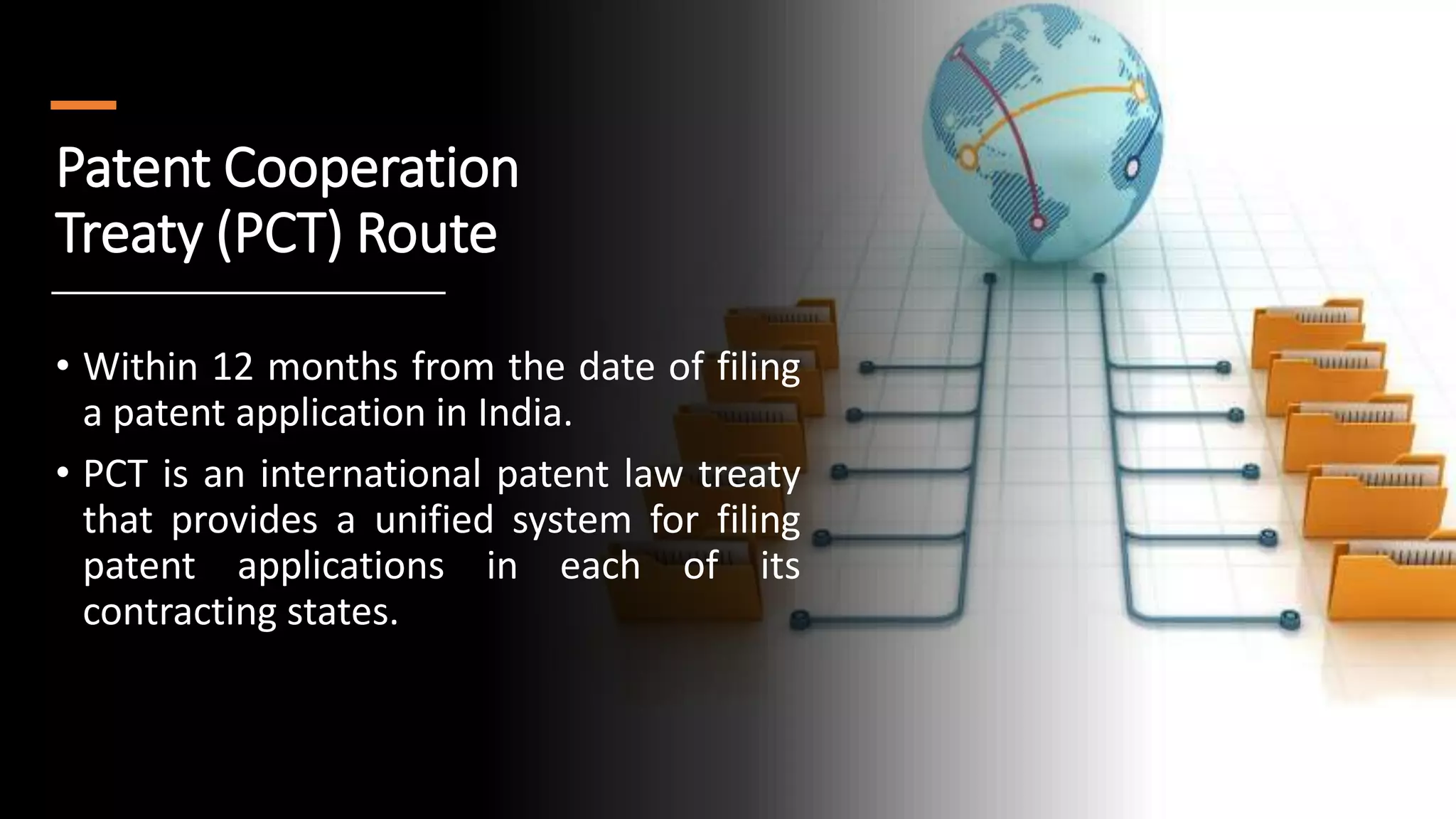
• Within 12 months from the date of filing
a patent application in India.
• PCT is an international patent law treaty
that provides a unified system for filing
patent applications in each of its
contracting states.
Patent Cooperation
Treaty (PCT) Route
• It is a convenient platform to assist inventors that
are seeking patent protection internationally (in
the contracting states of PCT) for their inventions.
• It also helps patent offices with their patent
granting decisions by providing comprehensive
search reports for the patent application along
with opinion on patentability.
Patent Cooperation Treaty
(PCT) Route
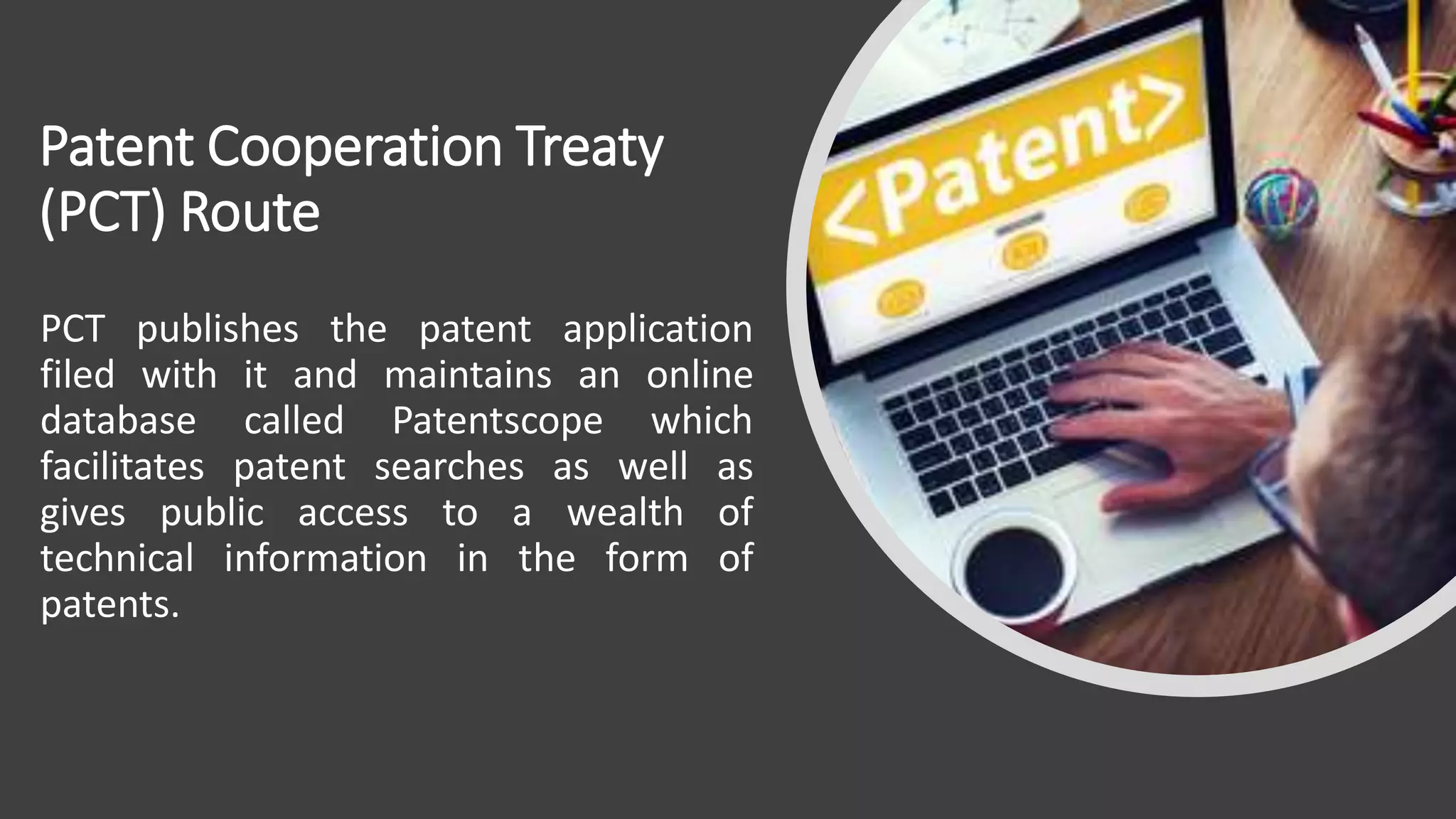
PCT publishes the patent application
filed with it and maintains an online
database called Patentscope which
facilitates patent searches as well as
gives public access to a wealth of
technical information in the form of
patents.
Patent Cooperation Treaty
(PCT) Route
• PCT examines the application, issues
examination report and enables
inventors to file their application within
30/31 months from the date of priority
in any of the member states of PCT.
• After this, the patent is processed and
granted by the national offices of the
countries where patent protection is
sought, based on the procedures and
requirements of the respective offices.
Patent Cooperation
Treaty (PCT) Route
• PCT enables patent filing in its
member states & gives extra time to
the inventor to decide about the
countries they want to file their
application in.
Convention Route
• The countries which are members of the
Paris Convention are called convention
countries and an application filed in a
convention country is called a
convention application.
• Unlike PCT, convention application is
required to be filed in the convention
country within 12 months from the
priority date.
Reasons to file
international application
• Filing international application without clarity
on the reason to file is not a good idea.
• It does not help inventors in long run and
may actually lead to a very stressful situation
if the prosecution is left midway, further
making the overall process financially
cumbersome.
Your future business
plans
• Patents must be filed in the countries where
the inventor wishes to expand the business in
future.
• It must be remembered that there is a specific
time period within which inventors must file
the patent application in specific countries.
• Once this period has lapsed, it is not possible to
file an application at a later stage.
Your future
business plans
Therefore, if it is desired by the inventor to
expand the business in countries like the
US or Japan 5 years later, it would make
sense to file patents in these countries
within the required time frame.
Potential of technology
in given jurisdiction
• Sometimes, it makes sense for an
inventor to file for patent in some
countries even if the inventor does not
have business there.
• Countries like the US have a mature
system of buying, selling and enforcing
patents.
Potential of technology in given
jurisdiction
• If technology has good potential in a specific
country, a patent should be filed in that country.
• Further, licensing and selling options may also be
explored to facilitate easier transition of the
patented technology to the market.
Your budget
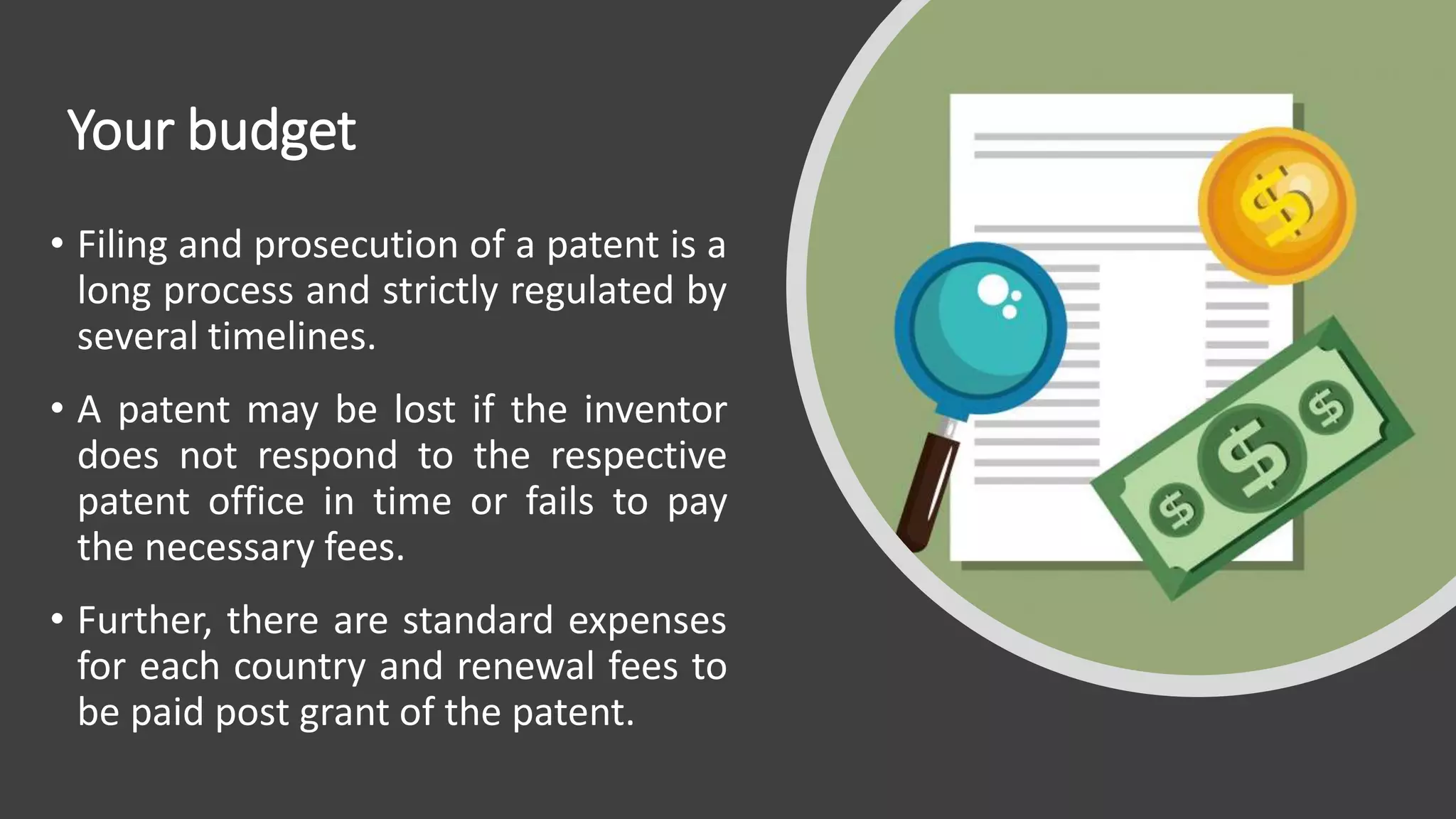
• Filing and prosecution of a patent is a
long process and strictly regulated by
several timelines.
• A patent may be lost if the inventor
does not respond to the respective
patent office in time or fails to pay
the necessary fees.
• Further, there are standard expenses
for each country and renewal fees to
be paid post grant of the patent.
Your budget
• This leaves a very small window for
postponing expenses and timelines, making
the overall process of getting a foreign
patent extremely time consuming, complex
and expensive.
• The tentative costs of filing, prosecution
and maintenance must be assessed in
advance and only then should a decision
about foreign filing be taken.
International patent filing has several
advantages as well as associated costs
and risk. Therefore the decision on
international filing of patents, shall be
taken after weighing pros and cons
depending upon business goals of the
company.
info@origiin.com | +91 98456 93459
www.origiin.com
Subscribe to our Origiin IP Solutions LLPChannel
Copyright © 2020 Origiin IP Solutions LLP. All Rights reserved

IPR in Business #04: International Patent Filing Reasons & Strategies

  • 1.
    Copyright © 2020Origiin IP Solutions LLP International Patent Filing Reasons & Strategies Bindu Sharma IPR in Business Presented by:-
  • 2.
    Why to filefor patent internationally? • Status that is associated with having a patent filed in the US or Europe • Enhances the valuation of the technology which ultimately may impress investors and fetch better value to the inventor.
  • 3.
    Drawbacks • Expensive, complicated,and long procedure. • Laws across the countries are not unified in terms of procedures, fee and timelines leading to more and more confusions at every stage.
  • 4.
    International Patent • Inreality, there is nothing called international patent or global patent. • Despite there being ways to file for a patent internationally, there is no single authority to grant international patents with validity across the globe. • Patents are required to be filed in and granted by each country where the inventor wishes to seek protection.
  • 5.
    There is adeadline • For a resident of India, Section 39 [Residents not to apply for patents outside India without prior permission] of Indian Patents Act 1970 states that the patent must be filed for in India first and can be filed in any foreign country within a period of 12 months. • Once this 12-month period expires, the inventor loses the chance of filing outside India.
  • 6.
    Two ways tofile patent application internationally • PCT application route • Convention route
  • 7.
    Patent Cooperation Treaty (PCT)Route • Within 12 months from the date of filing a patent application in India. • PCT is an international patent law treaty that provides a unified system for filing patent applications in each of its contracting states.
  • 8.
    Patent Cooperation Treaty (PCT)Route • It is a convenient platform to assist inventors that are seeking patent protection internationally (in the contracting states of PCT) for their inventions. • It also helps patent offices with their patent granting decisions by providing comprehensive search reports for the patent application along with opinion on patentability.
  • 9.
    Patent Cooperation Treaty (PCT)Route PCT publishes the patent application filed with it and maintains an online database called Patentscope which facilitates patent searches as well as gives public access to a wealth of technical information in the form of patents.
  • 10.
    Patent Cooperation Treaty (PCT)Route • PCT examines the application, issues examination report and enables inventors to file their application within 30/31 months from the date of priority in any of the member states of PCT. • After this, the patent is processed and granted by the national offices of the countries where patent protection is sought, based on the procedures and requirements of the respective offices.
  • 11.
    Patent Cooperation Treaty (PCT)Route • PCT enables patent filing in its member states & gives extra time to the inventor to decide about the countries they want to file their application in.
  • 12.
    Convention Route • Thecountries which are members of the Paris Convention are called convention countries and an application filed in a convention country is called a convention application. • Unlike PCT, convention application is required to be filed in the convention country within 12 months from the priority date.
  • 13.
    Reasons to file internationalapplication • Filing international application without clarity on the reason to file is not a good idea. • It does not help inventors in long run and may actually lead to a very stressful situation if the prosecution is left midway, further making the overall process financially cumbersome.
  • 14.
    Your future business plans •Patents must be filed in the countries where the inventor wishes to expand the business in future. • It must be remembered that there is a specific time period within which inventors must file the patent application in specific countries. • Once this period has lapsed, it is not possible to file an application at a later stage.
  • 15.
    Your future business plans Therefore,if it is desired by the inventor to expand the business in countries like the US or Japan 5 years later, it would make sense to file patents in these countries within the required time frame.
  • 16.
    Potential of technology ingiven jurisdiction • Sometimes, it makes sense for an inventor to file for patent in some countries even if the inventor does not have business there. • Countries like the US have a mature system of buying, selling and enforcing patents.
  • 17.
    Potential of technologyin given jurisdiction • If technology has good potential in a specific country, a patent should be filed in that country. • Further, licensing and selling options may also be explored to facilitate easier transition of the patented technology to the market.
  • 18.
    Your budget • Filingand prosecution of a patent is a long process and strictly regulated by several timelines. • A patent may be lost if the inventor does not respond to the respective patent office in time or fails to pay the necessary fees. • Further, there are standard expenses for each country and renewal fees to be paid post grant of the patent.
  • 19.
    Your budget • Thisleaves a very small window for postponing expenses and timelines, making the overall process of getting a foreign patent extremely time consuming, complex and expensive. • The tentative costs of filing, prosecution and maintenance must be assessed in advance and only then should a decision about foreign filing be taken.
  • 20.
    International patent filinghas several advantages as well as associated costs and risk. Therefore the decision on international filing of patents, shall be taken after weighing pros and cons depending upon business goals of the company.
  • 21.
    info@origiin.com | +9198456 93459 www.origiin.com Subscribe to our Origiin IP Solutions LLPChannel Copyright © 2020 Origiin IP Solutions LLP. All Rights reserved