TAKEAWAYS FROM MY FIRST
JOB
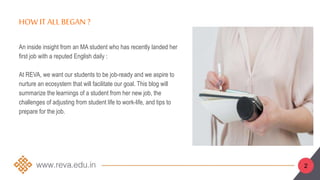
HOW IT ALL BEGAN ?
2
An inside insight from an MA student who has recently landed her
first job with a reputed English daily :
At REVA, we want our students to be job-ready and we aspire to
nurture an ecosystem that will facilitate our goal. This blog will
summarize the learnings of a student from her new job, the
challenges of adjusting from student life to work-life, and tips to
prepare for the job.
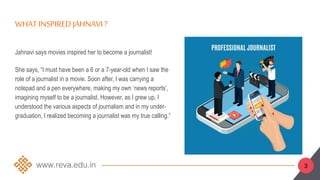
WHAT INSPIRED JAHNAVI ?
Jahnavi says movies inspired her to become a journalist!
She says, “I must have been a 6 or a 7-year-old when I saw the
role of a journalist in a movie. Soon after, I was carrying a
notepad and a pen everywhere, making my own ‘news reports’,
imagining myself to be a journalist. However, as I grew up, I
understood the various aspects of journalism and in my under-
graduation, I realized becoming a journalist was my true calling.”
3
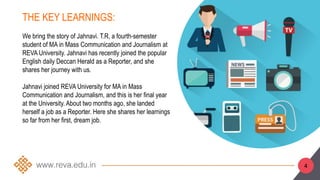
THE KEY LEARNINGS:
We bring the story of Jahnavi. T.R, a fourth-semester
student of MA in Mass Communication and Journalism at
REVA University. Jahnavi has recently joined the popular
English daily Deccan Herald as a Reporter, and she
shares her journey with us.
Jahnavi joined REVA University for MA in Mass
Communication and Journalism, and this is her final year
at the University. About two months ago, she landed
herself a job as a Reporter. Here she shares her learnings
so far from her first, dream job.
4
MAKE CONVERSATIONS:
● Talking to people – auto drivers, vegetable vendors, fruit
sellers- just anybody and everybody around you makes a
lot of difference! As a journalist, it’s important to talk to
people from all walks of life to understand their challenges
& problems.
● Most often, this could be the first hint for a news story and
could further lead to other stories that are interconnected
with them.
5
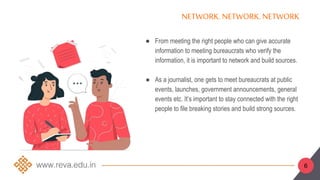
● From meeting the right people who can give accurate
information to meeting bureaucrats who verify the
information, it is important to network and build sources.
● As a journalist, one gets to meet bureaucrats at public
events, launches, government announcements, general
events etc. It’s important to stay connected with the right
people to file breaking stories and build strong sources.
NETWORK.NETWORK. NETWORK
6
7
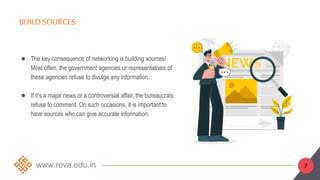
BUILD SOURCES:
● The key consequence of networking is building sources!
Most often, the government agencies or representatives of
these agencies refuse to divulge any information.
● If it’s a major news or a controversial affair, the bureaucrats
refuse to comment. On such occasions, it is important to
have sources who can give accurate information.
8
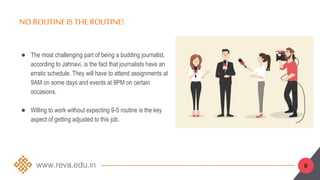
NO ROUTINEIS THE ROUTINE!
● The most challenging part of being a budding journalist,
according to Jahnavi, is the fact that journalists have an
erratic schedule. They will have to attend assignments at
9AM on some days and events at 9PM on certain
occasions.
● Willing to work without expecting 9-5 routine is the key
aspect of getting adjusted to this job.
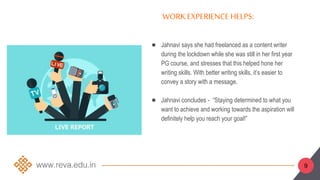
● Jahnavi says she had freelanced as a content writer
during the lockdown while she was still in her first year
PG course, and stresses that this helped hone her
writing skills. With better writing skills, it’s easier to
convey a story with a message.
● Jahnavi concludes - “Staying determined to what you
want to achieve and working towards the aspiration will
definitely help you reach your goal!”
WORK EXPERIENCEHELPS:
9
Takeaways from my first job

Takeaways from my first job

  • 1.
  • 2.
    HOW IT ALLBEGAN ? 2 An inside insight from an MA student who has recently landed her first job with a reputed English daily : At REVA, we want our students to be job-ready and we aspire to nurture an ecosystem that will facilitate our goal. This blog will summarize the learnings of a student from her new job, the challenges of adjusting from student life to work-life, and tips to prepare for the job.
  • 3.
    WHAT INSPIRED JAHNAVI? Jahnavi says movies inspired her to become a journalist! She says, “I must have been a 6 or a 7-year-old when I saw the role of a journalist in a movie. Soon after, I was carrying a notepad and a pen everywhere, making my own ‘news reports’, imagining myself to be a journalist. However, as I grew up, I understood the various aspects of journalism and in my under- graduation, I realized becoming a journalist was my true calling.” 3
  • 4.
    THE KEY LEARNINGS: Webring the story of Jahnavi. T.R, a fourth-semester student of MA in Mass Communication and Journalism at REVA University. Jahnavi has recently joined the popular English daily Deccan Herald as a Reporter, and she shares her journey with us. Jahnavi joined REVA University for MA in Mass Communication and Journalism, and this is her final year at the University. About two months ago, she landed herself a job as a Reporter. Here she shares her learnings so far from her first, dream job. 4
  • 5.
    MAKE CONVERSATIONS: ● Talkingto people – auto drivers, vegetable vendors, fruit sellers- just anybody and everybody around you makes a lot of difference! As a journalist, it’s important to talk to people from all walks of life to understand their challenges & problems. ● Most often, this could be the first hint for a news story and could further lead to other stories that are interconnected with them. 5
  • 6.
    ● From meetingthe right people who can give accurate information to meeting bureaucrats who verify the information, it is important to network and build sources. ● As a journalist, one gets to meet bureaucrats at public events, launches, government announcements, general events etc. It’s important to stay connected with the right people to file breaking stories and build strong sources. NETWORK.NETWORK. NETWORK 6
  • 7.
    7 BUILD SOURCES: ● Thekey consequence of networking is building sources! Most often, the government agencies or representatives of these agencies refuse to divulge any information. ● If it’s a major news or a controversial affair, the bureaucrats refuse to comment. On such occasions, it is important to have sources who can give accurate information.
  • 8.
    8 NO ROUTINEIS THEROUTINE! ● The most challenging part of being a budding journalist, according to Jahnavi, is the fact that journalists have an erratic schedule. They will have to attend assignments at 9AM on some days and events at 9PM on certain occasions. ● Willing to work without expecting 9-5 routine is the key aspect of getting adjusted to this job.
  • 9.
    ● Jahnavi saysshe had freelanced as a content writer during the lockdown while she was still in her first year PG course, and stresses that this helped hone her writing skills. With better writing skills, it’s easier to convey a story with a message. ● Jahnavi concludes - “Staying determined to what you want to achieve and working towards the aspiration will definitely help you reach your goal!” WORK EXPERIENCEHELPS: 9