1
Take Back Control:
Moving Forward with Scleroderma
Scleroderma Patient Education Conference
May 4th 2024
Gregory Cohen
DrPH, MPH, NBC-HWC
2
Agenda
• Background
• Your Why
• Your Are What You Think
• Taking Control of Your Life
• Lifestyle / Behavior Change
• Setting Goals
• SMART / PATIENCE
• Setbacks / Readiness
• Summary
3
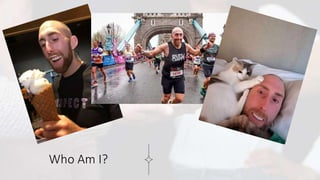
Who Am I?
Background
● Scleroderma (2017)
● Running Marathons
● MPH Degree
● NBC-HWC (Board Certified Health
and Wellness Coach)
● DrPH Degree
● Adjunct Professor WCU
● Glen Cove, NY
● Athlete (multi-sport)
● Binghamton University (Undergrad)
● Culinary School (Institute of Culinary
Education
● Hospitality Leader
● Group Fitness Instructor & Manager
What’s Your Why
6
“It’s hard to be, what you have not
seen” - Bishop TD Jake
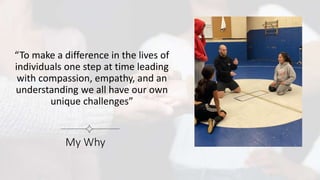
“To make a difference in the lives of
individuals one step at time leading
with compassion, empathy, and an
understanding we all have our own
unique challenges”
My Why
• Being an active participant in
my life
• CPR (would you help
someone?)
PILL
Proactive In Living Longer
8
Stop, think, & DISCUSS
• Is it easy for the average person to
set goals and make lifestyle
changes?
• Yes?
• No?
• Unsure?
• Why?
• What do you think it takes to make
change happen?
What do you think about before bed and
when you wake up?
10
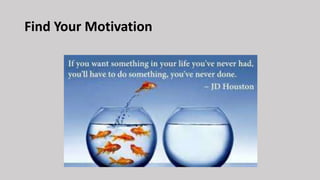
Find Your Motivation
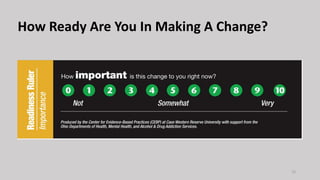
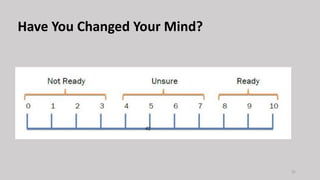
How Ready Are You In Making A Change?
13
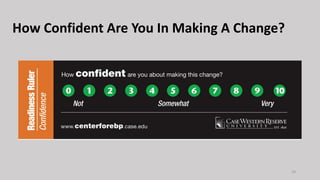
How Confident Are You In Making A Change?
14
15
Exercise / Physical Activity
• decrease risk factors for death
• improve quality of life
• decreased stress and damage on
heart and arteries
• increase new blood vessel growth
• improved insulin sensitivity
• reduce body fat
• reduce bad (LDL) cholesterol
• lower resting blood pressure
Nutrition / Diet
• lipid levels
• metabolic profiles
• blood pressure
• insulin resistance
• inflammatory markers
• oxidative stress
• gut microbiota
Impacts of Lifestyle Changes
• Self-Control (includes willpower)
• Emotional Regulation
• Find exercise / physical activity / or
whatever you are trying to improve
that is enjoyable
• Set and Reward Goals
• Self-Monitor (pay attention)
• Social Support System
• Have a means to address relapse
The Path To Behavior Change
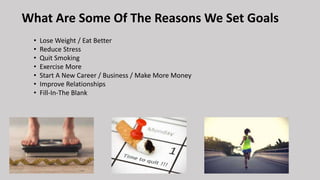
What Are Some Of The Reasons We Set Goals
• Lose Weight / Eat Better
• Reduce Stress
• Quit Smoking
• Exercise More
• Start A New Career / Business / Make More Money
• Improve Relationships
• Fill-In-The Blank
Why Are Goals So Important?
• Without goals we are moving through life without purpose
• Goals give us focus, fuel our drive, build character, and above all teach us SO much
about ourselves
• Goals teach us what it means to push through adversity
• Goals teach us humility
• Goals teach us how to fight for something we want, and most importantly:
• GOALS TEACH US HOW TO FAIL (more on this later)
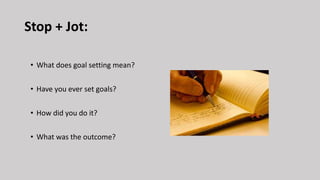
Stop + Jot:
• What does goal setting mean?
• Have you ever set goals?
• How did you do it?
• What was the outcome?
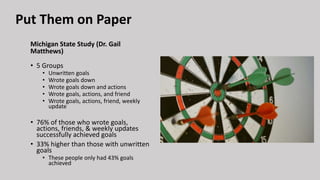
Michigan State Study (Dr. Gail
Matthews)
• 5 Groups
• Unwritten goals
• Wrote goals down
• Wrote goals down and actions
• Wrote goals, actions, and friend
• Wrote goals, actions, friend, weekly
update
• 76% of those who wrote goals,
actions, friends, & weekly updates
successfully achieved goals
• 33% higher than those with unwritten
goals
• These people only had 43% goals
achieved
Put Them on Paper
The Power of the Written Word
• When you write things down, it sets of a chain of events that will change your life
forever
• Until you write a goal down on paper, it’s just a wish
FUN FACT:
• Writing down your goals is like a road map for your subconscious mind—it speaks
directly to it and without you even knowing it, your brain starts working on how to
help you manifest what you’ve just written down!
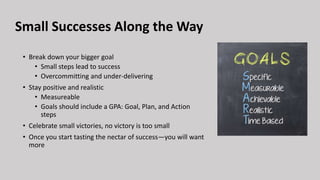
Small Successes Along the Way
• Break down your bigger goal
• Small steps lead to success
• Overcommitting and under-delivering
• Stay positive and realistic
• Measureable
• Goals should include a GPA: Goal, Plan, and Action
steps
• Celebrate small victories, no victory is too small
• Once you start tasting the nectar of success—you will want
more
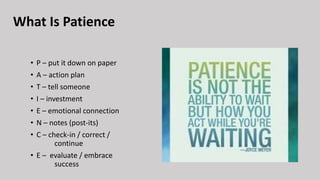
What Is Patience
• P – put it down on paper
• A – action plan
• T – tell someone
• I – investment
• E – emotional connection
• N – notes (post-its)
• C – check-in / correct /
continue
• E – evaluate / embrace
success
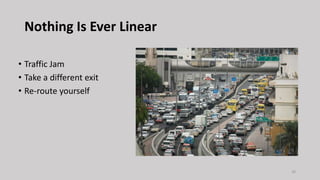
Nothing Is Ever Linear
• Traffic Jam
• Take a different exit
• Re-route yourself
26
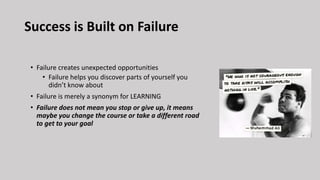
Success is Built on Failure
• Failure creates unexpected opportunities
• Failure helps you discover parts of yourself you
didn’t know about
• Failure is merely a synonym for LEARNING
• Failure does not mean you stop or give up, it means
maybe you change the course or take a different road
to get to your goal
Top Reasons Why People Fail
• Lack of commitment
• Wasn’t realistic, measureable, or timed appropriately
• Excuses
• Fear
• Lacking a plan
• Giving up when the going gets tough
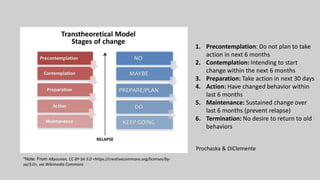
• Not really ready to make change (TTM of Change)
*Note: From A8younan, CC BY-SA 3.0 <https://creativecommons.org/licenses/by-
sa/3.0>, via Wikimedia Commons
1. Precontemplation: Do not plan to take
action in next 6 months
2. Contemplation: Intending to start
change within the next 6 months
3. Preparation: Take action in next 30 days
4. Action: Have changed behavior within
last 6 months
5. Maintenance: Sustained change over
last 6 months (prevent relapse)
6. Termination: No desire to return to old
behaviors
Prochaska & DiClemente
Bringing it all together + Takeaways
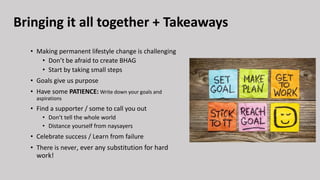
• Making permanent lifestyle change is challenging
• Don’t be afraid to create BHAG
• Start by taking small steps
• Goals give us purpose
• Have some PATIENCE: Write down your goals and
aspirations
• Find a supporter / some to call you out
• Don’t tell the whole world
• Distance yourself from naysayers
• Celebrate success / Learn from failure
• There is never, ever any substitution for hard
work!
Have You Changed Your Mind?
31
Health, Wellness, & Lifestyle
Coaching
Cooking & Nutrition services
Personal & Group Training
Public Speaking
Contact: (516) 729-3990
Email: greg@confidenceinmovement.com
Thank You & Questions
References
• Belinkie,, Matthew. (2008, December 10). 40 Inspirational speeches in 2 minutes [Video]. YouTube.
https://youtu.be/d6wRkzCW5qI?si=YERScQ0O5la0B9Oa
• Goals research summary. (n.d.). https://www.dominican.edu/sites/default/files/2020-02/gailmatthews-harvard-
goals-researchsummary.pdf
• McKenzie, J. F., Neiger, B. L., & Thackeray, R. (2017). Planning, implementing, and Evaluating Health Promotion
Programs: A Primer. Pearson/Benjamin Cummings.
• Readiness ruler: Center for evidence-based practices: Case Western Reserve University. Center for Evidence-Based
Practices | Case Western Reserve University. (2021, August 18). Retrieved August 23, 2022, from
https://case.edu/socialwork/centerforebp/resources/readiness-ruler
33

Take Back Control: Moving Forward with Scleroderma - Gregory Cohen

  • 1.
    1 Take Back Control: MovingForward with Scleroderma Scleroderma Patient Education Conference May 4th 2024
  • 2.
  • 3.
    Agenda • Background • YourWhy • Your Are What You Think • Taking Control of Your Life • Lifestyle / Behavior Change • Setting Goals • SMART / PATIENCE • Setbacks / Readiness • Summary 3
  • 4.
  • 5.
    Background ● Scleroderma (2017) ●Running Marathons ● MPH Degree ● NBC-HWC (Board Certified Health and Wellness Coach) ● DrPH Degree ● Adjunct Professor WCU ● Glen Cove, NY ● Athlete (multi-sport) ● Binghamton University (Undergrad) ● Culinary School (Institute of Culinary Education ● Hospitality Leader ● Group Fitness Instructor & Manager
  • 6.
    What’s Your Why 6 “It’shard to be, what you have not seen” - Bishop TD Jake
  • 7.
    “To make adifference in the lives of individuals one step at time leading with compassion, empathy, and an understanding we all have our own unique challenges” My Why
  • 8.
    • Being anactive participant in my life • CPR (would you help someone?) PILL Proactive In Living Longer 8
  • 9.
    Stop, think, &DISCUSS • Is it easy for the average person to set goals and make lifestyle changes? • Yes? • No? • Unsure? • Why? • What do you think it takes to make change happen?
  • 10.
    What do youthink about before bed and when you wake up? 10
  • 11.
  • 13.
    How Ready AreYou In Making A Change? 13
  • 14.
    How Confident AreYou In Making A Change? 14
  • 15.
  • 16.
    Exercise / PhysicalActivity • decrease risk factors for death • improve quality of life • decreased stress and damage on heart and arteries • increase new blood vessel growth • improved insulin sensitivity • reduce body fat • reduce bad (LDL) cholesterol • lower resting blood pressure Nutrition / Diet • lipid levels • metabolic profiles • blood pressure • insulin resistance • inflammatory markers • oxidative stress • gut microbiota Impacts of Lifestyle Changes
  • 17.
    • Self-Control (includeswillpower) • Emotional Regulation • Find exercise / physical activity / or whatever you are trying to improve that is enjoyable • Set and Reward Goals • Self-Monitor (pay attention) • Social Support System • Have a means to address relapse The Path To Behavior Change
  • 18.
    What Are SomeOf The Reasons We Set Goals • Lose Weight / Eat Better • Reduce Stress • Quit Smoking • Exercise More • Start A New Career / Business / Make More Money • Improve Relationships • Fill-In-The Blank
  • 19.
    Why Are GoalsSo Important? • Without goals we are moving through life without purpose • Goals give us focus, fuel our drive, build character, and above all teach us SO much about ourselves • Goals teach us what it means to push through adversity • Goals teach us humility • Goals teach us how to fight for something we want, and most importantly: • GOALS TEACH US HOW TO FAIL (more on this later)
  • 20.
    Stop + Jot: •What does goal setting mean? • Have you ever set goals? • How did you do it? • What was the outcome?
  • 21.
    Michigan State Study(Dr. Gail Matthews) • 5 Groups • Unwritten goals • Wrote goals down • Wrote goals down and actions • Wrote goals, actions, and friend • Wrote goals, actions, friend, weekly update • 76% of those who wrote goals, actions, friends, & weekly updates successfully achieved goals • 33% higher than those with unwritten goals • These people only had 43% goals achieved Put Them on Paper
  • 22.
    The Power ofthe Written Word • When you write things down, it sets of a chain of events that will change your life forever • Until you write a goal down on paper, it’s just a wish FUN FACT: • Writing down your goals is like a road map for your subconscious mind—it speaks directly to it and without you even knowing it, your brain starts working on how to help you manifest what you’ve just written down!
  • 23.
    Small Successes Alongthe Way • Break down your bigger goal • Small steps lead to success • Overcommitting and under-delivering • Stay positive and realistic • Measureable • Goals should include a GPA: Goal, Plan, and Action steps • Celebrate small victories, no victory is too small • Once you start tasting the nectar of success—you will want more
  • 24.
    What Is Patience •P – put it down on paper • A – action plan • T – tell someone • I – investment • E – emotional connection • N – notes (post-its) • C – check-in / correct / continue • E – evaluate / embrace success
  • 26.
    Nothing Is EverLinear • Traffic Jam • Take a different exit • Re-route yourself 26
  • 27.
    Success is Builton Failure • Failure creates unexpected opportunities • Failure helps you discover parts of yourself you didn’t know about • Failure is merely a synonym for LEARNING • Failure does not mean you stop or give up, it means maybe you change the course or take a different road to get to your goal
  • 28.
    Top Reasons WhyPeople Fail • Lack of commitment • Wasn’t realistic, measureable, or timed appropriately • Excuses • Fear • Lacking a plan • Giving up when the going gets tough • Not really ready to make change (TTM of Change)
  • 29.
    *Note: From A8younan,CC BY-SA 3.0 <https://creativecommons.org/licenses/by- sa/3.0>, via Wikimedia Commons 1. Precontemplation: Do not plan to take action in next 6 months 2. Contemplation: Intending to start change within the next 6 months 3. Preparation: Take action in next 30 days 4. Action: Have changed behavior within last 6 months 5. Maintenance: Sustained change over last 6 months (prevent relapse) 6. Termination: No desire to return to old behaviors Prochaska & DiClemente
  • 30.
    Bringing it alltogether + Takeaways • Making permanent lifestyle change is challenging • Don’t be afraid to create BHAG • Start by taking small steps • Goals give us purpose • Have some PATIENCE: Write down your goals and aspirations • Find a supporter / some to call you out • Don’t tell the whole world • Distance yourself from naysayers • Celebrate success / Learn from failure • There is never, ever any substitution for hard work!
  • 31.
    Have You ChangedYour Mind? 31
  • 32.
    Health, Wellness, &Lifestyle Coaching Cooking & Nutrition services Personal & Group Training Public Speaking Contact: (516) 729-3990 Email: greg@confidenceinmovement.com Thank You & Questions
  • 33.
    References • Belinkie,, Matthew.(2008, December 10). 40 Inspirational speeches in 2 minutes [Video]. YouTube. https://youtu.be/d6wRkzCW5qI?si=YERScQ0O5la0B9Oa • Goals research summary. (n.d.). https://www.dominican.edu/sites/default/files/2020-02/gailmatthews-harvard- goals-researchsummary.pdf • McKenzie, J. F., Neiger, B. L., & Thackeray, R. (2017). Planning, implementing, and Evaluating Health Promotion Programs: A Primer. Pearson/Benjamin Cummings. • Readiness ruler: Center for evidence-based practices: Case Western Reserve University. Center for Evidence-Based Practices | Case Western Reserve University. (2021, August 18). Retrieved August 23, 2022, from https://case.edu/socialwork/centerforebp/resources/readiness-ruler 33

Editor's Notes

  • #10 Based on today’s format, we may not be able to discuss but I want you to take a moment to think about these questions. In the chat box go ahead and maybe shoot over what you think.
  • #12 Seek your own sources of motivation that are not extrinsically or externally motivated: What keeps you pushing and working hard when you feel like you have nothing left? Is there a particular quote, or person, or even a song that can speak right to your heart? Use that internal fire—stoke it often and keep working. Give your work an emotional connection—make it more than the physical—invest in yourself by investing in your efforts with your whole heart
  • #13 2 minute video about motivation.
  • #17 Depending on where you are when it comes to health.
  • #18 We are really going to focus on the last 4 that are highlighted in bold.
  • #19 A lot of these are or related to lifestyle factors What are the reasons? Or The WHY behind setting these goals or achieving these things
  • #20 Are you ok with failure? Keep this in the back of your mind as we continue.
  • #21 Participants will write down their answers in their books and share out with a partner. Facilitate brief discussion
  • #22 Remember what I mentioned about New Year’s resolutions. NEW YEAR, NEW ME!!! Is it really a new you? Did you molecular or cellular structure change over night to make you a completely different person? Did you change your name from Mary to Pam?
  • #23 How many of you have written down your goals before? Have you often seen yourself referring back to your written goals to see if you have accomplished them or have they changed.
  • #24 By embedding smaller benchmarks along the way to a larger goal, you feel good about yourself and ultimately want to keep going. Keep in mind—the crazier the goal, the bigger the goal, the better. The crazier the goal you want to achieve the pool of people working to achieve it actually smaller, therefore the liklihood of you succeeding is actually higher! I love the concept of SMART Goals, but I believe we need to take it a bit further. There have been some articles and people that suggest SMART goals are not the end all and be all of goal setting and that in some environments like business and other places where change occurs that they can be problematic. Not only do businesses change and adapt to life and the environment, so do we. Also, when we come to personal goals or our life, we tend to want things to happen immediately. We want that job promotion, that raise, or - when we start a diet or new exercise plan we want result NOW! However, deep down we know that things do not just happen with the snap of our fingers! I know I am guilty of this. But to truly be successful in achieving our goals and lifestyle changes it takes time and we need some PATIENCE!
  • #26 Have we all heard of BHAG? Let’s find a big goal we want to achieve. And then break those down into SMART Goals and then apply the idea of Patience into rolling up the small goals into the big goal.
  • #28 I mentioned failure a few slides back. The whole concept of Patience allows for us to correct course should I initial action plan fail or hit a road block. People are often afraid of the word failure and it instills fear or lack of follow through Take risks! Try new things, be a visionary.
  • #29 Goals should test your limits—if it were easy, everyone would do it. The objective of working hard to achieve something is that you cultivate resiliency, wherewithal, and perseverance BY working through it
  • #30 Top 3 are Cognitive Bottom 2 are Behavior People relapse Maintenance is challenging, when we think of people losing weight (large amounts) and keeping it off, this is an area of primary focus.