PRUDENT
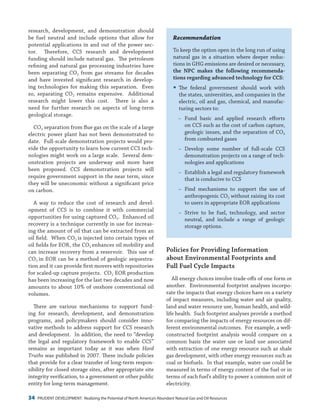
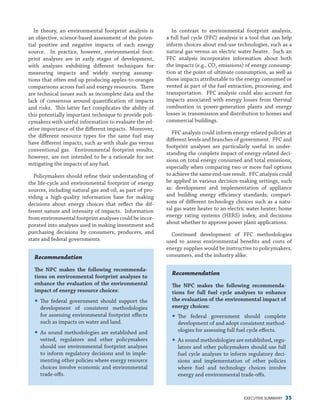
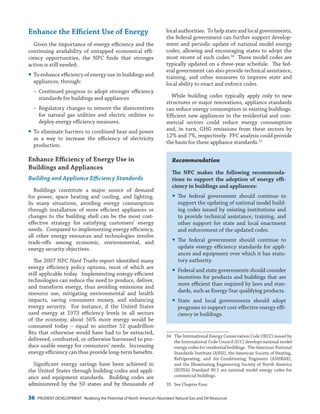
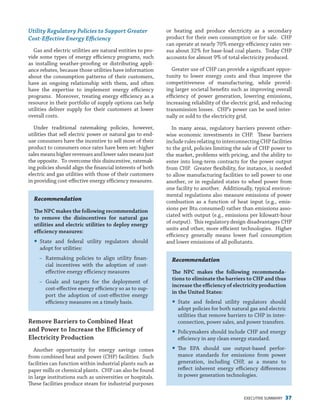
DEVELOPMENTRealizing the Potential of North America’s Abundant
Natural Gas and Oil Resources
National Petroleum Council • 2011
PRUDENT
DEVELOPMENTRealizing the Potential of North America’s Abundant
Natural Gas and Oil Resources
A report of the National Petroleum Council
September 2011
Committee on Resource Development
JamesT. Hackett, Chair
NATIONAL PETROLEUM COUNCIL
David J. O’Reilly, Chair
Douglas L. Foshee, Vice Chair
Marshall W. Nichols, Executive Director
U.S. DEPARTMENT OF ENERGY
Steven Chu, Secretary
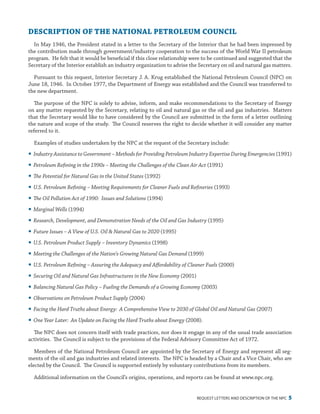
The National Petroleum Council is a federal
advisory committee to the Secretary of Energy.
The sole purpose of the National Petroleum Council
is to advise, inform, and make recommendations
to the Secretary of Energy on any matter
requested by the Secretary
relating to oil and natural gas
or to the oil and gas industries.
All Rights Reserved
Library of Congress Control Number: 2011944162
© National Petroleum Council 2011
Printed in the United States of America
The text and graphics herein may be reproduced
in any format or medium, provided they are reproduced accurately,
not used in a misleading context, and bear acknowledgement of
the National Petroleum Council’s copyright
and the title of this report.
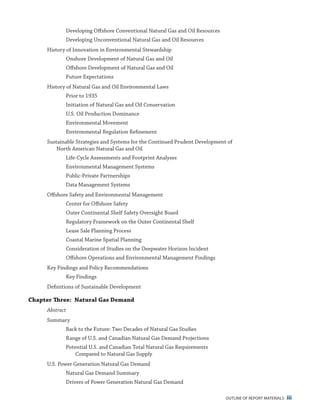
outline of report materials i
Summary Report Volume (also available
online at www.npc.org)
yy Report Transmittal Letter to the
Secretary of Energy
yy Outline of Report Materials
yy Preface
yy Executive Summary
yy Study Request Letters
yy Description of the National Petroleum Council
yy Roster of the National Petroleum Council
Full Report Volume (printed and available
online at www.npc.org)
yy Outline of Full Report (see below)
Additional Study Materials (available online
at www.npc.org)
yy Summary and Full Report (pdfs with hyperlinks)
yy Report Slide Presentations
yy Webcasts of NPC Report Approval Meeting and
Press Conference
yy Study Topic and White Papers (see page vi for list)
yy Study Survey Data Aggregations
Outline of Full Report
Preface
Executive Summary
America’s Energy Future
Core Strategies
Support Prudent Natural Gas and Oil Resource Development and Regulation
Better Reflect Environmental Impacts in Markets and Fuel/Technology Choices
Enhance the Efficient Use of Energy
Enhance the Regulation of Markets
Support the Development of Intellectual Capital and a Skilled Workforce
Conclusions
Outline of Report
Materials
ii PRUDENT DEVELOPMENT: Realizing the Potential of North America’s Abundant Natural Gas and Oil Resources
Chapter One: Crude Oil and Natural Gas Resources and Supply
Abstract
Introduction and Summary
Summaries and Key Findings
Summary of Scope and Objectives
Summary of Methodology
North American Oil and Natural Gas Resource Endowment
Hydrocarbon Resource Assessment Uses and Definitions
Overview of Recent and Current North American Oil and Gas Resource Assessments
Key Findings and Observations
Analysis of Resource and Production Outlooks and Studies
Overview
Crude Oil
Natural Gas
Prospects for North American Oil Development
Overview
Offshore
Arctic
Onshore Oil
Unconventional Oil
Crude Oil Pipeline Infrastructure
Prospects for North American Gas Development
Overview
Offshore
Arctic
Onshore Gas
Natural Gas Infrastructure
North American Oil and Gas Production Prospects to 2050
Chapter Two: Operations and Environment
Abstract
Introduction and Summary
Environmental Challenges
Prudent Development
Major Findings: Assuring Prudent Development
Chapter Organization
Resource Play Variations and Associated Environmental Challenges
Overview of the Life Cycle of Natural Gas and Oil Exploration and Production
Developing Onshore Conventional Natural Gas and Oil Resources
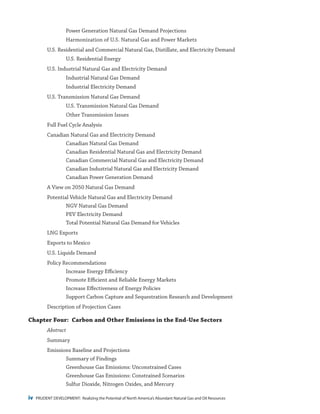
outline of report materials iii
Developing Offshore Conventional Natural Gas and Oil Resources
Developing Unconventional Natural Gas and Oil Resources
History of Innovation in Environmental Stewardship
Onshore Development of Natural Gas and Oil
Offshore Development of Natural Gas and Oil
Future Expectations
History of Natural Gas and Oil Environmental Laws
Prior to 1935
Initiation of Natural Gas and Oil Conservation
U.S. Oil Production Dominance
Environmental Movement
Environmental Regulation Refinement
Sustainable Strategies and Systems for the Continued Prudent Development of
North American Natural Gas and Oil
Life-Cycle Assessments and Footprint Analyses
Environmental Management Systems
Public-Private Partnerships
Data Management Systems
Offshore Safety and Environmental Management
Center for Offshore Safety
Outer Continental Shelf Safety Oversight Board
Regulatory Framework on the Outer Continental Shelf
Lease Sale Planning Process
Coastal Marine Spatial Planning
Consideration of Studies on the Deepwater Horizon Incident
Offshore Operations and Environmental Management Findings
Key Findings and Policy Recommendations
Key Findings
Definitions of Sustainable Development
Chapter Three: Natural Gas Demand
Abstract
Summary
Back to the Future: Two Decades of Natural Gas Studies
Range of U.S. and Canadian Natural Gas Demand Projections
Potential U.S. and Canadian Total Natural Gas Requirements
Compared to Natural Gas Supply
U.S. Power Generation Natural Gas Demand
Natural Gas Demand Summary
Drivers of Power Generation Natural Gas Demand
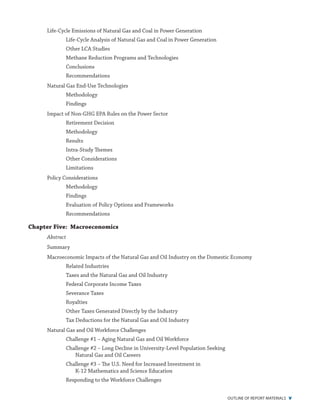
iv PRUDENT DEVELOPMENT: Realizing the Potential of North America’s Abundant Natural Gas and Oil Resources
Power Generation Natural Gas Demand Projections
Harmonization of U.S. Natural Gas and Power Markets
U.S. Residential and Commercial Natural Gas, Distillate, and Electricity Demand
U.S. Residential Energy
U.S. Industrial Natural Gas and Electricity Demand
Industrial Natural Gas Demand
Industrial Electricity Demand
U.S. Transmission Natural Gas Demand
Other Transmission Issues
Full Fuel Cycle Analysis
Canadian Natural Gas and Electricity Demand
Canadian Natural Gas Demand
Canadian Residential Natural Gas and Electricity Demand
Canadian Commercial Natural Gas and Electricity Demand
Canadian Industrial Natural Gas and Electricity Demand
Canadian Power Generation Demand
A View on 2050 Natural Gas Demand
Potential Vehicle Natural Gas and Electricity Demand
NGV Natural Gas Demand
PEV Electricity Demand
Total Potential Natural Gas Demand for Vehicles
LNG Exports
Exports to Mexico
U.S. Liquids Demand
Policy Recommendations
Increase Energy Efficiency
Promote Efficient and Reliable Energy Markets
Increase Effectiveness of Energy Policies
Support Carbon Capture and Sequestration Research and Development
Description of Projection Cases
Chapter Four: Carbon and Other Emissions in the End-Use Sectors
Abstract
Summary
Emissions Baseline and Projections
Summary of Findings
Greenhouse Gas Emissions: Unconstrained Cases
Greenhouse Gas Emissions: Constrained Scenarios
Sulfur Dioxide, Nitrogen Oxides, and Mercury
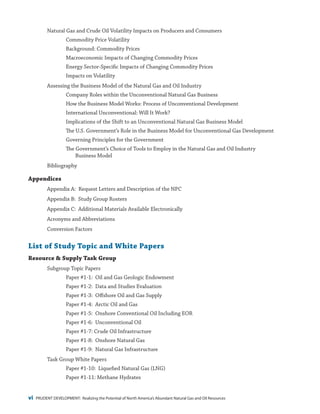
outline of report materials v
Life-Cycle Emissions of Natural Gas and Coal in Power Generation
Life-Cycle Analysis of Natural Gas and Coal in Power Generation
Other LCA Studies
Methane Reduction Programs and Technologies
Conclusions
Recommendations
Natural Gas End-Use Technologies
Methodology
Findings
Impact of Non-GHG EPA Rules on the Power Sector
Retirement Decision
Methodology
Results
Intra-Study Themes
Other Considerations
Limitations
Policy Considerations
Methodology
Findings
Evaluation of Policy Options and Frameworks
Recommendations
Chapter Five: Macroeconomics
Abstract
Summary
Macroeconomic Impacts of the Natural Gas and Oil Industry on the Domestic Economy
Related Industries
Taxes and the Natural Gas and Oil Industry
Federal Corporate Income Taxes
Severance Taxes
Royalties
Other Taxes Generated Directly by the Industry
Tax Deductions for the Natural Gas and Oil Industry
Natural Gas and Oil Workforce Challenges
Challenge #1 – Aging Natural Gas and Oil Workforce
Challenge #2 – Long Decline in University-Level Population Seeking
Natural Gas and Oil Careers
Challenge #3 – The U.S. Need for Increased Investment in
K-12 Mathematics and Science Education
Responding to the Workforce Challenges
vi PRUDENT DEVELOPMENT: Realizing the Potential of North America’s Abundant Natural Gas and Oil Resources
Natural Gas and Crude Oil Volatility Impacts on Producers and Consumers
Commodity Price Volatility
Background: Commodity Prices
Macroeconomic Impacts of Changing Commodity Prices
Energy Sector-Specific Impacts of Changing Commodity Prices
Impacts on Volatility
Assessing the Business Model of the Natural Gas and Oil Industry
Company Roles within the Unconventional Natural Gas Business
How the Business Model Works: Process of Unconventional Development
International Unconventional: Will It Work?
Implications of the Shift to an Unconventional Natural Gas Business Model
The U.S. Government’s Role in the Business Model for Unconventional Gas Development
Governing Principles for the Government
The Government’s Choice of Tools to Employ in the Natural Gas and Oil Industry
Business Model
Bibliography
Appendices
Appendix A: Request Letters and Description of the NPC
Appendix B: Study Group Rosters
Appendix C: Additional Materials Available Electronically
Acronyms and Abbreviations
Conversion Factors
List of Study Topic and White Papers
Resource & Supply Task Group
Subgroup Topic Papers
Paper #1-1: Oil and Gas Geologic Endowment
Paper #1-2: Data and Studies Evaluation
Paper #1-3: Offshore Oil and Gas Supply
Paper #1-4: Arctic Oil and Gas
Paper #1-5: Onshore Conventional Oil Including EOR
Paper #1-6: Unconventional Oil
Paper #1-7: Crude Oil Infrastructure
Paper #1-8: Onshore Natural Gas
Paper #1-9: Natural Gas Infrastructure
Task Group White Papers
Paper #1-10: Liquefied Natural Gas (LNG)
Paper #1-11: Methane Hydrates
outline of report materials vii
Paper #1-12: Mexico Oil & Gas Supply
Paper #1-13: Natural Gas Liquids (NGLs)
Operations & Environment Task Group
Environmental & Regulatory Subgroup Topic Papers
Paper #2-1: Water/Energy Nexus
Paper #2-2: Regulatory Framework
Paper #2-3: U.S. Oil and Gas Environmental Regulatory Process Overview
Paper #2-4: U.S. Environmental Regulatory and Permitting Processes
Paper #2-5: Canadian and Provincial Permitting and Environmental Processes
Paper # 2-6: Evolving Regulatory Framework
Offshore Operations Subgroup Topic Papers
Paper #2-7: Safe and Sustainable Offshore Operations
Paper #2-8: Offshore Environmental Footprints and Regulatory Reviews
Paper #2-9: Offshore Environmental Management of Seismic and Other Geophysical
Exploration Work
Paper #2-10: Offshore Production Facilities and Pipelines, Including Arctic Platform Designs
Paper #2-11: Subsea Drilling, Well Operations and Completions
Paper #2-12: Offshore Transportation
Paper #2-13: Offshore Well Control Management and Response
Paper #2-14: Offshore Data Management
Technology Subgroups Topic Papers
Paper #2-15: Air Emissions Management
Paper #2-16: Biodiversity Management and Technology
Paper #2-17: Management of Produced Water from Oil and Gas Wells
Paper #2-18: Oil Production Technology
Paper #2-19: Natural Gas Pipelines Challenges
Paper #2-20: Regulatory Data Management
Paper #2-21: Research, Development and Technology Transfer
Paper #2-22: Siting and Interim Reclamation
Paper #2-23: Sustainable Drilling of Onshore Oil and Gas Wells
Paper #2-24: Waste Management
Paper #2-25: Plugging and Abandonment of Oil and Gas Wells
Onshore Operations Subgroup
Paper #2-26: Life Cycle of Onshore Oil and Gas Operations
Paper #2-27: North American Oil and Gas Play Types
Task Group White Papers
Paper #2-28: Environmental Footprint Analysis Framework
Paper #2-29: Hydraulic Fracturing: Technology and Practices Addressing Hydraulic Fracturing
and Completions
viii PRUDENT DEVELOPMENT: Realizing the Potential of North America’s Abundant Natural Gas and Oil Resources
Demand Task Group
Subgroup Topic Papers
Paper #3-1: Power Generation Natural Gas Demand
Paper #3-2: Residential and Commercial Natural Gas and Electricity Demand
Paper #3-3: Industrial Natural Gas and Electricity Demand
Paper #3-4: Transmission Natural Gas Demand
Task Group White Papers
Paper #3-5: What Past Studies Missed
Paper #3-6: Natural Gas Exports to Mexico
Paper #3-7: Liquids Demand
Carbon and Other End-Use Emissions Subgroup
Subgroup Topic Papers
Paper #4-1: Baseline and Projections of Emissions from End-Use Sectors
Paper # 4-1a: Addendum: GHG Constrained Cases
Paper #4-2: Life-Cycle Emissions of Natural Gas and Coal in the Power Sector
Paper #4-3: Natural Gas End-Use GHG Reduction Technologies
Paper #4-4: Impact of EPA Regulations on the Power Sector
Paper #4-5: Policy Options for Deployment of Natural Gas End-Use GHG Reduction
Technologies
Macroeconomic Subgroup
Subgroup Topic Papers
Paper #5-1: Macroeconomic Impacts of the Domestic Oil & Gas Industry
Paper #5-2: Commodity Price Volatility
Paper #5-3:  U.S. Oil & Gas Industry Business Models
PREFACE 1
studies on two topics: (1) Future Transportation
Fuels; and (2) Prudent Development of North Ameri-
can Natural Gas and Oil Resources. The Secretary
stated that the Council is uniquely positioned to pro-
vide advice to the Department of Energy on these
important topics.
In the Fuels Study request, Secretary Chu asked
the Council to “conduct a study which would analyze
U.S. fuels prospects through 2030 for auto, truck, air,
rail, and waterborne transport,” with advice sought
on “policy options and pathways for integrating
new fuels and vehicles into the marketplace includ-
ing infrastructure development.” Expanding on his
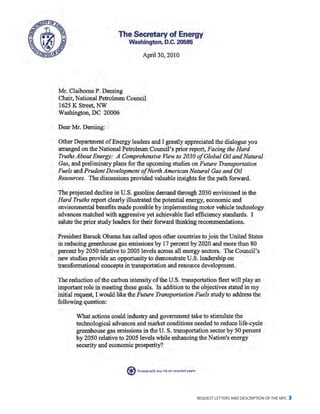
September 2009 request, in a supplemental letter
dated April 30, 2010, Secretary Chu further asked
that the Fuels Study examine actions industry and
government could take to stimulate the technologi-
cal advances and market conditions needed to reduce
life-cycle greenhouse gas emissions in the U.S. trans-
portation sector by 50% by 2050, relative to 2005
levels, while enhancing the nation’s energy security
and economic prosperity. That study is now under-
way, with an anticipated completion in the first half
of 2012.
This North American Resources Study report is
the Council’s response to the second study request,
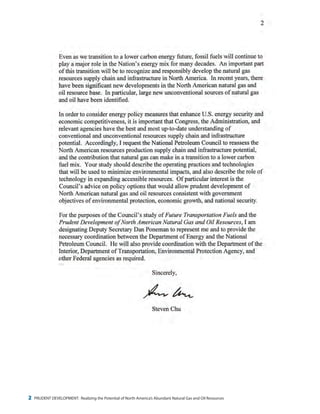
in which Secretary Chu asked the NPC to “reassess
the North American natural gas and oil resources
supply chain and infrastructure potential, and the
contribution that natural gas can make in a transition
to a lower carbon fuel mix.” He further expressed his
interest in “advice on policy options that would allow
prudent development of North American natural
gas and oil resources consistent with government
objectives of environmental protection, economic
growth, and national security.” In his supplemental
letter of April 2010, Secretary Chu stated: “the
National Petroleum Council
TheNationalPetroleumCouncil(NPC)isanorganiza-
tion whose sole purpose is to provide advice to the fed-
eral government. At President Harry Truman’s request,
this federally chartered and privately funded advisory
group was established by the Secretary of the Interior
in 1946 to represent the oil and natural gas industry’s
views to the federal government: advising, inform-
ing, and recommending policy options. During World
War II, under President Franklin Roosevelt, the federal
government and the Petroleum Industry War Council
worked closely together to mobilize the oil supplies that
fueled the Allied victory. President Truman’s goal was
to continue that successful cooperation in the uncertain
postwar years. Today, the NPC is chartered by the Sec-
retary of Energy under the Federal Advisory Committee
Act of 1972, and the views represented are considerably
broader than those of the oil and natural gas industry.
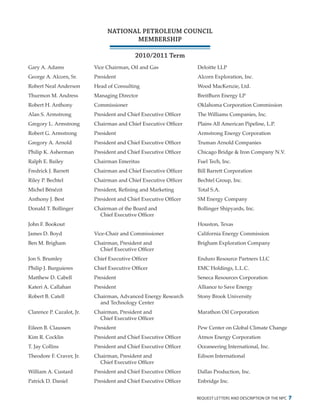
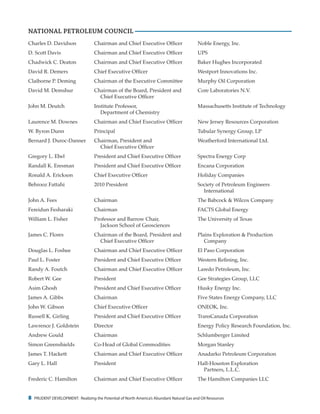
About 200 in number, Council members are ap-
pointed by the Energy Secretary to assure well-
balanced representation from all segments of the
oil and natural gas industry, from all sections of
the country, and from large and small companies.
Members are also appointed from outside the oil and
natural gas industry, representing related interests
such as states, Native Americans, and academic,
financial, research, and public-interest organizations
and institutions. The Council provides a forum
for informed dialogue on issues involving energy,
security, the economy, and the environment of an
ever-changing world.
Study Request
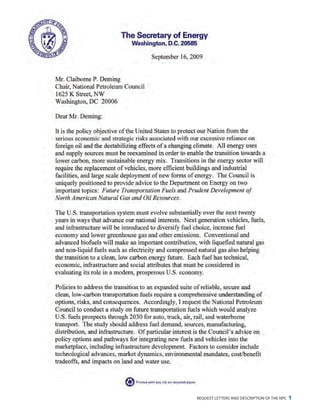
By letter dated September 16, 2009, Secretary of
Energy Steven Chu requested the NPC to conduct
Preface
2 PRUDENT DEVELOPMENT: Realizing the Potential of North America’s Abundant Natural Gas and Oil Resources
Subgroups focused on specific subject areas. Figure 1
provides an organization chart for the study and
Table 1 lists those who served as leaders of the groups
that conducted the study’s analyses.
The members of the various study groups were
drawn from NPC members’ organizations as well as
from many other industries, state and federal agen-
cies, environmental nongovernmental organiza-
tions (NGOs), other public interest groups, financial
institutions, consultancies, academia, and research
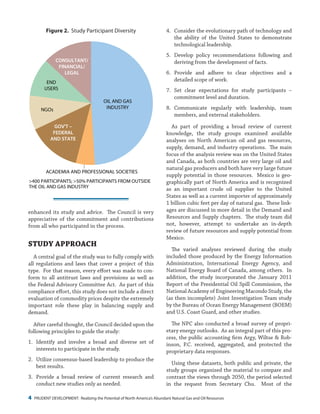
groups. More than 400 people served on the study’s
Committee, Subcommittee, Task Groups, and Sub-
groups and while all have relevant expertise for the
study, fewer than 50% work for natural gas and oil
companies. Appendix B contains rosters of these
study groups and Figure 2 depicts the diversity of par-
ticipation in the study process. In addition to these
study group participants, many more people were
involved through outreach activities. These efforts
were an integral part of the study with the goal of
informing and soliciting input from an informed
range of interested parties.
Study group and outreach participants contrib-
uted in a variety of ways, ranging from full-time
work in multiple study areas, to involvement on a
United States sees a future in which valuable
domestic energy resources are responsibly produced
to meet the needs of American energy consumers
consistent with national, environmental, economic
and energy security goals, … [and the United States]
has the opportunity to demonstrate global leadership
in technological and environmental innovation.
Accordingly,IrequesttheCouncil’sadviceonpotential
technology and policy actions capable of achieving
this vision.” Appendix A contains full copies of both
letters from the Secretary.
Study Organization
In response to the Secretary’s requests, the Council
established a Committee on Resource Development
to study this topic and to supervise preparation of a
draft report for the Council’s consideration. The Com-
mittee leadership consisted of a Chair, Government
Cochair, and four subject-area Vice Chairs. The Coun-
cil also established a Coordinating Subcommittee,
three Task Groups, and three Coordinating Subcom-
mittee level analytical Subgroups to assist the Com-
mittee in conducting the study. These study groups
were aided by four Coordinating Subcommittee level
support Subgroups and twenty-one Task Group-level
Figure P-1. Structure of the North American Resource and Development Study Team
COORDINATING SUBCOMMITTEE
COMMITTEE ON RESOURCE DEVELOPMENT
ANTITRUST
ADVISORY
SUBGROUP
REPORT
WRITING
SUBGROUP
INTEGRATION
SUBGROUP
MACROECONOMIC
SUBGROUP
END-USE EMISSIONS
AND CARBON
REGULATION SUBGROUP
POLICY
SUBGROUP
RESOURCE & SUPPLY
TASK GROUP
OPERATIONS & ENVIRONMENT
TASK GROUP
DEMAND
TASK GROUP
Figure 1. Structure of the North American Resource Development Study Team
PREFACE 3
lationofdataandotherinformation,theydidnottake
positionsonthestudy’spolicyrecommendations. Asa
federally appointed and chartered advisory commit-
tee, the NPC is solely responsible for the final advice
provided to the Secretary of Energy. However, the
Council believes that the broad and diverse study
group and outreach participation has informed and
specific topic, to reviewing proposed materials, or to
participating solely in an outreach session. Involve-
ment in these activities should not be construed as
endorsement or agreement with all the statements,
findings, and recommendations in this report. Addi-
tionally, while U.S. government participants provided
significant assistance in the identification and compi-
Chair – Committee
James T. Hackett
Chairman and Chief Executive Officer
Anadarko Petroleum Company
Chair – Coordinating Subcommittee
D. Clay Bretches
Vice President, E&P Services and Minerals
Anadarko Petroleum Company
Government Cochair – Committee
Daniel P. Poneman
Deputy Secretary of Energy
U.S. Department of Energy
Government Cochair – Coordinating Subcommittee
Christopher A. Smith
Deputy Assistant Secretary for Oil and Natural Gas
U.S. Department of Energy
Vice Chair – Resource & Supply
Marvin E. Odum
President
Shell Oil Company
Chair – Resource & Supply Task Group
Andrew J. Slaughter
Business Environment Advisor – Upstream Americas
Shell Exploration & Production Company
Vice Chair – Operations & Environment
Aubrey K. McClendon
Chairman of the Board and Chief Executive Officer
Chesapeake Energy Corporation
Chair – Operations & Environment Task Group
Paul D. Hagemeier
Vice President, Regulatory Compliance
Chesapeake Energy Corporation
Vice Chair – Demand
Daniel H. Yergin	
Chairman	
IHS Cambridge Energy Research Associates, Inc.
Chair – Demand Task Group
Kenneth L. Yeasting
Senior Director, Global Gas and North America Gas
IHS Cambridge Energy Research Associates, Inc.
Vice Chair – Policy
Philip R. Sharp	
President	
Resources for the Future
Chair – Policy Subgroup
Susan F. Tierney
Managing Principal
Analysis Group, Inc.
Chair – End-Use Emissions & Carbon Subgroup
Fiji C. George
Carbon Strategies Director
El Paso Corporation
Chair – Macroeconomic Subgroup
Christopher L. Conoscenti
Exective Director, Energy Investment Banking
J.P. Morgan Securities LLC
Table 1. North American Resource Development Study Leaders
4 PRUDENT DEVELOPMENT: Realizing the Potential of North America’s Abundant Natural Gas and Oil Resources
4.	 Consider the evolutionary path of technology and
the ability of the United States to demonstrate
technological leadership.
5.	 Develop policy recommendations following and
deriving from the development of facts.
6.	 Provide and adhere to clear objectives and a
detailed scope of work.
7.	 Set clear expectations for study participants –
commitment level and duration.
8.	 Communicate regularly with leadership, team
members, and external stakeholders.
As part of providing a broad review of current
knowledge, the study groups examined available
analyses on North American oil and gas resources,
supply, demand, and industry operations. The main
focus of the analysis review was on the United States
and Canada, as both countries are very large oil and
natural gas producers and both have very large future
supply potential in those resources. Mexico is geo-
graphically part of North America and is recognized
as an important crude oil supplier to the United
States as well as a current importer of approximately
1 billion cubic feet per day of natural gas. These link-
ages are discussed in more detail in the Demand and
Resources and Supply chapters. The study team did
not, however, attempt to undertake an in-depth
review of future resources and supply potential from
Mexico.
The varied analyses reviewed during the study
included those produced by the Energy Information
Administration, International Energy Agency, and
National Energy Board of Canada, among others. In
addition, the study incorporated the January 2011
Report of the Presidential Oil Spill Commission, the
National Academy of Engineering Macondo Study, the
(as then incomplete) Joint Investigation Team study
by the Bureau of Ocean Energy Management (BOEM)
and U.S. Coast Guard, and other studies.
The NPC also conducted a broad survey of propri-
etary energy outlooks. As an integral part of this pro-
cess, the public accounting firm Argy, Wiltse & Rob-
inson, P.C. received, aggregated, and protected the
proprietary data responses.
Using these datasets, both public and private, the
study groups organized the material to compare and
contrast the views through 2050, the period selected
in the request from Secretary Chu. Most of the
enhanced its study and advice. The Council is very
appreciative of the commitment and contributions
from all who participated in the process.
Study Approach
A central goal of the study was to fully comply with
all regulations and laws that cover a project of this
type. For that reason, every effort was made to con-
form to all antitrust laws and provisions as well as
the Federal Advisory Committee Act. As part of this
compliance effort, this study does not include a direct
evaluation of commodity prices despite the extremely
important role these play in balancing supply and
demand.
After careful thought, the Council decided upon the
following principles to guide the study:
1.	 Identify and involve a broad and diverse set of
interests to participate in the study.
2.	 Utilize consensus-based leadership to produce the
best results.
3.	 Provide a broad review of current research and
conduct new studies only as needed.
>400 PARTICIPANTS; >50% PARTICIPANTS FROM OUTSIDE
THE OIL AND GAS INDUSTRY
Figure P-2. Study Participant Diversity
ACADEMIA AND PROFESSIONAL SOCIETIES
OIL AND GAS
INDUSTRY
GOV'T –
FEDERAL
AND STATE
NGOs
END
USERS
CONSULTANT/
FINANCIAL/
LEGAL
Figure 2. Study Participant Diversity
PREFACE 5
review this Integrated Report and supporting details
in different levels of detail, the report is organized in
multiple layers as follows:
yy Executive Summary is the first layer and pro-
vides a broad overview of the study’s princi-
pal findings and resulting policy recommen-
dations. It describes the significant increases
in estimates of recoverable natural gas and oil
resources and the contributions they can make to
the nation’s economic, security, and environmental
well-being if properly produced and transported.
yy Report Chapters provide a more detailed discussion
of the data, analyses, and additional background
on the findings. These individual chapters of the
Integrated Report are titled by subject area – i.e.,
Demand, Macroeconomics, etc. These chapters pro-
vide supporting data and analyses for the findings
and recommendations presented in the Executive
Summary.
yy Appendices are at the end of the Integrated Report
to provide important background material, such as
Secretary Chu’s request letters; rosters of the Coun-
cil and study groups’ membership; and descriptions
of additional study materials available electroni-
cally. Also included are conversion factors used by
all study groups in the creation of the report, as
well as a list of acronyms and abbreviations.
yy Topic and White Papers provide a final level of detail
for the reader. These papers, developed by or for
the study’s Task Groups and Subgroups, formed
the base for the understanding of each study seg-
ment, such as Onshore Gas and Industrial Demand,
and were heavily utilized in the development of the
chapters of the Integrated Report. A list of short
abstracts of these papers appears in Appendix C
and the full papers can be viewed and downloaded
from the NPC website (http://www.npc.org).
The Council believes that these materials will be of
interest to the readers of the report and will help
them better understand the results. The members
of the NPC were not asked to endorse or approve
all of the statements and conclusions contained in
these documents but, rather, to approve the publi-
cation of these materials as part of the study pro-
cess. The papers were reviewed by the Task Groups
and Subgroups but are essentially stand-alone anal-
yses of the studies used by each group. As such,
statements and suggested findings that appear in
these papers are not endorsed by the NPC unless
they were incorporated into the Integrated Report.
outlooks evaluated, however, extended only through
2035 and a number ended before that date. For that
reason, the material framing many aspects of the
study for the 15  years between 2036 and 2050 are
more qualitative than quantitative in nature.
To avoid overlap and leverage resources, both the
Fuels Study and North American Resources Study
teams created Integration Subgroups to coordinate
work within and between the two parallel projects.
The Resources Study thus evaluated the petroleum
resource base and the infrastructure necessary to
bring petroleum to the refinery while the Fuels Study
focused on refinery capacity, upgrading, and down-
stream infrastructure. The Fuels Study also exam-
ined the demand for petroleum motor transportation
fuels as well as natural gas demand for transporta-
tion. With regard to the latter, the Resources Study
received access to the Fuels Study’s initial view on
high potential natural gas vehicle demand and the
effect of electric vehicles on natural gas consumption,
but the Resource Study advanced timeline did not
allow for inclusion of the final Fuels Study analysis in
these areas. By addressing these potential overlaps
and establishing firm means of communication, the
results of both studies were significantly improved
and the time necessary for completing each of the
Council’s studies was shortened.
The Resources Study Task Groups and Subgroups
carefully evaluated the numerous studies available
within their respective areas using the grounded per-
spective resulting from their combined hundreds of
years of experience. They determined the key drivers
for each outlook and developed a fact-based under-
standing of the key issues within demand and sup-
ply as well as end-use emissions, the economy and
prudent environmental operations. From this back-
ground, the Committee on Resource Development
brought important findings to the attention of the
Council. These findings led to the creation of recom-
mendations on government policy that could favor-
ably affect the ability of natural gas to manage the
country’s “transition to a lower carbon fuel mix.”
Study Report Structure
In the interest of transparency and to help readers
better understand this study, the NPC is making the
study results and many of the documents developed
by the study groups available to all interested par-
ties. To provide interested parties with the ability to
6 PRUDENT DEVELOPMENT: Realizing the Potential of North America’s Abundant Natural Gas and Oil Resources
visit the site to download the entire report or indi-
vidual sections for free. Also, published copies of the
report can be purchased from the NPC.
The Integrated Report and the Topic and White
Papers are publicly available. They may be individu-
ally downloaded from the NPC website (http://www.
npc.org). Readers are welcome and encouraged to
EXECUTIVE SUMMARY 7
energy and feedstocks required by America’s indus-
tries. What happens to natural gas supplies affects
all Americans.
Other events have detracted from these positive
developments. Consumers have been coping with
the effects of high petroleum prices. There have been
tragic accidents, such as the Macondo oil spill in the
deepwater Gulf of Mexico and the natural gas pipe-
line explosion in San Bruno, California. Concerns
have been raised about the environmental impacts
of oil sands and shale gas extraction. Some are
questioning the industry’s ability to develop North
American oil and gas resources in an environmen-
tally acceptable and safe manner.
All this sets the context for this study, highlight-
ing the need to continue to develop America’s natu-
ral gas and oil resources in a manner that will balance
energy, economic, and environmental security needs
as part of a transition to a lower carbon energy mix.
In his letter asking the NPC to conduct this study,
the Secretary of Energy requested that the assess-
ment concentrate on two tasks: developing an up-
to-date understanding of the potential natural gas
and oil supply opportunities in North America2
; and
examining the contribution that natural gas could
make in a transition to a lower carbon fuel mix. He
focused the NPC’s attention on interrelated national
objectives of enhancing the nation’s energy security
and economic competitiveness while minimizing
environmental impacts, including climate change.
He instructed the NPC to use a study process to
“venture beyond business-as-usual industry and
government assessments.”
2	 This study generally focuses on resources in the United States
and Canada.
E
xtraordinary events have affected energy mar-
kets in the years since the National Petroleum
Council (NPC) reported on the Hard Truths
about energy in 2007.1
That study concluded that
the world would need increased energy efficiency
and all economic forms of energy supply. This is still
true today, but in the few years since then, significant
technology advances have unlocked vast natural gas
and oil resources. The newly and greatly expanded
North American natural gas and oil resources are
already benefiting our country economically and
increasing employment. Growing supplies of natural
gas have resulted in lower prices, helping to revital-
ize many U.S. industries and, in some parts of the
country, lower the cost of producing electricity. The
increased competitiveness of natural gas could lead
to greater use for power generation, helping to fur-
ther reduce emissions from electricity production.
Technological advances and the expansion of eco-
nomically recoverable natural gas and oil reserves
can substantially improve America’s energy security.
North America has also become much more inte-
grated in energy terms; Canada provides a quarter of
America’s total oil imports, almost double that of the
next largest source.
The great expansion of economically recoverable
natural gas is central to meeting America’s over-
all needs, as natural gas is one of the cornerstone
fuels on which the nation’s economy depends.
Natural gas provides a quarter of America’s over-
all energy and is used to generate a quarter of the
nation’s electricity. It provides the heat for 56 mil-
lion homes and apartments and delivers 35% of the
1	 National Petroleum Council, Hard Truths: Facing the Hard
Truths about Energy, July 2007 (“Hard Truths”).
Executive Summary
8 PRUDENT DEVELOPMENT: Realizing the Potential of North America’s Abundant Natural Gas and Oil Resources
Fourth, realizing the benefits of natural gas and
oil depends on environmentally responsible devel-
opment. In order to realize the benefits of these
larger natural gas and oil resources, safe, responsi-
ble, and environmentally acceptable production and
delivery must be ensured in all circumstances. Many
natural gas and oil companies are committed to such
goals and work hard to achieve them. The critical path
to sustained and expanded resource development in
North America includes effective regulation and a
commitment of industry and regulators to continuous
improvement in practices to eliminate or minimize
environmental risk. These steps are necessary for pub-
lic trust. Recognizing that access to available resources
can be undermined by safety and environmental inci-
dents, all industry participants must continuously
improve their environmental, safety, and health prac-
tices, preserving the benefits of greater access for the
industry, consumers, and all other stakeholders.
In making these core findings, the NPC examined a
broad range of energy supply, demand, environmen-
tal, and technology outlooks through 2050. The study
participants addressed issues relating to public health,
safety, and environmental risks associated with natu-
ral gas and oil production and delivery practices, as
well as opportunities for natural gas to reduce emis-
sions from energy use. The NPC’s findings and recom-
mendations are summarized below and explained in
detail in the report chapters.
1.	NATURAL GAS IS A VERY ABUNDANT
RESOURCE
America’s natural gas resource base is enor-
mous. It offers significant, potentially trans-
formative benefits for the U.S. economy,
energy security, and the environment. Thanks
to the advances in the application of technol-
ogy pioneered in the United States and Canada,
North America has a large, economically acces-
sible natural gas resource base that includes
significant sources of unconventional gas such
as shale gas. This resource base could supply
over 100 years of demand at today’s consump-
tion rates. Natural gas, properly produced and
delivered, can play an important role in helping
the United States reduce its carbon and other
emissions. But these potentially transforma-
tive benefits cannot happen without access to
resource-rich basins and the consistent appli-
cation of responsible development practices.
AMERICA’S ENERGY FUTURE
This study came to four conclusions about natural
gas and oil. These findings can help guide the nation’s
actions.
First, the potential supply of North American
natural gas is far bigger than was thought even a
few years ago. As late as 2007, it was thought that
the United States would have to become increasingly
dependent on imported liquefied natural gas, owing
to what appeared to be a constrained domestic supply.
That is no longer the case. It is now understood that
the natural gas resource base is enormous and that its
development – if carried out in acceptable ways – is
potentially transformative for the American econ-
omy, energy security, and the environment, includ-
ing reduction of air emissions. These resources have
the potential to meet even the highest projections of
demand reviewed by this study.
Second – and perhaps surprising to many –
America’s oil resources are also proving to be much
larger than previously thought. The North American
oil resource base offers substantial supply for decades
ahead and could help the United States reduce, but not
eliminate, its requirements and costs for oil imported
from outside of North America. The United States
and Canada together produce 4% more oil than Rus-
sia, the world’s largest producer. However, as Hard
Truths stated, “energy independence is not realistic
in the foreseeable future,” although economic and
energy security benefits flow from reducing imports
through efficiency and increasing domestic produc-
tion. Realizing the potential of oil, like natural gas, in
the future will depend on putting in place appropriate
access regimes that can allow sustained exploration
and development activity to take place in resource-
rich areas.
Third, we need these natural gas and oil resources
even as efficiency reduces energy demand and alter-
natives become more economically available on a
large scale. Even presuming that the United States
uses energy much more efficiently, diversifies its
energy mix, and transitions to a lower carbon fuel mix,
Americans will need natural gas and oil for much of
their energy requirements for the foreseeable future.
Moreover, the natural gas and oil industry is vital to
the U.S. economy, generating millions of high-paying
jobs and providing tax revenues to federal, state, and
local governments.
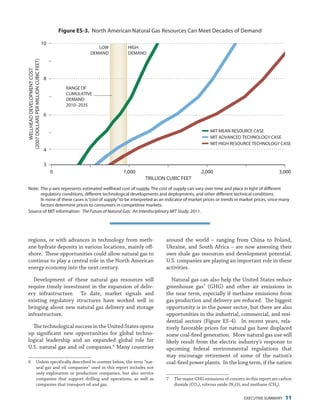
EXECUTIVE SUMMARY 9
decades at current or greatly expanded levels of use.
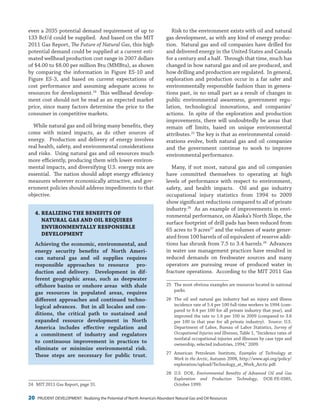
Figure ES-3 shows estimates of the wellhead devel-
opment cost from three estimates of future natural
gas resources derived from the recent Massachusetts
Institute of Technology (MIT) study4
on natural gas,
along with low and high estimates of cumulative, total
demand from 2010 to 2035.5
The wellhead develop-
ment cost, as estimated by the MIT study, should not
be read as an expected market price, since many fac-
tors determine the price to the consumer in competi-
tive markets. In the longer term, there are additional
potential major resources in Arctic and other offshore
4	 MIT Energy Initiative, The Future of Natural Gas: An Inter-
disciplinary MIT Study, Massachusetts Institute of Tech-
nology, 2011 (MIT 2011 Gas Report). As presented on
Figure ES-3, the MIT “Mean Resource Case” shows the
mean resource estimate, based on 2007 technology levels;
the “Advanced Technology Case” shows the mean resource
estimate based on advanced technologies; and the “High
Resource Technology Case” shows the high resource estimate
using advanced technologies, as defined in that study.
5	 Figure ES-3 also shows the range of cumulative natural gas
demand for 2010 through 2035. The range is based on the
NPC Demand Task Group estimate that North American nat-
ural gas demand for 2035 could range from 25 to 45 trillion
cubic feet per year, with a 2010 beginning point of 26 trillion
cubic feet per year.
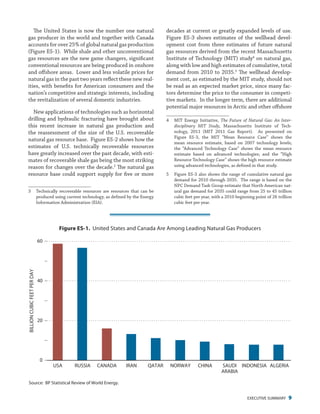
The United States is now the number one natural
gas producer in the world and together with Canada
accounts for over 25% of global natural gas production
(Figure ES-1). While shale and other unconventional
gas resources are the new game changers, significant
conventional resources are being produced in onshore
and offshore areas. Lower and less volatile prices for
natural gas in the past two years reflect these new real-
ities, with benefits for American consumers and the
nation’s competitive and strategic interests, including
the revitalization of several domestic industries.
New applications of technologies such as horizontal
drilling and hydraulic fracturing have brought about
this recent increase in natural gas production and
the reassessment of the size of the U.S. recoverable
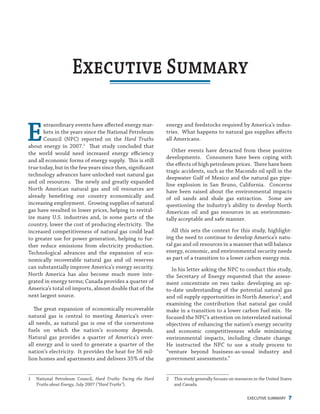
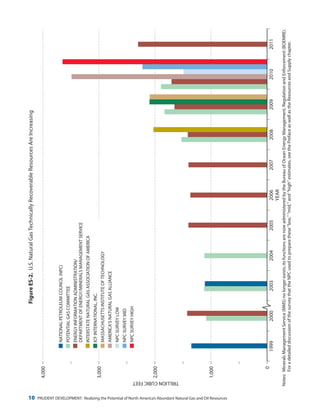
natural gas resource base. Figure ES-2 shows how the
estimates of U.S. technically recoverable resources
have greatly increased over the past decade, with esti-
mates of recoverable shale gas being the most striking
reason for changes over the decade.3
The natural gas
resource base could support supply for five or more
3	 Technically recoverable resources are resources that can be
produced using current technology, as defined by the Energy
Information Administration (EIA).
Figure ES-1. United States and Canada Are Among Leading Natural Gas Producers
0
20
40
60
USA RUSSIA CANADA IRAN NORWAYQATAR CHINA ALGERIASAUDI
ARABIA
INDONESIA
Source: BP Statistical Review of World Energy.
BILLIONCUBICFEETPERDAY
10 PRUDENT DEVELOPMENT: Realizing the Potential of North America’s Abundant Natural Gas and Oil Resources
0
1,000
2,000
3,000
4,000
FigureES-2.U.S.NaturalGasTechnicallyRecoverableResourcesAreIncreasing
TRILLIONCUBICFEET
YEAR
Notes:MineralsManagementService(MMS)nolongerexists;itsfunctionsarenowadministeredbytheBureauofOceanEnergyManagement,RegulationandEnforcement(BOEMRE).
ForadetaileddiscussionofthesurveythattheNPCusedtopreparethese“low,”“mid,”and“high”estimates,seethePrefaceaswellastheResourcesandSupplychapter.
19992000200320042005200620072008200920102011
POTENTIALGASCOMMITTEE
ENERGYINFORMATIONADMINISTRATION/
DEPARTMENTOFENERGY/MINERALSMANAGEMENTSERVICE
NATIONALPETROLEUMCOUNCIL(NPC)
ICFINTERNATIONAL,INC.
MASSACHUSETTSINSTITUTEOFTECHNOLOGY
NPCSURVEYLOW
NPCSURVEYMID
NPCSURVEYHIGH
AMERICA’SNATURALGASALLIANCE
INTERSTATENATURALGASASSOCIATIONOFAMERICA
FigureES-2.U.S.NaturalGasTechnicallyRecoverableResourcesAreIncreasing
EXECUTIVE SUMMARY 11
around the world – ranging from China to Poland,
Ukraine, and South Africa – are now assessing their
own shale gas resources and development potential.
U.S. companies are playing an important role in these
activities.
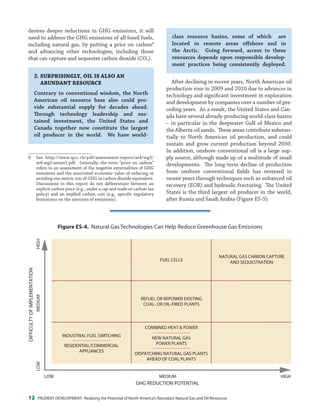
Natural gas can also help the United States reduce
greenhouse gas7
(GHG) and other air emissions in
the near term, especially if methane emissions from
gas production and delivery are reduced. The biggest
opportunity is in the power sector, but there are also
opportunities in the industrial, commercial, and resi-
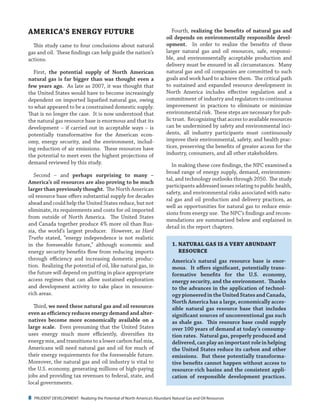
dential sectors (Figure ES-4). In recent years, rela-
tively favorable prices for natural gas have displaced
some coal-fired generation. More natural gas use will
likely result from the electric industry’s response to
upcoming federal environmental regulations that
may encourage retirement of some of the nation’s
coal-fired power plants. In the long term, if the nation
7	 The major GHG emissions of concern in this report are carbon
dioxide (CO2), nitrous oxide (N2O), and methane (CH4).
regions, or with advances in technology from meth-
ane hydrate deposits in various locations, mainly off-
shore. These opportunities could allow natural gas to
continue to play a central role in the North American
energy economy into the next century.
Development of these natural gas resources will
require timely investment in the expansion of deliv-
ery infrastructure. To date, market signals and
existing regulatory structures have worked well in
bringing about new natural gas delivery and storage
infrastructure.
The technological success in the United States opens
up significant new opportunities for global techno-
logical leadership and an expanded global role for
U.S. natural gas and oil companies.6
Many countries
6	 Unless specifically described in context below, the term “nat-
ural gas and oil companies” used in this report includes not
only exploration or production companies, but also service
companies that support drilling and operations, as well as
companies that transport oil and gas.
Figure ES-3. North American Natural Gas Resources Can Meet Decades of Demand
3
6
8
4
10
0 1,000 2,000 3,000
WELLHEADDEVELOPMENTCOST
(2007DOLLARSPERMILLIONCUBICFEET)
Figure ES-3. North American Technically Recoverable Natural Gas Resources
RANGE OF
CUMULATIVE
DEMAND
2010–2035
TRILLION CUBIC FEET
MIT MEAN RESOURCE CASE
MIT ADVANCED TECHNOLOGY CASE
MIT HIGH RESOURCE TECHNOLOGY CASE
LOW
DEMAND
HIGH
DEMAND
Note: The y-axis represents estimated wellhead cost of supply. The cost of supply can vary over time and place in light of different
regulatory conditions, different technological developments and deployments, and other different technical conditions.
In none of these cases is“cost of supply”to be interpreted as an indicator of market prices or trends in market prices, since many
factors determine prices to consumers in competitive markets.
Source of MIT information: The Future of Natural Gas: An Interdisciplinary MIT Study, 2011.
12 PRUDENT DEVELOPMENT: Realizing the Potential of North America’s Abundant Natural Gas and Oil Resources
GHG REDUCTION POTENTIAL
DIFFICULTYOFIMPLEMENTATION
NATURAL GAS CARBON CAPTURE
AND SEQUESTRATION
NEW NATURAL GAS
POWER PLANTS
COMBINED HEAT & POWER
FUEL CELLS
INDUSTRIAL FUEL SWITCHING
REFUEL OR REPOWER EXISTING
COAL- OR OIL-FIRED PLANTS
Figure ES-4. Natural Gas Technologies Can Help Reduce Greenhouse Gas (GHG) Emissions
WAS Fig. ES-3
RESIDENTIAL/COMMERCIAL
APPLIANCES
LOW MEDIUM HIGH
MEDIUMHIGHLOW
DISPATCHING NATURAL GAS PLANTS
AHEAD OF COAL PLANTS
class resource basins, some of which are
located in remote areas offshore and in
the Arctic. Going forward, access to these
resources depends upon responsible develop-
ment practices being consistently deployed.
After declining in recent years, North American oil
production rose in 2009 and 2010 due to advances in
technology and significant investment in exploration
and development by companies over a number of pre-
ceding years. As a result, the United States and Can-
ada have several already-producing world-class basins
– in particular in the deepwater Gulf of Mexico and
the Alberta oil sands. These areas contribute substan-
tially to North American oil production, and could
sustain and grow current production beyond 2030.
In addition, onshore conventional oil is a large sup-
ply source, although made up of a multitude of small
developments. The long-term decline of production
from onshore conventional fields has reversed in
recent years through techniques such as enhanced oil
recovery (EOR) and hydraulic fracturing. The United
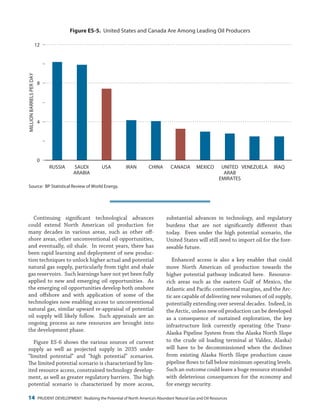
States is the third largest oil producer in the world,
after Russia and Saudi Arabia (Figure ES-5).
desires deeper reductions in GHG emissions, it will
need to address the GHG emissions of all fossil fuels,
including natural gas, by putting a price on carbon8
and advancing other technologies, including those
that can capture and sequester carbon dioxide (CO2).
2.	SURPRISINGLY, OIL IS ALSO AN
ABUNDANT RESOURCE
Contrary to conventional wisdom, the North
American oil resource base also could pro-
vide substantial supply for decades ahead.
Through technology leadership and sus-
tained investment, the United States and
Canada together now constitute the largest
oil producer in the world. We have world-
8	 See http://www.ipcc.ch/pdf/assessment-report/ar4/wg3/
ar4-wg3-annex1.pdf. Generally, the term “price on carbon”
refers to an assessment of the negative externalities of GHG
emissions and the associated economic value of reducing or
avoiding one metric ton of GHG in carbon dioxide equivalent.
Discussions in this report do not differentiate between an
explicit carbon price (e.g., under a cap and trade or carbon tax
policy) and an implied carbon cost (e.g., specific regulatory
limitations on the amounts of emissions).
Figure ES-4. Natural Gas Technologies Can Help Reduce Greenhouse Gas Emissions
EXECUTIVE SUMMARY 13
strong production in the Gulf of Mexico. Third, new
Arctic oil and natural gas supply have a potential of
the equivalent of over 200 billion barrels of oil. This
is in addition to existing oil supply and proven natural
gas reserves on the Alaska North Slope. The new Arc-
tic resources could yield significant supply after 2025.
Fourth, another very large long-term oil supply source
lies in the shale oil deposits of Colorado, Utah, and
Wyoming. The development of these billions of bar-
rels of oil from these new resource areas will require
sustained investment, substantial advances in tech-
nology, and environmental risk management systems
and approaches.9
In many instances, there will be the
need for new pipelines and other infrastructure.
9	 There are several trillion barrels of “oil-in-place.” How much
can be extracted will greatly depend on the technology and
economics.
Longer-term growth in oil production can come
from several new and emerging North American sup-
ply sources. One source is tight oil, found in geo-
logical formations where the oil does not easily flow
through the rock, such as in the Bakken formation of
North Dakota, Saskatchewan, Montana, and Mani-
toba. Tight oil has also benefited from technologies
similar to those used for shale gas, including hydrau-
lic fracturing. Over the next 20 years, tight oil pro-
duction could continue to grow. A second potentially
large supply source is in new offshore areas, particu-
larly in the Gulf of Mexico and the Atlantic and Pacific
coasts of the United States and Canada. Access to and
potential development of these new U.S. areas would
require an Executive Branch level directive to include
such areas in the 2012–2017 Leasing Program. New
offshore areas could provide both natural gas and oil
in significant quantities to supplement the continuing
Foundational Concepts
Based on the request from the Secretary of
Energy, the NPC used four key concepts to evaluate
potential policy recommendations that arose in the
study: economic prosperity, environmental sustain-
ability, energy security, and prudent development.
“Economic prosperity” means not just the
level of wealth of a country, but also its economic
growth, economic security, and economic com-
petitiveness. This goal also includes the notion of
balancing the interests of today’s society against
those of tomorrow’s.
“Environmentally sustainable” means allowing
for the maintenance of environmental quality
andresourceprotectionovertime. Environmental
sustainability encompasses impacts such as air and
water pollution that directly affect public health, as
well as these and other impacts affecting ecosystem
vitality, biodiversity, habitat, forestry and fisher-
ies’ health, agriculture, and the global climate. It is
related to the concept of sustainable development
as defined by the Brundtland Commission, formerly
known as the World Commission on Environment
and Development: “meeting the needs of the pres-
ent without compromising the ability of future gen-
erations to meet their own needs.”
“Energy security” means minimizing vulner-
ability to energy supply disruptions and the
resulting volatile and disruptive energy prices.
Since most of the U.S. energy supply is domestic,
energy security is affected by the development
of domestic resources, as well as the security of
delivery and production systems such as natural
gas pipelines, refineries, power plants, and elec-
tric power transmission. Likewise, as some of the
U.S. energy supply comes from other countries,
energy security also involves geopolitical consid-
erations associated with protecting and enhancing
U.S. strategic interests internationally. Potential
disrupters of energy security cover a range, among
which are turmoil in foreign supplier countries;
the disruption of a major supply source or delivery
infrastructure; assaults on the supply chain; natu-
ral disasters; and global environmental issues and
extreme weather events, as characterized by the
2010 Quadrennial Defense Review Report of the
U.S. Department of Defense.
The concept of “prudent development of
North American natural gas and oil resources”
means development, operations, and deliv-
ery systems that achieve a broadly acceptable
balance of several factors: economic growth,
environmental stewardship and sustainability,
energy security, and human health and safety.
Prudent development necessarily involves trade-
offs among these factors. Consideration of the
distribution of costs and benefits is a key part of
prudent development.
14 PRUDENT DEVELOPMENT: Realizing the Potential of North America’s Abundant Natural Gas and Oil Resources
substantial advances in technology, and regulatory
burdens that are not significantly different than
today. Even under the high potential scenario, the
United States will still need to import oil for the fore-
seeable future.
Enhanced access is also a key enabler that could
move North American oil production towards the
higher potential pathway indicated here. Resource-
rich areas such as the eastern Gulf of Mexico, the
Atlantic and Pacific continental margins, and the Arc-
tic are capable of delivering new volumes of oil supply,
potentially extending over several decades. Indeed, in
the Arctic, unless new oil production can be developed
as a consequence of sustained exploration, the key
infrastructure link currently operating (the Trans-
Alaska Pipeline System from the Alaska North Slope
to the crude oil loading terminal at Valdez, Alaska)
will have to be decommissioned when the declines
from existing Alaska North Slope production cause
pipeline flows to fall below minimum operating levels.
Such an outcome could leave a huge resource stranded
with deleterious consequences for the economy and
for energy security.
Continuing significant technological advances
could extend North American oil production for
many decades in various areas, such as other off-
shore areas, other unconventional oil opportunities,
and eventually, oil shale. In recent years, there has
been rapid learning and deployment of new produc-
tion techniques to unlock higher actual and potential
natural gas supply, particularly from tight and shale
gas reservoirs. Such learnings have not yet been fully
applied to new and emerging oil opportunities. As
the emerging oil opportunities develop both onshore
and offshore and with application of some of the
technologies now enabling access to unconventional
natural gas, similar upward re-appraisal of potential
oil supply will likely follow. Such appraisals are an
ongoing process as new resources are brought into
the development phase.
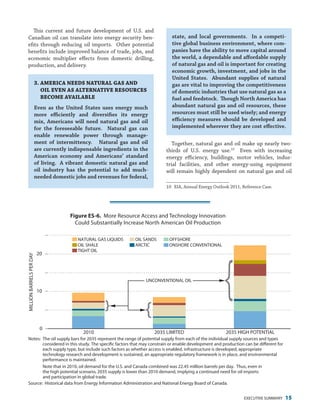
Figure ES-6 shows the various sources of current
supply as well as projected supply in 2035 under
“limited potential” and “high potential” scenarios.
The limited potential scenario is characterized by lim-
ited resource access, constrained technology develop-
ment, as well as greater regulatory barriers. The high
potential scenario is characterized by more access,
MILLIONBARRELSPERDAY
0
4
8
12
RUSSIA SAUDI
ARABIA
USA IRAN CHINA CANADA MEXICO UNITED
ARAB
EMIRATES
IRAQVENEZUELA
Figure ES-5. United States and Canada Are among Leading Oil Producers
WAS Figure ES-4
Source: BP Statistical Review of World Energy.
Figure ES-5. United States and Canada Are Among Leading Oil Producers
EXECUTIVE SUMMARY 15
This current and future development of U.S. and
Canadian oil can translate into energy security ben-
efits through reducing oil imports. Other potential
benefits include improved balance of trade, jobs, and
economic multiplier effects from domestic drilling,
production, and delivery.
3.	AMERICA NEEDS NATURAL GAS AND
OIL EVEN AS ALTERNATIVE RESOURCES
BECOME AVAILABLE
Even as the United States uses energy much
more efficiently and diversifies its energy
mix, Americans will need natural gas and oil
for the foreseeable future. Natural gas can
enable renewable power through manage-
ment of intermittency. Natural gas and oil
are currently indispensable ingredients in the
American economy and Americans’ standard
of living. A vibrant domestic natural gas and
oil industry has the potential to add much-
needed domestic jobs and revenues for federal,
state, and local governments. In a competi-
tive global business environment, where com-
panies have the ability to move capital around
the world, a dependable and affordable supply
of natural gas and oil is important for creating
economic growth, investment, and jobs in the
United States. Abundant supplies of natural
gas are vital to improving the competitiveness
of domestic industries that use natural gas as a
fuel and feedstock. Though North America has
abundant natural gas and oil resources, these
resources must still be used wisely; and energy
efficiency measures should be developed and
implemented wherever they are cost effective.
Together, natural gas and oil make up nearly two-
thirds of U.S. energy use.10
Even with increasing
energy efficiency, buildings, motor vehicles, indus-
trial facilities, and other energy-using equipment
will remain highly dependent on natural gas and oil
10	 EIA, Annual Energy Outlook 2011, Reference Case.
UNCONVENTIONAL OIL
{}
0
10
20
2010 2035 LIMITED 2035 HIGH POTENTIAL
MILLIONBARRELSPERDAY
Figure ES-6. More Resource Access and Technology Innovation Could Substantially Increase
North American Oil Production
ALSO used as Figure 1-5
Notes: The oil supply bars for 2035 represent the range of potential supply from each of the individual supply sources and types
considered in this study. The specific factors that may constrain or enable development and production can be different for
each supply type, but include such factors as whether access is enabled, infrastructure is developed, appropriate
technology research and development is sustained, an appropriate regulatory framework is in place, and environmental
performance is maintained.
Note that in 2010, oil demand for the U.S. and Canada combined was 22.45 million barrels per day. Thus, even in
the high potential scenario, 2035 supply is lower than 2010 demand, implying a continued need for oil imports
and participation in global trade.
Source: Historical data from Energy Information Administration and National Energy Board of Canada.
ONSHORE CONVENTIONAL
OFFSHORE
ARCTIC
NATURAL GAS LIQUIDS OIL SANDS
TIGHT OIL
OIL SHALE
Figure ES-6. More Resource Access and Technology Innovation
Could Substantially Increase North American Oil Production
16 PRUDENT DEVELOPMENT: Realizing the Potential of North America’s Abundant Natural Gas and Oil Resources
in combined operational expenses and capital invest-
mentin2009–equivalenttoover3%ofAmerica’sgross
domesticproduct(GDP).12
IntheUnitedStates,federal,
state, and local governments also benefit from the sub-
stantial amount of taxes and royalties paid by natural
gas and oil companies. Taking into account all corpo-
rate income taxes, severance taxes, royalties on federal
lands, sales taxes, payroll taxes, property and use taxes,
and excise taxes, natural gas and oil companies gener-
ate over $250 billion in government revenue annually.
Although natural gas and oil have long been viewed
as related fuels, their uses are quite different. Natural
gas is especially important for heating, power genera-
tion, and industrial uses such as chemical manufac-
turing. By contrast, around 97% of all energy used in
the transportation sector comes from oil. The import
picture differs as well. Nearly all of the natural gas con-
sumed in North America is produced within the same
continental boundaries, while about half of the crude
oil processed in North American refineries is imported.
Within North America, Canada is a net exporter of
crude oil and the United States is a net importer.13
Low natural gas prices make U.S. manufacturers
and farmers more competitive. U.S. firms rely on nat-
ural gas- and oil-derived chemicals as building blocks
for the production of electronics (including comput-
ers and cell phones), plastics, medicines and medical
equipment, cleaning products, fertilizers, building
materials, adhesives, and clothing. When manufac-
turers use natural gas as a fuel and feedstock, they
create a variety of products that are used every day.
These products are valued at greater than eight times
the cost of the natural gas used to create them, pro-
viding significant benefit to the nation’s economy.14
12	 PricewaterhouseCoopers, “The Economic Impacts of the
Oil and Natural Gas Industry on the U.S. Economy in 2009:
Employment, Labor Income, and Value Added,” May 2011.
13	 In 2010, U.S. net crude oil imports were 9.1 million barrels
per day, which was about 62% of its total refinery crude oil
inputs. Canada, in contrast, is a net crude oil exporter, as it
imports crude oil into eastern Canadian refineries but exports
crude oil to the United States from western Canadian produc-
tion. On a net basis, Canada exports 1.4 million barrels per
day, but its crude oil exports to the U.S. total 1.99 million bar-
rels/day, 22% of U.S. crude oil imports. So, for both coun-
tries together, net crude oil imports total 7.7 million barrels
per day, or about 47% of combined refinery crude oil runs.
Source: BP and EIA.
14	Based on information in the American Chemistry Coun-
cil, “Guide to the Business of Chemistry,” 2011; and Ameri-
can Chemistry Council, “Shale Gas and New Petrochemicals
Investment: Benefits for the Economy, Jobs, and US Manu-
facturing,” Economics & Statistics, March 2011.
for many years to come. Thus, these fuels are criti-
cal in the U.S. economy, particularly as part of a strat-
egy to transition towards a low-carbon energy mix in
the future. There is enough supply to meet a range of
demand levels for decades – from business as usual,
to scenarios with much greater penetrations of natu-
ral gas in the power, industrial, and transportation
sectors. And, using these resources much more effi-
ciently will strengthen the nation’s economic resil-
iency, reduce environmental impacts, and enhance
energy security. As noted in Hard Truths and other
studies, investment in and deployment of energy effi-
ciency measures is frequently cost effective and will
reduce demands for fossil fuels and the impacts of
their associated emissions. Energy efficiency deserves
continued and increased efforts.11
At the same time, in meeting the needs of U.S. con-
sumers, the American natural gas and oil industry
plays an essential role in the U.S. economy. Compa-
nies directly engaged in the oil and natural gas indus-
try employ over 2 million Americans who earn over
$175 billion in labor income. The employment figure
jumps to over 9 million Americans with $533 billion in
labor income when including the jobs created by the
spending on goods and services of natural gas and oil
companies and their employees. PricewaterhouseCoo-
pershasestimatedthatthedomesticoilandnaturalgas
industry directly generated approximately $464 billion
11	 Hard Truths recommended that the United States moderate
demand by increasing energy efficiency through improved
vehicle fuel economy and by reducing energy consumption
in the residential and commercial sectors. Hard Truths con-
cluded that:
“… anticipated energy use in the residential and commercial
sectors could be reduced by roughly 15 to 20 percent through
deploymentofcost-effectiveenergy-efficiencymeasuresthat
use existing, commercially available technologies. Assuming
that all these measures are put in place over the next decades
and that all other factors such as level of services are held
constant, U.S. residential/commercial energy consumption
could be reduced by 7 to 9 quadrillion Btu. Technologies to
accomplish savings of these magnitudes are indicated to be
available in the marketplace.” (page 43)
“… a doubling of fuel economy of new cars and light trucks
by 2030 is possible through the use of existing and antici-
pated technologies, assuming vehicle performance and other
attributes remain the same as today…. Depending upon
how quickly new vehicle improvements are incorporated in
the on-road light duty vehicle fleet, U.S. oil demand would
be reduced by about 3-5 million barrels per day in 2030.
Additional fuel economy improvements would be possible
by reducing vehicle weight, horsepower, and amenities,
or by developing more expensive, step-out technologies.”
(pages 14-15)
EXECUTIVE SUMMARY 17
Observers of natural gas markets forecast a
wide range of future natural gas demand for
the United States and a narrower range for
Canada.15
For the United States, most of the varia-
tion in natural gas demand comes from the power
sector; for Canada, it comes from the industrial
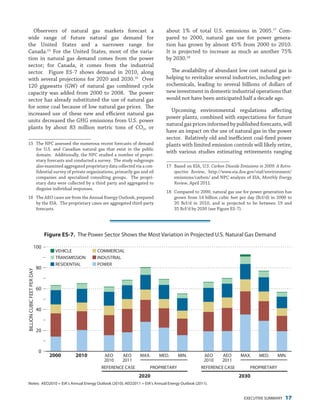
sector. Figure ES-7 shows demand in 2010, along
with several projections for 2020 and 2030.16
Over
120  gigawatts (GW) of natural gas combined cycle
capacity was added from 2000 to 2008. The power
sector has already substituted the use of natural gas
for some coal because of low natural gas prices. The
increased use of these new and efficient natural gas
units decreased the GHG emissions from U.S. power
plants by about 83 million metric tons of CO2, or
15	 The NPC assessed the numerous recent forecasts of demand
for U.S. and Canadian natural gas that exist in the public
domain. Additionally, the NPC studied a number of propri-
etary forecasts and conducted a survey. The study subgroups
also examined aggregated proprietary data collected via a con-
fidential survey of private organizations, primarily gas and oil
companies and specialized consulting groups. The propri-
etary data were collected by a third party and aggregated to
disguise individual responses.
16	 The AEO cases are from the Annual Energy Outlook, prepared
by the EIA. The proprietary cases are aggregated third-party
forecasts.
about 1% of total U.S. emissions in 2005.17
Com-
pared to 2000, natural gas use for power genera-
tion has grown by almost 45% from 2000 to 2010.
It is projected to increase as much as another 75%
by 2030.18
The availability of abundant low cost natural gas is
helping to revitalize several industries, including pet-
rochemicals, leading to several billions of dollars of
new investment in domestic industrial operations that
would not have been anticipated half a decade ago.
Upcoming environmental regulations affecting
power plants, combined with expectations for future
natural gas prices informed by published forecasts, will
have an impact on the use of natural gas in the power
sector. Relatively old and inefficient coal-fired power
plants with limited emission controls will likely retire,
with various studies estimating retirements ranging
17	 Based on EIA, U.S. Carbon Dioxide Emissions in 2009: A Retro-
spective Review, http://www.eia.doe.gov/oiaf/environment/
emissions/carbon/ and NPC analysis of EIA, Monthly Energy
Review, April 2011.
18	 Compared to 2000, natural gas use for power generation has
grown from 14 billion cubic feet per day (Bcf/d) in 2000 to
20 Bcf/d in 2010, and is projected to be between 19 and
35 Bcf/d by 2030 (see Figure ES-7).
0
20
40
60
80
100
BILLIONCUBICFEETPERDAY
Figure ES-7. The Power Sector Shows the Most Variation in Projected U.S. Natural Gas Demand
WAS Figure ES-6, ALSO Figure 3-2
AEO
2010
AEO
2011
REFERENCE CASE
MAX. MED. MIN.
2030
PROPRIETARY
AEO
2010
AEO
2011
REFERENCE CASE
MAX. MED. MIN.
2020
PROPRIETARY
20102000
Notes: AEO2010 = EIA’s Annual Energy Outlook (2010); AEO2011 = EIA’s Annual Energy Outlook (2011).
VEHICLE
TRANSMISSION
RESIDENTIAL
COMMERCIAL
INDUSTRIAL
POWER
Figure ES-7. The Power Sector Shows the Most Variation in Projected U.S. Natural Gas Demand
18 PRUDENT DEVELOPMENT: Realizing the Potential of North America’s Abundant Natural Gas and Oil Resources
U.S. GHG emissions in 2009. There is, however, a very
high degree of uncertainty around estimates of meth-
ane emissions and, therefore, better data are needed
while efforts continue to reduce such emissions.
Taking into account EPA’s recently revised esti-
mates of methane emissions during production and
delivery, the life-cycle emissions for natural gas are
about 35% lower than coal on a heat-content (British
thermal unit [Btu]) basis.21
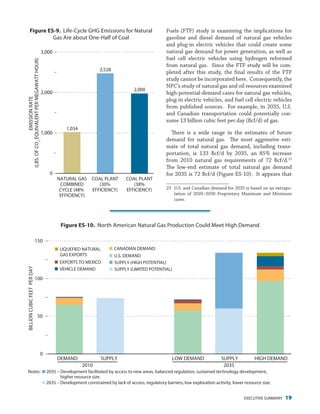
In terms of the production
of electricity, for efficiencies typical of coal- and
natural gas-fired plants, natural gas has about
50–60% lower GHG emissions than those of a coal-
fired plant (Figure ES-9).22
Beyond the power sector, there is potential for
increased use of natural gas to displace oil in the trans-
portation sector. The NPC Future Transportation
21	 Life-cycle emissions include those from the direct combustion
of natural gas, as well as methane emissions from the produc-
tion and delivery of natural gas.
22	 The natural gas combined cycle turbine unit has a heat rate of
7,000 Btu/kWh, while the coal plant at 30% efficiency has a
heat rate of 11,377 Btu/kWh and the coal plant at 38% effi-
ciency has a heat rate of 9,000 Btu/kWh.
from 12 to 101 GW of capacity by 2020. The study
average of 58 GW of coal-fired capacity retirements
represents about 6% of total U.S. generating capacity,
or around 18% of coal-fired capacity. This will likely
increase demand for natural gas at power plants, lead
to new investment in natural gas-fired generation, and
lower GHG emissions from the power sector (on aver-
age, around 3.5% of the 2005 U.S. total by 2020).
In the longer term, increased natural gas supplies,
along with the possible introduction of policies to
reduce GHG emissions, could yield more substitu-
tion of natural gas for other fossil fuels, mainly coal.
According to studies reviewed as part of this NPC
study, natural gas could help reduce emissions in the
long term (such as a 50% reduction from a 2005 base-
line by 2050). A steeper emissions reduction target,
such as 80% or more by 2050, will likely also require
more aggressive emission control technologies like car-
bon capture and sequestration (CCS) for both coal and
natural gas power plants, if these fossil fuels were to
remain a significant energy source for power genera-
tion. Excluding transportation, the potential reduc-
tion in GHG emissions from natural gas use ranges
from an equivalent of 126–864 million metric tons of
CO2 per year by 2030, or about 2–12% of total 2005
U.S. GHG emissions (Figure ES-8). This broad range
of GHG reductions reflects the potential application
of diverse natural gas technologies across the end-use
sectors, including appliances, power infrastructure,
and infrastructure retrofits in applications within the
residential,commercial,andindustrialend-usesectors.
In addition to emissions of CO2 at the point of natu-
ral gas combustion, there are emissions of methane
into the atmosphere that result from the production
and delivery of natural gas.19
Some emissions occur in
normal operations through venting for safety reasons
such as to relieve pressure. Other emissions occur
because of leaks in equipment such as compressor seals
and connections. Because methane is a GHG that is
significantly more potent than CO2 in its global warm-
ing potential,20
it is vital to minimize these emissions.
In the April 2011 annual national GHG inventory
update, the Environmental Protection Agency (EPA)
estimated that fugitive methane emissions by natu-
ral gas companies accounted for approximately 4% of
19	 Methane is a chemical compound that is the primary compo-
nent of natural gas.
20	 See a more detailed discussion in Chapter Four about the
issues surrounding the relative potency of methane and CO2
from a global warming potential.
Figure ES-8. Estimated GHG Emission Reductions
from the Use of Natural Gas Vary Widely
70
571
15
150
7
84
34
59
LOW HIGH
864
126
Figure ES-8. Estimated GHG Emission Reductions from the Use of Natural Gas Vary W
WAS Figure ES-7
MILLION METRIC TONS OF CO2 EQUIVALENT
PER YEAR (2030)
900
700
500
300
100
0
POWER
RESIDENTIAL
COMMERCIAL
INDUSTRIAL
EXECUTIVE SUMMARY 19
Fuels (FTF) study is examining the implications for
gasoline and diesel demand of natural gas vehicles
and plug-in electric vehicles that could create some
natural gas demand for power generation, as well as
fuel cell electric vehicles using hydrogen reformed
from natural gas. Since the FTF study will be com-
pleted after this study, the final results of the FTF
study cannot be incorporated here. Consequently, the
NPC’s study of natural gas and oil resources examined
high-potential-demand cases for natural gas vehicles,
plug-in electric vehicles, and fuel cell electric vehicles
from published sources. For example, in 2035, U.S.
and Canadian transportation could potentially con-
sume 13 billion cubic feet per day (Bcf/d) of gas.
There is a wide range in the estimates of future
demand for natural gas. The most aggressive esti-
mate of total natural gas demand, including trans-
portation, is 133 Bcf/d by 2035, an 85% increase
from 2010 natural gas requirements of 72 Bcf/d.23
The low-end estimate of total natural gas demand
for 2035 is 72 Bcf/d (Figure ES-10). It appears that
23	 U.S. and Canadian demand for 2035 is based on an extrapo-
lation of 2020–2030 Proprietary Maximum and Minimum
cases.
1,034
2,528
2,000
0
1,000
2,000
3,000
NATURAL GAS
COMBINED
CYCLE (48%
EFFICIENCY)
COAL PLANT
(30%
EFFICIENCY)
COAL PLANT
(38%
EFFICIENCY)
EMISSIONRATE
(LBS.OFCO2
EQUIVALENTPERMEGAWATTHOUR)
Figure ES-9. Life-Cycle GHG Emissions for Natural
Gas Are about One-Half of Coal
Notes: 2035 – Development facilitated by access to new areas, balanced regulation, sustained technology development,
higher resource size.
2035 – Development constrained by lack of access, regulatory barriers, low exploration activity, lower resource size.
0
50
100
150
BILLIONCUBICFEETPERDAY
Figure ES-10. North American Natural Gas Production Could Meet High Demand
HIGH DEMANDSUPPLY
2010 2035
SUPPLY (HIGH POTENTIAL)
SUPPLY (LIMITED POTENTIAL)
LIQUEFIED NATURAL
GAS EXPORTS
VEHICLE DEMAND
EXPORTS TO MEXICO
CANADIAN DEMAND
U.S. DEMAND
DEMAND LOW DEMAND SUPPLY
Figure ES-10. North American Natural Gas Production Could Meet High Demand
20 PRUDENT DEVELOPMENT: Realizing the Potential of North America’s Abundant Natural Gas and Oil Resources
Risk to the environment exists with oil and natural
gas development, as with any kind of energy produc-
tion. Natural gas and oil companies have drilled for
and delivered energy in the United States and Canada
for a century and a half. Through that time, much has
changed in how natural gas and oil are produced, and
how drilling and production are regulated. In general,
exploration and production occur in a far safer and
environmentally responsible fashion than in genera-
tions past, in no small part as a result of changes in
public environmental awareness, government regu-
lation, technological innovations, and companies’
actions. In spite of the exploration and production
improvements, there will undoubtedly be areas that
remain off limits, based on unique environmental
attributes.25
The key is that as environmental consid-
erations evolve, both natural gas and oil companies
and the government continue to work to improve
environmental performance.
Many, if not most, natural gas and oil companies
have committed themselves to operating at high
levels of performance with respect to environment,
safety, and health impacts. Oil and gas industry
occupational injury statistics from 1994 to 2009
show significant reductions compared to all of private
industry.26
As an example of improvements in envi-
ronmental performance, on Alaska’s North Slope, the
surface footprint of drill pads has been reduced from
65 acres to 9 acres27
and the volumes of waste gener-
ated from 100 barrels of oil equivalent of reserve addi-
tions has shrunk from 7.5 to 3.4 barrels.28
Advances
in water use management practices have resulted in
reduced demands on freshwater sources and many
operators are pursuing reuse of produced water in
fracture operations. According to the MIT 2011 Gas
25	 The most obvious examples are resources located in national
parks.
26	 The oil and natural gas industry had an injury and illness
incidence rate of 5.4 per 100 full-time workers in 1994 (com-
pared to 8.4 per 100 for all private industry that year), and
improved the rate to 1.6 per 100 in 2009 (compared to 3.6
per 100 in that year for all private industry). Source: U.S.
Department of Labor, Bureau of Labor Statistics, Survey of
Occupational Injuries and Illnesses, Table 1, “Incidence rates of
nonfatal occupational injuries and illnesses by case type and
ownership, selected industries, 1994,” 2009.
27	American Petroleum Institute, Examples of Technology at
Work in the Arctic, Autumn 2008, http://www.api.org/policy/
exploration/upload/Technology_at_Work_Arctic.pdf.
28	U.S. DOE, Environmental Benefits of Advanced Oil and Gas
Exploration and Production Technology, DOE-FE-0385,
October 1999.
even a 2035 potential demand requirement of up to
133 Bcf/d could be supplied. And based on the MIT
2011 Gas Report, The Future of Natural Gas, this high
potential demand could be supplied at a current esti-
mated wellhead production cost range in 2007 dollars
of $4.00 to $8.00 per million Btu (MMBtu), as shown
by comparing the information in Figure ES-10 and
Figure ES-3, and based on current expectations of
cost performance and assuming adequate access to
resources for development.24
This wellhead develop-
ment cost should not be read as an expected market
price, since many factors determine the price to the
consumer in competitive markets.
While natural gas and oil bring many benefits, they
come with mixed impacts, as do other sources of
energy. Production and delivery of energy involves
real health, safety, and environmental considerations
and risks. Using natural gas and oil resources much
more efficiently, producing them with lower environ-
mental impacts, and diversifying U.S. energy mix are
essential. The nation should adopt energy efficiency
measures wherever economically attractive, and gov-
ernment policies should address impediments to that
objective.
4.	REALIZING THE BENEFITS OF
NATURAL GAS AND OIL REQUIRES
ENVIRONMENTALLY RESPONSIBLE
DEVELOPMENT
Achieving the economic, environmental, and
energy security benefits of North Ameri-
can natural gas and oil supplies requires
responsible approaches to resource pro-
duction and delivery. Development in dif-
ferent geographic areas, such as deepwater
offshore basins or onshore areas with shale
gas resources in populated areas, requires
different approaches and continued techno-
logical advances. But in all locales and con-
ditions, the critical path to sustained and
expanded resource development in North
America includes effective regulation and
a commitment of industry and regulators
to continuous improvement in practices to
eliminate or minimize environmental risk.
These steps are necessary for public trust.
24	 MIT 2011 Gas Report, page 31.
EXECUTIVE SUMMARY 21
Hydraulic fracturing is the treatment applied to
reservoir rock to improve the flow of trapped oil
or natural gas from its initial location to the well-
bore. This process involves creating fractures in the
formation and placing sand or proppant in those
fractures to hold them open. Fracturing is accom-
plished by injecting water and fluids designed for
the specific site under high pressure in a process
that is engineered, controlled, and monitored.
Fracturing Facts
�	Hydraulic fracturing was first used in 1947 in an
oil well in Grant County, Kansas, and by 2002,
the practice had already been used approximately
a million times in the United States.*
�	Up to 95% of wells drilled today are hydrauli-
cally fractured, accounting for more than 43% of
total U.S. oil production and 67% of natural gas
production.†
�	The first known instance where hydraulic fractur-
ing was raised and addressed as a technology of
concern was when it was used in shallow coalbed
methane formations that contained freshwater
(Black Warrior Basin, Alabama, 1997).
�	In areas with deep unconventional formations
(such as the Marcellus areas in Appalachia),
the shale gas under development is separated
from freshwater aquifers by thousands of feet
and multiple confining layers. To reach these
deep formations where the fracturing of rock
occurs, drilling goes through the shallower
areas, with the drilling equipment and produc-
tion pipe sealed off using casing and cementing
techniques.
�	The technology and its application are continu-
ously evolving. For example, testing and devel-
opment are underway of safer fracturing fluid
additives.
�	The Interstate Oil and Gas Compact Commission
(IOGCC), comprised of 30 member states in the
United States, reported in 2009 that there have
been no cases where hydraulic fracturing has
been verified to have contaminated water.‡
�	A new voluntary chemical registry (FracFocus)
for disclosing fracturing fluid additives was
launched in the spring of 2011 by the Ground
Water Protection Council (GWPC) and the
IOGCC. Texas operators are required by law to
use FracFocus.
�	The Environmental Protection Agency concluded
in 2004 that the injection of hydraulic fractur-
ing fluids into coalbed methane wells poses little
or no threat to underground sources of drinking
water.§
The EPA is currently studying hydraulic
fracturing in unconventional formations to bet-
ter understand the full life-cycle relationship
between hydraulic fracturing and drinking water
and groundwater resources.
�	The Secretary of Energy’s Advisory Board is also
studying ways to improve the safety and environ-
mental performance relating to shale gas devel-
opment, including hydraulic fracturing.¶
Hydraulic Fracturing
*	 Interstate Oil and Gas Compact Commission, Testimony
Submitted to the House Committee on Natural Resources,
Subcommittee on Energy and Mineral Resources, June 18,
2009, Attachment B.
†	 IHS Global Insights, Measuring the Economic and Energy
Impacts of Proposals to Regulate Hydraulic Fracturing, 2009;
and EIA, “Natural Gas and Crude Oil Production,” Decem-
ber 2010 and July 2011.
‡	 Interstate Oil and Gas Compact Commission, Testimony
Submitted to the House Committee on Natural Resources,
Subcommittee on Energy and Mineral Resources, June 18,
2009, Attachment B.
§	 U.S. EPA, Office of Water, Office of Ground Water and
Drinking Water, “Evaluation of Impacts to Underground
Sources of Drinking Water by Hydraulic Fracturing of
Coalbed Methane Reservoirs,” (4606M) EPA 816-R-04-003,
June 2004.
¶	 Secretary of Energy Advisory Board (SEAB), Natural Gas
Subcommittee (http://www.shalegas.energy.gov/aboutus/
members.html), 90-Day Interim Report (http://www.
shalegas.energy.gov/resources/081811_90_day_report_
final.pdf), Safety of Shale Gas Development, May 5, 2011,
http://www.shalegas.energy.gov/
22 PRUDENT DEVELOPMENT: Realizing the Potential of North America’s Abundant Natural Gas and Oil Resources
Report, which reviewed three reports of publicly
reported incidents related to gas well drilling, there
were only 43 “widely reported” incidents related to
gas well drilling in the past decade (to 2010)29
during
which time, there were about 20,000 shale gas wells
drilled with almost all of them being hydraulically
fractured.30
Unfortunately, accidents have occurred in opera-
tions of even the most committed companies. Efforts
by all industry members to achieve and sustain high
environment, health, and safety performance are
essential. Many in and outside of the natural gas and
oil industry worry that accidents or inferior practices
of some companies could undermine public trust in
the entire industry. Consistent use of responsible
practices to protect the environment and public
health are important on their own, and will also help
avoid additional restrictions on access to resources
and support access to additional resources that could
help meet future energy needs.
Natural gas and oil resources in North America
are developed in a wide variety of settings, each of
which has a variety of environmental challenges.
For instance, in offshore development, the response
to a major oil spill incident is complicated by condi-
tions in the marine location, with drilling occurring
up to several thousand feet below sea level. Onshore
natural gas and oil development takes place in a wide
range of locations, including arid deserts and coastal
wetlands, wildlife habitats, rural and urban settings,
and pristine landscapes and industrial parks. The
various locations pose different issues in areas such
as water sourcing, effluent disposal, site preparation
and reclamation, and reduced fragmentation and
protection of wildlife habitat. Specific standards and
regulations that may be appropriate for production
in some areas may not be effective in others.
29	 Of these, 47% of the incidents involved groundwater contam-
ination by natural gas or drilling fluids; 33% involved on-site
surface spills; 9% involved off-site disposal issues; and the
remaining 10% involved water withdrawal issues, air quality
issues, and blowouts. “With over 20,000 shale wells drilled
in the last 10 years, the environmental record of shale gas
development has for the most part been a good one – but it
is important to recognize the inherent risks and the damage
that can be caused by just one poor operation…. In the stud-
ies surveyed, no incidents are reported which conclusively
demonstrate contamination of shallow water zones with frac-
ture fluids.” MIT 2011 Gas Report, Appendix 2E.
30	 MIT 2011 Gas Report, pages 39-40.
Environmental and public health concerns
associated with oil and natural gas development
vary according to location and type of resource,
whether the resource is onshore versus offshore,
and the methods employed to extract and deliver
the resource. The following issues are addressed
in the chapters of this report:
�	Hydraulic fracturing – consumption of fresh-
water (volumes and sources); treatment and/
or disposal of produced water returned to
the surface; instances of naturally occurring
radioactive material in produced water; seis-
mic impacts; chemical disclosure of fracture
fluid additives; potential ground and surface
water contamination.
�	Onshore operations – wellbore integrity;
air emissions from combustion, venting,
or leaks; methane migration into drink-
ing water; community impacts includ-
ing noise, odors, proximity to residen-
tial areas, and volume of truck traffic;
fragmentation of and impacts on wildlife hab-
itats; water contamination; waste manage-
ment; and human health and safety.
�	Offshore operations – the marine envi-
ronment brings different concerns than
for onshore; pressures and temperatures
at remote wellheads make prevention and
response to a major release more challenging;
and seismic noise associated with exploration
and drilling activities is recognized as a con-
cern for whale populations and other marine
life, including fish.
�	Arctic ice environments – responding to an
oil spill in low temperatures with the presence
of broken sea ice; potential threats to sensitive
habitat; and seismic noise.
�	Oil sands – volumes of water needed generate
issues of water sourcing; removal of overbur-
den for surface mining can fragment wildlife
habitat and increase the risk of soil erosion
or surface run-off events to nearby water
systems; GHG and other air emissions from
production.
Environmental and Public Health
Concerns
EXECUTIVE SUMMARY 23
The different types of natural gas and oil resources
and geologic formations also pose different develop-
ment and environmental challenges. The variations
among coalbed natural gas, tight sands, shale gas, oil
sands, shale oil, and conventional opportunities can
differ widely and require different approaches for pro-
duction and delivery and different risk management
practices to manage environmental impacts. Regula-
tions and operating practices need to be tailored for
the specific setting.
The number and variety of companies engaged in
natural gas and oil development differ dramatically
depending on the location and type of resource. In
offshore development, because of the large capital
investments and financial risk, generally the com-
panies are fewer in number and larger in size than
onshore. Onshore, around 7,000 companies are
involved in natural gas and oil exploration and pro-
duction, including 2,000 drilling operators and hun-
dreds of service companies. The size of these firms
ranges from those with very few employees to major
integrated international oil companies with tens of
thousands of U.S. employees.
Oil and gas activity has increased dramatically, and
development is now occurring in some areas where
there has not been significant activity for decades.
In those circumstances, regulatory capability may
have to be – and in some states,31
already has been
– enhanced and companies need to engage with local
communities. Regulators face the challenge of keep-
ing up with increased activity and staying abreast of
technological developments. Regulatory programs
have to be administered effectively and with clarity
during a time of extraordinary budget pressures.
A complex regulatory framework governs opera-
tional requirements, drilling practices, land use, water
use, and other environmental safeguards. These
involve many agencies of the federal, state, and even
local governments. Ensuring best regulatory practices
means providing adequate resources for development
31	 For example, Colorado has recently updated its regulations,
in part to address the intensity of development in parts of
the state where less development has occurred historically; in
2010, Pennsylvania instituted a number of policies to update
its regulations and regulatory capability, to address various
issues relating to increased natural gas development in the
state. See: Colorado Oil and Gas Conservation Commission,
2009 amended rules (http://cogcc.state.co.us/); and STRON-
GER, “Pennsylvania Hydraulic Fracturing State Review,”
September 2010.
State, federal, and in some cases, regional regu-
lations are in place to govern oil and natural gas
production for the purpose of achieving safety,
public health, and environmental protection. The
interaction of these many layers of regulation is
complex and generally effective. However, regu-
lation among jurisdictions is uneven and in some
cases requires strengthening resources available
for staffing, keeping abreast of changes in the
industry, and enforcement.
In certain circumstances, there are federal leg-
islative exemptions or special considerations
afforded the oil and gas industry that some envi-
ronmentaladvocatesbelieveresultinmaterialdefi-
ciencies in environmental protection, particularly
in relation to water and air quality. Others, includ-
ing many in the natural gas and oil industry and
in state governments, maintain that the special
classifications under federal law are appropriate
and supported by scientific or economic findings,
addressed by state laws, and are parallel to special
considerations that exist for many industries.
There is a range of views on whether outstand-
ing regulatory issues are best addressed through
state or federal regulatory action. Many state
agencies have been involved in regulating oil and
gas development for much longer than the fed-
eral government and have unique knowledge and
expertise relative to the local geological, hydro-
logical, environmental, and land use setting, and
are responsible for regulation and development of
private and state natural gas and oil resources, as
well as for implementing certain federal laws and
regulations.
Federal agencies have similar responsibilities for
federal mineral development and environmental
performance of companies where the federal gov-
ernment owns or controls such mineral rights or
lands. Some entities believe states are generally
more adept than federal agencies in their ability
to adapt to changes in technology and new indus-
try practices and more efficient. Others believe
that only through federal regulation can there be
assurance of a reasonably consistent level of envi-
ronmental and public health protection across the
country, and on public and private lands.
Environmental Regulation of the
Natural Gas and Oil Industry
24 PRUDENT DEVELOPMENT: Realizing the Potential of North America’s Abundant Natural Gas and Oil Resources
yy Better reflect environmental impacts in markets
and fuel/technology choices.
yy Enhance the efficient use of energy.
yy Enhance the regulation of markets.
yy Support the development of intellectual capital and
a skilled workforce.
As policymakers consider the recommendations of
this report and seek to create policies to implement
them, they should rely to the greatest extent possible
on market-based policies to provide signals and incen-
tives to industry and consumers. These approaches
have the best chance of providing cost-effective and
creative solutions to responsibly meet the nation’s
energy needs.
Support Prudent Natural Gas and
Oil Resource Development and
Regulation
The NPC found several key areas where more
could be done to support prudent natural gas and
oil resource development and regulation. Funda-
mental to all of these issues is that commitment to
excellent environmental performance and continu-
ous improvement must be maintained at both the
leadership level of companies and throughout their
organizations.
In support of these outcomes, the NPC recom-
mends the establishment of industry-led, regionally
based, “councils of excellence” for identification and
dissemination of effective environment, health, and
safety practices for natural gas and oil production
and delivery.32
The intention is to involve industry,
government, academics, nongovernmental organiza-
tions (NGOs), and other stakeholders in processes
that are light on bureaucracy, dedicated to sharing
technical information, and benefit from the substan-
tive work of many existing industry and public-sector
organizations such as the Society of Petroleum Engi-
neers, the State Review of Oil and Natural Gas Envi-
ronmental Regulations (STRONGER), the Ground
Water Protection Council, the Interstate Oil and Gas
Compact Commission, the standard-setting program
32	 These exchanges of environmental, health, and safety prac-
tices (as well as other similar exchanges referenced elsewhere
in this report) must be conducted in compliance with appli-
cable laws and regulations, including federal and state anti-
trust laws.
and enforcement of regulations, ensuring that regu-
latory staff has the technical capabilities to make
sound decisions, and creating a regulatory culture
that embraces efficiency, innovation, and effective-
ness. It also depends upon providing consistency of
regulation and understanding the specific planning
and practices required by the particular character of
production and operating risks of different resource
areas.
An example of the type of permitting and over-
sight that accompanies the development of a natural
gas and oil project is illustrated in Figure ES-11.  Not
every development project is exactly the same, and
in fact, there are significant differences between the
Pennsylvania illustration and Deepwater Offshore
development, as well as development on federal lands
where the federal National Environmental Policy Act
process is applied. However, the requirement for
regulatory interaction at each stage of the process is
common. Also, some of the state regulatory and over-
sight functions identified in this illustration are also
delegated from federal regulatory programs. The fed-
eral programs are not highlighted in this illustration.
CORE STRATEGIES
The NPC used the fundamental concepts of eco-
nomic prosperity, environmental sustainability,
energy security, and prudent development as lenses
for viewing the potential of natural gas and oil as
energy sources and the potential of gas to help reduce
GHG emissions. In doing this, the NPC kept in mind
that the United States generally relies on markets to
produce efficient use of resources in the economy and
on private entrepreneurs to innovate. Government
policy plays an important role in helping markets
function through setting the rules of the road, such
as establishing the rule of law to support contracts,
enforcing property rights, maintaining a regulatory
regime, and through providing public goods (such
as basic research and development). Designing and
implementing government policy in markets, how-
ever, should be done with care and consideration of
possible unintended consequences.
As described more fully in this report, the NPC pro-
poses a number of recommendations for adoption by
governments and companies. These recommenda-
tions are organized around five core strategies:
yy Support prudent natural gas and oil resource devel-
opment and regulation.
EXECUTIVE SUMMARY 25
of the American Petroleum Institute (API), and oth-
ers.33
Since there is lack of general information and
awareness about what may be effective practices in
a given region, and since companies vary in their
access to the most-recent information about effective
practices, such councils could address such deficien-
cies and provide for the more rapid dissemination of
information.
Leaders in government should be committed to
high-quality environmental supervision and out-
comes by ensuring adequate resources for efficient
and effective regulation and enforcement. Govern-
ment officials should also ensure that their regula-
tory requirements evolve and keep pace with the
development of new and highly effective practices.
The NPC recommends cooperation between the
councils of excellence and regulators. Community
engagement needs to be a core value and fundamen-
tal practice of companies, and these councils may be
ways to communicate constructive avenues to share
information with communities and to listen to their
concerns. Companies should also increase efforts
to reduce emissions from their gas production and
delivery activities. Finally, governments should
structure policies to support prudent development
of resources.
Establish Councils of Excellence for
Sharing Effective Environmental,
Health, and Safety Practices
Over many decades, natural gas and oil compa-
nies have made continuous and significant improve-
ments in production processes and practices. These
have resulted in energy production with lower envi-
ronmental impacts. Although accidents, spills, and
other problems have occurred, overall environmental
33	 STRONGER is a nonprofit organization whose purpose is to
assist states in documenting the environmental regulations
associated with the exploration, development, and production
of crude oil and natural gas; it uses a voluntary peer-review
process of state regulatory approaches in order to share inno-
vative techniques and environmental protection strategies,
and to identify opportunities for program improvement.  The
Ground Water Protection Council is a nonprofit organiza-
tion whose members consist of state groundwater regulatory
agencies, which promote and ensure the use of best manage-
ment practices and fair but effective laws regarding compre-
hensive groundwater protection. The Interstate Oil and Gas
Compact Commission is a chartered multistate government
agency that promotes the conservation and efficient recov-
ery of domestic oil and natural gas resources while protecting
health, safety, and the environment.
protection has improved. This has occurred as compa-
nies have applied more sophisticated technologies to
drilling and production practices.
In recent years, public confidence in natural gas and
oil development and in some of the associated regula-
tory mechanisms has frayed. The tragic circumstances
of the Macondo accident in the Gulf of Mexico in 2010
and community attention to real and perceived safety,
water quality, and other environmental impacts of
shale gas extraction in some parts of the country
have heightened public awareness and concerns. In
some cases, natural gas and oil production activity is
increasing in populated areas and in closer proximity
to residential areas.
Companies gain exposure to and adopt new tech-
nologies and operating practices in different ways
and at different rates. More systematic mechanisms
to identify, evaluate, and disseminate information
to companies and regulators about effective environ-
mental, health, and safety practices with a regional
focus would improve information transfer. In light
of the many existing organizations involved in one
or another aspect of this work, the focus should be
on developing mechanisms for information sharing,
and not the establishment of new bureaucracies. The
goal would be to promote more consistently high-
quality performance on environment, safety, and
health issues across all companies. The concept is
for the council(s) to be nimble, flexible, technically
competent, and aimed at collecting and disseminat-
ing effective environmental, health, and safety prac-
tices to all interested parties, rather than reinventing
the wheel.
There are existing examples of mechanisms for
sharing (and developing new) effective practices,
including the recently formed Center for Offshore
Safety under API, as well as activities by the Society
of Petroleum Engineers and the Petroleum Technol-
ogy Transfer Council. Each has its own particular
mission, structure that includes non-industry rep-
resentatives, and programmatic activities with the
goal of enhancing the performance of its members.
Another example is the API’s standard-setting orga-
nization – which is separate from API’s advocacy
organization and is responsible for developing many
standards and recommended practices for onshore
and offshore operations through a standard-
development process that encourages third-party
participation.
26 PRUDENT DEVELOPMENT: Realizing the Potential of North America’s Abundant Natural Gas and Oil Resources
of environmental safeguards and practices.
While the leaders of many natural gas and oil
companies are already committed to excellent
environmental performance and take action
to ensure this at their firms, all leaders of nat-
ural gas and oil companies should commit and
lead their firms to excellent environmental
performance. These companies should con-
sider more effective environmental, health,
and safety performance as critical success fac-
tors for their enterprises.
yy Natural gas and oil companies should estab-
lish regionally focused council(s) of excellence
in effective environmental, health, and safety
practices. These councils should be forums
in which companies could identify and dis-
seminate effective environmental, health, and
safety practices and technologies that are
appropriate to the particular region. These
may include operational risk management
approaches, better environmental manage-
ment techniques, and methods for measuring
environmental performance. The governance
structures, participation processes, and trans-
parencyshouldbedesignedto:promoteengage-
ment of industry and other interested parties,
and enhance the credibility of a council’s prod-
ucts and the likelihood they can be relied upon
by regulators at the state and federal level.
Adopt Policies for More Effective
Regulation of Natural Gas and Oil
Production and Operations
Most regulation relating to natural gas and oil pro-
duction in onshore areas occurs at the state rather
than the federal level. In the 33 states where natural
gas and oil resources are currently in development,
state agencies establish most of the terms and condi-
tions under which natural gas and oil production may
occur. This is particularly true for mineral resources
located on or under lands in private ownership. The
federal government has jurisdiction over develop-
ment on federal land, where federal mineral rights
exist under privately owned lands, and in the offshore
areas of the Outer Continental Shelf.
Within this context of natural gas and oil devel-
opment on private and public lands, there are mul-
tiple and overlapping areas of regulatory jurisdiction.
Natural gas and oil companies should draw upon
existingactivities,asappropriate,andform“council(s)
of excellence” that may be affiliated with or grow out
of an existing organization. Their function would be
to act as a centralized repository and more systematic
mechanism to collect, catalog, and disseminate envi-
ronmental, health, and safety standards, practices,
procedures, and management systems that pertain
to a region and resource play. Because development
of natural gas and oil resources differs depending on
factors such as the geology, water resources, geog-
raphy, and land uses of the region, what constitutes
effective practice may well be regionally defined. As
such, there may be a need for multiple councils, each
with a regional focus. The council(s) would be indus-
try led, but should be open to companies, regulators,
policymakers, nongovernmental stakeholders, and
the public. Their information would be publicly acces-
sible to interested parties as well as government agen-
cies. Experience in developing a first regional council
(potentially in the Marcellus region) could provide
insights for other subsequent councils.
A result of such council(s) of excellence should be
continuous improvement by all company participants
(and others, including nonparticipating companies
and regulators). Effective practices are not static.
They must evolve with changing technology, and dif-
ferent effective practices will apply in different types
of development areas.
There are many existing organizations that are
already seeking to collect and disseminate relevant
information and assist state regulators to have more
effective environment, health, and safety regulatory
approaches. These organizations include STRON-
GER, the GWPC, and the IOGCC. The proposed coun-
cils should benefit from their efforts and be useful to
them as well. One of these existing multistate organi-
zations should be considered as a possible vehicle for
housing these councils.
Recommendation
The NPC makes the following recommenda-
tions for more effective environmental perfor-
mance of natural gas and oil production and
delivery operations:
yy The leaders of companies set the expectations
for their individual organizations and focus
attention on the critical nature and importance
EXECUTIVE SUMMARY 27
States are heavily involved in regulating the terms and
conditions of access to and environmental impacts of
resource development and extraction, while local gov-
ernments often regulate land-use issues. The federal
government regulates certain aspects of air pollution,
water resource protection, and wastewater disposal.
Where the federal government itself owns the land or
mineral rights, the federal government also controls
land use, terms and conditions of access and use, and
many other issues.
For both state and federal regulation, it is important
that regulatory requirements and oversight evolve
to incorporate new technological developments and
practices. This is necessary to identify new standards
that may arise from the development of new science
or technical information, and to keep up with the pace
of industry activity.
While regulation of companies’ access to and devel-
opment of natural gas and oil resources exists in
every state where such resources are located, states
use different approaches and different standards in
regulating the industry due to varying geologic, cli-
mate, environmental, institutional, and statutory
factors. Over the years, the states have adopted tools
to help each other do their jobs better. An example
is the STRONGER organization, which provides peer
reviews of state regulatory approaches. STRONGER
is a nonprofit organization comprised of environmen-
tal, state, and industry stakeholders. STRONGER’s
mission is to assist states by sharing innovative tech-
niques and environmental protection strategies for
exploration, development, and production of oil and
natural gas. Another example is the IOGCC through
which oil- and gas-producing states share informa-
tion and tools to solve common problems, focus on
model statutes and environmental stewardship, and
acknowledge their differences.
Effective regulatory oversight should support the
multiple objectives of prudent development and take
into account different operating conditions for devel-
opment and operations. Such oversight benefits not
just the public, but also industry, by providing skilled
regulatory personnel who can handle issues effi-
ciently and effectively and keep abreast of technologi-
cal developments. In addition, effective and credible
regulatory oversight should take into consideration
standards set by independent standard-setting orga-
nizations – and strengthen regulation consistent
with evolving standards for prudent development.
To achieve these goals, regulators require adequate
resources, including sufficient staff, training, and
technical expertise. A fee-based funding mechanism
is one approach that could provide these resources
in states where there are neither the resources nor
adequate industry contributions to support this func-
tion, provided that such fees support the institutional
mission of efficient and effective regulation and are
not used solely to increase taxes for general budgetary
support.
Recommendation
The NPC makes the following recommenda-
tions for more effective regulatory programs:
yy Leaders of governments must be commit-
ted to efficient and effective oil and natural
gas regulation; create organizational cultures
aimed at that outcome; and ensure that their
regulatory requirements evolve with improve-
ments in scientific information, technology,
and operational practices.
yy State and federal agencies should seek a bal-
ance between prescriptive and performance-
based regulations to encourage innovation
and environmental improvements while
maintaining worker and public safety.
yy Federal agencies should undertake efforts to
better coordinate and streamline permitting
activities on federal lands and in the Outer
Continental Shelf.
yy Regulators at the federal and state level should
gain practical insights from the work of cred-
ible council(s) for excellence in effective envi-
ronmental, safety, and health practices.
yy Regulators at the federal and state level should
have sufficient funding to ensure adequate
personnel, training, technical expertise, and
effective enforcement to properly regulate
natural gas and oil companies.
yy STRONGER should be bolstered and increase
the scope of its activities. All states with natu-
ral gas and oil production should actively par-
ticipate in STRONGER and use its recommen-
dations to continuously improve regulation.
It should be adequately funded, including
from the federal government.
28 PRUDENT DEVELOPMENT: Realizing the Potential of North America’s Abundant Natural Gas and Oil Resources
1. LEASE LAND 2. SEISMIC ACQUISITION
Figure ES-11. The Natural Gas and Oil Industry
5. DRILLING AND COMPLETION 6. WELL START UP
LEGEND:
BMP – Best Management Practice
COE – U.S. Army Corps of Engineers
DCNR – PA Dept. of Conservation &
Natural Resources
DEP – PA Dept. of Environmental Protection
EA – Environmental Assessment
START
EPA – Environmental Protection Agency
ESA – Federal Endangered Species Act
FAA – Federal Aviation Administration
NOI – Notice of Intent
PA DOT – PA Dept. of Transportation
PNDI – PA Natural Diversity Inventory
SLO – State Lands Office
SPCC – Spill Prevention, Control &
Countermeasure Plan
SRBC – Susquehanna River Basin Commission
U.S. F&W – U.S. Fish & Wildlife Service
Frac Focus Report
SRBC – Post Drill Report
DEP – Solid Waste Mgmt Permit
DEP – Gas Flaring Permit
DEP – Post Drill Reports
Well Test & Clean Up
All Water Recycled
Solids – Disposed offsite at
Approved, Permitted Facility
TEMPORARYFLOWBACK
Local Water Well Survey & Tests
Surface Owner Sign-off
DEP – File Drilling Plan – Compliant
with PA Const. & Op. Stds.
DEP – Pre-Spud Notification
Local Sewage Permits
SRBC – Registration
DEP – Coal/Non-Coal Determination
DEP/SRBC Water Mgmt Plan
DEPPERMITTODRILL
Sent to DEP Licensed Landfill)
Cuttings & Waste Mgmt. (Tested &
Adhere to Previous Permit Conditions
Obey All Lease Stips
Obey Local Ordinance Requests
Inspections & Oversight
SPUD,DRILL&FRACWELL
PA Fish & Boat
PA Game
DCNR
DEP
SRBC
Local
Operator
PNDI – Mapping
DCNR - Seismic Survey Agreement
PA Game Comm. – Right-of-Way & Spec. Use
DEP Explosive Permits
PA DOT – State Road Permits
PA County – Local Road Use Permits
Collect Seismic Data
Evaluate Data
U.S. Fish & Wildlife
DCNR
PA Game
PA Fish & Boat
Federal ESA Review
DCNR – Species of Concern
High Occupancy Road Permits
Local Zoning Issues
Seasonal Game Restrictions
Stream, Road & Pad Buffers
Multiple Use Stipulations
Non-Surface Use Stips
Holiday Work Restrictions
Disturbance Limits
Road Use Bonds
Submit Bid to SLO
LEASECONDITIONS
Figure ES-11. The Natural Gas and Oil Industry Is Well Regulated:
EXECUTIVE SUMMARY 29
3. SITE SELECTION 4. LOCAL CONSTRUCTION
Is Well Regulated: Project Development Requirements in Pennsylvania
7. RESTORATION AND RELEASE
Source: Adapted from“Governor’s Marcellus Shale Advisory, Commission Report”by Jim Cawley, Lt. Governor, Commonwealth of
Pennsylvania, July 22, 2011. Full Report Found at http://www.pa.gov. Also see Pennsylvania Public Records for Grugan
development: Gathering Line - Permit #ESX10-035-0002, GP0518291004, GP0818291001; COP Tract 289 Pad E -
Permit #ESX10-081-0076, API #37-081-20446 (Well #E-1029H); COP Tract 285 Pad C - Permit #GP0718291001, ESX10-035-0007.
Additional reporting and oversight required for exceptions to permitted activity not shown.
ENDLandowner / Lease - Adhere
to Restoration Requirements
DEP – Plugging Permit
TERMINATIONOFPRODUCTION
Operator – Shut-In Production
Plug Well
Decommission & Remove
Equipment
Abandon Gathering Lines
(See Steps 3 & 4)
Release of
Land & Location
DECOMMISSIONING
INFRASTRUCTURE&HOOKUP
Repeat Steps 3 & 4
DEP – Air Permits
EPA – SPCC Requirements
Maintenance Activities
Repeat Steps 3 & 4
Inspections (Life of Well)
Construct
Gathering Lines
Construct
Permanent
Facilities
Connect
to Sales Line
DEP
EPA
SRBC
COE
U.S. F&W
Operator
DCNR
Monitor Well Integrity
(Reg. Req.)
PRODUCEWELL
NOI to DEP (w/ Local Notice & Comment)
Managing Agencies – Seasonal Activity
Restrictions
PA DOT – Road Const. Permits
PA County – Local Road Const. Permits
SRBC – Water Access Permits
Local Municipal – Zoning & Land
Development Permits
DEP – Inspection
DEP – Pre-Const. Meeting
Activity Notice – Various Agencies
Build Location & Access Roads
Compliance Monitoring (Life of Well)
FEMA/Local-Flood Plain Determination
U.S. FAA – Air Clearance Consult
PA Biological Review
Pre-const. EA Forestry Approval of Location
PA DEP – Road Const. Plan
DCNR Location and Approval
DEP – COE - Wetlands & Stream Crossings
PA Game Commission – Species of Concern
PA Fish & Boat – Species of Concern
U.S. F&W – Federal ESA Issues; Seasonal Stips
Penn-State Historical Preservation -
Cultural Resources
Storm water -
Pre-Const. Notice (BMP)
AND PRODUCTION
Project Development Requirements in Pennsylvania
30 PRUDENT DEVELOPMENT: Realizing the Potential of North America’s Abundant Natural Gas and Oil Resources
Recommendation
The NPC makes the following recommenda-
tions to increase community engagement by
natural gas and oil companies and, in so doing,
support prudent development practices:
yy Natural gas and oil companies should engage
affected communities to establish shared
understandings of expectations and aware-
ness of issues and facts.
yy Engagement should include sharing of infor-
mation relevant to the community on a trans-
parent and comparable basis.
yy The industry and state and federal agencies
must develop and disseminate science-based
information on practices and risks to inform
the public and build public confidence.
yy All levels of the natural gas and oil industry
should use appropriate and comprehensive
predevelopment planning, risk assessment,
and innovative applications of technology,
which must be adapted to the variability of
resource types and regional differences.
yy Every natural gas and oil company that uses
hydraulic fracturing should participate in
FracFocus and comply with applicable state-
mandated registries. The Department of the
Interior should require every natural gas and
oil company that uses hydraulic fracturing on
federal lands to participate in FracFocus.
Actions to Measure and Reduce
Methane Emissions
Since methane is a potent GHG, emissions should
be minimized in production and delivery. The
EPA Gas STAR program is a voluntary industry-
government partnership that has helped to elimi-
nate over 900 Bcf of methane emissions since 1993.
However, Gas STAR lacks robust quantification pro-
tocols to document the reductions and does not fully
account for reduction practices employed within
the industry. Moreover, not all companies partici-
pate in Gas STAR. An enhanced Gas STAR industry-
government partnership, or an alternative, could
provide an improved forum to review the barriers
to greater adoption of methane emission-reducing
Commit to Community Engagement
Every natural gas and oil company must be commit-
ted to community engagement. Even though a com-
pany may believe its environmental performance is at
the highest level, maintaining transparency regarding
issues is important to public stakeholders. Industry
needs to explain its production practices and environ-
mental, safety, and health impacts in nonproprietary
terms. The public should have the information neces-
sary to have an understanding of the challenges, risks,
and benefits associated with natural gas and oil pro-
duction, including the cumulative impacts in a region
of the development of multiple wells. Transparent
reporting of comparable and reliable information
can provide companies the tangible and intangible
benefits of stronger relationships with communi-
ties, employees, and public interest groups. This is an
essential part of earning and maintaining public trust
and critical to establishing appropriate public policies
and regulations.
While providing information is important, natural
gas and oil companies should also work with com-
munities and seek ways to reduce the tangible or per-
ceived negative impacts of development. This should
include predevelopment planning to identify issues
such as noise and traffic and seek ways to mitigate
them. Companies should ask for alternative views,
and reflect stakeholders’ positions in strategic objec-
tives and communications.
One recent example of the natural gas and oil
industry’s community engagement is found in Frac-
Focus, the hydraulic fracturing chemical registry
website. A joint project of the GWPC and the IOGCC,
FracFocus provides a place where companies can post
information about the chemicals used in the hydrau-
lic fracturing of oil and gas wells. Many natural gas
and oil companies participate in FracFocus, but not
all companies do so. Increasing the participation in
FracFocus to all natural gas and oil companies that
engage in hydraulic fracturing, and adding into the
system all wells currently in drilling or production,
would be an important step in raising the level of
community engagement.
Another example is the practice of drilling multiple
wells from a single pad, which can significantly reduce
the truck traffic and minimize surface disturbance.
Much effort is now going into innovations aimed at
significantly reducing the water usage for hydraulic
fracturing, and it is expected that the effects will be
seen over the next few years.
EXECUTIVE SUMMARY 31
technologies, develop and fund research for a variety
of new methane reduction technologies, and update
processes and practices to improve emissions account-
ing and reduction protocols.
Compliance with the EPA mandatory reporting of
GHG emissions should result in improved character-
ization of the emissions profile of the industry and
enable identification and adoption of technologies to
minimize the loss of natural gas.
Recommendation
The NPC makes the following recommenda-
tions to reduce methane emissions:
yy Use industry-government partnerships to
promote technologies, protocols, and prac-
tices to measure, estimate, report, and reduce
emissions of methane in all cycles of produc-
tion and delivery.
yy Ensure greater adoption of these tech-
nologies and practices within all sectors of
the natural gas industry, with a focus on
significantly reducing methane emissions
while maintaining high safety and reliability
standards.
Other Policies to Support
Prudent Development
Access to resources is a necessary condition for oil
and gas development. The ability to develop subsur-
face areas with known or potential natural gas or oil
resources often depends on decisions of owners of
land and mineral rights and of policymakers. In cir-
cumstances of limited or contested access, even where
there is a known natural gas or oil resource, explora-
tion and development activities cannot be undertaken
effectively. Access limitations can be explicit, such
as recent moratoria applied to shale exploration and
development in some areas. Limitations can occur
less explicitly, resulting from ineffective or unpredict-
able permitting regimes, or public opposition. Recent
advancements in technology and operating practices
may be able to alleviate some environmental concerns
that originally contributed to these access restric-
tions. Policymaking on issues affecting access should
reflect a balance of economics, energy security, and
environmental protection.
In places, the term of leases can pose access prob-
lems. For example, offshore areas could make an
important contribution to natural gas and oil supply
over the next 20 to 30 years. Steps that could allow
these areas to be considered for development, such as
updated resource assessments and the development
of environmental impact studies, are important to
sustaining supply potential. Also, proposals that put
into question the status of existing leases where drill-
ing activity has not yet taken place (“use it or lose it”)
are a threat to adequate access and resource develop-
ment. It can take considerable time to develop lease
exploration and drilling plans and receive requisite
approvals, since drilling activity requires water and air
discharge permits and other environmental assess-
ments. In some areas, such as the high-cost, finan-
cially risky offshore environment, 10-year lease terms
are a minimum length of time for these processes and
decisions to be made. Longer lease periods would be
more effective in frontier areas such as the Arctic,
which have shorter annual drilling windows, very
limited processing and transport infrastructure, and
more complex permitting procedures and environ-
mental review processes.
A second necessary condition to enable develop-
ment is predictable regulatory regimes. The public
has a right to expect regulatory compliance by com-
panies and proper government oversight. However,
examples of overlapping or conflicting regulations
that unreasonably impede development should be
addressed. State or Canadian provincial regulations
are usually more adapted to local subsurface and sur-
face conditions, which can vary widely across regions
of North America. Timely decision-making and regu-
latory clarity should also be objectives of government
policy. Delays and “regulatory congestion” not only
create uncertainty and draw out projects, but they
can also negatively affect the economics of projects
and add costs. Regulators should take care to ensure
that they aim their regulatory processes on achieving
meaningful outcomes, and minimize situations where
long review periods produce diminishing returns to
the public.
The third necessary condition to enable develop-
ment is continued support for research and technol-
ogy development. Much research and technology
development is conducted by private companies, and
it is important to not jeopardize this private enter-
prise system of innovation. However, sometimes the
payoff period for such research is too long to attract
32 PRUDENT DEVELOPMENT: Realizing the Potential of North America’s Abundant Natural Gas and Oil Resources
federal agencies may be appropriate homes
for a range of research and technology devel-
opment efforts, the Department of Energy
should lead in identifying, in some cases
funding, and in other cases supporting
public-private partnerships for research and
development on energy and certain environ-
mental issues of national interest (e.g., pre-
commercial issues or issues where companies
cannot retain intellectual property). Examples
where federal involvement is needed include:
−− The environmental impact of oil spills
and cleanup, including residual effects of
chemical dispersants, and science-based
risk assessments
−− Science and pre-commercial technology
relating to methane hydrates
−− Technology and methods for understand-
ing, quantifying, and mitigating the envi-
ronmental impacts and other risks of natu-
ral gas and oil development to continue to
improve the environmental performance of
exploration and development activities
−− Assessments of resource base in areas
currently off limits to exploration and
production.
Better Reflect Environmental
Impacts in Markets and Fuel/
Technology Choices
Potential Policies for Internalizing
the Cost of Carbon Impacts into
Fuel Prices
In recent years, the substitution of natural gas for
coal in electric power generation has decreased GHG
emissions. Moreover, if the EPA’s proposed non-GHG
rules for power plants take effect, additional GHG
emissions reductions are expected to occur.
In his letter asking the NPC to conduct this study,
the Secretary of Energy asked the NPC to examine the
contribution that natural gas could make in a transi-
tion to a lower carbon fuel mix. He did not ask the
NPC to weigh in on the merits of adopting a climate
policy. However, the NPC does believe that any con-
sideration of climate policy should take into account
private support. Therefore, private investment can-
not be counted on to perform this work. In other
cases, the intellectual property developed by research
is better held as a public good rather than being held
privately. This can occur when the benefits of the
research would accrue to the United States as a whole,
yet do not meet the criteria of any individual company
to justify the investment.
Recommendation
The NPC makes the following recommenda-
tions regarding other policies to support
prudent development of natural gas and oil
resources:
yy Policymakers on issues affecting access
should reflect the balance of economic,
energy security, and environmental issues,
and consider technology and operational
advancements that allow environmentally
responsible development.
yy Revise policies applicable to frontier areas
with long lead times, challenging physical
conditions, or new technology applications
(e.g., deep offshore Gulf of Mexico and Arctic).
−− Allow the length of leases to correspond
to the long development lead times neces-
sary to allow for appropriate incentives for
private-sector investments in exploration
and prudent development.
−− Maintain tailored royalty relief targeted
towards supporting pre-commercial invest-
ment by early adopters of new technology
or entrants into new types of resources with
potential for the long-term resource devel-
opment.
yy Congress should ensure adequate funding to
the Energy Information Administration for
the collection, analysis, and communication of
data on natural gas, oil, and other elements of
the energy system. All are essential to support
informed decisions by governments, private
firms, and the public.
yy Even as natural gas and oil companies con-
tinue to fund their own proprietary technol-
ogy and other research, federal government
agencies should also support the develop-
ment of new technology. While different
EXECUTIVE SUMMARY 33
the impacts on the national economy and competi-
tiveness, the environment, and energy security, and
be part of a global framework.
The NPC recognizes, however, that the United
States,withitsmarket-basedeconomy,willfinditdiffi-
cult if not impossible to substantially further decrease
its GHG emissions without introducing higher costs
or regulatory controls associated with GHG emissions
from development, delivery, or combustion of fossil
fuels. Absent a price on carbon, energy efficiency and
those power sources with lower carbon intensity –
such as renewables, nuclear, and natural gas – will tend
to be undervalued as individuals, businesses, and gov-
ernments make decisions. A price on carbon, implied
or explicit, or similar regulatory action that prices the
environmental costs of fossil fuel emissions, will help
to accelerate shifts to lower carbon-intensity sources
of electric power. Such policies could take the form of
an explicit carbon price, such as a carbon tax, or other
market mechanisms.
If policymakers were to adopt a carbon-pricing
mechanism, the policy should ensure that the carbon
price signal is not distorted to favor one energy source
over another except with respect to carbon inten-
sity. There should be a level playing field with regard
to carbon-related attributes of energy alternatives.
Designed appropriately, a carbon policy could provide
the economic incentive for further improvements in
energy efficiency; increased use of lower-carbon fuels
such as natural gas; as well as for the development of
other low- to zero-emitting technologies including
renewables, nuclear, and technologies that allow for
capture and sequestration of CO2. Other policies can
introduce an implied carbon price, such as through the
use of a performance standard, a clean energy stan-
dard (CES), or coal plant retirement incentives. If the
United States were to proceed with a CES, then such
a CES policy should include natural gas as a “qualified
clean energy” source for both new and existing natu-
ral gas power plants. All energy resources included
in a CES should be qualified on the basis of life-cycle
analysis that reflects total emissions from the fuel,
including production, delivery, and combustion.
A national carbon policy, incorporating the charac-
teristics in the recommendation below, would help pro-
vide predictable signals for decisions about long-lived
capital investments and allow for innovation and incre-
mental steps towards a lower carbon energy mix. Pro-
viding clarity on carbon policy would reduce regulatory
uncertainty and help business investment decisions.
Recommendation
The NPC makes the following recommenda-
tions with respect to potential policies for
internalizing the cost of carbon impacts into
fuel and technology choices:
yy As Congress, the administration, and rel-
evant agencies consider energy policies, they
should recognize that the most effective and
efficient method to further reduce GHG emis-
sions would be a mechanism for putting a
price on carbon emissions that is national,
economy-wide, market-based, visible, pre-
dictable, transparent, applicable to all sources
of emissions, and part of an effective global
framework.
−− Should policymakers implement clean
energy standards or other electric gen-
eration performance standards, such poli-
cies should allow natural gas to qualify as
a clean energy source based on relative
carbon-related emissions performance.
yy Any policy should include consideration of
the impacts on the national economy and
industry and should provide a predictable
investment climate. To minimize adverse
impacts on energy security and affordabil-
ity, implementation should address the need
for phase-in of carbon prices and emission
controls.
Policies for Keeping Options Open for
Advanced Technology for CCS
Direct and indirect policies to set a price on carbon
emissions from fossil fuel combustion and delivery
would value natural gas’ ability to provide energy
with lower GHG emissions than other fossil fuels.
However, if very deep reductions in GHG emissions
are desired over the long run, fossil fuels, including
natural gas, could play only a limited role in providing
energy unless there is a means to capture and seques-
ter the CO2 emissions from burning fossil fuels. CCS
could provide such a means.
Currently, CCS research is focused on coal-fired
power production. However, all fossil fuels, includ-
ing natural gas, would benefit from CCS; thus, CCS
34 PRUDENT DEVELOPMENT: Realizing the Potential of North America’s Abundant Natural Gas and Oil Resources
Recommendation
To keep the option open in the long run of using
natural gas in a situation where deeper reduc-
tions in GHG emissions are desired or necessary,
the NPC makes the following recommenda-
tions regarding advanced technology for CCS:
yy The federal government should work with
the states, universities, and companies in the
electric, oil and gas, chemical, and manufac-
turing sectors to:
−− Fund basic and applied research efforts
on CCS such as the cost of carbon capture,
geologic issues, and the separation of CO2
from combusted gases
−− Develop some number of full-scale CCS
demonstration projects on a range of tech-
nologies and applications
−− Establish a legal and regulatory framework
that is conducive to CCS
−− Find mechanisms to support the use of
anthropogenic CO2 without raising its cost
to users in appropriate EOR applications
−− Strive to be fuel, technology, and sector
neutral, and include a range of geologic
storage options.
Policies for Providing Information
about Environmental Footprints and
Full Fuel Cycle Impacts
All energy choices involve trade-offs of one form or
another. Environmental footprint analyses incorpo-
rate the impacts that energy choices have on a variety
of impact measures, including water and air quality,
land and water resource use, human health, and wild-
life health. Such footprint analyses provide a method
for comparing the impacts of energy resources on dif-
ferent environmental outcomes. For example, a well-
constructed footprint analysis would compare on a
common basis the water use or land use associated
with extraction of one energy resource such as shale
gas development, with other energy resources such as
coal or biofuels. In that example, water use could be
measured in terms of energy content of the fuel or in
terms of each fuel’s ability to power a common unit of
electricity.
research, development, and demonstration should
be fuel neutral and include options that allow for
potential applications in and out of the power sec-
tor. Therefore, CCS research and development
funding should include natural gas. The petroleum
refining and natural gas processing industries have
been separating CO2 from gas streams for decades
and have invested significant research in develop-
ing technologies for making this separation. Even
so, separating CO2 remains expensive. Additional
research might lower this cost. There is also a
need for further research on aspects of long-term
geological storage.
CO2 separation from flue gas on the scale of a large
electric power plant has not been demonstrated to
date. Full-scale demonstration projects would pro-
vide the opportunity to learn how current CCS tech-
nologies might work on a large scale. Several dem-
onstration projects are underway and more have
been proposed. CCS demonstration projects will
require government support in the near term, since
they will be uneconomic without a significant price
on carbon.
A way to reduce the cost of research and devel-
opment of CCS is to combine it with commercial
opportunities for using captured CO2. Enhanced oil
recovery is a technique currently in use for increas-
ing the amount of oil that can be extracted from an
oil field. When CO2 is injected into certain types of
oil fields for EOR, the CO2 enhances oil mobility and
can increase recovery from a reservoir. This use of
CO2 in EOR can be a method of geologic sequestra-
tion and it can provide first movers with repositories
for scaled-up capture projects. CO2 EOR production
has been increasing for the last two decades and now
amounts to about 10% of onshore conventional oil
volumes.
There are various mechanisms to support fund-
ing for research, development, and demonstration
programs, and policymakers should consider inno-
vative methods to address support for CCS research
and development. In addition, the need to “develop
the legal and regulatory framework to enable CCS”
remains as important today as it was when Hard
Truths was published in 2007. These include policies
that provide for a clear transfer of long-term respon-
sibility for closed storage sites, after appropriate site
integrity verification, to a government or other public
entity for long-term management.
EXECUTIVE SUMMARY 35
In theory, an environmental footprint analysis is
an objective, science-based assessment of the poten-
tial positive and negative impacts of each energy
source. In practice, however, environmental foot-
print analyses are in early stages of development,
with analyses exhibiting different techniques for
measuring impacts and widely varying assump-
tions that often end up producing apples-to-oranges
comparisons across fuel and energy resources. There
are technical issues such as incomplete data and the
lack of consensus around quantification of impacts
and risks. This latter fact complicates the ability of
this potentially important technique to provide poli-
cymakers with useful information to evaluate the rel-
ative importance of the different impacts. Moreover,
the different resource types for the same fuel may
have different impacts, such as with shale gas versus
conventional gas. Environmental footprint results,
however, are not intended to be a rationale for not
mitigating the impacts of any fuel.
Policymakers should refine their understanding of
the life-cycle and environmental footprint of energy
sources, including natural gas and oil, as part of pro-
viding a high-quality information base for making
decisions about energy choices that reflect the dif-
ferent nature and intensity of impacts. Information
from environmental footprint analyses could be incor-
porated into analyses used in making investment and
purchasing decisions by consumers, producers, and
state and federal governments.
Recommendation
The NPC makes the following recommenda-
tions on environmental footprint analyses to
enhance the evaluation of the environmental
impact of energy resource choices:
yy The federal government should support the
development of consistent methodologies
for assessing environmental footprint effects
such as impacts on water and land.
yy As sound methodologies are established and
vetted, regulators and other policymakers
should use environmental footprint analyses
to inform regulatory decisions and in imple-
menting other policies where energy resource
choices involve economic and environmental
trade-offs.
In contrast to environmental footprint analysis,
a full fuel cycle (FFC) analysis is a tool that can help
inform choices about end-use technologies, such as a
natural gas versus an electric water heater. Such an
FFC analysis incorporates information about both
the impacts (e.g., CO2 emissions) of energy consump-
tion at the point of ultimate consumption, as well as
those impacts attributable to the energy consumed or
vented as part of the fuel extraction, processing, and
transportation. FFC analysis could also account for
impacts associated with energy losses from thermal
combustion in power-generation plants and energy
losses in transmission and distribution to homes and
commercial buildings.
FFC analysis could inform energy-related policies at
different levels and branches of government. FFC and
footprint analyses are particularly useful in under-
standing the complete impact of energy-related deci-
sions on total energy consumed and total emissions,
especially when comparing two or more fuel options
to achieve the same end-use result. FFC analysis could
be applied in various decision-making settings, such
as: development and implementation of appliance
and building energy efficiency standards; compari-
sons of different technology choices such as a natu-
ral gas water heater to an electric water heater; home
energy rating systems (HERS) index; and decisions
about whether to approve power plant applications.
Continued development of FFC methodologies
used to assess environmental benefits and costs of
energy supplies would be instructive to policymakers,
consumers, and the industry alike.
Recommendation
The NPC makes the following recommenda-
tions for full fuel cycle analyses to enhance
the evaluation of the environmental impact of
energy choices:
yy The federal government should complete
development of and adopt consistent method-
ologies for assessing full fuel cycle effects.
yy As sound methodologies are established, regu-
lators and other policymakers should use full
fuel cycle analyses to inform regulatory deci-
sions and implementation of other policies
where fuel and technology choices involve
energy and environmental trade-offs.
36 PRUDENT DEVELOPMENT: Realizing the Potential of North America’s Abundant Natural Gas and Oil Resources
local authorities. To help state and local governments,
the federal government can further support develop-
ment and periodic update of national model energy
codes, allowing and encouraging states to adopt the
most recent of such codes.34
These model codes are
typically updated on a three-year schedule. The fed-
eral government can also provide technical assistance,
training, and other measures to improve state and
local ability to enact and enforce codes.
While building codes typically apply only to new
structures or major renovations, appliance standards
can reduce energy consumption in existing buildings.
Efficient new appliances in the residential and com-
mercial sectors could reduce energy consumption
and, in turn, GHG emissions from these sectors by
12% and 7%, respectively. FFC analysis could provide
the basis for these appliance standards.35
Recommendation
The NPC makes the following recommenda-
tions to support the adoption of energy effi-
ciency in buildings and appliances:
yy The federal government should continue to
support the updating of national model build-
ing codes issued by existing institutions and
to provide technical assistance, training, and
other support for state and local enactment
and enforcement of the updated codes.
yy The federal government should continue to
update energy efficiency standards for appli-
ances and equipment over which it has statu-
tory authority.
yy Federal and state governments should consider
incentives for products and buildings that are
more efficient than required by laws and stan-
dards, such as Energy Star qualifying products.
yy State and local governments should adopt
programs to support cost-effective energy effi-
ciency in buildings.
34	 The International Energy Conservation Code (IECC) issued by
the International Code Council (ICC) develops national model
energy codes for residential buildings. The American National
Standards Institute (ANSI), the American Society of Heating,
Refrigerating, and Air-Conditioning Engineers (ASHRAE),
and the Illuminating Engineering Society of North America
(IESNA) Standard 90.1 are national model energy codes for
commercial buildings.
35	 See Chapter Four.
Enhance the Efficient Use of Energy
Given the importance of energy efficiency and the
continuing availability of untapped economical effi-
ciency opportunities, the NPC finds that stronger
action is still needed:
yy To enhance efficiency of energy use in buildings and
appliances, through:
−− Continued progress to adopt stronger efficiency
standards for buildings and appliances
−− Regulatory changes to remove the disincentives
for natural gas utilities and electric utilities to
deploy energy efficiency measures.
yy To eliminate barriers to combined heat and power
as a way to increase the efficiency of electricity
production.
Enhance Efficiency of Energy Use in
Buildings and Appliances
Building and Appliance Efficiency Standards
Buildings constitute a major source of demand
for power, space heating and cooling, and lighting.
In many situations, avoiding energy consumption
through installation of more efficient appliances or
changes to the building shell can be the most cost-
effective strategy for satisfying customers’ energy
needs. Compared to implementing energy efficiency,
all other energy resources and technologies involve
trade-offs among economic, environmental, and
energy security objectives.
The 2007 NPC Hard Truths report identified many
energy efficiency policy options, most of which are
still applicable today. Implementing energy-efficient
technologies can reduce the need to produce, deliver,
and transform energy, thus avoiding emissions and
resource use, mitigating environmental and health
impacts, saving consumers money, and enhancing
energy security. For instance, if the United States
used energy at 1973 efficiency levels in all sectors
of the economy, about 56% more energy would be
consumed today – equal to another 52  quadrillion
Btu that otherwise would have had to be extracted,
delivered, combusted, or otherwise harnessed to pro-
duce usable energy for consumers’ needs. Increasing
energy efficiency can thus provide long-term benefits.
Significant energy savings have been achieved in
the United States through building codes and appli-
ance and equipment standards. Building codes are
administered by the 50 states and by thousands of
EXECUTIVE SUMMARY 37
Utility Regulatory Policies to Support Greater
Cost-Effective Energy Efficiency
Gas and electric utilities are natural entities to pro-
vide some types of energy efficiency programs, such
as installing weather-proofing or distributing appli-
ance rebates, because those utilities have information
about the consumption patterns of their customers,
have an ongoing relationship with them, and often
have the expertise to implement energy efficiency
programs. Moreover, treating energy efficiency as a
resource in their portfolio of supply options can help
utilities deliver supply for their customers at lower
overall costs.
Under traditional ratemaking policies, however,
utilities that sell electric power or natural gas to end-
use consumers have the incentive to sell more of their
product to consumers once rates have been set: higher
salesmeanshigherrevenuesandlowersalesmeansjust
the opposite. To overcome this disincentive, ratemak-
ing policies should align the financial interests of both
electric and gas utilities with those of their customers
in providing cost-effective energy efficiency measures.
Recommendation
The NPC makes the following recommendation
to remove the disincentives for natural gas
utilities and electric utilities to deploy energy
efficiency measures:
yy State and federal utility regulators should
adopt for utilities:
−− Ratemaking policies to align utility finan-
cial incentives with the adoption of cost-
effective energy efficiency measures
−− Goals and targets for the deployment of
cost-effective energy efficiency so as to sup-
port the adoption of cost-effective energy
efficiency measures on a timely basis.
Remove Barriers to Combined Heat
and Power to Increase the Efficiency of
Electricity Production
Another opportunity for energy savings comes
from combined heat and power (CHP) facilities. Such
facilities can function within industrial plants such as
paper mills or chemical plants. CHP can also be found
in large institutions such as universities or hospitals.
These facilities produce steam for industrial purposes
or heating and produce electricity as a secondary
product for their own consumption or for sale. CHP
can operate at nearly 70% energy-efficiency rates ver-
sus about 32% for base-load coal plants. Today CHP
accounts for almost 9% of total electricity produced.
Greater use of CHP can provide a significant oppor-
tunity to lower energy costs and thus improve the
competitiveness of manufacturing, while provid-
ing larger societal benefits such as improving overall
efficiency of power generation, lowering emissions,
increasing reliability of the electric grid, and reducing
transmission losses. CHP’s power can be used inter-
nally or sold to the electricity grid.
In many areas, regulatory barriers prevent other-
wise economic investments in CHP. These barriers
include rules relating to interconnecting CHP facilities
to the grid, policies limiting the sale of CHP power to
the market, problems with pricing, and the ability to
enter into long-term contracts for the power output
from CHP. Greater flexibility, for instance, is needed
to allow manufacturing facilities to sell power to one
another, or in regulated states to wheel power from
one facility to another. Additionally, typical environ-
mental regulations also measure emissions of power
combustion as a function of heat input (e.g., emis-
sions per Btu consumed) rather than emissions asso-
ciated with output (e.g., emissions per kilowatt-hour
of output). This regulatory design disadvantages CHP
units and other, more efficient technologies. Higher
efficiency generally means lower fuel consumption
and lower emissions of all pollutants.
Recommendation
The NPC makes the following recommenda-
tions to eliminate the barriers to CHP and thus
increase the efficiency of electricity production
in the United States:
yy State and federal utility regulators should
adopt policies for both natural gas and electric
utilities that remove barriers to CHP in inter-
connection, power sales, and power transfers.
yy Policymakers should include CHP and energy
efficiency in any clean energy standard.
yy The EPA should use output-based perfor-
mance standards for emissions from power
generation, including CHP, as a means to
reflect inherent energy efficiency differences
in power generation technologies.
38 PRUDENT DEVELOPMENT: Realizing the Potential of North America’s Abundant Natural Gas and Oil Resources
Moreover, other factors provide further dampening
on the potential for natural gas price volatility. First,
substantial investments in LNG import capacity made
over the past decade could now serve almost one-third
of annual U.S. demand. Second, new investments
have been made in natural gas storage. Third, some
states use demand response and energy efficiency in
order to manage price volatility.
Natural gas prices are currently low in comparison
to recent history, making gas-fired generation attrac-
tive relative to coal in some situations. One form of
risk faced by builders of new natural gas-fired power
plants is the perception that natural gas prices are
more volatile than the prices of competing fuels
such as coal. This perception is grounded in histori-
cal experience when utilities made investments in
(or purchases of power from) natural gas-fired power
generation technologies only to have the prices unex-
pectedly rise. The price increases created difficulties,
as these costs needed to be allocated between produc-
ers and consumers in states with traditionally regu-
lated electric utilities and natural gas utilities. Some
regulators and electric utilities may fear another spike
in prices, and be reluctant to engage in another era
of gas-fired power generation investments. Also, in
many states, the regulatory legacy resulting from out-
of-market, take-or-pay contracts from several decades
ago creates regulatory risk and a barrier for electric
and gas utilities, if they were to enter into long-term
contracts for natural gas and then gas prices change
in ways that introduce questions about the prudency
of those original contract decisions. Even where vari-
ous contract instruments were used more recently for
price hedging purposes, some utilities have been sub-
ject to hindsight review by state utility commissions
and more recently have had to refund some hedging
costs to ratepayers. These experiences with regula-
tory risk have made investment in gas-fired genera-
tion less attractive for utilities.
Recommendation
The NPC makes the following recommenda-
tions to allow natural gas utilities and electric
power utilities to manage their natural gas
price risk:
yy The NPC supports changes in regulatory policy
that remove regulatory barriers from utilities
managing their natural gas investment port-
folios using appropriate hedging approaches,
Enhance the Regulation of Markets
In large part, the U.S. economy relies on open
markets for goods and services that are influenced
by government policy and regulation. Government
regulation creates the rules of the road for markets.
Accordingly, the design and implementation of regu-
lations matter to accomplish desired results without
introducing needless restrictions or costs. In this
study, the NPC found three areas where changes to
government regulation would enhance the function-
ing of energy markets and promote the goals of pru-
dent development of natural gas and oil resources,
and national economic prosperity, environmental
sustainability, and energy security. These areas for
improved regulation are:
yy Mechanisms for utilities to manage the impacts of
price volatility
yy Harmonization of market rules and service arrange-
ments between the wholesale natural gas and
wholesale electric markets
yy Environmental regulatory certainty affecting
investments and fuel choices in the power sector.
Mechanisms for Utilities to Manage the
Impacts of Price Volatility
Crude oil and natural gas price volatility poses a
challenge to the natural gas and oil industry and the
consumers of its products. Volatility is a measure
of the pace and magnitude of price changes. Price
changes send signals to consumers and producers that
lead them to adapt their behavior to match market
conditions. Consumers tend to consume more when
prices are lower and less when prices rise. Higher
prices tend to encourage the development of addi-
tional supply, while lower prices tend to discourage
additional supply. Well-functioning and transparent
commodities futures markets provide producers and
consumers of crude oil and natural gas the ability to
mitigate price volatility.
North American natural gas markets, with vast
domestic supplies, have been relatively insulated
from global supply and demand shocks. Despite this,
there have still been fluctuations in U.S. natural gas
prices due to supply and demand imbalances, espe-
cially in the past decade. The recent development
of unconventional natural gas resources, however, is
dramatically increasing supply relative to demand and
dampening the expectation of future price volatility.
EXECUTIVE SUMMARY 39
including long-term contracts. Any such rules
should not impede the ability of utilities to
appropriately hedge their price risk.
yy Regulators (such as state utility commis-
sions) and other policymakers should allow
market participants such as utilities to use
mechanisms to mitigate and manage the
impacts of price volatility. These mechanisms
include long-term contracts for natural gas,
use of hedging instruments by regulated
entities like utilities, and investment in stor-
age facilities.
Harmonization of Market Rules and
Service Arrangements between the
Wholesale Natural Gas and Wholesale
Electric Markets
From 2000 to 2010, the use of natural gas for
power generation has increased from 16 to 24% of
total electric sector generation. In terms of fuel use,
the power sector’s use of natural gas grew from 14 to
20 Bcf/d (rising from 22 to 31% of total gas demand).
Natural gas use for power generation is expected to
increase further in the future, in light of three factors:
yy A change in expectations about North American
natural gas supply and costs due to the economic
viability of shale gas development. Concerns about
high and volatile natural gas prices, flat production,
and increasing LNG imports have changed to fore-
casts of lower and more stable natural gas prices
and abundant North American natural gas supplies
that could meet almost any natural gas demand
requirement.36
yy An expectation of strong growth in intermittent
renewable generation capacity that increasingly
requires backup by gas-fired generation to stabilize
grid operations.
yy An expectation of substantial retirements of coal-
fired generation in the next few years as a conse-
quence of implementation of the EPA’s proposed
non-GHG regulations, combined with lower gas
price expectations.
36	 See, for example, EIA, 2011 Annual Energy Outlook, Refer-
ence Case wellhead price forecast for 2030 declined from
$7.80 (2007$) per MMBtu for the 2009 Reference Case to
$5.66 (2009$) for the 2011 Reference Case.
Further growth in natural gas use for power genera-
tion, however, should not be taken for granted. The
increased use of natural gas for electricity produc-
tion, especially during peak periods in regional gas
and electric markets, is raising concerns about poten-
tial operational problems for both pipeline operators
and power generators. Some power generators have
identified some terms and conditions of natural gas
services that are inhibiting them from building and
operating gas-fired generation plants.37
Conversely,
some pipelines have stated that they are not being
adequately compensated for providing service to gas-
fired generators that are backstopping intermittent
renewables.38
Accordingly, federal and state regulators
and industry leaders are calling for more formalized
coordination between the electric and gas sectors.
This will not be an easy task. Both the natural gas
pipeline network and the electric transmission grid
operate under different complex systems of rules and
regulations that have evolved independently over
decades. For example, the natural gas industry uses
a standardized definition of an operating day, but the
power sector has multiple definitions of operating
days. The scheduling rules and timelines for power
generators (e.g., for day-ahead and real time markets)
may not synchronize between electric control areas
or with pipeline capacity nomination schedules or
rights. Gas-fired generators not holding firm pipe-
line transportation frequently have to commit power
to the regional electricity grid before they have the
assurance of pipeline capacity. With the prospects
that natural gas will become an even larger supply
source for power generation, and with the increasing
need for natural gas generation to backstop intermit-
tent renewable generation, coordinating these respec-
tive operating and regulatory systems will become
increasingly complicated.
As natural gas and electric markets become more
entwined, greater coordination between the two will
be required. One way to enhance this coordination
and to minimize surprises is to increase the transpar-
ency of operations. The Federal Energy Regulatory
Commission has done this for natural gas markets
by requiring interstate pipelines to post on the web
37	 See Chapter Three for a more complete discussion of issues
relating to the interaction of natural gas and electric whole-
sale markets.
38	INGAA Foundation, Firming Renewable Electric Power Gen-
erators: Opportunities and Challenges for Natural Gas Pipelines,
March 2011.
40 PRUDENT DEVELOPMENT: Realizing the Potential of North America’s Abundant Natural Gas and Oil Resources
yy Transmission operators should identify any
transmissionbottlenecksorpowermarketrules
that limit the ability of natural gas combined-
cycle plants to replace coal-fired generation.
Environmental Regulatory Certainty
Affecting the Power Sector
The EPA is in the process of finalizing a number of
regulations that will affect the power sector over the
next several years. These include the Clean Air Trans-
port Rule (now finalized and called the Cross-State
Air Pollution Rule); the proposed Air Toxics rule (also
known as the “Maximum Achievable Control Technol-
ogy” rule); and proposed regulations regarding cool-
ing water intake structures (the “316(b) Rule” under
the Clean Water Act); and coal combustion byproducts
(coal ash). Compliance costs associated with these
regulations may contribute to some power plant own-
ers’ decisions to retire some coal-fired power plants
rather than retrofit them to comply with the new envi-
ronmental rules. There is debate in the industry with
respect to costs, benefits, and effects on reliability.
Economics suggest that natural gas generation will
be a likely source of power to replace generation from
retired coal units. According to studies reviewed by
the NPC, the estimated amount of coal-fired capac-
ity that will retire through 2020 ranges from 12 GW
to 101 GW of capacity. Based on the study average of
58 GW, this represents about 6% of total U.S. generat-
ing capacity, or around 18% of coal-fired capacity. If
this amount of coal-fired generation is replaced by gas-
fired generation as a result of these regulations, there
could be a decrease in power sector CO2 emissions of
11% of total emissions by 2020. Other impacts would
include lower electric power sector emissions of sulfur
dioxide, nitrogen oxides, and mercury, with reductions
of 19%, 16%, and 12%, respectively, below 2005 levels.
Current uncertainty regarding the timing and con-
tent of some of the pending EPA regulations contrib-
utes to some power plant owners and operators wait-
ing to make decisions on affected power plants and on
alternatives in the marketplace. These decisions may
include whether and when to retire aging coal-fired
power plants, as well as whether and when to build
other generation types, including natural gas genera-
tion. Increasingthecertaintywithrespecttothetiming
of new regulations would support timely investment
decisions affecting an important amount of power
extensive data on their operations. Increasing the
information about generation and transmission oper-
ations would increase transparency and would benefit
the smooth functioning of the market.
Another interdependency issue that needs to be
addressed is the recovery of costs incurred by pipe-
lines in providing service to gas-fired generators
and, in turn, the recovery of those costs by gas-fired
generators from electric customers. The diversity
of various organized and non-organized wholesale
power markets requires different approaches.
Finally, there is an expectation that any retirement-
related reduction in coal-fired generation can be met,
to some extent, by existing gas-fired generation. How-
ever, none of the retirement studies examined whether
there were any electric transmission bottlenecks to
doing so.
Recommendation
The NPC recommends continuing the efforts
to harmonize the interaction between the nat-
ural gas and electric markets:
yy The Federal Energy Regulatory Commission,
the North American Electric Reliability Cor-
poration, the North American Energy Stan-
dards Board, the National Association of
Regulatory Utility Commissioners, and each
formal wholesale market operated by the
Regional Transmission Organizations should,
with robust participation from market partici-
pants, undertake to:
−− Develop policies, regulations, and standard-
ized business practices that improve the
coordinated operations of the two indus-
tries and reduce barriers that hamper the
operation of a well-functioning market
−− Increase the transparency of wholesale elec-
tric power and natural gas markets
−− Address the issue of what natural gas ser-
vices generators should hold, including firm
transport and storage, and what services
pipeline and storage operators should pro-
vide to meet the requirements of electricity
generators as well as compensation for such
services for pipeline and storage operators
and generators
EXECUTIVE SUMMARY 41
generation capacity and regarding impacts on fuel mar-
kets. Resolution of the EPA rules, as well as compliance
timelines and implementation decisions affecting indi-
vidual plants, must take into consideration reliability
impacts, recognizing that there are a variety of tools
available to address location-specific reliability issues.
Recommendation
The NPC makes the following recommenda-
tion to provide more regulatory certainty to
the power sector:
yy Policymakers should take into account the
benefits for market conditions from the final-
ization of EPA regulations affecting the power
sector, especially those regulations not related
to controlling GHG emissions. These benefits
include reduced uncertainty in the market and
provision of near-term investment signals, as
well as the reduction of emissions of sulfur
dioxide, nitrogen oxide, mercury, and particu-
lates, along with collateral reductions of GHG
emissions from power generation.
Support the Development of
Intellectual Capital and a Skilled
Workforce
Compared to other industries, the workforce in
the natural gas and oil industry and the agencies that
regulate them has an older average age. A large gap
exists between the number of retiring technical pro-
fessionals and the number of graduates coming out of
junior college, college, and graduate school with the
knowledge and skills required to work in the industry.
Figure ES-12 illustrates this for one segment. This
leads to potential workforce challenges for the indus-
try and its regulators.
Part of this is pure demographics, as the baby
boomer generation has begun to retire from the work-
force. But there also is not enough industry activity
on university campuses. Moreover, government study
grants to undergraduate and graduate-level engi-
neering and geosciences projects often do not relate
to the natural gas and oil industry. Despite a recent
uptick in enrollments in petroleum engineering and
natural gas and oil-focused geosciences programs, the
Figure ES-12. More Petroleum Engineers Are Approaching Retirement (2010)
WAS Figure ES-11, ES-13
0
10
20
<200 20–24 25–29 30–34 35–39 40–44 45–49 50–54 55–59 60–64 65+
PERCENTOFWORKFORCE
AGE RANGE
Source: Society of Petroleum Engineers.
Figure ES-12. More Petroleum Engineers are Approaching Retirement (2010)
42 PRUDENT DEVELOPMENT: Realizing the Potential of North America’s Abundant Natural Gas and Oil Resources
yy Congress should provide financial support for
higher-education programs, including faculty
positions and research programs in areas of
national interest related to energy resources.
The NPC also supports the recommendations of
the National Academy of Sciences’ Rising Above
the Gathering Storm with respect to the need to
“move the United States’ K-12 education system
in science and mathematics to a leading position
by global standards.”
CONCLUSIONS
The NPC reiterates the important findings of this
study: The North American natural gas resource base
is very large indeed, a size that has only become appar-
ent over the last half decade. Natural gas plays a criti-
cal role in supplying a quarter of the United States’
energy and what is likely to be a growing share of elec-
tric generation, including enabling renewable energy.
Similarly, the oil resources are also very large, with
major opportunities for development. The United
States needs these resources to reduce oil imports
even after continued efforts to improve energy effi-
ciency, and even as the nation transitions to a lower-
carbon energy system. Realizing the benefits of these
natural gas and oil resources requires environmentally
responsible development of them in all circumstances,
continually taking advantage of new technologies and
evolving effective practices. That is the route forward
for advancing America’s economic, environmental,
and energy security objectives.
prospective graduates will not have the experience or
the raw numbers to replace the number of retiring,
well-seasoned professionals.
Increased support for new faculty positions and
research programs could address this problem at
various levels of higher education: in community
colleges, universities, graduate programs, faculty
appointments, and in various fields (in the geosci-
ences, in addition to other areas of earth sciences,
engineering, below-surface-water hydrology, and
environmental programs). In addition, there is evi-
dence that support at the K-12 (kindergarten to 12th
grade level) would also be helpful.39
Because science
literacy is important for public understanding of
energy issues, energy science should be included in
curricula at these levels.
Recommendation
The NPC makes the following recommenda-
tions to increase the number of qualified natu-
ral gas and oil professionals:
yy Natural gas and oil companies should review
and consider increasing their financial sup-
port for educational/training activities to sup-
port the development of the next generation
of professionals with knowledge and skills
in the fields necessary for prudent develop-
ment of the nation’s natural gas and oil
resource base.
39	 See, for example: National Academies, Rising Above the Gath-
ering Storm, Revisited, 2010.
REQUESTLETTERS
ANDDESCRIPTIONOFTHE NPC
request letters and description of the npc 1
2 PRUDENT DEVELOPMENT: Realizing the Potential of North America’s Abundant Natural Gas and Oil Resources
request letters and description of the npc 3
4 PRUDENT DEVELOPMENT: Realizing the Potential of North America’s Abundant Natural Gas and Oil Resources
request letters and description of the npc 5
DESCRIPTION OF THE NATIONAL PETROLEUM COUNCIL
In May 1946, the President stated in a letter to the Secretary of the Interior that he had been impressed by
the contribution made through government/industry cooperation to the success of the World War II petroleum
program. He felt that it would be beneficial if this close relationship were to be continued and suggested that the
Secretary of the Interior establish an industry organization to advise the Secretary on oil and natural gas matters.
Pursuant to this request, Interior Secretary J. A. Krug established the National Petroleum Council (NPC) on
June 18, 1946. In October 1977, the Department of Energy was established and the Council was transferred to
the new department.
The purpose of the NPC is solely to advise, inform, and make recommendations to the Secretary of Energy
on any matter requested by the Secretary, relating to oil and natural gas or the oil and gas industries. Matters
that the Secretary would like to have considered by the Council are submitted in the form of a letter outlining
the nature and scope of the study. The Council reserves the right to decide whether it will consider any matter
referred to it.
Examples of studies undertaken by the NPC at the request of the Secretary include:
yy Industry Assistance to Government – Methods for Providing Petroleum Industry Expertise During Emergencies (1991)
yy Petroleum Refining in the 1990s – Meeting the Challenges of the Clean Air Act (1991)
yy The Potential for Natural Gas in the United States (1992)
yy U.S. Petroleum Refining – Meeting Requirements for Cleaner Fuels and Refineries (1993)
yy The Oil Pollution Act of 1990: Issues and Solutions (1994)
yy Marginal Wells (1994)
yy Research, Development, and Demonstration Needs of the Oil and Gas Industry (1995)
yy Future Issues – A View of U.S. Oil & Natural Gas to 2020 (1995)
yy U.S. Petroleum Product Supply – Inventory Dynamics (1998)
yy Meeting the Challenges of the Nation’s Growing Natural Gas Demand (1999)
yy U.S. Petroleum Refining – Assuring the Adequacy and Affordability of Cleaner Fuels (2000)
yy Securing Oil and Natural Gas Infrastructures in the New Economy (2001)
yy Balancing Natural Gas Policy – Fueling the Demands of a Growing Economy (2003)
yy Observations on Petroleum Product Supply (2004)
yy Facing the Hard Truths about Energy: A Comprehensive View to 2030 of Global Oil and Natural Gas (2007)
yy One Year Later: An Update on Facing the Hard Truths about Energy (2008).
The NPC does not concern itself with trade practices, nor does it engage in any of the usual trade association
activities. The Council is subject to the provisions of the Federal Advisory Committee Act of 1972.
Members of the National Petroleum Council are appointed by the Secretary of Energy and represent all seg-
ments of the oil and gas industries and related interests. The NPC is headed by a Chair and a Vice Chair, who are
elected by the Council. The Council is supported entirely by voluntary contributions from its members.
Additional information on the Council’s origins, operations, and reports can be found at www.npc.org.
request letters and description of the npc 7
NATIONAL PETROLEUM COUNCIL
MEMBERSHIP
2010/2011 Term
Gary A. Adams	 Vice Chairman, Oil and Gas	 Deloitte LLP
George A. Alcorn, Sr.	 President	 Alcorn Exploration, Inc.
Robert Neal Anderson	 Head of Consulting	 Wood MacKenzie, Ltd.
Thurmon M. Andress	 Managing Director	 BreitBurn Energy LP
Robert H. Anthony	 Commissioner	 Oklahoma Corporation Commission
Alan S. Armstrong	 President and Chief Executive Officer	 The Williams Companies, Inc.
Gregory L. Armstrong	 Chairman and Chief Executive Officer	 Plains All American Pipeline, L.P.
Robert G. Armstrong	 President	 Armstrong Energy Corporation
Gregory A. Arnold	 President and Chief Executive Officer	 Truman Arnold Companies
Philip K. Asherman	 President and Chief Executive Officer	 Chicago Bridge & Iron Company N.V.
Ralph E. Bailey	 Chairman Emeritus	 Fuel Tech, Inc.
Fredrick J. Barrett	 Chairman and Chief Executive Officer	 Bill Barrett Corporation
Riley P. Bechtel	 Chairman and Chief Executive Officer	 Bechtel Group, Inc.
Michel Bénézit	 President, Refining and Marketing	 Total S.A.
Anthony J. Best	 President and Chief Executive Officer	 SM Energy Company
Donald T. Bollinger	 Chairman of the Board and	 Bollinger Shipyards, Inc.
		 Chief Executive Officer
John F. Bookout			 Houston, Texas
James D. Boyd	 Vice-Chair and Commissioner	 California Energy Commission
Ben M. Brigham	 Chairman, President and	 Brigham Exploration Company
		 Chief Executive Officer
Jon S. Brumley	 Chief Executive Officer	 Enduro Resource Partners LLC
Philip J. Burguieres	 Chief Executive Officer	 EMC Holdings, L.L.C.
Matthew D. Cabell	 President	 Seneca Resources Corporation
Kateri A. Callahan	 President	 Alliance to Save Energy
Robert B. Catell	 Chairman, Advanced Energy Research 	 Stony Brook University
		 and Technology Center
Clarence P. Cazalot, Jr.	 Chairman, President and	 Marathon Oil Corporation
		 Chief Executive Officer
Eileen B. Claussen	 President	 Pew Center on Global Climate Change
Kim R. Cocklin	 President and Chief Executive Officer	 Atmos Energy Corporation
T. Jay Collins	 President and Chief Executive Officer	 Oceaneering International, Inc.
Theodore F. Craver, Jr.	 Chairman, President and	 Edison International
		 Chief Executive Officer
William A. Custard	 President and Chief Executive Officer	 Dallas Production, Inc.
Patrick D. Daniel	 President and Chief Executive Officer	 Enbridge Inc.
8 PRUDENT DEVELOPMENT: Realizing the Potential of North America’s Abundant Natural Gas and Oil Resources
Charles D. Davidson	 Chairman and Chief Executive Officer	 Noble Energy, Inc.
D. Scott Davis	 Chairman and Chief Executive Officer	 UPS
Chadwick C. Deaton	 Chairman and Chief Executive Officer	 Baker Hughes Incorporated
David R. Demers	 Chief Executive Officer	 Westport Innovations Inc.
Claiborne P. Deming	 Chairman of the Executive Committee	 Murphy Oil Corporation
David M. Demshur	 Chairman of the Board, President and	 Core Laboratories N.V.
		 Chief Executive Officer
John M. Deutch	 Institute Professor,	 Massachusetts Institute of Technology
		 Department of Chemistry
Laurence M. Downes	 Chairman and Chief Executive Officer	 New Jersey Resources Corporation
W. Byron Dunn	 Principal	 Tubular Synergy Group, LP
Bernard J. Duroc-Danner	 Chairman, President and	 Weatherford International Ltd.
		 Chief Executive Officer
Gregory L. Ebel	 President and Chief Executive Officer	 Spectra Energy Corp
Randall K. Eresman	 President and Chief Executive Officer	 Encana Corporation
Ronald A. Erickson	 Chief Executive Officer	 Holiday Companies
Behrooz Fattahi	 2010 President	 Society of Petroleum Engineers
				International
John A. Fees	 Chairman	 The Babcock & Wilcox Company
Fereidun Fesharaki	 Chairman 	 FACTS Global Energy
William L. Fisher	 Professor and Barrow Chair,	 The University of Texas
		 Jackson School of Geosciences
James C. Flores	 Chairman of the Board, President and	 Plains Exploration & Production
		 Chief Executive Officer 		 Company
Douglas L. Foshee	 Chairman and Chief Executive Officer	 El Paso Corporation
Paul L. Foster	 President and Chief Executive Officer	 Western Refining, Inc.
Randy A. Foutch	 Chairman and Chief Executive Officer	 Laredo Petroleum, Inc.
Robert W. Gee	 President 	 Gee Strategies Group, LLC
Asim Ghosh	 President and Chief Executive Officer	 Husky Energy Inc.
James A. Gibbs	 Chairman 	 Five States Energy Company, LLC
John W. Gibson	 Chief Executive Officer	 ONEOK, Inc.
Russell K. Girling	 President and Chief Executive Officer	 TransCanada Corporation
Lawrence J. Goldstein	 Director	 Energy Policy Research Foundation, Inc.
Andrew Gould	 Chairman	 Schlumberger Limited
Simon Greenshields	 Co-Head of Global Commodities	 Morgan Stanley
James T. Hackett	 Chairman and Chief Executive Officer	 Anadarko Petroleum Corporation
Gary L. Hall	 President	 Hall-Houston Exploration
				Partners, L.L.C.
Frederic C. Hamilton	 Chairman and Chief Executive Officer	 The Hamilton Companies LLC
NATIONAL PETROLEUM COUNCIL
request letters and description of the npc 9
NATIONAL PETROLEUM COUNCIL
Harold G. Hamm	 Chairman of the Board and	 Continental Resources, Inc.
		 Chief Executive Officer
John J. Hamre	 President and Chief Executive Officer	 Center for Strategic & International
				Studies
John A. Harju	 Associate Director for Research,	 University of North Dakota
		 Energy & Environment Research Center		
Jeffrey O. Henley	 Chairman of the Board	 Oracle Corporation
John B. Hess	 Chairman, President and	 Hess Corporation
		 Chief Executive Officer
Jack D. Hightower	 Chairman, President and	 Bluestem Energy L.P.
		 Chief Executive Officer
Stephen L. Hightower	 President and Chief Executive Officer	 Hightowers Petroleum Co.
Jeffery D. Hildebrand	 President and Chief Executive Officer	 Hilcorp Energy Company
John D. Hofmeister	 Founder and Chief Executive Officer	 Citizens for Affordable Energy, Inc.
Forrest E. Hoglund	 Chairman and Chief Executive Officer	 SeaOne Maritime Corp.
Stephen A. Holditch	 Noble Endowed Chair and	 Texas A&M University
		 Head of the Harold Vance
		 Department of Petroleum Engineering
Martin J. Houston	 Executive Director	 BG Group plc
Ray L. Hunt	 Chairman of the Board, President and	 Hunt Consolidated, Inc.
		 Chief Executive Officer
Hillard G. Huntington	 Executive Director,	 Stanford University
		 Energy Modeling Forum
John R. Hurd	 General Partner	 Hurd Enterprises, Ltd.
Ray R. Irani	 Executive Chairman	 Occidental Petroleum Corporation
Eugene M. Isenberg	 Chairman and Chief Executive Officer	 Nabors Industries, Inc.
Terrence S. Jacobs	 President and Chief Executive Officer	 Penneco Oil Company
Robert J. Johnson	 Past President	 National Association of Black
				 Geologists and Geophysicists
A. V. Jones, Jr.	 Chairman	 Van Operating, Ltd.
Jon Rex Jones	 Chairman	 Jones Management Corp.
Jerry D. Jordan	 Chairman and General Counsel	 Knox Energy, Inc.
Fred C. Julander	 President	 Julander Energy Company
Andy Karsner	 Executive Chairman	 Manifest Energy, Inc.
Richard C. Kelly	 Former Chairman of the Board	 Xcel Energy Inc.
Richard D. Kinder	 Chairman and Chief Executive Officer	 Kinder Morgan Inc.
Peter D. Kinnear	 Chairman of the Board and	 FMC Technologies, Inc.
		 Chief Executive Officer
Frederick M. Kirschner			 Bryn Mawr, Pennsylvania
John Krenicki, Jr.	 President and Chief Executive Officer	 GE Energy Infrastructure
10 PRUDENT DEVELOPMENT: Realizing the Potential of North America’s Abundant Natural Gas and Oil Resources
Fred Krupp	 President	 Environmental Defense Fund
Vello A. Kuuskraa	 President	 Advanced Resources International, Inc.
Stephen D. Layton	 President 	 E&B Natural Resources
				Management Corporation
Virginia B. Lazenby	 Chairman and Chief Executive Officer	 Bretagne, LLC
David J. Lesar	 Chairman of the Board, President and	 Halliburton Company
		 Chief Executive Officer
Nancy G. Leveson	 Professor of Aeronautic and Astronautics	 Massachusetts Institute of Technology
Michael C. Linn	 Executive Chairman	 Linn Energy, LLC
Andrew N. Liveris	 Chairman, President and	 The Dow Chemical Company
		 Chief Executive Officer
Daniel H. Lopez	 President	 New Mexico Institute of Mining and
				Technology
Amory B. Lovins	 Chairman and Chief Scientist	 Rocky Mountain Institute
Aubrey K. McClendon	 Chairman of the Board and	 Chesapeake Energy Corporation
		 Chief Executive Officer
W. Gary McGilvray	 President and Chief Executive Officer	 DeGolyer and MacNaughton
Lee A. McIntire	 Chairman of the Board and	 CH2M HILL Companies, Ltd.
		 Chief Executive Officer
Lamar McKay	 Chairman and President	 BP America Inc.
James T. McManus, II	 Chairman, President and	 Energen Corporation
		 Chief Executive Officer
Rae McQuade	 President	 North American Energy Standards
				Board
Cary M. Maguire	 President and Chief Executive Officer	 Maguire Oil Company
Kenneth B. Medlock, III	 James A. Baker III and Susan G. Baker 	 Rice University
		 Fellow in Energy and Resource
		 Economics and
	 Deputy Director, Energy Forum,
		 James A. Baker III Institute
		 for Public Policy	
	 Adjunct Professor, Economics Department
F. H. Merelli	 Chairman, President and	 Cimarex Energy Co.
		 Chief Executive Officer
Augustus C. Miller	 Chairman and Chief Executive Officer	 Miller Oil Co., Inc.
David B. Miller	 Partner	 EnCap Investments L.P.
Merrill A. Miller, Jr.	 Chairman, President and	 National Oilwell Varco, Inc.
		 Chief Executive Officer
Michael J. Miller	 President	 Miller Energy Company
T. O. Moffatt	 Chairman	 The Energy Council
Jack B. Moore	 President and Chief Executive Officer	 Cameron
Michael G. Morris	 Chairman, President and	 American Electric Power Co., Inc.
		 Chief Executive Officer
NATIONAL PETROLEUM COUNCIL
request letters and description of the npc 11
Steven L. Mueller	 President and Chief Executive Officer	 Southwestern Energy Company
James J. Mulva	 Chairman and Chief Executive Officer	 ConocoPhillips
David L. Murfin	 President	 Murfin Drilling Co., Inc.
Mark B. Murphy	 President	 Strata Production Company
Richard S. Neville	 President	 Western Petroleum Company
James E. Newsome	 Principal	 Delta Strategy Group
J. Larry Nichols	 Executive Chairman	 Devon Energy Corporation
Patrick F. Noonan	 Chairman Emeritus	 The Conservation Fund
Gerardo Norcia	 President and Chief Operating Officer	 Michigan Consolidated Gas Company
John W. B. Northington	 President	 Northington Strategy Group
Thomas B. Nusz	 President and Chief Executive Officer	 Oasis Petroleum, LLC
Marvin E. Odum	 President	 Shell Oil Company
David J. O’Reilly	 Chairman of the Board, Retired	 Chevron Corporation
Geoffrey C. Orsak	 Dean, Bobby B. Lyle School of Engineering	 Southern Methodist University
James W. Owens	 Retired Chairman of the Board	 Caterpillar Inc.
C. R. Palmer	 Chairman Emeritus	 Rowan Companies, Inc.
Mark G. Papa	 Chairman and Chief Executive Officer	 EOG Resources, Inc.
Robert L. Parker, Jr.	 Executive Chairman	 Parker Drilling Company
Donald L. Paul	 Executive Director of the Energy Institute 	 University of Southern California
		 and William M. Keck Chair in
		 Energy Resources
Allan G. Pulsipher	 Executive Director,	 Louisiana State University
		 Center for Energy Studies
Daniel W. Rabun	 Chairman of the Board, President and	 Ensco plc
		 Chief Executive Officer
W. Matt Ralls	 President and Chief Executive Officer	 Rowan Companies, Inc.
Keith O. Rattie	 Chairman	 Questar Corporation
Lee R. Raymond	 Former Chair	 National Petroleum Council
June Ressler	 President and Chief Executive Officer	 Cenergy Companies
Corbin J. Robertson, Jr.	 President and Chief Executive Officer	 Quintana Minerals Corporation
James E. Rogers	 Chairman, President and	 Duke Energy Corporation
		 Chief Executive Officer
Henry A. Rosenberg, Jr.	 Chairman of the Board	 Crown Central LLC
Paolo Scaroni	 Chief Executive Officer	 Eni S.p.A.
David T. Seaton	 Chief Executive Officer	 Fluor Corporation
Peter A. Seligmann	 Chairman of the Board and	 Conservation International
		 Chief Executive Officer
S. Scott Sewell	 President	 Delta Energy Management, Inc.
Bobby S. Shackouls	 Former Chair	 National Petroleum Council
NATIONAL PETROLEUM COUNCIL
12 PRUDENT DEVELOPMENT: Realizing the Potential of North America’s Abundant Natural Gas and Oil Resources
Philip R. Sharp	 President	 Resources for the Future Inc.
R. Gordon Shearer	 President and Chief Executive Officer	 Hess LNG LLC
Scott D. Sheffield	 Chairman and Chief Executive Officer	 Pioneer Natural Resources Company
Adam E. Sieminski	 Chief Energy Economist,	 Deutsche Bank AG
		 Global Markets/Commodities
Timothy Alan Simon	 Commissioner,	 State of California
		 Public Utilities Commission
Robert C. Skaggs, Jr.	 President and Chief Executive Officer	 NiSource Inc.
Carl Michael Smith	 Executive Director	 Interstate Oil and Gas Compact
				Commission
Frederick W. Smith	 Chairman, President and	 FedEx Corporation
		 Chief Executive Officer
Frank M. Stewart	 President and Chief Operating Officer	 American Association of Blacks in
				Energy
John P. Surma	 Chairman, President and	 U.S. Steel Corporation
		 Chief Executive Officer
Cindy B. Taylor	 President and Chief Executive Officer	 Oil States International, Inc.
Dean E. Taylor	 Chairman, President and	 Tidewater Inc.
		 Chief Executive Officer
Berry H. Tew, Jr.	 State Geologist and Oil and Gas Supervisor	 Geological Survey of Alabama
Susan F. Tierney	 Managing Principal	 Analysis Group, Inc.
Rex W. Tillerson	 Chairman, President and	 Exxon Mobil Corporation
		 Chief Executive Officer
Scott W. Tinker	 Director, Bureau of Economic Geology	 The University of Texas
		 and State Geologist of Texas	
	 Jackson School of Geosciences
William Paschall Tosch	 Managing Director	 J.P. Morgan Securities Inc.
H. A. True, III	 Partner	 True Oil LLC
Robert B. Tudor, III	 Chairman and Chief Executive Officer	 Tudor, Pickering, Holt & Co., LLC
William P. Utt	 Chairman, President and	 KBR, Inc.
		 Chief Executive Officer
W. Bruce Valdez	 Executive Director	 Southern Ute Indian Tribe Growth Fund
J. Craig Venter	 Chairman and President	 J. Craig Venter Institute
Philip K. Verleger, Jr.	 David Mitchell Encana Professor	 University of Calgary
	 Haskayne School of Business
Bruce H. Vincent	 President	 Swift Energy Company
John B. Walker	 President and Chief Executive Officer	 EnerVest, Ltd.
Douglas J. Wall	 President and Chief Executive Officer	 Patterson-UTI Energy, Inc.
Cynthia J. Warner	 President and Chairman	 Sapphire Energy, Inc.
Michael D. Watford	 Chairman, President and	 Ultra Petroleum Corp.
		 Chief Executive Officer
NATIONAL PETROLEUM COUNCIL
request letters and description of the npc 13
NATIONAL PETROLEUM COUNCIL
John S. Watson	 Chairman of the Board and	 Chevron Corporation
		 Chief Executive Officer
Roger P. Webb	 Interim Executive Director	 Georgia Institute of Technology
	 The Strategic Energy Institute
J. Robinson West	 Chairman and Chief Executive Officer	 PFC Energy, Inc.
Craig E. White	 President and Chief Executive Officer	 Philadelphia Gas Works
David W. Williams	 Chairman of the Board, President and	 Noble Corporation
		 Chief Executive Officer
Mary Jane Wilson	 President and Chief Executive Officer	 WZI Inc.
Timothy E. Wirth	 President	 United Nations Foundation
Patricia A. Woertz	 Chairman, Chief Executive Officer	 Archer Daniels Midland Company
		 and President
David M. Wood	 President and Chief Executive Officer	 Murphy Oil Corporation
Patrick Wood, III	 Principal	 Wood3 Resources
Martha B. Wyrsch	 President	 Vestas Americas, USA
George M. Yates	 President and Chief Executive Officer	 HEYCO Energy Group, Inc.
John A. Yates	 Chairman of the Board	 Yates Petroleum Corporation
J. Michael Yeager	 Group Executive and Chief Executive–	 BHP Billiton Petroleum
		Petroleum
Daniel H. Yergin	 Chairman	 IHS Cambridge Energy Research
				Associates, Inc.
John F. Young	 President and Chief Executive Officer	 Energy Future Holdings Corp.

tajuddin

  • 1.
    PRUDENT DEVELOPMENTRealizing the Potentialof North America’s Abundant Natural Gas and Oil Resources National Petroleum Council • 2011
  • 4.
    PRUDENT DEVELOPMENTRealizing the Potentialof North America’s Abundant Natural Gas and Oil Resources A report of the National Petroleum Council September 2011 Committee on Resource Development JamesT. Hackett, Chair
  • 5.
    NATIONAL PETROLEUM COUNCIL DavidJ. O’Reilly, Chair Douglas L. Foshee, Vice Chair Marshall W. Nichols, Executive Director U.S. DEPARTMENT OF ENERGY Steven Chu, Secretary The National Petroleum Council is a federal advisory committee to the Secretary of Energy. The sole purpose of the National Petroleum Council is to advise, inform, and make recommendations to the Secretary of Energy on any matter requested by the Secretary relating to oil and natural gas or to the oil and gas industries. All Rights Reserved Library of Congress Control Number: 2011944162 © National Petroleum Council 2011 Printed in the United States of America The text and graphics herein may be reproduced in any format or medium, provided they are reproduced accurately, not used in a misleading context, and bear acknowledgement of the National Petroleum Council’s copyright and the title of this report.
  • 6.
    outline of reportmaterials i Summary Report Volume (also available online at www.npc.org) yy Report Transmittal Letter to the Secretary of Energy yy Outline of Report Materials yy Preface yy Executive Summary yy Study Request Letters yy Description of the National Petroleum Council yy Roster of the National Petroleum Council Full Report Volume (printed and available online at www.npc.org) yy Outline of Full Report (see below) Additional Study Materials (available online at www.npc.org) yy Summary and Full Report (pdfs with hyperlinks) yy Report Slide Presentations yy Webcasts of NPC Report Approval Meeting and Press Conference yy Study Topic and White Papers (see page vi for list) yy Study Survey Data Aggregations Outline of Full Report Preface Executive Summary America’s Energy Future Core Strategies Support Prudent Natural Gas and Oil Resource Development and Regulation Better Reflect Environmental Impacts in Markets and Fuel/Technology Choices Enhance the Efficient Use of Energy Enhance the Regulation of Markets Support the Development of Intellectual Capital and a Skilled Workforce Conclusions Outline of Report Materials
  • 7.
    ii PRUDENT DEVELOPMENT:Realizing the Potential of North America’s Abundant Natural Gas and Oil Resources Chapter One: Crude Oil and Natural Gas Resources and Supply Abstract Introduction and Summary Summaries and Key Findings Summary of Scope and Objectives Summary of Methodology North American Oil and Natural Gas Resource Endowment Hydrocarbon Resource Assessment Uses and Definitions Overview of Recent and Current North American Oil and Gas Resource Assessments Key Findings and Observations Analysis of Resource and Production Outlooks and Studies Overview Crude Oil Natural Gas Prospects for North American Oil Development Overview Offshore Arctic Onshore Oil Unconventional Oil Crude Oil Pipeline Infrastructure Prospects for North American Gas Development Overview Offshore Arctic Onshore Gas Natural Gas Infrastructure North American Oil and Gas Production Prospects to 2050 Chapter Two: Operations and Environment Abstract Introduction and Summary Environmental Challenges Prudent Development Major Findings: Assuring Prudent Development Chapter Organization Resource Play Variations and Associated Environmental Challenges Overview of the Life Cycle of Natural Gas and Oil Exploration and Production Developing Onshore Conventional Natural Gas and Oil Resources
  • 8.
    outline of reportmaterials iii Developing Offshore Conventional Natural Gas and Oil Resources Developing Unconventional Natural Gas and Oil Resources History of Innovation in Environmental Stewardship Onshore Development of Natural Gas and Oil Offshore Development of Natural Gas and Oil Future Expectations History of Natural Gas and Oil Environmental Laws Prior to 1935 Initiation of Natural Gas and Oil Conservation U.S. Oil Production Dominance Environmental Movement Environmental Regulation Refinement Sustainable Strategies and Systems for the Continued Prudent Development of North American Natural Gas and Oil Life-Cycle Assessments and Footprint Analyses Environmental Management Systems Public-Private Partnerships Data Management Systems Offshore Safety and Environmental Management Center for Offshore Safety Outer Continental Shelf Safety Oversight Board Regulatory Framework on the Outer Continental Shelf Lease Sale Planning Process Coastal Marine Spatial Planning Consideration of Studies on the Deepwater Horizon Incident Offshore Operations and Environmental Management Findings Key Findings and Policy Recommendations Key Findings Definitions of Sustainable Development Chapter Three: Natural Gas Demand Abstract Summary Back to the Future: Two Decades of Natural Gas Studies Range of U.S. and Canadian Natural Gas Demand Projections Potential U.S. and Canadian Total Natural Gas Requirements Compared to Natural Gas Supply U.S. Power Generation Natural Gas Demand Natural Gas Demand Summary Drivers of Power Generation Natural Gas Demand
  • 9.
    iv PRUDENT DEVELOPMENT:Realizing the Potential of North America’s Abundant Natural Gas and Oil Resources Power Generation Natural Gas Demand Projections Harmonization of U.S. Natural Gas and Power Markets U.S. Residential and Commercial Natural Gas, Distillate, and Electricity Demand U.S. Residential Energy U.S. Industrial Natural Gas and Electricity Demand Industrial Natural Gas Demand Industrial Electricity Demand U.S. Transmission Natural Gas Demand U.S. Transmission Natural Gas Demand Other Transmission Issues Full Fuel Cycle Analysis Canadian Natural Gas and Electricity Demand Canadian Natural Gas Demand Canadian Residential Natural Gas and Electricity Demand Canadian Commercial Natural Gas and Electricity Demand Canadian Industrial Natural Gas and Electricity Demand Canadian Power Generation Demand A View on 2050 Natural Gas Demand Potential Vehicle Natural Gas and Electricity Demand NGV Natural Gas Demand PEV Electricity Demand Total Potential Natural Gas Demand for Vehicles LNG Exports Exports to Mexico U.S. Liquids Demand Policy Recommendations Increase Energy Efficiency Promote Efficient and Reliable Energy Markets Increase Effectiveness of Energy Policies Support Carbon Capture and Sequestration Research and Development Description of Projection Cases Chapter Four: Carbon and Other Emissions in the End-Use Sectors Abstract Summary Emissions Baseline and Projections Summary of Findings Greenhouse Gas Emissions: Unconstrained Cases Greenhouse Gas Emissions: Constrained Scenarios Sulfur Dioxide, Nitrogen Oxides, and Mercury
  • 10.
    outline of reportmaterials v Life-Cycle Emissions of Natural Gas and Coal in Power Generation Life-Cycle Analysis of Natural Gas and Coal in Power Generation Other LCA Studies Methane Reduction Programs and Technologies Conclusions Recommendations Natural Gas End-Use Technologies Methodology Findings Impact of Non-GHG EPA Rules on the Power Sector Retirement Decision Methodology Results Intra-Study Themes Other Considerations Limitations Policy Considerations Methodology Findings Evaluation of Policy Options and Frameworks Recommendations Chapter Five: Macroeconomics Abstract Summary Macroeconomic Impacts of the Natural Gas and Oil Industry on the Domestic Economy Related Industries Taxes and the Natural Gas and Oil Industry Federal Corporate Income Taxes Severance Taxes Royalties Other Taxes Generated Directly by the Industry Tax Deductions for the Natural Gas and Oil Industry Natural Gas and Oil Workforce Challenges Challenge #1 – Aging Natural Gas and Oil Workforce Challenge #2 – Long Decline in University-Level Population Seeking Natural Gas and Oil Careers Challenge #3 – The U.S. Need for Increased Investment in K-12 Mathematics and Science Education Responding to the Workforce Challenges
  • 11.
    vi PRUDENT DEVELOPMENT:Realizing the Potential of North America’s Abundant Natural Gas and Oil Resources Natural Gas and Crude Oil Volatility Impacts on Producers and Consumers Commodity Price Volatility Background: Commodity Prices Macroeconomic Impacts of Changing Commodity Prices Energy Sector-Specific Impacts of Changing Commodity Prices Impacts on Volatility Assessing the Business Model of the Natural Gas and Oil Industry Company Roles within the Unconventional Natural Gas Business How the Business Model Works: Process of Unconventional Development International Unconventional: Will It Work? Implications of the Shift to an Unconventional Natural Gas Business Model The U.S. Government’s Role in the Business Model for Unconventional Gas Development Governing Principles for the Government The Government’s Choice of Tools to Employ in the Natural Gas and Oil Industry Business Model Bibliography Appendices Appendix A: Request Letters and Description of the NPC Appendix B: Study Group Rosters Appendix C: Additional Materials Available Electronically Acronyms and Abbreviations Conversion Factors List of Study Topic and White Papers Resource & Supply Task Group Subgroup Topic Papers Paper #1-1: Oil and Gas Geologic Endowment Paper #1-2: Data and Studies Evaluation Paper #1-3: Offshore Oil and Gas Supply Paper #1-4: Arctic Oil and Gas Paper #1-5: Onshore Conventional Oil Including EOR Paper #1-6: Unconventional Oil Paper #1-7: Crude Oil Infrastructure Paper #1-8: Onshore Natural Gas Paper #1-9: Natural Gas Infrastructure Task Group White Papers Paper #1-10: Liquefied Natural Gas (LNG) Paper #1-11: Methane Hydrates
  • 12.
    outline of reportmaterials vii Paper #1-12: Mexico Oil & Gas Supply Paper #1-13: Natural Gas Liquids (NGLs) Operations & Environment Task Group Environmental & Regulatory Subgroup Topic Papers Paper #2-1: Water/Energy Nexus Paper #2-2: Regulatory Framework Paper #2-3: U.S. Oil and Gas Environmental Regulatory Process Overview Paper #2-4: U.S. Environmental Regulatory and Permitting Processes Paper #2-5: Canadian and Provincial Permitting and Environmental Processes Paper # 2-6: Evolving Regulatory Framework Offshore Operations Subgroup Topic Papers Paper #2-7: Safe and Sustainable Offshore Operations Paper #2-8: Offshore Environmental Footprints and Regulatory Reviews Paper #2-9: Offshore Environmental Management of Seismic and Other Geophysical Exploration Work Paper #2-10: Offshore Production Facilities and Pipelines, Including Arctic Platform Designs Paper #2-11: Subsea Drilling, Well Operations and Completions Paper #2-12: Offshore Transportation Paper #2-13: Offshore Well Control Management and Response Paper #2-14: Offshore Data Management Technology Subgroups Topic Papers Paper #2-15: Air Emissions Management Paper #2-16: Biodiversity Management and Technology Paper #2-17: Management of Produced Water from Oil and Gas Wells Paper #2-18: Oil Production Technology Paper #2-19: Natural Gas Pipelines Challenges Paper #2-20: Regulatory Data Management Paper #2-21: Research, Development and Technology Transfer Paper #2-22: Siting and Interim Reclamation Paper #2-23: Sustainable Drilling of Onshore Oil and Gas Wells Paper #2-24: Waste Management Paper #2-25: Plugging and Abandonment of Oil and Gas Wells Onshore Operations Subgroup Paper #2-26: Life Cycle of Onshore Oil and Gas Operations Paper #2-27: North American Oil and Gas Play Types Task Group White Papers Paper #2-28: Environmental Footprint Analysis Framework Paper #2-29: Hydraulic Fracturing: Technology and Practices Addressing Hydraulic Fracturing and Completions
  • 13.
    viii PRUDENT DEVELOPMENT:Realizing the Potential of North America’s Abundant Natural Gas and Oil Resources Demand Task Group Subgroup Topic Papers Paper #3-1: Power Generation Natural Gas Demand Paper #3-2: Residential and Commercial Natural Gas and Electricity Demand Paper #3-3: Industrial Natural Gas and Electricity Demand Paper #3-4: Transmission Natural Gas Demand Task Group White Papers Paper #3-5: What Past Studies Missed Paper #3-6: Natural Gas Exports to Mexico Paper #3-7: Liquids Demand Carbon and Other End-Use Emissions Subgroup Subgroup Topic Papers Paper #4-1: Baseline and Projections of Emissions from End-Use Sectors Paper # 4-1a: Addendum: GHG Constrained Cases Paper #4-2: Life-Cycle Emissions of Natural Gas and Coal in the Power Sector Paper #4-3: Natural Gas End-Use GHG Reduction Technologies Paper #4-4: Impact of EPA Regulations on the Power Sector Paper #4-5: Policy Options for Deployment of Natural Gas End-Use GHG Reduction Technologies Macroeconomic Subgroup Subgroup Topic Papers Paper #5-1: Macroeconomic Impacts of the Domestic Oil & Gas Industry Paper #5-2: Commodity Price Volatility Paper #5-3:  U.S. Oil & Gas Industry Business Models
  • 14.
    PREFACE 1 studies ontwo topics: (1) Future Transportation Fuels; and (2) Prudent Development of North Ameri- can Natural Gas and Oil Resources. The Secretary stated that the Council is uniquely positioned to pro- vide advice to the Department of Energy on these important topics. In the Fuels Study request, Secretary Chu asked the Council to “conduct a study which would analyze U.S. fuels prospects through 2030 for auto, truck, air, rail, and waterborne transport,” with advice sought on “policy options and pathways for integrating new fuels and vehicles into the marketplace includ- ing infrastructure development.” Expanding on his September 2009 request, in a supplemental letter dated April 30, 2010, Secretary Chu further asked that the Fuels Study examine actions industry and government could take to stimulate the technologi- cal advances and market conditions needed to reduce life-cycle greenhouse gas emissions in the U.S. trans- portation sector by 50% by 2050, relative to 2005 levels, while enhancing the nation’s energy security and economic prosperity. That study is now under- way, with an anticipated completion in the first half of 2012. This North American Resources Study report is the Council’s response to the second study request, in which Secretary Chu asked the NPC to “reassess the North American natural gas and oil resources supply chain and infrastructure potential, and the contribution that natural gas can make in a transition to a lower carbon fuel mix.” He further expressed his interest in “advice on policy options that would allow prudent development of North American natural gas and oil resources consistent with government objectives of environmental protection, economic growth, and national security.” In his supplemental letter of April 2010, Secretary Chu stated: “the National Petroleum Council TheNationalPetroleumCouncil(NPC)isanorganiza- tion whose sole purpose is to provide advice to the fed- eral government. At President Harry Truman’s request, this federally chartered and privately funded advisory group was established by the Secretary of the Interior in 1946 to represent the oil and natural gas industry’s views to the federal government: advising, inform- ing, and recommending policy options. During World War II, under President Franklin Roosevelt, the federal government and the Petroleum Industry War Council worked closely together to mobilize the oil supplies that fueled the Allied victory. President Truman’s goal was to continue that successful cooperation in the uncertain postwar years. Today, the NPC is chartered by the Sec- retary of Energy under the Federal Advisory Committee Act of 1972, and the views represented are considerably broader than those of the oil and natural gas industry. About 200 in number, Council members are ap- pointed by the Energy Secretary to assure well- balanced representation from all segments of the oil and natural gas industry, from all sections of the country, and from large and small companies. Members are also appointed from outside the oil and natural gas industry, representing related interests such as states, Native Americans, and academic, financial, research, and public-interest organizations and institutions. The Council provides a forum for informed dialogue on issues involving energy, security, the economy, and the environment of an ever-changing world. Study Request By letter dated September 16, 2009, Secretary of Energy Steven Chu requested the NPC to conduct Preface
  • 15.
    2 PRUDENT DEVELOPMENT:Realizing the Potential of North America’s Abundant Natural Gas and Oil Resources Subgroups focused on specific subject areas. Figure 1 provides an organization chart for the study and Table 1 lists those who served as leaders of the groups that conducted the study’s analyses. The members of the various study groups were drawn from NPC members’ organizations as well as from many other industries, state and federal agen- cies, environmental nongovernmental organiza- tions (NGOs), other public interest groups, financial institutions, consultancies, academia, and research groups. More than 400 people served on the study’s Committee, Subcommittee, Task Groups, and Sub- groups and while all have relevant expertise for the study, fewer than 50% work for natural gas and oil companies. Appendix B contains rosters of these study groups and Figure 2 depicts the diversity of par- ticipation in the study process. In addition to these study group participants, many more people were involved through outreach activities. These efforts were an integral part of the study with the goal of informing and soliciting input from an informed range of interested parties. Study group and outreach participants contrib- uted in a variety of ways, ranging from full-time work in multiple study areas, to involvement on a United States sees a future in which valuable domestic energy resources are responsibly produced to meet the needs of American energy consumers consistent with national, environmental, economic and energy security goals, … [and the United States] has the opportunity to demonstrate global leadership in technological and environmental innovation. Accordingly,IrequesttheCouncil’sadviceonpotential technology and policy actions capable of achieving this vision.” Appendix A contains full copies of both letters from the Secretary. Study Organization In response to the Secretary’s requests, the Council established a Committee on Resource Development to study this topic and to supervise preparation of a draft report for the Council’s consideration. The Com- mittee leadership consisted of a Chair, Government Cochair, and four subject-area Vice Chairs. The Coun- cil also established a Coordinating Subcommittee, three Task Groups, and three Coordinating Subcom- mittee level analytical Subgroups to assist the Com- mittee in conducting the study. These study groups were aided by four Coordinating Subcommittee level support Subgroups and twenty-one Task Group-level Figure P-1. Structure of the North American Resource and Development Study Team COORDINATING SUBCOMMITTEE COMMITTEE ON RESOURCE DEVELOPMENT ANTITRUST ADVISORY SUBGROUP REPORT WRITING SUBGROUP INTEGRATION SUBGROUP MACROECONOMIC SUBGROUP END-USE EMISSIONS AND CARBON REGULATION SUBGROUP POLICY SUBGROUP RESOURCE & SUPPLY TASK GROUP OPERATIONS & ENVIRONMENT TASK GROUP DEMAND TASK GROUP Figure 1. Structure of the North American Resource Development Study Team
  • 16.
    PREFACE 3 lationofdataandotherinformation,theydidnottake positionsonthestudy’spolicyrecommendations. Asa federallyappointed and chartered advisory commit- tee, the NPC is solely responsible for the final advice provided to the Secretary of Energy. However, the Council believes that the broad and diverse study group and outreach participation has informed and specific topic, to reviewing proposed materials, or to participating solely in an outreach session. Involve- ment in these activities should not be construed as endorsement or agreement with all the statements, findings, and recommendations in this report. Addi- tionally, while U.S. government participants provided significant assistance in the identification and compi- Chair – Committee James T. Hackett Chairman and Chief Executive Officer Anadarko Petroleum Company Chair – Coordinating Subcommittee D. Clay Bretches Vice President, E&P Services and Minerals Anadarko Petroleum Company Government Cochair – Committee Daniel P. Poneman Deputy Secretary of Energy U.S. Department of Energy Government Cochair – Coordinating Subcommittee Christopher A. Smith Deputy Assistant Secretary for Oil and Natural Gas U.S. Department of Energy Vice Chair – Resource & Supply Marvin E. Odum President Shell Oil Company Chair – Resource & Supply Task Group Andrew J. Slaughter Business Environment Advisor – Upstream Americas Shell Exploration & Production Company Vice Chair – Operations & Environment Aubrey K. McClendon Chairman of the Board and Chief Executive Officer Chesapeake Energy Corporation Chair – Operations & Environment Task Group Paul D. Hagemeier Vice President, Regulatory Compliance Chesapeake Energy Corporation Vice Chair – Demand Daniel H. Yergin Chairman IHS Cambridge Energy Research Associates, Inc. Chair – Demand Task Group Kenneth L. Yeasting Senior Director, Global Gas and North America Gas IHS Cambridge Energy Research Associates, Inc. Vice Chair – Policy Philip R. Sharp President Resources for the Future Chair – Policy Subgroup Susan F. Tierney Managing Principal Analysis Group, Inc. Chair – End-Use Emissions & Carbon Subgroup Fiji C. George Carbon Strategies Director El Paso Corporation Chair – Macroeconomic Subgroup Christopher L. Conoscenti Exective Director, Energy Investment Banking J.P. Morgan Securities LLC Table 1. North American Resource Development Study Leaders
  • 17.
    4 PRUDENT DEVELOPMENT:Realizing the Potential of North America’s Abundant Natural Gas and Oil Resources 4. Consider the evolutionary path of technology and the ability of the United States to demonstrate technological leadership. 5. Develop policy recommendations following and deriving from the development of facts. 6. Provide and adhere to clear objectives and a detailed scope of work. 7. Set clear expectations for study participants – commitment level and duration. 8. Communicate regularly with leadership, team members, and external stakeholders. As part of providing a broad review of current knowledge, the study groups examined available analyses on North American oil and gas resources, supply, demand, and industry operations. The main focus of the analysis review was on the United States and Canada, as both countries are very large oil and natural gas producers and both have very large future supply potential in those resources. Mexico is geo- graphically part of North America and is recognized as an important crude oil supplier to the United States as well as a current importer of approximately 1 billion cubic feet per day of natural gas. These link- ages are discussed in more detail in the Demand and Resources and Supply chapters. The study team did not, however, attempt to undertake an in-depth review of future resources and supply potential from Mexico. The varied analyses reviewed during the study included those produced by the Energy Information Administration, International Energy Agency, and National Energy Board of Canada, among others. In addition, the study incorporated the January 2011 Report of the Presidential Oil Spill Commission, the National Academy of Engineering Macondo Study, the (as then incomplete) Joint Investigation Team study by the Bureau of Ocean Energy Management (BOEM) and U.S. Coast Guard, and other studies. The NPC also conducted a broad survey of propri- etary energy outlooks. As an integral part of this pro- cess, the public accounting firm Argy, Wiltse & Rob- inson, P.C. received, aggregated, and protected the proprietary data responses. Using these datasets, both public and private, the study groups organized the material to compare and contrast the views through 2050, the period selected in the request from Secretary Chu. Most of the enhanced its study and advice. The Council is very appreciative of the commitment and contributions from all who participated in the process. Study Approach A central goal of the study was to fully comply with all regulations and laws that cover a project of this type. For that reason, every effort was made to con- form to all antitrust laws and provisions as well as the Federal Advisory Committee Act. As part of this compliance effort, this study does not include a direct evaluation of commodity prices despite the extremely important role these play in balancing supply and demand. After careful thought, the Council decided upon the following principles to guide the study: 1. Identify and involve a broad and diverse set of interests to participate in the study. 2. Utilize consensus-based leadership to produce the best results. 3. Provide a broad review of current research and conduct new studies only as needed. >400 PARTICIPANTS; >50% PARTICIPANTS FROM OUTSIDE THE OIL AND GAS INDUSTRY Figure P-2. Study Participant Diversity ACADEMIA AND PROFESSIONAL SOCIETIES OIL AND GAS INDUSTRY GOV'T – FEDERAL AND STATE NGOs END USERS CONSULTANT/ FINANCIAL/ LEGAL Figure 2. Study Participant Diversity
  • 18.
    PREFACE 5 review thisIntegrated Report and supporting details in different levels of detail, the report is organized in multiple layers as follows: yy Executive Summary is the first layer and pro- vides a broad overview of the study’s princi- pal findings and resulting policy recommen- dations. It describes the significant increases in estimates of recoverable natural gas and oil resources and the contributions they can make to the nation’s economic, security, and environmental well-being if properly produced and transported. yy Report Chapters provide a more detailed discussion of the data, analyses, and additional background on the findings. These individual chapters of the Integrated Report are titled by subject area – i.e., Demand, Macroeconomics, etc. These chapters pro- vide supporting data and analyses for the findings and recommendations presented in the Executive Summary. yy Appendices are at the end of the Integrated Report to provide important background material, such as Secretary Chu’s request letters; rosters of the Coun- cil and study groups’ membership; and descriptions of additional study materials available electroni- cally. Also included are conversion factors used by all study groups in the creation of the report, as well as a list of acronyms and abbreviations. yy Topic and White Papers provide a final level of detail for the reader. These papers, developed by or for the study’s Task Groups and Subgroups, formed the base for the understanding of each study seg- ment, such as Onshore Gas and Industrial Demand, and were heavily utilized in the development of the chapters of the Integrated Report. A list of short abstracts of these papers appears in Appendix C and the full papers can be viewed and downloaded from the NPC website (http://www.npc.org). The Council believes that these materials will be of interest to the readers of the report and will help them better understand the results. The members of the NPC were not asked to endorse or approve all of the statements and conclusions contained in these documents but, rather, to approve the publi- cation of these materials as part of the study pro- cess. The papers were reviewed by the Task Groups and Subgroups but are essentially stand-alone anal- yses of the studies used by each group. As such, statements and suggested findings that appear in these papers are not endorsed by the NPC unless they were incorporated into the Integrated Report. outlooks evaluated, however, extended only through 2035 and a number ended before that date. For that reason, the material framing many aspects of the study for the 15  years between 2036 and 2050 are more qualitative than quantitative in nature. To avoid overlap and leverage resources, both the Fuels Study and North American Resources Study teams created Integration Subgroups to coordinate work within and between the two parallel projects. The Resources Study thus evaluated the petroleum resource base and the infrastructure necessary to bring petroleum to the refinery while the Fuels Study focused on refinery capacity, upgrading, and down- stream infrastructure. The Fuels Study also exam- ined the demand for petroleum motor transportation fuels as well as natural gas demand for transporta- tion. With regard to the latter, the Resources Study received access to the Fuels Study’s initial view on high potential natural gas vehicle demand and the effect of electric vehicles on natural gas consumption, but the Resource Study advanced timeline did not allow for inclusion of the final Fuels Study analysis in these areas. By addressing these potential overlaps and establishing firm means of communication, the results of both studies were significantly improved and the time necessary for completing each of the Council’s studies was shortened. The Resources Study Task Groups and Subgroups carefully evaluated the numerous studies available within their respective areas using the grounded per- spective resulting from their combined hundreds of years of experience. They determined the key drivers for each outlook and developed a fact-based under- standing of the key issues within demand and sup- ply as well as end-use emissions, the economy and prudent environmental operations. From this back- ground, the Committee on Resource Development brought important findings to the attention of the Council. These findings led to the creation of recom- mendations on government policy that could favor- ably affect the ability of natural gas to manage the country’s “transition to a lower carbon fuel mix.” Study Report Structure In the interest of transparency and to help readers better understand this study, the NPC is making the study results and many of the documents developed by the study groups available to all interested par- ties. To provide interested parties with the ability to
  • 19.
    6 PRUDENT DEVELOPMENT:Realizing the Potential of North America’s Abundant Natural Gas and Oil Resources visit the site to download the entire report or indi- vidual sections for free. Also, published copies of the report can be purchased from the NPC. The Integrated Report and the Topic and White Papers are publicly available. They may be individu- ally downloaded from the NPC website (http://www. npc.org). Readers are welcome and encouraged to
  • 20.
    EXECUTIVE SUMMARY 7 energyand feedstocks required by America’s indus- tries. What happens to natural gas supplies affects all Americans. Other events have detracted from these positive developments. Consumers have been coping with the effects of high petroleum prices. There have been tragic accidents, such as the Macondo oil spill in the deepwater Gulf of Mexico and the natural gas pipe- line explosion in San Bruno, California. Concerns have been raised about the environmental impacts of oil sands and shale gas extraction. Some are questioning the industry’s ability to develop North American oil and gas resources in an environmen- tally acceptable and safe manner. All this sets the context for this study, highlight- ing the need to continue to develop America’s natu- ral gas and oil resources in a manner that will balance energy, economic, and environmental security needs as part of a transition to a lower carbon energy mix. In his letter asking the NPC to conduct this study, the Secretary of Energy requested that the assess- ment concentrate on two tasks: developing an up- to-date understanding of the potential natural gas and oil supply opportunities in North America2 ; and examining the contribution that natural gas could make in a transition to a lower carbon fuel mix. He focused the NPC’s attention on interrelated national objectives of enhancing the nation’s energy security and economic competitiveness while minimizing environmental impacts, including climate change. He instructed the NPC to use a study process to “venture beyond business-as-usual industry and government assessments.” 2 This study generally focuses on resources in the United States and Canada. E xtraordinary events have affected energy mar- kets in the years since the National Petroleum Council (NPC) reported on the Hard Truths about energy in 2007.1 That study concluded that the world would need increased energy efficiency and all economic forms of energy supply. This is still true today, but in the few years since then, significant technology advances have unlocked vast natural gas and oil resources. The newly and greatly expanded North American natural gas and oil resources are already benefiting our country economically and increasing employment. Growing supplies of natural gas have resulted in lower prices, helping to revital- ize many U.S. industries and, in some parts of the country, lower the cost of producing electricity. The increased competitiveness of natural gas could lead to greater use for power generation, helping to fur- ther reduce emissions from electricity production. Technological advances and the expansion of eco- nomically recoverable natural gas and oil reserves can substantially improve America’s energy security. North America has also become much more inte- grated in energy terms; Canada provides a quarter of America’s total oil imports, almost double that of the next largest source. The great expansion of economically recoverable natural gas is central to meeting America’s over- all needs, as natural gas is one of the cornerstone fuels on which the nation’s economy depends. Natural gas provides a quarter of America’s over- all energy and is used to generate a quarter of the nation’s electricity. It provides the heat for 56 mil- lion homes and apartments and delivers 35% of the 1 National Petroleum Council, Hard Truths: Facing the Hard Truths about Energy, July 2007 (“Hard Truths”). Executive Summary
  • 21.
    8 PRUDENT DEVELOPMENT:Realizing the Potential of North America’s Abundant Natural Gas and Oil Resources Fourth, realizing the benefits of natural gas and oil depends on environmentally responsible devel- opment. In order to realize the benefits of these larger natural gas and oil resources, safe, responsi- ble, and environmentally acceptable production and delivery must be ensured in all circumstances. Many natural gas and oil companies are committed to such goals and work hard to achieve them. The critical path to sustained and expanded resource development in North America includes effective regulation and a commitment of industry and regulators to continuous improvement in practices to eliminate or minimize environmental risk. These steps are necessary for pub- lic trust. Recognizing that access to available resources can be undermined by safety and environmental inci- dents, all industry participants must continuously improve their environmental, safety, and health prac- tices, preserving the benefits of greater access for the industry, consumers, and all other stakeholders. In making these core findings, the NPC examined a broad range of energy supply, demand, environmen- tal, and technology outlooks through 2050. The study participants addressed issues relating to public health, safety, and environmental risks associated with natu- ral gas and oil production and delivery practices, as well as opportunities for natural gas to reduce emis- sions from energy use. The NPC’s findings and recom- mendations are summarized below and explained in detail in the report chapters. 1. NATURAL GAS IS A VERY ABUNDANT RESOURCE America’s natural gas resource base is enor- mous. It offers significant, potentially trans- formative benefits for the U.S. economy, energy security, and the environment. Thanks to the advances in the application of technol- ogy pioneered in the United States and Canada, North America has a large, economically acces- sible natural gas resource base that includes significant sources of unconventional gas such as shale gas. This resource base could supply over 100 years of demand at today’s consump- tion rates. Natural gas, properly produced and delivered, can play an important role in helping the United States reduce its carbon and other emissions. But these potentially transforma- tive benefits cannot happen without access to resource-rich basins and the consistent appli- cation of responsible development practices. AMERICA’S ENERGY FUTURE This study came to four conclusions about natural gas and oil. These findings can help guide the nation’s actions. First, the potential supply of North American natural gas is far bigger than was thought even a few years ago. As late as 2007, it was thought that the United States would have to become increasingly dependent on imported liquefied natural gas, owing to what appeared to be a constrained domestic supply. That is no longer the case. It is now understood that the natural gas resource base is enormous and that its development – if carried out in acceptable ways – is potentially transformative for the American econ- omy, energy security, and the environment, includ- ing reduction of air emissions. These resources have the potential to meet even the highest projections of demand reviewed by this study. Second – and perhaps surprising to many – America’s oil resources are also proving to be much larger than previously thought. The North American oil resource base offers substantial supply for decades ahead and could help the United States reduce, but not eliminate, its requirements and costs for oil imported from outside of North America. The United States and Canada together produce 4% more oil than Rus- sia, the world’s largest producer. However, as Hard Truths stated, “energy independence is not realistic in the foreseeable future,” although economic and energy security benefits flow from reducing imports through efficiency and increasing domestic produc- tion. Realizing the potential of oil, like natural gas, in the future will depend on putting in place appropriate access regimes that can allow sustained exploration and development activity to take place in resource- rich areas. Third, we need these natural gas and oil resources even as efficiency reduces energy demand and alter- natives become more economically available on a large scale. Even presuming that the United States uses energy much more efficiently, diversifies its energy mix, and transitions to a lower carbon fuel mix, Americans will need natural gas and oil for much of their energy requirements for the foreseeable future. Moreover, the natural gas and oil industry is vital to the U.S. economy, generating millions of high-paying jobs and providing tax revenues to federal, state, and local governments.
  • 22.
    EXECUTIVE SUMMARY 9 decadesat current or greatly expanded levels of use. Figure ES-3 shows estimates of the wellhead devel- opment cost from three estimates of future natural gas resources derived from the recent Massachusetts Institute of Technology (MIT) study4 on natural gas, along with low and high estimates of cumulative, total demand from 2010 to 2035.5 The wellhead develop- ment cost, as estimated by the MIT study, should not be read as an expected market price, since many fac- tors determine the price to the consumer in competi- tive markets. In the longer term, there are additional potential major resources in Arctic and other offshore 4 MIT Energy Initiative, The Future of Natural Gas: An Inter- disciplinary MIT Study, Massachusetts Institute of Tech- nology, 2011 (MIT 2011 Gas Report). As presented on Figure ES-3, the MIT “Mean Resource Case” shows the mean resource estimate, based on 2007 technology levels; the “Advanced Technology Case” shows the mean resource estimate based on advanced technologies; and the “High Resource Technology Case” shows the high resource estimate using advanced technologies, as defined in that study. 5 Figure ES-3 also shows the range of cumulative natural gas demand for 2010 through 2035. The range is based on the NPC Demand Task Group estimate that North American nat- ural gas demand for 2035 could range from 25 to 45 trillion cubic feet per year, with a 2010 beginning point of 26 trillion cubic feet per year. The United States is now the number one natural gas producer in the world and together with Canada accounts for over 25% of global natural gas production (Figure ES-1). While shale and other unconventional gas resources are the new game changers, significant conventional resources are being produced in onshore and offshore areas. Lower and less volatile prices for natural gas in the past two years reflect these new real- ities, with benefits for American consumers and the nation’s competitive and strategic interests, including the revitalization of several domestic industries. New applications of technologies such as horizontal drilling and hydraulic fracturing have brought about this recent increase in natural gas production and the reassessment of the size of the U.S. recoverable natural gas resource base. Figure ES-2 shows how the estimates of U.S. technically recoverable resources have greatly increased over the past decade, with esti- mates of recoverable shale gas being the most striking reason for changes over the decade.3 The natural gas resource base could support supply for five or more 3 Technically recoverable resources are resources that can be produced using current technology, as defined by the Energy Information Administration (EIA). Figure ES-1. United States and Canada Are Among Leading Natural Gas Producers Figure ES-1. United States and Canada Are Among Leading Natural Gas Producers 0 20 40 60 USA RUSSIA CANADA IRAN NORWAYQATAR CHINA ALGERIASAUDI ARABIA INDONESIA Source: BP Statistical Review of World Energy. BILLIONCUBICFEETPERDAY
  • 23.
    10 PRUDENT DEVELOPMENT:Realizing the Potential of North America’s Abundant Natural Gas and Oil Resources 0 1,000 2,000 3,000 4,000 FigureES-2.U.S.NaturalGasTechnicallyRecoverableResourcesAreIncreasing TRILLIONCUBICFEET YEAR Notes:MineralsManagementService(MMS)nolongerexists;itsfunctionsarenowadministeredbytheBureauofOceanEnergyManagement,RegulationandEnforcement(BOEMRE). ForadetaileddiscussionofthesurveythattheNPCusedtopreparethese“low,”“mid,”and“high”estimates,seethePrefaceaswellastheResourcesandSupplychapter. 19992000200320042005200620072008200920102011 POTENTIALGASCOMMITTEE ENERGYINFORMATIONADMINISTRATION/ DEPARTMENTOFENERGY/MINERALSMANAGEMENTSERVICE NATIONALPETROLEUMCOUNCIL(NPC) ICFINTERNATIONAL,INC. MASSACHUSETTSINSTITUTEOFTECHNOLOGY NPCSURVEYLOW NPCSURVEYMID NPCSURVEYHIGH AMERICA’SNATURALGASALLIANCE INTERSTATENATURALGASASSOCIATIONOFAMERICA FigureES-2.U.S.NaturalGasTechnicallyRecoverableResourcesAreIncreasing
  • 24.
    EXECUTIVE SUMMARY 11 aroundthe world – ranging from China to Poland, Ukraine, and South Africa – are now assessing their own shale gas resources and development potential. U.S. companies are playing an important role in these activities. Natural gas can also help the United States reduce greenhouse gas7 (GHG) and other air emissions in the near term, especially if methane emissions from gas production and delivery are reduced. The biggest opportunity is in the power sector, but there are also opportunities in the industrial, commercial, and resi- dential sectors (Figure ES-4). In recent years, rela- tively favorable prices for natural gas have displaced some coal-fired generation. More natural gas use will likely result from the electric industry’s response to upcoming federal environmental regulations that may encourage retirement of some of the nation’s coal-fired power plants. In the long term, if the nation 7 The major GHG emissions of concern in this report are carbon dioxide (CO2), nitrous oxide (N2O), and methane (CH4). regions, or with advances in technology from meth- ane hydrate deposits in various locations, mainly off- shore. These opportunities could allow natural gas to continue to play a central role in the North American energy economy into the next century. Development of these natural gas resources will require timely investment in the expansion of deliv- ery infrastructure. To date, market signals and existing regulatory structures have worked well in bringing about new natural gas delivery and storage infrastructure. The technological success in the United States opens up significant new opportunities for global techno- logical leadership and an expanded global role for U.S. natural gas and oil companies.6 Many countries 6 Unless specifically described in context below, the term “nat- ural gas and oil companies” used in this report includes not only exploration or production companies, but also service companies that support drilling and operations, as well as companies that transport oil and gas. Figure ES-3. North American Natural Gas Resources Can Meet Decades of Demand 3 6 8 4 10 0 1,000 2,000 3,000 WELLHEADDEVELOPMENTCOST (2007DOLLARSPERMILLIONCUBICFEET) Figure ES-3. North American Technically Recoverable Natural Gas Resources RANGE OF CUMULATIVE DEMAND 2010–2035 TRILLION CUBIC FEET MIT MEAN RESOURCE CASE MIT ADVANCED TECHNOLOGY CASE MIT HIGH RESOURCE TECHNOLOGY CASE LOW DEMAND HIGH DEMAND Note: The y-axis represents estimated wellhead cost of supply. The cost of supply can vary over time and place in light of different regulatory conditions, different technological developments and deployments, and other different technical conditions. In none of these cases is“cost of supply”to be interpreted as an indicator of market prices or trends in market prices, since many factors determine prices to consumers in competitive markets. Source of MIT information: The Future of Natural Gas: An Interdisciplinary MIT Study, 2011.
  • 25.
    12 PRUDENT DEVELOPMENT:Realizing the Potential of North America’s Abundant Natural Gas and Oil Resources GHG REDUCTION POTENTIAL DIFFICULTYOFIMPLEMENTATION NATURAL GAS CARBON CAPTURE AND SEQUESTRATION NEW NATURAL GAS POWER PLANTS COMBINED HEAT & POWER FUEL CELLS INDUSTRIAL FUEL SWITCHING REFUEL OR REPOWER EXISTING COAL- OR OIL-FIRED PLANTS Figure ES-4. Natural Gas Technologies Can Help Reduce Greenhouse Gas (GHG) Emissions WAS Fig. ES-3 RESIDENTIAL/COMMERCIAL APPLIANCES LOW MEDIUM HIGH MEDIUMHIGHLOW DISPATCHING NATURAL GAS PLANTS AHEAD OF COAL PLANTS class resource basins, some of which are located in remote areas offshore and in the Arctic. Going forward, access to these resources depends upon responsible develop- ment practices being consistently deployed. After declining in recent years, North American oil production rose in 2009 and 2010 due to advances in technology and significant investment in exploration and development by companies over a number of pre- ceding years. As a result, the United States and Can- ada have several already-producing world-class basins – in particular in the deepwater Gulf of Mexico and the Alberta oil sands. These areas contribute substan- tially to North American oil production, and could sustain and grow current production beyond 2030. In addition, onshore conventional oil is a large sup- ply source, although made up of a multitude of small developments. The long-term decline of production from onshore conventional fields has reversed in recent years through techniques such as enhanced oil recovery (EOR) and hydraulic fracturing. The United States is the third largest oil producer in the world, after Russia and Saudi Arabia (Figure ES-5). desires deeper reductions in GHG emissions, it will need to address the GHG emissions of all fossil fuels, including natural gas, by putting a price on carbon8 and advancing other technologies, including those that can capture and sequester carbon dioxide (CO2). 2. SURPRISINGLY, OIL IS ALSO AN ABUNDANT RESOURCE Contrary to conventional wisdom, the North American oil resource base also could pro- vide substantial supply for decades ahead. Through technology leadership and sus- tained investment, the United States and Canada together now constitute the largest oil producer in the world. We have world- 8 See http://www.ipcc.ch/pdf/assessment-report/ar4/wg3/ ar4-wg3-annex1.pdf. Generally, the term “price on carbon” refers to an assessment of the negative externalities of GHG emissions and the associated economic value of reducing or avoiding one metric ton of GHG in carbon dioxide equivalent. Discussions in this report do not differentiate between an explicit carbon price (e.g., under a cap and trade or carbon tax policy) and an implied carbon cost (e.g., specific regulatory limitations on the amounts of emissions). Figure ES-4. Natural Gas Technologies Can Help Reduce Greenhouse Gas Emissions
  • 26.
    EXECUTIVE SUMMARY 13 strongproduction in the Gulf of Mexico. Third, new Arctic oil and natural gas supply have a potential of the equivalent of over 200 billion barrels of oil. This is in addition to existing oil supply and proven natural gas reserves on the Alaska North Slope. The new Arc- tic resources could yield significant supply after 2025. Fourth, another very large long-term oil supply source lies in the shale oil deposits of Colorado, Utah, and Wyoming. The development of these billions of bar- rels of oil from these new resource areas will require sustained investment, substantial advances in tech- nology, and environmental risk management systems and approaches.9 In many instances, there will be the need for new pipelines and other infrastructure. 9 There are several trillion barrels of “oil-in-place.” How much can be extracted will greatly depend on the technology and economics. Longer-term growth in oil production can come from several new and emerging North American sup- ply sources. One source is tight oil, found in geo- logical formations where the oil does not easily flow through the rock, such as in the Bakken formation of North Dakota, Saskatchewan, Montana, and Mani- toba. Tight oil has also benefited from technologies similar to those used for shale gas, including hydrau- lic fracturing. Over the next 20 years, tight oil pro- duction could continue to grow. A second potentially large supply source is in new offshore areas, particu- larly in the Gulf of Mexico and the Atlantic and Pacific coasts of the United States and Canada. Access to and potential development of these new U.S. areas would require an Executive Branch level directive to include such areas in the 2012–2017 Leasing Program. New offshore areas could provide both natural gas and oil in significant quantities to supplement the continuing Foundational Concepts Based on the request from the Secretary of Energy, the NPC used four key concepts to evaluate potential policy recommendations that arose in the study: economic prosperity, environmental sustain- ability, energy security, and prudent development. “Economic prosperity” means not just the level of wealth of a country, but also its economic growth, economic security, and economic com- petitiveness. This goal also includes the notion of balancing the interests of today’s society against those of tomorrow’s. “Environmentally sustainable” means allowing for the maintenance of environmental quality andresourceprotectionovertime. Environmental sustainability encompasses impacts such as air and water pollution that directly affect public health, as well as these and other impacts affecting ecosystem vitality, biodiversity, habitat, forestry and fisher- ies’ health, agriculture, and the global climate. It is related to the concept of sustainable development as defined by the Brundtland Commission, formerly known as the World Commission on Environment and Development: “meeting the needs of the pres- ent without compromising the ability of future gen- erations to meet their own needs.” “Energy security” means minimizing vulner- ability to energy supply disruptions and the resulting volatile and disruptive energy prices. Since most of the U.S. energy supply is domestic, energy security is affected by the development of domestic resources, as well as the security of delivery and production systems such as natural gas pipelines, refineries, power plants, and elec- tric power transmission. Likewise, as some of the U.S. energy supply comes from other countries, energy security also involves geopolitical consid- erations associated with protecting and enhancing U.S. strategic interests internationally. Potential disrupters of energy security cover a range, among which are turmoil in foreign supplier countries; the disruption of a major supply source or delivery infrastructure; assaults on the supply chain; natu- ral disasters; and global environmental issues and extreme weather events, as characterized by the 2010 Quadrennial Defense Review Report of the U.S. Department of Defense. The concept of “prudent development of North American natural gas and oil resources” means development, operations, and deliv- ery systems that achieve a broadly acceptable balance of several factors: economic growth, environmental stewardship and sustainability, energy security, and human health and safety. Prudent development necessarily involves trade- offs among these factors. Consideration of the distribution of costs and benefits is a key part of prudent development.
  • 27.
    14 PRUDENT DEVELOPMENT:Realizing the Potential of North America’s Abundant Natural Gas and Oil Resources substantial advances in technology, and regulatory burdens that are not significantly different than today. Even under the high potential scenario, the United States will still need to import oil for the fore- seeable future. Enhanced access is also a key enabler that could move North American oil production towards the higher potential pathway indicated here. Resource- rich areas such as the eastern Gulf of Mexico, the Atlantic and Pacific continental margins, and the Arc- tic are capable of delivering new volumes of oil supply, potentially extending over several decades. Indeed, in the Arctic, unless new oil production can be developed as a consequence of sustained exploration, the key infrastructure link currently operating (the Trans- Alaska Pipeline System from the Alaska North Slope to the crude oil loading terminal at Valdez, Alaska) will have to be decommissioned when the declines from existing Alaska North Slope production cause pipeline flows to fall below minimum operating levels. Such an outcome could leave a huge resource stranded with deleterious consequences for the economy and for energy security. Continuing significant technological advances could extend North American oil production for many decades in various areas, such as other off- shore areas, other unconventional oil opportunities, and eventually, oil shale. In recent years, there has been rapid learning and deployment of new produc- tion techniques to unlock higher actual and potential natural gas supply, particularly from tight and shale gas reservoirs. Such learnings have not yet been fully applied to new and emerging oil opportunities. As the emerging oil opportunities develop both onshore and offshore and with application of some of the technologies now enabling access to unconventional natural gas, similar upward re-appraisal of potential oil supply will likely follow. Such appraisals are an ongoing process as new resources are brought into the development phase. Figure ES-6 shows the various sources of current supply as well as projected supply in 2035 under “limited potential” and “high potential” scenarios. The limited potential scenario is characterized by lim- ited resource access, constrained technology develop- ment, as well as greater regulatory barriers. The high potential scenario is characterized by more access, MILLIONBARRELSPERDAY 0 4 8 12 RUSSIA SAUDI ARABIA USA IRAN CHINA CANADA MEXICO UNITED ARAB EMIRATES IRAQVENEZUELA Figure ES-5. United States and Canada Are among Leading Oil Producers WAS Figure ES-4 Source: BP Statistical Review of World Energy. Figure ES-5. United States and Canada Are Among Leading Oil Producers
  • 28.
    EXECUTIVE SUMMARY 15 Thiscurrent and future development of U.S. and Canadian oil can translate into energy security ben- efits through reducing oil imports. Other potential benefits include improved balance of trade, jobs, and economic multiplier effects from domestic drilling, production, and delivery. 3. AMERICA NEEDS NATURAL GAS AND OIL EVEN AS ALTERNATIVE RESOURCES BECOME AVAILABLE Even as the United States uses energy much more efficiently and diversifies its energy mix, Americans will need natural gas and oil for the foreseeable future. Natural gas can enable renewable power through manage- ment of intermittency. Natural gas and oil are currently indispensable ingredients in the American economy and Americans’ standard of living. A vibrant domestic natural gas and oil industry has the potential to add much- needed domestic jobs and revenues for federal, state, and local governments. In a competi- tive global business environment, where com- panies have the ability to move capital around the world, a dependable and affordable supply of natural gas and oil is important for creating economic growth, investment, and jobs in the United States. Abundant supplies of natural gas are vital to improving the competitiveness of domestic industries that use natural gas as a fuel and feedstock. Though North America has abundant natural gas and oil resources, these resources must still be used wisely; and energy efficiency measures should be developed and implemented wherever they are cost effective. Together, natural gas and oil make up nearly two- thirds of U.S. energy use.10 Even with increasing energy efficiency, buildings, motor vehicles, indus- trial facilities, and other energy-using equipment will remain highly dependent on natural gas and oil 10 EIA, Annual Energy Outlook 2011, Reference Case. UNCONVENTIONAL OIL {} 0 10 20 2010 2035 LIMITED 2035 HIGH POTENTIAL MILLIONBARRELSPERDAY Figure ES-6. More Resource Access and Technology Innovation Could Substantially Increase North American Oil Production ALSO used as Figure 1-5 Notes: The oil supply bars for 2035 represent the range of potential supply from each of the individual supply sources and types considered in this study. The specific factors that may constrain or enable development and production can be different for each supply type, but include such factors as whether access is enabled, infrastructure is developed, appropriate technology research and development is sustained, an appropriate regulatory framework is in place, and environmental performance is maintained. Note that in 2010, oil demand for the U.S. and Canada combined was 22.45 million barrels per day. Thus, even in the high potential scenario, 2035 supply is lower than 2010 demand, implying a continued need for oil imports and participation in global trade. Source: Historical data from Energy Information Administration and National Energy Board of Canada. ONSHORE CONVENTIONAL OFFSHORE ARCTIC NATURAL GAS LIQUIDS OIL SANDS TIGHT OIL OIL SHALE Figure ES-6. More Resource Access and Technology Innovation Could Substantially Increase North American Oil Production
  • 29.
    16 PRUDENT DEVELOPMENT:Realizing the Potential of North America’s Abundant Natural Gas and Oil Resources in combined operational expenses and capital invest- mentin2009–equivalenttoover3%ofAmerica’sgross domesticproduct(GDP).12 IntheUnitedStates,federal, state, and local governments also benefit from the sub- stantial amount of taxes and royalties paid by natural gas and oil companies. Taking into account all corpo- rate income taxes, severance taxes, royalties on federal lands, sales taxes, payroll taxes, property and use taxes, and excise taxes, natural gas and oil companies gener- ate over $250 billion in government revenue annually. Although natural gas and oil have long been viewed as related fuels, their uses are quite different. Natural gas is especially important for heating, power genera- tion, and industrial uses such as chemical manufac- turing. By contrast, around 97% of all energy used in the transportation sector comes from oil. The import picture differs as well. Nearly all of the natural gas con- sumed in North America is produced within the same continental boundaries, while about half of the crude oil processed in North American refineries is imported. Within North America, Canada is a net exporter of crude oil and the United States is a net importer.13 Low natural gas prices make U.S. manufacturers and farmers more competitive. U.S. firms rely on nat- ural gas- and oil-derived chemicals as building blocks for the production of electronics (including comput- ers and cell phones), plastics, medicines and medical equipment, cleaning products, fertilizers, building materials, adhesives, and clothing. When manufac- turers use natural gas as a fuel and feedstock, they create a variety of products that are used every day. These products are valued at greater than eight times the cost of the natural gas used to create them, pro- viding significant benefit to the nation’s economy.14 12 PricewaterhouseCoopers, “The Economic Impacts of the Oil and Natural Gas Industry on the U.S. Economy in 2009: Employment, Labor Income, and Value Added,” May 2011. 13 In 2010, U.S. net crude oil imports were 9.1 million barrels per day, which was about 62% of its total refinery crude oil inputs. Canada, in contrast, is a net crude oil exporter, as it imports crude oil into eastern Canadian refineries but exports crude oil to the United States from western Canadian produc- tion. On a net basis, Canada exports 1.4 million barrels per day, but its crude oil exports to the U.S. total 1.99 million bar- rels/day, 22% of U.S. crude oil imports. So, for both coun- tries together, net crude oil imports total 7.7 million barrels per day, or about 47% of combined refinery crude oil runs. Source: BP and EIA. 14 Based on information in the American Chemistry Coun- cil, “Guide to the Business of Chemistry,” 2011; and Ameri- can Chemistry Council, “Shale Gas and New Petrochemicals Investment: Benefits for the Economy, Jobs, and US Manu- facturing,” Economics & Statistics, March 2011. for many years to come. Thus, these fuels are criti- cal in the U.S. economy, particularly as part of a strat- egy to transition towards a low-carbon energy mix in the future. There is enough supply to meet a range of demand levels for decades – from business as usual, to scenarios with much greater penetrations of natu- ral gas in the power, industrial, and transportation sectors. And, using these resources much more effi- ciently will strengthen the nation’s economic resil- iency, reduce environmental impacts, and enhance energy security. As noted in Hard Truths and other studies, investment in and deployment of energy effi- ciency measures is frequently cost effective and will reduce demands for fossil fuels and the impacts of their associated emissions. Energy efficiency deserves continued and increased efforts.11 At the same time, in meeting the needs of U.S. con- sumers, the American natural gas and oil industry plays an essential role in the U.S. economy. Compa- nies directly engaged in the oil and natural gas indus- try employ over 2 million Americans who earn over $175 billion in labor income. The employment figure jumps to over 9 million Americans with $533 billion in labor income when including the jobs created by the spending on goods and services of natural gas and oil companies and their employees. PricewaterhouseCoo- pershasestimatedthatthedomesticoilandnaturalgas industry directly generated approximately $464 billion 11 Hard Truths recommended that the United States moderate demand by increasing energy efficiency through improved vehicle fuel economy and by reducing energy consumption in the residential and commercial sectors. Hard Truths con- cluded that: “… anticipated energy use in the residential and commercial sectors could be reduced by roughly 15 to 20 percent through deploymentofcost-effectiveenergy-efficiencymeasuresthat use existing, commercially available technologies. Assuming that all these measures are put in place over the next decades and that all other factors such as level of services are held constant, U.S. residential/commercial energy consumption could be reduced by 7 to 9 quadrillion Btu. Technologies to accomplish savings of these magnitudes are indicated to be available in the marketplace.” (page 43) “… a doubling of fuel economy of new cars and light trucks by 2030 is possible through the use of existing and antici- pated technologies, assuming vehicle performance and other attributes remain the same as today…. Depending upon how quickly new vehicle improvements are incorporated in the on-road light duty vehicle fleet, U.S. oil demand would be reduced by about 3-5 million barrels per day in 2030. Additional fuel economy improvements would be possible by reducing vehicle weight, horsepower, and amenities, or by developing more expensive, step-out technologies.” (pages 14-15)
  • 30.
    EXECUTIVE SUMMARY 17 Observersof natural gas markets forecast a wide range of future natural gas demand for the United States and a narrower range for Canada.15 For the United States, most of the varia- tion in natural gas demand comes from the power sector; for Canada, it comes from the industrial sector. Figure ES-7 shows demand in 2010, along with several projections for 2020 and 2030.16 Over 120  gigawatts (GW) of natural gas combined cycle capacity was added from 2000 to 2008. The power sector has already substituted the use of natural gas for some coal because of low natural gas prices. The increased use of these new and efficient natural gas units decreased the GHG emissions from U.S. power plants by about 83 million metric tons of CO2, or 15 The NPC assessed the numerous recent forecasts of demand for U.S. and Canadian natural gas that exist in the public domain. Additionally, the NPC studied a number of propri- etary forecasts and conducted a survey. The study subgroups also examined aggregated proprietary data collected via a con- fidential survey of private organizations, primarily gas and oil companies and specialized consulting groups. The propri- etary data were collected by a third party and aggregated to disguise individual responses. 16 The AEO cases are from the Annual Energy Outlook, prepared by the EIA. The proprietary cases are aggregated third-party forecasts. about 1% of total U.S. emissions in 2005.17 Com- pared to 2000, natural gas use for power genera- tion has grown by almost 45% from 2000 to 2010. It is projected to increase as much as another 75% by 2030.18 The availability of abundant low cost natural gas is helping to revitalize several industries, including pet- rochemicals, leading to several billions of dollars of new investment in domestic industrial operations that would not have been anticipated half a decade ago. Upcoming environmental regulations affecting power plants, combined with expectations for future natural gas prices informed by published forecasts, will have an impact on the use of natural gas in the power sector. Relatively old and inefficient coal-fired power plants with limited emission controls will likely retire, with various studies estimating retirements ranging 17 Based on EIA, U.S. Carbon Dioxide Emissions in 2009: A Retro- spective Review, http://www.eia.doe.gov/oiaf/environment/ emissions/carbon/ and NPC analysis of EIA, Monthly Energy Review, April 2011. 18 Compared to 2000, natural gas use for power generation has grown from 14 billion cubic feet per day (Bcf/d) in 2000 to 20 Bcf/d in 2010, and is projected to be between 19 and 35 Bcf/d by 2030 (see Figure ES-7). 0 20 40 60 80 100 BILLIONCUBICFEETPERDAY Figure ES-7. The Power Sector Shows the Most Variation in Projected U.S. Natural Gas Demand WAS Figure ES-6, ALSO Figure 3-2 AEO 2010 AEO 2011 REFERENCE CASE MAX. MED. MIN. 2030 PROPRIETARY AEO 2010 AEO 2011 REFERENCE CASE MAX. MED. MIN. 2020 PROPRIETARY 20102000 Notes: AEO2010 = EIA’s Annual Energy Outlook (2010); AEO2011 = EIA’s Annual Energy Outlook (2011). VEHICLE TRANSMISSION RESIDENTIAL COMMERCIAL INDUSTRIAL POWER Figure ES-7. The Power Sector Shows the Most Variation in Projected U.S. Natural Gas Demand
  • 31.
    18 PRUDENT DEVELOPMENT:Realizing the Potential of North America’s Abundant Natural Gas and Oil Resources U.S. GHG emissions in 2009. There is, however, a very high degree of uncertainty around estimates of meth- ane emissions and, therefore, better data are needed while efforts continue to reduce such emissions. Taking into account EPA’s recently revised esti- mates of methane emissions during production and delivery, the life-cycle emissions for natural gas are about 35% lower than coal on a heat-content (British thermal unit [Btu]) basis.21 In terms of the production of electricity, for efficiencies typical of coal- and natural gas-fired plants, natural gas has about 50–60% lower GHG emissions than those of a coal- fired plant (Figure ES-9).22 Beyond the power sector, there is potential for increased use of natural gas to displace oil in the trans- portation sector. The NPC Future Transportation 21 Life-cycle emissions include those from the direct combustion of natural gas, as well as methane emissions from the produc- tion and delivery of natural gas. 22 The natural gas combined cycle turbine unit has a heat rate of 7,000 Btu/kWh, while the coal plant at 30% efficiency has a heat rate of 11,377 Btu/kWh and the coal plant at 38% effi- ciency has a heat rate of 9,000 Btu/kWh. from 12 to 101 GW of capacity by 2020. The study average of 58 GW of coal-fired capacity retirements represents about 6% of total U.S. generating capacity, or around 18% of coal-fired capacity. This will likely increase demand for natural gas at power plants, lead to new investment in natural gas-fired generation, and lower GHG emissions from the power sector (on aver- age, around 3.5% of the 2005 U.S. total by 2020). In the longer term, increased natural gas supplies, along with the possible introduction of policies to reduce GHG emissions, could yield more substitu- tion of natural gas for other fossil fuels, mainly coal. According to studies reviewed as part of this NPC study, natural gas could help reduce emissions in the long term (such as a 50% reduction from a 2005 base- line by 2050). A steeper emissions reduction target, such as 80% or more by 2050, will likely also require more aggressive emission control technologies like car- bon capture and sequestration (CCS) for both coal and natural gas power plants, if these fossil fuels were to remain a significant energy source for power genera- tion. Excluding transportation, the potential reduc- tion in GHG emissions from natural gas use ranges from an equivalent of 126–864 million metric tons of CO2 per year by 2030, or about 2–12% of total 2005 U.S. GHG emissions (Figure ES-8). This broad range of GHG reductions reflects the potential application of diverse natural gas technologies across the end-use sectors, including appliances, power infrastructure, and infrastructure retrofits in applications within the residential,commercial,andindustrialend-usesectors. In addition to emissions of CO2 at the point of natu- ral gas combustion, there are emissions of methane into the atmosphere that result from the production and delivery of natural gas.19 Some emissions occur in normal operations through venting for safety reasons such as to relieve pressure. Other emissions occur because of leaks in equipment such as compressor seals and connections. Because methane is a GHG that is significantly more potent than CO2 in its global warm- ing potential,20 it is vital to minimize these emissions. In the April 2011 annual national GHG inventory update, the Environmental Protection Agency (EPA) estimated that fugitive methane emissions by natu- ral gas companies accounted for approximately 4% of 19 Methane is a chemical compound that is the primary compo- nent of natural gas. 20 See a more detailed discussion in Chapter Four about the issues surrounding the relative potency of methane and CO2 from a global warming potential. Figure ES-8. Estimated GHG Emission Reductions from the Use of Natural Gas Vary Widely 70 571 15 150 7 84 34 59 LOW HIGH 864 126 Figure ES-8. Estimated GHG Emission Reductions from the Use of Natural Gas Vary W WAS Figure ES-7 MILLION METRIC TONS OF CO2 EQUIVALENT PER YEAR (2030) 900 700 500 300 100 0 POWER RESIDENTIAL COMMERCIAL INDUSTRIAL
  • 32.
    EXECUTIVE SUMMARY 19 Fuels(FTF) study is examining the implications for gasoline and diesel demand of natural gas vehicles and plug-in electric vehicles that could create some natural gas demand for power generation, as well as fuel cell electric vehicles using hydrogen reformed from natural gas. Since the FTF study will be com- pleted after this study, the final results of the FTF study cannot be incorporated here. Consequently, the NPC’s study of natural gas and oil resources examined high-potential-demand cases for natural gas vehicles, plug-in electric vehicles, and fuel cell electric vehicles from published sources. For example, in 2035, U.S. and Canadian transportation could potentially con- sume 13 billion cubic feet per day (Bcf/d) of gas. There is a wide range in the estimates of future demand for natural gas. The most aggressive esti- mate of total natural gas demand, including trans- portation, is 133 Bcf/d by 2035, an 85% increase from 2010 natural gas requirements of 72 Bcf/d.23 The low-end estimate of total natural gas demand for 2035 is 72 Bcf/d (Figure ES-10). It appears that 23 U.S. and Canadian demand for 2035 is based on an extrapo- lation of 2020–2030 Proprietary Maximum and Minimum cases. 1,034 2,528 2,000 0 1,000 2,000 3,000 NATURAL GAS COMBINED CYCLE (48% EFFICIENCY) COAL PLANT (30% EFFICIENCY) COAL PLANT (38% EFFICIENCY) EMISSIONRATE (LBS.OFCO2 EQUIVALENTPERMEGAWATTHOUR) Figure ES-9. Life-Cycle GHG Emissions for Natural Gas Are about One-Half of Coal Notes: 2035 – Development facilitated by access to new areas, balanced regulation, sustained technology development, higher resource size. 2035 – Development constrained by lack of access, regulatory barriers, low exploration activity, lower resource size. 0 50 100 150 BILLIONCUBICFEETPERDAY Figure ES-10. North American Natural Gas Production Could Meet High Demand HIGH DEMANDSUPPLY 2010 2035 SUPPLY (HIGH POTENTIAL) SUPPLY (LIMITED POTENTIAL) LIQUEFIED NATURAL GAS EXPORTS VEHICLE DEMAND EXPORTS TO MEXICO CANADIAN DEMAND U.S. DEMAND DEMAND LOW DEMAND SUPPLY Figure ES-10. North American Natural Gas Production Could Meet High Demand
  • 33.
    20 PRUDENT DEVELOPMENT:Realizing the Potential of North America’s Abundant Natural Gas and Oil Resources Risk to the environment exists with oil and natural gas development, as with any kind of energy produc- tion. Natural gas and oil companies have drilled for and delivered energy in the United States and Canada for a century and a half. Through that time, much has changed in how natural gas and oil are produced, and how drilling and production are regulated. In general, exploration and production occur in a far safer and environmentally responsible fashion than in genera- tions past, in no small part as a result of changes in public environmental awareness, government regu- lation, technological innovations, and companies’ actions. In spite of the exploration and production improvements, there will undoubtedly be areas that remain off limits, based on unique environmental attributes.25 The key is that as environmental consid- erations evolve, both natural gas and oil companies and the government continue to work to improve environmental performance. Many, if not most, natural gas and oil companies have committed themselves to operating at high levels of performance with respect to environment, safety, and health impacts. Oil and gas industry occupational injury statistics from 1994 to 2009 show significant reductions compared to all of private industry.26 As an example of improvements in envi- ronmental performance, on Alaska’s North Slope, the surface footprint of drill pads has been reduced from 65 acres to 9 acres27 and the volumes of waste gener- ated from 100 barrels of oil equivalent of reserve addi- tions has shrunk from 7.5 to 3.4 barrels.28 Advances in water use management practices have resulted in reduced demands on freshwater sources and many operators are pursuing reuse of produced water in fracture operations. According to the MIT 2011 Gas 25 The most obvious examples are resources located in national parks. 26 The oil and natural gas industry had an injury and illness incidence rate of 5.4 per 100 full-time workers in 1994 (com- pared to 8.4 per 100 for all private industry that year), and improved the rate to 1.6 per 100 in 2009 (compared to 3.6 per 100 in that year for all private industry). Source: U.S. Department of Labor, Bureau of Labor Statistics, Survey of Occupational Injuries and Illnesses, Table 1, “Incidence rates of nonfatal occupational injuries and illnesses by case type and ownership, selected industries, 1994,” 2009. 27 American Petroleum Institute, Examples of Technology at Work in the Arctic, Autumn 2008, http://www.api.org/policy/ exploration/upload/Technology_at_Work_Arctic.pdf. 28 U.S. DOE, Environmental Benefits of Advanced Oil and Gas Exploration and Production Technology, DOE-FE-0385, October 1999. even a 2035 potential demand requirement of up to 133 Bcf/d could be supplied. And based on the MIT 2011 Gas Report, The Future of Natural Gas, this high potential demand could be supplied at a current esti- mated wellhead production cost range in 2007 dollars of $4.00 to $8.00 per million Btu (MMBtu), as shown by comparing the information in Figure ES-10 and Figure ES-3, and based on current expectations of cost performance and assuming adequate access to resources for development.24 This wellhead develop- ment cost should not be read as an expected market price, since many factors determine the price to the consumer in competitive markets. While natural gas and oil bring many benefits, they come with mixed impacts, as do other sources of energy. Production and delivery of energy involves real health, safety, and environmental considerations and risks. Using natural gas and oil resources much more efficiently, producing them with lower environ- mental impacts, and diversifying U.S. energy mix are essential. The nation should adopt energy efficiency measures wherever economically attractive, and gov- ernment policies should address impediments to that objective. 4. REALIZING THE BENEFITS OF NATURAL GAS AND OIL REQUIRES ENVIRONMENTALLY RESPONSIBLE DEVELOPMENT Achieving the economic, environmental, and energy security benefits of North Ameri- can natural gas and oil supplies requires responsible approaches to resource pro- duction and delivery. Development in dif- ferent geographic areas, such as deepwater offshore basins or onshore areas with shale gas resources in populated areas, requires different approaches and continued techno- logical advances. But in all locales and con- ditions, the critical path to sustained and expanded resource development in North America includes effective regulation and a commitment of industry and regulators to continuous improvement in practices to eliminate or minimize environmental risk. These steps are necessary for public trust. 24 MIT 2011 Gas Report, page 31.
  • 34.
    EXECUTIVE SUMMARY 21 Hydraulicfracturing is the treatment applied to reservoir rock to improve the flow of trapped oil or natural gas from its initial location to the well- bore. This process involves creating fractures in the formation and placing sand or proppant in those fractures to hold them open. Fracturing is accom- plished by injecting water and fluids designed for the specific site under high pressure in a process that is engineered, controlled, and monitored. Fracturing Facts � Hydraulic fracturing was first used in 1947 in an oil well in Grant County, Kansas, and by 2002, the practice had already been used approximately a million times in the United States.* � Up to 95% of wells drilled today are hydrauli- cally fractured, accounting for more than 43% of total U.S. oil production and 67% of natural gas production.† � The first known instance where hydraulic fractur- ing was raised and addressed as a technology of concern was when it was used in shallow coalbed methane formations that contained freshwater (Black Warrior Basin, Alabama, 1997). � In areas with deep unconventional formations (such as the Marcellus areas in Appalachia), the shale gas under development is separated from freshwater aquifers by thousands of feet and multiple confining layers. To reach these deep formations where the fracturing of rock occurs, drilling goes through the shallower areas, with the drilling equipment and produc- tion pipe sealed off using casing and cementing techniques. � The technology and its application are continu- ously evolving. For example, testing and devel- opment are underway of safer fracturing fluid additives. � The Interstate Oil and Gas Compact Commission (IOGCC), comprised of 30 member states in the United States, reported in 2009 that there have been no cases where hydraulic fracturing has been verified to have contaminated water.‡ � A new voluntary chemical registry (FracFocus) for disclosing fracturing fluid additives was launched in the spring of 2011 by the Ground Water Protection Council (GWPC) and the IOGCC. Texas operators are required by law to use FracFocus. � The Environmental Protection Agency concluded in 2004 that the injection of hydraulic fractur- ing fluids into coalbed methane wells poses little or no threat to underground sources of drinking water.§ The EPA is currently studying hydraulic fracturing in unconventional formations to bet- ter understand the full life-cycle relationship between hydraulic fracturing and drinking water and groundwater resources. � The Secretary of Energy’s Advisory Board is also studying ways to improve the safety and environ- mental performance relating to shale gas devel- opment, including hydraulic fracturing.¶ Hydraulic Fracturing * Interstate Oil and Gas Compact Commission, Testimony Submitted to the House Committee on Natural Resources, Subcommittee on Energy and Mineral Resources, June 18, 2009, Attachment B. † IHS Global Insights, Measuring the Economic and Energy Impacts of Proposals to Regulate Hydraulic Fracturing, 2009; and EIA, “Natural Gas and Crude Oil Production,” Decem- ber 2010 and July 2011. ‡ Interstate Oil and Gas Compact Commission, Testimony Submitted to the House Committee on Natural Resources, Subcommittee on Energy and Mineral Resources, June 18, 2009, Attachment B. § U.S. EPA, Office of Water, Office of Ground Water and Drinking Water, “Evaluation of Impacts to Underground Sources of Drinking Water by Hydraulic Fracturing of Coalbed Methane Reservoirs,” (4606M) EPA 816-R-04-003, June 2004. ¶ Secretary of Energy Advisory Board (SEAB), Natural Gas Subcommittee (http://www.shalegas.energy.gov/aboutus/ members.html), 90-Day Interim Report (http://www. shalegas.energy.gov/resources/081811_90_day_report_ final.pdf), Safety of Shale Gas Development, May 5, 2011, http://www.shalegas.energy.gov/
  • 35.
    22 PRUDENT DEVELOPMENT:Realizing the Potential of North America’s Abundant Natural Gas and Oil Resources Report, which reviewed three reports of publicly reported incidents related to gas well drilling, there were only 43 “widely reported” incidents related to gas well drilling in the past decade (to 2010)29 during which time, there were about 20,000 shale gas wells drilled with almost all of them being hydraulically fractured.30 Unfortunately, accidents have occurred in opera- tions of even the most committed companies. Efforts by all industry members to achieve and sustain high environment, health, and safety performance are essential. Many in and outside of the natural gas and oil industry worry that accidents or inferior practices of some companies could undermine public trust in the entire industry. Consistent use of responsible practices to protect the environment and public health are important on their own, and will also help avoid additional restrictions on access to resources and support access to additional resources that could help meet future energy needs. Natural gas and oil resources in North America are developed in a wide variety of settings, each of which has a variety of environmental challenges. For instance, in offshore development, the response to a major oil spill incident is complicated by condi- tions in the marine location, with drilling occurring up to several thousand feet below sea level. Onshore natural gas and oil development takes place in a wide range of locations, including arid deserts and coastal wetlands, wildlife habitats, rural and urban settings, and pristine landscapes and industrial parks. The various locations pose different issues in areas such as water sourcing, effluent disposal, site preparation and reclamation, and reduced fragmentation and protection of wildlife habitat. Specific standards and regulations that may be appropriate for production in some areas may not be effective in others. 29 Of these, 47% of the incidents involved groundwater contam- ination by natural gas or drilling fluids; 33% involved on-site surface spills; 9% involved off-site disposal issues; and the remaining 10% involved water withdrawal issues, air quality issues, and blowouts. “With over 20,000 shale wells drilled in the last 10 years, the environmental record of shale gas development has for the most part been a good one – but it is important to recognize the inherent risks and the damage that can be caused by just one poor operation…. In the stud- ies surveyed, no incidents are reported which conclusively demonstrate contamination of shallow water zones with frac- ture fluids.” MIT 2011 Gas Report, Appendix 2E. 30 MIT 2011 Gas Report, pages 39-40. Environmental and public health concerns associated with oil and natural gas development vary according to location and type of resource, whether the resource is onshore versus offshore, and the methods employed to extract and deliver the resource. The following issues are addressed in the chapters of this report: � Hydraulic fracturing – consumption of fresh- water (volumes and sources); treatment and/ or disposal of produced water returned to the surface; instances of naturally occurring radioactive material in produced water; seis- mic impacts; chemical disclosure of fracture fluid additives; potential ground and surface water contamination. � Onshore operations – wellbore integrity; air emissions from combustion, venting, or leaks; methane migration into drink- ing water; community impacts includ- ing noise, odors, proximity to residen- tial areas, and volume of truck traffic; fragmentation of and impacts on wildlife hab- itats; water contamination; waste manage- ment; and human health and safety. � Offshore operations – the marine envi- ronment brings different concerns than for onshore; pressures and temperatures at remote wellheads make prevention and response to a major release more challenging; and seismic noise associated with exploration and drilling activities is recognized as a con- cern for whale populations and other marine life, including fish. � Arctic ice environments – responding to an oil spill in low temperatures with the presence of broken sea ice; potential threats to sensitive habitat; and seismic noise. � Oil sands – volumes of water needed generate issues of water sourcing; removal of overbur- den for surface mining can fragment wildlife habitat and increase the risk of soil erosion or surface run-off events to nearby water systems; GHG and other air emissions from production. Environmental and Public Health Concerns
  • 36.
    EXECUTIVE SUMMARY 23 Thedifferent types of natural gas and oil resources and geologic formations also pose different develop- ment and environmental challenges. The variations among coalbed natural gas, tight sands, shale gas, oil sands, shale oil, and conventional opportunities can differ widely and require different approaches for pro- duction and delivery and different risk management practices to manage environmental impacts. Regula- tions and operating practices need to be tailored for the specific setting. The number and variety of companies engaged in natural gas and oil development differ dramatically depending on the location and type of resource. In offshore development, because of the large capital investments and financial risk, generally the com- panies are fewer in number and larger in size than onshore. Onshore, around 7,000 companies are involved in natural gas and oil exploration and pro- duction, including 2,000 drilling operators and hun- dreds of service companies. The size of these firms ranges from those with very few employees to major integrated international oil companies with tens of thousands of U.S. employees. Oil and gas activity has increased dramatically, and development is now occurring in some areas where there has not been significant activity for decades. In those circumstances, regulatory capability may have to be – and in some states,31 already has been – enhanced and companies need to engage with local communities. Regulators face the challenge of keep- ing up with increased activity and staying abreast of technological developments. Regulatory programs have to be administered effectively and with clarity during a time of extraordinary budget pressures. A complex regulatory framework governs opera- tional requirements, drilling practices, land use, water use, and other environmental safeguards. These involve many agencies of the federal, state, and even local governments. Ensuring best regulatory practices means providing adequate resources for development 31 For example, Colorado has recently updated its regulations, in part to address the intensity of development in parts of the state where less development has occurred historically; in 2010, Pennsylvania instituted a number of policies to update its regulations and regulatory capability, to address various issues relating to increased natural gas development in the state. See: Colorado Oil and Gas Conservation Commission, 2009 amended rules (http://cogcc.state.co.us/); and STRON- GER, “Pennsylvania Hydraulic Fracturing State Review,” September 2010. State, federal, and in some cases, regional regu- lations are in place to govern oil and natural gas production for the purpose of achieving safety, public health, and environmental protection. The interaction of these many layers of regulation is complex and generally effective. However, regu- lation among jurisdictions is uneven and in some cases requires strengthening resources available for staffing, keeping abreast of changes in the industry, and enforcement. In certain circumstances, there are federal leg- islative exemptions or special considerations afforded the oil and gas industry that some envi- ronmentaladvocatesbelieveresultinmaterialdefi- ciencies in environmental protection, particularly in relation to water and air quality. Others, includ- ing many in the natural gas and oil industry and in state governments, maintain that the special classifications under federal law are appropriate and supported by scientific or economic findings, addressed by state laws, and are parallel to special considerations that exist for many industries. There is a range of views on whether outstand- ing regulatory issues are best addressed through state or federal regulatory action. Many state agencies have been involved in regulating oil and gas development for much longer than the fed- eral government and have unique knowledge and expertise relative to the local geological, hydro- logical, environmental, and land use setting, and are responsible for regulation and development of private and state natural gas and oil resources, as well as for implementing certain federal laws and regulations. Federal agencies have similar responsibilities for federal mineral development and environmental performance of companies where the federal gov- ernment owns or controls such mineral rights or lands. Some entities believe states are generally more adept than federal agencies in their ability to adapt to changes in technology and new indus- try practices and more efficient. Others believe that only through federal regulation can there be assurance of a reasonably consistent level of envi- ronmental and public health protection across the country, and on public and private lands. Environmental Regulation of the Natural Gas and Oil Industry
  • 37.
    24 PRUDENT DEVELOPMENT:Realizing the Potential of North America’s Abundant Natural Gas and Oil Resources yy Better reflect environmental impacts in markets and fuel/technology choices. yy Enhance the efficient use of energy. yy Enhance the regulation of markets. yy Support the development of intellectual capital and a skilled workforce. As policymakers consider the recommendations of this report and seek to create policies to implement them, they should rely to the greatest extent possible on market-based policies to provide signals and incen- tives to industry and consumers. These approaches have the best chance of providing cost-effective and creative solutions to responsibly meet the nation’s energy needs. Support Prudent Natural Gas and Oil Resource Development and Regulation The NPC found several key areas where more could be done to support prudent natural gas and oil resource development and regulation. Funda- mental to all of these issues is that commitment to excellent environmental performance and continu- ous improvement must be maintained at both the leadership level of companies and throughout their organizations. In support of these outcomes, the NPC recom- mends the establishment of industry-led, regionally based, “councils of excellence” for identification and dissemination of effective environment, health, and safety practices for natural gas and oil production and delivery.32 The intention is to involve industry, government, academics, nongovernmental organiza- tions (NGOs), and other stakeholders in processes that are light on bureaucracy, dedicated to sharing technical information, and benefit from the substan- tive work of many existing industry and public-sector organizations such as the Society of Petroleum Engi- neers, the State Review of Oil and Natural Gas Envi- ronmental Regulations (STRONGER), the Ground Water Protection Council, the Interstate Oil and Gas Compact Commission, the standard-setting program 32 These exchanges of environmental, health, and safety prac- tices (as well as other similar exchanges referenced elsewhere in this report) must be conducted in compliance with appli- cable laws and regulations, including federal and state anti- trust laws. and enforcement of regulations, ensuring that regu- latory staff has the technical capabilities to make sound decisions, and creating a regulatory culture that embraces efficiency, innovation, and effective- ness. It also depends upon providing consistency of regulation and understanding the specific planning and practices required by the particular character of production and operating risks of different resource areas. An example of the type of permitting and over- sight that accompanies the development of a natural gas and oil project is illustrated in Figure ES-11.  Not every development project is exactly the same, and in fact, there are significant differences between the Pennsylvania illustration and Deepwater Offshore development, as well as development on federal lands where the federal National Environmental Policy Act process is applied. However, the requirement for regulatory interaction at each stage of the process is common. Also, some of the state regulatory and over- sight functions identified in this illustration are also delegated from federal regulatory programs. The fed- eral programs are not highlighted in this illustration. CORE STRATEGIES The NPC used the fundamental concepts of eco- nomic prosperity, environmental sustainability, energy security, and prudent development as lenses for viewing the potential of natural gas and oil as energy sources and the potential of gas to help reduce GHG emissions. In doing this, the NPC kept in mind that the United States generally relies on markets to produce efficient use of resources in the economy and on private entrepreneurs to innovate. Government policy plays an important role in helping markets function through setting the rules of the road, such as establishing the rule of law to support contracts, enforcing property rights, maintaining a regulatory regime, and through providing public goods (such as basic research and development). Designing and implementing government policy in markets, how- ever, should be done with care and consideration of possible unintended consequences. As described more fully in this report, the NPC pro- poses a number of recommendations for adoption by governments and companies. These recommenda- tions are organized around five core strategies: yy Support prudent natural gas and oil resource devel- opment and regulation.
  • 38.
    EXECUTIVE SUMMARY 25 ofthe American Petroleum Institute (API), and oth- ers.33 Since there is lack of general information and awareness about what may be effective practices in a given region, and since companies vary in their access to the most-recent information about effective practices, such councils could address such deficien- cies and provide for the more rapid dissemination of information. Leaders in government should be committed to high-quality environmental supervision and out- comes by ensuring adequate resources for efficient and effective regulation and enforcement. Govern- ment officials should also ensure that their regula- tory requirements evolve and keep pace with the development of new and highly effective practices. The NPC recommends cooperation between the councils of excellence and regulators. Community engagement needs to be a core value and fundamen- tal practice of companies, and these councils may be ways to communicate constructive avenues to share information with communities and to listen to their concerns. Companies should also increase efforts to reduce emissions from their gas production and delivery activities. Finally, governments should structure policies to support prudent development of resources. Establish Councils of Excellence for Sharing Effective Environmental, Health, and Safety Practices Over many decades, natural gas and oil compa- nies have made continuous and significant improve- ments in production processes and practices. These have resulted in energy production with lower envi- ronmental impacts. Although accidents, spills, and other problems have occurred, overall environmental 33 STRONGER is a nonprofit organization whose purpose is to assist states in documenting the environmental regulations associated with the exploration, development, and production of crude oil and natural gas; it uses a voluntary peer-review process of state regulatory approaches in order to share inno- vative techniques and environmental protection strategies, and to identify opportunities for program improvement.  The Ground Water Protection Council is a nonprofit organiza- tion whose members consist of state groundwater regulatory agencies, which promote and ensure the use of best manage- ment practices and fair but effective laws regarding compre- hensive groundwater protection. The Interstate Oil and Gas Compact Commission is a chartered multistate government agency that promotes the conservation and efficient recov- ery of domestic oil and natural gas resources while protecting health, safety, and the environment. protection has improved. This has occurred as compa- nies have applied more sophisticated technologies to drilling and production practices. In recent years, public confidence in natural gas and oil development and in some of the associated regula- tory mechanisms has frayed. The tragic circumstances of the Macondo accident in the Gulf of Mexico in 2010 and community attention to real and perceived safety, water quality, and other environmental impacts of shale gas extraction in some parts of the country have heightened public awareness and concerns. In some cases, natural gas and oil production activity is increasing in populated areas and in closer proximity to residential areas. Companies gain exposure to and adopt new tech- nologies and operating practices in different ways and at different rates. More systematic mechanisms to identify, evaluate, and disseminate information to companies and regulators about effective environ- mental, health, and safety practices with a regional focus would improve information transfer. In light of the many existing organizations involved in one or another aspect of this work, the focus should be on developing mechanisms for information sharing, and not the establishment of new bureaucracies. The goal would be to promote more consistently high- quality performance on environment, safety, and health issues across all companies. The concept is for the council(s) to be nimble, flexible, technically competent, and aimed at collecting and disseminat- ing effective environmental, health, and safety prac- tices to all interested parties, rather than reinventing the wheel. There are existing examples of mechanisms for sharing (and developing new) effective practices, including the recently formed Center for Offshore Safety under API, as well as activities by the Society of Petroleum Engineers and the Petroleum Technol- ogy Transfer Council. Each has its own particular mission, structure that includes non-industry rep- resentatives, and programmatic activities with the goal of enhancing the performance of its members. Another example is the API’s standard-setting orga- nization – which is separate from API’s advocacy organization and is responsible for developing many standards and recommended practices for onshore and offshore operations through a standard- development process that encourages third-party participation.
  • 39.
    26 PRUDENT DEVELOPMENT:Realizing the Potential of North America’s Abundant Natural Gas and Oil Resources of environmental safeguards and practices. While the leaders of many natural gas and oil companies are already committed to excellent environmental performance and take action to ensure this at their firms, all leaders of nat- ural gas and oil companies should commit and lead their firms to excellent environmental performance. These companies should con- sider more effective environmental, health, and safety performance as critical success fac- tors for their enterprises. yy Natural gas and oil companies should estab- lish regionally focused council(s) of excellence in effective environmental, health, and safety practices. These councils should be forums in which companies could identify and dis- seminate effective environmental, health, and safety practices and technologies that are appropriate to the particular region. These may include operational risk management approaches, better environmental manage- ment techniques, and methods for measuring environmental performance. The governance structures, participation processes, and trans- parencyshouldbedesignedto:promoteengage- ment of industry and other interested parties, and enhance the credibility of a council’s prod- ucts and the likelihood they can be relied upon by regulators at the state and federal level. Adopt Policies for More Effective Regulation of Natural Gas and Oil Production and Operations Most regulation relating to natural gas and oil pro- duction in onshore areas occurs at the state rather than the federal level. In the 33 states where natural gas and oil resources are currently in development, state agencies establish most of the terms and condi- tions under which natural gas and oil production may occur. This is particularly true for mineral resources located on or under lands in private ownership. The federal government has jurisdiction over develop- ment on federal land, where federal mineral rights exist under privately owned lands, and in the offshore areas of the Outer Continental Shelf. Within this context of natural gas and oil devel- opment on private and public lands, there are mul- tiple and overlapping areas of regulatory jurisdiction. Natural gas and oil companies should draw upon existingactivities,asappropriate,andform“council(s) of excellence” that may be affiliated with or grow out of an existing organization. Their function would be to act as a centralized repository and more systematic mechanism to collect, catalog, and disseminate envi- ronmental, health, and safety standards, practices, procedures, and management systems that pertain to a region and resource play. Because development of natural gas and oil resources differs depending on factors such as the geology, water resources, geog- raphy, and land uses of the region, what constitutes effective practice may well be regionally defined. As such, there may be a need for multiple councils, each with a regional focus. The council(s) would be indus- try led, but should be open to companies, regulators, policymakers, nongovernmental stakeholders, and the public. Their information would be publicly acces- sible to interested parties as well as government agen- cies. Experience in developing a first regional council (potentially in the Marcellus region) could provide insights for other subsequent councils. A result of such council(s) of excellence should be continuous improvement by all company participants (and others, including nonparticipating companies and regulators). Effective practices are not static. They must evolve with changing technology, and dif- ferent effective practices will apply in different types of development areas. There are many existing organizations that are already seeking to collect and disseminate relevant information and assist state regulators to have more effective environment, health, and safety regulatory approaches. These organizations include STRON- GER, the GWPC, and the IOGCC. The proposed coun- cils should benefit from their efforts and be useful to them as well. One of these existing multistate organi- zations should be considered as a possible vehicle for housing these councils. Recommendation The NPC makes the following recommenda- tions for more effective environmental perfor- mance of natural gas and oil production and delivery operations: yy The leaders of companies set the expectations for their individual organizations and focus attention on the critical nature and importance
  • 40.
    EXECUTIVE SUMMARY 27 Statesare heavily involved in regulating the terms and conditions of access to and environmental impacts of resource development and extraction, while local gov- ernments often regulate land-use issues. The federal government regulates certain aspects of air pollution, water resource protection, and wastewater disposal. Where the federal government itself owns the land or mineral rights, the federal government also controls land use, terms and conditions of access and use, and many other issues. For both state and federal regulation, it is important that regulatory requirements and oversight evolve to incorporate new technological developments and practices. This is necessary to identify new standards that may arise from the development of new science or technical information, and to keep up with the pace of industry activity. While regulation of companies’ access to and devel- opment of natural gas and oil resources exists in every state where such resources are located, states use different approaches and different standards in regulating the industry due to varying geologic, cli- mate, environmental, institutional, and statutory factors. Over the years, the states have adopted tools to help each other do their jobs better. An example is the STRONGER organization, which provides peer reviews of state regulatory approaches. STRONGER is a nonprofit organization comprised of environmen- tal, state, and industry stakeholders. STRONGER’s mission is to assist states by sharing innovative tech- niques and environmental protection strategies for exploration, development, and production of oil and natural gas. Another example is the IOGCC through which oil- and gas-producing states share informa- tion and tools to solve common problems, focus on model statutes and environmental stewardship, and acknowledge their differences. Effective regulatory oversight should support the multiple objectives of prudent development and take into account different operating conditions for devel- opment and operations. Such oversight benefits not just the public, but also industry, by providing skilled regulatory personnel who can handle issues effi- ciently and effectively and keep abreast of technologi- cal developments. In addition, effective and credible regulatory oversight should take into consideration standards set by independent standard-setting orga- nizations – and strengthen regulation consistent with evolving standards for prudent development. To achieve these goals, regulators require adequate resources, including sufficient staff, training, and technical expertise. A fee-based funding mechanism is one approach that could provide these resources in states where there are neither the resources nor adequate industry contributions to support this func- tion, provided that such fees support the institutional mission of efficient and effective regulation and are not used solely to increase taxes for general budgetary support. Recommendation The NPC makes the following recommenda- tions for more effective regulatory programs: yy Leaders of governments must be commit- ted to efficient and effective oil and natural gas regulation; create organizational cultures aimed at that outcome; and ensure that their regulatory requirements evolve with improve- ments in scientific information, technology, and operational practices. yy State and federal agencies should seek a bal- ance between prescriptive and performance- based regulations to encourage innovation and environmental improvements while maintaining worker and public safety. yy Federal agencies should undertake efforts to better coordinate and streamline permitting activities on federal lands and in the Outer Continental Shelf. yy Regulators at the federal and state level should gain practical insights from the work of cred- ible council(s) for excellence in effective envi- ronmental, safety, and health practices. yy Regulators at the federal and state level should have sufficient funding to ensure adequate personnel, training, technical expertise, and effective enforcement to properly regulate natural gas and oil companies. yy STRONGER should be bolstered and increase the scope of its activities. All states with natu- ral gas and oil production should actively par- ticipate in STRONGER and use its recommen- dations to continuously improve regulation. It should be adequately funded, including from the federal government.
  • 41.
    28 PRUDENT DEVELOPMENT:Realizing the Potential of North America’s Abundant Natural Gas and Oil Resources 1. LEASE LAND 2. SEISMIC ACQUISITION Figure ES-11. The Natural Gas and Oil Industry 5. DRILLING AND COMPLETION 6. WELL START UP LEGEND: BMP – Best Management Practice COE – U.S. Army Corps of Engineers DCNR – PA Dept. of Conservation & Natural Resources DEP – PA Dept. of Environmental Protection EA – Environmental Assessment START EPA – Environmental Protection Agency ESA – Federal Endangered Species Act FAA – Federal Aviation Administration NOI – Notice of Intent PA DOT – PA Dept. of Transportation PNDI – PA Natural Diversity Inventory SLO – State Lands Office SPCC – Spill Prevention, Control & Countermeasure Plan SRBC – Susquehanna River Basin Commission U.S. F&W – U.S. Fish & Wildlife Service Frac Focus Report SRBC – Post Drill Report DEP – Solid Waste Mgmt Permit DEP – Gas Flaring Permit DEP – Post Drill Reports Well Test & Clean Up All Water Recycled Solids – Disposed offsite at Approved, Permitted Facility TEMPORARYFLOWBACK Local Water Well Survey & Tests Surface Owner Sign-off DEP – File Drilling Plan – Compliant with PA Const. & Op. Stds. DEP – Pre-Spud Notification Local Sewage Permits SRBC – Registration DEP – Coal/Non-Coal Determination DEP/SRBC Water Mgmt Plan DEPPERMITTODRILL Sent to DEP Licensed Landfill) Cuttings & Waste Mgmt. (Tested & Adhere to Previous Permit Conditions Obey All Lease Stips Obey Local Ordinance Requests Inspections & Oversight SPUD,DRILL&FRACWELL PA Fish & Boat PA Game DCNR DEP SRBC Local Operator PNDI – Mapping DCNR - Seismic Survey Agreement PA Game Comm. – Right-of-Way & Spec. Use DEP Explosive Permits PA DOT – State Road Permits PA County – Local Road Use Permits Collect Seismic Data Evaluate Data U.S. Fish & Wildlife DCNR PA Game PA Fish & Boat Federal ESA Review DCNR – Species of Concern High Occupancy Road Permits Local Zoning Issues Seasonal Game Restrictions Stream, Road & Pad Buffers Multiple Use Stipulations Non-Surface Use Stips Holiday Work Restrictions Disturbance Limits Road Use Bonds Submit Bid to SLO LEASECONDITIONS Figure ES-11. The Natural Gas and Oil Industry Is Well Regulated:
  • 42.
    EXECUTIVE SUMMARY 29 3.SITE SELECTION 4. LOCAL CONSTRUCTION Is Well Regulated: Project Development Requirements in Pennsylvania 7. RESTORATION AND RELEASE Source: Adapted from“Governor’s Marcellus Shale Advisory, Commission Report”by Jim Cawley, Lt. Governor, Commonwealth of Pennsylvania, July 22, 2011. Full Report Found at http://www.pa.gov. Also see Pennsylvania Public Records for Grugan development: Gathering Line - Permit #ESX10-035-0002, GP0518291004, GP0818291001; COP Tract 289 Pad E - Permit #ESX10-081-0076, API #37-081-20446 (Well #E-1029H); COP Tract 285 Pad C - Permit #GP0718291001, ESX10-035-0007. Additional reporting and oversight required for exceptions to permitted activity not shown. ENDLandowner / Lease - Adhere to Restoration Requirements DEP – Plugging Permit TERMINATIONOFPRODUCTION Operator – Shut-In Production Plug Well Decommission & Remove Equipment Abandon Gathering Lines (See Steps 3 & 4) Release of Land & Location DECOMMISSIONING INFRASTRUCTURE&HOOKUP Repeat Steps 3 & 4 DEP – Air Permits EPA – SPCC Requirements Maintenance Activities Repeat Steps 3 & 4 Inspections (Life of Well) Construct Gathering Lines Construct Permanent Facilities Connect to Sales Line DEP EPA SRBC COE U.S. F&W Operator DCNR Monitor Well Integrity (Reg. Req.) PRODUCEWELL NOI to DEP (w/ Local Notice & Comment) Managing Agencies – Seasonal Activity Restrictions PA DOT – Road Const. Permits PA County – Local Road Const. Permits SRBC – Water Access Permits Local Municipal – Zoning & Land Development Permits DEP – Inspection DEP – Pre-Const. Meeting Activity Notice – Various Agencies Build Location & Access Roads Compliance Monitoring (Life of Well) FEMA/Local-Flood Plain Determination U.S. FAA – Air Clearance Consult PA Biological Review Pre-const. EA Forestry Approval of Location PA DEP – Road Const. Plan DCNR Location and Approval DEP – COE - Wetlands & Stream Crossings PA Game Commission – Species of Concern PA Fish & Boat – Species of Concern U.S. F&W – Federal ESA Issues; Seasonal Stips Penn-State Historical Preservation - Cultural Resources Storm water - Pre-Const. Notice (BMP) AND PRODUCTION Project Development Requirements in Pennsylvania
  • 43.
    30 PRUDENT DEVELOPMENT:Realizing the Potential of North America’s Abundant Natural Gas and Oil Resources Recommendation The NPC makes the following recommenda- tions to increase community engagement by natural gas and oil companies and, in so doing, support prudent development practices: yy Natural gas and oil companies should engage affected communities to establish shared understandings of expectations and aware- ness of issues and facts. yy Engagement should include sharing of infor- mation relevant to the community on a trans- parent and comparable basis. yy The industry and state and federal agencies must develop and disseminate science-based information on practices and risks to inform the public and build public confidence. yy All levels of the natural gas and oil industry should use appropriate and comprehensive predevelopment planning, risk assessment, and innovative applications of technology, which must be adapted to the variability of resource types and regional differences. yy Every natural gas and oil company that uses hydraulic fracturing should participate in FracFocus and comply with applicable state- mandated registries. The Department of the Interior should require every natural gas and oil company that uses hydraulic fracturing on federal lands to participate in FracFocus. Actions to Measure and Reduce Methane Emissions Since methane is a potent GHG, emissions should be minimized in production and delivery. The EPA Gas STAR program is a voluntary industry- government partnership that has helped to elimi- nate over 900 Bcf of methane emissions since 1993. However, Gas STAR lacks robust quantification pro- tocols to document the reductions and does not fully account for reduction practices employed within the industry. Moreover, not all companies partici- pate in Gas STAR. An enhanced Gas STAR industry- government partnership, or an alternative, could provide an improved forum to review the barriers to greater adoption of methane emission-reducing Commit to Community Engagement Every natural gas and oil company must be commit- ted to community engagement. Even though a com- pany may believe its environmental performance is at the highest level, maintaining transparency regarding issues is important to public stakeholders. Industry needs to explain its production practices and environ- mental, safety, and health impacts in nonproprietary terms. The public should have the information neces- sary to have an understanding of the challenges, risks, and benefits associated with natural gas and oil pro- duction, including the cumulative impacts in a region of the development of multiple wells. Transparent reporting of comparable and reliable information can provide companies the tangible and intangible benefits of stronger relationships with communi- ties, employees, and public interest groups. This is an essential part of earning and maintaining public trust and critical to establishing appropriate public policies and regulations. While providing information is important, natural gas and oil companies should also work with com- munities and seek ways to reduce the tangible or per- ceived negative impacts of development. This should include predevelopment planning to identify issues such as noise and traffic and seek ways to mitigate them. Companies should ask for alternative views, and reflect stakeholders’ positions in strategic objec- tives and communications. One recent example of the natural gas and oil industry’s community engagement is found in Frac- Focus, the hydraulic fracturing chemical registry website. A joint project of the GWPC and the IOGCC, FracFocus provides a place where companies can post information about the chemicals used in the hydrau- lic fracturing of oil and gas wells. Many natural gas and oil companies participate in FracFocus, but not all companies do so. Increasing the participation in FracFocus to all natural gas and oil companies that engage in hydraulic fracturing, and adding into the system all wells currently in drilling or production, would be an important step in raising the level of community engagement. Another example is the practice of drilling multiple wells from a single pad, which can significantly reduce the truck traffic and minimize surface disturbance. Much effort is now going into innovations aimed at significantly reducing the water usage for hydraulic fracturing, and it is expected that the effects will be seen over the next few years.
  • 44.
    EXECUTIVE SUMMARY 31 technologies,develop and fund research for a variety of new methane reduction technologies, and update processes and practices to improve emissions account- ing and reduction protocols. Compliance with the EPA mandatory reporting of GHG emissions should result in improved character- ization of the emissions profile of the industry and enable identification and adoption of technologies to minimize the loss of natural gas. Recommendation The NPC makes the following recommenda- tions to reduce methane emissions: yy Use industry-government partnerships to promote technologies, protocols, and prac- tices to measure, estimate, report, and reduce emissions of methane in all cycles of produc- tion and delivery. yy Ensure greater adoption of these tech- nologies and practices within all sectors of the natural gas industry, with a focus on significantly reducing methane emissions while maintaining high safety and reliability standards. Other Policies to Support Prudent Development Access to resources is a necessary condition for oil and gas development. The ability to develop subsur- face areas with known or potential natural gas or oil resources often depends on decisions of owners of land and mineral rights and of policymakers. In cir- cumstances of limited or contested access, even where there is a known natural gas or oil resource, explora- tion and development activities cannot be undertaken effectively. Access limitations can be explicit, such as recent moratoria applied to shale exploration and development in some areas. Limitations can occur less explicitly, resulting from ineffective or unpredict- able permitting regimes, or public opposition. Recent advancements in technology and operating practices may be able to alleviate some environmental concerns that originally contributed to these access restric- tions. Policymaking on issues affecting access should reflect a balance of economics, energy security, and environmental protection. In places, the term of leases can pose access prob- lems. For example, offshore areas could make an important contribution to natural gas and oil supply over the next 20 to 30 years. Steps that could allow these areas to be considered for development, such as updated resource assessments and the development of environmental impact studies, are important to sustaining supply potential. Also, proposals that put into question the status of existing leases where drill- ing activity has not yet taken place (“use it or lose it”) are a threat to adequate access and resource develop- ment. It can take considerable time to develop lease exploration and drilling plans and receive requisite approvals, since drilling activity requires water and air discharge permits and other environmental assess- ments. In some areas, such as the high-cost, finan- cially risky offshore environment, 10-year lease terms are a minimum length of time for these processes and decisions to be made. Longer lease periods would be more effective in frontier areas such as the Arctic, which have shorter annual drilling windows, very limited processing and transport infrastructure, and more complex permitting procedures and environ- mental review processes. A second necessary condition to enable develop- ment is predictable regulatory regimes. The public has a right to expect regulatory compliance by com- panies and proper government oversight. However, examples of overlapping or conflicting regulations that unreasonably impede development should be addressed. State or Canadian provincial regulations are usually more adapted to local subsurface and sur- face conditions, which can vary widely across regions of North America. Timely decision-making and regu- latory clarity should also be objectives of government policy. Delays and “regulatory congestion” not only create uncertainty and draw out projects, but they can also negatively affect the economics of projects and add costs. Regulators should take care to ensure that they aim their regulatory processes on achieving meaningful outcomes, and minimize situations where long review periods produce diminishing returns to the public. The third necessary condition to enable develop- ment is continued support for research and technol- ogy development. Much research and technology development is conducted by private companies, and it is important to not jeopardize this private enter- prise system of innovation. However, sometimes the payoff period for such research is too long to attract
  • 45.
    32 PRUDENT DEVELOPMENT:Realizing the Potential of North America’s Abundant Natural Gas and Oil Resources federal agencies may be appropriate homes for a range of research and technology devel- opment efforts, the Department of Energy should lead in identifying, in some cases funding, and in other cases supporting public-private partnerships for research and development on energy and certain environ- mental issues of national interest (e.g., pre- commercial issues or issues where companies cannot retain intellectual property). Examples where federal involvement is needed include: −− The environmental impact of oil spills and cleanup, including residual effects of chemical dispersants, and science-based risk assessments −− Science and pre-commercial technology relating to methane hydrates −− Technology and methods for understand- ing, quantifying, and mitigating the envi- ronmental impacts and other risks of natu- ral gas and oil development to continue to improve the environmental performance of exploration and development activities −− Assessments of resource base in areas currently off limits to exploration and production. Better Reflect Environmental Impacts in Markets and Fuel/ Technology Choices Potential Policies for Internalizing the Cost of Carbon Impacts into Fuel Prices In recent years, the substitution of natural gas for coal in electric power generation has decreased GHG emissions. Moreover, if the EPA’s proposed non-GHG rules for power plants take effect, additional GHG emissions reductions are expected to occur. In his letter asking the NPC to conduct this study, the Secretary of Energy asked the NPC to examine the contribution that natural gas could make in a transi- tion to a lower carbon fuel mix. He did not ask the NPC to weigh in on the merits of adopting a climate policy. However, the NPC does believe that any con- sideration of climate policy should take into account private support. Therefore, private investment can- not be counted on to perform this work. In other cases, the intellectual property developed by research is better held as a public good rather than being held privately. This can occur when the benefits of the research would accrue to the United States as a whole, yet do not meet the criteria of any individual company to justify the investment. Recommendation The NPC makes the following recommenda- tions regarding other policies to support prudent development of natural gas and oil resources: yy Policymakers on issues affecting access should reflect the balance of economic, energy security, and environmental issues, and consider technology and operational advancements that allow environmentally responsible development. yy Revise policies applicable to frontier areas with long lead times, challenging physical conditions, or new technology applications (e.g., deep offshore Gulf of Mexico and Arctic). −− Allow the length of leases to correspond to the long development lead times neces- sary to allow for appropriate incentives for private-sector investments in exploration and prudent development. −− Maintain tailored royalty relief targeted towards supporting pre-commercial invest- ment by early adopters of new technology or entrants into new types of resources with potential for the long-term resource devel- opment. yy Congress should ensure adequate funding to the Energy Information Administration for the collection, analysis, and communication of data on natural gas, oil, and other elements of the energy system. All are essential to support informed decisions by governments, private firms, and the public. yy Even as natural gas and oil companies con- tinue to fund their own proprietary technol- ogy and other research, federal government agencies should also support the develop- ment of new technology. While different
  • 46.
    EXECUTIVE SUMMARY 33 theimpacts on the national economy and competi- tiveness, the environment, and energy security, and be part of a global framework. The NPC recognizes, however, that the United States,withitsmarket-basedeconomy,willfinditdiffi- cult if not impossible to substantially further decrease its GHG emissions without introducing higher costs or regulatory controls associated with GHG emissions from development, delivery, or combustion of fossil fuels. Absent a price on carbon, energy efficiency and those power sources with lower carbon intensity – such as renewables, nuclear, and natural gas – will tend to be undervalued as individuals, businesses, and gov- ernments make decisions. A price on carbon, implied or explicit, or similar regulatory action that prices the environmental costs of fossil fuel emissions, will help to accelerate shifts to lower carbon-intensity sources of electric power. Such policies could take the form of an explicit carbon price, such as a carbon tax, or other market mechanisms. If policymakers were to adopt a carbon-pricing mechanism, the policy should ensure that the carbon price signal is not distorted to favor one energy source over another except with respect to carbon inten- sity. There should be a level playing field with regard to carbon-related attributes of energy alternatives. Designed appropriately, a carbon policy could provide the economic incentive for further improvements in energy efficiency; increased use of lower-carbon fuels such as natural gas; as well as for the development of other low- to zero-emitting technologies including renewables, nuclear, and technologies that allow for capture and sequestration of CO2. Other policies can introduce an implied carbon price, such as through the use of a performance standard, a clean energy stan- dard (CES), or coal plant retirement incentives. If the United States were to proceed with a CES, then such a CES policy should include natural gas as a “qualified clean energy” source for both new and existing natu- ral gas power plants. All energy resources included in a CES should be qualified on the basis of life-cycle analysis that reflects total emissions from the fuel, including production, delivery, and combustion. A national carbon policy, incorporating the charac- teristics in the recommendation below, would help pro- vide predictable signals for decisions about long-lived capital investments and allow for innovation and incre- mental steps towards a lower carbon energy mix. Pro- viding clarity on carbon policy would reduce regulatory uncertainty and help business investment decisions. Recommendation The NPC makes the following recommenda- tions with respect to potential policies for internalizing the cost of carbon impacts into fuel and technology choices: yy As Congress, the administration, and rel- evant agencies consider energy policies, they should recognize that the most effective and efficient method to further reduce GHG emis- sions would be a mechanism for putting a price on carbon emissions that is national, economy-wide, market-based, visible, pre- dictable, transparent, applicable to all sources of emissions, and part of an effective global framework. −− Should policymakers implement clean energy standards or other electric gen- eration performance standards, such poli- cies should allow natural gas to qualify as a clean energy source based on relative carbon-related emissions performance. yy Any policy should include consideration of the impacts on the national economy and industry and should provide a predictable investment climate. To minimize adverse impacts on energy security and affordabil- ity, implementation should address the need for phase-in of carbon prices and emission controls. Policies for Keeping Options Open for Advanced Technology for CCS Direct and indirect policies to set a price on carbon emissions from fossil fuel combustion and delivery would value natural gas’ ability to provide energy with lower GHG emissions than other fossil fuels. However, if very deep reductions in GHG emissions are desired over the long run, fossil fuels, including natural gas, could play only a limited role in providing energy unless there is a means to capture and seques- ter the CO2 emissions from burning fossil fuels. CCS could provide such a means. Currently, CCS research is focused on coal-fired power production. However, all fossil fuels, includ- ing natural gas, would benefit from CCS; thus, CCS
  • 47.
    34 PRUDENT DEVELOPMENT:Realizing the Potential of North America’s Abundant Natural Gas and Oil Resources Recommendation To keep the option open in the long run of using natural gas in a situation where deeper reduc- tions in GHG emissions are desired or necessary, the NPC makes the following recommenda- tions regarding advanced technology for CCS: yy The federal government should work with the states, universities, and companies in the electric, oil and gas, chemical, and manufac- turing sectors to: −− Fund basic and applied research efforts on CCS such as the cost of carbon capture, geologic issues, and the separation of CO2 from combusted gases −− Develop some number of full-scale CCS demonstration projects on a range of tech- nologies and applications −− Establish a legal and regulatory framework that is conducive to CCS −− Find mechanisms to support the use of anthropogenic CO2 without raising its cost to users in appropriate EOR applications −− Strive to be fuel, technology, and sector neutral, and include a range of geologic storage options. Policies for Providing Information about Environmental Footprints and Full Fuel Cycle Impacts All energy choices involve trade-offs of one form or another. Environmental footprint analyses incorpo- rate the impacts that energy choices have on a variety of impact measures, including water and air quality, land and water resource use, human health, and wild- life health. Such footprint analyses provide a method for comparing the impacts of energy resources on dif- ferent environmental outcomes. For example, a well- constructed footprint analysis would compare on a common basis the water use or land use associated with extraction of one energy resource such as shale gas development, with other energy resources such as coal or biofuels. In that example, water use could be measured in terms of energy content of the fuel or in terms of each fuel’s ability to power a common unit of electricity. research, development, and demonstration should be fuel neutral and include options that allow for potential applications in and out of the power sec- tor. Therefore, CCS research and development funding should include natural gas. The petroleum refining and natural gas processing industries have been separating CO2 from gas streams for decades and have invested significant research in develop- ing technologies for making this separation. Even so, separating CO2 remains expensive. Additional research might lower this cost. There is also a need for further research on aspects of long-term geological storage. CO2 separation from flue gas on the scale of a large electric power plant has not been demonstrated to date. Full-scale demonstration projects would pro- vide the opportunity to learn how current CCS tech- nologies might work on a large scale. Several dem- onstration projects are underway and more have been proposed. CCS demonstration projects will require government support in the near term, since they will be uneconomic without a significant price on carbon. A way to reduce the cost of research and devel- opment of CCS is to combine it with commercial opportunities for using captured CO2. Enhanced oil recovery is a technique currently in use for increas- ing the amount of oil that can be extracted from an oil field. When CO2 is injected into certain types of oil fields for EOR, the CO2 enhances oil mobility and can increase recovery from a reservoir. This use of CO2 in EOR can be a method of geologic sequestra- tion and it can provide first movers with repositories for scaled-up capture projects. CO2 EOR production has been increasing for the last two decades and now amounts to about 10% of onshore conventional oil volumes. There are various mechanisms to support fund- ing for research, development, and demonstration programs, and policymakers should consider inno- vative methods to address support for CCS research and development. In addition, the need to “develop the legal and regulatory framework to enable CCS” remains as important today as it was when Hard Truths was published in 2007. These include policies that provide for a clear transfer of long-term respon- sibility for closed storage sites, after appropriate site integrity verification, to a government or other public entity for long-term management.
  • 48.
    EXECUTIVE SUMMARY 35 Intheory, an environmental footprint analysis is an objective, science-based assessment of the poten- tial positive and negative impacts of each energy source. In practice, however, environmental foot- print analyses are in early stages of development, with analyses exhibiting different techniques for measuring impacts and widely varying assump- tions that often end up producing apples-to-oranges comparisons across fuel and energy resources. There are technical issues such as incomplete data and the lack of consensus around quantification of impacts and risks. This latter fact complicates the ability of this potentially important technique to provide poli- cymakers with useful information to evaluate the rel- ative importance of the different impacts. Moreover, the different resource types for the same fuel may have different impacts, such as with shale gas versus conventional gas. Environmental footprint results, however, are not intended to be a rationale for not mitigating the impacts of any fuel. Policymakers should refine their understanding of the life-cycle and environmental footprint of energy sources, including natural gas and oil, as part of pro- viding a high-quality information base for making decisions about energy choices that reflect the dif- ferent nature and intensity of impacts. Information from environmental footprint analyses could be incor- porated into analyses used in making investment and purchasing decisions by consumers, producers, and state and federal governments. Recommendation The NPC makes the following recommenda- tions on environmental footprint analyses to enhance the evaluation of the environmental impact of energy resource choices: yy The federal government should support the development of consistent methodologies for assessing environmental footprint effects such as impacts on water and land. yy As sound methodologies are established and vetted, regulators and other policymakers should use environmental footprint analyses to inform regulatory decisions and in imple- menting other policies where energy resource choices involve economic and environmental trade-offs. In contrast to environmental footprint analysis, a full fuel cycle (FFC) analysis is a tool that can help inform choices about end-use technologies, such as a natural gas versus an electric water heater. Such an FFC analysis incorporates information about both the impacts (e.g., CO2 emissions) of energy consump- tion at the point of ultimate consumption, as well as those impacts attributable to the energy consumed or vented as part of the fuel extraction, processing, and transportation. FFC analysis could also account for impacts associated with energy losses from thermal combustion in power-generation plants and energy losses in transmission and distribution to homes and commercial buildings. FFC analysis could inform energy-related policies at different levels and branches of government. FFC and footprint analyses are particularly useful in under- standing the complete impact of energy-related deci- sions on total energy consumed and total emissions, especially when comparing two or more fuel options to achieve the same end-use result. FFC analysis could be applied in various decision-making settings, such as: development and implementation of appliance and building energy efficiency standards; compari- sons of different technology choices such as a natu- ral gas water heater to an electric water heater; home energy rating systems (HERS) index; and decisions about whether to approve power plant applications. Continued development of FFC methodologies used to assess environmental benefits and costs of energy supplies would be instructive to policymakers, consumers, and the industry alike. Recommendation The NPC makes the following recommenda- tions for full fuel cycle analyses to enhance the evaluation of the environmental impact of energy choices: yy The federal government should complete development of and adopt consistent method- ologies for assessing full fuel cycle effects. yy As sound methodologies are established, regu- lators and other policymakers should use full fuel cycle analyses to inform regulatory deci- sions and implementation of other policies where fuel and technology choices involve energy and environmental trade-offs.
  • 49.
    36 PRUDENT DEVELOPMENT:Realizing the Potential of North America’s Abundant Natural Gas and Oil Resources local authorities. To help state and local governments, the federal government can further support develop- ment and periodic update of national model energy codes, allowing and encouraging states to adopt the most recent of such codes.34 These model codes are typically updated on a three-year schedule. The fed- eral government can also provide technical assistance, training, and other measures to improve state and local ability to enact and enforce codes. While building codes typically apply only to new structures or major renovations, appliance standards can reduce energy consumption in existing buildings. Efficient new appliances in the residential and com- mercial sectors could reduce energy consumption and, in turn, GHG emissions from these sectors by 12% and 7%, respectively. FFC analysis could provide the basis for these appliance standards.35 Recommendation The NPC makes the following recommenda- tions to support the adoption of energy effi- ciency in buildings and appliances: yy The federal government should continue to support the updating of national model build- ing codes issued by existing institutions and to provide technical assistance, training, and other support for state and local enactment and enforcement of the updated codes. yy The federal government should continue to update energy efficiency standards for appli- ances and equipment over which it has statu- tory authority. yy Federal and state governments should consider incentives for products and buildings that are more efficient than required by laws and stan- dards, such as Energy Star qualifying products. yy State and local governments should adopt programs to support cost-effective energy effi- ciency in buildings. 34 The International Energy Conservation Code (IECC) issued by the International Code Council (ICC) develops national model energy codes for residential buildings. The American National Standards Institute (ANSI), the American Society of Heating, Refrigerating, and Air-Conditioning Engineers (ASHRAE), and the Illuminating Engineering Society of North America (IESNA) Standard 90.1 are national model energy codes for commercial buildings. 35 See Chapter Four. Enhance the Efficient Use of Energy Given the importance of energy efficiency and the continuing availability of untapped economical effi- ciency opportunities, the NPC finds that stronger action is still needed: yy To enhance efficiency of energy use in buildings and appliances, through: −− Continued progress to adopt stronger efficiency standards for buildings and appliances −− Regulatory changes to remove the disincentives for natural gas utilities and electric utilities to deploy energy efficiency measures. yy To eliminate barriers to combined heat and power as a way to increase the efficiency of electricity production. Enhance Efficiency of Energy Use in Buildings and Appliances Building and Appliance Efficiency Standards Buildings constitute a major source of demand for power, space heating and cooling, and lighting. In many situations, avoiding energy consumption through installation of more efficient appliances or changes to the building shell can be the most cost- effective strategy for satisfying customers’ energy needs. Compared to implementing energy efficiency, all other energy resources and technologies involve trade-offs among economic, environmental, and energy security objectives. The 2007 NPC Hard Truths report identified many energy efficiency policy options, most of which are still applicable today. Implementing energy-efficient technologies can reduce the need to produce, deliver, and transform energy, thus avoiding emissions and resource use, mitigating environmental and health impacts, saving consumers money, and enhancing energy security. For instance, if the United States used energy at 1973 efficiency levels in all sectors of the economy, about 56% more energy would be consumed today – equal to another 52  quadrillion Btu that otherwise would have had to be extracted, delivered, combusted, or otherwise harnessed to pro- duce usable energy for consumers’ needs. Increasing energy efficiency can thus provide long-term benefits. Significant energy savings have been achieved in the United States through building codes and appli- ance and equipment standards. Building codes are administered by the 50 states and by thousands of
  • 50.
    EXECUTIVE SUMMARY 37 UtilityRegulatory Policies to Support Greater Cost-Effective Energy Efficiency Gas and electric utilities are natural entities to pro- vide some types of energy efficiency programs, such as installing weather-proofing or distributing appli- ance rebates, because those utilities have information about the consumption patterns of their customers, have an ongoing relationship with them, and often have the expertise to implement energy efficiency programs. Moreover, treating energy efficiency as a resource in their portfolio of supply options can help utilities deliver supply for their customers at lower overall costs. Under traditional ratemaking policies, however, utilities that sell electric power or natural gas to end- use consumers have the incentive to sell more of their product to consumers once rates have been set: higher salesmeanshigherrevenuesandlowersalesmeansjust the opposite. To overcome this disincentive, ratemak- ing policies should align the financial interests of both electric and gas utilities with those of their customers in providing cost-effective energy efficiency measures. Recommendation The NPC makes the following recommendation to remove the disincentives for natural gas utilities and electric utilities to deploy energy efficiency measures: yy State and federal utility regulators should adopt for utilities: −− Ratemaking policies to align utility finan- cial incentives with the adoption of cost- effective energy efficiency measures −− Goals and targets for the deployment of cost-effective energy efficiency so as to sup- port the adoption of cost-effective energy efficiency measures on a timely basis. Remove Barriers to Combined Heat and Power to Increase the Efficiency of Electricity Production Another opportunity for energy savings comes from combined heat and power (CHP) facilities. Such facilities can function within industrial plants such as paper mills or chemical plants. CHP can also be found in large institutions such as universities or hospitals. These facilities produce steam for industrial purposes or heating and produce electricity as a secondary product for their own consumption or for sale. CHP can operate at nearly 70% energy-efficiency rates ver- sus about 32% for base-load coal plants. Today CHP accounts for almost 9% of total electricity produced. Greater use of CHP can provide a significant oppor- tunity to lower energy costs and thus improve the competitiveness of manufacturing, while provid- ing larger societal benefits such as improving overall efficiency of power generation, lowering emissions, increasing reliability of the electric grid, and reducing transmission losses. CHP’s power can be used inter- nally or sold to the electricity grid. In many areas, regulatory barriers prevent other- wise economic investments in CHP. These barriers include rules relating to interconnecting CHP facilities to the grid, policies limiting the sale of CHP power to the market, problems with pricing, and the ability to enter into long-term contracts for the power output from CHP. Greater flexibility, for instance, is needed to allow manufacturing facilities to sell power to one another, or in regulated states to wheel power from one facility to another. Additionally, typical environ- mental regulations also measure emissions of power combustion as a function of heat input (e.g., emis- sions per Btu consumed) rather than emissions asso- ciated with output (e.g., emissions per kilowatt-hour of output). This regulatory design disadvantages CHP units and other, more efficient technologies. Higher efficiency generally means lower fuel consumption and lower emissions of all pollutants. Recommendation The NPC makes the following recommenda- tions to eliminate the barriers to CHP and thus increase the efficiency of electricity production in the United States: yy State and federal utility regulators should adopt policies for both natural gas and electric utilities that remove barriers to CHP in inter- connection, power sales, and power transfers. yy Policymakers should include CHP and energy efficiency in any clean energy standard. yy The EPA should use output-based perfor- mance standards for emissions from power generation, including CHP, as a means to reflect inherent energy efficiency differences in power generation technologies.
  • 51.
    38 PRUDENT DEVELOPMENT:Realizing the Potential of North America’s Abundant Natural Gas and Oil Resources Moreover, other factors provide further dampening on the potential for natural gas price volatility. First, substantial investments in LNG import capacity made over the past decade could now serve almost one-third of annual U.S. demand. Second, new investments have been made in natural gas storage. Third, some states use demand response and energy efficiency in order to manage price volatility. Natural gas prices are currently low in comparison to recent history, making gas-fired generation attrac- tive relative to coal in some situations. One form of risk faced by builders of new natural gas-fired power plants is the perception that natural gas prices are more volatile than the prices of competing fuels such as coal. This perception is grounded in histori- cal experience when utilities made investments in (or purchases of power from) natural gas-fired power generation technologies only to have the prices unex- pectedly rise. The price increases created difficulties, as these costs needed to be allocated between produc- ers and consumers in states with traditionally regu- lated electric utilities and natural gas utilities. Some regulators and electric utilities may fear another spike in prices, and be reluctant to engage in another era of gas-fired power generation investments. Also, in many states, the regulatory legacy resulting from out- of-market, take-or-pay contracts from several decades ago creates regulatory risk and a barrier for electric and gas utilities, if they were to enter into long-term contracts for natural gas and then gas prices change in ways that introduce questions about the prudency of those original contract decisions. Even where vari- ous contract instruments were used more recently for price hedging purposes, some utilities have been sub- ject to hindsight review by state utility commissions and more recently have had to refund some hedging costs to ratepayers. These experiences with regula- tory risk have made investment in gas-fired genera- tion less attractive for utilities. Recommendation The NPC makes the following recommenda- tions to allow natural gas utilities and electric power utilities to manage their natural gas price risk: yy The NPC supports changes in regulatory policy that remove regulatory barriers from utilities managing their natural gas investment port- folios using appropriate hedging approaches, Enhance the Regulation of Markets In large part, the U.S. economy relies on open markets for goods and services that are influenced by government policy and regulation. Government regulation creates the rules of the road for markets. Accordingly, the design and implementation of regu- lations matter to accomplish desired results without introducing needless restrictions or costs. In this study, the NPC found three areas where changes to government regulation would enhance the function- ing of energy markets and promote the goals of pru- dent development of natural gas and oil resources, and national economic prosperity, environmental sustainability, and energy security. These areas for improved regulation are: yy Mechanisms for utilities to manage the impacts of price volatility yy Harmonization of market rules and service arrange- ments between the wholesale natural gas and wholesale electric markets yy Environmental regulatory certainty affecting investments and fuel choices in the power sector. Mechanisms for Utilities to Manage the Impacts of Price Volatility Crude oil and natural gas price volatility poses a challenge to the natural gas and oil industry and the consumers of its products. Volatility is a measure of the pace and magnitude of price changes. Price changes send signals to consumers and producers that lead them to adapt their behavior to match market conditions. Consumers tend to consume more when prices are lower and less when prices rise. Higher prices tend to encourage the development of addi- tional supply, while lower prices tend to discourage additional supply. Well-functioning and transparent commodities futures markets provide producers and consumers of crude oil and natural gas the ability to mitigate price volatility. North American natural gas markets, with vast domestic supplies, have been relatively insulated from global supply and demand shocks. Despite this, there have still been fluctuations in U.S. natural gas prices due to supply and demand imbalances, espe- cially in the past decade. The recent development of unconventional natural gas resources, however, is dramatically increasing supply relative to demand and dampening the expectation of future price volatility.
  • 52.
    EXECUTIVE SUMMARY 39 includinglong-term contracts. Any such rules should not impede the ability of utilities to appropriately hedge their price risk. yy Regulators (such as state utility commis- sions) and other policymakers should allow market participants such as utilities to use mechanisms to mitigate and manage the impacts of price volatility. These mechanisms include long-term contracts for natural gas, use of hedging instruments by regulated entities like utilities, and investment in stor- age facilities. Harmonization of Market Rules and Service Arrangements between the Wholesale Natural Gas and Wholesale Electric Markets From 2000 to 2010, the use of natural gas for power generation has increased from 16 to 24% of total electric sector generation. In terms of fuel use, the power sector’s use of natural gas grew from 14 to 20 Bcf/d (rising from 22 to 31% of total gas demand). Natural gas use for power generation is expected to increase further in the future, in light of three factors: yy A change in expectations about North American natural gas supply and costs due to the economic viability of shale gas development. Concerns about high and volatile natural gas prices, flat production, and increasing LNG imports have changed to fore- casts of lower and more stable natural gas prices and abundant North American natural gas supplies that could meet almost any natural gas demand requirement.36 yy An expectation of strong growth in intermittent renewable generation capacity that increasingly requires backup by gas-fired generation to stabilize grid operations. yy An expectation of substantial retirements of coal- fired generation in the next few years as a conse- quence of implementation of the EPA’s proposed non-GHG regulations, combined with lower gas price expectations. 36 See, for example, EIA, 2011 Annual Energy Outlook, Refer- ence Case wellhead price forecast for 2030 declined from $7.80 (2007$) per MMBtu for the 2009 Reference Case to $5.66 (2009$) for the 2011 Reference Case. Further growth in natural gas use for power genera- tion, however, should not be taken for granted. The increased use of natural gas for electricity produc- tion, especially during peak periods in regional gas and electric markets, is raising concerns about poten- tial operational problems for both pipeline operators and power generators. Some power generators have identified some terms and conditions of natural gas services that are inhibiting them from building and operating gas-fired generation plants.37 Conversely, some pipelines have stated that they are not being adequately compensated for providing service to gas- fired generators that are backstopping intermittent renewables.38 Accordingly, federal and state regulators and industry leaders are calling for more formalized coordination between the electric and gas sectors. This will not be an easy task. Both the natural gas pipeline network and the electric transmission grid operate under different complex systems of rules and regulations that have evolved independently over decades. For example, the natural gas industry uses a standardized definition of an operating day, but the power sector has multiple definitions of operating days. The scheduling rules and timelines for power generators (e.g., for day-ahead and real time markets) may not synchronize between electric control areas or with pipeline capacity nomination schedules or rights. Gas-fired generators not holding firm pipe- line transportation frequently have to commit power to the regional electricity grid before they have the assurance of pipeline capacity. With the prospects that natural gas will become an even larger supply source for power generation, and with the increasing need for natural gas generation to backstop intermit- tent renewable generation, coordinating these respec- tive operating and regulatory systems will become increasingly complicated. As natural gas and electric markets become more entwined, greater coordination between the two will be required. One way to enhance this coordination and to minimize surprises is to increase the transpar- ency of operations. The Federal Energy Regulatory Commission has done this for natural gas markets by requiring interstate pipelines to post on the web 37 See Chapter Three for a more complete discussion of issues relating to the interaction of natural gas and electric whole- sale markets. 38 INGAA Foundation, Firming Renewable Electric Power Gen- erators: Opportunities and Challenges for Natural Gas Pipelines, March 2011.
  • 53.
    40 PRUDENT DEVELOPMENT:Realizing the Potential of North America’s Abundant Natural Gas and Oil Resources yy Transmission operators should identify any transmissionbottlenecksorpowermarketrules that limit the ability of natural gas combined- cycle plants to replace coal-fired generation. Environmental Regulatory Certainty Affecting the Power Sector The EPA is in the process of finalizing a number of regulations that will affect the power sector over the next several years. These include the Clean Air Trans- port Rule (now finalized and called the Cross-State Air Pollution Rule); the proposed Air Toxics rule (also known as the “Maximum Achievable Control Technol- ogy” rule); and proposed regulations regarding cool- ing water intake structures (the “316(b) Rule” under the Clean Water Act); and coal combustion byproducts (coal ash). Compliance costs associated with these regulations may contribute to some power plant own- ers’ decisions to retire some coal-fired power plants rather than retrofit them to comply with the new envi- ronmental rules. There is debate in the industry with respect to costs, benefits, and effects on reliability. Economics suggest that natural gas generation will be a likely source of power to replace generation from retired coal units. According to studies reviewed by the NPC, the estimated amount of coal-fired capac- ity that will retire through 2020 ranges from 12 GW to 101 GW of capacity. Based on the study average of 58 GW, this represents about 6% of total U.S. generat- ing capacity, or around 18% of coal-fired capacity. If this amount of coal-fired generation is replaced by gas- fired generation as a result of these regulations, there could be a decrease in power sector CO2 emissions of 11% of total emissions by 2020. Other impacts would include lower electric power sector emissions of sulfur dioxide, nitrogen oxides, and mercury, with reductions of 19%, 16%, and 12%, respectively, below 2005 levels. Current uncertainty regarding the timing and con- tent of some of the pending EPA regulations contrib- utes to some power plant owners and operators wait- ing to make decisions on affected power plants and on alternatives in the marketplace. These decisions may include whether and when to retire aging coal-fired power plants, as well as whether and when to build other generation types, including natural gas genera- tion. Increasingthecertaintywithrespecttothetiming of new regulations would support timely investment decisions affecting an important amount of power extensive data on their operations. Increasing the information about generation and transmission oper- ations would increase transparency and would benefit the smooth functioning of the market. Another interdependency issue that needs to be addressed is the recovery of costs incurred by pipe- lines in providing service to gas-fired generators and, in turn, the recovery of those costs by gas-fired generators from electric customers. The diversity of various organized and non-organized wholesale power markets requires different approaches. Finally, there is an expectation that any retirement- related reduction in coal-fired generation can be met, to some extent, by existing gas-fired generation. How- ever, none of the retirement studies examined whether there were any electric transmission bottlenecks to doing so. Recommendation The NPC recommends continuing the efforts to harmonize the interaction between the nat- ural gas and electric markets: yy The Federal Energy Regulatory Commission, the North American Electric Reliability Cor- poration, the North American Energy Stan- dards Board, the National Association of Regulatory Utility Commissioners, and each formal wholesale market operated by the Regional Transmission Organizations should, with robust participation from market partici- pants, undertake to: −− Develop policies, regulations, and standard- ized business practices that improve the coordinated operations of the two indus- tries and reduce barriers that hamper the operation of a well-functioning market −− Increase the transparency of wholesale elec- tric power and natural gas markets −− Address the issue of what natural gas ser- vices generators should hold, including firm transport and storage, and what services pipeline and storage operators should pro- vide to meet the requirements of electricity generators as well as compensation for such services for pipeline and storage operators and generators
  • 54.
    EXECUTIVE SUMMARY 41 generationcapacity and regarding impacts on fuel mar- kets. Resolution of the EPA rules, as well as compliance timelines and implementation decisions affecting indi- vidual plants, must take into consideration reliability impacts, recognizing that there are a variety of tools available to address location-specific reliability issues. Recommendation The NPC makes the following recommenda- tion to provide more regulatory certainty to the power sector: yy Policymakers should take into account the benefits for market conditions from the final- ization of EPA regulations affecting the power sector, especially those regulations not related to controlling GHG emissions. These benefits include reduced uncertainty in the market and provision of near-term investment signals, as well as the reduction of emissions of sulfur dioxide, nitrogen oxide, mercury, and particu- lates, along with collateral reductions of GHG emissions from power generation. Support the Development of Intellectual Capital and a Skilled Workforce Compared to other industries, the workforce in the natural gas and oil industry and the agencies that regulate them has an older average age. A large gap exists between the number of retiring technical pro- fessionals and the number of graduates coming out of junior college, college, and graduate school with the knowledge and skills required to work in the industry. Figure ES-12 illustrates this for one segment. This leads to potential workforce challenges for the indus- try and its regulators. Part of this is pure demographics, as the baby boomer generation has begun to retire from the work- force. But there also is not enough industry activity on university campuses. Moreover, government study grants to undergraduate and graduate-level engi- neering and geosciences projects often do not relate to the natural gas and oil industry. Despite a recent uptick in enrollments in petroleum engineering and natural gas and oil-focused geosciences programs, the Figure ES-12. More Petroleum Engineers Are Approaching Retirement (2010) WAS Figure ES-11, ES-13 0 10 20 <200 20–24 25–29 30–34 35–39 40–44 45–49 50–54 55–59 60–64 65+ PERCENTOFWORKFORCE AGE RANGE Source: Society of Petroleum Engineers. Figure ES-12. More Petroleum Engineers are Approaching Retirement (2010)
  • 55.
    42 PRUDENT DEVELOPMENT:Realizing the Potential of North America’s Abundant Natural Gas and Oil Resources yy Congress should provide financial support for higher-education programs, including faculty positions and research programs in areas of national interest related to energy resources. The NPC also supports the recommendations of the National Academy of Sciences’ Rising Above the Gathering Storm with respect to the need to “move the United States’ K-12 education system in science and mathematics to a leading position by global standards.” CONCLUSIONS The NPC reiterates the important findings of this study: The North American natural gas resource base is very large indeed, a size that has only become appar- ent over the last half decade. Natural gas plays a criti- cal role in supplying a quarter of the United States’ energy and what is likely to be a growing share of elec- tric generation, including enabling renewable energy. Similarly, the oil resources are also very large, with major opportunities for development. The United States needs these resources to reduce oil imports even after continued efforts to improve energy effi- ciency, and even as the nation transitions to a lower- carbon energy system. Realizing the benefits of these natural gas and oil resources requires environmentally responsible development of them in all circumstances, continually taking advantage of new technologies and evolving effective practices. That is the route forward for advancing America’s economic, environmental, and energy security objectives. prospective graduates will not have the experience or the raw numbers to replace the number of retiring, well-seasoned professionals. Increased support for new faculty positions and research programs could address this problem at various levels of higher education: in community colleges, universities, graduate programs, faculty appointments, and in various fields (in the geosci- ences, in addition to other areas of earth sciences, engineering, below-surface-water hydrology, and environmental programs). In addition, there is evi- dence that support at the K-12 (kindergarten to 12th grade level) would also be helpful.39 Because science literacy is important for public understanding of energy issues, energy science should be included in curricula at these levels. Recommendation The NPC makes the following recommenda- tions to increase the number of qualified natu- ral gas and oil professionals: yy Natural gas and oil companies should review and consider increasing their financial sup- port for educational/training activities to sup- port the development of the next generation of professionals with knowledge and skills in the fields necessary for prudent develop- ment of the nation’s natural gas and oil resource base. 39 See, for example: National Academies, Rising Above the Gath- ering Storm, Revisited, 2010.
  • 56.
  • 57.
    request letters anddescription of the npc 1
  • 58.
    2 PRUDENT DEVELOPMENT:Realizing the Potential of North America’s Abundant Natural Gas and Oil Resources
  • 59.
    request letters anddescription of the npc 3
  • 60.
    4 PRUDENT DEVELOPMENT:Realizing the Potential of North America’s Abundant Natural Gas and Oil Resources
  • 61.
    request letters anddescription of the npc 5 DESCRIPTION OF THE NATIONAL PETROLEUM COUNCIL In May 1946, the President stated in a letter to the Secretary of the Interior that he had been impressed by the contribution made through government/industry cooperation to the success of the World War II petroleum program. He felt that it would be beneficial if this close relationship were to be continued and suggested that the Secretary of the Interior establish an industry organization to advise the Secretary on oil and natural gas matters. Pursuant to this request, Interior Secretary J. A. Krug established the National Petroleum Council (NPC) on June 18, 1946. In October 1977, the Department of Energy was established and the Council was transferred to the new department. The purpose of the NPC is solely to advise, inform, and make recommendations to the Secretary of Energy on any matter requested by the Secretary, relating to oil and natural gas or the oil and gas industries. Matters that the Secretary would like to have considered by the Council are submitted in the form of a letter outlining the nature and scope of the study. The Council reserves the right to decide whether it will consider any matter referred to it. Examples of studies undertaken by the NPC at the request of the Secretary include: yy Industry Assistance to Government – Methods for Providing Petroleum Industry Expertise During Emergencies (1991) yy Petroleum Refining in the 1990s – Meeting the Challenges of the Clean Air Act (1991) yy The Potential for Natural Gas in the United States (1992) yy U.S. Petroleum Refining – Meeting Requirements for Cleaner Fuels and Refineries (1993) yy The Oil Pollution Act of 1990: Issues and Solutions (1994) yy Marginal Wells (1994) yy Research, Development, and Demonstration Needs of the Oil and Gas Industry (1995) yy Future Issues – A View of U.S. Oil & Natural Gas to 2020 (1995) yy U.S. Petroleum Product Supply – Inventory Dynamics (1998) yy Meeting the Challenges of the Nation’s Growing Natural Gas Demand (1999) yy U.S. Petroleum Refining – Assuring the Adequacy and Affordability of Cleaner Fuels (2000) yy Securing Oil and Natural Gas Infrastructures in the New Economy (2001) yy Balancing Natural Gas Policy – Fueling the Demands of a Growing Economy (2003) yy Observations on Petroleum Product Supply (2004) yy Facing the Hard Truths about Energy: A Comprehensive View to 2030 of Global Oil and Natural Gas (2007) yy One Year Later: An Update on Facing the Hard Truths about Energy (2008). The NPC does not concern itself with trade practices, nor does it engage in any of the usual trade association activities. The Council is subject to the provisions of the Federal Advisory Committee Act of 1972. Members of the National Petroleum Council are appointed by the Secretary of Energy and represent all seg- ments of the oil and gas industries and related interests. The NPC is headed by a Chair and a Vice Chair, who are elected by the Council. The Council is supported entirely by voluntary contributions from its members. Additional information on the Council’s origins, operations, and reports can be found at www.npc.org.
  • 62.
    request letters anddescription of the npc 7 NATIONAL PETROLEUM COUNCIL MEMBERSHIP 2010/2011 Term Gary A. Adams Vice Chairman, Oil and Gas Deloitte LLP George A. Alcorn, Sr. President Alcorn Exploration, Inc. Robert Neal Anderson Head of Consulting Wood MacKenzie, Ltd. Thurmon M. Andress Managing Director BreitBurn Energy LP Robert H. Anthony Commissioner Oklahoma Corporation Commission Alan S. Armstrong President and Chief Executive Officer The Williams Companies, Inc. Gregory L. Armstrong Chairman and Chief Executive Officer Plains All American Pipeline, L.P. Robert G. Armstrong President Armstrong Energy Corporation Gregory A. Arnold President and Chief Executive Officer Truman Arnold Companies Philip K. Asherman President and Chief Executive Officer Chicago Bridge & Iron Company N.V. Ralph E. Bailey Chairman Emeritus Fuel Tech, Inc. Fredrick J. Barrett Chairman and Chief Executive Officer Bill Barrett Corporation Riley P. Bechtel Chairman and Chief Executive Officer Bechtel Group, Inc. Michel Bénézit President, Refining and Marketing Total S.A. Anthony J. Best President and Chief Executive Officer SM Energy Company Donald T. Bollinger Chairman of the Board and Bollinger Shipyards, Inc. Chief Executive Officer John F. Bookout Houston, Texas James D. Boyd Vice-Chair and Commissioner California Energy Commission Ben M. Brigham Chairman, President and Brigham Exploration Company Chief Executive Officer Jon S. Brumley Chief Executive Officer Enduro Resource Partners LLC Philip J. Burguieres Chief Executive Officer EMC Holdings, L.L.C. Matthew D. Cabell President Seneca Resources Corporation Kateri A. Callahan President Alliance to Save Energy Robert B. Catell Chairman, Advanced Energy Research Stony Brook University and Technology Center Clarence P. Cazalot, Jr. Chairman, President and Marathon Oil Corporation Chief Executive Officer Eileen B. Claussen President Pew Center on Global Climate Change Kim R. Cocklin President and Chief Executive Officer Atmos Energy Corporation T. Jay Collins President and Chief Executive Officer Oceaneering International, Inc. Theodore F. Craver, Jr. Chairman, President and Edison International Chief Executive Officer William A. Custard President and Chief Executive Officer Dallas Production, Inc. Patrick D. Daniel President and Chief Executive Officer Enbridge Inc.
  • 63.
    8 PRUDENT DEVELOPMENT:Realizing the Potential of North America’s Abundant Natural Gas and Oil Resources Charles D. Davidson Chairman and Chief Executive Officer Noble Energy, Inc. D. Scott Davis Chairman and Chief Executive Officer UPS Chadwick C. Deaton Chairman and Chief Executive Officer Baker Hughes Incorporated David R. Demers Chief Executive Officer Westport Innovations Inc. Claiborne P. Deming Chairman of the Executive Committee Murphy Oil Corporation David M. Demshur Chairman of the Board, President and Core Laboratories N.V. Chief Executive Officer John M. Deutch Institute Professor, Massachusetts Institute of Technology Department of Chemistry Laurence M. Downes Chairman and Chief Executive Officer New Jersey Resources Corporation W. Byron Dunn Principal Tubular Synergy Group, LP Bernard J. Duroc-Danner Chairman, President and Weatherford International Ltd. Chief Executive Officer Gregory L. Ebel President and Chief Executive Officer Spectra Energy Corp Randall K. Eresman President and Chief Executive Officer Encana Corporation Ronald A. Erickson Chief Executive Officer Holiday Companies Behrooz Fattahi 2010 President Society of Petroleum Engineers International John A. Fees Chairman The Babcock & Wilcox Company Fereidun Fesharaki Chairman FACTS Global Energy William L. Fisher Professor and Barrow Chair, The University of Texas Jackson School of Geosciences James C. Flores Chairman of the Board, President and Plains Exploration & Production Chief Executive Officer Company Douglas L. Foshee Chairman and Chief Executive Officer El Paso Corporation Paul L. Foster President and Chief Executive Officer Western Refining, Inc. Randy A. Foutch Chairman and Chief Executive Officer Laredo Petroleum, Inc. Robert W. Gee President Gee Strategies Group, LLC Asim Ghosh President and Chief Executive Officer Husky Energy Inc. James A. Gibbs Chairman Five States Energy Company, LLC John W. Gibson Chief Executive Officer ONEOK, Inc. Russell K. Girling President and Chief Executive Officer TransCanada Corporation Lawrence J. Goldstein Director Energy Policy Research Foundation, Inc. Andrew Gould Chairman Schlumberger Limited Simon Greenshields Co-Head of Global Commodities Morgan Stanley James T. Hackett Chairman and Chief Executive Officer Anadarko Petroleum Corporation Gary L. Hall President Hall-Houston Exploration Partners, L.L.C. Frederic C. Hamilton Chairman and Chief Executive Officer The Hamilton Companies LLC NATIONAL PETROLEUM COUNCIL
  • 64.
    request letters anddescription of the npc 9 NATIONAL PETROLEUM COUNCIL Harold G. Hamm Chairman of the Board and Continental Resources, Inc. Chief Executive Officer John J. Hamre President and Chief Executive Officer Center for Strategic & International Studies John A. Harju Associate Director for Research, University of North Dakota Energy & Environment Research Center Jeffrey O. Henley Chairman of the Board Oracle Corporation John B. Hess Chairman, President and Hess Corporation Chief Executive Officer Jack D. Hightower Chairman, President and Bluestem Energy L.P. Chief Executive Officer Stephen L. Hightower President and Chief Executive Officer Hightowers Petroleum Co. Jeffery D. Hildebrand President and Chief Executive Officer Hilcorp Energy Company John D. Hofmeister Founder and Chief Executive Officer Citizens for Affordable Energy, Inc. Forrest E. Hoglund Chairman and Chief Executive Officer SeaOne Maritime Corp. Stephen A. Holditch Noble Endowed Chair and Texas A&M University Head of the Harold Vance Department of Petroleum Engineering Martin J. Houston Executive Director BG Group plc Ray L. Hunt Chairman of the Board, President and Hunt Consolidated, Inc. Chief Executive Officer Hillard G. Huntington Executive Director, Stanford University Energy Modeling Forum John R. Hurd General Partner Hurd Enterprises, Ltd. Ray R. Irani Executive Chairman Occidental Petroleum Corporation Eugene M. Isenberg Chairman and Chief Executive Officer Nabors Industries, Inc. Terrence S. Jacobs President and Chief Executive Officer Penneco Oil Company Robert J. Johnson Past President National Association of Black Geologists and Geophysicists A. V. Jones, Jr. Chairman Van Operating, Ltd. Jon Rex Jones Chairman Jones Management Corp. Jerry D. Jordan Chairman and General Counsel Knox Energy, Inc. Fred C. Julander President Julander Energy Company Andy Karsner Executive Chairman Manifest Energy, Inc. Richard C. Kelly Former Chairman of the Board Xcel Energy Inc. Richard D. Kinder Chairman and Chief Executive Officer Kinder Morgan Inc. Peter D. Kinnear Chairman of the Board and FMC Technologies, Inc. Chief Executive Officer Frederick M. Kirschner Bryn Mawr, Pennsylvania John Krenicki, Jr. President and Chief Executive Officer GE Energy Infrastructure
  • 65.
    10 PRUDENT DEVELOPMENT:Realizing the Potential of North America’s Abundant Natural Gas and Oil Resources Fred Krupp President Environmental Defense Fund Vello A. Kuuskraa President Advanced Resources International, Inc. Stephen D. Layton President E&B Natural Resources Management Corporation Virginia B. Lazenby Chairman and Chief Executive Officer Bretagne, LLC David J. Lesar Chairman of the Board, President and Halliburton Company Chief Executive Officer Nancy G. Leveson Professor of Aeronautic and Astronautics Massachusetts Institute of Technology Michael C. Linn Executive Chairman Linn Energy, LLC Andrew N. Liveris Chairman, President and The Dow Chemical Company Chief Executive Officer Daniel H. Lopez President New Mexico Institute of Mining and Technology Amory B. Lovins Chairman and Chief Scientist Rocky Mountain Institute Aubrey K. McClendon Chairman of the Board and Chesapeake Energy Corporation Chief Executive Officer W. Gary McGilvray President and Chief Executive Officer DeGolyer and MacNaughton Lee A. McIntire Chairman of the Board and CH2M HILL Companies, Ltd. Chief Executive Officer Lamar McKay Chairman and President BP America Inc. James T. McManus, II Chairman, President and Energen Corporation Chief Executive Officer Rae McQuade President North American Energy Standards Board Cary M. Maguire President and Chief Executive Officer Maguire Oil Company Kenneth B. Medlock, III James A. Baker III and Susan G. Baker Rice University Fellow in Energy and Resource Economics and Deputy Director, Energy Forum, James A. Baker III Institute for Public Policy Adjunct Professor, Economics Department F. H. Merelli Chairman, President and Cimarex Energy Co. Chief Executive Officer Augustus C. Miller Chairman and Chief Executive Officer Miller Oil Co., Inc. David B. Miller Partner EnCap Investments L.P. Merrill A. Miller, Jr. Chairman, President and National Oilwell Varco, Inc. Chief Executive Officer Michael J. Miller President Miller Energy Company T. O. Moffatt Chairman The Energy Council Jack B. Moore President and Chief Executive Officer Cameron Michael G. Morris Chairman, President and American Electric Power Co., Inc. Chief Executive Officer NATIONAL PETROLEUM COUNCIL
  • 66.
    request letters anddescription of the npc 11 Steven L. Mueller President and Chief Executive Officer Southwestern Energy Company James J. Mulva Chairman and Chief Executive Officer ConocoPhillips David L. Murfin President Murfin Drilling Co., Inc. Mark B. Murphy President Strata Production Company Richard S. Neville President Western Petroleum Company James E. Newsome Principal Delta Strategy Group J. Larry Nichols Executive Chairman Devon Energy Corporation Patrick F. Noonan Chairman Emeritus The Conservation Fund Gerardo Norcia President and Chief Operating Officer Michigan Consolidated Gas Company John W. B. Northington President Northington Strategy Group Thomas B. Nusz President and Chief Executive Officer Oasis Petroleum, LLC Marvin E. Odum President Shell Oil Company David J. O’Reilly Chairman of the Board, Retired Chevron Corporation Geoffrey C. Orsak Dean, Bobby B. Lyle School of Engineering Southern Methodist University James W. Owens Retired Chairman of the Board Caterpillar Inc. C. R. Palmer Chairman Emeritus Rowan Companies, Inc. Mark G. Papa Chairman and Chief Executive Officer EOG Resources, Inc. Robert L. Parker, Jr. Executive Chairman Parker Drilling Company Donald L. Paul Executive Director of the Energy Institute University of Southern California and William M. Keck Chair in Energy Resources Allan G. Pulsipher Executive Director, Louisiana State University Center for Energy Studies Daniel W. Rabun Chairman of the Board, President and Ensco plc Chief Executive Officer W. Matt Ralls President and Chief Executive Officer Rowan Companies, Inc. Keith O. Rattie Chairman Questar Corporation Lee R. Raymond Former Chair National Petroleum Council June Ressler President and Chief Executive Officer Cenergy Companies Corbin J. Robertson, Jr. President and Chief Executive Officer Quintana Minerals Corporation James E. Rogers Chairman, President and Duke Energy Corporation Chief Executive Officer Henry A. Rosenberg, Jr. Chairman of the Board Crown Central LLC Paolo Scaroni Chief Executive Officer Eni S.p.A. David T. Seaton Chief Executive Officer Fluor Corporation Peter A. Seligmann Chairman of the Board and Conservation International Chief Executive Officer S. Scott Sewell President Delta Energy Management, Inc. Bobby S. Shackouls Former Chair National Petroleum Council NATIONAL PETROLEUM COUNCIL
  • 67.
    12 PRUDENT DEVELOPMENT:Realizing the Potential of North America’s Abundant Natural Gas and Oil Resources Philip R. Sharp President Resources for the Future Inc. R. Gordon Shearer President and Chief Executive Officer Hess LNG LLC Scott D. Sheffield Chairman and Chief Executive Officer Pioneer Natural Resources Company Adam E. Sieminski Chief Energy Economist, Deutsche Bank AG Global Markets/Commodities Timothy Alan Simon Commissioner, State of California Public Utilities Commission Robert C. Skaggs, Jr. President and Chief Executive Officer NiSource Inc. Carl Michael Smith Executive Director Interstate Oil and Gas Compact Commission Frederick W. Smith Chairman, President and FedEx Corporation Chief Executive Officer Frank M. Stewart President and Chief Operating Officer American Association of Blacks in Energy John P. Surma Chairman, President and U.S. Steel Corporation Chief Executive Officer Cindy B. Taylor President and Chief Executive Officer Oil States International, Inc. Dean E. Taylor Chairman, President and Tidewater Inc. Chief Executive Officer Berry H. Tew, Jr. State Geologist and Oil and Gas Supervisor Geological Survey of Alabama Susan F. Tierney Managing Principal Analysis Group, Inc. Rex W. Tillerson Chairman, President and Exxon Mobil Corporation Chief Executive Officer Scott W. Tinker Director, Bureau of Economic Geology The University of Texas and State Geologist of Texas Jackson School of Geosciences William Paschall Tosch Managing Director J.P. Morgan Securities Inc. H. A. True, III Partner True Oil LLC Robert B. Tudor, III Chairman and Chief Executive Officer Tudor, Pickering, Holt & Co., LLC William P. Utt Chairman, President and KBR, Inc. Chief Executive Officer W. Bruce Valdez Executive Director Southern Ute Indian Tribe Growth Fund J. Craig Venter Chairman and President J. Craig Venter Institute Philip K. Verleger, Jr. David Mitchell Encana Professor University of Calgary Haskayne School of Business Bruce H. Vincent President Swift Energy Company John B. Walker President and Chief Executive Officer EnerVest, Ltd. Douglas J. Wall President and Chief Executive Officer Patterson-UTI Energy, Inc. Cynthia J. Warner President and Chairman Sapphire Energy, Inc. Michael D. Watford Chairman, President and Ultra Petroleum Corp. Chief Executive Officer NATIONAL PETROLEUM COUNCIL
  • 68.
    request letters anddescription of the npc 13 NATIONAL PETROLEUM COUNCIL John S. Watson Chairman of the Board and Chevron Corporation Chief Executive Officer Roger P. Webb Interim Executive Director Georgia Institute of Technology The Strategic Energy Institute J. Robinson West Chairman and Chief Executive Officer PFC Energy, Inc. Craig E. White President and Chief Executive Officer Philadelphia Gas Works David W. Williams Chairman of the Board, President and Noble Corporation Chief Executive Officer Mary Jane Wilson President and Chief Executive Officer WZI Inc. Timothy E. Wirth President United Nations Foundation Patricia A. Woertz Chairman, Chief Executive Officer Archer Daniels Midland Company and President David M. Wood President and Chief Executive Officer Murphy Oil Corporation Patrick Wood, III Principal Wood3 Resources Martha B. Wyrsch President Vestas Americas, USA George M. Yates President and Chief Executive Officer HEYCO Energy Group, Inc. John A. Yates Chairman of the Board Yates Petroleum Corporation J. Michael Yeager Group Executive and Chief Executive– BHP Billiton Petroleum Petroleum Daniel H. Yergin Chairman IHS Cambridge Energy Research Associates, Inc. John F. Young President and Chief Executive Officer Energy Future Holdings Corp.