Tagging/Folksonomies Think Tank Session April 8, 2008
What are tags? Keywords/descriptors to describe digital objects Applied by users of the content Keyword or category label. Tags help you find photos which have something in common. (Flickr’s explanation of tags) Del.icio.us ' explanation of tagging
What is a folksonomy? Collaboratively creating and managing tags Freely chosen keywords used instead of controlled vocabulary “ Folk”sonomy is most notably contrasted with a taxonomy - done by users, not professionals.
Tagging vs. folksonomy Tags are the descriptors applied to objects Folksonomies are the collections of descriptors (metadata) created by users and applied to objects
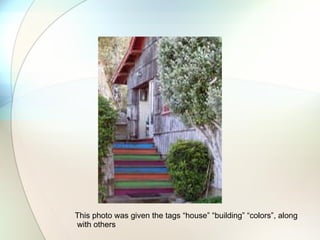
This photo was given the tags “house” “building” “colors”, along with others
The tags for that image are part of a  folksonomy
Advantages of tagging/folksonomies Simple to use - no complex structure to learn Lower cost of categorization Open-ended  Relevance - user's own terms.  Support serendipitious form of browsing. Easy to tag any object - photo, document, bookmark Better than no tags at all.  People want to tag.
Disadvantages Quality of the tags Don’t work well for finding No structure or conceptual relationships Issues of scale Personal tags or popularity tags Most people can’t tag very well Errors, misspellings, etc.
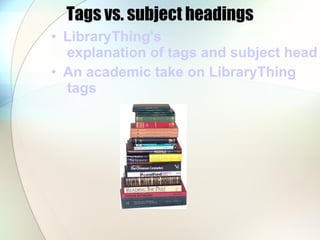
Tags vs. subject headings LibraryThing's  explanation of tags and subject headings An academic take on  LibraryThing  tags
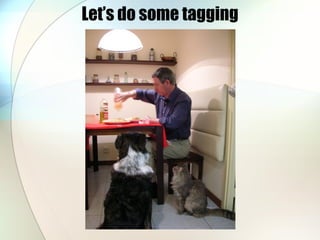
Let’s do some tagging
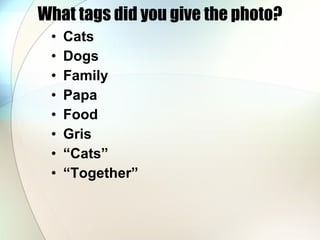
What tags did you give the photo? Cats Dogs Family Papa Food Gris “Cats” “Together”
 
What can we do with tags? Del.icio.us Flickr LibraryThing
Other sites using tagging Last.fm Amazon
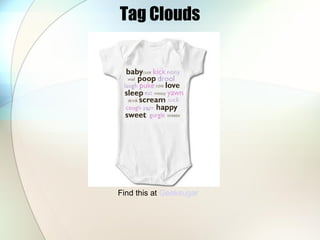
Tag Clouds Find this at  Geeksugar
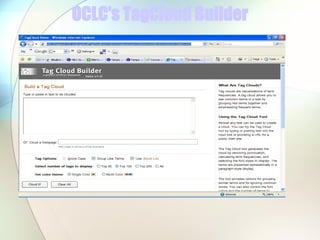
OCLC's   TagCloud  Builder
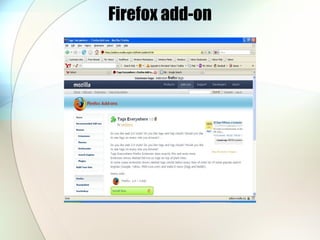
Firefox add-on
 
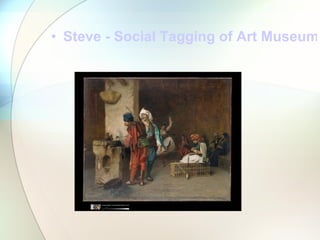
Steve - Social Tagging of Art Museum Collections
Library applications of tagging King County –  Aquabrowser Ann Arbor District Library – tagging LibraryThing  for Libraries PennTags Teen Web - Nashville Public Library LibMarks del.icio.us  libraries WorldCat Identities
More Library applications OCLC  FictionFinder Connotea lib.rario.us  - social media cataloging
Resources Pew Internet Life Project:  Report on Tagging TagsAhoy Tagging Tools Structure and form of  folksonomy  tags: The road to the public library catalogue When tags work and when they don't: Amazon and  LibraryThing
More resources Google Image Labeler 43Things The Hive Mind: Folksonomies and User-Based Tagging Becoming a tagging kung-fu master Tips From Top Taggers Picking Up Where Search Leaves Off The Peloponnesian War and the Future of Reference, Cataloging, and Scholarship in Research Libraries
And just a few more… Cataloging and You:  Measuring the Efficacy of a  Folksonomy  for Subject Analysis And related blog post -  An academic take on  LibraryThing  tags

Tagging 4 08

  • 1.
    Tagging/Folksonomies Think TankSession April 8, 2008
  • 2.
    What are tags?Keywords/descriptors to describe digital objects Applied by users of the content Keyword or category label. Tags help you find photos which have something in common. (Flickr’s explanation of tags) Del.icio.us ' explanation of tagging
  • 3.
    What is afolksonomy? Collaboratively creating and managing tags Freely chosen keywords used instead of controlled vocabulary “ Folk”sonomy is most notably contrasted with a taxonomy - done by users, not professionals.
  • 4.
    Tagging vs. folksonomyTags are the descriptors applied to objects Folksonomies are the collections of descriptors (metadata) created by users and applied to objects
  • 5.
    This photo wasgiven the tags “house” “building” “colors”, along with others
  • 6.
    The tags forthat image are part of a folksonomy
  • 7.
    Advantages of tagging/folksonomiesSimple to use - no complex structure to learn Lower cost of categorization Open-ended Relevance - user's own terms. Support serendipitious form of browsing. Easy to tag any object - photo, document, bookmark Better than no tags at all. People want to tag.
  • 8.
    Disadvantages Quality ofthe tags Don’t work well for finding No structure or conceptual relationships Issues of scale Personal tags or popularity tags Most people can’t tag very well Errors, misspellings, etc.
  • 9.
    Tags vs. subjectheadings LibraryThing's explanation of tags and subject headings An academic take on LibraryThing tags
  • 10.
  • 11.
    What tags didyou give the photo? Cats Dogs Family Papa Food Gris “Cats” “Together”
  • 12.
  • 13.
    What can wedo with tags? Del.icio.us Flickr LibraryThing
  • 14.
    Other sites usingtagging Last.fm Amazon
  • 15.
    Tag Clouds Findthis at Geeksugar
  • 16.
    OCLC's TagCloud Builder
  • 17.
  • 18.
  • 19.
    Steve - SocialTagging of Art Museum Collections
  • 20.
    Library applications oftagging King County – Aquabrowser Ann Arbor District Library – tagging LibraryThing for Libraries PennTags Teen Web - Nashville Public Library LibMarks del.icio.us libraries WorldCat Identities
  • 21.
    More Library applicationsOCLC FictionFinder Connotea lib.rario.us - social media cataloging
  • 22.
    Resources Pew InternetLife Project: Report on Tagging TagsAhoy Tagging Tools Structure and form of folksonomy tags: The road to the public library catalogue When tags work and when they don't: Amazon and LibraryThing
  • 23.
    More resources GoogleImage Labeler 43Things The Hive Mind: Folksonomies and User-Based Tagging Becoming a tagging kung-fu master Tips From Top Taggers Picking Up Where Search Leaves Off The Peloponnesian War and the Future of Reference, Cataloging, and Scholarship in Research Libraries
  • 24.
    And just afew more… Cataloging and You: Measuring the Efficacy of a Folksonomy for Subject Analysis And related blog post - An academic take on LibraryThing tags