


FINAL REPORT


         Tackling Obesities:
      The Foresight Report and
        Implications for Local
             Government


                                         Authors:

                                     Dr Jill Aylott
                                     Dr Ian Brown
                                 Dr Rob Copeland
                                    Dave Johnson

                   Faculty of Health and Wellbeing
                       Sheffield Hallam University

                                      March 2008
Tackling Obesities: The Foresight Report and
                 Implications for Local Government
Contents
   The Foresight Report and Implications for Local Government .................... 2
   Executive Summary.......................................................................................... 2
      'Top Ten’ tips ............................................................................................................ 6
   Introduction....................................................................................................... 8
      About Foresight......................................................................................................... 8
      Obesity...................................................................................................................... 8
   Section 1: Obesity – the wider debate ............................................................ 9
   Section 2: Social policy frameworks for local government action ............. 14
      Long term Strategies and Planning ..........................................................................15
      Scrutiny and Comprehensive Area Assessment.......................................................16
   Section 3: Inequalities and obesity ............................................................... 16
      Ethnicity and obesity ................................................................................................17
      Children and obesity ................................................................................................18
      Social class and obesity...........................................................................................18
   Section 4: Key areas of influence and responsibility .................................. 19
      Rationale for design of the matrices .........................................................................22
      Matrix One: Planning................................................................................................23
      Matrix Two: Children's services................................................................................28
      Matrix Three: Adult social care.................................................................................35
      Matrix Four: Parks and leisure .................................................................................38
   Section 5: Conclusions and effective responses ........................................ 43
      Relevance of Foresight top five policy responses to local government .....................44
      'Top Ten’ tips ...........................................................................................................44
   References ...................................................................................................... 46
   Appendix 1: Contributors to this report........................................................ 48
   Appendix 2: Is there really an epidemic of obesity?.................................... 49
   Appendix 3: Obesity and health – are some overweight people healthier
   than thin people?............................................................................................ 52
   Appendix 4: Body Mass Index (BMI) ............................................................. 55
   Appendix 5: Do some individuals have a fat gene?..................................... 59
   Appendix 6: A need to stigmatise obesity?.................................................. 61


Sheffield Hallam University 2008 1
Tackling Obesities:

The Foresight Report and Implications for Local Government

Executive summary
Introduction
The government supports the findings of the Foresight Report 'Tackling Obesities:
Future Choices – Project Report'; published in 2007, as a significant contribution to
recognising the social and economic costs of obesity in the UK. It has been
estimated that about 28 per cent of women and 33 per cent of men in the UK will
be obese by 2010. Similar trends are seen in obesity in children. This report sets
out the key recommendations and actions of the Foresight Report and its
relevance to local government. There are numerous examples of good practice
across the country where local government has demonstrated leadership to tackle
obesity. Examples are often found within obesity strategies set up and
implemented in collaboration with a range of agencies including health, sports
councils, the voluntary and private sector.

Obesity
Obesity is measured by calculating the Body Mass Index (BMI), which calculates
the amount of excess body fat but considers this in relation to a person's height.
People with a BMI of above 30 are considered obese. It is important to note that
the risk of poor health increase sharply with increasing BMI above 30. In other
words, someone with a BMI of 38 is at greater risk than someone of a BMI of 32.
Some documents identify a further category of 'morbid' or 'severe' obesity above
BMI of 40. A number of common causes of disease and death are associated with
obesity. In particular, diabetes, cardiovascular diseases and some cancers are
associated with obesity.

Section 1: Obesity – the wider debate
There are sometimes confusing messages about obesity portrayed throughout the
media. While the government has used words to describe the increase in obesity
as an 'epidemic', others say that this is not the case and that the situation is not as
bad as that being portrayed by the government. This section gathers evidence to
dispel some of the myths around obesity and clarify the facts. The facts are that
the numbers of individuals who are overweight and obese have hit epidemic
proportions and that the situation requires radical redress from all agencies in
public and private services to halt the further rise in obesity. Further evidence for
this section is presented as a series of appendices to the report.

The Foresight Report argues that understanding and preventing obesity is
complex. There is no example anywhere in the world where the obesity trend has
been reversed. The solution to reverse the trend is more complex than just helping
individuals to change their diet and to take up exercise (although this is a part of
the solution). Over the last few decades, our way of life has changed significantly.
We have many labour-saving devices in our home, we drive more, eat out more
and have takeaways delivered to our homes as well as the chance to do our
weekly shop on the internet. Food is abundantly available and presented to
encourage us to have the larger-sized Mars bar at the garage forecourt or to 'buy


Sheffield Hallam University 2008 2
one, get one free'. Towns have been planned around the car and large
supermarket chains have replaced small family stores. Everything is ‘super sized’.

The Foresight Report argues that it is the interplay of these various factors that
creates what has been termed in the report as an 'obesogenic environment'. The
term is defined as: 'the total sum of influences in the environment on promoting
obesity in individuals and populations'.

Section 2: Social policy frameworks for local government action
A global and nationwide response is required to stop the dramatic increase in the
number of children and adults who are obese. Without a well thought through
national strategy, the Foresight Report estimates that more than half of adults will
be obese by 2050, with consequent increase in costs for society. Other countries
in the world have used a range of strategies to combat obesity. For example,
Norway has used a combination of food subsidies, target pricing and clear
labelling on food to steer people away from unhealthy food. This is an opportunity
for local government to model effective leadership in responding to this major
challenge and to have a wider strategic role using its powers and influence
creatively to make a difference. This has been referred to as 'place-shaping'.

The Local Government Act 2000 and the Local Government and Public
Involvement in Health Act 2007 aim to strengthen visible and effective political
leadership in local government by changing the structure of local government. The
new legislation requires the local authority and its partners to prepare a
Sustainable Community Strategy for promoting or improving the economic, social
and environmental wellbeing of their area. The strategy could be a critical planning
tool to develop a local strategy to reduce obesity.

Section 3: Inequalities and obesity
As with other diseases, obesity raises a number of issues of inequalities between
groups in society. This section draws attention to issues arising from socio-
economic factors, from gender, and from ethnicity. Sadly but not surprisingly, the
negative consequences of obesity are greatest for those who are least well off.
There is a mixed picture across different ethnic groups – levels of obesity are low
among some groups. However, the disease risks, particularly for South Asian
communities, are greater even when body mass indices are lower than that
considered obese. The projected increases in obesity will be greater among men
than women. Men are less healthy weight conscious or proactive in improving diet
and lifestyle factors.

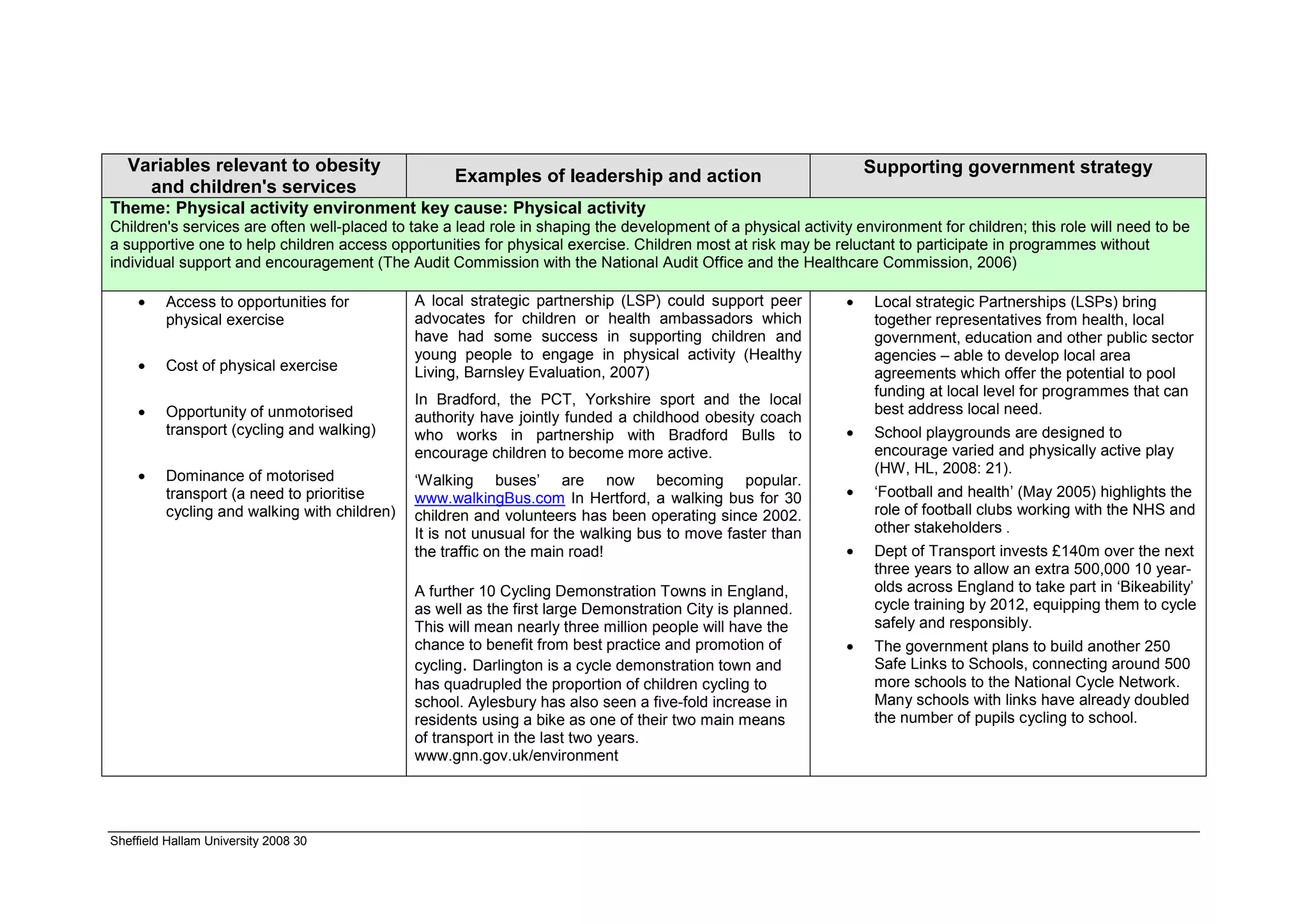
Section 4: Key areas of influence and responsibility
We have identified four local government areas of responsibility. These are:
planning; children's services; adult social care and parks and leisure. In each case
we have produced a detailed matrix matching key recommendations from the
Foresight Report with these selected areas of local government. The following are
examples from this section:
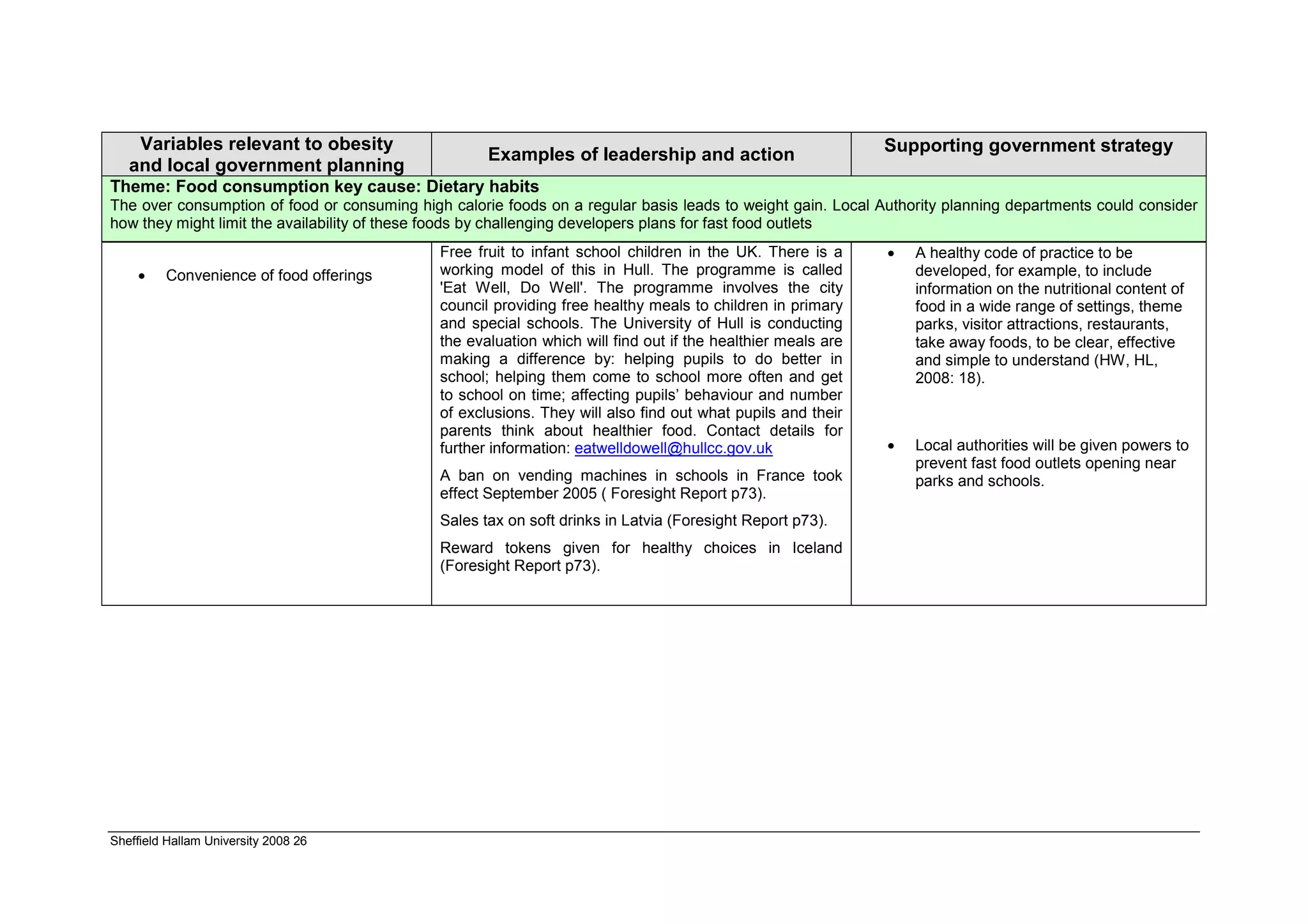
Planning
Towns could be planned to encouraging a more active community. EPODE is a
French project that set out to impact upon the planning processes to create a

Sheffield Hallam University 2008 3
'healthy town'. A number of agencies became involved in the project from town
planners, health, education and the voluntary sector. The outcomes of the project,
which included several towns in France, were staggering. In the French 'fit'
communities, the proportion of overweight boys almost halved from 19 per cent,
and the rate among girls dropped from 10 per cent to seven per cent.
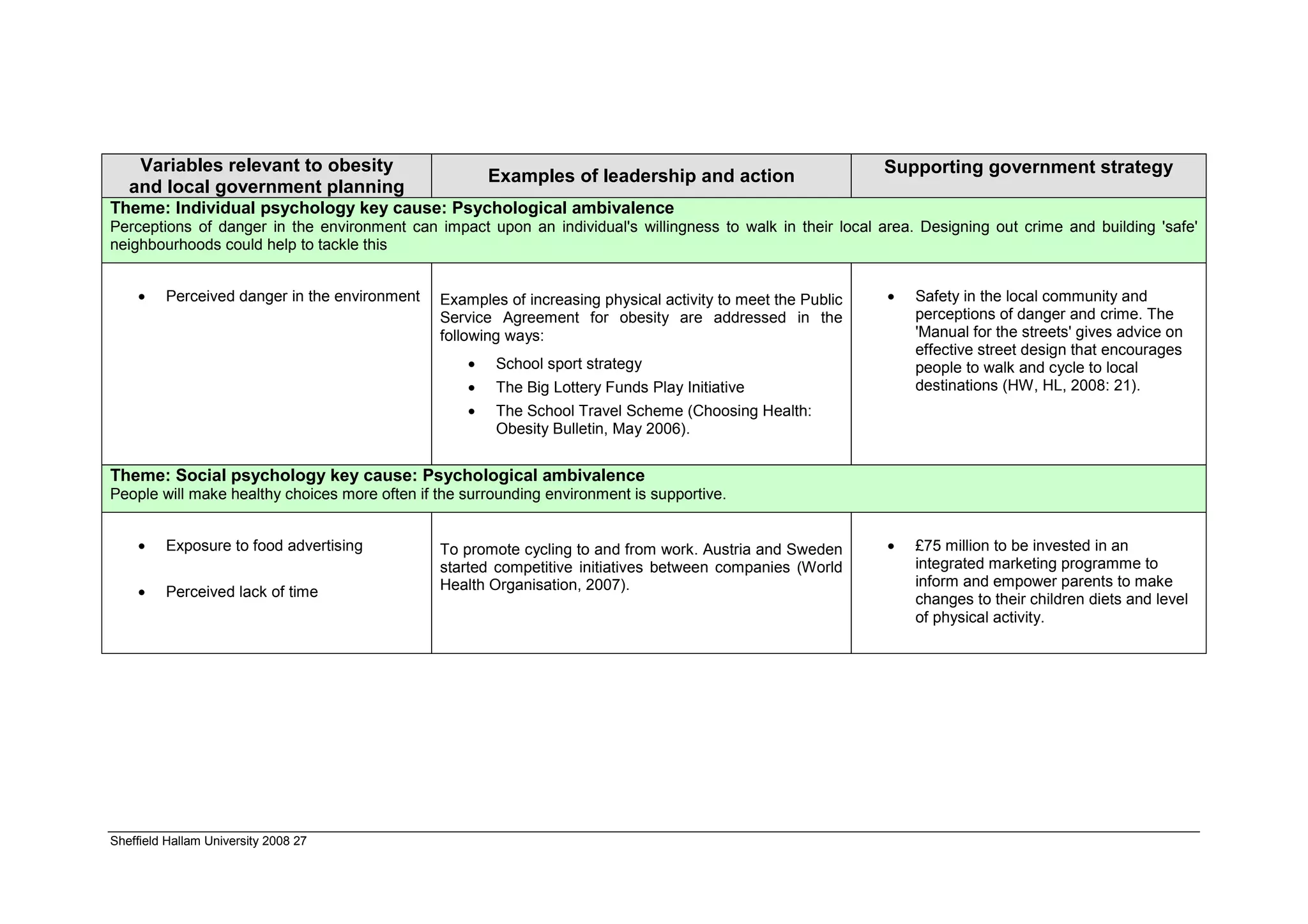
Low levels of activity and high levels of television watching appear to be more
prevalent in more deprived communities. There is evidence of voluntary sector
projects setting up 'sports' holiday clubs, or peer advocacy projects recruiting
young people as health ambassadors. These projects can reduce the innate
activity level of children by engaging them in holiday times. Examples of innovative
projects can be found from the Healthy Living Barnsley project, where sports clubs
for children helped to increase their physical activity levels.
Barnsley’s Fit4thefuture website
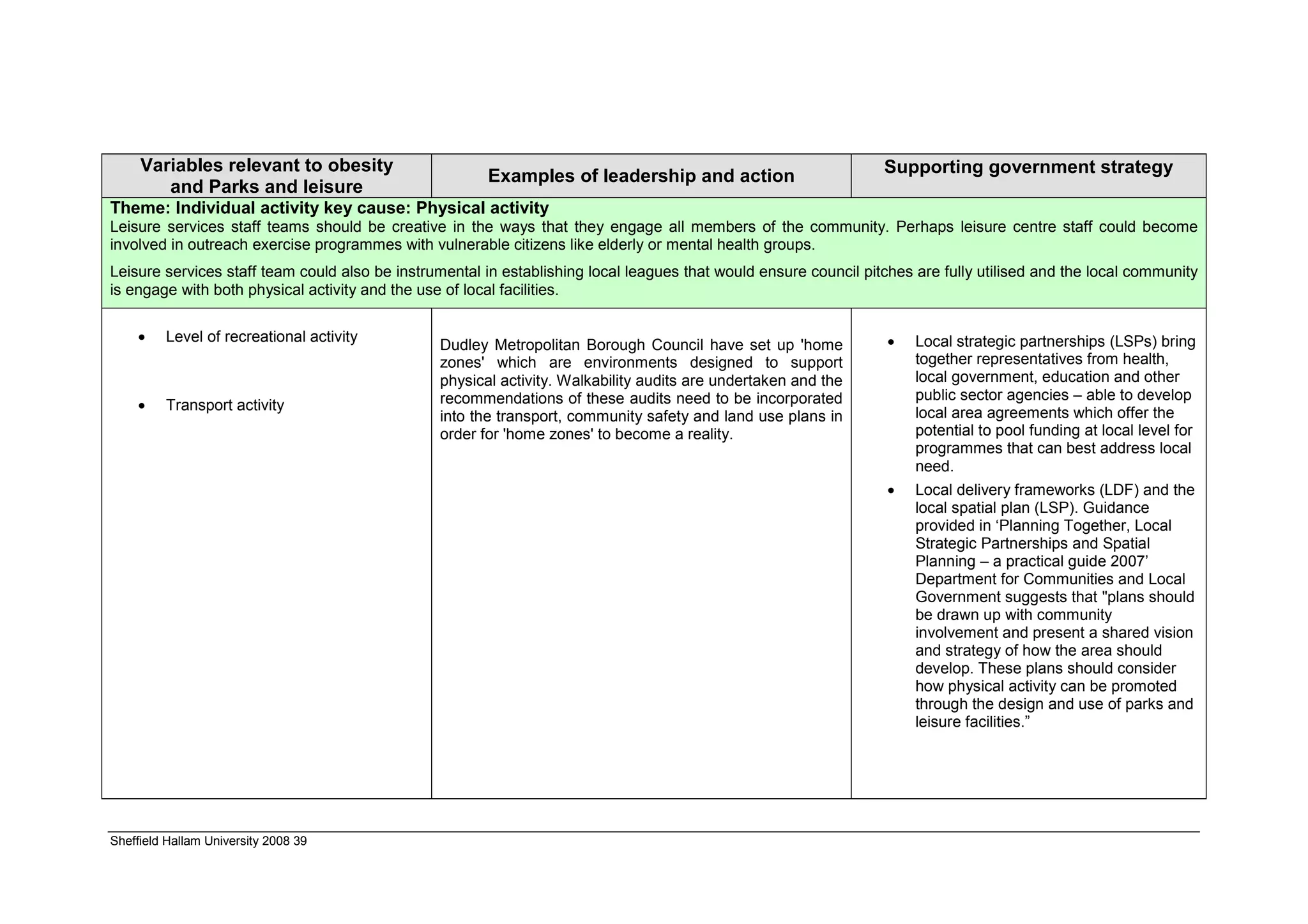
Government policy is now designed to support such initiatives. Local strategic
partnerships (LSPs) bring together representatives from health, local government,
education and other public sector agencies to develop local area agreements
(LAAs). LAAs offer the potential to pool funding at a local level for programmes
that can best address local needs.
Guidance provided in ‘Planning Together: Local Strategic Partnerships and Spatial
Planning – a Practical Guide 2007’, published by the Department for Communities
and Local Government, suggests that “plans should be drawn up with community
involvement and present a shared vision and strategy of how the area should
develop. Local authorities have an important contribution to make in their 'place-
shaping' role, as planning authorities and working in local partnerships with other
agencies. Through LAAs they can set specific objectives for their communities” –
see ‘Healthy Weight, Healthy Lives 2008:20’.
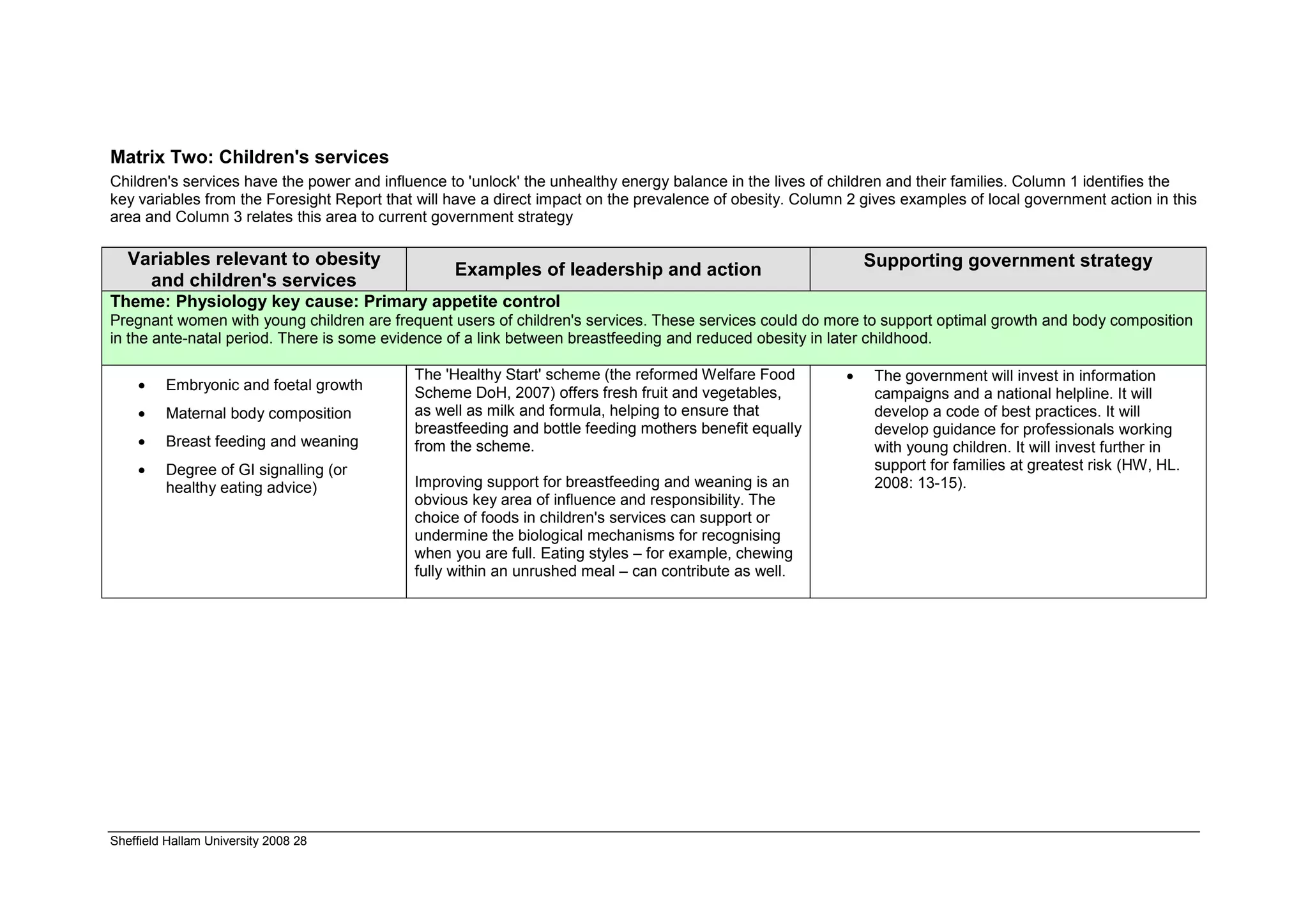
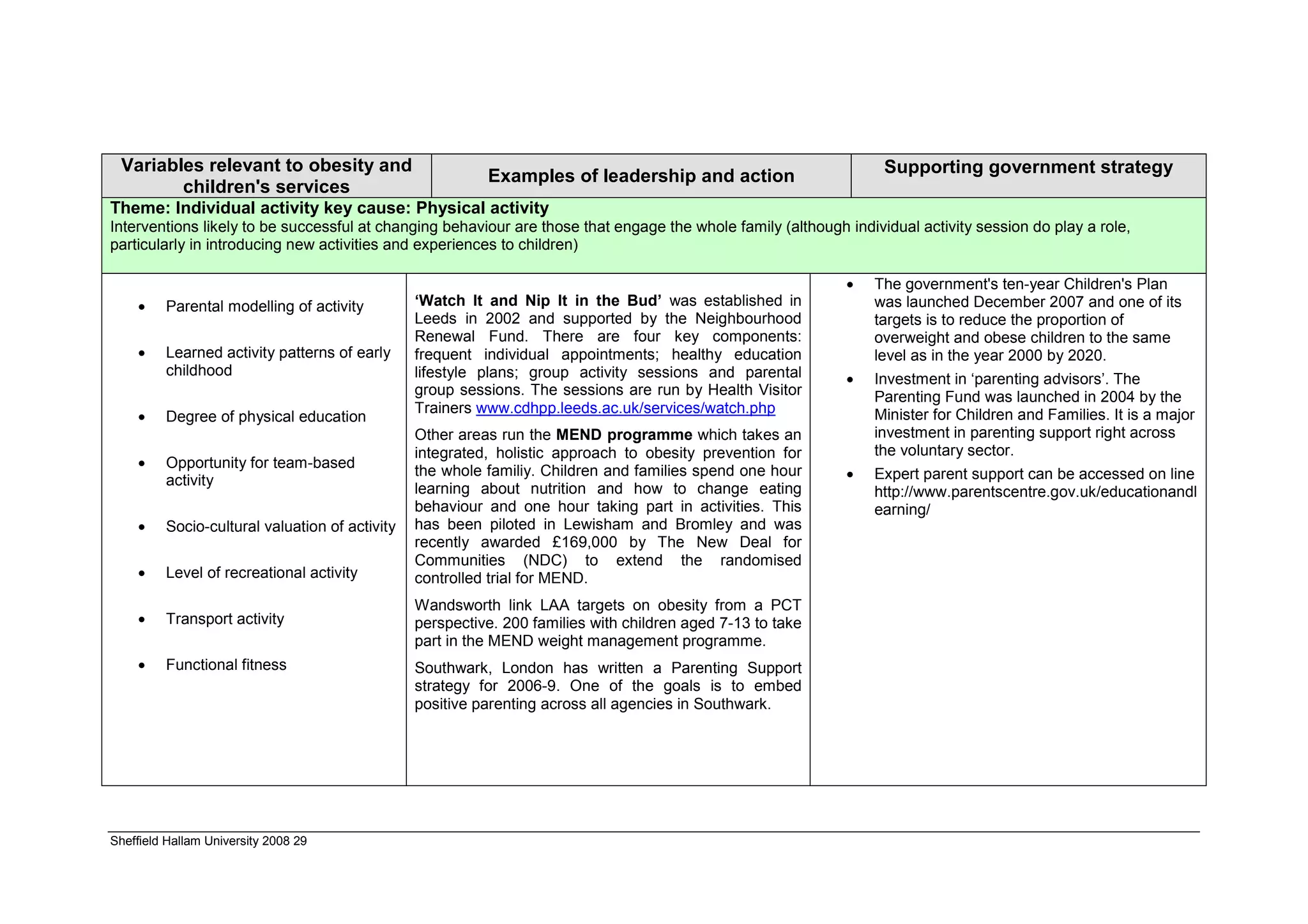
Children's services
Interventions likely to be successful are those that engage the whole family to try
to change behaviour – although individual sessions with children can also be
effective. ‘Watch It and Nip It in the Bud’ was established in Leeds in 2002 and
supported by the Neighbourhood Renewal Fund. There are four key components:
frequent individual appointments; healthy education lifestyle plans; group activity
sessions and parental group sessions. The sessions are run by health visitor
trainers http://www.cdhpp.leeds.ac.uk/services/watch.php (link not working)
Adult social care
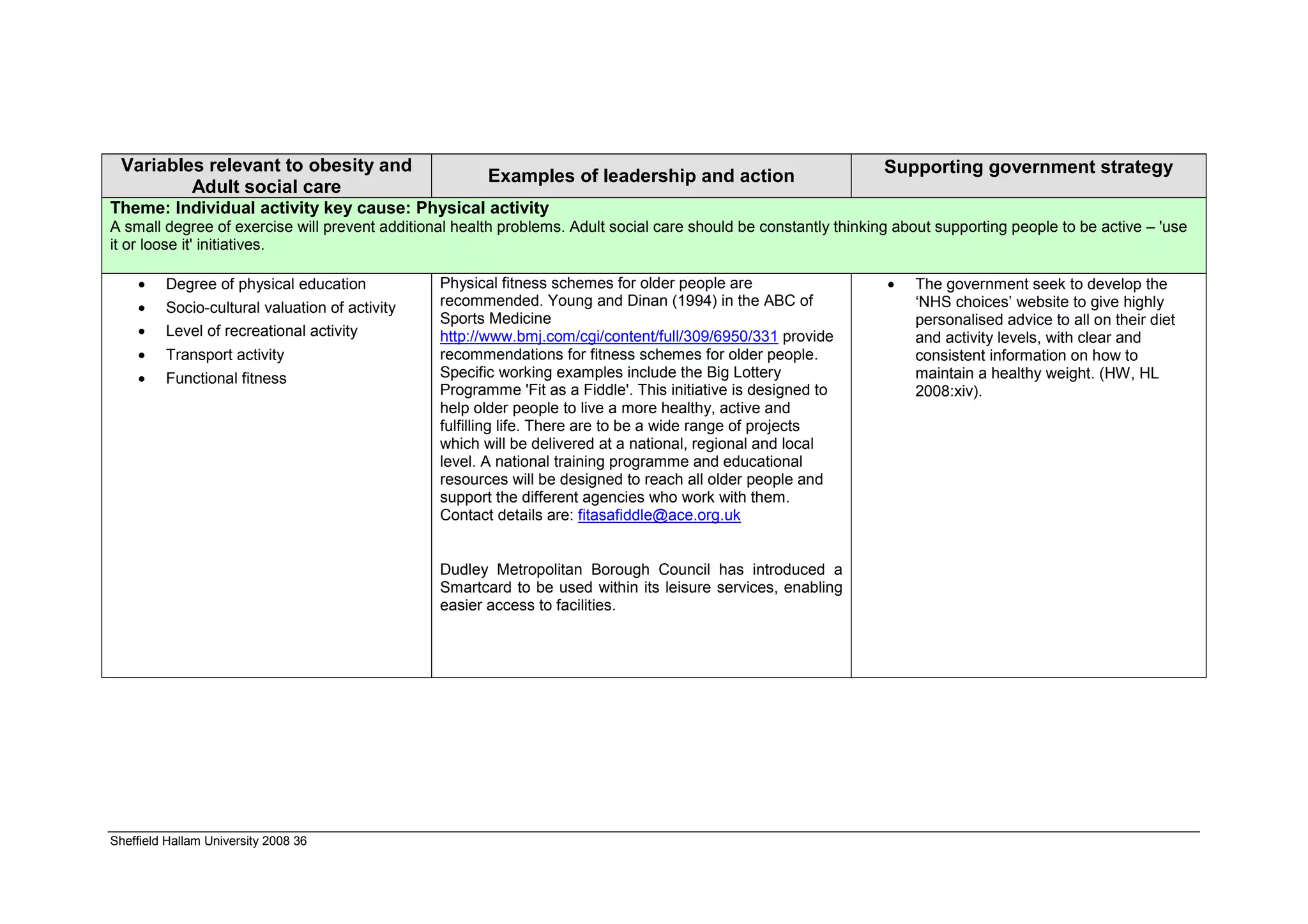
A small degree of exercise will prevent additional health problems. Adult social
care needs to look at innovative ways to support people to be active – for example
'use it or loose it' initiatives. The Sustainable Community Strategy can be a key
mechanism to do this. North East Lincolnshire has developed a community
strategy that covers the period 2003-2022. It is their intention to use LAAs to
develop a more integrated multi-agency approaches: "bringing a more effective
targeting of services and resources towards strategic priorities" North East
Lincolnshire Council (2007). Establishing adult health as a strategic priority can
lead to initiatives such as affordable fitness opportunities and GP referral
schemes.


Sheffield Hallam University 2008 4
Parks and leisure
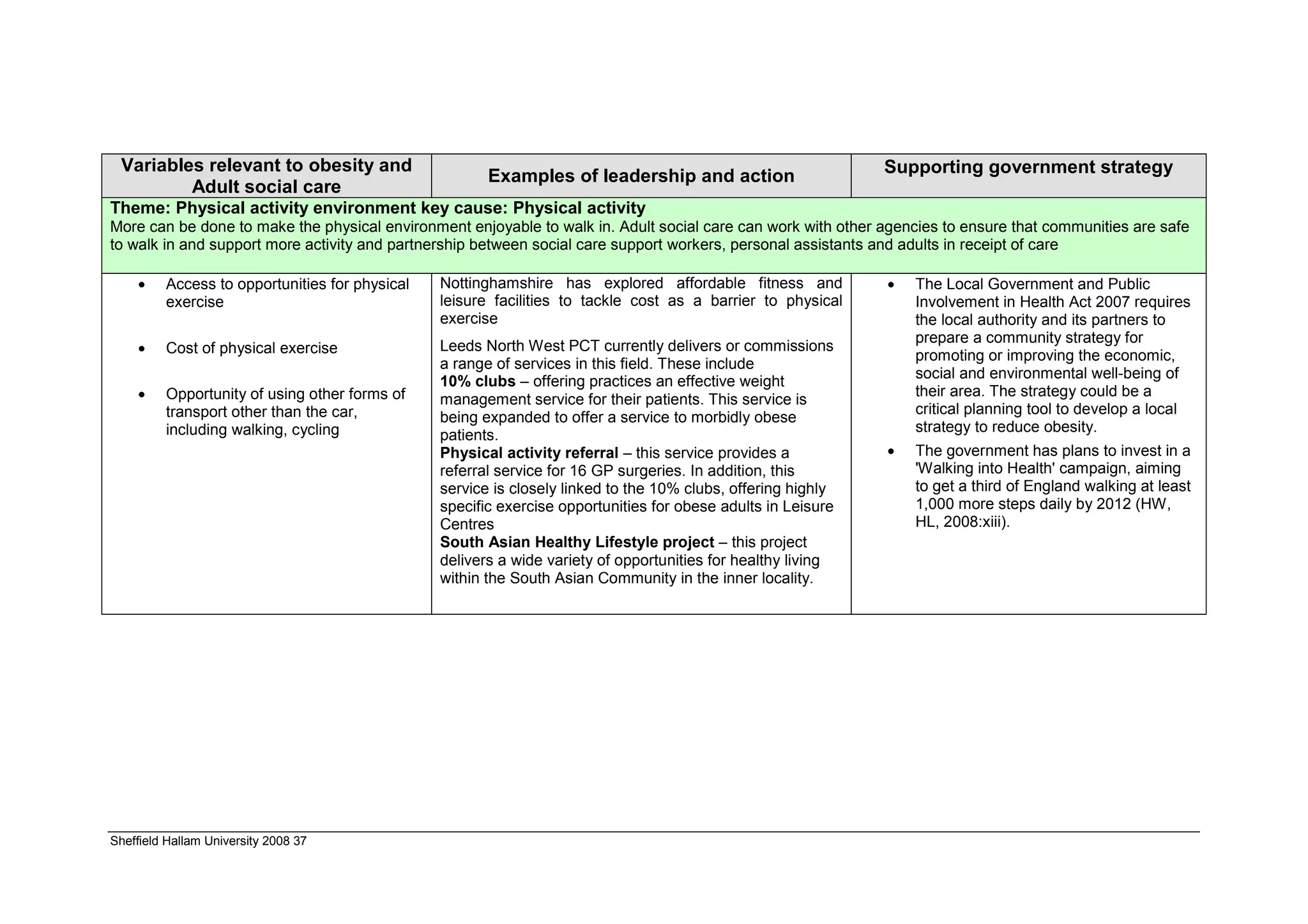
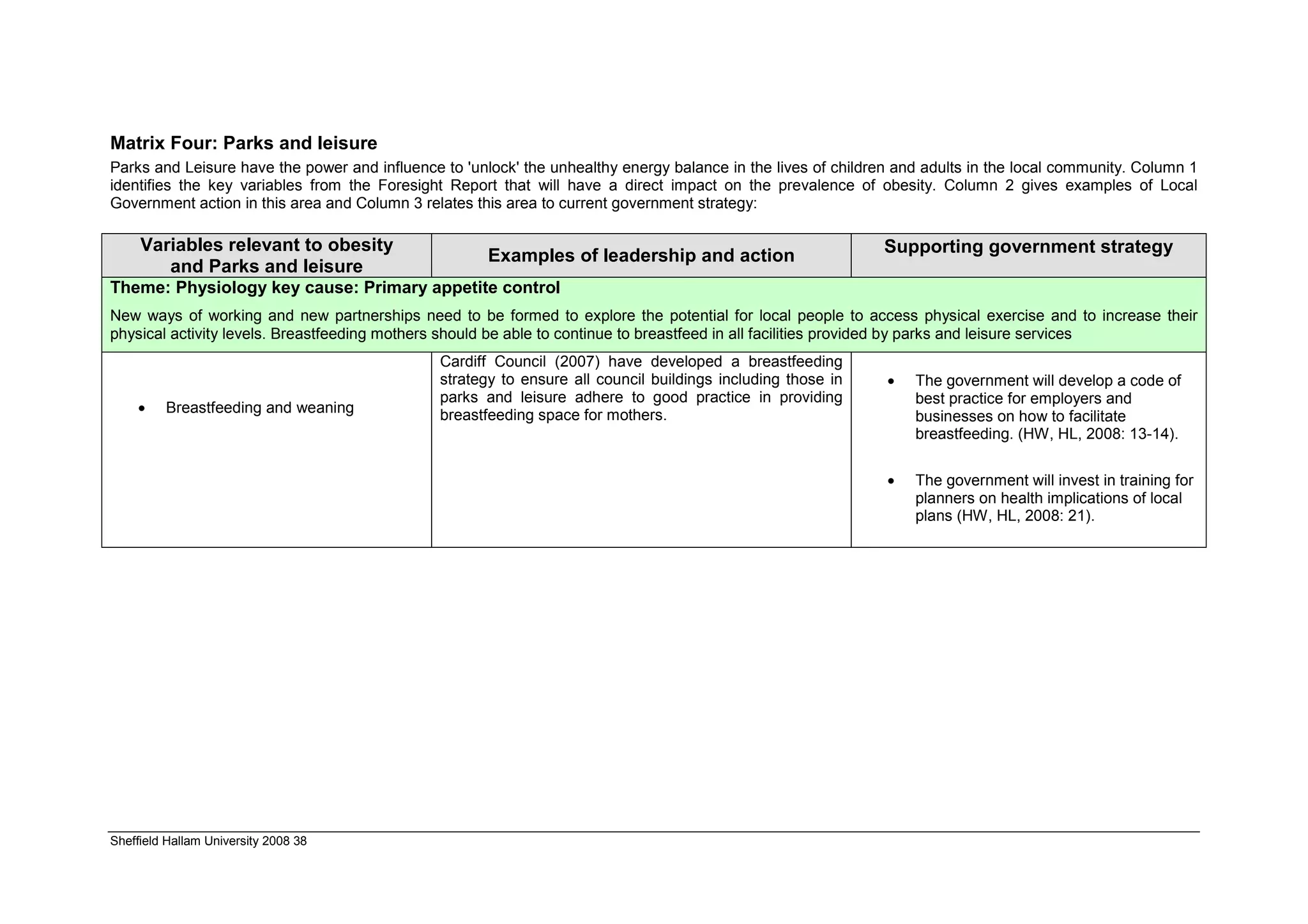
New ways of working and new partnerships need to be formed to explore access
to physical exercise and to increase physical activity. Partnership working is
central to the Barking and Dagenham childhood obesity strategy
New partnerships have been formed to explore more creative and innovative
solutions to preventing obesity. Apart from the primary care trust (PCT) and
council, there are a number of stakeholders who have helped to design the
strategy and implement actions. These include: the extended schools officer; head
of the Barking and Dagenham Racial Equality Council (REC) and the health and
fitness manager at the council. They are members of the Childhood Obesity
Strategy Task Group and believe that preparing the strategy has helped to identify
what the range of partners is doing and how that can be best coordinated.
Parks and leisure services are seen as significant component of local government
that can lead and shape a more active community. Local council leisure facilities
like leisure centres need to be prioritised for investment to ensure that they are
attractive to the community and council operated playing pitches need protection
to ensure that they are not sold as development land.
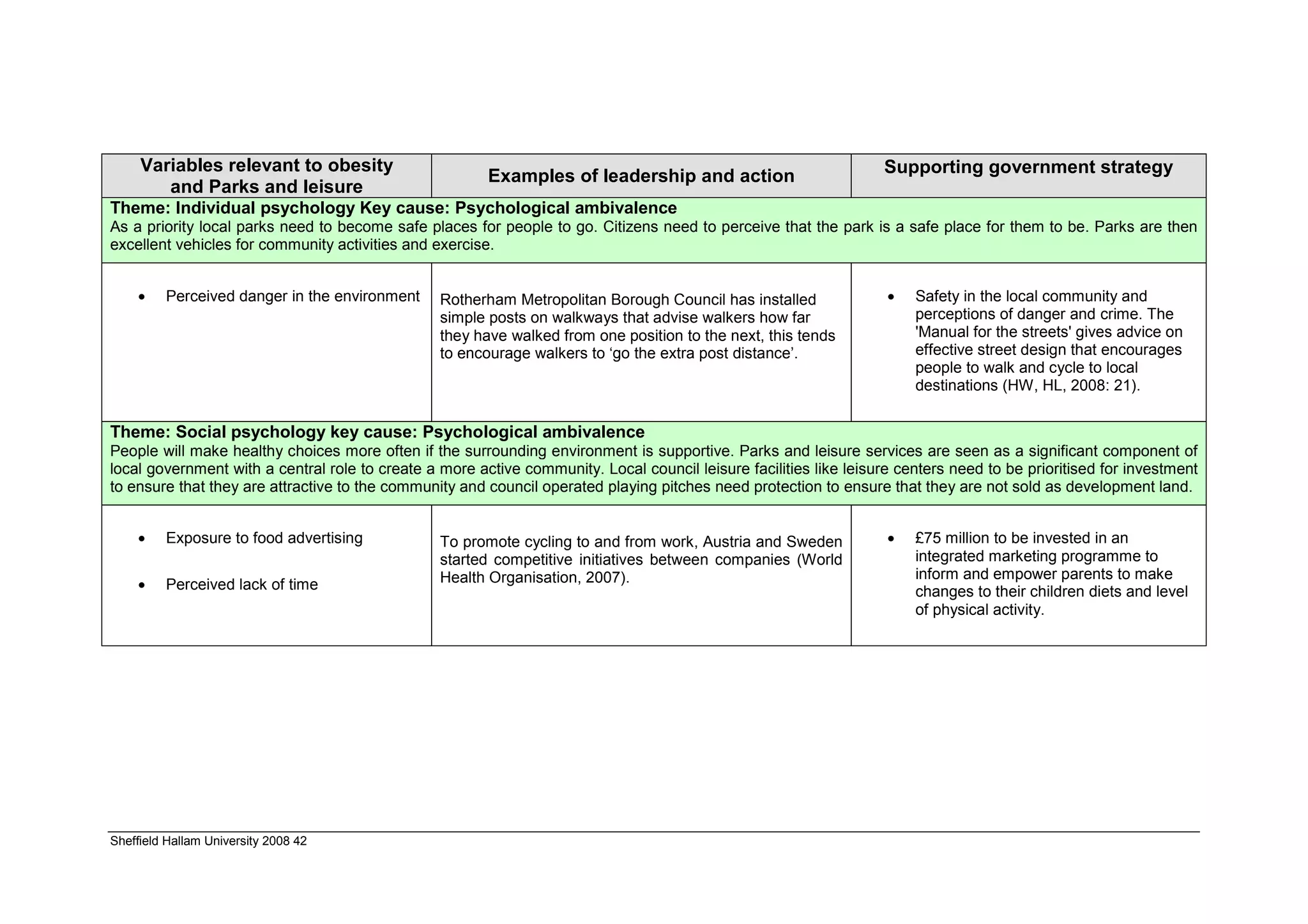
As a priority local parks need to become safe places for people to go. Citizens
need to perceive that the park is a safe place for them to be. Parks are then
excellent vehicles for community activities and exercise. Rotherham Metropolitan
Borough Council has installed simple posts on walkways that advise walkers how
far they have walked from one position to the next; this tends to encourages
walkers to ‘go the extra post distance’.


Section 5: Conclusions and effective responses
In the later part of the Foresight Report there is a very detailed analysis of future
scenarios. These have formed the basis of the government's strategy set out in
‘Healthy Weight, Healthy Lives 2008’. The five responses identify practical
strategies for change. We have concluded our report with examples of how a local
authority might use the five responses as a framework for action:
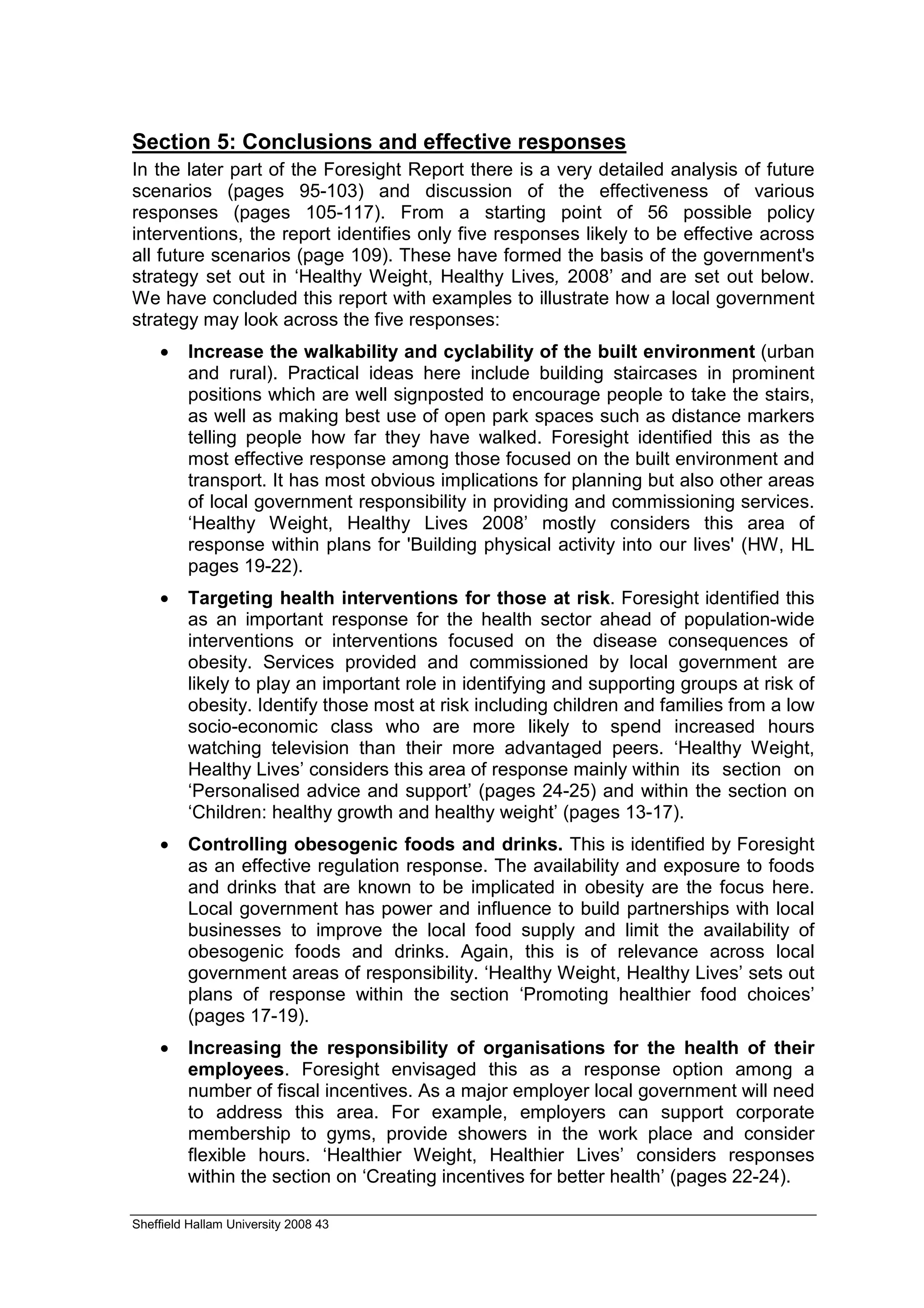
         Increase the walkability and cyclability of the built environment (urban
         and rural). For example: Oslo, Norway has been termed a 'slim city' as its
         design is around walkability and cyclability of the city.
         Targeting health interventions for those at risk. The MEND programme
         takes an integrated, holistic approach to obesity prevention for the whole
         familiy. Children and families spend one hour learning about nutrition and
         how to change eating behaviour and one hour taking part in activities. This
         has been piloted in Lewisham and Bromley and was recently awarded
         £169,000 by the New Deal for Communities (NDC) to extend the
         randomised controlled trial for MEND.

         Wandsworth links LAA targets on obesity from a PCT perspective. Two
         hundred families with children aged seven to 13 are to take part in the
         MEND weight management programme.
         Controlling obesogenic foods and drinks. For example: the Barking and
         Dagenham childhood obesity strategy and action plan has recognised that

Sheffield Hallam University 2008 5
food production and dietary habits have a cultural origin. Through the LAA it
         has fostered increased willingness to work with the voluntary sector – in this
         case Barking and Dagenham Racial Equalities Council – to deliver
         programmes which are led by the voluntary sector working directly with
         communities.
         Increasing the responsibility of organisations for the health of their
         employees. For example, employers can support corporate membership to
         gyms, provide showers in the work place and consider flexible hours.
         Early life interventions. Foresight identified this as the most effective
         response among those oriented to the family and far more effective than
         initiatives that might penalise parents. For example, breastfed babies may
         have some protection against obesity in later life (Gillman et al., 2002)
         although further research is required in this area. There are some examples
         of workplace breastfeeding policies (Canada and adapted by York
         University). Barnsley LAA contains obesity targets but also links to
         opportunities for the environment to encourage breastfeeding.

         The majority of public spaces and buildings have not been planned to
         facilitate breastfeeding or best weaning practices but new government
         policy (Healthy Weight, Healthy Lives, 2008) encourages planners to
         consider these issues.


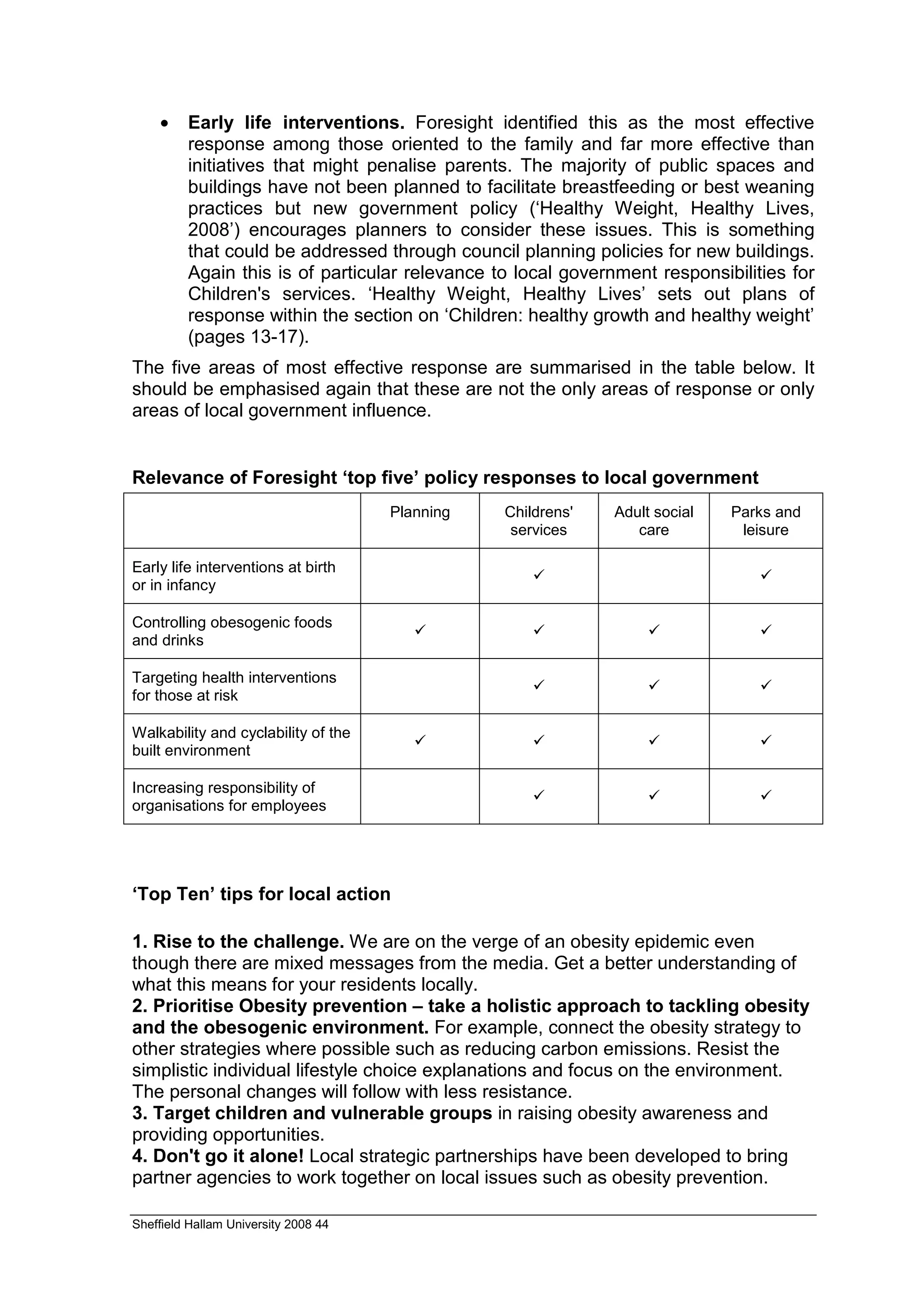
‘Top Ten’ tips for local action

1. Rise to the challenge. We are on the verge of an obesity epidemic even
though there are mixed messages from the media. Get a better understanding of
what this means for your residents locally
2. Prioritise obesity prevention – take a holistic approach to tackling obesity
and the obesogenic environment. For example, connect the obesity strategy to
other strategies where possible such as reducing carbon emissions. Resist the
simplistic individual lifestyle choice explanations and focus on the environment.
The personal changes will follow with less resistance.
3. Target children and vulnerable groups in raising obesity awareness and
providing opportunities
4. Don't go it alone. Local strategic partnerships have been developed to bring
partner agencies to work together on local issues such as obesity prevention
5. Identify 'obesity champions'. This might be the lead for public health or the
lead for children's health or a local mayor or lead councillor. They can capture
support with their passion to tackle obesity
6. Stay local. The Sustainable Community Strategy is intended to generate local
action and solutions to obesity prevention
7. One size does not fit all. Work with individuals at the grass-roots level to find
out what activity projects people would attend
8. Practice what you preach. Be a model employer and develop healthy
workplace objectives
9. Don't re-invent the wheel. There is a lot of evidence out there to show what
works to combat and prevent obesity, this can be tailored to fit local circumstances.


Sheffield Hallam University 2008 6
Learn from good practice elsewhere make information available to all agencies
and signpost people to the evidence
10. Make information accessible. Help people understand practical examples of
an unhealthy energy imbalance for example how much extra walking is needed to
burn off a chocolate bar or a glass of wine.


Sheffield Hallam University 2008 7
Introduction
This report summarises the key findings of the Foresight Report ‘Tackling
Obesities: Future Choices – Project Report for Local Government’. ‘Tackling
Obesities: Future Choices’ has taken a strategic view of the issue of obesity by
looking ahead 40 years, using scientific evidence, commissioned research and
expert advice. The report here aims to support local government to develop a local
response to what is now being referred to as an 'obesogenic environment' 1

About Foresight

Foresight brings together key people who are recognised as world leaders in their
respective fields, knowledge and ideas to look beyond normal planning horizons to
identify potential opportunities from new science and technologies and actions to
help realise those opportunities. The programme aims to improve the relative
performance of UK science and engineering and its use by government and
society and considers how future science and technologies could address key
future challenges for society.

Obesity
There has been some debate about obesity in the media and this sometimes
detracts from the science behind the facts. Section 1 presents a summary of the
main strands of this debate with reference to the evidence from the Foresight
Report and the wider scientific community. We have corresponded with a range of
experts from research, science, health and wellbeing and sport to ascertain their
views on these issues (contributors to this process are acknowledged in Appendix
1). We have presented a more detailed summary of the evidence on each aspect
of the critique presented as a series of appendices at the end of this report.
There is now a general consensus that preventing the ‘obesity epidemic' will only
happen if there is a joined-up, collaborative approach between local government,
health services and other partners. The changing legislative structure of local
government (Local Government and Public Involvement in Health Act 2007)
should enable a closer working relationship between local government and
primary care trusts (PCTs) in the development of local level obesity strategies.
The NHS operating framework requires all PCTs to develop plans to tackle child
obesity and to agree local plans with strategic health authorities. The government
expects that PCTs will work with local authorities to develop these plans using the
Joint Strategic Needs Assessment process that will become a requirement from
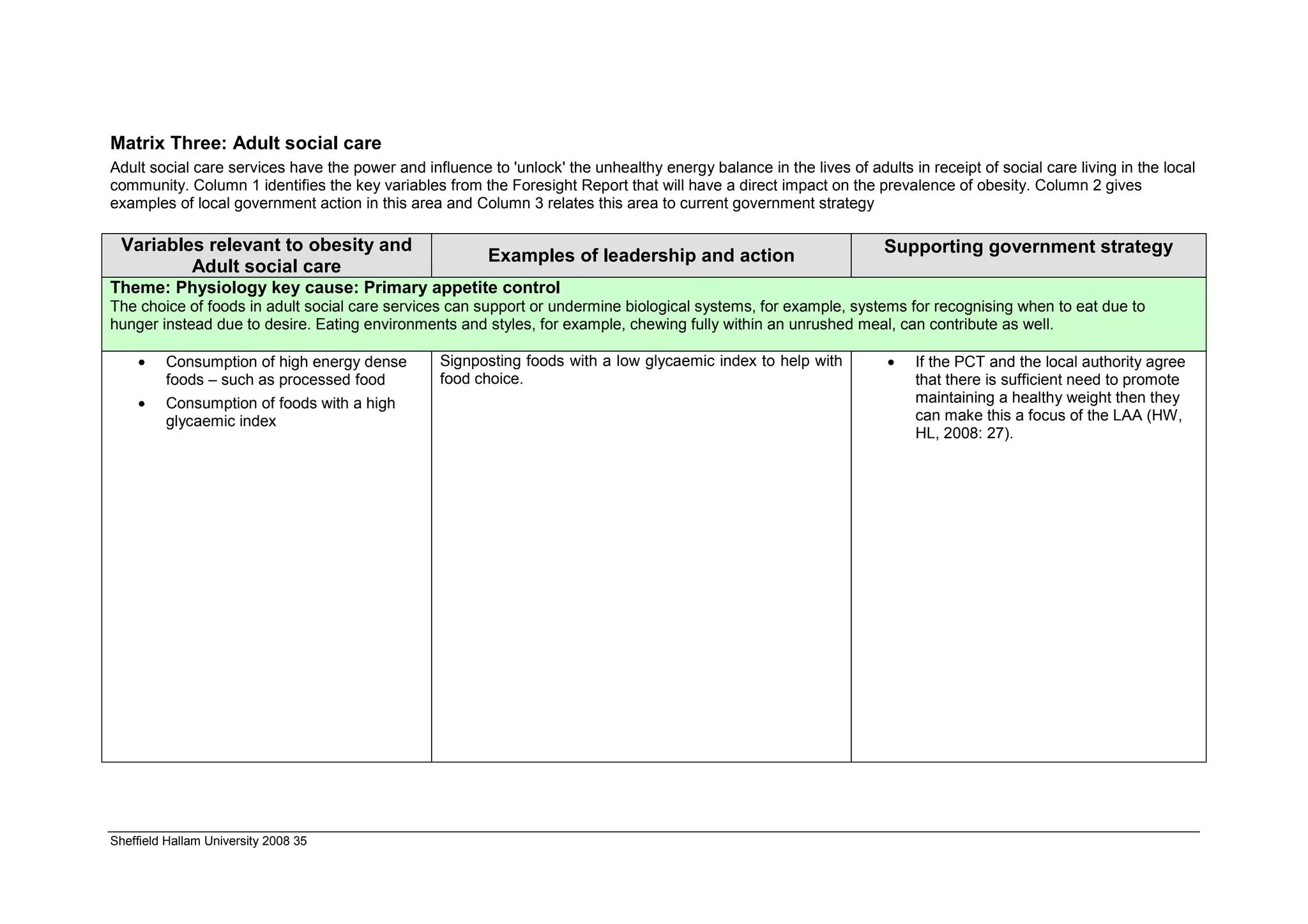
2008. If the PCT and the local authority agree that there is sufficient need to
promote maintaining a healthy weight then they can seek to make this a specific
focus on the local area agreement (LAA) (Healthy Weight, Healthy Lives,
2008:27). It is only with such a strategic commitment that inroads will be made to
impact on the prevention of obesity. The new structure should also enable elected
members in local government to have more power and influence to develop a
more systemic wide approach to tackling obesity. In Section 2, there are

1
  The term 'obesogenic environment' refers to the role environmental factors may play in
determining both energy (or calorie) intake and (calorie) expenditure. The term is used in the
Foresight Report (p52) and defined as 'the sum of influences that the surroundings, opportunities
or conditions of life have on promoting obesity in individuals and populations'.

Sheffield Hallam University 2008 8
illustrations of how a local obesity strategy can be operationalised within newly-
revised social policy frameworks. Section 3 identifies who is most at risk in
relation to obesity and reviews the evidence in relation to ethnicity, gender and
socio-economic status.
To highlight the possible role of local government in changing the local
environment and implementing interventions we have presented key findings from
the Foresight Report (and from the government's obesity strategy ‘Healthy Weight,
Healthy Lives, 2008’) in a series of matrices in Section 4. We have matched key
recommendations of the Foresight Report with selected areas of local government
responsibility. Four areas of local government responsibility have been selected
because of the relevance of the Foresight analyses to their areas of influence. The
four areas are: planning; children's services; adult social care; and parks and
leisure. A brief commentary is provided in each matrix to explore examples of how
public services could prevent its contribution to the development of an 'obesogenic
environment'. Although it might represent a significant challenge, public services
have the ability to improve their contribution to creating a health promoting
environment in local communities, thus begin to reduce the influence of an
'obesogenic environment' on individuals and their families. This potential in itself is
encouraging and local government are well positioned to be drivers and
demonstrate leadership in this change. The commentary herein provides practical
approaches concerning areas that local government has power and influence over.


Section 1: Obesity – the wider debate
The aim of the Foresight Report (2007:20) is to build on the scientific evidence of
an explanation of obesity to help inform government strategy. The goals are three
fold: 1) to prevent the increasing prevalence of numbers of people being defined
as obese (particularly children) and 2) to explore the likely costs of obesity in
relation to care and treatment (p21) and finally 3) to reverse the trend. There is
however no evidence of any nation being able to reverse the obesity epidemic,
which is why the emphasis is predominantly on prevention.
The causes of obesity are complex and the Foresight Report summarises some
key contributory factors that include:
   •    Technology – More labour-saving devices that require minimal physical
        activity (including a significant increase in car use), a decline of manual jobs
        and the rise of online shopping (Foresight Report, 2007:52).
   •    The built environment – The built environment is one of our most important
        habitats. Current research suggests that obesity is linked with area of
        residence, resources, television, walkability, land use, sprawl, and level of
        deprivation (Booth, Pinkston and Poston, 2005). Previous research tends to
        focus on the challenges of balanced transportation (for example, roads,
        highways, infrastructure and public transportation). However, research and
        pragmatic interventions are needed to identify mechanisms by which the
        built environment adversely and positively impacts health. Oslo, Norway is
        an example of a ‘slim city’ where the built environment was structured to
        discourage car use and encourage cycling and walking.
   •    The impact of genetics – Recent research evidence indicates that genes
        might only exert small effects on an individual's likelihood of becoming

Sheffield Hallam University 2008 9
obese. Moreover, evidence on genetic contributions to obesity should not
        detract from individual or population efforts to alter energy balance by
        changing lifestyle, and by altering the environment to make such changes in
        lifestyle easier. The small magnitude of these effects means that the obesity
        epidemic is not attributable to these genes but to changes in environment
        and behaviour.
   •    Opportunities for physical activity – Physical activity in relation to walking
        and cycling has declined over the last 30 years. The design of the urban
        environment can have a significant impact on the motivation of individuals to
        walk, but other issues also come into play such as safety, availability and
        access, aesthetics, local knowledge and supportiveness of neighbourhoods
        (Foresight Report, 2007:53).
   •    Food and drink availability – Eating habits and the nature of food have
        changed. More people eat out at restaurants. Fast food outlets and
        takeaways often offer food to be delivered. This increases the availability of
        foods high in hydrogenated fats and salt content. It is also difficult to monitor
        the calorific intake of food from these outlets. (Foresight Report, 2007:54).
   •    The price of food and drink – There are now plentiful sources of relatively
        cheap foods. Cheaper food sources tend to be more energy dense and
        nutrient poor, that is they provide plentiful calories especially in the form of
        fats and sugars, but relatively low levels of vitamins and minerals (Foresight
        Report, 2007:55).
   •    Food marketing – This includes special offers, ‘buy one, get one free’,
        promotional offers, packaging and formulation of foods (Foresight Report,
        2007:57).
   •    Purchasing capacity and impact on eating patterns – As people earn
        more they tend to eat out more (Foresight Report, 2007:58).
   •    Impact of working practices – There is a relationship between the
        increased hours worked and obesity (Foresight Report, 2007:58).
The Foresight Report argues that to be able to halt the obesity epidemic, a
systemic approach is required which tackles a wide range of factors in an
integrated way. Challenging directly the facets of an ‘obesogenic environment’,
that is an environment which encourages the over-consumption of energy-dense
foods, whilst reducing the opportunity for habitual physical activity, seems to
represent the sole way forward in terms of obesity treatment and prevention.
Some examples of how this can be accomplished are illustrated in Section 4 of
this report.
The subsequent section now outlines some common issues in the debate around
obesity and attempts to clarify some of the misunderstandings that surround them.
The issues below have been identified due to the frequency with which they are
misrepresented within popular media culture and would therefore benefit from a
factual representation here supported by research evidence.


Sheffield Hallam University 2008 10
The issue                                 Clarification
1. Is there really an epidemic of         •   The epidemiological evidence suggests that
  obesity?                                    obesity has reached global epidemic
• Professor Wright, Associate Dean            proportions.
    at the University of Wollongong,      •   The UK has the fastest increase in the
    Australia (2007) argues that there        disease in Europe, with prevalence rates
    is no epidemic relating to obesity.       similar to those found in the US (Adult obesity
    She argues that this is all about         rates have almost quadrupled in the last 25
    people making money out of the            years. Now 22 per cent of Britons are obese
    solutions to obesity.                     and three-quarters are overweight) (Davis et
                                              al., 2004; Flegal et al., 2002).
                                          •   In children, the evidence suggests that obesity
                                              has reached epidemic proportions globally
                                              with the highest rates of childhood obesity
                                              observed in developed countries.
                                          •   The number of young people who are
                                              overweight and obese in Britain has almost
                                              tripled in the past 20 years.
                                          •    A longitudinal study (Wardle, Brodersen,
                                              Cole, Jarvis & Boniface, 2006) of an ethnically
                                              and socio-economically diverse sample of
                                              young people in Britain confirmed obesity
                                              trends (DoH, 2004b). Central obesity seems to
                                              be increasing particularly rapidly and the
                                              notion of 'puppy fat' that disappears upon
                                              maturation must be abandoned (Wardle et al.,
                                              2006).
                                          •   (For a review of a commentary on the
                                              evidence of 'obesity as an epidemic', please
                                              see Appendix 2).
                                          •
2. Obesity and health                  •      There is a clear link between increased body
• Not all people who are measured             fat (obesity) and increased risks of a number
    as 'overweight' or 'obese' will           of serious disease outcomes.
    have the health problems           •      There has been a reduction in people dying
    associated with obesity such as           from cardiovascular diseases for a variety of
    diabetes or heart disease. Are            reasons. This then results in more people
    some overweight and obese                 living with these obesity-related chronic
    people healthier than thin people?        diseases as long-term conditions – at some
                                              cost for health services.
                                          •   The associations between increasing obesity
                                              and mortality from obesity-related diseases
                                              are not simple. While there might be some
                                              apparent benefits for some elderly people of
                                              being overweight, in terms of surviving
                                              operations, research suggests that obesity
                                              and overweight in adulthood are associated
                                              with large decreases in life expectancy and
                                              increases in early mortality. These decreases
                                              are similar to those seen with smoking


Sheffield Hallam University 2008 11
The issue                                Clarification
                                             (Peeters et al., 2003). Furthermore, the
                                             relationship between excess mortality and
                                             obesity is best described by a ‘J-shaped’
                                             curve (this is discussed further in Appendix
                                             2). A brief explanation is given in this section
                                             of the report (4. The BMI scale) as body
                                             weight (expressed as BMI) increases, there is
                                             a curvilinear increase in mortality.
                                         •   The increasing frequency of obesity in elderly
                                             people further complicates the clinical picture.
                                             For so-called ‘fat-frail’ individuals (Morely et
                                             al., 2006), frailty is actually inside and not
                                             readily apparent. The substitution of muscle
                                             for fat is of particular concern, and combines
                                             the problems of frailty with those of being
                                             overweight.
                                         •   Recent data from the US suggests that being
                                             slightly overweight may have benefits from an
                                             overall mortality point of view, however it
                                             doesn't suggest this is a disease-free benefit.
                                             Being overweight increases the risks of
                                             obesity itself.
                                         •   (For a review of a commentary on the
                                             evidence of the obesity and health debate,
                                             please see Appendix 3)
3. The cost projections for obesity      •   Overall, the Foresight Report is as accurate as
• The economic model used in the             it can be in forecasting an increased cost for
    Foresight Report made                    society of a greater prevalence of chronic
    inaccurate cost projections (£45.5       diseases arising from obesity.
    billion instead of £34 billion),     •   The areas of uncertainty are about the exact
    which generated some cynicism            trends and associations with overall mortality
    (Professor David Speigelhalter,          do not diminish the main arguments.
    Cambridge University) about the
    wider debate about an 'obesity
    epidemic' or if the issues of
    obesity are really as serious as
    the Foresight Report suggests.
4. The BMI scale                         •   Although body mass index (BMI) is not devoid
• George Clooney and Russell                 of its limitations, the gold standard (measures
    Crowe would be described as              offering greatest validity/accuracy) alternatives
    obese and Brad Pitt and Mel              (hydrodensitometry and/or dual-energy X-ray
    Gibson are overweight using the          absorptiometry) are too expensive and not
    BMI scale.                               freely available.
• This measure of obesity does not       •   For adult practice there is widespread
    take muscle density into account.        agreement and evidence for the use of the
    Therefore the BMI measure is not         body mass index. Moreover, BMI is currently
    a good measure for obesity.              the best available anthropometric estimate of
                                             fatness for public health purposes.
                                         •   In children there is strong evidence for the
                                             importance of using a relatively stable method
                                             to assess adiposity (body fat) change such as


Sheffield Hallam University 2008 12
The issue                                  Clarification
                                               BMI when following risk of obesity.
                                           •   (For a review of a commentary on the
                                               evidence of the BMI debate, please see
                                               Appendix 4)
5. Some individuals have a fat             •   Genetic potential does not lead to corporeal
  gene                                         reality.
• Studies from the Wellcome Trust          •   Take the example of height. The expression of
    Case Control Consortium Project,           the genes responsible for an individual’s
    (a collaboration of 24 leading             height depends upon the environment in
    human geneticists who analysed             which the individual lives. Those who have the
    thousands of DNA samples from              potential to be tall will not realise this if they
    patients suffering with different          are exposed to poor living conditions and
    diseases to identify common                inadequate nutrition.
    genetic variations for each
    condition) publicise evidence that     •   Individuals who have a genetic propensity to
    there is a 'fat gene’. Followers of        gain weight live in an environment that makes
    this belief detract from the               full expression of this genetic potential
    Foresight Report believing no              possible – hence the rise in obesity during a
    amount of measures in society,             period where there could not have possibly
    such as planning, cycle pathways           been any change in the gene pool.
    etc will make a difference to those    •   Contrary to what the statement suggests the
    who have the 'fat gene’.                   evidence indicates that the most effective
                                               response to the obesity epidemic will be a
                                               change in an individual's environment rather
                                               than their genes.
                                           •   (For a review of a commentary on the
                                               evidence of the fat gene, please see
                                               Appendix 5)
6. A need to stigmatise obesity            •   The literature clearly points out that the obese
• Some critics (D.Lawson from The              population are acceptable targets of
    Independent 18/10/2007 “We can             stigmatising behaviour in modern society.
    seek a 'cure' for obesity. But it          Indeed obesity has serious negative
    might be more effective to start           psychological consequences including; social
    stigmatising it”) suggest the              exclusion, depression and reduced self-
    Foresight Report has failed to             esteem.
    'stigmatise' obesity. If obesity is    •   Obese adults, particularly women, face
    stigmatised it would motivate              prejudice and are often stigmatised as a result
    more people to take individual             of their size.
    responsibility for their food intake
    and increase exercise.                 •   Judgments about character traits attributed to
                                               obese individuals include being lazy,
                                               gluttonous, or lacking will power and it is often
                                               assumed, therefore, that obese individuals are
                                               responsible for their weight problems, which
                                               might promote self-blame and exacerbate
                                               distress.
                                           •   Obese individuals experience low self-esteem
                                               and further stigmatisation is likely to have a
                                               greater negative impact. In fact, many
                                               overweight people already feel stigmatised
                                               and this may lead to an unwillingness to
                                               participate in schemes to loose weight and


Sheffield Hallam University 2008 13
The issue                             Clarification
                                          limit adherence to treatment programmes.
                                      •   (For a review of a commentary on the
                                          evidence of stigmatising obesity, please see
                                          Appendix 6)


Section 2: Social policy frameworks for local government action

The Lyons Report stated that there are strong and compelling arguments for local
government to be a device for allocating public resources and effort efficiently and
effectively to secure the wellbeing of citizens. The report suggested that local
government should have a wider strategic role and should use its powers and
influence creatively to promote the well being of its citizens. This was referred to
as ‘place-shaping’. The place-shaping agenda should be at the heart of efforts to
create local healthy communities (Lyons, 2007)

The government introduced the Local Government and Public Involvement in
Health Act in 2007; however implementation of this act is in stages with guidance
still to be produced. There are currently a number of green papers that relate to
the work of the local authority. It is therefore not clear exactly how this act and
other new legislation will change local authority priorities and functions, however
key points that relate to areas that could influence a comprehensive obesity
strategy are considered below.
The Local Government Act 2000 and the Local Government and Public
Involvement in Health Act 2007 have attempted to strengthen visible and effective
political leadership and democratic legitimacy by changing the structure of local
government (Stoker et al, 2007)
The Local Government Act 2000 required local councils to adopt one of four
leadership models; following research and consultation the 2007 act reduces this
to only two options for the vast majority of local authorities. Research also
indicated that political stability was an important factor in successful councils
(Stoker et al., 2007). The 2007 act thus introduced a four-year elected term of
office for either of the two models shown below:
   •    Elected mayor and elected member cabinet executive.
   •    Elected council leader and elected member cabinet executive.
Following full implementation, local authority areas will begin to enjoy more stable
longer term political leadership during which longer-term objectives can be
established. This longer term leadership role gives leaders the opportunity to drive
the obesity agenda forward through all areas of local government operations and
influence.
The Local Government and Public involvement in Health Act 2007 requires the
local authority and its partners to prepare a Sustainable Community Strategy for
promoting or improving the economic, social and environmental wellbeing of their
area. The strategy could be a critical planning tool to develop a local strategy to


Sheffield Hallam University 2008 14
reduce obesity. The Sustainable Community Strategy (SCS) should take account
of other local strategies.
It has been suggested that the lead member for health should take a lead role in
driving this agenda. In Doncaster Metropolitan Council this position has been
established as the member for children and public health. In other areas the lead
member for health is for adult social care and health (Nottingham, Rotherham
Metropolitan Borough Council and the London Borough of Bexley). Kent County
Council has established this role as a lead member for public health.
The different positions for lead members for health will have some effect on what
they are able to affect and influence. Clearly these councillors will have a
significant leadership role in developing an obesity-aware SCS within their spheres
of influence. However the Foresight Report suggest that a paradigm change is
required in our response to obesity; obesogenic environmental factors (for an
explanation, please see the footnote on page 7) cuts across all local government
functions. Therefore if local communities are to holistically embrace the required
change in thinking, it is suggested that the elected mayor or council leader should
be the driving political force behind a comprehensive holistic obesity strategy.

Long-term strategies and planning
In 2006, the Department of Health (DoH) White Paper ‘Our Health, Our Care, Our
Say’ sets out a new direction for improving the health and wellbeing of the
population. It identified the need for directors of public health, adult social services
and children’s services to undertake regular strategic needs assessments of the
health and wellbeing status of their populations. This collaborative, joint strategic
needs assessment was formally introduce under section 116 of the 2007 act and
is required for all local authority areas from April 2008. It should be a key
component used to inform the SCS. DoH (2007)

Local strategic partnerships (LSPs) have been developed to bring partner
agencies together to work jointly on local issues. They will continue to play a
pivotal role in the development and implementation of the community strategy and
thus a strategy to reduce levels of obesity. The solutions to an obesity epidemic
will require long term coordinated intervention over many years. The local authority
led Sustainable Community Strategy is a key vehicle through which a long-term
vision for obesity can be developed and articulated. As an example, North East
Lincolnshire has developed a community strategy that covers the period 2003-
2022. It is their intention to use local area agreements (LAAs) to develop a more
integrated multi-agency approaches "bringing a more effective targeting of
services and resources towards strategic priorities" North East Lincolnshire
Council (2007)
LSP and SCS priorities should also be a major influence on the planning
environment with the integration of key objectives from the SCS into the
development of the Local Delivery Framework (LDF) and the Local Spatial Plan
(LSP). Guidance provided in ‘Planning Together: Local Strategic Partnerships and
Spatial Planning – a practical guide’ (2007) published by the Department for
Communities and Local Government suggests that "plans should be drawn up with
community involvement and present a shared vision and strategy of how the area
should develop. The new planning system therefore both offers, and requires, the
development of a stronger leadership role for local authorities and elected

Sheffield Hallam University 2008 15
members, built on collaboration through LSPs and accountable delivery through
LAAs”. Department for Communities and Local Government (2007)
The place-shaping agenda utilising SCS, LSP, LAA and LDF could lead to the
development of comprehensive local strategic plans. The local authority executive
and it partners has both the vehicle and the authority to develop comprehensive,
holistic and specific initiatives that will help to combat obesity and the obesogenic
environment in the short, medium and long term.

Scrutiny and Comprehensive Area Assessment
Local arrangements for assessing the success of initiatives to stimulate healthy
lifestyles and lessen obesity could fall to Overview and Scrutiny Committees
(OSC). The 2007 act extended the role of OSC to include the performance of
partner agencies if the partner agency is responsible for contributing to a local
improvement target. Essex County Council undertook a scrutiny review to explore
how they were tackling childhood obesity locally. One of the findings from the
report suggest that although partnership arrangements in Essex are complex and
need to be clarified. They hoped that "Local Area Agreements, Children and
Young People's Plan and The Children's Trust approach will help to ensure strong
partnerships with an effective accountability framework". Essex County Council,
(2007).
A new joint inspection regime to replace the Comprehensive Performance
Assessment will be introduced from April 2009. The Comprehensive Area
Assessment (CAA) is currently the subject of a consultation process but will
include inspection information from the Audit Commission, Commission for Social
Care Inspection, Healthcare Commission, HM Inspectorate of Constabulary, HM
Inspectorate of Prisons, HM Inspectorate of Probation and Ofsted. The CAA “will
specifically check the progress that the local authority and its partners are making
towards achieving the targets set out in the LAA”. Audit Commission (2007)

Section 3: Inequalities and obesity
Obesity presents a greater challenge for some groups in society than others.
Particular attention should be addressed to these groups if the health inequalities
associated with obesity are not to be increased. Age, gender, social class,
ethnicity and geographical region will be discussed below. Three common issues
are as follows:

     •    differences in the prevalence of obesity between some groups
     •    key differences in patterns of body fat distribution and, therefore, different
          disease consequences
     •    differences in uptake of prevention and treatment services.

It is important to note that the research about inequalities and obesity is still fairly
limited.

Age and obesity
A threefold difference in the prevalence of obesity is found in comparing people of
middle age (45 years) with young adults (16-24 years). This pattern of difference
has remained stable with the changing levels of obesity across all groups in
society. The main disease risks associated with obesity increase with age – for

Sheffield Hallam University 2008 16
example, heart attacks and strokes become more likely in later life. However, there
is some evidence that obesity in later years (70+) poses less of a risk to health
than obesity in early years and in middle age. But this issue needs more research
before the policy implications can be clarified. There is evidence that prevention
programmes premised on individual motivation to make lifestyle change are best
targeted at those of middle age where the risks of the consequences of obesity are
more immediate.

Age is also a factor in considering inequalities associated with obesity and its
prevention. Studies of the life-course and inter-generational risks of obesity are
important to understanding how inequalities are transmitted and amplified within
social groups at different ages. A person with obese parents is more likely to
become obese themselves reflecting social determinants in early life and
childhood as well as genetic factors. Some periods in life may be more critical for
development of obesity and a focus has been on foetal development, early
childhood and adolescence.

Gender and obesity
In the past, body size has been considered much more of an issue for women than
men. However, the prevalence of obesity and the projected trends show that
obesity is more of a problem for men than women. The Foresight analyses
suggest that 60 per cent of men (in comparison to 50 per cent of women) will be
obese by 2050. In addition there are important differences in the patterns of body
fat distribution such that there may be different consequences for health in
comparing men and women. Men typically accumulate fat around the waist and it
is this distribution that carries greatest risks for morbidity. Certainly men are more
likely to be affected by cardiovascular diseases at an earlier age than women;
mortality from heart attacks and strokes is higher. A further consideration relating
to gender is the differences between men and women in the uptake of prevention
and treatment services relating to obesity. For example, a large survey of the
uptake of primary care services showed that men were much less likely to have
had their BMI recorded than women.

Ethnicity and obesity
Obesity prevalence and disease risks vary between ethnic groups in the UK. For
example, levels of obesity in women are lower (17.2 per cent) in Bangladeshi
women and higher (38.5 per cent) in black African women, compared to the
general population figure of 23.2 per cent. However, different patterns of fat
distribution between ethnic groups mean there are important differences in the
health risks associated with apparently similar levels of BMI. People of South
Asian origin are at greater risks of cardiovascular diseases. An annual health
survey for England2 (2005) reveals important differences between health-related
issues of different ethnic groups. Nearly a third of Pakistani men (31 per cent)
have angina compared with 13 per cent of men in the general population and high
prevalence of angina is also found in Indian women (15 per cent) compared with

2
  The Health Survey for England is a series of annual surveys about the health of people living in
private households in England. It is carried out by the Joint Health Surveys Unit of the National
Centre for Social Research and the Department of Epidemiology and Public Health at the Royal
Free and University College Medical Schools. It is commissioned by the Health and Social Care
Information Centre for the Department of Health

Sheffield Hallam University 2008 17
the general population of 9 per cent. Bangladeshi and Pakistani women reported
relatively high levels of stroke (12 per cent and 10 per cent respectively compared
with 5 per cent in the general population). Stroke rates were also relatively high
among black Caribbean and Irish men (12 per cent and 9 per cent). The
equivalent for men in the general population is 6 per cent. These health
differences are not however associated with differences in obesity levels as most
males from minority ethnic populations have markedly lower rates of obesity than
among the general population. Instead it is suggested that the higher risk of
coronary heart disease is associated with the distribution of fat around the
abdomen. South Asian men are particularly more likely to have a high waist to hip
ration than the general population. It is this pattern of fat distribution that potentially
mediates the risk of stroke and coronary heart disease.


Children and obesity
Among children in England, obesity was relatively high among black African,
Caribbean and Pakistani boys (42 per cent, 39 per cent and 39 per cent) and black
African and Caribbean girls (42per cent and 40 per cent). Within the general
population, 30per cent of boys and 31 per cent of girls are classed as overweight
or obese (Health Survey, Health and Social Care Information Centre, 2005). A
study in the US found that there were marked ethnic-based differences in weight
accumulation in young adults. The study also found that later birth cohorts
experienced an earlier onset of obesity. The conclusion of this study suggests that
interventions should target young people with particular targeting of minority ethnic
groups (McTigue et al., 2002). An investigation into the role of ethnicity in
childhood obesity in Germany found that known risk factors for being overweight
were especially poor education of the mother and watching more television. This
explained most of the difference in the prevalence of obesity by ethnic origin
(Kuepper-Nybelen, 2005). An American study also found that low income and
minority children watch more television than white advantaged children and are
potentially exposed to more television commercials advertising high-calorie, low
nutrient food during an average hour of television programmes (Kumanyika and
Grier, 2006). In other words, factors in the obesogenic environment have
additional adverse effects for those in vulnerable groups.

Social class and obesity
There is some evidence that obesity is commoner among groups with less
education and other indicators of lower socio-economic status. The burden of
obesity consequences in terms of risks of diabetes and cardiovascular diseases
shows a very clear social class gradient. National surveys show that women with
lower education levels are less likely to use healthy approaches to weight loss,
such as combined physical activity and energy intake reduction, than more
educated women and are less likely to participate in weight loss programmes
(French et al., 2003). In contrast to UK data, a study in the US found that while
there was a lot of literature to support a higher prevalence of obesity among black
and minority ethnic populations than with the general population, obesity is more
likely to occur in lower socioeconomic groups within black and minority ethnic
populations (Zhang and Wang, 2004). However, what is consistent across both UK
and US populations is that environmental factors can have larger effects on
disadvantaged and minority children than on their advantaged white peers, which

Sheffield Hallam University 2008 18
will contribute to disparities in obesity rates. Kumanyika and Grier (2006) argue
that winning the fight against childhood obesity in low income, minority ethnic
communities will depend on policy makers and public services desire to change
the social and physical environments in which these communities exist.

Regional differences and obesity
Finally, geographical differences have been found in the prevalence of obesity
across England. For example, the levels of obesity in some areas of Yorkshire are
up to twice as high as areas in the southeast of England. Again, the main disease
outcomes also show regional variations with worse health in the northwest of the
country in comparison to the southeast.

Section 4: Key areas of influence and responsibility

Summarising the Foresight Report for Local Government
Background
Notwithstanding the continuing areas of debate, there is international agreement
that impaired body functioning and disease increase with high levels of body fat
(WHO 2000). Body mass index (BMI) is the most widely used measure of body fat.
This measure has some limitations but these are overstated in the media (as
discussed in Section 1) – the science shows this to be a robust measure of body
fat. Obesity is a condition of excess body fat indicated by a BMI above 30kg/m2
(Royal College of Physicians, 2005). As noted earlier this is a somewhat arbitrary
cut-off point but there is overwhelming evidence that above this degree of body fat
there are significantly increased risks of disease.

In the last three decades trends in the prevalence of obesity have led to it being
increasingly prioritised as a public health problem in many parts of the world.
Indeed the World Health Organization (WHO) has spoken of obesity as the
greatest health threat of the 21st century (WHO 2000). Trends in levels of obesity
in the UK are among the most worrying in Europe. Approximately a quarter of
adults are obese according to BMI measures and these numbers are projected to
increase (Zaninotto et al., 2006). Various commentators and reports have drawn
attention to the limitations of the UK response to this epidemic (National Audit
Office 2000; Wanless Report, 2004).

However, more recent government statements on public health identify obesity as
a priority, meriting specific public service agreements and policy targets (HM
Government 2004). The key target arising from ‘Choosing Health’ (the government
white paper on public health published in 2004) was to halt the year-on-year
increase in childhood obesity. National guidance for health and other services has
been provided by the National Institute for Health and Clinical Excellence (NICE
2006). Local authorities are identified as key players in the prevention of obesity.

In 2006 the Foresight section of the Government Office for Science commissioned
work to draw together a range of expertise about obesity with a view to illuminating
a sustainable response for the coming decades (Foresight 2007). A number of
modelling and systems mapping exercises were undertaken, along with more
conventional literature reviews, in an effort to integrate different disciplines and to

Sheffield Hallam University 2008 19
forecast the likely trajectory of the problem and effective responses. A report
published in 2007 argues obesity is a complex problem that will require a
paradigm shift across all levels of governance if it is to be tackled. Without a
sustainable system-wide response the report estimates that more than half of
adults will be obese by 2050, with a consequent increase in costs for society. The
full title of the report was 'Tackling Obesities: Future Choices – Project Report';
hereafter ‘Tackling Obesities’ or the Foresight Report.

The forecasting of levels of obesity and future society scenarios is a somewhat
inexact science. Not surprisingly, therefore, criticisms of the report have focused
on the projected levels of obesity and also on the estimates of the health risks
associated with obesity. Section 1 of our report has addressed these areas of
scientific debate and media interest. There are inevitable areas of uncertainty
about the scale of the problem but they should not deflect from the main thrust of
‘Tackling Obesities’ that there is a major problem that will require a complex
response.

In early 2008 the government published ‘Healthy Weight, Healthy Lives: A Cross
Government Strategy for England’ (HM Government 2008); hereafter, ‘Healthy
Weight, Healthy Lives 2008’. This set out the new ambition: “of being the first
major country to reverse the rising tide of obesity and overweight in the population
by ensuring that all individuals are able to maintain a healthy weight.” (HM
Government 2008:xi) In anticipation of ‘Healthy Weight, Healthy Lives 2008’ the
government set out a new public service agreement in late 2007 in relation to child
health and wellbeing. The new ambition was: “by 2020 we will have reduced the
proportion of overweight and obese children to 2000 levels” (HM Government
2008:xi). ‘Healthy Weight, Healthy Lives’ draws on the Foresight Report analyses.

The scene is set therefore, with the Foresight Report 2007 and ‘Healthy Weight
Healthy Lives 2008’ as the key documents for grasping the implications of obesity
for local government. To translate the Foresight Report and integrate the strategy
responses and plans set out in ‘Healthy Weight, Healthy Lives’ we have designed
a series of matrices (pages 18-30). However, before presenting these matrices it is
necessary to explain a number of concepts used in the Foresight analyses.

Mapping key causes of obesity
The Foresight Report draws on a mapping exercise to examine the determinants
of obesity (pages 79-93). The map was constructed following 'detailed advice from
a large group of experts' to provide a 'whole systems' view of key determinants of
obesity and the relationships between them. In other words, it attempts to map all
possible influences in the causes of obesity within our society.
The mapping demonstrates the complexity and interdependence of the
determinants of obesity. The report presents the determinants within three
feedback loops that play a fundamental part in energy balance. It argues that
across the complex range of determinants we are more or less locked into an
unhealthy energy balance in modern Britain. A large number of variables (108) are
identified with a direct or indirect impact on the energy balance feedback systems.
Within these are variables with greater potential to effect change.


Sheffield Hallam University 2008 20
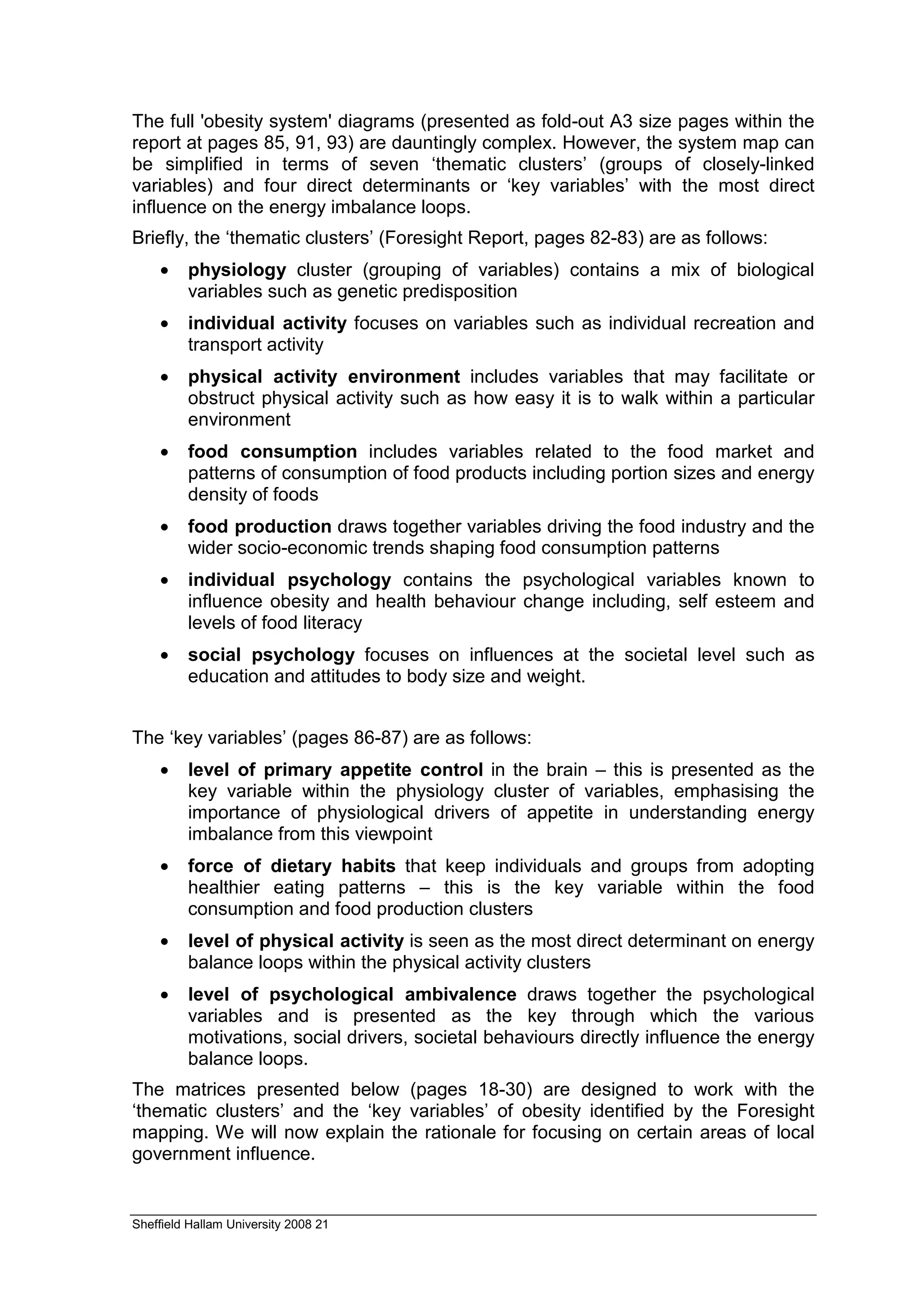
The full 'obesity system' diagrams (presented as fold-out A3 size pages within the
report at pages 85, 91, 93) are dauntingly complex. However, the system map can
be simplified in terms of seven ‘thematic clusters’ (groups of closely-linked
variables) and four direct determinants or ‘key variables’ with the most direct
influence on the energy imbalance loops.
Briefly, the ‘thematic clusters’ (Foresight Report, pages 82-83) are as follows:
    •    physiology cluster (grouping of variables) contains a mix of biological
         variables such as genetic predisposition
    •    individual activity focuses on variables such as individual recreation and
         transport activity
    •    physical activity environment includes variables that may facilitate or
         obstruct physical activity such as how easy it is to walk within a particular
         environment
    •    food consumption includes variables related to the food market and
         patterns of consumption of food products including portion sizes and energy
         density of foods
    •    food production draws together variables driving the food industry and the
         wider socio-economic trends shaping food consumption patterns
    •    individual psychology contains the psychological variables known to
         influence obesity and health behaviour change including, self esteem and
         levels of food literacy
    •    social psychology focuses on influences at the societal level such as
         education and attitudes to body size and weight.


The ‘key variables’ (pages 86-87) are as follows:
    •    level of primary appetite control in the brain – this is presented as the
         key variable within the physiology cluster of variables, emphasising the
         importance of physiological drivers of appetite in understanding energy
         imbalance from this viewpoint
    •    force of dietary habits that keep individuals and groups from adopting
         healthier eating patterns – this is the key variable within the food
         consumption and food production clusters
    •    level of physical activity is seen as the most direct determinant on energy
         balance loops within the physical activity clusters
    •    level of psychological ambivalence draws together the psychological
         variables and is presented as the key through which the various
         motivations, social drivers, societal behaviours directly influence the energy
         balance loops.
The matrices presented below (pages 18-30) are designed to work with the
‘thematic clusters’ and the ‘key variables’ of obesity identified by the Foresight
mapping. We will now explain the rationale for focusing on certain areas of local
government influence.


Sheffield Hallam University 2008 21
Rationale for design of the matrices
The key challenge for local government is to provide strategic leadership among
its partners to create sustainable system-wide change, promoting healthy lifestyles
and healthy weights. (Strategic level considerations have been introduced in
section two of our document.) The Foresight Report has implications therefore
across all levels of local government, including the myriad range of services
commissioned and directly delivered. To consider the Foresight implications
across all areas would make for a document that is even more complex than the
original! Therefore, four major areas of local authority influence and responsibility
have been selected for more detailed analyses. These four are:
•   Planning
•   Children's services
•   Adult social care
•   Parks and leisure.

Of course there are many other areas of local authority responsibility; including
environmental health services, waste management services, social housing. The
Foresight Report has implications for these other areas but the implications are
less direct or pressing in comparison to the selected four.
So, the matrices presented below are designed to work with the ‘thematic clusters’
and ‘key variables’ identified by Foresight and to focus in turn on four key areas of
local government influence.


Sheffield Hallam University 2008 22
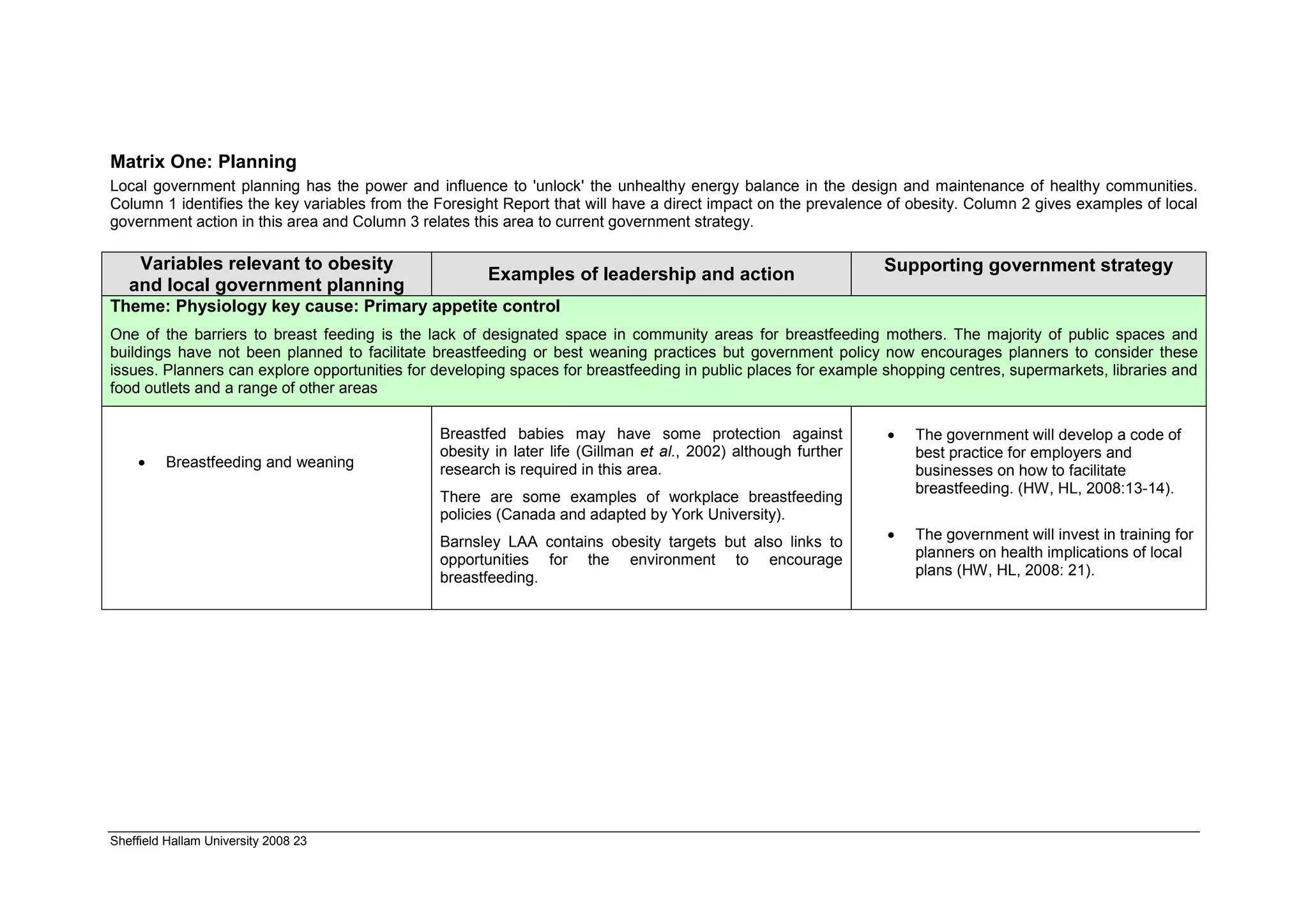
Matrix One: Planning
Local government planning has the power and influence to 'unlock' the unhealthy energy balance in the design and maintenance of healthy communities.
Column 1 identifies the key variables from the Foresight Report that will have a direct impact on the prevalence of obesity. Column 2 gives examples of local
government action in this area and Column 3 relates this area to current government strategy.

    Variables relevant to obesity                                                                              Supporting government strategy
                                                      Examples of leadership and action
   and local government planning
Theme: Physiology key cause: Primary appetite control
One of the barriers to breast feeding is the lack of designated space in community areas for breastfeeding mothers. The majority of public spaces and
buildings have not been planned to facilitate breastfeeding or best weaning practices but government policy now encourages planners to consider these
issues. Planners can explore opportunities for developing spaces for breastfeeding in public places for example shopping centres, supermarkets, libraries and
food outlets and a range of other areas

                                               Breastfed babies may have some protection against                •   The government will develop a code of
                                               obesity in later life (Gillman et al., 2002) although further        best practice for employers and
    •    Breastfeeding and weaning             research is required in this area.                                   businesses on how to facilitate
                                                                                                                    breastfeeding. (HW, HL, 2008:13-14).
                                               There are some examples of workplace breastfeeding
                                               policies (Canada and adapted by York University).
                                               Barnsley LAA contains obesity targets but also links to          •   The government will invest in training for
                                               opportunities for the environment to encourage                       planners on health implications of local
                                               breastfeeding.                                                       plans (HW, HL, 2008: 21).


Sheffield Hallam University 2008 23
Variables relevant to obesity                                                                                 Supporting government strategy
                                                         Examples of leadership and action
   and local government planning
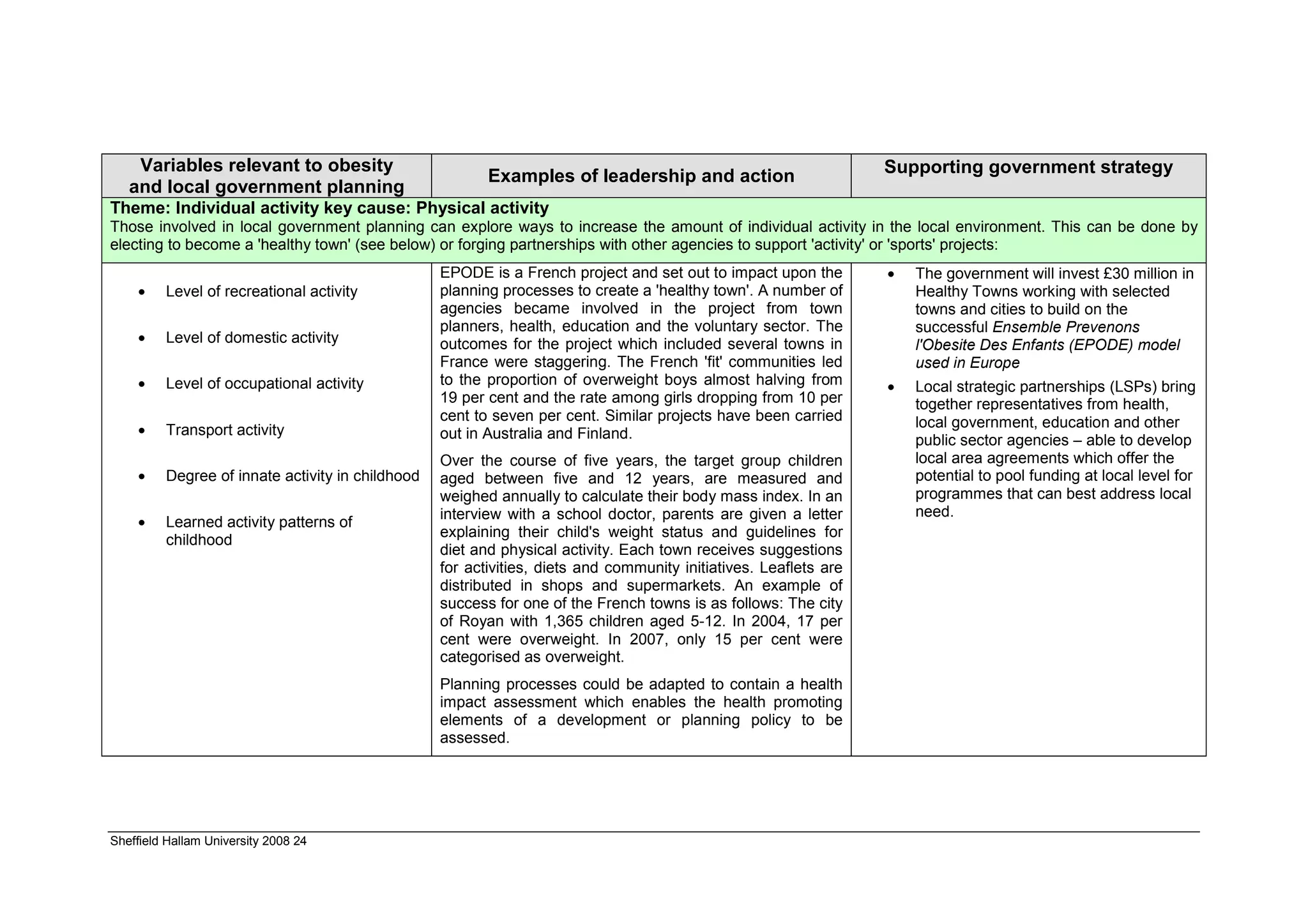
Theme: Individual activity key cause: Physical activity
Those involved in local government planning can explore ways to increase the amount of individual activity in the local environment. This can be done by
electing to become a 'healthy town' (see below) or forging partnerships with other agencies to support 'activity' or 'sports' projects:
                                                  EPODE is a French project and set out to impact upon the        •   The government will invest £30 million in
    •    Level of recreational activity           planning processes to create a 'healthy town'. A number of          Healthy Towns working with selected
                                                  agencies became involved in the project from town                   towns and cities to build on the
                                                  planners, health, education and the voluntary sector. The           successful Ensemble Prevenons
    •    Level of domestic activity               outcomes for the project which included several towns in            l'Obesite Des Enfants (EPODE) model
                                                  France were staggering. The French 'fit' communities led            used in Europe
    •    Level of occupational activity           to the proportion of overweight boys almost halving from        •   Local strategic partnerships (LSPs) bring
                                                  19 per cent and the rate among girls dropping from 10 per           together representatives from health,
                                                  cent to seven per cent. Similar projects have been carried          local government, education and other
    •    Transport activity                       out in Australia and Finland.                                       public sector agencies – able to develop
                                                  Over the course of five years, the target group children            local area agreements which offer the
    •    Degree of innate activity in childhood   aged between five and 12 years, are measured and                    potential to pool funding at local level for
                                                  weighed annually to calculate their body mass index. In an          programmes that can best address local
                                                  interview with a school doctor, parents are given a letter          need.
    •    Learned activity patterns of
                                                  explaining their child's weight status and guidelines for
         childhood
                                                  diet and physical activity. Each town receives suggestions
                                                  for activities, diets and community initiatives. Leaflets are
                                                  distributed in shops and supermarkets. An example of
                                                  success for one of the French towns is as follows: The city
                                                  of Royan with 1,365 children aged 5-12. In 2004, 17 per
                                                  cent were overweight. In 2007, only 15 per cent were
                                                  categorised as overweight.
                                                  Planning processes could be adapted to contain a health
                                                  impact assessment which enables the health promoting
                                                  elements of a development or planning policy to be
                                                  assessed.


Sheffield Hallam University 2008 24
Variables relevant to obesity                                                                              Supporting government strategy
                                                         Examples of leadership and action
   and local government planning
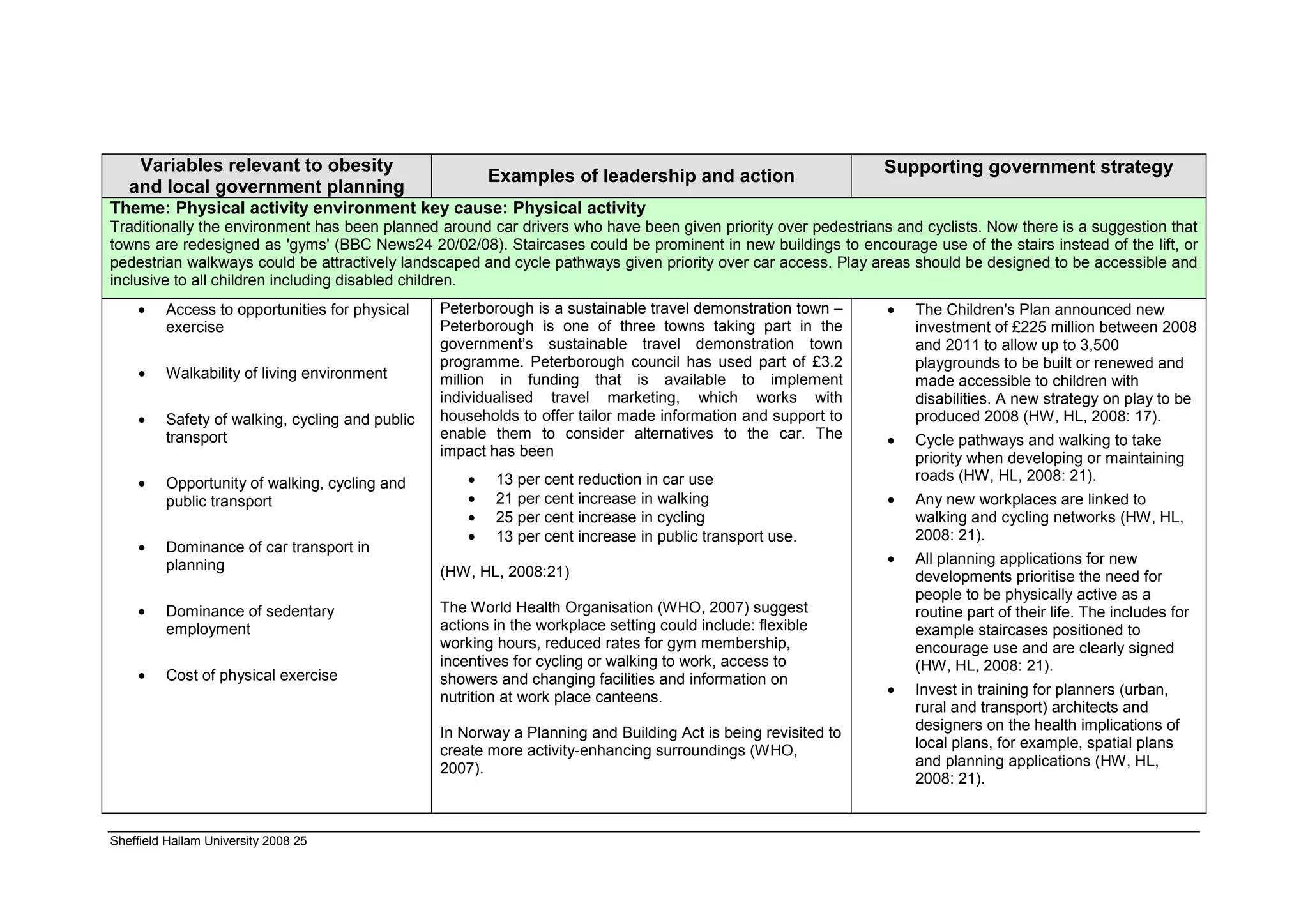
Theme: Physical activity environment key cause: Physical activity
Traditionally the environment has been planned around car drivers who have been given priority over pedestrians and cyclists. Now there is a suggestion that
towns are redesigned as 'gyms' (BBC News24 20/02/08). Staircases could be prominent in new buildings to encourage use of the stairs instead of the lift, or
pedestrian walkways could be attractively landscaped and cycle pathways given priority over car access. Play areas should be designed to be accessible and
inclusive to all children including disabled children.
    •    Access to opportunities for physical    Peterborough is a sustainable travel demonstration town –     •   The Children's Plan announced new
         exercise                                Peterborough is one of three towns taking part in the             investment of £225 million between 2008
                                                 government’s sustainable travel demonstration town                and 2011 to allow up to 3,500
                                                 programme. Peterborough council has used part of £3.2             playgrounds to be built or renewed and
     •   Walkability of living environment       million in funding that is available to implement                 made accessible to children with
                                                 individualised travel marketing, which works with                 disabilities. A new strategy on play to be
    •    Safety of walking, cycling and public   households to offer tailor made information and support to        produced 2008 (HW, HL, 2008: 17).
         transport                               enable them to consider alternatives to the car. The          •   Cycle pathways and walking to take
                                                 impact has been                                                   priority when developing or maintaining
    •    Opportunity of walking, cycling and         •   13 per cent reduction in car use                          roads (HW, HL, 2008: 21).
         public transport                            •   21 per cent increase in walking                       •   Any new workplaces are linked to
                                                     •   25 per cent increase in cycling                           walking and cycling networks (HW, HL,
                                                     •   13 per cent increase in public transport use.             2008: 21).
    •    Dominance of car transport in
         planning                                                                                              •   All planning applications for new
                                                 (HW, HL, 2008:21)                                                 developments prioritise the need for
                                                                                                                   people to be physically active as a
    •    Dominance of sedentary                  The World Health Organisation (WHO, 2007) suggest                 routine part of their life. The includes for
         employment                              actions in the workplace setting could include: flexible          example staircases positioned to
                                                 working hours, reduced rates for gym membership,                  encourage use and are clearly signed
                                                 incentives for cycling or walking to work, access to              (HW, HL, 2008: 21).
    •    Cost of physical exercise               showers and changing facilities and information on
                                                 nutrition at work place canteens.                             •   Invest in training for planners (urban,
                                                                                                                   rural and transport) architects and
                                                 In Norway a Planning and Building Act is being revisited to       designers on the health implications of
                                                 create more activity-enhancing surroundings (WHO,                 local plans, for example, spatial plans
                                                 2007).                                                            and planning applications (HW, HL,
                                                                                                                   2008: 21).


Sheffield Hallam University 2008 25
Variables relevant to obesity                                                                             Supporting government strategy
                                                     Examples of leadership and action
   and local government planning
Theme: Food consumption key cause: Dietary habits
The over consumption of food or consuming high calorie foods on a regular basis leads to weight gain. Local Authority planning departments could consider
how they might limit the availability of these foods by challenging developers plans for fast food outlets
                                              Free fruit to infant school children in the UK. There is a      •   A healthy code of practice to be
    •    Convenience of food offerings        working model of this in Hull. The programme is called              developed, for example, to include
                                              'Eat Well, Do Well'. The programme involves the city                information on the nutritional content of
                                              council providing free healthy meals to children in primary         food in a wide range of settings, theme
                                              and special schools. The University of Hull is conducting           parks, visitor attractions, restaurants,
                                              the evaluation which will find out if the healthier meals are       take away foods, to be clear, effective
                                              making a difference by: helping pupils to do better in              and simple to understand (HW, HL,
                                              school; helping them come to school more often and get              2008: 18).
                                              to school on time; affecting pupils’ behaviour and number
                                              of exclusions. They will also find out what pupils and their
                                              parents think about healthier food. Contact details for
                                              further information: eatwelldowell@hullcc.gov.uk                •   Local authorities will be given powers to
                                                                                                                  prevent fast food outlets opening near
                                              A ban on vending machines in schools in France took                 parks and schools.
                                              effect September 2005 ( Foresight Report p73).
                                              Sales tax on soft drinks in Latvia (Foresight Report p73).
                                              Reward tokens given for healthy choices in Iceland
                                              (Foresight Report p73).


Sheffield Hallam University 2008 26
Variables relevant to obesity                                                                            Supporting government strategy
                                                       Examples of leadership and action
   and local government planning
Theme: Individual psychology key cause: Psychological ambivalence
Perceptions of danger in the environment can impact upon an individual's willingness to walk in their local area. Designing out crime and building 'safe'
neighbourhoods could help to tackle this


    •    Perceived danger in the environment   Examples of increasing physical activity to meet the Public   •   Safety in the local community and
                                               Service Agreement for obesity are addressed in the                perceptions of danger and crime. The
                                               following ways:                                                   'Manual for the streets' gives advice on
                                                                                                                 effective street design that encourages
                                                   •   School sport strategy                                     people to walk and cycle to local
                                                   •   The Big Lottery Funds Play Initiative                     destinations (HW, HL, 2008: 21).
                                                   •   The School Travel Scheme (Choosing Health:
                                                       Obesity Bulletin, May 2006).


Theme: Social psychology key cause: Psychological ambivalence
People will make healthy choices more often if the surrounding environment is supportive.


    •    Exposure to food advertising          To promote cycling to and from work. Austria and Sweden       •   £75 million to be invested in an
                                               started competitive initiatives between companies (World          integrated marketing programme to
                                               Health Organisation, 2007).                                       inform and empower parents to make
    •    Perceived lack of time                                                                                  changes to their children diets and level
                                                                                                                 of physical activity.


Sheffield Hallam University 2008 27
Matrix Two: Children's services
Children's services have the power and influence to 'unlock' the unhealthy energy balance in the lives of children and their families. Column 1 identifies the
key variables from the Foresight Report that will have a direct impact on the prevalence of obesity. Column 2 gives examples of local government action in this
area and Column 3 relates this area to current government strategy

   Variables relevant to obesity                                                                               Supporting government strategy
                                                  Examples of leadership and action
     and children's services
Theme: Physiology key cause: Primary appetite control
Pregnant women with young children are frequent users of children's services. These services could do more to support optimal growth and body composition
in the ante-natal period. There is some evidence of a link between breastfeeding and reduced obesity in later childhood.

                                            The 'Healthy Start' scheme (the reformed Welfare Food          •    The government will invest in information
    •    Embryonic and foetal growth        Scheme DoH, 2007) offers fresh fruit and vegetables,                campaigns and a national helpline. It will
    •    Maternal body composition          as well as milk and formula, helping to ensure that                 develop a code of best practices. It will
                                            breastfeeding and bottle feeding mothers benefit equally            develop guidance for professionals working
    •    Breast feeding and weaning         from the scheme.                                                    with young children. It will invest further in
    •    Degree of GI signalling (or                                                                            support for families at greatest risk (HW, HL.
         healthy eating advice)             Improving support for breastfeeding and weaning is an               2008: 13-15).
                                            obvious key area of influence and responsibility. The
                                            choice of foods in children's services can support or
                                            undermine the biological mechanisms for recognising
                                            when you are full. Eating styles – for example, chewing
                                            fully within an unrushed meal – can contribute as well.


Sheffield Hallam University 2008 28
Variables relevant to obesity and                                                                                 Supporting government strategy
                                                          Examples of leadership and action
        children's services
Theme: Individual activity key cause: Physical activity
Interventions likely to be successful at changing behaviour are those that engage the whole family (although individual activity session do play a role,
particularly in introducing new activities and experiences to children)

                                                                                                             •   The government's ten-year Children's Plan
    •    Parental modelling of activity         ‘Watch It and Nip It in the Bud’ was established in              was launched December 2007 and one of its
                                                Leeds in 2002 and supported by the Neighbourhood                 targets is to reduce the proportion of
                                                Renewal Fund. There are four key components:                     overweight and obese children to the same
    •    Learned activity patterns of early     frequent individual appointments; healthy education              level as in the year 2000 by 2020.
         childhood                              lifestyle plans; group activity sessions and parental        •   Investment in ‘parenting advisors’. The
                                                group sessions. The sessions are run by Health Visitor           Parenting Fund was launched in 2004 by the
                                                Trainers www.cdhpp.leeds.ac.uk/services/watch.php
    •    Degree of physical education                                                                            Minister for Children and Families. It is a major
                                                Other areas run the MEND programme which takes an                investment in parenting support right across
                                                integrated, holistic approach to obesity prevention for          the voluntary sector.
    •    Opportunity for team-based
         activity
                                                the whole familiy. Children and families spend one hour      •   Expert parent support can be accessed on line
                                                learning about nutrition and how to change eating                http://www.parentscentre.gov.uk/educationandl
                                                behaviour and one hour taking part in activities. This           earning/
    •    Socio-cultural valuation of activity   has been piloted in Lewisham and Bromley and was
                                                recently awarded £169,000 by The New Deal for
                                                Communities (NDC) to extend the randomised
    •    Level of recreational activity         controlled trial for MEND.
                                                Wandsworth link LAA targets on obesity from a PCT
    •    Transport activity                     perspective. 200 families with children aged 7-13 to take
                                                part in the MEND weight management programme.
    •    Functional fitness                     Southwark, London has written a Parenting Support
                                                strategy for 2006-9. One of the goals is to embed
                                                positive parenting across all agencies in Southwark.


Sheffield Hallam University 2008 29
Variables relevant to obesity                                                                                   Supporting government strategy
                                                    Examples of leadership and action
     and children's services
Theme: Physical activity environment key cause: Physical activity
Children's services are often well-placed to take a lead role in shaping the development of a physical activity environment for children; this role will need to be
a supportive one to help children access opportunities for physical exercise. Children most at risk may be reluctant to participate in programmes without
individual support and encouragement (The Audit Commission with the National Audit Office and the Healthcare Commission, 2006)

    •    Access to opportunities for          A local strategic partnership (LSP) could support peer           •    Local strategic Partnerships (LSPs) bring
         physical exercise                    advocates for children or health ambassadors which                    together representatives from health, local
                                              have had some success in supporting children and                      government, education and other public sector
                                              young people to engage in physical activity (Healthy                  agencies – able to develop local area
    •    Cost of physical exercise            Living, Barnsley Evaluation, 2007)                                    agreements which offer the potential to pool
                                                                                                                    funding at local level for programmes that can
                                              In Bradford, the PCT, Yorkshire sport and the local
    •    Opportunity of unmotorised           authority have jointly funded a childhood obesity coach
                                                                                                                    best address local need.
         transport (cycling and walking)      who works in partnership with Bradford Bulls to                  •    School playgrounds are designed to
                                              encourage children to become more active.                             encourage varied and physically active play
    •    Dominance of motorised                                                                                     (HW, HL, 2008: 21).
                                              ‘Walking buses’ are now becoming popular.
         transport (a need to prioritise      www.walkingBus.com In Hertford, a walking bus for 30             •    ‘Football and health’ (May 2005) highlights the
         cycling and walking with children)   children and volunteers has been operating since 2002.                role of football clubs working with the NHS and
                                              It is not unusual for the walking bus to move faster than             other stakeholders .
                                              the traffic on the main road!                                    •    Dept of Transport invests £140m over the next
                                                                                                                    three years to allow an extra 500,000 10 year-
                                              A further 10 Cycling Demonstration Towns in England,                  olds across England to take part in ‘Bikeability’
                                              as well as the first large Demonstration City is planned.             cycle training by 2012, equipping them to cycle
                                              This will mean nearly three million people will have the              safely and responsibly.
                                              chance to benefit from best practice and promotion of            •    The government plans to build another 250
                                              cycling. Darlington is a cycle demonstration town and                 Safe Links to Schools, connecting around 500
                                              has quadrupled the proportion of children cycling to                  more schools to the National Cycle Network.
                                              school. Aylesbury has also seen a five-fold increase in               Many schools with links have already doubled
                                              residents using a bike as one of their two main means                 the number of pupils cycling to school.
                                              of transport in the last two years.
                                              www.gnn.gov.uk/environment


Sheffield Hallam University 2008 30
Variables relevant to obesity and                                                                               Supporting government strategy
                                                       Examples of leadership and action
        children's services
Theme: Food consumption key cause: Dietary habits
Food habits have changed significantly, with many children in the UK not eating the recommended portions of fruit and vegetables. A significant contributor to
the increasing rate of crime, aggression, depression and poor school performance is poor nutrition. Children's services have a key leadership role in
influencing, shaping and changing the behaviour of children's dietary habits


Sheffield Hallam University 2008 31
Variables relevant to obesity and                                                                          Supporting government strategy
                                                    Examples of leadership and action
        children's services
    •    Food exposure                      The statement above is the conclusion of an inquiry held        •   Local authorities will be given powers to
                                            by the Associate Parliamentary Food and Health Forum,               prevent fast food outlets opening near
                                            which issued a report urging the Government to fund a               parks and schools (HW, HL, 2008: xiii)
    •    Tendency to graze                  campaign to research, increase awareness and                    •   The Department for Children, Schools
                                            encourage us to eat more fish and whole foods high in               and Families will extend its healthy
    •    Deskilling                         essential fats, vitamins and minerals. Research findings to         school meals programme, it will invest
                                            date show:                                                          £500m between 2005-2011.
    •    Convenience of food offerings          •   Children with learning and behaviour problems           •   To promote a culture of healthy eating,
                                                    improve focus, concentration and school grades              the government now expects all schools
                                                    when given essential fat supplements and IQ                 – in consultation with parents, pupils and
    •    Food variety, abundance and                scores improve when given multi-vitamins                    staff to adopt whole school food polices.
         palatability                                                                                           The school food trust (SFT)
                                                •   Eating breakfast and a low glycaemic diet, low in
                                                                                                                www.schoolfoodtrust.org.uk provides
                                                    sugar, improves behaviour and concentration
    •    Energy density of food offerings                                                                       guidance on how to do this (HW, HL
                                                •   Supplementing B vitamins improves depression                2008: 15).
                                                    and symptoms of schizophrenia and stops or              •   All schools to be asked to develop
    •    Portion size                               slows down memory decline in older people.                  healthy lunch box policies, so that those
                                            In Bolton, a joint initiative between Bolton Council, Bolton        not yet taking up school lunches are also
    •    Rate of eating                     Wanderers FC and the PCT, aims to encourage children                eating healthily (HW, HL, 2008: xii).
                                            to eat healthily and educate families on how to pack a
                                            healthy lunch box. Youngsters in ten primary schools in
                                            Bolton have been split into ‘football teams’. Pupils with a
                                            nutritious lunch box will score goals for their team. All ten
                                            teams will be entered into a prize draw for the chance to
                                            dine with the Wanderers.
                                            The Barking and Dagenham childhood obesity strategy
                                            and action plan has recognised that food production and
                                            dietary habits have a cultural origin. Through the LAA it
                                            has fostered increased willingness to work with the
                                            voluntary sector – in this case Barking and Dagenham
                                            Racial Equalities Council – to deliver programmes which
                                            are led by the voluntary sector working directly with
                                            communities.


Sheffield Hallam University 2008 32
Sheffield Hallam University 2008 33
Variables relevant to obesity                                                                                  Supporting government strategy
                                                   Examples of leadership and action
     and children's services
Theme: Individual psychology key cause: Psychological ambivalence
The Foresight Report identifies the links between emotion, eating and self-esteem in children. There are a range of projects that work to help build social and
emotional learning of individuals, for example SEAL www.bandapilot.org.uk/primary
   • Stress                                  Social marketing could make behaviour change a reality –         • A need to challenge the 'food on the go' habit,
                                             recent research has identified that obese children have a            with children buying chocolate and sweets at
                                             greater snacking habit (50 per cent higher) than children of         retail outlets on their way to and from school.
   • Individualism                           normal weight – it is the parents who purchase 80 per cent           Further work is needed to look at aspects of
                                             of the snacks. Programmes that support both children and             the built environment or how building design
   • Food literacy                           parents to change their eating behaviour are likely to have          influences people's food habits (HW, HL,
                                             a successful impact.                                                 2008: 54).

    •    Social interaction                                                                                   •    The School Food Trust
                                                                                                                   www.schoolfoodtrust.org.uk has invested 20
                                                                                                                   million of lottery funding to establish a network
    •    Self-esteem                                                                                               of 'Lets get cooking' cookery clubs aimed at
                                                                                                                   encouraging both parents and children in
                                                                                                                   healthy eating and the enjoyment of cookery.
                                                                                                                   These programmes aim to build the
                                                                                                                   confidence of children in preparing healthy
                                                                                                                   meals (HW, HL, 2008).
Theme: Social psychology key cause: Psychological ambivalence
TV watching has been identified as a key variable in the increased weight of children. While watching television, they are also vulnerable to media and
advertising of particular foods and snacks. TV watching as a habit can extend into the over-reliance of 'passive entertainment options', such as the use of video
games. Children's services can work with a range of agencies to explore 'wrap around' school activities and sports options for children
   • Exposure to food advertising            A ‘stay on site’ policy will reduce access to and                  • Schools should consider the length of time for
   • TV watching                             consumption of fast food and in conjunction with the                   lunch and consider a 'stay on site' policy at
                                             'extended role of schools' a 'whole-school approach' can               lunchtime (HW, HL, 2008: 15).
   • Children's control of diet              be adopted. This involves health professionals, school
   • Media availability and                  staff and parents. Hours from 8am to 6pm will be available
        consumption                          in all schools by 2010 and a range of parenting classes,
   • Availability of passive                 cookery classes, food co-ops, sports clubs and the use of
        entertainment options                leisure facilities will be planned (HW, HL, 2008: 16).


Sheffield Hallam University 2008 34
Matrix Three: Adult social care
Adult social care services have the power and influence to 'unlock' the unhealthy energy balance in the lives of adults in receipt of social care living in the local
community. Column 1 identifies the key variables from the Foresight Report that will have a direct impact on the prevalence of obesity. Column 2 gives
examples of local government action in this area and Column 3 relates this area to current government strategy

 Variables relevant to obesity and                                                                                   Supporting government strategy
                                                         Examples of leadership and action
         Adult social care
Theme: Physiology key cause: Primary appetite control
The choice of foods in adult social care services can support or undermine biological systems, for example, systems for recognising when to eat due to
hunger instead due to desire. Eating environments and styles, for example, chewing fully within an unrushed meal, can contribute as well.

    •    Consumption of high energy dense         Signposting foods with a low glycaemic index to help with           •   If the PCT and the local authority agree
         foods – such as processed food           food choice.                                                            that there is sufficient need to promote
    •    Consumption of foods with a high                                                                                 maintaining a healthy weight then they
         glycaemic index                                                                                                  can make this a focus of the LAA (HW,
                                                                                                                          HL, 2008: 27).


Sheffield Hallam University 2008 35
Variables relevant to obesity and                                                                                Supporting government strategy
                                                       Examples of leadership and action
         Adult social care
Theme: Individual activity key cause: Physical activity
A small degree of exercise will prevent additional health problems. Adult social care should be constantly thinking about supporting people to be active – 'use
it or loose it' initiatives.

    •    Degree of physical education           Physical fitness schemes for older people are                     •   The government seek to develop the
    •    Socio-cultural valuation of activity   recommended. Young and Dinan (1994) in the ABC of                     ‘NHS choices’ website to give highly
                                                Sports Medicine                                                       personalised advice to all on their diet
    •    Level of recreational activity         http://www.bmj.com/cgi/content/full/309/6950/331 provide              and activity levels, with clear and
    •    Transport activity                     recommendations for fitness schemes for older people.                 consistent information on how to
    •    Functional fitness                     Specific working examples include the Big Lottery                     maintain a healthy weight. (HW, HL
                                                Programme 'Fit as a Fiddle'. This initiative is designed to           2008:xiv).
                                                help older people to live a more healthy, active and
                                                fulfilling life. There are to be a wide range of projects
                                                which will be delivered at a national, regional and local
                                                level. A national training programme and educational
                                                resources will be designed to reach all older people and
                                                support the different agencies who work with them.
                                                Contact details are: fitasafiddle@ace.org.uk


                                                Dudley Metropolitan Borough Council has introduced a
                                                Smartcard to be used within its leisure services, enabling
                                                easier access to facilities.


Sheffield Hallam University 2008 36
Variables relevant to obesity and                                                                            Supporting government strategy
                                                       Examples of leadership and action
         Adult social care
Theme: Physical activity environment key cause: Physical activity
More can be done to make the physical environment enjoyable to walk in. Adult social care can work with other agencies to ensure that communities are safe
to walk in and support more activity and partnership between social care support workers, personal assistants and adults in receipt of care

    •    Access to opportunities for physical   Nottinghamshire has explored affordable fitness and           •   The Local Government and Public
         exercise                               leisure facilities to tackle cost as a barrier to physical        Involvement in Health Act 2007 requires
                                                exercise                                                          the local authority and its partners to
                                                                                                                  prepare a community strategy for
    •    Cost of physical exercise              Leeds North West PCT currently delivers or commissions
                                                                                                                  promoting or improving the economic,
                                                a range of services in this field. These include
                                                                                                                  social and environmental well-being of
                                                10% clubs – offering practices an effective weight
    •    Opportunity of using other forms of    management service for their patients. This service is
                                                                                                                  their area. The strategy could be a
         transport other than the car,                                                                            critical planning tool to develop a local
                                                being expanded to offer a service to morbidly obese
         including walking, cycling                                                                               strategy to reduce obesity.
                                                patients.
                                                Physical activity referral – this service provides a          •   The government has plans to invest in a
                                                referral service for 16 GP surgeries. In addition, this           'Walking into Health' campaign, aiming
                                                service is closely linked to the 10% clubs, offering highly       to get a third of England walking at least
                                                specific exercise opportunities for obese adults in Leisure       1,000 more steps daily by 2012 (HW,
                                                Centres                                                           HL, 2008:xiii).
                                                South Asian Healthy Lifestyle project – this project
                                                delivers a wide variety of opportunities for healthy living
                                                within the South Asian Community in the inner locality.


Sheffield Hallam University 2008 37
Matrix Four: Parks and leisure
Parks and Leisure have the power and influence to 'unlock' the unhealthy energy balance in the lives of children and adults in the local community. Column 1
identifies the key variables from the Foresight Report that will have a direct impact on the prevalence of obesity. Column 2 gives examples of Local
Government action in this area and Column 3 relates this area to current government strategy:

     Variables relevant to obesity                                                                             Supporting government strategy
                                                      Examples of leadership and action
        and Parks and leisure
Theme: Physiology key cause: Primary appetite control
New ways of working and new partnerships need to be formed to explore the potential for local people to access physical exercise and to increase their
physical activity levels. Breastfeeding mothers should be able to continue to breastfeed in all facilities provided by parks and leisure services
                                               Cardiff Council (2007) have developed a breastfeeding
                                               strategy to ensure all council buildings including those in     •   The government will develop a code of
                                               parks and leisure adhere to good practice in providing              best practice for employers and
    •    Breastfeeding and weaning             breastfeeding space for mothers.                                    businesses on how to facilitate
                                                                                                                   breastfeeding. (HW, HL, 2008: 13-14).

                                                                                                               •   The government will invest in training for
                                                                                                                   planners on health implications of local
                                                                                                                   plans (HW, HL, 2008: 21).


Sheffield Hallam University 2008 38
Variables relevant to obesity                                                                                Supporting government strategy
                                                       Examples of leadership and action
        and Parks and leisure
Theme: Individual activity key cause: Physical activity
Leisure services staff teams should be creative in the ways that they engage all members of the community. Perhaps leisure centre staff could become
involved in outreach exercise programmes with vulnerable citizens like elderly or mental health groups.
Leisure services staff team could also be instrumental in establishing local leagues that would ensure council pitches are fully utilised and the local community
is engage with both physical activity and the use of local facilities.


    •    Level of recreational activity                                                                            •   Local strategic partnerships (LSPs) bring
                                                Dudley Metropolitan Borough Council have set up 'home
                                                zones' which are environments designed to support                      together representatives from health,
                                                physical activity. Walkability audits are undertaken and the           local government, education and other
                                                recommendations of these audits need to be incorporated                public sector agencies – able to develop
    •    Transport activity                                                                                            local area agreements which offer the
                                                into the transport, community safety and land use plans in
                                                order for 'home zones' to become a reality.                            potential to pool funding at local level for
                                                                                                                       programmes that can best address local
                                                                                                                       need.
                                                                                                                   •   Local delivery frameworks (LDF) and the
                                                                                                                       local spatial plan (LSP). Guidance
                                                                                                                       provided in ‘Planning Together, Local
                                                                                                                       Strategic Partnerships and Spatial
                                                                                                                       Planning – a practical guide 2007’
                                                                                                                       Department for Communities and Local
                                                                                                                       Government suggests that "plans should
                                                                                                                       be drawn up with community
                                                                                                                       involvement and present a shared vision
                                                                                                                       and strategy of how the area should
                                                                                                                       develop. These plans should consider
                                                                                                                       how physical activity can be promoted
                                                                                                                       through the design and use of parks and
                                                                                                                       leisure facilities.”


Sheffield Hallam University 2008 39
Variables relevant to obesity                                        Supporting government strategy
                                      Examples of leadership and action
        and Parks and leisure


Sheffield Hallam University 2008 40
Variables relevant to obesity                                                                                Supporting government strategy
                                                        Examples of leadership and action
        and Parks and leisure
Theme: Physical activity environment key cause: Physical activity
Efforts should be made to encourage overweight people into non stigmatising exercise regimes at local facilities during which comprehensive healthy living
advice could be given. Local councils need to pay attention to admission prices for use of leisure facilities as often pricing structures can become unaffordable
for the most disadvantaged groups.
    •    Access to opportunities for physical    Through Natural England, the Department of Health is              •   Cycle pathways and walking to take
         exercise                                working on a Physical Activity Care Pathway pilot. The                priority when developing or maintaining
                                                 ‘pathway’ is a means by which frontline health                        roads (HW, HL, 2008: 21).
                                                 professionals can identify sedentary patients who would           •   Any new workplaces are linked to
     •   Walkability of living environment       benefit – in terms of physical health – from increased                walking and cycling networks (HW, HL,
                                                 levels of physical activity.                                          2008: 21).
    •    Safety of walking, cycling and public
                                                 This pathway has been designed to help facilitate the             •   Invest in training for planners (urban,
         transport
                                                 promotion of physical activity across primary care. The               rural and transport) architects and
                                                 pathway is a tool for GPs and other professionals to use              designers on the health implications of
    •    Opportunity of walking, cycling and     with patients who would benefit from a more active                    local plans, for example, spatial plans
         public transport                        lifestyle and should result in signposting to local health            and planning applications (HW, HL,
                                                 walks and ‘green’ exercise schemes in addition to                     2008: 21).
    •    Dominance of car transport in           opportunities for local indoor activities.
         planning
                                                 Physical Activity Care Pathway – pilot details
                                                 The first wave launched in September 2007 in six London
    •    Dominance of sedentary                  boroughs (Islington, Harrow, Haringey, Tower Hamlets,
         employment                              Southwark and Wandsworth) with eight GP practices
                                                 involved. Wave two launched in March 2008 in six London
                                                 boroughs with seven GP surgeries involved.
    •    Cost of physical exercise


Sheffield Hallam University 2008 41
Variables relevant to obesity                                                                                 Supporting government strategy
                                                        Examples of leadership and action
        and Parks and leisure
Theme: Individual psychology Key cause: Psychological ambivalence
As a priority local parks need to become safe places for people to go. Citizens need to perceive that the park is a safe place for them to be. Parks are then
excellent vehicles for community activities and exercise.


    •    Perceived danger in the environment     Rotherham Metropolitan Borough Council has installed               •   Safety in the local community and
                                                 simple posts on walkways that advise walkers how far                   perceptions of danger and crime. The
                                                 they have walked from one position to the next, this tends             'Manual for the streets' gives advice on
                                                 to encourage walkers to ‘go the extra post distance’.                  effective street design that encourages
                                                                                                                        people to walk and cycle to local
                                                                                                                        destinations (HW, HL, 2008: 21).


Theme: Social psychology key cause: Psychological ambivalence
People will make healthy choices more often if the surrounding environment is supportive. Parks and leisure services are seen as a significant component of
local government with a central role to create a more active community. Local council leisure facilities like leisure centers need to be prioritised for investment
to ensure that they are attractive to the community and council operated playing pitches need protection to ensure that they are not sold as development land.


    •    Exposure to food advertising            To promote cycling to and from work, Austria and Sweden            •   £75 million to be invested in an
                                                 started competitive initiatives between companies (World               integrated marketing programme to
                                                 Health Organisation, 2007).                                            inform and empower parents to make
    •    Perceived lack of time                                                                                         changes to their children diets and level
                                                                                                                        of physical activity.


Sheffield Hallam University 2008 42
Section 5: Conclusions and effective responses
In the later part of the Foresight Report there is a very detailed analysis of future
scenarios (pages 95-103) and discussion of the effectiveness of various
responses (pages 105-117). From a starting point of 56 possible policy
interventions, the report identifies only five responses likely to be effective across
all future scenarios (page 109). These have formed the basis of the government's
strategy set out in ‘Healthy Weight, Healthy Lives, 2008’ and are set out below.
We have concluded this report with examples to illustrate how a local government
strategy may look across the five responses:
    •    Increase the walkability and cyclability of the built environment (urban
         and rural). Practical ideas here include building staircases in prominent
         positions which are well signposted to encourage people to take the stairs,
         as well as making best use of open park spaces such as distance markers
         telling people how far they have walked. Foresight identified this as the
         most effective response among those focused on the built environment and
         transport. It has most obvious implications for planning but also other areas
         of local government responsibility in providing and commissioning services.
         ‘Healthy Weight, Healthy Lives 2008’ mostly considers this area of
         response within plans for 'Building physical activity into our lives' (HW, HL
         pages 19-22).
    •    Targeting health interventions for those at risk. Foresight identified this
         as an important response for the health sector ahead of population-wide
         interventions or interventions focused on the disease consequences of
         obesity. Services provided and commissioned by local government are
         likely to play an important role in identifying and supporting groups at risk of
         obesity. Identify those most at risk including children and families from a low
         socio-economic class who are more likely to spend increased hours
         watching television than their more advantaged peers. ‘Healthy Weight,
         Healthy Lives’ considers this area of response mainly within its section on
         ‘Personalised advice and support’ (pages 24-25) and within the section on
         ‘Children: healthy growth and healthy weight’ (pages 13-17).
    •    Controlling obesogenic foods and drinks. This is identified by Foresight
         as an effective regulation response. The availability and exposure to foods
         and drinks that are known to be implicated in obesity are the focus here.
         Local government has power and influence to build partnerships with local
         businesses to improve the local food supply and limit the availability of
         obesogenic foods and drinks. Again, this is of relevance across local
         government areas of responsibility. ‘Healthy Weight, Healthy Lives’ sets out
         plans of response within the section ‘Promoting healthier food choices’
         (pages 17-19).
    •    Increasing the responsibility of organisations for the health of their
         employees. Foresight envisaged this as a response option among a
         number of fiscal incentives. As a major employer local government will need
         to address this area. For example, employers can support corporate
         membership to gyms, provide showers in the work place and consider
         flexible hours. ‘Healthier Weight, Healthier Lives’ considers responses
         within the section on ‘Creating incentives for better health’ (pages 22-24).

Sheffield Hallam University 2008 43
•    Early life interventions. Foresight identified this as the most effective
         response among those oriented to the family and far more effective than
         initiatives that might penalise parents. The majority of public spaces and
         buildings have not been planned to facilitate breastfeeding or best weaning
         practices but new government policy (‘Healthy Weight, Healthy Lives,
         2008’) encourages planners to consider these issues. This is something
         that could be addressed through council planning policies for new buildings.
         Again this is of particular relevance to local government responsibilities for
         Children's services. ‘Healthy Weight, Healthy Lives’ sets out plans of
         response within the section on ‘Children: healthy growth and healthy weight’
         (pages 13-17).
The five areas of most effective response are summarised in the table below. It
should be emphasised again that these are not the only areas of response or only
areas of local government influence.


Relevance of Foresight ‘top five’ policy responses to local government
                                      Planning   Childrens'   Adult social   Parks and
                                                  services       care         leisure

Early life interventions at birth
or in infancy

Controlling obesogenic foods
and drinks

Targeting health interventions
for those at risk

Walkability and cyclability of the
built environment

Increasing responsibility of
organisations for employees


‘Top Ten’ tips for local action

1. Rise to the challenge. We are on the verge of an obesity epidemic even
though there are mixed messages from the media. Get a better understanding of
what this means for your residents locally.
2. Prioritise Obesity prevention – take a holistic approach to tackling obesity
and the obesogenic environment. For example, connect the obesity strategy to
other strategies where possible such as reducing carbon emissions. Resist the
simplistic individual lifestyle choice explanations and focus on the environment.
The personal changes will follow with less resistance.
3. Target children and vulnerable groups in raising obesity awareness and
providing opportunities.
4. Don't go it alone! Local strategic partnerships have been developed to bring
partner agencies to work together on local issues such as obesity prevention.

Sheffield Hallam University 2008 44
5. Identify 'obesity champions'. This might be the lead for public health or the
lead for children's health or a local mayor or lead councillor. They can capture
support with their passion to tackle obesity.
6. Stay local. The Sustainable Community Strategy is intended to generate local
action and solutions to obesity prevention
7. 'One size does not fit all'. Work with individuals at the grass roots level to find
out what activity projects people would attend.
8. 'Practice what you preach'. Be a model employer and develop healthy
workplace objectives.
9. Don't re-invent the wheel. There is a lot of evidence out there to show what
works to combat and prevent obesity, this can be tailored to fit local circumstances.
Learn from good practice elsewhere make information available to all agencies
and signpost people to the evidence
10. Make information accessible. Help people understand practical examples of
an unhealthy energy imbalance for example how much extra walking is needed to
burn off a chocolate bar or a glass of wine.


Sheffield Hallam University 2008 45
References
Audit Commission, (2007), Comprehensive Area Assessment. A joint consultation
by the Audit Commission, Commission for Social Care Inspection, Healthcare
Commission, HM Inspectorate of Constabulary, HM Inspectorate of Prisons, HM
Inspectorate of Probation and Ofsted. CW print


Stoker G, Gains F, Greasley S, John P and Rao N, (2007) The New Council
Constitutions, The Outcomes and Impact of the Local Government Act 2000.
Department for Communities and Local Government: London


Department for Communities and Local Government, (2007) Strong and
Prosperous Communities: The Local Government White Paper Implementation
Plan: One Year on. Department for Communities and Local Government: London


Department of Health (2007) Guidance on Joint Strategic Needs Assessment
Department of Health (2007)


Canoy D and Buchan I, (2007) Challenges in obesity epidemiology. Obesity
Reviews 8 (Suppl. 1) 1-11.


Center for Consumer Freedom (2005) An Epidemic of Obesity Myths. Washington
DC, Center for Consumer Freedom. Available from www.obesitymyths.com/


Flegal K, Graubard B and Willimson D, (2004) Methods of calculating deaths
attributable to obesity. American Journal of Epidemiology, 160, 331-338.


Flegal K, Willimson D, Pamuk E and Rosenberg H. (2004) Estimating deaths
attributable to obesity in the United States. American Journal of Public Health, 94,
1486-1489.


Flegal K, Graubard B, Willimson D and Gail M, (2005) Excess deaths associated
with underweight, overweight and obesity. JAMA, 293, 1861-1867.

Sheffield Hallam University 2008 46
French S A et al. (2003) Perceived barriers to and incentives for participation in a
weight-loss programme among low-income women in WIC. Journal of the
American Dietetic Association


Kopelman P, (2007) Health risks associated with overweight and obesity. Obesity
Reviews 8 (Suppl. 1) 13-17.


Kuepper-Nybelen J, (2005) Major differences in prevalence of overweight
according to nationality in pre-school children living in Germany: determinants and
public health implications. Archives of Disease in Childhood, 90, 353-366


Kumanyika S and Grier S (2006) Targeting interventions for Ethnic Minority and
Low Income populations www.futureofchildren.org 16 (1) Spring 2006


Lyons M (2007) The Lyons Inquiry into Local Government, The Stationary Office:
London


McTigue K M, Garrett J M, Popkin B M, (2002) The natural history of the
development of obesity in a cohort of young US adults between 1981 and 1998.
Annals of Internal Medicine


Sturm R. (2002) The effects of obesity, smoking and problem drinking on chronic
medical problems and health care. Health Affairs, 21, 245-253.


Sturm R and Wells K, (2001) Does obesity contribute as much to morbidity as
poverty or smoking? Public Health, 115, 229-295.


WHO (2000) Obesity: Preventing and Managing the Global Epidemic, World
Health Organization, Geneva.


Zhang Q and Wang Y, (2004) Socioeconomic inequality in the United States: do
gender, age and ethnicity matter? Social Science and Medicine 58, (6) 1171-1180


Sheffield Hallam University 2008 47
Appendix 1: Contributors to this report


Dr John Reilly – University of Glasgow
Dr Paul Chadwick – University College London & MEND programme
Dr Caroline Dalton – Sheffield Hallam University
Dr Amanda Daley – University of Birmingham
Mr Harry MacMillan – MEND Programme
Dr Jerry Wales – Sheffield Teaching Hospitals
Dr Neil Wright – Sheffield Teaching Hospitals


Sheffield Hallam University 2008 48
Appendix 2: Is there really an epidemic of obesity?
Professor Wright, Associate Dean at the University of Wollongong, Australia
(2007) argues that there is no epidemic relating to obesity. Professor Wright
argues that most calculations of obesity rely on BMI measurement which is not an
accurate marker of obesity. She argues that this is all about people making money
out of the solutions to obesity.

"Am I the only one unconvinced by the 'obesity epidemic'? It clashes with my
experience… sounds a bit like a moral panic to me – especially when activists try
to link it to climate change in a scaremongering fashion and it gives politicians
some             kind           of    purpose."   Guardian     Unlimited        blogs:
http://blogs.guardian.co.uk/food/Oct 17 2007

The notion that the obesity epidemic is a fantasy (or has been exaggerated) is not
grounded in the evidence, and appears to be based at least partly on a
misunderstanding over the ability of BMI to diagnose obesity accurately (this has
been discussed in Appendix 2).

The epidemiological evidence suggests that obesity has reached global epidemic
proportions (Behn and Ur, 2006) and data from developed and developing
countries has revealed that an ever-increasing proportion of adults are obese
(World Health Organisation, 2002) in virtually all populations and age groups
worldwide (Eckel et al., 2004). The UK has the fastest increase in the disease in
Europe, with prevalence rates similar to those found in the US (Adult obesity rates
have almost quadrupled in the last 25 years. Now 22 per cent of Britons are obese
and three-quarters are overweight) (Davis et al., 2004; Flegal et al., 2002).

In children, the evidence suggests that obesity has reached epidemic proportions
globally (Wang and Lobstein, 2006). Worldwide, more than 155 million school-age
children are severely overweight (British Medical Association: BMA, 2005) with the
highest rates of childhood obesity observed in developed countries (Dehghan,
Akhtar-Danesh and Merchant, 2005). The number of young people who are
overweight and obese in Britain has almost tripled in the past 20 years (Lobstein,
James & Cole, 2003), as it has in the US (Hedley, Ogden, Johnson, Carrol, Curtin
and Flegal, 2002), and accelerated notably over the past decade (Chinn & Rona,
2001). In 1996 in the UK, 9.6 per cent of all children were obese; by 2003 this

Sheffield Hallam University 2008 49
figure had risen to 13.7 per cent (National Audit Office: NAO, 2006). In the US, as
of 2002, approximately 30 per cent of children were overweight and more than 15
per cent of children were obese (Hedley et al., 2002). Increases in obesity
amongst adolescents have been most prominent with obesity rising from 14 per
cent in boys and 15 per cent in girls’ aged 11-15 in 1995, to 24 per cent and 26 per
cent respectively by 2004 (Department of Health, 2004a). A longitudinal study
(Wardle, Brodersen, Cole, Jarvis and Boniface, 2006) of an ethnically and socio-
economically-diverse sample of young people in Britain confirmed obesity trends
identified from national statistics (DoH, 2004b) and further highlighted that obesity
rates are high and rising. Central obesity seems to be increasing particularly
rapidly and the notion of 'puppy fat' that disappears upon maturation must be
abandoned (Wardle et al., 2006).

There is also an increase in overweight and obesity across the population as a
whole with all age ranges affected. These figures are based on BMI and although
this measure does have its limitations (which have been discussed elsewhere in
this report) systematic reviews of the evidence have shown that a high BMI in both
children and adults denotes individuals with high fat mass and high risk of the co-
morbidities of obesity with very high specificity (low false positive rate) but with a
moderate sensitivity (modest false negative rate). This means that BMI-based
definitions of obesity are conservative and actually underestimate the scale of
obesity epidemic.

However, there is a sense in which the use of the word ‘epidemic’ legitimises a
discourse which supports panicky and sensationalist reporting and interpretation of
the scientific data. This style of reporting occurs in a context of a debate about the
appropriate response to the substantial increase in the prevalence of chronic
health problems in the context of a healthcare system which is increasingly
constrained and set up to deal with acute rather than chronic or preventative
health issue. In recent years, the notion of health has become inextricably linked
with personal responsibility the consequence of which has been to create a
climate in which people who fall ill can be seen to be blamed for their poor health.
In this sense people who become obese are seen to be personally culpable for
their weight gain and thus deemed irresponsible. From this position it is a mere
hop, step and a jump away from imputing moral failure in an individualist society.

Sheffield Hallam University 2008 50
From this perspective the notion of an obesity epidemic is being constructed as a
moral panic, and this is probably incredibly unhelpful when it comes to developing
an effective response to rising levels of fatness across the population. However,
the scientific facts speak for themselves. Perhaps the real ‘epidemic’ is in the level
of poor quality reporting of an increasingly complex scientific phenomenon.


Sheffield Hallam University 2008 51
Appendix 3: Obesity and health – are some overweight people
healthier than thin people?
There is a continuing uncertainty about the levels of mortality and morbidity
associated with obesity. The basic question here is how many extra deaths and
extra diseases are associated with different levels of body mass. Inevitably the
science behind the Foresight figures is stronger in some areas and weaker in
others. It is sensible to acknowledge this but it is not sensible to believe this fatally
undermines the analysis or projections. Again there is considerable ‘slippage’ in
the media in the clamour for a sensational story at the expense of clear
presentation of the issues. A range of interest groups (for example, on behalf of
restaurants and food companies) have been keen to highlight these areas of
uncertainty (Centre for Consumer Freedom, 2005).

There is universal agreement that mortality shows what is called a 'J-shaped
curve' in its relationship with BMI. In other words, that mortality is slightly higher for
those with a low BMI (thin people) on the one hand and a lot higher for those with
a high BMI (fat people) on the other hand. However, the lowest mortality is actually
somewhere in between low and high BMIs. The uncertainty is about where that in-
between lowest risk point lies in relation to BMI. In fact there's no very clear cut
point so it is one of those issues resolved in practical fashion by expert working
groups. Most noteworthy among these have been the World Health Organization's
(WHO 2000) categories of BMI and disease risk. Previously the lowest risk area
was established by the WHO as a BMI between 18.5 and 25 kg/m2.

Recent data is making this look a bit ‘rough and ready’ and it appears perhaps that
the lowest mortality risk area might be closer to a BMI around 27 kg/m2. A study in
the US lead by Katherine Flegal has been the most prominent of the recent efforts
to review categories of risk (Flegal et al., 2004, 2004a and 2005). In this case,
from a mortality point of view, being slightly overweight (BMI 25-30) may be
beneficial. The recent figures are still clear that a very low or very high BMI carries
extra mortality risk – they still clearly support a 'J-shaped curve'. But an expert
group working just with this data might draw attention to the obesity related health
risks being for those above 35 kg/m2 rather than above 30kg/m2.

However, it depends what data is considered apart from overall mortality. It is
significant that the Foresight Report focuses on the extra burden of diseases

Sheffield Hallam University 2008 52
linked to obesity rather than deaths from obesity. This is firmer ground because a
very wide range of data shows how risks of diabetes, hypertension and
cardiovascular diseases and so on increase with increasing levels of body fat as
indicated by BMI. The physiological mechanisms for these increasing risks are
fairly well understood as well (Kopelman, 2007). For example, how extra body fat
affects the efficiency of the working of insulin in the body to regulate sugar levels.
How blood lipids (essential fats) like cholesterol are affected by body fat levels. It
is clear that increasing obesity will increase the burden of diseases. Furthermore,
comparing obesity with other leading causes of health service cost and chronic
morbidity shows it to be a serious issue (Sturm, 2002; Sturm and Wells, 2001).

So why does this link to chronic disease not appear to be followed through in the
figures about people dying from obesity-related diseases? The reasons are not
fully understood (Canoy and Buchan, 2007) because there are a number of
concurrent epidemiological trends and some of these may be masking the visibility
of the effects of increasing obesity in the population.

For example, risks for diabetes increase with increasing BMI and the prevalence of
this disease is increasing. The Health Survey for England in 2003 suggests that
diabetes prevalence in this country has increased by 80 per cent in women and
doubled for men since 1991. Cardiovascular diseases (heart attacks and strokes)
are key causes of death for people with diabetes and hence for obesity as a main
cause of diabetes. But the death rate from cardiovascular diseases has been
decreasing since the 1970s for a variety of reasons including the availability of
better treatments. Untangling the different strands of epidemiological trends is
tricky and more robust studies are required to arrive at definitive answers. Waiting
for definitive answers on mortality is inappropriate because there is more than
sufficient evidence on morbidity on which to base reasonable actions at this point.

In conclusion, the key points are:

    •    there is a clear link between increased body fat (obesity) and increased
         risks of a number of serious disease outcomes
    •    there has been a reduction in people dying from cardiovascular diseases for
         a variety of reasons


Sheffield Hallam University 2008 53
•    more people are therefore probably living with these obesity-related chronic
         diseases as long term conditions – at some cost for health services
    •    the associations between increasing obesity and mortality from obesity
         related diseases are not simple
    •    recent data from the United States suggests that being slightly overweight
         may have benefits from an overall mortality point of view
    •    however it doesn't suggest this is a disease-free benefit
    •    being         overweight     increases   the   risks   of   obesity   itself.


Overall, the Foresight Report is as accurate as it can be in forecasting an
increased cost for society of a greater prevalence of chronic diseases arising from
obesity. The areas of uncertainty about the exact trends and associations with
overall mortality do not diminish the main arguments.


Sheffield Hallam University 2008 54
Appendix 4: Body Mass Index (BMI)
The BMI scale
BMI is calculated by dividing weight in kilograms by height in metres squared. The scale
of BMI is:
Underweight: less than 18.5
Normal: 18.5 to 24.9
Overweight: 25 to 29.9
Obese: 30 or more


Although there are certainly limitations concerning BMI as a measure of obesity, it
is rather uninformed to simply state that "George Clooney and Russell Crowe
would be described as obese and brad Pitt and Mel Gibson are overweight using
the BMI scale” (Dominic Lawson, 19 October 2007). The issues concerning the
validity of BMI as a tool to classify obesity are in fact far more complex. A short
response to the 'body mass mess' is offered below.

The measurement of obesity or excess body fat represents a challenge to
researchers and clinicians. A large proportion of body fat is diffuse and
inaccessible. Therefore, it is impossible to measure total adipose directly. The gold
standard for estimating body fat has been hydrodensitometry (underwater
weighing), and more recently dual-energy X-ray absorptiometry (DEXA). However,
both of these methods are expensive and not available for routine clinical care
making them impracticable for epidemiological use. However, they can and have
been used to validate other methods of measuring body fat such as BMI.

In clinical practice and in large epidemiologic studies, body fat is most commonly
estimated using BMI (a formula that combines weight and height). However, this
method does have limitations and has been open to criticism as a result (John
Cawley and Richard V Burkhauser, 2006. ‘Beyond BMI: The Value of More
Accurate Measures of Fatness and Obesity in Social Science Research,’ NBER
Working Papers 12291, National Bureau of Economic Research Inc.). BMI is an
imperfect proxy for obesity because there is much individual variability in the
relationship between BMI and body fat, cardiovascular risk factors, and long term
health outcomes (D M B Hall1, T J Cole2 What is the BMI? Archives of Disease in

Sheffield Hallam University 2008 55
Childhood 2006 91:283-286; doi:10.1136/adc.2005.077339). BMI also ignores
individuals frame size (people with a larger frame have greater mass overall but a
smaller ratio of lean mass to fat mass) and gender (weights are the same for men
and women, even though women are expected to have a higher percentage of
body fat). Furthermore, body composition can change while weight and therefore
BMI stay the same. For example, dieting and physical exercise fitness training
could reduce fat mass and increase muscle mass (D M B Hall1, T J Cole2 What is
the      BMI?         Archives        of   Disease   in   Childhood   2006   91:283-286;
doi:10.1136/adc.2005.077339).

A review of the evidence seems to suggest that the criticisms of BMI are
somewhat over-egged by social commentaries. BMI is evidenced to provide a
more accurate measure of total body fat compared with the assessment of body
weight alone. Furthermore, neither bioelectric impedance nor height-weight tables
provide an advantage over BMI in the clinical management of all adult patients,
regardless of gender (The National Heart, Lung and Blood Institute. Clinical
guidelines on the identification, evaluation, and treatment of overweight and
obesity in adults. The evidence report. Bethesda, M D: The Institute; 1998. [cited
29th Jan 2008]. http://www.nhlbi.nih.gov/guidelines/obesity/ob_gdlns.htm).

Among middle-aged adults, body mass index is strongly correlated with fat mass
measured by densitometrically and adjusted for height (r is approximately 0.9 for
both men and women) (Spiegelman D, Israel R G, Bouchard C, Willett W C.
Absolute fat mass, percent body fat, and body-fat distribution: which is the real
determinant of blood pressure and serum glucose? Am J Clin Nutr 1992 55:1033-
1044). Systematic reviews of the evidence have shown that a high BMI in both
children and adults denotes individuals with high fat mass and high risk of the co-
morbidities of obesity with very high specificity (low false positive rate) albeit with a
moderate sensitivity (modest false negative rate).

The application of BMI to determine obesity has been widely adopted in the adult
population with adult BMI cut-off points for overweight and obesity based on the
morbidity and mortality associated with excess weight. However, in children the
absence of such data has made the situation more complicated and yet there is
still widespread international support for the use of BMI to define obesity in
children, expressed in non-systematic reviews and consensus statements (Cole T

Sheffield Hallam University 2008 56
J, Freeman J V and Preece M A. Body mass index reference curves for the UK,
1990. Arch Dis Child 1995 73:25-9.6; Cole T J, Bellizzi M C, Flegal K M and Dietz
W H. Establishing a standard definition for child overweight and obesity worldwide:
international survey. BMJ 2000 320:1240-3.7; Robinson T N. Defining obesity in
children and adolescents: clinical approaches. Crit Rev Food Sci Nutr 1993
33:313-320).

Some of the limitations of the use BMI in children are expressed herein. The
international obesity task force defined the cut-off points for young people by back-
extrapolating from the centile of body mass index corresponding to values of >25
kg/m2 (overweight) and 30 kg/m2 (obese) at age 18. However, the application of
this definition has not been uniform amongst research or clinicians which make
international comparisons impossible – limiting the ability to which trends can be
established (Jebb and Prentice. Single definition of overweight and obesity should
be used. BMJ 2001 323:999. 27 October). Further, the existence of a choice of
centiles (85th and 95th) by which obesity can be defined effectively inflates the
apparent number of overweight and obese children and has led to confusion over
the prevalence of obesity in young people (Jebb and Prentice. Single definition of
overweight and obesity should be used. BMJ 2001 323:999. 27 October) and
comments that the obesity epidemic is somewhat inflated (Professor Wright,
Associate Dean at the University of Wollongong, Australia (2007)). That said
according to Professor Tim Cole from the Department of Epidemiology and Public
Health, Institute of Child Health, BMI correlates sufficiently well with direct
measures of total body fat to support its use, on an anonymous basis, as a public
health tool for monitoring progress in dealing with the obesity epidemic
(Establishing a standard definition for child overweight and obesity worldwide:
international survey. Tim J Cole, Mary C Bellizzi, Katherine M Flegal, and William
H Dietz BMJ 2000 320:1240). What is more, data gathered over many years in the
UK (Rudolf M C, Sahota P, Barth J H, et al. Increasing prevalence of obesity in
primary school children: cohort study. BMJ 2001 322:1094–95) and throughout the
world show that BMI is increasing, and it is reasonable to conclude that child and
adolescent populations are getting fatter. Moreover, the increase in BMI probably
underestimates the rise in visceral fat mass (VFM) which is of great concern given
the strong correlation of health risk with intra-abdominal or VFM (McCarthy H D,


Sheffield Hallam University 2008 57
Ellis S M and Cole T J. Dramatic increases in central overweight and obesity in
British children aged 11–16 years: cross-sectional surveys of waist circumference.
BMJ 2003 326:624–6; Moreno L A, Sarría A, Fleta J, et al. Secular trends in waist
circumference in Spanish adolescents, 1995 to 2000-02. Archives of Disease in
Childhood 2005 90:818–19.)

In summary, although BMI is not devoid of its limitations, the gold standard
alternatives (hydrodensitometry and or dual-energy X-ray absorptiometry) are too
expensive and not freely available. For adult practice there is widespread
agreement and evidence for the use of the body mass index (BMI: weight in
kilograms divided by the square of height in metres: kg/m2), with a simple definition
of obesity as BMI >30.0 kg/m2 (The National Heart, Lung and Blood Institute.
Clinical guidelines on the identification, evaluation, and treatment of overweight
and obesity in adults. The evidence report. Bethesda, M D: The Institute; 1998.
[cited                29th            Jan   2008].           Available         from:
http://www.nhlbi.nih.gov/guidelines/obesity/ob_gdlns.htm).     Moreover,    BMI    is
currently the best available anthropometric estimate of fatness for public health
purposes (D M B Hall1, T J Cole2 What is the BMI? Archives of Disease in
Childhood 2006 91:283-286; doi:10.1136/adc.2005.077339). In children there is
strong evidence for the importance of using a relatively stable method to assess
adiposity change such as BMI when following risk of obesity. (Cole T J, Faith M S,
Pietrobelli A, Heo M. What is the best measure of adiposity change in growing
children: BMI, BMI %, BMI z-score or BMI centile? Eur J. Clin Nutr. 2005 Jun
59(6):807.)

Of particular concern is the evidence that a high BMI in both children and adults
denotes individuals with high fat mass and high risk of the co-morbidities of obesity
with very high specificity (low false positive rate) but with a moderate sensitivity
(modest false negative rate). This means that BMI-based definitions of obesity are
potentially conservative and actually underestimate the scale of obesity epidemic.
One could argue on the basis of this evidence that the epidemic has been
underestimated from secular trends in BMI. Secular trends in waist and in body fat
content of the non-obese are even more worrying, suggesting that the epidemic
has affected most of the population, not just those who would be identified as
obese.

Sheffield Hallam University 2008 58
Appendix 5: Do some individuals have a fat gene?
Studies from the genome project publicise evidence that there is a 'fat gene’.
Followers of this belief detract from the Foresight Report believing no amount of
measures in society, such as planning, cycle pathways and so on, will make a
difference to those who have the 'fat gene’.

The recent evidence on the ‘FTO gene’ indicates that genes might only exert small
effects. Although some mutations have been shown to cause severe obesity (that
is leptin gene mutations), the incidence of these mutations in the general
population is low. These genes could be called ‘fat genes’ but they are unlikely to
be responsible for most cases of obesity. Instead, the genetics of obesity can be
described as polygenic against a strong environmental background. In other words
there are a large number of genes which each make a small contribution to the
condition alongside a large contribution by environmental factors. Moreover,
evidence on genetic contributions to obesity should not detract from individual or
population efforts to alter energy balance by changing lifestyle, and by altering the
environment to make such changes in lifestyle easier. The small magnitude of
these effects means that the obesity epidemic is not attributable to these genes
but to changes in environment and behaviour.

The genes involved in obesity are likely to include those that code for the
molecules and receptors involved in the signalling of hunger and satiety, such as
ghrelin, leptin, pro-opiomelanocortin, serotonin etc. Polymorphisms or variants in
these genes will make people more or less susceptible to obesity; someone with
the ‘fat’ version of all of the genes involved is much more likely to be obese than
someone with the ‘thin’ versions. However, the influence of all of these genes is
very likely to be less than the influence of lack of exercise. The reason why people
are obese is predominately because of their lack of exercise rather than because
they overeat. They overeat relative to the number of calories they burn, if they
want to continue to live a sedentary lifestyle and not become obese they will have
to eat less. Why don’t people exercise? Because they don’t have the motivation.

From an evolutionary point of view a genotype predisposing to overeating (an
energy intake that is greater than energy expenditure) when food was available
could, logically, have been advantageous to the individual. However, genetic
influences that conveyed an advantage during evolution may leave humans ill-

Sheffield Hallam University 2008 59
equipped to survive a modern western lifestyle with unlimited availability of food. In
some people the natural control mechanisms that regulate appetite, satiety and
psychological response to food may be genetically biased, in subtle ways, towards
an overeating phenotype. It has been estimated that an imbalance between
energy intake and expenditure of only 100 calories a day will result in weight gain.
However, the relationship between appetite and food intake is complex; food
intake is influenced by many factors in addition to feelings of hunger. In particular,
eating in the absence of hunger is influenced by social situation, availability of
palatable food and response to emotional stress (Hill et al., 1991; Wardle et al.,
2000; Yeomans et al., 2004).

In sum, genetic potential does not lead to corporeal reality. Take the example of
height. The expression of the genes responsible for an individual’s height depends
upon the environment in which the individual lives. Those who have the potential
to be tall will not realise this if they are exposed to poor living conditions and
inadequate nutrition. Individuals who have a genetic propensity to gain weight live
in an environment that makes full expression of this genetic potential possible –
hence the rise in obesity during a period where there could not have possibly been
any change in the gene pool. Contrary to what the statement suggests the
evidence indicates that the most effective response to the obesity epidemic will be
a change in an individual's environment rather than their genes.


Sheffield Hallam University 2008 60
Appendix 6: A need to Stigmatise obesity?
Some critics suggest the Foresight Report has failed to 'stigmatise' obesity. If
Obesity is stigmatised it would motivate more people to take individual
responsibility for their food intake and increase exercise.

"One word which did not appear in the Foresight projects list of possible responses
to the ‘obesity crisis’ is stigma. This is a deeply unfashionable term, but it is vital. It
is not ignorance that keeps some of our least well-educated from eating less often
and exercising more. Everybody knows why they become overweight. The reason
why obesity is more common outside the middle classes is because among them
(the bourgeoisie) it is considered naff to be fat and unacceptable to be grossly
obese." (Dominic Lawson, 19 October 2007

There is little or indeed no evidence that stigmatisation is likely to make a helpful
contribution to dealing with the obesity epidemic. In fact this notion could be
construed as absurd. The literature clearly points out that the obese population are
acceptable targets of stigmatising behaviour in modern society (Puhl and Brownell,
2001). Indeed obesity has serious negative psychological consequences
(Carpenter et al., 2000) including; social exclusion, depression and reduced self-
esteem (Chief Medical Officer, 2004). Obese adults, particularly women, face
prejudice and are often stigmatised as a result of their size (Quinn and Crocker,
1998). Judgments about character traits attributed to obese individuals include
being lazy, gluttonous, or lacking will power and it is often assumed, therefore, that
obese individuals are responsible for their weight problems, which might promote
self-blame and exacerbate distress (Puhl and Brownell, 2001). Being overweight is
associated with lower income, intelligence, and parental education for women
(Goran, 2001), poor educational achievement in men, and limiting longstanding
illness in both sexes (Viner and Cole, 2005). In short, all things being equal, obese
individuals are linked to lower educational achievement and intelligence, lower
income, and poorer job chances. They are less likely to get a job, have a place to
live, be thought of as attractive, have a partner, and be thought of as mentally
stable compared to their non-obese counterparts obesity (Power, Lake and Cole,
1997). To further stigmatise them clearly does not constitute a rational theoretically
underpinned approach.


Sheffield Hallam University 2008 61
In children and adolescents the psychological implications are equally marked.
Overweight adolescents are more likely to be socially isolated, bullied and
peripheral to social networks compared to their normal weight counterparts
(Morgan, Tanofsky-Kraff, Wilfley and Yanovski, 2002). Furthermore, weight status
has been consistently associated with high depressive symptoms and suicidal
ideation in obese young people (Mellin, Neumark-Sztainer, Story, Ireland and
Resnick, 2002). Collectively, these findings have created a need for clinicians and
researchers to address issues that are related to the long-term wellbeing of
clinically obese young people rather than try to stigmatise them. Furthermore,
without intervention, the high incidence of psychopathology amongst obese and
overweight children (Mellin et al., 2002; Puhl and Brownell, 2003; Zametkin, Zoon,
Klein and Munson, 2004) can persist into adulthood, diminishing quality of life and
psycho-social health.

Exercise interventions could be particularly appropriate treatments in obese
populations since they have potential to improve both physical and psychological
health simultaneously. However, there is concern that obesity treatment and
prevention programmes and untested health education messages, particularly in
children, could have the potential to stigmatise participants (Latner and Stunkard,
2003), and perpetuate the beliefs that overweight and obese people are ‘weak-
willed, ugly and awkward’ and ‘gluttonous, lazy, bad, weak, stupid, worthless and
lacking in self-control’ (Hill and Silver, 1995; Wardle and Cooke, 2005).

Highlighting the problem of being overweight in prevention programmes is likely to
have adverse effects. Potentially making adults and in particular children more
sensitive about their weight and self-perceived lack of athletic ability (O’Dea, 2006)
could mean they are less likely to participate in physical activity (Shaw and
Kemeny, 1989). Studies of barriers to physical activity among adolescents (O’Dea,
2006; Shaw and Kemeny, 1989) clearly identify body consciousness, lack of
privacy in changing rooms and physically revealing sports uniforms as major
barriers, particularly among girls. Coercing unwilling, body-conscious, overweight
children and adults for that matter into sport or physical activity is likely to
exacerbate these problems and further reduce their participation in physical
activity. Conversely, involving individuals in physical activities that they enjoy is
likely to boost their feelings about themselves, social interactions and friendships

Sheffield Hallam University 2008 62
(Strauss & Pollack, 2000), which promote the evidence-based philosophy that fat
individuals can be fit and healthy (Blair, 2003).

Obesity is also linked to eating patterns and it is well recognised that psychological
factors influence eating behaviour. Consideration of the hedonistic aspect of
appetite control is equally important in the notion of stigmatism. Most people eat
because it is a pleasurable activity in addition to the need to eat due to hunger.
Indeed, there is evidence that eating certain forms of food (carbohydrates such as
chocolate) can affect psychological wellbeing by promoting a sense of comfort and
fostering ‘feel good’ sensations (Parker et al., 2002). Of particular note is that
mood state can also alter food preference, with a desire for ‘junk food’ shown to
increase during negative mood states and preference for healthy foods increase
during positive mood states (Lyman, 1982). Coping with negative mood states
such as stress, boredom, depression and social self-doubt by eating is common
(Taylor et al., 1996; Hill et al., 1991; Rozin et al., 1991). What is more, emotional
eating has been linked with increased feelings of guilt and this type of emotional
eating is more common in those who are overweight or obese (Ganley, 1989).
While weight gain caused by emotional eating may exacerbate aversive mood
states, the latter could trigger a cycle of further emotional eating and continued
weight gain. Yet again the notion of further stigmatising individuals seems
ridiculous.

In summary, there is overwhelming evidence that the phrase ‘if obesity is
stigmatised it would motivate people to take responsibility for their food intake and
increase exercise’ is fundamentally flawed. Obese children and adults are already
stigmatised widely and it is difficult to imagine that this puts any meaningful brake
on excessive weight gain or that further stigmatisation would be helpful. There is
also an ethical case against stigmatisation. Trends in obesity suggest that social
patterning is less marked than it was and that the gap in prevalence between the
wealthy and the poor is closing in the UK and this provides indirect evidence
against the idea that stigmatisation protects the wealthy from obesity. Indeed,
levels of obesity stigma appear to be rising and the obese are just as likely
stigmatise themselves as lean individuals are.

Put simply, stigma compounds the problem of obesity rather than solving it. The
evidence suggests that making people feel bad about themselves destroys their

Sheffield Hallam University 2008 63
self-efficacy which reduces their capacity for behaviour change. Psychological
factors not only contribute to an individual's risk of developing obesity, they may
also play an important role in the ability of a subject to change their lifestyle, in
particular their eating habits and the amount of exercise they take and therefore
bring about a reduction in the extent of their obesity. Unless a subject is motivated
to change and exhibits self-efficacy (the self-belief that they are capable of making
changes in their life), they are unlikely to adhere to a diet exercise programme or
to achieve significant weight loss. Evidence from clinical trials has highlighted that
obese patients with a greater level of autonomy toward change or those who have
greater internal motivation are more likely to maintain dietary change over the
longer term. Moreover, these patients are more likely to lose weight (Williams et
al., 1996). The extent of motivation and self efficacy is influenced by a number of
factors most notably psychological wellbeing. It is clear therefore that researchers,
practitioners and clinicians should focus programmes on building self-efficacy and
confidence in obese individuals rather than eroding it with stigma.


Sheffield Hallam University 2008 64

Tackling obesities foresight report

  • 1.
    FINAL REPORT Tackling Obesities: The Foresight Report and Implications for Local Government Authors: Dr Jill Aylott Dr Ian Brown Dr Rob Copeland Dave Johnson Faculty of Health and Wellbeing Sheffield Hallam University March 2008
  • 2.
    Tackling Obesities: TheForesight Report and Implications for Local Government Contents The Foresight Report and Implications for Local Government .................... 2 Executive Summary.......................................................................................... 2 'Top Ten’ tips ............................................................................................................ 6 Introduction....................................................................................................... 8 About Foresight......................................................................................................... 8 Obesity...................................................................................................................... 8 Section 1: Obesity – the wider debate ............................................................ 9 Section 2: Social policy frameworks for local government action ............. 14 Long term Strategies and Planning ..........................................................................15 Scrutiny and Comprehensive Area Assessment.......................................................16 Section 3: Inequalities and obesity ............................................................... 16 Ethnicity and obesity ................................................................................................17 Children and obesity ................................................................................................18 Social class and obesity...........................................................................................18 Section 4: Key areas of influence and responsibility .................................. 19 Rationale for design of the matrices .........................................................................22 Matrix One: Planning................................................................................................23 Matrix Two: Children's services................................................................................28 Matrix Three: Adult social care.................................................................................35 Matrix Four: Parks and leisure .................................................................................38 Section 5: Conclusions and effective responses ........................................ 43 Relevance of Foresight top five policy responses to local government .....................44 'Top Ten’ tips ...........................................................................................................44 References ...................................................................................................... 46 Appendix 1: Contributors to this report........................................................ 48 Appendix 2: Is there really an epidemic of obesity?.................................... 49 Appendix 3: Obesity and health – are some overweight people healthier than thin people?............................................................................................ 52 Appendix 4: Body Mass Index (BMI) ............................................................. 55 Appendix 5: Do some individuals have a fat gene?..................................... 59 Appendix 6: A need to stigmatise obesity?.................................................. 61 Sheffield Hallam University 2008 1
  • 3.
    Tackling Obesities: The ForesightReport and Implications for Local Government Executive summary Introduction The government supports the findings of the Foresight Report 'Tackling Obesities: Future Choices – Project Report'; published in 2007, as a significant contribution to recognising the social and economic costs of obesity in the UK. It has been estimated that about 28 per cent of women and 33 per cent of men in the UK will be obese by 2010. Similar trends are seen in obesity in children. This report sets out the key recommendations and actions of the Foresight Report and its relevance to local government. There are numerous examples of good practice across the country where local government has demonstrated leadership to tackle obesity. Examples are often found within obesity strategies set up and implemented in collaboration with a range of agencies including health, sports councils, the voluntary and private sector. Obesity Obesity is measured by calculating the Body Mass Index (BMI), which calculates the amount of excess body fat but considers this in relation to a person's height. People with a BMI of above 30 are considered obese. It is important to note that the risk of poor health increase sharply with increasing BMI above 30. In other words, someone with a BMI of 38 is at greater risk than someone of a BMI of 32. Some documents identify a further category of 'morbid' or 'severe' obesity above BMI of 40. A number of common causes of disease and death are associated with obesity. In particular, diabetes, cardiovascular diseases and some cancers are associated with obesity. Section 1: Obesity – the wider debate There are sometimes confusing messages about obesity portrayed throughout the media. While the government has used words to describe the increase in obesity as an 'epidemic', others say that this is not the case and that the situation is not as bad as that being portrayed by the government. This section gathers evidence to dispel some of the myths around obesity and clarify the facts. The facts are that the numbers of individuals who are overweight and obese have hit epidemic proportions and that the situation requires radical redress from all agencies in public and private services to halt the further rise in obesity. Further evidence for this section is presented as a series of appendices to the report. The Foresight Report argues that understanding and preventing obesity is complex. There is no example anywhere in the world where the obesity trend has been reversed. The solution to reverse the trend is more complex than just helping individuals to change their diet and to take up exercise (although this is a part of the solution). Over the last few decades, our way of life has changed significantly. We have many labour-saving devices in our home, we drive more, eat out more and have takeaways delivered to our homes as well as the chance to do our weekly shop on the internet. Food is abundantly available and presented to encourage us to have the larger-sized Mars bar at the garage forecourt or to 'buy Sheffield Hallam University 2008 2
  • 4.
    one, get onefree'. Towns have been planned around the car and large supermarket chains have replaced small family stores. Everything is ‘super sized’. The Foresight Report argues that it is the interplay of these various factors that creates what has been termed in the report as an 'obesogenic environment'. The term is defined as: 'the total sum of influences in the environment on promoting obesity in individuals and populations'. Section 2: Social policy frameworks for local government action A global and nationwide response is required to stop the dramatic increase in the number of children and adults who are obese. Without a well thought through national strategy, the Foresight Report estimates that more than half of adults will be obese by 2050, with consequent increase in costs for society. Other countries in the world have used a range of strategies to combat obesity. For example, Norway has used a combination of food subsidies, target pricing and clear labelling on food to steer people away from unhealthy food. This is an opportunity for local government to model effective leadership in responding to this major challenge and to have a wider strategic role using its powers and influence creatively to make a difference. This has been referred to as 'place-shaping'. The Local Government Act 2000 and the Local Government and Public Involvement in Health Act 2007 aim to strengthen visible and effective political leadership in local government by changing the structure of local government. The new legislation requires the local authority and its partners to prepare a Sustainable Community Strategy for promoting or improving the economic, social and environmental wellbeing of their area. The strategy could be a critical planning tool to develop a local strategy to reduce obesity. Section 3: Inequalities and obesity As with other diseases, obesity raises a number of issues of inequalities between groups in society. This section draws attention to issues arising from socio- economic factors, from gender, and from ethnicity. Sadly but not surprisingly, the negative consequences of obesity are greatest for those who are least well off. There is a mixed picture across different ethnic groups – levels of obesity are low among some groups. However, the disease risks, particularly for South Asian communities, are greater even when body mass indices are lower than that considered obese. The projected increases in obesity will be greater among men than women. Men are less healthy weight conscious or proactive in improving diet and lifestyle factors. Section 4: Key areas of influence and responsibility We have identified four local government areas of responsibility. These are: planning; children's services; adult social care and parks and leisure. In each case we have produced a detailed matrix matching key recommendations from the Foresight Report with these selected areas of local government. The following are examples from this section: Planning Towns could be planned to encouraging a more active community. EPODE is a French project that set out to impact upon the planning processes to create a Sheffield Hallam University 2008 3
  • 5.
    'healthy town'. Anumber of agencies became involved in the project from town planners, health, education and the voluntary sector. The outcomes of the project, which included several towns in France, were staggering. In the French 'fit' communities, the proportion of overweight boys almost halved from 19 per cent, and the rate among girls dropped from 10 per cent to seven per cent. Low levels of activity and high levels of television watching appear to be more prevalent in more deprived communities. There is evidence of voluntary sector projects setting up 'sports' holiday clubs, or peer advocacy projects recruiting young people as health ambassadors. These projects can reduce the innate activity level of children by engaging them in holiday times. Examples of innovative projects can be found from the Healthy Living Barnsley project, where sports clubs for children helped to increase their physical activity levels. Barnsley’s Fit4thefuture website Government policy is now designed to support such initiatives. Local strategic partnerships (LSPs) bring together representatives from health, local government, education and other public sector agencies to develop local area agreements (LAAs). LAAs offer the potential to pool funding at a local level for programmes that can best address local needs. Guidance provided in ‘Planning Together: Local Strategic Partnerships and Spatial Planning – a Practical Guide 2007’, published by the Department for Communities and Local Government, suggests that “plans should be drawn up with community involvement and present a shared vision and strategy of how the area should develop. Local authorities have an important contribution to make in their 'place- shaping' role, as planning authorities and working in local partnerships with other agencies. Through LAAs they can set specific objectives for their communities” – see ‘Healthy Weight, Healthy Lives 2008:20’. Children's services Interventions likely to be successful are those that engage the whole family to try to change behaviour – although individual sessions with children can also be effective. ‘Watch It and Nip It in the Bud’ was established in Leeds in 2002 and supported by the Neighbourhood Renewal Fund. There are four key components: frequent individual appointments; healthy education lifestyle plans; group activity sessions and parental group sessions. The sessions are run by health visitor trainers http://www.cdhpp.leeds.ac.uk/services/watch.php (link not working) Adult social care A small degree of exercise will prevent additional health problems. Adult social care needs to look at innovative ways to support people to be active – for example 'use it or loose it' initiatives. The Sustainable Community Strategy can be a key mechanism to do this. North East Lincolnshire has developed a community strategy that covers the period 2003-2022. It is their intention to use LAAs to develop a more integrated multi-agency approaches: "bringing a more effective targeting of services and resources towards strategic priorities" North East Lincolnshire Council (2007). Establishing adult health as a strategic priority can lead to initiatives such as affordable fitness opportunities and GP referral schemes. Sheffield Hallam University 2008 4
  • 6.
    Parks and leisure Newways of working and new partnerships need to be formed to explore access to physical exercise and to increase physical activity. Partnership working is central to the Barking and Dagenham childhood obesity strategy New partnerships have been formed to explore more creative and innovative solutions to preventing obesity. Apart from the primary care trust (PCT) and council, there are a number of stakeholders who have helped to design the strategy and implement actions. These include: the extended schools officer; head of the Barking and Dagenham Racial Equality Council (REC) and the health and fitness manager at the council. They are members of the Childhood Obesity Strategy Task Group and believe that preparing the strategy has helped to identify what the range of partners is doing and how that can be best coordinated. Parks and leisure services are seen as significant component of local government that can lead and shape a more active community. Local council leisure facilities like leisure centres need to be prioritised for investment to ensure that they are attractive to the community and council operated playing pitches need protection to ensure that they are not sold as development land. As a priority local parks need to become safe places for people to go. Citizens need to perceive that the park is a safe place for them to be. Parks are then excellent vehicles for community activities and exercise. Rotherham Metropolitan Borough Council has installed simple posts on walkways that advise walkers how far they have walked from one position to the next; this tends to encourages walkers to ‘go the extra post distance’. Section 5: Conclusions and effective responses In the later part of the Foresight Report there is a very detailed analysis of future scenarios. These have formed the basis of the government's strategy set out in ‘Healthy Weight, Healthy Lives 2008’. The five responses identify practical strategies for change. We have concluded our report with examples of how a local authority might use the five responses as a framework for action: Increase the walkability and cyclability of the built environment (urban and rural). For example: Oslo, Norway has been termed a 'slim city' as its design is around walkability and cyclability of the city. Targeting health interventions for those at risk. The MEND programme takes an integrated, holistic approach to obesity prevention for the whole familiy. Children and families spend one hour learning about nutrition and how to change eating behaviour and one hour taking part in activities. This has been piloted in Lewisham and Bromley and was recently awarded £169,000 by the New Deal for Communities (NDC) to extend the randomised controlled trial for MEND. Wandsworth links LAA targets on obesity from a PCT perspective. Two hundred families with children aged seven to 13 are to take part in the MEND weight management programme. Controlling obesogenic foods and drinks. For example: the Barking and Dagenham childhood obesity strategy and action plan has recognised that Sheffield Hallam University 2008 5
  • 7.
    food production anddietary habits have a cultural origin. Through the LAA it has fostered increased willingness to work with the voluntary sector – in this case Barking and Dagenham Racial Equalities Council – to deliver programmes which are led by the voluntary sector working directly with communities. Increasing the responsibility of organisations for the health of their employees. For example, employers can support corporate membership to gyms, provide showers in the work place and consider flexible hours. Early life interventions. Foresight identified this as the most effective response among those oriented to the family and far more effective than initiatives that might penalise parents. For example, breastfed babies may have some protection against obesity in later life (Gillman et al., 2002) although further research is required in this area. There are some examples of workplace breastfeeding policies (Canada and adapted by York University). Barnsley LAA contains obesity targets but also links to opportunities for the environment to encourage breastfeeding. The majority of public spaces and buildings have not been planned to facilitate breastfeeding or best weaning practices but new government policy (Healthy Weight, Healthy Lives, 2008) encourages planners to consider these issues. ‘Top Ten’ tips for local action 1. Rise to the challenge. We are on the verge of an obesity epidemic even though there are mixed messages from the media. Get a better understanding of what this means for your residents locally 2. Prioritise obesity prevention – take a holistic approach to tackling obesity and the obesogenic environment. For example, connect the obesity strategy to other strategies where possible such as reducing carbon emissions. Resist the simplistic individual lifestyle choice explanations and focus on the environment. The personal changes will follow with less resistance. 3. Target children and vulnerable groups in raising obesity awareness and providing opportunities 4. Don't go it alone. Local strategic partnerships have been developed to bring partner agencies to work together on local issues such as obesity prevention 5. Identify 'obesity champions'. This might be the lead for public health or the lead for children's health or a local mayor or lead councillor. They can capture support with their passion to tackle obesity 6. Stay local. The Sustainable Community Strategy is intended to generate local action and solutions to obesity prevention 7. One size does not fit all. Work with individuals at the grass-roots level to find out what activity projects people would attend 8. Practice what you preach. Be a model employer and develop healthy workplace objectives 9. Don't re-invent the wheel. There is a lot of evidence out there to show what works to combat and prevent obesity, this can be tailored to fit local circumstances. Sheffield Hallam University 2008 6
  • 8.
    Learn from goodpractice elsewhere make information available to all agencies and signpost people to the evidence 10. Make information accessible. Help people understand practical examples of an unhealthy energy imbalance for example how much extra walking is needed to burn off a chocolate bar or a glass of wine. Sheffield Hallam University 2008 7
  • 9.
    Introduction This report summarisesthe key findings of the Foresight Report ‘Tackling Obesities: Future Choices – Project Report for Local Government’. ‘Tackling Obesities: Future Choices’ has taken a strategic view of the issue of obesity by looking ahead 40 years, using scientific evidence, commissioned research and expert advice. The report here aims to support local government to develop a local response to what is now being referred to as an 'obesogenic environment' 1 About Foresight Foresight brings together key people who are recognised as world leaders in their respective fields, knowledge and ideas to look beyond normal planning horizons to identify potential opportunities from new science and technologies and actions to help realise those opportunities. The programme aims to improve the relative performance of UK science and engineering and its use by government and society and considers how future science and technologies could address key future challenges for society. Obesity There has been some debate about obesity in the media and this sometimes detracts from the science behind the facts. Section 1 presents a summary of the main strands of this debate with reference to the evidence from the Foresight Report and the wider scientific community. We have corresponded with a range of experts from research, science, health and wellbeing and sport to ascertain their views on these issues (contributors to this process are acknowledged in Appendix 1). We have presented a more detailed summary of the evidence on each aspect of the critique presented as a series of appendices at the end of this report. There is now a general consensus that preventing the ‘obesity epidemic' will only happen if there is a joined-up, collaborative approach between local government, health services and other partners. The changing legislative structure of local government (Local Government and Public Involvement in Health Act 2007) should enable a closer working relationship between local government and primary care trusts (PCTs) in the development of local level obesity strategies. The NHS operating framework requires all PCTs to develop plans to tackle child obesity and to agree local plans with strategic health authorities. The government expects that PCTs will work with local authorities to develop these plans using the Joint Strategic Needs Assessment process that will become a requirement from 2008. If the PCT and the local authority agree that there is sufficient need to promote maintaining a healthy weight then they can seek to make this a specific focus on the local area agreement (LAA) (Healthy Weight, Healthy Lives, 2008:27). It is only with such a strategic commitment that inroads will be made to impact on the prevention of obesity. The new structure should also enable elected members in local government to have more power and influence to develop a more systemic wide approach to tackling obesity. In Section 2, there are 1 The term 'obesogenic environment' refers to the role environmental factors may play in determining both energy (or calorie) intake and (calorie) expenditure. The term is used in the Foresight Report (p52) and defined as 'the sum of influences that the surroundings, opportunities or conditions of life have on promoting obesity in individuals and populations'. Sheffield Hallam University 2008 8
  • 10.
    illustrations of howa local obesity strategy can be operationalised within newly- revised social policy frameworks. Section 3 identifies who is most at risk in relation to obesity and reviews the evidence in relation to ethnicity, gender and socio-economic status. To highlight the possible role of local government in changing the local environment and implementing interventions we have presented key findings from the Foresight Report (and from the government's obesity strategy ‘Healthy Weight, Healthy Lives, 2008’) in a series of matrices in Section 4. We have matched key recommendations of the Foresight Report with selected areas of local government responsibility. Four areas of local government responsibility have been selected because of the relevance of the Foresight analyses to their areas of influence. The four areas are: planning; children's services; adult social care; and parks and leisure. A brief commentary is provided in each matrix to explore examples of how public services could prevent its contribution to the development of an 'obesogenic environment'. Although it might represent a significant challenge, public services have the ability to improve their contribution to creating a health promoting environment in local communities, thus begin to reduce the influence of an 'obesogenic environment' on individuals and their families. This potential in itself is encouraging and local government are well positioned to be drivers and demonstrate leadership in this change. The commentary herein provides practical approaches concerning areas that local government has power and influence over. Section 1: Obesity – the wider debate The aim of the Foresight Report (2007:20) is to build on the scientific evidence of an explanation of obesity to help inform government strategy. The goals are three fold: 1) to prevent the increasing prevalence of numbers of people being defined as obese (particularly children) and 2) to explore the likely costs of obesity in relation to care and treatment (p21) and finally 3) to reverse the trend. There is however no evidence of any nation being able to reverse the obesity epidemic, which is why the emphasis is predominantly on prevention. The causes of obesity are complex and the Foresight Report summarises some key contributory factors that include: • Technology – More labour-saving devices that require minimal physical activity (including a significant increase in car use), a decline of manual jobs and the rise of online shopping (Foresight Report, 2007:52). • The built environment – The built environment is one of our most important habitats. Current research suggests that obesity is linked with area of residence, resources, television, walkability, land use, sprawl, and level of deprivation (Booth, Pinkston and Poston, 2005). Previous research tends to focus on the challenges of balanced transportation (for example, roads, highways, infrastructure and public transportation). However, research and pragmatic interventions are needed to identify mechanisms by which the built environment adversely and positively impacts health. Oslo, Norway is an example of a ‘slim city’ where the built environment was structured to discourage car use and encourage cycling and walking. • The impact of genetics – Recent research evidence indicates that genes might only exert small effects on an individual's likelihood of becoming Sheffield Hallam University 2008 9
  • 11.
    obese. Moreover, evidenceon genetic contributions to obesity should not detract from individual or population efforts to alter energy balance by changing lifestyle, and by altering the environment to make such changes in lifestyle easier. The small magnitude of these effects means that the obesity epidemic is not attributable to these genes but to changes in environment and behaviour. • Opportunities for physical activity – Physical activity in relation to walking and cycling has declined over the last 30 years. The design of the urban environment can have a significant impact on the motivation of individuals to walk, but other issues also come into play such as safety, availability and access, aesthetics, local knowledge and supportiveness of neighbourhoods (Foresight Report, 2007:53). • Food and drink availability – Eating habits and the nature of food have changed. More people eat out at restaurants. Fast food outlets and takeaways often offer food to be delivered. This increases the availability of foods high in hydrogenated fats and salt content. It is also difficult to monitor the calorific intake of food from these outlets. (Foresight Report, 2007:54). • The price of food and drink – There are now plentiful sources of relatively cheap foods. Cheaper food sources tend to be more energy dense and nutrient poor, that is they provide plentiful calories especially in the form of fats and sugars, but relatively low levels of vitamins and minerals (Foresight Report, 2007:55). • Food marketing – This includes special offers, ‘buy one, get one free’, promotional offers, packaging and formulation of foods (Foresight Report, 2007:57). • Purchasing capacity and impact on eating patterns – As people earn more they tend to eat out more (Foresight Report, 2007:58). • Impact of working practices – There is a relationship between the increased hours worked and obesity (Foresight Report, 2007:58). The Foresight Report argues that to be able to halt the obesity epidemic, a systemic approach is required which tackles a wide range of factors in an integrated way. Challenging directly the facets of an ‘obesogenic environment’, that is an environment which encourages the over-consumption of energy-dense foods, whilst reducing the opportunity for habitual physical activity, seems to represent the sole way forward in terms of obesity treatment and prevention. Some examples of how this can be accomplished are illustrated in Section 4 of this report. The subsequent section now outlines some common issues in the debate around obesity and attempts to clarify some of the misunderstandings that surround them. The issues below have been identified due to the frequency with which they are misrepresented within popular media culture and would therefore benefit from a factual representation here supported by research evidence. Sheffield Hallam University 2008 10
  • 12.
    The issue Clarification 1. Is there really an epidemic of • The epidemiological evidence suggests that obesity? obesity has reached global epidemic • Professor Wright, Associate Dean proportions. at the University of Wollongong, • The UK has the fastest increase in the Australia (2007) argues that there disease in Europe, with prevalence rates is no epidemic relating to obesity. similar to those found in the US (Adult obesity She argues that this is all about rates have almost quadrupled in the last 25 people making money out of the years. Now 22 per cent of Britons are obese solutions to obesity. and three-quarters are overweight) (Davis et al., 2004; Flegal et al., 2002). • In children, the evidence suggests that obesity has reached epidemic proportions globally with the highest rates of childhood obesity observed in developed countries. • The number of young people who are overweight and obese in Britain has almost tripled in the past 20 years. • A longitudinal study (Wardle, Brodersen, Cole, Jarvis & Boniface, 2006) of an ethnically and socio-economically diverse sample of young people in Britain confirmed obesity trends (DoH, 2004b). Central obesity seems to be increasing particularly rapidly and the notion of 'puppy fat' that disappears upon maturation must be abandoned (Wardle et al., 2006). • (For a review of a commentary on the evidence of 'obesity as an epidemic', please see Appendix 2). • 2. Obesity and health • There is a clear link between increased body • Not all people who are measured fat (obesity) and increased risks of a number as 'overweight' or 'obese' will of serious disease outcomes. have the health problems • There has been a reduction in people dying associated with obesity such as from cardiovascular diseases for a variety of diabetes or heart disease. Are reasons. This then results in more people some overweight and obese living with these obesity-related chronic people healthier than thin people? diseases as long-term conditions – at some cost for health services. • The associations between increasing obesity and mortality from obesity-related diseases are not simple. While there might be some apparent benefits for some elderly people of being overweight, in terms of surviving operations, research suggests that obesity and overweight in adulthood are associated with large decreases in life expectancy and increases in early mortality. These decreases are similar to those seen with smoking Sheffield Hallam University 2008 11
  • 13.
    The issue Clarification (Peeters et al., 2003). Furthermore, the relationship between excess mortality and obesity is best described by a ‘J-shaped’ curve (this is discussed further in Appendix 2). A brief explanation is given in this section of the report (4. The BMI scale) as body weight (expressed as BMI) increases, there is a curvilinear increase in mortality. • The increasing frequency of obesity in elderly people further complicates the clinical picture. For so-called ‘fat-frail’ individuals (Morely et al., 2006), frailty is actually inside and not readily apparent. The substitution of muscle for fat is of particular concern, and combines the problems of frailty with those of being overweight. • Recent data from the US suggests that being slightly overweight may have benefits from an overall mortality point of view, however it doesn't suggest this is a disease-free benefit. Being overweight increases the risks of obesity itself. • (For a review of a commentary on the evidence of the obesity and health debate, please see Appendix 3) 3. The cost projections for obesity • Overall, the Foresight Report is as accurate as • The economic model used in the it can be in forecasting an increased cost for Foresight Report made society of a greater prevalence of chronic inaccurate cost projections (£45.5 diseases arising from obesity. billion instead of £34 billion), • The areas of uncertainty are about the exact which generated some cynicism trends and associations with overall mortality (Professor David Speigelhalter, do not diminish the main arguments. Cambridge University) about the wider debate about an 'obesity epidemic' or if the issues of obesity are really as serious as the Foresight Report suggests. 4. The BMI scale • Although body mass index (BMI) is not devoid • George Clooney and Russell of its limitations, the gold standard (measures Crowe would be described as offering greatest validity/accuracy) alternatives obese and Brad Pitt and Mel (hydrodensitometry and/or dual-energy X-ray Gibson are overweight using the absorptiometry) are too expensive and not BMI scale. freely available. • This measure of obesity does not • For adult practice there is widespread take muscle density into account. agreement and evidence for the use of the Therefore the BMI measure is not body mass index. Moreover, BMI is currently a good measure for obesity. the best available anthropometric estimate of fatness for public health purposes. • In children there is strong evidence for the importance of using a relatively stable method to assess adiposity (body fat) change such as Sheffield Hallam University 2008 12
  • 14.
    The issue Clarification BMI when following risk of obesity. • (For a review of a commentary on the evidence of the BMI debate, please see Appendix 4) 5. Some individuals have a fat • Genetic potential does not lead to corporeal gene reality. • Studies from the Wellcome Trust • Take the example of height. The expression of Case Control Consortium Project, the genes responsible for an individual’s (a collaboration of 24 leading height depends upon the environment in human geneticists who analysed which the individual lives. Those who have the thousands of DNA samples from potential to be tall will not realise this if they patients suffering with different are exposed to poor living conditions and diseases to identify common inadequate nutrition. genetic variations for each condition) publicise evidence that • Individuals who have a genetic propensity to there is a 'fat gene’. Followers of gain weight live in an environment that makes this belief detract from the full expression of this genetic potential Foresight Report believing no possible – hence the rise in obesity during a amount of measures in society, period where there could not have possibly such as planning, cycle pathways been any change in the gene pool. etc will make a difference to those • Contrary to what the statement suggests the who have the 'fat gene’. evidence indicates that the most effective response to the obesity epidemic will be a change in an individual's environment rather than their genes. • (For a review of a commentary on the evidence of the fat gene, please see Appendix 5) 6. A need to stigmatise obesity • The literature clearly points out that the obese • Some critics (D.Lawson from The population are acceptable targets of Independent 18/10/2007 “We can stigmatising behaviour in modern society. seek a 'cure' for obesity. But it Indeed obesity has serious negative might be more effective to start psychological consequences including; social stigmatising it”) suggest the exclusion, depression and reduced self- Foresight Report has failed to esteem. 'stigmatise' obesity. If obesity is • Obese adults, particularly women, face stigmatised it would motivate prejudice and are often stigmatised as a result more people to take individual of their size. responsibility for their food intake and increase exercise. • Judgments about character traits attributed to obese individuals include being lazy, gluttonous, or lacking will power and it is often assumed, therefore, that obese individuals are responsible for their weight problems, which might promote self-blame and exacerbate distress. • Obese individuals experience low self-esteem and further stigmatisation is likely to have a greater negative impact. In fact, many overweight people already feel stigmatised and this may lead to an unwillingness to participate in schemes to loose weight and Sheffield Hallam University 2008 13
  • 15.
    The issue Clarification limit adherence to treatment programmes. • (For a review of a commentary on the evidence of stigmatising obesity, please see Appendix 6) Section 2: Social policy frameworks for local government action The Lyons Report stated that there are strong and compelling arguments for local government to be a device for allocating public resources and effort efficiently and effectively to secure the wellbeing of citizens. The report suggested that local government should have a wider strategic role and should use its powers and influence creatively to promote the well being of its citizens. This was referred to as ‘place-shaping’. The place-shaping agenda should be at the heart of efforts to create local healthy communities (Lyons, 2007) The government introduced the Local Government and Public Involvement in Health Act in 2007; however implementation of this act is in stages with guidance still to be produced. There are currently a number of green papers that relate to the work of the local authority. It is therefore not clear exactly how this act and other new legislation will change local authority priorities and functions, however key points that relate to areas that could influence a comprehensive obesity strategy are considered below. The Local Government Act 2000 and the Local Government and Public Involvement in Health Act 2007 have attempted to strengthen visible and effective political leadership and democratic legitimacy by changing the structure of local government (Stoker et al, 2007) The Local Government Act 2000 required local councils to adopt one of four leadership models; following research and consultation the 2007 act reduces this to only two options for the vast majority of local authorities. Research also indicated that political stability was an important factor in successful councils (Stoker et al., 2007). The 2007 act thus introduced a four-year elected term of office for either of the two models shown below: • Elected mayor and elected member cabinet executive. • Elected council leader and elected member cabinet executive. Following full implementation, local authority areas will begin to enjoy more stable longer term political leadership during which longer-term objectives can be established. This longer term leadership role gives leaders the opportunity to drive the obesity agenda forward through all areas of local government operations and influence. The Local Government and Public involvement in Health Act 2007 requires the local authority and its partners to prepare a Sustainable Community Strategy for promoting or improving the economic, social and environmental wellbeing of their area. The strategy could be a critical planning tool to develop a local strategy to Sheffield Hallam University 2008 14
  • 16.
    reduce obesity. TheSustainable Community Strategy (SCS) should take account of other local strategies. It has been suggested that the lead member for health should take a lead role in driving this agenda. In Doncaster Metropolitan Council this position has been established as the member for children and public health. In other areas the lead member for health is for adult social care and health (Nottingham, Rotherham Metropolitan Borough Council and the London Borough of Bexley). Kent County Council has established this role as a lead member for public health. The different positions for lead members for health will have some effect on what they are able to affect and influence. Clearly these councillors will have a significant leadership role in developing an obesity-aware SCS within their spheres of influence. However the Foresight Report suggest that a paradigm change is required in our response to obesity; obesogenic environmental factors (for an explanation, please see the footnote on page 7) cuts across all local government functions. Therefore if local communities are to holistically embrace the required change in thinking, it is suggested that the elected mayor or council leader should be the driving political force behind a comprehensive holistic obesity strategy. Long-term strategies and planning In 2006, the Department of Health (DoH) White Paper ‘Our Health, Our Care, Our Say’ sets out a new direction for improving the health and wellbeing of the population. It identified the need for directors of public health, adult social services and children’s services to undertake regular strategic needs assessments of the health and wellbeing status of their populations. This collaborative, joint strategic needs assessment was formally introduce under section 116 of the 2007 act and is required for all local authority areas from April 2008. It should be a key component used to inform the SCS. DoH (2007) Local strategic partnerships (LSPs) have been developed to bring partner agencies together to work jointly on local issues. They will continue to play a pivotal role in the development and implementation of the community strategy and thus a strategy to reduce levels of obesity. The solutions to an obesity epidemic will require long term coordinated intervention over many years. The local authority led Sustainable Community Strategy is a key vehicle through which a long-term vision for obesity can be developed and articulated. As an example, North East Lincolnshire has developed a community strategy that covers the period 2003- 2022. It is their intention to use local area agreements (LAAs) to develop a more integrated multi-agency approaches "bringing a more effective targeting of services and resources towards strategic priorities" North East Lincolnshire Council (2007) LSP and SCS priorities should also be a major influence on the planning environment with the integration of key objectives from the SCS into the development of the Local Delivery Framework (LDF) and the Local Spatial Plan (LSP). Guidance provided in ‘Planning Together: Local Strategic Partnerships and Spatial Planning – a practical guide’ (2007) published by the Department for Communities and Local Government suggests that "plans should be drawn up with community involvement and present a shared vision and strategy of how the area should develop. The new planning system therefore both offers, and requires, the development of a stronger leadership role for local authorities and elected Sheffield Hallam University 2008 15
  • 17.
    members, built oncollaboration through LSPs and accountable delivery through LAAs”. Department for Communities and Local Government (2007) The place-shaping agenda utilising SCS, LSP, LAA and LDF could lead to the development of comprehensive local strategic plans. The local authority executive and it partners has both the vehicle and the authority to develop comprehensive, holistic and specific initiatives that will help to combat obesity and the obesogenic environment in the short, medium and long term. Scrutiny and Comprehensive Area Assessment Local arrangements for assessing the success of initiatives to stimulate healthy lifestyles and lessen obesity could fall to Overview and Scrutiny Committees (OSC). The 2007 act extended the role of OSC to include the performance of partner agencies if the partner agency is responsible for contributing to a local improvement target. Essex County Council undertook a scrutiny review to explore how they were tackling childhood obesity locally. One of the findings from the report suggest that although partnership arrangements in Essex are complex and need to be clarified. They hoped that "Local Area Agreements, Children and Young People's Plan and The Children's Trust approach will help to ensure strong partnerships with an effective accountability framework". Essex County Council, (2007). A new joint inspection regime to replace the Comprehensive Performance Assessment will be introduced from April 2009. The Comprehensive Area Assessment (CAA) is currently the subject of a consultation process but will include inspection information from the Audit Commission, Commission for Social Care Inspection, Healthcare Commission, HM Inspectorate of Constabulary, HM Inspectorate of Prisons, HM Inspectorate of Probation and Ofsted. The CAA “will specifically check the progress that the local authority and its partners are making towards achieving the targets set out in the LAA”. Audit Commission (2007) Section 3: Inequalities and obesity Obesity presents a greater challenge for some groups in society than others. Particular attention should be addressed to these groups if the health inequalities associated with obesity are not to be increased. Age, gender, social class, ethnicity and geographical region will be discussed below. Three common issues are as follows: • differences in the prevalence of obesity between some groups • key differences in patterns of body fat distribution and, therefore, different disease consequences • differences in uptake of prevention and treatment services. It is important to note that the research about inequalities and obesity is still fairly limited. Age and obesity A threefold difference in the prevalence of obesity is found in comparing people of middle age (45 years) with young adults (16-24 years). This pattern of difference has remained stable with the changing levels of obesity across all groups in society. The main disease risks associated with obesity increase with age – for Sheffield Hallam University 2008 16
  • 18.
    example, heart attacksand strokes become more likely in later life. However, there is some evidence that obesity in later years (70+) poses less of a risk to health than obesity in early years and in middle age. But this issue needs more research before the policy implications can be clarified. There is evidence that prevention programmes premised on individual motivation to make lifestyle change are best targeted at those of middle age where the risks of the consequences of obesity are more immediate. Age is also a factor in considering inequalities associated with obesity and its prevention. Studies of the life-course and inter-generational risks of obesity are important to understanding how inequalities are transmitted and amplified within social groups at different ages. A person with obese parents is more likely to become obese themselves reflecting social determinants in early life and childhood as well as genetic factors. Some periods in life may be more critical for development of obesity and a focus has been on foetal development, early childhood and adolescence. Gender and obesity In the past, body size has been considered much more of an issue for women than men. However, the prevalence of obesity and the projected trends show that obesity is more of a problem for men than women. The Foresight analyses suggest that 60 per cent of men (in comparison to 50 per cent of women) will be obese by 2050. In addition there are important differences in the patterns of body fat distribution such that there may be different consequences for health in comparing men and women. Men typically accumulate fat around the waist and it is this distribution that carries greatest risks for morbidity. Certainly men are more likely to be affected by cardiovascular diseases at an earlier age than women; mortality from heart attacks and strokes is higher. A further consideration relating to gender is the differences between men and women in the uptake of prevention and treatment services relating to obesity. For example, a large survey of the uptake of primary care services showed that men were much less likely to have had their BMI recorded than women. Ethnicity and obesity Obesity prevalence and disease risks vary between ethnic groups in the UK. For example, levels of obesity in women are lower (17.2 per cent) in Bangladeshi women and higher (38.5 per cent) in black African women, compared to the general population figure of 23.2 per cent. However, different patterns of fat distribution between ethnic groups mean there are important differences in the health risks associated with apparently similar levels of BMI. People of South Asian origin are at greater risks of cardiovascular diseases. An annual health survey for England2 (2005) reveals important differences between health-related issues of different ethnic groups. Nearly a third of Pakistani men (31 per cent) have angina compared with 13 per cent of men in the general population and high prevalence of angina is also found in Indian women (15 per cent) compared with 2 The Health Survey for England is a series of annual surveys about the health of people living in private households in England. It is carried out by the Joint Health Surveys Unit of the National Centre for Social Research and the Department of Epidemiology and Public Health at the Royal Free and University College Medical Schools. It is commissioned by the Health and Social Care Information Centre for the Department of Health Sheffield Hallam University 2008 17
  • 19.
    the general populationof 9 per cent. Bangladeshi and Pakistani women reported relatively high levels of stroke (12 per cent and 10 per cent respectively compared with 5 per cent in the general population). Stroke rates were also relatively high among black Caribbean and Irish men (12 per cent and 9 per cent). The equivalent for men in the general population is 6 per cent. These health differences are not however associated with differences in obesity levels as most males from minority ethnic populations have markedly lower rates of obesity than among the general population. Instead it is suggested that the higher risk of coronary heart disease is associated with the distribution of fat around the abdomen. South Asian men are particularly more likely to have a high waist to hip ration than the general population. It is this pattern of fat distribution that potentially mediates the risk of stroke and coronary heart disease. Children and obesity Among children in England, obesity was relatively high among black African, Caribbean and Pakistani boys (42 per cent, 39 per cent and 39 per cent) and black African and Caribbean girls (42per cent and 40 per cent). Within the general population, 30per cent of boys and 31 per cent of girls are classed as overweight or obese (Health Survey, Health and Social Care Information Centre, 2005). A study in the US found that there were marked ethnic-based differences in weight accumulation in young adults. The study also found that later birth cohorts experienced an earlier onset of obesity. The conclusion of this study suggests that interventions should target young people with particular targeting of minority ethnic groups (McTigue et al., 2002). An investigation into the role of ethnicity in childhood obesity in Germany found that known risk factors for being overweight were especially poor education of the mother and watching more television. This explained most of the difference in the prevalence of obesity by ethnic origin (Kuepper-Nybelen, 2005). An American study also found that low income and minority children watch more television than white advantaged children and are potentially exposed to more television commercials advertising high-calorie, low nutrient food during an average hour of television programmes (Kumanyika and Grier, 2006). In other words, factors in the obesogenic environment have additional adverse effects for those in vulnerable groups. Social class and obesity There is some evidence that obesity is commoner among groups with less education and other indicators of lower socio-economic status. The burden of obesity consequences in terms of risks of diabetes and cardiovascular diseases shows a very clear social class gradient. National surveys show that women with lower education levels are less likely to use healthy approaches to weight loss, such as combined physical activity and energy intake reduction, than more educated women and are less likely to participate in weight loss programmes (French et al., 2003). In contrast to UK data, a study in the US found that while there was a lot of literature to support a higher prevalence of obesity among black and minority ethnic populations than with the general population, obesity is more likely to occur in lower socioeconomic groups within black and minority ethnic populations (Zhang and Wang, 2004). However, what is consistent across both UK and US populations is that environmental factors can have larger effects on disadvantaged and minority children than on their advantaged white peers, which Sheffield Hallam University 2008 18
  • 20.
    will contribute todisparities in obesity rates. Kumanyika and Grier (2006) argue that winning the fight against childhood obesity in low income, minority ethnic communities will depend on policy makers and public services desire to change the social and physical environments in which these communities exist. Regional differences and obesity Finally, geographical differences have been found in the prevalence of obesity across England. For example, the levels of obesity in some areas of Yorkshire are up to twice as high as areas in the southeast of England. Again, the main disease outcomes also show regional variations with worse health in the northwest of the country in comparison to the southeast. Section 4: Key areas of influence and responsibility Summarising the Foresight Report for Local Government Background Notwithstanding the continuing areas of debate, there is international agreement that impaired body functioning and disease increase with high levels of body fat (WHO 2000). Body mass index (BMI) is the most widely used measure of body fat. This measure has some limitations but these are overstated in the media (as discussed in Section 1) – the science shows this to be a robust measure of body fat. Obesity is a condition of excess body fat indicated by a BMI above 30kg/m2 (Royal College of Physicians, 2005). As noted earlier this is a somewhat arbitrary cut-off point but there is overwhelming evidence that above this degree of body fat there are significantly increased risks of disease. In the last three decades trends in the prevalence of obesity have led to it being increasingly prioritised as a public health problem in many parts of the world. Indeed the World Health Organization (WHO) has spoken of obesity as the greatest health threat of the 21st century (WHO 2000). Trends in levels of obesity in the UK are among the most worrying in Europe. Approximately a quarter of adults are obese according to BMI measures and these numbers are projected to increase (Zaninotto et al., 2006). Various commentators and reports have drawn attention to the limitations of the UK response to this epidemic (National Audit Office 2000; Wanless Report, 2004). However, more recent government statements on public health identify obesity as a priority, meriting specific public service agreements and policy targets (HM Government 2004). The key target arising from ‘Choosing Health’ (the government white paper on public health published in 2004) was to halt the year-on-year increase in childhood obesity. National guidance for health and other services has been provided by the National Institute for Health and Clinical Excellence (NICE 2006). Local authorities are identified as key players in the prevention of obesity. In 2006 the Foresight section of the Government Office for Science commissioned work to draw together a range of expertise about obesity with a view to illuminating a sustainable response for the coming decades (Foresight 2007). A number of modelling and systems mapping exercises were undertaken, along with more conventional literature reviews, in an effort to integrate different disciplines and to Sheffield Hallam University 2008 19
  • 21.
    forecast the likelytrajectory of the problem and effective responses. A report published in 2007 argues obesity is a complex problem that will require a paradigm shift across all levels of governance if it is to be tackled. Without a sustainable system-wide response the report estimates that more than half of adults will be obese by 2050, with a consequent increase in costs for society. The full title of the report was 'Tackling Obesities: Future Choices – Project Report'; hereafter ‘Tackling Obesities’ or the Foresight Report. The forecasting of levels of obesity and future society scenarios is a somewhat inexact science. Not surprisingly, therefore, criticisms of the report have focused on the projected levels of obesity and also on the estimates of the health risks associated with obesity. Section 1 of our report has addressed these areas of scientific debate and media interest. There are inevitable areas of uncertainty about the scale of the problem but they should not deflect from the main thrust of ‘Tackling Obesities’ that there is a major problem that will require a complex response. In early 2008 the government published ‘Healthy Weight, Healthy Lives: A Cross Government Strategy for England’ (HM Government 2008); hereafter, ‘Healthy Weight, Healthy Lives 2008’. This set out the new ambition: “of being the first major country to reverse the rising tide of obesity and overweight in the population by ensuring that all individuals are able to maintain a healthy weight.” (HM Government 2008:xi) In anticipation of ‘Healthy Weight, Healthy Lives 2008’ the government set out a new public service agreement in late 2007 in relation to child health and wellbeing. The new ambition was: “by 2020 we will have reduced the proportion of overweight and obese children to 2000 levels” (HM Government 2008:xi). ‘Healthy Weight, Healthy Lives’ draws on the Foresight Report analyses. The scene is set therefore, with the Foresight Report 2007 and ‘Healthy Weight Healthy Lives 2008’ as the key documents for grasping the implications of obesity for local government. To translate the Foresight Report and integrate the strategy responses and plans set out in ‘Healthy Weight, Healthy Lives’ we have designed a series of matrices (pages 18-30). However, before presenting these matrices it is necessary to explain a number of concepts used in the Foresight analyses. Mapping key causes of obesity The Foresight Report draws on a mapping exercise to examine the determinants of obesity (pages 79-93). The map was constructed following 'detailed advice from a large group of experts' to provide a 'whole systems' view of key determinants of obesity and the relationships between them. In other words, it attempts to map all possible influences in the causes of obesity within our society. The mapping demonstrates the complexity and interdependence of the determinants of obesity. The report presents the determinants within three feedback loops that play a fundamental part in energy balance. It argues that across the complex range of determinants we are more or less locked into an unhealthy energy balance in modern Britain. A large number of variables (108) are identified with a direct or indirect impact on the energy balance feedback systems. Within these are variables with greater potential to effect change. Sheffield Hallam University 2008 20
  • 22.
    The full 'obesitysystem' diagrams (presented as fold-out A3 size pages within the report at pages 85, 91, 93) are dauntingly complex. However, the system map can be simplified in terms of seven ‘thematic clusters’ (groups of closely-linked variables) and four direct determinants or ‘key variables’ with the most direct influence on the energy imbalance loops. Briefly, the ‘thematic clusters’ (Foresight Report, pages 82-83) are as follows: • physiology cluster (grouping of variables) contains a mix of biological variables such as genetic predisposition • individual activity focuses on variables such as individual recreation and transport activity • physical activity environment includes variables that may facilitate or obstruct physical activity such as how easy it is to walk within a particular environment • food consumption includes variables related to the food market and patterns of consumption of food products including portion sizes and energy density of foods • food production draws together variables driving the food industry and the wider socio-economic trends shaping food consumption patterns • individual psychology contains the psychological variables known to influence obesity and health behaviour change including, self esteem and levels of food literacy • social psychology focuses on influences at the societal level such as education and attitudes to body size and weight. The ‘key variables’ (pages 86-87) are as follows: • level of primary appetite control in the brain – this is presented as the key variable within the physiology cluster of variables, emphasising the importance of physiological drivers of appetite in understanding energy imbalance from this viewpoint • force of dietary habits that keep individuals and groups from adopting healthier eating patterns – this is the key variable within the food consumption and food production clusters • level of physical activity is seen as the most direct determinant on energy balance loops within the physical activity clusters • level of psychological ambivalence draws together the psychological variables and is presented as the key through which the various motivations, social drivers, societal behaviours directly influence the energy balance loops. The matrices presented below (pages 18-30) are designed to work with the ‘thematic clusters’ and the ‘key variables’ of obesity identified by the Foresight mapping. We will now explain the rationale for focusing on certain areas of local government influence. Sheffield Hallam University 2008 21
  • 23.
    Rationale for designof the matrices The key challenge for local government is to provide strategic leadership among its partners to create sustainable system-wide change, promoting healthy lifestyles and healthy weights. (Strategic level considerations have been introduced in section two of our document.) The Foresight Report has implications therefore across all levels of local government, including the myriad range of services commissioned and directly delivered. To consider the Foresight implications across all areas would make for a document that is even more complex than the original! Therefore, four major areas of local authority influence and responsibility have been selected for more detailed analyses. These four are: • Planning • Children's services • Adult social care • Parks and leisure. Of course there are many other areas of local authority responsibility; including environmental health services, waste management services, social housing. The Foresight Report has implications for these other areas but the implications are less direct or pressing in comparison to the selected four. So, the matrices presented below are designed to work with the ‘thematic clusters’ and ‘key variables’ identified by Foresight and to focus in turn on four key areas of local government influence. Sheffield Hallam University 2008 22
  • 24.
    Matrix One: Planning Localgovernment planning has the power and influence to 'unlock' the unhealthy energy balance in the design and maintenance of healthy communities. Column 1 identifies the key variables from the Foresight Report that will have a direct impact on the prevalence of obesity. Column 2 gives examples of local government action in this area and Column 3 relates this area to current government strategy. Variables relevant to obesity Supporting government strategy Examples of leadership and action and local government planning Theme: Physiology key cause: Primary appetite control One of the barriers to breast feeding is the lack of designated space in community areas for breastfeeding mothers. The majority of public spaces and buildings have not been planned to facilitate breastfeeding or best weaning practices but government policy now encourages planners to consider these issues. Planners can explore opportunities for developing spaces for breastfeeding in public places for example shopping centres, supermarkets, libraries and food outlets and a range of other areas Breastfed babies may have some protection against • The government will develop a code of obesity in later life (Gillman et al., 2002) although further best practice for employers and • Breastfeeding and weaning research is required in this area. businesses on how to facilitate breastfeeding. (HW, HL, 2008:13-14). There are some examples of workplace breastfeeding policies (Canada and adapted by York University). Barnsley LAA contains obesity targets but also links to • The government will invest in training for opportunities for the environment to encourage planners on health implications of local breastfeeding. plans (HW, HL, 2008: 21). Sheffield Hallam University 2008 23
  • 25.
    Variables relevant toobesity Supporting government strategy Examples of leadership and action and local government planning Theme: Individual activity key cause: Physical activity Those involved in local government planning can explore ways to increase the amount of individual activity in the local environment. This can be done by electing to become a 'healthy town' (see below) or forging partnerships with other agencies to support 'activity' or 'sports' projects: EPODE is a French project and set out to impact upon the • The government will invest £30 million in • Level of recreational activity planning processes to create a 'healthy town'. A number of Healthy Towns working with selected agencies became involved in the project from town towns and cities to build on the planners, health, education and the voluntary sector. The successful Ensemble Prevenons • Level of domestic activity outcomes for the project which included several towns in l'Obesite Des Enfants (EPODE) model France were staggering. The French 'fit' communities led used in Europe • Level of occupational activity to the proportion of overweight boys almost halving from • Local strategic partnerships (LSPs) bring 19 per cent and the rate among girls dropping from 10 per together representatives from health, cent to seven per cent. Similar projects have been carried local government, education and other • Transport activity out in Australia and Finland. public sector agencies – able to develop Over the course of five years, the target group children local area agreements which offer the • Degree of innate activity in childhood aged between five and 12 years, are measured and potential to pool funding at local level for weighed annually to calculate their body mass index. In an programmes that can best address local interview with a school doctor, parents are given a letter need. • Learned activity patterns of explaining their child's weight status and guidelines for childhood diet and physical activity. Each town receives suggestions for activities, diets and community initiatives. Leaflets are distributed in shops and supermarkets. An example of success for one of the French towns is as follows: The city of Royan with 1,365 children aged 5-12. In 2004, 17 per cent were overweight. In 2007, only 15 per cent were categorised as overweight. Planning processes could be adapted to contain a health impact assessment which enables the health promoting elements of a development or planning policy to be assessed. Sheffield Hallam University 2008 24
  • 26.
    Variables relevant toobesity Supporting government strategy Examples of leadership and action and local government planning Theme: Physical activity environment key cause: Physical activity Traditionally the environment has been planned around car drivers who have been given priority over pedestrians and cyclists. Now there is a suggestion that towns are redesigned as 'gyms' (BBC News24 20/02/08). Staircases could be prominent in new buildings to encourage use of the stairs instead of the lift, or pedestrian walkways could be attractively landscaped and cycle pathways given priority over car access. Play areas should be designed to be accessible and inclusive to all children including disabled children. • Access to opportunities for physical Peterborough is a sustainable travel demonstration town – • The Children's Plan announced new exercise Peterborough is one of three towns taking part in the investment of £225 million between 2008 government’s sustainable travel demonstration town and 2011 to allow up to 3,500 programme. Peterborough council has used part of £3.2 playgrounds to be built or renewed and • Walkability of living environment million in funding that is available to implement made accessible to children with individualised travel marketing, which works with disabilities. A new strategy on play to be • Safety of walking, cycling and public households to offer tailor made information and support to produced 2008 (HW, HL, 2008: 17). transport enable them to consider alternatives to the car. The • Cycle pathways and walking to take impact has been priority when developing or maintaining • Opportunity of walking, cycling and • 13 per cent reduction in car use roads (HW, HL, 2008: 21). public transport • 21 per cent increase in walking • Any new workplaces are linked to • 25 per cent increase in cycling walking and cycling networks (HW, HL, • 13 per cent increase in public transport use. 2008: 21). • Dominance of car transport in planning • All planning applications for new (HW, HL, 2008:21) developments prioritise the need for people to be physically active as a • Dominance of sedentary The World Health Organisation (WHO, 2007) suggest routine part of their life. The includes for employment actions in the workplace setting could include: flexible example staircases positioned to working hours, reduced rates for gym membership, encourage use and are clearly signed incentives for cycling or walking to work, access to (HW, HL, 2008: 21). • Cost of physical exercise showers and changing facilities and information on nutrition at work place canteens. • Invest in training for planners (urban, rural and transport) architects and In Norway a Planning and Building Act is being revisited to designers on the health implications of create more activity-enhancing surroundings (WHO, local plans, for example, spatial plans 2007). and planning applications (HW, HL, 2008: 21). Sheffield Hallam University 2008 25
  • 27.
    Variables relevant toobesity Supporting government strategy Examples of leadership and action and local government planning Theme: Food consumption key cause: Dietary habits The over consumption of food or consuming high calorie foods on a regular basis leads to weight gain. Local Authority planning departments could consider how they might limit the availability of these foods by challenging developers plans for fast food outlets Free fruit to infant school children in the UK. There is a • A healthy code of practice to be • Convenience of food offerings working model of this in Hull. The programme is called developed, for example, to include 'Eat Well, Do Well'. The programme involves the city information on the nutritional content of council providing free healthy meals to children in primary food in a wide range of settings, theme and special schools. The University of Hull is conducting parks, visitor attractions, restaurants, the evaluation which will find out if the healthier meals are take away foods, to be clear, effective making a difference by: helping pupils to do better in and simple to understand (HW, HL, school; helping them come to school more often and get 2008: 18). to school on time; affecting pupils’ behaviour and number of exclusions. They will also find out what pupils and their parents think about healthier food. Contact details for further information: eatwelldowell@hullcc.gov.uk • Local authorities will be given powers to prevent fast food outlets opening near A ban on vending machines in schools in France took parks and schools. effect September 2005 ( Foresight Report p73). Sales tax on soft drinks in Latvia (Foresight Report p73). Reward tokens given for healthy choices in Iceland (Foresight Report p73). Sheffield Hallam University 2008 26
  • 28.
    Variables relevant toobesity Supporting government strategy Examples of leadership and action and local government planning Theme: Individual psychology key cause: Psychological ambivalence Perceptions of danger in the environment can impact upon an individual's willingness to walk in their local area. Designing out crime and building 'safe' neighbourhoods could help to tackle this • Perceived danger in the environment Examples of increasing physical activity to meet the Public • Safety in the local community and Service Agreement for obesity are addressed in the perceptions of danger and crime. The following ways: 'Manual for the streets' gives advice on effective street design that encourages • School sport strategy people to walk and cycle to local • The Big Lottery Funds Play Initiative destinations (HW, HL, 2008: 21). • The School Travel Scheme (Choosing Health: Obesity Bulletin, May 2006). Theme: Social psychology key cause: Psychological ambivalence People will make healthy choices more often if the surrounding environment is supportive. • Exposure to food advertising To promote cycling to and from work. Austria and Sweden • £75 million to be invested in an started competitive initiatives between companies (World integrated marketing programme to Health Organisation, 2007). inform and empower parents to make • Perceived lack of time changes to their children diets and level of physical activity. Sheffield Hallam University 2008 27
  • 29.
    Matrix Two: Children'sservices Children's services have the power and influence to 'unlock' the unhealthy energy balance in the lives of children and their families. Column 1 identifies the key variables from the Foresight Report that will have a direct impact on the prevalence of obesity. Column 2 gives examples of local government action in this area and Column 3 relates this area to current government strategy Variables relevant to obesity Supporting government strategy Examples of leadership and action and children's services Theme: Physiology key cause: Primary appetite control Pregnant women with young children are frequent users of children's services. These services could do more to support optimal growth and body composition in the ante-natal period. There is some evidence of a link between breastfeeding and reduced obesity in later childhood. The 'Healthy Start' scheme (the reformed Welfare Food • The government will invest in information • Embryonic and foetal growth Scheme DoH, 2007) offers fresh fruit and vegetables, campaigns and a national helpline. It will • Maternal body composition as well as milk and formula, helping to ensure that develop a code of best practices. It will breastfeeding and bottle feeding mothers benefit equally develop guidance for professionals working • Breast feeding and weaning from the scheme. with young children. It will invest further in • Degree of GI signalling (or support for families at greatest risk (HW, HL. healthy eating advice) Improving support for breastfeeding and weaning is an 2008: 13-15). obvious key area of influence and responsibility. The choice of foods in children's services can support or undermine the biological mechanisms for recognising when you are full. Eating styles – for example, chewing fully within an unrushed meal – can contribute as well. Sheffield Hallam University 2008 28
  • 30.
    Variables relevant toobesity and Supporting government strategy Examples of leadership and action children's services Theme: Individual activity key cause: Physical activity Interventions likely to be successful at changing behaviour are those that engage the whole family (although individual activity session do play a role, particularly in introducing new activities and experiences to children) • The government's ten-year Children's Plan • Parental modelling of activity ‘Watch It and Nip It in the Bud’ was established in was launched December 2007 and one of its Leeds in 2002 and supported by the Neighbourhood targets is to reduce the proportion of Renewal Fund. There are four key components: overweight and obese children to the same • Learned activity patterns of early frequent individual appointments; healthy education level as in the year 2000 by 2020. childhood lifestyle plans; group activity sessions and parental • Investment in ‘parenting advisors’. The group sessions. The sessions are run by Health Visitor Parenting Fund was launched in 2004 by the Trainers www.cdhpp.leeds.ac.uk/services/watch.php • Degree of physical education Minister for Children and Families. It is a major Other areas run the MEND programme which takes an investment in parenting support right across integrated, holistic approach to obesity prevention for the voluntary sector. • Opportunity for team-based activity the whole familiy. Children and families spend one hour • Expert parent support can be accessed on line learning about nutrition and how to change eating http://www.parentscentre.gov.uk/educationandl behaviour and one hour taking part in activities. This earning/ • Socio-cultural valuation of activity has been piloted in Lewisham and Bromley and was recently awarded £169,000 by The New Deal for Communities (NDC) to extend the randomised • Level of recreational activity controlled trial for MEND. Wandsworth link LAA targets on obesity from a PCT • Transport activity perspective. 200 families with children aged 7-13 to take part in the MEND weight management programme. • Functional fitness Southwark, London has written a Parenting Support strategy for 2006-9. One of the goals is to embed positive parenting across all agencies in Southwark. Sheffield Hallam University 2008 29
  • 31.
    Variables relevant toobesity Supporting government strategy Examples of leadership and action and children's services Theme: Physical activity environment key cause: Physical activity Children's services are often well-placed to take a lead role in shaping the development of a physical activity environment for children; this role will need to be a supportive one to help children access opportunities for physical exercise. Children most at risk may be reluctant to participate in programmes without individual support and encouragement (The Audit Commission with the National Audit Office and the Healthcare Commission, 2006) • Access to opportunities for A local strategic partnership (LSP) could support peer • Local strategic Partnerships (LSPs) bring physical exercise advocates for children or health ambassadors which together representatives from health, local have had some success in supporting children and government, education and other public sector young people to engage in physical activity (Healthy agencies – able to develop local area • Cost of physical exercise Living, Barnsley Evaluation, 2007) agreements which offer the potential to pool funding at local level for programmes that can In Bradford, the PCT, Yorkshire sport and the local • Opportunity of unmotorised authority have jointly funded a childhood obesity coach best address local need. transport (cycling and walking) who works in partnership with Bradford Bulls to • School playgrounds are designed to encourage children to become more active. encourage varied and physically active play • Dominance of motorised (HW, HL, 2008: 21). ‘Walking buses’ are now becoming popular. transport (a need to prioritise www.walkingBus.com In Hertford, a walking bus for 30 • ‘Football and health’ (May 2005) highlights the cycling and walking with children) children and volunteers has been operating since 2002. role of football clubs working with the NHS and It is not unusual for the walking bus to move faster than other stakeholders . the traffic on the main road! • Dept of Transport invests £140m over the next three years to allow an extra 500,000 10 year- A further 10 Cycling Demonstration Towns in England, olds across England to take part in ‘Bikeability’ as well as the first large Demonstration City is planned. cycle training by 2012, equipping them to cycle This will mean nearly three million people will have the safely and responsibly. chance to benefit from best practice and promotion of • The government plans to build another 250 cycling. Darlington is a cycle demonstration town and Safe Links to Schools, connecting around 500 has quadrupled the proportion of children cycling to more schools to the National Cycle Network. school. Aylesbury has also seen a five-fold increase in Many schools with links have already doubled residents using a bike as one of their two main means the number of pupils cycling to school. of transport in the last two years. www.gnn.gov.uk/environment Sheffield Hallam University 2008 30
  • 32.
    Variables relevant toobesity and Supporting government strategy Examples of leadership and action children's services Theme: Food consumption key cause: Dietary habits Food habits have changed significantly, with many children in the UK not eating the recommended portions of fruit and vegetables. A significant contributor to the increasing rate of crime, aggression, depression and poor school performance is poor nutrition. Children's services have a key leadership role in influencing, shaping and changing the behaviour of children's dietary habits Sheffield Hallam University 2008 31
  • 33.
    Variables relevant toobesity and Supporting government strategy Examples of leadership and action children's services • Food exposure The statement above is the conclusion of an inquiry held • Local authorities will be given powers to by the Associate Parliamentary Food and Health Forum, prevent fast food outlets opening near which issued a report urging the Government to fund a parks and schools (HW, HL, 2008: xiii) • Tendency to graze campaign to research, increase awareness and • The Department for Children, Schools encourage us to eat more fish and whole foods high in and Families will extend its healthy • Deskilling essential fats, vitamins and minerals. Research findings to school meals programme, it will invest date show: £500m between 2005-2011. • Convenience of food offerings • Children with learning and behaviour problems • To promote a culture of healthy eating, improve focus, concentration and school grades the government now expects all schools when given essential fat supplements and IQ – in consultation with parents, pupils and • Food variety, abundance and scores improve when given multi-vitamins staff to adopt whole school food polices. palatability The school food trust (SFT) • Eating breakfast and a low glycaemic diet, low in www.schoolfoodtrust.org.uk provides sugar, improves behaviour and concentration • Energy density of food offerings guidance on how to do this (HW, HL • Supplementing B vitamins improves depression 2008: 15). and symptoms of schizophrenia and stops or • All schools to be asked to develop • Portion size slows down memory decline in older people. healthy lunch box policies, so that those In Bolton, a joint initiative between Bolton Council, Bolton not yet taking up school lunches are also • Rate of eating Wanderers FC and the PCT, aims to encourage children eating healthily (HW, HL, 2008: xii). to eat healthily and educate families on how to pack a healthy lunch box. Youngsters in ten primary schools in Bolton have been split into ‘football teams’. Pupils with a nutritious lunch box will score goals for their team. All ten teams will be entered into a prize draw for the chance to dine with the Wanderers. The Barking and Dagenham childhood obesity strategy and action plan has recognised that food production and dietary habits have a cultural origin. Through the LAA it has fostered increased willingness to work with the voluntary sector – in this case Barking and Dagenham Racial Equalities Council – to deliver programmes which are led by the voluntary sector working directly with communities. Sheffield Hallam University 2008 32
  • 34.
  • 35.
    Variables relevant toobesity Supporting government strategy Examples of leadership and action and children's services Theme: Individual psychology key cause: Psychological ambivalence The Foresight Report identifies the links between emotion, eating and self-esteem in children. There are a range of projects that work to help build social and emotional learning of individuals, for example SEAL www.bandapilot.org.uk/primary • Stress Social marketing could make behaviour change a reality – • A need to challenge the 'food on the go' habit, recent research has identified that obese children have a with children buying chocolate and sweets at greater snacking habit (50 per cent higher) than children of retail outlets on their way to and from school. • Individualism normal weight – it is the parents who purchase 80 per cent Further work is needed to look at aspects of of the snacks. Programmes that support both children and the built environment or how building design • Food literacy parents to change their eating behaviour are likely to have influences people's food habits (HW, HL, a successful impact. 2008: 54). • Social interaction • The School Food Trust www.schoolfoodtrust.org.uk has invested 20 million of lottery funding to establish a network • Self-esteem of 'Lets get cooking' cookery clubs aimed at encouraging both parents and children in healthy eating and the enjoyment of cookery. These programmes aim to build the confidence of children in preparing healthy meals (HW, HL, 2008). Theme: Social psychology key cause: Psychological ambivalence TV watching has been identified as a key variable in the increased weight of children. While watching television, they are also vulnerable to media and advertising of particular foods and snacks. TV watching as a habit can extend into the over-reliance of 'passive entertainment options', such as the use of video games. Children's services can work with a range of agencies to explore 'wrap around' school activities and sports options for children • Exposure to food advertising A ‘stay on site’ policy will reduce access to and • Schools should consider the length of time for • TV watching consumption of fast food and in conjunction with the lunch and consider a 'stay on site' policy at 'extended role of schools' a 'whole-school approach' can lunchtime (HW, HL, 2008: 15). • Children's control of diet be adopted. This involves health professionals, school • Media availability and staff and parents. Hours from 8am to 6pm will be available consumption in all schools by 2010 and a range of parenting classes, • Availability of passive cookery classes, food co-ops, sports clubs and the use of entertainment options leisure facilities will be planned (HW, HL, 2008: 16). Sheffield Hallam University 2008 34
  • 36.
    Matrix Three: Adultsocial care Adult social care services have the power and influence to 'unlock' the unhealthy energy balance in the lives of adults in receipt of social care living in the local community. Column 1 identifies the key variables from the Foresight Report that will have a direct impact on the prevalence of obesity. Column 2 gives examples of local government action in this area and Column 3 relates this area to current government strategy Variables relevant to obesity and Supporting government strategy Examples of leadership and action Adult social care Theme: Physiology key cause: Primary appetite control The choice of foods in adult social care services can support or undermine biological systems, for example, systems for recognising when to eat due to hunger instead due to desire. Eating environments and styles, for example, chewing fully within an unrushed meal, can contribute as well. • Consumption of high energy dense Signposting foods with a low glycaemic index to help with • If the PCT and the local authority agree foods – such as processed food food choice. that there is sufficient need to promote • Consumption of foods with a high maintaining a healthy weight then they glycaemic index can make this a focus of the LAA (HW, HL, 2008: 27). Sheffield Hallam University 2008 35
  • 37.
    Variables relevant toobesity and Supporting government strategy Examples of leadership and action Adult social care Theme: Individual activity key cause: Physical activity A small degree of exercise will prevent additional health problems. Adult social care should be constantly thinking about supporting people to be active – 'use it or loose it' initiatives. • Degree of physical education Physical fitness schemes for older people are • The government seek to develop the • Socio-cultural valuation of activity recommended. Young and Dinan (1994) in the ABC of ‘NHS choices’ website to give highly Sports Medicine personalised advice to all on their diet • Level of recreational activity http://www.bmj.com/cgi/content/full/309/6950/331 provide and activity levels, with clear and • Transport activity recommendations for fitness schemes for older people. consistent information on how to • Functional fitness Specific working examples include the Big Lottery maintain a healthy weight. (HW, HL Programme 'Fit as a Fiddle'. This initiative is designed to 2008:xiv). help older people to live a more healthy, active and fulfilling life. There are to be a wide range of projects which will be delivered at a national, regional and local level. A national training programme and educational resources will be designed to reach all older people and support the different agencies who work with them. Contact details are: fitasafiddle@ace.org.uk Dudley Metropolitan Borough Council has introduced a Smartcard to be used within its leisure services, enabling easier access to facilities. Sheffield Hallam University 2008 36
  • 38.
    Variables relevant toobesity and Supporting government strategy Examples of leadership and action Adult social care Theme: Physical activity environment key cause: Physical activity More can be done to make the physical environment enjoyable to walk in. Adult social care can work with other agencies to ensure that communities are safe to walk in and support more activity and partnership between social care support workers, personal assistants and adults in receipt of care • Access to opportunities for physical Nottinghamshire has explored affordable fitness and • The Local Government and Public exercise leisure facilities to tackle cost as a barrier to physical Involvement in Health Act 2007 requires exercise the local authority and its partners to prepare a community strategy for • Cost of physical exercise Leeds North West PCT currently delivers or commissions promoting or improving the economic, a range of services in this field. These include social and environmental well-being of 10% clubs – offering practices an effective weight • Opportunity of using other forms of management service for their patients. This service is their area. The strategy could be a transport other than the car, critical planning tool to develop a local being expanded to offer a service to morbidly obese including walking, cycling strategy to reduce obesity. patients. Physical activity referral – this service provides a • The government has plans to invest in a referral service for 16 GP surgeries. In addition, this 'Walking into Health' campaign, aiming service is closely linked to the 10% clubs, offering highly to get a third of England walking at least specific exercise opportunities for obese adults in Leisure 1,000 more steps daily by 2012 (HW, Centres HL, 2008:xiii). South Asian Healthy Lifestyle project – this project delivers a wide variety of opportunities for healthy living within the South Asian Community in the inner locality. Sheffield Hallam University 2008 37
  • 39.
    Matrix Four: Parksand leisure Parks and Leisure have the power and influence to 'unlock' the unhealthy energy balance in the lives of children and adults in the local community. Column 1 identifies the key variables from the Foresight Report that will have a direct impact on the prevalence of obesity. Column 2 gives examples of Local Government action in this area and Column 3 relates this area to current government strategy: Variables relevant to obesity Supporting government strategy Examples of leadership and action and Parks and leisure Theme: Physiology key cause: Primary appetite control New ways of working and new partnerships need to be formed to explore the potential for local people to access physical exercise and to increase their physical activity levels. Breastfeeding mothers should be able to continue to breastfeed in all facilities provided by parks and leisure services Cardiff Council (2007) have developed a breastfeeding strategy to ensure all council buildings including those in • The government will develop a code of parks and leisure adhere to good practice in providing best practice for employers and • Breastfeeding and weaning breastfeeding space for mothers. businesses on how to facilitate breastfeeding. (HW, HL, 2008: 13-14). • The government will invest in training for planners on health implications of local plans (HW, HL, 2008: 21). Sheffield Hallam University 2008 38
  • 40.
    Variables relevant toobesity Supporting government strategy Examples of leadership and action and Parks and leisure Theme: Individual activity key cause: Physical activity Leisure services staff teams should be creative in the ways that they engage all members of the community. Perhaps leisure centre staff could become involved in outreach exercise programmes with vulnerable citizens like elderly or mental health groups. Leisure services staff team could also be instrumental in establishing local leagues that would ensure council pitches are fully utilised and the local community is engage with both physical activity and the use of local facilities. • Level of recreational activity • Local strategic partnerships (LSPs) bring Dudley Metropolitan Borough Council have set up 'home zones' which are environments designed to support together representatives from health, physical activity. Walkability audits are undertaken and the local government, education and other recommendations of these audits need to be incorporated public sector agencies – able to develop • Transport activity local area agreements which offer the into the transport, community safety and land use plans in order for 'home zones' to become a reality. potential to pool funding at local level for programmes that can best address local need. • Local delivery frameworks (LDF) and the local spatial plan (LSP). Guidance provided in ‘Planning Together, Local Strategic Partnerships and Spatial Planning – a practical guide 2007’ Department for Communities and Local Government suggests that "plans should be drawn up with community involvement and present a shared vision and strategy of how the area should develop. These plans should consider how physical activity can be promoted through the design and use of parks and leisure facilities.” Sheffield Hallam University 2008 39
  • 41.
    Variables relevant toobesity Supporting government strategy Examples of leadership and action and Parks and leisure Sheffield Hallam University 2008 40
  • 42.
    Variables relevant toobesity Supporting government strategy Examples of leadership and action and Parks and leisure Theme: Physical activity environment key cause: Physical activity Efforts should be made to encourage overweight people into non stigmatising exercise regimes at local facilities during which comprehensive healthy living advice could be given. Local councils need to pay attention to admission prices for use of leisure facilities as often pricing structures can become unaffordable for the most disadvantaged groups. • Access to opportunities for physical Through Natural England, the Department of Health is • Cycle pathways and walking to take exercise working on a Physical Activity Care Pathway pilot. The priority when developing or maintaining ‘pathway’ is a means by which frontline health roads (HW, HL, 2008: 21). professionals can identify sedentary patients who would • Any new workplaces are linked to • Walkability of living environment benefit – in terms of physical health – from increased walking and cycling networks (HW, HL, levels of physical activity. 2008: 21). • Safety of walking, cycling and public This pathway has been designed to help facilitate the • Invest in training for planners (urban, transport promotion of physical activity across primary care. The rural and transport) architects and pathway is a tool for GPs and other professionals to use designers on the health implications of • Opportunity of walking, cycling and with patients who would benefit from a more active local plans, for example, spatial plans public transport lifestyle and should result in signposting to local health and planning applications (HW, HL, walks and ‘green’ exercise schemes in addition to 2008: 21). • Dominance of car transport in opportunities for local indoor activities. planning Physical Activity Care Pathway – pilot details The first wave launched in September 2007 in six London • Dominance of sedentary boroughs (Islington, Harrow, Haringey, Tower Hamlets, employment Southwark and Wandsworth) with eight GP practices involved. Wave two launched in March 2008 in six London boroughs with seven GP surgeries involved. • Cost of physical exercise Sheffield Hallam University 2008 41
  • 43.
    Variables relevant toobesity Supporting government strategy Examples of leadership and action and Parks and leisure Theme: Individual psychology Key cause: Psychological ambivalence As a priority local parks need to become safe places for people to go. Citizens need to perceive that the park is a safe place for them to be. Parks are then excellent vehicles for community activities and exercise. • Perceived danger in the environment Rotherham Metropolitan Borough Council has installed • Safety in the local community and simple posts on walkways that advise walkers how far perceptions of danger and crime. The they have walked from one position to the next, this tends 'Manual for the streets' gives advice on to encourage walkers to ‘go the extra post distance’. effective street design that encourages people to walk and cycle to local destinations (HW, HL, 2008: 21). Theme: Social psychology key cause: Psychological ambivalence People will make healthy choices more often if the surrounding environment is supportive. Parks and leisure services are seen as a significant component of local government with a central role to create a more active community. Local council leisure facilities like leisure centers need to be prioritised for investment to ensure that they are attractive to the community and council operated playing pitches need protection to ensure that they are not sold as development land. • Exposure to food advertising To promote cycling to and from work, Austria and Sweden • £75 million to be invested in an started competitive initiatives between companies (World integrated marketing programme to Health Organisation, 2007). inform and empower parents to make • Perceived lack of time changes to their children diets and level of physical activity. Sheffield Hallam University 2008 42
  • 44.
    Section 5: Conclusionsand effective responses In the later part of the Foresight Report there is a very detailed analysis of future scenarios (pages 95-103) and discussion of the effectiveness of various responses (pages 105-117). From a starting point of 56 possible policy interventions, the report identifies only five responses likely to be effective across all future scenarios (page 109). These have formed the basis of the government's strategy set out in ‘Healthy Weight, Healthy Lives, 2008’ and are set out below. We have concluded this report with examples to illustrate how a local government strategy may look across the five responses: • Increase the walkability and cyclability of the built environment (urban and rural). Practical ideas here include building staircases in prominent positions which are well signposted to encourage people to take the stairs, as well as making best use of open park spaces such as distance markers telling people how far they have walked. Foresight identified this as the most effective response among those focused on the built environment and transport. It has most obvious implications for planning but also other areas of local government responsibility in providing and commissioning services. ‘Healthy Weight, Healthy Lives 2008’ mostly considers this area of response within plans for 'Building physical activity into our lives' (HW, HL pages 19-22). • Targeting health interventions for those at risk. Foresight identified this as an important response for the health sector ahead of population-wide interventions or interventions focused on the disease consequences of obesity. Services provided and commissioned by local government are likely to play an important role in identifying and supporting groups at risk of obesity. Identify those most at risk including children and families from a low socio-economic class who are more likely to spend increased hours watching television than their more advantaged peers. ‘Healthy Weight, Healthy Lives’ considers this area of response mainly within its section on ‘Personalised advice and support’ (pages 24-25) and within the section on ‘Children: healthy growth and healthy weight’ (pages 13-17). • Controlling obesogenic foods and drinks. This is identified by Foresight as an effective regulation response. The availability and exposure to foods and drinks that are known to be implicated in obesity are the focus here. Local government has power and influence to build partnerships with local businesses to improve the local food supply and limit the availability of obesogenic foods and drinks. Again, this is of relevance across local government areas of responsibility. ‘Healthy Weight, Healthy Lives’ sets out plans of response within the section ‘Promoting healthier food choices’ (pages 17-19). • Increasing the responsibility of organisations for the health of their employees. Foresight envisaged this as a response option among a number of fiscal incentives. As a major employer local government will need to address this area. For example, employers can support corporate membership to gyms, provide showers in the work place and consider flexible hours. ‘Healthier Weight, Healthier Lives’ considers responses within the section on ‘Creating incentives for better health’ (pages 22-24). Sheffield Hallam University 2008 43
  • 45.
    Early life interventions. Foresight identified this as the most effective response among those oriented to the family and far more effective than initiatives that might penalise parents. The majority of public spaces and buildings have not been planned to facilitate breastfeeding or best weaning practices but new government policy (‘Healthy Weight, Healthy Lives, 2008’) encourages planners to consider these issues. This is something that could be addressed through council planning policies for new buildings. Again this is of particular relevance to local government responsibilities for Children's services. ‘Healthy Weight, Healthy Lives’ sets out plans of response within the section on ‘Children: healthy growth and healthy weight’ (pages 13-17). The five areas of most effective response are summarised in the table below. It should be emphasised again that these are not the only areas of response or only areas of local government influence. Relevance of Foresight ‘top five’ policy responses to local government Planning Childrens' Adult social Parks and services care leisure Early life interventions at birth or in infancy Controlling obesogenic foods and drinks Targeting health interventions for those at risk Walkability and cyclability of the built environment Increasing responsibility of organisations for employees ‘Top Ten’ tips for local action 1. Rise to the challenge. We are on the verge of an obesity epidemic even though there are mixed messages from the media. Get a better understanding of what this means for your residents locally. 2. Prioritise Obesity prevention – take a holistic approach to tackling obesity and the obesogenic environment. For example, connect the obesity strategy to other strategies where possible such as reducing carbon emissions. Resist the simplistic individual lifestyle choice explanations and focus on the environment. The personal changes will follow with less resistance. 3. Target children and vulnerable groups in raising obesity awareness and providing opportunities. 4. Don't go it alone! Local strategic partnerships have been developed to bring partner agencies to work together on local issues such as obesity prevention. Sheffield Hallam University 2008 44
  • 46.
    5. Identify 'obesitychampions'. This might be the lead for public health or the lead for children's health or a local mayor or lead councillor. They can capture support with their passion to tackle obesity. 6. Stay local. The Sustainable Community Strategy is intended to generate local action and solutions to obesity prevention 7. 'One size does not fit all'. Work with individuals at the grass roots level to find out what activity projects people would attend. 8. 'Practice what you preach'. Be a model employer and develop healthy workplace objectives. 9. Don't re-invent the wheel. There is a lot of evidence out there to show what works to combat and prevent obesity, this can be tailored to fit local circumstances. Learn from good practice elsewhere make information available to all agencies and signpost people to the evidence 10. Make information accessible. Help people understand practical examples of an unhealthy energy imbalance for example how much extra walking is needed to burn off a chocolate bar or a glass of wine. Sheffield Hallam University 2008 45
  • 47.
    References Audit Commission, (2007),Comprehensive Area Assessment. A joint consultation by the Audit Commission, Commission for Social Care Inspection, Healthcare Commission, HM Inspectorate of Constabulary, HM Inspectorate of Prisons, HM Inspectorate of Probation and Ofsted. CW print Stoker G, Gains F, Greasley S, John P and Rao N, (2007) The New Council Constitutions, The Outcomes and Impact of the Local Government Act 2000. Department for Communities and Local Government: London Department for Communities and Local Government, (2007) Strong and Prosperous Communities: The Local Government White Paper Implementation Plan: One Year on. Department for Communities and Local Government: London Department of Health (2007) Guidance on Joint Strategic Needs Assessment Department of Health (2007) Canoy D and Buchan I, (2007) Challenges in obesity epidemiology. Obesity Reviews 8 (Suppl. 1) 1-11. Center for Consumer Freedom (2005) An Epidemic of Obesity Myths. Washington DC, Center for Consumer Freedom. Available from www.obesitymyths.com/ Flegal K, Graubard B and Willimson D, (2004) Methods of calculating deaths attributable to obesity. American Journal of Epidemiology, 160, 331-338. Flegal K, Willimson D, Pamuk E and Rosenberg H. (2004) Estimating deaths attributable to obesity in the United States. American Journal of Public Health, 94, 1486-1489. Flegal K, Graubard B, Willimson D and Gail M, (2005) Excess deaths associated with underweight, overweight and obesity. JAMA, 293, 1861-1867. Sheffield Hallam University 2008 46
  • 48.
    French S Aet al. (2003) Perceived barriers to and incentives for participation in a weight-loss programme among low-income women in WIC. Journal of the American Dietetic Association Kopelman P, (2007) Health risks associated with overweight and obesity. Obesity Reviews 8 (Suppl. 1) 13-17. Kuepper-Nybelen J, (2005) Major differences in prevalence of overweight according to nationality in pre-school children living in Germany: determinants and public health implications. Archives of Disease in Childhood, 90, 353-366 Kumanyika S and Grier S (2006) Targeting interventions for Ethnic Minority and Low Income populations www.futureofchildren.org 16 (1) Spring 2006 Lyons M (2007) The Lyons Inquiry into Local Government, The Stationary Office: London McTigue K M, Garrett J M, Popkin B M, (2002) The natural history of the development of obesity in a cohort of young US adults between 1981 and 1998. Annals of Internal Medicine Sturm R. (2002) The effects of obesity, smoking and problem drinking on chronic medical problems and health care. Health Affairs, 21, 245-253. Sturm R and Wells K, (2001) Does obesity contribute as much to morbidity as poverty or smoking? Public Health, 115, 229-295. WHO (2000) Obesity: Preventing and Managing the Global Epidemic, World Health Organization, Geneva. Zhang Q and Wang Y, (2004) Socioeconomic inequality in the United States: do gender, age and ethnicity matter? Social Science and Medicine 58, (6) 1171-1180 Sheffield Hallam University 2008 47
  • 49.
    Appendix 1: Contributorsto this report Dr John Reilly – University of Glasgow Dr Paul Chadwick – University College London & MEND programme Dr Caroline Dalton – Sheffield Hallam University Dr Amanda Daley – University of Birmingham Mr Harry MacMillan – MEND Programme Dr Jerry Wales – Sheffield Teaching Hospitals Dr Neil Wright – Sheffield Teaching Hospitals Sheffield Hallam University 2008 48
  • 50.
    Appendix 2: Isthere really an epidemic of obesity? Professor Wright, Associate Dean at the University of Wollongong, Australia (2007) argues that there is no epidemic relating to obesity. Professor Wright argues that most calculations of obesity rely on BMI measurement which is not an accurate marker of obesity. She argues that this is all about people making money out of the solutions to obesity. "Am I the only one unconvinced by the 'obesity epidemic'? It clashes with my experience… sounds a bit like a moral panic to me – especially when activists try to link it to climate change in a scaremongering fashion and it gives politicians some kind of purpose." Guardian Unlimited blogs: http://blogs.guardian.co.uk/food/Oct 17 2007 The notion that the obesity epidemic is a fantasy (or has been exaggerated) is not grounded in the evidence, and appears to be based at least partly on a misunderstanding over the ability of BMI to diagnose obesity accurately (this has been discussed in Appendix 2). The epidemiological evidence suggests that obesity has reached global epidemic proportions (Behn and Ur, 2006) and data from developed and developing countries has revealed that an ever-increasing proportion of adults are obese (World Health Organisation, 2002) in virtually all populations and age groups worldwide (Eckel et al., 2004). The UK has the fastest increase in the disease in Europe, with prevalence rates similar to those found in the US (Adult obesity rates have almost quadrupled in the last 25 years. Now 22 per cent of Britons are obese and three-quarters are overweight) (Davis et al., 2004; Flegal et al., 2002). In children, the evidence suggests that obesity has reached epidemic proportions globally (Wang and Lobstein, 2006). Worldwide, more than 155 million school-age children are severely overweight (British Medical Association: BMA, 2005) with the highest rates of childhood obesity observed in developed countries (Dehghan, Akhtar-Danesh and Merchant, 2005). The number of young people who are overweight and obese in Britain has almost tripled in the past 20 years (Lobstein, James & Cole, 2003), as it has in the US (Hedley, Ogden, Johnson, Carrol, Curtin and Flegal, 2002), and accelerated notably over the past decade (Chinn & Rona, 2001). In 1996 in the UK, 9.6 per cent of all children were obese; by 2003 this Sheffield Hallam University 2008 49
  • 51.
    figure had risento 13.7 per cent (National Audit Office: NAO, 2006). In the US, as of 2002, approximately 30 per cent of children were overweight and more than 15 per cent of children were obese (Hedley et al., 2002). Increases in obesity amongst adolescents have been most prominent with obesity rising from 14 per cent in boys and 15 per cent in girls’ aged 11-15 in 1995, to 24 per cent and 26 per cent respectively by 2004 (Department of Health, 2004a). A longitudinal study (Wardle, Brodersen, Cole, Jarvis and Boniface, 2006) of an ethnically and socio- economically-diverse sample of young people in Britain confirmed obesity trends identified from national statistics (DoH, 2004b) and further highlighted that obesity rates are high and rising. Central obesity seems to be increasing particularly rapidly and the notion of 'puppy fat' that disappears upon maturation must be abandoned (Wardle et al., 2006). There is also an increase in overweight and obesity across the population as a whole with all age ranges affected. These figures are based on BMI and although this measure does have its limitations (which have been discussed elsewhere in this report) systematic reviews of the evidence have shown that a high BMI in both children and adults denotes individuals with high fat mass and high risk of the co- morbidities of obesity with very high specificity (low false positive rate) but with a moderate sensitivity (modest false negative rate). This means that BMI-based definitions of obesity are conservative and actually underestimate the scale of obesity epidemic. However, there is a sense in which the use of the word ‘epidemic’ legitimises a discourse which supports panicky and sensationalist reporting and interpretation of the scientific data. This style of reporting occurs in a context of a debate about the appropriate response to the substantial increase in the prevalence of chronic health problems in the context of a healthcare system which is increasingly constrained and set up to deal with acute rather than chronic or preventative health issue. In recent years, the notion of health has become inextricably linked with personal responsibility the consequence of which has been to create a climate in which people who fall ill can be seen to be blamed for their poor health. In this sense people who become obese are seen to be personally culpable for their weight gain and thus deemed irresponsible. From this position it is a mere hop, step and a jump away from imputing moral failure in an individualist society. Sheffield Hallam University 2008 50
  • 52.
    From this perspectivethe notion of an obesity epidemic is being constructed as a moral panic, and this is probably incredibly unhelpful when it comes to developing an effective response to rising levels of fatness across the population. However, the scientific facts speak for themselves. Perhaps the real ‘epidemic’ is in the level of poor quality reporting of an increasingly complex scientific phenomenon. Sheffield Hallam University 2008 51
  • 53.
    Appendix 3: Obesityand health – are some overweight people healthier than thin people? There is a continuing uncertainty about the levels of mortality and morbidity associated with obesity. The basic question here is how many extra deaths and extra diseases are associated with different levels of body mass. Inevitably the science behind the Foresight figures is stronger in some areas and weaker in others. It is sensible to acknowledge this but it is not sensible to believe this fatally undermines the analysis or projections. Again there is considerable ‘slippage’ in the media in the clamour for a sensational story at the expense of clear presentation of the issues. A range of interest groups (for example, on behalf of restaurants and food companies) have been keen to highlight these areas of uncertainty (Centre for Consumer Freedom, 2005). There is universal agreement that mortality shows what is called a 'J-shaped curve' in its relationship with BMI. In other words, that mortality is slightly higher for those with a low BMI (thin people) on the one hand and a lot higher for those with a high BMI (fat people) on the other hand. However, the lowest mortality is actually somewhere in between low and high BMIs. The uncertainty is about where that in- between lowest risk point lies in relation to BMI. In fact there's no very clear cut point so it is one of those issues resolved in practical fashion by expert working groups. Most noteworthy among these have been the World Health Organization's (WHO 2000) categories of BMI and disease risk. Previously the lowest risk area was established by the WHO as a BMI between 18.5 and 25 kg/m2. Recent data is making this look a bit ‘rough and ready’ and it appears perhaps that the lowest mortality risk area might be closer to a BMI around 27 kg/m2. A study in the US lead by Katherine Flegal has been the most prominent of the recent efforts to review categories of risk (Flegal et al., 2004, 2004a and 2005). In this case, from a mortality point of view, being slightly overweight (BMI 25-30) may be beneficial. The recent figures are still clear that a very low or very high BMI carries extra mortality risk – they still clearly support a 'J-shaped curve'. But an expert group working just with this data might draw attention to the obesity related health risks being for those above 35 kg/m2 rather than above 30kg/m2. However, it depends what data is considered apart from overall mortality. It is significant that the Foresight Report focuses on the extra burden of diseases Sheffield Hallam University 2008 52
  • 54.
    linked to obesityrather than deaths from obesity. This is firmer ground because a very wide range of data shows how risks of diabetes, hypertension and cardiovascular diseases and so on increase with increasing levels of body fat as indicated by BMI. The physiological mechanisms for these increasing risks are fairly well understood as well (Kopelman, 2007). For example, how extra body fat affects the efficiency of the working of insulin in the body to regulate sugar levels. How blood lipids (essential fats) like cholesterol are affected by body fat levels. It is clear that increasing obesity will increase the burden of diseases. Furthermore, comparing obesity with other leading causes of health service cost and chronic morbidity shows it to be a serious issue (Sturm, 2002; Sturm and Wells, 2001). So why does this link to chronic disease not appear to be followed through in the figures about people dying from obesity-related diseases? The reasons are not fully understood (Canoy and Buchan, 2007) because there are a number of concurrent epidemiological trends and some of these may be masking the visibility of the effects of increasing obesity in the population. For example, risks for diabetes increase with increasing BMI and the prevalence of this disease is increasing. The Health Survey for England in 2003 suggests that diabetes prevalence in this country has increased by 80 per cent in women and doubled for men since 1991. Cardiovascular diseases (heart attacks and strokes) are key causes of death for people with diabetes and hence for obesity as a main cause of diabetes. But the death rate from cardiovascular diseases has been decreasing since the 1970s for a variety of reasons including the availability of better treatments. Untangling the different strands of epidemiological trends is tricky and more robust studies are required to arrive at definitive answers. Waiting for definitive answers on mortality is inappropriate because there is more than sufficient evidence on morbidity on which to base reasonable actions at this point. In conclusion, the key points are: • there is a clear link between increased body fat (obesity) and increased risks of a number of serious disease outcomes • there has been a reduction in people dying from cardiovascular diseases for a variety of reasons Sheffield Hallam University 2008 53
  • 55.
    more people are therefore probably living with these obesity-related chronic diseases as long term conditions – at some cost for health services • the associations between increasing obesity and mortality from obesity related diseases are not simple • recent data from the United States suggests that being slightly overweight may have benefits from an overall mortality point of view • however it doesn't suggest this is a disease-free benefit • being overweight increases the risks of obesity itself. Overall, the Foresight Report is as accurate as it can be in forecasting an increased cost for society of a greater prevalence of chronic diseases arising from obesity. The areas of uncertainty about the exact trends and associations with overall mortality do not diminish the main arguments. Sheffield Hallam University 2008 54
  • 56.
    Appendix 4: BodyMass Index (BMI) The BMI scale BMI is calculated by dividing weight in kilograms by height in metres squared. The scale of BMI is: Underweight: less than 18.5 Normal: 18.5 to 24.9 Overweight: 25 to 29.9 Obese: 30 or more Although there are certainly limitations concerning BMI as a measure of obesity, it is rather uninformed to simply state that "George Clooney and Russell Crowe would be described as obese and brad Pitt and Mel Gibson are overweight using the BMI scale” (Dominic Lawson, 19 October 2007). The issues concerning the validity of BMI as a tool to classify obesity are in fact far more complex. A short response to the 'body mass mess' is offered below. The measurement of obesity or excess body fat represents a challenge to researchers and clinicians. A large proportion of body fat is diffuse and inaccessible. Therefore, it is impossible to measure total adipose directly. The gold standard for estimating body fat has been hydrodensitometry (underwater weighing), and more recently dual-energy X-ray absorptiometry (DEXA). However, both of these methods are expensive and not available for routine clinical care making them impracticable for epidemiological use. However, they can and have been used to validate other methods of measuring body fat such as BMI. In clinical practice and in large epidemiologic studies, body fat is most commonly estimated using BMI (a formula that combines weight and height). However, this method does have limitations and has been open to criticism as a result (John Cawley and Richard V Burkhauser, 2006. ‘Beyond BMI: The Value of More Accurate Measures of Fatness and Obesity in Social Science Research,’ NBER Working Papers 12291, National Bureau of Economic Research Inc.). BMI is an imperfect proxy for obesity because there is much individual variability in the relationship between BMI and body fat, cardiovascular risk factors, and long term health outcomes (D M B Hall1, T J Cole2 What is the BMI? Archives of Disease in Sheffield Hallam University 2008 55
  • 57.
    Childhood 2006 91:283-286;doi:10.1136/adc.2005.077339). BMI also ignores individuals frame size (people with a larger frame have greater mass overall but a smaller ratio of lean mass to fat mass) and gender (weights are the same for men and women, even though women are expected to have a higher percentage of body fat). Furthermore, body composition can change while weight and therefore BMI stay the same. For example, dieting and physical exercise fitness training could reduce fat mass and increase muscle mass (D M B Hall1, T J Cole2 What is the BMI? Archives of Disease in Childhood 2006 91:283-286; doi:10.1136/adc.2005.077339). A review of the evidence seems to suggest that the criticisms of BMI are somewhat over-egged by social commentaries. BMI is evidenced to provide a more accurate measure of total body fat compared with the assessment of body weight alone. Furthermore, neither bioelectric impedance nor height-weight tables provide an advantage over BMI in the clinical management of all adult patients, regardless of gender (The National Heart, Lung and Blood Institute. Clinical guidelines on the identification, evaluation, and treatment of overweight and obesity in adults. The evidence report. Bethesda, M D: The Institute; 1998. [cited 29th Jan 2008]. http://www.nhlbi.nih.gov/guidelines/obesity/ob_gdlns.htm). Among middle-aged adults, body mass index is strongly correlated with fat mass measured by densitometrically and adjusted for height (r is approximately 0.9 for both men and women) (Spiegelman D, Israel R G, Bouchard C, Willett W C. Absolute fat mass, percent body fat, and body-fat distribution: which is the real determinant of blood pressure and serum glucose? Am J Clin Nutr 1992 55:1033- 1044). Systematic reviews of the evidence have shown that a high BMI in both children and adults denotes individuals with high fat mass and high risk of the co- morbidities of obesity with very high specificity (low false positive rate) albeit with a moderate sensitivity (modest false negative rate). The application of BMI to determine obesity has been widely adopted in the adult population with adult BMI cut-off points for overweight and obesity based on the morbidity and mortality associated with excess weight. However, in children the absence of such data has made the situation more complicated and yet there is still widespread international support for the use of BMI to define obesity in children, expressed in non-systematic reviews and consensus statements (Cole T Sheffield Hallam University 2008 56
  • 58.
    J, Freeman JV and Preece M A. Body mass index reference curves for the UK, 1990. Arch Dis Child 1995 73:25-9.6; Cole T J, Bellizzi M C, Flegal K M and Dietz W H. Establishing a standard definition for child overweight and obesity worldwide: international survey. BMJ 2000 320:1240-3.7; Robinson T N. Defining obesity in children and adolescents: clinical approaches. Crit Rev Food Sci Nutr 1993 33:313-320). Some of the limitations of the use BMI in children are expressed herein. The international obesity task force defined the cut-off points for young people by back- extrapolating from the centile of body mass index corresponding to values of >25 kg/m2 (overweight) and 30 kg/m2 (obese) at age 18. However, the application of this definition has not been uniform amongst research or clinicians which make international comparisons impossible – limiting the ability to which trends can be established (Jebb and Prentice. Single definition of overweight and obesity should be used. BMJ 2001 323:999. 27 October). Further, the existence of a choice of centiles (85th and 95th) by which obesity can be defined effectively inflates the apparent number of overweight and obese children and has led to confusion over the prevalence of obesity in young people (Jebb and Prentice. Single definition of overweight and obesity should be used. BMJ 2001 323:999. 27 October) and comments that the obesity epidemic is somewhat inflated (Professor Wright, Associate Dean at the University of Wollongong, Australia (2007)). That said according to Professor Tim Cole from the Department of Epidemiology and Public Health, Institute of Child Health, BMI correlates sufficiently well with direct measures of total body fat to support its use, on an anonymous basis, as a public health tool for monitoring progress in dealing with the obesity epidemic (Establishing a standard definition for child overweight and obesity worldwide: international survey. Tim J Cole, Mary C Bellizzi, Katherine M Flegal, and William H Dietz BMJ 2000 320:1240). What is more, data gathered over many years in the UK (Rudolf M C, Sahota P, Barth J H, et al. Increasing prevalence of obesity in primary school children: cohort study. BMJ 2001 322:1094–95) and throughout the world show that BMI is increasing, and it is reasonable to conclude that child and adolescent populations are getting fatter. Moreover, the increase in BMI probably underestimates the rise in visceral fat mass (VFM) which is of great concern given the strong correlation of health risk with intra-abdominal or VFM (McCarthy H D, Sheffield Hallam University 2008 57
  • 59.
    Ellis S Mand Cole T J. Dramatic increases in central overweight and obesity in British children aged 11–16 years: cross-sectional surveys of waist circumference. BMJ 2003 326:624–6; Moreno L A, Sarría A, Fleta J, et al. Secular trends in waist circumference in Spanish adolescents, 1995 to 2000-02. Archives of Disease in Childhood 2005 90:818–19.) In summary, although BMI is not devoid of its limitations, the gold standard alternatives (hydrodensitometry and or dual-energy X-ray absorptiometry) are too expensive and not freely available. For adult practice there is widespread agreement and evidence for the use of the body mass index (BMI: weight in kilograms divided by the square of height in metres: kg/m2), with a simple definition of obesity as BMI >30.0 kg/m2 (The National Heart, Lung and Blood Institute. Clinical guidelines on the identification, evaluation, and treatment of overweight and obesity in adults. The evidence report. Bethesda, M D: The Institute; 1998. [cited 29th Jan 2008]. Available from: http://www.nhlbi.nih.gov/guidelines/obesity/ob_gdlns.htm). Moreover, BMI is currently the best available anthropometric estimate of fatness for public health purposes (D M B Hall1, T J Cole2 What is the BMI? Archives of Disease in Childhood 2006 91:283-286; doi:10.1136/adc.2005.077339). In children there is strong evidence for the importance of using a relatively stable method to assess adiposity change such as BMI when following risk of obesity. (Cole T J, Faith M S, Pietrobelli A, Heo M. What is the best measure of adiposity change in growing children: BMI, BMI %, BMI z-score or BMI centile? Eur J. Clin Nutr. 2005 Jun 59(6):807.) Of particular concern is the evidence that a high BMI in both children and adults denotes individuals with high fat mass and high risk of the co-morbidities of obesity with very high specificity (low false positive rate) but with a moderate sensitivity (modest false negative rate). This means that BMI-based definitions of obesity are potentially conservative and actually underestimate the scale of obesity epidemic. One could argue on the basis of this evidence that the epidemic has been underestimated from secular trends in BMI. Secular trends in waist and in body fat content of the non-obese are even more worrying, suggesting that the epidemic has affected most of the population, not just those who would be identified as obese. Sheffield Hallam University 2008 58
  • 60.
    Appendix 5: Dosome individuals have a fat gene? Studies from the genome project publicise evidence that there is a 'fat gene’. Followers of this belief detract from the Foresight Report believing no amount of measures in society, such as planning, cycle pathways and so on, will make a difference to those who have the 'fat gene’. The recent evidence on the ‘FTO gene’ indicates that genes might only exert small effects. Although some mutations have been shown to cause severe obesity (that is leptin gene mutations), the incidence of these mutations in the general population is low. These genes could be called ‘fat genes’ but they are unlikely to be responsible for most cases of obesity. Instead, the genetics of obesity can be described as polygenic against a strong environmental background. In other words there are a large number of genes which each make a small contribution to the condition alongside a large contribution by environmental factors. Moreover, evidence on genetic contributions to obesity should not detract from individual or population efforts to alter energy balance by changing lifestyle, and by altering the environment to make such changes in lifestyle easier. The small magnitude of these effects means that the obesity epidemic is not attributable to these genes but to changes in environment and behaviour. The genes involved in obesity are likely to include those that code for the molecules and receptors involved in the signalling of hunger and satiety, such as ghrelin, leptin, pro-opiomelanocortin, serotonin etc. Polymorphisms or variants in these genes will make people more or less susceptible to obesity; someone with the ‘fat’ version of all of the genes involved is much more likely to be obese than someone with the ‘thin’ versions. However, the influence of all of these genes is very likely to be less than the influence of lack of exercise. The reason why people are obese is predominately because of their lack of exercise rather than because they overeat. They overeat relative to the number of calories they burn, if they want to continue to live a sedentary lifestyle and not become obese they will have to eat less. Why don’t people exercise? Because they don’t have the motivation. From an evolutionary point of view a genotype predisposing to overeating (an energy intake that is greater than energy expenditure) when food was available could, logically, have been advantageous to the individual. However, genetic influences that conveyed an advantage during evolution may leave humans ill- Sheffield Hallam University 2008 59
  • 61.
    equipped to survivea modern western lifestyle with unlimited availability of food. In some people the natural control mechanisms that regulate appetite, satiety and psychological response to food may be genetically biased, in subtle ways, towards an overeating phenotype. It has been estimated that an imbalance between energy intake and expenditure of only 100 calories a day will result in weight gain. However, the relationship between appetite and food intake is complex; food intake is influenced by many factors in addition to feelings of hunger. In particular, eating in the absence of hunger is influenced by social situation, availability of palatable food and response to emotional stress (Hill et al., 1991; Wardle et al., 2000; Yeomans et al., 2004). In sum, genetic potential does not lead to corporeal reality. Take the example of height. The expression of the genes responsible for an individual’s height depends upon the environment in which the individual lives. Those who have the potential to be tall will not realise this if they are exposed to poor living conditions and inadequate nutrition. Individuals who have a genetic propensity to gain weight live in an environment that makes full expression of this genetic potential possible – hence the rise in obesity during a period where there could not have possibly been any change in the gene pool. Contrary to what the statement suggests the evidence indicates that the most effective response to the obesity epidemic will be a change in an individual's environment rather than their genes. Sheffield Hallam University 2008 60
  • 62.
    Appendix 6: Aneed to Stigmatise obesity? Some critics suggest the Foresight Report has failed to 'stigmatise' obesity. If Obesity is stigmatised it would motivate more people to take individual responsibility for their food intake and increase exercise. "One word which did not appear in the Foresight projects list of possible responses to the ‘obesity crisis’ is stigma. This is a deeply unfashionable term, but it is vital. It is not ignorance that keeps some of our least well-educated from eating less often and exercising more. Everybody knows why they become overweight. The reason why obesity is more common outside the middle classes is because among them (the bourgeoisie) it is considered naff to be fat and unacceptable to be grossly obese." (Dominic Lawson, 19 October 2007 There is little or indeed no evidence that stigmatisation is likely to make a helpful contribution to dealing with the obesity epidemic. In fact this notion could be construed as absurd. The literature clearly points out that the obese population are acceptable targets of stigmatising behaviour in modern society (Puhl and Brownell, 2001). Indeed obesity has serious negative psychological consequences (Carpenter et al., 2000) including; social exclusion, depression and reduced self- esteem (Chief Medical Officer, 2004). Obese adults, particularly women, face prejudice and are often stigmatised as a result of their size (Quinn and Crocker, 1998). Judgments about character traits attributed to obese individuals include being lazy, gluttonous, or lacking will power and it is often assumed, therefore, that obese individuals are responsible for their weight problems, which might promote self-blame and exacerbate distress (Puhl and Brownell, 2001). Being overweight is associated with lower income, intelligence, and parental education for women (Goran, 2001), poor educational achievement in men, and limiting longstanding illness in both sexes (Viner and Cole, 2005). In short, all things being equal, obese individuals are linked to lower educational achievement and intelligence, lower income, and poorer job chances. They are less likely to get a job, have a place to live, be thought of as attractive, have a partner, and be thought of as mentally stable compared to their non-obese counterparts obesity (Power, Lake and Cole, 1997). To further stigmatise them clearly does not constitute a rational theoretically underpinned approach. Sheffield Hallam University 2008 61
  • 63.
    In children andadolescents the psychological implications are equally marked. Overweight adolescents are more likely to be socially isolated, bullied and peripheral to social networks compared to their normal weight counterparts (Morgan, Tanofsky-Kraff, Wilfley and Yanovski, 2002). Furthermore, weight status has been consistently associated with high depressive symptoms and suicidal ideation in obese young people (Mellin, Neumark-Sztainer, Story, Ireland and Resnick, 2002). Collectively, these findings have created a need for clinicians and researchers to address issues that are related to the long-term wellbeing of clinically obese young people rather than try to stigmatise them. Furthermore, without intervention, the high incidence of psychopathology amongst obese and overweight children (Mellin et al., 2002; Puhl and Brownell, 2003; Zametkin, Zoon, Klein and Munson, 2004) can persist into adulthood, diminishing quality of life and psycho-social health. Exercise interventions could be particularly appropriate treatments in obese populations since they have potential to improve both physical and psychological health simultaneously. However, there is concern that obesity treatment and prevention programmes and untested health education messages, particularly in children, could have the potential to stigmatise participants (Latner and Stunkard, 2003), and perpetuate the beliefs that overweight and obese people are ‘weak- willed, ugly and awkward’ and ‘gluttonous, lazy, bad, weak, stupid, worthless and lacking in self-control’ (Hill and Silver, 1995; Wardle and Cooke, 2005). Highlighting the problem of being overweight in prevention programmes is likely to have adverse effects. Potentially making adults and in particular children more sensitive about their weight and self-perceived lack of athletic ability (O’Dea, 2006) could mean they are less likely to participate in physical activity (Shaw and Kemeny, 1989). Studies of barriers to physical activity among adolescents (O’Dea, 2006; Shaw and Kemeny, 1989) clearly identify body consciousness, lack of privacy in changing rooms and physically revealing sports uniforms as major barriers, particularly among girls. Coercing unwilling, body-conscious, overweight children and adults for that matter into sport or physical activity is likely to exacerbate these problems and further reduce their participation in physical activity. Conversely, involving individuals in physical activities that they enjoy is likely to boost their feelings about themselves, social interactions and friendships Sheffield Hallam University 2008 62
  • 64.
    (Strauss & Pollack,2000), which promote the evidence-based philosophy that fat individuals can be fit and healthy (Blair, 2003). Obesity is also linked to eating patterns and it is well recognised that psychological factors influence eating behaviour. Consideration of the hedonistic aspect of appetite control is equally important in the notion of stigmatism. Most people eat because it is a pleasurable activity in addition to the need to eat due to hunger. Indeed, there is evidence that eating certain forms of food (carbohydrates such as chocolate) can affect psychological wellbeing by promoting a sense of comfort and fostering ‘feel good’ sensations (Parker et al., 2002). Of particular note is that mood state can also alter food preference, with a desire for ‘junk food’ shown to increase during negative mood states and preference for healthy foods increase during positive mood states (Lyman, 1982). Coping with negative mood states such as stress, boredom, depression and social self-doubt by eating is common (Taylor et al., 1996; Hill et al., 1991; Rozin et al., 1991). What is more, emotional eating has been linked with increased feelings of guilt and this type of emotional eating is more common in those who are overweight or obese (Ganley, 1989). While weight gain caused by emotional eating may exacerbate aversive mood states, the latter could trigger a cycle of further emotional eating and continued weight gain. Yet again the notion of further stigmatising individuals seems ridiculous. In summary, there is overwhelming evidence that the phrase ‘if obesity is stigmatised it would motivate people to take responsibility for their food intake and increase exercise’ is fundamentally flawed. Obese children and adults are already stigmatised widely and it is difficult to imagine that this puts any meaningful brake on excessive weight gain or that further stigmatisation would be helpful. There is also an ethical case against stigmatisation. Trends in obesity suggest that social patterning is less marked than it was and that the gap in prevalence between the wealthy and the poor is closing in the UK and this provides indirect evidence against the idea that stigmatisation protects the wealthy from obesity. Indeed, levels of obesity stigma appear to be rising and the obese are just as likely stigmatise themselves as lean individuals are. Put simply, stigma compounds the problem of obesity rather than solving it. The evidence suggests that making people feel bad about themselves destroys their Sheffield Hallam University 2008 63
  • 65.
    self-efficacy which reducestheir capacity for behaviour change. Psychological factors not only contribute to an individual's risk of developing obesity, they may also play an important role in the ability of a subject to change their lifestyle, in particular their eating habits and the amount of exercise they take and therefore bring about a reduction in the extent of their obesity. Unless a subject is motivated to change and exhibits self-efficacy (the self-belief that they are capable of making changes in their life), they are unlikely to adhere to a diet exercise programme or to achieve significant weight loss. Evidence from clinical trials has highlighted that obese patients with a greater level of autonomy toward change or those who have greater internal motivation are more likely to maintain dietary change over the longer term. Moreover, these patients are more likely to lose weight (Williams et al., 1996). The extent of motivation and self efficacy is influenced by a number of factors most notably psychological wellbeing. It is clear therefore that researchers, practitioners and clinicians should focus programmes on building self-efficacy and confidence in obese individuals rather than eroding it with stigma. Sheffield Hallam University 2008 64