Human Papillomavirus Vaccinations among Adolescents
Nikky Agboola
Introduction
Methods
Discussion/Recommendations
References
Results
According to the Centers for Disease Control and Prevention, the Human Papillomavirus is
a widespread virus that currently effects nearly 80 million people in the United States. There
are more than 40 strands of HPV that can infect the genital areas of males and females.
Although, there are vaccines that prevent the infection of the most common strands, there is
a growing concern of parents stopping their children from receiving the HPV vaccinations
due to unwarranted safety concerns and the assumption that the vaccination consents to
their child sexual activity. As stated by the CDC, in the United States, HPV infections can
cause over 17,000 cancers in women and over 9,000 cancers in men every year.
It is highly recommended that both males and females receive the HPV vaccine at the ages
of 11 through 26, so that they are protected before ever being exposed to the virus. “HPV
vaccination is universally recommended for boys and girls, yet vaccination rates remain low
nationwide” (Perkins, Zisblatt, Legler, Trucks, Hanchate, Gorin, 2015). The Human
Papillomavirus (HPV) vaccine has been available for protection against HPV-associated
cervical cancer and genital warts since 2006. However, HPV vaccination rates have not
increased. This trend is seen as a result of the stigma that stifles conversations around
sexually transmitted infections and lack of educational awareness.
Doctors are the single most influential factor that determines whether people get vaccinated
or not and research shows that often they fail to bring up the HPV vaccine during the
physicals or check-ups of both boys and girls. This is one reason why children are not being
vaccinated. Another reason would be the patient, or parents of the patients as they
sometimes feel that people can be over vaccinated, the vaccination can cause other health
problems or becomes a precursor to sexual activity.
Increasing knowledge about HPV and the vaccine is a significant way to increase
vaccination rates. Studies have found that individuals’ knowledge and attitudes toward the
vaccine are associated with immunization uptake.
The articles that were reviewed were found and obtained through GALILEO and Google
Scholar. Galileo and Google Scholar are scholarly search engines in which the researcher can
select specific databases that are relevant to the subject of study and any search terms
entered. The articles used for this study was found electronically through various databases
such as ScienceDirect, MEDLINE, CINAHL Complete, and Advance Placement Sources. Each
database was searched using the key terms such as adolescent, cancer screening, Human
Papillomavirus, sexually transmitted infections, health knowledge and attitudes and
vaccinations. A total of 9 articles were reviewed based on inclusion and exclusion criteria.
Articles that were published electronically in English with full text options and under the peer
review category were included in this review.
Study Participants Measurement Theory/Experiment
Used
Intervention Results
Cates, J. R., Diehl,
S. J., Crandell, J.
L., & Coyne-
Beasley, T. (2014).
Parents and health
providers of 9-13-
year-old boys in a
13 county NC
region.
7 focus groups and
surveys for parents
and health
providers.
Used informed
theoretical concepts
from the Health Belief
Model and Cox’s
proportional hazards
model for the
examination of the
increased vaccination
rates in 9-13-year-old
boys.
3-month intervention
of distribution of HPV
posters and
brochures to all
county health
departments, radio
PSA and online CME
training.
Cox’s model showed an
intervention effect
indicating that during the
intervention the
probability of vaccination
increased by 34% in the
intervention counties
relative to the control
counties.
Cox, D. S., Cox, A.
D., Sturm, L., &
Zimet, G. (2010).
A sample of 471
mothers of girls
ages 11-16.
Study involved 3
different risk
presentation formats
(graphical HPV
statistics, no
graphical HPV
statistics, or no-
statistics control)
and the presences
or absence of
rhetorical questions.
Theory that was used
was the theory of self
perception.
Educational
intervention on HPV
knowledge among
parents and
rhetorical intervention
on HPV vaccination
acceptability.
Showed that both
educational presentation
and rhetorical questions
had a positive effect on
mothers’ intention to
vaccinate their daughters.
Kester, L. M.,
Shedd-Steele, R.
B., Dotson-
Roberts, C. A.,
Smith, J., & Zimet,
G. D. (2014).
A sample of 131
18-26-year-old
males and females
recruited from the
black and minority
health fair in
Indiana.
Participants were
randomized into one
of two groups,
control and
intervention.
Written surveys
assessed HPV
knowledge, vaccination
history and vaccination
intent for those who
were not vaccinated.
Education awareness
used to increase
HPV awareness and
vaccination rates.
37% had initiated HPV
vaccination and 19% had
completed the series.
The intervention group
had higher HPV
knowledge scores and
vaccination intent than
the control group.
Lee, H. Y.,
Koopmeiners, J.
S., Mchugh, J.,
Raveis, V. H., &
Ahluwalia, J. S.
(2016).
30 Korean-
American women
aged 21-29 with no
prior receipt of a
HPV vaccine,
having valid health
insurance and
having mobile
phone access.
Face to face
interview for pre and
post and follow-up
testing of each
participant.
Information was
collected at 3
different time
periods.
Intent to receive the
HPV vaccine was
measured according to
the trans-theoretical
model. Self-efficacy
was used towards
cervical cancer
prevention and
screening.
A 7-day text
message HPV
intervention was
developed using a
quasi-experimental
research design.
Participants
demonstrated significant
increases in knowledge
of HPV with an intent to
get vaccinated within one
year and 30% of
participants received the
first dose of the vaccine.
Stubbs, B. W.,
Panozzo, C. A.,
Moss, J. L., Reiter,
P. L., Whitesell, D.
H., & Brewer, N. T.
(2014).
Guilford County
middle school girls.
Surveys designed to
assess parents
reasoning for
vaccinating or not
vaccinating their
children and overall
assessment of the
school located
vaccination clinics.
A health behavior
theory was not used to
guide the development
of this program
however, the
intervention’s goals of
increasing awareness
and reducing barriers
are consistent with a
stage model of action.
To introduce
temporary clinics to
administer the HPV
vaccine to at least
30% of middle school
girls at a school-
located clinic and
have at least 90% of
girls who initiate the
vaccine complete the
3-dose series.
HPV vaccine initiation
was higher among girls
attending host schools
than satellite schools.
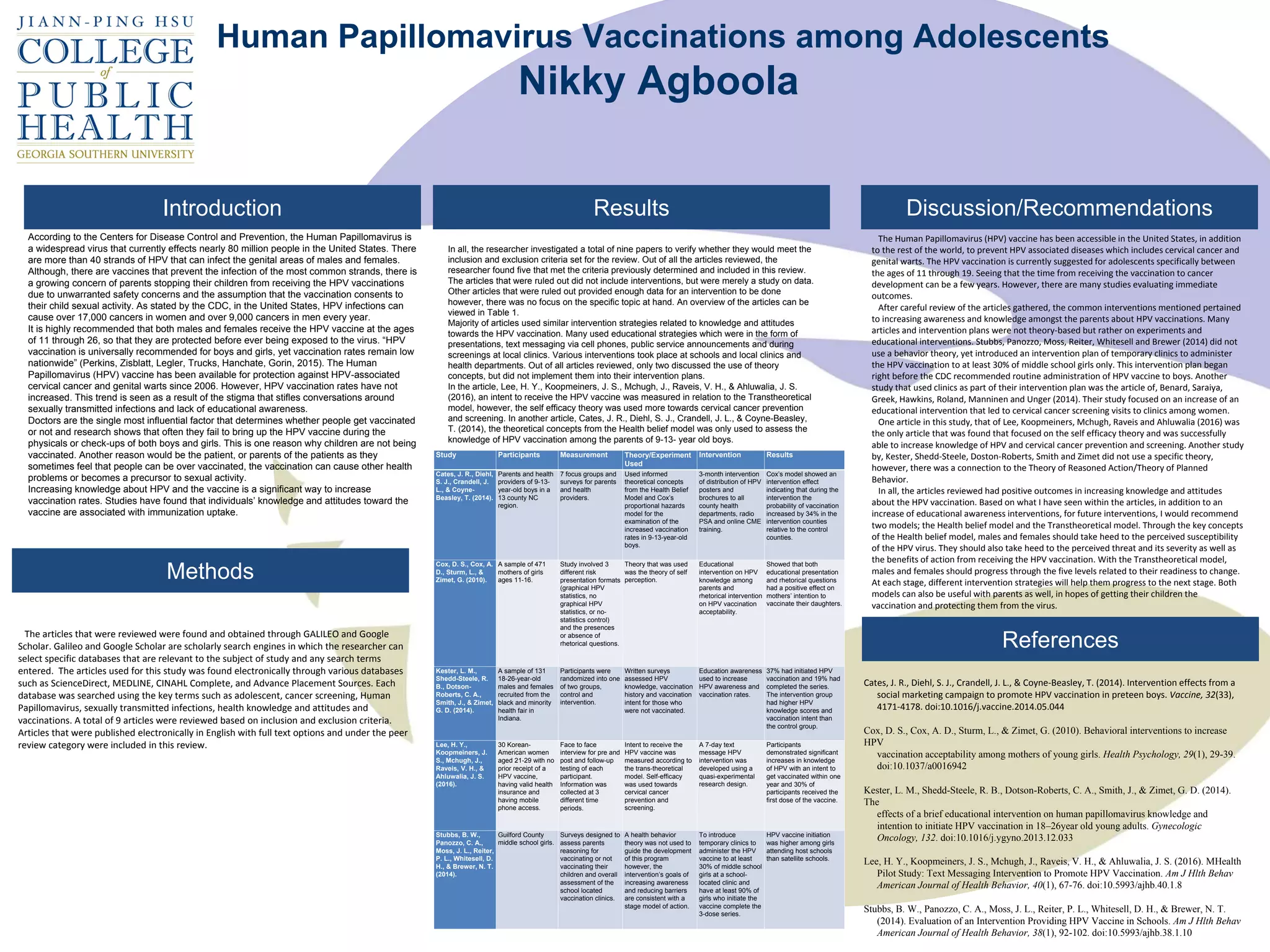
In all, the researcher investigated a total of nine papers to verify whether they would meet the
inclusion and exclusion criteria set for the review. Out of all the articles reviewed, the
researcher found five that met the criteria previously determined and included in this review.
The articles that were ruled out did not include interventions, but were merely a study on data.
Other articles that were ruled out provided enough data for an intervention to be done
however, there was no focus on the specific topic at hand. An overview of the articles can be
viewed in Table 1.
Majority of articles used similar intervention strategies related to knowledge and attitudes
towards the HPV vaccination. Many used educational strategies which were in the form of
presentations, text messaging via cell phones, public service announcements and during
screenings at local clinics. Various interventions took place at schools and local clinics and
health departments. Out of all articles reviewed, only two discussed the use of theory
concepts, but did not implement them into their intervention plans.
In the article, Lee, H. Y., Koopmeiners, J. S., Mchugh, J., Raveis, V. H., & Ahluwalia, J. S.
(2016), an intent to receive the HPV vaccine was measured in relation to the Transtheoretical
model, however, the self efficacy theory was used more towards cervical cancer prevention
and screening. In another article, Cates, J. R., Diehl, S. J., Crandell, J. L., & Coyne-Beasley,
T. (2014), the theoretical concepts from the Health belief model was only used to assess the
knowledge of HPV vaccination among the parents of 9-13- year old boys.
The Human Papillomavirus (HPV) vaccine has been accessible in the United States, in addition
to the rest of the world, to prevent HPV associated diseases which includes cervical cancer and
genital warts. The HPV vaccination is currently suggested for adolescents specifically between
the ages of 11 through 19. Seeing that the time from receiving the vaccination to cancer
development can be a few years. However, there are many studies evaluating immediate
outcomes.
After careful review of the articles gathered, the common interventions mentioned pertained
to increasing awareness and knowledge amongst the parents about HPV vaccinations. Many
articles and intervention plans were not theory-based but rather on experiments and
educational interventions. Stubbs, Panozzo, Moss, Reiter, Whitesell and Brewer (2014) did not
use a behavior theory, yet introduced an intervention plan of temporary clinics to administer
the HPV vaccination to at least 30% of middle school girls only. This intervention plan began
right before the CDC recommended routine administration of HPV vaccine to boys. Another
study that used clinics as part of their intervention plan was the article of, Benard, Saraiya,
Greek, Hawkins, Roland, Manninen and Unger (2014). Their study focused on an increase of an
educational intervention that led to cervical cancer screening visits to clinics among women.
One article in this study, that of Lee, Koopmeiners, Mchugh, Raveis and Ahluwalia (2016) was
the only article that was found that focused on the self efficacy theory and was successfully
able to increase knowledge of HPV and cervical cancer prevention and screening. Another study
by, Kester, Shedd-Steele, Doston-Roberts, Smith and Zimet did not use a specific theory,
however, there was a connection to the Theory of Reasoned Action/Theory of Planned
Behavior.
In all, the articles reviewed had positive outcomes in increasing knowledge and attitudes
about the HPV vaccination. Based on what I have seen within the articles, in addition to an
increase of educational awareness interventions, for future interventions, I would recommend
two models; the Health belief model and the Transtheoretical model. Through the key concepts
of the Health belief model, males and females should take heed to the perceived susceptibility
of the HPV virus. They should also take heed to the perceived threat and its severity as well as
the benefits of action from receiving the HPV vaccination. With the Transtheoretical model,
males and females should progress through the five levels related to their readiness to change.
At each stage, different intervention strategies will help them progress to the next stage. Both
models can also be useful with parents as well, in hopes of getting their children the
vaccination and protecting them from the virus.
Cates, J. R., Diehl, S. J., Crandell, J. L., & Coyne-Beasley, T. (2014). Intervention effects from a
social marketing campaign to promote HPV vaccination in preteen boys. Vaccine, 32(33),
4171-4178. doi:10.1016/j.vaccine.2014.05.044
Cox, D. S., Cox, A. D., Sturm, L., & Zimet, G. (2010). Behavioral interventions to increase
HPV
vaccination acceptability among mothers of young girls. Health Psychology, 29(1), 29-39.
doi:10.1037/a0016942
Kester, L. M., Shedd-Steele, R. B., Dotson-Roberts, C. A., Smith, J., & Zimet, G. D. (2014).
The
effects of a brief educational intervention on human papillomavirus knowledge and
intention to initiate HPV vaccination in 18–26year old young adults. Gynecologic
Oncology, 132. doi:10.1016/j.ygyno.2013.12.033
Lee, H. Y., Koopmeiners, J. S., Mchugh, J., Raveis, V. H., & Ahluwalia, J. S. (2016). MHealth
Pilot Study: Text Messaging Intervention to Promote HPV Vaccination. Am J Hlth Behav
American Journal of Health Behavior, 40(1), 67-76. doi:10.5993/ajhb.40.1.8
Stubbs, B. W., Panozzo, C. A., Moss, J. L., Reiter, P. L., Whitesell, D. H., & Brewer, N. T.
(2014). Evaluation of an Intervention Providing HPV Vaccine in Schools. Am J Hlth Behav
American Journal of Health Behavior, 38(1), 92-102. doi:10.5993/ajhb.38.1.10

Systematic Review Poster

  • 1.
    Human Papillomavirus Vaccinationsamong Adolescents Nikky Agboola Introduction Methods Discussion/Recommendations References Results According to the Centers for Disease Control and Prevention, the Human Papillomavirus is a widespread virus that currently effects nearly 80 million people in the United States. There are more than 40 strands of HPV that can infect the genital areas of males and females. Although, there are vaccines that prevent the infection of the most common strands, there is a growing concern of parents stopping their children from receiving the HPV vaccinations due to unwarranted safety concerns and the assumption that the vaccination consents to their child sexual activity. As stated by the CDC, in the United States, HPV infections can cause over 17,000 cancers in women and over 9,000 cancers in men every year. It is highly recommended that both males and females receive the HPV vaccine at the ages of 11 through 26, so that they are protected before ever being exposed to the virus. “HPV vaccination is universally recommended for boys and girls, yet vaccination rates remain low nationwide” (Perkins, Zisblatt, Legler, Trucks, Hanchate, Gorin, 2015). The Human Papillomavirus (HPV) vaccine has been available for protection against HPV-associated cervical cancer and genital warts since 2006. However, HPV vaccination rates have not increased. This trend is seen as a result of the stigma that stifles conversations around sexually transmitted infections and lack of educational awareness. Doctors are the single most influential factor that determines whether people get vaccinated or not and research shows that often they fail to bring up the HPV vaccine during the physicals or check-ups of both boys and girls. This is one reason why children are not being vaccinated. Another reason would be the patient, or parents of the patients as they sometimes feel that people can be over vaccinated, the vaccination can cause other health problems or becomes a precursor to sexual activity. Increasing knowledge about HPV and the vaccine is a significant way to increase vaccination rates. Studies have found that individuals’ knowledge and attitudes toward the vaccine are associated with immunization uptake. The articles that were reviewed were found and obtained through GALILEO and Google Scholar. Galileo and Google Scholar are scholarly search engines in which the researcher can select specific databases that are relevant to the subject of study and any search terms entered. The articles used for this study was found electronically through various databases such as ScienceDirect, MEDLINE, CINAHL Complete, and Advance Placement Sources. Each database was searched using the key terms such as adolescent, cancer screening, Human Papillomavirus, sexually transmitted infections, health knowledge and attitudes and vaccinations. A total of 9 articles were reviewed based on inclusion and exclusion criteria. Articles that were published electronically in English with full text options and under the peer review category were included in this review. Study Participants Measurement Theory/Experiment Used Intervention Results Cates, J. R., Diehl, S. J., Crandell, J. L., & Coyne- Beasley, T. (2014). Parents and health providers of 9-13- year-old boys in a 13 county NC region. 7 focus groups and surveys for parents and health providers. Used informed theoretical concepts from the Health Belief Model and Cox’s proportional hazards model for the examination of the increased vaccination rates in 9-13-year-old boys. 3-month intervention of distribution of HPV posters and brochures to all county health departments, radio PSA and online CME training. Cox’s model showed an intervention effect indicating that during the intervention the probability of vaccination increased by 34% in the intervention counties relative to the control counties. Cox, D. S., Cox, A. D., Sturm, L., & Zimet, G. (2010). A sample of 471 mothers of girls ages 11-16. Study involved 3 different risk presentation formats (graphical HPV statistics, no graphical HPV statistics, or no- statistics control) and the presences or absence of rhetorical questions. Theory that was used was the theory of self perception. Educational intervention on HPV knowledge among parents and rhetorical intervention on HPV vaccination acceptability. Showed that both educational presentation and rhetorical questions had a positive effect on mothers’ intention to vaccinate their daughters. Kester, L. M., Shedd-Steele, R. B., Dotson- Roberts, C. A., Smith, J., & Zimet, G. D. (2014). A sample of 131 18-26-year-old males and females recruited from the black and minority health fair in Indiana. Participants were randomized into one of two groups, control and intervention. Written surveys assessed HPV knowledge, vaccination history and vaccination intent for those who were not vaccinated. Education awareness used to increase HPV awareness and vaccination rates. 37% had initiated HPV vaccination and 19% had completed the series. The intervention group had higher HPV knowledge scores and vaccination intent than the control group. Lee, H. Y., Koopmeiners, J. S., Mchugh, J., Raveis, V. H., & Ahluwalia, J. S. (2016). 30 Korean- American women aged 21-29 with no prior receipt of a HPV vaccine, having valid health insurance and having mobile phone access. Face to face interview for pre and post and follow-up testing of each participant. Information was collected at 3 different time periods. Intent to receive the HPV vaccine was measured according to the trans-theoretical model. Self-efficacy was used towards cervical cancer prevention and screening. A 7-day text message HPV intervention was developed using a quasi-experimental research design. Participants demonstrated significant increases in knowledge of HPV with an intent to get vaccinated within one year and 30% of participants received the first dose of the vaccine. Stubbs, B. W., Panozzo, C. A., Moss, J. L., Reiter, P. L., Whitesell, D. H., & Brewer, N. T. (2014). Guilford County middle school girls. Surveys designed to assess parents reasoning for vaccinating or not vaccinating their children and overall assessment of the school located vaccination clinics. A health behavior theory was not used to guide the development of this program however, the intervention’s goals of increasing awareness and reducing barriers are consistent with a stage model of action. To introduce temporary clinics to administer the HPV vaccine to at least 30% of middle school girls at a school- located clinic and have at least 90% of girls who initiate the vaccine complete the 3-dose series. HPV vaccine initiation was higher among girls attending host schools than satellite schools. In all, the researcher investigated a total of nine papers to verify whether they would meet the inclusion and exclusion criteria set for the review. Out of all the articles reviewed, the researcher found five that met the criteria previously determined and included in this review. The articles that were ruled out did not include interventions, but were merely a study on data. Other articles that were ruled out provided enough data for an intervention to be done however, there was no focus on the specific topic at hand. An overview of the articles can be viewed in Table 1. Majority of articles used similar intervention strategies related to knowledge and attitudes towards the HPV vaccination. Many used educational strategies which were in the form of presentations, text messaging via cell phones, public service announcements and during screenings at local clinics. Various interventions took place at schools and local clinics and health departments. Out of all articles reviewed, only two discussed the use of theory concepts, but did not implement them into their intervention plans. In the article, Lee, H. Y., Koopmeiners, J. S., Mchugh, J., Raveis, V. H., & Ahluwalia, J. S. (2016), an intent to receive the HPV vaccine was measured in relation to the Transtheoretical model, however, the self efficacy theory was used more towards cervical cancer prevention and screening. In another article, Cates, J. R., Diehl, S. J., Crandell, J. L., & Coyne-Beasley, T. (2014), the theoretical concepts from the Health belief model was only used to assess the knowledge of HPV vaccination among the parents of 9-13- year old boys. The Human Papillomavirus (HPV) vaccine has been accessible in the United States, in addition to the rest of the world, to prevent HPV associated diseases which includes cervical cancer and genital warts. The HPV vaccination is currently suggested for adolescents specifically between the ages of 11 through 19. Seeing that the time from receiving the vaccination to cancer development can be a few years. However, there are many studies evaluating immediate outcomes. After careful review of the articles gathered, the common interventions mentioned pertained to increasing awareness and knowledge amongst the parents about HPV vaccinations. Many articles and intervention plans were not theory-based but rather on experiments and educational interventions. Stubbs, Panozzo, Moss, Reiter, Whitesell and Brewer (2014) did not use a behavior theory, yet introduced an intervention plan of temporary clinics to administer the HPV vaccination to at least 30% of middle school girls only. This intervention plan began right before the CDC recommended routine administration of HPV vaccine to boys. Another study that used clinics as part of their intervention plan was the article of, Benard, Saraiya, Greek, Hawkins, Roland, Manninen and Unger (2014). Their study focused on an increase of an educational intervention that led to cervical cancer screening visits to clinics among women. One article in this study, that of Lee, Koopmeiners, Mchugh, Raveis and Ahluwalia (2016) was the only article that was found that focused on the self efficacy theory and was successfully able to increase knowledge of HPV and cervical cancer prevention and screening. Another study by, Kester, Shedd-Steele, Doston-Roberts, Smith and Zimet did not use a specific theory, however, there was a connection to the Theory of Reasoned Action/Theory of Planned Behavior. In all, the articles reviewed had positive outcomes in increasing knowledge and attitudes about the HPV vaccination. Based on what I have seen within the articles, in addition to an increase of educational awareness interventions, for future interventions, I would recommend two models; the Health belief model and the Transtheoretical model. Through the key concepts of the Health belief model, males and females should take heed to the perceived susceptibility of the HPV virus. They should also take heed to the perceived threat and its severity as well as the benefits of action from receiving the HPV vaccination. With the Transtheoretical model, males and females should progress through the five levels related to their readiness to change. At each stage, different intervention strategies will help them progress to the next stage. Both models can also be useful with parents as well, in hopes of getting their children the vaccination and protecting them from the virus. Cates, J. R., Diehl, S. J., Crandell, J. L., & Coyne-Beasley, T. (2014). Intervention effects from a social marketing campaign to promote HPV vaccination in preteen boys. Vaccine, 32(33), 4171-4178. doi:10.1016/j.vaccine.2014.05.044 Cox, D. S., Cox, A. D., Sturm, L., & Zimet, G. (2010). Behavioral interventions to increase HPV vaccination acceptability among mothers of young girls. Health Psychology, 29(1), 29-39. doi:10.1037/a0016942 Kester, L. M., Shedd-Steele, R. B., Dotson-Roberts, C. A., Smith, J., & Zimet, G. D. (2014). The effects of a brief educational intervention on human papillomavirus knowledge and intention to initiate HPV vaccination in 18–26year old young adults. Gynecologic Oncology, 132. doi:10.1016/j.ygyno.2013.12.033 Lee, H. Y., Koopmeiners, J. S., Mchugh, J., Raveis, V. H., & Ahluwalia, J. S. (2016). MHealth Pilot Study: Text Messaging Intervention to Promote HPV Vaccination. Am J Hlth Behav American Journal of Health Behavior, 40(1), 67-76. doi:10.5993/ajhb.40.1.8 Stubbs, B. W., Panozzo, C. A., Moss, J. L., Reiter, P. L., Whitesell, D. H., & Brewer, N. T. (2014). Evaluation of an Intervention Providing HPV Vaccine in Schools. Am J Hlth Behav American Journal of Health Behavior, 38(1), 92-102. doi:10.5993/ajhb.38.1.10