1
Sistemas Distribuidos
System Models
René Guamán-Quinche
Facultad de la Energía, las Industrias y los Recursos Naturales No Renovables
Carrera de Ingeniería en Sistemas/Computación
Octubre, 2020
Loja, Ecuador
3
1. Introduction
2. Physical Models
3. Architectural models
4. Fundamental models
Contenido
4
Introduction
Distributed system design can be explained through three different models:

Physical models – models that capture the hardware composition of a system in terms of
computer and their interconnecting networks

Architectural models – models that describe the system in terms of the computational and
communication tasks performed by its computational elements

Fundamental models – models that describe an abstraction of individual items in
distributed systems. Three models; interaction, failure, and security models
5
PHYSICAL MODELS

Basic physical models - baseline physical model
 Model that shows hardware and software components located at
networked computers communicate and coordinate their actions by
passing message

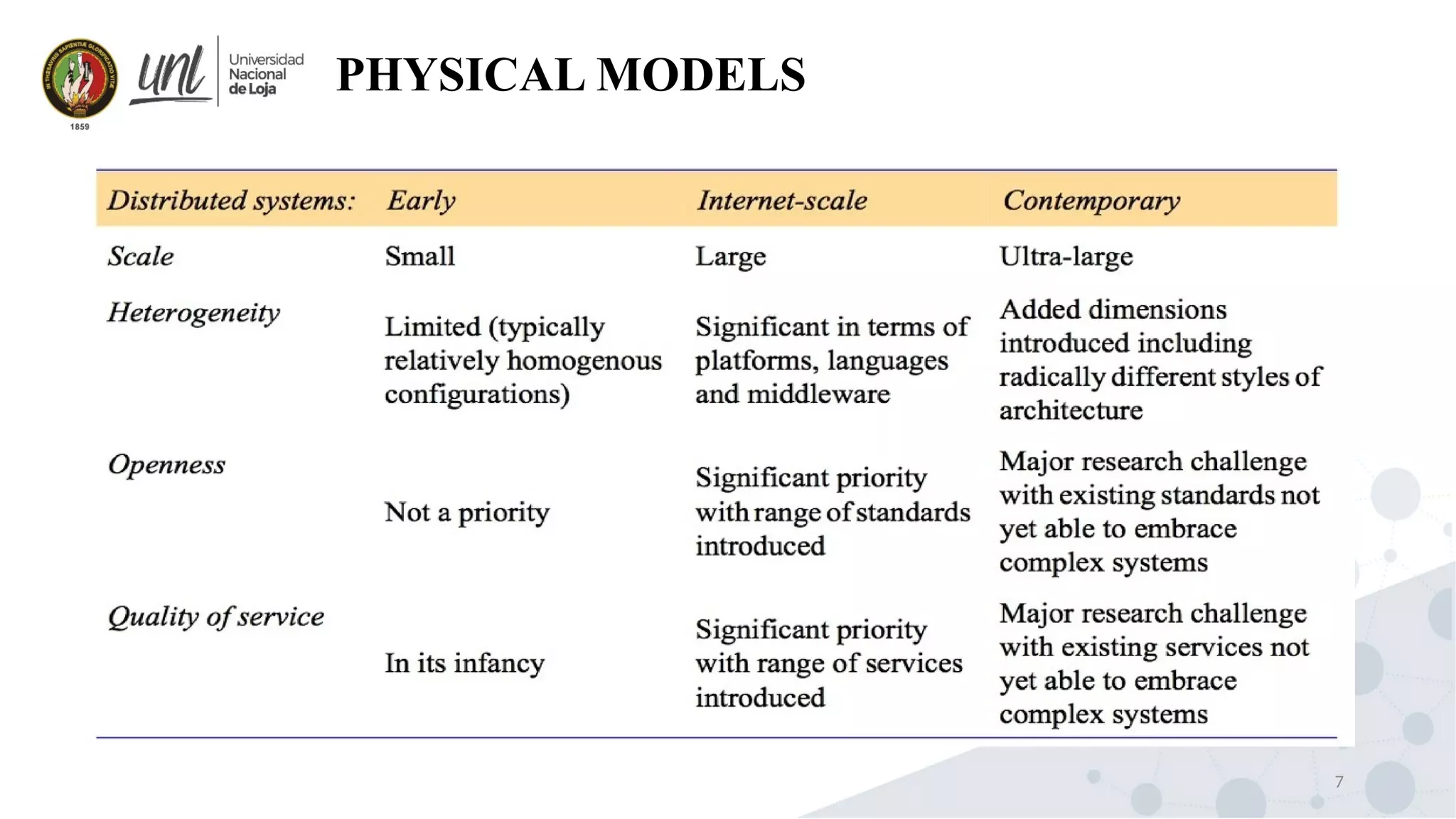
Three generations of distributed systems:
 Early distributed systems
 Internet-scale distributed systems
 Contemporary distributed systems
6
PHYSICAL MODELS
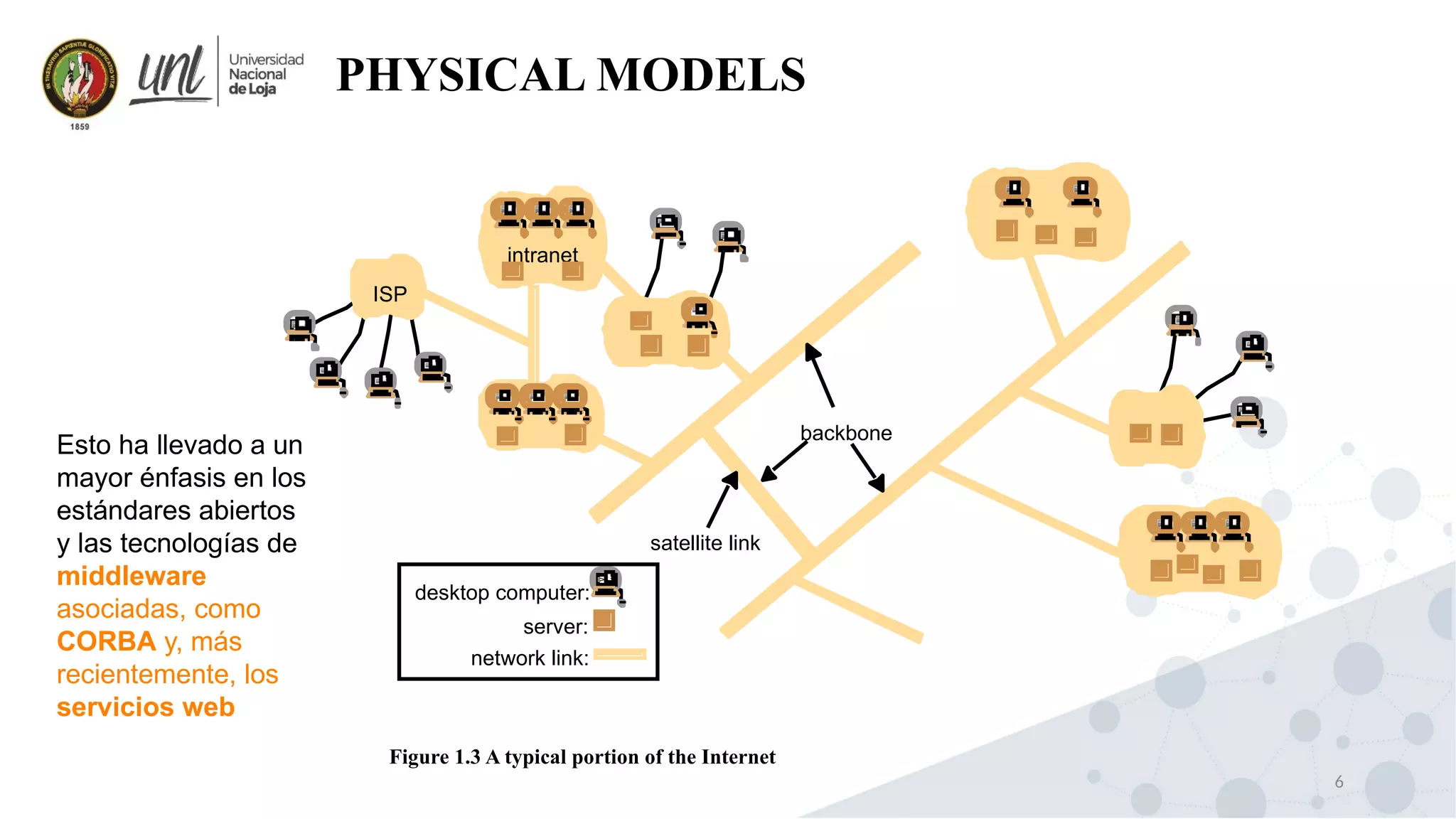
intranet
ISP
desktop computer:
backbone
satellite link
server:
Se rv er
Cli ent
Cl ien t
invocat ion
r esul t
Serve rinvoca ti on
r es ul t
P ro cess:
Key:
Com pute r:
☎
network link:
☎
☎
☎
Figure 1.3 A typical portion of the Internet
Esto ha llevado a un
mayor énfasis en los
estándares abiertos
y las tecnologías de
middleware
asociadas, como
CORBA y, más
recientemente, los
servicios web
7
PHYSICAL MODELS
8
PHYSICAL MODELS
9
PHYSICAL MODELS
10
ARCHITECTURAL MODELS

Architecture?
 The structure of a system specifying its
components and their interrelationships

Why architecture?
 To ensure that the structure will meet the current
and future demands on it
 To provide a reliable, manageable, adaptable and
cost-effective system
11
ARCHITECTURAL MODELS
 How to understand the fundamental building
blocks of a distributed system?

What are the entities that are communicating in the
distributed system (communicating entities)?

How do they communicate, or, what communication
paradigm is used (communication paradigms)?

What roles and responsibilities do they have in the
overall architecture (roles and responsibilities)?

How do they mapped on to the physical distributed
architecture (what is their placement)?
Architectural elements:
12
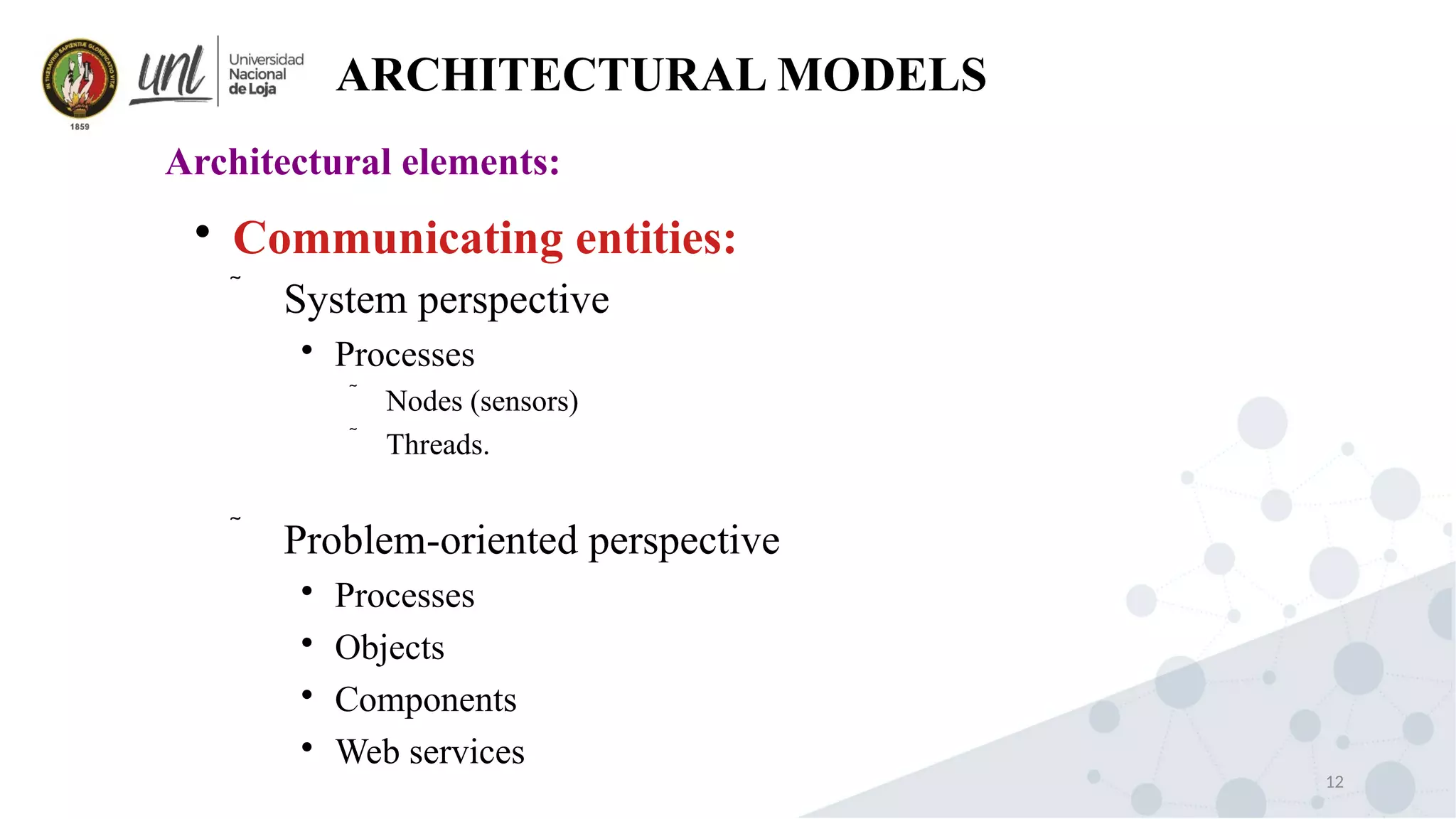
ARCHITECTURAL MODELS
Architectural elements:

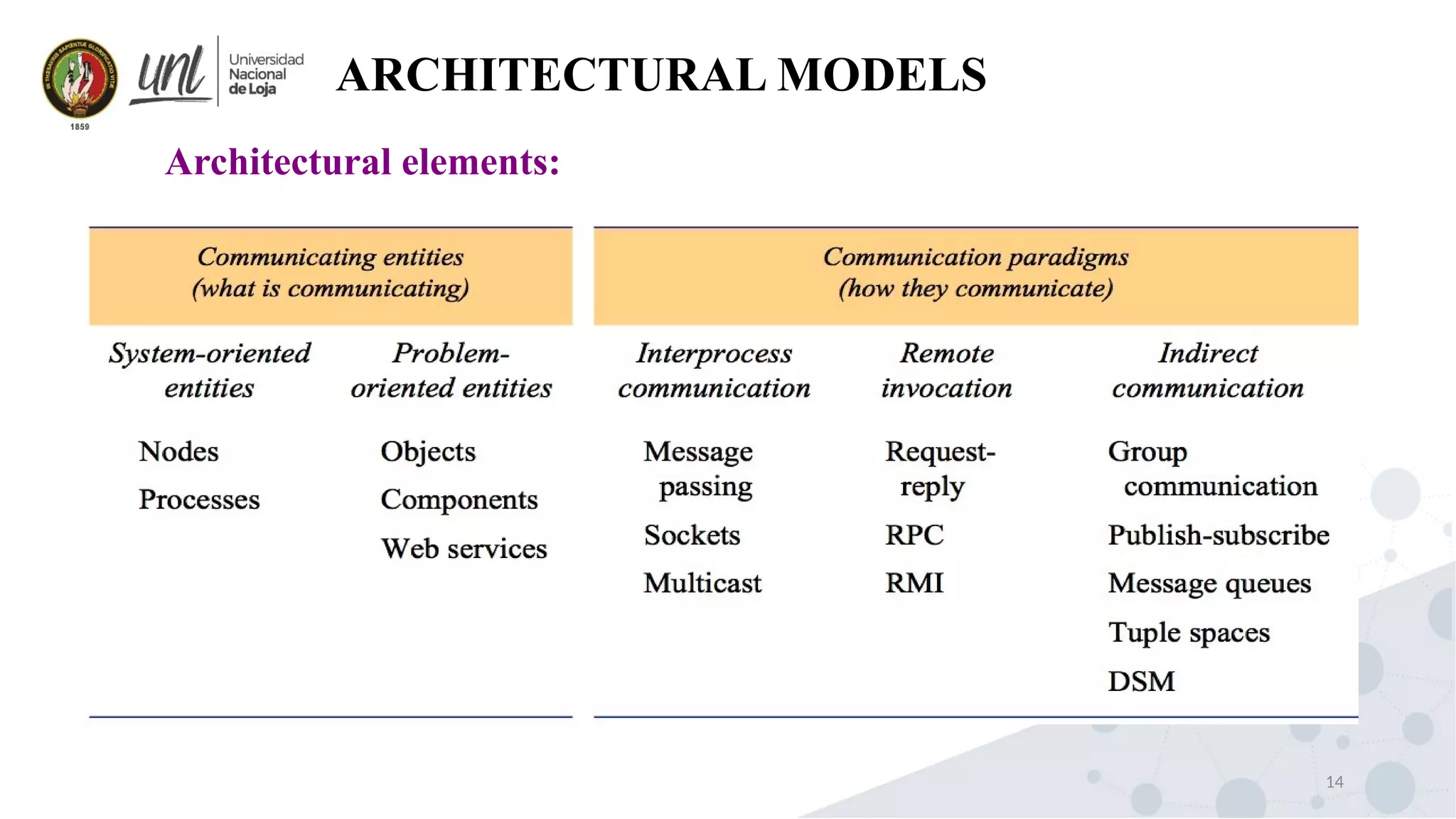
Communicating entities:
 System perspective

Processes
 Nodes (sensors)
 Threads.
 Problem-oriented perspective

Processes

Objects

Components

Web services
13
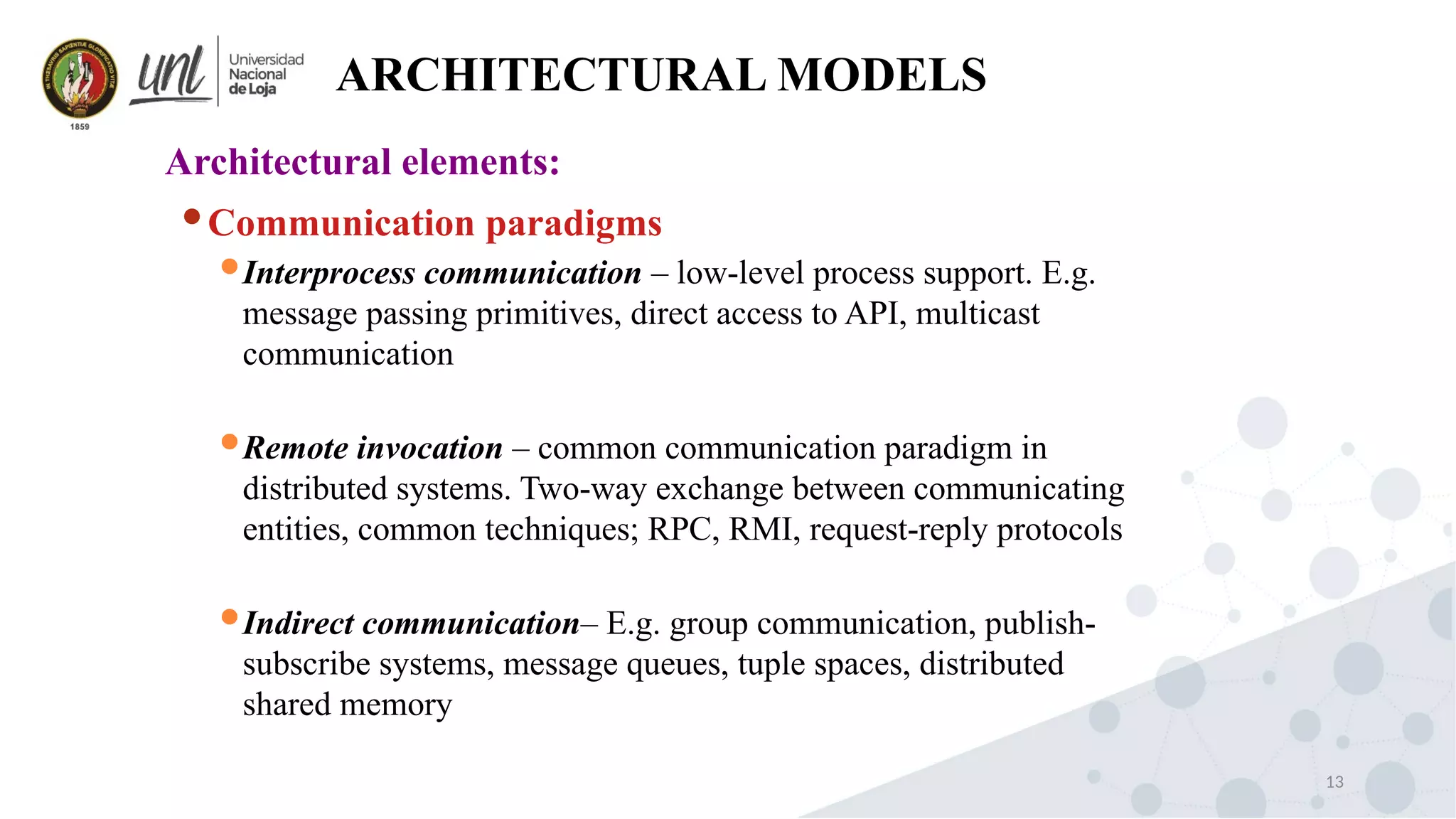
ARCHITECTURAL MODELS
Architectural elements:
Communication paradigms
Interprocess communication – low-level process support. E.g.
message passing primitives, direct access to API, multicast
communication
Remote invocation – common communication paradigm in
distributed systems. Two-way exchange between communicating
entities, common techniques; RPC, RMI, request-reply protocols
Indirect communication– E.g. group communication, publish-
subscribe systems, message queues, tuple spaces, distributed
shared memory
14
ARCHITECTURAL MODELS
Architectural elements:
15
ARCHITECTURAL MODELS
Architectural elements:

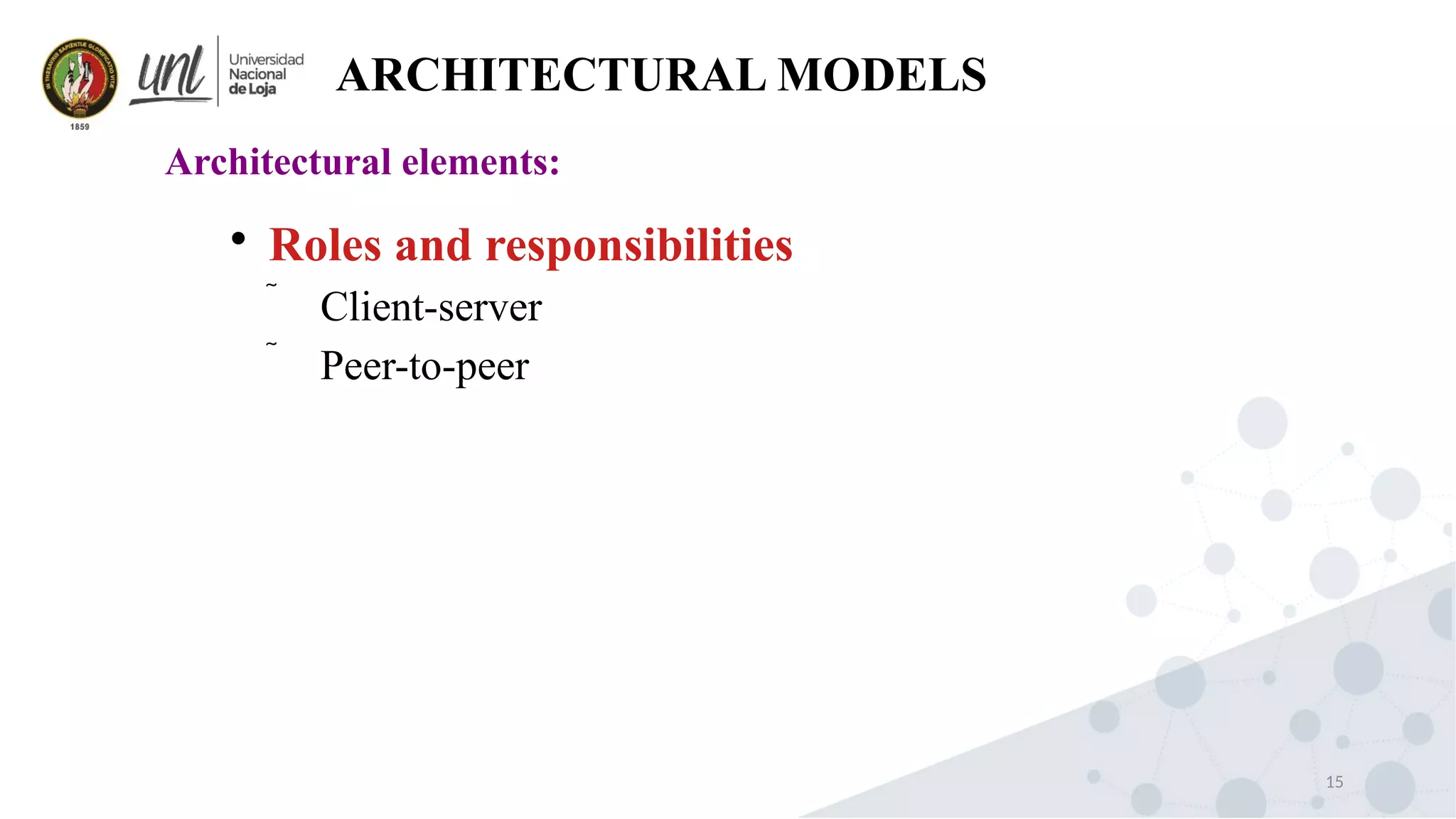
Roles and responsibilities
 Client-server
 Peer-to-peer
16
ARCHITECTURAL MODELS
Architectural elements:
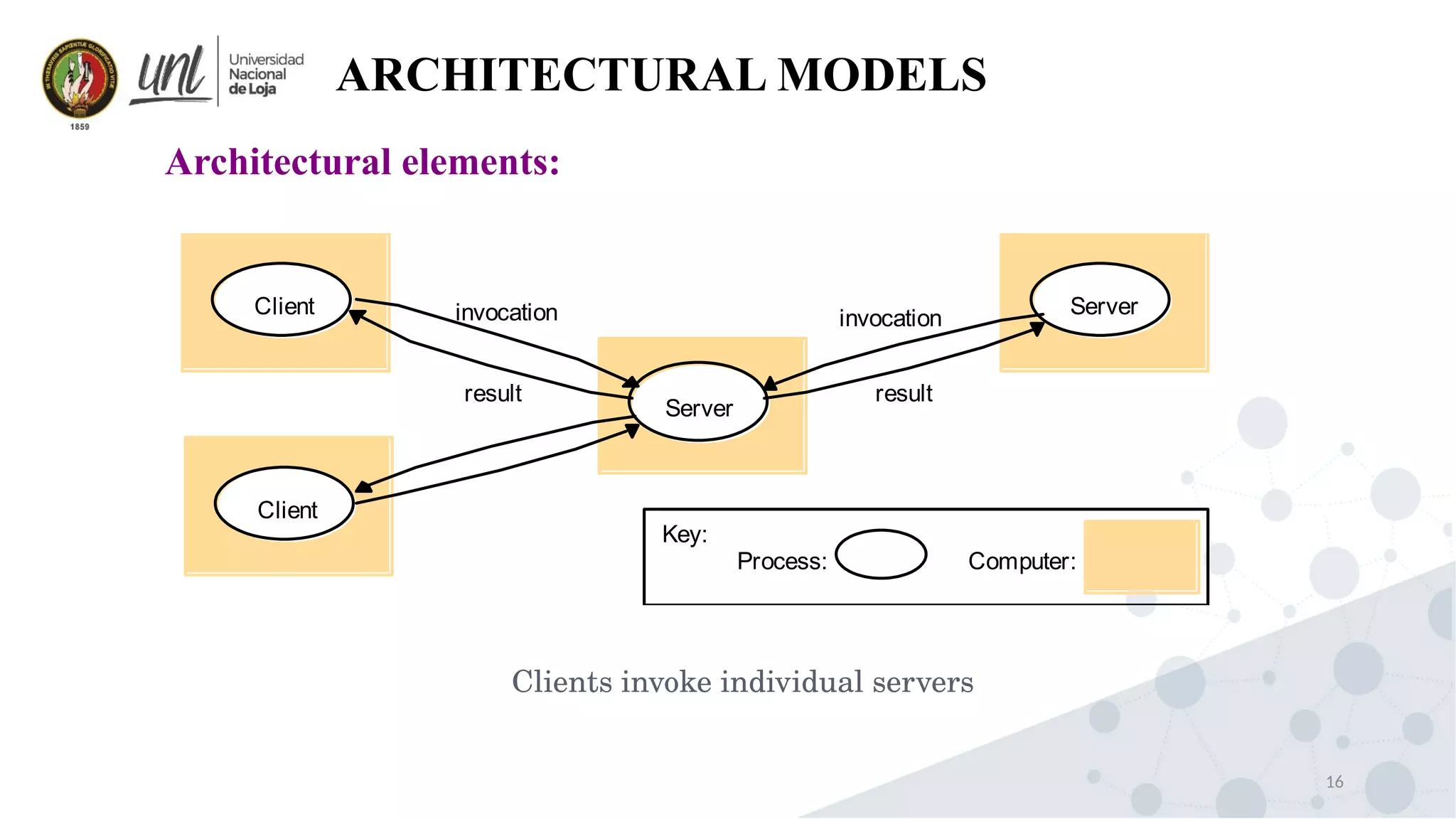
Server
Client
Client
invocation
result
Serverinvocation
result
Process:
Key:
Computer:
Clients invoke individual servers
17
ARCHITECTURAL MODELS
Architectural elements:
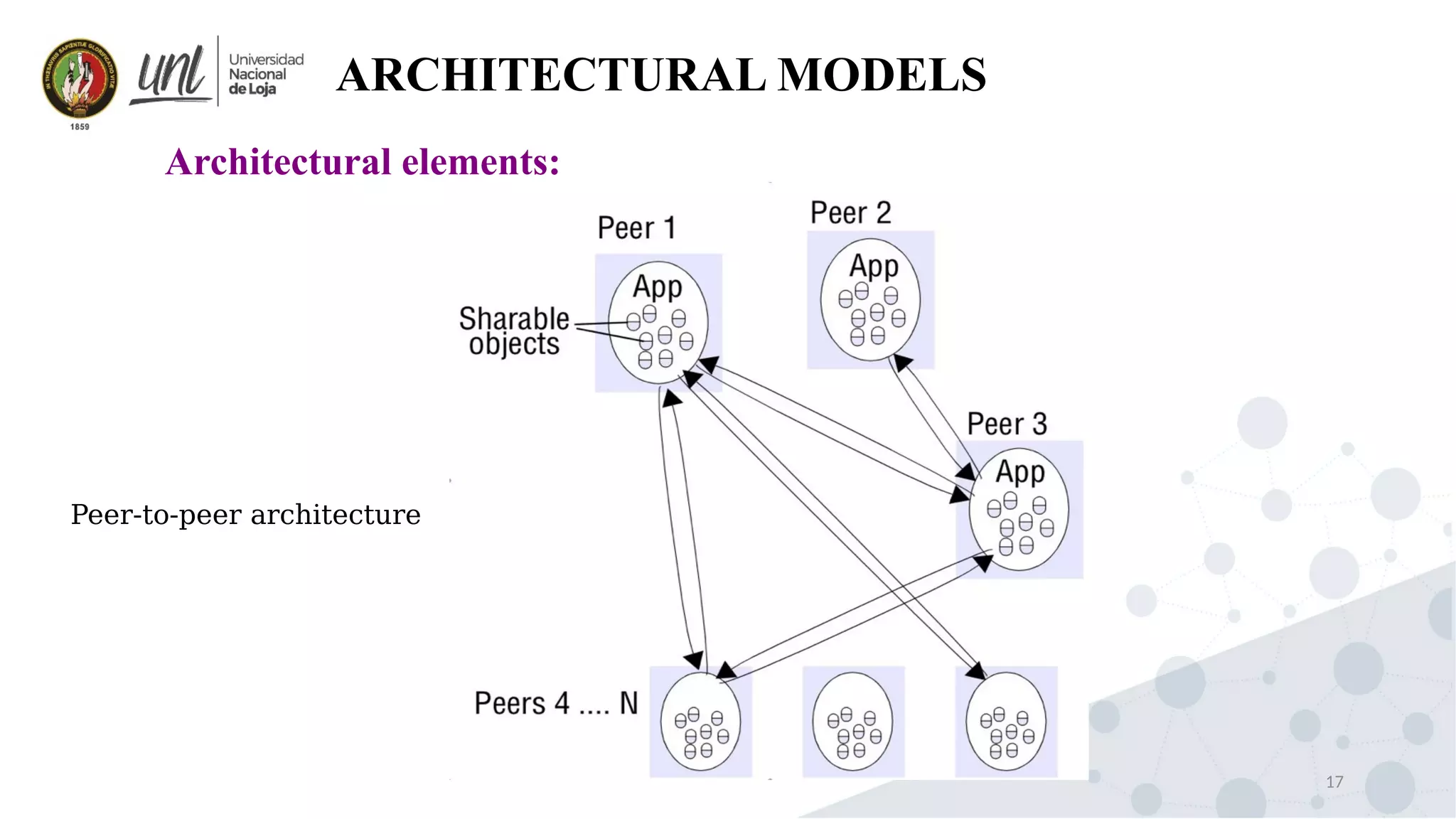
Peer-to-peer architecture
18
ARCHITECTURAL MODELS
Architectural elements:
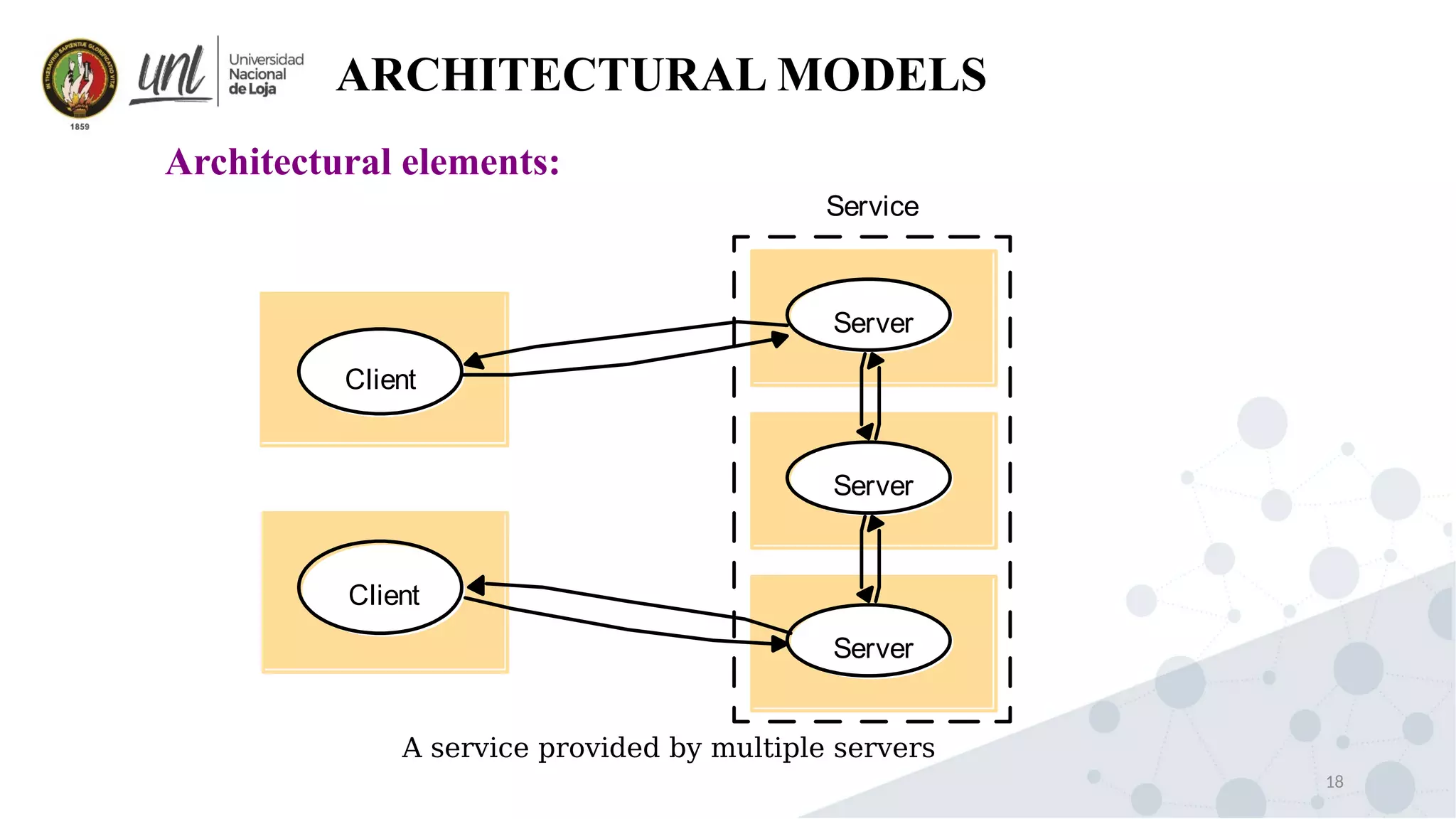
Server
Server
Server
Service
Client
Client
A service provided by multiple servers
19
ARCHITECTURAL MODELS
Architectural elements:
Placement strategies:
Mapping of services to multiple servers – several servers
process services in separate hosts. Example: Sun Network
Information Service (NIS)
Caching – storing recently used data objects. Example: web
proxy server
Mobile code – Code can be downloaded and run on user’s
machine. Example: Applet
Mobile agents – Code and data travel in a network and
performing specific tasks on behalf of the users. Example: Web
crawler program
20
ARCHITECTURAL MODELS
Architectural elements:
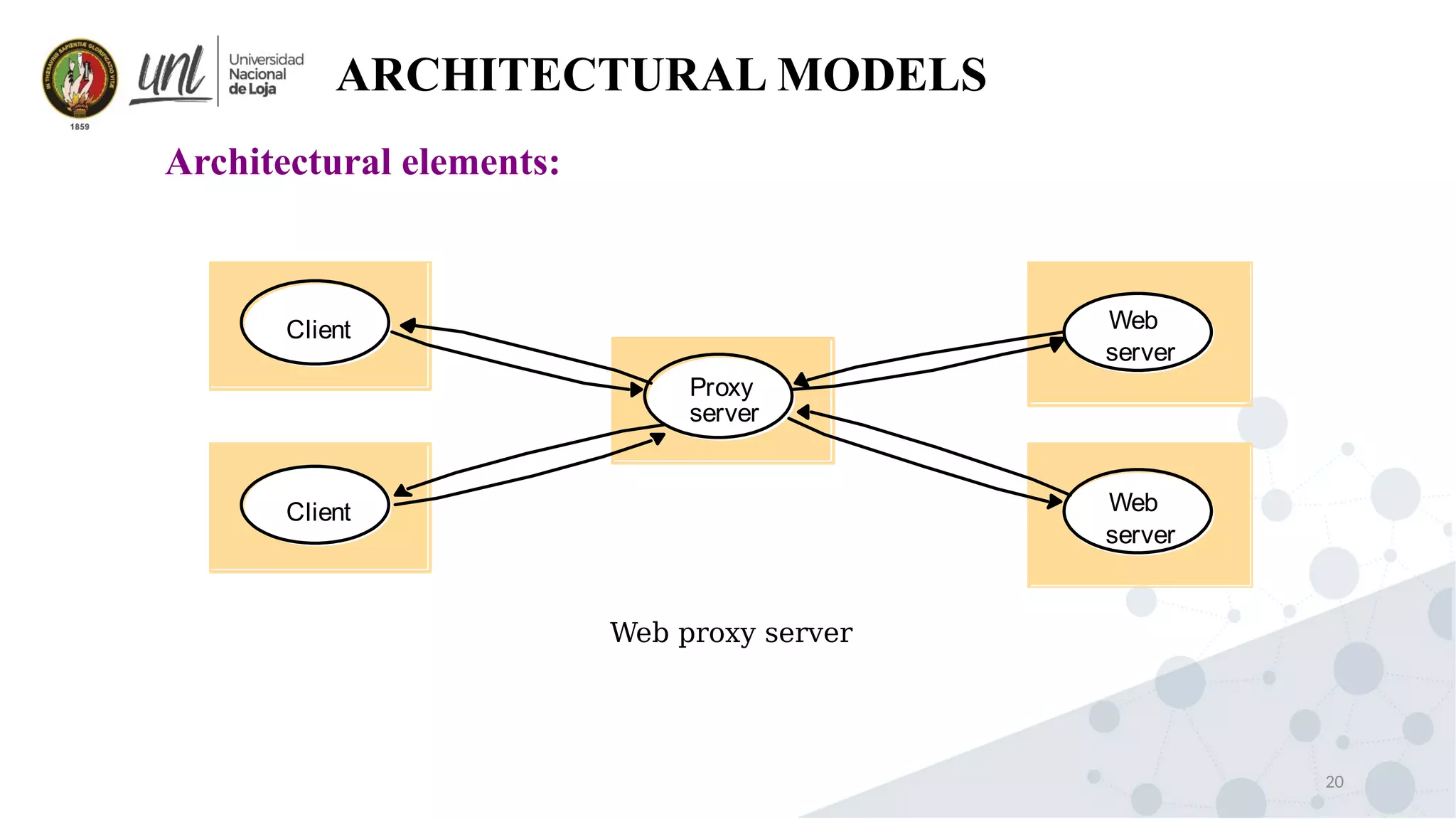
Client
Proxy
Web
server
Web
server
server
Client
Web proxy server
21
ARCHITECTURAL MODELS
Architectural elements:
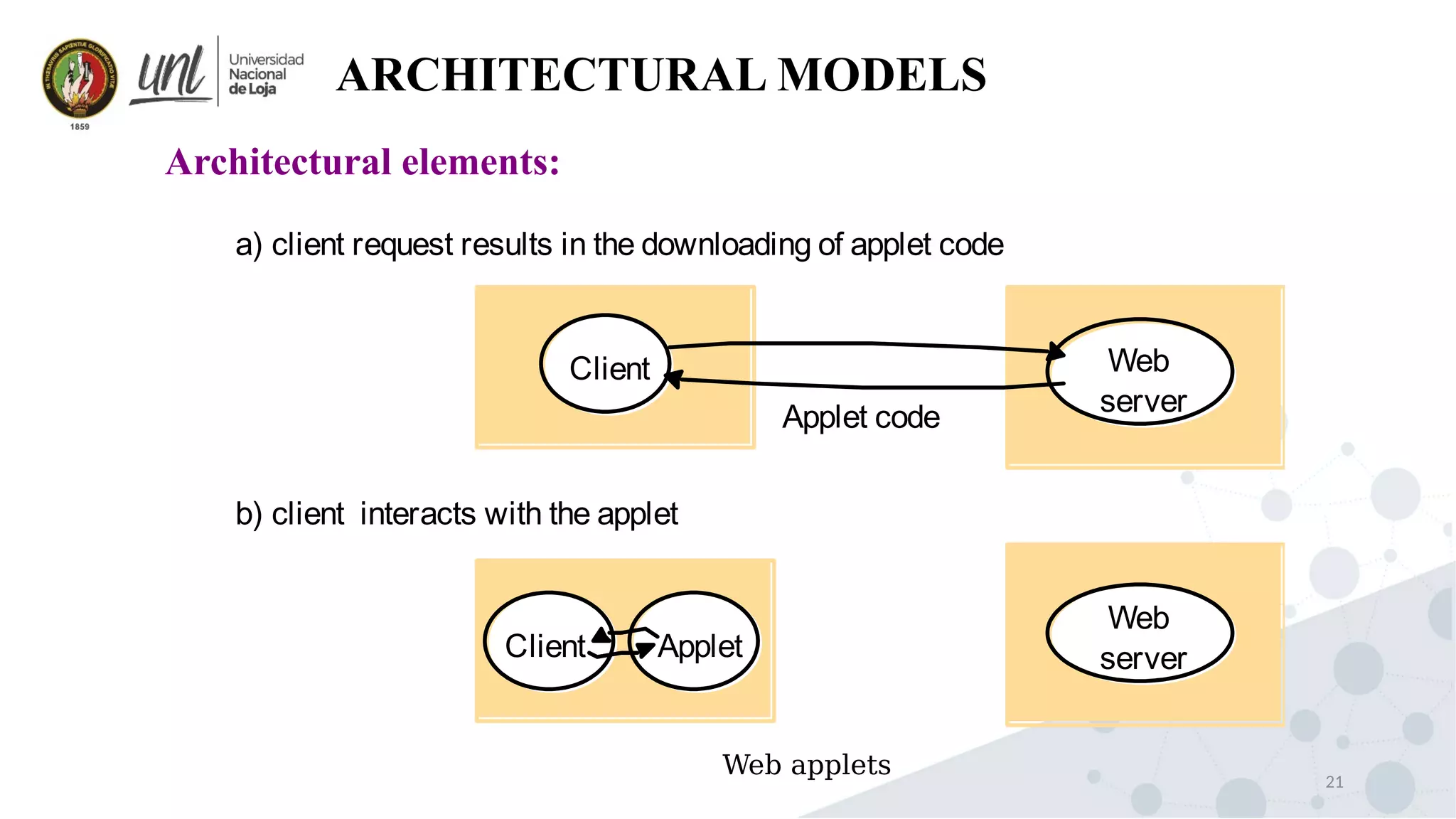
a) client request results in the downloading of applet code
Web
server
Client
Web
serverApplet
Applet code
Client
b) client interacts with the applet
Web applets
22
ARCHITECTURAL MODELS
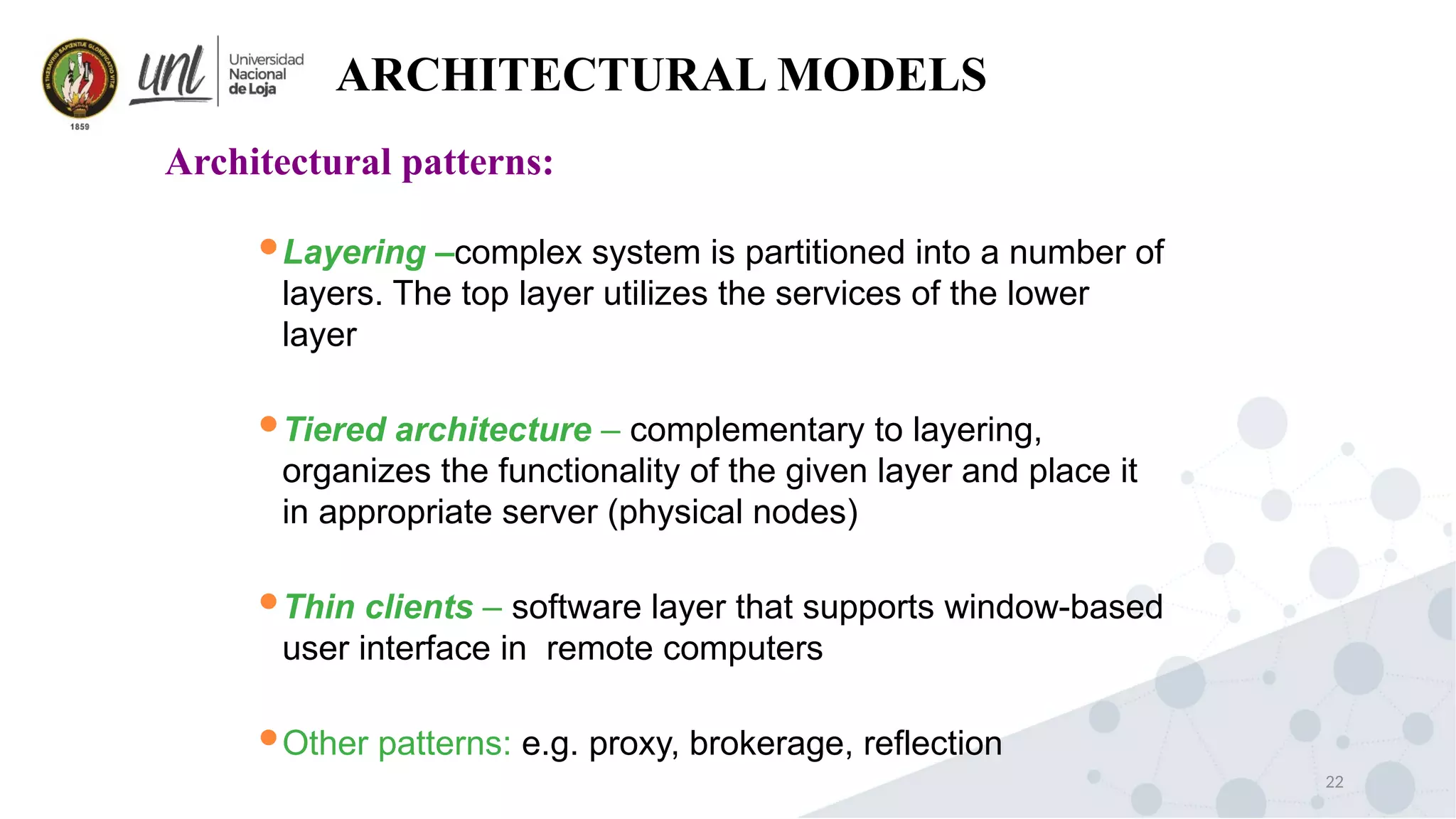
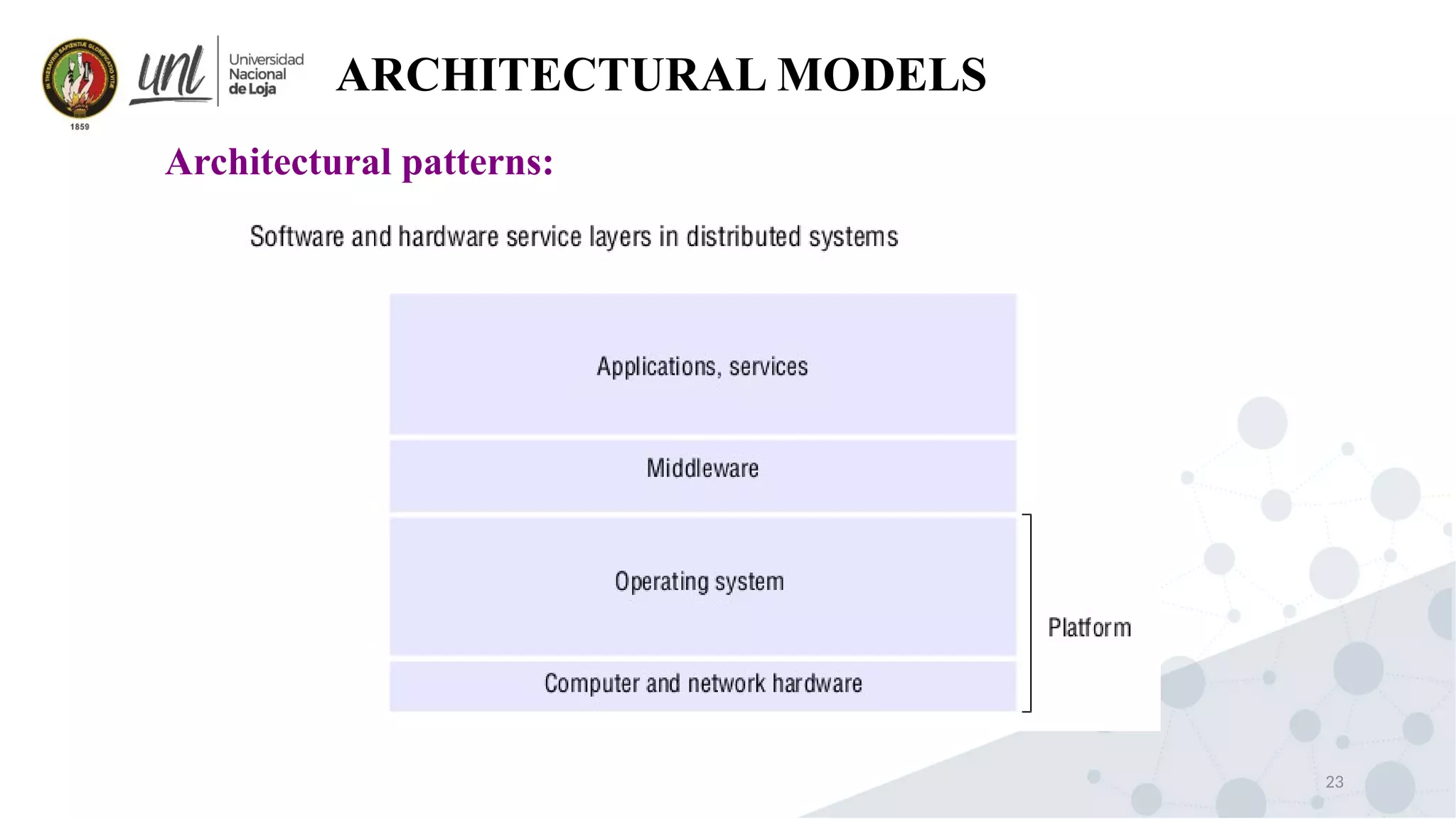
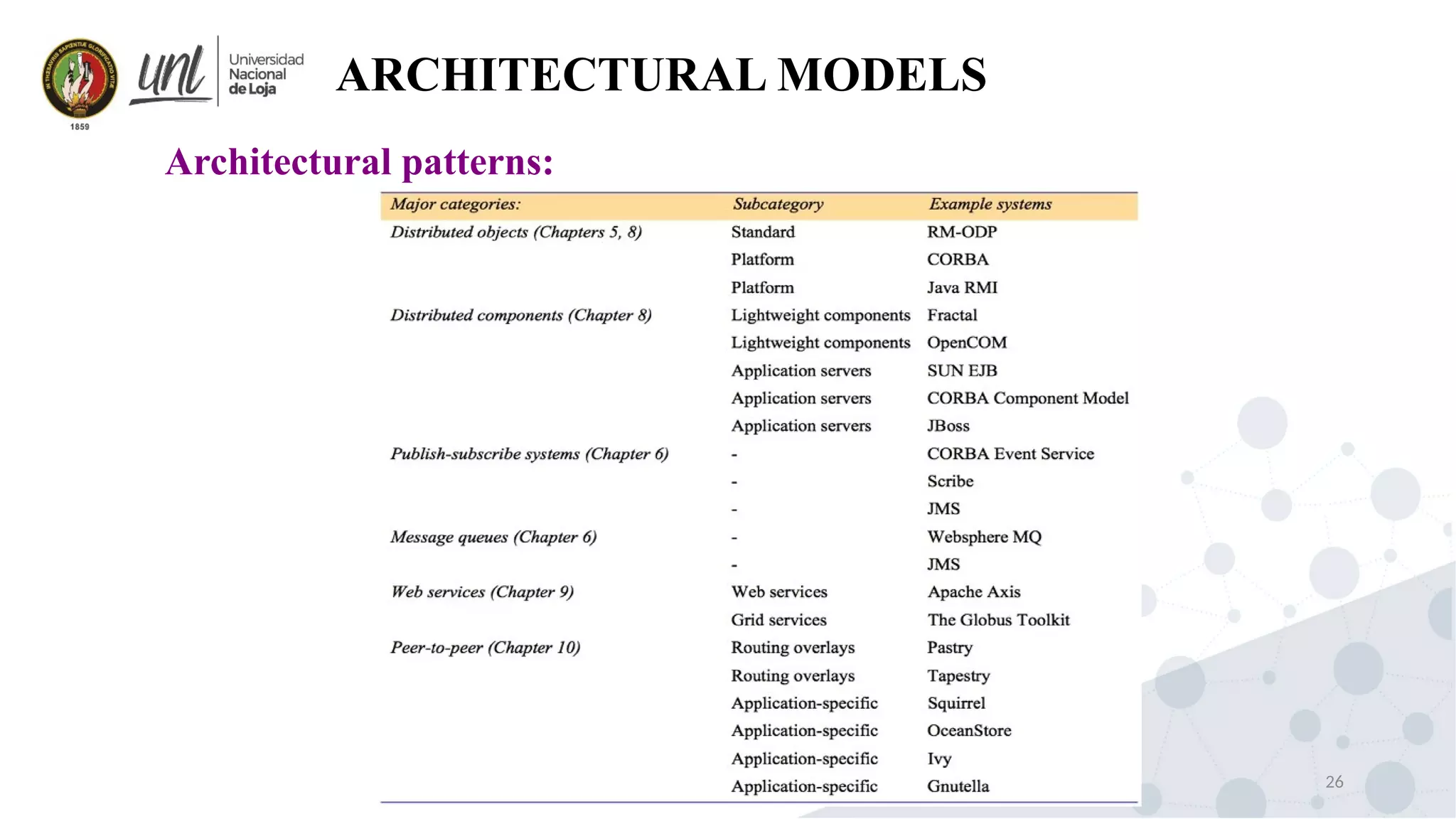
Architectural patterns:
Layering –complex system is partitioned into a number of
layers. The top layer utilizes the services of the lower
layer
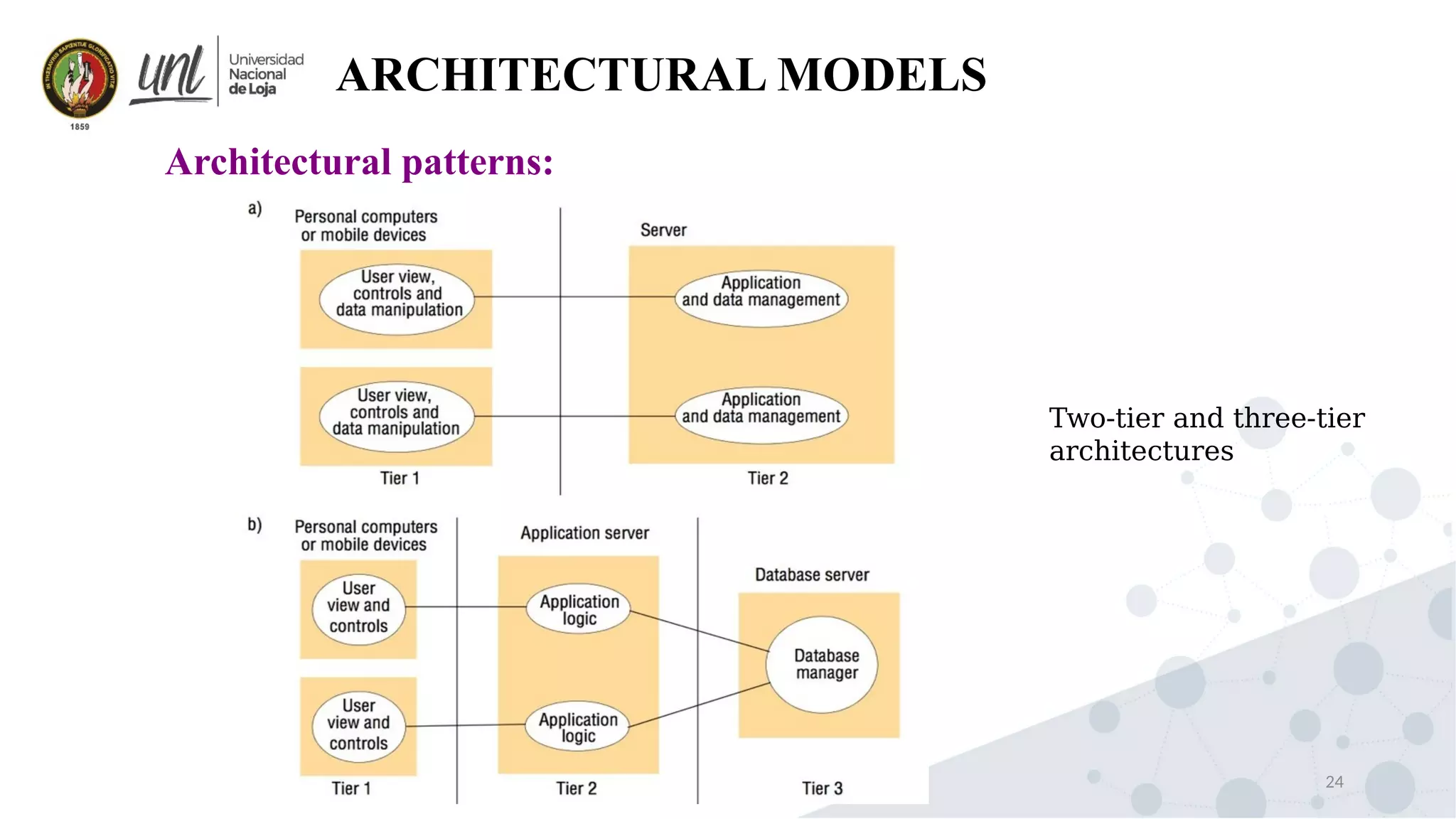
Tiered architecture – complementary to layering,
organizes the functionality of the given layer and place it
in appropriate server (physical nodes)
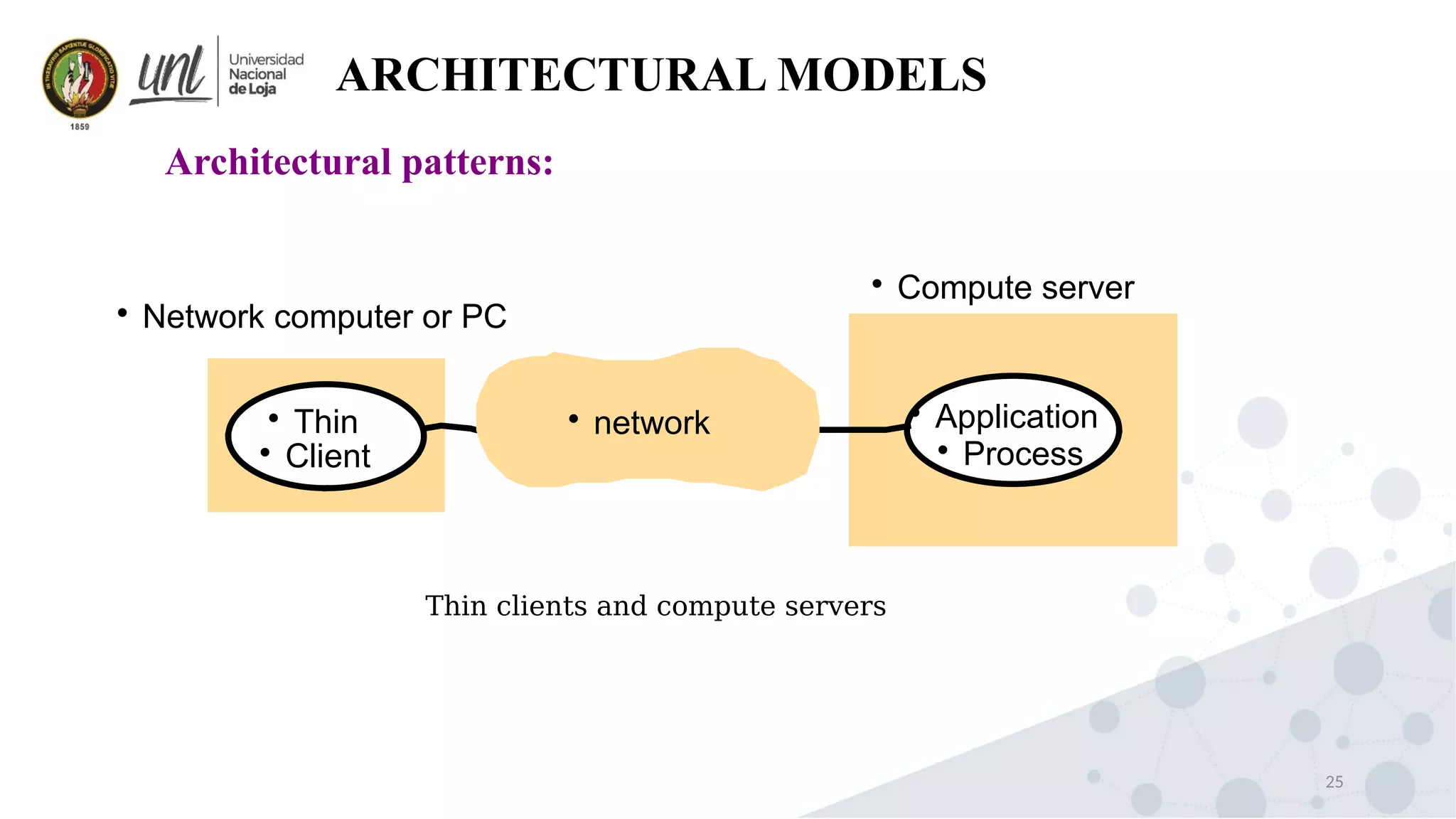
Thin clients – software layer that supports window-based
user interface in remote computers
Other patterns: e.g. proxy, brokerage, reflection
23
ARCHITECTURAL MODELS
Architectural patterns:
24
ARCHITECTURAL MODELS
Architectural patterns:
Two-tier and three-tier
architectures
25
ARCHITECTURAL MODELS
Architectural patterns:

Thin

Client

Application

Process

Network computer or PC

Compute server

network
Thin clients and compute servers
26
ARCHITECTURAL MODELS
Architectural patterns:
27
ARCHITECTURAL MODELS

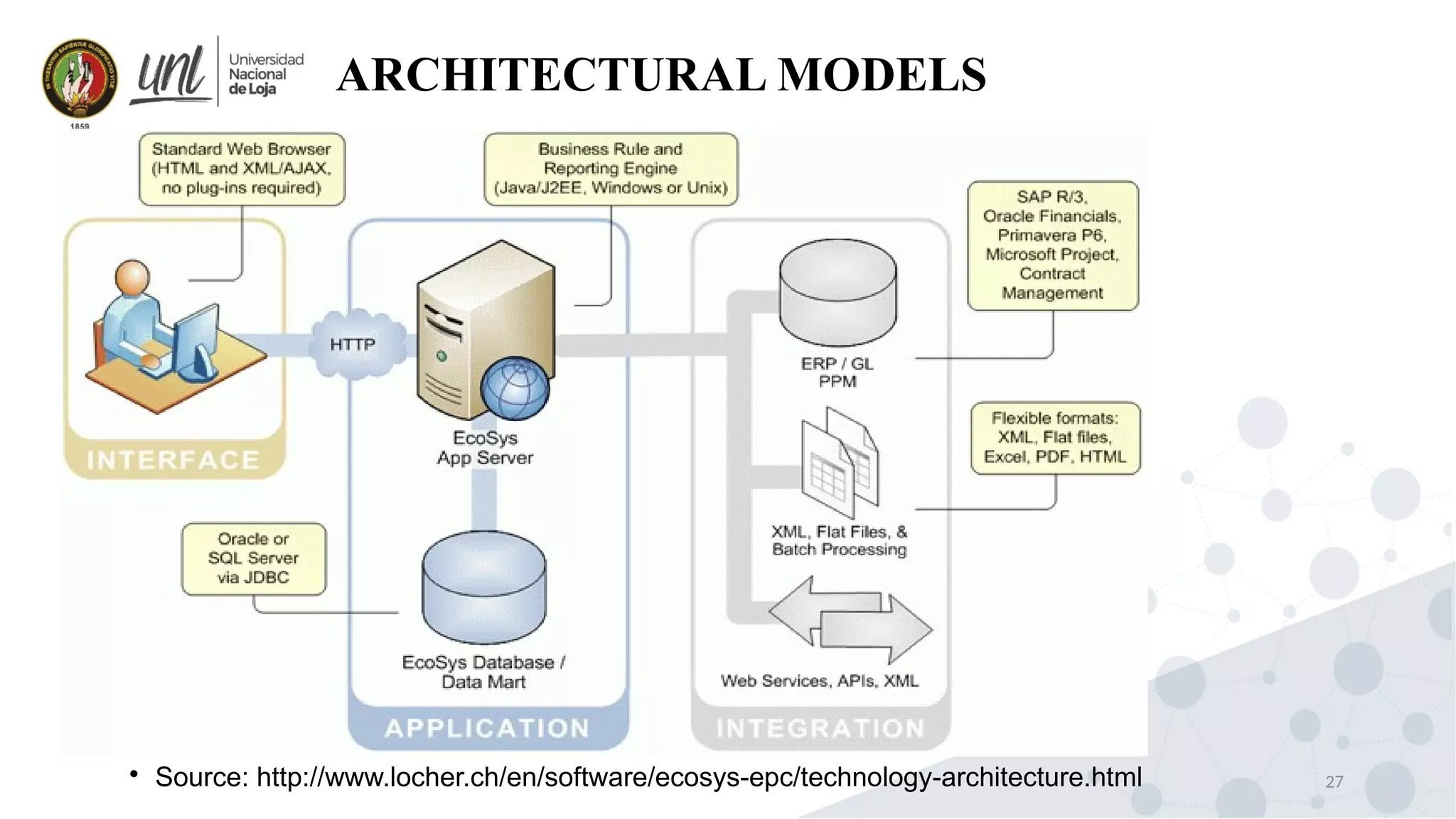
Source: http://www.locher.ch/en/software/ecosys-epc/technology-architecture.html
28
ARCHITECTURAL MODELS
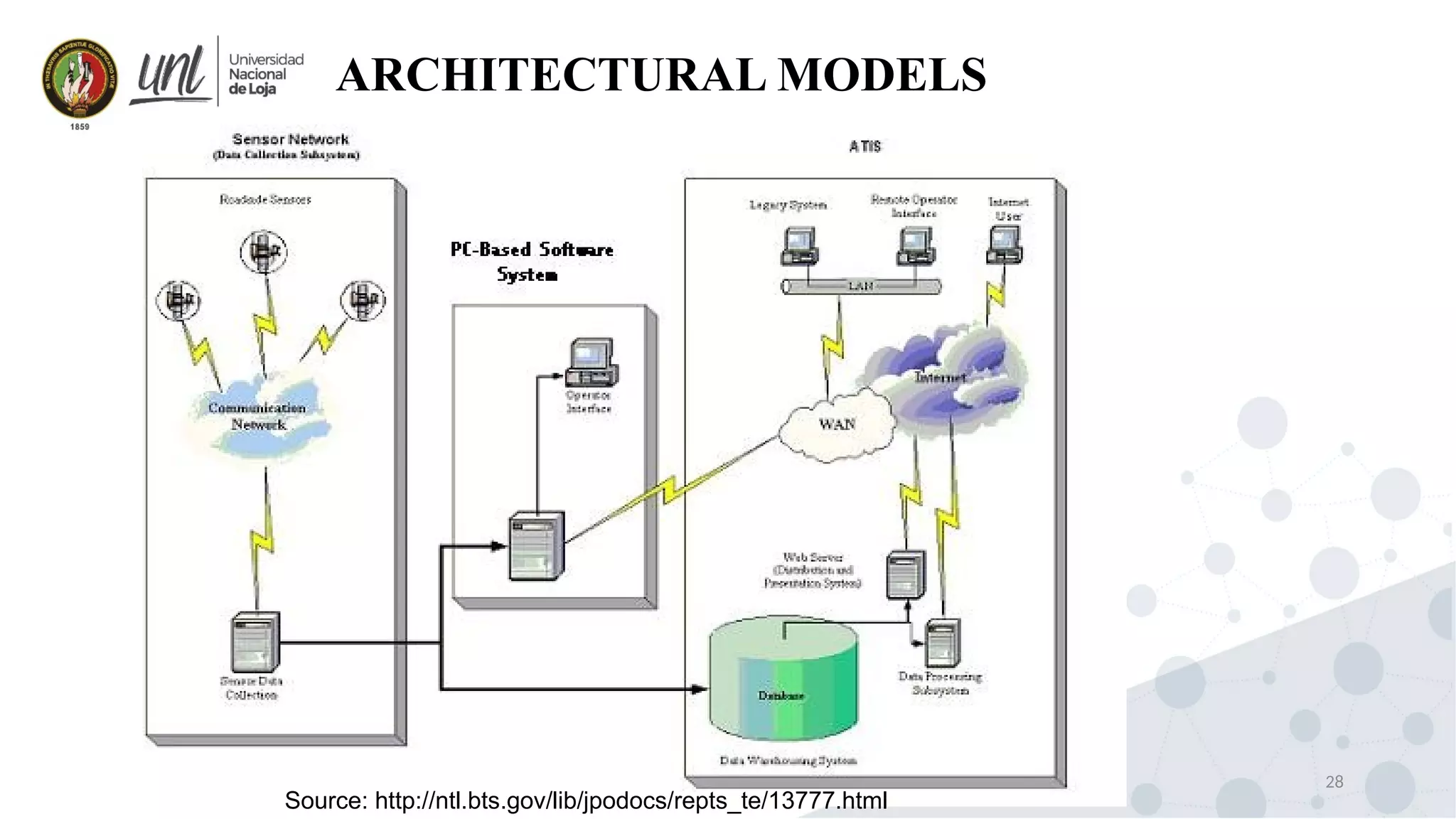
Source: http://ntl.bts.gov/lib/jpodocs/repts_te/13777.html
29
ARCHITECTURAL MODELS
Source: http://www.ecosys.net/ecosys-epc/technology-architecture/
30
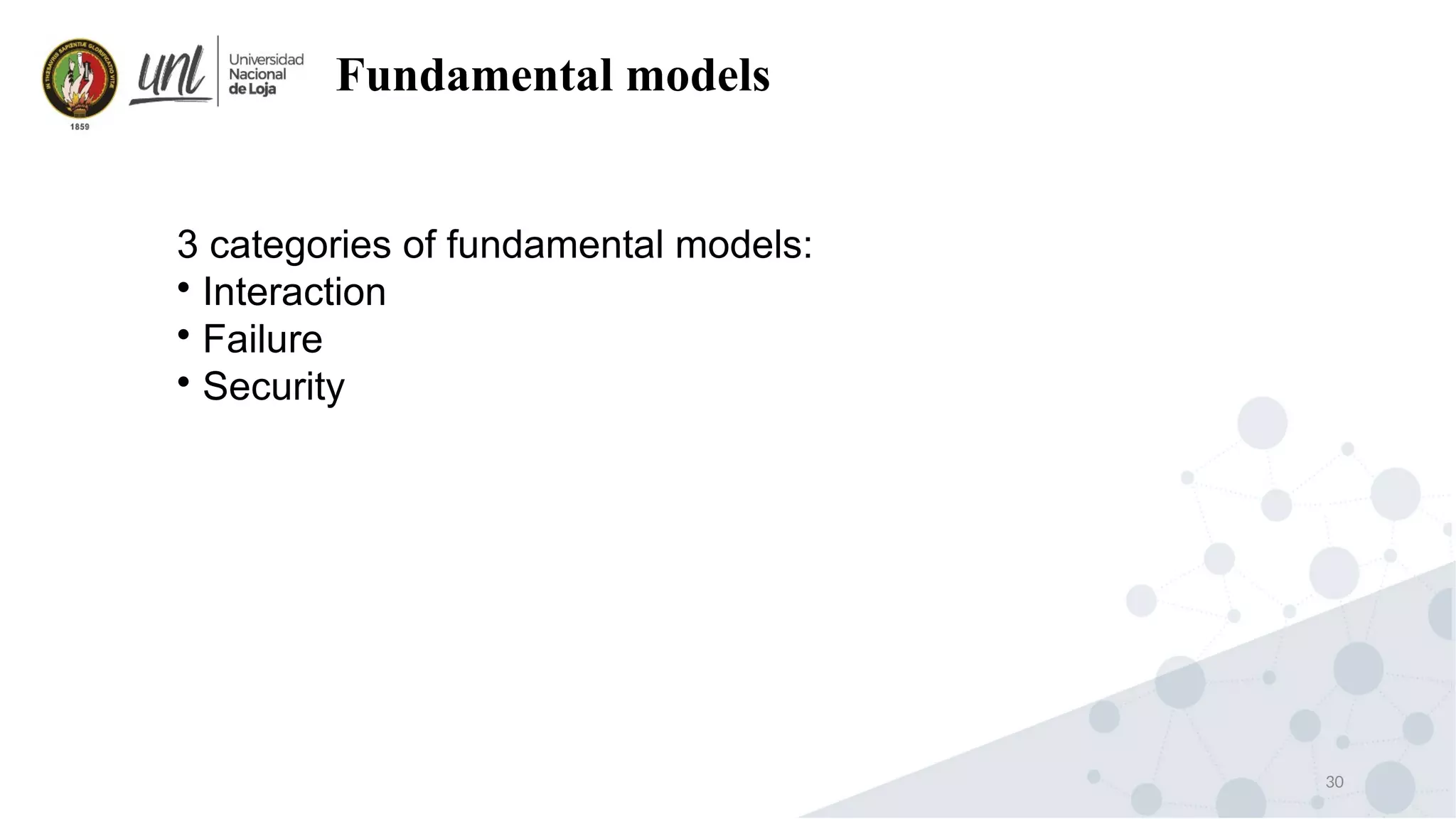
Fundamental models
3 categories of fundamental models:

Interaction

Failure

Security
31
Fundamental models

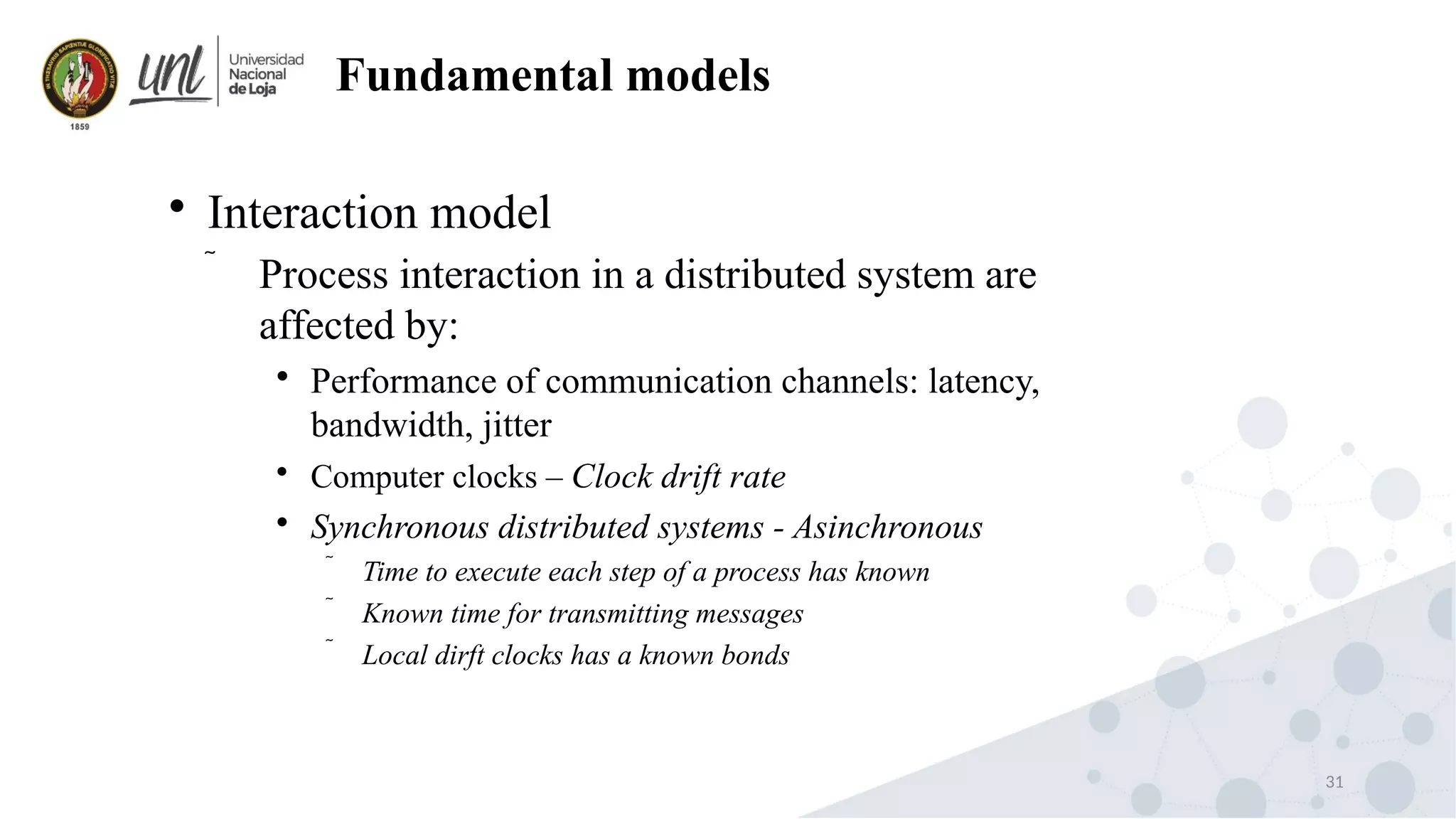
Interaction model
 Process interaction in a distributed system are
affected by:

Performance of communication channels: latency,
bandwidth, jitter

Computer clocks – Clock drift rate

Synchronous distributed systems - Asinchronous
 Time to execute each step of a process has known
 Known time for transmitting messages
 Local dirft clocks has a known bonds
32
Fundamental models

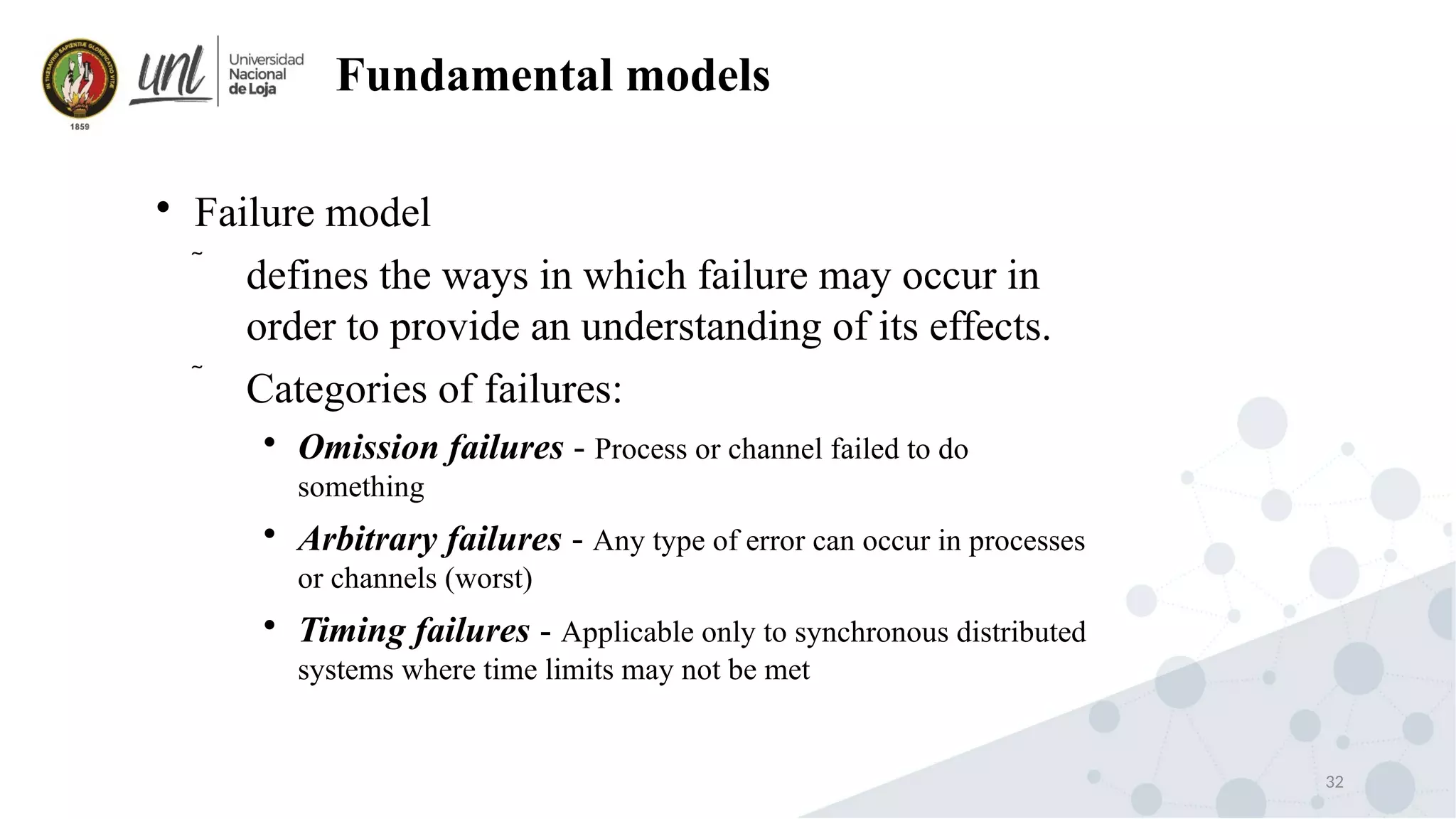
Failure model
 defines the ways in which failure may occur in
order to provide an understanding of its effects.
 Categories of failures:

Omission failures - Process or channel failed to do
something

Arbitrary failures - Any type of error can occur in processes
or channels (worst)

Timing failures - Applicable only to synchronous distributed
systems where time limits may not be met
33
Fundamental models
Process p Process q
Communication channel
send
Outgoing message buffer Incoming message buffer
receivem
Processes and channels
34
Fundamental models
Class of failure Affects Description
Fail-stop Process Process halts and remains halted. Other processes may
Crash Process Process halts and remains halted. Other processes may
not be able to detect this state.
Omission Channel A message inserted in an outgoing message buffer never
arrives at the other end’s incoming message buffer.
Send-omission Process A process completes asend, but the message is not put
in its outgoing message buffer.
Receive-omission Process A message is put in a process’s incoming message
buffer, but that process does not receive it.
Arbitrary
(Byzantine)
Process or
channel
Process/channel exhibits arbitrary behaviour: it may
send/transmit arbitrary messages at arbitrary times,
commit omissions; a process may stop or take an
incorrect step.
detect this state.
Omission and arbitrary failures
35
Fundamental models
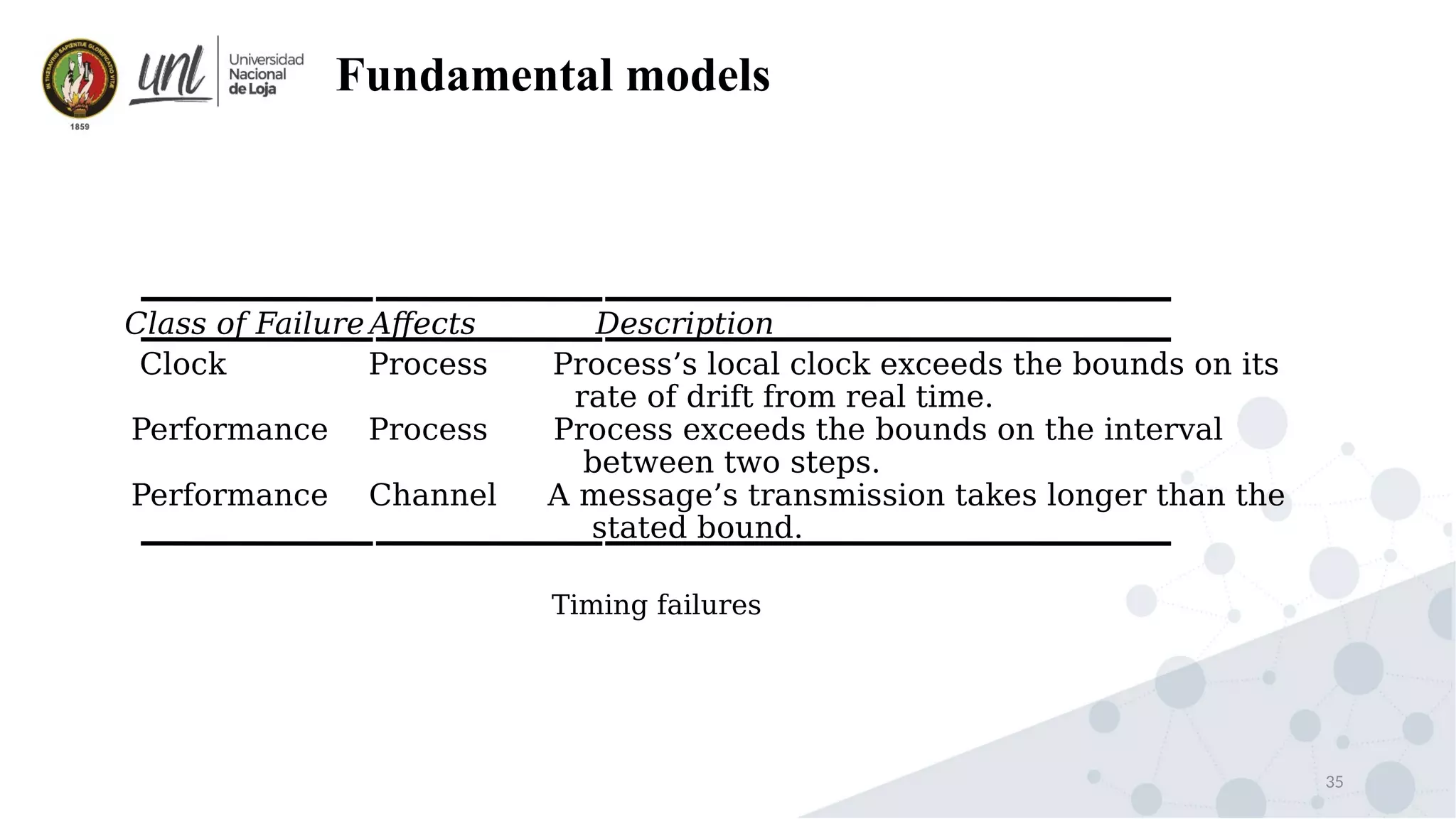
Class of Failure Affects Description
Clock Process Process’s local clock exceeds the bounds on its
rate of drift from real time.
Performance Process Process exceeds the bounds on the interval
between two steps.
Performance Channel A message’s transmission takes longer than the
stated bound.
Timing failures
36
Fundamental models

Security model - Secure processes and channels
and protect objects encapsulated against
unauthorized access.
 Protecting access to objects - Access rights,
authentication of clients
 Protecting processes and interactions

Threats to processes: problem of unauthenticated
requests / replies. e.g., "man in the middle"

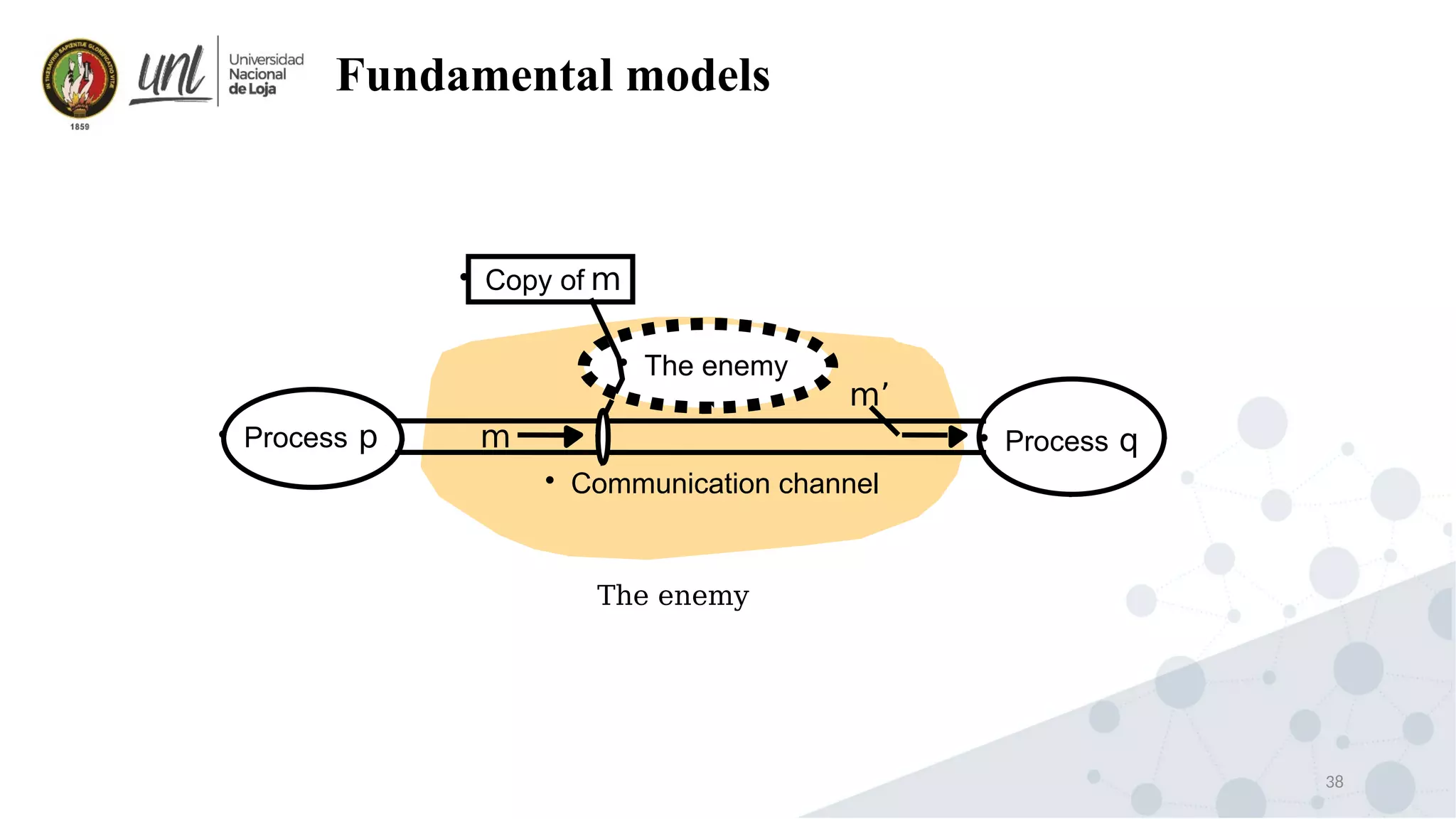
Threats to communication channels: enemy may
copy, alter or inject messages as they travel across
network.

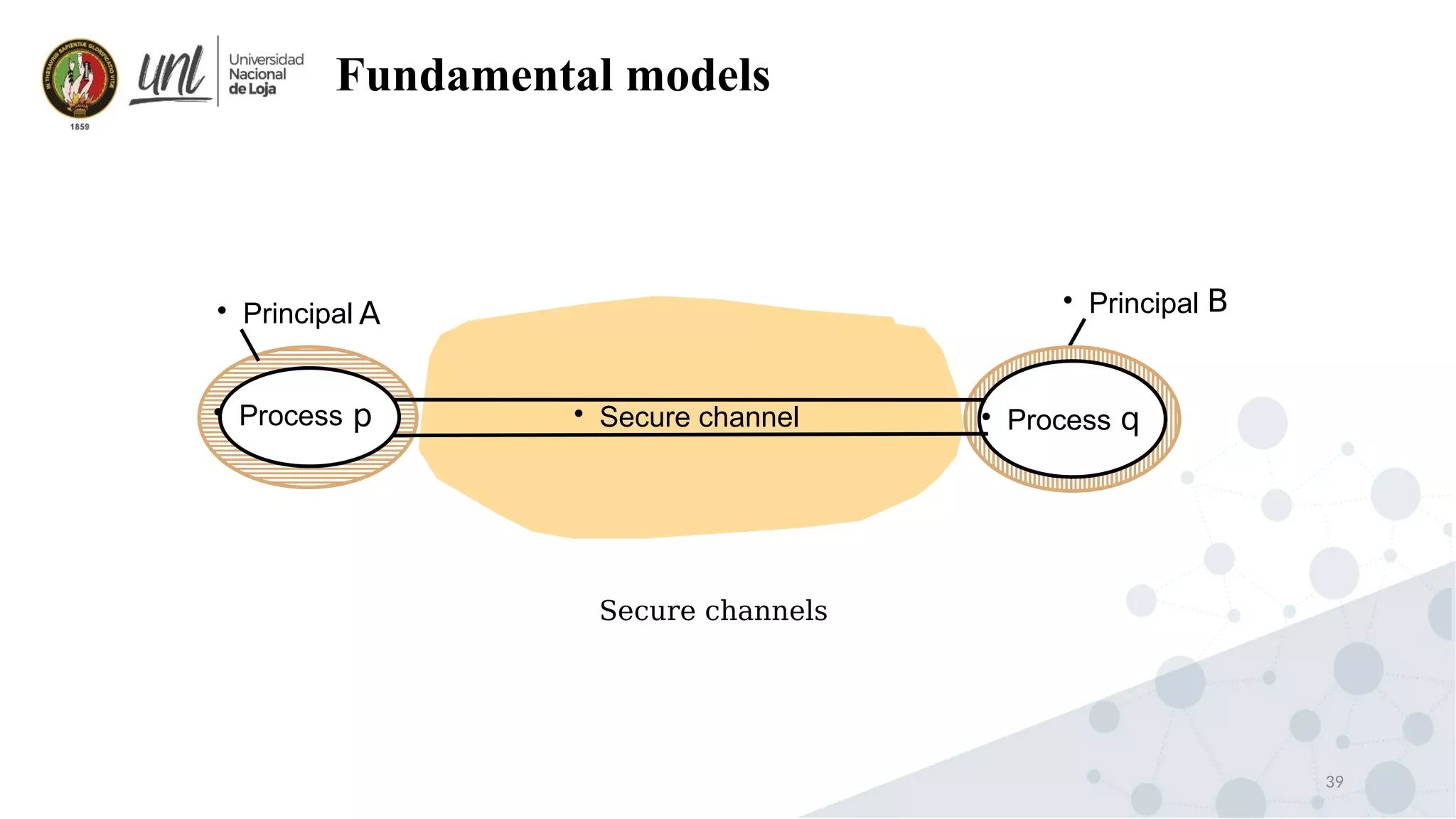
Use of “secure” channels, based on cryptographic methods.
37
Fundamental models
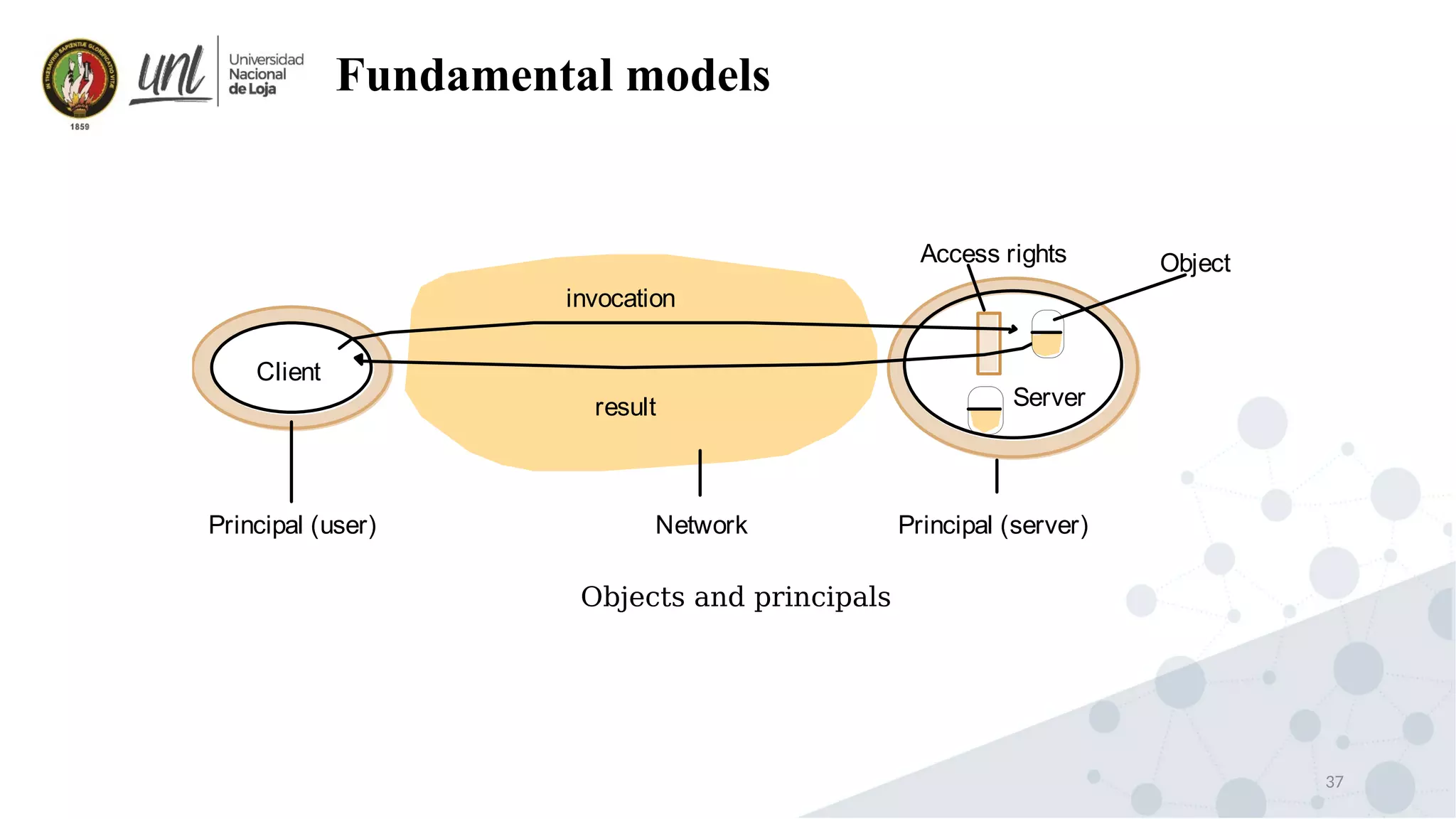
Network
invocation
result
Client
Server
Principal (user) Principal (server)
ObjectAccess rights
Objects and principals
38
Fundamental models

Communication channel

Copy of m

Process p 
Process qm

The enemy
m’
The enemy
39
Fundamental models

Principal A

Secure channel
Process p 
Process q

Principal B
Secure channels
40
Cŕeditos
• Transparencias basadas por:
• Alberto Lafuente,
http://www.sc.ehu.es/acwlaroa/SDI/Apuntes/Cap1.pdf
• Alberto Lafuente,
http://www.sc.ehu.es/acwlaalm/sdi/introduccion-slides.pdf
•
Networking académico:
Correo electrónico: rguaman@unl.edu.ec
Twitter: @rene5254
SlideShare: https://es.slideshare.net/rene5254
41
Gracias

System models