Click icon to add picture
SYNTHESIS AND
APPLICATION OF CORBON
NANOTUBE IN CANCER
TREATMENT
PREPARED BY – SEJAL YADAV
CONTENT
1. Introduction
2. Synthesis
3. Types of cnt
4. Application
5. Advantages
6. Disadvantages
7. Conclusion
1. INTRODUCTION
 Carbon nanotubes are cylindrical carbon molecules have Novel properties.
 They can be about 1/50,000th the thickness of a human hair.
 Their unique surface area, stiffness, strength have led to much excitement in the field of
pharmacy.
 High Thermal conductivity.
 Excellent electron emission characterstics.
 ease of cellular uptake, high drug loading, thermal ablation, among others, render them
useful for cancer therapy.
 Good candidates for a wide variety of applications, including drug transporters, new
therapeutics, delivery systems and diagnostics.
 It is discovered in 1991 and shown to have certain unique physicochemical properties,
attracting considerable interest in their application in various fields including drug
delivery.
2. Synthesis of carbon nanotube
• The oldest method for the carbon nanotube production is the electric arc discharge.
 This technique was used already in the early sixties by R. Bacon for the synthesis of carbon fibres called
whiskers. The same technique was adapted in 1990 by Krätschmer and Huffman to produce fullerenes in good
yields, and later on this method was improved and applied for the synthesis of multiwall (MWNT) and
singlewall (SWNT) carbon nanotubes.
• Other methods such as the laser evaporation/ablation and chemical vapour deposition (CVD) were also
succesfully examined in the production of carbon nanotubes. The laser evaporation process is technically
similar to the arc discharge method.
• The difference between these two methods is in the quality and purity of the obtained products.
METHOD ARC DISCHARGE
METHOD
LASER METHOD CHEM. VAPORIZATION
METHOD
PROCESS it involves two
graphite
electrode in presence
of
helium and a current
of
50 ampere is passed
through two graphite
electrodes
this process consist of
graphite rods and it
contain 50:50 catalyst
mixture of Co and Ni
at
12000C and argon is
flowing through it
in this process
reaction
chamber contain
mixture
of nitrogen, ethylene
and
acetylene. during this
temperature of
reaction
chamber was 700-
9000C
and one atmospheric
pressure.
CONDITION Low pressure inert
gas
Argon gas at 1200*c 700-900*c temp at
one atmospheric
pressure
3. TYPES OF CARBON NANOTUBES (CNTS)
The carbon nanotubes are of two types namely:
• Single walled carbon nanotubes (SWCNTs)
• Multiple walled carbon nanotubes (MWCNTs)
(A) SWCNTs consist of a single cylindrical carbon layer with a diameter in the range of 0.4-2 nm, depending on
the temperature at which they have been synthesized.
 The structure of SWCNTs may be arm chair, zigzag, chiral, or helical arrangements The SWCNTs have an
ultrahigh surface area as large as 1300 m2/g, which renders sufficient space for drug loading and bio
conjugation .
 In drug delivery, SWCNTs are known to be more efficient than MWCNTs. This is due to the reason that
SWCNTs have ultrahigh surface area and efficient drug-loading capacity.
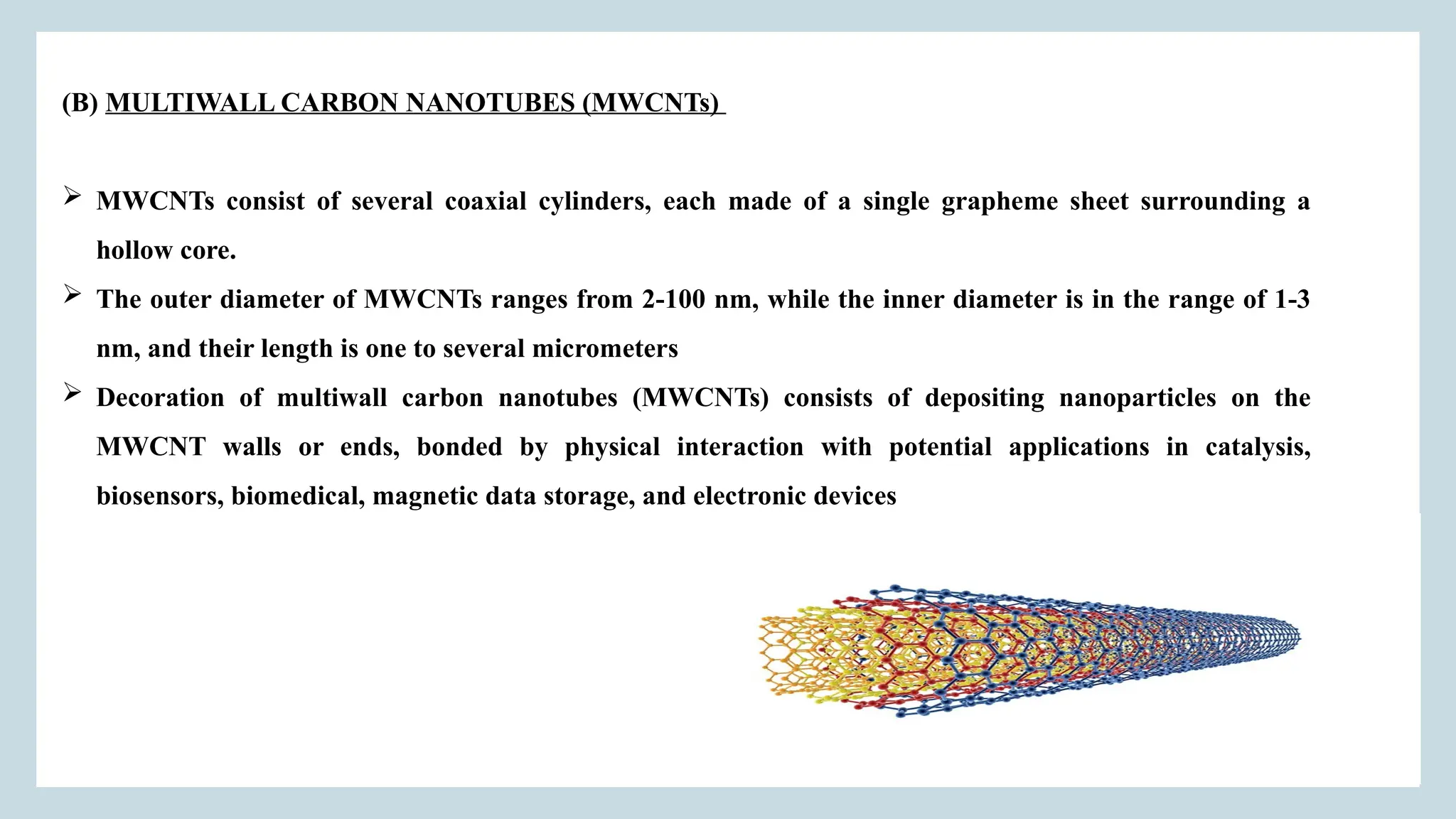
(B) MULTIWALL CARBON NANOTUBES (MWCNTs)
 MWCNTs consist of several coaxial cylinders, each made of a single grapheme sheet surrounding a
hollow core.
 The outer diameter of MWCNTs ranges from 2-100 nm, while the inner diameter is in the range of 1-3
nm, and their length is one to several micrometers
 Decoration of multiwall carbon nanotubes (MWCNTs) consists of depositing nanoparticles on the
MWCNT walls or ends, bonded by physical interaction with potential applications in catalysis,
biosensors, biomedical, magnetic data storage, and electronic devices
4. APPLICATION OF CARBON NANOTUBE IN CANCER
• Carbon nanotubes are used in drug delivery carriers for treatment of cancer. And they are reported for
targeting of amphotericin B to cells.
• Carbon nanotubes are used for generation of tissue. In recent years carbon nanotubes are best for tissue
generation because these are biocompatible, resistant to biodegradation and enhancing the organ generation
• Carbon nanotubes are used as energy storage devices.
• Carbon nanotubes are used in artificial implants. carbon nanotubes having high tensile stregth so they are
filled with calcium and arranged like a bone, so can acts as a bone substituent.
• Carbon nanotubes are antioxidant in nature so they are used preserve drugs that are easily oxidized.
• Carbon nanotubes are used for Gene therapy by DNA delivery. Gene therapy is a therapy to cure the gene
which can causeharmful disease by introducing DNA into cells.
APPLICATION
DRUG
DELIVERY
CARRIER
AS
PRESERVATIVE
FOR TISSUE
GENERATION
FOR GENE
THERAPY
ARTIFICIAL
IMPLANT
ENERGY
STORAGE
DEVICES
5. ADVANTAGES OF CARBON NANOTUBES
• Biocompatible, Non-biodegradable nature.
• Highly elastic nature and have the possibility of intracellular delivery.
• May exhibit minimum cytotoxicity.
• Excreted by urine 96% and remaining 4% by faeces.
• Ultra-light weight
• CNTs are able to enter cells by spontaneous mechanism due to its tubular and nano needle shape.
• It has distinct inner and outer surface, which can he differentially modified for chemical/ biochemical
functionalization.
6. DISADVANTAGES OF CARBON NANOTUBES
• It is difficult to maintain high quality and lower impurities.
• Cost of nanotechnology is very high .
• In ARC DISCHARGE and LASER method huge amount of energy is required to complete the
process.
• It is difficult to target large amount of graphite in industrial process.
CONCLUSION
Nanoparticulate as drug delivery systems is designed to improve the pharmacological and therapeutic properties
of conventional drugs.
 The incorporation of drug molecules into nanocarrier can protect a drug against degradation as well as offers
possibilities of targeting and controlled release. In comparison with the traditional form of drugs,
nanocarrierdrug conjugates are more effective and selective; they can reduce the toxicity and other adverse
side effects in normal tissues by accumulating drugs in target sites.
 In consequence, the required doses of drugs are lower. However, so far, the scientific paradigm for the
possible (adverse) reactivity of nanoparticles is lacking and we have little understanding of the basics of the
interaction of nanoparticles with living cells, organs and organisms. A conceptual understanding of biological
responses to nanomaterials is needed to develop and apply safe nanomaterials in drug delivery in the future.
Furthermore a close collaboration between those working in drug delivery and particle production is
necessary for the exchange of concepts, methods and know-how to move this issue ahead.
REFERENCE
• VALENTIN N. POPOV "CARBON NANOTUBES: PROPERTIES AND APPLICATION" MATERIALS SCIENCE
AND ENGINEERING R 43 (2004) 61–102
• B.K. KAUSHIK AND M.K. MAJUMDER, CARBON NANOTUBE BASED VLSI INTERCONNECTS,
SPRINGERBRIEFS IN APPLIED SCIENCES AND TECHNOLOGY, DOI 10.1007/978-81- 322-2047-3_2
• PETER J.F. HARRIS “ CARBON NANOTUBES SCIENCE : SYNTHESIS, PROPERTIES AND APPLICATIONS”
WWW.CAMBRIDGE.ORG/9780521828956. P.NO. 3
• KALPNA VARSHNEY "CARBON NANOTUBES: A REVIEW ON SYNTHESIS, PROPERTIES AND
APPLICATIONS" INTERNATIONAL JOURNAL OF ENGINEERING RESEARCH AND GENERAL SCIENCE
VOLUME 2, ISSUE 4, JUNE-JULY, 2014 ISSN 2091-2730
• A. AQEL, K.M.M. ABOU EL-NOUR R. A.A. AMMAR ,A. AL-WARTHAN"CARBON NANOTUBES, SCIENCE
AND TECHNOLOGY PART (I) STRUCTURE, SYNTHESIS AND CHARACTERISATION"ARABIAN JOURNAL
OF CHEMISTRY (2012) 5, 1–23
• IIJIMA S, ICHIHASHI T. SINGLE-SHELL CARBON NANOTUBES OF 1-NM DIAMETER. NATURE, 363, 603
(1993).

Synthesis and application of corbon compound in Cancer treatment.pptx

  • 1.
    Click icon toadd picture SYNTHESIS AND APPLICATION OF CORBON NANOTUBE IN CANCER TREATMENT PREPARED BY – SEJAL YADAV
  • 2.
    CONTENT 1. Introduction 2. Synthesis 3.Types of cnt 4. Application 5. Advantages 6. Disadvantages 7. Conclusion
  • 3.
    1. INTRODUCTION  Carbonnanotubes are cylindrical carbon molecules have Novel properties.  They can be about 1/50,000th the thickness of a human hair.  Their unique surface area, stiffness, strength have led to much excitement in the field of pharmacy.  High Thermal conductivity.  Excellent electron emission characterstics.  ease of cellular uptake, high drug loading, thermal ablation, among others, render them useful for cancer therapy.  Good candidates for a wide variety of applications, including drug transporters, new therapeutics, delivery systems and diagnostics.  It is discovered in 1991 and shown to have certain unique physicochemical properties, attracting considerable interest in their application in various fields including drug delivery.
  • 4.
    2. Synthesis ofcarbon nanotube
  • 5.
    • The oldestmethod for the carbon nanotube production is the electric arc discharge.  This technique was used already in the early sixties by R. Bacon for the synthesis of carbon fibres called whiskers. The same technique was adapted in 1990 by Krätschmer and Huffman to produce fullerenes in good yields, and later on this method was improved and applied for the synthesis of multiwall (MWNT) and singlewall (SWNT) carbon nanotubes. • Other methods such as the laser evaporation/ablation and chemical vapour deposition (CVD) were also succesfully examined in the production of carbon nanotubes. The laser evaporation process is technically similar to the arc discharge method. • The difference between these two methods is in the quality and purity of the obtained products.
  • 6.
    METHOD ARC DISCHARGE METHOD LASERMETHOD CHEM. VAPORIZATION METHOD PROCESS it involves two graphite electrode in presence of helium and a current of 50 ampere is passed through two graphite electrodes this process consist of graphite rods and it contain 50:50 catalyst mixture of Co and Ni at 12000C and argon is flowing through it in this process reaction chamber contain mixture of nitrogen, ethylene and acetylene. during this temperature of reaction chamber was 700- 9000C and one atmospheric pressure. CONDITION Low pressure inert gas Argon gas at 1200*c 700-900*c temp at one atmospheric pressure
  • 7.
    3. TYPES OFCARBON NANOTUBES (CNTS) The carbon nanotubes are of two types namely: • Single walled carbon nanotubes (SWCNTs) • Multiple walled carbon nanotubes (MWCNTs) (A) SWCNTs consist of a single cylindrical carbon layer with a diameter in the range of 0.4-2 nm, depending on the temperature at which they have been synthesized.  The structure of SWCNTs may be arm chair, zigzag, chiral, or helical arrangements The SWCNTs have an ultrahigh surface area as large as 1300 m2/g, which renders sufficient space for drug loading and bio conjugation .  In drug delivery, SWCNTs are known to be more efficient than MWCNTs. This is due to the reason that SWCNTs have ultrahigh surface area and efficient drug-loading capacity.
  • 8.
    (B) MULTIWALL CARBONNANOTUBES (MWCNTs)  MWCNTs consist of several coaxial cylinders, each made of a single grapheme sheet surrounding a hollow core.  The outer diameter of MWCNTs ranges from 2-100 nm, while the inner diameter is in the range of 1-3 nm, and their length is one to several micrometers  Decoration of multiwall carbon nanotubes (MWCNTs) consists of depositing nanoparticles on the MWCNT walls or ends, bonded by physical interaction with potential applications in catalysis, biosensors, biomedical, magnetic data storage, and electronic devices
  • 9.
    4. APPLICATION OFCARBON NANOTUBE IN CANCER • Carbon nanotubes are used in drug delivery carriers for treatment of cancer. And they are reported for targeting of amphotericin B to cells. • Carbon nanotubes are used for generation of tissue. In recent years carbon nanotubes are best for tissue generation because these are biocompatible, resistant to biodegradation and enhancing the organ generation • Carbon nanotubes are used as energy storage devices. • Carbon nanotubes are used in artificial implants. carbon nanotubes having high tensile stregth so they are filled with calcium and arranged like a bone, so can acts as a bone substituent. • Carbon nanotubes are antioxidant in nature so they are used preserve drugs that are easily oxidized. • Carbon nanotubes are used for Gene therapy by DNA delivery. Gene therapy is a therapy to cure the gene which can causeharmful disease by introducing DNA into cells.
  • 10.
  • 11.
    5. ADVANTAGES OFCARBON NANOTUBES • Biocompatible, Non-biodegradable nature. • Highly elastic nature and have the possibility of intracellular delivery. • May exhibit minimum cytotoxicity. • Excreted by urine 96% and remaining 4% by faeces. • Ultra-light weight • CNTs are able to enter cells by spontaneous mechanism due to its tubular and nano needle shape. • It has distinct inner and outer surface, which can he differentially modified for chemical/ biochemical functionalization.
  • 12.
    6. DISADVANTAGES OFCARBON NANOTUBES • It is difficult to maintain high quality and lower impurities. • Cost of nanotechnology is very high . • In ARC DISCHARGE and LASER method huge amount of energy is required to complete the process. • It is difficult to target large amount of graphite in industrial process.
  • 13.
    CONCLUSION Nanoparticulate as drugdelivery systems is designed to improve the pharmacological and therapeutic properties of conventional drugs.  The incorporation of drug molecules into nanocarrier can protect a drug against degradation as well as offers possibilities of targeting and controlled release. In comparison with the traditional form of drugs, nanocarrierdrug conjugates are more effective and selective; they can reduce the toxicity and other adverse side effects in normal tissues by accumulating drugs in target sites.  In consequence, the required doses of drugs are lower. However, so far, the scientific paradigm for the possible (adverse) reactivity of nanoparticles is lacking and we have little understanding of the basics of the interaction of nanoparticles with living cells, organs and organisms. A conceptual understanding of biological responses to nanomaterials is needed to develop and apply safe nanomaterials in drug delivery in the future. Furthermore a close collaboration between those working in drug delivery and particle production is necessary for the exchange of concepts, methods and know-how to move this issue ahead.
  • 15.
    REFERENCE • VALENTIN N.POPOV "CARBON NANOTUBES: PROPERTIES AND APPLICATION" MATERIALS SCIENCE AND ENGINEERING R 43 (2004) 61–102 • B.K. KAUSHIK AND M.K. MAJUMDER, CARBON NANOTUBE BASED VLSI INTERCONNECTS, SPRINGERBRIEFS IN APPLIED SCIENCES AND TECHNOLOGY, DOI 10.1007/978-81- 322-2047-3_2 • PETER J.F. HARRIS “ CARBON NANOTUBES SCIENCE : SYNTHESIS, PROPERTIES AND APPLICATIONS” WWW.CAMBRIDGE.ORG/9780521828956. P.NO. 3 • KALPNA VARSHNEY "CARBON NANOTUBES: A REVIEW ON SYNTHESIS, PROPERTIES AND APPLICATIONS" INTERNATIONAL JOURNAL OF ENGINEERING RESEARCH AND GENERAL SCIENCE VOLUME 2, ISSUE 4, JUNE-JULY, 2014 ISSN 2091-2730 • A. AQEL, K.M.M. ABOU EL-NOUR R. A.A. AMMAR ,A. AL-WARTHAN"CARBON NANOTUBES, SCIENCE AND TECHNOLOGY PART (I) STRUCTURE, SYNTHESIS AND CHARACTERISATION"ARABIAN JOURNAL OF CHEMISTRY (2012) 5, 1–23 • IIJIMA S, ICHIHASHI T. SINGLE-SHELL CARBON NANOTUBES OF 1-NM DIAMETER. NATURE, 363, 603 (1993).