The effects of environmental regulations on developing countries: what are the concerns and what can be done Veena Jha Public Symposium: Challenges ahead on the Road to Cancun 16-18th June 2003 WTO, Geneva UNCTAD
UNCTAD   activities UNCTAD/IDRC Project Standards and Trade Final meeting: Geneva, 16 and 17 May 2002 UNCTAD Expert Meeting on Environmental Requirements  and International Trade Geneva, 2-4 October 2002   Papers http://www.unctad.org/trade_env/index.htm
reports An overview paper Regional scoping paper on South Asia  (Bangladesh, India, Nepal and Sri Lanka) Regional scoping paper on Central America  (in particular Costa Rica) Regional scoping paper on Eastern Africa (Kenya, Mozambique, the United  Republic of Tanzania and Uganda)   Scoping paper on organic agriculture  (Costa Rica, India and Uganda) UNCTAD
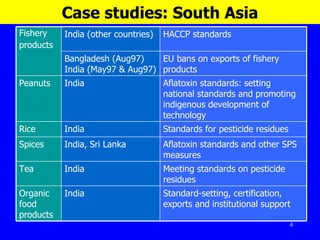
Case studies: South Asia EU bans on exports of fishery products Bangladesh (Aug97) India (May97 & Aug97)  Meeting standards on pesticide residues   India Tea   Standard-setting, certification, exports and institutional support  India Organic food products   Aflatoxin standards and other SPS measures   India, Sri Lanka Spices   Standards for pesticide residues  India Rice   Aflatoxin standards: setting national standards and promoting indigenous development of technology India Peanuts   HACCP standards India (other countries) Fishery  products
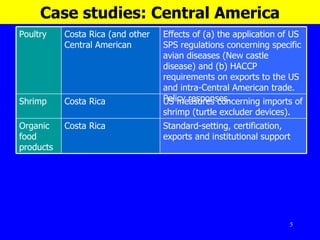
Case studies: Central America US measures concerning imports of shrimp (turtle excluder devices).   Costa Rica Shrimp   Standard-setting, certification, exports and institutional support Costa Rica Organic food products   Effects of (a) the  application of US SPS regulations concerning specific avian diseases  (New castle disease)  and (b) HACCP requirements on exports to the US and intra-Central American trade. Policy responses. Costa Rica (and other Central American Poultry
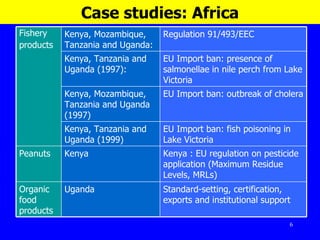
Case studies: Africa EU Import ban: outbreak of cholera  Kenya, Mozambique, Tanzania and Uganda (1997) EU Import ban: presence of s almonellae in nile perch from  Lake Victoria  Kenya, Tanzania and Uganda  (1997):  EU Import ban:  fish poisoning in Lake Victoria Kenya, Tanzania and Uganda (1999) Standard-setting, certification, exports and institutional support  Uganda Organic food products   Kenya : EU regulation on pesticide application (Maximum Residue Levels, MRLs)   Kenya Peanuts   Regulation 91/493/EEC Kenya, Mozambique, Tanzania and Uganda:  Fishery  products
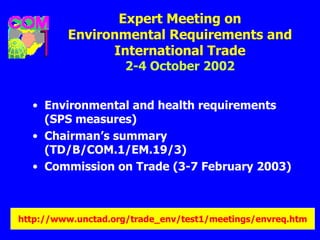
Expert Meeting on Environmental Requirements and International Trade 2-4 October 2002 Environmental and health requirements (SPS measures) Chairman’s summary (TD/B/COM.1/EM.19/3) Commission on Trade (3-7 February 2003)   http://www. unctad .org/trade_ env /test1/meetings/ envreq . htm
Environmental requirements Standards  (voluntary)  and technical regulations  (mandatory)   Labelling requirements (either mandatory or voluntary, such as eco-labelling),  Packaging  Product taxes and charges Take-back obligations Informal (non-government) requirements Quotas and N on  A utomatic  L icensing  (to implement MEAs)
Environmental requirements Voluntary measures and private sector standards appear to be much more frequent than Government environmental product regulations. These include: Standards, codes and benchmarks Supply chain management There are only few international standards for environmental regulations
More stringent and complex… Environmental requirements are becoming more frequent growing evidence of harmful environmental effects of certain substances  changes in consumer preferences
More stringent and complex: examples… Draft Strategy for a Future Chemicals Policy in the EU point to the imminent introduction of legislation that implements a precautionary approach Stakeholders' Conference on the Commission's White Paper on the Strategy for a Future Chemicals Policy, Brussels, 2 April 2002
More stringent and complex: examples… EU Directive 2000/53/EC on End-of-Life Vehicles Aimed at sound management of scrapped vehicles Implications for material selection, use of hazardous materials, the use of recyclable and/or bio-degradable material as well as design for recycling.  Japanese market, significant initiatives: The recycling-oriented economy framework  Launch of the Green Purchasing Act    
Implications for market access Concerns of developing countries: Many standards perceived as overly stringent or complex Frequent changes (never catch up) Scientific justification insufficient Standardes often fail to take into account the conditions of developing countries Way a measure is implemented may discriminate (GATT/WTO dispute settlement mechanism)
Structural weaknesses Lack of awareness  Management of information  Poor infrastructure SMEs Lack of finance Lack of institutional capacity Insufficient access to technology “ Standard-takers” rather than “standard-setters”
Sectors Most studies done by UNCTAD refer to:  Agricultural and fisheries products Leather and textiles Forestry products Electronics
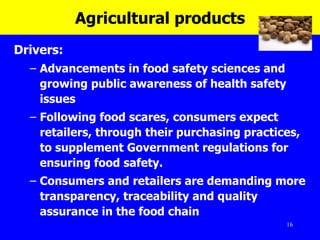
Agricultural products Drivers: Advancements in food safety sciences and growing public awareness of health safety issues Following food scares, consumers expect retailers, through their purchasing practices, to supplement Government regulations for ensuring food safety.  Consumers and retailers are demanding more transparency, traceability and quality assurance in the food chain
Agricultural and fisheries products: concerns HACCP (which has environmental aspects): may be expensive for small producers Aflatoxin: compliance and testing may be very expensive (issues such as science and proportionality)  MRL levels in food products: too stringent for tropical conditions? Developments in cut flowers Fishery products: large funds required to establish infrastructure and build institutions
Agricultural and fisheries products: concerns Cuba,  honey and coffee: lack of in-country technical capacity to verify compliance with the very low MRL limits required under EU regulation 2377/EC.  Peru:  traditional foods are now subject to complex import regulations ( EU regulation 258/97 on Novel Food and Novel Food Ingredients)   due simply to their exogeniety   Caribbean countries:  similar problems in exporting certain traditional food products to the US market, because MRL levels have not been defined
Leather and textiles, concerns  India Bans on products containing traces of azo dyes, pentachlorophenol (PCP), other harmful amines and other substances Eco-labels, based on life cycle analysis, buyer’s requirements and ISO standards Animal rights issues (leather) Pakistan With phasing out quantitative restrictions, quality standards and environment-related requirements of buyers in developed countries become more stringent
Leather and textiles, implications   South Asian  Problems of SMEs India: Substitutes 2.5 times more expensive than azo dyes  Azo-free dyeing 15 to 20 per cent more expensive High Costs of testing Nepal:   Weak regulatory and institutional framework to address problems faced by the export industry
Leather and textiles, national responses   India The Government of India (GoI) has banned 112 harmful azo dyes.  pro-active role of Pollution Control Boards: norms for effluent treatment.  Dissemination of information and development of eco-standards.  The GoI has established a Technology Upgradation Fund, strengthened testing laboratories and been assisting textile units in securing certification
Leather and textiles, national responses   Pakistan Pakistan National Environmental Quality Standards and Environmental Improvement Plans  Environment Technology Programme for Industry of the Federation of Pakistan Chamber of Commerce and Industries (FPCCI)  Nepal Joint initiative with the Governments of Finland to improve environmental performance and promote environmental labelling in certain export industries.
Electronics EU:  The Waste from Electrical and Electronic Equipment (WEEE) Directive The Restriction of the use of certain Hazardous Substances in electrical and electronic equipment (RoHS) Directive Integrated Product Policy (IPP) Green Purchasing Law (GPL) The Draft Strategy for a Future Chemicals Policy Japan Recycling regulations
Electronics: implications Since manufacturing of electronics components and other products are being  increasingly outsourced to developing countries, companies and governments in these countries need to promote pro-active policies with regard to information gathering/management and product engineering/design  Developing country companies should also seek cooperation with transnational corporations and obtain information from customers
Electronics Thailand A high-level subcommittee set up under the National Committee for International Trade and Economic Policy to monitor the development of the EU WEEE and RoHS directives and propose a plan of action  The subcommittee has commissioned a study to investigate the specific implications and adjustment requirements
Developmental aspects Environmental requirements that adversely affect market access can have a negative effect on development and poverty alleviation  There can be longer term advantages from trade-induced shifts to more stringent standards in terms of greater resource efficiency, higher occupational safety, improved health conditions and less environmental pollution There may be trade-offs especially in resource-constraint countries
Developmental aspects SME development WTO issues Special and differential treatment (S&D) Technical assistance Notification Transfer of technology
Action at national level Raise awareness (gov., private sector)  Dissemination of standard-related information, early warning system Strengthen national and regional institutions to  conduct risk analysis and testing;  monitor enforcement of standards and carry out certification.  R&D, innovation and enterprise development  Promote business partnerships  SMEs
Action international community and WTO Bilateral cooperation Participation and adequate time to adjust  Information dissemination  Promoting harmonization and mutual recognition of product standards and regulations based on equivalence in the WTO Standards developed without involvement of producing and consuming countries should have a default assumption of being discriminatory to trade.
Aid agencies Strengthen capacities and assist developing countries to become standard setters Assist developing countries in their participation in the work of international standardization bodies  National/regional cooperation Cases where developing countries have successfully enhanced their participation? Best practices on appropriate involvement of key trading partners in setting of environmental standards and regulations  Early warning systems
Technical assistance Large range of programmes Piecemeal? Often emerges when developing countries face problems in meeting requirements of importing countries Long-term Link TC/CB to enhance capacities to comply with environmental standards with broader TC/CB to enhance export comptetiveness
Consultative mechanism To support: Research on new trends in environmental requirements and likely implications for products of export interest to developing countries  Information management and dissemination  Pro-active adjustment strategies in exporting developing countries  Strategies for SMEs  Reliable statistical information to facilitate support policy-oriented research

Symp03 jha e

  • 1.
    The effects ofenvironmental regulations on developing countries: what are the concerns and what can be done Veena Jha Public Symposium: Challenges ahead on the Road to Cancun 16-18th June 2003 WTO, Geneva UNCTAD
  • 2.
    UNCTAD activities UNCTAD/IDRC Project Standards and Trade Final meeting: Geneva, 16 and 17 May 2002 UNCTAD Expert Meeting on Environmental Requirements and International Trade Geneva, 2-4 October 2002 Papers http://www.unctad.org/trade_env/index.htm
  • 3.
    reports An overviewpaper Regional scoping paper on South Asia (Bangladesh, India, Nepal and Sri Lanka) Regional scoping paper on Central America (in particular Costa Rica) Regional scoping paper on Eastern Africa (Kenya, Mozambique, the United Republic of Tanzania and Uganda) Scoping paper on organic agriculture (Costa Rica, India and Uganda) UNCTAD
  • 4.
    Case studies: SouthAsia EU bans on exports of fishery products Bangladesh (Aug97) India (May97 & Aug97) Meeting standards on pesticide residues India Tea Standard-setting, certification, exports and institutional support India Organic food products Aflatoxin standards and other SPS measures India, Sri Lanka Spices Standards for pesticide residues India Rice Aflatoxin standards: setting national standards and promoting indigenous development of technology India Peanuts HACCP standards India (other countries) Fishery products
  • 5.
    Case studies: CentralAmerica US measures concerning imports of shrimp (turtle excluder devices). Costa Rica Shrimp Standard-setting, certification, exports and institutional support Costa Rica Organic food products Effects of (a) the application of US SPS regulations concerning specific avian diseases (New castle disease) and (b) HACCP requirements on exports to the US and intra-Central American trade. Policy responses. Costa Rica (and other Central American Poultry
  • 6.
    Case studies: AfricaEU Import ban: outbreak of cholera Kenya, Mozambique, Tanzania and Uganda (1997) EU Import ban: presence of s almonellae in nile perch from Lake Victoria Kenya, Tanzania and Uganda (1997): EU Import ban: fish poisoning in Lake Victoria Kenya, Tanzania and Uganda (1999) Standard-setting, certification, exports and institutional support Uganda Organic food products Kenya : EU regulation on pesticide application (Maximum Residue Levels, MRLs) Kenya Peanuts Regulation 91/493/EEC Kenya, Mozambique, Tanzania and Uganda: Fishery products
  • 7.
    Expert Meeting onEnvironmental Requirements and International Trade 2-4 October 2002 Environmental and health requirements (SPS measures) Chairman’s summary (TD/B/COM.1/EM.19/3) Commission on Trade (3-7 February 2003) http://www. unctad .org/trade_ env /test1/meetings/ envreq . htm
  • 8.
    Environmental requirements Standards (voluntary) and technical regulations (mandatory) Labelling requirements (either mandatory or voluntary, such as eco-labelling), Packaging Product taxes and charges Take-back obligations Informal (non-government) requirements Quotas and N on A utomatic L icensing (to implement MEAs)
  • 9.
    Environmental requirements Voluntarymeasures and private sector standards appear to be much more frequent than Government environmental product regulations. These include: Standards, codes and benchmarks Supply chain management There are only few international standards for environmental regulations
  • 10.
    More stringent andcomplex… Environmental requirements are becoming more frequent growing evidence of harmful environmental effects of certain substances changes in consumer preferences
  • 11.
    More stringent andcomplex: examples… Draft Strategy for a Future Chemicals Policy in the EU point to the imminent introduction of legislation that implements a precautionary approach Stakeholders' Conference on the Commission's White Paper on the Strategy for a Future Chemicals Policy, Brussels, 2 April 2002
  • 12.
    More stringent andcomplex: examples… EU Directive 2000/53/EC on End-of-Life Vehicles Aimed at sound management of scrapped vehicles Implications for material selection, use of hazardous materials, the use of recyclable and/or bio-degradable material as well as design for recycling. Japanese market, significant initiatives: The recycling-oriented economy framework Launch of the Green Purchasing Act  
  • 13.
    Implications for marketaccess Concerns of developing countries: Many standards perceived as overly stringent or complex Frequent changes (never catch up) Scientific justification insufficient Standardes often fail to take into account the conditions of developing countries Way a measure is implemented may discriminate (GATT/WTO dispute settlement mechanism)
  • 14.
    Structural weaknesses Lackof awareness Management of information Poor infrastructure SMEs Lack of finance Lack of institutional capacity Insufficient access to technology “ Standard-takers” rather than “standard-setters”
  • 15.
    Sectors Most studiesdone by UNCTAD refer to: Agricultural and fisheries products Leather and textiles Forestry products Electronics
  • 16.
    Agricultural products Drivers:Advancements in food safety sciences and growing public awareness of health safety issues Following food scares, consumers expect retailers, through their purchasing practices, to supplement Government regulations for ensuring food safety. Consumers and retailers are demanding more transparency, traceability and quality assurance in the food chain
  • 17.
    Agricultural and fisheriesproducts: concerns HACCP (which has environmental aspects): may be expensive for small producers Aflatoxin: compliance and testing may be very expensive (issues such as science and proportionality) MRL levels in food products: too stringent for tropical conditions? Developments in cut flowers Fishery products: large funds required to establish infrastructure and build institutions
  • 18.
    Agricultural and fisheriesproducts: concerns Cuba, honey and coffee: lack of in-country technical capacity to verify compliance with the very low MRL limits required under EU regulation 2377/EC. Peru: traditional foods are now subject to complex import regulations ( EU regulation 258/97 on Novel Food and Novel Food Ingredients) due simply to their exogeniety Caribbean countries: similar problems in exporting certain traditional food products to the US market, because MRL levels have not been defined
  • 19.
    Leather and textiles,concerns India Bans on products containing traces of azo dyes, pentachlorophenol (PCP), other harmful amines and other substances Eco-labels, based on life cycle analysis, buyer’s requirements and ISO standards Animal rights issues (leather) Pakistan With phasing out quantitative restrictions, quality standards and environment-related requirements of buyers in developed countries become more stringent
  • 20.
    Leather and textiles,implications South Asian Problems of SMEs India: Substitutes 2.5 times more expensive than azo dyes Azo-free dyeing 15 to 20 per cent more expensive High Costs of testing Nepal: Weak regulatory and institutional framework to address problems faced by the export industry
  • 21.
    Leather and textiles,national responses India The Government of India (GoI) has banned 112 harmful azo dyes. pro-active role of Pollution Control Boards: norms for effluent treatment. Dissemination of information and development of eco-standards. The GoI has established a Technology Upgradation Fund, strengthened testing laboratories and been assisting textile units in securing certification
  • 22.
    Leather and textiles,national responses Pakistan Pakistan National Environmental Quality Standards and Environmental Improvement Plans Environment Technology Programme for Industry of the Federation of Pakistan Chamber of Commerce and Industries (FPCCI) Nepal Joint initiative with the Governments of Finland to improve environmental performance and promote environmental labelling in certain export industries.
  • 23.
    Electronics EU:  TheWaste from Electrical and Electronic Equipment (WEEE) Directive The Restriction of the use of certain Hazardous Substances in electrical and electronic equipment (RoHS) Directive Integrated Product Policy (IPP) Green Purchasing Law (GPL) The Draft Strategy for a Future Chemicals Policy Japan Recycling regulations
  • 24.
    Electronics: implications Sincemanufacturing of electronics components and other products are being increasingly outsourced to developing countries, companies and governments in these countries need to promote pro-active policies with regard to information gathering/management and product engineering/design Developing country companies should also seek cooperation with transnational corporations and obtain information from customers
  • 25.
    Electronics Thailand Ahigh-level subcommittee set up under the National Committee for International Trade and Economic Policy to monitor the development of the EU WEEE and RoHS directives and propose a plan of action The subcommittee has commissioned a study to investigate the specific implications and adjustment requirements
  • 26.
    Developmental aspects Environmentalrequirements that adversely affect market access can have a negative effect on development and poverty alleviation There can be longer term advantages from trade-induced shifts to more stringent standards in terms of greater resource efficiency, higher occupational safety, improved health conditions and less environmental pollution There may be trade-offs especially in resource-constraint countries
  • 27.
    Developmental aspects SMEdevelopment WTO issues Special and differential treatment (S&D) Technical assistance Notification Transfer of technology
  • 28.
    Action at nationallevel Raise awareness (gov., private sector) Dissemination of standard-related information, early warning system Strengthen national and regional institutions to conduct risk analysis and testing; monitor enforcement of standards and carry out certification. R&D, innovation and enterprise development Promote business partnerships SMEs
  • 29.
    Action international communityand WTO Bilateral cooperation Participation and adequate time to adjust Information dissemination Promoting harmonization and mutual recognition of product standards and regulations based on equivalence in the WTO Standards developed without involvement of producing and consuming countries should have a default assumption of being discriminatory to trade.
  • 30.
    Aid agencies Strengthencapacities and assist developing countries to become standard setters Assist developing countries in their participation in the work of international standardization bodies National/regional cooperation Cases where developing countries have successfully enhanced their participation? Best practices on appropriate involvement of key trading partners in setting of environmental standards and regulations Early warning systems
  • 31.
    Technical assistance Largerange of programmes Piecemeal? Often emerges when developing countries face problems in meeting requirements of importing countries Long-term Link TC/CB to enhance capacities to comply with environmental standards with broader TC/CB to enhance export comptetiveness
  • 32.
    Consultative mechanism Tosupport: Research on new trends in environmental requirements and likely implications for products of export interest to developing countries Information management and dissemination Pro-active adjustment strategies in exporting developing countries Strategies for SMEs Reliable statistical information to facilitate support policy-oriented research