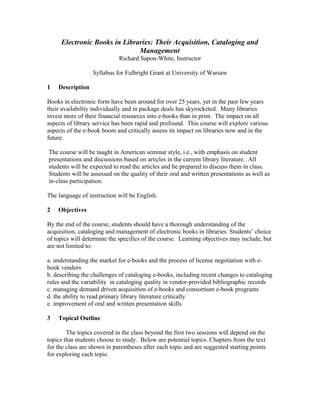
Electronic Books in Libraries: Their Acquisition, Cataloging and
                              Management
                             Richard Sapon-White, Instructor

                  Syllabus for Fulbright Grant at University of Warsaw

1   Description

Books in electronic form have been around for over 25 years, yet in the past few years
their availability individually and in package deals has skyrocketed. Many libraries
invest more of their financial resources into e-books than in print. The impact on all
aspects of library service has been rapid and profound. This course will explore various
aspects of the e-book boom and critically assess its impact on libraries now and in the
future.

The course will be taught in American seminar style, i.e., with emphasis on student
presentations and discussions based on articles in the current library literature. All
students will be expected to read the articles and be prepared to discuss them in class.
Students will be assessed on the quality of their oral and written presentations as well as
in-class participation.

The language of instruction will be English.

2   Objectives

By the end of the course, students should have a thorough understanding of the
acquisition, cataloging and management of electronic books in libraries. Students’ choice
of topics will determine the specifics of the course. Learning objectives may include, but
are not limited to:

a. understanding the market for e-books and the process of license negotiation with e-
book vendors
b. describing the challenges of cataloging e-books, including recent changes to cataloging
rules and the variability in cataloging quality in vendor-provided bibliographic records
c. managing demand driven acquisition of e-books and consortium e-book programs
d. the ability to read primary library literature critically
e. improvement of oral and written presentation skills

3   Topical Outline

        The topics covered in the class beyond the first two sessions will depend on the
topics that students choose to study. Below are potential topics. Chapters from the text
for the class are shown in parentheses after each topic and are suggested starting points
for exploring each topic.
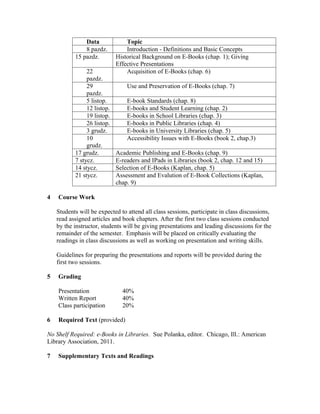
Data              Topic
               8 pazdz.          Introduction - Definitions and Basic Concepts
           15 pazdz.         Historical Background on E-Books (chap. 1); Giving
                             Effective Presentations
                22               Acquisition of E-Books (chap. 6)
                pazdz.
                29               Use and Preservation of E-Books (chap. 7)
                pazdz.
                5 listop.        E-book Standards (chap. 8)
                12 listop.       E-books and Student Learning (chap. 2)
                19 listop.       E-books in School Libraries (chap. 3)
                26 listop.       E-books in Public Libraries (chap. 4)
                3 grudz.         E-books in University Libraries (chap. 5)
                10               Accessibility Issues with E-Books (book 2, chap.3)
                grudz.
           17 grudz.         Academic Publishing and E-Books (chap. 9)
           7 stycz.          E-readers and IPads in Libraries (book 2, chap. 12 and 15)
           14 stycz.         Selection of E-Books (Kaplan, chap. 5)
           21 stycz.         Assessment and Evalution of E-Book Collections (Kaplan,
                             chap. 9)

4   Course Work

    Students will be expected to attend all class sessions, participate in class discussions,
    read assigned articles and book chapters. After the first two class sessions conducted
    by the instructor, students will be giving presentations and leading discussions for the
    remainder of the semester. Emphasis will be placed on critically evaluating the
    readings in class discussions as well as working on presentation and writing skills.

    Guidelines for preparing the presentations and reports will be provided during the
    first two sessions.

5   Grading

    Presentation               40%
    Written Report             40%
    Class participation        20%

6   Required Text (provided)

No Shelf Required: e-Books in Libraries. Sue Polanka, editor. Chicago, Ill.: American
Library Association, 2011.

7   Supplementary Texts and Readings
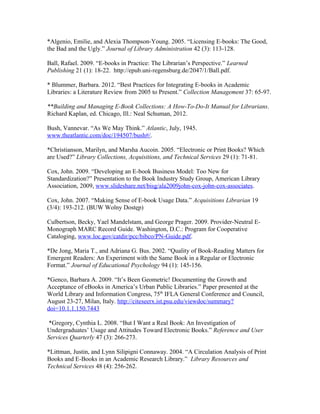
*Algenio, Emilie, and Alexia Thompson-Young. 2005. “Licensing E-books: The Good,
the Bad and the Ugly.” Journal of Library Administration 42 (3): 113-128.

Ball, Rafael. 2009. “E-books in Practice: The Librarian’s Perspective.” Learned
Publishing 21 (1): 18-22. http://epub.uni-regensburg.de/2047/1/Ball.pdf.

* Blummer, Barbara. 2012. “Best Practices for Integrating E-books in Academic
Libraries: a Literature Review from 2005 to Present.” Collection Management 37: 65-97.

**Building and Managing E-Book Collections: A How-To-Do-It Manual for Librarians.
Richard Kaplan, ed. Chicago, Ill.: Neal Schuman, 2012.

Bush, Vannevar. “As We May Think.” Atlantic, July, 1945.
www.theatlantic.com/doc/194507/bush#/.

*Christianson, Marilyn, and Marsha Aucoin. 2005. “Electronic or Print Books? Which
are Used?” Library Collections, Acquisitions, and Technical Services 29 (1): 71-81.

Cox, John. 2009. “Developing an E-book Business Model: Too New for
Standardization?” Presentation to the Book Industry Study Group, American Library
Association, 2009, www.slideshare.net/bisg/ala2009john-cox-john-cox-associates.

Cox, John. 2007. “Making Sense of E-book Usage Data.” Acquisitions Librarian 19
(3/4): 193-212. (BUW Wolny Dostęp)

Culbertson, Becky, Yael Mandelstam, and George Prager. 2009. Provider-Neutral E-
Monograph MARC Record Guide. Washington, D.C.: Program for Cooperative
Cataloging, www.loc.gov/catdir/pcc/bibco/PN-Guide.pdf.

*De Jong, Maria T., and Adriana G. Bus. 2002. “Quality of Book-Reading Matters for
Emergent Readers: An Experiment with the Same Book in a Regular or Electronic
Format.” Journal of Educational Psychology 94 (1): 145-156.

*Genco, Barbara A. 2009. “It’s Been Geometric! Documenting the Growth and
Acceptance of eBooks in America’s Urban Public Libraries.” Paper presented at the
World Library and Information Congress, 75th IFLA General Conference and Council,
August 23-27, Milan, Italy. http://citeseerx.ist.psu.edu/viewdoc/summary?
doi=10.1.1.150.7443

 *Gregory, Cynthia L. 2008. “But I Want a Real Book: An Investigation of
Undergraduates’ Usage and Attitudes Toward Electronic Books.” Reference and User
Services Quarterly 47 (3): 266-273.

*Littman, Justin, and Lynn Silipigni Connaway. 2004. “A Circulation Analysis of Print
Books and E-Books in an Academic Research Library.” Library Resources and
Technical Services 48 (4): 256-262.
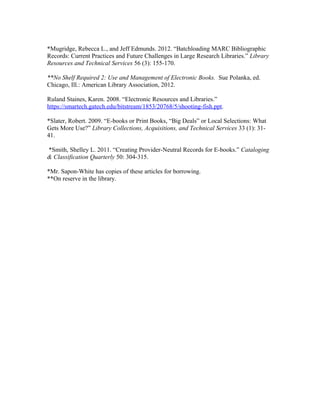
*Mugridge, Rebecca L., and Jeff Edmunds. 2012. “Batchloading MARC Bibliographic
Records: Current Practices and Future Challenges in Large Research Libraries.” Library
Resources and Technical Services 56 (3): 155-170.

**No Shelf Required 2: Use and Management of Electronic Books. Sue Polanka, ed.
Chicago, Ill.: American Library Association, 2012.

Ruland Staines, Karen. 2008. “Electronic Resources and Libraries.”
https://smartech.gatech.edu/bitstream/1853/20768/5/shooting-fish.ppt.

*Slater, Robert. 2009. “E-books or Print Books, “Big Deals” or Local Selections: What
Gets More Use?” Library Collections, Acquisitions, and Technical Services 33 (1): 31-
41.

*Smith, Shelley L. 2011. “Creating Provider-Neutral Records for E-books.” Cataloging
& Classification Quarterly 50: 304-315.

*Mr. Sapon-White has copies of these articles for borrowing.
**On reserve in the library.

Syllabus for electronic books in libraries

  • 1.
    Electronic Books inLibraries: Their Acquisition, Cataloging and Management Richard Sapon-White, Instructor Syllabus for Fulbright Grant at University of Warsaw 1 Description Books in electronic form have been around for over 25 years, yet in the past few years their availability individually and in package deals has skyrocketed. Many libraries invest more of their financial resources into e-books than in print. The impact on all aspects of library service has been rapid and profound. This course will explore various aspects of the e-book boom and critically assess its impact on libraries now and in the future. The course will be taught in American seminar style, i.e., with emphasis on student presentations and discussions based on articles in the current library literature. All students will be expected to read the articles and be prepared to discuss them in class. Students will be assessed on the quality of their oral and written presentations as well as in-class participation. The language of instruction will be English. 2 Objectives By the end of the course, students should have a thorough understanding of the acquisition, cataloging and management of electronic books in libraries. Students’ choice of topics will determine the specifics of the course. Learning objectives may include, but are not limited to: a. understanding the market for e-books and the process of license negotiation with e- book vendors b. describing the challenges of cataloging e-books, including recent changes to cataloging rules and the variability in cataloging quality in vendor-provided bibliographic records c. managing demand driven acquisition of e-books and consortium e-book programs d. the ability to read primary library literature critically e. improvement of oral and written presentation skills 3 Topical Outline The topics covered in the class beyond the first two sessions will depend on the topics that students choose to study. Below are potential topics. Chapters from the text for the class are shown in parentheses after each topic and are suggested starting points for exploring each topic.
  • 2.
    Data Topic 8 pazdz. Introduction - Definitions and Basic Concepts 15 pazdz. Historical Background on E-Books (chap. 1); Giving Effective Presentations 22 Acquisition of E-Books (chap. 6) pazdz. 29 Use and Preservation of E-Books (chap. 7) pazdz. 5 listop. E-book Standards (chap. 8) 12 listop. E-books and Student Learning (chap. 2) 19 listop. E-books in School Libraries (chap. 3) 26 listop. E-books in Public Libraries (chap. 4) 3 grudz. E-books in University Libraries (chap. 5) 10 Accessibility Issues with E-Books (book 2, chap.3) grudz. 17 grudz. Academic Publishing and E-Books (chap. 9) 7 stycz. E-readers and IPads in Libraries (book 2, chap. 12 and 15) 14 stycz. Selection of E-Books (Kaplan, chap. 5) 21 stycz. Assessment and Evalution of E-Book Collections (Kaplan, chap. 9) 4 Course Work Students will be expected to attend all class sessions, participate in class discussions, read assigned articles and book chapters. After the first two class sessions conducted by the instructor, students will be giving presentations and leading discussions for the remainder of the semester. Emphasis will be placed on critically evaluating the readings in class discussions as well as working on presentation and writing skills. Guidelines for preparing the presentations and reports will be provided during the first two sessions. 5 Grading Presentation 40% Written Report 40% Class participation 20% 6 Required Text (provided) No Shelf Required: e-Books in Libraries. Sue Polanka, editor. Chicago, Ill.: American Library Association, 2011. 7 Supplementary Texts and Readings
  • 3.
    *Algenio, Emilie, andAlexia Thompson-Young. 2005. “Licensing E-books: The Good, the Bad and the Ugly.” Journal of Library Administration 42 (3): 113-128. Ball, Rafael. 2009. “E-books in Practice: The Librarian’s Perspective.” Learned Publishing 21 (1): 18-22. http://epub.uni-regensburg.de/2047/1/Ball.pdf. * Blummer, Barbara. 2012. “Best Practices for Integrating E-books in Academic Libraries: a Literature Review from 2005 to Present.” Collection Management 37: 65-97. **Building and Managing E-Book Collections: A How-To-Do-It Manual for Librarians. Richard Kaplan, ed. Chicago, Ill.: Neal Schuman, 2012. Bush, Vannevar. “As We May Think.” Atlantic, July, 1945. www.theatlantic.com/doc/194507/bush#/. *Christianson, Marilyn, and Marsha Aucoin. 2005. “Electronic or Print Books? Which are Used?” Library Collections, Acquisitions, and Technical Services 29 (1): 71-81. Cox, John. 2009. “Developing an E-book Business Model: Too New for Standardization?” Presentation to the Book Industry Study Group, American Library Association, 2009, www.slideshare.net/bisg/ala2009john-cox-john-cox-associates. Cox, John. 2007. “Making Sense of E-book Usage Data.” Acquisitions Librarian 19 (3/4): 193-212. (BUW Wolny Dostęp) Culbertson, Becky, Yael Mandelstam, and George Prager. 2009. Provider-Neutral E- Monograph MARC Record Guide. Washington, D.C.: Program for Cooperative Cataloging, www.loc.gov/catdir/pcc/bibco/PN-Guide.pdf. *De Jong, Maria T., and Adriana G. Bus. 2002. “Quality of Book-Reading Matters for Emergent Readers: An Experiment with the Same Book in a Regular or Electronic Format.” Journal of Educational Psychology 94 (1): 145-156. *Genco, Barbara A. 2009. “It’s Been Geometric! Documenting the Growth and Acceptance of eBooks in America’s Urban Public Libraries.” Paper presented at the World Library and Information Congress, 75th IFLA General Conference and Council, August 23-27, Milan, Italy. http://citeseerx.ist.psu.edu/viewdoc/summary? doi=10.1.1.150.7443 *Gregory, Cynthia L. 2008. “But I Want a Real Book: An Investigation of Undergraduates’ Usage and Attitudes Toward Electronic Books.” Reference and User Services Quarterly 47 (3): 266-273. *Littman, Justin, and Lynn Silipigni Connaway. 2004. “A Circulation Analysis of Print Books and E-Books in an Academic Research Library.” Library Resources and Technical Services 48 (4): 256-262.
  • 4.
    *Mugridge, Rebecca L.,and Jeff Edmunds. 2012. “Batchloading MARC Bibliographic Records: Current Practices and Future Challenges in Large Research Libraries.” Library Resources and Technical Services 56 (3): 155-170. **No Shelf Required 2: Use and Management of Electronic Books. Sue Polanka, ed. Chicago, Ill.: American Library Association, 2012. Ruland Staines, Karen. 2008. “Electronic Resources and Libraries.” https://smartech.gatech.edu/bitstream/1853/20768/5/shooting-fish.ppt. *Slater, Robert. 2009. “E-books or Print Books, “Big Deals” or Local Selections: What Gets More Use?” Library Collections, Acquisitions, and Technical Services 33 (1): 31- 41. *Smith, Shelley L. 2011. “Creating Provider-Neutral Records for E-books.” Cataloging & Classification Quarterly 50: 304-315. *Mr. Sapon-White has copies of these articles for borrowing. **On reserve in the library.