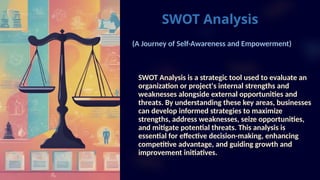
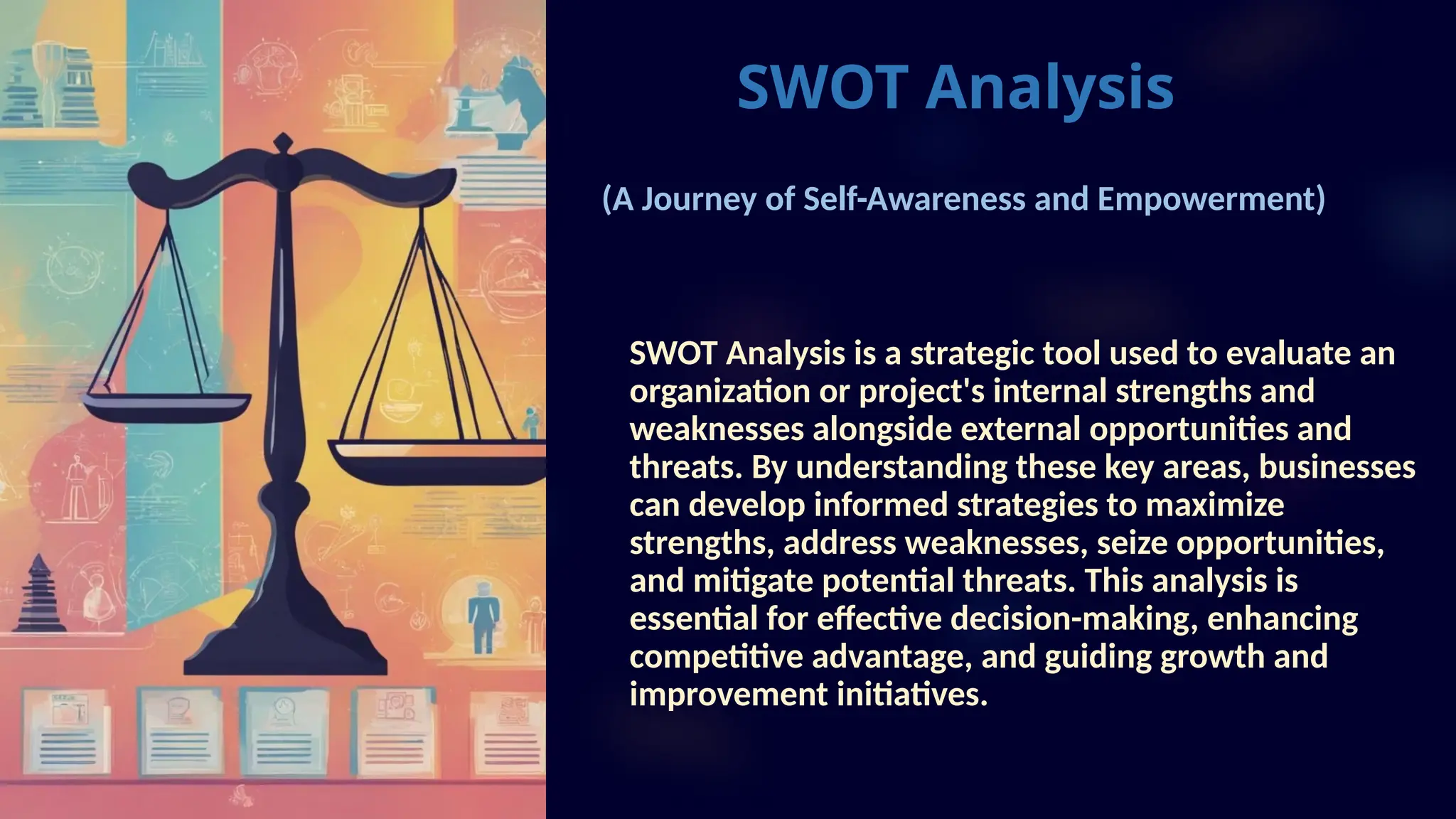
SWOT Analysis
(A Journey of Self-Awareness and Empowerment)
SWOT Analysis is a strategic tool used to evaluate an
organization or project's internal strengths and
weaknesses alongside external opportunities and
threats. By understanding these key areas, businesses
can develop informed strategies to maximize
strengths, address weaknesses, seize opportunities,
and mitigate potential threats. This analysis is
essential for effective decision-making, enhancing
competitive advantage, and guiding growth and
improvement initiatives.
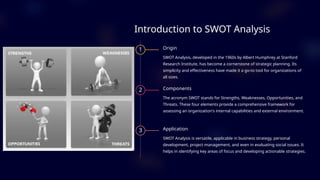
Introduction to SWOT Analysis
1 Origin
SWOT Analysis, developed in the 1960s by Albert Humphrey at Stanford
Research Institute, has become a cornerstone of strategic planning. Its
simplicity and effectiveness have made it a go-to tool for organizations of
all sizes.
2 Components
The acronym SWOT stands for Strengths, Weaknesses, Opportunities, and
Threats. These four elements provide a comprehensive framework for
assessing an organization's internal capabilities and external environment.
3 Application
SWOT Analysis is versatile, applicable in business strategy, personal
development, project management, and even in evaluating social issues. It
helps in identifying key areas of focus and developing actionable strategies.
Strengths:(Internal positive attributes or advantages that give an edge)
Intrinsic Value
A strong sense of purpose and inherent worth can be a
guiding strength, attracting like-minded individuals and
fostering a sense of shared vision. Organizations that
embrace their core values and align their actions with
them often cultivate a loyal following and achieve
sustainable growth.
Collective Intelligence
A diverse and collaborative workforce, where individual
perspectives are valued and nurtured, can unlock
collective brilliance. Organizations that prioritize open
communication and empower their employees to
contribute their unique insights often achieve greater
innovation and adaptability.
Transformative Potential
The ability to challenge the status quo and embrace
change is a potent strength. Organizations that possess a
spirit of inquiry and a willingness to explore new frontiers
often lead the way in creating positive societal impact.
Ethical Foundation
A strong commitment to ethical principles and social
responsibility can create a lasting legacy. Organizations
that operate with integrity and prioritize the well-being of
their stakeholders often build enduring trust and achieve
a positive reputation.
Weaknesses:(Internal limitations or areas that need improvement)
The Burden of Perfection
Striving for unattainable perfection
can be a crippling weakness. It can
lead to paralysis, self-doubt, and an
inability to embrace imperfections,
which are often the catalysts for
growth and innovation.
The Illusion of Control
The belief that we can fully control
our circumstances or outcomes can
be a deceptive weakness. It can
blind us to the interconnectedness
of life and make us resistant to
change or collaboration, hindering
our adaptability and resilience.
The Shadow of Fear
Fear of failure, judgment, or the
unknown can be a pervasive
weakness. It can stifle creativity,
limit our willingness to take risks,
and prevent us from fully engaging
with the world, restricting our
potential and limiting our impact.
Opportunities:(External factors that could be leveraged for growth or success )
Uncharted Territories
Expanding into new geographical markets
can provide a chance to connect with
diverse cultures and perspectives, fostering
a deeper understanding of the human
experience. It's a journey into the unknown,
a quest to bridge differences and discover
new possibilities for growth and
collaboration.
The Dawn of New Horizons
Embracing new technologies like AI,
blockchain, or IoT can be seen as an
evolution of our understanding of the
world. These advancements hold the
potential to reshape the way we interact,
communicate, and create, leading to a
paradigm shift in our collective
consciousness.
A Tapestry of Collaboration
Strategic partnerships are not merely
business deals; they are the weaving
together of different threads, each with its
unique strength and purpose. These
collaborations can create a richer and more
diverse tapestry of human experience,
promoting understanding and mutual
growth.
Threats:(External challenges that could harm success)
Intense Competition
The entry of new competitors or
aggressive moves by existing ones can
threaten market share and profitability.
This is particularly evident in fast-moving
industries like technology and e-
commerce.
Changing Regulations
Shifts in government policies or industry
regulations can pose significant threats.
For instance, environmental regulations
have forced many automotive companies
to rapidly adapt their product lines.
Economic Downturns
Economic recessions or global crises can
severely impact businesses across sectors.
The COVID-19 pandemic, for example,
posed unprecedented challenges to
industries like travel and hospitality.
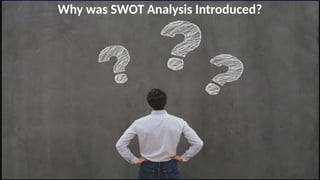
Why was SWOT Analysis Introduced?
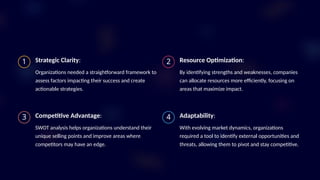
1 Strategic Clarity:
Organizations needed a straightforward framework to
assess factors impacting their success and create
actionable strategies.
2 Resource Optimization:
By identifying strengths and weaknesses, companies
can allocate resources more efficiently, focusing on
areas that maximize impact.
3 Competitive Advantage:
SWOT analysis helps organizations understand their
unique selling points and improve areas where
competitors may have an edge.
4 Adaptability:
With evolving market dynamics, organizations
required a tool to identify external opportunities and
threats, allowing them to pivot and stay competitive.
Thank you

By :
Aryan Prajapati
CRN(2302483)
Ayush
CRN(2302488)

SWOT- Analysis -and -Human-Rights.pptx

  • 1.
    SWOT Analysis (A Journeyof Self-Awareness and Empowerment) SWOT Analysis is a strategic tool used to evaluate an organization or project's internal strengths and weaknesses alongside external opportunities and threats. By understanding these key areas, businesses can develop informed strategies to maximize strengths, address weaknesses, seize opportunities, and mitigate potential threats. This analysis is essential for effective decision-making, enhancing competitive advantage, and guiding growth and improvement initiatives.
  • 2.
    Introduction to SWOTAnalysis 1 Origin SWOT Analysis, developed in the 1960s by Albert Humphrey at Stanford Research Institute, has become a cornerstone of strategic planning. Its simplicity and effectiveness have made it a go-to tool for organizations of all sizes. 2 Components The acronym SWOT stands for Strengths, Weaknesses, Opportunities, and Threats. These four elements provide a comprehensive framework for assessing an organization's internal capabilities and external environment. 3 Application SWOT Analysis is versatile, applicable in business strategy, personal development, project management, and even in evaluating social issues. It helps in identifying key areas of focus and developing actionable strategies.
  • 3.
    Strengths:(Internal positive attributesor advantages that give an edge) Intrinsic Value A strong sense of purpose and inherent worth can be a guiding strength, attracting like-minded individuals and fostering a sense of shared vision. Organizations that embrace their core values and align their actions with them often cultivate a loyal following and achieve sustainable growth. Collective Intelligence A diverse and collaborative workforce, where individual perspectives are valued and nurtured, can unlock collective brilliance. Organizations that prioritize open communication and empower their employees to contribute their unique insights often achieve greater innovation and adaptability. Transformative Potential The ability to challenge the status quo and embrace change is a potent strength. Organizations that possess a spirit of inquiry and a willingness to explore new frontiers often lead the way in creating positive societal impact. Ethical Foundation A strong commitment to ethical principles and social responsibility can create a lasting legacy. Organizations that operate with integrity and prioritize the well-being of their stakeholders often build enduring trust and achieve a positive reputation.
  • 4.
    Weaknesses:(Internal limitations orareas that need improvement) The Burden of Perfection Striving for unattainable perfection can be a crippling weakness. It can lead to paralysis, self-doubt, and an inability to embrace imperfections, which are often the catalysts for growth and innovation. The Illusion of Control The belief that we can fully control our circumstances or outcomes can be a deceptive weakness. It can blind us to the interconnectedness of life and make us resistant to change or collaboration, hindering our adaptability and resilience. The Shadow of Fear Fear of failure, judgment, or the unknown can be a pervasive weakness. It can stifle creativity, limit our willingness to take risks, and prevent us from fully engaging with the world, restricting our potential and limiting our impact.
  • 5.
    Opportunities:(External factors thatcould be leveraged for growth or success ) Uncharted Territories Expanding into new geographical markets can provide a chance to connect with diverse cultures and perspectives, fostering a deeper understanding of the human experience. It's a journey into the unknown, a quest to bridge differences and discover new possibilities for growth and collaboration. The Dawn of New Horizons Embracing new technologies like AI, blockchain, or IoT can be seen as an evolution of our understanding of the world. These advancements hold the potential to reshape the way we interact, communicate, and create, leading to a paradigm shift in our collective consciousness. A Tapestry of Collaboration Strategic partnerships are not merely business deals; they are the weaving together of different threads, each with its unique strength and purpose. These collaborations can create a richer and more diverse tapestry of human experience, promoting understanding and mutual growth.
  • 6.
    Threats:(External challenges thatcould harm success) Intense Competition The entry of new competitors or aggressive moves by existing ones can threaten market share and profitability. This is particularly evident in fast-moving industries like technology and e- commerce. Changing Regulations Shifts in government policies or industry regulations can pose significant threats. For instance, environmental regulations have forced many automotive companies to rapidly adapt their product lines. Economic Downturns Economic recessions or global crises can severely impact businesses across sectors. The COVID-19 pandemic, for example, posed unprecedented challenges to industries like travel and hospitality.
  • 7.
    Why was SWOTAnalysis Introduced?
  • 8.
    1 Strategic Clarity: Organizationsneeded a straightforward framework to assess factors impacting their success and create actionable strategies. 2 Resource Optimization: By identifying strengths and weaknesses, companies can allocate resources more efficiently, focusing on areas that maximize impact. 3 Competitive Advantage: SWOT analysis helps organizations understand their unique selling points and improve areas where competitors may have an edge. 4 Adaptability: With evolving market dynamics, organizations required a tool to identify external opportunities and threats, allowing them to pivot and stay competitive.
  • 9.
    Thank you  By : AryanPrajapati CRN(2302483) Ayush CRN(2302488)