BRICKS & BLOCKS
TYPES & USES
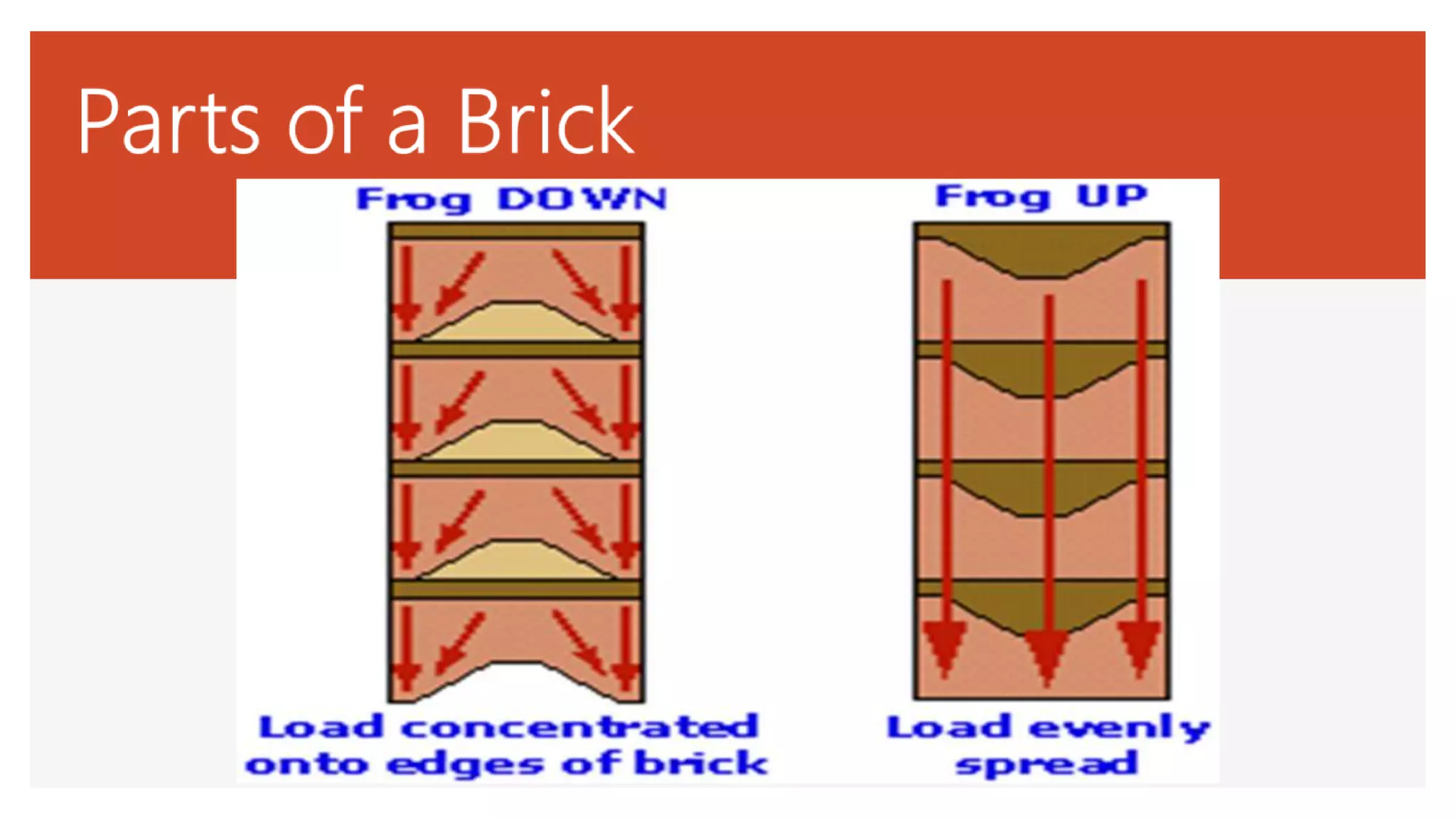
Parts of a Brick
How Bricks Sit
Let's Talk About Bricks
Where to start: engineering bricks and foundation blocks
Engineering bricks
Class A engineering bricks
Class B engineering bricks
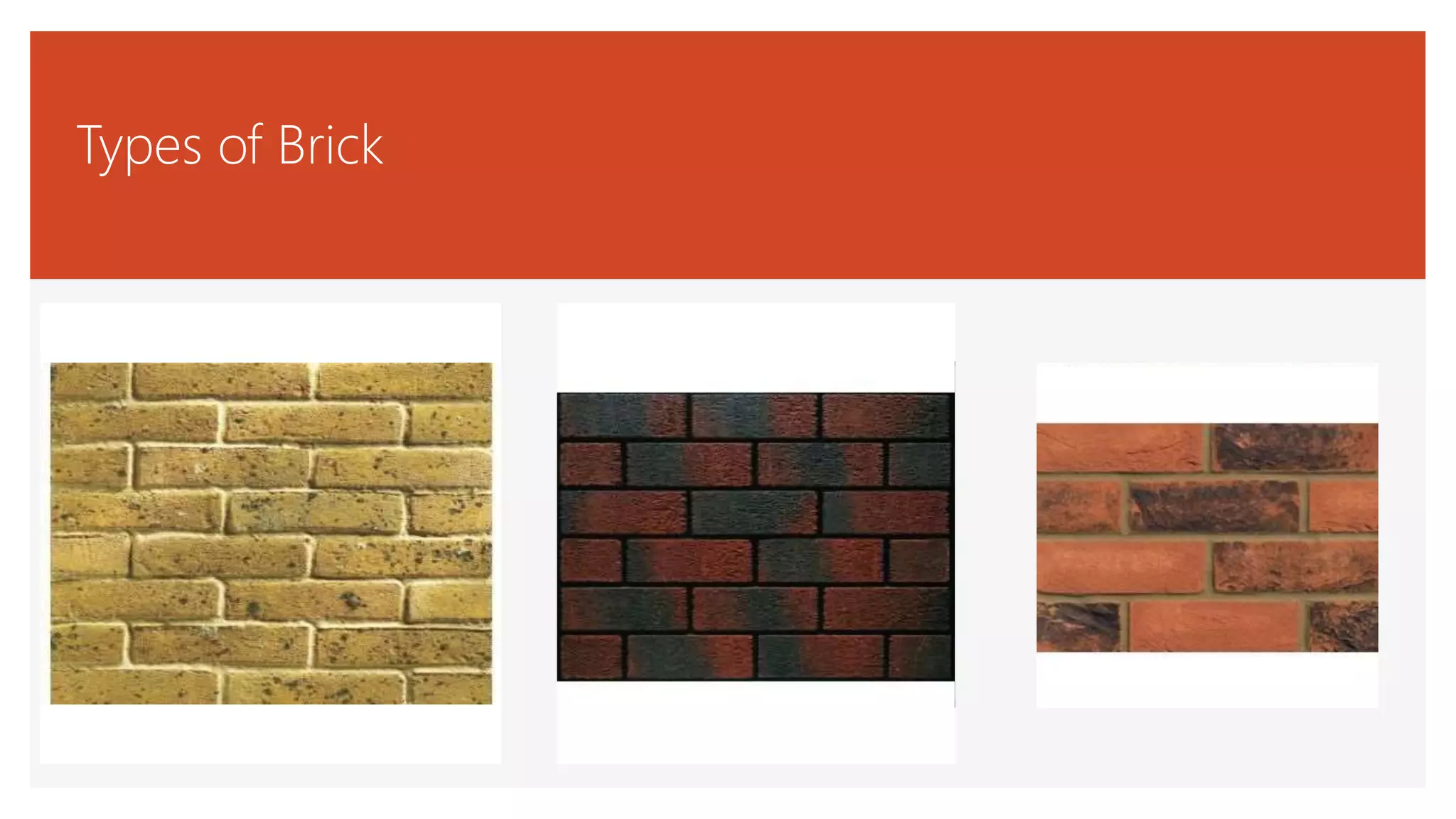
Types of Brick
Types of Brick
Types of Brick
Types of Blocks
Hollow Dense Concrete Block 7.3N 215mm
Solid Dense 7.3N Concrete Block
Aerated Concrete Block Grey 3.6N
Aerated Blocks Standard 3.6n 100mm
Thermalite
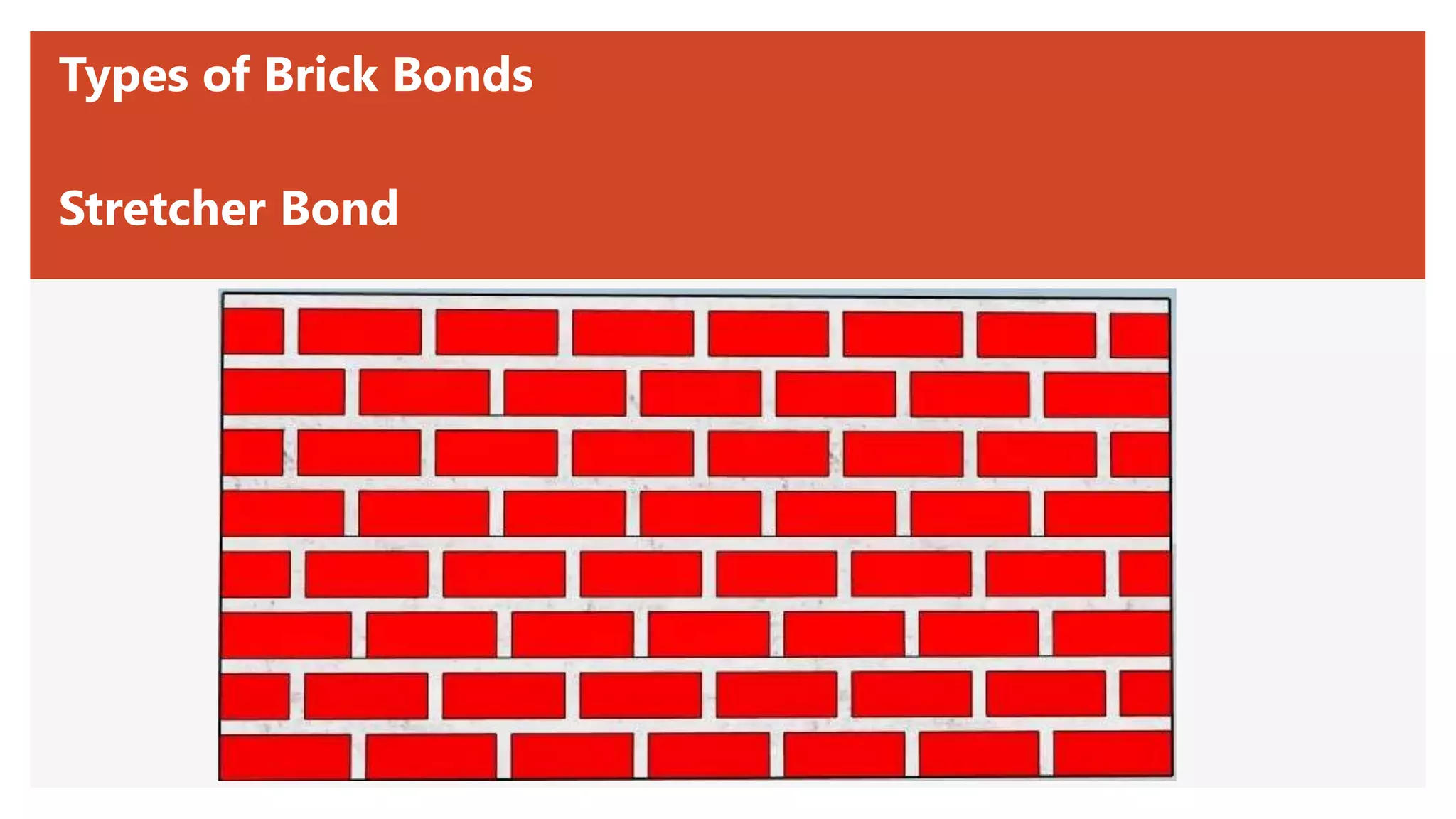
Types of Brick Bonds
Stretcher Bond
Types of Brick Bonds
Header Bond
Types of Brick Bonds
English Bond
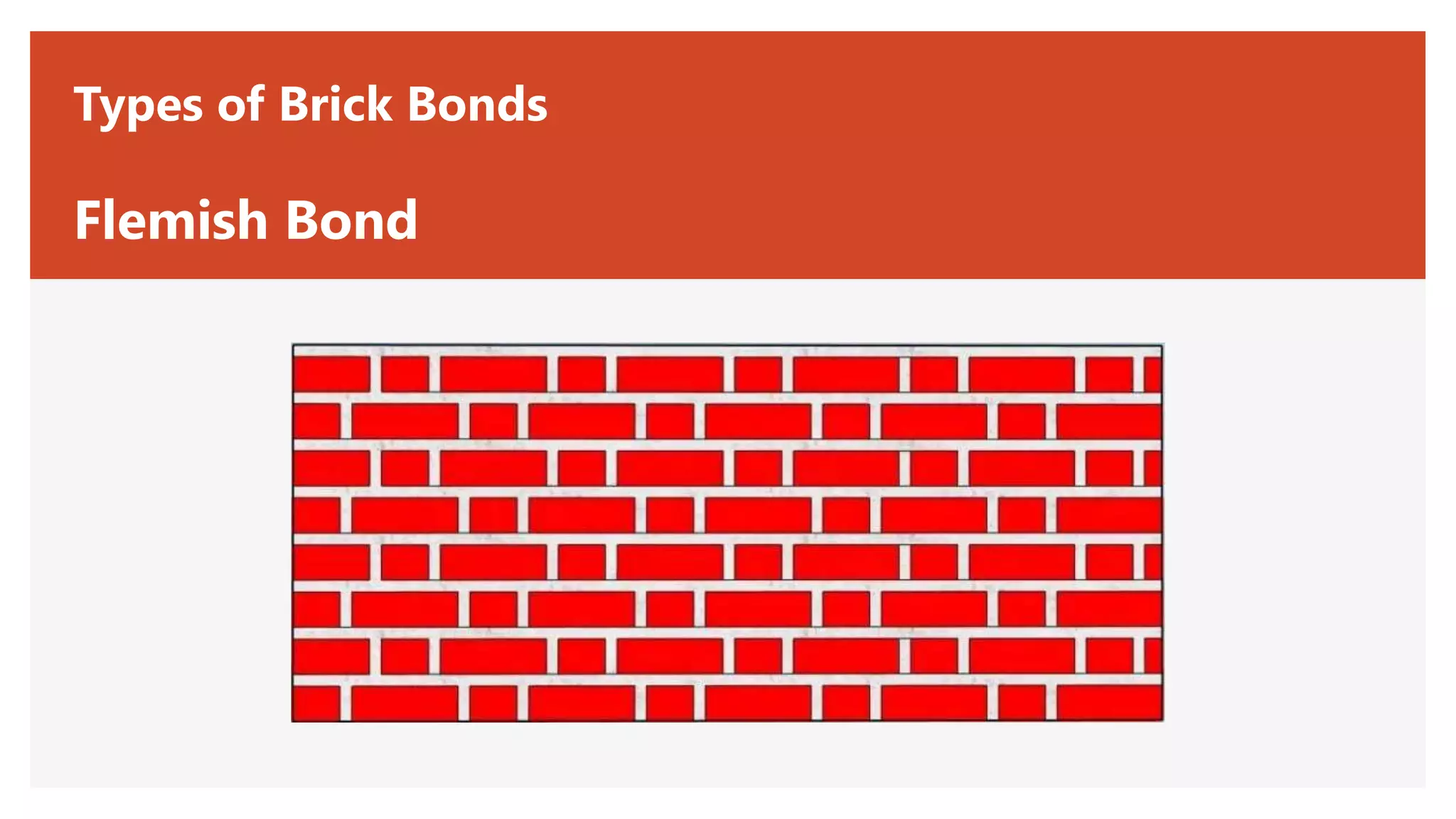
Flemish Bond
Types of Brick Bonds
English Garden Wall Bond
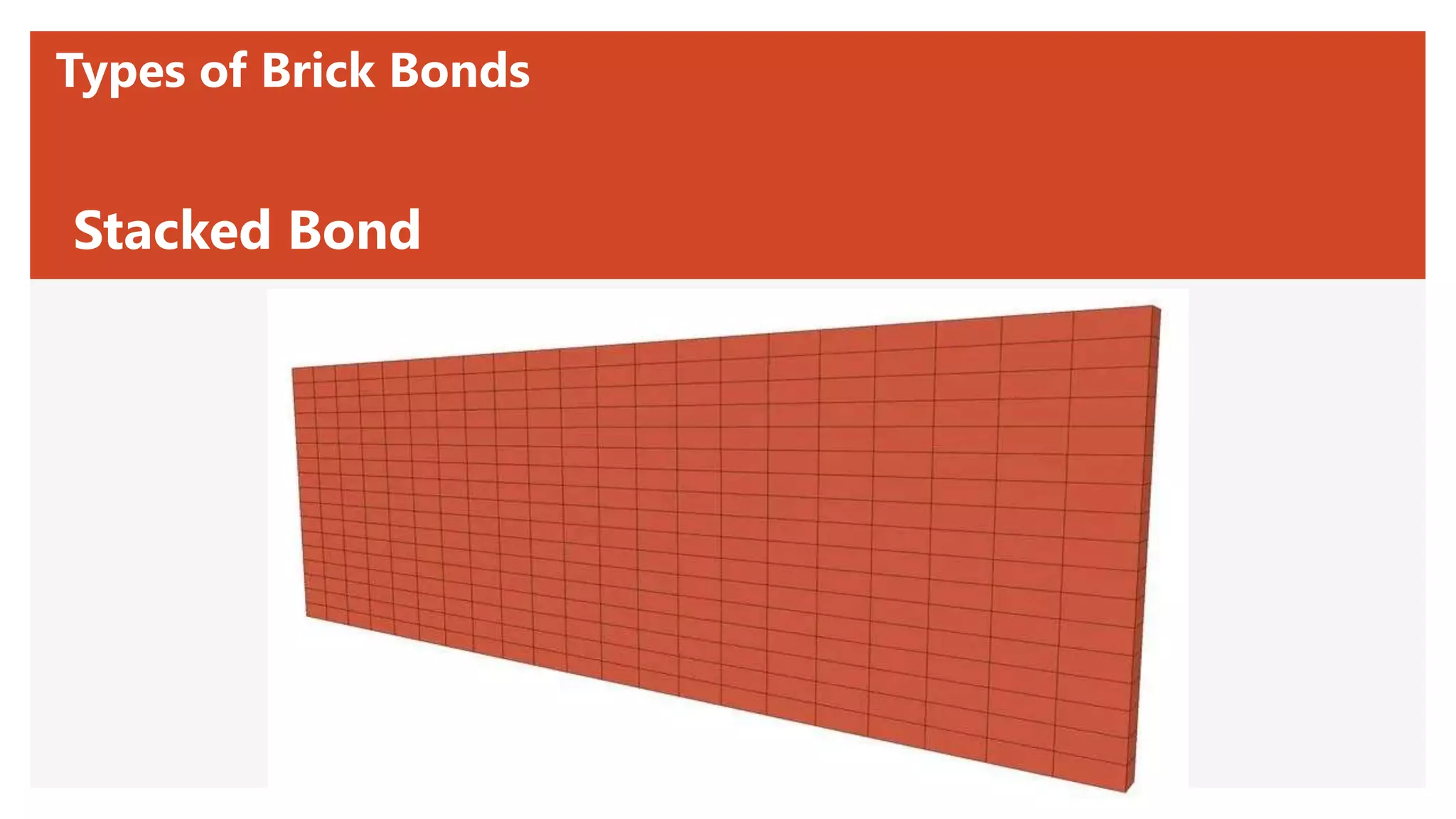
Stacked Bond
Types of Brick Bonds
Raked or Raking Bond
Types of Brick Bonds
Zig Zag Bond
Brick
https://youtu.be/NZ8brDJAMdE

Swh types of bricks and bonds

Editor's Notes

  • #2 Bricks are an integral part of construction, with around 150 million bricks delivered (Statista: Monthly deliveries of bricks in Great Britain 2016-2019) by brick suppliers each month across the UK. Bricks and blocks are needed for building, repair, and remodelling, with particular bricks serving very specific purposes.  We’re going to take you through the different types of brick used for construction in the UK and their uses. 
  • #3 Parts
  • #4 Frog https://www.youtube.com/watch?v=Q4XBuOZT_gc
  • #5 Holes: Weigh less, Allow mortar to seep through to other side and interlock more. Cheaper to fire.
  • #8 Where classing engineering bricks is concerned, there are clear definitions based on their tolerances – a brick’s ‘value’ is primarily based around compressive strength and water absorption. Compressive strength is the ability to withstand greater load weights. Water absorption indicates a brick’s resistance to freezing; essentially, the less water it takes in, the more freeze resistant it is. Class A engineering bricks – able to handle high compressive strength (125N/mm2), with water absorption at under 4.5%. Often used for specialised projects, and particularly good for damp coursing. Class B engineering bricks – broadly more commonly used than Class A. Compressive strength of 75N/mm2, water absorption under 7%. As an example, Class A engineering bricks are often used in constructing manholes.
  • #10 Facing bricks As common bricks are purely functional, facing bricks have the job of making walls - especially exterior walls for housing - more attractive. One of the most commonplace facing brick types is the wirecut or extruded brick. Often made from fired clay and mortar for reinforcement, and bonded with cement, sand and water. These are far more exacting in size and shape than older clay or soft mud bricks, and are produced in a selection of textures from rustic to contemporary.
  • #11 Common bricks Traditionally, common bricks were only made of clay and weren’t built to an exacting standard, which makes life a little difficult when brick matching. Things have changed for common bricks since then, as they are now produced to meet specific standards of sizing, compressive strength management and cold weather resistance.  Common concrete bricks are made by forming a cement and aggregate mix, which is pressed into molds before curing. Different colours can be added at this point, with the intention of making these appear as closely to clay – like traditional bricks – as possible.  The result is a uniform, functional brick that serves a purpose for construction. For most properties, however, this doesn’t take into account different tastes and styles. This is why facing bricks are produced. However, common bricks do play an important role, being a cheaper alternative to facing bricks.
  • #12 Concrete blocks are incredibly versatile, and can be used for anything from retaining walls to building security barriers. They are sturdy and simplify some building work by offering a tough, cost-effective solution to using bricks unnecessarily. This solid, dense concrete block from Aggregate Industries is suitable for cavity or solid wall constructions, internal load bearing walls and beam and block flooring. Water resistant with sound insulation properties. Creates a good base for fixings Suitable for internal and external use Resistant to fire and sound BBA approved Conforms to BS EN ISO 9001 Complies with BS EN 771-3
  • #13 Overview Can be used for the construction of high strength retaining walls, for external walls, cavity walls, partition walls and party walls. Suitable for a wide variety of applications Ideal for high strength load-bearing walls Secure base for fixings Reduced unit weight for ease of handling Reduced floor/ foundation loadings High levels of fire resistance and sound insulation
  • #14 Overview This solid, dense concrete block from Aggregate Industries is suitable for cavity or solid wall constructions, internal load bearing walls and beam and block flooring. Water resistant with sound insulation properties. Creates a good base for fixings Suitable for internal and external use Resistant to fire and sound BBA approved Conforms to BS EN ISO 9001 Complies with BS EN 771-3
  • #15 Overview Celcon Block Standard Grade is BBA certified and has a compressive strength of 3.6N/mm2. Its all-round performance allows a 100mm Standard Grade Celcon Block to be used consistently throughout a build, eliminating on-site confusion Internal and external leaf of cavity walls Solid walls Separating walls Partitions Multi-storey buildings Foundations Beam and Block floors Flanking walls
  • #16 Aerated Blocks Standard 3.6n 100mm Thermalite/Celcon Aerated Blocks Standard 3.6n in Thermalite Shield, Celcon Standard or other equivalent brands. The blocks can be used below DPC as infill for Beam & Block flooring systems, as well as above ground in walling applications. They are light, durable and have excellent sound & thermal insulation. The blocks are made from cement, lime, sand, fly ash (FA) and water. FA or ground sand is mixed with water to form slurry. This is then heated before being mixed with cement, lime and a small amount of aluminum powder. The aluminum reacts with the lime to form bubbles of hydrogen. Fly Ash The use of Fly Ash in building materials diverts millions of tons of ash from the landfills each year, increases the constructability and durability of concrete and brick, partially replaces energy-intensive Portland cement
  • #17 It one of the basic types of brick bonds. Bricks are laid horizontally and flat with a long side called a stretcher and in this types of brick bond, all brick is laid as stretchers, which is lengthwise shown in fig. this type of bond in the brick is the simplest repeating pattern. Sometimes stretcher bond is also known as running bond. Different types of wall construction done using stretcher type bond are: Sleeper walls Boundary walls Partition walls Division walls (internal dividers) Chimney stacks
  • #18 it one of the important types of brick bonds used in construction. Header means a shorter square span face of the brick which has dimensions 9cm x 9cm. In these bonds, all bricks are placed as headers on the faces of any type of walls. Sometime header bond is also called a heading bond.  While Stretcher bond is used for the construction of walls of half brick thickness whereas this bond is used for the construction of walls with full brick thickness. In these bonds, the overlap is kept equal to 1/2 width of the brick. For this purpose three-quarter brickbats are used in alternate courses as quoins.
  • #19 English bond is a widely used types of brick bond used in construction work. English bond in the brick masonry work consists of one course of the stretcher and another course of the header above it, i.e. pattern formed by laying alternate courses of stretchers and headers. Headers are laid centred on the stretchers in course below and each alternate row is vertically aligned. For the breaking of continuity of vertical joints, the queen closer is used in the beginning and end of a wall after the first header in each heading course. A queen closer is a brick cut lengthwise into two halves and used at corners in brick walls. Advantages of English Bond: English bond is one of the strongest bonds but it requires more facing bricks than any other bonds.
  • #20 Flemish bond is one of the strongest types of brick bond for building construction. This type of bond, also famous as the Dutch bond, is created by laying alternate headers and stretchers in a single same course. The very next course of brick is laid in such a way that the header lies in the center of the stretcher in the course below, i.e. the alternate headers of each course are centered on the stretcher of course below. Each and every alternate course of this bond starts with a header at the corner. The disadvantage of flemish bond: this bond is that difficult in construction and requires high skill to lay it perfectly as all vertical mortar joints need to be aligned vertically for best and great effects.  For the breaking of vertical joints in the successive courses, closers are putting in alternate courses next to the quoin header. Bats are used for walls having their thickness equal to an odd number of half bricks.
  • #21 English Garden Wall Bond: The arrangement of bricks in English garden wall type of bonding is similar to that of English bond except that the heading courses are only inserted at every (4th or 6th ) course whereas stretchers are used in consequent courses every (3rd,5th or 7th ). In sort the arrangement consists of one course of headers and three courses of stretchers. The queen closer is placed next to the queen header of the heading course forgive the necessary lap.
  • #22 In this type of bond, bricks are laid directly on the top of one another with joins aligned, running vertically down the whole wall. Bricks can be stacked horizontally or vertically too. The alignment of joints results in minimal bonding which means that this bond is weak and often structurally unsound unless wire bed-joint reinforcement is placed in every horizontal course or, where loading is moderate, every alternate course. This is often used purely for decorative purposes and in rain-screen applications.
  • #23 . Raking Bond: This is a types of brick bond in which the bonding bricks are laid at any angle except zero or ninety degrees. This type of arrangement helps to increase the longitudinal stability of thick walls built in English bond. In this pattern of bonding, the space between the all external stretchers of a wall is filled using bricks inclined to the face of the wall. Raking bond is introduced at certain intervals along with the height of any wall. There are two common pattern of raking bond ; Herring hone bond Diagonal bond Herringbone bond: This type of bond is suited for very thick walls usually not less than four bricks thick. In this pattern of brickwork, bricks are laid in course inclined at  45° in 2 directions from the centre. This type of bond is also commonly used for brick paving. Diagonal Bond: It is best suited for walls of two to four brick thickness. Diagonal bond is normally introduced at every fifth or seven-course along with the height of the wall. Bricks in this type of bond are placed end to end in such a way that extreme corners of the sequence remain in contact with stretchers.
  • #24 This type of bond is very similar to herring-bone bond only difference is that in this case the bricks are laid in a zig-zag pattern. Itis mostly adopted in brick-paved flooring.