Objectives
 Compare the educational systems of Sweden and
Vietnam;
 Identify the issues/problems encountered in
education in Sweden and Vietnam
History of Education in SWEDEN
 Compulsory school attendance was implemented in Sweden in 1842
(Stanfors,2000). In the 1980s and 1990s, Sweden found itself battling high
unemployment even as it wrestled with the problem of assimilating a fast-rising
immigrant population. By 1995, Sweden's literacy rate reached 99 percent. In
March of 2001, the country's employment situation approached a healthy state
again, with only a 3.9 percent unemployment rate.
 In the 1960s, the Social‐Democratic government implemented a reform of the
compulsory and secondary school system.
 A comprehensive compulsory school (grundskola) was introduced for children
aged 7 to 16 years, at the same time the educational system was centralised and
standardised nationally.
History of Education in SWEDEN
 In the mid 1960s and in the beginning of the 1970s, upper secondary school
(gymnasium) was restructured to contain three tracks, consisting of (a)
three‐year academic programmes preparing for university studies, (b) two‐year
continuation programmes, and (c) two‐year vocational programmes.
 In the mid 1960s and in the beginning of the 1970s, upper secondary school
(gymnasium) was restructured to contain three tracks, consisting of (a)
three‐year academic programmes preparing for university studies, (b) two‐year
continuation programmes, and (c) two‐year vocational programmes.
 Education in Sweden is mainly organised within the public sector. Parliament and
the government have the overall responsibility for the state financed education
system: Pre-school (early child-hood education, year 0- 6), pre-school class and
compulsory school (year 6-16), upper secondary school, general education as
wells as initial vocational training (year 16-20), adult education and higher
education and research.
History of Education in VIETNAM
 Feudal Period (up to late 19th century)
- Teachers were often given more importance than the parents
- Teachers must have excellent learning achievements and must have ranks in
competitive exam.
- Vietnamese learned the Chinese characters and used them in writing but they
pronounce them the Vietnamese way
1075- first competitive exam was conducted
1070- first Confucian University was constructed (Temple of Literature)
 French Colonization (19th century to mid-20th century)
- Confucian-oriented education was replaced by French-Vietnamese education
with the goal to serve the colonial system
- Elementary schools, primary schools, primary colleges were built with French
as the dominant language of instruction. However, not much was built and it
resulted to 95% illiteracy
History of Education in VIETNAM
 Independence to Reunification (1945-1975)
- Vietnam gained independence from France on September 2, 1945
- “fighting against poverty, illiteracy, and invaders”
“an illiterate nation is a powerless one”
- In just a year of its implementation, 75,000 literacy classes were established
with about 96,000 teachers to help 2.5Million people to learn and write.
- (1945-1954) Curriculum in Vietnamese was created
- (1950) an education reform was passed by the government with a goal in
reducing the number of years of general education and concentrating on
reading, writing, and calculating skills
- (1954) Vietnam gained its full independence from France
French (12 yr) 1st Reform (9 yr) 10 yr-system
History of Education in VIETNAM
 After the War, Pre-reform (1975-1985)
- Vietnam was proclaimed as one unified nation
- The government focused on:
(1) the removal of leftover influences from the old educational system;
(2) the implementation of anti-illiteracy activities for people in the age group
of 12-50 years old
 The Doi Moi Reform (1986)
- Its goal is to increase economic growth development which leads to more
funding for institutions and a higher percentage of government funds
allocated to the education system
- In 1998, Vietnam passed its first law on education which was later amended
to increase accessibility to education
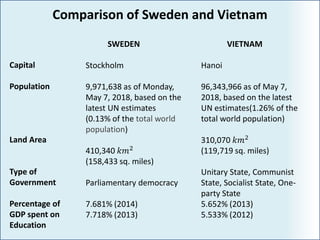
Comparison of Sweden and Vietnam
SWEDEN
Stockholm
9,971,638 as of Monday,
May 7, 2018, based on the
latest UN estimates
(0.13% of the total world
population)
410,340 𝑘𝑚2
(158,433 sq. miles)
Parliamentary democracy
7.681% (2014)
7.718% (2013)
VIETNAM
Hanoi
96,343,966 as of May 7,
2018, based on the latest
UN estimates(1.26% of the
total world population)
310,070 𝑘𝑚2
(119,719 sq. miles)
Unitary State, Communist
State, Socialist State, One-
party State
5.652% (2013)
5.533% (2012)
Capital
Population
Land Area
Type of
Government
Percentage of
GDP spent on
Education
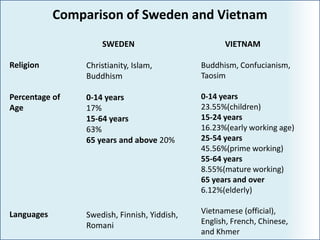
Comparison of Sweden and Vietnam
SWEDEN
Christianity, Islam,
Buddhism
0-14 years
17%
15-64 years
63%
65 years and above 20%
Swedish, Finnish, Yiddish,
Romani
VIETNAM
Buddhism, Confucianism,
Taosim
0-14 years
23.55%(children)
15-24 years
16.23%(early working age)
25-54 years
45.56%(prime working)
55-64 years
8.55%(mature working)
65 years and over
6.12%(elderly)
Vietnamese (official),
English, French, Chinese,
and Khmer
Religion
Percentage of
Age
Languages
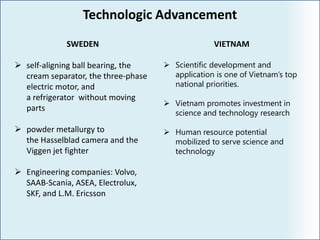
Technologic Advancement
SWEDEN
 self-aligning ball bearing, the
cream separator, the three-phase
electric motor, and
a refrigerator without moving
parts
 powder metallurgy to
the Hasselblad camera and the
Viggen jet fighter
 Engineering companies: Volvo,
SAAB-Scania, ASEA, Electrolux,
SKF, and L.M. Ericsson
VIETNAM
 Scientific development and
application is one of Vietnam’s top
national priorities.
 Vietnam promotes investment in
science and technology research
 Human resource potential
mobilized to serve science and
technology
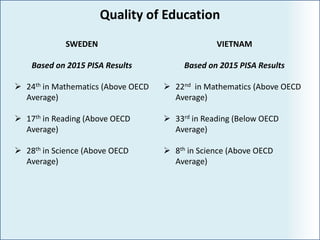
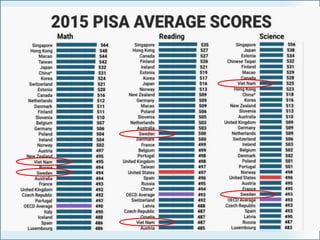
Quality of Education
SWEDEN
Based on 2015 PISA Results
 24th in Mathematics (Above OECD
Average)
 17th in Reading (Above OECD
Average)
 28th in Science (Above OECD
Average)
VIETNAM
Based on 2015 PISA Results
 22nd in Mathematics (Above OECD
Average)
 33rd in Reading (Below OECD
Average)
 8th in Science (Above OECD
Average)
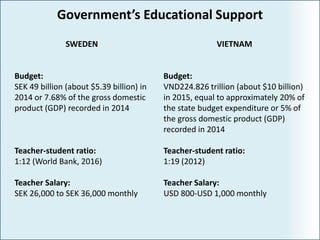
Government’s Educational Support
SWEDEN
Budget:
SEK 49 billion (about $5.39 billion) in
2014 or 7.68% of the gross domestic
product (GDP) recorded in 2014
Teacher-student ratio:
1:12 (World Bank, 2016)
Teacher Salary:
SEK 26,000 to SEK 36,000 monthly
VIETNAM
Budget:
VND224.826 trillion (about $10 billion)
in 2015, equal to approximately 20% of
the state budget expenditure or 5% of
the gross domestic product (GDP)
recorded in 2014
Teacher-student ratio:
1:19 (2012)
Teacher Salary:
USD 800-USD 1,000 monthly
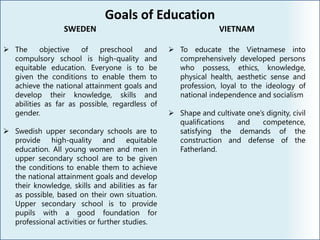
Goals of Education
SWEDEN
 The objective of preschool and
compulsory school is high-quality and
equitable education. Everyone is to be
given the conditions to enable them to
achieve the national attainment goals and
develop their knowledge, skills and
abilities as far as possible, regardless of
gender.
 Swedish upper secondary schools are to
provide high-quality and equitable
education. All young women and men in
upper secondary school are to be given
the conditions to enable them to achieve
the national attainment goals and develop
their knowledge, skills and abilities as far
as possible, based on their own situation.
Upper secondary school is to provide
pupils with a good foundation for
professional activities or further studies.
VIETNAM
 To educate the Vietnamese into
comprehensively developed persons
who possess, ethics, knowledge,
physical health, aesthetic sense and
profession, loyal to the ideology of
national independence and socialism
 Shape and cultivate one’s dignity, civil
qualifications and competence,
satisfying the demands of the
construction and defense of the
Fatherland.
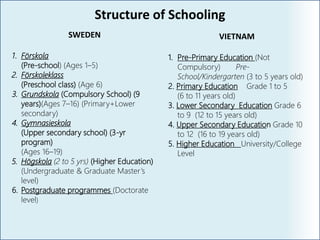
Structure of Schooling
SWEDEN
1. Förskola
(Pre-school) (Ages 1–5)
2. Förskoleklass
(Preschool class) (Age 6)
3. Grundskola (Compulsory School) (9
years)(Ages 7–16) (Primary+Lower
secondary)
4. Gymnasieskola
(Upper secondary school) (3-yr
program)
(Ages 16–19)
5. Högskola (2 to 5 yrs) (Higher Education)
(Undergraduate & Graduate Master’s
level)
6. Postgraduate programmes (Doctorate
level)
VIETNAM
1. Pre-Primary Education (Not
Compulsory) Pre-
School/Kindergarten (3 to 5 years old)
2. Primary Education Grade 1 to 5
(6 to 11 years old)
3. Lower Secondary Education Grade 6
to 9 (12 to 15 years old)
4. Upper Secondary Education Grade 10
to 12 (16 to 19 years old)
5. Higher Education University/College
Level
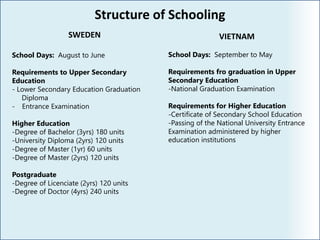
Structure of Schooling
SWEDEN
School Days: August to June
Requirements to Upper Secondary
Education
- Lower Secondary Education Graduation
Diploma
- Entrance Examination
Higher Education
-Degree of Bachelor (3yrs) 180 units
-University Diploma (2yrs) 120 units
-Degree of Master (1yr) 60 units
-Degree of Master (2yrs) 120 units
Postgraduate
-Degree of Licenciate (2yrs) 120 units
-Degree of Doctor (4yrs) 240 units
VIETNAM
School Days: September to May
Requirements fro graduation in Upper
Secondary Education
-National Graduation Examination
Requirements for Higher Education
-Certificate of Secondary School Education
-Passing of the National University Entrance
Examination administered by higher
education institutions
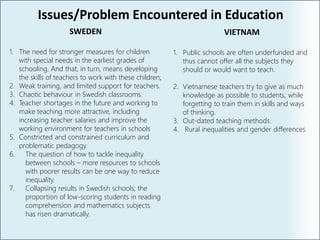
Issues/Problem Encountered in Education
SWEDEN
1. The need for stronger measures for children
with special needs in the earliest grades of
schooling. And that, in turn, means developing
the skills of teachers to work with these children;
2. Weak training, and limited support for teachers.
3. Chaotic behaviour in Swedish classrooms.
4. Teacher shortages in the future and working to
make teaching more attractive, including
increasing teacher salaries and improve the
working environment for teachers in schools
5. Constricted and constrained curriculum and
problematic pedagogy.
6. The question of how to tackle inequality
between schools – more resources to schools
with poorer results can be one way to reduce
inequality.
7. Collapsing results in Swedish schools; the
proportion of low-scoring students in reading
comprehension and mathematics subjects
has risen dramatically.
VIETNAM
1. Public schools are often underfunded and
thus cannot offer all the subjects they
should or would want to teach.
2. Vietnamese teachers try to give as much
knowledge as possible to students, while
forgetting to train them in skills and ways
of thinking.
3. Out-dated teaching methods.
4. Rural inequalities and gender differences
References
Teachers’ salaries in Sweden. (12, April 2016). Retrieved from:
https://www.lararforbundet.se/artiklar/teachers-salaries-in-sweden
Education in Vietnam. (2018). Retrieved from:
https://countryeconomy.com/government/expenditure/education/vietnam
Vietnam promotes scientific and technological development. Retrieved from:
http://vovworld.vn/en-US/current-affairs/vietnam-promotes-scientific-and-
technological-development-283395.vov
Sweden - Pupil-teacher ratio, primary. (2018). Retrieved from:
https://tradingeconomics.com/sweden/pupil-teacher-ratio-primary-wb-data.html
Education System in Sweden. (2012). Retrieved from:
https://www.classbase.com/Countries/Sweden/Education-System
Halldén, K. Retieved from: http://www.mzes.uni-
mannheim.de/publications/misc/isced_97/hall08a_the_swedish_educational_system_a
nd_classifying_edu.pdf
Vietnam’s past Educational System. (11, July 2018). Retrieved from: http://www.vietnam-
beauty.com/vietnamese-culture/vietnam-culture-value/20-vietnams-past-educational-
system-.html
The Vietnamese education system-Structure and reforms. (2003). Retrieved from:
https://www.justlanded.com/english/Vietnam/Vietnam-Guide/Education/The-
Vietnamese-education-system
Hays, J.(2013). School life in Vietnam. Retrieved from:
countryeconomy.com/government/expenditure/education/vietnam
References
Gamlam, R.(5, January 2017).What is the Average Salary for Teaching Abroad in Vietnam?.
Retrieved from: https://www.gooverseas.com/blog/earn-teaching-english-in-vietnam
Goals and visions. (27, November 2014). Retrieved from:
https://www.government.se/government-policy/education-and-research/goals-and-
visions/
The Swedish education system in brief. Retrieved from:
http://www.omsvenskaskolan.se/engelska/det-haer-aer-den-svenska-skolan/
The Vietnamese education system: An overview. (31, August 2017). Retrieved from:
https://transferwise.com/gb/blog/vietnamese-education-overview
Secondary Education in Vietnam. (2, April 2012). Retrieved from:
https://wenr.wes.org/2012/04/secondary-education-in-vietnam
Teacher salaries too low in Sweden: OECD. (18, February 2014). Retrieved from:
https://www.thelocal.se/20140218/teacher-salaries
Educational Policies: Sweden (2014). Retrieved from:
https://wenr.wes.org/2012/04/secondary-education-in-vietnam
How much do Member States spend on education?. Retrieved from:
http://ec.europa.eu/eurostat/web/products-eurostat-news/-/DDN-20170828-1
Vietnam: Education spending, percent of government spending.(2018). Retrieved from:
https://www.theglobaleconomy.com/Vietnam/Education_spending_percent_of_govern
ment_spending/
Vietnam - Government Education expenditure. Retrieved from:
https://countryeconomy.com/government/expenditure/education/vietnam
Thank You!

Sweden and Vietnam Educational Systems

  • 2.
    Objectives  Compare theeducational systems of Sweden and Vietnam;  Identify the issues/problems encountered in education in Sweden and Vietnam
  • 4.
    History of Educationin SWEDEN  Compulsory school attendance was implemented in Sweden in 1842 (Stanfors,2000). In the 1980s and 1990s, Sweden found itself battling high unemployment even as it wrestled with the problem of assimilating a fast-rising immigrant population. By 1995, Sweden's literacy rate reached 99 percent. In March of 2001, the country's employment situation approached a healthy state again, with only a 3.9 percent unemployment rate.  In the 1960s, the Social‐Democratic government implemented a reform of the compulsory and secondary school system.  A comprehensive compulsory school (grundskola) was introduced for children aged 7 to 16 years, at the same time the educational system was centralised and standardised nationally.
  • 5.
    History of Educationin SWEDEN  In the mid 1960s and in the beginning of the 1970s, upper secondary school (gymnasium) was restructured to contain three tracks, consisting of (a) three‐year academic programmes preparing for university studies, (b) two‐year continuation programmes, and (c) two‐year vocational programmes.  In the mid 1960s and in the beginning of the 1970s, upper secondary school (gymnasium) was restructured to contain three tracks, consisting of (a) three‐year academic programmes preparing for university studies, (b) two‐year continuation programmes, and (c) two‐year vocational programmes.  Education in Sweden is mainly organised within the public sector. Parliament and the government have the overall responsibility for the state financed education system: Pre-school (early child-hood education, year 0- 6), pre-school class and compulsory school (year 6-16), upper secondary school, general education as wells as initial vocational training (year 16-20), adult education and higher education and research.
  • 6.
    History of Educationin VIETNAM  Feudal Period (up to late 19th century) - Teachers were often given more importance than the parents - Teachers must have excellent learning achievements and must have ranks in competitive exam. - Vietnamese learned the Chinese characters and used them in writing but they pronounce them the Vietnamese way 1075- first competitive exam was conducted 1070- first Confucian University was constructed (Temple of Literature)  French Colonization (19th century to mid-20th century) - Confucian-oriented education was replaced by French-Vietnamese education with the goal to serve the colonial system - Elementary schools, primary schools, primary colleges were built with French as the dominant language of instruction. However, not much was built and it resulted to 95% illiteracy
  • 7.
    History of Educationin VIETNAM  Independence to Reunification (1945-1975) - Vietnam gained independence from France on September 2, 1945 - “fighting against poverty, illiteracy, and invaders” “an illiterate nation is a powerless one” - In just a year of its implementation, 75,000 literacy classes were established with about 96,000 teachers to help 2.5Million people to learn and write. - (1945-1954) Curriculum in Vietnamese was created - (1950) an education reform was passed by the government with a goal in reducing the number of years of general education and concentrating on reading, writing, and calculating skills - (1954) Vietnam gained its full independence from France French (12 yr) 1st Reform (9 yr) 10 yr-system
  • 8.
    History of Educationin VIETNAM  After the War, Pre-reform (1975-1985) - Vietnam was proclaimed as one unified nation - The government focused on: (1) the removal of leftover influences from the old educational system; (2) the implementation of anti-illiteracy activities for people in the age group of 12-50 years old  The Doi Moi Reform (1986) - Its goal is to increase economic growth development which leads to more funding for institutions and a higher percentage of government funds allocated to the education system - In 1998, Vietnam passed its first law on education which was later amended to increase accessibility to education
  • 9.
    Comparison of Swedenand Vietnam SWEDEN Stockholm 9,971,638 as of Monday, May 7, 2018, based on the latest UN estimates (0.13% of the total world population) 410,340 𝑘𝑚2 (158,433 sq. miles) Parliamentary democracy 7.681% (2014) 7.718% (2013) VIETNAM Hanoi 96,343,966 as of May 7, 2018, based on the latest UN estimates(1.26% of the total world population) 310,070 𝑘𝑚2 (119,719 sq. miles) Unitary State, Communist State, Socialist State, One- party State 5.652% (2013) 5.533% (2012) Capital Population Land Area Type of Government Percentage of GDP spent on Education
  • 10.
    Comparison of Swedenand Vietnam SWEDEN Christianity, Islam, Buddhism 0-14 years 17% 15-64 years 63% 65 years and above 20% Swedish, Finnish, Yiddish, Romani VIETNAM Buddhism, Confucianism, Taosim 0-14 years 23.55%(children) 15-24 years 16.23%(early working age) 25-54 years 45.56%(prime working) 55-64 years 8.55%(mature working) 65 years and over 6.12%(elderly) Vietnamese (official), English, French, Chinese, and Khmer Religion Percentage of Age Languages
  • 11.
    Technologic Advancement SWEDEN  self-aligningball bearing, the cream separator, the three-phase electric motor, and a refrigerator without moving parts  powder metallurgy to the Hasselblad camera and the Viggen jet fighter  Engineering companies: Volvo, SAAB-Scania, ASEA, Electrolux, SKF, and L.M. Ericsson VIETNAM  Scientific development and application is one of Vietnam’s top national priorities.  Vietnam promotes investment in science and technology research  Human resource potential mobilized to serve science and technology
  • 12.
    Quality of Education SWEDEN Basedon 2015 PISA Results  24th in Mathematics (Above OECD Average)  17th in Reading (Above OECD Average)  28th in Science (Above OECD Average) VIETNAM Based on 2015 PISA Results  22nd in Mathematics (Above OECD Average)  33rd in Reading (Below OECD Average)  8th in Science (Above OECD Average)
  • 14.
    Government’s Educational Support SWEDEN Budget: SEK49 billion (about $5.39 billion) in 2014 or 7.68% of the gross domestic product (GDP) recorded in 2014 Teacher-student ratio: 1:12 (World Bank, 2016) Teacher Salary: SEK 26,000 to SEK 36,000 monthly VIETNAM Budget: VND224.826 trillion (about $10 billion) in 2015, equal to approximately 20% of the state budget expenditure or 5% of the gross domestic product (GDP) recorded in 2014 Teacher-student ratio: 1:19 (2012) Teacher Salary: USD 800-USD 1,000 monthly
  • 15.
    Goals of Education SWEDEN The objective of preschool and compulsory school is high-quality and equitable education. Everyone is to be given the conditions to enable them to achieve the national attainment goals and develop their knowledge, skills and abilities as far as possible, regardless of gender.  Swedish upper secondary schools are to provide high-quality and equitable education. All young women and men in upper secondary school are to be given the conditions to enable them to achieve the national attainment goals and develop their knowledge, skills and abilities as far as possible, based on their own situation. Upper secondary school is to provide pupils with a good foundation for professional activities or further studies. VIETNAM  To educate the Vietnamese into comprehensively developed persons who possess, ethics, knowledge, physical health, aesthetic sense and profession, loyal to the ideology of national independence and socialism  Shape and cultivate one’s dignity, civil qualifications and competence, satisfying the demands of the construction and defense of the Fatherland.
  • 16.
    Structure of Schooling SWEDEN 1.Förskola (Pre-school) (Ages 1–5) 2. Förskoleklass (Preschool class) (Age 6) 3. Grundskola (Compulsory School) (9 years)(Ages 7–16) (Primary+Lower secondary) 4. Gymnasieskola (Upper secondary school) (3-yr program) (Ages 16–19) 5. Högskola (2 to 5 yrs) (Higher Education) (Undergraduate & Graduate Master’s level) 6. Postgraduate programmes (Doctorate level) VIETNAM 1. Pre-Primary Education (Not Compulsory) Pre- School/Kindergarten (3 to 5 years old) 2. Primary Education Grade 1 to 5 (6 to 11 years old) 3. Lower Secondary Education Grade 6 to 9 (12 to 15 years old) 4. Upper Secondary Education Grade 10 to 12 (16 to 19 years old) 5. Higher Education University/College Level
  • 17.
    Structure of Schooling SWEDEN SchoolDays: August to June Requirements to Upper Secondary Education - Lower Secondary Education Graduation Diploma - Entrance Examination Higher Education -Degree of Bachelor (3yrs) 180 units -University Diploma (2yrs) 120 units -Degree of Master (1yr) 60 units -Degree of Master (2yrs) 120 units Postgraduate -Degree of Licenciate (2yrs) 120 units -Degree of Doctor (4yrs) 240 units VIETNAM School Days: September to May Requirements fro graduation in Upper Secondary Education -National Graduation Examination Requirements for Higher Education -Certificate of Secondary School Education -Passing of the National University Entrance Examination administered by higher education institutions
  • 18.
    Issues/Problem Encountered inEducation SWEDEN 1. The need for stronger measures for children with special needs in the earliest grades of schooling. And that, in turn, means developing the skills of teachers to work with these children; 2. Weak training, and limited support for teachers. 3. Chaotic behaviour in Swedish classrooms. 4. Teacher shortages in the future and working to make teaching more attractive, including increasing teacher salaries and improve the working environment for teachers in schools 5. Constricted and constrained curriculum and problematic pedagogy. 6. The question of how to tackle inequality between schools – more resources to schools with poorer results can be one way to reduce inequality. 7. Collapsing results in Swedish schools; the proportion of low-scoring students in reading comprehension and mathematics subjects has risen dramatically. VIETNAM 1. Public schools are often underfunded and thus cannot offer all the subjects they should or would want to teach. 2. Vietnamese teachers try to give as much knowledge as possible to students, while forgetting to train them in skills and ways of thinking. 3. Out-dated teaching methods. 4. Rural inequalities and gender differences
  • 19.
    References Teachers’ salaries inSweden. (12, April 2016). Retrieved from: https://www.lararforbundet.se/artiklar/teachers-salaries-in-sweden Education in Vietnam. (2018). Retrieved from: https://countryeconomy.com/government/expenditure/education/vietnam Vietnam promotes scientific and technological development. Retrieved from: http://vovworld.vn/en-US/current-affairs/vietnam-promotes-scientific-and- technological-development-283395.vov Sweden - Pupil-teacher ratio, primary. (2018). Retrieved from: https://tradingeconomics.com/sweden/pupil-teacher-ratio-primary-wb-data.html Education System in Sweden. (2012). Retrieved from: https://www.classbase.com/Countries/Sweden/Education-System Halldén, K. Retieved from: http://www.mzes.uni- mannheim.de/publications/misc/isced_97/hall08a_the_swedish_educational_system_a nd_classifying_edu.pdf Vietnam’s past Educational System. (11, July 2018). Retrieved from: http://www.vietnam- beauty.com/vietnamese-culture/vietnam-culture-value/20-vietnams-past-educational- system-.html The Vietnamese education system-Structure and reforms. (2003). Retrieved from: https://www.justlanded.com/english/Vietnam/Vietnam-Guide/Education/The- Vietnamese-education-system Hays, J.(2013). School life in Vietnam. Retrieved from: countryeconomy.com/government/expenditure/education/vietnam
  • 20.
    References Gamlam, R.(5, January2017).What is the Average Salary for Teaching Abroad in Vietnam?. Retrieved from: https://www.gooverseas.com/blog/earn-teaching-english-in-vietnam Goals and visions. (27, November 2014). Retrieved from: https://www.government.se/government-policy/education-and-research/goals-and- visions/ The Swedish education system in brief. Retrieved from: http://www.omsvenskaskolan.se/engelska/det-haer-aer-den-svenska-skolan/ The Vietnamese education system: An overview. (31, August 2017). Retrieved from: https://transferwise.com/gb/blog/vietnamese-education-overview Secondary Education in Vietnam. (2, April 2012). Retrieved from: https://wenr.wes.org/2012/04/secondary-education-in-vietnam Teacher salaries too low in Sweden: OECD. (18, February 2014). Retrieved from: https://www.thelocal.se/20140218/teacher-salaries Educational Policies: Sweden (2014). Retrieved from: https://wenr.wes.org/2012/04/secondary-education-in-vietnam How much do Member States spend on education?. Retrieved from: http://ec.europa.eu/eurostat/web/products-eurostat-news/-/DDN-20170828-1 Vietnam: Education spending, percent of government spending.(2018). Retrieved from: https://www.theglobaleconomy.com/Vietnam/Education_spending_percent_of_govern ment_spending/ Vietnam - Government Education expenditure. Retrieved from: https://countryeconomy.com/government/expenditure/education/vietnam
  • 21.