Swoosh · 8.˚ ano Evaluation tests
Unit
1 Media and technology
School:
Name: Class: No.:
Date: / / Mark:
Enc. Educação: Teacher:
15 Minutes
A. You will hear a news item on the radio about the person who created Facebook.
For items 1 to 5, fill in the missing information.
NAME MARK ELLIOTZUCKERBERG
Nationality 1.
Year he was born 2.
He is famous for creating 3.
He studied at… University 4.
Year he became a billionaire in 5.
B. You will hear a conversation between a mother and her daughter. Choose the correct
option.
1. The girl wants to buy a .
(a) mobile phone (b) tablet (c) smartphone
2. To purchase the phone she has to pay .
(a) 15€ (b) 50€ (c) nothing because it’s free
3. The phone is .
(a) of a good quality (b) cheap (c) unique
4. What reason does the girl give for needing the phone?
(a) She can use it to keep in touch with her friends.
(b) She can call her family in caseof an emergency.
(c) She can make cheaper long-distance calls with it.
5. In the end, her mother .
(a) decides to buy her the phone
(b) is still thinking of what to do
(c) doesn’t buy her the phone
Test A
20 Minutes
Read the text carefully.
TECHNOLOGY
ADDICTION IN TEENS
Many of today’s teens spend a lot of their time with their faces buried
in a computer monitor or smartphone. Mums and dads who would
prefer that their teens’ faces were buried in books might suspect
the cause of this phenomenon is technology addiction.
5 Kimberly Young, director of the Center for Internet Addiction
Recovery and author of Internet Addiction: A Handbook and Guide to
Evaluation and Treatment, defines technology addiction as a habitual
compulsion to engage in using technology instead of addressing life’s
problems. For example, a teen, who instinctively pulls out her
10 smartphone whenever her mum begins lecturing her, might be addicted
to technology because such a reaction is a mechanism to avoid conflict.
Teens are particularly susceptible to technology addiction for several
reasons. First, teens tend to have poor coping mechanisms. In the face of
stress, they often turn to what’s comforting to them, usually something
15 easy to focus on, including online videos or social media sites. Also, in the
teen years, self-identity is crucial. One attraction to technologies such as
online video games and the Internet is the anonymity it brings, allowing
teensto expressthemselveswithoutputting their ego at risk.
Technology addiction can have several negative effects on a teen.The
20 interest of anonymity, for example, might pull a teen away from social
engagement. Such an avoidance of social settings could lead to a teen
shutting himself off from his peers. This also leaks into family life. A teen
who overuses technology or uses technology to cope with proble ms
might refuse to engage in family discourseor family activities in favour of
25 using the newest gadget or phone application. And addiction can affect a
teen’s work and academic performance. A teen who rushes to get online
after school neglects his homework. A teen who is texting in class
neglectsthe lesson.
Adapted from: http://every day life.globalp ost.com
Swoosh · 8.˚ ano Evaluation tests
A. Identify the paragraphs where you can find some information about the following
topics. Write the paragraph number in the corresponding circle.
a) The attraction of technology
b) Technology and teens nowadays
c) The risks of technology
d) The meaning of technology addiction
B. Read the text againand choose the correct option for items 1 to 4.
1. In lines 1-2 “buried in” means: (a) hidden from (b) giving all the attention to
2. In lines 7-8 “to engage in” means: (a) to have an interest in (b) to be busy with
3. In line 10 “lecturing” means: (a) praising (b) having a serious talk
4. In line 22 “shutting himself off from his peers” means:
(a) running away from his friends (b) stop having any contact with his schoolmates
C. Decide if the following statements are right (R) or wrong (W) according to the text.
1. Teenagers can’t usually deal with difficult situations.
2. Online games and the Internet attract teens because
they’re a way of putting their egoat risk.
3. Through technology teenagers avoid anonymity.
4. Technology addiction can affect family life.
D. Answer these questions about the text in full sentences.
1. Who is Kimberly Young?
2. Which behaviour mentioned in paragraph two is a mechanism to avoid conflict?
3. What happens to family life when teens become obsessed with technology instead of
dealing with their problems?
4. How do we know that a teenager is neglecting his/her homework?
10 Minutes
A. Choose the appropriate phrasal verb.
1. Could you turn down / switch off the music, please? It’s too loud.
2. I need to log in / hang up the phone now. My mother is calling me for dinner.
3. Can you switch on / shut down the radio? I want to hear the news.
4. To call back / log in you have to write your password, don’t forget.
5. Peter is looking for / sending back a friend on Facebook.
6. In the cinema we have to turn off / switch on our mobile phones.
B. Fill in the blanks with the Past Simple or the Past Continuous of the verbs given in
brackets.
Yesterday (1) (be) the worst day of my life. There
(2) (be) dark clouds in the sky and a
terrible storm (3) (begin) with a lot of thunder
and lightning. I (4) (work) on my computer
when suddenly it (5) (break) down. All my work
disappeared! I (6) (decide) to go downstairs to
call my dad. While I (7) (run) down the stairs,
I tripped over my sister’s toy and (8) (twist) my
ankle. What a terrible day! Now I’m stuck at home. The
only good thing is that I have my mobile phone!
C. Complete the sentences with used to or didn’t use to.
1. When I was younger I have a mobile phone. Now I do.
2. He play Farmville on the computer, but he stopped a few months ago.
3. Peter have a small cell phone, but last week he sold it online and
bought a new smartphone.
4. I go online very often, but now I’m addicted to social networking.
5. My parents have mobile phones when they were teenagers. Now they
do.
6. I play football with my friends when I was younger. Now we play
online games instead.
Swoosh · 8.˚ ano Evaluation tests
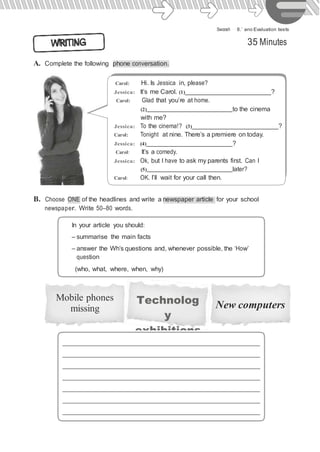
A. Complete the following phone conversation.
35 Minutes
Carol: Hi. Is Jessica in, please?
Jessica: It’s me Carol. (1) ?
Carol: Glad that you’re at home.
(2) to the cinema
with me?
Jessica: To the cinema!? (3) ?
Carol: Tonight at nine. There’s a premiere on today.
Jessica: (4) ?
Carol: It’s a comedy.
Jessica: Ok, but I have to ask my parents first. Can I
(5) later?
Carol: OK. I’ll wait for your call then.
B. Choose ONE of the headlines and write a newspaper article for your school
newspaper. Write 50–80 words.
In your article you should:
– summarise the main facts
– answer the Wh’s questions and, whenever possible, the ‘How’
question
(who, what, where, when, why)
Mobile phones
missing
Technolog
y
exhibitions
New computers

Sw8 tf p135_139

  • 1.
    Swoosh · 8.˚ano Evaluation tests Unit 1 Media and technology School: Name: Class: No.: Date: / / Mark: Enc. Educação: Teacher: 15 Minutes A. You will hear a news item on the radio about the person who created Facebook. For items 1 to 5, fill in the missing information. NAME MARK ELLIOTZUCKERBERG Nationality 1. Year he was born 2. He is famous for creating 3. He studied at… University 4. Year he became a billionaire in 5. B. You will hear a conversation between a mother and her daughter. Choose the correct option. 1. The girl wants to buy a . (a) mobile phone (b) tablet (c) smartphone 2. To purchase the phone she has to pay . (a) 15€ (b) 50€ (c) nothing because it’s free 3. The phone is . (a) of a good quality (b) cheap (c) unique 4. What reason does the girl give for needing the phone? (a) She can use it to keep in touch with her friends. (b) She can call her family in caseof an emergency. (c) She can make cheaper long-distance calls with it. 5. In the end, her mother . (a) decides to buy her the phone (b) is still thinking of what to do (c) doesn’t buy her the phone Test A
  • 2.
    20 Minutes Read thetext carefully. TECHNOLOGY ADDICTION IN TEENS Many of today’s teens spend a lot of their time with their faces buried in a computer monitor or smartphone. Mums and dads who would prefer that their teens’ faces were buried in books might suspect the cause of this phenomenon is technology addiction. 5 Kimberly Young, director of the Center for Internet Addiction Recovery and author of Internet Addiction: A Handbook and Guide to Evaluation and Treatment, defines technology addiction as a habitual compulsion to engage in using technology instead of addressing life’s problems. For example, a teen, who instinctively pulls out her 10 smartphone whenever her mum begins lecturing her, might be addicted to technology because such a reaction is a mechanism to avoid conflict. Teens are particularly susceptible to technology addiction for several reasons. First, teens tend to have poor coping mechanisms. In the face of stress, they often turn to what’s comforting to them, usually something 15 easy to focus on, including online videos or social media sites. Also, in the teen years, self-identity is crucial. One attraction to technologies such as online video games and the Internet is the anonymity it brings, allowing teensto expressthemselveswithoutputting their ego at risk. Technology addiction can have several negative effects on a teen.The 20 interest of anonymity, for example, might pull a teen away from social engagement. Such an avoidance of social settings could lead to a teen shutting himself off from his peers. This also leaks into family life. A teen who overuses technology or uses technology to cope with proble ms might refuse to engage in family discourseor family activities in favour of 25 using the newest gadget or phone application. And addiction can affect a teen’s work and academic performance. A teen who rushes to get online after school neglects his homework. A teen who is texting in class neglectsthe lesson. Adapted from: http://every day life.globalp ost.com
  • 3.
    Swoosh · 8.˚ano Evaluation tests A. Identify the paragraphs where you can find some information about the following topics. Write the paragraph number in the corresponding circle. a) The attraction of technology b) Technology and teens nowadays c) The risks of technology d) The meaning of technology addiction B. Read the text againand choose the correct option for items 1 to 4. 1. In lines 1-2 “buried in” means: (a) hidden from (b) giving all the attention to 2. In lines 7-8 “to engage in” means: (a) to have an interest in (b) to be busy with 3. In line 10 “lecturing” means: (a) praising (b) having a serious talk 4. In line 22 “shutting himself off from his peers” means: (a) running away from his friends (b) stop having any contact with his schoolmates C. Decide if the following statements are right (R) or wrong (W) according to the text. 1. Teenagers can’t usually deal with difficult situations. 2. Online games and the Internet attract teens because they’re a way of putting their egoat risk. 3. Through technology teenagers avoid anonymity. 4. Technology addiction can affect family life. D. Answer these questions about the text in full sentences. 1. Who is Kimberly Young? 2. Which behaviour mentioned in paragraph two is a mechanism to avoid conflict? 3. What happens to family life when teens become obsessed with technology instead of dealing with their problems? 4. How do we know that a teenager is neglecting his/her homework?
  • 4.
    10 Minutes A. Choosethe appropriate phrasal verb. 1. Could you turn down / switch off the music, please? It’s too loud. 2. I need to log in / hang up the phone now. My mother is calling me for dinner. 3. Can you switch on / shut down the radio? I want to hear the news. 4. To call back / log in you have to write your password, don’t forget. 5. Peter is looking for / sending back a friend on Facebook. 6. In the cinema we have to turn off / switch on our mobile phones. B. Fill in the blanks with the Past Simple or the Past Continuous of the verbs given in brackets. Yesterday (1) (be) the worst day of my life. There (2) (be) dark clouds in the sky and a terrible storm (3) (begin) with a lot of thunder and lightning. I (4) (work) on my computer when suddenly it (5) (break) down. All my work disappeared! I (6) (decide) to go downstairs to call my dad. While I (7) (run) down the stairs, I tripped over my sister’s toy and (8) (twist) my ankle. What a terrible day! Now I’m stuck at home. The only good thing is that I have my mobile phone! C. Complete the sentences with used to or didn’t use to. 1. When I was younger I have a mobile phone. Now I do. 2. He play Farmville on the computer, but he stopped a few months ago. 3. Peter have a small cell phone, but last week he sold it online and bought a new smartphone. 4. I go online very often, but now I’m addicted to social networking. 5. My parents have mobile phones when they were teenagers. Now they do. 6. I play football with my friends when I was younger. Now we play online games instead.
  • 5.
    Swoosh · 8.˚ano Evaluation tests A. Complete the following phone conversation. 35 Minutes Carol: Hi. Is Jessica in, please? Jessica: It’s me Carol. (1) ? Carol: Glad that you’re at home. (2) to the cinema with me? Jessica: To the cinema!? (3) ? Carol: Tonight at nine. There’s a premiere on today. Jessica: (4) ? Carol: It’s a comedy. Jessica: Ok, but I have to ask my parents first. Can I (5) later? Carol: OK. I’ll wait for your call then. B. Choose ONE of the headlines and write a newspaper article for your school newspaper. Write 50–80 words. In your article you should: – summarise the main facts – answer the Wh’s questions and, whenever possible, the ‘How’ question (who, what, where, when, why) Mobile phones missing Technolog y exhibitions New computers