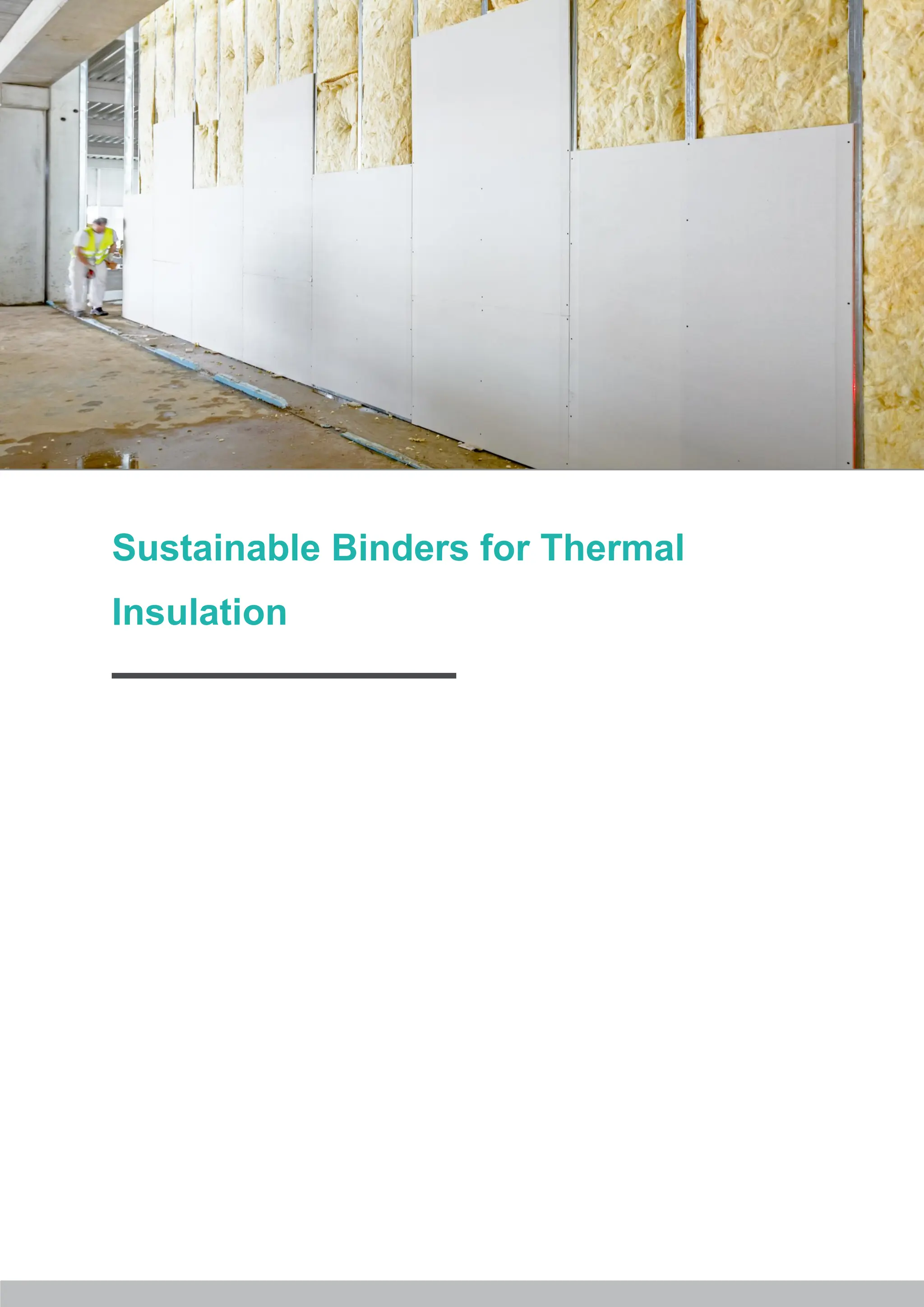
Sustainable Binders for Thermal
Insulation
Page | 1 Sustainable Binders for Thermal Insulation
Overview
In a world where every sector is trying to contribute to achieving sustainability through scientific
research, innovations, and technological advancements, the construction industry is treading hand-in-
hand with the vision for green building materials. Sustainable binders for thermal insulation are rising
at the forefront as crucial components that aid the environment and enhance the quality of structures
while staying true to nature’s requirements. Notably, conventional binders are drawn from
petrochemical products that contribute to carbon emissions due to non-biodegradable manufacturing
processes.
Why are Binders Important in Thermal Insulation?
Binders precisely work as adhesive agents that bind insulating materials tightly, ensuring long-term
performance and structural prowess. Conversely, conventional binders are mostly petroleum-based,
potentially raising the hazards of immense carbon footprints and the spread of VOCs (volatile organic
compounds) in the environment. Meanwhile, sustainable binders are extracted through natural
processes that use renewable or recycled resources, significantly reducing environmental impact.
Binders for Thermal Insulation: Technical Overview
Binders are an important cog in thermal insulation that bind insulating particles or fibers, offering
improved performance and standard structural integrity. They are expected to stand firm during all
conditions and situations, including environmental changes, degradation, humidity, and fluctuating
temperatures. Here are the technical aspects:
1. Durability: The binders demonstrate temperature fluctuation resistance and long-lasting
stability for a bigger and better insulation effect.
2. Moisture and Water Resistance: The hydrophobic-induced properties can prevent moisture
and act as water resistance. However, this may lead to fungus formation while compromising
insulation performance.
3. Fire Resistance: The role of fire-resistant binders is important during industrial and
construction applications as they offer optimum safety
4. Thermal Conductivity: The thermal conductivity must be contributed by binders to the overall
insulation material. Meanwhile, for efficient thermal insulation, lower thermal conductivity is
preferable.
Traditional binders have a detrimental environmental impact because they are derived from fossil
fuels, such as petroleum-based chemicals. Thus, there is a significant move toward biodegradable,
natural, renewable, and environmentally friendly binders. Some of the top sustainable binders are
extracted from starch, cellulose, protein-based sources, and lignin. Bio-based binders produce
reduced carbon emissions and lower environmental footprints during application and production.
Types of Sustainable Binders for Thermal Insulation
As the demand for viable alternatives for binders has increased, several eco-friendly and bio-based
binders have witnessed spiked attention. Find below a few of them:-
Page | 2 Sustainable Binders for Thermal Insulation
Starch-Based Binders
It is a carbohydrate, which is renewable and biodegradable as it is drawn from plants. Moreover, it
comes with low toxicity. Furthermore, starch-based binders can be used in conjunction with or
simultaneously with other additives to enhance durability and water resistance.
 Applications: It is primarily used in fiber insulation and rigid foam boards
 Properties: Effective bonding strength, biodegradable and renewable
 Issues: When compared to synthetic binders it offers lower durability and less moisture
resistance
Lignin-Based Binders
It has been considered one of the most sought-after sustainable binders. A natural polymer extracted
from plants, it has also been extensively researched. These binders play a crucial role in thermal
stability and improving fire resistance. Moreover, they are environmentally friendly and cost-effective
for users.
 Applications: It is primarily deployed in bio-composite panels and fiber insulation
 Properties: It offers resistance to UV degradation, thermal stability, and high mechanical
strength
 Issues: There’s limited compatibility with a few substrates and variability in composition based
on its source
Polymeric Binders from Bio-Based Sources
Synthetic polymers, including PLA (polylactic acid), are drawn from bio-based feedstocks following
advancements that have triggered development in the field. Importantly, these polymers are
renewable and biodegradable, offering the flexibility and durability of synthetic binders.
 Applications: It is extensively applicable in fiber insulation and foam
 Properties: It is flexible, durable, and eco-friendly
 Issues: The cost is higher and can’t be scaled beyond a point
Cellulose-Based Binders
It is a structural component of renewable and biodegradable plant cell walls. Once modified
chemically, it offers great thermal capabilities and binding strength.
 Properties: It is recyclable, renewable, and biodegradable, offering good thermal insulation
properties
 Applications: It is mostly applied in batt insulation or loose-fill
 Issues: Lower fire resistance compared to synthetic binders
Technological Advancements and Futuristic Methodology
As the demand is rising for sustainable binders, innovation, and inventions have also increased in
polymer technology and material science. New avenues are mushrooming following continuous
research and technological advancements. Some of them are mentioned below:-
Page | 3 Sustainable Binders for Thermal Insulation
a) Hybrid Binder Systems
They combine bio-based and synthetic binders to multiply their advantages. The primary aim of these
systems is to reduce carbon emissions while ensuring high-performance quality. Hybrid binders may
include materials derived from waste, adhering to the principle of a sustainable or circular economy.
b) Additive Manufacturing and 3D printing
Additive manufacturing is navigating the path from custom insulation products coupled with
sustainable binders. Moreover, industries and businesses can optimize shapes and produce complex
structures using bio-based binders in 3D printing; offering improved minimal waste and exceptional
thermal performances.
c) Nanotechnology
Nanomaterials can enhance the mechanical and thermal properties of bio-based binders. Currently,
cellulose nanofibers are used to improve the performance of starch-based binders, influencing the
creation of explicitly bio-based composites of high performance.
d) Self-Healing Materials
In regions that have harsh environmental conditions and improper climatic situations, self-healing
binders can prove to be a game changer for improving thermal insulation performance and longevity.
Researchers and scientists are working on self-healing materials that can do self-repairing upon
exposure to heat and other stimuli.
Sustainable Binders Adoption
The benefits of sustainable binders are not hidden from industries, and they are increasingly using
them in the automotive, construction, and packaging domains by recognizing potential. As renowned
companies and industry leaders are willingly accepting bio-based solutions for thermal insulations, the
cost is escalating swiftly. Here are the reasons fueling the industrial embrace:
1. Sustainability Targets: Several corporates are fixing their aim to reduce carbon emissions
through sustainable binders as they assist them in achieving their goals.
2. Consumer Demand: Rising awareness and increasing demand for green building materials
have pushed industries to incorporate sustainable binders.
3. Economic Benefits: Sustainability practices often include discounts, tax benefits, and
subsidies from NGOs, environmental organizations, and governments.
4. Environmental Rules: The restrictions imposed by several organizations and governments in
different countries on VOCs (volatile organic compounds) and immense emissions are forcing
industries to go with eco-friendly binders.
Giant insulation manufacturers, including Knauf Insulation, Owens Corning, and Saint Gobain, are
investing in sustainable binders to boost their insulation products, which directs toward an upward
trend. Notably, Knauf Insulation has produced a formaldehyde-free binder, ECOSE® Technology,
created from renewable bio-based materials.
Page | 4 Sustainable Binders for Thermal Insulation
Market Growth for Sustainable Binders
The global market growth for sustainable binders looks promising following the rising awareness,
increasing demand, regulatory requirements, and environmental issues in different industries. Here
are the trends:
The sustainable insulation material market is slated to grow at a CAGR of 10 percent by 2030,
supported by eco-friendly binders. Binders extracted from starch and lignin can make an impact due
to their lower cost and abundant availability. The Asia-Pacific market region is at the cusp of drawing
the highest growth rate, following the focus on a sustainable development roadmap chalked out by
governments and industries. However, North America and Europe are going strong in the current
scenario, driven by green building incentives and strict laws on environmental safety.
Investment Opportunities and Growth Prospects
As the market commands sustainable insulation solutions, the opportunities for businesses and
investors in binder technologies can be exciting and worth profits. Companies looking to attract public
and private investments along with venture capital should stay focused on the application and
development of bio-binders. The burgeoning interest of companies enveloped with energy efficiency
and a larger commitment to sustainable means reflects on the green sector. For quick and scalable
growth, companies are registering partnerships with insulation manufacturers and bio-based material
suppliers. Moreover, collaborating with research institutions can help companies access innovative
binder technology that can be valuable.
Major Challenges for Sustainable Binders
Sustainable binders for thermal insulation may seem one of the greatest prospects for industries and
the environment; however, they are not free from challenges. Thus, they need to be considered and
addressed accordingly:
1. Supply Chain Complexity: Fetching bio-based materials seamlessly can be difficult due to
regulatory issues, agricultural conditions, and supply fluctuations.
2. Scalability: Due to the limitations of raw materials and huge costs, there’s always a hindrance
to growth in the production processes.
3. Performance Limitations: The durability and stability of some bio-based binders, like protein-
based and starch-based binders, are lesser compared to thermal to synthetic counterparts.
Conclusion
Adoption and acceptance of sustainability and innovation have become the pedigree for continuous
growth for any industry, and the standard suits sustainable binders in thermal insulation, too, due to
the energy-efficient and eco-friendly materials. As the world is moving toward green and
environmental formulation, compelled by global warming and the deteriorating health of the Earth,
sustainable binders are a welcoming step backed by the demand of common people and stringent
rules by governments. Investors, companies, industries, and stakeholders are realizing the strength of
transformation from non-sustainable to sustainable binders and working in tandem in partnerships
Page | 5 Sustainable Binders for Thermal Insulation
and collaborations to grab the opportunity to scale and expand in the market by innovating and
manufacturing hybrid materials and bio-based binders. It’s noticeable that cost-reduction strategies
and supply chain integration can be pivotal in overcoming challenges in the market for thermal
insulation.
Page | 6 Sustainable Binders for Thermal Insulation
Disclaimer
The provision of services and materials by Stellarix Consulting Services Pvt. Ltd. (Stellarix)
is governed by Stellarix's standard terms and conditions. Stellarix does not offer legal,
accounting, or tax advice. The Client is responsible for seeking independent advice on such
matters. Additionally, Stellarix has no obligation to update the provided materials beyond the
date specified, even if the information contained therein becomes outdated or inaccurate.
The materials presented herein are exclusively intended for the Client's use and are limited
in purpose as described in the presentation. These materials may not be reproduced or
shared with any individual or entity other than the Client (referred to as "Third Party") without
prior written consent from Stellarix. These materials are intended solely as a basis for
discussion and should not be relied upon as a standalone document without accompanying
oral commentary. Furthermore, Third Parties may not and should not unreasonably rely on
these materials for any purpose. To the maximum extent permitted by law (unless otherwise
agreed upon in a written agreement signed by Stellarix), Stellarix assumes no liability
towards any Third Party, and any Third Party hereby relinquishes any rights or claims
against Stellarix relating to the services, this presentation, or other materials, including their
accuracy or completeness. By receiving and reviewing this document, it is deemed that the
recipient agrees to and acknowledges the aforementioned conditions.
Page | 7 Sustainable Binders for Thermal Insulation
Stellarix is an innovation and strategy consulting firm that empowers clients to achieve future
readiness with sustainable growth and long term success. We do that by providing deep
industry expertise, tech-enhanced solutions, and resilient strategies. With unwavering
attention to our clients’ needs, we hyper-customize solutions that deliver maximum impact.
From anticipating challenges to providing robust solutions, Stellarix serves as a trusted
partner from concept to commercialization.
Our Services
stellarix.com/services
Perspectives
stellarix.com/insights
Website
stellarix.com
Phone No
+91-141-49207 04/05
Headquarter
India
Email
sales@stellarix.com
Social Media

Sustainable Binders for Thermal Insulation

  • 1.
    Sustainable Binders forThermal Insulation
  • 2.
    Page | 1Sustainable Binders for Thermal Insulation Overview In a world where every sector is trying to contribute to achieving sustainability through scientific research, innovations, and technological advancements, the construction industry is treading hand-in- hand with the vision for green building materials. Sustainable binders for thermal insulation are rising at the forefront as crucial components that aid the environment and enhance the quality of structures while staying true to nature’s requirements. Notably, conventional binders are drawn from petrochemical products that contribute to carbon emissions due to non-biodegradable manufacturing processes. Why are Binders Important in Thermal Insulation? Binders precisely work as adhesive agents that bind insulating materials tightly, ensuring long-term performance and structural prowess. Conversely, conventional binders are mostly petroleum-based, potentially raising the hazards of immense carbon footprints and the spread of VOCs (volatile organic compounds) in the environment. Meanwhile, sustainable binders are extracted through natural processes that use renewable or recycled resources, significantly reducing environmental impact. Binders for Thermal Insulation: Technical Overview Binders are an important cog in thermal insulation that bind insulating particles or fibers, offering improved performance and standard structural integrity. They are expected to stand firm during all conditions and situations, including environmental changes, degradation, humidity, and fluctuating temperatures. Here are the technical aspects: 1. Durability: The binders demonstrate temperature fluctuation resistance and long-lasting stability for a bigger and better insulation effect. 2. Moisture and Water Resistance: The hydrophobic-induced properties can prevent moisture and act as water resistance. However, this may lead to fungus formation while compromising insulation performance. 3. Fire Resistance: The role of fire-resistant binders is important during industrial and construction applications as they offer optimum safety 4. Thermal Conductivity: The thermal conductivity must be contributed by binders to the overall insulation material. Meanwhile, for efficient thermal insulation, lower thermal conductivity is preferable. Traditional binders have a detrimental environmental impact because they are derived from fossil fuels, such as petroleum-based chemicals. Thus, there is a significant move toward biodegradable, natural, renewable, and environmentally friendly binders. Some of the top sustainable binders are extracted from starch, cellulose, protein-based sources, and lignin. Bio-based binders produce reduced carbon emissions and lower environmental footprints during application and production. Types of Sustainable Binders for Thermal Insulation As the demand for viable alternatives for binders has increased, several eco-friendly and bio-based binders have witnessed spiked attention. Find below a few of them:-
  • 3.
    Page | 2Sustainable Binders for Thermal Insulation Starch-Based Binders It is a carbohydrate, which is renewable and biodegradable as it is drawn from plants. Moreover, it comes with low toxicity. Furthermore, starch-based binders can be used in conjunction with or simultaneously with other additives to enhance durability and water resistance.  Applications: It is primarily used in fiber insulation and rigid foam boards  Properties: Effective bonding strength, biodegradable and renewable  Issues: When compared to synthetic binders it offers lower durability and less moisture resistance Lignin-Based Binders It has been considered one of the most sought-after sustainable binders. A natural polymer extracted from plants, it has also been extensively researched. These binders play a crucial role in thermal stability and improving fire resistance. Moreover, they are environmentally friendly and cost-effective for users.  Applications: It is primarily deployed in bio-composite panels and fiber insulation  Properties: It offers resistance to UV degradation, thermal stability, and high mechanical strength  Issues: There’s limited compatibility with a few substrates and variability in composition based on its source Polymeric Binders from Bio-Based Sources Synthetic polymers, including PLA (polylactic acid), are drawn from bio-based feedstocks following advancements that have triggered development in the field. Importantly, these polymers are renewable and biodegradable, offering the flexibility and durability of synthetic binders.  Applications: It is extensively applicable in fiber insulation and foam  Properties: It is flexible, durable, and eco-friendly  Issues: The cost is higher and can’t be scaled beyond a point Cellulose-Based Binders It is a structural component of renewable and biodegradable plant cell walls. Once modified chemically, it offers great thermal capabilities and binding strength.  Properties: It is recyclable, renewable, and biodegradable, offering good thermal insulation properties  Applications: It is mostly applied in batt insulation or loose-fill  Issues: Lower fire resistance compared to synthetic binders Technological Advancements and Futuristic Methodology As the demand is rising for sustainable binders, innovation, and inventions have also increased in polymer technology and material science. New avenues are mushrooming following continuous research and technological advancements. Some of them are mentioned below:-
  • 4.
    Page | 3Sustainable Binders for Thermal Insulation a) Hybrid Binder Systems They combine bio-based and synthetic binders to multiply their advantages. The primary aim of these systems is to reduce carbon emissions while ensuring high-performance quality. Hybrid binders may include materials derived from waste, adhering to the principle of a sustainable or circular economy. b) Additive Manufacturing and 3D printing Additive manufacturing is navigating the path from custom insulation products coupled with sustainable binders. Moreover, industries and businesses can optimize shapes and produce complex structures using bio-based binders in 3D printing; offering improved minimal waste and exceptional thermal performances. c) Nanotechnology Nanomaterials can enhance the mechanical and thermal properties of bio-based binders. Currently, cellulose nanofibers are used to improve the performance of starch-based binders, influencing the creation of explicitly bio-based composites of high performance. d) Self-Healing Materials In regions that have harsh environmental conditions and improper climatic situations, self-healing binders can prove to be a game changer for improving thermal insulation performance and longevity. Researchers and scientists are working on self-healing materials that can do self-repairing upon exposure to heat and other stimuli. Sustainable Binders Adoption The benefits of sustainable binders are not hidden from industries, and they are increasingly using them in the automotive, construction, and packaging domains by recognizing potential. As renowned companies and industry leaders are willingly accepting bio-based solutions for thermal insulations, the cost is escalating swiftly. Here are the reasons fueling the industrial embrace: 1. Sustainability Targets: Several corporates are fixing their aim to reduce carbon emissions through sustainable binders as they assist them in achieving their goals. 2. Consumer Demand: Rising awareness and increasing demand for green building materials have pushed industries to incorporate sustainable binders. 3. Economic Benefits: Sustainability practices often include discounts, tax benefits, and subsidies from NGOs, environmental organizations, and governments. 4. Environmental Rules: The restrictions imposed by several organizations and governments in different countries on VOCs (volatile organic compounds) and immense emissions are forcing industries to go with eco-friendly binders. Giant insulation manufacturers, including Knauf Insulation, Owens Corning, and Saint Gobain, are investing in sustainable binders to boost their insulation products, which directs toward an upward trend. Notably, Knauf Insulation has produced a formaldehyde-free binder, ECOSE® Technology, created from renewable bio-based materials.
  • 5.
    Page | 4Sustainable Binders for Thermal Insulation Market Growth for Sustainable Binders The global market growth for sustainable binders looks promising following the rising awareness, increasing demand, regulatory requirements, and environmental issues in different industries. Here are the trends: The sustainable insulation material market is slated to grow at a CAGR of 10 percent by 2030, supported by eco-friendly binders. Binders extracted from starch and lignin can make an impact due to their lower cost and abundant availability. The Asia-Pacific market region is at the cusp of drawing the highest growth rate, following the focus on a sustainable development roadmap chalked out by governments and industries. However, North America and Europe are going strong in the current scenario, driven by green building incentives and strict laws on environmental safety. Investment Opportunities and Growth Prospects As the market commands sustainable insulation solutions, the opportunities for businesses and investors in binder technologies can be exciting and worth profits. Companies looking to attract public and private investments along with venture capital should stay focused on the application and development of bio-binders. The burgeoning interest of companies enveloped with energy efficiency and a larger commitment to sustainable means reflects on the green sector. For quick and scalable growth, companies are registering partnerships with insulation manufacturers and bio-based material suppliers. Moreover, collaborating with research institutions can help companies access innovative binder technology that can be valuable. Major Challenges for Sustainable Binders Sustainable binders for thermal insulation may seem one of the greatest prospects for industries and the environment; however, they are not free from challenges. Thus, they need to be considered and addressed accordingly: 1. Supply Chain Complexity: Fetching bio-based materials seamlessly can be difficult due to regulatory issues, agricultural conditions, and supply fluctuations. 2. Scalability: Due to the limitations of raw materials and huge costs, there’s always a hindrance to growth in the production processes. 3. Performance Limitations: The durability and stability of some bio-based binders, like protein- based and starch-based binders, are lesser compared to thermal to synthetic counterparts. Conclusion Adoption and acceptance of sustainability and innovation have become the pedigree for continuous growth for any industry, and the standard suits sustainable binders in thermal insulation, too, due to the energy-efficient and eco-friendly materials. As the world is moving toward green and environmental formulation, compelled by global warming and the deteriorating health of the Earth, sustainable binders are a welcoming step backed by the demand of common people and stringent rules by governments. Investors, companies, industries, and stakeholders are realizing the strength of transformation from non-sustainable to sustainable binders and working in tandem in partnerships
  • 6.
    Page | 5Sustainable Binders for Thermal Insulation and collaborations to grab the opportunity to scale and expand in the market by innovating and manufacturing hybrid materials and bio-based binders. It’s noticeable that cost-reduction strategies and supply chain integration can be pivotal in overcoming challenges in the market for thermal insulation.
  • 7.
    Page | 6Sustainable Binders for Thermal Insulation Disclaimer The provision of services and materials by Stellarix Consulting Services Pvt. Ltd. (Stellarix) is governed by Stellarix's standard terms and conditions. Stellarix does not offer legal, accounting, or tax advice. The Client is responsible for seeking independent advice on such matters. Additionally, Stellarix has no obligation to update the provided materials beyond the date specified, even if the information contained therein becomes outdated or inaccurate. The materials presented herein are exclusively intended for the Client's use and are limited in purpose as described in the presentation. These materials may not be reproduced or shared with any individual or entity other than the Client (referred to as "Third Party") without prior written consent from Stellarix. These materials are intended solely as a basis for discussion and should not be relied upon as a standalone document without accompanying oral commentary. Furthermore, Third Parties may not and should not unreasonably rely on these materials for any purpose. To the maximum extent permitted by law (unless otherwise agreed upon in a written agreement signed by Stellarix), Stellarix assumes no liability towards any Third Party, and any Third Party hereby relinquishes any rights or claims against Stellarix relating to the services, this presentation, or other materials, including their accuracy or completeness. By receiving and reviewing this document, it is deemed that the recipient agrees to and acknowledges the aforementioned conditions.
  • 8.
    Page | 7Sustainable Binders for Thermal Insulation Stellarix is an innovation and strategy consulting firm that empowers clients to achieve future readiness with sustainable growth and long term success. We do that by providing deep industry expertise, tech-enhanced solutions, and resilient strategies. With unwavering attention to our clients’ needs, we hyper-customize solutions that deliver maximum impact. From anticipating challenges to providing robust solutions, Stellarix serves as a trusted partner from concept to commercialization. Our Services stellarix.com/services Perspectives stellarix.com/insights Website stellarix.com Phone No +91-141-49207 04/05 Headquarter India Email sales@stellarix.com Social Media