1
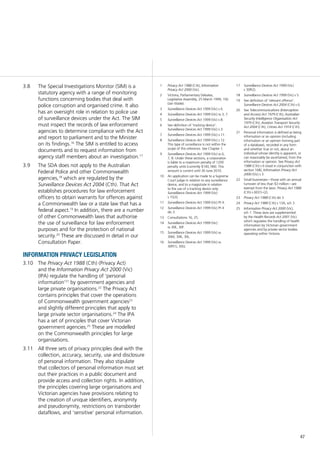
Surveillance in Public Places
Final Report 18
Victorian Law Reform Commission – Surveillance in Public Places: Final Report 18
Contents
Preface						 5
Terms of reference				 6
Glossary						 7
Executive summary				 11
Recommendations				 15
Chapter 1: Introduction				 19
Introduction					 20
Background					 20
Important definitions				 21
What is surveillance? 			 21
What is a public place?			 22
Coverage of this report				 22
Federal areas of concern			 22
State law enforcement 			 23
Practices covered by information
privacy laws				 23
Other law reform activity				 24
Australian Law Reform Commission		 24
NSW Law Reform Commission 		 24
New Zealand Law Commission		 25
UK House of Lords Select Committee		 25
Hong Kong Law Reform Commission 		 26
Law Reform Commission of Ireland		 26
Our process					 26
Consultation Paper				 26
Final Report				 26
Outline of this report				 27
Chapter 2: Use of Surveillance in Public Places	 29
Introduction					 30
Surveillance technology				 31
Closed-circuit television (CCTV)		 31
GPS and satellite technology			 31
Tracking mobile phones 			 31
Radio frequency identification (RFID)		 31
Automatic number plate recognition
(ANPR)					 31
Body imaging devices and scanners		 32
Biometric technologies			 32
Google Earth and Google Streetview		 32
Major users of public place surviellance 		 32
Victoria Police				 32
Corrections Victoria				 34
Local councils				 34
Public housing				 35
Universities and TAFEs			 35
Transport					 35
Major public events: concerts
and sports					 38
Crown Casino				 39
The hospitality industry			 40
Shopping centres and retailers		 40
The media					 41
Marketing companies			 41
Private investigators				 41
Public and private insurers 			 42
The private security industry 			 42
Aged care					 42
Personal uses				 42
Conclusion					 43
Chapter 3: Current Law				 45
Introduction					 46
Surveillance devices legislation			 46
Information privacy legislation 			 47
Information privacy laws and public
place surveillance				 48
Enforcement of information privacy laws	 49
Regulation of specific aspects of public
place surveillance 					 50
Common law protections 				 51
The Victorian Charter of Human Rights and
Responsibilities 					 51
Limits on the right to privacy under
the Charter 				 52
Non-binding guidelines, standards and policies 	 52
Regulation in other jurisdictions			 53
Other Australian jurisdictions			 53
Other countries				 54
Conclusion					 54
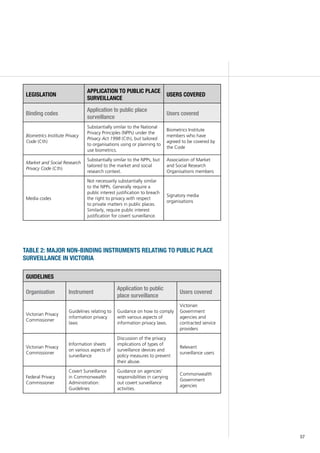
Table 1: Legislation and binding codes
relating to public place surveillance in Victoria	 55
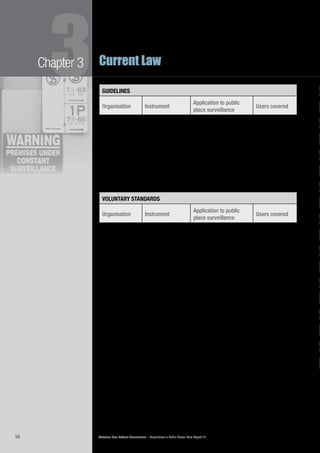
Table 2: Major non-binding instruments relating
to public place surveillance in Victoria		 57
2
33
Chapter 4: A Balanced Approach to Regulation	 59
Introduction 					 60
The impact of public place surveillance		 60
Benefits						 60
Investigation of criminal activity and fraud	 61
Asset protection and deterrence of crime 	 61
Saftey					 62
Operational needs				 63
Managing the movement and conduct
of people					 63
News gathering and the dissemination of
information				 63
Artistic purposes, entertainment and other
personal uses				 63
Risks						 64
Threat to privacy				 64
Social exclusion				 64
Loss of anonymity 				 66
The chilling effect				 66
Criminal conduct and offensive uses		 68
Publication on the internet			 68
Surveillance may not work 			 69
Converging devices 			 71
A balanced approach to regulation			 71
The Victorian Charter of Human Rights and
Responsibilities 				 71
Regulatory theory				 75
An overview of our recommendations and our
approach 					 80
Conclusion					 80
Chapter 5: Promoting Responsible Use of
Surveillance in Public Places 			 83
Introduction					 84
Principles to govern the use of surveillance in
public places					 84
Six public place surveillance principles		 85
An independent regulator of public place surveillance	 89
Regulatory functions				 90
Encouraging responsible practice 			 90
Research and monitoring			 90
Educating, providing advice and promoting
understanding of laws and best practice	 91
Developing and publishing best practice
guidelines					 91
Significant surveillance users: ensuring
responsible practice 				 93
Significant users of public place surveillance 	 93
Reviewing advice prepared by significant
users of public place surveillance		 96
Examining the practices of significant users
of public place surviellance 			 96
Advising of a significant user’s failure to
comply 					 96
Reporting to parliament			 97
Investigations and proceedings in relation to
SDA breaches 					 98
The most appropriate body to regulate public
place surveillance					 99
Relationship with other surveillance
regulators				 100
Review of Victoria Police surveillance practices 101
Regulatory features not recommended at
this stage 				 103
Registration or licensing of some
surveillance users 			 103
A complaint-handling power for the regulator 104
General own-motion investigatory powers 104
Procurement standards as a tool to
encourage compliance		 105
Conclusion				 105
Chapter 6: Modernising the Surveillance
Devices Act				 107
Introduction				 108
Background 				 108
Definitions				 108
Private activity			 108
Implied consent			 110
Prohibition of surveillance devices in toilets	 112
Regulated tracking devices			 112
Automatic number plate recognition	 114
Management and care of patients	 115
Removing the participant monitoring exception 117
Allowing some instances of participant
monitoring			 117
A civil penalty regime			 121
A new offence for improper use of a
surveillance device			 122
Other jurisdictions			 124
Conclusion				 125
Contents
Chapter 7: Statutory Causes of Action 	 127
Introduction				 128
Civil action for serious invasion of privacy	 128
The law in Australia			 128
The law in the UK			 130
The law in New Zealand		 134
The law in the United States		 137
The law in Canada			 140
Other law reform commission recommendations  141
Australian Law Reform Commission	 141
NSW Law Reform Commission	 143
Should Victoria enact a cause of action for
invasion of privacy?			 145
The commission’s recommendation: two
statutory causes of action			 147
Misuse of private information	 149
Intrusion upon seclusion		 150
Statutory causes of action		 151
Elements 				 151
Defences				 153
Exemptions?			 159
Remedies				 160
Costs				 163
Jurisdiction			 163
Availability of the cause of action to
corporations and deceased persons	 164
Limitation of action			 166
Conclusion 				 167
Appendices				 169
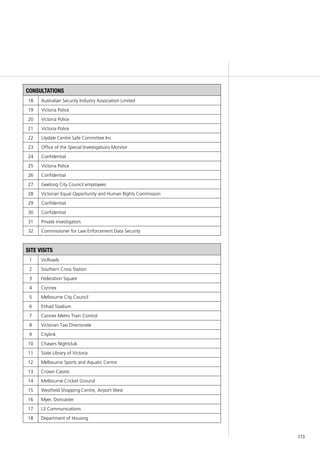
Appendix A: Submissions			 170
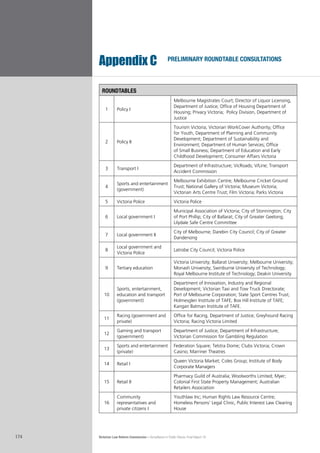
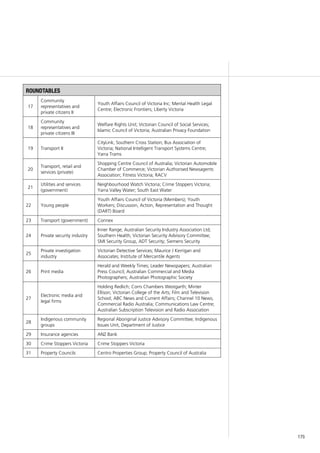
Appendix B: Consultative Committee, Community
Forums, Consultations and Site Visits	 172
Appendix C: Preliminary Roundtable Consultations 174
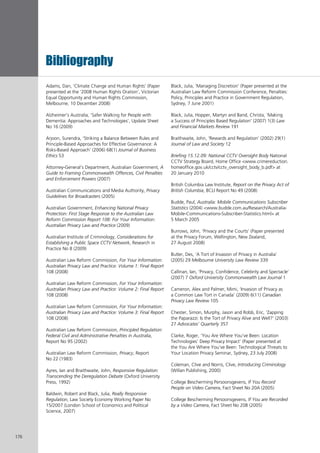
Bibliography				 176
Contributors
VICTORIAN LAW REFORM COMMISSION
Chairperson
Professor Neil Rees*
Commissioner
Associate Professor Pamela O’Connor
Part-time Commissioners
Paris Aristotle AM*
Magistrate Mandy Chambers
Hugh de Kretser*
Her Honour Judge Felicity Hampel
Professor Sam Ricketson*
Justice Iain Ross AO*†
Reference Team
Emily Minter (Team leader)
Miriam Cullen
Sally Finlay
Lara Rabiee
Chief Executive Officer
Merrin Mason
Operations Manager
Kathy Karlevski
Team Leaders
Emma Cashen	 Lindy Smith
Emily Minter	 Myra White
Policy and Research Officers
Becky Batagol	 Ian Parsons
Freia Carlton	 Lara Rabiee
Zane Gaylard	 Martin Wimpole
Kirsten McKillop	 Hilda Wrixon
Research Assistants
Sarah Dillon	 Alexandra Krummel
Melleta Elton	 Tess McCarthy
Amanda Kite	 Jessica Saunders
Communications Officer
Carlie Jennings
Project Officer
Simone Marrocco
Assistant Operations Manager
Vicki Christou
Research and Executive Assistant
Mia Hollick
Librarian
Julie Bransden
Administrative Officers
Failelei Siatua	 Samuel Tucker
* Commissioners involved in this reference.
† Retired March 2010.
5
This report completes a two-stage inquiry into the
widespread use of privacy invasive technologies.
The first stage of our inquiry dealt with workplace
privacy, while this report deals with the growing use
of surveillance in public places.
Public place surveillance is so extensive that it now
affects the lives of nearly all Victorians. It is highly
likely that our image will be captured by camera,
and recorded, whenever we are walking down city
streets, travelling on public transport, driving on
freeways, visiting shopping centres or attending a
major sporting event. People should know about
these activities and appreciate that it is becoming
increasingly difficult to remain anonymous in public
places. The notion of blending in with the crowd is
fast disappearing.
The Attorney-General asked the commission to
consider the interests of users of surveillance in
protecting their property and providing safe places,
and to balance these against the protection of
privacy, autonomy and the dignity of individuals. The
commission has been guided by these concerns and
this report reflects the diversity of opinion regarding
the use of surveillance in public places. We must seek
to reap the many benefits of modern surveillance
equipment while also ensuring that it is not used
oppressively and unnecessarily in public places.
Existing laws were not designed with the use of
high technology surveillance devices in mind. This
report contains 33 recommendations for reform.
Our proposed regulatory model encourages the
responsible use of surveillance in public places. It
balances this with the protection of individual rights,
especially the right to privacy.
Similar reviews of public place surveillance
have taken place or are occurring elsewhere. In
February 2010 the New Zealand Law Commission
recommended new laws to deal with the misuse of
visual surveillance, interception and tracking devices.
In the UK, the interim CCTV Regulator will make
recommendations by the end of 2010 for regulation
of the use of CCTV in public places.
Devising regulatory responses to significant
technological change is often challenging. That
has proven to be the case in this instance. I express
my thanks to the members of the division of the
commission who worked with me on this reference—
Justice Iain Ross AO, Professor Sam Ricketson, Paris
Aristotle AM and Hugh de Kretser—and who gave
generously of their time and expertise. In particular,
I wish to acknowledge the contribution of Professor
Sam Ricketson who chaired this division prior to my
appointment to the VLRC. Justice Ross resigned from
the VLRC upon being appointed President of the
Victorian Civil and Administrative Tribunal (VCAT)
in March 2010. The recommendation in Chapter 7
concerning VCAT was devised well before this date.
All members of the commission team who worked
on this project have produced high quality work.
Team Leader Emily Minter played a central role in
the preparation of this report. Her commitment,
understanding of the issues and organisational
skills were of vital importance. Policy and Research
officers Miriam Cullen and Lara Rabiee made major
contributions to the entire report, while Sally Finlay
and Padma Raman participated in overall planning
and worked on particular chapters. Melleta Elton,
Mia Hollick, Simone Marrocco, Claire Roberts and
Suzanne Zhou provided research assistance. The
report was edited by Clare Chandler and produced
by Carlie Jennings.
Many others made important earlier contributions to
this reference. Former Team Leader Emma Cashen
coordinated the later consultation stage of the
reference and the publication of our Consultation
Paper. Priya SaratChandran made a contribution to
research and consultation, and to our understanding
of the many complex issues which should be
individually recognised. Michelle Burrell and
Bronwyn Jennings gave early research and writing
assistance. Vicki Christou and Failelei Siatua provided
administrative support.
In 2009 we established a consultative committee
to provide us with advice. I thank the members of
that committee—Louise Connor, Andy Frances,
Leigh Gassner, Moira Paterson, Michael Pearce SC,
Bill Penrose, Jen Rose, Helen Versey and Deane
Wilson—for their very helpful responses to our draft
recommendations.
One of the members of that committee, Associate
Professor Moira Paterson, has acted as a consultant
and adviser throughout this reference. We benefited
greatly from her expertise and wise counsel.
Professor Neil Rees
Chairperson
May 2010
Preface
Victorian Law Reform Commission – Surveillance in Public Places: Final Report 186
In light of the widespread use of surveillance and other privacy-invasive technologies in
workplaces and places of public resort, and the potential benefits and risks posed by
these technologies, the Victorian Law Reform Commission will inquire into and report
progressively upon
	whether legislative or other reforms should be made to ensure that workers’a.	
privacy, including that of employees, independent contractors, outworkers and
volunteers, is appropriately protected in Victoria. In the course of this inquiry, the
commission should consider activities such as
surveillance and monitoring of workers’ communications;•	
surveillance of workers by current and emerging technologies,•	
including the use of video and audio devices on the employers’
premises or in other places;
physical and psychological testing of workers, including drug and•	
alcohol testing, medical testing and honesty testing;
searching of workers and their possessions;•	
collecting, using or disclosing personal information in workers’•	
records.
	whether legislative or other measures are necessary to ensure that there isb.	
appropriate control of surveillance, including current and emerging methods
of surveillance.* As part of this examination, the commission should consider
whether any regulatory models proposed by the commission in relation to
surveillance of workers, could be applied in other surveillance contexts, such as
surveillance in places of public resort, to provide for a uniform approach to the
regulation of surveillance.
In undertaking this reference, the commission should have regard to
the interests of employers and other users of surveillance, including•	
their interest in protecting property and assets, complying with laws
and regulations, ensuring productivity and providing safe and secure
places;
the protection of the privacy, autonomy and dignity of workers and•	
other individuals;
the interaction between state and Commonwealth laws, and the•	
jurisdictional limits imposed on the Victorian parliament;
the desirability of building on the work of other law reform bodies.•	
Terms of Reference
	 *	Our terms of reference also originally included the publication of photographs
without the subject’s consent. This issue was removed from the terms of reference
by the Attorney-General in October 2006 and referred to the Standing Committee of
Attorneys-General (SCAG).
7
Automatic number
plate recognition
(ANPR)
Technology that recognises symbols in images of a
number plate and stores or uses those symbols to identify
the vehicle.
Biometric surveillance Surveillance conducted using biological data, for example,
fingerprints, iris patterns or facial features.
Bluetooth A wireless form of transmission that uses radio waves to
transmit information over short distances.
Breach of confidence When confidential information is disclosed to a wider
audience. May result in a right to sue.
Cause of action A right to sue another person.
CCTV Closed-circuit television. Now a generic term for
surveillance camera systems.
Chilling effect Where speech or conduct is suppressed because of a
belief that it may result in undesirable consequences.
Citizen journalism Journalism undertaken by non-professionals.
Civil penalty A fine or other sanction for a civil offence. It has a lower
standard of proof than a criminal penalty and there is no
finding of criminal responsibility.
Common law Law that derives its authority from the decisions of courts,
rather than from Acts of parliament.
Convergence When used in relation to technology, describes the
phenomenon in which technology is becoming
increasingly interconnected and multi-functional.
CrimTrac A Commonwealth agency that uses, develops, and
provides access to information technology and services for
police use.
Data mining The process of analysing data for known and unknown
data patterns.
Data surveillance The monitoring of data, as opposed to people or places.
Enforcement pyramid A regulatory model characterised by increasing levels
of intervention that utilises serious measures only when
milder sanctions (such as education) have failed.
e-tag A device attached to a vehicle that transmits information
to an electronic reader; used to identify the vehicle for
tolling purposes.
E-view (Enterprise
view)
A web-based tool that provides detailed, zoomable
images of buildings and other features compiled through
aerial photographs.
Facial recognition A computer application for identifying or verifying a
person from an image by comparing it with a database of
existing images. A form of biometric technology.
Glossary
Victorian Law Reform Commission – Surveillance in Public Places: Final Report 188
Global positioning
system (GPS)
A navigation system that relies on information received
from a network of satellites to provide the latitude and
longitude of an object or location.
Google Earth A web-based program that maps the earth by the
superimposition of images obtained from satellite imagery
and aerial photography.
Google Street View A feature of Google Maps and Google Earth that
provides 360 degrees horizontal and 290 degrees vertical
panoramic street views and enables users to view parts of
some regions of the world at ground level.
Happy slapping The practice of recording an assault on a victim
(commonly with a camera phone) for entertainment.
In-car video A video camera fitted inside a vehicle (for example, a
police vehicle or taxi). May be used to observe the interior
or exterior of the vehicle.
International Covenant
on Civil and Political
Rights (ICCPR)
A treaty giving effect to civil and political rights contained
in the Universal Declaration of Human Rights. Australia is
a signatory to the ICCPR.
Location surveillance Identifying a person’s or an object’s whereabouts at a
particular time.
Mass surveillance Monitoring the public at large, or a significant part of the
public, instead of a particular individual.
Nuisance An unlawful interference with a person’s use or
enjoyment of land, or some right over or in connection
with it. May result in a right to sue.
Optical character
recognition
Software designed to recognise letters and numbers from
a captured image and to translate them into editable text.
Optical surveillance See Visual surveillance.
Own-motion
investigation
The power of a regulator to investigate possible breaches
of a law without the need for a complaint or referral by
a person.
Olfactory surveillance Purposeful monitoring of a person or object by smell,
including by the use of a device or animal.
Panopticon A type of prison building designed by Jeremy Bentham
to facilitate the observation of prisoners without the
prisoners being able to tell whether they are actually
being watched.
Participant monitoring Recording of conversations or activities by someone
participating in them.
Glossary
9
Passive location
services
Passive location services are those in which a mobile
phone user consents to have his or her location tracked
by another person, either from the other person’s mobile
phone or a computer.
Physical surveillance Observing a person by being physically present at their
location.
Profiling When used in a law enforcement context, reliance on
personal traits (such as race, gender and age) to target
potential offenders.
Purpose creep In a surveillance context, where a surveillance system set
up for one purpose is used for another purpose. Also
known as ‘function creep’.
Radio frequency
identification (RFID)
A technology that enables items to be identified through
an embedded chip that emits a unique radio signal. There
are two forms: active RFID, which emits its own signal,
and passive RFID that is read using energy from an
RFID reader.
Text message/SMS The exchange of brief written messages between mobile
phones and other portable devices over cellular networks.
Messages can now also include image, video and sound
content (known as MMS messages).
SmartGate A project of the Australian Customs and Border
Protection Service that uses a biometric passport and face
recognition technology to allow eligible travellers arriving
at Australia’s international airports to self-process through
passport control.
Smart card A card containing integrated circuits that can store and
process data. Used for performing financial transactions
and accessing restricted areas
Snaparazzi A play on the word ‘paparazzi’; used to describe the
collection of unstaged and/or candid photographs of
celebrities by non-professionals.
Spyware Software that, once installed in a computer, secretly
collects information about the computer use.
Statute A written law passed by parliament.
Surveillance Deliberate or purposive observation or monitoring of a
person, object or place.
Tort A breach of a duty, imposed by law, that protects the
bodily integrity, property, reputation or other interests of
a person.
Victorian Law Reform Commission – Surveillance in Public Places: Final Report 1810
Tracking Monitoring a person or object’s whereabouts over a
period of time. Also called ‘location surveillance’.
Trespass Direct interference with a person, goods, or property of
another without lawful justification. May result in a right
to sue.
Universal Declaration
of Human Rights
(UDHR)
A resolution of the United Nations General Assembly
affirming the importance of human rights and listing the
rights that UN member countries have pledged to uphold.
Upskirting The observation or recording of a person’s genital or anal
regions without their consent.
Visual surveillance Purposeful monitoring of a person or object by sight,
including by the use of a device. Also known as ‘optical
surveillance’.
Voice over Internet
Protocol (VoIP)
Generic term for technology that enables the delivery
of voice communication over the internet and other
networks.
Wire tapping The use of electronic or mechanical equipment to gain
access to transmission of private telephone conversations,
computer data or facsimiles.
Glossary
11
Executive Summary
introduction
This is the Victorian Law Reform Commission’s Final Report for the second phase of our
inquiry into the use of surveillance and other privacy-invasive technologies. In 2005 we
published our Workplace Privacy: Final Report. In this report we consider surveillance in
public places.
Surveillance devices have become increasingly affordable, available and sophisticated.
Their use has proliferated. Current laws were not designed to deal with the many ways
in which these devices are used in Victorian public places. In this report the commission
makes a series of recommendations that seek to modernise the existing regulatory
regime. The recommendations strive to encourage responsible surveillance practices and
ensure that users of surveillance devices do not infringe the rights of the Victorian public.
background
Government agencies, private organisations and individuals use public place surveillance
extensively. Victorians can expect to be observed, recorded and tracked while engaging
in daily activities in streets, shopping centres and major public venues.
The capabilities of surveillance devices are also increasing rapidly. Surveillance devices
are able to locate individuals in a crowd, determine identity, track movements, record
conversations, and compile and share this information almost instantaneously. As
technologies become more sophisticated, so, too, do the applications for which they are
used. For example, devices may be used at airports to see through passengers’ clothing,
or identify individuals from within hundreds of cars on a freeway.
Many groups within our community rely heavily on surveillance technology in their
everyday activities, including police, transport operators, retailers, private investigators,
sports venues and journalists. Surveillance serves a number of important purposes,
including the promotion of public safety, the prevention and investigation of crime,
and newsgathering. In addition, many widely owned personal products, such as mobile
phones, have surveillance capabilities.
Negative consequences that may flow from the increased use of surveillance in public
places include a loss of privacy and anonymity. One concern is that this may cause
Victorians to alter the way we express ourselves and behave when in public. While these
adjustments may not be readily apparent in the short term, the long-term incremental
effect may be permanent changes to the way in which we use and enjoy public places.
Those people with the means to do so may retreat to private places whenever possible in
order to avoid unwanted observation.
In devising recommendations for reform, the commission has taken into account the
many benefits that arise from the use of public place surveillance, as well as the risks
posed by its misuse.
Constitutional constraints and practical considerations have limited our inquiries. We
have not considered national security uses of surveillance, or telecommunications and
data surveillance practices, because they are federal responsibilities. We recommend
that the surveillance activities of state law enforcement bodies be considered separately
because of the need to consider police investigation and information gathering activities
as a whole.
Victorian Law Reform Commission – Surveillance in Public Places: Final Report 1812
consultative process
In March 2009 the commission published a Consultation Paper that was informed by
extensive preliminary consultations. We presented a number of options for reform and
received detailed feedback in over 40 submissions from government agencies, private
organisations and community advocates.
We also hosted five forums with groups who experience public place surveillance,
including young people, people experiencing homelessness, and culturally and
linguistically diverse communities. We established a consultative committee of individuals
with different experiences of public place surveillance whom we consulted on a number
of occasions. In addition, we met members of the community, and visited major
Victorian surveillance users at their premises in order to gain a thorough understanding
of their use of surveillance technologies.
These submissions, consultations and meetings provided us with a thorough
understanding of the scope, nature and impact of public place surveillance in Victoria
(outlined in Chapter 2), and the benefits and risks that flow from its use (outlined in
Chapter 4).
current law
There is little regulation of the use of surveillance devices in public places. Existing laws
are unclear, they have not kept pace with technological change, and they do not appear
to be actively enforced. There is a widespread uncertainty among surveillance users and
the community about which surveillance activities are permitted in public places. The
three major bodies of relevant law—the Surveillance Devices Act 1999 (Vic) (SDA), the
Privacy Act 1988 (Cth) and the Information Privacy Act 2000 (Vic)—were not specifically
designed to regulate public place surveillance.
The development of laws to cover particularly offensive forms of surveillance, such as
upskirting and the recording of images related to child pornography, represent attempts
to address some of the limitations in the current regime. In addition, surveillance in some
contexts, for example in casinos and bars, is separately regulated.
No clear public policy emerges from these separate laws concerning the circumstances in
which public place surveillance is acceptable and those when it is not. We consider the
current regulatory framework in Chapter 3.
a balanced approach to regulation
Numerous benefits arise from the use of surveillance devices, including crime prevention
and investigation, crowd control and the dissemination of information. However, there
are also risks associated with its use, including the increased loss of people’s anonymity
and personal space in public. The commission proposes a regulatory regime that is based
on a set of overarching principles that seek to balance the many competing interests at
play and are flexible enough to allow for rapid changes in technology. This approach is
primarily educative and focuses on achieving best practice use of surveillance technology,
while also ensuring that the privacy rights of individuals are adequately protected.
Two sources that provide a framework for achieving a balanced approach to regulation,
and which have informed our recommendations, are the Charter of Human Rights
and Responsibilities Act 2006 (Vic) (the Victorian Charter) and theories of responsible
regulation. We discuss the applicability of these sources to the development of our
approach in Chapter 4.
13
encouraging responsible use
Users of surveillance frequently stated that they were unsure of what surveillance
they could lawfully undertake and would welcome further guidance in this area. Our
recommendations aim to provide greater certainty about appropriate uses of surveillance
in any particular circumstance.
The commission proposes a set of overarching legislative principles to guide all users
about responsible use of public place surveillance. The principles, set out in Chapter
5, are based on those proposed in our Consultation Paper. The Victorian Charter
framework for balancing competing interests, and the principles contained in privacy
legislation, informed our approach. In refining these principles we drew upon the
opinions expressed in submissions and consultations, and the views of our Consultative
Committee.
The six public place surveillance principles devised by the commission are as follows.
1.		 People are entitled to a reasonable expectation of privacy when in public
places.
2.		 Users of surveillance devices in public places should act responsibly and
consider the reasonable expectations of privacy of individuals.
3.		 Users of surveillance devices in public places should take reasonable steps to
inform people of the use of those devices.
4.		 Public place surveillance should be for a legitimate purpose related to the
activities of the organisation conducting it.
5.		 Public place surveillance should be proportional to its legitimate purpose.
6.		 Reasonable steps should be taken to protect information gathered through
public place surveillance from misuse or inappropriate disclosure.
These principles are discussed in Chapter 5.
The commission recommends the creation of an independent regulator. The primary
roles of the regulator would be to promote the responsible use of surveillance in public
places by providing practical guidance to surveillance users, to provide the public with
information about their rights, and to keep the government and the people of Victoria
fully informed of rapidly changing technology. In Chapter 5 we consider the range of
functions and powers necessary for the regulator to fulfil these tasks, bearing in mind
that the least restrictive regulatory methods are desirable.
Although appropriate guidance about the responsible use of surveillance in public places
is a cornerstone of our recommendations, guidance alone cannot protect people from
some practices that seriously affect their privacy. Chapters 6 and 7 deal with additional
regulatory measures for particularly offensive uses of surveillance.
modernising the surveillance devices act
To reflect changes to the way surveillance is used in Victoria, and to ensure that the law
keeps pace with advances in technology, the commission recommends a number of
changes to clarify, modernise and strengthen the SDA. The SDA primarily prohibits the
use of covert surveillance devices in private places, while also allowing law enforcement
use of surveillance with a warrant. The commission’s proposed recommendations include
amending some important definitions to reflect contemporary uses of surveillance
devices, and expressly prohibiting surveillance in toilets and change rooms. Another
recommendation is the introduction of a prohibition on participant monitoring (where a
person records an activity or conversation to which they are a party without the consent
of other parties), which is currently allowed under the Act.
Victorian Law Reform Commission – Surveillance in Public Places: Final Report 1814
The commission also recommends the introduction of a new offence to prohibit highly
offensive uses of surveillance devices, regardless of where the surveillance occurs. This
offence is designed to send a clear message to the community that various forms of
behaviour are unacceptable, including, for example, filming violence for entertainment
(happy slapping). Using surveillance to intimidate or prevent people from doing
something they are otherwise lawfully entitled to do, like attending an abortion clinic or
drug treatment centre, would also be covered by the offence.
In addition, we recommend that a civil penalty regime also apply to existing criminal
offences in the SDA. This would provide for greater flexibility in enforcement by allowing
a surveillance regulator to act on the less serious matters that come to his or her
attention without referring the matter to Victoria Police for criminal prosecution.
statutory causes of action
The commission believes that individual Victorians should be able to take civil action in
response to serious invasions of privacy by the use of surveillance in a public place.
At present, no Australian jurisdiction has enacted a statutory cause of action for invasion
of privacy, and no appellate court has acknowledged the existence of a common law tort
of invasion of privacy.
It is open to both the High Court and the Victorian Court of Appeal to recognise a
common law tort of invasion of privacy in the absence of any legislative action. However,
developments in other common law countries, most notably the UK and New Zealand,
suggest it will take a long time before a reasonably clear body of law emerges.
Legislation would provide greater clarity and certainty within a more acceptable
timeframe. The Charter of Human Rights and Responsibilities Act 2006 (Vic) (the Charter)
is a useful catalyst for legislative action because ‘privacy’ is one of the human rights that
parliament specifically seeks to protect and promote under the Charter.
The commission recommends the introduction of two statutory causes of action for
serious invasions of privacy: the first dealing with misuse of private information, the
second with intrusion upon seclusion.
Although our focus is an appropriate legal response to the misuse of surveillance in
public places, these new causes of action would not necessarily be limited to conduct
that occurred in a public place or that involved the use of a surveillance device.
Executive Summary
15
Recommendations
GENERAL
	 The Victorian parliament should enact new laws that promote the1.	
responsible use of surveillance devices in public places.
PRINCIPLES
	 The legislation should include the following guiding principles.2.	
	 People are entitled to a reasonable expectation of privacy when in1.	
public places
	 Users of surveillance devices in public places should act responsibly and2.	
consider the reasonable expectations of privacy of individuals
	 Users of surveillance devices in public places should take reasonable3.	
steps to inform people of the use of those devices
	 Public place surveillance should be for a legitimate purpose related to4.	
the activities of the organisation conducting it
	 Public place surveillance should be proportional to its legitimate purpose5.	
	 Reasonable steps should be taken to protect information gathered6.	
through public place surveillance from misuse or inappropriate disclosure.
REGULATOR OF PUBLIC PLACE SURVEILLANCE
	 A regulator should be responsible for the oversight of public place3.	
surveillance in Victoria.
	 The regulator should have the following functions in relation to public place4.	
surveillance:
	 research and monitoring, including use, technologies and current lawsa.	
	 educating, providing advice and promoting understanding of laws andb.	
best practice
	 developing and publishing best practice guidelinesc.	
	 reviewing advice prepared by public authorities and significant privated.	
users of public place surveillance
	 examining the practices of public authorities and significant privatee.	
users in relation to their public place surveillance practices
	 advising a public authority or significant private organisation of anyf.	
failure to comply with laws and best practice guidelines
	 investigating and taking civil proceedings in relation to potentialg.	
breaches of the SDA
	 reporting to the Minister on an annual basis on any matters in relationh.	
to any of its functions, including any failure by public authorities and
significant organisations to comply with advice under paragraph (f).
	 Public authorities and significant private users should be required to provide5.	
advice to the regulator annually on their compliance with public place
surveillance guidelines in relation to designated surveillance devices.
	 The Victorian government should define ‘significant private user’ for the6.	
purposes of the regulatory regime.
Victorian Law Reform Commission – Surveillance in Public Places: Final Report 1816
	 In addition to any other powers conferred on the regulator by legislation,7.	
the regulator should have the power to do all things necessary or convenient
for, or in connection with, the performance of the functions of the regulator.
	 In addition to his or her annual reporting function, the regulator should also8.	
have the power to report formally to the relevant Minister about any matters
relating to his or her functions. The Minister should be required to table all
reports provided by the regulator in parliament.
	 The functions of the regulator should be exercised by the Victorian Privacy9.	
Commissioner.
	 The Commissioner for Law Enforcement and Data Security should conduct a10.	
review of, and create guidelines for, Victoria Police’s use of surveillance and
surveillance-captured data.
MODERNISING THE SURVEILLANCE DEVICES ACT
	 The words ‘11.	 an activity carried on outside a building’ should be removed
from the definition of ‘private activity’ in section 3 of the SDA so that it reads:
private activity means an activity carried on in circumstances that may
reasonably be taken to indicate that the parties to it desire it to be
observed only by themselves, but does not include an activity carried on
in any circumstances in which the parties to it ought reasonably to expect
that it may be observed by someone else.
	 The SDA should be amended so that courts are directed to consider whether a12.	
public place surveillance user has given adequate notice of their surveillance
activities when considering whether a person has given ‘implied consent’ to
any of the conduct that falls within sections 6–9 and 11–12 of the SDA.
	 The SDA should be amended to expressly prohibit the use of an optical13.	
surveillance device or listening device to observe, listen to, record or monitor
any activity in toilets, shower areas and change rooms which form a part
of any public place. This prohibition should include a law enforcement
exemption similar to that in section 9B(2) of the SDA.
	 The definition of ‘tracking device’ in section 3 the SDA should be amended14.	
so that it includes all electronic devices capable of being used to determine
the geographical location of a person or object.
	 The Governor in Council should be permitted to make regulations that15.	
allow specific law enforcement activities to be exempted from the general
prohibition in section 8 of the SDA against using a tracking device without
consent.
	 The proposed new regulator should advise Parliament regularly about the16.	
use of ANPR technology in Victoria, including whether the current regulatory
controls are adequate.
	 The automatic substitute consent regime in Part 4A of the17.	 Guardianship
and Administration Act 1986 (Vic) should be extended so that the ‘person
responsible’ may consent to the installation of a tracking device for a
person over the age of 18 years who is incapable of giving consent to the
installation of that device.
	 Sections 6 and 7 of the SDA should be amended to prohibit participant18.	
monitoring using a listening or optical surveillance device subject to the
following additional exceptions:
Recommendations
17
	the use of a listening or optical surveillance device by a lawa.	
enforcement officer to record a private conversation or private activity
to which he or she is a party if:
the law enforcement officer is acting in the course of his or heri)	
duty; and
the law enforcement officer reasonably believes at least one partyii)	
to the conversation or activity of having committed or being in the
course of committing an offence
	 the use of a listening device or optical surveillance device by a party to ab.	
private conversation or private activity if:
a principal party to the conversation or activity consents to thei)	
listening device being so used; and
recording of the conversation or activity is reasonably necessary forii)	
the protection of the lawful interests of that principal party.
	 Sections 6–9 and 11–12 of the SDA should be amended to include civil19.	
penalties as an alternative to criminal penalties. The regulator should be
permitted to commence proceedings for the imposition of a civil penalty.
	 A new offence should be included in the SDA that makes it unlawful to use20.	
a surveillance device in such a way as to:
	 intimidate, demean or harass a person of ordinary sensibilities; or toa.	
	 prevent or hinder a person of ordinary sensibilities from performing anb.	
act they are lawfully entitled to do.
	 A civil and alternative criminal penalty should apply for breach of the21.	
offence. The regulator should be permitted to commence proceedings for
the imposition of a civil penalty.
CREATING STATUTORY CAUSES OF ACTION
	 There should be two statutory causes of action dealing with serious invasion22.	
of privacy caused by misuse of surveillance in a public place.
	 The first cause of action should deal with serious invasion of privacy by23.	
misuse of private information.
	 The second cause of action should deal with serious invasion of privacy by24.	
intrusion upon seclusion.
	 The elements of the cause of action for serious invasion of privacy caused by25.	
misuse of private information should be:
	 D misused, by publication or otherwise, information about P in respecta.	
of which he/she had a reasonable expectation of privacy; and
	 a reasonable person would consider D’s misuse of that informationb.	
highly offensive.
	 The elements of the cause of action for serious invasion of privacy caused by26.	
intrusion upon seclusion should be:
	 D intruded upon the seclusion of P when he/she had a reasonablea.	
expectation of privacy; and
	 a reasonable person would consider D’s intrusion upon P’s seclusionb.	
highly offensive.
Victorian Law Reform Commission – Surveillance in Public Places: Final Report 1818
	 The defences to the cause of action for serious invasion of privacy caused by27.	
misuse of private information should be:
	 P consented to the use of the informationa.	
	 D’s conduct was incidental to the exercise of a lawful right of defenceb.	
of person or property, and was a reasonable and proportionate
response to the threatened harm
	 D’s conduct was authorised or required by lawc.	
	 D is a police or public officer who was engaged in his/her duty andd.	
the D’s conduct was neither disproportionate to the matter being
investigated nor committed in the course of a trespass
	 if D’s conduct involved publication, the publication was privileged ore.	
fair comment
	 D’s conduct was in the public interest, where public interest is a limitedf.	
concept and not any matter the public may be interested in.
	 The defences to the cause of action for serious invasion of privacy caused by28.	
intrusion upon seclusion should be:
	 P consented to the conducta.	
	 D’s conduct was incidental to the exercise of a lawful right of defenceb.	
of person or property, and was a reasonable and proportionate
response to the threatened harm
	 D’s conduct was authorised or required by lawc.	
	 D is a police or public officer who was engaged in his/her duty andd.	
the D’s conduct was neither disproportionate to the matter being
investigated nor committed in the course of a trespass
	 D’s conduct was in the public interest, where public interest is a limitede.	
concept and not any matter the public may be interested in.
	 The remedies for both causes of action should be:29.	
	 compensatory damagesa.	
	 injunctionsb.	
	 declarations.c.	
	 Costs should be dealt with in accordance with section 109 of the VCAT Act.30.	
	 Jurisdiction to hear and determine the causes of action for serious invasion31.	
of privacy by misuse of private information and by intrusion upon seclusion
should be vested exclusively in the Victorian Civil and Administrative Tribunal.
	 These causes of action should be restricted to natural persons. Corporations32.	
and the estates of deceased persons should not have the capacity to take
proceedings for these causes of action.
	 Proceedings must be commenced within three years of the date upon which33.	
the cause of action arose.
Recommendations
LLANCE SURVEILLANCE SURVEILLANCE SURVEILLANCE
SURVEILLANCE SURVEILLANCE SURVEILLANCE
LLANCE SURVEILLANCE SURVEILLANCE SURVEILLANCE
SURVEILLANCE SURVEILLANCE SURVEILLANCE
LLANCE SURVEILLANCE SURVEILLANCE SURVEILLANCE
SURVEILLANCE SURVEILLANCE SURVEILLANCE
LLANCE SURVEILLANCE SURVEILLANCE SURVEILLANCE
SURVEILLANCE SURVEILLANCE SURVEILLANCE
LLANCE SURVEILLANCE SURVEILLANCE SURVEILLANCE
SURVEILLANCE SURVEILLANCE SURVEILLANCE
LLANCE SURVEILLANCE SURVEILLANCE SURVEILLANCE
SURVEILLANCE SURVEILLANCE SURVEILLANCE
LLANCE SURVEILLANCE SURVEILLANCE SURVEILLANCE
SURVEILLANCE SURVEILLANCE SURVEILLANCE
LLANCE SURVEILLANCE SURVEILLANCE SURVEILLANCE
SURVEILLANCE SURVEILLANCE SURVEILLANCE
LLANCE SURVEILLANCE SURVEILLANCE SURVEILLANCE
1 19
Chapter 1
Introduction CONTENTS
20		 Introduction
20		 Background
21	 	 Important definitions
22	 	 Coverage of this report
24		 Other law reform activity
26	 	 Our process
27	 	 Outline of this report
Victorian Law Reform Commission – Surveillance in Public Places: Final Report 1820
1Chapter 1 Introduction
introduction
This is the Victorian Law Reform Commission’s Final Report into surveillance in1.1	
public places. The Victorian Attorney-General asked the Victorian Law Reform
Commission (the commission) to inquire into two major issues of public concern
in relation to privacy: workplace privacy and the use of surveillance in public
places. The first phase of the reference concluded in 2005 with the publication of
the commission’s Workplace Privacy: Final Report.1
The terms of reference for the second phase asked the commission to consider1.2	
whether there is appropriate control of surveillance in public places.2
In January
2009 we produced Surveillance in Public Places: Consultation Paper (Consultation
Paper) in which we presented a number of options for reforming the law to better
regulate surveillance of public places.3
We have since received submissions and
engaged in consultations on the options we presented. In this report we present
our final recommendations.
The terms of reference also asked us to consider whether the commission’s1.3	
proposed model to regulate surveillance of workers could be applied in relation to
the regulation of surveillance in public places. There are a number of similarities
between the two sets of recommendations (including our proposal for the
introduction of overarching principles to guide legislative changes, and a ‘light-
touch’ regulatory approach). This is explained in more detail in Chapters 4 and 5.
background
Surveillance devices have become increasingly available, affordable and1.4	
sophisticated, and their use in public places has proliferated. For example, many
local councils in Victoria now operate closed-circuit television (CCTV) systems.
Police, transport authorities, sporting and entertainment venues and retail outlets
also use CCTV. In addition, the capacity to use information gathered by CCTV
systems is expanding. Many modern CCTV systems are now networked, and
images can be stored, searched, analysed, reproduced and made available on
the internet.
A variety of location and tracking devices is also being used in Victorian public1.5	
places to determine the whereabouts and movement of individuals. They
include the use of global positioning system (GPS) technology in phones and
cars, and automatic number plate recognition (ANPR) technology on freeways.
Google’s Street View application allows internet users to view and zoom in on
photographs of Australian streetscapes, and, potentially, individuals.4
The federal
government has also recently announced its intention to introduce body scanners
at international airports, which will effectively enable security personnel to see
through passengers’ clothing.5
Many common products now have surveillance capabilities. One obvious example1.6	
is mobile phones,6
many of which have the capacity to record images and
sounds and to transmit them to multiple destinations, almost instantaneously
and at low cost.
Numerous benefits arise from the use of surveillance devices, including crime1.7	
prevention, investigations, crowd control and the dissemination of information.
However, there are also risks, including the increased loss of individuals’
anonymity and personal space in public, particularly as devices can monitor
movement and capture information in ways not previously possible.
21
Although research has shown community support for the use of some types of1.8	
surveillance in public places,7
this support is not absolute. There are concerns
about the potential loss of privacy in public places, the potential misuse of
collected information, the potential discriminatory effect of surveillance and the
lack of evidence supporting the effectiveness of surveillance in achieving its stated
purposes.8
Instances of users of surveillance inappropriately sharing surveillance
footage with the media in Victoria have also raised community concerns about
the use of surveillance-obtained information.9
While the practice of surveillance in public places continues to grow in Victoria,1.9	
the use of surveillance devices is not comprehensively regulated. Our existing laws
are unclear, they have not kept pace with technological change, and they do not
appear to have been actively enforced. It is likely that some organisations and
individuals do not always know whether they are acting lawfully when engaging
in surveillance practices. Because surveillance technology is developing so rapidly,
and laws are subsequently becoming outdated, it is time to consider how best to
encourage the responsible use of surveillance devices while also protecting the
rights and interests of individuals who may be harmed by their misuse.
important definitions
what is surveillance?
The term ‘surveillance’ stems from the French word1.10	 surveiller, meaning ‘to watch
over’.10
The Macquarie Dictionary defines surveillance as the ‘watch kept over a
person, etc., especially over a suspect, a prisoner, or the like’.11
Other definitions
emphasise the motivation for the conduct in question. For example, David Lyon,
one of the foremost academics in this area, defines surveillance as ‘the focused,
systematic and routine attention to personal details for the purposes of influence,
management, protection or directions’.12
In our Consultation Paper we said that surveillance may be a once off or1.11	
systematic activity, it may be conducted using a device or by personal observation,
and it usually involves deliberate rather than incidental conduct. Accordingly, the
commission suggested that surveillance should be defined as ‘the deliberate or
purposive observation or monitoring of a person or object’.13
There was general support in consultations and submissions for this definition,1.12	
although some consultees raised specific concerns. In particular, there was
concern that the definition refers only to the monitoring of people and objects. It
was suggested that some users of surveillance could potentially avoid regulation
by arguing that their use of surveillance protects or monitors a place or area.14
We have amended our definition of surveillance in response to this concern.1.13	
In this report we use the term surveillance to mean the deliberate or purposive
observation or monitoring of a person, object or place.
The expansion of the definition to include ‘place’ means that cameras installed1.14	
to observe a general area, such as an outdoor mall or park, would constitute
surveillance.15
We consider this definition broad enough to cover the many
surveillance practices undertaken in Victoria without risk of over-inclusion.16
1	 Victorian Law Reform Commission,
Workplace Privacy: Final Report (2005).
2	 The terms of reference are reproduced on
page 6.
3	 Victorian Law Reform Commission,
Surveillance in Public Places, Consultation
Paper No 7 (2009).
4	 Andrew Colley, ‘Privacy Advocates Say
Google’s Gone Too Far’, The Australian
(Sydney), 5 August 2008, 3.
5	 Anthony Albanese MP, Minister for
Transport, ‘Strengthening Aviation
Security’ (press release, 9 February 2010).
6	 Mobile phone subscriber penetration
rates in Australia were estimated at
being between 110% and 115% of the
population in August 2009: Paul Budde,
Australia: Mobile Communications
Subscriber Statistics, (2004) Paul Budde
Communication Pty Ltd <www.budde.
com.au/Research/Australia-Mobile-
Communications-Subscriber-Statistics.
html> at 5 March 2010.
7	 See Helene Wells et al, Crime and
CCTV in Australia: Understanding the
Relationship (2006) i–iii, 50; Wallis
Consulting Group, Community Attitudes
to Privacy 2007: Prepared for Office of
the Privacy Commissioner Reference No
WG3322 (2007) 3, 74–5; Terry Honess
and Elizabeth Charman, Closed Circuit
Television in Public Places: Its Acceptability
and Perceived Effectiveness (1992) 4–5,
25; Leon Hempel and Eric Töpfer, CCTV in
Europe: Final Report (2004) 1; Martin Gill
and Angela Spriggs, Assessing the Impact
of CCTV (2005) 55, 123.
8	 Submissions 5, 7, 12, 14, 18, 19, 27, 30,
32, 34, 40, 42, 43. For a discussion on the
effectiveness of CCTV, see Wells, above
n 7, 47–50; see also Wallis Consulting
Group, above n 7, 74–5.
9	 See eg Asher Moses, ‘Privacy Fears as
Google Hits Road’, The Age (Melbourne),
10 April 2008, 3; ‘Hi-tech Cops Use
Cyber Clues’, Community News
(Moonee Valley), 1 April 2008, 16;
Kate Uebergang, ‘Prison Term Cut for
Toilet Spy’, Herald Sun (Melbourne), 14
November 2007, 2; Mark Dunn, ‘Zooming
in On Crims: Privacy Worries Over Road
Cams Plan’, Herald Sun (Melbourne),
31 January 2008, 9; Roundtable 16.
10	 Oxford English Dictionary (10th
ed rev,
2002) 1443.
11	 Colin Yallop et al (eds), Macquarie
Dictionary (4th
ed, 2005) 1418.
12	 David Lyon, Surveillance Studies: An
Overview (2007) 14.
13	 Victorian Law Reform Commission, above
n 3, 11.
14	 Consultation 9.
15	 Although monitoring of a place will
necessarily include the monitoring of
activities conducted, or changes that
occur to objects within that place, we
have included ‘place’ in our definition to
make it clear that we mean to cover this
type of surveillance.
16	 This is also consistent with the definition
adopted by the NSW Law Reform
Commission. See NSW Law Reform
Commission, Surveillance: Final Report,
Report No 108 (2005).
Victorian Law Reform Commission – Surveillance in Public Places: Final Report 1822
1Chapter 1 Introduction
what is a public place?
In our Consultation Paper, we noted that it was difficult to draw a clear line1.15	
between a ‘public place’ and a ‘private place’.17
We suggested that any attempt
to do so should focus on the nature and degree of accessibility to a place by
members of the public, rather than whether a place is privately or publicly owned.
Drawing on the definition contained in the1.16	 Racial Discrimination Act 1975 (Cth),
we suggested that ‘public place’ should be defined as ‘any place to which the
public have access as of right or by invitation, whether express or implied and
whether or not a charge is made for admission to the place’.18
Thus ‘public places’ include public areas such as parks and streets, as well as1.17	
government or privately owned places when they are open to the general public,
such as shopping centres, libraries, sporting arenas and local swimming pools.
This definition received general support in consultations and submissions.
coverage of this report
Despite our broad definitions of ‘public place’ and ‘surveillance’ we have not1.18	
examined all forms of public place surveillance in Victoria. We have not, for
example, considered surveillance that occurs in workplaces because we addressed
this in the first phase of our privacy reference. In addition, we do not address the
issue of non-consensual publication of photographs because this is the subject of
a separate inquiry by the Standing Committee of Attorneys-General.19
Other practical considerations and constitutional constraints have also limited our1.19	
field of inquiry. These are outlined below.
federal areas of concern
Section 109 of the Commonwealth Constitution says that where state and1.20	
federal laws are inconsistent, the federal law should prevail to the extent of the
inconsistency. Thus, in developing our options for reform of Victorian law, we
must consider its interaction with relevant areas of Commonwealth concern.
Telecommunication and data surveillance
The1.21	 Telecommunications (Interception and Access) Act 1979 (Cth) (TIA) regulates
the interception of telecommunications and access to communications stored
in infrastructure owned by telecommunications carriers. The TIA imposes
general prohibitions on these activities, though exceptions exist for authorised
interception and access by Commonwealth and state law-enforcement bodies.
The High Court has decided that the TIA exclusively regulates interception1.22	
of telephone communications.20
It is also highly likely that the TIA exclusively
regulates interceptions of other communications that take place across
telecommunications networks, such as SMS and email. Consequently, our
consideration of telecommunications surveillance practices is limited. However,
it is important to note that the TIA does not provide complete protection
against the monitoring of communications across public networks. In
particular, it protects telecommunications only while they are passing over the
telecommunications system and does not cover interceptions via devices placed
next to a phone handset. It also does not apply to communications that do not
involve the use of telecommunications equipment, for example, those made
solely by radio signals, such as Bluetooth or walkie-talkie communications.21
These
limitations mean that the Victorian regulation of listening devices, in particular, is
important in protecting communications across public networks.
23
The existence of the TIA also limits the ability of the Victorian government1.23	
to regulate cyberspace surveillance. Most practices involving the use of
computer software to spy on the activities of others via the internet22
involve
telecommunications interceptions. Further, the borderless nature of cyberspace
makes it impractical to regulate at a state level. For these reasons, we have not
considered cyberspace-related surveillance in this inquiry. We do note, however,
the importance of appropriate regulation in this area.23
Other data surveillance that is incidental to the activities regulated by the TIA1.24	
but does not actually fall within the scope of the Act is best regulated at the
Commonwealth level. An example of such surveillance may be the use of a
keystroke monitor to detect use of a computer in an internet cafe or public library.
National security
We have not examined surveillance practices conducted for national security1.25	
purposes because this is primarily a Commonwealth responsibility. A number of
Commonwealth laws give various bodies, including federal and state police and
other national security organisations, specific powers to engage in surveillance
activities for security purposes.24
Recently, these powers were greatly expanded
by a series of laws that form part of a package of anti-terrorism measures.25
Australian Security Intelligence Organisation (ASIO) officers, for example, are
permitted to use tracking devices in accordance with a ministerial warrant ‘despite
any law of a State or Territory’.26
state law enforcement
The commission believes that regulation of police use of surveillance is best1.26	
achieved through an entirely separate regime from the one we propose for
general users of surveillance. For this reason, and others, we have not undertaken
a comprehensive review of the police use of surveillance in public places.
Surveillance is one of many means of investigation and crime detection available1.27	
to police. Examining the police use of surveillance in isolation from other
investigative tools would not be a fruitful exercise. In addition, some police use of
surveillance is subject to warrant-based processes under the Surveillance Devices
Act 1999 (Vic) (SDA) and other state and Commonwealth laws. Police officers are
subject to sanctions that do not apply to other surveillance users and, with judicial
authorisation, they may engage in activities that are otherwise prohibited.
A number of specialist bodies monitor the operations of Victoria Police, including1.28	
access to its data. The commission recommends that such a body undertake a
review of police use of surveillance technology and surveillance-captured data.
This proposal is dealt with in Chapter 5.
practices covered by information privacy laws
The primary focus of this report and our recommendations is surveillance1.29	
practices—that is, the practices associated with observing and recording a
person’s behaviour. Although we have considered the use of information
gathered by the use of surveillance (including the purposes for which it is used,
and procedures relating to retention, security and provision third parties), we have
not focused specifically on the ‘personal information’ that may be collected by
surveillance practices.
17	 These difficulties have been noted
by commentators in the context of
surveillance. See eg, Hille Koskela,
‘“Cam Era”—The Contemporary Urban
Panopticon’ (2003) 1 (3) Surveillance &
Society 292; Alison Wakefield, ‘The Public
Surveillance Functions of Private Security’
(2004) 2 (4) Surveillance & Society 529.
18	 Racial Discrimination Act 1975 (Cth)
s 18C.
19	 Standing Committee of Attorneys-
General, Unauthorised Photographs on
the Internet and Ancillary Privacy Issues
Discussion Paper (2005).
20	 See Miller v Miller (1978) 141 CLR 269,
276.
21	 Telecommunications (Interception and
Access) Act 1979 (Cth) s 5.
22	 Eg the use of viruses or worms such as
Trojan or rootkit malware infections.
23	 For a comprehensive discussion on the
international approaches to privacy in
cyberspace see Graham Greenleaf, Global
Protection of Privacy in Cyberspace:
Implications for the Asia–Pacific (1998)
<www.austlii.edu.au/itlaw/articles/
TaiwanSTLC.html> at 19 November 2008;
Cyber Law Policy Centre at the University
of NSW <www.bakercyberlawcentre.
org/> at 3 December 2008.
24	 Eg the Surveillance Devices Act 2004
(Cth).
25	 Eg changes under the Anti-Terrorism Act
(No. 2) 2005 (Cth).
26	 Australian Security Intelligence
Organisation Act 1979 (Cth) s 26A.
Victorian Law Reform Commission – Surveillance in Public Places: Final Report 1824
1Chapter 1 Introduction
Commonwealth and state information privacy laws regulate the use of ‘personal1.30	
information’.27
These laws contain privacy principles concerning the collection,
storage and use of personal information. While information privacy laws may
regulate some uses of public place surveillance,28
many of these activities are likely
to be beyond the reach of privacy laws.
Information privacy laws apply to government agencies and large businesses1.31	
only.29
In order to be defined as ‘personal information’, information must be
recorded,30
and must be about an individual ‘whose identity is apparent, or
can reasonably be ascertained’.31
The extent to which surveillance-captured
information is covered by this description is discussed in Chapter 3. Most
information captured by surveillance practices is unlikely to be ‘personal
information’ for the purposes of information privacy laws because the identity of
an individual cannot ‘reasonably be ascertained’ from that information.
However, because some ‘personal information’ is capable of being captured by1.32	
surveillance practices, there is potential for overlap between information privacy
laws and any regulation of surveillance. We have developed our recommendations
with this issue in mind.
other law reform activity
The issues of surveillance and privacy have been the subject of recent reports by1.33	
other Australian and international law reform bodies. The work of those bodies
has informed the commission’s approach to the complex issues surrounding
public place surveillance. We have referred to the findings of these law reform
agencies throughout the report.
australian law reform commission
In August 2008 the Australian Law Reform Commission (ALRC) reported on1.34	
whether the Privacy Act 1988 (Cth) and related laws continue to provide an
effective framework for the protection of privacy in Australia.32
The report
included 295 recommendations, which, if implemented, will result in a large-scale
overhaul of privacy regulation in Australia.
In its report, the ALRC recommended the creation of a unified set of privacy1.35	
principles that would apply to all federal government agencies and the private
sector. The ALRC also recommended that these principles should apply to state
and territory government agencies through an intergovernmental cooperative
scheme. This model aimed to ensure that, subject to limited exceptions, the same
privacy principles would apply across Australia.
The Australian Government released the first stage of its response to the ALRC1.36	
proposals in October 2009.33
It made an extensive commitment to redrafting the
Privacy Act 1998 (Cth) and giving new powers to the Privacy Commissioner. The
ALRC proposals, and the government response to them, are discussed in more
detail in Chapter 3 of this report.
The ALRC recommended a federal statutory cause of action for invasion of privacy1.37	
that would be available to individuals whose privacy has been invaded by means
of surveillance. This proposal assisted us when developing recommendations, set
out in Chapter 7, about two new causes of action for misuse of surveillance.
NSW law reform commission
In 2005, the NSW Law Reform Commission (NSWLRC) published a report entitled1.38	
Surveillance: Final Report which proposed a broad legislative approach to regulating
covert and overt forms of surveillance in private and public places.34
25
More recently, the NSWLRC released a1.39	
report (Invasion of Privacy) that examined the
adequacy of NSW personal information and
health information legislation, with a view
to providing an effective framework for the
protection of individuals’ privacy.35
This report
also recommended the development of a
statutory cause of action for invasion of privacy.
new zealand law commission
In March 2009 the New Zealand Law1.40	
Commission (NZLC) released an issues paper
on the adequacy of New Zealand’s civil and
criminal laws in dealing with invasions of
privacy. They found a number of significant
gaps in the law.36
In February 2010 the NZLC published its1.41	
final report, Invasion of Privacy: Penalties
and Remedies, which recommended a
comprehensive model to reform the gaps
identified in the existing law regulating the use
of surveillance in New Zealand. Central to these
recommendations was the creation of a new
Surveillance Devices Act that would establish
both civil and criminal remedies in relation to
the misuse of visual surveillance, interception
and tracking devices.37
UK house of lords select committee
In January 2009 the House of Lords Select1.42	
Committee on the Constitution released a
report into surveillance.38
Entitled Surveillance:
Citizens and the State, the report made 44
recommendations on issues such as greater
government monitoring of surveillance
(particularly in the private sector), secure
storage of personal data and investment in
technology to help protect privacy.39
The UK government issued a response to the1.43	
report in May 2009 in which it addressed each
of the recommendations. The government
agreed to undertake consultation on a number
of issues, but challenged the need for greater
regulation in the private sector and observed
that it found many of the government’s current
practices to be adequate.40
The UK Home Office
has also established an interim independent
regulator for CCTV in the UK.
27	 The Acts define personal information as
recorded information or an opinion about
an individual, whether true or not, whose
identity is apparent, or can reasonably
be ascertained, from the information
or opinion: Privacy Act 1988 (Cth) s 3;
Information Privacy Act 2000 (Vic) s 3.
28	 See WL v La Trobe University [2005]
VCAT 2592; Smith v Victoria Police
[2005] VCAT 654; Ng v Department of
Education [2005] VCAT 1054; Re Pasla
and Australian Postal Corporation (1990)
20 ALD 407; Kiernan v Commissioner
of Police, NSW Police [2007] NSWADT
207. See also Office of the Federal Privacy
Commissioner, Plain English Guidelines
to Information Privacy Principles 1–3
(1994) 11–12; Office of the Victorian
Privacy Commissioner, Short Guide to the
Information Privacy Principles (2006) 13.
29	 Large businesses are defined as those
with a turnover of over $3 million. Privacy
Act 1988 (Cth) s 6(D).
30	 Privacy Act 1988 (Cth) s 16B; Information
Privacy Act 2000 (Vic) s 3.
31	 Privacy Act 1988 (Cth ) s 6(1); Information
Privacy Act 2000 (Vic) s 3.
32	 Australian Law Reform Commission, For
Your Information: Australian Privacy Law
and Practice: Volume 1: Final Report 108
(2008).
33	 Australian Government, Australian
Government First Stage Response to
the Australian Law Reform Commission
Report 108: For Your Information:
Australian Privacy Law and Practice (2009).
34	 NSW Law Reform Commission,
Surveillance: Final Report, Report
108 (2005).
35	 NSW Law Reform Commission, Invasion
of Privacy, Report 120 (2009).
36	 New Zealand Law Commission, Invasion
of Privacy: Penalties and Remedies Review
of the Law of Privacy Stage 3, Issues Paper
14 (2009) [5.30].
37	 New Zealand Law Commission, Invasion
of Privacy: Penalties and Remedies:
Review of the Law of Privacy: Stage 3,
Report 113 (2010).
38	 Select Committee on the Constitution,
House of Lords, Surveillance: Citizens and
the State: Volume1: Report 2nd
Report of
Session 2008–9 (2009).
39	 Ibid.
40	 See eg, UK Government, Response to the
House of Lords Selection Committee on
the Constitution’s Report Surveillance:
Citizens and the State (2009).
Victorian Law Reform Commission – Surveillance in Public Places: Final Report 1826
1Chapter 1 Introduction
hong kong law reform commission
The Hong Kong Law Reform Commission (HKLRC) has released a number of1.44	
reports considering surveillance related issues. Of particular relevance to our
inquiry is the report Privacy: The Regulation of Covert Surveillance.41
Legislation
enacted in 2006 adopted the recommendations in the HKLRC’s report by
prohibiting covert surveillance without judicial authorisation.42
law reform commission of ireland
In 1998, the Law Reform Commission of Ireland released a report into1.45	
surveillance.43
A parliamentary working group subsequently released another
report on privacy in 2006.44
Some of the recommendations from the surveillance
report informed the drafting of the Criminal Justice (Surveillance) Act 2009 which
provides for the use of covert surveillance by authorisation in relation to criminal
investigations.45
our process
consultation paper
The commission’s first step was to hold 31 roundtable discussions with1.46	
organisations including police, local councils, universities, transport operators,
media, entertainment venues, retailers, courts, security organisations, as well as
representatives of young people, the indigenous community, state government
and other community representatives.
The purpose of these consultations was to provide the commission with a broad1.47	
understanding of the way organisations and individuals use surveillance in public
places and how their use affects people. The consultations also helped us to
understand what ‘surveillance’ and ‘public places’ mean to members of the
community and to gauge their understanding of existing relevant laws.
In March 2009 we published a Consultation Paper, which was informed by1.48	
our consultations as well as extensive secondary research. The paper described
current uses of public place surveillance in Victoria and examined likely future
trends. The paper also explored the concept of privacy, provided an overview
of the relevant law in Victoria and other jurisdictions, and considered the risks
and benefits associated with public place surveillance. Finally, the Consultation
Paper presented a number of options for reform, designed to stimulate public
discussion. We called for submissions and posed 24 questions to guide responses.
These responses informed the recommendations in this report.
final report
This Final Report is the product of a year-long period of consultation and research1.49	
in which we sought feedback on the proposals made in our Consultation Paper,
and information about the scope, nature, and impact of public place surveillance
in Victoria.
Submissions and consultations
The commission received 44 written submissions in response to our Consultation1.50	
Paper from a variety of organisations and individuals, including community
representatives, human rights advocacy groups, legal organisations and users of
surveillance technology.46
27
In addition, we visited 18 surveillance users at their premises in order to gain1.51	
a thorough understanding of the way surveillance is used in public places in
Victoria. Many of these users have surveillance technology in place that can
record the images of thousands of people in a day. We viewed the technology
used, discussed the individual practices of operators, and examined the protocols
and procedures in place to protect the integrity of the information collected.
We conducted 32 consultations with users of surveillance, advocacy organisations,1.52	
and experts seeking feedback on our proposed reform options.
As well as formal consultations, the commission hosted five forums with groups1.53	
who experience public place surveillance, including young people, people
experiencing homelessness, and culturally and linguistically diverse communities.47
Consultative committee
In 2009 we established a consultative committee of individuals with different1.54	
experiences of public place surveillance to gain responses to our draft
recommendations. Although the committee members provided us with a lot of
useful advice, the commission alone is responsible for the recommendations in
this report.
The committee members were:1.55	
Louise Connor, Secretary (Victoria), Media and Arts Alliance•	
Andy Frances, Manager, Security and Venue Support, Melbourne•	
Cricket Club
Leigh Gassner, former Assistant Commissioner, Region 1 (CBD),•	
Victoria Police
Moira Paterson, Associate Professor, Monash University Faculty•	
of Law
Michael Pearce SC, President, Liberty Victoria•	
Bill Penrose, Vice President, Victorian Local Governance Association•	
Jen Rose, Manager, Policy and Projects, Youth Affairs Council•	
of Victoria
Helen Versey, Victorian Privacy Commissioner•	
Dr Deane Wilson, Senior Lecturer in Criminology, Monash University.•	
outline of this report
The following chapter describes the major users of surveillance in Victoria1.56	
and the purposes of their surveillance activities. In Chapter 3 we provide an
overview of the current law relating to public place surveillance and highlight the
inconsistencies and gaps in the legislative framework.
Chapter 4 discusses the benefits and risks of surveillance and the rights that1.57	
may be affected by its use. When used responsibly, surveillance in public
places can serve important and beneficial social purposes. The commission’s
recommendations aim to preserve these benefits while safeguarding against
potential harm. This chapter also explains the commission’s approach to
regulatory reform.
41	 Law Reform Commission of Hong
Kong, Privacy: The Regulation of Covert
Surveillance Report (2006).
42	 Interception of Communications and
Surveillance Ordinance 2006 (Hong Kong)
pt 2.
43	 Law Reform Commission [Ireland], Privacy:
Surveillance and the Interception of
Communications LRC 57–1998 (1998).
44	 Ireland, Working Group on Privacy, Report
(2006).
45	 Criminal Justice (Surveillance) Act
2009 (Ireland) ss 7, 8. The Commission
Publications Library, The Law Reform
Commission of Ireland <www.lawreform.
ie/publications/publications.htm#TABLE_
OF_Implementation_of_Commission_Re>
at 12 January 2010.
46	 Submissions are listed in Appendix A and
reproduced at www.lawreform.vic.gov.au.
47	 Forums, consultations and site visits and
forums are listed in Appendix B.
Victorian Law Reform Commission – Surveillance in Public Places: Final Report 1828
1Chapter 1 Introduction
L
S
S
L
S
L
S
L
S
L
S
L
S
L
S
L
S
L
Chapters 5, 6 and 7 contain the commission’s recommendations for the1.58	
regulation of surveillance in public places. The central focus is good advice
about best practice. In Chapter 5 we explain our overarching principles that are
designed to guide responsible use of public place surveillance by all users. We
also detail one of our major recommendations—the creation of an independent
regulator to inform and guide users about the practical implementation of these
principles and advise the public about their operation.
Although appropriate guidance about the responsible use of surveillance in1.59	
public places is a cornerstone of our recommendations, we do not believe that
guidance alone can protect people from some practices that seriously affect their
privacy. Chapters 6 and 7 deal with additional regulatory measures for particularly
offensive uses of surveillance.
Although the SDA is the major piece of legislation that deals with public place1.60	
surveillance it was not designed for this purpose. Its primary aim is to prohibit
the use of covert surveillance devices in private places, while also allowing law
enforcement agencies to use such devices with judicial authorisation. In Chapter 6
we recommend amendments to clarify, modernise and strengthen the SDA.
These include refining some of the existing prohibitions and introducing a civil
penalty regime.
In Chapter 7 we recommend the introduction of two statutory causes of action1.61	
for serious invasions of privacy caused by misuse of surveillance devices in public
places. The first deals with misuse of private information, the second with
intrusion upon seclusion. We provide an overview of the current law in Australia
and other comparable jurisdictions, and discuss matters of detail such as the
elements, defences and remedies.
29
LLANCE SURVEILLANCE SURVEILLANCE SURVEILLANCE
SURVEILLANCE SURVEILLANCE SURVEILLANCE
LLANCE SURVEILLANCE SURVEILLANCE SURVEILLANCE
SURVEILLANCE SURVEILLANCE SURVEILLANCE
LLANCE SURVEILLANCE SURVEILLANCE SURVEILLANCE
SURVEILLANCE SURVEILLANCE SURVEILLANCE
LLANCE SURVEILLANCE SURVEILLANCE SURVEILLANCE
SURVEILLANCE SURVEILLANCE SURVEILLANCE
LLANCE SURVEILLANCE SURVEILLANCE SURVEILLANCE
SURVEILLANCE SURVEILLANCE SURVEILLANCE
LLANCE SURVEILLANCE SURVEILLANCE SURVEILLANCE
SURVEILLANCE SURVEILLANCE SURVEILLANCE
LLANCE SURVEILLANCE SURVEILLANCE SURVEILLANCE
SURVEILLANCE SURVEILLANCE SURVEILLANCE
LLANCE SURVEILLANCE SURVEILLANCE SURVEILLANCE
SURVEILLANCE SURVEILLANCE SURVEILLANCE
LLANCE SURVEILLANCE SURVEILLANCE SURVEILLANCE
2 29
Use of Surveillance in
Public Places
Chapter 2
CONTENTS
30		 Introduction
31		 Surveillance technology
32	 	 Major users of public place 	
	 surveillance
43	 	 Conclusion
Victorian Law Reform Commission – Surveillance in Public Places: Final Report 1830
2Chapter 2 Use of Surveillance in Public Places
introduction
This chapter examines the various forms of public place surveillance in Victoria,2.1	
who uses it, and why.
There is no single comprehensive source of information about the use of public2.2	
place surveillance in Victoria. Therefore, our description has been informed by
the results of our discussions with users of public place surveillance and our
examination of published research. In this chapter we list the major users of public
place surveillance and describe their surveillance practices and the technologies
used. The many important purposes served by public place surveillance—including
safety, crime prevention and control, journalism and entertainment—are outlined
in Chapter 4.
Government agencies and departments, individuals and private organisations2.3	
of all sizes use public place surveillance extensively and its use is increasing.
Victorians can expect to be observed, recorded and tracked while engaging in
daily activities in our streets, shops and major public venues.
By far the most common form of surveillance is visual surveillance, particularly by2.4	
the use of CCTV cameras. As systems are becoming cheaper and easier to install
and use, CCTV is increasingly relied upon by government and private users. There
is also growing use of other surveillance technologies, notably tracking devices,
in Victoria. We provide definitions and descriptions of the various surveillance
technologies in this chapter.
In our Consultation Paper we discussed some current trends in relation to2.5	
surveillance use in Victoria. These are:
the use of increasingly sophisticated technological devices with•	
greater capacities
the decreasing cost of surveillance devices and their greater use by•	
businesses and individuals
the increase in mass surveillance that monitors large groups of•	
people rather than specific individuals
the widespread use of location and tracking devices•	
the increased capacity to store, use and disseminate surveillance•	
data.1
There is also a tendency for technologies to converge, allowing for the creation2.6	
of devices with increased surveillance capabilities. CCTV, for example, may
be combined with facial recognition technology (described below) to identify
individuals from their images. Another example is modern mobile phones, which
combine telephonic services with GPS tracking software, digital visual and sound
recording capabilities, and connection to the internet. A consequence of the
convergence of surveillance technologies is the greater ability of surveillance users
to compile detailed pictures of members of the public,2
making it increasingly
difficult for individuals to maintain their privacy and anonymity.3
31
surveillance technology
closed-circuit television (cctv)
A CCTV system is one in which a number of video cameras are connected2.7	
through a closed circuit or loop, and the images taken by these cameras are
sent to a television monitor or recorder.4
The term ‘closed circuit’ highlights the
private nature of the system and distinguishes it from television broadcasting
from which anyone can receive signals.5
Increasingly, modern CCTV cameras use
digital technology and are no longer closed circuit but are usually networked
digital cameras.6
The expression CCTV is still commonly used, however, to refer
to camera surveillance. Increasingly, CCTV is combined with software capable
of ‘smart’ surveillance.7
For example, some CCTV systems can track individuals
within a camera image or across multiple screens. 8
global positioning system (GPS) and satellite technology
Many location devices rely on GPS technology. GPS works by measuring the time2.8	
it takes a signal to travel the distance between a satellite and the device itself.
GPS is commonly used in vehicles and handheld objects such as mobile phones9
and personal digital assistants.The nature of the technology means the device
itself can be used as a tracking device.10
tracking mobile phones
Every mobile phone has an unchangeable electronic serial number (ESN), which,2.9	
when combined with a phone number, makes the phone easily distinguishable
by a telecommunications service provider, enabling the telephone to be tracked
over time.11
GPS applications on mobile phones mean that phones can also be
used for location or tracking surveillance.12
radio frequency identification (rfid)
RFID is another type of tracking device that enables identification of an object.2.10	
The technology relies on a small transponder, known as a radio frequency
tag, to transmit and receive radio signals to and from a scanner, known as a
radio frequency reader.13
There are two types of RFID tags: active and passive.
An active RFID tag is powered by an internal source, such as a battery, and is
constantly functioning. A passive RFID tag is powered by an external source, for
example the e-tag reader on Melbourne freeways. Although a passive RFID tag,
such as the e-tag, cannot be used to monitor the location of a vehicle constantly,
it will identify the tag, and therefore the vehicle, when it is near a reader. In this
way this technology can, for example, be used to track a vehicle.
Another example of RFID as a surveillance device is the new public transport2.11	
ticketing system myki, which uses RFID to allow access to transport. Cards that
are not issued on an anonymous basis include details about the card holder.
There is, therefore, the potential for card holders’ movements to be tracked
while using the transport system through the records of their card use.14
automatic number plate recognition (anpr)
Another technology that can be used for location and tracking surveillance is2.12	
automatic number plate recognition (ANPR). ANPR uses a camera and optical
character recognition software to locate a vehicle’s number plate in an image of
the vehicle and convert the number plate to text.15
The car’s number plate can
be matched to a car registration database to identify the car owner or other
matters of interest.
1	 See Victorian Law Reform Commission,
Surveillance in Public Places, Consultation
Paper 7 (2009) 26–36.
2	 New Zealand Law Commission, Privacy:
Concepts and Issues: Review of the Law
of Privacy: Stage 1, Study Paper 19
(2008) 136.
3	 Kevin Haggerty and Richard Ericson, ‘The
Surveillant Assemblage’ (2000) 51 British
Journal of Sociology 605, 619.
4	 Benjamin Goold, CCTV and Policing
(2004) 12.
5	 Ibid 12.
6	 New Zealand Law Commission, Privacy:
Concepts and Issues, above n 2, 140 citing
Royal Academy of Engineering, Dilemmas
of Privacy and Surveillance: Challenges of
Technological Change (2007) 33.
7	 Tom Riley et al, ‘Implementing Advanced
Image Processing Technology in Sensor
Systems for Security and Surveillance’
Proceedings of SPIE—The International
Society for Optical Engineering: Volume
6741 (2007) 1, 3.
8	 Anton van den Hengel, Anthony Dick and
Rhys Hill, Activity Topology Estimation for
Large Networks of Cameras, School of
Computer Science, University of Adelaide
<www.acvt.com.au/research/surveillance/
AVSS06.pdf> at 1 October 2009.
9	 In 2008, an estimated 10–20% of mobile
phones had GPS: Chris Rizos, ‘Location
Based Services and Issues such as Privacy’
(Speech delivered at the You are Where
You’ve Been: Technological Threats to
Your Location Privacy Seminar, Sydney, 23
July 2008).
10	 See eg, Telstra, Whereis Everyone FAQ
<http://everyone.whereis.com/home/
faq/#faq26> at 28 January 2010.
11	 Recent Development, ‘Who Knows
Where You’ve Been? Privacy Concerns
Regarding the Use of Cellular Phones as
Personal Locators’ (2004) 18; Harvard
Journal of Law and Technology 307,
309; Timothy Stapleton, ‘The Electronic
Communications Privacy Act and Cell
Location Data: Is the Whole more than the
Sum of its Parts?’ (2007) 73; Brooklyn Law
Review 383, 386.
12	 Telstra, above n 10.
13	 Privacy Commissioner [New Zealand],
‘Tracking Technology on the Move’ (2005)
54 Private Word 1.
14	 Metlink, Victorian Fares and Ticketing
Manual (myki) (2009) 43 <www.
metlinkmelbourne.com.au/fares-tickets/
victorian-fares-and-ticketing-manual-
myki/> at 23 November 2009.
15	 Crimtrac, Automated Number
Plate Recognition <www.
crimtrac.gov.au/systems_projects/
AutomatedNumberPlateRecognitionANPR.
html> at 11 November 2008.
Victorian Law Reform Commission – Surveillance in Public Places: Final Report 1832
2Chapter 2 Use of Surveillance in Public Places
body imaging devices and scanners
Some types of body scanners have recently come into use at international airports2.13	
in a number of countries. One type relies on x-ray technology, which has been
used for over 100 years,16
most commonly for medical purposes. Recently, the
Australian Government has trialled the use of body scan x-ray machines as an
alternative to pat down checks to identify items such as weapons or explosives
concealed beneath a passenger’s clothing.17
Another type of body scanner that
was trialled is the millimetre wave scanner, which uses very low-level radio waves
(similar to a radar) to scan the human body. This creates an image that may also
be used to detect objects concealed under an individual’s clothing.18
Thermal imaging cameras work by detecting and measuring the heat radiating2.14	
from an object or person. This type of technology has been used in Australian
airports to identify individuals with higher than normal body temperatures that
may indicate a person suffering from a particular virus, for example, swine flu.19
Another type of technology is the residue scanner used in some airports and2.15	
prisons. It works by blowing air over an individual’s body in order to release small
particles attached to the skin, hair or clothing. The particles are analysed for trace
amounts of explosives or drugs.20
biometric technologies
Biometrics involves the collection of samples of biological information, such as2.16	
fingerprints and face or voice characteristics, for later comparison with samples
provided by the same person, or different individuals, to establish identity.21
An
example of a biometric technology used in combination with camera surveillance
is facial recognition technology, which compares a camera image of an individual’s
face with images held in a database to determine the individual’s identity.
google earth and google streetview
Google Inc., a publicly-listed US company specialising in internet search2.17	
technologies and other web-based services, has developed two popular services
using public place surveillance: Google Earth and Google Streetview. Google
Earth is a free online database of satellite images that provides a bird’s eye view
of a location, searchable by landmark or address.22
Google Streetview provides
a curbside view of streets and other locations. Vehicles with rooftop-mounted
cameras capture images. This application is also free and is searchable by address
or landmark. Streetview provides a higher level of clarity; in some cases it is
possible to identify faces and other identifying features such as number plates. To
address privacy concerns, these features may be blurred.23
major users of public place surviellance
victoria police
Victoria Police has access to state-of-the-art surveillance technology and its use of2.18	
surveillance devices in Victoria is extensive. Police routinely use optical surveillance,
including stationary CCTV systems and hand-held devices, in relation to the
investigation and prevention of crime. Cameras are also fitted to the front and
rear of some metropolitan and regional police vehicles.24
In some instances, video
surveillance is coupled with software to enhance its capabilities. For example, the
Victorian government recently announced its intention to provide funding for
police use of facial recognition software to identify individuals.25
33
Police also use listening devices that can be2.19	
handheld or installed at specific locations. The
commission was told that some police officers
record conversations between themselves
and members of the public for evidentiary
purposes.26
Police must obtain a warrant
issued by a judge or magistrate to conduct
covert surveillance of private activities and
conversations, unless they are a party to that
activity or conversation.27
Potential suspects may also be tracked through2.20	
their mobile phone28
or by ANPR. In 2007
Victoria Police and VicRoads trialled the use
of ANPR to record the details of vehicles
potentially involved in traffic violations and
other matters of interest.29
By late September
2009, 316 526 plates had been scanned and
6079 offences detected.30
Other less common
methods of surveillance, such as drug and
explosive-detection dogs, are also used.
Police are also increasingly using data2.21	
provided by other Victorian bodies, including
government departments, local councils,
private organisations and individuals. In some
cases this is provided on an ad hoc basis; in
others, formal agreements are in place. The
collection and subsequent use of these data
frequently falls outside the regulatory regime
designed to deal with police use of surveillance.
At least one police station has attempted to2.22	
simplify the process of locating CCTV footage
from local businesses by asking business
owners to complete a form describing the
CCTV systems they use.31
There are also
some formal agreements in place concerning
police access to surveillance footage between
organisations that operate CCTV systems and
Victoria Police.32
Victoria Police also funds the Crime Stoppers2.23	
Victoria program. Images (either captured by
CCTV or provided by the public) are publicised
in order to elicit information about potential
suspected criminals.33
25	 Minister for Police and Emergency
Services, ‘Facial Recognition Technology
will Catch Criminals’ (Press Release,
30 April 2007).
26	 Consultation 20.
27	 Surveillance Devices Act 1999 (Vic) ss 6, 7.
28	 Police must obtain a warrant from a
magistrate before undertaking this form
of surveillance. Surveillance Devices Act
1999 (Vic) s 8.
29	 See Victoria Police, Inquiry into Automatic
Number Plate Recognition Technology
(2008) <www.parliament.qld.gov.au/
view/historical/documents/committees/
TSAFE/inquiry/ANPR%20technology/
Submissions/14.pdf> at 14 January 2010.
30	 ‘Vic Police Trial Hi-Tech Traffic Cameras’,
The Age (Melbourne), 5 September 2009
<http://news.theage.com.au/breaking-
news-national/vic-police-trial-hitech-
traffic-cameras-20090905-fbo9.html> at
28 January 2010.
31	 Victoria Police, ‘Wyndham Police Call Out
to Local Businesses’ (Press Release,
27 August 2008) <www.police.vic.gov.
au/content.asp?Document_ID=16904> at
13 October 2009.
32	 Consultation 22.
33	 Sharing Crime Information
Online, Crimestoppers <www.vic.
crimestoppers.com.au/articleZone.
aspx?articleZoneID=11> at 28 January
2010.
16	 NDT Resource Centre, History of
Radiography <www.ndt-ed.org/
EducationResources/CommunityCollege/
Radiography/Introduction/history.htm> at
10 March 2010.
17	 ‘Australian airport trials full body X-rays’
Herald Sun (Melbourne), 2 October 2008
<www.heraldsun.com.au/lifestyle/health-
science/airports-trial-full-body-x-rays/story-
e6frfhjf-1111117642977> at 20 April
2010.
18	 Site Visit 17.
19	 ABC Radio National, ‘Thermal Imaging
at Airports to Check for Flu Fevers’, AM,
1 May 2009 <www.abc.net.au/am/
content/2008/s2557794.htm> at
28 January 2010.
20	 IonScan Sentinel II, Global Security
Solutions <www.global-security-solutions.
com/IonScanSentinel.htm> at 13 October
2009.
21	 New Zealand Law Commission, Privacy:
Concepts and Issues, above n 2, 148.
22	 Google Earth Pro for Business Users,
Google <www.google.com/enterprise/
earthmaps/earth_pro.html> at 14 January
2010.
23	 Street View FAQ, Google <maps.google.
com.au/help/maps/streetview/faq.
html#howto_report_an_image> at
14 January 2010.
24	 Victoria Police, ‘First in Car Video Vehicles
Launched’ (Press Release, 25 July 2007)
<www.police.vic.gov.au/content.
asp?Document_ID=11796> at 28 January
2010.
Victorian Law Reform Commission – Surveillance in Public Places: Final Report 1834
2Chapter 2 Use of Surveillance in Public Places
corrections victoria
Corrections Victoria also uses state-of-the art surveillance technology. While much2.24	
of its surveillance is not conducted in public places, Corrections Victoria does
track some people in public places under a home detention scheme.34
In some
cases, individuals placed on a home detention order can engage in employment
and some community activities but must wear a tamper-proof electronic tracking
bracelet equipped with an active RFID tag that enables supervising officials to
monitor the individual’s location.35
Before a home detention order can be granted,
the offender must sign an undertaking consenting to be monitored in this way.36
Since 2005 Corrections Victoria has also used a residue scanner in some prisons.2.25	
This machine blows air over an individual to detect trace amounts of explosives
and drugs. Iris scanning equipment was also introduced at the entry and exit of
the Melbourne Assessment Prison in 2005.37
local councils
CCTV
While the Victorian and federal governments fund some CCTV initiatives, local2.26	
councils are the primary government user of CCTV throughout the state.38
Melbourne City Council has the largest council-operated CCTV network in2.27	
Victoria. The network has been in place since 1997,39
and has had 54 cameras
in operation since an upgrade of the system in 2009.40
The cameras operate 24
hours a day, have the capacity to tilt and zoom, and can rotate 360 degrees. They
are placed throughout the city, including in areas known to have high crime rates,
and on some landmark buildings.41
The council also uses portable cameras for
crowd control during major events. These are mounted on poles and removed
within 24 hours.42
In addition, in 2009 the Melbourne City Council began trialling
the use of two CCTV security vehicles that are installed with cameras that record
a 360 degree view from the vehicle as it drives through the streets.43
Melbourne City Council has established detailed protocols that govern its use of2.28	
the CCTV system. These note the council’s commitment to privacy and include
procedures relating to security and access to footage, release of information and
provisions for sharing some types of information with Victoria Police. An external
consultant evaluates the policy every three years.44
Council’s use of CCTV is also
subject to scrutiny by an audit committee made up of senior staff and external
members. The committee provides oversight for council’s operations, including
storage, security, accuracy of documentation relating to CCTV footage and the
provision of footage to Victoria Police.45
A number of other metropolitan and regional councils also use CCTV cameras2.29	
in central business districts and high-crime areas. The arrangements regarding
the ownership and operation of systems vary between councils. One local
council has established a partnership with an incorporated body (made up of
local businesses owners and a councillor) to install CCTV systems in a shopping
strip and other identified areas.46
Footage from the systems is streamed live into
the local police station and monitored by an officer on duty.47
Procedures for
the operation and management of the CCTV system are set out in guidelines
agreed to by the incorporated body and Victoria Police. These stipulate that
the incorporated body is responsible for all costs and liability arising from the
operation of the CCTV cameras.48
35
The commission is aware that there are a number of other models in place for2.30	
the management of council systems. In one central business district council
staff monitor footage from the central police station. Footage is monitored at
busy times (ie weekend nights) and during special events only. Senior officers
are involved in the training of council staff, and staff may contact police if they
become aware of an incident occurring. Footage is also recorded and available
for police viewing at any time.49
Other councils contract security companies to
operate their systems.50
GPS
Local councils also use GPS to monitor activities within their council area. The2.31	
media have reported that local councils have, for example, used GPS and Google
Earth to ‘check on illegal pools, buildings and vegetation clearing’.51
As long ago
as 2001, at least one local council was using GPS to identify potential fire hazards
on private residential property in its district.52
public housing
The Housing and Community Building Division of the Department of Human2.32	
Services is responsible for the wireless CCTV network in operation at high-
rise public housing estates. The network was initially established to monitor
equipment and manage maintenance issues, but has since been expanded to
include camera surveillance. Cameras are located in lifts, foyers, car parks, plant
rooms and on external walls. Some cameras are strategically placed in areas
where criminal activity, such as drug dealing, may occur. Although the cameras
are not hidden, there are no signs notifying people of their use. In some instances
covert cameras have been installed upon police request when there has been a
strong suspicion of criminal activity. 53
All CCTV footage is fed to an offsite control room monitored by a contracted2.33	
security company. At larger housing estates there are also onsite control rooms
and security staff who monitor footage in real time. Footage is stored at the
central control room for 28 days and at the onsite control rooms for five days.
Cameras that are able to pan, tilt and zoom can be manoeuvred by onsite security
personnel and by staff at the central control room.54
universities and tafes
The commission consulted Victorian universities in our preliminary consultation2.34	
period. All universities consulted by the commission use CCTV to monitor their
campuses for the purpose of protecting students, staff and property. Some
institutions use surveillance cameras to monitor the movements of any individual
on the campus late at night. All universities and TAFEs the commission consulted
have internal policies regarding the storage, access and use of footage obtained
by CCTV.55
Universities and TAFEs can also track student and staff movements through their2.35	
university identity cards. These cards hold information about users and provide
access to particular campus locations, which enables individuals who have used
the card to be potentially located or subsequently tracked.56
transport
Transport operators rely heavily on surveillance technologies—including visual,2.36	
audio and tracking devices. Specific uses are outlined below.
34	 Approximately 35–50 people are subject
to home detention every year in Victoria:
Melbourne Centre for Criminological
Research and Evaluation for Corrections
Victoria, Department of Justice, Home
Detention in Victoria: Final Evaluation
Report (2006) 8.
35	 Home Detention, Department of Justice
(Vic) (2008) <www.justice.vic.gov.au/
wps/wcm/connect/DOJ+Internet/Home/
Sentencing/Home+Detention/> at
28 January 2010.
36	 Surveillance Devices Act 1999 (Vic), s
8(1)(a); Corrections and Sentencing Acts
(Home Detention) Act 2003 (Vic),
s 18ZZ(1)(b).
37	 Selma Milovanovic, ‘Blown Away by
New Technology’, The Age (Melbourne),
30 December 2005, 4.
38	 Adam Sutton and Dean Wilson, ‘Open-
Street CCTV in Australia: The Politics
of Resistance and Expansion’ (2004) 2
Surveillance and Society 310, 313.
39	 Site Visit 5.
40	 Safe City Cameras, City of Melbourne
<www.melbourne.vic.gov.au/
CommunityServices/CommunitySafety/
Pages/SafeCitycameras.aspx> at
28 January 2010.
41	 Site Visit 5.
42	 Consultation 10.
43	 Jason Dowling, ‘CCTV Security Vehicles to
Patrol CBD Streets’, The Age (Melbourne),
10 November 2009 <www.theage.com.
au/national/cctv-security-vehicles-to-
patrol-cbd-streets-20091110-i6e8.html>
at 28 January 2010.
44	 Consultation 10.
45	 Site Visit 5.
46	 Consultation 22.
47	 Consultation 22.
48	 Lilydale Centre Safe Committee
Incorporated, Lilydale (2006)
Memorandum of Understanding
between Lilydale Centre Safe Committee
Incorporated, Lilydale and Victoria Police,
provided by Victoria Police 12 February
2010.
49	 Consultation 27.
50	 Jeff Jones, ‘CCTV for Dandenong North
Shops’, The Dandenong Leader,
12 October 2009 <http://dandenong-
leader.whereilive.com.au/news/story/cctv-
for-dandenong-north-shops> at
12 March 2010; Consultation 10.
51	 Lachlan Heywood, ‘Public Told not to Fear
Council Spies in the Sky’, The Courier Mail
(Brisbane), 19 September 2003, 18.
52	 Sue Cant, ‘Satellites Help Council Spot
Fire Hazards’, The Age (Melbourne),
16 January 2001, 2.
53	 Site Visit 18.
54	 Site Visit 18.
55	 Roundtable 10.
56	 Roundtable 10.
Victorian Law Reform Commission – Surveillance in Public Places: Final Report 1836
2Chapter 2 Use of Surveillance in Public Places
Trains
CCTV is used in and around metropolitan and regional train stations for a number2.37	
of purposes, including monitoring train movements, passenger safety, and
deterring and investigating crime. The number of cameras at a particular station
can be significant—Flinders Street Station, for example, has approximately 150
cameras and Southern Cross Station 180, all operating 24 hours a day. Most
cameras show only a fixed view and only a few have zoom, pan and tilt functions.
Some stations erect signs notifying of the surveillance.57
Cameras operate inside most train carriages on metropolitan train lines.2.38	 58
Footage
cannot be viewed from train stations but can be viewed by the driver. When
a duress alarm sounds in a carriage, the driver is alerted to the view in that
carriage.59
At larger stations the station’s footage is monitored from an onsite control2.39	
room;60
on suburban lines footage for several stations is monitored from a
central suburban station.61
Control room operators and Department of Transport
personnel can view footage live, but do not have access to recorded footage;
recorded footage from cameras at train stations and inside trains is accessible
only to management centre staff.62
The commission was told that police requests
for footage was increasing. There is a formal process within the department for
dealing with all requests for footage.63
Myki, the new public transport ticketing system, uses passive RFID in plastic cards2.40	
to allow access to transport. The myki system ‘will provide passengers with smart
travel cards that can calculate and automatically deduct fares from pre-paid
accounts’.64
Except when issued on an anonymous basis, use of these cards could
potentially enable a person’s movements through the transport system to be
tracked and recorded.65
Trams
CCTV is used for operational and safety purposes on the Melbourne metropolitan2.41	
tram network. For example, footage from VicRoads traffic control cameras is
provided to Yarra Trams to monitor traffic conditions.66
Specific incidents can be
highlighted to better enable staff to monitor and manage incidents. CCTV also
operates on board newer Melbourne trams.67
These cameras are mounted on the
front and sides of trams and, in a bid to improve passenger safety, capture images
of cars that illegally drive past stationary trams.68
GPS tracking devices have also been installed in trams to allow trams to be2.42	
tracked in real time and for information to be relayed to passengers waiting at
tram stops.69
The tracking system also communicates with VicRoads to ensure
that trams are given priority at certain intersections across Melbourne.70
Trams
can also be tracked by individuals through an iPhone application.71
Buses
Some metropolitan buses have CCTV cameras that capture images inside buses.2.43	
These generally record while the bus is in operation. More modern buses also
have sound recording capabilities that record while the bus is in operation.
Footage and recordings may be reviewed at a later date in relation to a specific
incident. Some buses display signs notifying of surveillance.72
GPS tracking
systems are also used on some metropolitan bus routes. The information is used
by VicRoads to request priority at traffic lights and to provide accurate wait times
at bus stops.73
37
Taxis
All taxis that operate in the metropolitan, outer-suburban and Geelong taxi zones2.44	
are required by law to have cameras installed to capture images inside the vehicle.
Taxis must display notices inside and outside the taxi to notify of the presence of
the cameras.74
Footage can be viewed only by transport safety officers. Footage
may be released to a driver or passenger only in relation to an incident reported
to police and upon written request from a police officer.75
Approximately 90 per cent of Victorian taxis have GPS installed. In addition to2.45	
assisting drivers to determine which route to follow, the system can also assist in
emergencies. Once a driver triggers a duress alarm, the base operators can track
the vehicle. A one-way voice channel is also activated so that the conversation
inside the taxi can be heard at base.76
Some local councils have established taxi ranks at which a customer’s2.46	
identification information is collected and photo identification may be scanned.77
Privacy Victoria has expressed concern regarding the privacy implications of this
practice and as a result some local councils have abandoned it.78
Roads
Cameras
There are between 600 and 700 cameras used to monitor and manage traffic2.47	
on Victoria’s roads, including cameras owned by VicRoads and private toll road
operators Citylink and Eastlink. The majority of these cameras can be tilted and
zoomed. VicRoads and private operators continuously monitor footage from
inhouse control rooms.79
VicRoads has at least two operators in a control room at
all times. Once alerted to an incident or traffic situation, operators use cameras to
determine an appropriate traffic management response.80
VicRoads generally does not record footage. Where footage is recorded, it is2.48	
usually for operational purposes such as reviewing the effectiveness of a change
in a traffic management plan. There are no signs notifying the public that cameras
are in operation.81
Footage can be provided to Victoria Police if requested for criminal investigations.2.49	
CityLink also provides real-time webcam images of major Melbourne roads on
its website in order to enable individuals to view traffic conditions.82
VicRoads is
considering the use of similar webcams.83
Tracking devices
Toll collecting systems on Citylink and Eastlink use RFID technology in e-tag2.50	
transponders for billing and payments. When a car carrying an e-tag passes a
reader on the freeway, a fee is automatically charged to the individual’s account
without the car having to stop. If no e-tag registers as a vehicle passes, cameras
are triggered to capture images of the front and the back of the vehicle. The
information is downloaded and optical character recognition software is used
to read and record licence plate details. In most situations a toll is automatically
charged.84
Where photographs do not provide a clear image, an operator will review the2.51	
footage to determine the licence details and may contact VicRoads for
registration details for billing purposes.85
VicRoads also uses fixed and mobile
cameras with ANPR technology to detect traffic infringements such as running
red lights and speeding.86
57	 Site Visits 2, 4.
58	 The commission was informed in a 2007
Roundtable consultation that regional
train services do not have internal CCTV
because these are staffed by conductors:
Roundtable 3.
59	 Site Visit 4.
60	 Site Visits 2, 4.
61	 Site Visit 4.
62	 Site Visit 4.
63	 The Department of Transport process for
determining police requests for footage
is known as the ‘Keeper of Evidence’
process. See Site Visit 4.
64	 How Will I Use Myki?, myki <www.myki.
com.au/use-myki_your-key.aspx> at
12 November 2008.
65	 Metlink, above n 14.
66	 Yarra Trams, ‘Think Tram Takes a Closer
Look at the Tram Network’ (Press Release,
3 February 2009) <www.yarratrams.com.
au/desktopdefault.aspx/tabid-105/99_
read-1748/> at 28 January 2010.
67	 Stephen Moynihan, ‘Stop! Tram-Stop
Sneaks will be in the Picture’, The Age
(Melbourne), 2 July 2007 <www.theage.
com.au/news/national/snap-tramstop-
sneaks-targetted/2007/07/01/118322896
0462.html?s_cid=rss_age> at 28 January
2010.
68	 Ibid.
69	 Think Tram Projects, VicRoads
<www.vicroads.vic.gov.au/Home/
PublicTransportAndEnvironment/
PublicTransportOnRoads/TramProjects/
ThinkTramProjects.htm> at 14 January
2010.
70	 Ibid.
71	 Clay Lucas, ‘iPhone App Tracks Tram in
Real-Time’, The Sydney Morning Herald
(Sydney), 15 June 2009 <www.smh.com.
au/digital-life/mobiles/iphone-app-tracks-
trams-in-realtime-20090615-c8ut.html>
at 28 January 2010.
72	 Forum 3.
73	 SmartBus Infrastructure, Department of
Transport (Vic) <www.transport.vic.gov.
au/web23/Home.nsf/AllDocs/90A14F13E
ABE24E4CA25766600140C50?OpenDoc
ument> at 28 January 2010.
74	 Submission 3, Victorian Taxi Directorate,
Function and Performance Specification for
a Taxi Safety Camera System 2009 (2009).
75	 Site Visit 8.
76	 Site Visit 8.
77	 Office of the Victorian Privacy Commissioner,
Annual Report 2008–2009 (2009) 12;
Photo Identification Scheme for Geelong
Taxis (2008) ABC News <www.abc.net.
au/news/stories/2008/06/16/2275860.
htm> at 14 January 2010.
78	 Office of the Victorian Privacy
Commissioner, above n 77, 12.
79	 Site Visit 1.
80	 Site Visit 9.
81	 Site Visit 1.
82	 See Citylink <www.citylink.com.au> at
28 January 2010.
83	 Site Visit 1.
84	 Site Visit 9.
85	 Site Visit 9.
86	 Site Visit 1.
Victorian Law Reform Commission – Surveillance in Public Places: Final Report 1838
2Chapter 2 Use of Surveillance in Public Places
Monitoring heavy vehicle movements
Heavy freight vehicles are restricted from using some roads because their size and2.52	
mass can damage infrastructure or threaten safety. The Intelligent Access Program
(IAP) is a voluntary program that allows controlled vehicles access to additional
roads on the condition they install a GPS monitoring device and allow tracking
by the Transport Certification Authority. In 2009 over 3000 vehicles voluntarily
registered for involvement in the IAP across Australia.87
Airports
Airports use a number of surveillance technologies. For example, since 2005 all2.53	
Australian passports have included embedded RFID chips88
that can be read by an
airport scanner. The chip contains information that includes the holder’s photograph,
name, signature, gender, date of birth, passport number and expiry date.89
In 2008 the SmartGate system was introduced at Melbourne international2.54	
airport.90
The system, which relies on facial recognition technology, enables
Australian and New Zealand citizens to process themselves through passport
control.91
If the machine does not detect a match, the individual must go through
manual processing with a customs official.92
In 2008 the federal government trialled the use of x-ray and millimetre-wave body2.55	
scanning systems at Melbourne, Sydney and Adelaide airports.93
These scanners
were used as an alternative to a pat-down search to see through passenger
clothing to determine whether items such as weapons or explosives had been
concealed. In February 2010 the federal government released plans to install x-ray
body scanners in international airports as part of increased security measures.94
Another technology sometimes used in airports is thermal imaging, which is used2.56	
to identify people with higher than normal body temperatures.95
In 2009, thermal
imaging machines were installed in Australian international airports to detect
passengers arriving from overseas who may have had the swine flu virus.
Port of Melbourne
The Port of Melbourne Authority operates 180 CCTV cameras to maintain2.57	
employee health and safety and to protect against crime, including theft and
terrorist acts. Some cameras are positioned around bulk liquid terminals; others
overlook the beach and the pier. Footage is relayed to a central control room
and is continuously monitored by contracted security personnel. Footage is also
provided to the Water Police. There are no signs notifying the public of the use of
surveillance cameras in the area.96
major public events: concerts and sports
The commission consulted with two major sporting venues in Melbourne: Etihad2.58	
Stadium (Etihad) and the Melbourne Cricket Ground (MCG). Both rely heavily
on surveillance technology for the management of crowds, the protection of
people and property, and for responding to claims about injuries sustained at
the venue.97
The MCG, which holds approximately 100 000 people, has 400 cameras in2.59	
operation.98
Etihad is much smaller, with a capacity of 58 000 people and 63
cameras.99
Both organisations are considering upgrading their systems in the
near future. Some cameras pan the crowd and several monitor the perimeter of
the premises. A powerful camera is used by the MCG to monitor crowd flow
from nearby train stations and traffic flow outside the MCG. It can zoom up to
1.5 kilometres.100
There are signs in both stadiums notifying patrons of the use
of these systems.101
39
On event days security staff and police officers operate the control rooms. The2.60	
police have a leading role in directing camera operation.102
Footage is recorded
and stored for up to 30 days.103
The MCG’s policy is to release footage only to
police, insurers, and in response to a subpoena or court order. When members of
the public request footage a court order is requested.104
To date Etihad has not
received a request for footage from a member of the public but suggested that if
it did, it would probably refer the matter to the police.105
Other security measures used at the MCG include the use of a duress alarm by2.61	
cashiers. The alarm is linked to the CCTV system. Pressing the alarm button will
ensure that the camera records and retains footage from 15 seconds before the
alarm was activated. The MCG also uses biometric fingerprint scanning for the
purpose of controlling contractors’ access to the ground.106
The Melbourne Sports and Aquatic Centre (the Centre) is another major user of2.62	
surveillance. The Centre operates 86 cameras across its premises, although not
in change rooms and toilets. Footage can be viewed in the surveillance control
room and the Duty Manager’s office, although neither is continuously monitored.
Footage, which is routinely viewed for safety purposes, includes monitoring the
number of people using the pool and the location of staff. Recorded footage is
also used to investigate criminal offences, including break-ins and theft. Signs
notifying people that cameras are in operation are strategically placed to deter
criminal activity.107
The Centre stores footage for approximately 14 days after it is recorded and2.63	
provides footage to the police upon request. The Centre has not received any
requests for footage from members of the public and stated that if it did, it would
be unlikely to provide it.108
crown casino
Melbourne’s Crown Casino (the Casino), which employs approximately 60002.64	
staff, is visited by over 30 000 people every day. Crown Casino has one of the
most advanced, complex and comprehensive video surveillance systems currently
in use in Victoria. The primary component of this system is CCTV.109
The Casino has an inhouse surveillance technical team that is responsible for2.65	
maintaining the equipment, sourcing new equipment and keeping up to date
with technology. As well as performing those general duties these staff are also
responsible for developing inhouse surveillance technologies to suit the
Casino’s needs.110
In the past five years Crown Casino’s CCTV system has undergone technological2.66	
improvement, particularly in relation to the resolution quality of images and its
digital recording capabilities. The Casino relies on the system to identify and
prevent illegal activity, monitor cash handling and gambling activities, and to
ensure patron and staff safety by responding quickly to incidents as they arise.111
The Casino operates a large number of cameras within its premises. Many of the2.67	
cameras have the capacity to pan, tilt and zoom. Often several cameras target
one area, such as a gaming table. Some cameras are equipped with both audio
and visual recording capabilities. There are others that begin recording only when
motion is detected in a given area. In premium gaming rooms there is additional
surveillance. In most of these areas access is restricted either by use of swipe cards
or by a licensed officer at the door.112
87	 Consultation 2.
88	 The Australian ePassport (2009)
Department of Foreign Affairs and Trade
<www.dfat.gov.au/dept/passports/> at
28 January 2010.
89	 Ibid.
90	 New Smartgate Technology at Melbourne
Airport (2008), Melbourne Airport
<www.melbourneairport.com.au/
About-Melbourne-Airport/Media/Media-
releases/Media-Release-Archive/2008/
NEW-SMARTGATE-TECHNOLOGY-AT-
MELBOURNE-AIRPORT.html> at
28 January 2010.
91	 Peter Hawkins, ‘Sydney Airport Opens
SmartGate’, Sydney Morning Herald
(Sydney), 27 September 2009 <www.
smh.com.au/travel/travel-news/sydney-
airport-opens-smartgate-20090926-g742.
html> at 28 January 2010.
92	 ABC Radio, ‘New Airport Security System
Tested in Sydney’, The World Today,
29 January 2003 <www.abc.net.au/
worldtoday/stories/s772230.htm> at
28 October 2009.
93	 ‘Australian airport trials full body X-rays’,
above n 17.
94	 Anthony Albanese MP, Minister for
Transport, ‘Strengthening Aviation
Security’ (Press Release, 9 February 2010).
95	 ABC Radio National, ‘Thermal Imaging
at Airports to Check for Flu Fevers’, AM,
1 May 2009 <www.abc.net.au/am/
content/2008/s2557794.htm> at
28 January 2010.
96	 Roundtable 10.
97	 Site Visits 6, 14.
98	 Site Visit 14.
99	 Site Visit 6.
100	 Site Visit 14.
101	 Site Visits 6, 14.
102	 Site Visit 14.
103	 Site Visits 6, 14.
104	 Site Visit 14.
105	 Site Visit 6.
106	 Site Visit 14.
107	 Site Visit 12.
108	 Site Visit 12.
109	 Site Visit 13.
110	 Site Visit 13.
111	 Site Visit 13.
112	 Site Visit 13.
Victorian Law Reform Commission – Surveillance in Public Places: Final Report 1840
2Chapter 2 Use of Surveillance in Public Places
A number of staff continuously monitor the CCTV system. The cameras are2.68	
monitored in real time but footage can also be viewed retrospectively. The
Casino’s Security Communications Centre and the Victorian Commission for
Gambling Regulation can also access surveillance footage in real time.113
Crown Casino has installed software that is used in conjunction with some of2.69	
its cameras for surveillance purposes. For example, people-counting technology
(which does not identify individuals) is used in conjunction with tracking software
to determine the number of people entering the Casino. The Casino has also
conducted trials of facial recognition technology but has found it to be of
limited use.114
Crown Casino’s nightclubs use identification scanning technologies at their2.70	
entrances to record the details of the patrons entering. The use of this technology
has assisted police to apprehend at least one serious offender. Police often alert
the Casino to people who are of interest to their investigations. The identity
scanner can be used in conjunction with CCTV to identify such individuals and
monitor their movements.115
the hospitality industry
CCTV is widely used in the hospitality industry. Some licensed venues must2.71	
have CCTV cameras that operate to proscribed standards and security staff as a
condition of their licence,116
while other licensed venues choose to have security
cameras even though it is not a condition of their licence. In addition to cameras
within the premises, some venues also have cameras to view adjacent areas,
such as footpaths and carparks. Footage from these cameras can be viewed in
real time for crowd control purposes and to prevent criminal behaviour, and can
also be viewed later to investigate crime. In early 2009 some interstate hospitality
venues trialled the use of small cameras worn by security staff that record sound
as well as pictures.117
Some nightclubs operate other forms of surveillance, including identification2.72	
scanners and facial recognition technology.118
Identification scanners record the
image and written details on an individual’s driving licence or other identity card,
including their name and address.119
Facial recognition software scans patrons’
faces as they enter the nightclub and matches those images against a database of
photos. In this way the software can be used to identify patrons who have been
previously banned from a venue.120
The software can be shared among venues.
shopping centres and retailers
Many shopping centres and retail outlets such as service stations, supermarkets2.73	
and department stores rely on CCTV for crime prevention and detection.121
Large shopping centres typically use sophisticated CCTV systems that have many
cameras operating both inside and outside the centre. Cameras tend to be
concentrated on entrances and areas where there have been crime problems.
One consultation participant mentioned that as handbag theft was especially
common in food courts, there are more cameras in these areas.122
Service stations
use CCTV to deter theft and record the details of individuals who leave the service
station without paying for petrol so they can be provided to police.123
One large
shopping centre reported that its security personnel carry CCTV-captured images
of people who have been banned from the centre so they can be identified
and removed.124
41
RFID tracking is also used by some businesses for stock control. In this system, a2.74	
tag is attached to a pallet when it leaves the manufacturer and a scanner reads it
at each stage of its journey to the distribution centre.125
Some large retail chains
are considering attaching RFID chips to individual boxes or items so they can be
tracked to the store.126
Passive RFID devices are also used as anti-theft mechanisms in many clothing and2.75	
department stores. A tag on a garment triggers an alarm if the item is taken past
readers that are usually situated at the entrance of the store. As a rule, tags can
only be removed by the use of a device at the point of sale.
the media
Media organisations use various surveillance devices in public places in order to2.76	
carry out news gathering. For example, media organisations routinely use cameras
and audio devices to record events and interviews. Unlike many organisations the
media’s use of surveillance does not generally occur on an ongoing basis in only
one place, but typically for a short time in a given location.
Sometimes media organisations receive CCTV footage of alleged criminal conduct2.77	
from third parties. This occurred in relation to the shooting in Melbourne’s CBD
in June 2007.127
Generally, media organisations will attempt to corroborate such
footage and will be careful to consider its likely authenticity.128
Media groups told us they generally use surveillance equipment in an overt and2.78	
obvious way.129
When, for example, a news crew from a television station arrives
at the scene of an event it is usually in a marked vehicle, with crew wearing
clothing and carrying equipment marked with the logo of the television station.130
marketing companies
Some organisations use surveillance technologies for marketing purposes. One2.79	
example uses mobile phones with Bluetooth functionality. Location-based services
detect that a phone is in a certain vicinity (for example, a shopping centre) and, at
the customer’s request, send information about nearby services.
The same process is also used for advertising.2.80	 131
A Bluetooth transmitting device
is placed in a location near a retailer or institution wanting to advertise to people
nearby. The device sends a message to all Bluetooth-enabled mobile phones
within 100 metres of the device and the mobile phone user either accepts or
declines the offer from their phone.132
For example, pubs and clubs can advertise
drink specials or cinemas can send people the latest movie session times.133
private investigators
Private investigators routinely engage in public place surveillance to carry out2.81	
their work. While insurance companies are the primary source of work for
private investigators, private clients also request investigations about matters
such as matrimonial and child support issues. Footage is usually obtained in
a covert manner, for example, from inside cars or from public places using
concealed cameras. The commission was informed that toilets, change rooms,
homes and private yards are considered no go areas for surveillance by private
investigators.134
Private investigators must hold a licence. An application for a licence must include2.82	
details of the applicant’s qualifications and any training or experience relevant to
each private activity to be authorised under the licence.135
113	 Site Visit 13.
114	 Site Visit 13.
115	 Site Visit 13.
116	 Consultation 6; Liquor Control Reform
Regulations 1999 (Vic).
117	 Jacqui Jones, ‘Little Camera a Big
Deterrent’, The Herald (Sydney),
23 February 2009 <www.theherald.
com.au/news/local/news/general/little-
camera-a-big-deterrent-in-late-night-
violence/1440566.aspx#> at 28 January
2010.
118	 Consultation 27; Site Visit 10.
119	 Site Visit 10.
120	 Site Visit 10.
121	 Consultations 1, 7.
122	 Consultation 1.
123	 Consultation 7.
124	 Consultation 1.
125	 Teresa Scassa et al, ‘Consumer Privacy
and Radio Frequency Identification
Technology’ (2005–6) 37 Ottawa Law
Review 215, 219.
126	 Consultation 16.
127	 Consultation 12.
128	 Consultations 12, 14.
129	 Consultations 12, 14.
130	 Consultation 12.
131	 Submission 19.
132	 How It Works, Bluetooth Advertising
<www.bluetoothadvertising.com.au/
how_it_works.html> at 28 January 2010.
133	 Examples, Bluetooth Advertising <www.
bluetoothadvertising.com.au/examples.
html> at 28 January 2010.
134	 Consultation 31.
135	 Private Security Regulations 2005 (Vic)
reg 13.
Victorian Law Reform Commission – Surveillance in Public Places: Final Report 1842
2Chapter 2 Use of Surveillance in Public Places
public and private insurers
Public and private insurers hire private investigators to engage in some public2.83	
place surveillance in order to determine the validity of some insurance claims.136
The surveillance might include, for example, the use of an optical recording device
in a public location, such as a park, to record the claimant’s behaviour in order to
test the truth of his or her statements.137
The commission was told that while the use of covert surveillance is an important2.84	
part of the insurance industry’s ability to investigate claims, it is not a particularly
common activity.138
Private insurance companies advise policy holders in their
disclosure statements that surveillance may be used to assess the veracity of any
claim and to investigate possible fraud.139
the private security industry
Many surveillance systems in Victoria are managed and monitored by private2.85	
security companies. The commission met a number of organisations (including
government departments, local councils and private organisations) that outsource
all or part of their security needs to private security firms.140
There are many different
arrangements. Some private security companies manage operations from their
own premises using their own equipment (often for a number of clients) and
others work at the venue itself under direction of venue staff. In contrast, some
other organisations employ inhouse security staff to manage their operations.141
Contracted security personnel are required to undergo training,2.86	 142
which must
be provided by a registered training organisation at Certificate II or Certificate III
level.143
A Certificate III course typically takes three to four weeks to complete.144
Some people we consulted raised concerns that, in contrast, inhouse security staff
are not required to have any certification or training.145
aged care
RFID and GPS technology is used as a method to monitor the location of aged2.87	
care patients suffering from dementia and other memory-affecting conditions.
Alzheimer’s Australia recommends that carers consider the use of a tracking
device to monitor a person with dementia so that the individual can freely go for
walks on their own but are also easily located if they become lost or disoriented.
A device can be worn around the wrist, waist or neck. Some devices can be
activated only by the person wearing the device, while others enable an external
party to monitor the whereabouts of the person wearing the device.146
personal uses
Individuals use surveillance devices in public places for a number of reasons. Optical2.88	
surveillance devices, such as cameras and video recorders, are commonplace.
The Victorian Association of Photographic Societies noted in its submission that
photographers frequently use photography for legitimate purposes.147
It is also now possible for individuals to track each other. Telstra, for example, offers a2.89	
service that locates any Telstra mobile phone and marks the approximate address
on an online map.148
Although this service can be used only with the consent of
the phone user and the person receiving the alert, there are other covert phone
tracking services offered in Australia. One Sydney-based company offers ‘mobile
phone monitoring software’ that can be downloaded onto a mobile phone
without notification to the owner and can covertly copy, record and send to
another account all communications made to and from that phone.149
This type of
service has been marketed, for example, to people to monitor their spouse. There
have also been newspaper reports of an increasing number of parents tracking
their children, including by mobile phone tracking systems.150
43
The commission was also told about the importance of surveillance technologies2.90	
in family disputes.151
Family violence victims, for example, have used covert
surveillance to document abuse.152
Another group of individuals who routinely
use surveillance devices are people involved in protests. Visual recording is used by
activists ‘where there are community concerns that violence may occur’.153
There are some reports of individuals using surveillance for criminal purposes.2.91	
There have been several cases of people using hidden cameras to record images
up the skirts of unsuspecting women.154
This practice, known as ‘upskirting’, is
now a specific criminal offence.155
Another disturbing use of surveillance devices
by individuals is the practice of recording violent attacks on mobile phones
and then distributing that footage. This practice, known as ‘happy slapping’, is
discussed in greater detail in Chapter 4.
Surveillance in public places can also be used to facilitate other crimes. For2.92	
example, covert surveillance cameras have been installed at ATMs to capture PIN
numbers for the purpose of stealing from individual accounts.
conclusion
Because public place surveillance is widespread in Victoria, we can no longer2.93	
assume that activities performed in public places will pass unobserved and
unrecorded. Government, private organisations and individuals are all extensive
users of public place surveillance. Although there are many different practices, we
found some common themes.
Many agencies and organisations use CCTV. Although most systems•	
can record large amounts of data, many are not actively monitored.
The sophistication of modern CCTV systems is increasing rapidly,•	
including considerable pan, tilt and zoom capabilities, and an ability
to film in colour or use an infrared light.
Contracted security companies are responsible for monitoring many•	
of the CCTV systems that are actively monitored.
Because many cameras are small and are often placed in obscure•	
positions, and because not all users of CCTV erect signs, it is likely
that many people do not know that their image is being recorded as
they go about their daily lives.
Smart surveillance, such as facial recognition technology, is not yet•	
in widespread use.
In general, surveillance users appear to avoid private areas, such as•	
toilets and change rooms.
Surveillance data, such as CCTV footage, is generally shared only•	
with police and insurers.
While some organisations have good internal policies concerning•	
their use of surveillance equipment, others do not.
136	 Consultation 31.
137	 Submission 16.
138	 Submission 16.
139	 Submission 16.
140	 See eg, Consultation 10; Site Visits 15, 18.
141	 See eg, Site Visits 1, 9, 12, 16.
142	 Consultation 17.
143	 Eg, the International Security Training
Company offer a Certificate III in Security
Operations (control room operator).
144	 Consultation 18.
145	 Consultations 17, 18.
146	 Alzheimer’s Australia, Safer Walking for
People with Dementia: Approaches and
Technologies, Update Sheet 16 (April
2009) 3, 4.
147	 Submission 15.
148	 Telstra, above n 10.
149	 Mark Russell, ‘I’ll Be Watching You:
Warning on Mobile Phone Tracking’,
The Age (Melbourne), 8 March 2009;
Spousebusters, Latest News (2008)
<www.hotfrog.com.au/Companies/
Spousebusters/FullPressRelease.
aspx?id=15557> at 11 March 2009.
150	 ‘Parents Using Private Investigators on
Kids’, The Advertiser (Adelaide),
2 December 2009 <www.news.com.au/
national/parents-use-private-investigators-
on-kids/story-e6frfkvr-1225805939625>
at 28 January 2010.
151	 Submissions 14, 34, 40.
152	 Submission 40.
153	 Submission 34.
154	 For recent examples see: ‘Man Charged
Over “Upskirting” Photos’, Sydney
Morning Herald (Sydney), 6 September
2009 <www.smh.com.au/national/
man-charged-over-upskirting-photos-
20090906-fccu.html> at 28 January
2010; Karen Matthews, ‘Upskirting
Case Delayed’, Geelong Advertiser
(Geelong), 24 September 2009
<www.geelongadvertiser.com.au/
article/2009/09/24/106781_news.html>
at 28 January 2010
155	 Summary Offences Act 1966 (Vic) div 4A.
Victorian Law Reform Commission – Surveillance in Public Places: Final Report 1844
L
S
S
L
S
L
S
L
S
L
S
L
S
L
S
L
S
L
4545
LLANCE SURVEILLANCE SURVEILLANCE SURVEILLANCE
SURVEILLANCE SURVEILLANCE SURVEILLANCE
LLANCE SURVEILLANCE SURVEILLANCE SURVEILLANCE
SURVEILLANCE SURVEILLANCE SURVEILLANCE
LLANCE SURVEILLANCE SURVEILLANCE SURVEILLANCE
SURVEILLANCE SURVEILLANCE SURVEILLANCE
LLANCE SURVEILLANCE SURVEILLANCE SURVEILLANCE
SURVEILLANCE SURVEILLANCE SURVEILLANCE
LLANCE SURVEILLANCE SURVEILLANCE SURVEILLANCE
SURVEILLANCE SURVEILLANCE SURVEILLANCE
LLANCE SURVEILLANCE SURVEILLANCE SURVEILLANCE
SURVEILLANCE SURVEILLANCE SURVEILLANCE
LLANCE SURVEILLANCE SURVEILLANCE SURVEILLANCE
SURVEILLANCE SURVEILLANCE SURVEILLANCE
LLANCE SURVEILLANCE SURVEILLANCE SURVEILLANCE
SURVEILLANCE SURVEILLANCE SURVEILLANCE
LLANCE SURVEILLANCE SURVEILLANCE SURVEILLANCE
3
Current Law
Chapter 3
CONTENTS
46		 Introduction
46	 	 Surveillance devices 	
	 legislation
47		 Information privacy 		
	 legislation
50	 	 Regulation of specific 	
	 aspects of public place 	
	 surveillance
51	 	 Common law protections
51		 The Victorian Charter 	
	 of Human Rights and 	
	 Responsibilities
52	 	 Non-binding guidelines, 	
	 standards and policies
53		 Regulation in other 		
	 jurisdictions
54	 	 Conclusion
55	 	 Table 1: Legislation and 	
	 binding codes relating to 	
	 public place surveillance 	
	 in Victoria
57	 	 Table 2: Major non-binding 	
	 instruments relating to 	
	 public place surveillance 	
	 in Victoria
Victorian Law Reform Commission – Surveillance in Public Places: Final Report 1846
3Chapter 3 Current Law
introduction
Most public place surveillance in Victoria takes place without any regulation.3.1	
Although some of the most offensive forms of surveillance are prohibited, the
two main relevant bodies of law—the Surveillance Devices Act 1999 (Vic) (SDA)
and Commonwealth and Victorian privacy laws1
—have limited application
to public place surveillance. While some businesses, such as licensed venues,
taxis and casinos, operate under industry specific laws that regulate their use
of surveillance, these laws are not consistent. The result has been piecemeal
regulation. This chapter outlines the regulatory regime governing surveillance in
public places and highlights the gaps in the law. Table 1, on page 55, sets out all
legislation relating to public place surveillance in Victoria.
surveillance devices legislation
The SDA was enacted in 1999 to replace listening devices legislation and to3.2	
address the increasing use of different forms of surveillance, such as visual
surveillance and tracking devices. When introducing the Act to parliament, the
Attorney-General noted that it was designed to provide ‘stringent safeguards to
protect individual privacy’.2
The SDA prohibits some uses of four types of surveillance devices: listening3.3	
devices, optical surveillance devices, tracking devices and data surveillance
devices. The SDA regulates the use of these four types of surveillance device
differently. For example, it is illegal, subject to a few exceptions, to use a
listening device, such as a tape recorder, to record a private conversation in any
public place without consent.3
On the other hand, a person may use an optical
surveillance device, such as a CCTV system or a camera, to record any activity
outside a building without consent, but must obtain consent to record a private
activity indoors.4
Under the Act it is also illegal to use some devices to track a person’s movements3.4	
without their consent. Only those devices for which the primary purpose is to
track are regulated by the Act.5
Other devices that can track, such as mobile
phones with GPS capabilities, are not regulated.6
We discuss the details of these
provisions in Chapter 6.
The SDA also prohibits a person from communicating or publishing details of a3.5	
private conversation or activity without consent,7
and it regulates the use of data
surveillance devices such as spyware.8
Breaches of the Act are punishable by up to
two years imprisonment and/or 240 penalty units (currently $28 036.80).9
Law enforcement officers must apply to a Supreme Court judge or magistrate3.6	 10
for a warrant to covertly install and use a surveillance device.11
The Act also allows
senior police officers to issue emergency authorisations in some exceptional
circumstances to engage in surveillance activities that would otherwise be
unlawful.12
It appears that this procedure is rarely used.13
It is an offence to use,
communicate or publish the information collected by a surveillance device in these
circumstances, except for law enforcement purposes.14
Each law enforcement agency must keep detailed records of the types of devices3.7	
used, the people involved in executing the warrant, and submit a report to
the judge or magistrate who issued the warrant. The agency must also submit
an annual report to the Minister that includes the number of applications for
warrants and the number of ensuing arrests and prosecutions.15
47
The Special Investigations Monitor (SIM) is a3.8	
statutory agency with a range of monitoring
functions concerning bodies that deal with
police corruption and organised crime. It also
has an oversight role in relation to police use
of surveillance devices under the Act. The SIM
must inspect the records of law enforcement
agencies to determine compliance with the Act
and report to parliament and to the Minister
on its findings.16
The SIM is entitled to access
documents and to request information from
agency staff members about an investigation.17
The SDA does not apply to the Australian3.9	
Federal Police and other Commonwealth
agencies,18
which are regulated by the
Surveillance Devices Act 2004 (Cth). That Act
establishes procedures for law enforcement
officers to obtain warrants for offences against
a Commonwealth law or a state law that has a
federal aspect.19
In addition, there are a number
of other Commonwealth laws that authorise
the use of surveillance for law enforcement
purposes and for the protection of national
security.20
These are discussed in detail in our
Consultation Paper.
information privacy legislation
The3.10	 Privacy Act 1988 (Cth) (Privacy Act)
and the Information Privacy Act 2000 (Vic)
(IPA) regulate the handling of ‘personal
information’21
by government agencies and
large private organisations.22
The Privacy Act
contains principles that cover the operations
of Commonwealth government agencies23
and slightly different principles that apply to
large private sector organisations.24
The IPA
has a set of principles that cover Victorian
government agencies.25
These are modelled
on the Commonwealth principles for large
organisations.
All three sets of privacy principles deal with the3.11	
collection, accuracy, security, use and disclosure
of personal information. They also stipulate
that collectors of personal information must set
out their practices in a public document and
provide access and collection rights. In addition,
the principles covering large organisations and
Victorian agencies have provisions relating to
the creation of unique identifiers, anonymity
and pseudonymity, restrictions on transborder
dataflows, and ‘sensitive’ personal information.
1	 Privacy Act 1988 (Cth), Information
Privacy Act 2000 (Vic).
2	 Victoria, Parliamentary Debates,
Legislative Assembly, 25 March 1999, 192
(Jan Wade).
3	 Surveillance Devices Act 1999 (Vic) s 6.
4	 Surveillance Devices Act 1999 (Vic) ss 3, 7.
5	 Surveillance Devices Act 1999 (Vic) s 8.
6	 See definition of ’tracking device’:
Surveillance Devices Act 1999 (Vic) s 3.
7	 Surveillance Devices Act 1999 (Vic) s 11.
8	 Surveillance Devices Act 1999 (Vic) s 12.
This type of surveillance is not within the
scope of this reference. See Chapter 1.
9	 Surveillance Devices Act 1999 (Vic) ss 6,
7, 8. Under these sections, a corporation
is liable to a maximum penalty of 1200
penalty units (currently $140,184). This
amount is current until 30 June 2010.
10	 An application can be made to a Supreme
Court judge in relation to any surveillance
device, and to a magistrate in relation
to the use of a tracking device only:
Surveillance Devices Act 1999 (Vic)
s 15(3).
11	 Surveillance Devices Act 1999 (Vic) Pt 4.
12	 Surveillance Devices Act 1999 (Vic) Pt 4
div 3.
13	 Consultations 16, 25.
14	 Surveillance Devices Act 1999 (Vic)
ss 30E, 30F.
15	 Surveillance Devices Act 1999 (Vic) ss
30M, 30K, 30L.
16	 Surveillance Devices Act 1999 (Vic) ss
30P(1), 30Q.
17	 Surveillance Devices Act 1999 (Vic)
s 30P(2).
18	 Surveillance Devices Act 1999 (Vic) s 5.
19	 See definition of ‘relevant offence’:
Surveillance Devices Act 2004 (Cth) s 6.
20	 See Telecommunications (Interception
and Access) Act 1979 (Cth); Australian
Security Intelligence Organisation Act
1979 (Cth); Aviation Transport Security
Act 2004 (Cth); Crimes Act 1914 (Cth).
21	 Personal information is defined as being
information or an opinion (including
information or an opinion forming part
of a database), recorded in any form
and whether true or not, about an
individual whose identity is apparent, or
can reasonably be ascertained, from the
information or opinion. See Privacy Act
1988 (Cth) s 6 (read in conjunction with
section 16B); Information Privacy Act
2000 (Vic) s 3.
22	 Small businesses—those with an annual
turnover of less than $3 million—are
exempt from the laws: Privacy Act 1988
(Cth) s 6D(1)–(2).
23	 Privacy Act 1988 (Cth) div 3.
24	 Privacy Act 1988 (Cth) s 13A, sch 3.
25	 Information Privacy Act 2000 (Vic),
sch 1. These laws are supplemented
by the Health Records Act 2001 (Vic)
which regulates the handling of health
information by Victorian government
agencies and by private sector bodies
operating within Victoria.
Victorian Law Reform Commission – Surveillance in Public Places: Final Report 1848
Current Law
3Chapter 3
In its 2008 report,3.12	 For Your Information: Australian Privacy Law and Practice,
the ALRC noted that ‘Australian privacy laws are multi-layered, fragmented and
inconsistent’.26
The ALRC recommended the creation of a unified set of privacy
principles to apply to all federal government agencies and the private sector,27
and to state and territory government agencies through an intergovernmental
cooperative scheme.28
In its response in October 2009 the Commonwealth
Government committed to enacting a single set of Privacy Principles, noting that
this ‘will mark a significant step toward consistent privacy laws in Australia’.29
The government noted that the ultimate aim was to have a ‘consistent set of
privacy standards for the Commonwealth, state and territory public sectors, as
well as the private sector’ and that additional national consistency issues would be
considered in the government’s second stage response.30
information privacy laws and public place surveillance
Although information privacy laws regulate some types of public place3.13	
surveillance31
there are a number of reasons why many of the more common
public place surveillance activities fall beyond the reach of these laws. First,
information privacy laws do not apply to all members of the community; they
apply only to government agencies and businesses with a gross annual turnover
of more than $3 million. Individuals and smaller businesses are not covered.32
In
2008 the ALRC recommended the removal of the small business exemption in the
Privacy Act.33
The government will consider this recommendation in its second
stage response to the ALRC report.34
Secondly, as information privacy laws cover only information that is recorded,3.14	
they do not apply to any surveillance activities that do not involve the recording
of information.35
Thirdly, information privacy laws apply only to ‘personal information’; that is,3.15	
information collected about an individual ‘whose identity is apparent, or can
reasonably be ascertained, from the information or opinion’.36
The extent to
which surveillance-captured information falls within this description is not clear.
The Victorian Civil and Administrative Tribunal (VCAT) has found a surveillance-
captured image to be ‘personal information’ in cases where the image was
directly linked to other information about an individual.37
This may occur when
someone who knew the individual held the image, or when the image was
accompanied by the individual’s name. Thus, a CCTV-recorded image of a person
may be ‘personal information’ if, for example, that person’s image is also on the
organisation’s security blacklist.
The limited case law does not provide much guidance about the circumstances3.16	
in which a person’s identity ‘can be reasonably ascertained’. In one case it
was decided that this may extend to circumstances in which it is possible for
an organisation to cross-match information within its own databases, but not
necessarily with an external database to which it has access.38
Therefore, if
someone’s identity can be ascertained by reference to external material that may
be obtained without an obscure or lengthy process, the information may be
‘personal information’ covered by Commonwealth and state privacy laws.39
Although some surveillance-captured information is about identified individuals,3.17	
it is unlikely that the majority of images captured on a public place CCTV system
constitute ‘personal information’ for the purposes of information privacy laws.
This is because the identity of many of the individuals depicted cannot be
‘reasonably ascertained’ from the footage.
49
The ALRC has recommended clarifying the3.18	
scope of the definition of ‘personal information’
by narrowing it, saying:
a great deal of information is about
potentially identifiable individuals
but where identifying the individuals
would involve unreasonable expense or
difficulty, and is unlikely to happen, the
ALRC is of the view that the information
is not ‘personal information’ for the
purposes of the Privacy Act.40
The ALRC recommended that the definition of3.19	
personal information should be amended to be
information about an ‘identified or reasonably
identifiable individual’ (emphasis added).41
This would bring it in line with international
standards and precedents.42
The government
has accepted this recommendation.43
The Commonwealth government also3.20	
accepted the ALRC’s recommendation that the
definition of ‘sensitive information’ (a kind of
personal information given extra protection
under privacy laws)44
be changed so that it
unequivocally includes biometric information.45
Therefore, in the future, organisations that
capture biometric information through public
place surveillance will have to comply with
information privacy laws if this legislation
is enacted.
The commission is of the view that the extent3.21	
to which surveillance-captured information is
governed by information privacy law requires
clarification. The Commonwealth Government
accepted the ALRC’s recommendation that
the Federal Privacy Commissioner develop and
publish guidance on the meaning of ‘identified
or reasonably identifiable individual’.46
The
Victorian Privacy Commissioner should be
encouraged to liaise with the Federal Privacy
Commissioner in order to ensure a consistent
response to this complex issue.
enforcement of information privacy laws
The Federal and Victorian Privacy3.22	
Commissioners have the power to receive
complaints about bodies that may have
contravened information privacy laws.47
The
Federal Privacy Commissioner received 1089
new complaints in 2008–9.48
The Victorian
Privacy Commissioner received 88 new
complaints in 2008–9.49
26	 Australian Law Reform Commission, For
Your Information: Australian Privacy Law
and Practice: Volume 1: Final Report 108
(2008) [3.1].
27	 Ibid 110–111.
28	 Ibid 25, rec 3–4.
29	 Australian Government, Australian
Government First Stage Response to
the Australian Law Reform Commission
Report 108: For Your Information:
Australian Privacy Law and Practice
(2009) 13.
30	 Ibid 13.
31	 See WL v La Trobe University [2005]
VCAT 2592; Smith v Victoria Police
[2005] VCAT 654; Ng v Department of
Education [2005] VCAT 1054; Re Pasla
and Australian Postal Corporation (1990)
20 ALD 407; Kiernan v Commissioner
of Police, NSW Police [2007] NSWADT
207. See also Office of the Federal Privacy
Commissioner, Plain English Guidelines
to Information Privacy Principles 1–3
(1994) 11–12; Office of the Victorian
Privacy Commissioner, Short Guide to the
Information Privacy Principles (2006) 13.
32	 Privacy Act 1988 (Cth) ss 6(1), 7;
Information Privacy Act 2000 (Vic) ss 9,
17(2).
33	 Australian Law Reform Commission,
above n 26, rec 39–1.
34	 Australian Government, above n 29, 14.
35	 Privacy Act 1988 (Cth) s 16B; Information
Privacy Act 2000 (Vic) s 3.
36	 Privacy Act 1988 (Cth ) s 6(1); Information
Privacy Act 2000 (Vic) s 3.
37	 See Smith v Victoria Police [2005] VCAT
654; Ng v Department of Education
[2005] VCAT 1054; Re Rasla and
Australian Postal Corporation (1990) 20
ALD 407; Kiernan v Commissioner of
Police, NSW Police [2007] NSWADT 207.
38	 WL v La Trobe University [2005] VCAT
2592.
39	 Christa Ludlow, ‘“The Gentlest of
Predations”: Photography and Privacy
Law’ (2006) 10 Law Text Culture 135,
145–6 discussing Police Force of Western
Australia v Ayton [1999] WASCA 233.
40	 Australian Law Reform Commission,
above n 26 [6.57].
41	 Ibid rec 6.1.
42	 Including the APEC Privacy Framework,
the OECD Guidelines, the Council of
Europe Convention and the EU Directive;
Australian Law Reform Commission,
above n 26 [6.53].
43	 Australian Government, above n 29, 24.
44	 Privacy Act 1988 (Cth) sch 3; Information
Privacy Act 2000 (Vic) sch 1.
45	 Australian Government, above n 29, 25.
46	 Ibid 24.
47	 Privacy Act 1988 (Cth) s 36(1); Information
Privacy Act 2000 (Vic) s 25(1).
48	 Office of the Federal Privacy
Commissioner, The Operation of the
Privacy Act Annual Report 1 July 2008–
30 June 2009 (2009), 6, 54.
49	 Office of the Victorian Privacy
Commissioner, Annual Report 2008–9
(2009) 22–3.
Victorian Law Reform Commission – Surveillance in Public Places: Final Report 1850
Current Law
3Chapter 3
The Federal Privacy Commissioner can investigate a complaint, including by3.23	
way of obtaining information and documents and examining witnesses.50
The
Commissioner can make a non-binding order for the payment of damages and
institute court proceedings to enforce a determination.51
The government recently
accepted the ALRC’s recommendation that the Commissioner should be granted
additional powers, including the power to seek civil penalties for serious or
repeated breaches of the Privacy Act.52
The Victorian Privacy Commissioner can investigate and conciliate a complaint.3.24	 53
Conciliation may involve an undertaking by one of the parties to take
some action, including the provision of compensation or an apology.54
The
Commissioner can serve a compliance notice when there has been a ‘serious or
flagrant contravention’ of the IPA or an organisation has committed a breach of
the Act at least five times within the previous two years.55
It is an offence not to
comply with a compliance notice.56
To date the Commissioner has issued two
compliance notices.57
If conciliation fails, the Victorian Privacy Commissioner may refer a complaint to3.25	
VCAT at the request of the complainant.58
The Minister may also refer a complaint
directly to VCAT if he or she considers that the complaint ‘raises an issue of important
public policy’.59
When VCAT finds that a complaint is legitimate, it may make a
number of orders. These include restraining the respondent from repeating or
continuing the act or payment of compensatory damages up to $100 000.60
regulation of specific aspects of public place surveillance
Some of the most offensive forms of surveillance and behaviours accompanying3.26	
surveillance are separate criminal offences. There are, for example, Victorian and
Commonwealth laws dealing with child pornography,61
stalking62
and harassment
(including by the use and dissemination of an image).63
Since 2007 there has also
been a law that prohibits ‘upskirting’.64
There are also some laws that regulate the use of surveillance by specific3.27	
industries and organisations. The Private Security Act 2004 (Vic) imposes a
competency requirement on private investigators and private security officers that
includes completing approved training.65
Training can comprise knowledge of the
law relevant to surveillance, including the storage and protection of information
gathered.66
The3.28	 Casino Control Act 1991 (Vic) has specific laws governing the installation and
operation of security cameras. The Act requires clubs to develop procedures for
their use,67
and establishes the Victorian Commission for Gambling Regulation as
the oversight body for the operation of security cameras in gaming clubs.68
The
Liquor Control Reform Act 1998 (Vic) provides that installation of security cameras
may be a condition of a liquor licence. There may also be conditions about the
quality of images and modes of operation.69
There are also laws that make it illegal to drive a taxi not fitted with a functioning3.29	
camera and to interfere with such a camera.70
It is also illegal to download, print
or disclose any images or other data from a taxi camera without authorisation.71
51
common law protections
As well as the laws made by Commonwealth,3.30	
state and territory parliaments, Australia has
a system of common law that is developed
though decisions of the courts. The common
law regulates some surveillance activities,
but does so indirectly when protecting other
interests, such as those in property.
In some instances a person can take action for3.31	
trespass or nuisance to protect their privacy
if surveillance activities interfere with their
interest in land.72
A person may, for example,
bring a trespass action to prevent other people
from entering his or her land to engage in
surveillance activities. A person may also bring
a nuisance action to prevent someone from
persistently conducting video surveillance of his
or her property.73
Importantly, the actions of
trespass and nuisance provide limited protection
in relation to public place surveillance because
only owners of private land can bring these
actions before a court.
Although two Australian trial courts have3.32	
recognised a right to sue for an invasion
of privacy,74
there are no decisions of the
Australian High Court or intermediate appellate
courts that have confirmed the existence of
this right. This issue is discussed in detail in
Chapter 7.
the victorian charter of human rights
and responsibilities
The3.33	 Charter of Human Rights and
Responsibilities Act 2006 (Vic) (the Charter)
makes it unlawful for public authorities75
to act
in a way that is incompatible with the human
rights contained in the Charter.76
The Charter right of most relevance to public3.34	
place surveillance is the right to privacy in
section 13—the right for a person ‘not to
have his or her privacy, family, home or
correspondence unlawfully or arbitrarily
interfered with’.77
This section is modelled on a
similar provision in the International Covenant
on Civil and Political Rights (ICCPR)—a treaty to
which Australia is a party.78
Section 12 of the
Charter, which refers to the right to freedom of
movement, is also relevant.79
50	 Privacy Act 1988 (Cth) ss 40, 44, 45.
51	 Privacy Act 1988 (Cth) ss 52(1)(B)(iii), 55A.
52	 Australian Government, above n 29, 12.
53	 Information Privacy Act 2000 (Vic) s 34.
The Commissioner also has the power
to decline, dismiss, refer or conciliate the
complaint in certain circumstances. See
Information Privacy Act 2000 (Vic) ss 29,
30, 33, 34A.
54	 See eg, Complainant X v Contracted
Service Provider to a Department [2005]
VPrivCmr 6, where the respondent agreed
to pay the complainant compensation
for humiliation and distress, to formally
apologise, and to destroy all surveillance-
collected information it held regarding the
complainant.
55	 Information Privacy Act 2000 (Vic) s 44(1).
56	 In the case of a body corporate the
offence attracts 3000 penalty units; in any
other case 600 penalty units: Information
Privacy Act 2000 (Vic) s 48.
57	 Office of the Victorian Privacy
Commissioner, Report 03.06 Mr C’s Case
(2006) 47; Office of the Victorian Privacy
Commissioner, Report 01.06 Jenny’s Case
(2006) 79.
58	 Information Privacy Act 2000 (Vic) s 37.
59	 Information Privacy Act 2000 (Vic) s 31(1).
60	 Information Privacy Act 2000 (Vic) ss 43(1)
(a).
61	 Crimes Act 1958 (Vic) ss 68–70; Criminal
Code Act 1995 (Cth) sch [474.19].
62	 Crimes Act 1958 (Vic) s 21A.
63	 Criminal Code Act 1995 (Cth) sch
[474.17].
64	 Summary Offences Act 1966 (Vic) div
4A. Penalties include three months
imprisonment for observing a person’s
genital or anal areas from beneath and
two years imprisonment for visually
capturing or distributing images of a
person’s genital or anal region: Summary
Offences Act 1966 (Vic) ss 41A, 41B
and 41C.
65	 Private Security Act 2004 (Vic) ss 25(3),
182.
66	 See Australian School of Security and
Investigations, Certificate III in Investigative
Services (2009) <www.trainingschool.
com.au/certificate3.html> at 26 October
2009.
67	 Casino Control Act 1991 (Vic) s 122(1)(r).
68	 Casino Control Act 1991 (Vic) s 59(2)(b).
69	 Liquor Control Reform Act 1998 (Vic)
s 18B.
70	 Transport (Taxi-Cabs) Regulations 2005
(Vic) regs 15, 22.
71	 Transport Act 1983 (Vic) s 158B–C.
72	 An action for trespass requires showing
there was a direct interference with
the plaintiff’s land; an action for
nuisance requires showing some indirect
interference with the plaintiff’s right
to use and enjoy their land. Danuta
Mendelson, The New Law of Torts (2007)
117, 529.
73	 Raciti v Hughes (1995) 7 BPR 14 837. See
also Stoakes v Brydes [1958] QWN 5;
Khorasandjian v Bush [1993] QB 729.
74	 Grosse v Purvis [2003] QDC 151;
Jane Doe v Australian Broadcasting
Corporation [2007] VCC 281.
75	 The term ‘public authority’ is defined
broadly in the Charter of Human Rights
and Responsibilities Act 2006 (Vic) s 4.
It includes police, local councils and
private entities that have functions of
a public nature.
76	 Charter of Human Rights and
Responsibilities Act 2006 (Vic) s 38(1).
77	 Charter of Human Rights and
Responsibilities Act 2006 (Vic) s 13(a).
78	 International Covenant on Civil and
Political Rights, opened for signature
16 December 1966, 999 UNTS 171, art
17 (entered into force 23 March 1976).
79	 Guidelines suggest that surveillance that
enables a public authority to monitor or
trace the movements of a person within
Victoria should act as a policy trigger for
consideration of the right to freedom
of movement: Human Rights Unit,
Department of Justice [Victoria], Charter
of Human Rights and Responsibilities:
Guidelines for Legislation and Policy
Officers in Victoria (2008).
Victorian Law Reform Commission – Surveillance in Public Places: Final Report 1852
Current Law
3Chapter 3
There has not been any judicial consideration of the scope of the right to3.35	
privacy in section 13 of the Charter. However, the United Nations Human Rights
Committee (the Human Rights Committee), the body charged with monitoring
implementation of the ICCPR, has recognised that the right to privacy may be
breached through some surveillance practices.80
Likewise, the European Court of
Human Rights, in considering the right to privacy under the European Convention
on Human Rights, found invasions in relation to publication of photographs of a
celebrity81
and television broadcast of CCTV street footage.82
Draft guidelines prepared by the Victorian Department of Justice (DOJ Draft3.36	
Guidelines),83
to assist with implementation of the Charter identify public place
surveillance as a possible policy trigger for consideration of the right to privacy.
Two forms of surveillance are listed:
surveillance of persons for any purpose (such as CCTV)•	
surveillance or other monitoring where recorded personal•	
information is collected, accessed, used or disclosed.84
limits on the right to privacy under the charter
The Charter recognises that the right to privacy is not absolute. Section 13 of3.37	
the Charter prohibits interferences with the right to privacy only if they are
unlawful or arbitrary. The term ‘arbitrary’ has not yet been considered by a
court in Victoria. The Human Rights Committee has said that an interference is
not arbitrary if it is ‘reasonable’,85
that is, proportionate to the end sought and
necessary in the circumstances.86
In order to demonstrate that surveillance is reasonable, guidelines prepared by the3.38	
Department of Justice say that a public authority using surveillance must be able
to demonstrate that the limitation on privacy ‘is justified in the circumstances’.87
The guidelines also suggest that
the purported purpose of the surveillance must at minimum be a•	
societal concern that is pressing and substantial and this is more
than just an effort to achieve a common good88
and
the purpose of surveillance would need to relate to an area of•	
public or social concern that is important, and not trivial. Economic
considerations alone (other than a serious fiscal crisis) will almost
never be important enough to justify a limitation to a right.89
In addition, any right under the Charter may be limited by the application3.39	
of another right. For example, although the use of a surveillance device may
interfere with the right to privacy, that activity may also be an exercise of the right
to freedom of expression set out in section 15 of the Charter.90
Section 7(2)—the
general limitations clause—of the Charter is designed to assist in resolving conflict
between human rights. For example, in determining if the right to privacy can be
reasonably limited in order to exercise the right to freedom of expression, it would
be necessary to consider a number of factors, including the importance of the
right to freedom of expression in the particular context.91
The right to privacy,
and other rights potentially affected by public place surveillance, are discussed
more in Chapter 4.
non-binding guidelines, standards and policies
Because few laws regulate surveillance in public places, users of surveillance3.40	
generally look to advisory guidelines and industry standards, or devise their own
internal policies and procedures, to determine which surveillance practices are
permissible and which are unacceptable.
53
80	 Including telephone tapping and
interference with the correspondence
of prisoners: Sarah Joseph et al, The
International Covenant on Civil and
Political Rights: Cases, Materials and
Commentary (2nd
ed) (2004) 492.
81	 Von Hannover v Germany 59320/00
[2004] VI Eur Court HR 294 [61].
82	 Peck v United Kingdom 44647/98 [2003]
I Eur Court HR 44.
83	 Human Rights Unit, Department of Justice
[Victoria], above n 79.
84	 Ibid 81.
85	 Human Rights Committee, General
Comment 16 (Twenty-third session,
1988). Compilation of General Comments
and General Recommendations Adopted
by Human Rights Treaty Bodies, UN Doc
HRI/GEN/1/Rev.6 at 142 (2003) [4].
86	 Toonen v Australia, Human Rights
Committee, Communication no
488/1992, UN Doc CCPR/C/50/
D/488/1992 (31 March 1994) [8.3].
87	 Human Rights Unit, Department of Justice
[Victoria], above n 79, 42.
88	 Ibid 43.
89	 Ibid 43.
90	 ‘Every person has the right to freedom of
expression which includes the freedom
to seek, receive and impart information
and ideas of all kinds, whether within or
outside Victoria’: Charter of Human Rights
and Responsibilities Act 2006 (Vic) s 15(2).
91	 Human Rights Unit, Department of Justice
[Victoria], above n 79, s 2.2.
92	 See eg, Office of the Federal Privacy
Commissioner and Human Rights
and Equal Opportunity Commission,
Covert Surveillance in Commonwealth
Administration: Guidelines (1992); Office
of the Victorian Privacy Commissioner,
Mobile Phones with Cameras Info Sheet
05.03 (2003).
A number of non-binding guidelines, standards3.41	
and polices have been developed, particularly
covering common forms of surveillance. For
example, the Federal and Victorian Privacy
Commissioners have written advisory guidelines
about the application of privacy law, some
of which have relevance to public place
surveillance.92
The Australian Institute of
Criminology also recently developed guidelines
for the use of public place CCTV.93
Some
government departments and local councils
have developed their own internal protocols,
particularly for their use of CCTV. These
generally include who can access, download
and copy footage and how this should be done,
as well as how footage should be securely stored.
Guidelines for compliance with legislation have3.42	
also been developed at an industry level. For
example, the Australian Institute of Petroleum
and the Federal Police have developed
national guidelines for petrol service station
use of surveillance cameras.94
In addition,
many individual users of surveillance in public
places told the commission that they follow
internal policies and practices in relation to
the collection and storage of footage, and its
provision to third parties. Examples of major
relevant guidelines, standards and policies are
provided in Table 2 on page 57. These are
discussed in detail in our Consultation Paper.95
regulation in other jurisdictions
other australian jurisdictions
All Australian states and territories have3.43	
legislation that regulates the use of surveillance
devices, although some jurisdictions deal only
with the use of listening devices.96
NSW, the
Northern Territory, South Australia and Western
Australia all have laws that extend to devices
other than listening devices, as in Victoria.97
These Acts are similar to the SDA, but there
are some important distinctions. These are
discussed in Chapter 6.
Similarly, each Australian state and territory3.44	
regulates the management of personal
information by public authorities through
either a legislative regime or an administrative
scheme.98
The regulation of the handling
of personal information in other Australian
jurisdictions is discussed in detail in our
Consultation Paper.
93	 Australian Institute of Criminology,
Considerations for Establishing a Public
Space CCTV Network (2009).
94	 Roundtable 20.
95	 Victorian Law Reform Commission,
Surveillance in Public Places, Consultation
Paper 7 (2009), 113–6.
96	 See Listening Devices Act 1992 (ACT);
Invasion of Privacy Act 1971 (Qld);
Listening Devices Act 1991 (Tas).
97	 Surveillance Devices Act 2007 (NSW);
Surveillance Devices Act 2007 (NT);
Listening and Surveillance Devices Act
1972 (SA); Surveillance Devices Act
1998 (WA).
98	 Privacy and Personal Information
Protection Act 1998 (NSW); Australian
Capital Territory Government Service
(Consequential Provisions) Act 1994
(Cth); Information Act 2002 (NT);
Information Standard 42—Information
Privacy (IS 42), issued by the Queensland
Department of Innovation and
Information Economy under the Financial
Management Standard 1997 (Qld);
PC012 – Information Privacy Principles
Instruction, Government of South
Australia (1992). The Information Privacy
Bill 2007 (WA) was introduced into the
Western Australian Parliament in March
2007. The Bill has not yet passed through
both houses of the Western Australian
Parliament.
Victorian Law Reform Commission – Surveillance in Public Places: Final Report 1854
Current Law
3Chapter 3
other countries
Public place surveillance is more directly regulated in some other countries than3.45	
it is in Victoria. In the UK,99
New Zealand,100
Canada,101
Ireland,102
Norway103
and
the Netherlands104
surveillance practices are regulated through data protection
or privacy laws. In a recent development, the UK Minister for Policing announced
the creation of a new National CCTV Oversight Body and appointed an interim
CCTV regulator. The regulator will work with the National CCTV Strategy Board to
develop recommendations about the use of CCTV in public places.105
Other countries, such as Sweden,3.46	 106
Denmark,107
and France,108
have separate
laws that specifically regulate surveillance in public places. In addition, some
countries have created a right to sue for invasion of privacy, either through the
courts or by legislation. These models are discussed in Chapter 7.
conclusion
Although the practice of surveillance in public places continues to grow in3.47	
Victoria, the law has not kept pace with the expanded capabilities and uses of
surveillance devices. Devices have become increasingly affordable, available and
sophisticated. The two major bodies of law regulating public place surveillance—
the SDA and information privacy laws—are limited when it comes to public place
surveillance because they were not specifically designed to regulate this activity.
The development of laws to cover particularly offensive forms of surveillance (such3.48	
as upskirting and surveillance related to child pornography), and to regulate some
industries (for example, casinos and bars), has been an attempt to address some
of the limitations in the current regime. The result has been piecemeal regulation.
Victorians do not have laws of general application, based on a set of guiding
principles, that seek to balance the competing interests at stake when surveillance
devices are used in public places.
55
table 1: legislation and binding codes relating to public place
surveillance in victoria
Legislation
Application to public place
surveillance
Users covered
Privacy Act 1988 (Cth)
Regulates the collection, use,
storage and disclosure of ‘personal
information’ about individuals,
including surveillance-captured
information that is recorded and
in which a person is potentially
identifiable.
Commonwealth
government agencies
and large businesses
Surveillance Devices Act
2004 (Cth)
Establishes procedures for law
enforcement officers to obtain
warrants for the installation and use
of surveillance devices in relation to
the investigation of certain offences;
regulates the use and disclosure of
information collected.
Commonwealth and
state law enforcement
officers
Telecommunications
(Interception and Access)
Act 1979 (Cth)
Prohibits interception of
telecommunications systems and
access to stored communications
without a warrant in most
circumstances. Establishes
procedures for the issuing of
warrants for national security and
law enforcement activities.
All
Casino Control Act 1991
(Vic) ss 59(2), 122(1)(r)
Gives the Victorian Commission for
Gambling Regulation control over
the operation of security cameras
at gaming venues in Victoria and
requires that it develop procedures
for their use.
Gaming venues
Charter of Human Rights
and Responsibilities Act
2006 (Vic), in particular
ss 7, 13
Makes it unlawful for public
authorities to act in a way that
is incompatible with human
rights listed in the Charter,
including the right not to have
privacy arbitrarily interfered with.
Requires any interference (such as
through surveillance, recorded or
unrecorded) to be demonstrably
justified.
Victorian Government
agencies and contracted
service providers
Crimes Act 1958 (Vic) s 68
Prohibits the production of child
pornography.
All
Crimes Act 1958 (Vic)
s 21A
Prohibits stalking. All
99	 Information Commissioner’s Office [UK],
CCTV Code of Practice (revised ed, 2008)
<www.ico.gov.uk/upload/documents/
library/data_protection/detailed_specialist_
guides/ico_cctvfinal_2301.pdf> at
13 January 2009.
100	 Privacy Commissioner [New Zealand],
Privacy and CCTV: A guide to the
Privacy Act for businesses, agencies and
organisations (2009) <www.privacy.
org.nz/privacy-and-cctv-a-guide-to-the-
privacy-act-for-businesses-agencies-and-
organisations> at 26 October 2009.
101	 Privacy Act RS C 1985 c P-21; Personal
Information Protection and Electronic
Documents Act RS C 2000 c 5.
102	 See Office of the Data Protection
Commissioner, Ireland, What
Issues Surround the Use of CCTV?
<www.dataprotection.ie/viewdoc.
asp?DocID=642> at 19 January 2009.
103	 Act of 14 April 2000, No 31 relating to
the processing of personal data (Personal
Data Act) (Norway).
104	 College Bescherming Persoonsgevens, If
You Record People on Video Camera Fact
Sheets 20A (2005), 20B (2005).
105	 Briefing 15.12.09: National CCTV
Oversight Body, The National CCTV
Strategy Board, Home Office <www.
crimereduction.homeoffice.gov.uk/cctv/
cctv_oversight_body_b.pdf> at 20 January
2010.
106	 Electronic Privacy Information Center and
Privacy International, Privacy and Human
Rights 2006: An International Survey of
Privacy Laws and Developments (2007).
107	 Ibid 402.
108	 Marianne Gras, ‘The Legal Regulation of
CCTV in Europe’ (2004) 2 Surveillance &
Society 216, 222–3.
Victorian Law Reform Commission – Surveillance in Public Places: Final Report 1856
Current Law
3Chapter 3
Legislation
Application to public place
surveillance
Users covered
Information Privacy Act
2000 (Vic)
Regulates the collection, use and
disclosure of ‘personal information’
(other than health information)
about individuals, including
surveillance-captured information
that is recorded and in which a
person is potentially identifiable.
Victorian Government
agencies and contracted
service providers
Health Records Act 2001
(Vic)
Regulates the handling of health
information. Contains a set of
Health Privacy Principles (HPPs)
based on the NPPs.
Victorian Government
agencies and private
health service providers
Surveillance Devices Act
1999 (Vic)
Prohibits, in different circumstances,
listening and optical surveillance
devices to monitor private
conversations and activities,
and the use of tracking devices.
Establishes exceptions, for example
for authorised law enforcement
activities. Prohibits the use of
data surveillance devices by law
enforcement officers in most
circumstances unless a warrant is
obtained.
Everyone, other than
Australian Federal
Police and some other
Commonwealth agencies
Liquor Control Reform Act
1998 (Vic) s 18B
Provides that installation of security
cameras may be a condition for a
liquor licence, and standards on their
quality and operation may apply.
Liquor venues
Summary Offences Act
1966 (Vic) div 4A
Prohibits upskirting. All
Summary Offences Act
1966 (Vic) s 17
Prohibits indecent, offensive, or
insulting behaviour in public.
All
Private Security Act 2004
(Vic) s 25 (3)
Provides that a requirement of being
granted a private security licence is
the successful completion of training
in relation to each activity for which
the licence is granted (including
private investigation).
Private security
individuals and
businesses
Transport (Taxi-Cabs)
Regulations 2005 (Vic)
ss 15, 22
Requires that taxis be fitted with
surveillance cameras and that
the installation be approved by a
regulator. Prohibits interference with
the cameras.
Taxi operators and drivers
Transport Act 1983 (Vic)
s 144
Makes it a condition of a taxi
licence that equipment capable
of transmitting images from a
surveillance camera or making
an audio recording cannot be
unlawfully installed in a taxi.
Taxi operators and drivers
57
Legislation
Application to public place
surveillance
Users covered
Binding codes
Application to public place
surveillance
Users covered
Biometrics Institute Privacy
Code (Cth)
Substantially similar to the National
Privacy Principles (NPPs) under the
Privacy Act 1998 (Cth), but tailored
to organisations using or planning to
use biometrics.
Biometrics Institute
members who have
agreed to be covered by
the Code
Market and Social Research
Privacy Code (Cth)
Substantially similar to the NPPs, but
tailored to the market and social
research context.
Association of Market
and Social Research
Organisations members
Media codes
Not necessarily substantially similar
to the NPPs. Generally require a
public interest justification to breach
the right to privacy with respect
to private matters in public places.
Similarly, require public interest
justification for covert surveillance.
Signatory media
organisations
table 2: major non-binding instruments relating to public place
surveillance in victoria
Guidelines
Organisation Instrument
Application to public
place surveillance
Users covered
Victorian Privacy
Commissioner
Guidelines relating to
information privacy
laws
Guidance on how to comply
with various aspects of
information privacy laws.
Victorian
Government
agencies and
contracted service
providers
Victorian Privacy
Commissioner
Information sheets
on various aspects of
surveillance
Discussion of the privacy
implications of types of
surveillance devices and
policy measures to prevent
their abuse.
Relevant
surveillance users
Federal Privacy
Commissioner
Covert Surveillance
in Commonwealth
Administration:
Guidelines
Guidance on agencies’
responsibilities in carrying
out covert surveillance
activities.
Commonwealth
Government
agencies
Victorian Law Reform Commission – Surveillance in Public Places: Final Report 1858
Current Law
3Chapter 3
L
S
S
L
S
L
S
L
S
L
S
L
S
L
S
L
S
L
Guidelines
Organisation Instrument
Application to public
place surveillance
Users covered
Department of
Infrastructure (Vic)
Policy and
Procedures for the
Management of
CCTV Evidence
Records
Establishes a system for the
handling of CCTV footage,
including that it be treated
in accordance with privacy
principles contained in the
Information Privacy Act
2000 (Vic).
Public transport
systems
Australian
Institute of
Petroleum
Guidelines for
Service Station
Security
Provides guidance to
petrol station owners
and staff relating to their
responsibilities in carrying
out surveillance.
Petrol station
owners and staff
Voluntary standards
Organisation Instrument
Application to public
place surveillance
Users covered
Australian
Retailers
Association
Radio Frequency
Identification (RFID)
in Retail: Consumer
Privacy Code of
Practice
Designed to protect
consumer privacy; covers
areas including notice to
consumers, education, and
retention, use and security
of data.
Retail outlets
Council of
Australian
Governments
(COAG)
National Code of
Practice for CCTV
Systems for the Mass
Passenger Transport
Sector for Counter-
Terrorism
Standards for use of CCTV
systems on mass passenger
transport. Covers permissible
uses and disclosure of
surveillance footage for
counter-terrorism purposes
and recommends community
consultation on camera
location and installation.
Specified forms
of mass public
transport,
including trains,
trams and buses
Standards
Australia
Australian Standard:
Closed circuit
television (CCTV),
Parts 1–3
Includes recommendations
on the operation,
management, selection,
planning and installation
of CCTV systems. Outlines
good practice, including
that cameras not be used
to infringe the individual’s
privacy rights.
All
Individual
businesses
Internal policies
Policies on placement of
cameras and no-go areas
for cameras, signage,
access to footage by
staff, inappropriate use
of surveillance cameras,
disclosure to third parties, etc.
Government and
private sector
users
59
LLANCE SURVEILLANCE SURVEILLANCE SURVEILLANCE
SURVEILLANCE SURVEILLANCE SURVEILLANCE
LLANCE SURVEILLANCE SURVEILLANCE SURVEILLANCE
SURVEILLANCE SURVEILLANCE SURVEILLANCE
LLANCE SURVEILLANCE SURVEILLANCE SURVEILLANCE
SURVEILLANCE SURVEILLANCE SURVEILLANCE
LLANCE SURVEILLANCE SURVEILLANCE SURVEILLANCE
SURVEILLANCE SURVEILLANCE SURVEILLANCE
LLANCE SURVEILLANCE SURVEILLANCE SURVEILLANCE
SURVEILLANCE SURVEILLANCE SURVEILLANCE
LLANCE SURVEILLANCE SURVEILLANCE SURVEILLANCE
SURVEILLANCE SURVEILLANCE SURVEILLANCE
LLANCE SURVEILLANCE SURVEILLANCE SURVEILLANCE
SURVEILLANCE SURVEILLANCE SURVEILLANCE
LLANCE SURVEILLANCE SURVEILLANCE SURVEILLANCE
SURVEILLANCE SURVEILLANCE SURVEILLANCE
LLANCE SURVEILLANCE SURVEILLANCE SURVEILLANCE
4 59
Chapter 4
A Balanced Approach to
Regulation
CONTENTS
60		 Introduction
60	 	 The impact of public
	 place surveillance
60	 	 Benefits
64	 	 Risks
71	 	 A balanced approach
	 to regulation
80		 An overview of our 		
	 recommendations and 	
	 our approach
80	 	 Conclusion
Victorian Law Reform Commission – Surveillance in Public Places: Final Report 1860
4Chapter4 A Balanced Approach to Regulation
introduction
In Chapter 2 we described the many ways Victorians experience surveillance in4.1	
public places. Examples include the widespread presence of CCTV on city streets
and in shopping centres, the various surveillance devices in public transport and the
increasing use of personal surveillance, such as cameras and GPS in mobile phones.
In this chapter, we consider the impact surveillance is having on the lives of4.2	
Victorians. In particular, we report what we have learnt from users of public place
surveillance, as well as members of the public and community organisations,
about the benefits and risks of its use. In response, we have devised a balanced
approach to regulation—one that strives to maximise the benefits of public place
surveillance while minimising its risks.
In developing our recommendations for reform, the commission has drawn4.3	
on two particular sources. The first is the Charter of Human Rights and
Responsibilities Act 2006 (Vic) (the Charter). This contains a useful framework for
achieving a balanced approach to regulation when rights are in conflict and when
there is a need to place limits upon the capacity to exercise a particular right. The
second is modern theories of responsible regulation, which are also useful when
considering how best to regulate a complex activity where interests may differ
quite markedly. We discuss the applicability of these sources to the development
of our approach below.
We conclude the chapter by outlining our recommendations for reform in general4.4	
terms. Chapters 5, 6 and 7 contain detailed discussion of each recommendation.
the impact of public place surveillance
Many questions arise when considering the impact of public place surveillance.4.5	
Are such activities harmful because they threaten human rights, such as the right
to privacy? Will the ‘surveillance society’1
irreversibly change the way we live
because we will always feel we are being watched in public places?
Is it right, as is commonly said, that ‘If you’ve got nothing to hide, you’ve4.6	
got nothing to fear’?2
What are the benefits of surveillance in public places?
David Lyon has noted that we depend on surveillance ‘for the efficiency and
convenience of many ordinary transactions and interactions’.3
Characterisation of the risks and benefits of public place surveillance is often4.7	
challenging because the effects of particular forms of surveillance might be
considered beneficial to some people and detrimental to others. Nevertheless,
we have prepared an outline of the various benefits and risks as defined in the
literature and as explained to us in consultations.
benefits
The uses and users of surveillance have changed markedly over the past few4.8	
years. Surveillance technology is increasingly able to collect and disseminate
information in ways previously not thought possible. Today, police and many
other Victorian agencies rely on sophisticated surveillance technology for their
everyday operational and business activities. Surveillance devices are also utilised
by individuals for a number of important purposes. The commission met a wide
variety of users of surveillance, who told us why they use the technology and the
benefits they derive from it. These are outlined below.
A Balanced Approach to Regulation
61
investigation of criminal activity and fraud
One of the primary benefits of public place surveillance is its use in investigating4.9	
incidents that may involve criminal behaviour. Victoria Police told the commission
that surveillance is an important part of criminal investigations and a key factor in
obtaining convictions.4
The reasons for police use of surveillance include:
to obtain evidence of criminal activity•	
to enhance the ability to investigative corruption offences and other•	
forms of crime that are covert, sophisticated and difficult to detect
by conventional methods
to encourage more defendants to plead guilty to charges because of•	
surveillance evidence
to reduce the potential for harm to police, undercover operatives•	
and informants because they can be forewarned of planned
reprisals and criminal activities.5
In addition to their own surveillance records, police use CCTV footage provided by4.10	
others, either voluntarily or upon request.6
Police also use listening and tracking devices to aid in investigations. For example,4.11	
the commission was told that some police officers record conversations between
themselves and members of the public for evidentiary purposes.7
Potential
suspects may also be tracked through their mobile phone8
or through the use
of ANPR.9
Insurance companies and private investigators also use various surveillance4.12	
technologies, including visual surveillance and listening devices, to determine the
validity of insurance claims.10
asset protection and deterrence of crime
A number of businesses with whom the commission consulted stated that their4.13	
main reason for installing CCTV was to protect their property.11
Some also said
that the visible presence of cameras reduced crime, particularly property crime,
such as graffiti, theft and vandalism.12
We were told that the installation of CCTV
cameras in petrol stations, for example, has reduced the number of drive offs
from those stations.13
Transport operators also suggested that cameras might
serve as a general deterrent to crime and other antisocial behaviour on trains,
trams and buses.14
In addition, local councils told the commission that they used
surveillance cameras in the hope they would prevent a range of behaviours,
including assault, vandalism, drug dealing, street-car racing, and drunk and
disorderly behaviour.15
CCTV footage is used in a number of ways. Shopping centres noted that it assists4.14	
security staff to identify people who have previously committed crimes and
prevent them from offending again.16
A council employee told us that operators
are able to view footage in real time and notify police of criminal activity quickly,
which allows them to respond promptly and avoid the situation escalating.17
Cameras may be combined with other technology or software to assist in the4.15	
detection of crime. VicRoads, for example, uses fixed and mobile cameras with
ANPR technology to automatically detect traffic offences, such as speeding and
traffic light offences.18
1	 The expression ‘surveillance society’
emerged in the 1980s in studies of
surveillance: Surveillance Studies Network,
A Report on the Surveillance Society
(2006), [3.5].
2	 Daniel Solove, ‘“I’ve Got Nothing to
Hide” and Other Misunderstandings of
Privacy’ (2007) 44 San Diego Law Review
745, 748.
3	 David Lyon, Surveillance Society:
Monitoring Everyday Life (2001) 2.
4	 Roundtable 5. Youth groups also noted
that police use surveillance footage to
draw out confessions: Roundtable 16.
5	 Consultations 19, 20; Roundtables 5,
16, 30.
6	 Consultations 19, 20 and Site Visits 5,
11, 13, 14, 15 indicated they had been
approached by police for footage.
7	 Consultation 20.
8	 Police must obtain a warrant from a
magistrate before undertaking this form
of surveillance. Surveillance Devices Act
1999 (Vic) s 8.
9	 See Victoria Police, Inquiry into Automatic
Number Plate Recognition Technology
(2008) <www.parliament.qld.gov.au/
view/historical/documents/committees/
TSAFE/inquiry/ANPR%20technology/
Submissions/14.pdf> at 14 January 2010.
10	 Consultation 3.
11	 See Site Visits 3, 5, 15, 16, 18.
12	 See eg, Submission 4; Consultations 1,
27; Site Visit 15.
13	 Roundtable 15.
14	 Roundtables 3, 4.
15	 Roundtables 6, 7, 8.
16	 Submission 25.
17	 Consultation 27.
18	 Site Visit 1.
Victorian Law Reform Commission – Surveillance in Public Places: Final Report 1862
4Chapter4 A Balanced Approach to Regulation
Other technologies are also used to detect or prevent crime. For example,4.16	
RFID technology is widely used in the retail sector to deter and apprehend
shoplifters. Stock is fitted with a passive device that sounds an alarm if it passes
through a reader (generally at the exit of a store).19
RFID chips also are used in
modern Australian passports to assist in the prevention of identity fraud.20
Other
sophisticated technology, such as facial recognition technology, body scanners
and residue scanners are also used in some international airports for the same
purposes. This is discussed in Chapter 2.
Although crime prevention and control are major reasons for using CCTV,4.17	
the evidence suggests its effectiveness in reducing crime is debateable. This is
discussed below.
saftey
Another important benefit of public place surveillance is the promotion of4.18	
community and employee safety. The commission was told that CCTV cameras
are frequently installed to enhance the safety of an area (including suburban
train stations, car parks and some metropolitan streets), particularly at night.21
Businesses also use surveillance to protect their employees, particularly those
vulnerable to armed robbery, such as petrol stations and bottle shops.22
Public safety is an important reason underlying the use of surveillance in the4.19	
transport sector. Surveillance cameras can assist transport operators to respond
when a fire has erupted23
and when determining if passengers are clear of a
departing train or tram before allowing it to leave.24
There are over 600 CCTV
cameras operated by roads authorities for the purpose of traffic monitoring and
accident response.25
Safety is also a major reason for use of surveillance by local
councils. Surveillance is used for monitoring road traffic, the movement of fires,
access for emergency vehicles and crowd flow at major venues.26
Individuals may also carry surveillance devices to protect themselves and other4.20	
family members. We were told, for example, of the use of surveillance in domestic
violence and family law matters, such as a woman recording her ex-husband’s
conversations with her as evidence of him breaching his intervention order.27
We were also told of individuals recording scenes at protests ‘where there
are community concerns that violence may occur’.28
Interestingly, when we
consulted community groups—such as youth, multicultural groups and people
experiencing homelessness—there was a mixed response to whether CCTV made
them feel safer.29
Another way surveillance devices are used to enhance safety is by assisting in4.21	
locating people who have gone missing. Tracking devices in mobile phones, for
example, are used by some parents to keep track of a child’s whereabouts,30
and by carers for tracking people suffering from memory loss,31
or who have
fallen unconscious.32
Another beneficial use of surveillance devices is in the management of serious4.22	
incidents or emergencies. For example, in an emergency evacuation camera
surveillance can be used to ensure that every person has safely and successfully
left the premises.33
Transport providers and shopping centres told us that camera
surveillance has also been useful in facilitating speedy assistance to people if they
are injured or in danger.34
63
19	 Clive Norris and Gary Armstrong, The
Maximum Surveillance Society: the Rise of
CCTV (1999) 18.
20	 The Australian ePassport (2009)
Department of Foreign Affairs and Trade
<www.dfat.gov.au/dept/passports/> at
28 January 2010.
21	 Consultation 22; Site Visits 3, 4, 5.
22	 Roundtable 15.
23	 Roundtable 23.
24	 Site Visit 4.
25	 Site Visit 1.
26	 Consultation 5; Roundtable 7; Sue Cant,
‘Satellites Help Council Spot Fire Hazards’,
The Age (Melbourne), 16 January 2001, 2.
27	 Submission 4.
28	 Submission 34.
29	 Some people told us that the presence of
cameras made them feel safer: Forums 2,
3, 5. Other people said the presence of
CCTV cameras did not make them feel
safer: Forums 3, 4.
30	 See eg, ‘Tracking teens: Parents use GPS
Cell Phones to Keep up with Their Children’
LA Times/Washington Post wire service,
27 June 2006, <medialab.semissourian.
com/story/1158246.html> at 30 June 2008.
31	 See Katina Michael, Andrew McNamee,
M G Michael, ‘The Emerging Ethics
of Humancentric GPS Tracking and
Monitoring’ (Paper presented at the
International Conference on Mobile
Business: IEEE Computer Society.
Copenhagen, Denmark, 25–7 July 2006)
<ro.uow.edu.au/cgi/viewcontent.cgi?articl
e=1384&context=infopapers> at
21 May 2008.
32	 Chris Rizos, ‘You Are Where You’ve Been:
Location Technologies’ Deep Privacy
Impact’ (Speech delivered at the You
Are Where You’ve Been: Technological
Threats to Your Location Privacy Seminar,
Sydney, 23 July 2008).
33	 Site Visit 10.
34	 Submissions 22, 25; Site Visits 2, 4, 15.
35	 Site Visits 1, 9.
36	 Site Visit 1; Think Tram Projects,
VicRoads <www.vicroads.vic.gov.au/
Home/PublicTransportAndEnvironment/
PublicTransportOnRoads/TramProjects/
ThinkTramProjects.htm> at 14 January
2010; SmartBus Infrastructure, Department
of Transport (Vic) <www.transport.vic.
gov.au/web23/Home.nsf/AllDocs/90A14F
13EABE24E4CA25766600140C50?Open
Document> at 28 January 2010.
37	 Site Visit 1.
38	 Teresa Scassa et al, ‘Consumer Privacy
and Radio Frequency Identification
Technology’ (2005–6) 37 Ottawa Law
Review 215, 219.
39	 Lachlan Heywood, ‘Public Told not to Fear
Council Spies in the Sky’, The Courier Mail
(Brisbane), 19 September 2003, 18.
40	 How It Works, Bluetooth Advertising
<www.bluetoothadvertising.com.au/
how_it_works.html> at 28 January 2010.
41	 Site Visits 6, 14; Roundtables 13, 20, 31.
42	 Site Visits 2, 4.
43	 Site Visits 1, 5.
44	 Submission 10.
45	 Submission 15.
operational needs
In addition to its use in the protection of property and promotion of safety,4.23	
public place surveillance can aid organisations in the everyday operations of
their business. For example, cameras and tracking devices are used within the
transport sector to monitor traffic flow.35
Recorded footage may also be viewed
later to review major incidents or the success of traffic management plans.36
In
addition, ANPR and RFID allow speedy billing processes on the road, rail and tram
networks.37
RFID tracking is used within many stock supply chains as a method for stock4.24	
control and distribution.38
Local councils use Google Earth and other satellite
technologies to monitor activities, such as illegal housing developments or tree
clearing, within their municipality.39
Some organisations use surveillance technologies for advertising or marketing4.25	
purposes, for example, through mobile phones with Bluetooth functionality.40
This is discussed in Chapter 2.
managing the movement and conduct of people
Surveillance cameras are also used to ensure that public spaces remain accident4.26	
free by monitoring crowd behaviour. Large stores and entertainment venues
use surveillance for public safety purposes and for crowd control. Cameras are
monitored and information is passed on to ground staff about how best to
manage crowd movement.41
Surveillance also offers similar benefits for managing
the movement of large volumes of people through public transport hubs during
busy periods.42
Police can access existing CCTV networks (such as those operated
by local councils or transport operators) during special events to monitor and
manage crowd movement.43
news gathering and the dissemination of information
Public place surveillance is a tool used by journalists to record people’s activities4.27	
in public places as part of the newsgathering process. One media organisation
told us their activities frequently included ‘crowd shots taken at sporting events,
filming people participating in street demonstrations, recording of public events
and activities, such as outdoor concerts, and recording of events having a public
interest dimension, such as police actions’.44
The dissemination of information by the media is of great benefit to the public4.28	
because it allows the community to know about issues as they arise.
artistic purposes, entertainment and other personal uses
Individuals also conduct public place surveillance for a number of beneficial4.29	
reasons. The use of optical surveillance, such as cameras and video recorders, is
commonplace. In its submission to the commission, the Victorian Association of
Photographic Societies noted the frequent use of photography by professional
and recreational photographers for legitimate artistic purposes to record events
and capture images.45
People also use audio recording devices—including
recorders contained in mobile phones or hand-held computers—to record
lectures, presentations or important conversations. Individuals may also use
tracking devices in public places for personal purposes. Use of GPS technology in
mobile phones and vehicles is now widespread.
Victorian Law Reform Commission – Surveillance in Public Places: Final Report 1864
4Chapter4 A Balanced Approach to Regulation
risks
Although public place surveillance has many benefits, there are also a number4.30	
of risks associated with its use. Because some of those risks are subtle and
incremental, they may not be widely discussed. Other risks are difficult to
characterise. As one privacy commentator has noted, ‘most privacy problems lack
dead bodies’.46
In addition, invasion of privacy may result in harm that the law
finds difficult to remedy. We outline below the risks identified by the commission
through our research, site visits and consultations.
threat to privacy
Most, if not all, people have reasonable expectations of some privacy in public4.31	
places. The nature of those reasonable expectations will change according to
time and place. Most people would reasonably expect, for example, that a
conversation on a secluded park bench or a quiet beach would not be overheard
or recorded, and most people would similarly expect that a brief intimate
moment, such as a kiss or embrace, in a secluded public place would not be
observed or recorded. It may be unreasonable to have similar expectations on a
crowded tram or in a busy shopping mall.
Some current surveillance practices may interfere with people’s reasonable4.32	
expectations of privacy in public places. Many people may be shocked to discover
that their movements or conversations in public places have been recorded by
unseen CCTV cameras or listening devices. The commission was told of numerous
instances of surveillance occurring without clear notice to the public.47
Even
where signs are used, they do not necessarily contain sufficient information: they
may not identify why cameras are used; who owns, operates, or is responsible
for them; how footage is managed, where it goes, the people to whom it can be
released; and how to complain about abuse.48
Another surveillance practice that has raised privacy concerns is the use of x-ray4.33	
body scanners, trialled in 2009, and planned for installation in some Australian
airports.49
The scanners provide operators with an image of passengers without
clothes. A recent UK case of a man caught ogling the image of his colleague has
sparked concerns in the UK.50
The need to retain privacy in public places is sometimes concerned with the desire4.34	
to keep particular information private. This information may relate to a person’s
political views, medical issues (such as attendance at an abortion clinic or a drug
and alcohol treatment centre), and social matters (such as attendance at a gay
bar).51
It is strongly arguable that people ought to be able to restrict access to
information about themselves of this nature.
social exclusion
Young people, Indigenous communities, people experiencing homelessness, and4.35	
other marginalised and vulnerable members of society use public spaces more
than others do because these groups rely on public places as social, living and
cultural spaces.52
As a result, these groups experience more surveillance in public
places than do other members of the community.
65
Some submissions pointed out that surveillance in public places has a4.36	
disproportionate effect on the Indigenous community because of their reliance on
public space as cultural space.53
This can lead to individuals feeling targeted. For
example, one organisation noted that
where there is a concentration on policing of street offences, coupled with
the increased surveillance of public places, it is understandable that many
Aboriginal and Torres Strait Islander People will perceive such actions as
aimed directly to their specific use of public space.54
The St Kilda Legal Service also noted that the presence of surveillance might act to4.37	
exclude people experiencing homelessness from public places:
The homeless … face an increase in the risk of being charged with a
range of offences related to their homeless status. For example, if a
person is homeless they have far greater likelihood of breaching the law
around being intoxicated in a public place. Moreover, if their activities are
monitored on CCTV they are more likely to be charged with this offence.
The Legal Service is also concerned that increasingly homeless persons
are being pushed out of areas where they might previously have found
shelter by the proliferation of CCTV cameras. For example, a CCTV camera
positioned to record the sheltered waiting area of a railway station may
have a ‘security’ function, but it can also facilitate train authorities ‘moving
on’ a homeless person who uses the area to shelter for the night.55
Participants in our consultations suggested that CCTV could also exclude other4.38	
marginalised groups from public places,56
For example, including complaints by
young people about being moved on when congregating in public areas.57
The risk that certain people will be denied access to public space is magnified4.39	
by the increase in privately owned public places, such as shopping centres and
entertainment complexes. Some community organisations noted that their clients
report difficulties arising from the use of surveillance and security in shopping
centres.58
Walter Siebel and Jan Wehrheim suggest that the temptation to move
along ‘undesirables’ may be acted upon with less public accountability in the case
of private public places than would be the case with police on city streets.59
Access to services
Surveillance can also disproportionately affect access to services. The commission4.40	
was told of a number of instances in which young people and other marginalised
groups have been moved on by security guards at shopping complexes and train
stations, which has prevented them from enjoying public places and also moved
them ‘away from sites they have elected to be in because they are safe’.60
The
commission was informed that security guards frequently use CCTV images to
help them identify groups or individuals for attention.61
It was suggested that the practice of ejecting ‘undesirables’ essentially establishes4.41	
that some people have a less legitimate claim to being in public places than
others. The result is that they ‘develop a clearer sense of marginalisation and
alienation’.62
One submission suggested that the right to freedom of movement
includes ‘the right to avoid being forced to move’.63
46	 Solove, above n 2, 768.
47	 Eg, Consultation 31; Site Visit 18;
Roundtables 5, 25, 26, 27.
48	 Roundtable 16.
49	 Anthony Albanese MP, Minister for
Transport, ‘Strengthening Aviation
Security’ (Press Release, 9 February 2010).
50	 Reuters UK (2010), ‘Heathrow
Worker Warned in Scanner Ogling
Claim’, <uk.reuters.com/article/
idUKTRE62N1TB20100324> at
25 March 2010.
51	 Christopher Slobogin, ‘Public Privacy:
Camera Surveillance of Public Places
and the Right to Anonymity’ (2002) 72
Mississippi Law Journal 213, 244–5.
52	 Submissions 12, 20, 32, 40, 42.
53	 Submission 20, 40.
54	 Submission 20.
55	 Submission 14.
56	 See eg, Submissions 5, 14, 40, 42.
57	 Forums 2, 3, Roundtable 16.
58	 Roundtable 18.
59	 Walter Siebel and Jan Wehrheim, ‘Security
and the Urban Public Sphere’ (2006) 3 (1)
German Policy Studies 19, 22.
60	 Submission 12. Other submissions
expressed similar views, see eg,
Submissions 32, 42.
61	 Submission 25; Consultation 27; Site
Visit 13.
62	 Submission 34.
63	 Submission 42.
Victorian Law Reform Commission – Surveillance in Public Places: Final Report 1866
4Chapter4 A Balanced Approach to Regulation
Access to CCTV footage
The issue of access to and retention of surveillance data—in particular CCTV4.42	
footage—was of concern to several organisations the commission met.64
They
noted that only those conducting the surveillance are aware of the period of time
data are kept, and that community members are unlikely to be able to access the
footage in time, particularly if the process involves getting legal advice.65
It was
suggested that this is indicative of the general power imbalance between users
and subjects of surveillance.66
We were also told of people who had been victims of assault at nightclubs and4.43	
other CCTV monitored places who were refused access to the footage of the
incident.67
In submissions and forums it was alleged that assaults have been
committed against members of the public by persons in positions of authority who
were aware of the placement of CCTV and intentionally avoided being within its
range.68
A surveillance user noted that police usually request access to the footage
before it has been destroyed but that requests from the public are usually too late.69
Inappropriate publication of footage
Another specific concern was with the publication of images captured by4.44	
surveillance devices of people, particularly children, suspected of having
committed criminal offences.70
The commission was told that there are CCTV
captured images of young people displayed in some shops and shopping
complexes.71
Concern was expressed over the potential impact that this practice
can have on young people.72
A number of individuals and organisations were
of the view that the publishing, dissemination and use of material captured by
surveillance also requires regulation.73
loss of anonymity
Some authors have argued that surveillance of public places creates a loss of4.45	
individual anonymity in public and that this has negative social consequences.74
As one commentator noted, ‘under the gaze of CCTV, it is simply impossible4.46	
to blend into the situational landscape, or to be confident that one is acting
anonymously’.75
In this way, ‘an ability to spy on the lives of individuals by
intrusive methods can not only affect the lives of individuals but can provide a
source of power which can have profound effects on wider society’.76
Some people expressed concerns about the operation of the new myki public4.47	
transport card which requires anyone wanting to travel on a concession fare
to disclose personal details, while individuals travelling on a full fare can elect
to remain anonymous.77
People who qualify for concession fares on public
transport necessarily have a lower income and are often heavily reliant on public
transport as a mode of transportation, making it difficult for them to opt out of
such a scheme. A Liberty Victoria spokesperson has stated that ‘from a privacy
perspective the myki card is an unofficial tracking device’ because it will register
where and at what time an individual has used their card.78
ANPR and RFID
technology on private toll roads, which is discussed in Chapter 2, allows the
movement of vehicles to be tracked.
the chilling effect
The ‘chilling effect’ is a term used to describe the phenomenon of people4.48	
changing the way they behave in public, even when alone, because they are aware
of the presence of surveillance.79
Concerns were raised in several consultations
and submissions about the way surveillance can affect an individual’s public
behaviour.80
It was acknowledged that surveillance could have the effect of
‘normalising behaviour to result in a less diverse and more inhibited society’.81
67
64	 Submissions 1, 12, 34, 42.
65	 Submission 34.
66	 Submission 34.
67	 Submission 12.
68	 Submission 34; Forum 4.
69	 Consultation 4.
70	 Submissions 12, 14.
71	 Submissions 12, 14.
72	 Submission 14.
73	 Submissions 5, 12, 14, 18, 33, 41.
74	 See eg, Slobogin, above n 51, 239.
75	 Benjamin Goold, ‘Open to All? Regulating
Open Street CCTV and the Case for
“Symmetrical Surveillance”’ (2006) 25(1)
Criminal Justice Ethics 3, 6.
76	 Roger Toulson, ‘Freedom of Expression
and Privacy’ (2007) 41 Law Teacher
139, 148.
77	 Metlink, Victorian Fares and Ticketing
Manual (myki) (2009) 43 <www.
metlinkmelbourne.com.au/fares-tickets/
victorian-fares-and-ticketing-manual-
myki/> at 23 November 2009.
The idea that an anonymous observer can4.49	
alter individual behaviour is not new. Michel
Foucault wrote about this effect of surveillance.
He described the gaze of surveillance as central
to the exercise of power:
There is no need for arms, physical
violence, material constraints. Just a
gaze, a gaze to which each individual
under its weight will end by interiorising
to the point that he is his own overseer,
each individual thus exercising this
surveillance over, and against, himself.
A superb formula: power exercised
continuously and for what turns out to
be a minimal cost.82
As the use of surveillance cameras becomes4.50	
more widespread, there is a concern that
apprehension about unknown monitoring of
activities in public places may alter the way in
which people behave. People may no longer
feel comfortable to act and communicate with
a sense of freedom outside private places. For
example, people may be less likely to engage
in some activities—such as attending an
Alcoholics Anonymous meeting, a psychiatrist’s
office, or a sexual health clinic—if they believe
they may be under surveillance.83
In a recent case, the UK Court of Appeal4.51	
expressed concern about the potential chilling
effect of surveillance. In that case the police
were not permitted to keep photographs they
had taken of a man who had participated in a
protest. Lord Collins said he was ‘struck by the
chilling effect on the exercise of lawful rights
such a deployment would have’.84
The decision not to permit the police to retain4.52	
the photographs was based largely on Article 8
of the European Convention of Human Rights,
which protects the right to private life.85
This example is important given the recent
allegations that Victoria Police may have been
sharing surveillance footage of individual
protestors with private organisations.86
78	 Georgia King-Siem, quoted in Clay Lucas,
‘Myki Tracking Device Warning’, The Age
(Melbourne), 19 November 2009 <www.
theage.com.au/national/myki-tracking-
device-warning-20091118-imlj.html> at
19 November 2009.
79	 Slobogin, above n 51, 242–3.
80	 Submissions 5, 30.
81	 Submission 30.
82	 Michel Foucault, Discipline and Punish:
The Birth of the Prison (1975) 155.
83	 Slobogin, above n 51, 244–5.
84	 Wood v Commissioner of Police of the
Metropolis [2009] EWCA Civ 414 [92] per
Lord Collins.
85	 Wood v Commissioner of Police of the
Metropolis [2009] EWCA Civ 414.
86	 See eg, Office of the Victorian Privacy
Commissioner, ‘Briefing on the Aquasure
Memorandum of Understanding’ (Press
Release, 10 December 2009).
Victorian Law Reform Commission – Surveillance in Public Places: Final Report 1868
4Chapter4 A Balanced Approach to Regulation
criminal conduct and offensive uses
As surveillance devices become cheaper, they become increasingly accessible to4.53	
people who may wish to use them for criminal or offensive conduct. For example,
there have been several cases of people using hidden cameras to record under the
skirts of unsuspecting women.87
This practice is known as ‘upskirting’ and is now
a specific criminal offence.88
Surveillance in public places is also used to facilitate
other crimes. For example, covert surveillance cameras have been installed at
ATMs to capture individual PINs for the purpose of stealing from individual
accounts. There is also the possibility of blackmail based on recorded images of
embarrassing conduct.89
Recording criminal behaviour as entertainment
There has been a disturbing trend of people recording their own criminal conduct.4.54	
In some cases this has involved activities that are especially cruel and violent. In a
widely publicised Victorian example, a group of teenage boys lured a teenage girl
to a park in Werribee and forced her to remove some of her clothing and perform
oral sex. They then set fire to her hair and urinated on her. The young men
responsible filmed the entire incident and produced a DVD that they distributed
to a number of people.90
In another incident in Geelong, five men set upon
two teenage girls, sexually assaulted them and filmed the incident on a mobile
phone.91
In a recent case, a woman filmed her 14-year-old daughter assaulting
another girl.92
Footage from these types of incidents is commonly distributed
among friends. There have also been some examples of footage having been
posted on the internet.93
Innappropriate recording of emergencies
Recently, the media have reported incidents in which individuals have used their4.55	
mobile phones to film emergencies for the apparent purpose of entertainment.
In Queensland, after a runaway vehicle hit a backpacker, ‘dozens’ of bystanders
apparently filmed the victim’s final moments on their mobile phones.94
Similarly,
in NSW, after a traffic accident in which children were killed, bystanders began
filming the mother’s pleas for assistance and the accident scene.95
publication on the internet
Digital technologies have increased the capacity of individuals to capture,4.56	
transmit and distribute recordings of voices and images quickly and easily. The
popularity of the mobile camera phone has meant that the distribution of images
can be both immediate and widespread. As noted in some consultations and
submissions, the development of this technology has meant that embarrassing
(but legal) behaviour is increasingly posted on the internet without the consent
of the person who would find it most embarrassing.96
For example, videos have
been posted online of celebrities intoxicated in public places in Melbourne,97
and
individuals falling over or injuring themselves.98
In at least one consultation, some participants were of the view that if a person,4.57	
particularly a celebrity, is in a public place they run the risk of being filmed and
should be aware that images of them might be distributed.99
Others were of
the opinion that the use of embarrassing footage as entertainment without the
consent of the potentially humiliated party was unacceptable.
69
87	 Eg ‘Man Charged Over “Upskirting”
Photos’, Sydney Morning Herald
(Sydney), 6 September 2009 <www.
smh.com.au/national/man-charged-over-
upskirting-photos-20090906-fccu.html>
at 28 January 2010; Karen Matthews,
‘Upskirting Case Delayed’, Geelong
Advertiser (Geelong), 24 September
2009 <www.geelongadvertiser.com.au/
article/2009/09/24/106781_news.html>
at 28 January 2010
88	 Summary Offences Act 1966 (Vic) div 4A.
89	 Submission 5.
90	 Mex Cooper, ‘Werribee DVD Sex Case:
Teens’ Attack Sickening, Says Girl’s Dad’,
Geelong Advertiser (Geelong), 18 October
2007 <www.geelongadvertiser.com.au/
article/2007/10/18/7951_news.html> at
18 November 2009; Greg Roberts, ‘Boys
Escape Detention Over Assault Film’, The
Age (Melbourne), 5 November 2007
<http://news.theage.com.au/national/
boys-escape-detention-over-assault-film-
20071105-18ct.html> at 18 November
2009.
91	 ‘Gang Sex Attack Filmed on Mobile
Phone’, The Age (Melbourne), 17 May
2007 <http://news.theage.com.au/
national/gang-sex-attack-filmed-on-
mobile-phone-20070517-db9.html> at
18 November 2009.
92	 Adrian Lowe, ‘Mother Reportedly
Videotaped Daughter Assaulting Disabled
Girl’, The Age (Melbourne), 1 December
2009 <www.theage.com.au/national/
mother-urged-daughter-to-bash-
intellectually-disabled-girl-20091201-
k2eo.html> at 1 February 2010.
93	 See eg, ‘Clip of Mother being Gang-
Raped Posted on YouTube’, News.Com.
Au, 5 March 2008 <www.news.com.au/
story/0,23599,23322566-2,00.html> at
18 November 2009.
94	 Peter Michael, ‘Police Condemn Ghoulish
People Who Filmed Backpacker’s Dying
Moments’, The Courier-Mail (Brisbane),
8 January 2010 <www.news.com.au/
national/police-condemn-ghoulish-people-
who-filmed-backpackers-dying-moments/
story-e6frfkvr-1225817200736> at
8 January 2010.
Widespread concerns have been expressed4.58	
in the media and by privacy advocates about
the implications of Google Street View.100
For
example, the Google camera has occasionally
captured individuals who are clearly identifiable
and unaware their image would be published
on the internet via Street View. Overseas it
has captured and published images of women
sunbathing and a man entering an adult
book store.101
surveillance may not work
During consultations the commission4.59	
was frequently informed that surveillance
equipment does not always achieve the
purpose for which it was installed. Most
commonly, questions were raised about
whether CCTV surveillance actually deters
crime. In some submissions and consultations
people expressed the view that criminals can
relatively easily alter their behaviour to avoid
surveillance.102
For example, criminals are often
aware of the presence of cameras and will
sometimes try to alter their appearance to
avoid detection.103
In considering whether surveillance improves4.60	
security, one organisation stated:
By pledging to improve ‘security’
through increased surveillance,
politicians pander to voters’ anxiety,
without addressing its underlying causes.
We suspect that commercial interests—
those of surveillance technology
producers, as well as those of businesses
employing surveillance—are equally
significant drivers of the increase in
public place surveillance.104
Technological limits
During consultations the commission was often4.61	
reminded that surveillance technology is fallible.
We were told, for example, that CCTV systems
had sometimes failed to capture footage of a
serious incident or failed to produce footage to
a standard where the offender was identifiable.
Similarly, biometric evidence, often touted as
foolproof, can also provide inaccurate results.
For example, a number of organisations told
us that facial recognition technology has a
tendency to register false positives.105
95	 Gemma Jones and Anna Caldwell,
‘Onlookers Film Burning Car as Sisters Lay
Dying’, The Courier-Mail (Brisbane),
30 December 2009 <www.news.com.au/
couriermail/story/0,1,26535799-952,00.
html> at 8 January 2010.
96	 Submission 5; Forum 4.
97	 See eg, ‘Andrew O’Keefe’s Drunk
Night on the Tiles’ Herald Sun
(Melbourne) <www.youtube.com/
watch?v=MagtXy1Exwo> at
11 November 2009; ‘AFL Footy Show—
Brendan Fevola Brownlow Street Talk
‘09 (24 September, 2009) HQ’ <www.
youtube.com/watch?v=UDSphOXMgbM>
at 11 November 2009.
98	 ‘Man Falling Over a YouTube Sensation’,
Herald Sun (Melbourne), 12 January
2010 <www.heraldsun.com.au/lifestyle/
the-other-side/man-falling-over-a-
youtube-sensation/story-e6frfhk6-
1225818535649> at 13 January 2010.
99	 Consultation 12.
100	 See eg, Lisa Martin, ‘Big Brother in the
Backyard—Issues in the News—Google
Street View’, The Age (Melbourne),
6 October 2008 16; Kelly Brown, ‘Alarm
over Street View’, The Hume Moreland
Leader (Melbourne), 13 August 2008, 7;
Sharon Labi, ‘Google to Limit its Street
View’, Herald Sun (Melbourne), 20 July
2008, 12.
101	 Labi, above n 100, 12.
102	 Submissions 20, 30; Forums 1, 3, 4;
Consultations 6, 11; Site Visit 5.
103	 Forum 1.
104	 Submission 40.
105	 Consultations 1, 11; Site Visits 10,13.
Victorian Law Reform Commission – Surveillance in Public Places: Final Report 1870
4Chapter4 A Balanced Approach to Regulation
The use of camera footage in conjunction with expert identification evidence in4.62	
criminal prosecutions has been questioned because it is not always accurate.106
Experts in criminal prosecutions use facial mapping techniques to compare the
face of the accused with that contained in the camera image of the offender.
These techniques are neither standardised nor consistently applied. Critics have
suggested that as a result this method of identification risks being ‘unreliable and
unfairly prejudicial’.107
Ineffective in preventing crime
Evidence that CCTV is effective in controlling crime remains largely inconclusive.4.63	 108
Researchers have concluded that CCTV is ‘either largely ineffective at reducing
crime or that CCTV has different effects depending on the type of crime under
consideration’.109
Brandon Welsh and David Farrington concluded in 2002 that
‘the best current evidence suggests that CCTV reduces crime to a small degree’.110
In Australia there have been few published evaluations of CCTV.4.64	 111
In 2006,
Helene Wells and others published results from their research into CCTV use in
Gold Coast public spaces and on the Queensland Rail Citytrain network.112
The
authors found an increase in total offences against the person after CCTV was
installed, compared to areas without CCTV.113
They concluded it was likely that
CCTV detected violent crime that previously went undetected, but it had not
prevented it.114
Even when CCTV has been shown to reduce crime rates, that reduction relates4.65	
only to certain types of crimes. CCTV has been more successful at reducing
property crimes,115
and two studies found that CCTV was effective at reducing
vehicle theft from car parks.116
CCTV may be less effective at reducing crime
against the person and ‘impulsive’ acts such as alcohol-related crime.117
Wells
and others also reported that the evidence of CCTV’s effectiveness at reducing
burglary was mixed, and that CCTV may have no impact on shoplifting.118
Researchers have also noted the possibility that some decline in crime rates after4.66	
CCTV is installed may be due to a ‘displacement’ effect rather than a true decline
in the overall crime rate. Displacement occurs when incidents of crime move to
areas not covered by CCTV.119
Similarly, some people in consultations suggested
that one response to CCTV use in Melbourne has been that drug dealing has
relocated.120
Nevertheless, Wilson and Sutton argue the statistical evidence on the
displacement effects of CCTV is largely inconclusive.121
Misleading perceptions of safety
CCTV may be more effective in creating a perception of safety than preventing4.67	
crime. We learnt in consultations that some people who experience homelessness
in Victoria can derive a sense of safety from the presence of surveillance
cameras,122
although others do not.123
We were also told about the use of CCTV
to create a perception of safety in areas such as car parks, train stations and
schools.124
At least one study has concluded, however, that CCTV installation may
not make people feel safer.125
Moreover, creating a false sense of security carries
its own risks, such as encouraging people to let down their guard. Finally, there
is a question about whether merely creating a perception of safety is worth the
costs and risks associated with the installation of surveillance systems.
71
106	 See esp., Gary Edmond et al, ‘Law’s
Looking Glass: Expert Identification
Evidence Derived from Photographic and
Video Images’ (2008–2009) 20 Current
Issues in Criminal Justice, 337.
107	 Ibid 350–1.
108	 See Dean Wilson and Adam Sutton,
Open-Street CCTV in Australia (2003)
13–15. They note that studies have
produced mixed findings. See also
Coretta Phillips, ‘A Review of CCTV
Evaluations: Crime reduction effects and
attitudes towards its use’ in Kate Painter
and Nick Tilley (eds) Surveillance of Public
Space: CCTV, Street Lighting and Crime
Prevention (1999); Brandon Welsh and
David Farrington, Crime Prevention Effects
of Closed Circuit Television: A Systematic
Review (2002); Clive Coleman and Clive
Norris, Introducing Criminology (2000).
109	 Helene Wells et al, Crime and CCTV in
Australia: Understanding the Relationship
(2006) 2.
110	 Welsh, above n 108, i.
111	 See Wilson, above n 108, 112.
112	 Wells, above n 109, 4–5.
113	 Ibid 78.
114	 Ibid iii.
115	 Martin Gill and Angela Spriggs, Assessing
the Impact of CCTV (2005) 3.
116	 Ibid 29–30; Welsh, above n 108, vii,
34–40.
117	 Gill, above n 115, vii, 33–40, 118.
118	 Wells, above n 109, 2 (see studies cited
therein).
119	 See Vanessa Goodwin, Crime Prevention
and Community Safety Council
[Tasmania], Evaluation of the Devonport
CCTV Scheme (2002) 34.
120	 Roundtable 6.
121	 Wilson, above n 108, 14.
122	 Forum 4; Roundtable 16.
123	 Forum 4.
124	 Roundtables 2, 5, 7.
125	 Gill, above n 115, 60–1.
126	 Submission 5; Consultation 5.
127	 See Chapter 2.
128	 The other is the Australian Capital
Territory. See the Human Rights Act
2004 (ACT).
129	 Human Rights Unit, Department of Justice
[Victoria], Charter of Human Rights and
Responsibilities: Guidelines for Legislation
and Policy Officers in Victoria (2008) 13
(definition of ‘human rights’).
130	 Charter of Human Rights and
Responsibilities Act 2006 (Vic) s 38(1).
131	 Charter of Human Rights and
Responsibilities Act 2006 (Vic) s 4.
132	 Charter of Human Rights and
Responsibilities Act 2006 (Vic) s 32(1).
133	 Charter of Human Rights and
Responsibilities Act 2006 (Vic) s 28(1).
134	 Submission 9.
135	 Submissions 5, 9, 12, 14, 18, 20, 29, 30,
32, 34, 35, 36, 40, 42, 43.
136	 Submissions 4, 10, 15, 21, 25, 26, 28.
137	 Charter of Human Rights and
Responsibilities Act 2006 (Vic) s 13(a).
138	 Ibid 81.
converging devices
Many surveillance devices now have a number of capabilities. This phenomenon4.68	
is sometimes referred to as ‘convergence’. A number of people the commission
spoke with expressed concern that the expansion of surveillance capabilities in a
single device poses new privacy risks and creates challenges for regulation.126
It is possible to use one device to gain a very detailed account of what an4.69	
individual is doing. Some cameras, for example, now include audio as well as
visual recording, and contain software to assist with recognition and tracking.127
The potential for unreasonable intrusion into people’s lives is also increased by4.70	
improvements in technology that provide greater precision when monitoring and
recording activities. Improvements in image clarity, zoom capacity, sound quality
and scanning accuracy are a few examples.
a balanced approach to regulation
Any regulation of public place surveillance must strive to balance the many4.71	
risks and benefits associated with its use. The Charter of Human Rights and
Responsibilities Act 2006 (Vic) (the Charter) contains a useful framework for
achieving a balanced approach to regulation when rights are in conflict and when
there is a need to place limits upon the capacity to exercise a particular right.
Modern theories of responsible regulation are also of use when considering how
best to regulate a complex activity where interests may differ quite markedly.
the victorian charter of human rights and responsibilities
Victoria is one of two jurisdictions in Australia with a human rights charter.4.72	 128
Modelled on the International Covenant on Civil and Political Rights (ICCPR),129
the Charter makes it unlawful for public authorities to act in a way that is
incompatible with the human rights listed in the Charter.130
The Charter defines
the term ‘public authority’ broadly. It includes police, local councils, and private
entities that have functions of a public nature. 131
The Charter also requires that statutes be interpreted in a way that is compatible4.73	
with human rights whenever possible,132
and that statements of compatibility with
human rights accompany all Bills introduced into parliament.133
Human rights affected by public place surveillance
The Charter provides a useful framework for devising a balanced approach to4.74	
regulation of public place surveillance because some forms of surveillance may
affect a number of rights in the Charter.
Human rights considerations were at the forefront of many views expressed in4.75	
submissions and consultations. One submission noted that ‘the Charter ensures
that human rights language and standards will be relevant to regulation of public
place surveillance’.134
A number of submissions were especially concerned about
ensuring adequate protections for individuals,135
while others emphasised that the
protection of rights should not be taken too far.136
The right to privacy
Section 13 of the Charter grants a person the right ‘not to have his or her4.76	
privacy … unlawfully or arbitrarily interfered with’.137
Government agencies
should consider this right before installing surveillance devices and undertaking
surveillance activities.138
Victorian Law Reform Commission – Surveillance in Public Places: Final Report 1872
4Chapter4 A Balanced Approach to Regulation
Privacy is, however, notoriously difficult to define.4.77	 139
It is a fluid concept that has
developed over time in response to new technologies and changes in cultures
and lifestyles.140
It concerns a range of ideas, including secrecy, confidentiality,
solitude, anonymity, control over information, freedom from surveillance and
protection of one’s reputation.141
Accordingly, one leading commentator has
referred to privacy as ‘a concept in disarray’.142
Privacy is considered by some to be ‘essential for freedom, democracy,4.78	
psychological well-being, individuality, and creativity’.143
Privacy enables
individuals to develop a ‘better constructed’ view of themselves and the world
around them.144
It also gives people the freedom to develop, discuss and criticise
society and government ‘anonymously … and without fear of community
reprisal’.145
Some authors suggest that protecting a right to privacy can have negative4.79	
consequences. It can cloak illegal activities by protecting them from scrutiny and
inhibit some security and law enforcement steps. The enforcement of privacy
rights can also dilute transparency and accountability by limiting the extent to
which private activities and conversations can be monitored.146
There can often
be an inherent tension between the security objectives of government and the
privacy rights of individual members of the community.
The right to freedom of movement
Public place surveillance may also affect the right to freedom of movement,4.80	
contained in section 12 of the Charter. Guidelines prepared by the Victorian
Department of Justice suggest that surveillance that enables a public authority to
monitor or trace the movements of a person within Victoria should act as a policy
trigger for consideration of the right to freedom of movement.147
The right to freedom of expression
Section 15 of the Charter deals with the right to freedom of expression. It4.81	
protects the right of individuals to express and share views, ideas and information
with others.148
This right has long been considered central to a well-functioning
democracy.149
In a liberal democratic country such as Australia there is a need for ‘a public4.82	
sphere, in which there can be open deliberation of issues of public policy, and the
opportunity of learning from such exchanges’.150
Freedom of expression is of fundamental importance to media organisations. In4.83	
fact, the term ‘freedom of expression’ is sometimes used to mean ‘press rights’.151
The media are understandably concerned to maintain their capacity to report
freely and their relative freedom to use visual and audio recording devices to
capture newsworthy information.152
There is, however, another perspective to consider. The use of surveillance devices4.84	
in public places may affect freedom of expression by limiting what people feel
comfortable saying and doing in public either because they know they are under
surveillance or because they may believe this to be the case. Recent allegations
that police have agreed to share law enforcement data about protestors with
private organisations provides a useful example.153
Individuals exercising their right
to protest may be reluctant to express themselves this way if they are aware of
being monitored and having information about them distributed to others.
73
139	 See eg, Eric Barendt, ‘Privacy and
Freedom of Speech’ in Andrew Kenyon
and Megan Richardson (eds) New
Dimensions in Privacy Law: International
and Comparative Perspectives (2006)
11, 12. This was also noted in a number
of consultations and submissions, see
Submission 20. Note the commission’s
Consultation Paper provides a detailed
literature review of the right to privacy.
140	 See eg, Danuta Mendelson, ‘Illustory
Rights to Confidentiality and Privacy in
the 21st Century?’ (Professorial address
delivered at Deakin University, Melbourne,
26 August 2009) 7; John Gilliom,
Overseers of the Poor: Surveillance,
Resistance, and the Limits of Privacy
(2001) 115–136.
141	 Daniel Solove, ‘Conceptualizing Privacy’
(2002) 90 California Law Review 1087,
1088; Daniel Solove, Understanding
Privacy (2008) 1.
142	 Daniel Solove, ‘A Taxonomy of Privacy’
(2006) 154 University of Pennsylvania Law
Review, 477.
143	 Solove, Understanding Privacy, above
n 141, 5.
144	 Ibid 79.
145	 Ibid 80.
146	 Ibid 81–2.
147	 Human Rights Unit, Department of Justice
[Victoria], above n 129, s 12.
148	 Barendt, above n 139, 11, 30–1.
149	 Roger Toulson, ‘Freedom of Expression
and Privacy’ (2007) 41 Law Teacher 139,
139.
150	 Jeremy Shearmur, ‘Free Speech, Offence
and Religion’ (2006) 22 Policy 21, 22.
151	 See eg, Barendt, above n 139, 11, 16.
152	 Submission 10.
153	 See Office of the Victorian Privacy
Commissioner, ‘Briefing on Aquasure
Memorandum of Understanding’ (Press
Release, 10 December 2009).
154	 See eg, Barendt, above n 139, 11, 30.
155	 See Shering Chemicals Ltd v Falkman Ltd
[1981] 2 WLR 848, 865 (Lord Denning).
156	 Charter of Human Rights and
Responsibilities Act 2006 (Vic) s 20.
157	 CJ James Spigelman, ‘The Forgotten
Freedom: Freedom from Fear’ (Paper
presented at the Sydney Law School,
University of Sydney, 17 November 2009
and at the Australian Academy of Law,
Sydney 18 November 2009) 1–3, 6.
158	 Ibid 4.
159	 Forum 2. See also Submissions 4, 25.
160	 Human Rights Committee, General
Comment 16, (Twenty-third session,
1988), Compilation of General Comments
and General Recommendations Adopted
by Human Rights Treaty Bodies, UN Doc
HRI/GEN/1/Rev.6 at 142 (2003) [4].
161	 Toonen v Australia, Human Rights
Committee, Communication no
488/1992, UN Doc CCPR/C/50/
D/488/1992 (31 March 1994) [8.3].
In some instances there is an inevitable tension between the right to privacy and4.85	
the right to freedom of expression.154
When this occurs a balance must be struck
between the media’s right to pursue their newsgathering role (which also involves
the public’s right to receive that news) and the privacy rights of individuals who
might be affected by the gathering and publication of that news.155
The right to not be unlawfully deprived of property
The commission was frequently told in submissions and consultations that4.86	
surveillance devices are installed primarily for the purposes of protecting property
and deterring crime. Property rights are protected in section 20 of the Charter,
which provides that ‘a person must not be deprived of his or her property other
than in accordance with law’.156
Although Charter rights do not directly protect
business, all property owners have rights at law to protect their property.
Property rights are a fundamental part of our society. Numerous criminal and civil4.87	
laws protect those rights and impose sanctions upon individuals who interfere
with them.
Freedom from fear
Although freedom from fear is not specifically referred to in the Charter, it is a4.88	
value that underpins other rights and is a fundamental freedom in the Universal
Declaration of Human Rights.157
It is rarely raised in modern human rights
dialogues, causing Chief Justice Spigelman to suggest that it has become ‘the
forgotten freedom’.158
Freedom from fear can be used as an argument in favour of the use of4.89	
surveillance in public places. One of the primary reasons for the installation of
surveillance devices is to improve safety and security. Participants in some of the
commission’s forums said that surveillance in public places sometimes made them
feel safer because, for example, surveillance might have reduced the likelihood
that they would become victims of crime.159
Conversely, freedom from fear may also be a reason for regulating the use of4.90	
surveillance in public places. The use of surveillance can be intimidating and can
negatively alter the way some members of the public behave in public places.
The Charter’s framework for determining when surveillance is justified
The Charter provides a useful framework for balancing rights. It does this by4.91	
declaring that human rights are not absolute and that they may be limited in
certain circumstances. The human rights in the Charter are subject to ‘specific
limitations’ that are relevant to a particular human right, as well as to a
‘general limitations clause’ that is relevant to all of the human rights contained
in the Charter.
There is a specific limitation on the right to privacy in section 13 of the Charter.4.92	
Interferences with the right to privacy are prohibited only if they are unlawful or
arbitrary. An interference that is not arbitrary is one that is ‘reasonable’;160
that is,
proportionate to the end sought and necessary in the circumstances.161
Section 13
invites the balancing of the right to privacy against other ends, and consideration
of whether the means used, in this case surveillance, is in fact necessary to
achieve that end.
Victorian Law Reform Commission – Surveillance in Public Places: Final Report 1874
4Chapter4 A Balanced Approach to Regulation
The general limitations clause in section 7 of the Charter requires that rights4.93	
be ‘balanced against each other and against competing public interests’.162
It
states that the human rights contained in the Charter may be subject to action
that limits the right, but only if the action is authorised by law. It also says
the limitation must be ‘reasonable’ and ‘demonstrably justified in a free and
democratic society based on human dignity, equality and freedom’.163
When
determining whether a limit is reasonable, the following factors must be taken
into account:
the nature of the right•	
the importance and purpose of the limitation•	
the nature and extent of the limitation•	
the relationship between the limitation and its purpose•	
any less restrictive means reasonably available to achieve the•	
purpose that the limitation seeks to achieve.
Section 7 provides a useful framework when human rights conflict, that is, when4.94	
protecting one person’s rights limits the rights of another. As previously discussed,
although the use of a surveillance device may interfere with the right to privacy,
that activity may also be an exercise of the right to freedom of expression set
out in section 15 of the Charter. In such cases, section 7 instructs us to consider
the importance of the right to freedom of expression in that context (‘the
importance and purpose of the limitation’) and whether that right was advanced
by interfering with the privacy rights of others (‘the relationship between the
limitation and its purpose’).164
One submission explained the restricted way Charter rights can be limited in4.95	
relation to the use of surveillance in public places. It stated that the Charter
requires proportionality between the surveillance practice and the purpose it seeks
to achieve:
This means that a user of surveillance ought to use the least privacy-
intrusive means of achieving the purpose, and excessively intrusive forms
of surveillance may only be justifiable when designed to protect individuals
from grave physical harm.165
The Charter’s framework for evaluating the human rights impact of
surveillance regulation
The Charter also helps evaluate whether our recommended reforms would4.96	
adversely affect the human rights of users of surveillance. As noted above, the
Charter requires that statements of compatibility with human rights be prepared
for all Bills introduced to parliament.166
Department of Justice Guidelines for
preparing these statements offer a model for testing whether our recommended
reforms for public place surveillance regulation affect the rights contained in
the Charter.167
The guidelines suggest that, as a first step, a legislator should ask whether draft4.97	
laws raise human rights issues. For example, laws seeking some controls on public
place surveillance would raise the human rights issues identified in this chapter.
The scope of each relevant human right should be considered, followed by an
evaluation of whether the draft law limits, restricts or interferes with each right.
Next, a legislator must ask whether the limitations or restrictions are reasonable4.98	
and demonstrably justified after having considered all of the relevant factors in
section 7(2) of the Charter.168
75
regulatory theory
Our interest in a balanced approach to regulation of public place surveillance has4.99	
led us to consider modern theoretical approaches to regulation. Regulatory theory
is useful in this context because a ‘responsive regulatory approach’ takes account
of the relationship between regulation and those being regulated and offers a
graduated approach to enforcement.
We also discuss compliance-based regulatory theory, which is characterised4.100	
by enforcement mechanisms that actively encourage compliance with desired
behaviour. A subset of compliance-based regulatory theory is principle-based
regulation, which forms the cornerstone of the commission’s recommendations.
Finally, we discuss the4.101	 Victorian Guide to Regulation, which encapsulates much of
the modern writing in regulatory theory and apply its suggested approach to law
reform of public place surveillance.
Responsive regulation
‘Responsive regulation’—an approach developed by Ian Ayres and John4.102	
Braithwaite—is one of the most influential developments in regulatory theory over
the last two decades.169
This approach to regulation grew out of frustration at the
polarised nature of many regulatory debates. Businesses were seen either as entities
that needed punishment when they broke the law, or as responsible corporate
citizens who could be persuaded to comply. There was no middle ground.170
As Braithwaite notes, the threat of punishment alone is an ineffective means of4.103	
regulating business. Moreover, it has the potential to backfire and make situations
worse for those people who may be future victims of the harm in question.171
Responsive regulation, however, relies on persuasion and cooperation in the first
instance. ‘Consistent punishment of business non-compliance would be a bad policy
… persuasion is normally the better way to go when there is reason to suspect that
cooperation with attempting to secure compliance will be forthcoming.’172
Ayres and Braithwaite propose a regulatory pyramid to assist in determining when4.104	
punishment becomes necessary and when persuasion is more appropriate.173
Ayres and Braithwaite: Regulatory Pyramid
Criminal
penalties
Civil penalties
Warnings
Persuasion
Collaboration
162	 Explanatory Memorandum, Charter of
Human Rights and Responsibilities Bill
2006 (Vic) 9.
163	 Charter of Human Rights and
Responsibilities Act 2006 (Vic) s 7(2).
164	 Human Rights Unit, Department of Justice
[Victoria], above n 129, s 2.2.
165	 Submission 12.
166	 Charter of Human Rights and
Responsibilities Act 2006 (Vic) s 28(1).
167	 Human Rights Unit, Department of Justice
[Victoria], above n 129.
168	 Ibid 47–8.
169	 Ian Ayres and John Braithwaite,
Responsive Regulation: Transcending the
Deregulation Debate (1992).
170	 John Braithwaite, ‘Rewards and
Regulation’ (2002) 29 Journal of Law and
Society 12, 19; see also Robert Baldwin
and Julia Black, ‘Really Responsive
Regulation’ (Law Society Economy
Working Paper No 15/2007, London
School of Economics and Political
Science, 2007).
171	 Braithwaite, above n 170, 20.
172	 Ibid 20.
173	 Ayres, above n 169, 35, 39.
Victorian Law Reform Commission – Surveillance in Public Places: Final Report 1876
4Chapter4 A Balanced Approach to Regulation
The pyramid model emphasises that most effort should be directed towards4.105	
initiatives at the base of the pyramid. Escalation to methods further up the
pyramid should occur only when efforts to secure compliance through persuasion
have failed. This reflects that ‘cooperative approaches such as education,
persuasion and restorative justice are normally better … as a first strategy’.174
Having a specific regulator in place to administer the system in question is4.106	
important to the success of the model. The model works by providing a regulator
with flexibility and a range of tools that focus on cooperative compliance and only
revert to coercion if efforts at persuasion fail. Self-regulation, co-regulation and
direct regulation all fall within the pyramid.175
Those subject to regulation are essentially categorised into three different groups.4.107	
First, at the base of the pyramid, the organisation or individual is presumed to
be willing to comply. Secondly, in the centre of the pyramid, it is presumed the
organisation or individual is rational but needs incentives to comply. Thirdly, the
apex of the pyramid deals with the irrational organisation or individual whose
actions require a much heavier sanction.
Responsive regulation acknowledges that ‘persuasive and compliance-oriented4.108	
enforcement methods are more likely to work where they are backed up by the
possibility of more severe methods’.176
Thus, where regulation seeks to promote
socially responsible ends, there is a need to focus on persuasive means to
encourage responsible, law-abiding behaviour. Ayres and Braithwaite write that
when creating obligations involving social responsibility, models work best when
the regulator has ‘benign big guns’.177
By this the authors mean that ‘persuasion
will normally only be more effective than punishment in securing compliance
when the persuasion is backed up by punishment’.178
A culture of cooperation
is easier to establish when there are serious consequences for misbehaviour,
but when supportive methods are the first means of attempting to promote
good behaviour.179
Compliance-based regulation
Many scholars have considered how best to achieve compliance through4.109	
persuasion. These studies suggest that ‘in practice … officials have often relied
on education, persuasion and cooperation rather than deterrence to persuade
business to preventatively comply with regulatory goals’.180
The body of theory
that explains this approach can be described as compliance-based regulatory theory.
Compliance-oriented regulation relies on a range of strategies. First, it aims4.110	
to secure compliance with regulatory goals through ‘(a) codes of conduct and
self-regulation, (b) voluntary agreements between government and industry,
(c) industry standards and internal management systems, and (d) economic
instruments and market mechanisms’.181
Like principle-based regulation (discussed
below), compliance-based regulation focuses on the desired outcome rather than
the means used to achieve it. This permits flexibility of approach to regulation.
Like responsive regulation, the first efforts by a regulator in a compliance-based4.111	
system are education, cooperation and structured guidance. A compliance-based
approach is about
providing incentives and encouragement to voluntary compliance and
nurturing the ability for private actors to secure compliance through
self-regulation, internal management systems, and market mechanisms
where possible.182
77
174	 Braithwaite, above n 170, 20–1.
175	 Ayres, above n 169, 39.
176	 Christine Parker, ‘Reinventing Regulation
Within the Corporation: Compliance
Oriented Regulatory Innovation’ (2000)
32(5) Administration and Society 529,
541.
177	 Ibid 19.
178	 Braithwaite, above n 170, 19.
179	 Ayres, above n 169, 48–9.
180	 Parker, above n 176, 533.
181	 Ibid 542.
182	 Ibid 539.
183	 Ibid 535
184	 Ibid 536–7.
185	 Ibid 539.
186	 Ibid 534.
187	 Ibid 538.
188	 See eg, Julia Black, Martyn Hopper and
Christa Band, ‘Making a Success of
Principles-Based Regulation’ (2007) May
Law and Financial Markets Review 191;
Surendra Arjoon, ‘Striking a Balance
Between Rules and Principle-Based
Approaches for Effective Governance:
a Risks-Based Approach’ (2003) 68(1)
Journal of Business Ethics 53.
189	 Black, above n 188, 195.
190	 Australian Law Reform Commission, For
Your Information: Australian Privacy Law
and Practice: Volume 1: Final Report 108
(2008) [4.4].
Christine Parker believes that compliance-based regulation can be expressed in4.112	
seven principles:
1.		 identification and analysis of problems
2.		 harnessing of private capacity to secure compliance through alternatives to
public regulation
3.		 use of process or outcome-based regulation where possible to maximise
voluntary compliance
4.		 provision of rewards and incentives for high/voluntary compliance
5.		 informed monitoring of non-compliance
6.		 dialogue and restorative justice when compliance fails, and
7.		 tit-for-tat enforcement when restorative justice fails.183
Compliance-based regulation also requires a strong emphasis on monitoring4.113	
for non-compliance. Monitoring determines whether the system is achieving
its aims.184
A system that includes monitoring recognises that not all impacts
are foreseeable, and that gaps and loopholes in the regulatory model can be
identified using the information gathered.
Secondly, compliance-based regulation takes a rehabilitative approach to4.114	
enforcement rather than a punitive one. Parker writes that in the face of
non-compliance this approach would require an ‘attempt to restore or nurture
compliance rather than reverting immediately to a purely punishment-oriented
approach’.185
Critics argue that a major weakness in compliance-based regulatory theory is that in4.115	
practice businesses will only do the right thing when it is in their interest to do so.186
However, studies have found that this is not always the case. One US study examined
whether cooperative enforcement, or punitive, sanction-based, enforcement, was a
more effective means of protecting the environment. It found that there was greater
success and compliance when using a cooperative approach in which a regulator
worked with stakeholders to develop commitment and capacity for compliance.187
Principle-based regulation
A consequence of compliance-based regulation is that it places great emphasis4.116	
on principles that articulate the desired outcomes of any use of regulation.
Scholars who support principle-based regulation suggest that regulation that
relies exclusively on proscriptive rules is a creature of the past and does not have
the flexibility required for regulation in the modern era.188
‘Principles … have
the benefit of congruence: of communicating the regulatory objectives and
promoting behaviour that will achieve those objectives.’189
Principle-based regulation focuses on outcomes and uses overarching principles4.117	
to guide the regulatory regime. It seeks to address the problems inherent in
rule-based regulation by enabling the regime to respond to new issues as they
arise without having to create new rules. In a rapidly changing field, such as
public place surveillance, a principles-based approach can focus the aims of new
regulation and provide a set of overarching standards than can adapt to new
technologies and practices.
Principle-based approaches are already in place in state and federal information4.118	
privacy laws. In its recent review of federal privacy laws, the ALRC recognised
the importance of principle-based regulation when dealing with privacy.190
The
commission agrees with this approach and the surveillance principles described in
Chapter 5 form the centrepiece of our recommendations.
Victorian Law Reform Commission – Surveillance in Public Places: Final Report 1878
4Chapter4 A Balanced Approach to Regulation
One of the criticisms of principle-based regulation is that it leads to uncertainty4.119	
and inconsistency as organisations and agencies interpret and adapt to the
principles.191
Moreover, principles-based regulation is considered inadequate as
a form of regulation on its own.192
The ALRC’s approach to privacy regulation
is, however, a hybrid model that relies on principles as high level objectives and
uses more traditional rule-based regulation to ensure certainty and compliance.193
The commission has adopted a similar approach to the regulation of public place
surveillance.194
The Victorian Guide to Regulation
The commission has also considered the Victorian Guide to Regulation. The Guide4.120	
encapsulates much of the modern theoretical writing and provides a blueprint
for regulatory reform in Victoria. It seeks to establish a consistent regulatory
framework across the whole of the Victorian government.195
The commission’s
recommendations will ultimately have to satisfy the Victorian Competition and
Efficiency Commission (VCEC) of their value in accordance with the Guide if they
are to be adopted.
The VCEC outlines characteristics of good regulatory systems. It requires a4.121	
step-by-step approach that identifies the existence of a problem, the justification
for government action and an assessment of whether regulation and the form
of regulation chosen is the best option available to government to address
the concern.
The Guide’s threshold requirement is that there must be a legitimate justification4.122	
for government intervention. The Guide suggests that there are at least three
broad reasons for governments to choose to regulate in a particular field. They
are first, in order to deal with the failure of the market to regulate an activity,
secondly, to address social welfare objectives and, thirdly, to address the
management of public risk.196
Regulation of public place surveillance clearly falls within two of these categories.4.123	
Important rights and freedoms are threatened by inappropriate, disproportionate
or overly intrusive public place surveillance. This problem is exacerbated by the
prevalence of surveillance use in Victoria, the increasing sophistication and
capabilities of surveillance devices, and the increasing inability of current laws
to effectively regulate in this area. In addition, there is a real risk of harm to
vulnerable sections of the community if public place surveillance remains
largely unregulated.
Is there a problem that requires intervention?
There are major shortcomings in the way we regulate public place surveillance4.124	
because we have no laws specifically designed for this purpose. Commonwealth
and State information privacy laws regulate public place surveillance to a limited
extent only as part of general regimes that govern the collection and use of
private information. The Surveillance Devices Act 1999 (Vic) (SDA) is of limited
relevance because it is primarily concerned with the use of concealed surveillance
devices in private places and with authorising and monitoring the police use
of surveillance.197
There is widespread concern about the lack of certainty in the existing regulatory4.125	
regime. Users of surveillance frequently stated that they were unsure of what
surveillance they could lawfully undertake and welcomed further guidance.198
The
commission’s recommendations seek to balance the continuing use of surveillance
with the rights of individuals who may be harmed unless surveillance is used
responsibly and only when appropriate.
79
191	 Julia Black, ‘Managing Discretion’ (Paper
presented at the ALRC Conference,
Penalties: Policy, Principles and Practice in
Government Regulation, Sydney, 7 June
2001) 23–4.
192	 See eg, Julia Black, ‘Forms and Paradoxes
of Principles Based Regulation’, LSE Legal
Studies Working Paper No 13/2008
(2008) <http://papers.ssrn.com/sol3/
papers.cfm?abstract_id=1267722> at
21 December 2009.
193	 Australian Law Reform Commission,
above n 190, 241–2.
194	 The details of the commission’s specific
reform options are contained in the
following chapters. Chapter 5 outlines the
proposed principles to guide the use of
surveillance in public places.
195	 Department of Treasury and Finance,
Victorian Guide to Regulation (2nd
ed,
2007) 1–3.
196	 Ibid 2–1, 2–2, 2–3.
197	 Victoria, Parliamentary Debates,
Legislative Assembly, 25 March 1999,
191–2 (Jan Murray Wade, Attorney-
General).
198	 Submissions 7, 26, 33; Consultation 11;
Site Visit 16.
199	 Solove, above n 142, 487–8.
200	 Dan Adams, ‘Climate Change and
Human Rights’ (Paper presented as the
2008 Human Rights Oration, Victorian
Equal Opportunity and Human Rights
Commission, Melbourne, 4 January
2009) 7–8.
201	 Ibid.
202	 Solove, above n 142, 488.
203	 Department of Treasury and Finance,
above n 195, 3–2.
204	 For specific recommendations forming
part of the commission’s model see
Chapters 5, 6 and 7.
The legitimate interest that public authorities and private organisations have4.126	
in using surveillance devices to safeguard against threats to public safety and
interference with property must be balanced against the potential damage to
individual and community interests by misuse and overuse of surveillance in public
places. Only government can balance these competing interests and take steps to
discourage or prevent the inappropriate use of surveillance.
The harm surveillance can cause is not always easy to identify, especially when4.127	
compared to other kinds of harm, such as physical injuries or damage to property.
However, just because surveillance-related harm, such as invasion of privacy, is
difficult to quantify, it does not mean there is no need for regulatory action to
minimise the incidence of harm.199
Some useful parallels can be drawn between the potential harm caused by4.128	
unregulated use of surveillance in public places and the harm caused by various
threats to the physical environment. In all of these instances, the harm may not
always be immediate or easily quantifiable.200
Sometimes the potential harm
can seem less important, or in less need of an immediate response, because ‘it
is perceived to be too far over the horizon’.201
Some harms, such as the chilling
effect brought about by the excessive use of surveillance in public places, might
not affect an individual directly or immediately, but might still influence the way
that person lives and the community uses public places. The particular activity
might upset ‘the balance of social or institutional power in undesirable ways’.202
Once the need for regulation is established, the Guide suggests that regulatory4.129	
reform be characterised by the following eight features:203
1.		 Effectiveness: ‘Regulation … must be focused on the problem and achieve
its intended policy objectives with minimal side-effects.’
2.		 Proportionality: Regulatory measures must be proportional to the problem
that they seek to address.
3		 Flexibility: Government should pursue a culture of continuous improvement
and any new legislation should not constrain future government responses.
4.		 Transparency: The development and enforcement of regulation should
be transparent to the community and business sector. ‘Transparency can
promote learning and information-sharing within the regulatory system,
and can also help to build public trust in the quality of regulation and the
integrity of the process.’
5.		 Consistency and predictability: Regulation needs to be consistent with other
government policies and applied consistency. It should also be predictable to
allow for a stable regulatory environment.
6.		 Cooperation: Regulation should be developed cooperatively and aim to build
a cooperative culture.
7.		 Accountability: Government and enforcement agencies should be monitored
with the result being reported to the public on a systemic basis.
8.		 Review: Robust and transparent mechanisms for appeal should be available
when regulatory action has a significant impact on an individual or business.
According to the Guide, each of these characteristics should be present in any4.130	
new Victorian regulatory regime. They have been considered and applied to the
package of reforms recommended by the commission.204
Victorian Law Reform Commission – Surveillance in Public Places: Final Report 1880
4Chapter4 A Balanced Approach to Regulation
an overview of our recommendations and our approach
The commission’s conclusions about the best possible regulatory approach are4.131	
guided by our extensive consultations, site visits, submissions and research. Our
Consultation Paper contained a range of reform options that produced helpful
responses from many organisations and individuals.
Our research and consultations have led us to recommend a regulatory approach4.132	
that is primarily educative. The commission believes that regulation must focus
on encouraging best practice use of surveillance rather than placing additional
burdens on business and government.
The commission faced a number of challenges when developing its reform4.133	
options. First, in this area ‘there is no clear-cut wrongdoer, no indisputable villain
whose activities lack social value’.205
Secondly, the capacity of the technology
used to engage in surveillance in public places is constantly changing. Thirdly,
it is extremely difficult to regulate most of the activities of once-off uses of
surveillance devices, such as people who use mobile phones that have a range
of functions.206
An approach that emphasises information collection and guidance about4.134	
responsible practices is a useful first step in a field in which there has been little
regulation. As technology develops and the potential for harm increases, it is
important to provide guidance to users and information to the community about
the use of surveillance.
The commission has developed a principle-based, outcome-focused approach4.135	
to regulation of public place surveillance. We have devised a set of overarching
principles that can be included in legislation. Those principles, which are set out in
Chapter 5, seek to balance competing rights and interests.
The commission recommends that an independent regulator be appointed. In line4.136	
with modern regulatory theory, the primary function of the independent regulator
will be to work collaboratively with surveillance users. The regulator will assist
users to comply with the principles and will inform the public about the operation
of surveillance in public places. The commission has recommended in Chapter
5 that the independent regulator have a range of powers to guide and ensure
compliance with the principles.
In the chapters that follow we describe other recommendations that are designed4.137	
to deal with the most serious misuses of surveillance in public places. These
responses include the introduction of civil penalties for breaches of the SDA,
clarifying the reach of existing criminal prohibitions in the SDA, the creation of
a new offence designed to deal with the most offensive uses of surveillance and
two new civil causes of action for misuse of surveillance.
conclusion
Public place surveillance offers both benefits and risks. It affects important rights.4.138	
Do the risks outweigh the benefits? Which rights are paramount? The responses
depend on a range of matters, including the type of public place surveillance
under consideration, the purpose for which it is used, and the organisation or
person conducting the surveillance.
81
205	 Solove, above n 142, 563.
206	 Submissions 11, 13, 29, 33, 38.
207	 Dan Oakes, ‘Melbourne Airport Scanners
“Will Show Private Parts”’, (2008) Sydney
Morning Herald (Sydney) <www.smh.
com.au/news/news/airport-scanners-
show-genitals/2008/10/15/12237500
83412.html> at 21 January. 2009. A
woman was recently barred from flying
in the UK because she refused to submit
to a body scan: ‘Muslim Woman Barred
From Flight After Refusing Body Scan’
(2010) Telegraph UK <www.telegraph.
co.uk/travel/travelnews/7358967/Muslim-
woman-barred-from-flight-after-refusing-
body-scan.html> at 25 March 2010.
Achieving a balance between the risks and benefits of public place surveillance4.139	
sometimes involves personal choice. At times we must choose whether to forfeit
some aspects of our privacy in exchange for one or more of the benefits of public
place surveillance. Some people may, for example, be willing to give up privacy
with respect to their car travel patterns in return for speedier travel on a toll road.
During the recent trial phase of the x-ray body scanners at Melbourne airport
people were able to decide whether to allow invasive scrutiny of their body image
to avoid submitting to the alternative, a physical pat-down.207
As these examples suggest, however, the notion of choice may sometimes be4.140	
illusory. The non-toll roads may be heavily congested, and the alternative of a pat-
down search may not be any less privacy invasive than a full body scan. Moreover,
as public place surveillance becomes more widespread, we may find ourselves
increasingly foregoing our privacy not merely for convenience, but also in order to
access basic services.
Regulation is needed in order to encourage responsible practice, to assist with4.141	
those instances where choice about submitting to surveillance is illusory, and
to respond effectively to gross misuse of surveillance devices. Any regulation
of public place surveillance must be flexible enough to balance the many
competing interests.
Victorian Law Reform Commission – Surveillance in Public Places: Final Report 1882
L
S
S
L
S
L
S
L
S
L
S
L
S
L
S
L
S
L
83
LLANCE SURVEILLANCE SURVEILLANCE SURVEILLANCE
SURVEILLANCE SURVEILLANCE SURVEILLANCE
LLANCE SURVEILLANCE SURVEILLANCE SURVEILLANCE
SURVEILLANCE SURVEILLANCE SURVEILLANCE
LLANCE SURVEILLANCE SURVEILLANCE SURVEILLANCE
SURVEILLANCE SURVEILLANCE SURVEILLANCE
LLANCE SURVEILLANCE SURVEILLANCE SURVEILLANCE
SURVEILLANCE SURVEILLANCE SURVEILLANCE
LLANCE SURVEILLANCE SURVEILLANCE SURVEILLANCE
SURVEILLANCE SURVEILLANCE SURVEILLANCE
LLANCE SURVEILLANCE SURVEILLANCE SURVEILLANCE
SURVEILLANCE SURVEILLANCE SURVEILLANCE
LLANCE SURVEILLANCE SURVEILLANCE SURVEILLANCE
SURVEILLANCE SURVEILLANCE SURVEILLANCE
LLANCE SURVEILLANCE SURVEILLANCE SURVEILLANCE
SURVEILLANCE SURVEILLANCE SURVEILLANCE
LLANCE SURVEILLANCE SURVEILLANCE SURVEILLANCE
83
5
Promoting Responsible
Use of Surveillance in
Public Places
Chapter 5
CONTENTS
84		 Introduction
84	 	 Principles to govern the 	
	 use of surveillance in 	
	 public places
89 		 An independent regulator 	
	 of public place surveillance
90	 	 Regulatory functions
90	 	 Encouraging responsible 	
	 practice
93	 	 Significant surveillance 	
	 users: ensuring responsible 	
	 pracice
98	 	 Investigations and 	 	
	 proceedings in relation to 	
	 SDA breaches
99	 	 The most appropriate 	
	 body to regulate public 	
	 place surveillance
101		 Review of Victoria Police 	
	 surveillance practices
103		 Regulatory features not 	
	 recommended at this stage
105		 Conclusion
Victorian Law Reform Commission – Surveillance in Public Places: Final Report 1884
Chapter 55Promoting Responsible Use of
Surveillance in Public Places
introduction
This chapter contains details of the commission’s recommendations for promoting5.1	
the responsible use of surveillance in public places in Victoria. We have developed an
approach to regulation that is based on principles and focuses upon outcomes. The
first limb of the commission’s regulatory approach is a set of overarching legislative
principles to guide all users about responsible use of public place surveillance.
The second limb is the creation of an independent regulator who will assist users5.2	
to comply with the principles and inform the public about responsible surveillance
use. In this chapter we outline the range of functions and powers necessary
for the regulator to fulfil these tasks, bearing in mind that the least restrictive
regulatory methods are desirable. In preparing these recommendations, we have
drawn upon the opinions expressed in submissions and consultations and the
views of our Consultative Committee.
Although appropriate guidance about the responsible use of surveillance in public5.3	
places is a cornerstone of our recommendations, we believe that guidance alone
cannot protect people from some practices that seriously affect their privacy.
Chapters 6 and 7 deal with additional regulatory measures for particularly
offensive uses of surveillance.

principles to govern the use of surveillance in public places
Victoria does not have any laws that seek to promote the responsible use of5.4	
surveillance in public places. As outlined in Chapter 3, existing privacy and
surveillance laws were not designed to deal with public place surveillance. Privacy
laws regulate the handling of ‘personal information’1
by agencies and large
organisations. They are limited in their application to public place surveillance
because common means of surveillance, such as CCTV, monitor the activities of
large numbers of people who may not always be easily identifiable.
The5.5	 Surveillance Devices Act 1999 (Vic) (SDA) was designed to prohibit the use
of covert surveillance devices primarily in private places, while also allowing law
enforcement agencies to engage in such activities when authorised by judicial
warrant to do so.
We published draft policy principles in our Consultation Paper and invited5.6	
comments. Most people who expressed a view were supportive of the proposal
to introduce principles to guide regulation of public place surveillance.2
For
example, the Federal Privacy Commissioner noted that
a simple set of principles is an effective way to encourage users of
surveillance to build privacy compliant practices into a surveillance system
prior to its implementation.3
Some people who made submissions were concerned that any principles should5.7	
reflect the rights contained in the Charter of Human Rights and Responsibilities
Act 2006 (Vic) (the Charter), in particular the right to privacy.4
When refining the
principles, we took account of the views expressed in submissions and considered
the principles contained in federal and state privacy laws.
Devising general principles about the use of surveillance in public places is5.8	
challenging because there are many different users of surveillance and many
contexts in which it is used. What the community would consider acceptable
conduct by government departments and large organisations might differ from
what would be expected from individuals using surveillance devices for their own
purposes. Adding to the complexity is the wide range of interests at stake.
85
The principles are designed to work together. Although they are expressed very5.9	
generally, a primary function of the proposed regulator will be to provide users of
surveillance with guidance about how each of the principles applies to them.
six public place surveillance principles
We have devised six public place surveillance principles.5.10	
1.		 People are entitled to a reasonable expectation of privacy when in public
places.
2.		 Users of surveillance devices in public places should act responsibly and
consider the reasonable expectations of privacy of individuals.
3.		 Users of surveillance devices in public places should take reasonable steps to
inform people of the use of those devices.
4.		 Public place surveillance should be for a legitimate purpose related to the
activities of the organisation conducting it.
5.		 Public place surveillance should be proportional to its legitimate purpose.
6.		 Reasonable steps should be taken to protect information gathered through
public place surveillance from misuse or inappropriate disclosure.
We explain these principles in the following paragraphs.
1. People are entitled to a reasonable expectation of privacy when in public places
There is increasing international acceptance of the fact that people’s reasonable5.11	
expectations of privacy extend to activities in public places. The notion that people
can have reasonable expectations of privacy in public places has been accepted
in cases arising under European and Canadian human rights instruments,5
and at
common law in the UK and the US.6
The human right to privacy in the Charter is
not limited to private spaces.
The Irish Law Reform Commission has stated that privacy is a personal5.12	
right, ‘following the personal space of the person’.7
The NSW Law Reform
Commission (NSWLRC) agreed with this view, noting that ‘for this reason the
right is not extinguished by entry into either a public space or onto another’s
private property’.8
Some members of the Victorian parliament acknowledged
the expectation of privacy in some public places, such as at the beach, when
considering the SDA in 1999.9
Most people demonstrate an expectation of some privacy when in public places—5.13	
for example, by wearing clothing to hide intimate areas of the body and avoiding
discussion of personal matters when there is a chance of being overheard.10
In
submissions and consultations most groups were of the view that individuals do
have some right to privacy in public places. However, most also stated that the
right to privacy is not as extensive in public places as it is in private places.
As technology enables ever-closer scrutiny of individuals, the view that a right5.14	
to some privacy exists in public places has gained more popularity. Even when
submissions suggested that little or no right to privacy in public places existed,
they nevertheless acknowledged that the use of surveillance in public should be
limited to some extent. It was noted that, for example, particular care should be
taken before filming a private funeral on a public street.11
It was also noted that
permission of a child’s parents should be sought before filming the child.12
1	 Personal information is defined as being
information or an opinion (including
information or an opinion forming part
of a database) that is recorded in any
form and whether true or not, about an
individual whose identity is apparent,
or can reasonably be ascertained, from
the information or opinion: Privacy Act
1988 (Cth) s 6 (read in conjunction with
section 16B); Information Privacy Act
2000 (Vic) s 3.
2	 See eg, Consultations 1, 4, 5, 14.
3	 Submission 35.
4	 See eg, Submissions 5, 13, 20;
Consultation 28.
5	 Eg, PG and JH v United Kingdom (2001)
IX Eur Court HR; Aubry v Éditions Vice-
Versa Inc [1998] 1 SCR 591.
6	 Eg, Campbell v MGN Ltd [2004] 2 AC
457; Katz v United States 389 US 347
(1967).	
7	 Ireland Law Reform Commission, Privacy:
Surveillance and the Interception of
Communications Report 57 (1998) [2.11].
8	 NSW Law Reform Commission,
Surveillance: An Interim Report, Report
No 98 (2001) [4.41].
9	 Victoria, Parliamentary Debates,
Legislative Council, 11 May 1999, 524–5
(Maree Luckins); Victoria, Parliamentary
Debates, Legislative Assembly, 22 April
1999, 551 (Rob Hulls) 555 (Victor Perton),
559 (Hurtle Lupton).
10	 Nicole Moreham, ‘Privacy in Public Places’
(2006) 65 Cambridge Law Journal
606, 618.
11	 Consultation 12.
12	 Consultation 12.
Victorian Law Reform Commission – Surveillance in Public Places: Final Report 1886
Chapter 55Promoting Responsible Use of
Surveillance in Public Places
Although there may be shared expectations of privacy in public places, the5.15	
extent and reasonableness of those expectations differs according to context.
Commentators have identified a number of factors relevant to the expectation
of privacy in public places.13
Submissions and consultations also noted certain
relevant factors. The commission’s view is that the reasonableness of any
expectation of privacy in public will depend on, among other things, the following
factors:
the location•	
the nature of the activity being observed•	
whether the activity is recorded and disseminated•	
the type of surveillance used•	
the identity of the person being observed (for example a public•	
official, celebrity or a member of the public)
whether the surveillance was harassing in nature•	
whether the surveillance was covert•	
whether the person specifically consented to the surveillance.•	 14
2. Users of surveillance devices in public places should act responsibly and consider
the reasonable expectations of privacy of individuals
This principle seeks to oblige surveillance users to consider the reasonable5.16	
expectations of privacy of people who may be subject to that surveillance.
For example, this principle should make it quite clear that the use of visual
surveillance in a department store’s fitting rooms to deter theft would be contrary
to reasonable expectations of privacy. Consequently, it would not be responsible
practice to use a visual surveillance device in this area for this purpose.
There may be situations in which the ‘reasonable expectations’ of privacy of5.17	
individuals is not clear. In these instances surveillance users should be able to turn
to the regulator for guidance about what is appropriate in the circumstances.
3. Users of surveillance devices in public places should take reasonable steps to
inform people of the use of those devices
This principle seeks to ensure that members of the public are aware of when they5.18	
are under surveillance. Notification reduces the potential for harm by allowing
people to adjust their behaviour in response to the surveillance activity. Many
submissions emphasised that people should know when they are being watched,
by whom and for what purpose.15
Organisations representing Indigenous people
also suggested that there should be transparency about who has access to any
surveillance footage.16
What constitutes ‘reasonable steps to inform people of the use’ of surveillance5.19	
devices will depend upon context. For example, while it is reasonable to expect a
department store to have signs notifying the public that they use CCTV, it would
seem unreasonable to insist that a person taking a photograph on a mobile
phone should always alert the public to his or her actions. The regulator will be
well placed to advise surveillance users about what is reasonable in their particular
circumstance, and the public about what they can expect.
87
In determining what is reasonable, the regulator should consider the particular5.20	
circumstances of each type of surveillance use. For example, most CCTV operators
should not be required to place signs under every single camera in operation. It
may be more appropriate to use a limited number of well-placed signs, including
a visual depiction of a CCTV camera where appropriate. Some uses of surveillance
(for example public filming by a clearly identifiable media crew) will constitute
reasonable notice without the provision of any extra signage. Further, the
regulator should assist users to ensure that the economic burden of providing
notice does not outweigh the potential benefits in each particular circumstance.
4. Public place surveillance should be for a legitimate purpose related to the activities
of the organisation conducting it
This principle seeks to ensure that organisations and agencies do not utilise5.21	
surveillance in a way that is arbitrary or unnecessarily intrusive. In our preliminary
consultations many groups supported this principle.17
The view was expressed
that there should be a valid reason for surveillance, and that users should have to
justify their practices.18
What constitutes a ‘legitimate purpose’ will vary according to the circumstances.5.22	
In our Workplace Privacy report, we noted that one way to identify a legitimate
purpose is to require a direct connection between an organisation’s operations
and the surveillance practice, and that the connection not be trivial or incidental.19
The NSWLRC identified the following legitimate uses of public place surveillance:5.23	
protection of the person•	
protection of property•	
protection of the public interest•	
a catch-all category, ‘protection of a legitimate interest’.•	 20
Further, the purpose must be related to the activities of the organisation. The5.24	
NSWLRC noted that surveillance cameras in a casino were not being used in a
manner appropriate to their purpose when zooming in on female patrons.21
5. Public place surveillance should be proportional to its legitimate purpose
This principle seeks to ensure that the means of surveillance employed by an5.25	
organisation is proportionate to the legitimate purpose for which it is used.
Excessively intrusive surveillance should be used only for particularly important
purposes. For example, a highly intrusive form of surveillance such as an x-ray
body scanner may be justifiable when designed to protect individuals from
grave physical harm, but its use to avoid minor loss of property is not likely to
be proportionate to its purpose. The principle of proportionality means that a
user of surveillance ought to use the least privacy-intrusive means of achieving
their purpose.22
The European Human Rights Convention has been interpreted to require5.26	
proportionality between the surveillance practice and the purpose it seeks to
achieve.23
A study into the social and political impacts of CCTV in European cities
recommended allowing video surveillance in public places for only a limited set of
clearly defined purposes, and making surveillance use transparent.24
13	 See Law Reform Commission [Ireland],
Privacy: Surveillance and the Interception
of Communications, Report 57 (1998)
[2.13]–[2.19]; Moreham, above n 10, 620.
14	 These factors are outlined further in our
Consultation Paper.
15	 Roundtable 29.
16	 Roundtable 28.
17	 Roundtables 1, 2, 9, 19, 29.
18	 Roundtable 18.
19	 Victorian Law Reform Commission,
Workplace Privacy: Final Report (2005)
[3.47].
20	 NSW Law Reform Commission, above n 8.
21	 Ibid [4.47].
22	 Victorian Law Reform Commission, above
n 19 [3.50].
23	 Peck v United Kingdom, 44647/98 [2003]
I Eur Court HR 44, [76].
24	 Leon Hempel and Eric Töpfer, CCTV in
Europe: Final Report (2004) 66–7. The
report provides a comparative overview of
CCTV use in Austria, Denmark, Germany,
Hungary, Norway, Spain and the UK.
Victorian Law Reform Commission – Surveillance in Public Places: Final Report 1888
Chapter 55Promoting Responsible Use of
Surveillance in Public Places
Given the many situations in which surveillance in public places occurs, it is not5.27	
possible to describe in general terms those surveillance activities that may be
proportional in particular circumstances. Instead, it is hoped this principle will
encourage surveillance users to assess their practices and consider whether there
are less intrusive ways to achieve the same purpose. The regulator will be well
placed to issue guidelines and to assist individual users of surveillance.
6. Reasonable steps should be taken to protect information gathered through public
place surveillance from misuse or inappropriate disclosure
This principle seeks to ensure that users of public place surveillance act responsibly5.28	
by safeguarding any information they gather so that innocent people are not
harmed by its misuse or disclosure without good cause.
Surveillance users have a wide variety of procedures in place concerning the5.29	
handling, storing and sharing of information. Some users of CCTV systems, for
example, keep all footage in a secure room, allow access only to designated staff
and have strict protocols in place for the provision of footage to external parties.
The commission considers this to be best practice. Other users stream their
footage to monitors that may be viewed by a large number of people, and have
no protocols in place for the release of footage to external parties.
This principle, which draws on existing information privacy principles, is designed5.30	
to discourage the misuse of information obtained by surveillance. As noted in one
submission, these principles are intended to operate in a way that expands upon,
but complements, the existing information privacy laws because those laws do
not effectively regulate the use of all information collected by surveillance, such as
material captured by CCTV.25
RECOMMENDATIONS
1.		 The Victorian parliament should enact new laws that promote the
responsible use of surveillance devices in public places.
2.		 The legislation should include the following guiding principles.
	 People are entitled to a reasonable expectation of privacy when in1.	
public places.
	 Users of surveillance devices in public places should act responsibly and2.	
consider the reasonable expectations of privacy of individuals.
	 Users of surveillance devices in public places should take reasonable3.	
steps to inform people of the use of those devices.
	 Public place surveillance should be for a legitimate purpose related to4.	
the activities of the organisation conducting it.
	 Public place surveillance should be proportional to its legitimate5.	
purpose.
	 Reasonable steps should be taken to protect information gathered6.	
through public place surveillance from misuse or inappropriate
disclosure.
89
25	 Submission 14.
26	 Also the Commissioner for Law
Enforcement and Data Security, the
Victorian Commission for Gambling
Regulation and the Special Investigations
Monitor.
27	 See eg, Submissions 2, 5, 7, 9, 11, 12;
Forums 1, 5; Consultations 5, 9, 11,
15, 17.
28	 Including Submissions 7, 26, 28, 33;
Consultation 11; Site Visits 10, 16.
29	 Submissions 7, 11, 30, 33; Forum 1;
Consultations 8, 14; Site Visit 10.
30	 See Briefing 15.12.09: National CCTV
Oversight Body, The National CCTV
Strategy Board, Home Office <www.
crimereduction.homeoffice.gov.uk/cctv/
cctv_oversight_body_b.pdf> at 20 January
2010.
31	 A modified version of the Affirmative
Action (Equal Opportunity for Women)
Act 1986 (Cth).
32	 Explanatory Memorandum, Equal
Opportunity for Women in the Workplace
Amendment Bill 1999 (Cth) 1.
33	 Equal Opportunity for Women in the
Workplace Act 1999 (Cth) s 10.
34	 Equal Opportunity for Women in the
Workplace Act 1999 (Cth) ss 3, 6, 13.
35	 Equal Opportunity for Women in the
Workplace Act 1999 (Cth) s 19.
36	 Explanatory Memorandum, Equal
Opportunity for Women in the Workplace
Amendment Bill 1999 (Cth) 1–2.
an independent regulator of public place surveillance
The commission believes there should be an independent regulator to guide5.31	
responsible use of public place surveillance in Victoria. The primary roles of the
regulator would be to promote the responsible use of surveillance in public places
by providing practical guidance to surveillance users, and to keep the government
and the people of Victoria fully informed of rapidly changing technology.
Currently, no regulator has specific responsibility for monitoring the use of5.32	
surveillance in public places. The Victorian and Federal Privacy Commissioners’
existing responsibilities in relation to public place surveillance in Victoria are
limited. The Commissioners have oversight roles in relation only to the personal
information held by public agencies and large organisations. Although other
regulators, such as the Director of Liquor Licensing,26
have some responsibilities
in relation to public place surveillance, their oversight of this area is incidental to
their primary functions and involves only particular users of surveillance.
In our Consultation Paper we suggested the creation of a regulator to monitor5.33	
public place surveillance in Victoria. There was widespread support for this
proposal.27
Significantly, many surveillance users said they would benefit from
guidance on how to conduct public place surveillance responsibly.28
Many of the surveillance users we consulted favoured a regulatory regime5.34	
that is not intrusive or prescriptive and which emphasises the importance of
educating surveillance users about responsible practices and privacy protection.29
Surveillance users should be encouraged to work with a regulator to ensure that
they are conducting surveillance responsibly and in accordance with public place
surveillance guidelines.
The UK government has recently taken the first step down this path. As a result of5.35	
its 2007 report on a national CCTV strategy, the Home Office has established an
interim independent regulator for CCTV in the UK. The regulator has 12 months
to draft recommendations to the Minister for Home Affairs on how CCTV should
be regulated.30
The regulator is required to raise public awareness, set standards
and establish a complaints process.
A broadly similar regime to that proposed by the commission was introduced5.36	
federally in 1999 under the Equal Opportunity for Women in the Workplace
Act 1999 (Cth) (EOWWA),31
which established a regulator to promote equal
opportunity for women in the workplace. That regime emphasises a facilitative
rather than a punitive approach to compliance.32
The primary role of the regulator
is to provide advice to employers, to undertake research, and to promote
understanding and acceptance of the equal opportunity principle.33
Under the Act, all employers of more than 100 people must develop a program5.37	
for fostering equal opportunities for women, and report outcomes to the regulator.34
Where they fail to do so, the regulator may report them to the Minister.35
Although the regime covers government and private employers, it avoids5.38	
imposing an undue regulatory burden on business by exempting employers with
less than 100 employees and by keeping compliance costs to a minimum.36
Victorian Law Reform Commission – Surveillance in Public Places: Final Report 1890
Chapter 55Promoting Responsible Use of
Surveillance in Public Places
The level of compliance with the Act is significant—the 2008 annual report5.39	
listed 12 non-compliant employers and noted that there were 2501 compliant
employers. The report also noted that public feedback about the scheme was
overwhelmingly positive.37
The commission is of the view that a broadly similar model is appropriate for the5.40	
regulation of public place surveillance.
RECOMMENDATION
3.		 A regulator should be responsible for the oversight of public place
surveillance in Victoria.
regulatory functions
Responsive regulation requires a suite of tools for the regulator when encouraging5.41	
compliance with best practice guidelines. We have designed a multifaceted
regime that places emphasis on education and encouragement, and moves to
more punitive enforcement mechanisms only as a last resort.
First, the regulator should have responsibility for monitoring surveillance use and5.42	
technology, and for educating surveillance users and the general community
about their rights and responsibilities. The development of best practice guidelines
to aid users of public place surveillance is central to this role. We discuss these
functions below under ‘Encouraging responsible practice’.
Secondly, it is the commission’s view that the regulator should work closely with5.43	
significant government and private users of public place surveillance to ensure they
employ best practice standards. This should include reviewing advice prepared by
the users and advising on any areas for improvement, examining their surveillance
practices where appropriate, and reporting findings to parliament. We discuss these
functions below under ‘Significant surveillance users: ensuring responsible practice’.
Thirdly, the commission is of the view that it is appropriate for the regulator to5.44	
seek civil penalties for the principal offences in the Surveillance Devices Act 1999
(Vic) when this course is preferable to criminal prosecutions. This is discussed
below and further in Chapter 6.
encouraging responsible practice
In order to encourage responsible practice by all public place surveillance users,5.45	
the commission recommends that the regulator should be responsible for
researching and monitoring surveillance technology and the use of•	
surveillance in public places
educating, providing advice and promoting understanding of laws•	
and best practice in relation to public place surveillance
developing and publishing best practice guidelines to illustrate•	
appropriate use of public place surveillance technology.
research and monitoring
Public place surveillance is used extensively in Victoria and its use has increased5.46	
markedly in the past few years. Nevertheless, there is a distinct lack of data about
the precise extent of its use, including what types of devices are used, who uses
them, and for what purposes.
91
37	 Equal Opportunity for Women in the
Workplace Agency, Annual Report
(2008–09) 16.
38	 Submissions 5, 9, 11, 12, 14, 26, 29, 33,
34, 36, 40, 42.
39	 Consultations 18, 26; Site Visits 10,
17, 18.
40	 Submissions 5, 33; Consultation 11;
Site Visits 3, 10, 17. There was only
one submission that expressed strong
disagreement with having any new form
of regulation, and this submission did
so specifically in relation to that which
might limit CCTV use in shopping centres:
Submission 22.
41	 Submissions 5, 7, 11, 12, 14, 29, 30, 33,
34; Forum 1; Consultations 5, 8, 14.
42	 Submission 5.
43	 Consultations 7, 27; Site Visit 10.
44	 Submission 16.
In our Consultation Paper we suggested that an appropriate regulator be given5.47	
responsibility for researching and monitoring the use of surveillance technologies.
There was widespread support for this proposal.38
A thorough understanding
of all aspects of public place surveillance is central to effective regulation. The
information gathered will provide a base for educational campaigns to promote
responsible use.
The commission is of the view the regulator should be responsible for5.48	
collecting information and conducting empirical research about•	
surveillance practices in Victoria
monitoring the operation of existing and proposed regulatory•	
standards and codes
monitoring the operation of the law in Australia and elsewhere•	
monitoring the development of technology in order to ensure that•	
appropriate regulatory regimes are in place
identifying and monitoring regulatory schemes that require, or have•	
an impact on, the use of surveillance in public places (for example,
licensing regimes for liquor, gaming, private security and private
investigators) and ensuring these schemes offer consistent privacy
protection
reviewing Australian Standards relating to design and use of CCTV•	
and other surveillance technologies.
educating, providing advice and promoting understanding of
laws and best practice
Views expressed in consultations and submissions indicate there is a widespread5.49	
lack of understanding (both within the general community and among users of
surveillance) of many aspects of public place surveillance. It was, for example,
apparent that the public is not well informed about the nature and extent of
public place surveillance that is conducted in Victoria. There appears to be a
lack of awareness on the part of users of surveillance devices about existing
regulation.39
Submissions and consultations noted the need for more clarity and
certainty about the law regulating the use of public place surveillance.40
Submissions and consultations supported the provision of education about public5.50	
place surveillance.41
Many users indicated a wish for more guidance about how
to conduct surveillance responsibly. One submission noted, for example, that
increased awareness of surveillance technology would ‘enhance the deterrent
potential of surveillance … use’.42
One of the primary roles of the proposed regulator should be to ensure users of5.51	
surveillance understand how to act responsibly and to follow best practice. The
regulator should also be responsible for ensuring that the Victorian public is aware
of the extent of public place surveillance and of their rights if surveillance is misused.
developing and publishing best practice guidelines
Surveillance users should be given practical guidance about how to comply with5.52	
the public place surveillance principles. In our Consultation Paper we suggested
that a regulator could be responsible for devising guidelines. In submissions there
was strong support for either voluntary standards or mandatory codes. Many
users supported the introduction of voluntary standards.43
It was noted that the
introduction of a mandatory regime at this stage might place too great a burden
on surveillance users.44
Victorian Law Reform Commission – Surveillance in Public Places: Final Report 1892
Chapter 55Promoting Responsible Use of
Surveillance in Public Places
Other submissions expressed the view that standards may not have much practical5.53	
effect if they are not enforceable.45
The Victorian Privacy Commissioner, for
example, noted:
While the introduction of voluntary standards could be perceived to be an
initial ‘light touch’ regulatory action … in my view the rights and interest
at stake are of such importance and the scope, extent and nature of public
place surveillance is already so overwhelming that some form of mandatory
regulation is required.46
The commission proposes the adoption of voluntary standards accompanied by5.54	
an obligation upon major users of public place surveillance to provide advice
to the regulator about their compliance with those standards. The regulator
should develop, in consultation with users, best practice guidelines for specific
surveillance technologies, such as sophisticated CCTV systems, ANPR, body-
scanners and biometrics.47
This is the most appropriate way to provide users
of surveillance with practical guidance about how to comply with public place
surveillance principles. The guidelines would encourage users to conduct public
place surveillance responsibly while also protecting their own interests. They
would also provide the community with an understanding of their rights in
relation to public place surveillance.
In 2009 the New Zealand Privacy Commissioner published5.55	 Privacy and CCTV,
guidelines to help businesses ensure that their use of CCTV was compliant with
their obligations under the Privacy Act 1993 (NZ).48
The New Zealand guidelines advise CCTV users to5.56	
clearly identify whether CCTV is appropriate and, if so, for what•	
purposes
develop a business plan for its use•	
consult with affected people if appropriate•	
choose equipment to achieve the desired aims with minimal•	
invasion of privacy, and, where possible, use privacy enhancing
technologies
erect signage to alert the public to the use of cameras and train•	
staff to answer questions about it
limit the hours when footage is collected, and only retain footage as•	
long as necessary to achieve the stated purposes
ensure that the footage is stored securely and protected from•	
unauthorised access.49
Some individual users of surveillance and industry groups have developed their5.57	
own CCTV standards. VicRoads, Crown Casino, the Department of Transport,
Melbourne City Council and Victoria Police have internal guidelines that deal with
specific aspects of surveillance use.50
Victoria Police has arrangements with some
local councils concerning access, use and storage of council CCTV footage.51
Victoria Police noted that the protocols it has with Melbourne City Council work
well and could be applied in other areas.52
93
Some of the matters that could be included in Victorian CCTV guidelines, bearing5.58	
in mind the public place surveillance principles, are
careful consideration of the need to install a public place•	
CCTV system, including, where appropriate, consultation with
communities likely to be affected
assurance that the public receives adequate notice about the•	
surveillance, including who is responsible for the system, why it is
being used, and who to contact about complaints
the taking of active measures, such as monitoring of staff•	
responsible for the use of the surveillance system, in order to
minimise privacy invasion
regular evaluation of surveillance practices to determine if they•	
continue to be justified and proportionate
assurance that information is protected from misuse or disclosure•	
without good cause.
The regulator should consult surveillance users, key stakeholders and the broader5.59	
community when developing guidelines about particular forms of public place
surveillance.53
The regulator should also consider existing guidelines in other
countries, such as the CCTV guidelines developed by the New Zealand Privacy
Commissioner, and the guidelines followed by Victorian users of surveillance, such
as those developed by the Melbourne City Council.
significant surveillance users: ensuring responsible practice
Although the regulator should encourage all users of public place surveillance5.60	
to adopt best practice standards, some significant users of surveillance could be
assisted by working collaboratively with the regulator to create guidelines for their
own particular activities. The regulator should have additional functions in relation
to significant users which include
reviewing advice prepared by significant users about their use of•	
public place surveillance and compliance with laws and best-practice
guidelines
examining the practices of significant users•	
advising significant users of any failure to comply with laws and best•	
practice guidelines.
In the following paragraphs we describe ‘significant users’ of public place
surveillance and discuss the relevant functions of the regulator.
significant users of public place surveillance
There are many surveillance users in Victoria. For example, users of CCTV5.61	
range from large organisations with sophisticated systems (such as government
departments and sporting and entertainment venues) to small businesses (such as
convenience stores) with systems of limited capacity.
The more significant users of public place surveillance should be required to work5.62	
cooperatively with the regulator to integrate best practice standards into their
own practices. To ensure proper accountability, significant users should be made
accountable for their compliance with public place surveillance laws and best
practice guidelines. Such a scheme would be similar that under federal affirmative
action legislation, outlined above.
45	 Submissions 7, 14, 27, 29, 33, 34, 36, 39,
40; Consultations 5, 9.
46	 Submission 29.
47	 These technologies are described in detail
in Chapter 2.
48	 Privacy Commissioner [New Zealand],
‘Privacy and CCTV: A Guide to the
Privacy Act for Businesses, Agencies and
Organisations’ (2009) <www.privacy.org.
nz/assets/Files/Brochures-and-pamphlets-
and-pubs/Privacy-and-CCTV-A-guide-
October-2009.pdf> at 23 November
2009.
49	 Ibid.
50	 Consultations 4, 10, 25; Site Visits 1, 13.
51	 Submission 4; Consultations 19, 27; Site
Visit 10.
52	 Consultation 19.
53	 This was supported in submissions. See
Submissions 4, 16, 33, 35, 36, 39.
Victorian Law Reform Commission – Surveillance in Public Places: Final Report 1894
Chapter 55Promoting Responsible Use of
Surveillance in Public Places
The commission believes the following users of public place surveillance should be5.63	
subject to additional accountability mechanisms:
public authorities•	
‘significant private users’ of public place surveillance.•	
Public authorities
Bodies that exercise the power of the state (public authorities) should be held to5.64	
the highest standards of compliance with laws and guidelines concerning public
place surveillance. The term ‘public authority’ is defined in the Charter to include
bodies such as government departments, statutory agencies, local government
and entities performing functions of a public nature on behalf of a government
body.54
The commission believes these users of public place surveillance should be
required to work collaboratively with a regulator to strive for best practice. This
will increase accountability of government use of surveillance and will give the
regulator the opportunity to provide advice to parliament about the use of public
place surveillance in Victoria.
Government agencies were among the most significant users of surveillance we5.65	
consulted. Many government agencies have large, sophisticated surveillance
systems that monitor activities in the streets, in public housing estates and
on public transport. These systems have the capacity to record private, and
potentially sensitive, information. It is important that there are appropriate
safeguards concerning the way public authorities handle this information.
As described in Chapter 4, public authorities are required to give effect to privacy5.66	
rights, as well as other rights, under the Charter. Adoption of best practice
guidelines will ensure that agencies are meeting their obligations under the
Charter. Demonstration of government compliance with best practice guidelines
will also provide leadership to other users of public place surveillance.
Many public authorities already have processes in place to comply with a5.67	
range of best practice guidelines and to respond to their numerous reporting
requirements. Furthermore, a number of public authorities already have their
own internal protocols concerning their use of public place surveillance. Some,
such as Melbourne City Council, clearly follow current best practice in this area.
Compliance with protocols of this nature is not expensive, especially when
contrasted with the resources necessary to implement and operate a sophisticated
surveillance system. Some public authorities, however, do not have appropriate
protocols in place concerning their use of public place surveillance. In these cases
the regulator should work with the authority to develop appropriate procedures.
When the regulator considers the use of public place surveillance is so5.68	
insignificant as not to warrant additional accounting mechanisms, we believe
that the regulator should have the power to exempt the public authority from
additional accountability mechanisms until such time as the authority’s use of
surveillance changes.
Signficant private users of public place surveillance
In order to ensure that surveillance is conducted responsibly throughout5.69	
Victoria additional accountability mechanisms should not be limited to public
authorities. Many private usersincluding private transport operators, sports and
entertainment venues and large shopping centresuse such sophisticated public
place surveillance systems that they could be misused, and the resulting potential
harm could be considerable.
95
54	 The commission adopts the meaning
of ‘public authority’ set out in section
4 of the Charter of Human Rights and
Responsibilities Act 2006 (Vic).
55	 See eg, the Privacy Act 1988 (Cth),
in which businesses with a turnover
of $3 million or less are exempt from
the operation of the national privacy
principles.
56	 See eg, the Equal Opportunity for Women
in the Workplace Act 1999 (Cth), in which
employers with less than 100 employees
are exempt from the operation of the Act.
57	 See eg, Site Visit 22.
Significant private sector users of public place surveillance are generally5.70	
larger organisations who will be able to carry the small burden of additional
accountability mechanisms. Further, as with major government users, the
resources used to fulfil these would be very small when compared to the
resources used to implement and operate a sophisticated surveillance system.
These significant private sector users will also benefit from the guidance and
advice about best practice that would be available from the regulator.
The commission thinks that small users of public place surveillance, with relatively5.71	
unsophisticated systems, such as a CCTV system in a convenience store, should
not be burdened with these obligations at this stage. Such surveillance users
should be encouraged to comply with best practice guidelines and they should
have the opportunity to seek advice from the regulator.
In other regulatory schemes where it has been necessary to distinguish some5.72	
private users from others, legislators have typically marked a distinction by the
organisation’s size—either by its annual turnover,55
or by number of employees.56
We have found these distinctions are less useful in relation to the use of
surveillance in public places. Our consultations revealed that some very small
organisations operate sophisticated surveillance systems57
and, conversely, not all
large organisations conduct significant public place surveillance.
The commission believes that a different approach should be taken in order to5.73	
determine which private organisations should be considered ‘significant users’ of
surveillance. Factors other than the size of the organisation should be taken into
account. Such factors could include
the sophistication or capacity of the surveillance system used•	
the invasiveness of the surveillance technology used (potentially, all•	
users of the most invasive forms of surveillance)
the percentage or amount of public place under surveillance•	
the regulatory burden of any additional accounting requirement on•	
the user.
The commission acknowledges the difficulties that arise when attempting to5.74	
distinguish ‘significant users’ from other users of surveillance. Consequently,
resorting to the approaches of other regimes may be a useful starting point. For
example, the following organisations could be classified as significant users of
public place surveillance:
all organisations with a turnover of at least $3 million•	
all major sporting and entertainment venues•	
all organisations with a primary purpose of conducting surveillance•	
other organisations or classes of organisations nominated by the•	
regulator, including those using particularly invasive forms of
surveillance.
Any users that fall within these broad categories should be exempted where they5.75	
can demonstrate they are not significant users of public place surveillance.
The commission believes the Victorian Government, working in conjunction with5.76	
the regulator, is best placed to determine which organisations are ‘significant
private users’ for the purposes of the proposed regime.
Victorian Law Reform Commission – Surveillance in Public Places: Final Report 1896
Chapter 55Promoting Responsible Use of
Surveillance in Public Places
reviewing advice prepared by significant users of public
place surveillance
It is the commission’s view that significant users of public place surveillance5.77	
devices should provide regular advice to the regulator about their use of
surveillance in public places, including their compliance with law and best practice
guidelines. One of the functions of the regulator would be to provide users with
a template for the provision of advice, so that users can understand what is
expected of them. The regulator would also be responsible for reviewing advice
and providing reports to government.
A requirement to report is a feature of a number of other educative regulatory5.78	
regimes. The EOWWA, for example, requires all organisations with more than 100
employees to produce a workplace program and report to the regulator.58
The
regulator has developed a number of educational tools and other resources to
assist employers when making their reports.59
Similar reporting requirements are already used in Victoria. Victorian public5.79	
sector bodies are required to prepare action plans outlining their initiatives to
make workplaces accessible for people with disabilities, and to report on the
implementation of their plans.60
The Victorian Government’s policy, A Fairer
Victoria 2006, requires all departments to develop a cultural diversity plan.61
Likewise, the government’s Our Environment Our Future policy requires all
departments and agencies to report on their integration of the government’s
Environmental Sustainability Framework.62
The commission is of the view that
broadly similar reporting requirements are appropriate for significant users
of public place surveillance. The level of detail required in reports should be
determined by the regulator, and would vary according to the class of user and
type of surveillance technology.
examining the practices of significant users of public place surviellance
The commission recommends that the regulator be responsible for examining the5.80	
practices of significant users of public place surveillance.
This is a similar function to one held by the Victorian Privacy Commissioner. The5.81	
Commissioner has a responsibility to ‘examine the practices of an organisation
with respect to personal information maintained by that organisation for the
purpose of ascertaining whether or not the information is maintained according
to the Information Privacy Principles’.63
The Privacy Commissioner has the ‘power
to do all things that are necessary or convenient to be done for or in connection
with the performance of his or her functions’.64
It is envisaged that the surveillance regulator may examine the practices of5.82	
significant surveillance users on a systematic basis (that is, routinely, by class
of user or type of device). The regulator may wish to examine a particular
surveillance user if it did not provide advice to an appropriate standard, or if the
advice was unsatisfactory in some way. An examination may also be triggered
by the regulator’s research, or in response to a report by a member of the public
about the surveillance practices of a particular user.
advising of a significant user’s failure to comply
In line with the responsive regulatory approach outlined in the previous chapter,5.83	
the commission believes that the regulator should have a number of options
when a significant user of public place surveillance fails to comply with the law or
with best practice guidelines.
97
As a first step, the regulator should have the power to advise a significant user5.84	
of any failure to comply with best-practice guidelines and to require that user to
provide advice about action taken to remedy that failure.
The Victorian Privacy Commissioner is currently empowered to serve a compliance5.85	
notice on an organisation if it appears it has acted in a way that ‘constitutes a
serious or flagrant contravention’ of an information privacy principle.65
It is an
offence not to comply with a compliance notice.66
The proposed power for the surveillance regulator differs from this existing5.86	
compliance notice power because failure to rectify the breach following advice
from the surveillance regulator would not be an offence. However, failure by
a significant user to remedy the breach could result in an adverse report to
parliament, which is discussed in more detail below.
Where it comes to the attention of the regulator that a surveillance user may5.87	
have breached the SDA, the regulator should have the power to commence civil
penalty proceedings or refer the matter to the police for criminal action. These
options are discussed later in this chapter and in Chapter 6.
reporting to parliament
The commission recommends that the regulator provide an annual report to5.88	
parliament about the use of surveillance in public places in Victoria and about any
developments in technology that may require separate regulation.
Such a report should include advice about the users of public place surveillance,5.89	
the devices that are used and the reasons for their use. Much of this information
could be drawn from the advice provided by significant users of public place
surveillance.
The regulator should also be responsible for reporting about changes to5.90	
surveillance technologies, and the potential risks and benefits that may arise from
the use of these technologies. The regulator should advise government about
whether current legislative frameworks are adequate to deal with such changes.
In addition to providing legislators with valuable information, these reports will
also serve the function of informing the wider community about best practice use
of surveillance in public places.
The Federal Privacy Commissioner is empowered to provide the Minister with5.91	
a report relating to an inquiry or audit into any matter related to his or her
functions, which the Minister must table in parliament.67
The NSW Privacy
Commissioner also has the power to make a special report to parliament on
any matter arising in connection with his or her functions, and may include a
recommendation that the report be made public immediately.68
The Victorian
Privacy Commissioner currently has limited reporting powers. The Commissioner
may report to the Attorney-General in relation to some of the commission’s
functions only, and the Act does not require the Attorney-General to table
the reports in parliament.69
The commission is of the view that the proposed
surveillance regulator should have similar reporting powers to those possessed by
the federal and NSW Privacy Commissioners.
58	 Equal Opportunity for Women in the
Workplace Act 1999 (Cth) s 13.
59	 Australian Government, Equal
Opportunity for Women in the Workplace
Agency, <www.eowa.gov.au/Reporting_
And_Compliance/The_Quick_Guide.
asp#06> at 7 December 2009.
60	 Disability Act 2006 (Vic) s 38.
61	 Department of Premier and Cabinet,
A Fairer Victoria <www.dpc.vic.
gov.au/CA256D8000265E1A/page/
Listing-Government+Initiatives-
A+Fairer+Victoria+-+The+Victorian+Gover
nment%27s+social+policy+action+plan!O
penDocument&1=~&2=~&3=~>at
8 December 2009.
62	 Department of Sustainability and
Environment, Victoria’s Environmental
Sustainability Framework: Our
Environment Our Future (2005) <www.
dse.vic.gov.au/DSE/nrence.nsf/LinkView/
C50F9AEFF496CEA8CA256FE800232FE1
E2176756455B21FFCA256E57007C82C
F> at 8 December 2009.
63	 Information Privacy Act 2000 (Vic) s 58(g).
64	 Information Privacy Act 2000 (Vic) s 59.
65	 Information Privacy Act 2000 (Vic) s
44(1)(a).
66	 In the case of a body corporate, the
offence attracts 3000 penalty units; in any
other case 600 penalty units. Information
Privacy Act 2000 (Vic) s 48.
67	 Privacy Act 1988 (Cth) s 32(1), (3).
68	 See Privacy and Personal Information
Protection Act 1998 (NSW) s 65(1)–(2).
69	 Information Privacy Act 2000 (Vic) s 58.
Victorian Law Reform Commission – Surveillance in Public Places: Final Report 1898
Chapter 55Promoting Responsible Use of
Surveillance in Public Places
Reporting non-compliance with best practice guidelines by significant users
Reporting is used as a successful compliance tool in a number of federal and5.92	
state regimes. For example, reporting is the ultimate sanction for continued
non-compliance with laws under the EOWWA regime discussed above. The NSW
Food Authority publishes a ‘Register of Penalty Notices’, a public list of details
of cafes and restaurants that have failed to comply with food standards.70
In its
first three weeks of operation, the website was accessed 25 000 times71
and 1.5
million times during its first year.72
Victorian legislators plan to implement a similar
scheme in the food industry from mid 2010.73
The commission takes the view that the most appropriate way to deal with5.93	
routine non-compliance by significant users of surveillance with best practice
guidelines is by reporting these users to parliament.
Reputation is important to both the government and the private sectors. To5.94	
government, a loss of reputation raises obvious political risks. Studies have shown
that damage to reputation is also a significant concern for private organisations.74
Modern regulatory theorists have noted that public reporting can help add to a
‘culture of compliance’75
with the particular regime in question.
investigations and proceedings in relation to sda breaches
A greater range of regulatory measures should be available to control the use of5.95	
surveillance in Victoria. In Chapter 6 we outline the rationale for introducing civil
penalties, as an alternative to criminal penalties, into the SDA. We recommend
that the surveillance regulator be responsible for investigating potential breaches
of the SDA, and instituting civil penalty proceedings in the Victorian Civil and
Administrative Tribunal (VCAT) where appropriate.
At present, Victoria Police is responsible for investigating and prosecuting5.96	
breaches of the SDA. The commission is aware of only four successful
prosecutions for breach of the Act since its inception on 1 January 2000 (all in
relation to unlawful uses of optical surveillance devices).76
The Victorian Privacy
Commissioner noted the potential for a conflict of interest to arise in this role,
particularly as police are one of the major users of surveillance; they also often use
the information captured by other users.77
The commission’s recommendation that a regulator be made jointly responsible5.97	
for investigating potential breaches and initiating proceedings under the SDA
is consistent with recommendations of the ALRC. The ALRC recommended
amendments to the Privacy Act to allow the federal Privacy Commissioner to seek
a civil penalty in the Federal Court or the Federal Magistrates Court when there
had been a serious or repeated interference with the privacy of an individual.78
The commission recommends that the regulator be provided similar investigative5.98	
powers to those of other bodies responsible for initiating civil penalty
proceedings, for example the Australian Security Investment Commission (ASIC)
or the Australian Competition and Consumer Commission (ACCC).79
ASIC has the
power to seek a wide range of civil remedies, for example to prevent or contain
damage to corporate or individual assets, assist in the return of assets or to obtain
damages.80
Similarly, under the Trade Practices Act 1974 (Cth), the ACCC may
institute a civil proceeding in the Federal Court for the recovery of a monetary
penalty for a potential breach of certain provisions of the Act.81
99
70	 Available at NSW Food Authority, Food
Safety Offences <www.foodauthority.
nsw.gov.au/aboutus/offences/> at
18 November 2009.
71	 NSW Food Authority, Name and Shame
Website Scores 25,000 Hits in Three
Weeks (2008) <www.foodauthority.nsw.
gov.au/aboutus/media-releases/mr-23-Jul-
08-name-and-shame-website-hits/> at
18 November 2009.
72	 Food Safety Australia, Name and Shame
List Nearly a Year Old (2009) <www.
foodsafety.edu.au/news/2009/06/name-
shame-list-nearly-a-year-old/> at
18 November 2009.
73	 Food Amendment (Regulation Reform)
Bill 2009 (Vic). Note that the ACCC may
soon have a name and shame power in
the form of a right to issue public warning
notices: Trade Practices Amendment
(Australian Consumer Law) Bill 2009
(Cth) cl 86DA.
74	 Brent Fisse and John Braithwaite,
The Impact of Publicity on Corporate
Offenders (1983), 247.
75	 Ibid 2–3.
76	 See Steve Butcher, ‘Man May Face Jail
For Pointing Camera at Woman in Toilet’,
The Age (Melbourne), 4 March 2010,
10; Mark Russell, ‘Privacy Threatened
by Rise in Hidden Cameras’, The Age
(Melbourne), 30 September 2007, 2;
‘Former Drama Teacher Pleads Guilty to
Porn Charges’, The Age (Melbourne),
1 March 2010, 6.
77	 Submission 29.
78	 Australian Law Reform Commission, For
Your Information: Australian Privacy Law
and Practice: Volume 1: Final Report 108
(2008) Rec 50–2.
79	 See powers under the Australian
Securities and Investment Commission Act
2001 (Cth) s 13 and the Trade Practices
Act 1974 (Cth) s 155.
80	 See eg, powers under the Financial
Services Reform Act 2001 (Cth).
81	 Trade Practices Act 1974 (Cth) ss 77 and
151BY.
82	 Modelled on s 10(2) of the Equal
Opportunity for Women in the Workplace
Act 1999 (Cth).
83	 Department of Treasury and Finance,
Victorian Guide to Regulation (2nd
ed,
2007) 3–7.
RECOMMENDATIONS
4.		 The regulator should have the following functions in relation to public place
surveillance:
	 research and monitoring, including use, technologies and current lawsa.	
	 educating, providing advice and promoting understanding of laws andb.	
best practice
	 developing and publishing best practice guidelinesc.	
	 reviewing advice prepared by public authorities and significant privated.	
users of public place surveillance
	 examining the practices of public authorities and significant privatee.	
users in relation to their public place surveillance practices
	 advising a public authority or significant private organisation of anyf.	
failure to comply with laws and best practice guidelines
	 investigating and taking civil proceedings in relation to potentialg.	
breaches of the SDA
	 reporting to the Minister on an annual basis on any matters in relationh.	
to any of its functions, including any failure by public authorities and
significant organisations to comply with advice under paragraph (f).
5.		 Public authorities and significant private users should be required to provide
advice to the regulator annually on their compliance with public place
surveillance guidelines in relation to designated surveillance devices.
6.		 The Victorian Government should define ‘significant private user’ for the
purposes of the regulatory regime.
7.		 In addition to any other powers conferred on the regulator by legislation,
the regulator should have the power to do all things necessary or
convenient for, or in connection with, the performance of the functions
of the regulator.82
8.		 In addition to his or her annual reporting function, the regulator should also
have the power to report formally to the relevant Minister about any matters
relating to his or her functions. The Minister should be required to table all
reports provided by the regulator in parliament.
the most appropriate body to regulate public place surveillance
The commission believes it is more appropriate to extend the functions of an5.99	
existing regulator to regulate surveillance in public places than to create a
new regulator. This approach is consistent with the Victorian Government’s
commitment to devise regulatory options that are as cost-effective as possible and
that minimise the regulatory burden on agencies and organisations.83
In our Consultation Paper we sought submissions about the most appropriate5.100	
body to regulate public place surveillance. We suggested that the Victorian Privacy
Commissioner appeared to be an obvious choice to exercise regulatory functions
in relation to public place surveillance because of the Commissioner’s expertise in
protecting privacy.
Victorian Law Reform Commission – Surveillance in Public Places: Final Report 18100
Chapter 55Promoting Responsible Use of
Surveillance in Public Places
The vast majority of submissions and consultations supported this suggestion.5.101	 84
The Privacy Commissioner herself said:
While I have no settled view as to who should perform this independent
regulatory role, a number of the proposed functions are similar to those
currently bestowed on the Victorian Privacy Commissioner by the IPA,
which include some regulation of surveillance when undertaken by
Victorian public sector agencies or contracted service providers. It may
therefore make sense, in the absence of a new, specialist, independent
regulator, for the functions to be added to these. In addition, in other
jurisdictions, privacy or data protection commissioners have regulation of
surveillance included in their functions,85
to varying extents.86
The Privacy Commissioner also noted, however, that5.102	
additional functions will require substantial resources. The extension of the
functions of an existing regulator should not be seen as a ‘cost neutral’
option, otherwise neither the proposed surveillance related functions nor
the existing privacy functions will be adequately fulfilled.87
The Victorian Privacy Commissioner currently has a regulatory role in relation to5.103	
the privacy of personal information held by Victorian government agencies. There
is often a close relationship between the use of surveillance and the personal
information gathered by those practices. The commission believes that the Privacy
Commissioner is the most appropriate body to exercise regulatory functions
concerning the use of public place surveillance.88
The Privacy Commissioner has an existing role in relation to some information5.104	
captured by the use of surveillance in public places. For example, the
Commissioner’s existing oversight functions extend to surveillance-captured
information held by Victorian agencies where that information constitutes
‘personal information’ for the purposes of privacy legislation.89
These
functions include educative, examination and monitoring responsibilities.90
The Commissioner is also empowered to receive and resolve complaints about
the handling of personal information by a public sector agency (including that
captured by a surveillance regulator), to issue compliance notices, and to carry out
investigations for these purposes.91
While the Commissioner is currently empowered to deal with complaints about5.105	
public agencies only, her educative function is not limited to public agencies.92
The commission is of the view that it is a natural extension of the Commissioner’s
existing functions to regulate the use of surveillance in public places.
relationship with other surveillance regulators
As well as the Victorian and federal Privacy Commissioners, there are a number5.106	
of other regulators with responsibility for some limited aspects of public place
surveillance. These include
the Commissioner for Law Enforcement and Data Security, in•	
relation to Victoria Police’s handling of surveillance-captured data in
its possession93
the Director of Liquor Licensing, in relation to the procedures•	
concerning use of security cameras and retention and storage of
footage by some licensed venues94
101
the Victorian Commission for Gambling Regulation, in relation to•	
the collection, storage and retention of security footage by Crown
Casino95
the Special Investigations Monitor, in relation to compliance with•	
the SDA by the four Victorian agencies authorised to apply for
surveillance device warrants under the Act—Victoria Police, the
Office of Police Integrity, The Department of Primary Industries, and
the Department of Sustainability and Environment.96
The new regulator should liaise with these agencies about their functions to5.107	
ensure that the regulatory regimes are consistent, and that particular users are
not unnecessarily burdened by obligations under more than one regime.
RECOMMENDATION
9.		 The functions of the regulator should be exercised by the Victorian Privacy
Commissioner.
review of victoria police surveillance practices
Victoria Police, Victoria’s major law enforcement body, has access to state-of-5.108	
the-art surveillance technology. Its use of surveillance devices is extensive. We
consulted a number of organisations that provided insight into police use of
surveillance, including numerous departments and officers within Victoria Police,
as well as oversight bodies, including the Commissioner for Law Enforcement
Data Security, the Office of Police Integrity, the Special Investigations Monitor and
the Supreme Court.
Although the benefits of police use of surveillance are significant—importantly,5.109	
preventing and solving crime on behalf of the community—the consequences for
a person subject to surveillance can also be profound. These include the potential
loss of personal liberty following an arrest or conviction.97
The commission believes that regulation of police use of surveillance is best5.110	
achieved through an entirely separate regime from the one we have proposed
for general users of surveillance. Surveillance is only one of the many powers of
investigation and crime prevention available to police, and the commission’s view
is that to consider police use of surveillance in isolation from the broader contexts
would be to consider only part of the picture. Appropriately, police use of
surveillance is currently regulated by a separate regime from that of other bodies.
Regulation includes the warrant-based process under the SDA, and provisions
in other state and Commonwealth laws. Therefore, although police officers
are subject to sanctions that do not apply to other surveillance users, they also
engage in activities, with judicial authorisation, that are otherwise prohibited.
Victoria Police routinely use a variety of surveillance technologies, for example,5.111	
video surveillance, including stationary CCTV systems, hand-held devices and
cameras fitted in vehicles. In some instances, this is coupled with things such as
automatic number plate recognition (ANPR) software, which may determine the
registered owner of a vehicle from a photograph of the vehicle’s numberplate.
The Victorian Government has also announced its intention to provide funding for
police use of facial recognition software, to be used in conjunction with CCTV to
identify individuals from their images.98
84	 Submissions 5, 9, 12, 29; Consultations 5,
9, 14, 27, 28.
85	 Including the Netherlands, the UK,
Ireland, Canada, New Zealand, Germany,
Norway, Greece.
86	 Submission 29.
87	 Submission 29.
88	 Surveillance is regulated under
information privacy laws in a number of
countries, including New Zealand, the UK,
Canada, Ireland and The Netherlands.
See Victorian Law Reform Commission,
Surveillance in Public Places, Consultation
Paper 7 (2009) [5.15–5.172] for detail.
89	 This is discussed in detail in
Chapter 3.
90	 Information Privacy Act 2000 (Vic)
ss 58(o),(g), (l), (k).
91	 Information Privacy Act 2000 (Vic) pt 5,
pt 6, ss 34, 45.
92	 Information Privacy Act 2000 (Vic) s 58(a).
93	 Commissioner for Law Enforcement Data
Security Act 2005 (Vic) ss 4, 11, 12.
94	 Liquor Control Reform Act 1998 (Vic)
s 18B.
95	 Casino Control Act 1991 (Vic) ss 59(2),
122(1)(r).
96	 Major Crimes (Special Investigations
Monitor) Act 2004 (Vic) ss 4,11,12;
Surveillance Devices Act 1999 (Vic)
s 30P.
97	 The leaking of confidential files from
the Victoria Police’s covert surveillance
unit to organised crime figures in 2008
highlights the complexity of issues that
surround police surveillance. The incident
lends support to commission’s view
that consideration of police surveillance
practices would be best undertaken by
a body that has broad ranging access
to covert police units as well as police
information and policies. See Nick
McKenzie and Richard Baker, ‘Secret
Police Files Leaked’, The Age (Melbourne),
2 December 2008, 1. See also Office
of the Victorian Privacy Commissioner,
‘Briefing on the Aquasure Memorandum
of Understanding’ (Press Release,
10 December 2009).
98	 Minister for Police and Emergency
Services, ‘Facial Recognition Technology
will Catch Criminals’ (Press Release,
30 April 2007).
Victorian Law Reform Commission – Surveillance in Public Places: Final Report 18102
Chapter 55Promoting Responsible Use of
Surveillance in Public Places
In addition to video surveillance, police commonly use listening devices, including5.112	
handheld devices and those installed at specific locations. Potential suspects
may also be tracked, for example, through their mobile phone. Other less
common methods of surveillance, such as drug and explosive-detection dogs,
are also used. Police must obtain a warrant issued by a judge to conduct intrusive
covert surveillance.99
There is also a growing trend for police to use data provided by other Victorian5.113	
bodies, including government departments, local councils, private organisations
and individuals. In some cases this is provided on an adhoc basis, in others, there
are formal agreements in place. The collection and subsequent use of these data
frequently falls outside the regulatory regime designed to deal with police use
of surveillance.
It is important that regulation of police use of surveillance data responds to the5.114	
rapidly increasing sophistication of surveillance technologies and the increasing
variety of methods to obtain data. The SDA (the primary Act relating to law
enforcement use of surveillance in Victoria) is over a decade old and no longer
adequately covers all surveillance technologies or surveillance-captured data
accessed by police. For this reason, it is the commission’s view that there should
be a review of both police use of public place surveillance technologies and
the data acquired by its use. Victoria Police, like other users of public place
surveillance, should have the benefit of appropriate ‘best practice’ guidelines.
Such guidelines should take into account the principles proposed by the
commission to regulate general surveillance use.
There are a number of specialist bodies that have an oversight role in relation to5.115	
Victoria Police and, importantly, access to its data. The Commissioner for Law
Enforcement Data Security (CLEDS) is the most appropriate body to undertake a
review of the use of surveillance by Victoria Police.
The CLEDS’s primary role is to ‘promote the use by Victoria Police of appropriate5.116	
and secure management practices for law enforcement data’.100
All data,
including ‘any information obtained, received or held’ by Victoria Police, fall
within the Commissioner’s jurisdiction,101
and, importantly, this includes data
obtained through the surveillance activities of other bodies. The powers of the
Commissioner include the capacity to establish standards, monitor compliance
with those standards, and to conduct periodic reviews of ‘any matter related to
law enforcement data security’.102
The commission is of the view that the CLEDS should conduct a review of, and5.117	
create guidelines for, Victoria Police’s use of surveillance and surveillance-captured
data. Consideration may need to be given to whether current CLEDS powers are
sufficient for the Commissioner to comprehensively carry out these functions.
RECOMMENDATION
10.		 The Commissioner for Law Enforcement and Data Security should conduct a
review of, and create guidelines for, Victoria Police’s use of surveillance and
surveillance-captured data.
103
99	 Law enforcement use of surveillance is
described in more detail in Chapter 2.
100	 Commissioner for Law Enforcement Data
Security, About CLEDS (2009) <www.
cleds.vic.gov.au/content.asp?Document_
ID=10470> at 16 December 2009.
101	 Commissioner for Law Enforcement Data
Security Act 2005 (Vic) s 3.
102	 Commissioner for Law Enforcement Data
Security, above n 100.
103	 The European Parliament and the Council
of the European Union, Directive 95/46/
EC of the European Parliament and of
the Council of 24 October 1995 on the
Protection of Individuals with Regard to
the Processing of Personal Data and on
the Free Movement of Such Data [1995]
OJ L 281/31.
104	 Including Norway, Germany and Sweden.
See Victorian Law Reform Commission,
above n 88, 150 for detail.
105	 Submissions 5, 14, 29, 31, 33, 34, 40, 42.
106	 Submission 34.
107	 Submissions 11, 21.
108	 Submission 21.
109	 Submission 38.
110	 Consultation 4.
111	 Submission 34.
112	 Submission 39.
113	 Submission 13.
114	 Submission 29. The Commissioner
noted that in the absence of a warrant,
prohibition should include, at a minimum,
covert surveillance, x-ray body scanners,
infrared equipment and other equipment
operating outside the visible light
spectrum.
115	 Discussed in Chapter 2.
116	 Anthony Albanese MP, Minister for
Infrastructure, Transport, Regional
Development and Local Government,
‘Strengthening Aviation Security’ (Press
Release, 9 February 2010).
regulatory features not recommended at this stage
registration or licensing of some surveillance users
In our Consultation Paper we canvassed the options of requiring users of5.118	
surveillance to register their use with a regulator, or to apply for a licence for their
use of specific public place surveillance devices. Many European countries require
some users of public place surveillance to register with a regulator,103
or to obtain
a licence for their surveillance use.104
There was a mixed response to these proposals. A number of submissions5.119	
supported a registration scheme, mainly because such a scheme would
provide the regulator with knowledge of surveillance users in Victoria.105
Other
submissions raised concerns about the introduction of such a scheme. It was
noted that such a scheme could lead to the potential for data to be shared more
readily between organisations and agencies.106
Some stakeholders (including
Victoria Police) questioned the practicability of a registration scheme and
noted the potential for it to be very resource intensive.107
It was suggested
that the benefits of such a scheme should be carefully weighed up against the
potential costs.108
The response to the proposal of a licensing scheme for users of some forms5.120	
of surveillance was also mixed. A number of submissions supported licensing
for surveillance practices described variously as those that are ‘invasive’,109
‘intrusive’,110
that ‘have a significant impact on privacy’111
or are used in
‘particularly sensitive situations/areas’.112
On the other hand, many submissions
commented on the cost or resource requirements of establishing and maintaining
a licensing system.113
The Victorian Privacy Commissioner was ‘sceptical of the
efficacy of a licensing regime’, and preferred the prohibition of some forms of
invasive or potentially offensive surveillance.114
The commission believes that requiring significant surveillance users to provide5.121	
regular advice about their surveillance use is a better way for the regulator to
acquire information than a registration scheme. The introduction of our proposed
scheme would render registration unnecessary. The commission does not think
the potential benefits of requiring organisations to register their surveillance use
with a regulator outweigh the potential regulatory burden of having to register,
nor the resulting resource burden on the regulator.
The commission is also of the view that our proposed scheme is a more5.122	
appropriate method of regulating particularly invasive forms of surveillance than a
licensing scheme. An example of a particularly invasive form of surveillance is the
body scanners trialled at some Australian airports in 2009.115
Although the federal
government has recently announced its intention to introduce these at some
international airports,116
the devices are currently expensive and resource intensive
to use; the commission is not aware of plans for their use by any Victorian
bodies in the near future. The commission proposes that all users of particularly
invasive surveillance devices be required to provide advice to the regulator, and
to ensure they are conducting their surveillance in accordance with the proposed
surveillance principles. When the use of such devices becomes widespread in
Victoria, the regulator may wish to recommend a licensing scheme (or other
appropriate method of regulation) for the users of such devices.
Victorian Law Reform Commission – Surveillance in Public Places: Final Report 18104
Chapter 55Promoting Responsible Use of
Surveillance in Public Places
a complaint-handling power for the regulator
Some submissions suggested that the regulator should receive and investigate5.123	
complaints made by members of the public about misuse of public place
surveillance.117
The proposed regime is a more appropriate model for regulating
public place surveillance than a complaints-based regime, as it is designed to deal
primarily with systemic issues rather than individual grievances.
There are already some processes in place to deal with individual complaints5.124	
arising from some aspects of misuse of public place surveillance. Existing federal
and Victorian privacy laws, for example, have a mechanism for dealing with
complaints relating to misuse of personal information, including that captured
by way of a surveillance device.118
Additionally, the proposed statutory causes of
action discussed in Chapter 7 will allow an individual response to serious invasions
of privacy. These mechanisms should provide adequate redress for individuals
harmed by misuse of a surveillance device.
The commission’s proposed model places the onus on users to demonstrate their5.125	
compliance with laws and best practice guidelines, rather than on individuals to
notify the regulator of misuse. This is particularly appropriate in the public place
surveillance context, as in many instances it is likely that people will be unaware
of the fact that they are the victim of misuse of a surveillance device.
There is a noticeable shift away from complaints-based models in regimes5.126	
designed to protect people’s rights. For example, the Victorian Attorney-General
noted the shortcomings of a complaints-based model in relation to Victoria’s
equal opportunity laws in his 2008 Justice Statement:
This rather narrow approach places the onus for change on the willingness
of individual victims of discrimination to come forward and take the risks
and burden of pursuing a complaint through an unfamiliar legal system.119
Under the proposed model the regulator may receive notification from the public5.127	
about suspected inappropriate use of surveillance devices. The regulator will not
be obliged to act on this advice in every case. Instead, the regulator may choose
to request information from the surveillance user, or examine their surveillance
practices, to determine if they are acting in compliance with the law and best
practice guidelines.
general own-motion investigatory powers
The commission recommends that the regulator have limited investigatory5.128	
powers in relation to the most serious instances of inappropriate use of public
place surveillance. In some cases, such investigations may lead to civil penalty
proceedings.
In our Consultation Paper we suggested the regulator could be given the power5.129	
to carry out investigations into the public place surveillance practices of particular
agencies and organisations. There was a mixed response to this proposal.120
The Victorian Privacy Commissioner’s current investigative power is limited to5.130	
her complaint-handling function.121
The commission is of the view that it is
more appropriate that the focus of the surveillance regulator be on educating,
providing advice and working collaboratively with surveillance users to encourage
them to employ best practice. If, later, the regulator believes that the educative
role is not sufficient, and that investigatory powers are needed, the government
can be advised of this in a report to parliament.
105
procurement standards as a tool to encourage compliance
In our Consultation Paper we raised the possibility of making compliance5.131	
with a voluntary public place surveillance standard a condition of entering
into a contractual agreement with the Victorian Government. Although
some organisations supported the proposal of linking voluntary standards to
government procurement criteria,122
it was also noted this strategy may have
limited effect for a number of reasons, including that only a small proportion of
businesses compete for contracts with government through the tender process,
and that the government sector makes up a large proportion of surveillance users.123
The commission is of the view that requiring all government agencies and larger5.132	
private users of public place surveillance to provide advice to a regulator about
their compliance with best practice standards is a more effective way of ensuring
that the major users are conducting public place surveillance responsibly. Many of
the organisations who provide goods and services to the Victorian Government
will be covered by these requirements; it is unnecessary to burden them with
further requirements.
conclusion
This chapter outlines the first and second limbs of the commission’s proposed5.133	
regulatory model for regulating public place surveillance in Victoria. These are
based on the approach to regulation outlined in Chapter 4—a flexible, principle-
based approach that is primarily educative and focuses on achieving best practice.
In devising our principles and the functions of a proposed surveillance regulator,5.134	
the commission has been guided by its extensive consultations, site visits
and submissions. It has also been informed by the Charter framework for
balancing the competing rights and interests that arise in relation to public
place surveillance.
The second limb of the commission’s regulatory approach—the creation of an5.135	
independent regulator—is designed to provide surveillance users with practical
advice on how to apply the principles to their use of surveillance. The focus of the
regulator is to encourage users to conduct surveillance responsibly, and to inform
the public about their rights and responsibilities.
Regulatory options for dealing with particularly offensive or privacy-invasive forms5.136	
of surveillance are outlined in the following chapters.
117	 Submissions 5, 12, 42.
118	 Discussed in Chapter 3.
119	 Department of Justice [Victoria], Attorney-
General’s Justice Statement 2: The Next
Chapter (2008) 22.
120	 Supporters of the proposal included
Submissions 5, 12, 36, 40; Consultations
5, 9, 28. Other submissions did not
support the proposal, or did not canvass
the issue.
121	 See Information Privacy Act 2000 (Vic)
ss 34 and 58(i).
122	 Submissions 4, 5, 7, 26, 35, 37, 40;
Consultation 27.
123	 Submissions 14, 29, 33.
Victorian Law Reform Commission – Surveillance in Public Places: Final Report 18106
L
S
S
L
S
L
S
L
S
L
S
L
S
L
S
L
S
L
107
LLANCE SURVEILLANCE SURVEILLANCE SURVEILLANCE
SURVEILLANCE SURVEILLANCE SURVEILLANCE
LLANCE SURVEILLANCE SURVEILLANCE SURVEILLANCE
SURVEILLANCE SURVEILLANCE SURVEILLANCE
LLANCE SURVEILLANCE SURVEILLANCE SURVEILLANCE
SURVEILLANCE SURVEILLANCE SURVEILLANCE
LLANCE SURVEILLANCE SURVEILLANCE SURVEILLANCE
SURVEILLANCE SURVEILLANCE SURVEILLANCE
LLANCE SURVEILLANCE SURVEILLANCE SURVEILLANCE
SURVEILLANCE SURVEILLANCE SURVEILLANCE
LLANCE SURVEILLANCE SURVEILLANCE SURVEILLANCE
SURVEILLANCE SURVEILLANCE SURVEILLANCE
LLANCE SURVEILLANCE SURVEILLANCE SURVEILLANCE
SURVEILLANCE SURVEILLANCE SURVEILLANCE
LLANCE SURVEILLANCE SURVEILLANCE SURVEILLANCE
SURVEILLANCE SURVEILLANCE SURVEILLANCE
LLANCE SURVEILLANCE SURVEILLANCE SURVEILLANCE
107
6
Modernising the
Surveillance
Devices Act
Chapter 6
CONTENTS
108		 Introduction
108		 Background
108 	 Definitions
112		 Prohibition of surveillance 	
	 devices in toilets
112		 Regulating tracking 		
	 devices
117		 Removing the participant 	
	 monitoring exception
121		 A civil penalty regime
122		 A new offence for improper 	
	 use of a surveillance device
125		 Conclusion
Victorian Law Reform Commission – Surveillance in Public Places: Final Report 18108
Chapter 6
6Modernising the Surveillance
Devices Act
introduction
This chapter deals with those parts of the6.1	 Surveillance Devices Act 1999 (Vic)
(SDA) where the commission recommends change to deal with advances in
technology and to modernise the way we regulate the use of surveillance devices.
background
The Victorian parliament first dealt with surveillance devices in 1969 when it6.2	
introduced the Listening Devices Act 1969 (Vic), which prohibited the use of
listening devices to record or monitor private conversations. That Act also included
requirements for obtaining a warrant to undertake covert surveillance with a
listening device and provided exemptions for police in specific circumstances.
In 1999 parliament responded to advances in technology and the more6.3	
widespread use of surveillance by passing the SDA. This Act regulates the use of
optical surveillance devices, tracking devices and data surveillance devices as well
as listening devices. The SDA has been amended on a number of occasions since
then. Major amendments include prohibiting surveillance of workers in toilets and
change rooms,1
and establishing an oversight and monitoring role for the Special
Investigations Monitor in relation to law enforcement use of surveillance.2
Surveillance technology has become increasingly sophisticated, affordable,6.4	
concealable and unobtrusive. Its use is now commonplace. People are subject to
surveillance every day when they use public transport, shop for groceries, attend
sporting events and walk down city streets.3
Technology has also changed the way people use public places. Activities6.5	
that many people would still consider private, such as personal telephone
conversations, now regularly take place in public places on mobile phones.
To reflect these changes in behaviour, and to ensure that the law keeps pace6.6	
with advances in technology, the commission recommends a number of changes
to clarify, modernise and strengthen the SDA. These include amending some
important definitions to reflect contemporary uses of surveillance devices,
expressly prohibiting surveillance in toilets and change rooms, strengthening
the prohibition on participant monitoring, introducing a new offence to
prohibit particularly offensive uses of surveillance devices, and introducing a civil
enforcement regime into the Act.
definitions
PRIVATE ACTIVITY
The SDA prohibits a person from using a listening device to monitor6.7	 4
a
‘private conversation’ to which they are not a party if not all the people in the
conversation have given their consent.5
Similarly, the Act prohibits a person
from using an optical surveillance device to monitor a ‘private activity’ to which
they are not a party if not all the people conducting the activity have given their
consent.6
Under the Act, a conversation or activity is ‘private’ if it occurs in circumstances6.8	
that reasonably indicate the parties desire it to be heard or observed by
themselves only, and when they may reasonably expect that they will not be
heard or observed by someone else.7
Modernising the Surveillance
Devices Act
109
Currently, the definitions of ‘private conversation’ and ‘private activity’ differ in6.9	
relation to the physical location of the conversation or activity being monitored.
Although an activity cannot be ‘private’ if it occurs outside a building, a
conversation may be ‘private’ regardless of where it occurs. It is unlawful for a
person to use a listening device to record a private conversation without consent,
either indoors or outdoors.8
By contrast, although a person cannot use an optical
surveillance device indoors to record a private activity without consent, there
is no such prohibition on the use of an optical surveillance device outdoors.
Consequently, the SDA offers no protection against highly intrusive visual
surveillance in outdoor places.9
During the parliamentary debates that accompanied the passage of the SDA a6.10	
number of members referred to the lack of protection for private activities in
outdoor places, such as beaches and backyards.10
This issue generates community
interest from time to time, such as when the satellite images and photographs
published by Google Street View, and used by some NSW and Victorian councils,
attracted publicity.11
Advances in technology have meant that these different provisions in the SDA6.11	
for listening devices and optical surveillance devices produce illogical outcomes.
For example, the prohibition on recording a private conversation that occurs
outside a building without consent may be lawfully circumvented by the use
of a video recorder used in conjunction with lip-reading technology or services.
Further, using a video recorder with sound recording capacity to record a private
occurrence outside a building could breach the listening device offence in section
6 of the SDA without breaching the optical surveillance device offence in section 7.
This is because of the limited definition of ‘private activity’ in the SDA.
Surveillance device legislation in Western Australia and the Northern Territory6.12	
prohibits (with exceptions) the use of an optical surveillance device to record
a private activity.12
Neither jurisdiction makes a distinction between whether
the activity occurs indoors or outdoors.13
As well as this, NSW legislation that
regulates optical surveillance devices does not make a distinction between indoor
and outdoor activities.14
The commission believes the SDA should prohibit the use of an optical surveillance6.13	
device to monitor private activities that occur outdoors as well as indoors. This
change would ensure consistency in the regulation of surveillance devices and
would bring Victorian surveillance device legislation in line with legislation in other
Australian jurisdictions.
Most visual surveillance activities that occur outdoors would not be affected by6.14	
the commission’s proposal. This is because the prohibition in section 7 of the SDA
against the use of a visual surveillance device applies only to ‘private activities’.
These are activities that people do not wish others to observe, and which are not
carried out in circumstances where they ought to reasonably expect that someone
else may observe it. There are, however, some ‘private activities’ that do occur
outdoors and in public places. It should be unlawful for people to monitor these
activities with a visual surveillance device.
1	 Surveillance Devices Act 1999 (Vic)
s 9B. This was in response to our
recommendation: Victorian Law Reform
Commission, Workplace Privacy: Final
Report (2005) rec 30.
2	 Surveillance Devices Act 1999 (Vic)
ss 30P, 30Q.
3	 The use of surveillance in Victoria is
detailed in Chapter 2.
4	 The word ‘monitor’ is used here in a
generic sense. Section 6 of the Act makes
it unlawful to use a listening device ‘to
overhear, record, monitor or listen to a
private conversation’. Surveillance Devices
Act 1999 (Vic) s 6.
5	 Surveillance Devices Act 1999 (Vic) s 6.
6	 Surveillance Devices Act 1999 (Vic) s 7.
7	 The terms ‘private activity’ and ‘private
conversation’ are defined in section 3 of
the Surveillance Devices Act 1999 (Vic).
8	 Surveillance Devices Act 1999 (Vic) s 6.
9	 Surveillance Devices Act 1999 (Vic) s 7.
10	 Victoria, Parliamentary Debates,
Legislative Council, 11 May 1999, 524–5
(Maree Luckins); Victoria, Parliamentary
Debates, Legislative Assembly, 22 April
1999, 551 (Robert Hulls), 555 (Victor
Perton), 559 (Hurtle Lupton).
11	 Roundtable 10; Asher Moses and
Dewi Cooke, ‘Anyone for a Gentle
Google Down Wisteria Lane?’, The Age
(Melbourne), 6 August 2008, 5. See
discussion in Chapter 2.
12	 Surveillance Devices Act 1998 (WA) s 6;
Surveillance Devices Act 2007 (NT) s 12.
13	 Surveillance Devices Act 1998 (WA) s 3;
Surveillance Devices Act 2007 (NT) s 4.
14	 Surveillance Devices Act 2007 (NSW) s
8. Note that there are some exceptions
to the prohibition, including for law
enforcement purposes.
Victorian Law Reform Commission – Surveillance in Public Places: Final Report 18110
Chapter 6
6Modernising the Surveillance
Devices Act
Recommendation
11.		 The words ‘an activity carried on outside a building’ should be removed
from the definition of ‘private activity’ in section 3 of the SDA so that it
reads:
private activity means an activity carried on in circumstances that may
reasonably be taken to indicate that the parties to it desire it to be
observed only by themselves, but does not include an activity carried on
in any circumstances in which the parties to it ought reasonably to expect
that it may be observed by someone else.
IMPLIED CONSENT
The prohibitions in the SDA concerning the use of listening, optical, tracking or6.15	
data surveillance devices do not apply if the surveillance user has the express or
implied consent of the person being monitored.15
As the Act does not define
‘consent’ common law principles concerning the meaning of consent probably
apply. For example, at common law, a person must have capacity for consent to
be valid and that consent must be given freely and voluntarily.16
The notion of consent—particularly implied consent—is sometimes difficult to6.16	
characterise when dealing with many common surveillance practices in public
places. If, for example, a retail outlet has a sign on the door stating that cameras
are in use on the premises, does this mean that all customers give their implied
consent to being filmed when they walk into the shop, including when they
enter change rooms to try on clothing? Does this include people who might not
have the capacity to give consent, or those who cannot read the sign? In some
circumstances it may be inconvenient (or impossible) for a person to opt out of
being subject to surveillance, and therefore any implied consent may not be
truly voluntary.
In its Privacy Report the Australian Law Reform Commission (ALRC) discussed6.17	
the difficulties raised by the concept of consent, noting, in relation to personal
information:
There is a pressing need for contextual guidance on consent. What is
required to demonstrate that consent has been obtained is often highly
dependant on the context in which personal information is collected, used
or disclosed.17
To address this, the ALRC recommended that the Office of the Privacy Commissioner6.18	
‘develop and publish further guidance about what is required of agencies and
organisations to obtain an individual’s consent for the purposes of the Privacy
Act’.18
In our Consultation Paper we asked stakeholders whether a regulator
should develop guidelines to clarify the meaning of consent. Many submissions
supported this proposition. However, of those that did not, Victoria Police said
this was a matter for parliament and the judiciary,19
and the Victorian Privacy
Commissioner said the meaning of consent should be defined in the SDA itself.20
Submissions also noted the difficulties in defining ‘implied behaviour’. The St Kilda6.19	
Legal Service noted that consent should not be implied when an individual has
no reasonable choice about being in a particular place. The service noted that the
most marginalised groups—for example, homeless people—have little choice in
avoiding public place surveillance.21
The Victorian Privacy Commissioner noted
that even implied consent should be free, revocable and fully informed.22
111
From a commercial perspective Sensis (the information and advertising arm of6.20	
Telstra) said the lawfulness of their location-based services relied on implied
consent. When, for example, a mobile phone user is offered details of the
location of the closest petrol station via text message, the service provider must
identify the phone owner’s location in order to provide that information. By
requesting the service has the phone owner consented to having their location
tracked by the service provider? Sensis said the status quo, where implied consent
is not defined, operates effectively and flexibly and does not require legislative
amendment.23
The commission acknowledges that in many instances it makes little sense to6.21	
suggest that people whose activities are monitored by surveillance equipment
in public places have given actual consent to a ‘private activity’ or a ‘private
conversation’ being monitored by an optical surveillance device or a listening
device. Nevertheless, the notion of ‘implied consent’24
remains the most practical
dividing line between behaviour that should be prohibited in a public place
because it is highly intrusive, unannounced and undetectable, and behaviour that
should be permitted because reasonable attempts have been made to alert members
of the public to the fact that some form of intrusive surveillance is occurring.
Given the widespread use of surveillance devices in public places, it is important6.22	
to encourage surveillance device users to give adequate notice of their activities
when they engage in practices that may involve monitoring of a ‘private
conversation’ or a ‘private activity’. The SDA should actively encourage the
practice of giving adequate notice of surveillance, by signage or other means, in
these circumstances. The SDA should be amended to direct courts, when deciding
whether a person has given implied consent to conduct that would otherwise fall
within sections 6–9 and 11–12 of the SDA, to consider whether the defendant
should have given adequate notice of the surveillance activities and whether
in fact that notice was given. Although common law principles concerning the
meaning of implied consent would otherwise continue to apply, this change
would encourage surveillance users to ensure they do not conduct highly intrusive
public place surveillance without providing adequate notice of their activities.
In some instances it may be appropriate to make limited use of well-placed signs,6.23	
perhaps containing an image of a camera, to give people adequate notice of the
fact that a CCTV surveillance system is being used in a way that is particularly
intrusive. The regulator will be well placed to advise people about how to strike a
balance between reasonable notice, the cost of erecting signs and the unsightly
impact of some notices.
recommendation
12.		 The SDA should be amended so that courts are directed to consider
whether a public place surveillance user has given adequate notice of their
surveillance activities when considering whether a person has given ‘implied
consent’ to any of the conduct that falls within sections 6–9 and 11–12 of
the SDA.
15	 Surveillance Devices Act 1999 (Vic) ss 6–9.
16	 Jeremy Douglas-Stewart, Annotated
National Privacy Principles (2007), cited in
Australian Law Reform Commission, For
Your Information: Australian Privacy Law
and Practice: Volume 1, Final Report 108
(2008) [19.9].
17	 Australian Law Reform Commission, For
Your Information above n 16 [19.59].
18	 Ibid rec 19–1.
19	 Submission 11.
20	 Submission 29.
21	 Submission 14.
22	 Submission 29.
23	 Submission 19.
24	 We use the term ‘implied consent’ to
mean behaviour by a person, falling short
of express agreement, which would cause
a reasonable observer to conclude that
the person has agreed to a particular
course of conduct.
Victorian Law Reform Commission – Surveillance in Public Places: Final Report 18112
Chapter 6
6Modernising the Surveillance
Devices Act
prohibition of surveillance devices in toilets
At present, the SDA prohibits use of an optical surveillance device to monitor6.24	
‘private activity’—defined in the Act as an activity where parties may reasonably
expect that they may not be observed by someone else—without consent. The
explanatory memorandum to the Act suggests that the prohibition extends to
activities in toilet cubicles, shower areas and change rooms.25
There is, however, uncertainty about the reach of this prohibition because in6.25	
some instances a person would reasonably expect to be seen by others when
using communal facilities, such as in open showers and at urinals.26
Perhaps
because of the uncertainty about the reach of the current law, some fitness
centres have independently instituted policies to ban mobile telephones (which
may have camera devices) in such areas.27
The Victorian Privacy Commissioner has
queried whether the comment in the explanatory memorandum to the SDA is an
accurate description of the terms of the Act:
While courts can take note of the explanatory memoranda to statutes, courts
might be reluctant to impose criminal liability for conduct that does not clearly
fall within the terms of the Surveillance Devices Act, as currently drafted. It
may be better to state explicitly in the Surveillance Devices Act that private
activities do occur in certain public places and that invading the privacy of
persons in those places is prohibited, with serious penalties for breach.28
The commission is of the view that the SDA should be amended to include an6.26	
express prohibition on the use of all optical surveillance devices in toilet areas,
shower areas and change rooms. As with other prohibitions in the SDA, this
prohibition would not apply to law enforcement officers acting under warrant.
A prohibition of this nature appears to be in keeping with public expectations that6.27	
these are no go areas where all surveillance is regarded as unacceptable. This view
was strongly expressed in submissions and consultations.29
Further, many international
codes of practice and guidelines30
prohibit, or greatly restrict,31
surveillance in such areas.
This reform proposal reflects our recommendation in the Workplace Privacy report6.28	
that employers should be prohibited from using optical surveillance and listening
devices to monitor the activities of workers in toilets, change rooms, lactation
rooms and bathrooms.32
The Victorian parliament adopted that proposal in 2006
by inserting section 9B into the SDA.
recommendation
13.		 The SDA should be amended to expressly prohibit the use of an optical
surveillance device or listening device to observe, listen to, record or monitor
any activity in toilets, shower areas and change rooms which form a part
of any public place. This prohibition should include a law enforcement
exemption similar to that in section 9B(2) of the SDA.
regulating tracking devices
The use of tracking devices is regulated far more strictly under the SDA than the6.29	
use of optical surveillance or listening devices. It is unlawful to use a tracking device
without the consent of the person being tracked, unless one of the law enforcement
exceptions applies. In contrast, it is unlawful to use an optical surveillance or listening
device only when monitoring a private activity or a private conversation without
consent. Again, this is subject to the law enforcement exceptions.
113
25	 Explanatory Memorandum, Surveillance
Devices Bill 1999 (Vic) cl 3.
26	 Office of the Victorian Privacy
Commissioner, Mobile Phones with
Cameras, Info Sheet 05.03 (2003) 4.
27	 ‘Tighter Rules on Camera Phones’, Herald
Sun (Melbourne), 1 July 2004, 1.
28	 Office of the Victorian Privacy
Commissioner, above n 26, 4.
29	 Submissions 2, 4, 5, 9, 13, 29, 33, 34, 37,
38, 40; Roundtables 2, 8, 9, 10, 12, 13,
14, 15, 20, 21, 24, 25, 26, 27.
30	 See eg, Office of the Privacy
Commissioner of Canada, OPC Guidelines
for the Use of Video Surveillance of Public
Places by Police and Law Enforcement
Authorities (2006) <www.privcom.
gc.ca/information/guide/vs_060301_e.
asp> at 18 November 2008; Information
Commissioner’s Office [UK], CCTV
Code of Practice (2008) <www.ico.
gov.uk/upload/documents/library/data_
protection/detailed_specialist_guides/
ico_cctvfinal_2301.pdf> at 4 March 2009.
31	 See eg, Information Commissioner’s
Office [UK], above n 30, 9.
32	 Victorian Law Reform Commission,
Workplace Privacy, above n 1 rec 30.
33	 New Zealand Law Commission, Invasion
of Privacy: Penalties and Remedies, Report
No 113 (2010) [3.51].
34	 Surveillance Devices Act 1999 (Vic) s 3.
35	 Submission 36.
36	 Surveillance Devices Act 1999 (Vic) s 8(2).
This distinction reflects the serious privacy implications of tracking a person6.30	
without their consent. These implications were discussed by the New Zealand Law
Commission (NZLC), which recommended that tracking a person without their
consent should be generally prohibited in New Zealand. The NZLC notes:
Covert tracking robs people of the ability to choose whether or not
others know where they are at a particular time. It can reveal very private
information: that a person visited an abortion clinic or a gay bar for
example … In the most serious cases, being tracked may make people feel
insecure, or may genuinely threaten their safety if it is done by a violent
ex-partner, for example.33
Currently, not all tracking devices are regulated under the SDA. Although an6.31	
optical or listening device is defined as ‘any device capable’ of being used to
record a person’s voice or activity under the Act, a tracking device is defined as a
device the primary purpose of which is to determine the geographical location of
a person or an object.34
This means that a device that is capable of tracking, but is
not primarily used for that purpose (such as a mobile phone with GPS capacity), is
not a tracking device covered by the Act.
In our Consultation Paper we asked whether it was appropriate for the definition6.32	
of ‘tracking device’ to be amended so it includes any electronic device capable
of being used to determine the geographical location of a person or object. This
change would mean that the definition of ‘tracking device’ is consistent with the
definitions of other surveillance devices that are concerned with the capacity of a
device rather than its primary purpose.
There was broad support for amending the definition of ‘tracking device’ in this6.33	
way. Consultees raised concerns about the unregulated use of some tracking
devices. For example, the Victorian Women’s Legal Service expressed concern
about ‘stalkers’ using tracking devices with no protection for the person who is
being stalked.35
Amending the definition of ‘tracking device’ would create consistency with NSW6.34	
legislation. The Surveillance Devices Act 2007 (NSW) does not use the ‘primary
purpose’ test. It defines a ‘tracking device’ as ‘any electronic device capable of
being used to determine or monitor the geographical location of a person or an
object’ (emphasis added).
The commission recommends that the definition of ‘tracking device’ in the SDA6.35	
be amended so that it includes all electronic devices capable of being used to
determine the geographical location of a person or object. However, we also
recognise that there are many legitimate and beneficial uses of tracking devices.
The SDA currently includes the following exemptions:
the installation, use or maintenance of a tracking device in•	
accordance with a warrant, emergency authorisation, corresponding
warrant or corresponding emergency authorisation
the installation, use or maintenance of a tracking device in•	
accordance with a detention order or supervision order or an interim
order under the Serious Sex Offenders (Detention and Supervision)
Act 2009 (Vic)
the installation, use or maintenance of a tracking device in•	
accordance with a law of the Commonwealth.36
Victorian Law Reform Commission – Surveillance in Public Places: Final Report 18114
Chapter 6
6Modernising the Surveillance
Devices Act
The commission is of the view that these are appropriate and necessary6.36	
exemptions, and should continue to apply. In addition, there are other legitimate
uses of tracking devices that should be exempted from the general prohibition
against the use of a tracking device without consent. These are discussed below.
automatic number plate recognition
Automatic number plate recognition (ANPR) devices use pattern recognition6.37	
software to automatically detect and read the licence plates of vehicles that pass the
system’s cameras and match these against registration records on a database. ANPR
identifies the time and date of the scan and the GPS location. When multiple
ANPR devices are used together, they can track the movement of a vehicle.
ANPR technology is a classic example of ‘convergence’6.38	 37
of surveillance
technologies, as it uses both optical surveillance (cameras) and tracking devices
(GPS) in order to determine the location of a vehicle. The use of ANPR does not
infringe the prohibition on the use of optical surveillance devices in the SDA, as
optical surveillance is prohibited in relation to a private activity only. However, as
the current and proposed prohibition on the use of tracking devices is not limited
to ‘private activities’, the continued use of ANPR is relevant when considering the
regulation of tracking devices.
A number of organisations in Victoria use ANPR technology. For example, in6.39	
2009 Victoria Police trialled the use of ANPR in police cars to record the details
of passing vehicles and detect those that may be unregistered or stolen.38
It is
also possible for police to search for persons of interest using this technology.
ANPR is also used to assist in the collection of road tolls on private tollways in
Melbourne,39
and VicRoads uses the technology with red-light and speeding
cameras across Victoria. In addition, ANPR may be used by governments and
private organisations for a number of applications, including controlling access to
restricted areas, congestion taxes, monitoring freight movement and calculating
fees for unattended car parks.40
Government agencies in many countries use ANPR technology for road safety and6.40	
law enforcement purposes.41
It is estimated that there are at least 10 000 ANPR
cameras in operation in the UK. These cameras provide data about over 10 million
number plates per day to a national database run on behalf of the Association of
Chief Police Officers. The data are kept for two years and are used for a number
of purposes, including evidence in criminal trials. Concerns have been raised
about possible misuse of this information.42
In its submission to the commission Victoria Police noted that the commission’s6.41	
proposed changes to the definition of tracking device would have a significant
impact on police operations, particularly their use of ANPR technology, which
they believe does not currently fall within section 8 of the SDA. Victoria Police
believes that it would be ‘administratively unworkable’ to require police to obtain
a warrant each time they wish to use ANPR. Victoria Police also raised concerns
about the impact on emergency services in the case of missing persons.43
In
addition, it seems desirable that VicRoads and tollway operators be permitted to
continue to use ANPR for road safety and tolling purposes.
In NSW, ANPR has been an integral part of the Safe-T-Cam traffic monitoring6.42	
system since 1989.44
In addition, NSW Police trialled ANPR use in 2009.45
It
appears that these activities fall outside of the general prohibition against the
use of tracking devices in section 9 of the Surveillance Devices Act 2007 (NSW)
because of the exception in section 9(2)(c) that extends to ‘the installation, use or
maintenance of a tracking device for a lawful purpose’.
115
37	 Convergence is discussed in Chapter 2.
38	 Michael Daley MP, NSW Minister for
Police, ‘New Mobile Technology to Help
Capture Unregistered and Stolen Vehicles’
(Press Release, 17 September 2009).
39	 Site Visit 9.
40	 Parliamentary Travelsafe Committee,
Queensland Parliament, Inquiry into
Automatic Number Plate Recognition
Technology, Report 51 (2007) 2.
41	 Ibid 4.
42	 See eg, S A Mathieson, The ANPR
Secret (2010) Kable <www.kable.co.uk/
automatic-numberplate-recognition-
police-anpr-gc-feb10> at 3 March 2010.
43	 Submission 11.
44	 Parliamentary Travelsafe Committee,
above n 40, 5.
45	 Daley, above n 38.
46	 Parliamentary Travelsafe Committee,
above n 40, 14.
47	 Queensland Government, Queensland
Government Response to the
Parliamentary Select Committee on
Travelsafe’s Report No 51: Report on
the Inquiry into Automatic Number
Plate Recognition Technology (2009)
<www.parliament.qld.gov.au/view/
legislativeAssembly/tableOffice/
documents/TabledPapers/2009/5309T434.
pdf> at 9 March 2010.
48	 Alzheimer’s Australia, Update Sheet:
Safer Walking for People with Dementia:
Approaches and Technologies, Update
Sheet 16 (April 2009) 3.
49	 New Zealand Law Commission, above
n 33, [3.54].
This exception to the prohibition against using a tracking device without consent6.43	
is both vague and unnecessarily broad. There are better ways of ensuring that
all relevant interests are taken into account when deciding whether technology
of this nature should be used to track the movements of people who are acting
lawfully, as well as those who are acting unlawfully. One way would be to allow
specific law enforcement activities to be exempted by regulation from the general
prohibition against using a tracking device without consent.
This process should ensure that there is appropriate oversight of any decision to6.44	
provide a law enforcement exception to the general prohibition against using
a tracking device without consent. It is highly likely that the government would
seek advice from the Privacy Commissioner and the proposed new surveillance
regulator before preparing a regulation. Any regulation would be subject to
parliamentary scrutiny and disallowance under the relevant provisions of the
Subordinate Legislation Act 1994 (Vic).
The use of ANPR technology should be carefully monitored because of its6.45	
potential for capturing vast amounts of information about individuals who
are behaving lawfully. ANPR was the subject of a study by the Queensland
Parliamentary Travelsafe Committee, which released a report in September 2008.
A number of submissions (including those by the federal and Victorian Privacy
Commissioners) raised privacy concerns in relation to the technology, including
the appropriateness of recording and retaining data of people not identified
as having done something illegal, and the potential for ANPR to be used for
unintended purposes, referred to as ‘function creep’.46
The Committee made a number of recommendations, including the installation6.46	
of signs that inform motorists that their image may be recorded, and legislation
that contains safeguards and controls governing the use of ANPR technology. The
Queensland government has implemented a number of the recommendations,
including amending signs, and has committed to consider the Committee’s other
recommendations concerning legislation.47
The commission recommends that the proposed regulator should advise6.47	
parliament regularly about the use of ANPR technology in Victoria, including
whether the current regulatory controls are adequate.
management and care of patients
Another issue that arises in relation to tracking devices is their use in the6.48	
management and care of people suffering from dementia and other memory-
affecting conditions. Alzheimer’s Australia recommends that carers consider the
use of a GPS-enabled tracking device, such as a bracelet-type device, to monitor a
person with dementia so that the individual can freely go for walks on their own
but can be easily located if they are lost or disoriented.48
In many instances the
person being tracked may not have the capacity to consent to being monitored by
a device that enables them to be located.
It should be possible to use tracking devices to protect the health, safety and6.49	
wellbeing of people in these circumstances. The New Zealand Law Commission
has considered this issue in relation to its proposal that new surveillance legislation
include a prohibition on the use of tracking devices. The Commission notes:
We think that it should be a defence to the tracking device offence that
the use of the tracking device was necessary for the protection of the
health, safety or wellbeing of any person, or for the protection of public
health or safety, and was no more extensive than reasonably necessary for
those purposes.49
Victorian Law Reform Commission – Surveillance in Public Places: Final Report 18116
Chapter 6
6Modernising the Surveillance
Devices Act
The Commission notes the defence would cover such situations as6.50	
use of tracking devices to monitor the movements of dementia•	
patients
use of tracking devices by parents or guardians to monitor the•	
location of their children
use by hospital management to track the movements of patients•	
within the hospital.50
These defences may go too far. The family, friends and/or carers of people6.51	
suffering from dementia and other memory-affecting conditions should be able
to use a tracking device to locate that person if they are lost or disorientated. That
person’s freedom of decision and action is enhanced by permitting them to move
around the community as freely as possible so long as they do not pose a threat
to their own safety or that of others. If the person is unable to consent to the use
of the tracking device because of lack of capacity, there should be an automatic
substitute consent-giving regime that is similar to that which applies to consent
for medical treatment set out in Part 4A of the Guardianship and Administration
Act 1986 (Vic).
The6.52	 Guardianship and Administration Act 1986 (Vic) establishes a hierarchy of
people, known as the ‘person responsible’, who may consent to most forms of
medical treatment on behalf of a person who cannot consent to it themselves.
These people range from a medical agent and guardian to a spouse or primary
carer.51
This regime should be extended so that the ‘person responsible’ may
consent to the wearing of a tracking device.
The issue of substituted consent for using a tracking device to monitor the6.53	
location of a child is far more complex. Children of a certain age should be able
to move freely around the community without parents tracking them, no matter
how well meaning they may be. The proposed new regulator may choose to
report to parliament about this issue.
Recommendation
14.		 The definition of ‘tracking device’ in section 3 the SDA should be amended
so that it includes all electronic devices capable of being used to determine
the geographical location of a person or object.
15.		 The Governor in Council should be permitted to make regulations that
allow specific law enforcement activities to be exempted from the general
prohibition in section 8 of the SDA against using a tracking device without
consent.
16.		 The proposed new regulator should advise parliament regularly about the
use of ANPR technology in Victoria, including whether the current regulatory
controls are adequate.
17.		 The automatic substitute consent regime in Part 4A of the Guardianship
and Administration Act 1986 (Vic) should be extended so that the ‘person
responsible’ may consent to the installation of a tracking device for a
person over the age of 18 years who is incapable of giving consent to the
installation of that device.
117
50	 Ibid.
51	 Guardianship and Administration Act
1986 (Vic) s 37.
52	 Section 6 of the SDA prohibits a person
using a listening device to monitor a
private conversation to which the person
is not a party. Section 7 contains a similar
prohibition on the use of an optical
surveillance device.
53	 Surveillance Devices Act 2001 (Vic)
s 11(1).
54	 Note that a person’s conversation might
also be secretly recorded by an individual
acting for the police. Specifically, the SDA
allows a law enforcement officer, without
a warrant, to use a listening device to
monitor or record a private conversation
to which he or she is not a party if at least
one party to the conversation consents,
and where the officer is acting in the
course of his or her duty and believes the
recording is needed to protect the safety
of any person: Surveillance Devices Act
2001 (Vic) s 6(2)(c).
55	 This is what was found to have occurred
in Giller v Procopets (2008) 40 Fam LR
378; [2008] VSCA 236.
56	 Victorian Law Reform Commission,
Surveillance in Public Places, Consultation
Paper No 7 (2009) [6.134]; and see
Surveillance Devices Act 2007 (NSW)
s 7(1)(b); Listening Devices Act 1992
(ACT) s 4(1)(b); Surveillance Devices Act
1998 (WA) s 5(1)(b); Listening Devices Act
1991 (Tas) s 5(1)(b); and Listening and
Surveillance Devices Act 1972 (SA) s 4.
57	 Surveillance Devices Act 1999 (Vic) s 6(1);
Invasion of Privacy Act 1971 (Qld) s 43(1)
(a); Surveillance Devices Act 2007 (NT)
s 11(1a).
58	 Australian Law Reform Commission,
Privacy, Report No 22 (1983) [1129].
59	 Submission 4.
60	 Submission 11.
61	 Surveillance Devices Act 2007 (NSW)
s 7(3)(a); Surveillance Devices Act 1998
(WA) ss 5(3)(c), 6(3)(a); Listening Devices
Act 1992 (ACT) s 4(3)(a); Listening Devices
Act 1991 (Tas) s 5(3)(a).
62	 Surveillance Devices Act 2007 (NSW)
s 7(3)(b)(i); Listening Devices Act 1991
(Tas) s 5(3)(b)(i); Listening Devices Act
1992 (ACT) s 4(3)(b)(i); Surveillance
Devices Act 1998 (WA) ss 5(3)(c), 6(3)
(iii); Listening and Surveillance Devices Act
1972 (SA) s 7(1)(b).
63	 See eg, Surveillance Devices Act 1998
(WA) s 3 (‘principal party’).
64	 Sepulveda v R (2006) 167 A Crim R 108;
[2006] NSWCCA 379.
removing the participant monitoring exception
The SDA’s prohibition on recording a conversation or activity using a surveillance6.54	
device applies only to people who are not a party to the conversation or activity.
It does not prohibit a person from recording a private conversation or activity to
which they are a party.52
This activity is known as ‘participant monitoring’.
At present it is quite lawful for one person to secretly record his or her6.55	
conversation with another person on a park bench, or to secretly film an
encounter with another on a secluded beach. These are places where it might
be reasonable for a person to expect that a conversation or activity would not be
overheard or seen by others.
Publication of information gained through participant monitoring is unlawful6.56	
however. Section 11 of the SDA prohibits publication of a record or report
of ‘private conversation’ or ‘private activity’ that has been made by using a
surveillance device.53
There are a number of exceptions to this prohibition that
are set out in section 11(2) of the SDA.
It is strongly arguable that it is offensive in most circumstances to record a6.57	
private conversation or activity to which a person is a party without informing
the other participants.54
Without this knowledge, those people cannot refuse to
be recorded or alter their behaviour. These concerns apply even more strongly in
the case of activities or conduct in private places. For example, the SDA currently
permits a participant in a sexual act to record that activity without the knowledge
and consent of the other party involved.55
Finally, as we noted in our Consultation Paper, most Australian states prohibit6.58	
participant monitoring under their surveillance devices legislation.56
Only
Queensland and the Northern Territory have similar participant monitoring
exceptions to those in the Victorian legislation.57
allowing some instances of participant monitoring
It is also arguable6.59	 that some forms of participant monitoring are beneficial
and should continue to be permitted. Participant monitoring allows individuals
to protect their interests, particularly in ‘commercial, business and domestic
contexts’.58
For example, the commission was told that participant monitoring
is used by parties in domestic violence and family law matters, such as when a
woman records her ex-husband’s conversations with her as evidence of breach
of an intervention order.59
Police also use participant monitoring when gathering
evidence for criminal prosecutions.60
In those Australian jurisdictions where participant monitoring is unlawful (NSW,6.60	
Western Australia, ACT, South Australia and Tasmania), the legislation contains a
range of exceptions. A common exception is where all parties to the conversation
or activity consent.61
Other exceptions are outlined directly below.
When reasonably necessary for the protection of lawful interests
NSW, Tasmania, ACT, Western Australia and South Australia allow participant6.61	
monitoring by a principal party to the conversation or activity if it is reasonably
necessary for the protection of that party’s lawful interests.62
A principal party is
one who speaks or is spoken to in the course of the conversation, or who takes
part in the activity.63
The NSW Court of Criminal Appeal has interpreted ‘reasonably necessary for the6.62	
protection of the lawful interests’ of a principal party narrowly in order to prevent
the exception from swallowing the rule.64
Victorian Law Reform Commission – Surveillance in Public Places: Final Report 18118
Chapter 6
6Modernising the Surveillance
Devices Act
Although ‘reasonably necessary’ means only ‘reasonably appropriate’ (rather than6.63	
essential),65
the Court held that it was not reasonably appropriate for a sexual
assault victim to secretly record the perpetrator admitting to the assault. This was
because the victim could have approached the police with his complaints.66
Thus, the exception does not allow for ‘covert recordings of a conversation by6.64	
any person who alleges that he or she is a victim of crime, and who speaks to the
alleged offender for the purpose of obtaining admissions of offences’.67
Moreover, what is reasonably necessary is an objective test, having regard to6.65	
the circumstances that existed at the time the recording was made.68
Thus, it is
not sufficient that the surveillance user believed it to be reasonably necessary
to protect a lawful interest. The Court also declined to give the term ‘lawful
interests’ a broad meaning.69
It held that ‘lawful interests’ do not include an
interest in vindicating one’s right not to be a victim of crime.70
Police duties
NSW, Tasmanian, Western Australian and South Australian6.66	 71
surveillance device
legislation also exempts participant monitoring by law enforcement officers from
the general prohibition against participant monitoring. In the Western Australian
legislation, the prohibition against recording a private conversation or a private
activity to which a person is a party does not apply to a police officer acting in
the course of his or her duty.72
Moreover, the Act also exempts a person who acts
under instruction from a law enforcement officer in the course of investigating a
criminal offence.73
There is a similar provision in the South Australian legislation.74
NSW and Tasmania6.67	 75
have broader exemptions. For example, the NSW legislation
exempts a law enforcement officer who is a party to a private conversation
and is participating in an authorised operation (within the meaning of the Law
Enforcement (Controlled Operations) Act 1997 (NSW)) under an assumed name
from the prohibition on the installation, use and maintenance of a listening device.76
Other allowed instances of particpant monitoring
A number of states (NSW, ACT and Tasmania) also allow for participant6.68	
monitoring by a principal party when the purpose of the recording is not to share
it with individuals who are not a party to the conversation or activity.77
The Tasmanian legislation contains a general exception to the ban on the use of a6.69	
listening device without consent, where the use is to gain evidence or information
in connection with an imminent threat of serious violence, substantial damage to
property or serious narcotics offence.78
In such a case, the user must report to the
Chief Magistrate within three days after using the device.79
The South Australian
legislation allows for participant monitoring if it is ‘in the public interest’.80
Submissions
There was support in submissions for the proposal in our Consultation Paper6.70	
that Victoria should prohibit participant monitoring using surveillance devices.81
Liberty Victoria, for example, noted that the reform would promote privacy and
consistency between jurisdictions, bringing provisions of the SDA in line with
NSW, South Australia, Tasmania, Western Australia and ACT.82
119
Those who opposed any change noted the beneficial uses of participant6.71	
monitoring. For example, Victoria Police argued that the use of participant
monitoring enables police to perform important functions such as evidence
gathering and the protection of undercover operatives.83
The Lilydale Centre Safe
Committee noted its use by parties in domestic violence and family law matters,
such as a woman recording her ex-husband’s conversations with her as evidence
of him breaching his intervention order.84
In fact, the Committee favours such
monitoring by both parties, because when they do they ‘tend to be civil to one
another averting further breaches and allegations of breaches’.85
One submission suggested that the ban on participant monitoring was ultimately6.72	
uncontroversial given the prohibition on communicating or publishing the
information gained. In consultation with media representatives the commission
was told that extending the participant monitoring ban would have little effect
on journalistic practices. As one television news executive told the commission,
whether participant monitoring should be banned is an academic point because,
as it stands, the material obtained through participant monitoring cannot be used.86
In general, submissions in favour of the ban also supported exemptions that6.73	
would allow participant monitoring in limited circumstances. For example, the
St Kilda Legal Service said there should be an exception to allow for evidence
gathering in family violence and family law matters:
Without [such an exemption] individuals may find it more difficult to gather
evidence to support their case. This is because in family violence matters,
for example, there are often no witnesses to the alleged abuse apart from
the victim and the perpetrator.87
Liberty Victoria supported the exceptions now found in the SDA (NSW) ‘which6.74	
ensure the practice remains legal in limited and appropriate circumstances’.88
The
Office of the Victorian Privacy Commissioner went further, suggesting it would be
preferable if the exceptions were warrant-based.89
The commission is of the view that, as a rule, a person should be able to conduct6.75	
private conversations and engage in private activities without those events
being recorded without their consent. Such an expectation is consistent with
the overall purpose of surveillance devices legislation, which is to protect privacy
by prohibiting the covert use of surveillance devices other than in exceptional
circumstances associated with law enforcement. We recommend that the general
participant monitoring exception in sections 6(1) and 7(1) of the SDA be removed.
We accept, however, that in some circumstances this general rule should not6.76	
apply. Any exceptions to a general prohibition against participant monitoring
should not greatly diminish the usual expectation that conversations and activities
should not be covertly recorded by anyone.
There is no need to prohibit participant monitoring when all parties to the6.77	
conversation or activity consent. The prohibitions in the SDA already provide
an exception when each party to a conversation or activity gives their consent,
express or implied, to the use of a surveillance device.90
Consequently, even if the
words ‘to which the person is not a party’ are removed from sections 6(1) and
7(1), there is no need to create an additional exception for those instances when
each party has given his or her consent to the recording.
65	 Meaning that surveillance was the only
means by which a person could protect
the lawful interest: Sepulveda v R [2006]
NSWCCA 379 [117].
66	 Sepulveda v R [2006] NSWCCA 379 [139].
67	 Sepulveda v R [2006] NSWCCA 379
[142]. But see R v Riganias (2009) 9 DCLR
(NSW) 235; [2009] NSWDC 216 where
the court found it reasonably necessary
for the protection of lawful interests
the secret recording by an investor of
conversations with an individual to whom
he gave money and who he believed may
not have been properly investing
his money.
68	 Sepulveda v R [2006] NSWCCA 379
[139]. See also R v Riganias [2009]
NSWDC 216 [13].
69	 Sepulveda v R [2006] NSWCCA 379
[141].
70	 Sepulveda v R [2006] NSWCCA 379
[135], [142].
71	 Listening and Surveillance Devices Act
1972 (SA) s 7(1)(b).
72	 Surveillance Devices Act 1998 (WA)
ss 5(3)(a), 6(3)(b)(i).
73	 Surveillance Devices Act 1998 (WA)
ss 5(3)(b), 6(3)(b)(ii).
74	 Listening and Surveillance Devices Act
1972 (SA) s 7(2).
75	 Listening Devices Act 1991 (Tas) s 5(2)(e).
76	 Surveillance Devices Act 2007 (NSW)
s 7(4)(1).
77	 Surveillance Devices Act 2007 (NSW)
s 7(3)(b)(ii); Listening Devices Act 1991
(Tas) s 5(3)(b)(ii); Listening Devices Act
1992 (ACT) s 4(3)(b)(ii).
78	 Listening Devices Act 1991 (Tas) s 5(2)(c).
79	 Listening Devices Act 1991 (Tas) s
5(4)–(7).
80	 Listening and Surveillance Devices Act
1972 (SA) ss 4, 7(1).
81	 Submissions 2, 5, 14, 29, 33.
82	 Submission 5.
83	 Submission 11.
84	 Submission 4.
85	 Submission 4.
86	 Consultation 12.
87	 Submission 14.
88	 Submission 5.
89	 Submission 29.
90	 Surveillance Devices Act 1999 (Vic)
ss 6(1), 7(1).
Victorian Law Reform Commission – Surveillance in Public Places: Final Report 18120
Chapter 6
6Modernising the Surveillance
Devices Act
Participant monitoring by a principal party to a conversation should be possible6.78	
where it is reasonably necessary for the protection of that party’s lawful interests.
This exception should not be too broad. For example, we do not favour the
exception recently suggested by the New Zealand Law Commission, which would
permit non-consensual recording of a conversation to keep a more accurate
record than memory could provide.91
Although we favour a narrow view of the ‘lawful interests’ exception, we6.79	
suggest that it should not be as narrow as the one suggested by the NSW Court
of Criminal Appeal. We favour an interpretation that allows for participant
monitoring for evidentiary purposes, as suggested in a number of the submissions
we discussed above.
Similarly, although we support allowing participant monitoring by law6.80	
enforcement officers in the course of their duties and without a warrant, we
favour limiting the exception to situations in which an officer reasonably suspects
the person being recorded has committed an offence or is doing so.
We have not proposed the exception found in legislation elsewhere that permits6.81	
a person to engage in covert participant monitoring when the recording is made
without the purpose of sharing the material with others. In these circumstances
it is still possible that recordings made by a party to a conversation or activity
may fall into the hands of third parties. We have also chosen not to recommend
a broad public interest exception because its scope is too uncertain for use in a
regime that contains criminal sanctions.
Recommendation
18.		 Sections 6 and 7 of the SDA should be amended to prohibit participant
monitoring using a listening or optical surveillance device subject to the
following additional exceptions:
the use of a listening or optical surveillance device by a law enforcementa.	
officer to record a private conversation or private activity to which he or
she is a party if:
the law enforcement officer is acting in the course of his or heri)	
duty; and
the law enforcement officer reasonably believes at least one partyii)	
to the conversation or activity of having committed or being in the
course of committing an offence
	 the use of a listening device or optical surveillance device by a party to ab.	
private conversation or private activity if:
a principal party to the conversation or activity consents to thei)	
listening device being so used; and
recording of the conversation or activity is reasonably necessary forii)	
the protection of the lawful interests of that principal party.
121
91	 New Zealand Law Commission, above
n 33 [3.87].
92	 Surveillance Devices Act 1999 (Vic)
ss 6–12.
93	 Surveillance Devices Act 1999 (Vic) ss 6(1),
7(1), 8(1). The penalty unit rate is $116.82
for the financial year 2009–10. Thus, the
current maximum fine for an individual is
$26 836.80 and the maximum fine for a
body corporate is $140 184.
94	 See Mark Russell, ‘Privacy Threatened by
Hidden Cameras’, The Age (Melbourne),
30 September 2009, 2; ‘Former Drama
Teacher Pleads Guilty to Porn Charges’,
The Age (Melbourne), 1 March 2010, 8;
Steve Butcher, ‘Man May Face Jail For
Pointing Camera at Woman in Toilet’, The
Age (Melbourne), 4 March 2010, 10.
95	 Eamonn Moran, ‘Enforcement Mechanisms
(including Alternatives to Criminal
Penalties)’ (2009) 2 The Loophole 12.
96	 Australian Government, Attorney-
General’s Department, A Guide to
Framing Commonwealth Offences,
Civil Penalties and Enforcement Powers
(December 2007) 63–4.
97	 The ALRC recommended the Privacy Act
1988 (Cth) be amended to ‘allow the
Federal Privacy Commissioner to seek
a civil penalty in the Federal Court or
Federal Magistrates Court where there is
a serious or repeated interference with
the privacy of an individual’: Australian
Law Reform Commission, above n 16
rec 50–2. Currently, the Act empowers
the Privacy Commissioner to make
orders—including the payment of
compensation or that other action be
taken (s 52)—but does not impose civil
penalties or criminal offences in most
circumstances. The Act does contain a
number of criminal offences in relation to
specific actions, including the disclosure of
information (s 80Q) and credit reporting
(ss 18K, 18L, 18N, 18P, 18R).
98	 Ibid [50.50].
99	 Australian Law Reform Commission,
Principled Regulation: Federal Civil and
Administrative Penalties in Australia,
Report No 95 (2002) [2.81].
100	 Department of Treasury and Finance,
Victorian Guide to Regulation (2nd
ed,
2007) i.
101	 Under the Trade Practices Act 1974 (Cth).
102	 Under the Corporations Act 2001 (Cth).
103	 Under the Environmental Protection and
Biodiversity Conservation Act 1999 (Cth).
104	 Including the Banking Act 1959 (Cth) and
the Fair Work (Registered Organisations
Act) 2009 (Cth).
105	 Essential Services Commission Act 2001
(Vic) s 54A.
106	 Rail Corporations Act 1996 (Vic) ss 68–9.
107	 Victorian Renewable Energy Act 2006
(Vic) s 71.
108	 Outworkers (Improved Protection) Act
2003 (Vic) s 47.
109	 Long Service Leave Act 1992 (Vic) s 88.
110	 Owners Corporation Act 2006 (Vic) s 166.
a civil penalty regime
The SDA provides criminal sanctions when a person uses a surveillance device,6.82	
or publishes information gained by the use of a surveillance device, in prohibited
ways.92
The more serious offences attract a maximum penalty of two years
imprisonment, or a fine of up to 240 penalty units for an individual (1200 penalty
units for a corporation), or both.93
The commission has only been able to find evidence of four successful6.83	
prosecutions for breach of the SDA since its inception on 1 January 2000. All
cases concerned the unlawful use of optical surveillance devices in particularly
offensive circumstances.94
One explanation for the small number prosecutions
may be that the criminal sanctions in the SDA are too severe for use in cases
where the wrongful behaviour is not highly offensive.
There is growing support for the use of civil penalties when dealing with many6.84	
violations of the law. One legislator noted ‘a modern complex society with limited
judicial resources and an economic need for efficiency must necessarily seek
mechanisms for the enforcement of its rules additional to traditional criminal
processes’.95
In 2007 the Commonwealth Attorney-General’s Department stated
that civil penalties are most likely to be appropriate and effective where
criminal punishment is not merited (for example, offences involving•	
harm to a person or a serious danger to public safety should always
result in a criminal punishment)
the penalty is sufficient to justify court proceedings•	
there is corporate wrongdoing.•	 96
These matters were considered by the ALRC when it recommended a civil6.85	
penalties regime for breaches of the Privacy Act 1988 (Cth).97
The ALRC
concluded that ‘criminal sanctions would be disproportionate to the level of harm
caused by a serious or repeated interference with an individual’s privacy’.98
In our Consultation Paper we suggested the introduction of a civil penalty regime6.86	
for existing offences in the SDA. This would allow a surveillance regulator to act
on the less serious matters that come to his or her attention without referring the
matter to Victoria Police.
Introducing civil penalties is also likely to reduce the cost and complexity of6.87	
the regulatory process.99
This is consistent with the current approach taken by
the Victorian government, which ‘continues to work towards minimising [the
regulatory] burden’ on ‘businesses, not-for-profit organisations, government
sector organisations … and society as a whole’.100
A number of federal oversight bodies have the power to bring civil penalty6.88	
proceedings, including the Australian Competition and Consumer Commission
(ACCC),101
Australian Securities and Investment Commission (ASIC)102
and the
Environment Protection Authority (EPA).103
Civil penalty orders are available under
many pieces of Commonwealth legislation.104
In Victoria, there has also been growing use of civil penalties. For example, the6.89	
Essential Services Commission is responsible for bringing civil penalty proceedings
under a number of Acts, including the Essential Services Commission Act 2001
(Vic),105
the Rail Corporations Act 1996 (Vic),106
and the Victorian Renewable
Energy Act 2006 (Vic).107
The courts may make a civil penalty order under the
Outworkers (Improved Protection) Act 2003 (Vic)108
and the Long Service Leave
Act 1992 (Vic).109
VCAT may make a civil penalty order under the Owners
Corporation Act 2006 (Vic).110
Victorian Law Reform Commission – Surveillance in Public Places: Final Report 18122
Chapter 6
6Modernising the Surveillance
Devices Act
There was broad support for the introduction of a civil penalty regime among6.90	
submissions to the commission. The Victorian Privacy Commissioner argued
that one reason the current criminal regime was ineffective was due to an
inherent conflict of interest: the police who prosecute illegal uses of surveillance
devices also have an interest in obtaining footage from third parties to assist
their investigations.111
The Federation of Community Legal Centres supported civil penalties but also6.91	
promoted an educational approach.112
Victoria Police noted they seek ‘protection
from liability for police officers acting for a lawful purpose in the course of their
duties’.113
The commission believes that a greater range of regulatory measures should be6.92	
available to control the use of surveillance in Victoria.
In our Consultation Paper we noted it may be appropriate to retain criminal6.93	
penalties in the SDA if a civil penalties regime is introduced. The introduction of
civil penalties should not restrict police from pursuing criminal prosecutions under
the existing provisions of the SDA, or for surveillance-related offences in other
Acts. This includes those dealing with stalking,114
indecent, offensive or insulting
behaviour115
and ‘upskirting’.116
A number of federal regulators, including the
ACCC117
, ASIC118
and the EPA, have the power to bring civil penalty proceedings
when criminal prosecutions are also available.119
Recommendation
19.		 Sections 6–9 and 11–12 of the SDA should be amended to include civil
penalties as an alternative to criminal penalties. The regulator should be
permitted to commence proceedings for the imposition of a civil penalty.
a new offence for improper use of a surveillance device
The SDA currently regulates the use of four types of devices: listening devices,6.94	
optical surveillance devices, tracking devices and data surveillance devices.120
The
commission has recommended changes to modernise these provisions and to
fill gaps that have become apparent over time. In addition, we have considered
whether the SDA should be amended to include a new offence that would
prohibit offensive surveillance practices regardless of the type of device actually
used. The primary purpose of such a new offence would be to send a clear
message to the community that various forms of behaviour with a surveillance
device are unacceptable.
A number of submissions noted the desirability of ensuring the SDA is sufficiently6.95	
flexible to cover new and emerging uses of surveillance.121
Although the
commission agrees with these views, it is difficult to prohibit particular uses
of unknown devices with the precision necessary for a criminal offence. The
commission has concluded, however, that there is merit in introducing a new
offence which prohibits unacceptable behaviour with a surveillance device.
123
111	 Submission 29.
112	 Submission 40.
113	 Submission 11.
114	 Crimes Act 1958 (Vic) s 21A.
115	 Summary Offences Act 1966 (Vic) s 17.
116	 Summary Offences Act 1966 (Vic) ss 41A,
41B, 41C.
117	 Under the Trade Practices Act 1974 (Cth).
118	 Under the Corporations Act 2001 (Cth).
119	 Under the Environmental Protection and
Biodiversity Conservation Act 1999 (Cth).
120	 Surveillance Devices Act 1999 (Vic) ss 6–9.
121	 Submissions 11, 29, 33, 36.
122	 Mex Cooper, ‘Werribee DVD Sex Case:
Teens’ Attack Sickening, Says Girls Dad’,
Geelong Advertiser (Geelong), 18 October
2007 <www.geelongadvertiser.com.au/
article/2007/10/18/7951_news.html> at
18 November 2009; Greg Roberts, ‘Boys
Escape Detention Over Assault Film’, The
Age (Melbourne), 5 November 2007
<http://news.theage.com.au/national/
boys-escape-detention-over-assault-film-
20071105-18ct.html> at 18 November
2009.
123	 See Cooper, above n 122.
124	 Anthony Dowsley, ‘Schoolboy Filmed by
Classmates Being Bashed’, Herald Sun
(Melbourne), 15 October 2009, 4.
125	 See eg, Alyssa Betts, ‘Boxing Champ Filmed
in School Bashing’, NT News (Darwin), 4
December 2009 <www.ntnews.com.au/
article/2009/12/04/106431_ntnews.html>
at 22 January 2010.
The commission is aware of a number of6.96	
instances of surveillance devices being used
to intimidate, demean or harass people. For
example, in submissions and consultations we
learnt about individuals filming violence for
entertainment—a practice known colloquially
as ‘happy slapping’. For example, in 2007 a
group of young people lured a teenage girl to
a park and sexually assaulted her, set fire to
her hair and urinated on her.122
They filmed
the incident and distributed the footage on
DVD.123
Other examples include an incident at
a secondary school in Pakenham, where a fight
between students was recorded on another
student’s mobile phone.124
Other school yard
assaults have also been captured on mobile
phone cameras, with those behind the camera
audibly encouraging the violence.125
In some
cases the use of a surveillance device may
exacerbate criminal behaviour. For example, in
one case, it was reported that a man waved at
a camera during a sexual assault.126
The fact that the images can be distributed6.97	
widely and quickly further compounds the
problem. One academic stated that ‘the
internet actually encourages this behaviour
because kids from all over the world go on and
rate the fights, so … this particular medium
may be encouraging violence’.127
Surveillance devices can be used to record6.98	
highly personal information. In a recent case,
Giller v Procopets,128
the defendant covertly
filmed the couple’s consensual sexual activity
and later threatened to show the plaintiff’s
family and friends the videotapes. This sort of
behaviour should be strongly discouraged.
In Chapter 4 we also noted media reports of6.99	
an increase in individuals using devices such
as camera phones to capture images of
other people in distress during emergencies.
Recent examples include incidents in which
people have filmed the aftermath of traffic
accidents.129
In one instance, onlookers filmed
the dying moments of a man after a car hit
him.130
Filming an emergency in order to assist
emergency services is quite different to filming
an emergency for entertainment purposes.
126	 ‘Pair Jailed for Drugging, Raping 14-Year-
Old Girls’, The Age (Melbourne),
8 December 2009 <www.theage.com.au/
national/pair-jailed-for-drugging-raping-
14yearold-girls-20091208-kgb0.html>
at 21 January 2010. See also’Gang Sex
Attack Filmed on Mobile Phone’, The Age
(Melbourne), 17 May 2007 <http://news.
theage.com.au/national/gang-sex-attack-
filmed-on-mobile-phone-20070517-db9.
html> at 18 November 2009.
127	 Professor Kerry Carrington quoted in
Robyn Ironside, ‘Girl Fight Videos Posted
on Internet Amid Violence Surge’, The
Courier-Mail (Brisbane), 12 January 2010
<www.news.com.au/national/girl-fight-
videos-posted-on-internet-amid-violence-
surge/story-e6frfkvr-1225818238872> at
22 January 2010.
128	 (2008) 40 Fam LR 378; [2008] VSCA 236.
The court awarded Ms Giller a total of
$135 000 in damages.
129	 Gemma Jones and Anna Caldwell,
‘Onlookers Film Burning Car as Sisters Lay
Dying’, Courier Mail (Brisbane),
30 December 2009 <www.news.com.
au/couriermail/story/0,23739,26535799-
952,00.html> at 25 January 2010; Peter
Michael, ‘Police Condemn Ghoulish
People Who Filmed Backpacker’s Dying
Moments’, Courier Mail (Brisbane),
8 January 2010 <www.news.com.au/
national/police-condemn-ghoulish-people-
who-filmed-backpackers-dying-moments/
story-e6frfkvr-1225817200736> at
25 January 2010.
130	 Michael, above n 129.
Victorian Law Reform Commission – Surveillance in Public Places: Final Report 18124
Chapter 6
6Modernising the Surveillance
Devices Act
Sometimes surveillance devices are used for the purpose of intimidation or to6.100	
prevent people from doing something they are otherwise lawfully entitled to do.
Some submissions to our Consultation Paper expressed concern about surveillance
being used in this manner.131
Local examples include anti-abortion campaigners
setting up surveillance outside abortion clinics and people being filmed entering
gay bars or drug treatment clinics.132
In consultations and submissions concern was expressed at the power relationship6.101	
that exists between users of surveillance and people under surveillance.133
At
the extreme end of the scale, classic cases of blackmail involve the threat of the
release of personal or embarrassing information. Submissions gave examples of
people involved in an embarrassing incident who have been recorded, and then
the footage later broadcast on television or uploaded to the internet.134
other jurisdictions
Some other countries have criminalised the act of filming violence for entertainment.6.102	
For example, in 2007, the French government inserted provisions into its criminal
code as a response to the rising incidences of ‘happy slapping’.135
Now, only
professional journalists may film real-world violence and distribute it on the
internet.136
The offence is punishable by up to five years imprisonment and/or a
fine of up to €75 000.137
The New Zealand Law Commission has recently delivered its final report into6.103	
invasion of privacy. Recommendations include strengthening and streamlining
prohibitions against inappropriate uses of surveillance devices. For example, the
Commission recommends that the sections of the Crimes Act 1961 (NZ) dealing
with intimate visual recordings (which aim to prevent the filming of a person’s
sexual activity or intimate areas without their consent)138
should be moved
into their proposed new Surveillance Devices Act.139
Further, the Commission
recommends that ‘keeping a person under surveillance’ should be added as a
specified form of surveillance regulated under the Harassment Act 1997 (NZ).140
Newspaper articles from the UK cite particularly violent incidents of happy6.104	
slapping,141
including instances in which a victim ultimately died from their
injuries.142
In the UK there is no specific offence prohibiting filming violent
attacks for entertainment, however, other offences may be used to deal with
this behaviour. In 2008 a teenager who used her mobile phone to film the fatal
bashing of a man pleaded guilty to aiding and abetting manslaughter, even
though she did not physically participate in the attack. She was sentenced to two
years imprisonment.143
The commission is of the view that it is desirable to introduce a new offence that6.105	
demonstrates clear community disapproval of the growing use of a surveillance
device to intimidate, demean or harass people. There is considerable educative
value in a strong legislative statement that it is unacceptable to use a surveillance
device for these purposes. Although there are already some offences concerning
certain specific uses of surveillance devices, such as stalking or ‘upskirting’, and
while offensive behaviour of any nature in a public place is unlawful,144
there is no
specific offence concerned with the grossly offensive use of a surveillance device.
125
The SDA currently prohibits the publication or recording of a private conversation6.106	
or private activity.145
The current SDA prohibitions are limited to private conduct.
These provisions do not apply where parties ought reasonably to expect that
someone else could observe what they are doing or saying.146
Many of the
inappropriate uses of surveillance devices would probably constitute an offence
of obscene, indecent or offensive behaviour under the Summary Offences Act
1966 (Vic).147
This longstanding offence does not provide the community with a
clear message, however, that use of a surveillance device to intimidate, demean
or harass another person is unacceptable. The commission is of the view that a
separate offence in the SDA would appropriately serve this purpose.
The new offence should apply in two situations. First, where a surveillance6.107	
device is used to intimidate, demean or harass a person of ordinary sensibilities.
Secondly, where a surveillance device is used to prevent or hinder a person from
performing an act they are lawfully entitled to do. This latter situation includes,
for example, using a surveillance device to discourage people from entering places
such as abortion clinics or gay bars.
Some submissions expressed concern that any amendments to the SDA should6.108	
avoid criminalising legitimate uses of surveillance devices.148
We believe that the
proposed new offence strikes an appropriate balance and would not outlaw
acceptable uses of surveillance devices. For example, the use of a surveillance
device by the media to record the aftermath of a natural disaster is part of their
legitimate newsgathering activity, and is not conducted for the purpose of
intimidating, demeaning or harassing an individual.
Recommendation
20.		 A new offence should be included in the SDA that makes it unlawful to use a
surveillance device in such a way as to:
intimidate, demean or harass a person of ordinary sensibilities; or toa.	
prevent or hinder a person of ordinary sensibilities from performing anb.	
act they are lawfully entitled to do.
21.		 A civil and alternative criminal penalty should apply for breach of the
offence. The regulator should be permitted to commence proceedings for
the imposition of a civil penalty.
conclusion
At present the SDA regulates the use of surveillance devices inconsistently—6.109	
certain activities are prohibited while others are effectively permitted because the
Act says nothing about them. Furthermore, breaches of the Act attract serious
criminal sanctions, which have proven not particularly effective in regulating
public place surveillance. In this chapter we have explained our recommended
changes to the Act to address these shortcomings, and to modernise the way in
which the use of surveillance devices is regulated.
131	 Submissions 5, 33.
132	 Submission 6; Forum 1.
133	 Submission 14.
134	 Submission 5.
135	 ‘France: New Law Says Only Scribes can
Upload Violence Snaps’, The Times (India),
8 March 2007 <www.asiamedia.ucla.edu/
article.asp?parentid=65364> at
22 January 2010.
136	 Legifrance, Law No 2007–297 of 5 March
2007 (2010) <www.legifrance.gouv.fr/
affichTexte.do?cidTexte=JORFTEXT000
000615568&dateTexte=> at 3 February
2010.
137	 New Prevention of Criminality Law Poses
Threat to Citizen Reporting (2007),
Reporters Without Borders <www.rsf.org/
New-prevention-of-criminality-law.html>
at 27 January 2010.
138	 Crimes Act 1961 (NZ) ss 216G–216N.
139	 New Zealand Law Commission, above
n 33, rec 6.
140	 Ibid rec 21.
141	 See eg, a recent case in which two
brothers tortured four people over
several hours, one of whom nearly
died. ‘Edlington: Full Text of Mr Justice
Keith’s Comments to Torture Brothers’,
The Times Online (London), <www.
timesonline.co.uk/tol/news/uk/crime/
article6998667.ece> at 25 January 2010.
142	 ‘“Happy Slapper” Killers Jailed’ (8 July
2007) ABC News <http://abc.gov.au/
news/stories/2007/07/28/1990731.htm>
at 25 January 2010.
143	 Angela Balakrishnan, Girl Jailed for
Filming “Happy Slap” Killing (18 March
2008) guardian.co.uk <www.guardian.
co.uk/uk/2008/mar/18/happyslap.killing>
at 25 January 2010.
144	 Summary Offences Act 1966 (Vic) div 4A;
Crimes Act 1958 (Vic) s 21A.
145	 Surveillance Devices Act 1999 (Vic) s 11.
146	 Surveillance Devices Act 1999 (Vic)
ss 3, 11.
147	 Summary Offences Act 1966 (Vic) s 17.
148	 Submissions 7, 19.
Victorian Law Reform Commission – Surveillance in Public Places: Final Report 18126
L
S
S
L
S
L
S
L
S
L
S
L
S
L
S
L
S
L
LLANCE SURVEILLANCE SURVEILLANCE SURVEILLANCE
SURVEILLANCE SURVEILLANCE SURVEILLANCE
LLANCE SURVEILLANCE SURVEILLANCE SURVEILLANCE
SURVEILLANCE SURVEILLANCE SURVEILLANCE
LLANCE SURVEILLANCE SURVEILLANCE SURVEILLANCE
SURVEILLANCE SURVEILLANCE SURVEILLANCE
LLANCE SURVEILLANCE SURVEILLANCE SURVEILLANCE
SURVEILLANCE SURVEILLANCE SURVEILLANCE
LLANCE SURVEILLANCE SURVEILLANCE SURVEILLANCE
SURVEILLANCE SURVEILLANCE SURVEILLANCE
LLANCE SURVEILLANCE SURVEILLANCE SURVEILLANCE
SURVEILLANCE SURVEILLANCE SURVEILLANCE
LLANCE SURVEILLANCE SURVEILLANCE SURVEILLANCE
SURVEILLANCE SURVEILLANCE SURVEILLANCE
LLANCE SURVEILLANCE SURVEILLANCE SURVEILLANCE
SURVEILLANCE SURVEILLANCE SURVEILLANCE
LLANCE SURVEILLANCE SURVEILLANCE SURVEILLANCE
7
Statutory Causes
of Action
Chapter 7
127
CONTENTS
128		 Introduction
128		 Civil action for serious 	
	 invasions of privacy
141		 Other law reform 		
	 commission 	 	
	 recommendations
145		 ShouldAustralia enact a 	
	 cause of action for invasion 	
	 of privacy?
147		 The commission’s
	 recommendation:two 	
	 statutory causes of action
167		 Conclusion
Victorian Law Reform Commission – Surveillance in Public Places: Final Report 18128
Chapter 7
7Statutory Causes of Action
introduction
One of the options discussed in our Consultation Paper is a statutory cause of7.1	
action1
for a serious invasion of privacy. In the interests of national consistency,
we suggested that the cause of action for a serious invasion of privacy
recommended by the Australian Law Reform Commission (ALRC) in 2008 could
be used as the model for any new Victorian law.2
The ALRC recommended that its proposed cause of action be included in7.2	
Commonwealth legislation.3
Any such legislation would probably remove
Victoria’s ability to enact a similar cause of action because of constitutional
restrictions.4
However, as the Commonwealth may not implement the ALRC’s
recommendation, or may take some time to do so,5
Victoria is still in a position to
provide leadership in this area.
Since the release of the ALRC report, the NSW Law Reform Commission7.3	
(NSWLRC) has recommended a different version of a statutory cause of action
for invasion of privacy.6
Consequently, national harmony in this field may be a
long-term goal.
This chapter begins with a summary of the relevant law in Australia and other7.4	
comparable jurisdictions. We then discuss the views of those who made
submissions about our Consultation Paper proposal. The Consultation Paper
proposal attracted support and opposition. Some supporters also suggested
different causes of action to that proposed by the ALRC.
We recommend the introduction of two statutory causes of action for serious7.5	
invasions of privacy: the first dealing with misuse of private information, the
second with intrusion upon seclusion. Although our focus is an appropriate legal
response to the misuse of surveillance in public places, these new causes of action
would not necessarily be limited to conduct that occurred in a public place or that
involved the use of a surveillance device. We have drawn upon the work of the
ALRC and the NSWLRC when devising these causes of action.
Our recommendations deal with the legal characterisation of these causes of7.6	
action, their elements, the defences, the remedies, the people granted rights by
the law, the limitations period, and the tribunal that should hear these cases.
civil action for serious invasions of privacy
the law in australia
The right of a person to take civil action for a serious invasion of privacy by7.7	
use of a surveillance device in a public place is unclear. There are no relevant
statutory causes of action for invasion of privacy in any Australian jurisdiction.7
No
appellate court has acknowledged the existence of a common law tort of invasion
of privacy.8
The availability of general law causes of action, such as a claim for
breach of confidence, which has been used in other countries9
to seek redress for
a serious invasion of privacy in a public place, is untested.10
The common law regulates some surveillance activities, but does so indirectly7.8	
when protecting other interests, most particularly those in property. The interest
most directly and immediately affected by surveillance activities—privacy—has not
received much attention from the common law. Danuta Mendelson has written:
Our right to privacy is relatively modern, and has received scant protection
at common law. However, as society ascribes to it more value, it is possible
either that a new tort protecting privacy will be recognised or that existing
torts will be expanded to encompass aspects of the right to privacy.11
129
Development of an Australian body of common7.9	
law to protect the growing interest in privacy
may have been hindered by the fact that ‘there
is no easy, embracing formula for dealing with
all the different practices involved’ and because
the proper balance to be struck between the
diverse interests ‘varies greatly and demands
individualised solutions’.12
Former Chief Justice
of the Australian High Court Murray Gleeson
has referred to ‘the lack of precision of the
concept of privacy’ and to ‘the tension that
exists between interests in privacy and interests
in free speech’.13
The limited capacity of the
traditional common law remedies to deal with
the damage caused by invasion of privacy may
have also contributed to the fact that there
have been few privacy cases to assist in the
formulation of broad principles.14
Although no decision of the High Court, or of7.10	
any Australian intermediate appellate court, has
confirmed the existence of an Australian tort of
invasion of privacy, in 2001 various members
of the High Court observed that there is no
barrier to the creation of such a tort.15
As two
members of the New Zealand Court of Appeal
subsequently pointed out, ‘the High Court
of Australia has not ruled out the possibility
of a common law tort of privacy, nor has it
embraced it with open arms’.16
Since 2001, two Australian trial courts have7.11	
recognised a tort of invasion of privacy.17
In
Grosse v Purvis18
a judge in the Queensland
District Court concluded that a prolonged
course of stalking and harassment was an
unlawful invasion of the plaintiff’s privacy. The
Court decided that the conduct in question was
unlawful because it amounted to a breach of
‘the actionable right of an individual person to
privacy’.19
1	 A cause of action is a right to sue another
person.
2	 Australian Law Reform Commission, For
Your Information: Australian Privacy Law
and Practice: Volume 3: Final Report
108 (2008) rec 74–1.
3	 Ibid.
4	 S 109 of the Constitution renders
a state law inoperative when it is
inconsistent with a Commonwealth
law. A state law may be inconsistent
with a Commonwealth law when the
Commonwealth law seeks to be the sole
law covering a particular activity. In these
circumstances, the Commonwealth law
covers the field.
5	 On 14 October 2009 Cabinet Secretary
Senator Joe Ludwig released the
Commonwealth Government’s
response to the ALRC’s Report 108.
The Commonwealth Government has
neither accepted nor rejected the ALRC’s
recommendations concerning a statutory
cause of action for serious invasions of
privacy. It announced that the relevant
recommendations will be considered
later (Australian Government, Enhancing
National Privacy Protection: First Stage
Response to the Australian Law Reform
Commission Report 108 ‘For Your
Information: Australian Privacy Law and
Practice’, October 2009).
6	 NSW Law Reform Commission, Invasion
of Privacy, Consultation Paper No 1
(2007), 3.
7	 See Chapter 3 for a brief discussion of
compensation awards for information
privacy breaches.
8	 See Australian Broadcasting Corporation
v Lenah Game Meats Pty Limited (2001)
208 CLR 199 [132].
9	 See eg, the House of Lords decision in
Campbell v MGN Ltd [2004] 2 AC 457.
10	 Recent appellate court decisions
concerning the reach of the action for
breach of confidence involved the use of
a surveillance device (a video camera) in
private places (see Australian Broadcasting
Corporation v Lenah Game Meats Pty
Limited (2001) 208 CLR 199 [34]-[39];
Giller v Procopets [2008] 40 Fam LR 378.
11	 Danuta Mendelson, The New Law of Torts
(2007) 6.
12	 John Fleming, The Law of Torts (9th ed,
1998) 665.
13	 Australian Broadcasting Corporation v
Lenah Game Meats Pty Limited (2001)
208 CLR 199 [41].
14	 See Giller v Procopets [2008] 40 Fam
LR 378 for discussion of the available
remedies.
15	 Australian Broadcasting Corporation
v Lenah Game Meats Pty Limited
(2001) 208 CLR 199. See Ian Callinan,
‘Privacy, Confidence, Celebrity and
Spectacle’ (2007) 7 Oxford University
Commonwealth Law Journal 1.
16	 Hosking v Runting [2005] 1 NZLR 1
[59] (Gault P and Blanchard J). This
statement was made following a detailed
consideration of the relevant judgments
in Australian Broadcasting Corporation
v Lenah Game Meats Pty Limited (2001)
208 CLR 199.
17	 Grosse v Purvis [2003] QDC 151;
Jane Doe v Australian Broadcasting
Corporation [2007] VCC 281.
18	 [2003] QDC 151.
19	 Grosse v Purvis [2003] QDC 151 [442].
Victorian Law Reform Commission – Surveillance in Public Places: Final Report 18130
Chapter 7
7Statutory Causes of Action
The court determined that the essential elements of an action for invasion of7.12	
privacy are
	 a willed act by the defendanta.	
	 which intrudes upon the privacy or seclusion of the plaintiffb.	
	 in a manner which would be considered highly offensive to ac.	
reasonable person of ordinary sensibilities
	 and which causes the plaintiff detriment in the form of mental,d.	
psychological or emotional harm or distress, or because it prevented or
hindered her from doing an act which she was lawfully entitled to do.20
In7.13	 Doe v Australian Broadcasting Corporation21
a Victorian County Court judge
held that the publication of the name of a rape victim entitled her to damages
for breach of confidence, negligence, breach of statutory duty and invasion of
privacy. Judge Hampel observed that the ‘development of a tort of invasion of
privacy is intertwined with the development of the cause of action for breach of
confidence’ and that both causes of action are concerned with ‘a recognition
of the value of, and importance of the law recognising and protecting human
dignity’.22
Although Judge Hampel did not consider it appropriate to formulate
an exhaustive description of the elements of the cause of action for invasion of
privacy, she concluded that the wrong done in the case was ‘the publication of
personal information, in circumstances where there was no public interest in
publishing it, and where there was a prohibition on its publication’.23
Possible common law developments
Despite these trial court decisions, development of a broad ranging tort of7.14	
invasion of privacy is likely to take a very long time because of the way the
common law develops. Although the courts may ‘reformulate existing legal
rules and principles to take account of changing social conditions’,24
there is
widespread judicial acceptance of the proposition that ‘in a democratic society,
changes in the law that cannot logically or analogically be related to existing
common law rules and principles are the province of the legislature’.25
In the short term, the Australian High Court may follow the lead of the House7.15	
of Lords26
and the New Zealand Court of Appeal,27
which have both declined to
develop a broad tort of invasion of privacy, but have recognised a more limited
cause of action for misuse of private information. In order for this step to occur
appropriate cases would need to make their way through the legal system to the
High Court.
the law in the UK
Misuse of private information
In 2004 the House of Lords declared that there is no common law tort of invasion7.16	
of privacy in the UK.28
However, the equitable action for breach of confidence,
which was originally concerned with the wrongful disclosure of information
obtained in a confidential relationship,29
is evolving into a wider action concerned
with misuse of private information. The elements and reach of this cause of
action, described by one Law Lord as a tort,30
are developing slowly on a
case-by-case basis.
131
In7.17	 Campbell v MGN Ltd31
—a case concerning disclosure by a newspaper that
model Naomi Campbell had attended a Narcotics Anonymous meeting—the
House of Lords confirmed that the action for breach of confidence ’has now
firmly shaken off the limiting constraint of the need for an initial confidential
relationship’.32
The court held that the obligation to respect the confidentiality of
information extends to a person who knows, or ought to know, that information
that he or she receives is confidential.33
The essence of the action for breach of
confidence is now misuse of private information. It seeks to protect ‘two different
interests: privacy and secret (confidential) information’.34
Human rights principles were a catalyst for the common law developments7.18	
in Campbell. In 2003,35
the European Court of Human Rights had found that
public disclosure of CCTV footage of a man who had attempted suicide in an
English street breached his right to privacy.36
Moreover, it had found that English
law provided him with ‘no effective remedy in relation to the violation of his
right to respect for his private life guaranteed by Article 8 of the Convention’.37
When Campbell was decided in 2004, all of the members of the House of Lords
considered European human rights issues.38
Lord Nicholls said that ‘the values
enshrined in articles 8 and 10 [of the European Convention on Human Rights] are
now part of the cause of action for breach of confidence’ and that change has
been achieved ‘by absorbing the rights protected by articles 8 and 10 into this
cause of action’.39
Article 8 of the European Convention is concerned with
privacy while article 10 is concerned with freedom of expression.40
Lord Nicholls
went on to say:
The values embodied in articles 8 and 10 are as much applicable in
disputes between individuals or between an individual and a non-
governmental body such as a newspaper as they are in disputes between
individuals and a public authority.41
Elements
The law concerning the elements, defences and remedies that apply to the7.19	
cause of action for misuse of private information is embryonic. The elements of
the cause of action appear to be, first, ‘whether the claimant had a reasonable
expectation of privacy in relation to the particular information in question’ and,
secondly, ‘whether there is some countervailing public interest such as to justify
overriding that prima facie right’.42
Both issues are ‘essentially questions of fact’.43
The English courts have provided limited guidance about matters to consider, or
steps to take, when resolving these questions of fact.
The first element—a reasonable expectation of privacy—involves an objective7.20	
evaluation of the expectation of ‘a reasonable person of ordinary sensibilities …
placed in the same position as the claimant and faced with the same publicity’.44
The Court of Appeal has recently listed a number of factors that can be considered
when deciding whether the claimant had a reasonable expectation of privacy.45
These include the attributes of the claimant, the nature of the activity he or she was
engaged in, the place where it occurred, the nature and purpose of any intrusion,
the presence or absence of consent, how the information came into the possession
of the publisher, and the effect of publication on the claimant.46
Although the
courts have warned against generalisations about the sort of behaviour that
attracts a reasonable expectation of privacy, in those cases where the claimant has
been successful, ‘the information in question has been of a strictly personal nature
concerning, for example, sexual relationships, mental or physical health, financial
affairs, or the claimant’s family or domestic arrangements’.47
20	 Grosse v Purvis [2003] QDC 151 [444].
21	 [2007] VCC 281. Although an appeal was
lodged against the decision, the case was
settled before the appeal was heard.
22	 [2007] VCC 281 [148].
23	 [2007] VCC 281 [163].
24	 Breen v Williams (1996) 186 CLR 71, 115
(Gaudron and McHugh JJ).
25	 Ibid.
26	 Wainright v Home Office [2004] 2 AC
406 [35] (Lord Hoffman).
27	 Hosking v Runting [2005] 1 NZLR 1 [110]
(Gault P and Blanchard J).
28	 Wainright v Home Office [2004] 2 AC
406 [35]
29	 The elements of the traditional action for
breach of confidence were explained by
Megarry J in Coco v A N Clark (Engineers)
Ltd [1969] RPC 41.
30	 Campbell v MGN Ltd [2004] 2 AC 457
[13] (Lord Nicholls). There is uncertainty
about whether the cause of action is
properly described as a tort, as a majority
of the House of Lords in Campbell
did not formally adopt Lord Nicholls’
characterisation (See eg, Mosley v News
Group Newspapers Limited [2008] EWHC
177 [184] (QB)).
31	 [2004] 2 AC 457.
32	 Campbell v MGN Ltd [2004] 2 AC 457
[14] (Lord Nicholls).
33	 Campbell v MGN Ltd [2004] 2 AC 457, [14].
34	 Campbell v MGN Ltd [2004] 2 AC 457,
[14]–[15].
35	 Peck v United Kingdom [2003] ECHR 44.
36	 Peck v United Kingdom [ 2003] ECHR 44
[62]–[63].
37	 [2003] ECHR 44 [113]. Article 13 of the
European Convention of Human Rights
requires an effective national remedy for
any violation of Convention rights.
38	 Although the House of Lords was divided
(3–2) on the question of whether the
plaintiff should succeed on the facts of
the case, all five Law Lords supported the
development of the cause of action for
misuse of private information.
39	 Campbell v MGN Ltd [2004] 2 AC 457 [17].
40	 Article 8 of the European Convention
deals with ‘respect for private and family
life’ and Article 10 with ‘freedom of
expression’.
41	 Campbell v MGN Ltd [2004] 2 AC 457 [17].
42	 The Author of a Blog v Times Newspapers
Limited [2009] EWHC 1358 (QB) [7]
(Eady J). An act of the defendant that led
to the publication of the information in
question appears to be subsumed within
these two elements.
43	 Murray v Big Pictures (UK) Limited [2008]
EWCA Civ 446 [41] (Clarke MR).
44	 Campbell v MGN Ltd [2004] 2 AC 457
[99] (Lord Hope); Murray v Big Pictures
(UK) Limited [2008] EWCA Civ 446 [35]
(Clarke MR).
45	 Murray v Big Pictures (UK) Limited [2008]
EWCA Civ 446 [36] (Clarke MR).
46	 Murray v Big Pictures (UK) Limited [2008]
EWCA Civ 446 [36] (Clarke MR).
47	 The Author of a Blog v Times Newspapers
Limited [2009] EWHC 1358 (QB) [9]
(Eady J).
Victorian Law Reform Commission – Surveillance in Public Places: Final Report 18132
Chapter 7
7Statutory Causes of Action
The second element involves striking a balance between an individual’s right to7.21	
privacy and a publisher’s right to publish. Resolving ‘the tension between privacy
and freedom of expression’48
is not easy, as the result in Campbell demonstrates.
The House of Lords divided 3–2 in favour of the plaintiff on this point. Although
no appellate court has yet identified a list of factors to be considered when
seeking to strike this balance, it appears that an evaluation of the worth or value
of the private information disclosed has been significant in some cases.49
In
addition, the ‘difficult question of proportionality may arise’ when considering
how to assess any interference with one person’s right to privacy or another’s
freedom of expression.50
What this may mean is, for example, that an act
done to further one person’s right to freedom of expression must not have a
disproportionate impact upon another’s right to privacy.
Defences
The English courts have not yet articulated any defences to a claim for misuse7.22	
of private information. It does appear, however, that consent is a defence, just
as it is to most torts. There may also be a ‘defence’51
that is quite similar to
the defence of qualified privilege in defamation law.52
In Campbell all five Law
Lords accepted that it was quite lawful for the newspaper in question to publish
the fact that Naomi Campbell was a drug addict because she had made many
public statements to the contrary.53
Lord Nicholls said that ‘where a public figure
chooses to present a false image and make untrue pronouncements about his or
her life, the press will normally be entitled to put the record straight’.54
Remedies
It is not clear whether the wrong of misuse of private information requires proof7.23	
of actual damage or whether, like the tort of trespass, it may be committed
without proof of any damage. This lack of clarity has created uncertainty about
the types of damages that may be awarded.55
Damages awards have generally been modest in these cases, perhaps because the7.24	
courts have been asked to order compensation for injury that is difficult to assess
and quantify. The cause of action seeks ‘to protect such matters as personal dignity,
autonomy and integrity’, and ‘damages for such an infringement may include
distress, hurt feelings and loss of dignity’.56
In Mosley v News Group Newspapers
Limited, which attracted the largest damages award of £60 000, Eady J said ‘an
infringement of privacy cannot ever be effectively compensated by a monetary
award’.57
He also noted that ‘once privacy has been infringed, the damage is
done and the embarrassment is only augmented by pursuing a court action’.58
When concluding that £60 000 was the appropriate sum in the case, Eady J stated
that Mr Mosley ‘is hardly exaggerating when he says that his life was ruined’.59
The British courts have also issued injunctions to prevent the initial publication, or7.25	
continued publication, of material in some misuse of private information cases.
Injunctions have prevented publication of the addresses of convicted murderers
once they have been released from prison,60
the details of the extra-marital sex life
of a football player,61
the private life of a musician,62
and the musings of Prince
Charles in his diary.63
By contrast, in the recent case of7.26	 John Terry v Persons Unknown,64
the court
rejected an application for an injunction to prevent the media from publishing
information about an affair between the English football captain and a then-
unidentified woman. Justice Tugendhat concluded that disclosing the existence
of the relationship was not of itself highly intrusive,65
and that there was room for
argument about the social utility of publishing this information.66
133
Costs
Even though damages awards have generally been quite small in misuse of private7.27	
information litigation, costs awards have been quite extraordinary in some of the
more notorious cases. Naomi Campbell was awarded damages of £3500 and
costs of £1.08 million.67
Max Mosley was awarded damages of £60 000 and costs
of £850 000.68
Costs orders have also outstripped damages awards in some of
the significant European Court of Human Rights cases. One man was awarded
damages of £11 800 and costs of £18 075 for the broadcasting of CCTV footage
of his suicide attempt.69
Criticism of the cause of action
Viewed from one perspective, many of the more prominent English misuse7.28	
of private information cases are little more than legal actions by celebrities to
suppress inconvenient truths. For example, English Law Lord, Baroness Hale,
described the Campbell case as ‘a prima donna celebrity against a celebrity-
exploiting newspaper’,70
noting that ‘each in their time has profited from the
other. Both are assumed to be grown-ups who know the score’.71
The New Zealand
Law Commission referred to ‘the more highly-developed celebrity culture, and
the more aggressive nature of the media, in Britain’ when commenting upon the
differences between the types of cases that had arisen in the UK and New Zealand.72
Some British cases have provided an effective forum, however, to determine the7.29	
limits that should be placed upon the publication of information obtained by use
of surveillance devices. Although people must expect to be observed in many
public places, recent UK cases have illustrated conduct that may fall beyond the
limits of reasonable exposure to the gaze of others, or to the use of information
obtained by the use of a surveillance device in a public place. Is it acceptable, for
example, to broadcast CCTV footage of a man who has just slashed his wrists in
the street,73
or to publish a photo of a small child—whose mother happens to be
a famous author—being pushed down the street in a stroller?74
The English courts have been criticised for distorting settled legal principle7.30	
because they have been content to develop existing legal rules in response to new
situations rather than devise entirely new common law rules as their New Zealand
counterparts have done. Butler has questioned
the legitimacy of the theoretical transformation of an equitable doctrine,
based on a confidante’s obligations of good conscience and for which
an injunction is the major discretionary remedy, into what is studiously
referred to by several judges as the ‘action’ for breach of confidence but
which is evidently a tort protecting an aspect of human dignity, the major
remedy for which is substantive damages.75
There is some power to this criticism. Private information may be quite different7.31	
to confidential information. The traditional equitable action for breach of
confidence dealt with the wrongful use of information acquired in the course of
a confidential relationship. This cause of action sought to preserve the element
of trust that forms part of any confidential relationship. Privacy, however, is
concerned with control of information that may never be revealed to anyone.
Preservation of human dignity lies at the core of privacy protection. As two
members of the New Zealand Court of Appeal said in a leading case:
Privacy and confidence are different concepts. To press every case calling
for a remedy for unwarranted exposure of information about private lives
of individuals into a cause of action having as its foundation trust and
confidence will be to confuse those concepts.76
48	 Campbell v MGN Ltd [2004] 2 AC 457
[28] (Lord Nicholls).
49	 See eg, Campbell v MGN Ltd [2004] 2 AC
457; Mosley v News Group Newspapers
Limited [2008] EWHC 177 (QB).
50	 Campbell v MGN Ltd [2004] 2 AC 457
[20] (Lord Nicholls).
51	 Lord Nicholls suggested that this issue
may fall within one of the elements of
the cause of action because it may affect
the ‘reasonableness’ of the claimant’s
expectation of privacy (Campbell v MGN
Ltd [2004] 2 AC 457 [24]).
52	 See Patrick George, Defamation Law in
Australia (2006).
53	 The case was ultimately fought over the
issue of whether it was lawful for the
newspaper to publish a photo of Naomi
Campbell, covertly taken and at a distance,
in a public street, leaving a Narcotics
Anonymous meeting as well as details of
what occurred at those meetings (Campbell
v MGN [2004] 2 AC 457 [23]–[25]).
54	 Campbell v MGN Ltd [2004] 2 AC
457 [24] (Lord Nicholls). Lord Nicholls’
statement can be traced back to the
Court of Appeal decision in Woodward
v Hutchins [1977] 1 WLR 760. For a
discussion, see Sam Ricketson, ‘Public
Interest and Breach of Confidence’ (1979)
12 Melbourne University Law Review 176.
55	 See eg, Mosley v News Group Newspapers
Limited [2008] EWHC 177 (QB) [214].
56	 Mosley v News Group Newspapers
Limited [2008] EWHC 177 (QB)
[214]–[216].
57	 Mosley v News Group Newspapers
Limited [2008] EWHC 177 (QB) [231].
58	 Mosley v News Group Newspapers
Limited [2008] EWHC 177 (QB) [230].
59	 Mosley v News Group Newspapers
Limited [2008] EWHC 177 (QB) [236].
60	 Venables v News Group Newspapers Ltd
[2001] Fam 430.
61	 A v B plc [2003] QB 195.
62	 McKennitt v Ash [2008] QB 73.
63	 Associated Newspapers Ltd v HRH Prince
of Wales [2008] Ch 105.
64	 [2010] EWHC 119 (QB).
65	 [2010] EWHC 119 (QB) [68].
66	 [2010] EWHC 119 (QB). [102]–[105].
67	 Campbell v MGN Ltd Limited [2005]
2 AC 457.
68	 ‘Mosley Wins £60 000 in Privacy Case’
Metro, 24 July 2008 <www.metro.
co.uk/news/article.html?in_article_
id=233683&in_page_id=34> at
19 November 2009.
69	 Peck v United Kingdom [2003] ECHR 44.
70	 Campbell v MGN [2004] 2 AC 457 [143].
71	 Campbell v MGN [2004] 2 AC 457 [143].
72	 New Zealand Law Commission, Invasion
of Privacy: Penalties and Remedies Review
of the Law of Privacy Stage 3 Issues Paper
No 14 (2009) [4.69].
73	 Peck v United Kingdom [2003] ECHR 44.
74	 Murray v Big Pictures (UK) Limited [2008]
EWCA Civ 446.
75	 Des Butler, ‘A Tort of Invasion of Privacy
in Australia?’ (2005) 29 Melbourne
University Law Review 339, 352.
76	 Hosking v Runting [2005] 1 NZLR 1[48]
(Gault P and Blanchard J).
Victorian Law Reform Commission – Surveillance in Public Places: Final Report 18134
Chapter 7
7Statutory Causes of Action
The response to this criticism by one Law Lord has been to observe that the action7.32	
for breach of confidence has split in two. Lord Nicholls said that ‘the law has
developed’ so that ‘breach of confidence, or misuse of confidential information,
now covers two distinct causes of action, protecting two different interests:
privacy and secret (“confidential”) information’.77
The continued development of that branch of the breach of confidence cause7.33	
of action that protects privacy may be troublesome, however, because as Lord
Walker has observed, its ‘uncontrolled growth’ may ‘tend to bring incoherence
into the law of intellectual property’.78
Intrusion upon seclusion
UK common law has not yet developed a cause of action to protect what is7.34	
referred to as ‘intrusion upon seclusion’ in United States tort law,79
even though
British courts have referred to a relevant gap in the law on a number of occasions
over the past 20 years. The core of this wrong is an unjustifiable intrusion into a
person’s private space, such as the use of a camera to engage in ‘upskirting’ or a
hidden device to record a private conversation.
In 1991 the English Court of Appeal found that there was no remedy for invasion7.35	
of any privacy interest when a journalist and a photographer entered the hospital
room of a celebrity without permission and took his photograph.80
All three
members of the Court of Appeal encouraged the development of legislation that
would protect the privacy of a person in these circumstances.81
In7.36	 Campbell Lord Nicholls referred to this issue when he observed that an
‘individual’s privacy can be invaded in ways not involving publication of
information’ and that ‘strip searches are an example’.82
This is what happened in
Wainwright v Home Office, in which a woman and her son were strip searched
before being permitted to visit a family member in prison.83
The House of Lords
found that the common law had no remedy for them even though the prison
officers did not have any statutory authority to conduct the strip searches. In
this case the court was unable to fill any ‘perceived gap’ in the law by ‘judicious
development of an existing principle’.84
the law in new zealand
A tort of invasion of privacy by publishing private facts
The New Zealand courts have developed a tort of breach of privacy by giving7.37	
publicity to private and personal information.85
The tort concerns conduct that is
similar to that which falls within the UK extended cause of action for breach of
confidence by misuse of private information. Despite this similarity, the majority
of the New Zealand Court of Appeal chose to acknowledge the existence of a
new tort rather than follow the approach of the UK courts. They did this in order
to ‘allow the law to develop with a direct focus on the legitimate protection of
privacy, without the need to be related to issues of trust and confidence’.86
The
majority judges observed that as privacy and confidence are different concepts,
it could be confusing to ‘press every case calling for a remedy for unwarranted
exposure of information about the private lives of individuals into a cause of
action having as its foundation trust and confidence.’87
135
The majority judges said that it is up to the legislature to develop ‘any high-7.38	
level and wide tort of invasion of privacy’.88
In developing the new tort the
majority referred to New Zealand’s international human rights obligations and
observed that the ‘intrusiveness of the long-range lens and listening devices
and the willingness to pay for and publish the salacious are factors in modern
society of which the law must take account’.89
They went on to say that it is ‘the
very process of the common law’ for the courts to devise new civil remedies in
response to these developments. 90
Elements
The elements of this new tort of invasion of privacy by publicising private7.39	
information are		
the existence of facts in respect of which there is a reasonable•	
expectation of privacy
publicity given to those private facts that would be considered•	
highly offensive to a reasonable person.91
In7.40	 Hosking v Runting92
the New Zealand Court of Appeal concluded that these
elements were not made out by a celebrity couple who were seeking to prevent
publication of photographs taken on a public street of their 18-month-old twins.
The court found that the photographs did not publicise a fact in respect of
which there was a reasonable expectation of privacy, and that their publication
was not one that a person of ordinary sensibilities would find highly offensive
or objectionable.93
The court held that the photographs only disclosed what any
member of the public in that area could see on the particular day, and there was
no harm in publication of the photographs, even though they were of children.94
The second element of the New Zealand tort—that the publicity given to private7.41	
facts is highly offensive to a reasonable person—is not found in the UK action
for breach of confidence. The majority judges in Hosking v Runting explained
the reasoning that led to the adoption of this test drawn from US privacy law.
After acknowledging that people give up expectations of complete privacy and
seclusion by living in communities, they said they were concerned with ‘wide-
spread publicity of very personal and private matters’ which is ‘truly humiliating
and distressful or otherwise harmful to the individual concerned’.95
The result in7.42	 Hosking v Runting is different to that reached in a very similar recent UK
case involving the publication of photographs of the infant son of noted children’s
author J K Rowling, taken by a professional photographer with a long-range lens.96
The two courts reached different conclusions about whether there was a reasonable
expectation of privacy in relation to photographs of a child of a celebrity taken
in a public street. The English Court of Appeal held that J K Rowling’s action on
behalf of her son should be permitted to proceed97
because
the law should … protect children from intrusive media attention, at any
rate to the extent of holding that a child has a reasonable expectation that
he or she will not be targeted in order to obtain photographs in a public
place for publication which the person who took or procured the taking of
the photographs knew would be objected to on behalf of the child.98
77	 OBG Ltd v Allan [2008] 1 AC 1 [255] (Lord
Nicholls).
78	 OBG Ltd v Allan [2008] 1 AC 1 [292].
79	 See [7.55–7.62].
80	 Kaye v Robertson [1991] FSR 62.
81	 Kaye v Robertson [1991] FSR 62, 66
(Glidewell LJ), 70 (Bingham LJ), 71
(Leggatt LJ).
82	 Campbell v MGN Ltd [2004] 2 AC 457
[15].
83	 Wainwright v Home Office [2004] 2 AC
406.
84	 Wainwright v Home Office [2004] 2 AC
406 [18] (Lord Hoffmann).
85	 Hosking v Runting [2005] 1 NZLR 1.
86	 Hosking v Runting [2005] 1 NZLR 1[148]
(Gault P and Blanchard J); Tipping J
expressed general agreement with Gault
P and Blanchard J [223].
87	 Hosking v Runting [2005] 1 NZLR 1[48]
(Gault P and Blanchard J).
88	 Hosking v Runting [2005] 1 NZLR 1[110]
(Gault P and Blanchard J).
89	 Hosking v Runting [2005] 1 NZLR 1[109]
(Gault P and Blanchard J).
90	 Hosking v Runting [2005] 1 NZLR 1[109]
(Gault P and Blanchard J).
91	 Hosking v Runting [2005] 1 NZLR 1 [117]
(Gault P and Blanchard J).
92	 [2005] 1 NZLR 1.
93	 Hosking v Runting [2005] 1 NZLR 1
[164]–[165].
94	 Hosking v Runting [2005] 1 NZLR 1
[164]–[165].
95	 Hosking v Runting [2005] 1 NZLR
1[125]–[126] (Gault P and Blanchard J).
96	 Murray v Big Pictures (UK) Limited [2008]
EWCA Civ 446.
97	 The case was an appeal against a decision
by the trial judge to strike out the
proceedings because the pleaded facts
did not disclose a cause of action. The
Court of Appeal overturned that decision
and directed the case proceed to trial.
98	 Murray v Big Pictures (UK) Limited [2008]
EWCA Civ 446 [57].
Victorian Law Reform Commission – Surveillance in Public Places: Final Report 18136
Chapter 7
7Statutory Causes of Action
Defences
The majority judges in7.43	 Hosking v Runting suggested that there should be a
defence of legitimate public concern in order to ensure that ‘the scope of privacy
protection should not exceed such limits on the freedom of expression as is
justified in a free and democratic society’.99
They used the term ‘public concern’
rather than public interest to differentiate ‘matters of general interest or curiosity
to the public, and matters which are of legitimate public concern’.100
They
acknowledged that this might require judges to balance interests by considering
‘community norms, values and standards’.101
Although the New Zealand courts have had few opportunities to develop the7.44	
defences to this new cause of action, the New Zealand Law Commission has
suggested that consent should be a defence, as it is to all torts.102
The Commission
has also pointed out that it should be possible to rely upon a defence that an act
was privileged, or performed under legal authority, if it did not fall within the
broad defence of legitimate public concern identified in Hosking v Runting.103
Remedies
The majority judges said that the ‘primary remedy upon a successful claim will7.45	
be an award of damages’ and that ‘injunctive relief may be appropriate in some
circumstances’.104
They said actual damage in the sense of ‘personal injury or
economic loss’ is unnecessary and that the ‘harm to be protected against is in the
nature of humiliation and distress’.105
Proof of recognised psychiatric harm
is unnecessary.106
When dealing with the availability of injunctive relief, the majority judges7.46	
acknowledged legitimate concerns about ‘prior restraint’ of material the media
wish to publish.107
They suggested an injunction should not be granted to restrain
publication unless there is ‘compelling evidence of most highly offensive intended
publicising of private information and there is little legitimate public concern in
the information’.108
Comment
The precise status of the New Zealand tort of invasion of privacy by publishing7.47	
private facts is uncertain because some members of the country’s new highest
court, the Supreme Court, have cast doubts upon its continued acceptance
and its content. In a recent case109
Justice Anderson, who was one of the two
dissenting judges in Hosking v Runting,110
said that, in his view, the existence of
the tort and its scope were matters for debate in the Supreme Court.111
Chief
Justice Elias queried the details of the tort, particularly the need for the second
element concerning the ‘highly offensive’ nature of the publicity.112
There have been relatively few cases in New Zealand dealing with the tort of7.48	
invasion of privacy by publishing private facts since developments started at the
trial court level in the mid 1980s. It appears that ‘fifteen people have brought
cases wholly or partly based on privacy, and many of them have been neither rich
nor famous’.113
The New Zealand Law Commission has published brief details of
all of these cases.114
Damages were ordered in only two cases, with the highest
award being NZ$25 000.115
An injunction restraining publication was granted on
five occasions.116
137
The New Zealand Law Commission has recently recommended that development7.49	
of the tort recognised in Hosking v Runting should be left to the common law.117
Although the Commission acknowledged that a statutory cause of action would
make the law more accessible and certain, it referred to the absence of ‘evidence
that the current state of the law is causing practical difficulties to anyone’.118
Intrusion upon seclusion
The majority of the Court of Appeal in7.50	 Hosking v Runting119
said that they were
dealing with only one of the four strands of the US privacy tort120
—wrongful
publicity given to private lives—and that the scope of the cause of action should
be left to incremental development by the courts. They stated that it was
unnecessary to decide ‘whether a tortious remedy should be available … for
unreasonable intrusion into a person’s solitude or seclusion’.121
In its Issues Paper, the New Zealand Law Commission argued for the introduction7.51	
of a separate intrusion upon seclusion tort, suggesting that some intrusions upon
spatial privacy may be regarded as unacceptable invasions of privacy, regardless of
whether they are accompanied by unwanted disclosure of private information.122
The New Zealand Law Commission ultimately recommended that any recognition7.52	
and development of a tort of intrusion into seclusion should be left to the
common law.123
The Commission concluded that ‘the development of such a
tort deserves serious consideration’ and said that the ‘real question is whether
it should be introduced by statute, or whether it should be left to develop at
common law’.124
Because of its support for the common law tort of invasion
of privacy by publishing private facts, the Commission was content to leave
development of an intrusion tort to the courts.125
the law in the united states
Nearly all US states now recognise a right to privacy, either at common law or, in7.53	
a few states, as a creation of statute.126
There are four types of invasion of privacy:
intrusion of seclusion•	
appropriation of name or likeness•	
publicity given to private life•	
publicity placing a person in a false light.•	 127
Although most plaintiffs in privacy cases rely on more than one of the privacy7.54	
torts,128
the two causes of action most relevant to surveillance are intrusion upon
the seclusion of, and publicity given to, private life. These are also the two privacy
torts most concerned with ‘the fundamental value of personal autonomy’.129
Tort of intrusion upon seclusion
Elements
According to the Restatements of the Law, published to give judges greater7.55	
clarity about the law, ‘one who intentionally intrudes, physically or otherwise,
upon the solitude or seclusion of another or his private affairs or concerns, is
subject to liability to the other for invasion of privacy, if the intrusion would be
highly offensive to a reasonable person’.130
The tort includes physical intrusions,
as well as ‘sensory intrusions such as eavesdropping, wiretapping, and visual and
photographic spying’.131
99	 Hosking v Runting [2005] 1 NZLR
1[129]–[130] (Gault P and Blanchard J).
100	 Hosking v Runting [2005] 1 NZLR 1[133]
(Gault P and Blanchard J).
101	 Hosking v Runting [2005] 1 NZLR 1[135]
(Gault P and Blanchard J).
102	 New Zealand Law Commission, Invasion
of Privacy: Penalties and Remedies Stage 3
Report No 113 [6.91].
103	 Ibid.
104	 Hosking v Runting [2005] 1 NZLR 1[149]
(Gault P and Blanchard J).
105	 Hosking v Runting [2005] 1 NZLR 1[135]
(Gault P and Blanchard J).
106	 Ibid.
107	 Hosking v Runting [2005] 1 NZLR 1[151]
(Gault P and Blanchard J).
108	 Hosking v Runting [2005] 1 NZLR 1[158]
(Gault P and Blanchard J).
109	 Rogers v Television New Zealand Ltd
[2008] 2 NZLR 277 (SC).
110	 [2005] 1 NZLR 1.
111	 Rogers v Television New Zealand Ltd
[2008] 2 NZLR 277 [144] (SC).
112	 Rogers v Television New Zealand Ltd
[2008] 2 NZLR 277 [25] (SC).
113	 Professor John Burrows, ‘Privacy and the
Courts’ (Address to the Privacy Forum,
Wellington New Zealand, 27 August
2008) <www.privacy.org.nz/assets/
Files/PAW/10.-Speaker-Professor-John-
Burrows.doc > at 10 November 2009.
114	 New Zealand Law Commission, above
n 72, 158–160.
115	 Brown v Attorney-General [2006] DCR 630.
116	 New Zealand Law Commission above n 72.
117	 New Zealand Law Commission, above
n 102, 91.
118	 Ibid 90.
119	 [2005] 1 NZLR 1.
120	 See [7.55–7.69] for a discussion of the US
privacy tort.
121	 Hosking v Runting [2005] 1 NZLR 1[118]
(Gault P and Blanchard J).
122	 New Zealand Law Commission, above
n 72 [11.2].
123	 New Zealand Law Commission, above
n 102, 93.
124	 Ibid 92.
125	 Ibid 93.
126	 W Page Keeton et al (eds) Prosser and
Keeton on the Law of Torts (5th
ed) (1984)
851 with reference to statutes in New York,
Utah, Virginia, Wisconsin, and Nebraska.
127	 William Prosser, ‘Privacy’ (1960) 48 (3)
California Law Review 383, 388–389.
128	 Andrew McClurg, ‘Bringing Privacy Law
Out of the Closet: A Tort Theory of Liability
for Intrusions in Public Places’ (1995) 73
North Carolina Law Review 989, 1008.
129	 Australian Broadcasting Corporation v
Lenah Game Meats Pty Ltd (2001) 208
CLR 199 [125] (Gummow and Hayne JJ)
citing Sedley LJ in Douglas v Hello! Ltd
[2001] QB 967 at 1001.
130	 Restatement (Second) of Torts § 652B
(1977).
131	 Ruth Shulman v Group W Productions
(1998) 18 Cal 4th
200, 230–231; 955 P2d
469, 489; 74 Cal Rptr 2d 843, 863 citing
Restatement (Second) of Torts § 652B
cmt b (1977).
Victorian Law Reform Commission – Surveillance in Public Places: Final Report 18138
Chapter 7
7Statutory Causes of Action
The tort has two elements:7.56	
intrusion into a private place, conversation or matter; and•	
in a manner highly offensive to a reasonable person.•	 132
	
The requirement that the intrusion upon seclusion be ‘highly offensive to a7.57	
reasonable person’ means that the interference with seclusion must be substantial
and involve conduct that would elicit strong objection from a reasonable
person.133
An often-cited example is a press photographer who enters the hospital
room of a woman who has a rare illness and takes her photograph, even though
she previously objected to giving an interview.134
The intrusion itself subjects the defendant to liability, regardless of whether he or7.58	
she has published information gained from the intrusion.135
According to Andrew
McClurg: ‘this is important because it insulates the tort of intrusion from many of
the free speech obstacles that infiltrate the other privacy torts, most notably the
tort of public disclosure of private facts’.136
The US Supreme Court has held that the First Amendment to the US Constitution7.59	
prohibits actions for invasion of privacy where the published matter is truthful
and lawfully obtained information of legitimate public concern.137
By contrast,
the US Constitution provides only a limited right to gather information, which is
the right more directly implicated by intrusions into seclusion.138
Further, because
the ‘public interest test’ does not apply in the tort of intrusion, ‘it is technically
irrelevant whether the subject of intrusion is a public figure and/or whether
information acquired during the intrusion is a matter of public interest’.139
Application in public places
The tort of intrusion has been of limited use to people whose privacy has been7.60	
invaded in public places. This is due to what has been described as the ‘stubborn
principle’ in US tort law that privacy cannot be invaded in or from a public
place.140
William Prosser wrote in his 1960 article:
On the public street, or in any other public place, the plaintiff has no right
to be alone, and it is no invasion of his privacy to do no more than follow
him about. Neither is it such an invasion to take his photograph in such
a place, since this amounts to nothing more than making a record, not
differing essentially from a full written description, of a public sight which
any one present would be free to see.141
The principle also appears in the Restatements, which adopted his view that7.61	
the tort of intrusion generally cannot occur in public places.142
According to the
Restatements, there is no ‘liability for observing … or even taking [a plaintiff’s]
photograph while he is walking on the public highway, since he is not then in
seclusion, and his appearance is public and open to the public eye’.143
The Restatements acknowledges a narrow exception to the rule where the7.62	
intrusion concerns a matter that is not normally exhibited to the public gaze, such
as details of a person’s undergarments.144
Similarly, there may be privacy in public
with respect to a matter that is very personal in nature or implicates a person’s
‘emotional sanctum’.145
A number of cases have also said unreasonable, harassing
or persistent surveillance of individuals in public places can be unlawful.146
139
Tort of publicity given to private life
Elements
The Restatements defines the tort of publicity given to private life in the following7.63	
terms:
One who gives publicity to a matter concerning the private life of another
is subject to liability to the other for invasion of privacy, if the matter
publicized is of a kind that
would be highly offensive to a reasonable person, and•	
is not of legitimate concern to the public.•	 147
Thus, like the tort of intrusion upon seclusion, the tort of publicity given to private7.64	
life requires that the information publicised is highly offensive to a reasonable
person.148
In contrast to the tort of unreasonable intrusion, however, publication
is a necessary element of the tort of unreasonable publicity.
The further requirement that the matter publicised is not of legitimate concern7.65	
to the public stems from concerns with freedom of the press, and the privilege
under the common law to giving publicity to news, and other matters of public
interest.149
According to the Restatements, ‘when the matter to which publicity
is given is true, it is not enough that the publicity would be highly offensive
to a reasonable person’.150
The US Supreme Court has found that the First
Amendment to the US Constitution prohibits actions for invasion of privacy where
the matter publicised is truthful and was lawfully obtained.151
Application in public places
Like the tort of seclusion, the tort of publicity is generally not available when7.66	
the information in question was gathered in a public place. According to the
Restatements
there is no liability for giving further publicity to what the plaintiff himself
leaves open to the public eye. Thus he normally cannot complain when
his photograph is taken while he is walking down the public street and is
published in the defendant’s newspaper.152
Defences
Leading commentators suggest that consent may be the only defence in actions7.67	
for invasion of privacy.153
Consent may not in fact be a true defence because one
element of the tort—an offensive invasion of privacy—could not be established if
the plaintiff had consented to the conduct in question.154
Remedies
In the US, a successful claim of invasion of privacy under common law entitles the7.68	
plaintiff to recover damages on three bases:
the harm from the loss of privacy•	
mental distress reasonably suffered•	
when there is cause for ‘special damages’.•	 155
It remains unclear whether damages can be awarded in the absence of proof of7.69	
actual harm.156
Injunctions are not readily ordered.157
132	 Ruth Shulman v Group W Productions
(1998) 18 Cal 4th
200, 231; 955 P2d 469,
490; 74 Cal Rptr 2d 843, 864.
133	 Restatement (Second) of Torts § 652B
cmt d (1977).
134	 Restatement (Second) of Torts § 652B
cmt b, illus 1 (1977).
135	 Restatement (Second) of Torts § 652B
cmts a–b (1977).
136	 McClurg, above n 128, 1070.
137	 Cox Broadcasting Co v Cohn, 420 US 469
(1975); The Florida Star v BJF, 491 US 524
(1989).
138	 McClurg, above n 128, 1070–1.
139 Ibid 1078–1079.
140	 Ibid 999.
141	 Prosser, above n 127, 391–2.
142	 McClurg, above n 128,1026.
143	 Restatement (Second) of Torts § 652B
cmt c (1977).
144	 Restatement (Second) of Torts § 652B
cmt c (1977).
145	 Harvey Martin and David Whitten v
Robert Patterson, individually, and d/b/a
Patterson Construction (2007) 975 So 2d
984, 994.
146	 See eg, Galella v Onassis, 487 F2d 986
(2nd
Cir, 1973); Nader v General Motors
Corporation, 255 NE 2d 765 (NY Ct
App 1970); Robert Gellman, ‘A General
Survey of Video Surveillance in the
United States’ in Sjaak Nouwt et al (eds)
Reasonable Expectations of Privacy?
Eleven Country Reports on Camera
Surveillance and Workplace Privacy
(2005), 7, 32 citing Annotation, ‘Right of
Privacy—Surveillance’, 13 ALR 3rd
(1967)
1025, 1026.
147	 Restatement ( Second) of Torts § 652D
(1977).
148	 Keeton, above n 126, 857.
149	 Ibid 860.
150	 Restatement (Second) of Torts § 652D
cmt d (1977).
151	 Cox Broadcasting Co v Cohn 420 US 469
(1975); The Florida Star v BJF (1989) 491
US 524, 541.
152	 Restatement (Second) of Torts § 652D
cmt b (1977).
153	 Keeton, above n 126, 868.
154	 Ibid 867.
155	 Restatement (Second) of Torts § 652H
(1977).
156	 Restatement (Second) of Torts § 652H
(1977).
157	 Robert Gellman, ‘A General Survey of
Video Surveillance in the United States’,
in Sjaak Nouwt et al (eds) Reasonable
Expectations of Privacy? Eleven Country
Reports on Camera Surveillance and
Workplace Privacy (2005) 7, 34.
Victorian Law Reform Commission – Surveillance in Public Places: Final Report 18140
Chapter 7
7Statutory Causes of Action
the law in canada
Statutory causes of action for invasion of privacy
There is no common law tort of invasion of privacy in Canada.7.70	 158
However, four
provinces—British Columbia, Manitoba, Saskatchewan, and Newfoundland
and Labrador—have statutory causes of action for invasion of privacy.159
British
Columbia enacted the first Privacy Act in 1968, followed by Manitoba (1970),
Saskatchewan (1974), and Newfoundland and Labrador (1981).160
Elements of the statutory causes of action
All of the provincial statutes create broadly defined causes of action. In British7.71	
Columbia, for example, it is a tort, without proof of damage, ‘for a person,
wilfully and without claim of right to violate the privacy of another’.161
The elements of the statutory causes of action are similar. First, the plaintiff’s7.72	
expectation of privacy must be reasonable. For example, the British Columbia
Act provides that ‘the nature and degree of privacy to which a person is
entitled in a situation or in relation to a matter is that which is reasonable in the
circumstances, giving due regard to the lawful interests of others’.162
Among
the factors the courts look at to determine reasonableness is the location of the
privacy invasion and, in the case of surveillance, whether it was conspicuous,
together with its extent, thoroughness and duration.163
Secondly, all but the Manitoba Act require proof that the defendant acted7.73	
wilfully. This means that the defendant knew, or ought to have known, that an
act would violate the privacy of the plaintiff, and was not merely negligent.164
Thirdly, the statutes require the courts to consider a range of relevant factors such7.74	
as the nature of the privacy invasion and the relationship between the parties.
With the exception of the Manitoba Privacy Act, which stipulates that an invasion
of privacy must be ‘substantial’, the legislation does not require the alleged
invasion of privacy to be ‘serious’ or ‘highly offensive’.165
The Canadian provincial statutes include three of the four US privacy torts. Cases7.75	
brought under these laws have found liability for intrusion into seclusion and
disclosure of embarrassing private facts. The Canadian Acts also explicitly provide
for a right of action for misappropriation of personality.166
Defences
All four Acts list exceptions or defences to the cause of action. The common7.76	
exceptions or defences are:
the plaintiff consented to the conduct•	
the defendent’s conduct was incidental to the exercise of a lawful•	
right of defence of person or property
the defendant’s conduct was authorised or required by law•	
the defendent is a police or public officer who was engaged in•	
his/her duty and the conduct was neither disproportionate to the
matter being investigated nor committed in the course of a trespass
if the defendant’s conduct involved publication, the publication was•	
privileged, fair comment or was in the public interest.
141
The Saskatchewan Privacy Act also contains a defence of acting in the scope of7.77	
newsgathering, while the Manitoba Act has a defence for a person who neither
knows, nor reasonably should have known, that the act in question would violate
the privacy of any person.
Remedies
The Canadian statutes, other than the British Columbia Privacy Act, specify the7.78	
remedies that a court may order for an unlawful invasion of privacy. Common
remedies are:
damages•	
an injunction•	
an order for the defendant to account to the plaintiff for profits in•	
consequence of the violation
an order for the defendant to deliver the documents obtained in•	
consequence of the violation.
In British Columbia, damages are the only remedy that has been ordered by7.79	
the courts.167
Comment
There have been relatively few privacy cases in Canada. By 2001, there had been7.80	
no more than 25 privacy cases under the four provincial statutes.168
Most of those
cases had been taken under the British Columbia Privacy Act.169
The small number of cases may be due in part to the cost of litigation. For7.81	
example, in British Columbia, jurisdiction is vested solely in the Supreme Court,
where the high cost of bringing an action is a disincentive to litigation.170
other law reform commission recommendations
australian law reform commission
The ALRC proposed a new statutory cause of action for serious invasion of7.82	
privacy in its report about protection of privacy in Australia.171
When the
Australian Government announced its intention to implement many of the ALRC’s
recommendations in a document published in October 2009, it indicated it would
not respond to the recommendations concerning a new cause of action until an
unspecified later date.172
The ALRC recommended a broad statutory cause of action for serious invasion of7.83	
privacy.173
Although the ALRC did not seek to define ‘serious invasion of privacy’,
it did provide a non-exhaustive list of the circumstances that could give rise to the
cause of action. They were:
if there has been an interference with an individual’s home or•	
family life
if an individual has been subjected to unauthorised surveillance•	
if an individual’s correspondence or private written, oral or electronic•	
communication has been interfered with, misused or disclosed
if sensitive facts relating to an individual’s private life have•	
been disclosed.174
158	 Neither the Supreme Court of Canada
nor any provincial courts of appeal have
endorsed a common law tort of invasion
of privacy: Colin McNairn and Alexander
Scott, Privacy Law in Canada (2001) 45;
Simon Chester, Jason Murphy and Eric
Robb, ‘Zapping the Paparazzi: Is the Tort
of Privacy Alive and Well?’ (2003) 27
Advocates Quarterly 357, 360. However,
some lower courts have been prepared
to do so. See eg, Somwar v MacDonald’s
Restaurants of Canada Ltd [2006] OJ No
64 as discussed in Alex Cameron and
Mimi Palmer, ‘Invasion of Privacy as a
Common Law Tort in Canada (2009)
6(11) Canadian Privacy Law Review 105.
159	 Privacy Act, RSBC 1996, c 373, Privacy
Act, RSM 1987, c P125, Privacy Act, RSS
1978, c P–24, Privacy Act, RSNL 1990,
c P–22. The province of Quebec, which
is a civil rather than a common law
jurisdiction, has also enacted a statutory
cause of action for invasion of privacy.
McNairn, above n 158, 66, citing Articles
35–40 of the Civil Code of Quebec, SQ
1991, c 64.
160	 McNairn, above n 158, 68, 70, 72.
161	 Privacy Act, RSBC 1996, c 373, s 1(1).
162	 Privacy Act, RSBC 1996, c 373, s 1(2).
163	 McNairn, above n 158, 79 citing Davis v
McArthur (1969) 10 DLR (3d) 250 (BCSC).
164	 British Columbia Law Institute, Report
on the Privacy Act of British Columbia
BCLI Report No 49 (2008) 11 citing
Hollinsworth v BCTV (1998) 59 BCLR
(3d) 121 (CA) and Getejanc v Brentwood
College Association (2001) 6 CCLT (3d)
261 at [22] (BCSC).
165	 McNairn, above n 158, 67.
166	 Ibid 76.
167	 British Columbia Law Institute, above n
164, 40–1.
168	 McNairn, above n 158, 73.
169	 Chester, above n 158, 364.
170	 McNairn, above n 158, 70.
171	 Australian Law Reform Commission,
above n 2, 19.
172	 Australian Government, Australian
Government First Stage response to the
ALRC Report 108 (2009).
173	 Australian Law Reform Commission,
above n 2, rec 74–1.
174	 Australian Law Reform Commission,
above n 2 [74.119]. It appears that
‘unauthorised surveillance’ is surveillance
not authorised by any law. This
description probably includes most
surveillance that currently takes place
in Victoria.
Victorian Law Reform Commission – Surveillance in Public Places: Final Report 18142
Chapter 7
7Statutory Causes of Action
The ALRC concluded that a statutory cause of action was ‘the best way’ to7.84	
protect people from ‘unwanted intrusions into their private lives or affairs in
a broad range of contexts’.175
It supported legislative intervention because of
concern about ‘a lengthy period of uncertainty and inconsistency as the courts
refine the law in this area’.176
The ALRC suggested that a statutory cause of action
would overcome ‘the distinction between equitable and tortious causes of action,
and between the defences and remedies available under each’.177
Elements of the cause of action
The ALRC recommended that the elements of the cause of action should be that7.85	
the claimant had a reasonable expectation of privacy in the•	
circumstances
the act or conduct complained of is highly offensive to a reasonable•	
person of ordinary sensibilities.178
These elements are similar to those adopted by the New Zealand Court of Appeal
when devising the tort of misuse of private information. The ALRC cause of
action, however, extends to a much broader range of activities because it seeks to
deal with a serious invasion of privacy in any circumstances.
The ALRC proposed that a court undertake a balancing of interests when7.86	
considering the two elements of the cause of action. The court would be required
to consider whether ‘the public interest in maintaining the claimant’s privacy’
outweighs ‘other matters of public interest’, such as being informed about
matters of public concern and freedom of expression.179
This balancing exercise,
which is very similar to the second element of the UK cause of action for misuse
of private information,180
requires the court to consider those ‘other matters of
public interest’ when considering both elements of the cause of action.
The ALRC argued that including the public interest test within the elements of7.87	
the cause of action recognises the importance of freedom of expression. If freedom of
expression were merely a defence, claims without merit could proceed with defendants
having to wait until the defence case to raise their public interest defence.181
The ALRC’s recommended cause of action requires conduct that is either7.88	
deliberate or reckless, and not merely negligent. Negligent acts were excluded
because ‘including liability for negligent or accidental acts in relation to all
invasions of privacy would, arguably, go too far’.182
Defences
The ALRC recommended that there be three defences to the proposed statutory7.89	
cause of action for serious invasion of privacy:
where the act or conduct is incidental to the exercise of a lawful•	
right of defence of person or property
where the act or conduct is required or authorised by or under law•	
where publication of the information is subject to privilege under•	
the law of defamation.183
The ALRC suggested that defences that are commonly recognised in other7.90	
countries—such as consent, information in the public domain, and disclosure to
rebut an untruth—are subsumed within the elements of the cause of action. For
example, a person who consented to a particular course of conduct could not
have a reasonable expectation of privacy and nor could the defendant’s actions
be highly offensive to an ordinary person of reasonable sensibilities.184
143
Remedies
The ALRC’s proposed cause of action does not require proof of actual damage.7.91	
This means that proof of physical or economic harm is unnecessary and that
the cause of action extends to conduct that causes insult or humiliation. The
ALRC suggested that a successful plaintiff should have access to a wide range
of remedies, including ordinary and aggravated damages (but not exemplary
damages), an account of profits, an injunction, an order requiring the respondent
to apologise to the claimant, a correction order, an order for the delivery up and
destruction of material, and a declaration. The ALRC did not recommend any
limits to the amount of damages that could be awarded. Although the ALRC did
not directly address the matter, it seems apparent that the Federal Court and the
Federal Magistrates Court would exercise jurisdiction in these cases.
nsw law reform commission
In 2009 the NSWLRC recommended a statutory cause of action for invasion of7.92	
privacy.185
Like the ALRC, the NSWLRC recommended that it be a broad cause of
action for ‘invasion of privacy’ generally. Although declining to define ‘privacy’,
the NSWLRC said that its proposed cause of action seeks to protect two interests:
invasions of information privacy and intrusions on seclusion.186
It suggests that the
courts will develop and refine the cause of action over time.187
Unlike the ALRC, it
did not limit the cause of action to serious invasions of privacy.
Elements of the cause of action
There are two elements to the NSWLRC’s proposed cause of action.7.93	 188
The first
element is that the individual concerned (P) had a reasonable expectation of
privacy in the circumstances having regard to any relevant public interest and that
P’s privacy was invaded by the conduct of the alleged wrongdoer (D).189
It is also
necessary for P to prove, as a second element, that he or she did not consent to
the conduct in question.
The NSWLRC rejected the second element in the ALRC’s model cause of action—7.94	
that the act or conduct complained of is highly offensive to a reasonable person of
ordinary sensibilities—because it concluded that it is ‘unwarranted in principle’.190
The NSWLRC said that the ‘highly offensive’ test amounts to a qualification of the
‘reasonable expectation of privacy test’ which would unnecessarily privilege other
interests, such as freedom of expression, over protection of privacy.191
The NSWLRC recommended that in order to balance P’s interests with any other7.95	
relevant interests, a court should be legislatively required to consider nine matters
when deciding whether there has been an invasion of privacy. Those matters are:
the nature of the subject matter alleged to be private•	
the nature of the conduct concerned, including the extent to which a•	
person of ordinary sensibilities would consider the conduct offensive
the relationship between P and D•	
the extent to which P has a public profile•	
the extent to which P was in a position of vulnerability•	
the conduct of P and D before and after the event, including any•	
apology by D
the effect of D’s conduct on P’s health and welfare•	
whether D’s conduct contravened any Australian statute•	
any other matter the court considers relevant.•	 192
175	 Australian Law Reform Commission,
above n 2 [74.117].
176	 Ibid.
177	 Ibid.
178	 Ibid rec 74–2.
179	 Ibid rec 74–2.
180	 See discussion at 7.16–7.33.
181	 Australian Law Reform Commission,
above n 2 [74.144], [74.147].
182	 NSW Law Reform Commission, above
n 6 [7.24].
183	 Australian Law Reform Commission,
above n 2 [74.169].
184	 Ibid [74.174].
185	 NSW Law Reform Commission, Invasion
of Privacy, Report No 120, (2009).
186	 Ibid 4.11.
187	 Ibid 4.16.
188	 The precise wording of the cause of
action is set out in the draft legislation
that the Commission prepared as part
of its report. See NSW Law Reform
Commission, above n 185, 80–92.
189	 The requirement to balance competing
interests that is built into the two
elements in the ALRC model is made
explicit in the NSW model.
190	 NSW Law Reform Commission, above
n 185 [5.11].
191	 Ibid.
192	 Ibid [5.21].
Victorian Law Reform Commission – Surveillance in Public Places: Final Report 18144
Chapter 7
7Statutory Causes of Action
The NSWLRC suggested that the proposed cause of action should be7.96	
characterised as a statutory action rather than as a tort for two reasons. First,
it reasoned that the methodology of the cause of action is not that usually
associated with torts because they ‘do not generally require the courts to engage
in an overt balancing of relevant interests … in order to determine whether or not
the elements of the cause of action in question are satisfied’. Secondly, it argued
that the proposed cause of action ‘should not necessarily be constrained by rules
or principles generally applicable in the law of torts’.193
The NSWLRC identified two tort rules or principles that were of concern: the state7.97	
of mind of the wrongdoer and the extent to which actual damage forms part of
the cause of action. If the cause of action were characterised as a tort it would
be necessary to determine whether the wrongdoer’s conduct was intentional in
order to attract liability. Although the Commission was of the view that liability
should generally arise only where the conduct in question was intentional, it
preferred to leave the matter to the courts because there might be circumstances
in which a person should be held liable for reckless or negligent conduct, such as
when a doctor negligently discloses medical records. If the cause of action were
characterised as a tort it would also be necessary to determine whether it was
a tort that is actionable without proof of damage, such as trespass, or whether
actual proof of damage is necessary, as in the tort of negligence. The Commission
was of the view that this requirement of tort law ‘is inapposite to the statutory
cause of action, which is designed primarily to protect the plaintiff from suffering
non-economic loss, including mental distress’.194
Defences
The NSWLRC recommended that there should be five statutory defences to the7.98	
cause of action for invasion of privacy. These defences are similar to those found
in the Canadian provinces that have statutory causes of action. The defendant
bears the burden of proof in relation to the statutory defences, which are:
D’s conduct was required or authorised by law•	
D’s conduct was done in lawful defence of a person or property•	
D’s conduct involved publication of information in circumstances•	
where under defamation law D could rely upon the defences of
absolute privilege or fair reporting
D’s conduct involved publication of information as an employee or•	
agent of a subordinate distributor and D could not have reasonably
known that the publication constituted an invasion of privacy
D’s conduct involved publication of information in circumstances•	
similar to those that attract the defence of qualified privilege in
defamation law and D’s conduct was not actuated by malice.195
There are no public interest defences in the draft legislation prepared by the7.99	
NSWLRC. Rather, in determining whether an individual’s privacy has been
invaded for the purposes of the action, a court must consider any relevant public
interest, including the interest of the public in being informed about matters of
public concern.196
145
Remedies
The NSW Commission proposes that a court be permitted to order a range of7.100	
statutory remedies, including compensatory damages, injunctive style prohibitory
orders and orders of a declaratory nature. The draft legislation caps the amount
of compensation that may be awarded for non-economic loss at $150 000, with
this maximum figure being adjusted on an annual basis. Exemplary or punitive
damages are specifically excluded.
Jurisdiction
The NSWLRC proposed that the cause of action be created by state legislation7.101	
as part of a uniform national law project. Jurisdiction should be vested in a state
court of competent jurisdiction.
The cause of action is available only to living ‘individuals’ or natural persons. Any7.102	
cause of action would not survive the death of the complainant. Proceedings
must be commenced within 12 months of the date upon which the cause of
action accrues unless a court extends that limitation period. Any extension cannot
exceed three years from the date upon which the cause of action accrued.
should victoria enact a cause of action for invasion of privacy?
In our Consultation Paper, we suggested that consideration be given to whether7.103	
Victoria should have a statutory cause of action for serious invasions of privacy
modelled on the recommendations in the ALRC’s Privacy Report.197
The commission received a range of views about the proposed cause of action.7.104	
There was broad support for a statutory cause of action,198
although it was
carefully qualified in a number of instances.199
A number of organisations also
expressed direct opposition to the proposal.200
Support for a cause of action was often accompanied by the suggestion that7.105	
it would fill a gap in the protection of privacy in Victoria. For example, some
groups supported the cause of action because of its capacity to deal with
once-off or intermittent use of surveillance by individuals where other forms of
regulation might fail.201
Others took a slightly broader view. The Victorian Privacy
Commissioner, for example, wrote:
A large number of individuals who contact the Office of the Victorian
Privacy Commissioner … seek redress for interferences with spatial or
physical privacy for which there is currently no readily accessible remedy
in Australian law, or seek to complain about interferences with personal
information by other individuals, which are effectively beyond the
jurisdiction of all current privacy regulators.202
The Law Institute of Victoria noted that the protection afforded the right to7.106	
privacy by section 13 of the Charter of Human Rights and Responsibilities Act
2006 (the Charter) is limited because it ‘does [not] give rise to a direct cause of
action for invasions of privacy and it is limited to acts of public authorities’.203
A
statutory cause of action might fill this gap.
193	 Ibid [5.55].
194	 Ibid [5.57].
195	 Ibid 85–6.
196	 Ibid 86.
197	 Australian Law Reform Commission,
above n 2, rec 74–1.
198	 Submissions 2, 5, 7, 9, 12, 20, 27, 29,
33, 34, 35, 36, 37, 38, 40, 42, 44;
Consultations 4, 5, 9, 27.
199	 Submissions 27, 36, 38, 40, 42;
Consultation 5.
200	 Submissions 16, 19, 22, 25, 28.
201	 Submission 29; Consultation 5. See also
Submissions 5, 20.
202	 Submission 29.
203	 Submission 27.
Victorian Law Reform Commission – Surveillance in Public Places: Final Report 18146
Chapter 7
7Statutory Causes of Action
In some instances, submissions expressed the view that the introduction of a7.107	
statutory cause of action is preferable to waiting for the courts to develop the
cause of action as part of the common law.204
For example, the Victorian Privacy
Commissioner wrote:
Relying on the courts to recognise a cause of action for privacy may not
be the best approach, given the inherent limitations associated with the
courts only being able to consider particular matters brought before them
by parties resourced to access justice at the requisite level. In addition,
the courts would be limited by existing remedies developed within the
common law or equity.
Legislators have a better opportunity to craft a cause of action that is
more precisely targeted and which takes into account competing public
interests. Moreover, protection of a fundamental human right such as
privacy should not be dependent on the efforts of a particularly persistent
and well resourced plaintiff, to take an action all the way to the High Court
of Australia in order to definitively establish the existence of a cause of
action.205
Similarly, the Law Institute of Victoria noted that the evolution of common law7.108	
protection for privacy was ‘too slow and too limited’ to provide protection from
new surveillance technologies and other pressures on privacy protection such as
counter-terrorism.206
A number of submissions referred to the limited capacity of a cause of action7.109	
for serious invasions of privacy to control misuse of public place surveillance,
especially when compared to other regulatory measures.207
The Fitzroy Legal
Service, for example, acknowledged that a cause of action for serious invasions
of privacy could protect the rights of individuals, but also noted that it would not
address systemic discrimination, racial profiling, or harassment in the context of
surveillance in public places.208
The capacity of the proposed statutory cause of action to be useful to the7.110	
average person was questioned by some people. Some expressed concern that
the cause of action would probably assist only those individuals able to afford
the high cost of litigation.209
On the other hand, several people suggested that
judicial consideration of the cause of action would set useful precedents for
the entire community even if proceedings were taken only by the wealthy.210
It
was suggested that a high profile case would send an educative message about
acceptable use of surveillance in public places.211
Although there was considerable support for a statutory cause of action, some7.111	
organisations opposed the proposal that there be a cause of action for serious
invasions of privacy.212
For example, some noted that a cause of action for
invasion of privacy is best established at the federal level.213
One submission
suggested that the cause of action would alter the balance between privacy and
competing rights, including freedom of communication.214
Other organisations
said that the introduction of a statutory cause of action is ‘excessive’,215
and that
current regulation of the media sufficiently protects any potential infringement of
an individual’s privacy.216
The federal Privacy Commissioner, who supports development of a statutory7.112	
cause of action for invasion of privacy, encouraged ‘national consistency in the
regulation of surveillance’ and ‘ongoing collaboration between governments
to propose a cause of action that could be uniformly applied across all
jurisdictions’.217
147
the commission’s recommendation: two statutory causes of action
The commission is of the view that Victorians should be able to take civil action7.113	
in response to threatened or actual serious invasions of privacy by the use of
surveillance in a public place. Privacy is a value of increasing importance to
the entire community because it recognises and promotes human dignity. The
preamble to the Charter acknowledges that ‘all people are born free and equal in
dignity and rights’.
The reach of current privacy law is limited. There are Commonwealth and state7.114	
laws that regulate how public authorities and some larger businesses deal with
matters concerning information privacy. The Surveillance Devices Act 1999 (Vic)
(SDA) and the Summary Offences Act 1966 (Vic) regulate the most flagrant
invasions of privacy by use of a surveillance device. The extent to which the
common law protects privacy is unclear.
Although the commission believes the introduction of proper guidelines, coupled7.115	
with appropriate education about their implementation, will be an effective
means of promoting responsible use of public place surveillance, new civil
causes of action are warranted because, inevitably, some people will choose not
to follow the guidelines. The possibility of civil action ‘can create a climate of
restraint which ensures that serious breaches do not happen in the first place’,
and can provide a unique response in particularly serious cases which require ‘an
injunction to stop an offensive publication happening in the first place’.218
There is a clear gap in the current regulatory regime. Although the criminal law deals7.116	
with the most offensive invasions of privacy, there is no parallel civil cause of action
for people harmed by that behaviour. There is also no right of action for serious
misuse of a surveillance device that falls short of criminal conduct. The Victorian
Privacy Commissioner informed the commission that people contact her office with
complaints about interferences with spatial privacy or misuse of private information
for which for there is no redress under Victorian and Commonwealth law.
Events in other comparable countries suggest that the courts will face increasing7.117	
pressure to develop a response to misuse of surveillance devices in a public place
unless there is appropriate legislation. The developments in other common law
countries, most notably the UK and New Zealand, suggest it will take a long time
before a reasonably clear body of law emerges. Until that time, many people and
organisations with a direct interest in the evolution of privacy causes of action will
face substantial legal compliance costs to satisfy themselves that their proposed
activities are lawful. The UK experience suggests a few pioneering plaintiffs, and
some media organisations, will outlay significant sums of money in legal costs
to develop the general law through the courts. This means of developing an
important aspect of our law should be avoided if possible.
It is open to both the High Court and the Victorian Court of Appeal to recognise7.118	
causes of action for wrongful publication of private information and for intrusion
upon seclusion in the absence of any legislative action. This outcome could be
achieved by following long recognised principles about the process by which the
common law evolves. It is important to note that both the House of Lords and the
New Zealand Court of Appeal were influenced by human rights principles when
developing a cause of action for wrongful publication of private information.219
The Victorian Court of Appeal may follow a similar course.220
That Court might
be asked to consider what effect, if any, the right to privacy in the Victorian
Charter221
should have upon the common law as that body of law responds to
changing social conditions.222
204	 Submissions 27, 29.
205	 Submission 29.
206	 Submission 27.
207	 Submissions 16, 19, 22, 25, 28.
208	 Submission 34.
209	 Consultation 5.
210	 Submission 5; Consultation 5.
211	 Consultation 5.
212	 Submissions 19, 28.
213	 Submissions 16, 21, 24.
214	 Submission 28.
215	 Submission 19.
216	 Submission 28.
217	 Submission 35.
218	 John Burrows, ‘Privacy and the Courts’
(Address to the Privacy Forum, Hotel
Intercontinental, Wellington, New
Zealand, 27 August 2008) <www.privacy.
org.nz/assets/Files/PAW/10.-Speaker-
Professor-John-Burrows.doc > at
10 November 2009.
219	 See Campbell v MGN [2004] 2 AC 457
[16]–[20] (Lord Nicholls), [49]–[50] (Lord
Hoffmann; Hosking v Runting [2004]
NZCA 34 [2]–[6] (Gault P and Blanchard J).
220	 The remedies available in the general law
action for breach of confidence were
recently clarified by the Victorian Court of
Appeal in Giller v Procopets [2008] 40 Fam
LR 378. This decision is discussed in Robert
Dean, ‘Sex, Videotape and the Law’
(2009) 83.08 Law Institute Journal 52.
221	 Charter of Human Rights and
Responsibilities Act 2006 (Vic) s 13.
222	 While the Charter does not contain any
express provision that directs the courts to
consider human rights when developing
the common law in light of changing
social conditions (cf section 32 of the
Charter, which deals with interpretation
of statutory provisions), the courts could
quite properly consider ‘the human
rights that Parliament specifically seeks to
protect and promote’ (section 7(1) of the
Charter) when doing so.
Victorian Law Reform Commission – Surveillance in Public Places: Final Report 18148
Chapter 7
7Statutory Causes of Action
Former High Court Chief Justice Sir Anthony Mason has suggested that a human7.119	
rights charter guaranteeing a right to privacy ‘could provide a platform for the
development of a common law right’.223
Although the extent to which the
High Court should, or may, consider the rights in the Victorian Charter when
developing the Australian common law is a complex question, it can consider
the right to privacy in international human rights instruments ratified by the
Australian Government when doing so.224
The commission believes there should be two overlapping statutory causes of7.120	
action for some serious invasions of privacy caused by misuse of a surveillance
device in a public place. As national harmony of privacy law is likely to be a
long-term goal, Victoria is well placed to demonstrate leadership in this area.
The Charter is a useful catalyst for legislative action because ‘privacy’225
is one
of the human rights that ‘Parliament specifically seeks to protect and
promote’.226
The evidence from within Australia and other comparable countries suggests7.121	
that there is unlikely to be a flood of litigation in response to the creation of any
new causes of action for invasion of some privacy interests. There have been
very few Australian cases in the eight years since the High Court indicated in
Australian Broadcasting Corporation v Lenah Game Meats Pty Ltd that there were
no common law barriers to the development of a cause of action for invasion of
privacy.227
In New Zealand there have been approximately 15 privacy cases since
1985228
and Sir David Eady, the English High Court judge who has presided in
some of the most significant privacy cases in that country, has recently written
that after an early flurry of activity ‘things seem to have settled down to a large
extent’.229
He suggests this may mean ‘that journalists and their lawyers have
developed a feel for what is now acceptable to the general public (and to the
courts) and what is not’.230
The commission believes that access to any causes of action for invasion of privacy7.122	
should not be restricted to the few wealthy people who can afford the legal
fees involved in court proceedings and have the financial capacity to accept the
risk involved in any litigation. At the same time, senior judicial officers who have
experience in weighing competing interests and shaping the law should hear the
more difficult cases. The Victorian Civil and Administrative Tribunal (VCAT) is an
ideal forum for these purposes because it is a low cost jurisdiction comprised of a
broad range of judicial officers headed by a Supreme Court judge.
The commission believes it is not desirable for there to be one statutory cause7.123	
of action for all serious invasions of privacy because the concept of privacy is
too broad and imprecise to be of use when creating legal rights and obligations.
Many appellate court judges and academic commentators have warned of the
difficulty in devising a workable legal definition of privacy. In Lenah Game Meats
Gleeson CJ said that ‘the lack of precision of the concept of privacy is a reason for
caution in declaring a new tort’,231
while Justices Gummow and Hayne referred to
the ‘difficulties in obtaining in this field something approaching definition rather
than abstracted generalisation’.232
Members of the House of Lords233
and the New
Zealand Court of Appeal234
made similar comments when rejecting invitations to
devise a broad tort of invasion of privacy.
149
Two internationally recognised academic commentators on privacy law, Daniel7.124	
Solove and Raymond Wacks, make similar points. Solove suggests that while
‘privacy is an issue of profound importance around the world’,235
it is ‘a concept
in disarray’ because ‘nobody can articulate what it means’.236
He argues that
because ‘we should understand privacy as a set of protections against a plurality
of distinct but related problems’237
it is advisable to identify particular types of
privacy problems when considering regulation. Two of Solove’s privacy problem
areas—information dissemination and invasion—are of particular relevance
when considering new statutory causes of action involving misuse of surveillance
devices. According to Solove, ‘information dissemination involves the transfer
and publicizing of personal data’ and ‘invasion involves interference with one’s
personal life’.238
Wacks suggests that one of the reasons why a tort of privacy has not evolved as7.125	
part of the English common law is the lack of a coherent and consistent meaning
of the notion of privacy.239
He argues that it is more constructive to identify the
specific interests the law ought to protect and suggests that ‘at the core of the
preoccupation with the “right to privacy” is protection against the misuse of
personal, sensitive information’.240
The commission believes there should be two overlapping statutory causes of7.126	
action concerning the privacy interests most likely to be adversely affected by
the misuse of public place surveillance. Those causes of action should deal with
misuse of private information and what is often referred to as intrusion upon
seclusion, or unwarranted interference with spatial privacy. Legislating to protect
these broadly recognised sub-categories of privacy is likely to promote greater
clarity about the precise nature of the legal rights and obligations that have been
created than by creating a broad civilly enforceable right to privacy.
recommendation
22. 	 There should be two statutory causes of action dealing with serious invasion
of privacy caused by misuse of surveillance in a public place.
misuse of private information
The first new cause of action should deal with serious invasion of privacy by7.127	
misuse of private information. This cause of action is primarily concerned with
the use of private information rather than with how it is gathered or received.
It is similar in effect to the tort developed by the New Zealand courts and to the
extended action for breach of confidence which is evolving in the UK courts.
Whether the information in question is7.128	 private is best determined by the
application of an objective test rather than by relying solely on the views of the
person to whom the information relates. This approach means that the tribunal
should consider values and attitudes widely held throughout the community
before deciding whether the plaintiff had a reasonable expectation of privacy
about the information in question. Examples of the sort of information obtained
by the use of public place surveillance, which could fall within this cause of action
because the plaintiff had a reasonable expectation of privacy, include footage of a
person entering a medical clinic or a gay bar.
223	 Anthony Mason, ‘Legislative and
Judicial Law-Making: Can we locate
an identifiable boundary?’ (2003) 24
Adelaide Law Review 15, 35–6.
224	 See eg, International Covenant of Civil
and Political Rights Art 17.
225	 Charter of Human Rights and
Responsibilities Act 2006 (Vic) s 13.
226	 Charter of Human Rights and
Responsibilities Act 2006 (Vic) s 7(1).
227	 Australian Broadcasting Corporation v
Lenah Game Meats Pty Ltd (2001) 208
CLR 199 [107] (Gummow and Hayne JJ).
228	 Burrows, above n 218.
229	 David Eady (Speech delivered at
the University of Hertfordshire,
10 November 2009) <www.judiciary.
gov.uk/docs/speeches/justice-eady-
univ-of-hertfordshire-101109.pdf> at
20 April 2010.
230	 Ibid.
231	 (2001) 208 CLR 199 [41].
232	 (2001) 208 CLR 199 [116].
233	 Wainwright v Home Office [2004] 2 AC
406 (Lord Hoffmann).
234	 Hosking v Runting [2005] 1 NZLR 1 (Gault
P and Blanchard J).
235	 Daniel Solove, Understanding Privacy
(2008) 2.
236	 Ibid 1.
237	 Ibid 171.
238	 Ibid 172.
239	 Raymond Wacks, ‘Why there will never be
an English common law privacy tort’, in
Andrew T Kenyon and Megan Richardson
(eds) New Dimensions in privacy
law: International and Comparative
Perspectives (2006) 183.
240	 Ibid 177.
Victorian Law Reform Commission – Surveillance in Public Places: Final Report 18150
Chapter 7
7Statutory Causes of Action
The gist of this cause of action is the7.129	 misuse of private information. In most,
but not necessarily all, cases the misuse of private information will involve
some form of publication. This may range from photocopying documents and
distributing them to others, to broadcasting footage on television or posting it
on the internet. Whether the private information in question has been misused
is best determined by the application of an objective test rather than by relying
solely upon the views of the person to whom the information relates. Again, this
approach means that the tribunal should consider values and attitudes widely
held throughout the community before deciding whether the use of the private
information was highly offensive. Examples of the sort of behaviour that could fall
within this cause of action because the use of the private information was highly
offensive to a reasonable person include publishing footage of a person entering
an abortion clinic or a hospice for the dying.
recommendation
23.		 The first cause of action should deal with serious invasion of privacy by
misuse of private information.
intrusion upon seclusion
The second cause of action should deal with what is often referred to as intrusion7.130	
upon seclusion or spatial privacy. This cause of action is primarily concerned with
the use of a surveillance device, often surreptitiously, to view parts of a person
not open to public gaze or to monitor conduct that a person believes to be
private. Although this cause of action has not yet been developed by the courts
in New Zealand and the UK, it may emerge in time because there can be serious
invasions of privacy without any publication of personal information.
The act of intruding upon a person’s seclusion or invading their private space is in7.131	
itself objectionable conduct. Whether a person had an entitlement to seclusion is
best determined by the application of an objective test rather than by relying solely
on the views of the person to whom the information relates. This approach means
that the tribunal should consider values and attitudes widely held throughout the
community before deciding whether the plaintiff had a reasonable expectation of
privacy. Examples of the sort of things about which a person could have reasonable
expectations of privacy are intimate parts of their body that are clothed and
conversations that appear to be taking place well out of the earshot of others.
The gist of this cause of action is the7.132	 intrusion upon a person’s seclusion or
private space. Whether the intrusion is unacceptable is best determined by the
application of an objective test rather than by relying solely upon the views
of the person seeking seclusion. Again, this approach means that the tribunal
should consider values and attitudes widely held throughout the community
before deciding whether the conduct was highly offensive. Examples of the sort
of behaviour that could fall within this cause of action because the intrusion
upon seclusion was highly offensive to a reasonable person include engaging in
‘upskirting’ on public transport or covertly listening to a conversation between
people sitting on an isolated park bench.
Both examples in the previous paragraph involve criminal conduct.7.133	 241
Although
the wrongdoer may be prosecuted for a criminal offence, there is no civil cause of
action open to a person harmed by conduct of this nature. An action for breach
of statutory duty is not available in these cases because of the limited reach of
that cause of action.242
151
recommendation
24.		 The second cause of action should deal with serious invasion of privacy by
intrusion upon seclusion.
statutory causes of action
The commission believes that any new causes of action should be statutory7.134	
causes of action rather than torts. As the NSWLRC pointed out, there is little
to be gained—and many complex rules of law to be navigated—if any new
cause of action is characterised as a tort.243
Integration within the law of torts
would involve classification of the cause of action as one that is either actionable
without proof of damage or that requires proof of damage.244
It would also
involve incorporation of the detailed rules that have arisen in tort law concerning
remedies and the various types of liability that may attach to actual wrongdoers
and to those persons who are legally liable for the actions of others.245
Chief Justice Spigelman of the NSW Supreme Court has suggested that ‘torts’ refer7.135	
to rights or causes of action generally enforceable in courts. As the commission
recommends that jurisdiction in these new causes of action be vested solely in a
tribunal, this observation about the ‘usual’ venue for torts is another reason why it
is preferable to characterise them as statutory causes of action rather than torts.246
elements
A number of submissions and consultations supported the creation of a cause of7.136	
action for serious invasions of privacy but criticised aspects of the model proposed
by the ALRC.
Should the conduct be ‘highly offensive’?
An important issue common to both proposed causes of action is the seriousness7.137	
of the invasion of privacy. The ALRC and the NSWLRC differed on this point.
The second element of the ALRC cause of action is that ‘the act or conduct
complained of is highly offensive to a reasonable person of ordinary sensibilities’.
The NSWLRC disagreed with this approach because, in its view, this element set
the bar too high. It concluded that this element unnecessarily favoured other
interests, most notably, freedom of expression, over privacy.
The ALRC recommended that the conduct in question be objectively highly7.138	
offensive because this would help limit the cause of action to ‘egregious
circumstances’247
and ensure that the important countervailing interest of
‘freedom of expression is respected and not unduly curtailed in the great run of
circumstances’.248
The ALRC suggested that the requirement helps ensure that
the law does not protect ‘unduly sensitive’ plaintiffs; a plaintiff will succeed only
‘where the defendant’s conduct is thoroughly inappropriate and the complainant
suffered serious harm as a result’.249
A number of individuals and organisations suggested that the requirement in the7.139	
ALRC cause of action that the conduct complained of be ‘highly offensive to a
reasonable person of ordinary sensibilities’ set the bar too high for the plaintiff.
The Law Institute of Victoria (LIV), for example, submitted that the requirement7.140	
‘could be too restrictive and too subjective to lead to consistent outcomes’.250
It
suggested that this second element be amended to require that ‘the act complained
of [be] unreasonable’, with additional guidance concerning the factors that
should be taken into account in determining what is ‘unreasonable’. The LIV
argued that this would be consistent with interpretations of reasonableness under
the United Nations Human Rights Committee and the Victorian Charter.251
241	 The offence of ‘upskirting’ is dealt with
in sections 41A and 41B of the Summary
Offences Act 1966 (Vic), while using
a listening device to monitor a private
conversation is an offence under section 6
of the Surveillance Devices Act 1999 (Vic).
242	 Mendelson, The New Law of Torts, above
n 11. See esp Ch 19 for a discussion of
the law of breach of statutory duty.
243	 NSW Law Reform Commission, above
n 6 [1.5].
244	 See Mendelson, The New Law of Torts,
above n 11. See esp Ch 1 for a discussion
of classification in the law of torts.
245	 Ibid esp Ch 21 for a discussion of
remedies and Ch 22 for a discussion of
the different types of liability in the law
of torts.
246	 Commissioner of Police v Estate of Russell
(2002) 55 NSWLR 232 [70]–[75].
247	 Australian Law Reform Commission,
above n 2, 127.
248	 Ibid [74.135].
249	 Ibid [74.135].
250	 Submission 27.
251	 Submission 27.
Victorian Law Reform Commission – Surveillance in Public Places: Final Report 18152
Chapter 7
7Statutory Causes of Action
According to the LIV, the application of the concept of reasonableness together7.141	
with the public interest test ‘would provide appropriate limits on the cause of
action, such as the right to freedom of expression’.252
The commission believes that as legal protections for privacy develop, we should7.142	
ensure that minor or trivial invasions do not divert attention away from the more
significant cases. This is best done by including an element that a reasonable
person of ordinary sensibilities must find the defendant’s conduct to be highly
offensive. In other new areas of law, such as racial and religious vilification, there
are intensifiers in the statutory language used to describe unlawful conduct.
Sections 7 and 8 of the Racial and Religious Tolerance Act 2001 (Vic) prohibit
conduct that incites serious contempt for, or severe ridicule of, people on racial
and religious grounds. Presumably, this language has been used with the aim
of ensuring that important new social policies are not undermined by adverse
community responses to inconsequential claims.
The commission believes that the elements of the cause of action for serious7.143	
invasion of privacy caused by misuse of private information should be:
D (the defendant) misused, by publication or otherwise, information•	
about P (the plaintiff) in respect of which he/she had a reasonable
expectation of privacy; and
a reasonable person would consider D’s misuse of that information•	
highly offensive.
Similarly, the commission believes the elements of the cause of action for serious7.144	
invasion of privacy caused by intrusion upon seclusion should be:
D intruded upon the seclusion of P when he/she had a reasonable•	
expectation of privacy; and
a reasonable person would consider D’s intrusion upon P’s seclusion•	
highly offensive.
Intentional, reckless and negligent acts
The ALRC’s recommended cause of action requires conduct that is deliberate or7.145	
reckless, and not simply negligent. The inclusion of an element of wilfulness is
consistent with the Canadian statutory privacy torts.253
The ALRC approach of excluding negligent acts was supported in one submission.7.146	
The author of this submission supported the cause of action only if it was limited
to deliberate and reckless conduct and did not extend to negligence.254
The LIV noted one possible concern with the ALRC ‘state of mind’ requirement.7.147	
It queried whether there must be an intent to act, or an intent to invade privacy.
The LIV submitted that it appears the ALRC contemplated an intent to invade
privacy.
The commission is of the view that it is unnecessary to expressly exclude negligent7.148	
acts from the conduct which might fall within the two statutory causes of action.
Although it is highly likely that most serious invasions of privacy will involve
intentional conduct, there may be circumstances in which a person’s actions were
so grossly negligent that civil action ought to be possible. An example might be a
medical practitioner who leaves a patient’s highly sensitive medical records on a
train or tram.
153
recommendations
25. 	 The elements of the cause of action for serious invasion of privacy caused by
misuse of private information should be:
	 D misused, by publication or otherwise, information about P in respecta.	
of which he/she had a reasonable expectation of privacy; and
	 a reasonable person would consider D’s misuse of that informationb.	
highly offensive.
26. 	 The elements of the cause of action for serious invasion of privacy caused by
intrusion upon seclusion should be:
	 D intruded upon the seclusion of P when he/she had a reasonablea.	
expectation of privacy; and
	 a reasonable person would consider D’s intrusion upon P’s seclusionb.	
highly offensive.
Defences
Our Consultation Paper proposal for a statutory cause of action for serious invasions7.149	
of privacy listed the three defences recommended by the ALRC,255
namely:
where the act or conduct is incidental to the exercise of a lawful•	
right of defence of person or property
where the act or conduct is required or authorised by or under law•	
where publication of the information is subject to privilege under•	
the law of defamation.256
Having considered the law in other jurisdictions and the recommendations7.150	
made by other law reform commissions, we believe that additional defences are
desirable. They are:
consent•	
where the defendant was a public officer engaged in his or her duty•	
and acted in a way that was not disproportionate to the matter
being investigated and not committed in the course of a trespass
where D’s conduct was in the public interest, or if involving a•	
publication, the publication was privileged or fair comment.
Consent
In the US and the UK, consent is one of the most commonly used defences in7.151	
privacy actions.257
Consent is also an important defence in the Canadian Privacy Acts.
The ALRC did not include consent as a defence to its proposed cause of action7.152	
because it believed it was unnecessary to do so. It reasoned that if a ‘claimant
had consented to the invasion of his or her privacy … it is unlikely that the
elements of the cause of action would be satisfied’ as there would be no
reasonable expectation of privacy and the conduct of the defendant would not
be highly offensive.258
The NSWLRC included lack of consent as an element of its proposed cause of7.153	
action.259
This means that the plaintiff would bear the burden of proof in relation
to the issue of consent.
252	 Submission 27.
253	 Privacy Act, RSBC 1996, c 373, s 1(1);
Privacy Act, RSS 1978, c P–24, s 2; Privacy
Act, RSNL 1990, c P–22, s 3(1).
254	 Submission 38.
255	 Victorian Law Reform Commission,
Surveillance in Public Places: Consultation
Paper Consultation Paper 7 (2009)
[6.168].
256	 Australian Law Reform Commission,
above n 2 [74.169]. As noted above, a
public interest justification for the invasion
of privacy is not a defence to the cause of
action because it is to be considered by
the court at an earlier stage in deciding
whether the cause of action is made out.
257	 Keeton, above n 126, 867–8, stating
‘It has been said that chief among the
defences at common law is the plaintiff’s
consent to the invasion’ and that
‘[o]ther defences have appeared only
infrequently’ in the surveyed case law;
also Helen Fenwick and Gavin Phillipson,
Media Freedom Under the Human Rights
Act (2006) 772 stating that in the UK, the
most often invoked are implied consent
(or ‘waiver’) and press freedom (or
freedom of expression).
258	 Australian Law Reform Commission,
above n 2 [74.174].
259	 NSW Law Reform Commission, above
n 185 [5.46]; see also clause 74(4) of the
Commission’s draft bill.
Victorian Law Reform Commission – Surveillance in Public Places: Final Report 18154
Chapter 7
7Statutory Causes of Action
The commission is of the view that consent should be an express defence to7.154	
both proposed causes of action. The defendant, rather than the plaintiff, should
carry the burden of proving that his or her conduct was justified by the plaintiff’s
consent. To do otherwise is to force the plaintiff to engage in the difficult task of
proving a negative.
Protection of person or property
The defence that a person’s conduct was incidental to a lawful right of defence7.155	
of person or property appears in the Canadian Privacy Acts260
and in the
recommendations of the NSWLRC and the ALRC.261
Examples of this defence from the Canadian Acts include an employer taking7.156	
privacy invasive action to prevent employee pilferage of stock,262
and a defendant
arguing (unsuccessfully) that his interception of his neighbour’s cordless
telephone conversations was protection of person since the neighbour had
repeatedly threatened him.263
The defence also encompasses conduct undertaken
for the purpose of prosecuting or defending civil or criminal proceedings,264
such
as private investigations.265
The commission’s view is that if a person’s conduct was incidental to a defence of7.157	
person or property it should be a defence to the proposed causes of action if the
conduct is a reasonable and proportionate response to the threatened harm.
Authorised or required by law
The defence that a person’s action was authorised or required by law also appears7.158	
in the Canadian Privacy Acts266
and in the recommendations of the NSWLRC and
the ALRC.267
This defence is important for government actors, particularly in the
areas of law enforcement and national security,268
as it acknowledges that other
laws, such as the SDA, permit them to engage in some invasions of privacy when
their actions are appropriately authorised.
The commission is of the view that it should be a defence to the recommended7.159	
causes of action that the defendant’s conduct was authorised or required by law.
Public officer engaged in duty
The defence of being a police or public officer engaged in duties appears in7.160	
the Canadian Privacy Acts. The officer must also be acting in a manner not
disproportionate to the matter being investigated, and not committing a trespass.269
Although the defence of a police or public officer engaged in his or her duties7.161	
may fall within a broad public interest defence, the commission believes it is
important to provide police and public officers with a specific exception when
engaged in their duties. This defence does not give police and public officers
a licence to invade people’s privacy. As in Canada, the conduct should be
reasonable, proportionate to the duties of the officer and not involve a trespass in
order to fall within the defence.
Privilege, fair comment (honest opinion) and public interest
The defences of privilege and fair comment derived from defamation law are also7.162	
commonly available in privacy causes of action in other jurisdictions. So too is the
defence of public interest.270
Although defamation is concerned with the protection of reputation, rather than7.163	
privacy, the motivation for plaintiffs in a defamation action is often the desire to
protect privacy or to gain compensation for an invasion of privacy.271
In Victoria,
the Defamation Act 2005 (Vic) has replaced aspects of the common law tort of
defamation.272
155
As the defences in defamation law seek to7.164	
strike a balance between protection of a
plaintiff’s reputation and freedom of speech,
they may also be usefully employed when
seeking to strike a balance between privacy and
freedom of speech.
Privilege
A privilege can be absolute or it can be7.165	
qualified. Examples of absolute privilege include
statements made by a member of parliament
and by participants in court proceedings.273
By contrast, a qualified privilege requires
the defendant to show that he or she had
a legitimate duty and interest to publicise
the private matter.274
The law protects
such revelations because they promote the
welfare of society.275
Sections 27 and 30 of
the Defamation Act 2005 (Vic) provide for a
defence of absolute and qualified privilege,
respectively, in any cause of action for
defamation in Victoria.
Privilege is a defence in the Canadian Privacy7.166	
Acts,276
and the NSWLRC277
and ALRC proposed
causes of action.278
It is a defence to the Law
Reform Commission of Ireland’s proposed tort
of disclosure of information obtained by privacy
invasive surveillance. A ‘defence’279
similar to
the defence of qualified privilege in defamation
law280
may be available in the UK cause of action
for misuse of private information. Finally, the
New Zealand Law Commission has suggested
that actions that are privileged should be a
defence to the New Zealand tort if they do not
fall within the broad defence of legitimate public
concern recognised in Hosking v Runting.281
Fair comment (honest opinion)
In the interests of protecting the freedom to7.167	
discuss matters of public concern, the common
law developed the defence of fair comment in
actions for defamation.282
The fair comment
defence applies when there is
1.		 comment based on fact
2.		 about a matter of public interest
3.		 recognisable as comment (versus fact)
4.		 ‘fair’ in the sense that ‘an honest person
could express the opinion, even if it is
exaggerated, prejudiced or obstinate’.283
The defence may be defeated, however, by
proof of malice.284
260	 Privacy Act, RSBC 1996, c 373, s 2(2)(b);
Privacy Act, RSM 1987, c P125, s 5(c);
Privacy Act, RSS 1978, c P–24, s 4(1)(b);
Privacy Act, RSNL 1990, c P–22, s 5(1)(b).
261	 Australian Law Reform Commission,
above n 2, rec 74–4(a); NSW Law Reform
Commission, above n 185 [6.2].
262	 McNairn, above n 158, 84–5 citing United
Food and Commercial Workers, Local
1400 v Saskatoon Co-operative Assn Ltd
(1992) 101 Sask R 1 (QB).
263	 British Columbia Law Institute, above
n 164, 14.
264	 NSW Law Reform Commission, above
n 185, 86.
265	 McNairn, above n 158, 84–5 citing United
Food and Commercial Workers, Local
1400 v Saskatoon Co-operative Assn Ltd
(1992) 101 Sask R 1 (QB) and Druken
v RG Fewer and Associates Inc (1998)
171 Nfld & PEIR 312 (Nfld TD). See also
Ireland Law Reform Commission, Privacy:
Surveillance and the Interception of
Communications Report 57 (1998) 132
where, under the defence of ‘fulfilling a
legal duty, or exercising a legal power,
or defending or maintaining a legal
right’, the Law Reform Commission of
Ireland includes as an example where one
employs a private detective to investigate
another for the purpose of defending or
maintaining a civil action.
266	 Privacy Act, RSBC 1996, c 373, s 2(2)(c);
Privacy Act, RSM 1987, c P125, s 5(d);
Privacy Act, RSS 1978, c P–24, s 4(c);
Privacy Act, RSNL 1990, c P–22, s 5(1)(c).
267	 Australian Law Reform Commission,
above n 2, rec 74–4(b); NSW Law Reform
Commission, above n 185 [6.2].
268	 As noted by Australian Law Reform
Commission, above n 2 [74.171] and
NSW Law Reform Commission, above
n 185 [6.3].
269	 Privacy Act, RSBC 1996, c 373, s 2(2)(d);
Privacy Act, RSM 1987, c P125, s 5(e);
Privacy Act, RSS 1978, c P–24, s 4(1)(d);
Privacy Act, RSNL 1990, c P–22, s 5(1)(d).
270	 Not a defence in defamation cases under
the common law where truth alone is a
defence. Patrick George, Defamation Law
in Australia (2006) 243.
271	 Mendelson, The New Law of Torts, above
n 11, 579.
272	 Defamation Act 2005 (Vic) ss 6(1)–(2).
273	 George, above n 270, (2006) 260.
274	 Ibid 269.
275	 Ibid quoting from the High Court in
Roberts v Bass (2002) CLR 1, 26.
276	 Privacy Act, RSBC 1996, c 373, s 2(3)(b);
Privacy Act, RSM 1987, c P125, s 5(f)(ii);
Privacy Act, RSS 1978, c P–24, s 4(2)(b),
Privacy Act, RSNL 1990, c P–22, s 5(2)(b).
277	 NSW Law Reform Commission, above
n 185, [6.2].
278	 Australian Law Reform Commission,
above n 2, rec 74–4.
279	 Lord Nicholls suggested that this issue
may fall within one of the elements of
the cause of action because it may affect
the reasonableness of the claimant’s
expectation of privacy (Campbell v MGN
[2004] 2 AC 457 [24]).
280	 See George, above n 270, Ch 22.
281	 Ibid.
282	 Ibid 338.
283	 Ibid 338–9.
284	 Ibid 339.
Victorian Law Reform Commission – Surveillance in Public Places: Final Report 18156
Chapter 7
7Statutory Causes of Action
The7.168	 Defamation Act 2005 (Vic) provides for a defence of honest opinion, which,
though largely intended to reflect the common law, differs in some respects from
the defence of fair comment.285
Fair comment is a defence in the Canadian Privacy Acts7.169	 286
and the NSWLRC
proposal.287
By contrast, the ALRC proposal does not include fair comment as
a separate defence, as it is subsumed within the public interest test that is an
element of the proposed cause of action.288
Public interest
In contrast to privilege and fair comment, where the primary concern is protection7.170	
of communications, the defence of public interest may involve other matters of
community concern that might justify an intrusion into privacy. The Law Reform
Commission of Ireland lists the following four specific, but non-exhaustive,
strands in their public interest defence:
the detection and prevention of crime•	
the exposure of illegality or serious wrongdoing•	
informing the public on a matter of public importance•	
preventing the public from being misled by the public utterances of•	
public figures (broadly defined) where private beliefs and behaviour
are directly at variance with the same.289
Freedom of expression remains a central reason for any public interest defence.7.171	 290
For example, the New Zealand tort of invasion of privacy by publication of private
facts includes the defence that the publication concerned a matter of legitimate
public concern.291
The public interest defence appears in other existing and proposed statutory causes7.172	
of action for invasion of privacy. In the case of the Canadian Privacy Acts,292
and the
proposal of the Law Reform Commission of Ireland, the defence is limited to where
there has been a publication, and so may not apply where there is surveillance
without publication of the material. By contrast, in the proposals of the NSWLRC
and the ALRC, where the cause of action is not limited to publication of private
matters, the defence would likely apply to mere surveillance activities.293
The commission is of the view that, when devising new causes of action7.173	
concerning invasion of privacy, it is important to protect revelations that would
fall within the defences of privilege and honest opinion (fair comment) in
defamation law. If some statements merit protection because of their value to
the community, even when they are defamatory, it is strongly arguable that they
should be similarly protected, even when they are invasive of privacy. Because
the defences of privilege and fair comment are concerned with the publication of
information, they would apply only to the proposed cause of action concerned
with misuse of private information.
The public interest in protecting revelations of particular forms of conduct, such7.174	
as abuse of the powers associated with public office, is widely acknowledged,
even when it involves some invasion of privacy. The public interest defence should
apply to both recommended causes of action. It is not logical to limit this defence
to those cases that involve publication of private information because otherwise
people would be encouraged to publish everything they discover that may be
invasive of privacy in order to avail themselves of the defence. There will be
occasions in which it ought to be possible for investigative journalists, and others,
to rely upon a defence of public interest when their conduct would otherwise be
an intrusion upon a person’s seclusion.
157
There are different approaches to the question of which party should bear the7.175	
burden of proof when the public interest is a relevant issue in a privacy dispute.
In an action under the New Zealand tort, the defendant bears the onus of7.176	
establishing there is a legitimate public concern in the publication of otherwise
private facts.294
The defendant also bears the onus of proof of public interest under
the Canadian Privacy Acts and the Law Reform Commission of Ireland proposal.
In the US the plaintiff bears the burden of proof in actions for the tort of publicity7.177	
given to private life. A plaintiff must show that the matter publicised is highly
offensive to a reasonable person, and that it is not of legitimate concern to the
public.295
Although the public interest is not a defence to the UK cause of action
for misuse of private information, the second element of the action requires a
court to balance the right to press freedom and the right to privacy.296
As both the ALRC and NSWLRC proposals treat the public interest as an7.178	
element of their causes of action—the plaintiff bears the burden of proof in
relation to this matter. For example, under the NSWLRC proposed cause of
action, a court is required to consider ‘any relevant public interest (including the
interest of the public in being informed about matters of public concern)’ when
deciding whether an individual’s privacy has been invaded.297
In the case of the
ALRC proposal, a court must take into account ‘whether the public interest in
maintaining the claimant’s privacy outweighs other matters of public interest
(including the interest of the public to be informed about matters of public
concern and the public interest in allowing freedom of expression)’.298
The submission from legal academic David Lindsay expressed concern that7.179	
requiring the plaintiff to establish that there is no countervailing public interest
(such as freedom of expression) may be too high a burden because it requires the
plaintiff to prove a negative. 299
The commission believes that a plaintiff should not have to prove a negative, such7.180	
as the lack of a countervailing public interest. The defendant should carry the
burden of proof in relation to the public interest defence. The defendant should
be required to introduce evidence (if necessary) and satisfy the tribunal that it was
in the public interest to engage in conduct that would otherwise be unlawful.
In Canada and New Zealand the defendant has the burden of proof in relation7.181	
to the public interest. In other areas of law involving statutory causes of action
the defendant carries the burden of proof with respect to public interest
considerations. Vilification law is an example in point. Under section 11 of the
Racial and Religious Tolerance Act 2001 (Vic) the defendant must establish that
conduct which would otherwise be racial or religious vilification was justified
because it was in the public interest. In the law of defamation, public interest
considerations are dealt with as a defence rather than as one of the elements of
the cause of action that must be negatived by the plaintiff.300
The defence that publicity given to a private matter is justified because it concerns a7.182	
matter of public interest begs the question: What is a matter of public interest? There
is no settled and clear definition of public interest.301
Rather, more commonly, there
are categories believed to cover what may fall within public interest,302
including:
information needed by the public to evaluate a government official’s•	
fitness for office
information for the exposure of crime, corruption and other•	
wrongdoing in public life
other information affecting the public at large.•	 303
285	 Mendelson, above n 11, 616, 622–3.
286	 Privacy Act, RSBC 1996, c 373, s 2(3)(a);
Privacy Act, RSM 1987, c P125, s 5(f)(iii);
Privacy Act, RSS 1978, c P–24, s 4(2)(a);
Privacy Act, RSNL 1990, c P–22, s 5(2)(a).
287	 NSW Law Reform Commission, above
n 185, [6.2].
288	 Australian Law Reform Commission,
above n 2, [74.170].
289	 Law Reform Commission [Ireland],
above n 265, 36; Australian Law Reform
Commission, above n 2 [8.10]; NSW Law
Reform Commission, above n 185, [6.2].
290	 Australian Law Reform Commission,
above n 2 [74.147].
291	 Hosking v Runting [2005] 1 NZLR
1[129]–[130] (Gault P and Blanchard J).
292	 Privacy Act, RSBC 1996, c 373, s 2(3)(a);
Privacy Act, RSM 1987, c P125, s 5(f)(i);
Privacy Act, RSS 1978, c P–24, s 4(2)(a);
Privacy Act, RSNL 1990, c P–22, s 5(2)(a).
293	 Australian Law Reform Commission,
above n 2 [74.170], where it is an
element rather than a defence.
294	 New Zealand Law Commission, above
n 6, [6.63].
295	 Restatement (Second) of Torts § 652D
(1977).
296	 Helen Fenwick and Gavin Phillipson,
Media Freedom Under the Human Rights
Act (2006) 771.
297	 Ibid 86, citing NSWLRC Draft Civil Liability
Amendment (Privacy) Bill 2009
s 74(2).
298	 Australian Law Reform Commission,
above n 2, rec 74–2.
299	 Consultation 5.
300	 George, above n 270, 338–9.
301	 David Morrison and Michael Svennevig,
‘The Defence of Public Interest and
the Intrusion of Privacy’ (2007) 8 (1)
Journalism 44, 55.
302	 Ibid 45.
303	 Jennifer Mullaly, ‘Privacy: Are the
Media a Special Case?’ (1997) 16 (1)
Communication Law Bulletin 10, 11.
Victorian Law Reform Commission – Surveillance in Public Places: Final Report 18158
Chapter 7
7Statutory Causes of Action
There are different perspectives about whether publication of any matter7.183	
of interest to the public should constitute a defence to invasion of privacy.
The approach of treating any subject matter that is of interest to the public
as a matter of public concern is seen in the United States, where the law
regards whatever the media consider to be worthy of print or broadcast as
‘newsworthy’.304
This approach does not distinguish between speech about
celebrities’ lives and the lives of politicians, and speech about public figures and
people cast into the public spotlight.305
Supporters of the approach of equating all speech with matters of public interest7.184	
can point to several justifications for their stance. These include: the difficulty
of distinguishing between speech of a ‘public interest’ nature and that which is
not;306
the fact that there may never be consensus on what constitutes the public
interest;307
the fact that information about celebrities’ lives could serve a social
function, because people can model their lives on the choices celebrities make;308
and finally, if there is no consensus on what constitutes the public interest, who
should be assigned the task of deciding what it is?309
An alternative approach avoids equating the public interest with matters that may7.185	
interest the public.310
A notable example is the 2004 decision of the European
Court of Human Rights in Von Hannover v Germany.311
In this case, the Court
concluded that Princess Caroline of Monaco’s right to private life had been
breached following publication of photographs of her in public places engaged in
activities such as shopping and practising sport.312
The Court deemed the freedom
of interest values at stake to be minimal: the photos did not contribute to any
debate of general interest to society, but merely satisfied the curiosity of readers
about her private life.313
Some existing and proposed causes of action for invasion of privacy attempt to7.186	
exclude matters that are merely of interest to a public curious about the private
lives of others from the ambit of the defence of public interest. For example,
the draft legislation proposed by the Law Reform Commission of Ireland states
that a disclosure ‘is not in the public interest merely because the object of such
surveillance, or such information or material, is or would be newsworthy’.314
The commission is of the view that not all matters of interest to the public are7.187	
matters of public interest that ought to deprive a person of their right to privacy.
In particular, the public interest defence ought not to extend to matters that
satisfy a curiosity about the private lives of others, but serve no other purpose
relevant to the common good. Tribunals and courts should be aware of this
important point when interpreting and applying the proposed new laws.
Should the list of defences be exhaustive?
Opinions among submissions and consultations were varied on this point. The7.188	
LIV queried whether having an exhaustive list of defences was advisable315
and
suggested that there might be no need to have a list of defences if the second
element of the proposed cause of action for serious invasions of privacy—that the
act or conduct was highly offensive to a reasonable person—is replaced with a
requirement that the act or conduct was unreasonable.316
The commission is of the view that the legislation should contain an exhaustive list7.189	
of defences. Consent should be a defence to the proposed causes of action. The
issue of the reasonableness of the defendant’s conduct is best dealt with as an
element of both causes of action.
159
recommendations
27.		 The defences to the cause of action for serious invasion of privacy caused by
misuse of private information should be:
	 P consented to the use of the informationa.	
	 D’s conduct was incidental to the exercise of a lawful right of defenceb.	
of person or property, and was a reasonable and proportionate
response to the threatened harm
	 D’s conduct was authorised or required by lawc.	
	 D is a police or public officer who was engaged in his/her duty andd.	
the D’s conduct was neither disproportionate to the matter being
investigated nor committed in the course of a trespass
	 if D’s conduct involved publication, the publication was privileged ore.	
fair comment
	 D’s conduct was in the public interest, where public interest is a limitedf.	
concept and not any matter the public may be interested in.
28.		 The defences to the cause of action for serious invasion of privacy caused by
intrusion upon seclusion should be:
	 P consented to the conducta.	
	 D’s conduct was incidental to the exercise of a lawful right of defenceb.	
of person or property, and was a reasonable and proportionate
response to the threatened harm
	 D’s conduct was authorised or required by lawc.	
	 D is a police or public officer who was engaged in his/her duty andd.	
the D’s conduct was neither disproportionate to the matter being
investigated nor committed in the course of a trespass
	 D’s conduct was in the public interest, where public interest is a limitede.	
concept and not any matter the public may be interested in.
Exemptions?
In their submissions to the commission, some organisations suggested that they,7.190	
or their members, should be exempted from any new causes of action.317
For
example, Australia’s Right to Know, a coalition of major media organisations, wrote:
There is no need for any additional privacy rights or remedies in Australia.
If any need for an additional privacy right or remedy is identified in future,
it should be very clearly and narrowly defined and there should be a broad
media exemption.318
The LIV opposed a media exemption, arguing that the balancing test in the cause7.191	
of action was sufficient to protect media activities.319
The Insurance Council of Australia argued that exemptions were required for the7.192	
legitimate need of insurers to undertake surveillance.320
According to the Council,
its ‘members have a vital interest in being able to undertake surveillance in public
places, for example to assess a personal injury claim (particularly for Compulsory
Third Party and workers’ compensation claims) and in defence of a decision to
decline a claim’.321
304	 Camrin Crisci, ‘All the World is Not
a Stage: Finding a Rights to Privacy
in Existing and Proposed Legislation’
(2002) 6 New York University Journal
of Legislation and Public Policy 207,
219–20. See also Restatement (Second)
of Torts § 652D cmt g (1977) stating:
‘To a considerable extent, in accordance
with the mores of the community,
the publishers and broadcasters have
themselves defined the term [news]’.
305	 Ibid 225.
306	 Morrison, above n 301, 55.
307	 Ibid 48.
308	 See Richard Posner, ‘The Right of Privacy’
(1978) 12 Georgia Law Review 393, 396;
Crisci, above n 304, 217.
309	 Ibid 209.
310	 Morrison, above n 301, 44.
311	 Von Hannover v Germany 59320/00
[2004] VI Eur Court HR [61].
312	 Von Hannover v Germany 59320/00
[2004] VI Eur Court HR [61].
313	 Von Hannover v Germany 59320/00
[2004] VI Eur Court HR [65].
314	 Law Reform Commission [Ireland], above
n 265, 129.
315	 Submission 27.
316	 Submission 27.
317	 Submissions 10, 11, 21.
318	 Submission 28.
319	 Submission 27.
320	 Submission 21.
321	 Submission 21.
Victorian Law Reform Commission – Surveillance in Public Places: Final Report 18160
Chapter 7
7Statutory Causes of Action
Another group seeking an exemption was Victoria Police, who suggested police7.193	
officers acting for a lawful purpose in the course of their duties should be
protected from liability.322
The commission’s view is that no organisations or classes of people should be7.194	
exempted from the proposed statutory causes of action. The defences adequately
protect people engaged in legitimate activities from unmeritorious actions for
serious invasion of privacy.
remedies
A remedy is a step or an action that a defendant is ordered to take, such as7.195	
the payment of damages, once a court or tribunal finds that a wrong has been
committed.
Damages
The most common remedy in civil actions is an order for the payment of7.196	
damages. In the law of torts, damages means a court order that the defendant
compensate the plaintiff monetarily for the harm caused by the defendant’s
wrongful conduct.323
Damages are usually awarded to restore a plaintiff, to the
extent money can do so, to the position he or she would have been in had the
wrong not been committed.324
Damages of this nature are compensatory.
By contrast, exemplary (or punitive) damages are designed to punish the7.197	
defendant for particularly reprehensible conduct and to deter him or her (and
others) from acting in this way in the future.325
Although exemplary damages are part of Australian law, they are rarely awarded,7.198	
and only if the defendant engaged in conscious wrongdoing in flagrant disregard
of the plaintiff’s rights.326
Exemplary damages also raise unresolved concerns, such
as whether the criminal law, with its safeguards for defendants, might be the
more appropriate forum for punishing a wrongdoer and whether their award may
amount to an unfair windfall for the plaintiff.327
Exemplary damages have been awarded at common law in defamation cases.7.199	 328
However, section 37 of the Defamation Act 2005 (Vic) now provides that
exemplary damages cannot be awarded in defamation actions. As the NSW Court
of Appeal recently noted:
Parliament has tended to cut down exemplary damages at common
law. Secondly, in the fields where Parliament has created new rights
or developed existing rights, it has generally not conferred a right to
exemplary damages.329
Neither the ALRC nor the NSWLRC proposed that causes of action for invasion of7.200	
privacy provide for exemplary damages.
Proof of actual damage
Some torts, such as assault, trespass and defamation, are actionable per se,7.201	 330
meaning that the plaintiff may be awarded ‘damages at large’ without the
need to prove any actual injury or economic loss caused by the defendant’s
wrongdoing.331
In cases of this nature damages may be awarded to compensate
the plaintiff for infringement of his or her dignity, honour or decorum.332
The practical effect is to allow the plaintiff to be compensated for insult and
humiliation,333
without the need to prove injury or economic loss, which is
necessary when actual damage forms part of the cause of action.
161
In most of the jurisdictions we reviewed proof of actual damage is unnecessary7.202	
in privacy actions. The Court of Appeal in Hosking v Runting made it clear that
under the New Zealand privacy tort, proof of actual damage in the sense of
‘personal injury or economic loss’ is unnecessary and the ‘harm to be protected
against is in the nature of humiliation and distress’.334
Similarly, proof of damage
is unnecessary under the Canadian Privacy Acts,335
and in the proposal of the Law
Reform Commission of Ireland for a tort of privacy-invasive surveillance.336
The
ALRC and NSWLRC proposals for a cause of action for invasion of privacy are also
actionable without proof of damage.337
Limits to the amount of damages
Caps to the amount of compensation a court may award for non-economic loss7.203	
are common in Australia.338
Their purpose is to ensure that awards are not too
high, given that non-economic, as opposed to economic, loss cannot be precisely
quantified. Under the Defamation Act 2005 (Cth), for example, the maximum
amount of damages that a court may award in defamation cases is generally
$250 000.339
Damages awards in invasion of privacy and breach of confidence cases in7.204	
Australia and elsewhere have not been excessive. In Giller v Procopets,340
the
plaintiff was awarded $50 000 damages (including aggravated damages) for
non-economic loss; in Jane Doe v ABC341
the plaintiff was awarded $110 000 for
non-economic loss; and in Grosse v Purvis,342
the plaintiff was awarded $108 000
for non-economic loss.
Damages awards have ranged from small to moderate in both Canada and the7.205	
UK. In the UK, Mosley attracted the largest award, £60 000.343
The NSWLRC proposal places a cap on the award of damages for non-economic7.206	
loss at $150 000, adjustable yearly based on average weekly total earnings of
full-time adults over the preceding four quarters. This is the form of adjustment
used in the Civil Liability Act 2002 (NSW), which deals with actions in tort.344
Injunctions
An injunction is a remedy that may have an important role to play in some7.207	
invasion of privacy cases. We use the term ‘injunction’ broadly to mean any
order of a tribunal or court that compels specified conduct. In some instances,
an injunction may be sought to prevent the initial publication of material, while
in others it may be sought to prevent its ongoing publication in forums such as
websites. Sometimes it may be appropriate to a direct a person to publish an
apology in response to the wrongful publication of private information, or to
apologise privately for an intrusion upon seclusion.
An injunction may be sought to stop the threatened publication of private7.208	
information. This step is particularly challenging in cases involving privacy interests
because of the irreparable consequences of publication. Justice Eady suggested in
Mosley that ‘an infringement of privacy cannot ever be effectively compensated by a
monetary award’,345
and observed that ‘once privacy has been infringed, the damage
is done and the embarrassment is only augmented by pursuing a court action’.346
The British courts have issued injunctions to prevent the initial publication, or7.209	
continued publication, of material in some misuse of private information cases.
Injunctions have prevented publication of the addresses of convicted murderers
when released from prison,347
the details of the extra-marital sex life of a football
player,348
the private life of a musician,349
and the musings of Prince Charles in
his diary.350
322	 Submission 11.
323	 See eg, Mendelson, above n 10, 31.
324	 George, above n 278, 370.
325	 NSW Law Reform Commission, Invasion
of Privacy, Consultation Paper, above n 5
[8.11].
326	 Gray v Motor Accident Commission
(1998) 196 CLR 1, 5, 9.
327	 See Ibid 42–3 discussing Gray v Motor
Accident Commission (1998) 196 CLR
1 and Rachael Mulheron, ‘Exemplary
Damages and Tort: an International
Comparison (2000) 2 UNDALR 17. But
see Gray v Motor Accident Commission
(1998) 196 CLR 1, 7 (Gleeson CJ,
McHugh, Gummow and Hayne JJ) noting
that there is tension between using
civil proceedings to compensate a party
who is wronged and using the same
proceedings to punish the wrongdoer
only if it is assumed there is a sharp
dividing line between the criminal law and
the law of torts and contract, and noting
the intermingling of criminal and civil law,
such as ‘the increasing frequency with
which civil penalty provisions are enacted’.
328	 Uren v John Fairfax & Sons Pty Ltd (1966)
117 CLR 118.
329	 Harris v Digital Pulse Pty Ltd [2003]
NSWCA 10 at [296].
330	 Meaning literally, ‘by itself’.
331	 Mendelson, above n 10, 46.
332	 Ibid 46.
333	 Australian Law Reform Commission,
above n 2 [74.167] citing Francis
Trindade, Peter Cane, Mark Lunney, The
Law of Torts in Australia (3rd
ed, 1999) 23.
334	 Hosking v Runting [2005] 1 NZLR 1[128]
(Gault P and Blanchard J).
335	 Privacy Act, RSS 1978, c P–24, s 2; Privacy
Act, RSBC 1996, c 373, s 1(1); Privacy Act,
RSM 1987, c P125, s 2(2); Privacy Act,
RSNL 1990, c P–22, s 3(1).
336	 Law Reform Commission [Ireland], above
n 265 [7.28].
337	 Australian Law Reform Commission,
above n 2 rec 74–3(b); NSW Law Reform
Commission, Invasion of Privacy, Report,
above n 185 [7.9].
338	 NSW Law Reform Commission, above
n 185 (2009) [7.11] citing Harold
Luntz, Assessment of Damages for
Personal Injury and Death (4th
ed) (2002)
[11.2.1]–[11.2.22].
339	 Defamation Act 2005 (Cth) s 35(1).
340	 [2008] VSCA 236 [443]–[446].
341	 [2007] VCC 281.
342	 [2003] QDC 151.
343	 Mosley v News Group Newspapers
Limited [2008] EWHC 177 (QB) [231].
344	 NSW Law Reform Commission, Invasion
of Privacy, Report, above n 185 [7.13].
345	 Mosley v News Group Newspapers
Limited [2008] EWHC 177 (QB) [231].
346	 Mosley v News Group Newspapers
Limited [2008] EWHC 177 (QB) [230]
347	 Venables v News Group Newspapers Ltd
[2001] Fam 430.
348	 A v B plc [2003] QB 195.
349	 McKennitt v Ash [2008] QB 73.
350	 Associated Newspapers Ltd v HRH Prince
of Wales [2008] Ch 105.
Victorian Law Reform Commission – Surveillance in Public Places: Final Report 18162
Chapter 7
7Statutory Causes of Action
Importantly, there have also been high profile cases in which the courts have7.210	
declined to restrain publication of material that may be invasive of privacy. In John
Terry v Persons Unknown, 351
Tugendhat J rejected an application for an injunction
against the media to prevent publication of information about an affair involving
the captain of the English football team. The judge was not satisfied that the
plaintiff was likely to succeed in defeating a defence that it would be in the public
interest for there to be publication.352
A number of law reform bodies have discussed the importance of injunctions as7.211	
a remedy for privacy invasion cases. For example, because the British Columbia
Privacy Act, unlike the other three Canadian Privacy Acts, does not deal with
remedies expressly, the British Columbia Law Institute recently recommended
that the Act be amended to confer power on the courts to grant remedies other
than damages. In particular, the Institute noted the importance of injunctions
‘to make civil privacy legislation useful in curbing a privacy violation of a
persistent nature’.353
Similarly, the Law Reform Commission of Ireland recommended an injunction, or7.212	
‘privacy order’, be a remedy for its proposed torts. The Commission has written
that injunctions are ‘a key feature in any strategy to enhance the protection of
privacy, as privacy is a highly perishable commodity’.354
Because injunctions impede media freedom, the common law has generally7.213	
disfavoured ‘prior restraint’ on publication.355
In the US, injunctions may not be
readily awarded in privacy invasion cases.356
In Hosking v Runting members of the
New Zealand Court of Appeal referred to the legitimate concerns of the media with
respect to injunctions and ‘prior restraint’.357
The justices in the majority suggest
that an injunction should not be granted to restrain publication unless there is
‘compelling evidence of most highly offensive intended publicising of private
information and there is little legitimate public concern in the information’.358
Declarations
A declaration is an order of a court or tribunal that contains a statement about7.214	
the legal rights and obligations of a party to a dispute. In some cases involving
misuse of private information or intrusion upon seclusion, the plaintiff may seek
little more than a public finding, by way of declaration, that he or she has been
wronged. For example, a court or tribunal could declare that the publication in
a newspaper of the naked image of an identifiable person, originally obtained
by the use of a wave scanner, was a wrongful use of private information. In
some instances a declaration of this nature may be sufficient solace for the
wronged person.
We received only one submission about the remedies that should be available7.215	
when there has been a serious invasion of privacy.
The LIV suggested there may be circumstances in which exemplary damages7.216	
would be appropriate.359
Specifically, the LIV would ‘prefer to leave it to the
adjudicator’s discretion as to whether exemplary damages should be awarded’.360
The commission is of the view the remedies for the two proposed causes of action7.217	
should be
compensatory damages•	
injunctions•	
declarations.•
163
We do not include exemplary damages. It is our view that the available damages7.218	
should be compensatory only. Criminal proceedings and civil penalty proceedings
should be the sole means of punitive action against any person for grossly offensive
behaviour falling within either of the proposed statutory causes of action.
Further, in view of the modest sums likely to be awarded in cases of this nature,7.219	
the commission believes that a statutory cap on damages is unnecessary. It should
be possible for the plaintiff to be compensated for insult and humiliation without
the need to prove injury or economic loss.
costs
The question of who should be responsible for paying the costs of any civil legal7.220	
proceedings is often complicated. The usual costs rule in the courts—that the
losing party should be required to pay the costs of the winning party—can be a
strong disincentive to the vindication of legal rights when the sum of money that
may be awarded in damages to a successful plaintiff is small. A simple risk:benefit
analysis will often lead to the conclusion that it is not worth the risk of litigating,
especially when an adverse legal costs order may be much greater than any award
of damages. Only the wealthy can afford the risk in these circumstances.
Two leading English cases illustrate this point. Supermodel Naomi Campbell risked7.221	
over £1 million in costs for a damages award of £3500,361
while motor racing
impresario Max Mosley succeeded in gaining £60 000 in damages and £850 000
in legal costs.362
Litigation of this nature is beyond the reach of ordinary members
of the community.
The fairest way to deal with costs in cases of this nature is to start from the7.222	
position that each party should be responsible for their costs but to permit
departures from this presumption when it is fair to do so. This rule guards against
the abuse of legal process because the decision-maker can award costs against a
plaintiff who takes frivolous proceedings and against a defendant who seeks to
exhaust the resources of the plaintiff by unnecessarily prolonging the case.
Costs should be dealt with in accordance with section 109 of the7.223	 Victorian Civil and
Administrative Tribunal Act 1998 (Vic) (VCAT Act). That section provides that each
party is to bear their own costs in the proceeding, unless the Tribunal orders one party
to pay all or a part of the costs of the other party, if that would be fair to do so.363
recommendation
29. 	 The remedies for both causes of action should be:
	 compensatory damagesa.	
	 injunctionsb.	
	 declarations.c.	
30. 	 Costs should be dealt with in accordance with section 109 of the VCAT Act.
jurisdiction
It is necessary to consider which body should have jurisdiction to hear cases7.224	
involving the proposed new causes of action for misuse of private information
and intrusion upon seclusion.
351	 [2010] EWHC 119 (QB).
352	 [2010] EWHC 119 (QB) [149].
353	 British Columbia Law Institute, above
n 164, 41.
354	 Law Reform Commission [Ireland], above
n 265 [7.31].
355	 NSW Law Reform Commission, above
n 185 citing William Blackstone,
Commentaries on the Laws of England
(1769) vol 4, 151–2; Australian
Broadcasting Corporation v O’Neill (2006)
227 CLR 52, [260]–[268] (Heydon J
dissenting).
356	 Robert Gellman, ‘A General Survey of
Video Surveillance in the United States’
in Sjaak Nouwt et al (eds) Reasonable
Expectations of Privacy? Eleven Country
Reports on Camera Surveillance and
Workplace Privacy (2005), 7, 34.
357	 Hosking v Runting [2005] 1 NZLR 1[151]
(Gault P and Blanchard J).
358	 Hosking v Runting [2005] 1 NZLR 1[158]
(Gault P and Blanchard J).
359	 Submission 27.
360	 Submission 27.
361	 Campbell v MGN Ltd [2005] 2 AC 457.
362	 ‘Mosley Wins £60,000 in Privacy Case’
Metro, 24 July 2008 <www.metro.
co.uk/news/article.html?in_article_
id=233683&in_page_id=34> at
19 November 2009.
363	 S 109 (1)–(3) Victorian Civil and
Administrative Tribunal Act 1998 (Vic).
Victorian Law Reform Commission – Surveillance in Public Places: Final Report 18164
Chapter 7
7Statutory Causes of Action
A number of submissions in response to our Consultation Paper supported giving7.225	
jurisdiction to VCAT rather than to the courts.364
Among them, the LIV argued:
Giving powers to the Victorian Privacy Commissioner or the Victorian Civil
and Administrative Tribunal to adjudicate actions for privacy invasions
could make the action more accessible to people and therefore more
appropriate than actions in the courts.365
The commission agrees with this view. VCAT is designed to be more accessible7.226	
than the courts. It seeks to be a speedy, low-cost tribunal where legal costs do not
outweigh the issues at stake. The experience in other jurisdictions demonstrates
that any damages awards in cases of this nature are likely to be relatively
small. The sums of money involved do not justify the level of legal costs usually
associated with civil litigation in the courts. The costs associated with the high
profile UK cases involving Naomi Campbell and Max Mosley could be replicated in
Victoria if there were to be protracted litigation in the Supreme Court.
The likely nature of cases concerning the two proposed statutory causes of action7.227	
also supports the view that jurisdiction should be vested in VCAT rather than
the courts. Courts are well equipped to conduct civil litigation involving complex
issues of law or fact. Court rules concerning pleadings are designed to identify
contested questions of law and fact so that the parties and the court can direct
their attention to matters that require adjudication. Court rules concerning the
admissibility and use of evidence seek to ensure that contested issues of fact are
determined as fairly as possible.
Cases concerning the two proposed statutory causes of action are unlikely to7.228	
involve contested and complex issues of law or fact. They may involve judgment,
however, about contested issues of privacy and community standards. VCAT
is well placed to undertake these tasks because of its experience in exercising
jurisdiction under the Information Privacy Act 1999 (Vic) and because of the broad
range of members upon which it may draw to hear cases of this nature. There will
be some opportunity for input by the courts because the Supreme Court hears
appeals from VCAT on questions of law.366
recommendation
31. 	 Jurisdiction to hear and determine the causes of action for serious invasion
of privacy by misuse of private information and by intrusion upon seclusion
should be vested exclusively in the Victorian Civil and Administrative Tribunal.
availability of the cause of action to corporations and deceased persons
It is important to consider whether corporations and deceased persons, as well7.229	
as living individuals, should have the right to take action for misuse of private
information or intrusion upon seclusion.
Corporations
Although the law has assigned many of the attributes of individuals to7.230	
corporations,367
it does not make all causes of action available to corporations,
and sometimes restricts the claims they can make.368
For example, while a
corporation could sue for defamation at common law, it could not claim injury
to feelings and was restricted to a claim for financial loss.369
Under section 9 of
the Defamation Act 2005 (Vic), corporations no longer have a cause of action for
defamation, unless they are small businesses or not-for-profit organisations.370
165
Some members of the High Court have suggested that any common law tort7.231	
of invasion of privacy should not be available to corporations. In Lenah Game
Meats,371
Gummow and Hayne JJ said that the plaintiff was an ‘artificial legal
person [which] lacks the sensibilities, offence and injury to which provide a staple
value for any developing law of privacy’.372
In the same case Gleeson CJ said that
because the concept of privacy involves the protection of human dignity, it ‘may
be incongruous when applied to a corporation’.373
As the NSWLRC recently noted, jurisdictions with existing privacy causes of action7.232	
typically allow only ‘natural persons’ (that is, human beings) to bring the action.374
For example, the Restatements of US law states that, other than in actions for
appropriation of one’s name or likeness, an action for invasion of privacy can only
be brought by a living individual.375
The Privacy Act of the Canadian province of
Newfoundland and Labrador limits the cause of action to natural persons,376
and
the British Columbia Law Institute has recently recommended that the British
Columbia Act be amended to make it clear that it does not confer a right of
action upon corporations for any violation of privacy.377
Other law reform commissions have favoured limiting proposed privacy rights of7.233	
action to natural persons. The ALRC proposed cause of action for an invasion of
privacy is not available to corporations.378
The ALRC has reasoned that ‘extending
the protection of a human right to an entity that is not human is inconsistent
with the fundamental approach of Australian privacy law’.379
The Law Reform
Commission of Ireland has similarly observed that corporate bodies do not have
personal space that can be invaded in the same way as individuals, and no human
rights objectives, such as dignity or autonomy, compel the application of the
protections offered by their proposed torts to corporations.380
The NSWLRC draft
legislation for a cause of action for invasion of privacy also limits the action to
humans by using the term ‘individual’ when describing the right of action.381
Corporations may have some privacy-related interests. The British Columbia7.234	
Law Institute has observed that ‘corporations have their secrets and may suffer
economic damage from disclosure of certain kinds of information, such as the
details of an unpatented process or competitively sensitive production cost data’.382
However, according to the Institute, a right of action for invasion of privacy is best
restricted to natural persons, because corporations have other remedies available
to them, such as causes of action for breach of contract, breach of fiduciary duty,
trespass, and nuisance by which they may enforce confidentiality agreements or
prevent physical or electronic intrusion onto their premises.383
Deceased persons
Both the NSWLRC and the ALRC have recommended that any causes of action for7.235	
invasion of privacy should be restricted to living persons. Clause 79 of the draft
legislation proposed by the NSWLRC for a statutory cause of action for invasion
of an individual’s privacy states that the action does not survive the death of the
individual.384
The ALRC’s proposed cause of action for a serious invasion of privacy
is limited to ‘natural persons’,385
and in the context of the Privacy Act 1988 (Cth),
the ALRC has written that the right to privacy ‘attaches to the individual and
should not survive the death of the individual’.386
Deceased persons have no right of action under defamation law. At common law, a7.236	
deceased person’s estate or family members have no right to sue for defamation on
that person’s behalf.387
Section 10(a) of the Defamation Act 2005 (Vic) prohibits a
person from asserting, continuing, or enforcing a cause of action for defamation in
relation to the publication of defamatory matter about a deceased person.
364	 Submissions 27, 40.
365	 Submission 27.
366	 Victorian Civil and Administrative Tribunal
Act 1998, s 148.
367	 Harold Ford, R Austin, Ian Ramsay, Ford’s
Principles of Corporations Law (13th
ed)
(2007) [4.050].
368	 Ibid.
369	 Ibid citing Lewis v Daily Telegraph Ltd
[1964] AC 234 at 262 per Lord Reid.
370	 See also George, above n 270, 399.
371	 Australian Broadcasting Corporation v
Lenah Game Meats Pty Limited (2001)
208 CLR 199.
372	 Australian Broadcasting Corporation v
Lenah Game Meats Pty Limited (2001)
208 CLR 199, 256 [126].
373	 Australian Broadcasting Corporation v
Lenah Game Meats Pty Limited (2001)
208 CLR 199, 226 [43].
374	 NSW Law Reform Commission, above
n 6, 180.
375	 Restatement (Second) of Torts § 652l
(1977).
376	 By referring only to the privacy of an
individual, and defines an individual to
mean ‘natural person’ (ie, a human being.
Privacy Act, RSNL 1990, c P–22, ss 2, 3(1).
377	 British Columbia Law Institute, above
n 164, rec 6.
378	 Australian Law Reform Commission,
above n 2 [74.160] rec 74–3(a).
379	 Ibid [74.160].
380	 Law Reform Commission [Ireland], above
n 265 [7.33].
381	 NSW Law Reform Commission, above
n 185, 85.
382	 British Columbia Law Institute, above
n 164, 44.
383	 Ibid 45.
384	 NSW Law Reform Commission, above
n 185, 71, 89.
385	 Australian Law Reform Commission,
above n 2, rec 74–3(a).
386	 Australian Law Reform Commission,
above n 2 [8.44].
387	 George, above n 270, 174.
Victorian Law Reform Commission – Surveillance in Public Places: Final Report 18166
Chapter 7
7Statutory Causes of Action
The rationale for excluding deceased persons from a right of action for defamation or7.237	
privacy is that deceased persons cannot suffer any insult to reputation or dignity and
cannot incur the injury to feelings and mental distress that flows from these insults.
It is arguable, however, that in some instances deceased persons may have an7.238	
interest in the privacy of their personal information past death. For example,
under the Law Reform Commission of Ireland’s proposed privacy torts, a right
of action is available to representatives of deceased persons, where the remedy
sought is a privacy order, rather than damages or an account of profits.388
The
former would allow the family or estate of a deceased person to seek delivery of
materials, such as private or confidential documents, from a defendant.389
Similarly, the ALRC has recommended amendments to the7.239	 Privacy Act 1988
(Cth) to protect the personal information of persons who have been dead for
30 years or less where the information is held by an organisation.390
According
to the ALRC, the protections provided by the Privacy Act are analogous to the
protections offered by legal duties of confidentiality, which do survive the death
of an individual.391
The reforms they suggest aim to ensure that ‘living individuals
are confident to provide personal information, including sensitive information,
in the knowledge that the information will not be disclosed in inappropriate
circumstances after they die’.392
The commission is of the view that the causes of action for misuse of private7.240	
information and intrusion upon seclusion should be available to natural persons
only, and not to corporations or deceased people.
Limiting privacy rights of action to living human beings is consistent with other7.241	
jurisdictions, the views expressed by some High Court judges, defamation law,
and the recommendations of other law reform commissions. This approach is also
consistent with the Charter, which stipulates that human rights, such as the right
to privacy,393
are applicable to human beings only.394
Although there may be some legitimate reasons for protecting the privacy of7.242	
people’s personal information past death, these interests are best protected by
implementing the ALRC’s recommendations with respect to the Privacy Act 1988
(Cth) rather than conferring a right of action upon the estate of a deceased person.
recommendation
32. 	 These causes of action should be restricted to natural persons. Corporations
and the estates of deceased persons should not have the capacity to take
proceedings for these causes of action.
limitation of action
A plaintiff in a defamation action has one year from the date of publication of the7.243	
defamatory matter to bring the action.395
A court can extend this limitation period
to up to three years if satisfied that it was not reasonable in the circumstances for
the plaintiff to have commenced the action within one year of publication.396
The NSWLRC’s proposal for a cause of action for invasion of privacy takes a7.244	
similar approach. There is a limitation period of one year, running from the date
of the defendant’s conduct,397
and an extension of the limitation period to up to
three years from the date of the defendant’s conduct if the court is satisfied it
was not reasonable in the circumstances for the plaintiff to have commenced the
action within the year.398
167
According to the NSWLRC, a one-year limitation period is generally appropriate7.245	
because ‘if the invasion is serious enough, the plaintiff will, and should, act
promptly to avoid any escalation in the impact of the injury’.399
Moreover, the
court’s ability to extend the limitations period to up to three years allows for cases
where, for example, a plaintiff was not aware of the defendant’s conduct during
that one year period.400
However, the NSWLRC did not favour a general rule that the cause of action7.246	
accrue from the time the plaintiff first became aware of the invasion of privacy.
According to the NSWLRC:
Such an approach would not cohere with the general approach to the law
of limitations in Australia and would, we believe, be difficult to achieve as
part of an exercise in uniformity of law in Australia.401
By contrast, the Law Reform Commission of Ireland recommended that under7.247	
its proposed statutory torts, an action be barred after a period of three years
commencing from the date the plaintiff became aware (or ought reasonably to
have become aware) of the tort and of the identity of the defendant.402
The commission is of the view that a plaintiff should bring the action within three7.248	
years of the date the cause of action arose, that being the date of the defendant’s
conduct. This step would ensure actual consistency with causes of action for
personal injuries,403
and practical consistency with causes of action for defamation
where the limitation period can be extended to up to three years if the reason for
the delay in not commencing proceedings within 12 months can be reasonably
explained.404
recommendation
33. 	 Proceedings must be commenced within three years of the date upon which
the cause of action arose.
conclusion
We have recommended the introduction of two statutory causes of action in7.249	
response to serious invasions of privacy: the first dealing with misuse of private
information, the second with intrusion upon seclusion.
Although our focus has been to establish an appropriate legal response to the7.250	
misuse of surveillance in public places, these new causes of action would not be
limited to surveillance practices and conduct in public places. Rather, they would
apply to all instances of misuse of private information and intrusion upon seclusion.
Evidence from other jurisdictions with similar causes of action suggests that their7.251	
availability is unlikely to lead to a flood of litigation and increased expense for
users of public place surveillance.
388	 Law Reform Commission, above n 265,
142–3.
389	 Ibid 142–143.
390	 Australian Law Reform Commission,
above n 2, rec 8–1.
391	 Australian Law Reform Commission,
above n 2 [8.1]–[8.3].
392	 Ibid [8.3].
393	 The right to privacy is recognised in
section 13 of the Charter of Human
Rights and Responsibilities Act 2006 (Vic).
394	 Charter of Human Rights and
Responsibilities Act 2006 (Vic), s 6(1).
395	 Limitation of Actions Act 1958 (Vic) s 5
(1AAA).
396	 Limitation of Actions Act 1958 (Vic),
s 23B.
397	 NSW Law Reform Commission, above
n 185 [9.1].
398	 Ibid [9.1].
399	 Ibid [9.2].
400	 Ibid [9.2].
401	 Ibid [9.2].
402	 Law Reform Commission [Ireland], above
n 265 [7.37].
403	 Limitation of Actions Act 1958 (Vic),
s 5(1AA).
404	 Limitation of Actions Act 1958 (Vic),
s 23B.
Victorian Law Reform Commission – Surveillance in Public Places: Final Report 18168
169
Appendices CONTENTS
170		 Appendix A: Submissions
172		 Appendix B: Consultative 	
	 Committee, Community 	
	 Forums, Consultations and 	
	 Site Visits
174		 Appendix C: Preliminary 	
	 Roundtable Consultations
Victorian Law Reform Commission – Surveillance in Public Places: Final Report 18170
Appendix A
submissions
1 Pastor Richard D T Wilson
2 Anonymous
3 Victorian Taxi Directorate, Victorian Department of Transport
4 Lilydale Centre Safe Committee Inc
5 Liberty Victoria
6 Francis and Leonie Osowski
7 Office for Youth, Department of Planning and Community Development
8 Australian Hotels and Hospitality Association Incorporated
9 Human Rights Law Resource Centre Ltd
10 Australian Press Council
11 Victoria Police
12 Youthlaw Inc
13 Anonymous
14 St Kilda Legal Service Co-op Limited
15 Victorian Association of Photographic Societies
16 Suncorp-Metway Ltd
17 Les Simmonds and Associates Pty Ltd
18 Harm Reduction Victoria Inc
19 Sensis Pty Ltd
20 Victorian Aboriginal Legal Service Cooperative Ltd
21 Insurance Council of Australia
22 Property Council of Australia
23 Confidential
24 Investment and Financial Services Association Ltd
25 Shopping Centre Council of Australia
26 Australian Security Industry Association Limited
27 Law Institute Victoria
28 Right to Know Coalition
29 Office of the Victorian Privacy Commissioner
30 Victorian Alcohol and Drug Association
31 Confidential
32 Youth Affairs Council of Victoria Inc
33 ART Security Pty Ltd
submissions
171
submissions
34 Fitzroy Legal Service
35 Office of the Privacy Commissioner, Australia
36 Women’s Legal Service Victoria
37 Anonymous
38 Anonymous
39 Anonymous
40 Federation of Community Legal Centres Victoria
41 Biometrics Institute
42 Homeless Persons’ Legal Clinic, Public Interest Law Clearing House
43 Islamic Council of Victoria
44 Confidential
Victorian Law Reform Commission – Surveillance in Public Places: Final Report 18172
consultative Committee
Louise Connor Secretary (Victoria), Media and Arts Alliance
Andy Frances Manager, Security and Venue Support, Melbourne Cricket Club
Leigh Gassner Former Assistant Commissioner, Region 1 (CBD), Victoria Police
Moira Paterson Associate Professor, Monash University Faculty of Law
Michael Pearce SC President, Liberty Victoria
Bill Penrose Vice President, Victorian Local Governance Association
Jen Rose Manager, Policy and Projects, Youth Affairs Council of Victoria
Helen Versey Victorian Privacy Commissioner
Dr Deane Wilson Senior Lecturer in Criminology, Monash University
community forums
1 Neighbourhood Justice Centre
2 Centre for Multicultural Youth
3 Youthlaw Inc and Youth Affairs Council of Victoria Inc
4 Homeless Persons’ Legal Clinic, Public Interest Law Clearing House
5 Ethnic Communities Council of Victoria
consultations
1 Shopping Centre Council of Australia and Westfield Shopping Australia
2 Transport Certification Australia Limited
3 Confidential
4 Keeper of Evidence, Department of Transport
5 Dr David Lindsay
6 Director of Liquor Licensing, Department of Justice
7 Service Station Association Ltd
8 Confidential
9 Nigel Waters
10 Melbourne City Council
11 Woolworths Limited
12 Broadcast media
13 Confidential
14 Print media
15 Office of Policy Integrity
16 Radio Frequency Identification Association of Australia
17 ART Security Pty Ltd
Appendix B Consultative committee, community forums,
consultations and site visits
173
consultations
18 Australian Security Industry Association Limited
19 Victoria Police
20 Victoria Police
21 Victoria Police
22 Lilydale Centre Safe Committee Inc
23 Office of the Special Investigations Monitor
24 Confidential
25 Victoria Police
26 Confidential
27 Geelong City Council employees
28 Victorian Equal Opportunity and Human Rights Commission
29 Confidential
30 Confidential
31 Private investigators
32 Commissioner for Law Enforcement Data Security
Site Visits
1 VicRoads
2 Southern Cross Station
3 Federation Square
4 Connex
5 Melbourne City Council
6 Etihad Stadium
7 Connex Metro Train Control
8 Victorian Taxi Directorate
9 Citylink
10 Chasers Nightclub
11 State Library of Victoria
12 Melbourne Sports and Aquatic Centre
13 Crown Casino
14 Melbourne Cricket Ground
15 Westfield Shopping Centre, Airport West
16 Myer, Doncaster
17 L3 Communications
18 Department of Housing
Victorian Law Reform Commission – Surveillance in Public Places: Final Report 18174
Appendix C preliminary roundtable consultations
roundtables
1 Policy I
Melbourne Magistrates Court; Director of Liquor Licensing,
Department of Justice; Office of Housing Department of
Housing; Privacy Victoria; Policy Division, Department of
Justice
2 Policy II
Tourism Victoria; Victorian WorkCover Authority; Office
for Youth, Department of Planning and Community
Development; Department of Sustainability and
Environment; Department of Human Services; Office
of Small Business; Department of Education and Early
Childhood Development; Consumer Affairs Victoria
3 Transport I
Department of Infrastructure; VicRoads; V/Line; Transport
Accident Commission
4
Sports and entertainment
(government)
Melbourne Exhibition Centre; Melbourne Cricket Ground
Trust; National Gallery of Victoria; Museum Victoria;
Victorian Arts Centre Trust; Film Victoria; Parks Victoria
5 Victoria Police Victoria Police
6 Local government I
Municipal Association of Victoria; City of Stonnington; City
of Port Phillip; City of Ballarat; City of Greater Geelong;
Lilydale Safe Centre Committee
7 Local government II
City of Melbourne; Darebin City Council; City of Greater
Dandenong
8
Local government and
Victoria Police
Latrobe City Council; Victoria Police
9 Tertiary education
Victoria University; Ballarat University; Melbourne University;
Monash University; Swinburne University of Technology;
Royal Melbourne Institute of Technology; Deakin University
10
Sports, entertainment,
education and transport
(government)
Department of Innovation, Industry and Regional
Development; Victorian Taxi and Tow Truck Directorate;
Port of Melbourne Corporation; State Sport Centres Trust;
Holmesglen Institute of TAFE; Box Hill Institute of TAFE;
Kangan Batman Institute of TAFE.
11
Racing (government and
private)
Office for Racing, Department of Justice; Greyhound Racing
Victoria; Racing Victoria Limited
12
Gaming and transport
(government)
Department of Justice; Department of Infrastructure;
Victorian Commission for Gambling Regulation
13
Sports and entertainment
(private)
Federation Square; Telstra Dome; Clubs Victoria; Crown
Casino; Marriner Theatres
14 Retail I
Queen Victoria Market; Coles Group; Institute of Body
Corporate Managers
15 Retail II
Pharmacy Guild of Australia; Woolworths Limited; Myer;
Colonial First State Property Management; Australian
Retailers Association
16
Community
representatives and
private citizens I
Youthlaw Inc; Human Rights Law Resource Centre;
Homeless Persons’ Legal Clinic, Public Interest Law Clearing
House
175
roundtables
17
Community
representatives and
private citizens II
Youth Affairs Council of Victoria Inc; Mental Health Legal
Centre; Electronic Frontiers; Liberty Victoria
18
Community
representatives and
private citizens III
Welfare Rights Unit; Victorian Council of Social Services;
Islamic Council of Victoria; Australian Privacy Foundation
19 Transport II
CityLink; Southern Cross Station; Bus Association of
Victoria; National Intelligent Transport Systems Centre;
Yarra Trams
20
Transport, retail and
services (private)
Shopping Centre Council of Australia; Victorian Automobile
Chamber of Commerce; Victorian Authorised Newsagents
Association; Fitness Victoria; RACV
21
Utilities and services
(government)
Neighbourhood Watch Victoria; Crime Stoppers Victoria;
Yarra Valley Water; South East Water
22 Young people
Youth Affairs Council of Victoria (Members); Youth
Workers; Discussion, Action, Representation and Thought
(DART) Board
23 Transport (government) Connex
24 Private security industry
Inner Range; Australian Security Industry Association Ltd;
Southern Health; Victorian Security Advisory Committee;
SMI Security Group, ADT Security; Siemens Security
25
Private investigation
industry
Victorian Detective Services; Maurice J Kerrigan and
Associates; Institute of Mercantile Agents
26 Print media
Herald and Weekly Times; Leader Newspapers; Australian
Press Council; Australian Commercial and Media
Photographers; Australian Photographic Society
27
Electronic media and
legal firms
Holding Redlich; Corrs Chambers Westgarth; Minter
Ellison; Victorian College of the Arts; Film and Television
School; ABC News and Current Affairs; Channel 10 News;
Commercial Radio Australia; Communications Law Centre;
Australian Subscription Television and Radio Association
28
Indigenous community
groups
Regional Aboriginal Justice Advisory Committee; Indigenous
Issues Unit, Department of Justice
29 Insurance agencies ANZ Bank
30 Crime Stoppers Victoria Crime Stoppers Victoria
31 Property Councils Centro Properties Group; Property Council of Australia
Bibliography
176
Bibliography
Adams, Dan, ‘Climate Change and Human Rights’ (Paper
presented at the ‘2008 Human Rights Oration’, Victorian
Equal Opportunity and Human Rights Commission,
Melbourne, 10 December 2008)
Alzheimer’s Australia, ‘Safer Walking for People with
Dementia: Approaches and Technologies’, Update Sheet
No 16 (2009)
Arjoon, Surendra, ‘Striking a Balance Between Rules and
Principle-Based Approaches for Effective Governance: A
Risks-Based Approach’ (2006) 68(1) Journal of Business
Ethics 53
Attorney-General’s Department, Australian Government, A
Guide to Framing Commonwealth Offences, Civil Penalties
and Enforcement Powers (2007)
Australian Communications and Media Authority, Privacy
Guidelines for Broadcasters (2005)
Australian Government, Enhancing National Privacy
Protection: First Stage Response to the Australian Law
Reform Commission Report 108: For Your Information:
Australian Privacy Law and Practice (2009)
Australian Institute of Criminology, Considerations for
Establishing a Public Space CCTV Network, Research in
Practice No 8 (2009)
Australian Law Reform Commission, For Your Information:
Australian Privacy Law and Practice: Volume 1: Final Report
108 (2008)
Australian Law Reform Commission, For Your Information:
Australian Privacy Law and Practice: Volume 2: Final Report
108 (2008)
Australian Law Reform Commission, For Your Information:
Australian Privacy Law and Practice: Volume 3: Final Report
108 (2008)
Australian Law Reform Commission, Principled Regulation:
Federal Civil and Administrative Penalties in Australia,
Report No 95 (2002)
Australian Law Reform Commission, Privacy, Report
No 22 (1983)
Ayres, Ian and Braithwaite, John, Responsive Regulation:
Transcending the Deregulation Debate (Oxford University
Press, 1992)
Baldwin, Robert and Black, Julia, Really Responsive
Regulation, Law Society Economy Working Paper No
15/2007 (London School of Economics and Political
Science, 2007)
Black, Julia, ‘Managing Discretion’ (Paper presented at the
Australian Law Reform Commission Conference, Penalties:
Policy, Principles and Practice in Government Regulation,
Sydney, 7 June 2001)
Black, Julia, Hopper, Martyn and Band, Christa, ‘Making
a Success of Principles Based Regulation’ (2007) 1(3) Law
and Financial Markets Review 191
Braithwaite, John, ‘Rewards and Regulation’ (2002) 29(1)
Journal of Law and Society 12
Briefing 15.12.09: National CCTV Oversight Body National
CCTV Strategy Board, Home Office <www.crimereduction.
homeoffice.gov.uk/cctv/cctv_oversight_body_b.pdf> at
20 January 2010
British Columbia Law Institute, Report on the Privacy Act of
British Columbia, BCLI Report No 49 (2008)
Budde, Paul, Australia: Mobile Communications Subscriber
Statistics (2004) <www.budde.com.au/Research/Australia-
Mobile-Communications-Subscriber-Statistics.html> at
5 March 2005
Burrows, John, ‘Privacy and the Courts’ (Paper presented
at the Privacy Forum, Wellington, New Zealand,
27 August 2008)
Butler, Des, ‘A Tort of Invasion of Privacy in Australia’
(2005) 29 Melbourne University Law Review 339
Callinan, Ian, ‘Privacy, Confidence, Celebrity and Spectacle’
(2007) 7 Oxford University Commonwealth Law Journal 1
Cameron, Alex and Palmer, Mimi, ‘Invasion of Privacy as
a Common Law Tort in Canada’ (2009) 6(11) Canadian
Privacy Law Review 105
Chester, Simon, Murphy, Jason and Robb, Eric, ‘Zapping
the Paparazzi: Is the Tort of Privacy Alive and Well?’ (2003)
27 Advocates’ Quarterly 357
Clarke, Roger, ‘You Are Where You’ve Been: Location
Technologies’ Deep Privacy Impact’ (Paper presented at
the You Are Where You’ve Been: Technological Threats to
Your Location Privacy Seminar, Sydney, 23 July 2008)
Coleman, Clive and Norris, Clive, Introducing Criminology
(Willan Publishing, 2000)
College Bescherming Persoonsgevens, If You Record
People on Video Camera, Fact Sheet No 20A (2005)
College Bescherming Persoonsgevens, If You are Recorded
by a Video Camera, Fact Sheet No 20B (2005)
177
Crime Prevention and Community Safety and Tasmania
Police, Evaluation of the Devonport CCTV Scheme (2002)
Crisci, Camrin, ‘All the World is Not a Stage: Finding a
Rights to Privacy in Existing and Proposed Legislation’
(2002) 6 New York University Journal of Legislation and
Public Policy 207
Dean, Robert, ‘Sex, Videotape and the Law’ (2009) 83(8)
Law Institute Journal 52
Department of Justice (Victoria), An Equality Act for a Fairer
Victoria: Equal Opportunity Review, Final Report (2008)
Department of Justice (Victoria), Attorney-General’s Justice
Statement 2: The Next Chapter (2008)
Department of Sustainability and Environment, Victoria’s
Environmental Sustainability Framework: Our Environment
Our Future (2005) <www.dse.vic.gov.au/DSE/nrence.nsf/
LinkView/C50F9AEFF496CEA8CA256FE800232FE1E21767
67455B21FFCA256E57007C82CF> at 8 December 2005
Department of Treasury and Finance, Victorian Guide to
Regulation incorporating: Guidelines made under the
‘Subordinate Legislation Act 1994’ and Guidelines for
the Measurement of Changes in Administrative Burden
(2nd
ed, 2007)
Eady, Justice David, Speech delivered at the University of
Hertfordshire, 10 November 2009 <www.judiciary.gov.uk/
docs/speeches/justice-eady-univ-of-hertfordshire-101109.
pdf> at 20 April 2010
Edmond, Gary et al, ‘Law’s Looking Glass: Expert
Identification Evidence Derived from Photographic and Video
Images’ (2009) 20 Current Issues in Criminal Justice 337
Electronic Privacy Information Centre and Privacy International,
Privacy and Human Rights 2006: An International Survey of
Privacy Laws and Developments (2007)
Equal Opportunity for Women in the Workplace Agency,
Annual Report 2008–2009 (2009)
European Parliament and the Council of the European
Union, ‘Directive 95/46/EC of the European Parliament and
of the Council of 24 October 1995 on the Protection of
Individuals with Regard to the Processing of Personal Data
and on the Free Movement of Such Data’ (1995) No L 281
EN: Official Journal of the European Communities 31
Federal Privacy Commissioner, Plain English Guidelines
to Information Privacy Principles 1–3: Advice to Agencies
about Collecting Personal Information (1994)
Fenwick, Helen and Phillipson, Gavin, Media Freedom
Under the Human Rights Act (Oxford University Press, 2006)
Fisse, Brent and Braithwaite, John, The Impact of Publicity
on Corporate Offenders (State University of New York
Press, 1983)
Fleming, John, The Law of Torts (9th
ed) (LBC Information
Services, 1998)
Ford, Harold, Austin, R P and Ramsay, Ian, Ford’s Principles
of Corporations Law (13th
ed, LexisNexis Butterworths, 2007)
Foucault, Michel, Discipline and Punish: The Birth of the
Prison (Random House, 1975)
George, Patrick, Defamation Law in Australia (LexisNexis
Butterworths, 2006)
Gill, Martin and Spriggs, Angela, Assessing the Impact of
CCTV, Home Office Research Study 292 (Home Office, 2005)
Gilliom, John, Overseers of the Poor: Surveillance, Resistance,
and the Limits of Privacy (University of Chicago Press, 2001)
Goold, Benjamin, CCTV and Policing (Oxford University
Press, 2004)
Goold, Benjamin, ‘Open to All? Regulating Open Street
CCTV and the Case for “Symmetrical Surveillance”’ (2006)
25(1) Criminal Justice Ethics 3
Gras, Marianne, ‘The Legal Regulation of CCTV in Europe’
(2004) 2(2/3) Surveillance & Society 216
Greenleaf, Graham, ‘Global Protection of Privacy in
Cyberspace—Implications for the Asia–Pacific’ (Paper
presented at the Internet Law Symposium, Taiwan,
23–24 June 1998)
Haggerty, Kevin and Ericson, Richard, ‘The Surveillance
Assemblage’ (2000) 51(4) British Journal of Sociology 605
Hempel, Leon and Töpfer, Eric, CCTV in Europe: Final
Report (Urbaneye, 2004)
Home Office Police Department, Closed Circuit Television in
Public Places: Its Acceptability and Perceived Effectiveness,
Report 35 (1992)
Human Rights Committee, General Comment 16
(Twenty-Third Session, 1988) Compilation of General
Comments and General Recommendations Adopted by
Human Rights Treaty Bodies UN Doc HRI/GEN/Rev.6 at
142 (2003)
Human Rights Unit, Department of Justice (Victoria),
Charter of Human Rights and Responsibilities: Guidelines
for Legislation and Policy Officers in Victoria (2008)
Bibliography
178
Information Commissioner’s Office (UK), CCTV Code of
Practice (revised ed, 2008) <www.ico.gov.uk/upload/
documents/library/data_protection/detailed_specialist_
guides/ico_cctvfinal_2301.pdf> at 4 March 2009
Joseph, Sarah, Schultz, Jenny and Castan, Melissa, The
International Covenant on Civil and Political Rights: Cases,
Materials and Commentary (2nd
ed, Oxford University Press,
2004)
Keeton, W Page et al (eds), Prosser and Keeton on the Law
of Torts (5th
ed, West Publishing, 1984)
Kenyon, Andrew and Richardson, Megan (eds), New
Dimensions in Privacy Law: International and Comparative
Perspectives (Cambridge University Press, 2006)
Koskela, Hille, ‘“Cam Era”—The Contemporary Urban
Panopticon’ (2003) 1(3) Surveillance & Society 292
Law Reform Commission (Ireland), Privacy: Surveillance and
the Interception of Communications, LRC 57–1998 (1998)
Law Reform Commission of Hong Kong, Privacy: The
Regulation of Covert Surveillance, Report (2006)
Ludlow, Christa, ‘“The Gentlest of Predations”: Photography
and Privacy Law’ (2006) 10 Law Text Culture 135
Lyon, David, Surveillance Society: Monitoring Everyday Life
(Open University Press, 2001)
Lyon, David, Surveillance Studies: An Overview (Polity
Press, 2007)
Mason, Anthony, ‘Legislative and Judicial Law-Making: Can
We Locate an Identifiable Boundary’ (2003) 24 Adelaide
Law Review 15
McClurg, Andrew, ‘Bringing Privacy Law Out of the Closet:
A Tort Theory of Liability for Intrusions in Public Places’
(1995) 73 North Carolina Law Review 989
McNairn, Colin and Scott, Alexander, Privacy Law in
Canada (Butterworths, 2001)
Melbourne Centre for Criminological Research and
Evaluation for Corrections Victoria, Department of Justice,
Home Detention in Victoria: Final Evaluation Report (2006)
Mendelson, Danuta, The New Law of Torts (Oxford
University Press, 2007)
Mendelson, Danuta, ‘Illusionary Rights to Confidentiality
and Privacy in the 21st Century?’ (Paper presented at
Deakin University, Melbourne, 26 August 2009)
Metlink Melbourne, Victorian Fares and Ticketing Manual
(Myki) (2009) <www.metlinkmelbourne.com.au/fares-
tickets/victorian-fares-and-ticketing-manual-myki/> at
23 November 2009
Michael, Katrina ,MacNamee, Andrew and Michael,
M G, ‘The Emerging Ethics of Humancentric GPS Tracking
and Monitoring’ (Paper presented at the International
Conference on Mobile Business: IEEE Computer Society,.
Copenhagen, Denmark, 25–27 July 2006) <ro.uow.edu.au/
cgi/viewcontent.cgi?article=1384&context=infopapers> at
21 May 2008
Moran, Eamonn, ‘Enforcement Mechanisms (including
Alternatives to Criminal Penalties)’ (2009) 2 The Loophole 12
Moreham, Nicole, ‘Privacy in Public Places’ (2006) 65 (3)
Cambridge Law Journal 606
Morrison, David and Svennevig, Michael, ‘The Defence
of Public Interest and the Intrusion of Privacy’ (2007) 8(1)
Journalism 44
Mulheron, Rachel, ‘Exemplary Damages and Tort: An
International Comparison’ (2000) 2 University of Notre
Dame Australia Law Review 17
Mullaly, Jennifer, ‘Privacy: Are the Media a Special Case?’
(1997) 16(1) Communication Law Bulletin 10
NSW Law Reform Commission, Surveillance: An Interim
Report, Report 98 (2001)
NSW Law Reform Commission, Surveillance: Final Report,
Report 108 (2005)
NSW Law Reform Commission, Invasion of Privacy,
Consultation Paper 1 (2007)
NSW Law Reform Commission, Invasion of Privacy,
Report 120 (2009)
New Zealand Law Commission, Privacy: Concepts and
Issues: Review of the Law of Privacy: Stage 1, Study Paper
19 (2008)
New Zealand Law Commission, Invasion of Privacy: Penalties
and Remedies Review of the Law of Privacy: Stage 3, Issues
Paper 14 (2009)
New Zealand Law Commission, Invasion of Privacy:
Penalties and Remedies: Review of the Law of Privacy:
Stage 3, Report 113 (2010)
Norris, Clive and Armstrong, Gary, The Maximum
Surveillance Society: The Rise of CCTV (Berg, 1999)
179
Nouwt, Sjaak,Vries, de Berend and Prins, Corien (eds),
Reasonable Expectations of Privacy? Eleven Country
Reports on Camera Surveillance and Workplace Privacy
(T·M·C·Asser Press, 2005)
Office of the Data Protection Commissioner (Ireland), What
Issues Surround the Use of CCTV <www.dataprotection.ie/
viewdoc.asp?DocID=642> at 19 January 2009
Offices of the Federal Privacy Commissioner and Human
Rights and Equal Opportunity Commission, Covert
Surveillance in Commonwealth Administration:
Guidelines (1992)
Office of the Federal Privacy Commissioner, The Operation
of the Privacy Act Annual Report, 1 July 2008–30 June
2009 (2009)
Office of the Privacy Commissioner of Canada, OPC
Guidelines for the Use of Video Surveillance of Public Places
by Police and Law Enforcement Authorities (2006) <www.
privcom.gc.ca/information/guide/vs_060301_e.asp> at
4 March 2009
Office of the Victorian Privacy Commissioner, Annual
Report 2008–2009 (2009)
Office of the Victorian Privacy Commissioner, Images and
Privacy, Info Sheet 1.03 (2003)
Office of the Victorian Privacy Commissioner, Jenny’s Case:
Report of an Investigation into the Office of Police Integrity
Pursuant to Part 6 of the Information Privacy Act 2000,
Report 01.06 (2006)
Office of the Victorian Privacy Commissioner, Mobile
Phones with Cameras, Info Sheet 05.03 (2003)
Office of the Victorian Privacy Commissioner, Model
Terms for Transborder Data Flows of Personal Information,
Guidelines Edition.01 (2006)
Office of the Victorian Privacy Commissioner, Mr C’s
Case: Report of an Investigation Pursuant to Part 6 of
the Information Privacy Act 2000 into Victoria Police and
Department of Justice in Relation to the Security of Personal
Information in the Law Enforcement Assistance Program
(LEAP) and E* Justice Databases, Report 03.06 (2006)
Office of the Victorian Privacy Commissioner, Privacy and
Global Positioning System Technology, Info Sheet 2.08 (2008)
Office of the Victorian Privacy Commissioner, Short Guide
to the Information Privacy Principles (2006)
Office of the Victorian Privacy Commissioner, Who’s Covered
by the Information Privacy Act? Info Sheet 01.06 (2006)
Painter, Kate and Tilley, Nick (eds), Surveillance of Public
Space: CCTV, Street Lighting and Crime Prevention
(Criminal Justice Press, 1999)
Parker, Christine, ‘Reinventing Regulation within the
Corporation: Compliance-Oriented Regulatory Innovation’
(2000) 32(5) Administration and Society 529
Parliamentary Travelsafe Committee, Queensland
Parliament, Report on the Inquiry into Automatic Number
Plate Recognition Technology, Report No 51 (2008)
Posner, Richard, ‘The Right of Privacy’ (1978) 12(3) Georgia
Law Review 393
Privacy Commissioner (New Zealand), Privacy and CCTV:
A Guide to the Privacy Act for Businesses, Agencies and
Organisations (2009) <www.privacy.org.nz/privacy-and-
cctv-a-guide-to-the-privacy-act-for-businesses-agencies-
and-organisations/> at 26 October 2009
Privacy Commissioner (New Zealand), Privacy and CCTV:
A Guide to the Privacy Act for Businesses, Agencies and
Organisations (2009) <www.privacy.org.nz/assets/Files/
Brochures-and-pamphlets-and-pubs/Privacy-and-CCTV-A-
guide-October-2009.pdf> at 26 October 2009
Privacy Commissioner (New Zealand), ‘Tracking Technology
on the Move’ (2005) 54 Private Word 1
Prosser, William, ‘Privacy’ (1960) 48(3) California Law
Review 383
Queensland Government Response to the Parliamentary
Select Committee on Travelsafe’s Report No 51: Report
on the Inquiry into Automatic Number Plate Recognition
Technology (2009) <http://www.parliament.qld.gov.
au/view/legislativeAssembly/tableOffice/documents/
TabledPapers/2009/5309T434.pdf> at 9 March 2010
Ricketson, Sam, ‘Public Interest and Breach of Confidence’
(1979) 12 Melbourne University Law Review 176
Riley, Tom et al, ‘Implementing Advanced Image Processing
Technology in Sensor Systems for Security and Surveillance’
in Proceedings of SPIE—The International Society for
Optical Engineering: Volume 6741, (2007)
Rizos, Chris, ‘Location Based Services and Issues such as
Privacy’ (Paper presented at the You are Where You’ve
Been: Technological threats to Your Location Privacy
Seminar, Sydney, 23 July 2008)
Rizos, Chris, ‘You are Where You’ve Been: Location
Technologies’ Deep Privacy Impact’ (Paper presented at the
You are Where You’ve Been: Technological Threats to Your
Location Privacy Seminar, Sydney, 23 July 2008)
Bibliography
180
Scassa, Teresa et al, ‘Consumer Privacy and Radio Frequency
Identification Technology’ (2005–06) 37 Ottowa Law
Review 215
Select Committee on the Constitution, House of Lords,
Surveillance: Citizens and the State: Report, Volume 1: 2nd
Report of Session 2008–09 (2009)
Shearmur, Jeremy, ‘Free Speech, Offence and Religion’
(2006) 22(2) Policy 21
Siebel, Walter and Wehrheim, Jan, ‘Security and the Urban
Public Sphere’ (2006) 3(1) German Policy Studies 19
Slobogin, Christopher, ‘Public Privacy: Camera Surveillance
of Public Places and the Right to Anonymity’ (2002) 72
Mississippi Law Journal 213
Solove, Daniel, ‘Conceptualizing Privacy’ (2002) 90
California Law Review 1087
Solove, Daniel, ‘A Taxonomy of Privacy’ (2006) 154(3)
University of Pennsylvania Law Review 477
Solove, Daniel, ‘“I’ve Got Nothing to Hide” and Other
Misunderstandings of Privacy’ (2007) 44 San Diego Law
Review 745
Solove, Daniel, Understanding Privacy (Harvard University
Press, 2008)
Spigelman, James, ‘The Forgotten Freedom: Freedom from
Fear’ (Paper presented at the Sydney Law School, University
of Sydney 17 November 2009 and Australian Academy of
Law, Banco Court, Sydney, 18 November 2009)
Standing Committee of Attorneys-General, Unauthorised
Photographs on the Internet and Ancillary Privacy Issues,
Discussion Paper (2005)
Stapleton, Timothy, ‘The Electronic Communications
Privacy Act and Cell Location Data Is the Whole More
than the Sum of its Parts?’ (2007) 73(1) Brooklyn Law
Review 383
Surveillance Studies Network, A Report on the Surveillance
Society (2006)
Sutton, Adam and Wilson, Dean, ‘Open-Street CCTV in
Australia: The Politics of Resistance and Expansion’ (2004)
2(2/3) Surveillance & Society 310
Thompson, Mike, ‘Biomentrics: The Good, the Bad and
the Ugly’ (Paper presented at the Privacy Victoria How
Do I Know Who You Are? Conference, Melbourne,
12 November 2008)
Toulson, Roger, ‘Freedom of Expression and Privacy’ (2007)
41 Law Teacher 139
United Kingdom Government, Response to the House of
Lords Selection Committee on the Constitution’s Report:
Surveillance: Citizens and the State (2009)
van den Hengel, Anton, Dick, Anthony and Hill, Rhys, Activity
Topology Estimation for Large Networks of Cameras
Australian Centre for Visual Technologies <www.acvt.com.
au/research/surveillance/AVSS06.pdf> at 1 October 2009
Victoria Police, Inquiry into Automatic Number Plate
Recognition Technology (Submission) (2008) <www.
parliament.qld.gov.au/tsafe/view/historical/documents/
committees/TSAFE/inquiry/ANPR%20technology/
Submissions/14.pdf> at 14 January 2010
Victorian Law Reform Commission, Workplace Privacy:
Final Report (2005)
Victorian Law Reform Commission, Surveillance in Public
Places, Consultation Paper 7 (2009)
Wakefield, Alison, ‘The Public Surveillance Functions of
Private Security’ (2004) 2(4) Surveillance & Society 529
Wallis Consulting Group, Community Attitudes to Privacy
2007: Prepared for Office of the Privacy Commissioner,
Reference No WG3322 (2007)
Ward, Matt, van Kranenburg, Rob and Backhouse,
Gaynor, RFID: Frequency, Standards, Adoption and
Innovation (2006) JISC Technology and Standards, Watch
<www.jisc.ac.uk/whatwedo/services/techwatch/reports/
horizonscanning/hs0602.aspx> at 11 November 2008
Warren, Samuel and Brandeis, Louis, ‘The Right to Privacy’
(1890) 4(5) Harvard Law Review 194
Wells, Helene, Allard, Troy and Wilson, Paul, Crime and
CCTV in Australia: Understanding the Relationship (Bond
University Press, 2006)
Welsh, Brandon and Farrington, David, Crime Prevention
Effects of Closed Circuit Television: A Systematic Review,
Home Office Research Study 252 (Home Office, 2002)
‘Who Knows Where You’ve Been? Privacy Concerns
Regarding the Use of Cellular Phones as Personal Locators’
(2004) 18(1) Harvard Journal of Law & Technology 307
Wilson, Dean and Sutton, Adam, Open-Street CCTV in
Australia (Australian Institute of Criminology, 2003)
Working Group on Privacy, Ireland, Report of the Working
Group on Privacy (2006)

Surveillance_final_report

  • 1.
    1 Surveillance in PublicPlaces Final Report 18
  • 2.
    Victorian Law ReformCommission – Surveillance in Public Places: Final Report 18 Contents Preface 5 Terms of reference 6 Glossary 7 Executive summary 11 Recommendations 15 Chapter 1: Introduction 19 Introduction 20 Background 20 Important definitions 21 What is surveillance? 21 What is a public place? 22 Coverage of this report 22 Federal areas of concern 22 State law enforcement 23 Practices covered by information privacy laws 23 Other law reform activity 24 Australian Law Reform Commission 24 NSW Law Reform Commission 24 New Zealand Law Commission 25 UK House of Lords Select Committee 25 Hong Kong Law Reform Commission 26 Law Reform Commission of Ireland 26 Our process 26 Consultation Paper 26 Final Report 26 Outline of this report 27 Chapter 2: Use of Surveillance in Public Places 29 Introduction 30 Surveillance technology 31 Closed-circuit television (CCTV) 31 GPS and satellite technology 31 Tracking mobile phones 31 Radio frequency identification (RFID) 31 Automatic number plate recognition (ANPR) 31 Body imaging devices and scanners 32 Biometric technologies 32 Google Earth and Google Streetview 32 Major users of public place surviellance 32 Victoria Police 32 Corrections Victoria 34 Local councils 34 Public housing 35 Universities and TAFEs 35 Transport 35 Major public events: concerts and sports 38 Crown Casino 39 The hospitality industry 40 Shopping centres and retailers 40 The media 41 Marketing companies 41 Private investigators 41 Public and private insurers 42 The private security industry 42 Aged care 42 Personal uses 42 Conclusion 43 Chapter 3: Current Law 45 Introduction 46 Surveillance devices legislation 46 Information privacy legislation 47 Information privacy laws and public place surveillance 48 Enforcement of information privacy laws 49 Regulation of specific aspects of public place surveillance 50 Common law protections 51 The Victorian Charter of Human Rights and Responsibilities 51 Limits on the right to privacy under the Charter 52 Non-binding guidelines, standards and policies 52 Regulation in other jurisdictions 53 Other Australian jurisdictions 53 Other countries 54 Conclusion 54 Table 1: Legislation and binding codes relating to public place surveillance in Victoria 55 Table 2: Major non-binding instruments relating to public place surveillance in Victoria 57 2
  • 3.
    33 Chapter 4: ABalanced Approach to Regulation 59 Introduction 60 The impact of public place surveillance 60 Benefits 60 Investigation of criminal activity and fraud 61 Asset protection and deterrence of crime 61 Saftey 62 Operational needs 63 Managing the movement and conduct of people 63 News gathering and the dissemination of information 63 Artistic purposes, entertainment and other personal uses 63 Risks 64 Threat to privacy 64 Social exclusion 64 Loss of anonymity 66 The chilling effect 66 Criminal conduct and offensive uses 68 Publication on the internet 68 Surveillance may not work 69 Converging devices 71 A balanced approach to regulation 71 The Victorian Charter of Human Rights and Responsibilities 71 Regulatory theory 75 An overview of our recommendations and our approach 80 Conclusion 80 Chapter 5: Promoting Responsible Use of Surveillance in Public Places 83 Introduction 84 Principles to govern the use of surveillance in public places 84 Six public place surveillance principles 85 An independent regulator of public place surveillance 89 Regulatory functions 90 Encouraging responsible practice 90 Research and monitoring 90 Educating, providing advice and promoting understanding of laws and best practice 91 Developing and publishing best practice guidelines 91 Significant surveillance users: ensuring responsible practice 93 Significant users of public place surveillance 93 Reviewing advice prepared by significant users of public place surveillance 96 Examining the practices of significant users of public place surviellance 96 Advising of a significant user’s failure to comply 96 Reporting to parliament 97 Investigations and proceedings in relation to SDA breaches 98 The most appropriate body to regulate public place surveillance 99 Relationship with other surveillance regulators 100 Review of Victoria Police surveillance practices 101 Regulatory features not recommended at this stage 103 Registration or licensing of some surveillance users 103 A complaint-handling power for the regulator 104 General own-motion investigatory powers 104 Procurement standards as a tool to encourage compliance 105 Conclusion 105 Chapter 6: Modernising the Surveillance Devices Act 107 Introduction 108 Background 108 Definitions 108 Private activity 108 Implied consent 110 Prohibition of surveillance devices in toilets 112 Regulated tracking devices 112 Automatic number plate recognition 114 Management and care of patients 115 Removing the participant monitoring exception 117 Allowing some instances of participant monitoring 117 A civil penalty regime 121 A new offence for improper use of a surveillance device 122 Other jurisdictions 124 Conclusion 125
  • 4.
    Contents Chapter 7: StatutoryCauses of Action 127 Introduction 128 Civil action for serious invasion of privacy 128 The law in Australia 128 The law in the UK 130 The law in New Zealand 134 The law in the United States 137 The law in Canada 140 Other law reform commission recommendations  141 Australian Law Reform Commission 141 NSW Law Reform Commission 143 Should Victoria enact a cause of action for invasion of privacy? 145 The commission’s recommendation: two statutory causes of action 147 Misuse of private information 149 Intrusion upon seclusion 150 Statutory causes of action 151 Elements 151 Defences 153 Exemptions? 159 Remedies 160 Costs 163 Jurisdiction 163 Availability of the cause of action to corporations and deceased persons 164 Limitation of action 166 Conclusion 167 Appendices 169 Appendix A: Submissions 170 Appendix B: Consultative Committee, Community Forums, Consultations and Site Visits 172 Appendix C: Preliminary Roundtable Consultations 174 Bibliography 176 Contributors VICTORIAN LAW REFORM COMMISSION Chairperson Professor Neil Rees* Commissioner Associate Professor Pamela O’Connor Part-time Commissioners Paris Aristotle AM* Magistrate Mandy Chambers Hugh de Kretser* Her Honour Judge Felicity Hampel Professor Sam Ricketson* Justice Iain Ross AO*† Reference Team Emily Minter (Team leader) Miriam Cullen Sally Finlay Lara Rabiee Chief Executive Officer Merrin Mason Operations Manager Kathy Karlevski Team Leaders Emma Cashen Lindy Smith Emily Minter Myra White Policy and Research Officers Becky Batagol Ian Parsons Freia Carlton Lara Rabiee Zane Gaylard Martin Wimpole Kirsten McKillop Hilda Wrixon Research Assistants Sarah Dillon Alexandra Krummel Melleta Elton Tess McCarthy Amanda Kite Jessica Saunders Communications Officer Carlie Jennings Project Officer Simone Marrocco Assistant Operations Manager Vicki Christou Research and Executive Assistant Mia Hollick Librarian Julie Bransden Administrative Officers Failelei Siatua Samuel Tucker * Commissioners involved in this reference. † Retired March 2010.
  • 5.
    5 This report completesa two-stage inquiry into the widespread use of privacy invasive technologies. The first stage of our inquiry dealt with workplace privacy, while this report deals with the growing use of surveillance in public places. Public place surveillance is so extensive that it now affects the lives of nearly all Victorians. It is highly likely that our image will be captured by camera, and recorded, whenever we are walking down city streets, travelling on public transport, driving on freeways, visiting shopping centres or attending a major sporting event. People should know about these activities and appreciate that it is becoming increasingly difficult to remain anonymous in public places. The notion of blending in with the crowd is fast disappearing. The Attorney-General asked the commission to consider the interests of users of surveillance in protecting their property and providing safe places, and to balance these against the protection of privacy, autonomy and the dignity of individuals. The commission has been guided by these concerns and this report reflects the diversity of opinion regarding the use of surveillance in public places. We must seek to reap the many benefits of modern surveillance equipment while also ensuring that it is not used oppressively and unnecessarily in public places. Existing laws were not designed with the use of high technology surveillance devices in mind. This report contains 33 recommendations for reform. Our proposed regulatory model encourages the responsible use of surveillance in public places. It balances this with the protection of individual rights, especially the right to privacy. Similar reviews of public place surveillance have taken place or are occurring elsewhere. In February 2010 the New Zealand Law Commission recommended new laws to deal with the misuse of visual surveillance, interception and tracking devices. In the UK, the interim CCTV Regulator will make recommendations by the end of 2010 for regulation of the use of CCTV in public places. Devising regulatory responses to significant technological change is often challenging. That has proven to be the case in this instance. I express my thanks to the members of the division of the commission who worked with me on this reference— Justice Iain Ross AO, Professor Sam Ricketson, Paris Aristotle AM and Hugh de Kretser—and who gave generously of their time and expertise. In particular, I wish to acknowledge the contribution of Professor Sam Ricketson who chaired this division prior to my appointment to the VLRC. Justice Ross resigned from the VLRC upon being appointed President of the Victorian Civil and Administrative Tribunal (VCAT) in March 2010. The recommendation in Chapter 7 concerning VCAT was devised well before this date. All members of the commission team who worked on this project have produced high quality work. Team Leader Emily Minter played a central role in the preparation of this report. Her commitment, understanding of the issues and organisational skills were of vital importance. Policy and Research officers Miriam Cullen and Lara Rabiee made major contributions to the entire report, while Sally Finlay and Padma Raman participated in overall planning and worked on particular chapters. Melleta Elton, Mia Hollick, Simone Marrocco, Claire Roberts and Suzanne Zhou provided research assistance. The report was edited by Clare Chandler and produced by Carlie Jennings. Many others made important earlier contributions to this reference. Former Team Leader Emma Cashen coordinated the later consultation stage of the reference and the publication of our Consultation Paper. Priya SaratChandran made a contribution to research and consultation, and to our understanding of the many complex issues which should be individually recognised. Michelle Burrell and Bronwyn Jennings gave early research and writing assistance. Vicki Christou and Failelei Siatua provided administrative support. In 2009 we established a consultative committee to provide us with advice. I thank the members of that committee—Louise Connor, Andy Frances, Leigh Gassner, Moira Paterson, Michael Pearce SC, Bill Penrose, Jen Rose, Helen Versey and Deane Wilson—for their very helpful responses to our draft recommendations. One of the members of that committee, Associate Professor Moira Paterson, has acted as a consultant and adviser throughout this reference. We benefited greatly from her expertise and wise counsel. Professor Neil Rees Chairperson May 2010 Preface
  • 6.
    Victorian Law ReformCommission – Surveillance in Public Places: Final Report 186 In light of the widespread use of surveillance and other privacy-invasive technologies in workplaces and places of public resort, and the potential benefits and risks posed by these technologies, the Victorian Law Reform Commission will inquire into and report progressively upon whether legislative or other reforms should be made to ensure that workers’a. privacy, including that of employees, independent contractors, outworkers and volunteers, is appropriately protected in Victoria. In the course of this inquiry, the commission should consider activities such as surveillance and monitoring of workers’ communications;• surveillance of workers by current and emerging technologies,• including the use of video and audio devices on the employers’ premises or in other places; physical and psychological testing of workers, including drug and• alcohol testing, medical testing and honesty testing; searching of workers and their possessions;• collecting, using or disclosing personal information in workers’• records. whether legislative or other measures are necessary to ensure that there isb. appropriate control of surveillance, including current and emerging methods of surveillance.* As part of this examination, the commission should consider whether any regulatory models proposed by the commission in relation to surveillance of workers, could be applied in other surveillance contexts, such as surveillance in places of public resort, to provide for a uniform approach to the regulation of surveillance. In undertaking this reference, the commission should have regard to the interests of employers and other users of surveillance, including• their interest in protecting property and assets, complying with laws and regulations, ensuring productivity and providing safe and secure places; the protection of the privacy, autonomy and dignity of workers and• other individuals; the interaction between state and Commonwealth laws, and the• jurisdictional limits imposed on the Victorian parliament; the desirability of building on the work of other law reform bodies.• Terms of Reference * Our terms of reference also originally included the publication of photographs without the subject’s consent. This issue was removed from the terms of reference by the Attorney-General in October 2006 and referred to the Standing Committee of Attorneys-General (SCAG).
  • 7.
    7 Automatic number plate recognition (ANPR) Technologythat recognises symbols in images of a number plate and stores or uses those symbols to identify the vehicle. Biometric surveillance Surveillance conducted using biological data, for example, fingerprints, iris patterns or facial features. Bluetooth A wireless form of transmission that uses radio waves to transmit information over short distances. Breach of confidence When confidential information is disclosed to a wider audience. May result in a right to sue. Cause of action A right to sue another person. CCTV Closed-circuit television. Now a generic term for surveillance camera systems. Chilling effect Where speech or conduct is suppressed because of a belief that it may result in undesirable consequences. Citizen journalism Journalism undertaken by non-professionals. Civil penalty A fine or other sanction for a civil offence. It has a lower standard of proof than a criminal penalty and there is no finding of criminal responsibility. Common law Law that derives its authority from the decisions of courts, rather than from Acts of parliament. Convergence When used in relation to technology, describes the phenomenon in which technology is becoming increasingly interconnected and multi-functional. CrimTrac A Commonwealth agency that uses, develops, and provides access to information technology and services for police use. Data mining The process of analysing data for known and unknown data patterns. Data surveillance The monitoring of data, as opposed to people or places. Enforcement pyramid A regulatory model characterised by increasing levels of intervention that utilises serious measures only when milder sanctions (such as education) have failed. e-tag A device attached to a vehicle that transmits information to an electronic reader; used to identify the vehicle for tolling purposes. E-view (Enterprise view) A web-based tool that provides detailed, zoomable images of buildings and other features compiled through aerial photographs. Facial recognition A computer application for identifying or verifying a person from an image by comparing it with a database of existing images. A form of biometric technology. Glossary
  • 8.
    Victorian Law ReformCommission – Surveillance in Public Places: Final Report 188 Global positioning system (GPS) A navigation system that relies on information received from a network of satellites to provide the latitude and longitude of an object or location. Google Earth A web-based program that maps the earth by the superimposition of images obtained from satellite imagery and aerial photography. Google Street View A feature of Google Maps and Google Earth that provides 360 degrees horizontal and 290 degrees vertical panoramic street views and enables users to view parts of some regions of the world at ground level. Happy slapping The practice of recording an assault on a victim (commonly with a camera phone) for entertainment. In-car video A video camera fitted inside a vehicle (for example, a police vehicle or taxi). May be used to observe the interior or exterior of the vehicle. International Covenant on Civil and Political Rights (ICCPR) A treaty giving effect to civil and political rights contained in the Universal Declaration of Human Rights. Australia is a signatory to the ICCPR. Location surveillance Identifying a person’s or an object’s whereabouts at a particular time. Mass surveillance Monitoring the public at large, or a significant part of the public, instead of a particular individual. Nuisance An unlawful interference with a person’s use or enjoyment of land, or some right over or in connection with it. May result in a right to sue. Optical character recognition Software designed to recognise letters and numbers from a captured image and to translate them into editable text. Optical surveillance See Visual surveillance. Own-motion investigation The power of a regulator to investigate possible breaches of a law without the need for a complaint or referral by a person. Olfactory surveillance Purposeful monitoring of a person or object by smell, including by the use of a device or animal. Panopticon A type of prison building designed by Jeremy Bentham to facilitate the observation of prisoners without the prisoners being able to tell whether they are actually being watched. Participant monitoring Recording of conversations or activities by someone participating in them. Glossary
  • 9.
    9 Passive location services Passive locationservices are those in which a mobile phone user consents to have his or her location tracked by another person, either from the other person’s mobile phone or a computer. Physical surveillance Observing a person by being physically present at their location. Profiling When used in a law enforcement context, reliance on personal traits (such as race, gender and age) to target potential offenders. Purpose creep In a surveillance context, where a surveillance system set up for one purpose is used for another purpose. Also known as ‘function creep’. Radio frequency identification (RFID) A technology that enables items to be identified through an embedded chip that emits a unique radio signal. There are two forms: active RFID, which emits its own signal, and passive RFID that is read using energy from an RFID reader. Text message/SMS The exchange of brief written messages between mobile phones and other portable devices over cellular networks. Messages can now also include image, video and sound content (known as MMS messages). SmartGate A project of the Australian Customs and Border Protection Service that uses a biometric passport and face recognition technology to allow eligible travellers arriving at Australia’s international airports to self-process through passport control. Smart card A card containing integrated circuits that can store and process data. Used for performing financial transactions and accessing restricted areas Snaparazzi A play on the word ‘paparazzi’; used to describe the collection of unstaged and/or candid photographs of celebrities by non-professionals. Spyware Software that, once installed in a computer, secretly collects information about the computer use. Statute A written law passed by parliament. Surveillance Deliberate or purposive observation or monitoring of a person, object or place. Tort A breach of a duty, imposed by law, that protects the bodily integrity, property, reputation or other interests of a person.
  • 10.
    Victorian Law ReformCommission – Surveillance in Public Places: Final Report 1810 Tracking Monitoring a person or object’s whereabouts over a period of time. Also called ‘location surveillance’. Trespass Direct interference with a person, goods, or property of another without lawful justification. May result in a right to sue. Universal Declaration of Human Rights (UDHR) A resolution of the United Nations General Assembly affirming the importance of human rights and listing the rights that UN member countries have pledged to uphold. Upskirting The observation or recording of a person’s genital or anal regions without their consent. Visual surveillance Purposeful monitoring of a person or object by sight, including by the use of a device. Also known as ‘optical surveillance’. Voice over Internet Protocol (VoIP) Generic term for technology that enables the delivery of voice communication over the internet and other networks. Wire tapping The use of electronic or mechanical equipment to gain access to transmission of private telephone conversations, computer data or facsimiles. Glossary
  • 11.
    11 Executive Summary introduction This isthe Victorian Law Reform Commission’s Final Report for the second phase of our inquiry into the use of surveillance and other privacy-invasive technologies. In 2005 we published our Workplace Privacy: Final Report. In this report we consider surveillance in public places. Surveillance devices have become increasingly affordable, available and sophisticated. Their use has proliferated. Current laws were not designed to deal with the many ways in which these devices are used in Victorian public places. In this report the commission makes a series of recommendations that seek to modernise the existing regulatory regime. The recommendations strive to encourage responsible surveillance practices and ensure that users of surveillance devices do not infringe the rights of the Victorian public. background Government agencies, private organisations and individuals use public place surveillance extensively. Victorians can expect to be observed, recorded and tracked while engaging in daily activities in streets, shopping centres and major public venues. The capabilities of surveillance devices are also increasing rapidly. Surveillance devices are able to locate individuals in a crowd, determine identity, track movements, record conversations, and compile and share this information almost instantaneously. As technologies become more sophisticated, so, too, do the applications for which they are used. For example, devices may be used at airports to see through passengers’ clothing, or identify individuals from within hundreds of cars on a freeway. Many groups within our community rely heavily on surveillance technology in their everyday activities, including police, transport operators, retailers, private investigators, sports venues and journalists. Surveillance serves a number of important purposes, including the promotion of public safety, the prevention and investigation of crime, and newsgathering. In addition, many widely owned personal products, such as mobile phones, have surveillance capabilities. Negative consequences that may flow from the increased use of surveillance in public places include a loss of privacy and anonymity. One concern is that this may cause Victorians to alter the way we express ourselves and behave when in public. While these adjustments may not be readily apparent in the short term, the long-term incremental effect may be permanent changes to the way in which we use and enjoy public places. Those people with the means to do so may retreat to private places whenever possible in order to avoid unwanted observation. In devising recommendations for reform, the commission has taken into account the many benefits that arise from the use of public place surveillance, as well as the risks posed by its misuse. Constitutional constraints and practical considerations have limited our inquiries. We have not considered national security uses of surveillance, or telecommunications and data surveillance practices, because they are federal responsibilities. We recommend that the surveillance activities of state law enforcement bodies be considered separately because of the need to consider police investigation and information gathering activities as a whole.
  • 12.
    Victorian Law ReformCommission – Surveillance in Public Places: Final Report 1812 consultative process In March 2009 the commission published a Consultation Paper that was informed by extensive preliminary consultations. We presented a number of options for reform and received detailed feedback in over 40 submissions from government agencies, private organisations and community advocates. We also hosted five forums with groups who experience public place surveillance, including young people, people experiencing homelessness, and culturally and linguistically diverse communities. We established a consultative committee of individuals with different experiences of public place surveillance whom we consulted on a number of occasions. In addition, we met members of the community, and visited major Victorian surveillance users at their premises in order to gain a thorough understanding of their use of surveillance technologies. These submissions, consultations and meetings provided us with a thorough understanding of the scope, nature and impact of public place surveillance in Victoria (outlined in Chapter 2), and the benefits and risks that flow from its use (outlined in Chapter 4). current law There is little regulation of the use of surveillance devices in public places. Existing laws are unclear, they have not kept pace with technological change, and they do not appear to be actively enforced. There is a widespread uncertainty among surveillance users and the community about which surveillance activities are permitted in public places. The three major bodies of relevant law—the Surveillance Devices Act 1999 (Vic) (SDA), the Privacy Act 1988 (Cth) and the Information Privacy Act 2000 (Vic)—were not specifically designed to regulate public place surveillance. The development of laws to cover particularly offensive forms of surveillance, such as upskirting and the recording of images related to child pornography, represent attempts to address some of the limitations in the current regime. In addition, surveillance in some contexts, for example in casinos and bars, is separately regulated. No clear public policy emerges from these separate laws concerning the circumstances in which public place surveillance is acceptable and those when it is not. We consider the current regulatory framework in Chapter 3. a balanced approach to regulation Numerous benefits arise from the use of surveillance devices, including crime prevention and investigation, crowd control and the dissemination of information. However, there are also risks associated with its use, including the increased loss of people’s anonymity and personal space in public. The commission proposes a regulatory regime that is based on a set of overarching principles that seek to balance the many competing interests at play and are flexible enough to allow for rapid changes in technology. This approach is primarily educative and focuses on achieving best practice use of surveillance technology, while also ensuring that the privacy rights of individuals are adequately protected. Two sources that provide a framework for achieving a balanced approach to regulation, and which have informed our recommendations, are the Charter of Human Rights and Responsibilities Act 2006 (Vic) (the Victorian Charter) and theories of responsible regulation. We discuss the applicability of these sources to the development of our approach in Chapter 4.
  • 13.
    13 encouraging responsible use Usersof surveillance frequently stated that they were unsure of what surveillance they could lawfully undertake and would welcome further guidance in this area. Our recommendations aim to provide greater certainty about appropriate uses of surveillance in any particular circumstance. The commission proposes a set of overarching legislative principles to guide all users about responsible use of public place surveillance. The principles, set out in Chapter 5, are based on those proposed in our Consultation Paper. The Victorian Charter framework for balancing competing interests, and the principles contained in privacy legislation, informed our approach. In refining these principles we drew upon the opinions expressed in submissions and consultations, and the views of our Consultative Committee. The six public place surveillance principles devised by the commission are as follows. 1. People are entitled to a reasonable expectation of privacy when in public places. 2. Users of surveillance devices in public places should act responsibly and consider the reasonable expectations of privacy of individuals. 3. Users of surveillance devices in public places should take reasonable steps to inform people of the use of those devices. 4. Public place surveillance should be for a legitimate purpose related to the activities of the organisation conducting it. 5. Public place surveillance should be proportional to its legitimate purpose. 6. Reasonable steps should be taken to protect information gathered through public place surveillance from misuse or inappropriate disclosure. These principles are discussed in Chapter 5. The commission recommends the creation of an independent regulator. The primary roles of the regulator would be to promote the responsible use of surveillance in public places by providing practical guidance to surveillance users, to provide the public with information about their rights, and to keep the government and the people of Victoria fully informed of rapidly changing technology. In Chapter 5 we consider the range of functions and powers necessary for the regulator to fulfil these tasks, bearing in mind that the least restrictive regulatory methods are desirable. Although appropriate guidance about the responsible use of surveillance in public places is a cornerstone of our recommendations, guidance alone cannot protect people from some practices that seriously affect their privacy. Chapters 6 and 7 deal with additional regulatory measures for particularly offensive uses of surveillance. modernising the surveillance devices act To reflect changes to the way surveillance is used in Victoria, and to ensure that the law keeps pace with advances in technology, the commission recommends a number of changes to clarify, modernise and strengthen the SDA. The SDA primarily prohibits the use of covert surveillance devices in private places, while also allowing law enforcement use of surveillance with a warrant. The commission’s proposed recommendations include amending some important definitions to reflect contemporary uses of surveillance devices, and expressly prohibiting surveillance in toilets and change rooms. Another recommendation is the introduction of a prohibition on participant monitoring (where a person records an activity or conversation to which they are a party without the consent of other parties), which is currently allowed under the Act.
  • 14.
    Victorian Law ReformCommission – Surveillance in Public Places: Final Report 1814 The commission also recommends the introduction of a new offence to prohibit highly offensive uses of surveillance devices, regardless of where the surveillance occurs. This offence is designed to send a clear message to the community that various forms of behaviour are unacceptable, including, for example, filming violence for entertainment (happy slapping). Using surveillance to intimidate or prevent people from doing something they are otherwise lawfully entitled to do, like attending an abortion clinic or drug treatment centre, would also be covered by the offence. In addition, we recommend that a civil penalty regime also apply to existing criminal offences in the SDA. This would provide for greater flexibility in enforcement by allowing a surveillance regulator to act on the less serious matters that come to his or her attention without referring the matter to Victoria Police for criminal prosecution. statutory causes of action The commission believes that individual Victorians should be able to take civil action in response to serious invasions of privacy by the use of surveillance in a public place. At present, no Australian jurisdiction has enacted a statutory cause of action for invasion of privacy, and no appellate court has acknowledged the existence of a common law tort of invasion of privacy. It is open to both the High Court and the Victorian Court of Appeal to recognise a common law tort of invasion of privacy in the absence of any legislative action. However, developments in other common law countries, most notably the UK and New Zealand, suggest it will take a long time before a reasonably clear body of law emerges. Legislation would provide greater clarity and certainty within a more acceptable timeframe. The Charter of Human Rights and Responsibilities Act 2006 (Vic) (the Charter) is a useful catalyst for legislative action because ‘privacy’ is one of the human rights that parliament specifically seeks to protect and promote under the Charter. The commission recommends the introduction of two statutory causes of action for serious invasions of privacy: the first dealing with misuse of private information, the second with intrusion upon seclusion. Although our focus is an appropriate legal response to the misuse of surveillance in public places, these new causes of action would not necessarily be limited to conduct that occurred in a public place or that involved the use of a surveillance device. Executive Summary
  • 15.
    15 Recommendations GENERAL The Victorianparliament should enact new laws that promote the1. responsible use of surveillance devices in public places. PRINCIPLES The legislation should include the following guiding principles.2. People are entitled to a reasonable expectation of privacy when in1. public places Users of surveillance devices in public places should act responsibly and2. consider the reasonable expectations of privacy of individuals Users of surveillance devices in public places should take reasonable3. steps to inform people of the use of those devices Public place surveillance should be for a legitimate purpose related to4. the activities of the organisation conducting it Public place surveillance should be proportional to its legitimate purpose5. Reasonable steps should be taken to protect information gathered6. through public place surveillance from misuse or inappropriate disclosure. REGULATOR OF PUBLIC PLACE SURVEILLANCE A regulator should be responsible for the oversight of public place3. surveillance in Victoria. The regulator should have the following functions in relation to public place4. surveillance: research and monitoring, including use, technologies and current lawsa. educating, providing advice and promoting understanding of laws andb. best practice developing and publishing best practice guidelinesc. reviewing advice prepared by public authorities and significant privated. users of public place surveillance examining the practices of public authorities and significant privatee. users in relation to their public place surveillance practices advising a public authority or significant private organisation of anyf. failure to comply with laws and best practice guidelines investigating and taking civil proceedings in relation to potentialg. breaches of the SDA reporting to the Minister on an annual basis on any matters in relationh. to any of its functions, including any failure by public authorities and significant organisations to comply with advice under paragraph (f). Public authorities and significant private users should be required to provide5. advice to the regulator annually on their compliance with public place surveillance guidelines in relation to designated surveillance devices. The Victorian government should define ‘significant private user’ for the6. purposes of the regulatory regime.
  • 16.
    Victorian Law ReformCommission – Surveillance in Public Places: Final Report 1816 In addition to any other powers conferred on the regulator by legislation,7. the regulator should have the power to do all things necessary or convenient for, or in connection with, the performance of the functions of the regulator. In addition to his or her annual reporting function, the regulator should also8. have the power to report formally to the relevant Minister about any matters relating to his or her functions. The Minister should be required to table all reports provided by the regulator in parliament. The functions of the regulator should be exercised by the Victorian Privacy9. Commissioner. The Commissioner for Law Enforcement and Data Security should conduct a10. review of, and create guidelines for, Victoria Police’s use of surveillance and surveillance-captured data. MODERNISING THE SURVEILLANCE DEVICES ACT The words ‘11. an activity carried on outside a building’ should be removed from the definition of ‘private activity’ in section 3 of the SDA so that it reads: private activity means an activity carried on in circumstances that may reasonably be taken to indicate that the parties to it desire it to be observed only by themselves, but does not include an activity carried on in any circumstances in which the parties to it ought reasonably to expect that it may be observed by someone else. The SDA should be amended so that courts are directed to consider whether a12. public place surveillance user has given adequate notice of their surveillance activities when considering whether a person has given ‘implied consent’ to any of the conduct that falls within sections 6–9 and 11–12 of the SDA. The SDA should be amended to expressly prohibit the use of an optical13. surveillance device or listening device to observe, listen to, record or monitor any activity in toilets, shower areas and change rooms which form a part of any public place. This prohibition should include a law enforcement exemption similar to that in section 9B(2) of the SDA. The definition of ‘tracking device’ in section 3 the SDA should be amended14. so that it includes all electronic devices capable of being used to determine the geographical location of a person or object. The Governor in Council should be permitted to make regulations that15. allow specific law enforcement activities to be exempted from the general prohibition in section 8 of the SDA against using a tracking device without consent. The proposed new regulator should advise Parliament regularly about the16. use of ANPR technology in Victoria, including whether the current regulatory controls are adequate. The automatic substitute consent regime in Part 4A of the17. Guardianship and Administration Act 1986 (Vic) should be extended so that the ‘person responsible’ may consent to the installation of a tracking device for a person over the age of 18 years who is incapable of giving consent to the installation of that device. Sections 6 and 7 of the SDA should be amended to prohibit participant18. monitoring using a listening or optical surveillance device subject to the following additional exceptions: Recommendations
  • 17.
    17 the use ofa listening or optical surveillance device by a lawa. enforcement officer to record a private conversation or private activity to which he or she is a party if: the law enforcement officer is acting in the course of his or heri) duty; and the law enforcement officer reasonably believes at least one partyii) to the conversation or activity of having committed or being in the course of committing an offence the use of a listening device or optical surveillance device by a party to ab. private conversation or private activity if: a principal party to the conversation or activity consents to thei) listening device being so used; and recording of the conversation or activity is reasonably necessary forii) the protection of the lawful interests of that principal party. Sections 6–9 and 11–12 of the SDA should be amended to include civil19. penalties as an alternative to criminal penalties. The regulator should be permitted to commence proceedings for the imposition of a civil penalty. A new offence should be included in the SDA that makes it unlawful to use20. a surveillance device in such a way as to: intimidate, demean or harass a person of ordinary sensibilities; or toa. prevent or hinder a person of ordinary sensibilities from performing anb. act they are lawfully entitled to do. A civil and alternative criminal penalty should apply for breach of the21. offence. The regulator should be permitted to commence proceedings for the imposition of a civil penalty. CREATING STATUTORY CAUSES OF ACTION There should be two statutory causes of action dealing with serious invasion22. of privacy caused by misuse of surveillance in a public place. The first cause of action should deal with serious invasion of privacy by23. misuse of private information. The second cause of action should deal with serious invasion of privacy by24. intrusion upon seclusion. The elements of the cause of action for serious invasion of privacy caused by25. misuse of private information should be: D misused, by publication or otherwise, information about P in respecta. of which he/she had a reasonable expectation of privacy; and a reasonable person would consider D’s misuse of that informationb. highly offensive. The elements of the cause of action for serious invasion of privacy caused by26. intrusion upon seclusion should be: D intruded upon the seclusion of P when he/she had a reasonablea. expectation of privacy; and a reasonable person would consider D’s intrusion upon P’s seclusionb. highly offensive.
  • 18.
    Victorian Law ReformCommission – Surveillance in Public Places: Final Report 1818 The defences to the cause of action for serious invasion of privacy caused by27. misuse of private information should be: P consented to the use of the informationa. D’s conduct was incidental to the exercise of a lawful right of defenceb. of person or property, and was a reasonable and proportionate response to the threatened harm D’s conduct was authorised or required by lawc. D is a police or public officer who was engaged in his/her duty andd. the D’s conduct was neither disproportionate to the matter being investigated nor committed in the course of a trespass if D’s conduct involved publication, the publication was privileged ore. fair comment D’s conduct was in the public interest, where public interest is a limitedf. concept and not any matter the public may be interested in. The defences to the cause of action for serious invasion of privacy caused by28. intrusion upon seclusion should be: P consented to the conducta. D’s conduct was incidental to the exercise of a lawful right of defenceb. of person or property, and was a reasonable and proportionate response to the threatened harm D’s conduct was authorised or required by lawc. D is a police or public officer who was engaged in his/her duty andd. the D’s conduct was neither disproportionate to the matter being investigated nor committed in the course of a trespass D’s conduct was in the public interest, where public interest is a limitede. concept and not any matter the public may be interested in. The remedies for both causes of action should be:29. compensatory damagesa. injunctionsb. declarations.c. Costs should be dealt with in accordance with section 109 of the VCAT Act.30. Jurisdiction to hear and determine the causes of action for serious invasion31. of privacy by misuse of private information and by intrusion upon seclusion should be vested exclusively in the Victorian Civil and Administrative Tribunal. These causes of action should be restricted to natural persons. Corporations32. and the estates of deceased persons should not have the capacity to take proceedings for these causes of action. Proceedings must be commenced within three years of the date upon which33. the cause of action arose. Recommendations
  • 19.
    LLANCE SURVEILLANCE SURVEILLANCESURVEILLANCE SURVEILLANCE SURVEILLANCE SURVEILLANCE SURVEILLANCE SURVEILLANCE SURVEILLANCE LLANCE SURVEILLANCE SURVEILLANCE SURVEILLANCE SURVEILLANCE SURVEILLANCE SURVEILLANCE LLANCE SURVEILLANCE SURVEILLANCE SURVEILLANCE SURVEILLANCE SURVEILLANCE SURVEILLANCE LLANCE SURVEILLANCE SURVEILLANCE SURVEILLANCE SURVEILLANCE SURVEILLANCE SURVEILLANCE LLANCE SURVEILLANCE SURVEILLANCE SURVEILLANCE SURVEILLANCE SURVEILLANCE SURVEILLANCE LLANCE SURVEILLANCE SURVEILLANCE SURVEILLANCE SURVEILLANCE SURVEILLANCE SURVEILLANCE LLANCE SURVEILLANCE SURVEILLANCE SURVEILLANCE SURVEILLANCE SURVEILLANCE SURVEILLANCE LLANCE SURVEILLANCE SURVEILLANCE SURVEILLANCE SURVEILLANCE SURVEILLANCE SURVEILLANCE LLANCE SURVEILLANCE SURVEILLANCE SURVEILLANCE 1 19 Chapter 1 Introduction CONTENTS 20 Introduction 20 Background 21 Important definitions 22 Coverage of this report 24 Other law reform activity 26 Our process 27 Outline of this report
  • 20.
    Victorian Law ReformCommission – Surveillance in Public Places: Final Report 1820 1Chapter 1 Introduction introduction This is the Victorian Law Reform Commission’s Final Report into surveillance in1.1 public places. The Victorian Attorney-General asked the Victorian Law Reform Commission (the commission) to inquire into two major issues of public concern in relation to privacy: workplace privacy and the use of surveillance in public places. The first phase of the reference concluded in 2005 with the publication of the commission’s Workplace Privacy: Final Report.1 The terms of reference for the second phase asked the commission to consider1.2 whether there is appropriate control of surveillance in public places.2 In January 2009 we produced Surveillance in Public Places: Consultation Paper (Consultation Paper) in which we presented a number of options for reforming the law to better regulate surveillance of public places.3 We have since received submissions and engaged in consultations on the options we presented. In this report we present our final recommendations. The terms of reference also asked us to consider whether the commission’s1.3 proposed model to regulate surveillance of workers could be applied in relation to the regulation of surveillance in public places. There are a number of similarities between the two sets of recommendations (including our proposal for the introduction of overarching principles to guide legislative changes, and a ‘light- touch’ regulatory approach). This is explained in more detail in Chapters 4 and 5. background Surveillance devices have become increasingly available, affordable and1.4 sophisticated, and their use in public places has proliferated. For example, many local councils in Victoria now operate closed-circuit television (CCTV) systems. Police, transport authorities, sporting and entertainment venues and retail outlets also use CCTV. In addition, the capacity to use information gathered by CCTV systems is expanding. Many modern CCTV systems are now networked, and images can be stored, searched, analysed, reproduced and made available on the internet. A variety of location and tracking devices is also being used in Victorian public1.5 places to determine the whereabouts and movement of individuals. They include the use of global positioning system (GPS) technology in phones and cars, and automatic number plate recognition (ANPR) technology on freeways. Google’s Street View application allows internet users to view and zoom in on photographs of Australian streetscapes, and, potentially, individuals.4 The federal government has also recently announced its intention to introduce body scanners at international airports, which will effectively enable security personnel to see through passengers’ clothing.5 Many common products now have surveillance capabilities. One obvious example1.6 is mobile phones,6 many of which have the capacity to record images and sounds and to transmit them to multiple destinations, almost instantaneously and at low cost. Numerous benefits arise from the use of surveillance devices, including crime1.7 prevention, investigations, crowd control and the dissemination of information. However, there are also risks, including the increased loss of individuals’ anonymity and personal space in public, particularly as devices can monitor movement and capture information in ways not previously possible.
  • 21.
    21 Although research hasshown community support for the use of some types of1.8 surveillance in public places,7 this support is not absolute. There are concerns about the potential loss of privacy in public places, the potential misuse of collected information, the potential discriminatory effect of surveillance and the lack of evidence supporting the effectiveness of surveillance in achieving its stated purposes.8 Instances of users of surveillance inappropriately sharing surveillance footage with the media in Victoria have also raised community concerns about the use of surveillance-obtained information.9 While the practice of surveillance in public places continues to grow in Victoria,1.9 the use of surveillance devices is not comprehensively regulated. Our existing laws are unclear, they have not kept pace with technological change, and they do not appear to have been actively enforced. It is likely that some organisations and individuals do not always know whether they are acting lawfully when engaging in surveillance practices. Because surveillance technology is developing so rapidly, and laws are subsequently becoming outdated, it is time to consider how best to encourage the responsible use of surveillance devices while also protecting the rights and interests of individuals who may be harmed by their misuse. important definitions what is surveillance? The term ‘surveillance’ stems from the French word1.10 surveiller, meaning ‘to watch over’.10 The Macquarie Dictionary defines surveillance as the ‘watch kept over a person, etc., especially over a suspect, a prisoner, or the like’.11 Other definitions emphasise the motivation for the conduct in question. For example, David Lyon, one of the foremost academics in this area, defines surveillance as ‘the focused, systematic and routine attention to personal details for the purposes of influence, management, protection or directions’.12 In our Consultation Paper we said that surveillance may be a once off or1.11 systematic activity, it may be conducted using a device or by personal observation, and it usually involves deliberate rather than incidental conduct. Accordingly, the commission suggested that surveillance should be defined as ‘the deliberate or purposive observation or monitoring of a person or object’.13 There was general support in consultations and submissions for this definition,1.12 although some consultees raised specific concerns. In particular, there was concern that the definition refers only to the monitoring of people and objects. It was suggested that some users of surveillance could potentially avoid regulation by arguing that their use of surveillance protects or monitors a place or area.14 We have amended our definition of surveillance in response to this concern.1.13 In this report we use the term surveillance to mean the deliberate or purposive observation or monitoring of a person, object or place. The expansion of the definition to include ‘place’ means that cameras installed1.14 to observe a general area, such as an outdoor mall or park, would constitute surveillance.15 We consider this definition broad enough to cover the many surveillance practices undertaken in Victoria without risk of over-inclusion.16 1 Victorian Law Reform Commission, Workplace Privacy: Final Report (2005). 2 The terms of reference are reproduced on page 6. 3 Victorian Law Reform Commission, Surveillance in Public Places, Consultation Paper No 7 (2009). 4 Andrew Colley, ‘Privacy Advocates Say Google’s Gone Too Far’, The Australian (Sydney), 5 August 2008, 3. 5 Anthony Albanese MP, Minister for Transport, ‘Strengthening Aviation Security’ (press release, 9 February 2010). 6 Mobile phone subscriber penetration rates in Australia were estimated at being between 110% and 115% of the population in August 2009: Paul Budde, Australia: Mobile Communications Subscriber Statistics, (2004) Paul Budde Communication Pty Ltd <www.budde. com.au/Research/Australia-Mobile- Communications-Subscriber-Statistics. html> at 5 March 2010. 7 See Helene Wells et al, Crime and CCTV in Australia: Understanding the Relationship (2006) i–iii, 50; Wallis Consulting Group, Community Attitudes to Privacy 2007: Prepared for Office of the Privacy Commissioner Reference No WG3322 (2007) 3, 74–5; Terry Honess and Elizabeth Charman, Closed Circuit Television in Public Places: Its Acceptability and Perceived Effectiveness (1992) 4–5, 25; Leon Hempel and Eric Töpfer, CCTV in Europe: Final Report (2004) 1; Martin Gill and Angela Spriggs, Assessing the Impact of CCTV (2005) 55, 123. 8 Submissions 5, 7, 12, 14, 18, 19, 27, 30, 32, 34, 40, 42, 43. For a discussion on the effectiveness of CCTV, see Wells, above n 7, 47–50; see also Wallis Consulting Group, above n 7, 74–5. 9 See eg Asher Moses, ‘Privacy Fears as Google Hits Road’, The Age (Melbourne), 10 April 2008, 3; ‘Hi-tech Cops Use Cyber Clues’, Community News (Moonee Valley), 1 April 2008, 16; Kate Uebergang, ‘Prison Term Cut for Toilet Spy’, Herald Sun (Melbourne), 14 November 2007, 2; Mark Dunn, ‘Zooming in On Crims: Privacy Worries Over Road Cams Plan’, Herald Sun (Melbourne), 31 January 2008, 9; Roundtable 16. 10 Oxford English Dictionary (10th ed rev, 2002) 1443. 11 Colin Yallop et al (eds), Macquarie Dictionary (4th ed, 2005) 1418. 12 David Lyon, Surveillance Studies: An Overview (2007) 14. 13 Victorian Law Reform Commission, above n 3, 11. 14 Consultation 9. 15 Although monitoring of a place will necessarily include the monitoring of activities conducted, or changes that occur to objects within that place, we have included ‘place’ in our definition to make it clear that we mean to cover this type of surveillance. 16 This is also consistent with the definition adopted by the NSW Law Reform Commission. See NSW Law Reform Commission, Surveillance: Final Report, Report No 108 (2005).
  • 22.
    Victorian Law ReformCommission – Surveillance in Public Places: Final Report 1822 1Chapter 1 Introduction what is a public place? In our Consultation Paper, we noted that it was difficult to draw a clear line1.15 between a ‘public place’ and a ‘private place’.17 We suggested that any attempt to do so should focus on the nature and degree of accessibility to a place by members of the public, rather than whether a place is privately or publicly owned. Drawing on the definition contained in the1.16 Racial Discrimination Act 1975 (Cth), we suggested that ‘public place’ should be defined as ‘any place to which the public have access as of right or by invitation, whether express or implied and whether or not a charge is made for admission to the place’.18 Thus ‘public places’ include public areas such as parks and streets, as well as1.17 government or privately owned places when they are open to the general public, such as shopping centres, libraries, sporting arenas and local swimming pools. This definition received general support in consultations and submissions. coverage of this report Despite our broad definitions of ‘public place’ and ‘surveillance’ we have not1.18 examined all forms of public place surveillance in Victoria. We have not, for example, considered surveillance that occurs in workplaces because we addressed this in the first phase of our privacy reference. In addition, we do not address the issue of non-consensual publication of photographs because this is the subject of a separate inquiry by the Standing Committee of Attorneys-General.19 Other practical considerations and constitutional constraints have also limited our1.19 field of inquiry. These are outlined below. federal areas of concern Section 109 of the Commonwealth Constitution says that where state and1.20 federal laws are inconsistent, the federal law should prevail to the extent of the inconsistency. Thus, in developing our options for reform of Victorian law, we must consider its interaction with relevant areas of Commonwealth concern. Telecommunication and data surveillance The1.21 Telecommunications (Interception and Access) Act 1979 (Cth) (TIA) regulates the interception of telecommunications and access to communications stored in infrastructure owned by telecommunications carriers. The TIA imposes general prohibitions on these activities, though exceptions exist for authorised interception and access by Commonwealth and state law-enforcement bodies. The High Court has decided that the TIA exclusively regulates interception1.22 of telephone communications.20 It is also highly likely that the TIA exclusively regulates interceptions of other communications that take place across telecommunications networks, such as SMS and email. Consequently, our consideration of telecommunications surveillance practices is limited. However, it is important to note that the TIA does not provide complete protection against the monitoring of communications across public networks. In particular, it protects telecommunications only while they are passing over the telecommunications system and does not cover interceptions via devices placed next to a phone handset. It also does not apply to communications that do not involve the use of telecommunications equipment, for example, those made solely by radio signals, such as Bluetooth or walkie-talkie communications.21 These limitations mean that the Victorian regulation of listening devices, in particular, is important in protecting communications across public networks.
  • 23.
    23 The existence ofthe TIA also limits the ability of the Victorian government1.23 to regulate cyberspace surveillance. Most practices involving the use of computer software to spy on the activities of others via the internet22 involve telecommunications interceptions. Further, the borderless nature of cyberspace makes it impractical to regulate at a state level. For these reasons, we have not considered cyberspace-related surveillance in this inquiry. We do note, however, the importance of appropriate regulation in this area.23 Other data surveillance that is incidental to the activities regulated by the TIA1.24 but does not actually fall within the scope of the Act is best regulated at the Commonwealth level. An example of such surveillance may be the use of a keystroke monitor to detect use of a computer in an internet cafe or public library. National security We have not examined surveillance practices conducted for national security1.25 purposes because this is primarily a Commonwealth responsibility. A number of Commonwealth laws give various bodies, including federal and state police and other national security organisations, specific powers to engage in surveillance activities for security purposes.24 Recently, these powers were greatly expanded by a series of laws that form part of a package of anti-terrorism measures.25 Australian Security Intelligence Organisation (ASIO) officers, for example, are permitted to use tracking devices in accordance with a ministerial warrant ‘despite any law of a State or Territory’.26 state law enforcement The commission believes that regulation of police use of surveillance is best1.26 achieved through an entirely separate regime from the one we propose for general users of surveillance. For this reason, and others, we have not undertaken a comprehensive review of the police use of surveillance in public places. Surveillance is one of many means of investigation and crime detection available1.27 to police. Examining the police use of surveillance in isolation from other investigative tools would not be a fruitful exercise. In addition, some police use of surveillance is subject to warrant-based processes under the Surveillance Devices Act 1999 (Vic) (SDA) and other state and Commonwealth laws. Police officers are subject to sanctions that do not apply to other surveillance users and, with judicial authorisation, they may engage in activities that are otherwise prohibited. A number of specialist bodies monitor the operations of Victoria Police, including1.28 access to its data. The commission recommends that such a body undertake a review of police use of surveillance technology and surveillance-captured data. This proposal is dealt with in Chapter 5. practices covered by information privacy laws The primary focus of this report and our recommendations is surveillance1.29 practices—that is, the practices associated with observing and recording a person’s behaviour. Although we have considered the use of information gathered by the use of surveillance (including the purposes for which it is used, and procedures relating to retention, security and provision third parties), we have not focused specifically on the ‘personal information’ that may be collected by surveillance practices. 17 These difficulties have been noted by commentators in the context of surveillance. See eg, Hille Koskela, ‘“Cam Era”—The Contemporary Urban Panopticon’ (2003) 1 (3) Surveillance & Society 292; Alison Wakefield, ‘The Public Surveillance Functions of Private Security’ (2004) 2 (4) Surveillance & Society 529. 18 Racial Discrimination Act 1975 (Cth) s 18C. 19 Standing Committee of Attorneys- General, Unauthorised Photographs on the Internet and Ancillary Privacy Issues Discussion Paper (2005). 20 See Miller v Miller (1978) 141 CLR 269, 276. 21 Telecommunications (Interception and Access) Act 1979 (Cth) s 5. 22 Eg the use of viruses or worms such as Trojan or rootkit malware infections. 23 For a comprehensive discussion on the international approaches to privacy in cyberspace see Graham Greenleaf, Global Protection of Privacy in Cyberspace: Implications for the Asia–Pacific (1998) <www.austlii.edu.au/itlaw/articles/ TaiwanSTLC.html> at 19 November 2008; Cyber Law Policy Centre at the University of NSW <www.bakercyberlawcentre. org/> at 3 December 2008. 24 Eg the Surveillance Devices Act 2004 (Cth). 25 Eg changes under the Anti-Terrorism Act (No. 2) 2005 (Cth). 26 Australian Security Intelligence Organisation Act 1979 (Cth) s 26A.
  • 24.
    Victorian Law ReformCommission – Surveillance in Public Places: Final Report 1824 1Chapter 1 Introduction Commonwealth and state information privacy laws regulate the use of ‘personal1.30 information’.27 These laws contain privacy principles concerning the collection, storage and use of personal information. While information privacy laws may regulate some uses of public place surveillance,28 many of these activities are likely to be beyond the reach of privacy laws. Information privacy laws apply to government agencies and large businesses1.31 only.29 In order to be defined as ‘personal information’, information must be recorded,30 and must be about an individual ‘whose identity is apparent, or can reasonably be ascertained’.31 The extent to which surveillance-captured information is covered by this description is discussed in Chapter 3. Most information captured by surveillance practices is unlikely to be ‘personal information’ for the purposes of information privacy laws because the identity of an individual cannot ‘reasonably be ascertained’ from that information. However, because some ‘personal information’ is capable of being captured by1.32 surveillance practices, there is potential for overlap between information privacy laws and any regulation of surveillance. We have developed our recommendations with this issue in mind. other law reform activity The issues of surveillance and privacy have been the subject of recent reports by1.33 other Australian and international law reform bodies. The work of those bodies has informed the commission’s approach to the complex issues surrounding public place surveillance. We have referred to the findings of these law reform agencies throughout the report. australian law reform commission In August 2008 the Australian Law Reform Commission (ALRC) reported on1.34 whether the Privacy Act 1988 (Cth) and related laws continue to provide an effective framework for the protection of privacy in Australia.32 The report included 295 recommendations, which, if implemented, will result in a large-scale overhaul of privacy regulation in Australia. In its report, the ALRC recommended the creation of a unified set of privacy1.35 principles that would apply to all federal government agencies and the private sector. The ALRC also recommended that these principles should apply to state and territory government agencies through an intergovernmental cooperative scheme. This model aimed to ensure that, subject to limited exceptions, the same privacy principles would apply across Australia. The Australian Government released the first stage of its response to the ALRC1.36 proposals in October 2009.33 It made an extensive commitment to redrafting the Privacy Act 1998 (Cth) and giving new powers to the Privacy Commissioner. The ALRC proposals, and the government response to them, are discussed in more detail in Chapter 3 of this report. The ALRC recommended a federal statutory cause of action for invasion of privacy1.37 that would be available to individuals whose privacy has been invaded by means of surveillance. This proposal assisted us when developing recommendations, set out in Chapter 7, about two new causes of action for misuse of surveillance. NSW law reform commission In 2005, the NSW Law Reform Commission (NSWLRC) published a report entitled1.38 Surveillance: Final Report which proposed a broad legislative approach to regulating covert and overt forms of surveillance in private and public places.34

  • 25.
    25 More recently, theNSWLRC released a1.39 report (Invasion of Privacy) that examined the adequacy of NSW personal information and health information legislation, with a view to providing an effective framework for the protection of individuals’ privacy.35 This report also recommended the development of a statutory cause of action for invasion of privacy. new zealand law commission In March 2009 the New Zealand Law1.40 Commission (NZLC) released an issues paper on the adequacy of New Zealand’s civil and criminal laws in dealing with invasions of privacy. They found a number of significant gaps in the law.36 In February 2010 the NZLC published its1.41 final report, Invasion of Privacy: Penalties and Remedies, which recommended a comprehensive model to reform the gaps identified in the existing law regulating the use of surveillance in New Zealand. Central to these recommendations was the creation of a new Surveillance Devices Act that would establish both civil and criminal remedies in relation to the misuse of visual surveillance, interception and tracking devices.37 UK house of lords select committee In January 2009 the House of Lords Select1.42 Committee on the Constitution released a report into surveillance.38 Entitled Surveillance: Citizens and the State, the report made 44 recommendations on issues such as greater government monitoring of surveillance (particularly in the private sector), secure storage of personal data and investment in technology to help protect privacy.39 The UK government issued a response to the1.43 report in May 2009 in which it addressed each of the recommendations. The government agreed to undertake consultation on a number of issues, but challenged the need for greater regulation in the private sector and observed that it found many of the government’s current practices to be adequate.40 The UK Home Office has also established an interim independent regulator for CCTV in the UK. 27 The Acts define personal information as recorded information or an opinion about an individual, whether true or not, whose identity is apparent, or can reasonably be ascertained, from the information or opinion: Privacy Act 1988 (Cth) s 3; Information Privacy Act 2000 (Vic) s 3. 28 See WL v La Trobe University [2005] VCAT 2592; Smith v Victoria Police [2005] VCAT 654; Ng v Department of Education [2005] VCAT 1054; Re Pasla and Australian Postal Corporation (1990) 20 ALD 407; Kiernan v Commissioner of Police, NSW Police [2007] NSWADT 207. See also Office of the Federal Privacy Commissioner, Plain English Guidelines to Information Privacy Principles 1–3 (1994) 11–12; Office of the Victorian Privacy Commissioner, Short Guide to the Information Privacy Principles (2006) 13. 29 Large businesses are defined as those with a turnover of over $3 million. Privacy Act 1988 (Cth) s 6(D). 30 Privacy Act 1988 (Cth) s 16B; Information Privacy Act 2000 (Vic) s 3. 31 Privacy Act 1988 (Cth ) s 6(1); Information Privacy Act 2000 (Vic) s 3. 32 Australian Law Reform Commission, For Your Information: Australian Privacy Law and Practice: Volume 1: Final Report 108 (2008). 33 Australian Government, Australian Government First Stage Response to the Australian Law Reform Commission Report 108: For Your Information: Australian Privacy Law and Practice (2009). 34 NSW Law Reform Commission, Surveillance: Final Report, Report 108 (2005). 35 NSW Law Reform Commission, Invasion of Privacy, Report 120 (2009). 36 New Zealand Law Commission, Invasion of Privacy: Penalties and Remedies Review of the Law of Privacy Stage 3, Issues Paper 14 (2009) [5.30]. 37 New Zealand Law Commission, Invasion of Privacy: Penalties and Remedies: Review of the Law of Privacy: Stage 3, Report 113 (2010). 38 Select Committee on the Constitution, House of Lords, Surveillance: Citizens and the State: Volume1: Report 2nd Report of Session 2008–9 (2009). 39 Ibid. 40 See eg, UK Government, Response to the House of Lords Selection Committee on the Constitution’s Report Surveillance: Citizens and the State (2009).
  • 26.
    Victorian Law ReformCommission – Surveillance in Public Places: Final Report 1826 1Chapter 1 Introduction hong kong law reform commission The Hong Kong Law Reform Commission (HKLRC) has released a number of1.44 reports considering surveillance related issues. Of particular relevance to our inquiry is the report Privacy: The Regulation of Covert Surveillance.41 Legislation enacted in 2006 adopted the recommendations in the HKLRC’s report by prohibiting covert surveillance without judicial authorisation.42 law reform commission of ireland In 1998, the Law Reform Commission of Ireland released a report into1.45 surveillance.43 A parliamentary working group subsequently released another report on privacy in 2006.44 Some of the recommendations from the surveillance report informed the drafting of the Criminal Justice (Surveillance) Act 2009 which provides for the use of covert surveillance by authorisation in relation to criminal investigations.45 our process consultation paper The commission’s first step was to hold 31 roundtable discussions with1.46 organisations including police, local councils, universities, transport operators, media, entertainment venues, retailers, courts, security organisations, as well as representatives of young people, the indigenous community, state government and other community representatives. The purpose of these consultations was to provide the commission with a broad1.47 understanding of the way organisations and individuals use surveillance in public places and how their use affects people. The consultations also helped us to understand what ‘surveillance’ and ‘public places’ mean to members of the community and to gauge their understanding of existing relevant laws. In March 2009 we published a Consultation Paper, which was informed by1.48 our consultations as well as extensive secondary research. The paper described current uses of public place surveillance in Victoria and examined likely future trends. The paper also explored the concept of privacy, provided an overview of the relevant law in Victoria and other jurisdictions, and considered the risks and benefits associated with public place surveillance. Finally, the Consultation Paper presented a number of options for reform, designed to stimulate public discussion. We called for submissions and posed 24 questions to guide responses. These responses informed the recommendations in this report. final report This Final Report is the product of a year-long period of consultation and research1.49 in which we sought feedback on the proposals made in our Consultation Paper, and information about the scope, nature, and impact of public place surveillance in Victoria. Submissions and consultations The commission received 44 written submissions in response to our Consultation1.50 Paper from a variety of organisations and individuals, including community representatives, human rights advocacy groups, legal organisations and users of surveillance technology.46
  • 27.
    27 In addition, wevisited 18 surveillance users at their premises in order to gain1.51 a thorough understanding of the way surveillance is used in public places in Victoria. Many of these users have surveillance technology in place that can record the images of thousands of people in a day. We viewed the technology used, discussed the individual practices of operators, and examined the protocols and procedures in place to protect the integrity of the information collected. We conducted 32 consultations with users of surveillance, advocacy organisations,1.52 and experts seeking feedback on our proposed reform options. As well as formal consultations, the commission hosted five forums with groups1.53 who experience public place surveillance, including young people, people experiencing homelessness, and culturally and linguistically diverse communities.47 Consultative committee In 2009 we established a consultative committee of individuals with different1.54 experiences of public place surveillance to gain responses to our draft recommendations. Although the committee members provided us with a lot of useful advice, the commission alone is responsible for the recommendations in this report. The committee members were:1.55 Louise Connor, Secretary (Victoria), Media and Arts Alliance• Andy Frances, Manager, Security and Venue Support, Melbourne• Cricket Club Leigh Gassner, former Assistant Commissioner, Region 1 (CBD),• Victoria Police Moira Paterson, Associate Professor, Monash University Faculty• of Law Michael Pearce SC, President, Liberty Victoria• Bill Penrose, Vice President, Victorian Local Governance Association• Jen Rose, Manager, Policy and Projects, Youth Affairs Council• of Victoria Helen Versey, Victorian Privacy Commissioner• Dr Deane Wilson, Senior Lecturer in Criminology, Monash University.• outline of this report The following chapter describes the major users of surveillance in Victoria1.56 and the purposes of their surveillance activities. In Chapter 3 we provide an overview of the current law relating to public place surveillance and highlight the inconsistencies and gaps in the legislative framework. Chapter 4 discusses the benefits and risks of surveillance and the rights that1.57 may be affected by its use. When used responsibly, surveillance in public places can serve important and beneficial social purposes. The commission’s recommendations aim to preserve these benefits while safeguarding against potential harm. This chapter also explains the commission’s approach to regulatory reform. 41 Law Reform Commission of Hong Kong, Privacy: The Regulation of Covert Surveillance Report (2006). 42 Interception of Communications and Surveillance Ordinance 2006 (Hong Kong) pt 2. 43 Law Reform Commission [Ireland], Privacy: Surveillance and the Interception of Communications LRC 57–1998 (1998). 44 Ireland, Working Group on Privacy, Report (2006). 45 Criminal Justice (Surveillance) Act 2009 (Ireland) ss 7, 8. The Commission Publications Library, The Law Reform Commission of Ireland <www.lawreform. ie/publications/publications.htm#TABLE_ OF_Implementation_of_Commission_Re> at 12 January 2010. 46 Submissions are listed in Appendix A and reproduced at www.lawreform.vic.gov.au. 47 Forums, consultations and site visits and forums are listed in Appendix B.
  • 28.
    Victorian Law ReformCommission – Surveillance in Public Places: Final Report 1828 1Chapter 1 Introduction L S S L S L S L S L S L S L S L S L Chapters 5, 6 and 7 contain the commission’s recommendations for the1.58 regulation of surveillance in public places. The central focus is good advice about best practice. In Chapter 5 we explain our overarching principles that are designed to guide responsible use of public place surveillance by all users. We also detail one of our major recommendations—the creation of an independent regulator to inform and guide users about the practical implementation of these principles and advise the public about their operation. Although appropriate guidance about the responsible use of surveillance in1.59 public places is a cornerstone of our recommendations, we do not believe that guidance alone can protect people from some practices that seriously affect their privacy. Chapters 6 and 7 deal with additional regulatory measures for particularly offensive uses of surveillance. Although the SDA is the major piece of legislation that deals with public place1.60 surveillance it was not designed for this purpose. Its primary aim is to prohibit the use of covert surveillance devices in private places, while also allowing law enforcement agencies to use such devices with judicial authorisation. In Chapter 6 we recommend amendments to clarify, modernise and strengthen the SDA. These include refining some of the existing prohibitions and introducing a civil penalty regime. In Chapter 7 we recommend the introduction of two statutory causes of action1.61 for serious invasions of privacy caused by misuse of surveillance devices in public places. The first deals with misuse of private information, the second with intrusion upon seclusion. We provide an overview of the current law in Australia and other comparable jurisdictions, and discuss matters of detail such as the elements, defences and remedies.
  • 29.
    29 LLANCE SURVEILLANCE SURVEILLANCESURVEILLANCE SURVEILLANCE SURVEILLANCE SURVEILLANCE SURVEILLANCE SURVEILLANCE SURVEILLANCE LLANCE SURVEILLANCE SURVEILLANCE SURVEILLANCE SURVEILLANCE SURVEILLANCE SURVEILLANCE LLANCE SURVEILLANCE SURVEILLANCE SURVEILLANCE SURVEILLANCE SURVEILLANCE SURVEILLANCE LLANCE SURVEILLANCE SURVEILLANCE SURVEILLANCE SURVEILLANCE SURVEILLANCE SURVEILLANCE LLANCE SURVEILLANCE SURVEILLANCE SURVEILLANCE SURVEILLANCE SURVEILLANCE SURVEILLANCE LLANCE SURVEILLANCE SURVEILLANCE SURVEILLANCE SURVEILLANCE SURVEILLANCE SURVEILLANCE LLANCE SURVEILLANCE SURVEILLANCE SURVEILLANCE SURVEILLANCE SURVEILLANCE SURVEILLANCE LLANCE SURVEILLANCE SURVEILLANCE SURVEILLANCE SURVEILLANCE SURVEILLANCE SURVEILLANCE LLANCE SURVEILLANCE SURVEILLANCE SURVEILLANCE 2 29 Use of Surveillance in Public Places Chapter 2 CONTENTS 30 Introduction 31 Surveillance technology 32 Major users of public place surveillance 43 Conclusion
  • 30.
    Victorian Law ReformCommission – Surveillance in Public Places: Final Report 1830 2Chapter 2 Use of Surveillance in Public Places introduction This chapter examines the various forms of public place surveillance in Victoria,2.1 who uses it, and why. There is no single comprehensive source of information about the use of public2.2 place surveillance in Victoria. Therefore, our description has been informed by the results of our discussions with users of public place surveillance and our examination of published research. In this chapter we list the major users of public place surveillance and describe their surveillance practices and the technologies used. The many important purposes served by public place surveillance—including safety, crime prevention and control, journalism and entertainment—are outlined in Chapter 4. Government agencies and departments, individuals and private organisations2.3 of all sizes use public place surveillance extensively and its use is increasing. Victorians can expect to be observed, recorded and tracked while engaging in daily activities in our streets, shops and major public venues. By far the most common form of surveillance is visual surveillance, particularly by2.4 the use of CCTV cameras. As systems are becoming cheaper and easier to install and use, CCTV is increasingly relied upon by government and private users. There is also growing use of other surveillance technologies, notably tracking devices, in Victoria. We provide definitions and descriptions of the various surveillance technologies in this chapter. In our Consultation Paper we discussed some current trends in relation to2.5 surveillance use in Victoria. These are: the use of increasingly sophisticated technological devices with• greater capacities the decreasing cost of surveillance devices and their greater use by• businesses and individuals the increase in mass surveillance that monitors large groups of• people rather than specific individuals the widespread use of location and tracking devices• the increased capacity to store, use and disseminate surveillance• data.1 There is also a tendency for technologies to converge, allowing for the creation2.6 of devices with increased surveillance capabilities. CCTV, for example, may be combined with facial recognition technology (described below) to identify individuals from their images. Another example is modern mobile phones, which combine telephonic services with GPS tracking software, digital visual and sound recording capabilities, and connection to the internet. A consequence of the convergence of surveillance technologies is the greater ability of surveillance users to compile detailed pictures of members of the public,2 making it increasingly difficult for individuals to maintain their privacy and anonymity.3
  • 31.
    31 surveillance technology closed-circuit television(cctv) A CCTV system is one in which a number of video cameras are connected2.7 through a closed circuit or loop, and the images taken by these cameras are sent to a television monitor or recorder.4 The term ‘closed circuit’ highlights the private nature of the system and distinguishes it from television broadcasting from which anyone can receive signals.5 Increasingly, modern CCTV cameras use digital technology and are no longer closed circuit but are usually networked digital cameras.6 The expression CCTV is still commonly used, however, to refer to camera surveillance. Increasingly, CCTV is combined with software capable of ‘smart’ surveillance.7 For example, some CCTV systems can track individuals within a camera image or across multiple screens. 8 global positioning system (GPS) and satellite technology Many location devices rely on GPS technology. GPS works by measuring the time2.8 it takes a signal to travel the distance between a satellite and the device itself. GPS is commonly used in vehicles and handheld objects such as mobile phones9 and personal digital assistants.The nature of the technology means the device itself can be used as a tracking device.10 tracking mobile phones Every mobile phone has an unchangeable electronic serial number (ESN), which,2.9 when combined with a phone number, makes the phone easily distinguishable by a telecommunications service provider, enabling the telephone to be tracked over time.11 GPS applications on mobile phones mean that phones can also be used for location or tracking surveillance.12 radio frequency identification (rfid) RFID is another type of tracking device that enables identification of an object.2.10 The technology relies on a small transponder, known as a radio frequency tag, to transmit and receive radio signals to and from a scanner, known as a radio frequency reader.13 There are two types of RFID tags: active and passive. An active RFID tag is powered by an internal source, such as a battery, and is constantly functioning. A passive RFID tag is powered by an external source, for example the e-tag reader on Melbourne freeways. Although a passive RFID tag, such as the e-tag, cannot be used to monitor the location of a vehicle constantly, it will identify the tag, and therefore the vehicle, when it is near a reader. In this way this technology can, for example, be used to track a vehicle. Another example of RFID as a surveillance device is the new public transport2.11 ticketing system myki, which uses RFID to allow access to transport. Cards that are not issued on an anonymous basis include details about the card holder. There is, therefore, the potential for card holders’ movements to be tracked while using the transport system through the records of their card use.14 automatic number plate recognition (anpr) Another technology that can be used for location and tracking surveillance is2.12 automatic number plate recognition (ANPR). ANPR uses a camera and optical character recognition software to locate a vehicle’s number plate in an image of the vehicle and convert the number plate to text.15 The car’s number plate can be matched to a car registration database to identify the car owner or other matters of interest. 1 See Victorian Law Reform Commission, Surveillance in Public Places, Consultation Paper 7 (2009) 26–36. 2 New Zealand Law Commission, Privacy: Concepts and Issues: Review of the Law of Privacy: Stage 1, Study Paper 19 (2008) 136. 3 Kevin Haggerty and Richard Ericson, ‘The Surveillant Assemblage’ (2000) 51 British Journal of Sociology 605, 619. 4 Benjamin Goold, CCTV and Policing (2004) 12. 5 Ibid 12. 6 New Zealand Law Commission, Privacy: Concepts and Issues, above n 2, 140 citing Royal Academy of Engineering, Dilemmas of Privacy and Surveillance: Challenges of Technological Change (2007) 33. 7 Tom Riley et al, ‘Implementing Advanced Image Processing Technology in Sensor Systems for Security and Surveillance’ Proceedings of SPIE—The International Society for Optical Engineering: Volume 6741 (2007) 1, 3. 8 Anton van den Hengel, Anthony Dick and Rhys Hill, Activity Topology Estimation for Large Networks of Cameras, School of Computer Science, University of Adelaide <www.acvt.com.au/research/surveillance/ AVSS06.pdf> at 1 October 2009. 9 In 2008, an estimated 10–20% of mobile phones had GPS: Chris Rizos, ‘Location Based Services and Issues such as Privacy’ (Speech delivered at the You are Where You’ve Been: Technological Threats to Your Location Privacy Seminar, Sydney, 23 July 2008). 10 See eg, Telstra, Whereis Everyone FAQ <http://everyone.whereis.com/home/ faq/#faq26> at 28 January 2010. 11 Recent Development, ‘Who Knows Where You’ve Been? Privacy Concerns Regarding the Use of Cellular Phones as Personal Locators’ (2004) 18; Harvard Journal of Law and Technology 307, 309; Timothy Stapleton, ‘The Electronic Communications Privacy Act and Cell Location Data: Is the Whole more than the Sum of its Parts?’ (2007) 73; Brooklyn Law Review 383, 386. 12 Telstra, above n 10. 13 Privacy Commissioner [New Zealand], ‘Tracking Technology on the Move’ (2005) 54 Private Word 1. 14 Metlink, Victorian Fares and Ticketing Manual (myki) (2009) 43 <www. metlinkmelbourne.com.au/fares-tickets/ victorian-fares-and-ticketing-manual- myki/> at 23 November 2009. 15 Crimtrac, Automated Number Plate Recognition <www. crimtrac.gov.au/systems_projects/ AutomatedNumberPlateRecognitionANPR. html> at 11 November 2008.
  • 32.
    Victorian Law ReformCommission – Surveillance in Public Places: Final Report 1832 2Chapter 2 Use of Surveillance in Public Places body imaging devices and scanners Some types of body scanners have recently come into use at international airports2.13 in a number of countries. One type relies on x-ray technology, which has been used for over 100 years,16 most commonly for medical purposes. Recently, the Australian Government has trialled the use of body scan x-ray machines as an alternative to pat down checks to identify items such as weapons or explosives concealed beneath a passenger’s clothing.17 Another type of body scanner that was trialled is the millimetre wave scanner, which uses very low-level radio waves (similar to a radar) to scan the human body. This creates an image that may also be used to detect objects concealed under an individual’s clothing.18 Thermal imaging cameras work by detecting and measuring the heat radiating2.14 from an object or person. This type of technology has been used in Australian airports to identify individuals with higher than normal body temperatures that may indicate a person suffering from a particular virus, for example, swine flu.19 Another type of technology is the residue scanner used in some airports and2.15 prisons. It works by blowing air over an individual’s body in order to release small particles attached to the skin, hair or clothing. The particles are analysed for trace amounts of explosives or drugs.20 biometric technologies Biometrics involves the collection of samples of biological information, such as2.16 fingerprints and face or voice characteristics, for later comparison with samples provided by the same person, or different individuals, to establish identity.21 An example of a biometric technology used in combination with camera surveillance is facial recognition technology, which compares a camera image of an individual’s face with images held in a database to determine the individual’s identity. google earth and google streetview Google Inc., a publicly-listed US company specialising in internet search2.17 technologies and other web-based services, has developed two popular services using public place surveillance: Google Earth and Google Streetview. Google Earth is a free online database of satellite images that provides a bird’s eye view of a location, searchable by landmark or address.22 Google Streetview provides a curbside view of streets and other locations. Vehicles with rooftop-mounted cameras capture images. This application is also free and is searchable by address or landmark. Streetview provides a higher level of clarity; in some cases it is possible to identify faces and other identifying features such as number plates. To address privacy concerns, these features may be blurred.23 major users of public place surviellance victoria police Victoria Police has access to state-of-the-art surveillance technology and its use of2.18 surveillance devices in Victoria is extensive. Police routinely use optical surveillance, including stationary CCTV systems and hand-held devices, in relation to the investigation and prevention of crime. Cameras are also fitted to the front and rear of some metropolitan and regional police vehicles.24 In some instances, video surveillance is coupled with software to enhance its capabilities. For example, the Victorian government recently announced its intention to provide funding for police use of facial recognition software to identify individuals.25
  • 33.
    33 Police also uselistening devices that can be2.19 handheld or installed at specific locations. The commission was told that some police officers record conversations between themselves and members of the public for evidentiary purposes.26 Police must obtain a warrant issued by a judge or magistrate to conduct covert surveillance of private activities and conversations, unless they are a party to that activity or conversation.27 Potential suspects may also be tracked through2.20 their mobile phone28 or by ANPR. In 2007 Victoria Police and VicRoads trialled the use of ANPR to record the details of vehicles potentially involved in traffic violations and other matters of interest.29 By late September 2009, 316 526 plates had been scanned and 6079 offences detected.30 Other less common methods of surveillance, such as drug and explosive-detection dogs, are also used. Police are also increasingly using data2.21 provided by other Victorian bodies, including government departments, local councils, private organisations and individuals. In some cases this is provided on an ad hoc basis; in others, formal agreements are in place. The collection and subsequent use of these data frequently falls outside the regulatory regime designed to deal with police use of surveillance. At least one police station has attempted to2.22 simplify the process of locating CCTV footage from local businesses by asking business owners to complete a form describing the CCTV systems they use.31 There are also some formal agreements in place concerning police access to surveillance footage between organisations that operate CCTV systems and Victoria Police.32 Victoria Police also funds the Crime Stoppers2.23 Victoria program. Images (either captured by CCTV or provided by the public) are publicised in order to elicit information about potential suspected criminals.33 25 Minister for Police and Emergency Services, ‘Facial Recognition Technology will Catch Criminals’ (Press Release, 30 April 2007). 26 Consultation 20. 27 Surveillance Devices Act 1999 (Vic) ss 6, 7. 28 Police must obtain a warrant from a magistrate before undertaking this form of surveillance. Surveillance Devices Act 1999 (Vic) s 8. 29 See Victoria Police, Inquiry into Automatic Number Plate Recognition Technology (2008) <www.parliament.qld.gov.au/ view/historical/documents/committees/ TSAFE/inquiry/ANPR%20technology/ Submissions/14.pdf> at 14 January 2010. 30 ‘Vic Police Trial Hi-Tech Traffic Cameras’, The Age (Melbourne), 5 September 2009 <http://news.theage.com.au/breaking- news-national/vic-police-trial-hitech- traffic-cameras-20090905-fbo9.html> at 28 January 2010. 31 Victoria Police, ‘Wyndham Police Call Out to Local Businesses’ (Press Release, 27 August 2008) <www.police.vic.gov. au/content.asp?Document_ID=16904> at 13 October 2009. 32 Consultation 22. 33 Sharing Crime Information Online, Crimestoppers <www.vic. crimestoppers.com.au/articleZone. aspx?articleZoneID=11> at 28 January 2010. 16 NDT Resource Centre, History of Radiography <www.ndt-ed.org/ EducationResources/CommunityCollege/ Radiography/Introduction/history.htm> at 10 March 2010. 17 ‘Australian airport trials full body X-rays’ Herald Sun (Melbourne), 2 October 2008 <www.heraldsun.com.au/lifestyle/health- science/airports-trial-full-body-x-rays/story- e6frfhjf-1111117642977> at 20 April 2010. 18 Site Visit 17. 19 ABC Radio National, ‘Thermal Imaging at Airports to Check for Flu Fevers’, AM, 1 May 2009 <www.abc.net.au/am/ content/2008/s2557794.htm> at 28 January 2010. 20 IonScan Sentinel II, Global Security Solutions <www.global-security-solutions. com/IonScanSentinel.htm> at 13 October 2009. 21 New Zealand Law Commission, Privacy: Concepts and Issues, above n 2, 148. 22 Google Earth Pro for Business Users, Google <www.google.com/enterprise/ earthmaps/earth_pro.html> at 14 January 2010. 23 Street View FAQ, Google <maps.google. com.au/help/maps/streetview/faq. html#howto_report_an_image> at 14 January 2010. 24 Victoria Police, ‘First in Car Video Vehicles Launched’ (Press Release, 25 July 2007) <www.police.vic.gov.au/content. asp?Document_ID=11796> at 28 January 2010.
  • 34.
    Victorian Law ReformCommission – Surveillance in Public Places: Final Report 1834 2Chapter 2 Use of Surveillance in Public Places corrections victoria Corrections Victoria also uses state-of-the art surveillance technology. While much2.24 of its surveillance is not conducted in public places, Corrections Victoria does track some people in public places under a home detention scheme.34 In some cases, individuals placed on a home detention order can engage in employment and some community activities but must wear a tamper-proof electronic tracking bracelet equipped with an active RFID tag that enables supervising officials to monitor the individual’s location.35 Before a home detention order can be granted, the offender must sign an undertaking consenting to be monitored in this way.36 Since 2005 Corrections Victoria has also used a residue scanner in some prisons.2.25 This machine blows air over an individual to detect trace amounts of explosives and drugs. Iris scanning equipment was also introduced at the entry and exit of the Melbourne Assessment Prison in 2005.37 local councils CCTV While the Victorian and federal governments fund some CCTV initiatives, local2.26 councils are the primary government user of CCTV throughout the state.38 Melbourne City Council has the largest council-operated CCTV network in2.27 Victoria. The network has been in place since 1997,39 and has had 54 cameras in operation since an upgrade of the system in 2009.40 The cameras operate 24 hours a day, have the capacity to tilt and zoom, and can rotate 360 degrees. They are placed throughout the city, including in areas known to have high crime rates, and on some landmark buildings.41 The council also uses portable cameras for crowd control during major events. These are mounted on poles and removed within 24 hours.42 In addition, in 2009 the Melbourne City Council began trialling the use of two CCTV security vehicles that are installed with cameras that record a 360 degree view from the vehicle as it drives through the streets.43 Melbourne City Council has established detailed protocols that govern its use of2.28 the CCTV system. These note the council’s commitment to privacy and include procedures relating to security and access to footage, release of information and provisions for sharing some types of information with Victoria Police. An external consultant evaluates the policy every three years.44 Council’s use of CCTV is also subject to scrutiny by an audit committee made up of senior staff and external members. The committee provides oversight for council’s operations, including storage, security, accuracy of documentation relating to CCTV footage and the provision of footage to Victoria Police.45 A number of other metropolitan and regional councils also use CCTV cameras2.29 in central business districts and high-crime areas. The arrangements regarding the ownership and operation of systems vary between councils. One local council has established a partnership with an incorporated body (made up of local businesses owners and a councillor) to install CCTV systems in a shopping strip and other identified areas.46 Footage from the systems is streamed live into the local police station and monitored by an officer on duty.47 Procedures for the operation and management of the CCTV system are set out in guidelines agreed to by the incorporated body and Victoria Police. These stipulate that the incorporated body is responsible for all costs and liability arising from the operation of the CCTV cameras.48
  • 35.
    35 The commission isaware that there are a number of other models in place for2.30 the management of council systems. In one central business district council staff monitor footage from the central police station. Footage is monitored at busy times (ie weekend nights) and during special events only. Senior officers are involved in the training of council staff, and staff may contact police if they become aware of an incident occurring. Footage is also recorded and available for police viewing at any time.49 Other councils contract security companies to operate their systems.50 GPS Local councils also use GPS to monitor activities within their council area. The2.31 media have reported that local councils have, for example, used GPS and Google Earth to ‘check on illegal pools, buildings and vegetation clearing’.51 As long ago as 2001, at least one local council was using GPS to identify potential fire hazards on private residential property in its district.52 public housing The Housing and Community Building Division of the Department of Human2.32 Services is responsible for the wireless CCTV network in operation at high- rise public housing estates. The network was initially established to monitor equipment and manage maintenance issues, but has since been expanded to include camera surveillance. Cameras are located in lifts, foyers, car parks, plant rooms and on external walls. Some cameras are strategically placed in areas where criminal activity, such as drug dealing, may occur. Although the cameras are not hidden, there are no signs notifying people of their use. In some instances covert cameras have been installed upon police request when there has been a strong suspicion of criminal activity. 53 All CCTV footage is fed to an offsite control room monitored by a contracted2.33 security company. At larger housing estates there are also onsite control rooms and security staff who monitor footage in real time. Footage is stored at the central control room for 28 days and at the onsite control rooms for five days. Cameras that are able to pan, tilt and zoom can be manoeuvred by onsite security personnel and by staff at the central control room.54 universities and tafes The commission consulted Victorian universities in our preliminary consultation2.34 period. All universities consulted by the commission use CCTV to monitor their campuses for the purpose of protecting students, staff and property. Some institutions use surveillance cameras to monitor the movements of any individual on the campus late at night. All universities and TAFEs the commission consulted have internal policies regarding the storage, access and use of footage obtained by CCTV.55 Universities and TAFEs can also track student and staff movements through their2.35 university identity cards. These cards hold information about users and provide access to particular campus locations, which enables individuals who have used the card to be potentially located or subsequently tracked.56 transport Transport operators rely heavily on surveillance technologies—including visual,2.36 audio and tracking devices. Specific uses are outlined below. 34 Approximately 35–50 people are subject to home detention every year in Victoria: Melbourne Centre for Criminological Research and Evaluation for Corrections Victoria, Department of Justice, Home Detention in Victoria: Final Evaluation Report (2006) 8. 35 Home Detention, Department of Justice (Vic) (2008) <www.justice.vic.gov.au/ wps/wcm/connect/DOJ+Internet/Home/ Sentencing/Home+Detention/> at 28 January 2010. 36 Surveillance Devices Act 1999 (Vic), s 8(1)(a); Corrections and Sentencing Acts (Home Detention) Act 2003 (Vic), s 18ZZ(1)(b). 37 Selma Milovanovic, ‘Blown Away by New Technology’, The Age (Melbourne), 30 December 2005, 4. 38 Adam Sutton and Dean Wilson, ‘Open- Street CCTV in Australia: The Politics of Resistance and Expansion’ (2004) 2 Surveillance and Society 310, 313. 39 Site Visit 5. 40 Safe City Cameras, City of Melbourne <www.melbourne.vic.gov.au/ CommunityServices/CommunitySafety/ Pages/SafeCitycameras.aspx> at 28 January 2010. 41 Site Visit 5. 42 Consultation 10. 43 Jason Dowling, ‘CCTV Security Vehicles to Patrol CBD Streets’, The Age (Melbourne), 10 November 2009 <www.theage.com. au/national/cctv-security-vehicles-to- patrol-cbd-streets-20091110-i6e8.html> at 28 January 2010. 44 Consultation 10. 45 Site Visit 5. 46 Consultation 22. 47 Consultation 22. 48 Lilydale Centre Safe Committee Incorporated, Lilydale (2006) Memorandum of Understanding between Lilydale Centre Safe Committee Incorporated, Lilydale and Victoria Police, provided by Victoria Police 12 February 2010. 49 Consultation 27. 50 Jeff Jones, ‘CCTV for Dandenong North Shops’, The Dandenong Leader, 12 October 2009 <http://dandenong- leader.whereilive.com.au/news/story/cctv- for-dandenong-north-shops> at 12 March 2010; Consultation 10. 51 Lachlan Heywood, ‘Public Told not to Fear Council Spies in the Sky’, The Courier Mail (Brisbane), 19 September 2003, 18. 52 Sue Cant, ‘Satellites Help Council Spot Fire Hazards’, The Age (Melbourne), 16 January 2001, 2. 53 Site Visit 18. 54 Site Visit 18. 55 Roundtable 10. 56 Roundtable 10.
  • 36.
    Victorian Law ReformCommission – Surveillance in Public Places: Final Report 1836 2Chapter 2 Use of Surveillance in Public Places Trains CCTV is used in and around metropolitan and regional train stations for a number2.37 of purposes, including monitoring train movements, passenger safety, and deterring and investigating crime. The number of cameras at a particular station can be significant—Flinders Street Station, for example, has approximately 150 cameras and Southern Cross Station 180, all operating 24 hours a day. Most cameras show only a fixed view and only a few have zoom, pan and tilt functions. Some stations erect signs notifying of the surveillance.57 Cameras operate inside most train carriages on metropolitan train lines.2.38 58 Footage cannot be viewed from train stations but can be viewed by the driver. When a duress alarm sounds in a carriage, the driver is alerted to the view in that carriage.59 At larger stations the station’s footage is monitored from an onsite control2.39 room;60 on suburban lines footage for several stations is monitored from a central suburban station.61 Control room operators and Department of Transport personnel can view footage live, but do not have access to recorded footage; recorded footage from cameras at train stations and inside trains is accessible only to management centre staff.62 The commission was told that police requests for footage was increasing. There is a formal process within the department for dealing with all requests for footage.63 Myki, the new public transport ticketing system, uses passive RFID in plastic cards2.40 to allow access to transport. The myki system ‘will provide passengers with smart travel cards that can calculate and automatically deduct fares from pre-paid accounts’.64 Except when issued on an anonymous basis, use of these cards could potentially enable a person’s movements through the transport system to be tracked and recorded.65 Trams CCTV is used for operational and safety purposes on the Melbourne metropolitan2.41 tram network. For example, footage from VicRoads traffic control cameras is provided to Yarra Trams to monitor traffic conditions.66 Specific incidents can be highlighted to better enable staff to monitor and manage incidents. CCTV also operates on board newer Melbourne trams.67 These cameras are mounted on the front and sides of trams and, in a bid to improve passenger safety, capture images of cars that illegally drive past stationary trams.68 GPS tracking devices have also been installed in trams to allow trams to be2.42 tracked in real time and for information to be relayed to passengers waiting at tram stops.69 The tracking system also communicates with VicRoads to ensure that trams are given priority at certain intersections across Melbourne.70 Trams can also be tracked by individuals through an iPhone application.71 Buses Some metropolitan buses have CCTV cameras that capture images inside buses.2.43 These generally record while the bus is in operation. More modern buses also have sound recording capabilities that record while the bus is in operation. Footage and recordings may be reviewed at a later date in relation to a specific incident. Some buses display signs notifying of surveillance.72 GPS tracking systems are also used on some metropolitan bus routes. The information is used by VicRoads to request priority at traffic lights and to provide accurate wait times at bus stops.73
  • 37.
    37 Taxis All taxis thatoperate in the metropolitan, outer-suburban and Geelong taxi zones2.44 are required by law to have cameras installed to capture images inside the vehicle. Taxis must display notices inside and outside the taxi to notify of the presence of the cameras.74 Footage can be viewed only by transport safety officers. Footage may be released to a driver or passenger only in relation to an incident reported to police and upon written request from a police officer.75 Approximately 90 per cent of Victorian taxis have GPS installed. In addition to2.45 assisting drivers to determine which route to follow, the system can also assist in emergencies. Once a driver triggers a duress alarm, the base operators can track the vehicle. A one-way voice channel is also activated so that the conversation inside the taxi can be heard at base.76 Some local councils have established taxi ranks at which a customer’s2.46 identification information is collected and photo identification may be scanned.77 Privacy Victoria has expressed concern regarding the privacy implications of this practice and as a result some local councils have abandoned it.78 Roads Cameras There are between 600 and 700 cameras used to monitor and manage traffic2.47 on Victoria’s roads, including cameras owned by VicRoads and private toll road operators Citylink and Eastlink. The majority of these cameras can be tilted and zoomed. VicRoads and private operators continuously monitor footage from inhouse control rooms.79 VicRoads has at least two operators in a control room at all times. Once alerted to an incident or traffic situation, operators use cameras to determine an appropriate traffic management response.80 VicRoads generally does not record footage. Where footage is recorded, it is2.48 usually for operational purposes such as reviewing the effectiveness of a change in a traffic management plan. There are no signs notifying the public that cameras are in operation.81 Footage can be provided to Victoria Police if requested for criminal investigations.2.49 CityLink also provides real-time webcam images of major Melbourne roads on its website in order to enable individuals to view traffic conditions.82 VicRoads is considering the use of similar webcams.83 Tracking devices Toll collecting systems on Citylink and Eastlink use RFID technology in e-tag2.50 transponders for billing and payments. When a car carrying an e-tag passes a reader on the freeway, a fee is automatically charged to the individual’s account without the car having to stop. If no e-tag registers as a vehicle passes, cameras are triggered to capture images of the front and the back of the vehicle. The information is downloaded and optical character recognition software is used to read and record licence plate details. In most situations a toll is automatically charged.84 Where photographs do not provide a clear image, an operator will review the2.51 footage to determine the licence details and may contact VicRoads for registration details for billing purposes.85 VicRoads also uses fixed and mobile cameras with ANPR technology to detect traffic infringements such as running red lights and speeding.86 57 Site Visits 2, 4. 58 The commission was informed in a 2007 Roundtable consultation that regional train services do not have internal CCTV because these are staffed by conductors: Roundtable 3. 59 Site Visit 4. 60 Site Visits 2, 4. 61 Site Visit 4. 62 Site Visit 4. 63 The Department of Transport process for determining police requests for footage is known as the ‘Keeper of Evidence’ process. See Site Visit 4. 64 How Will I Use Myki?, myki <www.myki. com.au/use-myki_your-key.aspx> at 12 November 2008. 65 Metlink, above n 14. 66 Yarra Trams, ‘Think Tram Takes a Closer Look at the Tram Network’ (Press Release, 3 February 2009) <www.yarratrams.com. au/desktopdefault.aspx/tabid-105/99_ read-1748/> at 28 January 2010. 67 Stephen Moynihan, ‘Stop! Tram-Stop Sneaks will be in the Picture’, The Age (Melbourne), 2 July 2007 <www.theage. com.au/news/national/snap-tramstop- sneaks-targetted/2007/07/01/118322896 0462.html?s_cid=rss_age> at 28 January 2010. 68 Ibid. 69 Think Tram Projects, VicRoads <www.vicroads.vic.gov.au/Home/ PublicTransportAndEnvironment/ PublicTransportOnRoads/TramProjects/ ThinkTramProjects.htm> at 14 January 2010. 70 Ibid. 71 Clay Lucas, ‘iPhone App Tracks Tram in Real-Time’, The Sydney Morning Herald (Sydney), 15 June 2009 <www.smh.com. au/digital-life/mobiles/iphone-app-tracks- trams-in-realtime-20090615-c8ut.html> at 28 January 2010. 72 Forum 3. 73 SmartBus Infrastructure, Department of Transport (Vic) <www.transport.vic.gov. au/web23/Home.nsf/AllDocs/90A14F13E ABE24E4CA25766600140C50?OpenDoc ument> at 28 January 2010. 74 Submission 3, Victorian Taxi Directorate, Function and Performance Specification for a Taxi Safety Camera System 2009 (2009). 75 Site Visit 8. 76 Site Visit 8. 77 Office of the Victorian Privacy Commissioner, Annual Report 2008–2009 (2009) 12; Photo Identification Scheme for Geelong Taxis (2008) ABC News <www.abc.net. au/news/stories/2008/06/16/2275860. htm> at 14 January 2010. 78 Office of the Victorian Privacy Commissioner, above n 77, 12. 79 Site Visit 1. 80 Site Visit 9. 81 Site Visit 1. 82 See Citylink <www.citylink.com.au> at 28 January 2010. 83 Site Visit 1. 84 Site Visit 9. 85 Site Visit 9. 86 Site Visit 1.
  • 38.
    Victorian Law ReformCommission – Surveillance in Public Places: Final Report 1838 2Chapter 2 Use of Surveillance in Public Places Monitoring heavy vehicle movements Heavy freight vehicles are restricted from using some roads because their size and2.52 mass can damage infrastructure or threaten safety. The Intelligent Access Program (IAP) is a voluntary program that allows controlled vehicles access to additional roads on the condition they install a GPS monitoring device and allow tracking by the Transport Certification Authority. In 2009 over 3000 vehicles voluntarily registered for involvement in the IAP across Australia.87 Airports Airports use a number of surveillance technologies. For example, since 2005 all2.53 Australian passports have included embedded RFID chips88 that can be read by an airport scanner. The chip contains information that includes the holder’s photograph, name, signature, gender, date of birth, passport number and expiry date.89 In 2008 the SmartGate system was introduced at Melbourne international2.54 airport.90 The system, which relies on facial recognition technology, enables Australian and New Zealand citizens to process themselves through passport control.91 If the machine does not detect a match, the individual must go through manual processing with a customs official.92 In 2008 the federal government trialled the use of x-ray and millimetre-wave body2.55 scanning systems at Melbourne, Sydney and Adelaide airports.93 These scanners were used as an alternative to a pat-down search to see through passenger clothing to determine whether items such as weapons or explosives had been concealed. In February 2010 the federal government released plans to install x-ray body scanners in international airports as part of increased security measures.94 Another technology sometimes used in airports is thermal imaging, which is used2.56 to identify people with higher than normal body temperatures.95 In 2009, thermal imaging machines were installed in Australian international airports to detect passengers arriving from overseas who may have had the swine flu virus. Port of Melbourne The Port of Melbourne Authority operates 180 CCTV cameras to maintain2.57 employee health and safety and to protect against crime, including theft and terrorist acts. Some cameras are positioned around bulk liquid terminals; others overlook the beach and the pier. Footage is relayed to a central control room and is continuously monitored by contracted security personnel. Footage is also provided to the Water Police. There are no signs notifying the public of the use of surveillance cameras in the area.96 major public events: concerts and sports The commission consulted with two major sporting venues in Melbourne: Etihad2.58 Stadium (Etihad) and the Melbourne Cricket Ground (MCG). Both rely heavily on surveillance technology for the management of crowds, the protection of people and property, and for responding to claims about injuries sustained at the venue.97 The MCG, which holds approximately 100 000 people, has 400 cameras in2.59 operation.98 Etihad is much smaller, with a capacity of 58 000 people and 63 cameras.99 Both organisations are considering upgrading their systems in the near future. Some cameras pan the crowd and several monitor the perimeter of the premises. A powerful camera is used by the MCG to monitor crowd flow from nearby train stations and traffic flow outside the MCG. It can zoom up to 1.5 kilometres.100 There are signs in both stadiums notifying patrons of the use of these systems.101
  • 39.
    39 On event dayssecurity staff and police officers operate the control rooms. The2.60 police have a leading role in directing camera operation.102 Footage is recorded and stored for up to 30 days.103 The MCG’s policy is to release footage only to police, insurers, and in response to a subpoena or court order. When members of the public request footage a court order is requested.104 To date Etihad has not received a request for footage from a member of the public but suggested that if it did, it would probably refer the matter to the police.105 Other security measures used at the MCG include the use of a duress alarm by2.61 cashiers. The alarm is linked to the CCTV system. Pressing the alarm button will ensure that the camera records and retains footage from 15 seconds before the alarm was activated. The MCG also uses biometric fingerprint scanning for the purpose of controlling contractors’ access to the ground.106 The Melbourne Sports and Aquatic Centre (the Centre) is another major user of2.62 surveillance. The Centre operates 86 cameras across its premises, although not in change rooms and toilets. Footage can be viewed in the surveillance control room and the Duty Manager’s office, although neither is continuously monitored. Footage, which is routinely viewed for safety purposes, includes monitoring the number of people using the pool and the location of staff. Recorded footage is also used to investigate criminal offences, including break-ins and theft. Signs notifying people that cameras are in operation are strategically placed to deter criminal activity.107 The Centre stores footage for approximately 14 days after it is recorded and2.63 provides footage to the police upon request. The Centre has not received any requests for footage from members of the public and stated that if it did, it would be unlikely to provide it.108 crown casino Melbourne’s Crown Casino (the Casino), which employs approximately 60002.64 staff, is visited by over 30 000 people every day. Crown Casino has one of the most advanced, complex and comprehensive video surveillance systems currently in use in Victoria. The primary component of this system is CCTV.109 The Casino has an inhouse surveillance technical team that is responsible for2.65 maintaining the equipment, sourcing new equipment and keeping up to date with technology. As well as performing those general duties these staff are also responsible for developing inhouse surveillance technologies to suit the Casino’s needs.110 In the past five years Crown Casino’s CCTV system has undergone technological2.66 improvement, particularly in relation to the resolution quality of images and its digital recording capabilities. The Casino relies on the system to identify and prevent illegal activity, monitor cash handling and gambling activities, and to ensure patron and staff safety by responding quickly to incidents as they arise.111 The Casino operates a large number of cameras within its premises. Many of the2.67 cameras have the capacity to pan, tilt and zoom. Often several cameras target one area, such as a gaming table. Some cameras are equipped with both audio and visual recording capabilities. There are others that begin recording only when motion is detected in a given area. In premium gaming rooms there is additional surveillance. In most of these areas access is restricted either by use of swipe cards or by a licensed officer at the door.112 87 Consultation 2. 88 The Australian ePassport (2009) Department of Foreign Affairs and Trade <www.dfat.gov.au/dept/passports/> at 28 January 2010. 89 Ibid. 90 New Smartgate Technology at Melbourne Airport (2008), Melbourne Airport <www.melbourneairport.com.au/ About-Melbourne-Airport/Media/Media- releases/Media-Release-Archive/2008/ NEW-SMARTGATE-TECHNOLOGY-AT- MELBOURNE-AIRPORT.html> at 28 January 2010. 91 Peter Hawkins, ‘Sydney Airport Opens SmartGate’, Sydney Morning Herald (Sydney), 27 September 2009 <www. smh.com.au/travel/travel-news/sydney- airport-opens-smartgate-20090926-g742. html> at 28 January 2010. 92 ABC Radio, ‘New Airport Security System Tested in Sydney’, The World Today, 29 January 2003 <www.abc.net.au/ worldtoday/stories/s772230.htm> at 28 October 2009. 93 ‘Australian airport trials full body X-rays’, above n 17. 94 Anthony Albanese MP, Minister for Transport, ‘Strengthening Aviation Security’ (Press Release, 9 February 2010). 95 ABC Radio National, ‘Thermal Imaging at Airports to Check for Flu Fevers’, AM, 1 May 2009 <www.abc.net.au/am/ content/2008/s2557794.htm> at 28 January 2010. 96 Roundtable 10. 97 Site Visits 6, 14. 98 Site Visit 14. 99 Site Visit 6. 100 Site Visit 14. 101 Site Visits 6, 14. 102 Site Visit 14. 103 Site Visits 6, 14. 104 Site Visit 14. 105 Site Visit 6. 106 Site Visit 14. 107 Site Visit 12. 108 Site Visit 12. 109 Site Visit 13. 110 Site Visit 13. 111 Site Visit 13. 112 Site Visit 13.
  • 40.
    Victorian Law ReformCommission – Surveillance in Public Places: Final Report 1840 2Chapter 2 Use of Surveillance in Public Places A number of staff continuously monitor the CCTV system. The cameras are2.68 monitored in real time but footage can also be viewed retrospectively. The Casino’s Security Communications Centre and the Victorian Commission for Gambling Regulation can also access surveillance footage in real time.113 Crown Casino has installed software that is used in conjunction with some of2.69 its cameras for surveillance purposes. For example, people-counting technology (which does not identify individuals) is used in conjunction with tracking software to determine the number of people entering the Casino. The Casino has also conducted trials of facial recognition technology but has found it to be of limited use.114 Crown Casino’s nightclubs use identification scanning technologies at their2.70 entrances to record the details of the patrons entering. The use of this technology has assisted police to apprehend at least one serious offender. Police often alert the Casino to people who are of interest to their investigations. The identity scanner can be used in conjunction with CCTV to identify such individuals and monitor their movements.115 the hospitality industry CCTV is widely used in the hospitality industry. Some licensed venues must2.71 have CCTV cameras that operate to proscribed standards and security staff as a condition of their licence,116 while other licensed venues choose to have security cameras even though it is not a condition of their licence. In addition to cameras within the premises, some venues also have cameras to view adjacent areas, such as footpaths and carparks. Footage from these cameras can be viewed in real time for crowd control purposes and to prevent criminal behaviour, and can also be viewed later to investigate crime. In early 2009 some interstate hospitality venues trialled the use of small cameras worn by security staff that record sound as well as pictures.117 Some nightclubs operate other forms of surveillance, including identification2.72 scanners and facial recognition technology.118 Identification scanners record the image and written details on an individual’s driving licence or other identity card, including their name and address.119 Facial recognition software scans patrons’ faces as they enter the nightclub and matches those images against a database of photos. In this way the software can be used to identify patrons who have been previously banned from a venue.120 The software can be shared among venues. shopping centres and retailers Many shopping centres and retail outlets such as service stations, supermarkets2.73 and department stores rely on CCTV for crime prevention and detection.121 Large shopping centres typically use sophisticated CCTV systems that have many cameras operating both inside and outside the centre. Cameras tend to be concentrated on entrances and areas where there have been crime problems. One consultation participant mentioned that as handbag theft was especially common in food courts, there are more cameras in these areas.122 Service stations use CCTV to deter theft and record the details of individuals who leave the service station without paying for petrol so they can be provided to police.123 One large shopping centre reported that its security personnel carry CCTV-captured images of people who have been banned from the centre so they can be identified and removed.124
  • 41.
    41 RFID tracking isalso used by some businesses for stock control. In this system, a2.74 tag is attached to a pallet when it leaves the manufacturer and a scanner reads it at each stage of its journey to the distribution centre.125 Some large retail chains are considering attaching RFID chips to individual boxes or items so they can be tracked to the store.126 Passive RFID devices are also used as anti-theft mechanisms in many clothing and2.75 department stores. A tag on a garment triggers an alarm if the item is taken past readers that are usually situated at the entrance of the store. As a rule, tags can only be removed by the use of a device at the point of sale. the media Media organisations use various surveillance devices in public places in order to2.76 carry out news gathering. For example, media organisations routinely use cameras and audio devices to record events and interviews. Unlike many organisations the media’s use of surveillance does not generally occur on an ongoing basis in only one place, but typically for a short time in a given location. Sometimes media organisations receive CCTV footage of alleged criminal conduct2.77 from third parties. This occurred in relation to the shooting in Melbourne’s CBD in June 2007.127 Generally, media organisations will attempt to corroborate such footage and will be careful to consider its likely authenticity.128 Media groups told us they generally use surveillance equipment in an overt and2.78 obvious way.129 When, for example, a news crew from a television station arrives at the scene of an event it is usually in a marked vehicle, with crew wearing clothing and carrying equipment marked with the logo of the television station.130 marketing companies Some organisations use surveillance technologies for marketing purposes. One2.79 example uses mobile phones with Bluetooth functionality. Location-based services detect that a phone is in a certain vicinity (for example, a shopping centre) and, at the customer’s request, send information about nearby services. The same process is also used for advertising.2.80 131 A Bluetooth transmitting device is placed in a location near a retailer or institution wanting to advertise to people nearby. The device sends a message to all Bluetooth-enabled mobile phones within 100 metres of the device and the mobile phone user either accepts or declines the offer from their phone.132 For example, pubs and clubs can advertise drink specials or cinemas can send people the latest movie session times.133 private investigators Private investigators routinely engage in public place surveillance to carry out2.81 their work. While insurance companies are the primary source of work for private investigators, private clients also request investigations about matters such as matrimonial and child support issues. Footage is usually obtained in a covert manner, for example, from inside cars or from public places using concealed cameras. The commission was informed that toilets, change rooms, homes and private yards are considered no go areas for surveillance by private investigators.134 Private investigators must hold a licence. An application for a licence must include2.82 details of the applicant’s qualifications and any training or experience relevant to each private activity to be authorised under the licence.135 113 Site Visit 13. 114 Site Visit 13. 115 Site Visit 13. 116 Consultation 6; Liquor Control Reform Regulations 1999 (Vic). 117 Jacqui Jones, ‘Little Camera a Big Deterrent’, The Herald (Sydney), 23 February 2009 <www.theherald. com.au/news/local/news/general/little- camera-a-big-deterrent-in-late-night- violence/1440566.aspx#> at 28 January 2010. 118 Consultation 27; Site Visit 10. 119 Site Visit 10. 120 Site Visit 10. 121 Consultations 1, 7. 122 Consultation 1. 123 Consultation 7. 124 Consultation 1. 125 Teresa Scassa et al, ‘Consumer Privacy and Radio Frequency Identification Technology’ (2005–6) 37 Ottawa Law Review 215, 219. 126 Consultation 16. 127 Consultation 12. 128 Consultations 12, 14. 129 Consultations 12, 14. 130 Consultation 12. 131 Submission 19. 132 How It Works, Bluetooth Advertising <www.bluetoothadvertising.com.au/ how_it_works.html> at 28 January 2010. 133 Examples, Bluetooth Advertising <www. bluetoothadvertising.com.au/examples. html> at 28 January 2010. 134 Consultation 31. 135 Private Security Regulations 2005 (Vic) reg 13.
  • 42.
    Victorian Law ReformCommission – Surveillance in Public Places: Final Report 1842 2Chapter 2 Use of Surveillance in Public Places public and private insurers Public and private insurers hire private investigators to engage in some public2.83 place surveillance in order to determine the validity of some insurance claims.136 The surveillance might include, for example, the use of an optical recording device in a public location, such as a park, to record the claimant’s behaviour in order to test the truth of his or her statements.137 The commission was told that while the use of covert surveillance is an important2.84 part of the insurance industry’s ability to investigate claims, it is not a particularly common activity.138 Private insurance companies advise policy holders in their disclosure statements that surveillance may be used to assess the veracity of any claim and to investigate possible fraud.139 the private security industry Many surveillance systems in Victoria are managed and monitored by private2.85 security companies. The commission met a number of organisations (including government departments, local councils and private organisations) that outsource all or part of their security needs to private security firms.140 There are many different arrangements. Some private security companies manage operations from their own premises using their own equipment (often for a number of clients) and others work at the venue itself under direction of venue staff. In contrast, some other organisations employ inhouse security staff to manage their operations.141 Contracted security personnel are required to undergo training,2.86 142 which must be provided by a registered training organisation at Certificate II or Certificate III level.143 A Certificate III course typically takes three to four weeks to complete.144 Some people we consulted raised concerns that, in contrast, inhouse security staff are not required to have any certification or training.145 aged care RFID and GPS technology is used as a method to monitor the location of aged2.87 care patients suffering from dementia and other memory-affecting conditions. Alzheimer’s Australia recommends that carers consider the use of a tracking device to monitor a person with dementia so that the individual can freely go for walks on their own but are also easily located if they become lost or disoriented. A device can be worn around the wrist, waist or neck. Some devices can be activated only by the person wearing the device, while others enable an external party to monitor the whereabouts of the person wearing the device.146 personal uses Individuals use surveillance devices in public places for a number of reasons. Optical2.88 surveillance devices, such as cameras and video recorders, are commonplace. The Victorian Association of Photographic Societies noted in its submission that photographers frequently use photography for legitimate purposes.147 It is also now possible for individuals to track each other. Telstra, for example, offers a2.89 service that locates any Telstra mobile phone and marks the approximate address on an online map.148 Although this service can be used only with the consent of the phone user and the person receiving the alert, there are other covert phone tracking services offered in Australia. One Sydney-based company offers ‘mobile phone monitoring software’ that can be downloaded onto a mobile phone without notification to the owner and can covertly copy, record and send to another account all communications made to and from that phone.149 This type of service has been marketed, for example, to people to monitor their spouse. There have also been newspaper reports of an increasing number of parents tracking their children, including by mobile phone tracking systems.150
  • 43.
    43 The commission wasalso told about the importance of surveillance technologies2.90 in family disputes.151 Family violence victims, for example, have used covert surveillance to document abuse.152 Another group of individuals who routinely use surveillance devices are people involved in protests. Visual recording is used by activists ‘where there are community concerns that violence may occur’.153 There are some reports of individuals using surveillance for criminal purposes.2.91 There have been several cases of people using hidden cameras to record images up the skirts of unsuspecting women.154 This practice, known as ‘upskirting’, is now a specific criminal offence.155 Another disturbing use of surveillance devices by individuals is the practice of recording violent attacks on mobile phones and then distributing that footage. This practice, known as ‘happy slapping’, is discussed in greater detail in Chapter 4. Surveillance in public places can also be used to facilitate other crimes. For2.92 example, covert surveillance cameras have been installed at ATMs to capture PIN numbers for the purpose of stealing from individual accounts. conclusion Because public place surveillance is widespread in Victoria, we can no longer2.93 assume that activities performed in public places will pass unobserved and unrecorded. Government, private organisations and individuals are all extensive users of public place surveillance. Although there are many different practices, we found some common themes. Many agencies and organisations use CCTV. Although most systems• can record large amounts of data, many are not actively monitored. The sophistication of modern CCTV systems is increasing rapidly,• including considerable pan, tilt and zoom capabilities, and an ability to film in colour or use an infrared light. Contracted security companies are responsible for monitoring many• of the CCTV systems that are actively monitored. Because many cameras are small and are often placed in obscure• positions, and because not all users of CCTV erect signs, it is likely that many people do not know that their image is being recorded as they go about their daily lives. Smart surveillance, such as facial recognition technology, is not yet• in widespread use. In general, surveillance users appear to avoid private areas, such as• toilets and change rooms. Surveillance data, such as CCTV footage, is generally shared only• with police and insurers. While some organisations have good internal policies concerning• their use of surveillance equipment, others do not. 136 Consultation 31. 137 Submission 16. 138 Submission 16. 139 Submission 16. 140 See eg, Consultation 10; Site Visits 15, 18. 141 See eg, Site Visits 1, 9, 12, 16. 142 Consultation 17. 143 Eg, the International Security Training Company offer a Certificate III in Security Operations (control room operator). 144 Consultation 18. 145 Consultations 17, 18. 146 Alzheimer’s Australia, Safer Walking for People with Dementia: Approaches and Technologies, Update Sheet 16 (April 2009) 3, 4. 147 Submission 15. 148 Telstra, above n 10. 149 Mark Russell, ‘I’ll Be Watching You: Warning on Mobile Phone Tracking’, The Age (Melbourne), 8 March 2009; Spousebusters, Latest News (2008) <www.hotfrog.com.au/Companies/ Spousebusters/FullPressRelease. aspx?id=15557> at 11 March 2009. 150 ‘Parents Using Private Investigators on Kids’, The Advertiser (Adelaide), 2 December 2009 <www.news.com.au/ national/parents-use-private-investigators- on-kids/story-e6frfkvr-1225805939625> at 28 January 2010. 151 Submissions 14, 34, 40. 152 Submission 40. 153 Submission 34. 154 For recent examples see: ‘Man Charged Over “Upskirting” Photos’, Sydney Morning Herald (Sydney), 6 September 2009 <www.smh.com.au/national/ man-charged-over-upskirting-photos- 20090906-fccu.html> at 28 January 2010; Karen Matthews, ‘Upskirting Case Delayed’, Geelong Advertiser (Geelong), 24 September 2009 <www.geelongadvertiser.com.au/ article/2009/09/24/106781_news.html> at 28 January 2010 155 Summary Offences Act 1966 (Vic) div 4A.
  • 44.
    Victorian Law ReformCommission – Surveillance in Public Places: Final Report 1844 L S S L S L S L S L S L S L S L S L
  • 45.
    4545 LLANCE SURVEILLANCE SURVEILLANCESURVEILLANCE SURVEILLANCE SURVEILLANCE SURVEILLANCE SURVEILLANCE SURVEILLANCE SURVEILLANCE LLANCE SURVEILLANCE SURVEILLANCE SURVEILLANCE SURVEILLANCE SURVEILLANCE SURVEILLANCE LLANCE SURVEILLANCE SURVEILLANCE SURVEILLANCE SURVEILLANCE SURVEILLANCE SURVEILLANCE LLANCE SURVEILLANCE SURVEILLANCE SURVEILLANCE SURVEILLANCE SURVEILLANCE SURVEILLANCE LLANCE SURVEILLANCE SURVEILLANCE SURVEILLANCE SURVEILLANCE SURVEILLANCE SURVEILLANCE LLANCE SURVEILLANCE SURVEILLANCE SURVEILLANCE SURVEILLANCE SURVEILLANCE SURVEILLANCE LLANCE SURVEILLANCE SURVEILLANCE SURVEILLANCE SURVEILLANCE SURVEILLANCE SURVEILLANCE LLANCE SURVEILLANCE SURVEILLANCE SURVEILLANCE SURVEILLANCE SURVEILLANCE SURVEILLANCE LLANCE SURVEILLANCE SURVEILLANCE SURVEILLANCE 3 Current Law Chapter 3 CONTENTS 46 Introduction 46 Surveillance devices legislation 47 Information privacy legislation 50 Regulation of specific aspects of public place surveillance 51 Common law protections 51 The Victorian Charter of Human Rights and Responsibilities 52 Non-binding guidelines, standards and policies 53 Regulation in other jurisdictions 54 Conclusion 55 Table 1: Legislation and binding codes relating to public place surveillance in Victoria 57 Table 2: Major non-binding instruments relating to public place surveillance in Victoria
  • 46.
    Victorian Law ReformCommission – Surveillance in Public Places: Final Report 1846 3Chapter 3 Current Law introduction Most public place surveillance in Victoria takes place without any regulation.3.1 Although some of the most offensive forms of surveillance are prohibited, the two main relevant bodies of law—the Surveillance Devices Act 1999 (Vic) (SDA) and Commonwealth and Victorian privacy laws1 —have limited application to public place surveillance. While some businesses, such as licensed venues, taxis and casinos, operate under industry specific laws that regulate their use of surveillance, these laws are not consistent. The result has been piecemeal regulation. This chapter outlines the regulatory regime governing surveillance in public places and highlights the gaps in the law. Table 1, on page 55, sets out all legislation relating to public place surveillance in Victoria. surveillance devices legislation The SDA was enacted in 1999 to replace listening devices legislation and to3.2 address the increasing use of different forms of surveillance, such as visual surveillance and tracking devices. When introducing the Act to parliament, the Attorney-General noted that it was designed to provide ‘stringent safeguards to protect individual privacy’.2 The SDA prohibits some uses of four types of surveillance devices: listening3.3 devices, optical surveillance devices, tracking devices and data surveillance devices. The SDA regulates the use of these four types of surveillance device differently. For example, it is illegal, subject to a few exceptions, to use a listening device, such as a tape recorder, to record a private conversation in any public place without consent.3 On the other hand, a person may use an optical surveillance device, such as a CCTV system or a camera, to record any activity outside a building without consent, but must obtain consent to record a private activity indoors.4 Under the Act it is also illegal to use some devices to track a person’s movements3.4 without their consent. Only those devices for which the primary purpose is to track are regulated by the Act.5 Other devices that can track, such as mobile phones with GPS capabilities, are not regulated.6 We discuss the details of these provisions in Chapter 6. The SDA also prohibits a person from communicating or publishing details of a3.5 private conversation or activity without consent,7 and it regulates the use of data surveillance devices such as spyware.8 Breaches of the Act are punishable by up to two years imprisonment and/or 240 penalty units (currently $28 036.80).9 Law enforcement officers must apply to a Supreme Court judge or magistrate3.6 10 for a warrant to covertly install and use a surveillance device.11 The Act also allows senior police officers to issue emergency authorisations in some exceptional circumstances to engage in surveillance activities that would otherwise be unlawful.12 It appears that this procedure is rarely used.13 It is an offence to use, communicate or publish the information collected by a surveillance device in these circumstances, except for law enforcement purposes.14 Each law enforcement agency must keep detailed records of the types of devices3.7 used, the people involved in executing the warrant, and submit a report to the judge or magistrate who issued the warrant. The agency must also submit an annual report to the Minister that includes the number of applications for warrants and the number of ensuing arrests and prosecutions.15
  • 47.
    47 The Special InvestigationsMonitor (SIM) is a3.8 statutory agency with a range of monitoring functions concerning bodies that deal with police corruption and organised crime. It also has an oversight role in relation to police use of surveillance devices under the Act. The SIM must inspect the records of law enforcement agencies to determine compliance with the Act and report to parliament and to the Minister on its findings.16 The SIM is entitled to access documents and to request information from agency staff members about an investigation.17 The SDA does not apply to the Australian3.9 Federal Police and other Commonwealth agencies,18 which are regulated by the Surveillance Devices Act 2004 (Cth). That Act establishes procedures for law enforcement officers to obtain warrants for offences against a Commonwealth law or a state law that has a federal aspect.19 In addition, there are a number of other Commonwealth laws that authorise the use of surveillance for law enforcement purposes and for the protection of national security.20 These are discussed in detail in our Consultation Paper. information privacy legislation The3.10 Privacy Act 1988 (Cth) (Privacy Act) and the Information Privacy Act 2000 (Vic) (IPA) regulate the handling of ‘personal information’21 by government agencies and large private organisations.22 The Privacy Act contains principles that cover the operations of Commonwealth government agencies23 and slightly different principles that apply to large private sector organisations.24 The IPA has a set of principles that cover Victorian government agencies.25 These are modelled on the Commonwealth principles for large organisations. All three sets of privacy principles deal with the3.11 collection, accuracy, security, use and disclosure of personal information. They also stipulate that collectors of personal information must set out their practices in a public document and provide access and collection rights. In addition, the principles covering large organisations and Victorian agencies have provisions relating to the creation of unique identifiers, anonymity and pseudonymity, restrictions on transborder dataflows, and ‘sensitive’ personal information. 1 Privacy Act 1988 (Cth), Information Privacy Act 2000 (Vic). 2 Victoria, Parliamentary Debates, Legislative Assembly, 25 March 1999, 192 (Jan Wade). 3 Surveillance Devices Act 1999 (Vic) s 6. 4 Surveillance Devices Act 1999 (Vic) ss 3, 7. 5 Surveillance Devices Act 1999 (Vic) s 8. 6 See definition of ’tracking device’: Surveillance Devices Act 1999 (Vic) s 3. 7 Surveillance Devices Act 1999 (Vic) s 11. 8 Surveillance Devices Act 1999 (Vic) s 12. This type of surveillance is not within the scope of this reference. See Chapter 1. 9 Surveillance Devices Act 1999 (Vic) ss 6, 7, 8. Under these sections, a corporation is liable to a maximum penalty of 1200 penalty units (currently $140,184). This amount is current until 30 June 2010. 10 An application can be made to a Supreme Court judge in relation to any surveillance device, and to a magistrate in relation to the use of a tracking device only: Surveillance Devices Act 1999 (Vic) s 15(3). 11 Surveillance Devices Act 1999 (Vic) Pt 4. 12 Surveillance Devices Act 1999 (Vic) Pt 4 div 3. 13 Consultations 16, 25. 14 Surveillance Devices Act 1999 (Vic) ss 30E, 30F. 15 Surveillance Devices Act 1999 (Vic) ss 30M, 30K, 30L. 16 Surveillance Devices Act 1999 (Vic) ss 30P(1), 30Q. 17 Surveillance Devices Act 1999 (Vic) s 30P(2). 18 Surveillance Devices Act 1999 (Vic) s 5. 19 See definition of ‘relevant offence’: Surveillance Devices Act 2004 (Cth) s 6. 20 See Telecommunications (Interception and Access) Act 1979 (Cth); Australian Security Intelligence Organisation Act 1979 (Cth); Aviation Transport Security Act 2004 (Cth); Crimes Act 1914 (Cth). 21 Personal information is defined as being information or an opinion (including information or an opinion forming part of a database), recorded in any form and whether true or not, about an individual whose identity is apparent, or can reasonably be ascertained, from the information or opinion. See Privacy Act 1988 (Cth) s 6 (read in conjunction with section 16B); Information Privacy Act 2000 (Vic) s 3. 22 Small businesses—those with an annual turnover of less than $3 million—are exempt from the laws: Privacy Act 1988 (Cth) s 6D(1)–(2). 23 Privacy Act 1988 (Cth) div 3. 24 Privacy Act 1988 (Cth) s 13A, sch 3. 25 Information Privacy Act 2000 (Vic), sch 1. These laws are supplemented by the Health Records Act 2001 (Vic) which regulates the handling of health information by Victorian government agencies and by private sector bodies operating within Victoria.
  • 48.
    Victorian Law ReformCommission – Surveillance in Public Places: Final Report 1848 Current Law 3Chapter 3 In its 2008 report,3.12 For Your Information: Australian Privacy Law and Practice, the ALRC noted that ‘Australian privacy laws are multi-layered, fragmented and inconsistent’.26 The ALRC recommended the creation of a unified set of privacy principles to apply to all federal government agencies and the private sector,27 and to state and territory government agencies through an intergovernmental cooperative scheme.28 In its response in October 2009 the Commonwealth Government committed to enacting a single set of Privacy Principles, noting that this ‘will mark a significant step toward consistent privacy laws in Australia’.29 The government noted that the ultimate aim was to have a ‘consistent set of privacy standards for the Commonwealth, state and territory public sectors, as well as the private sector’ and that additional national consistency issues would be considered in the government’s second stage response.30 information privacy laws and public place surveillance Although information privacy laws regulate some types of public place3.13 surveillance31 there are a number of reasons why many of the more common public place surveillance activities fall beyond the reach of these laws. First, information privacy laws do not apply to all members of the community; they apply only to government agencies and businesses with a gross annual turnover of more than $3 million. Individuals and smaller businesses are not covered.32 In 2008 the ALRC recommended the removal of the small business exemption in the Privacy Act.33 The government will consider this recommendation in its second stage response to the ALRC report.34 Secondly, as information privacy laws cover only information that is recorded,3.14 they do not apply to any surveillance activities that do not involve the recording of information.35 Thirdly, information privacy laws apply only to ‘personal information’; that is,3.15 information collected about an individual ‘whose identity is apparent, or can reasonably be ascertained, from the information or opinion’.36 The extent to which surveillance-captured information falls within this description is not clear. The Victorian Civil and Administrative Tribunal (VCAT) has found a surveillance- captured image to be ‘personal information’ in cases where the image was directly linked to other information about an individual.37 This may occur when someone who knew the individual held the image, or when the image was accompanied by the individual’s name. Thus, a CCTV-recorded image of a person may be ‘personal information’ if, for example, that person’s image is also on the organisation’s security blacklist. The limited case law does not provide much guidance about the circumstances3.16 in which a person’s identity ‘can be reasonably ascertained’. In one case it was decided that this may extend to circumstances in which it is possible for an organisation to cross-match information within its own databases, but not necessarily with an external database to which it has access.38 Therefore, if someone’s identity can be ascertained by reference to external material that may be obtained without an obscure or lengthy process, the information may be ‘personal information’ covered by Commonwealth and state privacy laws.39 Although some surveillance-captured information is about identified individuals,3.17 it is unlikely that the majority of images captured on a public place CCTV system constitute ‘personal information’ for the purposes of information privacy laws. This is because the identity of many of the individuals depicted cannot be ‘reasonably ascertained’ from the footage.
  • 49.
    49 The ALRC hasrecommended clarifying the3.18 scope of the definition of ‘personal information’ by narrowing it, saying: a great deal of information is about potentially identifiable individuals but where identifying the individuals would involve unreasonable expense or difficulty, and is unlikely to happen, the ALRC is of the view that the information is not ‘personal information’ for the purposes of the Privacy Act.40 The ALRC recommended that the definition of3.19 personal information should be amended to be information about an ‘identified or reasonably identifiable individual’ (emphasis added).41 This would bring it in line with international standards and precedents.42 The government has accepted this recommendation.43 The Commonwealth government also3.20 accepted the ALRC’s recommendation that the definition of ‘sensitive information’ (a kind of personal information given extra protection under privacy laws)44 be changed so that it unequivocally includes biometric information.45 Therefore, in the future, organisations that capture biometric information through public place surveillance will have to comply with information privacy laws if this legislation is enacted. The commission is of the view that the extent3.21 to which surveillance-captured information is governed by information privacy law requires clarification. The Commonwealth Government accepted the ALRC’s recommendation that the Federal Privacy Commissioner develop and publish guidance on the meaning of ‘identified or reasonably identifiable individual’.46 The Victorian Privacy Commissioner should be encouraged to liaise with the Federal Privacy Commissioner in order to ensure a consistent response to this complex issue. enforcement of information privacy laws The Federal and Victorian Privacy3.22 Commissioners have the power to receive complaints about bodies that may have contravened information privacy laws.47 The Federal Privacy Commissioner received 1089 new complaints in 2008–9.48 The Victorian Privacy Commissioner received 88 new complaints in 2008–9.49 26 Australian Law Reform Commission, For Your Information: Australian Privacy Law and Practice: Volume 1: Final Report 108 (2008) [3.1]. 27 Ibid 110–111. 28 Ibid 25, rec 3–4. 29 Australian Government, Australian Government First Stage Response to the Australian Law Reform Commission Report 108: For Your Information: Australian Privacy Law and Practice (2009) 13. 30 Ibid 13. 31 See WL v La Trobe University [2005] VCAT 2592; Smith v Victoria Police [2005] VCAT 654; Ng v Department of Education [2005] VCAT 1054; Re Pasla and Australian Postal Corporation (1990) 20 ALD 407; Kiernan v Commissioner of Police, NSW Police [2007] NSWADT 207. See also Office of the Federal Privacy Commissioner, Plain English Guidelines to Information Privacy Principles 1–3 (1994) 11–12; Office of the Victorian Privacy Commissioner, Short Guide to the Information Privacy Principles (2006) 13. 32 Privacy Act 1988 (Cth) ss 6(1), 7; Information Privacy Act 2000 (Vic) ss 9, 17(2). 33 Australian Law Reform Commission, above n 26, rec 39–1. 34 Australian Government, above n 29, 14. 35 Privacy Act 1988 (Cth) s 16B; Information Privacy Act 2000 (Vic) s 3. 36 Privacy Act 1988 (Cth ) s 6(1); Information Privacy Act 2000 (Vic) s 3. 37 See Smith v Victoria Police [2005] VCAT 654; Ng v Department of Education [2005] VCAT 1054; Re Rasla and Australian Postal Corporation (1990) 20 ALD 407; Kiernan v Commissioner of Police, NSW Police [2007] NSWADT 207. 38 WL v La Trobe University [2005] VCAT 2592. 39 Christa Ludlow, ‘“The Gentlest of Predations”: Photography and Privacy Law’ (2006) 10 Law Text Culture 135, 145–6 discussing Police Force of Western Australia v Ayton [1999] WASCA 233. 40 Australian Law Reform Commission, above n 26 [6.57]. 41 Ibid rec 6.1. 42 Including the APEC Privacy Framework, the OECD Guidelines, the Council of Europe Convention and the EU Directive; Australian Law Reform Commission, above n 26 [6.53]. 43 Australian Government, above n 29, 24. 44 Privacy Act 1988 (Cth) sch 3; Information Privacy Act 2000 (Vic) sch 1. 45 Australian Government, above n 29, 25. 46 Ibid 24. 47 Privacy Act 1988 (Cth) s 36(1); Information Privacy Act 2000 (Vic) s 25(1). 48 Office of the Federal Privacy Commissioner, The Operation of the Privacy Act Annual Report 1 July 2008– 30 June 2009 (2009), 6, 54. 49 Office of the Victorian Privacy Commissioner, Annual Report 2008–9 (2009) 22–3.
  • 50.
    Victorian Law ReformCommission – Surveillance in Public Places: Final Report 1850 Current Law 3Chapter 3 The Federal Privacy Commissioner can investigate a complaint, including by3.23 way of obtaining information and documents and examining witnesses.50 The Commissioner can make a non-binding order for the payment of damages and institute court proceedings to enforce a determination.51 The government recently accepted the ALRC’s recommendation that the Commissioner should be granted additional powers, including the power to seek civil penalties for serious or repeated breaches of the Privacy Act.52 The Victorian Privacy Commissioner can investigate and conciliate a complaint.3.24 53 Conciliation may involve an undertaking by one of the parties to take some action, including the provision of compensation or an apology.54 The Commissioner can serve a compliance notice when there has been a ‘serious or flagrant contravention’ of the IPA or an organisation has committed a breach of the Act at least five times within the previous two years.55 It is an offence not to comply with a compliance notice.56 To date the Commissioner has issued two compliance notices.57 If conciliation fails, the Victorian Privacy Commissioner may refer a complaint to3.25 VCAT at the request of the complainant.58 The Minister may also refer a complaint directly to VCAT if he or she considers that the complaint ‘raises an issue of important public policy’.59 When VCAT finds that a complaint is legitimate, it may make a number of orders. These include restraining the respondent from repeating or continuing the act or payment of compensatory damages up to $100 000.60 regulation of specific aspects of public place surveillance Some of the most offensive forms of surveillance and behaviours accompanying3.26 surveillance are separate criminal offences. There are, for example, Victorian and Commonwealth laws dealing with child pornography,61 stalking62 and harassment (including by the use and dissemination of an image).63 Since 2007 there has also been a law that prohibits ‘upskirting’.64 There are also some laws that regulate the use of surveillance by specific3.27 industries and organisations. The Private Security Act 2004 (Vic) imposes a competency requirement on private investigators and private security officers that includes completing approved training.65 Training can comprise knowledge of the law relevant to surveillance, including the storage and protection of information gathered.66 The3.28 Casino Control Act 1991 (Vic) has specific laws governing the installation and operation of security cameras. The Act requires clubs to develop procedures for their use,67 and establishes the Victorian Commission for Gambling Regulation as the oversight body for the operation of security cameras in gaming clubs.68 The Liquor Control Reform Act 1998 (Vic) provides that installation of security cameras may be a condition of a liquor licence. There may also be conditions about the quality of images and modes of operation.69 There are also laws that make it illegal to drive a taxi not fitted with a functioning3.29 camera and to interfere with such a camera.70 It is also illegal to download, print or disclose any images or other data from a taxi camera without authorisation.71
  • 51.
    51 common law protections Aswell as the laws made by Commonwealth,3.30 state and territory parliaments, Australia has a system of common law that is developed though decisions of the courts. The common law regulates some surveillance activities, but does so indirectly when protecting other interests, such as those in property. In some instances a person can take action for3.31 trespass or nuisance to protect their privacy if surveillance activities interfere with their interest in land.72 A person may, for example, bring a trespass action to prevent other people from entering his or her land to engage in surveillance activities. A person may also bring a nuisance action to prevent someone from persistently conducting video surveillance of his or her property.73 Importantly, the actions of trespass and nuisance provide limited protection in relation to public place surveillance because only owners of private land can bring these actions before a court. Although two Australian trial courts have3.32 recognised a right to sue for an invasion of privacy,74 there are no decisions of the Australian High Court or intermediate appellate courts that have confirmed the existence of this right. This issue is discussed in detail in Chapter 7. the victorian charter of human rights and responsibilities The3.33 Charter of Human Rights and Responsibilities Act 2006 (Vic) (the Charter) makes it unlawful for public authorities75 to act in a way that is incompatible with the human rights contained in the Charter.76 The Charter right of most relevance to public3.34 place surveillance is the right to privacy in section 13—the right for a person ‘not to have his or her privacy, family, home or correspondence unlawfully or arbitrarily interfered with’.77 This section is modelled on a similar provision in the International Covenant on Civil and Political Rights (ICCPR)—a treaty to which Australia is a party.78 Section 12 of the Charter, which refers to the right to freedom of movement, is also relevant.79 50 Privacy Act 1988 (Cth) ss 40, 44, 45. 51 Privacy Act 1988 (Cth) ss 52(1)(B)(iii), 55A. 52 Australian Government, above n 29, 12. 53 Information Privacy Act 2000 (Vic) s 34. The Commissioner also has the power to decline, dismiss, refer or conciliate the complaint in certain circumstances. See Information Privacy Act 2000 (Vic) ss 29, 30, 33, 34A. 54 See eg, Complainant X v Contracted Service Provider to a Department [2005] VPrivCmr 6, where the respondent agreed to pay the complainant compensation for humiliation and distress, to formally apologise, and to destroy all surveillance- collected information it held regarding the complainant. 55 Information Privacy Act 2000 (Vic) s 44(1). 56 In the case of a body corporate the offence attracts 3000 penalty units; in any other case 600 penalty units: Information Privacy Act 2000 (Vic) s 48. 57 Office of the Victorian Privacy Commissioner, Report 03.06 Mr C’s Case (2006) 47; Office of the Victorian Privacy Commissioner, Report 01.06 Jenny’s Case (2006) 79. 58 Information Privacy Act 2000 (Vic) s 37. 59 Information Privacy Act 2000 (Vic) s 31(1). 60 Information Privacy Act 2000 (Vic) ss 43(1) (a). 61 Crimes Act 1958 (Vic) ss 68–70; Criminal Code Act 1995 (Cth) sch [474.19]. 62 Crimes Act 1958 (Vic) s 21A. 63 Criminal Code Act 1995 (Cth) sch [474.17]. 64 Summary Offences Act 1966 (Vic) div 4A. Penalties include three months imprisonment for observing a person’s genital or anal areas from beneath and two years imprisonment for visually capturing or distributing images of a person’s genital or anal region: Summary Offences Act 1966 (Vic) ss 41A, 41B and 41C. 65 Private Security Act 2004 (Vic) ss 25(3), 182. 66 See Australian School of Security and Investigations, Certificate III in Investigative Services (2009) <www.trainingschool. com.au/certificate3.html> at 26 October 2009. 67 Casino Control Act 1991 (Vic) s 122(1)(r). 68 Casino Control Act 1991 (Vic) s 59(2)(b). 69 Liquor Control Reform Act 1998 (Vic) s 18B. 70 Transport (Taxi-Cabs) Regulations 2005 (Vic) regs 15, 22. 71 Transport Act 1983 (Vic) s 158B–C. 72 An action for trespass requires showing there was a direct interference with the plaintiff’s land; an action for nuisance requires showing some indirect interference with the plaintiff’s right to use and enjoy their land. Danuta Mendelson, The New Law of Torts (2007) 117, 529. 73 Raciti v Hughes (1995) 7 BPR 14 837. See also Stoakes v Brydes [1958] QWN 5; Khorasandjian v Bush [1993] QB 729. 74 Grosse v Purvis [2003] QDC 151; Jane Doe v Australian Broadcasting Corporation [2007] VCC 281. 75 The term ‘public authority’ is defined broadly in the Charter of Human Rights and Responsibilities Act 2006 (Vic) s 4. It includes police, local councils and private entities that have functions of a public nature. 76 Charter of Human Rights and Responsibilities Act 2006 (Vic) s 38(1). 77 Charter of Human Rights and Responsibilities Act 2006 (Vic) s 13(a). 78 International Covenant on Civil and Political Rights, opened for signature 16 December 1966, 999 UNTS 171, art 17 (entered into force 23 March 1976). 79 Guidelines suggest that surveillance that enables a public authority to monitor or trace the movements of a person within Victoria should act as a policy trigger for consideration of the right to freedom of movement: Human Rights Unit, Department of Justice [Victoria], Charter of Human Rights and Responsibilities: Guidelines for Legislation and Policy Officers in Victoria (2008).
  • 52.
    Victorian Law ReformCommission – Surveillance in Public Places: Final Report 1852 Current Law 3Chapter 3 There has not been any judicial consideration of the scope of the right to3.35 privacy in section 13 of the Charter. However, the United Nations Human Rights Committee (the Human Rights Committee), the body charged with monitoring implementation of the ICCPR, has recognised that the right to privacy may be breached through some surveillance practices.80 Likewise, the European Court of Human Rights, in considering the right to privacy under the European Convention on Human Rights, found invasions in relation to publication of photographs of a celebrity81 and television broadcast of CCTV street footage.82 Draft guidelines prepared by the Victorian Department of Justice (DOJ Draft3.36 Guidelines),83 to assist with implementation of the Charter identify public place surveillance as a possible policy trigger for consideration of the right to privacy. Two forms of surveillance are listed: surveillance of persons for any purpose (such as CCTV)• surveillance or other monitoring where recorded personal• information is collected, accessed, used or disclosed.84 limits on the right to privacy under the charter The Charter recognises that the right to privacy is not absolute. Section 13 of3.37 the Charter prohibits interferences with the right to privacy only if they are unlawful or arbitrary. The term ‘arbitrary’ has not yet been considered by a court in Victoria. The Human Rights Committee has said that an interference is not arbitrary if it is ‘reasonable’,85 that is, proportionate to the end sought and necessary in the circumstances.86 In order to demonstrate that surveillance is reasonable, guidelines prepared by the3.38 Department of Justice say that a public authority using surveillance must be able to demonstrate that the limitation on privacy ‘is justified in the circumstances’.87 The guidelines also suggest that the purported purpose of the surveillance must at minimum be a• societal concern that is pressing and substantial and this is more than just an effort to achieve a common good88 and the purpose of surveillance would need to relate to an area of• public or social concern that is important, and not trivial. Economic considerations alone (other than a serious fiscal crisis) will almost never be important enough to justify a limitation to a right.89 In addition, any right under the Charter may be limited by the application3.39 of another right. For example, although the use of a surveillance device may interfere with the right to privacy, that activity may also be an exercise of the right to freedom of expression set out in section 15 of the Charter.90 Section 7(2)—the general limitations clause—of the Charter is designed to assist in resolving conflict between human rights. For example, in determining if the right to privacy can be reasonably limited in order to exercise the right to freedom of expression, it would be necessary to consider a number of factors, including the importance of the right to freedom of expression in the particular context.91 The right to privacy, and other rights potentially affected by public place surveillance, are discussed more in Chapter 4. non-binding guidelines, standards and policies Because few laws regulate surveillance in public places, users of surveillance3.40 generally look to advisory guidelines and industry standards, or devise their own internal policies and procedures, to determine which surveillance practices are permissible and which are unacceptable.
  • 53.
    53 80 Including telephonetapping and interference with the correspondence of prisoners: Sarah Joseph et al, The International Covenant on Civil and Political Rights: Cases, Materials and Commentary (2nd ed) (2004) 492. 81 Von Hannover v Germany 59320/00 [2004] VI Eur Court HR 294 [61]. 82 Peck v United Kingdom 44647/98 [2003] I Eur Court HR 44. 83 Human Rights Unit, Department of Justice [Victoria], above n 79. 84 Ibid 81. 85 Human Rights Committee, General Comment 16 (Twenty-third session, 1988). Compilation of General Comments and General Recommendations Adopted by Human Rights Treaty Bodies, UN Doc HRI/GEN/1/Rev.6 at 142 (2003) [4]. 86 Toonen v Australia, Human Rights Committee, Communication no 488/1992, UN Doc CCPR/C/50/ D/488/1992 (31 March 1994) [8.3]. 87 Human Rights Unit, Department of Justice [Victoria], above n 79, 42. 88 Ibid 43. 89 Ibid 43. 90 ‘Every person has the right to freedom of expression which includes the freedom to seek, receive and impart information and ideas of all kinds, whether within or outside Victoria’: Charter of Human Rights and Responsibilities Act 2006 (Vic) s 15(2). 91 Human Rights Unit, Department of Justice [Victoria], above n 79, s 2.2. 92 See eg, Office of the Federal Privacy Commissioner and Human Rights and Equal Opportunity Commission, Covert Surveillance in Commonwealth Administration: Guidelines (1992); Office of the Victorian Privacy Commissioner, Mobile Phones with Cameras Info Sheet 05.03 (2003). A number of non-binding guidelines, standards3.41 and polices have been developed, particularly covering common forms of surveillance. For example, the Federal and Victorian Privacy Commissioners have written advisory guidelines about the application of privacy law, some of which have relevance to public place surveillance.92 The Australian Institute of Criminology also recently developed guidelines for the use of public place CCTV.93 Some government departments and local councils have developed their own internal protocols, particularly for their use of CCTV. These generally include who can access, download and copy footage and how this should be done, as well as how footage should be securely stored. Guidelines for compliance with legislation have3.42 also been developed at an industry level. For example, the Australian Institute of Petroleum and the Federal Police have developed national guidelines for petrol service station use of surveillance cameras.94 In addition, many individual users of surveillance in public places told the commission that they follow internal policies and practices in relation to the collection and storage of footage, and its provision to third parties. Examples of major relevant guidelines, standards and policies are provided in Table 2 on page 57. These are discussed in detail in our Consultation Paper.95 regulation in other jurisdictions other australian jurisdictions All Australian states and territories have3.43 legislation that regulates the use of surveillance devices, although some jurisdictions deal only with the use of listening devices.96 NSW, the Northern Territory, South Australia and Western Australia all have laws that extend to devices other than listening devices, as in Victoria.97 These Acts are similar to the SDA, but there are some important distinctions. These are discussed in Chapter 6. Similarly, each Australian state and territory3.44 regulates the management of personal information by public authorities through either a legislative regime or an administrative scheme.98 The regulation of the handling of personal information in other Australian jurisdictions is discussed in detail in our Consultation Paper. 93 Australian Institute of Criminology, Considerations for Establishing a Public Space CCTV Network (2009). 94 Roundtable 20. 95 Victorian Law Reform Commission, Surveillance in Public Places, Consultation Paper 7 (2009), 113–6. 96 See Listening Devices Act 1992 (ACT); Invasion of Privacy Act 1971 (Qld); Listening Devices Act 1991 (Tas). 97 Surveillance Devices Act 2007 (NSW); Surveillance Devices Act 2007 (NT); Listening and Surveillance Devices Act 1972 (SA); Surveillance Devices Act 1998 (WA). 98 Privacy and Personal Information Protection Act 1998 (NSW); Australian Capital Territory Government Service (Consequential Provisions) Act 1994 (Cth); Information Act 2002 (NT); Information Standard 42—Information Privacy (IS 42), issued by the Queensland Department of Innovation and Information Economy under the Financial Management Standard 1997 (Qld); PC012 – Information Privacy Principles Instruction, Government of South Australia (1992). The Information Privacy Bill 2007 (WA) was introduced into the Western Australian Parliament in March 2007. The Bill has not yet passed through both houses of the Western Australian Parliament.
  • 54.
    Victorian Law ReformCommission – Surveillance in Public Places: Final Report 1854 Current Law 3Chapter 3 other countries Public place surveillance is more directly regulated in some other countries than3.45 it is in Victoria. In the UK,99 New Zealand,100 Canada,101 Ireland,102 Norway103 and the Netherlands104 surveillance practices are regulated through data protection or privacy laws. In a recent development, the UK Minister for Policing announced the creation of a new National CCTV Oversight Body and appointed an interim CCTV regulator. The regulator will work with the National CCTV Strategy Board to develop recommendations about the use of CCTV in public places.105 Other countries, such as Sweden,3.46 106 Denmark,107 and France,108 have separate laws that specifically regulate surveillance in public places. In addition, some countries have created a right to sue for invasion of privacy, either through the courts or by legislation. These models are discussed in Chapter 7. conclusion Although the practice of surveillance in public places continues to grow in3.47 Victoria, the law has not kept pace with the expanded capabilities and uses of surveillance devices. Devices have become increasingly affordable, available and sophisticated. The two major bodies of law regulating public place surveillance— the SDA and information privacy laws—are limited when it comes to public place surveillance because they were not specifically designed to regulate this activity. The development of laws to cover particularly offensive forms of surveillance (such3.48 as upskirting and surveillance related to child pornography), and to regulate some industries (for example, casinos and bars), has been an attempt to address some of the limitations in the current regime. The result has been piecemeal regulation. Victorians do not have laws of general application, based on a set of guiding principles, that seek to balance the competing interests at stake when surveillance devices are used in public places.
  • 55.
    55 table 1: legislationand binding codes relating to public place surveillance in victoria Legislation Application to public place surveillance Users covered Privacy Act 1988 (Cth) Regulates the collection, use, storage and disclosure of ‘personal information’ about individuals, including surveillance-captured information that is recorded and in which a person is potentially identifiable. Commonwealth government agencies and large businesses Surveillance Devices Act 2004 (Cth) Establishes procedures for law enforcement officers to obtain warrants for the installation and use of surveillance devices in relation to the investigation of certain offences; regulates the use and disclosure of information collected. Commonwealth and state law enforcement officers Telecommunications (Interception and Access) Act 1979 (Cth) Prohibits interception of telecommunications systems and access to stored communications without a warrant in most circumstances. Establishes procedures for the issuing of warrants for national security and law enforcement activities. All Casino Control Act 1991 (Vic) ss 59(2), 122(1)(r) Gives the Victorian Commission for Gambling Regulation control over the operation of security cameras at gaming venues in Victoria and requires that it develop procedures for their use. Gaming venues Charter of Human Rights and Responsibilities Act 2006 (Vic), in particular ss 7, 13 Makes it unlawful for public authorities to act in a way that is incompatible with human rights listed in the Charter, including the right not to have privacy arbitrarily interfered with. Requires any interference (such as through surveillance, recorded or unrecorded) to be demonstrably justified. Victorian Government agencies and contracted service providers Crimes Act 1958 (Vic) s 68 Prohibits the production of child pornography. All Crimes Act 1958 (Vic) s 21A Prohibits stalking. All 99 Information Commissioner’s Office [UK], CCTV Code of Practice (revised ed, 2008) <www.ico.gov.uk/upload/documents/ library/data_protection/detailed_specialist_ guides/ico_cctvfinal_2301.pdf> at 13 January 2009. 100 Privacy Commissioner [New Zealand], Privacy and CCTV: A guide to the Privacy Act for businesses, agencies and organisations (2009) <www.privacy. org.nz/privacy-and-cctv-a-guide-to-the- privacy-act-for-businesses-agencies-and- organisations> at 26 October 2009. 101 Privacy Act RS C 1985 c P-21; Personal Information Protection and Electronic Documents Act RS C 2000 c 5. 102 See Office of the Data Protection Commissioner, Ireland, What Issues Surround the Use of CCTV? <www.dataprotection.ie/viewdoc. asp?DocID=642> at 19 January 2009. 103 Act of 14 April 2000, No 31 relating to the processing of personal data (Personal Data Act) (Norway). 104 College Bescherming Persoonsgevens, If You Record People on Video Camera Fact Sheets 20A (2005), 20B (2005). 105 Briefing 15.12.09: National CCTV Oversight Body, The National CCTV Strategy Board, Home Office <www. crimereduction.homeoffice.gov.uk/cctv/ cctv_oversight_body_b.pdf> at 20 January 2010. 106 Electronic Privacy Information Center and Privacy International, Privacy and Human Rights 2006: An International Survey of Privacy Laws and Developments (2007). 107 Ibid 402. 108 Marianne Gras, ‘The Legal Regulation of CCTV in Europe’ (2004) 2 Surveillance & Society 216, 222–3.
  • 56.
    Victorian Law ReformCommission – Surveillance in Public Places: Final Report 1856 Current Law 3Chapter 3 Legislation Application to public place surveillance Users covered Information Privacy Act 2000 (Vic) Regulates the collection, use and disclosure of ‘personal information’ (other than health information) about individuals, including surveillance-captured information that is recorded and in which a person is potentially identifiable. Victorian Government agencies and contracted service providers Health Records Act 2001 (Vic) Regulates the handling of health information. Contains a set of Health Privacy Principles (HPPs) based on the NPPs. Victorian Government agencies and private health service providers Surveillance Devices Act 1999 (Vic) Prohibits, in different circumstances, listening and optical surveillance devices to monitor private conversations and activities, and the use of tracking devices. Establishes exceptions, for example for authorised law enforcement activities. Prohibits the use of data surveillance devices by law enforcement officers in most circumstances unless a warrant is obtained. Everyone, other than Australian Federal Police and some other Commonwealth agencies Liquor Control Reform Act 1998 (Vic) s 18B Provides that installation of security cameras may be a condition for a liquor licence, and standards on their quality and operation may apply. Liquor venues Summary Offences Act 1966 (Vic) div 4A Prohibits upskirting. All Summary Offences Act 1966 (Vic) s 17 Prohibits indecent, offensive, or insulting behaviour in public. All Private Security Act 2004 (Vic) s 25 (3) Provides that a requirement of being granted a private security licence is the successful completion of training in relation to each activity for which the licence is granted (including private investigation). Private security individuals and businesses Transport (Taxi-Cabs) Regulations 2005 (Vic) ss 15, 22 Requires that taxis be fitted with surveillance cameras and that the installation be approved by a regulator. Prohibits interference with the cameras. Taxi operators and drivers Transport Act 1983 (Vic) s 144 Makes it a condition of a taxi licence that equipment capable of transmitting images from a surveillance camera or making an audio recording cannot be unlawfully installed in a taxi. Taxi operators and drivers
  • 57.
    57 Legislation Application to publicplace surveillance Users covered Binding codes Application to public place surveillance Users covered Biometrics Institute Privacy Code (Cth) Substantially similar to the National Privacy Principles (NPPs) under the Privacy Act 1998 (Cth), but tailored to organisations using or planning to use biometrics. Biometrics Institute members who have agreed to be covered by the Code Market and Social Research Privacy Code (Cth) Substantially similar to the NPPs, but tailored to the market and social research context. Association of Market and Social Research Organisations members Media codes Not necessarily substantially similar to the NPPs. Generally require a public interest justification to breach the right to privacy with respect to private matters in public places. Similarly, require public interest justification for covert surveillance. Signatory media organisations table 2: major non-binding instruments relating to public place surveillance in victoria Guidelines Organisation Instrument Application to public place surveillance Users covered Victorian Privacy Commissioner Guidelines relating to information privacy laws Guidance on how to comply with various aspects of information privacy laws. Victorian Government agencies and contracted service providers Victorian Privacy Commissioner Information sheets on various aspects of surveillance Discussion of the privacy implications of types of surveillance devices and policy measures to prevent their abuse. Relevant surveillance users Federal Privacy Commissioner Covert Surveillance in Commonwealth Administration: Guidelines Guidance on agencies’ responsibilities in carrying out covert surveillance activities. Commonwealth Government agencies
  • 58.
    Victorian Law ReformCommission – Surveillance in Public Places: Final Report 1858 Current Law 3Chapter 3 L S S L S L S L S L S L S L S L S L Guidelines Organisation Instrument Application to public place surveillance Users covered Department of Infrastructure (Vic) Policy and Procedures for the Management of CCTV Evidence Records Establishes a system for the handling of CCTV footage, including that it be treated in accordance with privacy principles contained in the Information Privacy Act 2000 (Vic). Public transport systems Australian Institute of Petroleum Guidelines for Service Station Security Provides guidance to petrol station owners and staff relating to their responsibilities in carrying out surveillance. Petrol station owners and staff Voluntary standards Organisation Instrument Application to public place surveillance Users covered Australian Retailers Association Radio Frequency Identification (RFID) in Retail: Consumer Privacy Code of Practice Designed to protect consumer privacy; covers areas including notice to consumers, education, and retention, use and security of data. Retail outlets Council of Australian Governments (COAG) National Code of Practice for CCTV Systems for the Mass Passenger Transport Sector for Counter- Terrorism Standards for use of CCTV systems on mass passenger transport. Covers permissible uses and disclosure of surveillance footage for counter-terrorism purposes and recommends community consultation on camera location and installation. Specified forms of mass public transport, including trains, trams and buses Standards Australia Australian Standard: Closed circuit television (CCTV), Parts 1–3 Includes recommendations on the operation, management, selection, planning and installation of CCTV systems. Outlines good practice, including that cameras not be used to infringe the individual’s privacy rights. All Individual businesses Internal policies Policies on placement of cameras and no-go areas for cameras, signage, access to footage by staff, inappropriate use of surveillance cameras, disclosure to third parties, etc. Government and private sector users
  • 59.
    59 LLANCE SURVEILLANCE SURVEILLANCESURVEILLANCE SURVEILLANCE SURVEILLANCE SURVEILLANCE SURVEILLANCE SURVEILLANCE SURVEILLANCE LLANCE SURVEILLANCE SURVEILLANCE SURVEILLANCE SURVEILLANCE SURVEILLANCE SURVEILLANCE LLANCE SURVEILLANCE SURVEILLANCE SURVEILLANCE SURVEILLANCE SURVEILLANCE SURVEILLANCE LLANCE SURVEILLANCE SURVEILLANCE SURVEILLANCE SURVEILLANCE SURVEILLANCE SURVEILLANCE LLANCE SURVEILLANCE SURVEILLANCE SURVEILLANCE SURVEILLANCE SURVEILLANCE SURVEILLANCE LLANCE SURVEILLANCE SURVEILLANCE SURVEILLANCE SURVEILLANCE SURVEILLANCE SURVEILLANCE LLANCE SURVEILLANCE SURVEILLANCE SURVEILLANCE SURVEILLANCE SURVEILLANCE SURVEILLANCE LLANCE SURVEILLANCE SURVEILLANCE SURVEILLANCE SURVEILLANCE SURVEILLANCE SURVEILLANCE LLANCE SURVEILLANCE SURVEILLANCE SURVEILLANCE 4 59 Chapter 4 A Balanced Approach to Regulation CONTENTS 60 Introduction 60 The impact of public place surveillance 60 Benefits 64 Risks 71 A balanced approach to regulation 80 An overview of our recommendations and our approach 80 Conclusion
  • 60.
    Victorian Law ReformCommission – Surveillance in Public Places: Final Report 1860 4Chapter4 A Balanced Approach to Regulation introduction In Chapter 2 we described the many ways Victorians experience surveillance in4.1 public places. Examples include the widespread presence of CCTV on city streets and in shopping centres, the various surveillance devices in public transport and the increasing use of personal surveillance, such as cameras and GPS in mobile phones. In this chapter, we consider the impact surveillance is having on the lives of4.2 Victorians. In particular, we report what we have learnt from users of public place surveillance, as well as members of the public and community organisations, about the benefits and risks of its use. In response, we have devised a balanced approach to regulation—one that strives to maximise the benefits of public place surveillance while minimising its risks. In developing our recommendations for reform, the commission has drawn4.3 on two particular sources. The first is the Charter of Human Rights and Responsibilities Act 2006 (Vic) (the Charter). This contains a useful framework for achieving a balanced approach to regulation when rights are in conflict and when there is a need to place limits upon the capacity to exercise a particular right. The second is modern theories of responsible regulation, which are also useful when considering how best to regulate a complex activity where interests may differ quite markedly. We discuss the applicability of these sources to the development of our approach below. We conclude the chapter by outlining our recommendations for reform in general4.4 terms. Chapters 5, 6 and 7 contain detailed discussion of each recommendation. the impact of public place surveillance Many questions arise when considering the impact of public place surveillance.4.5 Are such activities harmful because they threaten human rights, such as the right to privacy? Will the ‘surveillance society’1 irreversibly change the way we live because we will always feel we are being watched in public places? Is it right, as is commonly said, that ‘If you’ve got nothing to hide, you’ve4.6 got nothing to fear’?2 What are the benefits of surveillance in public places? David Lyon has noted that we depend on surveillance ‘for the efficiency and convenience of many ordinary transactions and interactions’.3 Characterisation of the risks and benefits of public place surveillance is often4.7 challenging because the effects of particular forms of surveillance might be considered beneficial to some people and detrimental to others. Nevertheless, we have prepared an outline of the various benefits and risks as defined in the literature and as explained to us in consultations. benefits The uses and users of surveillance have changed markedly over the past few4.8 years. Surveillance technology is increasingly able to collect and disseminate information in ways previously not thought possible. Today, police and many other Victorian agencies rely on sophisticated surveillance technology for their everyday operational and business activities. Surveillance devices are also utilised by individuals for a number of important purposes. The commission met a wide variety of users of surveillance, who told us why they use the technology and the benefits they derive from it. These are outlined below. A Balanced Approach to Regulation
  • 61.
    61 investigation of criminalactivity and fraud One of the primary benefits of public place surveillance is its use in investigating4.9 incidents that may involve criminal behaviour. Victoria Police told the commission that surveillance is an important part of criminal investigations and a key factor in obtaining convictions.4 The reasons for police use of surveillance include: to obtain evidence of criminal activity• to enhance the ability to investigative corruption offences and other• forms of crime that are covert, sophisticated and difficult to detect by conventional methods to encourage more defendants to plead guilty to charges because of• surveillance evidence to reduce the potential for harm to police, undercover operatives• and informants because they can be forewarned of planned reprisals and criminal activities.5 In addition to their own surveillance records, police use CCTV footage provided by4.10 others, either voluntarily or upon request.6 Police also use listening and tracking devices to aid in investigations. For example,4.11 the commission was told that some police officers record conversations between themselves and members of the public for evidentiary purposes.7 Potential suspects may also be tracked through their mobile phone8 or through the use of ANPR.9 Insurance companies and private investigators also use various surveillance4.12 technologies, including visual surveillance and listening devices, to determine the validity of insurance claims.10 asset protection and deterrence of crime A number of businesses with whom the commission consulted stated that their4.13 main reason for installing CCTV was to protect their property.11 Some also said that the visible presence of cameras reduced crime, particularly property crime, such as graffiti, theft and vandalism.12 We were told that the installation of CCTV cameras in petrol stations, for example, has reduced the number of drive offs from those stations.13 Transport operators also suggested that cameras might serve as a general deterrent to crime and other antisocial behaviour on trains, trams and buses.14 In addition, local councils told the commission that they used surveillance cameras in the hope they would prevent a range of behaviours, including assault, vandalism, drug dealing, street-car racing, and drunk and disorderly behaviour.15 CCTV footage is used in a number of ways. Shopping centres noted that it assists4.14 security staff to identify people who have previously committed crimes and prevent them from offending again.16 A council employee told us that operators are able to view footage in real time and notify police of criminal activity quickly, which allows them to respond promptly and avoid the situation escalating.17 Cameras may be combined with other technology or software to assist in the4.15 detection of crime. VicRoads, for example, uses fixed and mobile cameras with ANPR technology to automatically detect traffic offences, such as speeding and traffic light offences.18 1 The expression ‘surveillance society’ emerged in the 1980s in studies of surveillance: Surveillance Studies Network, A Report on the Surveillance Society (2006), [3.5]. 2 Daniel Solove, ‘“I’ve Got Nothing to Hide” and Other Misunderstandings of Privacy’ (2007) 44 San Diego Law Review 745, 748. 3 David Lyon, Surveillance Society: Monitoring Everyday Life (2001) 2. 4 Roundtable 5. Youth groups also noted that police use surveillance footage to draw out confessions: Roundtable 16. 5 Consultations 19, 20; Roundtables 5, 16, 30. 6 Consultations 19, 20 and Site Visits 5, 11, 13, 14, 15 indicated they had been approached by police for footage. 7 Consultation 20. 8 Police must obtain a warrant from a magistrate before undertaking this form of surveillance. Surveillance Devices Act 1999 (Vic) s 8. 9 See Victoria Police, Inquiry into Automatic Number Plate Recognition Technology (2008) <www.parliament.qld.gov.au/ view/historical/documents/committees/ TSAFE/inquiry/ANPR%20technology/ Submissions/14.pdf> at 14 January 2010. 10 Consultation 3. 11 See Site Visits 3, 5, 15, 16, 18. 12 See eg, Submission 4; Consultations 1, 27; Site Visit 15. 13 Roundtable 15. 14 Roundtables 3, 4. 15 Roundtables 6, 7, 8. 16 Submission 25. 17 Consultation 27. 18 Site Visit 1.
  • 62.
    Victorian Law ReformCommission – Surveillance in Public Places: Final Report 1862 4Chapter4 A Balanced Approach to Regulation Other technologies are also used to detect or prevent crime. For example,4.16 RFID technology is widely used in the retail sector to deter and apprehend shoplifters. Stock is fitted with a passive device that sounds an alarm if it passes through a reader (generally at the exit of a store).19 RFID chips also are used in modern Australian passports to assist in the prevention of identity fraud.20 Other sophisticated technology, such as facial recognition technology, body scanners and residue scanners are also used in some international airports for the same purposes. This is discussed in Chapter 2. Although crime prevention and control are major reasons for using CCTV,4.17 the evidence suggests its effectiveness in reducing crime is debateable. This is discussed below. saftey Another important benefit of public place surveillance is the promotion of4.18 community and employee safety. The commission was told that CCTV cameras are frequently installed to enhance the safety of an area (including suburban train stations, car parks and some metropolitan streets), particularly at night.21 Businesses also use surveillance to protect their employees, particularly those vulnerable to armed robbery, such as petrol stations and bottle shops.22 Public safety is an important reason underlying the use of surveillance in the4.19 transport sector. Surveillance cameras can assist transport operators to respond when a fire has erupted23 and when determining if passengers are clear of a departing train or tram before allowing it to leave.24 There are over 600 CCTV cameras operated by roads authorities for the purpose of traffic monitoring and accident response.25 Safety is also a major reason for use of surveillance by local councils. Surveillance is used for monitoring road traffic, the movement of fires, access for emergency vehicles and crowd flow at major venues.26 Individuals may also carry surveillance devices to protect themselves and other4.20 family members. We were told, for example, of the use of surveillance in domestic violence and family law matters, such as a woman recording her ex-husband’s conversations with her as evidence of him breaching his intervention order.27 We were also told of individuals recording scenes at protests ‘where there are community concerns that violence may occur’.28 Interestingly, when we consulted community groups—such as youth, multicultural groups and people experiencing homelessness—there was a mixed response to whether CCTV made them feel safer.29 Another way surveillance devices are used to enhance safety is by assisting in4.21 locating people who have gone missing. Tracking devices in mobile phones, for example, are used by some parents to keep track of a child’s whereabouts,30 and by carers for tracking people suffering from memory loss,31 or who have fallen unconscious.32 Another beneficial use of surveillance devices is in the management of serious4.22 incidents or emergencies. For example, in an emergency evacuation camera surveillance can be used to ensure that every person has safely and successfully left the premises.33 Transport providers and shopping centres told us that camera surveillance has also been useful in facilitating speedy assistance to people if they are injured or in danger.34
  • 63.
    63 19 Clive Norrisand Gary Armstrong, The Maximum Surveillance Society: the Rise of CCTV (1999) 18. 20 The Australian ePassport (2009) Department of Foreign Affairs and Trade <www.dfat.gov.au/dept/passports/> at 28 January 2010. 21 Consultation 22; Site Visits 3, 4, 5. 22 Roundtable 15. 23 Roundtable 23. 24 Site Visit 4. 25 Site Visit 1. 26 Consultation 5; Roundtable 7; Sue Cant, ‘Satellites Help Council Spot Fire Hazards’, The Age (Melbourne), 16 January 2001, 2. 27 Submission 4. 28 Submission 34. 29 Some people told us that the presence of cameras made them feel safer: Forums 2, 3, 5. Other people said the presence of CCTV cameras did not make them feel safer: Forums 3, 4. 30 See eg, ‘Tracking teens: Parents use GPS Cell Phones to Keep up with Their Children’ LA Times/Washington Post wire service, 27 June 2006, <medialab.semissourian. com/story/1158246.html> at 30 June 2008. 31 See Katina Michael, Andrew McNamee, M G Michael, ‘The Emerging Ethics of Humancentric GPS Tracking and Monitoring’ (Paper presented at the International Conference on Mobile Business: IEEE Computer Society. Copenhagen, Denmark, 25–7 July 2006) <ro.uow.edu.au/cgi/viewcontent.cgi?articl e=1384&context=infopapers> at 21 May 2008. 32 Chris Rizos, ‘You Are Where You’ve Been: Location Technologies’ Deep Privacy Impact’ (Speech delivered at the You Are Where You’ve Been: Technological Threats to Your Location Privacy Seminar, Sydney, 23 July 2008). 33 Site Visit 10. 34 Submissions 22, 25; Site Visits 2, 4, 15. 35 Site Visits 1, 9. 36 Site Visit 1; Think Tram Projects, VicRoads <www.vicroads.vic.gov.au/ Home/PublicTransportAndEnvironment/ PublicTransportOnRoads/TramProjects/ ThinkTramProjects.htm> at 14 January 2010; SmartBus Infrastructure, Department of Transport (Vic) <www.transport.vic. gov.au/web23/Home.nsf/AllDocs/90A14F 13EABE24E4CA25766600140C50?Open Document> at 28 January 2010. 37 Site Visit 1. 38 Teresa Scassa et al, ‘Consumer Privacy and Radio Frequency Identification Technology’ (2005–6) 37 Ottawa Law Review 215, 219. 39 Lachlan Heywood, ‘Public Told not to Fear Council Spies in the Sky’, The Courier Mail (Brisbane), 19 September 2003, 18. 40 How It Works, Bluetooth Advertising <www.bluetoothadvertising.com.au/ how_it_works.html> at 28 January 2010. 41 Site Visits 6, 14; Roundtables 13, 20, 31. 42 Site Visits 2, 4. 43 Site Visits 1, 5. 44 Submission 10. 45 Submission 15. operational needs In addition to its use in the protection of property and promotion of safety,4.23 public place surveillance can aid organisations in the everyday operations of their business. For example, cameras and tracking devices are used within the transport sector to monitor traffic flow.35 Recorded footage may also be viewed later to review major incidents or the success of traffic management plans.36 In addition, ANPR and RFID allow speedy billing processes on the road, rail and tram networks.37 RFID tracking is used within many stock supply chains as a method for stock4.24 control and distribution.38 Local councils use Google Earth and other satellite technologies to monitor activities, such as illegal housing developments or tree clearing, within their municipality.39 Some organisations use surveillance technologies for advertising or marketing4.25 purposes, for example, through mobile phones with Bluetooth functionality.40 This is discussed in Chapter 2. managing the movement and conduct of people Surveillance cameras are also used to ensure that public spaces remain accident4.26 free by monitoring crowd behaviour. Large stores and entertainment venues use surveillance for public safety purposes and for crowd control. Cameras are monitored and information is passed on to ground staff about how best to manage crowd movement.41 Surveillance also offers similar benefits for managing the movement of large volumes of people through public transport hubs during busy periods.42 Police can access existing CCTV networks (such as those operated by local councils or transport operators) during special events to monitor and manage crowd movement.43 news gathering and the dissemination of information Public place surveillance is a tool used by journalists to record people’s activities4.27 in public places as part of the newsgathering process. One media organisation told us their activities frequently included ‘crowd shots taken at sporting events, filming people participating in street demonstrations, recording of public events and activities, such as outdoor concerts, and recording of events having a public interest dimension, such as police actions’.44 The dissemination of information by the media is of great benefit to the public4.28 because it allows the community to know about issues as they arise. artistic purposes, entertainment and other personal uses Individuals also conduct public place surveillance for a number of beneficial4.29 reasons. The use of optical surveillance, such as cameras and video recorders, is commonplace. In its submission to the commission, the Victorian Association of Photographic Societies noted the frequent use of photography by professional and recreational photographers for legitimate artistic purposes to record events and capture images.45 People also use audio recording devices—including recorders contained in mobile phones or hand-held computers—to record lectures, presentations or important conversations. Individuals may also use tracking devices in public places for personal purposes. Use of GPS technology in mobile phones and vehicles is now widespread.
  • 64.
    Victorian Law ReformCommission – Surveillance in Public Places: Final Report 1864 4Chapter4 A Balanced Approach to Regulation risks Although public place surveillance has many benefits, there are also a number4.30 of risks associated with its use. Because some of those risks are subtle and incremental, they may not be widely discussed. Other risks are difficult to characterise. As one privacy commentator has noted, ‘most privacy problems lack dead bodies’.46 In addition, invasion of privacy may result in harm that the law finds difficult to remedy. We outline below the risks identified by the commission through our research, site visits and consultations. threat to privacy Most, if not all, people have reasonable expectations of some privacy in public4.31 places. The nature of those reasonable expectations will change according to time and place. Most people would reasonably expect, for example, that a conversation on a secluded park bench or a quiet beach would not be overheard or recorded, and most people would similarly expect that a brief intimate moment, such as a kiss or embrace, in a secluded public place would not be observed or recorded. It may be unreasonable to have similar expectations on a crowded tram or in a busy shopping mall. Some current surveillance practices may interfere with people’s reasonable4.32 expectations of privacy in public places. Many people may be shocked to discover that their movements or conversations in public places have been recorded by unseen CCTV cameras or listening devices. The commission was told of numerous instances of surveillance occurring without clear notice to the public.47 Even where signs are used, they do not necessarily contain sufficient information: they may not identify why cameras are used; who owns, operates, or is responsible for them; how footage is managed, where it goes, the people to whom it can be released; and how to complain about abuse.48 Another surveillance practice that has raised privacy concerns is the use of x-ray4.33 body scanners, trialled in 2009, and planned for installation in some Australian airports.49 The scanners provide operators with an image of passengers without clothes. A recent UK case of a man caught ogling the image of his colleague has sparked concerns in the UK.50 The need to retain privacy in public places is sometimes concerned with the desire4.34 to keep particular information private. This information may relate to a person’s political views, medical issues (such as attendance at an abortion clinic or a drug and alcohol treatment centre), and social matters (such as attendance at a gay bar).51 It is strongly arguable that people ought to be able to restrict access to information about themselves of this nature. social exclusion Young people, Indigenous communities, people experiencing homelessness, and4.35 other marginalised and vulnerable members of society use public spaces more than others do because these groups rely on public places as social, living and cultural spaces.52 As a result, these groups experience more surveillance in public places than do other members of the community.
  • 65.
    65 Some submissions pointedout that surveillance in public places has a4.36 disproportionate effect on the Indigenous community because of their reliance on public space as cultural space.53 This can lead to individuals feeling targeted. For example, one organisation noted that where there is a concentration on policing of street offences, coupled with the increased surveillance of public places, it is understandable that many Aboriginal and Torres Strait Islander People will perceive such actions as aimed directly to their specific use of public space.54 The St Kilda Legal Service also noted that the presence of surveillance might act to4.37 exclude people experiencing homelessness from public places: The homeless … face an increase in the risk of being charged with a range of offences related to their homeless status. For example, if a person is homeless they have far greater likelihood of breaching the law around being intoxicated in a public place. Moreover, if their activities are monitored on CCTV they are more likely to be charged with this offence. The Legal Service is also concerned that increasingly homeless persons are being pushed out of areas where they might previously have found shelter by the proliferation of CCTV cameras. For example, a CCTV camera positioned to record the sheltered waiting area of a railway station may have a ‘security’ function, but it can also facilitate train authorities ‘moving on’ a homeless person who uses the area to shelter for the night.55 Participants in our consultations suggested that CCTV could also exclude other4.38 marginalised groups from public places,56 For example, including complaints by young people about being moved on when congregating in public areas.57 The risk that certain people will be denied access to public space is magnified4.39 by the increase in privately owned public places, such as shopping centres and entertainment complexes. Some community organisations noted that their clients report difficulties arising from the use of surveillance and security in shopping centres.58 Walter Siebel and Jan Wehrheim suggest that the temptation to move along ‘undesirables’ may be acted upon with less public accountability in the case of private public places than would be the case with police on city streets.59 Access to services Surveillance can also disproportionately affect access to services. The commission4.40 was told of a number of instances in which young people and other marginalised groups have been moved on by security guards at shopping complexes and train stations, which has prevented them from enjoying public places and also moved them ‘away from sites they have elected to be in because they are safe’.60 The commission was informed that security guards frequently use CCTV images to help them identify groups or individuals for attention.61 It was suggested that the practice of ejecting ‘undesirables’ essentially establishes4.41 that some people have a less legitimate claim to being in public places than others. The result is that they ‘develop a clearer sense of marginalisation and alienation’.62 One submission suggested that the right to freedom of movement includes ‘the right to avoid being forced to move’.63 46 Solove, above n 2, 768. 47 Eg, Consultation 31; Site Visit 18; Roundtables 5, 25, 26, 27. 48 Roundtable 16. 49 Anthony Albanese MP, Minister for Transport, ‘Strengthening Aviation Security’ (Press Release, 9 February 2010). 50 Reuters UK (2010), ‘Heathrow Worker Warned in Scanner Ogling Claim’, <uk.reuters.com/article/ idUKTRE62N1TB20100324> at 25 March 2010. 51 Christopher Slobogin, ‘Public Privacy: Camera Surveillance of Public Places and the Right to Anonymity’ (2002) 72 Mississippi Law Journal 213, 244–5. 52 Submissions 12, 20, 32, 40, 42. 53 Submission 20, 40. 54 Submission 20. 55 Submission 14. 56 See eg, Submissions 5, 14, 40, 42. 57 Forums 2, 3, Roundtable 16. 58 Roundtable 18. 59 Walter Siebel and Jan Wehrheim, ‘Security and the Urban Public Sphere’ (2006) 3 (1) German Policy Studies 19, 22. 60 Submission 12. Other submissions expressed similar views, see eg, Submissions 32, 42. 61 Submission 25; Consultation 27; Site Visit 13. 62 Submission 34. 63 Submission 42.
  • 66.
    Victorian Law ReformCommission – Surveillance in Public Places: Final Report 1866 4Chapter4 A Balanced Approach to Regulation Access to CCTV footage The issue of access to and retention of surveillance data—in particular CCTV4.42 footage—was of concern to several organisations the commission met.64 They noted that only those conducting the surveillance are aware of the period of time data are kept, and that community members are unlikely to be able to access the footage in time, particularly if the process involves getting legal advice.65 It was suggested that this is indicative of the general power imbalance between users and subjects of surveillance.66 We were also told of people who had been victims of assault at nightclubs and4.43 other CCTV monitored places who were refused access to the footage of the incident.67 In submissions and forums it was alleged that assaults have been committed against members of the public by persons in positions of authority who were aware of the placement of CCTV and intentionally avoided being within its range.68 A surveillance user noted that police usually request access to the footage before it has been destroyed but that requests from the public are usually too late.69 Inappropriate publication of footage Another specific concern was with the publication of images captured by4.44 surveillance devices of people, particularly children, suspected of having committed criminal offences.70 The commission was told that there are CCTV captured images of young people displayed in some shops and shopping complexes.71 Concern was expressed over the potential impact that this practice can have on young people.72 A number of individuals and organisations were of the view that the publishing, dissemination and use of material captured by surveillance also requires regulation.73 loss of anonymity Some authors have argued that surveillance of public places creates a loss of4.45 individual anonymity in public and that this has negative social consequences.74 As one commentator noted, ‘under the gaze of CCTV, it is simply impossible4.46 to blend into the situational landscape, or to be confident that one is acting anonymously’.75 In this way, ‘an ability to spy on the lives of individuals by intrusive methods can not only affect the lives of individuals but can provide a source of power which can have profound effects on wider society’.76 Some people expressed concerns about the operation of the new myki public4.47 transport card which requires anyone wanting to travel on a concession fare to disclose personal details, while individuals travelling on a full fare can elect to remain anonymous.77 People who qualify for concession fares on public transport necessarily have a lower income and are often heavily reliant on public transport as a mode of transportation, making it difficult for them to opt out of such a scheme. A Liberty Victoria spokesperson has stated that ‘from a privacy perspective the myki card is an unofficial tracking device’ because it will register where and at what time an individual has used their card.78 ANPR and RFID technology on private toll roads, which is discussed in Chapter 2, allows the movement of vehicles to be tracked. the chilling effect The ‘chilling effect’ is a term used to describe the phenomenon of people4.48 changing the way they behave in public, even when alone, because they are aware of the presence of surveillance.79 Concerns were raised in several consultations and submissions about the way surveillance can affect an individual’s public behaviour.80 It was acknowledged that surveillance could have the effect of ‘normalising behaviour to result in a less diverse and more inhibited society’.81
  • 67.
    67 64 Submissions 1,12, 34, 42. 65 Submission 34. 66 Submission 34. 67 Submission 12. 68 Submission 34; Forum 4. 69 Consultation 4. 70 Submissions 12, 14. 71 Submissions 12, 14. 72 Submission 14. 73 Submissions 5, 12, 14, 18, 33, 41. 74 See eg, Slobogin, above n 51, 239. 75 Benjamin Goold, ‘Open to All? Regulating Open Street CCTV and the Case for “Symmetrical Surveillance”’ (2006) 25(1) Criminal Justice Ethics 3, 6. 76 Roger Toulson, ‘Freedom of Expression and Privacy’ (2007) 41 Law Teacher 139, 148. 77 Metlink, Victorian Fares and Ticketing Manual (myki) (2009) 43 <www. metlinkmelbourne.com.au/fares-tickets/ victorian-fares-and-ticketing-manual- myki/> at 23 November 2009. The idea that an anonymous observer can4.49 alter individual behaviour is not new. Michel Foucault wrote about this effect of surveillance. He described the gaze of surveillance as central to the exercise of power: There is no need for arms, physical violence, material constraints. Just a gaze, a gaze to which each individual under its weight will end by interiorising to the point that he is his own overseer, each individual thus exercising this surveillance over, and against, himself. A superb formula: power exercised continuously and for what turns out to be a minimal cost.82 As the use of surveillance cameras becomes4.50 more widespread, there is a concern that apprehension about unknown monitoring of activities in public places may alter the way in which people behave. People may no longer feel comfortable to act and communicate with a sense of freedom outside private places. For example, people may be less likely to engage in some activities—such as attending an Alcoholics Anonymous meeting, a psychiatrist’s office, or a sexual health clinic—if they believe they may be under surveillance.83 In a recent case, the UK Court of Appeal4.51 expressed concern about the potential chilling effect of surveillance. In that case the police were not permitted to keep photographs they had taken of a man who had participated in a protest. Lord Collins said he was ‘struck by the chilling effect on the exercise of lawful rights such a deployment would have’.84 The decision not to permit the police to retain4.52 the photographs was based largely on Article 8 of the European Convention of Human Rights, which protects the right to private life.85 This example is important given the recent allegations that Victoria Police may have been sharing surveillance footage of individual protestors with private organisations.86 78 Georgia King-Siem, quoted in Clay Lucas, ‘Myki Tracking Device Warning’, The Age (Melbourne), 19 November 2009 <www. theage.com.au/national/myki-tracking- device-warning-20091118-imlj.html> at 19 November 2009. 79 Slobogin, above n 51, 242–3. 80 Submissions 5, 30. 81 Submission 30. 82 Michel Foucault, Discipline and Punish: The Birth of the Prison (1975) 155. 83 Slobogin, above n 51, 244–5. 84 Wood v Commissioner of Police of the Metropolis [2009] EWCA Civ 414 [92] per Lord Collins. 85 Wood v Commissioner of Police of the Metropolis [2009] EWCA Civ 414. 86 See eg, Office of the Victorian Privacy Commissioner, ‘Briefing on the Aquasure Memorandum of Understanding’ (Press Release, 10 December 2009).
  • 68.
    Victorian Law ReformCommission – Surveillance in Public Places: Final Report 1868 4Chapter4 A Balanced Approach to Regulation criminal conduct and offensive uses As surveillance devices become cheaper, they become increasingly accessible to4.53 people who may wish to use them for criminal or offensive conduct. For example, there have been several cases of people using hidden cameras to record under the skirts of unsuspecting women.87 This practice is known as ‘upskirting’ and is now a specific criminal offence.88 Surveillance in public places is also used to facilitate other crimes. For example, covert surveillance cameras have been installed at ATMs to capture individual PINs for the purpose of stealing from individual accounts. There is also the possibility of blackmail based on recorded images of embarrassing conduct.89 Recording criminal behaviour as entertainment There has been a disturbing trend of people recording their own criminal conduct.4.54 In some cases this has involved activities that are especially cruel and violent. In a widely publicised Victorian example, a group of teenage boys lured a teenage girl to a park in Werribee and forced her to remove some of her clothing and perform oral sex. They then set fire to her hair and urinated on her. The young men responsible filmed the entire incident and produced a DVD that they distributed to a number of people.90 In another incident in Geelong, five men set upon two teenage girls, sexually assaulted them and filmed the incident on a mobile phone.91 In a recent case, a woman filmed her 14-year-old daughter assaulting another girl.92 Footage from these types of incidents is commonly distributed among friends. There have also been some examples of footage having been posted on the internet.93 Innappropriate recording of emergencies Recently, the media have reported incidents in which individuals have used their4.55 mobile phones to film emergencies for the apparent purpose of entertainment. In Queensland, after a runaway vehicle hit a backpacker, ‘dozens’ of bystanders apparently filmed the victim’s final moments on their mobile phones.94 Similarly, in NSW, after a traffic accident in which children were killed, bystanders began filming the mother’s pleas for assistance and the accident scene.95 publication on the internet Digital technologies have increased the capacity of individuals to capture,4.56 transmit and distribute recordings of voices and images quickly and easily. The popularity of the mobile camera phone has meant that the distribution of images can be both immediate and widespread. As noted in some consultations and submissions, the development of this technology has meant that embarrassing (but legal) behaviour is increasingly posted on the internet without the consent of the person who would find it most embarrassing.96 For example, videos have been posted online of celebrities intoxicated in public places in Melbourne,97 and individuals falling over or injuring themselves.98 In at least one consultation, some participants were of the view that if a person,4.57 particularly a celebrity, is in a public place they run the risk of being filmed and should be aware that images of them might be distributed.99 Others were of the opinion that the use of embarrassing footage as entertainment without the consent of the potentially humiliated party was unacceptable.
  • 69.
    69 87 Eg ‘ManCharged Over “Upskirting” Photos’, Sydney Morning Herald (Sydney), 6 September 2009 <www. smh.com.au/national/man-charged-over- upskirting-photos-20090906-fccu.html> at 28 January 2010; Karen Matthews, ‘Upskirting Case Delayed’, Geelong Advertiser (Geelong), 24 September 2009 <www.geelongadvertiser.com.au/ article/2009/09/24/106781_news.html> at 28 January 2010 88 Summary Offences Act 1966 (Vic) div 4A. 89 Submission 5. 90 Mex Cooper, ‘Werribee DVD Sex Case: Teens’ Attack Sickening, Says Girl’s Dad’, Geelong Advertiser (Geelong), 18 October 2007 <www.geelongadvertiser.com.au/ article/2007/10/18/7951_news.html> at 18 November 2009; Greg Roberts, ‘Boys Escape Detention Over Assault Film’, The Age (Melbourne), 5 November 2007 <http://news.theage.com.au/national/ boys-escape-detention-over-assault-film- 20071105-18ct.html> at 18 November 2009. 91 ‘Gang Sex Attack Filmed on Mobile Phone’, The Age (Melbourne), 17 May 2007 <http://news.theage.com.au/ national/gang-sex-attack-filmed-on- mobile-phone-20070517-db9.html> at 18 November 2009. 92 Adrian Lowe, ‘Mother Reportedly Videotaped Daughter Assaulting Disabled Girl’, The Age (Melbourne), 1 December 2009 <www.theage.com.au/national/ mother-urged-daughter-to-bash- intellectually-disabled-girl-20091201- k2eo.html> at 1 February 2010. 93 See eg, ‘Clip of Mother being Gang- Raped Posted on YouTube’, News.Com. Au, 5 March 2008 <www.news.com.au/ story/0,23599,23322566-2,00.html> at 18 November 2009. 94 Peter Michael, ‘Police Condemn Ghoulish People Who Filmed Backpacker’s Dying Moments’, The Courier-Mail (Brisbane), 8 January 2010 <www.news.com.au/ national/police-condemn-ghoulish-people- who-filmed-backpackers-dying-moments/ story-e6frfkvr-1225817200736> at 8 January 2010. Widespread concerns have been expressed4.58 in the media and by privacy advocates about the implications of Google Street View.100 For example, the Google camera has occasionally captured individuals who are clearly identifiable and unaware their image would be published on the internet via Street View. Overseas it has captured and published images of women sunbathing and a man entering an adult book store.101 surveillance may not work During consultations the commission4.59 was frequently informed that surveillance equipment does not always achieve the purpose for which it was installed. Most commonly, questions were raised about whether CCTV surveillance actually deters crime. In some submissions and consultations people expressed the view that criminals can relatively easily alter their behaviour to avoid surveillance.102 For example, criminals are often aware of the presence of cameras and will sometimes try to alter their appearance to avoid detection.103 In considering whether surveillance improves4.60 security, one organisation stated: By pledging to improve ‘security’ through increased surveillance, politicians pander to voters’ anxiety, without addressing its underlying causes. We suspect that commercial interests— those of surveillance technology producers, as well as those of businesses employing surveillance—are equally significant drivers of the increase in public place surveillance.104 Technological limits During consultations the commission was often4.61 reminded that surveillance technology is fallible. We were told, for example, that CCTV systems had sometimes failed to capture footage of a serious incident or failed to produce footage to a standard where the offender was identifiable. Similarly, biometric evidence, often touted as foolproof, can also provide inaccurate results. For example, a number of organisations told us that facial recognition technology has a tendency to register false positives.105 95 Gemma Jones and Anna Caldwell, ‘Onlookers Film Burning Car as Sisters Lay Dying’, The Courier-Mail (Brisbane), 30 December 2009 <www.news.com.au/ couriermail/story/0,1,26535799-952,00. html> at 8 January 2010. 96 Submission 5; Forum 4. 97 See eg, ‘Andrew O’Keefe’s Drunk Night on the Tiles’ Herald Sun (Melbourne) <www.youtube.com/ watch?v=MagtXy1Exwo> at 11 November 2009; ‘AFL Footy Show— Brendan Fevola Brownlow Street Talk ‘09 (24 September, 2009) HQ’ <www. youtube.com/watch?v=UDSphOXMgbM> at 11 November 2009. 98 ‘Man Falling Over a YouTube Sensation’, Herald Sun (Melbourne), 12 January 2010 <www.heraldsun.com.au/lifestyle/ the-other-side/man-falling-over-a- youtube-sensation/story-e6frfhk6- 1225818535649> at 13 January 2010. 99 Consultation 12. 100 See eg, Lisa Martin, ‘Big Brother in the Backyard—Issues in the News—Google Street View’, The Age (Melbourne), 6 October 2008 16; Kelly Brown, ‘Alarm over Street View’, The Hume Moreland Leader (Melbourne), 13 August 2008, 7; Sharon Labi, ‘Google to Limit its Street View’, Herald Sun (Melbourne), 20 July 2008, 12. 101 Labi, above n 100, 12. 102 Submissions 20, 30; Forums 1, 3, 4; Consultations 6, 11; Site Visit 5. 103 Forum 1. 104 Submission 40. 105 Consultations 1, 11; Site Visits 10,13.
  • 70.
    Victorian Law ReformCommission – Surveillance in Public Places: Final Report 1870 4Chapter4 A Balanced Approach to Regulation The use of camera footage in conjunction with expert identification evidence in4.62 criminal prosecutions has been questioned because it is not always accurate.106 Experts in criminal prosecutions use facial mapping techniques to compare the face of the accused with that contained in the camera image of the offender. These techniques are neither standardised nor consistently applied. Critics have suggested that as a result this method of identification risks being ‘unreliable and unfairly prejudicial’.107 Ineffective in preventing crime Evidence that CCTV is effective in controlling crime remains largely inconclusive.4.63 108 Researchers have concluded that CCTV is ‘either largely ineffective at reducing crime or that CCTV has different effects depending on the type of crime under consideration’.109 Brandon Welsh and David Farrington concluded in 2002 that ‘the best current evidence suggests that CCTV reduces crime to a small degree’.110 In Australia there have been few published evaluations of CCTV.4.64 111 In 2006, Helene Wells and others published results from their research into CCTV use in Gold Coast public spaces and on the Queensland Rail Citytrain network.112 The authors found an increase in total offences against the person after CCTV was installed, compared to areas without CCTV.113 They concluded it was likely that CCTV detected violent crime that previously went undetected, but it had not prevented it.114 Even when CCTV has been shown to reduce crime rates, that reduction relates4.65 only to certain types of crimes. CCTV has been more successful at reducing property crimes,115 and two studies found that CCTV was effective at reducing vehicle theft from car parks.116 CCTV may be less effective at reducing crime against the person and ‘impulsive’ acts such as alcohol-related crime.117 Wells and others also reported that the evidence of CCTV’s effectiveness at reducing burglary was mixed, and that CCTV may have no impact on shoplifting.118 Researchers have also noted the possibility that some decline in crime rates after4.66 CCTV is installed may be due to a ‘displacement’ effect rather than a true decline in the overall crime rate. Displacement occurs when incidents of crime move to areas not covered by CCTV.119 Similarly, some people in consultations suggested that one response to CCTV use in Melbourne has been that drug dealing has relocated.120 Nevertheless, Wilson and Sutton argue the statistical evidence on the displacement effects of CCTV is largely inconclusive.121 Misleading perceptions of safety CCTV may be more effective in creating a perception of safety than preventing4.67 crime. We learnt in consultations that some people who experience homelessness in Victoria can derive a sense of safety from the presence of surveillance cameras,122 although others do not.123 We were also told about the use of CCTV to create a perception of safety in areas such as car parks, train stations and schools.124 At least one study has concluded, however, that CCTV installation may not make people feel safer.125 Moreover, creating a false sense of security carries its own risks, such as encouraging people to let down their guard. Finally, there is a question about whether merely creating a perception of safety is worth the costs and risks associated with the installation of surveillance systems.
  • 71.
    71 106 See esp.,Gary Edmond et al, ‘Law’s Looking Glass: Expert Identification Evidence Derived from Photographic and Video Images’ (2008–2009) 20 Current Issues in Criminal Justice, 337. 107 Ibid 350–1. 108 See Dean Wilson and Adam Sutton, Open-Street CCTV in Australia (2003) 13–15. They note that studies have produced mixed findings. See also Coretta Phillips, ‘A Review of CCTV Evaluations: Crime reduction effects and attitudes towards its use’ in Kate Painter and Nick Tilley (eds) Surveillance of Public Space: CCTV, Street Lighting and Crime Prevention (1999); Brandon Welsh and David Farrington, Crime Prevention Effects of Closed Circuit Television: A Systematic Review (2002); Clive Coleman and Clive Norris, Introducing Criminology (2000). 109 Helene Wells et al, Crime and CCTV in Australia: Understanding the Relationship (2006) 2. 110 Welsh, above n 108, i. 111 See Wilson, above n 108, 112. 112 Wells, above n 109, 4–5. 113 Ibid 78. 114 Ibid iii. 115 Martin Gill and Angela Spriggs, Assessing the Impact of CCTV (2005) 3. 116 Ibid 29–30; Welsh, above n 108, vii, 34–40. 117 Gill, above n 115, vii, 33–40, 118. 118 Wells, above n 109, 2 (see studies cited therein). 119 See Vanessa Goodwin, Crime Prevention and Community Safety Council [Tasmania], Evaluation of the Devonport CCTV Scheme (2002) 34. 120 Roundtable 6. 121 Wilson, above n 108, 14. 122 Forum 4; Roundtable 16. 123 Forum 4. 124 Roundtables 2, 5, 7. 125 Gill, above n 115, 60–1. 126 Submission 5; Consultation 5. 127 See Chapter 2. 128 The other is the Australian Capital Territory. See the Human Rights Act 2004 (ACT). 129 Human Rights Unit, Department of Justice [Victoria], Charter of Human Rights and Responsibilities: Guidelines for Legislation and Policy Officers in Victoria (2008) 13 (definition of ‘human rights’). 130 Charter of Human Rights and Responsibilities Act 2006 (Vic) s 38(1). 131 Charter of Human Rights and Responsibilities Act 2006 (Vic) s 4. 132 Charter of Human Rights and Responsibilities Act 2006 (Vic) s 32(1). 133 Charter of Human Rights and Responsibilities Act 2006 (Vic) s 28(1). 134 Submission 9. 135 Submissions 5, 9, 12, 14, 18, 20, 29, 30, 32, 34, 35, 36, 40, 42, 43. 136 Submissions 4, 10, 15, 21, 25, 26, 28. 137 Charter of Human Rights and Responsibilities Act 2006 (Vic) s 13(a). 138 Ibid 81. converging devices Many surveillance devices now have a number of capabilities. This phenomenon4.68 is sometimes referred to as ‘convergence’. A number of people the commission spoke with expressed concern that the expansion of surveillance capabilities in a single device poses new privacy risks and creates challenges for regulation.126 It is possible to use one device to gain a very detailed account of what an4.69 individual is doing. Some cameras, for example, now include audio as well as visual recording, and contain software to assist with recognition and tracking.127 The potential for unreasonable intrusion into people’s lives is also increased by4.70 improvements in technology that provide greater precision when monitoring and recording activities. Improvements in image clarity, zoom capacity, sound quality and scanning accuracy are a few examples. a balanced approach to regulation Any regulation of public place surveillance must strive to balance the many4.71 risks and benefits associated with its use. The Charter of Human Rights and Responsibilities Act 2006 (Vic) (the Charter) contains a useful framework for achieving a balanced approach to regulation when rights are in conflict and when there is a need to place limits upon the capacity to exercise a particular right. Modern theories of responsible regulation are also of use when considering how best to regulate a complex activity where interests may differ quite markedly. the victorian charter of human rights and responsibilities Victoria is one of two jurisdictions in Australia with a human rights charter.4.72 128 Modelled on the International Covenant on Civil and Political Rights (ICCPR),129 the Charter makes it unlawful for public authorities to act in a way that is incompatible with the human rights listed in the Charter.130 The Charter defines the term ‘public authority’ broadly. It includes police, local councils, and private entities that have functions of a public nature. 131 The Charter also requires that statutes be interpreted in a way that is compatible4.73 with human rights whenever possible,132 and that statements of compatibility with human rights accompany all Bills introduced into parliament.133 Human rights affected by public place surveillance The Charter provides a useful framework for devising a balanced approach to4.74 regulation of public place surveillance because some forms of surveillance may affect a number of rights in the Charter. Human rights considerations were at the forefront of many views expressed in4.75 submissions and consultations. One submission noted that ‘the Charter ensures that human rights language and standards will be relevant to regulation of public place surveillance’.134 A number of submissions were especially concerned about ensuring adequate protections for individuals,135 while others emphasised that the protection of rights should not be taken too far.136 The right to privacy Section 13 of the Charter grants a person the right ‘not to have his or her4.76 privacy … unlawfully or arbitrarily interfered with’.137 Government agencies should consider this right before installing surveillance devices and undertaking surveillance activities.138
  • 72.
    Victorian Law ReformCommission – Surveillance in Public Places: Final Report 1872 4Chapter4 A Balanced Approach to Regulation Privacy is, however, notoriously difficult to define.4.77 139 It is a fluid concept that has developed over time in response to new technologies and changes in cultures and lifestyles.140 It concerns a range of ideas, including secrecy, confidentiality, solitude, anonymity, control over information, freedom from surveillance and protection of one’s reputation.141 Accordingly, one leading commentator has referred to privacy as ‘a concept in disarray’.142 Privacy is considered by some to be ‘essential for freedom, democracy,4.78 psychological well-being, individuality, and creativity’.143 Privacy enables individuals to develop a ‘better constructed’ view of themselves and the world around them.144 It also gives people the freedom to develop, discuss and criticise society and government ‘anonymously … and without fear of community reprisal’.145 Some authors suggest that protecting a right to privacy can have negative4.79 consequences. It can cloak illegal activities by protecting them from scrutiny and inhibit some security and law enforcement steps. The enforcement of privacy rights can also dilute transparency and accountability by limiting the extent to which private activities and conversations can be monitored.146 There can often be an inherent tension between the security objectives of government and the privacy rights of individual members of the community. The right to freedom of movement Public place surveillance may also affect the right to freedom of movement,4.80 contained in section 12 of the Charter. Guidelines prepared by the Victorian Department of Justice suggest that surveillance that enables a public authority to monitor or trace the movements of a person within Victoria should act as a policy trigger for consideration of the right to freedom of movement.147 The right to freedom of expression Section 15 of the Charter deals with the right to freedom of expression. It4.81 protects the right of individuals to express and share views, ideas and information with others.148 This right has long been considered central to a well-functioning democracy.149 In a liberal democratic country such as Australia there is a need for ‘a public4.82 sphere, in which there can be open deliberation of issues of public policy, and the opportunity of learning from such exchanges’.150 Freedom of expression is of fundamental importance to media organisations. In4.83 fact, the term ‘freedom of expression’ is sometimes used to mean ‘press rights’.151 The media are understandably concerned to maintain their capacity to report freely and their relative freedom to use visual and audio recording devices to capture newsworthy information.152 There is, however, another perspective to consider. The use of surveillance devices4.84 in public places may affect freedom of expression by limiting what people feel comfortable saying and doing in public either because they know they are under surveillance or because they may believe this to be the case. Recent allegations that police have agreed to share law enforcement data about protestors with private organisations provides a useful example.153 Individuals exercising their right to protest may be reluctant to express themselves this way if they are aware of being monitored and having information about them distributed to others.
  • 73.
    73 139 See eg,Eric Barendt, ‘Privacy and Freedom of Speech’ in Andrew Kenyon and Megan Richardson (eds) New Dimensions in Privacy Law: International and Comparative Perspectives (2006) 11, 12. This was also noted in a number of consultations and submissions, see Submission 20. Note the commission’s Consultation Paper provides a detailed literature review of the right to privacy. 140 See eg, Danuta Mendelson, ‘Illustory Rights to Confidentiality and Privacy in the 21st Century?’ (Professorial address delivered at Deakin University, Melbourne, 26 August 2009) 7; John Gilliom, Overseers of the Poor: Surveillance, Resistance, and the Limits of Privacy (2001) 115–136. 141 Daniel Solove, ‘Conceptualizing Privacy’ (2002) 90 California Law Review 1087, 1088; Daniel Solove, Understanding Privacy (2008) 1. 142 Daniel Solove, ‘A Taxonomy of Privacy’ (2006) 154 University of Pennsylvania Law Review, 477. 143 Solove, Understanding Privacy, above n 141, 5. 144 Ibid 79. 145 Ibid 80. 146 Ibid 81–2. 147 Human Rights Unit, Department of Justice [Victoria], above n 129, s 12. 148 Barendt, above n 139, 11, 30–1. 149 Roger Toulson, ‘Freedom of Expression and Privacy’ (2007) 41 Law Teacher 139, 139. 150 Jeremy Shearmur, ‘Free Speech, Offence and Religion’ (2006) 22 Policy 21, 22. 151 See eg, Barendt, above n 139, 11, 16. 152 Submission 10. 153 See Office of the Victorian Privacy Commissioner, ‘Briefing on Aquasure Memorandum of Understanding’ (Press Release, 10 December 2009). 154 See eg, Barendt, above n 139, 11, 30. 155 See Shering Chemicals Ltd v Falkman Ltd [1981] 2 WLR 848, 865 (Lord Denning). 156 Charter of Human Rights and Responsibilities Act 2006 (Vic) s 20. 157 CJ James Spigelman, ‘The Forgotten Freedom: Freedom from Fear’ (Paper presented at the Sydney Law School, University of Sydney, 17 November 2009 and at the Australian Academy of Law, Sydney 18 November 2009) 1–3, 6. 158 Ibid 4. 159 Forum 2. See also Submissions 4, 25. 160 Human Rights Committee, General Comment 16, (Twenty-third session, 1988), Compilation of General Comments and General Recommendations Adopted by Human Rights Treaty Bodies, UN Doc HRI/GEN/1/Rev.6 at 142 (2003) [4]. 161 Toonen v Australia, Human Rights Committee, Communication no 488/1992, UN Doc CCPR/C/50/ D/488/1992 (31 March 1994) [8.3]. In some instances there is an inevitable tension between the right to privacy and4.85 the right to freedom of expression.154 When this occurs a balance must be struck between the media’s right to pursue their newsgathering role (which also involves the public’s right to receive that news) and the privacy rights of individuals who might be affected by the gathering and publication of that news.155 The right to not be unlawfully deprived of property The commission was frequently told in submissions and consultations that4.86 surveillance devices are installed primarily for the purposes of protecting property and deterring crime. Property rights are protected in section 20 of the Charter, which provides that ‘a person must not be deprived of his or her property other than in accordance with law’.156 Although Charter rights do not directly protect business, all property owners have rights at law to protect their property. Property rights are a fundamental part of our society. Numerous criminal and civil4.87 laws protect those rights and impose sanctions upon individuals who interfere with them. Freedom from fear Although freedom from fear is not specifically referred to in the Charter, it is a4.88 value that underpins other rights and is a fundamental freedom in the Universal Declaration of Human Rights.157 It is rarely raised in modern human rights dialogues, causing Chief Justice Spigelman to suggest that it has become ‘the forgotten freedom’.158 Freedom from fear can be used as an argument in favour of the use of4.89 surveillance in public places. One of the primary reasons for the installation of surveillance devices is to improve safety and security. Participants in some of the commission’s forums said that surveillance in public places sometimes made them feel safer because, for example, surveillance might have reduced the likelihood that they would become victims of crime.159 Conversely, freedom from fear may also be a reason for regulating the use of4.90 surveillance in public places. The use of surveillance can be intimidating and can negatively alter the way some members of the public behave in public places. The Charter’s framework for determining when surveillance is justified The Charter provides a useful framework for balancing rights. It does this by4.91 declaring that human rights are not absolute and that they may be limited in certain circumstances. The human rights in the Charter are subject to ‘specific limitations’ that are relevant to a particular human right, as well as to a ‘general limitations clause’ that is relevant to all of the human rights contained in the Charter. There is a specific limitation on the right to privacy in section 13 of the Charter.4.92 Interferences with the right to privacy are prohibited only if they are unlawful or arbitrary. An interference that is not arbitrary is one that is ‘reasonable’;160 that is, proportionate to the end sought and necessary in the circumstances.161 Section 13 invites the balancing of the right to privacy against other ends, and consideration of whether the means used, in this case surveillance, is in fact necessary to achieve that end.
  • 74.
    Victorian Law ReformCommission – Surveillance in Public Places: Final Report 1874 4Chapter4 A Balanced Approach to Regulation The general limitations clause in section 7 of the Charter requires that rights4.93 be ‘balanced against each other and against competing public interests’.162 It states that the human rights contained in the Charter may be subject to action that limits the right, but only if the action is authorised by law. It also says the limitation must be ‘reasonable’ and ‘demonstrably justified in a free and democratic society based on human dignity, equality and freedom’.163 When determining whether a limit is reasonable, the following factors must be taken into account: the nature of the right• the importance and purpose of the limitation• the nature and extent of the limitation• the relationship between the limitation and its purpose• any less restrictive means reasonably available to achieve the• purpose that the limitation seeks to achieve. Section 7 provides a useful framework when human rights conflict, that is, when4.94 protecting one person’s rights limits the rights of another. As previously discussed, although the use of a surveillance device may interfere with the right to privacy, that activity may also be an exercise of the right to freedom of expression set out in section 15 of the Charter. In such cases, section 7 instructs us to consider the importance of the right to freedom of expression in that context (‘the importance and purpose of the limitation’) and whether that right was advanced by interfering with the privacy rights of others (‘the relationship between the limitation and its purpose’).164 One submission explained the restricted way Charter rights can be limited in4.95 relation to the use of surveillance in public places. It stated that the Charter requires proportionality between the surveillance practice and the purpose it seeks to achieve: This means that a user of surveillance ought to use the least privacy- intrusive means of achieving the purpose, and excessively intrusive forms of surveillance may only be justifiable when designed to protect individuals from grave physical harm.165 The Charter’s framework for evaluating the human rights impact of surveillance regulation The Charter also helps evaluate whether our recommended reforms would4.96 adversely affect the human rights of users of surveillance. As noted above, the Charter requires that statements of compatibility with human rights be prepared for all Bills introduced to parliament.166 Department of Justice Guidelines for preparing these statements offer a model for testing whether our recommended reforms for public place surveillance regulation affect the rights contained in the Charter.167 The guidelines suggest that, as a first step, a legislator should ask whether draft4.97 laws raise human rights issues. For example, laws seeking some controls on public place surveillance would raise the human rights issues identified in this chapter. The scope of each relevant human right should be considered, followed by an evaluation of whether the draft law limits, restricts or interferes with each right. Next, a legislator must ask whether the limitations or restrictions are reasonable4.98 and demonstrably justified after having considered all of the relevant factors in section 7(2) of the Charter.168
  • 75.
    75 regulatory theory Our interestin a balanced approach to regulation of public place surveillance has4.99 led us to consider modern theoretical approaches to regulation. Regulatory theory is useful in this context because a ‘responsive regulatory approach’ takes account of the relationship between regulation and those being regulated and offers a graduated approach to enforcement. We also discuss compliance-based regulatory theory, which is characterised4.100 by enforcement mechanisms that actively encourage compliance with desired behaviour. A subset of compliance-based regulatory theory is principle-based regulation, which forms the cornerstone of the commission’s recommendations. Finally, we discuss the4.101 Victorian Guide to Regulation, which encapsulates much of the modern writing in regulatory theory and apply its suggested approach to law reform of public place surveillance. Responsive regulation ‘Responsive regulation’—an approach developed by Ian Ayres and John4.102 Braithwaite—is one of the most influential developments in regulatory theory over the last two decades.169 This approach to regulation grew out of frustration at the polarised nature of many regulatory debates. Businesses were seen either as entities that needed punishment when they broke the law, or as responsible corporate citizens who could be persuaded to comply. There was no middle ground.170 As Braithwaite notes, the threat of punishment alone is an ineffective means of4.103 regulating business. Moreover, it has the potential to backfire and make situations worse for those people who may be future victims of the harm in question.171 Responsive regulation, however, relies on persuasion and cooperation in the first instance. ‘Consistent punishment of business non-compliance would be a bad policy … persuasion is normally the better way to go when there is reason to suspect that cooperation with attempting to secure compliance will be forthcoming.’172 Ayres and Braithwaite propose a regulatory pyramid to assist in determining when4.104 punishment becomes necessary and when persuasion is more appropriate.173 Ayres and Braithwaite: Regulatory Pyramid Criminal penalties Civil penalties Warnings Persuasion Collaboration 162 Explanatory Memorandum, Charter of Human Rights and Responsibilities Bill 2006 (Vic) 9. 163 Charter of Human Rights and Responsibilities Act 2006 (Vic) s 7(2). 164 Human Rights Unit, Department of Justice [Victoria], above n 129, s 2.2. 165 Submission 12. 166 Charter of Human Rights and Responsibilities Act 2006 (Vic) s 28(1). 167 Human Rights Unit, Department of Justice [Victoria], above n 129. 168 Ibid 47–8. 169 Ian Ayres and John Braithwaite, Responsive Regulation: Transcending the Deregulation Debate (1992). 170 John Braithwaite, ‘Rewards and Regulation’ (2002) 29 Journal of Law and Society 12, 19; see also Robert Baldwin and Julia Black, ‘Really Responsive Regulation’ (Law Society Economy Working Paper No 15/2007, London School of Economics and Political Science, 2007). 171 Braithwaite, above n 170, 20. 172 Ibid 20. 173 Ayres, above n 169, 35, 39.
  • 76.
    Victorian Law ReformCommission – Surveillance in Public Places: Final Report 1876 4Chapter4 A Balanced Approach to Regulation The pyramid model emphasises that most effort should be directed towards4.105 initiatives at the base of the pyramid. Escalation to methods further up the pyramid should occur only when efforts to secure compliance through persuasion have failed. This reflects that ‘cooperative approaches such as education, persuasion and restorative justice are normally better … as a first strategy’.174 Having a specific regulator in place to administer the system in question is4.106 important to the success of the model. The model works by providing a regulator with flexibility and a range of tools that focus on cooperative compliance and only revert to coercion if efforts at persuasion fail. Self-regulation, co-regulation and direct regulation all fall within the pyramid.175 Those subject to regulation are essentially categorised into three different groups.4.107 First, at the base of the pyramid, the organisation or individual is presumed to be willing to comply. Secondly, in the centre of the pyramid, it is presumed the organisation or individual is rational but needs incentives to comply. Thirdly, the apex of the pyramid deals with the irrational organisation or individual whose actions require a much heavier sanction. Responsive regulation acknowledges that ‘persuasive and compliance-oriented4.108 enforcement methods are more likely to work where they are backed up by the possibility of more severe methods’.176 Thus, where regulation seeks to promote socially responsible ends, there is a need to focus on persuasive means to encourage responsible, law-abiding behaviour. Ayres and Braithwaite write that when creating obligations involving social responsibility, models work best when the regulator has ‘benign big guns’.177 By this the authors mean that ‘persuasion will normally only be more effective than punishment in securing compliance when the persuasion is backed up by punishment’.178 A culture of cooperation is easier to establish when there are serious consequences for misbehaviour, but when supportive methods are the first means of attempting to promote good behaviour.179 Compliance-based regulation Many scholars have considered how best to achieve compliance through4.109 persuasion. These studies suggest that ‘in practice … officials have often relied on education, persuasion and cooperation rather than deterrence to persuade business to preventatively comply with regulatory goals’.180 The body of theory that explains this approach can be described as compliance-based regulatory theory. Compliance-oriented regulation relies on a range of strategies. First, it aims4.110 to secure compliance with regulatory goals through ‘(a) codes of conduct and self-regulation, (b) voluntary agreements between government and industry, (c) industry standards and internal management systems, and (d) economic instruments and market mechanisms’.181 Like principle-based regulation (discussed below), compliance-based regulation focuses on the desired outcome rather than the means used to achieve it. This permits flexibility of approach to regulation. Like responsive regulation, the first efforts by a regulator in a compliance-based4.111 system are education, cooperation and structured guidance. A compliance-based approach is about providing incentives and encouragement to voluntary compliance and nurturing the ability for private actors to secure compliance through self-regulation, internal management systems, and market mechanisms where possible.182
  • 77.
    77 174 Braithwaite, aboven 170, 20–1. 175 Ayres, above n 169, 39. 176 Christine Parker, ‘Reinventing Regulation Within the Corporation: Compliance Oriented Regulatory Innovation’ (2000) 32(5) Administration and Society 529, 541. 177 Ibid 19. 178 Braithwaite, above n 170, 19. 179 Ayres, above n 169, 48–9. 180 Parker, above n 176, 533. 181 Ibid 542. 182 Ibid 539. 183 Ibid 535 184 Ibid 536–7. 185 Ibid 539. 186 Ibid 534. 187 Ibid 538. 188 See eg, Julia Black, Martyn Hopper and Christa Band, ‘Making a Success of Principles-Based Regulation’ (2007) May Law and Financial Markets Review 191; Surendra Arjoon, ‘Striking a Balance Between Rules and Principle-Based Approaches for Effective Governance: a Risks-Based Approach’ (2003) 68(1) Journal of Business Ethics 53. 189 Black, above n 188, 195. 190 Australian Law Reform Commission, For Your Information: Australian Privacy Law and Practice: Volume 1: Final Report 108 (2008) [4.4]. Christine Parker believes that compliance-based regulation can be expressed in4.112 seven principles: 1. identification and analysis of problems 2. harnessing of private capacity to secure compliance through alternatives to public regulation 3. use of process or outcome-based regulation where possible to maximise voluntary compliance 4. provision of rewards and incentives for high/voluntary compliance 5. informed monitoring of non-compliance 6. dialogue and restorative justice when compliance fails, and 7. tit-for-tat enforcement when restorative justice fails.183 Compliance-based regulation also requires a strong emphasis on monitoring4.113 for non-compliance. Monitoring determines whether the system is achieving its aims.184 A system that includes monitoring recognises that not all impacts are foreseeable, and that gaps and loopholes in the regulatory model can be identified using the information gathered. Secondly, compliance-based regulation takes a rehabilitative approach to4.114 enforcement rather than a punitive one. Parker writes that in the face of non-compliance this approach would require an ‘attempt to restore or nurture compliance rather than reverting immediately to a purely punishment-oriented approach’.185 Critics argue that a major weakness in compliance-based regulatory theory is that in4.115 practice businesses will only do the right thing when it is in their interest to do so.186 However, studies have found that this is not always the case. One US study examined whether cooperative enforcement, or punitive, sanction-based, enforcement, was a more effective means of protecting the environment. It found that there was greater success and compliance when using a cooperative approach in which a regulator worked with stakeholders to develop commitment and capacity for compliance.187 Principle-based regulation A consequence of compliance-based regulation is that it places great emphasis4.116 on principles that articulate the desired outcomes of any use of regulation. Scholars who support principle-based regulation suggest that regulation that relies exclusively on proscriptive rules is a creature of the past and does not have the flexibility required for regulation in the modern era.188 ‘Principles … have the benefit of congruence: of communicating the regulatory objectives and promoting behaviour that will achieve those objectives.’189 Principle-based regulation focuses on outcomes and uses overarching principles4.117 to guide the regulatory regime. It seeks to address the problems inherent in rule-based regulation by enabling the regime to respond to new issues as they arise without having to create new rules. In a rapidly changing field, such as public place surveillance, a principles-based approach can focus the aims of new regulation and provide a set of overarching standards than can adapt to new technologies and practices. Principle-based approaches are already in place in state and federal information4.118 privacy laws. In its recent review of federal privacy laws, the ALRC recognised the importance of principle-based regulation when dealing with privacy.190 The commission agrees with this approach and the surveillance principles described in Chapter 5 form the centrepiece of our recommendations.
  • 78.
    Victorian Law ReformCommission – Surveillance in Public Places: Final Report 1878 4Chapter4 A Balanced Approach to Regulation One of the criticisms of principle-based regulation is that it leads to uncertainty4.119 and inconsistency as organisations and agencies interpret and adapt to the principles.191 Moreover, principles-based regulation is considered inadequate as a form of regulation on its own.192 The ALRC’s approach to privacy regulation is, however, a hybrid model that relies on principles as high level objectives and uses more traditional rule-based regulation to ensure certainty and compliance.193 The commission has adopted a similar approach to the regulation of public place surveillance.194 The Victorian Guide to Regulation The commission has also considered the Victorian Guide to Regulation. The Guide4.120 encapsulates much of the modern theoretical writing and provides a blueprint for regulatory reform in Victoria. It seeks to establish a consistent regulatory framework across the whole of the Victorian government.195 The commission’s recommendations will ultimately have to satisfy the Victorian Competition and Efficiency Commission (VCEC) of their value in accordance with the Guide if they are to be adopted. The VCEC outlines characteristics of good regulatory systems. It requires a4.121 step-by-step approach that identifies the existence of a problem, the justification for government action and an assessment of whether regulation and the form of regulation chosen is the best option available to government to address the concern. The Guide’s threshold requirement is that there must be a legitimate justification4.122 for government intervention. The Guide suggests that there are at least three broad reasons for governments to choose to regulate in a particular field. They are first, in order to deal with the failure of the market to regulate an activity, secondly, to address social welfare objectives and, thirdly, to address the management of public risk.196 Regulation of public place surveillance clearly falls within two of these categories.4.123 Important rights and freedoms are threatened by inappropriate, disproportionate or overly intrusive public place surveillance. This problem is exacerbated by the prevalence of surveillance use in Victoria, the increasing sophistication and capabilities of surveillance devices, and the increasing inability of current laws to effectively regulate in this area. In addition, there is a real risk of harm to vulnerable sections of the community if public place surveillance remains largely unregulated. Is there a problem that requires intervention? There are major shortcomings in the way we regulate public place surveillance4.124 because we have no laws specifically designed for this purpose. Commonwealth and State information privacy laws regulate public place surveillance to a limited extent only as part of general regimes that govern the collection and use of private information. The Surveillance Devices Act 1999 (Vic) (SDA) is of limited relevance because it is primarily concerned with the use of concealed surveillance devices in private places and with authorising and monitoring the police use of surveillance.197 There is widespread concern about the lack of certainty in the existing regulatory4.125 regime. Users of surveillance frequently stated that they were unsure of what surveillance they could lawfully undertake and welcomed further guidance.198 The commission’s recommendations seek to balance the continuing use of surveillance with the rights of individuals who may be harmed unless surveillance is used responsibly and only when appropriate.
  • 79.
    79 191 Julia Black,‘Managing Discretion’ (Paper presented at the ALRC Conference, Penalties: Policy, Principles and Practice in Government Regulation, Sydney, 7 June 2001) 23–4. 192 See eg, Julia Black, ‘Forms and Paradoxes of Principles Based Regulation’, LSE Legal Studies Working Paper No 13/2008 (2008) <http://papers.ssrn.com/sol3/ papers.cfm?abstract_id=1267722> at 21 December 2009. 193 Australian Law Reform Commission, above n 190, 241–2. 194 The details of the commission’s specific reform options are contained in the following chapters. Chapter 5 outlines the proposed principles to guide the use of surveillance in public places. 195 Department of Treasury and Finance, Victorian Guide to Regulation (2nd ed, 2007) 1–3. 196 Ibid 2–1, 2–2, 2–3. 197 Victoria, Parliamentary Debates, Legislative Assembly, 25 March 1999, 191–2 (Jan Murray Wade, Attorney- General). 198 Submissions 7, 26, 33; Consultation 11; Site Visit 16. 199 Solove, above n 142, 487–8. 200 Dan Adams, ‘Climate Change and Human Rights’ (Paper presented as the 2008 Human Rights Oration, Victorian Equal Opportunity and Human Rights Commission, Melbourne, 4 January 2009) 7–8. 201 Ibid. 202 Solove, above n 142, 488. 203 Department of Treasury and Finance, above n 195, 3–2. 204 For specific recommendations forming part of the commission’s model see Chapters 5, 6 and 7. The legitimate interest that public authorities and private organisations have4.126 in using surveillance devices to safeguard against threats to public safety and interference with property must be balanced against the potential damage to individual and community interests by misuse and overuse of surveillance in public places. Only government can balance these competing interests and take steps to discourage or prevent the inappropriate use of surveillance. The harm surveillance can cause is not always easy to identify, especially when4.127 compared to other kinds of harm, such as physical injuries or damage to property. However, just because surveillance-related harm, such as invasion of privacy, is difficult to quantify, it does not mean there is no need for regulatory action to minimise the incidence of harm.199 Some useful parallels can be drawn between the potential harm caused by4.128 unregulated use of surveillance in public places and the harm caused by various threats to the physical environment. In all of these instances, the harm may not always be immediate or easily quantifiable.200 Sometimes the potential harm can seem less important, or in less need of an immediate response, because ‘it is perceived to be too far over the horizon’.201 Some harms, such as the chilling effect brought about by the excessive use of surveillance in public places, might not affect an individual directly or immediately, but might still influence the way that person lives and the community uses public places. The particular activity might upset ‘the balance of social or institutional power in undesirable ways’.202 Once the need for regulation is established, the Guide suggests that regulatory4.129 reform be characterised by the following eight features:203 1. Effectiveness: ‘Regulation … must be focused on the problem and achieve its intended policy objectives with minimal side-effects.’ 2. Proportionality: Regulatory measures must be proportional to the problem that they seek to address. 3 Flexibility: Government should pursue a culture of continuous improvement and any new legislation should not constrain future government responses. 4. Transparency: The development and enforcement of regulation should be transparent to the community and business sector. ‘Transparency can promote learning and information-sharing within the regulatory system, and can also help to build public trust in the quality of regulation and the integrity of the process.’ 5. Consistency and predictability: Regulation needs to be consistent with other government policies and applied consistency. It should also be predictable to allow for a stable regulatory environment. 6. Cooperation: Regulation should be developed cooperatively and aim to build a cooperative culture. 7. Accountability: Government and enforcement agencies should be monitored with the result being reported to the public on a systemic basis. 8. Review: Robust and transparent mechanisms for appeal should be available when regulatory action has a significant impact on an individual or business. According to the Guide, each of these characteristics should be present in any4.130 new Victorian regulatory regime. They have been considered and applied to the package of reforms recommended by the commission.204
  • 80.
    Victorian Law ReformCommission – Surveillance in Public Places: Final Report 1880 4Chapter4 A Balanced Approach to Regulation an overview of our recommendations and our approach The commission’s conclusions about the best possible regulatory approach are4.131 guided by our extensive consultations, site visits, submissions and research. Our Consultation Paper contained a range of reform options that produced helpful responses from many organisations and individuals. Our research and consultations have led us to recommend a regulatory approach4.132 that is primarily educative. The commission believes that regulation must focus on encouraging best practice use of surveillance rather than placing additional burdens on business and government. The commission faced a number of challenges when developing its reform4.133 options. First, in this area ‘there is no clear-cut wrongdoer, no indisputable villain whose activities lack social value’.205 Secondly, the capacity of the technology used to engage in surveillance in public places is constantly changing. Thirdly, it is extremely difficult to regulate most of the activities of once-off uses of surveillance devices, such as people who use mobile phones that have a range of functions.206 An approach that emphasises information collection and guidance about4.134 responsible practices is a useful first step in a field in which there has been little regulation. As technology develops and the potential for harm increases, it is important to provide guidance to users and information to the community about the use of surveillance. The commission has developed a principle-based, outcome-focused approach4.135 to regulation of public place surveillance. We have devised a set of overarching principles that can be included in legislation. Those principles, which are set out in Chapter 5, seek to balance competing rights and interests. The commission recommends that an independent regulator be appointed. In line4.136 with modern regulatory theory, the primary function of the independent regulator will be to work collaboratively with surveillance users. The regulator will assist users to comply with the principles and will inform the public about the operation of surveillance in public places. The commission has recommended in Chapter 5 that the independent regulator have a range of powers to guide and ensure compliance with the principles. In the chapters that follow we describe other recommendations that are designed4.137 to deal with the most serious misuses of surveillance in public places. These responses include the introduction of civil penalties for breaches of the SDA, clarifying the reach of existing criminal prohibitions in the SDA, the creation of a new offence designed to deal with the most offensive uses of surveillance and two new civil causes of action for misuse of surveillance. conclusion Public place surveillance offers both benefits and risks. It affects important rights.4.138 Do the risks outweigh the benefits? Which rights are paramount? The responses depend on a range of matters, including the type of public place surveillance under consideration, the purpose for which it is used, and the organisation or person conducting the surveillance.
  • 81.
    81 205 Solove, aboven 142, 563. 206 Submissions 11, 13, 29, 33, 38. 207 Dan Oakes, ‘Melbourne Airport Scanners “Will Show Private Parts”’, (2008) Sydney Morning Herald (Sydney) <www.smh. com.au/news/news/airport-scanners- show-genitals/2008/10/15/12237500 83412.html> at 21 January. 2009. A woman was recently barred from flying in the UK because she refused to submit to a body scan: ‘Muslim Woman Barred From Flight After Refusing Body Scan’ (2010) Telegraph UK <www.telegraph. co.uk/travel/travelnews/7358967/Muslim- woman-barred-from-flight-after-refusing- body-scan.html> at 25 March 2010. Achieving a balance between the risks and benefits of public place surveillance4.139 sometimes involves personal choice. At times we must choose whether to forfeit some aspects of our privacy in exchange for one or more of the benefits of public place surveillance. Some people may, for example, be willing to give up privacy with respect to their car travel patterns in return for speedier travel on a toll road. During the recent trial phase of the x-ray body scanners at Melbourne airport people were able to decide whether to allow invasive scrutiny of their body image to avoid submitting to the alternative, a physical pat-down.207 As these examples suggest, however, the notion of choice may sometimes be4.140 illusory. The non-toll roads may be heavily congested, and the alternative of a pat- down search may not be any less privacy invasive than a full body scan. Moreover, as public place surveillance becomes more widespread, we may find ourselves increasingly foregoing our privacy not merely for convenience, but also in order to access basic services. Regulation is needed in order to encourage responsible practice, to assist with4.141 those instances where choice about submitting to surveillance is illusory, and to respond effectively to gross misuse of surveillance devices. Any regulation of public place surveillance must be flexible enough to balance the many competing interests.
  • 82.
    Victorian Law ReformCommission – Surveillance in Public Places: Final Report 1882 L S S L S L S L S L S L S L S L S L
  • 83.
    83 LLANCE SURVEILLANCE SURVEILLANCESURVEILLANCE SURVEILLANCE SURVEILLANCE SURVEILLANCE SURVEILLANCE SURVEILLANCE SURVEILLANCE LLANCE SURVEILLANCE SURVEILLANCE SURVEILLANCE SURVEILLANCE SURVEILLANCE SURVEILLANCE LLANCE SURVEILLANCE SURVEILLANCE SURVEILLANCE SURVEILLANCE SURVEILLANCE SURVEILLANCE LLANCE SURVEILLANCE SURVEILLANCE SURVEILLANCE SURVEILLANCE SURVEILLANCE SURVEILLANCE LLANCE SURVEILLANCE SURVEILLANCE SURVEILLANCE SURVEILLANCE SURVEILLANCE SURVEILLANCE LLANCE SURVEILLANCE SURVEILLANCE SURVEILLANCE SURVEILLANCE SURVEILLANCE SURVEILLANCE LLANCE SURVEILLANCE SURVEILLANCE SURVEILLANCE SURVEILLANCE SURVEILLANCE SURVEILLANCE LLANCE SURVEILLANCE SURVEILLANCE SURVEILLANCE SURVEILLANCE SURVEILLANCE SURVEILLANCE LLANCE SURVEILLANCE SURVEILLANCE SURVEILLANCE 83 5 Promoting Responsible Use of Surveillance in Public Places Chapter 5 CONTENTS 84 Introduction 84 Principles to govern the use of surveillance in public places 89 An independent regulator of public place surveillance 90 Regulatory functions 90 Encouraging responsible practice 93 Significant surveillance users: ensuring responsible pracice 98 Investigations and proceedings in relation to SDA breaches 99 The most appropriate body to regulate public place surveillance 101 Review of Victoria Police surveillance practices 103 Regulatory features not recommended at this stage 105 Conclusion
  • 84.
    Victorian Law ReformCommission – Surveillance in Public Places: Final Report 1884 Chapter 55Promoting Responsible Use of Surveillance in Public Places introduction This chapter contains details of the commission’s recommendations for promoting5.1 the responsible use of surveillance in public places in Victoria. We have developed an approach to regulation that is based on principles and focuses upon outcomes. The first limb of the commission’s regulatory approach is a set of overarching legislative principles to guide all users about responsible use of public place surveillance. The second limb is the creation of an independent regulator who will assist users5.2 to comply with the principles and inform the public about responsible surveillance use. In this chapter we outline the range of functions and powers necessary for the regulator to fulfil these tasks, bearing in mind that the least restrictive regulatory methods are desirable. In preparing these recommendations, we have drawn upon the opinions expressed in submissions and consultations and the views of our Consultative Committee. Although appropriate guidance about the responsible use of surveillance in public5.3 places is a cornerstone of our recommendations, we believe that guidance alone cannot protect people from some practices that seriously affect their privacy. Chapters 6 and 7 deal with additional regulatory measures for particularly offensive uses of surveillance. principles to govern the use of surveillance in public places Victoria does not have any laws that seek to promote the responsible use of5.4 surveillance in public places. As outlined in Chapter 3, existing privacy and surveillance laws were not designed to deal with public place surveillance. Privacy laws regulate the handling of ‘personal information’1 by agencies and large organisations. They are limited in their application to public place surveillance because common means of surveillance, such as CCTV, monitor the activities of large numbers of people who may not always be easily identifiable. The5.5 Surveillance Devices Act 1999 (Vic) (SDA) was designed to prohibit the use of covert surveillance devices primarily in private places, while also allowing law enforcement agencies to engage in such activities when authorised by judicial warrant to do so. We published draft policy principles in our Consultation Paper and invited5.6 comments. Most people who expressed a view were supportive of the proposal to introduce principles to guide regulation of public place surveillance.2 For example, the Federal Privacy Commissioner noted that a simple set of principles is an effective way to encourage users of surveillance to build privacy compliant practices into a surveillance system prior to its implementation.3 Some people who made submissions were concerned that any principles should5.7 reflect the rights contained in the Charter of Human Rights and Responsibilities Act 2006 (Vic) (the Charter), in particular the right to privacy.4 When refining the principles, we took account of the views expressed in submissions and considered the principles contained in federal and state privacy laws. Devising general principles about the use of surveillance in public places is5.8 challenging because there are many different users of surveillance and many contexts in which it is used. What the community would consider acceptable conduct by government departments and large organisations might differ from what would be expected from individuals using surveillance devices for their own purposes. Adding to the complexity is the wide range of interests at stake.
  • 85.
    85 The principles aredesigned to work together. Although they are expressed very5.9 generally, a primary function of the proposed regulator will be to provide users of surveillance with guidance about how each of the principles applies to them. six public place surveillance principles We have devised six public place surveillance principles.5.10 1. People are entitled to a reasonable expectation of privacy when in public places. 2. Users of surveillance devices in public places should act responsibly and consider the reasonable expectations of privacy of individuals. 3. Users of surveillance devices in public places should take reasonable steps to inform people of the use of those devices. 4. Public place surveillance should be for a legitimate purpose related to the activities of the organisation conducting it. 5. Public place surveillance should be proportional to its legitimate purpose. 6. Reasonable steps should be taken to protect information gathered through public place surveillance from misuse or inappropriate disclosure. We explain these principles in the following paragraphs. 1. People are entitled to a reasonable expectation of privacy when in public places There is increasing international acceptance of the fact that people’s reasonable5.11 expectations of privacy extend to activities in public places. The notion that people can have reasonable expectations of privacy in public places has been accepted in cases arising under European and Canadian human rights instruments,5 and at common law in the UK and the US.6 The human right to privacy in the Charter is not limited to private spaces. The Irish Law Reform Commission has stated that privacy is a personal5.12 right, ‘following the personal space of the person’.7 The NSW Law Reform Commission (NSWLRC) agreed with this view, noting that ‘for this reason the right is not extinguished by entry into either a public space or onto another’s private property’.8 Some members of the Victorian parliament acknowledged the expectation of privacy in some public places, such as at the beach, when considering the SDA in 1999.9 Most people demonstrate an expectation of some privacy when in public places—5.13 for example, by wearing clothing to hide intimate areas of the body and avoiding discussion of personal matters when there is a chance of being overheard.10 In submissions and consultations most groups were of the view that individuals do have some right to privacy in public places. However, most also stated that the right to privacy is not as extensive in public places as it is in private places. As technology enables ever-closer scrutiny of individuals, the view that a right5.14 to some privacy exists in public places has gained more popularity. Even when submissions suggested that little or no right to privacy in public places existed, they nevertheless acknowledged that the use of surveillance in public should be limited to some extent. It was noted that, for example, particular care should be taken before filming a private funeral on a public street.11 It was also noted that permission of a child’s parents should be sought before filming the child.12 1 Personal information is defined as being information or an opinion (including information or an opinion forming part of a database) that is recorded in any form and whether true or not, about an individual whose identity is apparent, or can reasonably be ascertained, from the information or opinion: Privacy Act 1988 (Cth) s 6 (read in conjunction with section 16B); Information Privacy Act 2000 (Vic) s 3. 2 See eg, Consultations 1, 4, 5, 14. 3 Submission 35. 4 See eg, Submissions 5, 13, 20; Consultation 28. 5 Eg, PG and JH v United Kingdom (2001) IX Eur Court HR; Aubry v Éditions Vice- Versa Inc [1998] 1 SCR 591. 6 Eg, Campbell v MGN Ltd [2004] 2 AC 457; Katz v United States 389 US 347 (1967). 7 Ireland Law Reform Commission, Privacy: Surveillance and the Interception of Communications Report 57 (1998) [2.11]. 8 NSW Law Reform Commission, Surveillance: An Interim Report, Report No 98 (2001) [4.41]. 9 Victoria, Parliamentary Debates, Legislative Council, 11 May 1999, 524–5 (Maree Luckins); Victoria, Parliamentary Debates, Legislative Assembly, 22 April 1999, 551 (Rob Hulls) 555 (Victor Perton), 559 (Hurtle Lupton). 10 Nicole Moreham, ‘Privacy in Public Places’ (2006) 65 Cambridge Law Journal 606, 618. 11 Consultation 12. 12 Consultation 12.
  • 86.
    Victorian Law ReformCommission – Surveillance in Public Places: Final Report 1886 Chapter 55Promoting Responsible Use of Surveillance in Public Places Although there may be shared expectations of privacy in public places, the5.15 extent and reasonableness of those expectations differs according to context. Commentators have identified a number of factors relevant to the expectation of privacy in public places.13 Submissions and consultations also noted certain relevant factors. The commission’s view is that the reasonableness of any expectation of privacy in public will depend on, among other things, the following factors: the location• the nature of the activity being observed• whether the activity is recorded and disseminated• the type of surveillance used• the identity of the person being observed (for example a public• official, celebrity or a member of the public) whether the surveillance was harassing in nature• whether the surveillance was covert• whether the person specifically consented to the surveillance.• 14 2. Users of surveillance devices in public places should act responsibly and consider the reasonable expectations of privacy of individuals This principle seeks to oblige surveillance users to consider the reasonable5.16 expectations of privacy of people who may be subject to that surveillance. For example, this principle should make it quite clear that the use of visual surveillance in a department store’s fitting rooms to deter theft would be contrary to reasonable expectations of privacy. Consequently, it would not be responsible practice to use a visual surveillance device in this area for this purpose. There may be situations in which the ‘reasonable expectations’ of privacy of5.17 individuals is not clear. In these instances surveillance users should be able to turn to the regulator for guidance about what is appropriate in the circumstances. 3. Users of surveillance devices in public places should take reasonable steps to inform people of the use of those devices This principle seeks to ensure that members of the public are aware of when they5.18 are under surveillance. Notification reduces the potential for harm by allowing people to adjust their behaviour in response to the surveillance activity. Many submissions emphasised that people should know when they are being watched, by whom and for what purpose.15 Organisations representing Indigenous people also suggested that there should be transparency about who has access to any surveillance footage.16 What constitutes ‘reasonable steps to inform people of the use’ of surveillance5.19 devices will depend upon context. For example, while it is reasonable to expect a department store to have signs notifying the public that they use CCTV, it would seem unreasonable to insist that a person taking a photograph on a mobile phone should always alert the public to his or her actions. The regulator will be well placed to advise surveillance users about what is reasonable in their particular circumstance, and the public about what they can expect.
  • 87.
    87 In determining whatis reasonable, the regulator should consider the particular5.20 circumstances of each type of surveillance use. For example, most CCTV operators should not be required to place signs under every single camera in operation. It may be more appropriate to use a limited number of well-placed signs, including a visual depiction of a CCTV camera where appropriate. Some uses of surveillance (for example public filming by a clearly identifiable media crew) will constitute reasonable notice without the provision of any extra signage. Further, the regulator should assist users to ensure that the economic burden of providing notice does not outweigh the potential benefits in each particular circumstance. 4. Public place surveillance should be for a legitimate purpose related to the activities of the organisation conducting it This principle seeks to ensure that organisations and agencies do not utilise5.21 surveillance in a way that is arbitrary or unnecessarily intrusive. In our preliminary consultations many groups supported this principle.17 The view was expressed that there should be a valid reason for surveillance, and that users should have to justify their practices.18 What constitutes a ‘legitimate purpose’ will vary according to the circumstances.5.22 In our Workplace Privacy report, we noted that one way to identify a legitimate purpose is to require a direct connection between an organisation’s operations and the surveillance practice, and that the connection not be trivial or incidental.19 The NSWLRC identified the following legitimate uses of public place surveillance:5.23 protection of the person• protection of property• protection of the public interest• a catch-all category, ‘protection of a legitimate interest’.• 20 Further, the purpose must be related to the activities of the organisation. The5.24 NSWLRC noted that surveillance cameras in a casino were not being used in a manner appropriate to their purpose when zooming in on female patrons.21 5. Public place surveillance should be proportional to its legitimate purpose This principle seeks to ensure that the means of surveillance employed by an5.25 organisation is proportionate to the legitimate purpose for which it is used. Excessively intrusive surveillance should be used only for particularly important purposes. For example, a highly intrusive form of surveillance such as an x-ray body scanner may be justifiable when designed to protect individuals from grave physical harm, but its use to avoid minor loss of property is not likely to be proportionate to its purpose. The principle of proportionality means that a user of surveillance ought to use the least privacy-intrusive means of achieving their purpose.22 The European Human Rights Convention has been interpreted to require5.26 proportionality between the surveillance practice and the purpose it seeks to achieve.23 A study into the social and political impacts of CCTV in European cities recommended allowing video surveillance in public places for only a limited set of clearly defined purposes, and making surveillance use transparent.24 13 See Law Reform Commission [Ireland], Privacy: Surveillance and the Interception of Communications, Report 57 (1998) [2.13]–[2.19]; Moreham, above n 10, 620. 14 These factors are outlined further in our Consultation Paper. 15 Roundtable 29. 16 Roundtable 28. 17 Roundtables 1, 2, 9, 19, 29. 18 Roundtable 18. 19 Victorian Law Reform Commission, Workplace Privacy: Final Report (2005) [3.47]. 20 NSW Law Reform Commission, above n 8. 21 Ibid [4.47]. 22 Victorian Law Reform Commission, above n 19 [3.50]. 23 Peck v United Kingdom, 44647/98 [2003] I Eur Court HR 44, [76]. 24 Leon Hempel and Eric Töpfer, CCTV in Europe: Final Report (2004) 66–7. The report provides a comparative overview of CCTV use in Austria, Denmark, Germany, Hungary, Norway, Spain and the UK.
  • 88.
    Victorian Law ReformCommission – Surveillance in Public Places: Final Report 1888 Chapter 55Promoting Responsible Use of Surveillance in Public Places Given the many situations in which surveillance in public places occurs, it is not5.27 possible to describe in general terms those surveillance activities that may be proportional in particular circumstances. Instead, it is hoped this principle will encourage surveillance users to assess their practices and consider whether there are less intrusive ways to achieve the same purpose. The regulator will be well placed to issue guidelines and to assist individual users of surveillance. 6. Reasonable steps should be taken to protect information gathered through public place surveillance from misuse or inappropriate disclosure This principle seeks to ensure that users of public place surveillance act responsibly5.28 by safeguarding any information they gather so that innocent people are not harmed by its misuse or disclosure without good cause. Surveillance users have a wide variety of procedures in place concerning the5.29 handling, storing and sharing of information. Some users of CCTV systems, for example, keep all footage in a secure room, allow access only to designated staff and have strict protocols in place for the provision of footage to external parties. The commission considers this to be best practice. Other users stream their footage to monitors that may be viewed by a large number of people, and have no protocols in place for the release of footage to external parties. This principle, which draws on existing information privacy principles, is designed5.30 to discourage the misuse of information obtained by surveillance. As noted in one submission, these principles are intended to operate in a way that expands upon, but complements, the existing information privacy laws because those laws do not effectively regulate the use of all information collected by surveillance, such as material captured by CCTV.25 RECOMMENDATIONS 1. The Victorian parliament should enact new laws that promote the responsible use of surveillance devices in public places. 2. The legislation should include the following guiding principles. People are entitled to a reasonable expectation of privacy when in1. public places. Users of surveillance devices in public places should act responsibly and2. consider the reasonable expectations of privacy of individuals. Users of surveillance devices in public places should take reasonable3. steps to inform people of the use of those devices. Public place surveillance should be for a legitimate purpose related to4. the activities of the organisation conducting it. Public place surveillance should be proportional to its legitimate5. purpose. Reasonable steps should be taken to protect information gathered6. through public place surveillance from misuse or inappropriate disclosure.
  • 89.
    89 25 Submission 14. 26 Also the Commissioner for Law Enforcement and Data Security, the Victorian Commission for Gambling Regulation and the Special Investigations Monitor. 27 See eg, Submissions 2, 5, 7, 9, 11, 12; Forums 1, 5; Consultations 5, 9, 11, 15, 17. 28 Including Submissions 7, 26, 28, 33; Consultation 11; Site Visits 10, 16. 29 Submissions 7, 11, 30, 33; Forum 1; Consultations 8, 14; Site Visit 10. 30 See Briefing 15.12.09: National CCTV Oversight Body, The National CCTV Strategy Board, Home Office <www. crimereduction.homeoffice.gov.uk/cctv/ cctv_oversight_body_b.pdf> at 20 January 2010. 31 A modified version of the Affirmative Action (Equal Opportunity for Women) Act 1986 (Cth). 32 Explanatory Memorandum, Equal Opportunity for Women in the Workplace Amendment Bill 1999 (Cth) 1. 33 Equal Opportunity for Women in the Workplace Act 1999 (Cth) s 10. 34 Equal Opportunity for Women in the Workplace Act 1999 (Cth) ss 3, 6, 13. 35 Equal Opportunity for Women in the Workplace Act 1999 (Cth) s 19. 36 Explanatory Memorandum, Equal Opportunity for Women in the Workplace Amendment Bill 1999 (Cth) 1–2. an independent regulator of public place surveillance The commission believes there should be an independent regulator to guide5.31 responsible use of public place surveillance in Victoria. The primary roles of the regulator would be to promote the responsible use of surveillance in public places by providing practical guidance to surveillance users, and to keep the government and the people of Victoria fully informed of rapidly changing technology. Currently, no regulator has specific responsibility for monitoring the use of5.32 surveillance in public places. The Victorian and Federal Privacy Commissioners’ existing responsibilities in relation to public place surveillance in Victoria are limited. The Commissioners have oversight roles in relation only to the personal information held by public agencies and large organisations. Although other regulators, such as the Director of Liquor Licensing,26 have some responsibilities in relation to public place surveillance, their oversight of this area is incidental to their primary functions and involves only particular users of surveillance. In our Consultation Paper we suggested the creation of a regulator to monitor5.33 public place surveillance in Victoria. There was widespread support for this proposal.27 Significantly, many surveillance users said they would benefit from guidance on how to conduct public place surveillance responsibly.28 Many of the surveillance users we consulted favoured a regulatory regime5.34 that is not intrusive or prescriptive and which emphasises the importance of educating surveillance users about responsible practices and privacy protection.29 Surveillance users should be encouraged to work with a regulator to ensure that they are conducting surveillance responsibly and in accordance with public place surveillance guidelines. The UK government has recently taken the first step down this path. As a result of5.35 its 2007 report on a national CCTV strategy, the Home Office has established an interim independent regulator for CCTV in the UK. The regulator has 12 months to draft recommendations to the Minister for Home Affairs on how CCTV should be regulated.30 The regulator is required to raise public awareness, set standards and establish a complaints process. A broadly similar regime to that proposed by the commission was introduced5.36 federally in 1999 under the Equal Opportunity for Women in the Workplace Act 1999 (Cth) (EOWWA),31 which established a regulator to promote equal opportunity for women in the workplace. That regime emphasises a facilitative rather than a punitive approach to compliance.32 The primary role of the regulator is to provide advice to employers, to undertake research, and to promote understanding and acceptance of the equal opportunity principle.33 Under the Act, all employers of more than 100 people must develop a program5.37 for fostering equal opportunities for women, and report outcomes to the regulator.34 Where they fail to do so, the regulator may report them to the Minister.35 Although the regime covers government and private employers, it avoids5.38 imposing an undue regulatory burden on business by exempting employers with less than 100 employees and by keeping compliance costs to a minimum.36
  • 90.
    Victorian Law ReformCommission – Surveillance in Public Places: Final Report 1890 Chapter 55Promoting Responsible Use of Surveillance in Public Places The level of compliance with the Act is significant—the 2008 annual report5.39 listed 12 non-compliant employers and noted that there were 2501 compliant employers. The report also noted that public feedback about the scheme was overwhelmingly positive.37 The commission is of the view that a broadly similar model is appropriate for the5.40 regulation of public place surveillance. RECOMMENDATION 3. A regulator should be responsible for the oversight of public place surveillance in Victoria. regulatory functions Responsive regulation requires a suite of tools for the regulator when encouraging5.41 compliance with best practice guidelines. We have designed a multifaceted regime that places emphasis on education and encouragement, and moves to more punitive enforcement mechanisms only as a last resort. First, the regulator should have responsibility for monitoring surveillance use and5.42 technology, and for educating surveillance users and the general community about their rights and responsibilities. The development of best practice guidelines to aid users of public place surveillance is central to this role. We discuss these functions below under ‘Encouraging responsible practice’. Secondly, it is the commission’s view that the regulator should work closely with5.43 significant government and private users of public place surveillance to ensure they employ best practice standards. This should include reviewing advice prepared by the users and advising on any areas for improvement, examining their surveillance practices where appropriate, and reporting findings to parliament. We discuss these functions below under ‘Significant surveillance users: ensuring responsible practice’. Thirdly, the commission is of the view that it is appropriate for the regulator to5.44 seek civil penalties for the principal offences in the Surveillance Devices Act 1999 (Vic) when this course is preferable to criminal prosecutions. This is discussed below and further in Chapter 6. encouraging responsible practice In order to encourage responsible practice by all public place surveillance users,5.45 the commission recommends that the regulator should be responsible for researching and monitoring surveillance technology and the use of• surveillance in public places educating, providing advice and promoting understanding of laws• and best practice in relation to public place surveillance developing and publishing best practice guidelines to illustrate• appropriate use of public place surveillance technology. research and monitoring Public place surveillance is used extensively in Victoria and its use has increased5.46 markedly in the past few years. Nevertheless, there is a distinct lack of data about the precise extent of its use, including what types of devices are used, who uses them, and for what purposes.
  • 91.
    91 37 Equal Opportunityfor Women in the Workplace Agency, Annual Report (2008–09) 16. 38 Submissions 5, 9, 11, 12, 14, 26, 29, 33, 34, 36, 40, 42. 39 Consultations 18, 26; Site Visits 10, 17, 18. 40 Submissions 5, 33; Consultation 11; Site Visits 3, 10, 17. There was only one submission that expressed strong disagreement with having any new form of regulation, and this submission did so specifically in relation to that which might limit CCTV use in shopping centres: Submission 22. 41 Submissions 5, 7, 11, 12, 14, 29, 30, 33, 34; Forum 1; Consultations 5, 8, 14. 42 Submission 5. 43 Consultations 7, 27; Site Visit 10. 44 Submission 16. In our Consultation Paper we suggested that an appropriate regulator be given5.47 responsibility for researching and monitoring the use of surveillance technologies. There was widespread support for this proposal.38 A thorough understanding of all aspects of public place surveillance is central to effective regulation. The information gathered will provide a base for educational campaigns to promote responsible use. The commission is of the view the regulator should be responsible for5.48 collecting information and conducting empirical research about• surveillance practices in Victoria monitoring the operation of existing and proposed regulatory• standards and codes monitoring the operation of the law in Australia and elsewhere• monitoring the development of technology in order to ensure that• appropriate regulatory regimes are in place identifying and monitoring regulatory schemes that require, or have• an impact on, the use of surveillance in public places (for example, licensing regimes for liquor, gaming, private security and private investigators) and ensuring these schemes offer consistent privacy protection reviewing Australian Standards relating to design and use of CCTV• and other surveillance technologies. educating, providing advice and promoting understanding of laws and best practice Views expressed in consultations and submissions indicate there is a widespread5.49 lack of understanding (both within the general community and among users of surveillance) of many aspects of public place surveillance. It was, for example, apparent that the public is not well informed about the nature and extent of public place surveillance that is conducted in Victoria. There appears to be a lack of awareness on the part of users of surveillance devices about existing regulation.39 Submissions and consultations noted the need for more clarity and certainty about the law regulating the use of public place surveillance.40 Submissions and consultations supported the provision of education about public5.50 place surveillance.41 Many users indicated a wish for more guidance about how to conduct surveillance responsibly. One submission noted, for example, that increased awareness of surveillance technology would ‘enhance the deterrent potential of surveillance … use’.42 One of the primary roles of the proposed regulator should be to ensure users of5.51 surveillance understand how to act responsibly and to follow best practice. The regulator should also be responsible for ensuring that the Victorian public is aware of the extent of public place surveillance and of their rights if surveillance is misused. developing and publishing best practice guidelines Surveillance users should be given practical guidance about how to comply with5.52 the public place surveillance principles. In our Consultation Paper we suggested that a regulator could be responsible for devising guidelines. In submissions there was strong support for either voluntary standards or mandatory codes. Many users supported the introduction of voluntary standards.43 It was noted that the introduction of a mandatory regime at this stage might place too great a burden on surveillance users.44
  • 92.
    Victorian Law ReformCommission – Surveillance in Public Places: Final Report 1892 Chapter 55Promoting Responsible Use of Surveillance in Public Places Other submissions expressed the view that standards may not have much practical5.53 effect if they are not enforceable.45 The Victorian Privacy Commissioner, for example, noted: While the introduction of voluntary standards could be perceived to be an initial ‘light touch’ regulatory action … in my view the rights and interest at stake are of such importance and the scope, extent and nature of public place surveillance is already so overwhelming that some form of mandatory regulation is required.46 The commission proposes the adoption of voluntary standards accompanied by5.54 an obligation upon major users of public place surveillance to provide advice to the regulator about their compliance with those standards. The regulator should develop, in consultation with users, best practice guidelines for specific surveillance technologies, such as sophisticated CCTV systems, ANPR, body- scanners and biometrics.47 This is the most appropriate way to provide users of surveillance with practical guidance about how to comply with public place surveillance principles. The guidelines would encourage users to conduct public place surveillance responsibly while also protecting their own interests. They would also provide the community with an understanding of their rights in relation to public place surveillance. In 2009 the New Zealand Privacy Commissioner published5.55 Privacy and CCTV, guidelines to help businesses ensure that their use of CCTV was compliant with their obligations under the Privacy Act 1993 (NZ).48 The New Zealand guidelines advise CCTV users to5.56 clearly identify whether CCTV is appropriate and, if so, for what• purposes develop a business plan for its use• consult with affected people if appropriate• choose equipment to achieve the desired aims with minimal• invasion of privacy, and, where possible, use privacy enhancing technologies erect signage to alert the public to the use of cameras and train• staff to answer questions about it limit the hours when footage is collected, and only retain footage as• long as necessary to achieve the stated purposes ensure that the footage is stored securely and protected from• unauthorised access.49 Some individual users of surveillance and industry groups have developed their5.57 own CCTV standards. VicRoads, Crown Casino, the Department of Transport, Melbourne City Council and Victoria Police have internal guidelines that deal with specific aspects of surveillance use.50 Victoria Police has arrangements with some local councils concerning access, use and storage of council CCTV footage.51 Victoria Police noted that the protocols it has with Melbourne City Council work well and could be applied in other areas.52
  • 93.
    93 Some of thematters that could be included in Victorian CCTV guidelines, bearing5.58 in mind the public place surveillance principles, are careful consideration of the need to install a public place• CCTV system, including, where appropriate, consultation with communities likely to be affected assurance that the public receives adequate notice about the• surveillance, including who is responsible for the system, why it is being used, and who to contact about complaints the taking of active measures, such as monitoring of staff• responsible for the use of the surveillance system, in order to minimise privacy invasion regular evaluation of surveillance practices to determine if they• continue to be justified and proportionate assurance that information is protected from misuse or disclosure• without good cause. The regulator should consult surveillance users, key stakeholders and the broader5.59 community when developing guidelines about particular forms of public place surveillance.53 The regulator should also consider existing guidelines in other countries, such as the CCTV guidelines developed by the New Zealand Privacy Commissioner, and the guidelines followed by Victorian users of surveillance, such as those developed by the Melbourne City Council. significant surveillance users: ensuring responsible practice Although the regulator should encourage all users of public place surveillance5.60 to adopt best practice standards, some significant users of surveillance could be assisted by working collaboratively with the regulator to create guidelines for their own particular activities. The regulator should have additional functions in relation to significant users which include reviewing advice prepared by significant users about their use of• public place surveillance and compliance with laws and best-practice guidelines examining the practices of significant users• advising significant users of any failure to comply with laws and best• practice guidelines. In the following paragraphs we describe ‘significant users’ of public place surveillance and discuss the relevant functions of the regulator. significant users of public place surveillance There are many surveillance users in Victoria. For example, users of CCTV5.61 range from large organisations with sophisticated systems (such as government departments and sporting and entertainment venues) to small businesses (such as convenience stores) with systems of limited capacity. The more significant users of public place surveillance should be required to work5.62 cooperatively with the regulator to integrate best practice standards into their own practices. To ensure proper accountability, significant users should be made accountable for their compliance with public place surveillance laws and best practice guidelines. Such a scheme would be similar that under federal affirmative action legislation, outlined above. 45 Submissions 7, 14, 27, 29, 33, 34, 36, 39, 40; Consultations 5, 9. 46 Submission 29. 47 These technologies are described in detail in Chapter 2. 48 Privacy Commissioner [New Zealand], ‘Privacy and CCTV: A Guide to the Privacy Act for Businesses, Agencies and Organisations’ (2009) <www.privacy.org. nz/assets/Files/Brochures-and-pamphlets- and-pubs/Privacy-and-CCTV-A-guide- October-2009.pdf> at 23 November 2009. 49 Ibid. 50 Consultations 4, 10, 25; Site Visits 1, 13. 51 Submission 4; Consultations 19, 27; Site Visit 10. 52 Consultation 19. 53 This was supported in submissions. See Submissions 4, 16, 33, 35, 36, 39.
  • 94.
    Victorian Law ReformCommission – Surveillance in Public Places: Final Report 1894 Chapter 55Promoting Responsible Use of Surveillance in Public Places The commission believes the following users of public place surveillance should be5.63 subject to additional accountability mechanisms: public authorities• ‘significant private users’ of public place surveillance.• Public authorities Bodies that exercise the power of the state (public authorities) should be held to5.64 the highest standards of compliance with laws and guidelines concerning public place surveillance. The term ‘public authority’ is defined in the Charter to include bodies such as government departments, statutory agencies, local government and entities performing functions of a public nature on behalf of a government body.54 The commission believes these users of public place surveillance should be required to work collaboratively with a regulator to strive for best practice. This will increase accountability of government use of surveillance and will give the regulator the opportunity to provide advice to parliament about the use of public place surveillance in Victoria. Government agencies were among the most significant users of surveillance we5.65 consulted. Many government agencies have large, sophisticated surveillance systems that monitor activities in the streets, in public housing estates and on public transport. These systems have the capacity to record private, and potentially sensitive, information. It is important that there are appropriate safeguards concerning the way public authorities handle this information. As described in Chapter 4, public authorities are required to give effect to privacy5.66 rights, as well as other rights, under the Charter. Adoption of best practice guidelines will ensure that agencies are meeting their obligations under the Charter. Demonstration of government compliance with best practice guidelines will also provide leadership to other users of public place surveillance. Many public authorities already have processes in place to comply with a5.67 range of best practice guidelines and to respond to their numerous reporting requirements. Furthermore, a number of public authorities already have their own internal protocols concerning their use of public place surveillance. Some, such as Melbourne City Council, clearly follow current best practice in this area. Compliance with protocols of this nature is not expensive, especially when contrasted with the resources necessary to implement and operate a sophisticated surveillance system. Some public authorities, however, do not have appropriate protocols in place concerning their use of public place surveillance. In these cases the regulator should work with the authority to develop appropriate procedures. When the regulator considers the use of public place surveillance is so5.68 insignificant as not to warrant additional accounting mechanisms, we believe that the regulator should have the power to exempt the public authority from additional accountability mechanisms until such time as the authority’s use of surveillance changes. Signficant private users of public place surveillance In order to ensure that surveillance is conducted responsibly throughout5.69 Victoria additional accountability mechanisms should not be limited to public authorities. Many private usersincluding private transport operators, sports and entertainment venues and large shopping centresuse such sophisticated public place surveillance systems that they could be misused, and the resulting potential harm could be considerable.
  • 95.
    95 54 The commissionadopts the meaning of ‘public authority’ set out in section 4 of the Charter of Human Rights and Responsibilities Act 2006 (Vic). 55 See eg, the Privacy Act 1988 (Cth), in which businesses with a turnover of $3 million or less are exempt from the operation of the national privacy principles. 56 See eg, the Equal Opportunity for Women in the Workplace Act 1999 (Cth), in which employers with less than 100 employees are exempt from the operation of the Act. 57 See eg, Site Visit 22. Significant private sector users of public place surveillance are generally5.70 larger organisations who will be able to carry the small burden of additional accountability mechanisms. Further, as with major government users, the resources used to fulfil these would be very small when compared to the resources used to implement and operate a sophisticated surveillance system. These significant private sector users will also benefit from the guidance and advice about best practice that would be available from the regulator. The commission thinks that small users of public place surveillance, with relatively5.71 unsophisticated systems, such as a CCTV system in a convenience store, should not be burdened with these obligations at this stage. Such surveillance users should be encouraged to comply with best practice guidelines and they should have the opportunity to seek advice from the regulator. In other regulatory schemes where it has been necessary to distinguish some5.72 private users from others, legislators have typically marked a distinction by the organisation’s size—either by its annual turnover,55 or by number of employees.56 We have found these distinctions are less useful in relation to the use of surveillance in public places. Our consultations revealed that some very small organisations operate sophisticated surveillance systems57 and, conversely, not all large organisations conduct significant public place surveillance. The commission believes that a different approach should be taken in order to5.73 determine which private organisations should be considered ‘significant users’ of surveillance. Factors other than the size of the organisation should be taken into account. Such factors could include the sophistication or capacity of the surveillance system used• the invasiveness of the surveillance technology used (potentially, all• users of the most invasive forms of surveillance) the percentage or amount of public place under surveillance• the regulatory burden of any additional accounting requirement on• the user. The commission acknowledges the difficulties that arise when attempting to5.74 distinguish ‘significant users’ from other users of surveillance. Consequently, resorting to the approaches of other regimes may be a useful starting point. For example, the following organisations could be classified as significant users of public place surveillance: all organisations with a turnover of at least $3 million• all major sporting and entertainment venues• all organisations with a primary purpose of conducting surveillance• other organisations or classes of organisations nominated by the• regulator, including those using particularly invasive forms of surveillance. Any users that fall within these broad categories should be exempted where they5.75 can demonstrate they are not significant users of public place surveillance. The commission believes the Victorian Government, working in conjunction with5.76 the regulator, is best placed to determine which organisations are ‘significant private users’ for the purposes of the proposed regime.
  • 96.
    Victorian Law ReformCommission – Surveillance in Public Places: Final Report 1896 Chapter 55Promoting Responsible Use of Surveillance in Public Places reviewing advice prepared by significant users of public place surveillance It is the commission’s view that significant users of public place surveillance5.77 devices should provide regular advice to the regulator about their use of surveillance in public places, including their compliance with law and best practice guidelines. One of the functions of the regulator would be to provide users with a template for the provision of advice, so that users can understand what is expected of them. The regulator would also be responsible for reviewing advice and providing reports to government. A requirement to report is a feature of a number of other educative regulatory5.78 regimes. The EOWWA, for example, requires all organisations with more than 100 employees to produce a workplace program and report to the regulator.58 The regulator has developed a number of educational tools and other resources to assist employers when making their reports.59 Similar reporting requirements are already used in Victoria. Victorian public5.79 sector bodies are required to prepare action plans outlining their initiatives to make workplaces accessible for people with disabilities, and to report on the implementation of their plans.60 The Victorian Government’s policy, A Fairer Victoria 2006, requires all departments to develop a cultural diversity plan.61 Likewise, the government’s Our Environment Our Future policy requires all departments and agencies to report on their integration of the government’s Environmental Sustainability Framework.62 The commission is of the view that broadly similar reporting requirements are appropriate for significant users of public place surveillance. The level of detail required in reports should be determined by the regulator, and would vary according to the class of user and type of surveillance technology. examining the practices of significant users of public place surviellance The commission recommends that the regulator be responsible for examining the5.80 practices of significant users of public place surveillance. This is a similar function to one held by the Victorian Privacy Commissioner. The5.81 Commissioner has a responsibility to ‘examine the practices of an organisation with respect to personal information maintained by that organisation for the purpose of ascertaining whether or not the information is maintained according to the Information Privacy Principles’.63 The Privacy Commissioner has the ‘power to do all things that are necessary or convenient to be done for or in connection with the performance of his or her functions’.64 It is envisaged that the surveillance regulator may examine the practices of5.82 significant surveillance users on a systematic basis (that is, routinely, by class of user or type of device). The regulator may wish to examine a particular surveillance user if it did not provide advice to an appropriate standard, or if the advice was unsatisfactory in some way. An examination may also be triggered by the regulator’s research, or in response to a report by a member of the public about the surveillance practices of a particular user. advising of a significant user’s failure to comply In line with the responsive regulatory approach outlined in the previous chapter,5.83 the commission believes that the regulator should have a number of options when a significant user of public place surveillance fails to comply with the law or with best practice guidelines.
  • 97.
    97 As a firststep, the regulator should have the power to advise a significant user5.84 of any failure to comply with best-practice guidelines and to require that user to provide advice about action taken to remedy that failure. The Victorian Privacy Commissioner is currently empowered to serve a compliance5.85 notice on an organisation if it appears it has acted in a way that ‘constitutes a serious or flagrant contravention’ of an information privacy principle.65 It is an offence not to comply with a compliance notice.66 The proposed power for the surveillance regulator differs from this existing5.86 compliance notice power because failure to rectify the breach following advice from the surveillance regulator would not be an offence. However, failure by a significant user to remedy the breach could result in an adverse report to parliament, which is discussed in more detail below. Where it comes to the attention of the regulator that a surveillance user may5.87 have breached the SDA, the regulator should have the power to commence civil penalty proceedings or refer the matter to the police for criminal action. These options are discussed later in this chapter and in Chapter 6. reporting to parliament The commission recommends that the regulator provide an annual report to5.88 parliament about the use of surveillance in public places in Victoria and about any developments in technology that may require separate regulation. Such a report should include advice about the users of public place surveillance,5.89 the devices that are used and the reasons for their use. Much of this information could be drawn from the advice provided by significant users of public place surveillance. The regulator should also be responsible for reporting about changes to5.90 surveillance technologies, and the potential risks and benefits that may arise from the use of these technologies. The regulator should advise government about whether current legislative frameworks are adequate to deal with such changes. In addition to providing legislators with valuable information, these reports will also serve the function of informing the wider community about best practice use of surveillance in public places. The Federal Privacy Commissioner is empowered to provide the Minister with5.91 a report relating to an inquiry or audit into any matter related to his or her functions, which the Minister must table in parliament.67 The NSW Privacy Commissioner also has the power to make a special report to parliament on any matter arising in connection with his or her functions, and may include a recommendation that the report be made public immediately.68 The Victorian Privacy Commissioner currently has limited reporting powers. The Commissioner may report to the Attorney-General in relation to some of the commission’s functions only, and the Act does not require the Attorney-General to table the reports in parliament.69 The commission is of the view that the proposed surveillance regulator should have similar reporting powers to those possessed by the federal and NSW Privacy Commissioners. 58 Equal Opportunity for Women in the Workplace Act 1999 (Cth) s 13. 59 Australian Government, Equal Opportunity for Women in the Workplace Agency, <www.eowa.gov.au/Reporting_ And_Compliance/The_Quick_Guide. asp#06> at 7 December 2009. 60 Disability Act 2006 (Vic) s 38. 61 Department of Premier and Cabinet, A Fairer Victoria <www.dpc.vic. gov.au/CA256D8000265E1A/page/ Listing-Government+Initiatives- A+Fairer+Victoria+-+The+Victorian+Gover nment%27s+social+policy+action+plan!O penDocument&1=~&2=~&3=~>at 8 December 2009. 62 Department of Sustainability and Environment, Victoria’s Environmental Sustainability Framework: Our Environment Our Future (2005) <www. dse.vic.gov.au/DSE/nrence.nsf/LinkView/ C50F9AEFF496CEA8CA256FE800232FE1 E2176756455B21FFCA256E57007C82C F> at 8 December 2009. 63 Information Privacy Act 2000 (Vic) s 58(g). 64 Information Privacy Act 2000 (Vic) s 59. 65 Information Privacy Act 2000 (Vic) s 44(1)(a). 66 In the case of a body corporate, the offence attracts 3000 penalty units; in any other case 600 penalty units. Information Privacy Act 2000 (Vic) s 48. 67 Privacy Act 1988 (Cth) s 32(1), (3). 68 See Privacy and Personal Information Protection Act 1998 (NSW) s 65(1)–(2). 69 Information Privacy Act 2000 (Vic) s 58.
  • 98.
    Victorian Law ReformCommission – Surveillance in Public Places: Final Report 1898 Chapter 55Promoting Responsible Use of Surveillance in Public Places Reporting non-compliance with best practice guidelines by significant users Reporting is used as a successful compliance tool in a number of federal and5.92 state regimes. For example, reporting is the ultimate sanction for continued non-compliance with laws under the EOWWA regime discussed above. The NSW Food Authority publishes a ‘Register of Penalty Notices’, a public list of details of cafes and restaurants that have failed to comply with food standards.70 In its first three weeks of operation, the website was accessed 25 000 times71 and 1.5 million times during its first year.72 Victorian legislators plan to implement a similar scheme in the food industry from mid 2010.73 The commission takes the view that the most appropriate way to deal with5.93 routine non-compliance by significant users of surveillance with best practice guidelines is by reporting these users to parliament. Reputation is important to both the government and the private sectors. To5.94 government, a loss of reputation raises obvious political risks. Studies have shown that damage to reputation is also a significant concern for private organisations.74 Modern regulatory theorists have noted that public reporting can help add to a ‘culture of compliance’75 with the particular regime in question. investigations and proceedings in relation to sda breaches A greater range of regulatory measures should be available to control the use of5.95 surveillance in Victoria. In Chapter 6 we outline the rationale for introducing civil penalties, as an alternative to criminal penalties, into the SDA. We recommend that the surveillance regulator be responsible for investigating potential breaches of the SDA, and instituting civil penalty proceedings in the Victorian Civil and Administrative Tribunal (VCAT) where appropriate. At present, Victoria Police is responsible for investigating and prosecuting5.96 breaches of the SDA. The commission is aware of only four successful prosecutions for breach of the Act since its inception on 1 January 2000 (all in relation to unlawful uses of optical surveillance devices).76 The Victorian Privacy Commissioner noted the potential for a conflict of interest to arise in this role, particularly as police are one of the major users of surveillance; they also often use the information captured by other users.77 The commission’s recommendation that a regulator be made jointly responsible5.97 for investigating potential breaches and initiating proceedings under the SDA is consistent with recommendations of the ALRC. The ALRC recommended amendments to the Privacy Act to allow the federal Privacy Commissioner to seek a civil penalty in the Federal Court or the Federal Magistrates Court when there had been a serious or repeated interference with the privacy of an individual.78 The commission recommends that the regulator be provided similar investigative5.98 powers to those of other bodies responsible for initiating civil penalty proceedings, for example the Australian Security Investment Commission (ASIC) or the Australian Competition and Consumer Commission (ACCC).79 ASIC has the power to seek a wide range of civil remedies, for example to prevent or contain damage to corporate or individual assets, assist in the return of assets or to obtain damages.80 Similarly, under the Trade Practices Act 1974 (Cth), the ACCC may institute a civil proceeding in the Federal Court for the recovery of a monetary penalty for a potential breach of certain provisions of the Act.81
  • 99.
    99 70 Available atNSW Food Authority, Food Safety Offences <www.foodauthority. nsw.gov.au/aboutus/offences/> at 18 November 2009. 71 NSW Food Authority, Name and Shame Website Scores 25,000 Hits in Three Weeks (2008) <www.foodauthority.nsw. gov.au/aboutus/media-releases/mr-23-Jul- 08-name-and-shame-website-hits/> at 18 November 2009. 72 Food Safety Australia, Name and Shame List Nearly a Year Old (2009) <www. foodsafety.edu.au/news/2009/06/name- shame-list-nearly-a-year-old/> at 18 November 2009. 73 Food Amendment (Regulation Reform) Bill 2009 (Vic). Note that the ACCC may soon have a name and shame power in the form of a right to issue public warning notices: Trade Practices Amendment (Australian Consumer Law) Bill 2009 (Cth) cl 86DA. 74 Brent Fisse and John Braithwaite, The Impact of Publicity on Corporate Offenders (1983), 247. 75 Ibid 2–3. 76 See Steve Butcher, ‘Man May Face Jail For Pointing Camera at Woman in Toilet’, The Age (Melbourne), 4 March 2010, 10; Mark Russell, ‘Privacy Threatened by Rise in Hidden Cameras’, The Age (Melbourne), 30 September 2007, 2; ‘Former Drama Teacher Pleads Guilty to Porn Charges’, The Age (Melbourne), 1 March 2010, 6. 77 Submission 29. 78 Australian Law Reform Commission, For Your Information: Australian Privacy Law and Practice: Volume 1: Final Report 108 (2008) Rec 50–2. 79 See powers under the Australian Securities and Investment Commission Act 2001 (Cth) s 13 and the Trade Practices Act 1974 (Cth) s 155. 80 See eg, powers under the Financial Services Reform Act 2001 (Cth). 81 Trade Practices Act 1974 (Cth) ss 77 and 151BY. 82 Modelled on s 10(2) of the Equal Opportunity for Women in the Workplace Act 1999 (Cth). 83 Department of Treasury and Finance, Victorian Guide to Regulation (2nd ed, 2007) 3–7. RECOMMENDATIONS 4. The regulator should have the following functions in relation to public place surveillance: research and monitoring, including use, technologies and current lawsa. educating, providing advice and promoting understanding of laws andb. best practice developing and publishing best practice guidelinesc. reviewing advice prepared by public authorities and significant privated. users of public place surveillance examining the practices of public authorities and significant privatee. users in relation to their public place surveillance practices advising a public authority or significant private organisation of anyf. failure to comply with laws and best practice guidelines investigating and taking civil proceedings in relation to potentialg. breaches of the SDA reporting to the Minister on an annual basis on any matters in relationh. to any of its functions, including any failure by public authorities and significant organisations to comply with advice under paragraph (f). 5. Public authorities and significant private users should be required to provide advice to the regulator annually on their compliance with public place surveillance guidelines in relation to designated surveillance devices. 6. The Victorian Government should define ‘significant private user’ for the purposes of the regulatory regime. 7. In addition to any other powers conferred on the regulator by legislation, the regulator should have the power to do all things necessary or convenient for, or in connection with, the performance of the functions of the regulator.82 8. In addition to his or her annual reporting function, the regulator should also have the power to report formally to the relevant Minister about any matters relating to his or her functions. The Minister should be required to table all reports provided by the regulator in parliament. the most appropriate body to regulate public place surveillance The commission believes it is more appropriate to extend the functions of an5.99 existing regulator to regulate surveillance in public places than to create a new regulator. This approach is consistent with the Victorian Government’s commitment to devise regulatory options that are as cost-effective as possible and that minimise the regulatory burden on agencies and organisations.83 In our Consultation Paper we sought submissions about the most appropriate5.100 body to regulate public place surveillance. We suggested that the Victorian Privacy Commissioner appeared to be an obvious choice to exercise regulatory functions in relation to public place surveillance because of the Commissioner’s expertise in protecting privacy.
  • 100.
    Victorian Law ReformCommission – Surveillance in Public Places: Final Report 18100 Chapter 55Promoting Responsible Use of Surveillance in Public Places The vast majority of submissions and consultations supported this suggestion.5.101 84 The Privacy Commissioner herself said: While I have no settled view as to who should perform this independent regulatory role, a number of the proposed functions are similar to those currently bestowed on the Victorian Privacy Commissioner by the IPA, which include some regulation of surveillance when undertaken by Victorian public sector agencies or contracted service providers. It may therefore make sense, in the absence of a new, specialist, independent regulator, for the functions to be added to these. In addition, in other jurisdictions, privacy or data protection commissioners have regulation of surveillance included in their functions,85 to varying extents.86 The Privacy Commissioner also noted, however, that5.102 additional functions will require substantial resources. The extension of the functions of an existing regulator should not be seen as a ‘cost neutral’ option, otherwise neither the proposed surveillance related functions nor the existing privacy functions will be adequately fulfilled.87 The Victorian Privacy Commissioner currently has a regulatory role in relation to5.103 the privacy of personal information held by Victorian government agencies. There is often a close relationship between the use of surveillance and the personal information gathered by those practices. The commission believes that the Privacy Commissioner is the most appropriate body to exercise regulatory functions concerning the use of public place surveillance.88 The Privacy Commissioner has an existing role in relation to some information5.104 captured by the use of surveillance in public places. For example, the Commissioner’s existing oversight functions extend to surveillance-captured information held by Victorian agencies where that information constitutes ‘personal information’ for the purposes of privacy legislation.89 These functions include educative, examination and monitoring responsibilities.90 The Commissioner is also empowered to receive and resolve complaints about the handling of personal information by a public sector agency (including that captured by a surveillance regulator), to issue compliance notices, and to carry out investigations for these purposes.91 While the Commissioner is currently empowered to deal with complaints about5.105 public agencies only, her educative function is not limited to public agencies.92 The commission is of the view that it is a natural extension of the Commissioner’s existing functions to regulate the use of surveillance in public places. relationship with other surveillance regulators As well as the Victorian and federal Privacy Commissioners, there are a number5.106 of other regulators with responsibility for some limited aspects of public place surveillance. These include the Commissioner for Law Enforcement and Data Security, in• relation to Victoria Police’s handling of surveillance-captured data in its possession93 the Director of Liquor Licensing, in relation to the procedures• concerning use of security cameras and retention and storage of footage by some licensed venues94
  • 101.
    101 the Victorian Commissionfor Gambling Regulation, in relation to• the collection, storage and retention of security footage by Crown Casino95 the Special Investigations Monitor, in relation to compliance with• the SDA by the four Victorian agencies authorised to apply for surveillance device warrants under the Act—Victoria Police, the Office of Police Integrity, The Department of Primary Industries, and the Department of Sustainability and Environment.96 The new regulator should liaise with these agencies about their functions to5.107 ensure that the regulatory regimes are consistent, and that particular users are not unnecessarily burdened by obligations under more than one regime. RECOMMENDATION 9. The functions of the regulator should be exercised by the Victorian Privacy Commissioner. review of victoria police surveillance practices Victoria Police, Victoria’s major law enforcement body, has access to state-of-5.108 the-art surveillance technology. Its use of surveillance devices is extensive. We consulted a number of organisations that provided insight into police use of surveillance, including numerous departments and officers within Victoria Police, as well as oversight bodies, including the Commissioner for Law Enforcement Data Security, the Office of Police Integrity, the Special Investigations Monitor and the Supreme Court. Although the benefits of police use of surveillance are significant—importantly,5.109 preventing and solving crime on behalf of the community—the consequences for a person subject to surveillance can also be profound. These include the potential loss of personal liberty following an arrest or conviction.97 The commission believes that regulation of police use of surveillance is best5.110 achieved through an entirely separate regime from the one we have proposed for general users of surveillance. Surveillance is only one of the many powers of investigation and crime prevention available to police, and the commission’s view is that to consider police use of surveillance in isolation from the broader contexts would be to consider only part of the picture. Appropriately, police use of surveillance is currently regulated by a separate regime from that of other bodies. Regulation includes the warrant-based process under the SDA, and provisions in other state and Commonwealth laws. Therefore, although police officers are subject to sanctions that do not apply to other surveillance users, they also engage in activities, with judicial authorisation, that are otherwise prohibited. Victoria Police routinely use a variety of surveillance technologies, for example,5.111 video surveillance, including stationary CCTV systems, hand-held devices and cameras fitted in vehicles. In some instances, this is coupled with things such as automatic number plate recognition (ANPR) software, which may determine the registered owner of a vehicle from a photograph of the vehicle’s numberplate. The Victorian Government has also announced its intention to provide funding for police use of facial recognition software, to be used in conjunction with CCTV to identify individuals from their images.98 84 Submissions 5, 9, 12, 29; Consultations 5, 9, 14, 27, 28. 85 Including the Netherlands, the UK, Ireland, Canada, New Zealand, Germany, Norway, Greece. 86 Submission 29. 87 Submission 29. 88 Surveillance is regulated under information privacy laws in a number of countries, including New Zealand, the UK, Canada, Ireland and The Netherlands. See Victorian Law Reform Commission, Surveillance in Public Places, Consultation Paper 7 (2009) [5.15–5.172] for detail. 89 This is discussed in detail in Chapter 3. 90 Information Privacy Act 2000 (Vic) ss 58(o),(g), (l), (k). 91 Information Privacy Act 2000 (Vic) pt 5, pt 6, ss 34, 45. 92 Information Privacy Act 2000 (Vic) s 58(a). 93 Commissioner for Law Enforcement Data Security Act 2005 (Vic) ss 4, 11, 12. 94 Liquor Control Reform Act 1998 (Vic) s 18B. 95 Casino Control Act 1991 (Vic) ss 59(2), 122(1)(r). 96 Major Crimes (Special Investigations Monitor) Act 2004 (Vic) ss 4,11,12; Surveillance Devices Act 1999 (Vic) s 30P. 97 The leaking of confidential files from the Victoria Police’s covert surveillance unit to organised crime figures in 2008 highlights the complexity of issues that surround police surveillance. The incident lends support to commission’s view that consideration of police surveillance practices would be best undertaken by a body that has broad ranging access to covert police units as well as police information and policies. See Nick McKenzie and Richard Baker, ‘Secret Police Files Leaked’, The Age (Melbourne), 2 December 2008, 1. See also Office of the Victorian Privacy Commissioner, ‘Briefing on the Aquasure Memorandum of Understanding’ (Press Release, 10 December 2009). 98 Minister for Police and Emergency Services, ‘Facial Recognition Technology will Catch Criminals’ (Press Release, 30 April 2007).
  • 102.
    Victorian Law ReformCommission – Surveillance in Public Places: Final Report 18102 Chapter 55Promoting Responsible Use of Surveillance in Public Places In addition to video surveillance, police commonly use listening devices, including5.112 handheld devices and those installed at specific locations. Potential suspects may also be tracked, for example, through their mobile phone. Other less common methods of surveillance, such as drug and explosive-detection dogs, are also used. Police must obtain a warrant issued by a judge to conduct intrusive covert surveillance.99 There is also a growing trend for police to use data provided by other Victorian5.113 bodies, including government departments, local councils, private organisations and individuals. In some cases this is provided on an adhoc basis, in others, there are formal agreements in place. The collection and subsequent use of these data frequently falls outside the regulatory regime designed to deal with police use of surveillance. It is important that regulation of police use of surveillance data responds to the5.114 rapidly increasing sophistication of surveillance technologies and the increasing variety of methods to obtain data. The SDA (the primary Act relating to law enforcement use of surveillance in Victoria) is over a decade old and no longer adequately covers all surveillance technologies or surveillance-captured data accessed by police. For this reason, it is the commission’s view that there should be a review of both police use of public place surveillance technologies and the data acquired by its use. Victoria Police, like other users of public place surveillance, should have the benefit of appropriate ‘best practice’ guidelines. Such guidelines should take into account the principles proposed by the commission to regulate general surveillance use. There are a number of specialist bodies that have an oversight role in relation to5.115 Victoria Police and, importantly, access to its data. The Commissioner for Law Enforcement Data Security (CLEDS) is the most appropriate body to undertake a review of the use of surveillance by Victoria Police. The CLEDS’s primary role is to ‘promote the use by Victoria Police of appropriate5.116 and secure management practices for law enforcement data’.100 All data, including ‘any information obtained, received or held’ by Victoria Police, fall within the Commissioner’s jurisdiction,101 and, importantly, this includes data obtained through the surveillance activities of other bodies. The powers of the Commissioner include the capacity to establish standards, monitor compliance with those standards, and to conduct periodic reviews of ‘any matter related to law enforcement data security’.102 The commission is of the view that the CLEDS should conduct a review of, and5.117 create guidelines for, Victoria Police’s use of surveillance and surveillance-captured data. Consideration may need to be given to whether current CLEDS powers are sufficient for the Commissioner to comprehensively carry out these functions. RECOMMENDATION 10. The Commissioner for Law Enforcement and Data Security should conduct a review of, and create guidelines for, Victoria Police’s use of surveillance and surveillance-captured data.
  • 103.
    103 99 Law enforcementuse of surveillance is described in more detail in Chapter 2. 100 Commissioner for Law Enforcement Data Security, About CLEDS (2009) <www. cleds.vic.gov.au/content.asp?Document_ ID=10470> at 16 December 2009. 101 Commissioner for Law Enforcement Data Security Act 2005 (Vic) s 3. 102 Commissioner for Law Enforcement Data Security, above n 100. 103 The European Parliament and the Council of the European Union, Directive 95/46/ EC of the European Parliament and of the Council of 24 October 1995 on the Protection of Individuals with Regard to the Processing of Personal Data and on the Free Movement of Such Data [1995] OJ L 281/31. 104 Including Norway, Germany and Sweden. See Victorian Law Reform Commission, above n 88, 150 for detail. 105 Submissions 5, 14, 29, 31, 33, 34, 40, 42. 106 Submission 34. 107 Submissions 11, 21. 108 Submission 21. 109 Submission 38. 110 Consultation 4. 111 Submission 34. 112 Submission 39. 113 Submission 13. 114 Submission 29. The Commissioner noted that in the absence of a warrant, prohibition should include, at a minimum, covert surveillance, x-ray body scanners, infrared equipment and other equipment operating outside the visible light spectrum. 115 Discussed in Chapter 2. 116 Anthony Albanese MP, Minister for Infrastructure, Transport, Regional Development and Local Government, ‘Strengthening Aviation Security’ (Press Release, 9 February 2010). regulatory features not recommended at this stage registration or licensing of some surveillance users In our Consultation Paper we canvassed the options of requiring users of5.118 surveillance to register their use with a regulator, or to apply for a licence for their use of specific public place surveillance devices. Many European countries require some users of public place surveillance to register with a regulator,103 or to obtain a licence for their surveillance use.104 There was a mixed response to these proposals. A number of submissions5.119 supported a registration scheme, mainly because such a scheme would provide the regulator with knowledge of surveillance users in Victoria.105 Other submissions raised concerns about the introduction of such a scheme. It was noted that such a scheme could lead to the potential for data to be shared more readily between organisations and agencies.106 Some stakeholders (including Victoria Police) questioned the practicability of a registration scheme and noted the potential for it to be very resource intensive.107 It was suggested that the benefits of such a scheme should be carefully weighed up against the potential costs.108 The response to the proposal of a licensing scheme for users of some forms5.120 of surveillance was also mixed. A number of submissions supported licensing for surveillance practices described variously as those that are ‘invasive’,109 ‘intrusive’,110 that ‘have a significant impact on privacy’111 or are used in ‘particularly sensitive situations/areas’.112 On the other hand, many submissions commented on the cost or resource requirements of establishing and maintaining a licensing system.113 The Victorian Privacy Commissioner was ‘sceptical of the efficacy of a licensing regime’, and preferred the prohibition of some forms of invasive or potentially offensive surveillance.114 The commission believes that requiring significant surveillance users to provide5.121 regular advice about their surveillance use is a better way for the regulator to acquire information than a registration scheme. The introduction of our proposed scheme would render registration unnecessary. The commission does not think the potential benefits of requiring organisations to register their surveillance use with a regulator outweigh the potential regulatory burden of having to register, nor the resulting resource burden on the regulator. The commission is also of the view that our proposed scheme is a more5.122 appropriate method of regulating particularly invasive forms of surveillance than a licensing scheme. An example of a particularly invasive form of surveillance is the body scanners trialled at some Australian airports in 2009.115 Although the federal government has recently announced its intention to introduce these at some international airports,116 the devices are currently expensive and resource intensive to use; the commission is not aware of plans for their use by any Victorian bodies in the near future. The commission proposes that all users of particularly invasive surveillance devices be required to provide advice to the regulator, and to ensure they are conducting their surveillance in accordance with the proposed surveillance principles. When the use of such devices becomes widespread in Victoria, the regulator may wish to recommend a licensing scheme (or other appropriate method of regulation) for the users of such devices.
  • 104.
    Victorian Law ReformCommission – Surveillance in Public Places: Final Report 18104 Chapter 55Promoting Responsible Use of Surveillance in Public Places a complaint-handling power for the regulator Some submissions suggested that the regulator should receive and investigate5.123 complaints made by members of the public about misuse of public place surveillance.117 The proposed regime is a more appropriate model for regulating public place surveillance than a complaints-based regime, as it is designed to deal primarily with systemic issues rather than individual grievances. There are already some processes in place to deal with individual complaints5.124 arising from some aspects of misuse of public place surveillance. Existing federal and Victorian privacy laws, for example, have a mechanism for dealing with complaints relating to misuse of personal information, including that captured by way of a surveillance device.118 Additionally, the proposed statutory causes of action discussed in Chapter 7 will allow an individual response to serious invasions of privacy. These mechanisms should provide adequate redress for individuals harmed by misuse of a surveillance device. The commission’s proposed model places the onus on users to demonstrate their5.125 compliance with laws and best practice guidelines, rather than on individuals to notify the regulator of misuse. This is particularly appropriate in the public place surveillance context, as in many instances it is likely that people will be unaware of the fact that they are the victim of misuse of a surveillance device. There is a noticeable shift away from complaints-based models in regimes5.126 designed to protect people’s rights. For example, the Victorian Attorney-General noted the shortcomings of a complaints-based model in relation to Victoria’s equal opportunity laws in his 2008 Justice Statement: This rather narrow approach places the onus for change on the willingness of individual victims of discrimination to come forward and take the risks and burden of pursuing a complaint through an unfamiliar legal system.119 Under the proposed model the regulator may receive notification from the public5.127 about suspected inappropriate use of surveillance devices. The regulator will not be obliged to act on this advice in every case. Instead, the regulator may choose to request information from the surveillance user, or examine their surveillance practices, to determine if they are acting in compliance with the law and best practice guidelines. general own-motion investigatory powers The commission recommends that the regulator have limited investigatory5.128 powers in relation to the most serious instances of inappropriate use of public place surveillance. In some cases, such investigations may lead to civil penalty proceedings. In our Consultation Paper we suggested the regulator could be given the power5.129 to carry out investigations into the public place surveillance practices of particular agencies and organisations. There was a mixed response to this proposal.120 The Victorian Privacy Commissioner’s current investigative power is limited to5.130 her complaint-handling function.121 The commission is of the view that it is more appropriate that the focus of the surveillance regulator be on educating, providing advice and working collaboratively with surveillance users to encourage them to employ best practice. If, later, the regulator believes that the educative role is not sufficient, and that investigatory powers are needed, the government can be advised of this in a report to parliament.
  • 105.
    105 procurement standards asa tool to encourage compliance In our Consultation Paper we raised the possibility of making compliance5.131 with a voluntary public place surveillance standard a condition of entering into a contractual agreement with the Victorian Government. Although some organisations supported the proposal of linking voluntary standards to government procurement criteria,122 it was also noted this strategy may have limited effect for a number of reasons, including that only a small proportion of businesses compete for contracts with government through the tender process, and that the government sector makes up a large proportion of surveillance users.123 The commission is of the view that requiring all government agencies and larger5.132 private users of public place surveillance to provide advice to a regulator about their compliance with best practice standards is a more effective way of ensuring that the major users are conducting public place surveillance responsibly. Many of the organisations who provide goods and services to the Victorian Government will be covered by these requirements; it is unnecessary to burden them with further requirements. conclusion This chapter outlines the first and second limbs of the commission’s proposed5.133 regulatory model for regulating public place surveillance in Victoria. These are based on the approach to regulation outlined in Chapter 4—a flexible, principle- based approach that is primarily educative and focuses on achieving best practice. In devising our principles and the functions of a proposed surveillance regulator,5.134 the commission has been guided by its extensive consultations, site visits and submissions. It has also been informed by the Charter framework for balancing the competing rights and interests that arise in relation to public place surveillance. The second limb of the commission’s regulatory approach—the creation of an5.135 independent regulator—is designed to provide surveillance users with practical advice on how to apply the principles to their use of surveillance. The focus of the regulator is to encourage users to conduct surveillance responsibly, and to inform the public about their rights and responsibilities. Regulatory options for dealing with particularly offensive or privacy-invasive forms5.136 of surveillance are outlined in the following chapters. 117 Submissions 5, 12, 42. 118 Discussed in Chapter 3. 119 Department of Justice [Victoria], Attorney- General’s Justice Statement 2: The Next Chapter (2008) 22. 120 Supporters of the proposal included Submissions 5, 12, 36, 40; Consultations 5, 9, 28. Other submissions did not support the proposal, or did not canvass the issue. 121 See Information Privacy Act 2000 (Vic) ss 34 and 58(i). 122 Submissions 4, 5, 7, 26, 35, 37, 40; Consultation 27. 123 Submissions 14, 29, 33.
  • 106.
    Victorian Law ReformCommission – Surveillance in Public Places: Final Report 18106 L S S L S L S L S L S L S L S L S L
  • 107.
    107 LLANCE SURVEILLANCE SURVEILLANCESURVEILLANCE SURVEILLANCE SURVEILLANCE SURVEILLANCE SURVEILLANCE SURVEILLANCE SURVEILLANCE LLANCE SURVEILLANCE SURVEILLANCE SURVEILLANCE SURVEILLANCE SURVEILLANCE SURVEILLANCE LLANCE SURVEILLANCE SURVEILLANCE SURVEILLANCE SURVEILLANCE SURVEILLANCE SURVEILLANCE LLANCE SURVEILLANCE SURVEILLANCE SURVEILLANCE SURVEILLANCE SURVEILLANCE SURVEILLANCE LLANCE SURVEILLANCE SURVEILLANCE SURVEILLANCE SURVEILLANCE SURVEILLANCE SURVEILLANCE LLANCE SURVEILLANCE SURVEILLANCE SURVEILLANCE SURVEILLANCE SURVEILLANCE SURVEILLANCE LLANCE SURVEILLANCE SURVEILLANCE SURVEILLANCE SURVEILLANCE SURVEILLANCE SURVEILLANCE LLANCE SURVEILLANCE SURVEILLANCE SURVEILLANCE SURVEILLANCE SURVEILLANCE SURVEILLANCE LLANCE SURVEILLANCE SURVEILLANCE SURVEILLANCE 107 6 Modernising the Surveillance Devices Act Chapter 6 CONTENTS 108 Introduction 108 Background 108 Definitions 112 Prohibition of surveillance devices in toilets 112 Regulating tracking devices 117 Removing the participant monitoring exception 121 A civil penalty regime 122 A new offence for improper use of a surveillance device 125 Conclusion
  • 108.
    Victorian Law ReformCommission – Surveillance in Public Places: Final Report 18108 Chapter 6 6Modernising the Surveillance Devices Act introduction This chapter deals with those parts of the6.1 Surveillance Devices Act 1999 (Vic) (SDA) where the commission recommends change to deal with advances in technology and to modernise the way we regulate the use of surveillance devices. background The Victorian parliament first dealt with surveillance devices in 1969 when it6.2 introduced the Listening Devices Act 1969 (Vic), which prohibited the use of listening devices to record or monitor private conversations. That Act also included requirements for obtaining a warrant to undertake covert surveillance with a listening device and provided exemptions for police in specific circumstances. In 1999 parliament responded to advances in technology and the more6.3 widespread use of surveillance by passing the SDA. This Act regulates the use of optical surveillance devices, tracking devices and data surveillance devices as well as listening devices. The SDA has been amended on a number of occasions since then. Major amendments include prohibiting surveillance of workers in toilets and change rooms,1 and establishing an oversight and monitoring role for the Special Investigations Monitor in relation to law enforcement use of surveillance.2 Surveillance technology has become increasingly sophisticated, affordable,6.4 concealable and unobtrusive. Its use is now commonplace. People are subject to surveillance every day when they use public transport, shop for groceries, attend sporting events and walk down city streets.3 Technology has also changed the way people use public places. Activities6.5 that many people would still consider private, such as personal telephone conversations, now regularly take place in public places on mobile phones. To reflect these changes in behaviour, and to ensure that the law keeps pace6.6 with advances in technology, the commission recommends a number of changes to clarify, modernise and strengthen the SDA. These include amending some important definitions to reflect contemporary uses of surveillance devices, expressly prohibiting surveillance in toilets and change rooms, strengthening the prohibition on participant monitoring, introducing a new offence to prohibit particularly offensive uses of surveillance devices, and introducing a civil enforcement regime into the Act. definitions PRIVATE ACTIVITY The SDA prohibits a person from using a listening device to monitor6.7 4 a ‘private conversation’ to which they are not a party if not all the people in the conversation have given their consent.5 Similarly, the Act prohibits a person from using an optical surveillance device to monitor a ‘private activity’ to which they are not a party if not all the people conducting the activity have given their consent.6 Under the Act, a conversation or activity is ‘private’ if it occurs in circumstances6.8 that reasonably indicate the parties desire it to be heard or observed by themselves only, and when they may reasonably expect that they will not be heard or observed by someone else.7 Modernising the Surveillance Devices Act
  • 109.
    109 Currently, the definitionsof ‘private conversation’ and ‘private activity’ differ in6.9 relation to the physical location of the conversation or activity being monitored. Although an activity cannot be ‘private’ if it occurs outside a building, a conversation may be ‘private’ regardless of where it occurs. It is unlawful for a person to use a listening device to record a private conversation without consent, either indoors or outdoors.8 By contrast, although a person cannot use an optical surveillance device indoors to record a private activity without consent, there is no such prohibition on the use of an optical surveillance device outdoors. Consequently, the SDA offers no protection against highly intrusive visual surveillance in outdoor places.9 During the parliamentary debates that accompanied the passage of the SDA a6.10 number of members referred to the lack of protection for private activities in outdoor places, such as beaches and backyards.10 This issue generates community interest from time to time, such as when the satellite images and photographs published by Google Street View, and used by some NSW and Victorian councils, attracted publicity.11 Advances in technology have meant that these different provisions in the SDA6.11 for listening devices and optical surveillance devices produce illogical outcomes. For example, the prohibition on recording a private conversation that occurs outside a building without consent may be lawfully circumvented by the use of a video recorder used in conjunction with lip-reading technology or services. Further, using a video recorder with sound recording capacity to record a private occurrence outside a building could breach the listening device offence in section 6 of the SDA without breaching the optical surveillance device offence in section 7. This is because of the limited definition of ‘private activity’ in the SDA. Surveillance device legislation in Western Australia and the Northern Territory6.12 prohibits (with exceptions) the use of an optical surveillance device to record a private activity.12 Neither jurisdiction makes a distinction between whether the activity occurs indoors or outdoors.13 As well as this, NSW legislation that regulates optical surveillance devices does not make a distinction between indoor and outdoor activities.14 The commission believes the SDA should prohibit the use of an optical surveillance6.13 device to monitor private activities that occur outdoors as well as indoors. This change would ensure consistency in the regulation of surveillance devices and would bring Victorian surveillance device legislation in line with legislation in other Australian jurisdictions. Most visual surveillance activities that occur outdoors would not be affected by6.14 the commission’s proposal. This is because the prohibition in section 7 of the SDA against the use of a visual surveillance device applies only to ‘private activities’. These are activities that people do not wish others to observe, and which are not carried out in circumstances where they ought to reasonably expect that someone else may observe it. There are, however, some ‘private activities’ that do occur outdoors and in public places. It should be unlawful for people to monitor these activities with a visual surveillance device. 1 Surveillance Devices Act 1999 (Vic) s 9B. This was in response to our recommendation: Victorian Law Reform Commission, Workplace Privacy: Final Report (2005) rec 30. 2 Surveillance Devices Act 1999 (Vic) ss 30P, 30Q. 3 The use of surveillance in Victoria is detailed in Chapter 2. 4 The word ‘monitor’ is used here in a generic sense. Section 6 of the Act makes it unlawful to use a listening device ‘to overhear, record, monitor or listen to a private conversation’. Surveillance Devices Act 1999 (Vic) s 6. 5 Surveillance Devices Act 1999 (Vic) s 6. 6 Surveillance Devices Act 1999 (Vic) s 7. 7 The terms ‘private activity’ and ‘private conversation’ are defined in section 3 of the Surveillance Devices Act 1999 (Vic). 8 Surveillance Devices Act 1999 (Vic) s 6. 9 Surveillance Devices Act 1999 (Vic) s 7. 10 Victoria, Parliamentary Debates, Legislative Council, 11 May 1999, 524–5 (Maree Luckins); Victoria, Parliamentary Debates, Legislative Assembly, 22 April 1999, 551 (Robert Hulls), 555 (Victor Perton), 559 (Hurtle Lupton). 11 Roundtable 10; Asher Moses and Dewi Cooke, ‘Anyone for a Gentle Google Down Wisteria Lane?’, The Age (Melbourne), 6 August 2008, 5. See discussion in Chapter 2. 12 Surveillance Devices Act 1998 (WA) s 6; Surveillance Devices Act 2007 (NT) s 12. 13 Surveillance Devices Act 1998 (WA) s 3; Surveillance Devices Act 2007 (NT) s 4. 14 Surveillance Devices Act 2007 (NSW) s 8. Note that there are some exceptions to the prohibition, including for law enforcement purposes.
  • 110.
    Victorian Law ReformCommission – Surveillance in Public Places: Final Report 18110 Chapter 6 6Modernising the Surveillance Devices Act Recommendation 11. The words ‘an activity carried on outside a building’ should be removed from the definition of ‘private activity’ in section 3 of the SDA so that it reads: private activity means an activity carried on in circumstances that may reasonably be taken to indicate that the parties to it desire it to be observed only by themselves, but does not include an activity carried on in any circumstances in which the parties to it ought reasonably to expect that it may be observed by someone else. IMPLIED CONSENT The prohibitions in the SDA concerning the use of listening, optical, tracking or6.15 data surveillance devices do not apply if the surveillance user has the express or implied consent of the person being monitored.15 As the Act does not define ‘consent’ common law principles concerning the meaning of consent probably apply. For example, at common law, a person must have capacity for consent to be valid and that consent must be given freely and voluntarily.16 The notion of consent—particularly implied consent—is sometimes difficult to6.16 characterise when dealing with many common surveillance practices in public places. If, for example, a retail outlet has a sign on the door stating that cameras are in use on the premises, does this mean that all customers give their implied consent to being filmed when they walk into the shop, including when they enter change rooms to try on clothing? Does this include people who might not have the capacity to give consent, or those who cannot read the sign? In some circumstances it may be inconvenient (or impossible) for a person to opt out of being subject to surveillance, and therefore any implied consent may not be truly voluntary. In its Privacy Report the Australian Law Reform Commission (ALRC) discussed6.17 the difficulties raised by the concept of consent, noting, in relation to personal information: There is a pressing need for contextual guidance on consent. What is required to demonstrate that consent has been obtained is often highly dependant on the context in which personal information is collected, used or disclosed.17 To address this, the ALRC recommended that the Office of the Privacy Commissioner6.18 ‘develop and publish further guidance about what is required of agencies and organisations to obtain an individual’s consent for the purposes of the Privacy Act’.18 In our Consultation Paper we asked stakeholders whether a regulator should develop guidelines to clarify the meaning of consent. Many submissions supported this proposition. However, of those that did not, Victoria Police said this was a matter for parliament and the judiciary,19 and the Victorian Privacy Commissioner said the meaning of consent should be defined in the SDA itself.20 Submissions also noted the difficulties in defining ‘implied behaviour’. The St Kilda6.19 Legal Service noted that consent should not be implied when an individual has no reasonable choice about being in a particular place. The service noted that the most marginalised groups—for example, homeless people—have little choice in avoiding public place surveillance.21 The Victorian Privacy Commissioner noted that even implied consent should be free, revocable and fully informed.22
  • 111.
    111 From a commercialperspective Sensis (the information and advertising arm of6.20 Telstra) said the lawfulness of their location-based services relied on implied consent. When, for example, a mobile phone user is offered details of the location of the closest petrol station via text message, the service provider must identify the phone owner’s location in order to provide that information. By requesting the service has the phone owner consented to having their location tracked by the service provider? Sensis said the status quo, where implied consent is not defined, operates effectively and flexibly and does not require legislative amendment.23 The commission acknowledges that in many instances it makes little sense to6.21 suggest that people whose activities are monitored by surveillance equipment in public places have given actual consent to a ‘private activity’ or a ‘private conversation’ being monitored by an optical surveillance device or a listening device. Nevertheless, the notion of ‘implied consent’24 remains the most practical dividing line between behaviour that should be prohibited in a public place because it is highly intrusive, unannounced and undetectable, and behaviour that should be permitted because reasonable attempts have been made to alert members of the public to the fact that some form of intrusive surveillance is occurring. Given the widespread use of surveillance devices in public places, it is important6.22 to encourage surveillance device users to give adequate notice of their activities when they engage in practices that may involve monitoring of a ‘private conversation’ or a ‘private activity’. The SDA should actively encourage the practice of giving adequate notice of surveillance, by signage or other means, in these circumstances. The SDA should be amended to direct courts, when deciding whether a person has given implied consent to conduct that would otherwise fall within sections 6–9 and 11–12 of the SDA, to consider whether the defendant should have given adequate notice of the surveillance activities and whether in fact that notice was given. Although common law principles concerning the meaning of implied consent would otherwise continue to apply, this change would encourage surveillance users to ensure they do not conduct highly intrusive public place surveillance without providing adequate notice of their activities. In some instances it may be appropriate to make limited use of well-placed signs,6.23 perhaps containing an image of a camera, to give people adequate notice of the fact that a CCTV surveillance system is being used in a way that is particularly intrusive. The regulator will be well placed to advise people about how to strike a balance between reasonable notice, the cost of erecting signs and the unsightly impact of some notices. recommendation 12. The SDA should be amended so that courts are directed to consider whether a public place surveillance user has given adequate notice of their surveillance activities when considering whether a person has given ‘implied consent’ to any of the conduct that falls within sections 6–9 and 11–12 of the SDA. 15 Surveillance Devices Act 1999 (Vic) ss 6–9. 16 Jeremy Douglas-Stewart, Annotated National Privacy Principles (2007), cited in Australian Law Reform Commission, For Your Information: Australian Privacy Law and Practice: Volume 1, Final Report 108 (2008) [19.9]. 17 Australian Law Reform Commission, For Your Information above n 16 [19.59]. 18 Ibid rec 19–1. 19 Submission 11. 20 Submission 29. 21 Submission 14. 22 Submission 29. 23 Submission 19. 24 We use the term ‘implied consent’ to mean behaviour by a person, falling short of express agreement, which would cause a reasonable observer to conclude that the person has agreed to a particular course of conduct.
  • 112.
    Victorian Law ReformCommission – Surveillance in Public Places: Final Report 18112 Chapter 6 6Modernising the Surveillance Devices Act prohibition of surveillance devices in toilets At present, the SDA prohibits use of an optical surveillance device to monitor6.24 ‘private activity’—defined in the Act as an activity where parties may reasonably expect that they may not be observed by someone else—without consent. The explanatory memorandum to the Act suggests that the prohibition extends to activities in toilet cubicles, shower areas and change rooms.25 There is, however, uncertainty about the reach of this prohibition because in6.25 some instances a person would reasonably expect to be seen by others when using communal facilities, such as in open showers and at urinals.26 Perhaps because of the uncertainty about the reach of the current law, some fitness centres have independently instituted policies to ban mobile telephones (which may have camera devices) in such areas.27 The Victorian Privacy Commissioner has queried whether the comment in the explanatory memorandum to the SDA is an accurate description of the terms of the Act: While courts can take note of the explanatory memoranda to statutes, courts might be reluctant to impose criminal liability for conduct that does not clearly fall within the terms of the Surveillance Devices Act, as currently drafted. It may be better to state explicitly in the Surveillance Devices Act that private activities do occur in certain public places and that invading the privacy of persons in those places is prohibited, with serious penalties for breach.28 The commission is of the view that the SDA should be amended to include an6.26 express prohibition on the use of all optical surveillance devices in toilet areas, shower areas and change rooms. As with other prohibitions in the SDA, this prohibition would not apply to law enforcement officers acting under warrant. A prohibition of this nature appears to be in keeping with public expectations that6.27 these are no go areas where all surveillance is regarded as unacceptable. This view was strongly expressed in submissions and consultations.29 Further, many international codes of practice and guidelines30 prohibit, or greatly restrict,31 surveillance in such areas. This reform proposal reflects our recommendation in the Workplace Privacy report6.28 that employers should be prohibited from using optical surveillance and listening devices to monitor the activities of workers in toilets, change rooms, lactation rooms and bathrooms.32 The Victorian parliament adopted that proposal in 2006 by inserting section 9B into the SDA. recommendation 13. The SDA should be amended to expressly prohibit the use of an optical surveillance device or listening device to observe, listen to, record or monitor any activity in toilets, shower areas and change rooms which form a part of any public place. This prohibition should include a law enforcement exemption similar to that in section 9B(2) of the SDA. regulating tracking devices The use of tracking devices is regulated far more strictly under the SDA than the6.29 use of optical surveillance or listening devices. It is unlawful to use a tracking device without the consent of the person being tracked, unless one of the law enforcement exceptions applies. In contrast, it is unlawful to use an optical surveillance or listening device only when monitoring a private activity or a private conversation without consent. Again, this is subject to the law enforcement exceptions.
  • 113.
    113 25 Explanatory Memorandum,Surveillance Devices Bill 1999 (Vic) cl 3. 26 Office of the Victorian Privacy Commissioner, Mobile Phones with Cameras, Info Sheet 05.03 (2003) 4. 27 ‘Tighter Rules on Camera Phones’, Herald Sun (Melbourne), 1 July 2004, 1. 28 Office of the Victorian Privacy Commissioner, above n 26, 4. 29 Submissions 2, 4, 5, 9, 13, 29, 33, 34, 37, 38, 40; Roundtables 2, 8, 9, 10, 12, 13, 14, 15, 20, 21, 24, 25, 26, 27. 30 See eg, Office of the Privacy Commissioner of Canada, OPC Guidelines for the Use of Video Surveillance of Public Places by Police and Law Enforcement Authorities (2006) <www.privcom. gc.ca/information/guide/vs_060301_e. asp> at 18 November 2008; Information Commissioner’s Office [UK], CCTV Code of Practice (2008) <www.ico. gov.uk/upload/documents/library/data_ protection/detailed_specialist_guides/ ico_cctvfinal_2301.pdf> at 4 March 2009. 31 See eg, Information Commissioner’s Office [UK], above n 30, 9. 32 Victorian Law Reform Commission, Workplace Privacy, above n 1 rec 30. 33 New Zealand Law Commission, Invasion of Privacy: Penalties and Remedies, Report No 113 (2010) [3.51]. 34 Surveillance Devices Act 1999 (Vic) s 3. 35 Submission 36. 36 Surveillance Devices Act 1999 (Vic) s 8(2). This distinction reflects the serious privacy implications of tracking a person6.30 without their consent. These implications were discussed by the New Zealand Law Commission (NZLC), which recommended that tracking a person without their consent should be generally prohibited in New Zealand. The NZLC notes: Covert tracking robs people of the ability to choose whether or not others know where they are at a particular time. It can reveal very private information: that a person visited an abortion clinic or a gay bar for example … In the most serious cases, being tracked may make people feel insecure, or may genuinely threaten their safety if it is done by a violent ex-partner, for example.33 Currently, not all tracking devices are regulated under the SDA. Although an6.31 optical or listening device is defined as ‘any device capable’ of being used to record a person’s voice or activity under the Act, a tracking device is defined as a device the primary purpose of which is to determine the geographical location of a person or an object.34 This means that a device that is capable of tracking, but is not primarily used for that purpose (such as a mobile phone with GPS capacity), is not a tracking device covered by the Act. In our Consultation Paper we asked whether it was appropriate for the definition6.32 of ‘tracking device’ to be amended so it includes any electronic device capable of being used to determine the geographical location of a person or object. This change would mean that the definition of ‘tracking device’ is consistent with the definitions of other surveillance devices that are concerned with the capacity of a device rather than its primary purpose. There was broad support for amending the definition of ‘tracking device’ in this6.33 way. Consultees raised concerns about the unregulated use of some tracking devices. For example, the Victorian Women’s Legal Service expressed concern about ‘stalkers’ using tracking devices with no protection for the person who is being stalked.35 Amending the definition of ‘tracking device’ would create consistency with NSW6.34 legislation. The Surveillance Devices Act 2007 (NSW) does not use the ‘primary purpose’ test. It defines a ‘tracking device’ as ‘any electronic device capable of being used to determine or monitor the geographical location of a person or an object’ (emphasis added). The commission recommends that the definition of ‘tracking device’ in the SDA6.35 be amended so that it includes all electronic devices capable of being used to determine the geographical location of a person or object. However, we also recognise that there are many legitimate and beneficial uses of tracking devices. The SDA currently includes the following exemptions: the installation, use or maintenance of a tracking device in• accordance with a warrant, emergency authorisation, corresponding warrant or corresponding emergency authorisation the installation, use or maintenance of a tracking device in• accordance with a detention order or supervision order or an interim order under the Serious Sex Offenders (Detention and Supervision) Act 2009 (Vic) the installation, use or maintenance of a tracking device in• accordance with a law of the Commonwealth.36
  • 114.
    Victorian Law ReformCommission – Surveillance in Public Places: Final Report 18114 Chapter 6 6Modernising the Surveillance Devices Act The commission is of the view that these are appropriate and necessary6.36 exemptions, and should continue to apply. In addition, there are other legitimate uses of tracking devices that should be exempted from the general prohibition against the use of a tracking device without consent. These are discussed below. automatic number plate recognition Automatic number plate recognition (ANPR) devices use pattern recognition6.37 software to automatically detect and read the licence plates of vehicles that pass the system’s cameras and match these against registration records on a database. ANPR identifies the time and date of the scan and the GPS location. When multiple ANPR devices are used together, they can track the movement of a vehicle. ANPR technology is a classic example of ‘convergence’6.38 37 of surveillance technologies, as it uses both optical surveillance (cameras) and tracking devices (GPS) in order to determine the location of a vehicle. The use of ANPR does not infringe the prohibition on the use of optical surveillance devices in the SDA, as optical surveillance is prohibited in relation to a private activity only. However, as the current and proposed prohibition on the use of tracking devices is not limited to ‘private activities’, the continued use of ANPR is relevant when considering the regulation of tracking devices. A number of organisations in Victoria use ANPR technology. For example, in6.39 2009 Victoria Police trialled the use of ANPR in police cars to record the details of passing vehicles and detect those that may be unregistered or stolen.38 It is also possible for police to search for persons of interest using this technology. ANPR is also used to assist in the collection of road tolls on private tollways in Melbourne,39 and VicRoads uses the technology with red-light and speeding cameras across Victoria. In addition, ANPR may be used by governments and private organisations for a number of applications, including controlling access to restricted areas, congestion taxes, monitoring freight movement and calculating fees for unattended car parks.40 Government agencies in many countries use ANPR technology for road safety and6.40 law enforcement purposes.41 It is estimated that there are at least 10 000 ANPR cameras in operation in the UK. These cameras provide data about over 10 million number plates per day to a national database run on behalf of the Association of Chief Police Officers. The data are kept for two years and are used for a number of purposes, including evidence in criminal trials. Concerns have been raised about possible misuse of this information.42 In its submission to the commission Victoria Police noted that the commission’s6.41 proposed changes to the definition of tracking device would have a significant impact on police operations, particularly their use of ANPR technology, which they believe does not currently fall within section 8 of the SDA. Victoria Police believes that it would be ‘administratively unworkable’ to require police to obtain a warrant each time they wish to use ANPR. Victoria Police also raised concerns about the impact on emergency services in the case of missing persons.43 In addition, it seems desirable that VicRoads and tollway operators be permitted to continue to use ANPR for road safety and tolling purposes. In NSW, ANPR has been an integral part of the Safe-T-Cam traffic monitoring6.42 system since 1989.44 In addition, NSW Police trialled ANPR use in 2009.45 It appears that these activities fall outside of the general prohibition against the use of tracking devices in section 9 of the Surveillance Devices Act 2007 (NSW) because of the exception in section 9(2)(c) that extends to ‘the installation, use or maintenance of a tracking device for a lawful purpose’.
  • 115.
    115 37 Convergence isdiscussed in Chapter 2. 38 Michael Daley MP, NSW Minister for Police, ‘New Mobile Technology to Help Capture Unregistered and Stolen Vehicles’ (Press Release, 17 September 2009). 39 Site Visit 9. 40 Parliamentary Travelsafe Committee, Queensland Parliament, Inquiry into Automatic Number Plate Recognition Technology, Report 51 (2007) 2. 41 Ibid 4. 42 See eg, S A Mathieson, The ANPR Secret (2010) Kable <www.kable.co.uk/ automatic-numberplate-recognition- police-anpr-gc-feb10> at 3 March 2010. 43 Submission 11. 44 Parliamentary Travelsafe Committee, above n 40, 5. 45 Daley, above n 38. 46 Parliamentary Travelsafe Committee, above n 40, 14. 47 Queensland Government, Queensland Government Response to the Parliamentary Select Committee on Travelsafe’s Report No 51: Report on the Inquiry into Automatic Number Plate Recognition Technology (2009) <www.parliament.qld.gov.au/view/ legislativeAssembly/tableOffice/ documents/TabledPapers/2009/5309T434. pdf> at 9 March 2010. 48 Alzheimer’s Australia, Update Sheet: Safer Walking for People with Dementia: Approaches and Technologies, Update Sheet 16 (April 2009) 3. 49 New Zealand Law Commission, above n 33, [3.54]. This exception to the prohibition against using a tracking device without consent6.43 is both vague and unnecessarily broad. There are better ways of ensuring that all relevant interests are taken into account when deciding whether technology of this nature should be used to track the movements of people who are acting lawfully, as well as those who are acting unlawfully. One way would be to allow specific law enforcement activities to be exempted by regulation from the general prohibition against using a tracking device without consent. This process should ensure that there is appropriate oversight of any decision to6.44 provide a law enforcement exception to the general prohibition against using a tracking device without consent. It is highly likely that the government would seek advice from the Privacy Commissioner and the proposed new surveillance regulator before preparing a regulation. Any regulation would be subject to parliamentary scrutiny and disallowance under the relevant provisions of the Subordinate Legislation Act 1994 (Vic). The use of ANPR technology should be carefully monitored because of its6.45 potential for capturing vast amounts of information about individuals who are behaving lawfully. ANPR was the subject of a study by the Queensland Parliamentary Travelsafe Committee, which released a report in September 2008. A number of submissions (including those by the federal and Victorian Privacy Commissioners) raised privacy concerns in relation to the technology, including the appropriateness of recording and retaining data of people not identified as having done something illegal, and the potential for ANPR to be used for unintended purposes, referred to as ‘function creep’.46 The Committee made a number of recommendations, including the installation6.46 of signs that inform motorists that their image may be recorded, and legislation that contains safeguards and controls governing the use of ANPR technology. The Queensland government has implemented a number of the recommendations, including amending signs, and has committed to consider the Committee’s other recommendations concerning legislation.47 The commission recommends that the proposed regulator should advise6.47 parliament regularly about the use of ANPR technology in Victoria, including whether the current regulatory controls are adequate. management and care of patients Another issue that arises in relation to tracking devices is their use in the6.48 management and care of people suffering from dementia and other memory- affecting conditions. Alzheimer’s Australia recommends that carers consider the use of a GPS-enabled tracking device, such as a bracelet-type device, to monitor a person with dementia so that the individual can freely go for walks on their own but can be easily located if they are lost or disoriented.48 In many instances the person being tracked may not have the capacity to consent to being monitored by a device that enables them to be located. It should be possible to use tracking devices to protect the health, safety and6.49 wellbeing of people in these circumstances. The New Zealand Law Commission has considered this issue in relation to its proposal that new surveillance legislation include a prohibition on the use of tracking devices. The Commission notes: We think that it should be a defence to the tracking device offence that the use of the tracking device was necessary for the protection of the health, safety or wellbeing of any person, or for the protection of public health or safety, and was no more extensive than reasonably necessary for those purposes.49
  • 116.
    Victorian Law ReformCommission – Surveillance in Public Places: Final Report 18116 Chapter 6 6Modernising the Surveillance Devices Act The Commission notes the defence would cover such situations as6.50 use of tracking devices to monitor the movements of dementia• patients use of tracking devices by parents or guardians to monitor the• location of their children use by hospital management to track the movements of patients• within the hospital.50 These defences may go too far. The family, friends and/or carers of people6.51 suffering from dementia and other memory-affecting conditions should be able to use a tracking device to locate that person if they are lost or disorientated. That person’s freedom of decision and action is enhanced by permitting them to move around the community as freely as possible so long as they do not pose a threat to their own safety or that of others. If the person is unable to consent to the use of the tracking device because of lack of capacity, there should be an automatic substitute consent-giving regime that is similar to that which applies to consent for medical treatment set out in Part 4A of the Guardianship and Administration Act 1986 (Vic). The6.52 Guardianship and Administration Act 1986 (Vic) establishes a hierarchy of people, known as the ‘person responsible’, who may consent to most forms of medical treatment on behalf of a person who cannot consent to it themselves. These people range from a medical agent and guardian to a spouse or primary carer.51 This regime should be extended so that the ‘person responsible’ may consent to the wearing of a tracking device. The issue of substituted consent for using a tracking device to monitor the6.53 location of a child is far more complex. Children of a certain age should be able to move freely around the community without parents tracking them, no matter how well meaning they may be. The proposed new regulator may choose to report to parliament about this issue. Recommendation 14. The definition of ‘tracking device’ in section 3 the SDA should be amended so that it includes all electronic devices capable of being used to determine the geographical location of a person or object. 15. The Governor in Council should be permitted to make regulations that allow specific law enforcement activities to be exempted from the general prohibition in section 8 of the SDA against using a tracking device without consent. 16. The proposed new regulator should advise parliament regularly about the use of ANPR technology in Victoria, including whether the current regulatory controls are adequate. 17. The automatic substitute consent regime in Part 4A of the Guardianship and Administration Act 1986 (Vic) should be extended so that the ‘person responsible’ may consent to the installation of a tracking device for a person over the age of 18 years who is incapable of giving consent to the installation of that device.
  • 117.
    117 50 Ibid. 51 Guardianshipand Administration Act 1986 (Vic) s 37. 52 Section 6 of the SDA prohibits a person using a listening device to monitor a private conversation to which the person is not a party. Section 7 contains a similar prohibition on the use of an optical surveillance device. 53 Surveillance Devices Act 2001 (Vic) s 11(1). 54 Note that a person’s conversation might also be secretly recorded by an individual acting for the police. Specifically, the SDA allows a law enforcement officer, without a warrant, to use a listening device to monitor or record a private conversation to which he or she is not a party if at least one party to the conversation consents, and where the officer is acting in the course of his or her duty and believes the recording is needed to protect the safety of any person: Surveillance Devices Act 2001 (Vic) s 6(2)(c). 55 This is what was found to have occurred in Giller v Procopets (2008) 40 Fam LR 378; [2008] VSCA 236. 56 Victorian Law Reform Commission, Surveillance in Public Places, Consultation Paper No 7 (2009) [6.134]; and see Surveillance Devices Act 2007 (NSW) s 7(1)(b); Listening Devices Act 1992 (ACT) s 4(1)(b); Surveillance Devices Act 1998 (WA) s 5(1)(b); Listening Devices Act 1991 (Tas) s 5(1)(b); and Listening and Surveillance Devices Act 1972 (SA) s 4. 57 Surveillance Devices Act 1999 (Vic) s 6(1); Invasion of Privacy Act 1971 (Qld) s 43(1) (a); Surveillance Devices Act 2007 (NT) s 11(1a). 58 Australian Law Reform Commission, Privacy, Report No 22 (1983) [1129]. 59 Submission 4. 60 Submission 11. 61 Surveillance Devices Act 2007 (NSW) s 7(3)(a); Surveillance Devices Act 1998 (WA) ss 5(3)(c), 6(3)(a); Listening Devices Act 1992 (ACT) s 4(3)(a); Listening Devices Act 1991 (Tas) s 5(3)(a). 62 Surveillance Devices Act 2007 (NSW) s 7(3)(b)(i); Listening Devices Act 1991 (Tas) s 5(3)(b)(i); Listening Devices Act 1992 (ACT) s 4(3)(b)(i); Surveillance Devices Act 1998 (WA) ss 5(3)(c), 6(3) (iii); Listening and Surveillance Devices Act 1972 (SA) s 7(1)(b). 63 See eg, Surveillance Devices Act 1998 (WA) s 3 (‘principal party’). 64 Sepulveda v R (2006) 167 A Crim R 108; [2006] NSWCCA 379. removing the participant monitoring exception The SDA’s prohibition on recording a conversation or activity using a surveillance6.54 device applies only to people who are not a party to the conversation or activity. It does not prohibit a person from recording a private conversation or activity to which they are a party.52 This activity is known as ‘participant monitoring’. At present it is quite lawful for one person to secretly record his or her6.55 conversation with another person on a park bench, or to secretly film an encounter with another on a secluded beach. These are places where it might be reasonable for a person to expect that a conversation or activity would not be overheard or seen by others. Publication of information gained through participant monitoring is unlawful6.56 however. Section 11 of the SDA prohibits publication of a record or report of ‘private conversation’ or ‘private activity’ that has been made by using a surveillance device.53 There are a number of exceptions to this prohibition that are set out in section 11(2) of the SDA. It is strongly arguable that it is offensive in most circumstances to record a6.57 private conversation or activity to which a person is a party without informing the other participants.54 Without this knowledge, those people cannot refuse to be recorded or alter their behaviour. These concerns apply even more strongly in the case of activities or conduct in private places. For example, the SDA currently permits a participant in a sexual act to record that activity without the knowledge and consent of the other party involved.55 Finally, as we noted in our Consultation Paper, most Australian states prohibit6.58 participant monitoring under their surveillance devices legislation.56 Only Queensland and the Northern Territory have similar participant monitoring exceptions to those in the Victorian legislation.57 allowing some instances of participant monitoring It is also arguable6.59 that some forms of participant monitoring are beneficial and should continue to be permitted. Participant monitoring allows individuals to protect their interests, particularly in ‘commercial, business and domestic contexts’.58 For example, the commission was told that participant monitoring is used by parties in domestic violence and family law matters, such as when a woman records her ex-husband’s conversations with her as evidence of breach of an intervention order.59 Police also use participant monitoring when gathering evidence for criminal prosecutions.60 In those Australian jurisdictions where participant monitoring is unlawful (NSW,6.60 Western Australia, ACT, South Australia and Tasmania), the legislation contains a range of exceptions. A common exception is where all parties to the conversation or activity consent.61 Other exceptions are outlined directly below. When reasonably necessary for the protection of lawful interests NSW, Tasmania, ACT, Western Australia and South Australia allow participant6.61 monitoring by a principal party to the conversation or activity if it is reasonably necessary for the protection of that party’s lawful interests.62 A principal party is one who speaks or is spoken to in the course of the conversation, or who takes part in the activity.63 The NSW Court of Criminal Appeal has interpreted ‘reasonably necessary for the6.62 protection of the lawful interests’ of a principal party narrowly in order to prevent the exception from swallowing the rule.64
  • 118.
    Victorian Law ReformCommission – Surveillance in Public Places: Final Report 18118 Chapter 6 6Modernising the Surveillance Devices Act Although ‘reasonably necessary’ means only ‘reasonably appropriate’ (rather than6.63 essential),65 the Court held that it was not reasonably appropriate for a sexual assault victim to secretly record the perpetrator admitting to the assault. This was because the victim could have approached the police with his complaints.66 Thus, the exception does not allow for ‘covert recordings of a conversation by6.64 any person who alleges that he or she is a victim of crime, and who speaks to the alleged offender for the purpose of obtaining admissions of offences’.67 Moreover, what is reasonably necessary is an objective test, having regard to6.65 the circumstances that existed at the time the recording was made.68 Thus, it is not sufficient that the surveillance user believed it to be reasonably necessary to protect a lawful interest. The Court also declined to give the term ‘lawful interests’ a broad meaning.69 It held that ‘lawful interests’ do not include an interest in vindicating one’s right not to be a victim of crime.70 Police duties NSW, Tasmanian, Western Australian and South Australian6.66 71 surveillance device legislation also exempts participant monitoring by law enforcement officers from the general prohibition against participant monitoring. In the Western Australian legislation, the prohibition against recording a private conversation or a private activity to which a person is a party does not apply to a police officer acting in the course of his or her duty.72 Moreover, the Act also exempts a person who acts under instruction from a law enforcement officer in the course of investigating a criminal offence.73 There is a similar provision in the South Australian legislation.74 NSW and Tasmania6.67 75 have broader exemptions. For example, the NSW legislation exempts a law enforcement officer who is a party to a private conversation and is participating in an authorised operation (within the meaning of the Law Enforcement (Controlled Operations) Act 1997 (NSW)) under an assumed name from the prohibition on the installation, use and maintenance of a listening device.76 Other allowed instances of particpant monitoring A number of states (NSW, ACT and Tasmania) also allow for participant6.68 monitoring by a principal party when the purpose of the recording is not to share it with individuals who are not a party to the conversation or activity.77 The Tasmanian legislation contains a general exception to the ban on the use of a6.69 listening device without consent, where the use is to gain evidence or information in connection with an imminent threat of serious violence, substantial damage to property or serious narcotics offence.78 In such a case, the user must report to the Chief Magistrate within three days after using the device.79 The South Australian legislation allows for participant monitoring if it is ‘in the public interest’.80 Submissions There was support in submissions for the proposal in our Consultation Paper6.70 that Victoria should prohibit participant monitoring using surveillance devices.81 Liberty Victoria, for example, noted that the reform would promote privacy and consistency between jurisdictions, bringing provisions of the SDA in line with NSW, South Australia, Tasmania, Western Australia and ACT.82
  • 119.
    119 Those who opposedany change noted the beneficial uses of participant6.71 monitoring. For example, Victoria Police argued that the use of participant monitoring enables police to perform important functions such as evidence gathering and the protection of undercover operatives.83 The Lilydale Centre Safe Committee noted its use by parties in domestic violence and family law matters, such as a woman recording her ex-husband’s conversations with her as evidence of him breaching his intervention order.84 In fact, the Committee favours such monitoring by both parties, because when they do they ‘tend to be civil to one another averting further breaches and allegations of breaches’.85 One submission suggested that the ban on participant monitoring was ultimately6.72 uncontroversial given the prohibition on communicating or publishing the information gained. In consultation with media representatives the commission was told that extending the participant monitoring ban would have little effect on journalistic practices. As one television news executive told the commission, whether participant monitoring should be banned is an academic point because, as it stands, the material obtained through participant monitoring cannot be used.86 In general, submissions in favour of the ban also supported exemptions that6.73 would allow participant monitoring in limited circumstances. For example, the St Kilda Legal Service said there should be an exception to allow for evidence gathering in family violence and family law matters: Without [such an exemption] individuals may find it more difficult to gather evidence to support their case. This is because in family violence matters, for example, there are often no witnesses to the alleged abuse apart from the victim and the perpetrator.87 Liberty Victoria supported the exceptions now found in the SDA (NSW) ‘which6.74 ensure the practice remains legal in limited and appropriate circumstances’.88 The Office of the Victorian Privacy Commissioner went further, suggesting it would be preferable if the exceptions were warrant-based.89 The commission is of the view that, as a rule, a person should be able to conduct6.75 private conversations and engage in private activities without those events being recorded without their consent. Such an expectation is consistent with the overall purpose of surveillance devices legislation, which is to protect privacy by prohibiting the covert use of surveillance devices other than in exceptional circumstances associated with law enforcement. We recommend that the general participant monitoring exception in sections 6(1) and 7(1) of the SDA be removed. We accept, however, that in some circumstances this general rule should not6.76 apply. Any exceptions to a general prohibition against participant monitoring should not greatly diminish the usual expectation that conversations and activities should not be covertly recorded by anyone. There is no need to prohibit participant monitoring when all parties to the6.77 conversation or activity consent. The prohibitions in the SDA already provide an exception when each party to a conversation or activity gives their consent, express or implied, to the use of a surveillance device.90 Consequently, even if the words ‘to which the person is not a party’ are removed from sections 6(1) and 7(1), there is no need to create an additional exception for those instances when each party has given his or her consent to the recording. 65 Meaning that surveillance was the only means by which a person could protect the lawful interest: Sepulveda v R [2006] NSWCCA 379 [117]. 66 Sepulveda v R [2006] NSWCCA 379 [139]. 67 Sepulveda v R [2006] NSWCCA 379 [142]. But see R v Riganias (2009) 9 DCLR (NSW) 235; [2009] NSWDC 216 where the court found it reasonably necessary for the protection of lawful interests the secret recording by an investor of conversations with an individual to whom he gave money and who he believed may not have been properly investing his money. 68 Sepulveda v R [2006] NSWCCA 379 [139]. See also R v Riganias [2009] NSWDC 216 [13]. 69 Sepulveda v R [2006] NSWCCA 379 [141]. 70 Sepulveda v R [2006] NSWCCA 379 [135], [142]. 71 Listening and Surveillance Devices Act 1972 (SA) s 7(1)(b). 72 Surveillance Devices Act 1998 (WA) ss 5(3)(a), 6(3)(b)(i). 73 Surveillance Devices Act 1998 (WA) ss 5(3)(b), 6(3)(b)(ii). 74 Listening and Surveillance Devices Act 1972 (SA) s 7(2). 75 Listening Devices Act 1991 (Tas) s 5(2)(e). 76 Surveillance Devices Act 2007 (NSW) s 7(4)(1). 77 Surveillance Devices Act 2007 (NSW) s 7(3)(b)(ii); Listening Devices Act 1991 (Tas) s 5(3)(b)(ii); Listening Devices Act 1992 (ACT) s 4(3)(b)(ii). 78 Listening Devices Act 1991 (Tas) s 5(2)(c). 79 Listening Devices Act 1991 (Tas) s 5(4)–(7). 80 Listening and Surveillance Devices Act 1972 (SA) ss 4, 7(1). 81 Submissions 2, 5, 14, 29, 33. 82 Submission 5. 83 Submission 11. 84 Submission 4. 85 Submission 4. 86 Consultation 12. 87 Submission 14. 88 Submission 5. 89 Submission 29. 90 Surveillance Devices Act 1999 (Vic) ss 6(1), 7(1).
  • 120.
    Victorian Law ReformCommission – Surveillance in Public Places: Final Report 18120 Chapter 6 6Modernising the Surveillance Devices Act Participant monitoring by a principal party to a conversation should be possible6.78 where it is reasonably necessary for the protection of that party’s lawful interests. This exception should not be too broad. For example, we do not favour the exception recently suggested by the New Zealand Law Commission, which would permit non-consensual recording of a conversation to keep a more accurate record than memory could provide.91 Although we favour a narrow view of the ‘lawful interests’ exception, we6.79 suggest that it should not be as narrow as the one suggested by the NSW Court of Criminal Appeal. We favour an interpretation that allows for participant monitoring for evidentiary purposes, as suggested in a number of the submissions we discussed above. Similarly, although we support allowing participant monitoring by law6.80 enforcement officers in the course of their duties and without a warrant, we favour limiting the exception to situations in which an officer reasonably suspects the person being recorded has committed an offence or is doing so. We have not proposed the exception found in legislation elsewhere that permits6.81 a person to engage in covert participant monitoring when the recording is made without the purpose of sharing the material with others. In these circumstances it is still possible that recordings made by a party to a conversation or activity may fall into the hands of third parties. We have also chosen not to recommend a broad public interest exception because its scope is too uncertain for use in a regime that contains criminal sanctions. Recommendation 18. Sections 6 and 7 of the SDA should be amended to prohibit participant monitoring using a listening or optical surveillance device subject to the following additional exceptions: the use of a listening or optical surveillance device by a law enforcementa. officer to record a private conversation or private activity to which he or she is a party if: the law enforcement officer is acting in the course of his or heri) duty; and the law enforcement officer reasonably believes at least one partyii) to the conversation or activity of having committed or being in the course of committing an offence the use of a listening device or optical surveillance device by a party to ab. private conversation or private activity if: a principal party to the conversation or activity consents to thei) listening device being so used; and recording of the conversation or activity is reasonably necessary forii) the protection of the lawful interests of that principal party.
  • 121.
    121 91 New ZealandLaw Commission, above n 33 [3.87]. 92 Surveillance Devices Act 1999 (Vic) ss 6–12. 93 Surveillance Devices Act 1999 (Vic) ss 6(1), 7(1), 8(1). The penalty unit rate is $116.82 for the financial year 2009–10. Thus, the current maximum fine for an individual is $26 836.80 and the maximum fine for a body corporate is $140 184. 94 See Mark Russell, ‘Privacy Threatened by Hidden Cameras’, The Age (Melbourne), 30 September 2009, 2; ‘Former Drama Teacher Pleads Guilty to Porn Charges’, The Age (Melbourne), 1 March 2010, 8; Steve Butcher, ‘Man May Face Jail For Pointing Camera at Woman in Toilet’, The Age (Melbourne), 4 March 2010, 10. 95 Eamonn Moran, ‘Enforcement Mechanisms (including Alternatives to Criminal Penalties)’ (2009) 2 The Loophole 12. 96 Australian Government, Attorney- General’s Department, A Guide to Framing Commonwealth Offences, Civil Penalties and Enforcement Powers (December 2007) 63–4. 97 The ALRC recommended the Privacy Act 1988 (Cth) be amended to ‘allow the Federal Privacy Commissioner to seek a civil penalty in the Federal Court or Federal Magistrates Court where there is a serious or repeated interference with the privacy of an individual’: Australian Law Reform Commission, above n 16 rec 50–2. Currently, the Act empowers the Privacy Commissioner to make orders—including the payment of compensation or that other action be taken (s 52)—but does not impose civil penalties or criminal offences in most circumstances. The Act does contain a number of criminal offences in relation to specific actions, including the disclosure of information (s 80Q) and credit reporting (ss 18K, 18L, 18N, 18P, 18R). 98 Ibid [50.50]. 99 Australian Law Reform Commission, Principled Regulation: Federal Civil and Administrative Penalties in Australia, Report No 95 (2002) [2.81]. 100 Department of Treasury and Finance, Victorian Guide to Regulation (2nd ed, 2007) i. 101 Under the Trade Practices Act 1974 (Cth). 102 Under the Corporations Act 2001 (Cth). 103 Under the Environmental Protection and Biodiversity Conservation Act 1999 (Cth). 104 Including the Banking Act 1959 (Cth) and the Fair Work (Registered Organisations Act) 2009 (Cth). 105 Essential Services Commission Act 2001 (Vic) s 54A. 106 Rail Corporations Act 1996 (Vic) ss 68–9. 107 Victorian Renewable Energy Act 2006 (Vic) s 71. 108 Outworkers (Improved Protection) Act 2003 (Vic) s 47. 109 Long Service Leave Act 1992 (Vic) s 88. 110 Owners Corporation Act 2006 (Vic) s 166. a civil penalty regime The SDA provides criminal sanctions when a person uses a surveillance device,6.82 or publishes information gained by the use of a surveillance device, in prohibited ways.92 The more serious offences attract a maximum penalty of two years imprisonment, or a fine of up to 240 penalty units for an individual (1200 penalty units for a corporation), or both.93 The commission has only been able to find evidence of four successful6.83 prosecutions for breach of the SDA since its inception on 1 January 2000. All cases concerned the unlawful use of optical surveillance devices in particularly offensive circumstances.94 One explanation for the small number prosecutions may be that the criminal sanctions in the SDA are too severe for use in cases where the wrongful behaviour is not highly offensive. There is growing support for the use of civil penalties when dealing with many6.84 violations of the law. One legislator noted ‘a modern complex society with limited judicial resources and an economic need for efficiency must necessarily seek mechanisms for the enforcement of its rules additional to traditional criminal processes’.95 In 2007 the Commonwealth Attorney-General’s Department stated that civil penalties are most likely to be appropriate and effective where criminal punishment is not merited (for example, offences involving• harm to a person or a serious danger to public safety should always result in a criminal punishment) the penalty is sufficient to justify court proceedings• there is corporate wrongdoing.• 96 These matters were considered by the ALRC when it recommended a civil6.85 penalties regime for breaches of the Privacy Act 1988 (Cth).97 The ALRC concluded that ‘criminal sanctions would be disproportionate to the level of harm caused by a serious or repeated interference with an individual’s privacy’.98 In our Consultation Paper we suggested the introduction of a civil penalty regime6.86 for existing offences in the SDA. This would allow a surveillance regulator to act on the less serious matters that come to his or her attention without referring the matter to Victoria Police. Introducing civil penalties is also likely to reduce the cost and complexity of6.87 the regulatory process.99 This is consistent with the current approach taken by the Victorian government, which ‘continues to work towards minimising [the regulatory] burden’ on ‘businesses, not-for-profit organisations, government sector organisations … and society as a whole’.100 A number of federal oversight bodies have the power to bring civil penalty6.88 proceedings, including the Australian Competition and Consumer Commission (ACCC),101 Australian Securities and Investment Commission (ASIC)102 and the Environment Protection Authority (EPA).103 Civil penalty orders are available under many pieces of Commonwealth legislation.104 In Victoria, there has also been growing use of civil penalties. For example, the6.89 Essential Services Commission is responsible for bringing civil penalty proceedings under a number of Acts, including the Essential Services Commission Act 2001 (Vic),105 the Rail Corporations Act 1996 (Vic),106 and the Victorian Renewable Energy Act 2006 (Vic).107 The courts may make a civil penalty order under the Outworkers (Improved Protection) Act 2003 (Vic)108 and the Long Service Leave Act 1992 (Vic).109 VCAT may make a civil penalty order under the Owners Corporation Act 2006 (Vic).110
  • 122.
    Victorian Law ReformCommission – Surveillance in Public Places: Final Report 18122 Chapter 6 6Modernising the Surveillance Devices Act There was broad support for the introduction of a civil penalty regime among6.90 submissions to the commission. The Victorian Privacy Commissioner argued that one reason the current criminal regime was ineffective was due to an inherent conflict of interest: the police who prosecute illegal uses of surveillance devices also have an interest in obtaining footage from third parties to assist their investigations.111 The Federation of Community Legal Centres supported civil penalties but also6.91 promoted an educational approach.112 Victoria Police noted they seek ‘protection from liability for police officers acting for a lawful purpose in the course of their duties’.113 The commission believes that a greater range of regulatory measures should be6.92 available to control the use of surveillance in Victoria. In our Consultation Paper we noted it may be appropriate to retain criminal6.93 penalties in the SDA if a civil penalties regime is introduced. The introduction of civil penalties should not restrict police from pursuing criminal prosecutions under the existing provisions of the SDA, or for surveillance-related offences in other Acts. This includes those dealing with stalking,114 indecent, offensive or insulting behaviour115 and ‘upskirting’.116 A number of federal regulators, including the ACCC117 , ASIC118 and the EPA, have the power to bring civil penalty proceedings when criminal prosecutions are also available.119 Recommendation 19. Sections 6–9 and 11–12 of the SDA should be amended to include civil penalties as an alternative to criminal penalties. The regulator should be permitted to commence proceedings for the imposition of a civil penalty. a new offence for improper use of a surveillance device The SDA currently regulates the use of four types of devices: listening devices,6.94 optical surveillance devices, tracking devices and data surveillance devices.120 The commission has recommended changes to modernise these provisions and to fill gaps that have become apparent over time. In addition, we have considered whether the SDA should be amended to include a new offence that would prohibit offensive surveillance practices regardless of the type of device actually used. The primary purpose of such a new offence would be to send a clear message to the community that various forms of behaviour with a surveillance device are unacceptable. A number of submissions noted the desirability of ensuring the SDA is sufficiently6.95 flexible to cover new and emerging uses of surveillance.121 Although the commission agrees with these views, it is difficult to prohibit particular uses of unknown devices with the precision necessary for a criminal offence. The commission has concluded, however, that there is merit in introducing a new offence which prohibits unacceptable behaviour with a surveillance device.
  • 123.
    123 111 Submission 29. 112 Submission 40. 113 Submission 11. 114 Crimes Act 1958 (Vic) s 21A. 115 Summary Offences Act 1966 (Vic) s 17. 116 Summary Offences Act 1966 (Vic) ss 41A, 41B, 41C. 117 Under the Trade Practices Act 1974 (Cth). 118 Under the Corporations Act 2001 (Cth). 119 Under the Environmental Protection and Biodiversity Conservation Act 1999 (Cth). 120 Surveillance Devices Act 1999 (Vic) ss 6–9. 121 Submissions 11, 29, 33, 36. 122 Mex Cooper, ‘Werribee DVD Sex Case: Teens’ Attack Sickening, Says Girls Dad’, Geelong Advertiser (Geelong), 18 October 2007 <www.geelongadvertiser.com.au/ article/2007/10/18/7951_news.html> at 18 November 2009; Greg Roberts, ‘Boys Escape Detention Over Assault Film’, The Age (Melbourne), 5 November 2007 <http://news.theage.com.au/national/ boys-escape-detention-over-assault-film- 20071105-18ct.html> at 18 November 2009. 123 See Cooper, above n 122. 124 Anthony Dowsley, ‘Schoolboy Filmed by Classmates Being Bashed’, Herald Sun (Melbourne), 15 October 2009, 4. 125 See eg, Alyssa Betts, ‘Boxing Champ Filmed in School Bashing’, NT News (Darwin), 4 December 2009 <www.ntnews.com.au/ article/2009/12/04/106431_ntnews.html> at 22 January 2010. The commission is aware of a number of6.96 instances of surveillance devices being used to intimidate, demean or harass people. For example, in submissions and consultations we learnt about individuals filming violence for entertainment—a practice known colloquially as ‘happy slapping’. For example, in 2007 a group of young people lured a teenage girl to a park and sexually assaulted her, set fire to her hair and urinated on her.122 They filmed the incident and distributed the footage on DVD.123 Other examples include an incident at a secondary school in Pakenham, where a fight between students was recorded on another student’s mobile phone.124 Other school yard assaults have also been captured on mobile phone cameras, with those behind the camera audibly encouraging the violence.125 In some cases the use of a surveillance device may exacerbate criminal behaviour. For example, in one case, it was reported that a man waved at a camera during a sexual assault.126 The fact that the images can be distributed6.97 widely and quickly further compounds the problem. One academic stated that ‘the internet actually encourages this behaviour because kids from all over the world go on and rate the fights, so … this particular medium may be encouraging violence’.127 Surveillance devices can be used to record6.98 highly personal information. In a recent case, Giller v Procopets,128 the defendant covertly filmed the couple’s consensual sexual activity and later threatened to show the plaintiff’s family and friends the videotapes. This sort of behaviour should be strongly discouraged. In Chapter 4 we also noted media reports of6.99 an increase in individuals using devices such as camera phones to capture images of other people in distress during emergencies. Recent examples include incidents in which people have filmed the aftermath of traffic accidents.129 In one instance, onlookers filmed the dying moments of a man after a car hit him.130 Filming an emergency in order to assist emergency services is quite different to filming an emergency for entertainment purposes. 126 ‘Pair Jailed for Drugging, Raping 14-Year- Old Girls’, The Age (Melbourne), 8 December 2009 <www.theage.com.au/ national/pair-jailed-for-drugging-raping- 14yearold-girls-20091208-kgb0.html> at 21 January 2010. See also’Gang Sex Attack Filmed on Mobile Phone’, The Age (Melbourne), 17 May 2007 <http://news. theage.com.au/national/gang-sex-attack- filmed-on-mobile-phone-20070517-db9. html> at 18 November 2009. 127 Professor Kerry Carrington quoted in Robyn Ironside, ‘Girl Fight Videos Posted on Internet Amid Violence Surge’, The Courier-Mail (Brisbane), 12 January 2010 <www.news.com.au/national/girl-fight- videos-posted-on-internet-amid-violence- surge/story-e6frfkvr-1225818238872> at 22 January 2010. 128 (2008) 40 Fam LR 378; [2008] VSCA 236. The court awarded Ms Giller a total of $135 000 in damages. 129 Gemma Jones and Anna Caldwell, ‘Onlookers Film Burning Car as Sisters Lay Dying’, Courier Mail (Brisbane), 30 December 2009 <www.news.com. au/couriermail/story/0,23739,26535799- 952,00.html> at 25 January 2010; Peter Michael, ‘Police Condemn Ghoulish People Who Filmed Backpacker’s Dying Moments’, Courier Mail (Brisbane), 8 January 2010 <www.news.com.au/ national/police-condemn-ghoulish-people- who-filmed-backpackers-dying-moments/ story-e6frfkvr-1225817200736> at 25 January 2010. 130 Michael, above n 129.
  • 124.
    Victorian Law ReformCommission – Surveillance in Public Places: Final Report 18124 Chapter 6 6Modernising the Surveillance Devices Act Sometimes surveillance devices are used for the purpose of intimidation or to6.100 prevent people from doing something they are otherwise lawfully entitled to do. Some submissions to our Consultation Paper expressed concern about surveillance being used in this manner.131 Local examples include anti-abortion campaigners setting up surveillance outside abortion clinics and people being filmed entering gay bars or drug treatment clinics.132 In consultations and submissions concern was expressed at the power relationship6.101 that exists between users of surveillance and people under surveillance.133 At the extreme end of the scale, classic cases of blackmail involve the threat of the release of personal or embarrassing information. Submissions gave examples of people involved in an embarrassing incident who have been recorded, and then the footage later broadcast on television or uploaded to the internet.134 other jurisdictions Some other countries have criminalised the act of filming violence for entertainment.6.102 For example, in 2007, the French government inserted provisions into its criminal code as a response to the rising incidences of ‘happy slapping’.135 Now, only professional journalists may film real-world violence and distribute it on the internet.136 The offence is punishable by up to five years imprisonment and/or a fine of up to €75 000.137 The New Zealand Law Commission has recently delivered its final report into6.103 invasion of privacy. Recommendations include strengthening and streamlining prohibitions against inappropriate uses of surveillance devices. For example, the Commission recommends that the sections of the Crimes Act 1961 (NZ) dealing with intimate visual recordings (which aim to prevent the filming of a person’s sexual activity or intimate areas without their consent)138 should be moved into their proposed new Surveillance Devices Act.139 Further, the Commission recommends that ‘keeping a person under surveillance’ should be added as a specified form of surveillance regulated under the Harassment Act 1997 (NZ).140 Newspaper articles from the UK cite particularly violent incidents of happy6.104 slapping,141 including instances in which a victim ultimately died from their injuries.142 In the UK there is no specific offence prohibiting filming violent attacks for entertainment, however, other offences may be used to deal with this behaviour. In 2008 a teenager who used her mobile phone to film the fatal bashing of a man pleaded guilty to aiding and abetting manslaughter, even though she did not physically participate in the attack. She was sentenced to two years imprisonment.143 The commission is of the view that it is desirable to introduce a new offence that6.105 demonstrates clear community disapproval of the growing use of a surveillance device to intimidate, demean or harass people. There is considerable educative value in a strong legislative statement that it is unacceptable to use a surveillance device for these purposes. Although there are already some offences concerning certain specific uses of surveillance devices, such as stalking or ‘upskirting’, and while offensive behaviour of any nature in a public place is unlawful,144 there is no specific offence concerned with the grossly offensive use of a surveillance device.
  • 125.
    125 The SDA currentlyprohibits the publication or recording of a private conversation6.106 or private activity.145 The current SDA prohibitions are limited to private conduct. These provisions do not apply where parties ought reasonably to expect that someone else could observe what they are doing or saying.146 Many of the inappropriate uses of surveillance devices would probably constitute an offence of obscene, indecent or offensive behaviour under the Summary Offences Act 1966 (Vic).147 This longstanding offence does not provide the community with a clear message, however, that use of a surveillance device to intimidate, demean or harass another person is unacceptable. The commission is of the view that a separate offence in the SDA would appropriately serve this purpose. The new offence should apply in two situations. First, where a surveillance6.107 device is used to intimidate, demean or harass a person of ordinary sensibilities. Secondly, where a surveillance device is used to prevent or hinder a person from performing an act they are lawfully entitled to do. This latter situation includes, for example, using a surveillance device to discourage people from entering places such as abortion clinics or gay bars. Some submissions expressed concern that any amendments to the SDA should6.108 avoid criminalising legitimate uses of surveillance devices.148 We believe that the proposed new offence strikes an appropriate balance and would not outlaw acceptable uses of surveillance devices. For example, the use of a surveillance device by the media to record the aftermath of a natural disaster is part of their legitimate newsgathering activity, and is not conducted for the purpose of intimidating, demeaning or harassing an individual. Recommendation 20. A new offence should be included in the SDA that makes it unlawful to use a surveillance device in such a way as to: intimidate, demean or harass a person of ordinary sensibilities; or toa. prevent or hinder a person of ordinary sensibilities from performing anb. act they are lawfully entitled to do. 21. A civil and alternative criminal penalty should apply for breach of the offence. The regulator should be permitted to commence proceedings for the imposition of a civil penalty. conclusion At present the SDA regulates the use of surveillance devices inconsistently—6.109 certain activities are prohibited while others are effectively permitted because the Act says nothing about them. Furthermore, breaches of the Act attract serious criminal sanctions, which have proven not particularly effective in regulating public place surveillance. In this chapter we have explained our recommended changes to the Act to address these shortcomings, and to modernise the way in which the use of surveillance devices is regulated. 131 Submissions 5, 33. 132 Submission 6; Forum 1. 133 Submission 14. 134 Submission 5. 135 ‘France: New Law Says Only Scribes can Upload Violence Snaps’, The Times (India), 8 March 2007 <www.asiamedia.ucla.edu/ article.asp?parentid=65364> at 22 January 2010. 136 Legifrance, Law No 2007–297 of 5 March 2007 (2010) <www.legifrance.gouv.fr/ affichTexte.do?cidTexte=JORFTEXT000 000615568&dateTexte=> at 3 February 2010. 137 New Prevention of Criminality Law Poses Threat to Citizen Reporting (2007), Reporters Without Borders <www.rsf.org/ New-prevention-of-criminality-law.html> at 27 January 2010. 138 Crimes Act 1961 (NZ) ss 216G–216N. 139 New Zealand Law Commission, above n 33, rec 6. 140 Ibid rec 21. 141 See eg, a recent case in which two brothers tortured four people over several hours, one of whom nearly died. ‘Edlington: Full Text of Mr Justice Keith’s Comments to Torture Brothers’, The Times Online (London), <www. timesonline.co.uk/tol/news/uk/crime/ article6998667.ece> at 25 January 2010. 142 ‘“Happy Slapper” Killers Jailed’ (8 July 2007) ABC News <http://abc.gov.au/ news/stories/2007/07/28/1990731.htm> at 25 January 2010. 143 Angela Balakrishnan, Girl Jailed for Filming “Happy Slap” Killing (18 March 2008) guardian.co.uk <www.guardian. co.uk/uk/2008/mar/18/happyslap.killing> at 25 January 2010. 144 Summary Offences Act 1966 (Vic) div 4A; Crimes Act 1958 (Vic) s 21A. 145 Surveillance Devices Act 1999 (Vic) s 11. 146 Surveillance Devices Act 1999 (Vic) ss 3, 11. 147 Summary Offences Act 1966 (Vic) s 17. 148 Submissions 7, 19.
  • 126.
    Victorian Law ReformCommission – Surveillance in Public Places: Final Report 18126 L S S L S L S L S L S L S L S L S L
  • 127.
    LLANCE SURVEILLANCE SURVEILLANCESURVEILLANCE SURVEILLANCE SURVEILLANCE SURVEILLANCE SURVEILLANCE SURVEILLANCE SURVEILLANCE LLANCE SURVEILLANCE SURVEILLANCE SURVEILLANCE SURVEILLANCE SURVEILLANCE SURVEILLANCE LLANCE SURVEILLANCE SURVEILLANCE SURVEILLANCE SURVEILLANCE SURVEILLANCE SURVEILLANCE LLANCE SURVEILLANCE SURVEILLANCE SURVEILLANCE SURVEILLANCE SURVEILLANCE SURVEILLANCE LLANCE SURVEILLANCE SURVEILLANCE SURVEILLANCE SURVEILLANCE SURVEILLANCE SURVEILLANCE LLANCE SURVEILLANCE SURVEILLANCE SURVEILLANCE SURVEILLANCE SURVEILLANCE SURVEILLANCE LLANCE SURVEILLANCE SURVEILLANCE SURVEILLANCE SURVEILLANCE SURVEILLANCE SURVEILLANCE LLANCE SURVEILLANCE SURVEILLANCE SURVEILLANCE SURVEILLANCE SURVEILLANCE SURVEILLANCE LLANCE SURVEILLANCE SURVEILLANCE SURVEILLANCE 7 Statutory Causes of Action Chapter 7 127 CONTENTS 128 Introduction 128 Civil action for serious invasions of privacy 141 Other law reform commission recommendations 145 ShouldAustralia enact a cause of action for invasion of privacy? 147 The commission’s recommendation:two statutory causes of action 167 Conclusion
  • 128.
    Victorian Law ReformCommission – Surveillance in Public Places: Final Report 18128 Chapter 7 7Statutory Causes of Action introduction One of the options discussed in our Consultation Paper is a statutory cause of7.1 action1 for a serious invasion of privacy. In the interests of national consistency, we suggested that the cause of action for a serious invasion of privacy recommended by the Australian Law Reform Commission (ALRC) in 2008 could be used as the model for any new Victorian law.2 The ALRC recommended that its proposed cause of action be included in7.2 Commonwealth legislation.3 Any such legislation would probably remove Victoria’s ability to enact a similar cause of action because of constitutional restrictions.4 However, as the Commonwealth may not implement the ALRC’s recommendation, or may take some time to do so,5 Victoria is still in a position to provide leadership in this area. Since the release of the ALRC report, the NSW Law Reform Commission7.3 (NSWLRC) has recommended a different version of a statutory cause of action for invasion of privacy.6 Consequently, national harmony in this field may be a long-term goal. This chapter begins with a summary of the relevant law in Australia and other7.4 comparable jurisdictions. We then discuss the views of those who made submissions about our Consultation Paper proposal. The Consultation Paper proposal attracted support and opposition. Some supporters also suggested different causes of action to that proposed by the ALRC. We recommend the introduction of two statutory causes of action for serious7.5 invasions of privacy: the first dealing with misuse of private information, the second with intrusion upon seclusion. Although our focus is an appropriate legal response to the misuse of surveillance in public places, these new causes of action would not necessarily be limited to conduct that occurred in a public place or that involved the use of a surveillance device. We have drawn upon the work of the ALRC and the NSWLRC when devising these causes of action. Our recommendations deal with the legal characterisation of these causes of7.6 action, their elements, the defences, the remedies, the people granted rights by the law, the limitations period, and the tribunal that should hear these cases. civil action for serious invasions of privacy the law in australia The right of a person to take civil action for a serious invasion of privacy by7.7 use of a surveillance device in a public place is unclear. There are no relevant statutory causes of action for invasion of privacy in any Australian jurisdiction.7 No appellate court has acknowledged the existence of a common law tort of invasion of privacy.8 The availability of general law causes of action, such as a claim for breach of confidence, which has been used in other countries9 to seek redress for a serious invasion of privacy in a public place, is untested.10 The common law regulates some surveillance activities, but does so indirectly7.8 when protecting other interests, most particularly those in property. The interest most directly and immediately affected by surveillance activities—privacy—has not received much attention from the common law. Danuta Mendelson has written: Our right to privacy is relatively modern, and has received scant protection at common law. However, as society ascribes to it more value, it is possible either that a new tort protecting privacy will be recognised or that existing torts will be expanded to encompass aspects of the right to privacy.11
  • 129.
    129 Development of anAustralian body of common7.9 law to protect the growing interest in privacy may have been hindered by the fact that ‘there is no easy, embracing formula for dealing with all the different practices involved’ and because the proper balance to be struck between the diverse interests ‘varies greatly and demands individualised solutions’.12 Former Chief Justice of the Australian High Court Murray Gleeson has referred to ‘the lack of precision of the concept of privacy’ and to ‘the tension that exists between interests in privacy and interests in free speech’.13 The limited capacity of the traditional common law remedies to deal with the damage caused by invasion of privacy may have also contributed to the fact that there have been few privacy cases to assist in the formulation of broad principles.14 Although no decision of the High Court, or of7.10 any Australian intermediate appellate court, has confirmed the existence of an Australian tort of invasion of privacy, in 2001 various members of the High Court observed that there is no barrier to the creation of such a tort.15 As two members of the New Zealand Court of Appeal subsequently pointed out, ‘the High Court of Australia has not ruled out the possibility of a common law tort of privacy, nor has it embraced it with open arms’.16 Since 2001, two Australian trial courts have7.11 recognised a tort of invasion of privacy.17 In Grosse v Purvis18 a judge in the Queensland District Court concluded that a prolonged course of stalking and harassment was an unlawful invasion of the plaintiff’s privacy. The Court decided that the conduct in question was unlawful because it amounted to a breach of ‘the actionable right of an individual person to privacy’.19 1 A cause of action is a right to sue another person. 2 Australian Law Reform Commission, For Your Information: Australian Privacy Law and Practice: Volume 3: Final Report 108 (2008) rec 74–1. 3 Ibid. 4 S 109 of the Constitution renders a state law inoperative when it is inconsistent with a Commonwealth law. A state law may be inconsistent with a Commonwealth law when the Commonwealth law seeks to be the sole law covering a particular activity. In these circumstances, the Commonwealth law covers the field. 5 On 14 October 2009 Cabinet Secretary Senator Joe Ludwig released the Commonwealth Government’s response to the ALRC’s Report 108. The Commonwealth Government has neither accepted nor rejected the ALRC’s recommendations concerning a statutory cause of action for serious invasions of privacy. It announced that the relevant recommendations will be considered later (Australian Government, Enhancing National Privacy Protection: First Stage Response to the Australian Law Reform Commission Report 108 ‘For Your Information: Australian Privacy Law and Practice’, October 2009). 6 NSW Law Reform Commission, Invasion of Privacy, Consultation Paper No 1 (2007), 3. 7 See Chapter 3 for a brief discussion of compensation awards for information privacy breaches. 8 See Australian Broadcasting Corporation v Lenah Game Meats Pty Limited (2001) 208 CLR 199 [132]. 9 See eg, the House of Lords decision in Campbell v MGN Ltd [2004] 2 AC 457. 10 Recent appellate court decisions concerning the reach of the action for breach of confidence involved the use of a surveillance device (a video camera) in private places (see Australian Broadcasting Corporation v Lenah Game Meats Pty Limited (2001) 208 CLR 199 [34]-[39]; Giller v Procopets [2008] 40 Fam LR 378. 11 Danuta Mendelson, The New Law of Torts (2007) 6. 12 John Fleming, The Law of Torts (9th ed, 1998) 665. 13 Australian Broadcasting Corporation v Lenah Game Meats Pty Limited (2001) 208 CLR 199 [41]. 14 See Giller v Procopets [2008] 40 Fam LR 378 for discussion of the available remedies. 15 Australian Broadcasting Corporation v Lenah Game Meats Pty Limited (2001) 208 CLR 199. See Ian Callinan, ‘Privacy, Confidence, Celebrity and Spectacle’ (2007) 7 Oxford University Commonwealth Law Journal 1. 16 Hosking v Runting [2005] 1 NZLR 1 [59] (Gault P and Blanchard J). This statement was made following a detailed consideration of the relevant judgments in Australian Broadcasting Corporation v Lenah Game Meats Pty Limited (2001) 208 CLR 199. 17 Grosse v Purvis [2003] QDC 151; Jane Doe v Australian Broadcasting Corporation [2007] VCC 281. 18 [2003] QDC 151. 19 Grosse v Purvis [2003] QDC 151 [442].
  • 130.
    Victorian Law ReformCommission – Surveillance in Public Places: Final Report 18130 Chapter 7 7Statutory Causes of Action The court determined that the essential elements of an action for invasion of7.12 privacy are a willed act by the defendanta. which intrudes upon the privacy or seclusion of the plaintiffb. in a manner which would be considered highly offensive to ac. reasonable person of ordinary sensibilities and which causes the plaintiff detriment in the form of mental,d. psychological or emotional harm or distress, or because it prevented or hindered her from doing an act which she was lawfully entitled to do.20 In7.13 Doe v Australian Broadcasting Corporation21 a Victorian County Court judge held that the publication of the name of a rape victim entitled her to damages for breach of confidence, negligence, breach of statutory duty and invasion of privacy. Judge Hampel observed that the ‘development of a tort of invasion of privacy is intertwined with the development of the cause of action for breach of confidence’ and that both causes of action are concerned with ‘a recognition of the value of, and importance of the law recognising and protecting human dignity’.22 Although Judge Hampel did not consider it appropriate to formulate an exhaustive description of the elements of the cause of action for invasion of privacy, she concluded that the wrong done in the case was ‘the publication of personal information, in circumstances where there was no public interest in publishing it, and where there was a prohibition on its publication’.23 Possible common law developments Despite these trial court decisions, development of a broad ranging tort of7.14 invasion of privacy is likely to take a very long time because of the way the common law develops. Although the courts may ‘reformulate existing legal rules and principles to take account of changing social conditions’,24 there is widespread judicial acceptance of the proposition that ‘in a democratic society, changes in the law that cannot logically or analogically be related to existing common law rules and principles are the province of the legislature’.25 In the short term, the Australian High Court may follow the lead of the House7.15 of Lords26 and the New Zealand Court of Appeal,27 which have both declined to develop a broad tort of invasion of privacy, but have recognised a more limited cause of action for misuse of private information. In order for this step to occur appropriate cases would need to make their way through the legal system to the High Court. the law in the UK Misuse of private information In 2004 the House of Lords declared that there is no common law tort of invasion7.16 of privacy in the UK.28 However, the equitable action for breach of confidence, which was originally concerned with the wrongful disclosure of information obtained in a confidential relationship,29 is evolving into a wider action concerned with misuse of private information. The elements and reach of this cause of action, described by one Law Lord as a tort,30 are developing slowly on a case-by-case basis.
  • 131.
    131 In7.17 Campbell vMGN Ltd31 —a case concerning disclosure by a newspaper that model Naomi Campbell had attended a Narcotics Anonymous meeting—the House of Lords confirmed that the action for breach of confidence ’has now firmly shaken off the limiting constraint of the need for an initial confidential relationship’.32 The court held that the obligation to respect the confidentiality of information extends to a person who knows, or ought to know, that information that he or she receives is confidential.33 The essence of the action for breach of confidence is now misuse of private information. It seeks to protect ‘two different interests: privacy and secret (confidential) information’.34 Human rights principles were a catalyst for the common law developments7.18 in Campbell. In 2003,35 the European Court of Human Rights had found that public disclosure of CCTV footage of a man who had attempted suicide in an English street breached his right to privacy.36 Moreover, it had found that English law provided him with ‘no effective remedy in relation to the violation of his right to respect for his private life guaranteed by Article 8 of the Convention’.37 When Campbell was decided in 2004, all of the members of the House of Lords considered European human rights issues.38 Lord Nicholls said that ‘the values enshrined in articles 8 and 10 [of the European Convention on Human Rights] are now part of the cause of action for breach of confidence’ and that change has been achieved ‘by absorbing the rights protected by articles 8 and 10 into this cause of action’.39 Article 8 of the European Convention is concerned with privacy while article 10 is concerned with freedom of expression.40 Lord Nicholls went on to say: The values embodied in articles 8 and 10 are as much applicable in disputes between individuals or between an individual and a non- governmental body such as a newspaper as they are in disputes between individuals and a public authority.41 Elements The law concerning the elements, defences and remedies that apply to the7.19 cause of action for misuse of private information is embryonic. The elements of the cause of action appear to be, first, ‘whether the claimant had a reasonable expectation of privacy in relation to the particular information in question’ and, secondly, ‘whether there is some countervailing public interest such as to justify overriding that prima facie right’.42 Both issues are ‘essentially questions of fact’.43 The English courts have provided limited guidance about matters to consider, or steps to take, when resolving these questions of fact. The first element—a reasonable expectation of privacy—involves an objective7.20 evaluation of the expectation of ‘a reasonable person of ordinary sensibilities … placed in the same position as the claimant and faced with the same publicity’.44 The Court of Appeal has recently listed a number of factors that can be considered when deciding whether the claimant had a reasonable expectation of privacy.45 These include the attributes of the claimant, the nature of the activity he or she was engaged in, the place where it occurred, the nature and purpose of any intrusion, the presence or absence of consent, how the information came into the possession of the publisher, and the effect of publication on the claimant.46 Although the courts have warned against generalisations about the sort of behaviour that attracts a reasonable expectation of privacy, in those cases where the claimant has been successful, ‘the information in question has been of a strictly personal nature concerning, for example, sexual relationships, mental or physical health, financial affairs, or the claimant’s family or domestic arrangements’.47 20 Grosse v Purvis [2003] QDC 151 [444]. 21 [2007] VCC 281. Although an appeal was lodged against the decision, the case was settled before the appeal was heard. 22 [2007] VCC 281 [148]. 23 [2007] VCC 281 [163]. 24 Breen v Williams (1996) 186 CLR 71, 115 (Gaudron and McHugh JJ). 25 Ibid. 26 Wainright v Home Office [2004] 2 AC 406 [35] (Lord Hoffman). 27 Hosking v Runting [2005] 1 NZLR 1 [110] (Gault P and Blanchard J). 28 Wainright v Home Office [2004] 2 AC 406 [35] 29 The elements of the traditional action for breach of confidence were explained by Megarry J in Coco v A N Clark (Engineers) Ltd [1969] RPC 41. 30 Campbell v MGN Ltd [2004] 2 AC 457 [13] (Lord Nicholls). There is uncertainty about whether the cause of action is properly described as a tort, as a majority of the House of Lords in Campbell did not formally adopt Lord Nicholls’ characterisation (See eg, Mosley v News Group Newspapers Limited [2008] EWHC 177 [184] (QB)). 31 [2004] 2 AC 457. 32 Campbell v MGN Ltd [2004] 2 AC 457 [14] (Lord Nicholls). 33 Campbell v MGN Ltd [2004] 2 AC 457, [14]. 34 Campbell v MGN Ltd [2004] 2 AC 457, [14]–[15]. 35 Peck v United Kingdom [2003] ECHR 44. 36 Peck v United Kingdom [ 2003] ECHR 44 [62]–[63]. 37 [2003] ECHR 44 [113]. Article 13 of the European Convention of Human Rights requires an effective national remedy for any violation of Convention rights. 38 Although the House of Lords was divided (3–2) on the question of whether the plaintiff should succeed on the facts of the case, all five Law Lords supported the development of the cause of action for misuse of private information. 39 Campbell v MGN Ltd [2004] 2 AC 457 [17]. 40 Article 8 of the European Convention deals with ‘respect for private and family life’ and Article 10 with ‘freedom of expression’. 41 Campbell v MGN Ltd [2004] 2 AC 457 [17]. 42 The Author of a Blog v Times Newspapers Limited [2009] EWHC 1358 (QB) [7] (Eady J). An act of the defendant that led to the publication of the information in question appears to be subsumed within these two elements. 43 Murray v Big Pictures (UK) Limited [2008] EWCA Civ 446 [41] (Clarke MR). 44 Campbell v MGN Ltd [2004] 2 AC 457 [99] (Lord Hope); Murray v Big Pictures (UK) Limited [2008] EWCA Civ 446 [35] (Clarke MR). 45 Murray v Big Pictures (UK) Limited [2008] EWCA Civ 446 [36] (Clarke MR). 46 Murray v Big Pictures (UK) Limited [2008] EWCA Civ 446 [36] (Clarke MR). 47 The Author of a Blog v Times Newspapers Limited [2009] EWHC 1358 (QB) [9] (Eady J).
  • 132.
    Victorian Law ReformCommission – Surveillance in Public Places: Final Report 18132 Chapter 7 7Statutory Causes of Action The second element involves striking a balance between an individual’s right to7.21 privacy and a publisher’s right to publish. Resolving ‘the tension between privacy and freedom of expression’48 is not easy, as the result in Campbell demonstrates. The House of Lords divided 3–2 in favour of the plaintiff on this point. Although no appellate court has yet identified a list of factors to be considered when seeking to strike this balance, it appears that an evaluation of the worth or value of the private information disclosed has been significant in some cases.49 In addition, the ‘difficult question of proportionality may arise’ when considering how to assess any interference with one person’s right to privacy or another’s freedom of expression.50 What this may mean is, for example, that an act done to further one person’s right to freedom of expression must not have a disproportionate impact upon another’s right to privacy. Defences The English courts have not yet articulated any defences to a claim for misuse7.22 of private information. It does appear, however, that consent is a defence, just as it is to most torts. There may also be a ‘defence’51 that is quite similar to the defence of qualified privilege in defamation law.52 In Campbell all five Law Lords accepted that it was quite lawful for the newspaper in question to publish the fact that Naomi Campbell was a drug addict because she had made many public statements to the contrary.53 Lord Nicholls said that ‘where a public figure chooses to present a false image and make untrue pronouncements about his or her life, the press will normally be entitled to put the record straight’.54 Remedies It is not clear whether the wrong of misuse of private information requires proof7.23 of actual damage or whether, like the tort of trespass, it may be committed without proof of any damage. This lack of clarity has created uncertainty about the types of damages that may be awarded.55 Damages awards have generally been modest in these cases, perhaps because the7.24 courts have been asked to order compensation for injury that is difficult to assess and quantify. The cause of action seeks ‘to protect such matters as personal dignity, autonomy and integrity’, and ‘damages for such an infringement may include distress, hurt feelings and loss of dignity’.56 In Mosley v News Group Newspapers Limited, which attracted the largest damages award of £60 000, Eady J said ‘an infringement of privacy cannot ever be effectively compensated by a monetary award’.57 He also noted that ‘once privacy has been infringed, the damage is done and the embarrassment is only augmented by pursuing a court action’.58 When concluding that £60 000 was the appropriate sum in the case, Eady J stated that Mr Mosley ‘is hardly exaggerating when he says that his life was ruined’.59 The British courts have also issued injunctions to prevent the initial publication, or7.25 continued publication, of material in some misuse of private information cases. Injunctions have prevented publication of the addresses of convicted murderers once they have been released from prison,60 the details of the extra-marital sex life of a football player,61 the private life of a musician,62 and the musings of Prince Charles in his diary.63 By contrast, in the recent case of7.26 John Terry v Persons Unknown,64 the court rejected an application for an injunction to prevent the media from publishing information about an affair between the English football captain and a then- unidentified woman. Justice Tugendhat concluded that disclosing the existence of the relationship was not of itself highly intrusive,65 and that there was room for argument about the social utility of publishing this information.66
  • 133.
    133 Costs Even though damagesawards have generally been quite small in misuse of private7.27 information litigation, costs awards have been quite extraordinary in some of the more notorious cases. Naomi Campbell was awarded damages of £3500 and costs of £1.08 million.67 Max Mosley was awarded damages of £60 000 and costs of £850 000.68 Costs orders have also outstripped damages awards in some of the significant European Court of Human Rights cases. One man was awarded damages of £11 800 and costs of £18 075 for the broadcasting of CCTV footage of his suicide attempt.69 Criticism of the cause of action Viewed from one perspective, many of the more prominent English misuse7.28 of private information cases are little more than legal actions by celebrities to suppress inconvenient truths. For example, English Law Lord, Baroness Hale, described the Campbell case as ‘a prima donna celebrity against a celebrity- exploiting newspaper’,70 noting that ‘each in their time has profited from the other. Both are assumed to be grown-ups who know the score’.71 The New Zealand Law Commission referred to ‘the more highly-developed celebrity culture, and the more aggressive nature of the media, in Britain’ when commenting upon the differences between the types of cases that had arisen in the UK and New Zealand.72 Some British cases have provided an effective forum, however, to determine the7.29 limits that should be placed upon the publication of information obtained by use of surveillance devices. Although people must expect to be observed in many public places, recent UK cases have illustrated conduct that may fall beyond the limits of reasonable exposure to the gaze of others, or to the use of information obtained by the use of a surveillance device in a public place. Is it acceptable, for example, to broadcast CCTV footage of a man who has just slashed his wrists in the street,73 or to publish a photo of a small child—whose mother happens to be a famous author—being pushed down the street in a stroller?74 The English courts have been criticised for distorting settled legal principle7.30 because they have been content to develop existing legal rules in response to new situations rather than devise entirely new common law rules as their New Zealand counterparts have done. Butler has questioned the legitimacy of the theoretical transformation of an equitable doctrine, based on a confidante’s obligations of good conscience and for which an injunction is the major discretionary remedy, into what is studiously referred to by several judges as the ‘action’ for breach of confidence but which is evidently a tort protecting an aspect of human dignity, the major remedy for which is substantive damages.75 There is some power to this criticism. Private information may be quite different7.31 to confidential information. The traditional equitable action for breach of confidence dealt with the wrongful use of information acquired in the course of a confidential relationship. This cause of action sought to preserve the element of trust that forms part of any confidential relationship. Privacy, however, is concerned with control of information that may never be revealed to anyone. Preservation of human dignity lies at the core of privacy protection. As two members of the New Zealand Court of Appeal said in a leading case: Privacy and confidence are different concepts. To press every case calling for a remedy for unwarranted exposure of information about private lives of individuals into a cause of action having as its foundation trust and confidence will be to confuse those concepts.76 48 Campbell v MGN Ltd [2004] 2 AC 457 [28] (Lord Nicholls). 49 See eg, Campbell v MGN Ltd [2004] 2 AC 457; Mosley v News Group Newspapers Limited [2008] EWHC 177 (QB). 50 Campbell v MGN Ltd [2004] 2 AC 457 [20] (Lord Nicholls). 51 Lord Nicholls suggested that this issue may fall within one of the elements of the cause of action because it may affect the ‘reasonableness’ of the claimant’s expectation of privacy (Campbell v MGN Ltd [2004] 2 AC 457 [24]). 52 See Patrick George, Defamation Law in Australia (2006). 53 The case was ultimately fought over the issue of whether it was lawful for the newspaper to publish a photo of Naomi Campbell, covertly taken and at a distance, in a public street, leaving a Narcotics Anonymous meeting as well as details of what occurred at those meetings (Campbell v MGN [2004] 2 AC 457 [23]–[25]). 54 Campbell v MGN Ltd [2004] 2 AC 457 [24] (Lord Nicholls). Lord Nicholls’ statement can be traced back to the Court of Appeal decision in Woodward v Hutchins [1977] 1 WLR 760. For a discussion, see Sam Ricketson, ‘Public Interest and Breach of Confidence’ (1979) 12 Melbourne University Law Review 176. 55 See eg, Mosley v News Group Newspapers Limited [2008] EWHC 177 (QB) [214]. 56 Mosley v News Group Newspapers Limited [2008] EWHC 177 (QB) [214]–[216]. 57 Mosley v News Group Newspapers Limited [2008] EWHC 177 (QB) [231]. 58 Mosley v News Group Newspapers Limited [2008] EWHC 177 (QB) [230]. 59 Mosley v News Group Newspapers Limited [2008] EWHC 177 (QB) [236]. 60 Venables v News Group Newspapers Ltd [2001] Fam 430. 61 A v B plc [2003] QB 195. 62 McKennitt v Ash [2008] QB 73. 63 Associated Newspapers Ltd v HRH Prince of Wales [2008] Ch 105. 64 [2010] EWHC 119 (QB). 65 [2010] EWHC 119 (QB) [68]. 66 [2010] EWHC 119 (QB). [102]–[105]. 67 Campbell v MGN Ltd Limited [2005] 2 AC 457. 68 ‘Mosley Wins £60 000 in Privacy Case’ Metro, 24 July 2008 <www.metro. co.uk/news/article.html?in_article_ id=233683&in_page_id=34> at 19 November 2009. 69 Peck v United Kingdom [2003] ECHR 44. 70 Campbell v MGN [2004] 2 AC 457 [143]. 71 Campbell v MGN [2004] 2 AC 457 [143]. 72 New Zealand Law Commission, Invasion of Privacy: Penalties and Remedies Review of the Law of Privacy Stage 3 Issues Paper No 14 (2009) [4.69]. 73 Peck v United Kingdom [2003] ECHR 44. 74 Murray v Big Pictures (UK) Limited [2008] EWCA Civ 446. 75 Des Butler, ‘A Tort of Invasion of Privacy in Australia?’ (2005) 29 Melbourne University Law Review 339, 352. 76 Hosking v Runting [2005] 1 NZLR 1[48] (Gault P and Blanchard J).
  • 134.
    Victorian Law ReformCommission – Surveillance in Public Places: Final Report 18134 Chapter 7 7Statutory Causes of Action The response to this criticism by one Law Lord has been to observe that the action7.32 for breach of confidence has split in two. Lord Nicholls said that ‘the law has developed’ so that ‘breach of confidence, or misuse of confidential information, now covers two distinct causes of action, protecting two different interests: privacy and secret (“confidential”) information’.77 The continued development of that branch of the breach of confidence cause7.33 of action that protects privacy may be troublesome, however, because as Lord Walker has observed, its ‘uncontrolled growth’ may ‘tend to bring incoherence into the law of intellectual property’.78 Intrusion upon seclusion UK common law has not yet developed a cause of action to protect what is7.34 referred to as ‘intrusion upon seclusion’ in United States tort law,79 even though British courts have referred to a relevant gap in the law on a number of occasions over the past 20 years. The core of this wrong is an unjustifiable intrusion into a person’s private space, such as the use of a camera to engage in ‘upskirting’ or a hidden device to record a private conversation. In 1991 the English Court of Appeal found that there was no remedy for invasion7.35 of any privacy interest when a journalist and a photographer entered the hospital room of a celebrity without permission and took his photograph.80 All three members of the Court of Appeal encouraged the development of legislation that would protect the privacy of a person in these circumstances.81 In7.36 Campbell Lord Nicholls referred to this issue when he observed that an ‘individual’s privacy can be invaded in ways not involving publication of information’ and that ‘strip searches are an example’.82 This is what happened in Wainwright v Home Office, in which a woman and her son were strip searched before being permitted to visit a family member in prison.83 The House of Lords found that the common law had no remedy for them even though the prison officers did not have any statutory authority to conduct the strip searches. In this case the court was unable to fill any ‘perceived gap’ in the law by ‘judicious development of an existing principle’.84 the law in new zealand A tort of invasion of privacy by publishing private facts The New Zealand courts have developed a tort of breach of privacy by giving7.37 publicity to private and personal information.85 The tort concerns conduct that is similar to that which falls within the UK extended cause of action for breach of confidence by misuse of private information. Despite this similarity, the majority of the New Zealand Court of Appeal chose to acknowledge the existence of a new tort rather than follow the approach of the UK courts. They did this in order to ‘allow the law to develop with a direct focus on the legitimate protection of privacy, without the need to be related to issues of trust and confidence’.86 The majority judges observed that as privacy and confidence are different concepts, it could be confusing to ‘press every case calling for a remedy for unwarranted exposure of information about the private lives of individuals into a cause of action having as its foundation trust and confidence.’87
  • 135.
    135 The majority judgessaid that it is up to the legislature to develop ‘any high-7.38 level and wide tort of invasion of privacy’.88 In developing the new tort the majority referred to New Zealand’s international human rights obligations and observed that the ‘intrusiveness of the long-range lens and listening devices and the willingness to pay for and publish the salacious are factors in modern society of which the law must take account’.89 They went on to say that it is ‘the very process of the common law’ for the courts to devise new civil remedies in response to these developments. 90 Elements The elements of this new tort of invasion of privacy by publicising private7.39 information are the existence of facts in respect of which there is a reasonable• expectation of privacy publicity given to those private facts that would be considered• highly offensive to a reasonable person.91 In7.40 Hosking v Runting92 the New Zealand Court of Appeal concluded that these elements were not made out by a celebrity couple who were seeking to prevent publication of photographs taken on a public street of their 18-month-old twins. The court found that the photographs did not publicise a fact in respect of which there was a reasonable expectation of privacy, and that their publication was not one that a person of ordinary sensibilities would find highly offensive or objectionable.93 The court held that the photographs only disclosed what any member of the public in that area could see on the particular day, and there was no harm in publication of the photographs, even though they were of children.94 The second element of the New Zealand tort—that the publicity given to private7.41 facts is highly offensive to a reasonable person—is not found in the UK action for breach of confidence. The majority judges in Hosking v Runting explained the reasoning that led to the adoption of this test drawn from US privacy law. After acknowledging that people give up expectations of complete privacy and seclusion by living in communities, they said they were concerned with ‘wide- spread publicity of very personal and private matters’ which is ‘truly humiliating and distressful or otherwise harmful to the individual concerned’.95 The result in7.42 Hosking v Runting is different to that reached in a very similar recent UK case involving the publication of photographs of the infant son of noted children’s author J K Rowling, taken by a professional photographer with a long-range lens.96 The two courts reached different conclusions about whether there was a reasonable expectation of privacy in relation to photographs of a child of a celebrity taken in a public street. The English Court of Appeal held that J K Rowling’s action on behalf of her son should be permitted to proceed97 because the law should … protect children from intrusive media attention, at any rate to the extent of holding that a child has a reasonable expectation that he or she will not be targeted in order to obtain photographs in a public place for publication which the person who took or procured the taking of the photographs knew would be objected to on behalf of the child.98 77 OBG Ltd v Allan [2008] 1 AC 1 [255] (Lord Nicholls). 78 OBG Ltd v Allan [2008] 1 AC 1 [292]. 79 See [7.55–7.62]. 80 Kaye v Robertson [1991] FSR 62. 81 Kaye v Robertson [1991] FSR 62, 66 (Glidewell LJ), 70 (Bingham LJ), 71 (Leggatt LJ). 82 Campbell v MGN Ltd [2004] 2 AC 457 [15]. 83 Wainwright v Home Office [2004] 2 AC 406. 84 Wainwright v Home Office [2004] 2 AC 406 [18] (Lord Hoffmann). 85 Hosking v Runting [2005] 1 NZLR 1. 86 Hosking v Runting [2005] 1 NZLR 1[148] (Gault P and Blanchard J); Tipping J expressed general agreement with Gault P and Blanchard J [223]. 87 Hosking v Runting [2005] 1 NZLR 1[48] (Gault P and Blanchard J). 88 Hosking v Runting [2005] 1 NZLR 1[110] (Gault P and Blanchard J). 89 Hosking v Runting [2005] 1 NZLR 1[109] (Gault P and Blanchard J). 90 Hosking v Runting [2005] 1 NZLR 1[109] (Gault P and Blanchard J). 91 Hosking v Runting [2005] 1 NZLR 1 [117] (Gault P and Blanchard J). 92 [2005] 1 NZLR 1. 93 Hosking v Runting [2005] 1 NZLR 1 [164]–[165]. 94 Hosking v Runting [2005] 1 NZLR 1 [164]–[165]. 95 Hosking v Runting [2005] 1 NZLR 1[125]–[126] (Gault P and Blanchard J). 96 Murray v Big Pictures (UK) Limited [2008] EWCA Civ 446. 97 The case was an appeal against a decision by the trial judge to strike out the proceedings because the pleaded facts did not disclose a cause of action. The Court of Appeal overturned that decision and directed the case proceed to trial. 98 Murray v Big Pictures (UK) Limited [2008] EWCA Civ 446 [57].
  • 136.
    Victorian Law ReformCommission – Surveillance in Public Places: Final Report 18136 Chapter 7 7Statutory Causes of Action Defences The majority judges in7.43 Hosking v Runting suggested that there should be a defence of legitimate public concern in order to ensure that ‘the scope of privacy protection should not exceed such limits on the freedom of expression as is justified in a free and democratic society’.99 They used the term ‘public concern’ rather than public interest to differentiate ‘matters of general interest or curiosity to the public, and matters which are of legitimate public concern’.100 They acknowledged that this might require judges to balance interests by considering ‘community norms, values and standards’.101 Although the New Zealand courts have had few opportunities to develop the7.44 defences to this new cause of action, the New Zealand Law Commission has suggested that consent should be a defence, as it is to all torts.102 The Commission has also pointed out that it should be possible to rely upon a defence that an act was privileged, or performed under legal authority, if it did not fall within the broad defence of legitimate public concern identified in Hosking v Runting.103 Remedies The majority judges said that the ‘primary remedy upon a successful claim will7.45 be an award of damages’ and that ‘injunctive relief may be appropriate in some circumstances’.104 They said actual damage in the sense of ‘personal injury or economic loss’ is unnecessary and that the ‘harm to be protected against is in the nature of humiliation and distress’.105 Proof of recognised psychiatric harm is unnecessary.106 When dealing with the availability of injunctive relief, the majority judges7.46 acknowledged legitimate concerns about ‘prior restraint’ of material the media wish to publish.107 They suggested an injunction should not be granted to restrain publication unless there is ‘compelling evidence of most highly offensive intended publicising of private information and there is little legitimate public concern in the information’.108 Comment The precise status of the New Zealand tort of invasion of privacy by publishing7.47 private facts is uncertain because some members of the country’s new highest court, the Supreme Court, have cast doubts upon its continued acceptance and its content. In a recent case109 Justice Anderson, who was one of the two dissenting judges in Hosking v Runting,110 said that, in his view, the existence of the tort and its scope were matters for debate in the Supreme Court.111 Chief Justice Elias queried the details of the tort, particularly the need for the second element concerning the ‘highly offensive’ nature of the publicity.112 There have been relatively few cases in New Zealand dealing with the tort of7.48 invasion of privacy by publishing private facts since developments started at the trial court level in the mid 1980s. It appears that ‘fifteen people have brought cases wholly or partly based on privacy, and many of them have been neither rich nor famous’.113 The New Zealand Law Commission has published brief details of all of these cases.114 Damages were ordered in only two cases, with the highest award being NZ$25 000.115 An injunction restraining publication was granted on five occasions.116
  • 137.
    137 The New ZealandLaw Commission has recently recommended that development7.49 of the tort recognised in Hosking v Runting should be left to the common law.117 Although the Commission acknowledged that a statutory cause of action would make the law more accessible and certain, it referred to the absence of ‘evidence that the current state of the law is causing practical difficulties to anyone’.118 Intrusion upon seclusion The majority of the Court of Appeal in7.50 Hosking v Runting119 said that they were dealing with only one of the four strands of the US privacy tort120 —wrongful publicity given to private lives—and that the scope of the cause of action should be left to incremental development by the courts. They stated that it was unnecessary to decide ‘whether a tortious remedy should be available … for unreasonable intrusion into a person’s solitude or seclusion’.121 In its Issues Paper, the New Zealand Law Commission argued for the introduction7.51 of a separate intrusion upon seclusion tort, suggesting that some intrusions upon spatial privacy may be regarded as unacceptable invasions of privacy, regardless of whether they are accompanied by unwanted disclosure of private information.122 The New Zealand Law Commission ultimately recommended that any recognition7.52 and development of a tort of intrusion into seclusion should be left to the common law.123 The Commission concluded that ‘the development of such a tort deserves serious consideration’ and said that the ‘real question is whether it should be introduced by statute, or whether it should be left to develop at common law’.124 Because of its support for the common law tort of invasion of privacy by publishing private facts, the Commission was content to leave development of an intrusion tort to the courts.125 the law in the united states Nearly all US states now recognise a right to privacy, either at common law or, in7.53 a few states, as a creation of statute.126 There are four types of invasion of privacy: intrusion of seclusion• appropriation of name or likeness• publicity given to private life• publicity placing a person in a false light.• 127 Although most plaintiffs in privacy cases rely on more than one of the privacy7.54 torts,128 the two causes of action most relevant to surveillance are intrusion upon the seclusion of, and publicity given to, private life. These are also the two privacy torts most concerned with ‘the fundamental value of personal autonomy’.129 Tort of intrusion upon seclusion Elements According to the Restatements of the Law, published to give judges greater7.55 clarity about the law, ‘one who intentionally intrudes, physically or otherwise, upon the solitude or seclusion of another or his private affairs or concerns, is subject to liability to the other for invasion of privacy, if the intrusion would be highly offensive to a reasonable person’.130 The tort includes physical intrusions, as well as ‘sensory intrusions such as eavesdropping, wiretapping, and visual and photographic spying’.131 99 Hosking v Runting [2005] 1 NZLR 1[129]–[130] (Gault P and Blanchard J). 100 Hosking v Runting [2005] 1 NZLR 1[133] (Gault P and Blanchard J). 101 Hosking v Runting [2005] 1 NZLR 1[135] (Gault P and Blanchard J). 102 New Zealand Law Commission, Invasion of Privacy: Penalties and Remedies Stage 3 Report No 113 [6.91]. 103 Ibid. 104 Hosking v Runting [2005] 1 NZLR 1[149] (Gault P and Blanchard J). 105 Hosking v Runting [2005] 1 NZLR 1[135] (Gault P and Blanchard J). 106 Ibid. 107 Hosking v Runting [2005] 1 NZLR 1[151] (Gault P and Blanchard J). 108 Hosking v Runting [2005] 1 NZLR 1[158] (Gault P and Blanchard J). 109 Rogers v Television New Zealand Ltd [2008] 2 NZLR 277 (SC). 110 [2005] 1 NZLR 1. 111 Rogers v Television New Zealand Ltd [2008] 2 NZLR 277 [144] (SC). 112 Rogers v Television New Zealand Ltd [2008] 2 NZLR 277 [25] (SC). 113 Professor John Burrows, ‘Privacy and the Courts’ (Address to the Privacy Forum, Wellington New Zealand, 27 August 2008) <www.privacy.org.nz/assets/ Files/PAW/10.-Speaker-Professor-John- Burrows.doc > at 10 November 2009. 114 New Zealand Law Commission, above n 72, 158–160. 115 Brown v Attorney-General [2006] DCR 630. 116 New Zealand Law Commission above n 72. 117 New Zealand Law Commission, above n 102, 91. 118 Ibid 90. 119 [2005] 1 NZLR 1. 120 See [7.55–7.69] for a discussion of the US privacy tort. 121 Hosking v Runting [2005] 1 NZLR 1[118] (Gault P and Blanchard J). 122 New Zealand Law Commission, above n 72 [11.2]. 123 New Zealand Law Commission, above n 102, 93. 124 Ibid 92. 125 Ibid 93. 126 W Page Keeton et al (eds) Prosser and Keeton on the Law of Torts (5th ed) (1984) 851 with reference to statutes in New York, Utah, Virginia, Wisconsin, and Nebraska. 127 William Prosser, ‘Privacy’ (1960) 48 (3) California Law Review 383, 388–389. 128 Andrew McClurg, ‘Bringing Privacy Law Out of the Closet: A Tort Theory of Liability for Intrusions in Public Places’ (1995) 73 North Carolina Law Review 989, 1008. 129 Australian Broadcasting Corporation v Lenah Game Meats Pty Ltd (2001) 208 CLR 199 [125] (Gummow and Hayne JJ) citing Sedley LJ in Douglas v Hello! Ltd [2001] QB 967 at 1001. 130 Restatement (Second) of Torts § 652B (1977). 131 Ruth Shulman v Group W Productions (1998) 18 Cal 4th 200, 230–231; 955 P2d 469, 489; 74 Cal Rptr 2d 843, 863 citing Restatement (Second) of Torts § 652B cmt b (1977).
  • 138.
    Victorian Law ReformCommission – Surveillance in Public Places: Final Report 18138 Chapter 7 7Statutory Causes of Action The tort has two elements:7.56 intrusion into a private place, conversation or matter; and• in a manner highly offensive to a reasonable person.• 132 The requirement that the intrusion upon seclusion be ‘highly offensive to a7.57 reasonable person’ means that the interference with seclusion must be substantial and involve conduct that would elicit strong objection from a reasonable person.133 An often-cited example is a press photographer who enters the hospital room of a woman who has a rare illness and takes her photograph, even though she previously objected to giving an interview.134 The intrusion itself subjects the defendant to liability, regardless of whether he or7.58 she has published information gained from the intrusion.135 According to Andrew McClurg: ‘this is important because it insulates the tort of intrusion from many of the free speech obstacles that infiltrate the other privacy torts, most notably the tort of public disclosure of private facts’.136 The US Supreme Court has held that the First Amendment to the US Constitution7.59 prohibits actions for invasion of privacy where the published matter is truthful and lawfully obtained information of legitimate public concern.137 By contrast, the US Constitution provides only a limited right to gather information, which is the right more directly implicated by intrusions into seclusion.138 Further, because the ‘public interest test’ does not apply in the tort of intrusion, ‘it is technically irrelevant whether the subject of intrusion is a public figure and/or whether information acquired during the intrusion is a matter of public interest’.139 Application in public places The tort of intrusion has been of limited use to people whose privacy has been7.60 invaded in public places. This is due to what has been described as the ‘stubborn principle’ in US tort law that privacy cannot be invaded in or from a public place.140 William Prosser wrote in his 1960 article: On the public street, or in any other public place, the plaintiff has no right to be alone, and it is no invasion of his privacy to do no more than follow him about. Neither is it such an invasion to take his photograph in such a place, since this amounts to nothing more than making a record, not differing essentially from a full written description, of a public sight which any one present would be free to see.141 The principle also appears in the Restatements, which adopted his view that7.61 the tort of intrusion generally cannot occur in public places.142 According to the Restatements, there is no ‘liability for observing … or even taking [a plaintiff’s] photograph while he is walking on the public highway, since he is not then in seclusion, and his appearance is public and open to the public eye’.143 The Restatements acknowledges a narrow exception to the rule where the7.62 intrusion concerns a matter that is not normally exhibited to the public gaze, such as details of a person’s undergarments.144 Similarly, there may be privacy in public with respect to a matter that is very personal in nature or implicates a person’s ‘emotional sanctum’.145 A number of cases have also said unreasonable, harassing or persistent surveillance of individuals in public places can be unlawful.146
  • 139.
    139 Tort of publicitygiven to private life Elements The Restatements defines the tort of publicity given to private life in the following7.63 terms: One who gives publicity to a matter concerning the private life of another is subject to liability to the other for invasion of privacy, if the matter publicized is of a kind that would be highly offensive to a reasonable person, and• is not of legitimate concern to the public.• 147 Thus, like the tort of intrusion upon seclusion, the tort of publicity given to private7.64 life requires that the information publicised is highly offensive to a reasonable person.148 In contrast to the tort of unreasonable intrusion, however, publication is a necessary element of the tort of unreasonable publicity. The further requirement that the matter publicised is not of legitimate concern7.65 to the public stems from concerns with freedom of the press, and the privilege under the common law to giving publicity to news, and other matters of public interest.149 According to the Restatements, ‘when the matter to which publicity is given is true, it is not enough that the publicity would be highly offensive to a reasonable person’.150 The US Supreme Court has found that the First Amendment to the US Constitution prohibits actions for invasion of privacy where the matter publicised is truthful and was lawfully obtained.151 Application in public places Like the tort of seclusion, the tort of publicity is generally not available when7.66 the information in question was gathered in a public place. According to the Restatements there is no liability for giving further publicity to what the plaintiff himself leaves open to the public eye. Thus he normally cannot complain when his photograph is taken while he is walking down the public street and is published in the defendant’s newspaper.152 Defences Leading commentators suggest that consent may be the only defence in actions7.67 for invasion of privacy.153 Consent may not in fact be a true defence because one element of the tort—an offensive invasion of privacy—could not be established if the plaintiff had consented to the conduct in question.154 Remedies In the US, a successful claim of invasion of privacy under common law entitles the7.68 plaintiff to recover damages on three bases: the harm from the loss of privacy• mental distress reasonably suffered• when there is cause for ‘special damages’.• 155 It remains unclear whether damages can be awarded in the absence of proof of7.69 actual harm.156 Injunctions are not readily ordered.157 132 Ruth Shulman v Group W Productions (1998) 18 Cal 4th 200, 231; 955 P2d 469, 490; 74 Cal Rptr 2d 843, 864. 133 Restatement (Second) of Torts § 652B cmt d (1977). 134 Restatement (Second) of Torts § 652B cmt b, illus 1 (1977). 135 Restatement (Second) of Torts § 652B cmts a–b (1977). 136 McClurg, above n 128, 1070. 137 Cox Broadcasting Co v Cohn, 420 US 469 (1975); The Florida Star v BJF, 491 US 524 (1989). 138 McClurg, above n 128, 1070–1. 139 Ibid 1078–1079. 140 Ibid 999. 141 Prosser, above n 127, 391–2. 142 McClurg, above n 128,1026. 143 Restatement (Second) of Torts § 652B cmt c (1977). 144 Restatement (Second) of Torts § 652B cmt c (1977). 145 Harvey Martin and David Whitten v Robert Patterson, individually, and d/b/a Patterson Construction (2007) 975 So 2d 984, 994. 146 See eg, Galella v Onassis, 487 F2d 986 (2nd Cir, 1973); Nader v General Motors Corporation, 255 NE 2d 765 (NY Ct App 1970); Robert Gellman, ‘A General Survey of Video Surveillance in the United States’ in Sjaak Nouwt et al (eds) Reasonable Expectations of Privacy? Eleven Country Reports on Camera Surveillance and Workplace Privacy (2005), 7, 32 citing Annotation, ‘Right of Privacy—Surveillance’, 13 ALR 3rd (1967) 1025, 1026. 147 Restatement ( Second) of Torts § 652D (1977). 148 Keeton, above n 126, 857. 149 Ibid 860. 150 Restatement (Second) of Torts § 652D cmt d (1977). 151 Cox Broadcasting Co v Cohn 420 US 469 (1975); The Florida Star v BJF (1989) 491 US 524, 541. 152 Restatement (Second) of Torts § 652D cmt b (1977). 153 Keeton, above n 126, 868. 154 Ibid 867. 155 Restatement (Second) of Torts § 652H (1977). 156 Restatement (Second) of Torts § 652H (1977). 157 Robert Gellman, ‘A General Survey of Video Surveillance in the United States’, in Sjaak Nouwt et al (eds) Reasonable Expectations of Privacy? Eleven Country Reports on Camera Surveillance and Workplace Privacy (2005) 7, 34.
  • 140.
    Victorian Law ReformCommission – Surveillance in Public Places: Final Report 18140 Chapter 7 7Statutory Causes of Action the law in canada Statutory causes of action for invasion of privacy There is no common law tort of invasion of privacy in Canada.7.70 158 However, four provinces—British Columbia, Manitoba, Saskatchewan, and Newfoundland and Labrador—have statutory causes of action for invasion of privacy.159 British Columbia enacted the first Privacy Act in 1968, followed by Manitoba (1970), Saskatchewan (1974), and Newfoundland and Labrador (1981).160 Elements of the statutory causes of action All of the provincial statutes create broadly defined causes of action. In British7.71 Columbia, for example, it is a tort, without proof of damage, ‘for a person, wilfully and without claim of right to violate the privacy of another’.161 The elements of the statutory causes of action are similar. First, the plaintiff’s7.72 expectation of privacy must be reasonable. For example, the British Columbia Act provides that ‘the nature and degree of privacy to which a person is entitled in a situation or in relation to a matter is that which is reasonable in the circumstances, giving due regard to the lawful interests of others’.162 Among the factors the courts look at to determine reasonableness is the location of the privacy invasion and, in the case of surveillance, whether it was conspicuous, together with its extent, thoroughness and duration.163 Secondly, all but the Manitoba Act require proof that the defendant acted7.73 wilfully. This means that the defendant knew, or ought to have known, that an act would violate the privacy of the plaintiff, and was not merely negligent.164 Thirdly, the statutes require the courts to consider a range of relevant factors such7.74 as the nature of the privacy invasion and the relationship between the parties. With the exception of the Manitoba Privacy Act, which stipulates that an invasion of privacy must be ‘substantial’, the legislation does not require the alleged invasion of privacy to be ‘serious’ or ‘highly offensive’.165 The Canadian provincial statutes include three of the four US privacy torts. Cases7.75 brought under these laws have found liability for intrusion into seclusion and disclosure of embarrassing private facts. The Canadian Acts also explicitly provide for a right of action for misappropriation of personality.166 Defences All four Acts list exceptions or defences to the cause of action. The common7.76 exceptions or defences are: the plaintiff consented to the conduct• the defendent’s conduct was incidental to the exercise of a lawful• right of defence of person or property the defendant’s conduct was authorised or required by law• the defendent is a police or public officer who was engaged in• his/her duty and the conduct was neither disproportionate to the matter being investigated nor committed in the course of a trespass if the defendant’s conduct involved publication, the publication was• privileged, fair comment or was in the public interest.
  • 141.
    141 The Saskatchewan PrivacyAct also contains a defence of acting in the scope of7.77 newsgathering, while the Manitoba Act has a defence for a person who neither knows, nor reasonably should have known, that the act in question would violate the privacy of any person. Remedies The Canadian statutes, other than the British Columbia Privacy Act, specify the7.78 remedies that a court may order for an unlawful invasion of privacy. Common remedies are: damages• an injunction• an order for the defendant to account to the plaintiff for profits in• consequence of the violation an order for the defendant to deliver the documents obtained in• consequence of the violation. In British Columbia, damages are the only remedy that has been ordered by7.79 the courts.167 Comment There have been relatively few privacy cases in Canada. By 2001, there had been7.80 no more than 25 privacy cases under the four provincial statutes.168 Most of those cases had been taken under the British Columbia Privacy Act.169 The small number of cases may be due in part to the cost of litigation. For7.81 example, in British Columbia, jurisdiction is vested solely in the Supreme Court, where the high cost of bringing an action is a disincentive to litigation.170 other law reform commission recommendations australian law reform commission The ALRC proposed a new statutory cause of action for serious invasion of7.82 privacy in its report about protection of privacy in Australia.171 When the Australian Government announced its intention to implement many of the ALRC’s recommendations in a document published in October 2009, it indicated it would not respond to the recommendations concerning a new cause of action until an unspecified later date.172 The ALRC recommended a broad statutory cause of action for serious invasion of7.83 privacy.173 Although the ALRC did not seek to define ‘serious invasion of privacy’, it did provide a non-exhaustive list of the circumstances that could give rise to the cause of action. They were: if there has been an interference with an individual’s home or• family life if an individual has been subjected to unauthorised surveillance• if an individual’s correspondence or private written, oral or electronic• communication has been interfered with, misused or disclosed if sensitive facts relating to an individual’s private life have• been disclosed.174 158 Neither the Supreme Court of Canada nor any provincial courts of appeal have endorsed a common law tort of invasion of privacy: Colin McNairn and Alexander Scott, Privacy Law in Canada (2001) 45; Simon Chester, Jason Murphy and Eric Robb, ‘Zapping the Paparazzi: Is the Tort of Privacy Alive and Well?’ (2003) 27 Advocates Quarterly 357, 360. However, some lower courts have been prepared to do so. See eg, Somwar v MacDonald’s Restaurants of Canada Ltd [2006] OJ No 64 as discussed in Alex Cameron and Mimi Palmer, ‘Invasion of Privacy as a Common Law Tort in Canada (2009) 6(11) Canadian Privacy Law Review 105. 159 Privacy Act, RSBC 1996, c 373, Privacy Act, RSM 1987, c P125, Privacy Act, RSS 1978, c P–24, Privacy Act, RSNL 1990, c P–22. The province of Quebec, which is a civil rather than a common law jurisdiction, has also enacted a statutory cause of action for invasion of privacy. McNairn, above n 158, 66, citing Articles 35–40 of the Civil Code of Quebec, SQ 1991, c 64. 160 McNairn, above n 158, 68, 70, 72. 161 Privacy Act, RSBC 1996, c 373, s 1(1). 162 Privacy Act, RSBC 1996, c 373, s 1(2). 163 McNairn, above n 158, 79 citing Davis v McArthur (1969) 10 DLR (3d) 250 (BCSC). 164 British Columbia Law Institute, Report on the Privacy Act of British Columbia BCLI Report No 49 (2008) 11 citing Hollinsworth v BCTV (1998) 59 BCLR (3d) 121 (CA) and Getejanc v Brentwood College Association (2001) 6 CCLT (3d) 261 at [22] (BCSC). 165 McNairn, above n 158, 67. 166 Ibid 76. 167 British Columbia Law Institute, above n 164, 40–1. 168 McNairn, above n 158, 73. 169 Chester, above n 158, 364. 170 McNairn, above n 158, 70. 171 Australian Law Reform Commission, above n 2, 19. 172 Australian Government, Australian Government First Stage response to the ALRC Report 108 (2009). 173 Australian Law Reform Commission, above n 2, rec 74–1. 174 Australian Law Reform Commission, above n 2 [74.119]. It appears that ‘unauthorised surveillance’ is surveillance not authorised by any law. This description probably includes most surveillance that currently takes place in Victoria.
  • 142.
    Victorian Law ReformCommission – Surveillance in Public Places: Final Report 18142 Chapter 7 7Statutory Causes of Action The ALRC concluded that a statutory cause of action was ‘the best way’ to7.84 protect people from ‘unwanted intrusions into their private lives or affairs in a broad range of contexts’.175 It supported legislative intervention because of concern about ‘a lengthy period of uncertainty and inconsistency as the courts refine the law in this area’.176 The ALRC suggested that a statutory cause of action would overcome ‘the distinction between equitable and tortious causes of action, and between the defences and remedies available under each’.177 Elements of the cause of action The ALRC recommended that the elements of the cause of action should be that7.85 the claimant had a reasonable expectation of privacy in the• circumstances the act or conduct complained of is highly offensive to a reasonable• person of ordinary sensibilities.178 These elements are similar to those adopted by the New Zealand Court of Appeal when devising the tort of misuse of private information. The ALRC cause of action, however, extends to a much broader range of activities because it seeks to deal with a serious invasion of privacy in any circumstances. The ALRC proposed that a court undertake a balancing of interests when7.86 considering the two elements of the cause of action. The court would be required to consider whether ‘the public interest in maintaining the claimant’s privacy’ outweighs ‘other matters of public interest’, such as being informed about matters of public concern and freedom of expression.179 This balancing exercise, which is very similar to the second element of the UK cause of action for misuse of private information,180 requires the court to consider those ‘other matters of public interest’ when considering both elements of the cause of action. The ALRC argued that including the public interest test within the elements of7.87 the cause of action recognises the importance of freedom of expression. If freedom of expression were merely a defence, claims without merit could proceed with defendants having to wait until the defence case to raise their public interest defence.181 The ALRC’s recommended cause of action requires conduct that is either7.88 deliberate or reckless, and not merely negligent. Negligent acts were excluded because ‘including liability for negligent or accidental acts in relation to all invasions of privacy would, arguably, go too far’.182 Defences The ALRC recommended that there be three defences to the proposed statutory7.89 cause of action for serious invasion of privacy: where the act or conduct is incidental to the exercise of a lawful• right of defence of person or property where the act or conduct is required or authorised by or under law• where publication of the information is subject to privilege under• the law of defamation.183 The ALRC suggested that defences that are commonly recognised in other7.90 countries—such as consent, information in the public domain, and disclosure to rebut an untruth—are subsumed within the elements of the cause of action. For example, a person who consented to a particular course of conduct could not have a reasonable expectation of privacy and nor could the defendant’s actions be highly offensive to an ordinary person of reasonable sensibilities.184
  • 143.
    143 Remedies The ALRC’s proposedcause of action does not require proof of actual damage.7.91 This means that proof of physical or economic harm is unnecessary and that the cause of action extends to conduct that causes insult or humiliation. The ALRC suggested that a successful plaintiff should have access to a wide range of remedies, including ordinary and aggravated damages (but not exemplary damages), an account of profits, an injunction, an order requiring the respondent to apologise to the claimant, a correction order, an order for the delivery up and destruction of material, and a declaration. The ALRC did not recommend any limits to the amount of damages that could be awarded. Although the ALRC did not directly address the matter, it seems apparent that the Federal Court and the Federal Magistrates Court would exercise jurisdiction in these cases. nsw law reform commission In 2009 the NSWLRC recommended a statutory cause of action for invasion of7.92 privacy.185 Like the ALRC, the NSWLRC recommended that it be a broad cause of action for ‘invasion of privacy’ generally. Although declining to define ‘privacy’, the NSWLRC said that its proposed cause of action seeks to protect two interests: invasions of information privacy and intrusions on seclusion.186 It suggests that the courts will develop and refine the cause of action over time.187 Unlike the ALRC, it did not limit the cause of action to serious invasions of privacy. Elements of the cause of action There are two elements to the NSWLRC’s proposed cause of action.7.93 188 The first element is that the individual concerned (P) had a reasonable expectation of privacy in the circumstances having regard to any relevant public interest and that P’s privacy was invaded by the conduct of the alleged wrongdoer (D).189 It is also necessary for P to prove, as a second element, that he or she did not consent to the conduct in question. The NSWLRC rejected the second element in the ALRC’s model cause of action—7.94 that the act or conduct complained of is highly offensive to a reasonable person of ordinary sensibilities—because it concluded that it is ‘unwarranted in principle’.190 The NSWLRC said that the ‘highly offensive’ test amounts to a qualification of the ‘reasonable expectation of privacy test’ which would unnecessarily privilege other interests, such as freedom of expression, over protection of privacy.191 The NSWLRC recommended that in order to balance P’s interests with any other7.95 relevant interests, a court should be legislatively required to consider nine matters when deciding whether there has been an invasion of privacy. Those matters are: the nature of the subject matter alleged to be private• the nature of the conduct concerned, including the extent to which a• person of ordinary sensibilities would consider the conduct offensive the relationship between P and D• the extent to which P has a public profile• the extent to which P was in a position of vulnerability• the conduct of P and D before and after the event, including any• apology by D the effect of D’s conduct on P’s health and welfare• whether D’s conduct contravened any Australian statute• any other matter the court considers relevant.• 192 175 Australian Law Reform Commission, above n 2 [74.117]. 176 Ibid. 177 Ibid. 178 Ibid rec 74–2. 179 Ibid rec 74–2. 180 See discussion at 7.16–7.33. 181 Australian Law Reform Commission, above n 2 [74.144], [74.147]. 182 NSW Law Reform Commission, above n 6 [7.24]. 183 Australian Law Reform Commission, above n 2 [74.169]. 184 Ibid [74.174]. 185 NSW Law Reform Commission, Invasion of Privacy, Report No 120, (2009). 186 Ibid 4.11. 187 Ibid 4.16. 188 The precise wording of the cause of action is set out in the draft legislation that the Commission prepared as part of its report. See NSW Law Reform Commission, above n 185, 80–92. 189 The requirement to balance competing interests that is built into the two elements in the ALRC model is made explicit in the NSW model. 190 NSW Law Reform Commission, above n 185 [5.11]. 191 Ibid. 192 Ibid [5.21].
  • 144.
    Victorian Law ReformCommission – Surveillance in Public Places: Final Report 18144 Chapter 7 7Statutory Causes of Action The NSWLRC suggested that the proposed cause of action should be7.96 characterised as a statutory action rather than as a tort for two reasons. First, it reasoned that the methodology of the cause of action is not that usually associated with torts because they ‘do not generally require the courts to engage in an overt balancing of relevant interests … in order to determine whether or not the elements of the cause of action in question are satisfied’. Secondly, it argued that the proposed cause of action ‘should not necessarily be constrained by rules or principles generally applicable in the law of torts’.193 The NSWLRC identified two tort rules or principles that were of concern: the state7.97 of mind of the wrongdoer and the extent to which actual damage forms part of the cause of action. If the cause of action were characterised as a tort it would be necessary to determine whether the wrongdoer’s conduct was intentional in order to attract liability. Although the Commission was of the view that liability should generally arise only where the conduct in question was intentional, it preferred to leave the matter to the courts because there might be circumstances in which a person should be held liable for reckless or negligent conduct, such as when a doctor negligently discloses medical records. If the cause of action were characterised as a tort it would also be necessary to determine whether it was a tort that is actionable without proof of damage, such as trespass, or whether actual proof of damage is necessary, as in the tort of negligence. The Commission was of the view that this requirement of tort law ‘is inapposite to the statutory cause of action, which is designed primarily to protect the plaintiff from suffering non-economic loss, including mental distress’.194 Defences The NSWLRC recommended that there should be five statutory defences to the7.98 cause of action for invasion of privacy. These defences are similar to those found in the Canadian provinces that have statutory causes of action. The defendant bears the burden of proof in relation to the statutory defences, which are: D’s conduct was required or authorised by law• D’s conduct was done in lawful defence of a person or property• D’s conduct involved publication of information in circumstances• where under defamation law D could rely upon the defences of absolute privilege or fair reporting D’s conduct involved publication of information as an employee or• agent of a subordinate distributor and D could not have reasonably known that the publication constituted an invasion of privacy D’s conduct involved publication of information in circumstances• similar to those that attract the defence of qualified privilege in defamation law and D’s conduct was not actuated by malice.195 There are no public interest defences in the draft legislation prepared by the7.99 NSWLRC. Rather, in determining whether an individual’s privacy has been invaded for the purposes of the action, a court must consider any relevant public interest, including the interest of the public in being informed about matters of public concern.196
  • 145.
    145 Remedies The NSW Commissionproposes that a court be permitted to order a range of7.100 statutory remedies, including compensatory damages, injunctive style prohibitory orders and orders of a declaratory nature. The draft legislation caps the amount of compensation that may be awarded for non-economic loss at $150 000, with this maximum figure being adjusted on an annual basis. Exemplary or punitive damages are specifically excluded. Jurisdiction The NSWLRC proposed that the cause of action be created by state legislation7.101 as part of a uniform national law project. Jurisdiction should be vested in a state court of competent jurisdiction. The cause of action is available only to living ‘individuals’ or natural persons. Any7.102 cause of action would not survive the death of the complainant. Proceedings must be commenced within 12 months of the date upon which the cause of action accrues unless a court extends that limitation period. Any extension cannot exceed three years from the date upon which the cause of action accrued. should victoria enact a cause of action for invasion of privacy? In our Consultation Paper, we suggested that consideration be given to whether7.103 Victoria should have a statutory cause of action for serious invasions of privacy modelled on the recommendations in the ALRC’s Privacy Report.197 The commission received a range of views about the proposed cause of action.7.104 There was broad support for a statutory cause of action,198 although it was carefully qualified in a number of instances.199 A number of organisations also expressed direct opposition to the proposal.200 Support for a cause of action was often accompanied by the suggestion that7.105 it would fill a gap in the protection of privacy in Victoria. For example, some groups supported the cause of action because of its capacity to deal with once-off or intermittent use of surveillance by individuals where other forms of regulation might fail.201 Others took a slightly broader view. The Victorian Privacy Commissioner, for example, wrote: A large number of individuals who contact the Office of the Victorian Privacy Commissioner … seek redress for interferences with spatial or physical privacy for which there is currently no readily accessible remedy in Australian law, or seek to complain about interferences with personal information by other individuals, which are effectively beyond the jurisdiction of all current privacy regulators.202 The Law Institute of Victoria noted that the protection afforded the right to7.106 privacy by section 13 of the Charter of Human Rights and Responsibilities Act 2006 (the Charter) is limited because it ‘does [not] give rise to a direct cause of action for invasions of privacy and it is limited to acts of public authorities’.203 A statutory cause of action might fill this gap. 193 Ibid [5.55]. 194 Ibid [5.57]. 195 Ibid 85–6. 196 Ibid 86. 197 Australian Law Reform Commission, above n 2, rec 74–1. 198 Submissions 2, 5, 7, 9, 12, 20, 27, 29, 33, 34, 35, 36, 37, 38, 40, 42, 44; Consultations 4, 5, 9, 27. 199 Submissions 27, 36, 38, 40, 42; Consultation 5. 200 Submissions 16, 19, 22, 25, 28. 201 Submission 29; Consultation 5. See also Submissions 5, 20. 202 Submission 29. 203 Submission 27.
  • 146.
    Victorian Law ReformCommission – Surveillance in Public Places: Final Report 18146 Chapter 7 7Statutory Causes of Action In some instances, submissions expressed the view that the introduction of a7.107 statutory cause of action is preferable to waiting for the courts to develop the cause of action as part of the common law.204 For example, the Victorian Privacy Commissioner wrote: Relying on the courts to recognise a cause of action for privacy may not be the best approach, given the inherent limitations associated with the courts only being able to consider particular matters brought before them by parties resourced to access justice at the requisite level. In addition, the courts would be limited by existing remedies developed within the common law or equity. Legislators have a better opportunity to craft a cause of action that is more precisely targeted and which takes into account competing public interests. Moreover, protection of a fundamental human right such as privacy should not be dependent on the efforts of a particularly persistent and well resourced plaintiff, to take an action all the way to the High Court of Australia in order to definitively establish the existence of a cause of action.205 Similarly, the Law Institute of Victoria noted that the evolution of common law7.108 protection for privacy was ‘too slow and too limited’ to provide protection from new surveillance technologies and other pressures on privacy protection such as counter-terrorism.206 A number of submissions referred to the limited capacity of a cause of action7.109 for serious invasions of privacy to control misuse of public place surveillance, especially when compared to other regulatory measures.207 The Fitzroy Legal Service, for example, acknowledged that a cause of action for serious invasions of privacy could protect the rights of individuals, but also noted that it would not address systemic discrimination, racial profiling, or harassment in the context of surveillance in public places.208 The capacity of the proposed statutory cause of action to be useful to the7.110 average person was questioned by some people. Some expressed concern that the cause of action would probably assist only those individuals able to afford the high cost of litigation.209 On the other hand, several people suggested that judicial consideration of the cause of action would set useful precedents for the entire community even if proceedings were taken only by the wealthy.210 It was suggested that a high profile case would send an educative message about acceptable use of surveillance in public places.211 Although there was considerable support for a statutory cause of action, some7.111 organisations opposed the proposal that there be a cause of action for serious invasions of privacy.212 For example, some noted that a cause of action for invasion of privacy is best established at the federal level.213 One submission suggested that the cause of action would alter the balance between privacy and competing rights, including freedom of communication.214 Other organisations said that the introduction of a statutory cause of action is ‘excessive’,215 and that current regulation of the media sufficiently protects any potential infringement of an individual’s privacy.216 The federal Privacy Commissioner, who supports development of a statutory7.112 cause of action for invasion of privacy, encouraged ‘national consistency in the regulation of surveillance’ and ‘ongoing collaboration between governments to propose a cause of action that could be uniformly applied across all jurisdictions’.217
  • 147.
    147 the commission’s recommendation:two statutory causes of action The commission is of the view that Victorians should be able to take civil action7.113 in response to threatened or actual serious invasions of privacy by the use of surveillance in a public place. Privacy is a value of increasing importance to the entire community because it recognises and promotes human dignity. The preamble to the Charter acknowledges that ‘all people are born free and equal in dignity and rights’. The reach of current privacy law is limited. There are Commonwealth and state7.114 laws that regulate how public authorities and some larger businesses deal with matters concerning information privacy. The Surveillance Devices Act 1999 (Vic) (SDA) and the Summary Offences Act 1966 (Vic) regulate the most flagrant invasions of privacy by use of a surveillance device. The extent to which the common law protects privacy is unclear. Although the commission believes the introduction of proper guidelines, coupled7.115 with appropriate education about their implementation, will be an effective means of promoting responsible use of public place surveillance, new civil causes of action are warranted because, inevitably, some people will choose not to follow the guidelines. The possibility of civil action ‘can create a climate of restraint which ensures that serious breaches do not happen in the first place’, and can provide a unique response in particularly serious cases which require ‘an injunction to stop an offensive publication happening in the first place’.218 There is a clear gap in the current regulatory regime. Although the criminal law deals7.116 with the most offensive invasions of privacy, there is no parallel civil cause of action for people harmed by that behaviour. There is also no right of action for serious misuse of a surveillance device that falls short of criminal conduct. The Victorian Privacy Commissioner informed the commission that people contact her office with complaints about interferences with spatial privacy or misuse of private information for which for there is no redress under Victorian and Commonwealth law. Events in other comparable countries suggest that the courts will face increasing7.117 pressure to develop a response to misuse of surveillance devices in a public place unless there is appropriate legislation. The developments in other common law countries, most notably the UK and New Zealand, suggest it will take a long time before a reasonably clear body of law emerges. Until that time, many people and organisations with a direct interest in the evolution of privacy causes of action will face substantial legal compliance costs to satisfy themselves that their proposed activities are lawful. The UK experience suggests a few pioneering plaintiffs, and some media organisations, will outlay significant sums of money in legal costs to develop the general law through the courts. This means of developing an important aspect of our law should be avoided if possible. It is open to both the High Court and the Victorian Court of Appeal to recognise7.118 causes of action for wrongful publication of private information and for intrusion upon seclusion in the absence of any legislative action. This outcome could be achieved by following long recognised principles about the process by which the common law evolves. It is important to note that both the House of Lords and the New Zealand Court of Appeal were influenced by human rights principles when developing a cause of action for wrongful publication of private information.219 The Victorian Court of Appeal may follow a similar course.220 That Court might be asked to consider what effect, if any, the right to privacy in the Victorian Charter221 should have upon the common law as that body of law responds to changing social conditions.222 204 Submissions 27, 29. 205 Submission 29. 206 Submission 27. 207 Submissions 16, 19, 22, 25, 28. 208 Submission 34. 209 Consultation 5. 210 Submission 5; Consultation 5. 211 Consultation 5. 212 Submissions 19, 28. 213 Submissions 16, 21, 24. 214 Submission 28. 215 Submission 19. 216 Submission 28. 217 Submission 35. 218 John Burrows, ‘Privacy and the Courts’ (Address to the Privacy Forum, Hotel Intercontinental, Wellington, New Zealand, 27 August 2008) <www.privacy. org.nz/assets/Files/PAW/10.-Speaker- Professor-John-Burrows.doc > at 10 November 2009. 219 See Campbell v MGN [2004] 2 AC 457 [16]–[20] (Lord Nicholls), [49]–[50] (Lord Hoffmann; Hosking v Runting [2004] NZCA 34 [2]–[6] (Gault P and Blanchard J). 220 The remedies available in the general law action for breach of confidence were recently clarified by the Victorian Court of Appeal in Giller v Procopets [2008] 40 Fam LR 378. This decision is discussed in Robert Dean, ‘Sex, Videotape and the Law’ (2009) 83.08 Law Institute Journal 52. 221 Charter of Human Rights and Responsibilities Act 2006 (Vic) s 13. 222 While the Charter does not contain any express provision that directs the courts to consider human rights when developing the common law in light of changing social conditions (cf section 32 of the Charter, which deals with interpretation of statutory provisions), the courts could quite properly consider ‘the human rights that Parliament specifically seeks to protect and promote’ (section 7(1) of the Charter) when doing so.
  • 148.
    Victorian Law ReformCommission – Surveillance in Public Places: Final Report 18148 Chapter 7 7Statutory Causes of Action Former High Court Chief Justice Sir Anthony Mason has suggested that a human7.119 rights charter guaranteeing a right to privacy ‘could provide a platform for the development of a common law right’.223 Although the extent to which the High Court should, or may, consider the rights in the Victorian Charter when developing the Australian common law is a complex question, it can consider the right to privacy in international human rights instruments ratified by the Australian Government when doing so.224 The commission believes there should be two overlapping statutory causes of7.120 action for some serious invasions of privacy caused by misuse of a surveillance device in a public place. As national harmony of privacy law is likely to be a long-term goal, Victoria is well placed to demonstrate leadership in this area. The Charter is a useful catalyst for legislative action because ‘privacy’225 is one of the human rights that ‘Parliament specifically seeks to protect and promote’.226 The evidence from within Australia and other comparable countries suggests7.121 that there is unlikely to be a flood of litigation in response to the creation of any new causes of action for invasion of some privacy interests. There have been very few Australian cases in the eight years since the High Court indicated in Australian Broadcasting Corporation v Lenah Game Meats Pty Ltd that there were no common law barriers to the development of a cause of action for invasion of privacy.227 In New Zealand there have been approximately 15 privacy cases since 1985228 and Sir David Eady, the English High Court judge who has presided in some of the most significant privacy cases in that country, has recently written that after an early flurry of activity ‘things seem to have settled down to a large extent’.229 He suggests this may mean ‘that journalists and their lawyers have developed a feel for what is now acceptable to the general public (and to the courts) and what is not’.230 The commission believes that access to any causes of action for invasion of privacy7.122 should not be restricted to the few wealthy people who can afford the legal fees involved in court proceedings and have the financial capacity to accept the risk involved in any litigation. At the same time, senior judicial officers who have experience in weighing competing interests and shaping the law should hear the more difficult cases. The Victorian Civil and Administrative Tribunal (VCAT) is an ideal forum for these purposes because it is a low cost jurisdiction comprised of a broad range of judicial officers headed by a Supreme Court judge. The commission believes it is not desirable for there to be one statutory cause7.123 of action for all serious invasions of privacy because the concept of privacy is too broad and imprecise to be of use when creating legal rights and obligations. Many appellate court judges and academic commentators have warned of the difficulty in devising a workable legal definition of privacy. In Lenah Game Meats Gleeson CJ said that ‘the lack of precision of the concept of privacy is a reason for caution in declaring a new tort’,231 while Justices Gummow and Hayne referred to the ‘difficulties in obtaining in this field something approaching definition rather than abstracted generalisation’.232 Members of the House of Lords233 and the New Zealand Court of Appeal234 made similar comments when rejecting invitations to devise a broad tort of invasion of privacy.
  • 149.
    149 Two internationally recognisedacademic commentators on privacy law, Daniel7.124 Solove and Raymond Wacks, make similar points. Solove suggests that while ‘privacy is an issue of profound importance around the world’,235 it is ‘a concept in disarray’ because ‘nobody can articulate what it means’.236 He argues that because ‘we should understand privacy as a set of protections against a plurality of distinct but related problems’237 it is advisable to identify particular types of privacy problems when considering regulation. Two of Solove’s privacy problem areas—information dissemination and invasion—are of particular relevance when considering new statutory causes of action involving misuse of surveillance devices. According to Solove, ‘information dissemination involves the transfer and publicizing of personal data’ and ‘invasion involves interference with one’s personal life’.238 Wacks suggests that one of the reasons why a tort of privacy has not evolved as7.125 part of the English common law is the lack of a coherent and consistent meaning of the notion of privacy.239 He argues that it is more constructive to identify the specific interests the law ought to protect and suggests that ‘at the core of the preoccupation with the “right to privacy” is protection against the misuse of personal, sensitive information’.240 The commission believes there should be two overlapping statutory causes of7.126 action concerning the privacy interests most likely to be adversely affected by the misuse of public place surveillance. Those causes of action should deal with misuse of private information and what is often referred to as intrusion upon seclusion, or unwarranted interference with spatial privacy. Legislating to protect these broadly recognised sub-categories of privacy is likely to promote greater clarity about the precise nature of the legal rights and obligations that have been created than by creating a broad civilly enforceable right to privacy. recommendation 22. There should be two statutory causes of action dealing with serious invasion of privacy caused by misuse of surveillance in a public place. misuse of private information The first new cause of action should deal with serious invasion of privacy by7.127 misuse of private information. This cause of action is primarily concerned with the use of private information rather than with how it is gathered or received. It is similar in effect to the tort developed by the New Zealand courts and to the extended action for breach of confidence which is evolving in the UK courts. Whether the information in question is7.128 private is best determined by the application of an objective test rather than by relying solely on the views of the person to whom the information relates. This approach means that the tribunal should consider values and attitudes widely held throughout the community before deciding whether the plaintiff had a reasonable expectation of privacy about the information in question. Examples of the sort of information obtained by the use of public place surveillance, which could fall within this cause of action because the plaintiff had a reasonable expectation of privacy, include footage of a person entering a medical clinic or a gay bar. 223 Anthony Mason, ‘Legislative and Judicial Law-Making: Can we locate an identifiable boundary?’ (2003) 24 Adelaide Law Review 15, 35–6. 224 See eg, International Covenant of Civil and Political Rights Art 17. 225 Charter of Human Rights and Responsibilities Act 2006 (Vic) s 13. 226 Charter of Human Rights and Responsibilities Act 2006 (Vic) s 7(1). 227 Australian Broadcasting Corporation v Lenah Game Meats Pty Ltd (2001) 208 CLR 199 [107] (Gummow and Hayne JJ). 228 Burrows, above n 218. 229 David Eady (Speech delivered at the University of Hertfordshire, 10 November 2009) <www.judiciary. gov.uk/docs/speeches/justice-eady- univ-of-hertfordshire-101109.pdf> at 20 April 2010. 230 Ibid. 231 (2001) 208 CLR 199 [41]. 232 (2001) 208 CLR 199 [116]. 233 Wainwright v Home Office [2004] 2 AC 406 (Lord Hoffmann). 234 Hosking v Runting [2005] 1 NZLR 1 (Gault P and Blanchard J). 235 Daniel Solove, Understanding Privacy (2008) 2. 236 Ibid 1. 237 Ibid 171. 238 Ibid 172. 239 Raymond Wacks, ‘Why there will never be an English common law privacy tort’, in Andrew T Kenyon and Megan Richardson (eds) New Dimensions in privacy law: International and Comparative Perspectives (2006) 183. 240 Ibid 177.
  • 150.
    Victorian Law ReformCommission – Surveillance in Public Places: Final Report 18150 Chapter 7 7Statutory Causes of Action The gist of this cause of action is the7.129 misuse of private information. In most, but not necessarily all, cases the misuse of private information will involve some form of publication. This may range from photocopying documents and distributing them to others, to broadcasting footage on television or posting it on the internet. Whether the private information in question has been misused is best determined by the application of an objective test rather than by relying solely upon the views of the person to whom the information relates. Again, this approach means that the tribunal should consider values and attitudes widely held throughout the community before deciding whether the use of the private information was highly offensive. Examples of the sort of behaviour that could fall within this cause of action because the use of the private information was highly offensive to a reasonable person include publishing footage of a person entering an abortion clinic or a hospice for the dying. recommendation 23. The first cause of action should deal with serious invasion of privacy by misuse of private information. intrusion upon seclusion The second cause of action should deal with what is often referred to as intrusion7.130 upon seclusion or spatial privacy. This cause of action is primarily concerned with the use of a surveillance device, often surreptitiously, to view parts of a person not open to public gaze or to monitor conduct that a person believes to be private. Although this cause of action has not yet been developed by the courts in New Zealand and the UK, it may emerge in time because there can be serious invasions of privacy without any publication of personal information. The act of intruding upon a person’s seclusion or invading their private space is in7.131 itself objectionable conduct. Whether a person had an entitlement to seclusion is best determined by the application of an objective test rather than by relying solely on the views of the person to whom the information relates. This approach means that the tribunal should consider values and attitudes widely held throughout the community before deciding whether the plaintiff had a reasonable expectation of privacy. Examples of the sort of things about which a person could have reasonable expectations of privacy are intimate parts of their body that are clothed and conversations that appear to be taking place well out of the earshot of others. The gist of this cause of action is the7.132 intrusion upon a person’s seclusion or private space. Whether the intrusion is unacceptable is best determined by the application of an objective test rather than by relying solely upon the views of the person seeking seclusion. Again, this approach means that the tribunal should consider values and attitudes widely held throughout the community before deciding whether the conduct was highly offensive. Examples of the sort of behaviour that could fall within this cause of action because the intrusion upon seclusion was highly offensive to a reasonable person include engaging in ‘upskirting’ on public transport or covertly listening to a conversation between people sitting on an isolated park bench. Both examples in the previous paragraph involve criminal conduct.7.133 241 Although the wrongdoer may be prosecuted for a criminal offence, there is no civil cause of action open to a person harmed by conduct of this nature. An action for breach of statutory duty is not available in these cases because of the limited reach of that cause of action.242
  • 151.
    151 recommendation 24. The secondcause of action should deal with serious invasion of privacy by intrusion upon seclusion. statutory causes of action The commission believes that any new causes of action should be statutory7.134 causes of action rather than torts. As the NSWLRC pointed out, there is little to be gained—and many complex rules of law to be navigated—if any new cause of action is characterised as a tort.243 Integration within the law of torts would involve classification of the cause of action as one that is either actionable without proof of damage or that requires proof of damage.244 It would also involve incorporation of the detailed rules that have arisen in tort law concerning remedies and the various types of liability that may attach to actual wrongdoers and to those persons who are legally liable for the actions of others.245 Chief Justice Spigelman of the NSW Supreme Court has suggested that ‘torts’ refer7.135 to rights or causes of action generally enforceable in courts. As the commission recommends that jurisdiction in these new causes of action be vested solely in a tribunal, this observation about the ‘usual’ venue for torts is another reason why it is preferable to characterise them as statutory causes of action rather than torts.246 elements A number of submissions and consultations supported the creation of a cause of7.136 action for serious invasions of privacy but criticised aspects of the model proposed by the ALRC. Should the conduct be ‘highly offensive’? An important issue common to both proposed causes of action is the seriousness7.137 of the invasion of privacy. The ALRC and the NSWLRC differed on this point. The second element of the ALRC cause of action is that ‘the act or conduct complained of is highly offensive to a reasonable person of ordinary sensibilities’. The NSWLRC disagreed with this approach because, in its view, this element set the bar too high. It concluded that this element unnecessarily favoured other interests, most notably, freedom of expression, over privacy. The ALRC recommended that the conduct in question be objectively highly7.138 offensive because this would help limit the cause of action to ‘egregious circumstances’247 and ensure that the important countervailing interest of ‘freedom of expression is respected and not unduly curtailed in the great run of circumstances’.248 The ALRC suggested that the requirement helps ensure that the law does not protect ‘unduly sensitive’ plaintiffs; a plaintiff will succeed only ‘where the defendant’s conduct is thoroughly inappropriate and the complainant suffered serious harm as a result’.249 A number of individuals and organisations suggested that the requirement in the7.139 ALRC cause of action that the conduct complained of be ‘highly offensive to a reasonable person of ordinary sensibilities’ set the bar too high for the plaintiff. The Law Institute of Victoria (LIV), for example, submitted that the requirement7.140 ‘could be too restrictive and too subjective to lead to consistent outcomes’.250 It suggested that this second element be amended to require that ‘the act complained of [be] unreasonable’, with additional guidance concerning the factors that should be taken into account in determining what is ‘unreasonable’. The LIV argued that this would be consistent with interpretations of reasonableness under the United Nations Human Rights Committee and the Victorian Charter.251 241 The offence of ‘upskirting’ is dealt with in sections 41A and 41B of the Summary Offences Act 1966 (Vic), while using a listening device to monitor a private conversation is an offence under section 6 of the Surveillance Devices Act 1999 (Vic). 242 Mendelson, The New Law of Torts, above n 11. See esp Ch 19 for a discussion of the law of breach of statutory duty. 243 NSW Law Reform Commission, above n 6 [1.5]. 244 See Mendelson, The New Law of Torts, above n 11. See esp Ch 1 for a discussion of classification in the law of torts. 245 Ibid esp Ch 21 for a discussion of remedies and Ch 22 for a discussion of the different types of liability in the law of torts. 246 Commissioner of Police v Estate of Russell (2002) 55 NSWLR 232 [70]–[75]. 247 Australian Law Reform Commission, above n 2, 127. 248 Ibid [74.135]. 249 Ibid [74.135]. 250 Submission 27. 251 Submission 27.
  • 152.
    Victorian Law ReformCommission – Surveillance in Public Places: Final Report 18152 Chapter 7 7Statutory Causes of Action According to the LIV, the application of the concept of reasonableness together7.141 with the public interest test ‘would provide appropriate limits on the cause of action, such as the right to freedom of expression’.252 The commission believes that as legal protections for privacy develop, we should7.142 ensure that minor or trivial invasions do not divert attention away from the more significant cases. This is best done by including an element that a reasonable person of ordinary sensibilities must find the defendant’s conduct to be highly offensive. In other new areas of law, such as racial and religious vilification, there are intensifiers in the statutory language used to describe unlawful conduct. Sections 7 and 8 of the Racial and Religious Tolerance Act 2001 (Vic) prohibit conduct that incites serious contempt for, or severe ridicule of, people on racial and religious grounds. Presumably, this language has been used with the aim of ensuring that important new social policies are not undermined by adverse community responses to inconsequential claims. The commission believes that the elements of the cause of action for serious7.143 invasion of privacy caused by misuse of private information should be: D (the defendant) misused, by publication or otherwise, information• about P (the plaintiff) in respect of which he/she had a reasonable expectation of privacy; and a reasonable person would consider D’s misuse of that information• highly offensive. Similarly, the commission believes the elements of the cause of action for serious7.144 invasion of privacy caused by intrusion upon seclusion should be: D intruded upon the seclusion of P when he/she had a reasonable• expectation of privacy; and a reasonable person would consider D’s intrusion upon P’s seclusion• highly offensive. Intentional, reckless and negligent acts The ALRC’s recommended cause of action requires conduct that is deliberate or7.145 reckless, and not simply negligent. The inclusion of an element of wilfulness is consistent with the Canadian statutory privacy torts.253 The ALRC approach of excluding negligent acts was supported in one submission.7.146 The author of this submission supported the cause of action only if it was limited to deliberate and reckless conduct and did not extend to negligence.254 The LIV noted one possible concern with the ALRC ‘state of mind’ requirement.7.147 It queried whether there must be an intent to act, or an intent to invade privacy. The LIV submitted that it appears the ALRC contemplated an intent to invade privacy. The commission is of the view that it is unnecessary to expressly exclude negligent7.148 acts from the conduct which might fall within the two statutory causes of action. Although it is highly likely that most serious invasions of privacy will involve intentional conduct, there may be circumstances in which a person’s actions were so grossly negligent that civil action ought to be possible. An example might be a medical practitioner who leaves a patient’s highly sensitive medical records on a train or tram.
  • 153.
    153 recommendations 25. Theelements of the cause of action for serious invasion of privacy caused by misuse of private information should be: D misused, by publication or otherwise, information about P in respecta. of which he/she had a reasonable expectation of privacy; and a reasonable person would consider D’s misuse of that informationb. highly offensive. 26. The elements of the cause of action for serious invasion of privacy caused by intrusion upon seclusion should be: D intruded upon the seclusion of P when he/she had a reasonablea. expectation of privacy; and a reasonable person would consider D’s intrusion upon P’s seclusionb. highly offensive. Defences Our Consultation Paper proposal for a statutory cause of action for serious invasions7.149 of privacy listed the three defences recommended by the ALRC,255 namely: where the act or conduct is incidental to the exercise of a lawful• right of defence of person or property where the act or conduct is required or authorised by or under law• where publication of the information is subject to privilege under• the law of defamation.256 Having considered the law in other jurisdictions and the recommendations7.150 made by other law reform commissions, we believe that additional defences are desirable. They are: consent• where the defendant was a public officer engaged in his or her duty• and acted in a way that was not disproportionate to the matter being investigated and not committed in the course of a trespass where D’s conduct was in the public interest, or if involving a• publication, the publication was privileged or fair comment. Consent In the US and the UK, consent is one of the most commonly used defences in7.151 privacy actions.257 Consent is also an important defence in the Canadian Privacy Acts. The ALRC did not include consent as a defence to its proposed cause of action7.152 because it believed it was unnecessary to do so. It reasoned that if a ‘claimant had consented to the invasion of his or her privacy … it is unlikely that the elements of the cause of action would be satisfied’ as there would be no reasonable expectation of privacy and the conduct of the defendant would not be highly offensive.258 The NSWLRC included lack of consent as an element of its proposed cause of7.153 action.259 This means that the plaintiff would bear the burden of proof in relation to the issue of consent. 252 Submission 27. 253 Privacy Act, RSBC 1996, c 373, s 1(1); Privacy Act, RSS 1978, c P–24, s 2; Privacy Act, RSNL 1990, c P–22, s 3(1). 254 Submission 38. 255 Victorian Law Reform Commission, Surveillance in Public Places: Consultation Paper Consultation Paper 7 (2009) [6.168]. 256 Australian Law Reform Commission, above n 2 [74.169]. As noted above, a public interest justification for the invasion of privacy is not a defence to the cause of action because it is to be considered by the court at an earlier stage in deciding whether the cause of action is made out. 257 Keeton, above n 126, 867–8, stating ‘It has been said that chief among the defences at common law is the plaintiff’s consent to the invasion’ and that ‘[o]ther defences have appeared only infrequently’ in the surveyed case law; also Helen Fenwick and Gavin Phillipson, Media Freedom Under the Human Rights Act (2006) 772 stating that in the UK, the most often invoked are implied consent (or ‘waiver’) and press freedom (or freedom of expression). 258 Australian Law Reform Commission, above n 2 [74.174]. 259 NSW Law Reform Commission, above n 185 [5.46]; see also clause 74(4) of the Commission’s draft bill.
  • 154.
    Victorian Law ReformCommission – Surveillance in Public Places: Final Report 18154 Chapter 7 7Statutory Causes of Action The commission is of the view that consent should be an express defence to7.154 both proposed causes of action. The defendant, rather than the plaintiff, should carry the burden of proving that his or her conduct was justified by the plaintiff’s consent. To do otherwise is to force the plaintiff to engage in the difficult task of proving a negative. Protection of person or property The defence that a person’s conduct was incidental to a lawful right of defence7.155 of person or property appears in the Canadian Privacy Acts260 and in the recommendations of the NSWLRC and the ALRC.261 Examples of this defence from the Canadian Acts include an employer taking7.156 privacy invasive action to prevent employee pilferage of stock,262 and a defendant arguing (unsuccessfully) that his interception of his neighbour’s cordless telephone conversations was protection of person since the neighbour had repeatedly threatened him.263 The defence also encompasses conduct undertaken for the purpose of prosecuting or defending civil or criminal proceedings,264 such as private investigations.265 The commission’s view is that if a person’s conduct was incidental to a defence of7.157 person or property it should be a defence to the proposed causes of action if the conduct is a reasonable and proportionate response to the threatened harm. Authorised or required by law The defence that a person’s action was authorised or required by law also appears7.158 in the Canadian Privacy Acts266 and in the recommendations of the NSWLRC and the ALRC.267 This defence is important for government actors, particularly in the areas of law enforcement and national security,268 as it acknowledges that other laws, such as the SDA, permit them to engage in some invasions of privacy when their actions are appropriately authorised. The commission is of the view that it should be a defence to the recommended7.159 causes of action that the defendant’s conduct was authorised or required by law. Public officer engaged in duty The defence of being a police or public officer engaged in duties appears in7.160 the Canadian Privacy Acts. The officer must also be acting in a manner not disproportionate to the matter being investigated, and not committing a trespass.269 Although the defence of a police or public officer engaged in his or her duties7.161 may fall within a broad public interest defence, the commission believes it is important to provide police and public officers with a specific exception when engaged in their duties. This defence does not give police and public officers a licence to invade people’s privacy. As in Canada, the conduct should be reasonable, proportionate to the duties of the officer and not involve a trespass in order to fall within the defence. Privilege, fair comment (honest opinion) and public interest The defences of privilege and fair comment derived from defamation law are also7.162 commonly available in privacy causes of action in other jurisdictions. So too is the defence of public interest.270 Although defamation is concerned with the protection of reputation, rather than7.163 privacy, the motivation for plaintiffs in a defamation action is often the desire to protect privacy or to gain compensation for an invasion of privacy.271 In Victoria, the Defamation Act 2005 (Vic) has replaced aspects of the common law tort of defamation.272
  • 155.
    155 As the defencesin defamation law seek to7.164 strike a balance between protection of a plaintiff’s reputation and freedom of speech, they may also be usefully employed when seeking to strike a balance between privacy and freedom of speech. Privilege A privilege can be absolute or it can be7.165 qualified. Examples of absolute privilege include statements made by a member of parliament and by participants in court proceedings.273 By contrast, a qualified privilege requires the defendant to show that he or she had a legitimate duty and interest to publicise the private matter.274 The law protects such revelations because they promote the welfare of society.275 Sections 27 and 30 of the Defamation Act 2005 (Vic) provide for a defence of absolute and qualified privilege, respectively, in any cause of action for defamation in Victoria. Privilege is a defence in the Canadian Privacy7.166 Acts,276 and the NSWLRC277 and ALRC proposed causes of action.278 It is a defence to the Law Reform Commission of Ireland’s proposed tort of disclosure of information obtained by privacy invasive surveillance. A ‘defence’279 similar to the defence of qualified privilege in defamation law280 may be available in the UK cause of action for misuse of private information. Finally, the New Zealand Law Commission has suggested that actions that are privileged should be a defence to the New Zealand tort if they do not fall within the broad defence of legitimate public concern recognised in Hosking v Runting.281 Fair comment (honest opinion) In the interests of protecting the freedom to7.167 discuss matters of public concern, the common law developed the defence of fair comment in actions for defamation.282 The fair comment defence applies when there is 1. comment based on fact 2. about a matter of public interest 3. recognisable as comment (versus fact) 4. ‘fair’ in the sense that ‘an honest person could express the opinion, even if it is exaggerated, prejudiced or obstinate’.283 The defence may be defeated, however, by proof of malice.284 260 Privacy Act, RSBC 1996, c 373, s 2(2)(b); Privacy Act, RSM 1987, c P125, s 5(c); Privacy Act, RSS 1978, c P–24, s 4(1)(b); Privacy Act, RSNL 1990, c P–22, s 5(1)(b). 261 Australian Law Reform Commission, above n 2, rec 74–4(a); NSW Law Reform Commission, above n 185 [6.2]. 262 McNairn, above n 158, 84–5 citing United Food and Commercial Workers, Local 1400 v Saskatoon Co-operative Assn Ltd (1992) 101 Sask R 1 (QB). 263 British Columbia Law Institute, above n 164, 14. 264 NSW Law Reform Commission, above n 185, 86. 265 McNairn, above n 158, 84–5 citing United Food and Commercial Workers, Local 1400 v Saskatoon Co-operative Assn Ltd (1992) 101 Sask R 1 (QB) and Druken v RG Fewer and Associates Inc (1998) 171 Nfld & PEIR 312 (Nfld TD). See also Ireland Law Reform Commission, Privacy: Surveillance and the Interception of Communications Report 57 (1998) 132 where, under the defence of ‘fulfilling a legal duty, or exercising a legal power, or defending or maintaining a legal right’, the Law Reform Commission of Ireland includes as an example where one employs a private detective to investigate another for the purpose of defending or maintaining a civil action. 266 Privacy Act, RSBC 1996, c 373, s 2(2)(c); Privacy Act, RSM 1987, c P125, s 5(d); Privacy Act, RSS 1978, c P–24, s 4(c); Privacy Act, RSNL 1990, c P–22, s 5(1)(c). 267 Australian Law Reform Commission, above n 2, rec 74–4(b); NSW Law Reform Commission, above n 185 [6.2]. 268 As noted by Australian Law Reform Commission, above n 2 [74.171] and NSW Law Reform Commission, above n 185 [6.3]. 269 Privacy Act, RSBC 1996, c 373, s 2(2)(d); Privacy Act, RSM 1987, c P125, s 5(e); Privacy Act, RSS 1978, c P–24, s 4(1)(d); Privacy Act, RSNL 1990, c P–22, s 5(1)(d). 270 Not a defence in defamation cases under the common law where truth alone is a defence. Patrick George, Defamation Law in Australia (2006) 243. 271 Mendelson, The New Law of Torts, above n 11, 579. 272 Defamation Act 2005 (Vic) ss 6(1)–(2). 273 George, above n 270, (2006) 260. 274 Ibid 269. 275 Ibid quoting from the High Court in Roberts v Bass (2002) CLR 1, 26. 276 Privacy Act, RSBC 1996, c 373, s 2(3)(b); Privacy Act, RSM 1987, c P125, s 5(f)(ii); Privacy Act, RSS 1978, c P–24, s 4(2)(b), Privacy Act, RSNL 1990, c P–22, s 5(2)(b). 277 NSW Law Reform Commission, above n 185, [6.2]. 278 Australian Law Reform Commission, above n 2, rec 74–4. 279 Lord Nicholls suggested that this issue may fall within one of the elements of the cause of action because it may affect the reasonableness of the claimant’s expectation of privacy (Campbell v MGN [2004] 2 AC 457 [24]). 280 See George, above n 270, Ch 22. 281 Ibid. 282 Ibid 338. 283 Ibid 338–9. 284 Ibid 339.
  • 156.
    Victorian Law ReformCommission – Surveillance in Public Places: Final Report 18156 Chapter 7 7Statutory Causes of Action The7.168 Defamation Act 2005 (Vic) provides for a defence of honest opinion, which, though largely intended to reflect the common law, differs in some respects from the defence of fair comment.285 Fair comment is a defence in the Canadian Privacy Acts7.169 286 and the NSWLRC proposal.287 By contrast, the ALRC proposal does not include fair comment as a separate defence, as it is subsumed within the public interest test that is an element of the proposed cause of action.288 Public interest In contrast to privilege and fair comment, where the primary concern is protection7.170 of communications, the defence of public interest may involve other matters of community concern that might justify an intrusion into privacy. The Law Reform Commission of Ireland lists the following four specific, but non-exhaustive, strands in their public interest defence: the detection and prevention of crime• the exposure of illegality or serious wrongdoing• informing the public on a matter of public importance• preventing the public from being misled by the public utterances of• public figures (broadly defined) where private beliefs and behaviour are directly at variance with the same.289 Freedom of expression remains a central reason for any public interest defence.7.171 290 For example, the New Zealand tort of invasion of privacy by publication of private facts includes the defence that the publication concerned a matter of legitimate public concern.291 The public interest defence appears in other existing and proposed statutory causes7.172 of action for invasion of privacy. In the case of the Canadian Privacy Acts,292 and the proposal of the Law Reform Commission of Ireland, the defence is limited to where there has been a publication, and so may not apply where there is surveillance without publication of the material. By contrast, in the proposals of the NSWLRC and the ALRC, where the cause of action is not limited to publication of private matters, the defence would likely apply to mere surveillance activities.293 The commission is of the view that, when devising new causes of action7.173 concerning invasion of privacy, it is important to protect revelations that would fall within the defences of privilege and honest opinion (fair comment) in defamation law. If some statements merit protection because of their value to the community, even when they are defamatory, it is strongly arguable that they should be similarly protected, even when they are invasive of privacy. Because the defences of privilege and fair comment are concerned with the publication of information, they would apply only to the proposed cause of action concerned with misuse of private information. The public interest in protecting revelations of particular forms of conduct, such7.174 as abuse of the powers associated with public office, is widely acknowledged, even when it involves some invasion of privacy. The public interest defence should apply to both recommended causes of action. It is not logical to limit this defence to those cases that involve publication of private information because otherwise people would be encouraged to publish everything they discover that may be invasive of privacy in order to avail themselves of the defence. There will be occasions in which it ought to be possible for investigative journalists, and others, to rely upon a defence of public interest when their conduct would otherwise be an intrusion upon a person’s seclusion.
  • 157.
    157 There are differentapproaches to the question of which party should bear the7.175 burden of proof when the public interest is a relevant issue in a privacy dispute. In an action under the New Zealand tort, the defendant bears the onus of7.176 establishing there is a legitimate public concern in the publication of otherwise private facts.294 The defendant also bears the onus of proof of public interest under the Canadian Privacy Acts and the Law Reform Commission of Ireland proposal. In the US the plaintiff bears the burden of proof in actions for the tort of publicity7.177 given to private life. A plaintiff must show that the matter publicised is highly offensive to a reasonable person, and that it is not of legitimate concern to the public.295 Although the public interest is not a defence to the UK cause of action for misuse of private information, the second element of the action requires a court to balance the right to press freedom and the right to privacy.296 As both the ALRC and NSWLRC proposals treat the public interest as an7.178 element of their causes of action—the plaintiff bears the burden of proof in relation to this matter. For example, under the NSWLRC proposed cause of action, a court is required to consider ‘any relevant public interest (including the interest of the public in being informed about matters of public concern)’ when deciding whether an individual’s privacy has been invaded.297 In the case of the ALRC proposal, a court must take into account ‘whether the public interest in maintaining the claimant’s privacy outweighs other matters of public interest (including the interest of the public to be informed about matters of public concern and the public interest in allowing freedom of expression)’.298 The submission from legal academic David Lindsay expressed concern that7.179 requiring the plaintiff to establish that there is no countervailing public interest (such as freedom of expression) may be too high a burden because it requires the plaintiff to prove a negative. 299 The commission believes that a plaintiff should not have to prove a negative, such7.180 as the lack of a countervailing public interest. The defendant should carry the burden of proof in relation to the public interest defence. The defendant should be required to introduce evidence (if necessary) and satisfy the tribunal that it was in the public interest to engage in conduct that would otherwise be unlawful. In Canada and New Zealand the defendant has the burden of proof in relation7.181 to the public interest. In other areas of law involving statutory causes of action the defendant carries the burden of proof with respect to public interest considerations. Vilification law is an example in point. Under section 11 of the Racial and Religious Tolerance Act 2001 (Vic) the defendant must establish that conduct which would otherwise be racial or religious vilification was justified because it was in the public interest. In the law of defamation, public interest considerations are dealt with as a defence rather than as one of the elements of the cause of action that must be negatived by the plaintiff.300 The defence that publicity given to a private matter is justified because it concerns a7.182 matter of public interest begs the question: What is a matter of public interest? There is no settled and clear definition of public interest.301 Rather, more commonly, there are categories believed to cover what may fall within public interest,302 including: information needed by the public to evaluate a government official’s• fitness for office information for the exposure of crime, corruption and other• wrongdoing in public life other information affecting the public at large.• 303 285 Mendelson, above n 11, 616, 622–3. 286 Privacy Act, RSBC 1996, c 373, s 2(3)(a); Privacy Act, RSM 1987, c P125, s 5(f)(iii); Privacy Act, RSS 1978, c P–24, s 4(2)(a); Privacy Act, RSNL 1990, c P–22, s 5(2)(a). 287 NSW Law Reform Commission, above n 185, [6.2]. 288 Australian Law Reform Commission, above n 2, [74.170]. 289 Law Reform Commission [Ireland], above n 265, 36; Australian Law Reform Commission, above n 2 [8.10]; NSW Law Reform Commission, above n 185, [6.2]. 290 Australian Law Reform Commission, above n 2 [74.147]. 291 Hosking v Runting [2005] 1 NZLR 1[129]–[130] (Gault P and Blanchard J). 292 Privacy Act, RSBC 1996, c 373, s 2(3)(a); Privacy Act, RSM 1987, c P125, s 5(f)(i); Privacy Act, RSS 1978, c P–24, s 4(2)(a); Privacy Act, RSNL 1990, c P–22, s 5(2)(a). 293 Australian Law Reform Commission, above n 2 [74.170], where it is an element rather than a defence. 294 New Zealand Law Commission, above n 6, [6.63]. 295 Restatement (Second) of Torts § 652D (1977). 296 Helen Fenwick and Gavin Phillipson, Media Freedom Under the Human Rights Act (2006) 771. 297 Ibid 86, citing NSWLRC Draft Civil Liability Amendment (Privacy) Bill 2009 s 74(2). 298 Australian Law Reform Commission, above n 2, rec 74–2. 299 Consultation 5. 300 George, above n 270, 338–9. 301 David Morrison and Michael Svennevig, ‘The Defence of Public Interest and the Intrusion of Privacy’ (2007) 8 (1) Journalism 44, 55. 302 Ibid 45. 303 Jennifer Mullaly, ‘Privacy: Are the Media a Special Case?’ (1997) 16 (1) Communication Law Bulletin 10, 11.
  • 158.
    Victorian Law ReformCommission – Surveillance in Public Places: Final Report 18158 Chapter 7 7Statutory Causes of Action There are different perspectives about whether publication of any matter7.183 of interest to the public should constitute a defence to invasion of privacy. The approach of treating any subject matter that is of interest to the public as a matter of public concern is seen in the United States, where the law regards whatever the media consider to be worthy of print or broadcast as ‘newsworthy’.304 This approach does not distinguish between speech about celebrities’ lives and the lives of politicians, and speech about public figures and people cast into the public spotlight.305 Supporters of the approach of equating all speech with matters of public interest7.184 can point to several justifications for their stance. These include: the difficulty of distinguishing between speech of a ‘public interest’ nature and that which is not;306 the fact that there may never be consensus on what constitutes the public interest;307 the fact that information about celebrities’ lives could serve a social function, because people can model their lives on the choices celebrities make;308 and finally, if there is no consensus on what constitutes the public interest, who should be assigned the task of deciding what it is?309 An alternative approach avoids equating the public interest with matters that may7.185 interest the public.310 A notable example is the 2004 decision of the European Court of Human Rights in Von Hannover v Germany.311 In this case, the Court concluded that Princess Caroline of Monaco’s right to private life had been breached following publication of photographs of her in public places engaged in activities such as shopping and practising sport.312 The Court deemed the freedom of interest values at stake to be minimal: the photos did not contribute to any debate of general interest to society, but merely satisfied the curiosity of readers about her private life.313 Some existing and proposed causes of action for invasion of privacy attempt to7.186 exclude matters that are merely of interest to a public curious about the private lives of others from the ambit of the defence of public interest. For example, the draft legislation proposed by the Law Reform Commission of Ireland states that a disclosure ‘is not in the public interest merely because the object of such surveillance, or such information or material, is or would be newsworthy’.314 The commission is of the view that not all matters of interest to the public are7.187 matters of public interest that ought to deprive a person of their right to privacy. In particular, the public interest defence ought not to extend to matters that satisfy a curiosity about the private lives of others, but serve no other purpose relevant to the common good. Tribunals and courts should be aware of this important point when interpreting and applying the proposed new laws. Should the list of defences be exhaustive? Opinions among submissions and consultations were varied on this point. The7.188 LIV queried whether having an exhaustive list of defences was advisable315 and suggested that there might be no need to have a list of defences if the second element of the proposed cause of action for serious invasions of privacy—that the act or conduct was highly offensive to a reasonable person—is replaced with a requirement that the act or conduct was unreasonable.316 The commission is of the view that the legislation should contain an exhaustive list7.189 of defences. Consent should be a defence to the proposed causes of action. The issue of the reasonableness of the defendant’s conduct is best dealt with as an element of both causes of action.
  • 159.
    159 recommendations 27. The defencesto the cause of action for serious invasion of privacy caused by misuse of private information should be: P consented to the use of the informationa. D’s conduct was incidental to the exercise of a lawful right of defenceb. of person or property, and was a reasonable and proportionate response to the threatened harm D’s conduct was authorised or required by lawc. D is a police or public officer who was engaged in his/her duty andd. the D’s conduct was neither disproportionate to the matter being investigated nor committed in the course of a trespass if D’s conduct involved publication, the publication was privileged ore. fair comment D’s conduct was in the public interest, where public interest is a limitedf. concept and not any matter the public may be interested in. 28. The defences to the cause of action for serious invasion of privacy caused by intrusion upon seclusion should be: P consented to the conducta. D’s conduct was incidental to the exercise of a lawful right of defenceb. of person or property, and was a reasonable and proportionate response to the threatened harm D’s conduct was authorised or required by lawc. D is a police or public officer who was engaged in his/her duty andd. the D’s conduct was neither disproportionate to the matter being investigated nor committed in the course of a trespass D’s conduct was in the public interest, where public interest is a limitede. concept and not any matter the public may be interested in. Exemptions? In their submissions to the commission, some organisations suggested that they,7.190 or their members, should be exempted from any new causes of action.317 For example, Australia’s Right to Know, a coalition of major media organisations, wrote: There is no need for any additional privacy rights or remedies in Australia. If any need for an additional privacy right or remedy is identified in future, it should be very clearly and narrowly defined and there should be a broad media exemption.318 The LIV opposed a media exemption, arguing that the balancing test in the cause7.191 of action was sufficient to protect media activities.319 The Insurance Council of Australia argued that exemptions were required for the7.192 legitimate need of insurers to undertake surveillance.320 According to the Council, its ‘members have a vital interest in being able to undertake surveillance in public places, for example to assess a personal injury claim (particularly for Compulsory Third Party and workers’ compensation claims) and in defence of a decision to decline a claim’.321 304 Camrin Crisci, ‘All the World is Not a Stage: Finding a Rights to Privacy in Existing and Proposed Legislation’ (2002) 6 New York University Journal of Legislation and Public Policy 207, 219–20. See also Restatement (Second) of Torts § 652D cmt g (1977) stating: ‘To a considerable extent, in accordance with the mores of the community, the publishers and broadcasters have themselves defined the term [news]’. 305 Ibid 225. 306 Morrison, above n 301, 55. 307 Ibid 48. 308 See Richard Posner, ‘The Right of Privacy’ (1978) 12 Georgia Law Review 393, 396; Crisci, above n 304, 217. 309 Ibid 209. 310 Morrison, above n 301, 44. 311 Von Hannover v Germany 59320/00 [2004] VI Eur Court HR [61]. 312 Von Hannover v Germany 59320/00 [2004] VI Eur Court HR [61]. 313 Von Hannover v Germany 59320/00 [2004] VI Eur Court HR [65]. 314 Law Reform Commission [Ireland], above n 265, 129. 315 Submission 27. 316 Submission 27. 317 Submissions 10, 11, 21. 318 Submission 28. 319 Submission 27. 320 Submission 21. 321 Submission 21.
  • 160.
    Victorian Law ReformCommission – Surveillance in Public Places: Final Report 18160 Chapter 7 7Statutory Causes of Action Another group seeking an exemption was Victoria Police, who suggested police7.193 officers acting for a lawful purpose in the course of their duties should be protected from liability.322 The commission’s view is that no organisations or classes of people should be7.194 exempted from the proposed statutory causes of action. The defences adequately protect people engaged in legitimate activities from unmeritorious actions for serious invasion of privacy. remedies A remedy is a step or an action that a defendant is ordered to take, such as7.195 the payment of damages, once a court or tribunal finds that a wrong has been committed. Damages The most common remedy in civil actions is an order for the payment of7.196 damages. In the law of torts, damages means a court order that the defendant compensate the plaintiff monetarily for the harm caused by the defendant’s wrongful conduct.323 Damages are usually awarded to restore a plaintiff, to the extent money can do so, to the position he or she would have been in had the wrong not been committed.324 Damages of this nature are compensatory. By contrast, exemplary (or punitive) damages are designed to punish the7.197 defendant for particularly reprehensible conduct and to deter him or her (and others) from acting in this way in the future.325 Although exemplary damages are part of Australian law, they are rarely awarded,7.198 and only if the defendant engaged in conscious wrongdoing in flagrant disregard of the plaintiff’s rights.326 Exemplary damages also raise unresolved concerns, such as whether the criminal law, with its safeguards for defendants, might be the more appropriate forum for punishing a wrongdoer and whether their award may amount to an unfair windfall for the plaintiff.327 Exemplary damages have been awarded at common law in defamation cases.7.199 328 However, section 37 of the Defamation Act 2005 (Vic) now provides that exemplary damages cannot be awarded in defamation actions. As the NSW Court of Appeal recently noted: Parliament has tended to cut down exemplary damages at common law. Secondly, in the fields where Parliament has created new rights or developed existing rights, it has generally not conferred a right to exemplary damages.329 Neither the ALRC nor the NSWLRC proposed that causes of action for invasion of7.200 privacy provide for exemplary damages. Proof of actual damage Some torts, such as assault, trespass and defamation, are actionable per se,7.201 330 meaning that the plaintiff may be awarded ‘damages at large’ without the need to prove any actual injury or economic loss caused by the defendant’s wrongdoing.331 In cases of this nature damages may be awarded to compensate the plaintiff for infringement of his or her dignity, honour or decorum.332 The practical effect is to allow the plaintiff to be compensated for insult and humiliation,333 without the need to prove injury or economic loss, which is necessary when actual damage forms part of the cause of action.
  • 161.
    161 In most ofthe jurisdictions we reviewed proof of actual damage is unnecessary7.202 in privacy actions. The Court of Appeal in Hosking v Runting made it clear that under the New Zealand privacy tort, proof of actual damage in the sense of ‘personal injury or economic loss’ is unnecessary and the ‘harm to be protected against is in the nature of humiliation and distress’.334 Similarly, proof of damage is unnecessary under the Canadian Privacy Acts,335 and in the proposal of the Law Reform Commission of Ireland for a tort of privacy-invasive surveillance.336 The ALRC and NSWLRC proposals for a cause of action for invasion of privacy are also actionable without proof of damage.337 Limits to the amount of damages Caps to the amount of compensation a court may award for non-economic loss7.203 are common in Australia.338 Their purpose is to ensure that awards are not too high, given that non-economic, as opposed to economic, loss cannot be precisely quantified. Under the Defamation Act 2005 (Cth), for example, the maximum amount of damages that a court may award in defamation cases is generally $250 000.339 Damages awards in invasion of privacy and breach of confidence cases in7.204 Australia and elsewhere have not been excessive. In Giller v Procopets,340 the plaintiff was awarded $50 000 damages (including aggravated damages) for non-economic loss; in Jane Doe v ABC341 the plaintiff was awarded $110 000 for non-economic loss; and in Grosse v Purvis,342 the plaintiff was awarded $108 000 for non-economic loss. Damages awards have ranged from small to moderate in both Canada and the7.205 UK. In the UK, Mosley attracted the largest award, £60 000.343 The NSWLRC proposal places a cap on the award of damages for non-economic7.206 loss at $150 000, adjustable yearly based on average weekly total earnings of full-time adults over the preceding four quarters. This is the form of adjustment used in the Civil Liability Act 2002 (NSW), which deals with actions in tort.344 Injunctions An injunction is a remedy that may have an important role to play in some7.207 invasion of privacy cases. We use the term ‘injunction’ broadly to mean any order of a tribunal or court that compels specified conduct. In some instances, an injunction may be sought to prevent the initial publication of material, while in others it may be sought to prevent its ongoing publication in forums such as websites. Sometimes it may be appropriate to a direct a person to publish an apology in response to the wrongful publication of private information, or to apologise privately for an intrusion upon seclusion. An injunction may be sought to stop the threatened publication of private7.208 information. This step is particularly challenging in cases involving privacy interests because of the irreparable consequences of publication. Justice Eady suggested in Mosley that ‘an infringement of privacy cannot ever be effectively compensated by a monetary award’,345 and observed that ‘once privacy has been infringed, the damage is done and the embarrassment is only augmented by pursuing a court action’.346 The British courts have issued injunctions to prevent the initial publication, or7.209 continued publication, of material in some misuse of private information cases. Injunctions have prevented publication of the addresses of convicted murderers when released from prison,347 the details of the extra-marital sex life of a football player,348 the private life of a musician,349 and the musings of Prince Charles in his diary.350 322 Submission 11. 323 See eg, Mendelson, above n 10, 31. 324 George, above n 278, 370. 325 NSW Law Reform Commission, Invasion of Privacy, Consultation Paper, above n 5 [8.11]. 326 Gray v Motor Accident Commission (1998) 196 CLR 1, 5, 9. 327 See Ibid 42–3 discussing Gray v Motor Accident Commission (1998) 196 CLR 1 and Rachael Mulheron, ‘Exemplary Damages and Tort: an International Comparison (2000) 2 UNDALR 17. But see Gray v Motor Accident Commission (1998) 196 CLR 1, 7 (Gleeson CJ, McHugh, Gummow and Hayne JJ) noting that there is tension between using civil proceedings to compensate a party who is wronged and using the same proceedings to punish the wrongdoer only if it is assumed there is a sharp dividing line between the criminal law and the law of torts and contract, and noting the intermingling of criminal and civil law, such as ‘the increasing frequency with which civil penalty provisions are enacted’. 328 Uren v John Fairfax & Sons Pty Ltd (1966) 117 CLR 118. 329 Harris v Digital Pulse Pty Ltd [2003] NSWCA 10 at [296]. 330 Meaning literally, ‘by itself’. 331 Mendelson, above n 10, 46. 332 Ibid 46. 333 Australian Law Reform Commission, above n 2 [74.167] citing Francis Trindade, Peter Cane, Mark Lunney, The Law of Torts in Australia (3rd ed, 1999) 23. 334 Hosking v Runting [2005] 1 NZLR 1[128] (Gault P and Blanchard J). 335 Privacy Act, RSS 1978, c P–24, s 2; Privacy Act, RSBC 1996, c 373, s 1(1); Privacy Act, RSM 1987, c P125, s 2(2); Privacy Act, RSNL 1990, c P–22, s 3(1). 336 Law Reform Commission [Ireland], above n 265 [7.28]. 337 Australian Law Reform Commission, above n 2 rec 74–3(b); NSW Law Reform Commission, Invasion of Privacy, Report, above n 185 [7.9]. 338 NSW Law Reform Commission, above n 185 (2009) [7.11] citing Harold Luntz, Assessment of Damages for Personal Injury and Death (4th ed) (2002) [11.2.1]–[11.2.22]. 339 Defamation Act 2005 (Cth) s 35(1). 340 [2008] VSCA 236 [443]–[446]. 341 [2007] VCC 281. 342 [2003] QDC 151. 343 Mosley v News Group Newspapers Limited [2008] EWHC 177 (QB) [231]. 344 NSW Law Reform Commission, Invasion of Privacy, Report, above n 185 [7.13]. 345 Mosley v News Group Newspapers Limited [2008] EWHC 177 (QB) [231]. 346 Mosley v News Group Newspapers Limited [2008] EWHC 177 (QB) [230] 347 Venables v News Group Newspapers Ltd [2001] Fam 430. 348 A v B plc [2003] QB 195. 349 McKennitt v Ash [2008] QB 73. 350 Associated Newspapers Ltd v HRH Prince of Wales [2008] Ch 105.
  • 162.
    Victorian Law ReformCommission – Surveillance in Public Places: Final Report 18162 Chapter 7 7Statutory Causes of Action Importantly, there have also been high profile cases in which the courts have7.210 declined to restrain publication of material that may be invasive of privacy. In John Terry v Persons Unknown, 351 Tugendhat J rejected an application for an injunction against the media to prevent publication of information about an affair involving the captain of the English football team. The judge was not satisfied that the plaintiff was likely to succeed in defeating a defence that it would be in the public interest for there to be publication.352 A number of law reform bodies have discussed the importance of injunctions as7.211 a remedy for privacy invasion cases. For example, because the British Columbia Privacy Act, unlike the other three Canadian Privacy Acts, does not deal with remedies expressly, the British Columbia Law Institute recently recommended that the Act be amended to confer power on the courts to grant remedies other than damages. In particular, the Institute noted the importance of injunctions ‘to make civil privacy legislation useful in curbing a privacy violation of a persistent nature’.353 Similarly, the Law Reform Commission of Ireland recommended an injunction, or7.212 ‘privacy order’, be a remedy for its proposed torts. The Commission has written that injunctions are ‘a key feature in any strategy to enhance the protection of privacy, as privacy is a highly perishable commodity’.354 Because injunctions impede media freedom, the common law has generally7.213 disfavoured ‘prior restraint’ on publication.355 In the US, injunctions may not be readily awarded in privacy invasion cases.356 In Hosking v Runting members of the New Zealand Court of Appeal referred to the legitimate concerns of the media with respect to injunctions and ‘prior restraint’.357 The justices in the majority suggest that an injunction should not be granted to restrain publication unless there is ‘compelling evidence of most highly offensive intended publicising of private information and there is little legitimate public concern in the information’.358 Declarations A declaration is an order of a court or tribunal that contains a statement about7.214 the legal rights and obligations of a party to a dispute. In some cases involving misuse of private information or intrusion upon seclusion, the plaintiff may seek little more than a public finding, by way of declaration, that he or she has been wronged. For example, a court or tribunal could declare that the publication in a newspaper of the naked image of an identifiable person, originally obtained by the use of a wave scanner, was a wrongful use of private information. In some instances a declaration of this nature may be sufficient solace for the wronged person. We received only one submission about the remedies that should be available7.215 when there has been a serious invasion of privacy. The LIV suggested there may be circumstances in which exemplary damages7.216 would be appropriate.359 Specifically, the LIV would ‘prefer to leave it to the adjudicator’s discretion as to whether exemplary damages should be awarded’.360 The commission is of the view the remedies for the two proposed causes of action7.217 should be compensatory damages• injunctions• declarations.•
  • 163.
    163 We do notinclude exemplary damages. It is our view that the available damages7.218 should be compensatory only. Criminal proceedings and civil penalty proceedings should be the sole means of punitive action against any person for grossly offensive behaviour falling within either of the proposed statutory causes of action. Further, in view of the modest sums likely to be awarded in cases of this nature,7.219 the commission believes that a statutory cap on damages is unnecessary. It should be possible for the plaintiff to be compensated for insult and humiliation without the need to prove injury or economic loss. costs The question of who should be responsible for paying the costs of any civil legal7.220 proceedings is often complicated. The usual costs rule in the courts—that the losing party should be required to pay the costs of the winning party—can be a strong disincentive to the vindication of legal rights when the sum of money that may be awarded in damages to a successful plaintiff is small. A simple risk:benefit analysis will often lead to the conclusion that it is not worth the risk of litigating, especially when an adverse legal costs order may be much greater than any award of damages. Only the wealthy can afford the risk in these circumstances. Two leading English cases illustrate this point. Supermodel Naomi Campbell risked7.221 over £1 million in costs for a damages award of £3500,361 while motor racing impresario Max Mosley succeeded in gaining £60 000 in damages and £850 000 in legal costs.362 Litigation of this nature is beyond the reach of ordinary members of the community. The fairest way to deal with costs in cases of this nature is to start from the7.222 position that each party should be responsible for their costs but to permit departures from this presumption when it is fair to do so. This rule guards against the abuse of legal process because the decision-maker can award costs against a plaintiff who takes frivolous proceedings and against a defendant who seeks to exhaust the resources of the plaintiff by unnecessarily prolonging the case. Costs should be dealt with in accordance with section 109 of the7.223 Victorian Civil and Administrative Tribunal Act 1998 (Vic) (VCAT Act). That section provides that each party is to bear their own costs in the proceeding, unless the Tribunal orders one party to pay all or a part of the costs of the other party, if that would be fair to do so.363 recommendation 29. The remedies for both causes of action should be: compensatory damagesa. injunctionsb. declarations.c. 30. Costs should be dealt with in accordance with section 109 of the VCAT Act. jurisdiction It is necessary to consider which body should have jurisdiction to hear cases7.224 involving the proposed new causes of action for misuse of private information and intrusion upon seclusion. 351 [2010] EWHC 119 (QB). 352 [2010] EWHC 119 (QB) [149]. 353 British Columbia Law Institute, above n 164, 41. 354 Law Reform Commission [Ireland], above n 265 [7.31]. 355 NSW Law Reform Commission, above n 185 citing William Blackstone, Commentaries on the Laws of England (1769) vol 4, 151–2; Australian Broadcasting Corporation v O’Neill (2006) 227 CLR 52, [260]–[268] (Heydon J dissenting). 356 Robert Gellman, ‘A General Survey of Video Surveillance in the United States’ in Sjaak Nouwt et al (eds) Reasonable Expectations of Privacy? Eleven Country Reports on Camera Surveillance and Workplace Privacy (2005), 7, 34. 357 Hosking v Runting [2005] 1 NZLR 1[151] (Gault P and Blanchard J). 358 Hosking v Runting [2005] 1 NZLR 1[158] (Gault P and Blanchard J). 359 Submission 27. 360 Submission 27. 361 Campbell v MGN Ltd [2005] 2 AC 457. 362 ‘Mosley Wins £60,000 in Privacy Case’ Metro, 24 July 2008 <www.metro. co.uk/news/article.html?in_article_ id=233683&in_page_id=34> at 19 November 2009. 363 S 109 (1)–(3) Victorian Civil and Administrative Tribunal Act 1998 (Vic).
  • 164.
    Victorian Law ReformCommission – Surveillance in Public Places: Final Report 18164 Chapter 7 7Statutory Causes of Action A number of submissions in response to our Consultation Paper supported giving7.225 jurisdiction to VCAT rather than to the courts.364 Among them, the LIV argued: Giving powers to the Victorian Privacy Commissioner or the Victorian Civil and Administrative Tribunal to adjudicate actions for privacy invasions could make the action more accessible to people and therefore more appropriate than actions in the courts.365 The commission agrees with this view. VCAT is designed to be more accessible7.226 than the courts. It seeks to be a speedy, low-cost tribunal where legal costs do not outweigh the issues at stake. The experience in other jurisdictions demonstrates that any damages awards in cases of this nature are likely to be relatively small. The sums of money involved do not justify the level of legal costs usually associated with civil litigation in the courts. The costs associated with the high profile UK cases involving Naomi Campbell and Max Mosley could be replicated in Victoria if there were to be protracted litigation in the Supreme Court. The likely nature of cases concerning the two proposed statutory causes of action7.227 also supports the view that jurisdiction should be vested in VCAT rather than the courts. Courts are well equipped to conduct civil litigation involving complex issues of law or fact. Court rules concerning pleadings are designed to identify contested questions of law and fact so that the parties and the court can direct their attention to matters that require adjudication. Court rules concerning the admissibility and use of evidence seek to ensure that contested issues of fact are determined as fairly as possible. Cases concerning the two proposed statutory causes of action are unlikely to7.228 involve contested and complex issues of law or fact. They may involve judgment, however, about contested issues of privacy and community standards. VCAT is well placed to undertake these tasks because of its experience in exercising jurisdiction under the Information Privacy Act 1999 (Vic) and because of the broad range of members upon which it may draw to hear cases of this nature. There will be some opportunity for input by the courts because the Supreme Court hears appeals from VCAT on questions of law.366 recommendation 31. Jurisdiction to hear and determine the causes of action for serious invasion of privacy by misuse of private information and by intrusion upon seclusion should be vested exclusively in the Victorian Civil and Administrative Tribunal. availability of the cause of action to corporations and deceased persons It is important to consider whether corporations and deceased persons, as well7.229 as living individuals, should have the right to take action for misuse of private information or intrusion upon seclusion. Corporations Although the law has assigned many of the attributes of individuals to7.230 corporations,367 it does not make all causes of action available to corporations, and sometimes restricts the claims they can make.368 For example, while a corporation could sue for defamation at common law, it could not claim injury to feelings and was restricted to a claim for financial loss.369 Under section 9 of the Defamation Act 2005 (Vic), corporations no longer have a cause of action for defamation, unless they are small businesses or not-for-profit organisations.370
  • 165.
    165 Some members ofthe High Court have suggested that any common law tort7.231 of invasion of privacy should not be available to corporations. In Lenah Game Meats,371 Gummow and Hayne JJ said that the plaintiff was an ‘artificial legal person [which] lacks the sensibilities, offence and injury to which provide a staple value for any developing law of privacy’.372 In the same case Gleeson CJ said that because the concept of privacy involves the protection of human dignity, it ‘may be incongruous when applied to a corporation’.373 As the NSWLRC recently noted, jurisdictions with existing privacy causes of action7.232 typically allow only ‘natural persons’ (that is, human beings) to bring the action.374 For example, the Restatements of US law states that, other than in actions for appropriation of one’s name or likeness, an action for invasion of privacy can only be brought by a living individual.375 The Privacy Act of the Canadian province of Newfoundland and Labrador limits the cause of action to natural persons,376 and the British Columbia Law Institute has recently recommended that the British Columbia Act be amended to make it clear that it does not confer a right of action upon corporations for any violation of privacy.377 Other law reform commissions have favoured limiting proposed privacy rights of7.233 action to natural persons. The ALRC proposed cause of action for an invasion of privacy is not available to corporations.378 The ALRC has reasoned that ‘extending the protection of a human right to an entity that is not human is inconsistent with the fundamental approach of Australian privacy law’.379 The Law Reform Commission of Ireland has similarly observed that corporate bodies do not have personal space that can be invaded in the same way as individuals, and no human rights objectives, such as dignity or autonomy, compel the application of the protections offered by their proposed torts to corporations.380 The NSWLRC draft legislation for a cause of action for invasion of privacy also limits the action to humans by using the term ‘individual’ when describing the right of action.381 Corporations may have some privacy-related interests. The British Columbia7.234 Law Institute has observed that ‘corporations have their secrets and may suffer economic damage from disclosure of certain kinds of information, such as the details of an unpatented process or competitively sensitive production cost data’.382 However, according to the Institute, a right of action for invasion of privacy is best restricted to natural persons, because corporations have other remedies available to them, such as causes of action for breach of contract, breach of fiduciary duty, trespass, and nuisance by which they may enforce confidentiality agreements or prevent physical or electronic intrusion onto their premises.383 Deceased persons Both the NSWLRC and the ALRC have recommended that any causes of action for7.235 invasion of privacy should be restricted to living persons. Clause 79 of the draft legislation proposed by the NSWLRC for a statutory cause of action for invasion of an individual’s privacy states that the action does not survive the death of the individual.384 The ALRC’s proposed cause of action for a serious invasion of privacy is limited to ‘natural persons’,385 and in the context of the Privacy Act 1988 (Cth), the ALRC has written that the right to privacy ‘attaches to the individual and should not survive the death of the individual’.386 Deceased persons have no right of action under defamation law. At common law, a7.236 deceased person’s estate or family members have no right to sue for defamation on that person’s behalf.387 Section 10(a) of the Defamation Act 2005 (Vic) prohibits a person from asserting, continuing, or enforcing a cause of action for defamation in relation to the publication of defamatory matter about a deceased person. 364 Submissions 27, 40. 365 Submission 27. 366 Victorian Civil and Administrative Tribunal Act 1998, s 148. 367 Harold Ford, R Austin, Ian Ramsay, Ford’s Principles of Corporations Law (13th ed) (2007) [4.050]. 368 Ibid. 369 Ibid citing Lewis v Daily Telegraph Ltd [1964] AC 234 at 262 per Lord Reid. 370 See also George, above n 270, 399. 371 Australian Broadcasting Corporation v Lenah Game Meats Pty Limited (2001) 208 CLR 199. 372 Australian Broadcasting Corporation v Lenah Game Meats Pty Limited (2001) 208 CLR 199, 256 [126]. 373 Australian Broadcasting Corporation v Lenah Game Meats Pty Limited (2001) 208 CLR 199, 226 [43]. 374 NSW Law Reform Commission, above n 6, 180. 375 Restatement (Second) of Torts § 652l (1977). 376 By referring only to the privacy of an individual, and defines an individual to mean ‘natural person’ (ie, a human being. Privacy Act, RSNL 1990, c P–22, ss 2, 3(1). 377 British Columbia Law Institute, above n 164, rec 6. 378 Australian Law Reform Commission, above n 2 [74.160] rec 74–3(a). 379 Ibid [74.160]. 380 Law Reform Commission [Ireland], above n 265 [7.33]. 381 NSW Law Reform Commission, above n 185, 85. 382 British Columbia Law Institute, above n 164, 44. 383 Ibid 45. 384 NSW Law Reform Commission, above n 185, 71, 89. 385 Australian Law Reform Commission, above n 2, rec 74–3(a). 386 Australian Law Reform Commission, above n 2 [8.44]. 387 George, above n 270, 174.
  • 166.
    Victorian Law ReformCommission – Surveillance in Public Places: Final Report 18166 Chapter 7 7Statutory Causes of Action The rationale for excluding deceased persons from a right of action for defamation or7.237 privacy is that deceased persons cannot suffer any insult to reputation or dignity and cannot incur the injury to feelings and mental distress that flows from these insults. It is arguable, however, that in some instances deceased persons may have an7.238 interest in the privacy of their personal information past death. For example, under the Law Reform Commission of Ireland’s proposed privacy torts, a right of action is available to representatives of deceased persons, where the remedy sought is a privacy order, rather than damages or an account of profits.388 The former would allow the family or estate of a deceased person to seek delivery of materials, such as private or confidential documents, from a defendant.389 Similarly, the ALRC has recommended amendments to the7.239 Privacy Act 1988 (Cth) to protect the personal information of persons who have been dead for 30 years or less where the information is held by an organisation.390 According to the ALRC, the protections provided by the Privacy Act are analogous to the protections offered by legal duties of confidentiality, which do survive the death of an individual.391 The reforms they suggest aim to ensure that ‘living individuals are confident to provide personal information, including sensitive information, in the knowledge that the information will not be disclosed in inappropriate circumstances after they die’.392 The commission is of the view that the causes of action for misuse of private7.240 information and intrusion upon seclusion should be available to natural persons only, and not to corporations or deceased people. Limiting privacy rights of action to living human beings is consistent with other7.241 jurisdictions, the views expressed by some High Court judges, defamation law, and the recommendations of other law reform commissions. This approach is also consistent with the Charter, which stipulates that human rights, such as the right to privacy,393 are applicable to human beings only.394 Although there may be some legitimate reasons for protecting the privacy of7.242 people’s personal information past death, these interests are best protected by implementing the ALRC’s recommendations with respect to the Privacy Act 1988 (Cth) rather than conferring a right of action upon the estate of a deceased person. recommendation 32. These causes of action should be restricted to natural persons. Corporations and the estates of deceased persons should not have the capacity to take proceedings for these causes of action. limitation of action A plaintiff in a defamation action has one year from the date of publication of the7.243 defamatory matter to bring the action.395 A court can extend this limitation period to up to three years if satisfied that it was not reasonable in the circumstances for the plaintiff to have commenced the action within one year of publication.396 The NSWLRC’s proposal for a cause of action for invasion of privacy takes a7.244 similar approach. There is a limitation period of one year, running from the date of the defendant’s conduct,397 and an extension of the limitation period to up to three years from the date of the defendant’s conduct if the court is satisfied it was not reasonable in the circumstances for the plaintiff to have commenced the action within the year.398
  • 167.
    167 According to theNSWLRC, a one-year limitation period is generally appropriate7.245 because ‘if the invasion is serious enough, the plaintiff will, and should, act promptly to avoid any escalation in the impact of the injury’.399 Moreover, the court’s ability to extend the limitations period to up to three years allows for cases where, for example, a plaintiff was not aware of the defendant’s conduct during that one year period.400 However, the NSWLRC did not favour a general rule that the cause of action7.246 accrue from the time the plaintiff first became aware of the invasion of privacy. According to the NSWLRC: Such an approach would not cohere with the general approach to the law of limitations in Australia and would, we believe, be difficult to achieve as part of an exercise in uniformity of law in Australia.401 By contrast, the Law Reform Commission of Ireland recommended that under7.247 its proposed statutory torts, an action be barred after a period of three years commencing from the date the plaintiff became aware (or ought reasonably to have become aware) of the tort and of the identity of the defendant.402 The commission is of the view that a plaintiff should bring the action within three7.248 years of the date the cause of action arose, that being the date of the defendant’s conduct. This step would ensure actual consistency with causes of action for personal injuries,403 and practical consistency with causes of action for defamation where the limitation period can be extended to up to three years if the reason for the delay in not commencing proceedings within 12 months can be reasonably explained.404 recommendation 33. Proceedings must be commenced within three years of the date upon which the cause of action arose. conclusion We have recommended the introduction of two statutory causes of action in7.249 response to serious invasions of privacy: the first dealing with misuse of private information, the second with intrusion upon seclusion. Although our focus has been to establish an appropriate legal response to the7.250 misuse of surveillance in public places, these new causes of action would not be limited to surveillance practices and conduct in public places. Rather, they would apply to all instances of misuse of private information and intrusion upon seclusion. Evidence from other jurisdictions with similar causes of action suggests that their7.251 availability is unlikely to lead to a flood of litigation and increased expense for users of public place surveillance. 388 Law Reform Commission, above n 265, 142–3. 389 Ibid 142–143. 390 Australian Law Reform Commission, above n 2, rec 8–1. 391 Australian Law Reform Commission, above n 2 [8.1]–[8.3]. 392 Ibid [8.3]. 393 The right to privacy is recognised in section 13 of the Charter of Human Rights and Responsibilities Act 2006 (Vic). 394 Charter of Human Rights and Responsibilities Act 2006 (Vic), s 6(1). 395 Limitation of Actions Act 1958 (Vic) s 5 (1AAA). 396 Limitation of Actions Act 1958 (Vic), s 23B. 397 NSW Law Reform Commission, above n 185 [9.1]. 398 Ibid [9.1]. 399 Ibid [9.2]. 400 Ibid [9.2]. 401 Ibid [9.2]. 402 Law Reform Commission [Ireland], above n 265 [7.37]. 403 Limitation of Actions Act 1958 (Vic), s 5(1AA). 404 Limitation of Actions Act 1958 (Vic), s 23B.
  • 168.
    Victorian Law ReformCommission – Surveillance in Public Places: Final Report 18168
  • 169.
    169 Appendices CONTENTS 170 AppendixA: Submissions 172 Appendix B: Consultative Committee, Community Forums, Consultations and Site Visits 174 Appendix C: Preliminary Roundtable Consultations
  • 170.
    Victorian Law ReformCommission – Surveillance in Public Places: Final Report 18170 Appendix A submissions 1 Pastor Richard D T Wilson 2 Anonymous 3 Victorian Taxi Directorate, Victorian Department of Transport 4 Lilydale Centre Safe Committee Inc 5 Liberty Victoria 6 Francis and Leonie Osowski 7 Office for Youth, Department of Planning and Community Development 8 Australian Hotels and Hospitality Association Incorporated 9 Human Rights Law Resource Centre Ltd 10 Australian Press Council 11 Victoria Police 12 Youthlaw Inc 13 Anonymous 14 St Kilda Legal Service Co-op Limited 15 Victorian Association of Photographic Societies 16 Suncorp-Metway Ltd 17 Les Simmonds and Associates Pty Ltd 18 Harm Reduction Victoria Inc 19 Sensis Pty Ltd 20 Victorian Aboriginal Legal Service Cooperative Ltd 21 Insurance Council of Australia 22 Property Council of Australia 23 Confidential 24 Investment and Financial Services Association Ltd 25 Shopping Centre Council of Australia 26 Australian Security Industry Association Limited 27 Law Institute Victoria 28 Right to Know Coalition 29 Office of the Victorian Privacy Commissioner 30 Victorian Alcohol and Drug Association 31 Confidential 32 Youth Affairs Council of Victoria Inc 33 ART Security Pty Ltd submissions
  • 171.
    171 submissions 34 Fitzroy LegalService 35 Office of the Privacy Commissioner, Australia 36 Women’s Legal Service Victoria 37 Anonymous 38 Anonymous 39 Anonymous 40 Federation of Community Legal Centres Victoria 41 Biometrics Institute 42 Homeless Persons’ Legal Clinic, Public Interest Law Clearing House 43 Islamic Council of Victoria 44 Confidential
  • 172.
    Victorian Law ReformCommission – Surveillance in Public Places: Final Report 18172 consultative Committee Louise Connor Secretary (Victoria), Media and Arts Alliance Andy Frances Manager, Security and Venue Support, Melbourne Cricket Club Leigh Gassner Former Assistant Commissioner, Region 1 (CBD), Victoria Police Moira Paterson Associate Professor, Monash University Faculty of Law Michael Pearce SC President, Liberty Victoria Bill Penrose Vice President, Victorian Local Governance Association Jen Rose Manager, Policy and Projects, Youth Affairs Council of Victoria Helen Versey Victorian Privacy Commissioner Dr Deane Wilson Senior Lecturer in Criminology, Monash University community forums 1 Neighbourhood Justice Centre 2 Centre for Multicultural Youth 3 Youthlaw Inc and Youth Affairs Council of Victoria Inc 4 Homeless Persons’ Legal Clinic, Public Interest Law Clearing House 5 Ethnic Communities Council of Victoria consultations 1 Shopping Centre Council of Australia and Westfield Shopping Australia 2 Transport Certification Australia Limited 3 Confidential 4 Keeper of Evidence, Department of Transport 5 Dr David Lindsay 6 Director of Liquor Licensing, Department of Justice 7 Service Station Association Ltd 8 Confidential 9 Nigel Waters 10 Melbourne City Council 11 Woolworths Limited 12 Broadcast media 13 Confidential 14 Print media 15 Office of Policy Integrity 16 Radio Frequency Identification Association of Australia 17 ART Security Pty Ltd Appendix B Consultative committee, community forums, consultations and site visits
  • 173.
    173 consultations 18 Australian SecurityIndustry Association Limited 19 Victoria Police 20 Victoria Police 21 Victoria Police 22 Lilydale Centre Safe Committee Inc 23 Office of the Special Investigations Monitor 24 Confidential 25 Victoria Police 26 Confidential 27 Geelong City Council employees 28 Victorian Equal Opportunity and Human Rights Commission 29 Confidential 30 Confidential 31 Private investigators 32 Commissioner for Law Enforcement Data Security Site Visits 1 VicRoads 2 Southern Cross Station 3 Federation Square 4 Connex 5 Melbourne City Council 6 Etihad Stadium 7 Connex Metro Train Control 8 Victorian Taxi Directorate 9 Citylink 10 Chasers Nightclub 11 State Library of Victoria 12 Melbourne Sports and Aquatic Centre 13 Crown Casino 14 Melbourne Cricket Ground 15 Westfield Shopping Centre, Airport West 16 Myer, Doncaster 17 L3 Communications 18 Department of Housing
  • 174.
    Victorian Law ReformCommission – Surveillance in Public Places: Final Report 18174 Appendix C preliminary roundtable consultations roundtables 1 Policy I Melbourne Magistrates Court; Director of Liquor Licensing, Department of Justice; Office of Housing Department of Housing; Privacy Victoria; Policy Division, Department of Justice 2 Policy II Tourism Victoria; Victorian WorkCover Authority; Office for Youth, Department of Planning and Community Development; Department of Sustainability and Environment; Department of Human Services; Office of Small Business; Department of Education and Early Childhood Development; Consumer Affairs Victoria 3 Transport I Department of Infrastructure; VicRoads; V/Line; Transport Accident Commission 4 Sports and entertainment (government) Melbourne Exhibition Centre; Melbourne Cricket Ground Trust; National Gallery of Victoria; Museum Victoria; Victorian Arts Centre Trust; Film Victoria; Parks Victoria 5 Victoria Police Victoria Police 6 Local government I Municipal Association of Victoria; City of Stonnington; City of Port Phillip; City of Ballarat; City of Greater Geelong; Lilydale Safe Centre Committee 7 Local government II City of Melbourne; Darebin City Council; City of Greater Dandenong 8 Local government and Victoria Police Latrobe City Council; Victoria Police 9 Tertiary education Victoria University; Ballarat University; Melbourne University; Monash University; Swinburne University of Technology; Royal Melbourne Institute of Technology; Deakin University 10 Sports, entertainment, education and transport (government) Department of Innovation, Industry and Regional Development; Victorian Taxi and Tow Truck Directorate; Port of Melbourne Corporation; State Sport Centres Trust; Holmesglen Institute of TAFE; Box Hill Institute of TAFE; Kangan Batman Institute of TAFE. 11 Racing (government and private) Office for Racing, Department of Justice; Greyhound Racing Victoria; Racing Victoria Limited 12 Gaming and transport (government) Department of Justice; Department of Infrastructure; Victorian Commission for Gambling Regulation 13 Sports and entertainment (private) Federation Square; Telstra Dome; Clubs Victoria; Crown Casino; Marriner Theatres 14 Retail I Queen Victoria Market; Coles Group; Institute of Body Corporate Managers 15 Retail II Pharmacy Guild of Australia; Woolworths Limited; Myer; Colonial First State Property Management; Australian Retailers Association 16 Community representatives and private citizens I Youthlaw Inc; Human Rights Law Resource Centre; Homeless Persons’ Legal Clinic, Public Interest Law Clearing House
  • 175.
    175 roundtables 17 Community representatives and private citizensII Youth Affairs Council of Victoria Inc; Mental Health Legal Centre; Electronic Frontiers; Liberty Victoria 18 Community representatives and private citizens III Welfare Rights Unit; Victorian Council of Social Services; Islamic Council of Victoria; Australian Privacy Foundation 19 Transport II CityLink; Southern Cross Station; Bus Association of Victoria; National Intelligent Transport Systems Centre; Yarra Trams 20 Transport, retail and services (private) Shopping Centre Council of Australia; Victorian Automobile Chamber of Commerce; Victorian Authorised Newsagents Association; Fitness Victoria; RACV 21 Utilities and services (government) Neighbourhood Watch Victoria; Crime Stoppers Victoria; Yarra Valley Water; South East Water 22 Young people Youth Affairs Council of Victoria (Members); Youth Workers; Discussion, Action, Representation and Thought (DART) Board 23 Transport (government) Connex 24 Private security industry Inner Range; Australian Security Industry Association Ltd; Southern Health; Victorian Security Advisory Committee; SMI Security Group, ADT Security; Siemens Security 25 Private investigation industry Victorian Detective Services; Maurice J Kerrigan and Associates; Institute of Mercantile Agents 26 Print media Herald and Weekly Times; Leader Newspapers; Australian Press Council; Australian Commercial and Media Photographers; Australian Photographic Society 27 Electronic media and legal firms Holding Redlich; Corrs Chambers Westgarth; Minter Ellison; Victorian College of the Arts; Film and Television School; ABC News and Current Affairs; Channel 10 News; Commercial Radio Australia; Communications Law Centre; Australian Subscription Television and Radio Association 28 Indigenous community groups Regional Aboriginal Justice Advisory Committee; Indigenous Issues Unit, Department of Justice 29 Insurance agencies ANZ Bank 30 Crime Stoppers Victoria Crime Stoppers Victoria 31 Property Councils Centro Properties Group; Property Council of Australia
  • 176.
    Bibliography 176 Bibliography Adams, Dan, ‘ClimateChange and Human Rights’ (Paper presented at the ‘2008 Human Rights Oration’, Victorian Equal Opportunity and Human Rights Commission, Melbourne, 10 December 2008) Alzheimer’s Australia, ‘Safer Walking for People with Dementia: Approaches and Technologies’, Update Sheet No 16 (2009) Arjoon, Surendra, ‘Striking a Balance Between Rules and Principle-Based Approaches for Effective Governance: A Risks-Based Approach’ (2006) 68(1) Journal of Business Ethics 53 Attorney-General’s Department, Australian Government, A Guide to Framing Commonwealth Offences, Civil Penalties and Enforcement Powers (2007) Australian Communications and Media Authority, Privacy Guidelines for Broadcasters (2005) Australian Government, Enhancing National Privacy Protection: First Stage Response to the Australian Law Reform Commission Report 108: For Your Information: Australian Privacy Law and Practice (2009) Australian Institute of Criminology, Considerations for Establishing a Public Space CCTV Network, Research in Practice No 8 (2009) Australian Law Reform Commission, For Your Information: Australian Privacy Law and Practice: Volume 1: Final Report 108 (2008) Australian Law Reform Commission, For Your Information: Australian Privacy Law and Practice: Volume 2: Final Report 108 (2008) Australian Law Reform Commission, For Your Information: Australian Privacy Law and Practice: Volume 3: Final Report 108 (2008) Australian Law Reform Commission, Principled Regulation: Federal Civil and Administrative Penalties in Australia, Report No 95 (2002) Australian Law Reform Commission, Privacy, Report No 22 (1983) Ayres, Ian and Braithwaite, John, Responsive Regulation: Transcending the Deregulation Debate (Oxford University Press, 1992) Baldwin, Robert and Black, Julia, Really Responsive Regulation, Law Society Economy Working Paper No 15/2007 (London School of Economics and Political Science, 2007) Black, Julia, ‘Managing Discretion’ (Paper presented at the Australian Law Reform Commission Conference, Penalties: Policy, Principles and Practice in Government Regulation, Sydney, 7 June 2001) Black, Julia, Hopper, Martyn and Band, Christa, ‘Making a Success of Principles Based Regulation’ (2007) 1(3) Law and Financial Markets Review 191 Braithwaite, John, ‘Rewards and Regulation’ (2002) 29(1) Journal of Law and Society 12 Briefing 15.12.09: National CCTV Oversight Body National CCTV Strategy Board, Home Office <www.crimereduction. homeoffice.gov.uk/cctv/cctv_oversight_body_b.pdf> at 20 January 2010 British Columbia Law Institute, Report on the Privacy Act of British Columbia, BCLI Report No 49 (2008) Budde, Paul, Australia: Mobile Communications Subscriber Statistics (2004) <www.budde.com.au/Research/Australia- Mobile-Communications-Subscriber-Statistics.html> at 5 March 2005 Burrows, John, ‘Privacy and the Courts’ (Paper presented at the Privacy Forum, Wellington, New Zealand, 27 August 2008) Butler, Des, ‘A Tort of Invasion of Privacy in Australia’ (2005) 29 Melbourne University Law Review 339 Callinan, Ian, ‘Privacy, Confidence, Celebrity and Spectacle’ (2007) 7 Oxford University Commonwealth Law Journal 1 Cameron, Alex and Palmer, Mimi, ‘Invasion of Privacy as a Common Law Tort in Canada’ (2009) 6(11) Canadian Privacy Law Review 105 Chester, Simon, Murphy, Jason and Robb, Eric, ‘Zapping the Paparazzi: Is the Tort of Privacy Alive and Well?’ (2003) 27 Advocates’ Quarterly 357 Clarke, Roger, ‘You Are Where You’ve Been: Location Technologies’ Deep Privacy Impact’ (Paper presented at the You Are Where You’ve Been: Technological Threats to Your Location Privacy Seminar, Sydney, 23 July 2008) Coleman, Clive and Norris, Clive, Introducing Criminology (Willan Publishing, 2000) College Bescherming Persoonsgevens, If You Record People on Video Camera, Fact Sheet No 20A (2005) College Bescherming Persoonsgevens, If You are Recorded by a Video Camera, Fact Sheet No 20B (2005)
  • 177.
    177 Crime Prevention andCommunity Safety and Tasmania Police, Evaluation of the Devonport CCTV Scheme (2002) Crisci, Camrin, ‘All the World is Not a Stage: Finding a Rights to Privacy in Existing and Proposed Legislation’ (2002) 6 New York University Journal of Legislation and Public Policy 207 Dean, Robert, ‘Sex, Videotape and the Law’ (2009) 83(8) Law Institute Journal 52 Department of Justice (Victoria), An Equality Act for a Fairer Victoria: Equal Opportunity Review, Final Report (2008) Department of Justice (Victoria), Attorney-General’s Justice Statement 2: The Next Chapter (2008) Department of Sustainability and Environment, Victoria’s Environmental Sustainability Framework: Our Environment Our Future (2005) <www.dse.vic.gov.au/DSE/nrence.nsf/ LinkView/C50F9AEFF496CEA8CA256FE800232FE1E21767 67455B21FFCA256E57007C82CF> at 8 December 2005 Department of Treasury and Finance, Victorian Guide to Regulation incorporating: Guidelines made under the ‘Subordinate Legislation Act 1994’ and Guidelines for the Measurement of Changes in Administrative Burden (2nd ed, 2007) Eady, Justice David, Speech delivered at the University of Hertfordshire, 10 November 2009 <www.judiciary.gov.uk/ docs/speeches/justice-eady-univ-of-hertfordshire-101109. pdf> at 20 April 2010 Edmond, Gary et al, ‘Law’s Looking Glass: Expert Identification Evidence Derived from Photographic and Video Images’ (2009) 20 Current Issues in Criminal Justice 337 Electronic Privacy Information Centre and Privacy International, Privacy and Human Rights 2006: An International Survey of Privacy Laws and Developments (2007) Equal Opportunity for Women in the Workplace Agency, Annual Report 2008–2009 (2009) European Parliament and the Council of the European Union, ‘Directive 95/46/EC of the European Parliament and of the Council of 24 October 1995 on the Protection of Individuals with Regard to the Processing of Personal Data and on the Free Movement of Such Data’ (1995) No L 281 EN: Official Journal of the European Communities 31 Federal Privacy Commissioner, Plain English Guidelines to Information Privacy Principles 1–3: Advice to Agencies about Collecting Personal Information (1994) Fenwick, Helen and Phillipson, Gavin, Media Freedom Under the Human Rights Act (Oxford University Press, 2006) Fisse, Brent and Braithwaite, John, The Impact of Publicity on Corporate Offenders (State University of New York Press, 1983) Fleming, John, The Law of Torts (9th ed) (LBC Information Services, 1998) Ford, Harold, Austin, R P and Ramsay, Ian, Ford’s Principles of Corporations Law (13th ed, LexisNexis Butterworths, 2007) Foucault, Michel, Discipline and Punish: The Birth of the Prison (Random House, 1975) George, Patrick, Defamation Law in Australia (LexisNexis Butterworths, 2006) Gill, Martin and Spriggs, Angela, Assessing the Impact of CCTV, Home Office Research Study 292 (Home Office, 2005) Gilliom, John, Overseers of the Poor: Surveillance, Resistance, and the Limits of Privacy (University of Chicago Press, 2001) Goold, Benjamin, CCTV and Policing (Oxford University Press, 2004) Goold, Benjamin, ‘Open to All? Regulating Open Street CCTV and the Case for “Symmetrical Surveillance”’ (2006) 25(1) Criminal Justice Ethics 3 Gras, Marianne, ‘The Legal Regulation of CCTV in Europe’ (2004) 2(2/3) Surveillance & Society 216 Greenleaf, Graham, ‘Global Protection of Privacy in Cyberspace—Implications for the Asia–Pacific’ (Paper presented at the Internet Law Symposium, Taiwan, 23–24 June 1998) Haggerty, Kevin and Ericson, Richard, ‘The Surveillance Assemblage’ (2000) 51(4) British Journal of Sociology 605 Hempel, Leon and Töpfer, Eric, CCTV in Europe: Final Report (Urbaneye, 2004) Home Office Police Department, Closed Circuit Television in Public Places: Its Acceptability and Perceived Effectiveness, Report 35 (1992) Human Rights Committee, General Comment 16 (Twenty-Third Session, 1988) Compilation of General Comments and General Recommendations Adopted by Human Rights Treaty Bodies UN Doc HRI/GEN/Rev.6 at 142 (2003) Human Rights Unit, Department of Justice (Victoria), Charter of Human Rights and Responsibilities: Guidelines for Legislation and Policy Officers in Victoria (2008)
  • 178.
    Bibliography 178 Information Commissioner’s Office(UK), CCTV Code of Practice (revised ed, 2008) <www.ico.gov.uk/upload/ documents/library/data_protection/detailed_specialist_ guides/ico_cctvfinal_2301.pdf> at 4 March 2009 Joseph, Sarah, Schultz, Jenny and Castan, Melissa, The International Covenant on Civil and Political Rights: Cases, Materials and Commentary (2nd ed, Oxford University Press, 2004) Keeton, W Page et al (eds), Prosser and Keeton on the Law of Torts (5th ed, West Publishing, 1984) Kenyon, Andrew and Richardson, Megan (eds), New Dimensions in Privacy Law: International and Comparative Perspectives (Cambridge University Press, 2006) Koskela, Hille, ‘“Cam Era”—The Contemporary Urban Panopticon’ (2003) 1(3) Surveillance & Society 292 Law Reform Commission (Ireland), Privacy: Surveillance and the Interception of Communications, LRC 57–1998 (1998) Law Reform Commission of Hong Kong, Privacy: The Regulation of Covert Surveillance, Report (2006) Ludlow, Christa, ‘“The Gentlest of Predations”: Photography and Privacy Law’ (2006) 10 Law Text Culture 135 Lyon, David, Surveillance Society: Monitoring Everyday Life (Open University Press, 2001) Lyon, David, Surveillance Studies: An Overview (Polity Press, 2007) Mason, Anthony, ‘Legislative and Judicial Law-Making: Can We Locate an Identifiable Boundary’ (2003) 24 Adelaide Law Review 15 McClurg, Andrew, ‘Bringing Privacy Law Out of the Closet: A Tort Theory of Liability for Intrusions in Public Places’ (1995) 73 North Carolina Law Review 989 McNairn, Colin and Scott, Alexander, Privacy Law in Canada (Butterworths, 2001) Melbourne Centre for Criminological Research and Evaluation for Corrections Victoria, Department of Justice, Home Detention in Victoria: Final Evaluation Report (2006) Mendelson, Danuta, The New Law of Torts (Oxford University Press, 2007) Mendelson, Danuta, ‘Illusionary Rights to Confidentiality and Privacy in the 21st Century?’ (Paper presented at Deakin University, Melbourne, 26 August 2009) Metlink Melbourne, Victorian Fares and Ticketing Manual (Myki) (2009) <www.metlinkmelbourne.com.au/fares- tickets/victorian-fares-and-ticketing-manual-myki/> at 23 November 2009 Michael, Katrina ,MacNamee, Andrew and Michael, M G, ‘The Emerging Ethics of Humancentric GPS Tracking and Monitoring’ (Paper presented at the International Conference on Mobile Business: IEEE Computer Society,. Copenhagen, Denmark, 25–27 July 2006) <ro.uow.edu.au/ cgi/viewcontent.cgi?article=1384&context=infopapers> at 21 May 2008 Moran, Eamonn, ‘Enforcement Mechanisms (including Alternatives to Criminal Penalties)’ (2009) 2 The Loophole 12 Moreham, Nicole, ‘Privacy in Public Places’ (2006) 65 (3) Cambridge Law Journal 606 Morrison, David and Svennevig, Michael, ‘The Defence of Public Interest and the Intrusion of Privacy’ (2007) 8(1) Journalism 44 Mulheron, Rachel, ‘Exemplary Damages and Tort: An International Comparison’ (2000) 2 University of Notre Dame Australia Law Review 17 Mullaly, Jennifer, ‘Privacy: Are the Media a Special Case?’ (1997) 16(1) Communication Law Bulletin 10 NSW Law Reform Commission, Surveillance: An Interim Report, Report 98 (2001) NSW Law Reform Commission, Surveillance: Final Report, Report 108 (2005) NSW Law Reform Commission, Invasion of Privacy, Consultation Paper 1 (2007) NSW Law Reform Commission, Invasion of Privacy, Report 120 (2009) New Zealand Law Commission, Privacy: Concepts and Issues: Review of the Law of Privacy: Stage 1, Study Paper 19 (2008) New Zealand Law Commission, Invasion of Privacy: Penalties and Remedies Review of the Law of Privacy: Stage 3, Issues Paper 14 (2009) New Zealand Law Commission, Invasion of Privacy: Penalties and Remedies: Review of the Law of Privacy: Stage 3, Report 113 (2010) Norris, Clive and Armstrong, Gary, The Maximum Surveillance Society: The Rise of CCTV (Berg, 1999)
  • 179.
    179 Nouwt, Sjaak,Vries, deBerend and Prins, Corien (eds), Reasonable Expectations of Privacy? Eleven Country Reports on Camera Surveillance and Workplace Privacy (T·M·C·Asser Press, 2005) Office of the Data Protection Commissioner (Ireland), What Issues Surround the Use of CCTV <www.dataprotection.ie/ viewdoc.asp?DocID=642> at 19 January 2009 Offices of the Federal Privacy Commissioner and Human Rights and Equal Opportunity Commission, Covert Surveillance in Commonwealth Administration: Guidelines (1992) Office of the Federal Privacy Commissioner, The Operation of the Privacy Act Annual Report, 1 July 2008–30 June 2009 (2009) Office of the Privacy Commissioner of Canada, OPC Guidelines for the Use of Video Surveillance of Public Places by Police and Law Enforcement Authorities (2006) <www. privcom.gc.ca/information/guide/vs_060301_e.asp> at 4 March 2009 Office of the Victorian Privacy Commissioner, Annual Report 2008–2009 (2009) Office of the Victorian Privacy Commissioner, Images and Privacy, Info Sheet 1.03 (2003) Office of the Victorian Privacy Commissioner, Jenny’s Case: Report of an Investigation into the Office of Police Integrity Pursuant to Part 6 of the Information Privacy Act 2000, Report 01.06 (2006) Office of the Victorian Privacy Commissioner, Mobile Phones with Cameras, Info Sheet 05.03 (2003) Office of the Victorian Privacy Commissioner, Model Terms for Transborder Data Flows of Personal Information, Guidelines Edition.01 (2006) Office of the Victorian Privacy Commissioner, Mr C’s Case: Report of an Investigation Pursuant to Part 6 of the Information Privacy Act 2000 into Victoria Police and Department of Justice in Relation to the Security of Personal Information in the Law Enforcement Assistance Program (LEAP) and E* Justice Databases, Report 03.06 (2006) Office of the Victorian Privacy Commissioner, Privacy and Global Positioning System Technology, Info Sheet 2.08 (2008) Office of the Victorian Privacy Commissioner, Short Guide to the Information Privacy Principles (2006) Office of the Victorian Privacy Commissioner, Who’s Covered by the Information Privacy Act? Info Sheet 01.06 (2006) Painter, Kate and Tilley, Nick (eds), Surveillance of Public Space: CCTV, Street Lighting and Crime Prevention (Criminal Justice Press, 1999) Parker, Christine, ‘Reinventing Regulation within the Corporation: Compliance-Oriented Regulatory Innovation’ (2000) 32(5) Administration and Society 529 Parliamentary Travelsafe Committee, Queensland Parliament, Report on the Inquiry into Automatic Number Plate Recognition Technology, Report No 51 (2008) Posner, Richard, ‘The Right of Privacy’ (1978) 12(3) Georgia Law Review 393 Privacy Commissioner (New Zealand), Privacy and CCTV: A Guide to the Privacy Act for Businesses, Agencies and Organisations (2009) <www.privacy.org.nz/privacy-and- cctv-a-guide-to-the-privacy-act-for-businesses-agencies- and-organisations/> at 26 October 2009 Privacy Commissioner (New Zealand), Privacy and CCTV: A Guide to the Privacy Act for Businesses, Agencies and Organisations (2009) <www.privacy.org.nz/assets/Files/ Brochures-and-pamphlets-and-pubs/Privacy-and-CCTV-A- guide-October-2009.pdf> at 26 October 2009 Privacy Commissioner (New Zealand), ‘Tracking Technology on the Move’ (2005) 54 Private Word 1 Prosser, William, ‘Privacy’ (1960) 48(3) California Law Review 383 Queensland Government Response to the Parliamentary Select Committee on Travelsafe’s Report No 51: Report on the Inquiry into Automatic Number Plate Recognition Technology (2009) <http://www.parliament.qld.gov. au/view/legislativeAssembly/tableOffice/documents/ TabledPapers/2009/5309T434.pdf> at 9 March 2010 Ricketson, Sam, ‘Public Interest and Breach of Confidence’ (1979) 12 Melbourne University Law Review 176 Riley, Tom et al, ‘Implementing Advanced Image Processing Technology in Sensor Systems for Security and Surveillance’ in Proceedings of SPIE—The International Society for Optical Engineering: Volume 6741, (2007) Rizos, Chris, ‘Location Based Services and Issues such as Privacy’ (Paper presented at the You are Where You’ve Been: Technological threats to Your Location Privacy Seminar, Sydney, 23 July 2008) Rizos, Chris, ‘You are Where You’ve Been: Location Technologies’ Deep Privacy Impact’ (Paper presented at the You are Where You’ve Been: Technological Threats to Your Location Privacy Seminar, Sydney, 23 July 2008)
  • 180.
    Bibliography 180 Scassa, Teresa etal, ‘Consumer Privacy and Radio Frequency Identification Technology’ (2005–06) 37 Ottowa Law Review 215 Select Committee on the Constitution, House of Lords, Surveillance: Citizens and the State: Report, Volume 1: 2nd Report of Session 2008–09 (2009) Shearmur, Jeremy, ‘Free Speech, Offence and Religion’ (2006) 22(2) Policy 21 Siebel, Walter and Wehrheim, Jan, ‘Security and the Urban Public Sphere’ (2006) 3(1) German Policy Studies 19 Slobogin, Christopher, ‘Public Privacy: Camera Surveillance of Public Places and the Right to Anonymity’ (2002) 72 Mississippi Law Journal 213 Solove, Daniel, ‘Conceptualizing Privacy’ (2002) 90 California Law Review 1087 Solove, Daniel, ‘A Taxonomy of Privacy’ (2006) 154(3) University of Pennsylvania Law Review 477 Solove, Daniel, ‘“I’ve Got Nothing to Hide” and Other Misunderstandings of Privacy’ (2007) 44 San Diego Law Review 745 Solove, Daniel, Understanding Privacy (Harvard University Press, 2008) Spigelman, James, ‘The Forgotten Freedom: Freedom from Fear’ (Paper presented at the Sydney Law School, University of Sydney 17 November 2009 and Australian Academy of Law, Banco Court, Sydney, 18 November 2009) Standing Committee of Attorneys-General, Unauthorised Photographs on the Internet and Ancillary Privacy Issues, Discussion Paper (2005) Stapleton, Timothy, ‘The Electronic Communications Privacy Act and Cell Location Data Is the Whole More than the Sum of its Parts?’ (2007) 73(1) Brooklyn Law Review 383 Surveillance Studies Network, A Report on the Surveillance Society (2006) Sutton, Adam and Wilson, Dean, ‘Open-Street CCTV in Australia: The Politics of Resistance and Expansion’ (2004) 2(2/3) Surveillance & Society 310 Thompson, Mike, ‘Biomentrics: The Good, the Bad and the Ugly’ (Paper presented at the Privacy Victoria How Do I Know Who You Are? Conference, Melbourne, 12 November 2008) Toulson, Roger, ‘Freedom of Expression and Privacy’ (2007) 41 Law Teacher 139 United Kingdom Government, Response to the House of Lords Selection Committee on the Constitution’s Report: Surveillance: Citizens and the State (2009) van den Hengel, Anton, Dick, Anthony and Hill, Rhys, Activity Topology Estimation for Large Networks of Cameras Australian Centre for Visual Technologies <www.acvt.com. au/research/surveillance/AVSS06.pdf> at 1 October 2009 Victoria Police, Inquiry into Automatic Number Plate Recognition Technology (Submission) (2008) <www. parliament.qld.gov.au/tsafe/view/historical/documents/ committees/TSAFE/inquiry/ANPR%20technology/ Submissions/14.pdf> at 14 January 2010 Victorian Law Reform Commission, Workplace Privacy: Final Report (2005) Victorian Law Reform Commission, Surveillance in Public Places, Consultation Paper 7 (2009) Wakefield, Alison, ‘The Public Surveillance Functions of Private Security’ (2004) 2(4) Surveillance & Society 529 Wallis Consulting Group, Community Attitudes to Privacy 2007: Prepared for Office of the Privacy Commissioner, Reference No WG3322 (2007) Ward, Matt, van Kranenburg, Rob and Backhouse, Gaynor, RFID: Frequency, Standards, Adoption and Innovation (2006) JISC Technology and Standards, Watch <www.jisc.ac.uk/whatwedo/services/techwatch/reports/ horizonscanning/hs0602.aspx> at 11 November 2008 Warren, Samuel and Brandeis, Louis, ‘The Right to Privacy’ (1890) 4(5) Harvard Law Review 194 Wells, Helene, Allard, Troy and Wilson, Paul, Crime and CCTV in Australia: Understanding the Relationship (Bond University Press, 2006) Welsh, Brandon and Farrington, David, Crime Prevention Effects of Closed Circuit Television: A Systematic Review, Home Office Research Study 252 (Home Office, 2002) ‘Who Knows Where You’ve Been? Privacy Concerns Regarding the Use of Cellular Phones as Personal Locators’ (2004) 18(1) Harvard Journal of Law & Technology 307 Wilson, Dean and Sutton, Adam, Open-Street CCTV in Australia (Australian Institute of Criminology, 2003) Working Group on Privacy, Ireland, Report of the Working Group on Privacy (2006)