Supramolecular Structure And Function 10 1st Edition Sergey Ivanchenko
Supramolecular Structure And Function 10 1st Edition Sergey Ivanchenko
Supramolecular Structure And Function 10 1st Edition Sergey Ivanchenko
Supramolecular Structure And Function 10 1st Edition Sergey Ivanchenko
Supramolecular Structure And Function 10 1st Edition Sergey Ivanchenko
1.
Supramolecular Structure AndFunction 10 1st
Edition Sergey Ivanchenko download
https://ebookbell.com/product/supramolecular-structure-and-
function-10-1st-edition-sergey-ivanchenko-2114660
Explore and download more ebooks at ebookbell.com
2.
Here are somerecommended products that we believe you will be
interested in. You can click the link to download.
Supramolecular Structure And Function 8 Volume 8 1st Edition Greta
Pifatmrzljak
https://ebookbell.com/product/supramolecular-structure-and-
function-8-volume-8-1st-edition-greta-pifatmrzljak-2243648
Supramolecular Structure And Function 9 1st Edition Shoshana J Wodak
https://ebookbell.com/product/supramolecular-structure-and-
function-9-1st-edition-shoshana-j-wodak-4205132
Supramolecular Structure And Function 7 1st Edition Henryk Eisenberg
Auth
https://ebookbell.com/product/supramolecular-structure-and-
function-7-1st-edition-henryk-eisenberg-auth-4284766
Liquid Crystalline Functional Assemblies And Their Supramolecular
Structures 1st Edition Isabel M Saez
https://ebookbell.com/product/liquid-crystalline-functional-
assemblies-and-their-supramolecular-structures-1st-edition-isabel-m-
saez-2169860
3.
Nanomaterials And SupramolecularStructures Physics Chemistry And
Applications 1st Edition Lg Grechko
https://ebookbell.com/product/nanomaterials-and-supramolecular-
structures-physics-chemistry-and-applications-1st-edition-lg-
grechko-2157792
Supramolecular Assemblies Of Cucurbitnurils With Metal Ions
Coordination Structures And Properties 1st Edition Xinlong Ni
https://ebookbell.com/product/supramolecular-assemblies-of-
cucurbitnurils-with-metal-ions-coordination-structures-and-
properties-1st-edition-xinlong-ni-5056512
Supramolecular Chemistry On Surfaces 2d Networks And 2d Structures
Neil R Champness
https://ebookbell.com/product/supramolecular-chemistry-on-
surfaces-2d-networks-and-2d-structures-neil-r-champness-46707866
Hydrogen Bonded Supramolecular Structures 1st Edition Zhanting Li
https://ebookbell.com/product/hydrogen-bonded-supramolecular-
structures-1st-edition-zhanting-li-4976000
Supramolecular Catalysis New Directions And Developments 1st Edition
Piet Wnm Van Leeuwen
https://ebookbell.com/product/supramolecular-catalysis-new-directions-
and-developments-1st-edition-piet-wnm-van-leeuwen-45591048
Preface
In the fiftiesof the last century the definition of biophysics arose much dispute
among the scientists who were traditional physicists, chemists and biologists by
training. As an interdisciplinary science, biophysics shares significant overlap with
biochemistry, bioengineering and systems biology, but on the other hand offers a
rational language for discussion about a common subject to scientists of differ-
ent scientific disciplines. Biophysics has gradually erased the frontiers in scientific
research by bringing together scientists from different fields of research. Nowadays,
it has been widely accepted that the search for new knowledge depends not only
on new methods and concepts but also on the interaction within different fields of
research. Promoting an interaction between different disciplines in natural sciences
and enabling young scientists to be involved in it is the general philosophy behind
the Biophysical Summer Schools organized by the Rudjer Bošković Institute,
Zagreb, Croatia and the Croatian Biophysical Society every 3 years, since 1981.
The International Summer Schools on Biophysics have a broad scope devoted
to the structure-function relationship of biological macromolecules and to mayor
biophysical techniques. They are internationally recognized and successfully estab-
lished under the title “Supramolecular Structure and Function” and are included
into the curricula of doctoral studies at distinguished European universities. The
intention has remained the same through all the ten Schools – to organize courses
which provide advanced training at doctoral or postdoctoral level in biosciences.
The Schools have gained reputation for running Discussion Clubs as extra curric-
ular activities, where students would invite their peers to gather around lecturers
and discuss various topics of specific interest. The enthusiasm of these discussions
is always equally shared by students and lecturers. The contributions presented at
the Summer School by prominent lecturers illustrate the principles, concepts and
methods of biophysics coupled with molecular biology approaches. Given the con-
siderable diversity of topics it covers, we believe that the book will be of interest to
scientists involved in different disciplines, as it was to the audience at the Summer
School.
The tenth Summer School, as Master Classes of UNESCO, was supported
by UNESCO and could be considered as a part of the mosaic forming the
European Research Area (ERA) and the European Higher Education Area (EHEA).
v
11.
vi Preface
The organizersof the International Summer School on Biophysics hope that the
publication of this volume and its distribution within the scientific community will
serve towards the objectives of expanding, sharing and providing easy access to
scientific knowledge in the field of biophysics.
The support to the School by IUPAB and EBSA reflects the international and
European interest to bring together scientists of different profiles from all over the
world. The national financial supporters were the Ministry of Science, Education
and Sport of the Republic of Croatia, the Croatian Academy of Sciences and Arts,
The Adris Foundation and The National Foundation for Science, Higher Education
and Technological Development of the Republic of Croatia whose substantial
support enabled the participation of young scientists from Croatia.
This volume will inform the broader scientific community on the profile of the
Summer School and new biophysical achievements, but the most valuable out-
come of the tenth School is the exchange of knowledge and friendships established
between lecturers and participants in the pleasant atmosphere of the Crveni otok
near Rovinj, Croatia.
Zagreb, Croatia Greta Pifat-Mrzljak
Director of the Schools
The spiritus movens of all ten Schools during the period of 30 years was professor
Greta Pifat-Mrzljak. Unofortunately, she passed away December 11, 2009. Till the
last she was involved in organization and preparation of the School and this proceed-
ing. The tradition, she established, was to present the School with book of selected
lectures held on School by distinguished lectures. The intention was to acquaint the
brooder scientific communion with the hot subjects in biophysical research. The
result of 30 years devotement is the serial of ten books “Supramolecular Structure
and Function” as a nice history of biophysical research development and a great help
in education of young scientist in that field. Detailed information about Schools and
books can be found on web site of the School
http://www.irb.hr/events/confpages/biophysics/
For the outstanding record of accomplishments and leadership of the trien-
nial international summer schools and textbooks on Supramolecular Structure and
Function prof. Greta Pifat-Mrzljak was presented the 2010 Emily M. Gray Award
by The Biophysical Society.
Zagreb, Croatia Jasminka Brnjas-Kraljević
on behalf of Organizing Committee
12.
Contents
Fluorescence Correlation Spectroscopy:Principles and Developments . 1
Sergey Ivanchenko and Don C. Lamb
Time-Resolved FT-IR Spectroscopy for the Elucidation of
Protein Function . . . . . . . . . . . . . . . . . . . . . . . . . . . . . . . 31
Michael Schleeger, Ionela Radu, and Joachim Heberle
Recombinant Membrane Protein Production: Past, Present
and Future . . . . . . . . . . . . . . . . . . . . . . . . . . . . . . . . . . 41
Ravi K.R. Marreddy, Eric R. Geertsma, and Bert Poolman
Cold Denaturation and Protein Stability . . . . . . . . . . . . . . . . . . 75
Piero Andrea Temussi
Polyglutamine Diseases and Neurodegeneration: The Example
of Ataxin-1 . . . . . . . . . . . . . . . . . . . . . . . . . . . . . . . . . . 87
Cesira de Chiara and Annalisa Pastore
Phase Plate Electron Microscopy . . . . . . . . . . . . . . . . . . . . . . 101
Kuniaki Nagayama
Deriving Biomedical Diagnostics from Spectroscopic Data . . . . . . . . 115
Ian C.P. Smith and Ray L. Somorjai
The Emergence and Ozone Treatment Studies of Living Cells . . . . . . 125
Davor Pavuna, Božidar Pavelić, Ognjen Pavičević,
Domagoj Prebeg, and Mario Zovak
Toxicity Study of Nanofibers . . . . . . . . . . . . . . . . . . . . . . . . 133
Lenke Horváth, Arnaud Magrez, Beat Schwaller, and László Forró
Subject Index . . . . . . . . . . . . . . . . . . . . . . . . . . . . . . . . . 151
vii
14.
Contributors
Cesira de ChiaraNational Institute for Medical Research – MRC, NW7 1AA
London, UK, cdechia@imr.mrc.ac.uk
László Forró Laboratory of Physics of Complex Matter, Ecole Polytechnique
Fédérale de Lausanne, 1015 Lausanne, Switzerland, Laszlo.forro@epfl.ch
Eric R. Geertsma Department of Biochemistry, Groningen Biomolecular
Sciences and Biotechnology Institute, Netherlands Proteomics Centre and Zernike
Institute for Advanced Materials, University of Groningen, Nijenborgh 4, 9747 AG
Groningen, The Netherlands, e.geertsma@bioc.uzh.ch
Joachim Heberle Experimental Molecular Biophysics, Department of Physics,
Free University of Berlin, D-14195 Berlin, Germany, jheberle@zedat.fu-berlin.de
Lenke Horváth Department of Medicine, Unit of Anatomy, University of
Fribourg, 1700 Fribourg, Switzerland; Laboratory of Physics of Complex Matter,
Ecole Polytechnique Fédérale de Lausanne, 1015 Lausanne, Switzerland,
lenke.horvath@epfl.ch
Sergey Ivanchenko Department for Chemistry and Biochemistry, Center for
Nanoscience (CeNS) and Munich Center for Integrated Protein Science (CiPSM),
Ludwig-Maximilians-Universität München, 81377 Munich, Germany,
sergey.ivanchenko@cup.uni-muenchen.de
Don C. Lamb Department for Chemistry, Center for Nanoscience (CeNS) and
Munich Center for Integrated Protein Science (CiPSM), Ludwig-Maximilians-
Universität München, 81377 Munich, Germany; Department of Physics,
University of Illinois at Urbana-Champaign, Urbana, IL 61801, USA,
d.lamb@lmu.de
Arnaud Magrez Laboratory of Physics of Complex Matter, Ecole Polytechnique
Fédérale de Lausanne, 1015 Lausanne, Switzerland, arnaud.magrez@epfl.ch
Ravi K.R. Marreddy Department of Biochemistry, Groningen Biomolecular
Sciences and Biotechnology Institute, Netherlands Proteomics Centre and Zernike
ix
15.
x Contributors
Institute forAdvanced Materials, University of Groningen, Nijenborgh 4, 9747 AG
Groningen, The Netherlands, r.k.r.marreddy@rug.nl
Kuniaki Nagayama National Institute for Physiological Sciences, Okazaki City,
Aichi 444-8787, Japan; The Graduate University for Advanced Studies, School of
Physiological Sciences, Hayamacho, Kanagawa 240-0193, Japan,
nagayama@nips.ac.jp
Annalisa Pastore National Institute for Medical Research – MRC, NW7 1AA,
London, UK, apastor@nimr.mrc.ac.uk
Božidar Pavelić School of Dental Medicine, University of Zagreb, Zagreb,
Croatia, bozidar.pavelic@zg.hinet.hr
Ognjen Pavičević Biozon doo, Buzinski prilaz 10 10 000 Zagreb, Croatia,
pavicevic@biozon.hr
Davor Pavuna Physics Section, EPFL, CH-1015 Lausanne, Switzerland,
davor.pavuna@epfl.ch
Bert Poolman Department of Biochemistry, Groningen Biomolecular Sciences
and Biotechnology Institute, Netherlands Proteomics Centre and Zernike Institute
for Advanced Materials, University of Groningen, Nijenborgh 4, 9747 AG
Groningen, The Netherlands, b.poolman@rug.nl
Domagoj Prebeg Biozon doo, Buzinski prilaz 10 10 000 Zagreb, Croatia,
domagoj.prebeg@ozoneacademy.org
Ionela Radu Experimental Molecular Biophysics, Department of Physics, Free
University of Berlin, D-14195 Berlin, Germany, iradu@zedat.fu-berlin.de
Michael Schleeger Experimental Molecular Biophysics, Department of Physics,
Free University of Berlin, D-14195 Berlin, Germany,
michael.schleeger@fu-berlin.de
Beat Schwaller Department of Medicine, Unit of Anatomy, University of
Fribourg, 1700 Fribourg, Switzerland, beat.schwaller@unifr.ch
Ian C.P. Smith Institute for Biodiagnostics, National Research Council
Winnipeg, Winnipeg, MB, Canada R3B 1Y6, ian.smith@nrc-cnrc.gc.ca
Ray L. Somorjai Institute for Biodiagnostics, National Research Council
Winnipeg, Winnipeg, MB Canada, R3B 1Y6, ray.somorjai@nrc-cnrc.gc.ca
Piero Andrea Temussi Dipartimento di Chimica, Universita’ di Napoli Federico
II, I-80126 Napoli, Italy; National Institute for Medical Research – MRC,
NW7 1AA London, UK, temussi@unina.it
Mario Zovak Croatia School of Medicine, University of Zagreb, Zagreb, Croatia,
zovak@biozon.hr
17.
Fluorescence Correlation Spectroscopy:
Principlesand Developments
Sergey Ivanchenko and Don C. Lamb
Abstract Twenty years ago, fluorescence measurements at low concentrations
were difficult due to the weak fluorescence signal and intrinsic fluctuations of the
sample. With the development of FCS and its implementation on a confocal micro-
scope, it is possible to use the inherent fluctuations to gain information over the
concentration, molecular brightness, microscopic rate constants for reactions and
mobility of the measured sample. In recent years, there has been a strong increase
in the development and application of fluctuation methods. With pulsed interleaved
excitation, stoichiometry information can be obtained and spectral cross-talk can be
eliminated from FCCS experiments. An elegant implementation of two-focus FCS
has also been introduced to allow absolute measurements of diffusion coefficient
without precise knowledge of the psf of the microscope and is less sensitive to the
laser excitation intensity and saturation effects. Scanning methods such as Scanning
FCS and RICS increase the effective volume, which is advantageous for live-cell
measurements where diffusion is slow and photobleaching is a problem. In this arti-
cle, describe the basics of FCS and its limitations as well as a short discussion of a
handful of emerging techniques. There are still many other equally interesting appli-
cations of fluorescence fluctuation spectroscopy that we have not been able to touch
upon. And, if the past is any indication of the future, there will be a number of novel
fluorescence fluctuation spectroscopy methods emerging in the near future.
Keywords Fluorescence correlation spectroscopy (FCS) · ACF · ALEX · ccRISC ·
FRET · PIE
D.C. Lamb (B)
Department for Chemistry, Center for Nanoscience (CeNS) and Munich
Center for Integrated Protein Science (CiPSM), Ludwig-Maximilians-Universität München, 81377
Munich, Germany; Department of Physics, University of Illinois at Urbana-Champaign, Urbana,
IL 61801, USA
e-mail: d.lamb@lmu.de
1
J. Brnjas-Kraljević, G. Pifat-Mrzljak (eds.), Supramolecular Structure
and Function 10, DOI 10.1007/978-94-007-0893-8_1,
C
Springer Science+Business Media B.V. 2011
18.
2 S. Ivanchenkoand D.C. Lamb
Abbreviations
2fFCS Two-focus fluorescence correlation spectroscopy
ACF Autocorrelation function
ALEX Alternating laser excitation
CCF Cross-correlation function
ccRISC Cross-correlation raster image correlation spectroscopy
FCS Fluorescence correlation spectroscopy
FCCS Fluorescence cross-correlation spectroscopy
FRET Förster resonance energy transfer
PIE Pulsed interleaved excitation
RISC Raster image correlation spectroscopy
1 Introduction
Approximately 100 years ago, the first fluorescence microscopes were built
(Heimstadt 1911, Reichert 1911, Lehman 1913). Fluorescence has many advantages
for investigating biological systems; for example, cells are typically transparent
to visible light and fluorescence experiments can be performed without direct
contact with the sample. Often, background fluorescence is low and fluorescence
microscopy can be performed with high contrast. In addition, the fluorescence sig-
nal can be detected with high sensitivity, as single-photon counting detectors with
high quantum yield are currently available. It is possible to perform fluorescence
experiments over a broad range of concentrations that extends down to the single
molecule scale due to advances in detector sensitivity, aberration free optics and the
development of stable light sources. When performing experiments with molecules
in solution at low concentrations (e.g. in a cuvette or in the focus of a confocal
microscope), the detected fluorescence signal is noisy. This noise does not depend
on the quality of the detectors or the stability of the excitation sources, but arises
from fluctuations in the number of fluorescent molecules in the observation volume.
Due to laws of thermodynamics, the number of molecules in the detection volume
constantly fluctuates, giving rise to fluctuations in the detected fluorescence signal.
Thermodynamic fluctuations were first observed experimentally with gold beads
already in 1911 (Svedberg and Inouye 1911), verifying the predications of Einstein
(Einstein 1905) and von Smoluchowski (von Smoluchowski 1906). Fluctuations
contain interesting dynamic information regarding the sample and can be extracted
from the data with the appropriate methods. To this end, a correlation approach has
been developed. Events that are correlated, such as the detection of multiple photons
from the same molecule traversing the observation volume, will show up in a corre-
lation analysis. Thereby, information regarding the mobility and average number of
the fluorescent molecules in the observation volume can be determined.
Fluorescence Correlation Spectroscopy (FCS) was first performed by Madge
et al. (1972). In the first years, the group published three seminal works on FCS
including the theory for freely diffusing particles, the unimolecular and bimolec-
ular reactions (Elson and Magde 1974), experimental realization of the method
19.
Fluorescence Correlation Spectroscopy:Principles and Developments 3
(Magde et al. 1974) and the expansion of FCS for systems under flow (Magde
et al. 1978). In the early days of FCS, Ehrenberg and Rigler expanded the the-
ory of FCS to describe rotational Brownian motion (Ehrenberg and Rigler 1974,
1976). A thorough description of the error analysis involved in FCS was published
by Koppel (1974). Initially, FCS required long measurement times and had a low
signal-to-noise ratio due to the low detection efficiencies, high background and
large volumes used in the initial systems. A significant improvement came when
FCS was combined with confocal microscopy that was first implemented by Koppel
and coworkers (1976) and later championed by Rigler and coworkers in the 1990s
(Rigler et al. 1993, Eigen and Rigler 1994, Widengren et al. 1994, 1995).
Today, FCS is widely applied in a broad number of disciplines including physics,
chemistry, biology, biophysics, biochemistry and medicine. The apparatus is com-
mercially available and an FCS signal is easy to obtain. Anything that alters the
fluorescence intensity in a correlated way will show up in an FCS measurement.
This is one of the advantages of FCS but is also an aspect that requires caution. This
is especially true for measurements of slowly diffusion particles or for FCS measure-
ments in living cells where many external variables such as mechanical vibrations
or oscillations in laser intensity can contribute to the correlation function.
2 Principles of FCS
2.1 What Is FCS?
FCS has been used to measure a large number of phenomena including translational
diffusion (Magde et al. 1974), rotational diffusion (Ehrenberg and Rigler 1974,
Aragón and Pecora 1976, Kask et al. 1989), triplet-state dynamics (Widengren et al.
1994, 1995), chemical reactions (Magde et al. 1974, Magde 1976, Rauer et al. 1996,
Lamb et al. 2000a, Bismuto et al. 2001) and conformational fluctuations (Bonnet
et al. 1998, Torres and Levitus 2007). The fundamental process upon which FCS is
based is the non-stochastic nature of the fluorescence photons being detected. For
example, in translational diffusion, an increase in the number of detected photons
is observed when a fluorescent molecule enters the observation volume and again
the signal decreases when the molecule diffuses away. This correlation is extracted
using a correlation analysis. The typical FCS experiment is based upon two assump-
tions: (1) the system is stationary, meaning that the average values of the phenomena
being measured do not change with time and (2) the system is ergodic. Hence, every
sizable sampling of the process is representative of the whole. The details of what
FCS is and how it works are discussed below.
2.1.1 Fluorescence
FCS is based upon fluorescence. Fluorescence is the property of a molecule to emit
light upon returning to the ground state from the lowest level of the singlet excited
state after optical excitation (Fig. 1a). Molecules that can emit light upon such an
20.
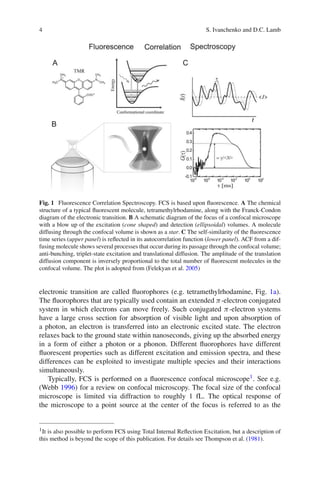
4 S. Ivanchenkoand D.C. Lamb
Fig. 1 Fluorescence Correlation Spectroscopy. FCS is based upon fluorescence. A The chemical
structure of a typical fluorescent molecule, tetramethylrhodamine, along with the Franck-Condon
diagram of the electronic transition. B A schematic diagram of the focus of a confocal microscope
with a blow up of the excitation (cone shaped) and detection (ellipsoidal) volumes. A molecule
diffusing through the confocal volume is shown as a star. C The self-similarity of the fluorescence
time series (upper panel) is reflected in its autocorrelation function (lower panel). ACF from a dif-
fusing molecule shows several processes that occur during its passage through the confocal volume;
anti-bunching, triplet-state excitation and translational diffusion. The amplitude of the translation
diffusion component is inversely proportional to the total number of fluorescent molecules in the
confocal volume. The plot is adopted from (Felekyan et al. 2005)
electronic transition are called fluorophores (e.g. tetramethylrhodamine, Fig. 1a).
The fluorophores that are typically used contain an extended π-electron conjugated
system in which electrons can move freely. Such conjugated π-electron systems
have a large cross section for absorption of visible light and upon absorption of
a photon, an electron is transferred into an electronic excited state. The electron
relaxes back to the ground state within nanoseconds, giving up the absorbed energy
in a form of either a photon or a phonon. Different fluorophores have different
fluorescent properties such as different excitation and emission spectra, and these
differences can be exploited to investigate multiple species and their interactions
simultaneously.
Typically, FCS is performed on a fluorescence confocal microscope1. See e.g.
(Webb 1996) for a review on confocal microscopy. The focal size of the confocal
microscope is limited via diffraction to roughly 1 fL. The optical response of
the microscope to a point source at the center of the focus is referred to as the
1It is also possible to perform FCS using Total Internal Reflection Excitation, but a description of
this method is beyond the scope of this publication. For details see Thompson et al. (1981).
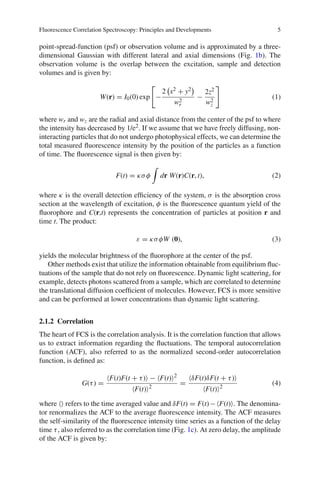
21.
Fluorescence Correlation Spectroscopy:Principles and Developments 5
point-spread-function (psf) or observation volume and is approximated by a three-
dimensional Gaussian with different lateral and axial dimensions (Fig. 1b). The
observation volume is the overlap between the excitation, sample and detection
volumes and is given by:
W(r) = I0(0) exp
−
2
x2 + y2
w2
r
−
2z2
w2
z
(1)
where wr and wz are the radial and axial distance from the center of the psf to where
the intensity has decreased by 1/e2. If we assume that we have freely diffusing, non-
interacting particles that do not undergo photophysical effects, we can determine the
total measured fluorescence intensity by the position of the particles as a function
of time. The fluorescence signal is then given by:
F(t) = κσφ
dr W(r)C(r, t), (2)
where κ is the overall detection efficiency of the system, σ is the absorption cross
section at the wavelength of excitation, φ is the fluorescence quantum yield of the
fluorophore and C(r,t) represents the concentration of particles at position r and
time t. The product:
ε = κσφW (0), (3)
yields the molecular brightness of the fluorophore at the center of the psf.
Other methods exist that utilize the information obtainable from equilibrium fluc-
tuations of the sample that do not rely on fluorescence. Dynamic light scattering, for
example, detects photons scattered from a sample, which are correlated to determine
the translational diffusion coefficient of molecules. However, FCS is more sensitive
and can be performed at lower concentrations than dynamic light scattering.
2.1.2 Correlation
The heart of FCS is the correlation analysis. It is the correlation function that allows
us to extract information regarding the fluctuations. The temporal autocorrelation
function (ACF), also referred to as the normalized second-order autocorrelation
function, is defined as:
G(τ) =
F(t)F(t + τ) − F(t)2
F(t)2
=
δF(t)δF(t + τ)
F(t)2
(4)
where refers to the time averaged value and δF(t) = F(t)−F(t). The denomina-
tor renormalizes the ACF to the average fluorescence intensity. The ACF measures
the self-similarity of the fluorescence intensity time series as a function of the delay
time τ, also referred to as the correlation time (Fig. 1c). At zero delay, the amplitude
of the ACF is given by:
most essential factorin the whole process. There is no doubt that a
given quantity of undiluted gastric juice will usually perform the
chemical process of food-transformation more rapidly than an equal
quantity of gastric juice which is diluted.[9] But there is also no doubt
that when we take a small quantity of alcohol into the stomach, the
amount of gastric juice is instantly increased. This results from the
stimulant action of alcohol both upon the pneumogastric nerves and
upon the great splanchnic or visceral branches of the sympathetic.
Just as when tobacco is smoked, though probably to a less extent,
the gastric secretion is increased; and the motions of the stomach
are also increased. This increase in the quantity of the digestive
fluid, due to nervous stimulus, is undoubtedly more than sufficient to
make up for the alleged impairment of its quality caused by mixing it
with a foreign substance. The action of saliva and carbonate of soda
supply us with a further illustration. In artificial experiments, like
those upon which Mr. Parton relies, alkaline substances are found to
retard digestion by neutralizing a portion of the acid of the gastric
juice. Yet the alkaline saliva, swallowed with food, does not retard
digestion; and Claude Bernard has shown that carbonate of soda
actually hastens, to a notable degree, the digestive process. Why is
this? It is because these alkalies act as local stimulants upon the
lining of the stomach, and thus increase the quantity of gastric juice.
It is in this way that common salt, eaten with other food, also
facilitates digestion; although salt is a preserver, as well as alcohol.
Here we come upon Mr. Parton's second blunder. He talks about the
decomposition of food, and appears to think that digestion is a
kind of putrefaction, so that alcohol, which arrests the latter, must
also arrest the former. He says: We do not need to experiment, for
we know that alcohol, which is a preserver, cannot digest food by
decomposing it. This unlucky remark illustrates the danger of writing
on a subject, the rudiments of which you have not taken time to get
acquainted with. Before attempting to lay down the law upon an
abstruse point connected with the subject of digestion, common
24.
prudence would appearto dictate that one should first acquire some
dim notion of what digestion is. The veriest tyro in physiology should
know that the gastric juice is itself a preventer of putrefaction. It will
not only keep off organic decay, but it will stop it after it has begun.
[10] In this sense of the word, it is as much a preserver as alcohol.
As it takes time to expose all the fallacies which Mr. Parton can
crowd into one short paragraph, we have thus far admitted that
alcohol impairs the quality of the gastric juice by diluting it: as a
matter of fact, it does not so impair it. If it is a preserver, it is also a
coagulator. It coagulates the albuminous portions of the food, thus
enabling them to be more easily acted upon by the gastric secretion.
[11] So that, on looking into the matter, we find the stimulant dose of
alcohol doing everything to quicken, and nothing whatever to
slacken, digestion. It coaxes out more digestive fluid, and it lightens
the task which that fluid has to perform.
Daily experience tells us that the glass of wine taken with our dinner,
or the thimble-full of liqueur taken after dessert, diminishes the
feeling of heaviness, and enables us sooner to go to work. Of
indigestion and its accompanying sensations, we are unable to speak
from experience; but Mr. Parton feelingly describes the effects of
alcohol as follows. When we have taken too much shad for
breakfast, we find that a wineglass of whisky instantly mitigates the
horrors of indigestion, and enables us again to contemplate the
future without dismay. Now, if Mr. Parton's ideas on this subject
were correct, his dose of whisky ought to exasperate his torment.
The fact that it comforts him shows that it serves to quicken the too
sluggish stomach to its normal activity. It is a very good clinical
experiment indeed.
Alcohol, however, aids digestion only when taken in moderate
quantities. A narcotic dose, by paralyzing the medulla and the
sympathetic, interferes with the flow of gastric juice. Here, as in
most cases, the large quantity does just the reverse of what the
25.
small quantity willdo. The same is true of food. Digestible food, in
moderate amount, stimulates the gastric secretion; in excessive
amount, it arrests its action. Another curious fact is, that although
the addition of organic acids increases the digestive power of this
fluid, there is a limit at which this increase ceases, and beyond it,
excess of acid suspends the whole digestive power.[12] It is
therefore a wise thing to eat heartily, but a silly thing to eat
voraciously; it is wise to eat pickles, but silly to make one's dinner of
them; it is wise to drink a glass of sherry, but silly to empty the
bottle. The happy mean is the thing to be maintained, in digestion
as in every thing else.
Mr. Parton next proceeds to deny that alcohol is a heat-producing
substance. On the contrary, he says, it appears in all cases to
diminish the efficiency of the heat-producing process. And he cites
the testimony of Arctic voyagers, New York car-drivers, Russian
corporals, and Rocky Mountain hunters, in support of the statement
that alcohol diminishes the power of the system to resist cold. He
thinks he could fill a whole magazine with the evidence on this point.
Nevertheless, so far as we have examined the reports of Arctic
travellers,[13] they appear by no means decisive. They do not keep in
mind the distinction between stimulation and intoxication. We do not
doubt that men who start under the influence of liquor are the first
to succumb to the cold, and the likeliest to be frost-bitten, if the
phrase under the influence of liquor be understood, as it usually is,
to mean partly drunk. On the other hand, it is a familiar fact that a
glass of whisky, taken on coming into the house after exposure to
cold, will in many cases prevent sore throat or inflammation of the
nasal passages. In our own experience, we know of no more
efficient agent for removing the effects of a chill from the system.
Before this question can be settled, however, we must ascertain
whether alcohol is, or is not, a true food. If the food-action of
alcohol is, as Liebig maintains, to be ranked with that of fat, starch
and sugar, its heat-producing power will follow as an inevitable
26.
inference. To thispoint we shall presently come; and meanwhile we
may content ourselves with citing the excellent authority of Johnston
in support of the opinion that ardent spirits directly warm the body.
[14]
Mr. Parton next indicts alcohol on the ground that it is not a
strength-giver. On this branch of the subject, he observes, all the
testimony is against alcoholic drinks.[15] Yet in his own statement of
the case may be found contradictions enough. On the one hand he
cites Tom Sayers, Richard Cobden and Benjamin Franklin in support
of his opinion;[16] and he tells us how Horace Greeley, teetotaler,
coming home the other day, and finding terrible arrears of work
piled up before him, sat down and wrote steadily, without leaving his
room, from ten A.M. till eleven P.M.—no very wonderful feat for a
healthy man. But on the other hand, it appears from some of his
own facts that when a supreme exertion of strength is requisite,
then we must take alcohol. During the war I knew of a party of
cavalry who, for three days and three nights, were not out of the
saddle fifteen minutes at a time. The men consumed two quarts of
whisky each, and all of them came in alive. It is a custom in England
to extract the last possible five miles from a tired horse, when those
miles must be had from him, by forcing down his most unwilling
throat a quart of beer. (p. 86.) From these unwelcome facts Mr.
Parton draws the sage inference that alcohol, like tobacco, supports
us in doing wrong! It enables us to violate the laws of nature
without immediate suffering and speedy destruction. Now there is
one much abused faculty of mankind, which nevertheless will
sometimes refuse to be insulted,—that faculty is common sense. And
in the present case, common sense declares that when we are
taxing our strength, no matter whether laws are violated or not,
we do not keep ourselves up by drinking a substance which can only
weaken us. It may be unfortunate that alcohol is a strength-giver;
but the fact that we can travel farther with it than without it shows
that, unfortunate or not, the thing is so. But Mr. Parton believes that
27.
Nature is evenwith us afterward. In a few instances of intermittent
disease, a small quantity of wine may sometimes enable a patient
who is at the low tide of vitality to anticipate the turn of the tide,
and borrow at four o'clock enough of five o'clock strength to enable
him to reach five o'clock. This is sheer nonsense. There is no such
thing as borrowing at four o'clock the strength of five o'clock. The
thing is a physiological absurdity. The strength of to-morrow is non-
existent until to-morrow comes; it is not a reserved fund from which
we can borrow to-day. If Mr. Parton's notion were correct, his patient
ought to be weaker at five o'clock by just the same amount that he
is stronger at four o'clock. If the strength has been borrowed, it
cannot be used over again. You cannot eat your cake and save it. In
an hour's time, therefore, the patient should be weaker than if he
had contrived to get along without the wine. But this is not found to
be the case: he is stronger at four and he is stronger at five, he is
stronger next day, and he convalesces more rapidly than if he had
not taken alcohol. This is a clinical fact which there is no blinking.[17]
It shows that the only source from which the strength can possibly
come is the alcohol. Whether it be food or not, the action of alcohol
in these cases is precisely similar to that of food. It calms delirium
and promotes refreshing sleep, exactly like a meat broth, except that
it is often more rapidly efficient. It can produce these effects only by
acting as a genuine stimulant, by either nourishing, or facilitating the
normal nutrition of, the nervous system.[18]
When therefore Lawyer Heavy-fee and the other allegorical
personages mentioned by Mr. Parton sit up working all night, and
then quiet their nerves by a glass of wine or a cigar, they are no
doubt shortening their lives and committing respectable suicide.
But it is because they sit up all night and waste vital force, not
because they resort to an obvious and effective means of repairing
the loss. It is well to keep early hours and avoid over-work. But on
rare occasions, when the circumstances of life absolutely require it,
he who cannot sit up all night for a week together, without inflicting
28.
permanent injury uponhimself, is rightly considered deficient in
recuperative vigour. When such occasions come, most persons
instinctively seek aid from alcohol; and it helps them because it is an
imparter, or at least an economizer, of nervous force. The fact that it
is resorted to, when supreme exertion is demanded, shows that it is
recognized as a strength-saver, if not as a strength-giver. Our inquiry
into its food-action will show that it is both the one and the other.
Thus far we have considered alcohol only as an agent which affects
the nutrition of the nerves. Whether it be also a food or not does not
essentially alter the question of its evil or beneficent influence upon
the system. As we saw in our chapter on Tobacco, the human
organism needs, for its proper nutrition, stimulus as well as food,—
force as well as material. No conclusion in physiology is better
established than that narcotic-stimulants increase the supply of force
while they diminish the waste of material;[19] and it is by virtue of
this peculiarity that they will often sustain the organism in the
absence of food. Tobacco is not food, but if you give a starving man
a pipe to smoke it will take him much longer to die. Opium and coca
are not foods; but they will sometimes support life when no true
aliment can be procured. The action of alcohol is similar to that of
these substances, but immeasurably more effective. None of the
inferior narcotic-stimulants is at all comparable with alcohol in the
degree of its food-replacing power. We read that tobacco and coca
will enable a man to go several days without anything to eat; and
we interpret this result as due to the waste-retarding action of these
substances. But when we find that alcohol will support life for weeks
and months, we can no longer be content with such an explanation.
When we recollect that Cornaro lived healthily for fifty-eight years
upon twelve ounces of light food and fourteen ounces of wine per
diem,[20] and reflect upon the large proportion of alcoholic drink in
this diet, the suspicion is forced upon us that alcohol is not only a
true stimulant but also a true food.
29.
Mr. Parton ofcourse asserts that alcoholic drinks do not nourish the
body, and denies to them the title of foods. He begins by quoting
Liebig's assertion that as much flour or meal as can lie on the point
of a table-knife is more nutritious than nine quarts of the best
Bavarian beer. Whereupon the reader, who is perhaps not familiar
with the history of physiological controversy, thinks at once that
Liebig's great authority is opposed to the opinion that alcohol is
food. Nothing could be further from the truth. Perhaps nothing in Mr.
Parton's book shows more forcibly the danger of cramming a
subject instead of studying it. When Liebig wrote the above
sentence, he believed that foods might be sharply divided into two
classes,—those which nourish, and those which keep up the heat of
the body. He believed that no foods except those which contain
nitrogen can nourish the tissues; and he therefore excluded not only
alcohol, but fat, starch and sugar also, from the class of nutritious
substances. But Liebig was far from believing that alcohol is not
food. On the contrary he distinctly classed it with fat, starch and
sugar, as a heat-producing food,—a fact which Mr. Parton, if he
knows it, takes good care not to quote! But this twofold classification
of foods has for several years been known to be unsound. It has
been shown that all true foods are more or less nutritious, and that
all are more or less heat-producing. Starch and sugar have
maintained their places in the class of nutritive materials from which
Liebig tried to exclude them, and we have now to see whether the
same can be said of the closely kindred substance, alcohol.
Mr. Parton thinks he has proved that alcohol cannot be food, when
he has asserted that it is not chemically transformed within the body.
As soon as it is taken, he tells us, lungs, skin and kidneys all set
busily to work to expel it, and they send it out just as it came in:
therefore it is an enemy. Now all this may be said of water. Water is
not chemically changed within the body; as soon as we drink it,
lungs, skin and kidneys begin busily to expel it; and it goes out just
30.
as good wateras it came in. Nevertheless, water is one of the most
essential elements of nutrition.
But it is by no means certain that alcohol is not transformed within
the body. It is neither certain nor probable. Mr. Parton relies upon
the experiments of Messrs. Lallemand, Duroy, and Perrin, who in
1860 thought they had demonstrated that all the alcohol taken into
the system comes out again, as alcohol, through the lungs, skin and
kidneys. By applying the very delicate chromic acid test, these
gentlemen appeared to prove that appreciable quantities of alcohol
always begin to be excreted very soon after the dose has been
received by the stomach, and continue to pass off for many hours.
They failed, after repeated attempts, to discover the intermediate
compounds into which alcohol had been represented as transforming
itself before its final change; and, on the other hand, they detected
unchanged alcohol everywhere in the body hours after it had been
taken; they found the substance in the blood, and in all the tissues,
but especially in the brain and the nervous centres generally, and in
the liver.[21] Mr. Parton has, it would appear, read their book, and he
is fully persuaded by it that if you take into your system an ounce
of alcohol, the whole ounce leaves the system within forty-eight
hours, just as good alcohol as it went in. These experiments,
moreover, produced the remarkable effect of causing the editor of a
leading periodical to confess to the public that he was not infallible.
The Westminster Review, it seems, in 1861, retracted the opinions
which it had expressed in 1855, concerning the rôle of alcohol in
the animal body. The Westminster Review has now an opportunity
to retract its recantations; for in 1863, these experiments were
subjected to a searching criticism by M. Baudot, which resulted in
thoroughly invalidating the conclusions supposed to flow from them.
[22] The case is an interesting one, as showing afresh the utter
impossibility of getting at the truth concerning alcohol, without
paying attention to the difference in the behaviour of large and small
quantities.
31.
The researches ofBouchardat and Sandras,[23] and of Duchek,[24]
have rendered it probable that, if alcohol undergoes any digestive
transformation, it is first changed into aldehyde, from which are
successively formed acetic acid, oxalic acid and water, and carbonic
acid.[25] But this transformation, like any other digestive process,
cannot go on unless the nervous system is in good working order.
Now when a narcotic dose of alcohol is taken, the flow of gastric
juice is prevented by local paralysis of the nerve-fibres distributed to
the stomach. What then must happen? Solid food may remain
undigested, in the stomach;[26] but liquid alcohol is easily
absorbable, and has two ways of exit,—one through the portal
system into the liver, the other through the lacteals into the general
circulation, by which it will be carried chiefly to the organ which
receives most blood,—namely, the brain. It is thus probable that no
alcohol can be transformed after narcosis begins. But the absorbed
alcohol, loading the circulation, begins at once to be excreted.
Paralysis of the renal plexus of the sympathetic sets up a rapid
diuresis, and considerable amounts of the volatile liquid escape
through the lungs and skin. In examining, therefore, a drunken man
or dog, we need not, on any theory, expect to find the intermediate
products of alcoholic transformation; we must expect to find large
quantities of undigested alcohol in the circulation, and notably in the
brain and liver; and we need not be surprised if we detect
unchanged alcohol in the excretions. Our experiment will not show
that alcohol cannot be assimilated; it will only show how serious is
the damage inflicted by a narcotic dose, in checking assimilation.
Now all this applies with force to the experiments of Messrs.
Lallemand, Duroy and Perrin. In their experiments, these gentlemen
always tried intoxicating doses; thus paralyzing at the outset the
whole digestive tract, and preventing the formation of those
transformed products which they afterward vainly tried to discover.
As so often happens in experimenting upon the enormously complex
human organism, they began by creating abnormal conditions which
rendered their conclusions inapplicable to the healthy body.
32.
A further criticismby M. Baudot, supported by renewed experiments,
is still more decisive. M. Baudot justly observes that in order to
substantiate their conclusions, Messrs. Lallemand, Duroy and Perrin
should have at least been able, with their excessively delicate tests,
to discover in the excretions a large part of the alcohol which had
been taken into the system. This, however, they never did. In all
cases, the amount of alcohol recovered was very small, and bore but
a trifling proportion to the amount which had been taken. According
to these physiologists, the elimination always takes place chiefly
through the kidneys. But M. Baudot, in a series of elaborate
experiments, has proved that, unless the dose has been excessive,
no sensible amount of alcohol reappears in the kidney-excretions for
more than twenty-four hours. The quantity is so minute that the
alcoometer is not in the least affected by it, and it requires the
chromic acid test even to reveal its presence. Similar results have
been obtained by experiments upon the breath.
Finally, the gravest doubts have been thrown upon the
trustworthiness of the chromic acid test relied on by Messrs.
Lallemand, Duroy and Perrin. It is considered possible, by good
chemical authority, that the reactions in the test-apparatus, which
they attributed to the escaping alcohol, may equally well have been
caused by some of the results of alcoholic transformation. For
reasons above given, however, it is probable that in cases of narcosis
some alcohol always escapes. When we reflect upon its absorbability
and its ready solubility in water, it seems likely beforehand that a
considerable quantity must escape. But all that these able
Frenchmen can be said to have accomplished, is the demonstration
of the fact that when you take into your system a greater quantity of
alcohol than the system can manage, a part of it is expelled in the
same state in which it entered. And this may be said of other kinds
of food.
These experiments have, therefore, instead of settling the question,
left it substantially just where it was before. But we have now a
33.
more remarkable setof facts to contemplate. In many cases of
typhoid fever, acute bronchitis, pneumonia, erysipelas, and
diphtheria, occurring in Dr. Anstie's practice, it was found that the
stomach could be made to retain nothing but wine or brandy. Upon
these alcoholic drinks, therefore, the patients were entirely sustained
for periods sometimes reaching a month in duration.[27] In nearly
every case convalescence was rapid, and the emaciation was much
slighter than usual: the quality of the flesh was also observed to be
remarkably good. Dr. Slack, of Liverpool, had two female patients
who, loathing ordinary food, maintained life and tolerable vigour for
more than three months upon alcoholic drinks alone. Mr. Nisbet
reports the case of a child affected with marasmus, who subsisted
for three months on sweet whisky and water alone, and then
recovered; and that of another child, who lived entirely upon Scotch
ale for a fortnight, and then recovered his appetite for common
things. Many similar examples might be cited.
It may be said that alcohol maintained these persons by retarding
the waste of the tissues. This is no doubt an admissible supposition.
There is no doubt that alcohol, by its waste-retarding action, will
postpone for some time the day of death from starvation.[28] But to
this action there must be some limit. Though the waste is retarded,
it is not wholly stopped. Though there is relatively less waste, there
is still absolutely large waste. The mere act of keeping up respiration
necessitates a considerable destruction of tissue. Then the
temperature of the body must be kept very near 98° Fahrenheit, or
life will suddenly cease; and the maintenance of this heat involves a
great consumption of tissue. Now this waste, under the most
favourable circumstances, will soon destroy life, unless it is balanced
by actual repair. You may diminish the draught on your furnace as
much as you please,—the fire will shortly go out unless fresh coal is
added. Upon these points the data are more or less precise. The
amount of waste material daily excreted from the body, under
ordinary circumstances, is a little more than seven pounds.[29] Of
34.
this the greaterpart is water, the quantity of carbon being about
twelve ounces, and the quantity of nitrogenous matter about five
ounces.[30] To make up for this waste we usually require at least two
and a half pounds of solid, and three pints of liquid, food.[31] In Dr.
Hammond's experiments, the weight-sustaining power of the alcohol
taken seems to have amounted to four or five ounces.[32] It will be
seen, therefore, that in spite of any stimulant effect of alcohol upon
nutrition, unless at least ten or twelve ounces of nitrogenous or
carbonaceous matter be eaten daily, the weight of the body must
rapidly diminish.
Now the experiments of Chossat have demonstrated that no animal
can suddenly lose more than two-fifths of its normal weight without
dying of starvation. If a man, therefore, weigh 150 lbs., for him 90
lbs. is the starvation-point; as soon as he reaches that weight he
dies. Usually, indeed, death occurs before this degree of emaciation
can have been attained,—in most cases, on the fifth or sixth day;
though there are a few authentic instances of persons who have
lived for twelve, and even sixteen, days before finally succumbing.
In view of these facts, we are willing to grant that people may in
rare cases live for three months on their own tissues, if waste be
duly retarded. We are willing to grant it, though we do not believe it.
But we are not prepared to admit that this process can go on for six
months or a year; and we believe that the cases now to be cited can
in nowise be got rid of by such an interpretation.
Mr. Nisbet mentions the case of a man who lived for seven months
entirely on spirit and water. At Wavertree, a young man afflicted with
heart-disease lived for five years principally, and for two years solely,
on brandy. His allowance was at first six ounces, afterward a pint,
per diem. His weight was not materially decreased, when, at the end
of the five years, he died of his disease. But the next case is still
more remarkable. Dr. Inman had a lady-patient, about twenty-five
years old, plump, active and florid, but somewhat deficient in power
35.
of endurance. Thislady had two large and healthy children in
succession, whom she successfully nursed. On each occasion she
became much exhausted, the appetite wholly failed, and she was
compelled to live solely on bitter ale and brandy and water; on this
regimen she kept up her good looks, her activity and her nursing,
and went on this way for about twelve months; the nervous system
was by this time thoroughly exhausted, yet there was no emaciation,
nor was there entire prostration of muscular power.[33]
For the accuracy of this statement there is to be had the testimony
of Dr. Inman, the attendant physician, as well as that of the lady's
husband, of mutual friends occasionally residing in the house with
her, of her mother, of her sisters, and of her nurse. We have
apparently no alternative but to believe it; and if it is true, it is
certainly decisive. It is nothing less than an experimentum crucis.
The suggestion that this lady might have kept up her normal activity
while nursing children, for a whole year, with no aliment except her
own tissues and the water and vegetable matter contained in her ale
and brandy, is too absurd to need refutation. The thing is an utter
impossibility. Moreover, not being emaciated at the end of the year,
she had probably been consuming her own tissues but very little.
Her weight, her muscular activity, and the natural heat of her body,
could have been sustained by nothing but the alcohol; which thus
appears as a true food, at once nourishing, strength-giving, and
heat-producing.
This conclusion is further re-enforced by the numerous cases on
record of persons who have lived actively for many years upon a diet
of alcoholic liquor accompanied by a quantity of solid food
notoriously inadequate to support life. The case of Cornaro is
outdone by some of those quoted by Dr. Anstie, as having occurred
under his own observation. Of twelve cases which are described in
detail, the most remarkable is that of a man aged 83, whose diet for
twenty years had consisted of one bottle of gin and one small
fragment of toasted bread daily. This old fellow, says Dr. Anstie,
36.
would have beenof little service as a practical illustration of the
bodily harm wrought by drinking, being in truth rather an unusually
active and vigorous person for his time of life. Probably the old man
was not narcotized by his daily bottle of gin; or he would, long
before the twenty years had elapsed, have shown symptoms of
nervous disease. In most of these cases of abnormal diet, there
occurs after a while a general breaking down of the nerve-centres,
shown in delirium tremens, epileptic fits, or a sudden stroke of
paralysis. They are not quoted, therefore, as examples to be
followed, but as very important items of evidence in favour of the
opinion that alcohol is food.
Taking all these considerations together, we believe it to be tolerably
well made out that alcohol, whether changed within the body or not,
is a true food, which nourishes, warms and strengthens. And Dr.
Brinton, in the following passage, declares it to be, in many cases, a
necessary food. That teetotalism is compatible with health, it needs
no elaborate facts to establish; but if we take the customary life of
those constituting the masses of our inhabitants of towns, we shall
find reason to wait before we assume that this result will extend to
our population at large. And, in respect to experience, it is singular
how few healthy teetotalers are to be met with in our ordinary
inhabitants of cities. Glancing back over the many years during
which this question has been forced upon the author by his
professional duties, he may estimate that he has sedulously
examined not less than 50,000 to 70,000 persons, including many
thousands in perfect health. Wishing, and even expecting to find it
otherwise, he is obliged to confess that he has hitherto met with but
very few perfectly healthy middle-aged persons, successfully
pursuing any arduous metropolitan calling under teetotal habits. On
the other hand, he has known many total abstainers, whose
apparently sound constitutions have given way with unusual and
frightful rapidity when attacked by a casual sickness. This, says an
English reviewer of the French experiments, is quite in accordance
37.
with what Ihave myself observed, and with what I can gather from
other medical men; and it speaks volumes concerning the way in
which we ought to regard alcohol. If, indeed, it be a fact that in a
certain high state of civilization men require to take alcohol every
day, in some shape or other, under penalty of breaking down
prematurely in their work, it is idle to appeal to a set of imperfect
chemical or physiological experiments, and to decide, on their
evidence, that we ought to call alcohol a medicine or a poison, but
not a food. I am obliged to declare that the chemical evidence is as
yet insufficient to give any complete explanation of its exact manner
of action upon the system; but that the practical facts are as striking
as they could well be, and that there can be no mistake about them.
And I have thought it proper that, while highly-coloured statements
of the results of the new French researches are being somewhat
disingenuously placed before the lay public, there should not be a
total silence on the part of those members of the profession who do
not see themselves called upon to yield to the mere force of
agitation.[34] If this view of the case, which so strongly
recommends itself to the mind of the practical physician, be the true
one, we are forced to regard teetotalism, considered not in its moral
but in its physiological aspects, as a dietetic heresy nearly akin to
vegetarianism. Man can do without wine, as he can do without
meat; but the rational course is to adopt that diet from which we
can obtain the greatest amount of available vital power.
But even if we were to give up the doctrine that alcohol is a true
food, the great indisputed and indisputable fact of its stimulant value
would still remain. Tobacco neither nourishes the body nor warms it;
yet it enables us to earn our daily bread with less fatigue, and to
support the incessant trials of life with a more even spirit. The value
of alcohol as a stimulant is inferior only to that of tobacco; or
perhaps, for general purposes, it is quite unsurpassed. It
compensates for the occasionally inevitable incapacity of ordinary
food to maintain due nutrition; and in this way enables us to work
38.
longer, and witha lighter heart, and with less fear of ultimate
depression. It bridges over the pitfalls which the complicated
exigencies of modern life are constantly digging for us. Warm-
hearted but weak-headed radicalism may imagine a utopian state of
things in which money will grow on bushes and every one mind the
moral law, and digestion be always easy, and vexation infrequent,
and artificial stimulus unnecessary; but this is not the state of
things amid which we live. A modern man cannot, if he does his
duty, secure to himself the enjoyment of such a state. There are
times when he must sacrifice a little of his own round perfection, if it
be only to lend a helping hand to his neighbour. A kind of
valetudinarian philosophy is now afloat, which says, Look out, above
all things, for your own physical welfare. This philosophy contains a
truth, but as usually manifested it is nothing but the result of a
morbid self-consciousness. Duty sometimes requires that we should
cease coddling ourselves, and go to work, unless we would see
some cause suffer which interests other men, living and to come,
besides ourselves. We must sometimes run to put the fire out, even
if we do thereby lose our dinner, and interfere with the stomach's
requirements. It is useless, then, to talk about agents which
support us in doing wrong, when, from the very constitution of the
world and of society, we can no more go exactly right than we can
draw a line which shall be mathematically straight. It is useless to
speculate about an ideal society in which men can dispense with the
agents which economize their nervous strength, when we find as a
historical fact that no nation has ever existed which has been able to
dispense with those agents. As long as there are inequalities in the
daily ratio of waste and repair to be rectified, so long we shall get
along better with wine than without it. For this, looked at from the
widest possible point of view, is the legitimate function of alcohol,—
to diminish the necessary friction of living.
This too is the view of Liebig: As a restorative, a means of
refreshment when the powers of life are exhausted, of giving
39.
animation and energywhere man has to struggle with days of
sorrow, as a means of correction and compensation where
misproportion occurs in nutrition, wine is surpassed by no product of
nature or of art…. In no part of Germany do the apothecaries'
establishments bring so low a price as in the rich cities on the Rhine;
for there wine is the universal medicine of the healthy as well as the
sick. It is considered as milk for the aged.[35]
This is also the view of Dr. Anstie. Comparing the action of alcohol
upon the organism with that of chloroform and sulphuric ether, he
observes: It seems as if the former were intended to be the
medicine of those ailments which are engendered of the necessary
everyday evils of civilized life, and has therefore been made
attractive to the senses, and easily retained in the tissues, and in
various ways approving itself to our judgment as a food; while the
others, which are more rarely needed for their stimulant properties,
and are chiefly valuable for their beneficent temporary poisonous
action, by the help of which painful operations are sustained with
impunity, are in great measure deprived of these attractions, and of
their facilities for entering and remaining in the system.[36] Apart
from its implied teleology, this passage contains the gist of the whole
matter.
As for the Coming Man, whom Mr. Parton appears to regard as a sort
of pugilist or Olympic athlete, we suppose he will undoubtedly have
to exercise his brain sometimes, he will have to study, think and
plan, he will have responsibilities to shoulder, his digestion will not
always be preserved at its maximum of efficiency, his powers of
endurance will sometimes be tried to the utmost. The period in the
future when we shall have changed all this is altogether too
remote to affect our present conclusion; which is that the Coming
Man, so long as he is a member of a complex, civilized society, will
continue to use, with profit as well as pleasure, the two universal
stimulants, Alcohol and Tobacco.
40.
APPENDIX.
Bibliography of Tobacco.
Forthe benefit of those readers who may feel interested in this
subject, the following list is added, of the principal works which have
been written on the effects of tobacco. The older ones have, of
course, little scientific value, yet they are often interesting and
suggestive. They usually made the best use of the science of their
time, which is more than can be said of some of the later treatises.
41.
Baumann: Dissertatio deTabaci virtutibus. Basil, 1579.
Everart: De herba Panacea. Antwerp, 1583.
Ziegler: Taback von dem gar heilsamen Wundkraute Nicotiana.
Zurich, 1616.
Marradon: Dialogo del uso del Tabaco. Seville, 1618.
De Castro: Historia de las virtudes y propriedades de Tabacco.
Cordova, 1620.
Thorius: Hymnus Tabaci. Leyden, 1622.
Neander: Tabacologia. Leyden, 1622.
Scriverius: Saturnalia, seu de usu et abusu Tabaci. Haarlem, 1628.
Braun: Quæstio medica de fumo Tabaci. Marburg, 1628.
Aguilar: Contra il mal uso del Tabaco. Cordova, 1633.
Frankenius: Dissertatio de virtutibus Nicotianæ. Upsal, 1633.
Ostendorf: Traité de l'usage et de l'abus du Tabac. Paris, 1636.
Venner: Via recta ad vitam longam. London, 1637. (See p. 363, for
an entertaining discourse on Tobacco.)
Ferrant: Traité du Tabac en sternutatoire. Bourges, 1645.
Cuffari: I biasimi del Tabacco. Palermo, 1645.
Vitaliani: De abusu Tabaci. Rome, 1650.
Tapp: Oratio de Tabaco. Helmstadt, 1653.
Balde: Satyra contra abusum Tabaci. Munich, 1657.
42.
Magnenus: Exercitationes XIV.de Tabaco. Ticino, 1658.
Rumsey: Organum Salutis. London, 1659.
Paulli: Commentarius de abusu Tabaci Americanorum veteri.
Argentorat. 1665.
Baillard: Discours du Tabac. Paris, 1668.
De Prade: Histoire du Tabac. Paris, 1677.
Van Bontekoe: Korte verhandeling van t' menschenleven gezondheit,
ziekte en dood, etc. s' Gravenhagen, 1684.
Worp Beintema: Tabacologia, ofle korte verhandelinge over de
Toback. s' Gravenhagen, 1690.
Fagon: Dissertatio an ex Tabaci usu frequenti vita brevior. Paris,
1699.
Brunet: Le bon usage du Tabac en poudre. Paris, 1700.
Della Fabra: Dissertatio de animi affectibus, etc. Ferrara, 1702.
Manara: De moderando Tabaci usu in Europæis. Madrid, 1702.
Nicolicchia: Uso ed abuso del Tabacco. Palermo, 1710.
Keyl: Dissertatio num Nicotianæ herbæ usu levis notæ maculam
contrahat. Leipsic, 1715.
Cohausen: Pica nasi, seu de Tabaci sternutatorii abusu et noxa.
Amsterdam, 1716.
Meier: Tabacomania. Nordhaus, 1720.
——: A Dissertation on the Use and Abuse of Tobacco in Relation to
Smoaking, Chewing, and taking of Snuff. London, 1720.
Plaz: De Tabaco sternutatorio. Leipsic, 1727.
43.
Stahl: Dissertatio deTabaci effectibus salutaribus et nocivis. Erfurt,
1732.
Maloet: Dissertatio an a Tabaco, naribus assumpto, peculiaris
quædam cephalalgiæ species, aliique effectus. Paris, 1733.
Alberti: De Tabaci fumum sugente theologo. Halle, 1743.
Garbenfeld: Dissertatio de Tabaci usu et abusu. Argent. 1744.
Beck: De suctione fumi Tabaci. Altdorf, 1745.
Büchner: De genuinis viribus Tabaci. Halle, 1746.
Herment: Dissertatio an post cibum fumus Tabaci, etc. Paris, 1749.
De la Sone: Dissertatio an Tabacum homini sit lentum venenum.
Paris, 1751.
Ferrein: Dissertatio an ex Tabaci usu frequenti vitæ summa brevior.
Paris, 1753.
Petitmaitre: De usu et abusu Nicotianæ. Basil, 1756.
Triller: Disputatio de Tabaci ptarmici abusu, affectus ventriculi causa.
Wittenberg, 1761.
Cuntira: De viribus medicis Nicotianæ ejusque usu et abusu. Vienna,
1777.
Hamilton: De Nicotianæ viribus in Medicina et de ejus malis
effectibus in usu communi et domestico. Edinburgh, 1779.
Clarke: A dissertation on the Use and Abuse of Tobacco. London,
1797.
Szerlecki: Monographie über den Tabak. Stuttgart, 1840.
Stahmann: Cigarre, Pfeife, und Dose. Quedlinburg, 1852.
44.
Welcome to ourwebsite – the perfect destination for book lovers and
knowledge seekers. We believe that every book holds a new world,
offering opportunities for learning, discovery, and personal growth.
That’s why we are dedicated to bringing you a diverse collection of
books, ranging from classic literature and specialized publications to
self-development guides and children's books.
More than just a book-buying platform, we strive to be a bridge
connecting you with timeless cultural and intellectual values. With an
elegant, user-friendly interface and a smart search system, you can
quickly find the books that best suit your interests. Additionally,
our special promotions and home delivery services help you save time
and fully enjoy the joy of reading.
Join us on a journey of knowledge exploration, passion nurturing, and
personal growth every day!
ebookbell.com










![most essential factor in the whole process. There is no doubt that a
given quantity of undiluted gastric juice will usually perform the
chemical process of food-transformation more rapidly than an equal
quantity of gastric juice which is diluted.[9] But there is also no doubt
that when we take a small quantity of alcohol into the stomach, the
amount of gastric juice is instantly increased. This results from the
stimulant action of alcohol both upon the pneumogastric nerves and
upon the great splanchnic or visceral branches of the sympathetic.
Just as when tobacco is smoked, though probably to a less extent,
the gastric secretion is increased; and the motions of the stomach
are also increased. This increase in the quantity of the digestive
fluid, due to nervous stimulus, is undoubtedly more than sufficient to
make up for the alleged impairment of its quality caused by mixing it
with a foreign substance. The action of saliva and carbonate of soda
supply us with a further illustration. In artificial experiments, like
those upon which Mr. Parton relies, alkaline substances are found to
retard digestion by neutralizing a portion of the acid of the gastric
juice. Yet the alkaline saliva, swallowed with food, does not retard
digestion; and Claude Bernard has shown that carbonate of soda
actually hastens, to a notable degree, the digestive process. Why is
this? It is because these alkalies act as local stimulants upon the
lining of the stomach, and thus increase the quantity of gastric juice.
It is in this way that common salt, eaten with other food, also
facilitates digestion; although salt is a preserver, as well as alcohol.
Here we come upon Mr. Parton's second blunder. He talks about the
decomposition of food, and appears to think that digestion is a
kind of putrefaction, so that alcohol, which arrests the latter, must
also arrest the former. He says: We do not need to experiment, for
we know that alcohol, which is a preserver, cannot digest food by
decomposing it. This unlucky remark illustrates the danger of writing
on a subject, the rudiments of which you have not taken time to get
acquainted with. Before attempting to lay down the law upon an
abstruse point connected with the subject of digestion, common](https://image.slidesharecdn.com/1057330-250528080808-9754dc3c/85/Supramolecular-Structure-And-Function-10-1st-Edition-Sergey-Ivanchenko-23-320.jpg)
![prudence would appear to dictate that one should first acquire some
dim notion of what digestion is. The veriest tyro in physiology should
know that the gastric juice is itself a preventer of putrefaction. It will
not only keep off organic decay, but it will stop it after it has begun.
[10] In this sense of the word, it is as much a preserver as alcohol.
As it takes time to expose all the fallacies which Mr. Parton can
crowd into one short paragraph, we have thus far admitted that
alcohol impairs the quality of the gastric juice by diluting it: as a
matter of fact, it does not so impair it. If it is a preserver, it is also a
coagulator. It coagulates the albuminous portions of the food, thus
enabling them to be more easily acted upon by the gastric secretion.
[11] So that, on looking into the matter, we find the stimulant dose of
alcohol doing everything to quicken, and nothing whatever to
slacken, digestion. It coaxes out more digestive fluid, and it lightens
the task which that fluid has to perform.
Daily experience tells us that the glass of wine taken with our dinner,
or the thimble-full of liqueur taken after dessert, diminishes the
feeling of heaviness, and enables us sooner to go to work. Of
indigestion and its accompanying sensations, we are unable to speak
from experience; but Mr. Parton feelingly describes the effects of
alcohol as follows. When we have taken too much shad for
breakfast, we find that a wineglass of whisky instantly mitigates the
horrors of indigestion, and enables us again to contemplate the
future without dismay. Now, if Mr. Parton's ideas on this subject
were correct, his dose of whisky ought to exasperate his torment.
The fact that it comforts him shows that it serves to quicken the too
sluggish stomach to its normal activity. It is a very good clinical
experiment indeed.
Alcohol, however, aids digestion only when taken in moderate
quantities. A narcotic dose, by paralyzing the medulla and the
sympathetic, interferes with the flow of gastric juice. Here, as in
most cases, the large quantity does just the reverse of what the](https://image.slidesharecdn.com/1057330-250528080808-9754dc3c/85/Supramolecular-Structure-And-Function-10-1st-Edition-Sergey-Ivanchenko-24-320.jpg)
![small quantity will do. The same is true of food. Digestible food, in
moderate amount, stimulates the gastric secretion; in excessive
amount, it arrests its action. Another curious fact is, that although
the addition of organic acids increases the digestive power of this
fluid, there is a limit at which this increase ceases, and beyond it,
excess of acid suspends the whole digestive power.[12] It is
therefore a wise thing to eat heartily, but a silly thing to eat
voraciously; it is wise to eat pickles, but silly to make one's dinner of
them; it is wise to drink a glass of sherry, but silly to empty the
bottle. The happy mean is the thing to be maintained, in digestion
as in every thing else.
Mr. Parton next proceeds to deny that alcohol is a heat-producing
substance. On the contrary, he says, it appears in all cases to
diminish the efficiency of the heat-producing process. And he cites
the testimony of Arctic voyagers, New York car-drivers, Russian
corporals, and Rocky Mountain hunters, in support of the statement
that alcohol diminishes the power of the system to resist cold. He
thinks he could fill a whole magazine with the evidence on this point.
Nevertheless, so far as we have examined the reports of Arctic
travellers,[13] they appear by no means decisive. They do not keep in
mind the distinction between stimulation and intoxication. We do not
doubt that men who start under the influence of liquor are the first
to succumb to the cold, and the likeliest to be frost-bitten, if the
phrase under the influence of liquor be understood, as it usually is,
to mean partly drunk. On the other hand, it is a familiar fact that a
glass of whisky, taken on coming into the house after exposure to
cold, will in many cases prevent sore throat or inflammation of the
nasal passages. In our own experience, we know of no more
efficient agent for removing the effects of a chill from the system.
Before this question can be settled, however, we must ascertain
whether alcohol is, or is not, a true food. If the food-action of
alcohol is, as Liebig maintains, to be ranked with that of fat, starch
and sugar, its heat-producing power will follow as an inevitable](https://image.slidesharecdn.com/1057330-250528080808-9754dc3c/85/Supramolecular-Structure-And-Function-10-1st-Edition-Sergey-Ivanchenko-25-320.jpg)
![inference. To this point we shall presently come; and meanwhile we
may content ourselves with citing the excellent authority of Johnston
in support of the opinion that ardent spirits directly warm the body.
[14]
Mr. Parton next indicts alcohol on the ground that it is not a
strength-giver. On this branch of the subject, he observes, all the
testimony is against alcoholic drinks.[15] Yet in his own statement of
the case may be found contradictions enough. On the one hand he
cites Tom Sayers, Richard Cobden and Benjamin Franklin in support
of his opinion;[16] and he tells us how Horace Greeley, teetotaler,
coming home the other day, and finding terrible arrears of work
piled up before him, sat down and wrote steadily, without leaving his
room, from ten A.M. till eleven P.M.—no very wonderful feat for a
healthy man. But on the other hand, it appears from some of his
own facts that when a supreme exertion of strength is requisite,
then we must take alcohol. During the war I knew of a party of
cavalry who, for three days and three nights, were not out of the
saddle fifteen minutes at a time. The men consumed two quarts of
whisky each, and all of them came in alive. It is a custom in England
to extract the last possible five miles from a tired horse, when those
miles must be had from him, by forcing down his most unwilling
throat a quart of beer. (p. 86.) From these unwelcome facts Mr.
Parton draws the sage inference that alcohol, like tobacco, supports
us in doing wrong! It enables us to violate the laws of nature
without immediate suffering and speedy destruction. Now there is
one much abused faculty of mankind, which nevertheless will
sometimes refuse to be insulted,—that faculty is common sense. And
in the present case, common sense declares that when we are
taxing our strength, no matter whether laws are violated or not,
we do not keep ourselves up by drinking a substance which can only
weaken us. It may be unfortunate that alcohol is a strength-giver;
but the fact that we can travel farther with it than without it shows
that, unfortunate or not, the thing is so. But Mr. Parton believes that](https://image.slidesharecdn.com/1057330-250528080808-9754dc3c/85/Supramolecular-Structure-And-Function-10-1st-Edition-Sergey-Ivanchenko-26-320.jpg)
![Nature is even with us afterward. In a few instances of intermittent
disease, a small quantity of wine may sometimes enable a patient
who is at the low tide of vitality to anticipate the turn of the tide,
and borrow at four o'clock enough of five o'clock strength to enable
him to reach five o'clock. This is sheer nonsense. There is no such
thing as borrowing at four o'clock the strength of five o'clock. The
thing is a physiological absurdity. The strength of to-morrow is non-
existent until to-morrow comes; it is not a reserved fund from which
we can borrow to-day. If Mr. Parton's notion were correct, his patient
ought to be weaker at five o'clock by just the same amount that he
is stronger at four o'clock. If the strength has been borrowed, it
cannot be used over again. You cannot eat your cake and save it. In
an hour's time, therefore, the patient should be weaker than if he
had contrived to get along without the wine. But this is not found to
be the case: he is stronger at four and he is stronger at five, he is
stronger next day, and he convalesces more rapidly than if he had
not taken alcohol. This is a clinical fact which there is no blinking.[17]
It shows that the only source from which the strength can possibly
come is the alcohol. Whether it be food or not, the action of alcohol
in these cases is precisely similar to that of food. It calms delirium
and promotes refreshing sleep, exactly like a meat broth, except that
it is often more rapidly efficient. It can produce these effects only by
acting as a genuine stimulant, by either nourishing, or facilitating the
normal nutrition of, the nervous system.[18]
When therefore Lawyer Heavy-fee and the other allegorical
personages mentioned by Mr. Parton sit up working all night, and
then quiet their nerves by a glass of wine or a cigar, they are no
doubt shortening their lives and committing respectable suicide.
But it is because they sit up all night and waste vital force, not
because they resort to an obvious and effective means of repairing
the loss. It is well to keep early hours and avoid over-work. But on
rare occasions, when the circumstances of life absolutely require it,
he who cannot sit up all night for a week together, without inflicting](https://image.slidesharecdn.com/1057330-250528080808-9754dc3c/85/Supramolecular-Structure-And-Function-10-1st-Edition-Sergey-Ivanchenko-27-320.jpg)
![permanent injury upon himself, is rightly considered deficient in
recuperative vigour. When such occasions come, most persons
instinctively seek aid from alcohol; and it helps them because it is an
imparter, or at least an economizer, of nervous force. The fact that it
is resorted to, when supreme exertion is demanded, shows that it is
recognized as a strength-saver, if not as a strength-giver. Our inquiry
into its food-action will show that it is both the one and the other.
Thus far we have considered alcohol only as an agent which affects
the nutrition of the nerves. Whether it be also a food or not does not
essentially alter the question of its evil or beneficent influence upon
the system. As we saw in our chapter on Tobacco, the human
organism needs, for its proper nutrition, stimulus as well as food,—
force as well as material. No conclusion in physiology is better
established than that narcotic-stimulants increase the supply of force
while they diminish the waste of material;[19] and it is by virtue of
this peculiarity that they will often sustain the organism in the
absence of food. Tobacco is not food, but if you give a starving man
a pipe to smoke it will take him much longer to die. Opium and coca
are not foods; but they will sometimes support life when no true
aliment can be procured. The action of alcohol is similar to that of
these substances, but immeasurably more effective. None of the
inferior narcotic-stimulants is at all comparable with alcohol in the
degree of its food-replacing power. We read that tobacco and coca
will enable a man to go several days without anything to eat; and
we interpret this result as due to the waste-retarding action of these
substances. But when we find that alcohol will support life for weeks
and months, we can no longer be content with such an explanation.
When we recollect that Cornaro lived healthily for fifty-eight years
upon twelve ounces of light food and fourteen ounces of wine per
diem,[20] and reflect upon the large proportion of alcoholic drink in
this diet, the suspicion is forced upon us that alcohol is not only a
true stimulant but also a true food.](https://image.slidesharecdn.com/1057330-250528080808-9754dc3c/85/Supramolecular-Structure-And-Function-10-1st-Edition-Sergey-Ivanchenko-28-320.jpg)
![as good water as it came in. Nevertheless, water is one of the most
essential elements of nutrition.
But it is by no means certain that alcohol is not transformed within
the body. It is neither certain nor probable. Mr. Parton relies upon
the experiments of Messrs. Lallemand, Duroy, and Perrin, who in
1860 thought they had demonstrated that all the alcohol taken into
the system comes out again, as alcohol, through the lungs, skin and
kidneys. By applying the very delicate chromic acid test, these
gentlemen appeared to prove that appreciable quantities of alcohol
always begin to be excreted very soon after the dose has been
received by the stomach, and continue to pass off for many hours.
They failed, after repeated attempts, to discover the intermediate
compounds into which alcohol had been represented as transforming
itself before its final change; and, on the other hand, they detected
unchanged alcohol everywhere in the body hours after it had been
taken; they found the substance in the blood, and in all the tissues,
but especially in the brain and the nervous centres generally, and in
the liver.[21] Mr. Parton has, it would appear, read their book, and he
is fully persuaded by it that if you take into your system an ounce
of alcohol, the whole ounce leaves the system within forty-eight
hours, just as good alcohol as it went in. These experiments,
moreover, produced the remarkable effect of causing the editor of a
leading periodical to confess to the public that he was not infallible.
The Westminster Review, it seems, in 1861, retracted the opinions
which it had expressed in 1855, concerning the rôle of alcohol in
the animal body. The Westminster Review has now an opportunity
to retract its recantations; for in 1863, these experiments were
subjected to a searching criticism by M. Baudot, which resulted in
thoroughly invalidating the conclusions supposed to flow from them.
[22] The case is an interesting one, as showing afresh the utter
impossibility of getting at the truth concerning alcohol, without
paying attention to the difference in the behaviour of large and small
quantities.](https://image.slidesharecdn.com/1057330-250528080808-9754dc3c/85/Supramolecular-Structure-And-Function-10-1st-Edition-Sergey-Ivanchenko-30-320.jpg)
![The researches of Bouchardat and Sandras,[23] and of Duchek,[24]
have rendered it probable that, if alcohol undergoes any digestive
transformation, it is first changed into aldehyde, from which are
successively formed acetic acid, oxalic acid and water, and carbonic
acid.[25] But this transformation, like any other digestive process,
cannot go on unless the nervous system is in good working order.
Now when a narcotic dose of alcohol is taken, the flow of gastric
juice is prevented by local paralysis of the nerve-fibres distributed to
the stomach. What then must happen? Solid food may remain
undigested, in the stomach;[26] but liquid alcohol is easily
absorbable, and has two ways of exit,—one through the portal
system into the liver, the other through the lacteals into the general
circulation, by which it will be carried chiefly to the organ which
receives most blood,—namely, the brain. It is thus probable that no
alcohol can be transformed after narcosis begins. But the absorbed
alcohol, loading the circulation, begins at once to be excreted.
Paralysis of the renal plexus of the sympathetic sets up a rapid
diuresis, and considerable amounts of the volatile liquid escape
through the lungs and skin. In examining, therefore, a drunken man
or dog, we need not, on any theory, expect to find the intermediate
products of alcoholic transformation; we must expect to find large
quantities of undigested alcohol in the circulation, and notably in the
brain and liver; and we need not be surprised if we detect
unchanged alcohol in the excretions. Our experiment will not show
that alcohol cannot be assimilated; it will only show how serious is
the damage inflicted by a narcotic dose, in checking assimilation.
Now all this applies with force to the experiments of Messrs.
Lallemand, Duroy and Perrin. In their experiments, these gentlemen
always tried intoxicating doses; thus paralyzing at the outset the
whole digestive tract, and preventing the formation of those
transformed products which they afterward vainly tried to discover.
As so often happens in experimenting upon the enormously complex
human organism, they began by creating abnormal conditions which
rendered their conclusions inapplicable to the healthy body.](https://image.slidesharecdn.com/1057330-250528080808-9754dc3c/85/Supramolecular-Structure-And-Function-10-1st-Edition-Sergey-Ivanchenko-31-320.jpg)
![more remarkable set of facts to contemplate. In many cases of
typhoid fever, acute bronchitis, pneumonia, erysipelas, and
diphtheria, occurring in Dr. Anstie's practice, it was found that the
stomach could be made to retain nothing but wine or brandy. Upon
these alcoholic drinks, therefore, the patients were entirely sustained
for periods sometimes reaching a month in duration.[27] In nearly
every case convalescence was rapid, and the emaciation was much
slighter than usual: the quality of the flesh was also observed to be
remarkably good. Dr. Slack, of Liverpool, had two female patients
who, loathing ordinary food, maintained life and tolerable vigour for
more than three months upon alcoholic drinks alone. Mr. Nisbet
reports the case of a child affected with marasmus, who subsisted
for three months on sweet whisky and water alone, and then
recovered; and that of another child, who lived entirely upon Scotch
ale for a fortnight, and then recovered his appetite for common
things. Many similar examples might be cited.
It may be said that alcohol maintained these persons by retarding
the waste of the tissues. This is no doubt an admissible supposition.
There is no doubt that alcohol, by its waste-retarding action, will
postpone for some time the day of death from starvation.[28] But to
this action there must be some limit. Though the waste is retarded,
it is not wholly stopped. Though there is relatively less waste, there
is still absolutely large waste. The mere act of keeping up respiration
necessitates a considerable destruction of tissue. Then the
temperature of the body must be kept very near 98° Fahrenheit, or
life will suddenly cease; and the maintenance of this heat involves a
great consumption of tissue. Now this waste, under the most
favourable circumstances, will soon destroy life, unless it is balanced
by actual repair. You may diminish the draught on your furnace as
much as you please,—the fire will shortly go out unless fresh coal is
added. Upon these points the data are more or less precise. The
amount of waste material daily excreted from the body, under
ordinary circumstances, is a little more than seven pounds.[29] Of](https://image.slidesharecdn.com/1057330-250528080808-9754dc3c/85/Supramolecular-Structure-And-Function-10-1st-Edition-Sergey-Ivanchenko-33-320.jpg)
![this the greater part is water, the quantity of carbon being about
twelve ounces, and the quantity of nitrogenous matter about five
ounces.[30] To make up for this waste we usually require at least two
and a half pounds of solid, and three pints of liquid, food.[31] In Dr.
Hammond's experiments, the weight-sustaining power of the alcohol
taken seems to have amounted to four or five ounces.[32] It will be
seen, therefore, that in spite of any stimulant effect of alcohol upon
nutrition, unless at least ten or twelve ounces of nitrogenous or
carbonaceous matter be eaten daily, the weight of the body must
rapidly diminish.
Now the experiments of Chossat have demonstrated that no animal
can suddenly lose more than two-fifths of its normal weight without
dying of starvation. If a man, therefore, weigh 150 lbs., for him 90
lbs. is the starvation-point; as soon as he reaches that weight he
dies. Usually, indeed, death occurs before this degree of emaciation
can have been attained,—in most cases, on the fifth or sixth day;
though there are a few authentic instances of persons who have
lived for twelve, and even sixteen, days before finally succumbing.
In view of these facts, we are willing to grant that people may in
rare cases live for three months on their own tissues, if waste be
duly retarded. We are willing to grant it, though we do not believe it.
But we are not prepared to admit that this process can go on for six
months or a year; and we believe that the cases now to be cited can
in nowise be got rid of by such an interpretation.
Mr. Nisbet mentions the case of a man who lived for seven months
entirely on spirit and water. At Wavertree, a young man afflicted with
heart-disease lived for five years principally, and for two years solely,
on brandy. His allowance was at first six ounces, afterward a pint,
per diem. His weight was not materially decreased, when, at the end
of the five years, he died of his disease. But the next case is still
more remarkable. Dr. Inman had a lady-patient, about twenty-five
years old, plump, active and florid, but somewhat deficient in power](https://image.slidesharecdn.com/1057330-250528080808-9754dc3c/85/Supramolecular-Structure-And-Function-10-1st-Edition-Sergey-Ivanchenko-34-320.jpg)
![of endurance. This lady had two large and healthy children in
succession, whom she successfully nursed. On each occasion she
became much exhausted, the appetite wholly failed, and she was
compelled to live solely on bitter ale and brandy and water; on this
regimen she kept up her good looks, her activity and her nursing,
and went on this way for about twelve months; the nervous system
was by this time thoroughly exhausted, yet there was no emaciation,
nor was there entire prostration of muscular power.[33]
For the accuracy of this statement there is to be had the testimony
of Dr. Inman, the attendant physician, as well as that of the lady's
husband, of mutual friends occasionally residing in the house with
her, of her mother, of her sisters, and of her nurse. We have
apparently no alternative but to believe it; and if it is true, it is
certainly decisive. It is nothing less than an experimentum crucis.
The suggestion that this lady might have kept up her normal activity
while nursing children, for a whole year, with no aliment except her
own tissues and the water and vegetable matter contained in her ale
and brandy, is too absurd to need refutation. The thing is an utter
impossibility. Moreover, not being emaciated at the end of the year,
she had probably been consuming her own tissues but very little.
Her weight, her muscular activity, and the natural heat of her body,
could have been sustained by nothing but the alcohol; which thus
appears as a true food, at once nourishing, strength-giving, and
heat-producing.
This conclusion is further re-enforced by the numerous cases on
record of persons who have lived actively for many years upon a diet
of alcoholic liquor accompanied by a quantity of solid food
notoriously inadequate to support life. The case of Cornaro is
outdone by some of those quoted by Dr. Anstie, as having occurred
under his own observation. Of twelve cases which are described in
detail, the most remarkable is that of a man aged 83, whose diet for
twenty years had consisted of one bottle of gin and one small
fragment of toasted bread daily. This old fellow, says Dr. Anstie,](https://image.slidesharecdn.com/1057330-250528080808-9754dc3c/85/Supramolecular-Structure-And-Function-10-1st-Edition-Sergey-Ivanchenko-35-320.jpg)
![with what I have myself observed, and with what I can gather from
other medical men; and it speaks volumes concerning the way in
which we ought to regard alcohol. If, indeed, it be a fact that in a
certain high state of civilization men require to take alcohol every
day, in some shape or other, under penalty of breaking down
prematurely in their work, it is idle to appeal to a set of imperfect
chemical or physiological experiments, and to decide, on their
evidence, that we ought to call alcohol a medicine or a poison, but
not a food. I am obliged to declare that the chemical evidence is as
yet insufficient to give any complete explanation of its exact manner
of action upon the system; but that the practical facts are as striking
as they could well be, and that there can be no mistake about them.
And I have thought it proper that, while highly-coloured statements
of the results of the new French researches are being somewhat
disingenuously placed before the lay public, there should not be a
total silence on the part of those members of the profession who do
not see themselves called upon to yield to the mere force of
agitation.[34] If this view of the case, which so strongly
recommends itself to the mind of the practical physician, be the true
one, we are forced to regard teetotalism, considered not in its moral
but in its physiological aspects, as a dietetic heresy nearly akin to
vegetarianism. Man can do without wine, as he can do without
meat; but the rational course is to adopt that diet from which we
can obtain the greatest amount of available vital power.
But even if we were to give up the doctrine that alcohol is a true
food, the great indisputed and indisputable fact of its stimulant value
would still remain. Tobacco neither nourishes the body nor warms it;
yet it enables us to earn our daily bread with less fatigue, and to
support the incessant trials of life with a more even spirit. The value
of alcohol as a stimulant is inferior only to that of tobacco; or
perhaps, for general purposes, it is quite unsurpassed. It
compensates for the occasionally inevitable incapacity of ordinary
food to maintain due nutrition; and in this way enables us to work](https://image.slidesharecdn.com/1057330-250528080808-9754dc3c/85/Supramolecular-Structure-And-Function-10-1st-Edition-Sergey-Ivanchenko-37-320.jpg)
![animation and energy where man has to struggle with days of
sorrow, as a means of correction and compensation where
misproportion occurs in nutrition, wine is surpassed by no product of
nature or of art…. In no part of Germany do the apothecaries'
establishments bring so low a price as in the rich cities on the Rhine;
for there wine is the universal medicine of the healthy as well as the
sick. It is considered as milk for the aged.[35]
This is also the view of Dr. Anstie. Comparing the action of alcohol
upon the organism with that of chloroform and sulphuric ether, he
observes: It seems as if the former were intended to be the
medicine of those ailments which are engendered of the necessary
everyday evils of civilized life, and has therefore been made
attractive to the senses, and easily retained in the tissues, and in
various ways approving itself to our judgment as a food; while the
others, which are more rarely needed for their stimulant properties,
and are chiefly valuable for their beneficent temporary poisonous
action, by the help of which painful operations are sustained with
impunity, are in great measure deprived of these attractions, and of
their facilities for entering and remaining in the system.[36] Apart
from its implied teleology, this passage contains the gist of the whole
matter.
As for the Coming Man, whom Mr. Parton appears to regard as a sort
of pugilist or Olympic athlete, we suppose he will undoubtedly have
to exercise his brain sometimes, he will have to study, think and
plan, he will have responsibilities to shoulder, his digestion will not
always be preserved at its maximum of efficiency, his powers of
endurance will sometimes be tried to the utmost. The period in the
future when we shall have changed all this is altogether too
remote to affect our present conclusion; which is that the Coming
Man, so long as he is a member of a complex, civilized society, will
continue to use, with profit as well as pleasure, the two universal
stimulants, Alcohol and Tobacco.](https://image.slidesharecdn.com/1057330-250528080808-9754dc3c/85/Supramolecular-Structure-And-Function-10-1st-Edition-Sergey-Ivanchenko-39-320.jpg)