D O C U M E N T A R Y B Y M O R G A N S P U R L O C K
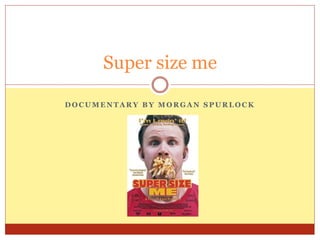
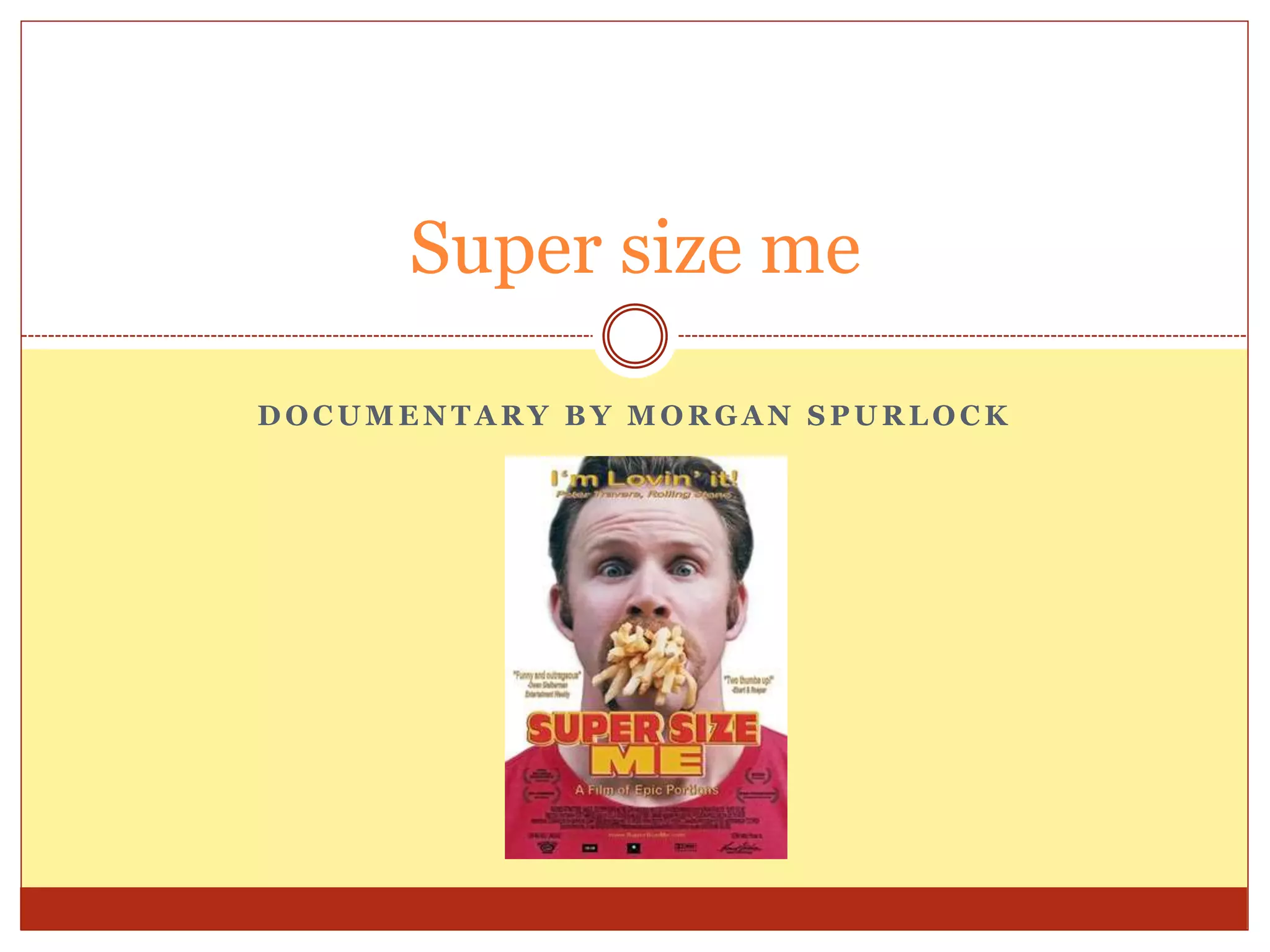
Super size me
Type of documentary
 There are multiple types of documentaries that
include different aspects of presenting information.
 Super size me is a mixed documentary as it includes
interviews, narration and observation to deliver
information to the audience.
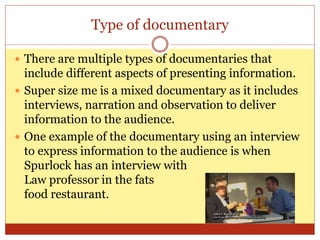
 One example of the documentary using an interview
to express information to the audience is when
Spurlock has an interview with
Law professor in the fats
food restaurant.
Type of documentary
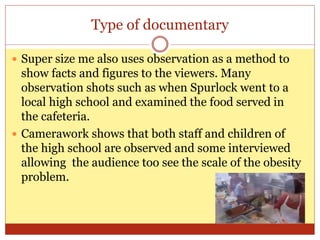
 Super size me also uses observation as a method to
show facts and figures to the viewers. Many
observation shots such as when Spurlock went to a
local high school and examined the food served in
the cafeteria.
 Camerawork shows that both staff and children of
the high school are observed and some interviewed
allowing the audience too see the scale of the obesity
problem.
Themes present in the documentary
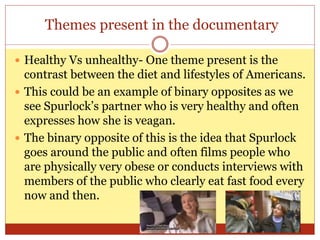
 Healthy Vs unhealthy- One theme present is the
contrast between the diet and lifestyles of Americans.
 This could be an example of binary opposites as we
see Spurlock’s partner who is very healthy and often
expresses how she is veagan.
 The binary opposite of this is the idea that Spurlock
goes around the public and often films people who
are physically very obese or conducts interviews with
members of the public who clearly eat fast food every
now and then.
Themes present in the documentary
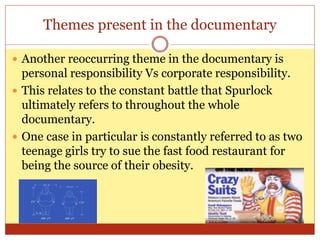
 Another reoccurring theme in the documentary is
personal responsibility Vs corporate responsibility.
 This relates to the constant battle that Spurlock
ultimately refers to throughout the whole
documentary.
 One case in particular is constantly referred to as two
teenage girls try to sue the fast food restaurant for
being the source of their obesity.
Themes present in the documentary
 Fitness is another theme in the documentary as
Spurlock shows consistently that American children
do not get the amount of physical exercise they
should get.
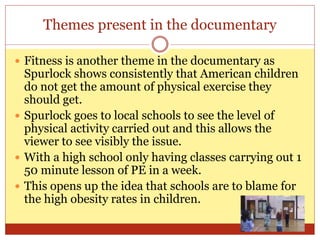
 Spurlock goes to local schools to see the level of
physical activity carried out and this allows the
viewer to see visibly the issue.
 With a high school only having classes carrying out 1
50 minute lesson of PE in a week.
 This opens up the idea that schools are to blame for
the high obesity rates in children.
Camerawork
 A lot of the camerawork in the documentary is handheld
which is evident from the amount of shaking the camera
does.
 This is probably because the filming is done out and
about in the streets and mostly in Spurlock’s car. This
means that heavy and bulky camera equipment would be
inefficient for the documentary and would prevent
Spurlock to go certain places.
 I believe that using handheld camerawork actually
helped get all the themes and messages across to the
viewers in a more realistic way.
 As the camera is handheld it makes the documentary
appear more relaxed and less formal.
Camerawork
 Throughout the documentary zoom is used a lot to
emphasise certain features that Spurlock clearly wants
the viewers to see.
 An example of when zoom is used could be when the
narration is talking about a certain food and at this point
the camera would zoom in to a nutritional label of a food
item which would show the amount of fat, sugar and
carbohydrates in the food.
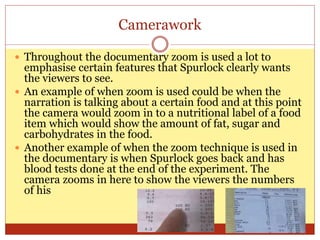
 Another example of when the zoom technique is used in
the documentary is when Spurlock goes back and has
blood tests done at the end of the experiment. The
camera zooms in here to show the viewers the numbers
of his
Camerawork
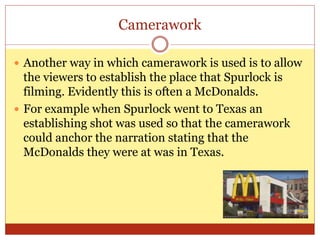
 Another way in which camerawork is used is to allow
the viewers to establish the place that Spurlock is
filming. Evidently this is often a McDonalds.
 For example when Spurlock went to Texas an
establishing shot was used so that the camerawork
could anchor the narration stating that the
McDonalds they were at was in Texas.
Mise-en-scene
 In the documentary the mise-en-scene is used very
wisely by Spurlock to get across to the viewers how
obesity levels have risen and are becoming a
worldwide epidemic.
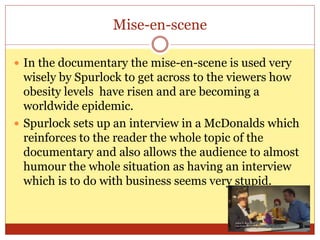
 Spurlock sets up an interview in a McDonalds which
reinforces to the reader the whole topic of the
documentary and also allows the audience to almost
humour the whole situation as having an interview
which is to do with business seems very stupid.
Mise-en-scene
 The setting comes across as very important throughout the whole
documentary.
 Other example of when setting plays a big role is when Spurlock interviews
the children in their school environment. Not only does this allow the
viewer to get a further insight in to what school children of America eat but
it also allows them to see how the school staff react to the children’s diet.
 For instance when Spurlock did ask the lunch staff about what their
thoughts were on the children’s lunches they often replied saying that the
children would only get unhealthy foods such as chips to go along with their
meal they brought from home.
 The staff were ultimately proved wrong when the children themselves
responded saying the chips alone were their lunch.
 If Spurlock didn’t go out to the location of the school and for example
instead asked for a report of the food served and bought in the cafeteria
then the results would be very different.
 For example the high schools would be able to cover the facts up and lie
about the type of food served and also the dietary habits of the children.
Mise-en-scene
 Another way setting has been used to express another
fast food issue is Spurlocks use of filming in his car.
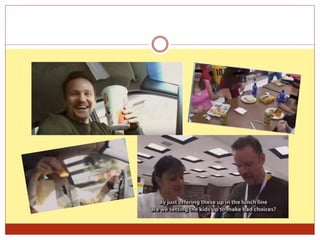
 On multiple occasions in the documentary Spurlock can
be seen in his car eating one of his McDonalds meals.
 This may have been purposely done to show the viewers
how easy fats food is to access.
 Especially in America drive-thru fast food restaurants are
everywhere you go.
 The accessibility of the fast food is arguably another
theme in the documentary and the use of having a setting
such as a car helps Spurlock to subtly point out to the
viewer that fast food is easier to access than healthy food.
Mise-en-scene
 In the documentary the use of props and the idea of
annotation of costume enables the viewers to see
professionals are the knowledgeable ones in the situation.
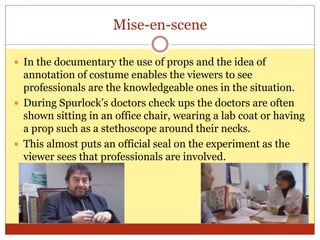
 During Spurlock’s doctors check ups the doctors are often
shown sitting in an office chair, wearing a lab coat or having
a prop such as a stethoscope around their necks.
 This almost puts an official seal on the experiment as the
viewer sees that professionals are involved.
Mise-en-scene
 By using specific props or costume Spurlock has allowed
the viewers to take on the information being given to
them as more official and therefore makes the shock
factor of the documentary a whole lot higher.
 This occurs in particular when Spurlock returns to the
doctors office after continuing the McDonalds diet for a
while and getting his blood test re-done.
 Here we see the affects that the diet is having on his
health and as these are being delivered by a professional
voice they seem more valid which makes the contrast of
the two blood tests seem more vast.
Mise-en-scene
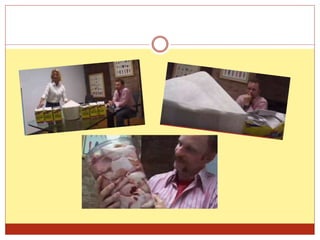
 The final use of props is present at the end of the documentary
when the diet and risks are weighed up and evaluated. This is
done through using props such as the tubs of sugar and jars of
fat which are presented to Spurlock and therefore the
audience.
 The use of these props are obvious as they startle to audience
and make them really see the affects of McDonalds and other
fast food restaurants.
 The viewers should feel disgusted by the amounts of sugar and
fat that Spurlock ate in such a small amount of time
 Through doing this Spurlock may have hoped for the viewers
t0 change their eating habits directly and stop eating as much
fast food for good.
Sound
 Both diegetic and non- diegetic sound are present in
the documentary.
 Some examples of the diegetic sounds used are
dialogue in interviews with professionals of law and
the doctors that Spurlock went with to monitor his
deterioration of the body.
 Another example would be sounds such as the food
wrappers and the sound of Spurlock eating the food.
Sound
 Non-diegetic sounds include those sounds that do not
have a visible source on screen.
 In the documentary the sound of narration is non-
diegetic as the source of the sound is not filmed.
 The narration throughout the whole documentary is
done by Spurlock himself.
 Another example of non-diegetic sound in the
documentary is mood music that is played.
 This is often done along with the voice over of Spurlock
and the mood music is repeated with the same music
being played throughout.
Sound
 One way in which Spurlock uses the music to his
advantage is by playing songs that belong to
McDonalds or have something to do with the fast
food industry.
 For example when Spurlock is talking about the play
areas in McDonalds the song ‘rock and roll
McDonalds’ is played in the background which
almost humours the company and makes the viewers
see that McDonalds is actually not at all a good thing
for children
Editing
 Like most documentaries the most common type of
editing used is a cut.
 However throughout the documentary some long
takes occur, especially when interviews take place
with professionals.
 The use of long takes for interviews allow the viewers
to first of all see what the person specialises in and
second of all understand what the person is saying
about the issue that Spurlock has raised.
Editing
 Another type of editing that is used in the
documentary is swipe.
 This is most commonly used when graphics come up
on the screen.
 The use of a swipe to graphics makes a smooth
transition to what Spurlock is talking about.
 For example at the beginning of the documentary
Spurlock talks about the accessibility of fast food
restaurants and to prove this point a swipe allows a
graphic of a worldwide map come up on the screen
with pin-pointed McDonalds stores on it.
Archive material
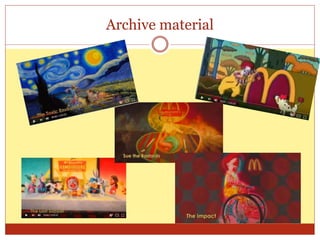
 A lot of archive material is used during the
documentary such as the images from McDonalds
and other artists that show an issue.
 These are used to introduce key topics within the
documentary. Some example are when Spurlock
talks about McDonalds interference with the
environment and the addiction aspect of fast food.
 Other ways in which archive material is used relates
to the lawsuit against the fast food restaurant.
 This is not originally Spurlock’s yet he relates to the
documents and films them repeatedly.
Archive material
Graphics
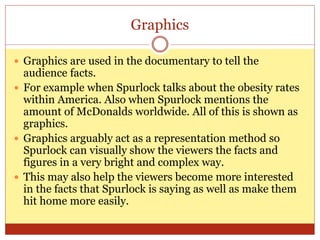
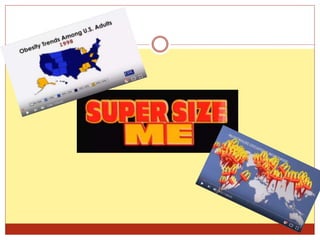
 Graphics are used in the documentary to tell the
audience facts.
 For example when Spurlock talks about the obesity rates
within America. Also when Spurlock mentions the
amount of McDonalds worldwide. All of this is shown as
graphics.
 Graphics arguably act as a representation method so
Spurlock can visually show the viewers the facts and
figures in a very bright and complex way.
 This may also help the viewers become more interested
in the facts that Spurlock is saying as well as make them
hit home more easily.
Super size me documentary

Super size me documentary

  • 1.
    D O CU M E N T A R Y B Y M O R G A N S P U R L O C K Super size me
  • 2.
    Type of documentary There are multiple types of documentaries that include different aspects of presenting information.  Super size me is a mixed documentary as it includes interviews, narration and observation to deliver information to the audience.  One example of the documentary using an interview to express information to the audience is when Spurlock has an interview with Law professor in the fats food restaurant.
  • 3.
    Type of documentary Super size me also uses observation as a method to show facts and figures to the viewers. Many observation shots such as when Spurlock went to a local high school and examined the food served in the cafeteria.  Camerawork shows that both staff and children of the high school are observed and some interviewed allowing the audience too see the scale of the obesity problem.
  • 4.
    Themes present inthe documentary  Healthy Vs unhealthy- One theme present is the contrast between the diet and lifestyles of Americans.  This could be an example of binary opposites as we see Spurlock’s partner who is very healthy and often expresses how she is veagan.  The binary opposite of this is the idea that Spurlock goes around the public and often films people who are physically very obese or conducts interviews with members of the public who clearly eat fast food every now and then.
  • 5.
    Themes present inthe documentary  Another reoccurring theme in the documentary is personal responsibility Vs corporate responsibility.  This relates to the constant battle that Spurlock ultimately refers to throughout the whole documentary.  One case in particular is constantly referred to as two teenage girls try to sue the fast food restaurant for being the source of their obesity.
  • 6.
    Themes present inthe documentary  Fitness is another theme in the documentary as Spurlock shows consistently that American children do not get the amount of physical exercise they should get.  Spurlock goes to local schools to see the level of physical activity carried out and this allows the viewer to see visibly the issue.  With a high school only having classes carrying out 1 50 minute lesson of PE in a week.  This opens up the idea that schools are to blame for the high obesity rates in children.
  • 7.
    Camerawork  A lotof the camerawork in the documentary is handheld which is evident from the amount of shaking the camera does.  This is probably because the filming is done out and about in the streets and mostly in Spurlock’s car. This means that heavy and bulky camera equipment would be inefficient for the documentary and would prevent Spurlock to go certain places.  I believe that using handheld camerawork actually helped get all the themes and messages across to the viewers in a more realistic way.  As the camera is handheld it makes the documentary appear more relaxed and less formal.
  • 8.
    Camerawork  Throughout thedocumentary zoom is used a lot to emphasise certain features that Spurlock clearly wants the viewers to see.  An example of when zoom is used could be when the narration is talking about a certain food and at this point the camera would zoom in to a nutritional label of a food item which would show the amount of fat, sugar and carbohydrates in the food.  Another example of when the zoom technique is used in the documentary is when Spurlock goes back and has blood tests done at the end of the experiment. The camera zooms in here to show the viewers the numbers of his
  • 9.
    Camerawork  Another wayin which camerawork is used is to allow the viewers to establish the place that Spurlock is filming. Evidently this is often a McDonalds.  For example when Spurlock went to Texas an establishing shot was used so that the camerawork could anchor the narration stating that the McDonalds they were at was in Texas.
  • 10.
    Mise-en-scene  In thedocumentary the mise-en-scene is used very wisely by Spurlock to get across to the viewers how obesity levels have risen and are becoming a worldwide epidemic.  Spurlock sets up an interview in a McDonalds which reinforces to the reader the whole topic of the documentary and also allows the audience to almost humour the whole situation as having an interview which is to do with business seems very stupid.
  • 11.
    Mise-en-scene  The settingcomes across as very important throughout the whole documentary.  Other example of when setting plays a big role is when Spurlock interviews the children in their school environment. Not only does this allow the viewer to get a further insight in to what school children of America eat but it also allows them to see how the school staff react to the children’s diet.  For instance when Spurlock did ask the lunch staff about what their thoughts were on the children’s lunches they often replied saying that the children would only get unhealthy foods such as chips to go along with their meal they brought from home.  The staff were ultimately proved wrong when the children themselves responded saying the chips alone were their lunch.  If Spurlock didn’t go out to the location of the school and for example instead asked for a report of the food served and bought in the cafeteria then the results would be very different.  For example the high schools would be able to cover the facts up and lie about the type of food served and also the dietary habits of the children.
  • 12.
    Mise-en-scene  Another waysetting has been used to express another fast food issue is Spurlocks use of filming in his car.  On multiple occasions in the documentary Spurlock can be seen in his car eating one of his McDonalds meals.  This may have been purposely done to show the viewers how easy fats food is to access.  Especially in America drive-thru fast food restaurants are everywhere you go.  The accessibility of the fast food is arguably another theme in the documentary and the use of having a setting such as a car helps Spurlock to subtly point out to the viewer that fast food is easier to access than healthy food.
  • 14.
    Mise-en-scene  In thedocumentary the use of props and the idea of annotation of costume enables the viewers to see professionals are the knowledgeable ones in the situation.  During Spurlock’s doctors check ups the doctors are often shown sitting in an office chair, wearing a lab coat or having a prop such as a stethoscope around their necks.  This almost puts an official seal on the experiment as the viewer sees that professionals are involved.
  • 15.
    Mise-en-scene  By usingspecific props or costume Spurlock has allowed the viewers to take on the information being given to them as more official and therefore makes the shock factor of the documentary a whole lot higher.  This occurs in particular when Spurlock returns to the doctors office after continuing the McDonalds diet for a while and getting his blood test re-done.  Here we see the affects that the diet is having on his health and as these are being delivered by a professional voice they seem more valid which makes the contrast of the two blood tests seem more vast.
  • 16.
    Mise-en-scene  The finaluse of props is present at the end of the documentary when the diet and risks are weighed up and evaluated. This is done through using props such as the tubs of sugar and jars of fat which are presented to Spurlock and therefore the audience.  The use of these props are obvious as they startle to audience and make them really see the affects of McDonalds and other fast food restaurants.  The viewers should feel disgusted by the amounts of sugar and fat that Spurlock ate in such a small amount of time  Through doing this Spurlock may have hoped for the viewers t0 change their eating habits directly and stop eating as much fast food for good.
  • 18.
    Sound  Both diegeticand non- diegetic sound are present in the documentary.  Some examples of the diegetic sounds used are dialogue in interviews with professionals of law and the doctors that Spurlock went with to monitor his deterioration of the body.  Another example would be sounds such as the food wrappers and the sound of Spurlock eating the food.
  • 19.
    Sound  Non-diegetic soundsinclude those sounds that do not have a visible source on screen.  In the documentary the sound of narration is non- diegetic as the source of the sound is not filmed.  The narration throughout the whole documentary is done by Spurlock himself.  Another example of non-diegetic sound in the documentary is mood music that is played.  This is often done along with the voice over of Spurlock and the mood music is repeated with the same music being played throughout.
  • 20.
    Sound  One wayin which Spurlock uses the music to his advantage is by playing songs that belong to McDonalds or have something to do with the fast food industry.  For example when Spurlock is talking about the play areas in McDonalds the song ‘rock and roll McDonalds’ is played in the background which almost humours the company and makes the viewers see that McDonalds is actually not at all a good thing for children
  • 21.
    Editing  Like mostdocumentaries the most common type of editing used is a cut.  However throughout the documentary some long takes occur, especially when interviews take place with professionals.  The use of long takes for interviews allow the viewers to first of all see what the person specialises in and second of all understand what the person is saying about the issue that Spurlock has raised.
  • 22.
    Editing  Another typeof editing that is used in the documentary is swipe.  This is most commonly used when graphics come up on the screen.  The use of a swipe to graphics makes a smooth transition to what Spurlock is talking about.  For example at the beginning of the documentary Spurlock talks about the accessibility of fast food restaurants and to prove this point a swipe allows a graphic of a worldwide map come up on the screen with pin-pointed McDonalds stores on it.
  • 23.
    Archive material  Alot of archive material is used during the documentary such as the images from McDonalds and other artists that show an issue.  These are used to introduce key topics within the documentary. Some example are when Spurlock talks about McDonalds interference with the environment and the addiction aspect of fast food.  Other ways in which archive material is used relates to the lawsuit against the fast food restaurant.  This is not originally Spurlock’s yet he relates to the documents and films them repeatedly.
  • 24.
  • 25.
    Graphics  Graphics areused in the documentary to tell the audience facts.  For example when Spurlock talks about the obesity rates within America. Also when Spurlock mentions the amount of McDonalds worldwide. All of this is shown as graphics.  Graphics arguably act as a representation method so Spurlock can visually show the viewers the facts and figures in a very bright and complex way.  This may also help the viewers become more interested in the facts that Spurlock is saying as well as make them hit home more easily.