Karen Zapata Montenegro
Dermatology and Dermatology surgery
CSS
 Introduction
UV Radiation
Concept
UV radiation damage
Photoprotection
Concept
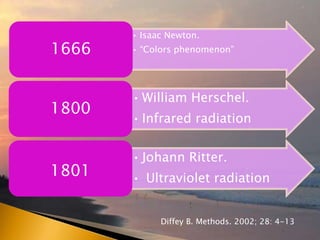
• Isaac Newton.
• “Colors phenomenon”1666
•William Herschel.
•Infrared radiation
1800
•Johann Ritter.
• Ultraviolet radiation1801
Diffey B. Methods. 2002; 28: 4-13
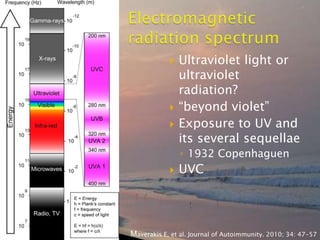
 Ultraviolet light or
ultraviolet
radiation?
 “beyond violet”
 Exposure to UV and
its several sequellae
◦ 1932 Copenhaguen
 UVC
Maverakis E, et al. Journal of Autoimmunity. 2010; 34: 47-57
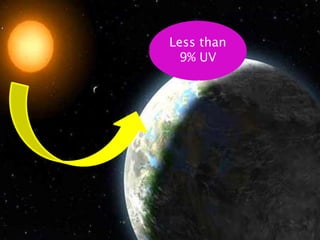
Less than
9% UV
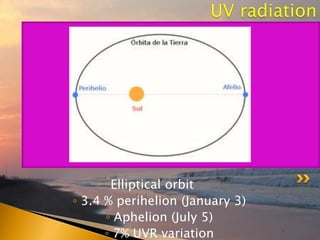
Elliptical orbit
◦ 3.4 % perihelion (January 3)
◦ Aphelion (July 5)
◦ 7% UVR variation
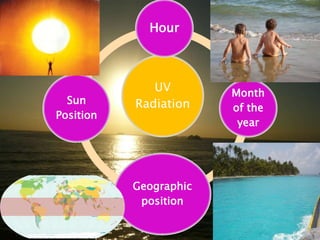
UV radiation
UV
Radiation
Hour
Month
of the
year
Geographic
position
Sun
Position
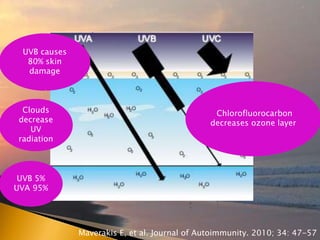
UVB 5%
UVA 95%
UVB causes
80% skin
damage
Clouds
decrease
UV
radiation
Chlorofluorocarbon
decreases ozone layer
Maverakis E, et al. Journal of Autoimmunity. 2010; 34: 47-57
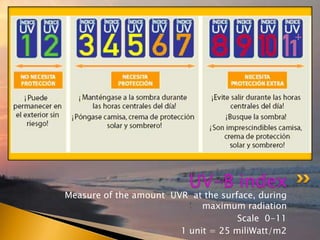
Measure of the amount UVR at the surface, during
maximum radiation
Scale 0-11
1 unit = 25 miliWatt/m2
UV-B index
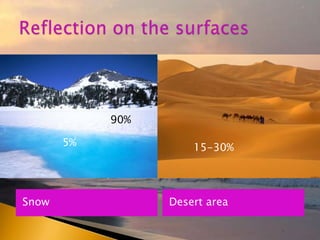
Snow Desert area
90%
5% 15-30%
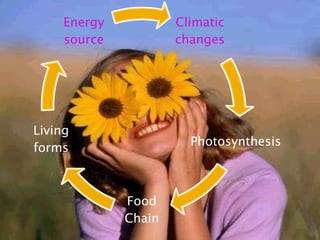
Climatic
changes
Photosynthesis
Food
Chain
Living
forms
Energy
source
Elevates mood and improves
energy
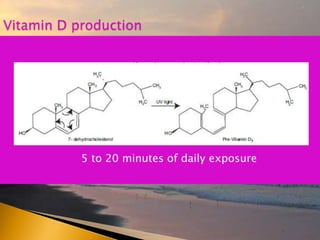
5 to 20 minutes of daily exposure
Vitamin D production
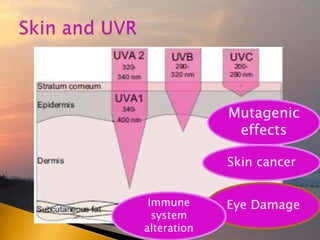
Skin cancer
Mutagenic
effects
Eye DamageImmune
system
alteration
Skin cancer
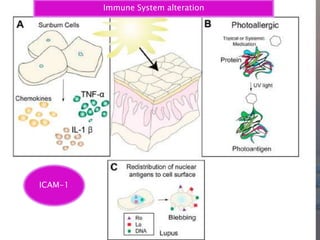
ICAM-1
Immune System alteration
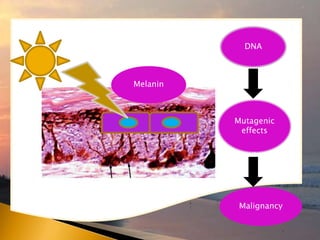
DNA
Mutagenic
effects
Malignancy
Melanin
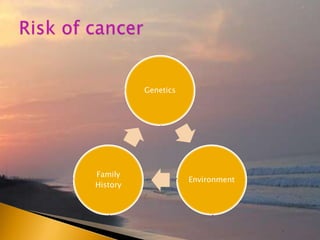
Genetics
Environment
Family
History
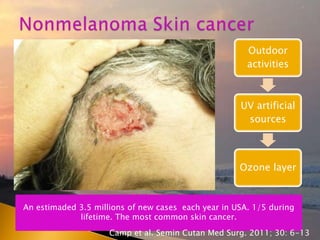
An estimaded 3.5 millions of new cases each year in USA. 1/5 during
lifetime. The most common skin cancer.
Outdoor
activities
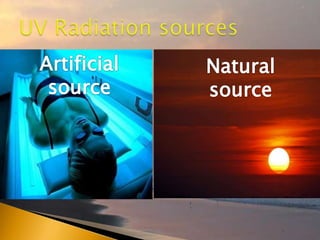
UV artificial
sources
Ozone layer
Camp et al. Semin Cutan Med Surg. 2011; 30: 6-13
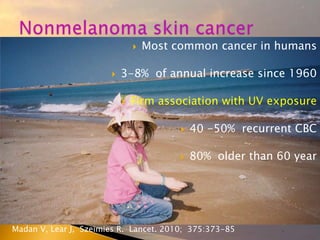
 Most common cancer in humans
 3-8% of annual increase since 1960
 Firm association with UV exposure
 40 -50% recurrent CBC
 80% older than 60 year
Madan V, Lear J, Szeimies R. Lancet. 2010; 375:373-85
• Intermittent exposure
• Childhood exposureCBC
• Chronic exposure
CEC
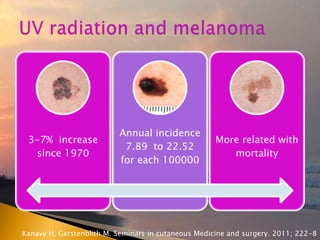
3-7% increase
since 1970
Annual incidence
7.89 to 22.52
for each 100000
More related with
mortality
Kanavy H, Gerstenblith M. Seminars in cutaneous Medicine and surgery. 2011; 222-8
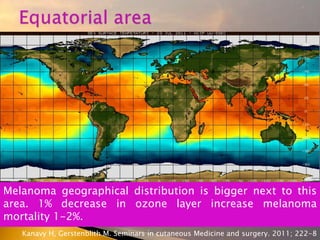
Melanoma geographical distribution is bigger next to this
area. 1% decrease in ozone layer increase melanoma
mortality 1-2%.
Kanavy H, Gerstenblith M. Seminars in cutaneous Medicine and surgery. 2011; 222-8
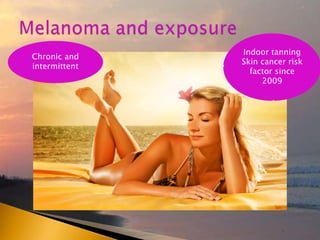
Chronic and
intermittent
Indoor tanning
Skin cancer risk
factor since
2009
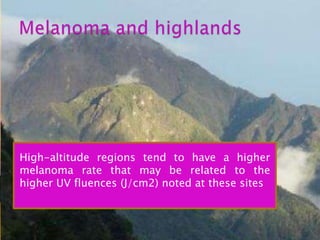
High-altitude regions tend to have a higher
melanoma rate that may be related to the
higher UV fluences (J/cm2) noted at these sites
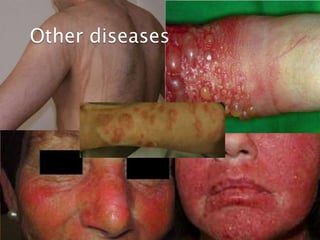
Other diseases
Key points
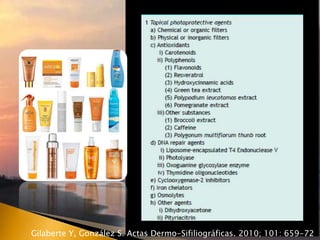
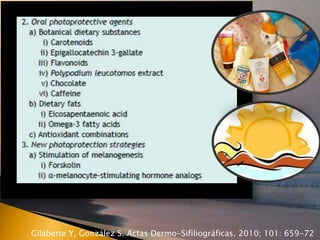
Gilaberte Y, González S. Actas Dermo-Sifiliográficas. 2010; 101: 659-72
 Sunscreens are photochemical systems that
absorb or reflect UV radiation.
 Frequently use of sunscreens is the best
photoprotection strategy.
 The first sunscreen was marketed in 1930
 Actually there are 28 chemical filters in
Australia, 26 in Europe and 14 in USA.
Kockler J, Oelgemoller M, Robertson S, Glass B.
Journal of Photochemistry and Photobiology. 2012; 1-17
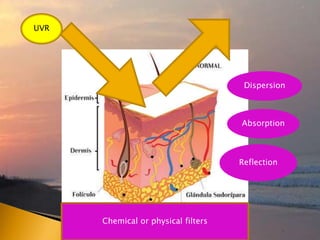
Absorption
Dispersion
UVR
Chemical or physical filters
Reflection
 La capacidad de eritema depende
◦ Longitud de onda de radiación
◦ Fotosensibilidad del individuo
◦ DEM uso estudios observacionales
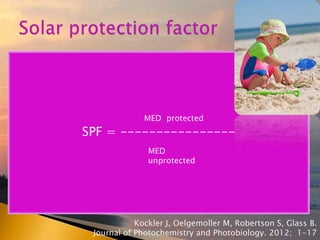
SPF = ----------------
MED protected
MED
unprotected
Kockler J, Oelgemoller M, Robertson S, Glass B.
Journal of Photochemistry and Photobiology. 2012; 1-17
 La capacidad de eritema depende
◦ Longitud de onda de radiación
◦ Fotosensibilidad del individuo
◦ DEM uso estudios observacionales
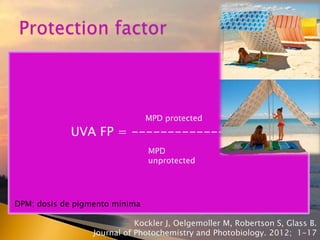
UVA FP = ----------------
MPD protected
MPD
unprotected
DPM: dosis de pigmento mínima
Kockler J, Oelgemoller M, Robertson S, Glass B.
Journal of Photochemistry and Photobiology. 2012; 1-17
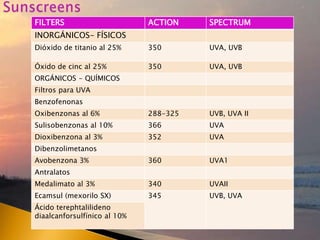
FILTERS ACTION SPECTRUM
INORGÁNICOS- FÍSICOS
Dióxido de titanio al 25% 350 UVA, UVB
Óxido de cinc al 25% 350 UVA, UVB
ORGÁNICOS - QUÍMICOS
Filtros para UVA
Benzofenonas
Oxibenzonas al 6% 288-325 UVB, UVA II
Sulisobenzonas al 10% 366 UVA
Dioxibenzona al 3% 352 UVA
Dibenzolimetanos
Avobenzona 3% 360 UVA1
Antralatos
Medalimato al 3% 340 UVAII
Ecamsul (mexorilo SX) 345 UVB, UVA
Ácido terephtalilideno
diaalcanforsulfínico al 10%
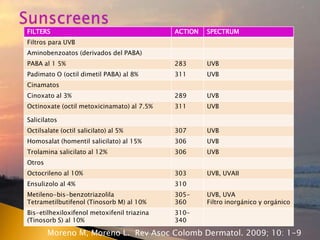
FILTERS ACTION SPECTRUM
Filtros para UVB
Aminobenzoatos (derivados del PABA)
PABA al 1 5% 283 UVB
Padimato O (octil dimetil PABA) al 8% 311 UVB
Cinamatos
Cinoxato al 3% 289 UVB
Octinoxate (octil metoxicinamato) al 7.5% 311 UVB
Salicilatos
Octilsalate (octil salicilato) al 5% 307 UVB
Homosalat (homentil salicilato) al 15% 306 UVB
Trolamina salicilato al 12% 306 UVB
Otros
Octocrileno al 10% 303 UVB, UVAII
Ensulizolo al 4% 310
Metileno-bis-benzotriazolila
Tetrametilbutifenol (Tinosorb M) al 10%
305-
360
UVB, UVA
Filtro inorgánico y orgánico
Bis-etilhexiloxifenol metoxifenil triazina
(Tinosorb S) al 10%
310-
340
Moreno M, Moreno L. Rev Asoc Colomb Dermatol. 2009; 10: 1-9
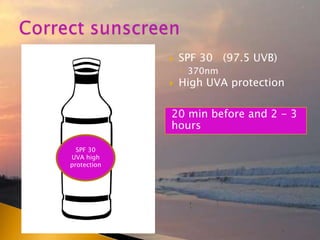
20 min before and 2 - 3
hours
 SPF 30 (97.5 UVB)
◦ 370nm
 High UVA protection
SPF 30
UVA high
protection
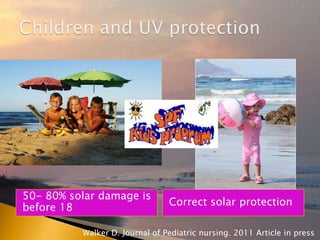
50- 80% solar damage is
before 18
Correct solar protection
Walker D. Journal of Pediatric nursing. 2011 Article in press
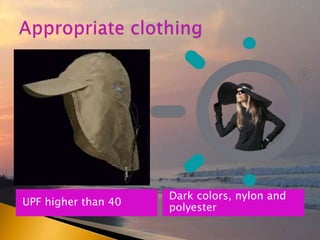
UPF higher than 40
Dark colors, nylon and
polyester
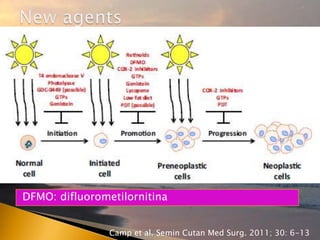
DFMO: difluorometilornitina
Camp et al. Semin Cutan Med Surg. 2011; 30: 6-13
Sunlight and Skin Cancer

Sunlight and Skin Cancer