SUNDRIED.COM
Triathlon
GUIDE
l CHOOSING YOUR TRIATHLON l FOUR WEEK TRAINING PLAN l OUR TOP TEN TIPS
-------------- INCLUDING --------------
SUNDRIED.COM 2
Contents
l Welcome to Triathlon						PAGE 3
l Know Your Distances 						PAGE 4
l So You Want To Be a Triathlete?					 PAGE 5
l Choosing Your Triathlon						PAGE 8
l 4 Week Sprint Triathlon Training Plan				 PAGE 9
l What Kit Do I Need For My First Triathlon?				 PAGE 11
l Top 10 Tips For Triathlon						 PAGE 14
l Contact Us								PAGE 17
SUNDRIED.COM 3
Welcome to the wonderful world of triathlon. You, my brave friend, have
decided to take on not just one, not even two, but three sports in one race.
Firstly, congratulations. Secondly, before the amount of prep for this type of event
dawns on you, let me reassure you, help is out there and as a new triathlete, you’ve
come to the right place.
This guide will cover all your ‘before the off’ basics, from picking a dis-
tance to top tips and getting stuck in with training.
Here at Sundried we are a team of level 3 REPS qualified personal trainers, fitness
fanatics and experienced triathletes. We’ve used our own experiences as well as
those of our professional athlete ambassadors to share with you all the things we
wish we knew in hindsight.
From myself and all the Sundried team, GOOD LUCK in your first triathlon.
- Vicky Gardner, Writer, PT and Events for Sundried.
Triathlon
Welcome to
SUNDRIED.COM 4
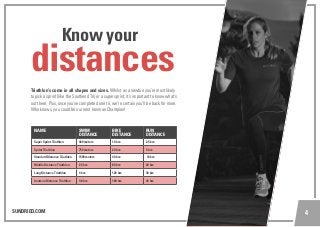
Triathlon’s come in all shapes and sizes. Whilst as a newbie you’re most likely
to pick a sprint (like the Southend Tri) or a super sprint, it’s important to know what’s
out there. Plus, once you’ve completed one tri, we’re certain you’ll be back for more.
Who knows, you could be our next Ironman Champion!
distances
Know your
NAME SWIM
DISTANCE
BIKE
DISTANCE
RUN
DISTANCE
Super Sprint Triathlon 400 meters 10 km 2.5 km
Sprint Triathlon 750 meters 20 km 5 km
Standard Distance Triathlon 1500 meters 40 km 10 km
Middle Distance Triathlon 2.5 km 80 km 20 km
Long Distance Triathlon 4 km 120 km 30 km
Ironman Distance Triathlon 3.8 km 180 km 42 km
SUNDRIED.COM 5
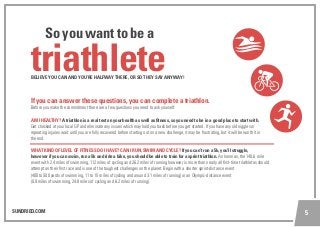
If you can answer these questions, you can complete a triathlon.
Before you make the commitment there are a few questions you need to ask yourself:
AM I HEALTHY? A triathlon is a real test on your health as well as fitness, so you need to be in a good place to start with.
Get checked at your local GP and eliminate any issues which may hold you back before you get started. If you have any old niggles or
repeating injuries wait until you are fully recovered before starting out on a new challenge, it may be frustrating, but it will be worth it in
the end.
WHAT KIND OF LEVEL OF FITNESS DO I HAVE? CAN I RUN, SWIM AND CYCLE? If you can’t run a 5k, you’ll struggle,
however if you can swim, run a 5k and ride a bike, you should be able to train for a sprint triathlon. An Ironman, the 140.6 mile
event with 2.4 miles of swimming, 112 miles of cycling and 26.2 miles of running however, is more than nearly all first-time triathletes should
attempt on their first race and is one of the toughest challenges on the planet. Begin with a shorter sprint-distance event
(400 to 500 yards of swimming, 11 to 15 miles of cycling and around 3.1 miles of running) or an Olympic-distance event
(0.9 miles of swimming, 24.8 miles of cycling and 6.2 miles of running).
triathlete
So you want to be a
BELIEVE YOU CAN AND YOU’RE HALFWAY THERE, OR SO THEY SAY ANYWAY!
SUNDRIED.COM 6
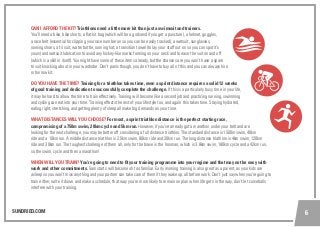
CAN I AFFORD THE KIT? Triathlons need a little more kit than just a swimsuit and trainers.
You’ll need a bike, bike shorts, a flat kit bag (which will be a godsend if you get a puncture), a helmet, goggles,
a race belt (essential for clipping your race number on so you can be easily tracked), a wetsuit, sunglasses,
running shoes, a tri suit, water bottle, running hat, a transition towel (to lay your stuff out on so you can spot it’s
yours) and wetsuit lubrication to avoid any hickey-like marks forming on your neck and to ease the suit on and off
(which is a skill in itself). You might have some of these items already, but the chances are you won’t have a spare
tri suit knocking about in your wardrobe. Don’t panic though, you don’t have to buy all of this and you can always hire
or borrow kit.
DO YOU HAVE THE TIME? Training for a triathlon takes time, even a sprint distance requires a solid 12 weeks
of good training and dedication to successfully complete the challenge. If this is a particularly busy time in your life,
it may be hard to allow the time to train effectively. Training will become like a second job and practicing running, swimming
and cycling can eat into your time. Training effects the rest of your lifestyle too, and again this takes time. Staying hydrated,
eating right, stretching, and getting plenty of sleep all make big demands on your time.
WHAT DISTANCES WILL YOU CHOOSE? For most, a sprint triathlon distance is the perfect starting race,
compromising of a 750m swim, 20km cycle and 5km run. However, if you’ve already got a marathon under your belt and are
looking for the next challenge, you may be better off considering a full distance triathlon. The standard distance is 1500m swim, 40km
ride and a 10km run. A middle distance triathlon is 2.5km swim, 80km ride and 20km run. The long distance triathlon is 4km swim, 120km
ride and 30km run. The toughest challenge of them all, only for the brave is the Ironman, which is 3.8km swim, 180km cycle and a 42km run,
so the swim, cycle and then a marathon!
WHEN WILL YOU TRAIN? You’re going to need to fit your training programme into your regime and that may not be easy with
work and other commitments. 5am starts will become oh too familiar. Early morning training is also great as a parent, as your kids are
asleep so you won’t miss anything and your partner can take care of them if they wake up, all before work. Don’t just say when you’re going to
train either, write it down and make a schedule, that way you’re more likely to remain on plan when life gets in the way, don’t let curveballs
interfere with your training.
SUNDRIED.COM 7
WILL YOU JOIN A CLUB / TRAIN ALONE? When you complete a triathlon, you won’t be wearing
headphones, so don’t get too dependant on running or cycling with music, as in most competitions
they’re banned for safety reasons. Joining a club allows you to meet people who share your same passion,
to build friendships and become part of a team, fueled by motivating each other. Meeting up for training and
paying for a membership can also increase your commitment and ensure you complete the necessary training.
Triathlon club memberships also often receive discounts in local triathlon shops, which can help when first purchasing
the kit, giving you a trusted place to go. However if you are a self motivated trainer, save money in membership fee’s
and get used to training alone. Come race day, whether you train as part of a club or as an individual, it’s every man for
himself and it’s unrealistic to try to run with buddies or a partner.
HOW WILL YOU TRAIN? It is recommended you implement a training plan from day one, enabling you to plan in
advance the goal for each session. For most people this will compromise of training 5-6 times a week, with most athletes
averaging around 10 hours of training per week, the majority being spent on the bike. The swim is often the hardest part of
training and so a lot of people will focus on their swimming, starting in a pool and working their way to an open swim.
For beginners it may be worth investing in some swimming lessons to brush up on technique and ensure you are as strong
(and safe) as possible when you hit the water on race day.
WHEN WILL YOU RACE? Always have an end date. Rather than ‘I want to do a triathlon this year’, find the event you want
to do and sign up. Once you’ve done that you’re committed with a deadline which will give you the extra incentive to stick with your
plan. You can then also start researching the event itself and even go and check out some of the route to give you more of an idea on what
you’re working towards. For example if you know your course is particularly hilly, it will give you plenty of time to add some hills into your
cycles to develop strength in that area ready for race day.
WHY AM I DOING THIS? You have to ask yourself why. Being honest with yourself as to why you want to do something is a huge
part of the journey to achieving your goal. Is it to prove you can? To challenge yourself? Or did your brother complete a triathlon last year and
you just won’t let him beat you at anything. Whether it be to raise money for charity, improve health or because you’re super competitive, knowing
what’s driving you towards the finish line is part of what’s going to get you there when your body starts telling you it’s ready to stop.
If you’re happy with your answers to all those questions, why not give it a Tri?
SUNDRIED.COM 8
triathlon
Choosing your
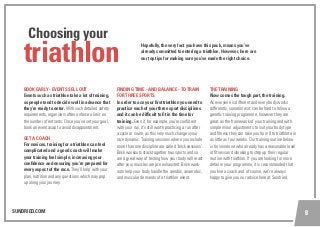
BOOK EARLY - EVENTS SELL OUT
Events such as triathlon take a lot of training,
so people tend to decide well in advance that
they’re ready to enter. With such detailed safety
requirements, organisers often enforce a limit on
the number of entrants. Once you’ve set your goal,
book an event asap to avoid disappointment.
GET A COACH
For novices, training for a triathlon can feel
complicated and a good coach will make
your training feel simple, increasing your
confidence and ensuring you’re prepared for
every aspect of the race. They’ll help with your
plan, nutrition and any questions which may pop
up along your journey.
FINDING TIME - AND BALANCE - TO TRAIN
FOR THREE SPORTS
In order to ace your first triathlon you need to
practice each of your three sport disciplines
and it can be difficult to fit in the time for
training. Even if, for example, you’re confident
with your run, it’s still worth practicing a run after
a cycle or swim, as this very much changes your
race dynamic. Training sessions where you include
more than one discipline are called ‘brick sessions’.
Brick workouts stack together two sports and so
are a great way of testing how your body will react
after your muscles are pre exhausted. Brick work-
outs help your body handle the aerobic, anaerobic,
and muscular demands of a triathlon event.
THE TRAINING
Now comes the tough part, the training.
As everyone is different and every body works
differently, sometimes it can be hard to follow a
genetic training programme, however they are
great as the framework of your training and with
simple minor adjustments to suit your body type
and fitness they can take you from 0 to triathlete in
as little as four weeks. Our training routine below
is for someone who already has a reasonable level
of fitness and islooking to step up their regular
routine with triathlon. If you are looking for more
detail in your programme, it is recommended that
you hire a coach and of course, we’re always
happy to give you our advice here at Sundried.
Hopefully, the very fact you have this pack, means you’ve
already committed to entering a triathlon. However, here are
our top tips for making sure you’ve made the right choice.
SUNDRIED.COM 9
10
MAX EFFORT ACTIVITY
Feels almost impossible to keep going.
Out of breath, unable to talk. Cannot
maintain for more than a very short time.
9
VERY HARD ACTIVITY
Very difficult to maintain exercise
intensity. Can barely breath and
speak only a few words.
7-8
VIGOROUS ACTIVITY
Boderline uncomfortable.
Short of breath.
Can still speak a sentence.
4-6
MODERATE ACTIVITY
Breathing heavily. Can hold a short
conversation, but is becoming
noticeably more challenging.
2-3
LIGHT ACTIVITY
Feels like you can maintain
for hours. Easy to breathe
and carry a conversation.
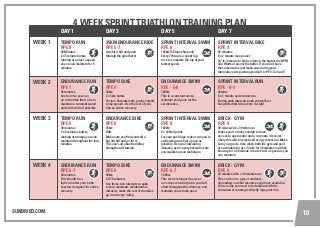
This plan is for competitors who already have a good baseline of fitness.
If you can comfortably run 5k, swim and ride a bike regularly, then this
is for you. The following plan consists of 4 days of training, with 3 days of well
earned recovery. You can swap the order as you feel best suits you and as with
any training routine, it is essential you listen to your body.
For each exercise listed, we’ve detailed a RPE rating. RPE stands for
rate of perceived exertion and helps to understand the level of effort you
should be putting into each training session for those of you who aren’t
strapped up to a heart rate monitor.
training plan
4 week sprint triathlon
As well as following a training plan, we recommend you think of the
finer details such as practicing getting into and out of your wetsuit,
into and out of the swim and from the transition area to your bike.
At your first tri if you haven’t already used cleats, race day probably isn’t the
best day to try, as they take some getting used to. Knowing what’s coming from
transition and keeping your kit to a minimum can help to make the day run a lot
smoother and gives you far less to worry about.
Your 4 day training plan is on the next page:
1
VERY LIGHT ACTIVITY
Hardly any exertion, but more
than sleeping or watching TV etc
RPE SCALE	 RATE OF PERCEIVED EXERTION
SUNDRIED.COM 10
DAY 1 DAY 3 DAY 5 DAY 7
WEEK 1 TEMPO RUN
RPE 8
30 Minutes
2 x 5 minute bursts,
running at as fast a speed
as you can maintain for 5
minutes.
35KM ENDURANCE RIDE
RPE 5-7
Aim for a hill and push
through the quad burn!
SPRINT INTERVAL SWIM
RPE 8
1400m (56 laps 25m pool)
Every 7th lap is a sprint lap,
race to complete the lap at your
fastest speed.
SPRINT INTERVAL BIKE
RPE 9
45 minutes
8 x 2 minute max power
Try to remain at a high cadence, the higher the RPM
and Watts of power the better. If you don’t have
these measures just make sure during your
intervals you’re pushing yourself to PE 9. So hard!
WEEK 2 ENDURANCE RUN
RPE 7
35 minutes
See how far you can
go in the time limit, aim to
maintain a constant speed
and add in hills if possible.
TEMPO BIKE
RPE 8
30km
2 x 5km bursts
For two 5km intervals, push yourself
to top speeds. Use the rest of your
ride as active recovery.
ENDURANCE SWIM
RPE - 6-8
1200m
This is a constant swim,
maintain your pace for the
set distance.
SPRINT INTERVAL RUN
RPE - 8-9
40mins
8 x 1 minute sprint intervals.
During push intervals push yourself as t
hough the finish line were in sight.
WEEK 3 TEMPO RUN
RPE 8
30 minutes
3 x 4 minutes bursts,
running at a tempo you can
maintain throughout the four
minutes.
ENDURANCE BIKE
RPE 8
35km
Hills
Make sure you find yourself a
big old hill and go for it.
This one’s all about building
strength and stamina.
SPRINT INTERVAL SWIM
RPE 8
1400m
6 x 100m Sprints
For your push laps, make sure you’re
swimming at as fast a pace as
possible. Use your remaining
distance as recovery but make sure
you maintain good technique.
BRICK - GYM
RPE 9
30 mins swim + 30 mins run
Unless you’re lucky enough to have
access to open water and a run route it is most
likely this will be practiced at a gym session. Make
sure you go at a time when both the gym and pool
are available for use. Swim for 30 minutes and then
head up for a 30 minute run at as fast a speed as you
can maintain.
WEEK 4 ENDURANCE RUN
RPE 6-7
30 minutes
This should be a
light run after your brick
session, designed for active
recovery.
TEMPO BIKE
RPE 8
30km
2 X 7km bursts
Use these two intervals to push
to your maximum maintainable
intensity, make the rest of the miles
up in recovery riding.
ENDURANCE SWIM
RPE 6-7
1,000m
This swim is longer than your
race day swim, but put in your full
effort throughout the distance and
maintain your stroke pace.
BRICK - GYM
RPE 9
40 minutes bike + 30 minutes run
This can be in a gym or outdoors,
depending on what resources you have available.
On race day you need to be familiar with the
sensation of running with jelly legs post-ride.
4 WEEK SPRINT TRIATHLON TRAINING PLAN
SUNDRIED.COM 11
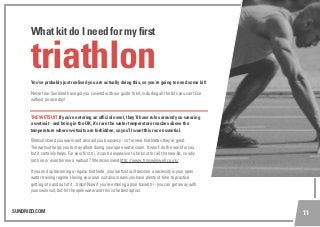
You’ve probably just realised you are actually doing this, so you’re going to need some kit!
Never fear, Sundried have got you covered with our guide to kit, including all the bits you can’t live
without on race day!
THE WETSUIT If you’re entering an official event, they’ll have rules around you wearing
a wetsuit - and being in the UK, it’s rare the water temperature reaches above the
temperature where wetsuits are forbidden, so you’ll want this race essential.
Wetsuits keep you warm and also aid you buoyancy - so for new triathletes they’re great.
The wetsuit helps you to stay afloat during your open water swim. It won’t do the work for you,
but it certainly helps. For your first tri, it can be expensive to fork out for all the new kit, so why
not hire or even borrow a wetsuit? We recommend http://www.trinswimwell.co.uk/
If you end up becoming a regular triathlete, your wetsuit will become a necessity in your open
water training regime. Having your own suit also means you have plenty of time to practice
getting into and out of it...tricky!Now if you’re entering a pool based tri - you can get away with
your swimsuit, but hit the open water and this is the best option.
triathlon
What kit do I need for my first
SUNDRIED.COM 12
TRI SUIT Now technically you can live without this, but then you’re looking at packing
separate kit for your swim, ride and run. Wearing a tri suit just makes life that much easier.
Rather than having to change from wetsuit to cycle shorts to your running gear, a tri suit is designed
to stay with you from start to finish. Why the tri suit? Tri suits usually come in a half suit or a full suit.
Whether you opt for the all in one or two-piece is entirely up to you, both do the same job and that
job is to provide simplicity for what is, due to the very event’s nature, a complicated race.
How does a tri suit help you? Tri suits are designed to be worn throughout the entire race and
to guide you through each discipline. Made from thin, breathable material that will slip under your
wetsuit, the top is usually sleeveless. The bottoms has a small pad in the crotch for your ride, which
typically is slightly less padded than you may find in bike shorts - so not to chafe you when you begin
to run with them. Sundried Tri suit will be released shortly where all Southend Triathlon
competitors will receive a 30% discount using code SOUTHENDTRI.
GOGGLES Most swimmers will have a decent pair of goggles to protect their eyes from
the dreaded sting of chlorine, but when it comes to sea swimming your goggles are often
needed for more than just keeping water out of your eyes. The glare from the sun on a bright
day can prevent your ability to see the buoys as you swim - which are what keeps you safe and
heading in the right direction! Tinted goggles will aid your vision and help you stay on track.
SWIM CAP Often, race organisers will provide these, as your swim cap may have your
number on it. If not it’s recommended you wear one, not only will it keep your hair out of your face,
preventing it from obscuring your vision, it also keeps your head dry, meaning you’re not cycling and
running with cold, wet hair, which will make you feel colder.
SUNDRIED.COM 13
BIKE For a sprint distance tri, you don’t really need to worry about investing in an
expensive tri bike, as your only cycling for 20 km. However if you want to pick up some
speed opt for a road bike or a hybrid over your mountain bike. It’s best to pick the same bike you
train with rather than battle with getting familiar with a new bike on race day. Trust me, you’ve
got enough to worry about.
HELMET Safety first. A helmet could save your life. In any race you will not be allowed to
ride without a helmet. Be sure to check your helmet fits properly - prior to your race. And ladies -
try your helmet with your hair the way it will be when it comes out of a swim cap ie.FLAT.
TRAINERS Triathlon specific trainers have nifty little extras - such as bike clips and quick
fastening laces, but they’re not essential for a beginner.
TRANSITION TOWEL You hardly have time spare to be toweling yourself down, but your
towel also serves as a great marker for your disorientated post swim self to look out
for. Most triathletes just stand on their towel whilst they quickly transition to the bike.
RUNNING TOP A running top to slip on over your tri suit is essential. Opt for a technical
t shirt, as these are designed to wick sweat - meaning it will dry quickly if you’re already wet!
The Sundried technical T shirt offers comfort and support and is perfect for this leg of the race.
Avoid cotton which will weigh you down when wet.
WATER Water should and most probably will, be handed out by marshalls throughout
the race course, but it’s always best to have your own in case you need extra - or miss
a marshal! This is a tough sport and you will be dehydrated. Don’t do a Jonathan Brownlee!
You’ve got the training, you’ve got the kit, now for our top tips.
SUNDRIED.COM 14
1
Get a good night’s sleep the evening before, Triathlons often have early
starts - especially if the tides early. If you’re traveling some way for the event,
try to get to a hotel nearby. Remember hotels tend to bump up their rates if they
know an event is on, so book plenty of time in advance.
2
Join a club. Most triathletes will join a club once they get a feel for the
event, but why wait? It can be a great opportunity to find training buddies, new
events and gather all the best advice from local triathletes. You may even be able
to pick up a lift to the event. Plus, of course, joining an affiliated club will get your British
Tri Foundation membership, which may save you money on event entry!
3
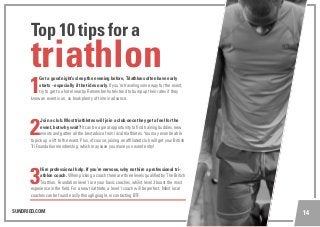
Hire professional help. If you’re nervous, why not hire a professional tri-
athlon coach. When picking a coach there are three levels qualified by The British
Triathlon. Foundation level 1 are your basic coaches, whilst level 3 boast the most
experience in the field. For a new triathlete, a level 1 coach will be perfect. Most local
coaches can be found easily through google, or contacting BTF.
triathlon
Top 10 tips for a
SUNDRIED.COM 15
4
Arrive with plenty of time. The last thing you want to be on race day, is
panicking that you’re going to be late. There are plenty of others things to
panic about, trust me! Road closures often take place prior to the event start, so
try to use public transport if you can and set off with plenty of time spare for delays.
5
Practice sea swimming. No matter how good a pool swimmer you are,
open waterswimming is completely different to a pool swim. Finding your
pace amongst a wave of other swimmers affects your stroke and rhythm and you
need to be prepared to take a kick or a punch as you find your space. Then there’s tide,
debris and finding your direction towards the buoys. It’s not easy, but who ever said
triathlon was! The sea swim is often the most daunting part of the challenge, so get in
practice of battling the elements. Physically, mentally and emotionally, it’s a far more
intense challenge than a pool swim, so practice, practice, practice!
6
Bring some moral support and get them to check you haven’t forgotten
anything! It’s great to have a familiar face to cheer you on and to relax
you before your first triathlon when nerves are high. Your family and friends
can also be the extra set of eyes to check you’ve packed everything and of course, you
need them to be taking plenty of pictures of you doing your thing at your first event!
OUR LAST TIPS ARE FROM OUR SUNDRIED PROFESSIONAL TRIATHLETES:
SUNDRIED.COM 16
7ALICE HECTOR
IRONMAN 70.3 CHAMPION SAYS:
I would say what people tend to notice when they start triathlon
is the horrible feeling you get trying to run when you’ve just cycled
hard! Your body doesn’t quite know what’s going on. Rest assured,
with practice, it eventually feels like second nature, and seasoned athletes
run almost as fast off the bike as they would in just a run race. So to strike
a balance in your first event, I’d definitely recommend doing a few ‘brick
sessions’ in your training. This simply means going for a run straight
after a cycle session. It doesn’t have to be long; just 5 or 10 minutes,
but this will get the body conditioned for what’s to come on race
day. Do this once a week and you’ll reap the benefits.
8CLAIRE STEELS
DUATHLON WORLD CHAMPION
Don’t rack your bike in a hard gear. It is easily done,
especially if you don’t have time to take your bike for a little
spin before you rack it in transition. Try to remember to leave
it in an easy gear. The last thing you want to do is run out
of transition, jump on your bike and realise that you can’t
turn the pedals! Believe me, I’ve been there!!!
SUNDRIED.COM 17
10
Relax and have fun, as your
first race try not to worry about
other people overtaking you or
making sure you finish before a certain
time, just finish. Enjoy your first new sport,
allow yourself mistakes, you’ll learn from
them for next time. Listen to your body and
enjoy your day.
CONTACT US:
We’re here to help so if you need any more advice contact:
vicky@sundried.com
event@southendtriathlon.com
GOOD LUCK.
We wish you all the best of luck for your first event.
And my parting words:
			SWIM, LIKE THE BOAT SANK.
		 BIKE, LIKE YOU’VE STOLEN IT.
	
				RUN, FOR YOUR LIFE!
9AMY KILPIN
AGE GROUP TRIATHLETE SAYS:
Make sure you are well prepared for the environment in which you’ll be racing.
This means if you are going to be racing in hot conditions, prepare your body as well
as possible for the extra demands that are going to be placed on it during the race – for
example, you might want to train on an indoor trainer without a fan/windows. You will also need to
think about adapting your nutrition strategy based on your race environment – if it’s hot conditions,
you’ll need to take on regular electrolytes and/or add salt to your energy drinks so your body can
absorb as much fluid as possible. The same principle applies if you might be racing somewhere
cold – ensure that you have enough layers for the bike and if appropriate, a jacket if it’s going to be
wet. Think about what tyres you might need to put on your bike in wet conditions. By preparing
accordingly for specific conditions, you will be confident that you are entering the race with as
much control as you can have over the environmental challenges you might face.
It’s an important but often overlooked consideration if you want to get the best out of
yourself in every circumstance.’

Sundried Triathlon Guide

  • 1.
    SUNDRIED.COM Triathlon GUIDE l CHOOSING YOURTRIATHLON l FOUR WEEK TRAINING PLAN l OUR TOP TEN TIPS -------------- INCLUDING --------------
  • 2.
    SUNDRIED.COM 2 Contents l Welcometo Triathlon PAGE 3 l Know Your Distances PAGE 4 l So You Want To Be a Triathlete? PAGE 5 l Choosing Your Triathlon PAGE 8 l 4 Week Sprint Triathlon Training Plan PAGE 9 l What Kit Do I Need For My First Triathlon? PAGE 11 l Top 10 Tips For Triathlon PAGE 14 l Contact Us PAGE 17
  • 3.
    SUNDRIED.COM 3 Welcome tothe wonderful world of triathlon. You, my brave friend, have decided to take on not just one, not even two, but three sports in one race. Firstly, congratulations. Secondly, before the amount of prep for this type of event dawns on you, let me reassure you, help is out there and as a new triathlete, you’ve come to the right place. This guide will cover all your ‘before the off’ basics, from picking a dis- tance to top tips and getting stuck in with training. Here at Sundried we are a team of level 3 REPS qualified personal trainers, fitness fanatics and experienced triathletes. We’ve used our own experiences as well as those of our professional athlete ambassadors to share with you all the things we wish we knew in hindsight. From myself and all the Sundried team, GOOD LUCK in your first triathlon. - Vicky Gardner, Writer, PT and Events for Sundried. Triathlon Welcome to
  • 4.
    SUNDRIED.COM 4 Triathlon’s comein all shapes and sizes. Whilst as a newbie you’re most likely to pick a sprint (like the Southend Tri) or a super sprint, it’s important to know what’s out there. Plus, once you’ve completed one tri, we’re certain you’ll be back for more. Who knows, you could be our next Ironman Champion! distances Know your NAME SWIM DISTANCE BIKE DISTANCE RUN DISTANCE Super Sprint Triathlon 400 meters 10 km 2.5 km Sprint Triathlon 750 meters 20 km 5 km Standard Distance Triathlon 1500 meters 40 km 10 km Middle Distance Triathlon 2.5 km 80 km 20 km Long Distance Triathlon 4 km 120 km 30 km Ironman Distance Triathlon 3.8 km 180 km 42 km
  • 5.
    SUNDRIED.COM 5 If youcan answer these questions, you can complete a triathlon. Before you make the commitment there are a few questions you need to ask yourself: AM I HEALTHY? A triathlon is a real test on your health as well as fitness, so you need to be in a good place to start with. Get checked at your local GP and eliminate any issues which may hold you back before you get started. If you have any old niggles or repeating injuries wait until you are fully recovered before starting out on a new challenge, it may be frustrating, but it will be worth it in the end. WHAT KIND OF LEVEL OF FITNESS DO I HAVE? CAN I RUN, SWIM AND CYCLE? If you can’t run a 5k, you’ll struggle, however if you can swim, run a 5k and ride a bike, you should be able to train for a sprint triathlon. An Ironman, the 140.6 mile event with 2.4 miles of swimming, 112 miles of cycling and 26.2 miles of running however, is more than nearly all first-time triathletes should attempt on their first race and is one of the toughest challenges on the planet. Begin with a shorter sprint-distance event (400 to 500 yards of swimming, 11 to 15 miles of cycling and around 3.1 miles of running) or an Olympic-distance event (0.9 miles of swimming, 24.8 miles of cycling and 6.2 miles of running). triathlete So you want to be a BELIEVE YOU CAN AND YOU’RE HALFWAY THERE, OR SO THEY SAY ANYWAY!
  • 6.
    SUNDRIED.COM 6 CAN IAFFORD THE KIT? Triathlons need a little more kit than just a swimsuit and trainers. You’ll need a bike, bike shorts, a flat kit bag (which will be a godsend if you get a puncture), a helmet, goggles, a race belt (essential for clipping your race number on so you can be easily tracked), a wetsuit, sunglasses, running shoes, a tri suit, water bottle, running hat, a transition towel (to lay your stuff out on so you can spot it’s yours) and wetsuit lubrication to avoid any hickey-like marks forming on your neck and to ease the suit on and off (which is a skill in itself). You might have some of these items already, but the chances are you won’t have a spare tri suit knocking about in your wardrobe. Don’t panic though, you don’t have to buy all of this and you can always hire or borrow kit. DO YOU HAVE THE TIME? Training for a triathlon takes time, even a sprint distance requires a solid 12 weeks of good training and dedication to successfully complete the challenge. If this is a particularly busy time in your life, it may be hard to allow the time to train effectively. Training will become like a second job and practicing running, swimming and cycling can eat into your time. Training effects the rest of your lifestyle too, and again this takes time. Staying hydrated, eating right, stretching, and getting plenty of sleep all make big demands on your time. WHAT DISTANCES WILL YOU CHOOSE? For most, a sprint triathlon distance is the perfect starting race, compromising of a 750m swim, 20km cycle and 5km run. However, if you’ve already got a marathon under your belt and are looking for the next challenge, you may be better off considering a full distance triathlon. The standard distance is 1500m swim, 40km ride and a 10km run. A middle distance triathlon is 2.5km swim, 80km ride and 20km run. The long distance triathlon is 4km swim, 120km ride and 30km run. The toughest challenge of them all, only for the brave is the Ironman, which is 3.8km swim, 180km cycle and a 42km run, so the swim, cycle and then a marathon! WHEN WILL YOU TRAIN? You’re going to need to fit your training programme into your regime and that may not be easy with work and other commitments. 5am starts will become oh too familiar. Early morning training is also great as a parent, as your kids are asleep so you won’t miss anything and your partner can take care of them if they wake up, all before work. Don’t just say when you’re going to train either, write it down and make a schedule, that way you’re more likely to remain on plan when life gets in the way, don’t let curveballs interfere with your training.
  • 7.
    SUNDRIED.COM 7 WILL YOUJOIN A CLUB / TRAIN ALONE? When you complete a triathlon, you won’t be wearing headphones, so don’t get too dependant on running or cycling with music, as in most competitions they’re banned for safety reasons. Joining a club allows you to meet people who share your same passion, to build friendships and become part of a team, fueled by motivating each other. Meeting up for training and paying for a membership can also increase your commitment and ensure you complete the necessary training. Triathlon club memberships also often receive discounts in local triathlon shops, which can help when first purchasing the kit, giving you a trusted place to go. However if you are a self motivated trainer, save money in membership fee’s and get used to training alone. Come race day, whether you train as part of a club or as an individual, it’s every man for himself and it’s unrealistic to try to run with buddies or a partner. HOW WILL YOU TRAIN? It is recommended you implement a training plan from day one, enabling you to plan in advance the goal for each session. For most people this will compromise of training 5-6 times a week, with most athletes averaging around 10 hours of training per week, the majority being spent on the bike. The swim is often the hardest part of training and so a lot of people will focus on their swimming, starting in a pool and working their way to an open swim. For beginners it may be worth investing in some swimming lessons to brush up on technique and ensure you are as strong (and safe) as possible when you hit the water on race day. WHEN WILL YOU RACE? Always have an end date. Rather than ‘I want to do a triathlon this year’, find the event you want to do and sign up. Once you’ve done that you’re committed with a deadline which will give you the extra incentive to stick with your plan. You can then also start researching the event itself and even go and check out some of the route to give you more of an idea on what you’re working towards. For example if you know your course is particularly hilly, it will give you plenty of time to add some hills into your cycles to develop strength in that area ready for race day. WHY AM I DOING THIS? You have to ask yourself why. Being honest with yourself as to why you want to do something is a huge part of the journey to achieving your goal. Is it to prove you can? To challenge yourself? Or did your brother complete a triathlon last year and you just won’t let him beat you at anything. Whether it be to raise money for charity, improve health or because you’re super competitive, knowing what’s driving you towards the finish line is part of what’s going to get you there when your body starts telling you it’s ready to stop. If you’re happy with your answers to all those questions, why not give it a Tri?
  • 8.
    SUNDRIED.COM 8 triathlon Choosing your BOOKEARLY - EVENTS SELL OUT Events such as triathlon take a lot of training, so people tend to decide well in advance that they’re ready to enter. With such detailed safety requirements, organisers often enforce a limit on the number of entrants. Once you’ve set your goal, book an event asap to avoid disappointment. GET A COACH For novices, training for a triathlon can feel complicated and a good coach will make your training feel simple, increasing your confidence and ensuring you’re prepared for every aspect of the race. They’ll help with your plan, nutrition and any questions which may pop up along your journey. FINDING TIME - AND BALANCE - TO TRAIN FOR THREE SPORTS In order to ace your first triathlon you need to practice each of your three sport disciplines and it can be difficult to fit in the time for training. Even if, for example, you’re confident with your run, it’s still worth practicing a run after a cycle or swim, as this very much changes your race dynamic. Training sessions where you include more than one discipline are called ‘brick sessions’. Brick workouts stack together two sports and so are a great way of testing how your body will react after your muscles are pre exhausted. Brick work- outs help your body handle the aerobic, anaerobic, and muscular demands of a triathlon event. THE TRAINING Now comes the tough part, the training. As everyone is different and every body works differently, sometimes it can be hard to follow a genetic training programme, however they are great as the framework of your training and with simple minor adjustments to suit your body type and fitness they can take you from 0 to triathlete in as little as four weeks. Our training routine below is for someone who already has a reasonable level of fitness and islooking to step up their regular routine with triathlon. If you are looking for more detail in your programme, it is recommended that you hire a coach and of course, we’re always happy to give you our advice here at Sundried. Hopefully, the very fact you have this pack, means you’ve already committed to entering a triathlon. However, here are our top tips for making sure you’ve made the right choice.
  • 9.
    SUNDRIED.COM 9 10 MAX EFFORTACTIVITY Feels almost impossible to keep going. Out of breath, unable to talk. Cannot maintain for more than a very short time. 9 VERY HARD ACTIVITY Very difficult to maintain exercise intensity. Can barely breath and speak only a few words. 7-8 VIGOROUS ACTIVITY Boderline uncomfortable. Short of breath. Can still speak a sentence. 4-6 MODERATE ACTIVITY Breathing heavily. Can hold a short conversation, but is becoming noticeably more challenging. 2-3 LIGHT ACTIVITY Feels like you can maintain for hours. Easy to breathe and carry a conversation. This plan is for competitors who already have a good baseline of fitness. If you can comfortably run 5k, swim and ride a bike regularly, then this is for you. The following plan consists of 4 days of training, with 3 days of well earned recovery. You can swap the order as you feel best suits you and as with any training routine, it is essential you listen to your body. For each exercise listed, we’ve detailed a RPE rating. RPE stands for rate of perceived exertion and helps to understand the level of effort you should be putting into each training session for those of you who aren’t strapped up to a heart rate monitor. training plan 4 week sprint triathlon As well as following a training plan, we recommend you think of the finer details such as practicing getting into and out of your wetsuit, into and out of the swim and from the transition area to your bike. At your first tri if you haven’t already used cleats, race day probably isn’t the best day to try, as they take some getting used to. Knowing what’s coming from transition and keeping your kit to a minimum can help to make the day run a lot smoother and gives you far less to worry about. Your 4 day training plan is on the next page: 1 VERY LIGHT ACTIVITY Hardly any exertion, but more than sleeping or watching TV etc RPE SCALE RATE OF PERCEIVED EXERTION
  • 10.
    SUNDRIED.COM 10 DAY 1DAY 3 DAY 5 DAY 7 WEEK 1 TEMPO RUN RPE 8 30 Minutes 2 x 5 minute bursts, running at as fast a speed as you can maintain for 5 minutes. 35KM ENDURANCE RIDE RPE 5-7 Aim for a hill and push through the quad burn! SPRINT INTERVAL SWIM RPE 8 1400m (56 laps 25m pool) Every 7th lap is a sprint lap, race to complete the lap at your fastest speed. SPRINT INTERVAL BIKE RPE 9 45 minutes 8 x 2 minute max power Try to remain at a high cadence, the higher the RPM and Watts of power the better. If you don’t have these measures just make sure during your intervals you’re pushing yourself to PE 9. So hard! WEEK 2 ENDURANCE RUN RPE 7 35 minutes See how far you can go in the time limit, aim to maintain a constant speed and add in hills if possible. TEMPO BIKE RPE 8 30km 2 x 5km bursts For two 5km intervals, push yourself to top speeds. Use the rest of your ride as active recovery. ENDURANCE SWIM RPE - 6-8 1200m This is a constant swim, maintain your pace for the set distance. SPRINT INTERVAL RUN RPE - 8-9 40mins 8 x 1 minute sprint intervals. During push intervals push yourself as t hough the finish line were in sight. WEEK 3 TEMPO RUN RPE 8 30 minutes 3 x 4 minutes bursts, running at a tempo you can maintain throughout the four minutes. ENDURANCE BIKE RPE 8 35km Hills Make sure you find yourself a big old hill and go for it. This one’s all about building strength and stamina. SPRINT INTERVAL SWIM RPE 8 1400m 6 x 100m Sprints For your push laps, make sure you’re swimming at as fast a pace as possible. Use your remaining distance as recovery but make sure you maintain good technique. BRICK - GYM RPE 9 30 mins swim + 30 mins run Unless you’re lucky enough to have access to open water and a run route it is most likely this will be practiced at a gym session. Make sure you go at a time when both the gym and pool are available for use. Swim for 30 minutes and then head up for a 30 minute run at as fast a speed as you can maintain. WEEK 4 ENDURANCE RUN RPE 6-7 30 minutes This should be a light run after your brick session, designed for active recovery. TEMPO BIKE RPE 8 30km 2 X 7km bursts Use these two intervals to push to your maximum maintainable intensity, make the rest of the miles up in recovery riding. ENDURANCE SWIM RPE 6-7 1,000m This swim is longer than your race day swim, but put in your full effort throughout the distance and maintain your stroke pace. BRICK - GYM RPE 9 40 minutes bike + 30 minutes run This can be in a gym or outdoors, depending on what resources you have available. On race day you need to be familiar with the sensation of running with jelly legs post-ride. 4 WEEK SPRINT TRIATHLON TRAINING PLAN
  • 11.
    SUNDRIED.COM 11 You’ve probablyjust realised you are actually doing this, so you’re going to need some kit! Never fear, Sundried have got you covered with our guide to kit, including all the bits you can’t live without on race day! THE WETSUIT If you’re entering an official event, they’ll have rules around you wearing a wetsuit - and being in the UK, it’s rare the water temperature reaches above the temperature where wetsuits are forbidden, so you’ll want this race essential. Wetsuits keep you warm and also aid you buoyancy - so for new triathletes they’re great. The wetsuit helps you to stay afloat during your open water swim. It won’t do the work for you, but it certainly helps. For your first tri, it can be expensive to fork out for all the new kit, so why not hire or even borrow a wetsuit? We recommend http://www.trinswimwell.co.uk/ If you end up becoming a regular triathlete, your wetsuit will become a necessity in your open water training regime. Having your own suit also means you have plenty of time to practice getting into and out of it...tricky!Now if you’re entering a pool based tri - you can get away with your swimsuit, but hit the open water and this is the best option. triathlon What kit do I need for my first
  • 12.
    SUNDRIED.COM 12 TRI SUITNow technically you can live without this, but then you’re looking at packing separate kit for your swim, ride and run. Wearing a tri suit just makes life that much easier. Rather than having to change from wetsuit to cycle shorts to your running gear, a tri suit is designed to stay with you from start to finish. Why the tri suit? Tri suits usually come in a half suit or a full suit. Whether you opt for the all in one or two-piece is entirely up to you, both do the same job and that job is to provide simplicity for what is, due to the very event’s nature, a complicated race. How does a tri suit help you? Tri suits are designed to be worn throughout the entire race and to guide you through each discipline. Made from thin, breathable material that will slip under your wetsuit, the top is usually sleeveless. The bottoms has a small pad in the crotch for your ride, which typically is slightly less padded than you may find in bike shorts - so not to chafe you when you begin to run with them. Sundried Tri suit will be released shortly where all Southend Triathlon competitors will receive a 30% discount using code SOUTHENDTRI. GOGGLES Most swimmers will have a decent pair of goggles to protect their eyes from the dreaded sting of chlorine, but when it comes to sea swimming your goggles are often needed for more than just keeping water out of your eyes. The glare from the sun on a bright day can prevent your ability to see the buoys as you swim - which are what keeps you safe and heading in the right direction! Tinted goggles will aid your vision and help you stay on track. SWIM CAP Often, race organisers will provide these, as your swim cap may have your number on it. If not it’s recommended you wear one, not only will it keep your hair out of your face, preventing it from obscuring your vision, it also keeps your head dry, meaning you’re not cycling and running with cold, wet hair, which will make you feel colder.
  • 13.
    SUNDRIED.COM 13 BIKE Fora sprint distance tri, you don’t really need to worry about investing in an expensive tri bike, as your only cycling for 20 km. However if you want to pick up some speed opt for a road bike or a hybrid over your mountain bike. It’s best to pick the same bike you train with rather than battle with getting familiar with a new bike on race day. Trust me, you’ve got enough to worry about. HELMET Safety first. A helmet could save your life. In any race you will not be allowed to ride without a helmet. Be sure to check your helmet fits properly - prior to your race. And ladies - try your helmet with your hair the way it will be when it comes out of a swim cap ie.FLAT. TRAINERS Triathlon specific trainers have nifty little extras - such as bike clips and quick fastening laces, but they’re not essential for a beginner. TRANSITION TOWEL You hardly have time spare to be toweling yourself down, but your towel also serves as a great marker for your disorientated post swim self to look out for. Most triathletes just stand on their towel whilst they quickly transition to the bike. RUNNING TOP A running top to slip on over your tri suit is essential. Opt for a technical t shirt, as these are designed to wick sweat - meaning it will dry quickly if you’re already wet! The Sundried technical T shirt offers comfort and support and is perfect for this leg of the race. Avoid cotton which will weigh you down when wet. WATER Water should and most probably will, be handed out by marshalls throughout the race course, but it’s always best to have your own in case you need extra - or miss a marshal! This is a tough sport and you will be dehydrated. Don’t do a Jonathan Brownlee! You’ve got the training, you’ve got the kit, now for our top tips.
  • 14.
    SUNDRIED.COM 14 1 Get agood night’s sleep the evening before, Triathlons often have early starts - especially if the tides early. If you’re traveling some way for the event, try to get to a hotel nearby. Remember hotels tend to bump up their rates if they know an event is on, so book plenty of time in advance. 2 Join a club. Most triathletes will join a club once they get a feel for the event, but why wait? It can be a great opportunity to find training buddies, new events and gather all the best advice from local triathletes. You may even be able to pick up a lift to the event. Plus, of course, joining an affiliated club will get your British Tri Foundation membership, which may save you money on event entry! 3 Hire professional help. If you’re nervous, why not hire a professional tri- athlon coach. When picking a coach there are three levels qualified by The British Triathlon. Foundation level 1 are your basic coaches, whilst level 3 boast the most experience in the field. For a new triathlete, a level 1 coach will be perfect. Most local coaches can be found easily through google, or contacting BTF. triathlon Top 10 tips for a
  • 15.
    SUNDRIED.COM 15 4 Arrive withplenty of time. The last thing you want to be on race day, is panicking that you’re going to be late. There are plenty of others things to panic about, trust me! Road closures often take place prior to the event start, so try to use public transport if you can and set off with plenty of time spare for delays. 5 Practice sea swimming. No matter how good a pool swimmer you are, open waterswimming is completely different to a pool swim. Finding your pace amongst a wave of other swimmers affects your stroke and rhythm and you need to be prepared to take a kick or a punch as you find your space. Then there’s tide, debris and finding your direction towards the buoys. It’s not easy, but who ever said triathlon was! The sea swim is often the most daunting part of the challenge, so get in practice of battling the elements. Physically, mentally and emotionally, it’s a far more intense challenge than a pool swim, so practice, practice, practice! 6 Bring some moral support and get them to check you haven’t forgotten anything! It’s great to have a familiar face to cheer you on and to relax you before your first triathlon when nerves are high. Your family and friends can also be the extra set of eyes to check you’ve packed everything and of course, you need them to be taking plenty of pictures of you doing your thing at your first event! OUR LAST TIPS ARE FROM OUR SUNDRIED PROFESSIONAL TRIATHLETES:
  • 16.
    SUNDRIED.COM 16 7ALICE HECTOR IRONMAN70.3 CHAMPION SAYS: I would say what people tend to notice when they start triathlon is the horrible feeling you get trying to run when you’ve just cycled hard! Your body doesn’t quite know what’s going on. Rest assured, with practice, it eventually feels like second nature, and seasoned athletes run almost as fast off the bike as they would in just a run race. So to strike a balance in your first event, I’d definitely recommend doing a few ‘brick sessions’ in your training. This simply means going for a run straight after a cycle session. It doesn’t have to be long; just 5 or 10 minutes, but this will get the body conditioned for what’s to come on race day. Do this once a week and you’ll reap the benefits. 8CLAIRE STEELS DUATHLON WORLD CHAMPION Don’t rack your bike in a hard gear. It is easily done, especially if you don’t have time to take your bike for a little spin before you rack it in transition. Try to remember to leave it in an easy gear. The last thing you want to do is run out of transition, jump on your bike and realise that you can’t turn the pedals! Believe me, I’ve been there!!!
  • 17.
    SUNDRIED.COM 17 10 Relax andhave fun, as your first race try not to worry about other people overtaking you or making sure you finish before a certain time, just finish. Enjoy your first new sport, allow yourself mistakes, you’ll learn from them for next time. Listen to your body and enjoy your day. CONTACT US: We’re here to help so if you need any more advice contact: vicky@sundried.com event@southendtriathlon.com GOOD LUCK. We wish you all the best of luck for your first event. And my parting words: SWIM, LIKE THE BOAT SANK. BIKE, LIKE YOU’VE STOLEN IT. RUN, FOR YOUR LIFE! 9AMY KILPIN AGE GROUP TRIATHLETE SAYS: Make sure you are well prepared for the environment in which you’ll be racing. This means if you are going to be racing in hot conditions, prepare your body as well as possible for the extra demands that are going to be placed on it during the race – for example, you might want to train on an indoor trainer without a fan/windows. You will also need to think about adapting your nutrition strategy based on your race environment – if it’s hot conditions, you’ll need to take on regular electrolytes and/or add salt to your energy drinks so your body can absorb as much fluid as possible. The same principle applies if you might be racing somewhere cold – ensure that you have enough layers for the bike and if appropriate, a jacket if it’s going to be wet. Think about what tyres you might need to put on your bike in wet conditions. By preparing accordingly for specific conditions, you will be confident that you are entering the race with as much control as you can have over the environmental challenges you might face. It’s an important but often overlooked consideration if you want to get the best out of yourself in every circumstance.’