Summer Program Planning:
  Memorable Field Trips

  National Summer Learning Association
           Friday,
           Friday May 21 2010
                      21,
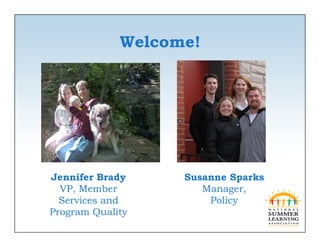
Welcome!


Jennifer Brady     Susanne Sparks
  VP, Member          Manager,
  Services and         Policy
Program Quality
Webinar Functions
 Question – Use this feature to ask and
  answer questions.
               ti
 Audience View – you can see names of
  others who are joining us on the
  webinar
 Hand Raising – use to be called on to
  comment, ask, or answer a question
            ,     ,            q
 Poll – Given the question, select the
  best answer
What is one trip
 you remember
 taking in the Use the
               q
               question box

 summer as a   to share your
               answers with
               us.

 child?
  hild?
Our mission is to connect
    and equip schools and
      d     i   h l      d
 community organizations
             y g
 to deliver quality summer
  learning programs to our
    nation’s youth to help
close the achievement gap
                        gap.
The Association works to:
 Increase the number of providers offering
  high-quality summer learning programs to
    g qu ty su        e e        g p og    s
  young people living in poverty;
 Increase the number of organizations and
                              g
  policymakers that identify summer learning
  as a public policy priority; and,
 Increase funding for high-quality summer
  learning programs for young people who
  currently lack choices and opportunities.
         tl l k h i          d       t iti
Objectives for today:
 Gain awareness of the quality
  standards for summer learning
  programs
 Highlight best practices for memorable
  field trips
 Learn the benefits of Summer
  Learning D 2010
  L      i   Day
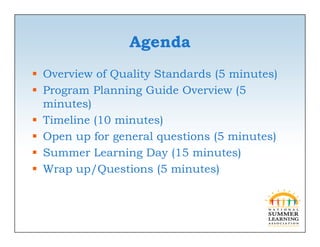
Agenda
 Overview of Quality Standards (5 minutes)
 Program Planning Guide Overview (5
  minutes))
 Timeline (10 minutes)
 Open up for general questions (5 minutes)
 Summer Learning Day (15 minutes)
 Wrap up/Questions (5 minutes)
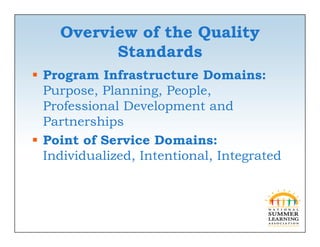
Overview of the Quality
          Standards
               d d
 Program Infrastructure Domains:
  Purpose, Planning, People,
  Professional Development and
  Partnerships
 Point of Service Domains:
  Individualized, Intentional, Integrated
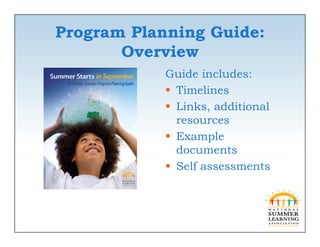
Program Planning Guide:
       Overview
            i
            Guide includes:
             Timelines
             Links additional
              Links,
              resources
             Example
              documents
             Self assessments
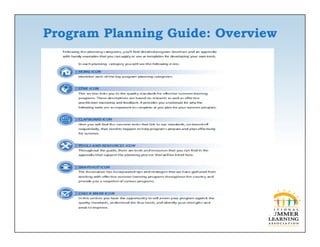
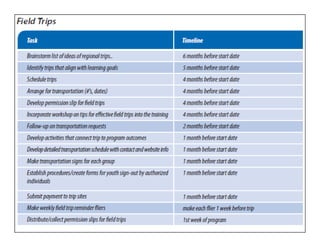
Program Planning Guide: Overview
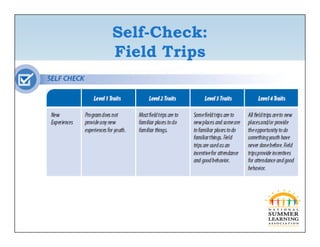
Self-Check:
Field Trips
 i ld T i
Learning is experience.
       g      p
Everything else is just
     information.
     information

    -Albert Ei
     Alb    Einstein
                  i
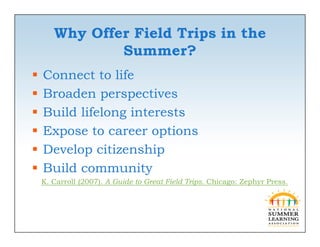
Why Offer Field Trips in the
               Summer?
               S        ?
   Connect to life
   Broaden perspectives
   Build lif l
    B ild lifelong interests
                   i
   Expose to career options
   Develop citizenship
   Build community
    K. Carroll (2007). A Guide to Great Field Trips. Chicago: Zephyr Press.
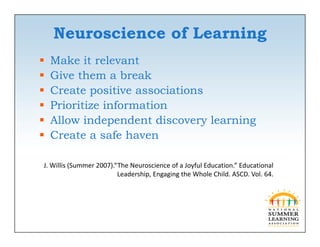
Neuroscience of Learning
   Make it relevant
   Give them a break
   Create positive associations
   Prioritize information
   Allow independent discovery learning
   Create a safe haven

J. Willis (Summer 2007).“The Neuroscience of a Joyful Education.” Educational 
                         Leadership, Engaging the Whole Child. ASCD. Vol. 64.
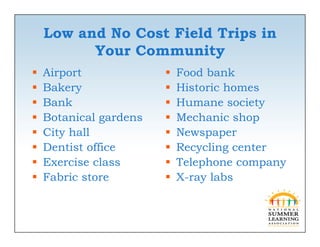
Low and No Cost Field Trips in
          Your C
          Y    Communityi
   Airport
       p                   Food bank
   Bakery                 Historic homes
   Bank                   Humane society y
   Botanical gardens      Mechanic shop
   City hall              Newspaper
   Dentist office         Recycling center
   Exercise class         Telephone company
   Fabric store           X-ray labs
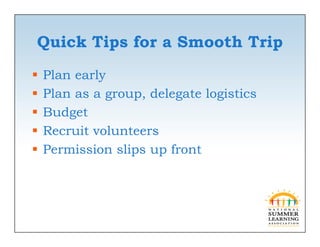
Quick Tips for a Smooth Trip
   Plan early
   Plan as a group, delegate logistics
   Budget
    B d
   Recruit volunteers
   Permission slips up front
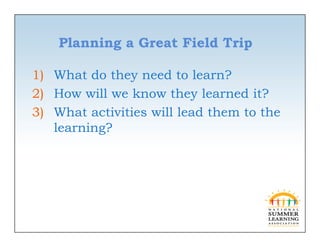
Planning a Great Field Trip

1) What do they need to learn?
2) How will we know they learned it?
3) Wh activities will lead them to the
   What     i ii   ill l d h        h
   learning?
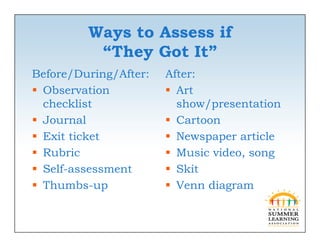
Ways to Assess if
          “They Got It”
          “Th         ”
Before/During/After:   After:
 Observation           Art
  checklist              show/presentation
                              /p
 Journal               Cartoon
 Exit ticket           Newspaper article
 Rubric                Music video, song
 Self-assessment
  Self assessment       Skit
 Thumbs-up             Venn diagram
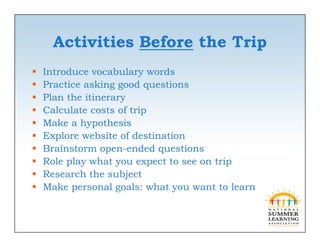
Activities Before the Trip
   Introduce vocabulary words
                        y
   Practice asking good questions
   Plan the itinerary
   Calculate
    C l l t costs of trip
                  t ft i
   Make a hypothesis
   Explore website of destination
       p
   Brainstorm open-ended questions
   Role play what you expect to see on trip
   Research the subject
   Make personal goals: what you want to learn
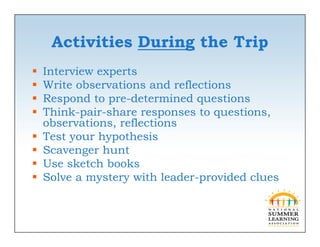
Activities During the Trip
   Interview experts
                p
   Write observations and reflections
   Respond to pre-determined questions
   Think-pair-share responses to questions,
    Thi k    i h                        i
    observations, reflections
   Test your hypothesis
   Scavenger hunt
   Use sketch books
   Solve a mystery with leader-provided clues
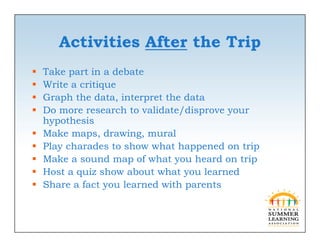
Activities After the Trip
   Take part in a debate
          p
   Write a critique
   Graph the data, interpret the data
   Do
    D more research to validate/disprove your
                     ht    lid t /di
    hypothesis
   Make maps, drawing, mural
   Play charades to show what happened on trip
   Make a sound map of what you heard on trip
   Host
    H t a quiz show about what you learned
              i h      b t h t        l   d
   Share a fact you learned with parents
O e S
    Other Skills to Introduce for Field Trips
               s o      oduce o     ed     ps

   Observation skills
   Listening, questioning, interviewing
   Note taking
    N      ki
   Using technology
   Cooperation
   Safety
Questions?
 What strategies do you use to
  reinforce learning on field trips?
Summer Learning Day: June 21
A national showcase for summer learning
  programs to highlight how they:
   • Maintain and advance participants'
     academic and developmental growth
   • Support working families
   • Keep children safe and healthy
   • Send young people back to school ready
     to learn
Tell Your Program’s Story
              g          y
 How can you best tell or illustrate your
  program’s value?
  • Who needs to hear this message?
  • How can you capitalize upon plans already
    underway?
      d      ?
Summer Learning Day:
       Online Resources
         li
 Planning Kit
  • Planning Checklist
  • Draft Invitation Letter
  • Example Events
E
 Event R i t ti
     t Registration
  • Map of events in your community
 History
  • Looking back to 2004
Steps to Take Now
 Finalize agenda
 Publicize, if appropriate.
  • Fl
    Flyers home to parents.
           h      t     t
  • Community calendars.
  • Invitation l
               letters.
 Purchase special supplies, if needed
 Draft media advisory
Final Webinar
Summer Program Planning:
    America After 3PM
  Summer Data Briefing
  S       D     B i fi
   Monday, June 7, 2010
      3 p.m.-4 p.m.
             4
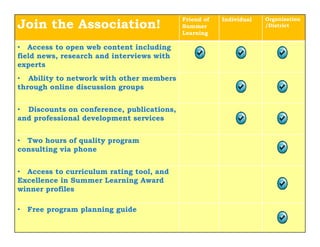
Friend of   Individual   Organization
Join the Association!                      Summer                   /District
                                           Learning

• AAccess t open web content including
          to         b     t t i l di
field news, research and interviews with
experts
     
• Abilit t network with other members
   Ability to  t   k ith th      b
through online discussion groups


• Di
  Discounts on conference, publications,
           t        f         bli ti
and professional development services


• T
  Two hhours of quality program
               f   lit
consulting via phone
   

• A
  Access t curriculum rating tool, and
         to     i l     ti g t l     d
Excellence in Summer Learning Award
winner profiles

•   Free program planning guide
Your feedback is important!
Please take a few minutes and answer
this 5 question survey.

http://www.surveymonkey.com/s/NPF
 VHTR
Thank you!
 Program Planning/Membership
  • Erin Gilbert –
    erin@summerlearning.org
 Program Assessment
  • Sarah Pitcock –
    sarah@summerlearning.org
 Summer Learning Day
  • Susanne Sparks –
    susanne@summerlearning.org

Summer Program Planning: Memorable Field Trips

  • 1.
    Summer Program Planning: Memorable Field Trips National Summer Learning Association Friday, Friday May 21 2010 21,
  • 2.
    Welcome! Jennifer Brady Susanne Sparks VP, Member Manager, Services and Policy Program Quality
  • 3.
    Webinar Functions  Question– Use this feature to ask and answer questions. ti  Audience View – you can see names of others who are joining us on the webinar  Hand Raising – use to be called on to comment, ask, or answer a question , , q  Poll – Given the question, select the best answer
  • 4.
    What is onetrip you remember taking in the Use the q question box summer as a to share your answers with us. child? hild?
  • 5.
    Our mission isto connect and equip schools and d i h l d community organizations y g to deliver quality summer learning programs to our nation’s youth to help close the achievement gap gap.
  • 6.
    The Association worksto:  Increase the number of providers offering high-quality summer learning programs to g qu ty su e e g p og s young people living in poverty;  Increase the number of organizations and g policymakers that identify summer learning as a public policy priority; and,  Increase funding for high-quality summer learning programs for young people who currently lack choices and opportunities. tl l k h i d t iti
  • 7.
    Objectives for today: Gain awareness of the quality standards for summer learning programs  Highlight best practices for memorable field trips  Learn the benefits of Summer Learning D 2010 L i Day
  • 8.
    Agenda  Overview ofQuality Standards (5 minutes)  Program Planning Guide Overview (5 minutes))  Timeline (10 minutes)  Open up for general questions (5 minutes)  Summer Learning Day (15 minutes)  Wrap up/Questions (5 minutes)
  • 9.
    Overview of theQuality Standards d d  Program Infrastructure Domains: Purpose, Planning, People, Professional Development and Partnerships  Point of Service Domains: Individualized, Intentional, Integrated
  • 10.
    Program Planning Guide: Overview i Guide includes:  Timelines  Links additional Links, resources  Example documents  Self assessments
  • 11.
  • 13.
  • 14.
    Learning is experience. g p Everything else is just information. information -Albert Ei Alb Einstein i
  • 15.
    Why Offer FieldTrips in the Summer? S ?  Connect to life  Broaden perspectives  Build lif l B ild lifelong interests i  Expose to career options  Develop citizenship  Build community K. Carroll (2007). A Guide to Great Field Trips. Chicago: Zephyr Press.
  • 16.
    Neuroscience of Learning  Make it relevant  Give them a break  Create positive associations  Prioritize information  Allow independent discovery learning  Create a safe haven J. Willis (Summer 2007).“The Neuroscience of a Joyful Education.” Educational  Leadership, Engaging the Whole Child. ASCD. Vol. 64.
  • 17.
    Low and NoCost Field Trips in Your C Y Communityi  Airport p  Food bank  Bakery  Historic homes  Bank  Humane society y  Botanical gardens  Mechanic shop  City hall  Newspaper  Dentist office  Recycling center  Exercise class  Telephone company  Fabric store  X-ray labs
  • 18.
    Quick Tips fora Smooth Trip  Plan early  Plan as a group, delegate logistics  Budget B d  Recruit volunteers  Permission slips up front
  • 19.
    Planning a GreatField Trip 1) What do they need to learn? 2) How will we know they learned it? 3) Wh activities will lead them to the What i ii ill l d h h learning?
  • 20.
    Ways to Assessif “They Got It” “Th ” Before/During/After: After:  Observation  Art checklist show/presentation /p  Journal  Cartoon  Exit ticket  Newspaper article  Rubric  Music video, song  Self-assessment Self assessment  Skit  Thumbs-up  Venn diagram
  • 21.
    Activities Before theTrip  Introduce vocabulary words y  Practice asking good questions  Plan the itinerary  Calculate C l l t costs of trip t ft i  Make a hypothesis  Explore website of destination p  Brainstorm open-ended questions  Role play what you expect to see on trip  Research the subject  Make personal goals: what you want to learn
  • 22.
    Activities During theTrip  Interview experts p  Write observations and reflections  Respond to pre-determined questions  Think-pair-share responses to questions, Thi k i h i observations, reflections  Test your hypothesis  Scavenger hunt  Use sketch books  Solve a mystery with leader-provided clues
  • 23.
    Activities After theTrip  Take part in a debate p  Write a critique  Graph the data, interpret the data  Do D more research to validate/disprove your ht lid t /di hypothesis  Make maps, drawing, mural  Play charades to show what happened on trip  Make a sound map of what you heard on trip  Host H t a quiz show about what you learned i h b t h t l d  Share a fact you learned with parents
  • 24.
    O e S Other Skills to Introduce for Field Trips s o oduce o ed ps  Observation skills  Listening, questioning, interviewing  Note taking N ki  Using technology  Cooperation  Safety
  • 25.
    Questions?  What strategiesdo you use to reinforce learning on field trips?
  • 26.
    Summer Learning Day:June 21 A national showcase for summer learning programs to highlight how they: • Maintain and advance participants' academic and developmental growth • Support working families • Keep children safe and healthy • Send young people back to school ready to learn
  • 27.
    Tell Your Program’sStory g y  How can you best tell or illustrate your program’s value? • Who needs to hear this message? • How can you capitalize upon plans already underway? d ?
  • 28.
    Summer Learning Day: Online Resources li  Planning Kit • Planning Checklist • Draft Invitation Letter • Example Events E Event R i t ti t Registration • Map of events in your community  History • Looking back to 2004
  • 29.
    Steps to TakeNow  Finalize agenda  Publicize, if appropriate. • Fl Flyers home to parents. h t t • Community calendars. • Invitation l letters.  Purchase special supplies, if needed  Draft media advisory
  • 30.
    Final Webinar Summer ProgramPlanning: America After 3PM Summer Data Briefing S D B i fi Monday, June 7, 2010 3 p.m.-4 p.m. 4
  • 31.
    Friend of Individual Organization Join the Association! Summer /District Learning • AAccess t open web content including to b t t i l di field news, research and interviews with experts  • Abilit t network with other members Ability to t k ith th b through online discussion groups • Di Discounts on conference, publications, t f bli ti and professional development services • T Two hhours of quality program f lit consulting via phone  • A Access t curriculum rating tool, and to i l ti g t l d Excellence in Summer Learning Award winner profiles • Free program planning guide
  • 32.
    Your feedback isimportant! Please take a few minutes and answer this 5 question survey. http://www.surveymonkey.com/s/NPF VHTR
  • 33.
    Thank you!  ProgramPlanning/Membership • Erin Gilbert – erin@summerlearning.org  Program Assessment • Sarah Pitcock – sarah@summerlearning.org  Summer Learning Day • Susanne Sparks – susanne@summerlearning.org