UCCESS	 toriesSSSUCCESS Program Advising
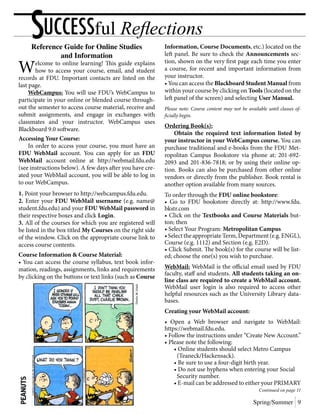
SUCCESS students can benefit from
multiple advisement resources. As an FDU
student, you may utilize the Advisement
Center on campus (Robison Hall), the
faculty in your “major” department, and the
SUCCESS Program office. Day and/or
evening appointments.
Other advisement professionals
including Career Management
staff are also available.
An appointment with Dr. Denise Hart,
Director of Adult Education,
can be made by calling
201-692-7153, 6508 or
E-mail: hart@fdu.edu
SUCCESSInside
2-3	 Curriculum Corner
5	 A SUCCESSful Portfolio Assessment
6-7	 FYI
4-19 Successful Reflections
14	 SUCCESS Program Highlights
ABOUT THIS NEWSLETTER
SUCCESS stories is a publication of the Office of Adult Education and
for SUCCESS Program students who are undergraduate adult learners
seeking a baccalaureate degree.
	 Your contributions, comments and recommendations about issues,
policies and procedures which affect the adult learner are important to us.
	 Submit your typed/word processed recommendations/ideas directly to
Dr. Denise Hart, Director, Adult Education, SUCCESS Program,
Fairleigh Dickinson University, 1000 River Road, H-DH1-02,
Teaneck, New Jersey 07666.
VOLUME 24, ISSUE 32	 ACADEMIC SUPPORT SERVICES FOR ADULT LEARNERS	 MARCH 2016
The Secret Weapon That Will Make You and Your
Business Stand Out in the War of Ideas
Posted by Carolyn Kilmer on February 8, 2016 in Book News, Entrepreneur.com.
ASilicon Valley venture capital investor turned to me during a
recent lunch and said, “I’ve seen more than 2,000 pitches, and
I can only remember about 10 of them.”
“What made the 10 stand out?” I asked.
“They all told a personal story.”
	 Professional investors agree: ideas that catch on are wrapped in
story. “Show me an MBA and your sales numbers, that’s fine. But
tell me a great story about how you got started and your vision, and
we’ll talk.” says Shark Tank’s Barbara Corcoran.
	 Although stories inform, illuminate and inspire, very few en-
trepreneurs and business professionals are aware of the power of
story to persuade. But it gives those who do master the art of story-
telling a significant competitive advantage. In today’s increasingly
automated world where robots are replacing humans in nearly ev-
ery task, storytelling is the one skill that will keep you relevant and
successful through your career.
	 “Storytelling is the most underrated skill,” says Ben Horowitz,
general partner with venture capital firm Andreessen Horowitz.
“The company story is the company strategy. If don’t have a clearly
articulated story, you don’t have a clear and well thought-out strat-
egy. The story must explain at a fundamental level why you exist.”
While conducting the research for my new book, The Storyteller’s
Continued on page 7
2	SUCCESS Stories
Curriculum Corner
SUCCESS Program Courses, Fall 2016
	 Note: All Fall 2016 courses listed below are offered at the Metropolitan campus.
UNIV 2001.54	 Cross Cultural Perspectives (3)		 TH	 5:30-8:00 pm
UNIV 2002.53	 Global Issues (3)		 T	 5:30-8:00 pm
BIOL 1060.51	 Genetics & Society Lecture (3)		 TH	 5:30-7:10 pm
BIOL 1061.51	 Genetics & Society Lab		 TH	 7:20 – 9:00 pm
	 Recommended for Success Students
BIOL 1105.21	 The Human Environment (3)		 T	 8:00-9:40 am
BIOL 1115.21	 Lab			 W	 8-9:40 am
	 Recommended for Success Students
BIOL 1105.52	 The Human Environment (3)		 W	 5:30-7:10 pm
BIOL 1115.52	 Lab			 W	 7:20-9:00 pm
	 Recommended for Success Students
BIOL 1105.53	 The Human Environment (3)		 M	 5:30-7:10 pm
BIOL 1115.53	 Lab			 M	 7:20-9:00 pm
	 Recommended for Success Students
BIOL1106.51	 Over the Counter Drugs (3)		 W	 5:30-7:10 pm
BIOL1116.51	Lab			 W	 7:20-9:00 pm
	 Recommended for Success Students
BIOL1106.52	 Over the Counter Drugs (3)		 M	 5:30-7:10 pm
BIOL1116.52	Lab			 M	 7:20-9:00 pm
	 Recommended for Success Students
CHEM 1118.51	 Forensic Science (3)		 M	 5:30-7:10 pm
CHEM 1119.51	 Lab			 M	 7:30-9:00 pm
	 Recommended for Success Students
CHEM 1119.21	 Lab (3)		 M	 3:30-5:10 pm
	 Recommended for Success Students
CHEM 1119.22	 Lab (3)		 M	 1-2:40 pm
	 Recommended for Success Students
ENVR 1101.21	 Physical Geology (3)		 M	 11:50 am-1:30 pm
ENVR 1102.21	 Lab			 M	 10:00 am-11:40 am
	 Recommended for Success Students
PSYC 2204.51	 Child Development (3)		 T	 5:30-8:00 pm
	 Recommended for Success Students
PSYC 3317.51	 Psychology and the Law (3)		 W	 5:30-8:00 pm
	 Recommended for Success Students
PSYC 3330.51	 Health Psychology (3)		 TH	 5:30-8:00 pm
	 Recommended for Success Students
PSYC 4431.21 SS:	 Behavioral Psychology (3)		 MW	 10-11:15 am
	 Recommended for Success Students
CREDITS
Editor in Chief Dr. Denise Hart Graphic Designer Craig M. Cannon Contributors Mark Budig, C.M.,
Dr. Denise Hart, Evangelina Ocasio, Robyn Pearce, and Julia Wagner
Spring/Summer 3
Curriculum Corner
Curriculum Corner
Continued from page 2
BUSI 3620.E1B	 Human Resource Systems (3)	 Peiffer 	 T	 5:30-9:30 pm
	 RESTRICTED to Success Students
		Note: Success Students, Dept. Chair Approval Restr: Open to students in Individual Studies,
		 Liberal Arts, or Hotel Rest, Cannot register online. Please see the department chairperson,
		 Students cannot register for this course online.
			 Class meets August 30-October 11, 2016 inclusive.
ENVR 1104.E1B	 Principles of Physical Geography (3)	 Konsevick	 M	 5:30-9:30 pm
	 RESTRICTED to Success Students	
		Note: Success Students, Dept. Chair Approval Restr: Open to students in Individual Studies,
		 Liberal Arts, or Hotel Rest, Cannot register online. Please see the department chairperson,
		 Students cannot register for this course online.
			 Class meets August 29, September 12-October 17, 2016 inclusive.
HIST 2105.E1B	 Crime in History (3)	 Dodd	 M	 5:30-9:30 pm
	 RESTRICTED to Success Students	
		Note: Success Students, Dept. Chair Approval Restr: Open to students in Individual Studies,
		 Liberal Arts, or Hotel Rest, Cannot register online. Please see the department chairperson,
		 Students cannot register for this course online.
			 Class meets October 24-December 12, 2016 inclusive.
HIST 3308.E1B	 Native American History (3)	 Mulligan	 M	 5:30-9:30 pm
	 RESTRICTED to Success Students	
		Note: Success Students, Dept. Chair Approval Restr: Open to students in Individual Studies,
		 Liberal Arts, or Hotel Rest, Cannot register online. Please see the department chairperson,
		 Students cannot register for this course online.
			 Class meets October 25-December 13, 2016 inclusive.
INTER 4438.E1B	 Ethics & Public Affairs (3)	 Markowski	 W	 5:30-9:30 pm
	 	 RESTRICTED to Success Students	 Kane
	 	 Note: Success Students, Dept. Chair Approval Restr: Open to students in Individual Studies,
		 Liberal Arts, or Hotel Rest, Cannot register online. Please see the department chairperson,
		 Students cannot register for this course online.
			 Class meets August 31-October 12, 2016 inclusive.
MATH 1131.E2B	 College Math I (3)	 J. Colagreco	 TH	 5:30-9:30 pm
	 RESTRICTED to Success Students	
		Note: Success Students, Dept. Chair Approval Restr: Open to students in Individual Studies,
		 Liberal Arts, or Hotel Rest, Cannot register online. Please see the department chairperson,
		 Students cannot register for this course online. 	
			 Class Meets September 1-October 13, 2016 inclusive.
HUMN 3002.EIB	 Table Talk: Literature of Food (3)	 J. Colagreco	 TH	 5:30-9:30 pm
	 RESTRICTED to Success Students	
		Note: Success Students, Dept. Chair Approval Restr: Open to students in Individual Studies,
		 Liberal Arts, or Hotel Rest, Cannot register online. Please see the department chairperson,
		 Students cannot register for this course online.
			 Class meets October 20-November 17 & December 1-15, 2016 inclusive.
“Immense power is acquired by assuring yourself in your
secret reveries that you were born to control affairs.”
— Andrew Carnegie, Industrialist
Retrieved from ASCD Smartbrief.com, Thursday, 2/11/2016 10:47 AM
4 SUCCESS Stories
THE ROAD TO
CHALLENGE EXAMINATION
By Evangelina Ocasio
Preparing for the Challenge Exam was a complex but
manageable task. As an adult learner I had to jug-
gle multiple responsibilities, but this experience proved
to be a great exercise in perseverance, determination
and commitment. For me and for many other adult
learners, obtaining a college degree means far more
than academic achievement. It is also an opportunity
to build on our professional credentials, and the Chal-
lenge Exam allows us to bridge both worlds.
	 As a working adult and parent, I have learned that
time is a valuable commodity. Starting the preparation
process early was my first step in order to provide ade-
quate time for research and writing. Next I began look-
ing back at my work experience to identify key aspects
that were most relevant to the course objectives/learn-
ing outcomes. The guidance and support provided by
Dr. Denise Hart in the Office of Adult Education in this
regard were indispensable determining factors to my
success.
	 I then began reviewing my portfolio and résumé
to identify key examples that substantiated my experi-
ence. During the Challenge Exam, the examples served
as a powerful resource to help demonstrate mastery of
the skills and competencies that I was challenging. My
next step was anticipating what questions I would be
asked in order to prepare accordingly.
	 From the beginning I wanted the look and feel of
the presentation and support materials to be a reflec-
tion of my professional brand, therefore I created a
presentation theme that incorporated my learning and
which also followed FDU’s PLA format. Devoting time
to the organization and flow of the content narrative,
support documentation and letters with an appropriate
index made it easier to transition from one point to the
next.
	 Preparing for presentation day required rehearsal.
I remembered the saying practice makes perfect. Ul-
timately, familiarity with the content afforded me the
comfort level
Continued on page 7
SUCCESSful Reflections
“There are many kinds of success in life worth having.”
—Theodore Roosevelt, 26th US President
Dear Students, Faculty, and Staff:
The Metro Writing Studio is open for tutor-
ing services for the spring semester. Regu-
lar hours of operation are Monday thru Thurs-
day 10 am to 7 pm, Friday 10 am - 4 pm, and
Saturday 1 pm - 5 pm. For a full schedule of
events, check out the Metro Writing Studio on-
line at HTTP://UCOLL.FDU.EDU/METRO
	 eTutoring, which provides online tutor-
ing services within multiple disciplines is also
available. Undergraduates can access these ser-
vices by logging onto https://www.etutoring.
org/ and following the instructions posted.
	 The studio is staffed with professional writ-
ing tutors who are available to help students
with their writing needs, and our many workshops
are geared toward written assignments. We are look-
ing forward to seeing students, faculty, and staff in the
studio this spring!
*****************************************************
Julia Wagner
Senior Lecturer, School of the Humanities Director,
Metro Writing Studio
Fairleigh Dickinson University
1000 River Road, T-GL1-03
Teaneck, New Jersey 07666
201-692-2165
jawagner@fdu.edu
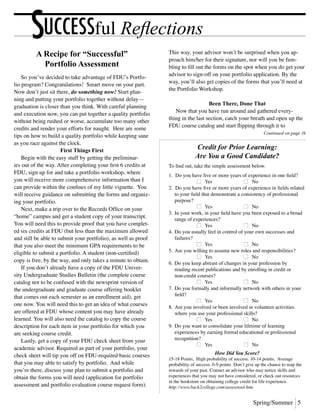
Credit for Prior Learning:
Are You a Good Candidate?
To find out, take the simple assessment below.
1. Do you have five or more years of experience in one field?
			 ■ Yes	 ■ No
2. Do you have five or more years of experience in fields related
	 to your field that demonstrate a consistency of professional
	 purpose?
			 ■ Yes	 ■ No
3.	In your work, in your field have you been exposed to a broad
	 range of experiences?
			 ■ Yes	 ■ No
4.	Do you usually feel in control of your own successes and
	 failures?
			 ■ Yes	 ■ No
5.	Are you willing to assume new roles and responsibilities?
			 ■ Yes	 ■ No
6.	Do you keep abreast of changes in your profession by
	 reading recent publications and by enrolling in credit or
	 non-credit courses?
			 ■ Yes	 ■ No
7.	Do you formally and informally network with others in your
	 field?
			 ■ Yes	 ■ No
8.	Are you involved or been involved in volunteer activities
	 where you use your professional skills?
			 ■ Yes	 ■ No
9.	Do you want to consolidate your lifetime of learning
	 experiences by earning formal educational or professional
	 recognition?
			 ■ Yes	 ■ No
How Did You Score?
15-18 Points, High probability of success. 10-14 points, Average
probability of success. 0-9 points Don’t give up the chance to reap the
rewards of your past. Contact an advisor who may notice skills and
experiences that you may not have considered, or check out resources
in the bookstore on obtaining college credit for life experience.
http://www.back2college.com/assesstool.htm
	 So you’ve decided to take advantage of FDU’s Portfo-
lio program? Congratulations! Smart move on your part.
Now don’t just sit there, do something now! Start plan-
ning and putting your portfolio together without delay—
graduation is closer than you think. With careful planning
and execution now, you can put together a quality portfolio
without being rushed or worse, accumulate too many other
credits and render your efforts for naught. Here are some
tips on how to build a quality portfolio while keeping sane
as you race against the clock.
First Things First
	 Begin with the easy stuff by getting the preliminar-
ies out of the way. After completing your first 6 credits at
FDU, sign up for and take a portfolio workshop, where
you will receive more comprehensive information than I
can provide within the confines of my little vignette. You
will receive guidance on submitting the forms and organiz-
ing your portfolio.
	 Next, make a trip over to the Records Office on your
“home” campus and get a student copy of your transcript.
You will need this to provide proof that you have complet-
ed six credits at FDU (but less than the maximum allowed
and still be able to submit your portfolio), as well as proof
that you also meet the minimum GPA requirements to be
eligible to submit a portfolio. A student (non-certified)
copy is free, by the way, and only takes a minute to obtain.
	 If you don’t already have a copy of the FDU Univer-
sity Undergraduate Studies Bulletin (the complete course
catalog not to be confused with the newsprint version of
the undergraduate and graduate course offering booklet
that comes out each semester as an enrollment aid), get
one now. You will need this to get an idea of what courses
are offered at FDU whose content you may have already
learned. You will also need the catalog to copy the course
description for each item in your portfolio for which you
are seeking course credit.
	 Lastly, get a copy of your FDU check sheet from your
academic advisor. Required as part of your portfolio, your
check sheet will tip you off on FDU-required basic courses
that you may able to satisfy by portfolio. And while
you’re there, discuss your plan to submit a portfolio and
obtain the forms you will need (application for portfolio
assessment and portfolio evaluation course request form).
This way, your advisor won’t be surprised when you ap-
proach him/her for their signature, nor will you be fum-
bling to fill out the forms on the spot when you do get your
advisor to sign-off on your portfolio application. By the
way, you’ll also get copies of the forms that you’ll need at
the Portfolio Workshop.
Been There, Done That
	 Now that you have run around and gathered every-
thing in the last section, catch your breath and open up the
FDU course catalog and start flipping through it to
Continued on page 16
SUCCESSful Reflections
A Recipe for “Successful”
Portfolio Assessment
Spring/Summer 5
or our nformation
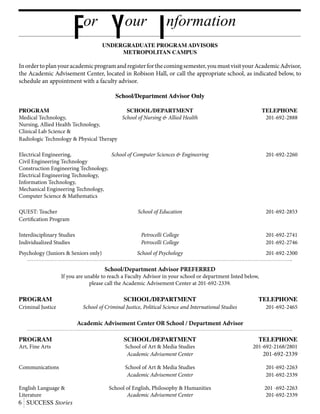
IYF UNDERGRADUATE PROGRAM ADVISORS
METROPOLITAN CAMPUS
Inordertoplanyouracademicprogramandregisterforthecomingsemester,youmustvisityourAcademicAdvisor,
the Academic Advisement Center, located in Robison Hall, or call the appropriate school, as indicated below, to
schedule an appointment with a faculty advisor.
School/Department Advisor Only
PROGRAM	 SCHOOL/DEPARTMENT	 TELEPHONE
Medical Technology,	 School of Nursing & Allied Health	201-692-2888
Nursing, Allied Health Technology,
Clinical Lab Science &
Radiologic Technology & Physical Therapy
Electrical Engineering,	 School of Computer Sciences & Engineering	201-692-2260
Civil Engineering Technology
Construction Engineering Technology,
Electrical Engineering Technology,
Information Technology,
Mechanical Engineering Technology,
Computer Science & Mathematics
QUEST: Teacher	 School of Education	201-692-2853
Certification Program
Interdisciplinary Studies	 Petrocelli College	 201-692-2741
Individualized Studies	 Petrocelli College	 201-692-2746
Psychology (Juniors & Seniors only)	 School of Psychology	201-692-2300
School/Department Advisor PREFERRED
If you are unable to reach a Faculty Advisor in your school or department listed below,
please call the Academic Advisement Center at 201-692-2339.
PROGRAM	 SCHOOL/DEPARTMENT	 TELEPHONE
Criminal Justice	 School of Criminal Justice, Political Science and International Studies	201-692-2465
Academic Advisement Center OR School / Department Advisor
PROGRAM	 SCHOOL/DEPARTMENT	 TELEPHONE
Art, Fine Arts	 School of Art & Media Studies	 201-692-2168/2801
		 Academic Advisement Center	 201-692-2339
Communications	 School of Art & Media Studies	 201-692-2263
		 Academic Advisement Center	 201-692-2339
English Language &	 School of English, Philosophy & Humanities	 201 -692-2263
Literature	 Academic Advisement Center	 201-692-2339
6 SUCCESS Stories
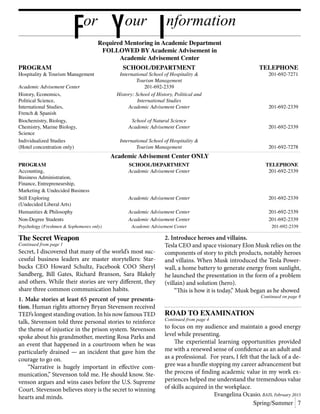
Required Mentoring in Academic Department
FOLLOWED BY Academic Advisement in
Academic Advisement Center
PROGRAM	 SCHOOL/DEPARTMENT	 TELEPHONE
Hospitality & Tourism Management	 International School of Hospitality &	201-692-7271
		 Tourism Management
Academic Advisement Center	201-692-2339
History, Economics,	 History: School of History, Political and
Political Science,	 International Studies
International Studies,	 Academic Advisement Center	201-692-2339
French & Spanish
Biochemistry, Biology,	 School of Natural Science
Chemistry, Marine Biology,	 Academic Advisement Center	201-692-2339
Science
Individualized Studies	 International School of Hospitality &
(Hotel concentration only)	 Tourism Management	 201-692-7278
Academic Advisement Center ONLY
PROGRAM	 SCHOOL/DEPARTMENT	 TELEPHONE
Accounting,	 Academic Advisement Center	201-692-2339
Business Administration,
Finance, Entrepreneurship,
Marketing & Undecided Business
Still Exploring	 Academic Advisement Center	201-692-2339
(Undecided Liberal Arts)
Humanities & Philosophy	 Academic Advisement Center	201-692-2339
Non-Degree Students	 Academic Advisement Center	201-692-2339
Psychology (Freshmen & Sophomores only)	 Academic Advisement Center	201-692-2339
or our nformation
IYF
Spring/Summer 7
ROAD TO EXAMINATION
Continued from page 4
to focus on my audience and maintain a good energy
level while presenting.
	 The experiential learning opportunities provided
me with a renewed sense of confidence as an adult and
as a professional. For years, I felt that the lack of a de-
gree was a hurdle stopping my career advancement but
the process of finding academic value in my work ex-
periences helped me understand the tremendous value
of skills acquired in the workplace.
Evangelina Ocasio, BAIS, February 2015
The Secret Weapon
Continued from page 1
Secret, I discovered that many of the world’s most suc-
cessful business leaders are master storytellers: Star-
bucks CEO Howard Schultz, Facebook COO Sheryl
Sandberg, Bill Gates, Richard Branson, Sara Blakely
and others. While their stories are very different, they
share three common communication habits.
1. Make stories at least 65 percent of your presenta-
tion. Human rights attorney Bryan Stevenson received
TED’s longest standing ovation. In his now famous TED
talk, Stevenson told three personal stories to reinforce
the theme of injustice in the prison system. Stevenson
spoke about his grandmother, meeting Rosa Parks and
an event that happened in a courtroom when he was
particularly drained — an incident that gave him the
courage to go on.
	 “Narrative is hugely important in effective com-
munication,” Stevenson told me. He should know. Ste-
venson argues and wins cases before the U.S. Supreme
Court. Stevenson believes story is the secret to winning
hearts and minds.
2. Introduce heroes and villains.
Tesla CEO and space visionary Elon Musk relies on the
components of story to pitch products, notably heroes
and villains. When Musk introduced the Tesla Power-
wall, a home battery to generate energy from sunlight,
he launched the presentation in the form of a problem
(villain) and solution (hero).
	 “This is how it is today,” Musk began as he showed
Continued on page 8
SUCCESSful Reflections
8 SUCCESS Stories
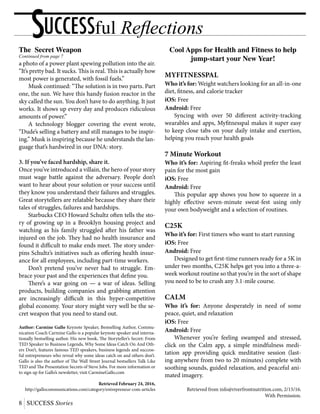
The Secret Weapon
Continued from page 7
a photo of a power plant spewing pollution into the air.
“It’s pretty bad. It sucks. This is real. This is actually how
most power is generated, with fossil fuels.”
	 Musk continued: “The solution is in two parts. Part
one, the sun. We have this handy fusion reactor in the
sky called the sun. You don’t have to do anything. It just
works. It shows up every day and produces ridiculous
amounts of power.”
	 A technology blogger covering the event wrote,
“Dude’s selling a battery and still manages to be inspir-
ing.” Musk is inspiring because he understands the lan-
guage that’s hardwired in our DNA: story.
3. If you’ve faced hardship, share it.
Once you’ve introduced a villain, the hero of your story
must wage battle against the adversary. People don’t
want to hear about your solution or your success until
they know you understand their failures and struggles.
Great storytellers are relatable because they share their
tales of struggles, failures and hardships.
	 Starbucks CEO Howard Schultz often tells the sto-
ry of growing up in a Brooklyn housing project and
watching as his family struggled after his father was
injured on the job. They had no health insurance and
found it difficult to make ends meet. The story under-
pins Schultz’s initiatives such as offering health insur-
ance for all employees, including part-time workers.
	 Don’t pretend you’ve never had to struggle. Em-
brace your past and the experiences that define you.
	 There’s a war going on — a war of ideas. Selling
products, building companies and grabbing attention
are increasingly difficult in this hyper-competitive
global economy. Your story might very well be the se-
cret weapon that you need to stand out.
Author: Carmine Gallo Keynote Speaker, Bestselling Author, Commu-
nication Coach Carmine Gallo is a popular keynote speaker and interna-
tionally bestselling author. His new book, The Storyteller’s Secret: From
TED Speaker to Business Legends, Why Some Ideas Catch On And Oth-
ers Don’t, features famous TED speakers, business legends and success-
ful entrepreneurs who reveal why some ideas catch on and others don’t.
Gallo is also the author of The Wall Street Journal bestsellers Talk Like
TED and The Presentation Secrets of Steve Jobs. For more information or
to sign up for Gallo’s newsletter, visit CarmineGallo.com
Retrieved February 24, 2016,
http://gallocommunications.com/category/entrepreneur-com-articles
Cool Apps for Health and Fitness to help
jump-start your New Year!
MyFitnessPal
Who it’s for: Weight watchers looking for an all-in-one
diet, fitness, and calorie tracker
iOS: Free
Android: Free
	 Syncing with over 50 different activity-tracking
wearables and apps, Myfitnesspal makes it super easy
to keep close tabs on your daily intake and exertion,
helping you reach your health goals
7 Minute Workout
Who it’s for: Aspiring fit-freaks who’d prefer the least
pain for the most gain
iOS: Free
Android: Free
	 This popular app shows you how to squeeze in a
highly effective seven-minute sweat-fest using only
your own bodyweight and a selection of routines.
C25K
Who it’s for: First timers who want to start running
iOS: Free
Android: Free
	 Designed to get first-time runners ready for a 5K in
under two months, C25K helps get you into a three-a-
week workout routine so that you’re in the sort of shape
you need to be to crush any 3.1-mile course.
Calm
Who it’s for: Anyone desperately in need of some
peace, quiet, and relaxation
iOS: Free
Android: Free
	 Whenever you’re feeling swamped and stressed,
click on the Calm app, a simple mindfulness medi-
tation app providing quick meditative session (last-
ing anywhere from two to 20 minutes) complete with
soothing sounds, guided relaxation, and peaceful ani-
mated imagery.
Retrieved from info@riverfrontnutrition.com, 2/15/16.
With Permission.
Reference Guide for Online Studies
and Information
Welcome to online learning! This guide explains
how to access your course, email, and student
records at FDU. Important contacts are listed on the
last page.
	 WebCampus: You will use FDU’s WebCampus to
participate in your online or blended course through-
out the semester to access course material, receive and
submit assignments, and engage in exchanges with
classmates and your instructor. WebCampus uses
Blackboard 9.0 software.
Accessing Your Course:
	 In order to access your course, you must have an
FDU WebMail account. You can apply for an FDU
WebMail account online at http://webmail.fdu.edu
(see instructions below). A few days after you have cre-
ated your WebMail account, you will be able to log in
to our WebCampus.
1. Point your browser to http://webcampus.fdu.edu.
2. Enter your FDU WebMail username (e.g. name@
student.fdu.edu) and your FDU WebMail password in
their respective boxes and click Login.
3. All of the courses for which you are registered will
be listed in the box titled My Courses on the right side
of the window. Click on the appropriate course link to
access course contents.
Course Information & Course Material:
• You can access the course syllabus, text book infor-
mation, readings, assignments, links and requirements
by clicking on the buttons or text links (such as Course
Information, Course Documents, etc.) located on the
left panel. Be sure to check the Announcements sec-
tion, shown on the very first page each time you enter
a course, for recent and important information from
your instructor.
• You can access the Blackboard Student Manual from
within your course by clicking on Tools (located on the
left panel of the screen) and selecting User Manual.
Please note: Course content may not be available until classes of-
ficially begin.
Ordering Book(s):
	 Obtain the required text information listed by
your instructor in your WebCampus course. You can
purchase traditional and e-books from the FDU Met-
ropolitan Campus Bookstore via phone at: 201-692-
2093 and 201-836-7818; or by using their online op-
tion. Books can also be purchased from other online
vendors or directly from the publisher. Book rental is
another option available from many sources.
To order through the FDU online bookstore:
• Go to FDU bookstore directly at: http://www.fdu.
bkstr.com
• Click on the Textbooks and Course Materials but-
ton; then
• Select Your Program: Metropolitan Campus
•SelecttheappropriateTerm,Department (e.g. ENGL),
Course (e.g. 1112) and Section (e.g. E2D).
• Click Submit. The book(s) for the course will be list-
ed; choose the one(s) you wish to purchase.
WebMail: WebMail is the official email used by FDU
faculty, staff and students. All students taking an on-
line class are required to create a WebMail account.
WebMail user login is also required to access other
helpful resources such as the University Library data-
bases.
Creating your WebMail account:
• Open a Web browser and navigate to WebMail:
https://webmail.fdu.edu.
• Follow the instructions under “Create New Account.”
• Please note the following:
	 • Online students should select Metro Campus
	 (Teaneck/Hackensack).
	 • Be sure to use a four-digit birth year.
	 • Do not use hyphens when entering your Social
	 Security number.
	 • E-mail can be addressed to either your PRIMARY
Continued on page 11
SUCCESSful Reflections
Spring/Summer 9
10	SUCCESS Stories
Useful Links
	 Here are some useful online resources to help you
with your writing.
Fairleigh Dickinson University:
	 Writing Program Guide for Students
		http://view.fdu.edu/default.aspx?id=7678
Purdue Writing Online:
	http://owl.english.purdue.edu/
APA style guide:
	http://owl.english.purdue.edu/owl/resource/560/01/
APA Online Tutorial:
	http://writing.wisc.edu/podcasts/index.html
MLA style guide:
	http://owl.english.purdue.edu/owl/resource/557/01/
American Heritage Dictionary:
	 http://www.bartleby.com/61/
Resources for Writers:
	http://writingcenters.org/resources/resources-for-writers
Grammar:
	http://web.mit.edu/writing/Resources/Writers/gram-
mar.html
http://www.dianahacker.com/resdoc/ research and
documentation help. Learn not only how to find sourc-
es in the humanities, social sciences, history, and the
sciences but also how to document them accurately
(includes MLA, APA, Chicago, and CSE formats).
Source: http://view.fdu.edu/default.aspx?id=6617
Retrieved 3/6/14
©MarkParisi/offthemark.com
Study Tips For Students (of all ages!)
Robyn Pearce
1. Write down your goals When you write down your goals it becomes
easier to know where your priorities lie. You can then, with greater ease,
stay focused when seductive time stealers such as TV, friends or a sunny
day try to lure you away.
	 What marks do you want? What do you wish to achieve with the
qualification you’re striving for? Stay focused on the benefits and payoff,
and your hours of concentration will feel purposeful.
2. Chunk out your study time, and work a plan When you look at the
whole project it often feels too big, too overwhelming. Instead, break it
into small pieces and you can easily get a grip on just how much work you
need to invest each day.
	 Ask yourself: ‘When is the assignment or exam due? How many
weeks have I got?’
	 Work backwards from the final date, cutting some slack for days off,
or times when you’re too busy to work. Also leave a realistic chunk of time
for review or editing (if it’s an assignment) at the end. If you start early
enough, you’ll be delighted how surprisingly little time is needed per day.
In one quick stroke your thinking changes from ‘This is too much’ to ‘I
can do this!’
3. Use a mind map to gather the parts My second book, ‘About Time –
120 Tips for Those with No Time’ was written in three weeks. I’d been out
of the country for a month prior, we were packing to move home to New
Zealand from Sydney at the end of that month, the Olympics were on
(and I attended some events), I had lots of work, mates to say goodbye to,
a house to pack up, and more. As well, nearly 40,000 words rolled off my
flying fingers with ease, because of a one-page mind map (and a deadline
with major benefits to me if I reached it).
	 Before a single word went into the computer, I chunked out the key
parts of the book – decided on twelve sections, and ten tips in each sec-
tion. Then, reviewing all my material, I brainstormed what each tip would
be, noting a few reminder words for each on the mind map.
	 Working backwards from the deadline, and allocating an extra week
for review and editing, it was easy to see that I needed to write nearly
six tips per day. If I missed one day due to other commitments, that just
meant I had to write twelve the next day (which didn’t seem such an at-
tractive option!).
	 If you’re writing an assignment, your target might be a set number of
words that you must reach before you get up from your computer. Or for
study, it could be a section in a book, or a section of notes to review.
4. Use prompts to keep you on track I’m quite visual, so I also ruled up a
chart showing 120 little squares, and the goal date for completion. Each
day I ticked off the number I’d done. Something so simple is amazingly
motivating, especially if you like to ‘see’ progress.
	 If you’re triggered by sound, you could ring a bell each time you
reach a milestone.
	 If you’re tactile, you may have a dish on your desk or in your room
with as many marbles or pretty pebbles as there are components in your
task. Each day, as you complete your allocation, transfer the correspond-
ing number of marbles into another dish.
5. Find a quiet space where you won’t be distracted – Not in front of the
TV! Music of your choice is fine, but TV is too distracting. I find music
with no words works better when I’m concentrating.
6. Do the big job first When I was writing that book, the six tips were the
first task of the day, (before I looked at the emails or did anything else) un-
less it was a day when I had to be out of the house early. (I’m a very early
riser – it’s the best part of the day for me, an incredibly creative time.)
Once the allocation was met, pressure was off. Everything else seemed
easy by comparison. You’ll find yourself energized and feeling invincible
– and the sense of achievement carries through to everything else you do
for the day.
	 Many folk try and get the little things handled before they start on
their big tasks. The outcome? The important tasks pile up, and they get
Continued on Page 13
Reference Guide for Online Students
Continued from page 9
	 E-MAIL ADDRESS (e.g. albert_einstein@student
	 fdu.edu) or your LOGIN NAME (e.g. einstein
	student.fdu.edu).
	 •	If you are having trouble being validated, please
	 contact FDU’s technical support. (973-443-8822).
For a complete WebMail Help Guide, go to: http://
webdocs.fdu.edu/index.html
	 WebAdvisor: WebAdvisor is a Web interface that
allows you to access information contained in the ad-
ministrative database used by Fairleigh Dickinson Uni-
versity. Using WebAdvisor, you can access your student
records to view and print grade reports, transcripts,
and tuition statements. After registering for your first
course, a WebAdvisor user ID and password are usually
emailed to your WebMail account. NOTE: WebAdvisor
will not accept your WebMail login information.
	 If you do not remember (or did not receive) your
WebAdvisor user ID:
	 • Open a Web browser and navigate to
	 WebAdvisor: http://webadvisor.fdu.edu.
	 • Click on Account Information at the bottom of
	 the screen.
	 • Click on What’s my User ID?
	 • Enter your last name and either your Social
	 Security Number or Datatel (FDU, 7-digit)
	 ID Number.
	 • Your WebAdvisor User ID will be displayed on
	 the screen.
	 If you do not remember (or did not set up) your
WebAdvisor password:
	 • Open a Web browser and navigate to WebAdvi-
sor: http://webadvisor.fdu.edu.
	 • Click on Account Information at the bottom of the
screen.
	 • Click on What’s my password?
	 • Select the desired option:
		•	Show Password Hint: If you forgot your
			 previously set password and want to see your
			reminder.
	 	 • Reset Password: If you want to change your
			 previously set password either for security
			 reasons or because you can’t remember it
			 despite the password hint. Your newly chosen
			 password will be emailed to your WebMail
			account.
	 • Set Up Password: To set your password for the
	 first time. Your password will be emailed to
	 your WebMail account.
Getting Help:
• Office of Online Programs, Academic/Administra-
tive issues, including questions about the program, ad-
missions, course registration, academic advising, etc.:
Contact the Office of Online Programs at 201-692-
7357 or at online@fdu.edu.
• Account issues (including bill, payment or grade re-
port, etc): Contact Enrollment Services at 201-692-
2206.
• Course-related problems (course requirements, as-
signments and their due dates, course material, etc):
Contact your Course Instructor using email or phone
as provided in the WebCampus course under “Faculty
Information” or as given by the individual instructor.
• FDU Bookstore (Metro Campus) orders: 201-692-
2093 / 201-836-7818.
• Financial Aid questions (student loans, grants, etc):
Contact the Financial Aid Office at 201-692-2363.
FAQs: http://view.fdu.edu/default.aspx?id=402
• Veterans Services Office (e.g. GI Bill): Contact Act-
ing Director Jeffrey Dunn at 201-692-7085 or e-mail
him at veterans@fdu.edu.
• WebCampus, WebMail or WebAdvisor: Contact the
Fairleigh Dickinson University Technical Assistance
Center (FDUTAC) anytime at 973-443-8822 or at
fdutac@fdu.edu. For quickest service have your (7-dig-
it) FDU student ID number handy.
• WebAdvisor: Email webadvisoradmin@fdu.edu.
• Success Program/Office of Adult Education: Con-
tact Dr. Denise Hart at hart@fdu.edu or judyg@fdu.edu
or 201-692-7153.
Note: Some of these resources and others are found on FDU’s
homepage, www.fdu.edu. Click on “Web Shortcuts” drop-down
menu, select appropriate option.
Thanks to Joanna Steiner for this information!
Spring/Summer 11
SUCCESSful Reflections
12	SUCCESS Stories
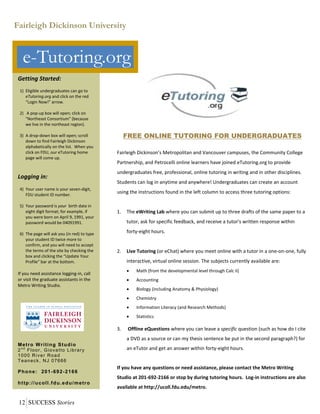
FREE ONLINE TUTORING FOR UNDERGRADUATES
Fairleigh Dickinson’s Metropolitan and Vancouver campuses, the Community College 
Partnership, and Petrocelli online learners have joined eTutoring.org to provide 
undergraduates free, professional, online tutoring in writing and in other disciplines.  
Students can log in anytime and anywhere! Undergraduates can create an account 
using the instructions found in the left column to access three tutoring options: 
 
1. The eWriting Lab where you can submit up to three drafts of the same paper to a 
tutor, ask for specific feedback, and receive a tutor's written response within 
forty‐eight hours.  
 
2. Live Tutoring (or eChat) where you meet online with a tutor in a one‐on‐one, fully 
interactive, virtual online session. The subjects currently available are: 
 Math (from the developmental level through Calc II)  
 Accounting  
 Biology (including Anatomy & Physiology)  
 Chemistry   
 Information Literacy (and Research Methods)  
 Statistics 
3.  Offline eQuestions where you can leave a specific question (such as how do I cite 
a DVD as a source or can my thesis sentence be put in the second paragraph?) for 
an eTutor and get an answer within forty‐eight hours. 
 
If you have any questions or need assistance, please contact the Metro Writing 
Studio at 201‐692‐2166 or stop by during tutoring hours.  Log‐in instructions are also 
available at http://ucoll.fdu.edu/metro.
Fairleigh Dickinson University
e-Tutoring.org
Getting Started: 
 
1) Eligible undergraduates can go to 
eTutoring.org and click on the red 
“Login Now!” arrow. 
 
2)  A pop‐up box will open; click on 
"Northeast Consortium" (because 
we live in the northeast region). 
 
3) A drop‐down box will open; scroll 
down to find Fairleigh Dickinson 
alphabetically on the list.  When you 
click on FDU, our eTutoring home 
page will come up. 
 
 
Logging in: 
 
4) Your user name is your seven‐digit, 
FDU student ID number. 
 
5) Your password is your  birth date in 
eight digit format; for example, if 
you were born on April 9, 1991, your 
password would be 04091991. 
 
6) The page will ask you (in red) to type 
your student ID twice more to 
confirm, and you will need to accept 
the terms of the site by checking the 
box and clicking the “Update Your 
Profile” bar at the bottom. 
 
If you need assistance logging‐in, call 
or visit the graduate assistants in the 
Metro Writing Studio.
Metro Writing Studio
2n d
Floor, Giovatto Library
1000 River Road
Teaneck, NJ 07666
Phone: 201-692-2166
http://ucoll.fdu.edu/metro
Spring/Summer 13
SUCCESSful Reflections
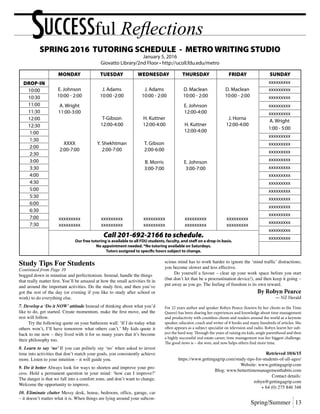
		 E. Johnson	 J. Adams	 J. Adams	 D. Maclean	 D. Maclean	
		 10:00 - 2:00	 10:00 -2:00	 10:00 - 2:00	 10:00 - 2:00	 10:00 - 2:00
			 	 	
		 A. Wright			 E. Johnson
		 11:00-3:00			 12:00-4:00
			 T-Gibson	 H. Kuttner		 J. Horna		
			 12:00-4:00	 12:00-4:00	 H. Kuttner	 12:00-4:00	 		
				 	12:00-4:00	
					
		 XXXX	 Y. Shekhtman	 T. Gibson
		 2:00-7:00	2:00-7:00	2:00-6:00	
			 	 	
		 		 B. Morris	 E. Johnson
				 3:00-7:00	 3:00-7:00
		 xxxxxxxxx	xxxxxxxxx	xxxxxxxxx	xxxxxxxxx	xxxxxxxxx
		 xxxxxxxxx	xxxxxxxxx	xxxxxxxxx	xxxxxxxxx	xxxxxxxxx
Drop-in
10:00
10:30
11:00
11:30
12:00
12:30
1:00
1:30
2:00
2:30
3:00
3:30
4:00
4:30
5:00
5:30
6:00
6:30
7:00
7:30
xxxxxxxxx
xxxxxxxxx
xxxxxxxxx
xxxxxxxxx
xxxxxxxxx
A. Wright
1:00 - 5:00
xxxxxxxxx
xxxxxxxxx
xxxxxxxxx
xxxxxxxxx
xxxxxxxxx
xxxxxxxxx
xxxxxxxxx
xxxxxxxxx
xxxxxxxxx
xxxxxxxxx
xxxxxxxxx
xxxxxxxxx
xxxxxxxxx
xxxxxxxxxCall 201-692-2166 to schedule.
Our free tutoring is available to all FDU students, faculty, and staff on a drop-in basis.
No appointment needed. *No tutoring available on Saturdays.
Tutors assigned to specific hours subject to change.
	MONDAY	 TUESDAY	 WEDNESDAY	 THURSDAY	 FRIDAY	 SUNDAY
SPRING 2016 TUTORING SCHEDULE - METRO WRITING STUDIO
January 5, 2016
Giovatto Library/2nd Floor • http://ucoll.fdu.edu/metro
Study Tips For Students
Continued from Page 10
bogged down in minutiae and perfectionism. Instead, handle the things
that really matter first. You’ll be amazed at how the small activities fit in
and around the important activities. Do the study first, and then you’ve
got the rest of the day (or evening if you like to study after school or
work) to do everything else.
7. Develop a ‘Do it NOW’ attitude Instead of thinking about what you’d
like to do, get started. Create momentum, make the first move, and the
rest will follow.
	 Try the following quote on your bathroom wall: ‘If I do today what
others won’t, I’ll have tomorrow what others can’t.’ My kids quote it
back to me now – they lived with it for so many years that it’s become
their philosophy too.
8. Learn to say ‘no’ If you can politely say ‘no’ when asked to invest
time into activities that don’t match your goals, you consistently achieve
more. Listen to your intuition – it will guide you.
9. Do it better Always look for ways to shorten and improve your pro-
cess. Hold a permanent question in your mind: ‘how can I improve?’
The danger is that we fall into a comfort zone, and don’t want to change.
Welcome the opportunity to improve.
10. Eliminate clutter Messy desk, house, bedroom, office, garage, car
– it doesn’t matter what it is. When things are lying around your subcon-
scious mind has to work harder to ignore the ‘mind traffic’ distractions;
you become slower and less effective.
	 Do yourself a favour – clear up your work space before you start
(but don’t let that be a procrastination device!), and then keep it going –
put away as you go. The feeling of freedom is its own reward.
By Robyn Pearce
— NZ Herald
For 22 years author and speaker Robyn Pearce (known by her clients as the Time
Queen) has been sharing her experiences and knowledge about time management
and productivity with countless clients and readers around the world as a keynote
speaker, educator, coach and writer of 8 books and many hundreds of articles. She
often appears as a subject specialist on television and radio. Robyn learnt her sub-
ject the hard way. Through the years of raising six kids, single parenthood and then
a highly successful real estate career, time management was her biggest challenge.
The good news is – she won, and now helps others find more time.
Retrieved 10/6/15
https://www.gettingagrip.com/study-tips-for-students-of-all-ages/
Website: www.gettingagrip.com
Blog: www.bettertimemanagementhabits.com
Contact details:
robyn@gettingagrip.com
+ 64 (0) 275 846 348
14	SUCCESS Stories
SUCCESS Program Highlights
or Paramedic). Other profes-
sional program may likewise
yield college credit, e.g. Fairleigh
Dickinson University’s Paralegal
Program, Certified Financial Plan-
ning, etc., contact the office of
Continuing Education at 201-692-
7153.
Scores and/or transcripts for
standardized exams and ACE
credit are sent directly to the
Admissions Office (for new
students) or to the Records Office
(for continuing FDU students)
on the student’s home campus.
Corollary Recommendations for
law enforcement, CPR and EMT
credentials are forwarded through
the transfer evaluator, Petrocelli
College for Continuing Studies
Metropolitan Campus. Challenge
exam results are forwarded by
the FDU department/school to
the Records Office with a copy to
your advisor.
Consult with your academic ad-
visor/advising center for details of
approximating for your academic
plan and associated processes.
• 	 Classes which satisfy general
	 education, core and major
	 requirements offered for adult
	 learners. (See Curriculum
	 Corner and WebAdvisor
	 for each Fall and Spring
	semester)
•	 SUCCESS Stories
	newsletter
	 Published twice per year.
•	 Enrollees may have certain
	 college courses waived*
:
		 • Freshman Seminar
		 • Physical Education
	 *
At the option of the student
	 in consultation with their
	 advisor. Based on the major,
	 the total number of credits
	 must be satisfied for the
	 baccalaureate degree.
	 In addition, to meet foreign
	 language requirements,
	 SUCCESS students may take
	 Literature in Translation
	 courses. (Lang Courses) or the
	 Elementary Languages I & II.
•	 SUCCESS Program
	 individualized advisement
	 In addition to “major”
	 advisors, the SUCCESS
	 Program welcomes you to
	 inquire about academic issues
	 and guidance. Call for an
	 appointment.
	 Dr. Denise Hart, Director,
	 Adult Education
	 201-692-7153, 6508
	 or via E-mail: hart@fdu.edu
•	 Adult Student Admissions
	Information
	 Hear about the SUCCESS
	 Program and opportunities for
	 adult learners. Call Adult
	 Admissions for more
	 information:
	 201-692-2551.
•	 Portfolio Assessment of
	 experiential learning
	 (“life/work experience”)
	 equal to college-level
	learning.
	 Students are encouraged to
	 consider developing portfolios
	 for experiential learning credit
	 evaluation. A maximum of 30
	 credits can be earned in this
	 way. This involves identifying
	 your experiential learning that
	 is equal to a course or courses
	 currently offered at FDU and
	 demonstrating by portfolio
	 that you have acquired the
	 knowledge, skills, & compe-
	 tencies normally learned
	 through an academic course.
	 Each semester, portfolio
	 workshops are offered on the
	 Metropolitan Campus to
	 explain the portfolio format
	 and process.
	 For information, call
	 201-692-7153.
•	 Other Credit Options
	 Adult students may also
	 explore the variety of credit
	 bearing options available to
	 them. These include FDU
	 challenge exams (where
	 available), CLEP, TECEP,
	 Excelsior College exams,
	 DSST’S, NYU Language
	 Proficiency Exams, ACE
	 College Credit Recommenda-
	 tion Service awards, FDU
	 expert evaluated Corollary
	 College Credit Recommenda-
	 tions for law enforcement, 	
	 CPR and EMT (Basic and/
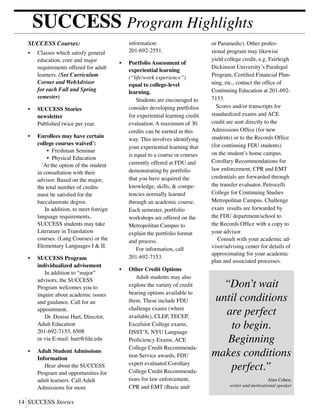
SUCCESS Courses:
“Don’t wait
until conditions
are perfect
to begin.
Beginning
makes conditions
perfect.”
Alan Cohen,
writer and motivational speaker
Spring/Summer 15
SUCCESSful Reflections
Bliss, Elation, Achievement,
SUCCESS…
Bliss, elation, achievement, SUCCESS….these are
just some of the adjectives that describe my feelings
in September 2015, when I graduated from FDU. My
graduation would not have been achieved until some-
time in 2016 (or later), if it were not for the Experiential
Learning Program’s Portfolio Assessment that is avail-
able to FDU students. This is a particularly attractive
program to adult learners or non-traditional students,
as we typically have expertise derived through work,
certifications, life, or other means that provide an op-
portunity to translate those skills and experiences into
college credits.
	 By way of background, I was an Accounting major
at Florham-Madison campus many years ago and had
nearly three of my four years of university completed
when life interrupted school. I had to work full time to
help my family and, through hard work and having a
good academic foundation, my career in financial ser-
vices thrived, as I was most fortunate along the way to
have employers base their hiring decisions on my work
product and ethics, not strictly a degree. With this said,
years later, I was frustrated that I could not complete
my degree due to schedule limitations, which did not
fit with traditional classes, and, having moved out of
the area, the process would be elongated, as universi-
ties require upper level classes be taken through their
programs, thus I would have to duplicate courses al-
ready completed. Further, I had growing concern that
at some point the absence of a degree would prohibit
me from obtaining a desired job opportunity. In fact,
even though I was generally being recruited instead
of seeking out jobs, I always felt like I was holding my
breath through the process, as I was not sure the hiring
company would be comfortable that I did not have my
degree, especially as I advanced into more senior posi-
tions with increased responsibilities. It felt like a dark
cloud that followed me around, as all of my colleagues
had their Bachelor’s degree, if not their Master’s. It was
just the standard in my industry – I was an anomaly.
	 Later, with the growth of online degree opportu-
nities across the nation, I sought out a university pro-
gram that would utilize my hard earned credits, pro-
vide the flexibility a full-time working mother that had
to travel would need, and propose a reasonable path to
obtain my degree as quickly as possible. FDU’s Bach-
elor of Arts in Individualized Studies (BAIS) degree, a
baccalaureate degree program structured to meet the
educational needs of adult learners was the perfect fit.
So, in the fall of 2013, I began my journey to achieve
my long-time goal of a college degree.
	 While taking some classes online, I began to ex-
plore the other options FDU offers to its students,
specifically the aforementioned Portfolio Assessment.
Through the thoughtful, thorough guidance of Dr.
Hart and her team, who coordinated with other advi-
sors and professors throughout the process, as well as
provide tons of encouragement and support, cham-
pioning me and my work, I was able to earn (10) ten
credits. The courses ranged from Presenting Technical
Information (ENGW 3004, 3 credits), which satisfied
my advanced writing requirement to Jogging for Fit-
ness (PHED 1126, 1 credit), which filled a free elective.
Even though a course may not be offered in a particular
semester, as long as it is listed in Coursefinder and is an
appropriate fit for your skill or experience, a student
may seek a Portfolio Assessment with Advisor approv-
al. Adult (and other) learners should keep in mind this
is a wonderful option to present your experience and
receive college credit, which expedites your degree and
lowers your educational expense. Through the SUC-
CESS Program, work and life experience is valued and
recognized by awarded course credit.
	 I will forever be grateful to Dr. Hart and her team,
who truly looked for each and every way they could
help me achieve success. I encourage FDU students to
take advantage of this amazing, progressive program
and its team. Now, while it may read a little corny, my
dark cloud has been replaced by academic sunshine. I
no longer worry that someone may learn I didn’t have
my degree. I have a new confidence and I can breath
easy. In fact, my degree has afforded me the opportu-
nity to pursue a new job opportunity, which I recently
started. I am enjoying the fruits of my SUCCESS each
and every day.
C.M.
16	SUCCESS Stories
UCCESSful ReflectionsSPortfolio Assessment
Continued from page 5
get an idea of what classes you might be able to apply for.
	 If they bestowed degrees for getting through “the
school of hard knocks,” or for “street smarts,” all adult
learners would be Ph.D.’s, right? Yet submitting a portfolio
leverages knowledge we have picked up along the way
from the time we were of traditional college age up to now.
We adult learners have an edge on our younger fellow stu-
dents. We have already mastered many of the subjects and
skills being taught and/or required of them, and we may
receive credit for that learning.
	 Take for instance, an introductory course in computer
usage. If you’re as old as I am, you have been using a PC
and business software since PC’s became desktop staples
in the early eighties. You probably remember a time when
“windows” were something made of glass, and that before
you could get a PC to do anything for you, you had to mas-
ter MS-DOS. My point is that, having learned all of this,
by the time that the Windows®
operating system caught on,
you already had become proficient with a PC and learning
Windows®
and the graphical versions of other Office®
soft-
ware was second nature. So why reinvent the wheel when
you can demonstrate that you have already acquired the
skills and knowledge taught in that class and can move on
to higher level learning? So flip through the course catalog
and glance at your
check sheet. You will probably find other classes you can
satisfy by portfolio assessment of your learning.
	 Once you have decided on which courses you want to
submit portfolios for, fill out the forms and get your advi-
sor to pen his/her approval. Also, if at all possible obtain
a copy of the syllabus for each course you are applying for
so that you can provide documentation that addresses the
course content. You’re now ready to start building.
Do You Know Me?
	 When you take a traditional class you get to interact
with other students and your professor, who gets to know
you as the course proceeds. The reverse, however, is true
when your portfolio is being evaluated. Chances are that
you might never meet your portfolio evaluator and, more
importantly, he/she will not know you from Adam (or
Eve). That’s why it is very important that your portfolio
convey a sense of who you are. You will do this to a great
extent when you write your narrative for each course for
which you build a portfolio—we will discuss this later. Yet
for everything you do from here on, you need to put your-
self in the reviewer’s shoes. This is the person to whom
you must demonstrate that you have satisfied the course
content. Don’t assume (and don’t expect) he/she will read
through a vague set of papers tucked into a binder. Do
the reviewer a favor by including only pertinent items.
Organize your portfolio well to make his/her job easier to
award you the credits you covet.
Just the Facts
	 You need to provide documentation that demonstrates
your mastery of the knowledge and proficiency in the
skills are equivalent to the courses for which you seek
portfolio evaluation. There are numerous ways in which
you can document what you have learned. We were
brought up to be humble, but in the case of portfolio
building, do not hesitate to blow your own horn if the data
you submit backs you up. The following is a partial list of
items you might use for inclusion in your portfolio:
	 •	Job performance evaluations that specifically
		 describe your proficiency/skill in the subject
		 matter (e.g., the quality of your presentations). An
		 appraisal that merely states you are a good worker
		 without quantifying what it is you are good at is
		 not enough;
	 •	Certificates for completing in-company training
		 (e.g., software training, public speaking classes,
		 etc.); Examples of your work (e.g., samples of
		 your writing, examples of work created with each
		 of the MS-Office®
suite of software, CD’s.
		 videotape and/or slides of a speech or
		 presentation, etc.);
	 •	Letters from your employer/manager that provide
		 testimonials of your learning or skills. These can
		 expand upon the more austere job appraisal. In
		 some cases, a letter from a peer may also be
		 acceptable/appropriate; Awards received in
		 connection with mastery of the subject matter.
• External customer commendations if they
		 demonstrate the course skills.
	 There are countless other sources you might use, de-
pending on the portfolio. Don’t be afraid to be creative.
Continued on page 17
Spring/Summer 17
UCCESSful ReflectionsSPortfolio Assessment
Continued from page 16
Pulling it Together: Presentation is Everything!
	 As I mentioned earlier, your task is to demonstrate that
your portfolio has fulfilled FDU’s course content. A neat,
well laid-out portfolio binder goes a long way in stating
your case for course credit:
	 •	Follow the prescribed ordering as described in the
		 portfolio workshop. Itemize EVERYTHING in
		 your portfolio-every last letter, evaluation, etc.;
	 •	Besides inventorying the whole of your portfolio
		 in your table of contents,
	 •	Consider sub-indices at every tab page. (I did this,
		 and it looked great!);
	 •	Use plastic page protectors and tab separator
		 pages with differently-colored tabs;
	 •	If you are submitting non-paper items (e.g.,
		 diskettes, video tapes, etc.) consider a pocket page
		 to place these in. This looks nice, and minimize
		 the chance of loss if they are securely in their
		 pockets.
The Narrative
	 Now it’s time to make your case – why should FDU
give you course credit for knowledge obtained outside
of the traditional classroom? I highly recommend writ-
ing your narrative last, after the collection of all of your
documentation. (You have listed it in your index and have
reserved a tab for it already, right?) By saving it until the
end, it will allow you to write a narrative that will be clear
and concise, now that you know what your portfolio con-
tains.
	 Keep it flowing. Briefly introduce yourself, and
explain how you learned and mastered the subject matter
for the courses in your portfolio. Act as a tour guide to the
evaluator. Walk them through the items in your portfolio.
Explain the relevance of items, especially those that may
not be self-explanatory. Build step by step, item by item,
demonstrating how each item leads to satisfaction of the
course requirements. Sum up and draw a conclusion that
the aggregate of all the items in your portfolio prove you
have, indeed, met the objectives for the course.
Parting Thoughts
	 Although I had a fairly clear idea of what would be in
each of my portfolios, I spent probably an equal amount
of time each between planning, gathering documentation,
portfolio aesthetics, and penning the narrative. It took a lot
of time, perfectionist that I am. Was it worth it? You bet!
Not having to take the classes, for which I submitted the
portfolios, not only saved time, but also catapulted me closer to
graduation.
Submitted by M. Budig (slightly edited) A “Success-ful” student Spring 2002
It’s time to register for class…
Every student requires academic advisement in or-
der to register for a credit course toward a degree. If
you are new to FDU, your initial contact at the univer-
sity, most likely the Admissions Office, will direct you
to an academic advisor. If you are a returning student,
you will be revisiting your academic advisor. See FYI in
this newsletter for a listing of Program Advisors at the
Metro campus.
	 When advising and registration for the next semester
begins, there are some things you’ll need:
	 1. Knowledge of the course listings found on
	 Webadvisor (www.fdu.edu) for the current semester
	 2. A registration form (either electronic or hard copy,
	 provided by your academic advisor)
Prior to your appointment:
	 • Check to see if an appointment is required with
		 your advisor
	 • Gather all relevant papers to bring with you,
		 i.e. transcripts
	 • Identify the days you’ll be able to take classes
	 • Familiarize yourself with the courses required in
		 your curriculum
	 • See which courses are offered at the times you have
		 available. Use Webadvisor and Coursefinder
		 (www.fdu.edu), the Success Stories newsletter
		 Curriculum Corner, and the recommendations of
		 your faculty and advisors
	 • Some courses are restricted, some have
		 prerequisites, etc.
	 • Register early. Some courses close early, especially
		 those which are required.
	 • Be sure that all fees and tuition from previous
		 semesters have been paid (outstanding fees may
		 prevent a current registration, check Webadvisor if
		 you’re a current student).
Continued on page 18
18	SUCCESS Stories
UCCESSful ReflectionsS
Interested in getting
“Experiential Learning Credit”
via Portfolio Assessment?
For information, please call 201-692-7153
or E-mail: judyg@fdu.edu
It’s Time To Register
Continued from page 17
At your appointment:
	 • Your advisor will provide a registration form
	 • Review your work and home schedules, in order
		 to develop an appropriate academic schedule;
		 select a schedule of classes.
	 • When making your course selection, refer to your
		 checksheet. Your check sheet shows your degree
		 requirements. This document specifies the course
		 requirements for your curriculum. Be sure to select
		 a course for a requirement you have not yet
		 completed.
	 • You may be able to meet with your advisor “at a
	 distance” via phone and/or email. Check to confirm.
Advising and Registration Tips
	 When making your course selection, please consider
these tips:
	 • Complete your basic degree requirements and
		 prerequisite courses (English Composition,
		 humanities, social sciences, etc.) before selecting
		 upper level, more specialized courses.
	 • Note the start and end dates of courses you select,
		 and location of classes.
	 • Familiarize yourself with course and program
		 requirements; some courses have prerequisites;
		 some courses are sequential and must be taken in a
		 certain order.
	 • You will be contacted if the course you chose is not
		 available.
	 • As a courtesy, call/email to cancel an appointment
		 with sufficient notice
	 • If you have more than one advisor, i.e. BAIS &
		 HRTM, QUEST & ___, be sure you have met with
		 both advisors and that they have conferred re your
		 present registration.
Electronic Registration for Success Program/Office
of Adult Education:
	 • After meeting with your advisor, and have
		 approval for your schedule, complete the
		 registration form that will be sent to you upon
		 request and return via email or fax. Please read the
		 University policies on the second page.
To complete the form:
	 • Electronically: type the information requested into
		 the gray areas and sign the form by typing in your
		 name. Save the file and then attach it to an email
		 and send to judyg@fdu.edu in the Success		
		 Program office.
	 •	 By Hand: print the form, complete it by hand
		 (including signature) and fax it to 201-692-6505.
		 No cover page is required.
	 You may not register online for ‘Restricted’ Success
Program classes. Approval by the Director, Adult Edu-
cation and the Success Program is necessary for these
classes.
Note: follow procedures for BAIS online and CASS or
other academic advising as outlined by those offices.
Electronic Registration for Office of Online Programs:
	 •	 Complete the electronic registration form provided
		 upon request and return via email or fax. Please
		 read the University policies on the second page.
To complete the form:
	Electronically: type the information requested into
the gray areas and sign the form by typing in your
name. Save the file and then attach it to an email to
jsteiner@fdu.edu. Please email your form to only one
person (one email address).
	 By Hand: print the form, complete it by hand (includ-
ing signature) and fax it to 201-692-7359. No cover
page is required.
	 Check with the Office of Online Programs in advance
of registration if there are any questions.
Spring/Summer 19
SUCCESSful Reflections
New Dietary Guidelines & Cheat Sheet
Lets face it, dietary advice can be confusing! Nutri-
tion studies are constantly being conducted and
published, and figuring out the results and what they
mean can be extremely dumbfounding. To help make
all this information more “palatable”, the federal gov-
ernment releases updated dietary guidelines every
5 years. Just a few days ago, the government released
the most recent dietary guidelines. While some of the
guidelines have remained consistent, a few may shock
you!
	Sugar: Sugars basically fall into one of two categories,
naturally occurring sugars (found in fruit and plain dairy
products) AND added sugars. According to the guidelines,
we should keep added sugars to less than 10% of our daily
calories. The average American’s sugar intake is 22 teaspoons
per day, and this new limit only allows about 12 teaspoons.
To put this in perspective, a 12-oz can of coke contains al-
most 10 teaspoons of sugar! While one does not have to go
crazy counting sugar grams and teaspoons, it is very impor-
tant to cut back on added sugars.
	Coffee: Starbucks and Dunkin Donut fans unite! For
the first time, the guidelines say that a “moderate” amount of
joe (up to five cups a day) is beneficial for health. The panel
agrees that having coffee daily can help reduce the risk of
heart disease and type 2 diabetes. With that said, enjoy your
daily cup, but remember to limit your added sugar intake.
	 Red Meat/Protein: According to recommendations,
red meat, in moderation is OK, especially if you choose lean
cuts (sirloin, filet, 93% lean ground beef) and don’t overdo
your servings. But to really reduce your overall saturated fat
intake, I recommend choosing leaner proteins, like skinless
poultry, fish, seafood, legumes and soy.
	 Salt: Less than 2,300 milligrams/day for everyone. This
is equivalent to one teaspoon. (Previously, guidelines said if
you were African-American, older than 50 or had certain
chronic conditions, the recommended limit would have
been 1,500 mg/day).
	Cholesterol: For years, Americans were told to limit
their cholesterol to 300 milligrams, the amount in 2 whole
eggs. But egg lovers rejoice, there is no longer a strict limit.
But for heart health, it is important to be mindful of your
overall cholesterol intake. While an egg yolk a day is OK, it is
still important to limit your intake of other high cholesterol
foods like fried foods, pastries, and fatty meats.
	 Another major dietary guideline change is the shift
from focusing on individual nutrients to adopting an over-
all healthy eating pattern. Here is a cheat sheet to help you
incorporate the guidelines into your lifestyle:
How to incorporate the new guidelines:
Eat more of:
	 •	 A variety of vegetables: dark green, red and orange,
		 and other vegetables
	 •	 Fruits, especially whole fruit
	 •	 Grains, at least half of which are whole grain
	 •	 Fat-free or low-fat dairy, including milk, yogurt,
		 cheese, and/or fortified soy beverages
	 •	 A variety of protein foods, including seafood, lean
		 meats and poultry, eggs, legumes (beans and peas),
		 soy products, and nuts and seeds
	 •	 Oils (in moderation), including those from plants:
		 canola, corn, olive, peanut, safflower, soybean and
		 sunflower. Oils also are naturally present in nuts,
		 seeds, seafood, olives and avocados.
Eat less of:
	 • Added sugars
	 • Read Labels: Reading the ingredient list on a food
		 label can tell you if the product contains added sugar.
		 Names for added sugar include: Raw sugar, brown
		 sugar, cane sugar, sucrose, glucose, fructose, malt,
		 maltose, corn syrup, lactose, sorbitol, mannitol,
		 honey, molasses, evaporated cane juice, and barley
		 malt extract.
	 • Cut back on the amount of sugar added to the things
		 you eat or drink regularly, like coffee, cereal,
		 pancakes or tea.
	 •	 Choose seltzer or water over soda and juice
	 •	 Limit your intake of processed sweets like cookies
		 and candy and instead, choose fresh fruit or fruits
		 canned in water or natural juice
	 • Saturated and trans fats
	 • Limit intake of fatty meats, whole milk dairy/cheese,
		 fried food, baked goods
	 • Sodium
	 •	 Put down the salt shaker and instead, season with
		 spices and herbs
	 •	 Choose “whole” foods over processed foods
	 •	 Limit dining/eating out
Retrieved from info@riverfrontnutrition.com,
January 11, 2016, With Permission.
Office of Adult Education
Fairleigh Dickinson University
1000 River Road, H-DH1-02
Teaneck, New Jersey 07666
Experiential Learning
Workshop Dates
March 31, 2016
May 19, 2016
If you believe you have experiential learning
that is equivalent to college level courses taught
at FDU, you may want to attend an Experiential
Learning Workshop to develop a means for identify-
ing your learning and demonstrating educational ac-
complishments. There is a fee to cover materials and
recommended readings.All workshops are held from
6-9:30 pm at the Metropolitan Campus.
To register for the workshop,
please call 201-692-7153 or
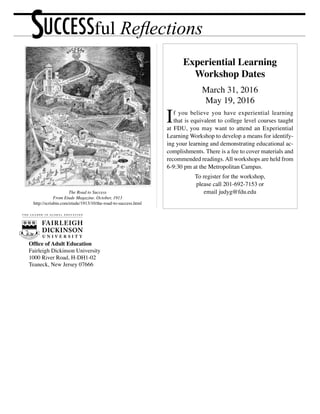
email judyg@fdu.eduThe Road to Success
From Etude Magazine. October, 1913
http://scriabin.com/etude/1913/10/the-road-to-success.html
SUCCESSful Reflections

Success Stories Single Pages Spring 2016

  • 1.
    UCCESS toriesSSSUCCESS ProgramAdvising SUCCESS students can benefit from multiple advisement resources. As an FDU student, you may utilize the Advisement Center on campus (Robison Hall), the faculty in your “major” department, and the SUCCESS Program office. Day and/or evening appointments. Other advisement professionals including Career Management staff are also available. An appointment with Dr. Denise Hart, Director of Adult Education, can be made by calling 201-692-7153, 6508 or E-mail: hart@fdu.edu SUCCESSInside 2-3 Curriculum Corner 5 A SUCCESSful Portfolio Assessment 6-7 FYI 4-19 Successful Reflections 14 SUCCESS Program Highlights ABOUT THIS NEWSLETTER SUCCESS stories is a publication of the Office of Adult Education and for SUCCESS Program students who are undergraduate adult learners seeking a baccalaureate degree. Your contributions, comments and recommendations about issues, policies and procedures which affect the adult learner are important to us. Submit your typed/word processed recommendations/ideas directly to Dr. Denise Hart, Director, Adult Education, SUCCESS Program, Fairleigh Dickinson University, 1000 River Road, H-DH1-02, Teaneck, New Jersey 07666. VOLUME 24, ISSUE 32 ACADEMIC SUPPORT SERVICES FOR ADULT LEARNERS MARCH 2016 The Secret Weapon That Will Make You and Your Business Stand Out in the War of Ideas Posted by Carolyn Kilmer on February 8, 2016 in Book News, Entrepreneur.com. ASilicon Valley venture capital investor turned to me during a recent lunch and said, “I’ve seen more than 2,000 pitches, and I can only remember about 10 of them.” “What made the 10 stand out?” I asked. “They all told a personal story.” Professional investors agree: ideas that catch on are wrapped in story. “Show me an MBA and your sales numbers, that’s fine. But tell me a great story about how you got started and your vision, and we’ll talk.” says Shark Tank’s Barbara Corcoran. Although stories inform, illuminate and inspire, very few en- trepreneurs and business professionals are aware of the power of story to persuade. But it gives those who do master the art of story- telling a significant competitive advantage. In today’s increasingly automated world where robots are replacing humans in nearly ev- ery task, storytelling is the one skill that will keep you relevant and successful through your career. “Storytelling is the most underrated skill,” says Ben Horowitz, general partner with venture capital firm Andreessen Horowitz. “The company story is the company strategy. If don’t have a clearly articulated story, you don’t have a clear and well thought-out strat- egy. The story must explain at a fundamental level why you exist.” While conducting the research for my new book, The Storyteller’s Continued on page 7
  • 2.
    2 SUCCESS Stories Curriculum Corner SUCCESSProgram Courses, Fall 2016 Note: All Fall 2016 courses listed below are offered at the Metropolitan campus. UNIV 2001.54 Cross Cultural Perspectives (3) TH 5:30-8:00 pm UNIV 2002.53 Global Issues (3) T 5:30-8:00 pm BIOL 1060.51 Genetics & Society Lecture (3) TH 5:30-7:10 pm BIOL 1061.51 Genetics & Society Lab TH 7:20 – 9:00 pm Recommended for Success Students BIOL 1105.21 The Human Environment (3) T 8:00-9:40 am BIOL 1115.21 Lab W 8-9:40 am Recommended for Success Students BIOL 1105.52 The Human Environment (3) W 5:30-7:10 pm BIOL 1115.52 Lab W 7:20-9:00 pm Recommended for Success Students BIOL 1105.53 The Human Environment (3) M 5:30-7:10 pm BIOL 1115.53 Lab M 7:20-9:00 pm Recommended for Success Students BIOL1106.51 Over the Counter Drugs (3) W 5:30-7:10 pm BIOL1116.51 Lab W 7:20-9:00 pm Recommended for Success Students BIOL1106.52 Over the Counter Drugs (3) M 5:30-7:10 pm BIOL1116.52 Lab M 7:20-9:00 pm Recommended for Success Students CHEM 1118.51 Forensic Science (3) M 5:30-7:10 pm CHEM 1119.51 Lab M 7:30-9:00 pm Recommended for Success Students CHEM 1119.21 Lab (3) M 3:30-5:10 pm Recommended for Success Students CHEM 1119.22 Lab (3) M 1-2:40 pm Recommended for Success Students ENVR 1101.21 Physical Geology (3) M 11:50 am-1:30 pm ENVR 1102.21 Lab M 10:00 am-11:40 am Recommended for Success Students PSYC 2204.51 Child Development (3) T 5:30-8:00 pm Recommended for Success Students PSYC 3317.51 Psychology and the Law (3) W 5:30-8:00 pm Recommended for Success Students PSYC 3330.51 Health Psychology (3) TH 5:30-8:00 pm Recommended for Success Students PSYC 4431.21 SS: Behavioral Psychology (3) MW 10-11:15 am Recommended for Success Students CREDITS Editor in Chief Dr. Denise Hart Graphic Designer Craig M. Cannon Contributors Mark Budig, C.M., Dr. Denise Hart, Evangelina Ocasio, Robyn Pearce, and Julia Wagner
  • 3.
    Spring/Summer 3 Curriculum Corner CurriculumCorner Continued from page 2 BUSI 3620.E1B Human Resource Systems (3) Peiffer T 5:30-9:30 pm RESTRICTED to Success Students Note: Success Students, Dept. Chair Approval Restr: Open to students in Individual Studies, Liberal Arts, or Hotel Rest, Cannot register online. Please see the department chairperson, Students cannot register for this course online. Class meets August 30-October 11, 2016 inclusive. ENVR 1104.E1B Principles of Physical Geography (3) Konsevick M 5:30-9:30 pm RESTRICTED to Success Students Note: Success Students, Dept. Chair Approval Restr: Open to students in Individual Studies, Liberal Arts, or Hotel Rest, Cannot register online. Please see the department chairperson, Students cannot register for this course online. Class meets August 29, September 12-October 17, 2016 inclusive. HIST 2105.E1B Crime in History (3) Dodd M 5:30-9:30 pm RESTRICTED to Success Students Note: Success Students, Dept. Chair Approval Restr: Open to students in Individual Studies, Liberal Arts, or Hotel Rest, Cannot register online. Please see the department chairperson, Students cannot register for this course online. Class meets October 24-December 12, 2016 inclusive. HIST 3308.E1B Native American History (3) Mulligan M 5:30-9:30 pm RESTRICTED to Success Students Note: Success Students, Dept. Chair Approval Restr: Open to students in Individual Studies, Liberal Arts, or Hotel Rest, Cannot register online. Please see the department chairperson, Students cannot register for this course online. Class meets October 25-December 13, 2016 inclusive. INTER 4438.E1B Ethics & Public Affairs (3) Markowski W 5:30-9:30 pm RESTRICTED to Success Students Kane Note: Success Students, Dept. Chair Approval Restr: Open to students in Individual Studies, Liberal Arts, or Hotel Rest, Cannot register online. Please see the department chairperson, Students cannot register for this course online. Class meets August 31-October 12, 2016 inclusive. MATH 1131.E2B College Math I (3) J. Colagreco TH 5:30-9:30 pm RESTRICTED to Success Students Note: Success Students, Dept. Chair Approval Restr: Open to students in Individual Studies, Liberal Arts, or Hotel Rest, Cannot register online. Please see the department chairperson, Students cannot register for this course online. Class Meets September 1-October 13, 2016 inclusive. HUMN 3002.EIB Table Talk: Literature of Food (3) J. Colagreco TH 5:30-9:30 pm RESTRICTED to Success Students Note: Success Students, Dept. Chair Approval Restr: Open to students in Individual Studies, Liberal Arts, or Hotel Rest, Cannot register online. Please see the department chairperson, Students cannot register for this course online. Class meets October 20-November 17 & December 1-15, 2016 inclusive. “Immense power is acquired by assuring yourself in your secret reveries that you were born to control affairs.” — Andrew Carnegie, Industrialist Retrieved from ASCD Smartbrief.com, Thursday, 2/11/2016 10:47 AM
  • 4.
    4 SUCCESS Stories THEROAD TO CHALLENGE EXAMINATION By Evangelina Ocasio Preparing for the Challenge Exam was a complex but manageable task. As an adult learner I had to jug- gle multiple responsibilities, but this experience proved to be a great exercise in perseverance, determination and commitment. For me and for many other adult learners, obtaining a college degree means far more than academic achievement. It is also an opportunity to build on our professional credentials, and the Chal- lenge Exam allows us to bridge both worlds. As a working adult and parent, I have learned that time is a valuable commodity. Starting the preparation process early was my first step in order to provide ade- quate time for research and writing. Next I began look- ing back at my work experience to identify key aspects that were most relevant to the course objectives/learn- ing outcomes. The guidance and support provided by Dr. Denise Hart in the Office of Adult Education in this regard were indispensable determining factors to my success. I then began reviewing my portfolio and résumé to identify key examples that substantiated my experi- ence. During the Challenge Exam, the examples served as a powerful resource to help demonstrate mastery of the skills and competencies that I was challenging. My next step was anticipating what questions I would be asked in order to prepare accordingly. From the beginning I wanted the look and feel of the presentation and support materials to be a reflec- tion of my professional brand, therefore I created a presentation theme that incorporated my learning and which also followed FDU’s PLA format. Devoting time to the organization and flow of the content narrative, support documentation and letters with an appropriate index made it easier to transition from one point to the next. Preparing for presentation day required rehearsal. I remembered the saying practice makes perfect. Ul- timately, familiarity with the content afforded me the comfort level Continued on page 7 SUCCESSful Reflections “There are many kinds of success in life worth having.” —Theodore Roosevelt, 26th US President Dear Students, Faculty, and Staff: The Metro Writing Studio is open for tutor- ing services for the spring semester. Regu- lar hours of operation are Monday thru Thurs- day 10 am to 7 pm, Friday 10 am - 4 pm, and Saturday 1 pm - 5 pm. For a full schedule of events, check out the Metro Writing Studio on- line at HTTP://UCOLL.FDU.EDU/METRO eTutoring, which provides online tutor- ing services within multiple disciplines is also available. Undergraduates can access these ser- vices by logging onto https://www.etutoring. org/ and following the instructions posted. The studio is staffed with professional writ- ing tutors who are available to help students with their writing needs, and our many workshops are geared toward written assignments. We are look- ing forward to seeing students, faculty, and staff in the studio this spring! ***************************************************** Julia Wagner Senior Lecturer, School of the Humanities Director, Metro Writing Studio Fairleigh Dickinson University 1000 River Road, T-GL1-03 Teaneck, New Jersey 07666 201-692-2165 jawagner@fdu.edu
  • 5.
    Credit for PriorLearning: Are You a Good Candidate? To find out, take the simple assessment below. 1. Do you have five or more years of experience in one field? ■ Yes ■ No 2. Do you have five or more years of experience in fields related to your field that demonstrate a consistency of professional purpose? ■ Yes ■ No 3. In your work, in your field have you been exposed to a broad range of experiences? ■ Yes ■ No 4. Do you usually feel in control of your own successes and failures? ■ Yes ■ No 5. Are you willing to assume new roles and responsibilities? ■ Yes ■ No 6. Do you keep abreast of changes in your profession by reading recent publications and by enrolling in credit or non-credit courses? ■ Yes ■ No 7. Do you formally and informally network with others in your field? ■ Yes ■ No 8. Are you involved or been involved in volunteer activities where you use your professional skills? ■ Yes ■ No 9. Do you want to consolidate your lifetime of learning experiences by earning formal educational or professional recognition? ■ Yes ■ No How Did You Score? 15-18 Points, High probability of success. 10-14 points, Average probability of success. 0-9 points Don’t give up the chance to reap the rewards of your past. Contact an advisor who may notice skills and experiences that you may not have considered, or check out resources in the bookstore on obtaining college credit for life experience. http://www.back2college.com/assesstool.htm So you’ve decided to take advantage of FDU’s Portfo- lio program? Congratulations! Smart move on your part. Now don’t just sit there, do something now! Start plan- ning and putting your portfolio together without delay— graduation is closer than you think. With careful planning and execution now, you can put together a quality portfolio without being rushed or worse, accumulate too many other credits and render your efforts for naught. Here are some tips on how to build a quality portfolio while keeping sane as you race against the clock. First Things First Begin with the easy stuff by getting the preliminar- ies out of the way. After completing your first 6 credits at FDU, sign up for and take a portfolio workshop, where you will receive more comprehensive information than I can provide within the confines of my little vignette. You will receive guidance on submitting the forms and organiz- ing your portfolio. Next, make a trip over to the Records Office on your “home” campus and get a student copy of your transcript. You will need this to provide proof that you have complet- ed six credits at FDU (but less than the maximum allowed and still be able to submit your portfolio), as well as proof that you also meet the minimum GPA requirements to be eligible to submit a portfolio. A student (non-certified) copy is free, by the way, and only takes a minute to obtain. If you don’t already have a copy of the FDU Univer- sity Undergraduate Studies Bulletin (the complete course catalog not to be confused with the newsprint version of the undergraduate and graduate course offering booklet that comes out each semester as an enrollment aid), get one now. You will need this to get an idea of what courses are offered at FDU whose content you may have already learned. You will also need the catalog to copy the course description for each item in your portfolio for which you are seeking course credit. Lastly, get a copy of your FDU check sheet from your academic advisor. Required as part of your portfolio, your check sheet will tip you off on FDU-required basic courses that you may able to satisfy by portfolio. And while you’re there, discuss your plan to submit a portfolio and obtain the forms you will need (application for portfolio assessment and portfolio evaluation course request form). This way, your advisor won’t be surprised when you ap- proach him/her for their signature, nor will you be fum- bling to fill out the forms on the spot when you do get your advisor to sign-off on your portfolio application. By the way, you’ll also get copies of the forms that you’ll need at the Portfolio Workshop. Been There, Done That Now that you have run around and gathered every- thing in the last section, catch your breath and open up the FDU course catalog and start flipping through it to Continued on page 16 SUCCESSful Reflections A Recipe for “Successful” Portfolio Assessment Spring/Summer 5
  • 6.
    or our nformation IYFUNDERGRADUATE PROGRAM ADVISORS METROPOLITAN CAMPUS Inordertoplanyouracademicprogramandregisterforthecomingsemester,youmustvisityourAcademicAdvisor, the Academic Advisement Center, located in Robison Hall, or call the appropriate school, as indicated below, to schedule an appointment with a faculty advisor. School/Department Advisor Only PROGRAM SCHOOL/DEPARTMENT TELEPHONE Medical Technology, School of Nursing & Allied Health 201-692-2888 Nursing, Allied Health Technology, Clinical Lab Science & Radiologic Technology & Physical Therapy Electrical Engineering, School of Computer Sciences & Engineering 201-692-2260 Civil Engineering Technology Construction Engineering Technology, Electrical Engineering Technology, Information Technology, Mechanical Engineering Technology, Computer Science & Mathematics QUEST: Teacher School of Education 201-692-2853 Certification Program Interdisciplinary Studies Petrocelli College 201-692-2741 Individualized Studies Petrocelli College 201-692-2746 Psychology (Juniors & Seniors only) School of Psychology 201-692-2300 School/Department Advisor PREFERRED If you are unable to reach a Faculty Advisor in your school or department listed below, please call the Academic Advisement Center at 201-692-2339. PROGRAM SCHOOL/DEPARTMENT TELEPHONE Criminal Justice School of Criminal Justice, Political Science and International Studies 201-692-2465 Academic Advisement Center OR School / Department Advisor PROGRAM SCHOOL/DEPARTMENT TELEPHONE Art, Fine Arts School of Art & Media Studies 201-692-2168/2801 Academic Advisement Center 201-692-2339 Communications School of Art & Media Studies 201-692-2263 Academic Advisement Center 201-692-2339 English Language & School of English, Philosophy & Humanities 201 -692-2263 Literature Academic Advisement Center 201-692-2339 6 SUCCESS Stories
  • 7.
    Required Mentoring inAcademic Department FOLLOWED BY Academic Advisement in Academic Advisement Center PROGRAM SCHOOL/DEPARTMENT TELEPHONE Hospitality & Tourism Management International School of Hospitality & 201-692-7271 Tourism Management Academic Advisement Center 201-692-2339 History, Economics, History: School of History, Political and Political Science, International Studies International Studies, Academic Advisement Center 201-692-2339 French & Spanish Biochemistry, Biology, School of Natural Science Chemistry, Marine Biology, Academic Advisement Center 201-692-2339 Science Individualized Studies International School of Hospitality & (Hotel concentration only) Tourism Management 201-692-7278 Academic Advisement Center ONLY PROGRAM SCHOOL/DEPARTMENT TELEPHONE Accounting, Academic Advisement Center 201-692-2339 Business Administration, Finance, Entrepreneurship, Marketing & Undecided Business Still Exploring Academic Advisement Center 201-692-2339 (Undecided Liberal Arts) Humanities & Philosophy Academic Advisement Center 201-692-2339 Non-Degree Students Academic Advisement Center 201-692-2339 Psychology (Freshmen & Sophomores only) Academic Advisement Center 201-692-2339 or our nformation IYF Spring/Summer 7 ROAD TO EXAMINATION Continued from page 4 to focus on my audience and maintain a good energy level while presenting. The experiential learning opportunities provided me with a renewed sense of confidence as an adult and as a professional. For years, I felt that the lack of a de- gree was a hurdle stopping my career advancement but the process of finding academic value in my work ex- periences helped me understand the tremendous value of skills acquired in the workplace. Evangelina Ocasio, BAIS, February 2015 The Secret Weapon Continued from page 1 Secret, I discovered that many of the world’s most suc- cessful business leaders are master storytellers: Star- bucks CEO Howard Schultz, Facebook COO Sheryl Sandberg, Bill Gates, Richard Branson, Sara Blakely and others. While their stories are very different, they share three common communication habits. 1. Make stories at least 65 percent of your presenta- tion. Human rights attorney Bryan Stevenson received TED’s longest standing ovation. In his now famous TED talk, Stevenson told three personal stories to reinforce the theme of injustice in the prison system. Stevenson spoke about his grandmother, meeting Rosa Parks and an event that happened in a courtroom when he was particularly drained — an incident that gave him the courage to go on. “Narrative is hugely important in effective com- munication,” Stevenson told me. He should know. Ste- venson argues and wins cases before the U.S. Supreme Court. Stevenson believes story is the secret to winning hearts and minds. 2. Introduce heroes and villains. Tesla CEO and space visionary Elon Musk relies on the components of story to pitch products, notably heroes and villains. When Musk introduced the Tesla Power- wall, a home battery to generate energy from sunlight, he launched the presentation in the form of a problem (villain) and solution (hero). “This is how it is today,” Musk began as he showed Continued on page 8
  • 8.
    SUCCESSful Reflections 8 SUCCESSStories The Secret Weapon Continued from page 7 a photo of a power plant spewing pollution into the air. “It’s pretty bad. It sucks. This is real. This is actually how most power is generated, with fossil fuels.” Musk continued: “The solution is in two parts. Part one, the sun. We have this handy fusion reactor in the sky called the sun. You don’t have to do anything. It just works. It shows up every day and produces ridiculous amounts of power.” A technology blogger covering the event wrote, “Dude’s selling a battery and still manages to be inspir- ing.” Musk is inspiring because he understands the lan- guage that’s hardwired in our DNA: story. 3. If you’ve faced hardship, share it. Once you’ve introduced a villain, the hero of your story must wage battle against the adversary. People don’t want to hear about your solution or your success until they know you understand their failures and struggles. Great storytellers are relatable because they share their tales of struggles, failures and hardships. Starbucks CEO Howard Schultz often tells the sto- ry of growing up in a Brooklyn housing project and watching as his family struggled after his father was injured on the job. They had no health insurance and found it difficult to make ends meet. The story under- pins Schultz’s initiatives such as offering health insur- ance for all employees, including part-time workers. Don’t pretend you’ve never had to struggle. Em- brace your past and the experiences that define you. There’s a war going on — a war of ideas. Selling products, building companies and grabbing attention are increasingly difficult in this hyper-competitive global economy. Your story might very well be the se- cret weapon that you need to stand out. Author: Carmine Gallo Keynote Speaker, Bestselling Author, Commu- nication Coach Carmine Gallo is a popular keynote speaker and interna- tionally bestselling author. His new book, The Storyteller’s Secret: From TED Speaker to Business Legends, Why Some Ideas Catch On And Oth- ers Don’t, features famous TED speakers, business legends and success- ful entrepreneurs who reveal why some ideas catch on and others don’t. Gallo is also the author of The Wall Street Journal bestsellers Talk Like TED and The Presentation Secrets of Steve Jobs. For more information or to sign up for Gallo’s newsletter, visit CarmineGallo.com Retrieved February 24, 2016, http://gallocommunications.com/category/entrepreneur-com-articles Cool Apps for Health and Fitness to help jump-start your New Year! MyFitnessPal Who it’s for: Weight watchers looking for an all-in-one diet, fitness, and calorie tracker iOS: Free Android: Free Syncing with over 50 different activity-tracking wearables and apps, Myfitnesspal makes it super easy to keep close tabs on your daily intake and exertion, helping you reach your health goals 7 Minute Workout Who it’s for: Aspiring fit-freaks who’d prefer the least pain for the most gain iOS: Free Android: Free This popular app shows you how to squeeze in a highly effective seven-minute sweat-fest using only your own bodyweight and a selection of routines. C25K Who it’s for: First timers who want to start running iOS: Free Android: Free Designed to get first-time runners ready for a 5K in under two months, C25K helps get you into a three-a- week workout routine so that you’re in the sort of shape you need to be to crush any 3.1-mile course. Calm Who it’s for: Anyone desperately in need of some peace, quiet, and relaxation iOS: Free Android: Free Whenever you’re feeling swamped and stressed, click on the Calm app, a simple mindfulness medi- tation app providing quick meditative session (last- ing anywhere from two to 20 minutes) complete with soothing sounds, guided relaxation, and peaceful ani- mated imagery. Retrieved from info@riverfrontnutrition.com, 2/15/16. With Permission.
  • 9.
    Reference Guide forOnline Studies and Information Welcome to online learning! This guide explains how to access your course, email, and student records at FDU. Important contacts are listed on the last page. WebCampus: You will use FDU’s WebCampus to participate in your online or blended course through- out the semester to access course material, receive and submit assignments, and engage in exchanges with classmates and your instructor. WebCampus uses Blackboard 9.0 software. Accessing Your Course: In order to access your course, you must have an FDU WebMail account. You can apply for an FDU WebMail account online at http://webmail.fdu.edu (see instructions below). A few days after you have cre- ated your WebMail account, you will be able to log in to our WebCampus. 1. Point your browser to http://webcampus.fdu.edu. 2. Enter your FDU WebMail username (e.g. name@ student.fdu.edu) and your FDU WebMail password in their respective boxes and click Login. 3. All of the courses for which you are registered will be listed in the box titled My Courses on the right side of the window. Click on the appropriate course link to access course contents. Course Information & Course Material: • You can access the course syllabus, text book infor- mation, readings, assignments, links and requirements by clicking on the buttons or text links (such as Course Information, Course Documents, etc.) located on the left panel. Be sure to check the Announcements sec- tion, shown on the very first page each time you enter a course, for recent and important information from your instructor. • You can access the Blackboard Student Manual from within your course by clicking on Tools (located on the left panel of the screen) and selecting User Manual. Please note: Course content may not be available until classes of- ficially begin. Ordering Book(s): Obtain the required text information listed by your instructor in your WebCampus course. You can purchase traditional and e-books from the FDU Met- ropolitan Campus Bookstore via phone at: 201-692- 2093 and 201-836-7818; or by using their online op- tion. Books can also be purchased from other online vendors or directly from the publisher. Book rental is another option available from many sources. To order through the FDU online bookstore: • Go to FDU bookstore directly at: http://www.fdu. bkstr.com • Click on the Textbooks and Course Materials but- ton; then • Select Your Program: Metropolitan Campus •SelecttheappropriateTerm,Department (e.g. ENGL), Course (e.g. 1112) and Section (e.g. E2D). • Click Submit. The book(s) for the course will be list- ed; choose the one(s) you wish to purchase. WebMail: WebMail is the official email used by FDU faculty, staff and students. All students taking an on- line class are required to create a WebMail account. WebMail user login is also required to access other helpful resources such as the University Library data- bases. Creating your WebMail account: • Open a Web browser and navigate to WebMail: https://webmail.fdu.edu. • Follow the instructions under “Create New Account.” • Please note the following: • Online students should select Metro Campus (Teaneck/Hackensack). • Be sure to use a four-digit birth year. • Do not use hyphens when entering your Social Security number. • E-mail can be addressed to either your PRIMARY Continued on page 11 SUCCESSful Reflections Spring/Summer 9
  • 10.
    10 SUCCESS Stories Useful Links Here are some useful online resources to help you with your writing. Fairleigh Dickinson University: Writing Program Guide for Students http://view.fdu.edu/default.aspx?id=7678 Purdue Writing Online: http://owl.english.purdue.edu/ APA style guide: http://owl.english.purdue.edu/owl/resource/560/01/ APA Online Tutorial: http://writing.wisc.edu/podcasts/index.html MLA style guide: http://owl.english.purdue.edu/owl/resource/557/01/ American Heritage Dictionary: http://www.bartleby.com/61/ Resources for Writers: http://writingcenters.org/resources/resources-for-writers Grammar: http://web.mit.edu/writing/Resources/Writers/gram- mar.html http://www.dianahacker.com/resdoc/ research and documentation help. Learn not only how to find sourc- es in the humanities, social sciences, history, and the sciences but also how to document them accurately (includes MLA, APA, Chicago, and CSE formats). Source: http://view.fdu.edu/default.aspx?id=6617 Retrieved 3/6/14 ©MarkParisi/offthemark.com Study Tips For Students (of all ages!) Robyn Pearce 1. Write down your goals When you write down your goals it becomes easier to know where your priorities lie. You can then, with greater ease, stay focused when seductive time stealers such as TV, friends or a sunny day try to lure you away. What marks do you want? What do you wish to achieve with the qualification you’re striving for? Stay focused on the benefits and payoff, and your hours of concentration will feel purposeful. 2. Chunk out your study time, and work a plan When you look at the whole project it often feels too big, too overwhelming. Instead, break it into small pieces and you can easily get a grip on just how much work you need to invest each day. Ask yourself: ‘When is the assignment or exam due? How many weeks have I got?’ Work backwards from the final date, cutting some slack for days off, or times when you’re too busy to work. Also leave a realistic chunk of time for review or editing (if it’s an assignment) at the end. If you start early enough, you’ll be delighted how surprisingly little time is needed per day. In one quick stroke your thinking changes from ‘This is too much’ to ‘I can do this!’ 3. Use a mind map to gather the parts My second book, ‘About Time – 120 Tips for Those with No Time’ was written in three weeks. I’d been out of the country for a month prior, we were packing to move home to New Zealand from Sydney at the end of that month, the Olympics were on (and I attended some events), I had lots of work, mates to say goodbye to, a house to pack up, and more. As well, nearly 40,000 words rolled off my flying fingers with ease, because of a one-page mind map (and a deadline with major benefits to me if I reached it). Before a single word went into the computer, I chunked out the key parts of the book – decided on twelve sections, and ten tips in each sec- tion. Then, reviewing all my material, I brainstormed what each tip would be, noting a few reminder words for each on the mind map. Working backwards from the deadline, and allocating an extra week for review and editing, it was easy to see that I needed to write nearly six tips per day. If I missed one day due to other commitments, that just meant I had to write twelve the next day (which didn’t seem such an at- tractive option!). If you’re writing an assignment, your target might be a set number of words that you must reach before you get up from your computer. Or for study, it could be a section in a book, or a section of notes to review. 4. Use prompts to keep you on track I’m quite visual, so I also ruled up a chart showing 120 little squares, and the goal date for completion. Each day I ticked off the number I’d done. Something so simple is amazingly motivating, especially if you like to ‘see’ progress. If you’re triggered by sound, you could ring a bell each time you reach a milestone. If you’re tactile, you may have a dish on your desk or in your room with as many marbles or pretty pebbles as there are components in your task. Each day, as you complete your allocation, transfer the correspond- ing number of marbles into another dish. 5. Find a quiet space where you won’t be distracted – Not in front of the TV! Music of your choice is fine, but TV is too distracting. I find music with no words works better when I’m concentrating. 6. Do the big job first When I was writing that book, the six tips were the first task of the day, (before I looked at the emails or did anything else) un- less it was a day when I had to be out of the house early. (I’m a very early riser – it’s the best part of the day for me, an incredibly creative time.) Once the allocation was met, pressure was off. Everything else seemed easy by comparison. You’ll find yourself energized and feeling invincible – and the sense of achievement carries through to everything else you do for the day. Many folk try and get the little things handled before they start on their big tasks. The outcome? The important tasks pile up, and they get Continued on Page 13
  • 11.
    Reference Guide forOnline Students Continued from page 9 E-MAIL ADDRESS (e.g. albert_einstein@student fdu.edu) or your LOGIN NAME (e.g. einstein student.fdu.edu). • If you are having trouble being validated, please contact FDU’s technical support. (973-443-8822). For a complete WebMail Help Guide, go to: http:// webdocs.fdu.edu/index.html WebAdvisor: WebAdvisor is a Web interface that allows you to access information contained in the ad- ministrative database used by Fairleigh Dickinson Uni- versity. Using WebAdvisor, you can access your student records to view and print grade reports, transcripts, and tuition statements. After registering for your first course, a WebAdvisor user ID and password are usually emailed to your WebMail account. NOTE: WebAdvisor will not accept your WebMail login information. If you do not remember (or did not receive) your WebAdvisor user ID: • Open a Web browser and navigate to WebAdvisor: http://webadvisor.fdu.edu. • Click on Account Information at the bottom of the screen. • Click on What’s my User ID? • Enter your last name and either your Social Security Number or Datatel (FDU, 7-digit) ID Number. • Your WebAdvisor User ID will be displayed on the screen. If you do not remember (or did not set up) your WebAdvisor password: • Open a Web browser and navigate to WebAdvi- sor: http://webadvisor.fdu.edu. • Click on Account Information at the bottom of the screen. • Click on What’s my password? • Select the desired option: • Show Password Hint: If you forgot your previously set password and want to see your reminder. • Reset Password: If you want to change your previously set password either for security reasons or because you can’t remember it despite the password hint. Your newly chosen password will be emailed to your WebMail account. • Set Up Password: To set your password for the first time. Your password will be emailed to your WebMail account. Getting Help: • Office of Online Programs, Academic/Administra- tive issues, including questions about the program, ad- missions, course registration, academic advising, etc.: Contact the Office of Online Programs at 201-692- 7357 or at online@fdu.edu. • Account issues (including bill, payment or grade re- port, etc): Contact Enrollment Services at 201-692- 2206. • Course-related problems (course requirements, as- signments and their due dates, course material, etc): Contact your Course Instructor using email or phone as provided in the WebCampus course under “Faculty Information” or as given by the individual instructor. • FDU Bookstore (Metro Campus) orders: 201-692- 2093 / 201-836-7818. • Financial Aid questions (student loans, grants, etc): Contact the Financial Aid Office at 201-692-2363. FAQs: http://view.fdu.edu/default.aspx?id=402 • Veterans Services Office (e.g. GI Bill): Contact Act- ing Director Jeffrey Dunn at 201-692-7085 or e-mail him at veterans@fdu.edu. • WebCampus, WebMail or WebAdvisor: Contact the Fairleigh Dickinson University Technical Assistance Center (FDUTAC) anytime at 973-443-8822 or at fdutac@fdu.edu. For quickest service have your (7-dig- it) FDU student ID number handy. • WebAdvisor: Email webadvisoradmin@fdu.edu. • Success Program/Office of Adult Education: Con- tact Dr. Denise Hart at hart@fdu.edu or judyg@fdu.edu or 201-692-7153. Note: Some of these resources and others are found on FDU’s homepage, www.fdu.edu. Click on “Web Shortcuts” drop-down menu, select appropriate option. Thanks to Joanna Steiner for this information! Spring/Summer 11 SUCCESSful Reflections
  • 12.
    12 SUCCESS Stories FREE ONLINETUTORING FOR UNDERGRADUATES Fairleigh Dickinson’s Metropolitan and Vancouver campuses, the Community College  Partnership, and Petrocelli online learners have joined eTutoring.org to provide  undergraduates free, professional, online tutoring in writing and in other disciplines.   Students can log in anytime and anywhere! Undergraduates can create an account  using the instructions found in the left column to access three tutoring options:    1. The eWriting Lab where you can submit up to three drafts of the same paper to a  tutor, ask for specific feedback, and receive a tutor's written response within  forty‐eight hours.     2. Live Tutoring (or eChat) where you meet online with a tutor in a one‐on‐one, fully  interactive, virtual online session. The subjects currently available are:   Math (from the developmental level through Calc II)    Accounting    Biology (including Anatomy & Physiology)    Chemistry     Information Literacy (and Research Methods)    Statistics  3.  Offline eQuestions where you can leave a specific question (such as how do I cite  a DVD as a source or can my thesis sentence be put in the second paragraph?) for  an eTutor and get an answer within forty‐eight hours.    If you have any questions or need assistance, please contact the Metro Writing  Studio at 201‐692‐2166 or stop by during tutoring hours.  Log‐in instructions are also  available at http://ucoll.fdu.edu/metro. Fairleigh Dickinson University e-Tutoring.org Getting Started:    1) Eligible undergraduates can go to  eTutoring.org and click on the red  “Login Now!” arrow.    2)  A pop‐up box will open; click on  "Northeast Consortium" (because  we live in the northeast region).    3) A drop‐down box will open; scroll  down to find Fairleigh Dickinson  alphabetically on the list.  When you  click on FDU, our eTutoring home  page will come up.      Logging in:    4) Your user name is your seven‐digit,  FDU student ID number.    5) Your password is your  birth date in  eight digit format; for example, if  you were born on April 9, 1991, your  password would be 04091991.    6) The page will ask you (in red) to type  your student ID twice more to  confirm, and you will need to accept  the terms of the site by checking the  box and clicking the “Update Your  Profile” bar at the bottom.    If you need assistance logging‐in, call  or visit the graduate assistants in the  Metro Writing Studio. Metro Writing Studio 2n d Floor, Giovatto Library 1000 River Road Teaneck, NJ 07666 Phone: 201-692-2166 http://ucoll.fdu.edu/metro
  • 13.
    Spring/Summer 13 SUCCESSful Reflections E. Johnson J. Adams J. Adams D. Maclean D. Maclean 10:00 - 2:00 10:00 -2:00 10:00 - 2:00 10:00 - 2:00 10:00 - 2:00 A. Wright E. Johnson 11:00-3:00 12:00-4:00 T-Gibson H. Kuttner J. Horna 12:00-4:00 12:00-4:00 H. Kuttner 12:00-4:00 12:00-4:00 XXXX Y. Shekhtman T. Gibson 2:00-7:00 2:00-7:00 2:00-6:00 B. Morris E. Johnson 3:00-7:00 3:00-7:00 xxxxxxxxx xxxxxxxxx xxxxxxxxx xxxxxxxxx xxxxxxxxx xxxxxxxxx xxxxxxxxx xxxxxxxxx xxxxxxxxx xxxxxxxxx Drop-in 10:00 10:30 11:00 11:30 12:00 12:30 1:00 1:30 2:00 2:30 3:00 3:30 4:00 4:30 5:00 5:30 6:00 6:30 7:00 7:30 xxxxxxxxx xxxxxxxxx xxxxxxxxx xxxxxxxxx xxxxxxxxx A. Wright 1:00 - 5:00 xxxxxxxxx xxxxxxxxx xxxxxxxxx xxxxxxxxx xxxxxxxxx xxxxxxxxx xxxxxxxxx xxxxxxxxx xxxxxxxxx xxxxxxxxx xxxxxxxxx xxxxxxxxx xxxxxxxxx xxxxxxxxxCall 201-692-2166 to schedule. Our free tutoring is available to all FDU students, faculty, and staff on a drop-in basis. No appointment needed. *No tutoring available on Saturdays. Tutors assigned to specific hours subject to change. MONDAY TUESDAY WEDNESDAY THURSDAY FRIDAY SUNDAY SPRING 2016 TUTORING SCHEDULE - METRO WRITING STUDIO January 5, 2016 Giovatto Library/2nd Floor • http://ucoll.fdu.edu/metro Study Tips For Students Continued from Page 10 bogged down in minutiae and perfectionism. Instead, handle the things that really matter first. You’ll be amazed at how the small activities fit in and around the important activities. Do the study first, and then you’ve got the rest of the day (or evening if you like to study after school or work) to do everything else. 7. Develop a ‘Do it NOW’ attitude Instead of thinking about what you’d like to do, get started. Create momentum, make the first move, and the rest will follow. Try the following quote on your bathroom wall: ‘If I do today what others won’t, I’ll have tomorrow what others can’t.’ My kids quote it back to me now – they lived with it for so many years that it’s become their philosophy too. 8. Learn to say ‘no’ If you can politely say ‘no’ when asked to invest time into activities that don’t match your goals, you consistently achieve more. Listen to your intuition – it will guide you. 9. Do it better Always look for ways to shorten and improve your pro- cess. Hold a permanent question in your mind: ‘how can I improve?’ The danger is that we fall into a comfort zone, and don’t want to change. Welcome the opportunity to improve. 10. Eliminate clutter Messy desk, house, bedroom, office, garage, car – it doesn’t matter what it is. When things are lying around your subcon- scious mind has to work harder to ignore the ‘mind traffic’ distractions; you become slower and less effective. Do yourself a favour – clear up your work space before you start (but don’t let that be a procrastination device!), and then keep it going – put away as you go. The feeling of freedom is its own reward. By Robyn Pearce — NZ Herald For 22 years author and speaker Robyn Pearce (known by her clients as the Time Queen) has been sharing her experiences and knowledge about time management and productivity with countless clients and readers around the world as a keynote speaker, educator, coach and writer of 8 books and many hundreds of articles. She often appears as a subject specialist on television and radio. Robyn learnt her sub- ject the hard way. Through the years of raising six kids, single parenthood and then a highly successful real estate career, time management was her biggest challenge. The good news is – she won, and now helps others find more time. Retrieved 10/6/15 https://www.gettingagrip.com/study-tips-for-students-of-all-ages/ Website: www.gettingagrip.com Blog: www.bettertimemanagementhabits.com Contact details: robyn@gettingagrip.com + 64 (0) 275 846 348
  • 14.
    14 SUCCESS Stories SUCCESS ProgramHighlights or Paramedic). Other profes- sional program may likewise yield college credit, e.g. Fairleigh Dickinson University’s Paralegal Program, Certified Financial Plan- ning, etc., contact the office of Continuing Education at 201-692- 7153. Scores and/or transcripts for standardized exams and ACE credit are sent directly to the Admissions Office (for new students) or to the Records Office (for continuing FDU students) on the student’s home campus. Corollary Recommendations for law enforcement, CPR and EMT credentials are forwarded through the transfer evaluator, Petrocelli College for Continuing Studies Metropolitan Campus. Challenge exam results are forwarded by the FDU department/school to the Records Office with a copy to your advisor. Consult with your academic ad- visor/advising center for details of approximating for your academic plan and associated processes. • Classes which satisfy general education, core and major requirements offered for adult learners. (See Curriculum Corner and WebAdvisor for each Fall and Spring semester) • SUCCESS Stories newsletter Published twice per year. • Enrollees may have certain college courses waived* : • Freshman Seminar • Physical Education * At the option of the student in consultation with their advisor. Based on the major, the total number of credits must be satisfied for the baccalaureate degree. In addition, to meet foreign language requirements, SUCCESS students may take Literature in Translation courses. (Lang Courses) or the Elementary Languages I & II. • SUCCESS Program individualized advisement In addition to “major” advisors, the SUCCESS Program welcomes you to inquire about academic issues and guidance. Call for an appointment. Dr. Denise Hart, Director, Adult Education 201-692-7153, 6508 or via E-mail: hart@fdu.edu • Adult Student Admissions Information Hear about the SUCCESS Program and opportunities for adult learners. Call Adult Admissions for more information: 201-692-2551. • Portfolio Assessment of experiential learning (“life/work experience”) equal to college-level learning. Students are encouraged to consider developing portfolios for experiential learning credit evaluation. A maximum of 30 credits can be earned in this way. This involves identifying your experiential learning that is equal to a course or courses currently offered at FDU and demonstrating by portfolio that you have acquired the knowledge, skills, & compe- tencies normally learned through an academic course. Each semester, portfolio workshops are offered on the Metropolitan Campus to explain the portfolio format and process. For information, call 201-692-7153. • Other Credit Options Adult students may also explore the variety of credit bearing options available to them. These include FDU challenge exams (where available), CLEP, TECEP, Excelsior College exams, DSST’S, NYU Language Proficiency Exams, ACE College Credit Recommenda- tion Service awards, FDU expert evaluated Corollary College Credit Recommenda- tions for law enforcement, CPR and EMT (Basic and/ SUCCESS Courses: “Don’t wait until conditions are perfect to begin. Beginning makes conditions perfect.” Alan Cohen, writer and motivational speaker
  • 15.
    Spring/Summer 15 SUCCESSful Reflections Bliss,Elation, Achievement, SUCCESS… Bliss, elation, achievement, SUCCESS….these are just some of the adjectives that describe my feelings in September 2015, when I graduated from FDU. My graduation would not have been achieved until some- time in 2016 (or later), if it were not for the Experiential Learning Program’s Portfolio Assessment that is avail- able to FDU students. This is a particularly attractive program to adult learners or non-traditional students, as we typically have expertise derived through work, certifications, life, or other means that provide an op- portunity to translate those skills and experiences into college credits. By way of background, I was an Accounting major at Florham-Madison campus many years ago and had nearly three of my four years of university completed when life interrupted school. I had to work full time to help my family and, through hard work and having a good academic foundation, my career in financial ser- vices thrived, as I was most fortunate along the way to have employers base their hiring decisions on my work product and ethics, not strictly a degree. With this said, years later, I was frustrated that I could not complete my degree due to schedule limitations, which did not fit with traditional classes, and, having moved out of the area, the process would be elongated, as universi- ties require upper level classes be taken through their programs, thus I would have to duplicate courses al- ready completed. Further, I had growing concern that at some point the absence of a degree would prohibit me from obtaining a desired job opportunity. In fact, even though I was generally being recruited instead of seeking out jobs, I always felt like I was holding my breath through the process, as I was not sure the hiring company would be comfortable that I did not have my degree, especially as I advanced into more senior posi- tions with increased responsibilities. It felt like a dark cloud that followed me around, as all of my colleagues had their Bachelor’s degree, if not their Master’s. It was just the standard in my industry – I was an anomaly. Later, with the growth of online degree opportu- nities across the nation, I sought out a university pro- gram that would utilize my hard earned credits, pro- vide the flexibility a full-time working mother that had to travel would need, and propose a reasonable path to obtain my degree as quickly as possible. FDU’s Bach- elor of Arts in Individualized Studies (BAIS) degree, a baccalaureate degree program structured to meet the educational needs of adult learners was the perfect fit. So, in the fall of 2013, I began my journey to achieve my long-time goal of a college degree. While taking some classes online, I began to ex- plore the other options FDU offers to its students, specifically the aforementioned Portfolio Assessment. Through the thoughtful, thorough guidance of Dr. Hart and her team, who coordinated with other advi- sors and professors throughout the process, as well as provide tons of encouragement and support, cham- pioning me and my work, I was able to earn (10) ten credits. The courses ranged from Presenting Technical Information (ENGW 3004, 3 credits), which satisfied my advanced writing requirement to Jogging for Fit- ness (PHED 1126, 1 credit), which filled a free elective. Even though a course may not be offered in a particular semester, as long as it is listed in Coursefinder and is an appropriate fit for your skill or experience, a student may seek a Portfolio Assessment with Advisor approv- al. Adult (and other) learners should keep in mind this is a wonderful option to present your experience and receive college credit, which expedites your degree and lowers your educational expense. Through the SUC- CESS Program, work and life experience is valued and recognized by awarded course credit. I will forever be grateful to Dr. Hart and her team, who truly looked for each and every way they could help me achieve success. I encourage FDU students to take advantage of this amazing, progressive program and its team. Now, while it may read a little corny, my dark cloud has been replaced by academic sunshine. I no longer worry that someone may learn I didn’t have my degree. I have a new confidence and I can breath easy. In fact, my degree has afforded me the opportu- nity to pursue a new job opportunity, which I recently started. I am enjoying the fruits of my SUCCESS each and every day. C.M.
  • 16.
    16 SUCCESS Stories UCCESSful ReflectionsSPortfolioAssessment Continued from page 5 get an idea of what classes you might be able to apply for. If they bestowed degrees for getting through “the school of hard knocks,” or for “street smarts,” all adult learners would be Ph.D.’s, right? Yet submitting a portfolio leverages knowledge we have picked up along the way from the time we were of traditional college age up to now. We adult learners have an edge on our younger fellow stu- dents. We have already mastered many of the subjects and skills being taught and/or required of them, and we may receive credit for that learning. Take for instance, an introductory course in computer usage. If you’re as old as I am, you have been using a PC and business software since PC’s became desktop staples in the early eighties. You probably remember a time when “windows” were something made of glass, and that before you could get a PC to do anything for you, you had to mas- ter MS-DOS. My point is that, having learned all of this, by the time that the Windows® operating system caught on, you already had become proficient with a PC and learning Windows® and the graphical versions of other Office® soft- ware was second nature. So why reinvent the wheel when you can demonstrate that you have already acquired the skills and knowledge taught in that class and can move on to higher level learning? So flip through the course catalog and glance at your check sheet. You will probably find other classes you can satisfy by portfolio assessment of your learning. Once you have decided on which courses you want to submit portfolios for, fill out the forms and get your advi- sor to pen his/her approval. Also, if at all possible obtain a copy of the syllabus for each course you are applying for so that you can provide documentation that addresses the course content. You’re now ready to start building. Do You Know Me? When you take a traditional class you get to interact with other students and your professor, who gets to know you as the course proceeds. The reverse, however, is true when your portfolio is being evaluated. Chances are that you might never meet your portfolio evaluator and, more importantly, he/she will not know you from Adam (or Eve). That’s why it is very important that your portfolio convey a sense of who you are. You will do this to a great extent when you write your narrative for each course for which you build a portfolio—we will discuss this later. Yet for everything you do from here on, you need to put your- self in the reviewer’s shoes. This is the person to whom you must demonstrate that you have satisfied the course content. Don’t assume (and don’t expect) he/she will read through a vague set of papers tucked into a binder. Do the reviewer a favor by including only pertinent items. Organize your portfolio well to make his/her job easier to award you the credits you covet. Just the Facts You need to provide documentation that demonstrates your mastery of the knowledge and proficiency in the skills are equivalent to the courses for which you seek portfolio evaluation. There are numerous ways in which you can document what you have learned. We were brought up to be humble, but in the case of portfolio building, do not hesitate to blow your own horn if the data you submit backs you up. The following is a partial list of items you might use for inclusion in your portfolio: • Job performance evaluations that specifically describe your proficiency/skill in the subject matter (e.g., the quality of your presentations). An appraisal that merely states you are a good worker without quantifying what it is you are good at is not enough; • Certificates for completing in-company training (e.g., software training, public speaking classes, etc.); Examples of your work (e.g., samples of your writing, examples of work created with each of the MS-Office® suite of software, CD’s. videotape and/or slides of a speech or presentation, etc.); • Letters from your employer/manager that provide testimonials of your learning or skills. These can expand upon the more austere job appraisal. In some cases, a letter from a peer may also be acceptable/appropriate; Awards received in connection with mastery of the subject matter. • External customer commendations if they demonstrate the course skills. There are countless other sources you might use, de- pending on the portfolio. Don’t be afraid to be creative. Continued on page 17
  • 17.
    Spring/Summer 17 UCCESSful ReflectionsSPortfolioAssessment Continued from page 16 Pulling it Together: Presentation is Everything! As I mentioned earlier, your task is to demonstrate that your portfolio has fulfilled FDU’s course content. A neat, well laid-out portfolio binder goes a long way in stating your case for course credit: • Follow the prescribed ordering as described in the portfolio workshop. Itemize EVERYTHING in your portfolio-every last letter, evaluation, etc.; • Besides inventorying the whole of your portfolio in your table of contents, • Consider sub-indices at every tab page. (I did this, and it looked great!); • Use plastic page protectors and tab separator pages with differently-colored tabs; • If you are submitting non-paper items (e.g., diskettes, video tapes, etc.) consider a pocket page to place these in. This looks nice, and minimize the chance of loss if they are securely in their pockets. The Narrative Now it’s time to make your case – why should FDU give you course credit for knowledge obtained outside of the traditional classroom? I highly recommend writ- ing your narrative last, after the collection of all of your documentation. (You have listed it in your index and have reserved a tab for it already, right?) By saving it until the end, it will allow you to write a narrative that will be clear and concise, now that you know what your portfolio con- tains. Keep it flowing. Briefly introduce yourself, and explain how you learned and mastered the subject matter for the courses in your portfolio. Act as a tour guide to the evaluator. Walk them through the items in your portfolio. Explain the relevance of items, especially those that may not be self-explanatory. Build step by step, item by item, demonstrating how each item leads to satisfaction of the course requirements. Sum up and draw a conclusion that the aggregate of all the items in your portfolio prove you have, indeed, met the objectives for the course. Parting Thoughts Although I had a fairly clear idea of what would be in each of my portfolios, I spent probably an equal amount of time each between planning, gathering documentation, portfolio aesthetics, and penning the narrative. It took a lot of time, perfectionist that I am. Was it worth it? You bet! Not having to take the classes, for which I submitted the portfolios, not only saved time, but also catapulted me closer to graduation. Submitted by M. Budig (slightly edited) A “Success-ful” student Spring 2002 It’s time to register for class… Every student requires academic advisement in or- der to register for a credit course toward a degree. If you are new to FDU, your initial contact at the univer- sity, most likely the Admissions Office, will direct you to an academic advisor. If you are a returning student, you will be revisiting your academic advisor. See FYI in this newsletter for a listing of Program Advisors at the Metro campus. When advising and registration for the next semester begins, there are some things you’ll need: 1. Knowledge of the course listings found on Webadvisor (www.fdu.edu) for the current semester 2. A registration form (either electronic or hard copy, provided by your academic advisor) Prior to your appointment: • Check to see if an appointment is required with your advisor • Gather all relevant papers to bring with you, i.e. transcripts • Identify the days you’ll be able to take classes • Familiarize yourself with the courses required in your curriculum • See which courses are offered at the times you have available. Use Webadvisor and Coursefinder (www.fdu.edu), the Success Stories newsletter Curriculum Corner, and the recommendations of your faculty and advisors • Some courses are restricted, some have prerequisites, etc. • Register early. Some courses close early, especially those which are required. • Be sure that all fees and tuition from previous semesters have been paid (outstanding fees may prevent a current registration, check Webadvisor if you’re a current student). Continued on page 18
  • 18.
    18 SUCCESS Stories UCCESSful ReflectionsS Interestedin getting “Experiential Learning Credit” via Portfolio Assessment? For information, please call 201-692-7153 or E-mail: judyg@fdu.edu It’s Time To Register Continued from page 17 At your appointment: • Your advisor will provide a registration form • Review your work and home schedules, in order to develop an appropriate academic schedule; select a schedule of classes. • When making your course selection, refer to your checksheet. Your check sheet shows your degree requirements. This document specifies the course requirements for your curriculum. Be sure to select a course for a requirement you have not yet completed. • You may be able to meet with your advisor “at a distance” via phone and/or email. Check to confirm. Advising and Registration Tips When making your course selection, please consider these tips: • Complete your basic degree requirements and prerequisite courses (English Composition, humanities, social sciences, etc.) before selecting upper level, more specialized courses. • Note the start and end dates of courses you select, and location of classes. • Familiarize yourself with course and program requirements; some courses have prerequisites; some courses are sequential and must be taken in a certain order. • You will be contacted if the course you chose is not available. • As a courtesy, call/email to cancel an appointment with sufficient notice • If you have more than one advisor, i.e. BAIS & HRTM, QUEST & ___, be sure you have met with both advisors and that they have conferred re your present registration. Electronic Registration for Success Program/Office of Adult Education: • After meeting with your advisor, and have approval for your schedule, complete the registration form that will be sent to you upon request and return via email or fax. Please read the University policies on the second page. To complete the form: • Electronically: type the information requested into the gray areas and sign the form by typing in your name. Save the file and then attach it to an email and send to judyg@fdu.edu in the Success Program office. • By Hand: print the form, complete it by hand (including signature) and fax it to 201-692-6505. No cover page is required. You may not register online for ‘Restricted’ Success Program classes. Approval by the Director, Adult Edu- cation and the Success Program is necessary for these classes. Note: follow procedures for BAIS online and CASS or other academic advising as outlined by those offices. Electronic Registration for Office of Online Programs: • Complete the electronic registration form provided upon request and return via email or fax. Please read the University policies on the second page. To complete the form: Electronically: type the information requested into the gray areas and sign the form by typing in your name. Save the file and then attach it to an email to jsteiner@fdu.edu. Please email your form to only one person (one email address). By Hand: print the form, complete it by hand (includ- ing signature) and fax it to 201-692-7359. No cover page is required. Check with the Office of Online Programs in advance of registration if there are any questions.
  • 19.
    Spring/Summer 19 SUCCESSful Reflections NewDietary Guidelines & Cheat Sheet Lets face it, dietary advice can be confusing! Nutri- tion studies are constantly being conducted and published, and figuring out the results and what they mean can be extremely dumbfounding. To help make all this information more “palatable”, the federal gov- ernment releases updated dietary guidelines every 5 years. Just a few days ago, the government released the most recent dietary guidelines. While some of the guidelines have remained consistent, a few may shock you! Sugar: Sugars basically fall into one of two categories, naturally occurring sugars (found in fruit and plain dairy products) AND added sugars. According to the guidelines, we should keep added sugars to less than 10% of our daily calories. The average American’s sugar intake is 22 teaspoons per day, and this new limit only allows about 12 teaspoons. To put this in perspective, a 12-oz can of coke contains al- most 10 teaspoons of sugar! While one does not have to go crazy counting sugar grams and teaspoons, it is very impor- tant to cut back on added sugars. Coffee: Starbucks and Dunkin Donut fans unite! For the first time, the guidelines say that a “moderate” amount of joe (up to five cups a day) is beneficial for health. The panel agrees that having coffee daily can help reduce the risk of heart disease and type 2 diabetes. With that said, enjoy your daily cup, but remember to limit your added sugar intake. Red Meat/Protein: According to recommendations, red meat, in moderation is OK, especially if you choose lean cuts (sirloin, filet, 93% lean ground beef) and don’t overdo your servings. But to really reduce your overall saturated fat intake, I recommend choosing leaner proteins, like skinless poultry, fish, seafood, legumes and soy. Salt: Less than 2,300 milligrams/day for everyone. This is equivalent to one teaspoon. (Previously, guidelines said if you were African-American, older than 50 or had certain chronic conditions, the recommended limit would have been 1,500 mg/day). Cholesterol: For years, Americans were told to limit their cholesterol to 300 milligrams, the amount in 2 whole eggs. But egg lovers rejoice, there is no longer a strict limit. But for heart health, it is important to be mindful of your overall cholesterol intake. While an egg yolk a day is OK, it is still important to limit your intake of other high cholesterol foods like fried foods, pastries, and fatty meats. Another major dietary guideline change is the shift from focusing on individual nutrients to adopting an over- all healthy eating pattern. Here is a cheat sheet to help you incorporate the guidelines into your lifestyle: How to incorporate the new guidelines: Eat more of: • A variety of vegetables: dark green, red and orange, and other vegetables • Fruits, especially whole fruit • Grains, at least half of which are whole grain • Fat-free or low-fat dairy, including milk, yogurt, cheese, and/or fortified soy beverages • A variety of protein foods, including seafood, lean meats and poultry, eggs, legumes (beans and peas), soy products, and nuts and seeds • Oils (in moderation), including those from plants: canola, corn, olive, peanut, safflower, soybean and sunflower. Oils also are naturally present in nuts, seeds, seafood, olives and avocados. Eat less of: • Added sugars • Read Labels: Reading the ingredient list on a food label can tell you if the product contains added sugar. Names for added sugar include: Raw sugar, brown sugar, cane sugar, sucrose, glucose, fructose, malt, maltose, corn syrup, lactose, sorbitol, mannitol, honey, molasses, evaporated cane juice, and barley malt extract. • Cut back on the amount of sugar added to the things you eat or drink regularly, like coffee, cereal, pancakes or tea. • Choose seltzer or water over soda and juice • Limit your intake of processed sweets like cookies and candy and instead, choose fresh fruit or fruits canned in water or natural juice • Saturated and trans fats • Limit intake of fatty meats, whole milk dairy/cheese, fried food, baked goods • Sodium • Put down the salt shaker and instead, season with spices and herbs • Choose “whole” foods over processed foods • Limit dining/eating out Retrieved from info@riverfrontnutrition.com, January 11, 2016, With Permission.
  • 20.
    Office of AdultEducation Fairleigh Dickinson University 1000 River Road, H-DH1-02 Teaneck, New Jersey 07666 Experiential Learning Workshop Dates March 31, 2016 May 19, 2016 If you believe you have experiential learning that is equivalent to college level courses taught at FDU, you may want to attend an Experiential Learning Workshop to develop a means for identify- ing your learning and demonstrating educational ac- complishments. There is a fee to cover materials and recommended readings.All workshops are held from 6-9:30 pm at the Metropolitan Campus. To register for the workshop, please call 201-692-7153 or email judyg@fdu.eduThe Road to Success From Etude Magazine. October, 1913 http://scriabin.com/etude/1913/10/the-road-to-success.html SUCCESSful Reflections